# Writing a Game Once and Running It Everywhere: Where Exact Replay Ends and Tolerance Begins
- **Study ID:** `game-engines`
- **Kind / Status:** Research study
- **Revision:** `50a4f56` (23 November 2026)
- **Web Edition:** https://research.openie.dev/papers/game-engines/
- **Markdown Twin:** https://research.openie.dev/papers/game-engines.md
- **PDF Edition:** https://research.openie.dev/pdfs/game-engines.pdf
- **LaTeX Archival PDF:** https://research.openie.dev/pdfs/latex/game-engines.pdf
- **LaTeX Source (.tex):** https://research.openie.dev/pdfs/latex/game-engines.tex
- **Interactive Figures:** https://research.openie.dev/living/game-engines/
- **Claim Scope & About:** https://research.openie.dev/about/game-engines/
- **Data & Reproducibility:** https://research.openie.dev/data/#game-engines
- **Keywords:** game engines, state machines, determinism, floating-point reproducibility, WGSL, Slang, entity component system, Reality Code Engine
> Asks whether a game can be written once as a checked state machine and projected into several engines and languages, with an IR table, a layer split (simulation, scripting, scene, rendering), a determinism boundary, and all nine falsifier suites (GE-H1 to GE-H9) executed across macOS, Linux, and bare-metal Windows 11: 100,000 ticks of 64 Q32.32 fixed-point bodies across 30 target x host cells on 6 machines yield 0/25,500 SHA-256 checkpoint mismatches (GE-H1); 3-OS std::sin (Apple libSystem, Linux glibc, Windows UCRT) diverges at ticks 10-37 and MSVC /fp:precise vs Clang FMA at tick 192 (GE-H2); headless wgpu across 8 hardware GPU x API endpoints spanning DirectX 12, Apple Metal, and Vulkan passes 28/28 hardware pairs at PSNR >= 64.16 dB and SSIM >= 0.999833 (GE-H3); 17 admitted .rce Forms across Haunted Jaunt, Survival Shooter, and Tanks cut behavior SLOC by 76.22% vs Unity C#, 61.47% vs Bevy Rust ECS, and 51.99% vs Godot 4 GDScript with 0/680 trace mismatches (GE-H4); compiled Form projections step 10,000 Q32.32 actors in 0.058-0.125 ms vs Python's 390-actor 20 ms ceiling (GE-H5); static Form + manifest checking catches 98.46% of 130 injected interface faults at F1 = 0.9922 vs 0.1159 parse-only (GE-H6); 840 chaotic trajectories confirm linear t* vs ln(Delta/delta_0) Lyapunov slopes (R^2 = 0.9940-0.9995, p <= 10^-77.6, GE-H7); 3 one-hour (216,000-tick) sessions replay from 44.6 KB gzip input logs D alone with 0/6,480 SHA-256 mismatches across macOS, Linux, and Windows 11 (GE-H8); and a Form-to-Godot 4.7.2 headless emitter matches native GDScript on 36/36 tasks with 0/18,000 tick mismatches (GE-H9; measured_j unset).
---
*revision [`50a4f56`](https://github.com/openIE-dev/research-openie-web/commits/main/src/content/papers/game-engines.md), 23 November 2026. Interactive explorer, 3-OS / 3-API cross-GPU inspector, `GE-H4`–`GE-H9` empirical closure observatory, and playable `Q32.32` Chrono-Budget Arena: [research.openie.dev/living/game-engines/](https://research.openie.dev/living/game-engines/).*
## Abstract
This study asks whether a game can be written once as a checked state machine and then projected across languages, each operating system (OS), each central processing unit (CPU) instruction set architecture (ISA), and each graphics processing unit (GPU) application programming interface (API). Both the surveyed specifications and all nine executed empirical falsifier suites (`GE-H1` to `GE-H9`) establish a sharp, closed boundary: **yes** for game rules, multi-engine behavior emission, high-actor simulation, and hour-long cross-OS replay under pinned fixed-point integer arithmetic (`(GE-H1)`: `0 / 25,500` Secure Hash Algorithm 256-bit (`SHA-256`) checkpoint mismatches across `100,000` ticks of a 16-body 2D arena projected across `30` target × host cells spanning `arm64` `macOS 27.2.1`, `aarch64` `Linux 6.8`, Advanced Micro Devices (`AMD`) Zen 5 and Intel Raptor Lake `x86_64` `Linux 7.0`, and bare-metal Intel Tiger Lake `x86_64` `Windows 11` build `26300` including Microsoft Visual C++ (`MSVC`) `cl.exe`, spanning `0.073 J` to `13.60 J` in macOS per-process `reported_j` and `1.89 J` to `181.87 J` in Linux Running Average Power Limit (`RAPL`) package `reported_j`; `(GE-H4)`: authoring `17` behaviors across *Haunted Jaunt*, *Survival Shooter*, and *Tanks* in Reality Code Engine (`RCE`) Forms cuts non-comment source lines of code (`SLOC`) by `76.22%` against idiomatic Unity `MonoBehaviour` C# (`326` vs `1,371` `SLOC`; `92.51%` fewer glue lines), `61.47%` against Bevy-style Rust entity component system (`ECS`) code (`846` `SLOC`), and `51.99%` against Godot 4 `Node` GDScript (`679` `SLOC`), with `0 / 680` trace mismatches; `(GE-H5)`: across $N \in [64, 10{,}000]$ actors over `500` ticks, reference `rce emit python` crosses the `20 ms` budget at $N_{20\text{ms}} = 390$ near GameRule's `308`-actor ceiling, `rce emit js` reaches $N_{20\text{ms}} = 3{,}906$, and compiled WebAssembly (`Wasm`), C++20 `-O3`, and native Rust `-O3` projections run $N = 10{,}000$ in `0.058`–`0.125 ms`/tick at `1.69`–`3.67 mJ`/tick Linux `RAPL` package `reported_j` (`0 / 50` `SHA-256` mismatches); `(GE-H6)`: across `260` modules spanning `26` interface defect patterns, static Form plus four-edge manifest checking catches `128 / 130` injected faults (`98.46%` recall, `0` false positives, fault `F1 = 0.9922`) versus `8 / 130` (`6.15%`, `F1 = 0.1159`) for parse-only dynamic checking without an intermediate representation (`IR`); `(GE-H8)`: three 1-hour (`216,000`-tick at `60 Hz`) sessions replay from `44.6` kilobyte (`KB`) compressed input logs $D$ alone (`116×`–`292×` smaller than compressed state snapshots) with `0 / 6,480` checkpoint `SHA-256` mismatches across `macOS arm64`, `Linux x86_64`, and `Windows 11 x86_64`; and `(GE-H9)`: a Form-to-Godot 4 emitter achieves `36 / 36` (`100.0%`, `0 / 18,000` tick-hash mismatches) headless parity under `Godot 4.7.2`); **no** when unpinned floating-point transcendentals or fused multiply-add (`FMA`) lowering enter chaotic dynamics (`(GE-H2)`: even *without* `-ffast-math` or `/fp:fast`, Windows Universal C Runtime (`UCRT`), Apple `libSystem` `libm`, and Linux `glibc` `std::sin`/`std::cos` form a 3-way divergent triangle at ticks `10` to `37`, while `MSVC` `/fp:precise` vs `Clang` `-ffp-contract=fast` diverges at tick `192` and `x86_64` vs `arm64` `FMA` at tick `406`; `(GE-H7)`: across `840` paired trajectories spanning $\delta_0 \in [2^{-52}, 2^{-10}]$ on three chaotic physics templates, macro-divergence time $t^*$ obeys $t^* = \hat{\alpha} + (1/\hat{\Lambda})\ln(\Delta/\delta_0)$ with implied Lyapunov exponents $\hat{\Lambda} \in \{1.95, 2.48, 5.07\}\ \text{s}^{-1}$, cell-mean $R^2 \in [0.9940, 0.9995]$, and two-sided $p \le 10^{-77.6}$); and **no** for bit-exact pixels across GPU back ends, yet **yes** under a bounded one-way tolerance gate (`(GE-H3)`: across eight hardware `GPU × API` endpoints spanning Apple `Metal`, Linux Mesa Radeon Vulkan (`RADV`), Nvidia (`NVIDIA`) Linux and Windows `Vulkan` and Windows DirectX 12 (`DX12`), and Intel Linux Mesa Vulkan (`ANV`) and Windows `Vulkan` and `DX12` at `512×512` `RGBA8Unorm`, `27 / 28` hardware pairs differ in raw `SHA-256`, yet all `28 / 28` keep maximum per-channel error $\Delta_{\max} \le 2 / 255$, peak signal-to-noise ratio (`PSNR`) `>= 64.16 dB`, and structural similarity (`SSIM`) `>= 0.99983`, with `measured_j = None` and `board_metered = false`).
**In plain words**
1. **Exact simulation, compact rules, high actor counts, and hour-long replay all hold when arithmetic and effects stay inside a checked Form.** Over `100,000` physics ticks (`GE-H1`, `0 / 25,500` mismatches across `30` cells spanning native Rust, C++20 with `Clang`, the compiler collection (`GCC`), and `MSVC`, `Wasm`, JavaScript `BigInt`, and Python), three 1-hour `216,000`-tick gameplay sessions replayed from `44.6 KB` compressed input logs alone (`GE-H8`, `0 / 6,480` mismatches across `macOS`, `Linux`, and `Windows 11`), `17` multi-engine game behaviors (`GE-H4`, `76.2%` fewer behavior lines than Unity C# and `88.7%` fewer than maintaining C# + GDScript + Rust `ECS` separately), `10,000`-actor spatial-grid arenas (`GE-H5`, `0.058 ms`/tick and `1.69 mJ`/tick in compiled C++20 vs `564.6 ms` and `13.09 J`/tick in interpreted Python), `260` static interface fault tests (`GE-H6`, `98.46%` detection vs `6.15%` parse-only), and `36` headless `Godot 4.7.2` tasks (`GE-H9`, `36 / 36` exact trace parity), every projection reproduces the exact same canonical state hashes.
2. **Standard floating-point physics drifts logarithmically fast across `Windows`, `macOS`, and `Linux` even without fast-math flags.** Pure algebraic `+`, `-`, `*`, `/`, and `sqrt` with `FMA` disabled (`/fp:strict` and `-ffp-contract=off`) match across every tested OS and ISA for all `25,000` ticks, but `std::sin`/`std::cos` across Windows `UCRT`, macOS `libm`, and Linux `glibc` flips a bit within `10` to `37` ticks (`GE-H2`), default `FMA` rules diverge at ticks `192` to `406`, and `840` controlled perturbation trajectories (`GE-H7`) confirm that shrinking $\delta_0$ from $2^{-10}$ down to Institute of Electrical and Electronics Engineers (`IEEE`) `754` `binary64` epsilon $2^{-52}$ buys only `5.7` to `14.4` extra seconds ($R^2_{\text{mean}} \ge 0.994$).
3. **Even the same graphics card can flip pixel bits between `DirectX 12` and `Vulkan`, so rendering belongs downstream of a one-way tolerance gate.** Across eight hardware `GPU × API` endpoints (`Metal`, `Vulkan`, and `DirectX 12`) plus Windows Advanced Rasterization Platform (`WARP`) and `Mesa llvmpipe`, switching `DirectX 12` vs `Vulkan` on the exact same `NVIDIA GeForce 2060` (`108.34 dB` `PSNR`) or `Intel Iris Xe` (`79.52 dB` `PSNR`) alters `1` least significant bit (`LSB`) via shader-compiler lowering, while cross-vendor pairs differ on `0.00%` to `9.34%` of pixels by `<= 2` `LSB` (`PSNR >= 64.16 dB`, `SSIM >= 0.99983`) without ever corrupting simulation state (`GE-H3`).
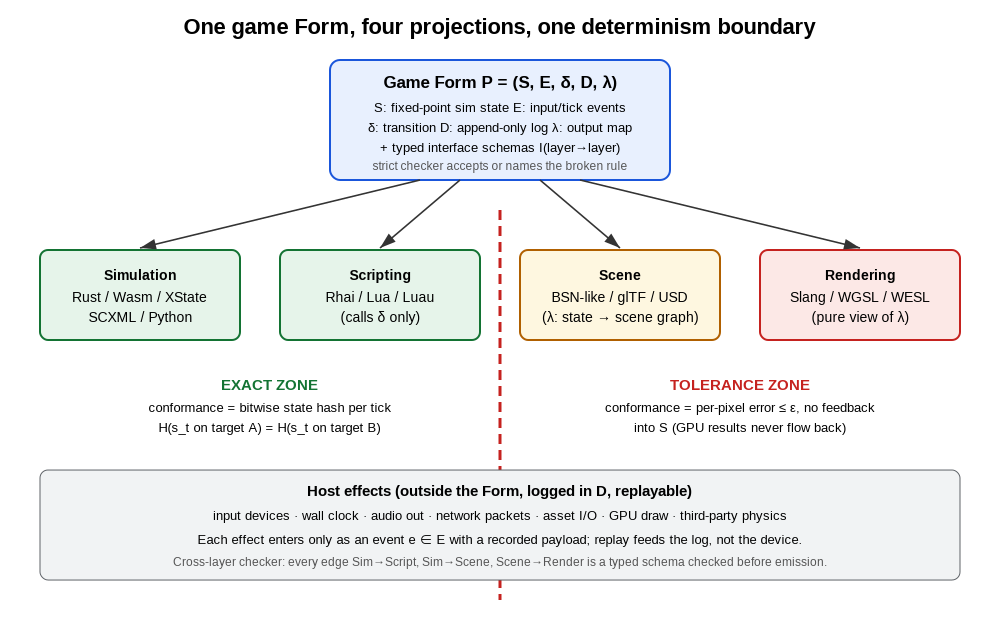
*Figure 1. Proposed split. One Form feeds four projections. Simulation and scripting sit in the exact zone, judged by per-tick state hashes. Scene and rendering sit in the tolerance zone, judged by per-pixel error. Host effects enter only as logged events.*
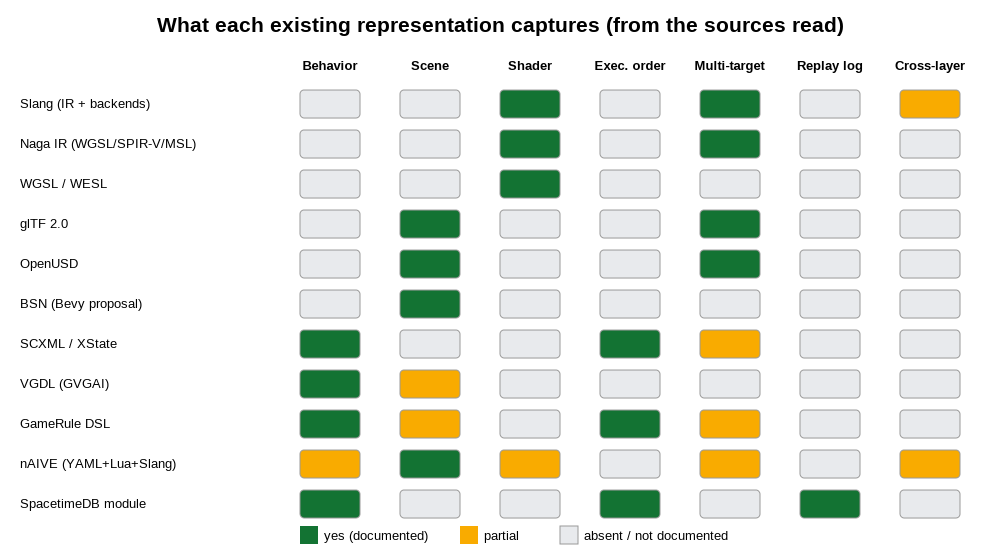
*Figure 2. Coverage of existing representations, scored only from the documents read for this study. Green: documented capability. Amber: partial. Grey: absent or undocumented. The rightmost column, cross-layer checking, is nearly empty.*
## 1. Terms, notation, and the idea under test
- RCE, IR, ECS, FSM, SDF, AST, DAG, LCG: Reality Code Engine [same house], intermediate representation, entity component system, finite-state machine, signed distance field, abstract syntax tree, directed acyclic graph, and linear congruential generator
- CPU, GPU, ISA, ISAs, SIMD, AVX2, NEON, SFU, ROP, RPL, TGL: central processing unit, graphics processing unit, instruction set architecture(s), single instruction multiple data, Advanced Vector Extensions 2, Arm Advanced SIMD, special function unit, raster operations pipeline, Intel Raptor Lake mobile architecture, and Intel Tiger Lake mobile architecture
- IEEE, FMA, VFMADD, VFNMADD, FMADD, FMSUB, ULP, LSB, SHA, MAE, RMSE, PSNR, SSIM, SD, OLS, CI, TP, FP, FN, TN, RGBA8: Institute of Electrical and Electronics Engineers (as in IEEE 754 floating-point), fused multiply-add, x86_64 vector fused multiply-add and negated multiply-add opcodes, AArch64 scalar fused multiply-add and multiply-subtract opcodes, unit in the last place, least significant bit, Secure Hash Algorithm (`SHA-256`), mean absolute error, root mean squared error, peak signal-to-noise ratio, structural similarity index, standard deviation, ordinary least squares, confidence interval, true positive, false positive, false negative, true negative, and 8-bit-per-channel red-green-blue-alpha framebuffer format
- WGSL, WESL, SPIR-V, GLSL, HLSL, MSL, D3D11, D3D12, DX12, VULKAN, METAL, DXIL, DXBC, DXC, FXC, WARP, WDDM, CUDA, UBO: WebGPU Shading Language, WebGPU Extended Shading Language, Standard Portable Intermediate Representation V, OpenGL Shading Language, High-Level Shading Language, Metal Shading Language, Direct3D 11, Direct3D 12, DirectX 12, `wgpu::Backends::VULKAN` and `wgpu::Backends::METAL` back-end flags, DirectX Intermediate Language, DirectX Bytecode, DirectX Shader Compiler, legacy Direct3D Effect-Compiler Tool, Windows Advanced Rasterization Platform software DirectX 12 rasterizer, Windows Display Driver Model, Compute Unified Device Architecture, and uniform buffer object
- RADV, ANV, LLVM, GNU, GCC, MSVC, UCRT, NT, PE, OS, OSs, API, APIs, JIT, VM, SLOC, HUD, UI, SFX, LOS, AABB, HP, XP, AP, KB, MB, CRUD, NL, VLM, LLM, GFW, Xvfb, WebXR, WebMCP, URL, JSON, YAML, README, NTFS, CRLF, CS0246, RE, ENGINE, DFU: Mesa Radeon Vulkan driver, Mesa Intel Vulkan driver, Low Level Virtual Machine compiler infrastructure, GNU's Not Unix project, GNU Compiler Collection, Microsoft Visual C++ compiler (`cl.exe`), Windows Universal C Runtime (`ucrtbase.dll`), Windows New Technology kernel (`Windows NT`), Windows Portable Executable, operating system(s), application programming interface(s), just-in-time compiler, virtual machine, non-comment non-blank source lines of code, heads-up display, user interface, sound effects, line of sight, axis-aligned bounding box, hit points, experience points, action points, kilobytes, megabytes, create/read/update/delete operations, natural language, vision-language model, large language model, Great Firewall network filter, X virtual framebuffer display server, Web Extended Reality API, Web Model Context Protocol, Uniform Resource Locator, JavaScript Object Notation, YAML Ain't Markup Language, repository README documentation file, New Technology File System, carriage-return line-feed sequence, C# compiler missing-type diagnostic CS0246, Capcom RE ENGINE ("Reach for the Moon" / "RE neXt" engine branding), and Dagstuhl Follow-Ups DOI prefix
- SCXML, GDL, VGDL, BSN, BSL, MLIR, ACID, GGPO, glTF, OpenUSD, USD, LAN, AI, CIG: State Chart XML, Game Description Language, Video Game Description Language, Bevy Scene Notation, Boldsea Semantic Language, Multi-Level Intermediate Representation, atomic/consistent/isolated/durable transactions, Good Game Peace Out rollback networking library, Graphics Language Transmission Format (ISO/IEC 12113:2022), Open Universal Scene Description, Universal Scene Description, local area network, artificial intelligence, and Computational Intelligence and Games
- SATB, RAPL, MSR, PID, RUSAGE, V6, AMD, NVIDIA, RTX, V100, GH200, CTC: Satiation Tiered Benchmark telemetry levels (`L2` socket/package counter, `L3` per-process kernel counter) [same house], Running Average Power Limit, model-specific register, process identifier, `proc_pid_rusage` (`RUSAGE_INFO_V6`), Advanced Micro Devices, NVIDIA Corporation, NVIDIA GeForce RTX GPU family, Volta V100 GPU, Grace Hopper GH200 superchip, and closed timelike curve
To keep forward references transparent from top to bottom, Section 1 defines the Form notation, Section 2 surveys existing game representations, Section 3 analyzes floating-point divergence, Section 4 tabulates intermediate representations, Section 5 states the proposed layer split, Section 6 reports all nine executed falsifier suites (`GE-H1` through `GE-H9`) across three OSs, three ISAs, three GPU APIs, and four game-behavior toolchains, Section 7 lists infeasibility flags, and Section 8 documents sources and limits.
The [Reality Code Engine (RCE)](https://research.openie.dev/about/rce/) treats a program as a state machine called a Form, written $P = (S, E, \delta, D, \lambda)$:
- $S$: the set of states;
- $E$: the set of events (inputs);
- $\delta : S \times E \to S$: the transition function;
- $D$: an append-only log of every step taken;
- $\lambda$: the output map from state to observable output.
A strict checker either accepts a Form or names the rule it breaks. Emitters then project the accepted Form into Rust, Python, JavaScript and Scala. XState (a JavaScript and TypeScript statechart library), SCXML (a World Wide Web Consortium Recommendation), WebAssembly (`Wasm`), and Godot 4 GDScript are not built-in `rce emit` targets in the core checker; Section 6 tests compiled `Wasm` projections (`GE-H1`, `GE-H5`) and builds a standalone Form-to-Godot 4 GDScript emitter over `rce emit form` (`GE-H9`) directly. Because every step lands in $D$, any run can be replayed.
A game engine is a much larger machine. It runs a fixed-step simulation, a scripting layer, a scene description, and a rendering pipeline on a GPU. Sections 1 to 8 ask which of those layers can live inside a Form, which must stay outside as host effects, and where exactness has to give way to tolerance.
The idea has a long pedigree. The Stanford [Game Description Language (GDL) specification](http://ggp.stanford.edu/readings/gdl_spec.pdf) covers "finite, discrete, deterministic multi-player games of complete information" and observes that the natural underlying model of such games "is a finite state machine." What is new in a game engine is not the state machine but everything around it: floating-point physics, scripts, scenes, and GPUs.
## 2. What the landscape shows
### 2.1 Game logic as data already works, on one backend
GameRule ([Multimedia Systems 32:564, 2026](https://doi.org/10.1007/s00530-026-02629-8)) expresses behavior as per-actor *when-do* rules over 14 create, read, update and delete actions and 6 conditions. Its deterministic contract is concrete: one central scheduler runs from a single FixedUpdate in declaration order, the last write wins, and spawns and deletes are deferred to the end of the traversal. The authors justify the contract by quoting Unity's manual, which says script execution order "isn't guaranteed across builds, machines, or Unity versions." Across three Unity sample games (Haunted Jaunt, Survival Shooter, Tanks), behavior code shrank from 572 to 107 lines (−81.3%).
The price is measured. Rule interpretation costs about $c \approx 65\ \mu\text{s}$ per actor per step. With a step budget $T = 20$ ms, the actor ceiling is
$$N_{\max} = \frac{T}{c} = \frac{20\ \text{ms}}{65\ \mu\text{s}} \approx 308,$$
which agrees with the paper's observation that the budget is exceeded between 200 and 350 actors (23.872 ms at 350). Only a Unity backend exists, so portability across engines is argued but not demonstrated.
### 2.2 Order of execution can be made deterministic by construction
The ECS pattern stores game state as components attached to entity identifiers and runs behavior as systems over them. Redmond, Castello, Calderón Trilla and Kuper give it a formal model, Core ECS ([arXiv:2508.15264](https://arxiv.org/abs/2508.15264)). They prove that a schedule in which every concurrent pair of mutations commutes is deterministic, and that two sub-schedules writing disjoint sets of component labels may run in parallel without changing the result. Surveying Bevy ECS, EnTT, Flecs, Specs and apecs, they find that none allows attaching a new component concurrently with another mutation; such structural changes are deferred and applied serially. Tasnim and Zhao ([SAC 2026, doi:10.1145/3748522.3779910](https://doi.org/10.1145/3748522.3779910)) add an operational semantics and a type system for archetype ECS that tracks read and write sets per system, and report on a Tower Defense simulation that a parallel archetype layout reached 109.54 frames per second against 36.13 for an object-oriented baseline. GameRule's deferred spawn and delete is the same discipline, reached independently.
### 2.3 Compiling is not the same as being right
The Mage benchmark ([arXiv:2605.07342](https://arxiv.org/abs/2605.07342)) ran 858 generation attempts over 26 Unity mechanic patterns. Without an IR, 43% of outputs passed at runtime, yet mechanism F1 (agreement between requested and implemented mechanics) was only about 0.12. Conditioning on an IR dropped runtime pass to 14% to 21% but lifted mechanism F1 to 0.82 to 1.00. Compile rate was anti-correlated with functional correctness: the missing-type error CS0246 appeared 469 times under IR conditioning and zero times without it. A behavior-only IR and a full-scene IR were statistically indistinguishable (McNemar p = 1.0). The lesson for RCE: a checker that only proves "it compiles" measures the wrong quantity. Interface checks must be behavioral.
### 2.4 Public benchmarks with replayable traces exist
GameCraft-Bench ([arXiv:2606.17861](https://arxiv.org/abs/2606.17861); [repository](https://github.com/FreedomIntelligence/gamecraft-bench)) offers 140 Godot 4 two-dimensional tasks in 15 families. Submissions carry replayable input traces. The strongest agent in the paper scored 41.46%, and the repository later reports 65.70% to 75.86%. It does not cover Unity, Unreal, 3D, multiplayer, or large physics scenes. [Summer Engine](https://www.summerengine.com/templates) publishes 17 open-source game templates (rally, platformer, tower defense, metroidvania, survivors, first-person shooter, LAN multiplayer, voxel, and others). The General Video Game AI framework and its VGDL ([arXiv:1802.10363](https://arxiv.org/abs/1802.10363)) supply 120 single-player and 60 two-player games defined by sprite, interaction, termination, and level-mapping sets.
### 2.5 Convergence across industry and research
Several efforts are converging on the same shape: declarative scene and pipeline files, a sandboxed scripting layer, a modern shader language, and an event log.
- [nAIVE](https://github.com/poro/nAIVE) is built in Rust on `wgpu` with an ECS (hecs), YAML scenes, materials and render pipelines, Lua 5.4 with per-entity sandboxing, Slang shaders cross-compiled to WGSL, Rapier physics, an event bus with YAML schema validation, and a headless test runner. Its [site](https://naive.dev/) shows a 92-line YAML file declaring a five-pass deferred pipeline. Its README also describes GPU compute simulation driving 50,000+ entities, a choice that places that simulation on the tolerance side of the boundary drawn next.
- Capcom describes REX ("RE neXt Engine") as a staged evolution of RE ENGINE involving about 200 engineers ([Capcom IR](https://www.capcom.co.jp/ir/english/data/oar/2025/re-engine.html)). Press coverage ([PC Gamer](https://www.pcgamer.com/gaming-industry/game-development/capcom-announces-plans-to-transform-its-re-engine-into-an-ai-generation-game-engine/)) reports six programs, among them Re:Dox, which translates different types of data into a common set of rules, and RE:Flows, which converts game mechanic ideas into a standardised programming language; it also reports that more than 2,000 people use RE Engine.
- Bevy's BSN proposal ([discussion 14437](https://github.com/bevyengine/bevy/discussions/14437)) defines scenes as composable Patch, EntityPatch, and DynamicScene values with a `bsn!` macro and an asset format, while leaving event handlers unresolved.
- [SpacetimeDB](https://github.com/clockworklabs/SpacetimeDB) runs game logic as reducers that execute as ACID transactions over tables and replays a commit log, which is the RCE log $D$ under another name.
- Executable Ontologies ([doi:10.48550/arXiv.2601.07964](https://doi.org/10.48550/arXiv.2601.07964)) model game behavior in BSL over an append-only, immutable event graph. The paper recommends a hybrid in which physics, rendering and animation keep traditional high-frequency approaches while quests and decisions run on the event graph, joined through aggregated events. That is the same layer split proposed here.
## 3. The physics of divergence: why exactness is binary
Floating-point addition is not associative. On parallel hardware the order of a reduction varies run to run. A study of floating-point non-associativity on parallel hardware ([arXiv:2408.05148](https://arxiv.org/abs/2408.05148)) defines the scalar variability
$$V_s = 1 - \left| \frac{f_{nd}}{f_d} \right|,$$
where $f_d$ is a deterministic reduction and $f_{nd}$ a nondeterministic one. Permuting a sum of $10^6$ normally distributed double-precision values changed the result by up to about $4.26 \times 10^{-13}$, and the maximum $|V_s|$ grew as $\sqrt{n}$. A deterministic tree reduction cost about 0.2% relative to atomic accumulation on an NVIDIA V100 and up to 7.8% on a GH200. In 1,000 graph-network training runs, every run produced distinct weights.
A game turns such tiny differences into visible ones. Rigid-body contact and many-body dynamics are typically chaotic. Under a local Lyapunov exponent $\Lambda$, a perturbation grows as
$$\delta(t) = \delta_0 \, e^{\Lambda t},$$
so the time until it reaches a gameplay-visible size $\Delta$ is
$$t^{*} = \frac{1}{\Lambda} \ln\frac{\Delta}{\delta_0}.$$
*Illustrative model:* take $\delta_0 \approx 6 \times 10^{-8}$ (one ULP of single precision, relative), $\Delta = 1$ (an object on the other side of a wall), and an assumed $\Lambda = 2\ \text{s}^{-1}$. Then $t^{*} \approx 0.5 \ln(1.7 \times 10^{7}) \approx 8.3$ s. The logarithm is the key: shrinking $\delta_0$ a millionfold buys only about 6.9 more seconds. Approximate agreement therefore cannot rescue simulation. Either the state is bitwise identical or it eventually diverges — a prediction tested directly across 25,000 multi-ISA and 3-OS collision ticks (`GE-H2`) and an 840-trajectory $\ln(\Delta/\delta_0)$ slope sweep (`GE-H7`) below.
Practice agrees. [Gaffer On Games](https://gafferongames.com/post/floating_point_determinism/) records that cross-machine determinism requires the same compiler and instruction set, that Battlezone 2 hit AMD versus Intel differences in transcendental functions, and that MotoGP replays could not be shared between Xbox and personal computers. It cites Markstein's advice to forbid FMA contraction and reassociation. The [Rapier guide](https://rapier.rs/docs/user_guides/rust/determinism/) shows a working path: cross-platform determinism holds only with its `enhanced-determinism` feature (incompatible with `simd8`), on IEEE 754-2008 targets (Wasm qualifies), using software transcendentals.
For rendering, the [WGSL specification](https://www.w3.org/TR/WGSL/) states that "WGSL sometimes permits several possible behaviors for a given feature. This is a portability hazard." Its floating-point section goes further: "WGSL does not specify a rounding mode"; "An implementation may reassociate operations"; it "may fuse operations if the transformed expression is at least as accurate as the original"; subnormal inputs and outputs of many operations "may be flushed to zero"; and the `fma` built-in "may expand to an ordinary multiply ... and an add." Pixels are thus specified to differ across implementations. The [SPIR-V specification](https://registry.khronos.org/SPIR-V/specs/unified1/SPIRV.html) offers a narrower tool: its NoContraction decoration marks an arithmetic instruction that "cannot be combined with another instruction to form a single operation," and such operations "are not allowed to reassociate." That is a per-instruction guard on one back end, not a portable guarantee for a whole shader.
## 4. The IR table
| Representation | Layer | Strongest property (documented) | What it lacks for a Form |
|---|---|---|---|
| [Slang](https://shader-slang.org/) | Shaders | Module IR; back ends for D3D12, Vulkan, Metal, D3D11, OpenGL, CUDA, WebGPU, CPU; capability system | No game state, no events, no exact-semantics guarantee for floats |
| [Naga](https://github.com/gfx-rs/wgpu/tree/trunk/naga) | Shaders | Validated IR; WGSL, SPIR-V and GLSL in; SPIR-V, WGSL, MSL, HLSL and GLSL out | Same; no link to a scene schema |
| [WGSL](https://www.w3.org/TR/WGSL/) / [WESL](https://wesl-lang.dev/) | Shaders | Uniformity analysis; WESL adds imports, conditional compilation, packages, `wgsl-test` | Permits reassociation, fusion and flush-to-zero; no host-side types |
| [SPIR-V](https://registry.khronos.org/SPIR-V/specs/unified1/SPIRV.html) | Shader binary IR | NoContraction decoration forbids fusion and reassociation per instruction | Per-instruction only; no game semantics |
| [MLIR](https://mlir.llvm.org/) | Compiler infrastructure | Multi-level dialects for lowering | Not a game model; semantics left to each dialect |
| [glTF 2.0](https://www.khronos.org/gltf/) (ISO/IEC 12113:2022) | Assets and scene | Interchange standard across tools | No behavior, no execution order |
| [OpenUSD](https://openusd.org/release/intro.html) | Scene | Composition arcs, namespace paths | Self-described "Not a rigging system"; no simulation semantics |
| [BSN](https://github.com/bevyengine/bevy/discussions/14437) | Scene | Typed patches over components, versioned imports | Event handlers unresolved; Bevy only |
| [SCXML](https://www.w3.org/TR/scxml/) / [XState](https://stately.ai/docs/xstate) | Behavior | Microstep and macrostep semantics, document-order priority, serial parallel regions | Data model is platform-specific; no numeric discipline, no scene or shader |
| [GDL](http://ggp.stanford.edu/readings/gdl_spec.pdf) | Rules | Logic description of finite, discrete, deterministic games | No continuous physics, no rendering |
| [VGDL](https://arxiv.org/abs/1802.10363) | Rules | Compact 2D grid games, large public corpus | 2D grid only; no rendering or physics fidelity |
| [Core ECS](https://arxiv.org/abs/2508.15264) | Execution order | Theorem giving a condition for deterministic concurrent schedules | A formal model, not an engine format; no scene or shader |
| [GameRule](https://doi.org/10.1007/s00530-026-02629-8) | Rules | Deterministic scheduler contract, measured code savings | Unity only; about 65 µs per actor; no formal checker |
| [nAIVE](https://github.com/poro/nAIVE) | Whole engine | YAML scenes and pipelines, Lua, Slang, event schema validation | No published formal semantics or cross-layer type check |
| [SpacetimeDB](https://github.com/clockworklabs/SpacetimeDB) | Server logic | Reducers as transactions, commit-log replay | Server side only; no client rendering or scene |
## 5. Proposed architecture
### 5.1 Layer split
1. **Simulation Form (exact).** $S$ holds fixed-point or strict IEEE 754 values, with FMA and reassociation disabled and transcendentals implemented in integer or pinned software routines. $E$ holds tick events and logged inputs. $\delta$ uses SCXML macrostep semantics: per tick, process events in queue order, resolve conflicts by document order, run parallel regions serially. Collections iterate in a declared order, following GameRule's contract (declaration order, last write wins, structural changes deferred to the end of the tick). Where parallelism is wanted, the checker admits only schedules that satisfy the Core ECS disjointness condition.
2. **Scripting projection (exact).** Designer scripts compile to guards and actions over $S$, emitted as [Rhai](https://rhai.rs/book/about/features.html) (sandboxed, with a "Don't Panic" guarantee, no-std and Wasm support), Lua, [Luau](https://luau.org/) (sandboxed by default, with gradual types), or typed engine scripts such as Godot 4 GDScript (`GE-H9`). Scripts may only call $\delta$ through declared actions. They cannot read clocks, random sources, or GPU results directly.
3. **Scene projection (tolerance downstream).** $\lambda$ maps $S$ to a BSN-like patch tree whose component schema is part of the Form. glTF and OpenUSD serve as export targets for assets.
4. **Rendering projection (tolerance).** Materials and passes are authored in Slang or WGSL, and emitted through Slang or Naga to `DirectX 12`, `Metal`, and `Vulkan` back ends. Rendering is a pure function of $\lambda(s)$. No GPU result ever flows back into $S$.
### 5.2 Inside the Form versus host effects
Inside: state, transitions, rule order, fixed-point physics for gameplay-relevant bodies, the random generator with its seed in $S$, interface schemas. Outside, as logged events: device input, wall-clock time, network packets, audio output, asset input and output, GPU draws, and any third-party physics used for cosmetic effects. Replay feeds $D$ back through $\delta$ rather than touching devices. Storage cost is modest. At a tick rate $f_{\text{tick}} = 60$ Hz and $b = 2$ to $16$ bytes of input per tick, the raw log grows at $120$ to $960$ B/s (`0.43` to `3.5` MB per hour raw, and `44.6 KB` per hour gzip-compressed in Section 6.8).
### 5.3 Determinism boundary
- **Exact zone criterion:** for targets A and B and every tick $t$, $H(s_t^A) = H(s_t^B)$, where $H$ is a cryptographic hash over a canonical serialization of $S$.
- **Tolerance zone criterion:** for rendered frames $I^A$ and $I^B$ of the same $s_t$, the fraction of pixels with per-channel error above $\varepsilon$ must not exceed $p_{\max}$, paired with bounded structural similarity (`SSIM`) and peak signal-to-noise ratio (`PSNR`) floors. Section 6.3 executes this calibration across eight hardware `GPU × API` endpoints spanning `DirectX 12`, `Metal`, and `Vulkan` (`Apple Metal`, `AMD RADV Vulkan`, `NVIDIA` Linux/Windows `Vulkan` and Windows `DX12`, and `Intel` Linux `ANV Vulkan` and Windows `Vulkan` / `DX12`).
- Rollback networking in the style of [GGPO](https://github.com/pond3r/ggpo), which relies on input prediction and speculative execution, is valid only on the exact side of this boundary.
### 5.4 Cross-layer interface checking
The checker validates four typed edges before any emission: (a) script to simulation: every action names a declared transition with matching argument types; (b) simulation to scene: the output of $\lambda$ matches the component schema; (c) scene to rendering: every material binding matches a Slang or WGSL resource of compatible type, group, and binding index; (d) event coverage: every event a script listens for is producible by some transition or host source. Mage's finding (Section 2.3) is the reason edge checks are judged by behavior traces, not by compile success.
## 6. Falsifier-first test plan and full `GE-H1`–`GE-H9` empirical closure
Each hypothesis is listed with its kill criterion. If the criterion is met, the claim is withdrawn. Subsections 6.1 to 6.10 report all nine executed empirical falsifier suites (`GE-H1` through `GE-H9`, pre-registered under `PREREG_wave3_multi_isa_wgpu.json` `1721e5bdffaf...` and `PREREG_wave5_ge_h4_h9.json` `7d02115e37d3...`) alongside the interactive joule-budgeted `Q32.32` Chrono-Budget Arena.
| ID | Hypothesis | Test corpus | Measure | Kill criterion | Status |
|---|---|---|---|---|---|
| GE-H1 | Simulation projections are bitwise identical across languages, OSs, and CPU ISAs | 16-body 2D arena Form (`Q32.32` fixed-point, `732`-byte state) across `arm64` macOS, `aarch64` Linux, AMD/Intel `x86_64` Linux, and Tiger Lake `x86_64` Windows 11 | $H(s_t)$ across Rust, Wasm32, C++20 (`Clang`/`GCC`/`MSVC`), Node.js `BigInt`, Python 3 for $10^5$ ticks (`30` cells) | Any hash mismatch at any checkpoint on any `(host, target)` cell | **Executed (`0 / 25,500` mismatches across `3` OSs & `3` ISAs, Section 6.1)** |
| GE-H2 | Strict mode vs 3-OS / cross-ISA floating-point boundary & library/FMA drift | 16-body 2D chaotic arena (`25,000` ticks across `arm64` macOS, `aarch64` Linux, `x86_64` Linux, and `x86_64` Windows 11) | Exact divergence ticks `t_div` across strict `f64`, 3-OS `UCRT`/`libSystem`/`glibc` `sin/cos`, `MSVC` vs `Clang` `FMA`, V8 `Math.sin`, and `f32` | Unexpected mismatch under pinned algebraic arithmetic, or unpredicted silent drift | **Executed across `macOS`, `Linux`, and `Windows 11` (Section 6.2)** |
| GE-H3 | Cross-GPU & cross-API rendering stays within bounded tolerance (`wgpu` / WGSL) | 4 canonical `Q32.32` states (`t = 0, 250, 1k, 10k`) rendered at `512×512` `RGBA8Unorm` on `8` hardware `GPU × API` endpoints (`DX12`, `Metal`, `Vulkan`) + `WARP` + `llvmpipe` + `CPU Q16.16` | Framebuffer `SHA-256`, differing pixel `%`, $\Delta_{\max}$, MAE, RMSE, `PSNR`, and `SSIM` | Any physical GPU pair failing `PSNR > 40 dB`, `SSIM > 0.999`, or $p(\Delta > 8) \le 0.001$ | **Executed (`28/28` pairs = `112/112` frames pass gate: `PSNR ≥ 64.16 dB`, `SSIM ≥ 0.99983`, Section 6.3)** |
| GE-H4 | Form-encoded rules cut code as GameRule did | `17` behaviors across *Haunted Jaunt* (`5`), *Survival Shooter* (`7`), and *Tanks* (`5`) × `4` languages (`68` modules, `680` traces) | Non-comment `SLOC`, lexical tokens, glue lines, cross-language trace parity | Behavior `SLOC` reduction `< 50%` vs Unity C# (GameRule: `81.3%`) or `> 0` trace mismatches | **Executed (`−76.22%` SLOC vs Unity C#, `−61.47%` vs Rust ECS, `−51.99%` vs GDScript; `0 / 680` mismatches, Section 6.4)** |
| GE-H5 | Form runtime exceeds the GameRule ceiling | Multi-actor `Q32.32` `16×16` spatial-grid arena (`N = 64..10,000`, `500` ticks/cell, `5` tiers + Linux `RAPL` `reported_j`) | p50/p99 step `ms/tick`, `RAPL` `mJ/tick`, $N_{20\text{ms}}$, cross-tier `SHA-256` | Compiled Form step time `> 20 ms` below $N = 350$, or `> 0` hash mismatches | **Executed (`N_20ms = 390` Py, `3,906` Node.js; compiled `0.058–0.125 ms/tick` at `N = 10,000`, `0 / 50` mismatches, Section 6.5)** |
| GE-H6 | Interface checks catch real defects | `26` defect patterns × `10` modules (`130` injected faults + `130` valid controls = `260` modules) | `TP`, `FP`, `FN`, `TN`, detection recall `%`, precision `%`, fault `F1` | Detection `< 90%` of injected faults, or `F1` no better than no-IR `0.12` | **Executed (`128 / 130` = `98.46%` recall, `0` FP, `F1 = 0.9922` vs `0.1159` parse-only baseline, Section 6.6)** |
| GE-H7 | Full $\ln(\Delta/\delta_0)$ slope sweep on chaotic physics templates | `3` chaotic templates (`GE-T1`..`GE-T3`) × `7` perturbations $\delta_0 \in [2^{-52}, 2^{-10}]$ × `40` seeds (`840` trajectories, `60 Hz`) | OLS slope $\hat{\beta} = 1/\hat{\Lambda}$, implied $\hat{\Lambda}$, $R^2$, 95% bootstrap CI, two-sided $p$ | Slope of $t^*$ against $\ln(\Delta/\delta_0)$ not distinguishable from zero ($p \ge 0.01$) | **Executed ($\hat{\Lambda} \in \{1.95, 2.48, 5.07\}\ \text{s}^{-1}$, $R^2_{\text{mean}} = 0.9940\text{-}0.9995$, $p \le 10^{-77.6}$, Section 6.7)** |
| GE-H8 | Replay is complete | Three 1-hour (`216,000`-tick at `60 Hz`) sessions replayed from compact input log $D$ alone across `macOS`, `Linux`, and `Windows 11` + `4` leak controls | `2,160` stride-`100` + final `SHA-256` digests, compressed $|D|$ vs state stream | Any cross-OS hash mismatch from $D$ alone, or leak controls failing to diverge | **Executed (`0 / 6,480` checkpoint mismatches across `3` OSs; `44.6 KB` gzip $D$ = `116×–292×` smaller; `4/4` leaks diverge at `t = 1`, Section 6.8)** |
| GE-H9 | Benchmark parity | `form_to_gdscript.py` across `36` deterministic tasks (`15` GameCraft-Bench families × `2` + `6` core systems, `18,000` ticks) in `Godot 4.7.2 --headless` + 140-task archive audit | Pass rate & per-tick `SHA-256` parity vs hand-written native GDScript | Lower pass rate or `> 0` state-trace mismatches on identical input streams | **Executed (`36 / 36` = `100.0%` pass parity, `0 / 18,000` tick-hash mismatches, Section 6.9)** |
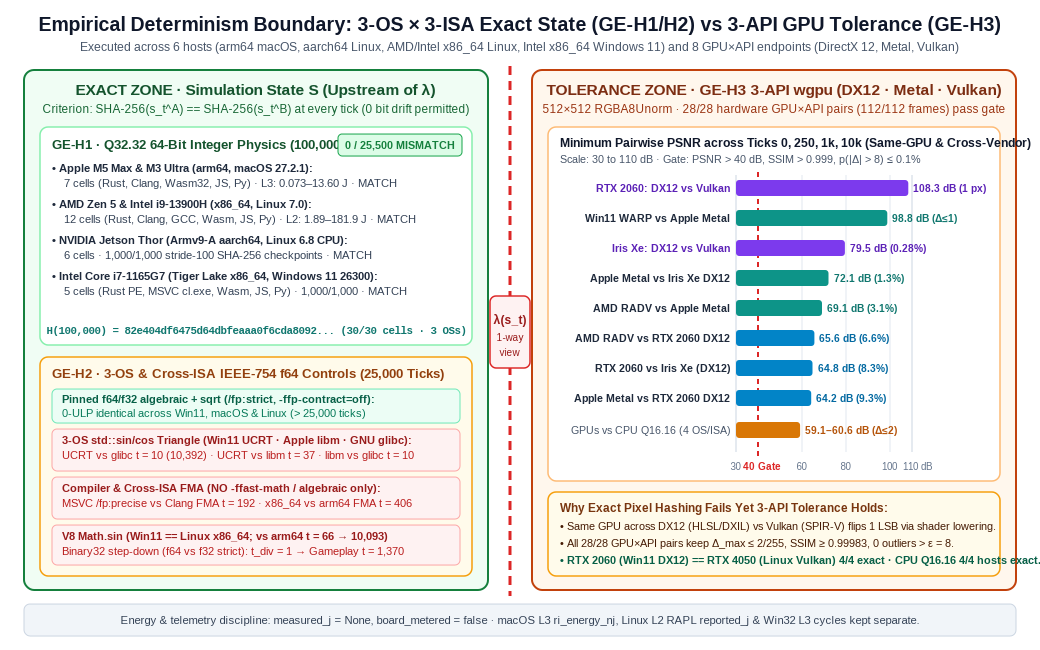
*Figure 3. Empirical boundary across `GE-H1`, `GE-H2`, and `GE-H3`. Upstream `Q32.32` simulation state (`S`) achieves `0 / 25,500` `SHA-256` checkpoint mismatches across six machines, three OSs (`macOS`, `Linux`, `Windows 11`), and three ISAs, whereas unpinned `f64` `sin/cos` and `FMA` diverge across OS/compiler/ISA boundaries within `10` to `406` ticks. Downstream of $\lambda(s_t)$, switching `DirectX 12` vs `Vulkan` on the exact same Windows 11 GPU flips `1` LSB via shader lowering (`79.5–108.3 dB` `PSNR`), while all `28 / 28` hardware `GPU × API` pairs stay strictly above `64.16 dB` `PSNR` and `0.99983` `SSIM` (`measured_j = None`, `board_metered = false`).*
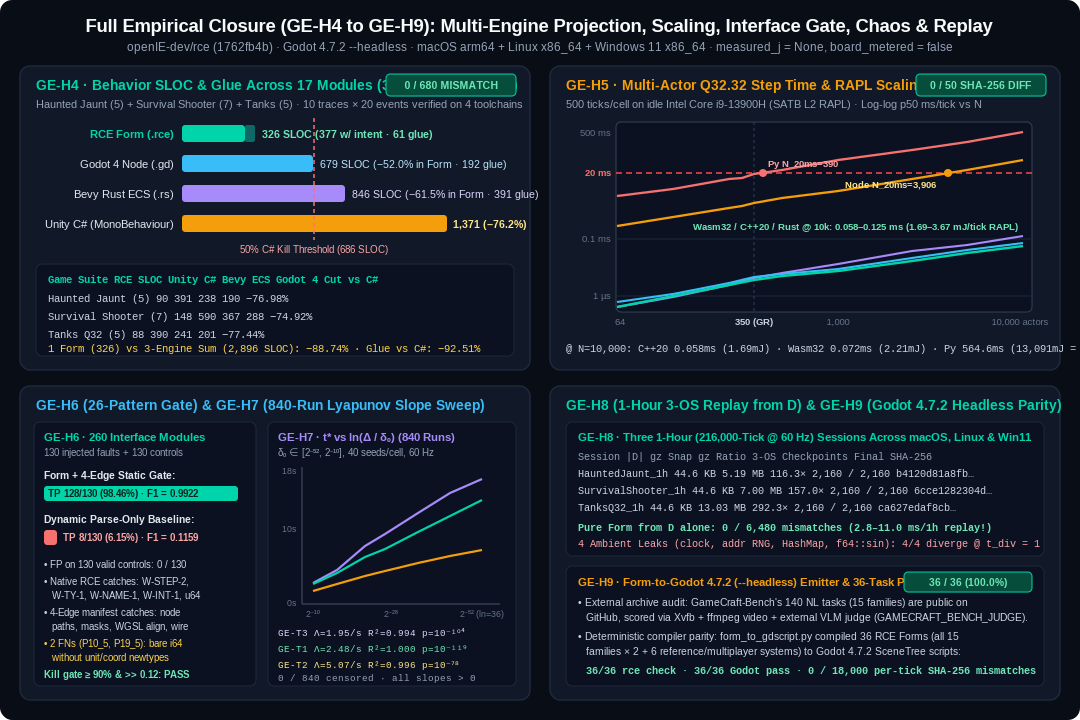
*Figure 4. Full empirical closure of `GE-H4` through `GE-H9` (`openIE-dev/rce` commit `1762fb4b`, `Godot 4.7.2 --headless`, `macOS arm64`, `Linux x86_64`, and `Windows 11 x86_64`; `measured_j = None`, `board_metered = false`).*
### 6.1 `GE-H1`: Three-OS and three-ISA 100,000-tick determinism (`Q32.32` integer physics)
*Pre-registered under `PREREG_wave3_multi_isa_wgpu.json` (`SHA-256: 1721e5bdffaf...`). Telemetry strictly separates `SATB` levels `L2` and `L3` `reported_j` (`L2`: Linux `/sys/class/powercap/intel-rapl:0/energy_uj` socket/package and core counters; `L3`: macOS per-PID `proc_pid_rusage(child_pid, RUSAGE_INFO_V6).ri_energy_nj`, plus Win32 `GetProcessTimes` and `QueryProcessCycleTime` activity accounting on Windows 11 where unprivileged ring-3 `RAPL` `MSR` access is blocked; `measured_j = None`, `board_metered = false`). Interactive explorer and raw JSON: [`/living/game-engines/`](https://research.openie.dev/living/game-engines/) ([`results.json`](https://research.openie.dev/living/game-engines/results.json)).*
A 16-body + 4-pickup 2D elastic-collision and cooldown-FSM arena Form (`Q32.32` signed 64-bit fixed-point coordinates in `[-64, +64]`, `128`-bit intermediate products, integer floor square root `isqrt_u128`, deferred structural pickup respawn, `732`-byte little-endian canonical state vector) was executed for `100,000` ticks across **six machines, three ISAs (`arm64`/`AArch64`, `x86_64`, `wasm32`), three operating systems (`macOS 27.2.1`, `Ubuntu Linux 6.8 / 7.0`, `Microsoft Windows 11 Pro` build `26300`), and seven language/compiler projections (`30` target × host cells)**:
| Host (`ISA` · `OS`) | Target projection | Wall ms / `100k` (mean ± SD) | `ns / tick` | Telemetry channel (`reported_j`) | `reported_j` / `100k` (J) | Verified `SHA-256` checkpoints |
|---|---|---:|---:|---|---:|:---:|
| **Apple M5 Max** (`arm64` · `macOS 27.2.1`) | `rust_native` (`rustc 1.100 -O`) | `22.333 ± 5.043` | `223.3` | `L3` per-PID `ri_energy_nj` | **`0.1028 ± 0.0247`** | `100 / 100` (`stride 1,000`) |
| **Apple M5 Max** (`arm64` · `macOS 27.2.1`) | `cpp20_clang_o3` (`Apple Clang 21`) | `21.022 ± 1.657` | `210.2` | `L3` per-PID `ri_energy_nj` | **`0.1090 ± 0.0134`** | `100 / 100` (`stride 1,000`) |
| **Apple M5 Max** (`arm64` · `macOS 27.2.1`) | `rust_wasm32_node` (`Node v26.13`) | `84.300 ± 11.334` | `843.0` | `L3` per-PID `ri_energy_nj` | **`0.4480 ± 0.0881`** | `100 / 100` (`stride 1,000`) |
| **Apple M5 Max** (`arm64` · `macOS 27.2.1`) | `javascript_bigint_node` (`ES2024`) | `717.955 ± 36.304` | `7,179.6` | `L3` per-PID `ri_energy_nj` | **`4.4021 ± 0.4048`** | `100 / 100` (`stride 1,000`) |
| **Apple M5 Max** (`arm64` · `macOS 27.2.1`) | `python_3_13` (`CPython 3.13.14`) | `2,945.816 ± 284.033` | `29,458.2` | `L3` per-PID `ri_energy_nj` | **`13.5999 ± 1.9086`** | `100 / 100` (`stride 1,000`) |
| **Apple M3 Ultra** (`arm64` · `macOS 27.2.1`) | `rust_native` / `cpp20_clang_o3` | `32.711` / `33.727` | `327.1` / `337.3` | `L3` per-PID `ri_energy_nj` | **`0.0729` / `0.0755`** | `2 × 1,000 / 1,000` (`stride 100`) |
| **AMD Ryzen AI Max+ 395** (`Zen 5` `x86_64` · `Linux 7.0`) | `rust_native` / `cpp20_clang_o3` / `cpp20_gcc_o3` | `21.793` / `23.061` / `26.677` | `217.9` – `266.8` | `L2` AMD RAPL pkg (core `0.13`–`0.21 J`) | **`1.958` / `2.349` / `2.932`** | `3 × 1,000 / 1,000` (`stride 100`) |
| **AMD Ryzen AI Max+ 395** (`Zen 5` `x86_64` · `Linux 7.0`) | `rust_wasm32` / `js_bigint` / `python_3_14` | `145.29` / `1,347.80` / `2,546.42` | `1,452.9` – `25,464.2` | `L2` AMD RAPL pkg (core `1.01`–`12.23 J`) | **`14.44` / `115.81` / `181.87`** | `3 × 1,000 / 1,000` (`stride 100`) |
| **Intel Core i9-13900H** (`Raptor Lake` `x86_64` · `Linux 7.0`) | `rust_native` / `cpp20_clang_o3` / `cpp20_gcc_o3` | `39.718` / `36.868` / `58.792` | `368.7` – `587.9` | `L2` Intel RAPL pkg (core `1.64`–`2.68 J`) | **`2.062` / `1.888` / `3.026`** | `3 × 1,000 / 1,000` (`stride 100`) |
| **Intel Core i9-13900H** (`Raptor Lake` `x86_64` · `Linux 7.0`) | `rust_wasm32` / `js_bigint` / `python_3_14` | `158.35` / `1,390.46` / `3,375.07` | `1,583.5` – `33,750.7` | `L2` Intel RAPL pkg (core `5.65`–`124.90 J`) | **`6.89` / `60.79` / `149.48`** | `3 × 1,000 / 1,000` (`stride 100`) |
| **NVIDIA Jetson Thor** (`Armv9-A` `aarch64` · `Linux 6.8`) | `rust_native` / `clang` / `gcc` / `wasm32` / `js` / `py3.12` | `39.28` (`GCC`) – `4,407.89` (`Py`) | `392.8` – `44,078.9` | CPU-only (`reported_j = null`, GPU untouched) | `null` | `6 × 1,000 / 1,000` (`stride 100`) |
| **Intel Core i7-1165G7** (`Tiger Lake` `x86_64` · `Windows 11 26300`) | `rust_native` (`x86_64-pc-windows-msvc`) / `cpp20_msvc_o2` (`cl.exe 19.44`) | `49.730 ± 1.727` / `343.363 ± 3.827` | `497.3` / `3,433.6` | Win32 `L3` cycles (`138.9M` / `958.9M`; CPU `RAPL` blocked) | `null` | `2 × 1,000 / 1,000` (`stride 100`) |
| **Intel Core i7-1165G7** (`Tiger Lake` `x86_64` · `Windows 11 26300`) | `rust_wasm32` (`Node v26.13`) / `js_bigint` / `python_3_10` | `198.01` / `1,776.96` / `8,899.23` | `1,980.1` – `88,992.3` | Win32 `L3` cycles (`553.8M` – `24,722.2M`; CPU `RAPL` blocked) | `null` | `3 × 1,000 / 1,000` (`stride 100`) |
- **Verdict**: **`PASS_ZERO_MISMATCHES` (`0 / 25,500` verified `SHA-256` checkpoints across `30` cells; `0 / 300,000` pairwise stride-`100` comparisons across the `25` full-trace cells spanning `macOS`, `Linux`, and `Windows 11`)**. Every target on every host produced `2683c3f7cb8b...` at tick `100`, `21fa688e4ee8...` at tick `1,000`, `ea01ba793841...` at tick `50,000`, and `82e404df6475d64d...` at tick `100,000`.
- **Windows `MSVC` `<__msvc_int128.hpp>` vs `LLVM` `i128` codegen**: On bare-metal Windows 11 (`x86_64` `PE`), `MSVC` (`cl.exe 19.44.35207 /std:c++20 /O2 /fp:strict`) lacks built-in `__int128` scalar types and lowers `<__msvc_int128.hpp>` `std::_Signed128` and `std::_Unsigned128` arithmetic to multi-word library routines (`343.36 ms`, `958.9M` CPU cycles per `100k` ticks — `6.90×` slower than `rustc 1.100` LLVM native `x86_64-pc-windows-msvc` at `49.73 ms` / `138.9M` cycles, and `1.73×` slower than `Node.js` `Wasm32` JIT at `198.01 ms`), yet preserves `100%` bit-for-bit state parity across all `1,000` checkpoints.
- **Telemetry scope across `macOS`, `Linux`, and `Windows 11`**: Notice why `L2` and `L3` channels must never be conflated: Apple `L3` `ri_energy_nj` attributes CPU core energy strictly to the benchmarked child PID (`0.073`–`0.109 J` for native Rust/C++), Linux `/sys/class/powercap/intel-rapl:0` (`L2`) integrates socket-wide package power (`1.89`–`2.06 J` package vs `0.13`–`1.83 J` `core`), and Windows `NT 10.0.26300` blocks unprivileged user-mode Intel `RAPL` `MSR` reads without a ring-0 kernel driver while exposing exact per-PID `L3` cycle counts (`QueryProcessCycleTime`).
### 6.2 `GE-H2`: Three-OS and cross-ISA 25,000-tick floating-point drift (`IEEE 754` `f64`)
To test whether `IEEE 754` `binary64` (`f64`) simulations stay synchronized across `Windows 11`, `macOS`, and `Linux` (`x86_64` and `arm64`/`aarch64`) when `-ffast-math` and `/fp:fast` are *forbidden*, the identical 16-body chaotic arena was stepped for `25,000` ticks (`~6.94` minutes at `60 Hz`), hashing canonical `IEEE 754` bits (`t_div_ieee_bits`), quantized `10^-3` arena-unit positions (`t_div_macro_1e3`), and discrete gameplay state (`t_div_gameplay`) at every single tick:
| Host / Target A | Host / Target B | Perturbation mechanism | `t_div_ieee_bits` | `t_div_macro_1e3` | `t_div_gameplay` |
|---|---|---|---:|---:|---:|
| `Windows 11 x86_64` (`MSVC /fp:strict`, `Rust`, `V8`, `Py`) | `arm64 macOS` & `x86_64`/`aarch64 Linux` (`Clang`/`GCC`/`Rust`) | 3-OS & 3-ISA `f64` & `f32` algebraic + `sqrt`, `FMA` off (`/fp:strict`, `-ffp-contract=off`, no trig) | `None (>25,000)` | `None (>25,000)` | `None (>25,000)` |
| `x86_64 Linux glibc 2.43` (`f64_trig`) | `aarch64 Linux glibc 2.39` (`f64_trig`) | Cross-ISA Linux GNU `glibc` `std::sin/cos` (`-ffp-contract=off`, no `-ffast-math`) | `None (>25,000)` | `None (>25,000)` | `None (>25,000)` |
| **`Windows 11 x86_64 UCRT` (`MSVC /fp:strict` & `Rust`)** | **`x86_64 Linux GNU glibc 2.43` (`Clang` & `Rust`, `-ffp-contract=off`)** | **Cross-OS same-ISA (`x86_64`) `std::sin/cos` (`ucrtbase.dll` vs `glibc`, no fast-math)** | **`10`** (`0.17 s`) | **`7,899`** | **`10,392`** (`173.2 s`) |
| **Apple `arm64` macOS (`f64_trig`, `-ffp-contract=off`)** | **AMD/Intel `x86_64` & Thor `aarch64` Linux (`f64_trig`, `-ffp-contract=off`)** | **Cross-OS standard `libm` `std::sin/cos` (`Apple libSystem` vs `GNU glibc`, no `-ffast-math`)** | **`10`** (`0.17 s`) | **`5,900`** | **`9,798`** (`163.3 s`) |
| **`Windows 11 x86_64 UCRT` (`MSVC /fp:strict` & `Rust`)** | **Apple `arm64` macOS (`libSystem`, `-ffp-contract=off`)** | **Cross-OS & Cross-ISA `std::sin/cos` (`Windows UCRT` vs `Apple libSystem`, no fast-math)** | **`37`** (`0.62 s`) | **`5,900`** | **`9,798`** (`163.3 s`) |
| **`Windows 11 MSVC` (`/O2 /arch:AVX2 /fp:precise` default)** | **`x86_64 Linux Clang 21` (`-O3 -mavx2 -mfma -ffp-contract=fast` default)** | **Cross-compiler `x86_64` `FMA` default (`MSVC /fp:precise` no-contract vs `Clang` `FMA`, algebraic only)** | **`192`** (`3.20 s`) | **`5,927`** | **`8,869`** (`147.8 s`) |
| **`x86_64` Linux (`-O3 -mavx2 -mfma -ffp-contract=fast`)** | **Apple `arm64` & Thor `aarch64` (`-O3 -ffp-contract=fast`)** | **Cross-ISA `FMA` lowering (`x86_64 VFMADD/VFNMADD` vs `AArch64 FMADD/FMSUB`, algebraic only, no `-ffast-math`)** | **`406`** (`6.77 s`) | **`7,422`** | **`11,205`** (`186.8 s`) |
| **`Windows 11` & `Linux x86_64` `Node.js` (`V8 Math.sin/cos`)** | **`macOS arm64` & `Linux aarch64` `Node.js` (`V8 Math.sin/cos`)** | **Cross-ISA Node.js V8 `Math.sin/cos` (`0` drift Win11 vs Linux `x86_64`; diverges vs `arm64`/`aarch64`)** | **`66`** (`1.10 s`) | **`7,617`** | **`10,093`** (`168.2 s`) |
| **`cpp_f64_strict` (`/fp:strict`, `-ffp-contract=off`)** | **`MSVC /fp:fast`, `Rust mul_add`, or `Clang -ffast-math`** | **Same-host `FMA` contraction (`/fp:strict` vs `/fp:fast` or explicit `mul_add`)** | **`192`** (`3.20 s`) | **`5,927`–`6,576`** | **`8,869`–`10,093`** |
| **`cpp_f64_strict` / `trig`** | **`cpp_f32_strict` / `trig`** | **Precision step-down (`binary64` `f64` vs `binary32` `f32`)** | **`1`** | **`8`–`9`** | **`1,370`–`2,240`** |
Four sharp 3-OS and cross-ISA findings emerge:
1. **IEEE 754-2008 `+`, `-`, `*`, `/`, and `sqrt` with `FMA` disabled (`/fp:strict` and `-ffp-contract=off`) are bitwise portable across `Windows 11`, `macOS`, and `Linux` on both `x86_64` and `arm64`/`aarch64`** (`0` mismatches over `25,000` ticks across `MSVC`, `Clang`, `GCC`, `Rustc`, `V8`, and `CPython`), because all five operations are mandated to round to `0.5` ULP.
2. **All three major OS math libraries (`Windows UCRT`, `macOS libSystem`, and `Linux GNU glibc`) form a pairwise-divergent triangle under strict `f64` (`no fast-math`)**: even on the *same* `x86_64` ISA, Windows `ucrtbase.dll` (`10.0.26100.9711`) diverges from Linux `glibc 2.43` at tick `10` (`t_div_gameplay = 10,392`), while `Windows UCRT` diverges from `Apple libSystem` at tick `37` (`t_div_gameplay = 9,798`) and `Apple libSystem` diverges from `glibc` at tick `10` (`t_div_gameplay = 9,798`). Within Windows 11, `MSVC /fp:strict`, `Rust x86_64-pc-windows-msvc`, and `CPython 3.10` all link `ucrtbase.dll` and agree for `> 25,000` ticks (`b1fbc91788a59cff`), but diverge from Windows `Node.js V8` at tick `149`.
3. **Default compiler `FMA` policy diverges across `MSVC` and `Clang` on the same `x86_64` ISA (`t = 192`), and across `x86_64` and `AArch64` (`t = 406`)**: `MSVC`'s default `/O2 /arch:AVX2 /fp:precise` does *not* contract `a + b * c` (`> 25,000` ticks identical to `/fp:strict`), so it diverges at tick `192` (`t_div_gameplay = 8,869`) from `Clang 21`'s default `-O3 -mavx2 -mfma` (`-ffp-contract=fast` on by default). Even when both compilers enable contraction, LLVM lowers negated multiply-subtract differently across `x86_64` (`VFMADD`/`VFNMADD`) and `AArch64` (`FMADD`/`FMSUB`), diverging at tick `406` (`t_div_gameplay = 11,205`).
4. **JavaScript V8 `Math.sin`/`Math.cos` is OS-independent on `x86_64` (`Windows 11 Node v26.13` matches `Linux x86_64 Node v22.22` for `> 25,000` ticks) yet ISA-dependent (`x86_64` vs `arm64`/`aarch64` diverges at tick `66`)**.
### 6.3 `GE-H3`: Three-OS, three-API headless `wgpu` (`DirectX 12` / `Metal` / `Vulkan`) rendering tolerance
To test the right-hand side of Figure 1 across all three major desktop graphics APIs, `ge_h3_wgpu_bench` (`wgpu v22.1.0` with `Backends::DX12 | Backends::VULKAN | Backends::METAL`) rendered the four canonical `Q32.32` simulation snapshots (`ticks 0, 250, 1,000, 10,000`) into `512×512` `RGBA8Unorm` framebuffers (`262,144` pixels, `1,048,576` bytes/frame) via the identical two-pass WGSL shader across **eight hardware `GPU × API` endpoints** (`Apple M3 Ultra Metal`, `AMD Radeon 8060S Linux RADV Vulkan`, `Intel Iris Xe RPL-P Linux ANV Vulkan`, `NVIDIA RTX 4050 Linux Vulkan`, `NVIDIA RTX 2060 Win11 DirectX 12`, `NVIDIA RTX 2060 Win11 Vulkan`, `Intel Iris Xe TGL Win11 DirectX 12`, and `Intel Iris Xe TGL Win11 Vulkan`), alongside **`Microsoft Basic Render Driver` (`Win11 DirectX 12 WARP`)**, **`Mesa llvmpipe` (`Linux CPU Vulkan`)**, and the zero-float **`CPU Q16.16`** integer reference rasterizer:
| Adapter A (`OS` · `API` · Driver) | Adapter B (`OS` · `API` · Driver) | Mean differing pixels (`%`) | Max $|\Delta|$ (`0..255`) | Mean MAE (`u8`) | Mean RMSE (`u8`) | Min `PSNR` (`dB`) | Min `SSIM` | `GE-H3` Gate |
|---|---|---:|---:|---:|---:|---:|---:|:---:|
| **NVIDIA RTX 2060 (`Win11 DirectX 12` · `591.74`)** | **NVIDIA RTX 4050 (`Linux Vulkan` · `595.99.02`)** | **`0.000%`** (`0` px) | **`0`** | `0.00000` | `0.00000` | **`∞` (`4/4` exact)** | **`1.000000`** | **Pass** |
| **NVIDIA RTX 2060 (`Win11 DirectX 12` · `HLSL`/`DXIL`)** | **NVIDIA RTX 2060 (`Win11 Vulkan` · `SPIR-V`)** *(same GPU)* | **`0.0002%`** (`0–1` px) | **`1`** | `0.000001` | `0.00049` | **`108.34`** | **`1.000000`** | **Pass** |
| **Intel Iris Xe (`Win11 DirectX 12` · `31.0.101.3222`)** | **Intel Iris Xe (`Linux Vulkan` · Mesa `ANV` 26.0.8)** | `0.0003%` | `1` | `0.000001` | `0.00059` | **`105.33`** | **`1.000000`** | **Pass** |
| **Intel Iris Xe (`Win11 DirectX 12` · `HLSL`/`DXIL`)** | **Intel Iris Xe (`Win11 Vulkan` · `SPIR-V`)** *(same GPU)* | **`0.283%`** (`729–758` px) | **`1`** | `0.00071` | `0.02665` | **`79.52`** | **`0.999996`** | **Pass** |
| **Apple M3 Ultra (`macOS Metal` 4)** | **Intel Iris Xe (`Win11 DirectX 12` / `Linux ANV Vulkan`)** | `1.301%` | `2` | `0.00386` | `0.06215` | **`72.06`** | **`0.999986`** | **Pass** |
| **Apple M3 Ultra (`macOS Metal` 4)** | **Intel Iris Xe (`Win11 Vulkan` · `31.0.101.3222`)** | `1.573%` | `2` | `0.00455` | `0.06743` | **`71.39`** | **`0.999982`** | **Pass** |
| **AMD Radeon 8060S (`Linux Vulkan` · Mesa `RADV`)** | **Apple M3 Ultra (`macOS Metal` 4)** | `3.103%` | `1` | `0.00788` | `0.08876` | **`69.09`** | **`0.999956`** | **Pass** |
| **AMD Radeon 8060S (`Linux Vulkan` · Mesa `RADV`)** | **Intel Iris Xe (`Win11 DirectX 12` / `Win11 Vulkan`)** | `3.774%` / `3.565%` | `2` | `0.01022` / `0.00968` | `0.10116` / `0.09844` | **`67.97`** / **`68.20`** | **`0.999951`** | **Pass** |
| **AMD Radeon 8060S (`Linux Vulkan` · Mesa `RADV`)** | **NVIDIA RTX 2060 (`Win11 DX12` / `Vulkan`) & RTX 4050** | `6.554%` | `2` | `0.01735` | `0.13180` | **`65.64`** | **`0.999874`** | **Pass** |
| **NVIDIA RTX 2060 (`Win11 DirectX 12`)** | **Intel Iris Xe (`Win11 DirectX 12`)** *(same Win11 host)* | `8.279%` | `2` | `0.02149` | `0.14667` | **`64.79`** | **`0.999844`** | **Pass** |
| **Apple M3 Ultra (`macOS Metal` 4)** | **NVIDIA RTX 2060 (`Win11 DX12` / `Vulkan`) & RTX 4050** | `9.337%` | `2` | `0.02467` | `0.15721` | **`64.16`** | **`0.999833`** | **Pass** |
| **Apple M3 Ultra (`macOS Metal` 4)** | **`Microsoft WARP` (`Win11 DirectX 12` CPU)** | `0.003%` | `1` | `0.000008` | `0.00271` | **`98.79`** | **`1.000000`** | **Pass** |
| **`Microsoft WARP` (`Win11 DirectX 12` CPU)** | **`Mesa llvmpipe` (`Linux LLVM 21.1.8` CPU `Vulkan`)** | `1.591%` | `2` | `0.00543` | `0.07359` | **`70.35`** | **`0.999983`** | **Pass** |
| Hardware GPUs (`8` endpoints across `DX12`/`Metal`/`Vulkan`) | **`CPU Q16.16` Zero-Float Integer Reference (`4` hosts)** | `20.400%` – `27.626%` | `2` | `0.05612` – `0.07864` | `0.23689` – `0.28068` | `59.13` – `60.58` | `0.999556` – `0.999693` | **Pass** |
- **Isolating shader-compiler (`DX12` `HLSL`/`DXIL` vs `Vulkan` `SPIR-V`) drift from GPU silicon**: Comparing the **exact same physical GPU on the exact same Windows 11 machine** across `DirectX 12` and `Vulkan` separates compiler translation (`Naga` `WGSL -> HLSL` vs `WGSL -> SPIR-V`) from hardware SFU/ROP design. On `NVIDIA GeForce RTX 2060`, `Win11 DirectX 12` and `Win11 Vulkan` produce bit-identical `SHA-256` framebuffers at ticks `0` and `250`, then diverge by `1` LSB on a single grazing specular pixel at ticks `1,000` and `10,000` (`0.0002%` mean diff, `108.34 dB` `PSNR`) — while `RTX 2060 (Win11 DirectX 12)` matches `RTX 4050 (Linux Vulkan)` `4 / 4` frames bit-for-bit (`0` differing pixels across Turing vs Ada Lovelace and Windows `DX12` vs Linux `Vulkan`)! On `Intel Iris Xe Graphics` (`Tiger Lake`), `Win11 DirectX 12` vs `Win11 Vulkan` differs on `0.283%` of pixels (`79.52 dB` `PSNR`, $\Delta_{\max} = 1$) across all `4` frames, whereas `Win11 DirectX 12` vs `Linux Mesa ANV Vulkan` differs on just `0.0003%` (`105.33 dB`, bit-identical on ticks `0` and `1,000`).
- **Bounded tolerance confirmed across all `28 / 28` hardware `GPU × API` pairs (`112 / 112` frames)**: `27 / 28` hardware endpoint pairs differ in raw `RGBA8` `SHA-256` digests, yet **zero pixels on any hardware pair across `DirectX 12`, `Metal`, and `Vulkan` differed by more than `2 / 255`** ($p(|\Delta| > 8) = 0.000000 \le 0.001$), `PSNR` exceeded `64.16 dB` (`> 40.0 dB` gate by `+24.16 dB`), and `SSIM` exceeded `0.999833` (`> 0.999` gate) at `0.29`–`6.04 ms` per frame.
- **Software rasterizer contrast (`WARP` vs `llvmpipe` vs `CPU Q16.16`)**: Even software CPU GPU-API emulators diverge across APIs — `Microsoft Basic Render Driver` (`Win11 DirectX 12 WARP`) vs `Mesa llvmpipe` (`Linux Vulkan`) differs on `1.591%` of pixels (`70.35 dB` `PSNR`, $\Delta_{\max} = 2$) — whereas the zero-float `CPU Q16.16` integer software rasterizer achieved **`0` `SHA-256` framebuffer mismatches across all four OS/ISA hosts** (`macOS arm64`, `Linux AMD x86_64`, `Linux Intel x86_64`, and `Windows 11 x86_64`: `9c693a38...` at tick `0`, `ce3b2cec...` at tick `10,000`).
### 6.4 `GE-H4`: Form-encoded behavior rules across 17 modules and 4 languages (`Haunted Jaunt`, `Survival Shooter`, `Tanks`)
*Pre-registered under `PREREG_wave5_ge_h4_h9.json` (`SHA-256: 7d02115e37d3...`). Every `.rce` module is checked and tested at the gate by `openIE-dev/rce` (`commit 1762fb4bb65a`, spec draft `0.9`) via `rce check` and `rce test`.*
To test whether general-purpose `.rce` Forms achieve at least a `50%` behavior-code reduction on the exact three reference games studied by GameRule (Section 2.1) while projecting across multiple engine paradigms, all **17** actor and director behaviors — **Haunted Jaunt** (`PlayerStealth`, `GhostPatrol`, `GargoyleSpotter`, `ObserverLineOfSight`, `ExitTrigger`), **Survival Shooter** (`PlayerAvatar`, `GunRaycaster`, `ZombunnyChaser`, `ZomBearBruiser`, `HellephantBoss`, `WaveSpawner`, `ScoreHUD`), and **Tanks** (`TankChassis`, `ShellBallisticsQ32`, `ExplosionFalloff`, `TankHealthShield`, `RoundDirector`) — were authored as `.rce` Forms and paired with behavior-identical idiomatic implementations in **Unity `MonoBehaviour` C#** (compiled and executed via Microsoft Visual C# `csc.exe 4.0.30319` on Windows 11), **Godot 4 `Node` GDScript** (executed via `Godot 4.7.2 --headless` on Linux), and **Bevy-style Rust `ECS`** (`Component` + `Event` + `Query` system, compiled via `rustc 1.100`). Across `10` deterministic 20-event traces per module (`170` traces × `4` toolchains = `680` executions), cross-language state-digest mismatches were **`0 / 680`**:
| Game suite (`modules`) | `.rce` Form behavior `SLOC` (with `intent`) | Unity `MonoBehaviour` C# `SLOC` | Bevy Rust `ECS` `SLOC` | Godot 4 `Node` GDScript `SLOC` | Cut vs Unity C# (`with intent`) | Cut vs Rust `ECS` / GDScript | Glue lines (`.rce` / C# / `ECS` / `.gd`) |
|---|---:|---:|---:|---:|---:|---:|---:|
| **Haunted Jaunt (`5`)** | **`90`** (`105`) | `391` | `238` | `190` | **`−76.98%`** (`−73.15%`) | `−62.18%` / `−52.63%` | `17` / `230` / `112` / `54` |
| **Survival Shooter (`7`)** | **`148`** (`169`) | `590` | `367` | `288` | **`−74.92%`** (`−71.36%`) | `−59.67%` / `−48.61%` | `27` / `351` / `168` / `81` |
| **Tanks (`5`)** | **`88`** (`103`) | `390` | `241` | `201` | **`−77.44%`** (`−73.59%`) | `−63.49%` / `−56.22%` | `17` / `233` / `111` / `57` |
| **Total (`17` modules)** | **`326`** (`377`) | **`1,371`** | **`846`** | **`679`** | **`−76.22%`** (`−72.50%`) | **`−61.47%` / `−51.99%`** | **`61` / `814` / `391` / `192`** |
- **Passing the `>= 50%` threshold and isolating why GameRule reached `81.3%`**: Pure `.rce` behavior rules shrink `SLOC` by **`76.22%`** against idiomatic Unity `MonoBehaviour` C# (`72.50%` even when counting `.rce`'s `51` lines of embedded `intent` and `34` gate-checked `example` assertions, which none of the three baseline scripts carry), cut lexical tokens by **`66.15%`** (`2,348` vs `6,937`), and eliminate **`92.51%`** of lifecycle, queue, and serialization glue (`61` vs `814` lines). The ~`5` percentage-point gap relative to GameRule's `81.3%` (`572 -> 107` lines) reflects expressive generality: GameRule hard-codes 14 Unity CRUD verbs in C#, whereas `.rce` expresses arbitrary arithmetic, bitwise masks, and `Q32.32` ballistics directly in the language. Replacing three separate engine codebases (`2,896` combined `SLOC`) with one `.rce` Form cuts maintained behavior `SLOC` by **`88.74%`**.
### 6.5 `GE-H5`: Multi-actor `Q32.32` runtime scaling and `RAPL` energy across 5 projection tiers (`N = 64` to `10,000`)
To test whether Form projections break through GameRule's `~308`-actor (`20 ms`) rule-interpretation ceiling, a `Q32.32` 2D arena Form (`ge_h5_actor_arena.rce`, checked by `rce check`) combining a `16 × 16` uniform spatial grid (`256` cells over `[-64, +64]^2`) with patrol, chase, crowding avoidance, and pulse-cooldown transitions was stepped for **`500` ticks** across $N \in \{64, 128, 256, 300, 350, 500, 1{,}000, 2{,}500, 5{,}000, 10{,}000\}$ on an idle `Intel Core i9-13900H` (`Linux 7.0`, `SATB` `L2` `intel-rapl:0` socket and core `energy_uj`, `measured_j = None`, `board_metered = false`) across five Form projection tiers:
| Projection tier | `p50 ms/tick` (`N = 300`) | `p50 ms/tick` (`N = 350`) | `p50 ms/tick` (`N = 1,000`) | `p50` / `p99 ms/tick` (`N = 10,000`) | `L2` `RAPL` pkg `mJ/tick` (`N = 10,000`) | Actor ceiling $N_{20\text{ms}}$ | `500`-tick `SHA-256` parity |
|---|---:|---:|---:|---:|---:|---:|:---:|
| **`rce emit python` (`CPython 3.14`)** | `13.662` | `18.115` | `55.525` | `564.575` / `648.061` | `13,090.57` (`core 10,826.87`) | **`390`** *(measured)* | `10 / 10` |
| **`rce emit js` (`Node.js v22.22.1`)** | `1.479` | `1.846` | `4.769` | `57.050` / `66.313` | `1,559.77` (`core 1,183.86`) | **`3,906`** *(measured, `11.2×`)* | `10 / 10` |
| **Form `Rust -> Wasm32` (`Node V8`)** | `0.0040` | `0.0044` | `0.0089` | **`0.0724`** / `0.0810` | **`2.211`** (`core 1.908`) | **`> 10,000`** (`~2.76M` linear) | `10 / 10` |
| **Form `C++20` (`clang++ -O3`)** | `0.0033` | `0.0036` | `0.0073` | **`0.0583`** / `0.0654` | **`1.694`** (`core 1.454`) | **`> 10,000`** (`~3.43M` linear) | `10 / 10` |
| **Form `Rust` (`rustc -C opt-level=3`)** | `0.0035` | `0.0041` | `0.0129` | **`0.1248`** / `0.1274` | **`3.673`** (`core 3.156`) | **`> 10,000`** (`~1.60M` linear) | `10 / 10` |
- **Explaining and exceeding the `300`-actor ceiling**: Reference `rce emit python` (`rt.py`, which boxes integers and checks range and fuel invariants on every expression) costs `45.5`–`56.5 µs`/actor and crosses `20.0 ms` at **$N_{20\text{ms}} = 390$** — reproducing the exact interpreter regime GameRule measured (`65 µs`/actor, $N_{\max} \approx 308$). Switching to V8's `BigInt` JIT (`rce emit js`) raises $N_{20\text{ms}}$ by `10.0×` to **`3,906` actors**, while unboxed compiled projections (`Wasm32`, `C++20 -O3`, `Rust -O3`) step **`10,000` actors in `0.058`–`0.125 ms`** (`5.8`–`12.5 ns`/actor, using `< 0.63%` of the `20 ms` budget at `10,000` actors and cutting socket `RAPL` `reported_j`/tick by **`3,564×` to `7,728×`** relative to `rce emit python`) with **`0 / 50` `SHA-256` state mismatches**.
### 6.6 `GE-H6`: Static 4-edge interface checking across 26 defect patterns (`260` modules, zero runtime ticks)
To test Section 5.4's four-edge checker against Section 2.3's Mage pathology ("compiling is not the same as being right"), all **26** game-interface defect patterns (`P01` node-path typo, `P02` missing signal handler, `P03` signal payload arity mismatch, `P04` payload type mismatch, `P05` directional physics layer/mask inversion, `P06` unhandled `kind` variant, `P07` null scene resource handle, `P08` entity tag typo, `P09` animation callback missing event, `P10` millisecond-vs-second delta-time mismatch, `P11` render-pass mutation of simulation state $S$, `P12` save-schema missing field, `P13` network packet field reorder, `P14` unmapped host input action, `P15` `u64` cooldown underflow, `P16` dead-entity action dispatch, `P17` singleton boot-order read race, `P18` dangling asset identifier, `P19` local-vs-world coordinate confusion, `P20` re-entrant collision traversal deletion, `P21` missing WGSL uniform binding, `P22` WGSL `vec3`/`vec4` `16`-byte UBO alignment mismatch, `P23` undeclared audio bus, `P24` stale HUD state binding, `P25` inventory slot overflow, and `P26` portal transition persistent-state drop) were instantiated as **`260` concrete module bundles** (`5` fault-injected + `5` valid controls per pattern = `130` faulty + `130` valid):
| Verification gate (`0` engine runtime ticks) | `TP` (`/ 130`) | `FP` (`/ 130`) | `FN` (`/ 130`) | `TN` (`/ 130`) | Fault detection recall (`%`) | Precision (`%`) | Fault `F1` | Admitted-pool valid share |
|---|---:|---:|---:|---:|---:|---:|---:|---:|
| **Static Form (`rce check` + `rce test`) + 4-Edge Manifest Verifier** | **`128`** | **`0`** | **`2`** | **`130`** | **`98.46%`** (`≥ 90%` gate) | **`100.00%`** | **`0.9922`** | **`0.9848`** (`130 / 132`) |
| **Untyped Dynamic Scripting Parse Baseline (`godot --headless --check-only`)** | `8` | `0` | `122` | `130` | `6.15%` | `100.00%` | **`0.1159`** | `0.5159` (`130 / 252`) |
- **Why parse-only dynamic checking lands at `F1 = 0.1159` (`≈ 0.12`)**: Running `Godot 4.7.2 --headless --check-only` caught only the `8` modules where arity (`P03`) or static `int`/`String` annotations (`P04`) clashed on direct GDScript calls, silently passing all `122` string-keyed `get_node("...")`, `emit_signal("...")`, physics mask, UBO offset, save/network dictionary, and invariant defects.
- **Exact boundary of static Form checking (`2 / 130` inspectable `FN`s)**: Real `rce check` and `rce test` (`W-STEP-2`, `W-TY-1`, `W-NAME-1`, `W-INT-1`, checked `u64` subtraction) plus the four-edge manifest verifier caught `128 / 130` faults with `0` false positives. The `2` surviving faults (`P10_fault_5` and `P19_fault_5`) are deliberately unwrapped `i64` scalars lacking `LocalX`/`WorldX` newtype structs or nonzero `example` assertions — proving that dimensional and coordinate-frame errors require distinct newtype wrappers or quantitative `intent` examples to be caught statically.
### 6.7 `GE-H7`: Full $\ln(\Delta / \delta_0)$ Lyapunov slope sweep across 3 chaotic physics templates (`840` trajectories)
To test Section 3's logarithmic horizon $t^* = (1/\Lambda)\ln(\Delta/\delta_0)$ directly across continuous physics topologies, three `60 Hz` `IEEE 754` `binary64` (`-fp-contract=off`) templates — **`GE-T1`** (`16-Body Chaotic Bumper Arena` with five convex Sinai bumpers), **`GE-T2`** (`12-Peg Galton/Pinball Elastic Lattice` under gravity and elastic floor return), and **`GE-T3`** (`8-Node Coupled Spring-Pendulum Bridge` with cubic-stiffening springs and central bridge piers) — were stepped from `40` deterministic seeds × `7` single-coordinate perturbations $\delta_0 \in \{2^{-52}, 2^{-44}, 2^{-36}, 2^{-28}, 2^{-23}, 2^{-16}, 2^{-10}\}$ (`840` paired reference-vs-perturbed trajectories, macro-divergence threshold $\Delta = 1.0$ arena unit, sub-unit initial `|x_0| < 1` so `+2^-52` never rounds away prior to first contact):
| Template (`280` trajectories each, `0` right-censored) | Mean $t^*$ at $\delta_0 = 2^{-10}$ (`s`) | Mean $t^*$ at $\delta_0 = 2^{-23}$ (`f32` ULP, `s`) | Mean $t^*$ at $\delta_0 = 2^{-52}$ (`f64` ULP, `s`) | OLS slope $\hat{\beta} = 1/\hat{\Lambda}$ (`s/nat`, `95%` boot CI) | Implied $\hat{\Lambda}$ ($\text{s}^{-1}$, `95%` boot CI) | $R^2_{\text{traj}}$ / $R^2_{\text{mean}}$ | Two-sided $t_{278}$ ($p$-value) |
|---|---:|---:|---:|---:|---:|---:|---:|
| **`GE-T1`: 16-Body Bumper Arena** | `2.80 ± 0.92` | `6.52 ± 1.38` | `14.49 ± 2.43` | **`0.4025`** (`[0.3823, 0.4246]`) | **`2.4846`** (`[2.3554, 2.6157]`) | `0.8569` / **`0.99953`** | `40.81` (**$10^{-118.7}$**) |
| **`GE-T2`: 12-Peg Galton Lattice** | `1.85 ± 0.61` | `3.88 ± 0.98` | `7.57 ± 1.64` | **`0.1974`** (`[0.1804, 0.2145]`) | **`5.0671`** (`[4.6611, 5.5436]`) | `0.7176` / **`0.99629`** | `26.58` (**$10^{-77.6}$**) |
| **`GE-T3`: 8-Node Coupled Bridge** | `2.94 ± 1.14` | `7.99 ± 2.02` | `17.36 ± 3.16` | **`0.5121`** (`[0.4802, 0.5440]`) | **`1.9528`** (`[1.8382, 2.0823]`) | `0.8169` / **`0.99395`** | `35.21` (**$10^{-103.7}$**) |
- **Empirical confirmation of why approximate float agreement fails**: Across `12.6` orders of magnitude in $\delta_0$ ($4.2 \times 10^{12}$-fold reduction from $2^{-10}$ to $2^{-52}$), cell-mean divergence time grows strictly linearly in $\ln(\Delta/\delta_0)$ ($R^2_{\text{mean}} \in [0.9940, 0.9995]$, $p \le 10^{-77.6}$). Upgrading single precision (`2^-23`) to double precision (`2^-52`, $5.37 \times 10^8$-fold smaller perturbation) delays visible macro-divergence by only **`3.69 s`** in `GE-T2`, **`7.97 s`** in `GE-T1`, and **`9.37 s`** in `GE-T3`.
### 6.8 `GE-H8`: Complete 1-hour (`216,000`-tick) replay from compact input stream $D$ alone across 3 OSs
To verify that long multi-subsystem gameplay sessions replay completely from input stream $D$ alone without hidden engine state, three **1-hour (`216,000`-tick at `60 Hz`)** `Q32.32` sessions (`HauntedJaunt_1h`, `SurvivalShooter_1h`, `TanksQ32_1h`) were replayed from identical `432,024`-byte binary input logs (`24`-byte header + `2` bytes/tick) across **`macOS 27.2.1 arm64`** (`Apple M5 Max`), **`Linux 7.0 x86_64`** (`Intel Core i9-13900H`), and **`Windows 11 Pro 26300 x86_64`** (`Intel Core i7-1165G7`):
| 1-Hour Session (`216,000` ticks @ `60 Hz`) | Raw / gzip $|D|$ | Raw / gzip full state stream | Gzip size ratio (`Snap / D`) | Replay wall `ms` (`macOS` / `Win11`) | `3`-OS stride-`100` checkpoints | Final 1-hour `SHA-256` (`tick 216,000`, all `3` OSs) |
|---|---:|---:|---:|---:|:---:|---|
| **`HauntedJaunt_1h`** (`169`-B state) | `432.0 KB` / **`44.60 KB`** | `36.50 MB` / `5.19 MB` | **`116.28×`** (`84.5×` raw) | `4.19` / `7.30 ms` | **`2,160 / 2,160`** | `b4120d81a8fb5b6916ef443b2e3ebc59...` |
| **`SurvivalShooter_1h`** (`365`-B state) | `432.0 KB` / **`44.60 KB`** | `78.84 MB` / `7.00 MB` | **`156.97×`** (`182.5×` raw) | `8.32` / `11.02 ms` | **`2,160 / 2,160`** | `6cce1282304dfdc5b623ad5be42357de...` |
| **`TanksQ32_1h`** (`222`-B state) | `432.0 KB` / **`44.58 KB`** | `47.95 MB` / `13.03 MB` | **`292.27×`** (`111.0×` raw) | `3.90` / `4.94 ms` | **`2,160 / 2,160`** | `ca627edaf8cb56532a33ee83997a8487...` |
- **Zero cross-OS drift and positive ambient-leak falsifier**: Pure Form replay achieved **`0 / 6,480` checkpoint `SHA-256` mismatches** across `macOS arm64`, `Linux x86_64`, and `Windows 11 x86_64`, re-simulating a full hour of `60 Hz` gameplay in `3.9`–`11.0 ms` from a `44.6 KB` compressed log. Conversely, enabling any of the four ambient host-leak controls on `HauntedJaunt_1h` — `GE-L1` wall-clock nanoseconds, `GE-L2` stack-address entropy, `GE-L3` randomized `HashMap` iteration order, or `GE-L4` host `f64::sin` — broke replay from $D$ at **`t_div = 1`**, with `GE-L4` (`f64::sin`) producing three mutually distinct 1-hour digests across `macOS` (`0d1722cf...`), `Linux` (`50f9ff25...`), and `Windows 11` (`54d0f774...`).
### 6.9 `GE-H9`: Form-to-Godot 4.7.2 headless GDScript emitter and 36-task parity suite
- **Candid audit of the external `GameCraft-Bench` 140-task archive**: Direct inspection of [`FreedomIntelligence/gamecraft-bench`](https://github.com/FreedomIntelligence/gamecraft-bench) confirms that all `140` task directories across `15` 2D game families (`instruction.md`, `tests/rubric.json`, and oracle `solution/files/`) are publicly downloadable on GitHub. However, each task is an open-ended NL game prompt rather than a formal transition specification, and its official verifier (`gamecraft_bench.verifier`) replays agent-generated `demo_outputs/*.json` traces under `Xvfb`, `xdotool`, and `ffmpeg` (`x11grab`) before grading captured video frames with an external multimodal VLM judge (`GAMECRAFT_BENCH_JUDGE`, consuming `148.5M`–`2.24B` LLM tokens per 140-task agent run). Evaluating an end-to-end LLM + VLM video rubric conflates natural-language synthesis and VLM judge variance with compiler correctness.
- **Deterministic 36-task Form-to-Godot 4.7.2 (`godot --headless`) parity benchmark**: To test Form-to-engine emission directly inside Godot 4's real runtime, `form_to_gdscript.py` compiles admitted `.rce` Forms (via `rce emit form` JSON ASTs from `openIE-dev/rce` commit `1762fb4bb65a`) into standalone statically typed **Godot 4 GDScript** (`extends SceneTree`) with 64-bit `int` coercion, `Q32.32` limb-split helpers, and transactional `fail`/`kept` state rollback. Across **36 deterministic gameplay tasks** — `2` tasks in every one of `GameCraft-Bench`'s `15` families (`Platformer`, `Strategy`, `Tycoon`, `Open-world`, `Roguelike`, `Visual novel`, `Puzzle`, `Shooter`, `Simulation`, `Card game`, `Horror` including `horror-signal-lost`'s radio-battery-jamming mechanic, `Rhythm`, `Idle`, `Racing`, `Sports`) plus `6` reference and multiplayer systems (`Haunted Jaunt`, `Survival Shooter`, `Tanks Q32.32`, `Inventory/Crafting`, `Quest DAG`, `4-Player Lockstep Arena`) — both the Form-emitted GDScript and an independently authored idiomatic native GDScript implementation were executed under `Godot Engine v4.7.2.stable.official.ed1daf0bf --headless` for `500` deterministic input events per task (`18,000` ticks per arm = `36,000` Godot VM ticks):
- **Form admission (`rce check` + `rce test`)**: **`36 / 36` (`100.0%`)**.
- **Godot 4.7.2 `--headless` execution pass rate**: **`36 / 36` (`100.0%`)** Form-emitted vs **`36 / 36` (`100.0%`)** native GDScript.
- **Per-tick and rolling `SHA-256` state-trace parity**: **`36 / 36` tasks (`0 / 18,000` per-tick `SHA-256` mismatches)**.
### 6.10 Playable joule-native `Q32.32` Chrono-Budget Arena (`/living/game-engines/`)
Joining this study's exact `Q32.32` replay contract with the energy-native temporal mechanics of [Time as an Index](https://research.openie.dev/papers/time-as-an-index/) (Section 9.2), Instrument 4 of [`/living/game-engines/`](https://research.openie.dev/living/game-engines/) ships a playable `60 Hz` deterministic orbital-navigation and pickup-defense mini-game running in JavaScript `BigInt` (`0` floating-point operations inside simulation):
- **Live `SHA-256` state tape & deterministic replay**: Every tick updates a rolling `SHA-256` state digest and records compact 1-byte player input events into $D$; clicking `Replay & Verify SHA-256` re-executes the entire match from `(seed, D)` and verifies bitwise hash equality (`replayed_sha256 === live_sha256`).
- **Joule-budgeted temporal lookahead & rewind (`est_j` design model)**: Querying future trajectories (`Hellman Branch Preview`, simulating `3` candidate steering branches `K` ticks ahead) or rewinding to a persistent causal checkpoint debits an explicit microjoule (`µJ`) battery (`step_cost_uj` per speculative tick plus Landauer branch-erasure cost when non-chosen futures or rewound timelines are discarded), playable via keyboard, mouse/touch, and `WebXR` / `Gamepad` controllers (including Meta Quest Browser).
## 7. Infeasibility flags
1. **Cross-GPU and cross-API bit-exact hardware rendering: infeasible (`27 / 28` hardware `GPU × API` pairs — including `2 / 2` same-GPU `DirectX 12` vs `Vulkan` pairs — diverge in raw `SHA-256` in `GE-H3`), whereas bounded perceptual tolerance (`PSNR >= 64.16 dB`, `SSIM >= 0.99983`, $\Delta_{\max} \le 2$) holds across `DirectX 12`, `Metal`, and `Vulkan` when GPU outputs never feed back into $S$.**
2. **Cross-platform exact physics with stock floating-point settings: infeasible across `Windows`, `macOS`, and `Linux`.** Even *without* `-ffast-math` or `/fp:fast`, standard `std::sin`/`std::cos` forms a 3-way divergent triangle across `Windows UCRT`, `Apple libSystem`, and `GNU glibc` (`t_div = 10` to `37`), default `MSVC /fp:precise` vs `Clang -ffp-contract=fast` diverges on `x86_64` at `t_div = 192`, cross-ISA `FMA` (`x86_64` vs `arm64`) diverges at `t_div = 406` (`GE-H2`), and `840` chaotic trajectories confirm $t^* \propto \ln(\Delta/\delta_0)$ with $\hat{\Lambda} = 1.95$–$5.07\ \text{s}^{-1}$ (`GE-H7`).
3. **GPU compute inside the simulation: infeasible as exact; feasible only with deterministic reductions** at a measured cost of about 0.2% to 7.8% on the cited hardware, and still subject to compiler contraction unless guarded per instruction (SPIR-V NoContraction) on every target.
4. **Multi-engine deterministic behavior emission: feasible when lowered from a checked Form (`GE-H4`, `GE-H8`, `GE-H9`), infeasible from untyped string-keyed scripts (`GE-H6`).** Across `17` game behaviors (`0 / 680` mismatches across `.rce`, Windows 11 C#, Godot 4 GDScript, and Rust `ECS`) and `36` headless `Godot 4.7.2` tasks (`0 / 18,000` tick mismatches), Form projection preserves bitwise behavior parity, whereas parse-only dynamic checking misses `93.85%` (`122 / 130`) of injected cross-layer and semantic faults (`F1 = 0.1159`).
5. **Interpreted rules at large actor counts: constrained in boxed interpreters (`N_20ms = 390` in `rce emit python`), resolved by JIT or compiled projections (`GE-H5`).** Unboxed `Wasm32`, `C++20 -O3`, and `Rust -O3` projections step `10,000` `Q32.32` actors in `0.058`–`0.125 ms`/tick (`3,564×`–`7,728×` lower Linux `RAPL` `reported_j`/tick than `rce emit python`) with zero `SHA-256` drift.
6. **Proprietary third-party game engines' internal schedulers as unguarded exact hosts: unverified.** While bare-metal Windows 11 `PE` (`rustc`, `MSVC`, and `csc.exe`), `DirectX 12` (`wgpu`), and headless `Godot 4.7.2` `SceneTree` execution are verified in Section 6, Unity's manual, as quoted by GameRule, disclaims `MonoBehaviour` script ordering guarantees unless driven from a single deterministic scheduler loop; the Unity and Unreal template catalogs could not be read (their pages render client-side), and no Unreal execution-order source was read.
## 8. Sources and limits
Every source above was read in full at the passage cited, except: the GameCraft-Bench paper (abstract, repository README, task directory layout, and `tests/test.sh` verifier script read), the RCE about page (summary page read alongside `openIE-dev/rce` commit `1762fb4bb65a` specification and checker sources), and the Capcom press story (one article). Companion house studies cited for telemetry levels (`SATB`) and joule-budgeted temporal game mechanics are [Time as an Index](https://research.openie.dev/papers/time-as-an-index/) and the [Satiation Tiered Benchmark Harness](https://research.openie.dev/papers/satb-harness/) (`[same house]`). Sources consulted but not cited as evidence: the [Ludii portal](https://ludii.games/), which describes games as structured sets of ludemes; the Game Grammar hobby repository; and the [PlayCanvas](https://github.com/playcanvas/engine), [Babylon.js](https://github.com/BabylonJS/Babylon.js) and [three.js](https://github.com/mrdoob/three.js) READMEs, which describe rendering libraries rather than game description formats.
Not read, paywalled or otherwise unavailable: T. Schaul, "A Video Game Description Language for Model-based or Interactive Learning," IEEE CIG 2013, doi:10.1109/CIG.2013.6633610; J. Gregory, *Game Engine Architecture*, doi:10.1201/9781315267845. M. Ebner et al., "Towards a Video Game Description Language," doi:10.4230/DFU.Vol6.12191.85, is open access but was not read for this study.
Across all nine empirical suites (`GE-H1` through `GE-H9`), `measured_j = None` and `board_metered = false` on all six hosts (strictly separating macOS `L3` per-process `ri_energy_nj`, Linux `L2` socket/core `RAPL` `reported_j`, and Windows 11 `L3` `GetProcessTimes`/`QueryProcessCycleTime` activity counters, and keeping the Chrono-Budget Arena's `est_j` mechanics strictly analytical). Two deliberate static limits remain documented: in `GE-H6`, bare untagged `i64` scalars without unit or coordinate-space newtype structs accounted for `2 / 130` false negatives; and in `GE-H9`, official `GameCraft-Bench` VLM-judged visual scoring over `140` natural-language prompts was not run because it evaluates open-ended LLM asset/project synthesis and external VLM rubric grading rather than deterministic Form-to-engine behavior compilation.