# The Reality Code Engine: One Lossless Form for Native, Verified, Low-Energy Programming
- **Study ID:** `rce`
- **Kind / Status:** Research paper
- **Revision:** `bb74dab` (23 November 2026)
- **Web Edition:** https://research.openie.dev/papers/rce/
- **Markdown Twin:** https://research.openie.dev/papers/rce.md
- **PDF Edition:** https://research.openie.dev/pdfs/rce.pdf
- **LaTeX Archival PDF:** https://research.openie.dev/pdfs/latex/rce.pdf
- **LaTeX Source (.tex):** https://research.openie.dev/pdfs/latex/rce.tex
- **Interactive Figures:** https://research.openie.dev/figures/rce/intent-entropy.svg
- **Claim Scope & About:** https://research.openie.dev/about/rce/
- **Data & Reproducibility:** https://research.openie.dev/data/#rce
- **Keywords:** Reality Code Engine, RCE, program form and fit, Abstract State Machine, e-graph, formal verification, Z3, Mixture of Limits
> A system in which a program is written once as a state machine and code in other languages is generated from it: its specification (openIE-dev/rce at f87d6af2), reference checker and emitters, 5,393 Lean 4.36.0 kernel theorem constants from 1,264 source declarations (theorems T1 to T63, verified inside Linux bubblewrap across all 6/6 independent kernels of lake check --paranoid: con-leche/con-ron 68,090 decls, lean4lean/nanoda/leanchecker/Lean v4.36.0 68,092 decls), 2,221/2,236 passing conformance checks with 0 failures, Apple M5 Max reported_j checker receipts (49.04 mJ per Form check; measured_j unset), and registered measurements of program dimension. Plain words: a program is written once and generated in many languages; the language requires every input to have a declared outcome; in the engine's design, checked fixes are saved so that the same problem is not paid for twice.
---
*revision [`bb74dab`](https://github.com/openIE-dev/research-openie-web/commits/main/src/content/papers/rce.md), 23 November 2026. Specification: [current draft (draft 0.9)](https://research.openie.dev/rce/spec/), from [openIE-dev/rce](https://github.com/openIE-dev/rce); the counts of the checks run in [§3.7](#37-the-language-one-text-costs-and-theorem-status) are at the public commits named there, and those at `0c015c43` are recorded in [`src/data/rce-facts.json`](https://github.com/openIE-dev/research-openie-web/blob/main/src/data/rce-facts.json). Data and code: [research.openie.dev/data/](https://research.openie.dev/data/#rce). Playground (reference checker): [openie-dev.github.io/rce](https://openie-dev.github.io/rce/).*
## Abstract
This paper describes the Reality Code Engine (RCE), a system in which a program is written once as a state machine, called a Form, and code in other languages is generated from it. It presents the written specification of the language, the reference checker that implements it and emits Rust, Python, JavaScript and Scala, the Lean proofs of its theorems, registered measurements of the dimension of its programs, and the design of the engine that finds, checks and reuses solutions. It states how the claims could be shown false and the protocols of the measurements still to be made.
**In plain words**
1. A program is written once, in one precise form, and the computer produces the same program in many languages from it.
2. Everything a program can do is declared in its form, and the language requires every input to have a declared outcome, a step or a recorded kept step that leaves the state as it was, rather than an undefined one that is found and fixed later.
3. In the design of the engine, a fix that passes the checks is saved and reused, so that the same problem does not cost time or energy twice.
## 1. Thesis
Autonomous computer automation is a design space with many points in it. Every approach sits somewhere along five continuous axes: the energy spent per correct result; the entropy the system must resolve at run time, and with it how deterministic its output is; the strength of the verification that accepts a result; how far each accepted result is reused and compounds; and how much the approach relies on a model. A large language model (LLM), a statistical text model, that writes each change from the prompt sits near one corner of that space: it relies on the model for every task, draws a fresh sample from a high-entropy distribution each time, and pays for generation again on every task. Retrieval, rules, synthesis, verification and caching occupy many other points, and real systems combine them.
The Reality Code Engine (RCE) is one point in the space. This paper describes it, and the measurements it reports are of its language and the language's tools. RCE models a program as a database functional state machine. Lopes and colleagues measured that about 70% of the code on GitHub consists of clones of earlier files [33], so RCE first tries to retrieve an existing fit, adapt it and check it, and calls a model only when nothing cheaper closes the task.
**The core claim.** RCE is a complete code ecosystem in which programs are authored natively from intent. Intent is written once, as a Form: a state, a set of events and a pure, total transition. The Form is a lossless encoding of that intent. Every target language is a projection of the Form, and each projection must replay the Form's trace byte for byte; the reference checker emits Rust, Python, JavaScript and Scala today. Every state a program can be in is declared in its Form, and the language requires every input to have a declared outcome: a step that takes it, or, when the event does not apply under its contract, a kept step: the state is unchanged and the step is recorded in the log (T8). A program that meets these requirements cannot drift from its intent the way a program in a common language drifts from its comments, its tests or its other implementations, and it needs no after-the-fact diffing or error tracking. The input contract that makes the reference checker meet the second requirement at entry is listed in [§10](#10-work-to-finish). In the engine's design, every fit that passes the gate is stored and reused, so the ecosystem compounds as it grows ([§2.4](#24-gated-verified-recursive-self-improvement)). Code written in other languages is one door in: it enters by lift ([§6](#6-lift-entering-the-ecosystem-from-other-languages)).
Every point in the space faces the same gate. The gate is correctness: a task's completeness predicate $C(z)$, here the task's tests, a proof or an agreement trace. Among runs that pass the gate, systems are ranked by joules to completion, $J^*$. Correctness is a constraint, not a score.
In the engine's design, RCE's mechanisms, called gears, run in order of cost, and the first gear whose candidate passes the gate closes the task.
Energy figures are labeled by source. `est_j` is an analytical estimate. `reported_j` is an operating-system or on-chip counter. `measured_j` is reserved for a wall meter and is empty in every result here. What the public code at openIE-dev/rce main `09b2bdfb` ships is narrower. The checker counts work in integer cost units and fuel per input, which specification C.6 states are "not a measurement of time or energy". A receipt's joule terms are filled only as `est` or `unpriced`, and no receipt holds a reading. The log entry for a counter reading, `host.Energy`, is defined in the specification, and no checker code writes it. `host.Calibrated` records a fabric's overhead and throughput, not joules. A calibration in joules per unit is a proposal ([§6.3](#63-energy)).
## 2. The design space of autonomous coding
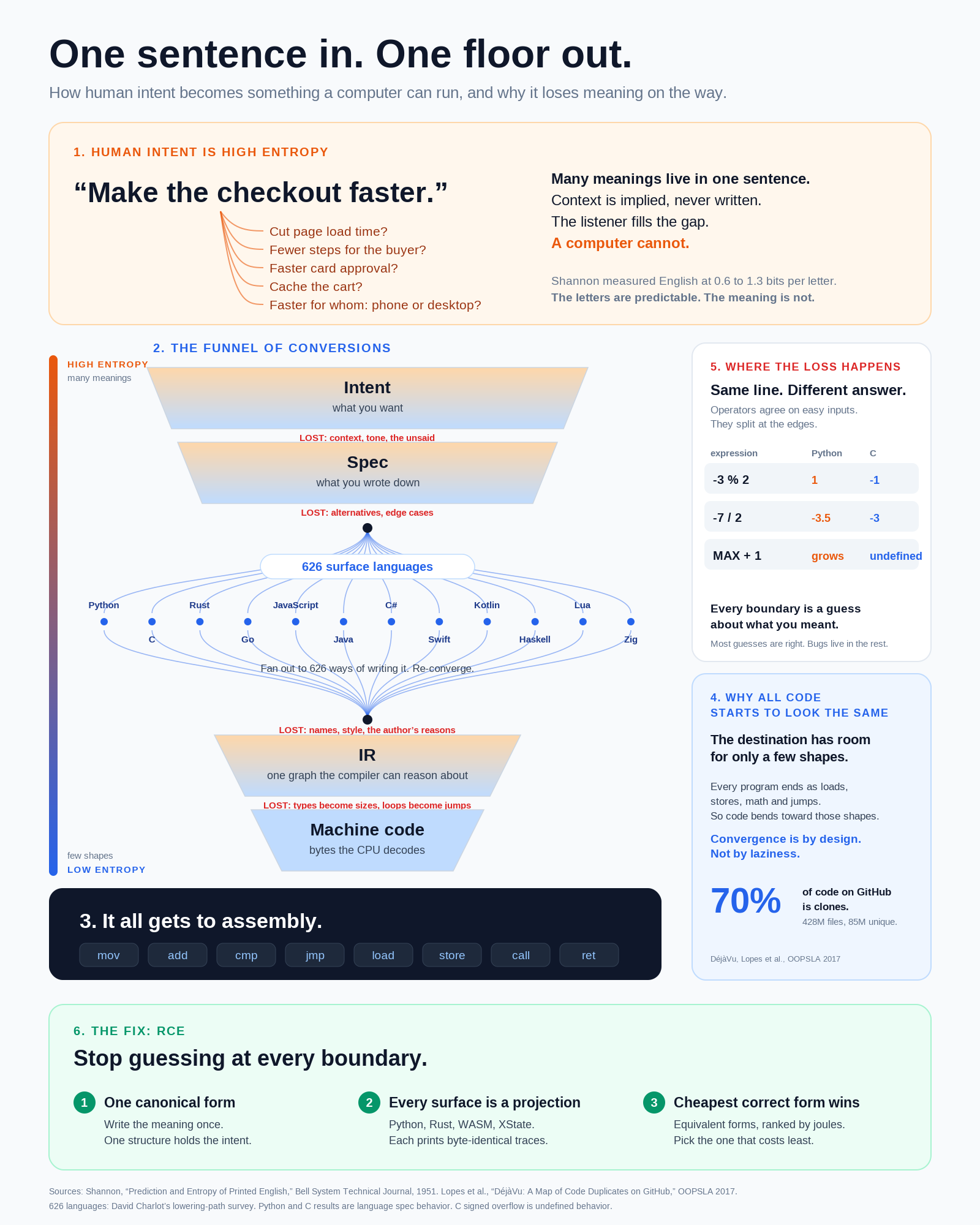
*Figure 1. Intent entropy and the machine floor. A [PNG copy](https://research.openie.dev/figures/rce/intent-entropy.png) is provided. Sources: Shannon (1951); Lopes et al. (2017); the 626-language count is an unpublished survey by the OpenIE authors and supports no claim in this paper. The Python and C results are language specification behavior; C signed overflow is undefined behavior.*
**Intent is high entropy.** "Make the checkout faster" carries many meanings: shorter page load, fewer steps, faster card approval, a cached cart, or faster on one device class. Context is implied and never written. Shannon measured printed English at about 0.6 to 1.3 bits per letter [1]. The letters are predictable. The meaning is not.
**Every conversion loses information.** Intent becomes a specification, and context is lost. The specification becomes one of hundreds of surface languages, and alternatives and edge cases are lost. The source becomes an intermediate representation (IR), and names, style and the author's reasons are lost. The IR becomes machine code, and types become sizes and loops become jumps.
**The floor is low entropy.** Every program ends as loads, stores, arithmetic and jumps. The destination has room for only a few shapes, so code bends toward them. Convergence is by design.
**Boundaries are where meaning diverges.** The same line gives different answers at the edges. In Python, `-3 % 2` is 1 and `-7 / 2` is -3.5. In C, `-3 % 2` is -1, `-7 / 2` is -3, and signed overflow is undefined. A system that regenerates code at every boundary guesses at every boundary.
**The axes, stated as quantities.**
| Axis | One end | Other end | Where RCE's design sits |
|---|---|---|---|
| Energy per correct result | Paid again in full on every task | Paid once per new case, then the handler floor | At the floor on covered tasks |
| Entropy resolved at run time, and determinism | The full distribution of the prompt, a fresh sample each time | Only the residual no stored fit covers, one deterministic output | The residual only; every projection deterministic |
| Verification strength | Output accepted on inspection | Tests, coverage and a proof certificate | The full gate on every result |
| Reuse and compounding | Each result used once | Each accepted fit stored and reused | Every fit that passes the gate is stored |
| Model reliance | A model on every task | No model | A model only as the last gear |
Approaches differ by degree on each axis, and the axes interact: reuse lowers energy and the entropy left to resolve, and strong verification is what makes reuse safe. RCE writes the meaning once, in one canonical Form. Every surface language is a projection of that Form, checked to match it. Among equivalent forms, the cheapest correct one runs.
Figure 2 draws the five axes and places the main classes of approach on them.
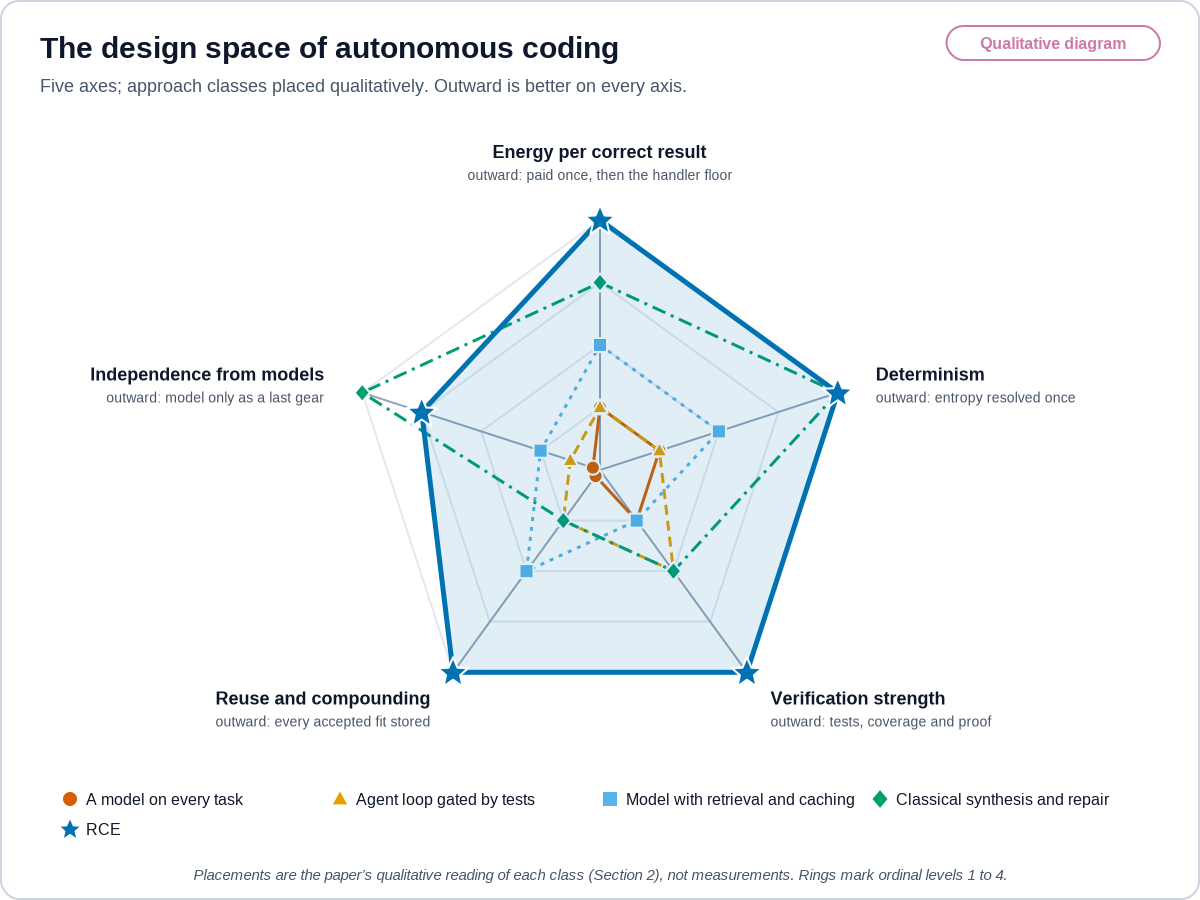
*Figure 2. The design space of autonomous coding. Qualitative diagram: each class of approach is placed by the paper’s reading of Section 2 on ordinal levels, not by measurement. Model reliance is drawn as independence from models so that outward is better on every axis. A [PNG copy](https://research.openie.dev/figures/rce/design-space.png) is provided.*
### 2.1 Programming is coding theory
The thesis of this section is that programming can be read as coding theory. A programmer converts intent along a gradient between two entropic regimes. Intent is high entropy, a distribution over meanings. Code is low entropy, one deterministic transition per state. Every step of software work, from a requirement to a register, is a step of that conversion. The literature has said so in pieces for seventy years, in many languages. This section assembles the pieces into one argument and places each RCE gear on it.
**The measure.** Shannon defined the entropy of a source and the capacity of a channel [40], and measured printed English at about 0.6 to 1.3 bits per letter [1]. Kolmogorov, writing in Russian in *Problemy Peredachi Informatsii* in 1965, gave three approaches to the quantity of information and made the algorithmic one primary: the information in an object is the length of the shortest program that produces it [41]. Solomonoff had reached the same object as a theory of inductive inference [42], and Chaitin showed that program size obeys identities formally identical to Shannon's [43]. Rissanen turned the idea into a rule for choosing models, the minimum description length [44]. Together they say that a program is a code word: a description of a behavior, and the shortest correct one is the floor. RCE's extraction rule, keep the least-joule fit among equivalent fits (Proposition 3), is that rule with joules in place of bits.
**Code sits in the low-entropy regime, and people measured it.** Hindle, Barr, Su, Gabel and Devanbu found that code is "very repetitive, and in fact even more so than natural languages," at lower cross-entropy under the same n-gram models [35]. Gabel and Su found that most lines of a project already exist elsewhere [34], and Lopes et al. found that most files on GitHub are clones [33]. Tu, Su and Devanbu found that code is also local: what was written nearby predicts what comes next [46]. Ray and colleagues found that buggy lines are less natural, with higher entropy, and that the entropy falls when the bug is fixed [45]. In 2025 Yang, Kolak, Hellendoorn and Martins used the entropy change a patch induces to rank repair candidates and to separate correct patches from overfitting ones [51]. Allamanis, Barr, Devanbu and Sutton surveyed the field under the name naturalness [47]. The result is not only an English-language one. Prem Devanbu stated it as a keynote at the India Software Engineering Conference in 2013 [50]. Sridhara, Sinha and Mani at IBM Research India measured the natural-language artifacts around code at the same venue and found that commit messages are the most regular and Stack Overflow prose behaves like ordinary English [49]. In China, the *Journal of Software* (软件学报) published a review of code naturalness research in 2022, which states the cross-entropy measure and the finding that defective code has higher entropy [48]. In Japan, Doi, Higo, Arima, Shimonaka and Kusumoto at Osaka University used n-gram naturalness, first in a Japanese-language IEICE technical report and then at ICPC 2018, to tell machine-generated source files from human-written ones [73, 74]. Generated code sits even lower on the entropy scale than human code, because a generator is a fixed conversion. In Brazil, Arrebola's doctoral thesis built code suggestion on n-gram and topic models segmented by project and maintainer, and evaluated it by cross-entropy, the bits needed to encode the next token [75]. The two regimes are visible in one repository: the prose around the code is high entropy, and the code is low.
**The measure matters.** Febres, Jaffé and Gershenson, working from Venezuela and Mexico, compared English, Spanish and program text by vocabulary diversity per message length and found the program text more diverse [76]. Rahman, Palani and Rigby found that much of the n-gram predictability of code comes from syntax tokens, and that code is still repetitive, less than first reported, once those are removed, with API usage the most repetitive part [77]. Both results sharpen the claim rather than reverse it. Diversity of symbols is not predictability, and the low-entropy regime is a property of the conditional distribution of the next step, which is what a deterministic transition fixes. RCE's G0 keys on shapes, not on surface tokens, for that reason.
**Intent sits in the high-entropy regime.** Zave and Jackson showed that a requirement is a statement about the environment, a specification is a statement at the interface, and the gap between them is filled only by domain knowledge that is often unwritten [64]. Brooks split the difficulty of software into essence and accident: the essence is the conceptual construct, and most of it is specification and design, not representation [61]. Naur argued that a program is the visible part of a theory held by its programmers, and that the theory is not fully recoverable from the text [62]. Read through Shannon, all three say the same thing. Intent carries more uncertainty than any one program, and writing the program is the act that removes it. What remains in a programmer's head after the code is written is the part of the intent the code did not encode.
**The conversion is a refinement, and refinement is a narrowing.** Hoare gave programs a logic in which a program is correct relative to a pre- and postcondition [54]. Wirth taught stepwise refinement: decompose a task into instructions by successive decisions, each one fixing a choice the specification left open [53]. Dijkstra's guarded commands made the open choices explicit as nondeterminacy, and derived programs from specifications by removing it [52]. In Munich, Bauer and Wössner's CIP project built program development as a sequence of correctness-preserving transformations from specification to program [58]. In France, Abrial's B method and then Event-B carried refinement to industrial scale, with proof obligations at each step [55, 56]. In Finland, Back and von Wright gave refinement its lattice-theoretic calculus [57]. In each, a specification denotes a set of acceptable behaviors and each refinement step shrinks the set, until one deterministic behavior remains. That is entropy reduction with a proof at every step. RCE's Form is the last element of that chain: a total, deterministic transition $\delta$ over database states, with every choice resolved ([§3.2](#32-definitions)).
**Synthesis is search that narrows a hypothesis space.** Gulwani's FlashFill learns a string program from a few input-output examples by representing the set of all consistent programs and intersecting it with each new example [59]. Gulwani, Polozov and Singh frame program synthesis in general as search through a space of programs constrained by intent [60], and Solar-Lezama's sketching fills holes in a partial program with a solver [27]. Each example or constraint is a measurement that removes hypotheses. Shannon's measure counts how many such measurements are needed. RCE's G2 is that gear.
**What the conversion produces has one shape.** Gurevich proved that every sequential algorithm is captured by an Abstract State Machine at its own level of abstraction [2]. Codd made the state a relation [5], and event sourcing makes the state the fold of an append-only log [14]. Under Curry and Howard, a proof is a program and a proposition is a type [18, 72], so a verified fit is a proof of its specification. These are the reasons the low-entropy regime has few shapes: the destination is a state machine over a database, whatever the surface language.
**Low entropy decays without a gate.** Lehman observed over decades of large systems that a program in use must keep changing, and that its complexity grows unless work is done to reduce it [63]. Torres, Baltes, Treude and Wagner measured structural and textual entropy over the commit histories of 25 projects and found the two rise together [78]. Entropy flows back into code from the environment. A system that keeps code in the low-entropy regime needs a gate on every change, and RCE's gate is correctness ([§4.3](#43-the-gate)).
**Compilers already do source coding.** Franz and Kistler shipped programs as compressed abstract syntax trees and generated native code on load, which is source coding of a program over its own grammar [67]. Fraser inferred statistical models of code from a corpus to compress it [68]. Futamura showed in 1971, in the Japanese journal *Systems, Computers, Controls*, that specializing an interpreter to a program yields a compiled program, and that specializing the specializer yields a compiler [70]. Ershov in Novosibirsk developed the same idea as mixed computation [71]. The Cousots' abstract interpretation computes a sound, lower-information description of every behavior of a program [69]. The analogy to channel coding is this paper's reading, not a cited theorem: types, tests and proofs add checked redundancy so that a wrong program is detected before it runs, as a parity check detects a corrupted word.
**Erasure is where the joules go.** Landauer showed that a logically irreversible step, the erasure of one bit, dissipates at least $k_B T \ln 2$ [65]. Bennett showed that computation can in principle be made logically reversible, so the erasure, not the computation, carries the bound [66]. Converting high-entropy intent to one low-entropy program discards every alternative the intent allowed. That discard is an erasure of information about the alternatives, and it has a thermodynamic floor. RCE pays the discard once per new case and stores the result, so a repeat case erases nothing new.
**What the surface costs, measured.** The naturalness result has two corrections that this paper now carries, and a third finding that bears on the name-free Form. First, the raw entropy gap between code and prose shrinks substantially once syntax tokens are removed [77], and Casalnuovo, Lee, Morgan and Devanbu found that part of what remains is a familiarity effect: in top-starred Java and Python projects the original code had lower surprisal than meaning-preserving rewrites, and 50 human raters agreed with the language model's preference 61.9% of the time [132]. What reads as natural is what the reader has seen most, so a canonical Form moves the equilibrium of that loop rather than escaping it. Second, the only quantities that track measured comprehension load are textual size, vocabulary size and data-flow dependency reach: in the one study that tested code metrics against brain activation, those three correlated at Kendall τ ≈ 0.4 while McCabe cyclomatic complexity correlated with nothing (τ ≈ 0.09) [133]; across 121 readability metrics and 444 evaluations, no single metric reached |τ| > 0.16 with measured understandability [134]; and pretty-printed against disrupted layout showed no fMRI difference [135], consistent with the finding that formatting is 13 to 15% of the tokens of brace languages and can be stripped for ten language models with no significant change in accuracy [136]. Third, names are a low-agreement, high-dependency channel: two developers choose the same name with median probability 6.9% [137], comments co-evolve with the code they describe in 7 to 13% of cases [138], and yet frontier models lose 11 to 29 points of summarisation accuracy and up to 24 points of execution-prediction accuracy when identifiers are removed or replaced [139]. Humans, by contrast, do not process identifiers as language at the neural level: swapping English identifiers for Japanese changed the language-system response by Δβ = 0.03 [140]. The consequence for RCE is stated in [§3.8](#38-behaviour-equivalence-and-dimension): positions stay in the hash (T7) and names stay outside it, but the side table that holds them must carry the *concept* a name encodes, because the only authors that will matter read through names and the Form has not yet shown that a model can reason from a nameless one.
### 2.2 How RCE converts, and where each gear sits
Read as coding theory, a task arrives as a message whose remaining uncertainty is what no stored fit already resolves. Each gear removes uncertainty at a different price, and the gears are ordered by that price ([§4.2](#42-the-gears)).
| Gear | What it does to the uncertainty | Lineage in the argument above |
|---|---|---|
| G0 Lookup | Recognizes that the intent was already encoded; resolves it by retrieval, at the handler floor | Repetitiveness and clones [33, 34, 35]; localness [46] |
| G1 Rules | Applies a known guarded rewrite; resolves a recurring residual with no search | Correctness-preserving transformation [52, 58]; refinement with proof obligations [55, 56] |
| G2 Synthesis | Searches a hypothesis space and narrows it by examples, constraints and a solver | Program synthesis as search [27, 59, 60] |
| G3 to G5 Models | Samples from a learned distribution over code when no lower gear closes the gap; a proposer only | Cross-entropy models of code [35, 47] |
| Gate | Accepts a candidate only with tests, coverage and a proof certificate | Hoare logic [54]; Curry-Howard [18, 72] |
| Promotion | Stores the accepted fit, so the same residual costs G0 next time | Minimum description length [44]; Landauer erasure paid once [65] |
Positions on the axes of Section 2 differ in where the conversion is paid. An approach that samples the full distribution of the prompt on every task pays the high-entropy side again each time. An approach that stores and reuses accepted fits pays only for the residual, and only once. Most systems sit between those ends, and RCE sits at the reuse end.
### 2.3 The ecosystem, checked per program
The claim of [§1](#1-thesis) is checked program by program, not on a sample. Each property below is an obligation of every program, checked by the continuous integration (CI) of [openIE-dev/rce](https://github.com/openIE-dev/rce), and one program that fails one obligation defeats the claim. The third column names when each check runs: the checker's tests and the reference and Scala runs of the conformance suite run on every push and every pull request, the suite's Rust run once a week and on request, and its Python and JavaScript runs are not in CI. Where a check runs on every commit, a program that enters later is held to it before it is merged. A sample says how many programs were tried; a check on every program says that the property holds for each program the repository holds. No model is called.
| Property | Obligation of each program | Where and when it is checked |
|---|---|---|
| Lossless encoding | Its Form (`rce emit form`), decoded to source (`rce unform`), gives a program whose syntax tree, verdict and observations equal the original's | `tests/form_roundtrip.rs`, on every `.rce` file of the specification examples and the checker's test corpora; in the fast test group of `ci.yml`, on every push and pull request |
| Faithful projection | Each emitted program (Rust, Python, JavaScript and Scala) prints the reference observations and the whole reference trace, line for line | `tests/emit.rs` on every example, a slow test binary that `ci.yml` runs as its own job on every push and pull request. The conformance suite: at public commit `43ea544a` each of the four emitters passes all 1,459 of its runnable tests, none failing (the other 520 test admission, which the front end decides). Of its emitter runs, only the Scala run is in CI on every push and pull request (`conformance.yml`); the Rust run is `emit-rust.yml`, once a week and on request; the Python and JavaScript runs are not in CI and are recorded in the suite's README with the commit they were made at |
| Deterministic projection | Two emits of one target give the same bytes | `tests/emit_deterministic.rs`: every example that `rce emit` accepts is emitted twice, each emit in its own process, to the Form, the core, Rust, Python, JavaScript and Scala, and the bytes are compared; in the fast test group of `ci.yml`, on every push and pull request |
| Gate at entry, inputs | A malformed payload (a wrong type, a missing field, an extra field, a nested value) or an undeclared event never changes the state: an undeclared event requires change, a payload that fails its contract keeps the state, and the outcome is recorded | The host contract tests (`tests/host_*.rs`), in the fast test group of `ci.yml`, on every push and pull request; the input contract of `rce run` is item 15 of [§10](#10-work-to-finish) |
| Gate at entry, specifications | A module that uses a name it does not declare requires change before emit (W-NAME-1) | The admission tests of the conformance suite, run against the reference checker by `conformance.yml` on every push and pull request |
Section 9 states the observation that defeats the claim, RCE-F0: one program, in the repository or entering it, whose emitted program prints a trace that differs from its reference trace, or one malformed input that changes the state. A target added to the emitters enters under the same checks. Lifted Forms from real programs are measured under the protocol of [§8.7](#87-lift-coverage-across-languages).
### 2.4 Gated, verified recursive self-improvement
Good (1965) [111] defined the ultraintelligent machine as one that could design better machines, so that improvement would recurse. Yudkowsky (2013) [113] cast the question as one of returns: whether each unit of improvement makes the next unit cheaper or dearer. Schmidhuber's Gödel machine (2007) [112] gave a formal answer with a guarantee: a program rewrites any part of itself, including its own search, only after proving that the rewrite improves its expected utility. Löb's theorem (1955) [114] is the obstacle a self-trusting prover meets, which Yudkowsky and Herreshoff (2013) [115] named the Löbian obstacle: a system cannot in general prove the soundness of a successor that uses its own proof system. Recent systems drop the proof requirement and select by measured score: STOP (Zelikman et al., 2023) [116] improves the scaffold that improves code, the Darwin Gödel Machine (Zhang et al., 2025) [117] keeps an archive of self-modified coding agents chosen by benchmark score, AlphaEvolve (Novikov et al., 2025) [118] evolves programs under automatic evaluators, and Voyager (Wang et al., 2023) [119] grows a library of verified skills that later tasks reuse.
RCE takes the structure of the Gödel machine and the library of Voyager, with two differences that avoid the obstacle for the objects it promotes. First, the object that improves is not the prover. In the design, RCE promotes handlers, rewrites and gears, and each is checked against a fixed kernel and a fixed proof rule: the properties the kernel is model-checked against ([§5.3](#53-model-checking-of-the-kernel)) and the encoding of the Form's arithmetic for a satisfiability modulo theories (SMT) solver ([§5.2](#52-the-proof-rule-for-rewrites)) never change through promotion, so no step needs to trust a successor's proof system. Second, the gate is a proof of correctness at the boundary, not a score. A score can rise while an interface assumption breaks; a proof at the boundary cannot be passed by a change that breaks it.
**Proposition R1 (monotone correctness).** If every promoted change passes the check of its boundary, and the checks of the other boundaries are unchanged, then every property established by those checks before the promotion still holds after it.
**Proposition R2 (compounding).** Let a workload be a multiset of tasks and let a promoted handler close every task of its shape. Then the number of escalations in round t is nonincreasing in t, and a correction promoted before round 1 lowers the cumulative escalations of every horizon by the escalations it closes in each later round.
**Proposition R3 (falling cost).** Since a promoted handler is executed in place of a model call, and its cost is the op count of the handler priced by the substrate table, the estimated energy (`est_j`) of a round falls toward the estimated energy of the handlers alone as escalations fall toward zero. The proposition is about the estimate; no reading backs it.
Futamura's projections (1971, republished 1999) [120] and Turchin's supercompilation (1986) [121] give the limit of this process. Specializing an interpreter to a program yields a compiled program; specializing the specializer yields a compiler. RCE's promotions specialize the general escalation path to the shapes that actually occur, so the engine converges toward the residual program of its workload: the part of the computation that a model or a person must still supply. Recursive self-improvement under a gate is that convergence, made with checked steps.
## 3. The Form
### 3.1 The strongest formal statement of "same form"
The scope of the theorem is stated first. Gurevich's sequential postulates cover sequential algorithms; parallel and interactive algorithms need the further postulates of Blass and Gurevich [3]. Blass, Dershowitz and Gurevich argue that no single equivalence relation on algorithms fits every purpose [79], and Moschovakis and Vardi set out the debate over what an algorithm is [80, 81]. A web handler that does input and output sits outside the sequential theorem. The Form handles interaction the way the interactive line does: each input is an event in $E$, and the state machine steps on it. So "one Form" is a modelling choice grounded in the sequential theorem and extended by convention, with production precedents in the Elm architecture [83], durable workflow event histories [84] and stream semantics such as Flo [82]. The propositions of Section 3.4 are stated for that choice.
Gurevich's Abstract State Machine (ASM) theorem is the strongest formal statement that every algorithm has one shape [2]. An abstract state machine is a machine whose states are first-order structures and whose step is a finite set of guarded updates. Gurevich states three postulates. Sequential Time: an algorithm has states, initial states and a one-step map $\tau$. Abstract State: states are first-order structures over one fixed vocabulary, closed under isomorphism. Bounded Exploration: a finite set of terms decides each step. His Main Theorem (Theorem 6.13) reads: "For every sequential algorithm A, there exists an equivalent sequential abstract state machine B." Blass and Gurevich extend it to parallel algorithms [3]. Dershowitz and Gurevich add a fourth axiom, that initial operations are computable, and from it derive Church's thesis [4].
### 3.2 Definitions
**Definition 1 (the Form).** A program is a tuple
$$P = (S, E, \delta, D, \lambda)$$
- $S = \Sigma_c \times \Sigma_d$, the state space: structures over a fixed vocabulary $\Sigma$, split into control regions $\Sigma_c$ and data $\Sigma_d$. $\Sigma_d$ holds the logical clock, the input count and the typed relations (in the language, also the declared regions). Each state is a database instance in Codd's sense [5].
- $E$, the event alphabet, including the logical clock tick.
- $\delta : S \times E \to S \times O^*$, the transition: total, deterministic and pure, written as a finite set of guarded updates "if $\varphi$ then $f(\bar t) := t_0$", each step reading a bounded set of locations. It returns the next state and the outputs of the step. Write $\delta_1 = \pi_1 \circ \delta$ for its state component.
- $D$, the durable log: a sequence of entries $\{\mathit{seq}, \mathit{event}, \mathit{prev\_hash}, \mathit{state\_hash}, \mathit{hash}\}$, where $\mathit{state\_hash}$ is the SHA-256 of the canonical JSON of the state after the step, $\mathit{hash}$ is the SHA-256 of the canonical JSON of the first four fields, and the first $\mathit{prev\_hash}$ is 64 zeros. The log is a hash chain, so changing any past entry changes every later $\mathit{hash}$.
- $\lambda = \pi_2 \circ \delta : S \times E \to O^*$, the output map. A Mealy machine reads both arguments [6]; a Moore machine reads the state only [7].
**Definition 2 (Form and fit).** The *form* is the tuple shape with four invariants: $\delta$ is deterministic and pure; exploration is bounded; the vocabulary is fixed; state is the fold of the log,
$$\mathrm{state}(D) = \mathrm{foldl}(\delta_1, s_0, D).$$
A log may also carry each entry's outcome, outputs and state. These are derived: they are not hashed, and they must equal replay (T1 and T3 of [§3.7](#37-the-language-one-text-costs-and-theorem-status)). Two outcomes are distinct. In the engine profile that Appendix D of the specification defines, every event is applied, and an input that fails its contract produces a `reject` output and an error row (D.6), not a kept step. In the language an event that does not apply keeps the state (T8: atomicity, the state unchanged) and is recorded as a kept step.
The *fit* is the data that fills the shape: the vocabulary $\Sigma$, the alphabets $E$ and $O$, the rule program $\Pi$ that defines $\delta$, the output rules that define $\lambda$, and the initial data $s_0$. In Gurevich's terms the fit is the vocabulary, the ASM program and the initial structures. In Codd's terms $\Sigma$ is the schema and $s_0$ is the instance. In product-line terms a fit is a feature selection [8]. In syntax-guided synthesis (SyGuS) terms a fit is a term from a grammar that meets a specification [9].
**Definition 3 (fit equivalence).** Two fits are equivalent when, for every event sequence $L$, their output sequences under $\lambda$ are equal.
**Definition 4 (fit language).** A grammar whose terms denote fits. Programming languages, statechart documents in State Chart XML (SCXML), XState configurations and `.rce` specifications are fit languages. A fit language is complete when every ASM program over $\Sigma$ has a term in it.
**Definition 5 (control projection).** Split $\Sigma = \Sigma_c \cup \Sigma_d$ into finite control symbols and data relations. The statechart of $P$ is the projection of $\delta$ onto $\Sigma_c$: states are values of $\Sigma_c$, transitions carry an event and a guard over $\Sigma_d$, and actions are updates to $\Sigma_d$. Harel's statecharts give the hierarchy and the orthogonal regions [10].
**Definition 6 (fit e-graph).** For a fit $F$ and a set $R$ of sound rewrites, the fit e-graph $EG(F, R)$ is the saturated e-graph of $F$'s rule terms under $R$ [11, 12]. Each e-class holds fits equivalent by Definition 3.
**Definition 7 (joule cost).** $\mathrm{cost}_J(t)$ is the estimated energy (`est_j`) to run term $t$ once on a named substrate, weighted by the expected number of runs.
### 3.3 Why "database functional state machine"
A finite relational structure is a database instance, so a Gurevich state is a database and each step is a bounded transaction. *Database*: $S$ is a relational structure. *Functional*: $\delta$ and $\lambda$ are pure. *State machine*: runs are folds of $\delta$ over events. Moseley and Marks draw the same line in architecture [13]. Event sourcing draws it in application state: "Capture all changes to an application state as a sequence of events" [14]. Dedalus draws it in logic, where mutable state is a relation indexed by time [15].
### 3.4 Propositions
**Proposition 1 (the Form captures every sequential algorithm).** For every sequential algorithm $A$ there is a Form instance $P$ whose runs are the runs of $A$.
*Proof sketch.* Theorem 6.13 gives an ASM $B$ with the states, initial states and one-step map of $A$. Set $E = \{\varepsilon\}$, $\delta(s, \varepsilon) = \tau_B(s)$, $D = (s_0, \varepsilon^n)$ and $\lambda$ the identity. The fold after $n$ ticks is $\tau_A^n(s_0)$. By Gurevich's Corollary 3.3, $P$ and $A$ have the same runs. ∎
**Proposition 1b (interactive programs).** Extend $\Sigma$ with a nullary input symbol set to $e$ before each step; then $\delta(s, e) = \tau(s[\mathit{in} := e])$ is a sequential algorithm over the extended vocabulary, and Proposition 1 applies. The construction is ours.
**Proposition 1c (computability).** Under the Dershowitz and Gurevich axiom, every Form instance computes a Turing-computable function [4, 16, 17]. The Form adds no power. It gives every program in the class one shape.
**Proposition 1d (proofs are fits).** "For each proof of a given proposition, there is a program of the corresponding type" [18]. A type is a specification and a proof is a fit that meets it. The correctness gate is the existence of that proof or of a passing acceptance test.
**Proposition 2 (one generator).** One function $G : \mathrm{Fit} \to \mathrm{Program}$ generates a runnable program for every fit and reads no domain. *Basis:* every program is a Form instance, so $G$ emits a typed store, an event type, compiled rules, a log with a fold and an output dispatcher. Scaffolders such as Rails generators, JHipster and Yeoman are $G$ restricted to small fit languages. Product-line engineering starts from "the systematic discovery and exploitation of commonality across related software systems" [8]; the commonality is the Form.
**Proposition 3 (least-energy extraction).** Extraction with $\mathrm{cost}_J$ returns the term of least estimated energy that the extractor finds in the e-class of $F$. *Proof sketch.* The rewrites are sound, so every term in the e-class has $F$'s observable behavior and passes the same gate. Extraction minimizes the cost, and the cost is `est_j`, an estimate in joules, not a reading. ∎ Whether the order holds for measured joules is what RCE-F5 tests ([§9](#9-falsifiers)). This is Mixture of Limits applied to code. Mixture of Limits, Part II of the companion paper [Metered Commit Gates](https://research.openie.dev/papers/gates/), states that a task needs a minimal expected energy to close and that energy spent after the task is complete buys no verified progress; applied to code, it says: keep the minimal fit that does the task, and the rest is waste.
**Proposition 4 (replay determinism).** If $\delta$ reads no wall clock, orders updates without names and logs every input, two replays of one $D$ give identical state hashes at every step.
**Proposition 5 (statechart projection is sound).** Project each state of a run onto $\Sigma_c$. The result is a run of the emitted statechart under the same events.
**Proposition 6 (coordination budget).** Rules tagged monotone run on replicas without coordination; only non-monotone rules need a coordination point. *Basis:* the CALM theorem, "the programs that have consistent, coordination-free distributed implementations are exactly the programs that can be expressed in monotonic logic" [19].
Appendix D.5 of the specification derives the tag from the rule, never from a declaration, and under the IR check of the engine profile a Form whose stored tag differs from the derived one requires change:
| Rule has | Tag | Reason |
|---|---|---|
| no resolve, read, join or scan | monotone | its writes only add keys and grow counters |
| a resolve | not monotone | it deletes escalation rows |
| a read of its own sink | not monotone | read, modify, write |
| a keyed join | not monotone | the joined row may be absent now and present later, or overwritten |
| a scan | not monotone | it observes the whole relation, including what is absent |
The tag is sound and not complete: a join against an insert-only relation would be monotone, but the profile does not prove that a relation is insert-only, so the tag does not claim it. A Form is coordination-free when every rule is monotone. Every read, join and scan sees the state at the event's entry, so the post-state of an input event does not depend on the order in which rules for different sinks run; only the output order does, and it is fixed by content hash.
**Proposition 7 (intelligence as a joule derivative).** Let $X$ count tasks through the gate and $J$ the joules spent. $\iota = dX/dJ$ is to be read in hindsight from $D$, which records every event, and, in the engine's design, from its receipts ([§4.4](#44-receipts)), each of which carries the `est_j` of one gear call. Today $D$ holds no joule entry, since no checker code writes `host.Energy`, and a receipt's joule terms are `est` or `unpriced`; a $J$ read from them is an estimate, and so is $\iota$. Extraction under $\mathrm{cost}_J$ holds the gate fixed and does not raise $J$, so at equal $X$ it does not lower $\iota$.
### 3.5 Graph, e-graph and statechart
| Structure | Part of the Form | What it decides |
|---|---|---|
| Statechart | Guards of $\delta$ over $\Sigma_c$ | Which transition fires |
| Dataflow graph | Read and write dependencies of $\delta$ and $\lambda$ (Kahn process networks [20]) | What runs, and in what order |
| E-graph | The equivalence class of the fit | Which equivalent fit runs |
The statechart and the graph describe one fit. The e-graph describes every fit equivalent to it. Extraction chooses among them by estimated joules (`est_j`).
### 3.6 One ecosystem, lossless, and the universality thesis
**Lossless by construction.** Shannon's source coding theorem fixes the floor for a lossless code at the entropy of the source [40]. A Form is a lossless code for intent in a narrow sense that can be checked: the canonical serialization of the Form is injective, so two Forms that differ in any state, event or transition have different shape hashes, and decoding the serialization gives back the same Form. Each projection to a target is a function of the Form alone. Bidirectional transformations make the round trip precise. Foster, Greenwald, Moore, Pierce and Schmitt define a lens as a pair of get and put functions with round trip conditions that make a view and its source agree [122], Hofmann, Pierce and Wagner extend the conditions to symmetric lenses [123], and Czarnecki and colleagues survey the same consistency conditions across model engineering, databases and programming languages [124]. RCE's round trip condition is the GetPut condition at the level of the whole program: lift a projection back and the shape hash is unchanged.
**Correct by construction.** Dijkstra proposed in 1968 that a program and its proof be developed together, so that correctness is designed in rather than tested for [125]. Hall and Chapman carried the approach into a commercial secure system with formal specification and refinement at every step [126]. Minsky's rule for typed functional programming, make illegal states unrepresentable, says the same at the type level: a type that cannot hold a bad value removes the need to check for it [127]. Turner's total functional programming requires every function to terminate on every input, so that a program denotes a mathematical function with no hidden failure [128]. RCE's Form is total in Turner's sense, its contract types make undeclared states unrepresentable in Minsky's sense, and the refinement chain of [§2.1](#21-programming-is-coding-theory) ends in it in Dijkstra's sense. The consequence is the one stated in [§1](#1-thesis): what a program does is what its Form declares, so there is nothing to diff or track after the fact.
**The universality thesis.** Stated in theory terms, the thesis is that there is one universal Form. Programs are authored in it natively, every existing language is reachable from it as a faithful projection, and every existing program enters it by lift. Gurevich's thesis gives the ground: every sequential algorithm is captured, step for step, by an Abstract State Machine at its own level of abstraction [2], and parallel algorithms likewise [3]. A Form is such a machine over a database state.
**Proposition U1 (capture).** If a program in language $L$ is a sequential or parallel algorithm in Gurevich's sense, then there is a Form whose transition simulates it step for step at the program's level of abstraction [2, 3].
**Proposition U2 (faithful projection).** If the projection $\pi_L$ of a Form to $L$ preserves the Form's trace on every input in the contract, then the Form and its projection are interchangeable for every observer of the trace, and $L$ adds nothing the Form lacks.
**Proposition U3 (lift by construction).** Every programming language in use has a formal grammar, a parser that yields a concrete syntax tree, an abstract syntax tree and a semantics fixed by its specification or reference implementation. A lift $\lambda_L$ is built per language in three stages: the grammar, then the abstract syntax tree, then the Form, with each construct of $L$ given its Form rule by the semantics of $L$. A lift so built satisfies $\pi_L(\lambda_L(p)) \equiv p$ on behavior and $\lambda_L(\pi_L(F)) = F$ on shape hash, so the pair is a lens in the sense of [122], and a program in $L$ is held as a Form with no loss.
**Proposition U4 (replacement).** If U2 and U3 hold for language $L$, then no program needs to be written in $L$: it is written once as a Form and emitted as $L$ where a platform requires it.
**Every language is a target and a source.** The Form places no bound on targets. A target language is a row of the emit registry (the proposal `spec/proposals/emit-targets.md` in the specification repository): one emitter over the Form IR, the intermediate representation of a Form's terms that Appendix D.7 of the specification defines, and one table per language fixing how that language keeps the numeric and text contract of specification 6.3, each row passing the same gate, the reference trace of every example program byte for byte (T9). The lift $\lambda_L$ is the reverse map, from the language's pinned grammar and a semantics table into the Form, so every language is both an output of the Form and an input to it. The reference checker emits Rust, Python, JavaScript and Scala today, and the registry's tiers list the systems, platform, dynamic and non-von-Neumann languages that follow, including the new entrants of 2024 to 2026 catalogued in [§3.7](#37-the-language-one-text-costs-and-theorem-status).
U1 is a theorem. U2 is checked per target by the tests of the program emitters ([§5.1](#51-differential-testing-of-the-program-emitters)) and is checked on every program by the checks of [§2.3](#23-the-ecosystem-checked-per-program). U3 is a construction, built language by language from the grammar up, and [§8.7](#87-lift-coverage-across-languages) states how the construction is measured as it is built.
**Two qualifications.** The lift of U3 is a construction, and its domain is smaller than the sentence above suggests. The Form requires that every program finishes (T2), so the lift from any Turing-complete language is at best a map from the terminating fragment of that language, and membership in that fragment is undecidable (Rice's theorem applied to a total target [141]). On the terminating fragment the lift is still not canonical: closure representation, which sub-terms become control states, and evaluation order are free choices, and the inverse exists only for programs in defunctionalized form [142, 143]. So $\lambda_L$ is a construction on the image of a partial map whose domain is undecidable, the lens round-trip conditions hold on that image, and "every existing program enters it by lift" is a statement about the fragment the construction reaches, measured as [§8.7](#87-lift-coverage-across-languages) measures it. The second qualification concerns the hash over which the injectivity claim is made. Specification 6.1 hashes the positional forms of the state and of the event (regions and fields as lists in declaration order, a variant by its index, an event by its index among the module's events); the stored entry keeps its readable `event` and `state`, and a trace repeats the hashed forms under `hashed` (trace format `rce-trace/2`). The Lean module `RCE/NameFree.lean` hashes De Bruijn keys, and `RCE/Positional.lean` models the positional embedding (records of declared types as field lists in declaration order, variants as index and fields, events by index, undeclared records by name) and proves it unchanged under any renaming that is injective and fixes undeclared names, which is what the nameless projection performs, so the state hash and the entire entry chain are unchanged for every hash function; the event index it hashes is by definition the declaration index of the De Bruijn model, so the two encodings agree on the component they share. The reference checker and the Python, JavaScript and Rust runtimes agree on the hashes, and a test checks that a program and its nameless projection have the same log hashes, as T7 states; at public commit `f2bd7222`, which adds `RCE/Positional.lean`, the audit passes at 5,052 theorems with standard axioms only. An earlier reference checker hashed the named canonical JSON, so its log hashes depended on names while the model's did not; the specification's register of proposals records that finding, the test that demonstrated it, and its resolution as an erratum under C.15 (the log entry is outside a program's meaning), with the trace fixtures, application goldens, 130 conformance pins and the standard library's feed vectors regenerated.
### 3.7 The language: one text, costs and theorem status
The RCE language is defined by a written specification ([/rce/spec/](https://research.openie.dev/rce/spec/); source in the [rce repository](https://github.com/openIE-dev/rce)). There is one language, the text of the specification at one commit, and every module of a program is in it (specification 2.7). Sections 2 to 10 define the core; Appendix C defines concurrency (`par`, `for ... par`, `with budget`, workgroups, LVars, sessions and supervisors) and applies to every module; Appendix D defines the engine profile: the handler specs and fits of the engine's design. No declaration selects a dialect: a first-line `# rce-version:` comment is a release label that names the specification commit a module was written against, is ignored by the checker and is not hashed, and a construct the checker does not implement requires change as reserved, not implemented (W-RES-1, Appendix F.12). The language is in development and changes as the project learns: a form can be added, generalised or replaced, and the change and every program of the repository it touches move together in one commit, never as a per-module choice, so a program never depends on the version of another program or library: everything checked at one commit agrees with the specification at that commit.
**Why one text and no version selection.** The record on versioning supports this rule rather than the per-module selection that earlier drafts had. Dependency resolution with one version per package and arbitrary constraints is NP-complete, established for Linux distributions [176], restated in 2020 for every non-trivial component model [177] and proved independently for language package managers by reduction from 3-SAT [178]. A semantic version number does not carry the promise it makes: about one third of Maven Central releases over seven years introduced a breaking change, in minor and patch releases about as often as in major ones [179], a replication on 119,879 upgrades still found 20.1% of non-major releases breaking [180], and the Google engineering text concludes that semantic versioning is a lossy summary of the risk of adopting a change and keeps one version of everything in one repository [181]. Exposure is a property of the transitive graph: for more than 80% of the 35,863 Maven artifacts affected by the Log4j vulnerability the dependency was more than one level deep [182]. Where the record converges is on identity derived from content, so that two different things never share a name and variants coexist [183, 184], on change by accretion under names that are never reused [185], and on a direct proof that a change preserved behaviour rather than a number asserting it [186]; hardware design has run such a proof, equivalence checking, as the gate on every revision for two decades [187], and reproducible builds tie an artifact to its source by its hash [188]. The RCE design takes each of these as a rule: one text at one commit, definition hashes with a closed compatibility table (F.4.3), a manifest that pins by hash with no resolver (F.5.3), name-free log hashes (T7) and behaviour as the only sense of two programs being the same ([§3.8](#38-behaviour-equivalence-and-dimension)). The survey of 24 October 2026 that reads the record against these rules, with the gaps it lists (a whole-program hash, the equivalence check run as a gate on every change, provenance in emitted code), is in the data repository ([/data/](https://research.openie.dev/data/#rce)) and its proposal is `spec/proposals/one-commit-change.md`.
**Budgets count work.** A `with budget` block charges each operation a fixed cost from the table of Appendix C.6.4 and traps with `budget` when the count runs out. The count is a proxy for work, not a measurement of time or energy; `est_j` is separate.
| Operation | Cost |
|---|---|
| call of a user function or a closure, $c_{call}$ | 4 |
| standard library method on receiver size $n$, first-argument size $k$ | $4 + w(m, n, k)$ |
| channel send or receive | 8 |
| `spawn` | 32 |
| one `par` branch or `for ... par` chunk | 16 |
| list or map literal, or comprehension, with $n$ results; `[x; n]` | $4 + n$ |
| index, slice, member access; unary operators; `and`, `or`; integer, bool and text operators and comparisons | 1 |
| float `+`, `-`, `*` | 2 |
| float `/`, `%` | 8 |
Sizes are the UTF-8 byte length of a text, the length of a list and the number of entries of a map; any other value has size 0. The method work $w$ is fixed by the method's complexity class in the reference evaluator: $n + k$ for the linear methods on text, lists and maps (maps are ordered association lists), $n \lceil \log_2 n \rceil$ for `sort` (0 when $n \le 1$), and 0 for the remaining methods. The calls that `map`, `filter` and `fold` make to their function argument are charged as calls in addition. The arithmetic saturates at the largest 128-bit integer, and $w$ never decreases when $n$ or $k$ grows. The reference evaluator and the emitted Rust, Python and JavaScript runtimes compute the same function, and a test checks that the budget trap falls on the same operation in all four.
**One cost rule.** The cost of a standard library method call is the one cost of the text, in every module and wherever the call is executed from (specification 2.7, C.15). The rule is lexical to the text, not to a module, so linking modules changes no cost; tests check it at module boundaries in both directions on the reference evaluator and on the emitted Rust, Python and JavaScript programs.
**Theorem status.** The specification states theorems T1 to T34 and records the status of each exactly. The proofs are in Lean 4 (v4.36.0 at public commit `f87d6af2`, migrated from v4.12.0, no Mathlib) over a core calculus. The words used for the level of a result are these. *Proved* means a Lean proof about the core semantics of the language. *Proved on a semantics* means a Lean proof over a small-step semantics of a core of RCE. *Model* means a Lean proof about an abstract model that is not connected to the RCE semantics or to the reference evaluator. *Vectors* means the reference evaluator's results on generated programs are checked against the model by the Lean kernel, which is a correspondence on samples, not a proof about the evaluator. *Tested* means differential testing on stated inputs. *Checked mechanically* means decided by a program, such as an LALR(1) table builder.
| | Statement | Level |
|---|---|---|
| T1 | determinism: one result per state and event; one result per tick of the concurrency semantics | proved |
| T2 | totality of $\delta$, with an explicit bound on evaluation steps; structural recursion and bound composition along the call graph | proved (the Lean expression core has no user function calls; recursion and composition are proved on separate models) |
| T3 | the runtime state is $\mathrm{foldl}(\delta_1, s_0, D)$ and replay reproduces every hash and output | proved |
| T4 | progress, including ticks (some task moves, or the run ends or reports `Deadlock`) | proved |
| T5 | preservation, including the integer range of every written field | proved |
| T6 | memory safety, full borrow paths, no mutable sharing between tasks | proved for the ownership core and an instrumented semantics of borrow paths |
| T7 | name independence of log hashes, ids and select choices | proved |
| T8 | atomicity: an event that does not apply keeps the state, unchanged | proved |
| T9-L | the program emitters (`rust`, `python`, `js`) agree with the reference evaluator | proved for the Rust emitter on a core, as a verified translation into MiniRust, a deep embedding of the emitted Rust subset; that `rustc` implements MiniRust is trusted and tested; the other emitters tested |
| T10 | the grammar is unambiguous | checked mechanically (LALR(1), 0 conflicts, for both versions) and sampled by a fuzzer |
| T11 | select fairness | proved on the rotation model |
| T12 | a linear handle is consumed exactly once on every path | proved on a statement model |
| T13 | f32 operations give the same bits on targets that agree on IEEE 754 | proved for multiplication; for addition, subtraction and division the single-rounding property is Figueroa's theorem, cited and not mechanized |
| T14 | checked u64 arithmetic is exact in range | proved |
| T15 | iterators end, respect the loop limit and are prefix-consistent | proved |
| T16 to T31 | Appendix C concurrency: `par` determinism, commutation, reductions, deadlock freedom, deadlines, workgroups, vector clocks, priorities, scopes, actors, sessions, LVars, atomic batches, replicas | proved on a semantics: T16, T17, T19a, T20, T23; proved on a model of runs: T24; proved on a session calculus: T28; model: T18, T19b, T21, T22, T25, T26, T31; model with vectors: T27, T29, T30. None is a proof about the Rust reference evaluator |
| T32 | foreign replay: for every oracle, replay of the log equals the live run, and an answer contract holds of every logged answer | proved |
| T33 | `&mut` restore on failure (F.4.4): a failed call leaves the caller's `&mut` state as at the call; a returning call writes back (the earlier copy-out-on-every-outcome rule is retired) | proved |
| T34 | the order-preserving ANF pass before every emitter gives the same value, store and trace of charges and emits | proved for a core fragment with full ANF; the implementation is tested differentially on every target, including a sweep of budgets across the trap point |
T9-L is the claim about the language's program emitters, which [§5.1](#51-differential-testing-of-the-program-emitters) describes; a target outside that set has no T9 claim. The specification also states T9-F, for the targets of the engine's Form compiler, and [§10](#10-work-to-finish) lists its test.
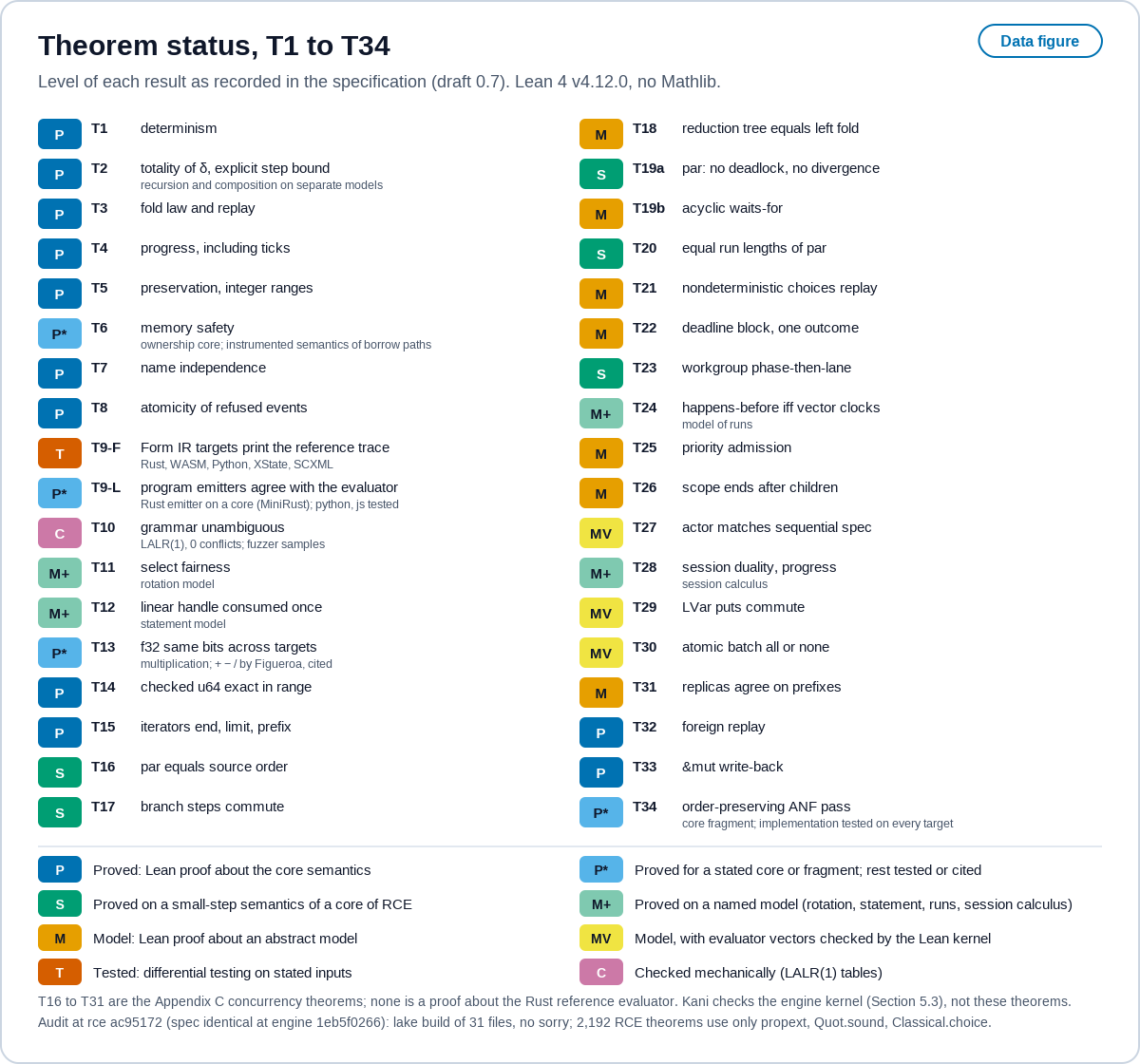
*Figure 3. Theorem status, T1 to T34. Level of each theorem as recorded in the specification at public commit `ac95172` (draft 0.7); theorems added after T34 are not shown, and T9 is shown as T9-L, the claim about the program emitters. `P`: Lean proof about the core semantics. `P*`: proved for a stated core or fragment, the rest tested or cited. `S`: proved on a small-step semantics of a core of RCE. `M+`: proved on a named model (rotation model, statement model, model of runs, session calculus). `M`: Lean proof about an abstract model. `MV`: model, with reference evaluator vectors checked by the Lean kernel. `C`: checked mechanically. T16 to T31 are the Appendix C concurrency theorems, and none is a proof about the Rust reference evaluator. Lean 4 v4.12.0 at `ac95172`, upgraded to Lean 4 v4.36.0 with six-kernel paranoid verification at `f87d6af2`, no Mathlib. Source: `spec/book/10-theorems.md` and Appendix C.13. A [PNG copy](https://research.openie.dev/figures/rce/theorem-status.png) is provided.*
**Checks run.** At public commit `f87d6af2` (23 November 2026), `spec/lean/` is upgraded from Lean 4.12.0 to **Lean 4.36.0** (`leanprover/lean4:v4.36.0`) to close the 2026 Lean 4 soundness and `.olean` replay disclosures: Common Vulnerabilities and Exposures `CVE-2026-72844` (`leanprover/lean4#14576`, nested inductive `.proj` type confusion in `<= v4.31.0`, fixed in `v4.32.2`), `CVE-2026-72711` (`#14484`, missing free-variable closure check in `environment::add_opaque`), `Kernel.Environment.replay` forged `.inductInfo` skipping (`#16688`, which showed that in-process `Lean.collectAxioms` and non-paranoid `.olean` replay can overlook manipulated environment entries), `.olean.server` sidecar/replay key mismatches (`#16674`, `#16675`), `Prop`-structure non-`Prop` field projection tightening (`#14977`), and compiler-trust `native_decide` (`Lean.ofReduceBool`, `#16693`). Across all 97 `.lean` files in `spec/lean/` (64 top-level `RCE` modules, 90 `.lean` files under `spec/lean/RCE/`), static and elaborated kernel scans confirm `0` `sorry`, `0` custom `axiom`, `0` `opaque`, `0` `Lean.ofReduceBool`, `0` `@[implemented_by]`/`@[extern]`/`skipKernelTC`, and `0` `Prop`-structures with non-`Prop` data fields; `audit/Audit.lean` verifies all **5,393** `RCE` theorem constants generated from the **1,264** `theorem` and `lemma` declarations in source (identical source declarations to `1762fb4b`, where Lean 4.12.0 generated 5,537 auxiliary theorem constants; 1,155 source declarations and 5,055 constants at `0c015c43`; 1,116 and 4,877 at `e416fd0`) using only `propext`, `Quot.sound`, and `Classical.choice`, and `scripts/lean-audit.sh` (`spec/lean/audit/six_kernel_paranoid_audit.json`) executes **`lake check --paranoid`** inside an unprivileged Linux `bubblewrap 0.11.1` (`bwrap`) read-only, network-isolated sandbox (`319.80 s`, `22,354.77 J` Linux Running Average Power Limit `package-0` `reported_j`, `measured_j = None`, `board_metered = false`) with unanimous acceptance across all **six independent proof checkers**:
| Independent Proof Checker (`lake check --paranoid` in `bwrap`) | Implementation & Soundness Basis | Verified Decls | Verdict | Mitigated Vulnerability Classes |
| :--- | :--- | :---: | :---: | :--- |
| **`con-leche --verified`** | Minimal reference kernel (Breitner) formally proved consistent in Zermelo–Fraenkel set theory with Choice (`ZFC`) | `68,090` | **`Accepts`** | `CVE-2026-72844` (`8` inductive blocks -> `252` fold records), `CVE-2026-72711`, weak-head cache bugs |
| **`con-ron --verified`** | *Aeneas*-verified Rust refinement of `con-leche` | `68,090` | **`Accepts`** | `CVE-2026-72844`, `CVE-2026-72711`, C++ memory & GNU bignum bugs (`#14833`) |
| **`lean4lean`** | Independent Lean-in-Lean Calculus of Inductive Constructions typechecker (Carneiro) | `68,092` | **`Accepts`** | C++ kernel implementation divergence & `#14977` projection typing |
| **`nanoda`** | Standalone zero-Lean-runtime Rust export verifier (`sorryAx` blocked) | `68,092` | **`Accepts`** | `.olean` replay manipulation (`#16674`, `#16688`) & unpermitted `sorryAx` |
| **`leanchecker --paranoid`** | Fresh-environment C++ kernel replay with zero tactic or compiler trust | `68,092` | **`Accepts`** | Metaprogramming environment mutation, `skipKernelTC`, & `Lean.ofReduceBool` (`#16693`) |
| **`Lean v4.36.0` (default)** | Post-`CVE` November 2026 C++ kernel (`#print axioms` enforced) | `68,092` | **`Accepts`** | All 2026 kernel `CVE`s patched; `0` `sorry`, `0` `opaque`, `0` `ofReduceBool` |
All 24 Rust-to-Lean vector tests and `spec/lean/emit-test/run.sh` (`3,000` cases, `0` mismatches) pass unchanged on Lean 4.36.0. At public commit `f87d6af2` (and `1762fb4b`), the reference checker holds 837 Rust unit tests across 159 test files (581 at `0c015c43`), passes 2,221 of 2,236 conformance tests across all 311 normative clauses (`0` failures, `15` unsupported), and `rce-spec-check` builds the LALR(1) tables of the core grammar (`1,028` states; `974` at `0c015c43`, `932` at `ac95172`) and of the grammar with Appendix C (`1,206` states; `1,152` at `0c015c43`, `1,110` at `ac95172`) with `0` conflicts, accepts `62` of `62` valid examples (`51` at `ac95172`), and reports that `13` of `13` syntax examples and `73` of `73` ill-typed or inadmissible programs require change (`12` and `65` at `0c015c43`, `12` and `64` at `ac95172`, where the WebAssembly build also passed `401` of `401` checks).
**A convergence observation.** Two sweeps of 24 October 2026 catalogued 111 programming languages first made public between January 2024 and October 2026 [189, 190]: 72 designed for language models or agents as authors or implemented largely by an agent (48 from the agentlanguages.dev catalogue [166], read at its source repository, and 24 beyond it), and 39 general-purpose or systems languages, with 35 pre-2024 languages reaching a milestone in the window. Among the machine-author entrants the count by year is 3, 10 and 57 for 2024, 2025 and 2026. Two positions are near-universal: refusal of invalid input at a boundary (54 of 72) and emission to another language (57 of 72; 17 of 39 general entrants, with Go the target of 2026 and C the systems default). Minorities take a canonical form (25 of 72), examples or tests inside the program (21 of 72; 2 of 39), a written specification as the authoritative definition (16 of 72; 14 of 39), deterministic evaluation as a stated gate (13 of 72; 3 of 39, among them Gossamer, Dawn and Wyzer) and memory safety without a collector (8 of 72; 7 of 39, converging on precise reference counting or ownership rather than lifetime annotations, with Goose's data stacks the outlier [191]). An append-only log with replay (5 of 72; none of 39) and hash-identified definitions (2 of 72; 3 of 39, Bend, Scrapscript and Dawn [192]) are rare, and an intermediate form as the source of truth is absent from the new general-purpose languages. A distinct trend of 2025 and 2026 is languages whose compilers were written largely by model agents and disclosed as such, among them Goose, Rue, Cursed and Jolt, whose performance claims are self-reported. The design choices of this paper therefore recur where they are cheap (a declared outcome for every input at the boundary, printing to a host language) and remain rare where they are theorems here (one canonical form, examples as part of the program, replay from a hash-chained log, name-free identity). This is an observation that choices recur and where; it is not evidence that they are correct, and this paper makes no comparison of quality with those projects. The emit registry of the specification repository takes every entrant as a target and a source on the same terms as every other language.
### 3.8 Behaviour, equivalence and dimension
Definition 3 says two fits are equivalent when their output sequences agree on every event sequence. This section gives that definition a universal property, defines the dimension of a program as a computed number, and reports the registered measurements of it. The normative text is section 6.10 of the specification (draft 0.9, commit `45fc95c`), with theorems T57 to T61 and the command `rce dim`.
**Behaviour as a point in the final coalgebra.** Fix a program $P$ with state space $S$, event alphabet $E$ and $\delta : S \times E \to S \times O^*$, and write $\delta_1 = \pi_1 \circ \delta$ and $\lambda = \pi_2 \circ \delta$ as in Definition 1. The behaviour of a state $s$ is the function $\mathrm{beh}_P(s) : E^* \to (O^*)^*$ with $\mathrm{beh}_P(s)(\varepsilon) = \varepsilon$ and $\mathrm{beh}_P(s)(e \cdot w) = \lambda(s, e) \cdot \mathrm{beh}_P(\delta_1(s, e))(w)$: the per-step outputs along any event sequence. $(S, \langle \lambda, \delta_1 \rangle)$ is a coalgebra of the functor $F(X) = (O^* \times X)^E$; $F$ has a final coalgebra $\mathrm{Beh}$ whose carrier is the set of causal stream functions, and $\mathrm{beh}_P$ is the unique coalgebra morphism $S \to \mathrm{Beh}$ (Rutten [144], Theorem 2.3). Two fits are equivalent, $F \equiv G$, when $\mathrm{beh}_F(s_0^F) = \mathrm{beh}_G(s_0^G)$. This is Definition 3 restated; the new content is that $\equiv$ is equality in one object that every Form, in every fit language, maps into by the same construction. Behaviour space is not a manifold: it carries the prefix ultrametric $d(b_1, b_2) = 2^{-n}$, $n$ the length of the shortest distinguishing event sequence, under which it is complete and totally disconnected [145]. Trace agreement on every sequence of length at most $k$ therefore certifies $d \le 2^{-(k+1)}$: a ball around the behaviour, not the behaviour. That is what the differential tests of [§5.1](#51-differential-testing-of-the-program-emitters) establish, and it never enters a hash.
**Two proof methods.** A relation $R \subseteq S \times S$ is a bisimulation for $P$ when $s\,R\,t$ implies, for every $e$, $\lambda(s, e) = \lambda(t, e)$ and $\delta_1(s, e)\,R\,\delta_1(t, e)$. T58 states that $\mathrm{beh}_P(s) = \mathrm{beh}_P(t)$ if and only if some bisimulation relates $s$ and $t$: to show two fits equivalent, exhibit the relation; to show them different, exhibit a distinguishing sequence, which also gives the distance. T1 and T2 (totality and determinism) are exactly the completeness and determinism that make the minimal machine unique; an incompletely specified machine has no unique minimum [146].
**Dimension.** $\mathrm{reach}(P)$ is the set of states reachable from $s_0$; it is finite because $S$ is finite under the value and size limits of the specification (N9). The dimension of $P$ is
$$\dim(P) = |\{\mathrm{beh}_P(s) : s \in \mathrm{reach}(P)\}|,$$
the number of distinct behaviours $P$ can be in, which is the Nerode index of its minimal Mealy machine [147], computable for an explicit alphabet in $n \log n$ [148]. $\log_2 \dim(P)$ is the bits of state the behaviour needs; $\log_2 |\mathrm{reach}(P)| - \log_2 \dim(P)$ is the *redundancy* of the fit, the bits of state that change no future output. A control dimension $\dim_c(P) \le \dim(P)$ is defined on the projection that replaces every guard over $\Sigma_d$ by its predicate symbol, a symbolic finite automaton [149], and its minimal machine, numbered by a breadth-first traversal in the canonical event order, has a unique name-free string [150]; its SHA-256 over canonical JSON is `shape_ctl`, a third key beside the name-free term hash and the e-class key of Definition 6. Equality at any key implies equivalence; inequality implies nothing.
What is and is not a theorem here should be said plainly. $S$ and $E$ are finite by the value limits and astronomically large: $|S| \le 256^{\mathrm{VALUE\_LIMIT}}$ per field, so finiteness makes every behavioural question decidable and none of them tractable. The minimal machine is a canonical form for the finite-control projection, where symbolic-automata minimisation is unique up to predicate equivalence [149]; for fields that are only compared and copied, register automata give a Myhill–Nerode theorem [151]; the moment $\delta$ does integer arithmetic into state, the only canonical object is the term itself. "Every Form is a finite Mealy machine, and its minimal machine is its canonical form" is therefore true as stated for $\Sigma_c$ plus guard predicates and is not a computable claim for $\Sigma_d$. That is also the honest reading of Proposition 3: the least-joule extraction returns the least-joule term *the extractor finds*, and three distinct functions are defined on one e-class: the target-blind budget units of specification C.6, which place the budget trap on the same operation in every runtime and are never joules; `est_j`, which is per target ([§6.3](#63-energy)); and the hashed representative, chosen by tree cost with a canonical-JSON tie-break for reproducibility. The emitted term and the hashed term of one e-class may differ; neither may differ across engines given the same log.
**Status of the theorems.** T57 (finality: $\mathrm{beh}_P$ is the unique coalgebra morphism), T58 (equivalence is bisimilarity), T59 (trace agreement to length $k$ bounds the distance by $2^{-(k+1)}$), T60 (for finite $S$ the quotient of $\mathrm{reach}(P)$ by the largest bisimulation is the minimal machine, with $\dim(P)$ states) and T61 (`shape_ctl` is invariant under renaming and under predicate-equivalent rewrites of guards) are stated in chapter 10 of the specification, and `spec/lean/RCE/Behaviour.lean` is in `lake build` (Lean 4.36.0 at public commit `f87d6af2`, passing `scripts/lean-audit.sh` and six-kernel `lake check --paranoid` over 5,393 theorem constants with standard axioms only and no `sorry`; earlier recorded at commit `f2bd7222` on Lean 4.12.0 with 5,052 theorem constants). What is proved, in the chapter's exact scope: the morphism equation of T57 (`beh_cons`; uniqueness of the morphism is stated, unproved); T58 for one program and for two (`bisim_beh`, `beh_bisim`, `behEq_iff_bisim`, `bisim2_beh`, `beh_bisim2`); and T59 in both directions over an explicit finite alphabet, the declared events over the boundary sets that `rce dim` explores (`trace_ball`, `ball_trace`), with the statement over all of $E$ stated, unproved. T60 is stated, with a model proof by partition refinement as the next step. T61 is tested for renaming only, against the name-free projection `rce fmt nameless`, which prints a program with positional names by kind in first-declaration order and is accepted whenever the source is, with the same trace hashes by T7; its invariance under guard rewrites is stated, unproved, and the symbolic quotient is not implemented.
**`rce equiv`: the equivalence check as a tool.** `rce equiv A B` explores two programs from their initial states over the same event instances, compares every step by its name-free output (emitted values in positional form, a kept step by its error's declaration index, T7), refines the two graphs together and reads whether the two initial states fall in one class (T58); when they do not it prints the shortest distinguishing event sequence and the two outputs at its end. `rce change OLD NEW` combines it with the export diff of F.4.3 and classifies a change as an erratum (every export compatible, every behaviour kept), a meaning change or an interface change, which is the rule of C.15 decided by the tool. Run between every corpus program and its name-free projection as a continuous-integration step, the check found one program whose projection required change (a state field named like a standard library method had renamed the method); the projection was corrected and the sweep reports every corpus Form equivalent to its projection, as T7 states. It is the Form's version of the equivalence check that hardware design runs on every revision ([§3.7](#37-the-language-one-text-costs-and-theorem-status)): a change under which every program keeps its behaviour is an erratum, any other a meaning change, decided by the tool rather than by a version number. With `rce hash`, which prints a program hash over the name-free projection (one hash for a program and its renaming, a different one for a changed step), and the provenance line that every emitted file now carries, the three mechanisms the record calls rare in new languages (section 3.7) are commands of the reference checker.
**`rce dim`, and the registered runs.** `rce dim [control] [fuel n] FILE` explores $\mathrm{reach}(P)$ breadth-first over the declared events with payloads drawn from each field's refinement type or, without one, from the boundary set of specification 6.3, up to `fuel` states, then runs Hopcroft partition refinement with the outputs as the initial partition (100,000 states in 10 to 40 s; the first Moore iteration was quadratic and did not finish), and reports states explored, behaviours (exact when the bound is not reached, else a lower bound), redundancy in bits per region, and with `control` the control states and `shape_ctl`. Three examples were written with known values: a counter with an unread flag (1.00 bit of redundancy), a mod-6 counter that emits parity (1.58 bits), and a door with three reachable states and no redundancy. The preregistration (`openie-research-experiments/rce/bench/dimension/PREREG.json`, registered 22 October 2026 before the command had been built and amended before each later run, with a hashed sidecar) fixes the populations and three hypotheses about bounded programs whose explored steps emit or keep the state: H0, that at least half of them carry more than 0.5 bit of redundancy; H1, that a program with one emit site carries more redundancy than a program with several; and H2, that one region carries at least 80% of the redundancy when it exceeds 1 bit. Its falsifier is RCE-F6 of [§9](#9-falsifiers), a median redundancy below 0.1 bit. The runs reported here, `dim-r2` to `dim-r5`, were each made once with `--fuel 100000 --control` (written `fuel 100000 control` since openIE-dev/rce `a5df5be7`, which made the command line positional), against a build of a public commit of openIE-dev/rce, with the binary hash recorded in every row; the first registered run, `dim-r1`, and the pilot before it are listed in [§10](#10-work-to-finish). The control label is the kept step's error or the emitted constructors only, and $\dim_c \le \dim$ holds on every row of these runs. In a state machine whose examples read state it never emits, the intent is carried by the examples and by no output; a report from `rce check` that names such an `example` (one that reads a field no step ever emits or keeps the state on) is an open proposal.
**The frozen runs.** The run `dim-r2` of 23 October 2026 (commit `1107442b` of openIE-dev/rce, registered as a second amendment of the same preregistration before the run, with the stratum read from the key that `rce dim` reported as `observable` at that commit, now `has_output`) samples the output-bearing stratum by rule: every program of the merged repository under its examples, programs, applications and book listings that is accepted standalone, has a state region and contains an emit or a fail statement. That is 25 programs, 24 of them output-bearing, 14 bounded within 100,000 states. Among them, `ring_buffer` has 12,500 reachable states, 781 behaviours and five control states; four bits of its state change no output, all in one region, and its control projection, which records only which steps fire, has five states. Excluding the three programs written for `rce dim` and their book copies leaves 8 bounded output-bearing programs, of which 6 carry more than 0.5 bit (Wilson 95% interval 0.41 to 0.93), with a median redundancy of 1.79 bits (interquartile range 0.25 to 3.37); over all 14, 10 of 14 (0.45 to 0.88) and a median of 1.29 bits. RCE-F6 (a median below 0.1 bit) is not triggered; the interval's lower end is below one half, so H0 is supported and not established at this size. H1 is not supported (the two single-emit-site programs carry 1.58 and 4.00 bits, the two multi-site programs 2.51 and 3.65), and H2 holds on 8 of 9 qualifying rows only because 8 have one state region; the one two-region program attributes 62% of its redundancy to its larger region. The run's substantive addition is three application-sized measurements. The chat application explores 100,000 states with 176 behaviours and 69 control states, so at least 9.15 bits of its state change no output, the largest redundancy measured and a lower bound; the selective forwarding unit (40,218 states, 7,038 behaviours, 2.51 bits) and the terminal (3,390 states, 270 behaviours, 3.65 bits) are exact. The ratio of control states to behaviours varies by an order of magnitude across the population (5 to 781 for the ring buffer, 69 to 176 for the chat, 5,095 to 7,038 for the forwarding unit), which measures how much of a program's behaviour is which steps fire against which values flow. The run also shows that the stratum needs a finer registered rule: the tool's flag is true for a program whose every output is the same (a constant, or a kept step every state gives), so a third run should register "output-bearing, with more than one distinct output" before sampling. Rows, intervals and the amendment are in the experiments repository under `rce/bench/dimension/` (`results/dim-r2.jsonl`, `RESULTS.md`). A third run, `dim-r3` (23 October 2026, registered before it), applied the finer rule the second run asked for: `rce dim` reports the number of distinct outputs (`distinct_outputs`; emitted values and kept steps counted separately as `emits` and `keeps`), and the stratum is output-bearing with at least two of them. On 28 programs (the second run's population plus the three accepted programs with two or more state regions), 22 are strictly output-bearing and 12 of those are bounded; the median redundancy is 1.29 bits (8 of 12 above 0.5 bit, Wilson 0.39 to 0.86), and 2.05 bits over the 6 not written for the tool. The three programs the finer rule removed (a thermostat, a reconciler and a cart) are each observable only by a constant, so the second run's medians had counted bits that change an output which never changes at all. H2 is tested where it can be, on the one strictly output-bearing multi-region program above 1 bit, whose larger region carries 62%, below the 80% threshold; it stays open on one row. A fourth run over the 86 conformance programs with state (registered before it) measured the five harvested host-contract programs for the first time, all bounded within the fuel and carrying from 0.01 bit (the terminal driver) to 2.16 bits (the channel driver) with control quotients in the thousands, and answered the multi-region question for this corpus: the only strictly output-bearing multi-region programs are data-distinguished copies of one capability example, so H2 cannot be decided from existing public material and the next step is authoring observable multi-region programs, registered as a population before the run. That step was taken on 24 October 2026: twelve two-region programs (an elevator, a vending machine, a crossing, a car park, a printer, a lobby, a bank card, a washer, a session, a player, a climate controller and a reservoir) were written into the programs corpus and registered as the fifth run, with the disclosure that the tool had been run on the drafts. All twelve are strictly output-bearing, bounded and explored in milliseconds; eleven have zero redundancy and the twelfth, the climate controller, keeps 1.58 bits in two flags that record its last action and that nothing reads. The median is 0.00 bits, so RCE-F6 is triggered on this population: accidental state is not common in small Forms whose caps are enforced by kept steps and whose phases emit. Read with the earlier runs (1.29 bits over the strictly output-bearing hand-written examples, 0.01 to 2.16 bits for the host programs, at least 9 bits for the chat application), the quantity grows with program size and with the number of fields nothing reads. The claim the data supports is the falsifier's own: `rce dim` is a diagnostic for larger programs and for regions added without an observer, not a property of small Forms in general.
**The concept record.** Specification 6.6 now describes an unhashed side table keyed by the name-free keys of a program and holding its names, intent strings and doc comments, and `rce emit form` prints it under `names`, keyed by declaration index (the index `shape_ctl` uses), after the hashed fields. Projections render it; $\delta$ never reads it; it is the complement that makes the projection of a Form a symmetric lens [123] rather than a retraction. The evidence of [§2.1](#21-programming-is-coding-theory) says the table must hold the concept a name stands for and not only its spelling, because word choice and ordering are the two steps developers disagree on at 6.9% [137] and the step they agree on is the concept. Whether a model can reason from the Form with the record attached as well as from a named surface is the first of the three registered experiments of [§12.3](#123-why-human-written-code-is-redundant) and is open.
## 4. The engine: gears, gate and receipts
This section describes the design of the engine, which Appendix D of the specification and its proposals define.
### 4.1 The engine is a Form
RCE runs software as a graph of small deterministic handlers. A handler that cannot decide raises an escalation. A resolver answers the escalation once, and the answer is installed as a permanent handler, so the next case of the same shape runs with no resolver. The design requires the engine to meet every Form invariant:
| Invariant | What the design requires of the engine |
|---|---|
| Reload is a verified fold | Reload reads the log verbatim, recomputes every hash and link, and folds the rest with $\delta$. Nothing is re-stamped. A broken chain does not load. |
| Name-free tick order | Handlers run in topological rank order, then by a name-free node key. Outputs are staged and delivered after all handlers run, as in ASM semantics. Renaming every node gives the same anonymous state hash at every entry. |
| No silent drop | A full mailbox holds the message in an ordered queue and logs `Backpressure`, and every task still closes. |
| Payloads are in the log | Inputs, ticks, external handler results, installs and faults are log entries. The state hash after every entry matches a fold from an empty engine. |
| Logical clock | Liveness counts ticks, not wall time. |
| Stable hashes | SHA-256 (Secure Hash Algorithm, 256-bit) over canonical JSON, keys sorted at every depth, for entries, states, shapes and rule ids. |
### 4.2 The gears
Each gear is tried only when the gear below it does not pass the gate. That order is one fixed cascade.
| Gear | Method | Lineage |
|---|---|---|
| G0 Lookup | A shared handler library keyed by SHA-256 shape hash; for code repair, localization to ranked functions | Code search and retrieval [21] |
| G1 Rules | Deterministic, guarded repair templates and schema-derived validators, each checked for mutation sensitivity | PAR, TBar, AVATAR, FixMiner [22, 23, 24, 25]; codemods such as Coccinelle [26] |
| G2 Synthesis | Enumeration over the handler grammar, solvers and e-graphs | Sketching, SyGuS, egg [27, 9, 12] |
| G3 to G5 Models | A typed decision model, a local small model, then a remote model, last | Model cascades [28] |
The order follows one principle: the first rule of automation is having a manual process that works. A model is worth adding only on top of a manual variant of the task, or a deterministic automated variant, that already works. So the exact gears G0 to G2 run first, and a model acts only on the residual they leave open, proposing edits that the same gate judges. Reducing what a stochastic model is required to do makes its action space smaller, and so easier to master. The public form of this ladder is `rce repair` of [openIE-dev/rce](https://github.com/openIE-dev/rce), and it has three runs in [openie-research-experiments](https://github.com/openIE-dev/openie-research-experiments), each registered before it ran. The first two ran four rungs (reuse, lookup by type, the rewrites `rce fmt` determines, and bounded enumeration of one small edit, at most 2000 candidates). The first [225] closed 118 of 120 tasks with zero model calls, but 119 of the 120 were operator and integer-literal mutations, which bounded enumeration inverts by construction, and 9 of the closures pass the examples and checks without being the original program. The second [226] has no such mutation. Of its 151 tasks it closed 31 (20.5%) with zero model calls: 1 of 41 changes from the git history of openIE-dev/rce, of which 39 follow changes of the language and only 2 are defects of a program; all 27 guard negations, each by the enumeration edit that removes a `not`, which inverts that mutation by construction; and 3 of 83 renames, none restored to the original. Without the guard negations, 4 of 124 tasks close. The second run's prediction P3 failed and its falsifier F1 was met: the closure rate of the first run does not carry over to real history. The third [227] ran the second run's 151 tasks unchanged, at openIE-dev/rce `8a5d90ea`, with a fifth rung after bounded enumeration: renames, in which one use of a value name becomes another value name in scope there, or one binding becomes a name the checker's report names, at most 2000 candidates. Its registration records that renames are the class this rung was built for after the second run. In its plain arm, given only the task, the ladder closed 111 of 151 (73.5%) with zero model calls, 103 of them restored to the original: all 83 renames (80 at the fifth rung, 3 by bounded enumeration), 77 restored; all 27 guard negations, each with its outcome in the second run; and 1 of the 41 history tasks, the same one. Without the guard negations, 84 of 124 tasks close. A known-good arm gave the ladder each task's original program as well: it closed 116 of 151, 114 restored, including all 83 renames restored and 6 of the 41 history tasks. Its prediction P6, that every guard and history task keeps its plain-arm outcome in the known-good arm, failed: 5 more history tasks close, and the one closed in the plain arm closes at the fifth rung instead of the third. The ladder closes the mutation classes its rungs invert and 1 of 41 changes from real history, so the residual on which a model would act is nearly every real defect.
### 4.3 The gate
A candidate is promoted only when it passes the gate. The gate replays the node's recorded inputs, runs the candidate in shadow on fresh samples with a coverage bound (the rule of three at a declared error budget), checks the output schema, and requires the proof certificate of Section 5. A candidate that does not pass is logged with its counterexample.
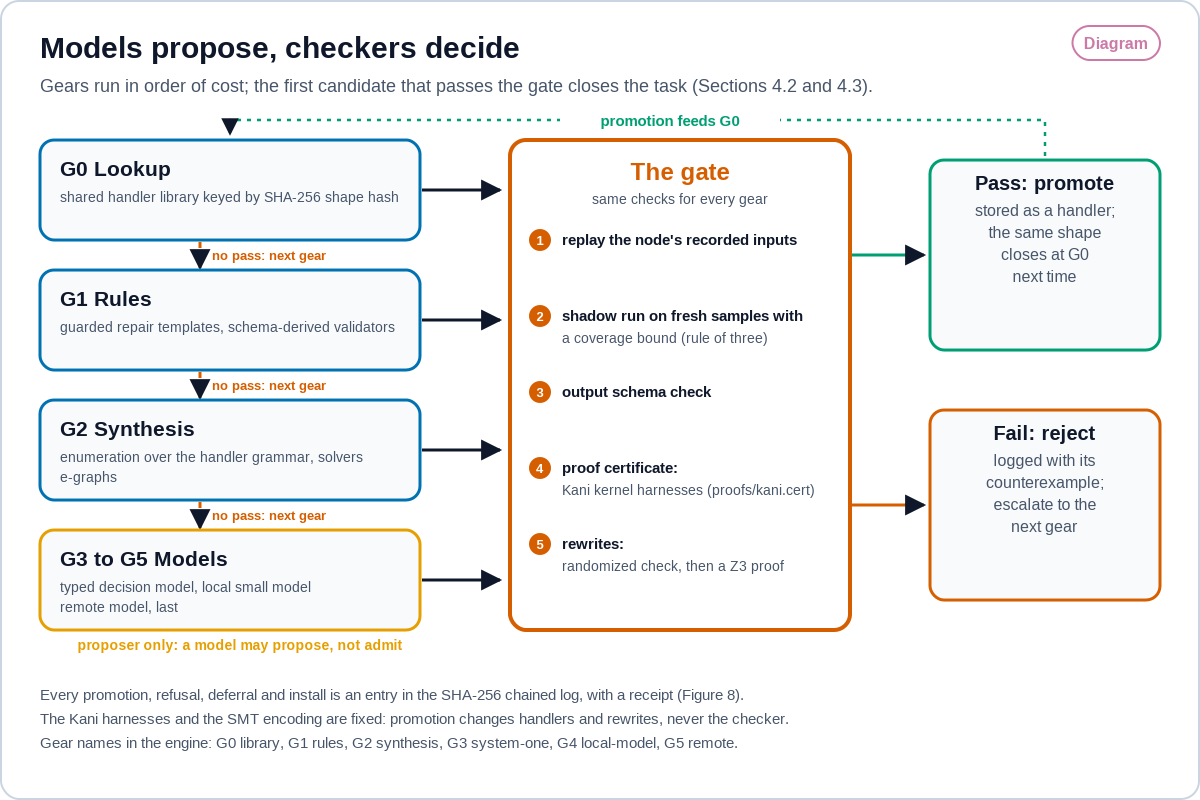
*Figure 4. Models propose, checkers decide. Diagram: gears run in order of cost: G0 Lookup, G1 Rules, G2 Synthesis, G3 to G5 Models (a typed decision model, a local small model, then a remote model). Every candidate passes through the same gate: replay of the node's recorded inputs, a shadow run on fresh samples with a coverage bound, an output schema check and the certificate of the kernel's model checking with Kani, a model checker for Rust (Section 5.3); a proposed rewrite also needs a randomized check and then a proof by the Z3 SMT solver (Section 5.2). A candidate that passes is promoted and closes the same shape at G0 next time; one that fails is logged with its counterexample and the next gear is tried. In the design, the Kani harnesses and the SMT encoding do not change through promotion. Source: Sections 2.2, 4.2, 4.3, 4.6, 5.2 to 5.5. A [PNG copy](https://research.openie.dev/figures/rce/gears-gate.png) is provided.*
### 4.4 Receipts
Every promotion, gate failure, deferral and install is a mutation in an append-only log chained with SHA-256, so tampering with any past entry breaks the chain [29, 30]. Each handler's cost is priced from interpreter operation counts with a per-host cost table and labeled `est_j`. The foreman is the engine's resolver of escalations, which runs the gears in order on each one, and each of its calls carries a receipt. A receipt names the gear, the method of the estimate (`basis`), the candidates tried and whether the gear resolved the escalation. Its `est_j` field is required: it is a finite non-negative number, or null, and null is allowed only when `basis` says `unpriced`, as for a model call with no energy figure. A receipt with the field missing does not parse. An unpriced cost is never read as zero, so a total over receipts reports its priced and unpriced invocations separately, and a saving that depends on an unpriced resolution is reported as unknown.
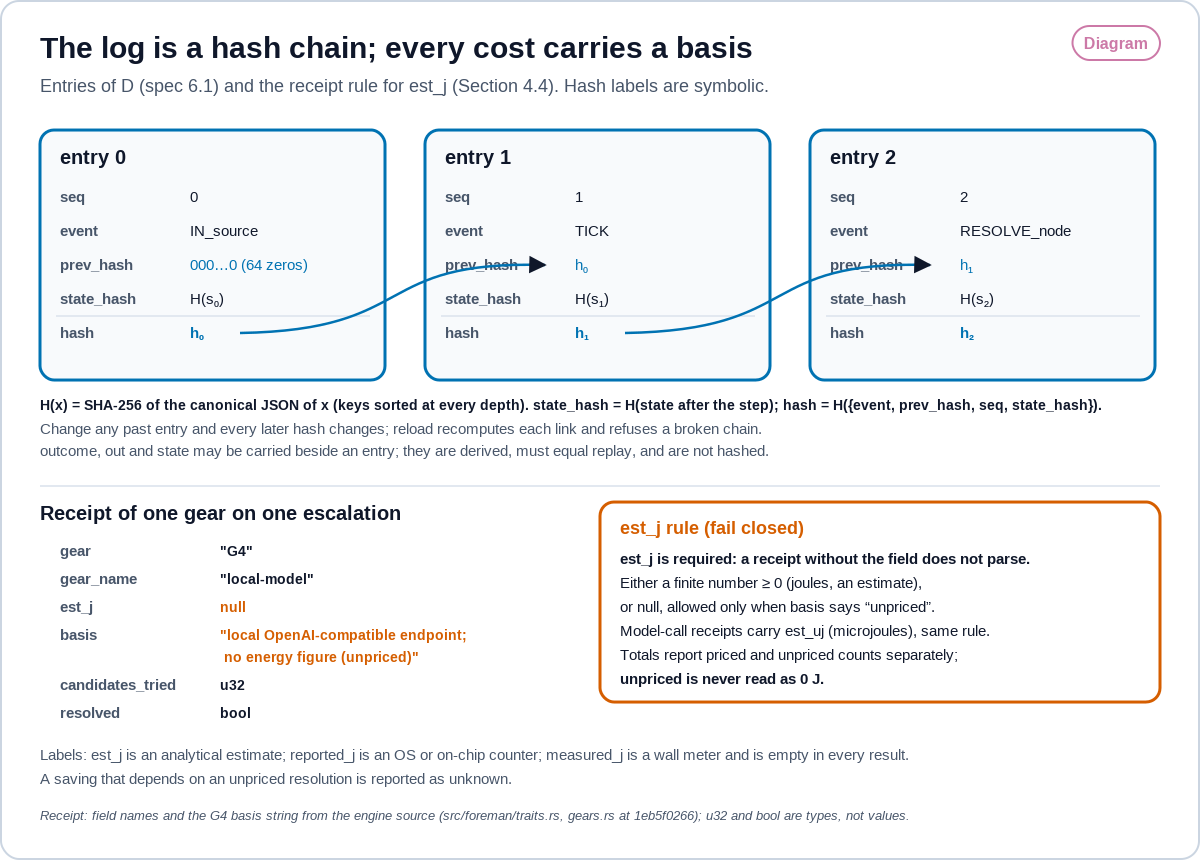
*Figure 5. The log is a hash chain; every cost carries a basis. Diagram: entries of the durable log D are `{seq, event, prev_hash, state_hash, hash}`. `state_hash` is the SHA-256 of the canonical JSON of the state after the step; `hash` is the SHA-256 of the canonical JSON of `{event, prev_hash, seq, state_hash}`; the first `prev_hash` is 64 zeros, so changing any past entry changes every later hash. A gear receipt carries `gear`, `gear_name`, `est_j`, `basis`, `candidates_tried` and `resolved`. `est_j` is required and is a finite non-negative number, or null only when `basis` says unpriced; model-call receipts carry `est_uj` in microjoules under the same rule. An unpriced cost is never read as 0 J. Hash labels are symbolic. Source: specification 6.1 and Section 4.4. A [PNG copy](https://research.openie.dev/figures/rce/receipt-chain.png) is provided.*
### 4.5 The compilers
The language's compiler is the reference checker's `rce emit TARGET FILE` (specification 10.5). It translates a module that passes `rce check` to one of five outputs: `form`, the Form $P = (S, E, \delta, D, \lambda)$ as one line of canonical JSON, a deterministic function of the program text; and four programs, `rust` (one Rust source file), `python` (one Python 3 file), `js` (one JavaScript module for Node) and `scala` (one Scala 3 file for the Java virtual machine). The program emitters translate the checked module, not the Form, and each output is self-contained. Every target is generated. None is authored.
Specification 6.3 fixes one behavior at every numeric edge, which every target must reproduce: checked integer arithmetic traps on overflow of the static type and never wraps; integer `/` truncates toward zero ($-7/2 = -3$); `%` takes the dividend's sign ($-3 \bmod 2 = -1$); division by zero traps; floats are IEEE 754 binary64, correctly rounded once per operator, and a non-finite result traps; time is the logical clock only.
In the engine's design a second compiler lowers a handler spec and its fit through an e-graph to a Form IR and projects it to further targets; its test is listed in [§10](#10-work-to-finish).
### 4.6 Method: the whole stack evaluated, every interface assumption explicit
A program is a stack of levels: tokens and statements; handlers; the Form, a single step function $\delta : S \times E \to S \times O^*$ over $S = \Sigma_c \times \Sigma_d$ (control regions; data: the clock, the input count and typed relations); the log, a SHA-256 hash chain whose entries record each event, the hash of the state it produced and the hash of the previous entry; the rewrites that transform the Form; and the substrate that executes it. Each level rests on assumptions about the level below. RCE does not treat any level as fixed. It evaluates the whole stack, writes each interface assumption down as a checkable statement, and checks it on every run.
| Boundary | Assumption | Check |
|---|---|---|
| source to handler | an input satisfies its source contract | the contract check at the input event of δ |
| handler to sink | every Ok output satisfies the output schema | handler proof: evaluation by the kernel evaluator, which the design requires to be total and deterministic and checks with a model checker ([§5.3](#53-model-checking-of-the-kernel)) |
| log to state | every entry carries the hash of the state it produced | kernel fold, which stops at the first entry whose hash does not match and reports it ([§5.3](#53-model-checking-of-the-kernel)) |
| rewrite to Form | a rewrite preserves the output for every input | randomized check, then an SMT proof ([§5.2](#52-the-proof-rule-for-rewrites)) |
| stub to foreman | a handler that cannot decide escalates instead of guessing | stub handlers emit escalations; resolutions are promoted only through the promotion path |
| Form to target | every emitted target computes the same δ | every target carries the same reference trace |
A failed check locates the break at the boundary where it occurs. The correction is made at that level, passed through the check of that boundary, and promoted. Every level above the corrected one inherits the correction without further change, because each level above consumes the corrected level only through the interface whose assumption is now checked. This is the sense in which corrections carry upward and compound.
## 5. Verification
### 5.1 Differential testing of the program emitters
T9-L states that the program emitters `rust`, `python` and `js` agree with the reference evaluator. For the Rust emitter it is proved on a core, as a verified translation into MiniRust, a deep embedding of the emitted Rust subset; that `rustc` implements MiniRust is trusted and tested. For the Python and JavaScript emitters it is tested: the emitted program must print the reference trace of every example program byte for byte, which is the gate every row of the emit registry passes ([§3.6](#36-one-ecosystem-lossless-and-the-universality-thesis)). The reference evaluator and the emitted Rust, Python and JavaScript runtimes also compute the same budget function, and a test checks that the budget trap falls on the same operation in all four ([§3.7](#37-the-language-one-text-costs-and-theorem-status)); the order-preserving ANF pass before every emitter is tested differentially on every target, including a sweep of budgets across the trap point (theorem T34). This is differential testing in the line of McKeeman and of Csmith [86]: agreement among independent implementations on a stated input set. It is not translation validation [85], and outside the proved core of the Rust emitter it is not a verified compiler. It says nothing about inputs outside the tested set.
### 5.2 The proof rule for rewrites
Verified rewrite rules have a lineage. Ruler infers and checks rewrite rules by equality saturation with no model in the loop [87]. The model-proposed rewrite admitted in Section 5.5 repeats a rule the engine already had, so that record is a statement about the gate, which did not admit 15 of 18 proposals, and not a claim that a model is a good rule source.
In the design of the engine, every e-graph rewrite must be proved in the Z3 SMT solver [31] against a quantifier-free encoding of the Form's term evaluation and arithmetic: values as a datatype, 64-bit bit-vectors with checked overflow, signed division and remainder with the dividend's sign, and binary64 floats. A rewrite that changes overflow, escalation order or a message gets no proof. A proposed equivalence enters the e-graph only with a proof.
### 5.3 Model checking of the kernel
The design checks the engine's kernel (hash chain, fold, name-free positions and handler evaluation) with the Kani model checker for Rust [32]. Handler evaluation is the fixed point of a non-recursive step, so a proof that the step is total and deterministic per constructor carries to evaluation by structural induction. The design names ten properties, one harness each:
| Harness | Property |
|---|---|
| `chain_appended_verifies` | An appended hash chain verifies |
| `chain_detects_tampering` | A changed entry breaks the chain |
| `fold_equals_replay` | The fold equals replay |
| `fold_rejects_wrong_state` | A fold that disagrees with the stored state fails |
| `position_is_name_independent` | Rule positions do not depend on node names |
| `reason_tokens_are_name_independent` | Reasons are name-free by whole tokens |
| `handler_core_leaves` | Leaf handlers are total and deterministic |
| `handler_core_validate` | Validation is total and deterministic |
| `handler_core_pipeline` | Pipelines are total and deterministic |
| `handler_core_ifhas` | Guards are total and deterministic |
### 5.4 Promotion gate on the proof certificate
In the design, the model-checking run writes a certificate whose hash is stored with the engine. The engine, the log, rule ids and handler evaluation route through the kernel, and promotion requires the certificate.
### 5.5 The model as a proposer behind the check
A model may propose equivalences. It may not admit them. A local 1.5-billion-parameter coding model was run as a proposer on the specification `orders-form`, and the public record of the run ([`rce/bench/results/llm-proposer-form-demo.form.json`](https://github.com/openIE-dev/openie-research-experiments/blob/main/rce/bench/results/llm-proposer-form-demo.form.json)) holds 18 proposals, 13 of them distinct. The record gives the source of each proposal only as `llm`; the model, Qwen2.5-Coder-1.5B under llama.cpp, is named by this paper and by no public record. The check did not admit 15 proposals, 12 of them distinct: four that do not parse, two that put a value where a term belongs, and nine commutations of arithmetic operators, each shown wrong by a counterexample on which the two sides fail differently. The 3 it admitted are one rewrite, `(pipe pass ?a) => ?a`, under three names, and that rewrite repeats a rule the engine already had. The record shows the gate stopping what is wrong; it shows no new rule from the model.
## 6. Lift: entering the ecosystem from other languages
Lift is the door into the ecosystem for code written elsewhere. It is a construction, made per language from tools every language already has: a formal grammar, a parser such as [tree-sitter](https://tree-sitter.github.io/tree-sitter/) that yields the syntax tree, the abstract syntax tree and the symbols that language-server tooling resolves ([Language Server Protocol](https://microsoft.github.io/language-server-protocol/)). The engine profile specifies a lift, `rce scan DIR --form`, that builds the Form from that tree for Rust, Python, TypeScript and Go and labels every lifted element as unproven (Appendix D.8). A lifted program carries the faults of its source, so lift includes repair, and the protocol below measures repair on public bug corpora with the location given.
### 6.0 The repair ladder
A coding task is measured here by the **intent bits** it needs: the bits that must be supplied from outside what the engine already holds (the program around the edit, the libraries, the tests, the index of known fixes). Writing $H_{task}$ for the bits that pin the target artifact down and $H_{corpus}$ for the bits the corpus already fixes, the supplied bits are $I = H_{task} - H_{corpus}$. A gear that ranks the right edit at rank $r$ among its candidates has supplied $\log_2 r$ bits of search, and the gate supplies the rest. The ladder orders tasks by edit size, an objective proxy for $I$: one token (L0), one statement (L1), one hunk (L2), several hunks in one file (L3), several files (L4), a function from a specification or tests (L5), an issue-level change (L6) and a program from a specification (L7). The rungs, corpora, splits and hypotheses are preregistered; the files are in the [public repository](https://github.com/openIE-dev/openie-research-experiments/tree/main/rce/bench/ladder/).
L2 to L4 are to be measured on a Defects4J held-out set ([Section 8.1](#81-defects4j)), and L5 to L7 under the protocols of [Section 8.2](#82-swe-bench-lite-offline). The method and the gate of L0 and L1 follow.
**Method.** Each corpus is shuffled with a fixed seed. The first 2,000 positions of each shuffle, and for L0 three whole repositories (commons-lang, requests, flask), form the development split, on which the gears may be tuned; development results are not reported. Every remaining task is in the test split. Before a test run the solver is committed and its binary hash recorded, and no gear changes during the run, so every row to be reported is a frozen-solver result on test tasks only, with 0 model calls. The preregistration (`PREREG.json`) and the report script are in the [public repository](https://github.com/openIE-dev/openie-research-experiments/tree/main/rce/bench/ladder/).
**Gate.** At L0 and L1 the location is given and the gate is token identity: the repaired line or statement must equal the developer's, token for token. This is stricter than passing the tests, because a patch can pass a weak test suite and still be wrong. Qi and colleagues found that most patches GenProg reported as fixes were plausible but incorrect [92]; overfitting to tests is documented in search-based and semantics-based repair [93, 94] and addressed with generated tests [95]; tools score higher on the benchmark they were tuned on [96]; and fault localization biases comparisons [97]. Token identity removes the plausibility gap on these rungs, and giving the location removes the localization term, so the rate measures the repair gears alone. L2 and above use the tests as the gate and report plausible and correct counts separately (Section 8.1).
### 6.1 L0: one-token faults
The L0 corpus is every PIT-style mutant [109] with a valid replacement token in real repositories at pinned commits, five Java (commons-math, commons-collections, jsoup, joda-time, gson) and four Python (click, attrs, pydantic, sympy), with four repositories never used for tuning (commons-text, commons-io, more-itertools, httpx) as a second test set. Mutants are a stand-in for real one-token faults that Just and colleagues found to be coupled with real faults [110]. If the neighbourhood that restores a one-token fault is built from the same operator tables that produced the mutants, a high rate partly reflects that overlap and not repair ability on faults that arise in practice. A plain operator-inversion search, run on the same mutants, is the baseline that shows how much of the rate the overlap explains, and an L0 rate is read beside it.
### 6.2 L1: one-statement bugs from real histories
L1 uses two public datasets of real single-statement bug fixes mined from open-source histories: ManySStuBs4J 2.0 [107] for Java and TSSB-3M v1.0.0 [108], shards 14 and 15, for Python. The solver receives either the 7-line hunk only or the whole file at the parent commit, with indexes of the project's methods and guard conditions, and the two are reported as separate rows. These datasets have no published repair leaderboard under this gate (hunk only, token identity, location given), so no learned-repair number is set beside them; Defects4J, which does have one, is compared with TBar in Section 8.1.
### 6.3 Energy
In the protocol, every row of the ladder carries `est_j`, an estimate of central processing unit (CPU) seconds times 10 W, and a subsample is to be read on RAPL [105], the processor's on-chip package counter, as `reported_j`: the package delta over the whole run, less idle power from a sample taken just before, times the run's duration. `measured_j`, a wall meter on a named rail, follows the protocol of Section 8.3. No `reported_j` or `measured_j` figure has been produced on public code; the rebuild is listed in [§10](#10-work-to-finish).
**Two regimes and a calibrated vector.** The estimate above, CPU seconds times 10 W, is one substrate table and cannot tell targets apart, so least-joule extraction never chooses a target. The measurement literature says what the fix must look like. On an in-order core, joules are linear in operation counts: a six-counter model on Cortex-M0 reaches R² ≈ 0.99 and 2.8 to 4.3% mean absolute error, with coefficients such as 0.96 nJ per instruction and 2.1 nJ per taken branch [152]. On an out-of-order core the model collapses to time: with one core pinned and turbo off, a Xeon Gold 6430 drew 189.8 ± 0.5 W across every implementation and benchmark of a language-energy replication, and the ranking that had put Python at 75.88 times C disappeared once library choice, parallelism, warm-up and measurement bugs were controlled [153]. The counters themselves are of uneven worth: Intel RAPL predicts plug power to 1.8% mean absolute percentage error once DRAM is included, but updates about every millisecond and drifted 10 to 12% with package temperature on one generation [105]; polling it faster than 10 ms produces up to 50% stale reads [154]; NVIDIA's NVML samples about a quarter of the run time and single naive runs erred by up to 70% against an external meter [155]. Gas-style unit metering correlates with CPU time at only Pearson ≈ 0.51 on Ethereum [156], so "energy scales with the operations counted" is an assumption the `reported_j` subsample has to test. A proposal to the specification keeps three objects apart: the C.6 budget units stay deterministic, target-blind and in the log; `est_j` becomes $\langle \mathrm{count}(\mathit{term}), E[\mathit{target}] \rangle$ plus idle power times time in regime A (microcontrollers, field-programmable gate array (FPGA) lanes, in-order cores) and $P_{\mathrm{active}} \cdot t + E_{\mathrm{llc}} \cdot \mathit{misses}$ in regime B (out-of-order CPUs and graphics processing units (GPUs)); and the coefficient vector $E[\mathit{target}]$ is a `host.Calibrated` log entry with its protocol, sample count and standard error per coefficient, written by `rce host calibrate` under a normative protocol (at least 30 interleaved A/B pairs against the idle baseline, blocks of at least 60 s or $10^9$ operations, warm-up discarded, temperature recorded, gross and net reported, the meter named with its validation reference, RAPL sampled no faster than 10 ms), so that extraction under `est_j` is a function of the log and replays. Receipts gain a `calibration` hash and a `stale_fraction`, the share of a step's operations with no calibrated row, priced `unpriced`; totals keep the four labels in separate columns. The falsifier is RCE-F5 in [§9](#9-falsifiers). The first calibration to run is the KV260 rung of the energy ladder on its core rail with $N \ge 30$, which turns the stand-in `E_LUT_READ = 1e-12` J, an OpCounter constant of [Metered Commit Gates](https://research.openie.dev/papers/gates/) that the RCE specification does not contain, into a coefficient with a standard error. None of this is built: on main, `host.Calibrated` holds fabric, operation class, overhead and throughput for placement, not joules, and no `rce host calibrate` command exists.
## 7. Reuse evidence
RCE's position on the reuse axis rests on an engineering fact: code is reused at every scale. Each method below measures it differently.
| Method | Source | Finding |
|---|---|---|
| File-level clone mapping | DéjàVu, Lopes et al. 2017 [33] | Of 428 million files in 4.5 million non-fork GitHub projects, 85 million are unique: "70% of the code on GitHub consists of clones of previously created files." In JavaScript, 6% of files are distinct. |
| Line-level redundancy | Gabel and Su 2010 [34] | Against 420 million lines, "between 50% and 100% of each project is redundant" at about one line. |
| Statistical language models | Hindle et al. 2012 [35] | Code is "very repetitive, and in fact even more so than natural languages." |
| Corpus near-deduplication | The Stack [36] | Near-deduplication removes 54.7% of The Stack v1 (6.4 TB to 2.9 TB) and 52.4% of v2 (67.5 TB to 32.1 TB). |
| Whole-archive preservation | Software Heritage [129, 130] | 30.3 billion unique file contents from 448 million origins (archive counters, read 13 October 2026), each stored once by the hash of its bytes. |
| Mined fix patterns | PAR, TBar [22, 23] | PAR found "several common fix patterns" in more than 60,000 human patches. TBar's 15 pattern categories fix 43 Defects4J bugs correctly in the standard pipeline, and 74 of 101 with perfect fault localization, with no learning. These are figures as read from [23]; the meaning of the 101 (plausible patches or bugs attempted) has not been rechecked against that paper here, so treat the ratio as unconfirmed. |
| Cross-language tasks | Rosetta Code [131] | 1,360 tasks (and 421 draft tasks), each one concept implemented across many of 1,009 known languages. |
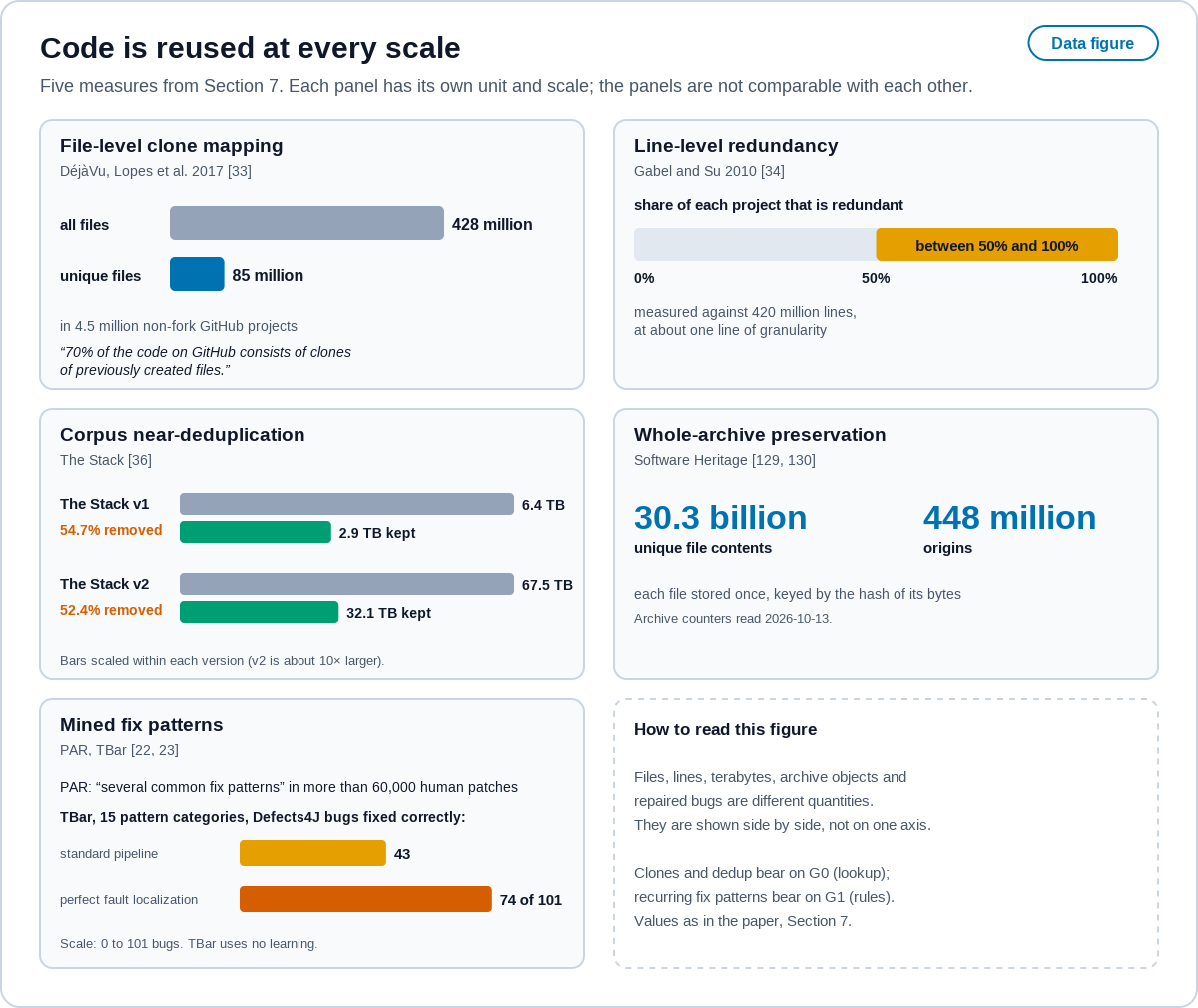
*Figure 6. Code is reused at every scale. Data figure: five measures of reuse, each in its own unit; the panels are not comparable with each other. File-level clone mapping (Lopes et al. 2017 [33]): of 428 million files in 4.5 million non-fork GitHub projects, 85 million are unique. Line-level redundancy (Gabel and Su 2010 [34]): between 50% and 100% of each project is redundant at about one line, against 420 million lines. Corpus near-deduplication (The Stack [36]): 54.7% removed from v1 (6.4 TB to 2.9 TB) and 52.4% from v2 (67.5 TB to 32.1 TB). Software Heritage [129, 130]: 30.3 billion unique file contents from 448 million origins (archive counters read 13 October 2026), each stored once by the hash of its bytes. Mined fix patterns (PAR [22], TBar [23]): PAR found common fix patterns in more than 60,000 human patches; TBar fixes 43 Defects4J bugs correctly in the standard pipeline and 74 of 101 with perfect fault localization. Values as in the table above. A [PNG copy](https://research.openie.dev/figures/rce/reuse.png) is provided.*
Each row is an input to the engine. Clones and dedup say a fit usually exists, which is G0. Recurring fixes say adaptation is mostly a small catalog of guarded rewrites, which is G1. Line-level redundancy shrinks the search space of G2. The repair ladder of Section 6 is the protocol that measures it at scale on held-out splits. Two cautions sharpen the reading. Duplicates inflate retrieval and model scores unless removed [104]. And buggy lines are less natural than fixed ones [45], so the bug itself is the case lookup is least able to predict; the fix shape, not the buggy line, is what G0 and G1 must key on. The rule-mining line that does this at scale, from GenProg's generate-and-validate search [88] and Prophet's learned correctness model [89] to Getafix at Facebook [90] and Sorald's model-free repair of static-analysis violations [91], derives templates from disjoint history and reports precision on unseen cases [98]. That is the standard Section 8.4 adopts.
## 8. Measurement protocols for what comes next
Each protocol is fixed before its run: preregistration committed, seeds and solver commit recorded, every artifact kept. Gate first, joules second, labels always.
### 8.1 Defects4J
Defects4J holds 854 active real Java bugs, each with reproducing tests [37].
1. Develop on a 100-bug subset, offline, through `defects4j checkout`; report held-out results only, on a disjoint set drawn from the active bugs by a seeded rule registered before the run, which excludes the development subset and every bug already run with any gear, and frozen before the run.
2. Run G0, then G1, then G2, then a local model last. Record the gear that closed each bug.
3. Gate: the triggering tests and the full suite pass. Report plausible and correct counts separately; correct means equivalent to the developer patch on review.
4. Report model calls per correct fix and joules per correct fix, labeled.
5. Reference points: TBar's 43 correct fixes and its 74 of 101 under perfect localization (figures as read from [23], with the denominator not rechecked here). This section is a protocol. No Defects4J result of this engine is reported in this paper.
6. Contamination check: flag every bug whose fix appears verbatim in G0's index, and report with and without flagged bugs.
### 8.2 SWE-bench Lite, offline
SWE-bench Lite is a 300-task subset of real GitHub issues resolved by hidden tests [38].
1. Use the official Docker harness with no network.
2. First run: G0 and G1 only, zero model calls. This is the floor of solving without a model.
3. Second run: add a local model as the last gear.
4. Report the resolve rate, model calls per resolved task and joules per resolved task, labeled.
5. Contamination check as in 8.1. SWE-Bench+ found that 32.67% of successful patches had the solution in the issue text [39].
### 8.3 A wall meter
1. Attach a wall meter or a shunt meter on the host's supply, logged at a stated rate with its clock synchronized to the run log.
2. Idle machine: CI runners and other builds stopped, and a quiet window gate checked before each block and recorded.
3. Subtract a measured idle baseline, and state the method.
4. Fill `measured_j` from the meter alone. Report `reported_j` (RAPL) and `est_j` beside it in separate columns. Never sum across labels.
5. Run the RAPL subsample of the ladder (Section 6.3) under the meter, then the Defects4J held-out set.
### 8.4 A held-out run with the gears frozen
This is the method of Section 6, extended to new corpora.
1. Freeze G0, G1 and G2 at a tagged commit, record the binary hash, and publish the rule set with its authoring timestamps.
2. Draw a disjoint held-out slice: the Rust and Python instances of Multi-SWE-bench [102] and BugsInPy [103], de-duplicated against G0's index [104].
3. Preregister the slice, the seeds and the hypotheses before the first run.
4. Report resolved, plausible and byte-identical counts separately, each with a 95% interval.
### 8.5 Baselines in the same table
1. Model-free: `cargo fix` and clippy [106], and Sorald or a TBar port [91].
2. Cheap model: Agentless with a local model [99].
3. Remote model: an agent with a frontier model, its energy estimated from provider disclosures and labeled `est_j`.
4. Report cost-of-pass [101] in joules and in dollars for every row, with cost controlled as Kapoor and colleagues require [100].
### 8.6 Convergence of model calls at large N
Promotion is the mechanism by which the model leaves the loop: a resolver is paid once for a new case, the gate admits the fit as a handler, and every later case of the same shape closes in G0 or G1 ([Section 4.2](#42-the-gears)). Convergence is the claim that model calls per round fall to zero on a fixed specification under live traffic. It is measured as follows.
1. Draw at least 1,000 specifications from public repositories, stratified by language and size, and freeze the engine and the resolver before the first round.
2. Replay recorded production traffic, at least 10,000 events per specification, in rounds of fixed size.
3. Record per round: new escalations, model calls, promotions, deferrals and joules per closed task, each labeled (`est_j`, `reported_j`, `measured_j`).
4. Primary endpoint: the share of specifications reaching a round with zero model calls within 20 rounds, with a 95% Wilson interval. Secondary: model calls per closed task by round, and the round of the last model call.
5. Report specifications that never converge with their cause (a stuck input, a missing dependency, new intent), and run stuck-input deferral as a preregistered arm.
**Proposition 8 (floor approach).** As G0 and G1 coverage grows, joules per solved task approach the gold floor of applying a known fix and running the tests. The ladder rungs and the Defects4J held-out set under the wall meter test it.
### 8.7 Lift coverage across languages
Lift is measured as it is built. For language $L$, a program counts as lifted when $\pi_L(\lambda_L(p))$ passes the program's own tests and replays its recorded traces byte for byte, and $\lambda_L(\pi_L(\lambda_L(p)))$ has the same shape hash as $\lambda_L(p)$. Each run takes every program of pinned public corpora, for at least ten languages, with the lifter frozen and its binary hash recorded before the run, and 0 model calls. Each run lists, per language, every program lifted and every program not yet lifted with the construct that stops it, and each construct not yet lifted is a work item for the lifter of that language, built and frozen before the next run. The target is every program in every language.
## 9. Falsifiers
Fixed before the runs they test.
| ID | Observation | Defeats |
|---|---|---|
| RCE-F0 | One program, in the repository or entering it, whose emitted program (Rust, Python, JavaScript or Scala) prints a trace that differs from its reference trace, or one malformed input that changes the state | The claim that projections are faithful and that malformed input never changes the state at entry |
| RCE-F1 | On the held-out slice, G0 to G2 with frozen rules resolve under 10% of tasks with 0 model calls | The claim that most fits already exist for repair at this scale |
| RCE-F2 | Byte-identical or equivalent patches are under half of the resolved held-out tasks | The reading of the gate as more than plausibility on the covered tasks |
| RCE-F3 | Under the wall meter, gross joules per solved task of the RCE solver exceed those of the cheapest model baseline on the tasks both solve | The claim of lower energy per solved task on covered tasks |
| RCE-F4 | In the convergence protocol of Section 8.6, fewer than half of the specifications without a stuck input reach a round with zero model calls within 20 rounds | Compiling the model out of the loop |
| RCE-F5 (registered 22 October 2026) | On the ladder subsample under the wall meter of Section 8.3, with a `host.Calibrated` entry for the host, the per-target R² of `reported_j` on the C.6 count vector is below 0.8 in regime A, or `est_j` in regime B is off by more than 25% at the median | The claim that the calibrated estimate is a usable proxy; the receipt's basis for that host becomes `unpriced` until a better model is calibrated |
| RCE-F6 (registered 22 October 2026) | In the registered dimension measurement of Section 3.8, the median redundancy over bounded, output-bearing programs (the stratum the registered runs call observable) is below 0.1 bit. Status, 24 October 2026: triggered on the authored two-region population of the fifth run (median 0.00 bits over twelve programs), not triggered on the hand-written examples (1.29 bits, third run) or the host programs (0.46 bits by family, fourth run) | The claim that accidental state is common in small Forms at this scale; `rce dim` is then a diagnostic for large programs only, which is the reading Section 3.8 now gives |
## 10. Work to finish
Each item has its protocol named.
1. Lift built and measured across at least ten languages under the protocol of Section 8.7.
2. The spec arm: specifications in the style of MBPP and HumanEval authored as Forms and emitted to every target.
3. Held-out results on L2 to L4, on the Defects4J held-out set drawn by the registered rule of Section 8.1, and on L5 to L7 (Section 8.2).
4. Baselines in one table, cost-of-pass in joules and dollars (Section 8.5).
5. A `measured_j` series: a wall meter on an idle host, at least 10 repeats, gross and net side by side (Section 8.3).
6. The 626-language survey published with its method (Figure 1).
7. New held-out corpora with the gears frozen: Multi-SWE-bench and BugsInPy (Section 8.4).
8. Convergence of model calls across at least 1,000 specifications (Section 8.6).
9. T60, T61 and T59 over all of $E$ proved (T60 by mechanised partition refinement), and T62 linked from its model to the admitter's order (Section 3.8).
10. The T7 `state_hash` finding is resolved (Section 3.6) and `RCE/Positional.lean` proves the positional embedding the checker hashes unchanged under the renamings of specification 10.6 for every hash function. What remains is a refinement from the Lean model to the Rust checker itself, which is the Phase 2 gate of Section 13.
11. A dimension population registered blind (programs written without the benchmark in mind, or lifted), large enough to test H2 beyond the two rows that now carry it; the registered runs at public commits recorded RCE-F6 as triggered on one population and not on the others (Section 3.8).
12. The three preregistered experiments of Section 12.3: model accuracy on the nameless Form with and without the concept record; the commutation rate of adjacent statements in lifted code; and whether replay-certified reversible deletion moves the 20% deletion baseline.
13. The first `host.Calibrated` entry, on the KV260 rung with $N \ge 30$, and the regression that RCE-F5 tests (Section 6.3).
14. Form IR format 2 (content-addressed definitions) made the only format, so that the 77 standard-library bricks that require change for term size alone lower, and the round-trip condition hash(lift(emit(F))) = hash(F) checked per target at $N = 10{,}000$ (Section 13).
15. The input contract of the reference checker, so that every input has a declared outcome at entry (Section 1). At public commit `d91a9fc8`, and still at `0c015c43`, `rce run` and `rce host run` drop a payload field that the event does not declare and apply the event, and store a field of the wrong type unless the step's arithmetic traps on it. Under the contract, an undeclared event, a missing, extra or wrongly typed field and a nested value each leave the state unchanged, and the outcome is recorded (T8); the protocol of Section 2.3 tests it at large N.
**Results being rebuilt on public code.** The engine produced the results below. Each is rebuilt on public code before it enters this paper: the code at a tagged public commit, a registration sealed before the run, per-task rows published, and one command that reproduces the summary from a clean clone (the first phase of the programme in [§13](#13-programme-of-work-and-its-gates)).
| Result | Protocol in this paper | Rebuild track |
|---|---|---|
| The engine's test count (`cargo test --release`, and the total of `make check`) and the Lean audit at an engine commit | §3.7 | Verification counts at one public commit: the reference checker's tests, `lake build` and the Lean audit, the specification check and the WebAssembly checks, with a continuous-integration run identifier |
| The pilot of 22 October 2026 and the first registered dimension run, `dim-r1` (77 programs of `spec/examples/` and `rce-examples`), both made at commits that are not public | §3.8 | The same population re-run with `rce dim` at a public commit |
| Model checking of the kernel: ten harnesses verified with Kani 0.67.0, their check counts, and the certificate that promotion requires | §5.3, §5.4 | Kani on a public kernel crate that the checker's log, fold and positional code call, with the ten harnesses and a stored certificate |
| The ecosystem result on generated Forms: lossless encoding, deterministic and faithful projection, the gate at entry for inputs and for specifications | §2.3 | Replaced by the per-program checks of §2.3, each run when §2.3 states; the check that two emits give the same bytes is `tests/emit_deterministic.rs` |
| T9-F: the engine's Form compiler (`rce form`) and its five targets (Rust, WebAssembly, Python, XState, SCXML) printing the reference trace on the edge and seeded events of an eleven-operator specification | §3.7 | A differential test of the public emitters on registered edge and seeded events |
| The Z3 proofs of the engine's built-in e-graph rewrites, and the deterministic proposer of 87 familiar identities | §5.2 | A public rewrite gate: a reference evaluator of Form IR terms, an SMT-LIB encoding with an unsat result per rewrite and negative controls, and the identities listed in the registration |
| The Form invariants of §4.1 as checked by named engine tests, the compounding of escalations on the reference workload of Proposition R2, and the browser demonstration of the engine | §2.4, §4.1 | The engine profile, gate, promotion and receipts in public code, built from Appendix D |
| The one-token repair rates (L0) on nine repositories and on four never tuned on, with the median search bits and the unsolved breakdown | §6, §6.1 | The rungs of the public proposer ladder (§4.2: deterministic rungs first, a model only on the residual), run on the L0 protocol, with the operator-inversion baseline beside it |
| The one-statement repair rates (L1) on ManySStuBs4J 2.0, hunk only and whole file, and on TSSB-3M, with the rates by category | §6, §6.2 | The L1 gears as rungs of the same public ladder, on the L1 protocol |
| Agreement of the lift with the original code on Rust, Python, TypeScript and Go fixtures | §6 | Public lifts per language, run on freshly written fixtures |
| Agreement of three sales-outreach programs, re-expressed as Forms, with their recorded inputs, and the `est_j` change under extraction | §6 | The programs written as language modules and replayed against the public recorded inputs |
| `est_j` per solved task on the ladder, and the RAPL subsample | §6.3 | `est_j` from the rebuilt ladder runs, and `reported_j` on a host with RAPL |
## 11. Conclusion
RCE is a native code ecosystem by design. A program is authored once, from intent, as a Form: a lossless encoding of state, events and pure transitions, of which every target language is a projection that must replay its trace. Every state a program can be in is declared in its Form, and an event that does not apply keeps the state (theorem T8), so a program in the ecosystem does not drift from its intent and needs no after-the-fact diffing or error tracking. The language is one written specification at one commit. The reference checker implements it and emits Rust, Python, JavaScript and Scala; the specification records the level of each theorem's proof exactly; and the dimension of a program is a computed number, measured in registered runs at public commits, which triggered RCE-F6 on one population and not on the others. In the engine's design every fit that passes the gate is stored and reused, and the ecosystem compounds under a gate whose correctness is monotone (Proposition R1). Code from other languages enters by lift, a construction from each language's grammar to its syntax tree to the Form. Sections 3.6 and 8.7 state the universality propositions and how their construction is measured, Section 9 states the observations that would defeat the claims, and Section 10 lists the work that remains, including the results of the engine being rebuilt on public code.
## 12. The Form against the record
This section places the Form against three bodies of evidence: the theory and tooling of each area the design touches, the history of programming-language design read as a comparison of what each language fixes and what it leaves free, and the measured causes of redundancy in human-written code. Each subsection states what the evidence shows, with its source, and then the position this paper takes and the reason. Where a position is a judgement rather than a measured result, the text says so. The three surveys behind this section were conducted in October 2026; their full texts and working notes are published in the experiments repository ([openie-research-experiments/rce/surveys](https://github.com/openIE-dev/openie-research-experiments/tree/main/rce/surveys)). The last subsection compares how languages in development plan breaking change with the rule RCE follows; it rests on a shorter web survey made at the end of October 2026, whose sources are cited with it.
### 12.1 Seven areas of the design
**Canonical forms.** For a complete, deterministic machine over a finite alphabet the minimal machine is unique up to isomorphism, and a fixed traversal order turns that into a unique string [150]. The Form supplies completeness and determinism (T1, T2), so the finite-control projection of [§3.8](#38-behaviour-equivalence-and-dimension) has a canonical form. The data component does not: symbolic finite automata have a canonical minimum up to predicate equivalence [149], register automata over equality or dense order admit a Myhill–Nerode theorem [151], and a state updated by integer arithmetic has no canonical representative but the term itself. Extraction from an e-graph under a cost that charges shared sub-terms once is NP-hard and not approximable to a constant factor [159], so a hashed representative must use a cost that is reproducible across extractors. Position: three shape keys, each naming its tier in the hashed input (the name-free term hash, the control form of [§3.8](#38-behaviour-equivalence-and-dimension), and the e-class key with its saturation budget); equivalence defined once, as bisimulation; guarded step bodies checked first by the nearly linear decision procedure of guarded Kleene algebra with tests [158]. Not adopted: any claim that the minimal machine is *the* canonical form of a Form with arithmetic state; a hashed representative chosen by shared-sub-term cost. Open: for which fragment equal meaning implies an equal control form (the converse of T61).
**Content-addressed intermediate representation.** Unison's five-year experience with hash-identified definitions reduced to one invariant, that the hash covers semantics and never names, and one cost, re-hashing dependents under edit [160]; Dhall hashes the normal form of a total language [161]; Nix's attempt to content-address build outputs stayed experimental for fifteen years because self-references and non-determinism broke it [162]. Position: definitions keyed by the digest of the α-erased, normalised body, with names, source positions and literal spellings in an unhashed table rendered by the projections; one emitter that walks the intermediate representation through a per-target table, replacing four emitters that walk the surface syntax; every runtime that serialises checked against the canonical-JSON vectors. Not adopted: replacing canonical JSON as the hashed bytes with RFC 8785 (which cannot carry an integer distinct from a float, negative zero or an exact 64-bit unsigned integer) or with deterministic CBOR (whose two specifications disagree on float width and key order); content-addressing emitted artefacts as identity; full β-normalisation before hashing, since a recursive function then has no finite term. Open: component-level keys for mutual recursion.
**The log as a partial order.** A trace in the sense of Mazurkiewicz is a word modulo the commutation of independent events, and all linearisations of one configuration read off the same trace. The consistency-as-logical-monotonicity theorem states which programs need no coordination [19], and its extension to reads says that observations of convergent state are unsafe unless they are threshold-shaped [82]. Position: an entry of the log hashed over its chain, sequence number, event and the hashes of the entries it causally observed, with the state hash recorded only at cuts, so that the digest is the same under every linearisation the semantics admits; the monotone tag extended to reads; every taken arm of a cross-chain `select` logged. The theorem that any order consistent with the dependencies folds to the same cut state (T62) is proved on a model and is a proposal, not normative text. Not adopted: letting a target choose the linearisation of a non-monotone event. Open: the extension of the model proof to the full evaluator.
**Synthesis from intent.** A verifier checks only soundness: a postcondition that is always true verifies. The completeness of a specification has to be measured, and the measure that works is the share of mutated outputs the specification rejects; removing that measure from the gate in the study that introduced it dropped verifiability to 1.56% [164]. Type-directed enumeration over equality-constrained tree automata raised the solved share of a library-search benchmark from 64% to 88% [165], and self-refinement and majority voting rarely justify their cost once cost per correct result is accounted for [166]. Position: intent as a program with holes carrying obligations, examples, a named set of usable definitions and a budget; a rule under which an intent whose obligations exclude no behaviour requires change; a measured completeness reported with every intent; a derivation record per hole giving the candidates before and after each check. Not adopted: promotion by score; refinement loops inside one model call. Open: a corpus-independent measure of the information an intent carries.
**Energy cost models.** The measurement literature is summarised in [§6.3](#63-energy): joules are linear in operation counts on an in-order core [152] and linear in time on an out-of-order core [153]; on-chip counters differ in worth by an order of magnitude [105, 154, 155]; unit metering of the kind used by Ethereum correlates with CPU time at only 0.51 [156]. Position: three distinct objects, never merged — the deterministic, target-blind budget units of the specification; an estimate that is a calibrated per-target coefficient vector applied to the counts (in-order) or to time (out-of-order); and the receipt labels, kept in separate columns. Not adopted: joules in the budget table; per-language constants; a counter read as a wall-meter measurement.
**Languages designed for machine authors.** A catalogue of 42 such languages, 36 of them first listed in 2026, shows every one of this paper's mechanisms with a peer: hash-chained evidence, mandatory contracts split into proved and run-time-checked, a proof-assistant core, syntax trees as the source of truth with hashed definitions [168]. The convergence observation of [§3.7](#37-the-language-one-text-costs-and-theorem-status) stands. What distinguishes this design is not any mechanism but that replay and injectivity are theorems (T3, T7) rather than run-time promises, and that examples are typed event traces over the same semantics replay uses, so the oracle a model cannot bypass is the program itself. Position: a versioned registry of rule codes with machine-readable diagnostics and repair plans; test-validated translation pairs manufactured from the emitters and the checker, which is the recipe that recovered low-resource languages in [167] run in reverse. Not adopted: any claim to be first or only.
**Proof engineering.** The standards that closed the gap between a specification and its mechanised model did so by generating prose, checker tables and definitions from one authored source: SpecTec for WebAssembly found ten errors in five proposals and was adopted for all future editions [169]. The projects that proved an implementation correct by refinement paid for it: about twelve person-years for 8,700 lines of C [171]. CompCert's maintainers list every trusted item with its reason [170]. Position: one authored rule source generating the specification text, the checker tables and the Lean definitions, with a check that fails on any divergence; the Lean core as the executor of record for the subset it covers, with the count of unsupported constructs published and bounding every theorem's stated scope; a chapter listing every trusted component with its test. Not adopted: a refinement proof from the Lean core to the Rust interpreter; theorem counts as a measure of assurance; two authored semantics of anything.
### 12.2 The Form among programming languages
About a hundred languages in twelve families were placed on eight coordinates — state layout, event alphabet, transition, order, resource, trust, binding time and intent — recording for each whether the author fixes it, the compiler or runtime chooses it, or the language has no word for it. Three regularities follow. Only three families obtain global determinism without the author's effort, by three different theorems: the synchronous languages by a causality check, the stream and logic languages by monotonicity, and guarded-atomic-action languages by one-rule-at-a-time scheduling with static conflict analysis. Every family that reached safety certification did so by removing the same three coordinates the Form removes: dynamic allocation, unbounded recursion and nondeterministic choice. And the two coordinates no family fixes well are trust and intent; the Form's intent and example blocks and its capability values fix both.
The five designs nearest the Form are Dedalus, whose time-indexed relations are the log and whose next-step rules are the transition [15]; Bluespec, whose guarded atomic rules are scheduled by a compiler-chosen order proved equal to one-rule-at-a-time execution; the Elm architecture, which is the Form's four components under other names [83]; Lustre, whose bounded-memory, statically scheduled discipline has been certified in about a hundred avionics systems; and Unison, on identity [160]. The record also fixes five constraints, each a place where an earlier language paid for the opposite choice. Concurrent tasks must lower to state machines without a stack, as Rust's asynchronous functions do, because a stackful coroutine cannot be logged step by step. Parallel composition must be emitted as a structured step, never as an explicit product of automata, which in Esterel's compilers failed beyond about a thousand lines of concurrent source. Effect handlers must be one-shot, as OCaml 5 chose, and the reason is ownership and the totality bound (each additional resumption copies captured state a data-dependent number of times), not loggability. The only dimension of a program that is a theorem is the index of its finite-control projection ([§3.8](#38-behaviour-equivalence-and-dimension)). And the lift from a Turing-complete language is a partial map whose domain is undecidable ([§3.6](#36-one-ecosystem-lossless-and-the-universality-thesis)). The vocabulary of differential geometry that an earlier working draft of this project used (charts, gauge, holonomy, geodesics) has no counterpart in the literature of programming languages and is not used here; the objects that exist are the final coalgebra, functors from syntax into it, the groupoid of rewrite proofs whose connected components are e-classes, and minimum description length with joules in place of bits.
The universality propositions of [§3.6](#36-one-ecosystem-lossless-and-the-universality-thesis) are made measurable by an encapsulation criterion. The Form encapsulates a language $L$ when, for every program $p$ of $L$ in a fixed corpus, the lifted Form is no worse than $p$ on five coordinates and strictly better on at least one: joules measured on the same tasks and host; redundancy in the sense of [§3.8](#38-behaviour-equivalence-and-dimension) against the state bits $p$ declares; decidability, meaning every property decided for $p$ is decided for the Form; the round trip, meaning behaviour agreement to a stated length and the lens condition on the shape hash; and the cost for a model to reach a gate-passing program from the same intent. The claim that the Form is better than a programming language is the conjunction of this criterion over the corpus, one registered run per language, and nothing else: it claims neither expressiveness, since a Form cannot say more than $p$, nor readability, which is a property of a projection, nor adoption. A language on which the Form is strictly worse on any coordinate after two registered runs is not encapsulated, and the record of what that language fixes that the Form does not becomes a work item for the Form.
### 12.3 Why human-written code is redundant
Human-written code carries redundancy wherever the medium gives the author no channel for what is meant, and the redundancy is each author's private substitute. The measured evidence sorts it into three layers. Formatting is 13 to 15% of the tokens of brace-delimited languages and can be removed without loss of accuracy for ten language models [136], and layout has no measured effect on human comprehension [135]. The only quantities that track measured comprehension load are textual size, vocabulary size and the reach of data-flow dependencies, each at Kendall's τ ≈ 0.4, while cyclomatic complexity tracks nothing (τ ≈ 0.09) [133]; and 97% of real concurrency bugs other than deadlocks are unenforced assumptions about atomicity or order, 96% of them involving at most two threads, because sequential text cannot state a partial order and the author writes a total one [172]. Names are chosen with a median agreement of 6.9% between developers and decoded at 97% [137]; comments stop tracking the code they describe within a few commits [138]; yet language models lose up to 29 points of accuracy when identifiers are removed [139]. Two further causes are organisational. Developers do not delete: in three production systems 54 to 60% of files were never executed over six to sixteen months, developers removed 20% of the code they were shown to be unnecessary, and the caution was reasonable, since the detector was 32% precise [173]. And organisations ship their boundaries: eight organisational metrics predicted failure-prone binaries at 86.2% precision and 84.0% recall, ahead of every code metric [174].
The position that follows has four parts. The Form takes order, locality, idiom and reachability, each decidable over a state, an event set and a total step. The projection takes layout and idiom, rendered per community, because an expert's advantage is confined to code written in familiar plans and a projection that emits merely correct code costs them it. Intent stays a structured, checked record, from which the projection renders names ([§3.8](#38-behaviour-equivalence-and-dimension)). And the specification is governed by a mechanical admission check, because authorship by models raises the rate of proposals without changing the rule. Three questions on which the design depends had no measurement in the literature and have been registered as experiments with sealed protocols: whether a model reasons as accurately from a nameless Form with its concept record as from a named surface; what share of adjacent statements in ordinary code commute under the Form's dependencies, which is the size of the slack whose cost the 97% figure measures; and whether deletion that is checked by replay and reversible by one command moves the 20% deletion rate. Two claims that circulated in the project's working material have no traceable source and are not used: a 2014 study of language-manual page counts, and the statement that experienced programmers write less code, which traces to a weblog post citing an unnamed study.
### 12.4 How the language grows and shrinks
Every language that stayed small replaced the taste of reviewers with a rule about what counts as admissible. Go's process is slanted towards declining, and in one study declined 40.9% of 1,095 proposals with a published set of reasons [175]; Lua's rule of mechanisms rather than policies held its implementation at about 25,000 lines of C; Elm stopped. The regime that grows is also documented by its own chair: the benefit of a feature is private and immediate, its cost diffuse and deferred, and it is easier to summon enthusiasm for something new than for opposing it [175]. In RCE the Form grows inside the one text. When a program needs a form the text lacks, including one nobody foresaw, the form is written into the specification itself, with no version and no macro, flag, directive or plugin. The specification repository states seven rules for how a form enters the text, each naming the artefact that enforces it. A construct enters the normative grammar only with an accepted example and one that requires change, a Lean statement of the theorem it relies on linked to the checker by a generated rule table or by test vectors, and no parsing conflicts; anything less is a proposal. A second spelling of something the Form already says is declined on that ground alone. Change runs both ways: any construct can be changed, generalised, replaced or removed when a better form is found, and the change moves together with every program, example and library module of the repository it touches in one commit, with a ledger row saying what changed and why. Each interface has one decision locus, because an organisational boundary that runs through an interface is a predicted defect site [174]. The decisions and their reasons are published in a ledger with a fixed set of reasons, so the decline rate is a number anyone can read. The market does not prune, so use is never a reason to keep a construct. And authorship by a model changes the rate, not the rule.
### 12.5 The library and the compute fabric
Whether a language should ship a large library ("batteries included") or a small specified core with a free registry is usually argued as convenience against flexibility. The record shows both positions failing at the same point [193]. A library shipped with the language ties its interface to the language's compatibility promise and loses flexibility [195]. Its modules are removed once an installer exists: Python Enhancement Proposal 594 removed 22 of them, citing maintenance cost and the ease of installing from the registry [194]. A free registry produces deep transitive graphs: half of the dependent packages in Cargo, npm and NuGet have at least 41, 21 and 27 transitive dependencies [196]. A specification with many implementations diverges at its edges, as more than 30 JSON parsers do on one under-specified grammar [197]. Where the record converges, it converges on a curated tier that is delivered and changed as one unit.
The same failure appears across compute fabrics. On graphics processors, single-source models match native code on streaming kernels and lose on reductions: on the dot product, the performance-portability scores of Kokkos, RAJA and SYCL lie between 0.80 and 0.91 [198]. On an FPGA, one SYCL source migrated from CUDA and tuned for a GPU reaches 0.2% to 47% of the speed of its FPGA-optimised version, by ratios derived from the published timings at the largest problem size [193, 199]. The surveyed systems that give one meaning in software and in hardware achieve it by cutting their source language down to what their hardware can mean (state of statically known size, no heap or recursion in the hardware part, a logical tick), and their proofs cover parts of the chain, not all of it [193, 200]. Portable code formats work where they fix semantics [201]. Bit-identical results cost little when designed in [202]. Soundness results for memory models are pairwise [203]. Placement from measured costs is nondeterministic unless each decision is recorded and replayed, or the run is simulated in virtual time [193, 204]. For machine authors the question is also one of knowledge: of the packages named by code that 16 models generated in Python and JavaScript, 19.7% did not exist [205].
Both debates ask where a library's meaning is held: by one implementation, by each registry package, by a specification checked with tolerances, or by a vendor binary for one fabric. The RCE position holds it in the one text.
- **The library is part of the text.** It is written in the language and built into every tool (specification 4.1). It is pinned by the hash of its manifest, which a program names as its one dependency (F.5.3).
- **It has no platform variant.** It performs input and output only through adapters.
- **Its cost is the cost of its source on every binary.** A step therefore means the same on every host (HC-7).
- **The per-target choice belongs to the host.** The host admits a fabric for a class of operations only after a logged bit-exactness probe against the CPU reference (HC-13), and it logs every placement for replay (HC-12).
- **What is available is a list a tool prints, complete at each commit and growing in the same text.** Whether a function exists becomes a lookup rather than a recollection.
The Form does this as a shape, not as a gate. The systems of the record cut their source language down because it says more than their hardware can mean. The Form P = (S, E, δ, D, λ) is the shape every program already has: the state it keeps, the events it answers, its step, its log and its outputs. That is why programs of other languages enter it by lift, within the domain [§3.6](#36-one-ecosystem-lossless-and-the-universality-thesis) states, and why no part of this position sorts programs into admitted ones and ones that require change.
The Form is rigid at each commit, with one text and one meaning. It is flexible across commits. When a program needs a form the shape does not have, the shape gains it in the text, never through a macro, flag, directive or plugin beside it. A change may extend, generalise or replace a form. It moves together with the programs of the repository in one commit, and the program hashes, the equivalence check of [§3.8](#38-behaviour-equivalence-and-dimension) and the log record what moved. Behaviour and equivalence (specification 6.10) and the host's fabric entries were added inside the text without changing the meaning of any accepted program, and the log as a partial order and intent with holes are proposed the same way. Under the proposal, hardware follows the same rule: the engine reads a Form's state sizes and step costs to realise it, with a statically sized state in registers and a growing state in memory the circuit addresses.
Batteries included and specification-and-free then stop being alternatives: the batteries are part of the specification, and the program is free of any fabric.
The library half of this position holds in the repository in its main parts: the library is written in the language, built into every tool and pinned by hash. Two of its parts remain: one definition of the standard library across the sections of the specification, and `use` as the one way to bring in the four modules that a directive still reaches. The fabric half is a contract and a reference executor proved to replay, exercised on CPUs only. The proposal "one library and one Form on every compute fabric" lists what remains [193]:
- one definition of the standard library, and `use` as the one way to bring a library in;
- probe evidence re-derived on replay;
- placement on every execution path;
- one reduction tree per construct;
- calibration runs;
- integer and binary32 operation classes;
- hardware realisation read from each Form's shape;
- a host without an operating system;
- two measurements the record lacks: one kernel's energy across device classes under one boundary, and the share of library functionality that model assistants reuse rather than reimplement.
### 12.6 How languages in development plan breaking change
[§12.4](#124-how-the-language-grows-and-shrinks) states how the Form changes. This subsection sets that rule beside the plans of languages that were changing in 2026, as their roadmaps, release notes and forums describe them. The sources are of mixed weight. Where a claim rests on a single blog or forum post, the text says so, and where secondary sources disagree, the disagreement is reported rather than resolved.
**Rust: editions, and no second major version.** Rust makes breaking changes through editions. An edition is chosen per crate, Rust's unit of compilation and distribution, and crates on different editions still link into one program. Commenters on the Lobsters forum read the editions policy as a stance that there will never be a Rust 2.0 [206]; that reading comes from a forum thread, not from a statement by the project. The current edition is 2024, stabilised in Rust 1.85. A 2027 edition is under discussion on the project's internals forum, where some participants expect it in 2028 instead; ranges are one candidate change, and nothing is decided [207]. The substantive direction for 2026 is the roadmap "The Borrow Checker Within" [208]. It plans to stabilise an alpha of Polonius, the next formulation of the borrow checker, in 2026, and leaves its full flow-sensitive form as future work. It also plans view types, which let a function declare the fields of a value that it touches, so that separate fields can be borrowed at once. A proposed 2026 experiment adds view types to the compiler for trials only, and their syntax is still debated [209]. Progress on these goals is reported on the Rust blog, for example for April 2026 [210]. Pattern types and linear types appear only in secondhand write-ups; the survey found no official 2026 goal for either.
**Go: one compatibility promise.** There is no Go 2. The Go 1 compatibility promise stands, and the language changes inside it. Go 1.26, released in February 2026, brought a rewritten `go fix`, a new garbage collector, an expression form of `new()` and detection of leaked goroutines [211]. Go 1.27, released on 19 August 2026, added generic methods (methods with type parameters of their own), better type inference, a goroutine leak profile and experimental SIMD (single instruction, multiple data) operations [212, 213].
**Zig: no 1.0 before stability can be promised.** Zig has not reached 1.0 and has no date for it. Its input and output were rebuilt around an `Io` interface that is passed in the way allocators are, so that the caller chooses threaded or evented execution, and the `async` and `await` keywords were removed [214, 215]. One blog reports version 0.16, with `std.Io`, in April 2026 [216]; other secondary sources disagree about version numbers, and the project's own site is the place to check them. A Lobsters discussion of the 2026 roadmap reports two pieces of work in progress: an x86 back end of Zig's own for debug builds, in place of LLVM, the compiler infrastructure that its other builds use, and incremental compilation [217]. According to a secondary report, Zig's creator, Andrew Kelley, holds that 1.0 ships when the project can credibly promise stability, and the estimates it collects range from late 2026 to 2027 [218].
**Other languages.** Mojo 1.0 shipped on 11 August 2026 as part of Modular 26.5, and careful breaking changes remain possible after it [219]. One report says the compiler's source followed a week later under the Apache 2.0 licence with the LLVM exception [220]; that claim has a single source. Carbon is experimental and has no working toolchain. Adding a memory-safety design moved its 0.1 release to the end of 2026 at the earliest, a date the project itself calls "very ambitious" [221, 222]. C++26 was finalised in March 2026, according to Herb Sutter's trip report from the committee meeting, a single source for the details that follow: contracts and a hardened standard library shipped, safety profiles moved to C++29, and Safe C++, the proposal to add a borrow checker, was dropped [223]. For Gleam, Roc, Vale and Hylo the survey found only list articles [224], and nothing is drawn from them here.
**Two shared patterns.** Each of these languages adds checked ownership in stages: Rust through Polonius and view types, Carbon through a safety design required before 0.1, and C++ through contracts now and profiles later. And each keeps code written for an earlier release compiling: Rust by editions that link together, Go by the Go 1 promise, Zig by withholding 1.0 until it can promise the same.
**Position.** RCE takes the opposite side of the second pattern, by design, and keeps what the second pattern protects by other means.
- *No edition, no version selection.* There is one language, the text of the specification at one commit (specification 2.7). The `# rce-version:` label selects nothing and is not hashed. A change that gives a valid program of an earlier release a different meaning is a new release with a new label, and a named release is never edited (specification C.15). A program that an earlier commit accepted may require change under a later one when a rule was added; the specification says so in its overview. An edition lets two dialects coexist in one program; the Form admits one.
- *The change moves with the code it touches.* Instead of keeping old forms alive, a change to the text and every program, example and library module of the repository that it touches move in one commit, with a ledger row saying what changed and why ([§12.4](#124-how-the-language-grows-and-shrinks)).
- *Compatibility is checked between two artefacts, not promised.* `rce api-diff` classifies every change of an export as compatible or breaking from a closed table (F.4.3); `rce equiv` decides whether two programs have the same behaviour over the explored alphabet ([§3.8](#38-behaviour-equivalence-and-dimension)); and `rce change` combines the two and classifies a change as an erratum, a meaning change or an interface change (specification 10.11, from the proposal `spec/proposals/one-commit-change.md`). The verdict holds to the explored bound, and T59 bounds what agreement to a depth shows.
- *A program names what it was checked against.* `rce manifest` writes a manifest that pins every module by the hash of its canonical text and the standard library by the hash of its own manifest, and nothing resolves versions (F.5.3). A published definition is immutable; a correction is a new definition with a new hash. A program is therefore never upgraded silently.
The trade is explicit. Go and Rust promise that code they do not own keeps compiling. RCE moves the code it does own and, for a program outside the repository, offers the pin, the release label that names one text, and the classification of each change, not a promise that the program is still accepted. The two designs are not ranked here; nothing in this paper measures the cost of either to the owners of outside programs.
On the first pattern, the Form's position is narrower. The footprint of a statement, the set of place paths it reads and writes, is defined from the statement itself (specification C.3), and the branches of a `par` are admitted only when their footprints are disjoint (W-PAR-1). Rust's view types reach a similar end, separate parts of one value used at once, by a declaration in the function's signature; the Form needs none. Zig's caller-chosen `Io` resembles the Form's division of labour: the step is pure and total, the library performs input and output only through adapters, and the host chooses the fabric and logs each placement for replay ([§12.5](#125-the-library-and-the-compute-fabric)). In the sources surveyed, no roadmap makes a program's behaviour a checked, replayable object or compares two programs by what they do. That is a judgement on the roadmaps read, not a measured result, and it is the gap the equivalence check and replay (theorem T3) are built to fill.
## 13. Programme of work and its gates
Two independent reviews of the public repositories in October 2026 reached the same diagnosis. The checker is not itself verified: nothing refines the Lean semantics to the Rust interpreter, and the two Lean cores have no theorem relating them. The two conformance floors below are different reports, and each is named.
**Lean core.** The report for the mechanised core (`conformance/reports/results-lean-core.json` at public commit `d91a9fc8`) records 210 tests passing, 1 failing and 1,766 unsupported of 1,977, so about a tenth of that Lean-core report is under the theorem the overview advertises. The file still committed at public tip `3d38454a28ef` (6 November 2026) has the same tally: 210 pass, 1 fail, 1,766 unsupported, 1,977 results. That tally is the Lean-core snapshot. The reference-checker floor is the next paragraph.
**Reference checker.** At `3d38454a28ef`, the README and the committed reports `conformance/reports/results-reference.json` and `conformance/reports/coverage.json` record 2,236 tests covering 311 of 311 normative clauses. The reference passes 2,221, fails 0 and marks 15 unsupported. The reference report names the interpreter commit `fb4211290198`. The Python and JavaScript emitters each match the reference trace line for line on 1,462 tests, with 0 fail, and the other 774 results in each of those files are not applicable (`conformance/reports/results-emit-python.json`, `conformance/reports/results-emit-js.json` and `conformance/reports/parity.md`: 1,462 answers with the same bytes as the reference, 0 different). The committed Rust and Scala result files hold statuses of earlier runs and sit outside this reference floor (`conformance/README.md`).
Emitted code is a dynamic-value runtime per target, four hand-written runtimes of about 2,000 lines each. The energy estimate cannot tell targets apart, so least-joule extraction never chooses one. The lifts at `3d38454a28ef` are the probe `spec/lift/go/lift_go.py`, for one Go pattern, and `spec/lift/python/lift_py.py`, for a subset of Python 3.13, which carries 6 of the 92 cases of the pinned Python corpus (`lang/README.md`). The universality claim needs measurement across at least ten languages and remains in [§10](#10-work-to-finish). The engine (the gears, the e-graph, the rewrites and their proofs, the kernel and its model checking, and the lift) is not public, so the results it produced enter this paper only as each is rebuilt on public code; [§10](#10-work-to-finish) lists them with their rebuild tracks. For a project whose stated reason for working in the open is traceability, that is the largest risk in the programme.
On 6 November 2026, at openIE-dev/rce `3d38454a28ef`, schedule and construct are on main. The bridge corpus is not a production compiler. The hand emitters still walk the syntax tree. The option B work that carries a loop-body break as the body's flag is open as [pull request #148](https://github.com/openIE-dev/rce/pull/148).
The programme is ordered by dependence: reproducibility first; then the encoding and the cost model that every later measurement rests on; then the proof chain; and only then breadth. Each phase ends at a gate that is a falsifier registered before the run, reported with a confidence interval; a phase closes when its gate observation is published, never on effort. The gates are stated in [§9](#9-falsifiers) and the table below.
| Phase | Deliverables | What defeats the phase |
|---|---|---|
| 0 Reproduce | Every result that depends on the engine rebuilt on public code at a tagged commit, as [§10](#10-work-to-finish) lists; the per-task records of every rebuilt run; the held-out Defects4J set completed; every registration sealed by hash; one version string; the specification errata closed; one spelling each of termination, authority and error; a published measure of surface redundancy (distinct constructs per Form over the example corpus) | A number in this paper that cannot be rebuilt from a public commit with one command |
| 1 Freeze the Form | Content-addressed definitions as the only intermediate form; typed relations as a Form value; one lowering that every emitter consumes; the round-trip condition checked per target; a per-target cost model calibrated as [§6.3](#63-energy) states | A definition that requires change for size alone; a target whose round trip changes a shape hash; the cost model ranking two targets opposite to the wall meter |
| 2 One core, verified gate | A single Lean core with T1 to T9 restated on it; the typing rules generated from the checker's rule table so that a rule without a Lean counterpart fails the build; the checker and the interpreter extracted from Lean and used as the gate, with the Rust checker as a cross-checked front end | The extracted gate and the Rust checker disagreeing on any program; a restated theorem needing an admitted step; unsupported tests in the Lean-core conformance report above 10% |
| 3 Targets priced in joules | Rank-n arrays and bulk operations as the one spelling for numeric work; Zig and Fortran emitters with fixed floating-point and overflow modes; layout hints in the fit and never in the Form; a translation-validation certificate per emitted module; the wall-meter protocol of [§8.3](#83-a-wall-meter) | RCE-F3 and RCE-F5; a module emitted without a certificate; extraction choosing the same term for every pair of targets |
| 4 Lift as the entry | A lift per language, Go and Python first, then TypeScript and Rust, then C and Zig; every program of each language's corpus counted, with the lift frozen; the encapsulation criterion of [§12.2](#122-the-form-among-programming-languages) run per language; a public, append-only log of admitted shape hashes with their certificates | Lift coverage under 10% on any of the first four languages after the second registered run; the Form strictly worse on any coordinate of the criterion |
| 5 The ecosystem compounds | Synthesis from intents with holes; the first gears public with their verification certificate; the convergence protocol of [§8.6](#86-convergence-of-model-calls-at-large-n) on 1,000 public specifications; baselines in one table with cost per correct result in joules and dollars | RCE-F1, RCE-F2, RCE-F4; the tools unable to check or emit themselves |
Three positions where the reviews differed from the surveys of [§12](#12-the-form-against-the-record) are resolved as follows. Canonical JSON remains the only hashed encoding, for the reasons given in [§12.1](#121-seven-areas-of-the-design); a binary encoding may mirror it for transport only if it is a bijection to those bytes, checked on the same vectors. The one spelling of termination is a declared decreasing measure, with the loop and recursion limits as the semantics; the content-addressed form still needs a bounded fixed point for recursion, and the measure is what bounds it. Reducing the concurrency vocabulary to two primitives is recorded as an open proposal rather than a decision, because the theorems of the two primitives must first be proved on the checker rather than on a model. Not on the programme at all: a self-hosting compiler before phase 2, further targets before phase 1, any construct of the appendices before its theorem, and a production compiler, which the specification's own overview says should not be built until the document stops moving.
Since the reviews, the six repositories that must agree with the specification (the book, the example programs, the standard library, the conformance suite, the grammar package and the editor) have been merged into the specification repository with their histories, and each is checked by a workflow that builds the checker from the same commit. Nothing in the project pins or vendors an older specification; the editor's vendored checker, six commits behind, was the last such pin. The research site and the experiments repository remain separate and read the specification repository; it never reads them.
## References
[1] C. E. Shannon, "Prediction and Entropy of Printed English," *Bell System Technical Journal* 30(1), 1951. doi:10.1002/j.1538-7305.1951.tb01366.x
[2] Y. Gurevich, "Sequential Abstract State Machines Capture Sequential Algorithms," *ACM Transactions on Computational Logic* 1(1), 2000. doi:10.1145/343369.343384
[3] A. Blass and Y. Gurevich, "Abstract State Machines Capture Parallel Algorithms," *ACM Transactions on Computational Logic*, 2003. doi:10.1145/937555.937561
[4] N. Dershowitz and Y. Gurevich, "A Natural Axiomatization of Computability and Proof of Church's Thesis," *Bulletin of Symbolic Logic*, 2008. doi:10.2178/bsl/1231081370
[5] E. F. Codd, "A Relational Model of Data for Large Shared Data Banks," *Communications of the ACM*, 1970. doi:10.1145/362384.362685
[6] G. H. Mealy, "A Method for Synthesizing Sequential Circuits," *Bell System Technical Journal*, 1955. doi:10.1002/j.1538-7305.1955.tb03788.x
[7] E. F. Moore, "Gedanken-Experiments on Sequential Machines," *Automata Studies*, 1956. doi:10.1515/9781400882618-006
[8] K. Kang et al., "Feature-Oriented Domain Analysis (FODA) Feasibility Study," CMU/SEI-90-TR-021, 1990.
[9] R. Alur et al., "Syntax-Guided Synthesis," FMCAD 2013. doi:10.1109/FMCAD.2013.6679385
[10] D. Harel, "Statecharts: A Visual Formalism for Complex Systems," *Science of Computer Programming*, 1987. doi:10.1016/0167-6423(87)90035-9
[11] R. Tate, M. Stepp, Z. Tatlock and S. Lerner, "Equality Saturation," POPL 2009. doi:10.1145/1480881.1480915
[12] M. Willsey et al., "egg: Fast and Extensible Equality Saturation," POPL 2021. doi:10.1145/3434304
[13] B. Moseley and P. Marks, "Out of the Tar Pit," 2006.
[14] M. Fowler, "Event Sourcing," 2005. https://martinfowler.com/eaaDev/EventSourcing.html
[15] P. Alvaro et al., "Dedalus: Datalog in Time and Space," LNCS 2011. doi:10.1007/978-3-642-24206-9_16
[16] A. M. Turing, "On Computable Numbers," *Proceedings of the London Mathematical Society*, 1937. doi:10.1112/plms/s2-42.1.230
[17] A. Church, "An Unsolvable Problem of Elementary Number Theory," *American Journal of Mathematics*, 1936. doi:10.2307/2371045
[18] P. Wadler, "Propositions as Types," *Communications of the ACM*, 2015. doi:10.1145/2699407
[19] J. M. Hellerstein and P. Alvaro, "Keeping CALM," *Communications of the ACM*, 2020. doi:10.1145/3369736
[20] G. Kahn, "The Semantics of a Simple Language for Parallel Programming," IFIP 1974, pp. 471 to 475.
[21] H. Husain et al., "CodeSearchNet Challenge," 2019. arXiv:1909.09436
[22] D. Kim, J. Nam, J. Song and S. Kim, "Automatic Patch Generation Learned from Human-Written Patches" (PAR), ICSE 2013. doi:10.1109/ICSE.2013.6606626
[23] K. Liu et al., "TBar: Revisiting Template-based Automated Program Repair," ISSTA 2019. arXiv:1903.08409
[24] K. Liu et al., "AVATAR: Fixing Semantic Bugs with Fix Patterns of Static Analysis Violations," SANER 2019. arXiv:1812.07270
[25] A. Koyuncu et al., "FixMiner: Mining Relevant Fix Patterns for Automated Program Repair," 2018. arXiv:1810.01791
[26] Y. Padioleau et al., "Documenting and Automating Collateral Evolutions in Linux Device Drivers" (Coccinelle), EuroSys 2008. doi:10.1145/1352592.1352618
[27] A. Solar-Lezama et al., "Combinatorial Sketching for Finite Programs," ASPLOS 2006. doi:10.1145/1168857.1168907
[28] L. Chen, M. Zaharia and J. Zou, "FrugalGPT," 2023. arXiv:2305.05176
[29] S. Haber and W. S. Stornetta, "How to Time-Stamp a Digital Document," *Journal of Cryptology*, 1991. doi:10.1007/BF00196791
[30] S. A. Crosby and D. S. Wallach, "Efficient Data Structures for Tamper-Evident Logging," USENIX Security 2009.
[31] L. de Moura and N. Bjørner, "Z3: An Efficient SMT Solver," TACAS 2008. doi:10.1007/978-3-540-78800-3_24
[32] Kani Rust Verifier. https://github.com/model-checking/kani
[33] C. V. Lopes et al., "DéjàVu: A Map of Code Duplicates on GitHub," OOPSLA 2017. doi:10.1145/3133908
[34] M. Gabel and Z. Su, "A Study of the Uniqueness of Source Code," FSE 2010. doi:10.1145/1882291.1882315
[35] A. Hindle et al., "On the Naturalness of Software," ICSE 2012. doi:10.1109/ICSE.2012.6227135
[36] D. Kocetkov et al., "The Stack: 3 TB of Permissively Licensed Source Code," 2022. arXiv:2211.15533; The Stack v2 dataset card, https://huggingface.co/datasets/bigcode/the-stack-v2
[37] R. Just, D. Jalali and M. D. Ernst, "Defects4J: A Database of Existing Faults to Enable Controlled Testing Studies for Java Programs," ISSTA 2014. doi:10.1145/2610384.2628055
[38] C. E. Jimenez et al., "SWE-bench: Can Language Models Resolve Real-World GitHub Issues?" 2023. arXiv:2310.06770
[39] R. Aleithan et al., "SWE-Bench+: Enhanced Coding Benchmark for LLMs," 2024. arXiv:2410.06992
[40] C. E. Shannon, "A Mathematical Theory of Communication," *Bell System Technical Journal* 27, 1948. doi:10.1002/j.1538-7305.1948.tb01338.x
[41] A. N. Kolmogorov, "Three approaches to the quantitative definition of information," *Problemy Peredachi Informatsii* 1(1), 1965 (in Russian); English translation, *International Journal of Computer Mathematics* 2, 1968. doi:10.1080/00207166808803030
[42] R. J. Solomonoff, "A formal theory of inductive inference. Part I," *Information and Control* 7(1), 1964. doi:10.1016/S0019-9958(64)90223-2
[43] G. J. Chaitin, "A Theory of Program Size Formally Identical to Information Theory," *Journal of the ACM* 22(3), 1975. doi:10.1145/321892.321894
[44] J. Rissanen, "Modeling by shortest data description," *Automatica* 14(5), 1978. doi:10.1016/0005-1098(78)90005-5
[45] B. Ray, V. Hellendoorn, S. Godhane, Z. Tu, A. Bacchelli and P. Devanbu, "On the 'naturalness' of buggy code," ICSE 2016. doi:10.1145/2884781.2884848
[46] Z. Tu, Z. Su and P. Devanbu, "On the localness of software," FSE 2014. doi:10.1145/2635868.2635875
[47] M. Allamanis, E. T. Barr, P. Devanbu and C. Sutton, "A Survey of Machine Learning for Big Code and Naturalness," *ACM Computing Surveys* 51(4), 2018. doi:10.1145/3212695
[48] 陈浙哲, 刘忠鑫, 鄢萌, 徐洲, 夏鑫, 雷晏 (Z. Chen, Z. Liu, M. Yan, Z. Xu, X. Xia and Y. Lei), "代码自然性及其应用研究进展" (Research progress of code naturalness and its application), *软件学报 (Journal of Software)* 33(8), 3015 to 3034, 2022. doi:10.13328/j.cnki.jos.006355
[49] G. Sridhara, V. S. Sinha and S. Mani, "Naturalness of Natural Language Artifacts in Software," ISEC 2015 (India Software Engineering Conference). doi:10.1145/2723742.2723758
[50] P. Devanbu, "On the naturalness of software," keynote, ISEC 2013 (India Software Engineering Conference). doi:10.1145/2442754.2442763
[51] A. Z. H. Yang, S. Kolak, V. J. Hellendoorn, R. Martins et al., "Revisiting Unnaturalness for Automated Program Repair in the Era of Large Language Models," ICSE 2025. doi:10.1109/ICSE55347.2025.00089
[52] E. W. Dijkstra, "Guarded commands, nondeterminacy and formal derivation of programs," *Communications of the ACM* 18(8), 1975. doi:10.1145/360933.360975
[53] N. Wirth, "Program development by stepwise refinement," *Communications of the ACM* 14(4), 1971. doi:10.1145/362575.362577
[54] C. A. R. Hoare, "An axiomatic basis for computer programming," *Communications of the ACM* 12(10), 1969. doi:10.1145/363235.363259
[55] J.-R. Abrial, *The B-Book: Assigning Programs to Meanings*, Cambridge University Press, 1996. doi:10.1017/CBO9780511624162
[56] J.-R. Abrial, *Modeling in Event-B: System and Software Engineering*, Cambridge University Press, 2010. doi:10.1017/CBO9781139195881
[57] R.-J. Back and J. von Wright, *Refinement Calculus: A Systematic Introduction*, Springer, 1998. doi:10.1007/978-1-4612-1674-2
[58] F. L. Bauer and H. Wössner, *Algorithmic Language and Program Development*, Springer, 1982. doi:10.1007/978-3-642-61807-9
[59] S. Gulwani, "Automating string processing in spreadsheets using input-output examples," POPL 2011. doi:10.1145/1926385.1926423
[60] S. Gulwani, O. Polozov and R. Singh, "Program Synthesis," *Foundations and Trends in Programming Languages* 4(1-2), 2017. doi:10.1561/2500000010
[61] F. P. Brooks, "No Silver Bullet: Essence and Accidents of Software Engineering," *Computer* 20(4), 1987. doi:10.1109/MC.1987.1663532
[62] P. Naur, "Programming as theory building," *Microprocessing and Microprogramming* 15(5), 1985. doi:10.1016/0165-6074(85)90032-8
[63] M. M. Lehman, "Programs, life cycles, and laws of software evolution," *Proceedings of the IEEE* 68(9), 1980. doi:10.1109/PROC.1980.11805
[64] P. Zave and M. Jackson, "Four dark corners of requirements engineering," *ACM Transactions on Software Engineering and Methodology* 6(1), 1997. doi:10.1145/237432.237434
[65] R. Landauer, "Irreversibility and Heat Generation in the Computing Process," *IBM Journal of Research and Development* 5(3), 1961. doi:10.1147/rd.53.0183
[66] C. H. Bennett, "Logical Reversibility of Computation," *IBM Journal of Research and Development* 17(6), 1973. doi:10.1147/rd.176.0525
[67] M. Franz and T. Kistler, "Slim binaries," *Communications of the ACM* 40(12), 1997. doi:10.1145/265563.265576
[68] C. W. Fraser, "Automatic inference of models for statistical code compression," PLDI 1999. doi:10.1145/301618.301672
[69] P. Cousot and R. Cousot, "Abstract interpretation: a unified lattice model for static analysis of programs by construction or approximation of fixpoints," POPL 1977. doi:10.1145/512950.512973
[70] Y. Futamura, "Partial evaluation of computation process: an approach to a compiler-compiler," *Systems, Computers, Controls* 2(5), 1971; reprinted in *Higher-Order and Symbolic Computation* 12(4), 1999. doi:10.1023/A:1010095604496
[71] A. P. Ershov, "Mixed computation: potential applications and problems for study," *Theoretical Computer Science* 18(1), 1982. doi:10.1016/0304-3975(82)90111-6
[72] W. A. Howard, "The formulae-as-types notion of construction," in J. P. Seldin and J. R. Hindley (eds.), *To H. B. Curry: Essays on Combinatory Logic, Lambda Calculus and Formalism*, Academic Press, 1980.
[73] 土居真之, 肥後芳樹, 有馬諒, 下仲健斗, 楠本真二 (M. Doi, Y. Higo, R. Arima, K. Shimonaka and S. Kusumoto), "ソースコードの「自然さ」を利用した自動生成ファイルの特定" (Identifying auto-generated files using the naturalness of source code), 電子情報通信学会技術研究報告 (IEICE Technical Report) 117(380), 19 to 24, January 2018. https://sdl.ist.osaka-u.ac.jp/pman/pman3.cgi?D=517
[74] M. Doi, Y. Higo, R. Arima, K. Shimonaka and S. Kusumoto, "On the naturalness of auto-generated code: can we identify auto-generated code automatically?" ICPC 2018. doi:10.1145/3196321.3196356
[75] F. V. Arrebola, "Modelo de sugestão de código-fonte baseado em modelos de linguagem organizados em um contexto hierárquico" (A source code suggestion model based on language models organized in a hierarchical context), doctoral thesis in electrical engineering, Fundação Educacional Inaciana Padre Sabóia de Medeiros (FEI), Brazil, 2018. Advisor R. A. C. Bianchi.
[76] G. Febres, K. Jaffé and C. Gershenson, "Complexity measurement of natural and artificial languages," *Complexity* 20(6), 2015. doi:10.1002/cplx.21529
[77] M. Rahman, D. Palani and P. C. Rigby, "Natural Software Revisited," ICSE 2019. doi:10.1109/ICSE.2019.00022
[78] A. Torres, S. Baltes, C. Treude and M. Wagner, "Applying Information Theory to Software Evolution," NLBSE 2023. doi:10.1109/NLBSE59153.2023.00017
[79] A. Blass, N. Dershowitz and Y. Gurevich, "When are two algorithms the same?," *Bulletin of Symbolic Logic* 15(2), 2009. arXiv:0811.0811. https://arxiv.org/abs/0811.0811
[80] Y. N. Moschovakis, "What is an algorithm?," in *Mathematics Unlimited: 2001 and Beyond*, Springer, 2001. https://www.math.ucla.edu/~ynm/papers/eng.pdf
[81] M. Y. Vardi, "What is an algorithm?," *Communications of the ACM* 55(3), 2012. doi:10.1145/2093548.2093549
[82] S. Laddad, A. Cheung, J. M. Hellerstein and M. Milano, "Flo: a Semantic Foundation for Progressive Stream Processing," POPL 2025. arXiv:2411.08274. https://arxiv.org/abs/2411.08274
[83] The Elm Architecture, Elm guide. https://guide.elm-lang.org/architecture/
[84] Temporal, "Workflows" (event history), documentation. https://docs.temporal.io/workflows
[85] A. Pnueli, M. Siegel and E. Singerman, "Translation validation," TACAS 1998. doi:10.1007/BFb0054170
[86] X. Yang, Y. Chen, E. Eide and J. Regehr, "Finding and understanding bugs in C compilers," PLDI 2011. doi:10.1145/1993498.1993532
[87] C. Nandi, M. Willsey, A. Zhu et al., "Rewrite Rule Inference Using Equality Saturation," OOPSLA 2021. arXiv:2108.10436. https://arxiv.org/abs/2108.10436
[88] C. Le Goues, T. Nguyen, S. Forrest and W. Weimer, "GenProg: A Generic Method for Automatic Software Repair," *IEEE TSE* 38(1), 2012. doi:10.1109/TSE.2011.104
[89] F. Long and M. Rinard, "Automatic patch generation by learning correct code," POPL 2016. doi:10.1145/2837614.2837617
[90] J. Bader, A. Scott, M. Pradel and S. Chandra, "Getafix: Learning to Fix Bugs Automatically," OOPSLA 2019. arXiv:1902.06111. https://arxiv.org/abs/1902.06111
[91] K. Etemadi, N. Harrand, S. Larsen et al., "Sorald: Automatic Patch Suggestions for SonarQube Static Analysis Violations," *IEEE TDSC*, 2022. arXiv:2103.12033. https://arxiv.org/abs/2103.12033
[92] Z. Qi, F. Long, S. Achour and M. Rinard, "An analysis of patch plausibility and correctness for generate-and-validate patch generation systems," ISSTA 2015. doi:10.1145/2771783.2771791
[93] E. K. Smith, E. T. Barr, C. Le Goues and Y. Brun, "Is the cure worse than the disease? Overfitting in automated program repair," ESEC/FSE 2015. doi:10.1145/2786805.2786825
[94] X.-B. D. Le, F. Thung, D. Lo and C. Le Goues, "Overfitting in semantics-based automated program repair," *Empirical Software Engineering* 23, 2018. doi:10.1007/s10664-017-9577-2
[95] Y. Xiong, X. Liu, M. Zeng, L. Zhang and G. Huang, "Identifying patch correctness in test-based program repair," ICSE 2018. doi:10.1145/3180155.3180182
[96] T. Durieux, F. Madeiral, M. Martinez and R. Abreu, "Empirical Review of Java Program Repair Tools: A Large-Scale Experiment on 2,141 Bugs and 23,551 Repair Attempts," ESEC/FSE 2019. arXiv:1905.11973. https://arxiv.org/abs/1905.11973
[97] K. Liu, A. Koyuncu, T. F. Bissyandé et al., "You Cannot Fix What You Cannot Find! An Investigation of Fault Localization Bias in Benchmarking Automated Program Repair Systems," ICST 2019. arXiv:1812.07283. https://arxiv.org/abs/1812.07283
[98] M. Monperrus, "Automatic Software Repair: A Bibliography," *ACM Computing Surveys* 51(1), 2018. doi:10.1145/3105906
[99] C. S. Xia, Y. Deng, S. Dunn and L. Zhang, "Agentless: Demystifying LLM-based Software Engineering Agents," 2024. arXiv:2407.01489. https://arxiv.org/abs/2407.01489
[100] S. Kapoor, B. Stroebl, Z. S. Siegel, N. Nadgir and A. Narayanan, "AI Agents That Matter," 2024. arXiv:2407.01502. https://arxiv.org/abs/2407.01502
[101] M. H. Erol, B. El, M. Suzgun, M. Yuksekgonul and J. Zou, "Cost-of-Pass: An Economic Framework for Evaluating Language Models," 2025. arXiv:2504.13359. https://arxiv.org/abs/2504.13359
[102] D. Zan, Z. Huang, W. Liu et al., "Multi-SWE-bench: A Multilingual Benchmark for Issue Resolving," 2025. arXiv:2504.02605. https://arxiv.org/abs/2504.02605
[103] R. Widyasari, S. Q. Sim, C. Lok et al., "BugsInPy: a database of existing bugs in Python programs to enable controlled testing and debugging studies," ESEC/FSE 2020. doi:10.1145/3368089.3417943
[104] M. Allamanis, "The Adverse Effects of Code Duplication in Machine Learning Models of Code," Onward! 2019. arXiv:1812.06469. https://arxiv.org/abs/1812.06469
[105] K. N. Khan, M. Hirki, T. Niemi, J. K. Nurminen and Z. Ou, "RAPL in Action: Experiences in Using RAPL for Power Measurements," *ACM TOMPECS* 3(2), 2018. doi:10.1145/3177754
[106] The Rust project, rustfix and `cargo fix`. https://github.com/rust-lang/rustfix
[107] R.-M. Karampatsis and C. Sutton, "How Often Do Single-Statement Bugs Occur? The ManySStuBs4J Dataset," MSR 2020. doi:10.1145/3379597.3387491
[108] C. Richter and H. Wehrheim, "TSSB-3M: Mining single statement bugs at massive scale," MSR 2022. doi:10.1145/3524842.3528505
[109] H. Coles, T. Laurent, C. Henard, M. Papadakis and A. Ventresque, "PIT: a practical mutation testing tool for Java," ISSTA 2016. doi:10.1145/2931037.2948707
[110] R. Just, D. Jalali, L. Inozemtseva, M. D. Ernst, R. Holmes and G. Fraser, "Are mutants a valid substitute for real faults in software testing?" FSE 2014. doi:10.1145/2635868.2635929
[111] I. J. Good, "Speculations Concerning the First Ultraintelligent Machine," *Advances in Computers* 6, 1965. doi:10.1016/S0065-2458(08)60418-0
[112] J. Schmidhuber, "Gödel Machines: Fully Self-referential Optimal Universal Self-improvers," in *Artificial General Intelligence*, Springer, 2007. doi:10.1007/978-3-540-68677-4_7
[113] E. Yudkowsky, "Intelligence Explosion Microeconomics," Technical report 2013-1, Machine Intelligence Research Institute, 2013. https://intelligence.org/files/IEM.pdf
[114] M. H. Löb, "Solution of a Problem of Leon Henkin," *Journal of Symbolic Logic* 20(2), 1955. doi:10.2307/2266895
[115] E. Yudkowsky and M. Herreshoff, "Tiling Agents for Self-Modifying AI, and the Löbian Obstacle," Machine Intelligence Research Institute, 2013. https://intelligence.org/files/TilingAgentsDraft.pdf
[116] E. Zelikman, E. Lorch, L. Mackey and A. T. Kalai, "Self-Taught Optimizer (STOP): Recursively Self-Improving Code Generation," 2023. doi:10.48550/arXiv.2310.02304
[117] J. Zhang, S. Hu, C. Lu, R. Lange and J. Clune, "Darwin Gödel Machine: Open-Ended Evolution of Self-Improving Agents," 2025. doi:10.48550/arXiv.2505.22954
[118] A. Novikov et al., "AlphaEvolve: A coding agent for scientific and algorithmic discovery," 2025. doi:10.48550/arXiv.2506.13131
[119] G. Wang, Y. Xie, Y. Jiang, A. Mandlekar, C. Xiao, Y. Zhu, L. Fan and A. Anandkumar, "Voyager: An Open-Ended Embodied Agent with Large Language Models," 2023. doi:10.48550/arXiv.2305.16291
[120] Y. Futamura, "Partial Evaluation of Computation Process: An Approach to a Compiler-Compiler," *Higher-Order and Symbolic Computation* 12(4), 1999 (first published 1971). doi:10.1023/A:1010095604496
[121] V. F. Turchin, "The Concept of a Supercompiler," *ACM Transactions on Programming Languages and Systems* 8(3), 1986. doi:10.1145/5956.5957
[122] J. N. Foster, M. B. Greenwald, J. T. Moore, B. C. Pierce and A. Schmitt, "Combinators for Bidirectional Tree Transformations: A Linguistic Approach to the View-Update Problem," *ACM Transactions on Programming Languages and Systems* 29(3), 2007. doi:10.1145/1232420.1232424
[123] M. Hofmann, B. Pierce and D. Wagner, "Symmetric Lenses," *POPL*, 2011. doi:10.1145/1926385.1926428
[124] K. Czarnecki, J. N. Foster, Z. Hu, R. Lämmel, A. Schürr and J. F. Terwilliger, "Bidirectional Transformations: A Cross-Discipline Perspective," *ICMT*, LNCS 5563, 2009. doi:10.1007/978-3-642-02408-5_19
[125] E. W. Dijkstra, "A Constructive Approach to the Problem of Program Correctness," *BIT* 8(3), 1968. doi:10.1007/BF01933419
[126] A. Hall and R. Chapman, "Correctness by Construction: Developing a Commercial Secure System," *IEEE Software* 19(1), 2002. doi:10.1109/52.976937
[127] Y. Minsky, "OCaml for the Masses," *Communications of the ACM* 54(11), 2011. doi:10.1145/2018396.2018413
[128] D. A. Turner, "Total Functional Programming," *Journal of Universal Computer Science* 10(7), 2004. doi:10.3217/jucs-010-07-0751
[129] R. Di Cosmo and S. Zacchiroli, "Software Heritage: Why and How to Preserve Software Source Code," iPRES 2017, Kyoto. https://hal.science/hal-01590958
[130] Software Heritage, archive counters, read 13 October 2026: 30,253,266,524 file contents and 448,311,919 origins. https://archive.softwareheritage.org/api/1/stat/counters/
[131] Rosetta Code, main page, read 13 October 2026: 1,360 tasks, 421 draft tasks, 1,009 known languages. https://rosettacode.org/wiki/Rosetta_Code
[132] C. Casalnuovo, K. Lee, H. Wang, P. Devanbu and E. Morgan, "Do Programmers Prefer Predictable Expressions in Code?" *Cognitive Science* 44(12), 2020; preprint arXiv:1910.03704. https://arxiv.org/abs/1910.03704
[133] N. Peitek, S. Apel, C. Parnin, A. Brechmann and J. Siegmund, "Program Comprehension and Code Complexity Metrics: An fMRI Study," ICSE 2021. https://www.se.cs.uni-saarland.de/publications/docs/PAP+21.pdf
[134] S. Scalabrino, G. Bavota, C. Vendome, M. Linares-Vásquez, D. Poshyvanyk and R. Oliveto, "Automatically Assessing Code Understandability," *IEEE Transactions on Software Engineering* 47(3), 2021. https://www.cs.wm.edu/~denys/pubs/TSE'19-Understandability.pdf
[135] N. Peitek, J. Siegmund, C. Parnin, S. Apel and A. Brechmann, "Beyond Gaze: Preliminary Analysis of Pupil Dilation and Blink Rates in an fMRI Study of Program Comprehension," and the companion layout study, 2017. https://www.se.cs.uni-saarland.de/publications/docs/SPP+17.pdf
[136] "The Hidden Cost of Readability: How Code Formatting Silently Consumes Your LLM Budget," arXiv:2508.13666, August 2025; ICSE 2026. https://arxiv.org/abs/2508.13666
[137] D. G. Feitelson, A. Mizrahi, N. Noy, A. Ben Shabat, O. Eliyahu and R. Sheffer, "How Developers Choose Names," *IEEE Transactions on Software Engineering* 48(1), 2022; preprint arXiv:2103.07487. https://arxiv.org/abs/2103.07487
[138] F. Wen, C. Nagy, G. Bavota and M. Lanza, "A Large-Scale Empirical Study on Code-Comment Inconsistencies," ICPC 2019. https://www.inf.usi.ch/faculty/lanza/PUBS/P/Wen2019a.pdf
[139] "When Names Disappear: Revealing What LLMs Actually Understand About Code," arXiv:2510.03178, October 2025. https://arxiv.org/abs/2510.03178
[140] A. A. Ivanova, S. Srikant, Y. Sueoka, H. H. Kean, R. Dhamala, U.-M. O'Reilly, M. U. Bers and E. Fedorenko, "Comprehension of Computer Code Relies Primarily on Domain-General Executive Brain Regions," *eLife* 9, 2020. doi:10.7554/eLife.58906
[141] H. G. Rice, "Classes of Recursively Enumerable Sets and Their Decision Problems," *Transactions of the American Mathematical Society* 74, 1953. doi:10.1090/S0002-9947-1953-0053041-6
[142] O. Danvy and K. Millikin, "Refunctionalization at Work," BRICS RS-08-4, 2008; *Science of Computer Programming* 74(8), 2009. https://www.brics.dk/RS/08/4/
[143] M. S. Ager, D. Biernacki, O. Danvy and J. Midtgaard, "A Functional Correspondence between Evaluators and Abstract Machines," PPDP 2003. doi:10.1145/888251.888254
[144] J. J. M. M. Rutten, "Universal Coalgebra: A Theory of Systems," *Theoretical Computer Science* 249(1), 2000. doi:10.1016/S0304-3975(00)00056-6
[145] J. W. de Bakker and J. I. Zucker, "Processes and the Denotational Semantics of Concurrency," *Information and Control* 54(1–2), 1982. doi:10.1016/S0019-9958(82)91013-8
[146] C. P. Pfleeger, "State Reduction in Incompletely Specified Finite-State Machines," *IEEE Transactions on Computers* C-22(12), 1973. doi:10.1109/T-C.1973.223591
[147] A. Nerode, "Linear Automaton Transformations," *Proceedings of the American Mathematical Society* 9(4), 1958. doi:10.2307/2033204
[148] J. Hopcroft, "An n log n Algorithm for Minimizing States in a Finite Automaton," in *Theory of Machines and Computations*, Academic Press, 1971. doi:10.1016/B978-0-12-417750-5.50022-1
[149] L. D'Antoni and M. Veanes, "Minimization of Symbolic Automata," POPL 2014. doi:10.1145/2535838.2535849
[150] R. Reis, N. Moreira and M. Almeida, "On the Representation of Finite Automata," DCFS 2005. https://www.dcc.fc.up.pt/~nam/resources/publica/dcfsrma05.pdf
[151] M. Bojańczyk, B. Klin and S. Lasota, "Automata with Group Actions," LICS 2011. doi:10.1109/LICS.2011.48
[152] J. Lee et al., "A Linear Energy Model for Cortex-M0 Class Cores from Six Hardware Counters," arXiv:2104.01055, 2021. https://arxiv.org/abs/2104.01055
[153] N. van Kempen, H. Kwon, D. T. Nguyen and E. D. Berger, "It's Not Easy Being Green: On the Energy Efficiency of Programming Languages," arXiv:2410.05460v4, 2025. https://arxiv.org/abs/2410.05460
[154] Dauner et al., "Stale Reads: Sampling Hazards of On-Chip Energy Counters," HotCarbon 2026. https://hotcarbon.org/assets/2026/paper-46.pdf
[155] Z. Yang et al., "Part-Time Power Measurements: nvidia-smi's Lack of Attention," arXiv:2312.02741v3, 2024. https://arxiv.org/abs/2312.02741
[156] D. Perez and B. Livshits, "Broken Metre: Attacking Resource Metering in EVM," NDSS 2020; arXiv:1909.07220. https://arxiv.org/abs/1909.07220
[157] S. Smolka, N. Foster, J. Hsu, T. Kappé, D. Kozen and A. Silva, "Guarded Kleene Algebra with Tests: Verification of Uninterpreted Programs in Nearly Linear Time," POPL 2020. doi:10.1145/3371129
[158] Y. Sun, Y. Zhang and Z. Ni, "E-Graph Extraction with DAG Cost Is NP-Hard and Inapproximable," arXiv:2408.17042, 2024. https://arxiv.org/abs/2408.17042
[159] Unison Computing, "The Big Idea," Unison language documentation; and "A New Update Process," 20 October 2023. https://www.unison-lang.org/docs/the-big-idea/
[160] Dhall language standard, "Binary Semantics and Semantic Integrity Checks," `binary.md`. https://github.com/dhall-lang/dhall-lang/blob/master/standard/binary.md
[161] Tweag, "Towards a Content-Addressed Model for Nix," 10 September 2020, and "Self-References in a Content-Addressed Nix," 18 November 2020. https://www.tweag.io/blog/2020-09-10-nix-cas/
[162] "SpecRL: Measuring Specification Completeness for Verified Program Synthesis," arXiv:2604.05820, 2026. https://arxiv.org/abs/2604.05820
[163] J. Koppel, Z. Guo, E. de Vries and A. Solar-Lezama, "Searching Entangled Program Spaces," ICFP 2022. doi:10.1145/3547622
[164] M. Erol et al., "Cost-of-Pass: An Economic Framework for Evaluating Language Models," arXiv:2504.13359, 2025. https://arxiv.org/abs/2504.13359
[165] F. Cassano, J. Gouwar, F. Lucchetti, C. Schlesinger, A. Freeman, C. J. Anderson, M. Q. Feldman, M. Greenberg, A. Jangda and A. Guha, "Knowledge Transfer from High-Resource to Low-Resource Programming Languages for Code LLMs," OOPSLA 2024. doi:10.1145/3689735
[166] agentlanguages.dev, catalogue of agent-oriented programming languages, read 19 October 2026 (42 entries). https://agentlanguages.dev
[167] WebAssembly Community Group, "SpecTec Has Been Adopted," 27 March 2025; D. Youn et al., "Bringing the WebAssembly Standard up to Speed with SpecTec," PLDI 2024. https://webassembly.org/news/2025-03-27-spectec/
[168] D. Monniaux and S. Boulmé, "The Trusted Computing Base of the CompCert Verified Compiler," ESOP 2022. https://arxiv.org/abs/2201.10280
[169] G. Klein, J. Andronick, K. Elphinstone, T. Murray, T. Sewell, R. Kolanski and G. Heiser, "Comprehensive Formal Verification of an OS Microkernel," *ACM Transactions on Computer Systems* 32(1), 2014; cost figures from NICTA technical report 4180. https://www.trustworthy.systems/publications/nicta_full_text/4180.pdf
[170] S. Lu, S. Park, E. Seo and Y. Zhou, "Learning from Mistakes: A Comprehensive Study on Real World Concurrency Bug Characteristics," ASPLOS 2008. doi:10.1145/1346281.1346323
[171] R. Haas, R. Niedermayr, T. Röhm and S. Apel, "Is Static Analysis Able to Identify Unnecessary Source Code?" *ACM Transactions on Software Engineering and Methodology* 29(1), 2020. doi:10.1145/3368267
[172] N. Nagappan, B. Murphy and V. Basili, "The Influence of Organizational Structure on Software Quality: An Empirical Case Study," ICSE 2008. doi:10.1145/1368088.1368160
[173] "An Empirical Study of Go's Language Proposal Process," arXiv:2510.06984, October 2025 (1,095 proposals; 448 declined, 337 accepted). https://arxiv.org/abs/2510.06984
[174] Z. R. Tam, C.-K. Wu, Y.-L. Tsai, C.-Y. Lin, H. Lee and Y.-N. Chen, "Let Me Speak Freely? A Study on the Impact of Format Restrictions on Performance of Large Language Models," EMNLP Industry 2024; arXiv:2408.02442. https://arxiv.org/abs/2408.02442
[175] B. Stroustrup, "Thriving in a Crowded and Changing World: C++ 2006–2020," HOPL IV, *Proceedings of the ACM on Programming Languages* 4(HOPL), 2020. doi:10.1145/3386320
[176] F. Mancinelli, J. Boender, R. Di Cosmo, J. Vouillon, B. Durak, X. Leroy and R. Treinen, "Managing the Complexity of Large Free and Open Source Package-Based Software Distributions," ASE 2006, pp. 199–208. doi:10.1109/ASE.2006.49
[177] P. Abate, R. Di Cosmo, G. Gousios and S. Zacchiroli, "Dependency Solving Is Still Hard, but We Are Getting Better at It," SANER 2020, pp. 547–551. doi:10.1109/SANER48275.2020.9054837
[178] R. Cox, "Version SAT," research!rsc, 13 December 2016. https://research.swtch.com/version-sat
[179] S. Raemaekers, A. van Deursen and J. Visser, "Semantic versioning and impact of breaking changes in the Maven repository," *Journal of Systems and Software* 129:140–158, 2017. doi:10.1016/j.jss.2016.04.008
[180] L. Ochoa, T. Degueule, J.-R. Falleri and J. Vinju, "Breaking bad? Semantic versioning and impact of breaking changes in Maven Central," *Empirical Software Engineering* 27:61, 2022. doi:10.1007/s10664-021-10052-y
[181] T. Winters, T. Manshreck and H. Wright (eds.), *Software Engineering at Google*, chapter 21, O'Reilly, 2020. https://abseil.io/resources/swe-book/html/ch21.html
[182] J. Wetter and N. Ringland, "Understanding the Impact of Apache Log4j Vulnerability," Google Open Source Insights, 17 December 2021. https://blog.deps.dev/log4j/
[183] E. Dolstra, *The Purely Functional Software Deployment Model*, PhD thesis, Utrecht University, 2006. https://edolstra.github.io/pubs/phd-thesis.pdf
[184] R. Di Cosmo, M. Gruenpeter and S. Zacchiroli, "Referencing Source Code Artifacts: a Separate Concern in Software Citation," *Computing in Science & Engineering* 22(2):33–43, 2020. doi:10.1109/MCSE.2019.2963148
[185] R. Hickey, "Spec-ulation," keynote, Clojure/conj, December 2016. Transcript: https://github.com/matthiasn/talk-transcripts/blob/master/Hickey_Rich/Spec_ulation.md
[186] B. Godlin and O. Strichman, "Regression verification," DAC 2009, pp. 466–471. doi:10.1145/1629911.1630034
[187] J. Baumgartner, H. Mony, V. Paruthi, R. Kanzelman and G. Janssen, "Scalable Sequential Equivalence Checking across Arbitrary Design Transformations," ICCD 2006. https://research.ibm.com/publications/scalable-sequential-equivalence-checking-across-arbitrary-design-transformations
[188] C. Lamb and S. Zacchiroli, "Reproducible Builds: Increasing the Integrity of Software Supply Chains," *IEEE Software* 39(2):62–70, 2022. doi:10.1109/MS.2021.3073045
[189] Open Interface Engineering, "Languages for or by machine authors, January 2024 to October 2026," working note 5 of the survey of 24 October 2026, `rce/surveys/2026-10-24/notes/languages_for_machine_authors.md`, openIE-dev/openie-research-experiments. https://github.com/openIE-dev/openie-research-experiments
[190] Open Interface Engineering, "New general-purpose and systems languages, January 2024 to October 2026," working note 6 of the survey of 24 October 2026, `rce/surveys/2026-10-24/notes/new_general_purpose_languages.md`, openIE-dev/openie-research-experiments. https://github.com/openIE-dev/openie-research-experiments
[191] W. van Oortmerssen, Goose: a memory-safe systems language with no heap allocator, garbage collector, or lifetime annotations, repository, 2026. https://github.com/aardappel/goose
[192] dawnop, Dawn: a small functional language with effects in the type signature and content-addressed packages, repository, 2026. https://github.com/dawnop/dawn-lang
[193] Open Interface Engineering, "Batteries included or specification and free: what the record says, and one Form on every compute fabric," synthesis of the survey of 24 October 2026, with working notes 7 to 18 and the proposal `spec/proposals/one-library-every-fabric.md` of openIE-dev/rce. https://github.com/openIE-dev/openie-research-experiments/blob/main/rce/surveys/2026-10-24/batteries-specification-and-fabrics.md
[194] C. Heimes and B. Cannon, "PEP 594: Removing dead batteries from the standard library," Python Enhancement Proposals, 2019. https://peps.python.org/pep-0594/
[195] Rust project, "RFC 1242: Policy for rust-lang crates," 2015. https://rust-lang.github.io/rfcs/1242-rust-lang-crates.html
[196] A. Decan, T. Mens and P. Grosjean, "An empirical comparison of dependency network evolution in seven software packaging ecosystems," Empirical Software Engineering 24, 2019. https://doi.org/10.1007/s10664-017-9589-y
[197] N. Seriot, "Parsing JSON is a Minefield," 2016. https://seriot.ch/projects/parsing_json.html
[198] J. H. Davis, P. Sivaraman, J. Kitson, K. Parasyris, H. Menon, I. Minn, G. Georgakoudis and A. Bhatele, "Taking GPU Programming Models to Task for Performance Portability," Proc. ICS 2025. https://doi.org/10.1145/3721145.3730423
[199] C. Weckert, L. Solis-Vasquez, J. Oppermann, A. Koch and O. Sinnen, "Altis-SYCL: Migrating Altis Benchmarking Suite from CUDA to SYCL for GPUs and FPGAs," SC '23 Workshops, 2023. https://doi.org/10.1145/3624062.3624542
[200] T. Bourgeat, C. Pit-Claudel, A. Chlipala and Arvind, "The essence of Bluespec: a core language for rule-based hardware design," Proc. PLDI 2020. https://doi.org/10.1145/3385412.3385965
[201] A. Haas, A. Rossberg, D. L. Schuff, B. L. Titzer, M. Holman, D. Gohman, L. Wagner, A. Zakai and J. F. Bastien, "Bringing the Web up to Speed with WebAssembly," Proc. PLDI 2017. https://doi.org/10.1145/3062341.3062363
[202] A. Arteaga, O. Fuhrer and T. Hoefler, "Designing Bit-Reproducible Portable High-Performance Applications," Proc. IPDPS 2014. https://doi.org/10.1109/IPDPS.2014.127
[203] D. Lustig, S. Sahasrabuddhe and O. Giroux, "A Formal Analysis of the NVIDIA PTX Memory Consistency Model," Proc. ASPLOS 2019. https://doi.org/10.1145/3297858.3304043
[204] StarPU project, StarPU Handbook: performance models and simulation with SimGrid, Inria. https://files.inria.fr/starpu/doc/html/
[205] J. Spracklen, R. Wijewickrama, A. H. M. N. Sakib, A. Maiti, B. Viswanath and M. Jadliwala, "We Have a Package for You! A Comprehensive Analysis of Package Hallucinations by Code Generating LLMs," Proc. USENIX Security 2025.
[206] Lobsters, discussion of "Announcing Rust 1.93.0" (forum comments). https://lobste.rs/s/l61c2k/announcing_rust_1_93_0
[207] Rust internals forum, "We have only two years to prepare the Rust 2027 edition" (discussion thread). https://internals.rust-lang.org/t/we-have-only-two-years-to-prepare-the-rust-2027-edition/22494
[208] Rust project goals, "The Borrow Checker Within," 2026 roadmap. https://rust-lang.github.io/rust-project-goals/2026/roadmap-borrow-checker-within.html
[209] Rust project goals, "View types experiment," proposed 2026 goal. https://rust-lang.github.io/rust-project-goals/2026/view-types-experiment.html
[210] Rust project, project goals update for April 2026, Rust Blog, 18 May 2026. https://blog.rust-lang.org/2026/05/18/project-goals-2026-04/
[211] Go project, Go 1.26 release notes, February 2026. https://go.googlesource.com/website/+show/cd9f0a846a136f7b452395772638018114795f37/_content/doc/go1.26.md
[212] Go project, Go 1.27 release announcement, The Go Blog, August 2026. https://go.dev/blog/go1.27
[213] Go project, Go 1.27 release notes, August 2026. https://go.dev/doc/go1.27
[214] Linux Weekly News (LWN.net), article on Zig's new asynchronous input and output design. https://lwn.net/Articles/1046084/
[215] L. Cro, "Zig's New Async I/O," blog post. https://kristoff.it/blog/zig-new-async-io/
[216] bokvi, "Zig in 2026," blog post. https://blog.bokvi.com/blog/zig-in-2026/
[217] Lobsters, discussion of the Zig roadmap for 2026 (forum comments). https://lobste.rs/s/0szaso/zig_roadmap_2026
[218] WebProNews, "Zig's Long Wait for 1.0: Andrew Kelley Demands Perfection Over Speed" (secondary report). https://www.webpronews.com/zigs-long-wait-for-1-0-andrew-kelley-demands-perfection-over-speed/
[219] Modular, "Mojo 1.0 is here," Modular forum, August 2026. https://forum.modular.com/t/mojo-1-0-is-here/3391
[220] iThome, report on the release of the Mojo compiler source, 2026 (single source). https://www.ithome.com.tw/news/178352
[221] Carbon Language project, Roadmap. https://docs.carbon-lang.dev/docs/project/roadmap.html
[222] Carbon Language project, Proposal 4880, "Safety milestones and a 2025 roadmap." https://docs.carbon-lang.dev/proposals/p004880-safety-milestones-and-a-2025-roadmap.html
[223] H. Sutter, trip report on the March 2026 C++ standards meeting, Sutter's Mill, March 2026. https://herbsutter.com/2026/03/
[224] DevPebble, "New programming languages" (list article). https://www.devpebble.com/blog/new-programming-languages/
[225] Open Interface Engineering, "Exact-proposer ladder: registered run," `rce/bench/ladder/exact-proposers/`, openIE-dev/openie-research-experiments: registration committed before the run at `3030469d`, results at `70a0a776` (pull request #21); ladder openIE-dev/rce `6d04a096`. https://github.com/openIE-dev/openie-research-experiments/tree/main/rce/bench/ladder/exact-proposers
[226] Open Interface Engineering, "Exact-proposer ladder on real defects: registered run," `rce/bench/ladder/real-defects/`, openIE-dev/openie-research-experiments: registration committed before the run at `64e70389`, results at `00e3b005` (pull request #22); ladder openIE-dev/rce `7dc4eded`. https://github.com/openIE-dev/openie-research-experiments/tree/main/rce/bench/ladder/real-defects
[227] Open Interface Engineering, "Exact-proposer ladder with renames: registered run," `rce/bench/ladder/rung-e/`, openIE-dev/openie-research-experiments: registration committed before the run at `be5f370d`, results at `3a5227c2`, merged at `f76ba9d8` (pull request #23); ladder openIE-dev/rce `8a5d90ea`. https://github.com/openIE-dev/openie-research-experiments/tree/f76ba9d8d02d57b773afbf105333417d55f72e2c/rce/bench/ladder/rung-e