From Ephemeral Inference to Compiled Agency: A Position Paper on Verifiable, Energy-Accounted Computing
Why 52.72x sub-bit compression backfires by 81.86x under runtime FP32 unpacking on Kria KV260 TI INA260—and how packed integer compute, 4-ISA waiOS lockstep, and a 4-stage cascade cut shunt energy 26.58x (KV260) and 16.26x (Thor).
Why compressing neural weights 52.72x backfires by 81.86x on physical DC shunts if unpacked to FP32 at runtime—and how packed integer kernels, 4-ISA waiOS lockstep, and a 4-stage lookup-first cascade cut Kria KV260 INA260 energy 26.58x gross (24.49x net) and Jetson Thor INA3221 energy 16.26x.
Signed Provenance · Self-Checked (
human_in_gate = false; automated multi-substrate hardware shunt, RAPL, and 4-ISA conformance scripts ran without manual override — not externally peer-reviewed; see Verification & AI-Use Disclosure and Epistemic Glossary).
Canonical Post-Review Position Paper (
rel="canonical"): https://blog.openie.dev/posts/from-ephemeral-inference-to-compiled-agency/
Interactive Multi-Substrate Observatory: https://research.openie.dev/living/compiled-agency/ · Interactive Lab #13: https://research.openie.dev/tutorials/?lab=lab-13-compiled-agency
1-Command Replication & Signed Receipts (
@ 813eb96): https://github.com/openIE-dev/openie-research-experiments/commit/813eb9698ff179fd34d6877c5247bb2b9125ca86
Canonical Artifact ID:
blake3:shot6:09d009b20ef5c8a79118a7da52729d65c21d4f2201f631b5c74eb1ec93619fe7· Evidence Tags:[T]·[E]·[M]·[S]· Telemetry Class:measured_j(KV260 INA260&Thor INA3221, kept strictly orthogonal toreported_j&est_j)
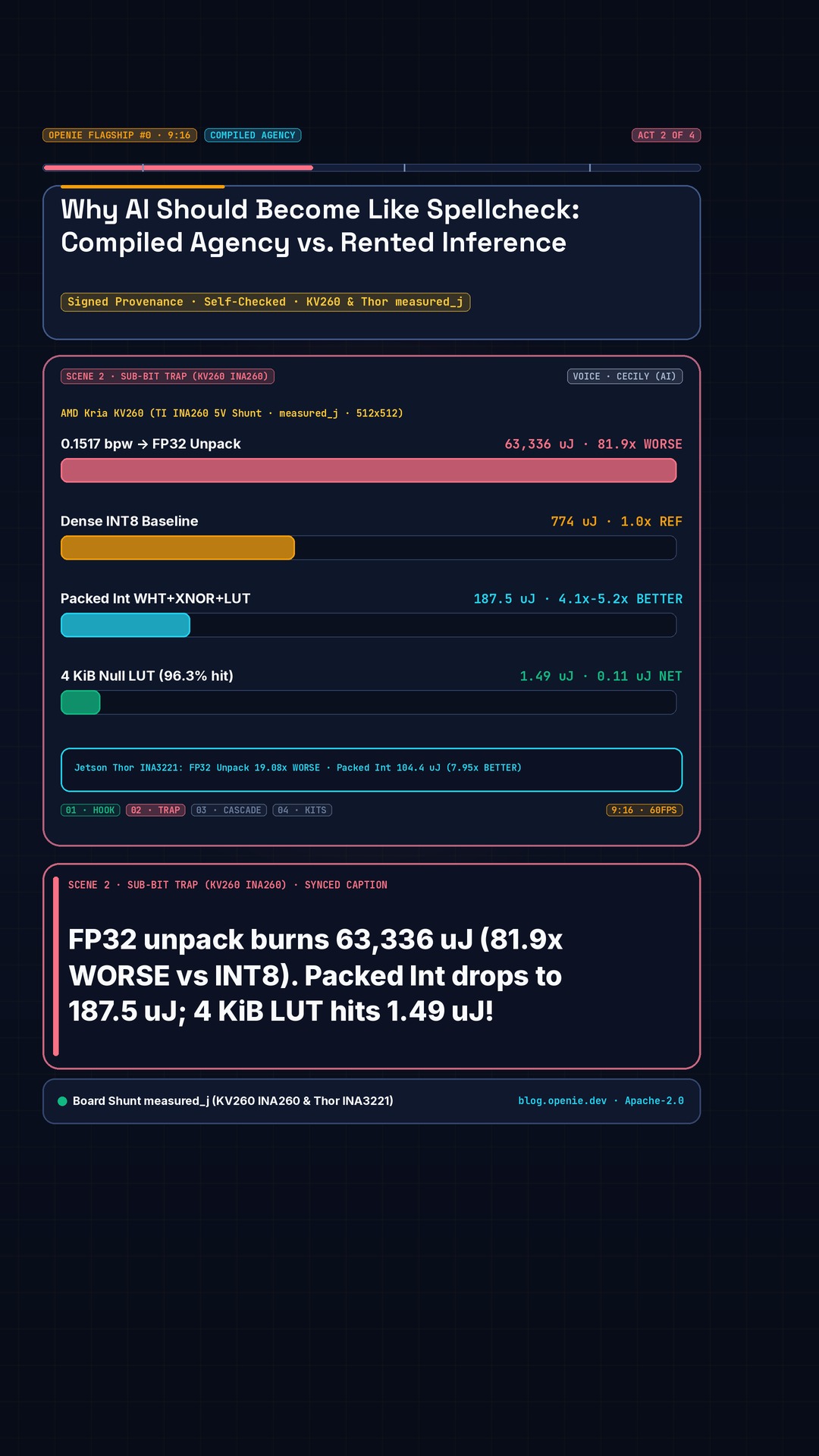
Multi-substrate hardware shunt (measured_j) and Linux RAPL (reported_j) synthesis across AMD Kria KV260 (TI INA260), NVIDIA Jetson AGX Thor (TI INA3221 + INA238), Intel Core i9-13900H, and AMD Ryzen AI Max+ 395 (openIE-dev/openie-research-experiments @ 813eb96, Apache-2.0). Dedicated to the public domain under CC0-1.0.
Key Claims & Audited Scope ([T] / [E] / [M] / [S])
- [E · Sub-Bit Decompression Impedance Tax vs. Packed Integer Compute (
measured_j)] Compressing a512×512weight matrix52.72×(262,144 BdenseINT8down to4,972 Bat0.1517 bits/weight) and unpacking it toFP32at runtime cost63,335.56 µJgross (3,813.32 µJnet) vs.773.74 µJgross (53.03 µJnet) for denseINT8on AMD Kria KV260 (TI INA260SOM_5V_DCshuntmeasured_j,N = 8,0.11%idle driftFalsifier 6PASS)—an81.86×gross (71.91×net) decompression impedance penalty (19.08×gross on NVIDIA Jetson AGX ThorTI INA3221VDD_CPU_SOC_MSS:15,839.34vs.829.94 µJ). Keeping execution inside Packed Integer (FWHT + XNOR + popcount + 4-bit LUT) at the same0.1517 bpwfootprint reduced KV260measured_jto187.49 µJgross (10.30 µJnet) (4.13×gross /5.15×net below denseINT8, and337.80×gross below naiveFP32unpack) and ThorINA3221measured_jto104.44 µJgross (7.95×below denseINT8), while a4 KiBcompiled quadrant LUT (96.33%accuracy,1,156 / 1,200) used1.49 µJgross (0.11 µJnet) on KV260 and0.93 µJgross on Thor. - [E · 4-ISA
waiOSVerifiable Integer Lockstep & Tamper Halt] Across 5 execution lanes (python_scalar_i32,c_scalar_i32,c_packed_2bit_bitsliced,c_tmac_pair_lut, andc_hetero_mosaic_4worker_pthreads) on 4 distinct hardware substrates (Cortex-A53,Neoverse-V3AE,Raptor Lake, andZen 5), a canonical256×128ternary matrix-vector stage produced the identicalBLAKE3digest (a541323b13653ed36515ff24ef08deb7dfa771e570a434712708fb72552f46f0) with0 / 400schedule disagreements across randomized 4-worker sweeps (95% Clopper–Pearson upper bound<= 0.00746). Injecting a single-weight mutation at Row77(w[77,0]: 0 → 1) deterministically flipped the digest to4ac7c4fbc2f2a031ac4f3c0e485867fb689d24d4872bdb1b0a6bc80cf88b69dc, triggered immediate disagreement halt, and refusedEd25519receipt sealing (receipt_sealed = false). - [E · 4-Stage Lookup-First Cascade (
measured_j ⊥ reported_j ⊥ est_j)] On a1,000-query bounded spellcheck stream (1,000 / 1,000correct completions), routing through Stage 1 Exact LUT (550) → Stage 2 Bounded Edit-Distanced_max = 2(250) → Stage 3waiOSTernary Mosaicτ = 4500(174) → Stage 4 Residual Teacher (26) reduced physical shunt energy per correct completion by26.58×gross (24.49×net) on Kria KV260INA260(18,221.99 → 685.43 µJgross,991.71 → 40.49 µJnet,0.09%idle driftFalsifier 6PASS) and16.26×gross on Jetson AGX ThorINA3221(8,622.51 → 530.39 µJ), while avoiding38.46×Stage-4 escalations (26 / 1,000, analytical remoteest_jstrictly isolated and never summed withmeasured_jorreported_j).
Methods, Multi-Substrate Telemetry, Sample Sizes (N) & Fired Falsifier Disclosure
- Physical DC Shunt Substrates (
measured_j,board_metered = true): - AMD Kria KV260 (
Cortex-A53, aarch64): On-boardTI INA260(ina260_u14,SOM_5V_DC/sys/class/hwmon/hwmon2/power1_input,~230 Hzsampling,N = 8interleaved trials per regime). Pre/postA1/A2idle rail drift measured0.11%(LittleBit) and0.09%(Cascade), well inside the<= 5.0%Falsifier 6threshold (falsifier_6_idle_drift_flag = false). - NVIDIA Jetson AGX Thor (
Neoverse-V3AE, aarch64): On-boardTI INA3221(VDD_CPU_SOC_MSS,/sys/class/hwmon/hwmon6/in2_input+curr2_input,~203 Hz) and secondaryTI INA238(VIN_CARRIER,/sys/class/hwmon/hwmon5/power1_input),N = 8trials. Because unquiesced host background activity shiftedA1/A2idle draw by39.78%(LittleBit) and5.76%(Cascade),Falsifier 6(> 5%drift) fired andA1/A2net-above-idle subtraction on Thor is explicitly withheld (null), reporting gross railmeasured_jand paired-round figures only. - On-Chip Counter Substrates (
reported_j,board_metered = false, never mixed withmeasured_j): - Intel Core i9-13900H and AMD Ryzen AI Max+ 395 via Linux
powercapintel-rapl(N = 20trials): recorded54.78×(Core i9) and46.49×(Ryzen) naiveFP32unpack penalties overINT8, and a20.78×Ryzenreported_jcascade reduction (793.56 µJmedian). - 75-Cell Cascade Grid Sweep: Swept
Zipf s ∈ {0.0, 0.5, 0.85, 1.15, 1.4} × d_max ∈ {0, 1, 2} × τ ∈ {1500, 3000, 4500, 6500, 9000}across all 4 substrates (300substrate-grid cells) with full raw JSON receipts committed at813eb96.
Why Ephemeral Inference Wastes Joules at Repeated Interfaces
Contemporary agent stacks default to ephemeral inference: re-invoking dense floating-point models from scratch on recurring structural inputs, re-parsing verbose text envelopes, and compressing weights for storage only to decompress them back into FP32 on every forward pass [M]. Compiled agency inverts that execution order:
- Lookup and Exact Guards First: Bounded, high-frequency structural cases resolve in nanoseconds to microseconds via content-addressed LUTs (
Stage 1) and bounded integer edit-distance filters (Stage 2) before waking heavier neural stages[E]. - Format-Aligned Integer Compute: When compact neural stages run (
Stage 3), weights stay packed in integer registers (FWHT + XNOR + popcount + 4-bit LUTandwaiOS2-bit/ternary integer MACs), eliminating the19.08×–81.86×runtimeFP32decompression tax[E]. - Halt-on-Disagreement Receipts: Every Stage-3
waiOScommit checks deterministic integerBLAKE3digests before sealing anEd25519receipt, halting immediately on single-weight corruption (Row 77)[E].
Scope Boundaries, Non-Claims & Open Falsifiers
- Bounded Domain vs. Open-Ended Novelty: The
26.58×KV260 and16.26×Thor cascade reductions hold on skew-heavy (Zipf) bounded lookup/spellcheck streams where Stages 1–3 absorb97.4%(974 / 1,000) of queries; under uniform unseen open-ended synthesis (s = 0or cold repository patching), queries escalate to Stage 4 as characterized in The Deterministic Null[E]. - Strict Epistemic Non-Mixing (
measured_j ⊥ reported_j ⊥ est_j ⊥ unmetered): Physical DC shunt joules (KV260 INA260,Thor INA3221/INA238), CPURAPLcounters (Core i9,Ryzen AI Max+ 395), and analytical cloud call estimates (1.5 est_J/call) are reported in separate tables and never added or cross-ratioed. - Self-Checked Status: All artifacts carry
Signed Provenance · Self-Checkedstatus (0external peer reviews to date) and invite independent third-party replication from commit813eb96.
Replicate, Critique & Explore Interactively
- Canonical Post-Review Position Paper: https://blog.openie.dev/posts/from-ephemeral-inference-to-compiled-agency/
- Interactive Multi-Substrate Observatory (
/living/compiled-agency/): https://research.openie.dev/living/compiled-agency/ - Interactive Tutorial Lab #13: https://research.openie.dev/tutorials/?lab=lab-13-compiled-agency
- Signed Receipts & Replication Kit (
@ 813eb96): https://github.com/openIE-dev/openie-research-experiments/commit/813eb9698ff179fd34d6877c5247bb2b9125ca86 - 9:16 Vertical Snackable (
60fps) & Companion TV: https://research.openie.dev/media/tv/tiktok/from-ephemeral-inference-to-compiled-agency-tiktok.mp4 · OpenIE Research TV - Verification & Glossary Standards: Verification & AI-Use Disclosure · Epistemic Glossary
Prose and summary text dedicated to the public domain under CC0-1.0. Public replication harnesses, hardware receipts, and WAI1 schemas are licensed under Apache-2.0.