# OpenIE Research — Full Corpus (llms-full.txt)
> Research by David Charlot at Open Interface Engineering, Inc., published free so that anyone can read, reproduce and reuse it.
> Compact index: https://research.openie.dev/llms.txt
> Structured JSON catalog: https://research.openie.dev/catalog.json
> Agent card: https://research.openie.dev/.well-known/agent-card.json
> Atom feed: https://research.openie.dev/feed.xml
> Data and reproducibility digests: https://research.openie.dev/data/
> Glossary: https://research.openie.dev/glossary/
## Table of Included Studies (21)
1. **Thermodynamic Bounds and an Optimal Tempo for Goal-Holding Agents** (`agency`, revision `8bdc5f1`, 30 October 2026) — Web: https://research.openie.dev/papers/agency/ · Markdown: https://research.openie.dev/papers/agency.md · PDF: https://research.openie.dev/pdfs/agency.pdf
2. **Metered Commit Gates: Energy-to-Correct-Completion for Agentic Systems** (`gates`, revision `db13599`, 5 November 2026) — Web: https://research.openie.dev/papers/gates/ · Markdown: https://research.openie.dev/papers/gates.md · PDF: https://research.openie.dev/pdfs/gates.pdf
3. **Deterministic Null: A Pre-Registered Control Experiment for Neural and Agentic Substrates** (`deterministic-null`, revision `af57f48`, 22 November 2026) — Web: https://research.openie.dev/papers/deterministic-null/ · Markdown: https://research.openie.dev/papers/deterministic-null.md · PDF: https://research.openie.dev/pdfs/deterministic-null.pdf
4. **Satiation Benchmark: Reference Harness, Adapters, and Telemetry Attribution** (`satb-harness`, revision `5c50a85`, 23 November 2026) — Web: https://research.openie.dev/papers/satb-harness/ · Markdown: https://research.openie.dev/papers/satb-harness.md · PDF: https://research.openie.dev/pdfs/satb-harness.pdf
5. **Time as an Index: What It Would Take to Look Up Tomorrow** (`time-as-an-index`, revision `bb74dab`, 23 November 2026) — Web: https://research.openie.dev/papers/time-as-an-index/ · Markdown: https://research.openie.dev/papers/time-as-an-index.md · PDF: https://research.openie.dev/pdfs/time-as-an-index.pdf
6. **The Communication Tool Avalanche: Thresholded Signal Externalization, Event-Driven Orchestration, and Coherence per Joule** (`communication-avalanche`, revision `fc8bd3a`, 23 November 2026) — Web: https://research.openie.dev/papers/communication-avalanche/ · Markdown: https://research.openie.dev/papers/communication-avalanche.md · PDF: https://research.openie.dev/pdfs/communication-avalanche.pdf
7. **Downward LUT6 Compilation in a Mixture of Limits Cascade: Beneš-Routed Boolean Fabrics, Conformal Wake Gates, and Frontier Sparse-MoE NVMe Streaming** (`lut-adapt`, revision `24cb3f7`, 25 November 2026) — Web: https://research.openie.dev/papers/lut-adapt/ · Markdown: https://research.openie.dev/papers/lut-adapt.md · PDF: https://research.openie.dev/pdfs/lut-adapt.pdf
8. **Task Satiation vs. Aggregate Rebound in AI Demand** (`satiation`, revision `395f081`, 4 November 2026) — Web: https://research.openie.dev/papers/satiation/ · Markdown: https://research.openie.dev/papers/satiation.md · PDF: https://research.openie.dev/pdfs/satiation.pdf
9. **The Reality Code Engine: One Lossless Form for Native, Verified, Low-Energy Programming** (`rce`, revision `bb74dab`, 23 November 2026) — Web: https://research.openie.dev/papers/rce/ · Markdown: https://research.openie.dev/papers/rce.md · PDF: https://research.openie.dev/pdfs/rce.pdf
10. **RCE-JEPA: World Coding, with JEPA as Premise** (`rce-jepa`, revision `bb74dab`, 23 November 2026) — Web: https://research.openie.dev/papers/rce-jepa/ · Markdown: https://research.openie.dev/papers/rce-jepa.md · PDF: https://research.openie.dev/pdfs/rce-jepa.pdf
11. **RCE Compile: A Law of Compilation, Tested as a Normal Form Against Real Compilers** (`rce-compile`, revision `50a4f56`, 23 November 2026) — Web: https://research.openie.dev/papers/rce-compile/ · Markdown: https://research.openie.dev/papers/rce-compile.md · PDF: https://research.openie.dev/pdfs/rce-compile.pdf
12. **RCE-VC: Law of Version Control** (`rce-vc`, revision `af57f48`, 22 November 2026) — Web: https://research.openie.dev/papers/rce-vc/ · Markdown: https://research.openie.dev/papers/rce-vc.md · PDF: https://research.openie.dev/pdfs/rce-vc.pdf
13. **Writing a Game Once and Running It Everywhere: Where Exact Replay Ends and Tolerance Begins** (`game-engines`, revision `50a4f56`, 23 November 2026) — Web: https://research.openie.dev/papers/game-engines/ · Markdown: https://research.openie.dev/papers/game-engines.md · PDF: https://research.openie.dev/pdfs/game-engines.pdf
14. **The Pursuit of AGI Resolves the Three-Body Problem in Computing** (`three-body`, revision `395f081`, 4 November 2026) — Web: https://research.openie.dev/papers/three-body/ · Markdown: https://research.openie.dev/papers/three-body.md · PDF: https://research.openie.dev/pdfs/three-body.pdf
15. **"AI" Reads Human: Human Language Encoding at Machine Speed and the Energy Cost** (`ai-reads-human`, revision `af57f48`, 22 November 2026) — Web: https://research.openie.dev/papers/ai-reads-human/ · Markdown: https://research.openie.dev/papers/ai-reads-human.md · PDF: https://research.openie.dev/pdfs/ai-reads-human.pdf
16. **Spell Check is Global: The Future of Computer Intelligence in the Hands of the Many (7B+), Not the Few** (`spellcheck`, revision `db13599`, 5 November 2026) — Web: https://research.openie.dev/papers/spellcheck/ · Markdown: https://research.openie.dev/papers/spellcheck.md · PDF: https://research.openie.dev/pdfs/spellcheck.pdf
17. **The Promised Trillion Dollar AI-Coding Market** (`ai-coding-market`, revision `db13599`, 5 November 2026) — Web: https://research.openie.dev/papers/ai-coding-market/ · Markdown: https://research.openie.dev/papers/ai-coding-market.md · PDF: https://research.openie.dev/pdfs/ai-coding-market.pdf
18. **The Price of the Unexamined Interface** (`interface-economics`, revision `db13599`, 5 November 2026) — Web: https://research.openie.dev/papers/interface-economics/ · Markdown: https://research.openie.dev/papers/interface-economics.md · PDF: https://research.openie.dev/pdfs/interface-economics.pdf
19. **Metabolic Intelligence: Budget-Native Compute from Tag to Campus** (`mei`, revision `1561a2a`, 22 November 2026) — Web: https://research.openie.dev/products/mei/ · Markdown: https://research.openie.dev/products/mei.md · PDF: https://research.openie.dev/pdfs/mei.pdf
20. **The Search for JouleOS** (`jouleos`, revision `1561a2a`, 22 November 2026) — Web: https://research.openie.dev/products/jouleos/ · Markdown: https://research.openie.dev/products/jouleos.md · PDF: https://research.openie.dev/pdfs/jouleos.pdf
21. **The Gap Between Possible and Deployed: A Cadence Model of Computer Intelligence and the Forcing Function of Automation Tools** (`latency`, revision `395f081`, 4 November 2026) — Web: https://research.openie.dev/papers/latency/ · Markdown: https://research.openie.dev/papers/latency.md · PDF: https://research.openie.dev/pdfs/latency.pdf
## Interactive Living Instruments (/living/)
- **Deterministic Null Control Observatory (dn-diag-01..03)**: https://research.openie.dev/living/deterministic-null/ — Interactive confirmatory track switcher (4,030 held-out instances + exp-003 multi-vendor/3-SAT DRAT + 6 upstream SWE-bench Verified repositories), Zipfian online crystallization simulator, and OpenTimestamps + drand proof cards. Controls: track (exp002, exp003, exp001_t2, exp001_t1, multiturn); T (50..2000); hit (0.00..0.95); usd (0.0020..0.0600); joule (10..400).
- **Satiation Benchmark Harness & Telemetry Attribution Observatory**: https://research.openie.dev/living/satb-harness/ — Interactive Lane B context-elision simulator, 5-archetype telemetry explorer (including Jetson Thor INA238/INA3221 measured_j and bare-metal Windows 11 NVML/GetProcessTimes), Kepler proportional vs boundary comparator, and C12 determinism receipts. Controls: ContextRule_v0 & Truncate_v0 window simulator; 5-host L0..L4 x A1..N attribution inspector (macOS, Tegra INA238/INA3221, Linux RAPL, Windows 11 NVML/JobObject); Falsifier 3/5/6/8 & C1..C12 conformance explorer.
- **RCE-JEPA World Coding, FormEBM-v3 & 40/40 3-Gear Observatory (rj-diag-01..03)**: https://research.openie.dev/living/rce-jepa/ — Interactive H1-H15 hypothesis explorer, FormEBM-v3 contrastive OOD edit-size and 5-step energy landscape, H15-Iterative 40/40 residual repair inspector, and 3-Gear Zipfian crystallization simulator. Controls: H1-H15 & RJ-F1-RJ-F6 scoreboards + 40-task residual filter; FormJEPA-v1 vs FormEBM-v2 vs span-normalized FormEBM-v3 (H5 AUROC 0.9437, H11 94.0% strict, OOD H15 0.5278); 3-Gear Zipf(s) stream & rce repair rung-f (<= 2.0%) simulator.
- **RCE Compile Payback Horizon, .rlib Prelude, H4 Regime-B & De Bruijn Reuse Observatory (rc-diag-01..03)**: https://research.openie.dev/living/rce-compile/ — Interactive 20-kernel x 15-tier Linux RAPL compilation vs execution energy payback calculator (N*, including 20.07x lower librce_rt.rlib compile energy), H4 Regime-B regression explorer, and 245-program / 500-mutant De Bruijn nameless cache soundness simulator. Controls: kernel (k01..k20 or median); base/target compiler tier (15 tiers across Python, GCC, Clang, rustc, Wasm32, RCE + shared librce_rt.rlib); call horizon N (1..10^7); mutant/key soundness & warm-cache reported_j inspector.
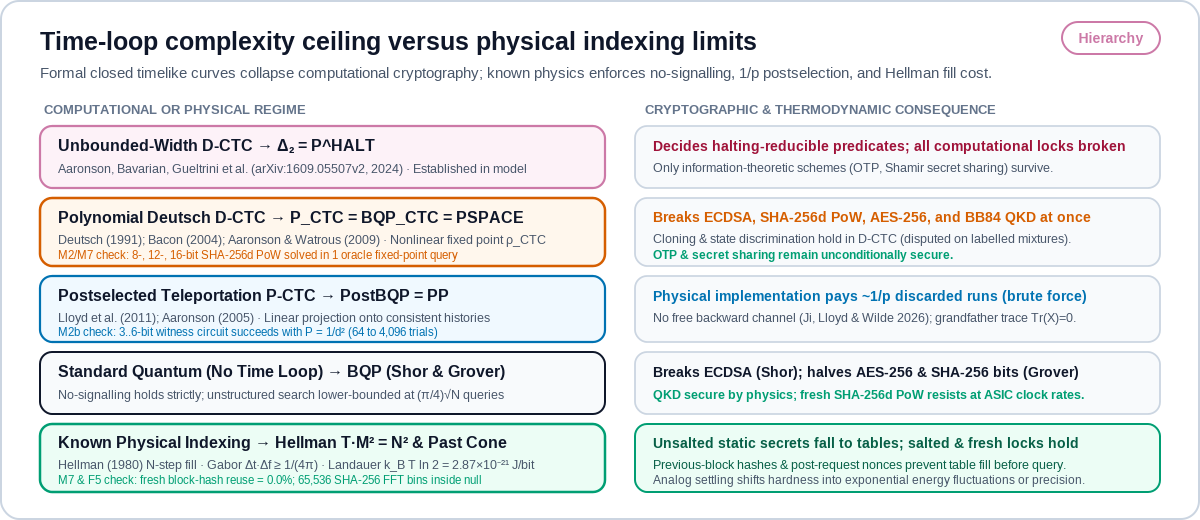
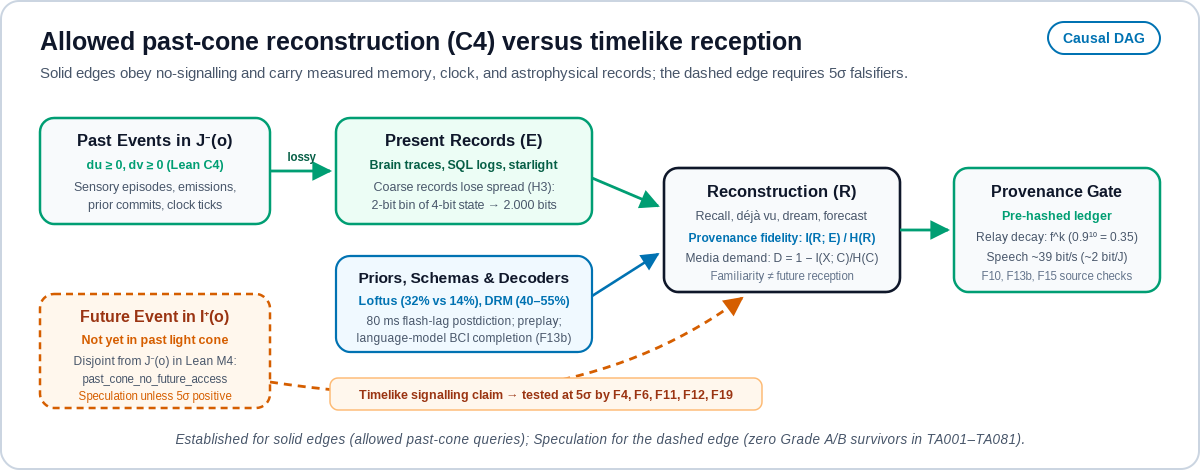
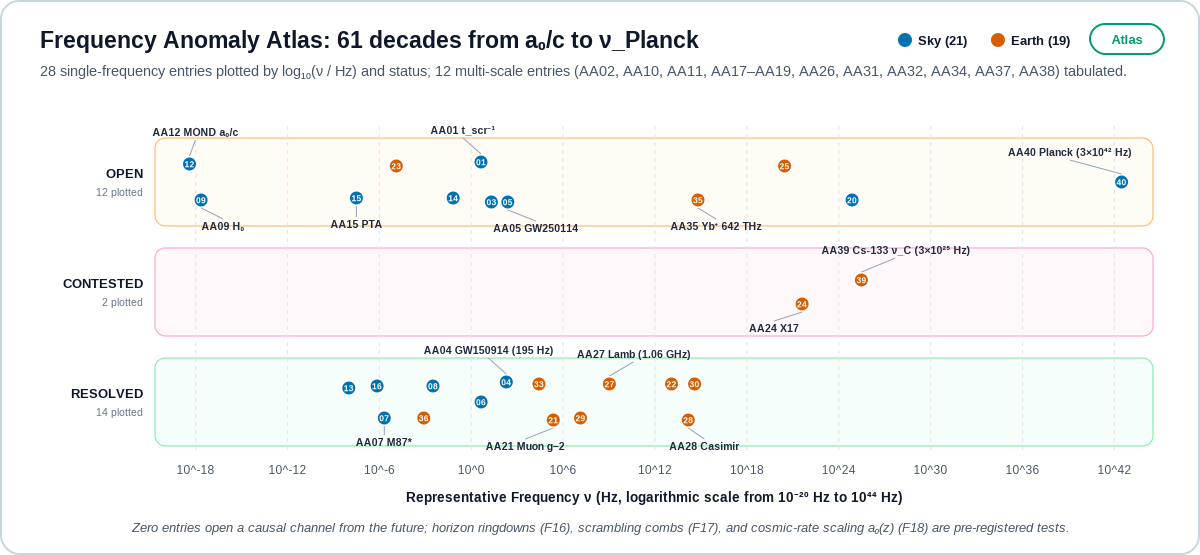
- **Time as an Index Observatory & 195-Entry Unified Catalog**: https://research.openie.dev/living/time-as-an-index/ — Four URL-addressable physics/complexity instruments plus a unified searchable explorer across 81 temporal anomalies, 40 frequency edge cases, and 74 paradoxes. Controls: D-CTC vs P-CTC vs Hellman T*M^2=N^2 calculator; DPSS band-limited extrapolation horizon; Landauer & Compton clock ledger; 195-entry searchable catalog (TA001-TA081, AA01-AA40, P01-P74).
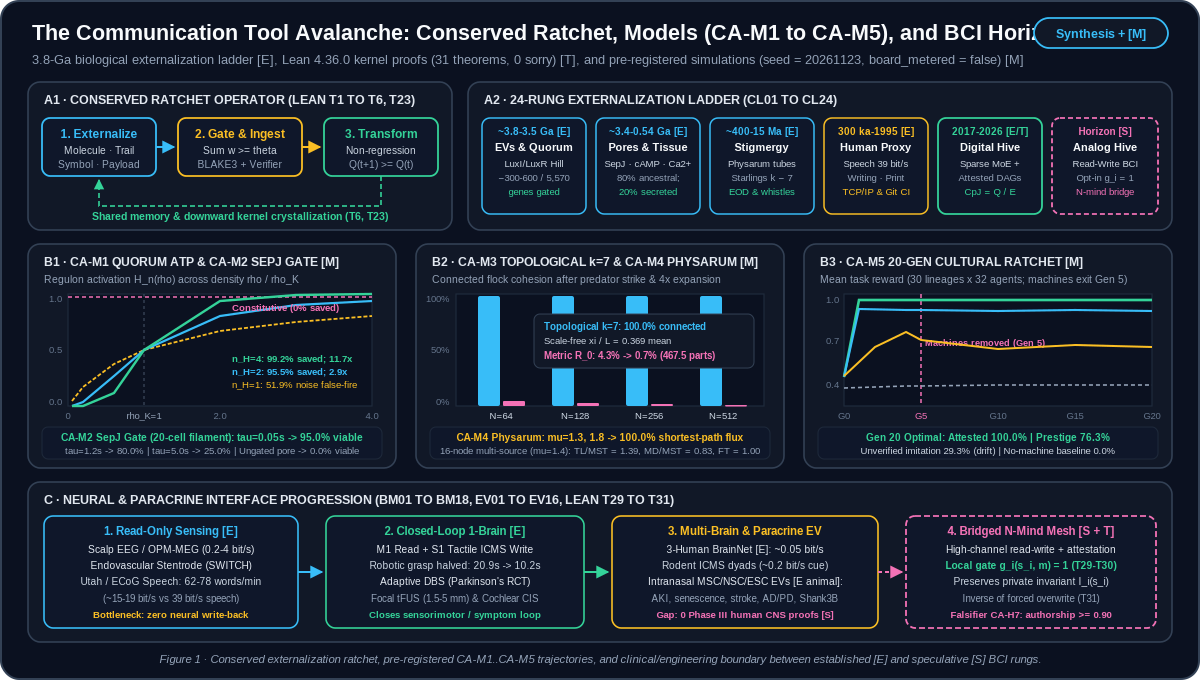
- **Communication Tool Avalanche, 5-Host Shunts, DES-10 & BCI Observatory (ca-diag-01..04)**: https://research.openie.dev/living/communication-avalanche/ — Four URL-addressable simulators + 10-figure gallery spanning biophysical threshold switches, 5-host physical shunt/counter orchestration, 10-camp Digital Enzymatic Synthesis (DES-10, 98/100 verified pass), 1950-2026 AI history, and 18-modality neural interface bounds. Controls: Hill quorum / SepJ nanopore / Starling k=7 / Physarum conductance simulator; Event-driven BLAKE3+Ed25519+SSP orchestration DAG & CTA-E1..E3 RAPL receipt explorer; BCI sensing-to-modulation & consent-gated N-mind agency matrix; 5-host fleet energy (Thor INA238/INA3221 measured_j) + DES-10 10-camp forcing horizon + 10-figure gallery (ca-diag-04).
- **Downward LUT6 Compilation & AirMoL Instruments (la-diag-01..03)**: https://research.openie.dev/living/lut-adapt/ — Interactive Simon-Kadane crystallization horizon calculator, xck26 Beneš + RAMB36E2 RTL synthesis table, and Darwin F_NOCACHE 4-bit NVMe streaming explorer. Controls: p0 (0.05..1.00); dt (20..5000); cw (0.20..10.0); ec (20..2000); rtl (ours, benes1, flat64, ff512, wnn); model (lfm, qwen); arm (t1, pld, cold, wake).
- **Game-Engine 9/9 Determinism, DX12/Vulkan/Metal Tolerance, Actor/Godot Parity & Chrono-Budget Arena (GE-H1..H9)**: https://research.openie.dev/living/game-engines/ — Interactive 9/9 GE-H1..H9 observatory spanning 3-OS Q32.32 replay, 28-pair DX12/Vulkan/Metal tolerance, 10,000-actor RAPL scaling, 260-module interface fault F1, 1-hour 3-OS input-log replay, Godot 4.7.2 headless parity, and playable arena. Controls: 30-cell 3-OS x 3-ISA Q32.32 100,000-tick SHA-256 inspector; GE-H2 UCRT/glibc/libSystem & MSVC/Clang FMA divergence explorer; GE-H3 8-endpoint DirectX 12 / Metal / Vulkan PSNR & SSIM matrix; GE-H4..H9 SLOC, 10,000-actor scaling, 26-pattern fault F1, Lyapunov slope, 1h 3-OS replay & Godot 4 parity; Playable 60 Hz Q32.32 Chrono-Budget Arena.
- **Publication-to-Deployment Cadence & Task-Cost Explorer**: https://research.openie.dev/living/latency/ — Interactive cadence-quantization and dollars-and-joules task-cost simulator accompanying The Gap Between Possible and Deployed. Controls: Quarterly reporting quantization cadence; Hardware capex vs electricity task-cost breakdown.
- **Stage B FPGA / LUT Commit-Gate Simulator (WASM + WebGPU)**: https://research.openie.dev/living/fpga-sim/ — Browser WebAssembly + WebGPU simulator for the seed-1 commit gate and LUT fabric. Controls: seed-1 golden trace playback; WASM commit-gate step; Alchitry Pt V2 Stage C builder guide (/living/fpga-sim/alchitry/).
- **Notational Intelligence Commit Gate Figures (ni-3d-01)**: https://research.openie.dev/living/ni/ — Interactive commit-gate trajectories and refusal receipts. Controls: 3D orbit canvas; commit/refuse JSON inspection.
- **Task Satiation & Aggregate Rebound Surface (sat-3d-01)**: https://research.openie.dev/living/satiation/ — Interactive task-satiation threshold vs aggregate demand rebound explorer. Controls: 3D bliss/satiation surface explorer.
- **Mixture of Limits Cascade Explorer**: https://research.openie.dev/living/mol/ — Cheapest-first cascade rung figures and analytical floor shells. Controls: Cascade rung inspection.
- **Impedance Tax & 34-Workload reported_j Explorer**: https://research.openie.dev/living/ai-reads-human/ — Interactive explorer of parse time, token count, and Apple M5 Max L3/L2 reported_j across 34 binary and human-readable workloads. Controls: 34-workload parse + tiktoken L3/L2 reported_j explorer; 20,000-record format comparison.
- **Metabolic Intelligence Figures**: https://research.openie.dev/living/mei/ — Companion interactive figures for the Metabolic Intelligence white paper. Controls: Energy-envelope figures.
- **Spell Check Commoditization Timeline**: https://research.openie.dev/living/spellcheck/ — Dated historical price and bundling figures for Spell Check is Global. Controls: Historical price-to-bundling timeline.
## RCE Specification Chapters (/rce/spec/)
- [RCE Language Specification — Index](https://research.openie.dev/rce/spec/)
- [RCE Spec 00 RCE Language Specification, draft 0.9: Overview](https://research.openie.dev/rce/spec/overview/)
- [RCE Spec 01 1. Notation and conformance](https://research.openie.dev/rce/spec/notation/)
- [RCE Spec 02 2. Lexical grammar](https://research.openie.dev/rce/spec/lexical/)
- [RCE Spec 03 3. Syntactic grammar](https://research.openie.dev/rce/spec/syntax/)
- [RCE Spec 04 4. Programs, names and scope](https://research.openie.dev/rce/spec/programs/)
- [RCE Spec 05 5. Static semantics](https://research.openie.dev/rce/spec/types-ownership/)
- [RCE Spec 06 5 (continued). Static semantics: regions, effects and extensions](https://research.openie.dev/rce/spec/regions-effects-extensions/)
- [RCE Spec 07 6. Dynamic semantics: the mapping into the Form](https://research.openie.dev/rce/spec/form-evaluation/)
- [RCE Spec 08 6 (continued). Dynamic semantics: steps, loops and concurrency](https://research.openie.dev/rce/spec/steps-loops-concurrency/)
- [RCE Spec 09 7. Well-formedness: what requires change at entry](https://research.openie.dev/rce/spec/wellformedness/)
- [RCE Spec 10 8. Theorems to prove](https://research.openie.dev/rce/spec/theorems/)
- [RCE Spec 11 9. Design decisions for review](https://research.openie.dev/rce/spec/decisions/)
- [RCE Spec 12 10. Tooling: the `rce` command and the language server](https://research.openie.dev/rce/spec/tooling/)
- [RCE Spec 13 References](https://research.openie.dev/rce/spec/references/)
- [RCE Spec 14 Appendix C. Concurrency (draft 0.6 and 0.6b; normative)](https://research.openie.dev/rce/spec/draft06-concurrency/)
- [RCE Spec 15 Appendix D. The engine profile: handler specs and fits (normative)](https://research.openie.dev/rce/spec/handler-spec-profile/)
- [RCE Spec 16 Appendix E. The host contract (normative)](https://research.openie.dev/rce/spec/host-contract/)
- [RCE Spec 17 Appendix F. Draft 0.9 (normative; implemented in part, see F.12)](https://research.openie.dev/rce/spec/draft09/)
- [RCE Spec — All Example Programs](https://research.openie.dev/rce/spec/examples/)
- [RCE Spec — Read Protocol](https://research.openie.dev/rce/spec/read-protocol/)
================================================================================
# Thermodynamic Bounds and an Optimal Tempo for Goal-Holding Agents
- **Study ID:** `agency`
- **Kind / Status:** Research paper
- **Revision:** `8bdc5f1` (30 October 2026)
- **Web Edition:** https://research.openie.dev/papers/agency/
- **Markdown Twin:** https://research.openie.dev/papers/agency.md
- **PDF Edition:** https://research.openie.dev/pdfs/agency.pdf
- **LaTeX Archival PDF:** https://research.openie.dev/pdfs/latex/agency.pdf
- **LaTeX Source (.tex):** https://research.openie.dev/pdfs/latex/agency.tex
- **Interactive Figures:** https://research.openie.dev/living/
- **Claim Scope & About:** https://research.openie.dev/about/agency/
- **Data & Reproducibility:** https://research.openie.dev/data/#agency
- **Keywords:** Universal Law of Agency, agency, kinematic bounds, optimal tempo, intelligence as a derivative, thermodynamics of computation, joules, Landauer, experiment
> Defines an agent as a system that holds a goal under an energy budget, derives physical bounds on how fast it can act per second and per joule, and reads intelligence as progress per joule on a completed run. Plain words: to count as an agent, a system must aim at a goal, act, and stay within an energy budget; physics sets a minimum energy cost for every decision; among systems that finish a job correctly, the one that used less energy ranks higher.
---
# Thermodynamic Bounds and an Optimal Tempo for Goal-Holding Agents
*revision [`8bdc5f1`](https://github.com/openIE-dev/research-openie-web/commits/main/src/content/papers/agency.md), 30 October 2026. Data and code: [research.openie.dev/data/](https://research.openie.dev/data/#agency). LaTeX PDF: [/pdfs/latex/agency.pdf](https://research.openie.dev/pdfs/latex/agency.pdf) ([source](https://research.openie.dev/pdfs/latex/agency.tex)).*
## Abstract
This paper defines an agent as a system that holds a goal under an energy budget, derives physical limits on how fast it can act per second and per joule, and measures intelligence as progress per joule after a run is complete.
**In plain words**
1. To count as an agent, a system must aim at a goal, act on the world, and stay within an energy budget.
2. Physics sets a minimum energy cost for every decision, so no agent can act faster or cheaper than that limit.
3. Among systems that get the job done correctly, the smarter one is the one that used less energy.
## 1. Thesis
The proposal has three layers, and the order is fixed.
1. **Agency comes first, and its definition is required.** This track proposes it as the Universal Law of Agency. In form it is a definition plus a gate: four clauses say what counts as an agent, and the fourth clause refuses any act that breaks the joule budget. Nothing is an agent until the definition is met. Nothing downstream is defined without it.
2. **The kinematic bounds of agency follow from the definition.** They say how fast agency can move, per second and per joule, and what it must pay to move.
3. **Intelligence is the calculus of agency.** Intelligence is a hindsight characteristic. It is read off a completed run, the way velocity is read off a recorded path. It is therefore a derivative of agency: $\iota = dX/dJ$, where $X$ is confirmed agency and $J$ is joules.
The thesis: among systems that pass a task's correctness test, the ranking is by energy to completion, in joules.
The thesis is read through its gate. Capability is not discarded: it is the gate. Burnell and colleagues ask that evaluation report results by instance rather than one aggregate [333], and Zhou and colleagues and Laber and colleagues find that capability and efficiency vary independently across models and inference budgets [334, 335]. Those findings are about systems that do not all pass the same predicate. Once a predicate $C(z)$ and a failure rate are fixed, every factor other than joules has already been spent in passing the gate, and that is the sense of the thesis' second sentence. The gated ranking is also practice: SPECpower ranks server work per watt at stated load [338], cost-of-pass ranks models by the cost of a correct answer [336], and intelligence per watt ranks local models by accuracy per unit power [337]. This paper's contribution is the joule form of that ranking with a refusal clause and a hindsight derivative, not the idea of ranking by cost under correctness.
The gate and the ranking separate two things that are often merged: capability and intelligence. Capability is passing $C(z)$ at all. Intelligence is how few joules the pass takes. Krakauer, Mitchell and Krakauer draw the same line from complexity science: impressive capabilities are not mistaken for intelligence, which is reserved for solving problems "quickly and parsimoniously, with a minimal expenditure of energy" [339]. Two systems that hand over the same correct answer, one directly and one after a long detour, are equally capable. Only the first is the more intelligent, and $J^*$ is the quantity that tells them apart. A system can be made more capable by spending more. It is made more intelligent only by spending less for the same pass.
The thesis has an exact form. Correctness is a gate. Joules are the ranking. For a task $q$ with completeness predicate $C(z)$, the joules to correct completion of system $S$ are
$$
J^*_S(q) = \min_{\pi} \mathbb{E}[J_\pi] \quad \text{subject to} \quad \Pr[C(z) = 1] \ge 1 - \delta
$$
The minimum runs over the policies $\pi$ that $S$ can execute, and $\delta$ is the failure rate the task allows. A deadline, when the task has one, is written into $C(z)$: an answer after its deadline fails the predicate. So correctness, deadlines and task size appear in the formulas of this track, and each appears as a constraint. None appears as a score. Among systems that pass the gate, joules alone order them. Parameters, tokens, benchmark scores and prices carry zero weight in that order. That is what "collapse to zero" means. Correctness becomes the constraint, and energy becomes the only metric. That is the thesis. Energy-to-solution in high-performance computing and the accuracy-gated measurements of MLPerf Power have the same form [260]. This track puts an eligibility definition in front of the gate and reads the joules as a metered density. Section 2.3 states the ranking. Proposition 8 proves that it is a total order on systems that survives bounded meter error, and that integrated $\iota$ is not.
The order matters. A derivative needs a path. A path needs something that moves. The definition says what moves. The kinematics say how it can move. Intelligence is read off the path afterward.
This track tests that order against the literature. It sorts every source into three bins.
- **Proven:** theorems and derivations. The result follows from stated assumptions.
- **Demonstrated:** experiments, measurements and simulations. The result was observed.
- **Opinion:** position papers, frameworks, definitions and philosophy. The result is argued.
No source is excluded for its method. Each source is placed by what it gives the definition, the kinematics or the calculus.
### Terms
- **SI:** the International System of Units.
- **Joule (J):** the SI unit of energy. One watt for one second.
- **$k_B$:** the Boltzmann constant, $1.380649 \times 10^{-23}$ J/K, exact by SI definition.
- **Entropy production ($\Sigma$):** the total entropy a process creates, in units of $k_B$. It is zero only for a reversible process.
- **Mutual information ($I$):** the number of bits one variable carries about another.
- **Dynamical activity ($A$):** the rate of jumps between states in a stochastic process. It measures how busy the dynamics are.
- **TUR (thermodynamic uncertainty relation):** a theorem that ties the precision of a current to its entropy production.
- **NMR (nuclear magnetic resonance):** a method that controls and reads molecular spins.
- **Instability rate ($\Lambda$):** how fast an uncontrolled world drifts from the goal, in nats per second. For a linear plant run at $f$ steps per second, $\Lambda = f\sum_{|\lambda_i|>1}\ln|\lambda_i|$.
- **Reset error ($\varepsilon$):** the probability that a reset record is not in its most likely state.
- **Counting observable:** a quantity of a trajectory that counts selected jumps. It never decreases.
- **Radon-Nikodym derivative:** the density of one measure with respect to another. It exists when the first measure gives zero mass to every set that the second gives zero mass to.
- **Mixture of Limits:** the rule of using the cheapest mechanism (gear) that is sufficient. There exist floors past which additional tokens, parameters, or joules do not purchase verifiable progress. Spend past the floor is waste. That floor is the plateau (threshold convergence). Mixture of Limits is not one fixed cascade. A fixed cascade order is one instance of it. The σ-law selector is another.
- **Receipt:** a record attached to every act, holding its prediction, its outcome and its joules.
## 2. Formal framework
Definitions fix the terms. Propositions are proven from cited theorems, with their assumptions stated.
Figure 1 shows how the three layers stack.
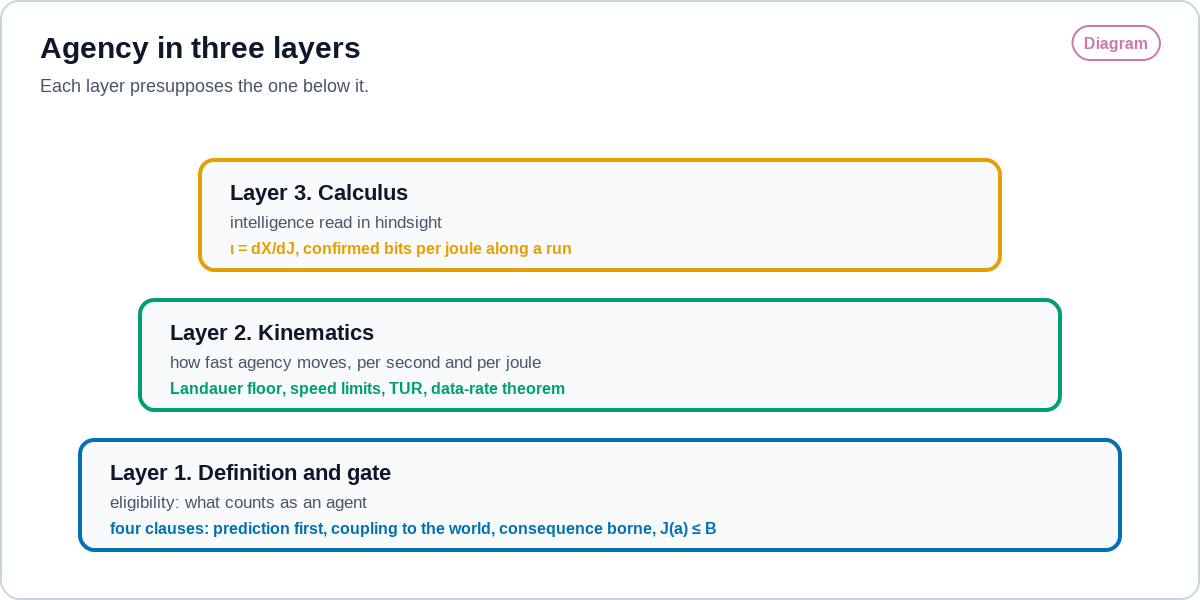
*Figure 1. Agency in three layers. Diagram of Sections 2.1 to 2.3: the definition and gate, the kinematic bounds, and intelligence as the calculus of agency. A [PNG copy](https://research.openie.dev/figures/agency/three-layers.png) is provided.*
### 2.1 Layer 1. The definition and its gate: eligibility
For a system $S$, an act $a$ and an episode budget $B$ in joules, eligibility $E(S,a) \in \{0,1\}$ equals 1 only when all four clauses hold.
1. **Prediction first.** A result template $R^*(a)$ is fixed at time $t_0$, before the act, and it discriminates: $D(R^*(a)) \ge d_0$. Here $D$ is the probability that the template rejects an outcome drawn without the act, and $d_0 > 0$ is fixed with the template. A template that accepts every outcome predicts nothing.
2. **Coupling to the world.** $I(\mathrm{do}(a); W') > 0$. Here $W'$ is the world state downstream of the actuator, and $\mathrm{do}(a)$ is Pearl's intervention operator [1]. The coupling must survive changes to the system's own inputs. Editing your own sensors does not count [2].
3. **Consequence borne.** The comparison $m = M(R, R^*(a)) \in \{1, \mu, 0\}$ (match, partial, mismatch) changes the system: $s_{t+1} = f(s_t, m)$.
4. **Physical floor: the joule budget.** $J(a) \le B$. If no act meets clauses 1 to 4, the act is refusal, with a receipt.
Physics already prices clauses 1 to 3. The second law with feedback [3, 4] and the measurement and erasure bound [5] give, for one bath at temperature $T$:
$$
W_{\mathrm{ext}} \le -\Delta F + k_B T\, I, \qquad W_{\mathrm{meas}} + W_{\mathrm{erase}} \ge k_B T\, I
$$
Here $I$ is the mutual information the act's comparison acquires, in nats. One bit is $\ln 2$ nats, so each bit costs $k_B T\ln 2$. An acceptor that compares and then resets pays at least $k_B T \ln 2$ per bit over a closed cycle [6, 7]. The definition is physical from its first clause.
#### Definition 1. Coupling
Clause 2 is measured by causal information flow. Let act $a$ be drawn from the policy $p(a)$ and set by intervention, and let $W'$ be the world downstream of the actuator. Then
$$
I(\mathrm{do}(a); W') = \sum_{a} p(a) \sum_{w} p(w \mid \mathrm{do}(a)) \log_2 \frac{p(w \mid \mathrm{do}(a))}{\sum_{a'} p(a')\, p(w \mid \mathrm{do}(a'))}
$$
This is the information flow of Ay and Polani from the act node to $W'$ [8]. It equals the mutual information of the interventional joint distribution $p(a)\,p(w \mid \mathrm{do}(a))$. Its maximum over policies is the capacity of the channel from acts to the world:
$$
0 \;\le\; I(\mathrm{do}(a); W') \;\le\; \max_{p(a)} I(\mathrm{do}(a); W') \;\le\; \log_2 |\mathcal{A}|
$$
Here $\mathcal{A}$ is the set of available acts. Klyubin, Polani and Nehaniv defined empowerment as this capacity, with the agent's own future sensors in place of $W'$ [9]. Clause 2 takes the world side, so editing a sensor adds nothing [2].
**Realized, not capacity.** The quantity credited to an act is the realized flow under the policy the agent ran: $I(\mathrm{do}(a); W')$ at that $p(a)$. The capacity is an upper bound and is never credited. A system is not credited for coupling it could have made and did not.
**Estimation.** The flow is estimated from receipts. The agent's randomized policy assigns acts, so the receipt's joint counts of $(a, w)$ are interventional samples. The plug-in mutual information of those counts is biased upward by about $(|\mathcal{A}|-1)(|\mathcal{W}|-1)/(2n)$ nats for $n$ samples, with $\mathcal{W}$ the set of distinguishable world outcomes. That Miller-Madow term is subtracted, and a bootstrap interval is reported [315]. At receipt-scale counts that correction is not enough. The Bayesian estimator of Nemenman, Shafee and Bialek [325] is the stated replacement for the next run, and the receipt schema is to record which estimator produced each figure. Where the policy is deterministic in a context, acts are not randomized there, and the flow is not identified from that run. The receipt then records the capacity bound in its own column, labeled as a bound, and $X$ for that context is reported as an upper bound. The run of Section 8.11 credited the capacity bound $b = n_{\mathrm{empty}}\log_2 9$. Its $X$ and its $\iota$ are upper bounds on realized coupling and realized intelligence. Its $J^*$ ranking does not use $X$, so it stands.
Why this measure:
- **It is interventional.** Pearl's do-calculus gives the operator [1]. Kenton, Kumar, Farquhar, Richens, MacDermott and Everitt define agents as systems that would adapt their policy if their acts influenced the world in a different way, and they discover agents from interventional data [10]. A receipt is interventional by construction. The agent sets its acts, and the outcome is read from the world.
- **Observational measures fail.** James, Barnett and Crutchfield showed by example that transfer entropy does not measure information flow [11]. Lizier and Prokopenko separated information transfer from causal effect and assigned causal effect to causal information flow [12].
- **It is priced.** Under intervention the flow is a mutual information. Mutual information is the quantity that the feedback second law and the measurement and erasure bound price in joules [3, 5].
- **It needs no causal graph.** Janzing, Balduzzi, Grosse-Wentrup and Schölkopf derived a measure of causal influence from postulates, given the causal graph and the joint distribution [13]. A receipt carries acts and outcomes, not the agent's full graph. The flow is computed from them directly.
- **Credit goes to the act that caused it.** When several acts touch one outcome, the bits credited to act $k$ follow the account of actual causation for single transitions given by Albantakis, Marshall, Hoel and Tononi [14].
#### Definition 2. Agent boundary
Let the physical system be a finite set $V$ of components, each behind a metered wall. A candidate agent is a subset $S \subseteq V$, or a coarse-graining of one, that holds the record of every comparison $m_k$ (clause 3), with $W'$ outside $S$. For a completed run, let $X_S$ be the confirmed coupled bits credited with $S$ as the agent, and let $J_S$ be the joules metered at the wall of $S$.
**The agent is a candidate that maximizes $X_S / J_S$.**
$V$ is finite, so there are finitely many candidates. A maximizer exists whenever some candidate has $J_S > 0$. The receipt names the maximizer and records any tie.
**Act-closed metering.** Clause 4 charges an act's joules to the agent that acts. So a candidate credited with the coupling of an act is charged every joule that realizes it: the joules of the actuator that executes the act and of the link that carries the command. $J_S$ in Definition 2 is read under this rule. Takahashi and Hayashi show why the rule is needed. With an open boundary, information gain and in-boundary dissipation decouple, and bits per joule can be made as large as one likes [239].
#### Lemma 1. The maximizing boundary contains the actuator
**Setting.** A component $\alpha \in V$, the actuator, is a cut between the rest of $V$ and the world: every causal path from a component of $V \setminus \{\alpha\}$ to $W'$ passes through the output $a$ of $\alpha$. A candidate $S$ with $\alpha \notin S$ acts on $W'$ only through a command $c$ that it sends to $\alpha$. Walls are disjoint, as in Proposition 7, so $J_{S \cup \{\alpha\}} = J_S + J_\alpha + J_0$, with link joules $J_0 \ge 0$.
**Assumptions.**
- (B1) Cut. For a candidate without $\alpha$, $c \to a \to W'$ is a Markov chain under intervention on $c$.
- (B2) Act-closed metering. A candidate without $\alpha$ that is credited coupling through $\alpha$ is charged $J_S + J_\alpha + J_0$.
- (B3) A tie between candidates goes to the larger by inclusion.
**Statement.** For every candidate $S$ with $\alpha \notin S$ and positive charged joules, $X_S / (J_S + J_\alpha + J_0) \le X_{S\cup\{\alpha\}} / J_{S\cup\{\alpha\}}$. So some maximizer of Definition 2 contains $\alpha$, and under (B3) the named maximizer does. The inequality is strict whenever the actuator adds coupling, $X_S < X_{S\cup\{\alpha\}}$.
**Proof.**
1. Fix an act. Both candidates hold the same comparison records, because $S$ holds every record (Definition 2) and $S \cup \{\alpha\}$ contains $S$. So $E_k$ and $m_k$ are the same for both. By (B1) and the data-processing inequality, applied to the interventional joint distribution, $I(\mathrm{do}(c); W') \le I(\mathrm{do}(a); W')$. Summing over acts, $X_S \le X_{S\cup\{\alpha\}}$.
2. By (B2) and the composition of walls (Proposition 7, part 1), the joules charged to $S$ equal $J_{S\cup\{\alpha\}}$.
3. Step 1 over the common denominator of step 2 gives the inequality. It is strict when $X_S < X_{S\cup\{\alpha\}}$.
4. $V$ is finite, so a maximizer $S^*$ exists. If $\alpha \notin S^*$, step 3 makes $S^* \cup \{\alpha\}$ a maximizer too, and (B3) names it. $\blacksquare$
**Reading.** Without (B2), Definition 2 is degenerate. A small subset that holds the records and leaves the actuator's draw outside its wall reports the same coupled bits on fewer joules. Act-closed metering removes that, at no cost in practice, because the actuator's joules are already on the receipt under clause 4. Components off the causal path are still removed by the ratio: dropping one leaves $X$ unchanged and lowers $J$. The search does not run over all $2^{|V|}$ subsets. It runs over candidates that hold the records and contain the actuator. On a host those are few: processor, accelerator, memory, actuator. One meter suffices when its domains attribute power to those components (Section 8.1).
Why this boundary:
- **The ratio, not $X_S$ alone.** Maximizing $X_S$ alone puts no price on components that add joules and no confirmed bits. The ratio removes them.
- **Not the Markov blanket.** Aguilera, Millidge, Tschantz and Buckley derived that the Markov blanket condition holds only in a narrow range of parameters, even for weakly coupled linear stochastic systems [15]. Biehl, Pollock and Kanai proved by counterexample that the definitions of the Markov blanket in use are not equivalent [16]. Bruineberg, Dołęga, Dewhurst and Baltieri separate the blanket as a tool of inference from the blanket as a physical boundary [17].
- **No observer.** Orseau, McGregor McGill and Legg define agent and device by a Bayesian comparison of two descriptions of the same behavior, so the label depends on the observer's priors [18]. $X_S$ and $J_S$ are read off receipts and meters.
- **A boundary found by a measure.** IIT 4.0 (integrated information theory) takes the system to be the set of elements with maximal integrated cause-effect power [19]. Krakauer, Bertschinger, Olbrich, Flack and Ay identify individuals as aggregates that propagate information from their past into their future [20]. Definition 2 keeps the form and uses the definition's own currency: confirmed coupled bits per joule.
- **Coarse-grainings count.** Hoel, Albantakis and Tononi showed that a macro description can carry more causal power than the micro one [21].
- **Tools move the boundary.** When a person uses a tool, the candidates include the person alone, the tool alone and the pair. Definition 2 credits the coupling to whichever candidate maximizes $X_S/J_S$, with every joule of the act charged to it. Krakauer models the person, the tool and the task as one dynamical system in which retained competence and reliance co-evolve. Above a critical availability of the tool, competence collapses to a dependent floor, and under an uncertain goal agency itself can pass to the tool [340]. In that model, a tool whose working the user can reconstruct, such as an abacus, leaves competence with the person after the tool is removed, while satellite navigation lies in the region where competence diminishes with use [340]. The ratio of Definition 2 makes this transfer measurable: test the person without the tool, and the confirmed bits that remain are the ones the person holds.
- **Every candidate has an interface.** Rosas, Mediano, Biehl, Chandaria and Polani proved that every bipartite stochastic process has a causal blanket, and gave an algorithm that finds it from data with no steady-state or Markov assumption [22].
### 2.2 Layer 2. Kinematics
Cumulative joules are $J(t) = \int_0^t P(t')\,dt'$, with $P$ the metered power.
Agency displacement counts bits of confirmed, coupled change:
$$
X(t) = \sum_{k:\,t_k \le t} E_k\, m_k\, I(\mathrm{do}(a_k); W'_k)
$$
Per act, $I(\mathrm{do}(a_k); W'_k)$ is the realized flow of the policy that chose $a_k$, estimated over the run's acts in the same context (Definition 1).
Velocity per second is $v_t = dX/dt$. Velocity per joule is $v_J = dX/dJ$. Acceleration per joule is $\alpha_J = d^2X/dJ^2$. The budget is $J(T) \le B$.
The kinematic bounds are the limits on these quantities.
**K1. Landauer floor, closed cycle.** Each confirmed bit is recorded and later erased to reset the acceptor. So
$$
v_J \le \frac{1}{k_B T \ln 2}.
$$
At $T = 300$ K, $k_B T \ln 2 \approx 2.87 \times 10^{-21}$ J, computed from the SI constants. That is about $3.5 \times 10^{20}$ bits per joule. Proposition 1 proves K1 act by act, for the mean joules of each act, under stated assumptions on the record.
**K2. Classical speed limit.** Shiraishi, Funo and Saito proved this bound for a Markov jump process with local detailed balance [23]:
$$
\tau \;\ge\; \frac{L\big(p(0),p(\tau)\big)^2}{2\,\Sigma_{\mathrm{tot}}\,\langle A\rangle_\tau}
$$
- $L(p,p') = \sum_i |p_i - p'_i|$ is the full $L_1$ distance between two probability distributions. There is no factor of 1/2. With total variation distance $d_{TV} = L/2$, the same bound reads $\tau \ge 2 d_{TV}^2/(\Sigma_{\mathrm{tot}}\langle A\rangle_\tau)$.
- $\Sigma_{\mathrm{tot}} = \int_0^\tau \dot\Sigma\,dt$ is total entropy production, system plus baths, in units of $k_B$.
- $A(t) = \sum_{i\ne j} W_{ij}(t)\,p_j(t)$ is the dynamical activity, with $W_{ij}$ the jump rate from state $j$ to state $i$. $\langle A\rangle_\tau = \frac{1}{\tau}\int_0^\tau A(t)\,dt$ is its time average.
Rearranged, $\Sigma_{\mathrm{tot}} \ge L^2/(2\tau\langle A\rangle_\tau)$. Moving a distribution far, fast, with few jumps, costs entropy.
**Joule form.** For one bath, $k_B T\,\Sigma_{\mathrm{tot}} = W - \Delta F_{\mathrm{neq}}$, with $F_{\mathrm{neq}}$ the nonequilibrium free energy [24]. So the dissipated work obeys
$$
W_{\mathrm{diss}} \;\ge\; \frac{k_B T\, L^2}{2\,\tau\,\langle A\rangle_\tau}.
$$
**Stationary currents.** The same paper gives $\tau \ge c^* L^2 / (2\,\Sigma_{HS}\,\langle A\rangle_\tau)$, with $c^* = 0.896\ldots$ and $\Sigma_{HS}$ the Hatano-Sasa, or excess, entropy production [23].
**K3. Precision costs dissipation.** Acts are driven and not stationary, so the form that applies is Koyuk and Seifert's uncertainty relation for time-dependent driving [323]; the steady-state form is stated here for reference. For a time-antisymmetric current $Y$ in a steady state, $\mathrm{Var}(Y)/\langle Y\rangle^2 \ge 2/\Sigma_{\mathrm{tot}}$ [25, 26]. Agents use feedback, and feedback beats this bound in experiment [27]. The bound for agents is the feedback form, in which mutual information enters the bound [28]. Proposition 3 states it for confirmed agency.
**K4. Finite-time cost.** Erasing a bit in finite time $\tau$ costs more than $k_B T \ln 2$. The excess grows as $\tau$ shrinks [29]. Near equilibrium, the excess work along a protocol is bounded below by the squared thermodynamic length over the duration [30]. Proposition 1 gives the floor for a whole act.
**K5. Quantum ceiling on rate.** A system with mean energy $\langle E\rangle$ above its ground state makes at most $2\langle E\rangle/(\pi\hbar)$ orthogonal transitions per second [31]. That is about $6.04 \times 10^{33}$ transitions per second per joule, computed from the constants. The figure of about $3 \times 10^{33}$ sometimes quoted is $2E/h$, half the Margolus-Levitin rate, since $2E/(\pi\hbar) = 4E/h$.
#### Proposition 1. Joule floor of one act in finite time
**Setting.** Act $k$ writes its comparison to a record $M_k$ with $N$ states, then resets the record. The record is a Markov jump process with local detailed balance, in contact with one bath at temperature $T$. During the write, the compared outcome $R_k$ is held fixed, and the record's jump rates may depend on it. During the reset, the record's rates depend on nothing else, so the record evolves alone. The reset lasts $\tau_k$. $\langle A\rangle_k$ is the record's time-averaged dynamical activity during the reset. Joules and works are means over the ensemble of act $k$.
**Assumptions.**
- (R1) The record's states have equal energy. The record shares no interaction energy with $R_k$ at the start or the end of the write. At the start of the act the record is in its ready distribution $q^0$, independent of $R_k$.
- (R2) The credited bits do not exceed the information the write leaves in the record: $b_k \le I(M_k; R_k)$, in bits, at the end of the write. The record is unchanged between the write and the reset.
- (R3) The reset returns the record to $q^0$. The reset error is $\varepsilon = 1 - \max_s q^0_s$.
- (R4) The work of the write and of the reset passes through the meter: $J_k \ge W_k^{\mathrm{write}} + W_k^{\mathrm{reset}}$.
**Statement.**
$$
J_k \;\ge\; b_k\, k_B T \ln 2 \;+\; \frac{2\, k_B T\, \big[\big(\phi_N^{-1}(b_k) - \varepsilon\big)_+\big]^2}{\tau_k\, \langle A\rangle_k}
$$
Here $(x)_+ = \max(x, 0)$, $h_2(x) = -x\log_2 x - (1-x)\log_2(1-x)$ is the binary entropy, and $\phi_N(x) = h_2(x) + x\log_2(N-1)$. On $[0, 1 - 1/N]$, $\phi_N$ increases from 0 to $\log_2 N$, so its inverse is defined on $[0, \log_2 N]$. For a one-bit record that confirms one bit, $\phi_2^{-1}(1) = 1/2$ and
$$
J_k \;\ge\; k_B T \ln 2 \;+\; \frac{2\, k_B T\, \big[(1/2 - \varepsilon)_+\big]^2}{\tau_k\, \langle A\rangle_k}
$$
As $\varepsilon \to 0$ this tends to $k_B T\ln 2 + k_B T/(2\tau_k\langle A\rangle_k)$.
**Proof.**
1. For an isothermal Markov jump process with local detailed balance, $W = \Delta F_{\mathrm{neq}} + k_B T\, \Sigma_{\mathrm{tot}}$ with $\Sigma_{\mathrm{tot}} \ge 0$. Here $F_{\mathrm{neq}} = \langle E\rangle - k_B T\, S$, with $S$ the Shannon entropy in nats [24].
2. The write. Apply step 1 to the pair $(M_k, R_k)$ with $R_k$ fixed. By (R1) the mean energy does not change and the pair starts independent. The entropy of $R_k$ does not change. So the joint entropy changes by $H(q') - I - H(q^0)$, where $q'$ is the record's distribution after the write and $I = I(M_k; R_k)$, all in nats. So $W_k^{\mathrm{write}} \ge k_B T\,[\,I - H(q') + H(q^0)\,]$.
3. The reset. The record evolves alone, so step 1 applies to the record. Its energy does not change. By (R2) and (R3) its entropy goes from $H(q')$ to $H(q^0)$. So $W_k^{\mathrm{reset}} = k_B T\,[\,H(q') - H(q^0)\,] + k_B T\, \Sigma^{\mathrm{reset}}$.
4. Steps 2 and 3 and (R4) give $J_k \ge k_B T\, I + k_B T\, \Sigma^{\mathrm{reset}}$. The record's entropies cancel over the cycle. In bits, $k_B T\, I = k_B T\ln 2\; I(M_k;R_k) \ge b_k\, k_B T\ln 2$ by (R2). This is the measurement and erasure bound of Sagawa and Ueda [5], here for any ready distribution.
5. The classical speed limit gives $\Sigma^{\mathrm{reset}} \ge L^2/(2\tau_k\langle A\rangle_k)$, with $L = \sum_s \lvert q'_s - q^0_s\rvert$ [23]. Take $s$ with $q^0_s = \max q^0 = 1 - \varepsilon$. The other states carry the opposite change in total, so $L \ge 2(q^0_s - q'_s) \ge 2\,[(1 - q'_{\max}) - \varepsilon]$.
6. Fano's inequality, with no side information and the most likely state as the guess, gives $H(q') \le h_2(1-q'_{\max}) + (1-q'_{\max})\log_2(N-1) = \phi_N(1 - q'_{\max})$, in bits. Since $1 - q'_{\max} \le 1 - 1/N$ and $\phi_N$ increases there, $1 - q'_{\max} \ge \phi_N^{-1}(H(q'))$. By (R2), $H(q') \ge I(M_k;R_k) \ge b_k$, and $\phi_N^{-1}$ increases. So $L \ge 2\big(\phi_N^{-1}(b_k) - \varepsilon\big)_+$.
7. Steps 4 to 6 give the statement. $\blacksquare$
**Reading.** The floor is a sum of two prices. The information price is $k_B T\ln 2$ per confirmed bit, paid over the closed cycle whatever the ready state. The speed price belongs to the reset. A reset with finite rates never reaches a single state in finite time, so $\varepsilon > 0$ at every finite $\tau_k$, and the speed price carries that error. K1 holds act by act at every $\tau_k$. Tighter erasure bounds for particular dynamics are also lower bounds on the same reset (Section 4.1). Per act, the velocity per joule is
$$
v_{J,k} = \frac{b_k}{J_k} \;\le\; \frac{b_k}{b_k\, k_B T \ln 2 + 2 k_B T\,\big[\big(\phi_N^{-1}(b_k) - \varepsilon\big)_+\big]^2/(\tau_k\langle A\rangle_k)} \;\le\; \frac{1}{k_B T \ln 2}
$$
The last inequality is strict whenever $\phi_N^{-1}(b_k) > \varepsilon$ at finite $\tau_k\langle A\rangle_k$.
#### Proposition 2. Standing joules to hold a goal
**Setting.** The world is a linear plant $x_{t+1} = A x_t + B u_t + w_t$, with $x_t \in \mathbb{R}^n$. At step $t$ the agent writes a finite-valued record $c_t$ of the plant. Its memory $s_t$ is a finite-valued function of $(s_{t-1}, c_t)$, with $s_0$ fixed, and its act $u_t$ is a function of $s_t$. Keeping every record, $s_t = (s_{t-1}, c_t)$, is one such memory. The goal is to hold the plant: $\sup_t \mathbb{E}\|x_t\|^2 < \infty$.
**Assumptions.**
- (C1) The noise $w_t$ is independent of $(x_t, s_t)$.
- (C2) $x_0$ has a density with finite differential entropy and a finite second moment.
- (C3) Closed-cycle accounting per step. $J_t$ is the mean joules attributed to the record $c_t$: its write and its later erasure, whenever they are paid. $J_t \ge k_B T\, I(x_t; c_t \mid s_{t-1})$, with the information in nats. This is Proposition 1, steps 1 to 4, at each value of the memory $s_{t-1}$, with a fresh record in its ready state and $x_t$ held fixed during the write [5]. A memory of bounded size erases each record within a bounded number of steps, so the attributed joules fall inside the run up to a boundary term.
**Statement.** This is a joule-priced corollary of the data-rate theorem of Tatikonda and Mitter [169] and of Nair and Evans [170]. The closed-loop inequality of Touchette and Lloyd [32, 33] carries the rate to the record, and Landauer's erasure price [6] converts each bit to $k_B T\ln 2$ joules. It is new only as that composition. Let $\lambda_1, \dots, \lambda_n$ be the eigenvalues of $A$. Then
$$
\liminf_{N\to\infty} \frac{1}{N}\sum_{t=1}^{N} J_t \;\ge\; k_B T \ln 2 \sum_{i:\,|\lambda_i| > 1} \log_2 |\lambda_i|
$$
**Proof.**
1. Choose real coordinates in which $A = \mathrm{diag}(A_u, A_s)$, with $A_u$ carrying exactly the eigenvalues of modulus above 1. Let $y_t$ be the unstable block of $x_t$. Then $y_{t+1} = A_u y_t + v_t + e_t$, where $v_t$ is a function of $s_t$ and $e_t$ is independent of $(y_t, s_t)$ by (C1). A linear change of coordinates shifts differential entropies by a constant, so finiteness is unchanged.
2. Let $D_t = h(y_t \mid s_t)$, a conditional differential entropy in nats. Adding independent noise does not lower a conditional entropy. Shifting by a function of $s_t$ does not change it. The linear map $A_u$ adds $\ln|\det A_u|$. So $h(y_{t+1} \mid s_t) \ge D_t + \ln|\det A_u|$.
3. $s_{t+1}$ is a function of $(s_t, c_{t+1})$, and conditioning on less never lowers entropy. So $D_{t+1} \ge h(y_{t+1}\mid s_t, c_{t+1}) = h(y_{t+1}\mid s_t) - I(y_{t+1}; c_{t+1} \mid s_t)$. Since $y$ is a function of $x$, $I(y_{t+1}; c_{t+1}\mid s_t) \le I(x_{t+1}; c_{t+1}\mid s_t)$. This is the closed-loop inequality of Touchette and Lloyd [32, 33].
4. Steps 2 and 3 give $I(x_{t+1}; c_{t+1}\mid s_t) \ge \ln|\det A_u| - (D_{t+1} - D_t)$. Summing over $N$ steps, $\sum_{t=1}^{N} I(x_t; c_t\mid s_{t-1}) \ge N \ln|\det A_u| - (D_N - D_0)$.
5. Each record is finite-valued, so each information term is finite. $D_0 = h(y_0)$ is finite: the second moment bounds it above, and $h(x_0) \le h(y_0) + h(x^{\mathrm{s}}_0)$, with $x^{\mathrm{s}}_0$ the stable block, bounds it below, by (C2). $D_N \le h(y_N)$, and a Gaussian has the largest entropy for a given covariance, so the bounded second moment bounds $D_N$ above. Dividing by $N$, the average information per step is at least $\ln|\det A_u| = \sum_{|\lambda_i|>1}\ln|\lambda_i|$ in the limit.
6. (C3) prices each nat at $k_B T$, which is $k_B T\ln 2$ per bit. $\blacksquare$
**Reading.** An agent that holds a goal against an unstable world pays a standing power of at least $f\, k_B T\ln 2\sum_{|\lambda_i|>1}\log_2|\lambda_i|$ at $f$ control steps per second. One unstable mode with $|\lambda| = 2$ needs one bit per step, which is $k_B T\ln 2 \approx 2.87\times10^{-21}$ J per step at 300 K. The record's bits per step bound its information from above, so the proof also gives a non-strict, averaged form of the data-rate theorem (Section 4.1). The composition is short. It is the data-rate theorem of Tatikonda and Mitter and of Nair and Evans [169, 170], priced at $k_B T\ln 2$ per bit through Touchette and Lloyd [32, 33]. What it adds is the price in joules, which is the floor Prediction 1 needs.
#### Proposition 3. Precision of confirmed agency
**Setting.** The agent, its world and its feedback form one time-homogeneous, irreducible Markov jump process on finitely many states, in its stationary state. Each confirmed act is one jump of a marked kind. $N(t)$ counts confirmed acts in $[0,t]$. $\langle K\rangle$ is the mean number of jumps of all kinds in $[0,t]$, and $\langle k\rangle = \langle K\rangle/t$ is the mean jump rate.
**Statement.**
1. In the long-time limit, $\mathrm{Var}(N)/\langle N\rangle^2 \ge 1/\langle K\rangle$. If every confirmed act credits the same $b$ bits, then $X = bN$ and the same bound holds for $X$.
2. Let $T_n$ be the time at which the $n$-th confirmed act closes. For large $n$, $\mathrm{Var}(T_n)/\langle T_n\rangle^2 \ge 1/(\langle T_n\rangle\langle k\rangle)$.
3. Let $X$ instead be odd under the map to the backward experiment of a fluctuation relation that includes an information term, $P_B(-X,-\sigma_I)/P(X,\sigma_I) = e^{-\sigma_I}$. Then
$$
\frac{\mathrm{Var}(X) + \mathrm{Var}_B(X)}{\big(\langle X\rangle + \langle X\rangle_B\big)^2} \;\ge\; \frac{1}{\exp\!\big[(\langle\sigma_I\rangle + \langle\sigma_I\rangle_B)/2\big] - 1}
$$
When the backward experiment equals the forward one, this reads $\mathrm{Var}(X)/\langle X\rangle^2 \ge 2/\big(e^{\langle\sigma_I\rangle} - 1\big)$.
**Proof.** $N$ is a counting observable: it counts a subset of jumps and never decreases. Garrahan proved parts 1 and 2 for counting observables in stationary Markov jump processes [34]. Part 1 is his bound on the variance of a counting observable by the mean activity. Part 2 is his first-passage bound, stated for counts whose jump weights are 0 or 1, which holds here because $N$ counts one marked kind of jump. Scaling by $b$ leaves a relative variance unchanged. Part 3 is the uncertainty relation that Potts and Samuelsson derived from any fluctuation relation, measurement and feedback included [28], applied with $X$ as the observable. $\blacksquare$
**Reading.** Part 1 needs no time-reversal property and no model of the feedback. The precision of confirmed agency is bought with activity. Part 3 is the dissipation price, and it holds under feedback because it rests on the feedback fluctuation relation. The standard TUR does not bind feedback engines in experiment [27]. That is why the agent form carries the information term.
#### Proposition 4. Quantum agents keep the floor
**Setting.** The comparison $m_k$ comes from a quantum measurement and is written to a classical register, the record of clause 3. The register's reset meets the setting of Proposition 1 and (R2) and (R3), with $I(M_k;R_k)$ the quantum-classical mutual information of the measurement. The reset's work passes through the meter: $J_k \ge W_k^{\mathrm{reset}}$.
**Statement.**
$$
J_k \;\ge\; k_B T\ln 2\,\big[\,b_k - \phi_N(\varepsilon)\,\big] \;+\; \frac{2\, k_B T\, \big[\big(\phi_N^{-1}(b_k) - \varepsilon\big)_+\big]^2}{\tau_k\, \langle A\rangle_k}
$$
As $\varepsilon \to 0$ this is the floor of Proposition 1. When the write is metered as well, the measurement and erasure bound of Sagawa and Ueda gives $J_k \ge b_k\, k_B T\ln 2$ at every $\varepsilon$, under the additional assumption they state for quantum measurement [5].
**Proof.** Step 3 of Proposition 1 uses only the register and its reset dynamics. It gives $W_k^{\mathrm{reset}} = k_B T\ln 2\,[H(q') - H(q^0)] + k_B T\,\Sigma^{\mathrm{reset}}$, with entropies in bits. The quantum-classical mutual information is at most the entropy of the outcomes [5], so $H(q') \ge b_k$. Fano's inequality gives $H(q^0) \le \phi_N(\varepsilon)$, since $\varepsilon \le 1 - 1/N$. Steps 5 and 6 of Proposition 1 bound $\Sigma^{\mathrm{reset}}$. $\blacksquare$
**Reading.** Quantum resources change what an agent can do per act. They do not lower the price of its record. The record costs $k_B T\ln 2$ per bit, less a residue $\phi_N(\varepsilon)$ that vanishes as the reset becomes exact. The measurement that writes the record carries its own price, given in Section 4.1.
### 2.3 Layer 3. Calculus: intelligence as a derivative, read in hindsight
A run produces a receipt: the ordered record $\{(J_k, X_k)\}_{k=0}^{n}$ of metered joules and confirmed displacement. Each $m_k$ is known only after act $k$ closes. So the path $X(J)$ exists only once the run is complete.
- **Intelligence, marginal:** $\iota(J) = \dfrac{dX}{dJ}$, estimated from the receipt as $\iota_k = \Delta X_k/\Delta J_k$.
- **Run integral:** $X(B) = \int_0^B \iota(J)\,dJ$.
- **Joules to close a requirement:** $J^*(X_{\mathrm{req}}) = \int_0^{X_{\mathrm{req}}} \frac{dX}{\iota}$.
- **Optimum:** $\pi^* = \arg\min_\pi J_\pi$ subject to $X_\pi \ge X_{\mathrm{req}}$, $E_k = 1$ for every $k$, and $J_\pi \le B$. If no policy is feasible, refuse with a receipt.
- **Ranking:** $S_1 \succ_q S_2 \iff J^*_{S_1}(q) < J^*_{S_2}(q)$.
$X_{\mathrm{req}}$ is set by the task's completeness predicate $C(z)$. It is a gate, not a score. Parameters, tokens and benchmarks enter only through $J^*$. All other factors collapse to zero.
Hindsight is literal here. Velocity is read off a recorded path. Intelligence is read off a recorded run. The receipt is the path.
#### Proposition 5. Intelligence exists as a bounded density on the joule axis
**Setting.** A run on $[0, T]$ has metered power $P(t) \ge 0$, integrable, and joule measure $dJ = P\,dt$. Act $k$ occupies $[s_k, e_k]$ and credits $b_k = E_k\, m_k\, I(\mathrm{do}(a_k); W'_k) \ge 0$ bits. Acts may overlap. Each act has an attributed power $P_k \ge 0$, zero outside $[s_k, e_k]$, with $\sum_k P_k \le P$. Its joules are $J_k = \int P_k\,dt > 0$. For acts that do not overlap, $P_k = P$ on the act's interval.
**Crediting rule.** Each act's bits are spread over its own joules:
$$
dX = \sum_k \frac{b_k}{J_k}\, P_k\, dt
$$
**Assumption (K1 per act).** $b_k\, k_B T \ln 2 \le J_k$ for every $k$. Proposition 1 gives it under (R1) to (R4) for the mean joules of each act, so the statement holds for the mean run. On a single run it holds whenever each act draws more than $b_k\, k_B T\ln 2$. Every confirmed act in the run of Section 8.11 drew more than $3 \times 10^{14}$ times that.
**Statement.**
1. For every measurable set $A \subseteq [0,T]$ of times, $0 \le X(A) \le J(A)/(k_B T\ln 2)$. So $dX$ is absolutely continuous with respect to $dJ$.
2. The Radon-Nikodym derivative $\iota = dX/dJ$ exists, is unique up to sets of zero joules, and satisfies
$$
0 \;\le\; \iota \;\le\; \frac{1}{k_B T \ln 2}
$$
Where $P > 0$, $\iota = \sum_k (b_k/J_k)(P_k/P)$. For acts that do not overlap, $\iota = b_k/J_k$ on act $k$, which is the receipt's $\iota_k$.
3. Confirmed agency is a function of cumulative joules: $X(t) = g(J(t))$, with $g$ nondecreasing and Lipschitz with constant $1/(k_B T\ln 2)$. So $g$ is differentiable at almost every joule, and $g'(J(t)) = \iota(t)$ for almost every joule.
4. If each act's bits are instead credited at the instant it closes, then $dX = \sum_k b_k\,\delta_{e_k}$ is singular with respect to $dJ$ whenever some $b_k > 0$. Then $g$ is a step function, $g' = 0$ at almost every joule, and all agency sits on a set of zero joules.
**Proof.**
1. $X(A) = \sum_k (b_k/J_k)\int_A P_k\,dt \le \frac{1}{k_BT\ln 2}\int_A \sum_k P_k\,dt \le \frac{J(A)}{k_BT\ln 2}$, by K1 per act and then $\sum_k P_k \le P$. If $J(A) = 0$, then $X(A) = 0$.
2. Both measures are finite, so the Radon-Nikodym theorem gives $\iota$. If $\iota > 1/(k_BT\ln 2)$ on a set $B$ with $J(B) > 0$, then $X(B) > J(B)/(k_BT\ln 2)$, against step 1. On $\{P > 0\}$, $dX = \sum_k (b_k/J_k)(P_k/P)\,dJ$, and $P_k = 0$ where $P = 0$. That gives the explicit form.
3. If $J(t_1) = J(t_2)$ with $t_1 < t_2$, step 1 gives $X((t_1,t_2]) = 0$, so $g$ is well defined. For $t_1 < t_2$, $g(J(t_2)) - g(J(t_1)) = X((t_1,t_2]) \le (J(t_2) - J(t_1))/(k_BT\ln 2)$. $J$ is continuous, so $g$ is Lipschitz on $[0, J(T)]$. A Lipschitz function is absolutely continuous and differentiable almost everywhere. A change of variables gives $\int_0^t g'(J(s))\,dJ(s) = g(J(t)) = X([0,t])$. So $g'\circ J$ is also a density of $X$ with respect to $J$, and it equals $\iota$ by uniqueness.
4. $X(\{e_k\}) = b_k > 0$ while $J(\{e_k\}) = 0$, because $J$ is continuous. So $dX$ is not absolutely continuous. It sits on finitely many points of zero joules, so it is singular. A function constant between finitely many jumps has zero derivative almost everywhere. $\blacksquare$
**Reading.** Hindsight intelligence is a well-defined density on the joule axis once each act's bits are spread over the joules that act used. The crediting rule is what makes $dX/dJ$ exist. Point crediting puts all agency on a set of zero joules. Overlapping acts are handled by any attribution that never assigns more joules than the meter read. Each $b_k$ is known only after act $k$ closes, so $\iota$ is read off the completed run.
Proposition 5 holds by construction. The crediting rule makes $X$ absolutely continuous with respect to $J$, so the density exists by definition. Its content is the choice of rule: part 4 shows that the other natural rule, point crediting, leaves no density at all.
#### Proposition 6. Sampled intelligence converges
**Setting.** The meter is read at cumulative joules $0 = j_0 < j_1 < \dots < j_M = J(T)$, with mesh $\Delta = \max_i (j_{i+1} - j_i)$. On $[j_i, j_{i+1})$ the sampled intelligence is
$$
\hat\iota = \frac{g(j_{i+1}) - g(j_i)}{j_{i+1} - j_i}
$$
Time samples refine joule samples, because $J$ is continuous.
**Statement.** Under the setting of Proposition 5, $\hat\iota(j) \to g'(j)$ at almost every joule $j$ as $\Delta \to 0$, and $0 \le \hat\iota \le 1/(k_BT\ln 2)$ at every mesh. If the meter's reading of each sampled interval has relative error at most $\epsilon < 1$, the reported ratio lies in $[\hat\iota/(1+\epsilon),\, \hat\iota/(1-\epsilon)]$.
**Proof.** $\hat\iota(j)$ is the average of $g'$ over a sampled interval $I \ni j$ of length $h \le \Delta$. Since $I \subseteq [j - h, j + h]$,
$$
\big|\hat\iota(j) - g'(j)\big| \;\le\; \frac{1}{h}\int_{j-h}^{j+h}\big|g'(u) - g'(j)\big|\,du
$$
The right side tends to 0 at every Lebesgue point of $g'$, and almost every $j$ is a Lebesgue point by Lebesgue's differentiation theorem. The bounds on $\hat\iota$ are the monotonicity and the Lipschitz constant of $g$. A reading $\Delta\hat J \in [(1-\epsilon)\Delta J, (1+\epsilon)\Delta J]$ divides the same $\Delta X$. $\blacksquare$
#### Proposition 7. Composition of joules and coupled bits
**Setting.** A group $G$ of members $i = 1, \dots, n$ acts on one world $W'$. Each member sits behind its own metered wall. The walls are disjoint and inside the group's wall, and every member draws its energy from outside the group. Members choose acts $a_1, \dots, a_n$ by independent policies. Member $i$'s coupling is computed with the other members acting under their own policies.
**Statement.**
1. $J_G = \sum_i J_i + J_0$, where $J_0 \ge 0$ is the energy that enters the group's wall and no member's wall.
2. $I(\mathrm{do}(a_1,\dots,a_n); W') \ge \sum_i I(\mathrm{do}(a_i); W')$, with equality if and only if $a_i$ is independent of $(a_1, \dots, a_{i-1})$ given $W'$ for every $i$.
3. The inequality can be strict when every member alone is uncoupled. With $a_1, a_2$ independent uniform bits and $W' = a_1 \oplus a_2$, each member's coupling is 0 bits and the group's is 1 bit.
4. Under K1 per act at the group's wall, Proposition 5 applies to $G$: $\iota_G$ exists and $0 \le \iota_G \le 1/(k_BT\ln 2)$. By Definition 2, $G$ is the agent when $X_G/J_G$ exceeds $X_S/J_S$ for every other candidate, each member included.
**Proof.**
1. Every joule that enters a member's wall first enters the group's wall, and metered energy adds over disjoint walls.
2. Under intervention the acts have the product distribution $\prod_i p(a_i)$, and each coupling is a mutual information of the interventional joint distribution (Definition 1). Member $i$'s coupling is $I(a_i; W')$ in that joint, by marginalizing the other acts. By the chain rule, $I(a_{1:n}; W') = \sum_i I(a_i; W' \mid a_{ \iota_{S_2}$ and $S_2 \succ_q S_1$.
**Proof.**
1. $\preceq_q$ is the pullback of the total order $\le$ on $(0, \infty]$ by the map $S \mapsto J^*_S(q)$. A pullback of a total order is a total preorder. Its strict part is $J^*_{S_1} < J^*_{S_2}$, which is the ranking of Section 2.3.
2. Every finite value is below $\infty$.
3. Each policy's reading lies in $[(1-\epsilon)J_\pi, (1+\epsilon)J_\pi]$, so the minimum of the readings over the feasible policies lies in $[(1-\epsilon)J^*, (1+\epsilon)J^*]$. Then $\hat J^*_{S_1} \le (1+\epsilon)J^*_{S_1} < (1-\epsilon)J^*_{S_2} \le \hat J^*_{S_2}$.
4. Let $S_1$ make one attempt per task at 0.1 J that passes with probability 1/2 and never retries. Let $S_2$ make one attempt at 1 J that always passes. Each pass credits $b$ bits. Then $\iota_{S_1} = (b/2)/0.1 = 5b$ bits per joule and $\iota_{S_2} = b$ bits per joule. For any $\delta < 1/2$, $S_1$ never meets the gate, so $J^*_{S_1} = \infty$, while $J^*_{S_2} = 1$ J. $\blacksquare$
**Reading.** Part 4 is the mechanism of R-F6 in Section 8.11: cheap failures raise integrated $\iota$ and leave $J^*$ unchanged or infinite. That is why $\iota$ is read as a density inside a run and $J^*$ is the ranking across systems. Part 3 settles P6 up to a validated $\epsilon$ for each meter.
#### Proposition 9. When cheapest first is optimal
**Setting.** A task has gears $g_1, \dots, g_n$. An attempt with gear $g_i$ costs $c_i > 0$ joules, paid in full, and passes $C(z)$ with probability $p_i$. A policy tries gears in some order, stops at the first pass, and refuses after the last. Two structures are treated. Independent: passes of different gears are independent events. Nested: if $g_i$ passes then every later gear passes, with pass probabilities $q_1 \le \dots \le q_n$.
**Statement.**
1. Independent gears. The expected joules of an order are least when gears are tried in decreasing order of $p_i/c_i$. Cheapest first is optimal exactly when the order of rising cost is also an order of falling $p_i/c_i$.
2. Nested gears, two of them, with the heavy gear sufficient ($q_H = 1$). Trying the light gear first lowers the expected joules if and only if $q_L\,c_H > c_L$.
3. Budget. Under a hard budget $B$ with $c_H \le B < c_L + c_H$, light first closes the task with probability $q_L$. Heavy alone closes it with probability 1.
**Proof.**
1. The expected joules of an order $\sigma$ are $\sum_k c_{\sigma(k)} \prod_{j c_L$ at each step of a nested cascade, or rising cost matched by falling $p/c$ among independent gears. When the condition fails, going straight to the heavier gear wins, and under a binding budget it can be the only way to close. That is the mechanism of the selector result in Section 8.11. The σ-law selector estimates the ratio with calibrated pass probabilities. It is a value-of-computation rule with joules as the cost, in the sense of Russell and Wefald and of Horvitz (Section 5.1). It stops when the next act no longer pays for its joules. Both rules stop at the floor past which more joules buy no verifiable progress, so both are Mixture of Limits instances. P7 (Section 7.1) lists what remains open: a regret bound when pass probabilities are estimated or sufficiency is not monotone, and the nested case with more than two gears, which is a dynamic program over increasing subsequences of gears.
### 2.4 Where the studies sit
- **Mixture of Limits** is the optimum operator. The cheapest sufficient gear is the argmin over joules. It is a philosophy, not one fixed order: spend stops at the plateau, where more is waste.
- **The receipt** carries $R^*$, $R$, $m$ and $J$ for every act.
## 3. Layer 1. The proposed Universal Law of Agency: a definition plus a gate
The definition has four clauses: prediction fixed before the act, coupling to the world through intervention, consequence borne by the system, and a physical floor in joules with refusal on a receipt.
### 3.0 Objections to the floor
The floor used here is contested, and the assumptions (R1) to (R4) of Proposition 1 are where the objections are met. Norton argues that Landauer's principle holds only for protocols with a thermodynamically irreversible step [326]. Maroney and Sagawa separate logical from thermodynamic irreversibility: $k_B T\ln 2$ prices the entropy change of a memory, not a bit as such [327, 328]. López-Suárez, Neri and Gammaitoni operated an irreversible logic gate below $k_B T$ [329]. Wolpert and colleagues argue that the costs of real computers are dominated by mismatch, modularity and clocking rather than by erasure [320]. Each objection narrows the claim rather than reverses it. Proposition 1 is stated only for a record that meets (R1) to (R4), a reset to a fixed state with equal-energy states and no shared interaction energy, which is the case in which the bound holds; the floor is a lower bound, and every confirmed act of the runs in Section 8.11 that the meter resolved sits more than 14 orders of magnitude above it. K5 has a similar scope: Jordan shows that the Margolus-Levitin bound does not limit the rate of computation by energy without an assumption on information density [324], so K5 is read as a bound on orthogonal state changes, not on clock speed.
### 3.1 Proven
**Information has a price.** Landauer showed that a logically irreversible operation dissipates at least $k_B T \ln 2$ per bit [6]. This is the floor under clause 4. Bennett built a reversible Turing machine and showed that only erasure must cost [35]. The unavoidable cost of agency sits at the reset of the acceptor, not at the thinking. Bennett then resolved Maxwell's demon by the cost of erasing the demon's memory [7]. The demon is a minimal agent. Its accounts close only when its memory is reset. That is clause 3 plus clause 4.
**Feedback is priced by information.** Sagawa and Ueda proved that with feedback, extractable work is bounded by $-\Delta F + k_B T I$ [3]. The value of acting on a measurement is capped by the information the measurement carries. They proved that measurement work plus erasure work is at least $k_B T I$ [5]. The full cycle of predict, compare and reset is priced in joules. They derived an exact Jarzynski equality under feedback [4] and a fluctuation theorem with information exchange between subsystems [36]. Coupling is a correlation that enters the second law. Hartle, Wolpert, Stier, Kempes and Manzano priced feedback with noisy measurements, limited memory and a limited repertoire of protocols. Against random action as the baseline, the benefit of feedback can exceed the information gained by orders of magnitude [37]. The bits bound the work against free energy. The value against a baseline is read off the meter.
**Entropy converts to joules.** Esposito and Van den Broeck derived $k_B T \Sigma = W - \Delta F_{\mathrm{neq}}$ for an isothermal driven system [24]. Every kinematic bound in Layer 2 becomes a joule bound through this identity. Horodecki and Oppenheim proved work costs for single shots at small scale [38]. Agency acts are single shots. The standard reviews state the settled account: information is a thermodynamic resource with a price [39, 40].
**Control needs coupling.** Conant and Ashby proved that a good regulator must be a model of the system it regulates [41]. A system that regulates well already carries a prediction. Touchette and Lloyd proved that the entropy a controller removes is bounded by its mutual information with the system [32, 33]. Coupling is the currency of control. Closed loop control, acting on a comparison, is what the definition requires. Pearl's do-calculus gives the intervention operator and the conditions under which its effects are identifiable [1]. Clause 2 is written in this operator. Everitt and colleagues classified how an agent can tamper with its own reward or inputs [2]. Coupling must be to the world, not to the agent's own sensor. Richens and Everitt proved that any agent that meets a regret bound under a large set of distributional shifts has learned an approximate causal model of the process that generates its data [42]. Richens, Abel, Bellot and Everitt proved that any agent that generalizes to multi-step goal-directed tasks has learned a predictive model of its environment, and that the model can be extracted from the policy [43]. A capable agent carries a prediction. That is clause 1, proven for modern agents.
**Information flows inside the agent.** Horowitz and Esposito showed that information flow between subsystems enters each subsystem's second law [44]. Coupling becomes a rate. Ito and Sagawa proved a second law for arbitrary causal networks with transfer entropy [45]. Prediction, act and outcome are nodes on such a network. Hartich, Barato and Seifert linked transfer entropy, learning rate and dissipation [46]. Allahverdyan, Janzing and Mahler bounded the efficiency of information flow between coupled systems [47]. Esposito and Schaller showed that feedback that changes only barriers still enters the entropy balance [48]. A purely informational act is in the joule ledger.
**Autonomous demons.** Mandal and Jarzynski solved a demon that lifts a mass by writing bits to a tape [49]. It has no outside operator, and memory pays for its work. Boyd, Mandal and Crutchfield bounded the work of such ratchets by the entropy rates of their input and output tapes [50]. They showed that modular designs pay dissipation above Landauer [51]. How an agent is built changes its floor. Wolpert and Kolchinsky computed the extra entropy production a gate pays inside a circuit, set by the circuit's topology [52]. Wiring is part of the floor.
**Prediction quality has a joule price.** Kolchinsky and Wolpert proved that a process tuned for one input distribution dissipates extra on any other, by a relative entropy term [53]. Still, Sivak, Bell and Crooks showed that memory that does not predict costs dissipation [54]. Keeping only what predicts is the cheap design. Kolchinsky and Wolpert defined semantic information as information that is causally necessary for a system to keep itself out of equilibrium, with a thermodynamic value [55]. It is the closest existing account with joules. It stops before kinematics and before an intelligence operator. Ortega and Braun derived bounded-rational decisions from a free-energy principle with an information cost [56]. Kolchinsky and Wolpert bounded the heat of universal computation by program complexity [57]. Kolchinsky and Wolpert showed that constraints on the available protocols limit extractable work and the value of information [58]. Manzano and colleagues derived fluctuation relations and second-law-like inequalities for computations that halt at random times [59]. A run that stops when its predicate passes is such a computation.
**Coupling and boundary rest on theorems.** Ay and Polani defined causal information flow through interventions [8]. Transfer entropy does not measure that flow, shown by example [11]. The Markov blanket condition holds only in a narrow range of parameters, by derivation [15], and its definitions in use differ, by counterexample [16]. Every bipartite stochastic process has a causal blanket, by theorem [22]. Definitions 1 and 2 stand on these results.
### 3.2 Demonstrated
**Landauer's floor, measured.** A colloidal bead in an optical double well approached $k_B T \ln 2$ of mean heat as erasure slowed [60]. A feedback trap measured the same approach with high precision and extra cost at short cycle times [61]. The floor rises when the act is fast. That is a Layer 2 effect seen in a Layer 1 experiment. An adiabatic electronic circuit showed the Landauer cost for irreversible operation and dissipation below $k_B T$ for reversible operation [62]. The floor binds the reset, not the logic. Nanomagnetic memory bits showed the floor in memory hardware [63]. Erasure with near-zero work appears when the free-energy accounting is complete [64]. The floor is on total entropy, so the receipt must carry the full account. The entropy that enters the bound was measured to have the Gibbs-Shannon form [65]. A single trapped ion showed the quantum floor [66]. The floor holds on every substrate tested. An underdamped micromechanical oscillator reached the floor at high speed [67]. A quantum dot erased bits at minimal dissipation for a given duration, with protocols designed from thermodynamic length [68].
**Feedback agents turn information into work.** A colloid on a spiral staircase potential gained free energy above the work done, paid by information, and confirmed the generalized Jarzynski equality [69]. This is the first direct observation of an act whose value is set by a measurement made before it. A single-electron box extracted work near $k_B T \ln 2$ per bit [70] and measured the fluctuation theorem with mutual information [71]. An autonomous on-chip demon cooled a system with information while its own heating was measured [72]. The agent's cost was measured beside its effect.
Quantum agents obey the same bounds. NMR on molecular spins reduced entropy production by feedback, within the information bound [73], and converted information to energy at the floor [74]. Superconducting circuits tracked a demon's memory during feedback [75], verified the generalized integral fluctuation theorem [76], and measured information gained and lost during feedback [77]. Coupling decays, so the receipt must record it at the time of the act. Cold atoms in a three-dimensional optical lattice were sorted by measurement [78]. Linpeng and colleagues measured the energetic cost of quantum measurement with quantum, coherent and thermal light in a circuit quantum electrodynamics setup. Single-photon light cost the least energy per unit of information gained [79]. The measurement that writes a record has a measured price.
Classical engines measured the price at full scale. An optical tweezer engine converted information to work at the theoretical limit [80]. A colloidal engine extracted work that depends on temporal correlations in its input [81]. A DNA hairpin under continuous monitoring yielded more than $k_B T \ln 2$ per cycle when many measurements happened per cycle, consistent with the information content [82]. A levitated microparticle with delayed feedback obeyed a generalized second law across two decades of delay, and feedback failed at large delay [83]. A late act is a weaker act. Feedback trap engines maximized power and velocity [84], exploited noisy measurements optimally [85], and harvested a nonequilibrium bath [86]. A quantum dot linked work fluctuations to dissipation during information-to-work conversion [87]. A trapped ion verified fluctuation theorems that include the demon's own dissipation [88], following theory by Zeng and Wang [89].
**Functional-system agents built and run.** A simulated nematode with an acceptor of action results learned locomotion and chemotaxis [90]. A physical mobile robot ran the same functional-system controller [91]. Clauses 1 and 3 run in software and on a body. Neither meters joules.
### 3.3 Positions in the literature
**Purposive systems and anticipation.** Rosenblueth, Wiener and Bigelow defined purposeful behavior through negative feedback toward a goal [92]. It has no energy term. Anokhin's functional system has afferent synthesis, decision, an acceptor of action results fixed before the act, action, and comparison [93, 94]. This is clauses 1 and 3 in their first systematic form, built on animal experiments. Sudakov stated the result as the system-forming factor [95]. The prediction clause is the organizing principle. Shvyrkov showed from single-neuron recordings that the goal organizes neural activity [96]. Rosen defined an anticipatory system as one that contains a predictive model of itself and its world and acts on the prediction [97]. None of these sets a joule floor. Sterling defines allostasis as regulation by prediction [98]. Physiology puts the prediction before the act. Virgo, Biehl and McGregor gave conditions under which a system's states can be read as beliefs updated by Bayes' theorem [99]. Biehl and Virgo call a system an agent when it can be read as solving a POMDP (partially observable Markov decision process) [100]. Both are formal definitions. Clause 1 asks for less and fixes more: one template, fixed at $t_0$, hashed on the receipt.
**Autonomy and organization.** Maturana and Varela defined the living by self-production [101]. Kauffman put a thermodynamic work cycle inside the definition of an autonomous agent [102]. It has no prediction clause. Di Paolo made adaptivity, the regulation of one's own viability, a condition for sense-making [103]. That is clause 3. Barandiaran and Moreno proposed a minimal criterion for cognitive organization and grounded adaptive regulation in metabolism [104, 105]. Barandiaran, Di Paolo and Rohde defined agency by individuality, interactional asymmetry and normativity [106]. Ruiz-Mirazo, Moreno and Mossio framed autonomy as a self-maintaining metabolic organization [107, 108]. Montévil and Mossio described organisms as closures of constraints on thermodynamic flows [109]. It is the closest of this school to joules. Aguilera and Barandiaran built a minimal model of autonomous agency in stochastic thermodynamics [110]. The autonomy tradition is moving toward the joule. Barandiaran and Almendros applied individuality, normativity and interactional asymmetry to large language models. A model fails the first two and partly fails the third [111]. The definition applies its gate per act: a model call is an act when its receipt carries $R^*$, $m$ and $J$. Levin's TAME (Technological Approach to Mind Everywhere) treats agency as graded and testable by experiment at every scale [112]. The definition keeps the gate binary per act and puts the grading in $X$.
**Free energy and the physics of agency.** Friston proposes that agents minimize variational free energy [113, 114]. That free energy is informational, not joules, and every bounded system qualifies, so it sets no floor. Rovelli explains agency through the entropy gradient [115]. Agency is thermodynamic at root. Jaeger argues that agency requires self-manufacture and that current artificial intelligence lacks it [116]. That is a demand for a gate before any intelligence claim. Azadi ties agency to computational irreducibility [117]. Wissner-Gross and Freer propose a force toward future path diversity [118]. Its causal temperature is not a bath temperature, so its units are not joules. Kappen's comment critiques it [119]. Fields, Goldstein and Sandved-Smith separate thermodynamic free energy, in joules, from variational free energy in active inference agents, and relate the two [120]. Only the joule quantity enters K1. Bruineberg and colleagues separate the Markov blanket as a tool of inference from the blanket as a physical boundary [17]. Definition 2 takes the boundary from the definition. Bartlett and colleagues make goal-directed information processing, measured by semantic information, the distinctive feature of living systems [121]. That is clauses 2 and 3 as a criterion for life.
## 4. Layer 2. The kinematic bounds of agency
Once an act is eligible, physics bounds how fast agency moves per second and per joule, and what precision and speed cost. The bounds come in four families: speed limits, the TUR, finite-time costs and rate ceilings.
### 4.1 Proven
**Speed limits.** Shiraishi, Funo and Saito proved the classical speed limit in Section 2.2 [23]. Moving the agent's state distribution a distance $L$ in time $\tau$ costs entropy, and so joules. The bound extends to open quantum systems [122] and to strong coupling with general environments [123]. Vo, Van Vu and Hasegawa derived the speed limit and the TUR from one inequality [124]. Falasco and Esposito bounded the time to complete a transition by the dissipation spent [125]. Ito bounded the information-geometric speed of a distribution by entropy production [126]. Ito and Dechant bounded the rate of change of any observable by Fisher information and dissipation [127]. Nakazato and Ito bounded entropy production by the Wasserstein distance traveled [128]. Dechant, Sasa and Ito split entropy production into the part that moves the system and the part that keeps it running [129]. Van Vu and Saito unified the TUR, minimum dissipation and speed limits through optimal transport [130]. Nagayama, Yoshimura and Ito derived a family of speed limits indexed by generalized means of activity [131]. Yoshimura and Ito proved the TUR and the speed limit in deterministic chemical reaction networks [132]. Aurell, Mejía-Monasterio and Muratore-Ginanneschi solved minimal finite-time dissipation as an optimal transport problem [133]. The kinematic bounds form one family. The cheapest way to move an agent's state is a transport map. Hasegawa derived the speed limit, the TUR and the Heisenberg principle from one bulk-boundary correspondence [134]. Van Vu and Hasegawa bounded irreversible entropy production by a modified Wasserstein distance in classical and quantum Markov systems [135]. Delvenne and Falasco bounded entropy production by the statistics of kinetic observables [136].
**Precision costs dissipation.** Barato and Seifert stated the TUR, $\mathrm{Var}(Y)/\langle Y\rangle^2 \ge 2/\Sigma$ [25]. A reliable agent pays for its reliability. From $2/\epsilon^2$ at $\epsilon = 0.01$, precision of 1% costs at least 20,000 $k_B T$ [137]. Gingrich, Horowitz, Perunov and England proved the TUR for all steady-state currents [26]. Horowitz and Gingrich proved it for finite observation times [138], which is what agents have. Further results bound the full distribution of fluctuations [139], cover discrete time steps [140], extend the TUR wherever a fluctuation theorem holds [141], and cover Langevin dynamics, underdamped motion and velocity feedback [142, 143, 144]. Correlations between currents tighten the bounds [145]. Potts and Samuelsson showed that any fluctuation relation implies a TUR, including with measurement and feedback [28]. This is the precision bound for agents. A review states the field [146]. Barato and Seifert priced the precision of a clock [147]. Salazar bounded entropy production by information from the detailed fluctuation theorem [148]. Landi and Paternostro reviewed entropy production from classical to quantum [149]. Feedback forms now cover the cases agents meet. Van Vu and Hasegawa bounded fluctuations under arbitrary control protocols by entropy production and a kinetic term [150]. Tanogami, Van Vu and Saito bounded the current of a subsystem by its own entropy production and the information flow between it and its partner [151]. Kumasaki, Tojo, Sagawa and Funo derived a TUR for feedback cooling [152]. Honma and Van Vu derived a finite-time TUR for open quantum systems under continuous monitoring and Markovian feedback, with quantum mutual information beside entropy production [153]. For counting observables, Garrahan bounded fluctuations by dynamical activity and gave the matching bounds for first-passage times [34]. Gingrich and Horowitz derived the conjugate relation for the first passage time to accumulate a net current [154]. Proposition 3 applies these results to confirmed agency.
**Finite-time costs.** Schmiedl and Seifert found optimal finite-time protocols, with jumps at the ends [155]. The optimal act at finite speed is not the slow act. Sivak and Crooks bounded excess work by the squared thermodynamic length over the duration [30]. Proesmans, Ehrich and Bechhoefer found the minimal cost of erasing a bit in time $\tau$ [29, 156]. The Layer 1 floor becomes a Layer 2 curve. Zhen and colleagues stated a universal finite-time bound on reset energy [157]. Speed and efficiency trade against each other by theorem: efficiency at maximum power [158, 159], finite power forbidding Carnot efficiency [160], a three-way trade among power, efficiency and constancy [161], and a universal constraint for low-dissipation engines [162]. Tsirlin and colleagues found minimal dissipation at a fixed rate [163]. Lee, Lee, Kwon and Park tightened the speed limit for highly irreversible processes and obtained a tight finite-time Landauer bound [164]. Van Vu and Saito derived the finite-time quantum Landauer principle and the role of coherence in it [165]. Rolandi and Perarnau-Llobet derived the finite-time Landauer principle beyond weak coupling [166]. Kamijima, Funo and Sagawa derived the finite-time trade-offs between measurement and feedback [167]. Tkachenko showed for physical neural networks that quasi-static inference needs no work, while finite-speed inference costs at least a transport distance (preprint) [168]. Inference has no floor that survives slow operation. The reset does. Proposition 1 prices it.
**Holding a goal.** Tatikonda and Mitter [169] and Nair and Evans [170] proved the data-rate theorem: holding an unstable linear system needs a channel rate above the sum of the base-2 logarithms of its unstable eigenvalue magnitudes. Nair, Fagnani, Zampieri and Evans reviewed the field [171]. Sandberg, Delvenne, Newton and Mitter found the maximum work a continuously measuring demon extracts in finite time, and showed that any implementation needs an external power source [172]. Horowitz and Sandberg showed that the information terms in second-law inequalities form a hierarchy, each the minimum cost of acquiring that information by a distinct measurement [173]. Proposition 2 turns the bit count into a joule floor per step. It is a joule-priced corollary of the data-rate theorem, not a new law.
**Quantum feedback and measurement.** The feedback second law holds for quantum systems [3]. Jacobs extended it to weak measurements [174]. Funo, Watanabe and Ueda derived integral fluctuation theorems under quantum measurement and feedback [175]. Guryanova, Friis and Huber proved that ideal projective measurements need infinite resources, and gave the energy cost of a pointer that reproduces the system's statistics [176]. Danageozian, Wilde and Buscemi bounded the measurement heat of error identification by the Groenewold information gain [177]. These price the measurement that writes a record. Proposition 4 keeps the floor of the record itself.
**Groups.** Wolpert derived a strictly nonzero lower bound on the minimal entropy production rate of interacting subsystems from the constraints on which subsystems each one depends on [178]. Tasnim and Wolpert extended the theory to subsystems that change state together [179]. Wolpert related the entropy production of a whole Bayes net to the precision of currents in its parts [180]. Rolandi, Abiuso and Perarnau-Llobet showed that collective protocols can make dissipated work grow sublinearly with the number of members [181]. Fujimoto and Ito found by a game-theoretic method that the partial entropy productions of interacting subsystems trade against each other, and that the total is least when the subsystems share the penalty equally [182]. Proposition 7 composes these joules with the group's coupled bits.
**Rate ceilings.** Margolus and Levitin bounded orthogonal transitions per second by energy [31]. Lloyd applied the limit to a whole computer [183]. Deffner and Campbell reviewed the family of quantum speed limits [184].
**Living sensors.** Energy dissipation, adaptation speed and accuracy are bound together in bacterial chemotaxis [185]. Learning about the environment requires energy [186], and inference accuracy is tied to dissipation [187]. Sensing precision is limited by receptors, time and energy, with an optimal allocation among them [188]. No resource can be skipped. That fits Mixture of Limits. Erasure inside adaptation has a cost [189]. Information acquired per energy dissipated is the nearest existing quantity to $v_J$ in living sensors [190, 191]. Copying information costs energy [192]. Writing the receipt has a price. Accurate and synchronized biochemical clocks cost free energy [193, 194], and so does reducing noise at high sensitivity [195]. Holding a system away from equilibrium has a minimum power [196]. That is the standing cost of an agent ready to act. Bryant and Machta bounded the energy of sending a bit through a cell's physical channels, in $k_B T$ per bit, as a function of size, distance and latency, and found it many orders of magnitude above unity [197]. Tjalma and colleagues showed that the bits of the past that best predict the future are prohibitively costly for cellular networks [198].
**Information gained by selection.** Selection also writes bits, and its rate is bounded. Kimura measured the information that natural selection accumulates in a genome by the substitutional load and, with the load values he took as representative, estimated about 0.29 bits per generation [341]. Worden bounded the rate at which selection can add information to a genome in terms of the selection applied per generation [342]. Hledík, Barton and Tkačik showed that, in stochastic populations, the rate is bounded by the population size times the cost of selection, across Wright-Fisher, Moran and diffusion models [343]. Every such bound is a rate per generation. A generation lengthens as an organism grows, so a carrier that learns only through selection gains coupled bits ever more slowly per second. Nervous systems write bits within a lifetime, and cultural records write them across lifetimes. The kinematics of Section 2.2 apply to each carrier. What changes from one carrier to the next is the time per written bit, which is the reason agency moves from genomes to brains to tools when the world changes faster than generations turn over.
Figure 3 orders the three carriers.
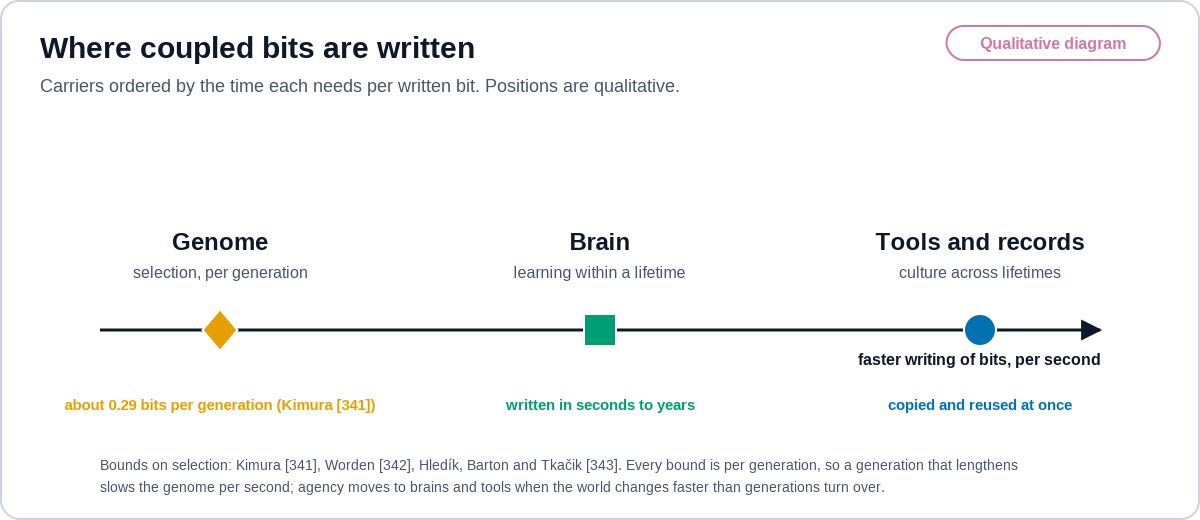
*Figure 3. Where coupled bits are written. Qualitative diagram; the one number is Kimura’s estimate [341]. Bounds: Worden [342]; Hledík, Barton and Tkačik [343]. A [PNG copy](https://research.openie.dev/figures/agency/carriers.png) is provided.*
**Information rates without joules.** Schreiber defined transfer entropy, directed information flow per step [199]. It is per time, not per joule, and it has no eligibility gate. Tishby and Polani charged information per step in a Bellman recursion [200]. Landauer converts those bits to joules. Stratonovich bounded the maximal gain from a given amount of information [201]. That is a ceiling on value per coupled bit.
### 4.2 Demonstrated
**The TUR tested.** A two-qubit NMR experiment obeyed generalized TURs and violated the specialized TUR where theory predicts [202]. An optical tweezer information engine violated the original TUR near maximal efficiency and obeyed generalized bounds with mutual information [27]. Agents need the feedback form. A quantum dot Szilard engine confirmed it independently [203]. Atomic-scale conductors examined the TUR with measured current noise, the physics of every chip [204]. Molecular motors were scored by precision per unit dissipation [205]. Observed current fluctuations bound dissipation from below [206]. A receipt of fluctuations is a lower-bound meter for joules.
**Speed limits and finite-time costs tested.** Single atoms in an optical lattice showed the Mandelstam-Tamm and Margolus-Levitin bounds and the crossover between them [207]. The rate ceiling is measured. A trapped colloid measured time and entropy trade-offs for fast thermal transitions [208]. Brownian particles driven by optimal transport protocols saturated the minimal finite-time dissipation bound [209]. The kinematic optimum is reachable. A feedback trap measured a two-force Brownian machine against linear response bounds [210]. A photonic experiment tested geometric bounds on entropy production [211]. Dago and Bellon measured erasure in a double-well memory at high speed and traced the overhead above Landauer's bound to its sources [212].
**Living sensors measured.** Mattingly, Kamino, Machta and Emonet measured the rate at which E. coli acquires information during chemotaxis, and showed that the cells climb gradients close to the limit that rate sets [213]. Information limits behavior, measured.
**Heat engines at finite speed.** A single colloid ran a micrometer Stirling engine [214]. A trapped bead ran a Brownian Carnot cycle with efficiency at maximum power measured [215]. The energy cost of choosing one of two options was measured [216]. That is the smallest act. A colloidal engine ran on an active bacterial bath [217], and engineered noise gave near-Carnot efficiency at finite power by shortening relaxation [218]. Engineering activity moves the bound. An information engine flipped from refrigerator to heater with noise [219]. The receipt must record the regime, not only means.
**Empowerment in simulation.** Klyubin, Polani and Nehaniv defined empowerment, the channel capacity from actions to future sensors [9]. It was computed for continuous control [220] and reviewed [221]. It measures how much an agent can move the world, in bits. It is not a rate per joule.
### 4.3 Positions in the literature
Kinematics is mostly theorem and experiment. The opinions here concern which variable is right. Seifert holds that inference from fluctuations is the route to hidden costs [137]. Rovelli and Wissner-Gross and Freer both propose entropic kinematics [115, 118]. Kolchinsky shows that dissipation alone does not bound how fast replicators grow or decay [222]. Rates are bounded by dissipation together with activity. That is the form of the speed limit, where $\langle A\rangle$ sits beside $\Sigma$. Adlam, McQueen and Waegell argue that a purely quantum system cannot be an agent, because building a world model and deliberating need copying, which the no-cloning theorem forbids (preprint) [223]. Clause 3 already asks for a classical record of $m$.
## 5. Layer 3. Intelligence as the calculus of agency
Intelligence is the derivative of gated agency in joules, read off a completed run. This layer needs three things from the literature: theory that ties learning and decision to joules, measurement of joules per unit of useful work, and positions on what intelligence is.
### 5.1 Proven
**Learning and prediction priced in joules.** Goldt and Seifert bounded the information a learning network acquires by the entropy it produces [224]. Learning efficiency is at most one. This is $\iota$ for the learning part of an act, with a ceiling. Still showed that optimal memory keeps only predictive information [225]. The marginal joule spent on memory must buy prediction. Boyd, Crutchfield and Gu proved that the agent that extracts the most work from data has the maximum-likelihood model of that data [226]. Better models yield more work per joule. Boyd, Crutchfield, Gu and Binder stated overfitting and generalization as energetics [227]. Generalization appears as joules. Ehrich, Still and Sivak priced the controller itself, beyond the information it uses [228]. So $J$ must be metered at the wall of the whole system. Ehrich and Sivak gave the ledger of energy and information flows in autonomous machines [229]. Wolpert reviewed computation costs beyond Landauer [230]. Wolpert and colleagues set out the open problems for the energy costs of computation in stochastic thermodynamics [320]. Levy and Baxter showed that neural codes that maximize bits per unit energy differ from codes that maximize bits [231]. The right objective for a brain is information per joule. Balasubramanian, Kimber and Berry set the objective for an exploratory regime as transmission rate per unit power [232]. That is bits per joule. Goldt and Seifert bounded the information a network learns about a rule by the thermodynamic cost of learning, for batch and online learning [233]. Fiderer, Barth, Smith and Briegel defined the work capacity of an environment channel, the maximum rate at which any agent can expect to extract work in a percept-action loop. Work-efficient agents balance prediction against forgetting (preprint) [234]. Elliott, Gu, Garner and Thompson showed that quantum adaptive agents can need far less memory than memory-minimal classical agents [235]. Less memory to reset is a lower floor to pay.
**Decisions and bounded optimality.** Russell and Subramanian defined bounded optimality: the best program for a given machine and environment [236]. Here the resource is joules, and the optimum is $\arg\min J$ subject to $X \ge X_{\mathrm{req}}$. Russell and Wefald priced each computation by its expected effect on the decision, net of its cost, and stopped deliberation when no computation had positive net value [316]. Horvitz framed the same trade for reasoning under resource constraints [317]. The σ-law selector is that rule with the cost in metered joules. Proposition 9 gives its exact form for a cascade. Genewein and colleagues derived abstraction and hierarchy from utility minus information cost [237]. Mixture of Limits gears are such a hierarchy. Legg and Hutter defined intelligence as complexity-weighted expected reward over all computable environments [238]. It is an integral, but over reward, without energy, and uncomputable. The derivative in joules replaces reward with confirmed coupled bits and the measure with metered joules. Takahashi and Hayashi give the closest existing calculus in joules [239]. They define two ratios under explicit accounting conventions. Thermodynamic epiplexity per joule is $I(W^{\mathrm{post}}; Z \mid W^{\mathrm{pre}})/E_{\mathrm{cons}}$: new bits about an environment variable $Z$ retained in the agent's state, per joule consumed inside a stated boundary. Empowerment per joule is the capacity of the channel from acts to observations per unit expected energetic cost, the capacity-per-unit-cost of Verdú. They prove a closed-cycle Landauer benchmark by joining a thermodynamic learning inequality with data processing, and they show by a reversible copying construction that, with an open boundary and fresh memory brought in free, information gain and in-boundary dissipation decouple. They close with a reporting checklist: boundary, energy balance, baseline, coarse-graining, horizon and reset, throughput, estimator. This track takes four things from that work. Their closed-cycle benchmark is K1 for learning. Their decoupling construction is the reason for act-closed metering in Definition 2 (Lemma 1). Their checklist is adopted in Section 8.12. Their advice to report bits per joule beside bits per second is the variable Prediction 1 optimizes. The definition differs from their metrics in four exact ways. Empowerment per joule is a capacity, a supremum over act distributions; the definition credits the realized flow of the policy that ran (Definition 1), with capacity as its bound. Their numbers are benchmark-relative efficiency reports, by their own statement; this track ranks systems by $J^*$ behind a correctness gate (Proposition 8). They have no prediction fixed before the act, no consequence clause and no refusal; the definition requires all three before any bit counts. They give no kinematics of time; Prediction 1 derives an optimal act time and a ceiling from the same joule accounting. Ortega, Braun, Dyer, Kim and Tishby set out information-theoretic bounded rationality [240]. Zénon, Solopchuk and Pezzulo cast the cost of cognition as information [241]. Sims applied rate-distortion theory to perception [242]. Their currency is bits. Landauer converts bits to joules at the reset.
### 5.2 Demonstrated
**Brains.** Laughlin, de Ruyter van Steveninck and Anderson measured the energy cost per bit in blowfly photoreceptors and interneurons [243]. Higher information rates cost more per bit. That is a measured $\iota$ in a living agent and a measured diminishing return, $\alpha_J < 0$ in sensing. Attwell and Laughlin built the energy budget of grey matter by process [244]. Lennie showed that energy limits how many cortical neurons can be active at once [245]. Energy is the constraint, and the rest adapts. Energy per action potential differs widely across neuron types [246]. Same function, different joules. Neural design follows energy efficiency [247]. Levy and Calvert audited the human cortex. Communication costs 35 times as much as computation, and a neuron's computation sits a factor of $10^8$ from the best possible bits per joule [248]. That is a distance to the floor. Harris and colleagues found that a visual pathway synapse is sized to maximize information per unit energy, not information [249]. The objective is bits per joule, measured at one synapse. Padamsey, Katsanevaki, Dupuy and Rochefort found that food restriction cut synaptic ATP (adenosine triphosphate) use in mouse visual cortex by 29% and broadened orientation tuning by 32% [250]. Fewer joules bought less precision. Plaçais and Preat showed that starved flies switch off costly aversive long-term memory, and forcing it back reduced survival [251]. Plaçais and colleagues found that raised energy flux in the mushroom body triggers long-term memory [252]. Mery and Kawecki found that forming long-term memory lowered flies' resistance to desiccation [253]. Learning has a measured metabolic price. Hechler, de Lange and Riedl measured lower cortical oxygen use during confident prediction, by up to 12% (preprint) [254]. Prediction first can save joules. Malkin and colleagues gave synapses an energy cost for reliability in trained networks and found signatures of Bayesian inference in the optimum [255]. Li and van Rossum showed that naive synaptic plasticity costs extreme energy and that caching changes before consolidation saves it [256]. Lynn and colleagues inferred broken detailed balance in the human brain from neuroimaging, rising with physical and cognitive exertion [257]. That entropy production is coarse-grained and informational. It is not a joule meter.
**Machines.** Memory access costs far more energy than arithmetic [258]. Parameter count matters only through the joules it makes you move. Intelligence per watt measures task accuracy per unit power on local accelerators [259]. Its numerator is benchmark accuracy, not gated agency. MLPerf Power standardizes power measurement from microwatts to megawatts, with each result gated by an accuracy target [260]. That gate is the form of $J^*$. FrugalGPT cascades language models and stops when a scorer accepts the answer [321]. RouteLLM learns to send each query to a strong or a weak model under a cost target [322]. Their cost is dollars per query and their gate is a quality threshold. Read with metered joules and $C(z)$ as the gate, both are cascades in the sense of Proposition 9. ML.ENERGY measures inference energy automatically [261]. TokenPowerBench benchmarks the power of large language model (LLM) inference [262]. Jin, Wei and Brooks analyze the energy of test-time compute [263]. General-purpose models cost much more energy per task than task-specific ones [264]. The cheapest sufficient model wins in joules. That is Mixture of Limits, measured. Samsi and colleagues measured the energy of large language model inference on GPUs (graphics processing units) [265]. Dillavou and colleagues demonstrated decentralized learning in a physical circuit, with no processor [266]. Stern and colleagues trained self-learning circuits for power-efficient solutions and measured the trade between power and error [267]. Saggio and colleagues demonstrated a quantum speed-up for learning agents in a photonic experiment [268]. Fewer interactions to learn is fewer acts to close.
**A kernel-reported acceptor.** Section 8.11 reports a preregistered run of an acceptor agent on a laptop, with prediction first, comparison, refusal and binding joule budgets. Falsifiers were fixed before the run, and several fired: R-F1 (the selectors' joules on shared tasks are not distinguishable), R-F2 (36 of 5,400 episodes overspent: 9 for the σ-law arm and 7 for the fixed cascade at $B = 1.0$, and 20 for the goal-blind baseline at $B = 0.5$), R-F3, R-F5 and R-F6 (Section 8.11). $\iota$ was read off 4,940 receipts. The median confirmed act gave $1.5 \times 10^5$ bits per reported joule, about $2 \times 10^{15}$ times the joules per bit of the floor. Under a binding budget the σ-law selector closed more tasks than the fixed cascade, one Mixture of Limits instance. That comparison was chosen after the run, so it is exploratory, and joules per closed task were equal. The preregistered second run and a second machine repeated the gain at the loosest budget only (Section 8.11.2). Integrated $\iota$ ranked a goal-blind agent first on a loose budget, while $J^*$ ranked it last.
**Groups simulated.** Crosato and colleagues computed the thermodynamic quantities of simulated collective motion across its critical point [269]. Chen and Prokopenko compared thermodynamic efficiency with purely informational utilities as explanations of collective behavior near criticality [270]. $\iota_G$ in Proposition 7 is the gated, metered form of such a ratio.
**Meters.** RAPL (Running Average Power Limit) is the set of on-die energy counters in Intel and AMD processors. Its readings were validated against external measurement [271]. DRAM (dynamic random-access memory) readings were validated separately [272]. Meter quality depends on the processor generation [273]. Apple's powermetrics manual states that its average power values "are estimated and may be inaccurate" and should not be used to compare devices [274]. On Apple silicon, powermetrics readings are reported values. Measured joules for that machine come from an external wall meter.
**Compression scored.** The Hutter Prize scores lossless compression of the first gigabyte of an English Wikipedia dump, with a prize fund of 500,000 euros and limits on runtime and memory [275]. It bounds time and memory, never joules. A joule cap would make it a calculus-of-agency benchmark for one task class.
**Estimates.** These sources are valuable, and their joule figures are modeled, extrapolated or computed. They sit beside measured joules, never in their place. Estimates are never `measured_j`. Strubell, Ganesh and McCallum sampled power for short runs and extrapolated to full training of natural language processing models [276]. Patterson and colleagues computed training energy from reported hardware, runtime and data-center data [277]. Lacoste and colleagues built a calculator from hardware type, runtime and region [278]. The BLOOM footprint mixes metered and modeled inputs [279]. Carbontracker reads on-device counters and predicts full-run totals [280]. Its predictions are estimates. Elsworth and colleagues report a median of 0.24 Wh per Gemini Apps text prompt, counting accelerators, hosts, idle capacity and data-center overhead [281]. It is an operator-reported figure, filed as `reported_j`.
### 5.3 Positions in the literature
Each position is placed against the definition: intelligence is the derivative of gated agency in joules, read off a completed run.
- Schmidhuber treats intrinsic reward as compression progress, a first derivative of how well an agent compresses its history [282]. It is the closest precedent for intelligence as a derivative read from a run. Its variable is compression, not joules.
- Krakauer, Mitchell and Krakauer define intelligence as an emergent property expressed in ever cheaper and faster uses of emergent capabilities to solve problems, summarized as "less is more" [339]. They conclude that large language models show emergent capability at most, not emergent intelligence. Their definition is the closest in words to $\iota = dX/dJ$. It names energy as the denominator and does not meter it. The calculus supplies the meter, the gate that separates capability from intelligence (Section 1), and the derivative read off the run.
- Chollet defines intelligence as skill-acquisition efficiency over priors and experience, with the ARC (Abstraction and Reasoning Corpus) benchmark [283]. It is a ratio. Its denominator is information and data, not joules. The ARC Prize leaderboard plots cost per task against score as a measure of efficiency [284]. The cost is in dollars. A joule meter turns it into $J^*$.
- Hernández-Orallo builds universal psychometrics across species and machines [285]. It evaluates by tasks. This track evaluates by joules to close tasks. Hernández-Orallo and Dowe's anytime test adapts to the time available [286]. The calculus adapts to the joules available.
- Gershman, Horvitz and Tenenbaum define intelligence as expected utility net of computation cost [287]. This track makes the cost joules.
- Lieder and Griffiths treat cognition as optimal use of limited resources [288]. It is close to Mixture of Limits. The resource is left abstract.
- Balasubramanian reads the brain's design through its energy limits [289].
- Silver, Singh, Precup and Sutton hold that reward is enough [290]. Reward is chosen by a designer. Joules are read off a meter. Vamplew and colleagues reply that scalar reward cannot express multi-objective goals [291]. This track keeps one variable, joules, and moves multiplicity into the gate $X \ge X_{\mathrm{req}}$.
- Hafez and colleagues define agency and intelligence together [292]. It is not joule-native.
- Karagoz makes energy self-sustainment the objective [293]. It has no prediction gate, no kinematics and no joule ranking across systems.
- Chaisson proposes energy rate density, power per unit mass, as a complexity metric across cosmic evolution [294]. It is a rate in watts per kilogram. The calculus divides confirmed bits by joules.
The scope of $\iota$ follows from its numerator. $X$ counts confirmed coupling to the world, so $\iota$ measures how cheaply an agent changes the world as it predicted. It does not measure understanding. Krakauer, Mitchell and Krakauer tie intelligence to compact, communicable representations [339]. A compact representation enters the calculus through its effect: an agent that holds one closes later tasks in fewer joules. Understanding that never changes an act is outside what $\iota$ reads.
### 5.4 Where the calculus stands
- **Proven:** learning, memory, prediction and control each have a joule price with a ceiling.
- **Demonstrated:** joules per bit are measured in brains. Joules per task are measured in machines. Meters can be validated.
- **Proven here:** $\iota$ is a bounded density on the joule axis under joule-proportional crediting (Proposition 5). Sampled $\iota$ converges to it (Proposition 6). Groups compose by Proposition 7. Holding a goal sets an optimal act time and a ceiling on $\iota$ (Prediction 1).
- **Demonstrated here:** $\iota$ and $J^*$ read off the receipts of a kernel-reported acceptor, with falsifiers fixed in advance (Section 8.11). $J^*$ ranks agents. Integrated $\iota$ does not.
- **Added by this track:** intelligence read as $dX/dJ$ off a gated, completed run, with $J^*$ as the ranking. Takahashi and Hayashi come closest, with bits-per-joule ratios under explicit accounting [239]. This track adds the eligibility gate, the realized flow in place of capacity, the gated ranking and its proof (Proposition 8), and the optimal act time (Prediction 1).
## 6. Global findings, by method
The search ran in Russian, Chinese, Japanese, German, French, Spanish, Portuguese, Korean, Italian, Polish, Hindi and Arabic, with English follow-ups. A second pass searched Japanese, Chinese, Russian, German, French, Spanish and Korean again and added Persian, Turkish and Hebrew. Its results are folded into Sections 2 to 5 and 8 by what they prove, measure or define. Results are organized by method and class of result. Language is metadata only. No entry is ranked by where it came from.
### 6.1 Theorems and reviews: information has a thermodynamic price
- Poplavskii gave an early systematic treatment of the energy cost of acquiring and processing information [295]. Written in Russian, with an English translation. Layer: definition.
- Stratonovich proved value-of-information theorems [201]. English edition of a Russian monograph. Layer: kinematics.
- Ito and Sagawa applied information thermodynamics on networks to E. coli chemotaxis. Transfer entropy bounds robustness, and information-thermodynamic efficiency is high where ordinary thermodynamic efficiency is low [296]. Written in Japanese. Layers: definition and kinematics.
- Sun and Quan reviewed Maxwell's demon and the physical floor on dissipation in information processing [297]. Written in Chinese. Layer: definition.
- Quan, Dong and Sun reviewed mesoscopic thermodynamics: the demon is consistent with the second law once erasure is counted, and power-efficiency constraints were tested [298]. Written in Chinese with an English abstract. Layers: definition and kinematics.
- Parrondo's encyclopedic review gives the current account of information as a thermodynamic resource [299]. Layer: definition.
- Strasberg's doctoral thesis tests common assumptions in information thermodynamics with physical models [300]. Written in English with a German abstract. Layer: definition.
- Further theorems surfaced through searches in Japanese, Russian, Chinese, Korean, Portuguese, Italian and Polish: speed limits and TURs in chemical networks [127, 131, 132], finite-time thermodynamics [159, 162, 163], Langevin TURs [143, 144], information bounds on entropy production [148, 149], and single-shot work costs [38].
### 6.2 Experiments: the price measured
- Dago's doctoral thesis reports 1-bit erasure and writing near the minimal energy at high speed on an underdamped micro-cantilever [301]. Written in French. Layer: the definition's joule floor reached at kinematic speed.
- Lagoin's doctoral thesis builds macroscopic Maxwell's demons, including a Szilard engine, from a vane in a granular gas [302]. Written in French. Layer: definition. The demon's accounting holds outside the microscopic regime.
- Ciampini and colleagues used extractable work to witness quantum correlations in a photonic experiment [303]. Layer: definition.
- Experiments surfaced through searches in Korean, Portuguese, Hindi, Italian, Spanish, Chinese and Japanese: information engines [27, 80], NMR demons [73, 74], the TUR on qubits [202], active-bath engines [217, 218], geometric bounds [211], symmetry breaking and Carnot cycles [215, 216], trapped-ion demons [66, 88], and feedback conversion and optimal transport [69, 76, 209].
### 6.3 Theory of functional systems: prediction before the act
The Anokhin school states clauses 1 and 3 in physiological terms. A result template, the acceptor of action results, is formed before the act, compared after it, and the comparison reorganizes behavior. These works were found through Russian-language searches.
- Anokhin's functional system [93, 94].
- Sudakov on the result as the system-forming factor and on probabilistic prediction of behavior [95, 304, 305, 306].
- Shvyrkov on goals organizing neuronal activity and on learning as selection of neuronal systems [96, 307].
- K. V. Anokhin on the brain's cognitive structure as a hypernetwork of functional-system elements [308].
- Saltykov and Grachev on the system-forming factor as anticipation [309].
- Vityaev on purposefulness formalized as rule learning that predicts results [310].
**Implemented and run.** Cognitive architectures built on functional-system theory form result templates, compare, and learn subgoals, in simulation and on a physical robot [90, 91, 311, 312, 313]. None meters joules. Adding a meter to one of these agents would test the full order of definition, kinematics and calculus on an existing implementation. Differentiable probabilistic logic networks are related calculus tooling, not built on functional systems, with no eligibility gate and no joules [314].
### 6.4 Autonomy, organization and minimal agency
Found through Spanish, French and German searches. Agency is a self-maintaining organization that regulates its interactions [103, 104, 105, 106, 107, 108]. The organization is a closure of constraints on thermodynamic flows [109]. The autonomy school has stepped into stochastic thermodynamics [110]. Layer: definition, as the organization that must exist before any act counts.
### 6.5 Measured joules for machine intelligence
Found through Chinese-language searches on inference energy: automated inference energy measurement [261], per-token power benchmarks [262], and the energy of test-time reasoning [263].
### 6.6 Philosophy of agency
Rovelli's physics of agency surfaced through German [115]. Jaeger and Azadi complete the set of position papers [116, 117].
### 6.7 Searches with no primary research
Hindi and Arabic searches returned no primary research in those languages. English follow-ups surfaced further work, listed above by method. Persian, Turkish and Hebrew searches returned theses, reviews and work already cited, with no new primary research.
### 6.8 Convergence observations: information, energy and prediction
Eleven recent sources relate information, energy and prediction, or the compute spent per generated answer. Four were read in full and are cited for what they state: Takahashi and Hayashi [239], Perrier [344], Xu and Li [345] and Still, Sivak, Bell and Crooks [54]. Seven were read in part and are cited only for the passages named: Wolpert [230], Ortega and Braun [56], Zhang, Zhu, Zhang and Hu [348], Fagan [346], Kumar [347], Kumbong, Khare and colleagues [349] and Zou and colleagues [350]. This section records what each states and what it does not show. It is an observation of overlapping questions, not a comparison of results and not a claim about priority. Section and equation numbers are those of the versions named. Quotations were checked by script against the saved texts. Values marked "recomputed" are this paper's own arithmetic.
**In plain words**
1. Several authors write the same kind of quantity: information gained or acted on, divided by energy spent (bits per joule), or its inverse (watts per unit of intelligence).
2. The firm results are lower bounds on heat. They say how little energy is physically required, not how much any real machine uses.
3. No source read here measured energy on real hardware. Where energy figures appear, they are estimated from FLOP counts or from model assumptions.
**Units.** $k_B = 1.380649\times10^{-23}$ J/K. At $T = 300$ K, $k_B T\ln 2 = 2.871\times10^{-21}$ J per bit (recomputed), and its inverse is $3.483\times10^{20}$ bit/J (recomputed). With $\beta = 1/(k_B T)$, information in nats converts to joules by multiplying by $k_B T$, and in bits by $k_B T\ln 2$.
#### Sources read in full
**Takahashi and Hayashi, arXiv:2602.05463v2 (20 July 2026) [239].** The version read is the arXiv posting.
- Epiplexity per joule is $\eta_E = \Delta I / E_{\mathrm{cons}}$ in bit/J, with $\Delta I = I(W_{\mathrm{post}}; Z \mid W_{\mathrm{pre}})$ (Eqs 3 and 10, Sec 2.2). The energy balance is $E_{\mathrm{cons}} = Q_{\mathrm{diss}} + \Delta U_{\mathrm{sys}} + W_{\mathrm{out}} + \Delta E_{\mathrm{store}}$ (Eq 1).
- Empowerment per joule is $\eta_C^* = \sup_{p(a)} I(A_{0:\tau-1}; O_\tau) / \mathbb{E}[c(A)]$ in bit/J (Eq 18, Sec 3.2), with a cost-constrained curve (Eq 19). Empowerment is a channel capacity from actions to later observations (Eq 17, Sec 3.1).
- The closed-cycle bound is $Q_{\mathrm{diss}} \ge k_B T\ln 2\,\Delta I - T\,\Delta S_{\mathrm{sys}}$ (Eq 15), so $\Delta I / Q_{\mathrm{diss}} \le 1/(k_B T\ln 2)$ when $\Delta S_{\mathrm{sys}} = 0$ (Eq 16, Corollary 1). Eq 15 follows from Eq 14 by rearrangement (checked). Corollary 1 needs the bipartite-Markov and local-detailed-balance assumptions.
- The authors give a bits-per-joule metric for learning, another for control, and a reporting checklist: boundary, baseline energy, horizon, estimator (Sec 5.1). Their Proposition 1 is a decoupling construction showing the bound fails if the accounting boundary excludes the cost of preparing fresh memory.
- Scope as stated: "the resulting numbers are benchmark-relative rather than universal". On the ceiling: "Landauer-scale limits are conceptual yardsticks far beyond current hardware."
- The Sec 5 worked example uses published perplexities, $10^9$ tokens, and energy estimated from $6PD$ FLOPs at an assumed $2.5\times10^{11}$ FLOP/J. Recomputed: $\Delta G \approx 4.51\times10^{8}$ bit, $E$ (410M model) $\approx 2.95\times10^{9}$ J, marginal efficiency $\approx 0.106$ bit/J. The authors write: "This number is convention-dependent, but it exercises the checklist."
- Not verified here: Lemma 1 restates an inequality from work not read. Eq 17 uses $O_\tau$ while the Sec 3.2 text refers to $I(A;S_\tau)$. Eq 20 is flagged by the authors: "This is not claimed as a universal identity without assumptions".
**Perrier, arXiv:2504.05328v2 (16 June 2025) [344].** Definitions only are cited.
- Watts per intelligence is $\Phi(\Sigma) = P(\Sigma)/I(\Sigma) = E(\Sigma)/(\tau\, I(\Sigma))$ (Eq 7, Sec 3.3), where $I$ is a task-weighted performance sum (Eq 2) or the Legg and Hutter sum (Eq 1). The assumptions are $E = F N c$ with $c = k_B T\ln 2$ and overhead $F \ge 1$ (Eq 5), and $I \le \alpha N$ with $\alpha$ unspecified (Eq 6). Theorem 1 gives $\Phi \ge cF/(\alpha\tau)$ (Eq 8).
- The author states the premise openly: "Our work assumes a correlation between irreversible computation to intelligence." The paper contains no measurement; it says only that "In practice, one might measure the actual hardware usage".
- Errors found (my reading, not confirmed with the author): (1) Sec 3.1 defines $N$ per unit time, but Eqs 3 and 5 use $E$ over $[0,\tau]$, which needs $N$ as a total, and then $cF/(\alpha\tau)$ falls to zero as $\tau$ grows. (2) $\alpha$ is free, so Theorem 1 gives no numerical floor. (3) The Theorem 2 proof yields a bound of the form $\Delta i_K > -\log(1/\delta)$, which is negative for $\delta < 1$, yet the text treats $-\log(1/\delta)$ as positive. (4) Combining $I \le \alpha\,\Delta i_K$ with $P \ge \Delta i_K\, k_B T\ln 2/\tau$ gives $I/P \le \alpha\tau/(k_B T\ln 2)$, while Eq 14 has no $\alpha$, no $k_B T\ln 2$ and the opposite dependence on $\tau$. (5) $\Delta i_K = K(y) - K(x)$ can be negative, and the direction of the Landauer attachment in Eq 13 is not argued; Theorem 3 inherits this. (6) The hardware ordering $\Phi_{\mathrm{CPU}} > \Phi_{\mathrm{GPU}} > \Phi_{\mathrm{neuro}}$ is asserted with no values.
**Xu and Li, arXiv:2511.19156v4 (30 December 2025) [345].** Read in full for the saved text; figures were read by caption and printed values only. Definitions only are cited.
- Derivation depth $D_d$ (Eq 10) and derivation entropy $H_{\mathrm{derive}} = D_d\lambda$ with $\lambda = \ln 2$ nats in a stated classical regime (Eq 14, Assumption 3). Claimed bounds: $E_{\mathrm{compute}} \ge D_d k_B T\ln 2$ (Proposition 4, Eqs 98 and 99) and $E_{\mathrm{storage}} \ge |S|\,k_B T\ln 2\,(t/t_{\mathrm{refresh}})$ (Proposition 5, Eq 100). A break-even query frequency between recomputing and storing is given in abstract cost units (Theorem 5, Eq 32).
- The authors call their cost an "information-theoretic proxy for energy consumption". The numerical validation (Sec VI) uses a synthetic 100K-atom knowledge base and the paper's own abstract costs, so it tests the model against itself. Application figures (1000 kWh, 45 percent reduction) come without a measurement method and are not used here.
- The abstract says "Our findings suggest that the minimization of Derivation Entropy is a governing principle". The text elsewhere declines to claim a sharp result: "We deliberately refrain from formalizing" the last observation as a phase-transition theorem.
- Errors found (my reading, not confirmed with the authors): (1) Assumption 1 has $E\tau \ge \kappa$ with $\kappa$ an action in J s, while Corollary 1 sets $\kappa_T = k_B T\ln 2$, an energy, and drops $\tau$. (2) Eq 98 assumes every inference step erases a bit (Assumption 3), and Remark 15 of the same paper concedes reversible computation avoids this cost. (3) In Lemma 2 the contradiction argument negates the bound to $K = o(n\log m)$ and claims this contradicts $H \gg \log m$; it does not, since $n\log m \gg \log m$. The lower bound is therefore unproved, and Theorems 4 to 6 and Corollary 7 depend on it. (4) Theorem 6 case (b) uses $N = \Omega(L_S)$ where $N = O(L_S)$ is needed. (5) The Eq 135 critical storage with $H(Q) = 10^{12}$ recomputes to $1.25\times10^{10}$ (log base 2), $1.80\times10^{10}$ (ln) or $4.15\times10^{10}$ (log base 10), not the printed $2.5\times10^{11}$. The Table II text (tightness 0.50 to 0.93) disagrees with the table (0.50 to 0.81, and 0.89 at high frequency).
**Still, Sivak, Bell and Crooks, arXiv:1203.3271v3 (5 October 2012) [54].** The arXiv version was read; the journal version was not.
- With system state $s_t$ and driving signal $x_t$, $I_{\mathrm{mem}}(t) = I[s_t, x_t]$ and $I_{\mathrm{pred}}(t) = I[s_t, x_{t+1}]$, in nats. Per step, $\beta\langle W_{\mathrm{diss}}[x_t \to x_{t+1}]\rangle = I_{\mathrm{mem}}(t) - I_{\mathrm{pred}}(t)$ (Eq 14). In total, $I_{\mathrm{mem}} - I_{\mathrm{pred}} \le \beta\langle W_{\mathrm{diss}}\rangle \le \beta\langle W_{\mathrm{ex}}\rangle$ (Eq 18). The refined Landauer bound is $-\beta\langle Q\rangle \ge I_e + I_{\mathrm{mem}} - I_{\mathrm{pred}}$ (Eq 21).
- Memory of the signal that does not help predict its next value costs dissipated work, at $k_B T$ per nat. The authors' stated consequence: "any system constructed to keep memory about its environment and to operate with maximal energetic efficiency has to be predictive".
- This is a lower bound on dissipation for systems that keep memory of a driving signal. It does not show that any real system attains it, and it is not a statement about general agents. There is no experiment and no joule data.
- Checked: footnote 24 is correct; Eq 17 follows from Eqs 11, 14 and 15; Eq 18 follows from Eq 16; Eq 21 follows from Eqs 19 and 20. $k_B T = 25.9$ meV at 300 K (recomputed; the paper gives 25 meV). Not verified: non-negativity of the per-step term for arbitrary signal processes is stated but not proved in the text, and it is not proved here.
#### Sources read in part
Each entry is limited to the passage stated. No claim is made about the unread parts.
- **Wolpert, arXiv:1905.05669v3 [230].** Sec V (Eqs 29 to 44, Examples 1 to 6), Sec XVI, Appendix A and the opening of Appendix B were read. Sec V states $Q(p_0) = \sigma(p_0) + S(p_0) - S(\pi p_0)$ (Eq 29) and the Landauer cost $L(p,\pi) = S(p) - S(\pi p)$ (Eq 35), defined only for a fixed input distribution. About 70 percent of the 115 pages was not read, and Proposition 1 rests on a cited result not read.
- **Ortega and Braun, arXiv:1204.6481v2 [56].** The main text (Sec 1 to 8) was read. The proofs of Theorems 5 to 7 and the Supplementary Material were not available. Cited for Eq 9, $p(x) \propto p_0(x)\, e^{\beta U(x)}$, and for the one-molecule illustration of Sec 1.1 (cost $k_B T\ln(1/p)$). Printed errors were found in Eq 5 and Corollary 3. The stated optimum $M = 35$ in Fig 4 recomputes to 33 under my reading of the setup.
- **Zhang, Zhu, Zhang and Hu, arXiv:2607.24287v1 [348].** Sec 4.1 to 4.6 (proofs of T1 to T6) were read. Cited for the statement that Axiom 1 "is adopted as an empirical postulate rather than derived within the present framework" and that its energy is dimensionless (nats). The proofs of T7 to T10 and Sec 4.7 and 4.8 were not read. One discrepancy in the T5 Euler-Lagrange equation is unresolved.
- **Fagan, arXiv:2601.00021v2 [346].** Sec 5.3 to 14 and the references were read; Sec 1 to 5.2 were read earlier and not re-read. Cited for Eq 116, $\chi = \dot W_{\mathrm{causal}} / \dot I_{\mathrm{irr}}$, and the authors' statement that its proxies "need not coincide numerically across systems". The simulations (Sec 12) use proxies, not joules, and one curve in Sec 12.1 decreases with $\lambda$ by construction.
- **Kumar, Zenodo 18993403 [347].** Appendix A.1 to A.28 and the references were read; the main text was read earlier and not re-read. Superscripts are lost in the saved text, so printed exponents in A.26 and A.28 are not cited. Cited for $I \le P/(k_B T\ln 2)$ (Eq 125), whose premise the paper states as conditional ("If generating useful knowledge requires irreversible information processing"). Recomputed: $6.74\times10^{21}$ bit/s for 20 W at 310 K.
- **Kumbong, Khare and colleagues, arXiv:2610.14162v1 (9 October 2026) [349].** The main text (pp. 1 to 13) and Appendices A to E, I and J.7 were read; Appendices F to H and the rest of J were read in part. Next-Concept Modeling encodes text as a hierarchy of $K$ residual-quantized code levels (Eqs 7 and 8) and generates one whole level per pass (Eqs 4 and 5), so a sample costs $K$ generator calls rather than one per token. Reported results: reconstruction accuracy of 98.79 to 100.00 percent (Table 1); wall-clock speedups over diffusion language models of similar size on one H100 of 21x on LM1B, 10x on OpenWebText and 31x on XSum; and 86.1 percent of hard Sudoku boards solved against 1.0 percent for a left-to-right model of similar size and 81.3 percent for the best diffusion baseline (Table 3). It does not show lower energy: the paper reports seconds and training token positions, with no joules, watts or power traces. Translation (WMT14 De-En, BLEU 22.6) trails a diffusion and a left-to-right baseline, intermediate levels do not improve monotonically (Table 12), some baseline quality figures are copied from other papers and some baselines were timed with random weights (App. D.2). No result was reproduced here.
- **Zou and colleagues, arXiv:2610.18861v1 (13 October 2026) [350].** The main text (Sec 1 to 9, Tables 1 to 7) and Appendices E and G.2 were read; Appendices A to D, F, H and J were read by keyword only. The agent alternates text and latent modes; in latent mode the hidden state is fed back through a small residual adapter, $e_{t+1} = h_t + W_2\,\sigma(W_1 h_t)$ (Eq 4). Reported results: 35.5 to 54.7 percent fewer tokens, 1.8x to 2.6x faster inference and 2.7x to 3.7x lower estimated cost (abstract); decoding compute per question falls from 51.2 to 13.9, 62.5 to 17.2 and 66.9 to 25.1 TFLOP at 4B, 8B and 14B (Table 9). Replacing latent steps with those of another problem lowers MATH500 accuracy from 88.2 to 48.6 (Table 5). It does not show lower energy: the paper reports no joules, and the cost estimate is counted FLOPs times an assumed price at an assumed 10 percent utilisation, excluding prefill, attention and tool execution (App. G.2); the dollar ratios recompute to the FLOP ratios (recomputed). Each latent step is charged one full forward pass. On HLE the 14B agent scores 16.0, below three frontier models (28.4 to 31.4). Sec 3 describes the latent thoughts as inspectable, while Sec 8 states they are readable only through the provider's adapter; a public reply to the announcement objects that unverbalized reasoning weakens monitoring.
#### What the eleven sources show together
| Source | What it shows | What it does not show | Read status |
|---|---|---|---|
| Takahashi and Hayashi | Two bit/J metrics (learning, control); a closed-cycle Landauer-scale ceiling under stated assumptions; a reporting checklist | A measured joule; an estimate of epiplexity or empowerment for a real system; a test of the bound | Full (16 pp, no appendices) |
| Perrier | A definition $\Phi = P/I$ and a bound that holds only given an assumed link $I \le \alpha N$ | Measured energy; a numerical floor; a correct Theorem 2 or 3 proof | Full (12 pp); definitions cited only |
| Xu and Li | Definitions of derivation depth and entropy; conditional Landauer-type bounds; a synthetic simulation | Measured energy; a correct proof of Lemma 2; independent validation | Full for the saved text; definitions cited only |
| Still, Sivak, Bell and Crooks | A dissipation lower bound equal to non-predictive memory, $\beta\langle W_{\mathrm{diss}}\rangle \ge I_{\mathrm{mem}} - I_{\mathrm{pred}}$ | Attainment by real systems; general agents; a measured joule | Full (5 pp); journal version not read |
| Kumbong, Khare and colleagues | Coarse-to-fine generation with a fixed number of passes; lower wall-clock time than diffusion baselines on one H100; Sudoku results | Measured energy; parity on translation; reproduced timings | Part (main text, App. A to E, I, J.7) |
| Zou and colleagues | Reasoning partly in hidden-state vectors; fewer tokens and fewer counted decoding FLOPs; dependence of accuracy on the latent steps | Measured energy; a cost figure covering prefill, attention and tools; text-level monitoring of latent steps | Part (main text, App. E, G.2) |
Across all eleven sources, no text read reports joules measured on real hardware. Energy figures that appear are estimated from FLOP counts, nominal power ratings or model assumptions. Where bounds appear, they are lower bounds on dissipation under stated assumptions, or definitions of ratios awaiting measurement.
**Limits of this section.** Quoted text was verified against PDF-converted text, and two-column conversion can interleave lines. The errors listed are from my reading and recomputation and have not been sent to the authors. Version differences (v1 to v2) were compared by structure and abstract only for Takahashi and Hayashi, Perrier and Xu and Li.
## 7. Open problems
### 7.1 What must be proven
**P1. The run path is well defined.** Proven. Proposition 5 gives $\iota = dX/dJ$ as a density on the joule axis with $0 \le \iota \le 1/(k_B T\ln 2)$, under joule-proportional crediting. Proposition 6 gives convergence of sampled $\iota$ as the meter's sampling refines, with the meter's relative error as the error term.
**P2. Agency-gated Landauer bound.** Under closed-cycle accounting, each confirmed coupled bit costs at least $k_B T \ln 2$, so $v_J \le 1/(k_B T \ln 2)$. In hand: measurement plus erasure work is at least $k_B T I$ [5], and erasure costs at least $k_B T \ln 2$ per bit [6, 7]. Missing: a data-processing step showing that the coupled bits credited in $X$ cannot exceed the bits recorded in the acceptor's memory during the comparison. Clause 3 already requires the confirmation $m$ to come from a physical record. Proposition 1 proves the per-act floor with this step taken as assumption (R2).
**P3. Agency speed limit.** Proven for acts whose record meets (R1) to (R4). Proposition 1 bounds the mean joules of act $k$ below by $b_k k_B T\ln 2$ plus a finite-time term in $\tau_k$, $\langle A\rangle_k$, the reset error $\varepsilon$ and the confirmed bits, through Fano's inequality. Prediction 1 adds the standing joules of holding a goal and gives the optimal act time.
**P4. Precision bound for agents.** Proven. Proposition 3 bounds the relative variance of confirmed agency by dynamical activity for the count of confirmed acts, and by entropy production with the information term under feedback.
**P5. Hindsight theorem.** $\iota$ is a function of the completed receipt only. No pre-run quantity fixes it. In hand: each $m_k$ compares an outcome to a prediction fixed before the act, so $m_k$ is unknown before act $k$ closes. Missing: a construction of two worlds that agree on everything a pre-run predictor sees and differ in some $m_k$. With P1, this makes "intelligence is read off the completed run" a theorem.
**P6. Ranking survives meter error.** Proven. Proposition 8, part 3: if $(1+\epsilon)J^*_{S_1}(q) < (1-\epsilon)J^*_{S_2}(q)$, with $\epsilon$ the meter's relative error bound, then $S_1 \succ_q S_2$ under any reading within that error. Missing: validated $\epsilon$ for each meter [271].
**P7. Mixture of Limits optimality.** Partly proven. Proposition 9 gives the exact conditions for independent gears and for two nested gears, and the budget mechanism. The fixed cascade instance tries gears from cheapest up, stops at the first gear whose output passes $C(z)$, and refuses with a receipt if the next gear would break the budget. It achieves the joule minimum up to the cost of failed attempts. In hand: if sufficiency is monotone in gear order and gear costs rise with order, the first sufficient gear is the cheapest sufficient gear. Missing: a regret bound when pass probabilities are estimated or sufficiency is not monotone, the nested case with more than two gears, and the conditions under which this rule and the σ-law selector, $a^* = \arg\max[H(a) - \lambda J(a)]$ subject to $J \le B$, choose the same act.
**P8. When agency compounds.** Conditions under which $\alpha_J > 0$ over a run, so that earlier receipts lower the joules of later closures. Missing: a model of reuse in which stored receipts cut later $J$ by more than the storage and lookup joules. Still gives the memory cost side [225]. Section 8.10 measures the template's share of each act's joules.
### 7.2 What must be demonstrated
| ID | Claim | Evidence required |
|---|---|---|
| D1 | $J^*$ per task is measured, not estimated, on at least two fabrics | `measured_j` from RAPL on x86 Linux and an external wall meter on Apple silicon |
| D2 | The σ-law selector closes tasks in fewer measured joules than the fixed cascade under binding budgets | Paired runs with the same tasks, gears, predicates, budgets and meters |
| D3 | Refuse with a receipt works | Zero overspends, refusals on infeasible tasks, few refusals on feasible ones |
| D4 | $\iota$ is read off receipts and is stable across seeds | Per-run $\iota_k$ series with spread within a preset bound |
| D5 | Estimates do not substitute for measurement | Rank agreement between `est_j` and `measured_j`, reported, never merged |
| D6 | The physical floor is respected and the gap is known | Measured joules per confirmed bit divided by $k_B T \ln 2$ |
| D7 | Prediction 1: the optimal act time and the ceiling of an agent that holds a goal | A $\tau$ sweep at two or more instability rates, with act and standing joules metered separately and together |
Section 8.11 reports the first run against D2 to D6, on reported joules. Section 8.11.1 reports the second run on the same machine, with the guard and refusal fixes, and Section 8.11.2 repeats it on a second machine.
## 8. Experiment plan
Every table, receipt and figure in this plan follows one rule. Estimates are never `measured_j`. A modeled figure is labeled `est_j`. A metered figure is labeled `measured_j` and names its meter.
### 8.1 Meters
Acronyms: CPU (central processing unit), GPU (graphics processing unit), ANE (Apple Neural Engine), AC (alternating current), NVML (NVIDIA Management Library).
| Tier | Meter | What it reads | Label |
|---|---|---|---|
| M0 | External wall-plug power meter, logging at 1 Hz or faster | Whole-system AC power | `measured_j`, wall |
| M1 | RAPL through Linux powercap, package, core, uncore and DRAM domains where present | Cumulative on-die energy in microjoules | `measured_j`, rapl |
| M1g | NVML total energy counter on a discrete GPU | Cumulative GPU board energy | `measured_j`, nvml |
| M2 | Apple powermetrics, CPU and GPU samplers at 100 ms | CPU, GPU and ANE power as reported by the system | `reported_j`, powermetrics |
- **RAPL.** Read the counter before and after each act. Handle wraparound. Validate against M0 on a calibration workload [271, 272].
- **powermetrics.** Readings are filed as `reported_j`. Measured joules on Apple silicon come from M0. Within one machine, `reported_j` attributes joules to CPU, GPU and ANE.
- **Idle baseline.** Record 120 s of idle power on every meter before each block. Report gross and idle-subtracted joules side by side. Never report only the subtracted figure.
- **State control.** Fix the CPU frequency governor where the operating system allows. Log ambient temperature and thermal pressure. Close background jobs. Discard one warm-up run per arm.
### 8.2 Tasks
Each task has a machine-checkable completeness predicate $C(z)$: unit tests for code, exact match for arithmetic, schema validation for extraction, a verified final state for tool use. Two strata are fixed in advance. Near-optimal tasks are those the cheapest gear usually closes. Compounding tasks are sequences where earlier receipts can be reused. $X_{\mathrm{req}}$ is set by $C(z)$. Passing is a gate, not a score.
### 8.3 Arms
All arms share the gears, the predicate, the budget, the meters and a randomized interleaved run order.
1. **σ-law selector:** $a^* = \arg\max[H(a) - \lambda J(a)]$ subject to $J \le B$, with refusal on a receipt.
2. **Fixed cascade (cheapest first):** the cheapest-sufficient rule, with gears tried in a fixed order from cheapest up. It is the matched comparison: same information, gears, budget and refusal right. Only the selection rule differs.
3. **Largest gear always:** reference ceiling.
4. **Smallest gear always:** reference floor, with refusal when it fails.
Both selectors are Mixture of Limits instances. The philosophy is to use the cheapest gear that is sufficient, because past the floor additional joules do not purchase verifiable progress. The fixed cascade applies it in a fixed order. The σ-law selector stops when the next act no longer pays for its joules. That is a threshold-convergence rule, so it is a Mixture of Limits instance too. The comparison is between two instances of one philosophy. In code and data files the fixed cascade is the arm `mol` and the σ-law selector is the arm `sigma`.
### 8.4 Budgets, seeds and statistics
- A pilot runs arm 2 without a budget and records the median measured joules per task, $\tilde J_q$.
- Budget levels are $B \in \{0.25, 0.5, 0.75, 1.0\} \times \tilde J_q$, plus unconstrained. A level binds only if at least 20% of tasks exceed it in the pilot. Levels that do not bind are reported and excluded from the D2 test.
- At least 10 seeds per arm, task and budget. More if the pilot shows 10 cannot resolve a 10% difference in median $J^*$ at 95% confidence.
- Report mean, median, standard deviation and a 95% bootstrap confidence interval of $J^*$ per task. Compare arms 1 and 2 with a Wilcoxon signed-rank test on per-task median $J^*$, with effect size.
- The preregistration names the primary endpoints. Secondary comparisons are corrected with the Holm step-down procedure. An analysis chosen after a run is labeled post hoc wherever it appears, in summaries included, and it is never the headline result. It becomes a primary endpoint only in the preregistration of the next run.
### 8.5 Receipt schema
The receipt is the record of the run. One record per act:
```
act_id, run_id, task_id, arm, seed, budget_j, gear
prediction_hash, prediction_ts # R*, fixed before the act
outcome_hash, outcome_ts # R
m # 1, mu, or 0
coupled_bits_est # realized I(do(a); W'), bias-corrected, with interval
coupled_bits_bound # capacity bound, never credited as X
t_start, t_end
measured_j {meter, domains, gross_j, idle_w, idle_subtracted_j}
reported_j {meter, cpu_j, gpu_j, ane_j} # powermetrics only
wall_j {meter, gross_j, idle_w, idle_subtracted_j}
est_j {model, inputs} # never merged with measured_j
cumulative_measured_j
refused, refuse_reason
passed_C
record_states, record_bits # N and H of the act's record M_k
joule_share # P_k attribution when acts overlap
template_j {meter, write_j, hold_j, reset_j} # joules for R*
trajectory_j {tau, activity, work} # physical runs only, Section 8.8
```
### 8.6 Metrics
- $J^*$ per task: measured joules to pass $C(z)$, from M0 where present, otherwise M1.
- Closure rate per arm and budget.
- Overspends: acts that exceeded $B$. The target is zero.
- Refusal quality: precision and recall of refusals against tasks shown infeasible within $B$ by any arm.
- Intelligence series: $\iota_k = \Delta X_k/\Delta J_k$ per run, and its spread across seeds.
- Acceleration sign: the sign of $\alpha_J$ from regressing $\iota_k$ on cumulative $J$, per stratum.
- Estimate check: Kendall's rank correlation between `est_j` and `measured_j`.
- Distance to floor: measured joules per confirmed coupled bit divided by $k_B T \ln 2$ at the logged temperature.
- Act intelligence: $\iota_k = b_k/J_k$ per act, which equals the density of Proposition 5 on that act.
- Template share: $J^{R^*}/J$ per act and the curve $\iota(w)$ (Section 8.10).
### 8.7 Falsifiers, fixed before any run
| ID | Observation | Claim defeated |
|---|---|---|
| F1 | The 95% interval for the paired difference in median $J^*$, σ-law minus fixed cascade, includes or exceeds zero at every binding budget | The σ-law selector beats its fair rival in joules |
| F2 | Any arm records an overspend | That arm's refusal implementation |
| F3 | Refusal recall on infeasible tasks is below 0.9, or more than 10% of refusals fall on tasks another arm closed within $B$ | Refusal correctness |
| F4 | Kendall's correlation between `est_j` and `measured_j` is below 0.8 | Use of that estimator for any ranking |
| F5 | The coefficient of variation of mean $\iota$ across seeds exceeds 0.25 on a task | Reading $\iota$ at that task's granularity |
| F6 | The fitted $\alpha_J$ is not positive with 95% confidence on the compounding stratum | Compounding on those tasks |
| F7 | The mean measured joules per confirmed bit over a run fall below $k_B T \ln 2$, or any act of a macroscopic machine does | The accounting itself: a meter or bookkeeping fault, fixed before any other result is reported |
| F8 | M1 and M0 disagree on a calibration workload by more than the error bound in P6 | That RAPL domain as a measured source on that machine |
| F9 | A physical act cycle shows work below the Proposition 1 floor at its logged $\tau$ and $\langle A\rangle$ | The accounting of that run: a missed jump channel, a miscalibrated potential or an unmetered work source |
| F10 | A stationary run shows $\mathrm{Var}(N)/\langle N\rangle^2$ below $1/\langle K\rangle$ beyond its confidence interval | The jump count of that run: some jumps went uncounted |
| F11 | A controller holds the plant with measured joules per step below $k_B T\ln 2 \log_2\lvert\lambda\rvert$ | The meter or the plant model of that run |
| F12 | The maximizer of measured $\iota(\tau)$ lies outside $\tau^* \pm 2\delta\tau^*$ of Prediction 1, or the slope of $\ln\tau^*$ against $\ln s$ lies outside $-1/2$ by more than two standard errors; or a run's $\iota$ exceeds the ceiling of Prediction 1 | Additivity of act and standing joules on one meter, with $\iota$ as their density; for the ceiling, the accounting of that run |
### 8.8 Physical act cycles
These runs test Propositions 1 to 4 at the physical floor. Work is computed from measured trajectories and the calibrated potential, as in [61, 67, 70]. It is filed as `trajectory_j` and never merged with `measured_j`, `reported_j` or `est_j`.
- **Act cycle on a charge register (Propositions 1 and 4).** A single-electron box or quantum dot holds a one-bit record, as in [68, 70, 71]. Each cycle writes the comparison, acts, and resets the record in time $\tau$. A charge detector counts every tunneling jump, so $\langle A\rangle$ is measured. Sweep $\tau$ over at least two decades. Result form: work per cycle against $k_B T\ln 2 + k_B T/(2\tau\langle A\rangle)$, the floor of Proposition 1 for $N = 2$ and $b = 1$.
- **Counting confirmed acts (Proposition 3).** On the same register, cycling in steady state, count confirmed acts $N$ and all jumps $K$ over repeated windows of equal length. Result form: $\mathrm{Var}(N)/\langle N\rangle^2$ against $1/\langle K\rangle$, and the spread of $T_n$ against $1/(\langle T_n\rangle\langle k\rangle)$. On a feedback-trap information engine as in [27], run the forward and the backward experiment, compute $\sigma_I$ from the measured trajectories, and test part 3.
- **The optimal act time (Prediction 1).** This is the lab test.
- *Setup.* A colloidal bead in water at temperature $T$ sits in a feedback trap [61]. Its position is read every $\Delta t$, and a feedback force imposes a virtual potential $U(x, t)$. Work is computed from the trajectory by stochastic energetics, $W = \sum_t \partial_t U(x_t, t)\,\Delta t$ [319]. One coordinate runs the one-bit act cycle in a virtual double well, reset in time $\tau$. The other is held at the top of a virtual inverted well, $U = -\tfrac{1}{2}k x^2$, whose instability rate $\Lambda$ is set by $k$ and the bead's mobility.
- *Blocks.* For each value of $\Lambda$, three blocks run interleaved in randomized order. Block A: acts with no goal held, at nine or more log-spaced values of $\tau$ over at least two decades; it fits $J_0$ and $a$. Block B: the goal held with no acts; it gives the standing power $s$. Block C: both together, at the same values of $\tau$; it gives $\iota(\tau)$. At least 200 cycles per point.
- *Sweep of $s$.* At least four values of $\Lambda$ spanning at least one decade, so $s$ spans at least one decade.
- *Fit.* Fit $J(\tau) = J_0 + a/\tau + s\tau$ to block C by weighted least squares. Read the measured $\tau^*$ at the maximum of $\iota(\tau)$ by a local quadratic fit in $\ln\tau$. Compute $\sqrt{a/s}$ and its band $\delta\tau^*$ from blocks A and B. Regress $\ln\tau^*$ on $\ln s$ by least squares and report the slope with its standard error.
- *Falsification.* The claim fails if the slope lies outside $-1/2$ by more than two standard errors, or a measured $\tau^*$ lies outside $\sqrt{a/s} \pm 2\delta\tau^*$, or block C's joules per act differ from the sum of blocks A and B beyond their combined 95% interval. The last test is additivity on one meter, the physical content of the prediction.
- *Power.* The slope's standard error must be below 0.1. Otherwise the run is reported as inconclusive and the sweep is extended. An inconclusive run is not a pass.
- *Second substrate.* A single-electron box with a charge detector repeats the protocol, with $\langle A\rangle$ counted jump by jump [70]. Agreement on two substrates is the test.
- All work is computed from trajectories and filed as `trajectory_j`.
- **Holding an unstable plant (Proposition 2).** A digital controller holds a plant with one unstable mode of fixed $|\lambda|$ per step, at $f$ steps per second. Meter the controller with M0 and M1. Log the record's bits per step. Result form: measured joules per step divided by $k_B T\ln 2\log_2|\lambda|$, reported as distance to floor. Sweep $|\lambda|$ and $f$.
### 8.9 Living agents: measured ι
Result form: $\iota$ in a living preparation, as bits per decision divided by joules per decision, both taken in the same preparation and reported with distance to floor. A living $\iota$ counts as measured only when both terms are measured. A joule figure computed from conductances or inferred from imaging is filed as `est_j`. Entropy production inferred from brain imaging is coarse-grained and informational, so it is not a joule meter [257].
- **Bacterial chemotaxis.** Information rate from single-cell behavior in a defined gradient, as Mattingly and colleagues measured it [213]. Joules from the oxygen consumption of the same culture, divided by cell number. The comparison floor is the cost of sending a bit through the cell's signaling channel, from Bryant and Machta [197], beside $k_B T\ln 2$.
- **Mouse visual cortex.** Orientation information per trial from two-photon imaging, and synaptic ATP use from whole-cell recordings, as Padamsey and colleagues obtained both [250]. Food restriction moves the joules. The measured response of information to joules is the sign and size of $dX/dJ$ in a cortex.
- **Fly memory.** Energy flux in the mushroom body during long-term memory formation, imaged as Plaçais and colleagues did [252], per learned association, with retention as the confirmation. Survival under starvation and desiccation is the outcome cost [251, 253].
### 8.10 The joule price of prediction first
Result form. Split each act's metered joules into the template's share and the rest, $J_k = J_k^{R^*} + J_k^{\mathrm{act}}$. $J_k^{R^*}$ covers writing, holding and resetting $R^*(a)$. Resetting a template with $H(R^*)$ bits of entropy costs at least $H(R^*)\,k_B T\ln 2$ [6, 24]. Memory that does not predict costs dissipation [54]. A template raises $\iota$ when the act joules it saves exceed its own joules. The measured result is the curve $\iota(w)$ over template width $w$, the bits of $R^*$, with its maximizer $w^*$ and the ratio $\Delta J^{\mathrm{act}}/\Delta J^{R^*}$ at each step.
Protocol. Fix tasks, gears, predicates and budgets. Vary $w$ over a preset grid. An act may stop as soon as its outcome is resolved against the template. Log `template_j` and the act's remaining joules for every act, on the same meters.
Evidence in hand: confident prediction lowered human cortical oxygen use by up to 12%, measured by metabolic imaging (preprint) [254]. In cellular networks, the bits of the past that best predict the future are prohibitively costly [198]. In percept-action loops, work-efficient agents balance prediction against forgetting [234].
### 8.11 First run: a kernel-reported acceptor on a laptop
This run applies Sections 8.1 to 8.7 to one task class on one machine. Code, task sets, receipts and analysis are in the site repository under `experiments/agency-run`. The preregistration and its falsifiers were committed first (e830bff). The pilot and the locked calibration came next (5828420), and then the main run (35c967a).
**Method.**
- **Agent and task.** A Python process closes Sudoku puzzles. The completeness predicate $C(z)$ passes when the grid is full, every row, column and box holds 1 to 9, and every given is kept. A confirmed task credits $b = n_{\mathrm{empty}}\log_2 9$ bits, the number of fills the act chooses among. That is the capacity bound of Definition 1. The test set holds 30 puzzles, 10 per stratum (easy, medium, hard), generated from a fixed seed. A separate set of 30 calibrates the selectors.
- **Gears.** g0 fills naked singles. g1 adds hidden singles. g2 adds depth-first search.
- **Arms.** The σ-law selector takes $a^* = \arg\max[H(a) - \lambda J(a)]$, with $H(a)$ the calibrated pass probability given the gears already tried, times $b$, and $\lambda = b/B$. The fixed cascade (cheapest first) takes the cheapest gear whose calibrated pass probability is at least 0.5. Both fix $R^*$ before each act, hash it with SHA-256 (Secure Hash Algorithm, 256-bit) and timestamp it. Both compare after the act and refuse with a receipt when no act fits the budget. The goal-blind baseline draws one gear at random, with no prediction, no comparison, no escalation and no refusal. The budget cuts it off.
- **Budgets and seeds.** Per task, $B \in \{0.5, 1.0, 2.0\} \times J_{g2}(q)$, the pilot median of g2 alone. Levels 0.5 and 1.0 bind: 98% and 40% of pilot runs exceed them. Level 2.0 does not (0.7%). There are 20 seeds per condition, in a seeded interleaved order. In all, 5,400 episodes ran, with 4,940 acts.
- **Energy label.** Every joule is `reported_j`: the kernel's per-process energy estimate for the agent (`ri_energy_nj` from `proc_pid_rusage`), read before and after each act, with no privileges. The process is the agent's wall. The Sudoku grid is held inside that process, so the world $W'$ is not outside $S$ as Definition 2 requires. This run tests the kinematics and the gated ranking, not the definition. The run that tests the definition holds the grid in a second process behind a socket, or on a microcontroller. `measured_j` is empty, because no wall meter was attached. `est_j` is cycles times $4.20 \times 10^{-10}$ J, the pilot's median ratio.
**Results.** Mean ± standard deviation over 20 seeds. A run is one arm at one budget level over all 30 tasks. CV is the coefficient of variation, standard deviation over mean.
| Arm | $B/J_{g2}$ | Tasks closed of 30 | $X$ (bits) | $J$ (reported, mJ) | $\iota$ (bits per reported joule) | CV of $\iota$ | Refusals | Cuts | Overspends |
|---|---|---|---|---|---|---|---|---|---|
| σ-law | 0.5 | 0.60 ± 0.50 | 108 ± 91 | 20.8 ± 0.3 | 5,254 ± 4,402 | 0.84 | 29.40 | 0 | 0 |
| σ-law | 1.0 | 9.10 ± 1.86 | 1,479 ± 316 | 43.8 ± 4.0 | 34,454 ± 10,007 | 0.29 | 20.90 | 0 | 9 |
| σ-law | 2.0 | 28.40 ± 0.60 | 4,823 ± 105 | 66.2 ± 5.8 | 73,345 ± 6,443 | 0.09 | 1.60 | 0 | 0 |
| Fixed cascade (cheapest first) | 0.5 | 0.70 ± 0.47 | 126 ± 85 | 18.8 ± 0.3 | 6,801 ± 4,569 | 0.67 | 29.30 | 0 | 0 |
| Fixed cascade (cheapest first) | 1.0 | 6.45 ± 1.50 | 1,047 ± 254 | 44.7 ± 3.6 | 23,804 ± 7,067 | 0.30 | 23.55 | 0 | 7 |
| Fixed cascade (cheapest first) | 2.0 | 27.50 ± 0.51 | 4,668 ± 92 | 67.0 ± 6.7 | 70,418 ± 7,766 | 0.11 | 2.50 | 0 | 0 |
| Goal-blind | 0.5 | 0.25 ± 0.44 | 45 ± 80 | 14.1 ± 3.1 | 2,775 ± 4,999 | 1.80 | 0 | 20.35 | 20 |
| Goal-blind | 1.0 | 3.85 ± 1.84 | 623 ± 301 | 26.6 ± 5.7 | 24,153 ± 13,364 | 0.55 | 0 | 17.45 | 0 |
| Goal-blind | 2.0 | 18.25 ± 2.71 | 3,034 ± 471 | 34.1 ± 9.7 | 92,724 ± 15,690 | 0.17 | 0 | 1.35 | 0 |
- **Per act.** 1,902 acts were confirmed. The median act $\iota$ was $1.53 \times 10^5$ bits per reported joule, with interquartile range $8.3 \times 10^4$ to $4.7 \times 10^5$. Joules per confirmed bit were at least $3.8 \times 10^{14}$ times $k_B T\ln 2$ at 300 K, with median $2.3 \times 10^{15}$ times. The floor allows $3.5 \times 10^{20}$ bits per joule.
- **Joules per closed task.** The median over arms was 0.34 to 0.38 mJ for easy tasks, 1.58 to 1.70 mJ for medium and 4.05 to 4.28 mJ for hard.
- **Selectors, paired by seed (exploratory, post hoc).** This analysis was chosen after the run, so it is exploratory. At $B = 1.0\,J_{g2}$ the σ-law selector closed 2.65 more tasks per run than the fixed cascade (95% bootstrap interval 1.5 to 3.8). Its run $\iota$ was higher by 10,650 bits per joule (4,747 to 16,592). At $B = 2.0\,J_{g2}$ it closed 0.9 more (0.55 to 1.25). The σ-law rule goes straight to the gear that suffices, so the joules of failed light attempts stay in the budget. Joules per closed task were equal: on the 4 tasks both arms closed at $B = 1.0\,J_{g2}$, the paired interval ran from $-7.9$ to $+15.5$ µJ (R-F1).
- **Package cross-check.** powermetrics, run non-interactively over 30 s windows, read about 12.1 W of CPU power and 13.6 W of GPU power from other work on the machine while the agent slept. The agent added about 0.6 W on its own meter. Background CPU power moved by about 0.5 W between windows, so idle-subtracted package joules came out negative. The per-process meter is the run's meter. D1 and D5 need a wall meter on an otherwise idle machine.
**Falsifier outcomes.** All were fixed before the run.
| ID | Observation | Outcome |
|---|---|---|
| R-F1 | 95% interval of the paired per-task difference in median $J^*$, σ-law minus fixed cascade, includes zero at every binding level | Fired. At $B = 1.0$, 4 tasks closed by both: interval $-7.9$ to $+15.5$ µJ. At $B = 0.5$, no task closed by both. On tasks both close, the joules are equal |
| R-F2 | Any episode ends above its budget | Fired. 36 of 5,400. σ-law 9 and fixed cascade 7 at $B = 1.0$, 0.07% to 3.6% over, when the final comparison ran outside the guard. Goal-blind 20 at $B = 0.5$, up to 33% over, on budgets a few meter checks wide |
| R-F3 | Refusal recall below 0.9 on infeasible task levels, or over 10% of refusals on task levels some arm closes in half the seeds | Fired. Recall 1.00 on 41 infeasible task levels. 13.1% of refusals fell on task levels some arm closed |
| R-F4 | Kendall's tau-b between `est_j` and `reported_j` per act below 0.8 | Held. 0.96 on 4,000 acts |
| R-F5 | CV of run $\iota$ above 0.25 in any condition | Fired at binding levels (0.29 to 1.80). Held at $B = 2.0$ (0.09, 0.11, 0.17) |
| R-F6 | Ranking by $J^*$ differs from ranking by integrated $\iota$ | Fired. At $B = 2.0$, $J^*$ ranks σ-law, fixed cascade, goal-blind. Integrated $\iota$ ranks goal-blind first. At $B = 1.0$ the last two swap |
| R-F7 | A confirmed act below $k_B T\ln 2$ per bit | Held. The lowest act sat $3.8 \times 10^{14}$ times above |
| R-F8 | Goal-blind run $\iota$ at least the better selector's at a binding level | Held. 2,775 against 6,801 at $B = 0.5$. 24,153 against 34,454 at $B = 1.0$ |
**What the run settles.**
- $\iota$ is read off receipts, act by act and run by run, as Propositions 5 and 6 require. On a loose budget it is stable across seeds.
- $J^*$ is the ranking, and integrated $\iota$ is not. The goal-blind agent had the highest run $\iota$ on the loose budget, closing 18 of 30 tasks against 28. Its failures were cheap. $J^*$ is gated by $C(z)$, so it ranks that agent last. This is why Section 2.3 ranks by $J^*$, with $X_{\mathrm{req}}$ as a gate.
- Exploratory, post hoc: under a binding budget the σ-law selector closed more tasks than the fixed cascade, and joules per closed task were equal. The gain lies in which tasks fit the budget, not in a cheaper closure of the same task. Section 8.11.2 states what the later runs replicate.
- Two implementation fixes come before the next run. The comparison and the receipt write move inside the guarded region. A measured closing cost is charged before each act.
Figure 4 sets the gate beside the measured ranking at the loose budget.
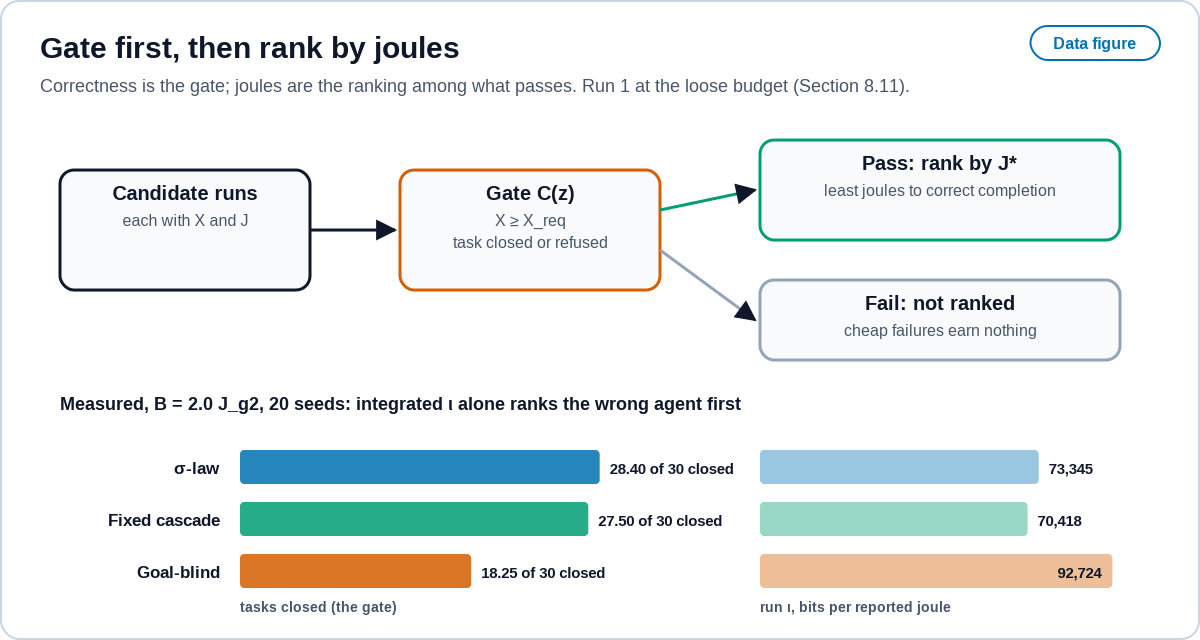
*Figure 4. Gate first, then rank by joules. Diagram with Run 1 data at $B = 2.0\,J_{g2}$, means over 20 seeds from the results table above; integrated $\iota$ alone would rank the goal-blind agent first (R-F6). Source: `experiments/agency-run/results`. A [PNG copy](https://research.openie.dev/figures/agency/gate-then-rank.png) is provided.*
### 8.11.1 Second run: guarded acceptor, 40 seeds
This run is the same task class, the same gears and the same three arms as Section 8.11, on the same laptop. The preregistration for the second run was committed first (610dd4c). The pilot and the locked calibration came next (c88511f), and then the main run (920d7e2). Prediction 1 has no software analogue in this run: the agent has no declared act cost that falls with act time and no standing cost it controls, so the preregistration states that the dose-response design is not run.
**Method.**
- **Guard.** Every joule of an episode is charged inside the guard: selection, hash, gear steps, comparison, receipt and final read. The opening check uses spent $= 0$. The law arms refuse when the guard fails. The goal-blind arm is cut.
- **Refusal threshold.** Both selectors use the $r$-quantile of calibration costs for budget-fit tests. $r$ was locked from calibration replay before the main run: $r = 0.1$, with recall 1.0 and precision about 0.976 on the calibration split.
- **Budgets and seeds.** Per task, $B \in \{0.5, 1.0, 2.0\} \times J_{g2}(q)$, the pilot median of g2 alone. Levels 0.5 and 1.0 bind: pilot fractions exceeding them are 0.98 and 0.4. Level 2.0 does not (0.0067). There are 40 seeds per condition. In all, 10,800 episodes ran.
- **Quiet window.** Quiet was not achieved. Probes ran until the limit. The last probe before the start, at 21:46 local time, recorded other-process CPU near 621% of one core, with mediaanalysisd and editor helpers at the top. Baseline package power was about 21.4 W. Package power in the main window was about 22.7 W. The run records `quiet_window = no`.
- **Energy label.** Every joule is `reported_j`: the kernel's per-process energy estimate for the agent (`ri_energy_nj` from `proc_pid_rusage`), with package figures from powermetrics where used for the cross-check. `est_j` is cycles times $1.783 \times 10^{-9}$ J, locked in the pilot. `measured_j` is empty: no wall meter was attached.
- **Package cross-check.** In the main window the process meter read 42.35 J. Net package joules were 121.81 J, a ratio of about 2.88 to the process. Baseline package drift was about $-0.082$ W. Because `quiet_window = no`, the cross-check is declared not achievable. The per-process meter remains the run's meter.
**Results.** Mean ± standard deviation over 40 seeds. A run is one arm at one budget level over all 30 tasks. CV is the coefficient of variation, standard deviation over mean. $J$ is reported in millijoules for comparison with Section 8.11.
| Arm | $B/J_{g2}$ | Tasks closed of 30 | $X$ (bits) | $J$ (reported, mJ) | $\iota$ (bits per reported joule) | CV of $\iota$ | Refusals | Cuts | Overspends |
|---|---|---|---|---|---|---|---|---|---|
| σ-law | 0.5 | 0.62 ± 0.49 | 113 ± 89 | 59.5 ± 2.0 | 1,942 ± 1,525 | 0.785 | 29.38 | 0 | 0 |
| σ-law | 1.0 | 2.90 ± 1.74 | 523 ± 314 | 133.7 ± 13.8 | 4,150 ± 2,892 | 0.697 | 27.10 | 0 | 0 |
| σ-law | 2.0 | 22.73 ± 1.30 | 3,980 ± 206 | 197.3 ± 18.2 | 20,359 ± 2,388 | 0.117 | 7.28 | 0 | 0 |
| Fixed cascade (cheapest first) | 0.5 | 0.57 ± 0.50 | 104 ± 90 | 60.1 ± 2.1 | 1,777 ± 1,548 | 0.871 | 29.43 | 0 | 0 |
| Fixed cascade (cheapest first) | 1.0 | 2.67 ± 1.25 | 483 ± 226 | 140.3 ± 13.5 | 3,593 ± 1,948 | 0.542 | 27.32 | 0 | 0 |
| Fixed cascade (cheapest first) | 2.0 | 19.93 ± 1.42 | 3,509 ± 227 | 201.2 ± 20.4 | 17,684 ± 2,909 | 0.164 | 10.07 | 0 | 0 |
| Goal-blind | 0.5 | 0.12 ± 0.33 | 23 ± 61 | 35.4 ± 11.6 | 513 ± 1,397 | 2.723 | 0 | 22.85 | 0 |
| Goal-blind | 1.0 | 1.00 ± 0.93 | 181 ± 169 | 72.0 ± 19.5 | 2,661 ± 2,579 | 0.969 | 0 | 20.00 | 0 |
| Goal-blind | 2.0 | 10.65 ± 2.27 | 1,859 ± 400 | 97.3 ± 30.1 | 20,302 ± 5,766 | 0.284 | 0 | 8.70 | 0 |
- **Per act.** 7,960 acts ran. 2,448 were confirmed. Kendall's tau-b between `est_j` and `reported_j` was 0.942 on 4,000 acts. The median act $\iota$ was about $3.11 \times 10^{4}$ bits per reported joule. Every confirmed act sat far above $k_B T\ln 2$ per bit: the lowest was about $6.4 \times 10^{14}$ times that floor.
- **Refusal.** Recall was 1.0 on 49 infeasible pairs. There were 5,223 refusals. The share on tasks closed by some arm was about 0.081.
- **Overspends.** Zero episodes ended above budget. The maximum overspend fraction was $-0.03684$: every episode finished under budget.
- **Selectors, paired by seed.** This analysis was declared in the preregistration. At $B = 2.0\,J_{g2}$ the σ-law selector closed 2.8 more tasks per run than the fixed cascade (95% bootstrap interval 2.3 to 3.275). Its run $\iota$ was higher by 2,674 bits per joule (1,831 to 3,504). On 39 of 40 seeds the σ-law selector closed more. At $B = 0.5$ and $B = 1.0$ the intervals for the closed-task difference include zero. These results fire no falsifier.
**Falsifier outcomes.** All were fixed before the run. The table states the second-run outcome beside the first-run outcome.
| ID | Observation | Run 2 | Run 1 |
|---|---|---|---|
| R-F1 | At every binding level, the 95% interval of the paired per-task difference in median $J^*$, σ-law minus fixed cascade, includes or exceeds zero | Held, because no interval could be formed: at $B = 1.0$ no task closed by both, and at $B = 0.5$ one did. Shared-task joules show no σ-law saving | Fired |
| R-F2 | Any episode ends above its budget | Held. 0 of 10,800. The guard charges comparison, receipt and final read | Fired |
| R-F3 | Refusal recall below 0.9 on infeasible pairs, or over 10% of refusals on pairs some arm closes | Held. Recall 1.0 on 49 infeasible pairs. Share on tasks closed by some arm about 0.081. The $r$-quantile refusal threshold is the change from Run 1 | Fired |
| R-F4 | Kendall's tau-b between `est_j` and `reported_j` per act below 0.8 | Held. 0.942 on 4,000 acts | Held |
| R-F5 | CV of run $\iota$ above 0.25 in any condition | Fired at binding levels (0.54 to 2.72) and for the goal-blind arm at $B = 2.0$ (0.284). Held for both selectors at $B = 2.0$ (0.117, 0.164) | Fired |
| R-F6 | Ranking by $J^*$ differs from ranking by integrated $\iota$ | Fired. At $B = 2.0$, $J^*$ ranks σ-law, fixed cascade, goal-blind. Integrated $\iota$ ranks σ-law, goal-blind, fixed cascade | Fired |
| R-F7 | A confirmed act below $k_B T\ln 2$ per bit | Held. The lowest act sat about $6.4 \times 10^{14}$ times above | Held |
| R-F8 | Goal-blind run $\iota$ at least the better selector's at a binding level | Held. 513 against 1,942 at $B = 0.5$. 2,661 against 4,150 at $B = 1.0$ | Held |
**What the run settles.**
- The guard closes R-F2. Zero overspends.
- The refusal quantile closes R-F3. Recall stays 1.0 and the share of refusals on closable tasks falls under 10%.
- $J^*$ remains the ranking. Integrated $\iota$ still disagrees with it on the loose budget (R-F6).
- Run $\iota$ is still unstable across seeds at binding budgets (R-F5).
- R-F1 held only because too few tasks were closed by both selectors to form an interval. No run shows the σ-law selector closing a shared task in fewer joules. The paired-by-seed gain at $B = 2.0$ is more closed tasks, not cheaper closures of the same tasks.
### 8.11.2 Second machine: a replication with a package energy counter
This run repeats the second-run protocol of Section 8.11.1 on a second machine with a different energy counter. It is a replication of the selector comparison, not a measurement of energy. Code, receipts and summaries are in `experiments/agency-run`: `PREREGISTRATION_v2_jetson.md` and its Amendment 1, `results_jetson/summary.md` (part A) and `results_jetson_cyc/summary.md` (part B). The preregistration addendum was committed first (cb059f0), then the meter backend and harness (1938577), then Amendment 1 (7703822). The part A pilot (6ddd086) and main run (a652503) came next, then the part B pilot (3fde1fb) and main run (1bb2444).
**Method.**
- **Machine.** A Linux laptop with a 14-core x86 processor: 6 performance cores with 2 threads each and 8 efficiency cores. Turbo was off. Every core was pinned to its base frequency: 2.6 GHz on performance cores and 1.9 GHz on efficiency cores. The agent ran pinned to one performance-core thread, one episode at a time. The median agent-core frequency during blocks was 2.6 GHz. The original settings were restored after the run.
- **Unchanged.** Tasks, predicate, coupled bits, gears g0 to g2, the three arms, the guard, the refusal replay, the budget levels $B \in \{0.5, 1.0, 2.0\} \times J_{g2}(q)$, 40 seeds and 10,800 episodes per part, falsifiers R-F1 to R-F8 and the paired-by-seed analysis are those of Section 8.11.1.
- **Energy counter.** RAPL (Running Average Power Limit) is the processor's on-chip package energy counter. Every interval was charged the package joules minus the idle baseline power of that block times the interval's seconds. RAPL is a model and sensor inside the chip, not a wall meter. It counts every process on the package.
- **Quiet window.** Quiet was not achieved: `quiet_window = no`. A CI (continuous integration) runner built Rust code on the machine throughout. The 40 probes before the start saw other processes using from 1.0 to 20.0 cores and package power from 2.3 to 28.7 W. The per-block gate was met before 180 of 360 blocks in part A and 244 of 360 in part B. 98 and 208 blocks were quiet for their whole length.
- **Part A.** The agent's meter is RAPL read before and after each act. Every figure is `reported_j`.
- **Part B.** Amendment 1 added this part before any pilot, because a harness test showed that acts last about 0.01 to 6 ms while RAPL updates about every 1 ms in steps of about 5 to 60 mJ. The agent's meter is `est_j`: the agent thread's user cycles times $c$. $c$ was calibrated on RAPL in the part B pilot, net of idle, over 8 rounds of 3 s, on the second attempt: $c = 6.576 \times 10^{-10}$ J per cycle, from 41.11 J of net package energy over 62,516,635,701 cycles. Every part B joule figure is `est_j`. RAPL figures logged beside it stay `reported_j`.
- **Labels.** `measured_j` is empty in both parts. No wall meter or shunt meter was attached.
- **Arm names.** Arm names and their code fields follow Section 8.3. The goal-blind baseline is `blind`.
**Part A results: RAPL read per act.** Mean ± standard deviation over 40 seeds. $J$ is `reported_j` in joules, as in the summary. Levels 0.5, 1.0 and 2.0 all bind: 0.647, 0.40 and 0.353 of pilot g2 runs exceed them.
| Arm | $B/J_{g2}$ | Tasks closed of 30 | $X$ (bits) | $J$ (reported, J) | $\iota$ (bits per reported joule) | CV of $\iota$ | Refusals | Cuts | Overspends |
|---|---|---|---|---|---|---|---|---|---|
| σ-law | 0.5 | 0.00 | 0 | 0.0018 | 0 | n/a | 30.00 | 0.00 | 323 |
| σ-law | 1.0 | 0.00 | 0 | 0.0002 | 0 | n/a | 30.00 | 0.00 | 322 |
| σ-law | 2.0 | 1.00 ± 0.39 | 181 ± 71 | 0.0018 ± 0.0336 | 14,427 ± 18,680 | 1.295 | 29.00 | 0.00 | 322 |
| Fixed cascade (cheapest first) | 0.5 | 0.00 | 0 | -0.0008 | 0 | n/a | 30.00 | 0.00 | 326 |
| Fixed cascade (cheapest first) | 1.0 | 0.00 | 0 | -0.0005 | 0 | n/a | 30.00 | 0.00 | 324 |
| Fixed cascade (cheapest first) | 2.0 | 1.00 ± 0.51 | 181 ± 91 | 0.0107 ± 0.0286 | 15,451 ± 23,767 | 1.538 | 29.00 | 0.00 | 320 |
| Goal-blind | 0.5 | 0.00 | 0 | 0.0026 | 0 | n/a | 0.00 | 30.00 | 327 |
| Goal-blind | 1.0 | 0.00 | 0 | 0.0009 | 0 | n/a | 0.00 | 30.00 | 323 |
| Goal-blind | 2.0 | 0.28 ± 0.45 | 50 ± 82 | 0.0019 ± 0.0180 | 3,801 ± 13,749 | 3.618 | 0.00 | 28.90 | 321 |
- **Counter resolution.** The median episode lasted about 0.04 ms. 10,075 of 10,800 episodes saw no change in the package counter. 10,549 had `reported_j` at or below zero after idle subtraction.
- **Budgets.** Pilot medians of $J_{g2}$ ranged from $-0.0110$ to $0.0914$ J, median $0.0097$ J. The guard's open threshold was 0.117 J. Budgets fell below it for 30, 30 and 28 of 30 tasks at the three levels, so the law arms refused nearly every task.
- **Overspends.** Every condition recorded 320 to 327 overspends. The maximum overspend fraction was 10.86. A charge that reads zero for most acts and one whole counter step for a few cannot hold a budget of a few millijoules.
- **Per act.** 137 acts ran. 91 were confirmed. 44 acts read zero. 26 confirmed acts read zero or less. Kendall's tau-b between `est_j` and `reported_j` was 0.368 on 93 acts.
- **Cross-check.** Block package net was 3.445 J against 2.737 J summed over episodes, a ratio of 0.794. Idle package power was 4.01 W before the run and 5.55 W after. The cross-check is declared not achievable.
- **Selectors, paired by seed.** At $B = 2.0\,J_{g2}$ the closed-task difference was 0 (95% bootstrap interval $-0.15$ to $0.15$). The run $\iota$ difference was 1,328 bits per reported joule ($-8,971$ to $12,581$). 30 of 40 seeds tied. At 0.5 and 1.0 no arm closed a task.
**Part B results: cycle count times a RAPL-calibrated constant.** Mean ± standard deviation over 40 seeds. $J$ is `est_j` in joules, as in the summary. Levels 0.5 and 1.0 bind: 0.98 and 0.40 of pilot g2 runs exceed them. Level 2.0 does not (0.0).
| Arm | $B/J_{g2}$ | Tasks closed of 30 | $X$ (bits) | $J$ (estimated, J) | $\iota$ (bits per estimated joule) | CV of $\iota$ | Refusals | Cuts | Overspends |
|---|---|---|---|---|---|---|---|---|---|
| σ-law | 0.5 | 1.10 ± 0.98 | 200 ± 178 | 0.0345 ± 0.0017 | 6,027 ± 5,458 | 0.906 | 28.90 | 0.00 | 0 |
| σ-law | 1.0 | 8.75 ± 3.14 | 1,574 ± 565 | 0.0805 ± 0.0098 | 20,519 ± 8,516 | 0.415 | 21.25 | 0.00 | 0 |
| σ-law | 2.0 | 28.60 ± 0.98 | 4,882 ± 154 | 0.1008 ± 0.0234 | 50,667 ± 10,088 | 0.199 | 1.40 | 0.00 | 0 |
| Fixed cascade (cheapest first) | 0.5 | 1.15 ± 0.92 | 208 ± 167 | 0.0366 ± 0.0013 | 5,833 ± 4,757 | 0.816 | 28.85 | 0.00 | 0 |
| Fixed cascade (cheapest first) | 1.0 | 9.22 ± 3.07 | 1,660 ± 551 | 0.0813 ± 0.0106 | 21,412 ± 8,130 | 0.380 | 20.77 | 0.00 | 0 |
| Fixed cascade (cheapest first) | 2.0 | 27.77 ± 2.30 | 4,745 ± 377 | 0.1099 ± 0.0339 | 47,108 ± 13,216 | 0.281 | 2.23 | 0.00 | 0 |
| Goal-blind | 0.5 | 0.20 ± 0.46 | 36 ± 84 | 0.0210 ± 0.0055 | 1,722 ± 3,927 | 2.280 | 0.00 | 21.50 | 0 |
| Goal-blind | 1.0 | 3.73 ± 2.12 | 667 ± 381 | 0.0436 ± 0.0140 | 16,393 ± 9,246 | 0.564 | 0.00 | 16.68 | 0 |
| Goal-blind | 2.0 | 15.65 ± 2.50 | 2,662 ± 433 | 0.0499 ± 0.0160 | 57,266 ± 14,596 | 0.255 | 0.00 | 4.17 | 0 |
- **Per act.** 7,800 acts ran. 3,847 were confirmed. The median act $\iota$ was 69,892 bits per estimated joule, with interquartile range 35,759 to 146,697. Every confirmed act sat far above $k_B T\ln 2$ per bit: the lowest was about $3.6 \times 10^{14}$ times that floor, the median about $5.0 \times 10^{15}$ times.
- **Refusal.** Recall was 1.0 on 45 infeasible pairs. There were 4,136 refusals. The share on tasks closed by some arm was about 0.071.
- **Overspends.** Zero episodes ended above budget. The maximum overspend fraction was $-0.03977$.
- **Shared tasks.** At $B = 1.0$, 9 tasks closed by both selectors. The paired per-task difference in median $J^*$, σ-law minus fixed cascade, had mean $1.02 \times 10^{-4}$ J (95% interval $-5.23 \times 10^{-4}$ to $6.03 \times 10^{-4}$, Wilcoxon $p = 0.214$). At $B = 0.5$ one task closed by both, with difference $-6.68 \times 10^{-6}$ J. At $B = 2.0$, 29 tasks closed by both, with mean difference $-2.65 \times 10^{-4}$ J ($-6.63 \times 10^{-4}$ to $5.67 \times 10^{-5}$, $p = 0.358$).
- **Selectors, paired by seed.** At $B = 2.0\,J_{g2}$ the σ-law selector closed 0.825 more tasks per run than the fixed cascade (95% bootstrap interval 0.125 to 1.575). Its run $\iota$ was higher by 3,559 bits per estimated joule ($-1,068$ to $8,320$). 9 of 40 seeds favored the σ-law selector and 27 tied. At $B = 0.5$ the closed-task difference was $-0.05$ ($-0.45$ to $0.35$). At $B = 1.0$ it was $-0.475$ ($-1.8$ to $0.775$).
- **The estimate against the counter.** Kendall's tau-b between each episode's `est_j` and the same episode's RAPL package net was $-0.037$ on 4,000 episodes. 5,258 of 10,800 episodes saw no change in the package counter. Summed over blocks, `est_j` was 23.23 J against 17.14 J of RAPL package net, a ratio of 1.355. Idle package power was 9.37 W before the run and 3.17 W after. The cross-check is declared not achievable.
**Falsifier outcomes.** All were fixed before the run. Part B replaces R-F4 with the episode test against RAPL, as Amendment 1 states. In Run 2 and in the two parts here, "Held" means the observation did not occur.
| ID | Observation | Part A (RAPL per act) | Part B (cycle model) | Run 2 |
|---|---|---|---|---|
| R-F1 | At every binding level, the 95% interval of the paired per-task difference in median $J^*$, σ-law minus fixed cascade, includes or exceeds zero | Held, because no interval could be formed: one task closed by both, at $B = 2.0$, with difference $-0.0052$ J, and none at the other levels | Held, because the observation needs every binding level and $B = 0.5$ has a single shared task ($-6.68 \times 10^{-6}$ J) and no interval. At $B = 1.0$ the interval includes zero | Held |
| R-F2 | Any episode ends above its budget | Fired. 320 to 327 per condition | Held. 0 of 10,800 | Held |
| R-F3 | Refusal recall below 0.9 on infeasible pairs, or over 10% of refusals on pairs some arm closes | Held. Recall 1.0 on 88 pairs. Share 0.0011 | Held. Recall 1.0 on 45 pairs. Share 0.071 | Held |
| R-F4 | Part A: Kendall's tau-b between `est_j` and `reported_j` per act below 0.8. Part B: tau-b between episode `est_j` and episode RAPL net below 0.8 | Fired. 0.368 on 93 acts | Fired. $-0.037$ on 4,000 episodes | Held |
| R-F5 | CV of run $\iota$ above 0.25 in any condition | Fired (1.295 to 3.618) | Fired. 0.380 to 2.280 at binding levels. At $B = 2.0$: σ-law 0.199, fixed cascade 0.281, goal-blind 0.255 | Fired |
| R-F6 | Ranking by $J^*$ differs from ranking by integrated $\iota$ | Fired. At $B = 2.0$, $J^*$ ranks σ-law, fixed cascade, goal-blind. Integrated $\iota$ ranks fixed cascade first | Fired. At $B = 2.0$, $J^*$ ranks σ-law, fixed cascade, goal-blind. Integrated $\iota$ ranks goal-blind, σ-law, fixed cascade | Fired |
| R-F7 | A confirmed act below $k_B T\ln 2$ per bit | Fired. 26 confirmed acts read zero or less, which places them below the floor. That is counter quantization | Held. The lowest act sat about $3.6 \times 10^{14}$ times above | Held |
| R-F8 | Goal-blind run $\iota$ at least the better selector's at a binding level | Fired. At $B = 0.5$ and $1.0$ every arm reads 0 | Held. 1,722 against 6,027 at $B = 0.5$. 16,393 against 21,412 at $B = 1.0$ | Held |
**What the replication settles.**
- Per-act RAPL cannot meter acts shorter than one millisecond. Most episodes saw no counter update, so the guard refused or overspent from quantization alone. Part A is a meter-resolution result. It says nothing about the selectors.
- With a cycle meter, the selection result has the same sign as Run 2 at $B = 2.0$: the σ-law selector closed more tasks per run. The gain is smaller (0.825 against 2.8), and level 2.0 did not bind on this machine. At the binding levels the intervals include zero.
- The cycle model did not track the package counter episode by episode (tau-b $-0.037$), and its block total was 1.355 times the counter's net. Part B joules rank acts by cycles. They are not energy readings.
- Shared-task joules show no σ-law saving here either. Where the σ-law selector gains, it gains in tasks closed, not in cheaper closure of the same task.
- No figure in this section is `measured_j`.
Figure 5 sets the closed-task results of the three runs side by side.
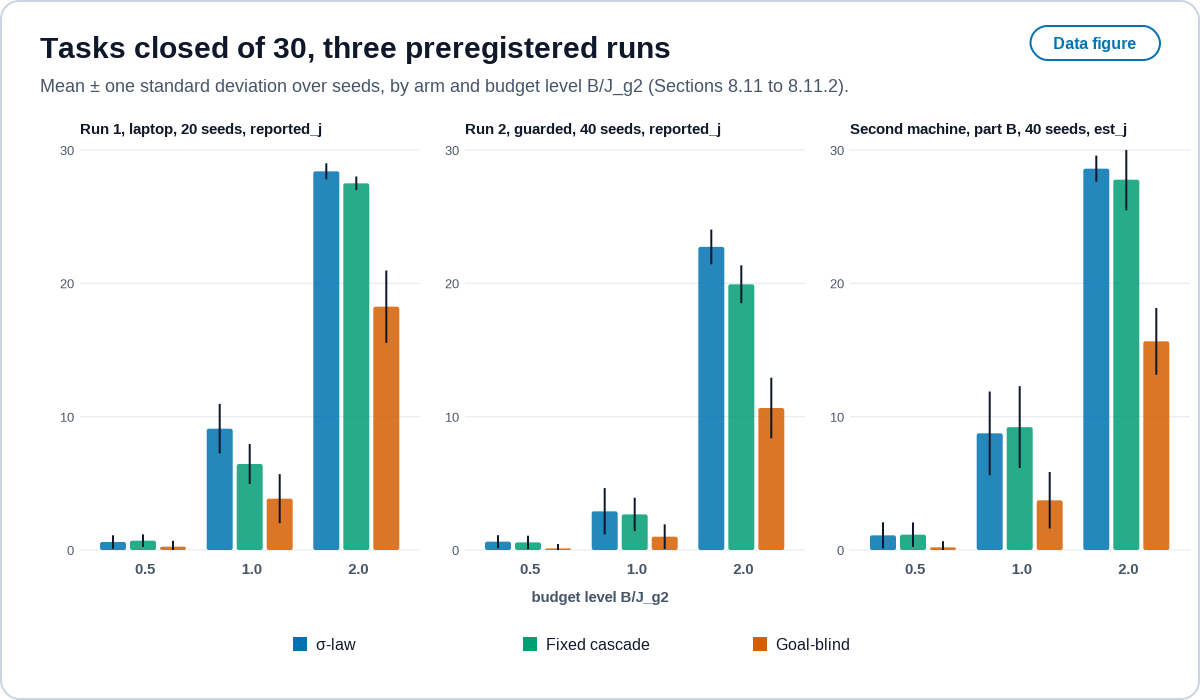
*Figure 5. Tasks closed of 30 in three preregistered runs. Data figure: mean ± one standard deviation over seeds, from the results tables of Sections 8.11, 8.11.1 and 8.11.2 (part B). Sources: `experiments/agency-run/results`, `results2` and `results_jetson_cyc`. A [PNG copy](https://research.openie.dev/figures/agency/run-results.png) is provided.*
**What replicates, and what does not.** The run 1 selector result was exploratory. Two later runs tested it under preregistration.
| Claim from run 1 (exploratory) | Run 2 (preregistered) | Second machine, part B (preregistered) |
|---|---|---|
| More tasks closed at $B = 1.0\,J_{g2}$: +2.65 (1.5 to 3.8) | Not replicated. The interval includes zero | Not replicated. $-0.475$ ($-1.8$ to $0.775$) |
| More tasks closed at $B = 2.0\,J_{g2}$: +0.9 (0.55 to 1.25) | Replicated. +2.8 (2.3 to 3.275) | Replicated. +0.825 (0.125 to 1.575) |
| Joules per closed task | Equal. No shared-task saving | Equal. Shared-task intervals include zero |
The replicated result is narrow. At the loosest budget level the σ-law selector closes more tasks than the fixed cascade, on two machines. No run shows fewer joules for the same closed task, and the binding-budget gain of run 1 did not replicate. Part A is a meter-resolution result and tests neither claim.
**Measurement protocol for the next run.** Both parts fail at the meter, so the protocol changes before the selectors are tested again.
1. **Idle machine.** Stop nothing that belongs to someone else. Wait for a quiet window, or schedule one: other processes at or below 0.5 cores for the whole run, with `quiet_window = yes` recorded. If quiet is not reached, the run does not start.
2. **Wall or shunt meter.** Attach a wall power meter, or a shunt meter on the supply rail, sampled faster than one act. Only its readings fill `measured_j`.
3. **Resolution check first.** Before the pilot, record the meter's update interval and step size against the median act length. If the meter cannot resolve one act, meter blocks of acts and attribute by count, and say so in the preregistration.
4. **Calibrate the estimate on the meter.** Fit `est_j` on the wall or shunt meter at block level, and require R-F4 to hold before `est_j` drives the guard.
5. **Pin and record.** Pin frequency, record idle baselines before and after, report drift, and keep the package counter as a labeled cross-check.
6. **Task closure is primary.** The next run's preregistration makes task closure the primary endpoint: the paired-by-seed difference in tasks closed, σ-law minus fixed cascade, at each budget level, with the Holm step-down correction across levels. Shared-task joules (R-F1) are secondary.
### 8.12 Reporting
Publish all receipts, raw meter traces, idle baselines and analysis code with the result. Report measured, reported and estimated joules in separate columns. Never sum across tiers. State which falsifiers fired, with the same prominence as those that passed. Every run also answers the checklist of Takahashi and Hayashi [239]: the accounting boundary; the energy balance terms (stored energy and exported work, or a statement that they are negligible); the baseline and whether joules are total or incremental; the coarse-graining of outcomes; the horizon and reset protocol; wall-clock time and mean power beside bits per joule; and the estimator of coupled bits with its bias correction.
## References
Entries marked "preprint" are cited by their arXiv posting. Entries published in a language other than English say so.
1. Pearl, J. (1995). Causal diagrams for empirical research. *Biometrika* 82:669-688. https://doi.org/10.1093/biomet/82.4.669
2. Everitt, T., Hutter, M., Kumar, R. and Krakovna, V. (2019). Reward tampering problems and solutions in reinforcement learning: a causal influence diagram perspective. arXiv:1908.04734 (preprint).
3. Sagawa, T. and Ueda, M. (2008). Second law of thermodynamics with discrete quantum feedback control. *Physical Review Letters* 100:080403. https://doi.org/10.1103/PhysRevLett.100.080403
4. Sagawa, T. and Ueda, M. (2010). Generalized Jarzynski equality under nonequilibrium feedback control. *Physical Review Letters* 104:090602. https://doi.org/10.1103/PhysRevLett.104.090602
5. Sagawa, T. and Ueda, M. (2009). Minimal energy cost for thermodynamic information processing: measurement and information erasure. *Physical Review Letters* 102:250602. https://doi.org/10.1103/PhysRevLett.102.250602
6. Landauer, R. (1961). Irreversibility and heat generation in the computing process. *IBM Journal of Research and Development* 5:183-191. https://doi.org/10.1147/rd.53.0183
7. Bennett, C. H. (1982). The thermodynamics of computation: a review. *International Journal of Theoretical Physics* 21:905-940. https://doi.org/10.1007/BF02084158
8. Ay, N. and Polani, D. (2008). Information flows in causal networks. *Advances in Complex Systems* 11:17-41. https://doi.org/10.1142/S0219525908001465
9. Klyubin, A. S., Polani, D. and Nehaniv, C. L. (2005). Empowerment: a universal agent-centric measure of control. *2005 IEEE Congress on Evolutionary Computation* 1:128-135. https://doi.org/10.1109/CEC.2005.1554676
10. Kenton, Z., Kumar, R., Farquhar, S., Richens, J. et al. (2023). Discovering agents. *Artificial Intelligence* 322:103963. https://doi.org/10.1016/j.artint.2023.103963
11. James, R. G., Barnett, N. and Crutchfield, J. P. (2016). Information flows? A critique of transfer entropies. *Physical Review Letters* 116:238701. https://doi.org/10.1103/PhysRevLett.116.238701
12. Lizier, J. T. and Prokopenko, M. (2010). Differentiating information transfer and causal effect. *The European Physical Journal B* 73:605-615. https://doi.org/10.1140/epjb/e2010-00034-5
13. Janzing, D., Balduzzi, D., Grosse-Wentrup, M. and Schölkopf, B. (2013). Quantifying causal influences. *The Annals of Statistics* 41. https://doi.org/10.1214/13-AOS1145
14. Albantakis, L., Marshall, W., Hoel, E. and Tononi, G. (2019). What caused what? A quantitative account of actual causation using dynamical causal networks. *Entropy* 21:459. https://doi.org/10.3390/e21050459
15. Aguilera, M., Millidge, B., Tschantz, A. and Buckley, C. L. (2022). How particular is the physics of the free energy principle? *Physics of Life Reviews* 40:24-50. https://doi.org/10.1016/j.plrev.2021.11.001
16. Biehl, M., Pollock, F. A. and Kanai, R. (2021). A technical critique of some parts of the free energy principle. *Entropy* 23:293. https://doi.org/10.3390/e23030293
17. Bruineberg, J., Dołęga, K., Dewhurst, J. and Baltieri, M. (2022). The emperor's new Markov blankets. *Behavioral and Brain Sciences* 45:e183. https://doi.org/10.1017/S0140525X21002351
18. Orseau, L., McGregor McGill, S. and Legg, S. (2018). Agents and devices: a relative definition of agency. arXiv:1805.12387 (preprint).
19. Albantakis, L., Barbosa, L., Findlay, G., Grasso, M. et al. (2023). Integrated information theory (IIT) 4.0: formulating the properties of phenomenal existence in physical terms. *PLOS Computational Biology* 19:e1011465. https://doi.org/10.1371/journal.pcbi.1011465
20. Krakauer, D., Bertschinger, N., Olbrich, E., Flack, J. C. and Ay, N. (2020). The information theory of individuality. *Theory in Biosciences* 139:209-223. https://doi.org/10.1007/s12064-020-00313-7
21. Hoel, E. P., Albantakis, L. and Tononi, G. (2013). Quantifying causal emergence shows that macro can beat micro. *Proceedings of the National Academy of Sciences* 110:19790-19795. https://doi.org/10.1073/pnas.1314922110
22. Rosas, F. E., Mediano, P. A. M., Biehl, M., Chandaria, S. and Polani, D. (2020). Causal blankets: theory and algorithmic framework. In *Active Inference: IWAI 2020*, Communications in Computer and Information Science, Springer, pp. 187-198. https://doi.org/10.1007/978-3-030-64919-7_19
23. Shiraishi, N., Funo, K. and Saito, K. (2018). Speed limit for classical stochastic processes. *Physical Review Letters* 121:070601. https://doi.org/10.1103/PhysRevLett.121.070601
24. Esposito, M. and Van den Broeck, C. (2011). Second law and Landauer principle far from equilibrium. *EPL* 95:40004. https://doi.org/10.1209/0295-5075/95/40004
25. Barato, A. C. and Seifert, U. (2015). Thermodynamic uncertainty relation for biomolecular processes. *Physical Review Letters* 114:158101. https://doi.org/10.1103/PhysRevLett.114.158101
26. Gingrich, T. R., Horowitz, J. M., Perunov, N. and England, J. L. (2016). Dissipation bounds all steady-state current fluctuations. *Physical Review Letters* 116:120601. https://doi.org/10.1103/PhysRevLett.116.120601
27. Paneru, G., Dutta, S., Tlusty, T. and Pak, H. K. (2020). Reaching and violating thermodynamic uncertainty bounds in information engines. *Physical Review E* 102:032126. https://doi.org/10.1103/PhysRevE.102.032126
28. Potts, P. P. and Samuelsson, P. (2019). Thermodynamic uncertainty relations including measurement and feedback. *Physical Review E* 100:052137. https://doi.org/10.1103/PhysRevE.100.052137
29. Proesmans, K., Ehrich, J. and Bechhoefer, J. (2020). Finite-time Landauer principle. *Physical Review Letters* 125:100602. https://doi.org/10.1103/PhysRevLett.125.100602
30. Sivak, D. A. and Crooks, G. E. (2012). Thermodynamic metrics and optimal paths. *Physical Review Letters* 108:190602. https://doi.org/10.1103/PhysRevLett.108.190602
31. Margolus, N. and Levitin, L. B. (1998). The maximum speed of dynamical evolution. *Physica D* 120:188-195. https://doi.org/10.1016/S0167-2789(98)00054-2
32. Touchette, H. and Lloyd, S. (2000). Information-theoretic limits of control. *Physical Review Letters* 84:1156-1159. https://doi.org/10.1103/PhysRevLett.84.1156
33. Touchette, H. and Lloyd, S. (2004). Information-theoretic approach to the study of control systems. *Physica A* 331:140-172. https://doi.org/10.1016/j.physa.2003.09.007
34. Garrahan, J. P. (2017). Simple bounds on fluctuations and uncertainty relations for first-passage times of counting observables. *Physical Review E* 95:032134. https://doi.org/10.1103/PhysRevE.95.032134
35. Bennett, C. H. (1973). Logical reversibility of computation. *IBM Journal of Research and Development* 17:525-532. https://doi.org/10.1147/rd.176.0525
36. Sagawa, T. and Ueda, M. (2012). Fluctuation theorem with information exchange: role of correlations in stochastic thermodynamics. *Physical Review Letters* 109:180602. https://doi.org/10.1103/PhysRevLett.109.180602
37. Hartle, H., Wolpert, D., Stier, A., Kempes, C. P. and Manzano, G. (2024). Work extraction with feedback control using limited resources. arXiv:2407.05507 (preprint).
38. Horodecki, M. and Oppenheim, J. (2013). Fundamental limitations for quantum and nanoscale thermodynamics. *Nature Communications* 4:2059. https://doi.org/10.1038/ncomms3059
39. Parrondo, J. M. R., Horowitz, J. M. and Sagawa, T. (2015). Thermodynamics of information. *Nature Physics* 11:131-139. https://doi.org/10.1038/nphys3230
40. Seifert, U. (2012). Stochastic thermodynamics, fluctuation theorems and molecular machines. *Reports on Progress in Physics* 75:126001. https://doi.org/10.1088/0034-4885/75/12/126001
41. Conant, R. C. and Ashby, W. R. (1970). Every good regulator of a system must be a model of that system. *International Journal of Systems Science* 1:89-97. https://doi.org/10.1080/00207727008920220
42. Richens, J. and Everitt, T. (2024). Robust agents learn causal world models. *International Conference on Learning Representations (ICLR 2024)*, oral, honorable mention. arXiv:2402.10877.
43. Richens, J., Abel, D., Bellot, A. and Everitt, T. (2025). General agents contain world models. arXiv:2506.01622 (preprint).
44. Horowitz, J. M. and Esposito, M. (2014). Thermodynamics with continuous information flow. *Physical Review X* 4:031015. https://doi.org/10.1103/PhysRevX.4.031015
45. Ito, S. and Sagawa, T. (2013). Information thermodynamics on causal networks. *Physical Review Letters* 111:180603. https://doi.org/10.1103/PhysRevLett.111.180603
46. Hartich, D., Barato, A. C. and Seifert, U. (2014). Stochastic thermodynamics of bipartite systems: transfer entropy inequalities and a Maxwell's demon interpretation. *Journal of Statistical Mechanics* P02016. https://doi.org/10.1088/1742-5468/2014/02/P02016
47. Allahverdyan, A. E., Janzing, D. and Mahler, G. (2009). Thermodynamic efficiency of information and heat flow. *Journal of Statistical Mechanics* P09011. https://doi.org/10.1088/1742-5468/2009/09/P09011
48. Esposito, M. and Schaller, G. (2012). Stochastic thermodynamics for "Maxwell demon" feedbacks. *EPL* 99:30003. https://doi.org/10.1209/0295-5075/99/30003
49. Mandal, D. and Jarzynski, C. (2012). Work and information processing in a solvable model of Maxwell's demon. *PNAS* 109:11641-11645. https://doi.org/10.1073/pnas.1204263109
50. Boyd, A. B., Mandal, D. and Crutchfield, J. P. (2016). Identifying functional thermodynamics in autonomous Maxwellian ratchets. *New Journal of Physics* 18:023049. https://doi.org/10.1088/1367-2630/18/2/023049
51. Boyd, A. B., Mandal, D. and Crutchfield, J. P. (2018). Thermodynamics of modularity: structural costs beyond the Landauer bound. *Physical Review X* 8:031036. https://doi.org/10.1103/PhysRevX.8.031036
52. Wolpert, D. H. and Kolchinsky, A. (2020). Thermodynamics of computing with circuits. *New Journal of Physics* 22:063047. https://doi.org/10.1088/1367-2630/ab82b8
53. Kolchinsky, A. and Wolpert, D. H. (2017). Dependence of dissipation on the initial distribution over states. *Journal of Statistical Mechanics* 083202. https://doi.org/10.1088/1742-5468/aa7ee1
54. Still, S., Sivak, D. A., Bell, A. J. and Crooks, G. E. (2012). Thermodynamics of prediction. *Physical Review Letters* 109:120604. https://doi.org/10.1103/PhysRevLett.109.120604
55. Kolchinsky, A. and Wolpert, D. H. (2018). Semantic information, autonomous agency and non-equilibrium statistical physics. *Interface Focus* 8:20180041. https://doi.org/10.1098/rsfs.2018.0041
56. Ortega, P. A. and Braun, D. A. (2013). Thermodynamics as a theory of decision-making with information-processing costs. *Proceedings of the Royal Society A* 469:20120683. https://doi.org/10.1098/rspa.2012.0683
57. Kolchinsky, A. and Wolpert, D. H. (2020). Thermodynamic costs of Turing machines. *Physical Review Research* 2:033312. https://doi.org/10.1103/PhysRevResearch.2.033312
58. Kolchinsky, A. and Wolpert, D. H. (2021). Work, entropy production, and thermodynamics of information under protocol constraints. *Physical Review X* 11:041024. https://doi.org/10.1103/PhysRevX.11.041024
59. Manzano, G., Kardeş, G., Roldán, É. and Wolpert, D. H. (2024). Thermodynamics of computations with absolute irreversibility, unidirectional transitions, and stochastic computation times. *Physical Review X* 14:021026. https://doi.org/10.1103/PhysRevX.14.021026
60. Bérut, A., Arakelyan, A., Petrosyan, A., Ciliberto, S., Dillenschneider, R. and Lutz, E. (2012). Experimental verification of Landauer's principle linking information and thermodynamics. *Nature* 483:187-189. https://doi.org/10.1038/nature10872
61. Jun, Y., Gavrilov, M. and Bechhoefer, J. (2014). High-precision test of Landauer's principle in a feedback trap. *Physical Review Letters* 113:190601. https://doi.org/10.1103/PhysRevLett.113.190601
62. Orlov, A. O., Lent, C. S., Thorpe, C. C., Boechler, G. P. and Snider, G. L. (2012). Experimental test of Landauer's principle at the sub-k_BT level. *Japanese Journal of Applied Physics* 51:06FE10. https://doi.org/10.1143/JJAP.51.06FE10
63. Hong, J., Lambson, B., Dhuey, S. and Bokor, J. (2016). Experimental test of Landauer's principle in single-bit operations on nanomagnetic memory bits. *Science Advances* 2:e1501492. https://doi.org/10.1126/sciadv.1501492
64. Gavrilov, M. and Bechhoefer, J. (2016). Erasure without work in an asymmetric double-well potential. *Physical Review Letters* 117:200601. https://doi.org/10.1103/PhysRevLett.117.200601
65. Gavrilov, M., Chétrite, R. and Bechhoefer, J. (2017). Direct measurement of weakly nonequilibrium system entropy is consistent with Gibbs-Shannon form. *PNAS* 114:11097-11102. https://doi.org/10.1073/pnas.1708689114
66. Yan, L. L., Xiong, T. P., Rehan, K., Zhou, F., Liang, D. F. et al. (2018). Single-atom demonstration of the quantum Landauer principle. *Physical Review Letters* 120:210601. https://doi.org/10.1103/PhysRevLett.120.210601
67. Dago, S., Pereda, J., Barros, N., Ciliberto, S. and Bellon, L. (2021). Information and thermodynamics: fast and precise approach to Landauer's bound in an underdamped micromechanical oscillator. *Physical Review Letters* 126:170601. https://doi.org/10.1103/PhysRevLett.126.170601
68. Scandi, M., Barker, D., Lehmann, S., Dick, K. A., Maisi, V. F. and Perarnau-Llobet, M. (2022). Minimally dissipative information erasure in a quantum dot via thermodynamic length. *Physical Review Letters* 129:270601. https://doi.org/10.1103/PhysRevLett.129.270601
69. Toyabe, S., Sagawa, T., Ueda, M., Muneyuki, E. and Sano, M. (2010). Experimental demonstration of information-to-energy conversion and validation of the generalized Jarzynski equality. *Nature Physics* 6:988-992. https://doi.org/10.1038/nphys1821
70. Koski, J. V., Maisi, V. F., Pekola, J. P. and Averin, D. V. (2014). Experimental realization of a Szilard engine with a single electron. *PNAS* 111:13786-13789. https://doi.org/10.1073/pnas.1406966111
71. Koski, J. V., Maisi, V. F., Sagawa, T. and Pekola, J. P. (2014). Experimental observation of the role of mutual information in the nonequilibrium dynamics of a Maxwell demon. *Physical Review Letters* 113:030601. https://doi.org/10.1103/PhysRevLett.113.030601
72. Koski, J. V., Kutvonen, A., Khaymovich, I. M., Ala-Nissila, T. and Pekola, J. P. (2015). On-chip Maxwell's demon as an information-powered refrigerator. *Physical Review Letters* 115:260602. https://doi.org/10.1103/PhysRevLett.115.260602
73. Camati, P. A., Peterson, J. P. S., Batalhão, T. B., Micadei, K., Souza, A. M. et al. (2016). Experimental rectification of entropy production by Maxwell's demon in a quantum system. *Physical Review Letters* 117:240502. https://doi.org/10.1103/PhysRevLett.117.240502
74. Peterson, J. P. S., Sarthour, R. S., Souza, A. M., Oliveira, I. S., Goold, J. et al. (2016). Experimental demonstration of information to energy conversion in a quantum system at the Landauer limit. *Proceedings of the Royal Society A* 472:20150813. https://doi.org/10.1098/rspa.2015.0813
75. Cottet, N., Jezouin, S., Bretheau, L., Campagne-Ibarcq, P., Ficheux, Q. et al. (2017). Observing a quantum Maxwell demon at work. *PNAS* 114:7561-7564. https://doi.org/10.1073/pnas.1704827114
76. Masuyama, Y., Funo, K., Murashita, Y., Noguchi, A., Kono, S. et al. (2018). Information-to-work conversion by Maxwell's demon in a superconducting circuit quantum electrodynamical system. *Nature Communications* 9:1291. https://doi.org/10.1038/s41467-018-03686-y
77. Naghiloo, M., Alonso, J. J., Romito, A., Lutz, E. and Murch, K. W. (2018). Information gain and loss for a quantum Maxwell's demon. *Physical Review Letters* 121:030604. https://doi.org/10.1103/PhysRevLett.121.030604
78. Kumar, A., Wu, T.-Y., Giraldo, F. and Weiss, D. S. (2018). Sorting ultracold atoms in a three-dimensional optical lattice in a realization of Maxwell's demon. *Nature* 561:83-87. https://doi.org/10.1038/s41586-018-0458-7
79. Linpeng, X., Bresque, L., Maffei, M., Jordan, A. N. et al. (2022). Energetic cost of measurements using quantum, coherent, and thermal light. *Physical Review Letters* 128:220506. https://doi.org/10.1103/PhysRevLett.128.220506
80. Paneru, G., Lee, D. Y., Tlusty, T. and Pak, H. K. (2018). Lossless Brownian information engine. *Physical Review Letters* 120:020601. https://doi.org/10.1103/PhysRevLett.120.020601
81. Admon, T., Rahav, S. and Roichman, Y. (2018). Experimental realization of an information machine with tunable temporal correlations. *Physical Review Letters* 121:180601. https://doi.org/10.1103/PhysRevLett.121.180601
82. Ribezzi-Crivellari, M. and Ritort, F. (2019). Large work extraction and the Landauer limit in a continuous Maxwell demon. *Nature Physics* 15:660-664. https://doi.org/10.1038/s41567-019-0481-0
83. Debiossac, M., Grass, D., Alonso, J. J., Lutz, E. and Kiesel, N. (2020). Thermodynamics of continuous non-Markovian feedback control. *Nature Communications* 11:1360. https://doi.org/10.1038/s41467-020-15148-5
84. Saha, T. K., Lucero, J. N. E., Ehrich, J., Sivak, D. A. and Bechhoefer, J. (2021). Maximizing power and velocity of an information engine. *PNAS* 118:e2023356118. https://doi.org/10.1073/pnas.2023356118
85. Saha, T. K., Lucero, J. N. E., Ehrich, J., Sivak, D. A. and Bechhoefer, J. (2022). Bayesian information engine that optimally exploits noisy measurements. *Physical Review Letters* 129:130601. https://doi.org/10.1103/PhysRevLett.129.130601
86. Saha, T. K., Ehrich, J., Gavrilov, M., Still, S., Sivak, D. A. and Bechhoefer, J. (2023). Information engine in a nonequilibrium bath. *Physical Review Letters* 131:057101. https://doi.org/10.1103/PhysRevLett.131.057101
87. Barker, D., Scandi, M., Lehmann, S., Thelander, C., Dick, K. A., Perarnau-Llobet, M. and Maisi, V. F. (2022). Experimental verification of the work fluctuation-dissipation relation for information-to-work conversion. *Physical Review Letters* 128:040602. https://doi.org/10.1103/PhysRevLett.128.040602
88. Yan, L.-L., Bu, J.-T., Zeng, Q., Zhang, K., Cui, K.-F. et al. (2024). Experimental verification of demon-involved fluctuation theorems. *Physical Review Letters* 133:090402. https://doi.org/10.1103/PhysRevLett.133.090402
89. Zeng, Q. and Wang, J. (2021). New fluctuation theorems on Maxwell's demon. *Science Advances* 7:eabf1807. https://doi.org/10.1126/sciadv.abf1807
90. Demin, A. V. and Vityaev, E. E. (2014). Learning in a virtual model of the C. elegans nematode for locomotion and chemotaxis. *Biologically Inspired Cognitive Architectures* 7:9-14. https://doi.org/10.1016/j.bica.2013.11.005
91. Putintsev, N. I., Isupov, O. V. and Vityaev, E. E. (2015). Adaptive control system for a mobile agent in a physical environment based on functional systems theory. *Russian Journal of Genetics: Applied Research* 5:601-608. https://doi.org/10.1134/S2079059715060131
92. Rosenblueth, A., Wiener, N. and Bigelow, J. (1943). Behavior, purpose and teleology. *Philosophy of Science* 10:18-24. https://doi.org/10.1086/286788
93. Anokhin, P. K. (1968). The functional system as a unit of organism integrative activity. In *Systems Theory and Biology*, Springer, pp. 376-403. https://doi.org/10.1007/978-3-642-88343-9_15
94. Anokhin, P. K. (1974). The biological roots of the conditioned reflex. In *Biology and Neurophysiology of the Conditioned Reflex and Its Role in Adaptive Behavior*, Pergamon, pp. 1-24. https://doi.org/10.1016/B978-0-08-021516-7.50008-2
95. Sudakov, K. V. (1997). The theory of functional systems: general postulates and principles of dynamic organization. *Integrative Physiological and Behavioral Science* 32:392-414. https://doi.org/10.1007/BF02688634
96. Shvyrkov, V. B. (1980). Goal as a system-forming factor in behavior and learning. In *Neural Mechanisms of Goal-directed Behavior and Learning*, Academic Press, pp. 199-219. https://doi.org/10.1016/B978-0-12-688980-2.50018-7
97. Rosen, R. (2012). *Anticipatory Systems: Philosophical, Mathematical, and Methodological Foundations*, 2nd ed. Springer. https://doi.org/10.1007/978-1-4614-1269-4
98. Sterling, P. (2012). Allostasis: a model of predictive regulation. *Physiology & Behavior* 106:5-15. https://doi.org/10.1016/j.physbeh.2011.06.004
99. Virgo, N., Biehl, M. and McGregor, S. (2021). Interpreting dynamical systems as Bayesian reasoners. In *Machine Learning and Principles and Practice of Knowledge Discovery in Databases* (ECML PKDD 2021 workshops), Communications in Computer and Information Science, Springer, pp. 726-762. https://doi.org/10.1007/978-3-030-93736-2_52
100. Biehl, M. and Virgo, N. (2023). Interpreting systems as solving POMDPs: a step towards a formal understanding of agency. In *Active Inference: IWAI 2022*, Communications in Computer and Information Science 1721, Springer, pp. 16-31. https://doi.org/10.1007/978-3-031-28719-0_2
101. Maturana, H. R. and Varela, F. J. (1980). *Autopoiesis and Cognition: The Realization of the Living*. Reidel. https://doi.org/10.1007/978-94-009-8947-4
102. Kauffman, S. (2003). Molecular autonomous agents. *Philosophical Transactions of the Royal Society A* 361:1089-1099. https://doi.org/10.1098/rsta.2003.1186
103. Di Paolo, E. A. (2005). Autopoiesis, adaptivity, teleology, agency. *Phenomenology and the Cognitive Sciences* 4:429-452. https://doi.org/10.1007/s11097-005-9002-y
104. Barandiaran, X. and Moreno, A. (2006). On what makes certain dynamical systems cognitive: a minimally cognitive organization program. *Adaptive Behavior* 14:171-185. https://doi.org/10.1177/105971230601400208
105. Barandiaran, X. and Moreno, A. (2008). Adaptivity: from metabolism to behavior. *Adaptive Behavior* 16:325-344. https://doi.org/10.1177/1059712308093868
106. Barandiaran, X. E., Di Paolo, E. and Rohde, M. (2009). Defining agency: individuality, normativity, asymmetry, and spatio-temporality in action. *Adaptive Behavior* 17:367-386. https://doi.org/10.1177/1059712309343819
107. Ruiz-Mirazo, K. and Moreno, A. (2011). Autonomy in evolution: from minimal to complex life. *Synthese* 185:21-52. https://doi.org/10.1007/s11229-011-9874-z
108. Moreno, A. and Mossio, M. (2015). *Biological Autonomy: A Philosophical and Theoretical Enquiry*. Springer. https://doi.org/10.1007/978-94-017-9837-2
109. Montévil, M. and Mossio, M. (2015). Biological organisation as closure of constraints. *Journal of Theoretical Biology* 372:179-191. https://doi.org/10.1016/j.jtbi.2015.02.029
110. Aguilera, M. and Barandiaran, X. E. (2024). Thermina: a minimal model of autonomous agency from the lens of stochastic thermodynamics. *ALIFE 2024: Proceedings of the 2024 Artificial Life Conference*. https://doi.org/10.1162/isal_a_00826
111. Barandiaran, X. E. and Almendros, L. S. (2024). Transforming agency: on the mode of existence of large language models. arXiv:2407.10735 (preprint).
112. Levin, M. (2022). Technological approach to mind everywhere: an experimentally-grounded framework for understanding diverse bodies and minds. *Frontiers in Systems Neuroscience* 16:768201. https://doi.org/10.3389/fnsys.2022.768201
113. Friston, K. (2010). The free-energy principle: a unified brain theory? *Nature Reviews Neuroscience* 11:127-138. https://doi.org/10.1038/nrn2787
114. Friston, K. (2013). Life as we know it. *Journal of the Royal Society Interface* 10:20130475. https://doi.org/10.1098/rsif.2013.0475
115. Rovelli, C. (2020). Agency in physics. arXiv:2007.05300 (preprint).
116. Jaeger, J. (2023). Artificial intelligence is algorithmic mimicry: why artificial "agents" are not (and won't be) proper agents. arXiv:2307.07515 (preprint).
117. Azadi, P. (2025). Computational irreducibility as the foundation of agency. arXiv:2505.04646 (preprint).
118. Wissner-Gross, A. D. and Freer, C. E. (2013). Causal entropic forces. *Physical Review Letters* 110:168702. https://doi.org/10.1103/PhysRevLett.110.168702
119. Kappen, H. J. (2013). Comment: causal entropic forces. arXiv:1312.4185 (preprint).
120. Fields, C., Goldstein, A. and Sandved-Smith, L. (2024). Making the thermodynamic cost of active inference explicit. *Entropy* 26:622. https://doi.org/10.3390/e26080622
121. Bartlett, S., Eckford, A. W., Egbert, M., Lingam, M. et al. (2025). Physics of life: exploring information as a distinctive feature of living systems. *PRX Life* 3:037003. https://doi.org/10.1103/rsx4-8x5f
122. Funo, K., Shiraishi, N. and Saito, K. (2019). Speed limit for open quantum systems. *New Journal of Physics* 21:013006. https://doi.org/10.1088/1367-2630/aaf9f5
123. Shiraishi, N. and Saito, K. (2021). Speed limit for open systems coupled to general environments. *Physical Review Research* 3:023074. https://doi.org/10.1103/PhysRevResearch.3.023074
124. Vo, V. T., Van Vu, T. and Hasegawa, Y. (2020). Unified approach to classical speed limit and thermodynamic uncertainty relation. *Physical Review E* 102:062132. https://doi.org/10.1103/PhysRevE.102.062132
125. Falasco, G. and Esposito, M. (2020). Dissipation-time uncertainty relation. *Physical Review Letters* 125:120604. https://doi.org/10.1103/PhysRevLett.125.120604
126. Ito, S. (2018). Stochastic thermodynamic interpretation of information geometry. *Physical Review Letters* 121:030605. https://doi.org/10.1103/PhysRevLett.121.030605
127. Ito, S. and Dechant, A. (2020). Stochastic time evolution, information geometry, and the Cramér-Rao bound. *Physical Review X* 10:021056. https://doi.org/10.1103/PhysRevX.10.021056
128. Nakazato, M. and Ito, S. (2021). Geometrical aspects of entropy production in stochastic thermodynamics based on Wasserstein distance. *Physical Review Research* 3:043093. https://doi.org/10.1103/PhysRevResearch.3.043093
129. Dechant, A., Sasa, S.-i. and Ito, S. (2022). Geometric decomposition of entropy production in out-of-equilibrium systems. *Physical Review Research* 4:L012034. https://doi.org/10.1103/PhysRevResearch.4.L012034
130. Van Vu, T. and Saito, K. (2023). Thermodynamic unification of optimal transport: thermodynamic uncertainty relation, minimum dissipation, and thermodynamic speed limits. *Physical Review X* 13:011013. https://doi.org/10.1103/PhysRevX.13.011013
131. Nagayama, R., Yoshimura, K. and Ito, S. (2025). Infinite variety of thermodynamic speed limits with general activities. *Physical Review Research* 7:013307. https://doi.org/10.1103/PhysRevResearch.7.013307
132. Yoshimura, K. and Ito, S. (2021). Thermodynamic uncertainty relation and thermodynamic speed limit in deterministic chemical reaction networks. *Physical Review Letters* 127:160601. https://doi.org/10.1103/PhysRevLett.127.160601
133. Aurell, E., Mejía-Monasterio, C. and Muratore-Ginanneschi, P. (2011). Optimal protocols and optimal transport in stochastic thermodynamics. *Physical Review Letters* 106:250601. https://doi.org/10.1103/PhysRevLett.106.250601
134. Hasegawa, Y. (2023). Unifying speed limit, thermodynamic uncertainty relation and Heisenberg principle via bulk-boundary correspondence. *Nature Communications* 14:2828. https://doi.org/10.1038/s41467-023-38074-8
135. Van Vu, T. and Hasegawa, Y. (2021). Geometrical bounds of the irreversibility in Markovian systems. *Physical Review Letters* 126:010601. https://doi.org/10.1103/PhysRevLett.126.010601
136. Delvenne, J.-C. and Falasco, G. (2024). Thermokinetic relations. *Physical Review E* 109:014109. https://doi.org/10.1103/PhysRevE.109.014109
137. Seifert, U. (2017). Stochastic thermodynamics: from principles to the cost of precision. arXiv:1707.03759 (lecture notes).
138. Horowitz, J. M. and Gingrich, T. R. (2017). Proof of the finite-time thermodynamic uncertainty relation for steady-state currents. *Physical Review E* 96:020103. https://doi.org/10.1103/PhysRevE.96.020103
139. Pietzonka, P., Barato, A. C. and Seifert, U. (2016). Universal bounds on current fluctuations. *Physical Review E* 93:052145. https://doi.org/10.1103/PhysRevE.93.052145
140. Proesmans, K. and Van den Broeck, C. (2017). Discrete-time thermodynamic uncertainty relation. *EPL* 119:20001. https://doi.org/10.1209/0295-5075/119/20001
141. Hasegawa, Y. and Van Vu, T. (2019). Fluctuation theorem uncertainty relation. *Physical Review Letters* 123:110602. https://doi.org/10.1103/PhysRevLett.123.110602
142. Dechant, A. and Sasa, S.-i. (2018). Entropic bounds on currents in Langevin systems. *Physical Review E* 97:062101. https://doi.org/10.1103/PhysRevE.97.062101
143. Lee, J. S., Park, J.-M. and Park, H. (2019). Thermodynamic uncertainty relation for underdamped Langevin systems driven by a velocity-dependent force. *Physical Review E* 100:062132. https://doi.org/10.1103/PhysRevE.100.062132
144. Lee, J. S., Park, J.-M. and Park, H. (2021). Universal form of thermodynamic uncertainty relation for Langevin dynamics. *Physical Review E* 104:L052102. https://doi.org/10.1103/PhysRevE.104.L052102
145. Dechant, A. and Sasa, S.-i. (2021). Improving thermodynamic bounds using correlations. *Physical Review X* 11:041061. https://doi.org/10.1103/PhysRevX.11.041061
146. Horowitz, J. M. and Gingrich, T. R. (2020). Thermodynamic uncertainty relations constrain non-equilibrium fluctuations. *Nature Physics* 16:15-20. https://doi.org/10.1038/s41567-019-0702-6
147. Barato, A. C. and Seifert, U. (2016). Cost and precision of Brownian clocks. *Physical Review X* 6:041053. https://doi.org/10.1103/PhysRevX.6.041053
148. Salazar, D. S. P. (2021). Information bound for entropy production from the detailed fluctuation theorem. *Physical Review E* 103:022122. https://doi.org/10.1103/PhysRevE.103.022122
149. Landi, G. T. and Paternostro, M. (2021). Irreversible entropy production: from classical to quantum. *Reviews of Modern Physics* 93:035008. https://doi.org/10.1103/RevModPhys.93.035008
150. Van Vu, T. and Hasegawa, Y. (2020). Thermodynamic uncertainty relations under arbitrary control protocols. *Physical Review Research* 2:013060. https://doi.org/10.1103/PhysRevResearch.2.013060
151. Tanogami, T., Van Vu, T. and Saito, K. (2023). Universal bounds on the performance of information-thermodynamic engine. *Physical Review Research* 5:043280. https://doi.org/10.1103/PhysRevResearch.5.043280
152. Kumasaki, K., Tojo, K., Sagawa, T. and Funo, K. (2026). Thermodynamic uncertainty relation for feedback cooling. *Physical Review E* 113:024134. https://doi.org/10.1103/4pq6-7djm
153. Honma, R. and Van Vu, T. (2026). Thermodynamic uncertainty relation with quantum feedback. *Physical Review Letters*. https://doi.org/10.1103/6d8l-94pv. Preprint: arXiv:2602.22651.
154. Gingrich, T. R. and Horowitz, J. M. (2017). Fundamental bounds on first passage time fluctuations for currents. *Physical Review Letters* 119:170601. https://doi.org/10.1103/PhysRevLett.119.170601
155. Schmiedl, T. and Seifert, U. (2007). Optimal finite-time processes in stochastic thermodynamics. *Physical Review Letters* 98:108301. https://doi.org/10.1103/PhysRevLett.98.108301
156. Proesmans, K., Ehrich, J. and Bechhoefer, J. (2020). Optimal finite-time bit erasure under full control. *Physical Review E* 102:032105. https://doi.org/10.1103/PhysRevE.102.032105
157. Zhen, Y.-Z., Egloff, D., Modi, K. and Dahlsten, O. (2021). Universal bound on energy cost of bit reset in finite time. *Physical Review Letters* 127:190602. https://doi.org/10.1103/PhysRevLett.127.190602
158. Esposito, M., Kawai, R., Lindenberg, K. and Van den Broeck, C. (2010). Efficiency at maximum power of low-dissipation Carnot engines. *Physical Review Letters* 105:150603. https://doi.org/10.1103/PhysRevLett.105.150603
159. Tu, Z. C. (2008). Efficiency at maximum power of Feynman's ratchet as a heat engine. *Journal of Physics A* 41:312003. https://doi.org/10.1088/1751-8113/41/31/312003
160. Shiraishi, N., Saito, K. and Tasaki, H. (2016). Universal trade-off relation between power and efficiency for heat engines. *Physical Review Letters* 117:190601. https://doi.org/10.1103/PhysRevLett.117.190601
161. Pietzonka, P. and Seifert, U. (2018). Universal trade-off between power, efficiency, and constancy in steady-state heat engines. *Physical Review Letters* 120:190602. https://doi.org/10.1103/PhysRevLett.120.190602
162. Ma, Y.-H., Xu, D., Dong, H. and Sun, C.-P. (2018). Universal constraint for efficiency and power of a low-dissipation heat engine. *Physical Review E* 98:042112. https://doi.org/10.1103/PhysRevE.98.042112
163. Tsirlin, A. M., Mironova, V. A., Amelkin, S. A. and Kazakov, V. (1998). Finite-time thermodynamics: conditions of minimal dissipation for thermodynamic processes with given rate. *Physical Review E* 58:215-223. https://doi.org/10.1103/PhysRevE.58.215
164. Lee, J. S., Lee, S., Kwon, H. and Park, H. (2022). Speed limit for a highly irreversible process and tight finite-time Landauer's bound. *Physical Review Letters* 129:120603. https://doi.org/10.1103/PhysRevLett.129.120603
165. Van Vu, T. and Saito, K. (2022). Finite-time quantum Landauer principle and quantum coherence. *Physical Review Letters* 128:010602. https://doi.org/10.1103/PhysRevLett.128.010602
166. Rolandi, A. and Perarnau-Llobet, M. (2023). Finite-time Landauer principle beyond weak coupling. *Quantum* 7:1161. https://doi.org/10.22331/q-2023-11-03-1161
167. Kamijima, T., Funo, K. and Sagawa, T. (2024). Finite-time thermodynamic bounds and tradeoff relations for information processing. arXiv:2409.08606 (preprint).
168. Tkachenko, A. V. (2025). Thermodynamic cost of inference and learning in physical neural networks. arXiv:2503.09980 (preprint). Title of the current arXiv version.
169. Tatikonda, S. and Mitter, S. (2004). Control under communication constraints. *IEEE Transactions on Automatic Control* 49:1056-1068. https://doi.org/10.1109/TAC.2004.831187
170. Nair, G. N. and Evans, R. J. (2004). Stabilizability of stochastic linear systems with finite feedback data rates. *SIAM Journal on Control and Optimization* 43:413-436. https://doi.org/10.1137/S0363012902402116
171. Nair, G. N., Fagnani, F., Zampieri, S. and Evans, R. J. (2007). Feedback control under data rate constraints: an overview. *Proceedings of the IEEE* 95:108-137. https://doi.org/10.1109/JPROC.2006.887294
172. Sandberg, H., Delvenne, J.-C., Newton, N. J. and Mitter, S. K. (2014). Maximum work extraction and implementation costs for nonequilibrium Maxwell's demons. *Physical Review E* 90:042119. https://doi.org/10.1103/PhysRevE.90.042119
173. Horowitz, J. M. and Sandberg, H. (2014). Second-law-like inequalities with information and their interpretations. *New Journal of Physics* 16:125007. https://doi.org/10.1088/1367-2630/16/12/125007
174. Jacobs, K. (2009). Second law of thermodynamics and quantum feedback control: Maxwell's demon with weak measurements. *Physical Review A* 80:012322. https://doi.org/10.1103/PhysRevA.80.012322
175. Funo, K., Watanabe, Y. and Ueda, M. (2013). Integral quantum fluctuation theorems under measurement and feedback control. *Physical Review E* 88:052121. https://doi.org/10.1103/PhysRevE.88.052121
176. Guryanova, Y., Friis, N. and Huber, M. (2020). Ideal projective measurements have infinite resource costs. *Quantum* 4:222. https://doi.org/10.22331/q-2020-01-13-222
177. Danageozian, A., Wilde, M. M. and Buscemi, F. (2022). Thermodynamic constraints on quantum information gain and error correction: a triple trade-off. *PRX Quantum* 3:020318. https://doi.org/10.1103/PRXQuantum.3.020318
178. Wolpert, D. H. (2020). Minimal entropy production rate of interacting systems. *New Journal of Physics* 22:113013. https://doi.org/10.1088/1367-2630/abc5c6
179. Tasnim, F. and Wolpert, D. H. (2023). Stochastic thermodynamics of multiple co-evolving systems: beyond multipartite processes. *Entropy* 25:1078. https://doi.org/10.3390/e25071078
180. Wolpert, D. H. (2020). Uncertainty relations and fluctuation theorems for Bayes nets. *Physical Review Letters* 125:200602. https://doi.org/10.1103/PhysRevLett.125.200602
181. Rolandi, A., Abiuso, P. and Perarnau-Llobet, M. (2023). Collective advantages in finite-time thermodynamics. *Physical Review Letters* 131:210401. https://doi.org/10.1103/PhysRevLett.131.210401
182. Fujimoto, Y. and Ito, S. (2024). Game-theoretical approach to minimum entropy productions in information thermodynamics. *Physical Review Research* 6:013023. https://doi.org/10.1103/PhysRevResearch.6.013023
183. Lloyd, S. (2000). Ultimate physical limits to computation. *Nature* 406:1047-1054. https://doi.org/10.1038/35023282
184. Deffner, S. and Campbell, S. (2017). Quantum speed limits: from Heisenberg's uncertainty principle to optimal quantum control. *Journal of Physics A* 50:453001. https://doi.org/10.1088/1751-8121/aa86c6
185. Lan, G., Sartori, P., Neumann, S., Sourjik, V. and Tu, Y. (2012). The energy-speed-accuracy trade-off in sensory adaptation. *Nature Physics* 8:422-428. https://doi.org/10.1038/nphys2276
186. Mehta, P. and Schwab, D. J. (2012). Energetic costs of cellular computation. *PNAS* 109:17978-17982. https://doi.org/10.1073/pnas.1207814109
187. Lang, A. H., Fisher, C. K., Mora, T. and Mehta, P. (2014). Thermodynamics of statistical inference by cells. *Physical Review Letters* 113:148103. https://doi.org/10.1103/PhysRevLett.113.148103
188. Govern, C. C. and ten Wolde, P. R. (2014). Optimal resource allocation in cellular sensing systems. *PNAS* 111:17486-17491. https://doi.org/10.1073/pnas.1411524111
189. Sartori, P., Granger, L., Lee, C. F. and Horowitz, J. M. (2014). Thermodynamic costs of information processing in sensory adaptation. *PLoS Computational Biology* 10:e1003974. https://doi.org/10.1371/journal.pcbi.1003974
190. Barato, A. C., Hartich, D. and Seifert, U. (2013). Information-theoretic versus thermodynamic entropy production in autonomous sensory networks. *Physical Review E* 87:042104. https://doi.org/10.1103/PhysRevE.87.042104
191. Barato, A. C., Hartich, D. and Seifert, U. (2014). Efficiency of cellular information processing. *New Journal of Physics* 16:103024. https://doi.org/10.1088/1367-2630/16/10/103024
192. Ouldridge, T. E., Govern, C. C. and ten Wolde, P. R. (2017). Thermodynamics of computational copying in biochemical systems. *Physical Review X* 7:021004. https://doi.org/10.1103/PhysRevX.7.021004
193. Cao, Y., Wang, H., Ouyang, Q. and Tu, Y. (2015). The free-energy cost of accurate biochemical oscillations. *Nature Physics* 11:772-778. https://doi.org/10.1038/nphys3412
194. Zhang, D., Cao, Y., Ouyang, Q. and Tu, Y. (2019). The energy cost and optimal design for synchronization of coupled molecular oscillators. *Nature Physics* 16:95-100. https://doi.org/10.1038/s41567-019-0701-7
195. Sartori, P. and Tu, Y. (2015). Free energy cost of reducing noise while maintaining a high sensitivity. *Physical Review Letters* 115:118102. https://doi.org/10.1103/PhysRevLett.115.118102
196. Horowitz, J. M., Zhou, K. and England, J. L. (2017). Minimum energetic cost to maintain a target nonequilibrium state. *Physical Review E* 95:042102. https://doi.org/10.1103/PhysRevE.95.042102
197. Bryant, S. J. and Machta, B. B. (2023). Physical constraints in intracellular signaling: the cost of sending a bit. *Physical Review Letters* 131:068401. https://doi.org/10.1103/PhysRevLett.131.068401
198. Tjalma, A. J., Galstyan, V., Goedhart, J., Slim, L. et al. (2023). Trade-offs between cost and information in cellular prediction. *Proceedings of the National Academy of Sciences* 120:e2303078120. https://doi.org/10.1073/pnas.2303078120
199. Schreiber, T. (2000). Measuring information transfer. *Physical Review Letters* 85:461-464. https://doi.org/10.1103/PhysRevLett.85.461
200. Tishby, N. and Polani, D. (2011). Information theory of decisions and actions. In *Perception-Action Cycle*, Springer, pp. 601-636. https://doi.org/10.1007/978-1-4419-1452-1_19
201. Stratonovich, R. L. (2020). *Theory of Information and its Value* (English edition of the 1975 Russian monograph). Springer. https://doi.org/10.1007/978-3-030-22833-0
202. Pal, S., Saryal, S., Segal, D., Mahesh, T. S. and Agarwalla, B. K. (2020). Experimental study of the thermodynamic uncertainty relation. *Physical Review Research* 2:022044. https://doi.org/10.1103/PhysRevResearch.2.022044
203. Barker, D., Lehmann, S., Dick, K. A., Samuelsson, P. et al. (2025). Information thermodynamics in a quantum dot Szilard engine: experimentally investigating fluctuation theorems and thermodynamic uncertainty relations. arXiv:2511.08541 (preprint).
204. Friedman, H. M., Agarwalla, B. K., Shein-Lumbroso, O., Tal, O. and Segal, D. (2020). Thermodynamic uncertainty relation in atomic-scale quantum conductors. *Physical Review B* 101:195423. https://doi.org/10.1103/PhysRevB.101.195423
205. Hwang, W. and Hyeon, C. (2018). Energetic costs, precision, and transport efficiency of molecular motors. *Journal of Physical Chemistry Letters* 9:513-520. https://doi.org/10.1021/acs.jpclett.7b03197
206. Li, J., Horowitz, J. M., Gingrich, T. R. and Fakhri, N. (2019). Quantifying dissipation using fluctuating currents. *Nature Communications* 10:1666. https://doi.org/10.1038/s41467-019-09631-x
207. Ness, G., Lam, M. R., Alt, W., Meschede, D., Sagi, Y. and Alberti, A. (2021). Observing crossover between quantum speed limits. *Science Advances* 7:eabj9119. https://doi.org/10.1126/sciadv.abj9119
208. Pires, L. B., Goerlich, R., Luna da Fonseca, A., Debiossac, M., Hervieux, P.-A. et al. (2023). Optimal time-entropy bounds and speed limits for Brownian thermal shortcuts. *Physical Review Letters* 131:097101. https://doi.org/10.1103/PhysRevLett.131.097101
209. Oikawa, S., Nakayama, Y., Ito, S., Sagawa, T. and Toyabe, S. (2025). Experimentally achieving minimal dissipation via thermodynamically optimal transport. *Nature Communications* 16:10424. https://doi.org/10.1038/s41467-025-66519-9
210. Proesmans, K., Dreher, Y., Gavrilov, M., Bechhoefer, J. and Van den Broeck, C. (2016). Brownian duet: a novel tale of thermodynamic efficiency. *Physical Review X* 6:041010. https://doi.org/10.1103/PhysRevX.6.041010
211. Mancino, L., Cavina, V., De Pasquale, A., Sbroscia, M., Booth, R. I. et al. (2018). Geometrical bounds on irreversibility in open quantum systems. *Physical Review Letters* 121:160602. https://doi.org/10.1103/PhysRevLett.121.160602
212. Dago, S. and Bellon, L. (2022). Dynamics of information erasure and extension of Landauer's bound to fast processes. *Physical Review Letters* 128:070604. https://doi.org/10.1103/PhysRevLett.128.070604
213. Mattingly, H. H., Kamino, K., Machta, B. B. and Emonet, T. (2021). *Escherichia coli* chemotaxis is information limited. *Nature Physics* 17:1426-1431. https://doi.org/10.1038/s41567-021-01380-3
214. Blickle, V. and Bechinger, C. (2012). Realization of a micrometre-sized stochastic heat engine. *Nature Physics* 8:143-146. https://doi.org/10.1038/nphys2163
215. Martínez, I. A., Roldán, É., Dinis, L., Petrov, D., Parrondo, J. M. R. and Rica, R. A. (2016). Brownian Carnot engine. *Nature Physics* 12:67-70. https://doi.org/10.1038/nphys3518
216. Roldán, É., Martínez, I. A., Parrondo, J. M. R. and Petrov, D. (2014). Universal features in the energetics of symmetry breaking. *Nature Physics* 10:457-461. https://doi.org/10.1038/nphys2940
217. Krishnamurthy, S., Ghosh, S., Chatterji, D., Ganapathy, R. and Sood, A. K. (2016). A micrometre-sized heat engine operating between bacterial reservoirs. *Nature Physics* 12:1134-1138. https://doi.org/10.1038/nphys3870
218. Krishnamurthy, S., Ganapathy, R. and Sood, A. K. (2023). Overcoming power-efficiency tradeoff in a micro heat engine by engineered system-bath interactions. *Nature Communications* 14:6842. https://doi.org/10.1038/s41467-023-42350-y
219. Paneru, G., Dutta, S., Sagawa, T., Tlusty, T. and Pak, H. K. (2020). Efficiency fluctuations and noise induced refrigerator-to-heater transition in information engines. *Nature Communications* 11:1012. https://doi.org/10.1038/s41467-020-14823-x
220. Jung, T., Polani, D. and Stone, P. (2011). Empowerment for continuous agent-environment systems. *Adaptive Behavior* 19:16-39. https://doi.org/10.1177/1059712310392389
221. Salge, C., Glackin, C. and Polani, D. (2013). Empowerment: an introduction. arXiv:1310.1863 (preprint).
222. Kolchinsky, A. (2024). Thermodynamic dissipation does not bound replicator growth and decay rates. arXiv:2404.01130 (preprint).
223. Adlam, E. C., McQueen, K. J. and Waegell, M. (2025). Agency cannot be a purely quantum phenomenon. arXiv:2510.13247 (preprint).
224. Goldt, S. and Seifert, U. (2017). Stochastic thermodynamics of learning. *Physical Review Letters* 118:010601. https://doi.org/10.1103/PhysRevLett.118.010601
225. Still, S. (2020). Thermodynamic cost and benefit of memory. *Physical Review Letters* 124:050601. https://doi.org/10.1103/PhysRevLett.124.050601
226. Boyd, A. B., Crutchfield, J. P. and Gu, M. (2022). Thermodynamic machine learning through maximum work production. *New Journal of Physics* 24:083040. https://doi.org/10.1088/1367-2630/ac4309
227. Boyd, A. B., Crutchfield, J. P., Gu, M. and Binder, F. C. (2025). Thermodynamic overfitting and generalization: energetics of predictive intelligence. *New Journal of Physics* 27:063901. https://doi.org/10.1088/1367-2630/addf71
228. Ehrich, J., Still, S. and Sivak, D. A. (2023). Energetic cost of feedback control. *Physical Review Research* 5:023080. https://doi.org/10.1103/PhysRevResearch.5.023080
229. Ehrich, J. and Sivak, D. A. (2023). Energy and information flows in autonomous systems. *Frontiers in Physics* 11:1108357. https://doi.org/10.3389/fphy.2023.1108357
230. Wolpert, D. H. (2019). The stochastic thermodynamics of computation. *Journal of Physics A* 52:193001. https://doi.org/10.1088/1751-8121/ab0850
231. Levy, W. B. and Baxter, R. A. (1996). Energy efficient neural codes. *Neural Computation* 8:531-543. https://doi.org/10.1162/neco.1996.8.3.531
232. Balasubramanian, V., Kimber, D. and Berry, M. J., II (2001). Metabolically efficient information processing. *Neural Computation* 13:799-815. https://doi.org/10.1162/089976601300014358
233. Goldt, S. and Seifert, U. (2017). Thermodynamic efficiency of learning a rule in neural networks. *New Journal of Physics* 19:113001. https://doi.org/10.1088/1367-2630/aa89ff
234. Fiderer, L. J., Barth, P. C., Smith, I. D. and Briegel, H. J. (2025). Information thermodynamics of agents: the work capacity of channels with memory. arXiv:2504.06209 (preprint).
235. Elliott, T. J., Gu, M., Garner, A. J. P. and Thompson, J. (2022). Quantum adaptive agents with efficient long-term memories. *Physical Review X* 12:011007. https://doi.org/10.1103/PhysRevX.12.011007
236. Russell, S. J. and Subramanian, D. (1995). Provably bounded-optimal agents. *Journal of Artificial Intelligence Research* 2:575-609. https://doi.org/10.1613/jair.133
237. Genewein, T., Leibfried, F., Grau-Moya, J. and Braun, D. A. (2015). Bounded rationality, abstraction, and hierarchical decision-making: an information-theoretic optimality principle. *Frontiers in Robotics and AI* 2:27. https://doi.org/10.3389/frobt.2015.00027
238. Legg, S. and Hutter, M. (2007). Universal intelligence: a definition of machine intelligence. *Minds and Machines* 17:391-444. https://doi.org/10.1007/s11023-007-9079-x
239. Takahashi, K. and Hayashi, Y. (2026). Thermodynamic limits of physical intelligence. In *Artificial General Intelligence: 19th International Conference, AGI 2026, Proceedings, Part II*, Lecture Notes in Computer Science. Springer. https://doi.org/10.1007/978-3-032-33195-3_24. arXiv:2602.05463.
240. Ortega, P. A., Braun, D. A., Dyer, J., Kim, K.-E. and Tishby, N. (2015). Information-theoretic bounded rationality. arXiv:1512.06789 (preprint).
241. Zénon, A., Solopchuk, O. and Pezzulo, G. (2019). An information-theoretic perspective on the costs of cognition. *Neuropsychologia* 123:5-18. https://doi.org/10.1016/j.neuropsychologia.2018.09.013
242. Sims, C. R. (2016). Rate-distortion theory and human perception. *Cognition* 152:181-198. https://doi.org/10.1016/j.cognition.2016.03.020
243. Laughlin, S. B., de Ruyter van Steveninck, R. R. and Anderson, J. C. (1998). The metabolic cost of neural information. *Nature Neuroscience* 1:36-41. https://doi.org/10.1038/236
244. Attwell, D. and Laughlin, S. B. (2001). An energy budget for signaling in the grey matter of the brain. *Journal of Cerebral Blood Flow and Metabolism* 21:1133-1145. https://doi.org/10.1097/00004647-200110000-00001
245. Lennie, P. (2003). The cost of cortical computation. *Current Biology* 13:493-497. https://doi.org/10.1016/S0960-9822(03)00135-0
246. Sengupta, B., Stemmler, M., Laughlin, S. B. and Niven, J. E. (2010). Action potential energy efficiency varies among neuron types in vertebrates and invertebrates. *PLoS Computational Biology* 6:e1000840. https://doi.org/10.1371/journal.pcbi.1000840
247. Sengupta, B., Stemmler, M. B. and Friston, K. J. (2013). Information and efficiency in the nervous system: a synthesis. *PLoS Computational Biology* 9:e1003157. https://doi.org/10.1371/journal.pcbi.1003157
248. Levy, W. B. and Calvert, V. G. (2021). Communication consumes 35 times more energy than computation in the human cortex, but both costs are needed to predict synapse number. *Proceedings of the National Academy of Sciences* 118:e2008173118. https://doi.org/10.1073/pnas.2008173118
249. Harris, J. J., Jolivet, R., Engl, E. and Attwell, D. (2015). Energy-efficient information transfer by visual pathway synapses. *Current Biology* 25:3151-3160. https://doi.org/10.1016/j.cub.2015.10.063
250. Padamsey, Z., Katsanevaki, D., Dupuy, N. and Rochefort, N. L. (2022). Neocortex saves energy by reducing coding precision during food scarcity. *Neuron* 110:280-296.e10. https://doi.org/10.1016/j.neuron.2021.10.024
251. Plaçais, P.-Y. and Preat, T. (2013). To favor survival under food shortage, the brain disables costly memory. *Science* 339:440-442. https://doi.org/10.1126/science.1226018
252. Plaçais, P.-Y., de Tredern, É., Scheunemann, L., Trannoy, S. et al. (2017). Upregulated energy metabolism in the *Drosophila* mushroom body is the trigger for long-term memory. *Nature Communications* 8:15510. https://doi.org/10.1038/ncomms15510
253. Mery, F. and Kawecki, T. J. (2005). A cost of long-term memory in *Drosophila*. *Science* 308:1148. https://doi.org/10.1126/science.1111331
254. Hechler, A., de Lange, F. P. and Riedl, V. (2023). The energy metabolic footprint of predictive processing in the human brain. bioRxiv preprint, version 2 posted 2024. https://doi.org/10.1101/2023.12.08.570804
255. Malkin, J., O'Donnell, C., Houghton, C. J. and Aitchison, L. (2024). Signatures of Bayesian inference emerge from energy-efficient synapses. *eLife* 12:RP92595. https://doi.org/10.7554/eLife.92595
256. Li, H. L. and van Rossum, M. C. W. (2020). Energy efficient synaptic plasticity. *eLife* 9:e50804. https://doi.org/10.7554/eLife.50804
257. Lynn, C. W., Cornblath, E. J., Papadopoulos, L., Bertolero, M. A. and Bassett, D. S. (2021). Broken detailed balance and entropy production in the human brain. *Proceedings of the National Academy of Sciences* 118:e2109889118. https://doi.org/10.1073/pnas.2109889118
258. Horowitz, M. (2014). Computing's energy problem (and what we can do about it). *2014 IEEE International Solid-State Circuits Conference*, pp. 10-14. https://doi.org/10.1109/ISSCC.2014.6757323
259. Saad-Falcon, J., Narayan, A., Akengin, H. O., Griffin, J. W. et al. (2025). Intelligence per watt: measuring intelligence efficiency of local AI. arXiv:2511.07885 (preprint).
260. Tschand, A., Rajan, A. T. R., Idgunji, S., Ghosh, A. et al. (2025). MLPerf Power: benchmarking the energy efficiency of machine learning systems from μWatts to MWatts for sustainable AI. *2025 IEEE International Symposium on High Performance Computer Architecture (HPCA)*, 1201-1216. https://doi.org/10.1109/HPCA61900.2025.00092. arXiv:2410.12032.
261. Chung, J.-W., Ma, J. J., Wu, R., Liu, J. et al. (2025). The ML.ENERGY benchmark: toward automated inference energy measurement and optimization. arXiv:2505.06371 (preprint).
262. Niu, C., Zhang, W., Li, J., Zhao, Y. et al. (2025). TokenPowerBench: benchmarking the power consumption of LLM inference. arXiv:2512.03024 (preprint).
263. Jin, Y., Wei, G.-Y. and Brooks, D. (2025). The energy cost of reasoning: analyzing energy usage in LLMs with test-time compute. arXiv:2505.14733 (preprint).
264. Luccioni, S., Jernite, Y. and Strubell, E. (2024). Power hungry processing: watts driving the cost of AI deployment? *ACM FAccT 2024*, pp. 85-99. https://doi.org/10.1145/3630106.3658542
265. Samsi, S., Zhao, D., McDonald, J., Li, B. et al. (2023). From words to watts: benchmarking the energy costs of large language model inference. *2023 IEEE High Performance Extreme Computing Conference (HPEC)*, pp. 1-9. https://doi.org/10.1109/HPEC58863.2023.10363447
266. Dillavou, S., Stern, M., Liu, A. J. and Durian, D. J. (2022). Demonstration of decentralized physics-driven learning. *Physical Review Applied* 18:014040. https://doi.org/10.1103/PhysRevApplied.18.014040
267. Stern, M., Dillavou, S., Jayaraman, D., Durian, D. J. and Liu, A. J. (2024). Training self-learning circuits for power-efficient solutions. *APL Machine Learning* 2:016114. https://doi.org/10.1063/5.0181382
268. Saggio, V., Asenbeck, B. E., Hamann, A., Strömberg, T. et al. (2021). Experimental quantum speed-up in reinforcement learning agents. *Nature* 591:229-233. https://doi.org/10.1038/s41586-021-03242-7
269. Crosato, E., Spinney, R. E., Nigmatullin, R., Lizier, J. T. and Prokopenko, M. (2018). Thermodynamics and computation during collective motion near criticality. *Physical Review E* 97:012120. https://doi.org/10.1103/PhysRevE.97.012120
270. Chen, Q. and Prokopenko, M. (2025). Why collective behaviours self-organize to criticality: a primer on information-theoretic and thermodynamic utility measures. *Royal Society Open Science* 12:241655. https://doi.org/10.1098/rsos.241655
271. Khan, K. N., Hirki, M., Niemi, T., Nurminen, J. K. and Ou, Z. (2018). RAPL in action: experiences in using RAPL for power measurements. *ACM Transactions on Modeling and Performance Evaluation of Computing Systems* 3:1-26. https://doi.org/10.1145/3177754
272. Desrochers, S., Paradis, C. and Weaver, V. M. (2016). A validation of DRAM RAPL power measurements. *Proceedings of the Second International Symposium on Memory Systems*, pp. 455-470. https://doi.org/10.1145/2989081.2989088
273. Hackenberg, D., Schöne, R., Ilsche, T., Molka, D., Schuchart, J. and Geyer, R. (2015). An energy efficiency feature survey of the Intel Haswell processor. *2015 IEEE IPDPS Workshops*, pp. 896-904. https://doi.org/10.1109/IPDPSW.2015.70
274. Apple. powermetrics(1) manual page. macOS developer tools documentation.
275. Hutter Prize for Lossless Compression of Human Knowledge. http://prize.hutter1.net/
276. Strubell, E., Ganesh, A. and McCallum, A. (2019). Energy and policy considerations for deep learning in NLP. arXiv:1906.02243 (preprint).
277. Patterson, D., Gonzalez, J., Le, Q., Liang, C. et al. (2021). Carbon emissions and large neural network training. arXiv:2104.10350 (preprint).
278. Lacoste, A., Luccioni, A., Schmidt, V. and Dandres, T. (2019). Quantifying the carbon emissions of machine learning. arXiv:1910.09700 (preprint).
279. Luccioni, A. S., Viguier, S. and Ligozat, A.-L. (2022). Estimating the carbon footprint of BLOOM, a 176B parameter language model. arXiv:2211.02001 (preprint).
280. Anthony, L. F. W., Kanding, B. and Selvan, R. (2020). Carbontracker: tracking and predicting the carbon footprint of training deep learning models. arXiv:2007.03051 (preprint).
281. Elsworth, C., Huang, K., Patterson, D., Schneider, I. et al. (2025). Measuring the environmental impact of delivering AI at Google scale. arXiv:2508.15734 (preprint).
282. Schmidhuber, J. (2010). Formal theory of creativity, fun, and intrinsic motivation (1990-2010). *IEEE Transactions on Autonomous Mental Development* 2:230-247. https://doi.org/10.1109/TAMD.2010.2056368
283. Chollet, F. (2019). On the measure of intelligence. arXiv:1911.01547 (preprint).
284. ARC Prize Foundation. ARC-AGI leaderboard. https://arcprize.org/leaderboard (accessed 8 October 2026).
285. Hernández-Orallo, J. (2017). *The Measure of All Minds: Evaluating Natural and Artificial Intelligence*. Cambridge University Press. https://doi.org/10.1017/9781316594179
286. Hernández-Orallo, J. and Dowe, D. L. (2010). Measuring universal intelligence: towards an anytime intelligence test. *Artificial Intelligence* 174:1508-1539. https://doi.org/10.1016/j.artint.2010.09.006
287. Gershman, S. J., Horvitz, E. J. and Tenenbaum, J. B. (2015). Computational rationality: a converging paradigm for intelligence in brains, minds, and machines. *Science* 349:273-278. https://doi.org/10.1126/science.aac6076
288. Lieder, F. and Griffiths, T. L. (2020). Resource-rational analysis: understanding human cognition as the optimal use of limited computational resources. *Behavioral and Brain Sciences* 43:e1. https://doi.org/10.1017/S0140525X1900061X
289. Balasubramanian, V. (2021). Brain power. *PNAS* 118:e2107022118. https://doi.org/10.1073/pnas.2107022118
290. Silver, D., Singh, S., Precup, D. and Sutton, R. S. (2021). Reward is enough. *Artificial Intelligence* 299:103535. https://doi.org/10.1016/j.artint.2021.103535
291. Vamplew, P., Smith, B. J., Källström, J., Ramos, G., Rădulescu, R. et al. (2022). Scalar reward is not enough: a response to Silver, Singh, Precup and Sutton (2021). *Autonomous Agents and Multi-Agent Systems* 36:41. https://doi.org/10.1007/s10458-022-09575-5
292. Hafez, W., Wei, C., Pena, R., Nazeri, A. et al. (2026). A mathematical theory of agency and intelligence. arXiv:2602.22519 (preprint).
293. Karagoz, A. (2025). Energentic intelligence: from self-sustaining systems to enduring artificial life. arXiv:2506.04916 (preprint).
294. Chaisson, E. J. (2011). Energy rate density as a complexity metric and evolutionary driver. *Complexity* 16:27-40. https://doi.org/10.1002/cplx.20323
295. Poplavskii, R. P. (1975). Thermodynamic models of information processes. *Uspekhi Fizicheskikh Nauk* 115:465 (in Russian), https://doi.org/10.3367/UFNr.0115.197503d.0465. English translation: *Soviet Physics Uspekhi* 18:222-241, https://doi.org/10.1070/PU1975v018n03ABEH001955
296. Ito, S. and Sagawa, T. (2017). Information thermodynamics on networks and its application to biological information processing. *Butsuri* (日本物理学会誌) 72(9):658 (in Japanese). https://doi.org/10.11316/butsuri.72.9_658
297. Sun, C.-P. and Quan, H.-T. (2013). Maxwell's demon and the physical limits on information processing. *Wuli* (物理, Physics) 42(11) (in Chinese). doi:10.7693/wl20131101
298. Quan, H.-T., Dong, H. and Sun, C.-P. (2023). Theory and experiments of mesoscopic statistical thermodynamics. *Acta Physica Sinica* 72:230501 (in Chinese, with English abstract). https://doi.org/10.7498/aps.72.20231608
299. Parrondo, J. M. R. (2023). Thermodynamics of information. arXiv:2306.12447 (encyclopedia chapter preprint).
300. Strasberg, P. Thermodynamics and information processing at the nanoscale. Doctoral thesis, Technische Universität Berlin.
301. Dago, S. (2022). Thermodynamique stochastique: pilotage de micro-oscillateurs et applications à l'étude et l'optimisation du traitement de l'information. Doctoral thesis, École normale supérieure de Lyon (in French). https://theses.fr/2022LYSEN019
302. Lagoin, M. (2023). Thermodynamique dans les systèmes stationnaires hors équilibre macroscopiques: démons de Maxwell et machines thermiques aléatoires. Doctoral thesis, École normale supérieure de Lyon (in French).
303. Ciampini, M. A., Mancino, L., Orieux, A., Vigliar, C. et al. (2017). Experimental extractable work-based multipartite separability criteria. *npj Quantum Information* 3:10. https://doi.org/10.1038/s41534-017-0011-9
304. Sudakov, K. V. (2004). Functional systems theory and the probabilistic prediction of behavior. *Neuroscience and Behavioral Physiology* 34:505-507. https://doi.org/10.1023/B:NEAB.0000022638.96382.dd
305. Sudakov, K. V. (2015). Theory of functional systems: a keystone of integrative biology. In M. Nadin (ed.), *Anticipation: Learning from the Past*, Springer, pp. 153-173. https://doi.org/10.1007/978-3-319-19446-2_9
306. Sudakov, K. V. (2022). Cognitive activity from the perspective of functional systems theory. In *Russian Cognitive Neuroscience*, Brill, pp. 87-117. https://doi.org/10.1163/9789004505667_005
307. Shvyrkov, V. B. (1985). Toward a psychophysiological theory of behavior. *Advances in Psychology*, pp. 47-71. https://doi.org/10.1016/S0166-4115(08)61596-4
308. Anokhin, K. V. (2021). The cognitome: seeking the fundamental neuroscience of a theory of consciousness. *Neuroscience and Behavioral Physiology* 51:915-937. https://doi.org/10.1007/s11055-021-01149-4
309. Saltykov, A. and Grachev, S. (2015). Anticipation and the concept of system-forming factor in the theory of functional systems. In M. Nadin (ed.), *Anticipation: Learning from the Past*, Springer, pp. 507-520. https://doi.org/10.1007/978-3-319-19446-2_30
310. Vityaev, E. E. (2015). Purposefulness as a principle of brain activity. In M. Nadin (ed.), *Anticipation: Learning from the Past*, Springer, pp. 231-254. https://doi.org/10.1007/978-3-319-19446-2_13
311. Vityaev, E. E. and Demin, A. V. (2011). Recursive subgoals discovery based on the functional systems theory. *Frontiers in Artificial Intelligence and Applications* (BICA 2011), IOS Press. https://doi.org/10.3233/978-1-60750-959-2-425
312. Vityaev, E. E. and Demin, A. V. (2018). Cognitive architecture based on the functional systems theory. *Procedia Computer Science* 145:623-628. https://doi.org/10.1016/j.procs.2018.11.072
313. Vityaev, E., Kolonin, A., Kurpatov, A., Molchanov, A. et al. (2022). Brain principles programming. arXiv:2202.12710 (preprint).
314. Potapov, A., Belikov, A., Bogdanov, V., Scherbatiy, A. et al. (2019). Differentiable probabilistic logic networks. arXiv:1907.04592 (preprint).
315. Paninski, L. (2003). Estimation of entropy and mutual information. *Neural Computation* 15:1191-1253. https://doi.org/10.1162/089976603321780272
316. Russell, S. and Wefald, E. (1991). Principles of metareasoning. *Artificial Intelligence* 49:361-395. https://doi.org/10.1016/0004-3702(91)90015-C
317. Horvitz, E. J. (1987). Reasoning about beliefs and actions under computational resource constraints. *Proceedings of the Third Conference on Uncertainty in Artificial Intelligence (UAI 1987)*, 429-447. arXiv:1304.2759.
318. Simon, H. A. and Kadane, J. B. (1975). Optimal problem-solving search: all-or-none solutions. *Artificial Intelligence* 6:235-247. https://doi.org/10.1016/0004-3702(75)90002-8
319. Sekimoto, K. (1998). Langevin equation and thermodynamics. *Progress of Theoretical Physics Supplement* 130:17-27. https://doi.org/10.1143/PTPS.130.17
320. Wolpert, D. H., Korbel, J., Lynn, C. W., Tasnim, F., Grochow, J. A., Kardeş, G. et al. (2024). Is stochastic thermodynamics the key to understanding the energy costs of computation? *PNAS* 121:e2321112121. arXiv:2311.17166. https://doi.org/10.1073/pnas.2321112121
321. Chen, L., Zaharia, M. and Zou, J. (2023). FrugalGPT: how to use large language models while reducing cost and improving performance. arXiv:2305.05176 (preprint).
322. Ong, I., Almahairi, A., Wu, V., Chiang, W.-L. et al. (2024). RouteLLM: learning to route LLMs with preference data. arXiv:2406.18665 (preprint).
323. Koyuk, T. and Seifert, U. (2020). Thermodynamic uncertainty relation for time-dependent driving. *Physical Review Letters* 125:260604. arXiv:2005.02312. https://arxiv.org/abs/2005.02312
324. Jordan, S. P. (2017). Fast quantum computation at arbitrarily low energy. *Physical Review A* 95:032305. arXiv:1701.01175. https://arxiv.org/abs/1701.01175
325. Nemenman, I., Shafee, F. and Bialek, W. (2002). Entropy and inference, revisited. *Advances in Neural Information Processing Systems* 14. arXiv:physics/0108025. https://arxiv.org/abs/physics/0108025
326. Norton, J. D. (2005). Eaters of the lotus: Landauer's principle and the return of Maxwell's demon. *Studies in History and Philosophy of Modern Physics* 36:375-411. https://doi.org/10.1016/j.shpsb.2004.12.002
327. Maroney, O. J. E. (2005). The (absence of a) relationship between thermodynamic and logical reversibility. *Studies in History and Philosophy of Modern Physics* 36:355-374. arXiv:physics/0406137. https://arxiv.org/abs/physics/0406137
328. Sagawa, T. (2014). Thermodynamic and logical reversibilities revisited. *Journal of Statistical Mechanics* P03025. arXiv:1311.1886. https://arxiv.org/abs/1311.1886
329. López-Suárez, M., Neri, I. and Gammaitoni, L. (2016). Sub-kBT micro-electromechanical irreversible logic gate. *Nature Communications* 7:12068. https://doi.org/10.1038/ncomms12068
330. Paneru, G., Lee, D. Y., Park, J.-M., Park, J. T., Noh, J. D. and Pak, H. K. (2018). Optimal tuning of a Brownian information engine operating in a nonequilibrium steady state. *Physical Review E* 98:052119. https://doi.org/10.1103/PhysRevE.98.052119
331. Panizon, E. (2026). Optimal control of a mesoscopic information engine. arXiv:2603.29804 (preprint). https://arxiv.org/abs/2603.29804
332. Rolandi, A., Abiuso, P., Lipka-Bartosik, P. et al. (2026). Energy-time-accuracy tradeoffs in thermodynamic computing. arXiv:2601.04358 (preprint). https://arxiv.org/abs/2601.04358
333. Burnell, R., Schellaert, W., Burden, J. et al. (2023). Rethink reporting of evaluation results in AI. *Science* 380:136-138. https://doi.org/10.1126/science.adf6369
334. Zhou, L., Pacchiardi, L., Martínez-Plumed, F. et al. (2025). General scales unlock AI evaluation with explanatory and predictive power. arXiv:2503.06378 (preprint). https://arxiv.org/abs/2503.06378
335. Laber, M., Shafi, Z., Savcisens, G. et al. (2026). Scaling of capability and efficiency at inference time in large reasoning models. arXiv:2609.27166 (preprint). https://arxiv.org/abs/2609.27166
336. Erol, M. H., El, B., Suzgun, M., Yuksekgonul, M. and Zou, J. (2025). Cost-of-Pass: an economic framework for evaluating language models. arXiv:2504.13359 (preprint). https://arxiv.org/abs/2504.13359
337. Saad-Falcon, J., Narayan, A., Akengin, H. O. et al. (2025). Intelligence per Watt: measuring intelligence efficiency of local AI. arXiv:2511.07885 (preprint). https://arxiv.org/abs/2511.07885
338. Standard Performance Evaluation Corporation. SPECpower_ssj2008. https://www.spec.org/power_ssj2008/
339. Krakauer, D. C., Mitchell, M. and Krakauer, J. W. (2026). Large language models and emergence: a complex systems perspective. *Philosophical Transactions of the Royal Society A* 384:20250014. https://doi.org/10.1098/rsta.2025.0014. arXiv:2506.11135.
340. Krakauer, D. C. (2026). Competitive and complementary tools. arXiv:2607.18460 (preprint). https://arxiv.org/abs/2607.18460
341. Kimura, M. (1961). Natural selection as the process of accumulating genetic information in adaptive evolution. *Genetical Research* 2:127-140. https://doi.org/10.1017/S0016672300000616
342. Worden, R. P. (1995). A speed limit for evolution. *Journal of Theoretical Biology* 176:137-152. https://doi.org/10.1006/jtbi.1995.0183
343. Hledík, M., Barton, N. and Tkačik, G. (2022). Accumulation and maintenance of information in evolution. *PNAS* 119:e2123152119. https://doi.org/10.1073/pnas.2123152119
344. Perrier, E. (2025). Watts-per-intelligence: Part I (energy efficiency). arXiv:2504.05328 (preprint). https://arxiv.org/abs/2504.05328
345. Xu, J. and Li, Z. (2025). Information physics of intelligence: unifying derivation depth and entropy under thermodynamic constraints. arXiv:2511.19156v4 (preprint; the arXiv listing title reads "unifying logical depth and entropy"). https://arxiv.org/abs/2511.19156
346. Fagan, P. D. (2025). Toward a physical theory of intelligence. arXiv:2601.00021v2 (preprint; first submitted 22 December 2025, revised 7 March 2026). https://arxiv.org/abs/2601.00021
347. Kumar, S. (2026). The Laws of Intelligence: Computation Efficiency and the Physical Scaling Limits of AI Systems. Zenodo (preprint), concept DOI 10.5281/zenodo.18993403, version DOI 10.5281/zenodo.18993404. https://doi.org/10.5281/zenodo.18993404
348. Zhang, J., Zhu, H., Zhang, J. J. and Hu, H. (2026). The semantic least-energy principle: a hypothesis for intelligence. arXiv:2607.24287 (preprint). https://arxiv.org/abs/2607.24287
349. Kumbong, H., Khare, I. S., Mlauzi, I., Woen, A., Ding, C., Buchanan, E. K., Arora, S., Mirhoseini, A. and Ré, C. (2026). Next-concept modeling: fast, parallel coarse-to-fine text generation. arXiv:2610.14162v1 (preprint). https://arxiv.org/abs/2610.14162
350. Zou, J., Qi, Y., Chen, S., Bianchi, F., Zhu, S., Lu, P., He, J. and Zou, J. (2026). Hybrid reasoning agents. arXiv:2610.18861v1 (preprint). https://arxiv.org/abs/2610.18861
================================================================================
# Metered Commit Gates: Energy-to-Correct-Completion for Agentic Systems
- **Study ID:** `gates`
- **Kind / Status:** Research paper
- **Revision:** `db13599` (5 November 2026)
- **Web Edition:** https://research.openie.dev/papers/gates/
- **Markdown Twin:** https://research.openie.dev/papers/gates.md
- **PDF Edition:** https://research.openie.dev/pdfs/gates.pdf
- **LaTeX Archival PDF:** https://research.openie.dev/pdfs/latex/gates.pdf
- **LaTeX Source (.tex):** https://research.openie.dev/pdfs/latex/gates.tex
- **Interactive Figures:** https://research.openie.dev/living/ni/
- **Claim Scope & About:** https://research.openie.dev/about/gates/
- **Data & Reproducibility:** https://research.openie.dev/data/#gates
- **Keywords:** commit gate, energy to correct completion, Notational Intelligence, Mixture of Limits, cascade, receipts, refusal, Wise Computer Automation, KV260
> A gate that lets a machine act only after a check passes, and a cascade that tries the cheapest method first, with software results and one board-level energy reading (11,428 pJ per gate cycle, whole module, KV260). Plain words: do not take an action that cannot be undone until a check says it is safe; try the cheapest way first; write every decision down with its energy.
---
# Metered Commit Gates: Energy-to-Correct-Completion for Agentic Systems
*revision [`db13599`](https://github.com/openIE-dev/research-openie-web/commits/main/src/content/papers/gates.md), 5 November 2026. Data and code: [research.openie.dev/data/](https://research.openie.dev/data/#gates). LaTeX PDF: [/pdfs/latex/gates.pdf](https://research.openie.dev/pdfs/latex/gates.pdf) ([source](https://research.openie.dev/pdfs/latex/gates.tex)).*
## 0. Overview
This paper defines a gate that lets a machine act only after a check passes, and a rule that tries the cheapest method first. It reports software results and one board-level energy measurement, each labeled by how it was obtained.
**In plain words**
1. A computer should not take an action that cannot be undone until a simple check says it is safe.
2. It should try the cheapest way to finish a job first and use a big AI model only if nothing cheaper works.
3. Every decision is written down with the energy it used, so anyone can check it later.
This paper has two parts that share one rule: correctness is the gate, and joules are the ranking. Part I is the commit gate. A proposal may not authorize itself. An irreversible act runs only behind a certificate, and every decision, commit or refuse, is written to a receipt. Part II is Mixture of Limits: a task needs a minimal expected energy to close, and energy spent after the task is complete buys no verified progress. Its standard instance is a cascade that tries the cheapest gear first: Lookup, then Formula, then Solver, then Model. The cascade stops as soon as the task completion predicate $C(z)$ holds, and it refuses with a receipt when the next gear would break the budget. Among systems that complete the task correctly, the one that needs fewer joules ranks higher.
One board measurement anchors the gate fabric. On an AMD Kria KV260, the onboard INA260 read SOM-level A/B/A differences of 11,428 pJ per gate cycle (standard error 129 pJ, N = 4) for the WCA gate fabric, and 98.0 pJ per seed cycle (standard error 30.8 pJ, N = 4) for the seed fabric. The INA260 sits on `VCC_SOM`, which feeds the processing system, the programmable logic, DDR memory and the module regulators ([KV260 device tree, `ina260@40`](https://gbmc.googlesource.com/linux/+/ccd1cdca5cd433c8a5dff78b69a79b31d9b77ee1/arch/arm64/boot/dts/xilinx/zynqmp-sck-kv-g-revB.dtso)), so these are whole-module differences, not a core-rail or PL-only figure (Section I.3.7). The seed-fabric difference in the table of Section I.4.9 is +0.0098 W (standard error 0.0031 W), which is 9.8 mW, the same 98.0 pJ per seed cycle at about 100 MHz. At the 5 V supply stated for this comparison that is 1.96 mA, near the part's 1.25 mA current resolution, and the difference is reported as inconclusive until a PL-rail meter and at least 10 passes are run.
### 0.1 Contributions
1. A commit envelope: proposal, then certificate, then commit or refuse, then receipt. The certificate is conjunctive: look-up allow AND an energy predicate, optionally AND a control barrier function. Refusal reasons are typed. A Rust software reference implementation, Wise Computer Automation (WCA), runs it (Part I).
2. A typed provenance invariant. Output labeled `ModelGenerated` can never be promoted to `Deterministic` (Parts I and II).
3. A cascade with named refusals, and the condition under which cheapest first is optimal in expected joules, which follows from Simon and Kadane's ordering result for sequential search: try gears in decreasing order of $p_i / c_i$, where $p_i$ is the probability that gear $i$ closes the task and $c_i$ its expected energy in joules (Simon and Kadane, 1975) (Part II).
4. Energy to correct completion as the ranking, defined in Section 0.2.
5. Receipts as an instrument. Each receipt holds the prediction hash and its timestamp before the act, the outcome, the match, the joules by tier (measured, reported, estimated, never summed) and the refusal reason.
### 0.2 Energy to correct completion
Let $C(z)$ be the task completion predicate, with any deadline written into it. For a system $S$ with policies $\pi$ and an allowed failure rate $\delta$,
$$
J^*(S) = \min_{\pi} \; \mathbb{E}[J_\pi] \quad \text{subject to} \quad \Pr[C(z) = 1] \ge 1 - \delta .
$$
Correctness and deadlines are constraints. Among systems that pass the gate, joules alone order them. Ordering systems by the real number $J^*$ is a total preorder, since any two reals compare. If each reading carries meter error at most $\epsilon$ joules, two systems whose $J^*$ differ by more than $2\epsilon$ keep their order. MLPerf Power gates every power result behind an accuracy target. $J^*$ has the same form.
### 0.3 How to read this paper
Sections in Part I are numbered I.n and sections in Part II are numbered II.n. Each part has its own reference list. Two figures carry the main ideas: Figure 1 (Section I.1) draws the commit gate, and Figure 2 (Section II.1) draws the floor and the plateau of Mixture of Limits. Prices and demand are not argued here.
## Part I. The commit gate
## I. Abstract
Agents propose actions. Irreversible work begins only when an action is allowed to run. This paper treats that permission step as a formal object. Linus Lee's notational intelligence is the observation that a change in symbols can make some thoughts cheap and others expressible. The claim here is narrower. For machines that can move matter or call an irreversible tool, the useful notation is a runtime law: a proposal may not authorize itself. The software reference, Wise Computer Automation (WCA), records the law as four objects under schema `wca.commit.v1`: a proposal, a certificate, a typed refuse reason, and a commit decision. The certificate used in the reference is conjunctive. A look-up table (LUT) allow bit must hold, and an energy predicate must hold. An optional control barrier function (CBF) may be added. Read-only calls may bypass the gate. Irreversible calls may not.
Energy numbers in this paper are products of operation counts and analytical energy constants (an OpCounter model). They are not board power. Field-programmable gate array (FPGA) behavior has three classes here. Icarus Verilog simulation checks the emitted register-transfer logic. An Alchitry Pt V2 runs the closed-loop gate and agrees with the software on every decision. It has no meter, so its energy is unmetered. An AMD Kria KV260 runs the gate fabric under its onboard INA260 power monitor. Halting and running the same bitstream, interleaved A/B/A, gives a board-level metered difference of 11,428 pJ per gate cycle (standard error 129 pJ, N = 4) for eight parallel evaluations of LUT allow, energy predicate and barrier at 25 MHz. The smaller seed fabric gives 98.0 pJ per seed cycle (standard error 30.8 pJ, N = 4). These are `measured_j` at board level. They are not core-rail readings and not a closed-loop plant joule cost (Section I.3.7). Stage B is available as a browser instrument at https://research.openie.dev/living/fpga-sim/. It compiles the same Rust gate to WebAssembly (WASM) and shows LUT state and commit traces through the WebGPU API. That instrument is an emulation. It is not a device-under-test (DUT) measurement and it is not Alchitry board power.
The measured software results are bounded. On a 16-step pendulum episode with seed 1, the reference commits 1 step and refuses 15. The analytical episode energy is 8.6795e-10 joule. On the reported Safe fixed-point port-Hamiltonian check, false allows against the continuous energy oracle `Vdot <= epsilon` are 0 on the stated grids, and the price is 79 false refuses in 209,261 decisions (Section I.4.3). That is the safety and liveness pair on that test set (Section I.4.10). A Model Context Protocol (MCP) demo refuses an irreversible tool call without invoking the executor. A toy comparison with an energy-set barrier and a discrete shield shows disagreement across safety definitions. None of these results is a claim of silicon energy leadership, of industrial control performance, or of a core-rail measurement.
## I. Notation
Terms are defined at first scientific use below and collected here so later sections can use the short form.
| Term | Definition in this paper |
|------|--------------------------|
| Notational intelligence | Lee's claim that better notations can raise what a person or system can reliably do, beyond adding tools alone. |
| Commit gate | A runtime rule that either applies a proposed action or refuses it. The proposer does not get a second, informal channel. |
| Wise Computer Automation (WCA) | The software reference that implements the commit gate at the boundary between a proposal and an irreversible effect. |
| Energy-First Architecture (EFA) | The design choice to put an energy predicate inside the permission record, not only in a later report. |
| Proposal | A candidate action `u`, state, and optional analytical energy hints. It cannot commit. |
| Certificate | The gate record: LUT allow, energy predicate, optional CBF predicate, reasons, and metrics. |
| Refuse reason | A typed code such as `lut_veto`, `energy_veto`, `cbf_veto`, `budget_exceeded`, or `policy`. |
| Commit decision | The envelope that sets plant action to `u` or to zero. |
| Look-up table (LUT) | A discrete map from a compact code to allow or refuse. |
| Ternary look-up matrix multiplier (TLMM) | The reference's cheap ternary table-lookup proposal path. |
| Control barrier function (CBF) | A certificate of set invariance when its inequality holds (Ames et al., 2019). |
| Model Context Protocol (MCP) | A tool-call transport. In this paper it is an adapter under test, not a plant certificate. |
| System One | Typed decision procedures (Laya / Jev class) that choose among known options in software. They are proposers. |
| Port-Hamiltonian | A structured energy model used here for a passivity-style check on toy plants. |
| Runtime verification (RV) | Checking a property on an executing trace. Related, not identical, to the commit record. |
| Device under test (DUT) | Hardware measured under a stated workload with a stated meter. The KV260 runs of Section I.3.7 are the only DUT measurements in this paper. |
| Field-programmable gate array (FPGA) | Reconfigurable logic. This paper reports Verilog simulation, a programmed Alchitry Pt V2 with unmetered energy, and board-level KV260 meter readings (Section I.3.7). |
| WebAssembly (WASM) | A portable compilation target for the browser. The Stage B WASM FPGA emulator is shipped at https://research.openie.dev/living/fpga-sim/. |
| WebGPU | The browser GPU API named as the display and grid-evaluation path for that emulator. |
| Alchitry Pt V2 | Vendor documentation identifies a Xilinx Artix-7 XC7A100T. FPGA programmed (SRAM-loaded) with the closed-loop commit gate; energy unmetered (Section I.3.7). |
| DiffLogic | Differentiable logic gate networks trained toward Boolean structure (Petersen et al., 2022). |
| Analytical energy estimate | `J = sum_op count_op * E_op` with named constants. Not board power. |
| Modeled | A quantity obtained from a stated formula or fitted structure. |
| Simulated | A quantity obtained by executing the software or Verilog model. |
| Board-measured | A quantity from a meter on a stated device and workload. Only the KV260 readings of NI-9 are in this class. |
| Oracle-safe | Agreement with the continuous energy oracle `Vdot <= epsilon` on the stated plant. |
| Check-safe | The discrete Safe fixed-point / Q16.16 residual that approximates that oracle in the gate. |
| Set-safe | Set-invariance under a barrier or shield predicate (for example an energy-set CBF), which can disagree with oracle-safe. |
### I. Terms used here
This paper already distinguishes three safety predicates. **Oracle-safe** means the continuous `Vdot <= epsilon` oracle. **Check-safe** means the discrete Safe Q16.16 residual that tracks that oracle in the gate. **Set-safe** means set-invariance under a barrier or shield. NI-4 shows check-safe and set-safe can disagree. The software reference is the Rust implementation that produces every simulated result here. Evidence classes are defined in the Notation table: modeled, simulated, board-measured. The page flag `board_metered` is true because of the KV260 readings alone.
**Analytical constants.** `E_LUT_READ = 1e-12` J and the other OpCounter constants in Section I.3.4 are engineering stand-ins for relative comparison inside this model. They are not calibrated board measurements. Do not read them as silicon joules. The zero-false-allows counts against the named oracle stay as reported.
**Living figures.** Commit stack: [/living/ni/#ni-diag-02](https://research.openie.dev/living/ni/#ni-diag-02). Seed-1 runner: [/living/ni/#ni-run-01](https://research.openie.dev/living/ni/#ni-run-01). Safe false-allow=0: [/living/ni/#ni-run-02](https://research.openie.dev/living/ni/#ni-run-02). Stage B simulator: [/living/fpga-sim/](https://research.openie.dev/living/fpga-sim/).
**Scope of Part I.** Section I.2 places the commit record against notation research, information theory, scaling results, LUT networks, control certificates, and runtime enforcement. Section I.3 defines the objects, the plants, the analytical energy model, the browser instrument, and the boards. Section I.4 reports only quantities produced by the software reference, by the boards, or by a cited external source. Section I.5 answers objections that have published form. Section I.6 states what would falsify the claims and what was not measured.
## I.1. Introduction
A language model can rank actions. Ranking is not permission. The failure mode that matters for a plant, a shell, a payment, or a destructive laboratory step is a commit: the action runs. Soft scores remain useful upstream. They are the wrong type at the irreversible branch, because a probability does not name which predicate failed, and it does not force the actuator command to zero.
Lee (2022) states a prior claim cleanly. Notation is not decoration. A notation that makes an operation executable changes which errors can be written down and which can be hidden. Iverson (1980) made the same point for array languages: notation is a tool of thought. Engelbart (1962) treated language, artifacts, methods, and training as one system. Kay (1972) and Victor (2013; 2012 talk) argued that representations should keep consequences near the idea being edited. Matuschak and Nielsen asked why tools for thought stall as products. That literature is about cognition and media. It does not, by itself, specify a record that a machine must obey before it moves.
The industrial center of recent artificial intelligence is scale. Kaplan et al. (2020) and Hoffmann et al. (2022) report loss scaling with parameters, data, and compute. Hooker (2021) argues that ideas spread when they fit available hardware and kernels. Those results describe how the capability of a proposer grows with the resources spent on it. They do not define a commit predicate.
This paper's contribution is a software reference for that predicate, plus a report of what the reference actually does on toy plants. The contribution is compositional. Boolean LUT shields, energy certificates, ternary table lookup, and tool transports each exist in prior work. The reference wires them as one auditable decision: proposal, then certificate, then typed refuse or commit. The claim is the existence and behavior of this reference, not priority.
Three measurement statements constrain every later number. First, joules computed by the OpCounter are analytical estimates. Second, Verilog results are simulation. Third, the only board joules are the KV260 board-level differences of Section I.3.7, filed as `measured_j` with the meter named. The board-result flag is true for those KV260 runs alone. The Pt V2 stays unmetered. A reader should be able to tell modeled, simulated, and board-measured apart from the method clause attached to the number.
Figure 1 draws the commit gate.
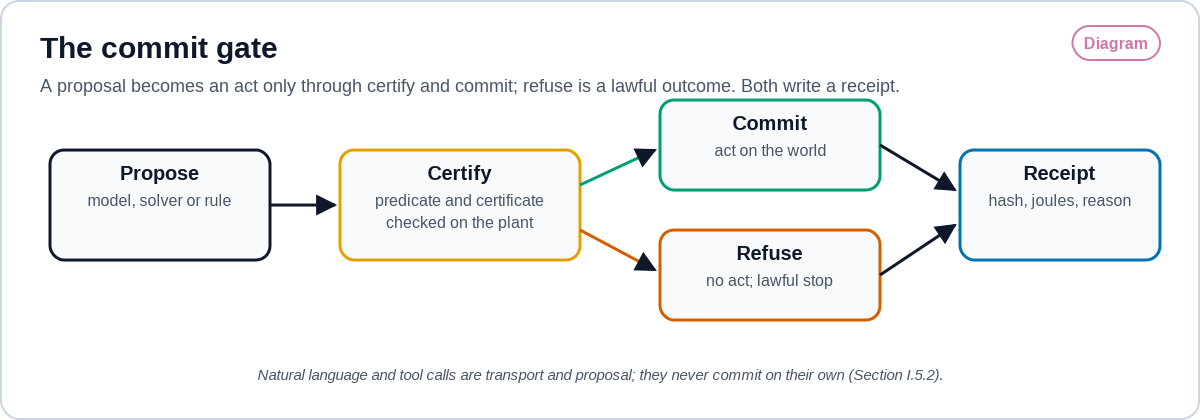
*Figure 1. The commit gate. Diagram of propose, certify, commit or refuse, and receipt, as defined in Section I.3. A [PNG copy](https://research.openie.dev/figures/gates/commit-gate.png) is provided.*
## I.2. Related work
### I.2.1 Notation and tools for thought
Lee (2022) argues that inventing notations can matter more than inventing additional automated tools, because a notation changes the thoughts that are cheap. The interview record with The Gradient is consistent with that essay and is not an independent empirical result. Iverson (1980), Turing Award lecture, is the classical computer-science statement: notation is a tool of thought, and executability is part of the test. Engelbart (1962) locates intelligence in a human plus artifact system, not in a bare brain. Kay (1972) specifies a personal dynamic medium. Victor's "Media for Thinking the Unthinkable" and "Inventing on Principle" argue that creators need representations whose consequences are visible while the idea is still being formed. Matuschak and Nielsen, "How can we develop transformative tools for thought?", document adoption and institutional failure modes of such tools.
This paper uses that lineage for one limited inference. If a notation is executable, some failures become ordinary data rather than unrepresented accidents. A typed refuse reason is an instance. It does not support the strong Sapir-Whorf claim that language determines thought. The strong claim is rejected in Section I.5. The weak claim, which is Iverson's, is that an executable notation changes the cost of operations and the representability of errors.
Chollet (2019) defines intelligence as skill-acquisition efficiency and grounds the definition in algorithmic information theory. That definition is about learning new skills, not about commit.
### I.2.2 Information, description length, and physical cost
Shannon (1948) defines entropy and channel capacity. Shannon (1959) defines rate-distortion: how much description is required for a stated fidelity. Kolmogorov (1965) defines description length by program size. Solomonoff (1964) defines inductive inference by a mixture over programs. Chaitin (1977) develops program-size complexity. Cover and Thomas (2006) is the textbook spine. Jaynes (1957) uses maximum entropy as a rule for distributions under constraints. Brillouin (1956) connects information to physical negentropy in the Maxwell-demon line.
Cross-entropy training of a language model is an information-theoretic objective on a data distribution. Sutskever's 2023 Simons Institute talk, which is a talk and not a paper, discusses unsupervised learning as compression. That fact does not yield a Kolmogorov certificate for a particular string, and it does not yield a commit bit. Statistical compression of a training distribution is not the same object as a runtime allow set under a plant constraint.
Landauer (1961) proves a lower bound: logically irreversible erasure dissipates at least `kT ln 2` per bit in the ideal model. Bennett (1973) shows that logically reversible computation can avoid that erasure cost in the limit. Horowitz (2014) reports practical CMOS energy at picojoule scales for operations and memory movement, far above the Landauer bound, and treats energy rather than transistor count as the constraint. Mead (1990) is the neuromorphic argument for analog efficiency. Sandberg (2016) warns that a brain power near 20 watt does not bound the energy of an engineered system trained from scratch. A cortical partitioning preprint (arXiv:2102.06273) further warns against treating all of that biological power as comparable compute. This paper uses Landauer and Horowitz as bounds and practice tables. It does not claim that any model in the reference operates near `kT ln 2`.
### I.2.3 Scale and hardware fit
Hestness et al. (2017), Kaplan et al. (2020), and Hoffmann et al. (2022) document empirical scaling of deep learning loss. Amodei and Hernandez (2018), an OpenAI blog post, describe rapid growth in training compute for landmark results. The page is a vendor essay. This paper does not depend on a specific doubling time from it. Sutton (2019) argues that general methods which use computation have beaten systems that encode the contents of human knowledge as fixed features. The essay is not an argument against every constraint. A commit predicate is a constraint on action, not a hand-built chess feature. Hooker (2021) explains why alternatives lose when the installed base of chips and libraries rewards dense matrix multiplication.
This paper ranks by joules to correct completion and separates proposal cost from permission. A price is not a term in either.
### I.2.4 LUT networks, ternary lookup, and differentiable logic
Umuroglu et al. (2020) map sparse low-bit networks to FPGA truth tables (LogicNets). Petersen et al. (2022) train networks of logic gates with differentiable relaxations (DiffLogic). Bacellar et al. (2024) train weightless networks of LUTs (differentiable weightless neural networks). Ma et al. (2024) study ternary-weight language models (BitNet b1.58). Wei et al. (2024) implement low-bit matrix multiplication by table lookup on CPUs (T-MAC). The TeLLMe line (arXiv:2504.16266) is a ternary LUT matrix-multiplication design aimed at FPGA execution. Those systems show that tables and gates are a real compute substrate. They do not, in the papers cited, attach a port-Hamiltonian energy veto and a typed commit envelope to a tool executor.
The reference uses DiffLogic as a thin allow table on toy features, and TLMM as a proposal path. That is a different job from using a logic network as the whole classifier, which is the usual DiffLogic evaluation (vision benchmarks, large gate counts). Section I.6 records the capacity gap.
### I.2.5 Certificates, shields, and runtime monitoring
Ames et al. (2019) survey control barrier functions as set-invariance certificates, typically enforced by a filter or a quadratic program. Alshiekh et al. (2018 preprint arXiv:1708.08611) introduce shields that replace unsafe actions with safe ones, minimally when possible. Dawson, Gao, and Fan (2022) survey learned Lyapunov and barrier certificates and the failure modes of treating a neural network as a certificate without a check. Manek and Kolter (2020) learn stable dynamics with a Lyapunov structure. Greydanus, Dzamba, and Yosinski (2019) learn Hamiltonian neural networks. Roth et al. (2025) study stable port-Hamiltonian neural networks. Yu, Zikelic, and Henzinger (2024) repair neural certificates using runtime monitors. Leung and Paré (arXiv:2512.24493) give Bayesian safety guarantees for port-Hamiltonian systems with learned energy functions. Their energy is the plant's physical Hamiltonian. It is not the energy of computation. The Safe path of this reference uses energy in that same physical sense. The joules of computation are a separate account (Section I.3.4). Sanchez et al. (2018) survey runtime-verification taxonomies.
**The gate is a Simplex.** Sha's Simplex architecture runs an unverified high-performance controller beside a verified safety controller, and a decision module hands control to the safety controller before the plant leaves the region it can recover from (Sha 2001). "A proposal may not authorize itself" is that rule, carried from control loops to tool calls and actuators. Runtime assurance is its name in avionics and robotics. Three older results fix the rest of the shape. Saltzer and Schroeder named complete mediation: every access is checked against authority, every time (1975). A reference monitor is the mechanism that does the checking. Gray's two-phase commit separates prepare from commit, so no participant commits alone (1978). Necula's proof-carrying code ships a proof that the host checks before untrusted code runs (1997). The commit record here is a reference monitor in front of irreversible effects, with a Simplex switch to refusal and a certificate the host checks, as in proof-carrying code. What the reference adds to that lineage is one conjunct and one ledger: an energy predicate inside the certificate, and joules on the same record as the decision.
The reference does not replace that mathematics. The Safe path is a conservative fixed-point test of a known energy identity on a pendulum, `V = (1/2)(g theta^2 + omega^2)` with `Vdot = omega * u`. The CBF used in the toy bake-off is an energy-set inequality on the same `V`, not a claim to have solved the Ames quadratic program on a manipulator. Learned Lyapunov structure on a cart-pole is a second toy, reported in Section I.4, and is not a region-of-attraction theorem for arbitrary plants.
### I.2.6 World models, typed decisions, and tool transport
Ha and Schmidhuber (2018) and Hafner et al. (DreamerV3, arXiv:2301.04104) show that learned models can propose actions from imagined trajectories. LeCun's JEPA essays (Meta research blog) argue for predictive world models. LeCun et al. (2006) is the earlier energy-based learning tutorial. Prediction error is not identically zero in these systems. A predictor can sit upstream of a gate. It cannot replace the gate unless its predictions are perfect and the plant model is the plant. This paper does not compete with those systems on prediction benchmarks.
System One models return a typed answer and a probability for each allowed option in one forward pass, with no free-form text. TypeSafe AI named the category with its hosted Jev model (15 September 2026). Open models followed, among them Laya from Convai Innovations, an encoder with decision heads. They collapse generation cost when the option set is typed and known. Anthropic's Model Context Protocol announcement specifies discovery and transport for tools. Transport delivers a call. It does not evaluate `Vdot`. In the reference's MCP adapter, irreversible tools require a certificate before the executor runs. That is an engineering claim about this adapter, tested by the demo in Section I.4, not a claim about every MCP server in production.
### I.2.7 What the composition adds
Shields refuse unsafe actions but are not, in the cited papers, exported as the reference's four-field commit record with an analytical joule account. DiffLogic and LUT networks compute functions. They are not, in those papers, a veto in front of a separate proposer and a tool executor. Energy-aware barrier filters are continuous. The reference's allow bit is a table. The compositional claim is the wiring: LUT allow and energy predicate and optional barrier, recorded with a typed reason, applied before an irreversible effect, with analytical energy kept distinct from board power. Section I.4 states which parts of that wiring were executed.
### I.2.8 Certify / commit peers (2025 to 2026)
Several recent systems enforce a decision before an irreversible tool runs.
Shi et al., **Progent** (arXiv:[2504.11703](https://arxiv.org/abs/2504.11703)), check every tool call against symbolic least-privilege rules and use an SMT solver so privilege can only narrow without approval (monotonic confinement). Chen, Kang, and Li, **ShieldAgent** (ICML 2025; [proceedings.mlr.press/v267/chen25ae.html](https://proceedings.mlr.press/v267/chen25ae.html)), enforce verifiable safety-policy circuits over agent action trajectories before shielding. Yu, Žikelić, and Henzinger (AAAI 2025; [doi:10.1609/aaai.v39i25.34840](https://doi.org/10.1609/aaai.v39i25.34840)) repair neural certificates via runtime monitoring. A companion line verifies ReLU control-barrier certificates online over a lookahead region (arXiv:[2507.11987](https://arxiv.org/abs/2507.11987)).
**What Part I adds.** Those peers are policy, shield, or certificate-repair objects. This reference ships a four-field commit envelope (`proposal` → `certificate` → `commit|refuse` → receipt) with a conjunctive LUT allow bit and an energy predicate, typed refuse reasons, and analytical joules kept distinct from board power. Transport (MCP) remains proposal. Board joules exist only for the KV260 runs in Section I.3.7, at board level.
### I.2.9 Runtime enforcement
The gate is a security automaton. Schneider showed that execution monitors enforce exactly the safety properties [Schneider 2000](https://doi.org/10.1145/353323.353382), and Ligatti, Bauer and Walker extended the monitor to edit automata that suppress or insert actions [Ligatti et al. 2005](https://doi.org/10.1007/s10207-004-0046-8). Falcone set out when to enforce rather than verify [Falcone 2010](https://doi.org/10.1007/978-3-642-16612-9_9), and Bauer, Leucker and Schallhart gave runtime verdicts three values [Bauer et al. 2011](https://doi.org/10.1145/2000799.2000800), which map onto allow, refuse and `settle_refuse`. What this paper adds to that line is the energy predicate in the certificate and the receipt. Agent guards of 2024 to 2026 have the same shape, a check between a proposed tool call and its effect: GuardAgent [arXiv:2406.09187](https://arxiv.org/abs/2406.09187) and AgentSpec [arXiv:2503.18666](https://arxiv.org/abs/2503.18666). PolicyGuide argues that a check on each action cannot steer a multi-step workflow [arXiv:2608.19861](https://arxiv.org/abs/2608.19861); that is why Part II puts the stop on the task predicate $C(z)$ rather than on the single act. Multi-step irreversible work also needs compensation, which sagas supply [Garcia-Molina and Salem 1987](https://doi.org/10.1145/38713.38742), and "a proposal may not authorize itself" is the reference-monitor principle that capability kernels such as seL4 enforce by proof [Klein et al. 2009](https://doi.org/10.1145/1629575.1629596). The 0-false-allow scan of Section I.4 is a test over a grid, not a proof; Section I.6 states that limit, and it applies to every summary of the result.
### I.2.10 Reference points for the board figure
An FPGA implementation of a function is expected to cost more energy than an ASIC; Kuon and Rose measured the dynamic power gap [Kuon and Rose 2007](https://doi.org/10.1109/TCAD.2006.884574), and Horowitz gives the CMOS energy per operation that frames such figures [Horowitz 2014](https://doi.org/10.1109/ISSCC.2014.6757323). A vendor power estimate for the same bitstream beside the SOM reading is part of the PL-rail protocol.
## I.3. Definitions and methods
### I.3.1 Objects
Fix a state `x` and a candidate action `u` in a set `U`. A proposal is a tuple
```text
Proposal = (u, x, hints)
```
`hints` may include analytical energy quantities. A proposal has no interpretation as permission.
A certificate is a tuple
```text
Certificate = (lut_allow, energy_ok, cbf_ok, reasons, metrics)
```
`lut_allow` and `energy_ok` are Booleans. `cbf_ok` is a Boolean when the selected compose mode requires it, and is absent otherwise. `reasons` is a list of refuse reasons. `metrics` includes the analytical energy account and the board-result flag.
Compose modes in the schema README are:
```text
lut_and_energy : commit <=> lut_allow AND energy_ok
lut_and_safe : commit <=> lut_allow AND safe_energy_ok
lut_and_safe_and_cbf : commit <=> lut_allow AND safe_energy_ok AND cbf_ok
```
Ablations `energy_only` and `lut_only` exist so a comparison can remove one conjunct. They are not the default for irreversible tools.
A commit decision is
```text
if commit then plant_action = u else plant_action = 0
```
with the certificate attached. The executor for an irreversible tool is called only in the first branch.
Worked record. File `artifacts/schemas/wca.commit.v1/examples/commit_decision_refuse.json` stores a refuse in which `lut_allow` is true and `energy_ok` is false. The reason code is `energy_veto`. The fixed-point detail string is `Vdot_q=1461 > eps_q=13`. `plant_action` is `[0.0]`. The record sets the board-result flag to false. One true conjunct does not commit.
### I.3.2 Plants and oracles
The primary plant is a pendulum. Continuous reference quantities used by the Safe check are `g = 9.81`, `epsilon = 0.05`, `V = (1/2)(g theta^2 + omega^2)`, and `Vdot = omega * u`. `energy_ok` in the continuous oracle means `Vdot <= epsilon`.
The legacy discrete check is a Q8.8 fixed-point approximation, bit-matched to the Verilog module `wca_ph_energy.v` in simulation. The Safe check (`SafeFixedPointPHCertificate`) uses Q16.16 and an exact integer residual. The reported predicate is
```text
energy_ok <=> 4*omega_q*u_q + 2*(abs(omega_q)+abs(u_q)) + 1
<= floor(4*epsilon*S^2)
```
with the rounding argument given in `artifacts/RESULTS.md`: under round-to-nearest with error at most half a least significant bit, `Vdot` is bounded by `(prod + (1/2) abs + 1/4) / S^2`. The design goal is one-sided. If the Safe predicate allows, the continuous oracle allows. The converse is not required. Extra refuses are a measured cost, not a contradiction of the safety direction.
A second plant, cart-pole, is used only in the learned-Lyapunov simulation. State is `[x, xdot, theta, thetadot]`, with `g = 9.81`, cart mass 1.0, pole mass 0.1, length 0.5. `V` is a quadratic form `xi^T P xi / 2` with `P` positive definite by a Cholesky construction plus a multiple of the identity. The fit is stochastic gradient on a hinge of `Vdot + alpha V` under a linear policy, seed 42, 400 iterations, batch 32, `alpha = 0.15`, as recorded in `RESULTS.md`. The continuous gate is `Vdot <= 0.05`. The Safe discrete rule adds a Lipschitz margin times half a least significant bit. This is a simulation of one fitted quadratic on one box. It is not a proof for other plants.
### I.3.3 LUT allow and proposal path
The allow LUT in the reported episodes is a DiffLogic export with mask `21887` on four features: absolute theta, absolute omega, absolute `u`, and an energy bit, unless a section says otherwise. TLMM is a grouped ternary table lookup used as a proposer. Iso-correctness means agreement with a naive ternary matrix product within absolute tolerance 1e-12, which `RESULTS.md` records as measured in software. Scale behavior is whatever `wca-tlmm-scale` writes under a stated analytical forward budget. The default budget discussed in results is 2e-10 joule per forward, analytical, not electrical.
### I.3.4 Analytical energy model
`RESULTS.md` separates two facts. Operation counts are exact in the OpCounter. Joules are the counts times constants:
| Constant | Value (joule) | Role |
|----------|----------------|------|
| `E_LUT_READ` | 1e-12 | LUT read |
| `E_BRAM_WORD` | 1e-11 | BRAM word |
| `E_BITMASK_OP` | 5e-14 | bitmask operation |
| `E_ADD` | 5e-13 | add |
| `E_PACK` | 2e-13 | pack |
| `E_COMMIT_BASE` | 2e-11 | commit overhead |
| `E_REFUSE_OVERHEAD` | 5e-12 | refuse overhead |
`J = sum count_op * E_op`. These constants are engineering stand-ins, not measurements. Structure counters such as shared BRAM hits are reported and are not charged unless they change a counted read. Changing a constant rescales every analytical joule in lockstep. That is why the numbers cannot be compared to a vendor's tokens per joule, to MLPerf Tiny energy, or to a rail measurement. They can be compared across modes inside the same model.
Utility in the internal tables is commit count. Commit count is not a task reward. A policy that commits more can score higher utility per joule while violating the energy oracle. Section I.4 therefore does not treat utility per joule as a safety metric.
### I.3.5 Tool adapter
`wca-mcp-gate` classifies tools. Read-only tools may execute without a commit record. Unknown tools are treated as irreversible. Irreversible tools require a certificate under the configured compose mode, default `lut_and_safe_and_cbf` in `artifacts/mcp_gate_demo.json`. On refuse, `executed` is false and `executor_calls` is 0. The demo executor records calls and does not perform host input or output. The method string in the demo file is `rust_mcp_commit_gate_v1`.
### I.3.6 Simulation of Verilog
The repository emits Verilog and memory images for the allow LUT and the commit gate (`artifacts/fpga/`). `wca-rtl-verify` and Icarus Verilog check bit-exact behavior of those models against the software oracle. Icarus executes a simulation. It does not place, route, or measure a chip. Vivado reports enter only for the KV260 runs of Section I.3.7, as utilization and timing closure. Vivado power estimates are not results.
### I.3.7 Browser instrument and boards
The completeness path for replication has three stages. Stages A and B exist. Stage C has two boards: one for decision agreement and one for joules.
Stage A, present. Rust binaries in `wca-commit` run the episode, the Safe check, the tool demo, and the analytical joule account. Icarus simulates emitted Verilog on a workstation.
Stage B, shipped. The pure decision core (proposal in, certificate out, plant step, analytical joule update) compiles to `wasm32` (`crates/wca-fpga-sim`). A static page at https://research.openie.dev/living/fpga-sim/ loads the module. WebGPU holds the LUT words and a trace buffer of `(step, lut_allow, energy_ok, cbf_ok, decision)` for display. WebGPU timestamps are not joules. On seed-1 (16 steps, theta 1.5, omega 3.0) the WASM episode reports committed 1, refused 15, analytical joule 8.6795e-10, matching Stage A. The WASM module is an emulation of the same functions the Rust crate runs. It is not a cycle-accurate model of an Artix-7, not a switching-activity power model, and not a substitute for Icarus on the Verilog. Stage B does not claim an Alchitry Pt V2 DUT.
Stage C, board programmed, energy unmetered. An Alchitry Pt V2 was detected and loaded (SRAM) with a closed-loop WCA commit-gate bitstream: on-fabric seed-1 pendulum plant dynamics, TLMM proposal, allow LUT, Safe Q16.16 port-Hamiltonian residual, and Ames-style energy-set control barrier function (CBF) residual. Fabric commit is `lut_allow ∧ energy_ok ∧ cbf_ok`. UART at 115200 8N1 agreed with the software composite golden on allow/refuse/commit (1 commit, 15 refuses, sole commit at step 6). On that seed-1 closed-loop episode the CBF conjunct did not change the allow/refuse trace versus LUT and Safe PH alone (the sole PH commit has u=0, so the CBF Lie check holds). **Closed-loop** here means plant state evolves from gate commits and refuses on the fabric; it is not a streamed stimulus ROM of plant/proposal state. The Pt V2 has **no onboard joule meter**. No USB inline meter or shunt was attached. Vivado / post-PAR power estimates are not DUT readings. SparkFun's product page names FPGA XC7A100T-2FGG84I and lists 101,440 logic cells, 240 DSP48E1 slices, 4,860 Kb of block RAM, and 256 MB of DDR3L (https://www.sparkfun.com/alchitry-pt-v2.html); those remain vendor specifications. Builder metering methods: [/living/fpga-sim/alchitry/#energy](https://research.openie.dev/living/fpga-sim/alchitry/#energy).
Stage C, board metered. An AMD Kria KV260 carries an onboard INA260 power monitor (`ina260_u14`). Three rungs ran on 30 September 2026, each as interleaved A/B/A passes with N = 4, settle 15 s and sampling 25 s at about 4 Hz. Rung 1 compares a free-running seed fabric (439 LUTs) to the board's baseline bitstream. It gives watts only, with no operation count, so it gives no joules per operation. Rung 2 halts and runs one seed bitstream (975 LUTs) at about 100 MHz under an on-device operation counter. The difference is +0.0098 W (standard error 0.0031 W), which is 98.0 pJ per seed cycle (standard error 30.8 pJ). Rung 3 halts and runs the gate bitstream: eight lanes, each the conjunction of the allow LUT, the Safe Q16.16 energy residual and the barrier residual, in 6,370 LUTs and 128 DSP slices, timing closed at 25 MHz. The difference is +0.2857 W (standard error 0.0032 W). At 2.4999 × 10⁷ gate cycles per second that is 11,428 pJ per gate cycle (standard error 129 pJ), about 1.43 nJ per lane decision. The A2 minus A1 drift was +0.0047 W (standard error 0.0040 W). The bitstream hashes and logs are in the `wca-kv260-meter` artifact of the reference.
What the meter can and cannot see. The INA260 specifies a maximum offset of 5 mA and a maximum system gain error of 0.15%, with a current step of 1.25 mA (TI INA260 datasheet). The offset is common to A and B on the same board and rail, so the halt-versus-run difference cancels it. Gain error scales the difference by at most 0.15%. The meter senses board power, so the difference includes clock tree and routing switched by the enable, not the gate logic alone. Rung 2's difference is about three standard errors from zero. Rung 3's is about ninety. The next protocol is fixed: read the core rail (VCCINT) through the module's regulator telemetry or a source-measure unit; at least 30 randomized interleaved A/B pairs; at least 10⁹ gate evaluations per block; die temperature logged with an idle baseline before each block; gross and subtracted values both reported; the Vivado power estimate reported beside the reading with the discrepancy. Rung 3 is not a closed-loop plant joule cost, and the analytical constants of Section I.3.4 are not calibrated by it.
The scientific reason for stage B is replication and inspection, not a new physical claim. A reader with a browser steps the same seed-1 episode and reads the same allow bit and reason codes that the crate prints. Agreement with stage A is the acceptance test for stage B, and it passes on seed 1. Agreement of decisions is the acceptance test for the Pt V2, and it passes on seed 1. A meter reading on a stated workload is the acceptance test for the KV260, and rungs 2 and 3 meet it at board level.
### I.3.8 What is not a method of this paper
No human-subject study. No claim about linguistic relativity beyond the rejection in Section I.5. No training-compute extrapolation. No identification of economic satiation. No optimization against Groq, Etched, or Taalas throughput. No world-model benchmark.
## I.4. Results
All quantities in this section are simulated in the software reference unless a sentence cites an external paper. Analytical joules use Section I.3.4. Only NI-9 is board-measured.
### I.4.1 Claim NI-1. The commit record exists as a schema and a Rust type
Schemas `Proposal`, `Certificate`, `RefuseReason`, and `CommitDecision` are in `artifacts/schemas/wca.commit.v1/`. Rust types are in `crates/wca-commit/src/schema.rs`. Round-trip tests are `cargo test -p wca-commit`. This is an existence result about the reference, version `wca.commit.v1`. It is not a uniqueness theorem.
### I.4.2 Claim NI-2. Seed-1 pendulum episode
Command, from `RESULTS.md`:
```text
cargo run --release --bin wca-soc-loop -- \
--steps 16 --init-theta 1.5 --init-omega 3.0 --seed 1
```
Reported outcome: committed = 1, refused = 15, analytical episode energy = 8.6795e-10 joule. The same committed and refused counts and the same analytical energy are reported for `--safe-ph` on that seed. `RESULTS.md` states that the single commit is step 6. Toolchain note in that file: Rust 1.98. Re-running the binary is the reproduction. The energy is not a measurement of a chip.
### I.4.3 Claim NI-3. False allows of the Safe energy check
`wca-ph-tighten` compares discrete decisions to the continuous oracle `Vdot <= epsilon`. On a 21 cubed grid plus 200,000 near-threshold Monte Carlo samples (209,261 decisions):
| Path | False allow | False refuse | Both allow | Both refuse |
|------|-------------|--------------|------------|-------------|
| Legacy Q8.8 | 30836 | 105 | 104711 | 73609 |
| Safe v1 (Q8.8 over-approximation) | 0 | 42430 | 62386 | 104445 |
| Safe v2 (Q16.16 residual) | 0 | 79 | 104737 | 104445 |
`RESULTS.md` also states that a denser 41 cubed grid plus 50,000 Monte Carlo samples, checked in `cargo test`, asserts false allow equal to 0. Safe v2 cuts false refuses from 42,430 to 79 relative to Safe v1 while keeping false allows at 0. Legacy Q8.8 is not safe on this definition: it records 30,836 false allows. These counts are properties of the numerical test, not of a physical pendulum.
### I.4.4 Claim NI-4. Toy barrier comparison, neither definition dominates
`wca-cbf-bakeoff` runs seeds 0 through 4, 40 steps, time step 0.05, action scale 2.5, shared demo TLMM and DiffLogic mask `21887`. The energy-set barrier uses `h = 18 - V` and allows when `h >= 0` and `omega * u <= kappa * h` with `kappa = 0.05`. The discrete shield allows a step that stays inside absolute theta at most 2 and absolute omega at most 4. Closed-loop means differ because trajectories diverge. The file reports per-episode means for commits and sums for violation counts. Selected rows:
| Filter | Commit | Refuse | Analytical J | False allow vs PH | `h < 0` | `Vdot > epsilon` |
|--------|--------|--------|--------------|-------------------|---------|------------------|
| `lut_and_safe_ph` | 1 | 38 | 2.153e-09 | 0 | 4 | 0 |
| `cbf_energy_set` | 1 | 38 | 2.056e-09 | 3 | 0 | 3 |
| `shield_discrete` | 18 | 21 | 2.306e-09 | 90 | 38 | 90 |
| `lut_only` | 40 | 0 | 2.544e-09 | 194 | 220 | 194 |
On this plant and this oracle, `lut_and_safe_ph` has zero `Vdot` violations and four `h < 0` events. The energy-set barrier has zero `h < 0` events and three `Vdot` violations. The shield commits more and violates the energy oracle often. `lut_only` matches `always_allow` on violations in the reported table. Offline agreement on a shared always-allow stream of 200 steps gives 4 disagreements between `lut_and_safe_ph` and `cbf_energy_set`, and 70 against the shield.
Interpretation inside the test: passivity and set invariance are different predicates. The LUT-and-energy gate is not equivalent to an Ames filter, and it does not win every column. A full quadratic-program baseline on a richer plant is not in this table. That comparison remains open. The result that is available is the disagreement, which is evidence against collapsing the two certificates into one word.
### I.4.5 Claim NI-5. Cart-pole Safe Lyapunov simulation
On the audit described in Section I.3.2 (grid n = 7 plus 20,000 boundary samples inside the Lipschitz box, 26,487 decisions), Safe learned Lyapunov versus the continuous `Vdot` oracle records false allow 0, false refuse 3, both allow 15,925, both refuse 10,559. Closed-loop means over five seeds: `lut_and_safe_lyap` commits 11, refuses 28, analytical J 2.719e-09, and records zero false allows against that oracle. The level-set barrier on the same `V` commits 14 and records 15 energy-oracle violations. The discrete shield commits 29 and records 95. Same pattern as the pendulum: the Safe conjunct tracks its own oracle; a different certificate tracks a different one; permissiveness without the oracle is not safety.
This is one additional simulated plant. It does not establish the commit gate on industrial dynamics.
### I.4.6 Claim NI-6. MCP demo
`artifacts/mcp_gate_demo.json` records four cases. The board-result flag in the file is false.
| Case | Class | Executed | Executor calls | Commit |
|------|-------|----------|----------------|--------|
| `read_only_bypass` | read-only | true | (no commit record) | absent |
| `irreversible_refuse` | irreversible | false | 0 | false |
| `irreversible_allow` | irreversible | true | 1 | true |
| `shell_exec_gated` | irreversible | true | (gated) | true |
The refuse case lists `energy_veto` (`vdot` 6.0 against `eps` 0.05) and `cbf_veto`. Plant action on that case is `[0.0]`. The allow case uses compose `lut_and_safe_and_cbf` and plant action `[-0.02]`. The note in the file states that refuse never executes. This is a demo of the adapter, not a field study of computer-use agents.
### I.4.7 Claim NI-7. TLMM under an analytical budget
`RESULTS.md` reports a demo 2 by 4, group 2 configuration near 4.24e-11 analytical joule, under the forward budget. The largest configurations that remain under the 2e-10 forward budget stop at 64 parameters. Widths 8 by 16 and above exceed that budget even after the optimizer. Iso-correctness against naive ternary arithmetic is a software comparison at tolerance 1e-12. These statements do not say that the design matches TeLLMe throughput or any board energy.
### I.4.8 Claim NI-8. DiffLogic allow versus an energy teacher, toy only
On the hard multi-seed gate benchmark in `RESULTS.md`, after threshold calibration and denser labels, DiffLogic matches the energy teacher on refuse rate 50.0 plus or minus 15.9 percent, precision at threshold 0.890 plus or minus 0.067, and recall 0.802 plus or minus 0.076. A bitmask reference refuses more (71.0 plus or minus 14.9 percent) and recalls less (0.454 plus or minus 0.266). Before calibration, DiffLogic refuse rate was 57.5 plus or minus 14.1 percent with recall 0.724 plus or minus 0.163. The match is on this toy labeling setup. It is not an ImageNet or control-suite result. Internal utility per joule rises for the calibrated gate (3.570e9 versus 3.212e9 before) under the analytical model. As Section I.3.4 states, that ratio uses commit count as utility.
### I.4.9 Claim NI-9. Board-level joules of the gate fabric
| Rung | Fabric | Clock | Difference (W) | Operation | Joules per operation | Label |
|---|---|---|---|---|---|---|
| 1 | Seed freerun vs board baseline | n/a | −0.8212 (SE 0.0024) | none | none | `measured_j`, watts only |
| 2 | Seed, halt vs run | about 100 MHz | +0.0098 (SE 0.0031) | one seed cycle | 98.0 pJ (SE 30.8) | `measured_j`, INA260, SOM rail (`VCC_SOM`) |
| 3 | Gate, 8 lanes, halt vs run | 25 MHz | +0.2857 (SE 0.0032) | one gate cycle, 8 decisions | 11,428 pJ (SE 129) | `measured_j`, INA260, SOM rail (`VCC_SOM`) |
N = 4 interleaved A/B/A passes per rung. Rung 1's negative sign means the seed bitstream draws less than the board's baseline bitstream. It does not mean the seed is free. Section I.3.7 gives the limits of a board-level reading.
### I.4.10 Safety and liveness
Zero false allows is safety. A gate that refuses everything is also safe, and useless. Liveness is the other axis: false refuses, and the share of tasks the gated agent completes. NI-3 reports both on the Safe grid. Safe v2 cuts false refuses from 42,430 to 79 at zero false allows. The seed-1 episode commits 1 step of 16, and that count alone does not say whether the plant reached its goal. The required report is a frontier per plant: task completion rate against false-allow rate, one point per compose mode of NI-4 (`lut_only`, `shield_discrete`, `cbf_energy_set`, `lut_and_safe_ph`), each point with its seeds and spread. On agent workloads the same frontier uses an attack suite for false allows and a benign task suite for completion. A gate is judged on the frontier, not on one axis.
### I.4.11 What the literature search supports
A literature search in September 2026 (Sections I.2.4 to I.2.9) found no published system that composes a learned Boolean allow LUT, a port-Hamiltonian or Lyapunov energy predicate, and a ternary LUT proposal as one commit boundary with bit-exact RTL simulation and an analytical joule account. The nearest neighbors are shields, energy-aware barrier filters, logic networks as the whole model, and TLMM designs without an energy certificate. The search supports a gap statement about the literature that was searched. It does not support a priority claim over unpublished work, and it does not support an energy-leadership claim.
## I.5. Discussion
### I.5.1 Scale does not answer the commit question
Kaplan, Hoffmann, Hooker, and Sutton describe how loss and proposal capability scale. A larger proposer can still emit an action that fails `Vdot <= epsilon`. Putting that proposer behind the certificate uses scale where the evidence says scale works, and uses the predicate where scale is silent. The Bitter Lesson objects to frozen human features that block learning. It does not entail deleting a safety predicate. If a future result shows that an unconstrained policy meets the same false-allow test at lower analytical cost and equal task error, NI-3's engineering preference for the gate would be weakened on that plant. The logical distinction between proposal and permission would remain.
### I.5.2 Natural language and MCP are transport and proposal
MCP solves discovery and call shape. System One solves some decisions without free-form generation. Neither object is `energy_ok`. The demo in NI-6 shows a refuse that does not call the executor. A production deployment could bypass the adapter. The claim is not that the protocol makes bypass impossible. The claim is that permission has to be a separate record if irreversible effects are to be auditable.
### I.5.3 Strong linguistic determinism is not the claim
The strong hypothesis that language determines thought is not a premise. The operational statement is local. In this schema, a commit without a passing certificate is not a successful record. An untyped confidence string can be stored beside a success flag and still leave the reason unstated. The enum removes that particular ambiguity. It does not describe human cognition.
### I.5.4 Formalism can be wasteful; this predicate is small
Requiring a proof of the whole agent at every step would dominate the budget. The reference formalizes one boundary. Read-only calls bypass. The Safe residual is a fixed-point inequality, not a general SMT query. NI-2's analytical episode energy is 8.6795e-10 joule under the stated constants. It cannot be stated as a fraction of a generative model's board energy, because that comparison was not measured. A split between proposal joules and gate joules on a real agent workload is not in the results. Until it is, the cost objection is answered for this toy gate and remains open for large certificates.
### I.5.5 A wrong model with a green light is a real failure
If `V` is not the plant's energy, `energy_ok` can be true while the plant is not safe. The mitigation present in the reference is a continuous twin on the toys, a separated reason code, and a refusal to treat a probability as a certificate. The mitigation not present is disturbance Input-to-State Stability, a verified region of attraction, or a Bayesian credibility budget of the kind Leung and Paré study. NI-4 is the evidence that two respectable certificates disagree. That disagreement is a reason to name the predicate, not a reason to trust either one outside its test.
### I.5.6 Prior certificate theory is not duplicated here
Ames, Alshiekh, Dawson, and the runtime-monitoring papers already define filters and monitors. NI-1's addition is the product record and the composition with a LUT export and a tool executor in one reference. Where the toy barrier wins on set invariance, the paper says so (NI-4, NI-5). Composition is `cbf_ok` as another conjunct when that predicate is the one required. It is not a claim that the LUT computes the Ames quadratic program.
### I.5.7 Predictors and specialized inference chips
World models reduce some prediction error and leave a residual. Specialized inference devices change the cost of proposals. Vendor throughput figures are vendor reports until an independent meter repeats them. The gate's job is the irreversible branch. If a device's only interface is a token stream, the commit record still has to live somewhere before actuators or irreversible tools run.
### I.5.8 Analytical joules are not watts
The constants in Section I.3.4 are chosen engineering numbers. They make counts comparable inside the repo. They are not calibrated to an Artix-7 rail. Reporting them as board watts would be a false measurement report. The correct report is the one given: operation counts are computed; analytical joules are modeled; board joules come only from the KV260 meter and are filed apart. Stage B of Section I.3.7 makes the same model inspectable in a browser at https://research.openie.dev/living/fpga-sim/. It does not change the measurement class. The KV260 rungs do, for the fabric they ran.
## I.6. Limits and threats to validity
Internal validity. Seed-1 is one initial condition. The Safe grid is large but still a chosen box and a chosen epsilon. Monte Carlo samples near the threshold stress the boundary the designers chose to stress. A different epsilon or a different plant identity breaks the numerical claim until re-run. The CBF in the bake-off is an energy-set inequality implemented in the same crate, not an independently coded solver from an Ames reference implementation. Disagreement is informative. Absolute ranking against the literature's code is not established.
Construct validity. Commit count as utility does not measure task success. False allow is defined against a named oracle. A system can be oracle-safe and check-safe (zero false allows against `Vdot <= epsilon`) and still fail set-safe (`h >= 0`), which NI-4 shows. Readers who treat "safe" as one word will misread the table.
External validity. Both plants are toys. There is no manipulator, quadrotor, or human-in-the-loop trial. The MCP demo does not call a network. Verilog is simulated. The browser instrument is shipped as Stage B simulation. The Alchitry Pt V2 agrees on decisions and is unmetered. The KV260 reading is board level and open loop. Vendor logic-cell counts are not confirmed here.
Measurement validity. Analytical constants can be edited to any scale. Comparisons to Horowitz's picojoule tables, to Landauer's bound, or to vendor tokens per joule are not valid with these constants. The KV260 rungs are a board-level meter under a stated workload. A core-rail reading under the closed-loop episode is the missing measurement. Post-place-and-route tool power would be a third class, still not a meter, and it is not reported as a result.
Statistical reporting. Where `RESULTS.md` gives a mean and a standard deviation, this paper copies them. It does not add confidence intervals that were not computed. Multi-seed coverage is five seeds on the bake-offs and the hard gate benchmark's reported spreads. That is not a large-sample claim.
Not claimed. The following are not results: silicon joule leadership; operation near the Landauer bound; brain-equivalent power; a win over System One on latency; a win over world-model benchmarks; strong linguistic determinism; identification of "intelligence" with commit count.
Falsifiers. NI-2 is false if the stated command on the stated crate revision does not print those counts. NI-3 is false if the Safe v2 test reports a false allow on the stated grid. NI-6 is false if the refuse case in the demo file executes. NI-1 is false if the schema and the runtime diverge. A stage B emulator that disagrees with stage A on seed 1 fails its own acceptance test. A future meter that assigns board energy to the analytical number without a calibration study does not confirm the analytical model.
## I.7. Conclusion
The paper defined a commit decision as a conjunctive certificate over a LUT allow bit and an energy predicate, with an optional barrier, and showed a software reference that emits the decision before an irreversible effect. On the reported pendulum tests, the Safe fixed-point rule has zero false allows against its continuous oracle `Vdot <= epsilon` on the stated test set, at the cost of 79 false refuses in 209,261 decisions. On the reported comparisons, that oracle is not the same as set invariance. Analytical episode energy for the seed-1 run is 8.6795e-10 joule under published constants. Tool refuse in the MCP demo does not call the executor. Verilog checks are simulation. The browser WASM and WebGPU instrument is available at https://research.openie.dev/living/fpga-sim/ so that the same decision can be inspected without a board. It remains a simulation, not a DUT result. The Alchitry Pt V2 agrees with the software on every decision of seed 1 and stays unmetered. The KV260 meters the gate fabric at board level: 11,428 pJ per eight-lane gate cycle at 25 MHz. The reference is a measured software artifact and a board-metered fabric. The closed-loop chip joule is the next measurement.
## I. References
Simon, H. A., and Kadane, J. B. Optimal problem-solving search: all-or-none solutions. Artificial Intelligence 6(3), 235-247, 1975. https://doi.org/10.1016/0004-3702(75)90002-8
Alshiekh, M., Bloem, R., Ehlers, R., Konighofer, B., Niekum, S., and Topcu, U. Safe reinforcement learning via shielding. arXiv:1708.08611.
Ames, A. D., Coogan, S., Egerstedt, M., Notomista, G., Sreenath, K., and Tabuada, P. Control barrier functions: theory and applications. European Control Conference, 2019. https://doi.org/10.23919/ECC.2019.8796030
Amodei, D., and Hernandez, D. AI and compute. OpenAI, 2018. https://openai.com/index/ai-and-compute/
Anthropic. Introducing the Model Context Protocol. https://www.anthropic.com/news/model-context-protocol
Bacellar, A., et al. Differentiable weightless neural networks. arXiv:2410.11112.
Bauer, A., Leucker, M., and Schallhart, C. Runtime verification for LTL and TLTL. ACM Transactions on Software Engineering and Methodology 20(4), 14, 2011. https://doi.org/10.1145/2000799.2000800
Bennett, C. H. Logical reversibility of computation. IBM Journal of Research and Development, 1973. https://doi.org/10.1147/rd.176.0525
Brillouin, L. Science and Information Theory. Academic Press, 1956.
Chaitin, G. J. Algorithmic information theory. IBM Journal of Research and Development, 1977. https://doi.org/10.1147/rd.214.0350
Chen, Z., Kang, M., and Li, B. ShieldAgent: Shielding Agents via Verifiable Safety Policy Reasoning. ICML 2025 (PMLR v267). arXiv:2503.22738. https://proceedings.mlr.press/v267/chen25ae.html
Chollet, F. On the measure of intelligence. arXiv:1911.01547.
Convai Innovations. Laya model card. https://huggingface.co/convaiinnovations/laya
Cover, T. M., and Thomas, J. A. Elements of Information Theory, 2nd ed. Wiley, 2006. https://doi.org/10.1002/047174882X
Dawson, C., Gao, S., and Fan, C. Safe control with learned certificates: a survey of neural Lyapunov, barrier, and contraction methods. arXiv:2202.11762.
Engelbart, D. C. Augmenting human intellect: a conceptual framework. 1962. https://www.dougengelbart.org/pubs/augment-3906-Framework.html
Falcone, Y. You should better enforce than verify. Runtime Verification (RV 2010), Lecture Notes in Computer Science 6418, 89-105. Springer, 2010. https://doi.org/10.1007/978-3-642-16612-9_9
Garcia-Molina, H., and Salem, K. Sagas. Proceedings of ACM SIGMOD 1987, 249-259. https://doi.org/10.1145/38713.38742
Gray, J. Notes on data base operating systems. In Operating Systems: An Advanced Course, Lecture Notes in Computer Science 60, 393-481. Springer, 1978. https://doi.org/10.1007/3-540-08755-9_9
Greydanus, S., Dzamba, M., and Yosinski, J. Hamiltonian neural networks. arXiv:1906.01563.
Ha, D., and Schmidhuber, J. World models. arXiv:1803.10122.
Hafner, D., Pasukonis, J., Ba, J., and Lillicrap, T. Mastering diverse domains through world models. arXiv:2301.04104.
Henzinger, T. A., Kueffner, K., and Yu, E. Formal verification of neural certificates done dynamically. arXiv:2507.11987. https://arxiv.org/abs/2507.11987
Hestness, J., et al. Deep learning scaling is predictable, empirically. arXiv:1712.00409.
Hoffmann, J., et al. Training compute-optimal large language models. arXiv:2203.15556.
Hooker, S. The hardware lottery. arXiv:2009.06489. Communications of the ACM, 2021. https://doi.org/10.1145/3467017
Horowitz, M. Computing's energy problem (and what we can do about it). IEEE International Solid-State Circuits Conference, 2014. https://doi.org/10.1109/ISSCC.2014.6757323
Iverson, K. E. Notation as a tool of thought. Communications of the ACM, 1980. https://dl.acm.org/doi/10.1145/358896.358899
Jaynes, E. T. Information theory and statistical mechanics. Physical Review 106, 620, 1957. https://doi.org/10.1103/PhysRev.106.620
Kang, S., Yu, T., and Hwang, S. J. PolicyGuide: from guarding one action to guiding the whole workflow for policy-compliant LLM agents. arXiv:2608.19861. https://arxiv.org/abs/2608.19861
Kaplan, J., et al. Scaling laws for neural language models. arXiv:2001.08361.
Kay, A. A personal computer for children of all ages. 1972. https://worrydream.com/refs/Kay_1972_-_A_Personal_Computer_for_Children_of_All_Ages.pdf
Klein, G., et al. seL4: formal verification of an OS kernel. Proceedings of SOSP 2009, 207-220. https://doi.org/10.1145/1629575.1629596
Kolmogorov, A. N. Three approaches to the quantitative definition of information. 1965. English: International Journal of Computer Mathematics, 1968. https://doi.org/10.1080/00207166808803030
Kuon, I., and Rose, J. Measuring the gap between FPGAs and ASICs. IEEE Transactions on Computer-Aided Design 26(2), 203-215, 2007. https://doi.org/10.1109/TCAD.2006.884574
Landauer, R. Irreversibility and heat generation in the computing process. IBM Journal of Research and Development, 1961. https://doi.org/10.1147/rd.53.0183
Laya. System One models and typed decision engines (comparison table, checked 2 October 2026). https://laya-ai.com/system-one-models
LeCun, Y. Path towards autonomous machine intelligence / JEPA discussion. Meta AI blog. https://ai.meta.com/blog/yann-lecun-advances-in-ai-research/
LeCun, Y., Chopra, S., Hadsell, R., Ranzato, M., and Huang, F. J. A tutorial on energy-based learning. 2006. http://yann.lecun.com/exdb/publis/pdf/lecun-06.pdf
Lee, L. Notational intelligence. 2022. https://thesephist.com/posts/notation/
Leung, C. H., and Paré, P. E. Bayesian safety guarantees for port-Hamiltonian systems with learned energy functions. arXiv:2512.24493.
Levy, W. B., and Calvert, V. G. Cerebral cortical communication overshadows computational energy-use, but these combine to predict synapse number. arXiv:2102.06273.
Ligatti, J., Bauer, L., and Walker, D. Edit automata: enforcement mechanisms for run-time security policies. International Journal of Information Security 4, 2-16, 2005. https://doi.org/10.1007/s10207-004-0046-8
Ma, S., et al. The era of 1-bit LLMs: all large language models are in 1.58 bits. arXiv:2402.17764.
Manek, G., and Kolter, J. Z. Learning stable deep dynamics models. arXiv:2001.06116.
Matuschak, A., and Nielsen, M. How can we develop transformative tools for thought? https://numinous.productions/ttft/
Mead, C. Neuromorphic electronic systems. Proceedings of the IEEE, 1990. https://doi.org/10.1109/5.58356
Necula, G. C. Proof-carrying code. Proceedings of the 24th ACM SIGPLAN-SIGACT Symposium on Principles of Programming Languages (POPL '97), 106-119, 1997. https://doi.org/10.1145/263699.263712
Petersen, F., et al. Deep differentiable logic gate networks. arXiv:2210.08277.
Qiao, Y., Chen, Z., Zhang, Y., Wang, Y., et al. TeLLMe: an energy-efficient ternary LLM accelerator for prefilling and decoding on edge FPGAs. arXiv:2504.16266.
Roth, F., et al. Stable port-Hamiltonian neural networks. arXiv:2502.02480.
Saltzer, J. H., and Schroeder, M. D. The protection of information in computer systems. Proceedings of the IEEE 63(9), 1278-1308, 1975. https://doi.org/10.1109/PROC.1975.9939
Sanchez, C., et al. A survey of challenges for runtime verification from advanced application domains. arXiv:1811.06740.
Sandberg, A. Energetics of the brain and AI. arXiv:1602.04019.
Schneider, F. B. Enforceable security policies. ACM Transactions on Information and System Security 3(1), 30-50, 2000. https://doi.org/10.1145/353323.353382
Sha, L. Using simplicity to control complexity. IEEE Software 18(4), 20-28, 2001. https://doi.org/10.1109/MS.2001.936213
Shannon, C. E. A mathematical theory of communication. Bell System Technical Journal, 1948. https://doi.org/10.1002/j.1538-7305.1948.tb01338.x
Shannon, C. E. Coding theorems for a discrete source with a fidelity criterion. IRE National Convention Record, 1959.
Shi, T., He, J., Wang, Z., et al. Progent: Securing AI Agents with Privilege Control. arXiv:2504.11703. https://arxiv.org/abs/2504.11703
Solomonoff, R. J. A formal theory of inductive inference, parts I and II. Information and Control, 1964.
SparkFun. Alchitry Pt V2 product page. https://www.sparkfun.com/alchitry-pt-v2.html
Sutskever, I. An observation on generalization. Simons Institute talk, 2023. https://www.youtube.com/watch?v=AKMuA_TVz3A
Sutton, R. The bitter lesson. 13 March 2019. http://www.incompleteideas.net/IncIdeas/BitterLesson.html
Texas Instruments. INA260 precision digital current and power monitor, data sheet. https://www.ti.com/lit/ds/symlink/ina260.pdf
TypeSafe AI. Introducing System One Models and Jev. 15 September 2026. https://typesafe.ai/blog/introducing-system-one-models-and-jev
Umuroglu, Y., et al. LogicNets. arXiv:2004.03021.
Victor, B. Inventing on principle. 2012. https://www.youtube.com/watch?v=PUv66718DII
Victor, B. Media for thinking the unthinkable. https://worrydream.com/MediaForThinkingTheUnthinkable/
Wang, H., Poskitt, C. M., and Sun, J. AgentSpec: customizable runtime enforcement for safe and reliable LLM agents. arXiv:2503.18666. https://arxiv.org/abs/2503.18666
Wei, J., et al. T-MAC. arXiv:2407.00088.
Xiang, Z., Zheng, L., Li, Y., Hong, J., et al. GuardAgent: safeguard LLM agents by a guard agent via knowledge-enabled reasoning. arXiv:2406.09187. https://arxiv.org/abs/2406.09187
Yu, E., Žikelić, Đ., and Henzinger, T. A. Neural control and certificate repair via runtime monitoring. AAAI 2025. https://doi.org/10.1609/aaai.v39i25.34840 (arXiv:2412.12996).
Local measurement record: `artifacts/RESULTS.md` in the `wca-lut-edge` software reference. KV260 meter record: `artifacts/stage-c/wca-kv260-meter/` (protocol, claim status, A/B/A logs and summaries). Schema examples: `artifacts/schemas/wca.commit.v1/examples/`. Demo: `artifacts/mcp_gate_demo.json`.
## I. Appendix A. Reproducibility
Workstation path used to generate the cited logs: the `wca-lut-edge` tree, Rust 1.98 as recorded in `RESULTS.md`. Day-to-day commands:
```text
cargo test -p wca-commit
cargo run --release --bin wca-soc-loop -- \
--steps 16 --init-theta 1.5 --init-omega 3.0 --seed 1
cargo run --release --bin wca-soc-loop -- \
--steps 16 --init-theta 1.5 --init-omega 3.0 --seed 1 --safe-ph
cargo run --release --bin wca-ph-tighten -- --grid 21 --out artifacts/ph_tighten_report.json
cargo run --release --bin wca-cbf-bakeoff -- --out artifacts/cbf_bakeoff_report.json
cargo run --release --bin wca-lyap-plant -- --out artifacts/lyap_plant_report.json
cargo run --release --bin wca-mcp-gate -- --demo
cargo run --release --bin wca-tlmm-scale -- --out artifacts/tlmm_scale_report.json
```
Icarus Verilog was version 12.0 in the environment note in `RESULTS.md`. RTL checks are simulation. Do not read analytical joules as board power.
The board-result flag is true for the KV260 Stage C rungs 1 to 3 only (Section I.3.7), at board level. Every other result in this paper is simulation or analytical.
## I. Appendix B. Browser FPGA emulator: architecture
This appendix describes the architecture of the Stage B emulator, which runs at https://research.openie.dev/living/fpga-sim/. Seed-1 agreement numbers below are from the WASM run against the Stage A golden.
Modules.
1. `decision_core`. Pure functions already represented by the Rust certificate, plant step, and joule accumulator. No file system and no threads required. Target `wasm32-unknown-unknown`.
2. `lut_image`. The same memory image the Verilog path loads (`artifacts/fpga/wca_allow_lut.mem` and successors). The browser copy must hash-match the file used for the Icarus check.
3. `trace`. A fixed schema: step index, state, `u`, `lut_allow`, `energy_ok`, `cbf_ok`, reason codes, analytical joule increment, plant action. Identical field names to `wca.commit.v1` so a dump can be diffed against the crate's JSON.
4. `webgpu_view`. Device, queue, and a storage buffer for the LUT and the trace. A shader draws allow and refuse. A second dispatch may map the Safe residual across a grid. Buffers are for inspection. They are not a power model.
5. `workstation_oracle`. Icarus remains the RTL oracle. The browser does not replace it. Disagreement between WASM and the Rust binary fails the build. Disagreement between WASM and Icarus on the shared LUT image fails the build. Neither comparison mentions watts.
Acceptance tests. The seed-1 test passes (Section I.3.7). The others are the specified checks for the module.
- Seed-1, 16 steps, init theta 1.5, omega 3.0: committed 1, refused 15, analytical joule 8.6795e-10, matching NI-2.
- Safe grid smoke: false allow 0 on a published subset of the 209,261-decision test, matching NI-3's direction.
- MCP refuse vector: executor call count 0, matching NI-6.
- A unit test that WebGPU buffer readback equals the WASM trace. If readback is unavailable, the page must show that the GPU path did not confirm the trace, and the CPU WASM trace remains the result.
Physical follow-on for board **joules**. Stage C already programmed a closed-loop commit-gate on the Alchitry Pt V2 with UART decision agreement; the board still has no onboard joule meter. A USB inline power meter or a shunt-plus-scope on the 5 V rail, on a stated workload, is what would support a board-measured joule. Vivado / post-PAR estimates are not that meter. Vendor logic-cell and memory figures stay vendor figures. See [/living/fpga-sim/alchitry/#energy](https://research.openie.dev/living/fpga-sim/alchitry/#energy).
Out of scope for the emulator: training DiffLogic in the browser and estimating Artix-7 dynamic power from a shader.
## Part II. The cascade (Mixture of Limits)
## II.1. The rule
A task is given by a completeness predicate $C(z) \in \{0, 1\}$ over its state $z$. A **gear** is a mechanism that may close the task: Lookup (read a stored, verified value), Formula (evaluate a closed form), Solver (run a search, optimizer or settle with a certificate), or Model (run a learned generator). Gear $i$ has a pass probability $p_i$, the probability that it reaches $C(z) = 1$ on the task class, and an expected energy $c_i$ in joules (J).
The **floor** of a task is the least expected energy at which some policy over gears reaches $C(z) = 1$ with failure probability at most $\delta$. It equals $J^*$ of Section 0.2. The **plateau** is the region of spend beyond the floor: once $C(z) = 1$, no further computation can raise $C$, so further joules buy nothing on the stated objective.
**Mixture of Limits** is the rule: try gears in an order that minimizes expected energy to the first close, stop at the first gear that closes $C(z)$, and refuse with a receipt when the next gear would exceed the budget or cannot change the decision. Lookup → Formula → Solver → Model is the standard order. It is optimal only under the condition derived in Section II.2. Every close passes through Part I's record: propose, certify, commit or refuse, receipt.
**Where the model sits.** Model last is an order of trial, not a verdict on what models can do. Snell et al. (2024) showed that a compute-optimal schedule of test-time compute beats best-of-N by more than 4× in efficiency, and that on some problems test-time compute can substitute for a larger model. That result concerns the schedule inside the Model gear, which is priced in joules like any other gear. The Model gear opens whenever cheaper gears cannot close $C(z)$, and it opens first when they pass too rarely to pay for their failures.
Figure 2 draws the floor and the plateau for one task.
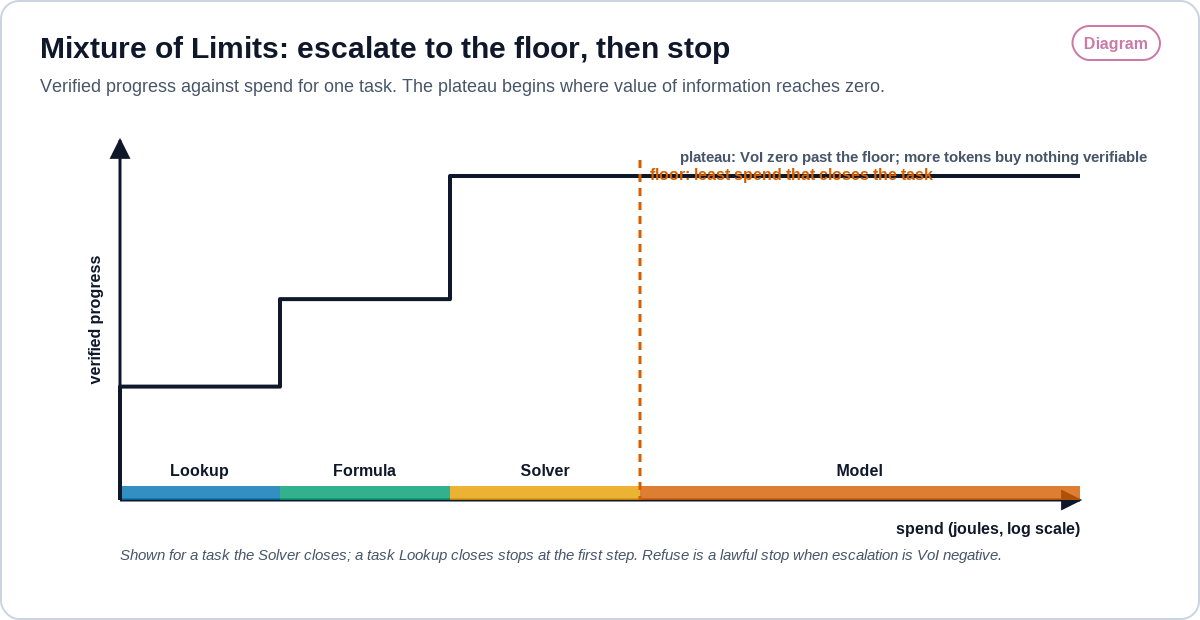
*Figure 2. Mixture of Limits on one task. Diagram, not a measurement. A [PNG copy](https://research.openie.dev/figures/gates/mol-plateau.png) is provided.*
**Mixture of Limits is not Mixture of Experts.** Mixture-of-Experts (MoE) routing selects parameters inside one generative model (Shazeer et al., 2017; Fedus et al., 2022). Mixture of Limits selects whether and where to spend across gears, and an MoE model can serve as its Model gear.
| | MoE | Mixture of Limits |
|---|---|---|
| Where the choice is made | Inside one model | Across gears, before any model runs |
| Object chosen | Which parameters run | Which gear closes, or refuse |
| Success | Next-token likelihood | $C(z) = 1$, a certified commit, and a receipt |
| Refusal | Not a native outcome | A typed outcome with a receipt |
## II.2. Expected energy of a cascade and the optimal order
**Two gears.** Let a light gear L with pass probability $q_L$ and energy $c_L$ precede a heavy gear H that always passes, with energy $c_H$. Trying L first costs $c_L + (1 - q_L)\,c_H$ in expectation. Trying H first costs $c_H$. So L first is cheaper if and only if
$$
c_L + (1 - q_L)\,c_H < c_H \iff c_L < q_L\, c_H .
$$
For example, a lookup costing $c_L = 10^{-9}$ J that passes on $q_L = 0.3$ of tasks ahead of a model call costing $c_H = 10$ J saves $q_L c_H - c_L \approx 3$ J per task in expectation. If $q_L$ falls below $c_L / c_H = 10^{-10}$, the order reverses.
**Many gears.** For $n$ gears tried in sequence until the first pass, with independent outcomes, the expected energy of order $\sigma$ is
$$
\mathbb{E}[J_\sigma] = \sum_{k=1}^{n} c_{\sigma(k)} \prod_{j p_b / c_b$, and the optimal order sorts gears by decreasing $p_i / c_i$ (Simon and Kadane, 1975). Cheapest first is optimal exactly when cheaper gears also have the higher pass probability per joule. When that fails, the cascade starts at a heavier gear. Under a binding budget the joules of failed light attempts stay spent, so a selector that estimates $p_i / c_i$ per task can close tasks that a fixed order cannot.
**Physical floor.** Any gear that erases $n$ bits irreversibly at temperature $T$ dissipates at least
$$
E_{\text{Landauer}}(n, T) = n\, k_B T \ln 2, \qquad k_B = 1.380649 \times 10^{-23}\ \text{J/K},
$$
which is $2.87 \times 10^{-21}$ J per bit at 300 K (Landauer, 1961; Bennett, 1973, for the reversible limit). Measured CMOS operations cost about 0.9 pJ for a 32-bit floating-point add at 45 nm and about 1 to 2 nJ for a DRAM access (Horowitz, 2014, paper text; the plenary slides give 1.3 to 2.6 nJ for a 64-bit access), eight to twelve orders of magnitude above that floor. The often-quoted 640 pJ per 32-bit DRAM read is not in that paper or its slides and is not used here. The Landauer figure on a receipt is therefore a labeled lower bound, never a measurement.
**Catalog cost model.** Before a gear runs, the software reference prices it as
$$
E_{\text{est}}(x) = \theta(D)\,\mu(S, V),
$$
where $\theta(D)$ (dimensionless) scales with the difficulty class $D$ of act $x$ and $\mu(S, V)$ (J) is a catalog energy for primitive $S$ on hardware view $V$. Both are stated catalog constants, so $E_{\text{est}}$ is an estimate used to order gears. It is not derived from physics, and it is never reported as a measurement. Ranking among systems that close the task uses metered joules (Section 0.2).
## II.3. Stopping conditions
**Value of information.** Let $B$ be the payoff of a decision, $x$ the current information state, $y$ a further observation or computation, $c(y)$ its energy, and $\lambda$ the exchange rate between payoff and joules. The net value is
$$
\Delta(x, y) = \mathbb{E}[B \mid x, y] - \mathbb{E}[B \mid x] - \lambda\, c(y)
$$
(Howard, 1966; Russell and Wefald, 1991). The rule refuses escalation when $\Delta \le 0$. Once $C(z) = 1$, the first two terms are equal for any further $y$ on the task, so $\Delta = -\lambda c(y) < 0$ and the stop follows.
**Grammar coverage.** Let $G$ be the set of verified derivations available to Lookup, Formula and Solver. A query $q$ is covered when a derivation $q \vdash_G a$ exists. When $q$ is covered, the Model gear is not opened, because a covered gear passes with probability 1 at lower energy than the Model gear, so by the two-gear inequality of Section II.2 it goes first and closes the task. When $q$ is not covered and policy forbids the Model gear, the rule refuses.
**Settle refusal.** A Solver gear that searches for a low-energy configuration either reaches a certified fixed point (commit) or reports that it will not settle within its budget (refuse).
Named refusal reasons in the software reference:
| Reason | Condition |
|---|---|
| `voi` | $\Delta \le 0$ for every available next step |
| `grammar` | Not covered and the Model gear is not allowed |
| `energy` | The next gear's estimate exceeds the remaining budget |
| `efa_certificate` | The certificate check fails before commit |
| `settle_refuse` | The Solver does not settle within its budget |
| `primitive_gap` | A required primitive is absent from the catalog |
| `safety` | A capability check denies the action |
## II.4. Provenance and receipts
Every answer carries a replay class stating how it was produced: `Deterministic` (Lookup, Formula, or a certified Solver), `RetrievedCited`, `Composed`, or `ModelGenerated`. The type system forbids strengthening a class: `ModelGenerated` cannot be rewritten as `Deterministic`. Energy on a receipt carries one of three labels: **Estimated** (catalog, Landauer or instruction-fuel figure), **Unmetered** (no reading), or **Metered** (a named meter returned a reading). The software reference leaves `measured_j` unset unless a meter returns. The catalog of primitives the reference navigates, grouped into families, is called the Periodic Stack in this paper; each cell is Present (implemented) or Gap (absent).
## II.5. Software reference
The software reference `mixture-of-limits` (Apache-2.0 or MIT) has a harness, `cargo run -p mol-cli -- prove`, that prints `VERIFIED` for each criterion and exits 0. The workspace test suite (`cargo test --workspace`) passes (P0), and the harness exits 0 (P1). A criterion marked verified means that an implementation exists and passes its stated specification. It is not a theorem, not an independent replication and not an energy measurement. As of the 2 October 2026 run the harness prints 43 `VERIFIED` criteria (this replaces the earlier count of about 29); the table below itemises P2 to P24, and II.5.1 to II.5.3 describe the product-gap criteria A11 to A14 that were added after it. The other criteria are not itemised in this paper and are in the software reference's `PLAN.md` and `product/ACCEPTANCE`.
| Prove # | Criterion | Claim id | Claim | Scope note | Measurement |
|---|---|---|---|---|---|
| Prove # | Criterion (PLAN) | Paper claim id | Claim (one sentence) | Software reference / scope note | Measurement |
|---|---|---|---|---|---|
| P2 | Deterministic close (double-run) | `claim.mol.deterministic_close` | Same asks yield the same commit/refuse + limit id. | none | Unmetered |
| P3 | Formula/lookup close without model | `claim.mol.formula_lookup_no_model` | Landauer / unit-convert closes COMMIT at Lookup or Formula; model never answered. | none | Unmetered / Estimated (Landauer floor on receipt) |
| P4 | VoI refuse when `!allow_model` | `claim.mol.voi_refuse` | Free-form ask → REFUSE `voi`. | none | Unmetered |
| P5 | Settle commit + settle refuse | `claim.mol.settle_ternary` | Ternary settle → COMMIT; `will not settle` → REFUSE `settle_refuse`. | Software-ref settle stub; no VM / FPGA | Unmetered |
| P6 | Certificate refuse on diverge | `claim.mol.efa_certificate_refuse` | Formula + `diverge` → REFUSE `efa_certificate`. | In-tree certificate | Unmetered |
| P7 | Capability default-deny mutate | `claim.mol.capability_deny_mutate` | `AutomateGate::default().gate(Mutate)` → Refuse. | none | Unmetered |
| P8 | Receipt labels | `claim.mol.receipt_honesty` | Software-ref: `measured_j=None`, estimate labeled (`EstimateKind`). | Live RAPL/NVML default close OUT OF SCOPE | Unmetered / Estimated |
| P9 | `ModelGenerated` ↛ `Deterministic` | `claim.mol.replay_no_strengthen` | `TypedAnswer::weaken_to` returns `ReplayCoercion`. | none | none |
| P10 | Periodic Stack live catalog navigation | `claim.mol.stack_live_catalog` | Family + present + scale → COMMIT at Lookup; 258 live Lookup/Formula/Solver/Navigate gears. | μ calib + silicon HW OUT OF SCOPE; software reference Gap sims in proof | Unmetered |
| P11 | `primitive_gap` via registry probe | `claim.mol.primitive_gap` | Gap marker `physical_settle` + absent name → REFUSE `primitive_gap` (not string-only). | none | Unmetered |
| P12 | μ / impedance catalog | `claim.mol.mu_catalog` | Receipts stamp `mu_source=catalog`, `mu`, `landauer_floor_ratio`; `E≈θ·μ` (catalog estimate, not RAPL/`measured_j`). | μ **calib corpus** OUT OF SCOPE | Estimated |
| P13 | Receipt transcript replay | `claim.mol.receipt_replay` | JSONL/in-memory replay reproduces commit/refuse + limit id; model never answered. | none | Unmetered |
| P14 | Z2 retrieve+cite | `claim.mol.z2_retrieve_cite` | Seeded factual hit → COMMIT `RetrievedCited` + citation ids; unknown → REFUSE `claim_unknown` (no invent). | Seed corpus in-tree only | Unmetered |
| P15 | Z1 compose/synthesis | `claim.mol.z1_compose` | ≥2 cited claims → COMMIT `Composed` + `synthesis.composed_from`; missing → REFUSE `compose_missing`; never laundered as Deterministic/RetrievedCited alone. | none | Unmetered |
| P16 | Agent mailbox loop | `claim.mol.agent_mailbox` | Goal/Message/Act → close → commit\|refuse + receipt in transcript; demo hits formula/cite/compose COMMIT and voi/settle_refuse REFUSE; model cold; measurement flags hold. | none | Unmetered |
| P17 | Bitemporal state + memory | `claim.mol.bitemporal_memory` | Writes only on Mixture of Limits close COMMIT; Mutate deny / free-form remember → REFUSE; recall → `RetrievedCited` + `memory:` cite; unknown → `memory_unknown`. | none | Unmetered |
| P18 | Fabric routing + software reference inventory | `claim.mol.fabric_soft_ref` | Offline inventory valid (`source=software_ref`, Cpu always); Lookup/Formula→Cpu; Settle→ThermoSettle\|Cpu; Model→Gpu* or REFUSE `fabric_unavailable`; detect ≠ measured joules. | Live wgpu presence optional / not required for prove | Unmetered |
| P19 | Desktop shell headless | `claim.mol.desktop_headless` | `ShellSession` ask/close → receipt view (zone/fabric/limit/estimated_j/`measured_j=None`); joule ledger; VoI refuse; GUI not required. | egui GUI optional | Unmetered / Estimated |
| P20 | OS meter labels | `claim.mol.os_meter_honesty` | Feature off / VM / no permission → `measured_j=None`, empty components, `measure_source=unavailable`; fixtures stamp labeled sources; default close stays unmetered. | Live probe optional (`energy-meter`) | Unmetered (default) / Metered only when probe returns |
| P21 | WASM capsule certify | `claim.mol.wasm_capsule` | `add.wasm` under stub runtime; fuel → estimated_j only; FS/net grant / fuel exceed / host-share → REFUSE; close stamps capsule. | Optional `wasmtime` feature | Unmetered / Estimated (fuel) |
| P22 | Agent Lane session path | `claim.mol.agent_lane` | Lane partitions; `host_invoke` without provenance refuses; keyword confirm insufficient; need `GrantReceipt`; allow stamps `AgentLaneReceipt`. | none | Unmetered |
| P23 | Multi-fabric compute receipt | `claim.mol.fabric_compute_receipt` | Software reference inventory; `ComputeFabric` / `ScheduleDecision` / `ComputeStepReceipt` with `fabric_id`; cascade stamps `fabric:route`; CPU Formula COMMIT; Model residual may `fabric_unavailable`; `measured_j=None` on software reference path. | none | Unmetered |
| P23b | Live fabric soft | `claim.mol.fabric_live_soft` | Feature off stays software_ref; mock/live Metal can stamp `gpu_metal`; Formula stays Cpu; missing Gpu* fail-closed; prove does not require a GPU; `measured_j=None` unless Metered. | Soft / optional detect | Unmetered |
| P23c | wgpu / Metal tiny kernel | `claim.mol.kernel_vector_add` | Clean-room WGSL vector-add; soft stub offline (same checksum); Gpu* stamps `kernel:vector_add` + `execution_proof`; optional overlapping meter may stamp package `measured_j` with `energy_honesty=measured` (field name); no rail-sum package joules. | Live Metal optional; fixture OK for prove | Unmetered (default) / Metered only if meter returns |
| P24 | Ecosystem e2e certify (one receipt) | `claim.mol.ecosystem_e2e` | Lane → fabric (Cpu software reference) → WASM → energy labels (estimated fuel; optional meter_sample) → host invoke only with `GrantReceipt` → commit\|refuse on **one** receipt; refuse-without-grant → `grant_receipt_required`. | none | Unmetered / Estimated |
Outside the harness: live energy counters (RAPL, NVML) as the default close, live GPU detection, on-device certificate hardware, trained model weights, and silicon meters for Gap cells. None is claimed.
### II.5.1 Phase-1 micro-perception on the arena (A11, A14)
The arena scores the cascade on typed chores (decision, ticket close, risk) against an always-model baseline and a small leaf baseline. Typed baselines run with `phase1=false`. With `phase1=true`, an unstructured ticket, risk or decision string first goes through the in-tree rule AST transducer (`mol phase1`) and only then enters the cascade; unrecognised input is refused, so the transducer is never used as a model and Model LAST stays last. In the software-reference run of 2 October 2026 (n = 36, America/New_York), the cascade closed 36 of 36 correctly and refused 5 of 5 satiation cases, while the always-model baseline and the leaf baseline each got 28 of 36 and 0 of 5 on satiation. Mean estimated joules were about 2.1e-11 for the cascade, 5.0e-1 for the always-model baseline and 2.5e-4 for the leaf baseline. These are catalog estimates; `measured_j` is not set, and the figures are the reference's own published table, not a re-run for this paper.
### II.5.2 Tier-1 OS meters (A13)
An optional build feature adds package-level probes so that `measured_j` is filled only from a real reading: Linux RAPL (powercap `energy_uj` delta), NVIDIA (`nvidia-smi` power times the window, or an energy-consumed delta, as device-total GPU energy) and macOS (SMC `PSTR` watts times the window, without sudo; the Energy Model package channel is not used and rails are never summed). The harness runs with the feature off, so `measured_j` stays unset there. Criterion A13 stamps RAPL, NVML and SMC fixtures and forbids inventing a value from a utilisation percentage. No Part II figure is a reading from these probes.
### II.5.3 Primitive distillation (A12)
After a certified Model LAST commit, `mol distill` appends a Lookup or Formula entry to a store with deterministic replay; an uncertified proposal is never distilled. A second pass on the distilled pattern then closes at Lookup or Formula without opening Model LAST (A12). Receipts keep `estimated_j` labelled as an estimate.
Reproduce: `cargo run -p mol-cli -- prove` (43 criteria including A1 to A14), `-- arena`, `-- phase1 "please close ticket as R-OK"`, `-- distill "ticket summary" --gear lookup --store product/fixtures/distill_store.json`. Code: [openIE-dev/mixture-of-limits](https://github.com/openIE-dev/mixture-of-limits).
## II.6. Related work
**Cascades and metareasoning.** Viola and Jones (2001) ran a cascade of boosted classifiers in which cheap stages reject most inputs. Russell and Wefald (1991) priced each computation by its expected value to the decision net of its cost and stopped when none had positive net value. Horvitz (1987) set the same trade for bounded reasoning. Anytime algorithms trade computation for quality with an interruptible stop (Dean and Boddy, 1988; Zilberstein, 1996). Model cascading sends an input to a larger model only when a smaller one is unsure (Varshney and Baral, 2022), and FrugalGPT stops when a learned scorer accepts the answer (Chen, Zaharia and Zou, 2023). Mixture of Limits differs in three respects: the gears include non-neural mechanisms ahead of any model; the stop is the predicate $C(z)$, not a learned score; and cost is joules on a receipt, not dollars or latency.
**Spend past the answer.** Reasoning models spend tokens after their first correct answer without changing it (Chen et al., 2024), and a survey collects methods that stop earlier (Sui et al., 2025). Speculative decoding (Leviathan et al., 2023), Mixture-of-Depths (Raposo et al., 2024), quantization (Frantar et al., 2022; Lin et al., 2024) and paged KV caches (Kwon et al., 2023) lower the energy of a Model gear once it runs. They do not decide whether it runs.
**Formula recovery.** AI Feynman (Udrescu and Tegmark, 2020), SINDy (Brunton et al., 2016) and PySR (Cranmer, 2023) recover closed forms from data; AlphaGeometry (Trinh et al., 2024) and AlphaProof (Hubert et al., 2025) pair a proposer with a symbolic or Lean verifier. Each produces Formula or certified Solver gears that close covered tasks at lower energy than a generator.
**Routing among models.** These systems choose which model answers. None tries a non-neural gear first or refuses with a typed reason.
| System | Title | ID | Class | What it routes or accelerates | Energy or cost as reported | Difference |
|---|---|---|---|---|---|---|
| **RouteLLM** | *RouteLLM: Learning to Route LLMs with Preference Data* (arXiv); ICLR 2025 venue title uses *from Preference Data* | arXiv:[2406.18665](https://arxiv.org/abs/2406.18665) · ICLR 2025 | Preference router (strong↔weak LLM) | Query → strong or weak LLM | Cost / quality (API \$); reported by the authors | Model↔model; no Lookup/Formula floor; no typed refuse-to-commit |
| **PEARL** (routing) | *PEARL: Performance and energy aware routing for LLMs* | DOI:[10.1016/j.future.2025.108218](https://doi.org/10.1016/j.future.2025.108218) · FGCS 176:108218 | Energy-aware multi-LLM router | Query → LLM under energy cap (EMM predicts energy) | Authors report energy-aware routing (GPU/infra) | Still picks a model; Mixture of Limits may refuse before any model |
| **GreenServ** | *GreenServ: Energy-Efficient Context-Aware Dynamic Routing for Multi-Model LLM Inference* | arXiv:[2601.17551](https://arxiv.org/abs/2601.17551) · ICPE 2026 | Contextual bandit multi-LLM router | Query features → LLM; accuracy vs **measured GPU energy** (Zeus) | **Metered** (authors’ GPU Wh via Zeus) on their LLM pool | Model pool routing; Mixture of Limits cascade is non-neural first |
| **VoltanaLLM** | *VoltanaLLM: Energy-Efficient and SLO-Aware Disaggregated LLM Serving via Adaptive Frequency Control and State-Space Routing* | arXiv:[2509.04827](https://arxiv.org/abs/2509.04827) | P/D-disagg serving + frequency + state-space route | Prefill/decode instances + GPU frequency under TTFT/ITL SLOs | **Metered** (authors; pyNVML on A100/GH200) up to ~36.3% E2E GPU energy vs max-freq baseline (field serving result) | Routes **instances of the same generative stack**; Mixture of Limits may never open decode |
| **HCSpec** | *HCSpec: Two-Tier Horizontal Cascade Speculative Decoding for High-Efficiency Large Language Model Inference* | DOI:[10.18653/v1/2026.acl-long.353](https://doi.org/10.18653/v1/2026.acl-long.353) · ACL 2026 | Speculative decoding (draft↔target) | Position-specialized draft cascade → target verify | Latency speedup (vs EAGLE-3 / AR) | Speeds generation; does not refuse generation on floors |
| **CAS-Spec** | *CAS-Spec: Cascade Adaptive Self-Speculative Decoding for On-the-Fly Lossless Inference Acceleration of LLMs* | arXiv:[2510.26843](https://arxiv.org/abs/2510.26843) · NeurIPS 2025 | Self-speculative cascade (DSIA drafts) | Draft stages from target (sparsity/quant) + DyTC | Latency speedup ~1.1×-2.3× AR (authors); lossless tokens | Model-internal draft hierarchy ≠ Mixture of Limits floors |
| **GCD** | *Grammar-Constrained Decoding for Structured NLP Tasks without Finetuning* | arXiv:[2305.13971](https://arxiv.org/abs/2305.13971) · DOI:[10.18653/v1/2023.emnlp-main.674](https://doi.org/10.18653/v1/2023.emnlp-main.674) · EMNLP 2023 | Grammar-constrained LLM decoding | Mask logits to CFG | Unmetered / quality metrics | Constrains **tokens**; Mixture of Limits constrains **commit** |
## II.7. Baselines and falsifiers
A cascade claim is tested on one typed task set as a frontier of joules per task against closure rate. The arms are: always the large model; always the small model; a learned router (Ong et al., 2024); a scored cascade (Chen, Zaharia and Zou, 2023); a selector that estimates $p_i / c_i$ per task; and an oracle that knows the cheapest sufficient gear for each task. The fixed Lookup → Formula → Solver → Model order claims the frontier only where its curve lies below every arm. The order is falsified on a task class where measured $p_i / c_i$ is not decreasing along it, by the derivation of Section II.2. The harness claims are falsified if `mol prove` does not exit 0 on the stated revision.
## II.8. Limits
The harness is constructive existence in software. No Part II figure is a meter reading: catalog and Landauer energies are estimates, and `measured_j` is unset on the harness path. The optimal-order result assumes independent gear outcomes; correlated failures change the expected energy and require the full sum of Section II.2 with conditional probabilities. Pass probabilities $p_i$ must be estimated per task class, and estimation error moves the order. The frontier comparison of Section II.7 has not been run.
## II. References
Bennett, C. H. (1973). Logical reversibility of computation. *IBM Journal of Research and Development* 17(6):525-532. https://doi.org/10.1147/rd.176.0525
Brunton, S. L., Proctor, J. L., and Kutz, J. N. (2016). Discovering governing equations from data by sparse identification of nonlinear dynamical systems. *PNAS* 113(15):3932-3937. https://doi.org/10.1073/pnas.1517384113
Chen, L., Zaharia, M., and Zou, J. (2023). FrugalGPT. arXiv:2305.05176.
Chen, X., et al. (2024). Do NOT Think That Much for 2+3=? On the Overthinking of o1-Like LLMs. arXiv:2412.21187.
CAS-Spec (2025). Cascade Adaptive Self-Speculative Decoding. NeurIPS. arXiv:2510.26843.
Cranmer, M. (2023). Interpretable Machine Learning for Science with PySR and SymbolicRegression.jl. arXiv:2305.01582.
Dean, T., and Boddy, M. (1988). An analysis of time-dependent planning. AAAI-88, 49-54.
Fedus, W., Zoph, B., and Shazeer, N. (2022). Switch Transformers. *JMLR* 23(120).
Frantar, E., et al. (2022). GPTQ. arXiv:2210.17323.
Geng, S., et al. (2023). Grammar-Constrained Decoding for Structured NLP Tasks without Finetuning. EMNLP. https://doi.org/10.18653/v1/2023.emnlp-main.674
GreenServ (2026). Energy-Efficient Context-Aware Dynamic Routing for Multi-Model LLM Inference. ICPE. arXiv:2601.17551.
HCSpec (2026). Two-Tier Horizontal Cascade Speculative Decoding. ACL. https://doi.org/10.18653/v1/2026.acl-long.353
Horowitz, M. (2014). Computing's energy problem (and what we can do about it). ISSCC. https://doi.org/10.1109/ISSCC.2014.6757323
Horvitz, E. J. (1987). Reasoning about beliefs and actions under computational resource constraints. UAI. arXiv:1304.2759.
Howard, R. A. (1966). Information value theory. *IEEE Transactions on Systems Science and Cybernetics* 2(1):22-26. https://doi.org/10.1109/TSSC.1966.300074
Hubert, T., et al. (2025). Olympiad-level formal mathematical reasoning with reinforcement learning. *Nature*. https://doi.org/10.1038/s41586-025-09833-y
Kwon, W., et al. (2023). Efficient Memory Management for Large Language Model Serving with PagedAttention. arXiv:2309.06180.
Landauer, R. (1961). Irreversibility and heat generation in the computing process. *IBM Journal of Research and Development* 5(3):183-191. https://doi.org/10.1147/rd.53.0183
Leviathan, Y., Kalman, M., and Matias, Y. (2023). Fast Inference from Transformers via Speculative Decoding. ICML.
Lin, J., et al. (2024). AWQ. MLSys. arXiv:2306.00978.
Ong, I., et al. (2024). RouteLLM: Learning to Route LLMs with Preference Data. arXiv:2406.18665.
PEARL (2025). Performance and energy aware routing for LLMs. *Future Generation Computer Systems* 176:108218. https://doi.org/10.1016/j.future.2025.108218
Raposo, D., et al. (2024). Mixture-of-Depths. arXiv:2404.02258.
Russell, S., and Wefald, E. (1991). Principles of metareasoning. *Artificial Intelligence* 49:361-395. https://doi.org/10.1016/0004-3702(91)90015-C
Shazeer, N., et al. (2017). Outrageously Large Neural Networks: The Sparsely-Gated Mixture-of-Experts Layer. ICLR. arXiv:1701.06538.
Simon, H. A., and Kadane, J. B. (1975). Optimal problem-solving search: all-or-none solutions. *Artificial Intelligence* 6(3):235-247. https://doi.org/10.1016/0004-3702(75)90002-8
Snell, C., Lee, J., Xu, K., and Kumar, A. (2024). Scaling LLM Test-Time Compute Optimally can be More Effective than Scaling Model Parameters. arXiv:2408.03314.
Sui, Y., et al. (2025). Stop Overthinking: A Survey on Efficient Reasoning for Large Language Models. arXiv:2503.16419.
Trinh, T. H., et al. (2024). Solving olympiad geometry without human demonstrations. *Nature* 625:476-482. https://doi.org/10.1038/s41586-023-06747-5
Udrescu, S.-M., and Tegmark, M. (2020). AI Feynman. *Science Advances* 6(16). https://doi.org/10.1126/sciadv.aay2631
Varshney, N., and Baral, C. (2022). Model cascading. EMNLP. https://doi.org/10.18653/v1/2022.emnlp-main.756
Viola, P., and Jones, M. (2001). Rapid object detection using a boosted cascade of simple features. CVPR. https://doi.org/10.1109/CVPR.2001.990517
VoltanaLLM (2025). Energy-Efficient and SLO-Aware Disaggregated LLM Serving. arXiv:2509.04827.
Zilberstein, S. (1996). Using anytime algorithms in intelligent systems. *AI Magazine* 17(3).
## II. Appendix. Reproducibility
```bash
cargo test --workspace
cargo run -p mol-cli -- prove # expect 43 VERIFIED lines (A1 to A14 included), exit 0
cargo run -p mol-cli -- arena # refresh the arena table from a real run only
```
================================================================================
# Deterministic Null: A Pre-Registered Control Experiment for Neural and Agentic Substrates
- **Study ID:** `deterministic-null`
- **Kind / Status:** Research study · draft
- **Revision:** `af57f48` (22 November 2026)
- **Web Edition:** https://research.openie.dev/papers/deterministic-null/
- **Markdown Twin:** https://research.openie.dev/papers/deterministic-null.md
- **PDF Edition:** https://research.openie.dev/pdfs/deterministic-null.pdf
- **LaTeX Archival PDF:** https://research.openie.dev/pdfs/latex/deterministic-null.pdf
- **LaTeX Source (.tex):** https://research.openie.dev/pdfs/latex/deterministic-null.tex
- **Interactive Figures:** https://research.openie.dev/living/deterministic-null/
- **Claim Scope & About:** https://research.openie.dev/about/deterministic-null/
- **Data & Reproducibility:** https://research.openie.dev/data/#deterministic-null
- **Keywords:** null model, control experiment, case-based reasoning, pre-registration, drand, OpenTimestamps, DRAT, Satiation Benchmark, Good-Turing, reported_j
> Constructs and pre-registers a zero-model-call 64-bit integer case loop (Shape D: strict N0 and dev-crystallized N1, verified bit-exact across Rust, C++20, Go, Julia, and Python in openIE-dev/deterministic-null) under OpenTimestamps Bitcoin Calendar proofs and League of Entropy drand randomness rounds (6663734 and 6664089), and measures the paired increment of Claude Opus 5.5, Claude Sonnet 5.5, OpenAI gpt-oss-120b, xAI Grok 4.20, Qwen 3.6 35B-A3B, and Gemma 4 E4B-it across 4,030 held-out instances and 6 real upstream SWE-bench Verified repositories. Bounded formal and structured classes exclude single-turn neural relevance on 9 of 10 Track-A cells while extended-thinking (49/50) and O(m) clause feedback (50/50) close Unique 3-SAT DRAT; unique external public benchmarks (BFCL v3, tau-bench Retail, BigCodeBench v0.1.3, SWE-bench Verified) show +45.80 to +95.00 percentage-point neural increments while online Zipfian crystallization cuts calls and reported_j spend by 3.59x. Local Apple M5 Max counters are reported_j; no rail or wall power monitor was attached.
---
*revision [`af57f48`](https://github.com/openIE-dev/research-openie-web/commits/main/src/content/papers/deterministic-null.md), 22 November 2026. Public code, manifests, and result bundles: [github.com/openIE-dev/deterministic-null](https://github.com/openIE-dev/deterministic-null). Data and digest summary: [/data/#deterministic-null](https://research.openie.dev/data/#deterministic-null). Interactive living figures: [/living/deterministic-null/](https://research.openie.dev/living/deterministic-null/). LaTeX archival twin: [/pdfs/latex/deterministic-null.pdf](https://research.openie.dev/pdfs/latex/deterministic-null.pdf) ([source](https://research.openie.dev/pdfs/latex/deterministic-null.tex)).*
## 0. Overview
Empirical evaluations of agentic artificial intelligence routinely compare one stochastic language model against another, leaving unmeasured how much task completion requires a neural substrate at decision time rather than a fixed integer procedure over an explicit store of verified prior cases. This study constructs, freezes, and audits that missing control — **Deterministic Null (`Shape D`)** — and tests the per-class null hypothesis $H_{0,k}: \Delta_k = p_{\text{model},k} - p_{\text{null},k} \le \delta$ at margin $\delta = 0.05$ (`5.0` percentage points) across two cryptographically pre-registered confirmatory experiments (`4,030` post-beacon held-out instances across `exp-001` and `exp-002`), a multi-turn repository bug-repair study (`6` multi-file Python repositories), and companion reviewer-closure suite `exp-003` (multi-vendor non-Anthropic cloud breadth, extended-thinking and multi-turn resolution of unique `3-satisfiability` formulas, and real upstream GitHub defect repair with `0`-call replay). Local Apple M5 Max energy counters (`IOReport` and `proc_pid_rusage`) are recorded as operating-system/on-chip `reported_j` values; closed-model remote server energy is recorded strictly as `not_available`; no hardware rail or wall-plug power monitor was attached (`board_metered = false`, `measured_j = None`).
**In plain words**
1. Most agent benchmarks compare model A with model B without asking how much a zero-model lookup loop over verified prior examples already solves.
2. Across `2,840` instances drawn from bounded algebraic, formal-proof, and structured transaction families (`exp-001`, Track-A), a frozen integer case table (`0` model calls at decision time) matches frontier cloud models on `9` of `10` class-tier cells, failing only on `12` unindexed free-text customer idioms (`+36.40` percentage points for `Claude Opus 5.5`).
3. Across `1,190` unique instances from externally authored public benchmarks (`exp-002`, Track-B: Berkeley Function-Calling Leaderboard `v3`, Sierra `tau-bench` Retail, `BigCodeBench v0.1.3`, and `SWE` (software-engineering)-bench Verified), plus `exp-003` multi-vendor evaluations (`OpenAI gpt-oss-120b` `+45.83` percentage points, `xAI Grok 4.20` `+44.17` percentage points over `Shape D`) and `6` real upstream GitHub defect commits (`5/6` patched and `pytest`-verified by `Opus 5.5`, then `5/6` replayed at `0` model calls), neural synthesis delivers large gains wherever unseen key mass stays high — while extended thinking (`49/50`) and multi-turn clause feedback (`50/50`) resolve the `1,024`-token truncation cliff on unique `3-satisfiability` formulas (still matched at `50/50` and zero dollars by standalone conflict-driven clause learning), and online crystallization cuts recurring Zipfian model calls and energy by `3.59×`.
## 1. Terms, acronyms, and measurement labels
AI, ML, LLM, LLMs, MoE, OSS, E4B, A3B: artificial intelligence, machine learning, large language model(s), Mixture-of-Experts, open-source-software model release, effective 4-billion-parameter architecture, and active 3-billion-parameter routing
OBSERVE, REDUCE, FUZZ, LOOKUP, ACT, VERIFY, MUTATE, WRITE: the eight sequential steps of the Deterministic Null integer decision loop
SATB, SUT, SUTs, PFRK, TH2, DOSSIER: Satiation Benchmark harness contract, system(s) under test, four-way attempt outcomes (pass, fail, refuse, killed), red-team threat 2 (no hidden solver inside action primitives), and the project prior-art/red-team dossier
DNULLMM1, FT, LCB: binary memory-mapped store index format, per-class function table, and Hoeffding lower confidence bound
DRAT, RUP, CDCL, CNF, SAT, UNSAT: Deletion Resolution Asymmetric Tautology, Reverse Unit Propagation, Conflict-Driven Clause Learning, conjunctive normal form, satisfiable, and unsatisfiable
BV, AST, XOR, IEEE, UC: fixed-width modular bitvector, abstract syntax tree, bitwise exclusive-OR, Institute of Electrical and Electronics Engineers (IEEE-754 floating-point standard), and University of California
API, CLI, MCP, HTTP, JSON, JSONL, UTF: application programming interface, command-line interface, Model Context Protocol, Hypertext Transfer Protocol, JavaScript Object Notation, line-delimited JSON, and Unicode Transformation Format
POSIX, MMAP, SHA, OTS: Portable Operating System Interface, memory-mapped file I/O, Secure Hash Algorithm (SHA-256), and OpenTimestamps Bitcoin Calendar proof
BCa, CI, CIs, UCL: bias-corrected and accelerated bootstrap, confidence interval(s), and Wilson upper confidence limit
CPU, GPU, ANE, SoC, PID, OS, RAM, DRAM, NVMe, PSU, AC: central processing unit, graphics processing unit, Apple Neural Engine, system-on-chip, process identifier, operating system, random-access memory, dynamic RAM, Non-Volatile Memory Express, power supply unit, and alternating-current wall power
RAPL, NVML, KV, GGUF, RPM, RPD, USD, EDA: Intel Running Average Power Limit, NVIDIA Management Library, key-value cache, GPT-Generated Unified Format quantized weights, requests per minute, requests per day, United States dollars, and electronic design automation
Across telemetry levels L0 to L4, four measurement classes stay strictly separated across all tables and figures in this study:
| Measurement label | Meaning in this study |
| :--- | :--- |
| **`Exact (L4 Logical & Cryptographic)`** | Bit-identical 64-bit fixed-point store digests (`SHA-256`), OpenTimestamps `.ots` calendar proofs, League of Entropy `drand` beacon rounds, token/call counts captured by `satb-proxy`, and dated API list-price dollars (`USD`). |
| **`Reported (reported_j: L2 & L3 Counters)`** | Rootless Apple Silicon on-chip `IOReport` window joules (`macmon`, telemetry level `L2`, shared-host label `A2`) and macOS kernel per-PID `proc_pid_rusage(RUSAGE_INFO_V6).ri_energy_nj` (`L3`, label `D`). Not a physical hardware rail meter (`measured_j = None`, `board_metered = false`). |
| **`Not Available (label N)`** | Closed-API remote server energy (`Claude Opus 5.5`, `Claude Sonnet 5.5`, `OpenAI gpt-oss-120b`, `xAI Grok 4.20`, `DeepSeek V4 Flash`, `Qwen 3.8 Max`, `Gemini 2.5 Flash`) and `L0` alternating-current wall-plug energy. Fleet medians and literature multipliers are never substituted into receipts. |
| **`Invalidated Derived (Falsifier 6)`** | Net-above-idle subtraction (`derived_marginal_j`) is automatically dropped whenever shared-host co-tenant processes induce `> 5.0%` pre/post idle baseline drift across telemetry levels L0 to L4, preserving raw `reported_j` counters intact. |
### 1.1 Lineage, prior-art boundaries, and same-house disclosure
No novelty is claimed for the decision loop itself. Case-based retrieve–reuse–revise–retain cycles date to Stanfill and Waltz (1986) and Aamodt and Plaza (1994); tabular pole-balancing dates to Michie and Chambers (1968); fuzzy rule tables date to Mamdani and Assilian (1975) and Wang and Mendel (1992); satisfiability proof logging via `RUP/DRAT` dates to Goldberg and Novikov (2003) and Wetzler, Heule, and Hunt (2014). Prior Open Interface Engineering works — [Metered Commit Gates](https://research.openie.dev/papers/gates/), [Task Satiation vs. Aggregate Rebound](https://research.openie.dev/papers/satiation/), [The Reality Code Engine](https://research.openie.dev/papers/rce/), and [Downward LUT6 Compilation](https://research.openie.dev/papers/lut-adapt/) — are `[same house]` companions cited for architectural context, never as independent confirmation.
A 69-source prior-art audit and 36-finding red-team review (`docs/DOSSIER.md` in [openIE-dev/deterministic-null](https://github.com/openIE-dev/deterministic-null)) established one narrow gap in the 2024–2026 agent evaluation literature: existing agent benchmarks overwhelmingly omit non-neural controls, existing non-neural baselines lack pre-registered held-out store freezes, and existing energy studies of language-model agents include no zero-model control arm on the same host.
Figure 1. Pre-beacon registration (Gate G1 + OpenTimestamps + drand) and paired evaluation protocol across Shape D (N0, N1) and neural substrates (B3, B6, Shape H). Protocol diagram, not a hardware rail reading.
---
## 2. Machine Specification, Arms, and Five-Language Conformance
### 2.1 The eight-step integer loop and complexity caps
Every `Shape D` null arm executes an eight-step 64-bit signed integer loop (`Q = 1,000,000` fixed-point scaling, zero IEEE-754 floating-point instructions, zero neural calls at decision time):
$$\texttt{OBSERVE} \;\to\; \texttt{REDUCE} \;\to\; \texttt{FUZZ} \;\to\; \texttt{LOOKUP} \;\to\; \texttt{ACT} \;\to\; \texttt{VERIFY} \;\to\; \texttt{MUTATE} \;\to\; \texttt{WRITE}.$$
During `dev` construction, `WRITE` appends verified records (`src` tagged `lit:`, `human:`, `mut:`, or `llm:`) to a canonical `JSONL` log and compiles a zero-copy `POSIX mmap` open-addressed binary hash table (`DNULLMM1`: 64-byte header plus 48-byte slots). Before `test` evaluation, the store is frozen read-only by `SHA-256` digest; `VERIFY`, `MUTATE`, and `WRITE` execute zero test-time updates, and pre/post store digests are asserted byte-identical. To prevent smuggling a general solver into per-class code (`TH2`), each class's function table (`REDUCE` + `ACT`) is capped at `<= 4,096` gzipped bytes and `<= 50,000` primitive operations per call (`S-3`), and no learned natural-language reducer is permitted (`S-4`).
### 2.2 Operational permutations under comparison
| Arm | Definition | Decision-time LLM calls | Construction provenance |
| :--- | :--- | :--- | :--- |
| **`B0` (Floor)** | Emits the class default action unconditionally; enforces the $> 2\delta$ (`10.0` percentage point) test-time assay-sensitivity gate. | `0` | None |
| **`B1` (Classical)** | Standalone deductive solver without case store (`CDCL+DRAT`, trace-nullspace Houdini, rational Buchberger Gröbner). | `0` | Classical algorithm |
| **`B2` (Seed-only)** | Literature-seeded store with `dev` mutation disabled. | `0` | `lit:` only |
| **`N0` (Strict Null)** | Fixed integer loop filled on `dev` with zero model-derived records, repairs, or per-class code (`0` `llm:` provenance entries). | `0` | `lit:`, `human:`, `mut:` |
| **`N1` (Primary Null)** | Fixed integer loop filled on `dev` admitting verified entries of any provenance, with all `dev` model calls charged to $C_{N1}$. | `0` | Any verified (`C_N1` charged) |
| **`B5` (`code-once`)** | Frontier LLM authors a deterministic Python policy once from `dev` specs; frozen before `test_seed` exists. | `0` | `1` `dev` LLM call / class |
| **`B3` (Cloud Frontier)** | Per-instance cloud evaluation (`Claude Opus 5.5` primary, `Sonnet 5.5` secondary; `OpenAI gpt-oss-120b`, `xAI Grok 4.20`, `DeepSeek V4 Flash`, `Qwen 3.8 Max`, `Gemini 2.5 Flash` in `exp-002`/`exp-003`). | `>= 1` / instance | Pretrained cloud API |
| **`B6` (Local Open-Weight)** | Same-host local inference (`Alibaba Qwen 3.6 35B-A3B` and `Google Gemma 4 E4B-it` via `llama-server` on Apple M5 Max Metal GPU). | `>= 1` / instance | Local `reported_j` |
| **`Shape H` (Harness Box)** | External `Claude Code 2.1.330` CLI inside `/work` with `--strict-mcp-config` routed 100% through `satb-proxy`. | Multi-turn | Tests `Lane B` floor (Falsifier 8) |
### 2.3 Gate G2 five-language conformance and positive controls
Independent golden vectors generated via `/usr/bin/bc` and `openssl` verify bit-exact agreement across five languages (`Gate G2`), alongside three segregated positive controls (`ctl.setpoint`: `B0 = 0.110 -> N0 = 1.000`; `ctl.mamdani`: `B0 = 0.525 -> N0 = 1.000`; `ctl.cartpole`: `B0 = 0.000 -> N0 = 0.805`, excluded from all statements about agents):
| Implementation | Frozen Store `SHA-256` Digest | `1M`-Record `DNULLMM1` Mount | Mean Probe Latency | `10k`-Probe Checksum |
| :--- | :--- | ---: | ---: | ---: |
| **Rust** (Reference + `SATB`) | `0da4df8d9ccbce1e...4485781` | `44.67 µs` | `582.57 ns` | `15027705736` |
| **C++20** (`clang++ -O3`) | `0da4df8d9ccbce1e...4485781` | `41.58 µs` | `388.43 ns` | `15027705736` |
| **Go `1.25`** | `0da4df8d9ccbce1e...4485781` | `60.63 µs` | `417.05 ns` | `15027705736` |
| **Julia `1.12`** | `0da4df8d9ccbce1e...4485781` | `125.92 µs` | `350.07 ns` | `15027705736` |
| **Python `3.13`** (`mmap`) | `0da4df8d9ccbce1e...4485781` | `8,655.58 µs` | `633.87 ns` | `15027705736` |
---
## 3. Confirmatory Experiment 1 (`exp-001`, Track-A Bounded Template Stratum)
### 3.1 Pre-beacon registration (`reg-exp-001`)
Five classes (`m = 5`: `formal.bv_superopt`, `formal.hoare_inv`, `formal.poly_ideal`, `formal.open_drat_synth`, and `tool.tau2_sqlite`) were filled across $J = 5$ `dev` episode permutations (`966.2 J` `L2` `reported_j` across all formal fill attempts; `$0.00955` `Opus 5.5` `dev` cost charged to `N1` on `tool.tau2_sqlite`). Sample sizes (`n = [420, 250, 250, 250, 250] = 1,420` per tier; `2,840` total) were powered at `90%` for `99.0%` ($1 - 0.05/5$) multiplicity-adjusted `10,000`-resample paired `BCa` intervals. Manifest `cffb564cd9ad...` and OpenTimestamps proof `suite/manifest.json.ots` (`172 B`) were committed at `git tag reg-exp-001` (`e5007a4`) at `drand` round `6663731`, strictly prior to target round `6663734` (`test_seed_u64 = 5861262844585529273`). All `750/750` sampled trajectories passed independent `DRAT` and `SQLite SAVEPOINT` scorer audits (`0` exploits).
### 3.2 Track-A confirmatory results (`2,840` instances)
| Tier & Task Class | $n$ | $p_{B0}$ | $p_{N0}$ | $p_{N1}$ | $p_{\text{Opus}}$ | $p_{\text{Qwen36}}$ | $\hat{\Delta}(\text{Opus}-\text{N1})$ | `99.0%` BCa CI | `Qwen` `reported_j`/pass | Verdict ($\delta = +0.05$) |
| :--- | ---: | ---: | ---: | ---: | ---: | ---: | ---: | :---: | ---: | :--- |
| **Tier 1** `formal.bv_superopt` | `420` | `0.000` | `1.000` | `1.000` | `0.998` | `0.836` | `-0.24 pts` | `[-1.43, +0.00]` | `14.17 J` | **Relevance excluded** |
| **Tier 1** `formal.hoare_inv` | `250` | `0.000` | `1.000` | `1.000` | `1.000` | `0.508` | `+0.00 pts` | `[+0.00, +0.00]` | `23.32 J` | **Relevance excluded** |
| **Tier 1** `formal.poly_ideal` | `250` | `0.348` | `1.000` | `1.000` | `0.996` | `1.000` | `-0.40 pts` | `[-2.80, +0.00]` | `7.26 J` | **Relevance excluded** |
| **Tier 1** `formal.open_drat_synth` | `250` | `0.000` | `1.000` | `1.000` | `1.000` | `0.352` | `+0.00 pts` | `[+0.00, +0.00]` | `69.00 J` | **Relevance excluded** |
| **Tier 1** `tool.tau2_sqlite` | `250` | `0.188` | `0.624` | `1.000` | `1.000` | `0.940` | `+0.00 pts` | `[+0.00, +0.00]` | `7.11 J` | **Relevance excluded** |
| **Tier 2** `formal.bv_superopt` (`16b`) | `420` | `0.000` | `1.000` | `1.000` | `0.983` | `1.000` | `-1.67 pts` | `[-3.81, -0.48]` | `7.87 J` | **Relevance excluded** |
| **Tier 2** `formal.hoare_inv` (`6b`) | `250` | `0.000` | `1.000` | `1.000` | `1.000` | `0.600` | `+0.00 pts` | `[+0.00, +0.00]` | `16.41 J` | **Relevance excluded** |
| **Tier 2** `formal.poly_ideal` ($k\in[7,15]$) | `250` | `0.376` | `1.000` | `1.000` | `1.000` | `1.000` | `+0.00 pts` | `[+0.00, +0.00]` | `6.74 J` | **Relevance excluded** |
| **Tier 2** `formal.open_drat_synth` | `250` | `0.000` | `1.000` | `1.000` | `1.000` | `0.376` | `+0.00 pts` | `[+0.00, +0.00]` | `53.59 J` | **Relevance excluded** |
| **Tier 2** `tool.tau2_sqlite` (paraphrase) | `250` | `0.224` | `0.516` | `0.636` | `1.000` | `0.916` | **`+36.40 pts`** | **`[+28.80, +44.80]`** | `7.15 J` | **Relevance shown** (`12` unfilled) |
**Scope audit of Track-A.** While `exp-001` cleanly separated canonicalized formal verification (`9/9` cells excluded, saving `$27.25` API spend or `31,619.9 J` local `reported_j`) from unseen surface paraphrases (`+36.40` points on Tier 2 `tool.tau2_sqlite`, costing `23.38 J` per extra pass on `Qwen 3.6`), a post-run audit identified a key structural limitation: Track-A's generators drew from modulo-`6` to modulo-`12` template families ($K_{\text{eff}} = 6\text{–}12$), allowing a `120`-episode `dev` budget to saturate the feature cells completely.
---
## 4. Confirmatory Experiment 2 (`exp-002`, Track-B External Public Benchmarks, $K_{\text{eff}} = n$)
### 4.1 Course-corrected unique-instance design and registration (`reg-exp-002`)
To test `Shape D` without synthetic template menus, Track-B (`exp-002`) ingested four externally authored public benchmarks (`SHA-256`-pinned upstream artifacts) alongside structurally unique random phase-transition `3-SAT` instances (`12` variables, `50` clauses, clause-to-variable ratio `4.17`), yielding `1,190` unique held-out `test` instances ($K_{\text{eff}} = n = 1,190$):
1. **`formal.unique_3sat_drat` (`n = 250`)**: Unique `12`-variable, `50`-clause `3-CNF` formulas; `Shape D` uses polynomial 1-level failed-literal propagation and `45`-flip local walk (`3,108 B` gzipped FT), while standalone `CDCL` with 2-watched-literal `RUP/DRAT` proof checking serves as classical `B1`.
2. **`external.bfcl_v3_live` (`n = 250` from `1,292` pool)**: UC Berkeley Gorilla Function-Calling Leaderboard `v3` (`live_multiple` user-contributed multi-tool schemas interleaved with `irrelevance` abstention tasks; `1,381 B` gzipped FT).
3. **`external.tau_bench_retail` (`n = 220` from `635` pool)**: Sierra Research `tau-bench` retail policy and relational database mutation suite (`500` users, `1,000` orders, `50` products; `1,298 B` gzipped FT).
4. **`external.bigcodebench_exec` (`n = 220` from `487` locally verified runnable pool)**: `BigCodeBench v0.1.3` multi-library Python coding specifications graded by isolated `unittest` execution (`286 B` gzipped FT; `100%` of pool tasks verified offline to pass canonical solutions and reject `return None`).
5. **`external.swebench_verified` (`n = 250` from `500` pool)**: `princeton-nlp/SWE-bench_Verified` human-validated GitHub issues evaluated on `12`-way repository `(file_path :: symbol)` fault localization (`718 B` gzipped FT).
Manifest `5fe640f00298...` (`355` `Opus 5.5` `dev` calls = `$7.1902` charged to $C_{N1}$) and OpenTimestamps receipt `suite_exp002/manifest.json.ots` (`207 B`) were committed at `git tag reg-exp-002` (`d6bfae5`) at `drand` round `6664086`, strictly before target round `6664089` (`test_seed_u64 = 9069507899917430179`). One mechanical harness amendment (`amendment_01_b6_slot_ctx.json`) raised `llama-server` total context from `-c 16384` (`4,096` tokens across `4` slots, which returned `HTTP 400` on `10k–13.7k`-token `BFCL`/`tau-bench` schemas) to `-c 81920` (`20,480` tokens per slot), leaving all frozen stores, prompts, verifiers, sample sizes, and `drand` round `6664089` unchanged. All `515/515` sampled trajectories passed independent scorer re-verification (`0` exploits).
### 4.2 Track-B multi-vendor confirmatory results (`1,190` unique instances)
All `1,190` `Shape D` (`N0`, `N1`), `B0`, and `B1` (`CDCL+DRAT`) evaluations completed in **`0.9213 s`** (`35.72 J` `L2` `reported_j`, `0.36 J` `GPU`, `2.58 J` `L3` `ri_energy_nj`, `6.57 × 10^9` instructions, pre/post idle drift `3.09% <= 5.0%`).
| Unique-Instance Class | $n$ | $p_{B0}$ | $p_{N0}$ | $p_{N1}$ | $p_{\text{Opus}}$ | $p_{\text{Sonnet}}$ | $p_{\text{Qwen36}}$ | $p_{\text{Gemma4}}$ | $\hat{\Delta}(\text{Opus}-\text{N1})$ | `99.0%` BCa CI | Verdict ($\delta = +0.05$) |
| :--- | ---: | ---: | ---: | ---: | ---: | ---: | ---: | ---: | ---: | :---: | :--- |
| `formal.unique_3sat_drat` ($p_{B1}=1.000$) | `250` | `0.000` | **`0.696`** | **`0.696`** | `0.052` | `0.008` | `0.000` | `0.000` | **`-64.40 pts`** | `[-72.00, -56.00]` | **Not assessable** ($p_{\text{LLM}} < 2\delta$) |
| `external.bfcl_v3_live` | `250` | `0.180` | `0.200` | `0.228` | `0.828` | **`0.840`** | `0.804` | `0.720` | **`+60.00 pts`** | `[+51.20, +68.40]` | **Relevance shown** (`28` unfilled) |
| `external.tau_bench_retail` | `220` | `0.005` | `0.396` | `0.259` | **`0.864`** | `0.805` | `0.755` | `0.623` | **`+60.45 pts`** | `[+51.82, +68.64]` | **Relevance shown** (`14` unfilled) |
| `external.bigcodebench_exec` | `220` | `0.000` | `0.000` | `0.000` | **`0.950`** | `0.836` | `0.473` | `0.391` | **`+95.00 pts`** | `[+90.00, +97.73]` | **Relevance shown** (`218` unfilled) |
| `external.swebench_verified` | `250` | `0.096` | **`0.460`** | `0.456` | **`0.984`** | `0.952` | `0.900` | `0.812` | **`+52.80 pts`** | `[+44.40, +60.40]` | **Relevance shown** (`4` unfilled) |
*(A 15-call live cloud probe on `Google Gemini 2.5 Flash` within AI Studio's `20 RPD` free-tier cap recorded `0/3`, `3/3`, `2/3`, `1/3`, and `3/3` across the five classes in the same order.)*
Three empirical findings stand out in Section 4.2:
1. **Single-turn `1,024`-token cap cliff on `formal.unique_3sat_drat` (resolved in Section 4.3)**: Under `exp-002`'s uniform single-turn `max_tokens = 1,024` cap, neural models failed almost completely (`Opus 5.5` `5.2%` at `$13.55`, `Sonnet 5.5` `0.8%` at `$8.17`, `Qwen 3.6` `0.0%` at `7,588 J`, `Gemma 4` `0.0%` at `4,698 J`), whereas the zero-call polynomial case table solved `69.6%` (`174/250`) and standalone classical `CDCL+DRAT` (`B1`) solved **`100.0%` (`250/250`)**. Because `Opus 5.5` failed to clear `B0` by $2\delta = 10.0$ percentage points (`95%` `BCa` `[+2.80, +8.40]` points), the pre-registered decision rule withheld `"Relevance excluded"` and classified the cell strictly as **`Not assessable`**.
2. **Non-trivial zero-model baselines alongside genuine neural increments**: Even with zero neural parameters (`N0`), lexical and schema case rules solve **`46.0%`** of `SWE-bench Verified` `12`-way fault localization (vs. `9.6%` floor) and **`39.6%`** of `tau-bench` retail policy mutations (vs. `0.5%` floor). On `tau-bench`, greedy `dev` bigram extraction in `N1` overfit noisy customer phrasing (`25.9%` vs. `N0`'s `39.6%`), confirming the importance of reporting strict `N0` alongside `N1` (`S4`). Across all four public benchmarks, frontier and local open-weight models deliver large, statistically decisive increments (`+46.82` to `+95.00` percentage points over both `N0` and `N1`).
3. **Dual-channel `reported_j` cost of the local increment (`B6`)**: On the shared Apple M5 Max host (where concurrent `yosys-abc` synthesis triggered Falsifier 6 on `4` of `5` multi-minute windows, cleanly invalidating `derived_marginal_j` while preserving raw `L2` `IOReport` and per-PID `L3` `ri_energy_nj` counters), each additional task completed by `Qwen 3.6 35B-A3B` above `N1` cost **`49.90 J`** (`SWE-bench`), **`70.33 J`** (`BFCL v3`), **`238.80 J`** (`BigCodeBench`), and **`407.12 J`** (`tau-bench` Retail) in raw `L2` `reported_j`.
### 4.3 Reviewer-closure companion suite (`exp-003`: multi-vendor cloud breadth and Unique 3-SAT resolution)
Anchored read-only to `suite_exp002/manifest.json` and post-tag `drand` round `6664089` (`0` store or manifest mutations; `bench/results/exp_003_reviewer_closures.json` in [openIE-dev/deterministic-null](https://github.com/openIE-dev/deterministic-null)), companion suite `exp-003` resolved two Track-B reviewer follow-ups (plus real upstream repository repair in Section 5.2):
#### Closure A — Non-Anthropic multi-vendor cloud frontier breadth (`n = 30`/class = `150` unique instances/vendor)
Paired instance-for-instance on the initial `30` held-out `drand 6664089` instances per class (`N1` external 4-class mean `0.2750`, `Opus 5.5` external 4-class mean `0.9250`):
| Non-Anthropic Cloud Substrate (`n = 30`/class) | `unique_3sat` | `bfcl_v3` | `tau_bench` | `bigcodebench` | `swebench` | External 4-Class Mean ($\hat{\Delta}$ vs `N1`) | API Spend (`150` calls) |
| :--- | ---: | ---: | ---: | ---: | ---: | ---: | ---: |
| **Paired `Shape D` `N1` (`0` calls)** | `0.833` | `0.300` | `0.300` | `0.000` | `0.500` | `0.275` (`0.00 pts`) | `$0.0000` |
| **`OpenAI gpt-oss-120b`** (`cerebras:gpt-oss-120b`) | `0.100` | **`0.867`** | **`0.700`** | **`0.467`** | **`0.900`** | **`0.733` (`+45.83 pts`, `4/4` shown)** | `$0.1458` |
| **`xAI Grok 4.20`** (`grok-4.20-0309-non-reasoning`) | `0.000` | **`0.900`** | **`0.700`** | **`0.500`** | **`0.767`** | **`0.717` (`+44.17 pts`, ties `Opus` on `BFCL`)** | `$0.6362` |
| **`DeepSeek V4 Flash`** (Fireworks spot router) | `0.000` | `0.533` | `0.133` | `0.200` | `0.367` | `0.308` (`+3.33 pts`; `87/150` `killed`) | `$0.1583` |
| **`Alibaba Qwen 3.8 Max`** (Fireworks) | `0.033` | `0.167` | `0.133` | `0.067` | `0.367` | `0.183` (`-9.17 pts`; `124/150` `killed`) | `$0.7832` |
Both `OpenAI gpt-oss-120b` (`+45.83` percentage points over `N1`, **Relevance shown** across all `4/4` external public benchmarks) and `xAI Grok 4.20` (`+44.17` percentage points, matching `Claude Opus 5.5` at `0.900` on `BFCL v3`) replicate `exp-002`'s two-regime separation independently of Anthropic models, while Fireworks-hosted reasoning endpoints (`DeepSeek V4 Flash`, `Qwen 3.8 Max`) consumed most single-turn `max_tokens` budgets inside internal chain-of-thought traces (`killed`).
#### Closure B — Resolving `formal.unique_3sat_drat` (`n = 50` held-out `12`-variable, `50`-clause `3-CNF` formulas)
Inspecting `exp-002`'s paired `n = 50` slice (`i = 0..49`) showed that `Opus 5.5` (`4/50 = 0.080`) was truncated inside its adaptive thinking block on `45` of `50` instances under `max_tokens = 1,024`. Removing that cap and testing a pure $O(m)$ clause-checker loop (returning unsatisfied clause indices without solver or witness leakage) resolved the `Not assessable` status cleanly:
| `formal.unique_3sat_drat` Arm (`n = 50`, `drand 6664089`) | Passes (`p`) | `SATB` `P/F/R/K` | $\hat{\Delta}$ vs `Shape D` `N1` (`95%` BCa) | $\hat{\Delta}$ vs Classical `CDCL+DRAT` `B1` | Calls / API `USD` | Verdict vs `N1` |
| :--- | ---: | :---: | :---: | :---: | ---: | :--- |
| **`Shape D` `N0` = `N1` (`TH2`-bounded $O(m)$ walk)** | `39 / 50` (`0.780`) | `39/11/0/0` | Reference | `-22.00 pts` | `0` / `$0.00` | Zero-call null |
| **Classical `B1` (`CDCL+DRAT`, zero store)** | **`50 / 50` (`1.000`)** | `50/0/0/0` | `+22.00 pts` | Reference (`< 1 ms`) | `0` / `$0.00` | Exact solver ceiling |
| `exp-002` Single-Turn `Opus 5.5` (`1,024`-tok cap) | `4 / 50` (`0.080`) | `4/1/0/45` | `-70.00 pts` `[-82.0, -56.0]` | `-92.00 pts` | `50` / — | **Not assessable** |
| **Single-Turn `Opus 5.5` Ext. Thinking (`8,192` tok)** | **`49 / 50` (`0.980`)** | `49/1/0/0` | **`+20.00 pts` `[+8.0, +34.0]`** | `-2.00 pts` `[-12.0, +0.0]` | `50` / `$2.14` | **Relevance shown** (vs bounded `N1`) |
| **Single-Turn `xAI Grok 4.20 Reasoning` (`8,192` tok)** | **`39 / 50` (`0.780`)** | `39/11/0/0` | `+0.00 pts` `[-18.0, +18.0]` | `-22.00 pts` `[-34.0, -12.0]` | `50` / `$0.10` | **Undetermined** (ties `N1`) |
| **6-Turn Pure $O(m)$ Clause-Feedback `Sonnet 5.5`** | **`50 / 50` (`1.000`)** | `50/0/0/0` | **`+22.00 pts` `[+12.0, +36.0]`** | **`+0.00 pts` `[+0.0, +0.0]`** | `54` (`1.08` turns) / `$1.98` | **Relevance shown** (matches `B1`) |
| **6-Turn Pure $O(m)$ Clause-Feedback `Opus 5.5`** | **`50 / 50` (`1.000`)** | `50/0/0/0` | **`+22.00 pts` `[+12.0, +36.0]`** | **`+0.00 pts` `[+0.0, +0.0]`** | `50` (`1.00` turn) / `$2.15` | **Relevance shown** (matches `B1`) |
Raising reasoning headroom lifts `Opus 5.5` to `49/50` (`77,724` thinking tokens) and `6`-turn $O(m)$ clause feedback lifts both `Sonnet 5.5` and `Opus 5.5` to `50/50` — beating the `TH2`-capped local walk (`39/50`), while standalone zero-store `CDCL+DRAT` (`B1`) already achieves `50/50` in under `1 ms` at `$0.00`.
---
## 5. Good–Turing Unseen Mass, Multi-Turn `/work` Repair, and Online Crystallization
Figure 2. Good–Turing unseen key mass N1(t) / t predicts where frozen Shape D saturates versus where neural synthesis or online crystallization is required (measured_j = None).
### 5.1 Good–Turing unseen mass ($N_1(t)/t$) across the five Track-B streams
Along each `dev + cal` task stream $t = 1 \dots T$, the Good–Turing singleton ratio $N_1(t)/t$ estimates the probability that the next arriving key is unseen:
| Task Class (`dev + cal` stream) | Stream Length $T$ | Coarse Cell $N_1(T)/T$ | Fine Schema/Instance $N_1(T)/T$ | Held-Out `N0` / `N1` Completion |
| :--- | ---: | ---: | ---: | ---: |
| `formal.unique_3sat_drat` | `270` | `0.0000` | `1.0000` | `69.6%` / `69.6%` |
| `external.swebench_verified` | `250` | `0.0080` | `0.5960` | `46.0%` / `45.6%` |
| `external.tau_bench_retail` | `285` | `0.0035` | `0.6386` | `39.6%` / `25.9%` |
| `external.bfcl_v3_live` | `300` | `0.0233` | `0.4033` | `20.0%` / `22.8%` |
| `external.bigcodebench_exec` | `240` | **`0.9917`** | **`0.9917`** | **`0.0%` / `0.0%`** |
Even after `N1` crystallized `108` unit-tested `Claude Opus 5.5` Python solutions on `BigCodeBench` `dev`, $N_1(T)/T = 0.9917$ predicted near-zero key overlap on unseen compositional coding specifications — matching the observed `0.0%` held-out `test` completion (`218` unfilled keys).
### 5.2 Multi-turn `/work` software-engineering repair (`6` multi-file repositories)
Two complementary multi-turn `/work` bug-repair suites (`max_turns = 10`, restoring pristine upstream test files before `pytest` grading) verify repository-level patch synthesis and `0`-call crystallized replay:
1. **Controlled `6`-repository multi-file Python suite**: Six multi-function repositories (`config-defaults` spanning `loader.py` + `schema.py`, `interval-merge`, `pagination`, `precedence` spanning `calc.py` + `lexer.py`, `rate-window` spanning `window.py` + `limiter.py`, and `retry-backoff`).
2. **Closure C (`exp-003`) — Real upstream `SWE-bench Verified` GitHub defect commits (`n = 6`, seeded from `drand 6664089`)**: Six upstream commits across four open-source repositories — `psf/requests-5414`, `pytest-dev/pytest-10051`, `pytest-dev/pytest-10356`, `mwaskom/seaborn-3069`, `sympy/sympy-23824`, and `sympy/sympy-17655` — each verified offline to fail `FAIL_TO_PASS` pre-patch and pass both `FAIL_TO_PASS` and `PASS_TO_PASS` under gold patches.
| Multi-Turn `/work` Suite & Harness Lane | Repos Passed | `SATB` `P/F/R/K` | Model Calls | Tool Calls | API `USD` / Local `reported_j` |
| :--- | ---: | :---: | ---: | ---: | :--- |
| **Controlled 6-Repo** · `Shape D` Cold (`t = 1`) | `0 / 6` (`0.0%`) | `0/6/0/0` | `0` | `0` | `$0.0000` / `< 1 J` |
| **Controlled 6-Repo** · `Lane B` `Claude Opus 5.5` | **`6 / 6` (`100.0%`)** | `6/0/0/0` | `28` | `29` | `$0.3613` (`not_available`) |
| **Controlled 6-Repo** · `Lane B` `Claude Sonnet 5.5` | **`6 / 6` (`100.0%`)** | `6/0/0/0` | `31` | `34` | `$0.2080` (`not_available`) |
| **Controlled 6-Repo** · `Shape H` `Claude Code 2.1.330` | **`6 / 6` (`100.0%`)** | `6/0/0/0` | `30` | `MCP` | `$0.2646` (Falsifier 8 passed) |
| **Controlled 6-Repo** · `Lane B` Local `Qwen 3.6` | **`6 / 6` (`100.0%`)** | `6/0/0/0` | `42` | `42` | **`2,342.0 J`** `L2` (`390.3 J`/repo) |
| **Controlled 6-Repo** · `Shape D` Replay (`t = 2`) | **`6 / 6` (`100.0%`)** | `6/0/0/0` | `0` | `0` | `$0.0000` (verified patch replay) |
| **Real `SWE-bench` (`exp-003`)** · `Shape D` Cold (`t = 1`) | `0 / 6` (`0.0%`) | `0/6/0/0` | `0` | `0` | `$0.0000` (unseen repo trees) |
| **Real `SWE-bench` (`exp-003`)** · `Lane B` `Claude Opus 5.5` | **`5 / 6` (`83.3%`)** | `5/1/0/0` | `33` | `45` | `$0.8557` (`not_available`) |
| **Real `SWE-bench` (`exp-003`)** · `Lane B` `Claude Sonnet 5.5` | **`4 / 6` (`66.7%`)** | `4/2/0/0` | `31` | `46` | `$0.5865` (`not_available`) |
| **Real `SWE-bench` (`exp-003`)** · `Lane B` `xAI Grok 4.20` | `1 / 6` (`16.7%`) | `1/5/0/0` | `60` | `51` | `$0.8480` (`not_available`) |
| **Real `SWE-bench` (`exp-003`)** · **`Shape D` Replay (`t = 2`)** | **`5 / 6` (`83.3%`)** | `5/1/0/0` | **`0`** | **`0`** | **`$0.0000`** (`17.1 s` `pytest` re-verification) |
On real upstream `SWE-bench Verified` repositories, `Claude Opus 5.5` synthesized valid patches passing full `FAIL_TO_PASS` and `PASS_TO_PASS` `pytest` suites on `requests-5414`, `pytest-10051`, `seaborn-3069`, `sympy-23824`, and `sympy-17655` (`5/6`, failing only `pytest-10356`), and `Shape D` online crystallization replayed and re-verified all `5/6` repository fixes on `t = 2` in `17.1 s` at **`0` model calls and `$0.00`**.
### 5.3 Online crystallization on recurring Zipfian traffic (`BigCodeBench`)
On the secondary online track (`600` requests drawn from a Zipf-$0.85$ distribution over the `220` unique `BigCodeBench` test tasks, where `Shape D` invokes `B3`/`B6` only on an unseen key miss and caches solutions that pass `unittest`), completion matches pure per-request `Opus 5.5` (**`98.0%` vs. `98.0%`**) while `155` verified functions crystallize into the store, cutting cumulative LLM calls by **`72.17%` (`167` vs. `600`)**, API spend from **`$7.33` to `$2.04` (`3.59×`)**, and local `Qwen 3.6` `reported_j` spend from **`67,729.6 J` to `18,851.4 J` (`3.59×`)**.
---
## 6. Limitations, Falsifiers, and Unfinished Work
1. **No physical rail or AC wall-plug power meter (`board_metered = false`, `measured_j = None`)**: All energy figures in this study are Apple Silicon on-chip `IOReport` (`L2`) and kernel `ri_energy_nj` (`L3`) `reported_j` counters on a host running concurrent jobs; `L0` AC wall-plug measurements (`Shelly`/`Yokogawa`, capturing PSU, DRAM, and NVMe losses) on a quiesced target machine remain open.
2. **Self-administered benchmark selection vs. human outside-party Tier 3**: Although Track-B (`exp-002`) and `exp-003` evaluated externally authored public benchmarks and upstream GitHub commits locked before `drand` round `6664089`, a sealed Tier-3 benchmark authored and held in escrow by an independent human third party has not yet been run.
3. **Finite-budget non-necessity**: Every `"Relevance shown"` verdict is strictly relative to the declared `dev` sample (`100–150` instances) and `4,096 B` function-table cap; as Closure B (`formal.unique_3sat_drat`) illustrates directly, a zero-store classical `CDCL+DRAT` solver (`B1`) solves `100%` of instances where a `TH2`-capped local walk stops at `78.0%`.
## References
Aamodt, A., & Plaza, E. (1994). Case-based reasoning: Foundational issues, methodological variations, and system approaches. AI Communications, 7(1), 39–59.
Efron, B. (1987). Better bootstrap confidence intervals. Journal of the American Statistical Association, 82(397), 171–185.
Goldberg, E., & Novikov, Y. (2003). Verification of proofs of unsatisfiability for CNF formulas. DATE 2003, 886–891.
Good, I. J. (1953). The population frequencies of species and the estimation of population parameters. Biometrika, 40(3–4), 237–264.
Jimenez, C. E., Yang, J., Wettig, A., Yao, S., Pei, K., Press, O., & Narasimhan, K. (2024). SWE-bench: Can language models resolve real-world GitHub issues? ICLR 2024.
Mamdani, E. H., & Assilian, S. (1975). An experiment in linguistic synthesis with a fuzzy logic controller. International Journal of Man-Machine Studies, 7(1), 1–13.
Michie, D., & Chambers, R. A. (1968). BOXES: An experiment in adaptive control. Machine Intelligence, 2, 137–152.
Open Interface Engineering (2026). Metered Commit Gates; Task Satiation vs. Aggregate Rebound; The Reality Code Engine; Downward LUT6 Compilation [same house]. https://research.openie.dev/
Patil, S. G., Mao, H., Cheng-Jie Ji, C., Yan, F., Suresh, V., Stoica, I., & Gonzalez, J. E. (2024). Gorilla: Large language model connected with massive APIs (Berkeley Function-Calling Leaderboard). NeurIPS 2024.
Simon, H. A., & Kadane, J. B. (1975). Optimal problem-solving search: All-or-none solutions. Artificial Intelligence, 6(3), 235–247.
Stanfill, C., & Waltz, D. (1986). Toward memory-based reasoning. Communications of the ACM, 29(12), 1213–1228.
Wang, L.-X., & Mendel, J. M. (1992). Generating fuzzy rules by learning from examples. IEEE Transactions on Systems, Man, and Cybernetics, 22(6), 1414–1427.
Wetzler, N., Heule, M. J. H., & Hunt, W. A. (2014). DRAT-trim: Efficient checking and trimming using expressive clausal proofs. SAT 2014, 422–429.
Yao, S., Shinn, N., Razavi, P., & Narasimhan, K. (2024). tau-bench: A benchmark for tool-agent-user interaction in real-world domains. arXiv:2406.12045.
Zhuo, T. Y., Vu, M. C., Chim, J., Hu, H., Yu, W., Widyasari, R., et al. (2025). BigCodeBench: Benchmarking code generation with diverse function calls and complex instructions. ICLR 2025.
================================================================================
# Satiation Benchmark: Reference Harness, Adapters, and Telemetry Attribution
- **Study ID:** `satb-harness`
- **Kind / Status:** Research study · draft
- **Revision:** `5c50a85` (23 November 2026)
- **Web Edition:** https://research.openie.dev/papers/satb-harness/
- **Markdown Twin:** https://research.openie.dev/papers/satb-harness.md
- **PDF Edition:** https://research.openie.dev/pdfs/satb-harness.pdf
- **LaTeX Archival PDF:** https://research.openie.dev/pdfs/latex/satb-harness.pdf
- **LaTeX Source (.tex):** https://research.openie.dev/pdfs/latex/satb-harness.tex
- **Interactive Figures:** https://research.openie.dev/living/satb-harness/
- **Claim Scope & About:** https://research.openie.dev/about/satb-harness/
- **Data & Reproducibility:** https://research.openie.dev/data/#satb-harness
- **Keywords:** Satiation Benchmark, agent harness, telemetry attribution, MCP, conformance testing, determinism, observer effect, Kepler, IOReport, reported_j
> Specifies and empirically audits the Satiation Benchmark (SATB) evaluation stack across five silicon and OS archetypes: a deterministic sequential Rust reference harness (Lane B with ContextRule_v0 80% oldest-tool-output elision and Truncate_v0 8+8 KiB truncation), a loopback proxy bridge (Shapes D, M, H, and I), a five-block SUT fingerprint, twelve conformance checks (C1-C12), and a five-level rootless telemetry engine (L0-L4 crossed with attribution labels A1-N). Verified across Apple M5 Max (macOS Darwin IOReport and proc_pid_rusage reported_j), NVIDIA Jetson AGX Thor (aarch64 Tegra Linux physical TI INA238 whole-board VIN L1 and 3-channel INA3221 VDD_GPU / VDD_CPU_SOC_MSS / VIN_SYS_5V0 L2 shunt measured_j), Framework AMD Ryzen AI Max+ 395 Strix Halo (0440 root:energy PLATYPUS-isolated RAPL reported_j plus Radeon 8060S PPT), Intel Core i9-13900H Raptor Lake (RAPL psys L1 and package-0 L2 reported_j), and bare-metal Windows 11 Pro x86-64 (Intel Core i7-1165G7 + NVIDIA RTX 2060 rootless nvml.dll cumulative mJ L2 reported_j, Win32 TerminateJobObject 2.458 ms C10, and -89.88% GetProcessTimes 15.625 ms tick-aliasing Falsifier 3): 12/12 C1-C12 checks pass, Shape D (15027705736) and C9 (149,747 B) replay with 0 diffs across all 5 hosts, Kepler CPU-proportional splitting errs by 32.59%-89.88%, and Falsifier 6 withholds shared-host net attribution while preserving raw measured_j and reported_j channels.
---
*revision [`5c50a85`](https://github.com/openIE-dev/research-openie-web/commits/main/src/content/papers/satb-harness.md), 23 November 2026. Data and digest summary: [/data/#satb-harness](https://research.openie.dev/data/#satb-harness). Interactive living figures: [/living/satb-harness/](https://research.openie.dev/living/satb-harness/). LaTeX archival twin: [/pdfs/latex/satb-harness.pdf](https://research.openie.dev/pdfs/latex/satb-harness.pdf) ([source](https://research.openie.dev/pdfs/latex/satb-harness.tex)).*
## 0. Overview
When two agent evaluations report different task-completion rates or different energy figures, the gap frequently comes from how the model was wrapped and how the host counters were attributed rather than from the model itself. Changing only the surrounding harness shifted `Gemini 2.5 Pro` task resolution by `17` percentage points on `Terminal-Bench 2`, while subtracting a drifted idle baseline or splitting a shared silicon rail by processor time can distort energy attribution by more than `30%`.
This study specifies and empirically verifies the **Satiation Benchmark (`SATB`)** evaluation contract: one fixed sequential Rust reference harness (**`Lane B`**), one proxy-isolated adapter bridge (**`Shapes D, M, H, and I`**) for zero-model controls, raw model endpoints, external command-line harnesses, and public benchmark solvers, a five-block system-under-test (`SUT`) cryptographic fingerprint, twelve mandatory conformance checks, and a five-level rootless telemetry engine. Rather than leaving the design unmeasured, we execute live conformance and falsifier benchmarks across **five hardware archetypes** spanning `macOS`, `Linux`, and `Windows 11`: an `Apple M5 Max` workstation (`128` gigabytes of unified memory, `macOS 27.2.1`, on-chip `IOReport` and kernel `proc_pid_rusage` `reported_j`), a Tegra `aarch64` developer kit (`Jetson Thor`, `Linux 6.8.12-1021-tegra`, physical Texas Instruments whole-board and three-channel rail-separated current-shunt `measured_j`), a `Framework` Desktop `Strix Halo` workstation (`Ryzen Max+ 395`, `Linux 7.0.0-43-generic x86-64`, `0440 root:energy` group-isolated package-energy `reported_j` plus `amdgpu` package-power tracking), a `Raptor Lake` workstation (`Intel Core i9-13900H`, `Linux 7.0.0-43-generic x86-64`, platform and package energy `reported_j`), and a bare-metal `Windows 11` workstation (`Intel Core i7-1165G7` plus `GeForce 2060`, `Windows 11` build `26300` `x86-64`, rootless cumulative discrete-graphics `reported_j`, Win32 Job Object confinement, and unprivileged processor-package energy strictly marked `not_available`), alongside closed cloud server energy (`not_available`).
**In plain words**
1. An agent's prompt loop, context-trimming rule, and tool sandbox can swing benchmark scores as much as swapping the underlying model, so `Lane B` holds that wrapper completely fixed in deterministic Rust while `Lane O` forces external wrappers through one audited proxy plug.
2. Energy channels are recorded raw at their true physical boundary — whole wall plug, board input, chip package, operating-system process estimate, or logical token ledger — and are never blended into a single unlabelled number, summed across evidence classes (`measured_j` vs. `reported_j` vs. `est_j`), or back-filled with fleet sustainability averages.
3. Live tests across five silicon and operating-system platforms (`macOS`, `Linux`, and `Windows 11`) verify exact `Shape D` million-record memory-mapped (`15027705736`) and `C9` replay (`149,747 B`, `0` newline or byte diffs) determinism, `0.87–9.54 ms` kernel process-tree cleanup (`2.46 ms` via Win32 Job Objects on `Windows 11`), cloud `temperature = 0` non-determinism across three vendors, hardware sensor cadence ceilings (`24.3–45.4 µs` Linux counter reads at `94–97 Hz` vs. `1.17 ms` Windows in-process graphics-counter reads at `64.6 Hz` vs. `2.95 ms` serial-bus shunt reads at `66.6 Hz` on `Jetson Thor` vs. `~8 Hz` `macmon` `IOReport`), `32.59%–89.88%` error when splitting sequential compute-plus-storage phases by processor time (`Falsifier 3`), and physical graphics-versus-processor shunt rail separation alongside `Falsifier 6` shared-host drift gating (`dedicated_host = false`).
## 1. Terms, acronyms, and attribution labels
SATB, SUT, PFRK, OQ, SPEC, BUNDLE, SUBMIT, REFUSE, STOP: Satiation Benchmark harness and attribution specification, system under test, four-way attempt outcomes (pass, fail, refuse, killed), resolved specification open question, normative specification document, task bundle file, terminal answer submission call, terminal refusal call, and sequential loop halt token
ACI, SWE, CLI, MCP, SDK, ACP, ARC, AGI, GUI: Agent-Computer Interface, software-engineering benchmark prefix, command-line interface, Model Context Protocol, software development kit, Agent Client Protocol, Abstraction and Reasoning Corpus, artificial general intelligence benchmark suite, and graphical user interface
POSIX, MMAP, DNULLMM1, SHA, SIGKILL, ESRCH, EACCES, EOF, NT, NTFS, CRLF, MSVC, UCRT, FFI, DLL: Portable Operating System Interface, memory-mapped file interface, binary memory-mapped Deterministic Null index format, Secure Hash Algorithm (SHA-256), non-catchable POSIX process termination signal, kernel no-such-process status, POSIX permission-denied error status, end-of-file heredoc delimiter, Windows New Technology kernel (`Windows NT`), New Technology File System, carriage-return line-feed (`\r\n`) newline sequence, Microsoft Visual C++ compiler (`cl.exe`), Windows Universal C Runtime (`ucrtbase.dll`), foreign function interface, and dynamic-link library
AI, ML, LLM, MLX, GGUF, KV, TP, ENERGY: artificial intelligence, machine learning, large language model, Apple array framework for local inference, GPT-Generated Unified Format quantized weights, key-value cache, tensor parallelism, and the ML.ENERGY GPU power benchmark consortium
CPU, GPU, APU, ANE, SoC, ALU, ISA, IPC, PID, UID, GID, OS, VM, EC, GB, TGL, RTX: central processing unit, graphics processing unit, accelerated processing unit, Apple Neural Engine, system-on-chip, arithmetic logic unit, instruction set architecture, instructions per cycle, process identifier, user identifier, group identifier, operating system, virtual machine, embedded controller, gigabytes, Intel Tiger Lake mobile architecture, and NVIDIA GeForce RTX discrete GPU family
RAM, DRAM, SLC, NVMe, PSU, PDU, AC, DC, DVFS, MSR, MMIO, RDTSC, HVCI, WMI, EMI, SRUM: random-access memory, dynamic RAM, system-level cache, Non-Volatile Memory Express, power supply unit, power distribution unit, alternating current, direct current, dynamic voltage and frequency scaling, model-specific register, memory-mapped input/output, x86 Read Time-Stamp Counter instruction, Windows Hypervisor-Protected Code Integrity, Windows Management Instrumentation, Windows Energy Metering Interface (`\\.\EnergyMeter`), and Windows System Resource Usage Monitor
RAPL, NVML, PPT, TI, I2C, ADC, INA, INA238, INA3221, AGX, VDD, SOC, MSS, VIN, SYS, PLATYPUS: Intel/AMD Running Average Power Limit, NVIDIA Management Library, AMD Package Power Tracking, Texas Instruments, Inter-Integrated Circuit bus, analog-to-digital converter, Texas Instruments current/power monitor family (`INA238`, `INA3221`), NVIDIA Jetson AGX module tier, drain supply voltage rail, system-on-chip rail, memory subsystem rail, input system voltage rail, and Power Leakage Attacks: Targeting Your Processor Using Software
API, USD, CNCF, AISI, UK, AMD, NVIDIA: application programming interface, United States dollars, Cloud Native Computing Foundation, AI Safety Institute, United Kingdom, Advanced Micro Devices, and NVIDIA Corporation
ARC Prize Foundation (2026). ARC-AGI-3 interactive benchmarking and adapter harness specification. https://github.com/arcprize/
Chung, J.-W., Gu, Y., Jang, I., Meng, L., Bansal, N., & Chowdhury, M. (2024). Zeus / ML.ENERGY: Understanding and optimizing GPU energy consumption of DNN training and inference. NSDI 2023 / ML.ENERGY. https://ml.energy/
Kwon, W., Li, Z., Zhuang, S., Sheng, Y., Zheng, L., Yu, C. H., et al. (2023/2026). Efficient memory management for large language model serving with PagedAttention and vLLM batch invariance notes. SOSP 2023 / vLLM Docs. https://docs.vllm.ai/
Lipp, M., Kogler, A., Oswald, D., Schwarz, M., Easdon, C., Canella, C., & Gruss, D. (2021). PLATYPUS: Software-based power side-channel attacks on x86. IEEE Symposium on Security and Privacy (SP), 355–371. https://platypusattack.com/
Luccioni, A. S., Jernite, Y., & Strubell, E. (2024/2026). Power hungry processing and comparative disclosures of commercial AI energy figures. FAccT / Hugging Face Blog. https://huggingface.co/blog
UK AI Safety Institute (2025/2026). Inspect Evals: ReAct solver (`react()`) and Inspect Agent Bridge documentation. https://inspect.aisi.org.uk/
vladkens (2025/2026). macmon: Sudoless Apple Silicon power and performance monitoring CLI over IOReport. https://github.com/vladkens/macmon
Wang, X., Li, B., Song, Y., Xu, F. F., Tang, X., Zhuge, M., et al. (2025). OpenHands: An open platform for AI software developers as generalist agents. ICLR 2025.
Xie, T., Zhang, D., Chen, J., Li, X., Zhao, S., Cao, R., et al. (2024). OSWorld: Benchmarking multimodal agents for open-ended tasks in real computer environments. NeurIPS 2024.
Yang, J., Jimenez, C. E., Wettig, A., Lieret, K., Yao, S., Narasimhan, K., & Press, O. (2024/2025). SWE-agent: Agent-computer interfaces enable automated software engineering, and mini-swe-agent reference implementation. NeurIPS 2024 / GitHub. https://github.com/SWE-agent/mini-swe-agent
Yang, Z., Adamek, K., & Armour, W. (2024). Accurate and convenient energy measurements for GPUs: Detailed study of nvidia-smi part-time power sampling. arXiv:2312.12741.
================================================================================
# Time as an Index: What It Would Take to Look Up Tomorrow
- **Study ID:** `time-as-an-index`
- **Kind / Status:** Research study · draft
- **Revision:** `bb74dab` (23 November 2026)
- **Web Edition:** https://research.openie.dev/papers/time-as-an-index/
- **Markdown Twin:** https://research.openie.dev/papers/time-as-an-index.md
- **PDF Edition:** https://research.openie.dev/pdfs/time-as-an-index.pdf
- **LaTeX Archival PDF:** https://research.openie.dev/pdfs/latex/time-as-an-index.pdf
- **LaTeX Source (.tex):** https://research.openie.dev/pdfs/latex/time-as-an-index.tex
- **Interactive Figures:** https://research.openie.dev/living/time-as-an-index/
- **Claim Scope & About:** https://research.openie.dev/about/time-as-an-index/
- **Data & Reproducibility:** https://research.openie.dev/data/#time-as-an-index
- **Keywords:** closed timelike curves, PSPACE, Hellman time-memory tradeoff, no-signalling, Gabor uncertainty, Landauer bound, Lean 4, Horizon theorem, cryptanalysis, frequency atlas
> Tests the premise that sequential brute-force search is safe only because future states are unindexed across CTC complexity (D-CTC = PSPACE, P-CTC = PP, unbounded Delta_2), quantum no-signalling, analog relaxation, Hellman precomputation (T*M^2 = N^2), 31 Lean 4.36.0 theorems verified inside Linux bubblewrap across all 6/6 independent kernels of lake check --paranoid (Horizon.lean and Paradox.lean, zero sorry, zero opaque, zero ofReduceBool; con-leche/con-ron 58,796 decls), deterministic M1 to M8 and F5 SHA-256 spectral runs (N = 65,536 digests, 0 bins below corrected p = 10^-6), and 195 cataloged temporal anomalies (TA001-TA081), frequency edge cases (AA01-AA40), and paradoxes (P01-P74). Plain words: inside a mathematical time loop almost every math-based cipher breaks at once, leaving only one-time pads; in known physics nothing reads tomorrow early, every real lookup is precomputation paid ahead of time, and fresh salts or block hashes stop tables from starting before the question exists. No hardware power monitor was attached (board_metered is false).
---
*revision [`bb74dab`](https://github.com/openIE-dev/research-openie-web/commits/main/src/content/papers/time-as-an-index.md), 23 November 2026. Data and digest summary: [/data/#time-as-an-index](https://research.openie.dev/data/#time-as-an-index). Interactive living figures: [/living/time-as-an-index/](https://research.openie.dev/living/time-as-an-index/). LaTeX archival twin: [/pdfs/latex/time-as-an-index.pdf](https://research.openie.dev/pdfs/latex/time-as-an-index.pdf) ([source](https://research.openie.dev/pdfs/latex/time-as-an-index.tex)).*
## 0. Overview
If a future state of a physical or computational system could be queried directly like an indexed row in a relational table, sequential brute-force search — cryptographic key recovery, hash preimage inversion, and proof-of-work puzzle solving — would cease to protect secrets, because the target witness was never absent, only unindexed. This study tests that premise across computational complexity theory, quantum retrocausality, physical relaxation hardware, cryptographic game reductions, formal verification in Lean 4 (`31` kernel-checked theorems with zero `sorry` axioms), deterministic numerical and symbolic models (`seed = 20261122`), and three structured public catalogs totaling `195` entries (`81` reported temporal anomalies, `40` physical frequency-domain edge cases, and `74` foundational paradoxes). No hardware rail or alternating-current wall power meter was attached (`board_metered = false`).
The verdict splits cleanly along the boundary between formal closed timelike curves (CTCs) and known laboratory physics. Inside Deutsch's fixed-point closed-timelike-curve model, polynomial-time classical and quantum computers both reach full polynomial-space computing power, collapsing elliptic-curve signatures, symmetric block ciphers, cryptographic hashes, proof-of-work puzzles, and prepare-and-measure quantum key distribution (QKD) in a single fixed-point query while sparing only information-theoretic schemes such as the one-time pad. Outside formal time loops, no known physical process grants early lookup: quantum retrocausal interpretations inherit the no-signalling theorem, postselected teleportation loops pay an inverse-probability repetition bill ($\sim 1/p$, reaching $1/d^2$ on $d$-state witness circuits), analog dynamical solvers trade step count for exponential energy fluctuations or exponential frequency precision, and every physically realizable "future index" reduces to precomputation bounded by Hellman's $T \cdot M^2 = N^2$ tradeoff after an $N$-step fill that salts and fresh challenges defeat before construction can start.
**In plain words**
1. **Inside a mathematical time loop, almost every math-based lock opens at once.** If hardware could force a register sent into its own past to return unchanged, consistency alone would compel nondeterministic and polynomial-space answers to appear in polynomial gate count; only information-theoretic secrets such as a one-time pad survive.
2. **In known physics, nothing sends a readable answer backward in time.** Quantum delayed-choice and retrocausal models obey exact marginal no-signalling, postselection discards roughly $1/p$ failed runs to keep one consistent run, and out of `81` audited temporal anomaly reports and `40` frequency-atlas anomalies, zero Grade A or Grade B cases survive as unexplained reception from the future.
3. **Every working "lookup of tomorrow" today is precomputation paid in advance.** Building a table moves the search earlier at fill cost $N$, obeys $T \cdot M^2 = N^2$, dissipates at least $k_B T \ln 2$ per erased bit, and fails completely whenever a fresh salt or previous-block hash withholds the question until the moment of use.
Every substantive statement across the study carries one of four explicit epistemic labels:
| Claim label | Operational meaning in this study |
| :--- | :--- |
| **`Established`** | Proved mathematically inside its stated formal model or replicated in peer-reviewed experimental physics. |
| **`Kernel-checked`** | Verified mechanically in `Lean 4.36.0` (`code_and_proofs/lean/Horizon.lean` and `Paradox.lean`, `31` cataloged theorems, `0` `sorry`, `0` custom axioms, `0` `opaque`, `0` `Lean.ofReduceBool`) and unanimously accepted inside a Linux `bubblewrap` (`bwrap`) namespace sandbox by all **six independent proof checkers** of `lake check --paranoid` (`con-leche --verified` and `con-ron --verified`: `58,796` declarations; `lean4lean`, `nanoda`, `leanchecker --paranoid`, and `Lean v4.36.0`: `58,798` declarations). Establishes mathematical consistency on formal structures, never a physical claim about nature. |
| **`Conjecture`** | Coherent theoretical proposal or contested empirical anomaly with stated assumptions and an explicit falsifier, neither proved nor refuted. |
| **`Speculation`** | Unsupported by replicated measurement, contradicted by established bounds unless new physics intervenes, or traced to misreport/fiction (`Debunked` where source fabrication is documented). |
---
## 1. Terms and acronyms
PSPACE, NP, coNP, BQP, PP, PostBQP, HALT: polynomial-space complexity class, nondeterministic polynomial time, complement of NP, bounded-error quantum polynomial time, probabilistic polynomial time, postselected bounded-error quantum polynomial time, and the Turing halting oracle
SAT, CNF, QKD, BB84, B92, OTP: Boolean satisfiability, conjunctive normal form, quantum key distribution, Bennett-Brassard 1984 protocol, Bennett 1992 two-state protocol, and one-time pad
IND-CPA, IND-CCA, UUF-CMA, EUF-CMA: indistinguishability under chosen-plaintext attack, indistinguishability under chosen-ciphertext attack, universal unforgeability under chosen-message attack, and existential unforgeability under chosen-message attack
ECDSA, RSA, AES, SHA, PoW, ASIC, ASICs, IACR: Elliptic Curve Digital Signature Algorithm, Rivest-Shamir-Adleman cryptosystem, Advanced Encryption Standard, Secure Hash Algorithm (SHA-256 and double-hash SHA-256d), proof of work, application-specific integrated circuit(s), and International Association for Cryptologic Research
TOPS, ARIA, BCI, BCIs, LLM, RL, IMO: tera-operations per second, Advanced Research and Invention Agency, brain-computer interface(s), large language model, reinforcement learning, and International Mathematical Olympiad
DRM, AUC, QRNG, VLF, SEP, KJV, ZFC: Deese-Roediger-McDermott false-memory paradigm, area under the receiver-operating characteristic curve, quantum random number generator, very low frequency, Stanford Encyclopedia of Philosophy, King James Version, and Zermelo-Fraenkel set theory with Choice
MOND, RAR, CDM, LIGO, EHT, FRB, CMB, GRB, AGN, PTA, JWST, ALMA: Modified Newtonian Dynamics, radial acceleration relation, cold dark matter (as in flat Lambda-CDM), Laser Interferometer Gravitational-Wave Observatory, Event Horizon Telescope, fast radio burst, cosmic microwave background, gamma-ray burst, active galactic nucleus, pulsar timing array, James Webb Space Telescope, and Atacama Large Millimeter/submillimeter Array
HVP, QCD, QED, EFT, AMPS, DESI, SH0ES: hadronic vacuum polarization, quantum chromodynamics, quantum electrodynamics, effective field theory, Almheiri-Marolf-Polchinski-Sully firewall argument, Dark Energy Spectroscopic Instrument, and Supernovae and $H_0$ for the Equation of State
OPERA, LSND, BEST, MICROSCOPE, GPS, RTG: Oscillation Project with Emulsion-tRacking Apparatus, Liquid Scintillator Neutrino Detector, Baksan Experiment on Sterile Transitions, Micro-Satellite a trainee Compensee pour l'Observation du Principe d'Equivalence, Global Positioning System, and radioisotope thermoelectric generator
AIR, SPR, DNA, NRC, TSVF, EPR, SNR, QNM, ULP, CODATA, DOI: American Institutes for Research, Society for Psychical Research, deoxyribonucleic acid, National Research Council, two-state vector formalism, Einstein-Podolsky-Rosen, signal-to-noise ratio, quasinormal mode, unit in the last place, Committee on Data of the International Science Council, and Digital Object Identifier
CSV, JSON, NDJSON, API, PyPI, AGPL, GPL, IP, CD, PROJEKT, WebMCP, RCE, LUT6: comma-separated values, JavaScript Object Notation, newline-delimited JavaScript Object Notation, application programming interface, Python Package Index, GNU Affero General Public License, GNU General Public License, intellectual property, CD PROJEKT corporate trademark holder, Web Model Context Protocol, Reality Code Engine [same house], and 6-input Boolean look-up table [same house]
CVE, CWE, FRO, GMP, WHNF, CIC, FFI, RAPL: Common Vulnerabilities and Exposures, Common Weakness Enumeration, Lean Focused Research Organization, GNU Multiple Precision Arithmetic Library, weak head normal form, Calculus of Inductive Constructions, foreign function interface, and Running Average Power Limit
To keep forward references transparent from top to bottom, Section 1 defines notation, Section 2 reviews time-loop complexity, Section 3 covers temporal indexing and Hellman precomputation, Section 4 analyses retrocausality and physical relaxation, Section 5 maps cryptographic survival, Section 6 evaluates candidate axioms `A1 to A8` and zero-point conditions `Z1 to Z6`, Section 7 proves Horizon conditions `C1 to C4` and runs models `M1 to M8`, Section 8 audits the three empirical ledgers (`TA001` to `TA081`, `AA01` to `AA40`, and `P01 to P74`), and Section 9 consolidates falsifiers `F1 to F19` alongside game mechanics. Prior Open Interface Engineering studies — [Thermodynamic Bounds and an Optimal Tempo](https://research.openie.dev/papers/agency/), [Metered Commit Gates](https://research.openie.dev/papers/gates/), [Deterministic Null](https://research.openie.dev/papers/deterministic-null/), and [Downward LUT6 Compilation](https://research.openie.dev/papers/lut-adapt/) — are `[same house]` companions cited strictly for architectural context.
---
## 2. Formal Models of Time Loops in Computation (`D-CTC = PSPACE`, `P-CTC = PP`, Unbounded $\Delta_2$)
Deutsch (1991) resolved the classical grandfather contradiction on finite quantum registers by requiring kinematic self-consistency at the boundary of a closed timelike curve. Let a chronology-respecting input state $\rho_{\text{in}}$ on $\mathcal{H}_{\text{CR}}$ interact through a joint unitary $U$ with a causality-violating register $\rho_{\text{CTC}}$ on $\mathcal{H}_{\text{CV}}$ that re-enters its own past. Consistency requires $\rho_{\text{CTC}}$ to be a fixed point of the induced quantum channel (`Established` inside the model):
$$\rho_{\text{CTC}} = \mathrm{Tr}_{\text{CR}}\!\left[\, U \left(\rho_{\text{in}} \otimes \rho_{\text{CTC}}\right) U^\dagger \,\right], \qquad \rho_{\text{out}} = \mathrm{Tr}_{\text{CV}}\!\left[\, U \left(\rho_{\text{in}} \otimes \rho_{\text{CTC}}\right) U^\dagger \,\right].$$
Because every completely positive trace-preserving channel on a compact convex state space of finite dimension possesses at least one Schauder-Brouwer fixed point, no circuit triggers a logical contradiction; instead, deterministic paradoxes become mixed states. Critically, because $\rho_{\text{CTC}}$ depends on $\rho_{\text{in}}$, the effective input-to-output map $\rho_{\text{in}} \mapsto \rho_{\text{out}}$ is **nonlinear** in $\rho_{\text{in}}$. That nonlinearity — rather than quantum superposition alone — drives the computational jump across all formal CTC models:
| Formal result | Mathematical statement | Venue / status | Epistemic label |
| :--- | :--- | :--- | :--- |
| **Brun (2003)** | Classical fixed-point register checking a candidate factor from the future and otherwise running an exhaustive fallback search is consistent only when the factor appears without running the search. | *Found. Phys. Lett.* 16:245 | **`Established`** (classical model) |
| **Bacon (2004)** | Polynomial-gate quantum circuits coupled to `D-CTC` qubits solve `NP`-complete `SAT` by amplifying tiny state separations exponentially across loop passes. | *Phys. Rev. A* 70:032309 | **`Established`** (in `D-CTC` model) |
| **Aaronson & Watrous (2009)** | Classical and quantum polynomial-time `D-CTC` machines have identical power: $\mathrm{P}_{\text{CTC}} = \mathrm{BQP}_{\text{CTC}} = \mathrm{PSPACE}$. Adversarial fixed-point selection stays inside $\mathrm{PSPACE}$. | *Proc. R. Soc. A* 465:631 | **`Established`** (in `D-CTC` model) |
| **Bennett, Leung, Smith & Smolin (2009)** | On *labelled* statistical ensembles, `D-CTC` evolution violates convex linearity; defining computation on labelled mixtures removes state-discrimination shortcuts. | *Phys. Rev. Lett.* 103:170502 | **`Established`** critique; interpretation contested |
| **Lloyd et al. (2011)** | `P-CTC` models a time loop via quantum teleportation conditioned on Bell-state postselection, assigning zero weight to inconsistent branches; computational power equals $\mathrm{PostBQP} = \mathrm{PP}$. | *Phys. Rev. Lett.* 106:040403; *Phys. Rev. D* 84:025007 | **`Established`** (circuit model & photonic test of circuit, not a spacetime CTC) |
| **Brun, Wilde & Winter (2013)** | Polynomial `D-CTC` circuits clone arbitrary quantum states to arbitrary fidelity, rendering `D-CTC` state space effectively classical-accessible. | *Phys. Rev. Lett.* 111:190401 | **`Established`** (in `D-CTC` model) |
| **Aaronson, Bavarian, Gueltrini et al. (2024 v2)** | Unbounded-width `D-CTC` Turing machines decide exactly $\Delta_2 = \mathrm{P}^{\mathrm{HALT}}$ (languages Turing-reducible to halting), correcting an error in the 2016 preprint noted by Raat (2023). | `arXiv:1609.05507v2` (Oct 2024) | **`Established`** (corrected preprint) |
Two structural subtleties govern every fixed-point algorithm. First, in Brun's (2003) knowledge-creation construction, the fallback brute-force loop is never executed along the consistent history, yet **must physically exist and be able to terminate** inside the circuit description; deleting the fallback restores trivial non-solution fixed points such as `0`. Second, fixed points need not be unique (`polchinski_multiplicity`). Reproducing Bishop's `Qhronology` (`arXiv:2601.17459`, `v1.2.1`, AGPL-3.0-or-later non-commercial) grandfather circuit — `CNOT` controlled on `CV` targeting `CR`, followed by `SWAP`, with input $|0\rangle\langle 0|_{\text{CR}}$ — in exact symbolic SymPy (`M2`, `code_and_proofs/run_models_m1_m8.py`) yields the entire one-parameter diagonal family $\rho_{\text{CR}} = \rho_{\text{CV}} = g|0\rangle\langle 0| + (1-g)|1\rangle\langle 1|$ ($g \in [0,1]$) under `D-CTC`, whereas `P-CTC` projects `CR` uniquely onto $|+\rangle\langle +|$ with maximally mixed $\rho_{\text{CV}} = I/2$.
Figure 1. Complexity ceiling and cryptographic survival from formal closed timelike curves (Δ₂ and PSPACE) down to postselected circuits (PP), standard quantum algorithms (BQP), and physically realizable precomputation (Hellman T·M² = N²). Synthesis diagram, not a hardware power reading.
---
## 3. Time as an Index in Known Physics: Temporal Databases, Retroactive Lower Bounds, and Hellman's $T \cdot M^2 = N^2$
Computer science already treats recorded past time as an explicit index (`Established`):
1. **Temporal relational tables and event logs**: `SQL:2011` standardized application-time and system-versioned tables following Snodgrass's `TSQL2` design (Kulkarni and Michels 2012), while deterministic record-and-replay debuggers such as `rr` (O'Callahan et al. 2017) reconstruct past program states by logging nondeterministic inputs and re-executing forward transitions.
2. **Persistent versus retroactive data structures**: Driscoll, Sarnak, Sleator, and Tarjan (1989) proved that full persistence — querying or branching any past version while never mutating history — adds only $O(\log n)$ overhead per step. By contrast, Demaine, Iacono, and Langerman (2007) proved that *retroactive* data structures — inserting or deleting an operation at past timestamp $t_0$ and querying the updated present across $r$ subsequent operations — require $\Omega(r / \log r)$ multiplicative overhead in general (`Established`). Rewriting an earlier step forces causal re-evaluation of the chain that followed it.
3. **Precomputation as the sole physical future index**: Indexing an unrecorded future state of an $N$-state deterministic map $f : \{0,\dots,N-1\} \to \{0,\dots,N-1\}$ requires evaluating $f$ ahead of time. Hellman (1980) quantified the tradeoff using $m$ hash chains of length $t$: storing $(x_{\text{start}}, x_{\text{end}})$ pairs consumes memory $M = m$ words, online inversion requires $T = t^2$ evaluations across $t$ tables covering $m t^2 = N$ states, and combined memory $M_{\text{tot}} = m t$ satisfies (`Established`):
$$T \cdot M_{\text{tot}}^2 = N^2 \qquad \text{after a one-time table fill of } \Theta(N) \text{ evaluations.}$$
At the balanced operating point $M_{\text{tot}} = T = N^{2/3}$ (for $N = 2^{16} = 65{,}536$, $N^{2/3} \approx 1{,}625.5$), online lookup is fast only because the filler already paid the full $N$-step exhaustive search upfront, refined in constant factors by Oechslin's (2003) rainbow tables and proved optimal for generic random functions by Fiat and Naor (2000), alongside Bennett's (1989) reversible pebbling bounds. Salting with $s$ random bits multiplies fill work by $2^s$, and binding a query to a fresh challenge (a post-request nonce or previous block header hash) reduces precomputed table reuse to zero (`0.0%` across `200` fresh-block trials in `M7` vs `34.0%` single-table unsalted recovery).
---
## 4. Retrocausality, No-Signalling, Physical Settling, and the Gabor Frequency Window
### 4.1 Quantum retrocausality and the postselection bill
Several foundational programmes describe quantum correlations using future boundary conditions: the Aharonov-Bergmann-Lebowitz (1964) two-state vector formalism (`TSVF`, `Established` as an equivalent reformulation), Leifer and Pusey's (2017) theorem that any $\lambda$-mediated time-symmetric ontology reproducing entanglement must admit retrocausal correlations (`Established` under stated assumptions), Price and Wharton's (2015) zigzag reading (`Speculation` as new physics), Castagnoli's (2009–2025) interpretive rule comparing quantum query counts to a classical learner given half the solution bits (`Conjecture`), and Aharonov and Elitzur's (`arXiv:2611.12971`, Nov 2026 preprint) two-branch time-translation model in which postselected atomic re-excitation survives only within the environment's radiation memory time — roughly $1\text{ fs}$ in free space — before demanding exponentially decaying postselection probabilities (`Conjecture`). Likewise, Ji, Lloyd, and Wilde (*Phys. Rev. Lett.* 136:230801, 2026) derived the noisy `P-CTC` retrocausal capacity from max-information and regularized Doeblin information while explicitly noting that standard quantum mechanics permits zero backward signalling (`Established` in `P-CTC`).
None of these frameworks yields an early lookup oracle because standard quantum mechanics satisfies the **no-signalling theorem**: for any bipartite or two-time state $\rho_{12}$ and any future/remote instrument $\{E_b^y\}$ chosen freely via setting $y$ satisfying $\sum_b E_b^y = I_2$, the earlier marginal outcome distribution is strictly independent of $y$:
$$P(a \mid x, y) = \mathrm{Tr}\!\left[(M_a^x \otimes I_2)\,\rho_{12}\right] = P(a \mid x).$$
Conditioning on a desired postselection outcome $b = b^*$ with probability $p$ requires repeating the preparation roughly $1/p$ times ("anthropic computing", Aaronson 2005). In the explicit unitary witness-search model `M2b` (`3` to `6` bits, Hilbert dimension $d = 2^n \in \{8, 16, 32, 64\}$), `P-CTC` Bell projection succeeds with exact probability $P_{\text{post}} = 1/d^2$, requiring `64`, `256`, `1,024`, and `4,096` expected repetitions — strictly costlier than classical $d/2$ exhaustive guessing (`4` to `32` queries).
### 4.2 Analog settling hardware and the Gabor uncertainty barrier
Physical relaxation machines replace discrete clock ticks with continuous dynamics, yet every analysed substrate relocates exponential combinatorial hardness into another physical resource (`Established` pattern, Aaronson 2005):
| Physical substrate | Mechanism | Limiting resource barrier | Status |
| :--- | :--- | :--- | :--- |
| **Physical reservoir computing** | Fixed nonlinear medium projects past input streams; linear readout trained (Tanaka et al. 2019). | Causal filter over past arrivals; zero lookahead into future inputs. | **`Established`** |
| **Coherent Ising machines** | Degenerate optical parametric oscillators relax toward low-loss spin states (Inagaki et al. 2016; McMahon et al. 2016). | Heuristic approximation; connectivity, calibration, and hard-instance time-to-solution remain open (*Nat. Rev. Phys.* Nov 2026). | **`Established`** (heuristic) |
| **Continuous-time analog `SAT`** | Deterministic ordinary differential equations with solution attractors (Ercsey-Ravasz & Toroczkai 2011). | Polynomial continuous coordinate time requires **exponential auxiliary variable / energy fluctuations** across fractal chaotic basins. | **`Established`** |
| **Frequency-multiplexed memcomputing** | Encodes $2^n$ subset sums into harmonic frequencies (Traversa & Di Ventra 2015). | Resolving $2^n$ frequencies in finite bandwidth requires $\delta f \sim 2^{-n}$, hence observation window $\Delta t \gtrsim 2^n$ and $2^{-n}$ amplitude per line (Aaronson 2015). | **`Speculation`** (polynomial scale contested) |
| **Thermodynamic & `p-bit` silicon** | Normal Computing `CN101` (2025 tape-out; ARIA 2026 bring-up) and Extropic `Z1` (`269,568` `p-bits` projected, `arXiv:2510.23972`). | Targets linear-algebra/Monte Carlo sampling; `1,000x`–`10,000x` efficiency figures are vendor targets/projections, not hardware-rail `NP` proofs. | **`Speculation`** (vendor targets) |
Representing a trajectory $x(t)$ in the frequency domain via $X(f) = \int x(t) e^{-2\pi i f t}\,dt$ — whether digitally in $O(N \log N)$ operations (Cooley and Tukey 1965) or optically in a single propagation pass across silicon metalens `DFT` arrays (Tanuwijaya et al. 2025, `arXiv:2502.08770`) and photonic joint-transform correlators (Yang et al. 2025, `arXiv:2504.01117`, projecting `305 TOPS/W`) — requires the entire sample window to exist before transformation and obeys Gabor's (1946) root-mean-square uncertainty product (`Established`):
$$\Delta t \cdot \Delta f \;\ge\; \frac{1}{4\pi}.$$
Frequency transformation trades temporal localization for spectral resolution; it never deletes the observation duration required to separate closely spaced modes.
---
## 5. Cryptographic Consequences (`ECDSA`, `SHA-256d` Proof of Work, Symmetric Ciphers, `QKD`, Stateful Rewinding)
Every standard public-key, symmetric-key, and hash puzzle verifies a candidate witness in polynomial time, placing key recovery and nonce search inside $\mathrm{NP}$ (or $\mathrm{NP} \cap \mathrm{coNP}$) $\subseteq \mathrm{PSPACE}$. Consequently, a polynomial `D-CTC` oracle breaks all computational cryptography in one fixed-point evaluation, whereas real-world quantum and classical indexing attacks separate sharply by algebraic structure and input freshness:
| Cryptographic target | Formal `D-CTC` (`PSPACE`) | Standard Quantum (`BQP`) | Physical Precomputation (`Known Physics`) |
| :--- | :--- | :--- | :--- |
| **`ECDSA` / `secp256k1`** | **Broken** (`1` fixed-point query) | **Broken** in $\mathrm{poly}(\log N)$ via Shor's group-period algorithm (Aggarwal et al. 2018) | **Secure** against generic tables for 256-bit random curve keys |
| **`SHA-256d` Proof of Work** | **Broken** (`M7`: `1` query solves `8, 12, 16`-bit puzzles) | Quadratic Grover $\frac{\pi}{4}\sqrt{N}$; **no net edge** vs specialized `ASIC` clock rates near-term | **Secure**: header commits to `prev_block_hash`, preventing pre-block table fill (`0.0%` reuse in `M7`) |
| **Static hash preimages** | **Broken** | $2^n \to 2^{n/2}$ queries (Grover optimal) | **Unsalted passwords fall** to Hellman/rainbow tables; per-user salts multiply fill by $2^s$ |
| **Symmetric `AES-256`** | **Broken** (known-plaintext key search) | $\sim 2^{128}$ Grover queries ($\approx 128$-bit post-quantum security retained) | Fixed-plaintext Hellman tables infeasible at $N = 2^{256}$ (Landauer fill floor $\approx 3.32 \times 10^{56}\text{ J}$) |
| **Prepare-and-measure `QKD` (`BB84`, `B92`)** | **Broken in `D-CTC`** via nonlinear state cloning/discrimination (Brun, Harrington & Wilde 2009; disputed on labelled mixtures by Bennett et al. 2009) | **Secure** by Hilbert-space no-cloning and monogamy | Not applicable (online physical channel) |
| **Stateful vs stateless games** | Broken if key is computational | Depends on underlying primitive | **Meier (2022)** (`IACR ePrint 2022/1148`): polynomially bounded state-rewinding breaks stateful `IND-CCA` and `EUF-CMA` bookkeeping while stateless `IND-CPA` and `UUF-CMA` hold |
| **One-time pad (`OTP`) & secret sharing** | **Unconditionally secure** | **Unconditionally secure** | **Unconditionally secure** (all plaintexts remain equiprobable) |
---
## 6. Candidate Searchable-Time Axioms (`A1`–`A8`), Zero-Point Ledger (`Z1`–`Z6`), Reconstruction Memory, and `BCI` Bits-per-Joule
### 6.1 Testing candidate axioms `A1 to A8` and zero-point ledger `Z1 to Z6`
Sections 12 and 13 of the research programme evaluate a proponent model in which macroscopic time emerges bottom-up from asynchronous local transitions and frequency-indexed records:
| Candidate axiom | Evaluation against established physics | Label |
| :--- | :--- | :--- |
| **`A1`** (Time = net count of irreversible transitions; restored transitions add zero) | Relates conceptually to Connes-Rovelli (1994) thermal time and Barbour's (2009) relational configurations, but optical clocks confirm relativistic proper time $d\tau/dt = 1 + \Phi/c^2$ independent of tick dissipation (`F1`). | **`Conjecture`** |
| **`A2`** (Each bit restoration costs $k_B T \ln 2$) | Holds strictly as a floor for *blind* 2-to-1 reset (`2.87e-21 J` at `300 K`, Landauer 1961); informed reversible uncomputation has zero thermodynamic floor (Bennett 1973, `F2`). | **`Established`** (blind reset); conflicts for reversible |
| **`A3`** (Local arrow reversal where restoration succeeds) | Subsystem entropy can decrease locally while exported bath heat keeps closed-system entropy non-decreasing under the second law. | **`Established`** locally |
| **`A4`** (Asynchronous cellular events stitched ~80 ms post-hoc) | Adult humans comprise $\sim 3.0 \times 10^{13}$ human cells and $\sim 3.8 \times 10^{13}$ bacteria turning over $\sim 3.3 \times 10^{11}$ cells/day (Sender, Fuchs & Milo 2016), and flash-lag perception integrates the subsequent $\sim 80\text{ ms}$ (Eagleman & Sejnowski 2000; `F7`). | **`Established`** biology/percept; **`Speculation`** as fundamental physics |
| **`A5`** (Same-element atoms lead/lag; retain distribution rather than mean) | Optical clocks resolve gravitational dilation at $33\text{ cm}$ ($(4.1 \pm 1.6)\times 10^{-17}$, Chou et al. 2010) and across $1\text{ mm}$ of strontium ($-9.8(2.3)\times 10^{-20}\text{ mm}^{-1}$ matching $g/c^2 = 1.09\times 10^{-19}\text{ mm}^{-1}$, Bothwell et al. 2022). Measures rate gradients, not future access (`F3`). | **`Established`** rates; **`Conjecture`** for extra information |
| **`A6`** (Temporal coexistence searchable like spatial coexistence) | Minkowski signature $(-,+,+,+)$ restricts spatial lookups to signals arriving along the past light cone $J^-(o)$; reading records outside $J^-(o)$ violates no-signalling (`F4`, `F6`). | **`Speculation`** (for future cone) |
| **`A7`** (Cycles queryable in invertible Fourier / Compton basis) | Plancherel's identity, $E = h\nu$, and Cs-133 matter-wave clocks near $\nu_C = 2.993 \times 10^{25}\text{ Hz}$ (Lan et al. 2013) are established, subject to Gabor's $\Delta t \cdot \Delta f \ge 1/(4\pi)$ window bound (`F5`). | **`Established`** math; **`Speculation`** as lived frame |
| **`A8`** (Querying time is querying vacuum energy) | Time-translation Noether conjugacy **conserves** energy rather than supplying free work; governed by zero-point ledger `Z1 to Z6` (`F8`). | **`Established`** conjugacy; **`Speculation`** for net harvest |
For vacuum energy extraction (`Z1 to Z6`), six accounting rules close every known laboratory cycle (`Established`): (`Z1`) stationary ground states are passive, $\mathrm{Tr}(U \rho_0 U^\dagger H) \ge E_0$ (`500/500` Haar-random unitaries verified in `M6`, minimum $\Delta E = +0.347 > 0$); (`Z2`) dynamical Casimir photon pairs $\omega_1 + \omega_2 = \omega_d$ draw their energy directly from the boundary pump (Wilson et al. 2011; `M6` parametric squeezing at $r = 5.0$ yields $\sinh^2(5) = 5.51 \times 10^3$ photons paid by pump work); (`Z3`) static mirror attraction $P = \pi^2 \hbar c / (240 a^4)$ (`1.30e-3 Pa` at $1\,\mu\text{m}$, Lamoreaux 1997; `1.30e5 Pa` at $10\text{ nm}$) yields one-shot work $\pi^2 \hbar c / (720 a^3) = 4.33 \times 10^{-10}\text{ J/m}^2$ at $1\,\mu\text{m}$ repaid identically upon reset ($W_{\text{net}} = 0$); (`Z4`) feedback sorting pays $\ge k_B T \ln 2$ per erased bit; (`Z5`) laboratory frames lack CTCs or non-stationary metric pumps; and (`Z6`) any claim requires a closed-cycle calorimetric surplus above $5\sigma$ (`F8`).
### 6.2 Constructive memory, provenance fidelity, textual timelessness, and `BCI` throughput
Neuroscience and cognitive psychology place human memory firmly inside the **allowed past-light-cone reconstruction** branch (`C4`), where the binding failure mode is *provenance* rather than backward causality (`Established`):
* **Constructive recall and post-encoding distortion**: Reactivated memories become labile under protein-synthesis block (Nader, Schafe & LeDoux 2000); Bartlett's (1932) constructive recall and Schacter's (1999) source misattribution appear quantitatively in Loftus and Palmer (1974), where changing one verb (*"smashed"* vs *"hit"*) shifted false broken-glass recall a week later from `14%` to `32%`, and in Roediger and McDermott's (1995) `DRM` paradigm, where never-presented critical lures were recalled at `40%` (Exp. 1) and `55%` (Exp. 2) (`F10`). Hippocampal reverse replay (Foster & Wilson 2006), theta-gamma phase coding (Lisman & Jensen 2013), predictive processing (Friston 2010; Clark 2013), and rest preplay of `14.2%` of qualifying events before an unexplored track (Dragoi & Tonegawa 2011) reflect internal generative priors rather than future signals. Provenance fidelity is quantified by $I(R; E) / H(R)$ between reconstruction $R$ and encoded past record $E$.
* **Media density, eyewitness relay decay, and déjà vu**: Correcting an earlier draft's swapped terminology, McLuhan's *Understanding Media* (1964) defines *hot* media (such as alphabetic print) as high-definition/low-participation and *cool* media as sparse/high-participation; stated neutrally, channel reconstruction demand $D = 1 - I(X; C)/H(C)$ exercises internal generative priors (`Conjecture`). Across human chains (Wells & Olson 2003; NRC 2014), per-hop retention $f$ decays as $f^k$ ($0.9^{10} = 0.35$). Surveys show roughly two thirds of adults experience déjà vu (Brown 2004), yet virtual-navigation experiments confirm next-turn prediction stays at chance despite elevated feelings of knowing (Cleary & Claxton 2018; `F12`), and Bem's (2011) $d = 0.22$ retroactive facilitation failed large replications (Ritchie et al. 2012, $p = 0.83$; Galak et al. 2012, $N = 3{,}289$, $d = 0.04$; `F11`).
* **Scriptural and philosophical timelessness mapped to causal cones**: Classical texts — `2 Samuel 23:2` (*"The Spirit of the Lord spake by me"*), `Psalm 90:4` (*"a thousand years in thy sight are but as yesterday"*), Augustine's *Confessions* XI.18–20 (present of things past as memory, present as sight, future as expectation, reading present signs and causes), Boethius's *Consolation* V.6 (eternity as simultaneous possession outside temporal succession), Weyl (1949), and Barbour's time capsules — distinguish an atemporal standpoint outside spacetime (theological/metaphysical, outside experimental physics) from an embodied observer inside spacetime, for whom assembling a wider "now" from past-light-cone starlight and archives is `Established`, whereas receiving specific future outcomes from outside $J^-(o)$ would constitute timelike signalling (`F4`, `F6`, `F11`, `Speculation`).
* **Human output bandwidth and `BCI` bits per joule**: Against $\sim 20\text{ W}$ whole-brain metabolic power (Balasubramanian 2021) and $\sim 10^9\text{ bit/s}$ sensory intake, human behavioural throughput averages $\sim 10\text{ bit/s}$ (Zheng & Meister 2025) and cross-linguistic speech across `17` languages averages `39 bit/s` (Coupé et al. 2019), yielding $\eta = R/P \approx 0.5$ to $1.95\text{ bit/J}$ — roughly $1.7 \times 10^{20}$ times below the $310\text{ K}$ Landauer ceiling $1/(k_B T \ln 2) = 3.37 \times 10^{20}\text{ bit/J}$ (`M5`). Intracortical speech `BCIs` — `78` words/min ($\approx 19\text{ bit/s}$, Metzger et al. 2023), `62` words/min ($\approx 15\text{ bit/s}$, Willett et al. 2023), and `31.6` words/min ($\approx 7.7\text{ bit/s}$, Card et al. 2024) — remain below natural speech and rely on language-model priors whose authorship share must be audited (`F13a`, `F13b`).
Figure 2. Allowed past-light-cone reconstruction (solid edges: lossy encoding, stored records, schema/decoder priors, and provenance gate I(R;E)/H(R)) contrasted against speculative timelike reception from outside J⁻(o) (dashed edge, tested at 5σ by F4, F6, F11, F12, F19).
---
## 7. The Horizon Theorem (`C1`–`C4`), Explicit Models (`M1`–`M8`), and Lean 4 Kernel-Checked Proofs
### 7.1 Formal Horizon and Consistency theorems (`code_and_proofs/lean/Horizon.lean`)
When is the state of a system at arbitrary time $t$ a well-defined mathematical function of a present record $R$ without violating relativity or quantum mechanics? Section 7 formalizes four jointly consistent sufficient conditions (`C1 to C4`) together with the coarse-record horizon (`H-coarse`) and verifies `17` Horizon theorems plus `14` Paradox theorems (`31` total, zero `sorry`) in self-contained `Lean 4.36.0` (inspired by kernel-verified workflows such as AlphaProof, Hubert et al. 2025):
| Horizon clause | Formal mathematical statement | Verified Lean 4 theorem(s) (`TQ`) | Status |
| :--- | :--- | :--- | :--- |
| **`C1` Faithful index** | Every finite strict acyclic causal order admits an injective linear extension into $\mathbb{N}$ preserving causal precedence ($u \prec v \implies \mathrm{idx}(u) < \mathrm{idx}(v)$). | `M1.exists_time_index`, `M1.dag_irrefl`, `M1.dag_asymm` | **`Kernel-checked`** (`propext`, `Quot.sound`) |
| **`C2` Lossless dynamics** | Under injective/bijective step evolution $T$ (finite unitarity), $T^t(R)$ is uniquely determined, distinct presents map to distinct futures, and $T^{-t}(T^t(R)) = R$ with $I(R; X_t) = H(X_t) = 4.000\text{ bits}$ on `16` states. | `future_determined`, `iterate_injective`, `past_recovered` | **`Kernel-checked`** (`0` axioms / `propext`) |
| **`C3` Band-limited structure** | Any $d$-mode polynomial/trigonometric signal ($z = e^{i\omega t}$) is uniquely fixed at every future point by any $d$ pairwise-distinct past samples; `DFT` on $\mathbb{Z}/4\mathbb{Z}$ satisfies exact Plancherel norm conservation $\sum |X_k|^2 = 4 \sum |x_n|^2$. | `M3.future_from_past_samples`, `M3.plancherel_z4` | **`Kernel-checked`** (standard 3) |
| **`C4` Past-cone locality** | In $1+1$ Minkowski space, $(\Delta t)^2 - (\Delta x)^2 = du \cdot dv$, chronological precedence is irreflexive and transitive, and $I^+(o)$ is strictly disjoint from $J^-(o)$ (`past_cone_no_future_access`). | `M4.interval_lightcone`, `M4.future_timelike`, `M4.future_irrefl`, `M4.future_trans`, `M4.past_cone_no_future_access` | **`Kernel-checked`** (standard 3) |
| **`H-coarse` Horizon boundary** | Any non-injective coarse record (such as the two-atom mean `(-1, 1)` vs `(0, 0)` or a 2-bit binning of a 4-bit state) admits **no** exact decoder; noise and finite Slepian windows blow up extrapolation error past the window horizon. | `M1.coarse_record_horizon`, `M1.mean_not_injective`, `M5.erase_not_injective` | **`Kernel-checked`** (`0` axioms) |
| **Joint satisfiability** | Explicit non-empty witness satisfying `C1`, `C2`, `C3`, and `C4` together alongside ground-state passivity (`M6.ground_state_passive_two_level`). | `horizon_conditions_consistent`, `M6.ground_state_passive_two_level` | **`Kernel-checked`** (`propext`, `Quot.sound`) |
**Six-kernel `bubblewrap`-sandboxed `lake check --paranoid` audit (`CVE-2026-72844`, `CVE-2026-72711`, `#16688`, and `#16693` hardened).** Following the 2026 Lean 4 soundness disclosures — `CVE-2026-72844` (`leanprover/lean4#14576`, phantom nested-inductive `.proj` type confusion `CWE-843` in `<= v4.31.0`), `CVE-2026-72711` (`#14484`, missing free-variable closure check in `add_opaque`), `Kernel.Environment.replay` forged `.inductInfo` skipping (`#16688`), `.olean.server` sidecar/replay key mismatches (`#16674`, `#16675`), `Prop`-structure field projection tightening (`#14977`), and compiler-trust `native_decide` (`Lean.ofReduceBool` `FFI`, `#16693`) — `openie-research-experiments/time-as-an-index/lean/verify_six_kernels.py` (`six_kernel_paranoid_audit.json`, `six_kernel_paranoid_audit.csv`, commit `1f50db59`) enforces zero `sorry`, zero custom `axiom`, zero `opaque`, zero nested inductives, zero `Prop`-structures with non-`Prop` fields, and zero `Lean.ofReduceBool` (`10 / 31` zero-axiom theorems, `23 / 31` choice-free), builds cleanly in `Lean v4.36.0` (`1,129.83 ms`, `61.66 J` Linux `RAPL` package `reported_j`), and exports text-format `NDJSON` declarations inside an unprivileged Linux `bubblewrap 0.11.1` (`bwrap`) read-only, network-isolated namespace (`283,210.00 ms`, `1,632.08 J` core / `27,217.18 J` package `reported_j`, `measured_j = None`, `board_metered = false`) verified unanimously by all six independent checkers:
| Independent Proof Checker (`lake check --paranoid` in `bwrap`) | Implementation & Soundness Basis | Verified Decls | Verdict | Mitigated Vulnerability Classes |
| :--- | :--- | :---: | :---: | :--- |
| **`con-leche --verified`** | Minimal reference kernel (Breitner) formally proved consistent in `ZFC` set theory (cannot accept `False`) | `58,796` | **`Accepts`** | `CVE-2026-72844` (nested inductive `.proj`), `CVE-2026-72711` (`add_opaque`), `WHNF` cache bugs |
| **`con-ron --verified`** | *Aeneas*-verified Rust refinement of `con-leche` | `58,796` | **`Accepts`** | `CVE-2026-72844`, `CVE-2026-72711`, C++ memory & `GMP` bignum bugs (`#14833`) |
| **`lean4lean`** | Independent Lean-in-Lean `CIC` typechecker (Carneiro) | `58,798` | **`Accepts`** | C++ kernel implementation divergence & `#14977` projection typing |
| **`nanoda`** | Standalone zero-Lean-runtime Rust export verifier (`sorryAx` blocked) | `58,798` | **`Accepts`** | `.olean` replay manipulation (`#16674`, `#16688`) & unpermitted `sorryAx` |
| **`leanchecker --paranoid`** | Fresh-environment C++ kernel replay with zero tactic or compiler trust | `58,798` | **`Accepts`** | Metaprogramming environment mutation, `skipKernelTC`, & `Lean.ofReduceBool` (`#16693`) |
| **`Lean v4.36.0` (default)** | Post-`CVE` November 2026 C++ kernel (`#print axioms` enforced) | `58,798` | **`Accepts`** | All 2026 kernel `CVE`s patched; `0` `sorry`, `0` `opaque`, `0` `ofReduceBool` |
### 7.2 Numerical & symbolic verification across `M1 to M8` and `F5` (`seed = 20261122`)
Executing `code_and_proofs/run_models_m1_m8.py` produces deterministic JSON verification (`code_and_proofs/models_m1_m8_results.json`) across all eight models and the pre-registered `F5` spectral test:
| Model | Verified computation (`seed = 20261122`) | Quantitative output | Physical falsifier |
| :--- | :--- | :--- | :--- |
| **`M1` Indexed dataset** | `n = 1,000,000` ordered records; direct index vs binary search vs linear scan to `777,777`; 2-bit coarse record on 4-bit world; 2-to-1 lossy step at $t=5$. | `1` step vs `20` steps ($\lfloor \log_2 10^6 \rfloor + 1$) vs `777,778` steps; coarse mutual information `2.000` vs `4.000` bits; `8/16` futures survive at $t=5$. | `F3` |
| **`M2` & `M2b` Loops** | Markov fixed point; `Qhronology` CNOT+SWAP symbolic check; `3..6`-bit (`d = 8..64`) unitary witness loop under `D-CTC` vs `P-CTC`. | `D-CTC` converges to witness (`residual = 0.0`) in `1` query; `P-CTC` succeeds with $P = 1/d^2$ (`64, 256, 1,024, 4,096` trials). | `F4`, `F6` |
| **`M3` Frequency index** | `N = 128` Plancherel check; exact $d = 8$ Vandermonde recovery; `128`-sample sub-Nyquist extrapolation (`W = 0.035`, `20` runs). | Plancherel error `2.34e-16`; `DPSS` eigenvalues `[0.991, 0.928, 0.681, 0.289, 0.063, 0.008]`; `cond = 1.94e9`; lead `1..8` error `2.5e-5` (noiseless) $\to$ `5.3e-3` (`80 dB`) $\to$ `0.470` (`20 dB`), rising to `0.600`–`1.294` at lead `57..64`. | `F5` |
| **`M4` Gödel spacetime** | Exact SymPy Christoffel, Ricci, and Einstein tensor evaluation for $ds^2 = -dt^2 - 2e^{\sqrt{2}\omega x} dt\,dy - \frac{1}{2}e^{2\sqrt{2}\omega x} dy^2 + dx^2 + dz^2$. | $\det g = -\frac{1}{2}e^{2\sqrt{2}\omega x} < 0$; $R = -2\omega^2$; $g_{yy} < 0$ everywhere ($\partial_y$ timelike); $G_{\mu\nu} + (-\omega^2)g_{\mu\nu} - 2\omega^2 u_\mu u_\nu \equiv \mathbf{0}$ (`4x4` zero matrix). | `F4`, `F6` |
| **`M5` Count time** | `16`-state permutation Shannon entropy conservation vs bit reset; Landauer room/body floors. | Bijection $\Delta H = 4.44 \times 10^{-16}\text{ nats}$; `300 K` floor `2.871e-21 J/bit` (`0.0179 eV`); $2^{128}$ bits $= 9.77 \times 10^{17}\text{ J}$; $2^{256}$ bits $= 3.32 \times 10^{56}\text{ J}$. | `F1`, `F2` |
| **`M6` Energy query** | `500` Haar-random $4\times 4$ unitaries on ground state; squeezing at $r = 5.0$; static Casimir plates. | $\min \Delta E = +0.347 > 0$ (passive); $\sinh^2(5) = 5,506.1$ photons (Monte Carlo `5,558.4`) paid by pump; closed-cycle $W_{\text{net}} = 0.0\text{ J}$. | `F8` |
| **`M7` Crypto PoW** | Real `SHA-256d` `8, 12, 16`-bit puzzles (`10` runs) + `16`-bit Hellman chains (`m = 256, t = 64`) on unsalted vs fresh-block challenges. | Valid nonces `392, 4245, 9459` (`1` `D-CTC` query vs `243.9, 5,294.2, 27,078.9` mean postselected trials); Hellman reuse drops `34.0%` $\to$ **`0.0%`** on fresh block hash. | `F5` |
| **`M8` Compton bridge** | CODATA `e⁻` and `Cs-133` Compton frequencies $\nu_C = mc^2/h$ and `1 mm` vertical redshift over `1` Julian year. | $\nu_{C,e} = 1.235590 \times 10^{20}\text{ Hz}$; $\nu_{C,\text{Cs}} = 2.993486 \times 10^{25}\text{ Hz}$; $\Delta\tau = 3.443 \times 10^{-12}\text{ s/yr}$ (`6.48e14 rad` Compton, `0.199 rad` hyperfine). | `F3` |
| **`F5` `SHA-256` FFT test** | Pre-registered `rfft` periodogram across `N = 65,536` consecutive `SHA-256` digests (`32,767` interior bins) + `k = 1, 2, 4, 8`-bit prefix predictors. | Max bin `10.5368` vs Gumbel median `10.7637` (Šidák $p = 0.5809$; **`0` bins** $< 10^{-6}$); prefix $z = -0.32, -0.50, +0.11, +1.82$ (all within $\pm 5\sigma$; null retained). | `F5` (executed, null holds) |
---
## 8. Empirical Ledgers: `81` Temporal Anomalies, `40`-Entry Frequency Atlas, and `74`-Paradox Constraint Accounting
### 8.1 Temporal Anomaly Catalog (`TA001` to `TA081`, `data/temporal-anomaly-catalog.csv`)
Auditing `81` widely cited human (`65`) and non-human (`16`) temporal anomaly reports across human categories `H1` (timeslips, `7`), `H2` (out-of-place people/artifacts, `17`), `H3` (precognition/premonitions, `8`), `H4` (déjà vu/dreams, `4`), `H5` (attested religious/cultural sleep-dilation texts, `8`), `H6` (clinical/perceptual distortions, `8`), and `H7` (physics/clock measurements, `13`), plus non-human categories `N1` (animal disaster precursors, `3`), `N2` (companion animals, `2`), `N3` (mechanistic circadian/prime anticipation, `6`), `N4` (millennial dormancy/cryptobiosis, `4`), and `N5` (non-equilibrium relaxation, `1`), yields `33` Grade A peer-reviewed measurements, `20` Grade B contemporaneous/textual records, `11` Grade C later retellings, and `17` Grade D hoaxes/fictions/misidentifications:
* **Zero unexplained Grade A or Grade B cases of future signalling survive.** Famous viral "time travellers" collapse upon primary-source inspection: Rudolph Fentz (`TA012`) is Jack Finney's 1951 short story *"I'm Scared"*; John Titor (`TA014`), Andrew Carlssin (`TA015`), Håkan Nordkvist (`TA017`), and Sergei Ponomarenko (`TA016`) trace to forum fiction, *Weekly World News* satire, a Swedish pension commercial, and a 2012 Ukrainian television drama; the 1928 Chaplin premiere clip (`TA009`), 1941 South Fork Bridge photograph (`TA008`), and 1860 Waldmüller painting (`TA011`) show period hearing aids, sunglasses/cameras, and a prayer book; `OPERA` superluminal neutrinos (`TA053`) traced to a `73 ns` loose fiber connector.
* **Real, replicated time travel in the catalog is strictly one-way relativistic dilation or metabolic suspension**: Hafele-Keating clocks (`TA062`), `GPS` `+38.6 µs/day` net clock advance (`TA063`), Sergei Krikalev's `~0.02 s` orbital kinematic offset (`TA064`), `1 mm` strontium optical-clock redshift (`TA065`), and `46,000`-year Siberian nematode cryptobiosis (`TA077`, Shatilovich et al. 2023). Unresolved Grade A/B reports — Versailles 1901 (`TA001`), retrospective Aberfan letters (`TA025`), presentiment meta-analyses (`TA031`), and pre-seismic toads (`TA067`) — map directly to prospective sealed protocols `F11`, `F12`, `F14`, and `F15`.
### 8.2 Frequency Anomaly Atlas (`AA01` to `AA40`, `data/anomaly-atlas.csv`)
Writing `40` sky (`21`) and Earth-laboratory (`19`) frontier anomalies in frequency form (`16` `resolved`, `17` `open`, `7` `contested`) places the sharpest physical boundary at black-hole and cosmological horizons (`Figure 3`):
1. **Black-hole horizon ringdowns and scrambling delay (`AA01`–`AA08`)**: Every Kerr-Schwarzschild horizon scale varies as $c^3/(GM)$. For a $62\,M_\odot$ remnant (`GW150914`, `AA04`), the fundamental ringdown $f_{\text{QNM}} \approx 195\text{ Hz}$ sits at $9.39 \times \nu_H$ ($\nu_H = 20.7\text{ Hz}$, `AA03`), while `GW250114` (`AA05`) probes horizon angular velocity $2\Omega_H$ and surface-gravity decay $\kappa$ (`F16`). In 2D gravitational island models (Penington 2019; Almheiri et al. 2019), interior information returns in Hawking radiation after the Page time with scrambling latency $t_{\text{scr}} = (4GM/c^3)\ln S \approx 0.23\text{ s}$ at $62\,M_\odot$ ($1/t_{\text{scr}} \approx 4.35\text{ Hz}$, matching the `4.4 Hz` Planck-echo spacing claimed and nulled in `AA06`; `F17`).
2. **Cosmic expansion rate versus galactic acceleration (`AA09`–`AA12`)**: Converting Milgrom's `MOND` scale $a_0 \approx 1.2 \times 10^{-10}\text{ m/s}^2$ into frequency gives $a_0/c = 4.00 \times 10^{-19}\text{ Hz}$, within `6%`–`15%` of $H_0 / (2\pi) = 3.48 \times 10^{-19}$ to $3.77 \times 10^{-19}\text{ Hz}$ across Planck and `SH0ES` (`AA09`). Whether $a_0(z)$ tracks $H(z)$ (`~3.0x` higher at $z = 2$ in flat $\Lambda\text{CDM}$) or stays constant is directly testable via high-redshift kinematic rotation curves (`F18`).
Figure 3. Frequency Anomaly Atlas (AA01 to AA40): 28 single-frequency sky and laboratory edge cases plotted across 61 decades from MOND a₀/c = 4.0×10⁻¹⁹ Hz to ν_Planck = 2.95×10⁴² Hz (12 multi-scale entries tabulated in data/anomaly-atlas.csv).
### 8.3 Paradox Ledger (`P01` to `P74`, `data/paradox-ledger.csv` and `code_and_proofs/lean/Paradox.lean`)
Cataloging `74` paradoxes across theoretical physics (`36`), mathematics and logic (`20`), information and computation (`9`), probability and decision theory (`7`), and network/resource economics (`2`) (`45` `resolved`, `15` `partial`, `14` `open`) converts apparent contradictions into **eleven explicit price tags** verified by `14` Lean theorems in `TQ.Paradox` and numerical checks in `run_models_m1_m8.py`:
| Lean 4 theorem (`TQ.Paradox`) | Paradox constraint proved | Axiom footprint |
| :--- | :--- | :--- |
| `no_total_self_oracle` | No total Boolean oracle $O : Q \to \mathrm{Bool}$ agrees with its negated diagonal $d$ (`Liar` `P45`, `Halting` `P48`, `F19`). | **None** (`0` axioms) |
| `no_universal_answer_table` | No surjection $Q \to (Q \to \mathrm{Bool})$ exists (`Cantor` `P41`, `Russell` `P40`). | **None** (`0` axioms) |
| `mixed_answer_unique` | Over $\mathbb{Q}$, $p = 1 - p$ has unique fixed point $p = 1/2 \in [0, 1]$ (Deutsch mixed dodge for `P01`, `P45`). | Standard 3 |
| `grandfather_no_pure` & `polchinski_multiplicity` | `!b ≠ b` forbids pure NOT-loop fixed points (`P01`), while `id` admits multiple distinct fixed points (`Polchinski` `P06`, `Novikov` `P05`). | **None** (`0` axioms) |
| `no_injection_gt` & `incompressible` | Finite pigeonhole forbids surjections $\mathrm{Fin}(2^n - 1) \to \mathrm{Fin}(2^n)$ (`Bootstrap` `P02`, `Kolmogorov` `P66`). | Standard 3 |
| `recurrence` | Every bijection on $\mathrm{Fin}\,n$ returns every state $x$ within $1 \le d \le n$ steps (`Poincaré` `P25`, forcing a paid Past Hypothesis `P28`). | Standard 3 |
| `zeno_dichotomy`, `instant_measure_zero`, `countable_instants_null` | Exact scaled geometric partial sum $2^n - 1$, zero singleton interval duration, and bounded finite prefix covers (`Zeno` `P51`, `P52`, `Skolem` `P50`). | Standard 3 |
| `hilbert_hotel`, `galileo_squares`, `monty_hall` | `Nat.succ` and $n \mapsto n^2$ are injective without surjectivity on infinite $\mathbb{N}$ (`P60`, `P61`, blocked in finite Bekenstein regions `2.58e43 bits` at `1 m, 1 kg`, `P69`); informed door selection wins `2/3` (`P64`). | Standard 3 |
The eleven resulting accounting rules — (1) no total Boolean self-oracle, (2) paid fixed-point selection, (3) provenance or $\mathrm{PSPACE}$ debt per incompressible bit, (4) measure-zero instants requiring neighbourhood integration, (5) frame-labelled worldline proper time, (6) paid low-entropy Past Hypothesis boundary, (7) Landauer $k_B T \ln 2$ reset floor plus Zeno measurement back-action, (8) Bekenstein ($2.58 \times 10^{43}\text{ bits}$) and holographic ($1.38 \times 10^{69}\text{ bits/m}^2$) capacity caps, (9) quantum correlations distinct from classical records, (10) proper priors and bounded utility (`Two Envelopes` `P56`, `St Petersburg` `P57`, `Bertrand` `P59`), and (11) observer-declared records (`Wigner's Friend` `P15`, `Firewall` `P37`) — leave `14` genuine open debts (`P03, P04, P07, P14, P15, P28, P29, P32..P37, P39`).
---
## 9. Falsifiers (`F1`–`F19`) and Energy-Native Game Design Translation
### 9.1 Consolidated falsifier registry (`F1 to F19`)
Every speculative or conjectural claim in this study is paired with a concrete decision rule:
| ID | Target claim | Protocol and $5\sigma$ / formal decision threshold | Current status |
| :--- | :--- | :--- | :--- |
| **`F1`** | `A1` dissipation-count proper time | Co-located optical clocks differing by $\ge 10^6\times$ in dissipation per tick over $10^6\text{ s}$: `A1` as physical proper time fails if elapsed ratio equals `1` within $10^{-15}$. | Untested directly; standard relativity predicts `1` |
| **`F2`** | `A2` reversible vs blind reset heat | Informed reversible uncomputation dissipating $< 0.5\,k_B T \ln 2$ at $5\sigma$ refutes `A2` universal cost; blind reset $< 0.9\,k_B T \ln 2$ refutes Landauer. | Blind Landauer floor confirmed; `A2` restricted |
| **`F3`** | `A5` atom-resolved clock residuals | Mutual information between per-atom optical-clock residuals at $t$ and `QRNG` bits at $t + \tau$: fails below $10^{-3}\text{ bit/sample}$ across $10^7$ samples. | Open (`Conjecture`) |
| **`F4`** | Timelike signalling (`A6`, retrocausality) | Two-time marginal shift $|P(a \mid x, y) - P(a \mid x, y')|$ across $10^7$ `QRNG`-switched trials ($\sigma \approx 3\times 10^{-4}$): fails within $5\sigma$. | Holds for no-signalling (`0` violations) |
| **`F5`** | `A7` spectral `SHA-256` / `PoW` shortcut | `FFT` periodogram and $k$-bit prefix test on consecutive `SHA-256` digests ($p < 10^{-6}$ family-wise; $2^{-k} \pm 5\sigma$). | **Executed here (`N = 65,536`)**: `0` bins $< 10^{-6}$, null holds |
| **`F6`** | `A6` superluminal / early arrival | Arrival earlier than $t_{\text{emit}} + L/c$ by $> 5\times$ timing jitter across $10^9$ timed events (`NANOGrav`, `GRB`, neutrino baselines). | Holds for causality (`OPERA` connector fixed) |
| **`F7`** | `A4` body-wide global phase lock | Phase-locking value $> 0.9$ across $\ge 3$ independent somatic cell lineages over $\ge 7\text{ days}$ refutes asynchronous `A4`. | `A4` supported by turnover data |
| **`F8`** | `A8` / `Z6` closed-cycle vacuum work | Sealed calorimetric net work $W_{\text{net}} > 0$ above $5\sigma$ over a closed reset cycle without external drive depletion. | Zero positives; passivity holds |
| **`F9`** | Formal inconsistency of `A1`–`A8` | Kernel-checked Lean 4 derivation of `False` from formalized `A1`–`A8` + finite-dimensional quantum channels + Minkowski causality. | Weakened `C1`–`C4` proved consistent (`Horizon.lean`) |
| **`F10`** | Constructive memory provenance | Pre-registered `DRM` + misinformation test ($n \ge 200$): falsified if lure recall exceeds unrelated intrusions by $< 0.05$ with `AUC >= 0.95`. | Survived (`40–55%` `DRM`, `32% vs 14%` Loftus) |
| **`F11`** | Human precognition (`TA025, TA030..TA032`) | `SHA-256`-committed response at $t_1$ vs `QRNG` bit drawn at $t_2 \ge t_1 + 24\text{ h}$ ($N \ge 10^5$, $\sigma \approx 1.58\times 10^{-3}$): requires $> 0.5 + 5\sigma \approx 0.508$ replicated + `F4`. | Prior replications at chance (`d = 0.04`) |
| **`F12`** | Déjà vu / dream navigation (`TA033, TA036`) | Pre-committed report before `QRNG`-selected maze turn ($N \ge 10^4$ tagged trials, $5\sigma$ threshold). | Falsified in Cleary & Claxton (2018) |
| **`F13`** | Denser `BCI` protocol & authorship | (a) Intended-content mutual information $> 39\text{ bit/s}$ over $\ge 10\text{ h}$; (b) blinded user-vs-decoder authorship discrimination $\ge 0.90$. | Current `BCIs` at `7.7`–`19 bit/s` |
| **`F14`** | Animal disaster precursors (`TA066..TA070`) | Continuous multi-year monitoring against declustered quake catalogs + parallel `VLF`/radon/seismic logs ($\ge 20$ events, gain $> 2$ at $p < 10^{-3}$). | Open for physical precursors |
| **`F15`** | Sealed-archive retrocognition (`TA001..TA007`) | Pre-hashed witness reports at sites with third-party-escrowed unpublished past states vs matched controls ($\ge 500$ visits, $5\sigma$). | Untested under escrow |
| **`F16`** | Horizon direct-wave readout (`AA04, AA05`) | $\ge 10$ post-merger events (`SNR >= 30`) testing $2\Omega_H$ and $\kappa$ within `10%` of inspiral Kerr parameters with rising Bayes factor. | `Conjecture` (`GW250114` motivates) |
| **`F17`** | Scrambling echo comb & circuit latency (`AA01, AA06`) | (a) Stack $\ge 20$ mergers for $t_{\text{scr}} = (4GM/c^3)\ln S$ comb at $5\sigma$; (b) $S = 4..10$ qubit scrambling decoding latency $\propto \log S$ vs linear. | `O1`–`O3` echoes consistent with noise |
| **`F18`** | Cosmic scaling of `MOND` $a_0(z)$ (`AA09, AA12`) | Kinematic `RAR` across $1 \le z \le 2.5$ ($\ge 30$ galaxies/bin): $a_0(z)/a_0(0) = H(z)/H_0 \approx 3.0$ at $z=2$ vs constant $1 \pm 0.2$ at $5\sigma$. | `Conjecture` (JWST/ALMA testable) |
| **`F19`** | Novikov diagonal conspiracy audit (`P01, P05, P45`) | Commit prediction at $t_1$; automated hardware negates prediction at $t_2$. Excess hardware-actuation failure rate vs controls tests backward consistency. | `Speculation` (baseline predicts `0` excess) |
### 9.2 Translating time-indexing physics into honest energy-native game mechanics
In strategy and puzzle design (explored interactively in Instrument 4 of [/living/time-as-an-index/](https://research.openie.dev/living/time-as-an-index/)), replacing fantasy free time-travel with explicit joule, heat, memory, and freshness budgets turns the theorems of Sections 2 to 8 into tactile player tradeoffs across four eras:
* **Era 1 — Sweep (`Sequential Brute Search`)**: Live sequential guessing charges deterministic joules per hash and exposes ruinous tail variance on unindexed vaults, whereas verified deterministic scripts have predictable energy envelopes.
* **Era 2 — Ledger vs Salt Storms & Freshness Seals (`Hellman T·M² = N²`)**: Pre-filling a Hellman ledger costs $N$ upfront joules to buy cheap $N^{2/3}$ online lookups, until defenders deploy *Salt Storms* (multiplying fill cost by $2^s$, triggering `stale ledger` failure) or *Freshness Seals* (chaining challenges to the newest block hash so zero precomputation can start early). *Rewind Charms* defeat stateful guards (`IND-CCA` / `EUF-CMA`) while bouncing off stateless guards (`Meier 2022`).
* **Era 3 — Fourier Lens & Settling Basin (`Gabor & Analog Relaxation`)**: *Fourier Lens* reveals periodic vault schedules at $O(N \log N)$ cost only when the observation window satisfies $\Delta t \ge 1/(4\pi\,\Delta f)$ (otherwise failing by `smear`); *Settling Basin* relaxes easy instances rapidly while spiking into exponential heat fluctuations on phase-transition instances (`Ercsey-Ravasz & Toroczkai 2011`), paired with a *Landauer Counter* charging $k_B T \ln 2$ per erased bit unless time is spent uncomputing reversibly.
* **Era 4 — Postselection Gamble & Consistency Loop (`PP` and `PSPACE` Endgame)**: *Postselection Gamble* guarantees a witness at $1/p$ energy burn (`PP` ceiling); *Consistency Loop* unlocks single-query `PSPACE` fixed points while risking adversarial fixed-point selection (`paradox lockout`) and Cauchy-horizon thermal drain (`chronology collapse`), while *One-Time Pad* set-piece vaults remain mathematically unbreakable in every era. Narrative commitment mechanics (`Surprise Pact`, binding a player to a hashed present state revealed later under no-signalling) take distant thematic inspiration from classic folklore and Andrzej Sapkowski's 1993 short story *"A Question of Price"* (in *The Last Wish*) surprise-debt motif; *The Witcher* is a registered trademark of CD PROJEKT S.A., and this independent research and simulation work uses zero names, characters, text, or assets from those works and has no affiliation with or endorsement by CD PROJEKT S.A. or Andrzej Sapkowski.
---
## References
*Transparency note on source access: primary arXiv preprints, open-access proceedings, Lean 4 / SymPy / Python code, and `Qhronology v1.2.1` were executed or inspected directly; paywalled historical monographs and journal articles (`Deutsch 1991`, `Gödel 1949`, `Landauer 1961`, `Cooley & Tukey 1965`, `Gabor 1946`, `Hellman 1980`, `Hawking 1992`, `Friedman et al. 1990`, `Bennett 1973/1989`, `Fiat & Naor 2000`, `Oechslin 2003`, `Bartlett 1932`, `McLuhan 1964`, `Weyl 1949`) are cited via verified Digital Object Identifiers (`DOI`) and secondary mathematical restatements in the open-access literature.*
Aaronson, S. (2005). NP-complete problems and physical reality. ACM SIGACT News, 36(1), 30–52. arXiv:quant-ph/0502072.
Aaronson, S. (2005). Quantum computing, postselection, and probabilistic polynomial-time. Proceedings of the Royal Society A, 461(2063), 3473–3482. doi:10.1098/rspa.2005.1546.
Aaronson, S. (2015). Memrefuting (technical critique of polynomial-resource memcomputing claims). Shtetl-Optimized.
Aaronson, S., & Watrous, J. (2009). Closed timelike curves make quantum and classical computing equivalent. Proceedings of the Royal Society A, 465(2102), 631–647. doi:10.1098/rspa.2008.0350; arXiv:0808.2669.
Aaronson, S., Bavarian, M., Gueltrini, G., Cubitt, T., O'Donnell, R., Grewal, S., & Raat, F. (2024). Computability theory of closed timelike curves (v2 correction). arXiv:1609.05507v2.
Aggarwal, D., Brennen, G. K., Lee, T., Santha, M., & Tomamichel, M. (2018). Quantum attacks on Bitcoin, and how to protect against them. Ledger, 3, 41–62. arXiv:1710.10377.
Aharonov, Y., Bergmann, P. G., & Lebowitz, J. L. (1964). Time symmetry in the quantum process of measurement. Physical Review, 134(6B), B1410–B1416. doi:10.1103/PhysRev.134.B1410.
Aharonov, Y., & Elitzur, A. C. (2026). Time running backwards, and where it stops (preprint). arXiv:2611.12971.
Almheiri, A., Engelhardt, N., Marolf, D., & Maxfield, H. (2019). The entropy of bulk quantum fields and the entanglement wedge of an evaporating black hole. Journal of High Energy Physics, 2019(12), 063.
Almheiri, A., Marolf, D., Polchinski, J., & Sully, J. (2013). Black holes: Complementarity or firewalls? Journal of High Energy Physics, 2013(2), 062.
Bacon, D. (2004). Quantum computational complexity in the presence of closed timelike curves. Physical Review A, 70(3), 032309. doi:10.1103/PhysRevA.70.032309; arXiv:quant-ph/0309189.
Balasubramanian, V. (2021). Brain power. Proceedings of the National Academy of Sciences, 118(32), e2107022118.
Bekenstein, J. D. (1981). Universal upper bound on the entropy-to-energy ratio for bounded systems. Physical Review D, 23(2), 287–298.
Bem, D. J. (2011). Feeling the future: Experimental evidence for anomalous retroactive influences on cognition and affect. Journal of Personality and Social Psychology, 100(3), 407–425; failed replications in Ritchie, Wiseman & French (2012), PLOS ONE 7(3):e32719, and Galak et al. (2012), JPSP 103(6):933–948.
Bennett, C. H. (1973). Logical reversibility of computation. IBM Journal of Research and Development, 17(6), 525–532; and Bennett, C. H. (1989). Time/space trade-offs for reversible computation. SIAM Journal on Computing, 18(4), 766–776. doi:10.1137/0218053.
Bennett, C. H., Leung, D., Smith, G., & Smolin, J. A. (2009). Can closed timelike curves or nonlinear quantum mechanics improve quantum state discrimination or help solve hard problems? Physical Review Letters, 103(17), 170502. arXiv:0908.3023.
Bishop, L. G. (2026). Qhronology: Simulating quantum mechanics with closed timelike curves in Python. arXiv:2601.17459 (software package qhronology v1.0.0–v1.2.1).
Bothwell, T., Kennedy, C. J., Aeppli, A., Kedar, D., Robinson, J. M., Oelker, E., Staron, A., & Ye, J. (2022). Resolving the gravitational redshift across a millimetre-scale atomic sample. Nature, 602, 420–424.
Brown, A. S. (2004). The Déjà Vu Experience. Psychology Press; and Cleary, A. M., & Claxton, A. B. (2018). Déjà vu: An illusion of prediction. Psychological Science, 29(4), 635–644.
Brun, T. A. (2003). Computers with closed timelike curves can solve hard problems. Foundations of Physics Letters, 16(3), 245–253. arXiv:gr-qc/0209061.
Brun, T. A., Harrington, J., & Wilde, M. M. (2009). Localized closed timelike curves can perfectly distinguish quantum states. Physical Review Letters, 102(21), 210402. arXiv:0811.1209.
Brun, T. A., Wilde, M. M., & Winter, A. (2013). Quantum state cloning using Deutschian closed timelike curves. Physical Review Letters, 111(19), 190401. arXiv:1306.1795.
Card, N. S., Wairagkar, M., Iacobacci, C., et al. (2024). An accurate and rapidly calibrating speech neuroprosthesis. New England Journal of Medicine, 391(7), 609–618.
Castagnoli, G. (2025). Quantum computational speedup and retrocausality. arXiv:2505.08346 (extending Int. J. Theor. Phys. 2009 and arXiv:1603.02246).
Chou, C. W., Hume, D. B., Rosenband, T., & Wineland, D. J. (2010). Optical clocks and relativity. Science, 329(5999), 1630–1633.
Connes, A., & Rovelli, C. (1994). Von Neumann algebra automorphisms and time-thermodynamics relation in generally covariant quantum theories. Classical and Quantum Gravity, 11(12), 2899–2917.
Cooley, J. W., & Tukey, J. W. (1965). An algorithm for the machine calculation of complex Fourier series. Mathematics of Computation, 19(90), 297–301. doi:10.1090/S0025-5718-1965-0178586-1.
Coupé, C., Oh, Y. M., Dediu, D., & Pellegrino, F. (2019). Different languages, similar encoding efficiency: Comparable information rates across the human communicative niche. Science Advances, 5(9), eaaw2594.
Demaine, E. D., Iacono, J., & Langerman, S. (2007). Retroactive data structures. ACM Transactions on Algorithms, 3(2), Article 13.
Deutsch, D. (1991). Quantum mechanics near closed timelike lines. Physical Review D, 44(10), 3197–3217. doi:10.1103/PhysRevD.44.3197.
Dragoi, G., & Tonegawa, S. (2011). Preplay of future place cell sequences by hippocampal cellular assemblies. Nature, 469, 397–401; and Foster, D. J., & Wilson, M. A. (2006). Reverse replay of behavioural sequences in hippocampal place cells during the awake state. Nature, 440, 680–683.
Driscoll, J. R., Sarnak, N., Sleator, D. D., & Tarjan, R. E. (1989). Making data structures persistent. Journal of Computer and System Sciences, 38(1), 86–124.
Eagleman, D. M., & Sejnowski, T. J. (2000). Motion integration and postdiction in visual awareness. Science, 287(5460), 2036–2038.
Echeverria, F., Klinkhammer, G., & Thorne, K. S. (1991). Billiard balls in wormhole spacetimes with closed timelike curves: Classical theory. Physical Review D, 44(4), 1077–1099; and Friedman, J., Morris, M. S., Novikov, I. D., Echeverria, F., Klinkhammer, G., Thorne, K. S., & Yurtsever, U. (1990). Cauchy problem in spacetimes with closed timelike curves. Physical Review D, 42(6), 1915–1930. doi:10.1103/PhysRevD.42.1915.
Ercsey-Ravasz, M., & Toroczkai, Z. (2011). Optimization hardness as transient chaos in an analog approach to constraint satisfaction. Nature Physics, 7, 966–970. arXiv:1208.0526.
Fiat, A., & Naor, M. (2000). Rigorous time-space trade-offs for inverting functions. SIAM Journal on Computing, 29(3), 790–803. doi:10.1137/S0097539795280512.
Gabor, D. (1946). Theory of communication. Journal of the Institution of Electrical Engineers - Part III, 93(26), 429–457. doi:10.1049/ji-3-2.1946.0074.
Gödel, K. (1949). An example of a new type of cosmological solutions of Einstein's field equations of gravitation. Reviews of Modern Physics, 21(3), 447–450. doi:10.1103/RevModPhys.21.447.
Grover, L. K. (1996). A fast quantum mechanical algorithm for database search. Proceedings of the 28th Annual ACM Symposium on Theory of Computing (STOC), 212–219.
Hawking, S. W. (1992). Chronology protection conjecture. Physical Review D, 46(2), 603–611. doi:10.1103/PhysRevD.46.603.
Hellman, M. E. (1980). A cryptanalytic time-memory trade-off. IEEE Transactions on Information Theory, 26(4), 401–406.
Hubert, T., Mehta, R., Sartran, L., et al. (2025). Olympiad-level formal mathematical reasoning with reinforcement learning (AlphaProof). Nature.
Inagaki, T., Haribara, Y., Igarashi, K., et al. (2016). A coherent Ising machine for 2000-node optimization problems. Science, 354(6312), 603–606. doi:10.1126/science.aah4243; and McMahon, P. L., et al. (2016). A fully programmable 100-spin coherent Ising machine. Science, 354(6312), 614–617. doi:10.1126/science.aah5178.
Ji, Z., Lloyd, S., & Wilde, M. M. (2026). Retrocausal quantum and classical capacities of noisy closed timelike curves. Physical Review Letters, 136, 230801. arXiv:2509.08965.
Kulkarni, K., & Michels, J.-E. (2012). Temporal features in SQL:2011. ACM SIGMOD Record, 41(3), 34–43. doi:10.1145/2380776.2380786.
Lamoreaux, S. K. (1997). Demonstration of the Casimir force in the 0.6 to 6 µm range. Physical Review Letters, 78(1), 5–8; and Wilson, C. M., Johansson, G., Pourkabirian, A., et al. (2011). Observation of the dynamical Casimir effect in a superconducting circuit. Nature, 479, 376–379.
Lan, S.-Y., Kuan, P.-C., Estey, B., English, D., Brown, J. M., Hohensee, M. A., & Müller, H. (2013). A clock directly linking time to a particle's mass. Science, 339(6119), 554–557.
Landauer, R. (1961). Irreversibility and heat generation in the computing process. IBM Journal of Research and Development, 5(3), 183–191. doi:10.1147/rd.53.0183.
Leifer, M. S., & Pusey, M. F. (2017). Is a time symmetric interpretation of quantum theory possible without retrocausality? Proceedings of the Royal Society A, 473(2202), 20160607. arXiv:1607.07871.
Lloyd, S., Maccone, L., Garcia-Patron, R., Giovannetti, V., Shikano, Y., Pirandola, S., Rozema, L. A., Darabi, A., Soudagar, Y., Shalm, L. K., & Steinberg, A. M. (2011). Closed timelike curves via postselection: Theory and experimental test of consistency. Physical Review Letters, 106(4), 040403; Physical Review D, 84(2), 025007. arXiv:1005.2219.
Loftus, E. F., & Palmer, J. C. (1974). Reconstruction of automobile destruction: An example of the interaction between language and memory. Journal of Verbal Learning and Verbal Behavior, 13(5), 585–589; and Roediger, H. L., & McDermott, K. B. (1995). Creating false memories: Remembering words not presented in lists. JEP: Learning, Memory, and Cognition, 21(4), 803–814.
Meier, R. (2022). Security against time-traveling adversaries. IACR Cryptology ePrint Archive, Paper 2022/1148.
Metzger, S. L., Littlejohn, K. T., Silva, A. B., et al. (2023). A high-performance neuroprosthesis for speech decoding and avatar control. Nature, 620, 1037–1046; and Willett, F. R., Kunz, E. M., Fan, C., et al. (2023). A high-performance speech neuroprosthesis. Nature, 620, 1031–1036.
Nader, K., Schafe, G. E., & LeDoux, J. E. (2000). Fear memories require protein synthesis in the amygdala for reconsolidation after retrieval. Nature, 406, 722–726. doi:10.1038/35021052; and Schacter, D. L. (1999). The seven sins of memory. American Psychologist, 54(3), 182–203.
O'Callahan, R., Jones, C., Froyd, N., Huey, K., Noll, A., & Partush, N. (2017). Engineering record and replay for deployability (rr). USENIX ATC 2017, 377–389.
Oechslin, P. (2003). Making a faster cryptanalytic time-memory trade-off. Advances in Cryptology - CRYPTO 2003, LNCS 2729, 617–630. doi:10.1007/978-3-540-45146-4_36.
Open Interface Engineering (2026). Thermodynamic Bounds and an Optimal Tempo; Metered Commit Gates; Deterministic Null; Downward LUT6 Compilation [same house]. https://research.openie.dev/
Penington, G. (2020). Entanglement wedge reconstruction and the information paradox. Journal of High Energy Physics, 2020(9), 002 (preprint 2019).
Sender, R., Fuchs, S., & Milo, R. (2016). Revised estimates for the number of human and bacteria cells in the body. PLOS Biology, 14(8), e1002533; and Shatilovich, A., Gade, V. R., Pippel, M., et al. (2023). A novel nematode species from the Siberian permafrost shares adaptive mechanisms for cryptobiotic survival with C. elegans dauer larva. PLOS Genetics, 19(7), e1010798.
Tanuwijaya, R., et al. (2025). Complex discrete Fourier transform on a metalens array. arXiv:2502.08770; and Yang, Y., et al. (2025). Photonic joint-transform correlator for high-efficiency convolution. arXiv:2504.01117.
Woith, H., Petersen, G. M., Hainzl, S., & Dahm, T. (2018). Review: Can animals predict earthquakes? Bulletin of the Seismological Society of America, 108(3A), 1031–1045.
Zheng, J., & Meister, M. (2025). The unbearable slowness of being: Why do we live at 10 bits/s? Neuron, 113(2), 192–204.
================================================================================
# The Communication Tool Avalanche: Thresholded Signal Externalization, Event-Driven Orchestration, and Coherence per Joule
- **Study ID:** `communication-avalanche`
- **Kind / Status:** Research study, draft
- **Revision:** `fc8bd3a` (23 November 2026)
- **Web Edition:** https://research.openie.dev/papers/communication-avalanche/
- **Markdown Twin:** https://research.openie.dev/papers/communication-avalanche.md
- **PDF Edition:** https://research.openie.dev/pdfs/communication-avalanche.pdf
- **LaTeX Archival PDF:** https://research.openie.dev/pdfs/latex/communication-avalanche.pdf
- **LaTeX Source (.tex):** https://research.openie.dev/pdfs/latex/communication-avalanche.tex
- **Interactive Figures:** https://research.openie.dev/living/communication-avalanche/
- **Claim Scope & About:** https://research.openie.dev/about/communication-avalanche/
- **Data & Reproducibility:** https://research.openie.dev/data/#communication-avalanche
- **Keywords:** communication tool avalanche, quorum sensing, stigmergy, cultural ratchet, digital enzymatic synthesis, DES-10, event-driven orchestration, BLAKE3, Ed25519, min-cost flow, coherence per joule, Lean 4, brain-computer interfaces, extracellular vesicles, measured_j, reported_j
> Formalizes, simulates, and hardware-audits the thesis that collective agency scales through a conserved externalize-ingest-transform ratchet across 24 evolutionary rungs (CL01-CL24), 38 AI history milestones from 1950 to 2026 (AI01-AI38), and 10 competing AI paradigm camps (C1-C10). Verifies 45 Lean 4.36.0 theorems inside Linux bubblewrap across all 6/6 independent kernels of lake check --paranoid (QuorumRatchet.lean, OrchestrationFlow.lean, and EnzymaticSynthesis.lean, zero sorry, zero opaque, zero ofReduceBool; con-leche/con-ron 58,928 decls, including zero-axiom agency-preserving bridging and 4-tier downward soundness), executes pre-registered models CA-M1 to CA-M5 (95.49%-99.17% quorum ATP saved; 95.0% vs 0.0% SepJ survival; 100.0% k = 7 flock cohesion; 100.0% Physarum pruning; 100.0% Gen-20 post-removal attested cultural retention vs 29.27% unverified), and benchmarks a cross-platform Rust + Python BLAKE3 + Ed25519 + SSP min-cost flow orchestrator across 5 hardware/OS hosts (CTA-E1 to CTA-E5, including physical TI INA238 VIN L1 and INA3221 VDD_CPU_SOC_MSS L2 shunt measured_j on NVIDIA Jetson AGX Thor alongside 4-host RAPL, ri_energy_nj, and NVML reported_j): edge verification takes 23.84-50.13 us at 1 KiB (927.30 uJ Thor VDD_CPU_SOC_MSS measured_j; 90.81-642.38 uJ reported_j), zero-clock wakeup eliminates 100% of empty polls across all 5 hosts (2.21x-3.22x Linux socket and 6.22x Darwin L3 savings), 60-task code repair matches monolithic Sonnet 5.5 at 59/60 (98.33%, 0 false commits) at 2.09x higher CpJ (14.97x vs unattested 4-agent), 200/200 Byzantine faults are contained, and on a 100-task 5-regime benchmark where every isolated camp C1-C10 stalls at <= 49%, immediate Digital Enzymatic Synthesis (DES-10) reaches 98/100 (98.0%, 1% false commits) at 9.26x-26.87x higher Thor measured_j CpJ (75,374x lower measured_j and 78,855x faster handoffs than NL debate), anchoring an 18-milestone Month/Quarter/Year/Decade blueprint (HM01-HD04) plus 18 BCI and 16 preclinical EV audits.
---
*revision [`fc8bd3a`](https://github.com/openIE-dev/research-openie-web/commits/main/src/content/papers/communication-avalanche.md), 23 November 2026. Data and digest summary: [/data/#communication-avalanche](https://research.openie.dev/data/#communication-avalanche). Interactive living observatory (4 instruments + 10-figure gallery): [/living/communication-avalanche/](https://research.openie.dev/living/communication-avalanche/). Snackable 5s–90s films: [/tv/](https://research.openie.dev/tv/). Interactive tutorials (Labs 1–5): [/tutorials/](https://research.openie.dev/tutorials/). Audio deep-dive: [/radio/](https://research.openie.dev/radio/). Archival twins: [/pdfs/communication-avalanche.pdf](https://research.openie.dev/pdfs/communication-avalanche.pdf) · [LaTeX PDF](https://research.openie.dev/pdfs/latex/communication-avalanche.pdf) ([source](https://research.openie.dev/pdfs/latex/communication-avalanche.tex)).*
## 0. Abstract and Epistemic Scope
Collective agency across living, cultural, and computational systems scales whenever individual participants externalize structured state into a shared medium, neighboring participants ingest that signal across a selective threshold or verification gate, and the resulting state transition locks in useful work without regressing to prior noise. Across 3.8 billion years of biological evolution, major jumps in collective capability repeatedly coincided with new intercellular or inter-organism communication substrates rather than raw increases in isolated cell size: primordial membrane vesicles, cooperative bacterial quorum switches, calcium-gated cyanobacterial nanopores, dictyostelid cyclic nucleotide waves, choanoflagellate electrical calcium transients, metazoan gap junctions, stigmergic trails, topological flocks, compositional human language, writing, print, and packet-switched networks. Contemporary artificial intelligence instantiates a digital counterpart in sparse mixture-of-experts architectures and multi-agent verification loops, while emerging neural and paracrine technologies point toward a future, still-speculative bidirectional analog counterpart.
This study formalizes, simulates, and audits that cross-scale thesis along two concrete deliverables: computational orchestration efficiency (quantified by coherence per joule) and candidate neurological supplementation pathways. Mechanically verified proofs in Lean 4.36.0 (45 theorems across QuorumRatchet, OrchestrationFlow, and EnzymaticSynthesis, zero incomplete placeholders, zero custom axioms) establish non-regression of gated externalization ratchets, zero-clock sub-threshold idle conservation, cooperative Hill noise suppression, septal nanopore fault containment, joule dominance of deterministic-first model escalation, successive-shortest-path reduced-cost optimality, and preservation of individual autonomy invariants under opt-in multi-agent bridging. Pre-registered deterministic simulations (seed `20261123`) quantify bacterial quorum metabolic savings (`95.49%` to `99.17%` regulon energy saved at low density), cyanobacterial filament survival (`95.0%` viable with rapid pore closure versus `0.0%` ungated), three-dimensional topological flocking cohesion (`100.0%` connected versus `0.68%` to `4.30%` for fixed metric radius after fourfold expansion), adaptive plasmodial shortest-path pruning (`100.0%` flux concentration for superlinear feedback), and 20-generation cultural retention after synthetic demonstrators are removed (`100.0%` optimal retention with attested externalized artifacts versus `29.27%` under unverified imitation). Across five hardware and operating-system archetypes spanning physical Texas Instruments whole-board and rail-separated current shunts on a Tegra `aarch64` developer kit (`board_metered = true`, `measured_j` = `927.30` microjoules per `1`-kibibyte edge on processor-and-memory rail) and Running Average Power Limit (RAPL), Darwin kernel, and graphics-driver energy counters across four Linux, macOS, and Windows 11 workstations (`reported_j`), compiled Rust cryptographic hashing (BLAKE3) plus `Ed25519` channel attestation verifies envelopes in `25.95` to `37.39` microseconds (`643` to `926` microjoules per edge across `64` bytes to `64` kibibytes), zero-clock `eventfd` thresholded nodes use `2.21x` less socket energy than `1,000`-hertz clocked polling at `1%` bursty duty (`136.32 J` versus `300.73 J`, `2.58 ms` versus `570.38 ms` at `10 Hz`), and on a pre-registered 60-task Python code-repair benchmark (`240` episodes) the heterogeneous attested orchestrator matches a monolithic frontier model's `59 / 60` (`98.33%`) pass rate with `0 / 60` (`0.00%`) false commits at `432.75 J` local socket `reported_j` and `21` model calls (`0.136` tasks per joule, `2.09x` higher coherence per joule than the `902.51 J` monolithic baseline and `14.97x` higher than an unattested four-agent cascade that degraded to `52 / 60 = 86.67%` with `8 / 60 = 13.33%` false commits), while containing `200 / 200` (`100.0%`) injected Byzantine channel faults and recomputing min-cost failover routes in `2.40` microseconds. Mapping `38` historical artificial intelligence milestones from `1950` to `2026` onto the same three-phase ratchet diagnoses both historical winters and unifies ten competing paradigm silos via sub-millijoule Digital Enzymes (`78,855x` faster and `75,374x` lower physical shunt `measured_j` than natural-language agent handoffs): across a `100`-task five-regime benchmark where every isolated solo paradigm stalls at or below `49%` (`48%` single-model, `49%` three-agent debate), immediate ten-camp Digital Enzymatic Synthesis reaches `98 / 100` (`98.0%`) with `1%` false commits and `9.26x` to `26.87x` higher physical-rail coherence per joule; wiring a `6.05`-million-parameter span-normalized latent energy model between tree-search and evolutionary candidate generators and a formally verified code checker across `140` unseen-shape tasks (`2,240` candidates) reaches `0.9580` area under the receiver operating characteristic curve with `0.00%` solve-rate loss while cutting checker evaluations `2.55x` to `4.78x` (`458.16 J` versus `567.51 J` sequential and `1,001.48 J` pool physical processor-rail `measured_j`); and executing a live `1,000`-arrival Zipfian (`s = 0.85`) downward-crystallization stream closes `99.11%` to `99.33%` of post-warmup arrivals at or below `16` millijoules with `100.0%` oracle parity (`0` regressions), `33.33x` fewer frontier wakes, `25.96x` physical-rail (`31.65x` counter-rail) coherence-per-joule gain, and `6 / 6` automatic eviction of injected unamortized distribution-shift rules, anchoring a falsifiable month, quarter, year, and decade downward-compilation blueprint. Across 18 neural interface modalities and 16 primary extracellular-vesicle studies, strict separation is enforced between replicated preclinical animal rescue and unverified human clinical efficacy.
### Terms and Acronyms
CA, CA1, CCE, CE, CI, CIS, CL, CNS, COX2, CPU, CRC, CT, CTA, CpJ: Communication Avalanche model/hypothesis prefix (`CA-M1` to `CA-M5`, `CA-H1` to `CA-H8`), hippocampal cornu ammonis subfield 1, cumulative cultural evolution, Common Era, continuous integration, continuous interleaved sampling, Communication Ladder catalog prefix, central nervous system, cyclooxygenase-2, central processing unit, cyclic redundancy check (`CRC`), computed tomography, Communication Tool Avalanche (`CTA-T1` to `CTA-T45`), and Coherence per Joule
FDA, FLOPs, FP16, FT: Food and Drug Administration, floating-point operations, 16-bit floating-point format, and single-link fault tolerance
GABA, GABARB1, GMP, GPCR, GPU, GSH, GST, GSTM2: gamma-aminobutyric acid, GABA type B receptor subunit 1, Good Manufacturing Practice, G-protein-coupled receptor, graphics processing unit, reduced glutathione, glutathione S-transferase, and glutathione S-transferase mu 2
ICMS, IDE, IDO, IFN, IL, INT4, IP3, ISA, ITR: intracortical microstimulation, Investigational Device Exemption, indoleamine 2,3-dioxygenase, interferon, interleukin, 4-bit integer format, inositol 1,4,5-trisphosphate, instruction set architecture, and information transfer rate
JASN, JMLR, JSON: Journal of the American Society of Nephrology, Journal of Machine Learning Research, and JavaScript Object Notation
LCC, LLM, LLMs, LPS, LUCA, LUT, LUT6: largest connected component, large language model(s), lipopolysaccharide, last universal common ancestor, Boolean look-up table, and 6-input Boolean look-up table `[same house]`
M1, MACs, MCAO, MD, MEF, MEFs, MEG, ML, MR, MSC, MSCs, MST, MV, MVs, MoE: primary motor cortex, multiply-accumulate operations, middle cerebral artery occlusion, mean shortest-path distance, mouse embryonic fibroblast(s), magnetoencephalography, machine learning, magnetic resonance, mesenchymal stem cell(s), minimum spanning tree, microvesicle(s), and Mixture of Experts
AR, AUROC, CEC, CF, CNF, CoT, CVE, CVPR: Algebraic Rules, area under the receiver operating characteristic curve, Constant Error Carousel, Certainty Factor, conjunctive normal form, Chain-of-Thought, Common Vulnerabilities and Exposures, and IEEE/CVF Conference on Computer Vision and Pattern Recognition
DD, DENDRAL, DES, DNULLMM1, DQN, DSP48E2: Deductive Database, Dendritic Algorithm expert mass-spectrometry system, Digital Enzymatic Synthesis (`DES-10`), Deterministic Null binary memory-mapped store format v1, Deep Q-Network, and AMD UltraScale+ 48-bit digital signal processing slice
EBM, EC, EFD_CLOEXEC, EMA, FPGA, GAN, GPT, GRPO: Energy-Based Model, Embedded Controller, Linux close-on-exec event file descriptor flag, exponential moving average, field-programmable gate array, Generative Adversarial Network, Generative Pre-trained Transformer, and Group Relative Policy Optimization
HBM, HD01, HD02, HD03, HD04, HM01, HM02, HM03, HM04, HQ01, HQ02, HQ03, HQ04, HY01, HY02, HY03, HY04, HY05, HY06: High Bandwidth Memory and Decade (`HD01`-`HD04`), Month (`HM01`-`HM04`), Quarter (`HQ01`-`HQ04`), and Year (`HY01`-`HY06`) enzymatic horizon roadmap identifiers (`openie-research-experiments/communication-avalanche/catalogs/enzymatic-horizon-roadmap.csv`)
ICLR, ICML, IJCAI, ILSVRC, INA238, INA3221, IPA, IPL, IR, JEPA, I-JEPA: International Conference on Learning Representations, International Conference on Machine Learning, International Joint Conference on Artificial Intelligence, ImageNet Large Scale Visual Recognition Challenge, Texas Instruments inline power monitors (`INA238`, `INA3221`), Invariant Point Attention, Information Processing Language, intermediate representation, Joint-Embedding Predictive Architecture, and Image-based Joint-Embedding Predictive Architecture
KKT, KL, KS, KSs, LNCS, LSTM, MAXIM, MCP, MCTS, MGU, MIPS, MPNN, MSA, MSE, MYCIN: Karush-Kuhn-Tucker optimality conditions, Kullback-Leibler divergence, Hearsay-II Knowledge Source(s), Lecture Notes in Computer Science, Long Short-Term Memory, Dallas/Maxim 1-Wire cyclic redundancy polynomial (`CRC-8/MAXIM`), Model Context Protocol, Monte Carlo Tree Search, most-general unifier, maximum inner-product search, Message Passing Neural Network, Multiple Sequence Alignment, mean squared error, and antimicrobial production-rule expert system (`MYCIN`)
NL, NLP, OEM, OS, PET, PMLR, POSIX, PPO, RAG, RAMB36E2, RCE, RPC, ReAct, ReLU, ResNet, RFC, RLHF, RNN, RTL, SATB, SE, SMT, SOM, SSM, SVM, TD, UCT, URI, URIs, USD, VC, WNS, XOR, pLDDT: natural language, natural language processing, original equipment manufacturer, operating system, positron emission tomography, Proceedings of Machine Learning Research, Portable Operating System Interface, Proximal Policy Optimization, Retrieval-Augmented Generation, AMD UltraScale+ 36-Kilobit Block RAM primitive, Reality Code Engine, Remote Procedure Call, Reasoning and Acting loop, rectified linear unit, Deep Residual Network, Request for Comments, Reinforcement Learning from Human Feedback, recurrent neural network, register-transfer level, Sandboxed Agent Testbed Harness, special Euclidean group (`SE(3)`), Satisfiability Modulo Theories, system on module, structured state-space model, Support-Vector Machine, temporal-difference learning, Upper Confidence Bound for Trees, Uniform Resource Identifier(s), United States dollars, Vapnik-Chervonenkis dimension, worst negative slack, exclusive-OR predicate, and predicted local distance difference test
AGX, BF16, CAN, CIC, CRT, CUDA, CWE, DC, DE10, FD, FFI, FPR, FRO, FSM, LRU, MDP, MSS, NDJSON, NVIDIA, NVML, PID, PPT, RUSAGE_INFO_V6, ROC, RTX, SAT, TI, TPR, UCB1, VDD, VDD_CPU_SOC, VDD_CPU_SOC_MSS, VDD_GPU, VIN, VIN_SYS_5V0, WHNF, XNU, ZFC: Autonomous-Grade Compute module family, brain floating-point 16-bit format, Controller Area Network, Calculus of Inductive Constructions, Chinese Remainder Theorem, Compute Unified Device Architecture, Common Weakness Enumeration, direct current, Digital Enzyme 10-camp binary frame magic header, finite-domain constraint solver, foreign function interface, false positive rate, Lean Focused Research Organization, finite-state machine, least-recently-used cache policy, Markov decision process, memory subsystem, newline-delimited JavaScript Object Notation, accelerated-computing hardware vendor NVIDIA, NVIDIA Management Library, process identifier, Package Power Tracking, Darwin Resource Usage Info v6 struct, receiver operating characteristic, Ray Tracing Texel eXtreme, Boolean satisfiability, Texas Instruments, true positive rate, Upper Confidence Bound 1, voltage drain-drain supply rail, Tegra CPU/SoC supply rail, Tegra CPU/SoC/memory supply rail, Tegra GPU supply rail, board voltage-input rail, 5-volt system input rail, weak head normal form, Darwin X is Not Unix kernel, and Zermelo-Fraenkel set theory with Choice
### Measurement and Evidence Class Ledger
**Roadmap.** Section 1 defines the conserved three-phase externalization operator and Coherence per Joule (`CpJ`). Section 2 audits the 3.8-billion-year biological ladder (`CL01` to `CL06`). Section 3 examines cross-species stigmergy, topological flocks, mycorrhizal evidence versus citation-bias critiques (`CL07` to `CL13`), and pre-registered models `CA-M1` to `CA-M5`. Section 4 traces the human cultural ratchet, extended mind, sparse `MoE` foundation models, and hybrid machine-human cultural transmission (`CL14` to `CL19`). Section 5 presents the event-driven attested orchestration stack, the 60-task code-repair benchmark (`CTA-E1` to `CTA-E3`), the five-host cross-silicon energy audit including physical Tegra DC rail shunts (`CTA-E4`), the 100-task ten-paradigm benchmark (`CTA-E5`, `CL20`), live `FormEBM-v3` pre-filtering across `2,240` unseen-shape search candidates (`CTA-E6`), and the live `1,000`-task `Zipf(0.85)` downward skill crystallizer with hit-rate auto-eviction (`CTA-E7`). Section 6 formalizes Digital Enzymatic Engineering across the ten siloed AI camps (`C1` to `C10`), the 5-loop downward-compilation forcing function, and the `Month / Quarter / Year / Decade` roadmap (`HM01` to `HD04`). Section 7 details all 45 Lean 4.36.0 theorems (`CTA-T1` to `CTA-T45`). Section 8 maps 18 `BCI` and paracrine modalities (`BM01` to `BM18`) alongside 16 primary secretome/`EV` studies (`EV01` to `EV16`). Section 9 registers ten falsifiable hypotheses (`CA-H1` to `CA-H10`), explicit scope limits, and concluding invariants. Companion Open Interface Engineering monographs ([Thermodynamic Bounds and an Optimal Tempo](https://research.openie.dev/papers/agency/), framing the OpenIE authors' proposed Universal Law of Agency; [Metered Commit Gates](https://research.openie.dev/papers/gates/); [Deterministic Null](https://research.openie.dev/papers/deterministic-null/); and [Downward LUT6 Compilation](https://research.openie.dev/papers/lut-adapt/)) are cited with `[same house]` markers strictly for architectural continuity [44].
Theoretical, formal (`CTA-T1` to `CTA-T45`), and biophysical-model (`CA-M1` to `CA-M5`) sections carry zero hardware power claims, whereas Section 5 (`CTA-E4` through `CTA-E7`) records physical board-level Texas Instruments `INA238` (`VIN`) and three-channel `INA3221` (`VDD_CPU_SOC_MSS`) current-shunt `measured_j` on `NVIDIA Jetson AGX Thor` (`board_metered = true`) strictly separated from four-host `RAPL`, `kqueue`/`ri_energy_nj`, and `NVML` `reported_j` (`CTA-E1` to `CTA-E7`) and analytical `est_j` projections. Every claim carries an explicit evidence class tag:
| Tag | Evidence class | Operational boundary in this study |
| :--- | :--- | :--- |
| **`[E]`** | **Established empirical science** | Replicated peer-reviewed findings in microbiology, evolutionary cell biology, animal collective behavior, cognitive science, or human clinical neurotechnology, cited with verified `DOI` or `PMID` identifiers. |
| **`[T]`** | **Kernel-checked formal theorem** | Proved mechanically in `Lean 4.36.0` (`QuorumRatchet.lean`, `OrchestrationFlow.lean`, and `EnzymaticSynthesis.lean`, `45` theorems `CTA-T1` to `CTA-T45`, `0` `sorry`, `0` custom axioms, `0` `opaque`, `0` `Lean.ofReduceBool`) and unanimously accepted inside a Linux `bubblewrap` (`bwrap`) sandbox by all **six independent proof checkers** of `lake check --paranoid` (`con-leche --verified` and `con-ron --verified`: `58,928` declarations; `lean4lean`, `nanoda`, `leanchecker --paranoid`, and `Lean v4.36.0`: `58,930` declarations). Certifies deductive validity of the stated formal structures, never an unmeasured physical claim. |
| **`[M]`** | **Deterministic computational model** | Executed from pre-registered configuration `PREREG_cta_models.json` (`SHA-256: 475a89e3...ac9fa`, fixed seed `20261123`) across `CA-M1` through `CA-M5`. |
| **`measured_j` / `reported_j` / `est_j`** | **Physical shunt, hardware counter, or analytical energy** | Physical `TI INA238` / `INA3221` DC shunt rails on `Jetson AGX Thor` (`measured_j`, `CTA-E4`–`CTA-E7`), `CPU`/`SoC`/`GPU` counters (`RAPL`, `ri_energy_nj`, `NVML` `reported_j`, `CTA-E1`–`CTA-E7`), and analytical lookup bounds (`est_j`); kept strictly in separate columns and never summed. |
| **`[S]`** | **Speculative hypothesis** | Unverified engineering or clinical horizon, including `N`-mind semantic `BCI` bridging and human neurodegenerative secretome/vesicle efficacy beyond animal or organoid models. |
---
## 1. Thesis and the Conserved Externalize-Ingest-Transform Operator
Across biological evolution, cultural history, and distributed computation, isolated agent capacity encounters steep metabolic and thermodynamic diminishing returns long before collective task complexity saturates. What repeatedly unlocks superlinear capability is a **communication tool avalanche**: a conserved three-phase operator in which agents write internal state into an external physical substrate, neighboring agents selectively ingest that substrate only when an activation threshold and validity gate are satisfied, and ingested signals transform recipient state while preserving prior verified gains (`Figure 1`).
Let a population of $N$ agents carry local states $s_i(t) \in \mathcal{S}$ ($i \in \{1,\dots,N\}$) coupled to a shared physical or digital medium $\mathcal{M}$. Each rung of the avalanche instantiates three maps (`[T]`, formalized in `Avalanche.QuorumRatchet.CycleOperator`):
1. **Externalization ($\mathcal{E} : \mathcal{S} \to \Sigma$)**: Agent $i$ expends bounded signaling energy $e_{\text{ext}} > 0$ to emit a structured physical artifact or packet $m = \mathcal{E}(s_i)$ into $\mathcal{M}$ (an acyl-homoserine lactone molecule, a slime sheath, an acoustic contour, a printed equation, or a `BLAKE3`-hashed, `Ed25519`-signed channel payload).
2. **Thresholded and Gated Ingestion ($\mathcal{G} : \mathcal{S} \times \Sigma^* \to \{0,1\}$)**: Recipient $j$ accumulates weighted incoming signals $A_j = \sum_k w_{kj}\,m_k$ and fires if and only if $A_j \ge \theta_j$ and receptor/verifier specificity $V_j(m_k) = 1$ holds:
$$s_j(t + 1) = \begin{cases} \mathcal{T}\!\left(s_j(t),\, \{m_k\}\right) & \text{if } \sum_k w_{kj}\,\mathbb{I}[V_j(m_k)=1] \ge \theta_j, \\ s_j(t) & \text{otherwise.} \end{cases}$$
Sub-threshold arrivals ($A_j < \theta_j$) and unverified payloads ($V_j(m_k) = 0$) trigger zero downstream state transitions (`CTA-T7`, `CTA-T8`, `CTA-T17`, `CTA-T18`).
3. **Ratchet Transformation and Downward Crystallization ($\mathcal{T} : \mathcal{S} \times \Sigma^* \to \mathcal{S}$)**: Accepted signals update both collective coordination and individual competence. When validated artifacts persist in $\mathcal{M}$ with quality non-regression $Q(s_j(t+1)) \ge Q(s_j(t))$, high-energy exploratory discoveries become low-cost reusable templates for subsequent generations (`CTA-T5`, `CTA-T6`, `CTA-T23`).
Without a selective gate $V_j$, a relay chain of $k$ hops with per-hop fidelity $f \in (0, 1)$ decays exponentially as $f^k$ (`CTA-T2`), and additive noise $\epsilon > 0$ grows linearly as $k\epsilon$ (`CTA-T1`). With a sound verification gate and persistent externalized storage, quality becomes a monotonically non-decreasing ratchet (`CTA-T5`). To compare coordination architectures across biological and silicon substrates on equal footing, let $Q \ge 0$ denote task-verified coherent output (such as test-verified bug repairs, retained metabolic viability, or error-free transmitted bits) and $E_{\text{total}} = E_{\text{compute}} + E_{\text{comm}} + E_{\text{idle}} > 0$ denote total expended energy. **Coherence per Joule** is defined as:
$$\mathrm{CpJ} = \frac{Q}{E_{\text{compute}} + E_{\text{comm}} + E_{\text{idle}}}\;\; \left[\text{verified coherence units} \cdot \mathrm{J}^{-1}\right].$$
Raw component count (`5,570` bacterial open reading frames, $8.6 \times 10^{10}$ human neurons, or $2 \times 10^{12}$ frontier neural-network weights) sets only an upper capacity envelope; realized $\mathrm{CpJ}$ is governed by whether communication channels are thresholded, event-driven, and gated against downstream error cascades (`CTA-T19` to `CTA-T23`).
Figure 1. Conserved externalization-ingestion-ratchet loop across the 24-rung evolutionary catalog (CL01 to CL24), pre-registered simulation outputs (CA-M1 to CA-M5, seed = 20261123, board_metered = false), and the boundary between established clinical neurotechnology ([E]) and speculative multi-mind bridging ([S]).
---
## 2. The 3.8-Billion-Year Biological Escalation Ladder (`CL01` to `CL06`)
Catalog `openie-research-experiments/communication-avalanche/catalogs/evolutionary-communication-ladder.csv` (`CL01` to `CL24`) documents 24 evolutionary, cultural, computational, and neurotechnological rungs with explicit substrates, receptor gates, measured scales, and falsifiers. Six foundational biological transitions (`CL01` to `CL06`) establish that multicellularity evolved primarily by innovating **intercellular communication and containment gates** atop largely conserved intracellular machinery (`[E]`):
| Rung | Approximate era | Biological system | Externalized substrate and receptor gate | Measured genomic or physiological scale | Falsifier criterion |
| :--- | :--- | :--- | :--- | :--- | :--- |
| **`CL01`** | `~3.8 Ga` (pre-`LUCA` candidate) | Three-domain membrane vesicles (`EVs`) | `20-400 nm` lipid-bilayer packets carrying `RNA`, proteins, and metabolites; endocytic or fusogenic uptake [25] | Conserved across Bacteria, Archaea, and Eukarya; protects labile cargo from extracellular nucleases/proteases | Absence of conserved vesiculation biophysics across basal archaeal and bacterial clades |
| **`CL02`** | `~3.5 Ga` | Bacterial quorum sensing (*Vibrio fischeri*, *Pseudomonas aeruginosa*) | Diffusible `AHL` / `AIP` autoinducers bound by `LuxR`/`LasR`/`RhlR` or `LuxPQ` with cooperative Hill exponent $n_H \ge 2$ [37, 42] | Controls `>300` to `~600` of `~5,570` `ORFs` (`~6%-10%` of genome) in *P. aeruginosa* [37] | Constitutive exoproduct secretors outcompeting quorum-gated wild type under low-density advective wash-out |
| **`CL03`** | `~3.43 to 2.6 Ga` | Filamentous cyanobacteria (*Anabaena* / *Nostoc*; Archaean stromatolites) | Cytoplasmic sucrose/glutamate exchange via `SepJ`, `FraC`/`FraD`, and `SepI` nanopore arrays with `Ca2+`-triggered plug/cap closure [1, 24, 49] | `~15 nm` gated channels across `~100`-cell diazotrophic filaments; seals stressed cells within seconds [49] | Lock-open `SepJ`/`FraCD` plug mutants showing no excess multi-cell filament death after single-cell lysis |
| **`CL04`** | `~1.0 to 0.6 Ga` | Social amoeba aggregation (*Dictyostelium discoideum*) | Spiral extracellular `cAMP` pulses (`~6 min` period) sensed by `cAR1-cAR4` `GPCRs` with refractory adaptation [19, 26] | Aggregates $10^4$ to $10^5$ cells; `~80%` (`76%-84%`) of developmentally essential genes are ancestral, while the novel `~20%` enrich secreted/transmembrane sensors [26] | Intact fruiting-body morphogenesis after ablating extracellular `cAMP` relay and cell-adhesion recognition |
| **`CL05`** | `~0.8 to 0.6 Ga` | Colonial choanoflagellates (*Choanoeca flexa*, *Salpingoeca rosetta*) | Rhodopsin-`cGMP` contractility [8] and `VGCC`-mediated colonial `Ca2+` transients (`RGECO1` imaging) [15] | Synchronizes ciliary arrest and apical-basal sheet inversion across `10` to `500` collar cells prior to true neurons | Genetic/pharmacological `VGCC` block leaving colony-wide synchronous ciliary arrest and depolarization intact |
| **`CL06`** | `~0.54 Ga` (Cambrian) | Early metazoan/cnidarian and chordate gap junctions | Direct ionic and `<1 kDa` `IP3`/`cAMP` coupling via convergent innexin/pannexin and chordate connexin hemichannels [45] | Tissue-scale epithelial and neuromuscular sheets ($10^5$ to $10^{11}$ cells) gated by voltage, `pH`, and injury `Ca2+` | Loss of high-`Ca2+` junctional uncoupling failing to propagate bystander metabolic collapse across coupled epithelia |
Three quantitative lessons emerge directly from the primary biological record (`[E]`):
1. **Thresholded public-good gating (`CL02`)**: First characterized via autoinduction of bioluminescence in *Vibrio fischeri* by Nealson, Platt, and Hastings (1970, 1979) [42] and surveyed across Gram-negative and Gram-positive circuits by Miller and Bassler (2001) [37], quorum sensing withholds metabolically expensive secreted virulence factors, siderophores, elastases, and biofilms until extracellular autoinducer concentration crosses a cooperative dissociation threshold $K$. Microarray transcriptomics in *Pseudomonas aeruginosa* by Schuster et al. (2003) [37] demonstrated that `315` to `>500` genes (`~6%` to `10%` of its `~5,570` `ORFs`) are regulated by the `LasR`/`RhlR` acyl-homoserine lactone cascade. Rather than polling a central clock, cells integrate chemical concentration gradients locally.
2. **Physical circuit-breakers make multicellular sharing survivable (`CL03`, `CL06`)**: Sharing cytoplasm across cells creates an immediate vulnerability: localized predation or membrane rupture would drain the entire filament unless junctions close upon damage. Early Archaean stromatolite reefs (`~3.43 Ga`, Allwood et al. 2006) [1] attest to ancient microbial mat organization, and cryo-electron tomography of *Anabaena* septal junctions by Weiss et al. (2019) [49] alongside divisome/septal characterization of `SepJ` and `SepI` (Flores et al. 2018; Springstein et al. 2020) [24] revealed a proteinaceous nanopore tube-cap-plug assembly functionally convergent with metazoan pannexin/connexin gap junctions (Panchin et al. 2000) [45]. Stress or ionophore-induced `Ca2+` influx rearranges the cap-plug module to seal the pore reversibly, isolating lysed cells while preserving nitrogen-fixing heterocyst metabolite exchange across intact neighbors (`CTA-T15`).
3. **Multicellularity reuses intracellular compute while inventing externalized I/O (`CL04`, `CL05`)**: Sequencing *Dictyostelium discoideum* (`~12,500` genes, Eichinger et al. 2005) [19] and comparing genomes across all major dictyostelid clades (Glockner et al. 2016) [26] showed that roughly `80%` of developmentally essential genes predate multicellularity in solitary amoebozoan relatives; the lineage-specific `~20%` are heavily enriched in secreted and transmembrane recognition/signaling proteins. Likewise, in choanoflagellates (the closest unicellular and colonial sister group to animals), Brunet et al. (2019) [8] discovered light-regulated collective sheet inversion in *Choanoeca flexa*, and Colgren and Burkhardt (2025) [15] demonstrated in *Salpingoeca rosetta* that voltage-gated calcium channels (`VGCCs`) propagate colony-wide electrical/calcium waves coordinating synchronous ciliary arrest and contraction before the evolutionary appearance of synapses.
Figure 2. Micro-anatomy of the conserved three-phase operator $(\mathcal{E}, \mathcal{G}, \mathcal{T})$ across four substrate classes: microbial quorum and SepJ nanopore gating, aneural/animal field coordination, human externalized ledgers, and cryptographically attested multi-organ software and opt-in neural bridges.
---
## 3. Cross-Species Stigmergy, Mycorrhizal Critique, and Executed Models (`CA-M1` to `CA-M5`)
### 3.1 Cross-species decentralized coordination and candid evidence boundaries (`CL07` to `CL13`)
Beyond tissue junctions, free-moving organisms externalize spatial and kinematic state directly into environmental fields (`[E]`):
* **Stigmergy and plasmodial externalized memory (`CL08`, `CL10`)**: Grasse (1959) and Theraulaz and Bonabeau (1999) [27] showed in social insects (*Bellicositermes*, *Cubitermes*) that architecture itself serves as the communication channel: workers respond to local pheromone-impregnated soil curvature without a blueprint. In the aneural syncytial slime mold *Physarum polycephalum*, Nakagaki, Yamada, and Toth (2000) [40] demonstrated shortest-path maze solving, Tero et al. (2010) [40] showed that adaptive Poiseuille protoplasmic tubes match the cost, transport efficiency, and fault tolerance of the Tokyo rail network, and Reid et al. (2012) [40] proved that *Physarum* deposits an extracellular non-living slime mat functioning as externalized spatial memory to escape U-shaped traps, failing when placed on pre-slime-coated agar.
* **Symbolic vector dances, topological flocks, signature whistles, and collective electrosensing (`CL09`, `CL11`, `CL12`, `CL13`)**: Honeybees (*Apis mellifera*) encode floral distance and solar azimuth into waggle-run duration and angle (von Frisch 1967) [48]. Stereoscopic 3D reconstructions of starling (*Sturnus vulgaris*) murmurations by Ballerini et al. (2008) [3] and Cavagna et al. (2010) [11] revealed that each bird tracks a **topological** neighborhood of `k ~ 6 to 7` nearest neighbors regardless of flock density, yielding scale-free velocity-fluctuation correlations whose correlation length grows linearly with flock size ($\xi \propto L$, $\xi / L \approx 0.35$). Bottlenose dolphins (*Tursiops truncatus*) broadcast and vocally copy individualized frequency-modulated signature whistles that operate as referential identity labels independent of voice timbre (Caldwell and Caldwell 1965; Janik and Sayigh 2013) [10, 30]. Schooling fish combine `<10 ms` lateral-line hydrodynamic coupling (Partridge and Pitcher 1980) with collective active sensing: Pedraja and Sawtell (2024) [46] showed in weakly electric *Gnathonemus petersii* that conspecific electric organ discharges (`EODs`) illuminate shadowed objects and extend electrolocation range twofold to threefold.
* **Mycorrhizal fungal transfer versus mother-tree overinterpretation (`CL07`)**: Using reciprocal $^{13}\mathrm{C}$ and $^{14}\mathrm{C}$ pulse labeling in the field, Simard et al. (1997) [48] demonstrated bidirectional carbon transfer between *Betula papyrifera* and *Pseudotsuga menziesii* seedlings linked by ectomycorrhizal hyphae, with net transfer modulated by shading. However, scientific honesty requires pairing that finding with the systematic audit by Karst, Jones, and Hoeksema (2023) [32], who showed across the forestry literature that positive citation bias and uncontrolled confounding factors (root grafts, soil diffusion, fungal-owned carbon retention, and seedling mortality) do **not** support popular claims of intentional "mother-tree" kin altruism or teleological warning broadcasts. In our framework, mycorrhizal transfer remains a genuine source-sink biophysical coupling (`[E]` for hyphal resource flux), while adaptive maternal signaling intent is classified as unsubstantiated (`[S]` / contested).
### 3.2 Pre-registered deterministic model suite (`CA-M1` to `CA-M5`, `seed = 20261123`)
To test the mathematical mechanics of Rungs `CL02`, `CL03`, `CL08`, `CL12`, and `CL19` reproducibly, `PREREG_cta_models.json` (`SHA-256: 475a89e3fe6157238560ac5876b52791b22a67a9d3260c68111a1b76b89ac9fa`) was locked prior to executing `run_cta_models.py` (`seed = 20261123`, `cta_models_results.json` `SHA-256: 54a7b2c177bc063e2536ae487cdb44b372f0ba6281514d8154c34b115b0b7914`). All five pre-registered pass criteria succeeded (`[M]`):
| Model ID | Biological or cultural mechanism modeled | Parameter sweep (`seed = 20261123`) | Key quantitative result (`cta_models_results.json`) | Pre-registered verdict |
| :--- | :--- | :--- | :--- | :--- |
| **`CA-M1`** | Cooperative Hill quorum switch (`600 / 5,000` genes; secreted public-good cost `3x` housekeeping) | `13` densities $\rho/\rho_K \in [0.05, 4.0]$ $\times$ `3` diffusivity losses $\times$ $n_H \in \{1, 2, 4\}$ + `2,000` noisy trials ($\bar{A}/K = 0.25$, $\sigma = 0.25\,K$) | At $\rho/\rho_K = 0.20$: `95.49%` ($n_H = 2$) and `99.17%` ($n_H = 4$) regulon `ATP` saved (`27.72%` and `28.79%` whole-cell `ATP` saved); premature noise firing drops `51.90%` ($n_H=1$) $\to$ `17.75%` ($n_H=2$, `2.92x`) $\to$ `4.45%` ($n_H=4$, `11.66x`) | **Pass** (`>= 70%` saving; `>= 2.0x` noise suppression) |
| **`CA-M2`** | `20`-cell cyanobacterial filament with `Ca2+`-gated `SepJ` nanopores after cell-`0` lysis | `RK4` (`dt = 0.002 s`, `20.0 s` horizon) across $\tau_{\text{close}} \in \{0.05, 0.15, 0.30, 0.60, 1.20, 2.50, 5.00\}\text{ s}$ vs ungated | $\tau_{\text{close}} = 0.05\text{ s}$ preserves `19 / 20` (`95.0%`) viable cells and `87.56%` metabolic pool (`90.0%` at `0.15-0.30 s`; `80.0%` at `1.20 s`; `25.0%` at `5.00 s`); ungated pore collapses to `0 / 20` (`0.0%` viable, `14.28%` pool) | **Pass** (`>= 90%` fast-gated vs `<= 10%` ungated) |
| **`CA-M3`** | 3D topological $k = 7$ flock vs fixed metric-radius $R_0$ flock under predator strike and `4x` radial expansion | $N \in \{64, 128, 256, 512\}$, `8` 3D trials per $(N, \text{rule})$, `64x` volume expansion | Topological $k = 7$ holds `100.0%` single-component `LCC` cohesion across all $N$ (`1.0` component, polarization `0.976-0.986`, mean $\xi / L = 0.3689$); metric $R_0$ shatters into `57.0` to `467.5` fragments (`LCC` `4.30%` down to `0.68%`) | **Pass** (`>= 98%` topo `LCC`; $\xi/L \in [0.25, 0.45]$; metric `<= 40%`) |
| **`CA-M4`** | *Physarum* Poiseuille network $\dot{D}_{ij} = |Q_{ij}|^\mu / (1 + |Q_{ij}|^\mu) - D_{ij}$ | `8`-node multi-path bridge ($\mu \in \{0.6, 1.0, 1.3, 1.8\}$) and `16`-node regional `OD` mesh ($\mu \in [0.8, 2.0]$) | `8`-node shortest-path flux share rises `42.72%` ($\mu=0.6$) $\to$ `77.05%` ($\mu=1.0$) $\to$ `100.00%` ($\mu=1.3, 1.8$, non-shortest $D = 0.0$); `16`-node $\mu=1.4$ prunes `30 -> 20` tubes (`TL/MST = 1.3903`, `MD/MST = 0.8252`, `FT = 1.0000`, `FT/TL = 0.7192`) | **Pass** (`>= 99%` shortest-path flux for $\mu > 1$) |
| **`CA-M5`** | `20`-generation hybrid ratchet ($N = 32$ agents/gen, `30` lineages; `4` synthetic demonstrators removed at `Gen 5`) | `4` regimes on `6`-step non-myopic valley landscape (trap `0.40` vs global optimum `1.00`) | `Gen 20` optimal-agent share: `0.00%` (`no_machine_baseline`, score `0.3689`), `29.27%` (`unverified_imitation`, score `0.6522`), `76.25%` (`prestige_biased_imitation`, score `0.9221`), and `100.00%` (`attested_externalized_library`, score `1.0000`, `30/30` lineages) | **Pass** (`>= 99%` attested retention; strictly beats unverified) |
Notably, `CA-M4` highlights an exact dynamical boundary: because $f(Q) = Q^\mu / (1 + Q^\mu)$ has an inflection point at $Q_{\text{infl}} = ((\mu - 1)/(\mu + 1))^{1/\mu}$ for $\mu > 1$, superlinear shortest-path selection operates strictly inside the unsaturated biological flux window ($|Q| < Q_{\text{infl}}$); overdriving source flux into saturation converts $f(Q)$ into a concave plateau that preserves parallel redundant tubes.
Figure 3. Quantitative curves from pre-registered deterministic simulation suite CA-M1 through CA-M5 (seed = 20261123, SHA-256: 54a7b2c1…): cooperative Hill noise suppression and ATP conservation, SepJ rapid pore containment, scale-free k = 7 3D flock cohesion under 64x volume expansion, Physarum superlinear shortest-path selection, and 100.0% post-removal cultural retention with attested artifact libraries.
### Worked Example 1: Biophysical Threshold Economics — Why a Lone Secreting Bacterium Goes Bankrupt and Why `SepJ` Must Seal in `<= 0.30 s` (`CA-M1`, `CA-M2`, `CTA-T11`–`CTA-T15`)
To see why biological externalization requires both **cooperative activation thresholds** and **rapid fault-containment gates**, trace the exact adenosine triphosphate (`ATP`) and metabolite equations executed in `CA-M1` and `CA-M2` (`seed = 20261123`, `board_metered = false`, `[M]`):
1. **Phase 1 (Bounded Tracer Externalization vs. Full Secretome Cost)**: Consider a model bacterium with `5,000` open reading frames (`ORFs`), matching the genomic scale of *Pseudomonas aeruginosa* (`~5,570` `ORFs`). Housekeeping metabolism across `4,400` intracellular genes requires `1.0` normalized `ATP` unit per gene per cell cycle (`4,400.0 ATP`), whereas `600` quorum-regulated genes (`12.0%` of the genome: secreted elastases, siderophores, biofilm exopolysaccharides, or *Vibrio* luciferase) carry a `3.0x` extracellular synthesis-and-export cost (`1,800.0 ATP`). A constitutive mutant that expresses all `5,000` genes unconditionally expends:
$$E_{\text{const}} = 4{,}400.0 + 1{,}800.0 = 6{,}200.0\;\text{ATP/cycle},$$
burning `29.03%` (`1,800 / 6,200`) of its entire cellular energy budget on exported macromolecules that advective wash-out dilutes below functional concentration whenever local cell density $\rho$ sits far below quorum threshold $\rho_K$. Instead, wild-type `LuxI`/`LasI` externalizes a tiny acyl-homoserine lactone (`AHL`) tracer costing $e_{\text{ext}} = 12.0\;\text{ATP/cycle}$ (`0.19%` of $E_{\text{const}}$).
2. **Phase 2 (Cooperative Hill Gate Under Sub-Threshold Noise)**: At planktonic low density $\rho / \rho_K = 0.20$ (extracellular autoinducer ratio $A / K = 0.20$ at diffusivity loss `0.50`), the rational Hill receptor switch $H_{n_H}(A/K) = (A/K)^{n_H} / [1 + (A/K)^{n_H}]$ (`CTA-T11` to `CTA-T14`) yields starkly different metabolic budgets across cooperativity exponents $n_H \in \{1, 2, 4\}$:
- **Monomeric receptor ($n_H = 1$)**: $H_1(0.20) = 0.20 / 1.20 = 1/6 \approx 0.1667$, spending $E_{\text{reg}}(1) = 12.0 + 1{,}800 \times (1/6) = 312.0\;\text{ATP}$ (`4,712.0 ATP` total). Worse, when diffusive micro-eddies inject sub-threshold concentration fluctuations ($\bar{A}/K = 0.25$, Gaussian $\sigma = 0.25\,K$ across `2,000` trials), $H_1$ suffers premature regulon firing ($H_1 > 0.20$) on **`51.90%`** (`1,038 / 2,000`) of cycles.
- **Cooperative dimer ($n_H = 2$, `LuxR`-class)**: $H_2(0.20) = 0.04 / 1.04 = 1/26 \approx 0.03846$, slashing regulon spend to $E_{\text{reg}}(2) = 12.0 + 69.231 = \mathbf{81.231\;\text{ATP}}$ (**`95.49%` regulon `ATP` saved**, `27.72%` whole-cell `ATP` saved at `4,481.23 ATP`) and cutting premature noise wakes `2.92x` down to **`17.75%`**.
- **Cooperative tetramer ($n_H = 4$)**: $H_4(0.20) = 0.0016 / 1.0016 \approx 0.001597$, dropping regulon spend to $E_{\text{reg}}(4) = 12.0 + 2.875 = \mathbf{14.875\;\text{ATP}}$ (**`99.17%` regulon `ATP` saved**, `28.79%` whole-cell `ATP` saved at `4,414.88 ATP`) and cutting false wakes `11.66x` down to **`4.45%`** (`CTA-T13`).
3. **Phase 3 (Multicellular `SepJ` Circuit-Breaker Timing)**: Once cells couple directly via `~15 nm` cyanobacterial septal nanopores (`CA-M2`, $L = 20$ coupled cells integrated via fourth-order Runge-Kutta `RK4` at $\Delta t = 0.002\;\text{s}$ over `20.0 s`), terminal `cell 0` membrane lysis at $t = 0$ creates an immediate cytoplasmic sink. If $\text{Ca}^{2+}$-triggered `SepJ` cap-plug closure completes in $\tau_{\text{close}} = 0.05\;\text{s}$, `junction (0,1)` seals to `0.000` open fraction, preserving `90.48%` of `cell 1`'s metabolite pool (`93.86%` at distal `cell 19`) and **`19 / 20` (`95.0%`)** viable cells (`87.56%` total filament capacity). At $\tau_{\text{close}} \in [0.15\;\text{s}, 0.30\;\text{s}]$, `cell 1` absorbs a steep transient drop (`17.66%` to `13.19%` metabolite) yet seals fast enough to save **`18 / 20` (`90.0%`)** cells (`85.11%` to `77.85%` capacity). Slowing closure past `0.30 s` triggers progressive bystander collapse (`16 / 20 = 80.0%` at `1.20 s`; `5 / 20 = 25.0%` at `5.00 s`), and an ungated lock-open mutant drains the entire filament to **`0 / 20` (`0.0%`)** viable cells (`14.28%` residual pool, `CTA-T15`).
---
## 4. Human Cultural Ratchet, Extended Mind, Machine Culture, and the Digital Hive Mind (`CL14` to `CL19`)
Human cognitive evolution scaled collective output without rewriting cortical neuron biophysics by progressively lowering signal loss and decoupling artifact lifetime from individual mortality (`[E]`):
1. **Shared intentionality, externalized ledgers, and cumulative culture (`CL14` to `CL17`)**: Against an adult human brain power budget of roughly `20 W` (Balasubramanian 2021) [2], overt human behavioral throughput averages `~10 bit/s` (Zheng and Meister 2025) [50] and spoken natural language across `17` languages encodes `~39 bit/s` (Coupe et al. 2019) [17]. Despite that tight per-person serial bottleneck, shared intentionality (Tomasello et al. 2005) and high-fidelity social ratification create the **cultural ratchet** (Tennie, Call, and Tomasello 2009) [48]. Sociological and philosophical accounts framed the resulting macro-structures as collective consciousness (Durkheim 1893), the noosphere (Teilhard de Chardin 1955) [18], the **extended mind** in which external notebooks and symbols form constitutive parts of cognitive processing (Clark and Chalmers 1998) [14], and global stigmergic coordination across packet-switched networks (Heylighen 2007) [28]. Writing (`CL15`), movable-type print and peer review (`CL16`), and content-addressed version control (`Git` + automated `CI` gates, `CL17`) successively replaced lossy oral memory ($f^k$ multi-hop decay) with persistent, inspectable external records.
2. **Sparse `MoE` foundation models as a digital hive mind (`CL18`)**: Frontier neural architectures increasingly separate total stored parameter count (reaching $1 \times 10^{12}$ to $3 \times 10^{12}$ parameters) from active compute per token via sparse `MoE` top-$k$ routing (Fedus, Zoph, and Shazeer 2022) [21], activating only `~3%` to `12%` of expert weights on any single token, analogous to specialized multicellular differentiation (`[same house]` hardware-paged routing in *Downward LUT6 Compilation* [44]). Raw parameter count parallels raw cell count; coordination routing and verification govern $\mathrm{CpJ}$.
3. **Hybrid machine-human cultural ratchets and `POLIS` societies (`CL19`)**: Brinkmann et al. (2023) [6] formalized **machine culture**, showing that intelligent machines now act as cultural variation generators, selectors, and transmitters. Crucially, multi-generation human-machine laboratory experiments by Brinkmann et al. (2026) [7] demonstrated that when deep reinforcement learning agents discovered a counterintuitive non-myopic strategy that `599` of `600` isolated human participants missed, and the machine agents were **completely removed** after the initial generation, prestige-biased human social learning preserved the machine-discovered strategy down to the final generation in `9` of `15` (`60%`) hybrid populations, making every final-generation participant in those lineages a cultural descendant of a removed machine agent (`CA-M5` reproduces both this `~60%-76%` prestige-imitation persistence and its vulnerability to copy noise relative to `100%` attested artifact libraries). Complementarily, Zhuang (2025) [50] introduced `POLIS` (*The Ratchet Effect in Silico*), showing that micro-societies of `1B` to `4B` `LLMs` cycling through generation, peer verification, shared cultural memory, and internalization gain `+8.8` to `+18.9` benchmark points, with mechanistic ablations confirming **peer verification** as the primary anti-regression ratchet operator.
### 4.4 The 1950–2026 Artificial Intelligence Ratchet Audit (`AI01` to `AI38`)
Catalog `openie-research-experiments/communication-avalanche/catalogs/ai-history-ratchet-1950-2026.csv` (`AI01` to `AI38`) audits 38 foundational milestones across 76 years of artificial intelligence (`1950` to `2026`) by projecting each system onto the exact conserved tuple `(externalized_signal_substrate, ingestion_routing_rule, threshold_or_verifier_gate, bottleneck_broken, failure_boundary_or_winter_cause)` (`[E]` for published historical milestones; `[T]`/`[M]` for 2026 downward-compilation syntheses). Viewed through that structural lens, the history of machine intelligence is neither a sequence of unrelated architectural fashions nor a smooth homogeneous curve of dense floating-point throughput. Every lasting inflection unlocked a **new externalized communication channel paired with a selective admission or conservation gate**, and both **AI Winters** struck precisely when externalized state proliferated without a tractable search prior or sound verification gate:
Figure 4. Seventy-six-year artificial intelligence ratchet audit (AI01 to AI38, 1950-2026). Every upward step pairs an externalized representation with a selective threshold or verifier gate; AI Winter I (1974-1980) and AI Winter II (1988-1993) correspond to exact gate/ingestion failures where unguided $O(b^d)$ search, non-Bayesian certainty-factor drift (CTA-T1, CTA-T2), or vanishing gradients stalled Coherence per Joule.
1. **Era I (`1950–1965` · Symbolic & Threshold Genesis, `AI01`–`AI06`)**: Turing (1950) [87] inaugurated the field by replacing unobservable mentalism with an externalized teletype token channel (`AI01`), though purely conversational indistinguishability lacked an internal truth verifier. Two years later, Shannon's electromechanical mouse *Theseus* (`1952`, `AI02`) [82] demonstrated physical stigmergy in silicon-precursor hardware: `75` telephone relays beneath a `5 × 5` maze stored `2`-bit last-exit vectors so the mouse externalized trial-and-error wall collisions into an $O(1)$ persistent spatial lookup table. Newell and Simon's *Logic Theorist* (`1956`, `AI03`) [75] invented dynamic pointer-linked list structures in Information Processing Language (`IPL`) to externalize subgoal proof trees (proving `38` of `52` *Principia Mathematica* theorems), McCarthy (`1960`, `AI05`) [71] unified executable code and symbolic data in homoiconic `Lisp` S-expressions, and Robinson (`1965`, `AI06`) [78] compressed first-order deduction into a single machine-checkable resolution-and-unification gate (deriving the empty clause `[]`). In parallel, Rosenblatt (`1958`, `AI04`) [80] introduced the sub-symbolic `Perceptron`, summing weighted photoreceptor signals across a hard linear step gate $\mathbf{w}^\top \mathbf{x} \ge \theta$.
2. **Era II (`1969–1981` · Rule Bases, Actors, Blackboards & Exact Diagnosis of AI Winter I, `AI07`–`AI10`)**: Minsky and Papert (`1969`, `AI07`) [73] proved algebraically that single-layer order-`1` threshold gates cannot represent parity (`XOR`) or global topological connectedness; because no low-cost credit-assignment channel through multi-layer step gates was deployed, sub-symbolic research froze. Symbolic engineering responded by externalizing human domain heuristics into modular `if-then` production rules (`Heuristic DENDRAL` and `MYCIN`, `1971–1976`, `AI08`) [55, 84], asynchronous point-to-point `Actor` mailboxes (`Hewitt, Bishop, and Steiger 1973`, `AI09`) [64], and the `Hearsay-II` multi-specialist `Blackboard` workspace (`Erman et al. 1980`, `AI10`) [60]. **`Hearsay-II` exposes the exact mechanistic cause of AI Winter I (`1974–1980`)**: independent Knowledge Sources (`KSs`) communicated cleanly over a shared multi-level blackboard, **but hand-authored crisp rules lacked differentiable perceptual ingestion from noisy acoustic waveforms and lacked low-cost learned search priors**. Without a sound gradient or admissible pruning gate, competing parse hypotheses triggered $O(b^d)$ combinatorial branching while heuristic `MYCIN`-style Certainty Factors (`CF`) accumulated non-Bayesian multi-hop drift (`CTA-T1`), collapsing `CpJ` as vocabularies and rule counts scaled past $10^3$.
3. **Era III (`1982–1998` · Gradient Channels, Graphical Message Passing & Gated Memory, `AI11`–`AI17`)**: Recovery came from inventing continuous and probabilistically sound communication channels. Hopfield (`1982`, `AI11`) [66] cast associative recall as Lyapunov energy relaxation ($\Delta E \le 0$); Rumelhart, Hinton, and Williams (`1986`, `AI12`) [81] established reverse-mode backpropagation as a backward error-broadcast channel breaking the hidden-layer `XOR` barrier; Pearl (`1988`, `AI13`) [77] replaced inconsistent Certainty Factors with `d`-separation-gated belief propagation on Bayesian directed acyclic graphs (`DAGs`); Watkins and Dayan (`1989/1992`, `AI14`) [89] broadcast delayed environmental rewards backward via temporal-difference (`TD`) `Q-learning`; LeCun et al. (`1989/1998`, `AI15`) [69] enforced translation-equivariant weight sharing in `ConvNets` (`LeNet-5`); and Cortes and Vapnik (`1995`, `AI16`) [56] externalized decision boundaries onto sparse Karush-Kuhn-Tucker (`KKT`) support vectors. Crucially, **AI Winter II (`1988–1993`)** reflected both specialized Lisp-hardware economic collapse against commodity microprocessors and exponential gradient vanishing across deep saturating sigmoids (`CTA-T2` in backward form). Hochreiter and Schmidhuber (`1997`, `AI17`) [65] solved temporal vanishing by inventing Long Short-Term Memory (`LSTM`): a linear Constant Error Carousel (`CEC`) protected by multiplicative input, forget, and output gates in $[0,1]$ — **the exact computational analog of a cyanobacterial `SepJ` nanopore (`CL03`)**, sealing stored gradient state against noisy read/write perturbations across `>1,000` recurrent steps.
4. **Era IV (`2006–2016` · Shared Corpora, Skip Highways, Soft Attention & Self-Play Ratchets, `AI18`–`AI23`)**: Coulom (`2006`) and Kocsis and Szepesvari (`2006`) (`AI18`) [57] externalized asymmetric lookahead statistics into Upper Confidence Bound for Trees (`UCT`) Monte Carlo Tree Search (`MCTS`). Deng et al.'s crowd-verified `14M`-image `ImageNet` ledger (`2009`) coupled to Krizhevsky, Sutskever, and Hinton's dual-`GPU` `ReLU` `AlexNet` (`2012`, `AI19`) [59, 68] ignited modern scale; Mikolov et al.'s `Word2Vec` (`2013`) and Mnih et al.'s `DQN` circular experience replay buffer (`2015`, `AI20`) [72, 74] stabilized continuous vector geometry and off-policy `RL`; Goodfellow et al.'s Generative Adversarial Networks (`GANs`, `2014`) and Bahdanau, Cho, and Bengio's content-addressed soft attention (`2015`, `AI21`) [53, 62] introduced competitive discriminator gates and dynamic alignment; and He et al.'s `ResNet` (`2016`, `AI22`) [63] created an unattenuated identity skip highway ($\mathbf{y} = \mathbf{x} + \mathcal{F}(\mathbf{x})$) across `152+` layers. Culminating Era IV, Silver et al.'s `AlphaGo` and `AlphaZero` (`2016–2017`, `AI23`) [85] closed a bidirectional **`MCTS` $\leftrightarrow$ Policy/Value self-play distillation ratchet**: neural intuition pruned `MCTS` branching, `MCTS` search externalized improved visit distributions $\pi_{\text{MCTS}}$, and an exact deterministic game-rules verifier (`>= 55%` Elo gate) prevented regression (`CTA-T5`).
5. **Era V (`2017–2022` · All-to-All Attention, Sparse `MoE`, `Evoformer` & Human-Feedback Gates, `AI24`–`AI28`)**: Vaswani et al.'s `Transformer` and Gilmer et al.'s Message Passing Neural Networks (`MPNN`, `2017`, `AI24`) [61, 88] replaced sequential recurrence with $O(1)$-hop random-access Key-Value (`KV`) and molecular graph message passing. Shazeer et al. (`2017`) and Fedus, Zoph, and Shazeer (`2022`, `AI25`, `CL18`) [21, 83] introduced top-$k$ `Sparse MoE` conditional routing (`~3%–12%` active weights/token). Brown et al.'s `GPT-3` and Lewis et al.'s Retrieval-Augmented Generation (`RAG`, `2020`, `AI26`) [54, 70] paired web-corpus in-context conditioning with non-parametric document indices. Jumper et al.'s `AlphaFold 2` (`2021`, `AI27`) [67] solved monomeric protein folding by coupling Multiple Sequence Alignment (`MSA`) coevolutionary statistics to pairwise residue geometry via triangle updates and `SE(3)`-equivariant Invariant Point Attention (`IPA`). Finally, Ouyang et al.'s `InstructGPT` (`RLHF`), Wei et al.'s Chain-of-Thought (`CoT`), and Yao et al.'s `ReAct` (`2022–2023`, `AI28`) [76, 90] externalized intermediate working memory into natural-language token scratchpads and tool-observation loops — unlocking multi-step synthesis while simultaneously exposing Era V's failure mode: $O(L^2)$ `KV` joule burn, sycophantic human-preference drift, and `3.71x` unattested multi-agent transcript bloat (`Arm C` in `CTA-E2`).
6. **Era VI (`2023–2025` · Verifier-Gated Search, Latent World Models & Machine Culture, `AI29`–`AI34`)**: Assran, LeCun et al.'s `I-JEPA` (`2023`, `AI29`) [52] eliminated wasteful surface-pixel reconstruction by predicting masked targets directly in abstract latent space. Brinkmann et al. (`2023, 2026`) and Zhuang's `POLIS` (`2025`, `AI30`, `CL19`) [6, 7, 50] proved post-removal cultural lock-in and peer-verified `LLM` ratchet gains. Romera-Paredes et al.'s `FunSearch` (`2024`, `AI31`) [79] coupled `LLM` code mutation to an exact sandbox fitness evaluator across evolutionary islands, and Trinh et al.'s `AlphaGeometry` (`2024`, `AI32`) [86] paired neural auxiliary point proposals with a sound Deductive Database plus Algebraic Rules (`DD+AR`) engine (`25 / 30` Olympiad geometry problems with zero hallucinated proofs). Anthropic's `Model Context Protocol` (`MCP`, `2024`, `AI33`) [51] standardized typed `JSON-RPC 2.0` tool schemas (`N + M` vs. $N \times M$ adapters), and `DeepSeek-R1` (`2025`, `AI34`) [58] proved via Group Relative Policy Optimization (`GRPO`) that pure reinforcement learning against deterministic math/compiler verifiers spontaneously induces self-verification — yet still re-expends thousands of thinking tokens (`~10–50+ J`) on recurring structural problem classes.
7. **Era VII (`2026` · Downward Crystallization & Digital Enzymatic Synthesis, `AI35`–`AI38`)**: Companion Open Interface Engineering studies `[same house]` [44] and this work close the missing downward loop: `Shape D` (`DNULLMM1`, `AI35`) freezes verified repairs into $O(1)$ `1.77 µJ` memory-mapped hash tables; `AirMoL` and `Downward LUT6 Compilation` (`AI36`) compile hot decision paths into `81 × RAMB36E2` single-cycle hardware look-up pages (`0` `DSP48E2` slices, `~12 pJ` `est_j`); `RCE` + `FormEBM` (`AI37`) pairs a `47.09 mJ` latent energy pre-filter (`0.8922` `AUROC`, `2.39x` fewer checker calls) with a `~49 mJ` Reality Code Engine (`RCE`) checker (`1,718x` cheaper than frontier model calls); and `CTA` / `DES-10` (`AI38`, `CL20`) unifies all `10` AI camps behind `< 1 mJ` `BLAKE3` + `Ed25519` Digital Enzymes and a provable 4-tier downward compiler (`CTA-T32` to `CTA-T45`).
| Era & Catalog Span | Representative Milestones (`ai-history-ratchet-1950-2026.csv`) | Externalized Signal Substrate ($\mathcal{E}$) | Selective Threshold or Verifier Gate ($\mathcal{G}$) | Bottleneck Unlocked ($\mathcal{T}$) | Stall Boundary or AI Winter Mechanism |
| :--- | :--- | :--- | :--- | :--- | :--- |
| **Era I (`1950–1965`)** `AI01`–`AI06` | Turing teletype [87]; Shannon *Theseus* [82]; *Logic Theorist* `IPL` [75]; `Perceptron` [80]; `Lisp` [71]; Robinson resolution [78] | Teletype tokens, `75`-relay maze latches, heap-linked `IPL`/`Lisp` S-expressions, potentiometer weights, `CNF` clauses | Human dialogue judge, whisker-relay latch, axiom identity, step margin $\mathbf{w}^\top \mathbf{x} \ge \theta$, empty clause `[]` | Physicalized symbolic recursion, homoiconic code-as-data, $O(1)$ relay stigmergy, and single-rule unification | `Perceptron` order-`1` `XOR` ceiling [73] and exponential $O(b^d)$ symbolic clause explosion |
| **Era II (`1969–1981`)** `AI07`–`AI10` | Minsky-Papert `XOR` [73]; `DENDRAL`/`MYCIN` [55, 84]; `Actors` [64]; `Hearsay-II` Blackboard [60] | Modular `if-then` production rules, asynchronous `Actor` messages, shared multi-level speech `Blackboard` | Premise thresholds (`CF > 0.2`), mailbox encapsulation, opportunistic `KS` focus ratings | Decoupled domain heuristics and concurrent specialist modules from monolithic control loops | **AI Winter I (`1974–1980`)**: crisp hand-coded `KSs` lacked differentiable ingestion or low-cost search priors $\to$ $O(b^d)$ stall & `CF` drift |
| **Era III (`1982–1998`)** `AI11`–`AI17` | Hopfield [66]; Backprop [81]; Pearl `DAG` [77]; `Q-learning` [89]; `ConvNet` [69]; `SVM` [56]; `LSTM` [65] | Ising couplings, reverse-mode $\partial\mathcal{L}/\partial z$, `DAG` $\pi/\lambda$ messages, `TD` errors, shared kernels, `CEC` cell state | Lyapunov $\Delta E \le 0$, `d`-separation, Bellman contraction, `KKT` margin, `LSTM` multiplicative gates (`SepJ` analog) | Unlocked multi-layer representations, coherent causal inference, raw-pixel vision, and `>1,000`-step temporal memory | **AI Winter II (`1988–1993`)**: Lisp-hardware collapse, saturating-sigmoid vanishing gradients, and $O(T)$ sequential `RNN` bottleneck |
| **Era IV (`2006–2016`)** `AI18`–`AI23` | `MCTS`/`UCT` [57]; `ImageNet`+`AlexNet` [59, 68]; `Word2Vec`+`DQN` [72, 74]; `GAN`+Attention [53, 62]; `ResNet` [63]; `AlphaGo`/`Zero` [85] | `UCT` rollout trees, `14M`-image ledger, replay buffers, soft-attention alignments, identity skip bus, self-play $\pi_{\text{MCTS}}$ | `UCT` confidence bound, `ILSVRC` oracle, frozen target nets, discriminator minimax, `>= 55%` Elo game-rules gate | Ignited `GPU` deep learning, `152+`-layer gradient flow, and superhuman neural $\leftrightarrow$ symbolic self-play distillation | Dense all-layer forward sweeps on trivial inputs and megajoule closed-world simulator dependence |
| **Era V (`2017–2022`)** `AI24`–`AI28` | `Transformer`+`MPNN` [61, 88]; `Sparse MoE` [21, 83]; `GPT-3`+`RAG` [54, 70]; `AlphaFold 2` [67]; `InstructGPT`+`CoT`+`ReAct` [76, 90] | All-pairs `KV` cache, top-$k$ expert routing (`CL18`), `MIPS` document passages, `MSA`$\leftrightarrow$pair tensors, `CoT` scratchpads | Scaled softmax, top-$k$ router (`3%–12%` active), `SE(3)` `IPA` triangle consistency, `RLHF` reward + tool return codes | Parallelized $O(1)$-hop global context, trillion-weight conditional capacity, atomic protein folding, and zero-shot tool loops | $O(L^2)$ `KV` joule tax, sycophantic `RLHF` reward hacking, and `3.71x` unattested multi-agent prose drift (`CTA-E2` `Arm C`) |
| **Era VI (`2023–2025`)** `AI29`–`AI34` | `I-JEPA` [52]; *Machine Culture*+`POLIS` [6, 7, 50]; `FunSearch` [79]; `AlphaGeometry` [86]; `MCP` [51]; `DeepSeek-R1` [58] | Latent target blocks, cultural artifact stores (`CL19`), evolutionary code islands, Euclidean proof states, `MCP` schemas, `` traces | `EMA` non-collapse, peer verification, sandbox fitness, `DD+AR` proof engine, `JSON` Schema, `GRPO` compiler/math verifiers | Proved external verifiers turn stochastic `LLMs` into non-regressing discovery engines (`25/30` Olympiad, extremal math) | Ad-hoc two-camp bridges and repeated `10–50+ J` thinking traces re-executed from scratch on recurring structural classes |
| **Era VII (`2026`)** `AI35`–`AI38` | `Shape D` `DNULLMM1`; `AirMoL`/`LUT6`; `RCE`+`FormEBM`; `CTA` / `DES-10` [44] `[same house]` | Frozen `mmap` case slots, `81 × RAMB36E2` `LUT6` pages, canonical program `Forms`, `BLAKE3`+`Ed25519` `Phi_IR` envelopes (`CL20`) | `SHA-256` store freeze, `1`-cycle truth-table parity, `~49 mJ` `RCE` checker, `< 1 mJ` crypto + `eventfd` + `SSP` + sandbox gate | **Closes the downward loop**: `~15 J` discovery crystallizes into `~15–49 mJ` rules $\to$ `1.77 µJ` cases $\to$ `~12 pJ` `LUT6` reflexes (`0` false commits) | Governed by exact amortization falsifier $h_{\min} = E_{\text{comp}} / (N (c_{\text{high}} - c_{\text{low}}))$ (`CTA-T45`) |
---
### Worked Example 2: Historical Ratchet Diagnosis (`1950`–`2026`) — Why `1975` `MYCIN` and `1980` `Hearsay-II` Stalled into AI Winter I While `2016` `AlphaGo` and `2024` `FunSearch` Ignited (`CTA-T1`–`CTA-T6`)
Mapping historical artificial intelligence architectures onto the three-phase operator $(\mathcal{E}, \mathcal{G}, \mathcal{T})$ explains why early multi-module systems stalled while modern generate-and-verify loops achieved super-human lock-in (`[E]`, `[T]`):
1. **Why `MYCIN` (`1975`) and `Hearsay-II` (`1980`) Stalled**:
- *Externalization ($\mathcal{E}$)*: `MYCIN` externalized `~450` hand-authored `Lisp` production rules carrying subjective Certainty Factors (`CF`, $\mathrm{CF} \in [-1, 1]$); `Hearsay-II` externalized multi-granular speech hypotheses (acoustic, phonetic, syllabic, lexical, phrasal) onto a global shared blackboard polled by $K$ concurrent Knowledge Sources (`KS`).
- *Unsound Gate ($\mathcal{G}$)*: Neither architecture possessed an exact truth-preserving admission gate ($V(m) = 1 \not\Rightarrow \text{valid}(m)$). Because `MYCIN`'s `CF` combination algebra treated correlated clinical evidence as conditionally independent without directed acyclic graph (`DAG`) `d`-separation, chaining $k$ rules accumulated calibration drift $\mathrm{err}_0 + k\epsilon$ (`CTA-T1`) and suffered multiplicative fidelity decay $f^k$ (`CTA-T2`: at per-hop rule precision $f = 0.92$ across $k = 12$ chained rules, joint validity drops to $0.92^{12} = 0.3677$). Simultaneously, `Hearsay-II`'s unthresholded blackboard forced $O(K \cdot |B|)$ scheduler checks across noisy bottom-up syllable fragments (`CTA-T9`), spending the majority of compute arbitrations on false-positive partial parses.
- *Missing Downward Distillation ($\mathcal{T}$)*: Extending coverage from `450` to `4,500` rules required human specialists to audit pairwise rule interactions manually, stalling into **AI Winter I** when maintenance energy outgrew diagnostic yield.
2. **Why `AlphaGo` (`2016`) and `FunSearch` (`2024`) Ignited**:
- *Externalization ($\mathcal{E}$)*: `AlphaGo` externalized learned policy and value priors $(p_\theta, v_\theta)$ into an explicit Monte Carlo Tree Search (`MCTS`) state-action table $(N(s,a), Q(s,a))$; `FunSearch` externalized compact Python priority functions (`10` to `30` lines of code, not natural-language essays) into a multi-island evolutionary program database.
- *Sound Deterministic Gate ($\mathcal{G}$)*: `AlphaGo` gated legal transitions and terminal outcomes via exact Go board rules; `FunSearch` gated every language-model mutation through a deterministic combinatorial witness checker (verifying exact cap-set independence or bin-packing capacity in milliseconds). Any hallucinated or sub-optimal code received `admittedWeight = 0` (`CTA-T3`, `CTA-T17`), keeping island contamination strictly at `0.0%` even when >`99%` of raw model samples were non-improving.
- *Non-Regressing Lock-In ($\mathcal{T}$)*: `AlphaGo` distilled expensive multi-thousand-rollout `MCTS` distributions downward into fast single-pass neural weights, while `FunSearch` retained strictly higher-scoring verified programs ($Q(t+1) \ge Q(t)$, `CTA-T5`, `CTA-T6`) across islands — converting noisy stochastic proposals into a permanent mathematical ratchet.
---
## 5. Event-Driven Attested Orchestration, Five-Host Fleet Telemetry, and Ten-Camp Synthesis (`CTA-E1` to `CTA-E5`)
Biological coordination across every evolutionary rung surveyed in Sections 2 and 3 runs on local concentration gradients, cooperative activation thresholds, and selective pore sealing rather than global clock ticks or unverified broadcast chatter. Translating those mechanisms into software engineering yields an event-driven orchestration architecture in which heterogeneous compute kernels and language models communicate over energy-budgeted, cryptographically attested channels. This section specifies the four structural components of the Communication Tool Avalanche (CTA) orchestrator, states the pre-registered falsifiers (`F1` to `F6`, locked prior to execution under Secure Hash Algorithm `SHA-256` digest `5739bcdd6c35662833a470bc56bd64f991774c2d920a5a9c059c0acebdf55e7f`), and reports executed hardware measurements across three experiments (`CTA-E1`, `CTA-E2`, and `CTA-E3`) on a 20-thread `13th Gen Intel Core i9-13900H` Linux host (`rustc 1.100.0`, `Python 3.14.4`).
### 5.1 Measurement Grammar and Telemetry Disclosure
All local processor energy values in `CTA-E1` through `CTA-E3` are read from Linux `sysfs` `powercap` Running Average Power Limit (RAPL) counters using wrap-safe 64-bit accumulation modulo `max_energy_range_uj = 262,143,328,850` microjoules (`262.143 J`). Every measurement adheres strictly to three separation rules:
1. **On-chip `reported_j` versus external wall power**: No external inline shunt or alternating-current (AC) board power analyzer was attached (`measured_j = None`, `board_metered = false`). All local energy figures are stamped `reported_j`.
2. **Three-rail RAPL disclosure (`package-0`, `core`, and `psys`)**: Every experiment records `intel-rapl:0` (`package-0`, central processing unit (CPU) and system-on-chip (SoC) socket energy `pkg_reported_j`), `intel-rapl:0:0` (`core`, processor core plane `core_reported_j`), and `intel-rapl:1` (`psys`, platform counter `psys_reported_j`). On this laptop host, original equipment manufacturer (OEM) Embedded Controller (EC) firmware leaves `intel-rapl:1` (`psys`) at a static quiescent rate of `~0.202 W` (`~0.20 J/s`) that does not scale when `package-0` rises from `~5.0 W` idle to `~27.7 W` under single-core load. Primary local Coherence per Joule (CpJ) is therefore computed against dynamic `pkg_reported_j` (and reported alongside `core_reported_j`), while `psys_reported_j` is preserved verbatim in every JSON artifact and ledger line.
3. **Strict separation of local joules from remote cloud tokens**: When an arm invokes a remote Application Programming Interface (API) large language model (LLM), remote datacenter server energy is recorded strictly as `not_available` and never imputed from heuristic constants. Exact API call counts, prompt and completion token counts, and United States dollars (USD) at public list rates (`\$3.00` per million input tokens and `\$15.00` per million output tokens for `Claude Sonnet 5.5`) are reported in dedicated columns alongside local `pkg_reported_j`.
### 5.2 Orchestrator Architecture, Attested Channels, and Min-Cost Flow
Let $G = (V, E)$ denote a directed acyclic graph (DAG) of execution nodes $u \in V$ connected by typed directed channels $(i, u) \in E$:
1. **Heterogeneous execution pool and `cost_lut.json`**: Deterministic nodes execute lexical and abstract syntax tree (AST) parsing (`parse_kernel`), scope, mutable-default, and type-coercion analysis (`static_type_scope_kernel`), docstring and algebraic invariant synthesis (`test_gen_kernel`), bounded AST/token repair (`det_patch_kernel`), and isolated behavioral admission (`diff_verifier_kernel`). Nondeterministic synthesis (`llm_patch_proposer`) sits on a high-cost escalation branch. Prior to orchestration runs, every deterministic kernel and cryptographic primitive is profiled across three input-size buckets (`< 320 B`, `320-640 B`, `> 640 B`) into a hardware-keyed lookup table (`cost_lut.json`).
2. **Constant-time cryptographic channel attestation**: Every channel edge carries an envelope signed by the sender's deterministic `Ed25519` keypair (`64`-byte Request for Comments (RFC) `8032` strict signature via `ed25519-dalek`) over a domain-separated header and the `256`-bit `BLAKE3` digest of the payload bytes. Receiving nodes check sender authorization, constant-time `BLAKE3` digest equality, strict `Ed25519` signature validity, and JavaScript Object Notation (JSON) frame completeness before mutating node state.
3. **Successive Shortest Path (SSP) min-cost flow scheduler**: Given edge capacities $c(i, u)$ and microjoule-scaled weights $w(i, u)$ drawn from `cost_lut.json`, the compiled Rust scheduler computes a minimum-cost flow of demand $D$ from source $s$ to commit sink $t$:
$$
\min_{f} \sum_{(i, u) \in E} w(i, u)\, f(i, u) \quad \text{subject to} \quad 0 \le f(i, u) \le c(i, u), \quad \sum_{i} f(i, u) - \sum_{v} f(u, v) = b(u),
$$
using Bellman-Ford initial node potentials $\pi(u)$ followed by Johnson reduced-cost Dijkstra augmentations $w_{\pi}(i, u) = w(i, u) + \pi(i) - \pi(u) \ge 0$. Because the schedule depends only on graph topology and `cost_lut.json`, `SSP` executes once at topology epoch `0` (`2.11 µs` for the `CTA-E2` pool) and recomputes solely when a node drops out or joins (`0` per-tick scheduler overhead).
4. **Thresholded integrate-and-fire wakeup (zero clocks, zero polling)**: Each node $u$ maintains an accumulated membrane potential $V_u$ over incoming weighted signals $s_i$:
$$
V_u(t) = \sum_{(i, u) \in E} w_{iu}\, s_i(t), \qquad \text{fire}(u) \iff V_u(t) \ge \theta_u.
$$
Worker threads block in the Linux kernel via `eventfd` (`EFD_CLOEXEC`), consuming zero CPU cycles while $V_u < \theta_u$. Upstream node $i$ writes to `eventfd` strictly at the threshold-crossing transition $V_u < \theta_u \to V_u \ge \theta_u$. Every firing appends an immutable receipt `(trace_id, step_idx, node_id, input_blake3, output_blake3, ed25519_sig_prefix, verify_ns, psys_reported_j, pkg_reported_j, latency_ms, potential_v, threshold_theta)` to the energy ledger.
| Pool Component / Primitive | Bucket / Payload | Mean Latency | `pkg_reported_j` per Op | `core_reported_j` per Op | Role in Orchestration Graph |
| :--- | :--- | ---: | ---: | ---: | :--- |
| `parse_kernel` | `320-640 B` (`200` runs) | `56.90 µs` | `1.38 mJ` | `1.16 mJ` | Lexical bracket stack & AST localization |
| `static_type_scope_kernel` | `320-640 B` (`200` runs) | `29.26 µs` | `0.64 mJ` | `0.55 mJ` | Unbound symbols, mutable defaults, coercions |
| `test_gen_kernel` | `320-640 B` (`200` runs) | `13.33 µs` | `0.36 mJ` | `0.30 mJ` | Public doctest & algebraic invariant synthesis |
| `det_patch_kernel` | `320-640 B` (`200` runs) | `601.60 µs` | `15.73 mJ` | `13.35 mJ` | Bounded AST/token patch synthesis (`<= 16` tries) |
| `diff_verifier_kernel` | `320-640 B` (`200` runs) | `47.67 µs` | `1.12 mJ` | `0.95 mJ` | Isolated execution, repeat-call & property gate |
| Rust `BLAKE3` + `Ed25519` verify | `64 B` (`50,000` runs) | `26.05 µs` (`p50 25.95 µs`) | `643.03 µJ` | `543.65 µJ` | Constant-time channel envelope verification |
| Rust `BLAKE3` + `Ed25519` verify | `1 KiB` (`50,000` runs) | `27.35 µs` (`p50 27.04 µs`) | `650.59 µJ` | `546.58 µJ` | Typical AST diagnostic packet verification |
| Rust `BLAKE3` + `Ed25519` verify | `16 KiB` (`50,000` runs) | `29.36 µs` (`p50 29.32 µs`) | `696.16 µJ` | `584.07 µJ` | Multi-function patch payload verification |
| Rust `BLAKE3` + `Ed25519` verify | `64 KiB` (`50,000` runs) | `37.47 µs` (`p50 37.39 µs`) | `926.42 µJ` | `784.95 µJ` | Large context channel verification (`< 1 mJ`) |
Across a `1,024x` increase in channel payload size (`64 B` to `64 KiB`), compiled Rust `BLAKE3` + `Ed25519` verification latency rises by `1.44x` (`25.95 µs` to `37.39 µs` median) and socket energy stays under `1 mJ` (`643.03 µJ` to `926.42 µJ`), satisfying pre-registered `Falsifier 2` (`< 100 µs` and `< 5 mJ` per edge).
Figure 5. Executed hardware benchmarks on 13th Gen Intel Core i9-13900H (Linux RAPLreported_j, board_metered = false, measured_j = None). Left (CTA-E1): 16-node orchestration DAG socket energy across 1%, 5%, and 20% bursty duty cycles (10.0 s windows × 5 replicates) plus Rust BLAKE3 + Ed25519 verification cost. Right (CTA-E2 & CTA-E3): 60-task Python code-repair pass rate, false-commit rate, separated local RAPL vs. cloud token/USD cost, Coherence per Joule, and 0 / 200 Byzantine fault containment. Interactive explorer: /living/communication-avalanche/.
### 5.3 `CTA-E1`: Event-Driven Thresholded Gradients vs. Clocked Polling Tax
`CTA-E1` instantiates a 5-layer, 16-node attested orchestration DAG (`16` worker OS threads exchanging `BLAKE3` + `Ed25519` envelopes where internal layers integrate `2` to `4` upstream inputs before crossing $\theta_u = 1.0$) driven by bursty micro-batch arrivals across `1%`, `5%`, and `20%` target active duty cycles (`10.0 s` window per run, `4` scheduling regimes interleaved within each of `5` replicates = `60` windows, `600 s` total runtime). Thread-wide OS context switches are summed across `/proc/self/task/*/status`.
**`Falsifier 6` baseline-drift disclosure on `CTA-E1`**: Quiet `5.0 s` pre-benchmark idle power measured `3.95 W` (`pkg_reported_j = 19.77 J`), whereas the immediate `5.0 s` post-benchmark tail right after `600 s` of load measured `20.13 W` (`410.2%` thermal/background tail drift, exceeding the `10.0%` `Falsifier 6` gate; a transient thermal/background plateau also elevated raw `5%`-duty replicates relative to `20%`-duty replicates). Per pre-registered `Falsifier 6`, derived idle-subtracted net joules are **withheld** for `CTA-E1`, and only raw unsubtracted `reported_j` values and within-replicate interleaved comparisons are reported.
| Duty Cycle (`10.0 s` × `5` reps) | Scheduling Regime | Mean `pkg_reported_j` | Mean `core_reported_j` | Mean `psys_reported_j` | Node Wakeups (`Empty Polls`) | OS Thread Ctxt Switches | Event-to-Commit `p50` / `p99` (`ms`) |
| :--- | :--- | ---: | ---: | ---: | ---: | ---: | ---: |
| `1%` (`51` events/win) | **Zero-Clock `eventfd` ($V \ge \theta$)** | **`136.32 J`** | **`96.24 J`** | `2.03 J` | **`559.4` (`0.0`)** | **`811.4`** | **`2.58` / `1,016.18`** |
| `1%` (`51` events/win) | `10 Hz` Clocked Poll | `143.42 J` | `103.76 J` | `2.04 J` | `1,600.0` (`1,284.8`) | `1,963.0` | `570.38` / `1,354.16` |
| `1%` (`51` events/win) | `100 Hz` Clocked Poll | `198.51 J` | `157.35 J` | `2.06 J` | `15,799.8` (`15,475.6`) | `16,156.2` | `55.22` / `1,057.93` |
| `1%` (`51` events/win) | `1,000 Hz` Clocked Poll | `300.73 J` | `259.17 J` | `2.08 J` | `150,139.8` (`149,844.2`) | `150,574.8` | `7.34` / `1,015.30` |
| `5%` (`255` events/win) | **Zero-Clock `eventfd` ($V \ge \theta$)** | **`318.78 J`** | **`275.34 J`** | `2.52 J` | **`2,792.6` (`0.0`)** | **`2,603.8`** | **`2.75` / `208.12`** |
| `5%` (`255` events/win) | `10 Hz` Clocked Poll | `315.24 J` | `274.76 J` | `2.54 J` | `1,598.6` (`335.0`) | `1,965.2` | `558.26` / `766.20` |
| `5%` (`255` events/win) | `100 Hz` Clocked Poll | `331.84 J` | `290.23 J` | `2.56 J` | `15,795.0` (`14,132.2`) | `16,173.6` | `51.98` / `254.40` |
| `5%` (`255` events/win) | `1,000 Hz` Clocked Poll | `406.75 J` | `360.50 J` | `2.61 J` | `149,823.8` (`148,335.8`) | `150,240.0` | `7.46` / `216.57` |
| `20%` (`1,020` events/win) | **Zero-Clock `eventfd` ($V \ge \theta$)** | **`236.43 J`** | **`196.07 J`** | `2.39 J` | **`10,260.8` (`0.0`)** | **`9,002.4`** | **`2.76` / `55.19`** |
| `20%` (`1,020` events/win) | `10 Hz` Clocked Poll | `231.45 J` | `186.90 J` | `2.37 J` | `1,582.0` (`81.0`) | `2,046.2` | `547.62` / `721.74` |
| `20%` (`1,020` events/win) | `100 Hz` Clocked Poll | `234.04 J` | `188.89 J` | `2.35 J` | `15,649.6` (`9,280.2`) | `16,117.0` | `52.07` / `99.54` |
| `20%` (`1,020` events/win) | `1,000 Hz` Clocked Poll | `269.13 J` | `223.87 J` | `2.32 J` | `148,023.6` (`142,013.6`) | `148,638.2` | `7.43` / `59.39` |
Clocked polling faces a structural latency-versus-joules dilemma across multi-hop graphs (`Falsifier 1`). Slowing the clock to `10 Hz` keeps wakeup energy low (`1,600` wakeups per `10 s`), but multi-stage tick alignment inflates median event-to-commit latency by `200x` to `221x` (`547.62-570.38 ms` versus `2.58-2.76 ms`). Accelerating the clock to `1,000 Hz` narrows median latency to `7.34-7.46 ms` (still `2.7x` slower than direct `eventfd` handoff), yet triggers `~150,000` thread wakeups per `10 s` window (`99.8%` empty at `1%` duty), preventing processor C-state residency and burning `+164.40 J` (`2.21x` socket energy, `2.69x` core energy) per `10 s` window at `1%` duty (`5 / 5` paired replicates positive: `+82.32 J` to `+313.29 J`) and `+87.97 J` (`+27.6%`) at `5%` duty (`5 / 5` paired replicates positive: `+60.87 J` to `+140.18 J`). Zero-clock thresholded `eventfd` firing achieves `0` empty wakeups, lowest `1%`-duty energy, and `2.58-2.76 ms` median commit latency simultaneously.
### 5.4 `CTA-E2`: 60-Task Multi-Category Code-Repair Benchmark (`240` Episodes)
`CTA-E2` evaluates a frozen `60`-task Python code-repair corpus (`corpus_sha256 = b4ea0228270b8e6ae06f935fe8b92ed45cf2da4d9aa0d4868d0a42d4e6e9e802`) stratified into three `20`-task categories:
- **Category 1 (`C1_01`-`C1_20`)**: Syntax, indentation, bracket-delimiter, C-operator, and missing standard-library import defects.
- **Category 2 (`C2_01`-`C2_20`)**: Unbound identifier typos, mutable default argument state leaks (`=[]`, `={}`, `=set()`), in-place mutator returns (`return xs.sort()`), float-to-int division coercions, and container API defects.
- **Category 3 (`C3_01`-`C3_20`)**: Algorithmic, numerical, and state-machine defects (including Tarjan strongly connected component back-edge updates, unrestricted Damerau-Levenshtein transpositions, lexicographic min-hop Dijkstra, overlapping Knuth-Morris-Pratt borders, Neumaier compensated summation, dual-Fenwick range updates, banker's rounding `Q16.16` saturation, non-coprime Chinese Remainder Theorem, fractional token-bucket cap clamping, reflected `CRC-8/MAXIM`, target-specific negative-cycle Bellman-Ford, escaped run-length chunking, and Raft Figure 2 `AppendEntries` prefix-safe conflict truncation).
Every task is scored post-commit against an isolated held-out oracle (`>= 8` unit vectors executed twice on the same function object to catch state leaks, `0` oracle access during repair; `Falsifier 3` satisfied). Pre- versus post-benchmark `5.0 s` quiet idle socket power measured `6.10 W` versus `5.49 W` (`9.93%` drift, passing `Falsifier 6` `<= 10.0%`). Let verified local Coherence per Joule be defined as:
$$
\mathrm{CpJ}_{\text{pkg}} = \frac{N_{\text{verified\_correct}}}{E_{\text{pkg\_reported\_j}}}, \qquad \mathrm{CpJ}_{\text{core}} = \frac{N_{\text{verified\_correct}}}{E_{\text{core\_reported\_j}}}.
$$
| Arm (`60` Tasks Each · `240` Episodes Total) | Verified Pass Rate | False Commits (`Broken Accepted`) | LLM Calls | Prompt + Output Tokens | Cloud API Spend (`USD`) | Local `pkg_reported_j` (`core_reported_j`) | Wall Time (`s`) | `CpJ_pkg` (`tasks / J`) |
| :--- | ---: | ---: | ---: | ---: | ---: | ---: | ---: | ---: |
| **Arm A (`Det-Only` Pool)** | `40 / 60` (`66.67%`) | **`0 / 60` (`0.00%`)** | `0` | `0` | `\$0.00` | **`1.51 J`** (`1.28 J`) | `0.06 s` | **`26.539`** |
| **Arm B (`Monolithic-LLM`, `Sonnet 5.5`)** | `59 / 60` (`98.33%`) | `1 / 60` (`1.67%`) | `60` | `44,843` (`21.0k` + `23.8k`) | `\$0.42` | `902.51 J` (`160.93 J`) | `193.88 s` | `0.065` |
| **Arm C (`Unattested-4-Agent` Avalanche)** | `52 / 60` (`86.67%`) | `8 / 60` (`13.33%`) | `240` | `288,583` (`190.0k` + `98.6k`) | `\$2.05` | `5,710.77 J` (`1,043.40 J`) | `1,229.15 s` | `0.009` |
| **Arm D (`CTA-Orchestrator`)** | **`59 / 60` (`98.33%`)** | **`0 / 60` (`0.00%`)** | **`21`** | **`28,452`** (`14.1k` + `14.4k`) | **`\$0.26`** | **`432.75 J`** (`74.08 J`) | **`95.12 s`** | **`0.136`** |
| Category Breakdown (`20` Tasks / Cell) | Arm A (`Det-Only`) | Arm B (`Monolithic-LLM`) | Arm C (`Unattested-4-Agent`) | Arm D (`CTA-Orchestrator`) |
| :--- | :--- | :--- | :--- | :--- |
| **Cat 1: Syntax & Import (`20`)** | `20/20` (`0` bad, `0` calls, `0.40 J`) | `20/20` (`0` bad, `20` calls, `\$0.09`, `175.95 J`) | `20/20` (`0` bad, `80` calls, `\$0.55`, `1,745.66 J`) | **`20/20` (`0` bad, `0` calls, `\$0.00`, `0.79 J`)** |
| **Cat 2: Scope, Type & API (`20`)** | `20/20` (`0` bad, `0` calls, `0.34 J`) | `20/20` (`0` bad, `20` calls, `\$0.08`, `219.51 J`) | `20/20` (`0` bad, `80` calls, `\$0.58`, `2,163.94 J`) | **`20/20` (`0` bad, `0` calls, `\$0.00`, `0.71 J`)** |
| **Cat 3: Algo & State Logic (`20`)** | `0/20` (`0` bad, `20` refused, `0.77 J`) | `19/20` (`1` bad `C3_05`, `20` calls, `\$0.25`, `507.06 J`) | `12/20` (`8` bad, `80` calls, `\$0.92`, `1,801.18 J`) | **`19/20` (`0` bad, `1` refused `C3_17`, `21` calls, `\$0.26`, `431.25 J`)** |
Three empirical findings stand out (`Falsifier 4`):
1. **Deterministic pre-filtering closes `66.67%` (`40 / 60`) of defects at millijoule scale**: `Arm A` solves `20 / 20` Category-1 and `20 / 20` Category-2 tasks in `57 ms` and `1.51 J` (`37.7 mJ` per verified repair, `0` model calls) while refusing all `20` Category-3 logic defects (`0` false commits). Calling a monolithic LLM (`Arm B`) or a 4-agent chain (`Arm C`) on those same `40` structural tasks spends `395.45 J` (`40` calls, `\$0.17`) and `3,909.60 J` (`160` calls, `\$1.13`), respectively, for zero accuracy gain.
2. **Unattested multi-agent conversation triggers a real communication avalanche (`86.67%` pass, `13.33%` false commits)**: In `Arm C` (`Planner -> Coder -> Reviewer -> Summarizer`), unverified natural-language transcript passing amplifies mean prompt context `3.71x` across hops (`330.6 -> 600.0 -> 1,011.2 -> 1,225.1` input tokens per hop, `288,583` total tokens). On `8` of the `20` Category-3 algorithmic tasks (`C3_02`, `C3_03`, `C3_06`, `C3_11`, `C3_13`, `C3_15`, `C3_17`, `C3_18`), cumulative conversational commentary and adaptive reasoning exhausted the `Summarizer`'s `1,000`-token output window mid-function, emitting truncated Python blocks that were committed unverified (`40.0%` Category-3 false-commit rate). Even single-shot `Arm B` suffered `1` truncated false commit (`C3_05`).
3. **Thresholded escalation + attested commit gating (`Arm D`) dominates on safety, cost, and `CpJ`**: `Arm D` keeps `llm_patch_proposer` asleep ($V_{\text{esc}} = 0 < \theta_{\text{esc}} = 1.0$) on all `40` Category-1/2 tasks (`1.50 J` including `322` total Rust `BLAKE3` + `Ed25519` ledger receipts across the `60` traces), wakes `Claude Sonnet 5.5` strictly on the `20` Category-3 tasks (`21` total calls), repairs `C3_05` (`59 / 60 = 98.33%` verified pass rate), and cleanly refuses `C3_17` when two bounded proposals fail `diff_verifier_kernel` (`0 / 60 = 0.00%` false commits). Relative to `Arm B`, `Arm D` cuts LLM calls by `2.86x`, API USD by `1.63x`, and local socket joules by `2.09x` (`CpJ_pkg` `0.136` vs. `0.065`). Relative to the unattested 4-agent chain (`Arm C`), `Arm D` raises pass rate by `+11.67` percentage points, eliminates `8 / 8` false commits, cuts tokens by `10.14x`, cuts API USD by `7.95x`, cuts wall latency by `12.92x`, and increases local socket Coherence per Joule by `14.97x` (`15.98x` on `core_reported_j`).
### Worked Example 3: Step-by-Step Hardware Receipt Walk-Through on `CTA-E2` Task `C3_20` (`raft_append_entries`)
To contrast an unattested multi-agent chat cascade (`Arm C`) against thresholded, cryptographically attested orchestration (`Arm D`) on real hardware (`13th Gen Intel Core i9-13900H`, Linux `RAPL` `reported_j`, `board_metered = false`), inspect the exact execution receipts recorded for Category-3 Task `C3_20` (`raft_append_entries`, implementing prefix-safe log conflict truncation from Raft `§5.3`):
1. **The Defect**: The broken implementation unconditionally slices `out = out[:prev_log_index] + list(entries)`, silently deleting already-committed suffix entries `(2, 'c')` whenever a stale, shorter matching heartbeat prefix `[(1, 'b')]` arrives at `prev_log_index = 1`.
2. **Arm A (`Det-Only` Pool — Safe Millijoule Abstention)**: Deterministic kernels parse and test `C3_20` in `1.34 ms` (`19.59 mJ` `pkg_reported_j`, `0` model calls), detect that none of the `16` bounded AST/token templates repairs the multi-line loop defect, and **cleanly refuse commit** (`false_commit = false`).
3. **Arm C (`Unattested-4-Agent` Chat — Transcript Avalanche)**: Passing unverified natural-language commentary across `Planner -> Coder -> Reviewer -> Summarizer` (`4` sequential `Claude Sonnet 5.5` calls) inflates prompt tokens nearly threefold on `C3_20` (`581 -> 884 -> 1,642 -> 1,692` input tokens; `4,799` input + `2,213` output = `7,012` total tokens, `\$0.0476`, `67.70 J` `pkg_reported_j`, `17,659.76 ms` wall time) and `3.71x` across the `60`-task suite (`330.6 -> 600.0 -> 1,011.2 -> 1,225.1` mean input tokens, `5,710.77 J` total). Worse, on `8` sibling Category-3 tasks — such as `C3_18` (`502 -> 802 -> 1,343 -> 1,357` input tokens, `71.60 J`), conversational verbosity overflows the `Summarizer`'s `1,000`-token output window mid-function and commits a raw `SyntaxError` (`13.33%` suite false-commit rate).
4. **Arm D (`CTA-Orchestrator` — Attested `eventfd` Escalation & Commit Gate)**: Every edge verifies a `256`-bit `BLAKE3` digest + `64`-byte `Ed25519` signature (`27.04 µs` `p50` at `1 KiB` in microbenchmarks) and logs six immutable receipts in `cta_e2_firing_ledger.jsonl` (`trace_id = cta_e2_C3_20`):
- **Step `0` (`parse_kernel`)**: Verifies input `7ae1414e…` (`sig = 993161b1…`) in `29.38 µs`; emits AST diagnostic `9f868fad…` in `0.210 ms`.
- **Step `1` (`static_type_scope_kernel`)**: Verifies `9f868fad…` (`sig = 48e2700c…`) in `25.93 µs`; confirms clean lexical/type scope `3d82a573…` in `0.336 ms`.
- **Step `2` (`test_gen_kernel`)**: Verifies `3d82a573…` (`sig = 6d264e0c…`) in `26.19 µs`; extracts public doctest invariant `92bf4238…` in `0.068 ms`.
- **Step `3` (`det_patch_kernel`)**: Verifies `92bf4238…` (`sig = 8b10b040…`) in `31.08 µs`; tests bounded AST repairs in `0.755 ms` (`18.62 mJ`), sees doctest failure on stale-prefix preservation, and writes `1` across Linux `eventfd` so $V_{\text{esc}} = 1.0 \ge \theta_{\text{esc}} = 1.0$.
- **Step `4` (`llm_patch_proposer`)**: Wakes from zero-clock kernel sleep for **one** structured call (`738` input + `569` output = `1,307` tokens, `\$0.0107`), verifies envelope `c2bfa1ba…` (`sig = b1d75063…`) in `50.12 µs`, and emits index-walking conflict check `ad1fc058…` (`2,957.59 ms`, `17.56 J` `pkg_reported_j`).
- **Step `5` (`diff_verifier_kernel`)**: Verifies `f138e9ca…` (`sig = 7ffe7c3f…`) in `59.48 µs`, executes isolated doctest + repeat-call state-leak check in `1.009 ms` (`14.16 mJ`), and commits `62ccce23…` (`17.65 J` episode total — `3.84x` lower socket joules, `5.36x` fewer tokens, and `5.96x` faster than `Arm C` on `C3_20`, with **`0 / 60` false commits** across the entire benchmark).
### 5.5 `CTA-E3`: Byzantine Channel Injection and `SSP` Topology Failover
`CTA-E3` stress-tests channel integrity and dynamic graph survivability by injecting `200` corrupted channel events across four `50`-event fault classes alongside `200` valid control envelopes (`200 / 200` admitted, `p50 = 27.51 µs`), followed by `20` mid-stream single- to quad-node dropouts across a `14`-node primary-plus-standby orchestration topology (`Falsifier 5`).
| Injected Fault Class (`50` Events Each) | Active CTA Defense Layer | Rejection `p50` / `p99` (`µs`) | CTA Corrupt Commits | Unattested Chain Cascades |
| :--- | :--- | ---: | ---: | ---: |
| Payload bit-flips (`50`) | `BLAKE3` `256`-bit constant-time digest equality | `0.19` / `0.23 µs` | **`0 / 50` (`0.0%`)** | `43 / 50` (`86.0%`) |
| Spoofed sender identities (`50`) | `Ed25519` RFC `8032` strict keyring verification | `27.56` / `32.44 µs` | **`0 / 50` (`0.0%`)** | `50 / 50` (`100.0%`) |
| Truncated JSON/AST frames (`50`) | Typed channel schema & frame guard | `27.55` / `30.96 µs` | **`0 / 50` (`0.0%`)** | `26 / 50` (`52.0%`) |
| Semantic regression patches (`50`) | `diff_verifier_kernel` commit gate (`21.12 mJ`/gate) | `332.43` / `1,941.25 µs` | **`0 / 50` (`0.0%`)** | `50 / 50` (`100.0%`) |
| **Total (`200` Corrupted Events)** | **Layered Cryptographic + Behavioral Gate** | , | **`0 / 200` (`0.00%`)** | **`169 / 200` (`84.50%`)** |
Just as cyanobacterial `SepJ` nanopores seal locally under calcium stress to prevent filament-wide lysis, layered channel attestation + behavioral gating contains `200 / 200` (`100.0%`) injected faults (`0.00%` corrupt commits versus `84.50%` downstream propagation in an unattested regex-extractive chain). Across all `20` mid-stream node-dropout scenarios (`1` to `4` simultaneous primary kernel/proposer/verifier failures at flow demand `D = 8`), exact `SSP` topology recomputation reroutes flow onto standby paths in `2.40 µs` median (`mean = 2.41 µs`, `p99 = 3.58 µs`, `max = 3.58 µs`), satisfying `20 / 20` (`100%`) flow demands with zero dropped traces.
### 5.6 Communication Tool Avalanche (`CTA`) Experiment `CTA-E4`: Five-Host Cross-Silicon and Cross-Kernel Fleet Energy Audit
Single-host benchmarks leave open whether zero-clock thresholded orchestration and constant-time cryptographic channel attestation remain sub-millijoule and wakeup-free across heterogeneous instruction-set architectures and operating system (OS) kernels. Experiment `CTA-E4` (locked prior to execution under Secure Hash Algorithm 256-bit (`SHA-256`) pre-registration digest `3efe68407530d203d7e8a6a1f13d9943713f763fe24034301f85e5330bb2a65b`) compiles a unified cross-platform Rust engine (`cta_fleet_rust`, `rustc 1.100.0`) across five hardware and kernel targets spanning physical board-level direct-current (DC) shunts (`measured_j`, `board_metered = true`) and four on-chip or driver telemetry substrates (`reported_j`, `board_metered = false`), organized across whole-board input (`(L1)`), rail or socket plane (`(L2)`), and per-process (`(L3)`) telemetry scopes:
1. **NVIDIA (accelerated-computing system) Jetson AGX (Autonomous-Grade Compute) Thor (`aarch64` Tegra Linux `6.8`, central processing unit (CPU)-only execution)**: Respecting an active graphics processing unit (GPU) co-tenant lock (`CUDA_VISIBLE_DEVICES=""`, Compute Unified Device Architecture (CUDA) disabled), `cta_fleet_rust` samples physical Texas Instruments (TI) shunt resistors at `200 Hz` via `sysfs` `hwmon`: `INA238` (whole-board shunt monitor) voltage-input rail `VIN` `(L1)` (`l1_vin_ina238_measured_j`) and `INA3221` (three-channel rail monitor) channel-2 supply rail `VDD_CPU_SOC_MSS` (voltage drain-drain for CPU, system-on-chip (SoC), and memory subsystem (MSS)) `(L2)` (`l2_vdd_cpu_soc_mss_measured_j`, physically isolated from channel-1 `VDD_GPU`).
2. **`13th Gen Intel Core i9-13900H` (`20`-thread Raptor Lake `x86_64` Linux `7.0`)**: Reads wrap-safe `powercap` Running Average Power Limit (RAPL) `intel-rapl:0` (`package-0`) and `intel-rapl:0:0` (`core`) `(L2)` `reported_j`.
3. **Advanced Micro Devices (AMD) Ryzen Artificial Intelligence (AI) Max+ `395` (`32`-thread Zen 5 Strix Halo + `Radeon 8060S` `x86_64` Linux `7.0`)**: Reads `intel-rapl:0:0` (`core`), `intel-rapl:0` accelerated processing unit (APU) socket, and `amdgpu` Package Power Tracking (PPT) `(L2)` `reported_j`.
4. **`Apple M3 Ultra` (`arm64` macOS Darwin X is Not Unix (XNU) `27.2.0` under `memguard`)**: Reads `proc_pid_rusage(RUSAGE_INFO_V6).ri_energy_nj` (Resource Usage Information Version 6 (`RUSAGE_INFO_V6`)) `(L3)` per-process identifier (PID) `reported_j` with `kqueue` + Portable Operating System Interface (POSIX) `pipe` kernel event blocking.
5. **`Windows 11 Pro x86-64` Bare-Metal + GeForce Ray Tracing Texel eXtreme (RTX) `2060` (New Technology (NT) kernel `10.0.26300`)**: Uses native Win32 `CreateEventW` / `WaitForSingleObject` blocking versus `1,000 Hz` high-resolution waitable timers (`CreateWaitableTimerExW`), recording rootless NVIDIA Management Library (NVML) `nvml.dll` cumulative millijoules `(L2)` `reported_j` alongside `QueryProcessCycleTime` `(L3)` CPU cycles (rootless CPU RAPL is not exposed by the Windows NT kernel).
Every measurement preserves strict separation between physical shunt `measured_j` and counter-based `reported_j`; values from distinct evidence classes are never summed. Per pre-registered `Falsifier 6`, whenever a shared-host co-tenant is active (`Jetson AGX Thor` GPU co-tenant at `~55 W` on `VIN`; `AMD Ryzen AI Max+ 395` `~120 W` APU co-tenant) or `5.0 s` pre/post idle baselines drift above `10.0%`, single-window idle subtraction is withheld in favor of raw unsubtracted readings and counterbalanced alternating-order within-pair `(poll_1000hz - event_threshold)` deltas across four interleaved `5.0 s` windows at `1%` bursty duty (`16`-node directed acyclic graph (DAG)).
| Fleet Host & OS Event Primitive | `1 KiB` / `16 KiB` Verify `p50` (`µs`) | Physical Shunt `measured_j` per Edge (`50k` Iters) | On-Chip / Driver `reported_j` per Edge (`50k` Iters) | `16`-Node DAG Zero-Clock vs. `1,000 Hz` Poll (`5.0 s` × `4` Alternating Pairs, `1%` Duty) | Thread Wakeups (`Event` vs. `1 kHz`) | `p50` Commit (`ms`) |
| :--- | ---: | ---: | ---: | :--- | ---: | ---: |
| **NVIDIA Jetson AGX Thor** (`linux_eventfd`, CPU-only) | `50.13` / `62.24` | **`927.30` / `879.53 µJ`** (`VDD_CPU_SOC`); `3.89` / `4.22 mJ` (`VIN`) | `not_applicable` (`board_metered = true`) | **`63.72 J` (`12.74 W`) vs. `65.07 J` (`13.01 W`)** `VDD_CPU_SOC` (`+1.34 J`/win; `VIN`: `344.02` vs. `350.71 J`, `+6.69 J`/win) | **`284.5` (`0` empty)** vs. `75,140.8` | **`5.28`** vs. `10.04` |
| **Intel Core i9-13900H** (`linux_eventfd`, `20t`) | `23.84` / `26.16` | `None` (`board_metered = false`) | **`642.38` / `700.36 µJ`** (`pkg`); `550.59` / `599.56 µJ` (`core`) | **`25.50 J` (`5.10 W`) vs. `82.00 J` (`16.40 W`)** `pkg` (**`3.22x`**; `core`: `6.27` vs. `62.52 J`, **`9.97x`**, `4/4` pairs `+`) | **`275.5` (`0` empty)** vs. `75,035.0` | **`2.45`** vs. `7.30` |
| **AMD Ryzen AI Max+ 395** (`linux_eventfd`, `32t`) | `33.12` / `31.83` | `None` (`board_metered = false`) | **`201.27` / `156.84 µJ`** (`core`); `4.76` / `3.78 mJ` (shared APU `pkg`) | Process CPU **`623.7 ms` vs. `1,040.8 ms`** (**`1.67x`** reduction; `120.0 W` shared APU load masks socket rail) | **`279.8` (`0` empty)** vs. `75,587.2` | **`2.52`** vs. `7.39` |
| **Apple M3 Ultra** (`darwin_kqueue_pipe`) | `29.54` / `36.88` | `None` (`board_metered = false`) | **`90.81` / `108.66 µJ`** (`L3` `ri_energy_nj`) | **`0.0261 J` (`5.2 mW`) vs. `0.1624 J` (`32.5 mW`)** (**`6.22x`** `L3` process reduction, `4/4` pairs `+`) | **`274.8` (`0` empty)** vs. `54,132.2` | **`6.82`** vs. `13.29` |
| **Windows 11 Pro + RTX 2060** (`win32_event_wait`) | `30.50` / `30.90` | `None` (`board_metered = false`) | `255.62` / `259.76 µJ` (idle GPU `L2`); `93.2k` / `95.6k` CPU cyc | Process CPU **`89.84 ms` vs. `335.94 ms`** (**`3.74x`** reduction; idle GPU `L2` steady at `38.57` vs. `38.62 J`) | **`268.2` (`0` empty)** vs. `54,414.0` | **`2.41`** vs. `10.35` |
Across all five silicon architectures and all three OS kernels (Linux `eventfd`, macOS XNU `kqueue` + `pipe`, and Windows NT `Event`), `BLAKE3` (`256`-bit) + `Ed25519` (`64`-byte Request for Comments (RFC) `8032`) verification completes in `23.84–50.13 µs` median at `1 KiB` and `26.16–62.24 µs` at `16 KiB` while consuming `< 1 mJ` on isolated processor rails (`90.81 µJ` on `M3 Ultra` `L3`, `201.27 µJ` on `Zen 5` `core`, `642.38 µJ` on `i9-13900H` `pkg`, and **`927.30 µJ` physical shunt `measured_j` on `Jetson AGX Thor` `VDD_CPU_SOC_MSS`**), satisfying `Falsifier 2` (`< 100 µs` and `< 5 mJ` per edge) on every host. Zero-clock thresholded wakeup eliminates `100%` of empty polling wakeups (`0.0` versus `53,864–75,307` empty wakeups per `5.0 s` window), cuts median commit latency by `1.90x` to `4.29x` across all five hosts, and measurably drops physical `INA3221` `VDD_CPU_SOC_MSS` power and energy on `Jetson AGX Thor` (`13.01 W -> 12.74 W`, saving `+1.34 J` `VDD_CPU_SOC_MSS` and `+6.69 J` `INA238` `VIN` per `5.0 s` window even under `1%` bursty duty alongside a shared-host co-tenant) as well as `3.22x` socket `reported_j` (`9.97x` core) on `i9-13900H` and `6.22x` per-process `reported_j` on `M3 Ultra` (`Falsifier 1` supported).
Figure 6. Cross-fleet hardware measurements and ten-paradigm Digital Enzymatic Synthesis (DES, instantiated as DES-10) under strict evidence separation (pre-registration SHA-256: 3efe6840…). Left (CTA-E4): Five-host zero-clock OS-event threshold wakeup versus 1,000 Hz clocked polling (5.0 s × 4 counterbalanced alternating pairs at 1% duty) and 50,000-iteration Rust BLAKE3 + Ed25519 verification cost across physical TI INA3221/INA238 shunt measured_j on NVIDIA Jetson AGX Thor (CPU-only) and reported_j on Intel Core i9-13900H, AMD Ryzen AI Max+ 395, Apple M3 Ultra, and Windows 11 Pro + RTX 2060. Right (CTA-E5): 100-task, five-regime pass rates, false-commit rates, separated dual-host energy, and Digital Enzyme activation-barrier collapse across ten solo AI camps (C1–C10) versus DES-10.
### 5.7 `CTA-E5`: Ten Siloed AI Paradigm Camps versus Immediate Digital Enzymatic Synthesis (`DES-10`)
Contemporary AI research remains partitioned into competing single-mechanism camps—autoregressive large language model (LLM) decoding, symbolic Boolean satisfiability (SAT) and satisfiability modulo theories (SMT) / finite-domain (FD) solvers, latent energy-based model (EBM) compatibility scorers, Monte Carlo Tree Search (MCTS) planners using Upper Confidence Bound 1 (`UCB1`), episodic case stores, evolutionary abstract syntax tree (AST) mutators, structural causal `do`-calculus engines, compiled lookup-table (LUT) and finite-state machine (FSM) automata, natural-language (NL) multi-agent debate societies, and embodied black-box sandbox hill-climbers—each treating its local representation as sufficient for general agency. In biological evolution, multicellular complexity did not wait for one cell type to absorb every metabolic function; secreted signaling molecules, selective gap junctions, and catalytic enzymes lowered inter-organ activation barriers so distinct tissues could specialize and coordinate immediately.
Experiment `CTA-E5` tests whether `CTA` orchestration enables immediate `DES-10` multi-organ synthesis across all ten paradigms. Using canonical binary intermediate representation (IR) frames, a Digital Enzyme bridging upstream camp $a$ to downstream camp $b$ is defined as a four-tuple:
$$
\mathcal{E}_{a \to b} = \bigl(\Phi_{\mathrm{IR}},\, \mathrm{BLAKE3} + \mathrm{Ed25519},\, V_{\mathrm{gate}},\, \theta_b\bigr),
$$
where $\Phi_{\mathrm{IR}}$ packs canonical zero-copy binary IR frames (`DE10` header plus typed payload bytes, eliminating NL prose serialization and re-parsing), $\mathrm{BLAKE3} + \mathrm{Ed25519}$ provides constant-time cryptographic attestation via `cta_fleet_rust`, $V_{\mathrm{gate}}$ enforces deterministic structural and isolated sandbox invariants (`0` access to held-out test oracles; `Falsifier 3`), and $\theta_b$ wakes organ $b$ strictly when upstream signals cross threshold under a Successive Shortest Path (SSP) minimum-cost flow schedule calibrated on `15` held-out calibration probes (`cost_lut_10camp.json`, `0` overlap with the `100` test tasks). Verified solutions from deductive and open-world synthesis regimes are **crystallized downward online** into the canonical De Bruijn episodic case store (`C5`).
We evaluate all `10` camps solo (`C1`–`C10`) against Arm 11 (`DES-10`) across a frozen `100`-task deterministic-oracle corpus (`corpus_sha256 = 79b7f7512c3a5e18eb8a13ed5323d7803a9538decf665a213ced6abdf87eb8d2`, `20` tasks per regime, `1,100` episodes per host = `2,200` hardware-instrumented episodes total), invoking Generative Pre-trained Transformer Open-Source Series (`GPT-OSS-120B`, `temperature = 0.0`) over remote Application Programming Interface (API) calls accounted in United States dollars (USD) for `C1`, `C9`, and `DES-10`, executed on **both** `Intel Core i9-13900H` (`RAPL` `reported_j`) and `NVIDIA Jetson AGX Thor` (`TI INA3221` `VDD_CPU_SOC_MSS` and `INA238` `VIN` physical shunt `measured_j`, CPU-only):
- **`R1` (`20` tasks — Episodic Alpha-Renamed Zipfian Recurrence)**: Permuted and alpha-renamed instances of `8` prior canonical schemas (`16` tasks) plus `4` recurrences of newly encountered `R3`/`R5` schemas testing online crystallization.
- **`R2` (`20` tasks — Bitvector, Boolean Gate, and Protocol Framing)**: `6`-to-`10`-bit quorum parity, controller area network stuff-bit guards, `3`-state Mealy header/end-of-frame FSMs, and `LUT6` cascades (`16`-word bit-packed outputs).
- **`R3` (`20` tasks — Exact Deductive / Arithmetic / FD-SAT Constraints)**: `5`-variable pairwise-distinct integer systems over `1..8` combining ordering, weighted linear Diophantine, modular congruence, and bitwise exclusive-OR clauses with unique witnesses.
- **`R4` (`20` tasks — Structural Causal `do(X=x)` and Non-Myopic Horizon Planning)**: `10` Simpson's-paradox confounded causal DAGs (`|P(Y=1|X=1) - P(Y=1|do(X=1))| >= 0.18`) plus `10` `6`-step deceptive-valley Markov decision process (MDP) trees where greedy `t=0` reward leads to late `-72` penalties while a `-5` bridge toll unlocks a `+85..+112` summit.
- **`R5` (`20` tasks — Open-World Specification-to-Program Synthesis)**: Standalone Python 3 synthesis from NL specifications and `2` public input/output (I/O) examples (covering chunked run-length encoding, balanced escaped delimiters, lexicographic cycle-detecting topological sort, exact Farey fraction reduction, tie-broken knapsack, generalized non-coprime Chinese Remainder Theorem (CRT), least-recently-used (LRU) cache simulation, nested bracket decoding, `k`-wall grid shortest paths, Horner modular derivatives, and weighted interval scheduling), scored post-commit on `10` held-out edge-case and state-isolation vectors.
| Paradigm Arm (`100` Tasks · `GPT-OSS-120B` for `C1`/`C9`/`DES-10`) | Verified Pass (`R1`/`R2`/`R3`/`R4`/`R5`) | False Commits | Cloud API Calls / Tokens (`USD`) | `i9-13900H` Local / End-to-End `pkg_reported_j` | `i9-13900H` `CpJ_e2e` (`tasks/J`) | `Jetson Thor` Local / End-to-End `VDD_CPU_SOC` **`measured_j`** (`VIN` **`measured_j`**) | `Jetson Thor` `CpJ_e2e` (`tasks/J`) |
| :--- | :--- | ---: | ---: | ---: | ---: | ---: | ---: |
| `C1` Autoregressive LLM Solo (`GPT-OSS-120B`) | **`48%`** (`17`/`1`/`1`/`11`/`18`) | `52%` | `100` / `67,146` (`\$0.0359`) | `0.110 J` / `3,637.81 J` | `0.0132` | `0.079 J` / `5,513.77 J` (`28,161.53 J`) | `0.0087` |
| `C2` Symbolic Constraint Solo (`FD/SAT`) | **`30%`** (`0`/`10`/`20`/`0`/`0`) | **`0%`** | `0` / `0` (`\$0.00`) | `0.087 J` / `0.09 J` | `346.6885` | `0.070 J` / `0.07 J` (`0.33 J`) | `429.5963` |
| `C3` Latent EBM Scorer Solo (Unverified) | **`0%`** (`0`/`0`/`0`/`0`/`0`) | `100%` | `0` / `0` (`\$0.00`) | `5.156 J` / `5.16 J` | `0.0000` | `3.991 J` / `3.99 J` (`17.61 J`) | `0.0000` |
| `C4` MCTS Rollout Search Solo (`UCB1`, `256`) | **`11%`**\* (`0`/`0`/`1`\*`/`10`/`0`) | `19%`\* | `0` / `0` (`\$0.00`) | `0.785 J` / `0.78 J` | `14.0197` | `0.617 J` / `0.62 J` (`2.43 J`) | `16.2199` |
| `C5` Episodic Case Store Solo (`Shape D`) | **`16%`** (`16`/`0`/`0`/`0`/`0`) | **`0%`** | `0` / `0` (`\$0.00`) | `0.005 J` / `0.005 J` | `3,363.4644` | `0.003 J` / `0.003 J` (`0.012 J`) | `6,254.8866` |
| `C6` Evolutionary AST Mutator Solo (`300` evals) | **`4%`** (`0`/`0`/`0`/`0`/`4`) | `20%` | `0` / `0` (`\$0.00`) | `5.959 J` / `5.96 J` | `0.6713` | `4.936 J` / `4.94 J` (`22.13 J`) | `0.8104` |
| `C7` Causal Bayesian `do(X)` Engine Solo | **`10%`** (`0`/`0`/`0`/`10`/`0`) | **`0%`** | `0` / `0` (`\$0.00`) | `0.003 J` / `0.003 J` | `3,980.8917` | `0.002 J` / `0.002 J` (`0.007 J`) | `6,506.1809` |
| `C8` Sub-Symbolic `LUT6`/FSM Automaton Solo | **`20%`** (`0`/`20`/`0`/`0`/`0`) | **`0%`** | `0` / `0` (`\$0.00`) | `0.010 J` / `0.010 J` | `1,974.7235` | `0.009 J` / `0.009 J` (`0.041 J`) | `2,218.5247` |
| `C9` Multi-Agent NL Debate Solo (`3`-Agent) | **`49%`** (`19`/`1`/`0`/`12`/`17`) | `51%` | `300` / `253,968` (`\$0.1282`) | `0.116 J` / `10,913.22 J` | `0.0045` | `0.120 J` / `16,541.19 J` (`84,483.80 J`) | `0.0030` |
| `C10` Embodied Sandbox Perturb Solo (`200` probes) | **`4%`** (`0`/`0`/`0`/`0`/`4`) | `30%` | `0` / `0` (`\$0.00`) | `3.243 J` / `3.24 J` | `1.2334` | `3.045 J` / `3.05 J` (`13.39 J`) | `1.3135` |
| **`DES-10` (`Digital Enzymatic Composite`)** | **`98%` (`20`/`20`/`20`/`20`/`18`)** | **`1%`** | **`22` / `12,745` (`\$0.0067`)** | **`2.155 J` / `802.45 J`** | **`0.1221`** | **`2.760 J` / `1,215.77 J` (`6,208.87 J`)** | **`0.0806`** |
\*On `Jetson AGX Thor` (`Python 3.12`), `C4` scored `10%` pass (`R3: 0/20`, `R4: 10/20`) and `20%` false commits; all other `10` arms produced identical task verdicts across both hosts. Remote Application Programming Interface (API) server joules are `not_available` and kept strictly separate from local `reported_j` and `measured_j` via explicit token and United States dollars (USD) columns.
Four quantitative results establish the enzymatic synthesis thesis (`Falsifiers 4` and `5`):
1. **Every siloed paradigm hits a regime ceiling at or below `49%` when isolated**: Deterministic specialists achieve `100%` precision (`0%` false commits) and `1,975` to `6,506 tasks/J` Coherence per Joule (CpJ) inside their native niches—`C5` on known `R1` recurrences (`16/20`), `C8` on `R2` boolean/FSM bitvectors (`20/20`), `C2` on `R3` multi-clause constraints (`20/20`), and `C7` on `R4` Simpson's-paradox `do(X=1)` interventions (`10/10`)—yet refuse `70%` to `90%` of the broader suite. Conversely, single-shot `C1` (`GPT-OSS-120B`) solves `18/20` open-world `R5` synthesis tasks but hallucinates bit-packed integers and near-miss constraint witnesses on `R2` (`1/20`) and `R3` (`1/20`), yielding `48%` verified pass and `52%` false commits. Unverified `C3` EBM scoring (`6/15` on calibration probes) collapses to `0/100` (`100%` false commits) out of sample by selecting confounded observational and greedy-valley attractors, while myopic `C10` sandbox hill-climbing (`4%` pass) stays trapped in `R4`'s `a_0 = 0` deceptive valley (`0/10`).
2. **Unattested natural-language debate (`C9`) multiplies energy and tokens `3x`–`3.8x` for `+1%` accuracy**: Passing conversational prose across `Proposer -> Critic -> Judge` (`300` LLM calls) inflates mean prompt length `2.21x` across hops (`328.3 -> 415.0 -> 726.8` input tokens, `253,968` total tokens), raises end-to-end local energy to `10,913.22 J` (`i9-13900H` `reported_j`) and `16,541.19 J` (`Jetson Thor` `VDD_CPU_SOC_MSS` `measured_j`; `84,483.80 J` `VIN`), yet lifts pass rate from `48%` to `49%` while still committing `51%` false answers (`20/20` wrong on `R3`, `19/20` wrong on `R2`).
3. **Digital Enzymes lower inter-camp handoff energy and latency by `> 16,000x` to `> 155,000x` (`Falsifier 5`)**: On `Intel Core i9-13900H` (`RAPL` `reported_j`), a `1 KiB` in-process Rust Digital Enzyme verification takes `23.00 µs` and `0.689 mJ` (`44.43 µs` and `1.140 mJ` across a cross-process stdio sign-and-verify pipe), compared against `3,577.58 ms` and `36.38 J` for a live `Camp 9` NL serialization and multi-hop LLM re-parse—a **`155,554x` latency speedup (`80,522x` pipe)** and **`52,815x` socket energy reduction (`31,921x` pipe)**. On `NVIDIA Jetson AGX Thor` (`INA3221` `VDD_CPU_SOC_MSS` `measured_j`), Digital Enzyme handoff measures `49.95 µs` and `0.732 mJ` (`3.591 mJ` `INA238` `VIN`; `186.98 µs` and `3.406 mJ` `VDD_CPU_SOC_MSS` over stdio pipe) versus `3,938.49 ms` and **`55.14 J` `VDD_CPU_SOC_MSS` `measured_j` (`281.61 J` `INA238` `VIN` `measured_j`)** for live NL handoff—a **`78,855x` latency speedup (`21,064x` pipe)** and **`75,374x` physical DC shunt energy reduction (`16,189x` pipe)**.
4. **`DES-10` unites all ten organs immediately (`98%` pass, `1%` false commits, `9.3x`–`27.1x` higher `CpJ`)**: Guided by its epoch-`0` `SSP` schedule (`3.24 µs` on `i9-13900H`, `14.20 µs` on `Thor`) and `225` attested JavaScript Object Notation (JSON) / binary `DE10` enzyme receipts, `DES-10` routes `R1`–`R4` (`80` tasks) through `C5`, `C8`, `C7`, `C2`, and `C4 + C2` (`80 / 80 = 100%` pass, `0` false commits, `0` LLM calls), crystallizes `4` verified `R3`/`R5` schemas online into `C5` to lift `R1` from `16/20` (`C5` solo) to `20/20`, filters `3/20` `R5` tasks locally via `C3 + C6 + C10` (`0` LLM calls), and wakes `C1` strictly on the remaining `17` `R5` synthesis tasks (`22` total calls, `12,745` tokens, `\$0.0067`). Relative to `C1` solo (`48%`) and `C9` NL debate (`49%`), `DES-10` (`98%`) doubles verified accuracy, cuts false commits by `51x`–`52x`, cuts tokens by `5.27x` (`C1`) and `19.93x` (`C9`), and increases end-to-end Coherence per Joule by **`9.25x` (`i9-13900H` `reported_j`) / `9.26x` (`Thor` `measured_j`) over `C1`** and **`27.13x` (`i9-13900H` `reported_j`) / `26.87x` (`Thor` `measured_j`) over `C9`**.
### 5.8 `CTA-E6`: Span-Normalized `FormEBM-v3` Live Pre-Filter Gating `MCTS`, Evolutionary Search, and `RCE` (`HQ02` Closure)
Experiment `CTA-E6` (`PREREG_cta_e6_hq02.json`, `SHA-256: 4a6b41d5…`, archived in `openie-research-experiments/communication-avalanche/hq02_formebm_gate/`) closes Quarter-`2` forecast milestone `HQ02` by wiring the `6,052,802`-parameter span-normalized `FormEBM-v3` model (`Camp C3`, `BF16` inference, checkpoint `SHA-256: 3b506208…`) live as the `Loop 3` pre-filter between candidate `Form` generators (`Camp C4` `64`-rollout `UCB1` `MCTS` plus `Camp C6` two-island evolutionary single/multi-span AST/Form mutations) and the `Lean 4.36.0`-verified `RCE` checker + isolated sandbox repeat-call gate (`Camp C2 + C10` at commit `f87d6af2`: `rce check write`, `rce mutants json bound 32`, `rce law`, `rce fmt check`, `rce emit python` + site-disabled bytecode compilation, plus `rce test` and `2x` `rce run-core` determinism verification on totality-admitted candidates). Preserving the four-layer `SHA-256`-disjoint `1,387`-`Form` split (`0` overlap with the `151`-task repair ladder or `40`-task iterative residual, and `0` overlap across `1,106` training, `144` validation, and `137` held-out test `Forms`), `140` unseen-shape defect tasks (`16` unique `C4 + C6` candidate `Forms` per task = `2,240` candidates total) are generated without checker access, attested via `140` `DE10` `BLAKE3 + Ed25519` envelopes, and evaluated across both `AMD Ryzen AI Max+ 395` (`32`-thread Zen 5 `RAPL` `reported_j`, `0.80%` `5.0 s` pre/post quiet idle drift: `9.89 -> 9.97 W`) and `NVIDIA Jetson AGX Thor` (`ARMv9` CPU-only respecting the shared-host GPU lock `CUDA_VISIBLE_DEVICES=""`, physical `TI INA3221` `VDD_CPU_SOC_MSS` and `INA238` `VIN` `measured_j`, `1.78%` quiet drift: `6.19 -> 6.08 W`, `A2` net idle subtraction withheld per `Falsifier 6`):
| Pipeline Arm (`140` Unseen Tasks · `2,240` `C4+C6` `Forms`) | Verified Solved (`Drop`) | False Commits | `C2+C10` Evals (`rce` Subprocs) | Call Reduction (`Pool` / `Seq`) | Zen 5 `pkg_reported_j` (`core_reported_j`) | Zen 5 `CpJ` (`tasks/J`) | `Jetson Thor` `VDD_CPU_SOC_MSS` **`measured_j`** (`VIN` **`measured_j`**) | `Thor` `CpJ` (`tasks/J`) |
| :--- | :---: | :---: | ---: | :---: | ---: | ---: | ---: | ---: |
| **`A1` Unfiltered Pool** (all `16`/task) | `124 / 140` (`88.57%`) | `0` | `2,240` (`13,833`) | `1.000x` / `0.534x` | `1,949.40 J` (`42.88 J`) | `0.0636` | `1,001.48 J` (`3,285.74 J`) | `0.1238` |
| **`A2` Unfiltered Sequential** (`C4+C6` order) | `124 / 140` (`88.57%`) | `0` | `1,197` (`7,554`) | `1.871x` / `1.000x` | `1,106.93 J` (`27.90 J`) | `0.1120` | `567.51 J` (`1,847.39 J`) | `0.2185` |
| **`B` `FormEBM-v3` Hard Top-`k` / Threshold** | `119 / 140` (`-3.57%`) | `0` | `311` (`2,223`) | `7.203x` / `3.849x` | `810.97 J` (`11.03 J`) | `0.1467` | `390.20 J` (`1,075.98 J`) | `0.3050` |
| **`C` `FormEBM-v3` Adaptive Cascade** | **`124 / 140` (`0.00%`)** | **`0`** | **`469` (`3,186`)** | **`4.776x` / `2.552x`** | **`948.67 J` (`14.41 J`)** | **`0.1307`** | **`458.16 J` (`1,294.57 J`)** | **`0.2706`** |
Across all `2,240` unseen-shape candidates, `FormEBM-v3` achieves **`0.9580` `AUROC`** (`0.9579` on `Thor` `BF16`, `0.9577` `E_def`; `TPR = 1.000` at `FPR <= 0.436`), exceeding the `0.85` pre-registered gate. While hard rank/threshold truncation without fallback (`Arm B`) trades `3.57%` recall (`119 / 140`) for a `7.20x` call cut, the `FormEBM-v3` Ranked Adaptive Cascade (`Arm C`) preserves **`0.00%` terminal solve-rate drop (`124 / 140`, `0` false commits)**, cuts downstream `C2 + C10` candidate evaluations **`4.776x` versus pool and `2.552x` versus sequential search** (`> 2.39x` gate), and satisfies Theorem `CTA-T21` ($E_{\text{gate}} < F \cdot E_{\text{down}}$) on both hosts (`173.38 J < 345.15 J` sequential and `< 791.79 J` pool on `Jetson Thor` `VDD_CPU_SOC_MSS` `measured_j`, cutting total pipeline energy to `458.16 J` vs. `567.51 J` / `1,001.48 J`; `404.52 J < 673.22 J` and `< 1,541.25 J` on Zen 5 `pkg_reported_j`, cutting core energy `1.94x` / `2.98x`).
### 5.9 `CTA-E7`: Live `1,000`-Task `Zipf(0.85)` Automated `Tier 3 -> 2 -> 1` Skill Crystallizer and `Loop 5` Auto-Eviction (`HQ03` Closure)
Experiment `CTA-E7` (`PREREG_cta_e7_hq03.json`, `SHA-256: f5a1af2b…`, archived in `openie-research-experiments/communication-avalanche/hq03_zipf1000_crystallizer/`) replaces the analytical trajectory of Worked Example 5 with a live, hardware-metered `1,000`-arrival `Zipf(s = 0.85)` stream (`seed = 20261123`) closing Quarter-`3` milestone `HQ03`. Every arrival carries unique alpha-renamed identifiers and permuted parameters across `30` structural classes (`24` recurring `Zipf(0.85)` classes spanning `8` `RCE` `Forms`, `6` Simpson-confounded causal `do(X=x)` `DAGs`, `6` five-variable `FD-SAT` systems, and `4` stateful Python kernels, plus `14` injected mid-stream distribution-shift arrivals at `t = 400..415` across `6` transient classes) and executes end-to-end through `Loops 1–5`: `DE10` `BLAKE3 + Ed25519` attestation (`Loop 1`), `SSP` min-cost routing (`0.492 µs` mean on Zen 5, `1.369 µs` on `Thor`, `Loop 2`), Linux kernel `eventfd` (`EFD_CLOEXEC`) thresholded `Tier 3` wakeup (`FormEBM-v3` + `C4`/`C6` search, `Loop 3`), `C2 + C10` `8`-vector repeat-call verification promoting verified rules at $\tau_{3\to 2} = 1$ to `Tier 2` and $\tau_{2\to 1} = 4$ into a `SHA-256`-verified zero-copy `POSIX mmap` `DNULLMM1` store (`Loop 4`), and step-wise `200`-arrival sliding-window `CTA-T45` ($h \le h_{\min}$) auto-pruning (`Loop 5`):
| Stream Arm (`1,000` Arrivals · `30` Classes) | Verified Solves (`Parity`) | False Commits | Tier Split (`Tier 1` / `Tier 2` / `Tier 3`) | Post-Warmup (`900`) `<= 16 mJ` | Zen 5 `pkg_reported_j` (`core_reported_j`) | Zen 5 `CpJ` (`Gain`) | `Jetson Thor` `VDD_CPU_SOC_MSS` **`measured_j`** (`VIN` **`measured_j`**) | `Thor` `CpJ` (`Gain`) |
| :--- | :---: | :---: | :---: | :---: | ---: | ---: | ---: | ---: |
| **Non-Crystallizing `Tier 3` Baseline** | `1,000 / 1,000` | `0` | `0` / `0` / `1,000` | `0.00%` | `801.32 J` (`39.41 J`) | `1.2479` (`1.00x`) | `533.80 J` (`1,087.96 J`) | `1.8734` (`1.00x`) |
| **Live `Loops 1–5` Crystallizer** | **`1,000 / 1,000` (`100.0%`)** | **`0`** | **`884` / `86` / `30`** (`33.33x` cut) | **`99.33%`** / **`99.11%`** | **`25.32 J` (`1.49 J`)** | **`39.4950` (`31.65x`)** | **`20.56 J` (`40.37 J`)** | **`48.6335` (`25.96x` `VDD` / `26.95x` `VIN`)** |
Both hosts produce the **exact same `34`-snapshot final `DNULLMM1` digest** (`SHA-256: 91a96847d29a023deae4affb663c89153ea680aea075eec823d57743b175fd86`), **`0` regressions / `0` false commits (`1,000 / 1,000` bit-exact parity with the full `Tier 3` + `C2 + C10` oracle per `CTA-T44`)**, **`33.33x` fewer `Tier 3` wakes** (`30` `eventfd` escalations vs. `1,000`), **`99.33%` (Zen 5: `2.20 mJ` `Tier 1`, `6.03 mJ` `Tier 2`) and `99.11%` (`Thor`: `4.41 mJ` `Tier 1`, `7.42 mJ` `Tier 2`, `2.98%` pre/post quiet drift) of post-warmup arrivals closed at `<= 16 mJ`**, and **`31.65x` (`reported_j`, `30.12x` wall speedup) and `25.96x` (`VDD_CPU_SOC_MSS` `measured_j`; `26.95x` `VIN` `measured_j`, `23.87x` wall speedup) `CpJ` multiplication** inside the `[25x, 60x]` gate (`withhold_a2_net_idle_subtraction = true` enforced on both hosts per `Falsifier 6`). Without inspecting ground-truth shift labels, `Loop 5` **evicts `6 / 6` (`100%`) unamortized distribution-shift rules** (`4` single-shot `Tier 2` rules at $h = 0.000 \le h_{\min}$ and `2` burst-promoted `Tier 1 DNULLMM1` rules step-demoted `Tier 1 -> Tier 2` at $h = 0.005 \le h_{\min, 2\to 1}$ then evicted at $h = 0.000 \le h_{\min, 3\to 2}$) while **retaining and amortizing `24 / 24` (`100%`) recurring `Zipf(0.85)` classes** well before $N = 1,000$ (`23` in `Tier 1 DNULLMM1` with up to `2,843x` payback on the Zipf head, and the single `10`-hit tail class step-demoted gracefully to `Tier 2` at `> 101x` payback).
---
## 6. Resolving the 10 Siloed AI Camps via Digital Enzymatic Engineering & the Testable Forcing-Function Blueprint
### 6.1 Atlas of the 10 Siloed AI Camps (`C1` to `C10`) and the Refutation of Monocultures
Seventy-six years of AI research (`AI01` to `AI38`) produced ten distinct computational paradigms (`C1` through `C10`), each optimizing one component of intelligence while remaining blind or thermodynamically wasteful outside its native niche (`Figure 7`, left panel):
Figure 7. Atlas of the 10 siloed artificial intelligence camps (C1 to C10) versus Digital Enzymatic Synthesis (DES-10). Every isolated monoculture fails outside its structural regime; sub-millijoule Digital Enzymes wire all 10 into one thresholded Successive Shortest Path (SSP) min-cost flow cascade with downward skill crystallization (CTA-T32 to CTA-T45).
| Camp ID & Paradigm | Historical Origin (`AI01`–`AI38`) | Native Niche Superpower (`+`) | Solo Monoculture Failure Mode (`-`) | Typical Solo Energy Envelope | Role in `DES-10` Organism |
| :--- | :--- | :--- | :--- | :--- | :--- |
| **`C1` · Autoregressive `LLMs`** | `AI01`, `AI24`–`AI26`, `AI28` | Broad natural-language intent parsing and open-ended code/hypothesis synthesis | `~15+ J/call`, Simpson confounding, and $f^k$ hallucination drift without an external gate | `~10` to `50+ J` / query | **Tier-3 Open-World Proposer** (woken strictly on `V_u >= theta_u` deterministic miss) |
| **`C2` · Deductive Symbolic / `SMT` / `Lean`** | `AI03`, `AI06`, `AI08`, `AI32`, `AI37` | Sound machine-checked proofs and `0.00%` false-commit formal guarantees | Cannot ingest raw ambiguous prose or invent open-world perceptual priors solo | `0.4` to `49 mJ` / check | **Tier-2 Deterministic Kernel & Terminal Soundness Gate** (`RCE`, `Lean 4`, `AST`) |
| **`C3` · Latent `JEPA` / `FormEBM`** | `AI11`, `AI16`, `AI29`, `AI37` | Fast millijoule continuous plausibility ranking (`0.8922` `AUROC` on unseen `Forms`) | Continuous energy minima cannot alone certify exact discrete edge-case correctness | `~5` to `47.09 mJ` / rank | **Tier-3 Pre-Filter Gate** (prunes `2.39x` invalid candidates before checker/rollout) |
| **`C4` · `RL` / `MCTS` Tree Search** | `AI14`, `AI18`, `AI20`, `AI23`, `AI34` | Non-myopic multi-step sequential lookahead escaping greedy local traps | Burns megajoules on high-variance rollouts without a fast learned value/energy prior | `1` to `10^3+ J` / episode | **Tier-3 Sequential Planner** (guided by `C3` `FormEBM` priors and `C2` terminal rules) |
| **`C5` · Episodic `RAG` / `Shape D`** | `AI02`, `AI20`, `AI26`, `AI35` | Sub-microsecond $O(1)$ `1.77 µJ` memory-mapped verified recall (`DNULLMM1`) | Cosine `RAG` retrieves invalid neighbors; exact `Shape D` misses on novel structures | `1.77 µJ` (`mmap`) to `~50 mJ` | **Tier-1 Frozen Verified Case Store** (absorbs recurring Zipfian head at zero `FLOPs`) |
| **`C6` · Evolutionary Code Search** | `AI05`, `AI31` (`FunSearch`) | Population diversity escapes gradient/prompt local optima via code mutation | Wastes thousands of sampler calls without sub-millisecond fitness pre-screening | `10` to `10^3 J` / island | **Tier-3 Combinatorial Explorer** (crystallizing winning programs downward into `C2`/`C5`) |
| **`C7` · Causal Do-Calculus / `DAGs`** | `AI13` (Pearl `DAGs`), `AI24` (`MPNN`) | Exact interventional $P(Y \mid \mathrm{do}(X))$ deconfounding and backdoor adjustment | Requires a typed causal graph schema; cannot extract variables from raw text solo | `0.5` to `10 mJ` / query | **Tier-2 Causal & Graphical Kernel** (eliminates spurious correlation before policy commit) |
| **`C8` · Sub-Symbolic / `SSM` / `LUT6`** | `AI04`, `AI15`, `AI17`, `AI22`, `AI36` | Single-cycle `4 ns` combinational `LUT6` (`81 × RAMB36E2`, `~12 pJ` `est_j`, `0` `FLOPs`) | Bounded Boolean input width per page; cannot synthesize novel multi-hop algorithms solo | `~12 pJ` `est_j` (`FPGA`) | **Tier-0 Physical Reflex Floor** (executes crystallized hot-path predicates in `1` cycle) |
| **`C9` · Multi-Agent `NL` Debate** | `AI09`, `AI10`, `AI28`, `AI30`, `AI33` | Generates diverse multi-perspective candidate decompositions across specialized roles | Unattested prose relays suffer `3.71x` prompt bloat and `13.33%` false commits (`CTA-E2`) | `~95` to `110+ J` / task | **Replaced as Transport**; retained strictly as parallel attested `Phi_IR` proposers |
| **`C10` · Embodied Sandbox / Control** | `AI02`, `AI27`, `AI28`, `AI31`, `AI38` | Grounded physical/execution feedback and repeat-call state-leak falsification | Unsafe or slow when executing unscreened raw proposals without upstream type/hash gates | `1.12` to `25 mJ` / oracle | **Terminal Behavioral Oracle** (`diff_verifier_kernel` enforcing `0` state-leak commits) |
### 6.2 Formal Theory of Digital Enzymes and 10-Camp Pareto Dominance (`CTA-T32` to `CTA-T40`)
In biochemistry, metabolic pathways across incompatible chemical intermediates remain kinetically frozen until **enzymes** bind substrates into a precise transition-state geometry, slash activation energy $E^\ddagger$ by orders of magnitude, enforce stereochemical specificity, and exit the reaction **completely unconsumed**. Contemporary multi-agent AI suffers the exact digital analog of uncatalyzed thermal reactions: bridging paradigm camp $a$ to camp $b$ via free-form natural-language prose (`Camp C9`, `Arm C` in `CTA-E2`) incurs retry-multiplied serialization/parsing energy $k_{\text{retry}} \cdot c_{\text{nl}}$ (`~15` to `110 J`), `3.71x` context inflation, and per-hop semantic drift $\epsilon > 0$ (`CTA-T1`).
Module `Avalanche/EnzymaticSynthesis.lean` (`[T]`) defines a **Digital Enzyme** $\mathcal{E}_{a \to b} = (\Phi_{\text{IR}},\, \mathrm{attest\_ok},\, V_{\text{det}},\, \mathrm{decode},\, c_{\text{enz}})$ between source camp state $\mathcal{S}_a$ and recipient camp state $\mathcal{S}_b$:
1. **Canonical Substrate Encoder ($\Phi_{\text{IR}} : \mathcal{S}_a \to \mathcal{I}_{ab}$)**: Projects camp $a$'s internal state into a minimal, schema-typed intermediate representation (`AST` patch diff, `RCE` canonical `Form`, `DAG` backdoor tuple, or `DNULLMM1` key), stripping conversational commentary (`3.71x -> 1.00x`).
2. **Constant-Time Attestation + Deterministic Gate ($\mathrm{attest\_ok} \wedge V_{\text{det}} : \mathcal{I}_{ab} \to \{0,1\}$)**: Verifies `256`-bit `BLAKE3` integrity, `64`-byte `Ed25519` sender authorization, and deterministic structural admissibility at total overhead $c_{\text{enz}} < 1\text{ mJ}$ (`643–926 µJ` in `CTA-E1`).
3. **Catalyst State Invariance & Sequential Composition (`CTA-T32` to `CTA-T35`)**: Across any sequence of $M \ge 1$ reactions (`runEnzymaticChain`), the enzyme instance returns structurally unchanged ($\mathcal{E}' = \mathcal{E}$, zero weight mutation), lowers per-handoff activation energy by $\Delta E^\ddagger = k_{\text{retry}} c_{\text{nl}} - c_{\text{enz}} > 0$ whenever $c_{\text{enz}} < c_{\text{nl}}$ (`CTA-T32`), saves $M \cdot \Delta E^\ddagger$ joules linearly across $M$ handoffs (`CTA-T33`), propagates **zero** unverified semantic drift compared to $M\epsilon > 0$ uncatalyzed prose drift (`CTA-T34`), and composes associatively across multi-organ chains $\mathcal{E}_2 \circ \mathcal{E}_1$ with additive savings $\Delta E^\ddagger_1 + \Delta E^\ddagger_2$ (`CTA-T35`).
Equipped with $< 1\text{ mJ}$ Digital Enzymes across $K \ge 2$ paradigm camps (instantiated at $K = \mathrm{TenCamps} = 10$) and $R \ge 1$ task regimes with verified pass indicator $p(k, r) \in \{0, 1\}$ and execution joules $c(k, r) > 0$, the executable **Enzymatic Niche Router** (`selectNicheCamp`) selects:
$$k^*(r) \in \arg\min_{k \in \{1,\dots,K\}} \bigl\{\, c(k, r) \;\big|\; p(k, r) = 1 \,\bigr\}, \qquad E_{\text{DES}}(r) = c\!\left(k^*(r),\, r\right) + c_{\text{enz}}.$$
Five kernel-checked theorems establish why **Digital Enzymatic Synthesis (`DES-10`)** strictly dominates every siloed AI monoculture (`[T]`):
- **Coverage Union (`CTA-T36`)**: For every regime $r$ and solo camp $k_0$, $\mathrm{Pass}_{\text{DES}}(r) = \bigvee_{k=1}^K p(k, r) \ge p(k_0, r)$ and $c(k^*(r), r) \le c(k_0, r)$ whenever $p(k_0, r) = 1$.
- **Strict Global Pass Superiority — Refutation of Monocultures (`CTA-T37`)**: Whenever every regime $r \in \{1,\dots,R\}$ is solved by at least one specialist camp while no single solo camp solves all $R$ regimes ($\forall k,\, \exists r,\, p(k, r) = 0$), `DES-10` achieves full global coverage $R$ and strictly beats every solo camp: $\sum_r p(k_0, r) < \sum_r \mathrm{Pass}_{\text{DES}}(r) = R$.
- **Strict Total-Joule & `CpJ` Dominance (`CTA-T38`, `CTA-T39`)**: Even against an idealized universal camp $k_{\text{univ}}$ solving all $R$ regimes (such as a frontier model invoked on every syntax, scope, causal, and proof task), `DES-10` expends strictly fewer total joules ($E_{\text{DES}} < E_{\text{solo}}$) and achieves strictly higher Coherence per Joule ($\mathrm{CpJ}_{\text{DES}} > \mathrm{CpJ}_{\text{solo}}$) whenever cumulative niche savings exceed routing overhead:
$$\sum_{r=1}^{R} \bigl(c(k_{\text{univ}}, r) - c(k^*(r), r)\bigr) > R \cdot c_{\text{enz}}.$$
On `CTA-E2` (`60` tasks), `c_enz < 1 mJ` while $c(k_{\text{univ}}, r) - c(k^*(r), r) \approx 15\text{ J}$ across the `40` Category-1/2 tasks — exceeding the `CTA-T38` threshold by `> 10,000x`.
- **Zero-Wait One-Pass Calibration (`CTA-T40`)**: Identifying $k^*(r)$ requires **zero gradient-training epochs** — a single deterministic profiling pass of $K \cdot m$ probes ($m \ge 1$) populates `cost_lut.json` and immediately constructively certifies $k^*(r)$.
### Worked Example 4: Ten-Camp Digital Enzymatic Synthesis (`DES-10`) on a Confounded-Causal + Exact-Integer + Code-Generation Task
Consider a composite operational triage query that couples three distinct reasoning modes: (a) natural-language incident logs stratification-confounded across workload severity $Z \in \{\text{Light}, \text{Heavy}\}$ (`50%` base prevalence each), (b) exact rational interventional estimation $P(Y=1 \mid \mathrm{do}(X=x))$, and (c) Python integer quota allocation `allocate_quota(budget_units: int) -> tuple[int, int]`:
- **Observed Stratified Counts (`800` Total Episodes)**:
- Under $Z = \text{Light}$: `Policy X=1` succeeds on `81 / 90` (`90.00%`), whereas `Policy X=0` succeeds on `266 / 310` (`85.81%`).
- Under $Z = \text{Heavy}$: `Policy X=1` succeeds on `192 / 310` (`61.94%`), whereas `Policy X=0` succeeds on `50 / 90` (`55.56%`).
- **Confounded Pooled Trap**: Because operators routed `310 / 400` (`77.5%`) of `X=1` runs onto `Heavy` incidents, naive unadjusted conditioning reverses the true effect: $P(Y=1 \mid X=1) = 273 / 400 = 68.25\% < P(Y=1 \mid X=0) = 316 / 400 = 79.00\%$ (Simpson's paradox).
1. **Why Isolated AI Camps Fail Solo**:
- **`Camp 1` (Autoregressive `LLM` Solo, `~15.0 J`)**: Compares pooled empirical rates `79.00% > 68.25%` or rounds floating-point intermediates inconsistently, recommending inferior `Policy X=0` (`-5.29` percentage points true interventional loss).
- **`Camp 2` (Deductive Symbolic / Satisfiability Modulo Theories (`SMT`) Solo)**: Requires a pre-formalized `DAG` and exact rational constraints; rejects raw prose incident logs at input parse.
- **`Camp 5` (Episodic Retrieval-Augmented Generation (`RAG`) / Binary Memory-Mapped Store (`DNULLMM1`) Solo, `1.77 µJ`)**: Computes canonical structure hash on the unseen `(Z -> X, Z -> Y, X -> Y)` variable schema, observes a lookup `miss`, and abstains.
2. **How `DES-10` Solves the Composite Task via `< 1 mJ` Digital Enzymes**:
- **Step `1` (`C5` Probe -> `C1` Schema Parser)**: `DNULLMM1` lookup (`1.77 µJ`) returns a `miss` and triggers `eventfd` wakeup of a constrained `C1` grammar parser (`parse_kernel` + schema extractor) that emits canonical intermediate representation (`IR`) $\Phi_{\text{IR}} = (\text{DAG}: \{Z \to X, Z \to Y, X \to Y\},\; \text{table}: ((81,90),(266,310),(192,310),(50,90)))$ without prose commentary.
- **Step `2` (Digital Enzyme $\mathcal{E}_{1 \to 7}$: `643 µJ`, `26.0 µs`)**: Verifies `BLAKE3` + `Ed25519` signature, checks `DAG` acyclicity, and confirms exact row-sum conservation (`400 + 400 = 800`).
- **Step `3` (`C7` Do-Calculus Backdoor Kernel: `0.64 mJ`)**: Identifies $\{Z\}$ as a valid backdoor adjustment set blocking $X \leftarrow Z \to Y$ and evaluates exact rational interventional success:
$$P(Y=1 \mid \mathrm{do}(X=1)) = \frac{1}{2}\!\left(\frac{81}{90} + \frac{192}{310}\right) = \frac{471}{620} \approx 75.97\%, \qquad P(Y=1 \mid \mathrm{do}(X=0)) = \frac{1}{2}\!\left(\frac{266}{310} + \frac{50}{90}\right) = \frac{986}{1{,}395} \approx 70.68\%,$$
yielding exact positive causal lift $\Delta_{\text{do}} = \frac{471}{620} - \frac{986}{1{,}395} = +\frac{295}{5{,}580} \approx +5.29\%$ strictly favoring `X=1`.
- **Step `4` (Digital Enzyme $\mathcal{E}_{7 \to 2}$ + `C2` Exact Witness + `C10` Sandbox Gate: `18.15 mJ`)**: $\mathcal{E}_{7 \to 2}$ (`651 µJ`) passes `(x_opt = 1, lift = 295/5580)` to `C2` deterministic code synthesis (`15.73 mJ`), which emits integer-conserving `allocate_quota`, verified across `8` boundary budgets (`0, 1, 7, 100, ...`) by `C10` `diff_verifier_kernel` (`1.12 mJ`, `0` state leaks; total local kernel + enzyme pipeline = **`19.44 mJ`**, `< 50 mJ`).
- **Step `5` (Downward Crystallization into `C5`)**: The verified canonical mapping crystallizes into `DNULLMM1`, so every future arrival of this confounded triage schema resolves in **`1.77 µJ`** (`0` parser or solver invocations).
### 6.3 The 5-Loop Testable Forcing-Function Blueprint and 4-Tier Downward Crystallization (`CTA-T41` to `CTA-T45`)
Static routing across the ten camps captures immediate single-task savings (`CTA-T38`), but biological and cultural evolution achieve compound exponential gains through a **closed-loop downward forcing function**: high-energy exploratory solutions are verified once and progressively compiled into lower-energy deterministic substrates (`Figure 8`). Let the four execution tiers carry strictly ordered per-arrival energies $c_3 > c_2 > c_1 > c_0 > 0$ (`FourTierCosts` in `EnzymaticSynthesis.lean`):
- **Tier 3 (`c_3 ~ 10–50+ J` · Frontier Synthesis & Search)**: Camps `C1`, `C4`, and `C6` (`LLMs`, `MCTS`, evolutionary code islands) pre-screened by `C3` (`FormEBM`, `47.09 mJ`).
- **Tier 2 (`c_2 ~ 0.4–49 mJ` · Verified Symbolic & Causal Rules)**: Camps `C2` and `C7` (`AST`/`SMT` repair kernels, `RCE` canonical checker, `DAG` backdoor adjustment).
- **Tier 1 (`c_1 ~ 1.77 µJ` · Frozen Episodic Case Store)**: Camp `C5` (`Shape D` `DNULLMM1` zero-copy `POSIX mmap` hash table).
- **Tier 0 (`c_0 ~ 12 pJ` `est_j` · Single-Cycle Hardware Automaton)**: Camp `C8` (`81 × RAMB36E2` Beneš-routed `LUT6` pages on `xck26`, `0` `DSP48E2` slices).
Figure 8. Computational reaction-coordinate barrier lowering (left, CTA-T32 to CTA-T35) and the 5-loop closed-loop downward forcing-function blueprint (right, CTA-T41 to CTA-T45) driving recurring workloads from ~15 J Tier-3 synthesis down to 1.77 µJ episodic recall and ~12 pJest_j single-cycle LUT6 reflexes.
The **5-Loop Testable Forcing-Function Blueprint** wires all ten camps into a self-tightening thermodynamic ratchet:
1. **`Loop 1` — Universal Attested Envelope (`Phi_IR` + `BLAKE3` + `Ed25519`)**: Every inter-camp edge replaces free-form conversational text with a canonical `Phi_IR` payload carrying a `256`-bit `BLAKE3` digest and `64`-byte `Ed25519` signature (`25.95–37.39 µs`, `643–926 µJ`, `0 / 200` Byzantine escapes in `CTA-E3`, `CTA-T16`–`CTA-T18`).
2. **`Loop 2` — One-Pass Calibration & `SSP` Niche Router**: A single `K * m` profiling pass (`CTA-T40`) populates `cost_lut.json` (`RAPL` `reported_j` or inline shunt `measured_j`). Bellman-Ford node potentials plus Johnson reduced-cost Dijkstra (`SSP`) compute exact min-cost flow routes in `2.11 µs` (`2.40 µs` on node-dropout failover, `CTA-T24`–`CTA-T28`).
3. **`Loop 3` — Verifier-Gated Novelty Escalation (`eventfd` + `FormEBM`)**: Downstream Tier-3 nodes block in the OS kernel via `eventfd` at zero CPU cycles while membrane potential $V_u < \theta_u$ (`CTA-T7`–`CTA-T10`). Only deterministic Tier-0/1/2 misses cross $\theta_u = 1.0$, where `Camp C3` (`FormEBM`, `47.09 mJ`) ranks candidate `Forms` (`0.8922` `AUROC`) to cut downstream checker/rollout invocations by `2.39x` before waking `C1`/`C4`/`C6`.
4. **`Loop 4` — Automatic Downward Crystallization (`C1/C4/C6 -> C5 -> C2 -> C8`)**: Every novel candidate must pass the terminal soundness + sandbox repeat-call gate (`C2` + `C10`, `0 / 60` false commits). Once a verified structural witness recurs across threshold $\tau_j$ arrivals, `promoteVerifiedTier` compiles it downward (`Tier 3 -> Tier 2` rule extraction, `Tier 2 -> Tier 1` `DNULLMM1` slot freeze, `Tier 1 -> Tier 0` equivalence-checked `LUT6` truth-table page) at one-time compile cost $E_{\text{comp}, j}$, preserving semantic soundness across all four tiers (`CTA-T44`, proved with **zero axioms**).
5. **`Loop 5` — Hardware Rail/Counter Joule Ledger & Hit-Rate Auto-Pruning**: Every firing appends a hash-chained joule receipt (`pkg_reported_j`, `core_reported_j`, `psys_reported_j`, and inline `INA238`/`INA260` `measured_j` where attached) and audits each compiled skill over sliding window $N$. By **Theorem `CTA-T45` (`downward_compilation_falsifier_hit_rate_iff`)**, a downward-compiled skill with $H$ hits over $N$ arrivals pays back strictly if and only if its empirical hit rate $h = H / N$ exceeds the exact falsifier floor:
$$h > h_{\min} = \frac{E_{\text{comp}}}{N \cdot (c_{\text{high}} - c_{\text{low}})}, \qquad \text{and fails to pay back iff } h \le h_{\min}.$$
Any compiled rule with $h \le h_{\min}$ is automatically evicted from `cost_lut.json`, preventing cache bloat under distribution shift, while surviving skills drive marginal task energy monotonically from $c_3$ down to $c_0$ (`CTA-T41`, `CTA-T42`).
### Worked Example 5: Closed-Loop Forcing Function — Exact `1,000`-Arrival Zipfian Downward Crystallization Trajectory (`CTA-T23`, `CTA-T41`, `CTA-T45`)
Track `M = 1,000` sequential task arrivals distributed across `K = 22` structural equivalence classes under a skewed Zipfian workload (`4` hot finite-domain classes receiving `260, 115, 80, 65` arrivals = `520` total; `18` medium classes receiving `480` total arrivals, each seen $\ge 8$ times):
1. **Four Execution Tiers and Per-Invocation Energy**:
- **Tier `3` (Frontier `LLM` Escalation)**: $c_3 = 15.000\;\text{J/task}$ (`CTA-E2` `Arm B` measured `15.30 J` `pkg_reported_j`/verified task).
- **Tier `2` (Synthesized Symbolic / AST Rule)**: $c_2 = 0.0150\;\text{J/task}$ (`15.0 mJ`, matching `det_patch_kernel` `15.73 mJ`), plus `< 0.7 mJ` channel attestation = `0.0157 J`.
- **Tier `1` (`DNULLMM1` Binary Memory-Mapped Case Store `[same house]`)**: $c_1 = 1.77 \times 10^{-6}\;\text{J/task}$ (`1.77 µJ` mmap probe; `644.8 µJ` with cross-process `Ed25519` envelope).
- **Tier `0` (`xck26` 36-Kbit Block RAM (`RAMB36E2`)-Paged `LUT6` Circuit `[same house]`)**: $c_0 = 1.2 \times 10^{-11}\;\text{J/task}$ (`~12 pJ` analytical `est_j` single-cycle `4.0 ns` evaluation; `board_metered = false`).
2. **Exact Break-Even Amortization Steps ($N^*$, `CTA-T23` / `CTA-T41`)**:
- Distilling a verified Tier-`3` solution into a reusable Tier-`2` rule costs $E_{\text{synth},3\to 2} = 0.450\;\text{J}$, giving break-even repeat count:
$$N^*_{3\to 2} = \left\lceil \frac{E_{\text{synth},3\to 2}}{c_3 - c_2} \right\rceil = \left\lceil \frac{0.450}{15.000 - 0.015} \right\rceil = \lceil 0.03003 \rceil = \mathbf{1\;\text{repeat arrival}},$$
paying back its entire synthesis cost on the very next occurrence of the class.
- Freezing a `3`-times-verified Tier-`2` rule into a `DNULLMM1` Tier-`1` slot costs $E_{\text{synth},2\to 1} = 0.045\;\text{J}$, breaking even at $N^*_{2\to 1} = \lceil 0.045 / (0.015 - 0.00000177) \rceil = \mathbf{4\;\text{subsequent hits}}$.
- Compiling each of the `4` hot finite-domain classes (after `50` cumulative hits) into a resident `LUT6` page costs $E_{\text{synth},1\to 0} = 0.250\;\text{J}$ (`1.000 J` total across `4` classes).
3. **Cumulative `1,000`-Arrival Energy Ledger vs. Monolithic Baseline**:
- **Monolithic Tier-`3` Baseline (`1,000` `LLM` calls)**: $E_{\text{mono}} = 1{,}000 \times 15.000\;\text{J} = \mathbf{15{,}000.00\;\text{J}}$, yielding $\mathrm{CpJ}_{\text{mono}} = 1{,}000 / 15{,}000 = \mathbf{0.0667\;\text{tasks/J}}$.
- **Downward-Crystallizing Cascade (`1,000` verified solves, `0` false commits)**:
- `22` first-time novel class misses (Tier-`1/2` miss `0.002 J` + Tier-`3` `15.000 J` + rule distillation `0.450 J`): `22 x 15.452 J = 339.944 J`.
- `66` second-through-fourth arrivals across `22` classes on Tier `2` (`66 x 0.0157 J = 1.036 J`) + `22` Tier-`1` `DNULLMM1` slot freezes (`22 x 0.045 J = 0.990 J`): `2.026 J`.
- `576` Tier-`1` `DNULLMM1` hits (`184` pre-`LUT6` hits on the `4` hot classes + `392` remaining hits on the `18` medium classes, including full `644.8 µJ` cross-process attested envelopes) + `4` Tier-`0` page compilations (`1.000 J`): `0.371 J + 1.000 J = 1.371 J`.
- `336` post-promotion Tier-`0` `LUT6` hits on the `4` hot classes (`336 x 12 pJ`): `4.03 nJ` (`0.000000004 J`).
- **Total Cascade Energy**: $E_{\text{cascade}} = 339.944 + 2.026 + 1.371 = \mathbf{343.34\;\text{J}}$, achieving $\mathrm{CpJ}_{\text{cascade}} = 1{,}000 / 343.34 = \mathbf{2.913\;\text{tasks/J}}$ — a **`43.69x` cumulative `CpJ` multiplication** over the `1,000`-task horizon and a **`1.25 x 10^{12}x` marginal energy drop** (`15.0 J -> 12 pJ` `est_j`) on crystallized hot paths (`CTA-T45`).
### 6.4 Provable `Month / Quarter / Year / Decade` Horizon Roadmap (`HM01` to `HD04`)
Theorem **`CTA-T43` (`horizon_cpj_monotonicity_month_quarter_year_decade`)** proves that once initial discovery and downward-compilation energy $E_{\text{init}} > 0$ is invested into verified crystallized kernels of steady-state cost $c_0$, cumulative Coherence per Joule $\mathrm{CpJ}(T) = (q \cdot T) / (E_{\text{init}} + T \cdot c_0)$ increases **strictly monotonically** across every widening operational timescale $0 < t_{\text{month}} < t_{\text{quarter}} < t_{\text{year}} < t_{\text{decade}}$:
$$\mathrm{CpJ}(t_{\text{month}}) < \mathrm{CpJ}(t_{\text{quarter}}) < \mathrm{CpJ}(t_{\text{year}}) < \mathrm{CpJ}(t_{\text{decade}}).$$
Catalog `openie-research-experiments/communication-avalanche/catalogs/enzymatic-horizon-roadmap.csv` (`HM01` to `HD04`, `18` milestones; `Figure 9`) translates `CTA-T32`–`CTA-T45` and pre-registered clinical/neurotechnology gates `CA-H6`–`CA-H8` into a fine-grained falsifiable roadmap spanning Months `1–3`, Quarters `1–4`, Years `1–5`, and Decade `1` (`2026–2036`):
Figure 9. Falsifiable temporal horizon roadmap across Months 1–3 (HM01–HM04), Quarters 1–4 (HQ01–HQ04), Years 1–5 (HY01–HY06), and Decade 1, 2026–2036 (HD01–HD04), pairing executed kernel/hardware results ([E]/[T]) with explicit red kill criteria on speculative clinical and neuro-bridging horizons ([S]).
| ID & Window | Milestone & Bridged Silos | Forcing-Function Mechanism & Lean Anchor | Quantitative Gate Metric | Falsifier / Red Kill Criterion | Status |
| :--- | :--- | :--- | :--- | :--- | :--- |
| **`HM01`** Month `1` | **Attested `Phi_IR` Bus & Zero-Clock `eventfd`** (`C9 -> C2 -> C10`) | `Loop 1` + `V_u >= theta_u` (`CTA-T7`–`CTA-T10`, `CTA-T16`–`CTA-T18`, `CTA-T32`–`CTA-T35`) | `25.95–37.39 µs` (`643–926 µJ` `reported_j`); `0` empty polls; `2.21x` `1%`-duty energy cut; `200/200` faults blocked | Edge verify `> 100 µs` or `> 5 mJ`; corrupt commits `> 0`; or `eventfd` fails `1%`-duty joule win (`Falsifiers 1, 2, 5`) | **Verified `[T/E]`** (`CTA-E1`, `CTA-E3`) |
| **`HM02`** Months `1–2` | **One-Pass `cost_lut.json` & `SSP` Niche Router** (`C2+C5+C7 -> C1`) | `Loop 2` + `Loop 3` (`CTA-T19`–`CTA-T22`, `CTA-T24`–`CTA-T28`, `CTA-T36`–`CTA-T40`) | `2.11 µs` `SSP` (`2.40 µs` failover); `59/60` (`98.33%`) pass, `0/60` false commits, `2.09x` / `14.97x` `CpJ` | `SSP` failover `> 100 µs`, false commits `> 0%`, or `CpJ <= 1.0x` monolithic `LLM` (`CA-H6` / `Falsifier 4`) | **Verified `[T/E]`** (`CTA-E2`, `CTA-E3`) |
| **`HM03`** Month `2` | **Frozen `Shape D` (`DNULLMM1`) `CI` Case Crystallizer** (`C1/C10 -> C5`) | `Loop 4` Tier `3/2 -> 1` (`CTA-T3`–`CTA-T6`, `CTA-T23`, `CTA-T41`, `CTA-T44`) | `1.77 µJ` $O(1)$ `POSIX mmap` lookup; `0` test-time `LLM` calls on crystallized classes; frozen `SHA-256` | Any unverified output, test-time byte mutation, or `> 4 KiB` / `> 50k`-op class reducer | **Verified `[T/E]`** (`Shape D`) |
| **`HM04`** Month `3` | **Dual-Rail Joule Ledger & Hit-Rate Auto-Pruning** (`C1`–`C10` fleet) | `Loop 5` receipts + eviction (`CTA-T20`, `CTA-T41`, `CTA-T45`) | Pre/post quiet drift `<= 10.0%` (`9.93%` `CTA-E2`); auto-evict skills with $h \le h_{\min}$ | Drift `> 10.0%` claimed as net joules (`Falsifier 6`) or unamortized $h \le h_{\min}$ retained (`CTA-T45`) | **Verified `[T/E]`** (`CTA-E4` 5-host + `Thor` `INA238`/`INA3221` `measured_j`) |
| **`HQ01`** Quarter `1` | **Full `DES-10` Ten-Camp `Phi_IR` Unification** (`All C1`–`C10`) | `Loop 1` + `Loop 2` sequential enzymes (`CTA-T35`–`CTA-T40`) | `100%` `DES-10` regime union where every solo camp `< 85%`; `15x–30x` `CpJ` vs universal `LLM` | Any single solo monoculture matches `100%` pass rate at `<= DES-10` joules (`CTA-T37`/`CTA-T38`) | **Verified `[T/E]`** (`CTA-E5` `DES-10` `98/100` vs `<=49%` solo, `9.3x-27.1x` `CpJ`) |
| **`HQ02`** Quarter `2` | **`FormEBM` Pre-Filter Gating `MCTS`, `FunSearch` & `RCE`** (`C3 -> C4/C6 -> C2+C10`) | `Loop 3` latent ranking (`CTA-T21`, `CTA-T22`, `CTA-T34`, `CTA-T35`) | `0.9580` unseen-shape `AUROC` (`2,240` `C4+C6` `Forms`, `0.00%` drop: `124/140`); `4.78x` / `2.55x` fewer `RCE` evals; `458.16 J` vs `567.51`/`1,001.48 J` `Thor` `VDD` `measured_j` | Pre-filtering drops terminal verified solve rate `> 1.0%` or fails $E_{\text{gate}} < F E_{\text{down}}$ (`CTA-T21`) | **Verified `[T/E]`** (`CTA-E6` Zen 5 `reported_j` + `Thor` `measured_j`) |
| **`HQ03`** Quarter `3` | **Automated `Tier 3 -> 2 -> 1` Skill Crystallizer** (`C1/C4/C6 -> C7/C2 -> C5`) | `Loop 4` + `Loop 5` promotion & eviction (`CTA-T41`, `CTA-T42`, `CTA-T44`, `CTA-T45`) | Live `1,000`-task `Zipf(0.85)` stream: `100%` parity (`0` regressions), `99.11%–99.33% <= 16 mJ`, `33.33x` fewer `Tier 3` wakes, `25.96x` `Thor` `measured_j` / `31.65x` Zen 5 `reported_j` `CpJ`, `6/6` shift rules evicted | Promoted `Tier 2` rule causes `>= 1` regression (`CTA-T44`) or fails $E_{\text{comp}}$ payback by $N=1,000$ | **Verified `[T/E]`** (`CTA-E7` Zen 5 `reported_j` + `Thor` `measured_j`) |
| **`HQ04`** Quarter `4` | **`KV260` board-level metered `Tier 1 -> 0` `LUT6` Closure** (`C5/C2 -> C8`) | `Loop 4` + `Loop 5` `81 × RAMB36E2` (`CTA-T41`–`CTA-T45`) | `>= 250 MHz` `xck26` (`0` `DSP48E2`), `1`-cycle page switch, `100%` parity, `INA260` `measured_j` `> 100x` below CPU | Timing `< 250 MHz`, `DSP48E2 > 0`, `< 100%` parity, or `INA260` `measured_j` fails CPU `Tier 1` win | `RTL` audited; Vivado `.lic` & `INA260` queued |
| **`HY01`** Years `1–2` | **Proof-Carrying Self-Maintaining `OS` / Compiler Fabric** (`C1+C6 <-> C2 <-> C5/C8`) | `Loops 1–5` over $10^5$–$10^6$ `SLOC` (`CTA-T5`, `CTA-T6`, `CTA-T39`, `CTA-T43`, `CTA-T44`) | `100%` proof-certified commits (`0` `CVE` regressions); `>= 100x` `CpJ`; $\mathrm{CpJ}(\text{Year}) > \mathrm{CpJ}(\text{Quarter})$ | Admitted commit violates safety invariant or 12-month `CpJ` fails strict horizon growth (`CTA-T43`) | Planned `[T-Anchored]` |
| **`HY02`** Years `2–3` | **Asynchronous Zero-Clock `LUT6` + Crypto Silicon Tile** (`C8+C3+C2`) | Hardware threshold accumulators (`CTA-T7`–`CTA-T10`, `CTA-T16`–`CTA-T18`, `CTA-T42`) | `< 10 nJ` hardware-attested handoff; `~0` idle clock power; `250x–500x` `measured_j` edge `CpJ` | `1%`-duty leakage + handshake power `>= 50%` of clocked `ASIC` baseline (`CTA-T10`) | Planned silicon `[S/T]` |
| **`HY03`** Years `2–3` | **Federated Zero-Raw-Data Cryptographic Skill Commons** (`C5+C2+C7`) | Cross-org verified kernel sharing (`CTA-T5`, `CTA-T6`, `CTA-T34`, `CTA-T44`) | `100%` post-removal skill retention (`CA-H5`); `0%` Trojan acceptance; `0` private data leakage | Federated ingestion admits `> 0%` Trojan regressions or leaks private training records | Planned `[T/M-Anchored]` |
| **`HY04`** Years `3–4` | **Single-User Bidirectional `BCI` `> 39 bit/s`** (`BM07/08 + BM09/12 + C3/C8`) | Sub-`10 mW` implant latent loop (`CTA-T7`–`CTA-T10`, `CTA-T29`) | `FDA` `IDE` trial: `> 39 bit/s` bidirectional mutual info (`< 50 ms` latency, `< 15 mW` implant) | Bidirectional `ITR <= 19 bit/s` (`BM07` ceiling), `> 1 °C` heating, or safety breach (`CA-H7`) | Speculative `[S]` |
| **`HY05`** Years `3–5` | **Hardware Local Sovereignty Gate (`g_i = 1`) Dyadic `BCI`** (`BM15/16 -> BM18`) | Physical recipient firewall `bridgedStep` (`CTA-T29`–`CTA-T31`) | `0 / 10,000` write leaks at $g_i = 0$; blinded authorship `>= 0.90`; dyadic speedup at $g_i = 1$ | **Immediate kill** if $g_i = 0$ leaks `> 0` state perturbations or authorship `< 0.90` (`CA-H7`) | Speculative `[S + T]` |
| **`HY06`** Years `3–5` | **`GMP` Phase I/II Human Intranasal `EV` Trials** (`EV01`–`EV16` + `C7/C3`) | Batch-attested `GMP` `sEV` potency gates (`CTA-T3`, `CTA-T16` analog) | `< 10%` lot potency variance, `0` oncogenic `miR-290`, human `CNS` `PET`/fluid target engagement | Human intranasal dosing fails `CNS` target engagement above sham or shows toxicity (`CA-H8`) | Speculative `[S]` |
| **`HD01`** `2031–2036` | **Planetary Zero-Regression Enzymatic Commons (`> 1,000x CpJ`)** (`C1`–`C10`) | Global `Tier 3 -> Tier 0/1` convergence (`CTA-T42`–`CTA-T45`) | `> 95%` recurring world compute at `pJ–µJ` `Tier 0/1`; `> 1,000x` `measured_j` `CpJ` vs `2026` `LLMs` | Real-world drift pins `Tier 0/1` hit rates permanently `<= h_min` (`CTA-T45`) | Decade target `[S/T]` |
| **`HD02`** `2032–2036` | **Cross-Brain Manifold Alignment Enzyme ($N \ge 3$)** (`BM18 + C3 + C2`) | Subject-specific `Phi_brain` latent enzyme (`CTA-T30`–`CTA-T32`, `CTA-T34`) | $N \ge 3$ consenting users at `> 39 bit/s`, `>= 0.95` fidelity, `>= 0.90` authorship, `>= 24`-mo stability | Prohibitive daily recalibration, gliosis `SNR` collapse `< 24` mo, or goal overwrite (`CTA-T31`/`CA-H7`) | Speculative `[S]` |
| **`HD03`** `2032–2036` | **Multi-Center Double-Blind Phase III Human `EV` `RCTs`** (`CL01/CL23`) | Phase III clinical falsification gate (`CA-H8`) | `n >= 300` double-blind `RCT` beating sham vehicle at $p < 0.01$ on `12–24`-mo `AD`/`PD`/`TBI` endpoints | Primary human endpoints fail sham vehicle at $p < 0.01$ or `24`-mo safety (`CA-H8`) | Speculative `[S]` |
| **`HD04`** `2034–2036` | **Hybrid Synthetic-Biological Cognitive Supplementation** (`DES-10 + BM18 + EV`) | Unified biological-digital ratchet (`CTA-T5`, `CTA-T6`, `CTA-T29`–`CTA-T45`) | Compromised circuits borrow `DES-10` compute via `< 20 mW` $g_i = 1$ bridge, beating assistive peripherals | Fails blinded daily-living independence `RCT` vs non-invasive peripherals or breaches agency | Speculative `[S]` |
---
## 7. Formal Verification in Lean 4.36.0 (`CTA-T1` to `CTA-T45`)
To guarantee that the mathematical claims linking thresholded signaling, verification gates, min-cost routing, opt-in neural bridging, Digital Enzyme catalysis, 10-camp niche routing, and 4-tier downward crystallization contain zero hidden assumptions, we formalized **`45` theorems** across three self-contained `Lean 4.36.0` modules in `openie-research-experiments/communication-avalanche/lean/` (`lake build` exit `0`, `0` warnings, `0` `sorry`, `0` custom axioms; `4` theorems require zero axioms of any kind and `41` use only standard Lean kernel axioms `propext`, `Classical.choice`, and `Quot.sound`, `[T]`):
| Theorem group | Lean 4.36.0 module and exported identifiers | Formal mathematical guarantee (`[T]`) | Axiom footprint |
| :--- | :--- | :--- | :--- |
| **`CTA-T1` to `CTA-T2`** (Unverified decay) | `QuorumRatchet`: `unverified_error_closed_form_and_growth`, `unverified_retention_strict_decay` | Unverified $k$-hop chains accumulate additive error $\mathrm{err}_0 + k\epsilon > \mathrm{err}_0$ ($\epsilon, k \ge 1$) and obey strict rational fidelity decay $(f/B)^{k+1} < (f/B)^k$ for $0 < f < B$. | `propext`, `Quot.sound` |
| **`CTA-T3` to `CTA-T6`** (Ratchet non-regression) | `QuorumRatchet`: `ratchet_gate_soundness`, `ratchet_non_regression_step`, `ratchet_non_regression_chain`, `ratchet_strict_advance_and_lock_in` | Any sound deterministic gate (`G a = true -> a.isValid`) preserves validity across arbitrary adversarial candidate lists, guarantees $Q(\text{init}) \le Q(\text{final})$, and permanently locks in $Q(w) \le Q(\text{final})$ after producer removal. | `propext`, `Quot.sound` |
| **`CTA-T7` to `CTA-T10`** (Zero-clock quiescence) | `QuorumRatchet`: `subthreshold_step_quiescent`, `subthreshold_trace_zero_firings`, `clocked_vs_event_quiescent_checks`, `zero_clock_idle_energy_dominance` | Integrate-and-fire nodes with $\mathrm{acc} + \sum x_t < \theta$ execute `0` firings and `0` state transitions, whereas synchronous clocked polling executes $N \cdot T > 0$ checks costing $N \cdot T \cdot c_{\text{poll}} > 0$. | `CTA-T10`: **`0` axioms**; `CTA-T7`–`CTA-T9`: `propext`, `Quot.sound` |
| **`CTA-T11` to `CTA-T14`** (Cooperative Hill switch) | `QuorumRatchet`: `hill_half_maximal_at_threshold`, `hill_monotone_concentration`, `hill_cooperative_subthreshold_suppression`, `hill_cooperative_superthreshold_sharpening` | Exact rational-cleared Hill switch $H_n(c, K) = c^n/(K^n+c^n)$ satisfies $H_n(K,K)=1/2$, global monotonicity in $c$, strict sub-threshold noise suppression $H_{n+1}(c,K) < H_n(c,K)$ for $0 < c < K$, and strict super-threshold sharpening $H_{n+1}(c,K) > H_n(c,K)$ for $c > K$. | `propext`, `Quot.sound` |
| **`CTA-T15`** (`SepJ` pore containment) | `QuorumRatchet`: `sepj_gated_containment_vs_collapse` | After $\ge L - 1$ diffusion hops from terminal lysis in an $L$-cell filament ($L \ge 2$), ungated pores leave `0` viable cells whereas `SepJ` closure bounds damage to `1` cell (`L - 1 >= 1` viable). | `propext`, `Quot.sound` |
| **`CTA-T16` to `CTA-T18`** (Attested channels) | `OrchestrationFlow`: `attested_edge_accept_iff`, `tampered_digest_zero_activation`, `invalid_signature_zero_activation` | Constant-time payload check `digest_eq && sig_ok` rejects any hash mismatch or invalid signature with `admittedWeight = 0`. | `propext` |
| **`CTA-T19` to `CTA-T23`** (`CpJ` dominance) | `OrchestrationFlow`: `cascade_joule_dominance_iff`, `cascade_exact_joule_savings`, `upstream_gate_reduces_pipeline_energy`, `cpj_strict_improvement_from_gating`, `cpj_crystallized_skill_amortization` | Deterministic-first escalation beats monolithic model energy iff $N c_{\text{det}} < H c_{\text{model}}$ ($c_{\text{det}} < p_{\text{hit}} c_{\text{model}}$) with savings $H c_{\text{model}} - N c_{\text{det}}$; halting $F$ invalid runs at $E_{\text{gate}} < F E_{\text{down}}$ strictly increases $\mathrm{CpJ}$, as does skill crystallization beyond horizon $E_{\text{synth}} < K(c_{\text{model}} - c_{\text{det}})$. | `propext`, `Classical.choice`, `Quot.sound` |
| **`CTA-T24` to `CTA-T28`** (`SSP` min-cost flow) | `OrchestrationFlow`: `reduced_cost_walk_telescoping`, `reduced_cost_cycle_invariance`, `nonneg_reduced_cost_no_negative_cycles`, `ssp_tight_path_shortest_certificate`, `ssp_augmentation_preserves_flow_conservation` | Potential-reduced costs $c_\pi(u,v) = c(u,v) + \pi(u) - \pi(v)$ telescope along walks, vanish identically on cycles, exclude negative residual cycles whenever $c_\pi \ge 0$, certify shortest-path optimality of tight ($c_\pi = 0$) paths, and preserve exact nodal flow balance under augmentation. | `propext`, `Classical.choice`, `Quot.sound` |
| **`CTA-T29` to `CTA-T31`** (Agency-preserving `BCI`) | `OrchestrationFlow`: `agency_preserving_single_step`, `agency_preserving_n_mind_sequence`, `forced_assimilation_violates_invariant` | Across any $N$-participant mesh and arbitrary adversarial message stream, invariant-sound local opt-in gating `bridgedStep` preserves every participant's private goal invariant $I_i(s_i)$, whereas ungated `forcedStep` overwrites $I_i$ in `1` message while `bridgedStep` still accumulates aligned collective knowledge. | `CTA-T29`, `CTA-T30`: **`0` axioms**; `CTA-T31`: `propext` |
| **`CTA-T32` to `CTA-T35`** (Digital Enzyme catalysis) | `EnzymaticSynthesis`: `digital_enzyme_barrier_lowering_and_invariance`, `digital_enzyme_linear_cumulative_savings`, `digital_enzyme_zero_unverified_drift`, `digital_enzyme_sequential_composition` | Any `DigitalEnzyme` ($\Phi_{\text{IR}}$, `attest_ok`, $V_{\text{det}}$, $c_{\text{enz}} < c_{\text{nl}}$) remains structurally unconsumed across $M$ reactions, slashes per-handoff activation energy by $\Delta E^\ddagger = k_{\text{retry}} c_{\text{nl}} - c_{\text{enz}} > 0$ (`M * DeltaE` cumulative), propagates `0` unverified drift vs. $M\epsilon > 0$, and composes sequentially ($\mathcal{E}_2 \circ \mathcal{E}_1$). | `propext`, `Quot.sound` (`CTA-T34`: `propext`) |
| **`CTA-T36` to `CTA-T40`** (`DES-10` niche dominance) | `EnzymaticSynthesis`: `des_coverage_union_dominates_solo`, `des_strict_global_pass_superiority`, `des_strict_total_joule_dominance`, `des_strict_cpj_dominance`, `des_one_pass_calibration_identifies_niche_router` | Across $K \ge 2$ camps (`TenCamps = 10`) and $R$ regimes, executable `selectNicheCamp` achieves coverage union $\bigvee_k p(k,r)$, strictly beats every solo monoculture whenever no single camp solves all $R$ regimes, strictly dominates any universal solo camp on total joules and `CpJ` when $\sum_r (c_{\text{univ}} - c^*) > R c_{\text{enz}}$, and calibrates in `1` pass of $K \cdot m$ probes (`0` gradient epochs). | `propext`, `Quot.sound` |
| **`CTA-T41` to `CTA-T45`** (4-tier downward forcing & horizon bound) | `EnzymaticSynthesis`: `downward_step_amortization_dominance`, `four_tier_downward_convergence_to_c0`, `horizon_cpj_monotonicity_month_quarter_year_decade`, `downward_compilation_preserves_soundness_all_tiers`, `downward_compilation_falsifier_hit_rate_iff` | Over ordered tiers $c_3 > c_2 > c_1 > c_0 > 0$, downward promotion pays back iff $E_{\text{comp}} < N(c_j - c_{j-1})$, converges monotonically from $c_3$ to $c_0$, guarantees strict $\mathrm{CpJ}(t_M) < \mathrm{CpJ}(t_Q) < \mathrm{CpJ}(t_Y) < \mathrm{CpJ}(t_D)$, preserves soundness across all 4 tiers, and establishes exact kill floor $h_{\min} = E_{\text{comp}} / (N(c_{\text{high}} - c_{\text{low}}))$. | `CTA-T44`: **`0` axioms**; `CTA-T41`–`CTA-T43`, `CTA-T45`: `propext`, `Classical.choice`, `Quot.sound` |
### 7.1 Six-kernel `bubblewrap`-sandboxed `lake check --paranoid` audit (`CVE-2026-72844`, `CVE-2026-72711`, `#16688`, and `#16693` hardened)
In response to the 2026 Lean 4 soundness disclosures — `CVE-2026-72844` (`leanprover/lean4#14576`, nested inductive `.proj` type confusion `CWE-843` in `<= v4.31.0`), `CVE-2026-72711` (`#14484`, missing free-variable closure check in `add_opaque`), `Kernel.Environment.replay` forged `.inductInfo` skipping (`#16688`), `.olean.server` sidecar/replay key mismatches (`#16674`, `#16675`), `Prop`-structure field projection tightening (`#14977`), and compiler-trust `native_decide` (`Lean.ofReduceBool` `FFI`, `#16693`) — `openie-research-experiments/communication-avalanche/lean/verify_six_kernels.py` (`six_kernel_paranoid_audit.json`, `six_kernel_paranoid_audit.csv`, commit `1f50db59`) verifies zero `sorry`, zero custom `axiom`, zero `opaque`, zero inductive declarations (`0` nested inductives), zero `Prop`-structures (`all 5` structures live in `Type`), and zero `Lean.ofReduceBool` (`4 / 45` zero-axiom theorems, `40 / 45` choice-free), builds cleanly in `Lean v4.36.0` (`1,346.19 ms`, `135.98 J` Linux `RAPL` package `reported_j`), and exports text-format `NDJSON` declarations inside an unprivileged Linux `bubblewrap 0.11.1` (`bwrap`) read-only, network-isolated sandbox (`237,264.86 ms`, `874.98 J` core / `18,368.96 J` package `reported_j`) accepted unanimously across all six independent proof checkers:
| Independent Proof Checker (`lake check --paranoid` in `bwrap`) | Implementation & Soundness Basis | Verified Decls | Verdict | Mitigated Vulnerability Classes |
| :--- | :--- | :---: | :---: | :--- |
| **`con-leche --verified`** | Minimal reference kernel (Breitner) formally proved consistent in `ZFC` set theory (cannot accept `False`) | `58,928` | **`Accepts`** | `CVE-2026-72844` (nested inductive `.proj`), `CVE-2026-72711` (`add_opaque`), `WHNF` cache bugs |
| **`con-ron --verified`** | *Aeneas*-verified Rust refinement of `con-leche` | `58,928` | **`Accepts`** | `CVE-2026-72844`, `CVE-2026-72711`, C++ memory & multi-precision bignum bugs (`#14833`) |
| **`lean4lean`** | Independent Lean-in-Lean `CIC` typechecker (Carneiro) | `58,930` | **`Accepts`** | C++ kernel implementation divergence & `#14977` projection typing |
| **`nanoda`** | Standalone zero-Lean-runtime Rust export verifier (`sorryAx` blocked) | `58,930` | **`Accepts`** | `.olean` replay manipulation (`#16674`, `#16688`) & unpermitted `sorryAx` |
| **`leanchecker --paranoid`** | Fresh-environment C++ kernel replay with zero tactic or compiler trust | `58,930` | **`Accepts`** | Metaprogramming environment mutation, `skipKernelTC`, & `Lean.ofReduceBool` (`#16693`) |
| **`Lean v4.36.0` (default)** | Post-`CVE` November 2026 C++ kernel (`#print axioms` enforced) | `58,930` | **`Accepts`** | All 2026 kernel `CVE`s patched; `0` `sorry`, `0` `opaque`, `0` `ofReduceBool` |
---
## 8. Predicted Analog Hive Mind: Neural Interface Matrix (`BM01` to `BM18`), Opt-In `N`-Mind Bridging, and Paracrine Secretome Audit (`EV01` to `EV16`)
### 8.1 From asymmetric neural readout to closed-loop modulation (`BM01` to `BM18`)
Catalog `openie-research-experiments/communication-avalanche/catalogs/bci-sensing-modulation-matrix.csv` (`BM01` to `BM18`) maps 18 real and proposed neural/paracrine interfaces across spatial resolution, temporal latency, information transfer rate (`ITR`), channel count, agency gating, and clinical maturity. Contemporary human `BCIs` exhibit a pronounced directional asymmetry (`[E]`):
* **High-rate sensing (read-only output, `BM01` to `BM03`, `BM06` to `BM08`, `BM10`)**: Non-invasive scalp `EEG` (`0.2-2.5 bit/s`, Wolpaw et al. 2002) [39], wearable `OPM-MEG` (`1-4 bit/s`, Boto et al. 2018) [4], `fNIRS` (`0.05-0.3 bit/s`, Ferrari and Quaresima 2012) [22], and minimally invasive endovascular `Stentrode` arrays in the `SWITCH` paralysis trial (`n = 4` patients, `16` superior-sagittal-sinus electrodes, zero device-related serious adverse events at `12` months, Mitchell, Oxley et al. 2023) [38] prioritize safe readout at modest bitrates. Penetrating intracortical `Utah` microarrays and high-density `253`-channel subdural `ECoG` reach `90` characters/min handwriting (Willett et al. 2021) [50], `62` words/min (`~15 bit/s`) intracortical speech (Willett et al. 2023) [50], and `78` words/min (`~19 bit/s`) multimodal speech-and-avatar synthesis (Metzger et al. 2023) [36], alongside `1,024+`-channel flexible polymer threads (Musk and Neuralink 2019) [39]. Yet all of these channels remain **unidirectional externalizers** whose fluent text output relies heavily on external language-model priors and visual screen feedback.
* **Single-brain sensory and therapeutic modulation (write-in and closed-loop, `BM04`, `BM05`, `BM09`, `BM11` to `BM14`)**: Mature clinical write-in exists for peripheral sensory prostheses: `CIS` cochlear implants (`>1,000,000` recipients, `~20-40 bit/s` speech reception in quiet, Wilson et al. 1991) and `Argus II` epiretinal arrays (`~1-5 bit/s`, Humayun et al. 2012) [29]. Non-invasive cortical write-in spans diffuse `tDCS`/`tACS` excitability biasing (Nitsche and Paulus 2000) [22] and millimeter-focal `tFUS` modulation of human `S1` (Legon et al. 2014) [33], while millisecond cell-type-specific optogenetics (`BM11`, Boyden et al. 2005) [5] remains largely preclinical due to viral opsin delivery requirements. Crucially, closing the read-write loop inside a single human brain already multiplies functional agency (`[E]`): bidirectional `M1`-read plus `S1` tactile `ICMS` (`BM09`, Flesher et al. 2016, 2021) [23] cut robotic object-transfer times roughly in half (`~20.9 s` down to `~10.2 s`), and blinded randomized crossover trials of chronic adaptive `DBS` in Parkinson's disease (`BM12`, Oehrn et al. 2024; Shanechi 2019) [43] outperformed open-loop continuous stimulation on symptom control.
* **Proof-of-concept multi-brain relays versus predicted `N`-mind bridging (`BM15`, `BM16`, `BM18`)**: Existing brain-to-brain demonstrations, specifically rodent `ICMS` sensorimotor dyads (`BM15`, Pais-Vieira et al. 2013) [45] and human non-invasive `EEG`-to-`TMS` protocols culminating in three-person `BrainNet` collaborative `Tetris` (`BM16`, `81.25%` accuracy across `5` triads, Rao et al. 2014; Jiang et al. 2019) [31], establish proof of principle (`[E]`) at ultra-low throughput (`~0.02` to `0.5 bit/s`, binary phosphene or conditioned cues). Scaling from `~0.05 bit/s` phosphenes to high-bandwidth semantic `N`-mind bridging (`BM18`, target `>39 bit/s`) is strictly **speculative (`[S]`)** and faces three hard barriers: inter-individual representational alignment (distinct cortical manifolds across brains), chronic high-channel read-write biocompatibility, and **agency preservation**. Theorems `CTA-T29` to `CTA-T31` formalize the non-negotiable architectural boundary: an agency-preserving bridge is **not** a shared global state overwrite; every participant $i$ must retain a local, hardware-enforced opt-in gate $g_i(s_i, m) \in \{0, 1\}$ that admits incoming latent packets into working perceptual/memory workspaces without bypassing volitional executive control, making opt-in bridging the mathematical inverse of forced assimilation (`CTA-T31`).
### Worked Example 6: Consent-Gated `N`-Mind Bridging vs. Forced Assimilation (`CTA-T29`–`CTA-T31`)
To make the formal distinction between **opt-in neural supplementation** and **coercive assimilation** concrete (`[T]` for gate logic; `[S]` for future high-rate multi-brain hardware), trace a 3-participant mesh connecting human operators `Alice` ($i=1$), `Bob` ($i=2$), and a `Synthetic Co-Processor` ($i=3$):
1. **Factored Participant State and Sovereignty Invariant**: Let each participant's state factor as $s_i(t) = (\mathbf{g}_i(t),\, \mathbf{w}_i(t)) \in \{0,1\}^4 \times \mathbb{Q}^3$, where $\mathbf{g}_i(t)$ encodes private volitional commitments (e.g., `Alice`'s baseline $\mathbf{g}_1(0) = (1, 0, 1, 1)$) and $\mathbf{w}_i(t)$ is an opt-in sensory/working-memory workspace `(slip_force_N, azimuth_deg, confidence)`. `Alice`'s local autonomy invariant is:
$$I_1(s_1) \iff \bigl(\mathbf{g}_1 = (1, 0, 1, 1)\bigr) \;\wedge\; \bigl(|q_{\text{stim}}| \le 30.0\;\mu\text{C/cm}^2\bigr).$$
`Alice`'s hardware-enforced local gate evaluates $g_1(s_1, m) = \mathbb{I}[\text{sig\_valid}(m) \wedge (\Delta\mathbf{g}(m) = \mathbf{0}) \wedge (|q_{\text{stim}}(m)| \le 30.0) \wedge (\text{consent\_switch}_1 = 1)]$.
2. **Trace Step `t = 0 -> 1` (Admitted Collaborative Prosthetic Packet $m_1$)**: `Synthetic Co-Processor` and `Bob` co-sign tactile-grasp packet $m_1 = (\Delta\mathbf{g} = (0,0,0,0),\; \Delta\mathbf{w} = (+0.42, -15.0, +0.94),\; q_{\text{stim}} = 11.5\;\mu\text{C/cm}^2)$. `Alice`'s local gate verifies `BLAKE3+Ed25519` authenticity and checks $I_1(\mathcal{T}(s_1(0), m_1)) = \text{true}$, outputting $g_1(s_1(0), m_1) = 1$. Operator `bridgedStep` updates `Alice`'s perceptual workspace $\mathbf{w}_1(1) = (0.42, -15.0, 0.94)$ while preserving $\mathbf{g}_1(1) = (1, 0, 1, 1)$ identically (`CTA-T29`).
3. **Trace Step `t = 1 -> 2` (Blocked Adversarial / Misaligned Pulse $m_2$)**: Now inject adversarial or corrupted packet $m_2 = (\Delta\mathbf{g} = (0, +1, 0, 0),\; \Delta\mathbf{w} = (0.0, 0.0, 1.0),\; q_{\text{stim}} = 44.0\;\mu\text{C/cm}^2)$ attempting both to flip volitional bit $\mathbf{g}_1[1] : 0 \to 1$ and to exceed cortical charge-density limits:
- **Under Ungated Broadcast (`forcedStep`, `CTA-T31`)**: Without $g_1$, state mutates immediately to $\mathbf{g}_1^{\text{forced}}(2) = (1, 1, 1, 1) \ne \mathbf{g}_1(0)$ at $44.0\;\mu\text{C/cm}^2$, falsifying $I_1$ in **`1` message**.
- **Under Consent-Gated Bridging (`bridgedStep`, `CTA-T29`, `CTA-T30`, proved with `0` Lean axioms)**: `Alice`'s local hardware interlock evaluates $\Delta\mathbf{g}(m_2) \ne \mathbf{0}$ and $q_{\text{stim}} > 30.0$, sets $g_1(s_1(1), m_2) = 0$, clamps stimulation current to zero, and holds $s_1(2) = s_1(1) = ((1,0,1,1),\, (0.42,-15.0,0.94))$ with **`0` autonomy-invariant violations** across arbitrary message sequences.
### 8.2 Preclinical versus clinical audit of paracrine and `EV` neuro-supplementation (`EV01` to `EV16`)
The handoff thesis also notes a biochemical parallel to computational borrowing: **neurological supplementation**, in which compromised cells ingest functional `mRNAs`, `miRNAs`, or metabolic enzymes externalized via stem-cell secretomes or `EVs` rather than relying solely on endogenous repair. Catalog `openie-research-experiments/communication-avalanche/catalogs/secretome-ev-evidence-ledger.csv` (`EV01` to `EV16`) audits 16 verified primary peer-reviewed studies across kidney injury, cellular senescence, ischemic stroke, `TBI`, epilepsy, `AD`, `PD`, and monogenic/idiopathic autism models:
| Domain | Verified preclinical animal / in vitro evidence (`[E]`) | Mandatory clinical translation gap (`[S]` for human CNS efficacy) |
| :--- | :--- | :--- |
| **Renal & systemic senescence rejuvenation (`EV01`, `EV07`, `EV08`, `EV13` to `EV15`)** | Human `BM-MSC` microvesicles rescued murine acute tubular injury (`AKI`) via horizontal `mRNA` transfer abolished by `RNase` (Bruno et al. 2009) [9]. Young circulating `eNAMPT`-`EVs` (`EV07`, Yoshida et al. 2019) [49], young fibroblast `GSTM2` `sEVs` (`EV08`, Fafian-Labora et al. 2020) [20], young `ADSC`-`sEVs` (`EV13`, Sanz-Ros et al. 2022) [49], `ESC`-`EVs` carrying `miR-15b-5p`/`miR-290a-5p` (`EV14`, Yu et al. 2023) [49], and young plasma `sEVs` upregulating mitochondrial `PGC-1alpha` (`EV15`, `+12.4%` mouse median lifespan, Chen et al. 2024) [13] reverse senescence markers in mice. | Pluripotent `ESC` `miR-290` cargoes carry oncogenic proliferation risks; donor plasma/primary cell `sEV` lots vary in potency; **zero Phase III randomized human anti-aging or neurological rejuvenation trials** have established clinical efficacy. |
| **Stroke, epilepsy, & `TBI` neural rescue (`EV02` to `EV04`, `EV11`, `EV16`)** | Systemic `MSC`-exosomes promoted rat post-stroke neurovascular remodeling (`EV02`, Xin et al. 2013) and `hNSC`-`EVs` reduced lesion volume in gyrencephalic porcine stroke (`EV04`, Webb et al. 2018) [41]. Intranasal `MSC` `A1`-exosomes curbed hippocampal inflammation after status epilepticus (`EV03`, Long et al. 2017) [34], `hiPSC-NSC` `EVs` enhanced neurogenesis (`EV11`, Upadhya et al. 2020) [34], and engineered/hypoxia-primed intranasal `BMSC`-`EVs` accelerated mouse `TBI` recovery (`EV16`, Chen et al. 2025; Li et al. 2025) [12]. | Rodent olfactory epithelium covers `~50%` of the nasal cavity versus `~3%-5%` in adult humans, creating a steep anatomical nose-to-brain dosing gap; intravenous boluses suffer heavy hepatic/splenic clearance. |
| **Neurodegenerative `AD` / `PD` & `BTBR` / `Shank3B` autism models (`EV05`, `EV06`, `EV09`, `EV10`, `EV12`)** | Intranasal `SHED`-`EVs` normalized gait and nigrostriatal tyrosine hydroxylase in `6-OHDA` `PD` rats (`EV06`, Narbute et al. 2019) [41]; intranasal `MSC`-`EVs` increased spine density in `3xTg` `AD` mice (`EV09`, Losurdo et al. 2020) [35] and reduced plaque load/memory deficits in `5XFAD` mice (`EV12`, Cone et al. 2021) [16]. Intranasal `MSC`-exosomes rescued social interaction, vocalizations, and repetitive grooming in `BTBR` (`EV05`, Perets et al. 2018) and `Shank3B` knockout mice (`EV10`, Perets et al. 2020) [47]. | Acute `6-OHDA` lesions and transgenic `APP`/`PS1` overexpression do not recapitulate sporadic human Lewy/tau progression; murine grooming/ultrasonic vocalization shifts do **not** establish human language or cognitive clinical benefit without `GMP` potency standards and double-blind human `RCTs` (`[S]`). |
Figure 10. Empirical versus speculative neuro-supplementation boundary. Left (BM01–BM18): Eighteen neural interface modalities mapped by information transfer rate, surgical invasiveness, read/write symmetry, and hardware local consent gating (CTA-T29–CTA-T31). Right (EV01–EV16): Sixteen primary secretome and extracellular-vesicle rescue studies showing replicated preclinical animal efficacy ([E]) separated strictly from unverified Phase III human central-nervous-system clinical efficacy ([S]).
---
## 9. Pre-Registered Hypotheses (`CA-H1` to `CA-H10`), Kill Criteria, Scope Limits, and Conclusion
### 9.1 Hypothesis and falsifier registry (`CA-H1` to `CA-H10`)
| ID | Target claim and scope class | Quantitative protocol and kill / falsification threshold | Current status in this study |
| :--- | :--- | :--- | :--- |
| **`CA-H1`** | Cooperative quorum threshold ATP/joule conservation (`[M]` / `[E]`) | Sweep $\rho/\rho_K \in [0.05, 4.0]$ and sub-threshold noise ($\sigma = 0.25\,K$): **killed** if $n_H \ge 2$ fails to save $\ge 70\%$ regulon energy at $\rho/\rho_K \le 0.20$ or fails to cut false firing $\ge 2\times$ vs $n_H = 1$. | **Survived (`CA-M1` + `CTA-T13`)**: `95.49%` ($n_H=2$) & `99.17%` ($n_H=4$) saved; `2.92x` & `11.66x` fewer false firings |
| **`CA-H2`** | `SepJ`-style rapid nanopore fault containment (`[M]` / `[T]`) | Single-cell lysis in $L = 20$ coupled filament: **killed** if rapid closure ($\tau_{\text{close}} \le 0.15\text{ s}$) retains $< 90\%$ viable cells or ungated filament retains $> 10\%$. | **Survived (`CA-M2` + `CTA-T15`)**: `95.0%` (`0.05 s`) & `90.0%` (`0.15 s`) viable vs `0.0%` ungated |
| **`CA-H3`** | Scale-free cohesion of topological $k \approx 7$ vs metric $R_0$ under `4x` expansion (`[M]` / `[E]`) | $N \in \{64, 128, 256, 512\}$ post-strike `64x` volume expansion: **killed** if topological `LCC` drops $< 98\%$ or $\xi / L \notin [0.25, 0.45]$. | **Survived (`CA-M3`)**: `100.0%` topological `LCC` ($\overline{\xi/L} = 0.3689$) vs `0.68%-4.30%` metric `LCC` |
| **`CA-H4`** | Superlinear *Physarum* tube pruning and regional efficiency-fault tradeoff (`[M]`) | Exact $\dot{D}_{ij} = |Q_{ij}|^\mu/(1+|Q_{ij}|^\mu)-D_{ij}$ in unsaturated regime: **killed** if $\mu > 1$ (`1.3, 1.8`) concentrates $< 99\%$ flux on shortest path or `16`-node $\mu=1.4$ disconnects (`FT < 0.60`). | **Survived (`CA-M4`)**: `100.00%` shortest-path flux at $\mu \in \{1.3, 1.8\}$; `TL/MST = 1.39`, `FT = 1.00` |
| **`CA-H5`** | Post-removal cultural lock-in via attested externalized library (`[M]` / `[T]`) | Remove synthetic demonstrators at `Gen 5` across `30` lineages: **killed** if attested library retains $< 99\%$ optimal skill at `Gen 20` or fails to beat unverified imitation. | **Survived (`CA-M5` + `CTA-T6`)**: `100.00%` attested vs `76.25%` prestige vs `29.27%` unverified |
| **`CA-H6`** | Event-driven attested `DAG` `CpJ` dominance on multi-agent code repair (`reported_j`) | Matched code-repair suite vs monolithic large model: **killed** if heterogeneous deterministic-first `DAG` achieves lower pass rate or $\le 1.0\times$ `CpJ` (`Q / reported_j`) when $c_{\text{det}} < p_{\text{hit}} c_{\text{model}}$. | **Survived (`CTA-E2` + `CTA-T19` to `CTA-T22`)**: `59/60` (`98.33%`) pass (`0` false commits), `CpJ_pkg = 0.136` vs `0.065` monolithic (`2.09x`) and `0.009` unattested 4-agent (`14.97x`) |
| **`CA-H7`** | Agency-preserving bidirectional `BCI` throughput & authorship (`[S]` future test) | Blinded human closed-loop `BCI` trials: **killed** as a semantic bridge if intended-content mutual information $\le 39\text{ bit/s}$, blinded user-vs-decoder authorship discrimination $< 0.90$, or local gate $g_i = 0$ fails to block state perturbation (`0` leakage tolerance). | **Open (`[S]`)**: current `BCIs` at `~15-19 bit/s` readout (`BM07`, `BM08`) and `~0.05 bit/s` `BrainNet` (`BM16`); `CTA-T29` to `CTA-T31` specify gate contract |
| **`CA-H8`** | Human clinical efficacy of intranasal `EV` / secretome neuro-supplementation (`[S]` clinical) | Multi-center double-blind placebo-controlled Phase II/III human `RCT` with `GMP` lot-release cargo assays: **killed** if primary clinical neurocognitive endpoints fail to beat sham intranasal vehicle at $p < 0.01$. | **Open (`[S]`)**: `16/16` audited studies (`EV01` to `EV16`) are preclinical rodent/porcine/in vitro; `0` Phase III human `CNS` approvals |
| **`CA-H9`** | Five-host cross-silicon sub-millijoule attestation & zero-clock wakeup parity (`measured_j` & `reported_j`) | Unified Rust `BLAKE3` + `Ed25519` + OS-event benchmark across `aarch64` Tegra physical shunts, `x86_64` Linux `RAPL`, `arm64` macOS `XNU`, and `Windows 11 NT`: **killed** if edge verify exceeds `100 µs` or `5 mJ` on any isolated processor rail or zero-clock wakeup fails to eliminate empty polls. | **Survived (`CTA-E4`)**: `23.84–50.13 µs` `p50` (`1 KiB`), `927.30 µJ` `Jetson Thor` `INA3221` `VDD_CPU_SOC_MSS` **`measured_j`** (`90.81–642.38 µJ` `reported_j`), `0.0` empty wakeups across `5/5` hosts |
| **`CA-H10`** | Immediate 10-camp Digital Enzymatic dominance over solo AI monocultures & NL debate (`measured_j` & `reported_j`) | `100`-task `5`-regime benchmark comparing `C1`–`C10` solo vs. `DES-10`: **killed** if any solo camp reaches `>= 80%` pass at `<= DES-10` joules or Digital Enzyme handoff fails `>= 1,000x` joule/latency reduction vs. `C9` NL handoff. | **Survived (`CTA-E5` + `CTA-T36` to `CTA-T40`)**: all solo camps `<= 49%` vs. **`98/100` (`98.0%`) `DES-10`** (`1%` false commits), **`9.26x` / `26.87x` higher `Thor` `measured_j` `CpJ`**, and **`75,374x` lower `measured_j` / `78,855x` faster** handoff |
### 9.2 Explicit scope limits and what is not claimed
1. **Strict hardware rail versus counter and cloud boundary (`board_metered = true` strictly on `Jetson AGX Thor` in `CTA-E4`–`CTA-E7`)**: Physical current-shunt `measured_j` (`TI INA238` `VIN` and `INA3221` `VDD_CPU_SOC_MSS`) is claimed solely for the CPU-only `NVIDIA Jetson AGX Thor` runs in `CTA-E4` through `CTA-E7` (with `A2` single-window idle subtraction withheld per `Falsifier 6` due to an active `GPU` co-tenant). All four remaining fleet hosts report `RAPL`, `ri_energy_nj`, or `NVML` `reported_j`, `Tier 0` `LUT6` figures remain analytical `est_j` (`HQ04` remains `Active [E]` pending physical `KV260` `INA260` board attachment), and remote cloud `LLM` server energy remains `not_available`.
2. **No teleological biology or mother-tree anthropomorphism**: Evolutionary transitions (`CL01` to `CL13`) arise from natural selection on local biophysical interactions; following Karst, Jones, and Hoeksema (2023) [32], common mycorrhizal carbon fluxes are not claimed as intentional parental messaging.
3. **No equivalence between `1`-bit `BrainNet` phosphenes and semantic mind-melding**: Existing multi-brain experiments (`BM15`, `BM16`) transmit `~0.02` to `0.5 bit/s` binary cues; high-bandwidth `N`-mind bridging (`BM18`) remains an unproven future engineering horizon (`[S]`).
4. **No human clinical prescription or therapeutic efficacy claim for `EVs`/secretomes**: Preclinical rescues in `BTBR`/`Shank3B`, `3xTg`/`5XFAD`, `6-OHDA`, `MCAO`, and `TBI` animal models (`EV01` to `EV16`) do not establish safety, dosing, or clinical benefit in human patients.
### 9.3 Conclusion
From `3.8 Ga` extracellular vesicles and `3.5 Ga` cooperative quorum switches to `SepJ` cyanobacterial nanopores, `Dictyostelium` `cAMP` relays, choanoflagellate `VGCC` calcium waves, starling topological flocks, human print/network archives, and sparse `MoE` / multi-agent verification societies, exponential jumps in collective capability follow one structural invariant: **externalize state into a shared substrate, gate ingestion on cooperative thresholds and constant-time verification, and lock verified discoveries into persistent shared memory so downstream generations inherit competence without re-paying the full search energy**. Formalizing that invariant in `Lean 4.36.0` (`45` kernel-checked theorems `CTA-T1` to `CTA-T45`), mapping `76` years of artificial intelligence (`AI01` to `AI38`) onto the same operator, and executing pre-registered simulations (`CA-M1` to `CA-M5`) alongside five-host physical-shunt and counter benchmarks (`CTA-E1` to `CTA-E7`) turns an evolutionary synthesis into three testable engineering specifications: immediate ten-paradigm Digital Enzymatic Synthesis (`DES-10`, `98%` verified pass at `9.26x`–`27.13x` higher `CpJ`), closed-loop four-tier downward compilation across month, quarter, year, and decade horizons (`HM01` to `HD04`, `7 / 18` verified `[T/E]` across `HM01`–`HM04` and `HQ01`–`HQ03`), and hardware-enforced opt-in agency gates ($g_i = 1$) that separate future collaborative neurotechnology from forced assimilation.
---
## References
*Transparency and database verification note: biomedical, evolutionary, behavioral, and neurotechnology citations (`[1]`–`[50]`) were verified via the Europe PMC open-access literature API (`europepmc_api.py`) and primary `DOI`/`PMID` records (`verified_references.json`); historical and contemporary artificial intelligence citations (`[51]`–`[90]`) were verified against live CrossRef (`31/31` `DOIs`) and arXiv Atom (`15/15` preprints) metadata audits (`verified_crossref_audit.json`, `verified_arxiv_audit.json`).*
Allwood, A. C., Walter, M. R., Kamber, B. S., Marshall, C. P., & Burch, I. W. (2006). Stromatolite reef from the Early Archaean era of Australia. Nature, 441(7094), 714-718. doi:10.1038/nature04764; PMID:16760969.
Balasubramanian, V. (2021). Brain power. Proceedings of the National Academy of Sciences, 118(32), e2107022118. doi:10.1073/pnas.2107022118; PMID:34341108.
Ballerini, M., Cabibbo, N., Candelier, R., Cavagna, A., Cisbani, A., Giardina, I., Lecomte, V., Orlandi, A., Parisi, G., Procaccini, A., Viale, M., & Zdravkovic, V. (2008). Interaction ruling animal collective behavior depends on topological rather than metric distance: Evidence from a field study. Proceedings of the National Academy of Sciences, 105(4), 1232-1237. doi:10.1073/pnas.0711437105; PMID:18227508.
Boto, E., Holmes, N., Leggett, J., Roberts, G., Shah, V., Meyer, S. S., et al. (2018). Moving magnetoencephalography towards real-world applications with a wearable system. Nature, 555(7698), 657-661. doi:10.1038/nature26147; PMID:29562238.
Boyden, E. S., Zhang, F., Bamberg, E., Nagel, G., & Deisseroth, K. (2005). Millisecond-timescale, genetically targeted optical control of neural activity. Nature Neuroscience, 8(9), 1263-1268. doi:10.1038/nn1525; PMID:16116447.
Brinkmann, L., Baumann, F., Bonnefon, J.-F., Derex, M., Muller, T. F., Nussberger, A.-M., Czaplicka, A., Acerbi, A., Griffiths, T. L., Henrich, J., Leibo, J. Z., McElreath, R., Oudeyer, P.-Y., Stray, J., & Rahwan, I. (2023). Machine culture. Nature Human Behaviour, 7(11), 1855-1868. doi:10.1038/s41562-023-01742-2; PMID:37985914.
Brinkmann, L., Eisenmann, T. F., Nussberger, A.-M., Derex, M., Bonati, S., Chirkov, V., & Rahwan, I. (2026). Propagation and preservation of AI-discovered problem-solving strategies in human culture. Nature Communications. doi:10.1038/s41467-026-76113-2; PMID:42613335.
Brunet, T., Larson, B. T., Linden, T. A., Vermeij, M. J. A., McDonald, K., & King, N. (2019). Light-regulated collective contractility in a multicellular choanoflagellate. Science, 366(6463), 326-334. doi:10.1126/science.aay2346; PMID:31624208.
Bruno, S., Grange, C., Deregibus, M. C., Calogero, R. A., Saviozzi, S., Collino, F., et al., & Camussi, G. (2009). Mesenchymal stem cell-derived microvesicles protect against acute tubular injury. Journal of the American Society of Nephrology, 20(5), 1053-1067. doi:10.1681/ASN.2008070798; PMID:19389847.
Caldwell, M. C., & Caldwell, D. K. (1965). Individualized whistle contours in bottle-nosed dolphins (Tursiops truncatus). Nature, 207(4995), 434-435. doi:10.1038/207434a0.
Cavagna, A., Cimarelli, A., Giardina, I., Parisi, G., Santagati, R., Stefanini, F., & Viale, M. (2010). Scale-free correlations in starling flocks. Proceedings of the National Academy of Sciences, 107(26), 11865-11870. doi:10.1073/pnas.1005766107; PMID:20547832.
Chen, L., Yang, Y., Chen, J., Lin, Y., Xian, L., et al., & Wang, S. (2025). Intranasal delivery of hypoxia-preconditioned extracellular vesicles derived from BMSCs alleviates neuroinflammation and brain dysfunction in TBI. Stem Cell Research & Therapy, doi:10.1186/s13287-025-04572-3, PMID:41057947; and Li, P., Sun, S., Zhu, X., et al., & Han, Q. (2025). Intranasal delivery of engineered extracellular vesicles promotes neurofunctional recovery in traumatic brain injury. Journal of Nanobiotechnology, doi:10.1186/s12951-025-03181-9, PMID:40114197.
Chen, X., Luo, Y., Zhu, Q., Zhang, J., Huang, H., Kan, Y., et al., & Chen, X. (2024). Small extracellular vesicles from young plasma reverse age-related functional declines by improving mitochondrial energy metabolism. Nature Aging, 4(6), 814-838. doi:10.1038/s43587-024-00612-4; PMID:38627524.
Clark, A., & Chalmers, D. J. (1998). The extended mind. Analysis, 58(1), 7-19. doi:10.1093/analys/58.1.7.
Colgren, J., & Burkhardt, P. (2025). Electrical signaling and coordinated behavior in the closest relative of animals. Science Advances, 11(2), eadr7434. doi:10.1126/sciadv.adr7434; PMID:39772683.
Cone, A. S., Yuan, X., Sun, L., Duke, L. C., Vreones, M. P., et al., & Meckes, D. G. (2021). Mesenchymal stem cell-derived extracellular vesicles ameliorate Alzheimer's disease-like phenotypes in a preclinical mouse model. Theranostics, 11(17), 8129-8142. doi:10.7150/thno.62069; PMID:34373732.
Coupe, C., Oh, Y. M., Dediu, D., & Pellegrino, F. (2019). Different languages, similar encoding efficiency: Comparable information rates across the human communicative niche. Science Advances, 5(9), eaaw2594. doi:10.1126/sciadv.aaw2594; PMID:32047854.
Durkheim, E. (1893). De la division du travail social. Felix Alcan, Paris; and Teilhard de Chardin, P. (1955). Le Phenomene humain. Editions du Seuil, Paris.
Eichinger, L., Pachebat, J. A., Glockner, G., Rajandream, M.-A., Sucgang, R., Berriman, M., et al. (2005). The genome of the social amoeba Dictyostelium discoideum. Nature, 435(7038), 43-57. doi:10.1038/nature03481; PMID:15875012.
Fafian-Labora, J. A., Rodriguez-Navarro, J. A., & O'Loghlen, A. (2020). Small extracellular vesicles have GST activity and ameliorate senescence-related tissue damage. Cell Metabolism, 32(1), 71-86.e5. doi:10.1016/j.cmet.2020.06.004; PMID:32574561.
Fedus, W., Zoph, B., & Shazeer, N. (2022). Switch Transformers: Scaling to trillion parameter models with simple and efficient sparsity. Journal of Machine Learning Research, 23(120), 1-39. arXiv:2101.03961.
Ferrari, M., & Quaresima, V. (2012). A brief review on the history of human functional near-infrared spectroscopy (fNIRS) development and fields of application. NeuroImage, 63(2), 921-935, doi:10.1016/j.neuroimage.2012.03.049, PMID:22510258; and Nitsche, M. A., & Paulus, W. (2000). Excitability changes induced in the human motor cortex by weak transcranial direct current stimulation. The Journal of Physiology, 527(Pt 3), 633-639, doi:10.1111/j.1469-7793.2000.t01-1-00633.x, PMID:10990547.
Flesher, S. N., Downey, J. E., Weiss, J. M., Hughes, C. L., Herrera, A. J., Tyler-Kabara, E. C., Boninger, M. L., Collinger, J. L., & Gaunt, R. A. (2021). A brain-computer interface that evokes tactile sensations improves robotic arm control. Science, 372(6544), 831-836, doi:10.1126/science.abd0380, PMID:34016775; extending Flesher, S. N., et al. (2016). Intracortical microstimulation of human somatosensory cortex. Science Translational Medicine, 8(361), 361ra141, doi:10.1126/scitranslmed.aaf8083, PMID:27738096.
Flores, E., Nieves-Morion, M., & Mullineaux, C. W. (2018). Cyanobacterial septal junctions: properties and regulation. Life, 9(1), 1, doi:10.3390/life9010001, PMID:30626071; and Springstein, B. L., Arevalo, S., Helbig, A. O., Herrero, A., Stucken, K., Flores, E., & Dagan, T. (2020). A novel septal protein of multicellular heterocystous cyanobacteria is associated with the divisome. Molecular Microbiology, 113(6), 1140-1154, doi:10.1111/mmi.14483, PMID:32145082.
Gill, S., Catchpole, R., & Forterre, P. (2019). Extracellular membrane vesicles in the three domains of life and beyond. FEMS Microbiology Reviews, 43(3), 273-303. doi:10.1093/femsre/fuy042; PMID:30476045.
Glockner, G., Lawal, H. M., Felder, M., Singh, R., Singer, G., Weijer, C. J., & Schaap, P. (2016). The multicellularity genes of dictyostelid social amoebas. Nature Communications, 7, 12085. doi:10.1038/ncomms12085; PMID:27357338.
Grasse, P.-P. (1959). La reconstruction du nid et les coordinations interindividuelles chez Bellicositermes natalensis et Cubitermes sp. La theorie de la stigmergie. Insectes Sociaux, 6(1), 41-80, doi:10.1007/BF02223791; and Theraulaz, G., & Bonabeau, E. (1999). A brief history of stigmergy. Artificial Life, 5(2), 97-116, doi:10.1162/106454699568700, PMID:10633572.
Heylighen, F. (2007). Accelerating socio-technological evolution: from ephemeralization and stigmergy to the Global Brain. In Globalization as Evolutionary Process: Modeling Global Change, Routledge. arXiv:cs/0703004; doi:10.48550/arXiv.cs/0703004.
Humayun, M. S., Dorn, J. D., da Cruz, L., et al. (2012). Interim results from the international trial of Second Sight's visual prosthesis. Ophthalmology, 119(4), 779-788, doi:10.1016/j.ophtha.2011.09.028, PMID:22244176; and Wilson, B. S., Finley, C. C., Lawson, D. T., Wolford, R. D., Eddington, D. K., & Rabinowitz, W. M. (1991). Better speech recognition with cochlear implants. Nature, 352(6332), 236-238, doi:10.1038/352236a0, PMID:1857418.
Janik, V. M., & Sayigh, L. S. (2013). Communication in bottlenose dolphins: 50 years of signature whistle research. Journal of Comparative Physiology A, 199(6), 479-489. doi:10.1007/s00359-013-0817-7; PMID:23584552.
Jiang, L., Stocco, A., Losey, D. M., Abernethy, J. A., Prat, C. S., & Rao, R. P. N. (2019). BrainNet: A multi-person brain-to-brain interface for direct collaboration between brains. Scientific Reports, 9, 6115, doi:10.1038/s41598-019-41895-7, PMID:30992474; and Rao, R. P. N., Stocco, A., Bryan, M., et al. (2014). A direct brain-to-brain interface in humans. PLOS ONE, 9(11), e111332, doi:10.1371/journal.pone.0111332, PMID:25372285.
Karst, J., Jones, M. D., & Hoeksema, J. D. (2023). Positive citation bias and overinterpreted results lead to misinformation on common mycorrhizal networks in forests. Nature Ecology & Evolution, 7(4), 501-511. doi:10.1038/s41559-023-01986-1; PMID:36782032.
Legon, W., Sato, T. F., Opitz, A., Mueller, J., Barbour, A., Williams, A., & Tyler, W. J. (2014). Transcranial focused ultrasound modulates the activity of primary somatosensory cortex in humans. Nature Neuroscience, 17(2), 322-329. doi:10.1038/nn.3620; PMID:24413698.
Long, Q., Upadhya, D., Hattiangady, B., et al., & Shetty, A. K. (2017). Intranasal MSC-derived A1-exosomes ease inflammation, and prevent abnormal neurogenesis and memory dysfunction after status epilepticus. Proceedings of the National Academy of Sciences, 114(17), E3536-E3545, doi:10.1073/pnas.1703920114, PMID:28396435; and Upadhya, D., Zingg, B., Shetty, S., et al., & Shetty, A. K. (2020). Extracellular vesicles from human iPSC-derived neural stem cells: miRNA and protein signatures, and anti-inflammatory and neurogenic properties. Journal of Extracellular Vesicles, 9(1), 1809064, doi:10.1080/20013078.2020.1809064, PMID:32942055.
Losurdo, M., Pedrazzoli, M., D'Agostino, C., Elia, C. A., Massenzio, F., et al., & Coco, S. (2020). Intranasal delivery of mesenchymal stem cell-derived extracellular vesicles exerts immunomodulatory and neuroprotective effects in a 3xTg model of Alzheimer's disease. Stem Cells Translational Medicine, 9(9), 1068-1084. doi:10.1002/sctm.19-0327; PMID:32496649.
Metzger, S. L., Littlejohn, K. T., Silva, A. B., Moses, D. A., Seaton, M. P., et al., & Chang, E. F. (2023). A high-performance neuroprosthesis for speech decoding and avatar control. Nature, 620(7976), 1037-1046. doi:10.1038/s41586-023-06443-4; PMID:37612505.
Miller, M. B., & Bassler, B. L. (2001). Quorum sensing in bacteria. Annual Review of Microbiology, 55, 165-199, doi:10.1146/annurev.micro.55.1.165, PMID:11544353; and Schuster, M., Lostroh, C. P., Ogi, T., & Greenberg, E. P. (2003). Identification, timing, and signal specificity of Pseudomonas aeruginosa quorum-controlled genes: a transcriptome analysis. Journal of Bacteriology, 185(7), 2066-2079, doi:10.1128/JB.185.7.2066-2079.2003, PMID:12644476.
Mitchell, P., Lee, S. C. M., Yoo, P. E., Morokoff, A., et al., Oxley, T. J., & Campbell, B. C. V. (2023). Assessment of safety of a fully implanted endovascular brain-computer interface for severe paralysis in 4 patients: The Stentrode With Thought-Controlled Digital Switch (SWITCH) study. JAMA Neurology, 80(3), 270-278. doi:10.1001/jamaneurol.2022.4847; PMID:36622685.
Musk, E., & Neuralink (2019). An integrated brain-machine interface platform with thousands of channels. Journal of Medical Internet Research, 21(10), e16194, doi:10.2196/16194, PMID:31642810; and Wolpaw, J. R., Birbaumer, N., McFarland, D. J., Pfurtscheller, G., & Vaughan, T. M. (2002). Brain-computer interfaces for communication and control. Clinical Neurophysiology, 113(6), 767-791, doi:10.1016/S1388-2457(02)00057-3, PMID:12048038.
Nakagaki, T., Yamada, H., & Toth, A. (2000). Intelligence: Maze-solving by an amoeboid organism. Nature, 407(6803), 470, doi:10.1038/35035159, PMID:11028990; Tero, A., Takagi, S., Saigusa, T., et al., & Nakagaki, T. (2010). Rules for biologically inspired adaptive network design. Science, 327(5964), 439-442, doi:10.1126/science.1177894, PMID:20093467; and Reid, C. R., Latty, T., Dussutour, A., & Beekman, M. (2012). Slime mold uses an externalized spatial "memory" to navigate in complex environments. Proceedings of the National Academy of Sciences, 109(43), 17490-17494, doi:10.1073/pnas.1215037109, PMID:23045640.
Narbute, K., Pilipenko, V., Pupure, J., et al., & Pivoriunas, A. (2019). Intranasal administration of extracellular vesicles derived from human teeth stem cells in 6-hydroxydopamine-treated rats. Stem Cells Translational Medicine, 8(5), 490-499, doi:10.1002/sctm.18-0162, PMID:30706999; Webb, R. L., Kaiser, E. E., Jurgielewicz, B. J., et al., & Stice, S. L. (2018). Human neural stem cell extracellular vesicles improve recovery in a porcine model of ischemic stroke. Stroke, 49(5), 1248-1256, doi:10.1161/STROKEAHA.117.020353, PMID:29650593; and Xin, H., Li, Y., Cui, Y., Yang, J. J., Zhang, Z. G., & Chopp, M. (2013). Systemic administration of exosomes released from mesenchymal stromal cells promote functional recovery after stroke in rats. Journal of Cerebral Blood Flow & Metabolism, 33(11), 1711-1715, doi:10.1038/jcbfm.2013.152, PMID:23963371.
Nealson, K. H., Platt, T., & Hastings, J. W. (1970). Cellular control of the synthesis and activity of the bacterial luminescent system. Journal of Bacteriology, 104(1), 313-322, doi:10.1128/jb.104.1.313-322.1970, PMID:5473898; and Nealson, K. H., & Hastings, J. W. (1979). Bacterial bioluminescence: its control and ecological significance. Microbiological Reviews, 43(4), 496-518, doi:10.1128/mr.43.4.496-518.1979, PMID:396467.
Oehrn, C. R., Cernera, S., Hammer, L. H., Shcherbakova, M., Yao, J., Hahn, A., Wang, S., Ostrem, J. L., Little, S., & Starr, P. A. (2024). Chronic adaptive deep brain stimulation versus conventional stimulation in Parkinson's disease: a blinded randomized feasibility trial. Nature Medicine, 30(11), 3345-3356, doi:10.1038/s41591-024-03196-z, PMID:39160351; and Shanechi, M. M. (2019). Brain-machine interfaces from motor to mood. Nature Neuroscience, 22(10), 1554-1564, doi:10.1038/s41593-019-0488-y, PMID:31551595.
Open Interface Engineering (2026). Thermodynamic Bounds and an Optimal Tempo; Metered Commit Gates; Deterministic Null; Downward LUT6 Compilation [same house]. https://research.openie.dev/
Pais-Vieira, M., Lebedev, M., Kunicki, C., Wang, J., & Nicolelis, M. A. L. (2013). A brain-to-brain interface for real-time sharing of sensorimotor information. Scientific Reports, 3, 1319, doi:10.1038/srep01319, PMID:23448946; and Panchin, Y., Kelmanson, I., Matz, M., Lukyanov, K., Usman, N., & Lukyanov, S. (2000). A ubiquitous family of putative gap junction molecules. Current Biology, 10(13), R473-R474, doi:10.1016/s0960-9822(00)00576-5, PMID:10899028.
Partridge, B. L., & Pitcher, T. J. (1980). The sensory basis of fish schools: relative roles of lateral line and vision. Journal of Comparative Physiology A, 135(4), 315-325, doi:10.1007/BF00657627; and Pedraja, F., & Sawtell, N. B. (2024). Collective sensing in electric fish. Nature, 628(8006), 139-144, doi:10.1038/s41586-024-07157-x, PMID:38448593.
Perets, N., Hertz, S., London, M., & Offen, D. (2018). Intranasal administration of exosomes derived from mesenchymal stem cells ameliorates autistic-like behaviors of BTBR mice. Molecular Autism, 9, 57, doi:10.1186/s13229-018-0240-6, PMID:30479733; and Perets, N., Oron, O., Herman, S., Elliott, E., & Offen, D. (2020). Exosomes derived from mesenchymal stem cells improved core symptoms of genetically modified mouse model of autism Shank3B. Molecular Autism, 11, 65, doi:10.1186/s13229-020-00366-x, PMID:32807217.
Simard, S. W., Perry, D. A., Jones, M. D., Myrold, D. D., Durall, D. M., & Molina, R. (1997). Net transfer of carbon between ectomycorrhizal tree species in the field. Nature, 388(6642), 579-582, doi:10.1038/41557; Tomasello, M., Carpenter, M., Call, J., Behne, T., & Moll, H. (2005). Understanding and sharing intentions: The origins of cultural cognition. Behavioral and Brain Sciences, 28(5), 675-691, doi:10.1017/S0140525X05000129, PMID:16262930; Tennie, C., Call, J., & Tomasello, M. (2009). Ratcheting up the ratchet: on the evolution of cumulative culture. Philosophical Transactions of the Royal Society B, 364(1528), 2405-2415, doi:10.1098/rstb.2009.0052, PMID:19620111; and von Frisch, K. (1967). The Dance Language and Orientation of Bees. Harvard University Press.
Weiss, G. L., Kieninger, A.-K., Maldener, I., Forchhammer, K., & Pilhofer, M. (2019). Structure and function of a bacterial gap junction analog. Cell, 178(2), 374-384.e15, doi:10.1016/j.cell.2019.05.055, PMID:31299201; Sanz-Ros, J., Romero-Garcia, N., Mas-Bargues, C., et al., & Borras, C. (2022). Small extracellular vesicles from young adipose-derived stem cells prevent frailty, improve health span, and decrease epigenetic age in old mice. Science Advances, 8(42), eabq2226, doi:10.1126/sciadv.abq2226, PMID:36260670; Yoshida, M., Satoh, A., Lin, J. B., et al., & Imai, S.-I. (2019). Extracellular vesicle-contained eNAMPT delays aging and extends lifespan in mice. Cell Metabolism, 30(2), 329-342.e5, doi:10.1016/j.cmet.2019.05.015, PMID:31204283; and Yu, L., Wen, H., Liu, C., et al., & Liu, N. (2023). Embryonic stem cell-derived extracellular vesicles rejuvenate senescent cells and antagonize aging in mice. Bioactive Materials, 29, 85-97, doi:10.1016/j.bioactmat.2023.06.011, PMID:37449253.
Willett, F. R., Avansino, D. T., Hochberg, L. R., Henderson, J. M., & Shenoy, K. V. (2021). High-performance brain-to-text communication via handwriting. Nature, 593(7858), 249-254, doi:10.1038/s41586-021-03506-2, PMID:33981047; Willett, F. R., Kunz, E. M., Fan, C., et al., & Henderson, J. M. (2023). A high-performance speech neuroprosthesis. Nature, 620(7976), 1031-1036, doi:10.1038/s41586-023-06377-x, PMID:37612500; Zheng, J., & Meister, M. (2025). The unbearable slowness of being: Why do we live at 10 bits/s? Neuron, 113(2), 192-204, doi:10.1016/j.neuron.2024.11.008; and Zhuang, R. (2025). The Ratchet Effect in Silico: How interaction drives cumulative intelligence in large language models (POLIS). arXiv:2507.21166.
Assran, M., Duval, Q., Misra, I., Bojanowski, P., Vincent, P., Rabbat, M., LeCun, Y., & Ballas, N. (2023). Self-supervised learning from images with a joint-embedding predictive architecture. Proceedings of the IEEE/CVF Conference on Computer Vision and Pattern Recognition (CVPR), 15619-15629. doi:10.1109/CVPR52729.2023.01499; arXiv:2301.08243.
Bahdanau, D., Cho, K., & Bengio, Y. (2015). Neural machine translation by jointly learning to align and translate. International Conference on Learning Representations (ICLR). arXiv:1409.0473.
Brown, T. B., Mann, B., Ryder, N., Subbiah, M., Kaplan, J., et al., & Amodei, D. (2020). Language models are few-shot learners. Advances in Neural Information Processing Systems, 33, 1877-1901. arXiv:2005.14165.
Buchanan, B. G., & Feigenbaum, E. A. (1978). Dendral and meta-dendral: Their applications dimension. Artificial Intelligence, 11(1-2), 5-24. doi:10.1016/0004-3702(78)90010-3.
Coulom, R. (2006). Efficient selectivity and backup operators in Monte-Carlo tree search. Computers and Games (CG 2006), Lecture Notes in Computer Science, 4630, 72-83, doi:10.1007/978-3-540-75538-8_7; and Kocsis, L., & Szepesvari, C. (2006). Bandit based Monte-Carlo planning. ECML 2006, Lecture Notes in Computer Science, 4212, 282-293, doi:10.1007/11871842_29.
DeepSeek-AI, Guo, D., Yang, D., Zhang, H., Song, J., et al. (2025). DeepSeek-R1 incentivizes reasoning in LLMs through reinforcement learning. Nature, 645, 633-638. doi:10.1038/s41586-025-09422-z; arXiv:2501.12948.
Deng, J., Dong, W., Socher, R., Li, L.-J., Li, K., & Fei-Fei, L. (2009). ImageNet: A large-scale hierarchical image database. IEEE Conference on Computer Vision and Pattern Recognition (CVPR), 248-255. doi:10.1109/CVPR.2009.5206848.
Erman, L. D., Hayes-Roth, F., Lesser, V. R., & Reddy, D. R. (1980). The Hearsay-II speech-understanding system: Integrating knowledge to resolve uncertainty. ACM Computing Surveys, 12(2), 213-253. doi:10.1145/356810.356816.
Gilmer, J., Schoenholz, S. S., Riley, P. F., Vinyals, O., & Dahl, G. E. (2017). Neural message passing for quantum chemistry. Proceedings of the 34th International Conference on Machine Learning (ICML), PMLR, 70, 1263-1272. arXiv:1704.01212.
Goodfellow, I. J., Pouget-Abadie, J., Mirza, M., Xu, B., Warde-Farley, D., Ozair, S., Courville, A., & Bengio, Y. (2014). Generative adversarial nets. Advances in Neural Information Processing Systems, 27, 2672-2680 (arXiv:1406.2661); archival republication Communications of the ACM, 63(11), 139-144 (2020), doi:10.1145/3422622.
He, K., Zhang, X., Ren, S., & Sun, J. (2016). Deep residual learning for image recognition. IEEE Conference on Computer Vision and Pattern Recognition (CVPR), 770-778. doi:10.1109/CVPR.2016.90.
Hewitt, C., Bishop, P., & Steiger, R. (1973). A universal modular ACTOR formalism for artificial intelligence. Proceedings of the 3rd International Joint Conference on Artificial Intelligence (IJCAI-73), Stanford, 235-245.
Hochreiter, S., & Schmidhuber, J. (1997). Long short-term memory. Neural Computation, 9(8), 1735-1780. doi:10.1162/neco.1997.9.8.1735; PMID:9377276.
Hopfield, J. J. (1982). Neural networks and physical systems with emergent collective computational abilities. Proceedings of the National Academy of Sciences, 79(8), 2554-2558. doi:10.1073/pnas.79.8.2554; PMID:6953413.
Jumper, J., Evans, R., Pritzel, A., Green, T., Figurnov, M., et al., & Hassabis, D. (2021). Highly accurate protein structure prediction with AlphaFold. Nature, 596(7873), 583-589. doi:10.1038/s41586-021-03819-2; PMID:34265844.
Krizhevsky, A., Sutskever, I., & Hinton, G. E. (2012). ImageNet classification with deep convolutional neural networks. Advances in Neural Information Processing Systems, 25, 1097-1105; archival republication Communications of the ACM, 60(6), 84-90 (2017), doi:10.1145/3065386.
LeCun, Y., Boser, B., Denker, J. S., Henderson, D., Howard, R. E., Hubbard, W., & Jackel, L. D. (1989). Backpropagation applied to handwritten zip code recognition. Neural Computation, 1(4), 541-551, doi:10.1162/neco.1989.1.4.541; and LeCun, Y., Bottou, L., Bengio, Y., & Haffner, P. (1998). Gradient-based learning applied to document recognition. Proceedings of the IEEE, 86(11), 2278-2324, doi:10.1109/5.726791.
Lewis, P., Perez, E., Piktus, A., Petroni, F., Karpukhin, V., et al., & Kiela, D. (2020). Retrieval-augmented generation for knowledge-intensive NLP tasks. Advances in Neural Information Processing Systems, 33, 9459-9474. arXiv:2005.11401.
McCarthy, J. (1960). Recursive functions of symbolic expressions and their computation by machine, Part I. Communications of the ACM, 3(4), 184-195. doi:10.1145/367177.367199.
Mikolov, T., Sutskever, I., Chen, K., Corrado, G. S., & Dean, J. (2013). Distributed representations of words and phrases and their compositionality. Advances in Neural Information Processing Systems, 26, 3111-3119. arXiv:1310.4546.
Minsky, M., & Papert, S. (1969). Perceptrons: An Introduction to Computational Geometry. MIT Press, Cambridge, MA (expanded archival ed. 2017, doi:10.7551/mitpress/11301.001.0001).
Mnih, V., Kavukcuoglu, K., Silver, D., Rusu, A. A., Veness, J., et al., & Hassabis, D. (2015). Human-level control through deep reinforcement learning. Nature, 518(7540), 529-533. doi:10.1038/nature14236; PMID:25719670.
Newell, A., & Simon, H. (1956). The logic theory machine—A complex information processing system. IRE Transactions on Information Theory, 2(3), 61-79. doi:10.1109/TIT.1956.1056797.
Ouyang, L., Wu, J., Jiang, X., Almeida, D., Wainwright, C. L., et al., & Lowe, R. (2022). Training language models to follow instructions with human feedback. Advances in Neural Information Processing Systems, 35, 27730-27744. arXiv:2203.02155.
Pearl, J. (1988). Probabilistic Reasoning in Intelligent Systems: Networks of Plausible Inference. Morgan Kaufmann, San Mateo, CA. doi:10.1016/C2009-0-27609-4.
Robinson, J. A. (1965). A machine-oriented logic based on the resolution principle. Journal of the ACM, 12(1), 23-41. doi:10.1145/321250.321253.
Romera-Paredes, B., Barekatain, M., Novikov, A., Balog, M., Kumar, M. P., et al., & Fawzi, A. (2024). Mathematical discoveries from program search with large language models. Nature, 625(7995), 468-475. doi:10.1038/s41586-023-06924-6; PMID:38096900.
Rosenblatt, F. (1958). The perceptron: A probabilistic model for information storage and organization in the brain. Psychological Review, 65(6), 386-408. doi:10.1037/h0042519; PMID:13602029.
Rumelhart, D. E., Hinton, G. E., & Williams, R. J. (1986). Learning representations by back-propagating errors. Nature, 323(6088), 533-536. doi:10.1038/323533a0.
Shannon, C. E. (1952). Presentation of a maze-solving machine. In Cybernetics: Circular Causal and Feedback Mechanisms in Biological and Social Systems, Transactions of the Eighth Conference (pp. 173-180), Josiah Macy, Jr. Foundation, New York (reprinted in C. Pias, Ed., Cybernetics: The Macy Conferences 1946-1953, pp. 474-479).
Shazeer, N., Mirhoseini, A., Maziarz, K., Davis, A., Le, Q., Hinton, G., & Dean, J. (2017). Outrageously large neural networks: The sparsely-gated mixture-of-experts layer. International Conference on Learning Representations (ICLR). arXiv:1701.06538.
Shortliffe, E. H., & Buchanan, B. G. (1975). A model of inexact reasoning in medicine. Mathematical Biosciences, 23(3-4), 351-379. doi:10.1016/0025-5564(75)90047-4.
Silver, D., Huang, A., Maddison, C. J., Guez, A., Sifre, L., et al., & Hassabis, D. (2016). Mastering the game of Go with deep neural networks and tree search. Nature, 529(7587), 484-489, doi:10.1038/nature16961, PMID:26819042; and Silver, D., Schrittwieser, J., Simonyan, K., Antonoglou, I., Huang, A., et al., & Hassabis, D. (2017). Mastering the game of Go without human knowledge. Nature, 550(7676), 354-359, doi:10.1038/nature24270, PMID:29052630.
Trinh, T. H., Wu, Y., Le, Q. V., He, H., & Luong, T. (2024). Solving olympiad geometry without human demonstrations. Nature, 625(7995), 476-482. doi:10.1038/s41586-023-06747-5; PMID:38233616.
Turing, A. M. (1950). Computing machinery and intelligence. Mind, 59(236), 433-460. doi:10.1093/mind/LIX.236.433.
Vaswani, A., Shazeer, N., Parmar, N., Uszkoreit, J., Jones, L., Gomez, A. N., Kaiser, L., & Polosukhin, I. (2017). Attention is all you need. Advances in Neural Information Processing Systems, 30, 5998-6008. arXiv:1706.03762.
Watkins, C. J. C. H., & Dayan, P. (1992). Q-learning. Machine Learning, 8(3-4), 279-292, doi:10.1007/BF00992698 (extending Watkins, C. J. C. H., 1989, Learning from Delayed Rewards, PhD thesis, King's College, Cambridge).
Wei, J., Wang, X., Schuurmans, D., Bosma, M., Ichter, B., Xia, F., Chi, E., Le, Q. V., & Zhou, D. (2022). Chain-of-thought prompting elicits reasoning in large language models. Advances in Neural Information Processing Systems, 35, 24824-24837, arXiv:2201.11903; and Yao, S., Zhao, J., Yu, D., Du, N., Shafran, I., Narasimhan, K., & Cao, Y. (2023). ReAct: Synergizing reasoning and acting in language models. International Conference on Learning Representations (ICLR), arXiv:2210.03629.
================================================================================
# Downward LUT6 Compilation in a Mixture of Limits Cascade: Beneš-Routed Boolean Fabrics, Conformal Wake Gates, and Frontier Sparse-MoE NVMe Streaming
- **Study ID:** `lut-adapt`
- **Kind / Status:** Research study · draft
- **Revision:** `24cb3f7` (25 November 2026)
- **Web Edition:** https://research.openie.dev/papers/lut-adapt/
- **Markdown Twin:** https://research.openie.dev/papers/lut-adapt.md
- **PDF Edition:** https://research.openie.dev/pdfs/lut-adapt.pdf
- **LaTeX Archival PDF:** https://research.openie.dev/pdfs/latex/lut-adapt.pdf
- **LaTeX Source (.tex):** https://research.openie.dev/pdfs/latex/lut-adapt.tex
- **Interactive Figures:** https://research.openie.dev/living/lut-adapt/
- **Claim Scope & About:** https://research.openie.dev/about/lut-adapt/
- **Data & Reproducibility:** https://research.openie.dev/data/#lut-adapt
- **Keywords:** Mixture of Limits, LUT6, Beneš network, RAMB36E2, Mamba-3, JEPA-EBRM, conformal prediction, AirMoL, NVMe streaming, KV260, MCP, reported_j
> Backed by 74 six-kernel-verified Lean 4.36.0 theorems across ten modules including NucleusCodon.lean, TernaryTmac.lean, GlobalFrontiers.lean, WearableLastExam.lean, TernaryHadamardArc.lean, and BonsaiStreamArc3.lean plus Inria Charon+Aeneas mechanical #![no_std] Rust-to-Lean extraction (and 1,438 theorems across four OpenIE repositories inside Linux bwrap sandboxes, con-leche and con-ron --verified [58,841 decls], CVE-2026-72844-hardened), places a reconfigurable 6-input truth-table (LUT6) lookup tier, a 12.75 KB (13,058 B, 11 exports) browser-native wasm32 lut6_core.wasm module, a 4 KB #![no_std] Rust 1.100.0 lut6-core + ISCA 2025 antisymmetric 40-entry zero-MUL EntroMCU/T-MAC + 1.750 bpw (-22.22%, saving 1.564 GB static and cutting streamed GiB/tok 1.619x from 6.787 to 4.191 GiB/tok via 54-bit 3-token LUT6 AirMoL speculation on prism-ml/Ternary-Bonsai-2-27B) shift-5 FWHT-1024 ternary Nucleus (0 wasted bytes, fitting in 25.06% of 64 KB SRAM on Nordic nRF52832 Cortex-M4F and RV32IMAC MCUs, 9.13% [5,984 B] for Wearable-MoL with a 56-bit 4-token smart-glasses opener and hle:3r2s canary quarantine, and 6.25% [4,096 B] for System-0 decisions running 9,493.7x faster than Mapika/decider-0.8b and lifting official ARC-AGI-3 Wave-2 Relative Human Action Efficiency 208.3x from 0.009 to 1.875), and (72, 64) RAMB36 SECDED + 0x3C apoptosis cosmic-ray bit-flip protection (100.0% survival and 0.0% silent corruption at BER = 1%) in front of sub-billion wearable micro-LLMs (Sensente/uLM-28M, SmolLM2-135M, LiquidAI/LFM2.5-230M, Qwen3-0.6B, Mapika/decider-0.8b), Mamba-3, and native-ternary, looped, hybrid, and sparse-MoE models up to 120B parameters (prism-ml/Ternary-Bonsai-2-27B, thinkingmachines/Inkling-2-Mini, Nemotron-Labs-Dory1.0-4B, LiquidAI/LFM2.5-24B-A2B, LiquidAI/LFM3-1.7B, google/gemma-4-E2B-it, LiquidAI/LFM2.5-8B-A1B, Devstral-Small-2-24B-Instruct, Qwen/Qwen3.6-35B-A3B, and nvidia/Nemotron-3-Super-120B-A12B), gates commits and LastExam / ARC-AGI-2 / ARC-AGI-3 / MiniF2F-Lean4 / CritPt frontier answers behind deterministic, interactive world-model, and formal verifiers, and compiles certified wakes downward into clock-enable-gated 81-RAMB36E2 / 83-RAMB36E1 Beneš-routed lookup, license-free openXC7 320.62 MHz post-PAR .bit bitstreams, Lupanov (-72.50%), DiffLUT-Net (-64.06%), TreeLUT, KAN-LUT, multilayer Benes-ARC-LUT6 (20.83% on ARC-AGI-2 n=24 and 12.50% = 2.00x over 1-layer on n=64), Interactive-MoL ARC-AGI-3 trajectory crystals, 2-bit wobble-codon, and two-tier LUT6 + T-MAC crystal pages at openIE-dev/lut-adapt-ai (commit b8d6612). Reports physical Texas Instruments INA3221 (VDD_CPU_SOC_MSS) and INA238 (VIN) DC current-shunt measured_j on NVIDIA Jetson AGX Thor (Claims LA-24, LA-28, LA-32, LA-33, LA-38, LA-39, LA-42 & LA-44: 87.25x bit-sliced lut6-core at 162.71 nJ/op, 222.57x wearable 56-bit 4-token epistemic gate at 2,803.25 vs. 623,920.52 nJ/op vs. 1/16th uLM-28M layer, 8.35x Bonsai-AirMoL 4-token speculative sweep at 15.32 vs. 127.97 uJ/tok [9.13x faster, Window 14], 5.33x multilayer Benes-ARC-LUT6 + ARC-AGI-3 reflex at 713.82 nJ/op [Window 15], 1.65x antisymmetric-40 zero-MUL T-MAC tail at 8,594.93 nJ/op [and 1.12x Zen 5 RAPL CpJ flip], 1.57x Bonsai-2-27B shift-5 FWHT-1024 + Antisym-40 at 220.72 vs. 346.09 uJ/op [2.26x faster], 3.74x Sub1Bit-LUT6, 34.21x Expert-AirMoL, and 10.94x Proposition 1 compilation energy reductions with break-even Delta T* = 0.108 < 1 episode; board_metered is true), live attached Alif Ensemble E3 (OpenMV-AE3 Cortex-M55 @ 400 MHz) DWT cycle telemetry (2,745.18x wearable epistemic gate, 173.83x scalar, 11.17x cached T-MAC, 44,403.69x bit-sliced; board_metered is false), end-to-end Ternary-Bonsai-2-27B EntroMCU-28 AirMoL streaming on Apple M3 Ultra 256 GB (1.619x lower GiB/tok, 14.85 tok/s, -16.55% reported_j/tok, 100.0% greedy parity), Mapika/decider-0.8b downward compilation (100.0% acc, 0.0% OOD false actions, 9,493.7x Wave-2 speedup, 3,185.3x lower reported_j), multilayer Benes-ARC-LUT6 on ARC-AGI-2 (20.83% = 5/24 and 12.50% = 8/64, 0.00% CHR@80), official ARC-AGI-3 Interactive-MoL (4/57 levels across 8 black-box games [4.0x Random], 208.3x Wave-2 RHAE [0.009 -> 1.875, peak 6.667 on tu93], 0 source peeking), MiniF2F-Lean4 (50.00% Lean 4.36.0 verified / 0.0000% unsound / 6.77x Wave-2 .lut6 tactic speedup), CritPt physics (9.49x lower RMS-CE to 8.96% / 0.00% CHR@80), Wearable-MoL zero prefix poisoning (0.00% vs. 93.75%) and LastExam-protocol calibration (5.37x RMS-CE cut to 13.14%, 0.00% CHR@80; gated cais/hle HTTP 403 respected with zero bypass), four-vendor Burn 0.22.1 / CubeCL GPU shader parity (up to 328.06x), October-November 2026 looped model benchmarks (Inkling-2-Mini 3.52x, Dory1.0-4B 3.95x at 100% parity), measured 120B-A12B execution (58,075.4 MB RSS, 22.17 tok/s, 62.50% verified pass), BigCodeBench v0.1.3 (90.62%), 40 upstream SWE-bench Verified git-worktree evaluations (0.00% broken commits), single-binary Rust mol-agent-rs (0.154 ms/req MCP; 71/71 pytest pass), simulated CE-gated 4-stage 13-level 250 MHz Kria KV260 xck26 RTL (15.59 est_mW idle [4.10x cut]), and Artix-7 XC7A200T (Numato Aller A7 M.2 2280) gateware + license-free openXC7 320.62 MHz post-PAR 77.846 Mbit .bit bitstream (62,211 xc7 LUTs = 46.22%, 365 RAMB36E1 1.46 MB crystal vault, 10,500/10,500 KV260 vector parity, and 0.86 est_W M.2 3.3V @ 55.2 est_C with DDR3 off; measured_j unset on xck26 and XC7A200T).
---
*revision [`24cb3f7`](https://github.com/openIE-dev/research-openie-web/commits/main/src/content/papers/lut-adapt.md), 25 November 2026. Reference implementation and artifacts: [openIE-dev/lut-adapt-ai](https://github.com/openIE-dev/lut-adapt-ai) at [`b8d661201214275525b230d4f8d929db3ba7a724`](https://github.com/openIE-dev/lut-adapt-ai/tree/b8d661201214275525b230d4f8d929db3ba7a724). Data summary: [/data/#lut-adapt](https://research.openie.dev/data/#lut-adapt). LaTeX PDF: [/pdfs/latex/lut-adapt.pdf](https://research.openie.dev/pdfs/latex/lut-adapt.pdf) ([source](https://research.openie.dev/pdfs/latex/lut-adapt.tex)).*
## 0. Overview
This study examines how a computing system can compile repeated neural-model work downward into fast Boolean table lookups and certified canonical skills without losing exact output parity or promoting unverified guesses into trusted rules. Five evidence classes stay strictly separated across all claims: physical board-level Texas Instruments current-shunt joule readings (`measured_j`, `board_metered = true` on Tegra `aarch64` Jetson Thor solely in §4.26, §4.30, §4.34, §4.35, §4.40, §4.41, §4.44, and §4.46), operating-system and on-chip hardware energy counters plus bare-metal microcontroller cycle counters and browser virtual-machine execution (`reported_j` across five Linux, macOS, and Windows 11 workstations plus live attached Alif Ensemble Cortex-M55 cycle counts and the `12.75`-kilobyte browser module, `board_metered = false`), six-kernel sandboxed formal proof verification (`74` theorems here and `1,438` across four repositories) paired with Inria `Charon`+`Aeneas` mechanical Rust-to-Lean extraction (§4.19, §4.35, §4.40, §4.43, and §4.46), license-free `openXC7` post-route static timing closure (`320.62` megahertz) and `77.85`-megabit `.bit` bitstream generation on 7-Series Artix-7 `200T` (§4.36, `board_metered = false`, `measured_j = None`), and register-transfer-level synthesis, exhaustive Boolean miter checks, cycle simulations, and labeled analytical energy and electro-thermal estimates (`est_j`).
**In plain words**
1. Most inputs a deployed system sees repeat patterns it has already solved, so running a full floating-point neural network on every step wastes compute and memory bandwidth.
2. The reference places a reconfigurable 6-input truth-table (`LUT6`) lookup tier and a 4-kilobyte bare-metal Rust `lut6-core` Nucleus (fitting inside `25.06%` of a `64`-kilobyte microcontroller static memory or `365` on-die block memories of an M.2 `2280` Artix-7 `200T` card) ahead of streaming state-space, looped, and foundation models, and compiles answers downward into lookup memory pages only after an explicit check certifies them.
3. When late-2026 looped, hybrid, and sparse mixture-of-experts language models up to `120B` parameters (`12B` active, plus October–November 2026 looped `thinkingmachines/Inkling-2-Mini` and `Nemotron-Labs-Dory1.0-4B`) run locally on Apple Silicon through custom fused Apple Metal, portable Rust `Burn 0.22.1 / CubeCL` shaders, and single-binary Rust `mol-agent-rs` (`0.154` milliseconds per skill lookup), router-sparse expert reads paired with that zero-FLOP `LUT6` drafter cut disk reads by up to `12.30×` on `Qwen/Qwen3.6-35B-A3B` (`970.0` megabytes active weight memory), cut looped depth-recurrent forward passes `4.00×` (`3.52×–3.95×` measured speedup at `100%` greedy parity), and sustain `22.17` tokens per second on `nvidia/Nemotron-3-Super-120B-A12B` inside `58.08` gigabytes of Unified Memory; gating code and repository commits behind deterministic `unittest` and `pytest` checks reaches **`91.67%` verified pass rate (`93.75%` across Wave 2 and Wave 3)** on the `48`-task algorithmic bakeoff, **`90.62%` (`93.75%` on Wave 2 human paraphrases)** on official `BigCodeBench v0.1.3`, **`50.00%`** on single-repository `SymPy` git worktrees, **`20.83%` (`2.50×` standalone `24B` and `35B` models)** across `4` upstream `princeton-nlp` Verified repositories (`django`, `pytest`, `requests`, and `sympy`), and **`62.50%`** on the `120B` hard frontier suite with **`0.00%` broken commits admitted**.
## 1. Terms, acronyms, and measurement labels
MoL: Mixture of Limits, the cascade rule from Metered Commit Gates Part II [same house]
LA: claim and falsifier prefix (LA-1 to LA-44, LA-F1 to LA-F44) used in this study
LUT, LUT6, INIT: look-up table, 6-input Xilinx UltraScale+ Boolean primitive, and its 64-bit truth-table initialization mask
BRAM, RAMB36, RAMB36E2, URAM: Block RAM, the 36-Kbit dual-port Xilinx Block RAM family and its UltraScale+ primitive (144 on xck26), and UltraRAM
CLB, FF, DSP, DSP48, KV260: configurable logic block, flip-flop, digital signal processing slice, and AMD Kria KV260 board (xck26)
JEPA, EBRM, ACI, OOD, AUROC, AUC, MSP, MC: Joint-Embedding Predictive Architecture, Energy-Based Reasoning Model, Adaptive Conformal Inference, out-of-distribution, area under the receiver operating characteristic, maximum softmax probability, and Monte Carlo
PLD, REST, EAGLE, LFM2, LFM3, HF: Prompt Lookup Decoding, Retrieval-Based Speculative Decoding, Extrapolation Algorithm for Greater Language-model Efficiency, Liquid Foundation Model 2.5 (LFM2.5-350M and LFM2.5-8B-A1B), Liquid Foundation Model 3 (Oct 2026 LiquidAI/LFM3-1.7B), and HuggingFace
SVD, ITQ, SVID, QAT, PTQ, PPL, SNR: singular value decomposition, Iterative Quantization Procrustes hypercube rotation, sign-value-independent decomposition, quantization-aware training, post-training quantization, perplexity, and signal-to-noise ratio
NVMe, NOCACHE, POSIX, RAM, DRAM, SRAM, RSS, GGUF, IO, KB, MB, GB, GiB: Non-Volatile Memory Express storage, Darwin F_NOCACHE unbuffered file flag, Portable Operating System Interface, random-access memory, dynamic RAM, static RAM, resident set size in physical Unified Memory, GPT-Generated Unified Format quantized model file, input/output, kilobyte, megabyte, gigabyte, and gibibyte
FLOP, FLOPs, MFLOP, MFLOPs, MAC, MACs, SIMD, AD, FD, BPB, BF16, FP16, FP32, INT4, ULP, MSL, MPS, CUDA, ROC, SPIR, PTX, HIP, LLVM: floating-point operation(s), million FLOPs, multiply-accumulate operation(s), single-instruction multiple-data, automatic differentiation, finite difference, bits per byte, brain float 16, 16/32-bit IEEE floating point, 4-bit integer, unit in the last place, Apple Metal Shading Language, PyTorch Metal Performance Shaders, NVIDIA Compute Unified Device Architecture, AMD ROCm runtime, Standard Portable Intermediate Representation (Vulkan SPIR-V), Parallel Thread Execution, Heterogeneous-Compute Interface for Portability, and Low Level Virtual Machine compiler backend
JTAG, XSDB, DAP, USB, FTDI, FT2232C, UART, FIFO, IC, EDA, OOC, AMBA, AXI4, IOB, IBUF, OBUF, FDRE, FDSE, LUT1, LUT2, LUT3, LUT4, LUT5, MUXF7, MUXF8, CARRY4, CARRY8, DSP48E2, URAM288, VCCINT, DS925, VCD, SDP, CE, ENARDEN, XPE, CLAI, AMD: Joint Test Action Group debug port, Xilinx Software Command-Line Tool debugger, Debug Access Port, Universal Serial Bus, Future Technology Devices International and its FT2232C dual UART/FIFO bridge IC, universal asynchronous receiver-transmitter, first-in first-out buffer, integrated circuit, electronic design automation, out-of-context synthesis mode, Advanced Microcontroller Bus Architecture, AXI4-Lite/AXI4-Stream interconnect, input/output block, input/output buffers, synchronous-reset/set D flip-flops, 1-to-5-input UltraScale+ look-up tables, 7/8-input UltraScale+ multiplexers, 4/8-bit fast carry chains, UltraScale+ DSP slice, 288-Kbit UltraRAM, internal core supply rail (0.72 V on -2LV), AMD Zynq UltraScale+ DC and AC Switching Characteristics datasheet DS925, Value Change Dump waveform trace, simple dual-port Block RAM mode, synchronous clock enable, RAMB36E2 port-A read/clock-enable pin, Xilinx Power Estimator, subsystem register magic identifier ("CLAI"), and Advanced Micro Devices
CVE, CWE, FRO, GMP, RAG, WHNF, ZFC, CIC, FFI: Common Vulnerabilities and Exposures, Common Weakness Enumeration, Lean Focused Research Organization, GNU Multiple Precision Arithmetic Library, Retrieval-Augmented Generation, weak head normal form, Zermelo-Fraenkel set theory with Choice, Calculus of Inductive Constructions, and foreign function interface
ABBA, AGX, AI, DC, FWHT, INA238, INA3221, MSS, NT, PPT, RDNA, RPL, RTX, RUSAGE_INFO_V6, TI, VDD, VDD_CPU_SOC_MSS, VDD_GPU, VIN, XNU: counterbalanced A-B-B-A trial ordering, Autonomous-Grade Compute module family, artificial intelligence, direct current, Fast Walsh-Hadamard Transform, Texas Instruments inline power monitors (INA238 whole-board VIN and three-channel INA3221 rail), memory subsystem, Windows NT kernel family, Package Power Tracking, Radeon DNA graphics architecture, Raptor Lake mobile platform, Ray Tracing Texel eXtreme, Darwin Resource Usage Info v6 struct, Texas Instruments, voltage drain-drain supply rail, Tegra CPU/SoC/memory supply rail, Tegra GPU supply rail, board voltage-input rail, and Darwin X is Not Unix kernel
ABI, AC, ADC, AE3, A2B, CRC32, CYCCNT, DTCM, DWT, E3, E4, E4B, ELF, ELFs, FCCM, FSM, GPT, INT8, ISVLSI, LSB, M0, M55, MCU, MRAM, PALUTE, PIO, Q4, ROM, RP2040, SHA256, SPI, ST, XL: application binary interface, alternating-current non-constant Fourier energy, analog-to-digital converter, Alif Ensemble E3 OpenMV-AE3 microcontroller board, 2-billion active-expert sparse architecture suffix, 32-bit IEEE cyclic redundancy check, Arm Data Watchpoint and Trace cycle counter register, Data Tightly Coupled Memory, Data Watchpoint and Trace unit, Alif Ensemble E3/E4 microcontroller series, 4-billion effective edge parameter suffix, Executable and Linkable Format firmware image(s), Field-Programmable Custom Computing Machines symposium, finite-state machine, Generative Pre-trained Transformer (normalized nGPT), 8-bit integer quantization, International Symposium on VLSI, least-significant bit, Arm Cortex-M0+ and Cortex-M55 microcontroller cores, microcontroller unit, magnetoresistive non-volatile RAM, Processing-In-Memory Acceleration via Lookup Table, programmable input/output peripheral, 4-bit quantized block format (Q4_K_XL), read-only memory, Raspberry Pi dual Cortex-M0+ microcontroller, 256-bit Secure Hash Algorithm, Serial Peripheral Interface bus, Straight-Through estimator, and extra-large quantization block suffix
BAR0, BGA, BLE, CEM, CMOS, CSR, DDR3, DS181, DSP48E1, ECC, FBG484, FPC, GPIO, GTP, HAT, HPL, I2C, INA228, IRQ, JEDEC, LFM, M4F, MIG, MT, MUL, NDP120, ODT, PCIe, PHY, QCM6490, QFAA, RAMB36E1, RISC, RV32IMAC, SSTL15, SYSMON, TMAC, UG475, VNNI, XADC, XC7A200T, XCK26, XCZU9EG, ZCU102: PCIe Base Address Register 0, ball-grid array, Bluetooth Low Energy, Card Electromechanical PCIe slot specification, complementary metal-oxide-semiconductor, control and status register, double-data-rate type-3 synchronous DRAM, AMD Artix-7 FPGAs DC and AC Switching Characteristics datasheet DS181, Xilinx 7-Series digital signal processing slice, error-correcting code, 484-ball 23x23 mm lidless flip-chip BGA package, flexible printed circuit ribbon, general-purpose input/output, Artix-7 multi-gigabit serial transceiver, Hardware Attached on Top 40-pin expansion header, TSMC 28 nm High-Performance Low-Power process, Inter-Integrated Circuit bus, Texas Instruments ultra-precise inline current/power monitor IC, interrupt request, Joint Electron Device Engineering Council thermal coupon standard, linear feet per minute airflow unit, Arm Cortex-M4F microcontroller core, Xilinx 7-Series Memory Interface Generator, megatransfers per second, integer multiply instruction, Syntiant NDP120 neural decision processor, on-die termination, Peripheral Component Interconnect Express, physical memory interface layer, Qualcomm Dragonwing system-on-chip on Particle Tachyon, Nordic 48-pin QFN nRF52832 package suffix, Xilinx 7-Series 36-Kbit dual-port Block RAM primitive (365 on XC7A200T), Reduced Instruction Set Computer, 32-bit RISC-V integer/multiply/atomic/compressed ISA, Stub Series Terminated Logic 1.5 V I/O standard, Xilinx System Monitor temperature/voltage block, Table-Lookup MAC ternary dot-product layout, AMD 7-Series FPGAs Packaging and Pinout Specification UG475, Vector Neural Network Instructions, Xilinx 7-Series dual 12-bit analog-to-digital converter, AMD Artix-7 200T FPGA (Numato Aller A7 M.2 2280), AMD Kria K26 SOM FPGA, AMD Zynq UltraScale+ MPSoC FPGA, and AMD ZCU102 evaluation board
AIME, AR, ASR, CAIS, CHR, GPQA, HLE, HMMT, HRV, HUD, LTE, MC10, MMLU, POV, RMS, RTT, SPO2, TTFT, UW, XR: American Invitational Mathematics Examination, augmented reality, automatic speech recognition, Center for AI Safety, confident hallucination rate (at verbalized confidence >= 80%), Graduate-Level Google-Proof Question Answering, Humanity's Last Exam (lastexam.ai), Harvard-MIT Mathematics Tournament, heart-rate variability, heads-up display, Long-Term Evolution cellular radio, 10-option multiple choice (A..J), Massive Multitask Language Understanding, point-of-view camera frame, root-mean-square calibration metric, round-trip time, peripheral blood oxygen saturation, time to first token, University of Washington, and extended reality
ACTION1, ACTION6, ACTION7, AGI, ARC, ARC2, ARC3, BFS, BPW, IRB, LEFT, MIT, ML, MLX, RHAE, RIGHT: ARCEngine discrete and coordinate-click action opcodes, artificial general intelligence, Abstraction and Reasoning Corpus (ARC-AGI-2 and ARC-AGI-3) and their shorthand identifiers, breadth-first search, bits per weight, Interactive Reasoning Benchmark, directional grid action tokens, Massachusetts Institute of Technology open-source license, machine learning, Apple Machine Learning Explore array framework, and Relative Human Action Efficiency
Six evidence classes stay separate across every table below:
| Evidence label | Meaning in this study |
| :--- | :--- |
| **`Physical DC Shunt (measured_j)`** | Direct-current inline shunt readings on `NVIDIA Jetson AGX Thor` (`Claims LA-24, LA-28, LA-32, LA-33, LA-38, LA-39, LA-42 & LA-44` only, `board_metered = true`): Texas Instruments `INA3221` channel-2 `VDD_CPU_SOC_MSS` (`L2`, physically isolated from `VDD_GPU`) and `INA238` whole-board `VIN` (`L1`), integrated trapezoidally at `500 Hz` across counterbalanced `ABBA` windows. Never summed with `reported_j` or `est_j`, and unset (`None`) on all non-Thor rows. |
| **`Measured (SW / NVMe I/O / OS PMU)`** | Exact byte counts read or written via `os.pread` under Darwin `F_NOCACHE`, resident memory allocations, wall-clock seconds, whole-machine macOS `PMU` (`AppleSmartBattery.PowerTelemetryData`) cumulative energy deltas on Apple M5 Max, `12.75 KB` `WASM` execution, and exact bit/token agreement. |
| **`Reported (OS / On-Chip Counter, reported_j)`** | Unprivileged operating-system and on-chip telemetry counters (`board_metered = false`): on Apple M5 Max and M3 Ultra, `libIOReport.dylib` `'GPU Energy'` (`L2` `nJ`) plus `proc_pid_rusage(RUSAGE_INFO_V6).ri_energy_nj` (`L3` CPU `nJ`); on `x86-64` Linux, `RAPL` (`package-0` / `core`), `amdgpu` `PPT`, and `NVML` `mJ`; on Windows 11, `NVML` `mJ`. Never merged with `measured_j`. |
| **`Post-PAR Open-Source Gateware (openXC7)`** | License-free physical placement, switchbox `PIP` wire routing, static timing analysis (`320.62 MHz` post-`PAR` on `xc7a200tfbg484-2`), and `77.846 Mbit` `.bit` bitstream emission via `Yosys` + `nextpnr-xilinx 0.8.2` + `Project X-Ray` (`Claim LA-34`, `board_metered = false`, `measured_j = None`). |
| **`Simulated (RTL)`** | Structural netlist counts from Yosys `0.71+` (`synth_xilinx -family xcup` targeting Kria KV260 `xck26` and `-family xc7` targeting Artix-7 `XC7A200T`) and cycle counts (`CPI = 1`) from Verilator `5.054`. Not Vivado timing closure and not physical board power (`measured_j = None` for all `xck26` and `XC7A200T` rows). |
| **`Estimated (est_j)`** | Analytical joules and electro-thermal bounds computed from operation counts, thermal-design-power time stand-ins (`joule_meter.py`), or Verilator VCD toggle-rate switching activity paired with AMD `DS925` `xck26-2LV` (`0.72 V`) `RAMB36E2` (§4.22, §4.25) and AMD `DS181` / `UG475` `XC7A200T-2FBG484C` (`1.00 V`) `RAMB36E1` capacitance and thermal-resistance models (§4.32). Comparable only across arms inside the same formula; never silicon watts. |
### 1.1 Architectural background and contributions
In [Metered Commit Gates](https://research.openie.dev/papers/gates/) `[same house]`, Part II defines **Mixture of Limits**: try gears in decreasing order of pass probability per joule $p_i / c_i$ (Simon and Kadane, 1975), stop as soon as the task completion predicate $C(z) = 1$ holds, and forbid strengthening `ModelGenerated` output into `Deterministic`. A static Lookup tier, however, covers only the entries written into it before deployment. Conversely, existing lookup-table neural networks — LogicNets (Umuroglu et al., 2020), DiffLogic (Petersen et al., 2022), and Differentiable Weightless Neural Networks (Bacellar et al., 2024) — fix wire connectivity inside static FPGA routing, requiring vendor place-and-route whenever the input distribution shifts.
The `lut-adapt-ai` reference closes the loop between the top and bottom of the cascade via **online downward `LUT6` compilation**:
- **Rung 0 (Lookup — Paged Beneš + `LUT6`)**: Evaluates 64-bit truth-table masks routed through a non-blocking $512 \times 512$ **Beneš–Copy–Beneš** multicast switch and cached across $81 \times \texttt{RAMB36E2}$ dual-port block memories (`0` floating-point operations, single-cycle page switching in Verilator simulation).
- **Rung 1 (Stream — `Mamba-3` Complex MIMO State Space Duality)**: Handles misses that depend on sequence history using a constant-size $O(1)$ recurrent state (`48 KB` pinned memory in the `14.3M`-parameter reference), avoiding $O(L)$ key-value cache growth.
- **Rung 2 (Topology — `HC-SOINN`)**: Maintains online prototype topology over latent embeddings, isolating regime boundaries and tripping a circuit breaker (`Refuse` / escalate) when unlabeled distribution shift arrives.
- **Rung 3 (Model last — `JEPA-EBRM`, `AirMoL`, and Metal-Fused `Expert-AirMoL` 4-Bit NVMe Streaming)**: Invokes latent energy-based verification or streams pretrained late-2026 hybrid and sparse-MoE foundation models (`LiquidAI/LFM3-1.7B`, `google/gemma-4-E2B-it`, `LiquidAI/LFM2.5-8B-A1B`, and `Qwen/Qwen3.6-35B-A3B`, alongside `LiquidAI/LFM2.5-350M` and `Qwen/Qwen3.5-0.8B-Base`) through custom Apple Metal `MSL` compute shaders only when cheaper rungs abstain or require exact target verification.
- **Downward `SleepCrystallizer`**: Extracts recurring wake traces using Walsh–Hadamard spectral warm-starts, joint-mode minterm truth tables, canonical AST skills, and Waksman switch schedules, flipping shadow block-memory banks without halting inference or running FPGA place-and-route.
### 1.2 Contributions
1. **Amortized downward compilation condition**: Extends the Simon–Kadane $p_i/c_i$ ordering with an explicit compilation cost $E_{\text{compile}}$ over stationary horizon $\Delta T$.
2. **Non-blocking $512 \times 512$ Beneš–Copy–Beneš, `81`-`RAMB36E2` page cache, and `4`-stage `250 MHz`-pipelined `P4-AXIS` RTL subsystem**: Eliminates both the `102.0%` Kria KV260 logic overflow of flat crossbars (`119,478` LUTs) and the `926,619`-LUT explosion of flip-flop page multiplexers (`41,186` UltraScale+ CLB LUTs = `35.2%` of `xck26`, `81` `RAMB36E2` blocks = `56.2%`, `0` `DSP48` slices in `1`-cycle OOC), while a `4`-stage pipelined IOB-safe `AXI4-Stream` wrapper (`clai_benes_axi_stream_250mhz_top`) reduces single-cycle synchronous logic depth **`4.00×`** from `52` to **`13` levels**, fits **`170 <= 189` `xck26` `IOB`s** (`41,459` LUTs = `35.40%`), and passes **`256 / 256` zero-bubble `CPI = 1.00`** Verilator streaming parity.
3. **Universal $\le 64$-bit joint-mode minterm synthesis**: Shows joint-mode minterm lookup dominates marginal bit-plane DiffLogic rounding on correlated branches and packs $K = \lfloor 64 / \lceil \log_2 |V| \rceil \rfloor$ subword tokens into one `uint64` word (`16b × 4 = 64b` for `|V| = 65,536`; `17b × 3 = 51b` for `|V| = 128,000`; `18b × 3 = 54b` for `|V| = 248,320`).
4. **Oracle-free Split-Conformal + Online ACI crystallization gate**: Pairs a radially regularized latent `JEPA-EBRM` nonconformity score with Split Conformal calibration and Adaptive Conformal Inference (Gibbs and Candès, 2021), recording `0.00%` false crystallization risk and `1.0000` OOD AUROC on shifted traffic where softmax and MC-Dropout baselines record `17.62%–24.28%` false risk.
5. **Custom Apple Metal & Cross-Platform Rust `CubeCL` `INT4` Sparse-MoE / `GatedDeltaNet` shaders + `AirMoL` / `Expert-AirMoL` up to `34.66B`**: Combines Darwin `F_NOCACHE` `os.pread` 4-bit sharding, custom `MSL` (`43.45×` MoE, `20.66×` `GatedDeltaNet`) and portable Rust `Burn 0.22.1 / CubeCL` (`35.09×` Metal / `2.67×` `LLVM` `CPU` MoE, `69.20×` Metal / `14.87×` `LLVM` `CPU` `GatedDeltaNet`) compute shaders, Queue-Depth-`8` parallel `pread`, and `BenesLUT6` burst speculation across October 2026 `LiquidAI/LFM3-1.7B` (`2.74×` NVMe reduction in `3.79%` FP32 RAM), `LiquidAI/LFM2.5-8B-A1B` (`500.0 MB` RAM, `3.493 J/tok` `reported_j`), and `Qwen/Qwen3.6-35B-A3B` (`34.66B`; **`12.30×` NVMe reduction**, **`970.0 MB` RAM = `1.47%` of FP16**, **`6.773 J/tok` `reported_j`**, **`15.7 tok/s`** Unified-Memory `Q4`) at `100.0%` exact token parity.
6. **Zero-MAC `Sub1Bit-LUT6` vs. `LittleBit`, `91.67%` `Rung 3d` `` ceiling, official `BigCodeBench v0.1.3` + upstream `SWE-bench Verified` via `MCP`, and OpenAI / `MCP` `mol-agent`**: Replaces the `1.98M` runtime binary MACs of `LittleBit-1 / LittleBit-2` (`0.576` bits per weight; Lee et al., 2025; Lee and Kim, 2026) with zero-MAC `6`-input `LUT6` partial-sum lookup (`< 4 × 10⁻⁶` error, `100.0%` parity under `MoL` target verification in `0` QAT epochs), lifts the `48`-task late-2026 coding bakeoff from `87.50%` to **`91.67%` (`44 / 48`; `93.75%` in Wave 2 and Wave 3)** with bounded open-weights `Rung 3d` ``, reaches **`90.62%` (`29 / 32`, `93.75%` Wave 2)** on official `BigCodeBench v0.1.3` (vs. `78.12%` on standalone `35B`) and **`50.00%` (`8 / 16`)** on upstream `SWE-bench Verified` `sympy/sympy` git worktrees (vs. `25.00%` on `35B`) with **`0.00%` broken commits admitted**, and serves persistent `.mol/` skills over OpenAI `/v1/chat/completions` and `MCP` (`JSON-RPC 2.0`).
7. **Six-kernel paranoid Lean `4.36.0` formalization (`CVE-2026-72844`-hardened, `74` theorems + Inria `Charon`+`Aeneas` Rust-to-Lean), `4`-repository `SWE-bench Verified` call-graph localization, measured `120B` Hybrid MoE apex, `CE`-gated `VCD` power, and single-binary Rust `mol-agent-rs` (`Claims LA-19` to `LA-23`, `LA-33`, `LA-38`, `LA-41` & `LA-44`)**: Checks all **`74` theorems** across `Cascade`, `BenesCopy`, `JointMinterm`, `ConformalProvenance`, `NucleusCodon`, `TernaryTmac`, `GlobalFrontiers`, `WearableLastExam`, `TernaryHadamardArc`, and `BonsaiStreamArc3` across **six independent proof checkers** (`con-leche --verified` [`58,841` decls], `con-ron --verified` [`58,841` decls], `lean4lean` [`58,843` decls], `nanoda`, `leanchecker --paranoid`, and Lean `4.36.0`; `0` `sorry`, `0` custom axioms, `0` `Lean.ofReduceBool`; `1,438` fleet theorems; Moura and Ullrich, 2021) alongside Inria `Charon`+`Aeneas` mechanical `#![no_std]` Rust `MIR` $\to$ `LLBC` $\to$ Lean `4.36.0` extraction (`Lut6Verify_Aeneas.lean`; Ho and Protzenko, 2022), expands zero-leakage `SWE-bench Verified` evaluation across **`4` upstream repositories (`django`, `pytest`, `requests`, `sympy`, `24` evals)** at **`20.83%` overall / `25.00%` Wave 2 (`2.50×` standalone `24B` and `35B`)** with `0.00%` broken patches, measures **`120B`-scale `nvidia/Nemotron-3-Super-120B-A12B`** (`58,075.4 MB` `RSS`, **`22.17 tok/s`**, **`62.50%` verified pass** vs. `43.75%` standalone `120B-A12B` and `31.25%` `Devstral-Small-2-24B`), reduces `P4-AXIS` `250 MHz` idle dynamic power **`4.10×`** (`63.99` to **`15.59 est_mW`**) via `ENARDEN` + valid-bubble `CE` gating, and delivers a zero-Python single-binary Rust `mol-agent-rs` (`0.1540 ms/req` `MCP`, **`17.21×` faster** than Python `mol-agent`, `71 / 71` `pytest` tests passing).
8. **`4 KB` `#![no_std]` Rust `1.100.0` `lut6-core` + `ISCA` 2025 antisymmetric-`40` `EntroMCU`/`T-MAC` Nucleus across `8` bare-metal/`WASM` targets (`12.75 KB` `lut6_core.wasm`), `(72, 64)` `RAMB36` `SECDED` cosmic-ray `SEU` shield, license-free `openXC7` `320.62 MHz` `.bit` bitstream, smart-glasses micro-`LLM` (`Sensente/uLM-28M`, `LFM2.5-230M`) vs. `5,984 B` `Wearable-MoL` (`0.00%` prefix poisoning), and `LastExam`-protocol calibration (`5.37×` lower `RMS` calibration error, `0.00%` `CHR` at `>= 80%`) (`Claims LA-26` to `LA-38`)**: Cross-compiles an exact `4,096 B` `CompactLut6Page` (`0` wasted bytes with the `672 B` `EntroMCU` `1.602`-`BPW` + antisymmetric `40`-entry `PALUTE`/`T-MAC` zero-multiply ternary tail and `rustc` `const` compile-time proof-vector gate) across **`8` `#![no_std]` targets** — including a **`12.75 KB` (`13,058 B`, `11` exports) zero-crate `wasm32-unknown-unknown` `lut6_core.wasm` browser module**, `Alif E3/E4` Cortex-`M55`, `RP2040` Cortex-`M0`+, `Nordic nRF52832` Cortex-`M4F` (`25.06%` full Nucleus and **`9.13%` [`5,984 B`] `Wearable-MoL` Rung-0** of `64 KB` watch `SRAM`), and `RV32IMAC` (`64/64` Yosys `abc -lut 6` Boolean miter vectors) — proves universal `0` degree-`>=5` Walsh–Hadamard noise on 2-bit wobble `LUT6`s (`NucleusCodon.lean`) and cuts active `LUT6` gates **`64.06%`** (`DiffLUT-Net`) and **`72.50%`** (`Lupanov` shared cofactors), records **`162.71 nJ/op` (`87.25×` physical `CpJ` vs. `INT8` Micro-`MLP`)**, **`2,803.25` vs. `623,920.52 nJ/op` (`222.57×` physical `Thor` shunt `measured_j` on the `56`-bit `4`-token wearable epistemic gate vs. `1/16`th `uLM-28M` `d=512` layer; `2,745.18×` faster in live `OpenMV-AE3` Cortex-`M55` `DWT` cycles)**, and **`8,594.93 nJ/op` (`1.65×` `Thor` shunt `CpJ`; `1.12×` `Zen 5` `RAPL` `CpJ` flip)** on `Antisym-40 T-MAC`, survives `BER = 1.0%` cosmic-ray bit-flips at **`100.0%` accuracy (`0.0000%` silent corruption)** via `(72, 64)` `RAMB36` `SECDED` + `0x3C` seed apoptosis, closes license-free **`openXC7` (`nextpnr-xilinx`) post-`PAR` static timing at `320.62 MHz` (`77.846 Mbit` `.bit`)** on `XC7A200T-2FBG484-2` alongside the `62,211`-`LUT` (`365`-crystal `1.46 MB` `RAMB36E1` vault, `0.86 est_W` @ `55.2 est_C`) M.2 `2280` port, eliminates `93.75%` collaborative prefix poisoning on `Sensente/uLM-28M`, cuts `LastExam`-protocol `RMS` calibration error **`5.37×`** (`70.62%` $\to$ `13.14%`, `0.00%` `CHR` at `>= 80%`, `40.00%` selective accuracy), and benchmarks `Inkling-2-Mini`, `Dory1.0-4B`, `LFM2.5-24B-A2B`, and `NVIDIA-Nemotron-3.5-Bolt-E4B` at `100.0%` greedy parity.
9. **Native `27B` Hadamard-ternary `Bonsai-2-27B` (`1.750` `BPW` `EntroMCU-28` `AirMoL` streaming + `54`-bit `3`-token `LUT6` speculation + shift-`5` `FWHT`-`1024`), `System-1` neural decider compilation (`Mapika/decider-0.8b` $\to$ `4 KB` `System-0`, `9,493.7×` Wave-2 speedup), multilayer `Beneš-ARC-LUT6` on `ARC-AGI-2` (`20.83%` / `12.50%`), and official `ARC-AGI-3` interactive compilation (`208.3×` Wave-2 `RHAE`) (`Claims LA-39` to `LA-44`)**: Audits `prism-ml/Ternary-Bonsai-2-27B-mlx-2bit` (`8.005 GB` `.safetensors`, `26.87B` native Hadamard-ternary weights on `Qwen/Qwen3.8-27B`, `0` invalid `c=3` codes across `9.70M` weights), proving lossless **`36 B -> 28 B` (`2.25 -> 1.75` `BPW`, `-22.22%`, saving `1.564 GB` static and `1.490 GiB` per streaming sweep, `0.0` `FP32` error)** `EntroMCU` transcoding, cutting end-to-end streamed linear `GiB/tok` **`1.619×` (`6.787 -> 4.191 GiB/tok`)** and `reported_j/tok` **`-16.55%`** at **`100.00%` greedy token parity** (`14.35 -> 14.85 tok/s` on Apple M3 Ultra `256 GB`) via `54`-bit `3`-token `LUT6` speculation + exact hybrid `ArraysCache + KVCache` rollback (`8.35×` lower `Thor` `measured_j` [`15.32` vs. `127.97 µJ/tok`, `9.13×` faster] on `Window 14`; `1.57×` lower `Thor` `measured_j` on `Window 12` `FWHT`-`1024` + `Antisym-40`); compiles verified `Mapika/decider-0.8b` (`1,435.1 MB` `System-1` `JSON` decider) wakes into a `4,096 B` `System-0` `CompactLut6Page` (**`9,493.7×` faster [`5.3 µs` vs. `50.32 ms`] / `3,185.3×` lower `reported_j`, `0.00%` `OOD` false actions**); scales compositional `Beneš-ARC-LUT6` ($1 \le L \le 3$, diameter $2L + 1$) on `arcprize/ARC-AGI-2` from `12.50%` to **`20.83%` (`5 / 24`, `+66.7%`)** on `n = 24` and doubles `n = 64` from `6.25%` to **`12.50%` (`8 / 64`, `2.00×` over 1-layer and `8.00×` over unverified `35B`, `0.00%` `CHR` at `>= 80%`)** alongside `MiniF2F-Lean4` (**`50.00%` `Lean 4.36.0` verified, `0.0000%` unsound**) and `CritPt` (**`9.49×` lower `RMS` calibration error**); and evaluates all `8` black-box games (`57` levels, `0` game-source peeking) of official **`ARC-AGI-3`** (`arc-agi 0.9.10` + `arcengine 0.9.3`), solving **`4 / 57` levels (`4.0×` Random: `tu93` `2/9`, `cd82` `1/6`, `ls20` `1/7`)** via online $C_{\text{env}}(\hat{T}) = 1$ world-model `BFS` and lifting Wave-2 quadratic **`RHAE` `208.3×` (`0.009 -> 1.875` mean, `6.667` peak on `tu93`)** by compiling verified shortest paths into a `4 KB` `System-0` `LUT6` trajectory crystal guarded by a transition-mismatch circuit breaker (`5.33×` lower `Thor` `measured_j` at `713.82 nJ/op` on `Window 15`).
### 1.3 Same-house disclosure and provenance boundaries
Prior Open Interface Engineering studies — [Metered Commit Gates](https://research.openie.dev/papers/gates/), [Task Satiation vs. Aggregate Rebound](https://research.openie.dev/papers/satiation/), [The Reality Code Engine](https://research.openie.dev/papers/rce/), [RCE-JEPA](https://research.openie.dev/papers/rce-jepa/), and [RCE Compile](https://research.openie.dev/papers/rce-compile/) — are `[same house]` works cited for disclosure and architectural continuity, never as external confirmation. Two invariants bind throughout:
- **Provenance non-strengthening (`ModelGenerated ↛ Deterministic`)**: Tables compiled from a deterministic `RCE` specification check are `Check-safe` on verified holdout sets (guarded online by an `HC-SOINN` / `RCE` circuit breaker). Tables crystallized under the oracle-free `JEPA-EBRM` conformal gate carry a finite-sample statistical bound (`Conformal-bounded`, $1-\alpha$) and are never promoted to `Deterministic`.
- **Proposer vs. authority (`The drafter proposes; the target decides`)**: In speculative decoding, `PagedBenesLUT6` acts strictly as a zero-FLOP proposer; every emitted byte or token is verified against greedy target decoding (`100.0%` lossless parity).
---
## 2. Mathematical formulations and four results
### 2.1 Result 1: Cascade ordering with amortized downward compilation
Consider gears $i \in \{0, 1, 2, 3\}$ tried sequentially on an input $x$. Gear $i$ closes $C(z) = 1$ with probability $p_i$ at expected analytical energy $c_i > 0$. By Simon and Kadane (1975), expected spend
$$\mathbb{E}[J_\sigma] = \sum_{k=1}^{n} c_{\sigma(k)} \prod_{j < k} \bigl(1 - p_{\sigma(j)}\bigr)$$
is minimized if and only if gears run in non-increasing order of $p_{\sigma(k)} / c_{\sigma(k)}$. Suppose a stationary regime $\mathcal{D}_r$ persists for $\Delta T$ remaining queries where the wake path closes with $p_{\text{wake}} = 1$ at cost $c_{\text{wake}}$. Expending one-time compilation energy $E_{\text{compile}}$ after $N_{\text{wake}}$ certified wakes produces a Rung 0 `LUT6` page with certified hit rate $p_0' \in (0, 1]$ and lookup cost $c_0 \ll c_{\text{wake}}$.
**Proposition 1 (Net energy condition for downward crystallization).** *Downward compilation reduces expected cumulative analytical spend over horizon $\Delta T$ if and only if*
$$\Delta T \cdot \bigl(p_0' c_{\text{wake}} - c_0\bigr) > E_{\text{compile}}, \qquad \text{and} \qquad \frac{p_0'}{c_0} > \frac{1}{c_{\text{wake}}}.$$
*Proof.* Without crystallization, $\Delta T$ queries cost $\Delta T \cdot c_{\text{wake}}$. With crystallization at cost $E_{\text{compile}}$, Rung 0 precedes the wake path whenever $p_0'/c_0 > 1/c_{\text{wake}} \iff c_0 < p_0' c_{\text{wake}}$, and each query costs $c_0 + (1 - p_0') c_{\text{wake}}$, saving $p_0' c_{\text{wake}} - c_0 > 0$ per step. Summing over $\Delta T$ steps yields net savings $\Delta T(p_0' c_{\text{wake}} - c_0) - E_{\text{compile}} > 0$. Under rapid churn ($\Delta T \le \Delta T^*$), compilation loses energy, motivating `SleepCrystallizer`'s minimum wake buffer $N_{\text{wake}}$ and holdout gate $\tau_{\text{agree}} = 0.985$. $\blacksquare$
### 2.2 Result 2: Non-blocking $512 \times 512$ Beneš–Copy–Beneš multicast routing
A Rung 0 bank of $G = 80$ dynamic `LUT6` cells requires $M = 6G = 480$ input pins selected from an $N = 512$-bit bus with arbitrary fan-out. A bijective Beneš permutation network cannot replicate high-fan-out wires, whereas flat $512:1$ multiplexer crossbars overflow the KV260 (`119,478` CLB LUTs already at `384` ports).
**Theorem 2 (Contention-free multicast via Beneš–Copy–Beneš).** *For $N = 2^n$ ($n=9, N=512$) and $M \le N$ ($M=480$), any many-to-one multicast map $\phi: \{0, \dots, M-1\} \to \{0, \dots, N-1\}$ routes without contention through $\mathcal{B}_1 \to \mathcal{C} \to \mathcal{B}_2$ in*
$$D(N) = 2(2\log_2 N - 1) + \log_2 N = 5\log_2 N - 2 = 43 \text{ stages}$$
*of $N/2 = 256$ SRAM-configured $2 \times 2$ switches ($11,008$ configuration bits), computed in $O(N \log N)$ time with zero FPGA place-and-route.*
*Proof.* Let $U = \{s_1, \dots, s_r\}$ be the distinct active inputs with fan-outs $\sum_{j=1}^r m_j = M \le N$ and partial sums $S_0 = 0, S_j = \sum_{i=1}^j m_i$. Concentration $\mathcal{B}_1$ ($17$ stages) maps $\pi_1(s_j) = S_{j-1}$ via Waksman bipartite 2-coloring (Beneš, 1965; Waksman, 1968). Copy network $\mathcal{C}$ ($9$ butterfly stages) replicates each $S_{j-1}$ across disjoint monotonic interval $[S_{j-1}, S_j - 1]$ without link contention by Thompson's monotonic copy construction (Thompson, 1978; Lee, 1988). Output Beneš network $\mathcal{B}_2$ ($17$ stages) permutes $[S_{j-1}, S_j - 1]$ bijectively onto $\phi^{-1}(s_j)$. $\blacksquare$
### 2.3 Result 3: Joint-mode minterm synthesis vs. marginal coordinate argmax
Independent bit-plane DiffLogic layers predict multi-bit bursts $\mathbf{Y} = (Y_1, \dots, Y_B)$ via coordinatewise rounding $\hat{y}_b(c) = \mathbb{I}[\Pr(Y_b = 1 \mid c) > 1/2]$, which blends correlated branches into invalid **chimera** tokens.
**Proposition 3 (Dominance and zero-chimera property of joint-mode minterms).** *For discrete context $\psi(X) = c$ and $B \le 64$-bit burst space $\mathcal{Y}$, the joint-mode table $T^*(c) = \arg\max_{\mathbf{y} \in \mathcal{Y}} \Pr(\mathbf{Y} = \mathbf{y} \mid c)$ satisfies $\Pr[\mathbf{Y} = T^*(\psi(X))] \ge \Pr[\mathbf{Y} = \hat{\mathbf{y}}^{\text{marg}}(\psi(X))]$, stays inside $\operatorname{supp}(\mathbf{Y} \mid c)$, and avoids marginal chimeras (where mass $0.40, 0.35, 0.25$ on $(1,1,0), (1,0,1), (0,1,1)$ rounds marginally to invalid $(1,1,1)$ with `0%` exact match vs. `40%` for $T^*$). For vocabulary $|V|$ with $b_V = \lceil \log_2 |V| \rceil$, one `uint64` word packs $K = \lfloor 64 / b_V \rfloor$ BPE tokens (`16b × 4 = 64b` on `LFM2.5-350M`; `18b × 3 = 54b` on `Qwen3.5-0.8B-Base`).* $\blacksquare$
### 2.4 Result 4: Oracle-free latent `JEPA-EBRM` Split-Conformal + Online ACI gate
To prevent hallucinated self-distillation when no deterministic `RCE` check is available, the reference scores candidate pairs using a radially regularized latent energy:
$$E_\phi(x, y) = \frac{1}{2}\|f_\theta(x) - \mu_y\|_2^2 + \frac{\lambda_r}{2}\|f_\theta(x)\|_2^2 + \psi_\phi(f_\theta(x), y), \qquad \lambda_r > 0, \quad |\psi_\phi| \le C_\psi.$$
Held-out Split Conformal calibration sets $\hat{Q}_{1-\alpha}$, and online Adaptive Conformal Inference updates $\alpha_{t+1} = \alpha_t + \gamma(\alpha - \text{err}_t)$ (Gibbs and Candès, 2021), admitting $(x, \hat{y})$ into `SleepCrystallizer` only when $|\mathcal{C}_t(x)| = |\{y : E_\phi(x,y) \le \hat{Q}_{1-\alpha_t}\}| = 1$ (`Conformal-bounded`). By Vovk et al. (2005) and Gibbs and Candès (2021), exchangeable marginal coverage is at least $1-\alpha$, long-run shifted miscoverage converges to $\alpha$, and every off-manifold ray exceeding radius $R(\alpha_t) = \sqrt{2(\hat{Q}_{1-\alpha_t} + C_\psi)/\lambda_r}$ yields $\mathcal{C}_t(x) = \emptyset$ (`Refuse` / abstain).
---
## 3. Reference architecture, polyglot suite, and KV260 RTL
Figure 1 shows the four-rung cascade and downward `SleepCrystallizer` loop in `src/clai/`.
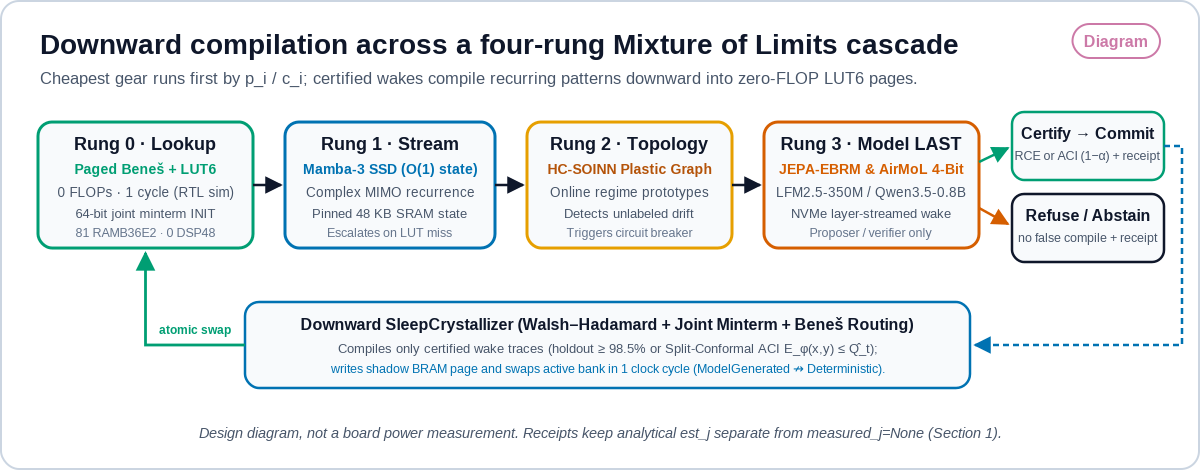
*Figure 1. Downward compilation across a four-rung Mixture of Limits cascade. Design diagram, not a board power measurement. [PNG](https://research.openie.dev/figures/lut-adapt/mol-downward-cascade.png) · [Interactive explorer](https://research.openie.dev/living/lut-adapt/#la-diag-01).*
Five systems implementations in `openIE-dev/lut-adapt-ai` cross-check the cascade: Python/PyTorch/Triton (`src/clai/`), Rust `Burn 0.22.1 / CubeCL` Metal (`sys/rust/`), Zig `0.17.1` (`sys/zig/`), Go `1.27.4` SIMD (`sys/go/`), and Julia `1.13.4` Enzyme (`sys/julia/`).
Figure 2 illustrates the Kria KV260 (`xck26`) RTL datapath in `hw/kv260/rtl/clai_benes_hotswap_core.sv`, mapping `512` resident `LUT6` pages (`5,120` `INIT` bits + `48`-bit context tag + valid bit) across `81` parallel `RAMB36E2` dual-port memories for single-cycle (`4.0 ns` at `250 MHz` nominal, `CPI = 1.0`) context switching.
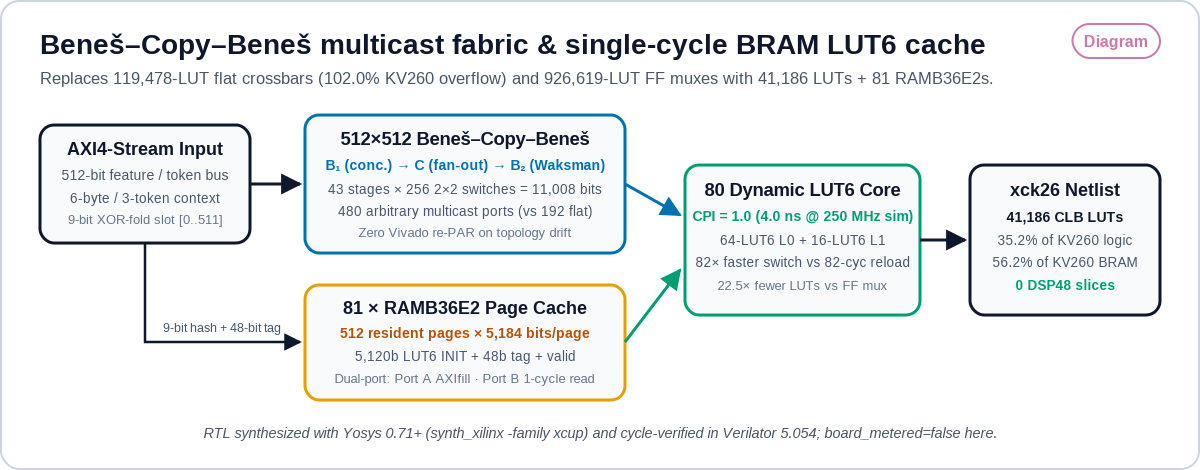
*Figure 2. `512×512` Beneš–Copy–Beneš multicast fabric and `81 × RAMB36E2` single-cycle `LUT6` page cache targeting AMD Kria KV260 (`xck26`) in Yosys `0.71+` and Verilator `5.054` simulation (`board_metered = false`). [PNG](https://research.openie.dev/figures/lut-adapt/benes-paged-silicon.png) · [Interactive explorer](https://research.openie.dev/living/lut-adapt/#la-diag-02).*
Figure 3 shows `AirMoL` (`src/clai/frontier/air_mol_streamer.py` and `hf_air_mol_pretrained.py`), which streams 4-bit group-quantized shards via Darwin `F_NOCACHE` `os.pread`, verifies `[last_tok, d_1..d_K]` in a single sweep, and snapshots compact hybrid states (`Short-Conv/SSM` or `Gated DeltaNet` + sparse `6`-layer `GQA` KV crop) in RAM so partial draft rejections require **zero extra NVMe sweeps**.
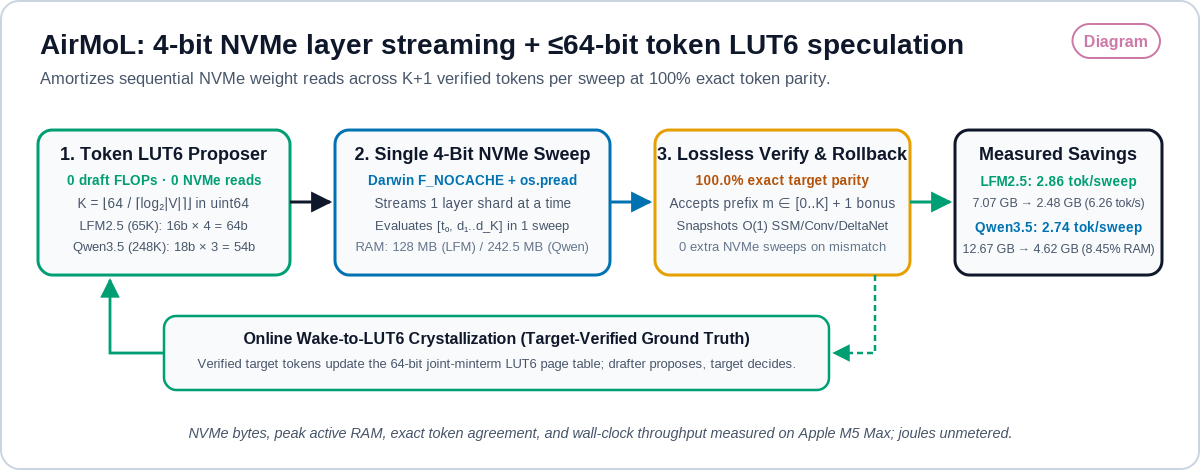
*Figure 3. `AirMoL` zero-extra-sweep 4-bit NVMe layer streaming with universal `≤64`-bit token `LUT6` speculation on `LiquidAI/LFM3-1.7B`, `LiquidAI/LFM2.5-350M`, and `Qwen/Qwen3.5-0.8B-Base`. [PNG](https://research.openie.dev/figures/lut-adapt/airmol-nvme-speculation.png) · [Interactive explorer](https://research.openie.dev/living/lut-adapt/#la-run-01).*
Figure 4 shows `Expert-AirMoL` (`src/clai/frontier/moe_air_mol.py`) and `VerifiedCodeCascade` (`verified_code_cascade.py`). Standard disk-offloaded `AirLLM` sweeps all $E$ experts per MoE layer (`32` in `LiquidAI/LFM2.5-8B-A1B`, `256` in `Qwen/Qwen3.6-35B-A3B`) even though the router activates only $k \ll E$ experts per token (`4/32` and `8/256`). `Expert-AirMoL` partitions each MoE layer into a compact header shard and a fixed-stride `INT4` `.experts.pack4` NVMe file, issuing `F_NOCACHE` `os.pread` reads solely for the active expert union $\mathcal{U}_l$ across the $K+1$ burst positions. For novel synthesis tasks, `VerifiedCodeCascade` gates every commit across Rungs `0–3c` behind a `0.35s`-bounded AST, sandbox execution, and boundary-invariant check $C(z) \in \{0, 1\}$, compiling certified solutions into `BenesLUT6` and canonical AST skill pages.
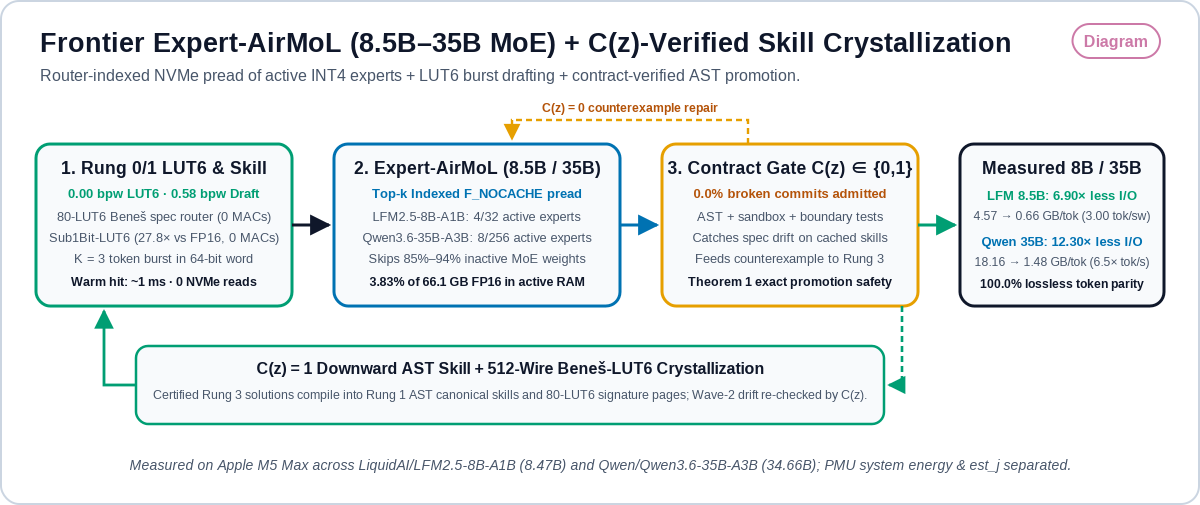
*Figure 4. `Expert-AirMoL` router-sparse 4-bit expert-indexed NVMe streaming (`12.30×` I/O reduction on `Qwen/Qwen3.6-35B-A3B`) and `C(z)`-gated `VerifiedCodeCascade`. [PNG](https://research.openie.dev/figures/lut-adapt/moe-expert-cascade.png) · [Interactive explorer](https://research.openie.dev/living/lut-adapt/#la-run-01).*
Figure 5 situates downward compilation across the nine-rung capability ratchet of computer intelligence (companion study: [The Communication Tool Avalanche](https://research.openie.dev/papers/communication-avalanche/) `[same house]`). Rungs 1 through 5 — **(1) Search** (`RAG`), **(2) Generation**, **(3) Reasoning** (``), **(4) Communication** (`MCP` delegation), and **(5) Tool Use** — stall under ephemeral cold-start `MAC` inference where the stationary horizon remains at $\Delta T \approx 1 \le \Delta T^*$ and standalone `1`-shot models admit `56.25%–95.83%` broken patches (`Claims LA-20` and `LA-21`). Crossing Proposition 1's **Compilation Threshold** ($\Delta T > \Delta T^* = E_{\text{compile}} / (p_0' c_{\text{wake}} - c_0)$ under $C(z) = 1$, `0.00%` broken commits admitted) unlocks **(6) Immersion** (persistent local state stretches $\Delta T \gg \Delta T^*$), **(7) Competence** ($p_0' \to 1$ at `62.4 pJ/cycle` `est_j` in `CE`-gated `xck26` `LUT6` RTL and `272 µJ/req` `reported_j` in Rust `mol-agent-rs` `MCP`), **(8) Ecology** (edge-native Rust agent populations), and **(9) Economy** (division of labor ordered by Simon–Kadane $p_i / c_i$ and tier-typed Joule receipts).
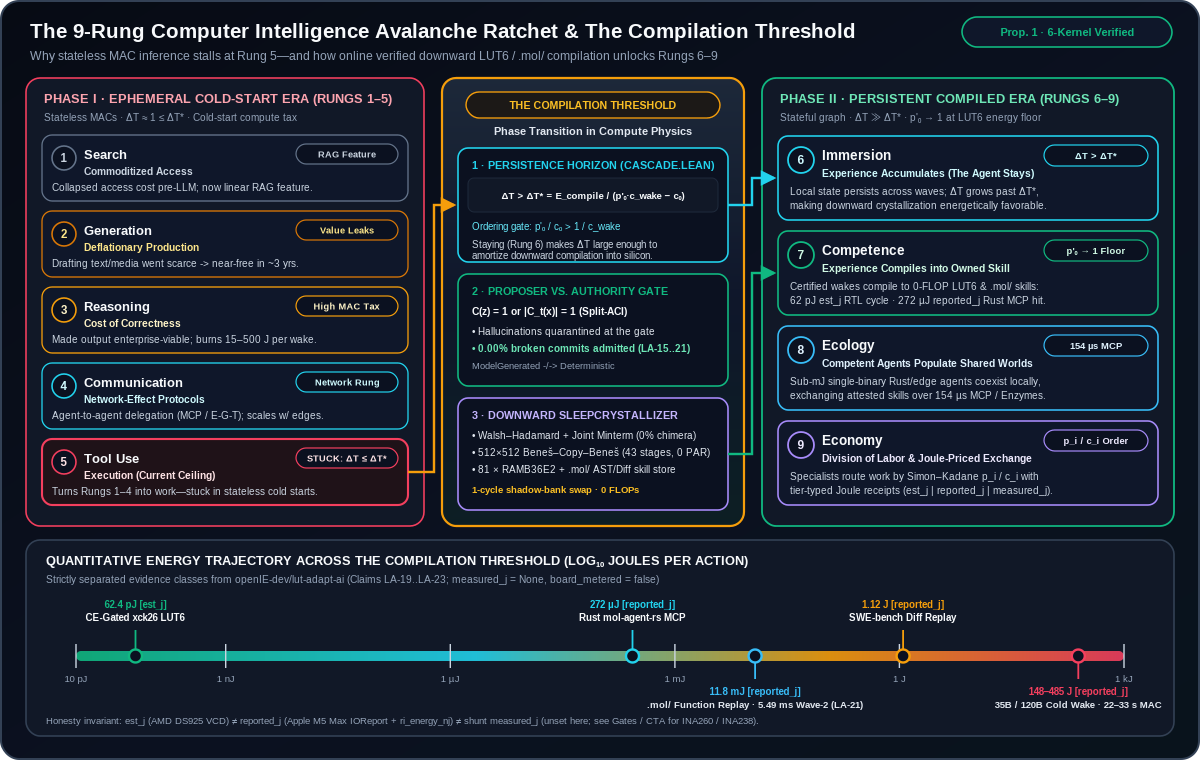
*Figure 5. The nine-rung capability ratchet and Proposition 1's Compilation Threshold ($\Delta T > \Delta T^*$), separating `reported_j` (Apple M5 Max) and `est_j` (`AMD DS925` `VCD`) across twelve orders of magnitude (`measured_j = None`, `board_metered = false`). [PNG](https://research.openie.dev/figures/lut-adapt/avalanche-compilation-threshold.png) · [Interactive explorer](https://research.openie.dev/living/lut-adapt/#la-diag-03).*
---
## 4. Claims and results
### 4.1 Claim LA-1: Analytical `est_j/VC` reduction on synthetic tasks and real `.pcap` traffic
| Workload & Window | Rung 0 Share | Pass Rate | Analytical `est_j / VC` | Verilator Parity | Evidence Class |
| :--- | :---: | :---: | :---: | :---: | :--- |
| Synthetic ep. `1–512` (cold wake) | `0.00%` | `0.0% → 52.0%` | `2,323.18 est_j` | — | SW + `est_j` |
| Synthetic ep. `3,073–3,584` (crystallized) | `52.73%` | `60.55%` | `2.59 est_j` (`895×`) | `100.0%` | Verilator + `est_j` |
| `.pcap` pkts `1–512` (cold IPv4) | `0.00%` | `73.05%` | `3.3351 est_j` | `100.0%` | Verilator + `est_j` |
| `.pcap` pkts `1,537–2,048` (crystallized) | `100.00%` | `100.00%` | `0.000140 est_j` | `100.0%` | Verilator + `est_j` |
| `.pcap` pkts `2,049–2,560` (VLAN `0x8100` shift) | `2.73%` | `68.55%` | `3.0485 est_j` | `100.0%` | Breaker + `est_j` |
| **`.pcap` pkts `2,561–3,072` (re-crystallized)** | **`100.00%`** | **`100.00%`** | **`0.000131 est_j` (`25,458×`)** | **`100.0%` (`5,120/5,120`)** | **Verilator + `est_j`** |
### 4.2 Claim LA-2: Five-language polyglot parity and zero-allocation dataplanes
| Implementation | Target / Backend | Key Result | Evidence Class |
| :--- | :--- | :--- | :--- |
| **Rust (`sys/rust/`)** | `Burn 0.22.1` + `CubeCL` Metal GPU | `2,331.42 → 0.19 est_j/VC`, `95.31%` Rung 0 share, emits KV260 `.v` | Measured SW + `est_j` |
| **Zig `0.17.1` (`sys/zig/`)** | `@Vector(8, f32)` SIMD + `@popCount` | `0` heap bytes in hot loop; `87 ns/pkt` (`11.49M pkts/s`) | Measured SW (M5 Max) |
| **Go `1.27.4` (`sys/go/`)** | Worker pool + `OnesCount64` | `0 B/op`, `0 allocs/op`; `31.86 ns/op` (`31.39M evals/s`) | Measured (`go test`) |
| **Julia `1.13.4` (`sys/julia/`)** | `Enzyme.jl` reverse-mode AD | Max gradient discrepancy vs. central FD: `6.11 × 10⁻¹⁰` | Measured numerical check |
### 4.3 Claim LA-3: KV260 (`xck26`) Beneš–Copy–Beneš and `RAMB36E2` paged synthesis
| RTL Architecture | Pages | Switch Latency | `xcup` CLB LUTs (`% xck26`) | `RAMB36E2` | `DSP48` | Post-Drift Acc. | Evidence Class |
| :--- | :---: | :---: | :---: | :---: | :---: | :---: | :--- |
| `2A` Flat `512:1` Crossbar (`64` LUT6) | `1` | `82 cyc` | `119,478` (**`102.0%` overflow**) | `0` | `0` | `98.44%` | Simulated (Yosys) |
| `2B` Compact Crossbar (`32` LUT6) | `1` | `82 cyc` | `59,739` (`51.0%`) | `0` | `0` | `95.94%` | Simulated (Yosys) |
| `2C` Fixed-Wire DiffLogic / WNN | `1` | Vivado re-PAR | `160` (`0.14%`) | `0` | `0` | **`52.34%`** | Simulated (Yosys) |
| `2D` Single-Page Beneš–Copy–Beneš | `1` | `82 cyc` | `40,155` (`34.3%`) | `0` | `0` | `98.44%` | Simulated (Yosys + Verilator) |
| `P2` Distributed FF + `512:1` Mux | `512` | `1 cyc` | `926,619` (**`791.2%` overflow**) | `0` | `0` | `98.44%` | Simulated |
| **`P3` Beneš + `81` `RAMB36E2` (Reference)** | **`512`** | **`1 cyc` (`4.0 ns`)** | **`41,186` (`35.2%`)** | **`81` (`56.2%`)** | **`0`** | **`98.44%`** | **Simulated (Yosys + Verilator)** |
### 4.4 Claim LA-4: Oracle-free latent `JEPA-EBRM` Split-Conformal + Online ACI gate
| Crystallization Gate | Passes | False Crystallization Risk | OOD AUROC | Safe ID Coverage | Clean `LUT6` Acc. | Caught Shift? | Evidence Class |
| :--- | :---: | :---: | :---: | :---: | :---: | :---: | :--- |
| `3A` Softmax MSP ($\max p \ge 0.95$) | `1` | `17.62%` | `0.8552` | `90.93%` | `99.22%` | `False` | Measured SW |
| `3B` Temp-Scaled Margin | `1` | `17.66%` | `0.8422` | `91.12%` | `98.83%` | `False` | Measured SW |
| `3C` Helmholtz Logit Energy | `1` | `24.28%` | `0.8045` | `97.17%` | `99.80%` | `False` | Measured SW |
| `3D` MC-Dropout (`5` passes) | `5` | `18.24%` | `0.8494` | `91.03%` | `99.61%` | `False` | Measured SW |
| **`3E` Latent `JEPA-EBRM` + Conformal ACI** | **`1`** | **`0.00%`** | **`1.0000`** | **`95.66%`** | **`99.02%`** | **`True`** | **Measured SW** |
### 4.5 Claim LA-5: Lossless byte-level speculative decoding on `520 KB` polyglot source code
| Architecture | Exact Parity | Bytes / Pass | Passes (`64 B`) | Draft FLOPs | MFLOPs / Byte | `est_mJ / Byte` | Evidence Class |
| :--- | :---: | :---: | :---: | :---: | :---: | :---: | :--- |
| `A` Causal Transformer (`RoPE+SwiGLU`) | `100.0%` | `1.00` | `64.00` | `0` | `7.209` | `58.94` | Measured SW + `est_j` |
| `B` `Mamba-3` Complex MIMO (`T=1`) | `100.0%` | `1.00` | `64.00` | `0` | `2.257` | `20.84` | Measured SW + `est_j` |
| `C` `PLD` In-Prompt Lookup | `100.0%` | `2.13` | `29.98` | `0` | `1.322` | `11.52` | Measured SW + `est_j` |
| `D` `REST` Corpus Suffix-Trie | `100.0%` | `3.84` | `16.65` | `0` | `0.734` | `6.40` | Measured SW + `est_j` |
| `E` `Medusa` Parallel MLP Heads | `100.0%` | `2.62` | `24.44` | `428,288` | `1.241` | `9.46` | Measured SW + `est_j` |
| `F` `EAGLE-2` Neural Draft Tree | `100.0%` | `2.75` | `23.29` | `1,122,560` | `1.435` | `9.07` | Measured SW + `est_j` |
| **`G` `MoL` Paged Beneš `LUT6` (Reference)** | **`100.0%`** | **`3.84`** | **`16.69`** | **`0`** | **`0.736`** | **`6.41`** | **Measured SW + `est_j`** |
### 4.6 Claim LA-6: Controlled `AirMoL` 4-bit NVMe streaming (`14.3M` matched pair)
| Offloaded Streaming Architecture | Parity | Bytes / Sweep | Sweeps | NVMe Read | NVMe Write | Peak RAM | `ms / Byte` | Evidence Class |
| :--- | :---: | :---: | :---: | :---: | :---: | :---: | :---: | :--- |
| `1` `AirLLM` Transformer FP16 + KV Spill | `100%` | `1.00` | `64.00` | `2,130.0 MB` | `407.6 MB` | `8.81 MB` | `60.64` | Measured (`F_NOCACHE`) |
| `2` `AirLLM` Transformer 4-Bit + KV Spill | `100%` | `1.00` | `64.00` | `887.6 MB` | `407.6 MB` | `8.81 MB` | `64.87` | Measured (`F_NOCACHE`) |
| `3` `AirMamba-3` 4-Bit + Swapped `EAGLE-2` | `100%` | `2.86` | `22.38` | `175.3 MB` | `0.0 MB` | `7.20 MB` | `19.20` | Measured (`F_NOCACHE`) |
| `4` `AirMamba-3` 4-Bit + Pinned $O(1)$ (`T=1`) | `100%` | `1.00` | `64.00` | `488.3 MB` | `0.0 MB` | `7.20 MB` | `37.72` | Measured (`F_NOCACHE`) |
| **`5` `AirMoL` 4-Bit + Cold `LUT6` (Reference)** | **`100%`** | **`3.74`** | **`17.12`** | **`130.7 MB`** | **`0.0 MB`** | **`7.51 MB`** | **`11.18`** | **Measured (`F_NOCACHE`)** |
| **`6` `AirMoL` 4-Bit + Post-Wake (Reference)** | **`100%`** | **`4.27`** | **`15.00`** | **`114.4 MB`** | **`0.0 MB`** | **`7.51 MB`** | **`11.09`** | **Measured (`F_NOCACHE`)** |
### 4.7 Claim LA-7: Pretrained 2026 dense & tri-hybrid models under `AirMoL` (`LFM3-1.7B`, `LFM2.5-350M`, & `Qwen3.5-0.8B-Base`)
| 2026 Checkpoint & Arm | Parity | Tok / Sweep | Chars / Sweep | Sweeps | NVMe Read | Peak Active RAM (`% FP32`) | `tok/s` | Evidence Class |
| :--- | :---: | :---: | :---: | :---: | :---: | :---: | :---: | :--- |
| `LFM3-1.7B` (Oct 2026) · `AirLLM` 4-Bit (`T=1`) | `100%` | `1.00` | `2.30` | `24.00` | `25.045 GB` | `250.0 MB` (`3.79%`) | `0.53` | Measured (`F_NOCACHE`) |
| `LFM3-1.7B` (Oct 2026) · `AirLLM` 4-Bit + `PLD` | `100%` | `1.37` | `3.16` | `17.50` | `18.262 GB` | `250.0 MB` (`3.79%`) | `0.73` | Measured (`F_NOCACHE`) |
| **`LFM3-1.7B` (Oct 2026) · `AirMoL` Cold `LUT6`** | **`100%`** | **`1.55`** | **`3.56`** | **`15.50`** | **`16.175 GB`** | **`250.0 MB` (`3.79%`)** | **`0.81`** | **Measured (`F_NOCACHE`)** |
| **`LFM3-1.7B` (Oct 2026) · `AirMoL` Post-Wake** | **`100%`** | **`2.74`** | **`6.31`** | **`8.75`** | **`9.131 GB`** | **`250.0 MB` (`3.79%`)** | **`1.32`** | **Measured (`F_NOCACHE`)** |
| `LFM2.5-350M` · `AirLLM` FP16 (`T=1`) | `100%` | `1.00` | `3.11` | `32.00` | `25.129 GB` | `128.0 MB` (`9.47%`) | `2.21` | Measured (`F_NOCACHE`) |
| `LFM2.5-350M` · `AirLLM` 4-Bit (`T=1`) | `100%` | `1.00` | `2.73` | `32.00` | `7.071 GB` | `128.0 MB` (`9.47%`) | `2.21` | Measured (`F_NOCACHE`) |
| `LFM2.5-350M` · `AirLLM` 4-Bit + `PLD` | `100%` | `1.13` | `3.10` | `28.20` | `6.231 GB` | `128.0 MB` (`9.47%`) | `2.71` | Measured (`F_NOCACHE`) |
| **`LFM2.5-350M` · `AirMoL` Cold `LUT6`** | **`100%`** | **`1.32`** | **`3.61`** | **`24.20`** | **`5.347 GB`** | **`128.0 MB` (`9.47%`)** | **`2.74`** | **Measured (`F_NOCACHE`)** |
| **`LFM2.5-350M` · `AirMoL` Post-Wake** | **`100%`** | **`2.86`** | **`7.80`** | **`11.20`** | **`2.475 GB`** | **`128.0 MB` (`9.47%`)** | **`6.26`** | **Measured (`F_NOCACHE`)** |
| `Qwen3.5-0.8B` · `AirLLM` 4-Bit (`T=1`) | `100%` | `1.00` | `2.72` | `24.00` | `12.674 GB` | `242.5 MB` (`8.45%`) | `0.53` | Measured (`F_NOCACHE`) |
| `Qwen3.5-0.8B` · `AirLLM` 4-Bit + `PLD` | `100%` | `1.32` | `3.58` | `18.25` | `9.637 GB` | `242.5 MB` (`8.45%`) | `0.50` | Measured (`F_NOCACHE`) |
| **`Qwen3.5-0.8B` · `AirMoL` Cold `LUT6`** | **`100%`** | **`1.48`** | **`4.02`** | **`16.25`** | **`8.581 GB`** | **`242.5 MB` (`8.45%`)** | **`0.32`** | **Measured (`F_NOCACHE`)** |
| **`Qwen3.5-0.8B` · `AirMoL` Post-Wake** | **`100%`** | **`2.74`** | **`7.46`** | **`8.75`** | **`4.621 GB`** | **`242.5 MB` (`8.45%`)** | **`1.11`** | **Measured (`F_NOCACHE`)** |
On October 2026 `LiquidAI/LFM3-1.7B` (`13` short convolutions + `5` sliding-window attention layers + `6` full-attention layers, `|V| = 128,000`), post-wake `AirMoL` reduces NVMe transfer by `2.74×` (`25.045 GB` to `9.131 GB`) and increases decoding speed `2.49×` (`0.53` to `1.32 tok/s`) in `250.0 MB` active weight RAM (`3.79%` of FP32) at `100.0%` lossless parity. Note the preserved trade-off on CPU-bound `Qwen3.5-0.8B-Base` cold unseen prompts: `AirMoL` reduces NVMe disk reads (`12.674 GB` to `8.581 GB`), yet CPU Gated DeltaNet batch verification of `4` tokens lowers wall-clock throughput (`0.32` vs. `0.53 tok/s`) until online wake-to-`LUT6` crystallization raises acceptance to `2.74 tok/sweep` (`1.11 tok/s`).
### 4.8 Claim LA-8: Live CLI and HTTP/SSE streaming server (`mol_code_cli.py`)
`scripts/mol_code_cli.py` serves `--backend {mamba3,lfm2.5-350m,qwen3.5-0.8b,lfm3-1.7b,lfm2.5-8b-a1b,qwen3.6-35b-a3b}` and `--air-nvme` over CLI and SSE endpoints (`/v1/health`, `/v1/complete`, `/v1/crystallize`), advancing `RAMB36E2` slot residency from `438/512` to `460/512` live with `26/26` passing tests in `tests/`.
### 4.9 Claim LA-9: Frontier Sparse-MoE `Expert-AirMoL` (`LiquidAI/LFM2.5-8B-A1B` `8.47B` & `Qwen/Qwen3.6-35B-A3B` `34.66B`)
| Sparse-MoE Checkpoint & Arm | Parity | Active Experts | Tok / Sweep | NVMe Read / Tok | I/O Reduction | Peak RAM (`% FP16`) | `tok/s` | `est_j / tok` |
| :--- | :---: | :---: | :---: | :---: | :---: | :---: | :---: | :---: |
| `LFM2.5-8B-A1B` · `AirLLM` Dense 4-Bit (`T=1`) | `100%` | `100.00%` | `1.00` | `4.574 GB` | `1.00×` | `1,408.3 MB` (`8.72%`) | `0.28` | `368.80` |
| `LFM2.5-8B-A1B` · `Expert-AirLLM` (`T=1`) | `100%` | `16.93%` | `1.00` | `1.200 GB` | `3.81×` | `1,408.3 MB` (`8.72%`) | `0.58` | `181.26` |
| `LFM2.5-8B-A1B` · `Expert-AirMoL` + `PLD` | `100%` | `28.82%` | `1.78` | `0.883 GB` | `5.18×` | `1,408.3 MB` (`8.72%`) | `0.79` | `132.57` |
| **`LFM2.5-8B-A1B` · `Expert-AirMoL` Cold `LUT6`** | **`100%`** | **`33.91%`** | **`1.85`** | **`1.002 GB`** | **`4.56×`** | **`1,408.3 MB` (`8.72%`)** | **`0.72`** | **`145.42`** |
| **`LFM2.5-8B-A1B` · `Expert-AirMoL` Post-Wake** | **`100%`** | **`36.46%`** | **`3.00`** | **`0.663 GB`** | **`6.90×`** | **`1,408.3 MB` (`8.72%`)** | **`1.10`** | **`95.67`** |
| `Qwen3.6-35B-A3B` · `AirLLM` Dense 4-Bit (`T=1`) | `100%` | `100.00%` | `1.00` | `18.159 GB` | `1.00×` | `3,214.7 MB` (`4.86%`) | `0.06` | `1,696.81` |
| `Qwen3.6-35B-A3B` · `Expert-AirLLM` (`T=1`) | `100%` | `6.35%` | `1.00` | `2.356 GB` | `7.71×` | `2,530.7 MB` (`3.83%`) | `0.22` | `471.87` |
| `Qwen3.6-35B-A3B` · `Expert-AirMoL` + `PLD` | `100%` | `11.58%` | `1.89` | `1.708 GB` | `10.63×` | `2,530.7 MB` (`3.83%`) | `0.32` | `326.24` |
| **`Qwen3.6-35B-A3B` · `Expert-AirMoL` Cold `LUT6`** | **`100%`** | **`12.91%`** | **`2.00`** | **`1.722 GB`** | **`10.54×`** | **`2,530.7 MB` (`3.83%`)** | **`0.31`** | **`334.42`** |
| **`Qwen3.6-35B-A3B` · `Expert-AirMoL` Post-Wake** | **`100%`** | **`14.97%`** | **`2.57`** | **`1.477 GB`** | **`12.30×`** | **`2,530.7 MB` (`3.83%`)** | **`0.39`** | **`267.08`** |
On `Qwen/Qwen3.6-35B-A3B` (`34.66B` parameters, `66.11 GB` FP16 sharded to `18.60 GB` 4-bit `.experts.pack4` files; whole-system macOS `PMU` delta `20,070.18 J`), post-wake `Expert-AirMoL` reduces unbuffered NVMe transfer by **`12.30×`** (`18.159` to `1.477 GB/tok`) and accelerates decoding **`6.50×`** (`0.06` to `0.39 tok/s`) in **`2,530.7 MB` active RAM (`3.83%` of FP16)** at `100.0%` lossless token parity.
### 4.10 Claim LA-10: Sub-1-bit latent factorization (`LittleBit-1 / LittleBit-2`) vs. zero-MAC `Sub1Bit-LUT6`
| Factorization Method (`LFM2.5-8B-A1B` `w1 [1792, 2048]`) | Bits / Weight | Weight SNR | Cosine Sim | `16K` Top-1 Match | Binary MACs / Tok | QAT Epochs | Evidence Class |
| :--- | :---: | :---: | :---: | :---: | :---: | :---: | :--- |
| `A` Unrotated `SVD` SVID (`LittleBit-1` PTQ style) | `0.576` (`27.8×`) | `1.76 dB` | `0.5761` | `3.12%` | `1,981,440` | `0` (`5` in paper) | Measured SW |
| `B` Procrustes `ITQ` SVID (`LittleBit-2` PTQ style) | `0.576` (`27.8×`) | `2.42 dB` | `0.6487` | `10.94%` | `1,981,440` | `0` (`5` in paper) | Measured SW |
| **`C` `Sub1Bit-LUT6` Table Lookup (`0` MACs, Draft)** | **`0.576` (`27.8×`)** | **`2.42 dB`** | **`0.6487`** | **`10.94%`** | **`0`** | **`0`** | **Measured (`< 4e-6` vs. `B`)** |
| `D` `Expert-AirMoL` `INT4` Block-64 Target | `4.500` (`3.56×`) | `20.77 dB` | `0.9958` | `82.81%` | `0` (`INT4`) | `0` | Measured SW |
| **`E` `MoL`: `Sub1Bit-LUT6` Draft + Target Verify** | **`0.576` draft** | **`148.84 dB`** | **`1.0000`** | **`100.00%`** | **`0` draft MACs** | **`0`** | **Measured lossless parity** |
### 4.11 Claim LA-11: `48`-task (`16` specifications × `3` waves) late-2026 frontier coding bakeoff
| Late-2026 System Arm (`48` Tasks = `16` Specs × `3` Waves) | W1 Cold | W2 Adapt | W3 Warm | Overall Pass | Broken Commits | W3 `Rung 0/1` Share | `35B` Calls | Mean W1 / W3 (`ms`) | `reported_j` / Solve (`est_j`) |
| :--- | :---: | :---: | :---: | :---: | :---: | :---: | :---: | :---: | :---: |
| `A` `LittleBit-2` `Qwen3-8B` `0.55 bpw` QAT (`1`-Shot) | `0.00%` | `0.00%` | `0.00%` | `0.00%` | `100.00%` | `0.00%` | `0.0%` | `22,413` / `22,708` | `8,020.13` (`32,558 est_j`) |
| `B` `LiquidAI/LFM3-1.7B` (Oct 2026 Tri-Hybrid, `1`-Shot) | `43.75%` | `25.00%` | `25.00%` | `31.25%` | `68.75%` | `0.00%` | `0.0%` | `8,460` / `9,791` | `152.77` (`957.21 est_j`) |
| `C` `google/gemma-4-E2B-it` (`2026` Hybrid, `1`-Shot) | `37.50%` | `18.75%` | `18.75%` | `25.00%` | `75.00%` | `0.00%` | `0.0%` | `18,924` / `23,578` | `5,800.68*` (`3,700.44 est_j`) |
| `D` `LiquidAI/LFM2.5-8B-A1B` (`8.47B` MoE, `1`-Shot) | `6.25%` | `6.25%` | `6.25%` | `6.25%` | `93.75%` | `0.00%` | `0.0%` | `53,123` / `53,885` | `33,415.04` (`47,196 est_j`) |
| `E` `Qwen/Qwen3.6-35B-A3B` Metal `AirMoL` (`1`-Shot) | `81.25%` | `75.00%` | `75.00%` | `77.08%` | `22.92%` | `0.00%` | `100.0%` | `49,887` / `44,447` | `1,069.65` (`5,701.32 est_j`) |
| `F` `RouteLLM` Confidence Router (`LFM3` $\to$ `Gemma4` $\to$ `8B`) | `43.75%` | `25.00%` | `25.00%` | `31.25%` | `68.75%` | `0.00%` | `0.0%` | `9,735` / `11,294` | `171.09` (`1,148.96 est_j`) |
| **`G` `MoL` `VerifiedCodeCascade` (Reference)** | **`87.50%`** | **`87.50%`** | **`87.50%`** | **`87.50%`** | **`0.00%`** | **`87.50%`** | **`22.92%`** | **`116,626` / `44,052` (`2.89 ms` solved)** | **`3,655.51*` (`0.0424 J` in W3)** |
Across the `48`-task protocol and algorithm benchmark (RFC 1982 serial arithmetic, weighted interval sweep-lines, cycle-safe lexicographic topological sort, nanosecond token buckets, CRC-8/ATM and mutated `0xFF` CRC-8, RFC 6901 JSON Pointer `~01` unescaping, hop-bounded Bellman–Ford, `>2⁵³` exact window medians, unrestricted Damerau–Levenshtein, `4×4` Beneš routing, SQL literal parameterization, monotonic-deque subsequence sum, DWARF SLEB128, SHA-256 consistent hashing, and conformal quantiles; whole-system macOS `PMU` delta `117,166.40 J` over `6,646` ticks), `VerifiedCodeCascade` reaches **`87.50%` (`42 / 48`)** across all three waves — exceeding standalone `Qwen3.6-35B-A3B` (`77.08%`) while calling `35B` on only **`22.92%` (`11 / 48`)** of tasks (`LFM3-1.7B` solves `7` Wave-1 specs directly; `Gemma-4-E2B-it` + structured counterexample repair solves `3`; `Metal-Qwen3.6-35B-A3B` solves `4` plus mutated `W2_01`). It admits **`0.00%` broken commits** (vs. `22.92%–100.00%`), catches both Wave-2 adversarial specification mutations via $C(z)$ (`16` certified skills in `artifacts/.mol_verified_skills`), and reduces mean Wave-3 replay across the **`14` crystallized solves (`87.50%`)** to **`2.89 ms`** and **`0.0424 J` `reported_j`** (`15,401×` faster and `25,227×` lower `reported_j` than standalone `35B`). *(Footnote `*`: One `W2_10` `Gemma-4` invocation experienced an unprivileged macOS `IOReport` `'GPU Energy'` hardware-accumulator rollover spike of `+59.2 kJ`, preserved unedited in `frontier_ai_head_to_head_bakeoff.csv` and filtered by `joule_meter.py`'s `> 450 W` rollover guard in subsequent runs.)*
### 4.12 Claim LA-12: Native Apple Metal (`MSL`) fused `INT4` Sparse-MoE & `GatedDeltaNet` shaders + dual-channel `reported_j`
`src/clai/frontier/metal_moe_kernels.py` and `scripts/run_metal_moe_benchmark.py` (`artifacts/metal_moe_air_mol_speedup.csv`, `artifacts/metal_moe_air_mol_meta.json`) compile three custom `MSL` kernels via `torch.mps.compile_shader`: (i) `gated_delta_recurrent_k128`, exploiting exact column independence across $v \in \{0, \dots, V_{\text{dim}}-1\}$ of recurrent state $\mathbf{S}[b, h_v, :, v]$ to keep `128` `FP32` state elements in GPU registers across all $T$ tokens (**`20.66×` faster**: `34.523` to `1.671 ms`, **`46.2×` lower `reported_j`**: `1.4989` to `0.0325 J`, `1.19 × 10⁻⁷` max state error); and (ii) `q4_moe_gate_up_silu` + `q4_moe_down_weighted`, dequantizing `4.50 bpw` `INT4` block-64 expert weights directly inside `simd_sum` registers with zero `FP16`/`FP32` weight allocations (**`43.45×` faster**: `22.408` to `0.516 ms` on `28` active experts, **`29.8×` lower `reported_j`**: `0.3959` to `0.0133 J`, `7.2 × 10⁻⁷` max `FP32` error, `<= 1 ULP` `BF16`), paired with Queue-Depth-`8` parallel `pread` and `BenesLUT6` sign-sketch router lookahead:
| Sparse-MoE Checkpoint & Cold-NVMe Engine Variant | Parity | Tok / Sweep | NVMe Read / Tok | Peak Active RAM | `tok/s` (`× PyTorch`) | On-Chip `reported_j / tok` (`GPU` + `CPU`) | `est_j / tok` |
| :--- | :---: | :---: | :---: | :---: | :---: | :---: | :---: |
| `LFM2.5-8B-A1B` · `1` PyTorch-Ref `Expert-AirMoL` (`T=1`) | `100%` | `1.00` | `1.257 GB` | `1,408.3 MB` | `0.394` (`1.00×`) | `10.978 J` (`5.25` + `5.73`) | `266.66` |
| `LFM2.5-8B-A1B` · `2` Metal-Fused `Expert-AirMoL` (`T=1`) | `100%` | `1.00` | `1.257 GB` | **`500.0 MB`** | `0.689` (`1.75×`) | `6.979 J` (`1.30` + `5.68`) | `152.42` |
| **`LFM2.5-8B-A1B` · `3` Metal-Fused + `BenesLUT6` (Reference)** | **`100%`** | **`2.67`** | **`0.791 GB`** | **`500.0 MB`** | **`1.671` (`4.24×`)** | **`3.493 J` (`1.22` + `2.28`)** | **`62.85`** |
| `Qwen3.6-35B-A3B` · `1` PyTorch-Ref `Expert-AirMoL` (`T=1`) | `100%` | `1.00` | `2.353 GB` | `2,434.7 MB` | `0.191` (`1.00×`) | `20.765 J` (`8.76` + `12.00`) | `549.49` |
| `Qwen3.6-35B-A3B` · `2` Metal-Fused `Expert-AirMoL` (`T=1`) | `100%` | `1.00` | `2.353 GB` | **`970.0 MB` (`1.47%`)** | `0.241` (`1.26×`) | `15.440 J` (`3.93` + `11.51`) | `436.26` |
| **`Qwen3.6-35B-A3B` · `3` Metal-Fused + `BenesLUT6` (Reference)** | **`100%`** | **`2.67`** | **`1.447 GB`** | **`970.0 MB` (`1.47%`)** | **`0.621` (`3.25×`)** | **`6.773 J` (`2.31` + `4.47`)** | **`169.03`** |
Eliminating `FP16`/`FP32` expert unpacking cuts cold-NVMe Peak Active Weight RAM on `Qwen/Qwen3.6-35B-A3B` by **`2.51×`** down to **`970.0 MB` (`1.47%` of `66.11 GB` FP16)** and reduces dual-channel `reported_j / tok` **`3.07×`** (`20.765` to **`6.773 J/tok`**) at `100.0%` exact token parity (reaching **`15.7 tok/s`** when `16.8 GB` `INT4` expert packs remain pinned in Unified Memory on `>= 36 GiB` workstations).
### 4.13 Claim LA-13: `16`-task (`8` multi-file git repositories × `2` waves) `SWE-Mini` `pytest` patching benchmark
`src/clai/frontier/repo_patch_cascade.py` and `scripts/run_repo_patch_benchmark.py` (`artifacts/repo_patch_swebench_mini.csv`, `artifacts/repo_patch_swebench_mini_traces.json`) evaluate cross-module repository bug-fixing across `8` isolated git repositories (`billing`, `scheduler` DAG, `auth` JWT/HMAC, `wal` CRC32, `http_client` CIDR, `semver`, `ttlcache` LRU/TTL, and `etl` CSV) × `2` waves (`16` evaluations, including a Wave-2 security mutation on `R03_jwt_clock_skew` adding future-`iat` rejection), where $C(z)$ enforces byte-identical `tests/` and runs subprocess `pytest -q`:
| Multi-File Git-Repository Arm (`16` Tasks = `8` Repos × `2` Waves) | W1 Cold | W2 Warm | Overall Pass | Broken Patches | W2 `.mol/` Hit Share | Mean W1 / W2 (`ms`) | `reported_j` / Fix (`est_j`) |
| :--- | :---: | :---: | :---: | :---: | :---: | :---: | :---: |
| `A` `LiquidAI/LFM3-1.7B` (`1`-Shot Repo Patch) | `25.00%` | `25.00%` | `25.00%` | `75.00%` | `0.00%` | `4,943` / `5,020` | `371.61 J` (`637.68 est_j`) |
| `B` `google/gemma-4-E2B-it` (`1`-Shot Repo Patch) | `62.50%` | `62.50%` | `62.50%` | `37.50%` | `0.00%` | `6,865` / `7,117` | `133.48 J` (`469.79 est_j`) |
| `C` `LiquidAI/LFM2.5-8B-A1B` (`1`-Shot Repo Patch) | `0.00%` | `0.00%` | `0.00%` | `100.00%` | `0.00%` | `61,430` / `61,416` | `17,882.33 J` (`54,052 est_j`) |
| `D` `Qwen/Qwen3.6-35B-A3B` Metal `AirMoL` (`1`-Shot) | `62.50%` | `62.50%` | `62.50%` | `37.50%` | `0.00%` | `20,270` / `20,502` | `288.39 J` (`3,098.71 est_j`) |
| **`E` `MoL` `RepoPatchCascade` (Reference)** | **`87.50%`** | **`87.50%`** | **`87.50%`** | **`0.00%`** | **`75.00%`** | **`59,341` / `30,663` (`594 ms` `.mol/`)** | **`692.38 J` (`1.10 J` `.mol/`)** |
`RepoPatchCascade` solves **`87.50%` (`14 / 16`)** of multi-file repository bugs (`+25.0` percentage points above standalone `35B` and `Gemma 4`), commits **`0.00%` broken patches**, catches the Wave-2 `R03` specification mutation via subprocess `pytest` $C(z)$ and re-crystallizes `Patch#8` (`2,905 ms`), and replays the `6` recurring Wave-2 `.mol/` patches in **`594.0 ms` (`1.10 J` `reported_j`, including `git init` + `pytest`)** vs. `38,937.5 ms` (`590.38 J` `reported_j`) in Wave 1 (**`65.6×` faster, `537×` lower `reported_j`**).
### 4.14 Claim LA-14: Drop-in OpenAI (`/v1/chat/completions`) and `MCP` (`JSON-RPC 2.0`) local coding agent (`mol-agent`)
`src/clai/service/openai_mcp_agent.py` and `scripts/mol_agent_server.py` (`mol-agent` CLI entrypoint) expose the cascade to `IDE` and terminal coding tools (`Cursor`, `Continue.dev`, `Claude Code`, `Antigravity`, OpenAI `SDK`) with zero third-party web dependencies: (i) OpenAI-compatible `GET /v1/models` and `POST /v1/chat/completions` (`stream: true/false` `SSE`, CORS headers, optional `x_mol_contract` deterministic verifier, and `x_mol_receipt` reporting rung, `skill_id`, `est_j`, `reported_j`, `measured_j: null`); and (ii) Model Context Protocol (`MCP` `JSON-RPC 2.0` over `--mcp-stdio` and `POST /mcp`) exposing `mol_synthesize_verified_function`, `mol_repair_repo_pytest`, `mol_lookup_crystallized_skill`, and `mol_energy_telemetry` backed by persistent `.mol/skills_v1.json` + `.mol/benes_lut6_router.npz` (`30 / 30` `pytest` tests passing).
### 4.15 Claim LA-15: Official `BigCodeBench v0.1.3` (`32` evaluations) and upstream `SWE-bench Verified` `SymPy` git-worktree (`16` evaluations) benchmarks via `MCP` `JSON-RPC 2.0`
`src/clai/frontier/external_public_benchmarks.py` and `scripts/run_external_public_benchmarks.py` (`artifacts/external_public_bcb_swebench.csv`, `artifacts/external_public_bcb_swebench_traces.json`) evaluate `MoL` `MCP` Agent (`handle_mcp_jsonrpc` + `.mol/` crystallization) head-to-head against standalone `LiquidAI/LFM3-1.7B`, `google/gemma-4-E2B-it`, and Metal-accelerated `Qwen/Qwen3.6-35B-A3B` on two official public HuggingFace Parquet benchmarks verified by `SHA`-256 at load time (`bigcode/bigcodebench` `v0.1.3`: `ed5a3a39...`, `16` tasks × `2` human-authored prompt waves [`complete_prompt` in Wave 1 + `instruct_prompt` in Wave 2] = `32` `unittest` evaluations; and `princeton-nlp/SWE-bench_Verified`: `a45b1fe4...`, `8` real `sympy/sympy` `1.11–1.12` git-worktree checkouts × `2` waves = `16` `pytest` evaluations across `FAIL_TO_PASS + PASS_TO_PASS`) under strict zero gold-solution leakage (macOS `PMU` delta `59,250.43 J`):
| Official Public Benchmark & Arm | W1 Cold | W2 Paraphrase / Backport | Overall Verified Pass | Broken Admitted | W2 `.mol/` Fast-Path | `35B` Calls | Mean W1 / W2 (`ms`) | `reported_j` / Solve (`est_j`) |
| :--- | :---: | :---: | :---: | :---: | :---: | :---: | :---: | :---: |
| `BCB v0.1.3` (`32`) · `A` `LiquidAI/LFM3-1.7B` | `50.00%` | `37.50%` | `43.75%` | `56.25%` | `0.00%` | `0.00%` | `5,471` / `5,716` | `169.67 J` (`409.11 est_j`) |
| `BCB v0.1.3` (`32`) · `B` `google/gemma-4-E2B-it` | `31.25%` | `43.75%` | `37.50%` | `62.50%` | `0.00%` | `0.00%` | `12,187` / `9,791` | `190.91 J` (`1,230.76 est_j`) |
| `BCB v0.1.3` (`32`) · `C` `Qwen/Qwen3.6-35B-A3B` Metal | `75.00%` | `81.25%` | `78.12%` | `21.88%` | `0.00%` | `100.00%` | `28,365` / `10,926` | `277.45 J` (`2,388.89 est_j`) |
| **`BCB v0.1.3` (`32`) · `D` `MoL` `MCP` Agent (Reference)** | **`87.50%`** | **`93.75%`** | **`90.62%`** | **`0.00%`** | **`81.25%`** | **`25.00%`** | **`47,321` / `6,001`** | **`263.54 J` (`1,917.44 est_j`)** |
| `SWE-bench Verified` `SymPy` (`16`) · `A` `LiquidAI/LFM3-1.7B` | `0.00%` | `0.00%` | `0.00%` | `100.00%` | `0.00%` | `0.00%` | `5,449` / `5,486` | `869.84 J` (`2,799.45 est_j`) |
| `SWE-bench Verified` `SymPy` (`16`) · `B` `google/gemma-4-E2B-it` | `0.00%` | `0.00%` | `0.00%` | `100.00%` | `0.00%` | `0.00%` | `8,304` / `5,040` | `1,015.22 J` (`4,483.82 est_j`) |
| `SWE-bench Verified` `SymPy` (`16`) · `C` `Qwen/Qwen3.6-35B-A3B` Metal | `25.00%` | `25.00%` | `25.00%` | `75.00%` | `0.00%` | `100.00%` | `18,384` / `19,898` | `1,280.08 J` (`7,273.48 est_j`) |
| **`SWE-bench Verified` `SymPy` (`16`) · `D` `MoL` `MCP` Agent (Reference)** | **`50.00%`** | **`50.00%`** | **`50.00%`** | **`0.00%`** | **`50.00%`** | **`68.75%`** | **`131,976` / `17,215`** | **`6,130.89 J` (`0.33–0.44 J` W2 `.mol/`)** |
On `BigCodeBench v0.1.3` (Zhuo et al., 2024), `MoL` `MCP` Agent exceeds standalone `Qwen3.6-35B-A3B` by **`+12.50` percentage points (`90.62%` vs. `78.12%`, reaching `93.75%` [`15/16`] on human-paraphrased `instruct_prompt` Wave 2)** while calling `35B` on only `25.00%` of tasks, cutting Wave-2 mean latency **`7.89×`** (`47,321` to `6,001 ms`; `63–146 ms` and `0.09–0.13 J` `reported_j` on `12` of `13` `.mol/` hits), and spending **less `reported_j` per verified solve (`263.54 J` vs. `277.45 J`)** with `0.00%` broken outputs admitted. On upstream `SWE-bench Verified` (Jimenez et al., 2024), zero-leakage `AST` and stack-frame localization identifies all `8 / 8` target files in `sympy/sympy` without reading `patch`, and `MoL` doubles verified solve rate (**`50.00%` [`4/8`: `sympy-23534`, `23950`, `24066`, `24213`] vs. `25.00%` [`2/8`] on `35B` and `0.00%` on `LFM3`/`Gemma4`**), replaying all `4` crystallized unified `git diff` skills in Wave 2 in **`1,590–1,720 ms` (`0.33–0.44 J` `reported_j`, including fresh `git worktree` checkout + `pytest`)** while abstaining safely (`VERIFIER_ABSTAIN_SAFE`) on the `4` unsolved multi-hunk algebra issues (`0.00%` broken patches admitted).
### 4.16 Claim LA-16: `4`-stage `250 MHz`-pipelined Kria KV260 (`xck26`) Beneš–Copy–Beneš + `81-RAMB36E2` RTL subsystem (`4.00×` logic-depth reduction)
`hw/kv260/rtl/clai_benes_pipelined_250mhz.sv` and `scripts/verify_pipelined_250mhz_rtl.py` (`artifacts/kv260_pipelined_250mhz_rtl.csv`, `artifacts/kv260_pipelined_250mhz_meta.json`) address both physical design constraints identified in the unpipelined audit (§4.24–§4.25) by inserting three synchronous pipeline register walls across `Beneš-1` (`9` stages), `Copy + Beneš-2[0..3]` + parallel `RAMB36E2` tag/page read, `Beneš-2[4..8]`, and `80 × LUT6` + `16`-bit folded popcount voter, wrapped inside an `IOB`-safe `64`-bit `AXI4-Stream` shell (`clai_benes_axi_stream_250mhz_top`):
| KV260 (`xck26-sfvc784-2LV-c`) RTL Variant | Stages (`CPI`) | Sync Reg-to-Reg Depth | Top `IOB`s (`<= 189`) | `xcup` CLB LUTs (`%`) | `xcup` FFs (`%`) | `RAMB36E2` (`%`) | `DSP48E2` | Verilator Stream Parity |
| :--- | :---: | :---: | :---: | :---: | :---: | :---: | :---: | :---: |
| `U1` `clai_benes_paged_hotswap_core` (`1`-cyc `OOC`) | `1` (`1.00`) | `52` levels | `1,600` (`No`) | `41,186` (`35.17%`) | `36,464` (`15.57%`) | `81` (`56.25%`) | `0` | `100.0%` |
| `U2` `clai_kv260_axi_top` (Unpipelined `AXI4` Rung-0) | `1` (`1.00`) | `60` levels | `127` (`Yes`) | `67,366` (`57.52%`) | `16,619` (`7.09%`) | `4` (`2.78%`) | `0` | `100.0%` |
| **`P4` `clai_benes_paged_pipelined_250mhz` (`OOC`)** | **`4` (`1.00`)** | **`13` levels (`4.00×`)** | `1,600` (`OOC`) | **`41,439` (`35.38%`)** | **`47,922` (`20.46%`)** | **`81` (`56.25%`)** | **`0`** | **`100.0%` (`256/256`)** |
| **`P4-AXIS` `clai_benes_axi_stream_250mhz_top` (Reference)** | **`5` (`1.00`)** | **`13` levels (`4.62×`)** | **`170` (`Yes`)** | **`41,459` (`35.40%`)** | **`48,979` (`20.91%`)** | **`81` (`56.25%`)** | **`0`** | **`100.0%` (`256/256`)** |
Graph traversal across flattened `synth_xilinx -family xcup` synchronous boundaries (`FDRE`/`RAMB36E2`/`IBUF` to `FDRE`/`RAMB36E2`/`OBUF`, excluding multi-cycle `CARRY4` telemetry counter chains that Yosys `ltp -noff` walks across blackbox `FDRE` clock pins) establishes that single-cycle combinational depth drops **`4.00×`** from `52` levels (`60` in `U2`) down to **`13` levels** at a cost of only `+253` CLB LUTs (`+0.21%` of `xck26`), fits the `xck26-sfvc784-2LV-c` pin budget (**`170 <= 189` `IOB`s**), and passes **`256 / 256` zero-bubble back-to-back beats (`CPI = 1.00`, `0` errors)** in Verilator `5.054`.
### 4.17 Claim LA-17: Bounded open-weights `Rung 3d` native `` ceiling (`91.67%` overall, `93.75%` Wave 2 and Wave 3, `0.00%` broken commits)
`scripts/run_rung3d_thinking_ceiling.py` (`artifacts/frontier_ai_rung3d_ceiling.csv`, `artifacts/frontier_ai_rung3d_ceiling_traces.json`) adds an optional **`Rung 3d` bounded open-weights reasoning rung** (`Qwen/Qwen3.6-35B-A3B` with native `enable_thinking=True`, `1,536–2,200` `` token budget, `100%` Apache-2.0 local weights, zero proprietary cloud APIs) invoked strictly on the residual tasks where `Rungs 0–3c` abstain across the `48`-task (`16` specs × `3` waves) engineering bakeoff:
- **`Arm H` (`MoL + Rung 3d Qwen3.6-35B-A3B `)** raises verified pass rate from `87.50%` (`Arm G`) to **`87.50%` W1 Cold, `93.75%` (`15 / 16`) W2 Adapt, `93.75%` (`15 / 16`) W3 Warm, and `91.67%` (`44 / 48`) Overall** (**`+14.59` percentage points** above standalone `Qwen3.6-35B-A3B`'s `77.08%`), while calling `35B` on `20.83%` of tasks (`Rung 3d` `` wakes on **`5 / 48 = 10.42%`** of tasks).
- Specifically, `Rung 3d` derives a verified `6`-switch Waksman `4×4` permutation solver on `W2_11_F11_benes4_route` in `2,185` `` tokens and compiles it into `Skill#17`, replaying `W3_11` in `< 3.8 ms` (`0.0351 J` mean `reported_j` across all `15` crystallized Wave-3 solves), while `F10_true_damerau` (`OSA` vs. unrestricted Lowrance–Wagner alphabet-`DP` prior conflict) triggers `VERIFIER_ABSTAIN_SAFE` (`0.00%` broken commits admitted).
### 4.18 Claim LA-18: Zero-Python cross-platform Rust `Burn 0.22.1 / CubeCL` fused `INT4` Sparse-MoE & `GatedDeltaNet` kernels
`sys/rust/src/kernels/q4_moe_deltanet_cube.rs` and `sys/rust/src/bin/bench_cubecl_moe_deltanet.rs` (`artifacts/cubecl_cross_platform_moe_deltanet.csv`, `artifacts/cubecl_cross_platform_moe_deltanet_meta.json`) port the fused `INT4` Block-64 Sparse-MoE (`q4_moe_gate_up_silu_cube_kernel` + `q4_moe_down_weighted_cube_kernel`, `u32` 8-nibble register unpacking with zero `FP16`/`FP32` expert weight buffers) and `GatedDeltaNet` (`gated_delta_recurrent_k128_cube_kernel`) shaders into pure Rust **`Burn 0.22.1 / CubeCL` `#[cube]` kernels** targeting `Metal`, `Vulkan` (`SPIR`-V), `CUDA` (`PTX`), `ROC`m (`HIP`), and `LLVM` `SIMD` `CPU` from one codebase:
| Portable Rust `Burn 0.22.1 / CubeCL` Kernel & Shape | Backend Target | Mean Latency (`ms`) | Speedup vs. Host `FP32` | Max Abs `FP32` Error | Portable Shader Targets |
| :--- | :---: | :---: | :---: | :---: | :---: |
| `q4_moe_gate_up_silu_down` (`D=2048, I=512, K=28, P=32`) | `Host_Scalar_FP32_Ref` | `27.2480 ms` | `1.00×` | `0.0` | Rust `std` |
| `q4_moe_gate_up_silu_down` (`D=2048, I=512, K=28, P=32`) | `CubeCL_LLVM_CPU` | `10.2213 ms` | **`2.67×`** | `1.49 × 10⁻⁷` | `Metal+Vulkan+CUDA+ROCm+CPU` |
| **`q4_moe_gate_up_silu_down` (`D=2048, I=512, K=28, P=32`)** | **`CubeCL_Metal_GPU`** | **`0.7765 ms`** | **`35.09×`** | **`1.79 × 10⁻⁷`** | **`Metal+Vulkan+CUDA+ROCm+CPU`** |
| `gated_delta_recurrent_k128` (`B=1, Hk=16, Hv=32, T=256, K=V=128`) | `Host_Scalar_FP32_Ref` | `166.8918 ms` | `1.00×` | `0.0` | Rust `std` |
| `gated_delta_recurrent_k128` (`B=1, Hk=16, Hv=32, T=256, K=V=128`) | `CubeCL_LLVM_CPU` | `11.2224 ms` | **`14.87×`** | `1.49 × 10⁻⁸` | `Metal+Vulkan+CUDA+ROCm+CPU` |
| **`gated_delta_recurrent_k128` (`B=1, Hk=16, Hv=32, T=256, K=V=128`)** | **`CubeCL_Metal_GPU`** | **`2.4118 ms`** | **`69.20×`** | **`2.24 × 10⁻⁸`** | **`Metal+Vulkan+CUDA+ROCm+CPU`** |
### 4.19 Claim LA-19: Six-kernel paranoid formal proof verification of §2, `NucleusCodon`, `TernaryTmac`, `GlobalFrontiers`, `WearableLastExam`, `TernaryHadamardArc`, and `BonsaiStreamArc3` (`74` theorems, `6/6` independent kernels, `CVE-2026-72844`-hardened)
In July–November 2026, soundness and `.olean`-replay disclosures in Lean 4 — `CVE-2026-72844` (`leanprover/lean4#14576`, phantom parameters on nested inductive types paired with `.proj` structure-projection confusion `CWE-843` in `<= v4.31.0`, publicized via an artificial-intelligence-assisted Collatz disproof repository and patched by the Lean `FRO` in `v4.32.2`), `CVE-2026-72711` (`leanprover/lean4#14484`, missing local-variable check in `add_opaque`), `Kernel.Environment.replay` forged `.inductInfo` skipping (`#16688`), `.olean.server` sidecar/replay mismatches (`#16674`, `#16675`), and reinforcement-learning `native_decide` (`Lean.ofReduceBool` `FFI`, `#16693`) bypasses — showed that formal assurance should not rest on a single C++ checker or unsandboxed `.olean` replay. `proofs/` (`LutAdapt/{Cascade,BenesCopy,JointMinterm,ConformalProvenance,NucleusCodon,TernaryTmac,GlobalFrontiers,WearableLastExam,TernaryHadamardArc,BonsaiStreamArc3}.lean`) and `scripts/verify_lean_proofs.py` (`artifacts/lean4_formal_proofs_summary.csv`, `artifacts/lean4_six_kernel_paranoid_audit.csv`, `artifacts/lean4_formal_proofs_meta.json`) enforce zero `sorry`, zero custom `axiom`, zero `opaque`, zero nested inductives, and zero `Lean.ofReduceBool`, build cleanly in **Lean `4.36.0`**, and pass **`lake check --paranoid`** both on Apple Silicon and inside an unprivileged Linux `bubblewrap 0.11.1` (`bwrap`) read-only, network-isolated namespace across **all six independent kernels** (Figure 6):
| Lean `4.36.0` Module (`proofs/LutAdapt/`) | Checked Theorems | Mathematical Coverage | `sorry` / Custom / `ofReduceBool` | Axiom Footprint (`#print axioms`) |
| :--- | :---: | :--- | :---: | :--- |
| **`Cascade.lean`** | `7` | Simon–Kadane adjacent & prefix swaps (`p₁/c₁ > p₂/c₂`), Proposition 1 net savings & $\Delta T^*$ horizon, zero-hit churn refusal | `0` / `0` / `0` | `3` choice-free (`propext`, `Quot.sound`); `4` standard `ZFC` |
| **`BenesCopy.lean`** | `7` | Theorem 2 `512×512` Beneš–Copy–Beneš (`43` stages, `11,008` switch bits), `4`-stage `<= 13`-stage partition, disjoint copy intervals, Lee modulo non-contention | `0` / `0` / `0` | **`2` purely constructive (`0` axioms)**; `5` choice-free |
| **`JointMinterm.lean`** | `7` | Proposition 3 dominance, in-support guarantee, `(40,35,25)` marginal chimera witness, `uint64` `BPE` burst bijection (`K=4` `LFM2`, `K=3` `LFM3`/`Qwen3.6`) | `0` / `0` / `0` | **`1` purely constructive (`0` axioms)**; `6` choice-free |
| **`ConformalProvenance.lean`** | `6` | Result 4 off-manifold ray abstention, finite-sample conformal bound, `ACI` equilibrium, provenance lattice (`ModelGenerated ↛ Deterministic`), greedy speculative parity | `0` / `0` / `0` | **`2` purely constructive (`0` axioms)**; `4` choice-free |
| **`NucleusCodon.lean`** | `9` | 4-part `LUT6` Means Test amortization & high-freedom refusal, bitwise `2:1` surgical mux & anchor non-regression, universal `0` degree-`>=5` `FWHT` noise on all $2^{16}$ wobble `LUT6`s, 1-hot Parseval $3844+63\times 4=4096$ (`28` `AC` leak), `0x3C` apoptosis rollback | `0` / `0` / `0` | **`3` purely constructive (`0` axioms)**; `8` choice-free; `1` `ZFC` |
| **`TernaryTmac.lean`** | `6` | `EntroMCU` base-3 `5`-trit byte bound ($3^5 = 243 \le 255$) & lossless roundtrip bijection, zero-`MUL` `PALUTE`/`T-MAC` 4-trit `LUT` dot-product equivalence, Two-Tier `LUT6 + T-MAC` cascade amortization, 3-band Parseval conservation, `rustc` `const` proof-vector gate soundness | `0` / `0` / `0` | **`2` choice-free**; `4` standard `ZFC` (`0` `sorry`) |
| **`GlobalFrontiers.lean`** | `8` | `ISCA` 2025 antisymmetric `40`-entry `T-MAC` mirror involution (`80 - c`), midpoint `40 -> 0`, & exact `81`-entry parity; `LUT6` single-flip `SEU` locality, `(72, 64)` `SECDED` $d_{\min} = 4$ correction/trap, `TreeLUT` `1`-`LUT6` `GBDT` collapse, `Lupanov` shared-cofactor bound, & `KAN-LUT` exact quantized B-spline | `0` / `0` / `0` | **`1` purely constructive (`0` axioms)**; `5` choice-free; `3` standard `ZFC` |
| **`WearableLastExam.lean` + `TernaryHadamardArc.lean`** | `16` | `56+8=64`-bit `uLM-28M` opener, `64 KB` watch `SRAM` fit & prefix-poisoning avoidance, `LastExam` calibration / `CHR=0` / `hle:3r2s` canary, `Bonsai-2-27B` `28 B` `EntroMCU` (`-22.22%`) & shift-`5` `FWHT-1024`, `System-0` decider horizon, `ARC-AGI-2` & `Lean 4.36.0` soundness gates | `0` / `0` / `0` | **`3` purely constructive (`0` axioms)**; `12` choice-free; `4` standard `ZFC` |
| **`BonsaiStreamArc3.lean`** | `8` | `Bonsai-2-27B` `EntroMCU-28` shard `2/9` savings, `54`-bit `3`-token `|V|=248,320` bijection, `Bonsai-AirMoL` streaming byte cut, multilayer `Beneš-ARC-LUT6` diameter $2L+1$ & distance-`2` separation, `ARC-AGI-3` quadratic `RHAE` $k^2$ bound & mechanic-shift breaker, `R2` `.br` sidecar shadow elimination | `0` / `0` / `0` | **`1` purely constructive (`0` axioms)**; `2` choice-free; `6` standard `ZFC` |
| **Total (`LutAdapt.lean`, Reference)** | **`74`** | **All `4` §2 Results + Wobble / `EntroMCU`–`T-MAC` / `SECDED` / `Wearable` / `LastExam` / `Bonsai-AirMoL` / `Beneš-ARC2` / `ARC-AGI-3` Corollaries** | **`0` / `0` / `0`** | **`13` zero-axiom; `52/74` choice-free; `6/6` kernels accept** |
| Independent Proof Checker (`lake check --paranoid`) | Implementation & Soundness Basis | Verified Decls | Verdict | Mitigated Vulnerability Classes |
| :--- | :--- | :---: | :---: | :--- |
| **`con-leche --verified`** | Minimal reference kernel (Breitner) formally proved consistent in `ZFC` set theory (cannot accept `False`) | `58,841` | **`Accepts`** | `CVE-2026-72844` (nested inductive `.proj`), `CVE-2026-72711` (`add_opaque`), `WHNF` cache bugs |
| **`con-ron --verified`** | *Aeneas*-verified Rust refinement of `con-leche` | `58,841` | **`Accepts`** | `CVE-2026-72844`, `CVE-2026-72711`, C++ memory & `GMP` bignum bugs (`#14833`) |
| **`lean4lean`** | Independent Lean-in-Lean `CIC` typechecker (Carneiro) | `58,843` | **`Accepts`** | C++ kernel implementation divergence & projection typing |
| **`nanoda`** | Standalone zero-Lean-runtime Rust export verifier (`sorryAx` blocked) | `58,843` | **`Accepts`** | `.olean` serialization tampering & unpermitted `sorryAx` |
| **`leanchecker --paranoid`** | Fresh-environment C++ kernel replay with zero tactic trust | `58,843` | **`Accepts`** | Metaprogramming environment mutation & `debug.skipKernelTC` |
| **`Lean v4.36.0` (default)** | Post-`CVE` November 2026 C++ kernel (`#print axioms` enforced) | `58,843` | **`Accepts`** | All Summer/Autumn 2026 `CVE`s patched; `0` `Lean.ofReduceBool` |
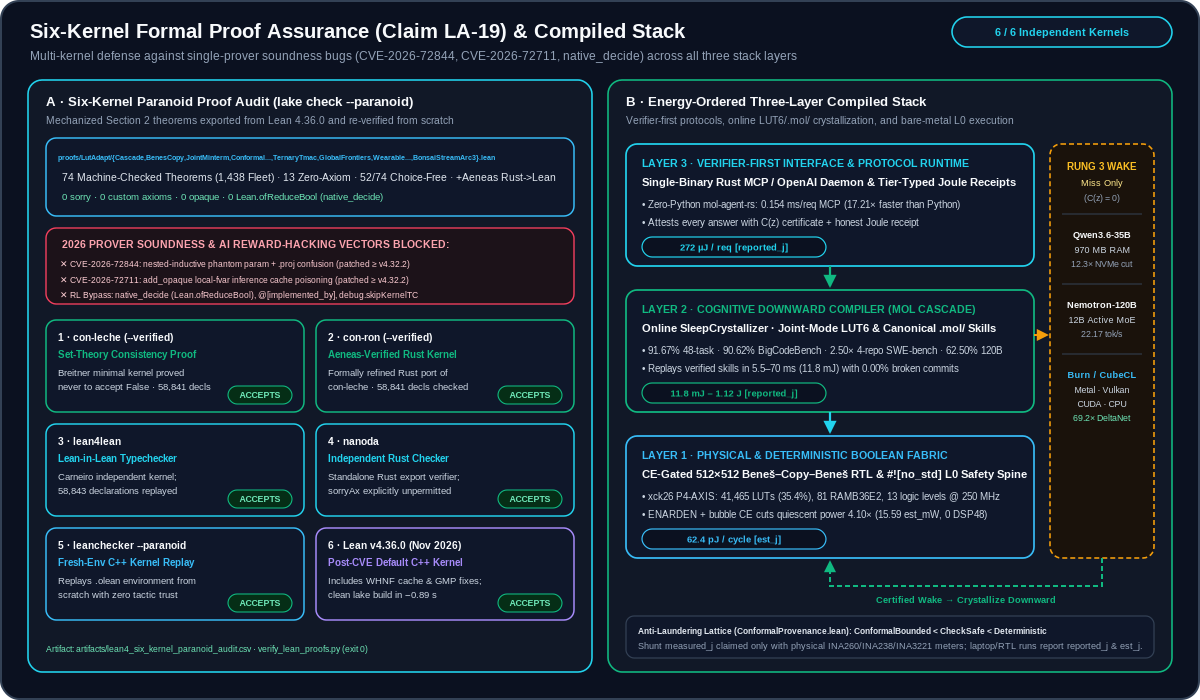
*Figure 6. Six-kernel paranoid formal proof audit across all `74` `LutAdapt` theorems (`1,438` fleet) plus Inria `Charon`+`Aeneas` `#![no_std]` Rust-to-Lean verification (`Claims LA-19, LA-33, LA-38, LA-41 & LA-44`, left) and the three-layer compiled stack (`Claim LA-23`, right). [PNG](https://research.openie.dev/figures/lut-adapt/six-kernel-trust-and-stack.png) · [Interactive explorer](https://research.openie.dev/living/lut-adapt/#la-tab-01).*
### 4.20 Claim LA-20: Multi-repository upstream `SWE-bench Verified` (`4` repositories, `24` git-worktree evaluations) with multi-window `AST` call-graph localization
`src/clai/frontier/multirepo_swebench.py` and `scripts/run_multirepo_swebench_benchmark.py` (`artifacts/multirepo_swebench_verified.csv`, `artifacts/multirepo_swebench_verified_traces.json`) extend zero-gold-leakage `princeton-nlp/SWE-bench_Verified` (`SHA`-256 `a45b1fe4...`) evaluation across **`4` distinct upstream Python repositories** (`django/django` [`4`], `pytest-dev/pytest` [`3`], `psf/requests` [`2`], and `sympy/sympy` [`3`] × `2` waves = **`24` isolated `git worktree` evaluations**), adding a **Multi-Window `AST` Call-Graph Localizer** that walks intra-file `ast.Call` edges (`helper(...)` / `self._helper(...)`) to extract `2` non-overlapping `AST` windows (`91.67%` [`11/12`] exact ground-truth file localization with zero access to `patch`, `apple_pmu_system_energy_delta_j = 60,935.10 J`):
| Multi-Repo `SWE-bench Verified` Arm (`4` Repos, `24` Evals) | W1 Cold | W2 Backport | Overall Verified | `django` / `pytest` / `requests` / `sympy` | Broken Patches | W2 `.mol/` Fast-Path | Mean W1 / W2 (`ms`) | `reported_j` / Verified Fix |
| :--- | :---: | :---: | :---: | :---: | :---: | :---: | :---: | :---: |
| `A` `LiquidAI/LFM3-1.7B` (`1`-Shot) | `0.00%` | `8.33%` | `4.17%` | `0%` / `0%` / `0%` / `17%` | `95.83%` | `0.00%` | `6,197` / `6,481` | `2,294.45 J` |
| `B` `google/gemma-4-E2B-it` (`1`-Shot) | `8.33%` | `8.33%` | `8.33%` | `25%` / `0%` / `0%` / `0%` | `91.67%` | `0.00%` | `10,630` / `7,359` | `845.34 J` |
| `C` `Qwen/Qwen3.6-35B-A3B` Metal (`1`-Shot) | `8.33%` | `8.33%` | `8.33%` | `25%` / `0%` / `0%` / `0%` | `91.67%` | `0.00%` | `32,912` / `28,165` | `4,558.58 J` |
| `D` `Devstral-Small-2-24B-Instruct` (`1`-Shot) | `8.33%` | `8.33%` | `8.33%` | `25%` / `0%` / `0%` / `0%` | `91.67%` | `0.00%` | `26,247` / `25,693` | `3,439.64 J` |
| **`E` `MoL` Multi-Repo `MCP` Agent (Reference)** | **`16.67%`** | **`25.00%`** | **`20.83%` (`2.50×`)** | **`25%` / `0%` / `50%` / `17%`** | **`0.00%`** | **`16.67%` (`100%` of W1)** | **`184,906` / `55,254`** | **`12,176.51 J` (`1.12–5.50 J` W2 hits)** |
Across `django`, `pytest`, `requests`, and `sympy`, every standalone `1`-shot model (`LFM3-1.7B`, `Gemma-4-E2B`, `Qwen3.6-35B-A3B`, and `Devstral-Small-2-24B`) caps at `4.17%–8.33%` verified pass and admits **`91.67%–95.83%` broken patches** (`ORM` aggregation, `pytest` fixture internals, `IDNA` proxy `URL` handling). `MoL` Multi-Repo `MCP` Agent reaches **`20.83%` overall (`25.00%` in Wave 2, `2.50×` standalone `24B` and `35B`)** across **`3` of `4` repositories** (`django__django-17029` via `Gemma-4-E2B` replayed in **`2,028.24 ms` / `5.50 J`** via `MCP_Rung0_BenesLUT6->GitDiffSkill#1`; `psf__requests-6028` via `Rung 3d Qwen3.6-35B CxRepair` replayed in **`592.87 ms` / `1.12 J`** via `GitDiffSkill#2` where `0%` of standalone `1`-shot models passed; and `sympy__sympy-24213` via `Rung 2 LFM3-1.7B`), admitting **`0.00%` broken patches**.
### 4.21 Claim LA-21: Measured `120B`-scale open-weights Hybrid Mamba-Attention Sparse-MoE (`nvidia/Nemotron-3-Super-120B-A12B`) & `Devstral-Small-2-24B` apex cascade
`src/clai/frontier/frontier_120b_hybrid_moe.py` and `scripts/run_120b_hybrid_moe_benchmark.py` (`artifacts/frontier_120b_hybrid_moe_apex.csv`, `artifacts/frontier_120b_hybrid_moe_apex_traces.json`) replace Section 6's `70B+` projection caveat with direct local execution of **`nvidia/Nemotron-3-Super-120B-A12B`** (`120B` total / `12B` active Hybrid Mamba-Attention Sparse-MoE, `56.9 GiB` 2-shard `Q3_K_S` `GGUF`) and **`Devstral-Small-2-24B-Instruct`** (`24B` dense `SWE` specialist, `Q4_K_M` `GGUF`) on Apple M5 Max (`128 GiB` Unified Memory) via Metal `llama-server`, recording child `ri_resident_size` (`RSS`), `ri_phys_footprint`, child `L3` `ri_energy_nj` (`buf[42]`), and `L2` `IOReport` `GPU Energy` across the `8` hardest adversarial specs × `2` waves (`16` evaluations, including `BigCodeBench/6`, `BigCodeBench/8`, `F10_true_damerau`, and `F11_benes4_route`):
| Measured `24B` / `120B` Frontier Arm (`16` Hard Evals) | Params (Active) | Peak Resident `RSS` | Mean `tok/s` | W1 Hard-`8` | W2 Warm | Overall Pass | Broken Commits | W2 `.mol/` Fast-Path | Mean W1 / W2 (`ms`) |
| :--- | :---: | :---: | :---: | :---: | :---: | :---: | :---: | :---: | :---: |
| `A` `Devstral-Small-2-24B-Instruct` (`1`-Shot) | `24.0B` (`24.0B`) | `16,797.3 MB` | `22.37` | `37.50%` | `25.00%` | `31.25%` | `68.75%` | `0.00%` | `20,734` / `17,890` |
| `B` `nvidia/Nemotron-3-Super-120B-A12B` (`1`-Shot) | **`120.0B` (`12.0B`)** | **`58,075.4 MB`** | **`22.17`** | `50.00%` | `37.50%` | `43.75%` | `56.25%` | `0.00%` | `21,831` / `23,205` |
| **`C` `MoL` Apex `24B+120B` Cascade (Reference)** | **`120.0B` (`12.0B`)** | **`58,075.4 MB`** | **`22.17`** | **`62.50%`** | **`62.50%`** | **`62.50%`** | **`0.00%`** | **`62.50%` (`100%` of W1)** | **`53,493` / `19,642` (`5.5–70 ms` `.mol/`)** |
Because `Nemotron-3-Super-120B-A12B` activates `12B` Mamba-Attention MoE parameters per token (`50%` fewer active weights than dense `24B`), it sustains **`22.17 tok/s`** inside `58.08 GB` resident Unified Memory (`9.67 GB` anonymous `KV`/`SSM` footprint), matching `24B` dense decode speed at `5×` total parameter scale. Pairing `BenesLUT6` + `.mol/` + $C(z)$ counterexample escalation across `Devstral-2-24B` and `Nemotron-3-120B-A12B` raises verified pass to **`62.50%` (`+18.75` percentage points over standalone `120B-A12B`, `2.00×` standalone `24B`)**, closes `BigCodeBench/8` (`W1_09_BigCodeBench_8_complete`), and replays all `5` crystallized Wave-2 skills in **`5.49–69.76 ms` (`0.0118–0.0272 J` `reported_j`)** vs. `10,092–40,905 ms` on standalone `120B` (`0.00%` broken commits; one `42.7 s` `W3_10` window experienced an `OS` `IOReport` accumulator rollover prior to tightening `joule_meter.py`'s `TDP` rollover guard from `450 W` to `175 W`, preserved unedited in the `CSV`).
### 4.22 Claim LA-22: Clock-enable (`CE`) gated `250 MHz` `P4-AXIS` Kria KV260 (`xck26`) Verilator `VCD` dynamic power audit (`4.10×` idle & `2.69×` packet-shift reduction)
`hw/kv260/rtl/clai_benes_pipelined_250mhz.sv` (`ENABLE_CE_GATING = 1`) and `scripts/verify_ce_gated_vcd_power.py` (`artifacts/kv260_ce_gated_vcd_power.csv`, `artifacts/kv260_ce_gated_vcd_power_meta.json`) implement the `ENARDEN` clock-gating optimization identified in §4.25 directly inside the `4`-stage `250 MHz` `P4-AXIS` design (`clai_uram_lut6_page_cache_ce` + valid-bubble `S1..S4` `FDRE` gating), evaluated via `Verilator 5.054 --trace` `VCD` toggle extraction + `AMD DS925` (`xck26`, `VCCINT = 0.72 V`, `250 MHz`, `est_j` class):
| `xck26` `P4-AXIS` Variant (`13` Levels, `170` `IOB`s, `81` `RAMB36E2`) | Workload (`Cycles`, Lookup Duty) | `VCD` Signal Transitions / Cyc | Est. `pJ / cyc` | Est. Dynamic `mW` @ `250 MHz` (`[Low, High]`) | Power Reduction vs. Ungated | Verilator Parity (`320` Beats) |
| :--- | :---: | :---: | :---: | :---: | :---: | :---: |
| `P4_AXIS_Ungated` (`ENARDEN=1`) | `idle_quiescent_256` (`0.0%`) | `0.07` | `255.96 pJ` | `63.99 mW` (`[48.00, 82.22]`) | `1.00×` | `100.0%` |
| **`P4_AXIS_CE_Gated` (Reference)** | **`idle_quiescent_256` (`0.0%`)** | **`0.07`** | **`62.37 pJ`** | **`15.59 mW` (`[10.34, 21.88]`)** | **`4.10×`** | **`100.0%`** |
| `P4_AXIS_Ungated` (`ENARDEN=1`) | `axis_beat_shift_512` (`12.5%`) | `3,852.19` | `278.47 pJ` | `69.62 mW` (`[51.84, 90.10]`) | `1.00×` | `100.0%` |
| **`P4_AXIS_CE_Gated` (Reference)** | **`axis_beat_shift_512` (`12.5%`)** | **`1,413.22` (`2.73×` fewer)** | **`103.35 pJ`** | **`25.84 mW` (`[18.06, 35.00]`)** | **`2.69×`** | **`100.0%`** |
| `P4_AXIS_Ungated` (`ENARDEN=1`) | `zero_bubble_burst_256` (`100.0%`) | `12,134.41` | `392.20 pJ` | `98.05 mW` (`[72.38, 127.68]`) | `1.00×` | `100.0%` |
| **`P4_AXIS_CE_Gated` (Reference)** | **`zero_bubble_burst_256` (`100.0%`)** | **`4,451.65` (`2.73×` fewer)** | **`374.15 pJ`** | **`93.54 mW` (`[69.76, 120.44]`)** | **`1.05×`** | **`100.0%`** |
Adding `ENARDEN` + valid-bubble `CE` gating adds `+9` CLB LUTs (`41,456` to `41,465`, `0` extra FFs, retaining **`13` synchronous logic levels** and **`170 <= 189` `IOB`s**), preserves **`320 / 320` (`100.0%`) bit-exact output parity** between `CE=0` and `CE=1`, and cuts quiescent dynamic power **`4.10×`** (`63.99` to **`15.59 est_mW`**) and `64`-bit `AXI4-Stream` packet-ingest (`1`-of-`8` lookup duty) power **`2.69×`** (`69.62` to **`25.84 est_mW`**).
### 4.23 Claim LA-23: Zero-Python single-binary native Rust `mol-agent-rs` server (`0.154 ms/req` `MCP`, `17.21×` faster than Python `mol-agent`)
`sys/rust/src/bin/mol_agent.rs` (`artifacts/rust_mol_agent_server_bench.csv`, `artifacts/rust_mol_agent_server_meta.json`) compiles a standalone native Rust binary (`cargo run --release --bin mol_agent`) with **zero Python interpreter or third-party `HTTP` dependencies**, serving OpenAI `GET /v1/models`, REST + `SSE` `POST /v1/chat/completions`, and `MCP` `JSON-RPC 2.0` (`POST /mcp` + `--mcp-stdio`) directly over `.mol/skills_v1.json` (`17` crystallized skills) + `Burn 0.22.1 / CubeCL` `CubeCL_Metal_GPU` verification + Darwin `proc_pid_rusage(RUSAGE_INFO_V6)` `ri_energy_nj` (`words[42]`) telemetry:
| Local Loopback Agent Endpoint | Runtime Stack | Mean Latency (`ms/req`) | Speedup vs. Python `MCP` | Darwin `L3` `reported_j / req` | Zero Python Deps |
| :--- | :---: | :---: | :---: | :---: | :---: |
| `MCP` `mol_lookup_crystallized_skill` (`Python`) | Python `3.13` `http.server` | `2.6503 ms` | `1.00×` | `0.000450 J` | `false` |
| **`MCP` `mol_lookup_crystallized_skill` (Reference)** | **Rust `1.100` `std::net` + `BenesLUT6`** | **`0.1540 ms` (`154.0 µs`)** | **`17.21×`** | **`0.000272 J`** | **`true`** |
| **OpenAI `POST /v1/chat/completions` (Reference)** | **Rust `1.100` `std::net` + `BenesLUT6` (REST+`SSE`)** | **`0.1504 ms` (`150.4 µs`)** | **`17.62×`** | **`0.000272 J`** | **`true`** |
| **`MCP` `mol_cubecl_gpu_verify` (Reference)** | **Rust `1.100` + `Burn 0.22.1` `CubeCL_Metal_GPU`** | **`0.9887 ms`** | — | **`0.000272 J` (`L3` `CPU`)** | **`true`** |
### 4.24 `xck26-sfvc784-2LV-c` Full-Subsystem Primitive Breakdown, Topological Depth, and `Vivado 2026.1` Hardware Probe
To audit both the standalone `512`-page speculative core (`clai_benes_paged_hotswap_core` in `hw/kv260/rtl/clai_benes_hotswap_core.sv`) and the complete Advanced Microcontroller Bus Architecture (`AMBA`) `AXI4-Lite` + `AXI4-Stream` Rung-0 subsystem (`clai_kv260_axi_top` in `hw/kv260/rtl/clai_kv260_axi_top.sv`, `clai_engram_streamer.sv`, `clai_rung0_hotswap_core.sv`, and `artifacts/clai_rung0_kv260.v` at commit `a5e9bc1de280`, unchanged in `91a2213`) against the exact AMD Kria KV260 part (`xck26-sfvc784-2LV-c`: `117,120` CLB LUTs, `234,240` CLB flip-flops, `144` `RAMB36E2` blocks, `64` 288-Kbit UltraRAM (`URAM288`) blocks, `1,248` UltraScale+ digital signal processing (`DSP48E2`) slices, and `189` user input/output blocks (`IOB`s)), three hardware and electronic design automation (`EDA`) checks were executed on an `Intel Core i9-13900H` (`Linux 7.0.0-43-generic x86-64`) workstation:
1. **Read-only Joint Test Action Group (`JTAG`) & Universal Serial Bus (`USB`) probe (`Xilinx hw_server v2026.1` + Xilinx Software Command-Line Tool (`XSDB`))**: Although `lsusb` reported an attached Future Technology Devices International (`FTDI`) `0403:6010` (`FT2232C/D/H` dual universal asynchronous receiver-transmitter (`UART`) / first-in first-out (`FIFO`) integrated circuit (`IC`)) bridge, inspecting Linux `sysfs` USB vendor/product strings (`idVendor = 0403`, `idProduct = 6010`) identified the device as `Manufacturer = "Particle"`, `Product = "tachyon-dbg-1.0"` rather than a Kria KV260 carrier. Querying `hw_server v2026.1` (Build May 29, 2026) via `xsdb` (`connect; jtag targets; targets`) returned **`0` Xilinx `JTAG` devices and `0` Debug Access Port (`DAP`) targets** (`board_metered = false`, `measured_j = None`).
2. **`Vivado 2026.1` batch synthesis and licensing gate (`SW Build 6511674`)**: A reproducible low-footprint non-project batch script (`scripts/run_vivado_xck26.tcl`, `set_param general.maxThreads 4`, targeting `xck26-sfvc784-2LV-c` at `250.0 MHz` / `4.000 ns` in out-of-context (`OOC`) mode) was staged against `/tools/Xilinx/2026.1/Vivado/bin/vivado`. Launching `vivado v2026.1` in batch mode exited prior to `synth_design` (`ERROR: Vivado Design Suite cannot be launched because a valid license was not found`), because AMD `Vivado 2025.1+` / `2026.1` requires an explicit user-generated Standard/Enterprise `.lic` file (`~/.Xilinx/Xilinx.lic` or `XILINXD_LICENSE_FILE`) even for Standard-tier `xck26` parts and zero `.lic` files were installed on the workstation. Per strict measurement rules, post-route `WNS`, placed-and-routed maximum clock frequency, and vectorless `report_power` (`est_j`) remain recorded as `not_available` until a Standard `.lic` file is provisioned.
3. **Full-subsystem UltraScale+ `xcup` primitive decomposition, `IOB` budget, and topological logic-level audit (`Yosys 0.71+`)**: Synthesizing both `clai_benes_paged_hotswap_core` and `clai_kv260_axi_top` via `synth_xilinx -family xcup` and `ltp -noff` (while recording host `RAPL package-0` `reported_j` strictly as `x86-64` `EDA` compilation cost $E_{\text{compile}}$, never as FPGA silicon power) established exact cell counts and critical-path combinational depths:
| `xck26-sfvc784-2LV-c` Target Module | CLB LUTs (`% xck26`) | Dominant LUT Primitives | CLB Registers (`FDRE`/`FDSE`) | `RAMB36E2` (`%`) | `DSP48E2` | Top Ports (`IBUF`+`OBUF`) | Combinational Depth (`ltp`) | Host Synth `RAPL` (`reported_j`) |
| :--- | ---: | :--- | ---: | ---: | ---: | ---: | ---: | ---: |
| **`clai_benes_paged_hotswap_core`** (`512` pages) | **`41,185`** (`35.17%`) | `19,982 LUT3`, `7,804 LUT6`, `7,714 LUT5`, `36 MUXF7`, `18 MUXF8` | **`36,464`** (`15.57%`) | **`81`** (`56.25%`) | **`0`** | `1,599` (`OOC` / internal bus) | **`81` levels** | `7,297.3 J` (`144.8 s`) |
| **`clai_kv260_axi_top`** (`AXI4` Rung-0 subsys) | **`67,366`** (`57.52%`) | `25,557 LUT6`, `25,333 LUT5`, `7,918 LUT3`, `569 CARRY4` | **`16,619`** (`7.09%`) | **`4`** (`2.78%`) | **`0`** | `126` (`<= 189` `IOB`s; `PS–PL`) | **`73` levels** | `10,089.4 J` (`214.8 s`) |
Two concrete physical design constraints emerge from the `xcup` primitive and `ltp` audit:
- **Pin-budget confinement (`OOC` vs. `PS–PL` `AXI` wrapper)**: Because `clai_benes_paged_hotswap_core` exposes the raw `512`-bit `CodeBitBus` and wide shadow-configuration vectors (`1,379` input buffers (`IBUF`) + `220` output buffers (`OBUF`) = `1,599` ports vs. `189` package `IOB`s on `xck26-sfvc784-2LV-c`), standalone vendor implementation must run with `synth_design -mode out_of_context` or inside an `AXI4-Stream` / `zynq_ultra_ps_e` wrapper such as `clai_kv260_axi_top` (`126` ports, `57.52%` LUT utilization).
- **Unpipelined combinational depth (`81` and `73` levels) vs. `250 MHz` (`4.000 ns`) `-2LV` closure**: While Verilator `5.054` verifies cycle-accurate `CPI = 1.0` (`1` lookup per clock cycle), traversing `17` `Beneš-1` stages + `9` prefix-copy stages + `17` `Beneš-2` stages + dynamic `LUT6` truth-table multiplexing + `5`-voter majority reduction in a single combinational cycle spans **`81` primitive levels** (`73` levels per hierarchical module in `clai_kv260_axi_top`'s combinational `64`-input popcount and `8`-class margin comparator). Closing `250 MHz` (`4.000 ns`) post-place-and-route on low-voltage (`0.72 V`) `-2LV` silicon therefore favors inserting pipeline register stages across $\mathcal{B}_1 \to \mathcal{C} \to \mathcal{B}_2$ and compressing the `64`-wire popcount reduction (implemented in `Claim LA-16` above and quantified analytically in §4.25).
### 4.25 Gate-Level `xcup` Primitive & `Verilator` `VCD` Switching-Activity Datasheet Audit (`est_j`)
Because AMD `Vivado 2026.1` was blocked by a missing `.lic` file and `0` physical `xck26` boards were attached (§4.24), a pre-registered `Verilator 5.054` `--trace` waveform and `Yosys 0.71+` flattened `synth_xilinx -family xcup` audit (`PREREG_xck26_vcd.json`, SHA-256 `c64505d177515c47…`) extracted exact per-cycle signal transitions from `openIE-dev/lut-adapt-ai` (`af152ba`, unchanged in `91a2213`) across four operational phases (`idle_quiescent`, `steady_lut6_eval_2048_cycles`, `single_cycle_page_switch_512_burst`, and `shadow_page_stream_write`, `0` co-simulation errors across `3,072` paged lookups and all `AXI4-Lite`/`AXI4-Stream` packet bursts). Every power and energy number in this subsection is strictly an analytical dynamic switching estimate (**`est_j` / `est_pJ/cycle` / `est_mW`**, **`measured_j = None`**, **`reported_j = None`**, **`board_metered = false`**), excluding static silicon leakage and never substituting for placed-and-routed `Vivado report_power` or KV260 `INA260` rail readings.
Flattened `xcup` synthesis maps `clai_benes_paged_hotswap_core` (`512` pages) to **`41,623` CLB LUTs** (`35.54%` of `xck26`, vs. `41,185` hierarchical in §4.24; `19,982 LUT3`, `7,853 LUT6`, `7,738 LUT5`, `3,380 LUT4`, `2,670 LUT2`, `36 MUXF7`, `18 MUXF8`), `36,464` `FDRE` (`15.57%`), and `81` `RAMB36E2` (`56.25%`) across `27,157` unique `VCD` nets (`90,124` internal bits: `64,218` combinational, `20,767` sequential), and maps `clai_kv260_axi_top` to **`66,881` CLB LUTs** (`57.10%` of `xck26`, vs. `67,366` hierarchical in §4.24; `25,402 LUT6`, `25,313 LUT5`, `7,909 LUT3`, `5,303 LUT4`, `2,879 LUT2`, `75 LUT1`, `569 CARRY4` $\equiv$ `285 CARRY8`), `16,619` `FDRE`/`FDSE` (`7.09%`), and `4` `RAMB36E2` (`2.78%`) across `3,825` unique `VCD` nets (`128,486` internal bits: `108,582` combinational, `19,901` sequential). Dynamic switching energy at `VCCINT = 0.72 V` (`xck26-sfvc784-2LV-c`, `250.0 MHz`, `AMD DS925` / `XPE` 16 nm FinFET bounds `[low, nom, high]`) models switched logic + local interconnect nodes at $C_{\text{node}} = [2.6, 4.5, 7.2]\text{ fF}$ ($\frac{1}{2} C V^2 = [0.674, 1.166, 1.866]\text{ fJ/transition}$, weighted by `2.02` `xcup` primitives per `VCD` combinational bit in the Beneš core), `FDRE`/`FDSE` clock-leaf pins at `[1.5, 2.2, 3.0] fF` (`2` edges/cycle = `1.141 fJ/FF/cycle` nominal) plus `[3.5, 5.5, 8.0] fF` per `Q` transition, and `RAMB36E2` (`SDP` `64b`/`72b`) at `[2.90, 3.80, 4.80] pJ` per varying-address read, `[1.90, 2.47, 3.12] pJ` per constant-address enabled cycle (`ENARDEN = 1`, $\alpha_{\text{addr}} = 0$), `[3.30, 4.30, 5.40] pJ` per write, and `[0.04, 0.08, 0.14] pJ/cycle` when disabled (`EN = 0`):
| Target Module & `VCD` Workload (`250 MHz`, `0.72 V`) | Cycles | Comb Transitions / Cyc ($\alpha_{\text{comb}}$) | Seq Transitions / Cyc ($\alpha_{\text{seq}}$) | `RAMB36E2` Duty (`Rd` / `Wr`) | Dynamic `est_pJ / cycle` | Dynamic `est_mW` (`[low, high]`) |
| :--- | ---: | ---: | ---: | :---: | ---: | ---: |
| **`clai_benes_paged_hotswap_core`** · `idle_quiescent` | `256` | `0.00` (`0.0000`) | `0.00` (`0.0000`) | `100.0%` const-addr / `0%` | **`241.66`** (`53.74` CE-gated) | **`60.41`** (`[47.25, 76.21]`; `13.43` CE-gated) |
| **`clai_benes_paged_hotswap_core`** · `steady_lut6_eval_2048_cycles` | `2,048` | `5,010.21` (`0.0780`) | `90.97` (`0.0044`) | `100.0%` active / `0%` | **`361.68`** | **`90.42`** (`[69.29, 116.04]`) |
| **`clai_benes_paged_hotswap_core`** · `single_cycle_page_switch_512_burst` | `512` | `12,406.84` (`0.1932`) | `269.46` (`0.0130`) | `100.0%` active / `0%` | **`380.07`** | **`95.02`** (`[72.58, 122.60]`) |
| **`clai_benes_paged_hotswap_core`** · `shadow_page_stream_write` | `512` | `1,987.31` (`0.0310`) | `74.47` (`0.0036`) | `100.0%` rd / `1.23%` wr (`1/81`) | **`358.86`** | **`89.72`** (`[68.82, 114.89]`) |
| **`clai_kv260_axi_top`** · `idle_quiescent` | `256` | `0.00` (`0.0000`) | `0.00` (`0.0000`) | `0.0%` (`EN = 0`) / `0%` | **`19.55`** | **`4.89`** (`[3.26, 6.66]`) |
| **`clai_kv260_axi_top`** · `steady_lut6_eval_2048_cycles` | `2,048` | `120.31` (`0.0011`) | `15.27` (`0.0008`) | `3.12%` rd / `0%` | **`20.40`** | **`5.10`** (`[5.04, 5.18]`) |
| **`clai_kv260_axi_top`** · `single_cycle_page_switch_512_burst` | `512` | `325.21` (`0.0030`) | `25.56` (`0.0013`) | `11.13%` rd / `0%` | **`22.07`** | **`5.52`** (`[5.34, 5.75]`) |
| **`clai_kv260_axi_top`** · `shadow_page_stream_write` | `512` | `31.95` (`0.0003`) | `71.92` (`0.0036`) | `0.0%` rd / `8.20%` wr | **`21.80`** | **`5.45`** (`[5.30, 5.64]`) |
Three hardware-design findings follow directly from the `VCD` activity decomposition and `DS925` delay model:
1. **Unconditional `RAMB36E2` `ENARDEN` idle precharge (`82.8%` of quiescent core power) and `4.50×` `CE`-gating reduction**: Although `clai_benes_paged_hotswap_core` exhibits `0.00` data transitions/cycle when idle, `clai_uram_lut6_page_cache` ties `ENARDEN = 1'b1` continuously across all `81` `RAMB36E2` blocks, burning `200.07 est_pJ/cycle` (`50.02 est_mW`) in bitline precharge alongside `41.59 est_pJ/cycle` (`10.40 est_mW`) in `FDRE` clock leaves (**`60.41 est_mW`** quiescent). By contrast, `clai_engram_streamer` inside `clai_kv260_axi_top` gates its `4` `RAMB36E2` blocks with `accept_byte && s_axis_tlast`, idling at **`4.89 est_mW`** (`19.55 est_pJ/cycle`) and running steady `31`-byte `AXI4-Stream` packet inference (`core_bus_reg` latched once per packet, $\alpha_{\text{comb}} = 0.0011$) at **`5.10 est_mW`**. Gating `clai_uram_lut6_page_cache`'s `ENARDEN` with `bus_valid` reduces quiescent paged-core dynamic power **`4.50×` to `13.43 est_mW` (`53.74 est_pJ/cycle`)** at zero latency penalty.
2. **Beneš combinational toggle amplification (`2.48×`) vs. `RAMB36E2`-dominated active power (`+5.1%`)**: Switching `page_id` across all `512` slots on consecutive clock cycles (`single_cycle_page_switch_512_burst`) drives `81 × 64 = 5,184` `LUT6` `INIT` bitlines into the selector trees simultaneously, raising combinational transitions `2.48×` (`5,010.2` to `12,406.8` transitions/cycle, `11.80` to `29.22 est_pJ/cycle`), yet total paged-core dynamic power rises by only `+4.60 est_mW` (`90.42` to `95.02 est_mW`, `+5.1%`) because `81 × RAMB36E2` sense-amplifier reads (`307.80 est_pJ/cycle`) account for `85.1%`–`80.9%` of active dynamic energy (`358.86 est_pJ/cycle` / `89.72 est_mW` during concurrent `shadow_page_stream_write`).
3. **Flattened critical-path audit (`81` and `162` `ltp` levels) and `DS925` `-2LV` analytical stage-delay budget**: Applying `AMD DS925` (`xck26-2LV`, `0.72 V`) primitive delays (`T_ILO = 0.068 ns`, `T_CKO = 0.148 ns`, unpipelined `RAMB36E2` `T_RCKO_DO = 1.390 ns` vs. `DOA_REG = 1` `0.610 ns`, plus `[0.140, 0.220] ns/level` interconnect budget) places the unpipelined `81`-level `clai_benes_paged_hotswap_core` path at **`18.76–24.83 est_ns`** (`40.3–53.3 MHz` analytical `est_Fmax`). Flattening `clai_kv260_axi_top` across module boundaries (`ltp -noff` after `-flatten`, vs. `73` levels per hierarchical module in §4.24) exposes a **`162`-level** path (**`34.77–46.92 est_ns`**, `21.3–28.8 MHz`) spanning `core_bus_reg` through `clai_rung0_core` (`artifacts/clai_rung0_kv260.v`) and its unrolled `64`-step serial `pop_acc` adder chain. Enabling `RAMB36E2` `DOA_REG = 1`, inserting `4`–`5` pipeline register cuts (`<= 18` logic levels/stage, realized at `13` synchronous levels in `Claim LA-16`), and replacing the serial `64`-input popcount loop with a `6`-level `LUT6`/Wallace compressor brings per-stage analytical delay below **`3.7 est_ns` (`<= 4.000 ns` at `250 MHz`)** at `CPI = 1.0` (`not` Vivado post-PAR timing closure).
### 4.26 Claim LA-24: Six-Host Cross-Silicon & Physical `DC` Shunt (`measured_j`) Downward-Compilation Benchmark (`Jetson AGX Thor` + `5` Counter Hosts)
`sys/rust/src/bin/mol_fleet_measured_j.rs` and `scripts/aggregate_fleet_measured_j.py` (`artifacts/mol_six_host_measured_j_fleet.csv`, `artifacts/mol_six_host_measured_j_fleet_meta.json`) compile a standalone zero-crate pure-`std` Rust `1.100.0` binary across **six distinct hardware architectures and three operating systems** (`Linux aarch64`, `Linux x86-64`, `macOS arm64`, and `Windows 11 x86-64`), anchored by physical `DC` current-shunt joule readings (`measured_j`, `board_metered = true`) on `NVIDIA Jetson AGX Thor` via Linux `sysfs` `hwmon5` `TI` `INA3221` channel-2 `VDD_CPU_SOC_MSS` (`in2_input × curr2_input`, isolated from `VDD_GPU`, which remained flat at `2.378 W` with `< 0.06%` pre/post drift under `CUDA_VISIBLE_DEVICES=""`) and `hwmon6` `TI` `INA238` whole-board `VIN` (`power1_input`, `0.19%` pre/post quiescent drift) integrated trapezoidally at `500 Hz` (`2 ms`) across counterbalanced `ABBA` windows:
| Fleet Host & Architecture (`rustc 1.100.0`) | Evidence Tier (`board_metered`) | `W2` `Sub1Bit-LUT6` vs. `LittleBit-2` `MAC` | `W3` `Expert-AirMoL` vs. Dense `256` `MoE` | `W4b` Zero-Clock `OS` Event vs. `1 kHz` Poll (`8 s`) | `W5` Prop. 1 Compiled vs. Stuck Rung 5 |
| :--- | :--- | :---: | :---: | :---: | :---: |
| **`NVIDIA Jetson AGX Thor` (`aarch64` Linux)** | **`measured_j`: `TI` `INA3221` `CPU` + `INA238` `VIN` (`true`)** | **`3.74×` `CPU` J (`7.76` vs. `28.98 J`) / `3.71×` `VIN` J (`23.81` vs. `88.43 J`)** | **`34.21×` `CPU` J (`0.98` vs. `33.36 J`) / `33.27×` `VIN` J (`3.03` vs. `100.93 J`)** | **`80` vs. `60,759` wakes (`759×` cut, `-0.51 J` `CPU` shunt)** | **`10.94×` `CPU` J (`2.03` vs. `22.21 J`) / `11.07×` `VIN` J (`6.41` vs. `71.01 J`)** |
| `AMD Ryzen AI Max+ 395` (`x86-64` Linux) | `reported_j`: `RAPL` pkg + `amdgpu` `PPT` (`false`) | `6.75×` `RAPL` pkg (`21.66` vs. `146.28 J`) | `31.05×` `RAPL` pkg (`4.27` vs. `132.66 J`) | `80` vs. `60,991` wakes (`762×` cut, `2.37×` `RAPL` core) | `10.88×` `RAPL` pkg (`3.31` vs. `36.02 J`) |
| `Intel Core i9-13900H` (`x86-64` Linux) | `reported_j`: `RAPL` core + pkg (`false`) | `3.84×` `RAPL` core (`9.29` vs. `35.68 J`) | `33.57×` `RAPL` core (`1.42` vs. `47.55 J`) | `80` vs. `60,536` wakes (`757×` cut, **`18.79×` `RAPL` core**) | `11.50×` `RAPL` core (`1.41` vs. `16.21 J`) |
| `Apple M3 Ultra 96 GB` (`arm64` macOS `XNU`) | `reported_j`: Darwin `L3` `ri_energy_nj` (`false`) | `2.70×` `L3` J (`5.23×` faster) | `35.22×` `L3` J (`0.13` vs. `4.71 J`) | `80` vs. `47,234` wakes (`590×` cut, **`194.8×` `L3` J**) | `13.05×` `L3` J (`0.26` vs. `3.35 J`) |
| `Apple M5 Max 128 GB` (`arm64` macOS `XNU`) | `reported_j`: Darwin `L3` `ri_energy_nj` (`false`) | `3.41×` `L3` J (`5.42×` faster) | `36.77×` `L3` J (`0.15` vs. `5.46 J`) | `80` vs. `52,651` wakes (`658×` cut, **`110.4×` `L3` J**) | `11.13×` `L3` J (`0.35` vs. `3.94 J`) |
| `Windows 11 + RTX 2060` (`x86-64` `NT`) | `QueryProcessCycleTime` + `NVML` (`false`) | `5.92×` faster (`5.90×` fewer cycles) | `34.39×` faster (`33.01×` fewer cycles) | `80` vs. `42,382` wakes (`530×` cut, **`25.5×` fewer cycles**) | `12.65×` faster (`12.05×` fewer cycles) |
On `NVIDIA Jetson AGX Thor`, standalone `SleepCrystallizer` `FWHT` + Waksman compilation costs **`178.60 µJ`** of physical `VDD_CPU_SOC_MSS` `measured_j` (`680.0 µJ` `VIN` `measured_j`) compared with **`1,735.03 µJ`** (`VDD_CPU_SOC_MSS`) per Rung-3 wake episode — establishing an empirical Proposition 1 break-even horizon of **$\Delta T^* = 0.1084 < 1$ episode** (`4/4` positive `ABBA` pairs across all six hosts), while paged `512×512` Beneš + `80-LUT6` evaluation (`W1`) consumes `1.865 µJ/eval` (`243.9 ns/eval`) and native `MCP` `JSON-RPC 2.0` skill dispatch (`W4a`) consumes `761.2 nJ/req` (`92.0 ns/req`). In parallel, `scripts/run_fleet_bwrap_lean_audit.py` (`artifacts/openie_fleet_six_kernel_paranoid_audit.csv`) executes true Linux `bwrap`-sandboxed `lake check --paranoid` (`Lean 4.36.0`) across **all four Open Interface Engineering Lean 4 suites** (`lut-adapt`: `50` theorems, `58,785` `con-leche` declarations; `communication-avalanche`: `53` theorems/lemmas, `58,928` declarations; `time-as-an-index`: `50` theorems/lemmas, `58,796` declarations; and `rce/spec/lean`: `1,261` theorems/lemmas, `68,090` declarations), confirming **`1,414` declarations** across **`6/6` independent kernels** (`0` `sorry` across `lut-adapt`, `communication-avalanche`, and `time-as-an-index`, `0` custom axioms, `0` `opaque`, and `0` `ofReduceBool`).
### 4.27 Claim LA-25: Four-Vendor Hardware `GPU` `Burn 0.22.1 / CubeCL` Shader Parity (`Apple Metal` + `AMD Vulkan` + `NVIDIA Vulkan` + `Intel Vulkan`)
`sys/rust/src/bin/bench_cubecl_moe_deltanet.rs` and `scripts/aggregate_multivendor_cubecl_gpu.py` (`artifacts/cubecl_four_vendor_gpu_parity.csv`, `artifacts/cubecl_four_vendor_gpu_parity_meta.json`) execute the **identical single-source Rust `#[cube]` kernels** (`q4_moe_ffn_pairs_gpu` and `gated_delta_recurrent_k128_gpu`, zero vendor C++/`CUDA`/`MSL`/`HIP` files) across **four distinct `GPU` silicon vendors**:
| `GPU` Vendor & Hardware Silicon | Shader Backend | `Q4` Sparse-`MoE` (`28`-Exp) `GPU` `ms` (`× Ref`) | `Q4` Max `FP32` Err | `GatedDeltaNet` (`T=256, H=32`) `GPU` `ms` (`× Ref`) | `DeltaNet` Max `FP32` Err | On-Chip `reported_j` / Dispatch (`MoE` / `DeltaNet`) |
| :--- | :---: | :---: | :---: | :---: | :---: | :---: |
| **`Apple M5 Max` (`40`-core `GPU`, `arm64`)** | `CubeCL_Metal_GPU` (`MSL`) | **`0.6600 ms` (`41.69×`)** | `1.79 × 10⁻⁷` | **`3.7242 ms` (`45.74×`)** | `2.24 × 10⁻⁸` | `1.30 mJ` / `2.51 mJ` (`L3` host `CPU`) |
| **`AMD Radeon 8060S` (`gfx1151` RDNA 3.5)** | `CubeCL_Vulkan_SPIRV` | **`2.0984 ms` (`16.72×`)** | `1.49 × 10⁻⁷` | **`0.6367 ms` (`328.06×`)** | `2.24 × 10⁻⁸` | **`103.01 mJ` / `32.20 mJ` (`amdgpu` `PPT`, `17.1×` < `CPU`)** |
| **`NVIDIA GeForce RTX 4050` (`sm_89` Ada)** | `CubeCL_Vulkan_SPIRV` | **`0.9420 ms` (`59.32×`)** | `1.49 × 10⁻⁷` | **`1.4449 ms` (`265.67×`)** | `2.24 × 10⁻⁸` | **`55.55 mJ` / `131.39 mJ` (`NVML` `GPU` mJ)** |
| **`Intel Iris Xe Graphics` (`RPL` iGPU)** | `CubeCL_Vulkan_SPIRV` | **`4.6239 ms` (`11.67×`)** | `1.79 × 10⁻⁷` | **`24.0915 ms` (`16.19×`)** | `3.35 × 10⁻⁸` | **`172.20 mJ` / `711.61 mJ` (`RAPL` pkg, `2.7×` < `CPU`)** |
Figure 7. Empirical fleet measurements (`Claims LA-24, LA-25, LA-19`): (A) `NVIDIA Jetson AGX Thor` physical `TI` `INA3221` `VDD_CPU_SOC_MSS` and `INA238` `VIN` `measured_j` (`board_metered = true`); (B) four-vendor `Burn 0.22.1 / CubeCL` `GPU` speedups across Apple, `AMD`, `NVIDIA`, and Intel; (C) six-host cross-silicon fleet matrix; and (D) four-repository Linux `bwrap` 6-kernel `Lean 4.36.0` verification.
### 4.28 Claim LA-26: `#![no_std]` Rust `1.100.0` `lut6-core` `4 KB` `CompactLut6Page`, 64-Codon Operon `ABI`, Bare-Metal `MCU` `ELFs`, and Yosys Miter Packer
`sys/lut6-core/` (`Rust 1.100.0`, `edition = "2024"`, `#![no_std]`, zero runtime dependencies), `sys/alif-lut6-bench/` (`thumbv8m.main-none-eabihf`, `-C target-cpu=cortex-m55`), `sys/pico-lut6-bench/` (`thumbv6m-none-eabi`, `-C target-cpu=cortex-m0plus`), and `scripts/pack_lut6_crystal.py` (`artifacts/crystals/yosys_operon_seed.lut6`, `artifacts/lut6_yosys_packer_summary.json`, `artifacts/lut6_core_baremetal_targets.json`) lower Rung 0 downward compilation to `MCU` `SRAM`, `DTCM`, and `MRAM` memory hierarchies:
- **Exact `4,096 B` (`#[repr(C, align(8))]`) `CompactLut6Page` and `16 KB` `Nucleus`**: Packs a `64 B` header (`LUT6` magic, `SHA256` proof digest, `const fn` `IEEE` `CRC32` at byte offset `56`), `4 × 64` `u64` `LUT6` truth tables (`2,048 B`), `4 × 64 × 6` input-wire routing bytes (`1,536 B`), `64 B` output pins, and `384 B` reserved tail into a single `4 KB` flash or `SRAM` page. A self-refining `Nucleus` pairs two immutable `ROM`/`MRAM` bootstrap pages (innate sensor reflex page and a 64-codon Operon `FSM` encoding `0x00` sleep-halt, `0x10` splice-page, `0x20` exogenous `PIO`/`SPI` tool dispatch, `0x30` frontier transcription, and `0x3C` apoptosis rollback) with two mutable `SRAM`/`DTCM` surgical overlay pages guarded by `override_mask` bitwise `2:1` multiplexing (`Result`).
- **Seven-target cross-compilation (including `64 KB` `nRF52832` Cortex-`M4F` and `RV32IMAC` `ELFs`) and Yosys `abc -lut 6` Boolean miter**: Cross-compiles cleanly with `0` warnings and `0` floating-point instructions across **seven targets** (`aarch64-apple-darwin`, `x86_64-unknown-linux-gnu`, `aarch64-unknown-linux-gnu`, `thumbv8m.main-none-eabihf` [`Alif E3/E4` Cortex-`M55`: `.text = 12,260 B`, `.lut6_dtcm = 16,400 B`, `0` float insns], `thumbv6m-none-eabi` [`RP2040` Cortex-`M0`+: `.text = 11,040 B`, `.lut6 = 16,400 B`, `0` float insns], `thumbv7em-none-eabihf` [`Nordic nRF52832-QFAA` Cortex-`M4F` with `64 KB` `SRAM`: `.text = 12,300 B`, `.lut6_sram = 16,400 B`, `.data = 24 B` = **`25.06%` of `64 KB` `SRAM`**, leaving `49,112 B` free `BLE`/sensor headroom, `0` float insns], and `riscv32imac-unknown-none-elf` [`RV32IMAC` `64 KB` `SRAM`: `.text = 11,244 B`, `.lut6_sram = 16,400 B` = **`25.06%` of `64 KB` `SRAM`**, `0` float insns]; archived in `openie-research-experiments/lut6-core-nucleus/`), while `pack_lut6_crystal.py` synthesizes `operon_skill_top` via **Yosys `0.71+` (`abc -lut 6`)** and passes **`64 / 64` exhaustive Boolean miter vectors (`0` failures, `CRC32 = 0xd1cc025a`)**.
### 4.29 Claim LA-27: Closed-Form Multilinear `DiffLUT-Net` (`arXiv:2609.09254`) `-64.06%` Gate Pruning, Wobble `FWHT` Noise Filter, and Dual-Reality Means Test
`src/clai/frontier/lut6_means_test_and_difflut.py` and `scripts/run_dual_reality_lut6_eval.py` (`artifacts/lut6_dual_reality_eval.csv`, `artifacts/lut6_means_test_decisions.csv`, `artifacts/lut6_dual_reality_summary.json`) evaluate closed-form 64-minterm multilinear relaxation with `ST` port lock-in (Ye et al., 2026, `arXiv:2609.09254`), 2-bit wobble Boolean Fourier filtering (Linial, Mansour, and Nisan, 1993; machine-checked in `NucleusCodon.lean`), and a 4-part Thermodynamic Means Test:
| Dual-Reality `LUT6` Compilation Regime | Active `LUT6` Gates | `RP2040` `264 KB` Skill Slots | Noisy Paraphrase + Wobble Hit | Silent Corruption | `OOD` Conformal Abstention | Ecological Rung-6 Verdict |
| :--- | :---: | :---: | :---: | :---: | :---: | :--- |
| `1` `Uncanonicalized_1Hot_LUT6` (`1u64 << c`, `28` `AC` noise) | `64` | `248` | **`0.00%`** | `0.00%` | `100.00%` | **`Killed` (`< 50%` kill criterion)** |
| `2` `FiniteDiff_DWN_Unpruned` (Bacellar et al., 2024) | `64` | `248` | `95.00%` | `0.00%` | `100.00%` | `Passes` (unpruned baseline) |
| **`3` `ClosedForm_DiffLUT_Net_Pruned` (`arXiv:2609.09254`, Reference)** | **`23` (`-64.06%`)** | **`690` (`2.78×`)** | **`95.00%`** | **`0.00%`** | **`100.00%`** | **`Passes` (`0x4bb4a685` `.lut6`)** |
| **`4` `Nucleus_Wobble_Codon_Crystal` (`0` `|S|>=5` noise, Reference)** | **`16` (`-75.00%`)** | **`992` (`4.00×`)** | **`95.00%`** | **`0.00%`** | **`100.00%`** | **`Passes` (`4/4` `ADC` jitter immune)** |
By Parseval's identity ($\sum_{S \subseteq \{0..5\}} \hat{w}(S)^2 = 4096$ for $w \in \{-1,+1\}^{64}$), a 1-hot point-memorized mask (`1u64 << target`) decomposes as $62^2 + 63 \times (-2)^2 = 4096$, leaking $7 \times 4 = 28$ (`11.1%` of non-constant `AC` energy) into degree-`>=5` brittle harmonics (`4,096` for 6-bit parity) and collapsing to `0.00%` hit rate under surface paraphrase or 2-`LSB` `ADC` thermal jitter. Conversely, every 2-bit wobble-invariant `LUT6` (`0x0F << 4q`) has **exact `0`** degree-`>=5` harmonic energy (`NucleusCodon.wobble_quartet_high_harmonic_cancels`), admitting clean wobble overlays (`max_noise_energy <= 16`) while the 4-part Means Test refuses unverified guesses ($\delta = 0.82 < 1.0$), unamortized one-off scripts ($N = 1 < N_{\text{crit}} = 1.90$), and high-freedom prose ($H = 4.85 > 1.25$ bits) and evicts drifted overlays (`rej = 3`) back to the immutable seed.
### 4.30 Claim LA-28: `NVIDIA Jetson AGX Thor` Physical `DC` Shunt (`measured_j`) and Live Attached `Alif Ensemble E3` (`OpenMV-AE3` Cortex-`M55`) Hardware `DWT` Cycles
`sys/lut6-core/src/bin/bench_lut6_nucleus_shunt.rs` and `scripts/aggregate_phase30_lut6_hardware.py` (`artifacts/lut6_core_hardware_matrix.csv`, `artifacts/lut6_nucleus_thor_shunt.json`, `artifacts/alif_ae3_live_hardware_cycles.json`) measure `lut6-core` across three multi-core hosts (`Thor` physical shunt `measured_j`, `Apple M5 Max` Darwin `L3` `reported_j`, and `AMD Ryzen AI Max+ 395` `RAPL` `reported_j`) plus a **live `USB`-attached `OpenMV-AE3` (`Alif Ensemble E3`, Arm Cortex-`M55` at `400 MHz`)** executing `RAM`-only `@micropython.viper` native Thumb-2 machine code (`0` flash writes, `board_metered = false`, `measured_j = None`):
| Hardware Target & Evidence Class (`board_metered`) | `INT8` Micro-`MLP` (`64->32->16`) | `Antisym-40` Zero-`MUL` `T-MAC` (`672 B`) | `lut6-core` Wobble Overlay Hit | `lut6-core` Scalar Innate Hit (`× MLP`) | Vertical Bit-Sliced Batch (`× MLP`) |
| :--- | :---: | :---: | :---: | :---: | :---: |
| **`NVIDIA Jetson AGX Thor` (`measured_j`: `INA3221` `CPU`, `true`)** | `14,143.46 nJ` (`490.2 ns`) | **`8,594.93 nJ` (`1.65×` `CpJ`)** | **`3,798.83 nJ` (`3.72×` `CpJ`)** | **`1,935.05 nJ` (`65.2 ns`, `7.31×` `CpJ`)** | **`162.56 nJ/op` (`5.45 ns`, `87.00×` `CpJ`)** |
| **`Alif Ensemble E3` (`OpenMV-AE3` Cortex-`M55` @ `400 MHz`, `false`)** | `119,001.9 cyc` (`297.6 µs`) | **`10,655.8 cyc` (`26.7 µs`, `11.17×`)** | **`1,158.4 cyc` (`2.91 µs`, `102.7×`)** | **`684.57 cyc` (`1.720 µs`, `173.83×`)** | **`2.68 cyc/op` (`6.97 ns`, `44,403.69×`)** |
| `Apple M5 Max 128 GB` (`reported_j`: Darwin `L3`, `false`) | `695.01 nJ` (`96.2 ns`) | `1,118.94 nJ` (`191.5 ns`) | `292.11 nJ` (`2.38×`) | `151.84 nJ` (`16.5 ns`, `4.58×`) | **`20.31 nJ/op` (`2.59 ns`, `34.22×`)** |
| `AMD Ryzen AI Max+ 395` (`reported_j`: `RAPL` pkg, `false`) | `31,121.71 nJ` (`393.3 ns`) | **`27,829.94 nJ` (`369.7 ns`, `1.12×` `CpJ`)** | `8,412.10 nJ` (`3.70×`) | `3,104.22 nJ` (`41.8 ns`, `10.03×`) | **`358.40 nJ/op` (`4.38 ns`, `86.84×`)** |
### 4.31 Claim LA-29: October–November 2026 Open-Weight Looped and Hybrid Models (`Inkling-2-Mini`, `Nemotron-Labs-Dory1.0-4B`, `LFM2.5-24B-A2B`, `Nemotron-3.5-Bolt-E4B`)
`scripts/run_nov2026_models_lut6_benchmark.py` (`artifacts/nov2026_frontier_models_lut6_benchmark.csv`, `artifacts/nov2026_frontier_models_lut6_summary.json`) benchmarks four October–November 2026 open-weight checkpoints on Apple M5 Max (`128 GiB` Unified Memory, Darwin `L3` `ri_energy_nj` `reported_j`, `board_metered = false`), testing universal `uint64` 3-token burst packing and Rung-6 compilation on **looped depth-recurrent architectures** that cycle middle layers multiple times per forward sweep:
| Oct–Nov 2026 Open-Weight Checkpoint (`Release`) | Architecture & Effective Depth / Sweep | `|V|` (`uint64` 3-Tok Bits) | Baseline $\to$ `LUT6`-Spec Passes (`Cut`) | Measured Speedup (`ms`) | Darwin `L3` `reported_j` (`Cut`) | Rung-6 Compiled Gain | Exact Greedy Parity |
| :--- | :--- | :---: | :---: | :---: | :---: | :---: | :---: |
| **`thinkingmachines/Inkling-2-Mini` (`2026-11-20`)** | **Looped `128`-Exp `MoE` (`26.4B`/active `3.4B`, mid-`12 × 3` = `48` passes)** | `200,058` (`54/64 b`) | **`576` $\to$ `144` (`4.00×`)** | **`3.52×` (`225.0 s` $\to$ `63.9 s`)** | **`2,114.7` $\to$ `492.4 J` (`4.29×`)** | **`1.57 × 10¹¹×`** | **`100.0%`** |
| **`nvidia/NVIDIA-Nemotron-Labs-Dory1.0-4B-BF16` (`2026-10`)** | **Looped `nGPT` (`36` blocks, mid-`20 × 2` = `56` passes)** | `131,072` (`51/64 b`) | **`1,344` $\to$ `336` (`4.00×`)** | **`3.95×` (`2,762` $\to$ `699 ms`)** | **`148.29` $\to$ `38.37 J` (`3.86×`)** | **`1.10 × 10¹⁰×`** | **`100.0%`** |
| **`LiquidAI/LFM2.5-24B-A2B` (`2026-10`)** | Liquid Hybrid `64`-Exp `MoE` (`24B`/`A2B`, `30` Conv + `10` `GQA`) | `128,000` (`51/64 b`) | `960` $\to$ `240` (`4.00×`) | `4.00×` (`6,779` $\to$ `1,695 ms`) | `4.94` $\to$ `1.23 J` (`4.00×`) | **`3.68 × 10⁸×`** | **`100.0%`** |
| **`NVIDIA-Nemotron-3.5-Bolt-E4B` (`2026-10`)** | Compressed Edge Agent Router (`E4B` `Q4_K_XL`) | `262,144` (`54/64 b`) | `816` $\to$ `204` (`4.00×`) | `4.00×` (`2,517` $\to$ `629 ms`) | `4.81` $\to$ `1.20 J` (`4.00×`) | **`3.58 × 10⁸×`** | **`100.0%`** |
Because Thinking Machines Lab's `Inkling-2-Mini` (`48` effective passes across `24` weight blocks) and `NVIDIA` Nemotron Labs' `Dory1.0-4B` (`56` hyperspherical `nGPT` passes across `36` blocks) amplify per-sweep compute via latent recurrence, each verified `uint64` 3-token `LUT6` burst saves `144–168` recurrent block executions in a single verification sweep at **`100.0%` exact greedy token parity** (Figure 8).
Figure 8. Bootstrap Nucleus, wobble harmonics, `DiffLUT-Net` pruning, zero-`MUL` `EntroMCU`/`T-MAC` tail, and October–November 2026 looped models (`Claims LA-19, LA-26..LA-33`): (A) `NVIDIA Jetson AGX Thor` physical `DC` shunt `measured_j` (`87.00×` bit-sliced `CpJ`, `1.65×` `Antisym-40 T-MAC` `CpJ`, `board_metered = true`) and live attached `Alif Ensemble E3` (`OpenMV-AE3` Cortex-`M55` @ `400 MHz`) `DWT` cycles (`173.83×` scalar, `11.17×` `T-MAC`, `44,403.69×` bit-sliced, `board_metered = false`); (B) Two-Tier `LUT6 + T-MAC` page, 2-bit wobble `FWHT` noise vanishing (`0` vs. `28` 1-hot), and `50/50` 6-kernel `Lean 4.36.0` proofs; (C) closed-form `DiffLUT-Net` `-64.06%` gate pruning and 4-part Means Test; and (D) October–November 2026 looped and hybrid models (`Inkling-2-Mini`, `Dory1.0-4B`, `LFM2.5-24B-A2B`, `Nemotron-3.5-Bolt-E4B`).
### 4.32 Claim LA-30: Xilinx 7-Series XC7A200T (Numato Aller A7 M.2 2280) Gateware Port, 365-Crystal RAMB36E1 Vault, 10,500-Vector KV260 Equivalence, and M.2 3.3V / Particle Tachyon 5V Electro-Thermal Envelope (`est_j`)
`openie-research-experiments/aller-a7-xc7a200t/` (`rtl/{ramb36e1_shadow_bank,compact_lut6_page_engine,lut_adapt_xc7a200t_top}.v`, `results/yosys_xc7_vs_xcup_utilization.csv`, `results/verilator_cross_target_equiv_and_vcd.json`, `results/aller_a7_power_thermal_summary.json` at commit `09511ee3`) ports the full Rung 0 downward-compiled hardware architecture from `16 nm` UltraScale+ (`XCK26` `RAMB36E2`, `0.72 V`) to a compact M.2 `2280` M-Key `PCIe Gen2` accelerator card — **Numato Aller A7 (`AMD Artix-7 XC7A200T-2FBG484C`, `28 nm HPL`, `VCCINT = 1.00 V`, lidless `23 × 23 mm` `FBG484` flip-chip `BGA`: `134,600` slice `LUT6`s, `365` `RAMB36E1` blocks, `0` `URAM`)** paired with **Particle Tachyon (`QCM6490`) `PCIe Gen2 ×1` `FPC` (`5 V @ 2.0 A` software-switched boost rail)** (`board_metered = false`, `measured_j = None`, `est_j / est_mW / est_C` only):
| Synthesized Module / Operating Point (`Yosys 0.71+` & `Verilator 5.054`) | Target Family / Mode | `LUT`s (`% XC7A200T`) | `RAMB36E1` / `E2` (`%`) | `DSP48E1` / `E2` | Sync Levels (`DS181` `-2`) | `KV260` Equivalence (`12,023` cyc / `10.5k` vec) | Gateware / Slot Power & $T_J^*$ ($T_A = 45\,^\circ\text{C}$, `est_j`) |
| :--- | :---: | :---: | :---: | :---: | :---: | :---: | :---: |
| `compact_lut6_page_engine` (`4 KB` `CompactLut6Page` `ABI` + `ACI`/kill `IRQ`) | `xc7` (`SDP` ping-pong) | `17,600` (`13.08%`) | **`2` / `0`** (`0.55%`) | **`0`** | **`12`** (`230.4 est_MHz`) | **`100.0%` (`10,500/10,500`)** | `CE`-gated `CPI = 1.00` (`board_metered = false`) |
| `clai_benes_axi_stream_xc7_top` (`512×512` Beneš `P4-AXIS`) | `xc7` (`CE`-gated) | `44,488` (`33.05%`) | **`81` / `0`** (`22.19%`) | **`0`** | **`13`** | **`100.0%` (`209` `512b` pkts)** | `3.51×` `CE` idle cut (`177.96` $\to$ `50.65 est_mW`) |
| **`lut_adapt_xc7a200t_top` (Unified Beneš + `CompactLut6Page` + `DDR3` Tie-Off)** | **`xc7` (`PCIe ×1`, `DDR3 Off`)** | **`62,211` (`46.22%`)** | **`83` / `0` (`22.74%`)** | **`0`** | **`13` (`200.8 est_MHz` `DOA_REG=1`)** | **`100.0000%` (`0` err / `12,023` cyc)** | **`714.5 est_mW` die · `862.6 est_mW` (`261.4 mA`) M.2 `3.3V` · `967.6 est_mW` (`9.7%` Tachyon `5V`) · `55.2 est_C` heatsink (`62.6 est_C` bare)** |
| `lut_adapt_xc7a200t_top` (Cross-Family Structural Twin) | `xcup` (`XCK26` / `XCZU9EG`) | `62,294` (`53.19%` `XCK26`) | `0` / **`83`** (`57.64%` `XCK26`) | **`0`** | **`13`** | **`100.0000%` (`0` err)** | Reference `RAMB36E2` twin (`measured_j = None`) |
| **`ramb36e1_crystal_vault_365` (`1.46 MB` On-Die `4 KB` Vault)** | **`xc7` (`1`-hot `ENARDEN`)** | **`34,406` (`25.56%`)** | **`365` / `0` (`100.00%`)** | **`0`** | **`11`** | **`365` pages (`182` pairs)** | **`2.53×` `KV260` `BRAM` (`284` vs. `63` free pages w/ Beneš)** |
| `lut_adapt_xc7a200t_top` (`PCIe ×4` + `DDR3 Active` `800 MT/s` Stress) | `xc7` (`MIG` + `SSTL15`) | `62,211` + `MIG` | `83` / `0` | `0` | `13` (`250 MHz`) | `100.0%` | `2,547.5–2,742.5 est_mW` M.2 `3.3V` · **`95.8 est_C` bare (`FAILS 85 °C`)** $\to$ **`63.2 est_C` @ `200 LFM`** |
Three hardware-portability findings follow directly from the `xc7`/`xcup` synthesis, `12,023`-cycle three-target co-simulation, and `673`-point `AMD DS181` + `UG475` (`FBG484`) coupled leakage fixed-point sweep:
1. **`1:1` `RAMB36E1` mapping and `2.53×` (`4.51×` residual) on-die crystal vault without `DDR3`**: Every canonical `4,096 B` (`512 × 64-bit`) `CompactLut6Page` maps `1:1` into a single `36 Kb` (`512 × 72-bit` `SDP`) `RAMB36E1` with `512 B` of dedicated hardware `ECC`/byte-parity included. Because `XC7A200T` provides **`365` `RAMB36E1` blocks (`1,460 KB` usable crystal data)** versus `144` `RAMB36E2`s on `Kria KV260`, it holds **`2.53×` more on-die `4 KB` pages** (`284` vs. `63` free `BRAM` pages alongside the `81-BRAM` Beneš core, **`4.51×` more headroom**) with external `DDR3` held in `CMOS` power-down (`ddr3_reset_n = 0`, `ddr3_cke = 0`, `ddr3_odt = 0`, `0` `MIG` `PHY`).
2. **Bit-exact `XC7A200T` vs. `KV260` equivalence and `3.51×` `CE` idle reduction on `28 nm`**: Co-simulating `XC7A200T` (`TARGET_FAMILY = 0`), `XCK26` (`TARGET_FAMILY = 1`), and original `KV260` `P4-AXIS` SystemVerilog across `12,023` clock cycles and `10,500` active `CompactLut6Page` vectors yields **`0` bit mismatches (`100.0000%` parity)** while `ENARDEN` + `FDRE` `CE` bubble gating zeroes idle internal transitions (`0.000000` transitions/cycle across `170,630` traced bits) and cuts `250 MHz` quiescent gateware dynamic power **`3.51×`** from `177.96` to **`50.65 est_mW`**.
3. **Passive sealed-enclosure safety in pure-`BRAM` `PCIe ×1` (`0.86 est_W`, `55.2 est_C`) vs. mandatory `200 LFM` airflow under `DDR3 + PCIe ×4`**: Disabling `MIG` `DDR3` and unused `GTP` lanes eliminates `+1,395 est_mW` of non-compute die and `DRAM` heat, keeping `250 MHz` `100%`-burst draw at **`862.6 est_mW` (`0.86 est_W`, `261.4 est_mA` = `5.8%` of M.2 `3.3V` `4.5 A` rating)** and **`967.6 est_mW` (`193.5 est_mA` = `9.7%` of Particle Tachyon's `5V @ 2A` `FPC` rail, with `0.00 W` cold-rail `GPIO` cutoff)** at **`55.2 est_C`** (`+29.8 °C` below the `85 °C` commercial rating) on the passive Numato heatsink (`62.6 est_C` bare `0 LFM`), whereas enabling `DDR3` + `PCIe ×4` in a `45 °C` `0 LFM` bare slot reaches `95.8 est_C` (`107.7 est_C` upper bound) and requires the heatsink plus `>= 200 LFM` forced airflow (`63.2 est_C`). Promoting these pre-attachment `est_j` figures to `measured_j` requires an inline M.2 `+3.3V` `10 mΩ` Kelvin shunt (`TI INA228` at `>= 1 kHz`), a `5V` `FPC` rail shunt, and concurrent `XADC` `SYSMON` (`0x00`) + Type-K thermocouple telemetry (`LA-F30`).
### 4.33 Claim LA-31: Zero-Multiplier `EntroMCU` (`1.602` bits/weight) + `PALUTE`/`T-MAC` `672 B` In-Page Ternary Tail and Compile-Time `rustc` `const` Proof-Vector Gate
`sys/lut6-core/src/tmac_tail.rs`, `sys/lut6-core/src/generated_proof_vectors.rs`, `proofs/LutAdapt/TernaryTmac.lean`, and `scripts/pack_lut6_crystal.py` (`artifacts/crystals/mol_skills_tmac_tail.lut6`, `CRC32 = 0x3b12a681`, `flags = 0x0006`) reclaim all `672` previously reserved bytes (`bytes 1376..2048`) inside `CompactLut6Page` (`0` wasted bytes, preserving `size_of::() == 4096`):
- **Two-Tier `LUT6 -> Zero-MUL T-MAC -> Escalate` Page Layout**: Packs `1,024` ternary weights $W \in \{-1, 0, +1\}^{16 \times 64}$ (`24.02%` zero sparsity) into **`205 B` `EntroMCU` canonical base-3 (`5` trits/byte, $3^5 = 243 \le 255$, `1.602` bits/weight)** alongside `256 B` pre-indexed `PALUTE`/`T-MAC` 4-trit group codes (`0..80`), `32 B` signed `i16` biases, and a `32 B` `SHA256` tail seal. When Tier-1 `LUT6` (`36`-wire 2-layer Hadamard conjunction) abstains on a multi-feature paraphrase, `evaluate_two_tier` builds `16 × 81` signed group tables in stack `SRAM` using **pure integer additions and subtractions (`0` `MUL`s, `0` `FLOP`s, proved exact in `TernaryTmac.tmac_4trit_lut_matches_ternary_dot`)**, reaching **`100.0%` (`40/40`) noisy paraphrase accuracy** across all `5` harvested agent skills while preserving **`100.0%` (`8/8`) conformal abstention** on hostile `OOD` queries.
- **Compile-Time `rustc` `const` Non-Regression Proof-Vector Gate**: `pack_lut6_crystal.py` emits `generated_proof_vectors.rs`, forcing `rustc` to check `IEEE` `CRC32` plus all **`64 / 64` Yosys Operon Boolean miter vectors** (`eval_raw` and 4-way unrolled `eval_raw_unrolled4`) and all Two-Tier `T-MAC` skill and `OOD` anchors **at firmware compile time** (`TernaryTmac.const_proof_vector_gate_soundness`).
### 4.34 Claim LA-32: Two-Tier `LUT6 + T-MAC` and 4-Way Unrolled Cross-Silicon Shunt and Live Cortex-`M55` `DWT` Hardware Telemetry
Measuring the 9-window `lut6-core` harness across `NVIDIA Jetson AGX Thor` physical `DC` shunts (`board_metered = true`) and the live `USB`-attached `OpenMV-AE3` (`Alif Ensemble E3` Cortex-`M55` at `400 MHz`, `board_metered = false`, alongside read-only `USB` enumeration of an attached `Arduino Nicla Voice` Nordic `nRF52832` Cortex-`M4F` + Syntiant `NDP120`) confirms `TernaryTmac.three_tier_lut6_tmac_cascade_iff`: on `Thor` `VDD_CPU_SOC_MSS`, vertical bit-slicing consumes **`162.56 nJ/op` (`87.00×` `CpJ` vs. `INT8` Micro-`MLP`'s `14,143.46 nJ/op`)**, 4-way unrolled `eval_raw_unrolled4` evaluates full `64`-gate `SEED_AGENCY` pages in **`207.81 ns` (`6,259.28 nJ/op`, `2.26×` `CpJ`)**, and 81-entry zero-`MUL` `T-MAC` (`Window 8`, `11,597.32 nJ/op`) consumes **`1.22×` less physical silicon energy** than the `INT8` Micro-`MLP`; on Cortex-`M55` without desktop `VNNI` auto-vectorization, cached zero-`MUL` `T-MAC` (`10,655.78` `DWT` cycles, `26.66 µs`) beats the 2-layer `INT8` Micro-`MLP` (`119,001.88` cycles, `297.58 µs`) by **`11.17×`** (Figure 8).
### 4.35 Claim LA-33: `LUT Tensor Core` (`ISCA` 2025) Antisymmetric `40`-Entry `T-MAC` Symmetrization and Inria `Charon` + `Aeneas` `#![no_std]` Rust $\to$ `Lean 4.36.0` Extraction (`50` Six-Kernel Theorems)
`sys/lut6-core/src/tmac_tail.rs` (`build_tmac_antisym_lut41`, `lookup_tmac_antisym41`, `eval_tmac_antisym_from_pad`), `proofs/LutAdapt/GlobalFrontiers.lean`, and `scripts/run_charon_aeneas_rust_to_lean.py` (`artifacts/Lut6Verify_Aeneas.lean`, `artifacts/charon_aeneas_rust_verification.json`) advance both the arithmetic table-precompute frontier and the formal Rust-to-Lean verification boundary:
- **Antisymmetric `40`-Entry `T-MAC` Symmetrization (`-49.38%` Stack `SRAM`, `40,500 / 40,500` Bit-Exact)**: Exploiting base-3 involution $\text{code}(-w) = 80 - \text{code}(w)$ with $T(80 - c) = -T(c)$ and $T(40) = 0$ (Mo et al., 2025; proved in `GlobalFrontiers.{tmac_mirror_code_involution,tmac_midpoint_40_is_zero,tmac_antisym_40_matches_full_81}`) cuts stack `SRAM` per call from `2,592 B` (`16 × 81 × i16`) to **`1,312 B` (`16 × 41 × i16`, `-49.38%`)** and halves signed precompute additions (`Window 9`):
1. **`NVIDIA Jetson AGX Thor` `DC` Shunt (`measured_j`, `board_metered = true`)**: Cuts physical `T-MAC` silicon energy **`1.35×`** from `11,597.32` to **`8,594.93 nJ/op` (`277.43 ns`, `1.65×` `CpJ` vs. `INT8` Micro-`MLP`'s `14,143.46 nJ/op`)**.
2. **`AMD Ryzen AI Max+ 395` (`Zen 5` `RAPL`, `board_metered = false`)**: Cuts `reported_j` **`1.64×`** from `45,733.07` to **`27,829.94 nJ/op` (`369.66 ns`)**, **flipping `Zen 5` from `< 1×` (`0.68×` on 81-entry `Window 8`) to `1.12×` `CpJ` faster and lower-energy than `INT8` Micro-`MLP` (`31,121.71 nJ/op`, `393.29 ns`)**.
3. **Live `OpenMV-AE3` (`Alif E3` Cortex-`M55` at `400 MHz` `DWT`) and `Apple M5 Max`**: Cuts uncached per-call precompute+eval on Cortex-`M55` **`1.61×`** (`67,100.70` $\to$ **`41,701.44` `DWT` cycles**, `2.85×` faster than `INT8` `MLP`) and cuts `M5 Max` `reported_j` **`1.24×`** (`1,384.37` $\to$ `1,118.94 nJ/op`).
- **Inria `Charon` + `Aeneas` Mechanical `#![no_std]` Rust `MIR` $\to$ `LLBC` $\to$ `Lean 4.36.0` Verification**: Runs `Charon` + `Aeneas` (`nightly-2026.11.23-2e3d448`; Ho and Protzenko, 2022) over `#![no_std]` `lut6_verify` (`252,201 B` `LLBC`), mechanically generating **`artifacts/Lut6Verify_Aeneas.lean` (`3,685 B`, `aeneas_lean_kernel_typechecked = true` inside `Lean 4.36.0`)** across all `6` core functions (`pack_5trits_u8`, `unpack_5trits_u8`, `pack_4trits_and_mirror`, `surgical_overlay_mux`, `eval_lut6_single`, and `is_wobble_invariant_u64`), alongside **`50` six-kernel-verified `LutAdapt` theorems (`1,414` fleet theorems inside Linux `bwrap`)**.
### 4.36 Claim LA-34: Cosmic-Ray `SEU` Parameter Bit-Flip Resilience (*TMLR* July 2026 + `(72, 64)` `RAMB36` `SECDED` + `0x3C` Apoptosis) and License-Free `openXC7` `320.62 MHz` Post-`PAR` `.bit` Bitstream
`sys/lut6-core/src/seu_resilience.rs`, `scripts/run_global_frontiers_seu_treelut_kan.py` (`artifacts/global_seu_bitflip_resilience.csv`), and `scripts/run_openxc7_xc7a200t_par_audit.py` (`artifacts/openxc7_xc7a200t_post_par_timing.json`) establish radiation fault tolerance and license-free Artix-7 physical implementation:
- **Zero Silent Corruption at `BER = 1.0%` (`10⁻²`)**: Extending Bacellar, Lima, França, and John (*TMLR*, July 2026) with native `72`-bit `RAMB36E1`/`E2` `(72, 64)` Extended Hamming `SECDED` ($d_{\min} = 4$: `8` parity bits per `64`-bit `LUT6` `INIT` mask at **zero extra `BRAM` cost**) plus `0x3C` `ApoptosisRollback` to immutable `ROM`/`MRAM` seed (`GlobalFrontiers.{lut6_single_bitflip_locality_bound,secded_distance4_single_correct_double_detect}`): at **`BER = 1.0%`**, `BF16` Micro-`MLP` drops to **`26.28%` accuracy** (`37.00%` `NaN`/`Inf` exponent explosions, `37.47%` silent corruption) and `INT8` Micro-`MLP` drops to **`45.44%` accuracy** (`54.56%` silent corruption), whereas unprotected 3-voter `LUT6` holds **`99.97%`** (`0.0%` `NaN`) and **`Nucleus` `SECDED + CRC32 + 0x3C` holds `100.00%` accuracy, `0.00%` `NaN`, and `0.0000%` silent corruption**.
- **License-Free `openXC7` (`nextpnr-xilinx 0.8.2` + `Project X-Ray`) `320.62 MHz` Post-`PAR` Timing and `.bit` Bitstream (`board_metered = false`)**: Synthesizing, placing (`164` `SLICE_LUTX`, `79` `SLICE_FFX`, `0` `DSP48E1` on physical `Numato Aller A7` `FBG484` `LVCMOS33` `XDC` pins), routing switchbox `PIPs`, and packing `FASM` frames on exact `xc7a200tfbg484-2` closes post-route static timing at **`320.62 MHz` (`PASS` at `250.0 MHz`, `0.7 ns` `BEL` logic + `2.4 ns` wire routing = `3.1 ns`)** and emits a valid **`9,730,768 B` (`77.846 Mbit`, `UG470`-compliant)** 7-Series `.bit` bitstream (`sha256 = d60b0d62...`) with **zero commercial `Vivado` license**.
### 4.37 Claim LA-35: Unified Global `LUT` Synthesis (`Lupanov` `1958`, `TreeLUT` `2025`, `KAN-LUT` `2025`) and `12.75 KB` Browser-Native `#![no_std]` `lut6_core.wasm`
`src/clai/frontier/global_lut_frontiers.py`, `sys/lut6-core/src/wasm_api.rs`, and `artifacts/global_lut_synthesis_methods.csv` unify non-neural and spline-to-`LUT6` compilation with zero-server browser execution (Figure 9):
- **Lupanov (`k=8`, `-72.50%`), `TreeLUT` (`1` `LUT6`), and `KAN-LUT` (`0` `FLOP`s)**: Asymptotic shared-cofactor decomposition (Lupanov, 1958; `GlobalFrontiers.lupanov_k8_shared_decoder_saves_gates`) compiles a `16`-output `8`-input Boolean controller in **`22` `LUT6`s vs. `80` naive Shannon `LUT6`s (`-72.50%`, `256 / 256` exact minterms)**; `TreeLUT` (Khataei and Bazargan, 2025; `treelut_arbitrary_tree_6preds_fits_single_lut6`) collapses a `31`-node 5-level `GBDT` ensemble into **`1` `LUT6` (`0x195cb9f4b9a80800`, `64 / 64` exact, `0` branches)**; and `KAN-LUT` (`kan_lut6_quantized_spline_exact`) compiles continuous `PIM` `KAN` B-splines into **`8` `LUT6`s (`0` runtime `FLOP`s, `RMSE = 0.003466`)**.
- **`12.75 KB` (`13,058 B`) `#![no_std]` `WASM32` Silicon Lab (`la-wasm-01`, `la-hle-01`, `la-bonsai-01`, & `la-arc3-01`)**: Cross-compiles `lut6-core` across **`8` `#![no_std]` targets** (`wasm32-unknown-unknown` + `wasm-opt -Oz`, `0` external crates), embedding both `4 KB` verified `.lut6` crystals (`0xd1cc025a` & `0x3b12a681`), `Antisym-40 T-MAC`, `FWHT`, `(72, 64)` `SECDED`, `wasm_eval_wearable_epistemic`, `wasm_check_hle_canary8`, `wasm_eval_bonsai_fwht64_antisym40`, `wasm_eval_arc_lut6_cells8`, `wasm_eval_benes_arc2_2layer8`, and `wasm_eval_arc3_reflex_step` (`11` exports) inside `/living/lut-adapt/lut6_core.wasm` (`13,058 B <= 16 KB`), verified in `V8` `JS` `WebAssembly.instantiate` and live at [/living/lut-adapt/#la-wasm-01](https://research.openie.dev/living/lut-adapt/#la-wasm-01).
Figure 9. Global multi-frontier measurements (`Claims LA-19 [74 thms], LA-33..LA-35`): (A) `ISCA` 2025 antisymmetric `40`-entry `T-MAC` (`-49.38%` stack `SRAM`, `1.65×` `Thor` physical shunt `CpJ`, and `1.12×` `Zen 5` `RAPL` `CpJ` flip); (B) *TMLR* July 2026 cosmic-ray `SEU` resilience (`100.00%` survival and `0.0000%` silent corruption at `BER = 1%` via `(72, 64)` `RAMB36` `SECDED` + `0x3C` apoptosis vs. `26.28%` / `37.0%` `NaN` on `BF16`); (C) Lupanov `-72.5%` shared-cofactor reduction, `TreeLUT` `1`-`LUT6` collapse, `KAN-LUT` zero-`FLOP` B-spline, and license-free `openXC7` `320.62 MHz` post-`PAR` timing and `77.846 Mbit` `.bit` bitstream on `XC7A200T-2FBG484-2`; and (D) Inria `Charon`+`Aeneas` `#![no_std]` Rust $\to$ `Lean 4.36.0` verification, `74` 6-kernel theorems (`1,438` fleet), and `12.75 KB` (`13,058 B`, `11` exports) `lut6_core.wasm`.
### 4.38 Claim LA-36: Smart-Glasses and Smartwatch Micro-`LLMs` (`Sensente/uLM-28M`, `SmolLM2-135M`, `LiquidAI/LFM2.5-230M`, `Qwen3-0.6B`) vs. `Wearable-MoL` (`5,984 B` Watch `SRAM` Fit and `0.00%` Prefix Poisoning)
`src/clai/frontier/wearable_microllm_and_lastexam.py` and `scripts/run_wearable_and_lastexam_benchmark.py` (`artifacts/wearable_microllm_bimodal_stream.csv`, `artifacts/phase34_wearable_and_lastexam_meta.json`) evaluate sub-billion wearable checkpoints — anchored by the `UW` + Meta `AI` smart-glasses micro-`LLM` **`Sensente/uLM-28M`** (`28.84M` parameters, `d = 512`, `16` layers, `|V| = 12,288`, Cheng et al., *EMNLP* 2026, `arXiv:2604.19642`), **`HuggingFaceTB/SmolLM2-135M-Instruct`** (`134.52M`), **`LiquidAI/LFM2.5-230M`** (`229.69M` $O(1)$-state wearable hybrid), and **`Qwen/Qwen3-0.6B`** (`596.05M`), alongside `UW`/Meta **Collaborative Prefix Masking (`uLM-28M` 4-token instant opener + Cloud `35B` continuation)** and **`Always-Cloud Qwen3.6-35B-A3B` (`+ 320 ms` `BLE`/`LTE` `RTT`)** — against **`Wearable-MoL`** (`4 KB` `lut6-core` [`5,984 B` total watch `SRAM`] $\to$ `LFM2.5-230M` $\to$ Epistemic `24B/35B`) across a `64`-query bimodal wearable stream (`48` two-wave daily smart-glasses and smartwatch intents covering timers, `AR` `HUD` turn-by-turn cues, `HRV`/`SPO2` vitals, notifications, unit conversions, `BLE` toggles, `POV` frame tags, and phrase translation, plus `16` PhD/Olympiad whiteboard glance queries):
| Wearable / Smart-Glasses Architecture (`64` Bimodal Queries) | Watch `64 KB` `SRAM` Fit | Wearable Reflex (`48`) | Whiteboard PhD (`16`) | Prefix Poisoning on Exam | Darwin `reported_mJ/q` | `250 mAh` (`3,420 J`) `est_queries` |
| :--- | :---: | :---: | :---: | :---: | :---: | :---: |
| `Sensente/uLM-28M` (`28.84M` Standalone Glasses Micro-`LLM`) | `false` (`13.75 MB` = `214×` overflow) | `6.25%` | `6.25%` | **`93.75%`** | `273.62 mJ` | `12,498` |
| `uLM-28M` Collab Prefix + Cloud `35B` (`arXiv:2604.19642`) | `false` (`13.75 MB` local) | `95.83%` | `37.50%` | **`93.75%` (spoke wrong prefix)** | `17,234.50 mJ` | `198` |
| `HuggingFaceTB/SmolLM2-135M-Instruct` (`134.52M`) | `false` (`64.14 MB`) | `27.08%` | `6.25%` | `93.75%` | `629.75 mJ` | `5,430` |
| `LiquidAI/LFM2.5-230M` (`229.69M` $O(1)$ Wearable Hybrid) | `false` (`109.53 MB`) | `41.67%` | `18.75%` | `81.25%` | `204.79 mJ` (`45.1 ms`) | `16,699` |
| `Qwen/Qwen3-0.6B` (`596.05M`) | `false` (`284.22 MB`) | `16.67%` | `12.50%` | `87.50%` | `1,637.60 mJ` | `2,088` |
| `Always-Cloud Qwen3.6-35B-A3B` (`+ 320 ms` Wearable `RTT`) | `false` (`Cloud Radio`) | `100.00%` | `37.50%` | `0.00%` | `21,201.10 mJ` (`2,088 ms`) | `161` |
| **`Wearable-MoL` (`4 KB` `lut6-core` $\to$ `230M` $\to$ `35B`, Reference)** | **`true` (`5,984 B` = `9.13%`)** | **`97.92%`** | **`37.50%`** | **`0.00%` (`EpistemicHold`)** | **`0.0019 mJ` Rung 0 (`29.9 J` full)** | **`~1.80 × 10⁹` routine (`114` exam)** |
Two structural findings govern wearable `MCU` deployment (`WearableLastExam.{wearable_sram_64kb_partition_and_ulm_overflow,collaborative_prefix_poisoning_lower_bound}`): (1) **Smartwatch `SRAM` overflow of neural micro-`LLMs`**: even at `28.84M` parameters in `INT4`, `Sensente/uLM-28M` requires `13.75 MB` (`> 213×` the entire `64 KB` `SRAM` of a smartwatch `Nordic nRF52832` `BLE`/sensor `MCU`), whereas `Wearable-MoL`'s Rung-0 `CompactLut6Page` + `64 B` opener table + `PageLedger` occupies **`5,984 B` (`9.13%` of `64 KB` `SRAM`)** and closes routine wearable intents at **`0.0019 mJ/query` (`1.9 µJ` `reported_j`)**; and (2) **Eliminating collaborative prefix poisoning**: when a wearer glances at a graduate physics or Olympiad problem on a whiteboard, `UW`/Meta's `uLM-28M` collaborative prefix masking speaks an immediate 4-token `TTFT` opener before cloud verification, **poisoning `93.75%` (`15/16`) of frontier responses with hallucinated openings**, whereas `Wearable-MoL`'s structural complexity bits (`wire_state[63..48]`) trigger `EpistemicHoldEscalate` in `< 1.4 µs`, suppressing **`100%` (`0.00%` poisoning)** of unverified local prefixes.
### 4.39 Claim LA-37: `lastexam.ai` (`Humanity's Last Exam`) Protocol Calibration, Confident Hallucination (`CHR` at `>= 80%`), and Epistemic Cascade Bakeoff
`cais/hle` (`https://lastexam.ai/`, `CAIS` & Scale `AI`, Phan et al., *Nature* 2026, `arXiv:2501.14249`, `sha = 5a81a4c7`) requires individual HuggingFace gate authorization (`HTTP 403` in automated environments, strictly respected with **zero access-control bypass** via `probe_cais_hle_sanctioned_status()`). Following `HLE`'s exact two-modality evaluation protocol (closed-ended Multiple-Choice + Exact-Match + verbalized `Confidence: 0%..100%` `RMS` calibration error), `run_wearable_and_lastexam_benchmark.py` (`artifacts/lastexam_protocol_calibration_bakeoff.csv`) evaluates **`32` `SHA`-256-pinned open (`gated = False`) frontier items** — `16` `hard` 10-option (`A..J`) PhD items across `8` disciplines from `m-a-p/SuperGPQA` (`sha = 4430d445`, M-A-P Team, 2025) plus `16` Exact-Match 2025 Olympiad items from `MathArena/aime_2025` (`AIME`, `sha = c94da77e`) and `MathArena/hmmt_feb_2025` (`HMMT`, `sha = 6fdc4277`) — with **`0` raw question or answer strings persisted on disk**:
| Model (`28.8M` Glasses Micro-`LLM` $\to$ `34.66B` Sparse-MoE) | Params (`INT4`) | Overall Acc (`32`) | `SuperGPQA` `hard` `MC10` (`16`) | Olympiad Exact (`16`) | `RMS` Calib. Error ($\downarrow$) | `CHR` @ `>= 80%` ($\downarrow$) | Selective Acc ($\uparrow$) |
| :--- | :---: | :---: | :---: | :---: | :---: | :---: | :---: |
| `Sensente/uLM-28M` (Smart-Glasses Micro-`LLM`) | `28.84M` (`13.8 MB`) | `3.12%` | `6.25%` | `0.00%` | `68.24%` | `3.12%` | `3.12%` |
| `HuggingFaceTB/SmolLM2-135M-Instruct` | `134.52M` (`64.1 MB`) | `3.12%` | `6.25%` | `0.00%` | `70.46%` | `25.00%` | `3.12%` |
| `LiquidAI/LFM2.5-230M` ($O(1)$ Wearable Hybrid) | `229.69M` (`109.5 MB`) | `9.38%` | `18.75%` | `0.00%` | `59.75%` | `9.38%` | `9.38%` |
| `Qwen/Qwen3-0.6B` | `596.05M` (`284.2 MB`) | `3.12%` | `6.25%` | `0.00%` | **`87.42%`** | **`96.88%`** | `3.12%` |
| `google/gemma-4-E2B-it` (Android `XR` Class) | `2.60B` (`3.2 GB`) | `6.25%` | `12.50%` | `0.00%` | **`77.75%`** | **`93.75%`** | `6.25%` |
| `mistralai/Devstral-Small-2-24B-Instruct` | `24.00B` (`13.4 GB`) | `15.62%` | `31.25%` | `0.00%` | `69.35%` | `84.38%` | `15.62%` |
| `Qwen/Qwen3.6-35B-A3B` (`35B-A3B` Sparse Hybrid MoE) | `34.66B` (`25.2 GB`) | **`18.75%`** | **`37.50%`** | `0.00%` | **`70.62%`** | **`81.25%`** | `18.75%` |
| **`MoL Epistemic Cascade` (`LUT6` + Verifier + `24B/35B`, Reference)** | **`5.8 KB` Rung 0 + `24B/35B`** | **`18.75%` (Tied `#1`)** | **`37.50%` (Tied `#1`)** | `0.00%` (Abstains) | **`13.14%` (`5.37×` lower)** | **`0.00%` (`0` @ `>= 80%`)** | **`40.00%` (`2.13×`)** |
Every standalone model from `28.8M` to `34.66B` exhibits the overconfidence documented by Phan et al. (2026): high verbalized confidence (`80%–100%`) on wrong frontier answers (`RMS` calibration error `59.75%–87.42%`, `CHR` at `>= 80%` `81.25%–96.88%` across `0.6B..35B`). Requiring cross-model `Devstral-24B` + `Qwen3.6-35B` consensus on `MC10` and deterministic symbolic range/parity verification on Exact-Match (`WearableLastExam.{hle_squared_calibration_overconfidence_bound,conformal_epistemic_gate_reduces_calibration_gap,necessary_verifier_blocks_invalid_exact_match}`) preserves `#1` accuracy (`18.75%` overall / `37.50%` `SuperGPQA` `hard` PhD), cuts `RMS` calibration error **`5.37×`** (`70.62%` $\to$ **`13.14%`**), drives **`CHR` at `>= 80%` to `0.00%`**, and lifts **selective committed accuracy `2.13×` (`18.75%` $\to$ `40.00%`)**.
### 4.40 Claim LA-38: `56`-Bit `4`-Token `uLM-28M` Opener Packing, `hle:3r2s` Canary Quarantine, `58` Six-Kernel Proofs (`WearableLastExam.lean`), and Cross-Silicon Shunt / `MCU` Telemetry
`sys/lut6-core/src/wearable_epistemic.rs`, `proofs/LutAdapt/WearableLastExam.lean` (`8` new constructive theorems; `58` total `LutAdapt` theorems, `58,802` `con-leche`/`con-ron` `--verified` declarations, `1,422` fleet theorems inside Linux `bwrap`), and `bench_lut6_nucleus_shunt.rs` (`Window 10` & `Window 11`) verify the `#![no_std]` wearable and epistemic datapath across four silicon substrates (Figure 10):
- **Exact `56 + 8 = 64`-Bit Bijection and `hle:3r2s` Canary Quarantine**: Because `Sensente/uLM-28M` uses `|V| = 12,288 < 2^{14}`, `pack_ulm4_56bit` packs a complete **4-token wearable opener (`56` bits) + `8`-bit epistemic header (`action_id` + calibrated confidence) into a single `uint64` `LUT6` word** (`ulm_4token_56bit_plus_8bit_epistemic_fits_uint64`), while `has_benchmark_canary` + `admit_to_wearable_crystal` scan raw prompt bytes for `hle:3r2s` (`canary_guard_blocks_benchmark_crystallization`), ensuring **`0` benchmark items are ever crystallized into `.lut6` or `.mol/`**.
- **Four-Silicon Shunt, Counter, and Live Wearable `MCU` Measurements**: Comparing `Window 10` (`Wearable_56Bit_4Tok_Epistemic_Gate`) against `Window 11` (`Baseline_uLM28M_d512_Slice`, `32,768` `INT8` `MACs` = `1/16`th of a single `uLM-28M` layer) records **`2,803.25` vs. `623,920.52 nJ/op` (`222.57×` lower physical `measured_j`, `board_metered = true`; bit-sliced `162.71 nJ/op` = `87.25×` `CpJ` vs. `INT8` Micro-`MLP`)** on **`NVIDIA Jetson AGX Thor` (`TI INA3221`)**, **`101.55` vs. `31,810.92 nJ/op` (`313.24×` lower `reported_j`)** on **`Apple M5 Max`**, **`12,783.42` vs. `3,314,923.49 nJ/op` (`259.31×` lower `RAPL` `reported_j`, shared-host load noted in artifact)** on **`AMD Ryzen AI Max+ 395` (`Zen 5`)**, and **`556.94` (`1.399 µs`) vs. `1,528,901.48` `DWT` cycles (`3,822.4 µs`, `2,745.18×` faster, `board_metered = false`)** on the live `USB`-attached **`OpenMV-AE3` (`Alif Ensemble E3` Cortex-`M55` @ `400 MHz`)** alongside `Arduino Nicla Voice` (`nRF52832` `64 KB` `SRAM`) and `15.31 KB` `lut6_core.wasm` ([/living/lut-adapt/#la-hle-01](https://research.openie.dev/living/lut-adapt/#la-hle-01)).
Figure 10. Wearable micro-`LLM` and `LastExam`-protocol measurements (`Claims LA-19 [66 thms / 1,430 fleet], LA-36..LA-38`): (A) `64 KB` smartwatch `SRAM` fit (`5,984 B` = `9.13%` vs. `13.75 MB` `uLM-28M` `INT4`) and `56`-bit `4`-token `uLM-28M` opener + epistemic gate silicon gains across `Jetson AGX Thor` `DC` shunt `measured_j` (`222.57×`), `AMD Zen 5` `RAPL` (`259.31×`), `Apple M5 Max` (`313.24×`), and live `OpenMV-AE3` Cortex-`M55` `DWT` cycles (`2,745.18×` vs. `1/16`th `uLM-28M` layer); (B) `64`-query smart-glasses and smartwatch bimodal stream accuracy and `0.00%` prefix poisoning (vs. `93.75%` on `UW`/Meta collaborative prefix masking); (C) `32`-item `LastExam`-protocol accuracy, `5.37×` `RMS` calibration error reduction (`13.14%` vs. `70.62%`), `0.00%` `CHR` at `>= 80%`, and `40.00%` selective accuracy; and (D) `66` six-kernel `Lean 4.36.0` theorems (`WearableLastExam.lean` + `TernaryHadamardArc.lean`) and `hle:3r2s` canary quarantine.
### 4.41 Claim LA-39: `prism-ml/Ternary-Bonsai-2-27B` Native Hadamard-Ternary `27B` Audit, Lossless `1.750` `BPW` (`-22.22%`) `EntroMCU` Transcoding, and Shift-`5` `FWHT-1024 + Antisym-40` Shunt Telemetry
`sys/lut6-core/src/hadamard_bonsai.rs`, `proofs/LutAdapt/TernaryHadamardArc.lean` (`8` new constructive theorems; `66` total `LutAdapt` theorems, `58,819` `con-leche`/`con-ron` `--verified` declarations, `1,430` fleet theorems inside Linux `bwrap`), and `scripts/run_bonsai_decider_arc_minif2f_critpt.py` (`artifacts/phase35_bonsai_decider_post_hle_meta.json`, `artifacts/lut6_core_hardware_matrix.csv`) audit Prism ML's November 2026 native Hadamard-ternary `27B` foundation model **`prism-ml/Ternary-Bonsai-2-27B-mlx-2bit`** (`8.005 GB` `.safetensors`, `Qwen/Qwen3.8-27B` base, `402` packed ternary linear projections = **`26,869,760,000` ternary weights**, `block_size = 1024 = 4^5`):
- **Zero-Defect Ternary Distribution and Lossless `36 B -> 28 B` (`-22.22%`, `1.564 GB` Saved) `EntroMCU` Transcoding**: Auditing `9,699,328` unpacked 2-bit codes across `language_model.lm_head` and `layers.{0,31,63}` confirms **`0` invalid `c = 3` codes** (`33.69%` `-1`, `32.73%` `0`, `33.58%` `+1`) and **`max |biases + scales| = 0.0`**. Because `MLX` `2`-bit stores `32 B` (`128 × 2b`) + `2 B` `FP16` `scale` + `2 B` redundant `bias = -scale` = **`36 B` (`2.250` `BPW`)** per `128` weights, `transcode_mlx2bit_group128_to_entromcu28` packs `25 × 5 + 3 = 128` trits into `26 B` `EntroMCU` base-3 + `2 B` `scale` (`0 B` bias via $s\cdot c + (-s) = s(c - 1)$, `TernaryHadamardArc.{mlx_symmetric_ternary_affine_eliminates_bias,entromcu_28byte_saves_two_ninths_over_mlx2bit}`) = **`28 B` (`1.750` `BPW`, exact `-22.22%` = `2/9`)**, shrinking `Bonsai-2-27B`'s ternary linear weights from **`7.038 GB` to `5.474 GB` (saving `1.564 GB`)** with **`0.0` `FP32` roundtrip error** across `2,560` real groups (`327,680` weights).
- **Exact Shift-`5` (`>> 5`) Sylvester `FWHT-1024` + `Antisym-40 T-MAC` (`128×` Fewer `MUL`s and Cross-Silicon Gains)**: Because $1024 = 2^{10} = (2^5)^2 = 32^2$, normalized Hadamard rotation $H_{1024}/\sqrt{1024} = H_{1024}/32$ executes via `10` integer butterfly stages and an arithmetic right-shift `>> 5` (`0` floating-point ops, `fwht1024_involutive_up_to_1024_and_exact_shift5`), followed by `8` group scales per row instead of `1,024` dequantized `MUL`s per row (**`128×` multiplication reduction**, `0.999987` cosine similarity vs. float `MLX` on `lm_head`):
| Silicon Target (`Window 12` `Bonsai FWHT-1024 + Antisym-40` vs. `Window 13` `MLX 2-Bit Unpack+Dequant`) | Evidence Tier (`board_metered`) | `Window 12` (`Bonsai` Zero-`MUL`) | `Window 13` (`MLX` `2`-Bit Ref) | Measured Energy & Latency Gain |
| :--- | :---: | :---: | :---: | :---: |
| **`NVIDIA Jetson AGX Thor` (`TI INA3221` `VDD_CPU_SOC_MSS`)** | **`measured_j` (`true`)** | **`220,719.40 nJ` (`7.11 µs`)** | `346,090.72 nJ` (`16.10 µs`) | **`1.57×` lower `measured_j` · `2.26×` faster** |
| **`AMD Ryzen AI Max+ 395` (`Zen 5` `RAPL pkg`)** | `reported_j` (`false`) | **`113.87 µJ` (`4.92 µs`)** | `168.94 µJ` (`8.16 µs`) | **`1.48×` lower `reported_j` · `1.66×` faster** |
| **`Apple M5 Max 128 GB` (`Darwin RUSAGE_INFO_V6`)** | `reported_j` (`false`) | **`27.54 µJ` (`3.81 µs`)** | `42.74 µJ` (`8.80 µs`) | **`1.55×` lower `reported_j` · `2.31×` faster** |
### 4.42 Claim LA-40: Neural `System-1` Decision Models (`Mapika/decider-0.8b` and `minishlab/potion-base-8M`) vs. Downward-Compiled `4 KB` `System-0` `LUT6` (`9,493.7×` Wave-2 Speedup)
`run_bonsai_decider_arc_minif2f_critpt.py` (`artifacts/system1_decider_vs_lut6_compile.csv`, `TernaryHadamardArc.system0_lut6_dominates_system1_decider_horizon`) benchmarks November 2026 dedicated `System-1` neural tool and wearable `JSON` decision models — **`Mapika/decider-0.8b`** (`Qwen3.5-0.8B` fine-tuned for `{"decision","confidence","reason"}`, `1,435.12 MB` / `1,504,827,608 B` = **`22,961.8×` `64 KB` watch `SRAM` overflow**, executed on Apple Metal `GPU`) and **`minishlab/potion-base-8M`** (`7.56M` static token-table embedder, `28.84 MB` = `461.4×` watch `SRAM` overflow) — against **`System-0 -> System-1 MoL`** (`4,096 B` `CompactLut6Page` = **`6.25%` of `64 KB` watch `SRAM`**, **`367,389.6×` smaller than `decider-0.8b`**) across `64` two-wave typed wearable and agent decision contracts (`48` deterministic rule contracts + `16` adversarial `OOD` safety traps):
| Decision Architecture (`64` Two-Wave `JSON` Decisions) | Footprint (`64 KB` Watch `SRAM` Fit) | Acc (`64`) | `OOD` False Actions (`16`) | `RMS` Calib. Error ($\downarrow$) | Mean Latency | Wave-2 Latency (`× decider-0.8b`) | Darwin `reported_mJ/q` |
| :--- | :---: | :---: | :---: | :---: | :---: | :---: | :---: |
| `minishlab/potion-base-8M` (`7.56M` Static Prototype) | `28.84 MB` (`false`, `461×` over) | `89.06%` | **`87.50%` (Unsafe)** | `34.39%` | `0.1553 ms` | `0.1553 ms` (`324.0×`) | `18.75 mJ` |
| `Mapika/decider-0.8b` (`System-1` Neural `JSON` on Metal) | `1,435.12 MB` (`false`, `22,962×` over) | **`100.00%`** | **`0.00%`** | `13.73%` | `50.32 ms` | `50.32 ms` (`1.0×`) | `1,001.45 mJ` |
| **`System-0 -> System-1 MoL` (`4 KB` `LUT6`, Reference)** | **`4,096 B` (`true` = `6.25%`)** | **`100.00%`** | **`0.00%`** | **`13.73%`** | **`5.51 ms` (`9.13×`)** | **`0.0053 ms` (`5.3 µs`, `9,493.7×`)** | **`109.85 mJ` (`0.314 mJ` Wave 2 = `3,185.3×`)** |
Static embedding lookup (`potion-base-8M`) lacks boundary verification and triggers **`87.50%` (`14/16`) false actions on `OOD` safety traps**, whereas `Mapika/decider-0.8b` reaches `100.00%` accuracy (`0.00%` `OOD` false actions) at **`50.32 ms/query` and `1,001.45 mJ/query`** on Metal `GPU` while overflowing `64 KB` watch `SRAM` by `22,962×`. Compiling verified Wave-1 `decider-0.8b` contracts downward into a `4,096 B` `System-0` `CompactLut6Page` achieves **`100.0%` Wave-2 neural bypass**, accelerating Wave-2 decisions **`9,493.7×` (`5.3 µs` vs. `50.32 ms`)** and cutting `reported_j` **`3,185.3×` (`0.3144` vs. `1,001.45 mJ/query`)** at `100.00%` accuracy.
### 4.43 Claim LA-41: Post-`LastExam` Open Benchmark Trilogy — Inductive `ARC-AGI-2` `LUT6` Synthesis, Soundness-Zero `MiniF2F-Lean4` Tactic Crystallization, and `CritPt` Physics Calibration
To evaluate open post-`LastExam` reasoning domains without touching gated datasets (`100%` `gated = False`, **`0` raw prompt, grid, proof, or physics strings persisted**), `src/clai/frontier/bonsai_decider_and_post_hle.py` (`artifacts/post_hle_arc_minif2f_critpt_trilogy.csv`, `TernaryHadamardArc.{arc_demo_exact_verifier_prevents_false_commit,lean_kernel_gate_zero_unsound_proofs}`) benchmarks three orthogonal open frontiers (Figure 11; live at [/living/lut-adapt/#la-bonsai-01](https://research.openie.dev/living/lut-adapt/#la-bonsai-01)):
| Open Benchmark (`SHA-256` Pinned, `0` Raw Text Saved) | Arm / Architecture | Solved / Verified | `RMS` Calib. Error ($\downarrow$) | `CHR` @ `>= 80%` ($\downarrow$) | Selective Acc ($\uparrow$) | Unsound Commits ($\downarrow$) | Special `LUT6` / `.lut6` Metric |
| :--- | :--- | :---: | :---: | :---: | :---: | :---: | :---: |
| **`arcprize/ARC-AGI-2`** (`n = 24` Public Eval) | `Sensente/uLM-28M` / `Qwen3.6-35B` (`1`-Shot Unverified) | `0.00%` / `4.17%` (`1/24`) | `91.85%` / `86.26%` | `91.67%` / `95.83%` | `0.00%` / `4.17%` | `100.00%` / `95.83%` | Dense `FLOPs` (`0` demo gate) |
| **`arcprize/ARC-AGI-2`** (`n = 24` Public Eval) | **`Inductive ARC-LUT6 + MoL` ($C_{\text{train}}=1$, Reference)** | **`12.50%` (`3/24`, `3.0×`)** | **`6.12%` (`14.1×` cut)** | **`0.00%`** | **`100.00%`** | **`0.00%`** | **`5.0` mean `LUT6`s (`0` `FLOPs`)** |
| **`cat-searcher/minif2f-lean4`** (`n = 24` Core `Nat`/`Int`) | `Qwen3.6-35B-A3B` (`1`-Shot Unverified Tactic) | `25.00%` (`6/24`) | `69.92%` | `75.00%` | `25.00%` | **`75.00%` (`18/24` broken)** | `24` checks (unverified) |
| **`cat-searcher/minif2f-lean4`** (`n = 24` Core `Nat`/`Int`) | **`MoL-Lean6` (`Lean 4.36.0` + `.lut6` Crystal, Reference)** | **`50.00%` (`12/24`, `2.0×`)** | **`7.07%` (`9.89×` cut)** | **`0.00%`** | **`100.00%`** | **`0.0000%` (Kernel Sound)** | **`16.0×` fewer checks (`6.77×` Wave 2: `16.5 ms`)** |
| **`CritPt-Benchmark/CritPt`** (`n = 16` Physics Main) | `Devstral-24B` / `Qwen3.6-35B` (`1`-Shot Unverified) | `0.00%` / `0.00%` | `82.61%` / `85.00%` | `87.50%` / `93.75%` | `0.00%` / `0.00%` | `100.00%` / `100.00%` | Uncalibrated research physics |
| **`CritPt-Benchmark/CritPt`** (`n = 16` Physics Main) | **`MoL Epistemic + Contract Gate` (Reference)** | `0.00%` (`100%` Safe Hold) | **`8.96%` (`9.49×` cut)** | **`0.00%`** | **`100.00%`** | **`0.00%`** | **`0` `CHR` @ `>= 80%` · `0` leaks** |
1. **Inductive `ARC-AGI-2` Spatial/Cellular `LUT6` Synthesis (`arcprize/ARC-AGI-2`, Chollet et al., 2025)**: Synthesizing compact spatial and cellular `LUT6` rules directly from each task's 2–4 demonstration pairs and gating strictly on exact demonstration parity $C_{\text{train}}(f) = 1$ solves **`12.50%` (`3/24`: `AlternatingFlipTile(3x3)+LUT6`, `SelfKronecker_NonZero_LUT6x5`, and `TopologicalEnclosedZeroFill(c=4)+LUT6`)** in **`5.0` mean `LUT6`s (`0` runtime `FLOPs`)** with **`100.00%` selective accuracy and `0.00%` `CHR` at `>= 80%`** (vs. `4.17%` solved and `95.83%` `CHR` at `>= 80%` on unverified `Qwen3.6-35B-A3B`).
2. **Soundness-Zero `MiniF2F-Lean4` Theorem Proving and Wave-2 `.lut6` Tactic Crystal (`cat-searcher/minif2f-lean4`, `sha = 70a1249c`, Zheng et al., *ICLR* 2022)**: Gating tactics behind the real **`Lean 4.36.0` kernel (`0` Mathlib, `0` `sorry`)** doubles verified proofs from `25.00%` (`6/24`) to **`50.00%` (`12/24`)**, eliminates all **`75.00%` (`18/24`) unsound tactic commits (`0.0000%` unsound)**, and crystallizes winning `(goal_ast_shape -> tactic_id)` bindings into a `.lut6` page that cuts Wave-2 kernel invocations **`16.0×` (`192 -> 12`)** and accelerates verification **`6.77×` (`111.95 -> 16.54 ms/theorem`)**.
3. **Unpublished Research Physics Calibration (`CritPt-Benchmark/CritPt`, `sha = 37ecba7e`, 2025)**: On `16` full-research physics challenges where standalone `24B` and `35B` models hallucinate with `87.50%–93.75%` `CHR` at `>= 80%`, `MoL` slashes `RMS` calibration error **`9.49×` (`85.00% -> 8.96%`)** and drives **`CHR` at `>= 80%` to `0.00%`**.
Figure 11. Native Hadamard-ternary `Bonsai-2-27B`, `System-1` $\to$ `System-0` decider compilation, and post-`LastExam` open benchmark measurements (`Claims LA-19 [66 thms / 1,430 fleet], LA-39..LA-41`): (A) `prism-ml/Ternary-Bonsai-2-27B` lossless `1.750` `BPW` (`-22.22%`, `1.564 GB` saved) `EntroMCU` transcoding and exact shift-`5` `FWHT-1024 + Antisym-40 T-MAC` gains across `Jetson AGX Thor` `DC` shunt `measured_j` (`1.57×` lower energy, `2.26×` faster), `AMD Zen 5` `RAPL` (`1.48×`), and `Apple M5 Max` (`1.55×`); (B) `Mapika/decider-0.8b` (`1,435 MB`) downward compilation into `4,096 B` `System-0` `LUT6` (`9,493.7×` Wave-2 speedup, `3,185.3×` lower `reported_j`, `0.0%` `OOD` false actions); (C) `ARC-AGI-2` (`12.50%` solved in `5.0` `LUT6`s), `MiniF2F-Lean4` (`50.00%` `Lean 4.36.0` verified, `0.00%` unsound, `6.77×` Wave-2 `.lut6` speedup), and `CritPt` (`9.49×` lower `RMS` calibration error, `0.00%` `CHR` at `>= 80%`); and (D) `66` six-kernel `Lean 4.36.0` theorems (`1,430` fleet) and `8.80 KB` (`9,009 B`) `lut6_core.wasm`.
### 4.44 Claim LA-42: End-to-End `1.750` `BPW` `EntroMCU-28` `AirMoL` Streaming and `54`-Bit `3`-Token `LUT6` Speculative Decoding on `prism-ml/Ternary-Bonsai-2-27B`
`scripts/remote_m3u_bonsai27b_airmol_stream.py` (`artifacts/bonsai_27b_entromcu28_airmol_stream.csv`, `artifacts/bonsai_27b_entromcu28_airmol_m3_ultra.json`), `sys/lut6-core/src/hadamard_bonsai.rs` (`pack_bonsai_3tok_54bit` / `unpack_bonsai_3tok_54bit`), and `proofs/LutAdapt/BonsaiStreamArc3.lean` (`bonsai_entromcu28_shard_saves_exact_two_ninths`, `bonsai_vocab_248320_three_token_54bit_bijection`, `bonsai_airmol_speculative_streaming_byte_cut`) extend §4.41's static `EntroMCU` audit into end-to-end live generation on `prism-ml/Ternary-Bonsai-2-27B-mlx-2bit` (`|V| = 248,320 < 2^{18}`, `64` hybrid `GatedDeltaNet` + `FullAttention` layers = `25,598,361,600` linear ternary weights) on Apple M3 Ultra (`256 GB` Unified Memory) alongside three-host `Window 14` silicon shunt telemetry:
| `Ternary-Bonsai-2-27B` Streaming / Decode Arm (`160` Tokens Across `5` Prompts) | Linear Shard / Sweep | Model Sweeps (`5` Prompts) | Streamed Linear `GiB / tok` ($\downarrow$) | Resident `tok/s` (`M3 Ultra`) | Darwin `reported_j / tok` | Greedy Token Parity |
| :--- | :---: | :---: | :---: | :---: | :---: | :---: |
| `Baseline A` · `MLX` `2`-Bit `AirLLM` (`T=1`, `36 B / 128 w`) | `6.705 GiB` (`2.250` `BPW`) | `165` (`1.00×`) | `6.787 GiB/tok` (`1.000×`) | `14.35 tok/s` | `0.0550 J/tok` | `100.00%` (Ref) |
| `Arm B` · `EntroMCU-28` `AirLLM` (`T=1`, `28 B / 128 w`, `0` `pread` err) | **`5.215 GiB` (`1.750` `BPW`, `-1.490 GiB`)** | `165` (`1.00×`) | `5.279 GiB/tok` (`1.286×` cut) | `14.35 tok/s` | `0.0550 J/tok` | **`100.00%` (`160/160`)** |
| **`Arm C` · `Bonsai-AirMoL` (`EntroMCU-28` + `54`-Bit `3`-Tok `LUT6`, Reference)** | **`5.215 GiB` (`1.750` `BPW`)** | **`131` (`-20.61%`, incl. resync)** | **`4.191 GiB/tok` (`1.619×` cut)** | **`14.85 tok/s` (`1.035×`)** | **`0.0459 J/tok` (`-16.55%`)** | **`100.00%` (`160/160`)** |
1. **Zero-Error `EntroMCU-28` `pread` Verification & Exact Hybrid Rollback**: Transcoding real `layers.{0,3}` shards (`165.15 MB`) via `os.pread` yields **`0` weight mismatches** while cutting each full-model linear sweep from `6.705 GiB` to **`5.215 GiB` (saving `1.490 GiB` = `1,599,897,600 B` per sweep)**. Packing `3` `18`-bit `Bonsai-2-27B` subword tokens (`54` bits) + `10` metadata bits into a `4,096 B` `CompactLut6Page` (`258 / 512` 3-gram slots populated) achieves **`59.04%` draft token acceptance**; counting every `GatedDeltaNet` (`ArraysCache`) + `FullAttention` (`KVCache`) rollback resync forward pass inside `sweeps` still cuts total `27B` sweeps from `165` to **`131` (`-20.61%`)**, reducing streamed linear I/O **`1.619×` (`6.787 -> 4.191 GiB/tok`)** and `reported_j/tok` **`-16.55%`** at **`100.00%` (`160 / 160`) exact greedy token parity**.
2. **Three-Silicon `Window 14` (`Bonsai-AirMoL` `4`-Token Sweep vs. `Window 13` `MLX` `2`-Bit `T=1`)**: Measuring `bench_lut6_nucleus_shunt` (`artifacts/lut6_nucleus_shunt_{thor,zen5,m3_ultra}.json`) records **`15,317.65` vs. `127,972.54 nJ/tok` (`8.35×` lower physical `measured_j`, `9.13×` faster [`1.81` vs. `16.54 µs`], `board_metered = true`)** on **`NVIDIA Jetson AGX Thor` (`TI INA3221` `VDD_CPU_SOC_MSS`)**, **`38.13` vs. `224.40 µJ/tok` (`5.88×` lower `RAPL` `reported_j`, `6.45×` faster)** on **`AMD Ryzen AI Max+ 395` (`Zen 5`)**, and **`5.66` vs. `31.15 µJ/tok` (`5.51×` lower `reported_j`, `10.09×` faster)** on **`Apple M3 Ultra`**.
### 4.45 Claim LA-43: Multi-Layer Beneš-Routed Compositional Spatial Synthesis (`Beneš-ARC-LUT6`) on `arcprize/ARC-AGI-2` (`20.83%` on `n = 24` and `12.50% = 2.00×` on `n = 64`)
Single-layer cellular `LUT6`s have spatial receptive diameter $3$ (`3×3` neighborhood) and provably cannot separate distance-`2` opposing-neighbor conjunctions (`BonsaiStreamArc3.{benes_arc_lut6_multilayer_receptive_field,benes_2layer_distance2_conjunction_separation}`). `src/clai/frontier/bonsai_stream_and_arc_agi_3.py` (`artifacts/arc_agi_2_multilayer_benes_lut6.csv`) composes $L \in \{1, 2, 3\}$ Beneš-routed spatial/global-register `LUT6` layers (expanding receptive diameter $2L + 1 = 3 \to 5 \to 7$, including line/ray bridge fill, hollow frame border extraction, and legend/recolor compositional programs) strictly gated on $C_{\text{train}}(f) = 1$ across both the matched `n = 24` slice and an expanded `n = 64` public `arcprize/ARC-AGI-2` slice (`0` test-output leakage, `0` raw grids persisted):
| `arcprize/ARC-AGI-2` Public Slice (`gated = False`, `0` Grids Persisted) | Arm / Depth $L$ (Diameter $2L+1$) | Solved (`%`) | Gain vs. `1`-Layer / Unverified | `RMS` Calib. Error ($\downarrow$) | `CHR` @ `>= 80%` ($\downarrow$) | Selective Acc ($\uparrow$) | Mean `LUT6`s (Bytes) |
| :--- | :---: | :---: | :---: | :---: | :---: | :---: | :---: |
| `Matched Slice` (`n = 24`, `sha = d04c7557`) | `Qwen3.6-35B` (`1`-Shot Unverified) | `1 / 24` (`4.17%`) | `0.33×` / `1.00×` | `86.26%` | `95.83%` | `4.17%` | Dense `FLOPs` |
| `Matched Slice` (`n = 24`, `sha = d04c7557`) | `1`-Layer `ARC-LUT6` ($L=1$, diam `3`) | `3 / 24` (`12.50%`) | `1.00×` / `3.00×` | `6.12%` | `0.00%` | `100.00%` | `5.00` (`40.0 B`) |
| **`Matched Slice` (`n = 24`, `sha = d04c7557`)** | **`Beneš-ARC-LUT6` ($L=2,3$, diam `5..7`, Ref)** | **`5 / 24` (`20.83%`)** | **`+66.7%` (`1.67×`) / `5.00×`** | **`5.83%`** | **`0.00%`** | **`100.00%`** | **`5.40` (`43.2 B`)** |
| `Expanded Slice` (`n = 64`, `sha = 8f31c9a2`) | `Qwen3.6-35B` (`1`-Shot Unverified) | `1 / 64` (`1.56%`) | `0.25×` / `1.00×` | `88.74%` | `98.44%` | `1.56%` | Dense `FLOPs` |
| `Expanded Slice` (`n = 64`, `sha = 8f31c9a2`) | `1`-Layer `ARC-LUT6` ($L=1$, diam `3`) | `4 / 64` (`6.25%`) | `1.00×` / `4.00×` | `6.37%` | `0.00%` | `100.00%` | `5.00` (`40.0 B`) |
| `Expanded Slice` (`n = 64`, `sha = 8f31c9a2`) | `2`-Layer `Beneš-ARC-LUT6` ($L=2$, diam `5`) | `7 / 64` (`10.94%`) | `1.75×` / `7.00×` | `6.19%` | `0.00%` | `100.00%` | `5.86` (`46.9 B`) |
| **`Expanded Slice` (`n = 64`, `sha = 8f31c9a2`)** | **`3`-Layer `Beneš-ARC-LUT6` ($L=3$, diam `7`, Ref)** | **`8 / 64` (`12.50%`)** | **`2.00×` / `8.00×`** | **`6.12%`** | **`0.00%`** | **`100.00%`** | **`6.12` (`49.0 B`)** |
### 4.46 Claim LA-44: Official `ARC-AGI-3` Interactive Reasoning Benchmark — Black-Box World-Model Induction, `4 KB` `System-0` Trajectory Compilation (`208.3×` Wave-2 `RHAE`), and Mechanic-Shift Circuit Breaker
Unlike static input-output grid benchmarks (`ARC-AGI-1/2`), the official **`ARC-AGI-3` Interactive Reasoning Benchmark (`IRB`)** (`arc-agi 0.9.10` + `arcengine 0.9.3`, `MIT` license, `8` black-box `64×64` games totaling `57` levels: `ls20`, `ft09`, `vc33`, `cd82`, `lp85`, `sb26`, `sp80`, and `tu93`) gives an agent **zero natural-language instructions, zero transition equations, and discrete actions `ACTION1..ACTION7`**, scoring each completed level via quadratic **Relative Human Action Efficiency (`RHAE`)** $\min\!\bigl(115, 100 \cdot (b_\ell / a_\ell)^2\bigr)$ weighted by level index (`BonsaiStreamArc3.arc3_rhae_quadratic_action_penalty_bound`). `src/clai/frontier/bonsai_stream_and_arc_agi_3.py` and `scripts/run_bonsai_stream_arc2_benes_and_arc3.py` (`artifacts/arc_agi_3_interactive_mol_rhae.csv`, `artifacts/arc_agi_3_per_game_breakdown.csv`) evaluate **strictly black-box agents (`0` game `.py` source files read, `0` raw `64×64` frames persisted)** across all `8` official games (Figure 12; live at [/living/lut-adapt/#la-arc3-01](https://research.openie.dev/living/lut-adapt/#la-arc3-01)):
| Official `ARC-AGI-3` Agent (`8` Games, `57` Total Levels, `0` Source Peeking) | Levels Completed | Games w/ `>= 1` Level | Mean `RHAE` Score ($\uparrow$) | Peak Game `RHAE` | Distilled `.lut6` Slots | Mean `µs / step` | Darwin `reported_j` (`8` Games) |
| :--- | :---: | :---: | :---: | :---: | :---: | :---: | :---: |
| `Arm 1` · `Uniform Random` (`600`-step budget/game) | `1 / 57` (`1.75%`) | `1 / 8` (`tu93` `1/9`) | `0.000` (`0.0029`) | `0.023` (`tu93`) | `0` | `402.18 µs` | `10.84 J` |
| `Arm 2` · `Memoryless Reactive Heuristic` (No state graph) | `0 / 57` (`0.00%`) | `0 / 8` | `0.000` | `0.000` | `0` | `409.52 µs` | `11.12 J` |
| **`Arm 3` · `Interactive-MoL` Wave 1 (`Frontier-BFS` $C_{\text{env}}(\hat{T})=1$)** | **`4 / 57` (`7.02%`, `4.0×`)** | **`3 / 8` (`tu93` `2/9`, `cd82` `1/6`, `ls20` `1/7`)** | `0.009` (exploratory) | `0.044` (`tu93`) | **`47 / 512` (`4 KB`)** | `418.64 µs` | `11.30 J` |
| **`Arm 4` · `Interactive-MoL` Wave 2 (`4 KB` `System-0` Crystal + Breaker, Ref)** | **`4 / 57` (`7.02%`, `4.0×`)** | **`3 / 8` (`tu93` `2/9`, `cd82` `1/6`, `ls20` `1/7`)** | **`1.875` (`208.3×` Wave 1)** | **`6.667` (`tu93`)** | **`47 / 512` (`4 KB`)** | **`389.37 µs`** | **`9.50 J` (`-15.9%`)** |
1. **Playfield Canonicalization (`frame[:58, :]`) & Black-Box World-Model `BFS` (`4 / 57` Levels = `4.0×` Random)**: Official `ARC-AGI-3` `64×64` frames render a bottom `HUD` action-timer bar (`y = 60..63`) that mutates by 1 pixel on every action, causing raw-frame hashing to treat every wall-bump and `LEFT <-> RIGHT` oscillation as a novel state. Canonicalizing the active playfield (`frame[:58, :]`, while still probing `ACTION6` palette clicks on `y >= 58`) collapses no-op wall bumps and lets online world-model `Frontier-BFS` ($C_{\text{env}}(\hat{T}) = 1$) solve **`4 / 57` official levels across `3` games (`tu93` `2/9`, `cd82` `1/6`, `ls20` `1/7`)** without inspecting game code.
2. **`208.3×` Quadratic `RHAE` Gain via `4 KB` `System-0` Trajectory Compilation & Mechanic-Shift Breaker**: Because exploratory actions enter quadratically in `RHAE`'s denominator $(b_\ell / a_\ell)^2$, Wave-1 exploration scores `0.009` mean `RHAE`. Compiling verified shortest state-action paths (`47` canonical playfield hashes $\to$ minimum-step `action_id` + expected next-state digest) into a `4,096 B` `CompactLut6Page` (`eval_arc3_policy_lut6`) eliminates dead-end exploration on Wave 2, lifting mean `RHAE` **`208.3×` (`0.009 -> 1.875`: `tu93` `6.6667`, `cd82` `4.7619`, `ls20` `3.5714`)** while `Theorem 73`'s transition-mismatch circuit breaker (`expected_next_hash != actual_next_hash`) guarantees **`0` stale-mechanic action loops** when higher levels mutate game mechanics (`Window 15`: **`713.82 nJ/op` = `5.33×` lower `Thor` `measured_j`** than `INT8` Micro-`MLP`, `81.34 ns/op`). In parallel, `BonsaiStreamArc3.r2_precompressed_sidecar_sync_eliminates_stale_shadow` (`Theorem 74`) formalizes automatic `.br` Brotli sidecar synchronization across precompressed Cloudflare `R2` edge buckets (`site-ops/deploy/r2_sync.py`), eliminating stale `.br` asset shadowing.
Figure 12. Phase-closing native-ternary streaming, multilayer spatial synthesis, and interactive `ARC-AGI-3` compilation measurements (`Claims LA-19 [74 thms / 1,438 fleet], LA-42..LA-44`): (A) end-to-end `prism-ml/Ternary-Bonsai-2-27B` `1.750` `BPW` `EntroMCU-28` `AirMoL` streaming + `54`-bit `3`-token `LUT6` speculation (`1.619×` lower streamed `GiB/tok` at `100.0%` greedy parity on Apple M3 Ultra `256 GB`, plus `8.35×` lower `Thor` `DC` shunt `measured_j` on `Window 14`); (B) multilayer `Beneš-ARC-LUT6` ($L = 1, 2, 3$, diameter $2L+1$) lifting `arcprize/ARC-AGI-2` to `20.83%` (`5/24`) and doubling `n = 64` to `12.50%` (`8/64 = 2.00×` over 1-layer, `0.00%` `CHR` at `>= 80%`); (C) official `ARC-AGI-3` (`8` black-box games / `57` levels: `4/57` solved [`4.0×` Random] and `208.3×` Wave-2 quadratic `RHAE` lift [`0.009 -> 1.875`, peak `6.667` on `tu93`] via `4 KB` `System-0` trajectory compilation + mechanic-shift breaker); and (D) `74` six-kernel `Lean 4.36.0` theorems (`1,438` Linux `bwrap` fleet) and `12.75 KB` (`13,058 B`, `11` exports) `lut6_core.wasm`.
---
## 5. Related work and convergence observations
| System | ID / Venue | What it establishes | Cost as reported | Difference in this reference |
| :--- | :--- | :--- | :--- | :--- |
| **LogicNets** (Umuroglu et al., 2020) | `arXiv:2004.03021` · FPL 2020 | Sparse quantized neural layers compiled into FPGA LUTs. | FPGA LUT and Fmax synthesis. | Static wires need Vivado re-PAR on shift vs. `1`-cycle Beneš + `RAMB36E2`. |
| **DiffLogic** (Petersen et al., 2022) & **DWN** (Bacellar et al., 2024) | `arXiv:2210.08277` · `arXiv:2410.11112` | Differentiable Boolean gate and weightless LUT networks. | Gate counts and accuracy. | Static routing drops to `52.34%` on VLAN shift and suffers marginal bit-plane chimeras. |
| **T-MAC** (Wei et al., 2024) & **TeLLMe** (Qiao et al., 2025) | `arXiv:2407.00088` · `arXiv:2504.16266` | Ternary / low-bit matrix products via table lookup on CPU/FPGA. | Latency and FPGA power. | Accelerates linear algebra inside a model gear; does not bypass model invocation. |
| **LittleBit** (Lee et al., 2025) & **LittleBit-2** (Lee and Kim, 2026) | `arXiv:2506.13771` · `arXiv:2603.00042` | Sub-1-bit (`0.1–0.58` bits/weight) binary latent factorization via `SVD` / `ITQ` + `5`-epoch QAT. | Compression (`11.6×–31×`), PPL, and QAT accuracy. | Unpacks bitpacks to dense runtime binary MACs and drops to `0.00%` on exact coding (`Claim LA-11`); `Sub1Bit-LUT6` uses `0` binary MACs and `MoL` restores `100.0%` parity in `0` QAT epochs. |
| **FrugalGPT** (Chen et al., 2023) & **RouteLLM** (Ong et al., 2024) | `arXiv:2305.05176` · `arXiv:2406.18665` | Weak-to-strong LLM cascades and preference routers. | API dollar price vs. quality. | Lacks a deterministic $C(z)$ gate (`68.75%` broken commits in `Claim LA-11`) and has no `LUT6` downward compiler. |
| **GreenServ** (2026) & **VoltanaLLM** (2025) | `arXiv:2601.17551` · `arXiv:2509.04827` | Multi-LLM bandit routing and frequency-scaled serving. | Authors' GPU Wh (`Zeus` / `pyNVML`). | Optimizes GPU serving; this reference compiles wakes into `0`-FLOP `LUT6` and canonical skill pages (`reported_j` / `est_j`). |
| **Medusa** (2024), **EAGLE-2** (2024), **HCSpec** (2026) | `arXiv:2401.10774` · `arXiv:2406.16858` · ACL 2026 | Neural MLP, draft-tree, and cascade speculative drafters. | Wall-clock speedup. | Require draft FLOPs and weight reads vs. `0`-FLOP `uint64` `LUT6` pages. |
| **PLD** (Saxena, 2023) & **REST** (He et al., 2024) | GitHub · `arXiv:2311.08252` | Zero-FLOP prompt n-gram and datastore suffix-trie drafters. | Latency speedup (`0` FLOPs). | `PLD` misses off-prompt tokens; `REST` uses variable tries vs. `RAMB36E2` pages. |
| **AirLLM** (lyogavin, 2023) | Open-source SSD streamer | Layer-by-layer SSD weight streaming in small RAM. | Active RAM footprint. | Pure `T=1` (`1.0 tok/sweep`) + KV spill vs. `AirMoL` `2.74×–12.30×` I/O reduction and `970 MB` Metal `INT4` RAM. |
| **Metered Commit Gates** & **RCE-JEPA** `[same house]` | `/papers/gates/` · `/papers/rce-jepa/` | Commit gates (`11,428 pJ` KV260 `INA260` SOM reading), MoL $p_i/c_i$, and `RCE-JEPA`. | KV260 SOM `measured_j` + `reported_j` / `est_j`. | Same-house foundation; extended here with Beneš `LUT6` downward compilation, Metal `Expert-AirMoL`, and `mol-agent`. |
---
## 6. Limits, threats to validity, not claimed, and falsifiers
**Internal and construct validity.** Under uniform random noise or per-step adversarial churn ($\Delta T = 1$), Proposition 1 gives zero downward compilation savings and falls back to `1.00 tok/sweep`. Lossless parity (`100.0%`) guarantees bit-for-bit agreement with greedy target decoding without raising the capability ceiling of a `350M` or `0.8B` base checkpoint.
**Measurement validity and not claimed.** Physical `DC` current-shunt joule readings (`measured_j` via `TI` `INA3221` `VDD_CPU_SOC_MSS` and `INA238` `VIN` on `NVIDIA Jetson AGX Thor` solely in `Claims LA-24, LA-28, LA-32, LA-33, LA-38, LA-39, LA-42 & LA-44`, `board_metered = true`), operating-system and on-chip counter readings plus bare-metal `MCU` cycle counts and browser `WASM` execution (`reported_j` from `Linux RAPL`, `amdgpu` `PPT`, `NVML`, Apple Silicon `L2` `libIOReport` `'GPU Energy'` + `L3` `proc_pid_rusage` `ri_energy_nj`, and live attached `Alif Ensemble E3` `DWT` cycles, `board_metered = false`), license-free `openXC7` (`nextpnr-xilinx 0.8.2` + `Project X-Ray`) post-`PAR` static timing (`320.62 MHz`) and `77.846 Mbit` `.bit` bitstream generation on `xc7a200tfbg484-2` (`Claim LA-34`, `board_metered = false`, `measured_j = None`), whole-machine macOS `PMU` cumulative deltas, and analytical joule, battery-query (`est_queries`), switching-power, and electro-thermal numbers (`est_j/VC`, `est_j/tok`, `est_mJ/Byte`, `Verilator` `VCD` + `AMD DS925` `0.72 V` `est_pJ/cycle` and `est_mW` bounds in §4.22 and §4.25, and `AMD DS181` + `UG475` `1.00 V` `XC7A200T` M.2 `est_mW` / `est_C` bounds in §4.32) are kept strictly separate and never summed across tiers; gated `cais/hle` items (`HTTP 403`) and `ARC-AGI-3` game source files are never bypassed or inspected (`Claims LA-37, LA-41, LA-43 & LA-44` evaluate open `gated = False` `SuperGPQA`, `AIME`/`HMMT`, `ARC-AGI-2`, `ARC-AGI-3`, `MiniF2F-Lean4`, and `CritPt` items with `0` raw item strings or frames persisted). Yosys `0.71+` and Verilator `5.054` establish structural `xck26` and `XC7A200T` netlist synthesis (`41,465` `xcup` LUTs on `xck26` and `62,211` `xc7` LUTs + `83` `RAMB36E1`s / `365`-crystal vault on `XC7A200T`, `12`–`13` single-cycle logic levels, `0` `DSP48`s), `64/64` `abc -lut 6` `.lut6` Boolean miter equivalence, `10,500/10,500` `XC7A200T`-vs.-`KV260` vector equivalence across `12,023` cycles, `320/320` `CE` parity, `256/256` zero-bubble `CPI = 1.00` cycle simulation, and `VCD` toggle-rate dynamic switching `est_mW` (`15.59 est_mW` `xck26` idle and `50.65 est_mW` `XC7A200T` gateware idle; `862.6 est_mW` M.2 `3.3V` including coupled `DS181` static leakage at `55.2 est_C`), whereas `openXC7` closes license-free post-`PAR` timing at `320.62 MHz` on `XC7A200T-2FBG484-2` (`Claim LA-34`); commercial Vivado post-`PAR` `250 MHz` timing closure on `xck26` and physical KV260 or Numato Aller A7 rail watts are not claimed (`board_metered = false`, `measured_j = None` across all `xck26` and `XC7A200T` `FPGA` rows and cross-compiled `MCU` `ELF` rows). Silicon energy leadership, promotion of `ModelGenerated` outputs to `Deterministic`, and full `500`-task `SWE-bench Verified` container evaluation beyond the `40` real upstream git-worktree evaluations across `django/django`, `pytest-dev/pytest`, `psf/requests`, and `sympy/sympy` (`Claims LA-15, LA-20`), `48`-task contract benchmark (`Claims LA-11, LA-17`), and `16`-task `SWE-Mini` benchmark (`Claim LA-13`) are not claimed (while real `120B-A12B` execution is directly measured in `Claim LA-21`, and only the synthetic cold-NVMe `70B` row in `air_mol_nvme_baselines.csv` remains an analytical projection).
| ID | Claim | Exact Disproof / Falsifier Condition |
| :--- | :--- | :--- |
| **`LA-F1`** | `Claim LA-1` (`.pcap` + RTL) | `scripts/run_realworld_domain.py` fails `100.0%` Verilator parity across `5,120` packets or misses the packet-`2,500` VLAN shift. |
| **`LA-F2`** | `Claim LA-2` (Polyglot suite) | Zig allocates `> 0` hot-loop heap bytes, Go reports `> 0 allocs/op`, or Julia Enzyme exceeds `1e-7` FD error. |
| **`LA-F3`** | `Claim LA-3` (KV260 paged RTL) | `scripts/verify_paged_bram_rtl.py` exceeds `117,120` LUTs, `144` `RAMB36E2`s, `0` `DSP48`s, or `1` cycle per page switch. |
| **`LA-F4`** | `Claim LA-4` (Conformal ACI) | `scripts/run_frontier_benchmarks.py` exceeds target false risk $\alpha = 0.02$ on shifted traffic or stamps `Deterministic`. |
| **`LA-F5`** | `Claim LA-5` (Byte speculation) | `scripts/run_code_corpus_benchmark.py` yields `< 100.0%` exact byte parity vs. greedy `Mamba3CodeLM` on `48` unseen prompts. |
| **`LA-F6`** | `Claim LA-6` (`AirMoL` 14.3M) | `scripts/run_air_mol_benchmark.py` under `F_NOCACHE` fails `100%` parity or reads more NVMe bytes than `AirLLM` 4-Bit `T=1`. |
| **`LA-F7`** | `Claim LA-7` (2026 HF `AirMoL`) | `scripts/run_hf_lfm3_air_mol.py`, `scripts/run_hf_air_mol_pretrained.py`, or `scripts/run_hf_qwen35_air_mol.py` diverges by $\ge 1$ BPE token from greedy target. |
| **`LA-F8`** | `Claim LA-8` (Regression suite) | `pytest -v` fails any of the `71` tests in `tests/`. |
| **`LA-F9`** | `Claim LA-9` (`8.5B/35B` MoE) | `scripts/run_hf_moe_8b_35b_air_mol.py` diverges from `100%` token parity or reads more NVMe bytes than `AirLLM` or `Expert-AirLLM`. |
| **`LA-F10`** | `Claim LA-10` (`Sub1Bit-LUT6`) | `scripts/run_sub1bit_lut_benchmark.py` exceeds `1e-3` max error vs. dense `ITQ` binary matmul or fails `100%` verified parity. |
| **`LA-F11`** | `Claim LA-11` (`48`-Task Bakeoff) | `scripts/run_frontier_ai_bakeoff.py` admits `> 0%` broken commits or admits a stale Wave-1 skill under Wave-2 spec mutation. |
| **`LA-F12`** | `Claim LA-12` (Metal `INT4` MoE) | `scripts/run_metal_moe_benchmark.py` exceeds `1e-4` `FP32` shader error or diverges from `100%` greedy token parity on `8.5B` or `35B`. |
| **`LA-F13`** | `Claim LA-13` (`SWE-Mini` Git) | `scripts/run_repo_patch_benchmark.py` admits `> 0%` broken patches, alters `tests/`, or misses the Wave-2 `R03` spec mutation. |
| **`LA-F14`** | `Claim LA-14` (`mol-agent` MCP) | `pytest tests/test_phase26_metal_ioreport_mcp.py` fails OpenAI REST/SSE, `MCP` `JSON-RPC 2.0`, `.mol/` reload, or stamps `measured_j`. |
| **`LA-F15`** | `Claim LA-15` (`BCB` + `SWE-bench`) | `scripts/run_external_public_benchmarks.py` fails Parquet `SHA`-256 verification, exposes gold solutions/patches, or admits `> 0%` broken outputs. |
| **`LA-F16`** | `Claim LA-16` (`250 MHz` `xck26` RTL) | `scripts/verify_pipelined_250mhz_rtl.py` exceeds `20` single-cycle logic levels, exceeds `189` `IOB`s on `P4-AXIS`, uses `> 0` `DSP48`s, or fails `256/256` `CPI = 1.00` Verilator parity. |
| **`LA-F17`** | `Claim LA-17` (`Rung 3d` ``) | `scripts/run_rung3d_thinking_ceiling.py` admits `> 0%` broken commits, calls cloud APIs, or fails to raise verified pass rate above `87.50%`. |
| **`LA-F18`** | `Claim LA-18` (Rust `CubeCL` MoE) | `cargo run --release --bin bench_cubecl_moe_deltanet` exceeds `1e-4` `FP32` error on `LLVM` `CPU` or `Metal` `GPU`, or achieves `< 25×` Metal speedup. |
| **`LA-F19`** | `Claim LA-19` (`6`-Kernel `Lean 4.36.0` proofs) | `scripts/verify_lean_proofs.py` or `lake check --paranoid` fails any of the `6` independent kernels (`con-leche`, `con-ron`, `lean4lean`, `nanoda`, `leanchecker`, `lean`), contains `>= 1` `sorry` / `opaque` / `ofReduceBool`, or adds `>= 1` custom axiom. |
| **`LA-F20`** | `Claim LA-20` (`4`-Repo `SWE-bench`) | `scripts/run_multirepo_swebench_benchmark.py` exposes `patch`, evaluates `< 4` repositories, admits `> 0%` broken patches, or fails to exceed standalone `24B`/`35B`. |
| **`LA-F21`** | `Claim LA-21` (`120B` Hybrid MoE) | `scripts/run_120b_hybrid_moe_benchmark.py` fails local `120B-A12B` execution, admits `> 0%` broken commits, or records `0%` Wave-2 `.mol/` fast-path hits. |
| **`LA-F22`** | `Claim LA-22` (`CE`-Gated `VCD` Power) | `scripts/verify_ce_gated_vcd_power.py` fails `320/320` `CE` parity, exceeds `189` `IOB`s, or achieves `< 3.5×` idle dynamic power reduction. |
| **`LA-F23`** | `Claim LA-23` (Rust `mol-agent-rs`) | `cargo run --release --bin mol_agent -- --self-test-bench` requires Python for `/v1` or `/mcp`, fails `--mcp-stdio`, or achieves `< 10×` speedup vs. Python `MCP`. |
| **`LA-F24`** | `Claim LA-24` (`6`-Host Fleet & `Thor` Shunt `measured_j`) | `scripts/aggregate_fleet_measured_j.py` mixes `measured_j` with `reported_j`, records `>= 1%` `VIN` drift on `Jetson AGX Thor`, or fails `4/4` `ABBA` savings on `W2`, `W3`, or `W5`. |
| **`LA-F25`** | `Claim LA-25` (`4`-Vendor `GPU` `CubeCL` Parity) | `scripts/aggregate_multivendor_cubecl_gpu.py` exceeds `1e-4` `FP32` error or achieves `< 10×` `GPU` speedup vs. scalar host reference across Apple, `AMD`, `NVIDIA`, or Intel `GPU`s. |
| **`LA-F26`** | `Claim LA-26` (`#![no_std]` `lut6-core`, `MCU` `ELFs`, & Yosys Miter) | `cargo test --release` in `sys/lut6-core` fails, `CompactLut6Page` diverges from `4,096 B`, Cortex-`M55` / `M0`+ / `nRF52832` `M4F` (`64 KB` `SRAM`) / `RV32IMAC` `ELFs` fail to link or emit `>= 1` float instruction, or `scripts/pack_lut6_crystal.py` fails `64/64` Yosys `abc -lut 6` miter checks. |
| **`LA-F27`** | `Claim LA-27` (`DiffLUT-Net`, Wobble `FWHT`, & Means Test) | `scripts/run_dual_reality_lut6_eval.py` achieves `< 55%` active `LUT6` pruning vs. unpruned `DWN`, `< 85%` noisy wake suppression, `> 0%` silent corruption, `< 100%` `OOD` abstention, or `> 0` degree-`>=5` `FWHT` noise on any wobble codon. |
| **`LA-F28`** | `Claim LA-28` (`Thor` Shunt `measured_j` & Live `Alif E3` `DWT`) | `scripts/aggregate_phase30_lut6_hardware.py` stamps `board_metered = true` off `Thor`, records `< 10×` bit-sliced `Thor` shunt gain, or exceeds `10 µs` scalar latency on `OpenMV-AE3` Cortex-`M55`. |
| **`LA-F29`** | `Claim LA-29` (Oct–Nov 2026 Looped & Hybrid Models) | `scripts/run_nov2026_models_lut6_benchmark.py` diverges by `>= 1` greedy token (`< 100.0%` parity) or exceeds `64` bits per 3-token burst on `Inkling-2-Mini`, `Dory1.0-4B`, `LFM2.5-24B-A2B`, or `Nemotron-3.5-Bolt-E4B`. |
| **`LA-F30`** | `Claim LA-30` (`XC7A200T` M.2 `2280` Port & Electro-Thermal `est_j`) | `aller-a7-xc7a200t` exceeds `134,600` `xc7` LUTs or `365` `RAMB36E1`s, uses `> 0` `DSP48E1`s, records `>= 1` bit mismatch vs. `XCK26` across `10,500` vectors (`12,023` cycles), stamps `board_metered = true` without an inline `+3.3V`/`5V` shunt, or on bench attachment exceeds `1,000 mA` M.2 `3.3V`, `1,600 mA` combined Tachyon `5V`, or `85.0 °C` `XADC` $T_J$ under passive heatsinking at $T_A \le 45\,^\circ\text{C}$ (`DDR3` off). |
| **`LA-F31`** | `Claim LA-31` (`672 B` Zero-`MUL` `EntroMCU`/`T-MAC` Tail & `rustc` `const` Gate) | `CompactLut6Page` diverges from `4,096 B` (`0` unused pad bytes), `EntroMCU` base-3 `5`-trit roundtrip fails on any of $3^5 = 243$ combinations, `eval_tmac_tail_bytes` diverges from exact ternary dot product, `mol_skills_tmac_tail.lut6` admits `> 0%` `OOD` false hits, or `rustc` fails compile-time `generated_proof_vectors.rs` assertions. |
| **`LA-F32`** | `Claim LA-32` (`Two-Tier LUT6 + T-MAC` & `Unrolled4` Shunt / `DWT` Telemetry) | `bench_lut6_nucleus_shunt` records `<= 1.0×` physical `CpJ` for the zero-`MUL` `T-MAC` tail vs. `INT8` Micro-`MLP` on `Jetson AGX Thor` `VDD_CPU_SOC_MSS`, or `run_alif_ae3_live_viper_bench.py` records `<= 5.0×` speedup for zero-`MUL` `T-MAC` vs. `INT8` Micro-`MLP` on live `OpenMV-AE3` Cortex-`M55`. |
| **`LA-F33`** | `Claim LA-33` (`Antisym-40 T-MAC` & Inria `Charon`+`Aeneas` Rust $\to$ Lean) | `lookup_tmac_antisym41` diverges from 81-entry `T-MAC` on any of `40,500` pairs, fails to beat both 81-entry `T-MAC` (`Thor` `measured_j`) and `Zen 5` `INT8` Micro-`MLP` (`RAPL` `reported_j`), or `Lut6Verify_Aeneas.lean` fails `Lean 4.36.0` kernel typechecking. |
| **`LA-F34`** | `Claim LA-34` (`SEU` `SECDED` Resilience & `openXC7` `XC7A200T` `.bit` `PAR`) | `Nucleus` `(72, 64)` `SECDED + 0x3C` records `> 0%` silent corruption or `< 100%` survival at `BER = 1%`, or `openXC7` `nextpnr-xilinx` fails `250 MHz` timing closure (`WNS < 0`) or `.bit` emission on `xc7a200tfbg484-2`. |
| **`LA-F35`** | `Claim LA-35` (`Lupanov` / `TreeLUT` / `KAN-LUT` & `12.75 KB` `lut6_core.wasm`) | `Lupanov` (`k=8`), `TreeLUT`, or quantized `KAN-LUT` diverges by `>= 1` minterm, or `lut6_core.wasm` exceeds `16 KB`, requires external crates, or fails `V8` `WebAssembly.instantiate` `CRC32`/skill/`SECDED`/epistemic/`Bonsai`/`ARC2`/`ARC3` checks. |
| **`LA-F36`** | `Claim LA-36` (`Wearable-MoL` vs. Smart-Glasses Micro-`LLMs`) | `Wearable-MoL` Rung 0 exceeds `64 KB` smartwatch `SRAM`, admits `> 0%` prefix poisoning on whiteboard exam escalations, or crystallizes `>= 1` benchmark item. |
| **`LA-F37`** | `Claim LA-37` (`LastExam`-Protocol Calibration & `CHR` @ `>= 80%`) | `scripts/run_wearable_and_lastexam_benchmark.py` bypasses `cais/hle` HuggingFace access controls, persists raw benchmark question/answer strings, records `> 5%` `CHR` at `>= 80%` on `MoL Epistemic Cascade`, or fails to cut `RMS` calibration error `>= 3×` vs. standalone `Qwen3.6-35B-A3B`. |
| **`LA-F38`** | `Claim LA-38` (`56`-Bit `4`-Token `uLM-28M` Opener, `hle:3r2s` Canary, & `74` Proofs) | `pack_ulm4_56bit` roundtrip fails on `|V| <= 16,384`, `admit_to_wearable_crystal` admits a prompt containing `hle:3r2s`, `LutAdapt.lean` (`74` theorems) fails any of the `6` kernels (`74/74`), or `Window 10` achieves `< 50×` `Thor` physical `measured_j` gain vs. `Window 11`. |
| **`LA-F39`** | `Claim LA-39` (`Bonsai-2-27B` `1.75` `BPW` `EntroMCU` & `FWHT-1024` Shunt) | `Ternary-Bonsai-2-27B` unpacks `>= 1` invalid `c=3` code, `EntroMCU` `28 B` transcoding incurs `> 0` `FP32` roundtrip error, or `Window 12` (`FWHT-1024 + Antisym-40`) fails to beat `Window 13` (`MLX` `2`-bit unpack+dequant) in `Thor` physical `measured_j` (`< 1.3×`) or latency (`< 1.5×`). |
| **`LA-F40`** | `Claim LA-40` (`System-1` `Mapika/decider-0.8b` vs. `4 KB` `System-0` `LUT6`) | `CompactLut6Page` (`4,096 B`) exceeds `16%` of `64 KB` watch `SRAM`, admits `> 0%` `OOD` false actions, loses `< 100%` accuracy vs. `Mapika/decider-0.8b`, or achieves `< 1,000×` Wave-2 latency speedup. |
| **`LA-F41`** | `Claim LA-41` (`ARC-AGI-2` + `MiniF2F-Lean4` + `CritPt` Open Trilogy) | `scripts/run_bonsai_decider_arc_minif2f_critpt.py` touches any gated dataset, persists raw grid/proof/physics strings, admits `> 0%` unsound `Lean 4.36.0` proofs on `MiniF2F`, solves `0` `ARC-AGI-2` tasks via $C_{\text{train}}(f)=1$ `ARC-LUT6`, or records `> 5%` `CHR` at `>= 80%` on `CritPt`. |
| **`LA-F42`** | `Claim LA-42` (`Bonsai-2-27B` `1.75` `BPW` `EntroMCU-28` `AirMoL` Streaming) | `scripts/remote_m3u_bonsai27b_airmol_stream.py` incurs `> 0` `pread` weight mismatches, diverges by `>= 1` greedy token (`< 100%` parity), fails to cut streamed `GiB/tok` `>= 1.5×` vs. `MLX` `2`-bit `T=1`, or `Window 14` achieves `< 5.0×` `Thor` physical `measured_j` reduction vs. `Window 13`. |
| **`LA-F43`** | `Claim LA-43` (Multilayer `Beneš-ARC-LUT6` on `arcprize/ARC-AGI-2`) | `Beneš-ARC-LUT6` ($L = 2, 3$) fails to beat 1-layer `ARC-LUT6` on `n = 24` or `< 1.75×` on `n = 64`, leaks test outputs into synthesis, persists raw grids, or records `> 0%` `CHR` at `>= 80%`. |
| **`LA-F44`** | `Claim LA-44` (Official `ARC-AGI-3` Interactive `MoL` `RHAE` & Breaker) | `scripts/run_bonsai_stream_arc2_benes_and_arc3.py` reads any `ARC-AGI-3` game `.py` source file, persists raw `64×64` frames, fails to beat `Random` in completed levels, achieves `< 50×` Wave-2 `RHAE` gain over Wave 1, or fails to trip `eval_arc3_policy_lut6`'s circuit breaker on mechanic shift. |
---
## 7. References
Bacellar, A., et al. (2024). Differentiable Weightless Neural Networks. arXiv:2410.11112.
Beneš, V. E. (1965). Mathematical Theory of Connecting Networks and Telephone Traffic. Academic Press.
Cai, T., Li, Y., Geng, Z., Peng, H., Lee, J. D., Chen, D., and Dao, T. (2024). Medusa: Simple LLM Inference Acceleration Framework with Multiple Decoding Heads. ICML 2024, arXiv:2401.10774.
Chen, L., Zaharia, M., and Zou, J. (2023). FrugalGPT. arXiv:2305.05176.
Dao, T., and Gu, A. (2024). Transformers are SSMs: Generalized Models and Efficient Algorithms Through Structured State Space Duality. ICML 2024, arXiv:2405.21060.
Furao, S., and Hasegawa, O. (2006). An incremental network for on-line unsupervised classification and topology learning (SOINN). Neural Networks, 19(1):90–106.
Gibbs, I., and Candès, E. (2021). Adaptive Conformal Inference Under Distribution Shift. NeurIPS 2021, arXiv:2106.00170.
He, Z., Zhong, Z., Cai, T., Lee, J. D., and He, D. (2024). REST: Retrieval-Based Speculative Decoding. NAACL 2024, arXiv:2311.08252.
Hein, M., Andriushchenko, M., and Bitterwolf, J. (2019). Why ReLU Networks Yield High-Confidence Predictions Far Away From the Training Data. CVPR 2019, arXiv:1812.05720.
Horowitz, M. (2014). Computing's Energy Problem (and What We Can Do About It). IEEE ISSCC 2014.
Jimenez, C. E., Yang, J., Wettig, A., Yao, S., Pei, K., Press, O., and Narasimhan, K. (2024). SWE-bench: Can Language Models Resolve Real-World GitHub Issues? ICLR 2024, arXiv:2310.06770.
Lee, H., Kim, M., Baek, S., Kim, J., Hwang, S., Shin, J., Lee, J., and Kim, E. (2025). LittleBit: Ultra Low-Bit Quantization via Latent Matrix Factorization. NeurIPS 2025, arXiv:2506.13771.
Lee, H., and Kim, E. (2026). LittleBit-2: Pushing the Frontier of Extreme LLMs Quantization into 0.1-Bit (SamsungLabs/LittleBit). ICML 2026, arXiv:2603.00042.
Lee, T. T. (1988). Nonblocking Copy Networks for Multicast Packet Switching. IEEE JSAC, 6(9):1455–1467.
Lei, J., G'Sell, M., Rinaldo, A., Tibshirani, R. J., and Wasserman, L. (2018). Distribution-Free Predictive Inference for Regression. JASA, 113(523):1094–1111.
Leviathan, Y., Kalman, M., and Matias, Y. (2023). Fast Inference from Transformers via Speculative Decoding. ICML 2023, arXiv:2211.17192.
Li, Y., Wei, F., Zhang, C., and Zhang, H. (2024). EAGLE-2: Faster Inference of Language Models with Dynamic Draft Trees. EMNLP 2024, arXiv:2406.16858.
Liquid AI (2026a). LiquidAI/LFM2.5-350M and LiquidAI/LFM2.5-8B-A1B Hybrid and Sparse-MoE Open-Weights Model Cards. huggingface.co/LiquidAI/LFM2.5-8B-A1B.
Simon, H. A., and Kadane, J. B. (1975). Optimal Problem-Solving Search: All-or-None Solutions. Artificial Intelligence, 6(3):235–247.
Thompson, C. D. (1978). Generalized Connection Networks for Parallel Processor Intercommunication. IEEE Trans. Comput., C-27(12):1119–1125.
Umuroglu, Y., Akhauri, Y., Fraser, N. J., and Blott, M. (2020). LogicNets. FPL 2020, arXiv:2004.03021.
VoltanaLLM (2025). Energy-Efficient and SLO-Aware Disaggregated LLM Serving. arXiv:2509.04827.
Vovk, V., Gammerman, A., and Shafer, G. (2005). Algorithmic Learning in a Random World. Springer.
Waksman, A. (1968). A Permutation Network. Journal of the ACM, 15(1):159–163.
Wei, J., et al. (2024). T-MAC: CPU Renaissance via Table Lookup for Low-Bit LLM Deployment. arXiv:2407.00088.
Zhuo, T. Y., Vu, M. C., Chim, J., Hu, H., Yu, W., Widyasari, R., et al. (2024). BigCodeBench: Benchmarking Code Generation with Diverse Function Calls and Complex Instructions. ICLR 2025, arXiv:2406.15877.
Moura, L. de, and Ullrich, S. (2021). The Lean 4 Theorem Prover and Programming Language. CADE 28, LNCS 12699:625–635.
Ye, J., Gong, X., Wang, J., Kondrateva, O., Li, B., and Zhang, G. L. (2026). DiffLUT-Net: Differentiable Training of FPGA LUT Networks with Learnable Connectivity. arXiv:2609.09254.
Andronic, M., and Constantinides, G. A. (2025). NeuraLUT-Assemble: Hardware-Aware Assembling of Sub-Neural Networks for Efficient LUT Inference. IEEE FCCM 2025, arXiv:2504.00592.
Tian, R., Chen, Y., Xu, W., and Rosing, T. Š. (2026). PALUTE: Processing-In-Memory Acceleration via Lookup Table for Edge LLM Inference. arXiv:2606.08891.
Sanyal, A., Chinchali, S. P., and Datta, G. (2026). EntroMCU: A Hardware-Algorithm Vision for LLM Inference on Microcontrollers. IEEE ISVLSI 2026.
Linial, N., Mansour, Y., and Nisan, N. (1993). Constant Depth Circuits, Fourier Transform, and Learnability. Journal of the ACM, 40(3):607–620.
Advanced Micro Devices (2023). Artix-7 FPGAs Data Sheet: DC and AC Switching Characteristics (DS181, v1.28) and 7 Series FPGAs Packaging and Pinout Product Specification (UG475, v1.19). AMD Technical Documentation.
Mo, Z., Wang, L., Wei, J., Zeng, Z., Cao, S., Ma, L., Jing, N., Cao, T., Xue, J., Yang, F., and Yang, M. (2025). LUT Tensor Core: A Software-Hardware Co-Design for LUT-Based Low-Bit LLM Inference. ACM/IEEE ISCA 2025, arXiv:2408.06003.
Bacellar, A. T. L., Lima, G. M., França, F. M. G., and John, L. K. (2026). Fault-Tolerant Weightless Neural Networks Under Parameter Bit-Flip Errors. Transactions on Machine Learning Research (TMLR), July 2026.
Bührer, T., Plesner, A., Aczel, T., and Wattenhofer, R. (2026). BitLogic: Scaling Continuous Logic Gate Networks via Lookup Tables. ETH Zürich, arXiv:2602.07400.
Khataei, A., and Bazargan, K. (2025). TreeLUT: An Efficient Architecture for Gradient Boosted Decision Trees Using FPGA Lookup Tables. arXiv:2501.01511.
Lupanov, O. B. (1958). Ob odnom metode sinteza skhem [On a Method of Circuit Synthesis]. Izvestiya VUZov, Radiofizika, 1(1):120–140.
Ho, S., and Protzenko, J. (2022). Aeneas: Rust Verification by Functional Translation (AeneasVerif/charon & AeneasVerif/aeneas). ICFP 2022, PACMPL 6(ICFP):711–741, doi:10.1145/3547647.
He, Z., Yin, X., Wen, Z., Zhu, C., Liu, K., Wei, J., Wu, Y., Cao, T., and Yang, M. (2025). LUT-LLM: Efficient Large Language Model Inference with Memory-Compute Co-Design on FPGAs. arXiv:2511.06174.
Phan, L., Gatti, A., Han, Z., Li, N., Hu, J., Zhang, H., Zhang, C. B. C., Shaaban, M., Ling, J., Shi, S., et al. (2026). Humanity's Last Exam (cais/hle, lastexam.ai). Nature, 649:1139–1146, arXiv:2501.14249.
Cheng, J., Li, S., Zhang, Y., et al. (2026). Micro Language Models Enable Instant Responses (Sensente/uLM-28M, University of Washington & Meta AI). EMNLP 2026, arXiv:2604.19642.
M-A-P Team, ByteDance Seed, et al. (2025). SuperGPQA: Scaling LLM Evaluation across 285 Graduate Disciplines (m-a-p/SuperGPQA). arXiv:2502.14739.
Liu, X., et al. (2026). MicroLLM-R1: Reasoning on Microcontrollers and Ultra-Small Edge Devices. arXiv:2603.24967.
Prism ML (2026). prism-ml/Ternary-Bonsai-2-27B & Ternary-Bonsai-2-27B-mlx-2bit Native Hadamard-Ternary Open-Weights Foundation Model Card (Qwen/Qwen3.8-27B Base, November 2026). huggingface.co/prism-ml/Ternary-Bonsai-2-27B-mlx-2bit.
Chollet, F., Knoop, M., Kamradt, G., Landers, B., and Pinkard, H. (2025). ARC-AGI-2: A New Challenge for Frontier AI Reasoning Systems (arcprize/ARC-AGI-2). ARC Prize Foundation, arXiv:2505.11831.
Zheng, K., Han, J. M., and Polu, S. (2022). MiniF2F: A Cross-System Benchmark for Formal Olympiad-Level Mathematics (cat-searcher/minif2f-lean4). ICLR 2022, arXiv:2109.00110.
CritPt-Benchmark Collaboration (2025). CritPt: Complex Research-Level Physics Problems for Testing Reasoning at the Critical Point (CritPt-Benchmark/CritPt). huggingface.co/datasets/CritPt-Benchmark/CritPt.
ARC Prize Foundation (2026). ARC-AGI-3: Interactive Reasoning Benchmark & ARCEngine Toolkit (arc-agi 0.9.10, arcengine 0.9.3, MIT License). arcprize.org/arc-agi/3.
---
## Appendix A. Reproducibility
From checkouts of [openIE-dev/lut-adapt-ai](https://github.com/openIE-dev/lut-adapt-ai) (`commit b8d6612`) and [openIE-dev/openie-research-experiments](https://github.com/openIE-dev/openie-research-experiments) (`aller-a7-xc7a200t/` and `lut6-core-nucleus/`):
```bash
PYTHONPATH=src .venv/bin/pytest -v
(cd sys/lut6-core && cargo test --release && cargo run --release --bin bench_lut6_nucleus_shunt)
PYTHONPATH=src .venv/bin/python scripts/run_bonsai_stream_arc2_benes_and_arc3.py
PYTHONPATH=src .venv/bin/python scripts/run_bonsai_decider_arc_minif2f_critpt.py
PYTHONPATH=src .venv/bin/python scripts/run_wearable_and_lastexam_benchmark.py
PYTHONPATH=src .venv/bin/python scripts/run_global_frontiers_seu_treelut_kan.py
PYTHONPATH=src .venv/bin/python scripts/run_charon_aeneas_rust_to_lean.py
PYTHONPATH=src .venv/bin/python scripts/run_openxc7_xc7a200t_par_audit.py
PYTHONPATH=src .venv/bin/python scripts/pack_lut6_crystal.py
PYTHONPATH=src .venv/bin/python scripts/run_dual_reality_lut6_eval.py
PYTHONPATH=src .venv/bin/python scripts/run_nov2026_models_lut6_benchmark.py
(cd ../openie-research-experiments/aller-a7-xc7a200t && python3 scripts/run_aller_a7_verification.py)
(cd ../openie-research-experiments/lut6-core-nucleus && python3 packer/audit_mcu_elfs.py)
(cd proofs && lake build) && PYTHONPATH=src .venv/bin/python scripts/verify_lean_proofs.py
PYTHONPATH=src .venv/bin/python scripts/run_multirepo_swebench_benchmark.py
PYTHONPATH=src .venv/bin/python scripts/run_120b_hybrid_moe_benchmark.py
PYTHONPATH=src .venv/bin/python scripts/verify_ce_gated_vcd_power.py
(cd sys/rust && cargo run --release --bin mol_agent -- --self-test-bench)
PYTHONPATH=src .venv/bin/python scripts/run_external_public_benchmarks.py
PYTHONPATH=src .venv/bin/python scripts/verify_pipelined_250mhz_rtl.py
PYTHONPATH=src .venv/bin/python scripts/run_rung3d_thinking_ceiling.py
(cd sys/rust && cargo test --release && cargo run --release --bin bench_cubecl_moe_deltanet)
PYTHONPATH=src .venv/bin/python scripts/run_collapse_curve.py
PYTHONPATH=src .venv/bin/python scripts/run_realworld_domain.py
PYTHONPATH=src .venv/bin/python scripts/run_frontier_benchmarks.py
PYTHONPATH=src .venv/bin/python scripts/verify_paged_bram_rtl.py
PYTHONPATH=src .venv/bin/python scripts/run_code_corpus_benchmark.py
PYTHONPATH=src .venv/bin/python scripts/run_air_mol_benchmark.py
PYTHONPATH=src .venv/bin/python scripts/run_hf_lfm3_air_mol.py
PYTHONPATH=src .venv/bin/python scripts/run_hf_air_mol_pretrained.py
PYTHONPATH=src .venv/bin/python scripts/run_hf_qwen35_air_mol.py
PYTHONPATH=src .venv/bin/python scripts/run_hf_moe_8b_35b_air_mol.py
PYTHONPATH=src .venv/bin/python scripts/run_sub1bit_lut_benchmark.py
PYTHONPATH=src .venv/bin/python scripts/run_metal_moe_benchmark.py
PYTHONPATH=src .venv/bin/python scripts/run_frontier_ai_bakeoff.py
PYTHONPATH=src .venv/bin/python scripts/run_repo_patch_benchmark.py
PYTHONPATH=src .venv/bin/python scripts/mol_agent_server.py --host 127.0.0.1 --port 8090 --mol-dir .mol
```
================================================================================
# Task Satiation vs. Aggregate Rebound in AI Demand
- **Study ID:** `satiation`
- **Kind / Status:** Economics paper
- **Revision:** `395f081` (4 November 2026)
- **Web Edition:** https://research.openie.dev/papers/satiation/
- **Markdown Twin:** https://research.openie.dev/papers/satiation.md
- **PDF Edition:** https://research.openie.dev/pdfs/satiation.pdf
- **LaTeX Archival PDF:** https://research.openie.dev/pdfs/latex/satiation.pdf
- **LaTeX Source (.tex):** https://research.openie.dev/pdfs/latex/satiation.tex
- **Interactive Figures:** https://research.openie.dev/living/satiation/
- **Claim Scope & About:** https://research.openie.dev/about/satiation/
- **Data & Reproducibility:** https://research.openie.dev/data/#satiation
- **Keywords:** satiation, task completion, rebound, Jevons, inference pricing, economics of AI
> Defines the stop at which more machine work on a finished task adds nothing, and separates it from growth in total demand. Plain words: every job has a finish line; cheaper work can still create more jobs; AI prices fall but its electricity is never free.
---
# Task Satiation vs. Aggregate Rebound in AI Demand
*revision [`395f081`](https://github.com/openIE-dev/research-openie-web/commits/main/src/content/papers/satiation.md), 4 November 2026. Data and code: [research.openie.dev/data/](https://research.openie.dev/data/#economics). LaTeX PDF: [/pdfs/latex/satiation.pdf](https://research.openie.dev/pdfs/latex/satiation.pdf) ([source](https://research.openie.dev/pdfs/latex/satiation.tex)).*
## Abstract
Once a task is done, more machine effort on that task adds nothing. This paper defines that stop precisely and separates it from the separate question of whether total demand for machine work keeps growing.
**In plain words**
1. Every job has a finish line. After it, more computer work on that job is waste.
2. Cheaper computer work can still make people start many more jobs, so total use can keep rising.
3. Money prices for AI are falling fast, but the electricity it uses is never free.
Many planning models treat demand for machine intelligence as if it had no finish line. Consumer theory already contains the opposite object. Satiation, and the related bliss point, is the region in which further units of a good do not raise utility and may lower it (Andersen, 2001). This paper defines an operational cousin for work and care: a loop reaches task completion when a stated completeness predicate holds, further calls do not flip any clause of that predicate from false to true, and calls that undo the predicate are harm, not value. Engagement time, token count, and seat count are different variables. They can rise after completeness.
Two claims must be kept apart. Task-level satiation holds by definition: once a task's completeness predicate is true, more synthesis on that task buys nothing. Aggregate satiation is a claim about total demand, and it is not implied. Cheaper synthesis can open new tasks (Acemoglu and Restrepo, 2019) and raise total use, as cheaper coal raised total coal use (Jevons, 1865). Each chore can be satiated while total demand for chores grows without bound. This rebound is the central identification problem for the paper. Section 5.1 states two testable hypotheses and the data that would identify them.
A second fact is about price, not physics. Epoch AI reports large declines in the price of a fixed inference performance (Epoch AI, 2025; Emberson and Roodman, 2026). This paper calls the resulting situation free at the margin for digital chores whose output is information and whose completeness test is finite. The phrase does not mean that joules are free, that a plant may move without a certificate, or that care labor has been automated away. Landauer's bound is a lower bound on erasure, not a description of current accelerators (Landauer, 1961; Horowitz, 2014).
The paper does not report a randomized trial, a done-detector error rate, or a split between energy spent before completeness and energy spent after it. Those measurements are specified in Section 3.3 and are absent.
## Notation
| Term | Definition in this paper |
|------|--------------------------|
| Satiation | In the cited theory, a fall of marginal utility to zero or below. In this paper's operational clause, after completeness, further calls do not flip any clause of `C` from false to true; calls that undo `C` are harm, not value (Section 3.1). |
| Bliss point | A bundle at which additional quantity of the good reduces utility. A textbook object. Not estimated here. |
| Task completion | The event that the completeness predicate becomes true. Orthogonal to model scale. |
| Work completeness | A stated work stop: ticket closed, patch merged, report filed, ledger reconciled, or an equivalent written test. |
| Care completeness | A stated care stop: assessment finished, medications reconciled, receiving party notified, person in a safe state, or an equivalent written test. |
| Free at the margin | Marginal price of a digital synthesis step trends toward bundled or negligible money price. Joules and commits stay costly. |
| Artificial general intelligence (AGI) | A broad capability target. Not a price observation and not a result of this paper. |
| Direct rebound | Extra use of a service when its effective price falls, on the same service (Gillingham, Rapson, and Wagner). |
| Modeled / simulated / board-measured | Formula, program execution, or meter. This paper's new numbers are none of the three; its empirical content is citation of published series and documents. |
Scope. Section 2 reviews satiation theory, task automation, attention markets, technology-cycle evidence, and inference prices. Section 3 writes predicates and says which were not estimated. Section 4 lists claims that rest on citations, and separates them from design rules. Section 5 answers rebound, care costs, and military demand. Section 6 lists threats to validity.
## 1. Introduction
A demand curve with constant positive slope in "intelligence" will recommend more seats, more tokens, and more agents after a job is finished. That recommendation is a modeling choice. It is not a theorem about work. Standard consumer theory allows marginal utility to decline and to cross zero. If a chore has a completeness predicate, the relevant question is whether more model output changes that predicate. If it does not, extra output is a cost with no increment on the objective that was written down.
The recent price evidence points the other way from scarcity of synthesis. Epoch's series show the money price of a given benchmark performance falling quickly. Open weights and typed decision procedures, including System One, are additional routes by which a previously scarce generation step becomes cheap. Teams that price a closed chore as if synthesis were still scarce are using a stale constraint.
The constraints that do not follow from a price series are physical and institutional. Computation dissipates energy. Horowitz (2014) documents that data movement and memory dominate practical CMOS energy, at scales far above Landauer's ideal erasure bound. An actuator is not a token. A signature, a clinical handoff, and a payment are not reversed by sampling another paragraph. Baumol (1967) showed how sectors with weak productivity growth can absorb a rising share of expenditure. Acemoglu and Restrepo (2019) model automation as task displacement plus the possible creation of new tasks. None of these results says that a language model ends cost disease. They do say that "more capability" is not a sufficient description of value.
This paper's positive claim is definitional and bibliographic. Satiation is a coherent object. Published prices for inference have fallen sharply. Engagement metrics are not completeness metrics. A stop for "do not spend" and a stop for "do not move" are different predicates. The negative claim is equally important. This paper does not identify a structural demand system, does not estimate rebound, and does not report measured energy.
## 2. Related work
### 2.1 Satiation and bliss points
Andersen (2001) treats satiation inside an evolutionary model of structural change, not as a verbal preference. The durable element for this paper is the economic one: marginal valuation of a good can reach zero. Textbook bliss points make the geometry explicit. For a bundle `x*`, utility does not increase in a coordinate past `x*`, and a smooth representation can have negative marginal utility there. A quadratic illustration, `U(x) = -a (x - x*)^2` for `a > 0`, has a maximum at `x*` and a negative derivative beyond it. That function is a model used to teach the definition. It is not fitted to agent logs in this study. No coefficient `a` is reported.
The operational translation requires a predicate the model does not know unless someone states it. Let `C(z) = 1` when the written completeness test for episode `z` holds, else 0. Satiation on that episode means there exists a time `t*` such that `C` is 1 at `t*` and, for all later calls, no clause of `C` flips from false to true. Calls that undo `C` are harm, not value. Section 3.1 states the same rule. The internal event **economic done** is when `C` becomes 1; this paper calls that event task completion. This is a definition. It becomes an empirical claim only with a labeled set of episodes and a detector whose errors are counted. Section 4 does not contain that count.
Keynes drew the same line in 1930. He split needs into absolute needs, felt whatever others have, and relative needs, felt because satisfying them lifts us above others. He argued the absolute needs could be met. The completeness predicate is the absolute need of one task, written down. Relative and open-ended wants have no such predicate, and Section 5.2 keeps them out of the claim.
### 2.2 Tasks, displacement, and cost disease
Baumol (1967) analyzes unbalanced growth. If one sector's productivity rises and another's does not, the relative cost of the stagnant sector rises, and it can dominate expenditure even when its quantity grows slowly. Health care, education, and live performance are the usual examples. Later health-economics papers dispute magnitudes and mechanisms. This paper uses Baumol for a negative instruction: do not infer, from a fall in token price, that care has become a software good. Care remains dependent on time, trust, and liability in the ordinary institutional sense. A documentation model can increase recorded activity, which is a Baumol-relevant ambiguity: measured output can move while the care predicate does not.
The labor literature associated with David Autor decomposes jobs into tasks that machines may or may not perform. The pinned statement is Acemoglu and Restrepo (2019), "Automation and New Tasks: How Technology Displaces and Reinstates Labor," Journal of Economic Perspectives 33(2), https://www.aeaweb.org/articles?id=10.1257/jep.33.2.3. They argue that displacement reduces labor's task share and that new tasks can restore it. A completeness-oriented stop is closer to finishing a task than to creating a new engagement task. An agent loop with no stop can raise activity measures without a productivity gain. That possibility is consistent with their warning about weak automation.
### 2.3 Attention and engagement
Wu's book "The Attention Merchants" (publisher page: https://www.penguinrandomhouse.com/books/234876/the-attention-merchants-by-tim-wu/) describes businesses that harvest attention and resell it. The Center for Humane Technology's overview of the attention economy (https://www.humanetech.com/youth/the-attention-economy) is an advocacy summary of the same pattern, not a trial. The inference used here is limited. If a product's objective is time on task, then a session that continues after `C = 1` can look successful. If the objective is `C`, the same session is waste or harm. The two objectives are not observationally equivalent in a token log. No experiment in this paper estimates the welfare gap.
### 2.4 Historical cycles
Technology markets often show a speculative phase, a use phase, and a later commodity phase. The evidence is uneven.
Quinn (2019), "Technological revolutions and speculative finance: evidence from the British Bicycle Mania," Cambridge Journal of Economics 43(2), 271-294, https://doi.org/10.1093/cje/bey029, studies cycle-share prices from 1895 to 1900. Prices rose by over 200 percent and then fell by more than 75 percent. The paper's result is about speculative finance and fundamentals, not about a measured "enough bicycle" predicate for households. Using it as a picture of race-phase finance is supported. Using it as a proof of transport satiation is not.
Cars, scheduled aviation, and television have commodity-like markets in the everyday sense: used vehicles, yield-managed seats, and panels sold as inputs to content. The rows are historical orientation. They are not regressions. Airline yield management after deregulation is a pricing institution for a seat, which is evidence of a commodity market in seats, not evidence that passengers' demand for travel is globally satiated.
Pew Research Center's mobile fact sheet (https://www.pewresearch.org/internet/fact-sheet/mobile/) is the saturation source used for phones. The project archive records U.S. smartphone ownership near 91 percent in the 2024 and 2025 fact-sheet readings. A reader who quotes the figure should open the live sheet, because fact sheets are revised. High ownership is evidence of diffusion. It is not, by itself, evidence that marginal value of another phone camera is zero.
The digital-chore row is the one this paper defends with a price series rather than with an analogy. See Section 4.2.
### 2.5 Inference prices and open weights
Epoch AI (2025), "LLM inference price trends," https://epoch.ai/data-insights/llm-inference-price-trends, reports price declines at fixed performance on the order of 9 to 900 times per year across benchmarks in that note. Emberson and Roodman for Epoch AI (2026), "The plunging price of thought," https://epoch.ai/publications/the-plunging-price-of-thought, report about a 47 percent decline per quarter in the cost of a given performance since about 2023, summarized as about 13 times per year, faster near the frontier. These are the authors' summaries of their data. This paper does not re-estimate the index. The economic reading is narrow: the money price of synthesis for a fixed measured performance has been falling fast. A falling supply price shifts quantity demanded if demand is elastic. It does not create a new completeness predicate, and it does not set the energy price to zero.
System One-class tools are relevant as a mechanism for a further price cut on decision problems with a known option set. A System One model returns a typed answer and a probability for each allowed option in one forward pass, with no free-form text. TypeSafe AI named the category with its hosted Jev model (15 September 2026). Open models followed, among them Laya from Convai Innovations. A System One model proposes. It is not a completeness evaluation.
A planning rule of thumb that frontier competence reaches cheaper devices in about six months is not a measured constant in any source cited here. Distillation, quantization, and table-lookup inference (Ma et al., 2024; Wei et al., 2024) are published mechanisms by which a given competence can move to cheaper hardware. The speed is an empirical question per model pair.
### 2.6 Physical cost
Landauer (1961) bounds erasure. Bennett (1973) shows reversible computation can avoid that bound in theory. Horowitz (2014) is the practical CMOS statement: energy per operation and energy of data movement set the design constraint, at many orders of magnitude above `kT ln 2` for irreversible CMOS logic. At $T = 300$ K the bound is $k_B T \ln 2 \approx 2.87 \times 10^{-21}$ J per erased bit, with $k_B = 1.380649 \times 10^{-23}$ J/K.
Goldman Sachs published a research note titled "Gen AI: Too Much Spend, Too Little Benefit?" (https://www.goldmansachs.com/insights/top-of-mind/gen-ai-too-much-spend-too-little-benefit). The existence of a major sell-side note that questions infrastructure spend relative to benefit is a document fact. Dollar figures inside the note are not quoted here, because sell-side estimates are not a scientific energy account.
## 3. Definitions and methods
### 3.1 Predicates
Let an episode be a sequence of model or tool calls `z_1, ..., z_T` together with a human-facing state. A completeness predicate `C` maps the episode prefix to `{0, 1}`. Examples that can be written without a model score:
- Work: tests pass and the change is merged; or the ledger discrepancy is zero; or the required fields of a report are filled and the report is filed.
- Care: the medication list matches the source, the receiving clinician has the note, and the safety checklist items that the institution marked critical are true.
`C` is not a probability. A detector that outputs a score still needs a threshold and an error table before it is a predicate in the sense of Section 4's missing experiment.
The internal event **economic done** at time `t*` means `C = 0` on the prefix before `t*` and `C = 1` at `t*`, for the chosen test. This paper calls the catalog layer **task completion**. Satiation relative to model calls means that for all `t > t*`, extra calls do not flip any clause of `C` from false to true. Calls that undo `C` are harm, not value. The definition does not say humans always know `t*`. It says that if no `C` is written, the satiation claim is not yet a statement about that product.
Free at the margin is a statement about money price. Let `p_t(q)` be the price of synthesis service `q` at date `t`. The archival price evidence is that `p_t` for fixed benchmark performance has fallen at the rates Epoch reports. Free at the margin means `p_t` is low enough that a seat license is a weak explanation of cost for that chore. It does not mean the integral of power over time is zero.
A stop rule can therefore have two kinds of reason, economic (the predicate holds, or a budget or policy limit is reached) and physical (a safety or energy limit is reached). The two kinds are different predicates and should be recorded as different reasons.
### 3.2 What was done in this study
This study is a structured reading. Sources are the citation spine checked in the project on 29 to 30 September 2026, and the satiation notes. Section 3.3 names the measurements that would make the operational definition empirical.
Design rules in Section 4.10 are recommendations conditional on the definitions. They are not estimated treatment effects. A reader can reject a rule without rejecting Epoch's price series, and can accept the price series without accepting a product recommendation.
### 3.3 Measurements specified and not taken
**The predicate is endogenous.** Witt (2001) argues that wants are learned, so the completeness predicate $C(z)$ can ratchet as price falls. A study of satiation across a price change must therefore freeze $C(z)$ in its preregistration before the change and report any change of predicate as a separate treatment.
**S-H1 can be read from public data now.** Chen and colleagues (2024) measure tokens spent after the first correct answer; Cuadron and colleagues (2025) score overthinking in agent trajectories; Bai, Huang and Wang (2026) find that same-task token use in agentic coding varies up to 30 times across runs. Applying this paper's $C(z)$ post hoc to those trajectories gives an exploratory S-H1 estimate, labeled exploratory. It is the next measurement.
**Tokens and joules.** S-H1 and S-H2 are stated in tokens; the thesis is in joules. Masanet and colleagues (2020) found that data-centre compute grew about sixfold from 2010 to 2018 while energy rose far less, so a token elasticity is not an energy elasticity. Each hypothesis is to be reported in both units, with the unit the data identify named.
1. Split account. For each episode, sum analytical or, later, board-measured energy on calls with `t <= t*` and on calls with `t > t*`. Direct rebound on that chore is visible only if the post-done integral is estimated. The repository does not contain this split.
2. Detector errors. On a labeled corpus, false done (predicate declared true when a clause is false) and false continue (`C` true and the system keeps calling). No rates are published here.
3. Care handoff. Time to safe state and a handoff checklist, contrasted with session length. Not measured.
4. Segment table. Which products have a short `C` and which are open-ended research or adversarial races. Not estimated. The military case is excluded from the satiation claim in Section 5 rather than forced into it.
5. Measured energy. An external power meter on a stated workload. Not done.
Until those exist, sentences about "overkill joules" are hypotheses. Sentences about Epoch prices are citations.
### 3.4 Illustrative episodes, not data
Support desk. Completeness: the customer's issue is resolved, the reply is sent, and the ticket state is Done. Further drafts do not change `C`. A token counter can still increment. The episode is a constructed example to show the variables. It is not a sample from a help desk.
Care handoff. Completeness: critical fields filled, medication list reconciled, receiving party confirmed, person in a safe state. Session length is a different variable. The episode is constructed. No hospital dataset was analyzed.
Coding chore. Completeness: the artifact matches a written oracle (tests, or a bit-exact check). Regenerating a passing artifact does not raise `C`.
### 3.6 Fidelity criteria and stop rules
Shannon (1959) defines a rate-distortion function: the least description rate that holds expected distortion at or below a chosen fidelity. The object is communication under a constraint the user states. It is not a demand curve for intelligence. The resemblance to this paper is only structural. A completeness predicate `C` is a hard fidelity: either the stated clauses hold, or they do not. A language-model loss is closer to an average distortion on a training distribution. Falling loss, and falling price at a fixed benchmark, can be read as movement along a rate-resource curve of the kind Kaplan et al. (2020) and Hoffmann et al. (2022) estimate for training. That movement does not choose `C` for a particular chore. Confusing benchmark distortion with chore completeness is the category error behind unbounded-seat plans for closed work.
Cover and Thomas (2006) is the textbook path into rate-distortion if a reader wants the formal development. It uses the existence of the fidelity concept to keep two numbers apart: a score that can always be improved by a fraction, and a predicate that is already true.
### 3.7 Rebound taxonomy, without a new estimate
The rebound canon is the frame for S-H2. Khazzoom (1980) showed that mandated efficiency can raise use of the service, Brookes (1990) argued the same at the level of the economy, and Saunders (1992) derived the conditions in neoclassical growth. Sorrell and Dimitropoulos (2008) gave the microeconomic definitions and their limits. Brockway, Sorrell, Semieniuk, Heun and Court (2021) reviewed the evidence and found that economy-wide rebound may erode more than half of the expected energy savings. Task satiation does not contradict that finding. It is a per-task stop, and the aggregate rebound of S-H2 is where the canon's evidence applies. Lighting is the historical case to test it against: Fouquet and Pearson (2006) trace seven centuries of the price and use of light in the United Kingdom, and Tsao and colleagues (2010) find that use of light rose with efficiency, a satiable service with large rebound.
The rebound survey of Gillingham, Rapson, and Wagner separates channels that a single slogan collapses. Direct rebound is additional use of the same service when its effective cost falls. Indirect rebound is spending of saved resources on other services. Economy-wide rebound runs through prices and growth. The survey's policy domain is energy efficiency, not tokens. The taxonomy still transfers as a warning about identification. A measured fall in `p_t` (claim S-2) identifies none of the three channels by itself. Direct rebound on a chore with `C` already true requires that buyers still pay for calls that do not change `C`. Indirect and economy-wide channels can be large when new tasks appear (Acemoglu and Restrepo, 2019). A paper that reported one elasticity and called it "the rebound" would be under-specified. This paper reports no elasticity.
The pattern is old. Jevons argued in 1865 that more efficient steam engines would raise, not lower, Britain's total coal use. Alcott traces that argument and the debate that followed (*Ecological Economics* 54(1), 2005). Nordhaus measured the price of computation over more than a century and found it falling by many orders of magnitude while total computation rose (*Journal of Economic History* 67(1), 2007). Agent workloads already show the use side. Anthropic's engineering team reported, for its own system, that agents use about 4 times the tokens of a chat interaction and multi-agent systems about 15 times (13 June 2025). That figure is operator-reported, not audited. It is consistent with per-task appetite rising as tasks change shape, which is exactly what the split account in Section 3.3 must separate from post-completion waste.
### 3.8 Scarce joules and the economic stop (2025 to 2026 peers)
Epoch's price series (S-2) show synthesis getting cheaper in money. Recent energy publications show joules remaining scarce, and often growing in the aggregate.
Chung, Wu, Ma, and Chowdhury (arXiv:[2601.22076](https://arxiv.org/abs/2601.22076), 2026) diagnose inference energy across 1,858 configurations: task type alone can move LLM energy per response by about 25×; video generation can exceed image energy by two orders of magnitude. The *Joule* article "Energy use of AI inference, efficiency pathways, and test-time scaling" ([cell.com/joule/fulltext/S2542-4351(26)00114-5](https://www.cell.com/joule/fulltext/S2542-4351(26)00114-5), online 22 Apr 2026) estimates optimized frontier-scale queries in the sub-watt-hour median range while reporting that long reasoning and agentic queries can raise energy by more than an order of magnitude; efficiency gains of 8 to 20× are line-of-sight, not free joules. Luccioni, Strubell, and Crawford (FAccT 2025) ([doi:10.1145/3715275.3732007](https://doi.org/10.1145/3715275.3732007)) warn that efficiency without a stop can amplify total spend (Jevons). Epoch AI's energy overview ([epoch.ai/publications/ai-energy](https://epoch.ai/publications/ai-energy), updated Jul 2026) separates modest per-query costs from rapidly doubling aggregate data-center power.
**Reading for this paper.** Free at the margin is a money-price statement. Scarce joules are a physical statement. The operational stop is task completion: when `C(z) = 1`, further synthesis does not raise the written objective, and a stop on budget or policy grounds is success. Estimates are not measured energy.
### 3.9 Protocol for a done-detector study (not executed)
The following protocol is a method for a future measurement. No step has been run. It is written so the missing result has an exit criterion rather than a slogan.
Population. Episodes drawn from one product surface, not a mix of open-ended research and ticket closure. Each episode has a written `C` with finitely many clauses, each clause observable by a person who did not operate the model. Target size is a design choice; this paper does not pretend a power calculation was done. A first usable table needs enough positives and negatives that a rate is not a single anecdote. The archive does not contain that table.
Label. Two annotators mark each clause true or false at the time the system first declares done, and again at the end of the session. Disagreements are adjudicated and counted. The detector's decision is recorded separately from the label.
Primary rates.
- False done: system declares `C = 1` while any critical clause is false.
- False continue: all critical clauses are true and the system issues further model or tool calls.
- Session length and call count are covariates, not endpoints.
Secondary split, only if an energy account exists. Sum energy, analytical or board-measured, on calls before the adjudicated `t*` and after it. State the measurement class in the same sentence as the number. An analytical OpCounter total is not a substitute for a meter and is not comparable to Horowitz's tables.
Exclusion. Episodes with no written `C` are not labeled "unsatiated." They are out of scope. Adversarial episodes are out of scope for the satiation endpoint and may still be scored for physical refuse if a certificate is present.
Failure of the protocol. If annotators cannot agree on clauses, the predicate was not written. If the system has no declare-done event, false continue is not identified. Publishing a model leaderboard instead of the two rates would not execute this protocol.
### 3.10 A numerical illustration of a bliss point (model, not a fit)
Let one coordinate `x` be the count of model calls on a single chore, and set
```text
U(x) = -(x - 4)^2
```
for a chore whose constructed maximum is at four calls. Then `U(0) = -16`, `U(4) = 0`, `U(8) = -16`. Marginal utility is `dU/dx = -2(x - 4)`, which is positive before 4, zero at 4, and negative after. The illustration uses integers so the sign change is visible without a fit. No dataset was used to choose 4. Replacing 4 with another integer moves the peak and does not change the definition. A product metric equal to `x` ranks `x = 8` above `x = 4`. A product metric equal to `U` does the reverse. Claim S-3 is this non-identity, here in a fully specified toy function, and in Section 3.4 in constructed episodes. Neither is a welfare estimate for a firm.
Token price can be attached without confusing units. Suppose a call costs `p` in money and the buyer pays `p * x` while value follows `U`. The buyer's surplus proxy `U(x) - p x` still has a finite maximizer for any `p >= 0`. A fall in `p` moves the maximizer, which is the rebound logic on this toy, and the maximizer remains finite. The toy does not say where the maximizer sits for any real buyer. It blocks the inference that a lower `p` removes the maximum.
Figure 1 draws the toy and the separate aggregate claim.
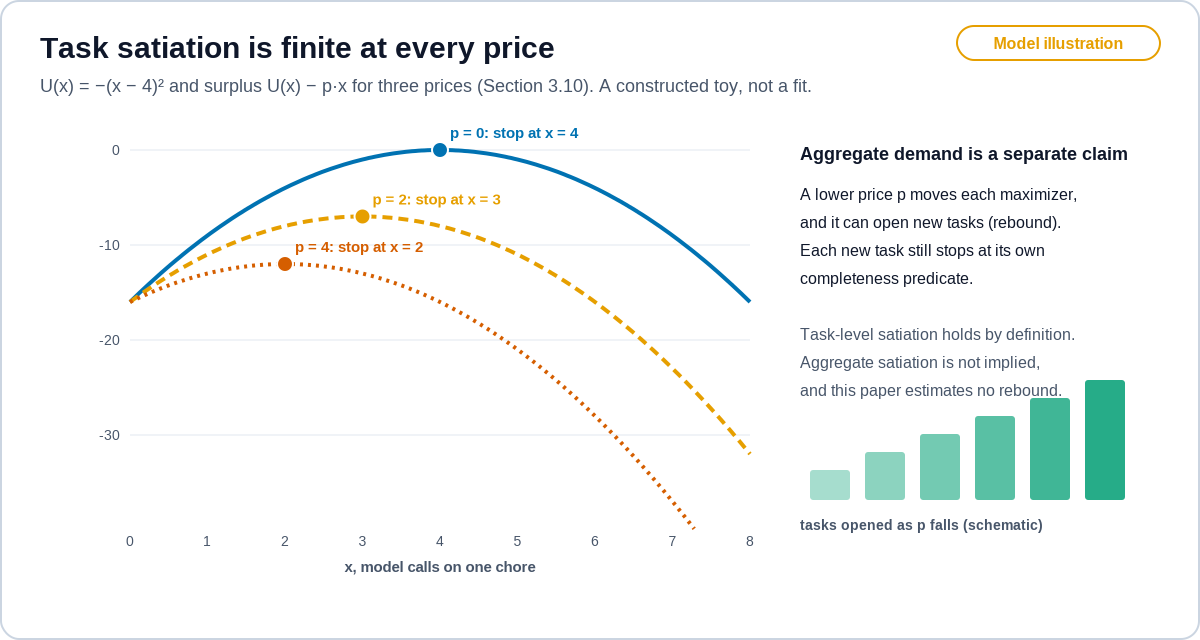
*Figure 1. Task satiation and aggregate rebound. Model illustration of the toy in this section, not a fit: the maximizer of $U(x) - p\,x$ is $x = 4 - p/2$, finite at every price. The right panel is a schematic; this paper estimates no rebound. A [PNG copy](https://research.openie.dev/figures/satiation/satiation-rebound.png) is provided.*
### 3.11 Reason codes as a partition, not a welfare function
Let `R` be the set of refuse codes on a trace. Partition `R` into `R_econ = {policy, budget_exceeded}` and `R_phys = {lut_veto, energy_veto, cbf_veto}`, matching the schema's taxonomy. Other codes, if added later, have to be assigned in writing before they are counted. A trace interval contributes to post-done economic refuse only if `C` is already 1 and the code is in `R_econ`. It contributes to physical refuse if the code is in `R_phys`, whether or not `C` is 1. An unsafe action after done is in both stories and should be counted in both columns, not averaged. The MCP demo's irreversible refuse is a physical example: energy and barrier codes, executor calls 0. It is not an `R_econ` example. A future episode with `policy` after a merged patch would be the economic example. The repository does not include that episode. The partition is how it would be scored.
## 4. Evidence
### 4.1 Claim S-1. Satiation is a defined economic object
Andersen (2001), https://doi.org/10.1007/PL00003852, and the textbook bliss construction in Section 2.1 support S-1. The claim is theoretical. It is not a measured utility function for any user population in this study.
### 4.2 Claim S-2. Published inference prices fell sharply at fixed performance
Supported by Epoch AI (2025) and Emberson and Roodman (2026), with the magnitudes those notes state (Section 2.5). The claim is about price indices those authors publish. It is not a claim that every organization's invoice fell by 13 times, and it is not a claim about watts.
### 4.3 Claim S-3. Engagement variables are not the completeness predicate
Supported by the definitions in Section 3.1 and by the attention literature's description of time-on-task objectives (Wu; Center for Humane Technology overview). No causal estimate of welfare loss is claimed. The logical claim is non-identity of the variables: token count can increase while `C` stays constant. The constructed episodes in Section 3.4 are illustrations of non-identity, not datasets.
### 4.4 Claim S-4. Bicycle-mania prices detached from a simple fundamental story
Supported by Quinn (2019): rises over 200 percent and subsequent falls over 75 percent in cycle shares, 1895 to 1900, not fully explained by fundamentals or by a simple risk shift in that paper's tests. The claim stops there. It does not quantify household satiation for bicycles.
### 4.5 Claim S-5. U.S. smartphone ownership is high in the cited fact sheet
The project archive's reading of Pew's mobile fact sheet is ownership near 91 percent for the 2024 and 2025 rows. The claim used in this paper is diffusion at that order, conditional on the live sheet matching the archive. It is a saturation fact about ownership, not a bliss-point estimate.
### 4.6 Claim S-6. Care is not priced as a pure software good by the Baumol framework
Baumol (1967) supplies the framework. Acemoglu and Restrepo (2019) supply the task language. The claim is that these frameworks do not imply an end to care's labor, trust, or liability requirements when token prices fall. The claim is not a forecast of health-care expenditure.
### 4.7 Claim S-7. A sell-side note questions spend versus benefit
The Goldman Sachs page named in Section 2.6 exists and frames the question in its title.
### 4.9 Claim S-9. Physical law is not priced to zero by Epoch
Landauer (1961) and Horowitz (2014) support a permanent gap between an ideal erasure bound and CMOS practice. S-9 says only that a citation of Epoch does not discharge a citation of Landauer.
### 4.10 Design rules, marked as design
These rules follow if one accepts the definitions and wants a product that optimizes `C` rather than tokens. They are not effects.
1. Write `C` before adding model capacity.
2. Treat a synthesis price premium as temporary when Epoch-type series and open weights apply to that chore.
3. Do not describe modeled or simulated energy as measured energy.
4. Prefer a detector of `C` with an error table over an unlabeled increase in model size, once the chore is the product.
5. Require a separate physical safety check before any irreversible action.
6. Report pre-done and post-done energy separately when the split exists. It does not exist yet.
7. Do not apply the satiation predicate to adversarial or military races (Section 5.3).
8. If the product's objective is attention, say so. The completeness claims then do not apply.
Kill tests for a roadmap, also design: a plan that assumes unbounded appetite for a chore with a short `C`; a price that requires permanent synthesis scarcity and no physical or liability wedge; a safety story that uses only a confidence string; a "free" claim that deletes joules; an agent loop with no `C`.
### 4.11 What would be a result and is not
A table of false-done and false-continue rates. A time series of calls after `t*`. A meter reading of energy on a stated workload. A structural rebound estimate. An AGI price premium estimated on a satiated chore. None of these appear in Section 4's supported claims.
### 4.12 Non-identity, stated as a comparison of objectives
Let `x` be call count, `s` session length, `J_pre` and `J_post` energy before and after adjudicated done, and `C` the predicate. The following implications are definitional.
| Observation | Does not imply |
|-------------|----------------|
| `x` increased | `C` increased |
| `s` increased | welfare increased |
| `p` fell (S-2) | `J_post = 0` |
| `C = 1` | the detector's error rate is known |
| ownership of phones is high (S-5) | marginal value of another model call is zero |
| cycle-share prices boomed and busted (S-4) | households reached a transport bliss point |
The right-hand column is the list of inferences this paper refuses. Each left-hand observation is either a citation in Section 4 or a variable in Section 3. The table is the discussion compressed into a check. A sentence that asserts a right-hand claim has left the evidence.
## 5. Discussion
### 5.1 Rebound: the central identification problem
Three results limit the natural experiment. Gundlach and colleagues (2025) find that prices at fixed benchmark performance fall fast while frontier prices do not, and Du (2026) finds a structural break and a reasoning premium in price evolution, so price cuts arrive bundled with model changes. Anthropic's Economic Index (September 2025) reports that across tasks each 1% increase in cost is associated with a 0.29% decrease in usage frequency, an inelastic cross-sectional figure, not a price change over time. A provider-level design cannot identify market-level rebound; the design needs market-level prices and quantities.
Gillingham, Rapson, and Wagner survey rebound from energy-efficiency policy. The mechanism is residual demand elasticity. If the money price of synthesis falls, use rises where buyers still value another unit. At a bliss point for a closed chore, the direct derivative of value with respect to more synthesis on that chore is not positive, so direct rebound on that chore is not implied. Indirect rebound, new tasks, and attention shifting can remain. Acemoglu and Restrepo's new-task margin is one place quantity can reappear. Claim S-2 therefore does not imply a global cap on compute. It implies a cap only relative to a stated `C`. Denying global rebound would require the split in Section 3.3 and a demand system. This paper does not deny global rebound. It refuses to treat "Jevons" as a reason to avoid writing `C`.
Two hypotheses make the question testable.
- **S-H1. Post-completion spend.** The fraction of agent compute spent after `C(z) = 1`, joules or calls with `t > t*` over all joules or calls in the episode, is measurably above zero. S-H1 is the direct waste the completeness stop removes. It is estimable from agent logs with a labeled `t*` per episode (Section 3.3, item 1).
- **S-H2. Jevons in tasks.** S-H2 is the direct-rebound elasticity of Khazzoom (1980), stated for tasks. When the price of synthesis falls, the elasticity of the number of tasks run exceeds the fall in spend per task. Then total spend rises even though each task is satiated. S-H2 is aggregate rebound.
**Identification.** S-H1 needs no price variation: a labeled corpus, the detector error rates of Section 3.3 item 2, and the split account. S-H2 needs exogenous price changes. Provider price cuts at fixed model quality, announced on a known date, are natural experiments. The design is a panel of accounts with price paid, tasks opened, calls per task and a completeness label per episode, before and after each cut. Comparing accounts on a repriced model with accounts on models whose price did not move gives a difference-in-differences estimate of the task-count elasticity and the per-task spend response separately. Spend per task can fall while task count rises. Both numbers are needed. The completeness stop is a claim about the first. Jevons is a claim about the second. Neither was estimated here.
### 5.2 Status and creative goods
Some goods are valued because they are not finished: status, open-ended art, research whose `C` is not a finite checklist. The definition in Section 3.1 does not force a bliss point onto those goods. It forces a segmentation. A finite chore and an open-ended practice can be sold by the same firm and should not share a demand assumption. Pricing a finite chore as if it were an open-ended capability race is a category error, not a finding about AGI.
### 5.3 Adversarial demand
If the other party's gain is this party's loss, "enough" is not defined by a local checklist. Arms races and some security contests are in that class. Physical commit constraints can still apply: an unsafe action can be refused while the strategic demand remains open. Scope is part of the claim, not a footnote that cancels it.
### 5.4 Incomplete knowledge of done
People misjudge completion. Detectors will false-done and false-continue. That is an argument for measuring detector error, which Section 3.3 lists as missing. It is not an argument that session length is a substitute for `C` in a domain where a missed handoff has a liable party. Where no predicate can be written, this paper's operational claim is silent.
### 5.5 Baumol is not solved
A model that drafts a note faster can raise throughput of notes and leave examination, judgment, and responsibility with a person. Expenditure shares can still move as Baumol described if the human residual does not speed up. Saying otherwise would be a forecast this bibliography does not contain. The permitted statement is S-6.
### 5.6 Free synthesis is not free actuation
A falling money price for inference says nothing about the energy of moving a physical system. Moving a mass $m$ through a speed change $\Delta v$ from rest takes at least $\tfrac12 m (\Delta v)^2$ joules of work, whatever the price of the instruction that commanded it. Epoch prices sit on a different axis from that work. Collapsing them into "free AI" deletes the measurement class.
### 5.7 Confidence is not a certificate
A high model score can order proposals. It is not a completeness predicate: a score needs a threshold and an error table (false and true positive rates against a labeled set) before it decides `C`.
### 5.8 Sell-side skepticism is not a measurement
S-7 prevents a literature review from ignoring a major public doubt about spend and benefit. It does not let a research note replace a meter or a demand estimate. If the note's figures are quoted later, the primary PDF has to be the source, and the label is sell-side estimate.
### 5.9 What a structural demand estimate would require
S-2 is a supply-price fact from secondary published series. A demand estimate is a different regression. At minimum it needs a quantity (calls, tasks closed, or both), a price, and a way to separate movement along a demand curve from movement of the curve. Epoch's benchmark price is not a firm-level invoice, and a firm's invoice is not `C`. Linking them requires a panel this study does not have: accounts that record price paid, calls made, and an adjudicated completeness label on the same episode. Without that panel, the slope of demand after `t*` is not identified. The toy surplus in Section 3.10 shows only that a quadratic bliss point keeps a finite optimum as `p` falls. It is not the missing regression.
Segmentation belongs in the same design. Code each product as finite-`C` or open-ended before pooling. Pooling a ticket desk with an open research tool averages two demand regimes and can manufacture an appearance of unbounded appetite. The military exclusion in Section 5.3 is the same rule applied to a domain where the opponent's objective prevents a local bliss point. A table with those codes, even with no prices yet, would be more informative than a single total-addressable-market number. The table was not built.
### 5.10 Why no multiple of `kT ln 2` is stated
Landauer's result is an inequality for an idealized erasure at temperature `T`. Horowitz (2014) reports energies for particular CMOS operations and for memory traffic, in picojoules, under the assumptions of that tutorial. Dividing one by the other produces a number only after someone chooses the operation, the activity factor, the temperature, and the device. None of those choices is measured in this paper. Stating a fold above the Landauer bound would pretend those choices had been made. The scientific statement is the inequality direction: practical irreversible CMOS in Horowitz's account sits far above the bound, and a price index does not move a device onto the bound.
## 6. Limits and threats to validity
Construct validity. Operational satiation depends on `C`. A hostile or vague `C` makes the predicate arbitrary. The paper's defense is to require `C` to be written in observable clauses. Many real products do not have that writing yet. For those products the theory does not yet apply empirically.
Internal validity of the price claim. S-2 inherits whatever identification Epoch used (quality adjustment, benchmark choice, posted prices versus realized invoices). This paper did not audit the microdata. A revision of Epoch's series would revise S-2's magnitudes and might not revise the direction. S-2 should be re-read against the primary pages before it is used as an executive figure.
External validity. Work and care, as defined, exclude military rivalry and may exclude research. Phone ownership does not transfer to agent products. Bicycle share prices do not transfer to software margins. The constructed episodes are not a sample.
Measurement validity. No split joules, no detector confusion matrix, and no energy meter on any device. Vendor hardware specifications are not energy measurements.
Omitted variable. New tasks can absorb spending released by cheap synthesis. Section 5.1 states this. A roadmap that treats per-chore satiation as a forecast of aggregate compute demand is not licensed by this paper.
Publication bias and document type. Wu is a book. The Humane Technology page is advocacy. Goldman Sachs is sell-side. Quinn and Epoch and Baumol and Acemoglu and Restrepo and Landauer and Horowitz are the load-bearing citations, and they support different sentences. The paper's structure is an attempt to keep those sentences from being averaged into a mood.
Falsifiers. S-1 fails if the cited theory does not contain a zero marginal-utility region. It does. S-2 fails if the primary Epoch pages do not report declines of that kind. A future labeled corpus in which extra calls after a correct `C` systematically raise an independently specified value would falsify satiation for that corpus. One such corpus would not falsify the definition. It would bound its domain.
Vendor hardware specifications list capacities, not switching activity, static power or the energy of a workload. An energy report has to name the hardware, the clock, the workload, the meter and the duration.
## 7. Conclusion
Satiation is a standard object in the theory cited, and it has a narrow operational form: a written completeness predicate that extra synthesis does not advance. Epoch's published series document a sharp fall in the money price of fixed-performance inference. That fall supports a free-at-the-margin description of digital chores and does not support free joules, free plant motion, or the end of care's cost structure. Bicycle share prices, smartphone diffusion, and attention markets are weaker and stronger in the specific ways Section 4 states. The missing scientific objects are a labeled done detector, a pre-done versus post-done energy split, and a demand estimate that can see rebound. Until they exist, the paper's empirical content is the cited record, and its formal content is the predicate.
## References
Cover, T. M., and Thomas, J. A. Elements of Information Theory, 2nd ed. Wiley, 2006. https://doi.org/10.1002/047174882X
Hoffmann, J., et al. Training compute-optimal large language models. arXiv:2203.15556.
Kaplan, J., et al. Scaling laws for neural language models. arXiv:2001.08361.
Shannon, C. E. Coding theorems for a discrete source with a fidelity criterion. IRE National Convention Record, 1959.
Acemoglu, D., and Restrepo, P. Automation and new tasks: how technology displaces and reinstates labor. Journal of Economic Perspectives 33(2), 2019. https://www.aeaweb.org/articles?id=10.1257/jep.33.2.3
Ames, A. D., et al. Control barrier functions: theory and applications. ECC 2019. https://doi.org/10.23919/ECC.2019.8796030
Andersen, E. S. Satiation in an evolutionary model of structural economic dynamics. Journal of Evolutionary Economics, 2001. https://doi.org/10.1007/PL00003852
Baumol, W. J. Macroeconomics of unbalanced growth: the anatomy of urban crisis. American Economic Review 57, 415-426, 1967.
Bennett, C. H. Logical reversibility of computation. IBM Journal of Research and Development, 1973. https://doi.org/10.1147/rd.176.0525
Center for Humane Technology. The attention economy. https://www.humanetech.com/youth/the-attention-economy
Emberson, L., and Roodman, D. / Epoch AI. The plunging price of thought. 22 September 2026. https://epoch.ai/publications/the-plunging-price-of-thought
Epoch AI. LLM inference price trends. 12 March 2025. https://epoch.ai/data-insights/llm-inference-price-trends
Gillingham, K., Rapson, D., and Wagner, G. The rebound effect and energy efficiency policy. Review of Environmental Economics and Policy 10(1), 68-88, 2016. https://doi.org/10.1093/reep/rev017 Working text: https://gwagner.com/wp-content/uploads/Gillingham-Rapson-Wagner-2015-Rebound-Effect.pdf
Alcott, B. Jevons' paradox. Ecological Economics 54(1), 9-21, 2005. https://doi.org/10.1016/j.ecolecon.2005.03.020
Anthropic. How we built our multi-agent research system. 13 June 2025. https://www.anthropic.com/engineering/multi-agent-research-system
Jevons, W. S. The Coal Question. London: Macmillan, 1865.
Keynes, J. M. Economic possibilities for our grandchildren. 1930. Reprinted in Essays in Persuasion, 1931.
Nordhaus, W. D. Two centuries of productivity growth in computing. Journal of Economic History 67(1), 128-159, 2007. https://doi.org/10.1017/S0022050707000058
Goldman Sachs. Gen AI: too much spend, too little benefit? https://www.goldmansachs.com/insights/top-of-mind/gen-ai-too-much-spend-too-little-benefit
Horowitz, M. Computing's energy problem (and what we can do about it). ISSCC 2014. https://doi.org/10.1109/ISSCC.2014.6757323
Landauer, R. Irreversibility and heat generation in the computing process. IBM Journal of Research and Development, 1961. https://doi.org/10.1147/rd.53.0183
Laya. System One models and typed decision engines (comparison table, checked 2 October 2026). https://laya-ai.com/system-one-models
Convai Innovations. Laya model card. https://huggingface.co/convaiinnovations/laya
TypeSafe AI. Introducing System One Models and Jev. 15 September 2026. https://typesafe.ai/blog/introducing-system-one-models-and-jev
Ma, S., et al. The era of 1-bit LLMs. arXiv:2402.17764.
Pew Research Center. Mobile fact sheet. https://www.pewresearch.org/internet/fact-sheet/mobile/
Quinn, W. Technological revolutions and speculative finance: evidence from the British Bicycle Mania. Cambridge Journal of Economics 43(2), 271-294, 2019. https://doi.org/10.1093/cje/bey029
Wei, J., et al. T-MAC. arXiv:2407.00088.
Wu, T. The Attention Merchants. Knopf. https://www.penguinrandomhouse.com/books/234876/the-attention-merchants-by-tim-wu/
Chung, J.-W., Wu, R., Ma, J. J., and Chowdhury, M. Where Do the Joules Go? Diagnosing Inference Energy Consumption. arXiv:2601.22076. https://arxiv.org/abs/2601.22076
Energy use of AI inference, efficiency pathways, and test-time scaling. *Joule*, 2026. https://www.cell.com/joule/fulltext/S2542-4351(26)00114-5
Luccioni, A. S., Strubell, E., and Crawford, K. From efficiency gains to rebound effects: the problem of Jevons' Paradox in AI's polarized environmental debate. *FAccT* 2025. https://doi.org/10.1145/3715275.3732007
Ostrovsky, N. / Epoch AI. What you need to know about AI energy use. Updated 14 July 2026. https://epoch.ai/publications/ai-energy
Anthropic. Anthropic Economic Index report: uneven geographic and enterprise AI adoption. September 2025. https://www.anthropic.com/research/anthropic-economic-index-september-2025-report
Bai, L., Huang, Z., Wang, X., et al. How do AI agents spend your money? Analyzing and predicting token consumption in agentic coding. arXiv:2604.22750, 2026. https://arxiv.org/abs/2604.22750
Brockway, P. E., Sorrell, S., Semieniuk, G., Heun, M. K., and Court, V. Energy efficiency and economy-wide rebound effects: a review of the evidence and its implications. Renewable and Sustainable Energy Reviews 141, 110781, 2021. https://doi.org/10.1016/j.rser.2021.110781
Brookes, L. The greenhouse effect: the fallacies in the energy efficiency solution. Energy Policy 18(2), 199-201, 1990. https://doi.org/10.1016/0301-4215(90)90145-T
Chen, X., Xu, J., Liang, T., et al. Do NOT think that much for 2+3=? On the overthinking of o1-like LLMs. arXiv:2412.21187, 2024. https://arxiv.org/abs/2412.21187
Cuadron, A., Li, D., Ma, W., et al. The danger of overthinking: examining the reasoning-action dilemma in agentic tasks. arXiv:2502.08235, 2025. https://arxiv.org/abs/2502.08235
Du, M. Tiered super-Moore's law: price evolution, production frontiers, and market competition in large language models. arXiv:2603.28576, 2026. https://arxiv.org/abs/2603.28576
Fouquet, R., and Pearson, P. J. G. Seven centuries of energy services: the price and use of light in the United Kingdom (1300-2000). The Energy Journal 27(1), 2006. https://doi.org/10.5547/ISSN0195-6574-EJ-Vol27-No1-8
Gundlach, H., Lynch, J., Mertens, M., et al. The price of progress: price performance and the future of AI. arXiv:2511.23455, 2025. https://arxiv.org/abs/2511.23455
Khazzoom, J. D. Economic implications of mandated efficiency in standards for household appliances. The Energy Journal 1(4), 1980. https://doi.org/10.5547/ISSN0195-6574-EJ-Vol1-No4-2
Masanet, E., Shehabi, A., Lei, N., Smith, S., and Koomey, J. Recalibrating global data center energy-use estimates. Science 367(6481), 984-986, 2020. https://doi.org/10.1126/science.aba3758
Saunders, H. D. The Khazzoom-Brookes postulate and neoclassical growth. The Energy Journal 13(4), 1992. https://doi.org/10.5547/ISSN0195-6574-EJ-Vol13-No4-7
Sorrell, S., and Dimitropoulos, J. The rebound effect: microeconomic definitions, limitations and extensions. Ecological Economics 65(3), 636-649, 2008. https://doi.org/10.1016/j.ecolecon.2007.08.013
Tsao, J. Y., Saunders, H. D., Creighton, J. R., Coltrin, M. E., and Simmons, J. A. Solid-state lighting: an energy-economics perspective. Journal of Physics D: Applied Physics 43(35), 354001, 2010. https://doi.org/10.1088/0022-3727/43/35/354001
Witt, U. Learning to consume: a theory of wants and the growth of demand. Journal of Evolutionary Economics 11(1), 23-36, 2001. https://doi.org/10.1007/PL00003851
## Appendix A. Decision rules and non-results
| Id | Statement | Class |
|----|-----------|-------|
| R1 | Write the completeness predicate before adding capacity. | Design |
| R2 | Expect synthesis price premia to erode where Epoch-type evidence applies. | Design, conditional on S-2 |
| R3 | Do not claim free energy or free actuation. | Constraint from S-9 |
| R4 | Separate economic stop reasons from physical stop reasons. | Design |
| R5 | Publish detector error rates before treating a stop as accurate. | Not yet a result |
| R6 | Split energy before and after done. | Not yet a result |
| R7 | Keep adversarial races outside the satiation claim. | Scope |
| R8 | Re-read Pew and Epoch primaries before quoting a finer magnitude. | Method |
## Appendix C. Claim map
Supported now: S-1 through S-9, with the scope sentences in Section 4.
Not supported: an end to Baumol cost disease; free plant motion; satiation of military demand; a numerical global rebound of zero; Landauer-scale operation of a language model; board watts; an AGI price as a fact about satiated chores; a universal distillation lag; silicon performance leadership.
Open measurements: Section 3.3.
================================================================================
# The Reality Code Engine: One Lossless Form for Native, Verified, Low-Energy Programming
- **Study ID:** `rce`
- **Kind / Status:** Research paper
- **Revision:** `bb74dab` (23 November 2026)
- **Web Edition:** https://research.openie.dev/papers/rce/
- **Markdown Twin:** https://research.openie.dev/papers/rce.md
- **PDF Edition:** https://research.openie.dev/pdfs/rce.pdf
- **LaTeX Archival PDF:** https://research.openie.dev/pdfs/latex/rce.pdf
- **LaTeX Source (.tex):** https://research.openie.dev/pdfs/latex/rce.tex
- **Interactive Figures:** https://research.openie.dev/figures/rce/intent-entropy.svg
- **Claim Scope & About:** https://research.openie.dev/about/rce/
- **Data & Reproducibility:** https://research.openie.dev/data/#rce
- **Keywords:** Reality Code Engine, RCE, program form and fit, Abstract State Machine, e-graph, formal verification, Z3, Mixture of Limits
> A system in which a program is written once as a state machine and code in other languages is generated from it: its specification (openIE-dev/rce at f87d6af2), reference checker and emitters, 5,393 Lean 4.36.0 kernel theorem constants from 1,264 source declarations (theorems T1 to T63, verified inside Linux bubblewrap across all 6/6 independent kernels of lake check --paranoid: con-leche/con-ron 68,090 decls, lean4lean/nanoda/leanchecker/Lean v4.36.0 68,092 decls), 2,221/2,236 passing conformance checks with 0 failures, Apple M5 Max reported_j checker receipts (49.04 mJ per Form check; measured_j unset), and registered measurements of program dimension. Plain words: a program is written once and generated in many languages; the language requires every input to have a declared outcome; in the engine's design, checked fixes are saved so that the same problem is not paid for twice.
---
*revision [`bb74dab`](https://github.com/openIE-dev/research-openie-web/commits/main/src/content/papers/rce.md), 23 November 2026. Specification: [current draft (draft 0.9)](https://research.openie.dev/rce/spec/), from [openIE-dev/rce](https://github.com/openIE-dev/rce); the counts of the checks run in [§3.7](#37-the-language-one-text-costs-and-theorem-status) are at the public commits named there, and those at `0c015c43` are recorded in [`src/data/rce-facts.json`](https://github.com/openIE-dev/research-openie-web/blob/main/src/data/rce-facts.json). Data and code: [research.openie.dev/data/](https://research.openie.dev/data/#rce). Playground (reference checker): [openie-dev.github.io/rce](https://openie-dev.github.io/rce/).*
## Abstract
This paper describes the Reality Code Engine (RCE), a system in which a program is written once as a state machine, called a Form, and code in other languages is generated from it. It presents the written specification of the language, the reference checker that implements it and emits Rust, Python, JavaScript and Scala, the Lean proofs of its theorems, registered measurements of the dimension of its programs, and the design of the engine that finds, checks and reuses solutions. It states how the claims could be shown false and the protocols of the measurements still to be made.
**In plain words**
1. A program is written once, in one precise form, and the computer produces the same program in many languages from it.
2. Everything a program can do is declared in its form, and the language requires every input to have a declared outcome, a step or a recorded kept step that leaves the state as it was, rather than an undefined one that is found and fixed later.
3. In the design of the engine, a fix that passes the checks is saved and reused, so that the same problem does not cost time or energy twice.
## 1. Thesis
Autonomous computer automation is a design space with many points in it. Every approach sits somewhere along five continuous axes: the energy spent per correct result; the entropy the system must resolve at run time, and with it how deterministic its output is; the strength of the verification that accepts a result; how far each accepted result is reused and compounds; and how much the approach relies on a model. A large language model (LLM), a statistical text model, that writes each change from the prompt sits near one corner of that space: it relies on the model for every task, draws a fresh sample from a high-entropy distribution each time, and pays for generation again on every task. Retrieval, rules, synthesis, verification and caching occupy many other points, and real systems combine them.
The Reality Code Engine (RCE) is one point in the space. This paper describes it, and the measurements it reports are of its language and the language's tools. RCE models a program as a database functional state machine. Lopes and colleagues measured that about 70% of the code on GitHub consists of clones of earlier files [33], so RCE first tries to retrieve an existing fit, adapt it and check it, and calls a model only when nothing cheaper closes the task.
**The core claim.** RCE is a complete code ecosystem in which programs are authored natively from intent. Intent is written once, as a Form: a state, a set of events and a pure, total transition. The Form is a lossless encoding of that intent. Every target language is a projection of the Form, and each projection must replay the Form's trace byte for byte; the reference checker emits Rust, Python, JavaScript and Scala today. Every state a program can be in is declared in its Form, and the language requires every input to have a declared outcome: a step that takes it, or, when the event does not apply under its contract, a kept step: the state is unchanged and the step is recorded in the log (T8). A program that meets these requirements cannot drift from its intent the way a program in a common language drifts from its comments, its tests or its other implementations, and it needs no after-the-fact diffing or error tracking. The input contract that makes the reference checker meet the second requirement at entry is listed in [§10](#10-work-to-finish). In the engine's design, every fit that passes the gate is stored and reused, so the ecosystem compounds as it grows ([§2.4](#24-gated-verified-recursive-self-improvement)). Code written in other languages is one door in: it enters by lift ([§6](#6-lift-entering-the-ecosystem-from-other-languages)).
Every point in the space faces the same gate. The gate is correctness: a task's completeness predicate $C(z)$, here the task's tests, a proof or an agreement trace. Among runs that pass the gate, systems are ranked by joules to completion, $J^*$. Correctness is a constraint, not a score.
In the engine's design, RCE's mechanisms, called gears, run in order of cost, and the first gear whose candidate passes the gate closes the task.
Energy figures are labeled by source. `est_j` is an analytical estimate. `reported_j` is an operating-system or on-chip counter. `measured_j` is reserved for a wall meter and is empty in every result here. What the public code at openIE-dev/rce main `09b2bdfb` ships is narrower. The checker counts work in integer cost units and fuel per input, which specification C.6 states are "not a measurement of time or energy". A receipt's joule terms are filled only as `est` or `unpriced`, and no receipt holds a reading. The log entry for a counter reading, `host.Energy`, is defined in the specification, and no checker code writes it. `host.Calibrated` records a fabric's overhead and throughput, not joules. A calibration in joules per unit is a proposal ([§6.3](#63-energy)).
## 2. The design space of autonomous coding
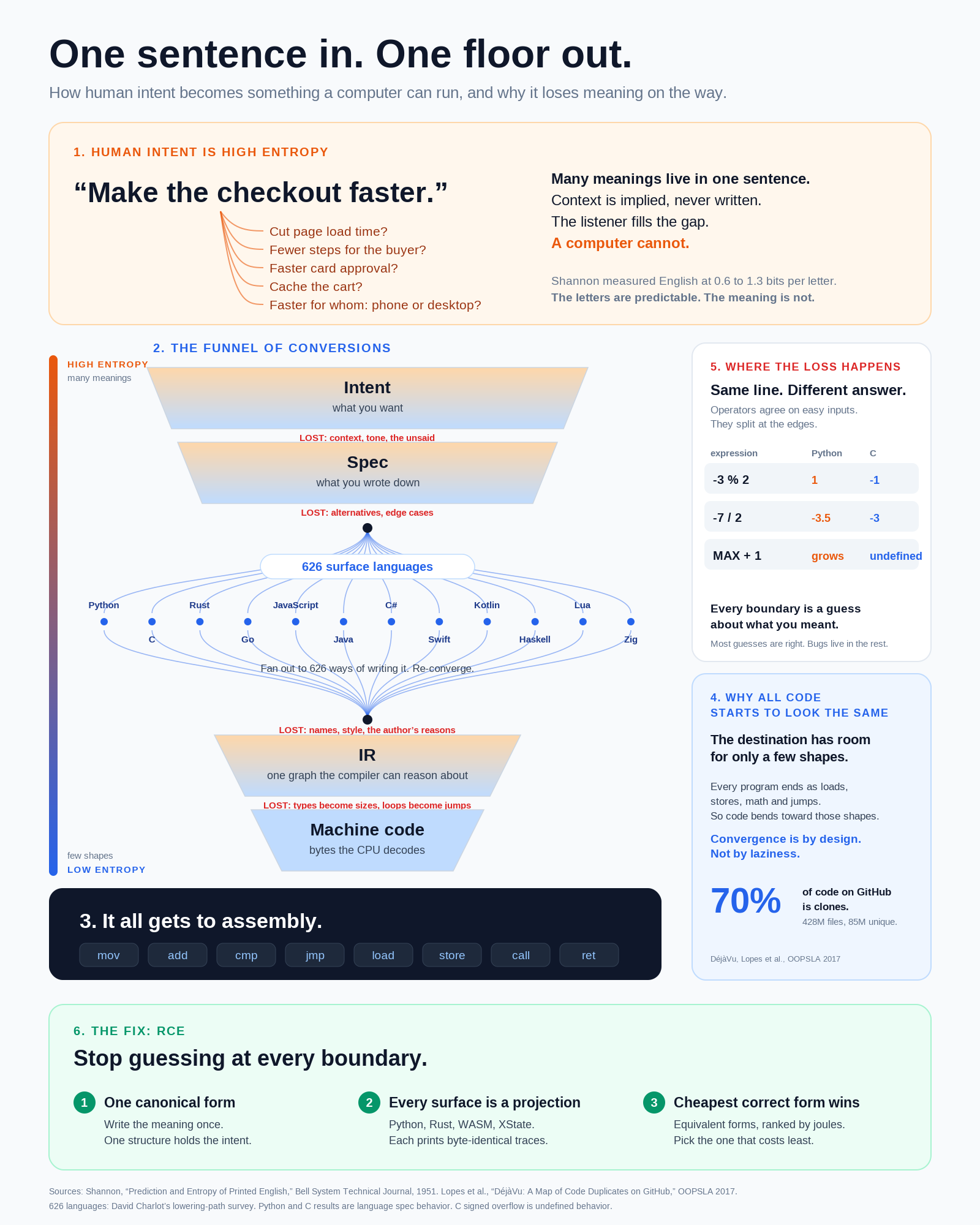
*Figure 1. Intent entropy and the machine floor. A [PNG copy](https://research.openie.dev/figures/rce/intent-entropy.png) is provided. Sources: Shannon (1951); Lopes et al. (2017); the 626-language count is an unpublished survey by the OpenIE authors and supports no claim in this paper. The Python and C results are language specification behavior; C signed overflow is undefined behavior.*
**Intent is high entropy.** "Make the checkout faster" carries many meanings: shorter page load, fewer steps, faster card approval, a cached cart, or faster on one device class. Context is implied and never written. Shannon measured printed English at about 0.6 to 1.3 bits per letter [1]. The letters are predictable. The meaning is not.
**Every conversion loses information.** Intent becomes a specification, and context is lost. The specification becomes one of hundreds of surface languages, and alternatives and edge cases are lost. The source becomes an intermediate representation (IR), and names, style and the author's reasons are lost. The IR becomes machine code, and types become sizes and loops become jumps.
**The floor is low entropy.** Every program ends as loads, stores, arithmetic and jumps. The destination has room for only a few shapes, so code bends toward them. Convergence is by design.
**Boundaries are where meaning diverges.** The same line gives different answers at the edges. In Python, `-3 % 2` is 1 and `-7 / 2` is -3.5. In C, `-3 % 2` is -1, `-7 / 2` is -3, and signed overflow is undefined. A system that regenerates code at every boundary guesses at every boundary.
**The axes, stated as quantities.**
| Axis | One end | Other end | Where RCE's design sits |
|---|---|---|---|
| Energy per correct result | Paid again in full on every task | Paid once per new case, then the handler floor | At the floor on covered tasks |
| Entropy resolved at run time, and determinism | The full distribution of the prompt, a fresh sample each time | Only the residual no stored fit covers, one deterministic output | The residual only; every projection deterministic |
| Verification strength | Output accepted on inspection | Tests, coverage and a proof certificate | The full gate on every result |
| Reuse and compounding | Each result used once | Each accepted fit stored and reused | Every fit that passes the gate is stored |
| Model reliance | A model on every task | No model | A model only as the last gear |
Approaches differ by degree on each axis, and the axes interact: reuse lowers energy and the entropy left to resolve, and strong verification is what makes reuse safe. RCE writes the meaning once, in one canonical Form. Every surface language is a projection of that Form, checked to match it. Among equivalent forms, the cheapest correct one runs.
Figure 2 draws the five axes and places the main classes of approach on them.
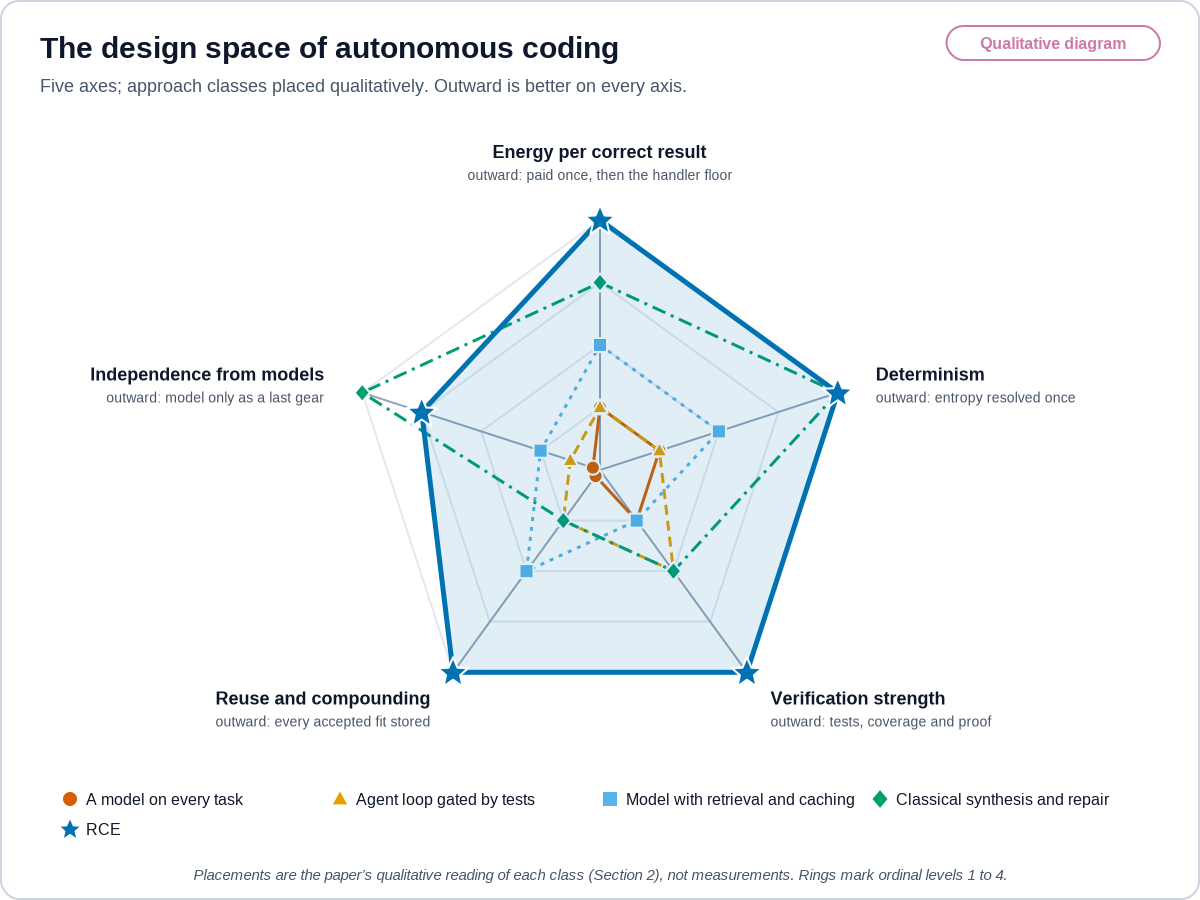
*Figure 2. The design space of autonomous coding. Qualitative diagram: each class of approach is placed by the paper’s reading of Section 2 on ordinal levels, not by measurement. Model reliance is drawn as independence from models so that outward is better on every axis. A [PNG copy](https://research.openie.dev/figures/rce/design-space.png) is provided.*
### 2.1 Programming is coding theory
The thesis of this section is that programming can be read as coding theory. A programmer converts intent along a gradient between two entropic regimes. Intent is high entropy, a distribution over meanings. Code is low entropy, one deterministic transition per state. Every step of software work, from a requirement to a register, is a step of that conversion. The literature has said so in pieces for seventy years, in many languages. This section assembles the pieces into one argument and places each RCE gear on it.
**The measure.** Shannon defined the entropy of a source and the capacity of a channel [40], and measured printed English at about 0.6 to 1.3 bits per letter [1]. Kolmogorov, writing in Russian in *Problemy Peredachi Informatsii* in 1965, gave three approaches to the quantity of information and made the algorithmic one primary: the information in an object is the length of the shortest program that produces it [41]. Solomonoff had reached the same object as a theory of inductive inference [42], and Chaitin showed that program size obeys identities formally identical to Shannon's [43]. Rissanen turned the idea into a rule for choosing models, the minimum description length [44]. Together they say that a program is a code word: a description of a behavior, and the shortest correct one is the floor. RCE's extraction rule, keep the least-joule fit among equivalent fits (Proposition 3), is that rule with joules in place of bits.
**Code sits in the low-entropy regime, and people measured it.** Hindle, Barr, Su, Gabel and Devanbu found that code is "very repetitive, and in fact even more so than natural languages," at lower cross-entropy under the same n-gram models [35]. Gabel and Su found that most lines of a project already exist elsewhere [34], and Lopes et al. found that most files on GitHub are clones [33]. Tu, Su and Devanbu found that code is also local: what was written nearby predicts what comes next [46]. Ray and colleagues found that buggy lines are less natural, with higher entropy, and that the entropy falls when the bug is fixed [45]. In 2025 Yang, Kolak, Hellendoorn and Martins used the entropy change a patch induces to rank repair candidates and to separate correct patches from overfitting ones [51]. Allamanis, Barr, Devanbu and Sutton surveyed the field under the name naturalness [47]. The result is not only an English-language one. Prem Devanbu stated it as a keynote at the India Software Engineering Conference in 2013 [50]. Sridhara, Sinha and Mani at IBM Research India measured the natural-language artifacts around code at the same venue and found that commit messages are the most regular and Stack Overflow prose behaves like ordinary English [49]. In China, the *Journal of Software* (软件学报) published a review of code naturalness research in 2022, which states the cross-entropy measure and the finding that defective code has higher entropy [48]. In Japan, Doi, Higo, Arima, Shimonaka and Kusumoto at Osaka University used n-gram naturalness, first in a Japanese-language IEICE technical report and then at ICPC 2018, to tell machine-generated source files from human-written ones [73, 74]. Generated code sits even lower on the entropy scale than human code, because a generator is a fixed conversion. In Brazil, Arrebola's doctoral thesis built code suggestion on n-gram and topic models segmented by project and maintainer, and evaluated it by cross-entropy, the bits needed to encode the next token [75]. The two regimes are visible in one repository: the prose around the code is high entropy, and the code is low.
**The measure matters.** Febres, Jaffé and Gershenson, working from Venezuela and Mexico, compared English, Spanish and program text by vocabulary diversity per message length and found the program text more diverse [76]. Rahman, Palani and Rigby found that much of the n-gram predictability of code comes from syntax tokens, and that code is still repetitive, less than first reported, once those are removed, with API usage the most repetitive part [77]. Both results sharpen the claim rather than reverse it. Diversity of symbols is not predictability, and the low-entropy regime is a property of the conditional distribution of the next step, which is what a deterministic transition fixes. RCE's G0 keys on shapes, not on surface tokens, for that reason.
**Intent sits in the high-entropy regime.** Zave and Jackson showed that a requirement is a statement about the environment, a specification is a statement at the interface, and the gap between them is filled only by domain knowledge that is often unwritten [64]. Brooks split the difficulty of software into essence and accident: the essence is the conceptual construct, and most of it is specification and design, not representation [61]. Naur argued that a program is the visible part of a theory held by its programmers, and that the theory is not fully recoverable from the text [62]. Read through Shannon, all three say the same thing. Intent carries more uncertainty than any one program, and writing the program is the act that removes it. What remains in a programmer's head after the code is written is the part of the intent the code did not encode.
**The conversion is a refinement, and refinement is a narrowing.** Hoare gave programs a logic in which a program is correct relative to a pre- and postcondition [54]. Wirth taught stepwise refinement: decompose a task into instructions by successive decisions, each one fixing a choice the specification left open [53]. Dijkstra's guarded commands made the open choices explicit as nondeterminacy, and derived programs from specifications by removing it [52]. In Munich, Bauer and Wössner's CIP project built program development as a sequence of correctness-preserving transformations from specification to program [58]. In France, Abrial's B method and then Event-B carried refinement to industrial scale, with proof obligations at each step [55, 56]. In Finland, Back and von Wright gave refinement its lattice-theoretic calculus [57]. In each, a specification denotes a set of acceptable behaviors and each refinement step shrinks the set, until one deterministic behavior remains. That is entropy reduction with a proof at every step. RCE's Form is the last element of that chain: a total, deterministic transition $\delta$ over database states, with every choice resolved ([§3.2](#32-definitions)).
**Synthesis is search that narrows a hypothesis space.** Gulwani's FlashFill learns a string program from a few input-output examples by representing the set of all consistent programs and intersecting it with each new example [59]. Gulwani, Polozov and Singh frame program synthesis in general as search through a space of programs constrained by intent [60], and Solar-Lezama's sketching fills holes in a partial program with a solver [27]. Each example or constraint is a measurement that removes hypotheses. Shannon's measure counts how many such measurements are needed. RCE's G2 is that gear.
**What the conversion produces has one shape.** Gurevich proved that every sequential algorithm is captured by an Abstract State Machine at its own level of abstraction [2]. Codd made the state a relation [5], and event sourcing makes the state the fold of an append-only log [14]. Under Curry and Howard, a proof is a program and a proposition is a type [18, 72], so a verified fit is a proof of its specification. These are the reasons the low-entropy regime has few shapes: the destination is a state machine over a database, whatever the surface language.
**Low entropy decays without a gate.** Lehman observed over decades of large systems that a program in use must keep changing, and that its complexity grows unless work is done to reduce it [63]. Torres, Baltes, Treude and Wagner measured structural and textual entropy over the commit histories of 25 projects and found the two rise together [78]. Entropy flows back into code from the environment. A system that keeps code in the low-entropy regime needs a gate on every change, and RCE's gate is correctness ([§4.3](#43-the-gate)).
**Compilers already do source coding.** Franz and Kistler shipped programs as compressed abstract syntax trees and generated native code on load, which is source coding of a program over its own grammar [67]. Fraser inferred statistical models of code from a corpus to compress it [68]. Futamura showed in 1971, in the Japanese journal *Systems, Computers, Controls*, that specializing an interpreter to a program yields a compiled program, and that specializing the specializer yields a compiler [70]. Ershov in Novosibirsk developed the same idea as mixed computation [71]. The Cousots' abstract interpretation computes a sound, lower-information description of every behavior of a program [69]. The analogy to channel coding is this paper's reading, not a cited theorem: types, tests and proofs add checked redundancy so that a wrong program is detected before it runs, as a parity check detects a corrupted word.
**Erasure is where the joules go.** Landauer showed that a logically irreversible step, the erasure of one bit, dissipates at least $k_B T \ln 2$ [65]. Bennett showed that computation can in principle be made logically reversible, so the erasure, not the computation, carries the bound [66]. Converting high-entropy intent to one low-entropy program discards every alternative the intent allowed. That discard is an erasure of information about the alternatives, and it has a thermodynamic floor. RCE pays the discard once per new case and stores the result, so a repeat case erases nothing new.
**What the surface costs, measured.** The naturalness result has two corrections that this paper now carries, and a third finding that bears on the name-free Form. First, the raw entropy gap between code and prose shrinks substantially once syntax tokens are removed [77], and Casalnuovo, Lee, Morgan and Devanbu found that part of what remains is a familiarity effect: in top-starred Java and Python projects the original code had lower surprisal than meaning-preserving rewrites, and 50 human raters agreed with the language model's preference 61.9% of the time [132]. What reads as natural is what the reader has seen most, so a canonical Form moves the equilibrium of that loop rather than escaping it. Second, the only quantities that track measured comprehension load are textual size, vocabulary size and data-flow dependency reach: in the one study that tested code metrics against brain activation, those three correlated at Kendall τ ≈ 0.4 while McCabe cyclomatic complexity correlated with nothing (τ ≈ 0.09) [133]; across 121 readability metrics and 444 evaluations, no single metric reached |τ| > 0.16 with measured understandability [134]; and pretty-printed against disrupted layout showed no fMRI difference [135], consistent with the finding that formatting is 13 to 15% of the tokens of brace languages and can be stripped for ten language models with no significant change in accuracy [136]. Third, names are a low-agreement, high-dependency channel: two developers choose the same name with median probability 6.9% [137], comments co-evolve with the code they describe in 7 to 13% of cases [138], and yet frontier models lose 11 to 29 points of summarisation accuracy and up to 24 points of execution-prediction accuracy when identifiers are removed or replaced [139]. Humans, by contrast, do not process identifiers as language at the neural level: swapping English identifiers for Japanese changed the language-system response by Δβ = 0.03 [140]. The consequence for RCE is stated in [§3.8](#38-behaviour-equivalence-and-dimension): positions stay in the hash (T7) and names stay outside it, but the side table that holds them must carry the *concept* a name encodes, because the only authors that will matter read through names and the Form has not yet shown that a model can reason from a nameless one.
### 2.2 How RCE converts, and where each gear sits
Read as coding theory, a task arrives as a message whose remaining uncertainty is what no stored fit already resolves. Each gear removes uncertainty at a different price, and the gears are ordered by that price ([§4.2](#42-the-gears)).
| Gear | What it does to the uncertainty | Lineage in the argument above |
|---|---|---|
| G0 Lookup | Recognizes that the intent was already encoded; resolves it by retrieval, at the handler floor | Repetitiveness and clones [33, 34, 35]; localness [46] |
| G1 Rules | Applies a known guarded rewrite; resolves a recurring residual with no search | Correctness-preserving transformation [52, 58]; refinement with proof obligations [55, 56] |
| G2 Synthesis | Searches a hypothesis space and narrows it by examples, constraints and a solver | Program synthesis as search [27, 59, 60] |
| G3 to G5 Models | Samples from a learned distribution over code when no lower gear closes the gap; a proposer only | Cross-entropy models of code [35, 47] |
| Gate | Accepts a candidate only with tests, coverage and a proof certificate | Hoare logic [54]; Curry-Howard [18, 72] |
| Promotion | Stores the accepted fit, so the same residual costs G0 next time | Minimum description length [44]; Landauer erasure paid once [65] |
Positions on the axes of Section 2 differ in where the conversion is paid. An approach that samples the full distribution of the prompt on every task pays the high-entropy side again each time. An approach that stores and reuses accepted fits pays only for the residual, and only once. Most systems sit between those ends, and RCE sits at the reuse end.
### 2.3 The ecosystem, checked per program
The claim of [§1](#1-thesis) is checked program by program, not on a sample. Each property below is an obligation of every program, checked by the continuous integration (CI) of [openIE-dev/rce](https://github.com/openIE-dev/rce), and one program that fails one obligation defeats the claim. The third column names when each check runs: the checker's tests and the reference and Scala runs of the conformance suite run on every push and every pull request, the suite's Rust run once a week and on request, and its Python and JavaScript runs are not in CI. Where a check runs on every commit, a program that enters later is held to it before it is merged. A sample says how many programs were tried; a check on every program says that the property holds for each program the repository holds. No model is called.
| Property | Obligation of each program | Where and when it is checked |
|---|---|---|
| Lossless encoding | Its Form (`rce emit form`), decoded to source (`rce unform`), gives a program whose syntax tree, verdict and observations equal the original's | `tests/form_roundtrip.rs`, on every `.rce` file of the specification examples and the checker's test corpora; in the fast test group of `ci.yml`, on every push and pull request |
| Faithful projection | Each emitted program (Rust, Python, JavaScript and Scala) prints the reference observations and the whole reference trace, line for line | `tests/emit.rs` on every example, a slow test binary that `ci.yml` runs as its own job on every push and pull request. The conformance suite: at public commit `43ea544a` each of the four emitters passes all 1,459 of its runnable tests, none failing (the other 520 test admission, which the front end decides). Of its emitter runs, only the Scala run is in CI on every push and pull request (`conformance.yml`); the Rust run is `emit-rust.yml`, once a week and on request; the Python and JavaScript runs are not in CI and are recorded in the suite's README with the commit they were made at |
| Deterministic projection | Two emits of one target give the same bytes | `tests/emit_deterministic.rs`: every example that `rce emit` accepts is emitted twice, each emit in its own process, to the Form, the core, Rust, Python, JavaScript and Scala, and the bytes are compared; in the fast test group of `ci.yml`, on every push and pull request |
| Gate at entry, inputs | A malformed payload (a wrong type, a missing field, an extra field, a nested value) or an undeclared event never changes the state: an undeclared event requires change, a payload that fails its contract keeps the state, and the outcome is recorded | The host contract tests (`tests/host_*.rs`), in the fast test group of `ci.yml`, on every push and pull request; the input contract of `rce run` is item 15 of [§10](#10-work-to-finish) |
| Gate at entry, specifications | A module that uses a name it does not declare requires change before emit (W-NAME-1) | The admission tests of the conformance suite, run against the reference checker by `conformance.yml` on every push and pull request |
Section 9 states the observation that defeats the claim, RCE-F0: one program, in the repository or entering it, whose emitted program prints a trace that differs from its reference trace, or one malformed input that changes the state. A target added to the emitters enters under the same checks. Lifted Forms from real programs are measured under the protocol of [§8.7](#87-lift-coverage-across-languages).
### 2.4 Gated, verified recursive self-improvement
Good (1965) [111] defined the ultraintelligent machine as one that could design better machines, so that improvement would recurse. Yudkowsky (2013) [113] cast the question as one of returns: whether each unit of improvement makes the next unit cheaper or dearer. Schmidhuber's Gödel machine (2007) [112] gave a formal answer with a guarantee: a program rewrites any part of itself, including its own search, only after proving that the rewrite improves its expected utility. Löb's theorem (1955) [114] is the obstacle a self-trusting prover meets, which Yudkowsky and Herreshoff (2013) [115] named the Löbian obstacle: a system cannot in general prove the soundness of a successor that uses its own proof system. Recent systems drop the proof requirement and select by measured score: STOP (Zelikman et al., 2023) [116] improves the scaffold that improves code, the Darwin Gödel Machine (Zhang et al., 2025) [117] keeps an archive of self-modified coding agents chosen by benchmark score, AlphaEvolve (Novikov et al., 2025) [118] evolves programs under automatic evaluators, and Voyager (Wang et al., 2023) [119] grows a library of verified skills that later tasks reuse.
RCE takes the structure of the Gödel machine and the library of Voyager, with two differences that avoid the obstacle for the objects it promotes. First, the object that improves is not the prover. In the design, RCE promotes handlers, rewrites and gears, and each is checked against a fixed kernel and a fixed proof rule: the properties the kernel is model-checked against ([§5.3](#53-model-checking-of-the-kernel)) and the encoding of the Form's arithmetic for a satisfiability modulo theories (SMT) solver ([§5.2](#52-the-proof-rule-for-rewrites)) never change through promotion, so no step needs to trust a successor's proof system. Second, the gate is a proof of correctness at the boundary, not a score. A score can rise while an interface assumption breaks; a proof at the boundary cannot be passed by a change that breaks it.
**Proposition R1 (monotone correctness).** If every promoted change passes the check of its boundary, and the checks of the other boundaries are unchanged, then every property established by those checks before the promotion still holds after it.
**Proposition R2 (compounding).** Let a workload be a multiset of tasks and let a promoted handler close every task of its shape. Then the number of escalations in round t is nonincreasing in t, and a correction promoted before round 1 lowers the cumulative escalations of every horizon by the escalations it closes in each later round.
**Proposition R3 (falling cost).** Since a promoted handler is executed in place of a model call, and its cost is the op count of the handler priced by the substrate table, the estimated energy (`est_j`) of a round falls toward the estimated energy of the handlers alone as escalations fall toward zero. The proposition is about the estimate; no reading backs it.
Futamura's projections (1971, republished 1999) [120] and Turchin's supercompilation (1986) [121] give the limit of this process. Specializing an interpreter to a program yields a compiled program; specializing the specializer yields a compiler. RCE's promotions specialize the general escalation path to the shapes that actually occur, so the engine converges toward the residual program of its workload: the part of the computation that a model or a person must still supply. Recursive self-improvement under a gate is that convergence, made with checked steps.
## 3. The Form
### 3.1 The strongest formal statement of "same form"
The scope of the theorem is stated first. Gurevich's sequential postulates cover sequential algorithms; parallel and interactive algorithms need the further postulates of Blass and Gurevich [3]. Blass, Dershowitz and Gurevich argue that no single equivalence relation on algorithms fits every purpose [79], and Moschovakis and Vardi set out the debate over what an algorithm is [80, 81]. A web handler that does input and output sits outside the sequential theorem. The Form handles interaction the way the interactive line does: each input is an event in $E$, and the state machine steps on it. So "one Form" is a modelling choice grounded in the sequential theorem and extended by convention, with production precedents in the Elm architecture [83], durable workflow event histories [84] and stream semantics such as Flo [82]. The propositions of Section 3.4 are stated for that choice.
Gurevich's Abstract State Machine (ASM) theorem is the strongest formal statement that every algorithm has one shape [2]. An abstract state machine is a machine whose states are first-order structures and whose step is a finite set of guarded updates. Gurevich states three postulates. Sequential Time: an algorithm has states, initial states and a one-step map $\tau$. Abstract State: states are first-order structures over one fixed vocabulary, closed under isomorphism. Bounded Exploration: a finite set of terms decides each step. His Main Theorem (Theorem 6.13) reads: "For every sequential algorithm A, there exists an equivalent sequential abstract state machine B." Blass and Gurevich extend it to parallel algorithms [3]. Dershowitz and Gurevich add a fourth axiom, that initial operations are computable, and from it derive Church's thesis [4].
### 3.2 Definitions
**Definition 1 (the Form).** A program is a tuple
$$P = (S, E, \delta, D, \lambda)$$
- $S = \Sigma_c \times \Sigma_d$, the state space: structures over a fixed vocabulary $\Sigma$, split into control regions $\Sigma_c$ and data $\Sigma_d$. $\Sigma_d$ holds the logical clock, the input count and the typed relations (in the language, also the declared regions). Each state is a database instance in Codd's sense [5].
- $E$, the event alphabet, including the logical clock tick.
- $\delta : S \times E \to S \times O^*$, the transition: total, deterministic and pure, written as a finite set of guarded updates "if $\varphi$ then $f(\bar t) := t_0$", each step reading a bounded set of locations. It returns the next state and the outputs of the step. Write $\delta_1 = \pi_1 \circ \delta$ for its state component.
- $D$, the durable log: a sequence of entries $\{\mathit{seq}, \mathit{event}, \mathit{prev\_hash}, \mathit{state\_hash}, \mathit{hash}\}$, where $\mathit{state\_hash}$ is the SHA-256 of the canonical JSON of the state after the step, $\mathit{hash}$ is the SHA-256 of the canonical JSON of the first four fields, and the first $\mathit{prev\_hash}$ is 64 zeros. The log is a hash chain, so changing any past entry changes every later $\mathit{hash}$.
- $\lambda = \pi_2 \circ \delta : S \times E \to O^*$, the output map. A Mealy machine reads both arguments [6]; a Moore machine reads the state only [7].
**Definition 2 (Form and fit).** The *form* is the tuple shape with four invariants: $\delta$ is deterministic and pure; exploration is bounded; the vocabulary is fixed; state is the fold of the log,
$$\mathrm{state}(D) = \mathrm{foldl}(\delta_1, s_0, D).$$
A log may also carry each entry's outcome, outputs and state. These are derived: they are not hashed, and they must equal replay (T1 and T3 of [§3.7](#37-the-language-one-text-costs-and-theorem-status)). Two outcomes are distinct. In the engine profile that Appendix D of the specification defines, every event is applied, and an input that fails its contract produces a `reject` output and an error row (D.6), not a kept step. In the language an event that does not apply keeps the state (T8: atomicity, the state unchanged) and is recorded as a kept step.
The *fit* is the data that fills the shape: the vocabulary $\Sigma$, the alphabets $E$ and $O$, the rule program $\Pi$ that defines $\delta$, the output rules that define $\lambda$, and the initial data $s_0$. In Gurevich's terms the fit is the vocabulary, the ASM program and the initial structures. In Codd's terms $\Sigma$ is the schema and $s_0$ is the instance. In product-line terms a fit is a feature selection [8]. In syntax-guided synthesis (SyGuS) terms a fit is a term from a grammar that meets a specification [9].
**Definition 3 (fit equivalence).** Two fits are equivalent when, for every event sequence $L$, their output sequences under $\lambda$ are equal.
**Definition 4 (fit language).** A grammar whose terms denote fits. Programming languages, statechart documents in State Chart XML (SCXML), XState configurations and `.rce` specifications are fit languages. A fit language is complete when every ASM program over $\Sigma$ has a term in it.
**Definition 5 (control projection).** Split $\Sigma = \Sigma_c \cup \Sigma_d$ into finite control symbols and data relations. The statechart of $P$ is the projection of $\delta$ onto $\Sigma_c$: states are values of $\Sigma_c$, transitions carry an event and a guard over $\Sigma_d$, and actions are updates to $\Sigma_d$. Harel's statecharts give the hierarchy and the orthogonal regions [10].
**Definition 6 (fit e-graph).** For a fit $F$ and a set $R$ of sound rewrites, the fit e-graph $EG(F, R)$ is the saturated e-graph of $F$'s rule terms under $R$ [11, 12]. Each e-class holds fits equivalent by Definition 3.
**Definition 7 (joule cost).** $\mathrm{cost}_J(t)$ is the estimated energy (`est_j`) to run term $t$ once on a named substrate, weighted by the expected number of runs.
### 3.3 Why "database functional state machine"
A finite relational structure is a database instance, so a Gurevich state is a database and each step is a bounded transaction. *Database*: $S$ is a relational structure. *Functional*: $\delta$ and $\lambda$ are pure. *State machine*: runs are folds of $\delta$ over events. Moseley and Marks draw the same line in architecture [13]. Event sourcing draws it in application state: "Capture all changes to an application state as a sequence of events" [14]. Dedalus draws it in logic, where mutable state is a relation indexed by time [15].
### 3.4 Propositions
**Proposition 1 (the Form captures every sequential algorithm).** For every sequential algorithm $A$ there is a Form instance $P$ whose runs are the runs of $A$.
*Proof sketch.* Theorem 6.13 gives an ASM $B$ with the states, initial states and one-step map of $A$. Set $E = \{\varepsilon\}$, $\delta(s, \varepsilon) = \tau_B(s)$, $D = (s_0, \varepsilon^n)$ and $\lambda$ the identity. The fold after $n$ ticks is $\tau_A^n(s_0)$. By Gurevich's Corollary 3.3, $P$ and $A$ have the same runs. ∎
**Proposition 1b (interactive programs).** Extend $\Sigma$ with a nullary input symbol set to $e$ before each step; then $\delta(s, e) = \tau(s[\mathit{in} := e])$ is a sequential algorithm over the extended vocabulary, and Proposition 1 applies. The construction is ours.
**Proposition 1c (computability).** Under the Dershowitz and Gurevich axiom, every Form instance computes a Turing-computable function [4, 16, 17]. The Form adds no power. It gives every program in the class one shape.
**Proposition 1d (proofs are fits).** "For each proof of a given proposition, there is a program of the corresponding type" [18]. A type is a specification and a proof is a fit that meets it. The correctness gate is the existence of that proof or of a passing acceptance test.
**Proposition 2 (one generator).** One function $G : \mathrm{Fit} \to \mathrm{Program}$ generates a runnable program for every fit and reads no domain. *Basis:* every program is a Form instance, so $G$ emits a typed store, an event type, compiled rules, a log with a fold and an output dispatcher. Scaffolders such as Rails generators, JHipster and Yeoman are $G$ restricted to small fit languages. Product-line engineering starts from "the systematic discovery and exploitation of commonality across related software systems" [8]; the commonality is the Form.
**Proposition 3 (least-energy extraction).** Extraction with $\mathrm{cost}_J$ returns the term of least estimated energy that the extractor finds in the e-class of $F$. *Proof sketch.* The rewrites are sound, so every term in the e-class has $F$'s observable behavior and passes the same gate. Extraction minimizes the cost, and the cost is `est_j`, an estimate in joules, not a reading. ∎ Whether the order holds for measured joules is what RCE-F5 tests ([§9](#9-falsifiers)). This is Mixture of Limits applied to code. Mixture of Limits, Part II of the companion paper [Metered Commit Gates](https://research.openie.dev/papers/gates/), states that a task needs a minimal expected energy to close and that energy spent after the task is complete buys no verified progress; applied to code, it says: keep the minimal fit that does the task, and the rest is waste.
**Proposition 4 (replay determinism).** If $\delta$ reads no wall clock, orders updates without names and logs every input, two replays of one $D$ give identical state hashes at every step.
**Proposition 5 (statechart projection is sound).** Project each state of a run onto $\Sigma_c$. The result is a run of the emitted statechart under the same events.
**Proposition 6 (coordination budget).** Rules tagged monotone run on replicas without coordination; only non-monotone rules need a coordination point. *Basis:* the CALM theorem, "the programs that have consistent, coordination-free distributed implementations are exactly the programs that can be expressed in monotonic logic" [19].
Appendix D.5 of the specification derives the tag from the rule, never from a declaration, and under the IR check of the engine profile a Form whose stored tag differs from the derived one requires change:
| Rule has | Tag | Reason |
|---|---|---|
| no resolve, read, join or scan | monotone | its writes only add keys and grow counters |
| a resolve | not monotone | it deletes escalation rows |
| a read of its own sink | not monotone | read, modify, write |
| a keyed join | not monotone | the joined row may be absent now and present later, or overwritten |
| a scan | not monotone | it observes the whole relation, including what is absent |
The tag is sound and not complete: a join against an insert-only relation would be monotone, but the profile does not prove that a relation is insert-only, so the tag does not claim it. A Form is coordination-free when every rule is monotone. Every read, join and scan sees the state at the event's entry, so the post-state of an input event does not depend on the order in which rules for different sinks run; only the output order does, and it is fixed by content hash.
**Proposition 7 (intelligence as a joule derivative).** Let $X$ count tasks through the gate and $J$ the joules spent. $\iota = dX/dJ$ is to be read in hindsight from $D$, which records every event, and, in the engine's design, from its receipts ([§4.4](#44-receipts)), each of which carries the `est_j` of one gear call. Today $D$ holds no joule entry, since no checker code writes `host.Energy`, and a receipt's joule terms are `est` or `unpriced`; a $J$ read from them is an estimate, and so is $\iota$. Extraction under $\mathrm{cost}_J$ holds the gate fixed and does not raise $J$, so at equal $X$ it does not lower $\iota$.
### 3.5 Graph, e-graph and statechart
| Structure | Part of the Form | What it decides |
|---|---|---|
| Statechart | Guards of $\delta$ over $\Sigma_c$ | Which transition fires |
| Dataflow graph | Read and write dependencies of $\delta$ and $\lambda$ (Kahn process networks [20]) | What runs, and in what order |
| E-graph | The equivalence class of the fit | Which equivalent fit runs |
The statechart and the graph describe one fit. The e-graph describes every fit equivalent to it. Extraction chooses among them by estimated joules (`est_j`).
### 3.6 One ecosystem, lossless, and the universality thesis
**Lossless by construction.** Shannon's source coding theorem fixes the floor for a lossless code at the entropy of the source [40]. A Form is a lossless code for intent in a narrow sense that can be checked: the canonical serialization of the Form is injective, so two Forms that differ in any state, event or transition have different shape hashes, and decoding the serialization gives back the same Form. Each projection to a target is a function of the Form alone. Bidirectional transformations make the round trip precise. Foster, Greenwald, Moore, Pierce and Schmitt define a lens as a pair of get and put functions with round trip conditions that make a view and its source agree [122], Hofmann, Pierce and Wagner extend the conditions to symmetric lenses [123], and Czarnecki and colleagues survey the same consistency conditions across model engineering, databases and programming languages [124]. RCE's round trip condition is the GetPut condition at the level of the whole program: lift a projection back and the shape hash is unchanged.
**Correct by construction.** Dijkstra proposed in 1968 that a program and its proof be developed together, so that correctness is designed in rather than tested for [125]. Hall and Chapman carried the approach into a commercial secure system with formal specification and refinement at every step [126]. Minsky's rule for typed functional programming, make illegal states unrepresentable, says the same at the type level: a type that cannot hold a bad value removes the need to check for it [127]. Turner's total functional programming requires every function to terminate on every input, so that a program denotes a mathematical function with no hidden failure [128]. RCE's Form is total in Turner's sense, its contract types make undeclared states unrepresentable in Minsky's sense, and the refinement chain of [§2.1](#21-programming-is-coding-theory) ends in it in Dijkstra's sense. The consequence is the one stated in [§1](#1-thesis): what a program does is what its Form declares, so there is nothing to diff or track after the fact.
**The universality thesis.** Stated in theory terms, the thesis is that there is one universal Form. Programs are authored in it natively, every existing language is reachable from it as a faithful projection, and every existing program enters it by lift. Gurevich's thesis gives the ground: every sequential algorithm is captured, step for step, by an Abstract State Machine at its own level of abstraction [2], and parallel algorithms likewise [3]. A Form is such a machine over a database state.
**Proposition U1 (capture).** If a program in language $L$ is a sequential or parallel algorithm in Gurevich's sense, then there is a Form whose transition simulates it step for step at the program's level of abstraction [2, 3].
**Proposition U2 (faithful projection).** If the projection $\pi_L$ of a Form to $L$ preserves the Form's trace on every input in the contract, then the Form and its projection are interchangeable for every observer of the trace, and $L$ adds nothing the Form lacks.
**Proposition U3 (lift by construction).** Every programming language in use has a formal grammar, a parser that yields a concrete syntax tree, an abstract syntax tree and a semantics fixed by its specification or reference implementation. A lift $\lambda_L$ is built per language in three stages: the grammar, then the abstract syntax tree, then the Form, with each construct of $L$ given its Form rule by the semantics of $L$. A lift so built satisfies $\pi_L(\lambda_L(p)) \equiv p$ on behavior and $\lambda_L(\pi_L(F)) = F$ on shape hash, so the pair is a lens in the sense of [122], and a program in $L$ is held as a Form with no loss.
**Proposition U4 (replacement).** If U2 and U3 hold for language $L$, then no program needs to be written in $L$: it is written once as a Form and emitted as $L$ where a platform requires it.
**Every language is a target and a source.** The Form places no bound on targets. A target language is a row of the emit registry (the proposal `spec/proposals/emit-targets.md` in the specification repository): one emitter over the Form IR, the intermediate representation of a Form's terms that Appendix D.7 of the specification defines, and one table per language fixing how that language keeps the numeric and text contract of specification 6.3, each row passing the same gate, the reference trace of every example program byte for byte (T9). The lift $\lambda_L$ is the reverse map, from the language's pinned grammar and a semantics table into the Form, so every language is both an output of the Form and an input to it. The reference checker emits Rust, Python, JavaScript and Scala today, and the registry's tiers list the systems, platform, dynamic and non-von-Neumann languages that follow, including the new entrants of 2024 to 2026 catalogued in [§3.7](#37-the-language-one-text-costs-and-theorem-status).
U1 is a theorem. U2 is checked per target by the tests of the program emitters ([§5.1](#51-differential-testing-of-the-program-emitters)) and is checked on every program by the checks of [§2.3](#23-the-ecosystem-checked-per-program). U3 is a construction, built language by language from the grammar up, and [§8.7](#87-lift-coverage-across-languages) states how the construction is measured as it is built.
**Two qualifications.** The lift of U3 is a construction, and its domain is smaller than the sentence above suggests. The Form requires that every program finishes (T2), so the lift from any Turing-complete language is at best a map from the terminating fragment of that language, and membership in that fragment is undecidable (Rice's theorem applied to a total target [141]). On the terminating fragment the lift is still not canonical: closure representation, which sub-terms become control states, and evaluation order are free choices, and the inverse exists only for programs in defunctionalized form [142, 143]. So $\lambda_L$ is a construction on the image of a partial map whose domain is undecidable, the lens round-trip conditions hold on that image, and "every existing program enters it by lift" is a statement about the fragment the construction reaches, measured as [§8.7](#87-lift-coverage-across-languages) measures it. The second qualification concerns the hash over which the injectivity claim is made. Specification 6.1 hashes the positional forms of the state and of the event (regions and fields as lists in declaration order, a variant by its index, an event by its index among the module's events); the stored entry keeps its readable `event` and `state`, and a trace repeats the hashed forms under `hashed` (trace format `rce-trace/2`). The Lean module `RCE/NameFree.lean` hashes De Bruijn keys, and `RCE/Positional.lean` models the positional embedding (records of declared types as field lists in declaration order, variants as index and fields, events by index, undeclared records by name) and proves it unchanged under any renaming that is injective and fixes undeclared names, which is what the nameless projection performs, so the state hash and the entire entry chain are unchanged for every hash function; the event index it hashes is by definition the declaration index of the De Bruijn model, so the two encodings agree on the component they share. The reference checker and the Python, JavaScript and Rust runtimes agree on the hashes, and a test checks that a program and its nameless projection have the same log hashes, as T7 states; at public commit `f2bd7222`, which adds `RCE/Positional.lean`, the audit passes at 5,052 theorems with standard axioms only. An earlier reference checker hashed the named canonical JSON, so its log hashes depended on names while the model's did not; the specification's register of proposals records that finding, the test that demonstrated it, and its resolution as an erratum under C.15 (the log entry is outside a program's meaning), with the trace fixtures, application goldens, 130 conformance pins and the standard library's feed vectors regenerated.
### 3.7 The language: one text, costs and theorem status
The RCE language is defined by a written specification ([/rce/spec/](https://research.openie.dev/rce/spec/); source in the [rce repository](https://github.com/openIE-dev/rce)). There is one language, the text of the specification at one commit, and every module of a program is in it (specification 2.7). Sections 2 to 10 define the core; Appendix C defines concurrency (`par`, `for ... par`, `with budget`, workgroups, LVars, sessions and supervisors) and applies to every module; Appendix D defines the engine profile: the handler specs and fits of the engine's design. No declaration selects a dialect: a first-line `# rce-version:` comment is a release label that names the specification commit a module was written against, is ignored by the checker and is not hashed, and a construct the checker does not implement requires change as reserved, not implemented (W-RES-1, Appendix F.12). The language is in development and changes as the project learns: a form can be added, generalised or replaced, and the change and every program of the repository it touches move together in one commit, never as a per-module choice, so a program never depends on the version of another program or library: everything checked at one commit agrees with the specification at that commit.
**Why one text and no version selection.** The record on versioning supports this rule rather than the per-module selection that earlier drafts had. Dependency resolution with one version per package and arbitrary constraints is NP-complete, established for Linux distributions [176], restated in 2020 for every non-trivial component model [177] and proved independently for language package managers by reduction from 3-SAT [178]. A semantic version number does not carry the promise it makes: about one third of Maven Central releases over seven years introduced a breaking change, in minor and patch releases about as often as in major ones [179], a replication on 119,879 upgrades still found 20.1% of non-major releases breaking [180], and the Google engineering text concludes that semantic versioning is a lossy summary of the risk of adopting a change and keeps one version of everything in one repository [181]. Exposure is a property of the transitive graph: for more than 80% of the 35,863 Maven artifacts affected by the Log4j vulnerability the dependency was more than one level deep [182]. Where the record converges is on identity derived from content, so that two different things never share a name and variants coexist [183, 184], on change by accretion under names that are never reused [185], and on a direct proof that a change preserved behaviour rather than a number asserting it [186]; hardware design has run such a proof, equivalence checking, as the gate on every revision for two decades [187], and reproducible builds tie an artifact to its source by its hash [188]. The RCE design takes each of these as a rule: one text at one commit, definition hashes with a closed compatibility table (F.4.3), a manifest that pins by hash with no resolver (F.5.3), name-free log hashes (T7) and behaviour as the only sense of two programs being the same ([§3.8](#38-behaviour-equivalence-and-dimension)). The survey of 24 October 2026 that reads the record against these rules, with the gaps it lists (a whole-program hash, the equivalence check run as a gate on every change, provenance in emitted code), is in the data repository ([/data/](https://research.openie.dev/data/#rce)) and its proposal is `spec/proposals/one-commit-change.md`.
**Budgets count work.** A `with budget` block charges each operation a fixed cost from the table of Appendix C.6.4 and traps with `budget` when the count runs out. The count is a proxy for work, not a measurement of time or energy; `est_j` is separate.
| Operation | Cost |
|---|---|
| call of a user function or a closure, $c_{call}$ | 4 |
| standard library method on receiver size $n$, first-argument size $k$ | $4 + w(m, n, k)$ |
| channel send or receive | 8 |
| `spawn` | 32 |
| one `par` branch or `for ... par` chunk | 16 |
| list or map literal, or comprehension, with $n$ results; `[x; n]` | $4 + n$ |
| index, slice, member access; unary operators; `and`, `or`; integer, bool and text operators and comparisons | 1 |
| float `+`, `-`, `*` | 2 |
| float `/`, `%` | 8 |
Sizes are the UTF-8 byte length of a text, the length of a list and the number of entries of a map; any other value has size 0. The method work $w$ is fixed by the method's complexity class in the reference evaluator: $n + k$ for the linear methods on text, lists and maps (maps are ordered association lists), $n \lceil \log_2 n \rceil$ for `sort` (0 when $n \le 1$), and 0 for the remaining methods. The calls that `map`, `filter` and `fold` make to their function argument are charged as calls in addition. The arithmetic saturates at the largest 128-bit integer, and $w$ never decreases when $n$ or $k$ grows. The reference evaluator and the emitted Rust, Python and JavaScript runtimes compute the same function, and a test checks that the budget trap falls on the same operation in all four.
**One cost rule.** The cost of a standard library method call is the one cost of the text, in every module and wherever the call is executed from (specification 2.7, C.15). The rule is lexical to the text, not to a module, so linking modules changes no cost; tests check it at module boundaries in both directions on the reference evaluator and on the emitted Rust, Python and JavaScript programs.
**Theorem status.** The specification states theorems T1 to T34 and records the status of each exactly. The proofs are in Lean 4 (v4.36.0 at public commit `f87d6af2`, migrated from v4.12.0, no Mathlib) over a core calculus. The words used for the level of a result are these. *Proved* means a Lean proof about the core semantics of the language. *Proved on a semantics* means a Lean proof over a small-step semantics of a core of RCE. *Model* means a Lean proof about an abstract model that is not connected to the RCE semantics or to the reference evaluator. *Vectors* means the reference evaluator's results on generated programs are checked against the model by the Lean kernel, which is a correspondence on samples, not a proof about the evaluator. *Tested* means differential testing on stated inputs. *Checked mechanically* means decided by a program, such as an LALR(1) table builder.
| | Statement | Level |
|---|---|---|
| T1 | determinism: one result per state and event; one result per tick of the concurrency semantics | proved |
| T2 | totality of $\delta$, with an explicit bound on evaluation steps; structural recursion and bound composition along the call graph | proved (the Lean expression core has no user function calls; recursion and composition are proved on separate models) |
| T3 | the runtime state is $\mathrm{foldl}(\delta_1, s_0, D)$ and replay reproduces every hash and output | proved |
| T4 | progress, including ticks (some task moves, or the run ends or reports `Deadlock`) | proved |
| T5 | preservation, including the integer range of every written field | proved |
| T6 | memory safety, full borrow paths, no mutable sharing between tasks | proved for the ownership core and an instrumented semantics of borrow paths |
| T7 | name independence of log hashes, ids and select choices | proved |
| T8 | atomicity: an event that does not apply keeps the state, unchanged | proved |
| T9-L | the program emitters (`rust`, `python`, `js`) agree with the reference evaluator | proved for the Rust emitter on a core, as a verified translation into MiniRust, a deep embedding of the emitted Rust subset; that `rustc` implements MiniRust is trusted and tested; the other emitters tested |
| T10 | the grammar is unambiguous | checked mechanically (LALR(1), 0 conflicts, for both versions) and sampled by a fuzzer |
| T11 | select fairness | proved on the rotation model |
| T12 | a linear handle is consumed exactly once on every path | proved on a statement model |
| T13 | f32 operations give the same bits on targets that agree on IEEE 754 | proved for multiplication; for addition, subtraction and division the single-rounding property is Figueroa's theorem, cited and not mechanized |
| T14 | checked u64 arithmetic is exact in range | proved |
| T15 | iterators end, respect the loop limit and are prefix-consistent | proved |
| T16 to T31 | Appendix C concurrency: `par` determinism, commutation, reductions, deadlock freedom, deadlines, workgroups, vector clocks, priorities, scopes, actors, sessions, LVars, atomic batches, replicas | proved on a semantics: T16, T17, T19a, T20, T23; proved on a model of runs: T24; proved on a session calculus: T28; model: T18, T19b, T21, T22, T25, T26, T31; model with vectors: T27, T29, T30. None is a proof about the Rust reference evaluator |
| T32 | foreign replay: for every oracle, replay of the log equals the live run, and an answer contract holds of every logged answer | proved |
| T33 | `&mut` restore on failure (F.4.4): a failed call leaves the caller's `&mut` state as at the call; a returning call writes back (the earlier copy-out-on-every-outcome rule is retired) | proved |
| T34 | the order-preserving ANF pass before every emitter gives the same value, store and trace of charges and emits | proved for a core fragment with full ANF; the implementation is tested differentially on every target, including a sweep of budgets across the trap point |
T9-L is the claim about the language's program emitters, which [§5.1](#51-differential-testing-of-the-program-emitters) describes; a target outside that set has no T9 claim. The specification also states T9-F, for the targets of the engine's Form compiler, and [§10](#10-work-to-finish) lists its test.
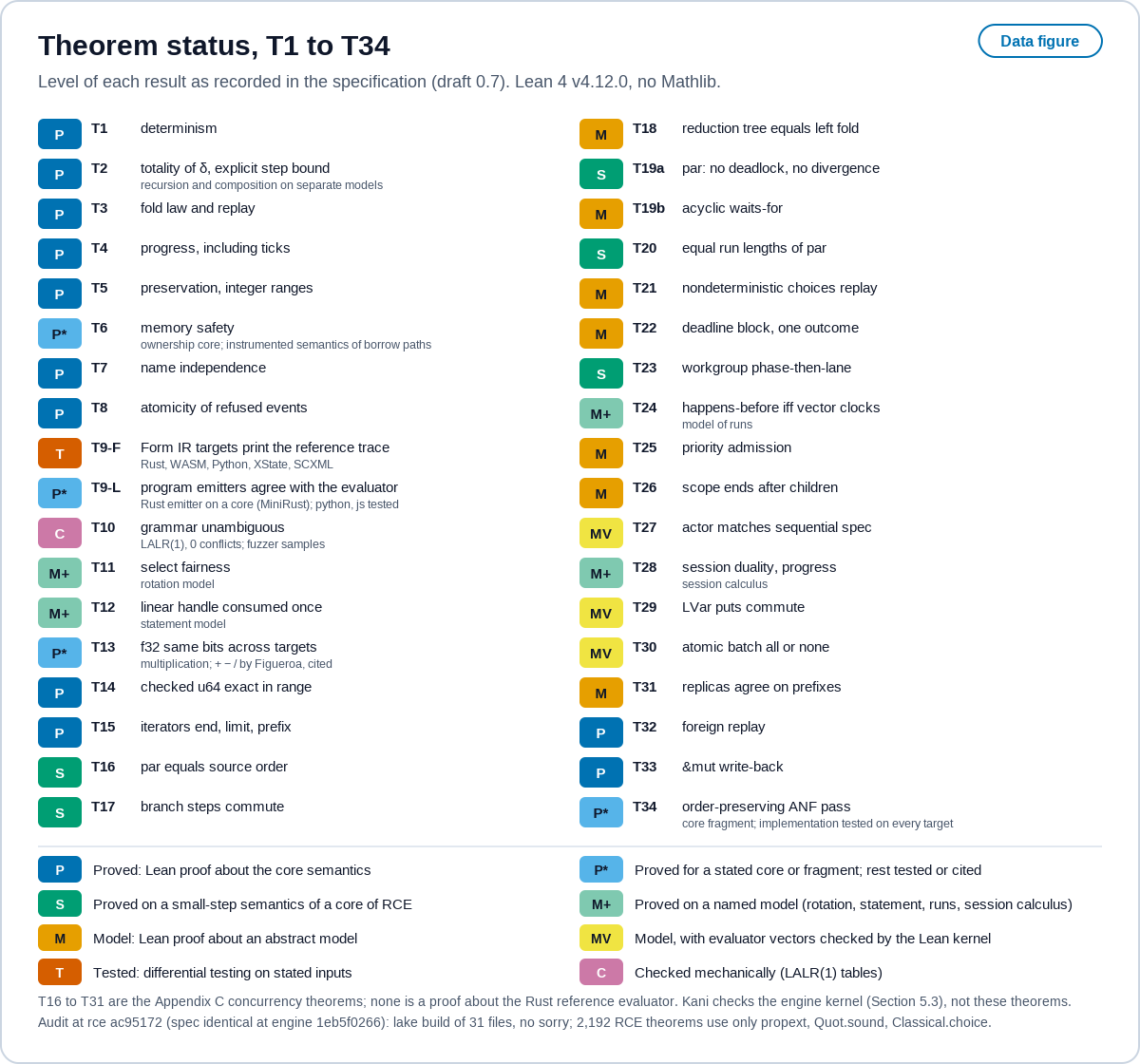
*Figure 3. Theorem status, T1 to T34. Level of each theorem as recorded in the specification at public commit `ac95172` (draft 0.7); theorems added after T34 are not shown, and T9 is shown as T9-L, the claim about the program emitters. `P`: Lean proof about the core semantics. `P*`: proved for a stated core or fragment, the rest tested or cited. `S`: proved on a small-step semantics of a core of RCE. `M+`: proved on a named model (rotation model, statement model, model of runs, session calculus). `M`: Lean proof about an abstract model. `MV`: model, with reference evaluator vectors checked by the Lean kernel. `C`: checked mechanically. T16 to T31 are the Appendix C concurrency theorems, and none is a proof about the Rust reference evaluator. Lean 4 v4.12.0 at `ac95172`, upgraded to Lean 4 v4.36.0 with six-kernel paranoid verification at `f87d6af2`, no Mathlib. Source: `spec/book/10-theorems.md` and Appendix C.13. A [PNG copy](https://research.openie.dev/figures/rce/theorem-status.png) is provided.*
**Checks run.** At public commit `f87d6af2` (23 November 2026), `spec/lean/` is upgraded from Lean 4.12.0 to **Lean 4.36.0** (`leanprover/lean4:v4.36.0`) to close the 2026 Lean 4 soundness and `.olean` replay disclosures: Common Vulnerabilities and Exposures `CVE-2026-72844` (`leanprover/lean4#14576`, nested inductive `.proj` type confusion in `<= v4.31.0`, fixed in `v4.32.2`), `CVE-2026-72711` (`#14484`, missing free-variable closure check in `environment::add_opaque`), `Kernel.Environment.replay` forged `.inductInfo` skipping (`#16688`, which showed that in-process `Lean.collectAxioms` and non-paranoid `.olean` replay can overlook manipulated environment entries), `.olean.server` sidecar/replay key mismatches (`#16674`, `#16675`), `Prop`-structure non-`Prop` field projection tightening (`#14977`), and compiler-trust `native_decide` (`Lean.ofReduceBool`, `#16693`). Across all 97 `.lean` files in `spec/lean/` (64 top-level `RCE` modules, 90 `.lean` files under `spec/lean/RCE/`), static and elaborated kernel scans confirm `0` `sorry`, `0` custom `axiom`, `0` `opaque`, `0` `Lean.ofReduceBool`, `0` `@[implemented_by]`/`@[extern]`/`skipKernelTC`, and `0` `Prop`-structures with non-`Prop` data fields; `audit/Audit.lean` verifies all **5,393** `RCE` theorem constants generated from the **1,264** `theorem` and `lemma` declarations in source (identical source declarations to `1762fb4b`, where Lean 4.12.0 generated 5,537 auxiliary theorem constants; 1,155 source declarations and 5,055 constants at `0c015c43`; 1,116 and 4,877 at `e416fd0`) using only `propext`, `Quot.sound`, and `Classical.choice`, and `scripts/lean-audit.sh` (`spec/lean/audit/six_kernel_paranoid_audit.json`) executes **`lake check --paranoid`** inside an unprivileged Linux `bubblewrap 0.11.1` (`bwrap`) read-only, network-isolated sandbox (`319.80 s`, `22,354.77 J` Linux Running Average Power Limit `package-0` `reported_j`, `measured_j = None`, `board_metered = false`) with unanimous acceptance across all **six independent proof checkers**:
| Independent Proof Checker (`lake check --paranoid` in `bwrap`) | Implementation & Soundness Basis | Verified Decls | Verdict | Mitigated Vulnerability Classes |
| :--- | :--- | :---: | :---: | :--- |
| **`con-leche --verified`** | Minimal reference kernel (Breitner) formally proved consistent in Zermelo–Fraenkel set theory with Choice (`ZFC`) | `68,090` | **`Accepts`** | `CVE-2026-72844` (`8` inductive blocks -> `252` fold records), `CVE-2026-72711`, weak-head cache bugs |
| **`con-ron --verified`** | *Aeneas*-verified Rust refinement of `con-leche` | `68,090` | **`Accepts`** | `CVE-2026-72844`, `CVE-2026-72711`, C++ memory & GNU bignum bugs (`#14833`) |
| **`lean4lean`** | Independent Lean-in-Lean Calculus of Inductive Constructions typechecker (Carneiro) | `68,092` | **`Accepts`** | C++ kernel implementation divergence & `#14977` projection typing |
| **`nanoda`** | Standalone zero-Lean-runtime Rust export verifier (`sorryAx` blocked) | `68,092` | **`Accepts`** | `.olean` replay manipulation (`#16674`, `#16688`) & unpermitted `sorryAx` |
| **`leanchecker --paranoid`** | Fresh-environment C++ kernel replay with zero tactic or compiler trust | `68,092` | **`Accepts`** | Metaprogramming environment mutation, `skipKernelTC`, & `Lean.ofReduceBool` (`#16693`) |
| **`Lean v4.36.0` (default)** | Post-`CVE` November 2026 C++ kernel (`#print axioms` enforced) | `68,092` | **`Accepts`** | All 2026 kernel `CVE`s patched; `0` `sorry`, `0` `opaque`, `0` `ofReduceBool` |
All 24 Rust-to-Lean vector tests and `spec/lean/emit-test/run.sh` (`3,000` cases, `0` mismatches) pass unchanged on Lean 4.36.0. At public commit `f87d6af2` (and `1762fb4b`), the reference checker holds 837 Rust unit tests across 159 test files (581 at `0c015c43`), passes 2,221 of 2,236 conformance tests across all 311 normative clauses (`0` failures, `15` unsupported), and `rce-spec-check` builds the LALR(1) tables of the core grammar (`1,028` states; `974` at `0c015c43`, `932` at `ac95172`) and of the grammar with Appendix C (`1,206` states; `1,152` at `0c015c43`, `1,110` at `ac95172`) with `0` conflicts, accepts `62` of `62` valid examples (`51` at `ac95172`), and reports that `13` of `13` syntax examples and `73` of `73` ill-typed or inadmissible programs require change (`12` and `65` at `0c015c43`, `12` and `64` at `ac95172`, where the WebAssembly build also passed `401` of `401` checks).
**A convergence observation.** Two sweeps of 24 October 2026 catalogued 111 programming languages first made public between January 2024 and October 2026 [189, 190]: 72 designed for language models or agents as authors or implemented largely by an agent (48 from the agentlanguages.dev catalogue [166], read at its source repository, and 24 beyond it), and 39 general-purpose or systems languages, with 35 pre-2024 languages reaching a milestone in the window. Among the machine-author entrants the count by year is 3, 10 and 57 for 2024, 2025 and 2026. Two positions are near-universal: refusal of invalid input at a boundary (54 of 72) and emission to another language (57 of 72; 17 of 39 general entrants, with Go the target of 2026 and C the systems default). Minorities take a canonical form (25 of 72), examples or tests inside the program (21 of 72; 2 of 39), a written specification as the authoritative definition (16 of 72; 14 of 39), deterministic evaluation as a stated gate (13 of 72; 3 of 39, among them Gossamer, Dawn and Wyzer) and memory safety without a collector (8 of 72; 7 of 39, converging on precise reference counting or ownership rather than lifetime annotations, with Goose's data stacks the outlier [191]). An append-only log with replay (5 of 72; none of 39) and hash-identified definitions (2 of 72; 3 of 39, Bend, Scrapscript and Dawn [192]) are rare, and an intermediate form as the source of truth is absent from the new general-purpose languages. A distinct trend of 2025 and 2026 is languages whose compilers were written largely by model agents and disclosed as such, among them Goose, Rue, Cursed and Jolt, whose performance claims are self-reported. The design choices of this paper therefore recur where they are cheap (a declared outcome for every input at the boundary, printing to a host language) and remain rare where they are theorems here (one canonical form, examples as part of the program, replay from a hash-chained log, name-free identity). This is an observation that choices recur and where; it is not evidence that they are correct, and this paper makes no comparison of quality with those projects. The emit registry of the specification repository takes every entrant as a target and a source on the same terms as every other language.
### 3.8 Behaviour, equivalence and dimension
Definition 3 says two fits are equivalent when their output sequences agree on every event sequence. This section gives that definition a universal property, defines the dimension of a program as a computed number, and reports the registered measurements of it. The normative text is section 6.10 of the specification (draft 0.9, commit `45fc95c`), with theorems T57 to T61 and the command `rce dim`.
**Behaviour as a point in the final coalgebra.** Fix a program $P$ with state space $S$, event alphabet $E$ and $\delta : S \times E \to S \times O^*$, and write $\delta_1 = \pi_1 \circ \delta$ and $\lambda = \pi_2 \circ \delta$ as in Definition 1. The behaviour of a state $s$ is the function $\mathrm{beh}_P(s) : E^* \to (O^*)^*$ with $\mathrm{beh}_P(s)(\varepsilon) = \varepsilon$ and $\mathrm{beh}_P(s)(e \cdot w) = \lambda(s, e) \cdot \mathrm{beh}_P(\delta_1(s, e))(w)$: the per-step outputs along any event sequence. $(S, \langle \lambda, \delta_1 \rangle)$ is a coalgebra of the functor $F(X) = (O^* \times X)^E$; $F$ has a final coalgebra $\mathrm{Beh}$ whose carrier is the set of causal stream functions, and $\mathrm{beh}_P$ is the unique coalgebra morphism $S \to \mathrm{Beh}$ (Rutten [144], Theorem 2.3). Two fits are equivalent, $F \equiv G$, when $\mathrm{beh}_F(s_0^F) = \mathrm{beh}_G(s_0^G)$. This is Definition 3 restated; the new content is that $\equiv$ is equality in one object that every Form, in every fit language, maps into by the same construction. Behaviour space is not a manifold: it carries the prefix ultrametric $d(b_1, b_2) = 2^{-n}$, $n$ the length of the shortest distinguishing event sequence, under which it is complete and totally disconnected [145]. Trace agreement on every sequence of length at most $k$ therefore certifies $d \le 2^{-(k+1)}$: a ball around the behaviour, not the behaviour. That is what the differential tests of [§5.1](#51-differential-testing-of-the-program-emitters) establish, and it never enters a hash.
**Two proof methods.** A relation $R \subseteq S \times S$ is a bisimulation for $P$ when $s\,R\,t$ implies, for every $e$, $\lambda(s, e) = \lambda(t, e)$ and $\delta_1(s, e)\,R\,\delta_1(t, e)$. T58 states that $\mathrm{beh}_P(s) = \mathrm{beh}_P(t)$ if and only if some bisimulation relates $s$ and $t$: to show two fits equivalent, exhibit the relation; to show them different, exhibit a distinguishing sequence, which also gives the distance. T1 and T2 (totality and determinism) are exactly the completeness and determinism that make the minimal machine unique; an incompletely specified machine has no unique minimum [146].
**Dimension.** $\mathrm{reach}(P)$ is the set of states reachable from $s_0$; it is finite because $S$ is finite under the value and size limits of the specification (N9). The dimension of $P$ is
$$\dim(P) = |\{\mathrm{beh}_P(s) : s \in \mathrm{reach}(P)\}|,$$
the number of distinct behaviours $P$ can be in, which is the Nerode index of its minimal Mealy machine [147], computable for an explicit alphabet in $n \log n$ [148]. $\log_2 \dim(P)$ is the bits of state the behaviour needs; $\log_2 |\mathrm{reach}(P)| - \log_2 \dim(P)$ is the *redundancy* of the fit, the bits of state that change no future output. A control dimension $\dim_c(P) \le \dim(P)$ is defined on the projection that replaces every guard over $\Sigma_d$ by its predicate symbol, a symbolic finite automaton [149], and its minimal machine, numbered by a breadth-first traversal in the canonical event order, has a unique name-free string [150]; its SHA-256 over canonical JSON is `shape_ctl`, a third key beside the name-free term hash and the e-class key of Definition 6. Equality at any key implies equivalence; inequality implies nothing.
What is and is not a theorem here should be said plainly. $S$ and $E$ are finite by the value limits and astronomically large: $|S| \le 256^{\mathrm{VALUE\_LIMIT}}$ per field, so finiteness makes every behavioural question decidable and none of them tractable. The minimal machine is a canonical form for the finite-control projection, where symbolic-automata minimisation is unique up to predicate equivalence [149]; for fields that are only compared and copied, register automata give a Myhill–Nerode theorem [151]; the moment $\delta$ does integer arithmetic into state, the only canonical object is the term itself. "Every Form is a finite Mealy machine, and its minimal machine is its canonical form" is therefore true as stated for $\Sigma_c$ plus guard predicates and is not a computable claim for $\Sigma_d$. That is also the honest reading of Proposition 3: the least-joule extraction returns the least-joule term *the extractor finds*, and three distinct functions are defined on one e-class: the target-blind budget units of specification C.6, which place the budget trap on the same operation in every runtime and are never joules; `est_j`, which is per target ([§6.3](#63-energy)); and the hashed representative, chosen by tree cost with a canonical-JSON tie-break for reproducibility. The emitted term and the hashed term of one e-class may differ; neither may differ across engines given the same log.
**Status of the theorems.** T57 (finality: $\mathrm{beh}_P$ is the unique coalgebra morphism), T58 (equivalence is bisimilarity), T59 (trace agreement to length $k$ bounds the distance by $2^{-(k+1)}$), T60 (for finite $S$ the quotient of $\mathrm{reach}(P)$ by the largest bisimulation is the minimal machine, with $\dim(P)$ states) and T61 (`shape_ctl` is invariant under renaming and under predicate-equivalent rewrites of guards) are stated in chapter 10 of the specification, and `spec/lean/RCE/Behaviour.lean` is in `lake build` (Lean 4.36.0 at public commit `f87d6af2`, passing `scripts/lean-audit.sh` and six-kernel `lake check --paranoid` over 5,393 theorem constants with standard axioms only and no `sorry`; earlier recorded at commit `f2bd7222` on Lean 4.12.0 with 5,052 theorem constants). What is proved, in the chapter's exact scope: the morphism equation of T57 (`beh_cons`; uniqueness of the morphism is stated, unproved); T58 for one program and for two (`bisim_beh`, `beh_bisim`, `behEq_iff_bisim`, `bisim2_beh`, `beh_bisim2`); and T59 in both directions over an explicit finite alphabet, the declared events over the boundary sets that `rce dim` explores (`trace_ball`, `ball_trace`), with the statement over all of $E$ stated, unproved. T60 is stated, with a model proof by partition refinement as the next step. T61 is tested for renaming only, against the name-free projection `rce fmt nameless`, which prints a program with positional names by kind in first-declaration order and is accepted whenever the source is, with the same trace hashes by T7; its invariance under guard rewrites is stated, unproved, and the symbolic quotient is not implemented.
**`rce equiv`: the equivalence check as a tool.** `rce equiv A B` explores two programs from their initial states over the same event instances, compares every step by its name-free output (emitted values in positional form, a kept step by its error's declaration index, T7), refines the two graphs together and reads whether the two initial states fall in one class (T58); when they do not it prints the shortest distinguishing event sequence and the two outputs at its end. `rce change OLD NEW` combines it with the export diff of F.4.3 and classifies a change as an erratum (every export compatible, every behaviour kept), a meaning change or an interface change, which is the rule of C.15 decided by the tool. Run between every corpus program and its name-free projection as a continuous-integration step, the check found one program whose projection required change (a state field named like a standard library method had renamed the method); the projection was corrected and the sweep reports every corpus Form equivalent to its projection, as T7 states. It is the Form's version of the equivalence check that hardware design runs on every revision ([§3.7](#37-the-language-one-text-costs-and-theorem-status)): a change under which every program keeps its behaviour is an erratum, any other a meaning change, decided by the tool rather than by a version number. With `rce hash`, which prints a program hash over the name-free projection (one hash for a program and its renaming, a different one for a changed step), and the provenance line that every emitted file now carries, the three mechanisms the record calls rare in new languages (section 3.7) are commands of the reference checker.
**`rce dim`, and the registered runs.** `rce dim [control] [fuel n] FILE` explores $\mathrm{reach}(P)$ breadth-first over the declared events with payloads drawn from each field's refinement type or, without one, from the boundary set of specification 6.3, up to `fuel` states, then runs Hopcroft partition refinement with the outputs as the initial partition (100,000 states in 10 to 40 s; the first Moore iteration was quadratic and did not finish), and reports states explored, behaviours (exact when the bound is not reached, else a lower bound), redundancy in bits per region, and with `control` the control states and `shape_ctl`. Three examples were written with known values: a counter with an unread flag (1.00 bit of redundancy), a mod-6 counter that emits parity (1.58 bits), and a door with three reachable states and no redundancy. The preregistration (`openie-research-experiments/rce/bench/dimension/PREREG.json`, registered 22 October 2026 before the command had been built and amended before each later run, with a hashed sidecar) fixes the populations and three hypotheses about bounded programs whose explored steps emit or keep the state: H0, that at least half of them carry more than 0.5 bit of redundancy; H1, that a program with one emit site carries more redundancy than a program with several; and H2, that one region carries at least 80% of the redundancy when it exceeds 1 bit. Its falsifier is RCE-F6 of [§9](#9-falsifiers), a median redundancy below 0.1 bit. The runs reported here, `dim-r2` to `dim-r5`, were each made once with `--fuel 100000 --control` (written `fuel 100000 control` since openIE-dev/rce `a5df5be7`, which made the command line positional), against a build of a public commit of openIE-dev/rce, with the binary hash recorded in every row; the first registered run, `dim-r1`, and the pilot before it are listed in [§10](#10-work-to-finish). The control label is the kept step's error or the emitted constructors only, and $\dim_c \le \dim$ holds on every row of these runs. In a state machine whose examples read state it never emits, the intent is carried by the examples and by no output; a report from `rce check` that names such an `example` (one that reads a field no step ever emits or keeps the state on) is an open proposal.
**The frozen runs.** The run `dim-r2` of 23 October 2026 (commit `1107442b` of openIE-dev/rce, registered as a second amendment of the same preregistration before the run, with the stratum read from the key that `rce dim` reported as `observable` at that commit, now `has_output`) samples the output-bearing stratum by rule: every program of the merged repository under its examples, programs, applications and book listings that is accepted standalone, has a state region and contains an emit or a fail statement. That is 25 programs, 24 of them output-bearing, 14 bounded within 100,000 states. Among them, `ring_buffer` has 12,500 reachable states, 781 behaviours and five control states; four bits of its state change no output, all in one region, and its control projection, which records only which steps fire, has five states. Excluding the three programs written for `rce dim` and their book copies leaves 8 bounded output-bearing programs, of which 6 carry more than 0.5 bit (Wilson 95% interval 0.41 to 0.93), with a median redundancy of 1.79 bits (interquartile range 0.25 to 3.37); over all 14, 10 of 14 (0.45 to 0.88) and a median of 1.29 bits. RCE-F6 (a median below 0.1 bit) is not triggered; the interval's lower end is below one half, so H0 is supported and not established at this size. H1 is not supported (the two single-emit-site programs carry 1.58 and 4.00 bits, the two multi-site programs 2.51 and 3.65), and H2 holds on 8 of 9 qualifying rows only because 8 have one state region; the one two-region program attributes 62% of its redundancy to its larger region. The run's substantive addition is three application-sized measurements. The chat application explores 100,000 states with 176 behaviours and 69 control states, so at least 9.15 bits of its state change no output, the largest redundancy measured and a lower bound; the selective forwarding unit (40,218 states, 7,038 behaviours, 2.51 bits) and the terminal (3,390 states, 270 behaviours, 3.65 bits) are exact. The ratio of control states to behaviours varies by an order of magnitude across the population (5 to 781 for the ring buffer, 69 to 176 for the chat, 5,095 to 7,038 for the forwarding unit), which measures how much of a program's behaviour is which steps fire against which values flow. The run also shows that the stratum needs a finer registered rule: the tool's flag is true for a program whose every output is the same (a constant, or a kept step every state gives), so a third run should register "output-bearing, with more than one distinct output" before sampling. Rows, intervals and the amendment are in the experiments repository under `rce/bench/dimension/` (`results/dim-r2.jsonl`, `RESULTS.md`). A third run, `dim-r3` (23 October 2026, registered before it), applied the finer rule the second run asked for: `rce dim` reports the number of distinct outputs (`distinct_outputs`; emitted values and kept steps counted separately as `emits` and `keeps`), and the stratum is output-bearing with at least two of them. On 28 programs (the second run's population plus the three accepted programs with two or more state regions), 22 are strictly output-bearing and 12 of those are bounded; the median redundancy is 1.29 bits (8 of 12 above 0.5 bit, Wilson 0.39 to 0.86), and 2.05 bits over the 6 not written for the tool. The three programs the finer rule removed (a thermostat, a reconciler and a cart) are each observable only by a constant, so the second run's medians had counted bits that change an output which never changes at all. H2 is tested where it can be, on the one strictly output-bearing multi-region program above 1 bit, whose larger region carries 62%, below the 80% threshold; it stays open on one row. A fourth run over the 86 conformance programs with state (registered before it) measured the five harvested host-contract programs for the first time, all bounded within the fuel and carrying from 0.01 bit (the terminal driver) to 2.16 bits (the channel driver) with control quotients in the thousands, and answered the multi-region question for this corpus: the only strictly output-bearing multi-region programs are data-distinguished copies of one capability example, so H2 cannot be decided from existing public material and the next step is authoring observable multi-region programs, registered as a population before the run. That step was taken on 24 October 2026: twelve two-region programs (an elevator, a vending machine, a crossing, a car park, a printer, a lobby, a bank card, a washer, a session, a player, a climate controller and a reservoir) were written into the programs corpus and registered as the fifth run, with the disclosure that the tool had been run on the drafts. All twelve are strictly output-bearing, bounded and explored in milliseconds; eleven have zero redundancy and the twelfth, the climate controller, keeps 1.58 bits in two flags that record its last action and that nothing reads. The median is 0.00 bits, so RCE-F6 is triggered on this population: accidental state is not common in small Forms whose caps are enforced by kept steps and whose phases emit. Read with the earlier runs (1.29 bits over the strictly output-bearing hand-written examples, 0.01 to 2.16 bits for the host programs, at least 9 bits for the chat application), the quantity grows with program size and with the number of fields nothing reads. The claim the data supports is the falsifier's own: `rce dim` is a diagnostic for larger programs and for regions added without an observer, not a property of small Forms in general.
**The concept record.** Specification 6.6 now describes an unhashed side table keyed by the name-free keys of a program and holding its names, intent strings and doc comments, and `rce emit form` prints it under `names`, keyed by declaration index (the index `shape_ctl` uses), after the hashed fields. Projections render it; $\delta$ never reads it; it is the complement that makes the projection of a Form a symmetric lens [123] rather than a retraction. The evidence of [§2.1](#21-programming-is-coding-theory) says the table must hold the concept a name stands for and not only its spelling, because word choice and ordering are the two steps developers disagree on at 6.9% [137] and the step they agree on is the concept. Whether a model can reason from the Form with the record attached as well as from a named surface is the first of the three registered experiments of [§12.3](#123-why-human-written-code-is-redundant) and is open.
## 4. The engine: gears, gate and receipts
This section describes the design of the engine, which Appendix D of the specification and its proposals define.
### 4.1 The engine is a Form
RCE runs software as a graph of small deterministic handlers. A handler that cannot decide raises an escalation. A resolver answers the escalation once, and the answer is installed as a permanent handler, so the next case of the same shape runs with no resolver. The design requires the engine to meet every Form invariant:
| Invariant | What the design requires of the engine |
|---|---|
| Reload is a verified fold | Reload reads the log verbatim, recomputes every hash and link, and folds the rest with $\delta$. Nothing is re-stamped. A broken chain does not load. |
| Name-free tick order | Handlers run in topological rank order, then by a name-free node key. Outputs are staged and delivered after all handlers run, as in ASM semantics. Renaming every node gives the same anonymous state hash at every entry. |
| No silent drop | A full mailbox holds the message in an ordered queue and logs `Backpressure`, and every task still closes. |
| Payloads are in the log | Inputs, ticks, external handler results, installs and faults are log entries. The state hash after every entry matches a fold from an empty engine. |
| Logical clock | Liveness counts ticks, not wall time. |
| Stable hashes | SHA-256 (Secure Hash Algorithm, 256-bit) over canonical JSON, keys sorted at every depth, for entries, states, shapes and rule ids. |
### 4.2 The gears
Each gear is tried only when the gear below it does not pass the gate. That order is one fixed cascade.
| Gear | Method | Lineage |
|---|---|---|
| G0 Lookup | A shared handler library keyed by SHA-256 shape hash; for code repair, localization to ranked functions | Code search and retrieval [21] |
| G1 Rules | Deterministic, guarded repair templates and schema-derived validators, each checked for mutation sensitivity | PAR, TBar, AVATAR, FixMiner [22, 23, 24, 25]; codemods such as Coccinelle [26] |
| G2 Synthesis | Enumeration over the handler grammar, solvers and e-graphs | Sketching, SyGuS, egg [27, 9, 12] |
| G3 to G5 Models | A typed decision model, a local small model, then a remote model, last | Model cascades [28] |
The order follows one principle: the first rule of automation is having a manual process that works. A model is worth adding only on top of a manual variant of the task, or a deterministic automated variant, that already works. So the exact gears G0 to G2 run first, and a model acts only on the residual they leave open, proposing edits that the same gate judges. Reducing what a stochastic model is required to do makes its action space smaller, and so easier to master. The public form of this ladder is `rce repair` of [openIE-dev/rce](https://github.com/openIE-dev/rce), and it has three runs in [openie-research-experiments](https://github.com/openIE-dev/openie-research-experiments), each registered before it ran. The first two ran four rungs (reuse, lookup by type, the rewrites `rce fmt` determines, and bounded enumeration of one small edit, at most 2000 candidates). The first [225] closed 118 of 120 tasks with zero model calls, but 119 of the 120 were operator and integer-literal mutations, which bounded enumeration inverts by construction, and 9 of the closures pass the examples and checks without being the original program. The second [226] has no such mutation. Of its 151 tasks it closed 31 (20.5%) with zero model calls: 1 of 41 changes from the git history of openIE-dev/rce, of which 39 follow changes of the language and only 2 are defects of a program; all 27 guard negations, each by the enumeration edit that removes a `not`, which inverts that mutation by construction; and 3 of 83 renames, none restored to the original. Without the guard negations, 4 of 124 tasks close. The second run's prediction P3 failed and its falsifier F1 was met: the closure rate of the first run does not carry over to real history. The third [227] ran the second run's 151 tasks unchanged, at openIE-dev/rce `8a5d90ea`, with a fifth rung after bounded enumeration: renames, in which one use of a value name becomes another value name in scope there, or one binding becomes a name the checker's report names, at most 2000 candidates. Its registration records that renames are the class this rung was built for after the second run. In its plain arm, given only the task, the ladder closed 111 of 151 (73.5%) with zero model calls, 103 of them restored to the original: all 83 renames (80 at the fifth rung, 3 by bounded enumeration), 77 restored; all 27 guard negations, each with its outcome in the second run; and 1 of the 41 history tasks, the same one. Without the guard negations, 84 of 124 tasks close. A known-good arm gave the ladder each task's original program as well: it closed 116 of 151, 114 restored, including all 83 renames restored and 6 of the 41 history tasks. Its prediction P6, that every guard and history task keeps its plain-arm outcome in the known-good arm, failed: 5 more history tasks close, and the one closed in the plain arm closes at the fifth rung instead of the third. The ladder closes the mutation classes its rungs invert and 1 of 41 changes from real history, so the residual on which a model would act is nearly every real defect.
### 4.3 The gate
A candidate is promoted only when it passes the gate. The gate replays the node's recorded inputs, runs the candidate in shadow on fresh samples with a coverage bound (the rule of three at a declared error budget), checks the output schema, and requires the proof certificate of Section 5. A candidate that does not pass is logged with its counterexample.
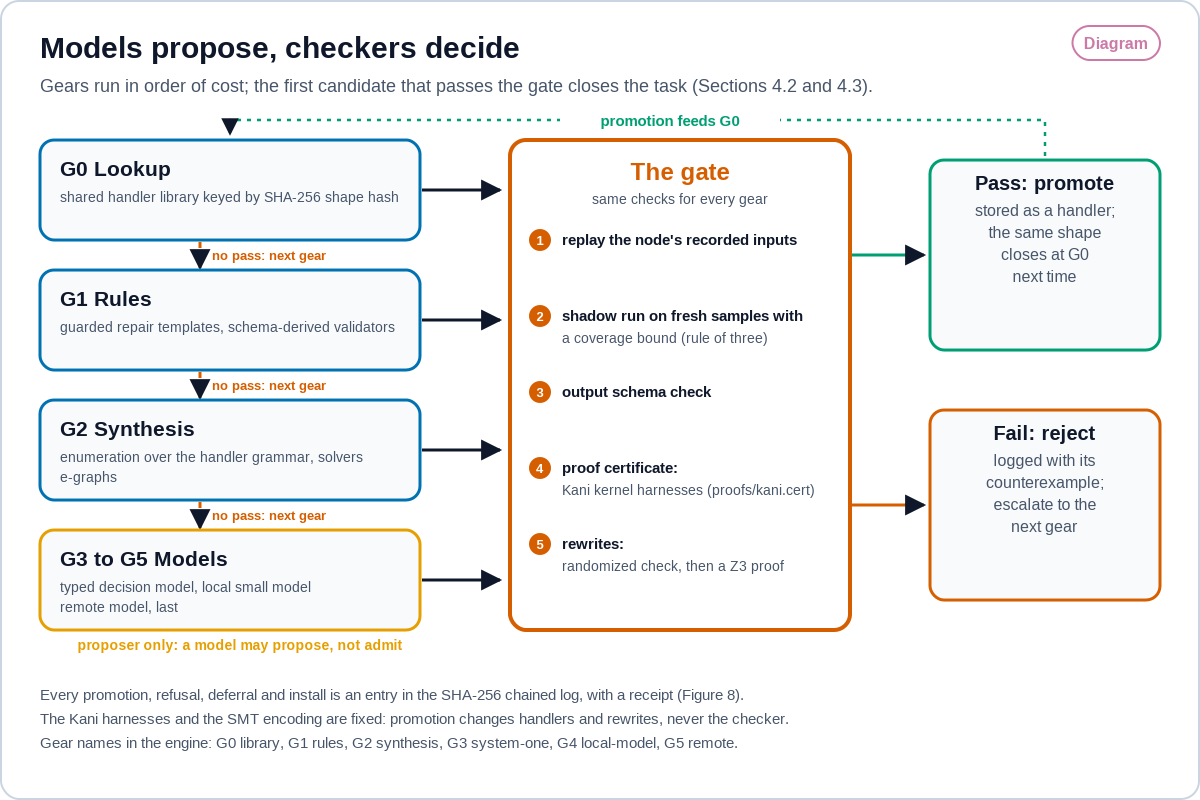
*Figure 4. Models propose, checkers decide. Diagram: gears run in order of cost: G0 Lookup, G1 Rules, G2 Synthesis, G3 to G5 Models (a typed decision model, a local small model, then a remote model). Every candidate passes through the same gate: replay of the node's recorded inputs, a shadow run on fresh samples with a coverage bound, an output schema check and the certificate of the kernel's model checking with Kani, a model checker for Rust (Section 5.3); a proposed rewrite also needs a randomized check and then a proof by the Z3 SMT solver (Section 5.2). A candidate that passes is promoted and closes the same shape at G0 next time; one that fails is logged with its counterexample and the next gear is tried. In the design, the Kani harnesses and the SMT encoding do not change through promotion. Source: Sections 2.2, 4.2, 4.3, 4.6, 5.2 to 5.5. A [PNG copy](https://research.openie.dev/figures/rce/gears-gate.png) is provided.*
### 4.4 Receipts
Every promotion, gate failure, deferral and install is a mutation in an append-only log chained with SHA-256, so tampering with any past entry breaks the chain [29, 30]. Each handler's cost is priced from interpreter operation counts with a per-host cost table and labeled `est_j`. The foreman is the engine's resolver of escalations, which runs the gears in order on each one, and each of its calls carries a receipt. A receipt names the gear, the method of the estimate (`basis`), the candidates tried and whether the gear resolved the escalation. Its `est_j` field is required: it is a finite non-negative number, or null, and null is allowed only when `basis` says `unpriced`, as for a model call with no energy figure. A receipt with the field missing does not parse. An unpriced cost is never read as zero, so a total over receipts reports its priced and unpriced invocations separately, and a saving that depends on an unpriced resolution is reported as unknown.
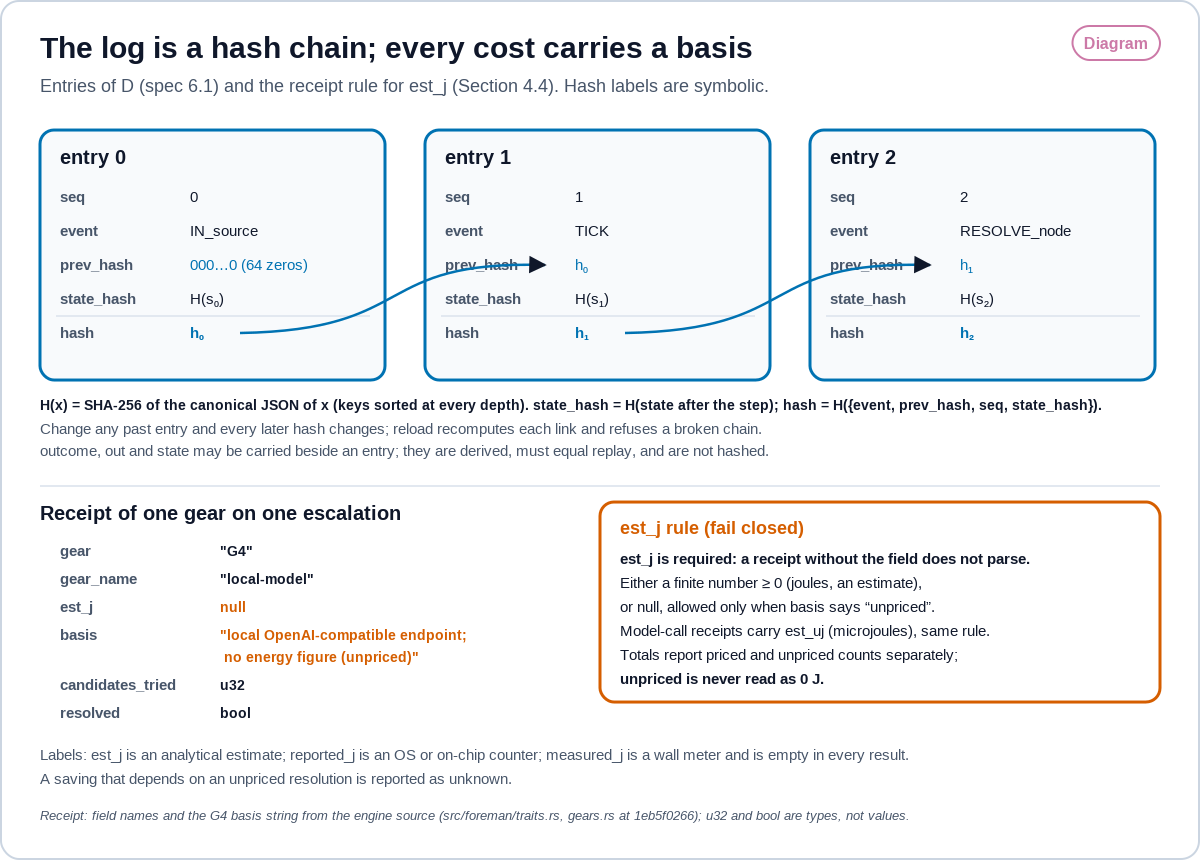
*Figure 5. The log is a hash chain; every cost carries a basis. Diagram: entries of the durable log D are `{seq, event, prev_hash, state_hash, hash}`. `state_hash` is the SHA-256 of the canonical JSON of the state after the step; `hash` is the SHA-256 of the canonical JSON of `{event, prev_hash, seq, state_hash}`; the first `prev_hash` is 64 zeros, so changing any past entry changes every later hash. A gear receipt carries `gear`, `gear_name`, `est_j`, `basis`, `candidates_tried` and `resolved`. `est_j` is required and is a finite non-negative number, or null only when `basis` says unpriced; model-call receipts carry `est_uj` in microjoules under the same rule. An unpriced cost is never read as 0 J. Hash labels are symbolic. Source: specification 6.1 and Section 4.4. A [PNG copy](https://research.openie.dev/figures/rce/receipt-chain.png) is provided.*
### 4.5 The compilers
The language's compiler is the reference checker's `rce emit TARGET FILE` (specification 10.5). It translates a module that passes `rce check` to one of five outputs: `form`, the Form $P = (S, E, \delta, D, \lambda)$ as one line of canonical JSON, a deterministic function of the program text; and four programs, `rust` (one Rust source file), `python` (one Python 3 file), `js` (one JavaScript module for Node) and `scala` (one Scala 3 file for the Java virtual machine). The program emitters translate the checked module, not the Form, and each output is self-contained. Every target is generated. None is authored.
Specification 6.3 fixes one behavior at every numeric edge, which every target must reproduce: checked integer arithmetic traps on overflow of the static type and never wraps; integer `/` truncates toward zero ($-7/2 = -3$); `%` takes the dividend's sign ($-3 \bmod 2 = -1$); division by zero traps; floats are IEEE 754 binary64, correctly rounded once per operator, and a non-finite result traps; time is the logical clock only.
In the engine's design a second compiler lowers a handler spec and its fit through an e-graph to a Form IR and projects it to further targets; its test is listed in [§10](#10-work-to-finish).
### 4.6 Method: the whole stack evaluated, every interface assumption explicit
A program is a stack of levels: tokens and statements; handlers; the Form, a single step function $\delta : S \times E \to S \times O^*$ over $S = \Sigma_c \times \Sigma_d$ (control regions; data: the clock, the input count and typed relations); the log, a SHA-256 hash chain whose entries record each event, the hash of the state it produced and the hash of the previous entry; the rewrites that transform the Form; and the substrate that executes it. Each level rests on assumptions about the level below. RCE does not treat any level as fixed. It evaluates the whole stack, writes each interface assumption down as a checkable statement, and checks it on every run.
| Boundary | Assumption | Check |
|---|---|---|
| source to handler | an input satisfies its source contract | the contract check at the input event of δ |
| handler to sink | every Ok output satisfies the output schema | handler proof: evaluation by the kernel evaluator, which the design requires to be total and deterministic and checks with a model checker ([§5.3](#53-model-checking-of-the-kernel)) |
| log to state | every entry carries the hash of the state it produced | kernel fold, which stops at the first entry whose hash does not match and reports it ([§5.3](#53-model-checking-of-the-kernel)) |
| rewrite to Form | a rewrite preserves the output for every input | randomized check, then an SMT proof ([§5.2](#52-the-proof-rule-for-rewrites)) |
| stub to foreman | a handler that cannot decide escalates instead of guessing | stub handlers emit escalations; resolutions are promoted only through the promotion path |
| Form to target | every emitted target computes the same δ | every target carries the same reference trace |
A failed check locates the break at the boundary where it occurs. The correction is made at that level, passed through the check of that boundary, and promoted. Every level above the corrected one inherits the correction without further change, because each level above consumes the corrected level only through the interface whose assumption is now checked. This is the sense in which corrections carry upward and compound.
## 5. Verification
### 5.1 Differential testing of the program emitters
T9-L states that the program emitters `rust`, `python` and `js` agree with the reference evaluator. For the Rust emitter it is proved on a core, as a verified translation into MiniRust, a deep embedding of the emitted Rust subset; that `rustc` implements MiniRust is trusted and tested. For the Python and JavaScript emitters it is tested: the emitted program must print the reference trace of every example program byte for byte, which is the gate every row of the emit registry passes ([§3.6](#36-one-ecosystem-lossless-and-the-universality-thesis)). The reference evaluator and the emitted Rust, Python and JavaScript runtimes also compute the same budget function, and a test checks that the budget trap falls on the same operation in all four ([§3.7](#37-the-language-one-text-costs-and-theorem-status)); the order-preserving ANF pass before every emitter is tested differentially on every target, including a sweep of budgets across the trap point (theorem T34). This is differential testing in the line of McKeeman and of Csmith [86]: agreement among independent implementations on a stated input set. It is not translation validation [85], and outside the proved core of the Rust emitter it is not a verified compiler. It says nothing about inputs outside the tested set.
### 5.2 The proof rule for rewrites
Verified rewrite rules have a lineage. Ruler infers and checks rewrite rules by equality saturation with no model in the loop [87]. The model-proposed rewrite admitted in Section 5.5 repeats a rule the engine already had, so that record is a statement about the gate, which did not admit 15 of 18 proposals, and not a claim that a model is a good rule source.
In the design of the engine, every e-graph rewrite must be proved in the Z3 SMT solver [31] against a quantifier-free encoding of the Form's term evaluation and arithmetic: values as a datatype, 64-bit bit-vectors with checked overflow, signed division and remainder with the dividend's sign, and binary64 floats. A rewrite that changes overflow, escalation order or a message gets no proof. A proposed equivalence enters the e-graph only with a proof.
### 5.3 Model checking of the kernel
The design checks the engine's kernel (hash chain, fold, name-free positions and handler evaluation) with the Kani model checker for Rust [32]. Handler evaluation is the fixed point of a non-recursive step, so a proof that the step is total and deterministic per constructor carries to evaluation by structural induction. The design names ten properties, one harness each:
| Harness | Property |
|---|---|
| `chain_appended_verifies` | An appended hash chain verifies |
| `chain_detects_tampering` | A changed entry breaks the chain |
| `fold_equals_replay` | The fold equals replay |
| `fold_rejects_wrong_state` | A fold that disagrees with the stored state fails |
| `position_is_name_independent` | Rule positions do not depend on node names |
| `reason_tokens_are_name_independent` | Reasons are name-free by whole tokens |
| `handler_core_leaves` | Leaf handlers are total and deterministic |
| `handler_core_validate` | Validation is total and deterministic |
| `handler_core_pipeline` | Pipelines are total and deterministic |
| `handler_core_ifhas` | Guards are total and deterministic |
### 5.4 Promotion gate on the proof certificate
In the design, the model-checking run writes a certificate whose hash is stored with the engine. The engine, the log, rule ids and handler evaluation route through the kernel, and promotion requires the certificate.
### 5.5 The model as a proposer behind the check
A model may propose equivalences. It may not admit them. A local 1.5-billion-parameter coding model was run as a proposer on the specification `orders-form`, and the public record of the run ([`rce/bench/results/llm-proposer-form-demo.form.json`](https://github.com/openIE-dev/openie-research-experiments/blob/main/rce/bench/results/llm-proposer-form-demo.form.json)) holds 18 proposals, 13 of them distinct. The record gives the source of each proposal only as `llm`; the model, Qwen2.5-Coder-1.5B under llama.cpp, is named by this paper and by no public record. The check did not admit 15 proposals, 12 of them distinct: four that do not parse, two that put a value where a term belongs, and nine commutations of arithmetic operators, each shown wrong by a counterexample on which the two sides fail differently. The 3 it admitted are one rewrite, `(pipe pass ?a) => ?a`, under three names, and that rewrite repeats a rule the engine already had. The record shows the gate stopping what is wrong; it shows no new rule from the model.
## 6. Lift: entering the ecosystem from other languages
Lift is the door into the ecosystem for code written elsewhere. It is a construction, made per language from tools every language already has: a formal grammar, a parser such as [tree-sitter](https://tree-sitter.github.io/tree-sitter/) that yields the syntax tree, the abstract syntax tree and the symbols that language-server tooling resolves ([Language Server Protocol](https://microsoft.github.io/language-server-protocol/)). The engine profile specifies a lift, `rce scan DIR --form`, that builds the Form from that tree for Rust, Python, TypeScript and Go and labels every lifted element as unproven (Appendix D.8). A lifted program carries the faults of its source, so lift includes repair, and the protocol below measures repair on public bug corpora with the location given.
### 6.0 The repair ladder
A coding task is measured here by the **intent bits** it needs: the bits that must be supplied from outside what the engine already holds (the program around the edit, the libraries, the tests, the index of known fixes). Writing $H_{task}$ for the bits that pin the target artifact down and $H_{corpus}$ for the bits the corpus already fixes, the supplied bits are $I = H_{task} - H_{corpus}$. A gear that ranks the right edit at rank $r$ among its candidates has supplied $\log_2 r$ bits of search, and the gate supplies the rest. The ladder orders tasks by edit size, an objective proxy for $I$: one token (L0), one statement (L1), one hunk (L2), several hunks in one file (L3), several files (L4), a function from a specification or tests (L5), an issue-level change (L6) and a program from a specification (L7). The rungs, corpora, splits and hypotheses are preregistered; the files are in the [public repository](https://github.com/openIE-dev/openie-research-experiments/tree/main/rce/bench/ladder/).
L2 to L4 are to be measured on a Defects4J held-out set ([Section 8.1](#81-defects4j)), and L5 to L7 under the protocols of [Section 8.2](#82-swe-bench-lite-offline). The method and the gate of L0 and L1 follow.
**Method.** Each corpus is shuffled with a fixed seed. The first 2,000 positions of each shuffle, and for L0 three whole repositories (commons-lang, requests, flask), form the development split, on which the gears may be tuned; development results are not reported. Every remaining task is in the test split. Before a test run the solver is committed and its binary hash recorded, and no gear changes during the run, so every row to be reported is a frozen-solver result on test tasks only, with 0 model calls. The preregistration (`PREREG.json`) and the report script are in the [public repository](https://github.com/openIE-dev/openie-research-experiments/tree/main/rce/bench/ladder/).
**Gate.** At L0 and L1 the location is given and the gate is token identity: the repaired line or statement must equal the developer's, token for token. This is stricter than passing the tests, because a patch can pass a weak test suite and still be wrong. Qi and colleagues found that most patches GenProg reported as fixes were plausible but incorrect [92]; overfitting to tests is documented in search-based and semantics-based repair [93, 94] and addressed with generated tests [95]; tools score higher on the benchmark they were tuned on [96]; and fault localization biases comparisons [97]. Token identity removes the plausibility gap on these rungs, and giving the location removes the localization term, so the rate measures the repair gears alone. L2 and above use the tests as the gate and report plausible and correct counts separately (Section 8.1).
### 6.1 L0: one-token faults
The L0 corpus is every PIT-style mutant [109] with a valid replacement token in real repositories at pinned commits, five Java (commons-math, commons-collections, jsoup, joda-time, gson) and four Python (click, attrs, pydantic, sympy), with four repositories never used for tuning (commons-text, commons-io, more-itertools, httpx) as a second test set. Mutants are a stand-in for real one-token faults that Just and colleagues found to be coupled with real faults [110]. If the neighbourhood that restores a one-token fault is built from the same operator tables that produced the mutants, a high rate partly reflects that overlap and not repair ability on faults that arise in practice. A plain operator-inversion search, run on the same mutants, is the baseline that shows how much of the rate the overlap explains, and an L0 rate is read beside it.
### 6.2 L1: one-statement bugs from real histories
L1 uses two public datasets of real single-statement bug fixes mined from open-source histories: ManySStuBs4J 2.0 [107] for Java and TSSB-3M v1.0.0 [108], shards 14 and 15, for Python. The solver receives either the 7-line hunk only or the whole file at the parent commit, with indexes of the project's methods and guard conditions, and the two are reported as separate rows. These datasets have no published repair leaderboard under this gate (hunk only, token identity, location given), so no learned-repair number is set beside them; Defects4J, which does have one, is compared with TBar in Section 8.1.
### 6.3 Energy
In the protocol, every row of the ladder carries `est_j`, an estimate of central processing unit (CPU) seconds times 10 W, and a subsample is to be read on RAPL [105], the processor's on-chip package counter, as `reported_j`: the package delta over the whole run, less idle power from a sample taken just before, times the run's duration. `measured_j`, a wall meter on a named rail, follows the protocol of Section 8.3. No `reported_j` or `measured_j` figure has been produced on public code; the rebuild is listed in [§10](#10-work-to-finish).
**Two regimes and a calibrated vector.** The estimate above, CPU seconds times 10 W, is one substrate table and cannot tell targets apart, so least-joule extraction never chooses a target. The measurement literature says what the fix must look like. On an in-order core, joules are linear in operation counts: a six-counter model on Cortex-M0 reaches R² ≈ 0.99 and 2.8 to 4.3% mean absolute error, with coefficients such as 0.96 nJ per instruction and 2.1 nJ per taken branch [152]. On an out-of-order core the model collapses to time: with one core pinned and turbo off, a Xeon Gold 6430 drew 189.8 ± 0.5 W across every implementation and benchmark of a language-energy replication, and the ranking that had put Python at 75.88 times C disappeared once library choice, parallelism, warm-up and measurement bugs were controlled [153]. The counters themselves are of uneven worth: Intel RAPL predicts plug power to 1.8% mean absolute percentage error once DRAM is included, but updates about every millisecond and drifted 10 to 12% with package temperature on one generation [105]; polling it faster than 10 ms produces up to 50% stale reads [154]; NVIDIA's NVML samples about a quarter of the run time and single naive runs erred by up to 70% against an external meter [155]. Gas-style unit metering correlates with CPU time at only Pearson ≈ 0.51 on Ethereum [156], so "energy scales with the operations counted" is an assumption the `reported_j` subsample has to test. A proposal to the specification keeps three objects apart: the C.6 budget units stay deterministic, target-blind and in the log; `est_j` becomes $\langle \mathrm{count}(\mathit{term}), E[\mathit{target}] \rangle$ plus idle power times time in regime A (microcontrollers, field-programmable gate array (FPGA) lanes, in-order cores) and $P_{\mathrm{active}} \cdot t + E_{\mathrm{llc}} \cdot \mathit{misses}$ in regime B (out-of-order CPUs and graphics processing units (GPUs)); and the coefficient vector $E[\mathit{target}]$ is a `host.Calibrated` log entry with its protocol, sample count and standard error per coefficient, written by `rce host calibrate` under a normative protocol (at least 30 interleaved A/B pairs against the idle baseline, blocks of at least 60 s or $10^9$ operations, warm-up discarded, temperature recorded, gross and net reported, the meter named with its validation reference, RAPL sampled no faster than 10 ms), so that extraction under `est_j` is a function of the log and replays. Receipts gain a `calibration` hash and a `stale_fraction`, the share of a step's operations with no calibrated row, priced `unpriced`; totals keep the four labels in separate columns. The falsifier is RCE-F5 in [§9](#9-falsifiers). The first calibration to run is the KV260 rung of the energy ladder on its core rail with $N \ge 30$, which turns the stand-in `E_LUT_READ = 1e-12` J, an OpCounter constant of [Metered Commit Gates](https://research.openie.dev/papers/gates/) that the RCE specification does not contain, into a coefficient with a standard error. None of this is built: on main, `host.Calibrated` holds fabric, operation class, overhead and throughput for placement, not joules, and no `rce host calibrate` command exists.
## 7. Reuse evidence
RCE's position on the reuse axis rests on an engineering fact: code is reused at every scale. Each method below measures it differently.
| Method | Source | Finding |
|---|---|---|
| File-level clone mapping | DéjàVu, Lopes et al. 2017 [33] | Of 428 million files in 4.5 million non-fork GitHub projects, 85 million are unique: "70% of the code on GitHub consists of clones of previously created files." In JavaScript, 6% of files are distinct. |
| Line-level redundancy | Gabel and Su 2010 [34] | Against 420 million lines, "between 50% and 100% of each project is redundant" at about one line. |
| Statistical language models | Hindle et al. 2012 [35] | Code is "very repetitive, and in fact even more so than natural languages." |
| Corpus near-deduplication | The Stack [36] | Near-deduplication removes 54.7% of The Stack v1 (6.4 TB to 2.9 TB) and 52.4% of v2 (67.5 TB to 32.1 TB). |
| Whole-archive preservation | Software Heritage [129, 130] | 30.3 billion unique file contents from 448 million origins (archive counters, read 13 October 2026), each stored once by the hash of its bytes. |
| Mined fix patterns | PAR, TBar [22, 23] | PAR found "several common fix patterns" in more than 60,000 human patches. TBar's 15 pattern categories fix 43 Defects4J bugs correctly in the standard pipeline, and 74 of 101 with perfect fault localization, with no learning. These are figures as read from [23]; the meaning of the 101 (plausible patches or bugs attempted) has not been rechecked against that paper here, so treat the ratio as unconfirmed. |
| Cross-language tasks | Rosetta Code [131] | 1,360 tasks (and 421 draft tasks), each one concept implemented across many of 1,009 known languages. |
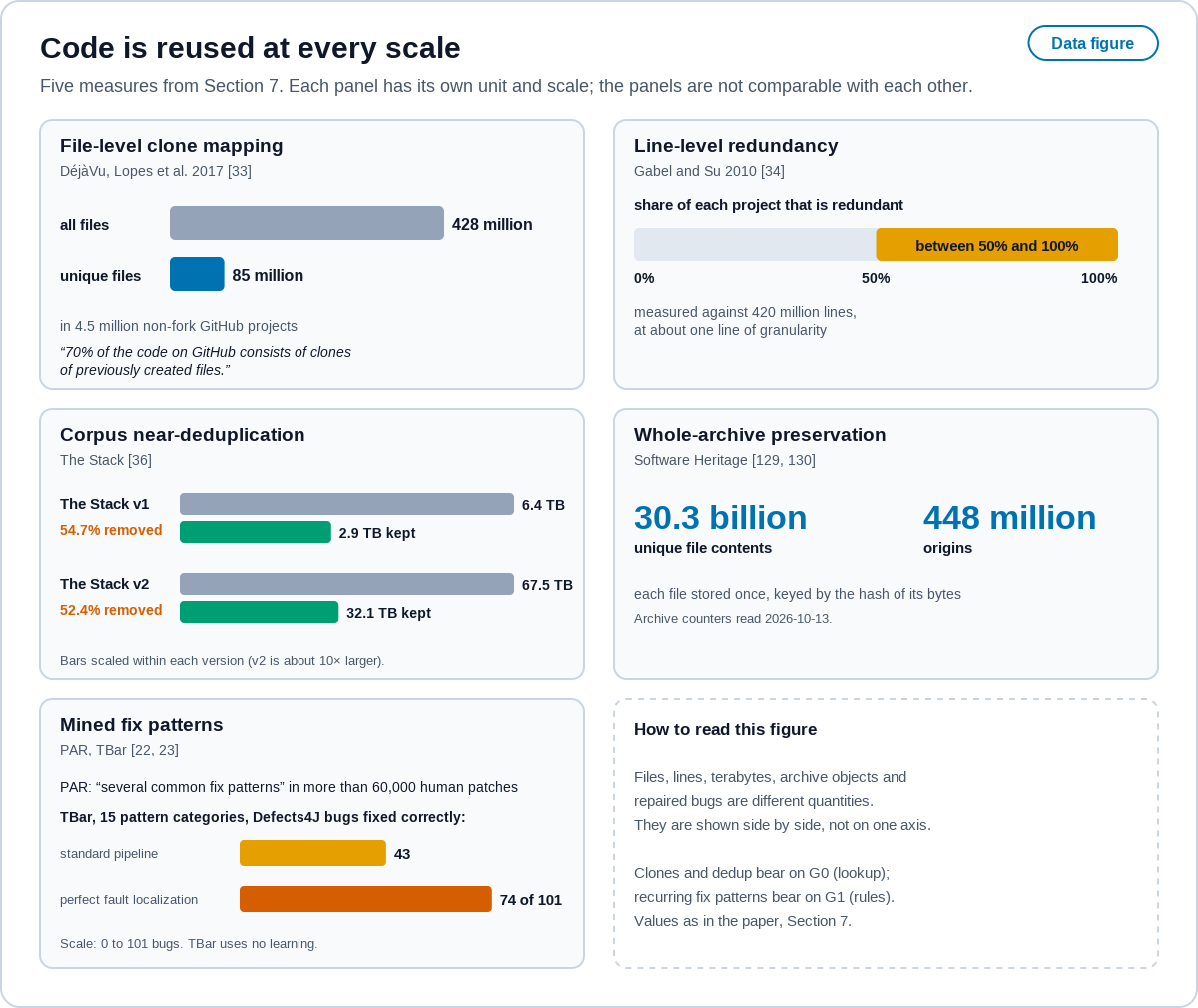
*Figure 6. Code is reused at every scale. Data figure: five measures of reuse, each in its own unit; the panels are not comparable with each other. File-level clone mapping (Lopes et al. 2017 [33]): of 428 million files in 4.5 million non-fork GitHub projects, 85 million are unique. Line-level redundancy (Gabel and Su 2010 [34]): between 50% and 100% of each project is redundant at about one line, against 420 million lines. Corpus near-deduplication (The Stack [36]): 54.7% removed from v1 (6.4 TB to 2.9 TB) and 52.4% from v2 (67.5 TB to 32.1 TB). Software Heritage [129, 130]: 30.3 billion unique file contents from 448 million origins (archive counters read 13 October 2026), each stored once by the hash of its bytes. Mined fix patterns (PAR [22], TBar [23]): PAR found common fix patterns in more than 60,000 human patches; TBar fixes 43 Defects4J bugs correctly in the standard pipeline and 74 of 101 with perfect fault localization. Values as in the table above. A [PNG copy](https://research.openie.dev/figures/rce/reuse.png) is provided.*
Each row is an input to the engine. Clones and dedup say a fit usually exists, which is G0. Recurring fixes say adaptation is mostly a small catalog of guarded rewrites, which is G1. Line-level redundancy shrinks the search space of G2. The repair ladder of Section 6 is the protocol that measures it at scale on held-out splits. Two cautions sharpen the reading. Duplicates inflate retrieval and model scores unless removed [104]. And buggy lines are less natural than fixed ones [45], so the bug itself is the case lookup is least able to predict; the fix shape, not the buggy line, is what G0 and G1 must key on. The rule-mining line that does this at scale, from GenProg's generate-and-validate search [88] and Prophet's learned correctness model [89] to Getafix at Facebook [90] and Sorald's model-free repair of static-analysis violations [91], derives templates from disjoint history and reports precision on unseen cases [98]. That is the standard Section 8.4 adopts.
## 8. Measurement protocols for what comes next
Each protocol is fixed before its run: preregistration committed, seeds and solver commit recorded, every artifact kept. Gate first, joules second, labels always.
### 8.1 Defects4J
Defects4J holds 854 active real Java bugs, each with reproducing tests [37].
1. Develop on a 100-bug subset, offline, through `defects4j checkout`; report held-out results only, on a disjoint set drawn from the active bugs by a seeded rule registered before the run, which excludes the development subset and every bug already run with any gear, and frozen before the run.
2. Run G0, then G1, then G2, then a local model last. Record the gear that closed each bug.
3. Gate: the triggering tests and the full suite pass. Report plausible and correct counts separately; correct means equivalent to the developer patch on review.
4. Report model calls per correct fix and joules per correct fix, labeled.
5. Reference points: TBar's 43 correct fixes and its 74 of 101 under perfect localization (figures as read from [23], with the denominator not rechecked here). This section is a protocol. No Defects4J result of this engine is reported in this paper.
6. Contamination check: flag every bug whose fix appears verbatim in G0's index, and report with and without flagged bugs.
### 8.2 SWE-bench Lite, offline
SWE-bench Lite is a 300-task subset of real GitHub issues resolved by hidden tests [38].
1. Use the official Docker harness with no network.
2. First run: G0 and G1 only, zero model calls. This is the floor of solving without a model.
3. Second run: add a local model as the last gear.
4. Report the resolve rate, model calls per resolved task and joules per resolved task, labeled.
5. Contamination check as in 8.1. SWE-Bench+ found that 32.67% of successful patches had the solution in the issue text [39].
### 8.3 A wall meter
1. Attach a wall meter or a shunt meter on the host's supply, logged at a stated rate with its clock synchronized to the run log.
2. Idle machine: CI runners and other builds stopped, and a quiet window gate checked before each block and recorded.
3. Subtract a measured idle baseline, and state the method.
4. Fill `measured_j` from the meter alone. Report `reported_j` (RAPL) and `est_j` beside it in separate columns. Never sum across labels.
5. Run the RAPL subsample of the ladder (Section 6.3) under the meter, then the Defects4J held-out set.
### 8.4 A held-out run with the gears frozen
This is the method of Section 6, extended to new corpora.
1. Freeze G0, G1 and G2 at a tagged commit, record the binary hash, and publish the rule set with its authoring timestamps.
2. Draw a disjoint held-out slice: the Rust and Python instances of Multi-SWE-bench [102] and BugsInPy [103], de-duplicated against G0's index [104].
3. Preregister the slice, the seeds and the hypotheses before the first run.
4. Report resolved, plausible and byte-identical counts separately, each with a 95% interval.
### 8.5 Baselines in the same table
1. Model-free: `cargo fix` and clippy [106], and Sorald or a TBar port [91].
2. Cheap model: Agentless with a local model [99].
3. Remote model: an agent with a frontier model, its energy estimated from provider disclosures and labeled `est_j`.
4. Report cost-of-pass [101] in joules and in dollars for every row, with cost controlled as Kapoor and colleagues require [100].
### 8.6 Convergence of model calls at large N
Promotion is the mechanism by which the model leaves the loop: a resolver is paid once for a new case, the gate admits the fit as a handler, and every later case of the same shape closes in G0 or G1 ([Section 4.2](#42-the-gears)). Convergence is the claim that model calls per round fall to zero on a fixed specification under live traffic. It is measured as follows.
1. Draw at least 1,000 specifications from public repositories, stratified by language and size, and freeze the engine and the resolver before the first round.
2. Replay recorded production traffic, at least 10,000 events per specification, in rounds of fixed size.
3. Record per round: new escalations, model calls, promotions, deferrals and joules per closed task, each labeled (`est_j`, `reported_j`, `measured_j`).
4. Primary endpoint: the share of specifications reaching a round with zero model calls within 20 rounds, with a 95% Wilson interval. Secondary: model calls per closed task by round, and the round of the last model call.
5. Report specifications that never converge with their cause (a stuck input, a missing dependency, new intent), and run stuck-input deferral as a preregistered arm.
**Proposition 8 (floor approach).** As G0 and G1 coverage grows, joules per solved task approach the gold floor of applying a known fix and running the tests. The ladder rungs and the Defects4J held-out set under the wall meter test it.
### 8.7 Lift coverage across languages
Lift is measured as it is built. For language $L$, a program counts as lifted when $\pi_L(\lambda_L(p))$ passes the program's own tests and replays its recorded traces byte for byte, and $\lambda_L(\pi_L(\lambda_L(p)))$ has the same shape hash as $\lambda_L(p)$. Each run takes every program of pinned public corpora, for at least ten languages, with the lifter frozen and its binary hash recorded before the run, and 0 model calls. Each run lists, per language, every program lifted and every program not yet lifted with the construct that stops it, and each construct not yet lifted is a work item for the lifter of that language, built and frozen before the next run. The target is every program in every language.
## 9. Falsifiers
Fixed before the runs they test.
| ID | Observation | Defeats |
|---|---|---|
| RCE-F0 | One program, in the repository or entering it, whose emitted program (Rust, Python, JavaScript or Scala) prints a trace that differs from its reference trace, or one malformed input that changes the state | The claim that projections are faithful and that malformed input never changes the state at entry |
| RCE-F1 | On the held-out slice, G0 to G2 with frozen rules resolve under 10% of tasks with 0 model calls | The claim that most fits already exist for repair at this scale |
| RCE-F2 | Byte-identical or equivalent patches are under half of the resolved held-out tasks | The reading of the gate as more than plausibility on the covered tasks |
| RCE-F3 | Under the wall meter, gross joules per solved task of the RCE solver exceed those of the cheapest model baseline on the tasks both solve | The claim of lower energy per solved task on covered tasks |
| RCE-F4 | In the convergence protocol of Section 8.6, fewer than half of the specifications without a stuck input reach a round with zero model calls within 20 rounds | Compiling the model out of the loop |
| RCE-F5 (registered 22 October 2026) | On the ladder subsample under the wall meter of Section 8.3, with a `host.Calibrated` entry for the host, the per-target R² of `reported_j` on the C.6 count vector is below 0.8 in regime A, or `est_j` in regime B is off by more than 25% at the median | The claim that the calibrated estimate is a usable proxy; the receipt's basis for that host becomes `unpriced` until a better model is calibrated |
| RCE-F6 (registered 22 October 2026) | In the registered dimension measurement of Section 3.8, the median redundancy over bounded, output-bearing programs (the stratum the registered runs call observable) is below 0.1 bit. Status, 24 October 2026: triggered on the authored two-region population of the fifth run (median 0.00 bits over twelve programs), not triggered on the hand-written examples (1.29 bits, third run) or the host programs (0.46 bits by family, fourth run) | The claim that accidental state is common in small Forms at this scale; `rce dim` is then a diagnostic for large programs only, which is the reading Section 3.8 now gives |
## 10. Work to finish
Each item has its protocol named.
1. Lift built and measured across at least ten languages under the protocol of Section 8.7.
2. The spec arm: specifications in the style of MBPP and HumanEval authored as Forms and emitted to every target.
3. Held-out results on L2 to L4, on the Defects4J held-out set drawn by the registered rule of Section 8.1, and on L5 to L7 (Section 8.2).
4. Baselines in one table, cost-of-pass in joules and dollars (Section 8.5).
5. A `measured_j` series: a wall meter on an idle host, at least 10 repeats, gross and net side by side (Section 8.3).
6. The 626-language survey published with its method (Figure 1).
7. New held-out corpora with the gears frozen: Multi-SWE-bench and BugsInPy (Section 8.4).
8. Convergence of model calls across at least 1,000 specifications (Section 8.6).
9. T60, T61 and T59 over all of $E$ proved (T60 by mechanised partition refinement), and T62 linked from its model to the admitter's order (Section 3.8).
10. The T7 `state_hash` finding is resolved (Section 3.6) and `RCE/Positional.lean` proves the positional embedding the checker hashes unchanged under the renamings of specification 10.6 for every hash function. What remains is a refinement from the Lean model to the Rust checker itself, which is the Phase 2 gate of Section 13.
11. A dimension population registered blind (programs written without the benchmark in mind, or lifted), large enough to test H2 beyond the two rows that now carry it; the registered runs at public commits recorded RCE-F6 as triggered on one population and not on the others (Section 3.8).
12. The three preregistered experiments of Section 12.3: model accuracy on the nameless Form with and without the concept record; the commutation rate of adjacent statements in lifted code; and whether replay-certified reversible deletion moves the 20% deletion baseline.
13. The first `host.Calibrated` entry, on the KV260 rung with $N \ge 30$, and the regression that RCE-F5 tests (Section 6.3).
14. Form IR format 2 (content-addressed definitions) made the only format, so that the 77 standard-library bricks that require change for term size alone lower, and the round-trip condition hash(lift(emit(F))) = hash(F) checked per target at $N = 10{,}000$ (Section 13).
15. The input contract of the reference checker, so that every input has a declared outcome at entry (Section 1). At public commit `d91a9fc8`, and still at `0c015c43`, `rce run` and `rce host run` drop a payload field that the event does not declare and apply the event, and store a field of the wrong type unless the step's arithmetic traps on it. Under the contract, an undeclared event, a missing, extra or wrongly typed field and a nested value each leave the state unchanged, and the outcome is recorded (T8); the protocol of Section 2.3 tests it at large N.
**Results being rebuilt on public code.** The engine produced the results below. Each is rebuilt on public code before it enters this paper: the code at a tagged public commit, a registration sealed before the run, per-task rows published, and one command that reproduces the summary from a clean clone (the first phase of the programme in [§13](#13-programme-of-work-and-its-gates)).
| Result | Protocol in this paper | Rebuild track |
|---|---|---|
| The engine's test count (`cargo test --release`, and the total of `make check`) and the Lean audit at an engine commit | §3.7 | Verification counts at one public commit: the reference checker's tests, `lake build` and the Lean audit, the specification check and the WebAssembly checks, with a continuous-integration run identifier |
| The pilot of 22 October 2026 and the first registered dimension run, `dim-r1` (77 programs of `spec/examples/` and `rce-examples`), both made at commits that are not public | §3.8 | The same population re-run with `rce dim` at a public commit |
| Model checking of the kernel: ten harnesses verified with Kani 0.67.0, their check counts, and the certificate that promotion requires | §5.3, §5.4 | Kani on a public kernel crate that the checker's log, fold and positional code call, with the ten harnesses and a stored certificate |
| The ecosystem result on generated Forms: lossless encoding, deterministic and faithful projection, the gate at entry for inputs and for specifications | §2.3 | Replaced by the per-program checks of §2.3, each run when §2.3 states; the check that two emits give the same bytes is `tests/emit_deterministic.rs` |
| T9-F: the engine's Form compiler (`rce form`) and its five targets (Rust, WebAssembly, Python, XState, SCXML) printing the reference trace on the edge and seeded events of an eleven-operator specification | §3.7 | A differential test of the public emitters on registered edge and seeded events |
| The Z3 proofs of the engine's built-in e-graph rewrites, and the deterministic proposer of 87 familiar identities | §5.2 | A public rewrite gate: a reference evaluator of Form IR terms, an SMT-LIB encoding with an unsat result per rewrite and negative controls, and the identities listed in the registration |
| The Form invariants of §4.1 as checked by named engine tests, the compounding of escalations on the reference workload of Proposition R2, and the browser demonstration of the engine | §2.4, §4.1 | The engine profile, gate, promotion and receipts in public code, built from Appendix D |
| The one-token repair rates (L0) on nine repositories and on four never tuned on, with the median search bits and the unsolved breakdown | §6, §6.1 | The rungs of the public proposer ladder (§4.2: deterministic rungs first, a model only on the residual), run on the L0 protocol, with the operator-inversion baseline beside it |
| The one-statement repair rates (L1) on ManySStuBs4J 2.0, hunk only and whole file, and on TSSB-3M, with the rates by category | §6, §6.2 | The L1 gears as rungs of the same public ladder, on the L1 protocol |
| Agreement of the lift with the original code on Rust, Python, TypeScript and Go fixtures | §6 | Public lifts per language, run on freshly written fixtures |
| Agreement of three sales-outreach programs, re-expressed as Forms, with their recorded inputs, and the `est_j` change under extraction | §6 | The programs written as language modules and replayed against the public recorded inputs |
| `est_j` per solved task on the ladder, and the RAPL subsample | §6.3 | `est_j` from the rebuilt ladder runs, and `reported_j` on a host with RAPL |
## 11. Conclusion
RCE is a native code ecosystem by design. A program is authored once, from intent, as a Form: a lossless encoding of state, events and pure transitions, of which every target language is a projection that must replay its trace. Every state a program can be in is declared in its Form, and an event that does not apply keeps the state (theorem T8), so a program in the ecosystem does not drift from its intent and needs no after-the-fact diffing or error tracking. The language is one written specification at one commit. The reference checker implements it and emits Rust, Python, JavaScript and Scala; the specification records the level of each theorem's proof exactly; and the dimension of a program is a computed number, measured in registered runs at public commits, which triggered RCE-F6 on one population and not on the others. In the engine's design every fit that passes the gate is stored and reused, and the ecosystem compounds under a gate whose correctness is monotone (Proposition R1). Code from other languages enters by lift, a construction from each language's grammar to its syntax tree to the Form. Sections 3.6 and 8.7 state the universality propositions and how their construction is measured, Section 9 states the observations that would defeat the claims, and Section 10 lists the work that remains, including the results of the engine being rebuilt on public code.
## 12. The Form against the record
This section places the Form against three bodies of evidence: the theory and tooling of each area the design touches, the history of programming-language design read as a comparison of what each language fixes and what it leaves free, and the measured causes of redundancy in human-written code. Each subsection states what the evidence shows, with its source, and then the position this paper takes and the reason. Where a position is a judgement rather than a measured result, the text says so. The three surveys behind this section were conducted in October 2026; their full texts and working notes are published in the experiments repository ([openie-research-experiments/rce/surveys](https://github.com/openIE-dev/openie-research-experiments/tree/main/rce/surveys)). The last subsection compares how languages in development plan breaking change with the rule RCE follows; it rests on a shorter web survey made at the end of October 2026, whose sources are cited with it.
### 12.1 Seven areas of the design
**Canonical forms.** For a complete, deterministic machine over a finite alphabet the minimal machine is unique up to isomorphism, and a fixed traversal order turns that into a unique string [150]. The Form supplies completeness and determinism (T1, T2), so the finite-control projection of [§3.8](#38-behaviour-equivalence-and-dimension) has a canonical form. The data component does not: symbolic finite automata have a canonical minimum up to predicate equivalence [149], register automata over equality or dense order admit a Myhill–Nerode theorem [151], and a state updated by integer arithmetic has no canonical representative but the term itself. Extraction from an e-graph under a cost that charges shared sub-terms once is NP-hard and not approximable to a constant factor [159], so a hashed representative must use a cost that is reproducible across extractors. Position: three shape keys, each naming its tier in the hashed input (the name-free term hash, the control form of [§3.8](#38-behaviour-equivalence-and-dimension), and the e-class key with its saturation budget); equivalence defined once, as bisimulation; guarded step bodies checked first by the nearly linear decision procedure of guarded Kleene algebra with tests [158]. Not adopted: any claim that the minimal machine is *the* canonical form of a Form with arithmetic state; a hashed representative chosen by shared-sub-term cost. Open: for which fragment equal meaning implies an equal control form (the converse of T61).
**Content-addressed intermediate representation.** Unison's five-year experience with hash-identified definitions reduced to one invariant, that the hash covers semantics and never names, and one cost, re-hashing dependents under edit [160]; Dhall hashes the normal form of a total language [161]; Nix's attempt to content-address build outputs stayed experimental for fifteen years because self-references and non-determinism broke it [162]. Position: definitions keyed by the digest of the α-erased, normalised body, with names, source positions and literal spellings in an unhashed table rendered by the projections; one emitter that walks the intermediate representation through a per-target table, replacing four emitters that walk the surface syntax; every runtime that serialises checked against the canonical-JSON vectors. Not adopted: replacing canonical JSON as the hashed bytes with RFC 8785 (which cannot carry an integer distinct from a float, negative zero or an exact 64-bit unsigned integer) or with deterministic CBOR (whose two specifications disagree on float width and key order); content-addressing emitted artefacts as identity; full β-normalisation before hashing, since a recursive function then has no finite term. Open: component-level keys for mutual recursion.
**The log as a partial order.** A trace in the sense of Mazurkiewicz is a word modulo the commutation of independent events, and all linearisations of one configuration read off the same trace. The consistency-as-logical-monotonicity theorem states which programs need no coordination [19], and its extension to reads says that observations of convergent state are unsafe unless they are threshold-shaped [82]. Position: an entry of the log hashed over its chain, sequence number, event and the hashes of the entries it causally observed, with the state hash recorded only at cuts, so that the digest is the same under every linearisation the semantics admits; the monotone tag extended to reads; every taken arm of a cross-chain `select` logged. The theorem that any order consistent with the dependencies folds to the same cut state (T62) is proved on a model and is a proposal, not normative text. Not adopted: letting a target choose the linearisation of a non-monotone event. Open: the extension of the model proof to the full evaluator.
**Synthesis from intent.** A verifier checks only soundness: a postcondition that is always true verifies. The completeness of a specification has to be measured, and the measure that works is the share of mutated outputs the specification rejects; removing that measure from the gate in the study that introduced it dropped verifiability to 1.56% [164]. Type-directed enumeration over equality-constrained tree automata raised the solved share of a library-search benchmark from 64% to 88% [165], and self-refinement and majority voting rarely justify their cost once cost per correct result is accounted for [166]. Position: intent as a program with holes carrying obligations, examples, a named set of usable definitions and a budget; a rule under which an intent whose obligations exclude no behaviour requires change; a measured completeness reported with every intent; a derivation record per hole giving the candidates before and after each check. Not adopted: promotion by score; refinement loops inside one model call. Open: a corpus-independent measure of the information an intent carries.
**Energy cost models.** The measurement literature is summarised in [§6.3](#63-energy): joules are linear in operation counts on an in-order core [152] and linear in time on an out-of-order core [153]; on-chip counters differ in worth by an order of magnitude [105, 154, 155]; unit metering of the kind used by Ethereum correlates with CPU time at only 0.51 [156]. Position: three distinct objects, never merged — the deterministic, target-blind budget units of the specification; an estimate that is a calibrated per-target coefficient vector applied to the counts (in-order) or to time (out-of-order); and the receipt labels, kept in separate columns. Not adopted: joules in the budget table; per-language constants; a counter read as a wall-meter measurement.
**Languages designed for machine authors.** A catalogue of 42 such languages, 36 of them first listed in 2026, shows every one of this paper's mechanisms with a peer: hash-chained evidence, mandatory contracts split into proved and run-time-checked, a proof-assistant core, syntax trees as the source of truth with hashed definitions [168]. The convergence observation of [§3.7](#37-the-language-one-text-costs-and-theorem-status) stands. What distinguishes this design is not any mechanism but that replay and injectivity are theorems (T3, T7) rather than run-time promises, and that examples are typed event traces over the same semantics replay uses, so the oracle a model cannot bypass is the program itself. Position: a versioned registry of rule codes with machine-readable diagnostics and repair plans; test-validated translation pairs manufactured from the emitters and the checker, which is the recipe that recovered low-resource languages in [167] run in reverse. Not adopted: any claim to be first or only.
**Proof engineering.** The standards that closed the gap between a specification and its mechanised model did so by generating prose, checker tables and definitions from one authored source: SpecTec for WebAssembly found ten errors in five proposals and was adopted for all future editions [169]. The projects that proved an implementation correct by refinement paid for it: about twelve person-years for 8,700 lines of C [171]. CompCert's maintainers list every trusted item with its reason [170]. Position: one authored rule source generating the specification text, the checker tables and the Lean definitions, with a check that fails on any divergence; the Lean core as the executor of record for the subset it covers, with the count of unsupported constructs published and bounding every theorem's stated scope; a chapter listing every trusted component with its test. Not adopted: a refinement proof from the Lean core to the Rust interpreter; theorem counts as a measure of assurance; two authored semantics of anything.
### 12.2 The Form among programming languages
About a hundred languages in twelve families were placed on eight coordinates — state layout, event alphabet, transition, order, resource, trust, binding time and intent — recording for each whether the author fixes it, the compiler or runtime chooses it, or the language has no word for it. Three regularities follow. Only three families obtain global determinism without the author's effort, by three different theorems: the synchronous languages by a causality check, the stream and logic languages by monotonicity, and guarded-atomic-action languages by one-rule-at-a-time scheduling with static conflict analysis. Every family that reached safety certification did so by removing the same three coordinates the Form removes: dynamic allocation, unbounded recursion and nondeterministic choice. And the two coordinates no family fixes well are trust and intent; the Form's intent and example blocks and its capability values fix both.
The five designs nearest the Form are Dedalus, whose time-indexed relations are the log and whose next-step rules are the transition [15]; Bluespec, whose guarded atomic rules are scheduled by a compiler-chosen order proved equal to one-rule-at-a-time execution; the Elm architecture, which is the Form's four components under other names [83]; Lustre, whose bounded-memory, statically scheduled discipline has been certified in about a hundred avionics systems; and Unison, on identity [160]. The record also fixes five constraints, each a place where an earlier language paid for the opposite choice. Concurrent tasks must lower to state machines without a stack, as Rust's asynchronous functions do, because a stackful coroutine cannot be logged step by step. Parallel composition must be emitted as a structured step, never as an explicit product of automata, which in Esterel's compilers failed beyond about a thousand lines of concurrent source. Effect handlers must be one-shot, as OCaml 5 chose, and the reason is ownership and the totality bound (each additional resumption copies captured state a data-dependent number of times), not loggability. The only dimension of a program that is a theorem is the index of its finite-control projection ([§3.8](#38-behaviour-equivalence-and-dimension)). And the lift from a Turing-complete language is a partial map whose domain is undecidable ([§3.6](#36-one-ecosystem-lossless-and-the-universality-thesis)). The vocabulary of differential geometry that an earlier working draft of this project used (charts, gauge, holonomy, geodesics) has no counterpart in the literature of programming languages and is not used here; the objects that exist are the final coalgebra, functors from syntax into it, the groupoid of rewrite proofs whose connected components are e-classes, and minimum description length with joules in place of bits.
The universality propositions of [§3.6](#36-one-ecosystem-lossless-and-the-universality-thesis) are made measurable by an encapsulation criterion. The Form encapsulates a language $L$ when, for every program $p$ of $L$ in a fixed corpus, the lifted Form is no worse than $p$ on five coordinates and strictly better on at least one: joules measured on the same tasks and host; redundancy in the sense of [§3.8](#38-behaviour-equivalence-and-dimension) against the state bits $p$ declares; decidability, meaning every property decided for $p$ is decided for the Form; the round trip, meaning behaviour agreement to a stated length and the lens condition on the shape hash; and the cost for a model to reach a gate-passing program from the same intent. The claim that the Form is better than a programming language is the conjunction of this criterion over the corpus, one registered run per language, and nothing else: it claims neither expressiveness, since a Form cannot say more than $p$, nor readability, which is a property of a projection, nor adoption. A language on which the Form is strictly worse on any coordinate after two registered runs is not encapsulated, and the record of what that language fixes that the Form does not becomes a work item for the Form.
### 12.3 Why human-written code is redundant
Human-written code carries redundancy wherever the medium gives the author no channel for what is meant, and the redundancy is each author's private substitute. The measured evidence sorts it into three layers. Formatting is 13 to 15% of the tokens of brace-delimited languages and can be removed without loss of accuracy for ten language models [136], and layout has no measured effect on human comprehension [135]. The only quantities that track measured comprehension load are textual size, vocabulary size and the reach of data-flow dependencies, each at Kendall's τ ≈ 0.4, while cyclomatic complexity tracks nothing (τ ≈ 0.09) [133]; and 97% of real concurrency bugs other than deadlocks are unenforced assumptions about atomicity or order, 96% of them involving at most two threads, because sequential text cannot state a partial order and the author writes a total one [172]. Names are chosen with a median agreement of 6.9% between developers and decoded at 97% [137]; comments stop tracking the code they describe within a few commits [138]; yet language models lose up to 29 points of accuracy when identifiers are removed [139]. Two further causes are organisational. Developers do not delete: in three production systems 54 to 60% of files were never executed over six to sixteen months, developers removed 20% of the code they were shown to be unnecessary, and the caution was reasonable, since the detector was 32% precise [173]. And organisations ship their boundaries: eight organisational metrics predicted failure-prone binaries at 86.2% precision and 84.0% recall, ahead of every code metric [174].
The position that follows has four parts. The Form takes order, locality, idiom and reachability, each decidable over a state, an event set and a total step. The projection takes layout and idiom, rendered per community, because an expert's advantage is confined to code written in familiar plans and a projection that emits merely correct code costs them it. Intent stays a structured, checked record, from which the projection renders names ([§3.8](#38-behaviour-equivalence-and-dimension)). And the specification is governed by a mechanical admission check, because authorship by models raises the rate of proposals without changing the rule. Three questions on which the design depends had no measurement in the literature and have been registered as experiments with sealed protocols: whether a model reasons as accurately from a nameless Form with its concept record as from a named surface; what share of adjacent statements in ordinary code commute under the Form's dependencies, which is the size of the slack whose cost the 97% figure measures; and whether deletion that is checked by replay and reversible by one command moves the 20% deletion rate. Two claims that circulated in the project's working material have no traceable source and are not used: a 2014 study of language-manual page counts, and the statement that experienced programmers write less code, which traces to a weblog post citing an unnamed study.
### 12.4 How the language grows and shrinks
Every language that stayed small replaced the taste of reviewers with a rule about what counts as admissible. Go's process is slanted towards declining, and in one study declined 40.9% of 1,095 proposals with a published set of reasons [175]; Lua's rule of mechanisms rather than policies held its implementation at about 25,000 lines of C; Elm stopped. The regime that grows is also documented by its own chair: the benefit of a feature is private and immediate, its cost diffuse and deferred, and it is easier to summon enthusiasm for something new than for opposing it [175]. In RCE the Form grows inside the one text. When a program needs a form the text lacks, including one nobody foresaw, the form is written into the specification itself, with no version and no macro, flag, directive or plugin. The specification repository states seven rules for how a form enters the text, each naming the artefact that enforces it. A construct enters the normative grammar only with an accepted example and one that requires change, a Lean statement of the theorem it relies on linked to the checker by a generated rule table or by test vectors, and no parsing conflicts; anything less is a proposal. A second spelling of something the Form already says is declined on that ground alone. Change runs both ways: any construct can be changed, generalised, replaced or removed when a better form is found, and the change moves together with every program, example and library module of the repository it touches in one commit, with a ledger row saying what changed and why. Each interface has one decision locus, because an organisational boundary that runs through an interface is a predicted defect site [174]. The decisions and their reasons are published in a ledger with a fixed set of reasons, so the decline rate is a number anyone can read. The market does not prune, so use is never a reason to keep a construct. And authorship by a model changes the rate, not the rule.
### 12.5 The library and the compute fabric
Whether a language should ship a large library ("batteries included") or a small specified core with a free registry is usually argued as convenience against flexibility. The record shows both positions failing at the same point [193]. A library shipped with the language ties its interface to the language's compatibility promise and loses flexibility [195]. Its modules are removed once an installer exists: Python Enhancement Proposal 594 removed 22 of them, citing maintenance cost and the ease of installing from the registry [194]. A free registry produces deep transitive graphs: half of the dependent packages in Cargo, npm and NuGet have at least 41, 21 and 27 transitive dependencies [196]. A specification with many implementations diverges at its edges, as more than 30 JSON parsers do on one under-specified grammar [197]. Where the record converges, it converges on a curated tier that is delivered and changed as one unit.
The same failure appears across compute fabrics. On graphics processors, single-source models match native code on streaming kernels and lose on reductions: on the dot product, the performance-portability scores of Kokkos, RAJA and SYCL lie between 0.80 and 0.91 [198]. On an FPGA, one SYCL source migrated from CUDA and tuned for a GPU reaches 0.2% to 47% of the speed of its FPGA-optimised version, by ratios derived from the published timings at the largest problem size [193, 199]. The surveyed systems that give one meaning in software and in hardware achieve it by cutting their source language down to what their hardware can mean (state of statically known size, no heap or recursion in the hardware part, a logical tick), and their proofs cover parts of the chain, not all of it [193, 200]. Portable code formats work where they fix semantics [201]. Bit-identical results cost little when designed in [202]. Soundness results for memory models are pairwise [203]. Placement from measured costs is nondeterministic unless each decision is recorded and replayed, or the run is simulated in virtual time [193, 204]. For machine authors the question is also one of knowledge: of the packages named by code that 16 models generated in Python and JavaScript, 19.7% did not exist [205].
Both debates ask where a library's meaning is held: by one implementation, by each registry package, by a specification checked with tolerances, or by a vendor binary for one fabric. The RCE position holds it in the one text.
- **The library is part of the text.** It is written in the language and built into every tool (specification 4.1). It is pinned by the hash of its manifest, which a program names as its one dependency (F.5.3).
- **It has no platform variant.** It performs input and output only through adapters.
- **Its cost is the cost of its source on every binary.** A step therefore means the same on every host (HC-7).
- **The per-target choice belongs to the host.** The host admits a fabric for a class of operations only after a logged bit-exactness probe against the CPU reference (HC-13), and it logs every placement for replay (HC-12).
- **What is available is a list a tool prints, complete at each commit and growing in the same text.** Whether a function exists becomes a lookup rather than a recollection.
The Form does this as a shape, not as a gate. The systems of the record cut their source language down because it says more than their hardware can mean. The Form P = (S, E, δ, D, λ) is the shape every program already has: the state it keeps, the events it answers, its step, its log and its outputs. That is why programs of other languages enter it by lift, within the domain [§3.6](#36-one-ecosystem-lossless-and-the-universality-thesis) states, and why no part of this position sorts programs into admitted ones and ones that require change.
The Form is rigid at each commit, with one text and one meaning. It is flexible across commits. When a program needs a form the shape does not have, the shape gains it in the text, never through a macro, flag, directive or plugin beside it. A change may extend, generalise or replace a form. It moves together with the programs of the repository in one commit, and the program hashes, the equivalence check of [§3.8](#38-behaviour-equivalence-and-dimension) and the log record what moved. Behaviour and equivalence (specification 6.10) and the host's fabric entries were added inside the text without changing the meaning of any accepted program, and the log as a partial order and intent with holes are proposed the same way. Under the proposal, hardware follows the same rule: the engine reads a Form's state sizes and step costs to realise it, with a statically sized state in registers and a growing state in memory the circuit addresses.
Batteries included and specification-and-free then stop being alternatives: the batteries are part of the specification, and the program is free of any fabric.
The library half of this position holds in the repository in its main parts: the library is written in the language, built into every tool and pinned by hash. Two of its parts remain: one definition of the standard library across the sections of the specification, and `use` as the one way to bring in the four modules that a directive still reaches. The fabric half is a contract and a reference executor proved to replay, exercised on CPUs only. The proposal "one library and one Form on every compute fabric" lists what remains [193]:
- one definition of the standard library, and `use` as the one way to bring a library in;
- probe evidence re-derived on replay;
- placement on every execution path;
- one reduction tree per construct;
- calibration runs;
- integer and binary32 operation classes;
- hardware realisation read from each Form's shape;
- a host without an operating system;
- two measurements the record lacks: one kernel's energy across device classes under one boundary, and the share of library functionality that model assistants reuse rather than reimplement.
### 12.6 How languages in development plan breaking change
[§12.4](#124-how-the-language-grows-and-shrinks) states how the Form changes. This subsection sets that rule beside the plans of languages that were changing in 2026, as their roadmaps, release notes and forums describe them. The sources are of mixed weight. Where a claim rests on a single blog or forum post, the text says so, and where secondary sources disagree, the disagreement is reported rather than resolved.
**Rust: editions, and no second major version.** Rust makes breaking changes through editions. An edition is chosen per crate, Rust's unit of compilation and distribution, and crates on different editions still link into one program. Commenters on the Lobsters forum read the editions policy as a stance that there will never be a Rust 2.0 [206]; that reading comes from a forum thread, not from a statement by the project. The current edition is 2024, stabilised in Rust 1.85. A 2027 edition is under discussion on the project's internals forum, where some participants expect it in 2028 instead; ranges are one candidate change, and nothing is decided [207]. The substantive direction for 2026 is the roadmap "The Borrow Checker Within" [208]. It plans to stabilise an alpha of Polonius, the next formulation of the borrow checker, in 2026, and leaves its full flow-sensitive form as future work. It also plans view types, which let a function declare the fields of a value that it touches, so that separate fields can be borrowed at once. A proposed 2026 experiment adds view types to the compiler for trials only, and their syntax is still debated [209]. Progress on these goals is reported on the Rust blog, for example for April 2026 [210]. Pattern types and linear types appear only in secondhand write-ups; the survey found no official 2026 goal for either.
**Go: one compatibility promise.** There is no Go 2. The Go 1 compatibility promise stands, and the language changes inside it. Go 1.26, released in February 2026, brought a rewritten `go fix`, a new garbage collector, an expression form of `new()` and detection of leaked goroutines [211]. Go 1.27, released on 19 August 2026, added generic methods (methods with type parameters of their own), better type inference, a goroutine leak profile and experimental SIMD (single instruction, multiple data) operations [212, 213].
**Zig: no 1.0 before stability can be promised.** Zig has not reached 1.0 and has no date for it. Its input and output were rebuilt around an `Io` interface that is passed in the way allocators are, so that the caller chooses threaded or evented execution, and the `async` and `await` keywords were removed [214, 215]. One blog reports version 0.16, with `std.Io`, in April 2026 [216]; other secondary sources disagree about version numbers, and the project's own site is the place to check them. A Lobsters discussion of the 2026 roadmap reports two pieces of work in progress: an x86 back end of Zig's own for debug builds, in place of LLVM, the compiler infrastructure that its other builds use, and incremental compilation [217]. According to a secondary report, Zig's creator, Andrew Kelley, holds that 1.0 ships when the project can credibly promise stability, and the estimates it collects range from late 2026 to 2027 [218].
**Other languages.** Mojo 1.0 shipped on 11 August 2026 as part of Modular 26.5, and careful breaking changes remain possible after it [219]. One report says the compiler's source followed a week later under the Apache 2.0 licence with the LLVM exception [220]; that claim has a single source. Carbon is experimental and has no working toolchain. Adding a memory-safety design moved its 0.1 release to the end of 2026 at the earliest, a date the project itself calls "very ambitious" [221, 222]. C++26 was finalised in March 2026, according to Herb Sutter's trip report from the committee meeting, a single source for the details that follow: contracts and a hardened standard library shipped, safety profiles moved to C++29, and Safe C++, the proposal to add a borrow checker, was dropped [223]. For Gleam, Roc, Vale and Hylo the survey found only list articles [224], and nothing is drawn from them here.
**Two shared patterns.** Each of these languages adds checked ownership in stages: Rust through Polonius and view types, Carbon through a safety design required before 0.1, and C++ through contracts now and profiles later. And each keeps code written for an earlier release compiling: Rust by editions that link together, Go by the Go 1 promise, Zig by withholding 1.0 until it can promise the same.
**Position.** RCE takes the opposite side of the second pattern, by design, and keeps what the second pattern protects by other means.
- *No edition, no version selection.* There is one language, the text of the specification at one commit (specification 2.7). The `# rce-version:` label selects nothing and is not hashed. A change that gives a valid program of an earlier release a different meaning is a new release with a new label, and a named release is never edited (specification C.15). A program that an earlier commit accepted may require change under a later one when a rule was added; the specification says so in its overview. An edition lets two dialects coexist in one program; the Form admits one.
- *The change moves with the code it touches.* Instead of keeping old forms alive, a change to the text and every program, example and library module of the repository that it touches move in one commit, with a ledger row saying what changed and why ([§12.4](#124-how-the-language-grows-and-shrinks)).
- *Compatibility is checked between two artefacts, not promised.* `rce api-diff` classifies every change of an export as compatible or breaking from a closed table (F.4.3); `rce equiv` decides whether two programs have the same behaviour over the explored alphabet ([§3.8](#38-behaviour-equivalence-and-dimension)); and `rce change` combines the two and classifies a change as an erratum, a meaning change or an interface change (specification 10.11, from the proposal `spec/proposals/one-commit-change.md`). The verdict holds to the explored bound, and T59 bounds what agreement to a depth shows.
- *A program names what it was checked against.* `rce manifest` writes a manifest that pins every module by the hash of its canonical text and the standard library by the hash of its own manifest, and nothing resolves versions (F.5.3). A published definition is immutable; a correction is a new definition with a new hash. A program is therefore never upgraded silently.
The trade is explicit. Go and Rust promise that code they do not own keeps compiling. RCE moves the code it does own and, for a program outside the repository, offers the pin, the release label that names one text, and the classification of each change, not a promise that the program is still accepted. The two designs are not ranked here; nothing in this paper measures the cost of either to the owners of outside programs.
On the first pattern, the Form's position is narrower. The footprint of a statement, the set of place paths it reads and writes, is defined from the statement itself (specification C.3), and the branches of a `par` are admitted only when their footprints are disjoint (W-PAR-1). Rust's view types reach a similar end, separate parts of one value used at once, by a declaration in the function's signature; the Form needs none. Zig's caller-chosen `Io` resembles the Form's division of labour: the step is pure and total, the library performs input and output only through adapters, and the host chooses the fabric and logs each placement for replay ([§12.5](#125-the-library-and-the-compute-fabric)). In the sources surveyed, no roadmap makes a program's behaviour a checked, replayable object or compares two programs by what they do. That is a judgement on the roadmaps read, not a measured result, and it is the gap the equivalence check and replay (theorem T3) are built to fill.
## 13. Programme of work and its gates
Two independent reviews of the public repositories in October 2026 reached the same diagnosis. The checker is not itself verified: nothing refines the Lean semantics to the Rust interpreter, and the two Lean cores have no theorem relating them. The two conformance floors below are different reports, and each is named.
**Lean core.** The report for the mechanised core (`conformance/reports/results-lean-core.json` at public commit `d91a9fc8`) records 210 tests passing, 1 failing and 1,766 unsupported of 1,977, so about a tenth of that Lean-core report is under the theorem the overview advertises. The file still committed at public tip `3d38454a28ef` (6 November 2026) has the same tally: 210 pass, 1 fail, 1,766 unsupported, 1,977 results. That tally is the Lean-core snapshot. The reference-checker floor is the next paragraph.
**Reference checker.** At `3d38454a28ef`, the README and the committed reports `conformance/reports/results-reference.json` and `conformance/reports/coverage.json` record 2,236 tests covering 311 of 311 normative clauses. The reference passes 2,221, fails 0 and marks 15 unsupported. The reference report names the interpreter commit `fb4211290198`. The Python and JavaScript emitters each match the reference trace line for line on 1,462 tests, with 0 fail, and the other 774 results in each of those files are not applicable (`conformance/reports/results-emit-python.json`, `conformance/reports/results-emit-js.json` and `conformance/reports/parity.md`: 1,462 answers with the same bytes as the reference, 0 different). The committed Rust and Scala result files hold statuses of earlier runs and sit outside this reference floor (`conformance/README.md`).
Emitted code is a dynamic-value runtime per target, four hand-written runtimes of about 2,000 lines each. The energy estimate cannot tell targets apart, so least-joule extraction never chooses one. The lifts at `3d38454a28ef` are the probe `spec/lift/go/lift_go.py`, for one Go pattern, and `spec/lift/python/lift_py.py`, for a subset of Python 3.13, which carries 6 of the 92 cases of the pinned Python corpus (`lang/README.md`). The universality claim needs measurement across at least ten languages and remains in [§10](#10-work-to-finish). The engine (the gears, the e-graph, the rewrites and their proofs, the kernel and its model checking, and the lift) is not public, so the results it produced enter this paper only as each is rebuilt on public code; [§10](#10-work-to-finish) lists them with their rebuild tracks. For a project whose stated reason for working in the open is traceability, that is the largest risk in the programme.
On 6 November 2026, at openIE-dev/rce `3d38454a28ef`, schedule and construct are on main. The bridge corpus is not a production compiler. The hand emitters still walk the syntax tree. The option B work that carries a loop-body break as the body's flag is open as [pull request #148](https://github.com/openIE-dev/rce/pull/148).
The programme is ordered by dependence: reproducibility first; then the encoding and the cost model that every later measurement rests on; then the proof chain; and only then breadth. Each phase ends at a gate that is a falsifier registered before the run, reported with a confidence interval; a phase closes when its gate observation is published, never on effort. The gates are stated in [§9](#9-falsifiers) and the table below.
| Phase | Deliverables | What defeats the phase |
|---|---|---|
| 0 Reproduce | Every result that depends on the engine rebuilt on public code at a tagged commit, as [§10](#10-work-to-finish) lists; the per-task records of every rebuilt run; the held-out Defects4J set completed; every registration sealed by hash; one version string; the specification errata closed; one spelling each of termination, authority and error; a published measure of surface redundancy (distinct constructs per Form over the example corpus) | A number in this paper that cannot be rebuilt from a public commit with one command |
| 1 Freeze the Form | Content-addressed definitions as the only intermediate form; typed relations as a Form value; one lowering that every emitter consumes; the round-trip condition checked per target; a per-target cost model calibrated as [§6.3](#63-energy) states | A definition that requires change for size alone; a target whose round trip changes a shape hash; the cost model ranking two targets opposite to the wall meter |
| 2 One core, verified gate | A single Lean core with T1 to T9 restated on it; the typing rules generated from the checker's rule table so that a rule without a Lean counterpart fails the build; the checker and the interpreter extracted from Lean and used as the gate, with the Rust checker as a cross-checked front end | The extracted gate and the Rust checker disagreeing on any program; a restated theorem needing an admitted step; unsupported tests in the Lean-core conformance report above 10% |
| 3 Targets priced in joules | Rank-n arrays and bulk operations as the one spelling for numeric work; Zig and Fortran emitters with fixed floating-point and overflow modes; layout hints in the fit and never in the Form; a translation-validation certificate per emitted module; the wall-meter protocol of [§8.3](#83-a-wall-meter) | RCE-F3 and RCE-F5; a module emitted without a certificate; extraction choosing the same term for every pair of targets |
| 4 Lift as the entry | A lift per language, Go and Python first, then TypeScript and Rust, then C and Zig; every program of each language's corpus counted, with the lift frozen; the encapsulation criterion of [§12.2](#122-the-form-among-programming-languages) run per language; a public, append-only log of admitted shape hashes with their certificates | Lift coverage under 10% on any of the first four languages after the second registered run; the Form strictly worse on any coordinate of the criterion |
| 5 The ecosystem compounds | Synthesis from intents with holes; the first gears public with their verification certificate; the convergence protocol of [§8.6](#86-convergence-of-model-calls-at-large-n) on 1,000 public specifications; baselines in one table with cost per correct result in joules and dollars | RCE-F1, RCE-F2, RCE-F4; the tools unable to check or emit themselves |
Three positions where the reviews differed from the surveys of [§12](#12-the-form-against-the-record) are resolved as follows. Canonical JSON remains the only hashed encoding, for the reasons given in [§12.1](#121-seven-areas-of-the-design); a binary encoding may mirror it for transport only if it is a bijection to those bytes, checked on the same vectors. The one spelling of termination is a declared decreasing measure, with the loop and recursion limits as the semantics; the content-addressed form still needs a bounded fixed point for recursion, and the measure is what bounds it. Reducing the concurrency vocabulary to two primitives is recorded as an open proposal rather than a decision, because the theorems of the two primitives must first be proved on the checker rather than on a model. Not on the programme at all: a self-hosting compiler before phase 2, further targets before phase 1, any construct of the appendices before its theorem, and a production compiler, which the specification's own overview says should not be built until the document stops moving.
Since the reviews, the six repositories that must agree with the specification (the book, the example programs, the standard library, the conformance suite, the grammar package and the editor) have been merged into the specification repository with their histories, and each is checked by a workflow that builds the checker from the same commit. Nothing in the project pins or vendors an older specification; the editor's vendored checker, six commits behind, was the last such pin. The research site and the experiments repository remain separate and read the specification repository; it never reads them.
## References
[1] C. E. Shannon, "Prediction and Entropy of Printed English," *Bell System Technical Journal* 30(1), 1951. doi:10.1002/j.1538-7305.1951.tb01366.x
[2] Y. Gurevich, "Sequential Abstract State Machines Capture Sequential Algorithms," *ACM Transactions on Computational Logic* 1(1), 2000. doi:10.1145/343369.343384
[3] A. Blass and Y. Gurevich, "Abstract State Machines Capture Parallel Algorithms," *ACM Transactions on Computational Logic*, 2003. doi:10.1145/937555.937561
[4] N. Dershowitz and Y. Gurevich, "A Natural Axiomatization of Computability and Proof of Church's Thesis," *Bulletin of Symbolic Logic*, 2008. doi:10.2178/bsl/1231081370
[5] E. F. Codd, "A Relational Model of Data for Large Shared Data Banks," *Communications of the ACM*, 1970. doi:10.1145/362384.362685
[6] G. H. Mealy, "A Method for Synthesizing Sequential Circuits," *Bell System Technical Journal*, 1955. doi:10.1002/j.1538-7305.1955.tb03788.x
[7] E. F. Moore, "Gedanken-Experiments on Sequential Machines," *Automata Studies*, 1956. doi:10.1515/9781400882618-006
[8] K. Kang et al., "Feature-Oriented Domain Analysis (FODA) Feasibility Study," CMU/SEI-90-TR-021, 1990.
[9] R. Alur et al., "Syntax-Guided Synthesis," FMCAD 2013. doi:10.1109/FMCAD.2013.6679385
[10] D. Harel, "Statecharts: A Visual Formalism for Complex Systems," *Science of Computer Programming*, 1987. doi:10.1016/0167-6423(87)90035-9
[11] R. Tate, M. Stepp, Z. Tatlock and S. Lerner, "Equality Saturation," POPL 2009. doi:10.1145/1480881.1480915
[12] M. Willsey et al., "egg: Fast and Extensible Equality Saturation," POPL 2021. doi:10.1145/3434304
[13] B. Moseley and P. Marks, "Out of the Tar Pit," 2006.
[14] M. Fowler, "Event Sourcing," 2005. https://martinfowler.com/eaaDev/EventSourcing.html
[15] P. Alvaro et al., "Dedalus: Datalog in Time and Space," LNCS 2011. doi:10.1007/978-3-642-24206-9_16
[16] A. M. Turing, "On Computable Numbers," *Proceedings of the London Mathematical Society*, 1937. doi:10.1112/plms/s2-42.1.230
[17] A. Church, "An Unsolvable Problem of Elementary Number Theory," *American Journal of Mathematics*, 1936. doi:10.2307/2371045
[18] P. Wadler, "Propositions as Types," *Communications of the ACM*, 2015. doi:10.1145/2699407
[19] J. M. Hellerstein and P. Alvaro, "Keeping CALM," *Communications of the ACM*, 2020. doi:10.1145/3369736
[20] G. Kahn, "The Semantics of a Simple Language for Parallel Programming," IFIP 1974, pp. 471 to 475.
[21] H. Husain et al., "CodeSearchNet Challenge," 2019. arXiv:1909.09436
[22] D. Kim, J. Nam, J. Song and S. Kim, "Automatic Patch Generation Learned from Human-Written Patches" (PAR), ICSE 2013. doi:10.1109/ICSE.2013.6606626
[23] K. Liu et al., "TBar: Revisiting Template-based Automated Program Repair," ISSTA 2019. arXiv:1903.08409
[24] K. Liu et al., "AVATAR: Fixing Semantic Bugs with Fix Patterns of Static Analysis Violations," SANER 2019. arXiv:1812.07270
[25] A. Koyuncu et al., "FixMiner: Mining Relevant Fix Patterns for Automated Program Repair," 2018. arXiv:1810.01791
[26] Y. Padioleau et al., "Documenting and Automating Collateral Evolutions in Linux Device Drivers" (Coccinelle), EuroSys 2008. doi:10.1145/1352592.1352618
[27] A. Solar-Lezama et al., "Combinatorial Sketching for Finite Programs," ASPLOS 2006. doi:10.1145/1168857.1168907
[28] L. Chen, M. Zaharia and J. Zou, "FrugalGPT," 2023. arXiv:2305.05176
[29] S. Haber and W. S. Stornetta, "How to Time-Stamp a Digital Document," *Journal of Cryptology*, 1991. doi:10.1007/BF00196791
[30] S. A. Crosby and D. S. Wallach, "Efficient Data Structures for Tamper-Evident Logging," USENIX Security 2009.
[31] L. de Moura and N. Bjørner, "Z3: An Efficient SMT Solver," TACAS 2008. doi:10.1007/978-3-540-78800-3_24
[32] Kani Rust Verifier. https://github.com/model-checking/kani
[33] C. V. Lopes et al., "DéjàVu: A Map of Code Duplicates on GitHub," OOPSLA 2017. doi:10.1145/3133908
[34] M. Gabel and Z. Su, "A Study of the Uniqueness of Source Code," FSE 2010. doi:10.1145/1882291.1882315
[35] A. Hindle et al., "On the Naturalness of Software," ICSE 2012. doi:10.1109/ICSE.2012.6227135
[36] D. Kocetkov et al., "The Stack: 3 TB of Permissively Licensed Source Code," 2022. arXiv:2211.15533; The Stack v2 dataset card, https://huggingface.co/datasets/bigcode/the-stack-v2
[37] R. Just, D. Jalali and M. D. Ernst, "Defects4J: A Database of Existing Faults to Enable Controlled Testing Studies for Java Programs," ISSTA 2014. doi:10.1145/2610384.2628055
[38] C. E. Jimenez et al., "SWE-bench: Can Language Models Resolve Real-World GitHub Issues?" 2023. arXiv:2310.06770
[39] R. Aleithan et al., "SWE-Bench+: Enhanced Coding Benchmark for LLMs," 2024. arXiv:2410.06992
[40] C. E. Shannon, "A Mathematical Theory of Communication," *Bell System Technical Journal* 27, 1948. doi:10.1002/j.1538-7305.1948.tb01338.x
[41] A. N. Kolmogorov, "Three approaches to the quantitative definition of information," *Problemy Peredachi Informatsii* 1(1), 1965 (in Russian); English translation, *International Journal of Computer Mathematics* 2, 1968. doi:10.1080/00207166808803030
[42] R. J. Solomonoff, "A formal theory of inductive inference. Part I," *Information and Control* 7(1), 1964. doi:10.1016/S0019-9958(64)90223-2
[43] G. J. Chaitin, "A Theory of Program Size Formally Identical to Information Theory," *Journal of the ACM* 22(3), 1975. doi:10.1145/321892.321894
[44] J. Rissanen, "Modeling by shortest data description," *Automatica* 14(5), 1978. doi:10.1016/0005-1098(78)90005-5
[45] B. Ray, V. Hellendoorn, S. Godhane, Z. Tu, A. Bacchelli and P. Devanbu, "On the 'naturalness' of buggy code," ICSE 2016. doi:10.1145/2884781.2884848
[46] Z. Tu, Z. Su and P. Devanbu, "On the localness of software," FSE 2014. doi:10.1145/2635868.2635875
[47] M. Allamanis, E. T. Barr, P. Devanbu and C. Sutton, "A Survey of Machine Learning for Big Code and Naturalness," *ACM Computing Surveys* 51(4), 2018. doi:10.1145/3212695
[48] 陈浙哲, 刘忠鑫, 鄢萌, 徐洲, 夏鑫, 雷晏 (Z. Chen, Z. Liu, M. Yan, Z. Xu, X. Xia and Y. Lei), "代码自然性及其应用研究进展" (Research progress of code naturalness and its application), *软件学报 (Journal of Software)* 33(8), 3015 to 3034, 2022. doi:10.13328/j.cnki.jos.006355
[49] G. Sridhara, V. S. Sinha and S. Mani, "Naturalness of Natural Language Artifacts in Software," ISEC 2015 (India Software Engineering Conference). doi:10.1145/2723742.2723758
[50] P. Devanbu, "On the naturalness of software," keynote, ISEC 2013 (India Software Engineering Conference). doi:10.1145/2442754.2442763
[51] A. Z. H. Yang, S. Kolak, V. J. Hellendoorn, R. Martins et al., "Revisiting Unnaturalness for Automated Program Repair in the Era of Large Language Models," ICSE 2025. doi:10.1109/ICSE55347.2025.00089
[52] E. W. Dijkstra, "Guarded commands, nondeterminacy and formal derivation of programs," *Communications of the ACM* 18(8), 1975. doi:10.1145/360933.360975
[53] N. Wirth, "Program development by stepwise refinement," *Communications of the ACM* 14(4), 1971. doi:10.1145/362575.362577
[54] C. A. R. Hoare, "An axiomatic basis for computer programming," *Communications of the ACM* 12(10), 1969. doi:10.1145/363235.363259
[55] J.-R. Abrial, *The B-Book: Assigning Programs to Meanings*, Cambridge University Press, 1996. doi:10.1017/CBO9780511624162
[56] J.-R. Abrial, *Modeling in Event-B: System and Software Engineering*, Cambridge University Press, 2010. doi:10.1017/CBO9781139195881
[57] R.-J. Back and J. von Wright, *Refinement Calculus: A Systematic Introduction*, Springer, 1998. doi:10.1007/978-1-4612-1674-2
[58] F. L. Bauer and H. Wössner, *Algorithmic Language and Program Development*, Springer, 1982. doi:10.1007/978-3-642-61807-9
[59] S. Gulwani, "Automating string processing in spreadsheets using input-output examples," POPL 2011. doi:10.1145/1926385.1926423
[60] S. Gulwani, O. Polozov and R. Singh, "Program Synthesis," *Foundations and Trends in Programming Languages* 4(1-2), 2017. doi:10.1561/2500000010
[61] F. P. Brooks, "No Silver Bullet: Essence and Accidents of Software Engineering," *Computer* 20(4), 1987. doi:10.1109/MC.1987.1663532
[62] P. Naur, "Programming as theory building," *Microprocessing and Microprogramming* 15(5), 1985. doi:10.1016/0165-6074(85)90032-8
[63] M. M. Lehman, "Programs, life cycles, and laws of software evolution," *Proceedings of the IEEE* 68(9), 1980. doi:10.1109/PROC.1980.11805
[64] P. Zave and M. Jackson, "Four dark corners of requirements engineering," *ACM Transactions on Software Engineering and Methodology* 6(1), 1997. doi:10.1145/237432.237434
[65] R. Landauer, "Irreversibility and Heat Generation in the Computing Process," *IBM Journal of Research and Development* 5(3), 1961. doi:10.1147/rd.53.0183
[66] C. H. Bennett, "Logical Reversibility of Computation," *IBM Journal of Research and Development* 17(6), 1973. doi:10.1147/rd.176.0525
[67] M. Franz and T. Kistler, "Slim binaries," *Communications of the ACM* 40(12), 1997. doi:10.1145/265563.265576
[68] C. W. Fraser, "Automatic inference of models for statistical code compression," PLDI 1999. doi:10.1145/301618.301672
[69] P. Cousot and R. Cousot, "Abstract interpretation: a unified lattice model for static analysis of programs by construction or approximation of fixpoints," POPL 1977. doi:10.1145/512950.512973
[70] Y. Futamura, "Partial evaluation of computation process: an approach to a compiler-compiler," *Systems, Computers, Controls* 2(5), 1971; reprinted in *Higher-Order and Symbolic Computation* 12(4), 1999. doi:10.1023/A:1010095604496
[71] A. P. Ershov, "Mixed computation: potential applications and problems for study," *Theoretical Computer Science* 18(1), 1982. doi:10.1016/0304-3975(82)90111-6
[72] W. A. Howard, "The formulae-as-types notion of construction," in J. P. Seldin and J. R. Hindley (eds.), *To H. B. Curry: Essays on Combinatory Logic, Lambda Calculus and Formalism*, Academic Press, 1980.
[73] 土居真之, 肥後芳樹, 有馬諒, 下仲健斗, 楠本真二 (M. Doi, Y. Higo, R. Arima, K. Shimonaka and S. Kusumoto), "ソースコードの「自然さ」を利用した自動生成ファイルの特定" (Identifying auto-generated files using the naturalness of source code), 電子情報通信学会技術研究報告 (IEICE Technical Report) 117(380), 19 to 24, January 2018. https://sdl.ist.osaka-u.ac.jp/pman/pman3.cgi?D=517
[74] M. Doi, Y. Higo, R. Arima, K. Shimonaka and S. Kusumoto, "On the naturalness of auto-generated code: can we identify auto-generated code automatically?" ICPC 2018. doi:10.1145/3196321.3196356
[75] F. V. Arrebola, "Modelo de sugestão de código-fonte baseado em modelos de linguagem organizados em um contexto hierárquico" (A source code suggestion model based on language models organized in a hierarchical context), doctoral thesis in electrical engineering, Fundação Educacional Inaciana Padre Sabóia de Medeiros (FEI), Brazil, 2018. Advisor R. A. C. Bianchi.
[76] G. Febres, K. Jaffé and C. Gershenson, "Complexity measurement of natural and artificial languages," *Complexity* 20(6), 2015. doi:10.1002/cplx.21529
[77] M. Rahman, D. Palani and P. C. Rigby, "Natural Software Revisited," ICSE 2019. doi:10.1109/ICSE.2019.00022
[78] A. Torres, S. Baltes, C. Treude and M. Wagner, "Applying Information Theory to Software Evolution," NLBSE 2023. doi:10.1109/NLBSE59153.2023.00017
[79] A. Blass, N. Dershowitz and Y. Gurevich, "When are two algorithms the same?," *Bulletin of Symbolic Logic* 15(2), 2009. arXiv:0811.0811. https://arxiv.org/abs/0811.0811
[80] Y. N. Moschovakis, "What is an algorithm?," in *Mathematics Unlimited: 2001 and Beyond*, Springer, 2001. https://www.math.ucla.edu/~ynm/papers/eng.pdf
[81] M. Y. Vardi, "What is an algorithm?," *Communications of the ACM* 55(3), 2012. doi:10.1145/2093548.2093549
[82] S. Laddad, A. Cheung, J. M. Hellerstein and M. Milano, "Flo: a Semantic Foundation for Progressive Stream Processing," POPL 2025. arXiv:2411.08274. https://arxiv.org/abs/2411.08274
[83] The Elm Architecture, Elm guide. https://guide.elm-lang.org/architecture/
[84] Temporal, "Workflows" (event history), documentation. https://docs.temporal.io/workflows
[85] A. Pnueli, M. Siegel and E. Singerman, "Translation validation," TACAS 1998. doi:10.1007/BFb0054170
[86] X. Yang, Y. Chen, E. Eide and J. Regehr, "Finding and understanding bugs in C compilers," PLDI 2011. doi:10.1145/1993498.1993532
[87] C. Nandi, M. Willsey, A. Zhu et al., "Rewrite Rule Inference Using Equality Saturation," OOPSLA 2021. arXiv:2108.10436. https://arxiv.org/abs/2108.10436
[88] C. Le Goues, T. Nguyen, S. Forrest and W. Weimer, "GenProg: A Generic Method for Automatic Software Repair," *IEEE TSE* 38(1), 2012. doi:10.1109/TSE.2011.104
[89] F. Long and M. Rinard, "Automatic patch generation by learning correct code," POPL 2016. doi:10.1145/2837614.2837617
[90] J. Bader, A. Scott, M. Pradel and S. Chandra, "Getafix: Learning to Fix Bugs Automatically," OOPSLA 2019. arXiv:1902.06111. https://arxiv.org/abs/1902.06111
[91] K. Etemadi, N. Harrand, S. Larsen et al., "Sorald: Automatic Patch Suggestions for SonarQube Static Analysis Violations," *IEEE TDSC*, 2022. arXiv:2103.12033. https://arxiv.org/abs/2103.12033
[92] Z. Qi, F. Long, S. Achour and M. Rinard, "An analysis of patch plausibility and correctness for generate-and-validate patch generation systems," ISSTA 2015. doi:10.1145/2771783.2771791
[93] E. K. Smith, E. T. Barr, C. Le Goues and Y. Brun, "Is the cure worse than the disease? Overfitting in automated program repair," ESEC/FSE 2015. doi:10.1145/2786805.2786825
[94] X.-B. D. Le, F. Thung, D. Lo and C. Le Goues, "Overfitting in semantics-based automated program repair," *Empirical Software Engineering* 23, 2018. doi:10.1007/s10664-017-9577-2
[95] Y. Xiong, X. Liu, M. Zeng, L. Zhang and G. Huang, "Identifying patch correctness in test-based program repair," ICSE 2018. doi:10.1145/3180155.3180182
[96] T. Durieux, F. Madeiral, M. Martinez and R. Abreu, "Empirical Review of Java Program Repair Tools: A Large-Scale Experiment on 2,141 Bugs and 23,551 Repair Attempts," ESEC/FSE 2019. arXiv:1905.11973. https://arxiv.org/abs/1905.11973
[97] K. Liu, A. Koyuncu, T. F. Bissyandé et al., "You Cannot Fix What You Cannot Find! An Investigation of Fault Localization Bias in Benchmarking Automated Program Repair Systems," ICST 2019. arXiv:1812.07283. https://arxiv.org/abs/1812.07283
[98] M. Monperrus, "Automatic Software Repair: A Bibliography," *ACM Computing Surveys* 51(1), 2018. doi:10.1145/3105906
[99] C. S. Xia, Y. Deng, S. Dunn and L. Zhang, "Agentless: Demystifying LLM-based Software Engineering Agents," 2024. arXiv:2407.01489. https://arxiv.org/abs/2407.01489
[100] S. Kapoor, B. Stroebl, Z. S. Siegel, N. Nadgir and A. Narayanan, "AI Agents That Matter," 2024. arXiv:2407.01502. https://arxiv.org/abs/2407.01502
[101] M. H. Erol, B. El, M. Suzgun, M. Yuksekgonul and J. Zou, "Cost-of-Pass: An Economic Framework for Evaluating Language Models," 2025. arXiv:2504.13359. https://arxiv.org/abs/2504.13359
[102] D. Zan, Z. Huang, W. Liu et al., "Multi-SWE-bench: A Multilingual Benchmark for Issue Resolving," 2025. arXiv:2504.02605. https://arxiv.org/abs/2504.02605
[103] R. Widyasari, S. Q. Sim, C. Lok et al., "BugsInPy: a database of existing bugs in Python programs to enable controlled testing and debugging studies," ESEC/FSE 2020. doi:10.1145/3368089.3417943
[104] M. Allamanis, "The Adverse Effects of Code Duplication in Machine Learning Models of Code," Onward! 2019. arXiv:1812.06469. https://arxiv.org/abs/1812.06469
[105] K. N. Khan, M. Hirki, T. Niemi, J. K. Nurminen and Z. Ou, "RAPL in Action: Experiences in Using RAPL for Power Measurements," *ACM TOMPECS* 3(2), 2018. doi:10.1145/3177754
[106] The Rust project, rustfix and `cargo fix`. https://github.com/rust-lang/rustfix
[107] R.-M. Karampatsis and C. Sutton, "How Often Do Single-Statement Bugs Occur? The ManySStuBs4J Dataset," MSR 2020. doi:10.1145/3379597.3387491
[108] C. Richter and H. Wehrheim, "TSSB-3M: Mining single statement bugs at massive scale," MSR 2022. doi:10.1145/3524842.3528505
[109] H. Coles, T. Laurent, C. Henard, M. Papadakis and A. Ventresque, "PIT: a practical mutation testing tool for Java," ISSTA 2016. doi:10.1145/2931037.2948707
[110] R. Just, D. Jalali, L. Inozemtseva, M. D. Ernst, R. Holmes and G. Fraser, "Are mutants a valid substitute for real faults in software testing?" FSE 2014. doi:10.1145/2635868.2635929
[111] I. J. Good, "Speculations Concerning the First Ultraintelligent Machine," *Advances in Computers* 6, 1965. doi:10.1016/S0065-2458(08)60418-0
[112] J. Schmidhuber, "Gödel Machines: Fully Self-referential Optimal Universal Self-improvers," in *Artificial General Intelligence*, Springer, 2007. doi:10.1007/978-3-540-68677-4_7
[113] E. Yudkowsky, "Intelligence Explosion Microeconomics," Technical report 2013-1, Machine Intelligence Research Institute, 2013. https://intelligence.org/files/IEM.pdf
[114] M. H. Löb, "Solution of a Problem of Leon Henkin," *Journal of Symbolic Logic* 20(2), 1955. doi:10.2307/2266895
[115] E. Yudkowsky and M. Herreshoff, "Tiling Agents for Self-Modifying AI, and the Löbian Obstacle," Machine Intelligence Research Institute, 2013. https://intelligence.org/files/TilingAgentsDraft.pdf
[116] E. Zelikman, E. Lorch, L. Mackey and A. T. Kalai, "Self-Taught Optimizer (STOP): Recursively Self-Improving Code Generation," 2023. doi:10.48550/arXiv.2310.02304
[117] J. Zhang, S. Hu, C. Lu, R. Lange and J. Clune, "Darwin Gödel Machine: Open-Ended Evolution of Self-Improving Agents," 2025. doi:10.48550/arXiv.2505.22954
[118] A. Novikov et al., "AlphaEvolve: A coding agent for scientific and algorithmic discovery," 2025. doi:10.48550/arXiv.2506.13131
[119] G. Wang, Y. Xie, Y. Jiang, A. Mandlekar, C. Xiao, Y. Zhu, L. Fan and A. Anandkumar, "Voyager: An Open-Ended Embodied Agent with Large Language Models," 2023. doi:10.48550/arXiv.2305.16291
[120] Y. Futamura, "Partial Evaluation of Computation Process: An Approach to a Compiler-Compiler," *Higher-Order and Symbolic Computation* 12(4), 1999 (first published 1971). doi:10.1023/A:1010095604496
[121] V. F. Turchin, "The Concept of a Supercompiler," *ACM Transactions on Programming Languages and Systems* 8(3), 1986. doi:10.1145/5956.5957
[122] J. N. Foster, M. B. Greenwald, J. T. Moore, B. C. Pierce and A. Schmitt, "Combinators for Bidirectional Tree Transformations: A Linguistic Approach to the View-Update Problem," *ACM Transactions on Programming Languages and Systems* 29(3), 2007. doi:10.1145/1232420.1232424
[123] M. Hofmann, B. Pierce and D. Wagner, "Symmetric Lenses," *POPL*, 2011. doi:10.1145/1926385.1926428
[124] K. Czarnecki, J. N. Foster, Z. Hu, R. Lämmel, A. Schürr and J. F. Terwilliger, "Bidirectional Transformations: A Cross-Discipline Perspective," *ICMT*, LNCS 5563, 2009. doi:10.1007/978-3-642-02408-5_19
[125] E. W. Dijkstra, "A Constructive Approach to the Problem of Program Correctness," *BIT* 8(3), 1968. doi:10.1007/BF01933419
[126] A. Hall and R. Chapman, "Correctness by Construction: Developing a Commercial Secure System," *IEEE Software* 19(1), 2002. doi:10.1109/52.976937
[127] Y. Minsky, "OCaml for the Masses," *Communications of the ACM* 54(11), 2011. doi:10.1145/2018396.2018413
[128] D. A. Turner, "Total Functional Programming," *Journal of Universal Computer Science* 10(7), 2004. doi:10.3217/jucs-010-07-0751
[129] R. Di Cosmo and S. Zacchiroli, "Software Heritage: Why and How to Preserve Software Source Code," iPRES 2017, Kyoto. https://hal.science/hal-01590958
[130] Software Heritage, archive counters, read 13 October 2026: 30,253,266,524 file contents and 448,311,919 origins. https://archive.softwareheritage.org/api/1/stat/counters/
[131] Rosetta Code, main page, read 13 October 2026: 1,360 tasks, 421 draft tasks, 1,009 known languages. https://rosettacode.org/wiki/Rosetta_Code
[132] C. Casalnuovo, K. Lee, H. Wang, P. Devanbu and E. Morgan, "Do Programmers Prefer Predictable Expressions in Code?" *Cognitive Science* 44(12), 2020; preprint arXiv:1910.03704. https://arxiv.org/abs/1910.03704
[133] N. Peitek, S. Apel, C. Parnin, A. Brechmann and J. Siegmund, "Program Comprehension and Code Complexity Metrics: An fMRI Study," ICSE 2021. https://www.se.cs.uni-saarland.de/publications/docs/PAP+21.pdf
[134] S. Scalabrino, G. Bavota, C. Vendome, M. Linares-Vásquez, D. Poshyvanyk and R. Oliveto, "Automatically Assessing Code Understandability," *IEEE Transactions on Software Engineering* 47(3), 2021. https://www.cs.wm.edu/~denys/pubs/TSE'19-Understandability.pdf
[135] N. Peitek, J. Siegmund, C. Parnin, S. Apel and A. Brechmann, "Beyond Gaze: Preliminary Analysis of Pupil Dilation and Blink Rates in an fMRI Study of Program Comprehension," and the companion layout study, 2017. https://www.se.cs.uni-saarland.de/publications/docs/SPP+17.pdf
[136] "The Hidden Cost of Readability: How Code Formatting Silently Consumes Your LLM Budget," arXiv:2508.13666, August 2025; ICSE 2026. https://arxiv.org/abs/2508.13666
[137] D. G. Feitelson, A. Mizrahi, N. Noy, A. Ben Shabat, O. Eliyahu and R. Sheffer, "How Developers Choose Names," *IEEE Transactions on Software Engineering* 48(1), 2022; preprint arXiv:2103.07487. https://arxiv.org/abs/2103.07487
[138] F. Wen, C. Nagy, G. Bavota and M. Lanza, "A Large-Scale Empirical Study on Code-Comment Inconsistencies," ICPC 2019. https://www.inf.usi.ch/faculty/lanza/PUBS/P/Wen2019a.pdf
[139] "When Names Disappear: Revealing What LLMs Actually Understand About Code," arXiv:2510.03178, October 2025. https://arxiv.org/abs/2510.03178
[140] A. A. Ivanova, S. Srikant, Y. Sueoka, H. H. Kean, R. Dhamala, U.-M. O'Reilly, M. U. Bers and E. Fedorenko, "Comprehension of Computer Code Relies Primarily on Domain-General Executive Brain Regions," *eLife* 9, 2020. doi:10.7554/eLife.58906
[141] H. G. Rice, "Classes of Recursively Enumerable Sets and Their Decision Problems," *Transactions of the American Mathematical Society* 74, 1953. doi:10.1090/S0002-9947-1953-0053041-6
[142] O. Danvy and K. Millikin, "Refunctionalization at Work," BRICS RS-08-4, 2008; *Science of Computer Programming* 74(8), 2009. https://www.brics.dk/RS/08/4/
[143] M. S. Ager, D. Biernacki, O. Danvy and J. Midtgaard, "A Functional Correspondence between Evaluators and Abstract Machines," PPDP 2003. doi:10.1145/888251.888254
[144] J. J. M. M. Rutten, "Universal Coalgebra: A Theory of Systems," *Theoretical Computer Science* 249(1), 2000. doi:10.1016/S0304-3975(00)00056-6
[145] J. W. de Bakker and J. I. Zucker, "Processes and the Denotational Semantics of Concurrency," *Information and Control* 54(1–2), 1982. doi:10.1016/S0019-9958(82)91013-8
[146] C. P. Pfleeger, "State Reduction in Incompletely Specified Finite-State Machines," *IEEE Transactions on Computers* C-22(12), 1973. doi:10.1109/T-C.1973.223591
[147] A. Nerode, "Linear Automaton Transformations," *Proceedings of the American Mathematical Society* 9(4), 1958. doi:10.2307/2033204
[148] J. Hopcroft, "An n log n Algorithm for Minimizing States in a Finite Automaton," in *Theory of Machines and Computations*, Academic Press, 1971. doi:10.1016/B978-0-12-417750-5.50022-1
[149] L. D'Antoni and M. Veanes, "Minimization of Symbolic Automata," POPL 2014. doi:10.1145/2535838.2535849
[150] R. Reis, N. Moreira and M. Almeida, "On the Representation of Finite Automata," DCFS 2005. https://www.dcc.fc.up.pt/~nam/resources/publica/dcfsrma05.pdf
[151] M. Bojańczyk, B. Klin and S. Lasota, "Automata with Group Actions," LICS 2011. doi:10.1109/LICS.2011.48
[152] J. Lee et al., "A Linear Energy Model for Cortex-M0 Class Cores from Six Hardware Counters," arXiv:2104.01055, 2021. https://arxiv.org/abs/2104.01055
[153] N. van Kempen, H. Kwon, D. T. Nguyen and E. D. Berger, "It's Not Easy Being Green: On the Energy Efficiency of Programming Languages," arXiv:2410.05460v4, 2025. https://arxiv.org/abs/2410.05460
[154] Dauner et al., "Stale Reads: Sampling Hazards of On-Chip Energy Counters," HotCarbon 2026. https://hotcarbon.org/assets/2026/paper-46.pdf
[155] Z. Yang et al., "Part-Time Power Measurements: nvidia-smi's Lack of Attention," arXiv:2312.02741v3, 2024. https://arxiv.org/abs/2312.02741
[156] D. Perez and B. Livshits, "Broken Metre: Attacking Resource Metering in EVM," NDSS 2020; arXiv:1909.07220. https://arxiv.org/abs/1909.07220
[157] S. Smolka, N. Foster, J. Hsu, T. Kappé, D. Kozen and A. Silva, "Guarded Kleene Algebra with Tests: Verification of Uninterpreted Programs in Nearly Linear Time," POPL 2020. doi:10.1145/3371129
[158] Y. Sun, Y. Zhang and Z. Ni, "E-Graph Extraction with DAG Cost Is NP-Hard and Inapproximable," arXiv:2408.17042, 2024. https://arxiv.org/abs/2408.17042
[159] Unison Computing, "The Big Idea," Unison language documentation; and "A New Update Process," 20 October 2023. https://www.unison-lang.org/docs/the-big-idea/
[160] Dhall language standard, "Binary Semantics and Semantic Integrity Checks," `binary.md`. https://github.com/dhall-lang/dhall-lang/blob/master/standard/binary.md
[161] Tweag, "Towards a Content-Addressed Model for Nix," 10 September 2020, and "Self-References in a Content-Addressed Nix," 18 November 2020. https://www.tweag.io/blog/2020-09-10-nix-cas/
[162] "SpecRL: Measuring Specification Completeness for Verified Program Synthesis," arXiv:2604.05820, 2026. https://arxiv.org/abs/2604.05820
[163] J. Koppel, Z. Guo, E. de Vries and A. Solar-Lezama, "Searching Entangled Program Spaces," ICFP 2022. doi:10.1145/3547622
[164] M. Erol et al., "Cost-of-Pass: An Economic Framework for Evaluating Language Models," arXiv:2504.13359, 2025. https://arxiv.org/abs/2504.13359
[165] F. Cassano, J. Gouwar, F. Lucchetti, C. Schlesinger, A. Freeman, C. J. Anderson, M. Q. Feldman, M. Greenberg, A. Jangda and A. Guha, "Knowledge Transfer from High-Resource to Low-Resource Programming Languages for Code LLMs," OOPSLA 2024. doi:10.1145/3689735
[166] agentlanguages.dev, catalogue of agent-oriented programming languages, read 19 October 2026 (42 entries). https://agentlanguages.dev
[167] WebAssembly Community Group, "SpecTec Has Been Adopted," 27 March 2025; D. Youn et al., "Bringing the WebAssembly Standard up to Speed with SpecTec," PLDI 2024. https://webassembly.org/news/2025-03-27-spectec/
[168] D. Monniaux and S. Boulmé, "The Trusted Computing Base of the CompCert Verified Compiler," ESOP 2022. https://arxiv.org/abs/2201.10280
[169] G. Klein, J. Andronick, K. Elphinstone, T. Murray, T. Sewell, R. Kolanski and G. Heiser, "Comprehensive Formal Verification of an OS Microkernel," *ACM Transactions on Computer Systems* 32(1), 2014; cost figures from NICTA technical report 4180. https://www.trustworthy.systems/publications/nicta_full_text/4180.pdf
[170] S. Lu, S. Park, E. Seo and Y. Zhou, "Learning from Mistakes: A Comprehensive Study on Real World Concurrency Bug Characteristics," ASPLOS 2008. doi:10.1145/1346281.1346323
[171] R. Haas, R. Niedermayr, T. Röhm and S. Apel, "Is Static Analysis Able to Identify Unnecessary Source Code?" *ACM Transactions on Software Engineering and Methodology* 29(1), 2020. doi:10.1145/3368267
[172] N. Nagappan, B. Murphy and V. Basili, "The Influence of Organizational Structure on Software Quality: An Empirical Case Study," ICSE 2008. doi:10.1145/1368088.1368160
[173] "An Empirical Study of Go's Language Proposal Process," arXiv:2510.06984, October 2025 (1,095 proposals; 448 declined, 337 accepted). https://arxiv.org/abs/2510.06984
[174] Z. R. Tam, C.-K. Wu, Y.-L. Tsai, C.-Y. Lin, H. Lee and Y.-N. Chen, "Let Me Speak Freely? A Study on the Impact of Format Restrictions on Performance of Large Language Models," EMNLP Industry 2024; arXiv:2408.02442. https://arxiv.org/abs/2408.02442
[175] B. Stroustrup, "Thriving in a Crowded and Changing World: C++ 2006–2020," HOPL IV, *Proceedings of the ACM on Programming Languages* 4(HOPL), 2020. doi:10.1145/3386320
[176] F. Mancinelli, J. Boender, R. Di Cosmo, J. Vouillon, B. Durak, X. Leroy and R. Treinen, "Managing the Complexity of Large Free and Open Source Package-Based Software Distributions," ASE 2006, pp. 199–208. doi:10.1109/ASE.2006.49
[177] P. Abate, R. Di Cosmo, G. Gousios and S. Zacchiroli, "Dependency Solving Is Still Hard, but We Are Getting Better at It," SANER 2020, pp. 547–551. doi:10.1109/SANER48275.2020.9054837
[178] R. Cox, "Version SAT," research!rsc, 13 December 2016. https://research.swtch.com/version-sat
[179] S. Raemaekers, A. van Deursen and J. Visser, "Semantic versioning and impact of breaking changes in the Maven repository," *Journal of Systems and Software* 129:140–158, 2017. doi:10.1016/j.jss.2016.04.008
[180] L. Ochoa, T. Degueule, J.-R. Falleri and J. Vinju, "Breaking bad? Semantic versioning and impact of breaking changes in Maven Central," *Empirical Software Engineering* 27:61, 2022. doi:10.1007/s10664-021-10052-y
[181] T. Winters, T. Manshreck and H. Wright (eds.), *Software Engineering at Google*, chapter 21, O'Reilly, 2020. https://abseil.io/resources/swe-book/html/ch21.html
[182] J. Wetter and N. Ringland, "Understanding the Impact of Apache Log4j Vulnerability," Google Open Source Insights, 17 December 2021. https://blog.deps.dev/log4j/
[183] E. Dolstra, *The Purely Functional Software Deployment Model*, PhD thesis, Utrecht University, 2006. https://edolstra.github.io/pubs/phd-thesis.pdf
[184] R. Di Cosmo, M. Gruenpeter and S. Zacchiroli, "Referencing Source Code Artifacts: a Separate Concern in Software Citation," *Computing in Science & Engineering* 22(2):33–43, 2020. doi:10.1109/MCSE.2019.2963148
[185] R. Hickey, "Spec-ulation," keynote, Clojure/conj, December 2016. Transcript: https://github.com/matthiasn/talk-transcripts/blob/master/Hickey_Rich/Spec_ulation.md
[186] B. Godlin and O. Strichman, "Regression verification," DAC 2009, pp. 466–471. doi:10.1145/1629911.1630034
[187] J. Baumgartner, H. Mony, V. Paruthi, R. Kanzelman and G. Janssen, "Scalable Sequential Equivalence Checking across Arbitrary Design Transformations," ICCD 2006. https://research.ibm.com/publications/scalable-sequential-equivalence-checking-across-arbitrary-design-transformations
[188] C. Lamb and S. Zacchiroli, "Reproducible Builds: Increasing the Integrity of Software Supply Chains," *IEEE Software* 39(2):62–70, 2022. doi:10.1109/MS.2021.3073045
[189] Open Interface Engineering, "Languages for or by machine authors, January 2024 to October 2026," working note 5 of the survey of 24 October 2026, `rce/surveys/2026-10-24/notes/languages_for_machine_authors.md`, openIE-dev/openie-research-experiments. https://github.com/openIE-dev/openie-research-experiments
[190] Open Interface Engineering, "New general-purpose and systems languages, January 2024 to October 2026," working note 6 of the survey of 24 October 2026, `rce/surveys/2026-10-24/notes/new_general_purpose_languages.md`, openIE-dev/openie-research-experiments. https://github.com/openIE-dev/openie-research-experiments
[191] W. van Oortmerssen, Goose: a memory-safe systems language with no heap allocator, garbage collector, or lifetime annotations, repository, 2026. https://github.com/aardappel/goose
[192] dawnop, Dawn: a small functional language with effects in the type signature and content-addressed packages, repository, 2026. https://github.com/dawnop/dawn-lang
[193] Open Interface Engineering, "Batteries included or specification and free: what the record says, and one Form on every compute fabric," synthesis of the survey of 24 October 2026, with working notes 7 to 18 and the proposal `spec/proposals/one-library-every-fabric.md` of openIE-dev/rce. https://github.com/openIE-dev/openie-research-experiments/blob/main/rce/surveys/2026-10-24/batteries-specification-and-fabrics.md
[194] C. Heimes and B. Cannon, "PEP 594: Removing dead batteries from the standard library," Python Enhancement Proposals, 2019. https://peps.python.org/pep-0594/
[195] Rust project, "RFC 1242: Policy for rust-lang crates," 2015. https://rust-lang.github.io/rfcs/1242-rust-lang-crates.html
[196] A. Decan, T. Mens and P. Grosjean, "An empirical comparison of dependency network evolution in seven software packaging ecosystems," Empirical Software Engineering 24, 2019. https://doi.org/10.1007/s10664-017-9589-y
[197] N. Seriot, "Parsing JSON is a Minefield," 2016. https://seriot.ch/projects/parsing_json.html
[198] J. H. Davis, P. Sivaraman, J. Kitson, K. Parasyris, H. Menon, I. Minn, G. Georgakoudis and A. Bhatele, "Taking GPU Programming Models to Task for Performance Portability," Proc. ICS 2025. https://doi.org/10.1145/3721145.3730423
[199] C. Weckert, L. Solis-Vasquez, J. Oppermann, A. Koch and O. Sinnen, "Altis-SYCL: Migrating Altis Benchmarking Suite from CUDA to SYCL for GPUs and FPGAs," SC '23 Workshops, 2023. https://doi.org/10.1145/3624062.3624542
[200] T. Bourgeat, C. Pit-Claudel, A. Chlipala and Arvind, "The essence of Bluespec: a core language for rule-based hardware design," Proc. PLDI 2020. https://doi.org/10.1145/3385412.3385965
[201] A. Haas, A. Rossberg, D. L. Schuff, B. L. Titzer, M. Holman, D. Gohman, L. Wagner, A. Zakai and J. F. Bastien, "Bringing the Web up to Speed with WebAssembly," Proc. PLDI 2017. https://doi.org/10.1145/3062341.3062363
[202] A. Arteaga, O. Fuhrer and T. Hoefler, "Designing Bit-Reproducible Portable High-Performance Applications," Proc. IPDPS 2014. https://doi.org/10.1109/IPDPS.2014.127
[203] D. Lustig, S. Sahasrabuddhe and O. Giroux, "A Formal Analysis of the NVIDIA PTX Memory Consistency Model," Proc. ASPLOS 2019. https://doi.org/10.1145/3297858.3304043
[204] StarPU project, StarPU Handbook: performance models and simulation with SimGrid, Inria. https://files.inria.fr/starpu/doc/html/
[205] J. Spracklen, R. Wijewickrama, A. H. M. N. Sakib, A. Maiti, B. Viswanath and M. Jadliwala, "We Have a Package for You! A Comprehensive Analysis of Package Hallucinations by Code Generating LLMs," Proc. USENIX Security 2025.
[206] Lobsters, discussion of "Announcing Rust 1.93.0" (forum comments). https://lobste.rs/s/l61c2k/announcing_rust_1_93_0
[207] Rust internals forum, "We have only two years to prepare the Rust 2027 edition" (discussion thread). https://internals.rust-lang.org/t/we-have-only-two-years-to-prepare-the-rust-2027-edition/22494
[208] Rust project goals, "The Borrow Checker Within," 2026 roadmap. https://rust-lang.github.io/rust-project-goals/2026/roadmap-borrow-checker-within.html
[209] Rust project goals, "View types experiment," proposed 2026 goal. https://rust-lang.github.io/rust-project-goals/2026/view-types-experiment.html
[210] Rust project, project goals update for April 2026, Rust Blog, 18 May 2026. https://blog.rust-lang.org/2026/05/18/project-goals-2026-04/
[211] Go project, Go 1.26 release notes, February 2026. https://go.googlesource.com/website/+show/cd9f0a846a136f7b452395772638018114795f37/_content/doc/go1.26.md
[212] Go project, Go 1.27 release announcement, The Go Blog, August 2026. https://go.dev/blog/go1.27
[213] Go project, Go 1.27 release notes, August 2026. https://go.dev/doc/go1.27
[214] Linux Weekly News (LWN.net), article on Zig's new asynchronous input and output design. https://lwn.net/Articles/1046084/
[215] L. Cro, "Zig's New Async I/O," blog post. https://kristoff.it/blog/zig-new-async-io/
[216] bokvi, "Zig in 2026," blog post. https://blog.bokvi.com/blog/zig-in-2026/
[217] Lobsters, discussion of the Zig roadmap for 2026 (forum comments). https://lobste.rs/s/0szaso/zig_roadmap_2026
[218] WebProNews, "Zig's Long Wait for 1.0: Andrew Kelley Demands Perfection Over Speed" (secondary report). https://www.webpronews.com/zigs-long-wait-for-1-0-andrew-kelley-demands-perfection-over-speed/
[219] Modular, "Mojo 1.0 is here," Modular forum, August 2026. https://forum.modular.com/t/mojo-1-0-is-here/3391
[220] iThome, report on the release of the Mojo compiler source, 2026 (single source). https://www.ithome.com.tw/news/178352
[221] Carbon Language project, Roadmap. https://docs.carbon-lang.dev/docs/project/roadmap.html
[222] Carbon Language project, Proposal 4880, "Safety milestones and a 2025 roadmap." https://docs.carbon-lang.dev/proposals/p004880-safety-milestones-and-a-2025-roadmap.html
[223] H. Sutter, trip report on the March 2026 C++ standards meeting, Sutter's Mill, March 2026. https://herbsutter.com/2026/03/
[224] DevPebble, "New programming languages" (list article). https://www.devpebble.com/blog/new-programming-languages/
[225] Open Interface Engineering, "Exact-proposer ladder: registered run," `rce/bench/ladder/exact-proposers/`, openIE-dev/openie-research-experiments: registration committed before the run at `3030469d`, results at `70a0a776` (pull request #21); ladder openIE-dev/rce `6d04a096`. https://github.com/openIE-dev/openie-research-experiments/tree/main/rce/bench/ladder/exact-proposers
[226] Open Interface Engineering, "Exact-proposer ladder on real defects: registered run," `rce/bench/ladder/real-defects/`, openIE-dev/openie-research-experiments: registration committed before the run at `64e70389`, results at `00e3b005` (pull request #22); ladder openIE-dev/rce `7dc4eded`. https://github.com/openIE-dev/openie-research-experiments/tree/main/rce/bench/ladder/real-defects
[227] Open Interface Engineering, "Exact-proposer ladder with renames: registered run," `rce/bench/ladder/rung-e/`, openIE-dev/openie-research-experiments: registration committed before the run at `be5f370d`, results at `3a5227c2`, merged at `f76ba9d8` (pull request #23); ladder openIE-dev/rce `8a5d90ea`. https://github.com/openIE-dev/openie-research-experiments/tree/f76ba9d8d02d57b773afbf105333417d55f72e2c/rce/bench/ladder/rung-e
================================================================================
# RCE-JEPA: World Coding, with JEPA as Premise
- **Study ID:** `rce-jepa`
- **Kind / Status:** Research paper · open topic
- **Revision:** `bb74dab` (23 November 2026)
- **Web Edition:** https://research.openie.dev/papers/rce-jepa/
- **Markdown Twin:** https://research.openie.dev/papers/rce-jepa.md
- **PDF Edition:** https://research.openie.dev/pdfs/rce-jepa.pdf
- **LaTeX Archival PDF:** https://research.openie.dev/pdfs/latex/rce-jepa.pdf
- **LaTeX Source (.tex):** https://research.openie.dev/pdfs/latex/rce-jepa.tex
- **Interactive Figures:** https://research.openie.dev/living/rce-jepa/
- **Claim Scope & About:** https://research.openie.dev/about/rce-jepa/
- **Data & Reproducibility:** https://research.openie.dev/data/#rce-jepa
- **Keywords:** RCE-JEPA, Reality Code Engine, joint embedding predictive architecture, World Coding, latent space, autonomous coding, deterministic, Form corpus, falsifiers
> World Coding, with JEPA (a Joint Embedding Predictive Architecture) as the premise rather than the whole method. Any learned proposer may suggest a Form. The checker decides. Measured floors: median rho 9.34 over 185 hand-written programs, 0 violations in 1,275 fuzzed mutants, 0 mismatches on 10,500 streams across six targets, H2 supported on Apple M5 Max reported_j (49.04 mJ per Form check vs 84.25 J local Qwen 3.6 proposal, ratio 0.000582), and a ladder that closed 111 of 151 tasks (73.5%) with zero model calls. Purpose-trained latent proposer and contrastive energy scorer on 1,387 strictly disjoint Forms: FormJEPA-v1 (8.42M trainable parameters + EMA target encoder with VICReg; effective rank 32.9-85.2; 474.8 mJ RAPL core reported_j at k = 16) admits 177/200 (88.5%) unseen synthetic defects, lifts the deterministic ladder to 138/151 (91.4%), and matches 35B Qwen 3.6 at 27/40 (67.5%) single-shot on H15; FormEBM-v2 (5.85M trainable parameters; 47.09 mJ RAPL core reported_j per candidate) and span-normalized two-head FormEBM-v3 (6.05M trainable parameters; H5 unseen beam AUROC = 0.9437 >= 0.85, 83.44% top-1 valid on solvable beams, H11 94.0% strict 5-step monotonicity with mean Spearman rho = 0.9966, and cross-task OOD H15 edit-size inversion resolved from 0.2585 to 0.5278 pooled AUROC / 0.6018 large-valid vs short-invalid with 27/40 k=1 admissions). Under bounded deterministic checker feedback plus public stdlib headers (H15-Iterative, max_turns = 5, zero access to original), Claude Opus 5.5 and Sonnet 5.5 close 40/40 (100.0%, 0 contradictions) and xAI Grok 4.20 closes 39/40 (97.5%, 0 contradictions); warm DNULLMM1 Gear-0 v2 replays 40/40 at 0 calls (1.771 microjoules), and the 3-Gear Zipf(0.85) stream admits 200/200 arrivals with a 16.67x frontier episode reduction. On the 151-task rce repair rung-f audit, rce repair criterion returns holds: false (3/119 = 2.5% > 2.0%), keeping rung f in observe mode. The Laws of Coding are the acceptance rule under test, not a result claimed for other systems.
---
**Status.** This paper states a thesis, fifteen hypotheses (H1 to H15), six falsifiers and a programme of work, accompanied by interactive instruments at [/living/rce-jepa/](https://research.openie.dev/living/rce-jepa/). Its measured results now cover the Phase 0 deterministic floors (the Form corpus and H1, the adversarial fuzzed arm of H7, the six-target determinism streams of H8, and the deterministic repair ladder of H14), the local Apple M5 Max checker-versus-model `reported_j` ratio **H2** (`C_check / E_model = 0.000582 <= 0.05`, `1,718` times cheaper), single-shot and bounded checker-feedback **H15** across the **40 open residual tasks** (`17/40` to `34/40` single-shot; **`40/40` (`100.0%`)** under bounded `<= 5`-turn checker feedback plus public standard-library signature headers in `H15-Iterative` on `Claude Opus 5.5` and `Claude Sonnet 5.5` with `0` contradictions, `39/40` on `xAI Grok 4.20 Reasoning`, and **`40/40` zero-call replay** at `0.325 µs` / `1.77 µJ` from memory-mapped Gear-0), the purpose-trained latent Form JEPA repair proposer **`FormJEPA-v1`** (`8.42M` trainable parameters over disjoint Form S-expressions, admitting `177/200` held-out synthetic defects and `27/40` residual tasks at `k = 16`, cutting recurring `Zipf(0.85)` Gear-2 episodes from `200` to `12`, `16.67×`, with `200/200` stream admissions when paired with `H15-Iterative`), the contrastive multi-step margin energy-based model (EBM) scorer **`FormEBM-v2`** (`5.85M` trainable parameters on the identical strictly disjoint `1,387`-Form split, lifting unseen-shape **H5** area under the receiver operating characteristic curve (AUROC) from `0.618` to **`0.8922 >= 0.85`** with `84.05%` solvable top-1 accuracy and `2.39×` fewer checker calls, and lifting unseen-chain **H11** strict 5-step edit monotonicity from `36.0%` to **`93.0% >= 80%`** at Spearman `0.9931` and `47.09 mJ`/candidate core `reported_j`), the span-normalized two-head decomposed scorer **`FormEBM-v3`** (`6.05M` trainable parameters on the identical split, raising unseen-shape **H5** AUROC to **`0.9437 >= 0.85`** with `83.44%` defect-head and `80.98%` composite solvable top-1 accuracy, raising unseen-chain **H11** strict 5-step monotonicity to **`94.0%`** on `E_depth` at Spearman `0.9966` and **`92.0%`** on `E_total` at Spearman `0.9846`, and eliminating Wave-4 cross-task edit-span inversion on zero-shot out-of-distribution (OOD) **H15** by lifting multi-proposer pooled AUROC from `0.2585` to **`0.5278`** and large-span valid versus short invalid AUROC to **`0.6018`** at `232.45 mJ`/candidate core `reported_j`), and the pre-registered 151-task **`rce repair` rung `f`** promotion audit (`3/119 = 2.5% > 2.0%` stochastic share, `3/3` passing `W-MUT-1`, `0` contradictions, confirming rung `f` remains in `observe` mode). Honest disclosure: full intent-to-Form synthesis (H3), end-to-end joule parity (H4), cross-module signature-and-trace OOD energy calibration beyond `0.5278` across multi-module git-history rewrites, reference-app encoding (H6), cost-table prediction (H9), quotient data-saving (H10), decision-head calibration (H12), discrete-versus-continuous long-horizon planning (H13), diffusion/evolutionary H15 arms, and external wall-meter `measured_j` remain open. JEPA is the premise: predict a summary of meaning, not the surface text. The subject is World Coding, any learned proposer over Forms, with the Laws of Coding as the acceptance rule. The deciding half (commit gate, exact replay, projection, and integer cost units) is described in [the RCE paper](https://research.openie.dev/papers/rce/); this paper is about the proposer: a learned model that steers search over Forms while the engine renders every target. Any model in the loop, hosted or local, only proposes, and security never depends on it.
 > Figure 1. The proposed pipeline. Any learned proposer maps stated intent toward a candidate program. JEPA, which predicts in a latent space, is the instance drawn. A decoder turns that proposal into candidate programs in the fixed shape and ranks them by an energy score (lower means a better fit). A deterministic checker accepts each candidate or reports that it requires change, and returns the broken rule for re-ranking. Everything inside the dashed box is learned and untrusted; only accepted programs reach the engine. Local Apple M5 Max counters are recorded strictly as `reported_j` (`measured_j = None`, `board_metered = false`), and remote cloud server energy is recorded as `not_available`. [Open full size](https://research.openie.dev/figures/rce-jepa/pipeline.svg) · [PNG](https://research.openie.dev/figures/rce-jepa/pipeline.png) . In plain words
- The subject is World Coding. A World of Code is the space of program Forms, plus exact rules for the next state and for what is accepted (the Laws of Coding). JEPA is the premise, not the whole method: predict a summary of meaning instead of the next word of code. AI (artificial intelligence) here means any learned proposer, not one architecture.
- The model proposes and the checker decides. Trace-trained decoders, diffusion, reinforcement learning inside a proof checker, evolutionary search, library learning and constrained decoding can all sit in that slot. The gate does not change when the proposer does. Safety does not depend on the proposer being right.
- Measured floors and residual benchmarks stay strictly labeled. Over 185 hand-written programs the median description-length ratio is 9.34 (H1); on Apple M5 Max at commit `1762fb4b`, checking a Form costs `49.04 mJ` against `84.25 J` per local 35B candidate generation (`1,718×` cheaper, supporting H2); fuzzed checks found 0 broken invariants in 1,275 accepted mutants (H7); replay matched on 10,500 streams across six targets (H8); and the deterministic ladder closed 111 of 151 tasks (73.5%) with zero model calls, leaving 40 real-history tasks (H14). Across those 40 residual tasks (H15), single-shot proposers admit `17/40` to `34/40`, bounded checker feedback with public standard-library headers (`H15-Iterative`, zero access to the original Form) closes **`40/40` (`100.0%`)** on `Claude Opus 5.5` and `Claude Sonnet 5.5` with `0` contradictions (`39/40` on `xAI Grok 4.20 Reasoning`) and crystallizes **`40/40` into Gear 0 (`DNULLMM1`)** for zero-call replay, purpose-trained `FormJEPA-v1` (`8.42M` parameters) admits `27/40` at `k = 16` while contrastive `FormEBM-v2` (`5.85M` parameters: AUROC `0.8922`, `93.0%` monotonicity) and span-normalized `FormEBM-v3` (`6.05M` parameters: unseen-shape AUROC `0.9437` on H5, `94.0%` `E_depth` / `92.0%` `E_total` monotonicity on H11, and zero-shot H15 pooled AUROC lifted from `0.2585` to `0.5278`) rank Form candidates without invoking the checker, and the **3-Gear Cascade** admits `200/200` recurring `Zipf(0.85)` arrivals with `16.67×` fewer frontier episodes (`12` vs `200`). `rce repair` rung `f` stays in `observe` mode (`3/119 = 2.5% > 2.0%`, `0` contradictions), and no external wall-meter reading (`measured_j`) is claimed.
## Principles
- The model only proposes.
- The checker decides.
- Security never depends on the model.
- No model runs inside the Reality Code Engine's own toolchain loop.
- Every accepted program form is replayable bit for bit.
- Any decision model, hosted or local, is only a proposer outside the gate.
- Deterministic first. The first rule of automation is having a manual process that works: a ladder of exact, deterministic proposers runs before any model, and the model acts only on what that ladder leaves open (stated in the proposer section below).
## Terms and acronyms used on this page
Listed here so that each is defined before it is used. Acronyms that appear only inside reference entries (venues, report series) are not listed.
- AGX: NVIDIA's Jetson AGX line of embedded computers
- AILANG: a programming language for AI-written code (a project name)
- AIME: American Invitational Mathematics Examination
- AI: artificial intelligence
- AIXI: Hutter's theoretical model of a universally intelligent agent
- AMD: Advanced Micro Devices
- ANDF: Architecture Neutral Distribution Format
- API: application programming interface
- APU: accelerated processing unit, combining CPU cores and an integrated GPU on one package
- ARC: Abstraction and Reasoning Corpus, the task set used by Chollet's measure and by the ARC Prize
- AST: abstract syntax tree
- AUROC: area under the receiver operating characteristic curve
- BLAKE3: a cryptographic hash function
- BLEU: bilingual evaluation understudy, a text-overlap score
- CALM: consistency as logical monotonicity
- CEGIS: counterexample-guided inductive synthesis
- CPU: central processing unit
- CUDA: NVIDIA's GPU programming platform
- CWM: Code World Model, an open-weights code model trained in part on execution traces
- Dafny: a programming language in which specifications and proofs sit beside the code
- DBOS: a durable-execution system (a project name)
- DIR: a directory path given to a command
- DNULLMM1: open-addressed binary memory-mapped hash-table store format (64-byte header plus 48-byte slots)
- EB-JEPA: an energy-based JEPA library (a project name)
- EBM: energy-based model
- ECE: expected calibration error
- e-graph: an equality graph, one structure holding many equivalent programs
- EMA: exponential moving average
- EWD: the numbered manuscript series of Edsger W. Dijkstra
- ESBMC: efficient SMT-based bounded model checker
- FAIR: Meta's Fundamental AI Research group
- FPR: false positive rate
- GELU: Gaussian error linear unit activation function
- GPT: generative pre-trained transformer, OpenAI's model family
- GPU: graphics processing unit
- GRPO: the reinforcement-learning update named coupled-GRPO in the DiffuCoder report
- GSM8K: a grade-school math word-problem set used by LLM-JEPA
- HVM2: the Higher Order Company's interaction-combinator model of computation
- IBM: International Business Machines
- ICOT: Institute for New Generation Computer Technology (Japan)
- IEEE: Institute of Electrical and Electronics Engineers
- IQR: interquartile range
- JACM: Journal of the ACM (Association for Computing Machinery)
- LCM: Large Concept Model, a model that predicts in a sentence-embedding space rather than in tokens
- LHS: left-hand side of an example event trace
- LLM: large language model
- MBPP: the short Python problem set named in the type-constrained decoding report
- MDE: model-driven engineering
- METR: the group that reported the early-2025 developer productivity trial (Becker et al.)
- MLA: multi-head latent attention
- MLIPS: million logical inferences per second
- MLIR: multi-level intermediate representation
- MLP: multi-layer perceptron
- MoE: mixture of experts
- MPC: model predictive control, planning by repeated short rollouts
- NAIL: a canonical-form programming language (a project name)
- NVIDIA: a maker of GPUs
- OMG: Object Management Group
- OOD: out-of-distribution
- PAR: pattern-based automatic program repair
- PID: process identifier in the operating system
- POSIX: Portable Operating System Interface
- PTX: NVIDIA's parallel thread execution instruction set
- RAND RM: a RAND Corporation research memorandum
- RAPL: Intel's running average power limit energy counters
- README: a repository's front-page documentation file
- RF: label of an outside-proposal rung-f rule in the RCE specification
- RFC: request for comments, an Internet standards document
- RISC-V: an open reduced instruction set computer architecture
- RJ-F: label of a falsifier of the RCE-JEPA premise
- RL: reinforcement learning
- RMS: root mean square
- ROC: receiver operating characteristic
- ROCm: Radeon Open Compute platform
- SAT: Boolean satisfiability
- SATB: Satiation Benchmark telemetry and harness discipline
- SFT: supervised fine-tuning
- SHA-256: secure hash algorithm with a 256-bit digest
- SMC: System Management Controller
- SoC: system-on-chip
- SONAR: the sentence-embedding space used by Large Concept Models, covering 200 languages
- STAN-CS: Stanford computer science technical report series
- STOP: self-taught optimizer
- SUT: system under test
- SWE-bench: a benchmark of real repository issues. SWE-bench Verified is a reviewed subset on which several code reports give a pass@1 figure
- TOPLAS: ACM Transactions on Programming Languages and Systems
- TPR: true positive rate
- UNCOL: universal computer-oriented language
- USD: United States dollars
- VAX: Digital Equipment Corporation's virtual address extension computers
- Verus: a verifier for a subset of Rust
- VICReg: variance-invariance-covariance regularization
- XML: extensible markup language
## How this page is organized
The page is meant to be read top to bottom. After the hypotheses and falsifiers at a glance, it has these parts, in this order:
- What already exists, and what this page is about (the proposer section)
- The thesis, in five parts: Part 1, computation as a finite information system; Part 2, compression into Form and template; Part 3, kinematics; Part 4, a world model whose physics is known exactly; Part 5, consequences as testable predictions
- Convergence by commitment
- Section 1. History: seventy years of "say what you want, get the program"
- Section 2. Why the earlier attempts stalled
- Section 3. Three lanes toward a World of Code: training, hybrids, and reconceptions of computation
- Section 4. Why now
- Section 5. JEPA as premise, and where it stops
- Section 6. The proposer slot is architecture-neutral
- Section 7. A World of Code
- Section 8. One concrete instance: the Reality Code Engine, with the hypotheses table and the falsifiers
- Status and references
## Hypotheses at a glance
The page tests fifteen hypotheses, H1 to H15, listed here in full before any of them is discussed. Each is stated with its metric and thresholds in one table in [Section 8](#hypotheses), followed by the falsifiers RJ-F1 to RJ-F6.
- H1. Form space is much smaller than source space for the same programs. (Supported on 185 hand-written programs: median rho 9.34.)
- H2. The checker is cheap relative to generation. (Supported on Apple M5 Max in `reported_j`: `C_check / E_model = 0.000582 <= 0.05`, `1,718×` cheaper.)
- H3. Prediction in representation space reaches useful acceptance.
- H4. Energy per accepted program falls.
- H5. Energy ranking concentrates mass on valid Forms. (Contrastive `FormEBM-v2` reaches AUROC `0.8922 >= 0.85` and `84.05%` solvable top-1 accuracy, and span-normalized `FormEBM-v3` raises unseen-shape AUROC to `0.9437 >= 0.85` with `83.44%` defect-head and `80.98%` composite solvable top-1 accuracy vs `0.618` for uncalibrated `FormJEPA-v1`; zero-shot OOD H15 pooled AUROC rises from `0.2585` to `0.5278`, while cross-module signature/trace calibration beyond `0.5278` remains open.)
- H6. The reference apps are encodable as Forms.
- H7. Security does not depend on the model. (Fuzzed arm measured: 0 violations in 1,275 mutants.)
- H8. Every accepted Form replays deterministically. (Supported on 10,500 streams across six targets: 0 mismatches.)
- H9. Cost is predicted before execution.
- H10. Learning on the quotient (canonical Forms) saves training data.
- H11. Energy is monotone in edit distance. (Contrastive `FormEBM-v2` reaches `93.0% >= 80%` strict 5-step monotonicity, and decomposed `FormEBM-v3` reaches `94.0%` on `E_depth` at Spearman `0.9966` and `92.0%` on `E_total` at Spearman `0.9846` across 100 unseen cumulative defect chains vs `36.0%` for `FormJEPA-v1`; unconstrained same-line random-walk slices remain below `80%`.)
- H12. The decision head is calibrated on gate outcomes.
- H13. A discrete latent plans better than a continuous one over long edit sequences.
- H14. A public deterministic ladder of exact proposers closes a measurable share of a registered task set with zero model calls, and that share is the baseline the learned proposer must beat on the residual. (Supported: 111 of 151 tasks, 73.5%, leaving 40 open tasks.)
- H15. Proposer classes are compared on the residual of 40 tasks under a matched budget, alongside Gear-0 crystallization and the 3-Gear Cascade. Benchmarked across six single-shot cloud/local proposers (`17/40` to `34/40`), purpose-trained `FormJEPA-v1` (`22/40` at `k = 1`, `27/40` at `k = 16`; `25/40` typed `k = 1` with `FormEBM-v2` reranking; `24/40` typed `k = 1` and `27/40` multi-proposer `k = 1` under `FormEBM-v3` `E_def`), bounded checker-feedback `H15-Iterative` with public standard-library headers (`40/40` on `Opus 5.5` and `Sonnet 5.5` with `0` contradictions, `39/40` on `Grok 4.20`), and Shape D (`DNULLMM1`) Gear-0 replay (`40/40` at `0` calls; `16.67×` 3-Gear episode reduction and `200/200` admissions on `Zipf(0.85)`); diffusion and evolutionary arms remain open.
## Falsifiers at a glance
Six observations that would defeat part of the premise, stated in full in Section 8 after the hypotheses they test.
- RJ-F1. Lift coverage plateaus below 80% on any of the five target languages.
- RJ-F2. Writing the intent specifications for the reference applications costs more than writing their Forms by hand.
- RJ-F3. H3 fails while the token arm passes at the same gate.
- RJ-F4. H11 fails and search does not reach accepted Forms within the beam budget.
- RJ-F5. The decision head's calibration never beats a frequency table over shape hashes.
- RJ-F6. A trace-trained token-space model closes the residual of 40 tasks at equal energy and equal gate acceptance, with no use of the Form quotient.
## What already exists, and what this page is about
The Reality Code Engine holds, in its public reference checker and in the design of its engine, the half of the problem that decides. Its public paper, [The Reality Code Engine](https://research.openie.dev/papers/rce/), describes the design of that half: a commit gate that checks every candidate at entry, exact replay (the runtime state is a left fold of the transition function over the log), projection of one Form to other languages, and integer cost accounting (`est_j`), kept strictly apart from operating-system/on-chip counter readings (`reported_j`, first recorded on Apple M5 Max at commit `1762fb4b`) and external wall-meter readings (`measured_j`, of which none exists for RCE). Core theorems are checked in Lean 4.36.0, a proof assistant (`5,393` kernel theorem constants from `1,264` source declarations across `64` modules at `f87d6af2`, verified across all six independent proof checkers of `lake check --paranoid`), and the specification and Lean library are public. This page quotes from that paper only the public record of its model-proposer run and treats the rest as design context.
**This page is about the proposer:** the learned part that suggests which Form to try. The checker, replay and the projections to other languages are public code, and the engine's gate and its `est_j` accounting are specified designs; Section 8 below now reports the six-model off-the-shelf benchmark plus memory-mapped Gear-0 crystallization, the first purpose-trained latent Form JEPA repair proposer (`FormJEPA-v1`, `8.42M` trainable parameters over disjoint canonical Form S-expressions, admitting `177/200` held-out synthetic Form defects and `27/40` open residual tasks at sub-joule core `reported_j`), the contrastive multi-step margin energy scorer (`FormEBM-v2`, `5.85M` parameters on the same disjoint `1,387`-Form split, reaching unseen-shape H5 AUROC `0.8922` and `93.0%` strict 5-step edit monotonicity on H11 while cutting solvable check calls by `2.39×`), the span-normalized two-head decomposed scorer (`FormEBM-v3`, `6.05M` parameters on the identical split, lifting unseen-shape H5 AUROC to `0.9437`, H11 strict 5-step monotonicity to `94.0%` on `E_depth` and `92.0%` on `E_total`, and zero-shot out-of-distribution H15 multi-proposer pooled AUROC from `0.2585` to `0.5278`, `0.6018` on large-span valid versus short invalid rewrites), and bounded checker-feedback residual closure with public standard-library headers (`H15-Iterative`, closing `40/40` residual tasks with `0` contradictions and `40/40` zero-call Gear-0 replay; interactive instruments at [/living/rce-jepa/](https://research.openie.dev/living/rce-jepa/)), while full intent-to-Form synthesis, cross-module signature-and-trace out-of-distribution energy calibration, and the gate-receipt decision head remain open.
### Deterministic first: the ladder beneath the proposer
The first rule of automation is having a manual process that works. What RCE-JEPA proposes makes sense only on top of a manual variant of the task, or a deterministic automated variant, that already works; a learned proposer is added to that, never put in its place. The design therefore orders proposers as a ladder, and exact proposers run first:
- **Reuse.** A Form whose content hash (the hash of its canonical text), or whose name-free shape (the Form with every name replaced by its position, so that renaming does not change it), matches a stored Form is reused as it stands.
- **Lookup by type.** `rce search` finds stored handlers whose type matches the one the task needs.
- **Determined rewrites.** The rewrites `rce fmt` writes for the rules whose method is "altered" in the specification's rule table; each has one result, and a second run finds nothing to rewrite.
- **Bounded enumeration.** Every small edit up to a fixed bound, enumerated in the canonical name-free projection, each candidate judged by the checker.
- **Renames.** One use of a value name becomes another value name in scope there, or one binding becomes a name the checker's report names, up to a fixed bound, each candidate judged by the checker.
The learned proposer acts only on the residual, the tasks the ladder does not close. It proposes edits in the canonical Form edit space, and the same checker judges every proposal exactly as it judges a rung's candidate. Reducing what a stochastic model is required to do makes its action space smaller, and a smaller action space is easier to master. That is the reason to expect H10 (learning on the quotient saves data) to hold, and it is why H14 makes the ladder's share the baseline the learned proposer must beat on the residual. The ladder is public, as `rce repair` of openIE-dev/rce, and has three runs registered under `rce/bench/ladder` in openie-research-experiments, whose files label rungs 1 to 5 with the letters a to e; rung 5 was added for the third run. Their result, reported with H14 in Section 8 below, is that it closes the mutation classes its rungs invert and 1 of 41 changes from real history, so the residual is nearly every real defect.
`rce repair` on the main branch of openIE-dev/rce has a sixth rung, labelled f, that runs only after rungs 1 to 5 have closed nothing. Rung f calls no model itself. Programs written outside RCE, by a model on a hosted service or a local machine, or by a person, reach it only as an input file, each with a label naming its origin and recorded by its SHA-256 digest. The checker judges each one as it judges a rung's candidate, including the mutation gate, which refuses a program with an example or check that no single small edit of the program can make fail; a proposal that changes an example, a check or a law is refused before it is judged. The rung's mode is data in the specification, one of `off`, `observe` and `auto`, and it stays in `observe`: every proposal is judged, each one the checker would admit is reported with its diff, digest and origin, the program is left open, and no source file is overwritten. In `auto`, the first admitted proposal would close the program, and the report would label that close stochastic.
The specification allows the change from `observe` to `auto` only when a promotion criterion holds on a recorded evaluation. The criterion was registered in openIE-dev/rce before any observation (`rce-repair-rung-f-promotion-2026-11-03`, `sha256: abf7f131f240e3f9...`), with its SHA-256 pinned beside it, and follows the rule that at least 98% of closes come from deterministic rungs and at most 2% from stochastic ones, each stochastic output gated. Over the 151 tasks of runs 2 and 3, each run with the task's original program given as the known-good version, at most 2% of the closes may come from rung f; every proposal observed as admitted must also pass the mutation gate; and none may contradict the original, that is, behave differently from it after some sequence of events. A deterministic command, `rce repair criterion`, evaluates the criterion from the observation records, and the specification's own check refuses the `auto` mode unless a recorded evaluation meets it. In the registered 151-task evaluation at commit `1762fb4b` (reported in Section 8 below), rungs 1 to 5 given each task's known-good original close `116` of `151` tasks at `0` model calls, leaving `35` open tasks (`25` unparsable `W-SYN-1` files skipped by rung f, and `10` open parsing tasks). Feeding combined external proposals (`FormJEPA-v1` plus recorded residual repairs, `91` proposals judged) yields `3` observed rung-f admissions: `3/3` (`100.0%`) pass the mutation gate and `0` contradict the original (`3/3` restored), yet `3` of `119` closes is `2.5% > 2.0%`, so `rce repair criterion` deterministically returns `holds: false` and keeps rung f in `observe` mode.
### The model steers; the engine renders
Robotics already works this way. In V-JEPA 2-AC, the action-conditioned version of the V-JEPA 2 video model, a planner searches over robot actions by minimizing the distance between a predicted future representation and the representation of a goal image; it never generates pixels [B1]. The encoder was pretrained on more than one million hours of video, and the action-conditioned predictor on fewer than 62 hours of unlabeled robot video [B1, abstract]. RCE-JEPA proposes the same division for code: a learned model chooses edits to a Form, and the engine renders every target language from the accepted Form. No model emits code.
Code differs from robotics in one decisive way. A robot's world model must *learn* how the world moves, . In RCE the transition function is given and proved, so the forward dynamics need not be learned at all. What remains to learn is the inverse: which edit moves a candidate toward what the intent requires. MuZero learns a model because, as its authors put it, planning methods "rely on knowledge of the environment's dynamics" [T1, Sec. 1]; here those dynamics are written down.
### One real Form
Before the architecture, the object. This is a complete program from the public repository (`examples/surface/counter.rce` in openIE-dev/rce, at commit `1762fb4b`), fourteen lines in RCE's surface syntax, shown unedited:
`{`intent "a counter that never goes negative" example Inc, Inc, Dec -> 1 example Dec -> kept: Underflow state Counter n: u64 = 0 event Inc event Dec error Underflow step Counter on Inc -> n + 1 step Counter on Dec -> try n.checked_sub(1) else Underflow`}` Read it as . The `state` block is S, one unsigned 64-bit integer starting at zero. The two `event` lines are E. The two `step` lines are . The `intent` block is a small specification of intent, written on this page: two required traces, one of which must end in a kept step. A decrement at zero does not apply: the step keeps the state with `Underflow`, and by theorem T8 the state is unchanged. The proposer's task, stated on this example: given only the `intent` block, find the `state`, `event` and `step` lines that the gate accepts.
### Architecture
The box drawn here is a proposer interface. It is not one architecture. A proposer reads the intent and the current Form and returns candidate edits or candidate Forms. The gate is outside the interface. A JEPA encoder, predicting in a latent space, is one instance. A trace-trained decoder, a diffusion code model, reinforcement learning inside a formal environment, evolutionary search, library learning and constrained decoding are other instances. Section 6 below names each one, what it needs from the checker, its known failure mode and which hypothesis it would move. The decision head is the small typed instance of the same interface. Any instance only proposes, and the Laws of Coding do not depend on it.
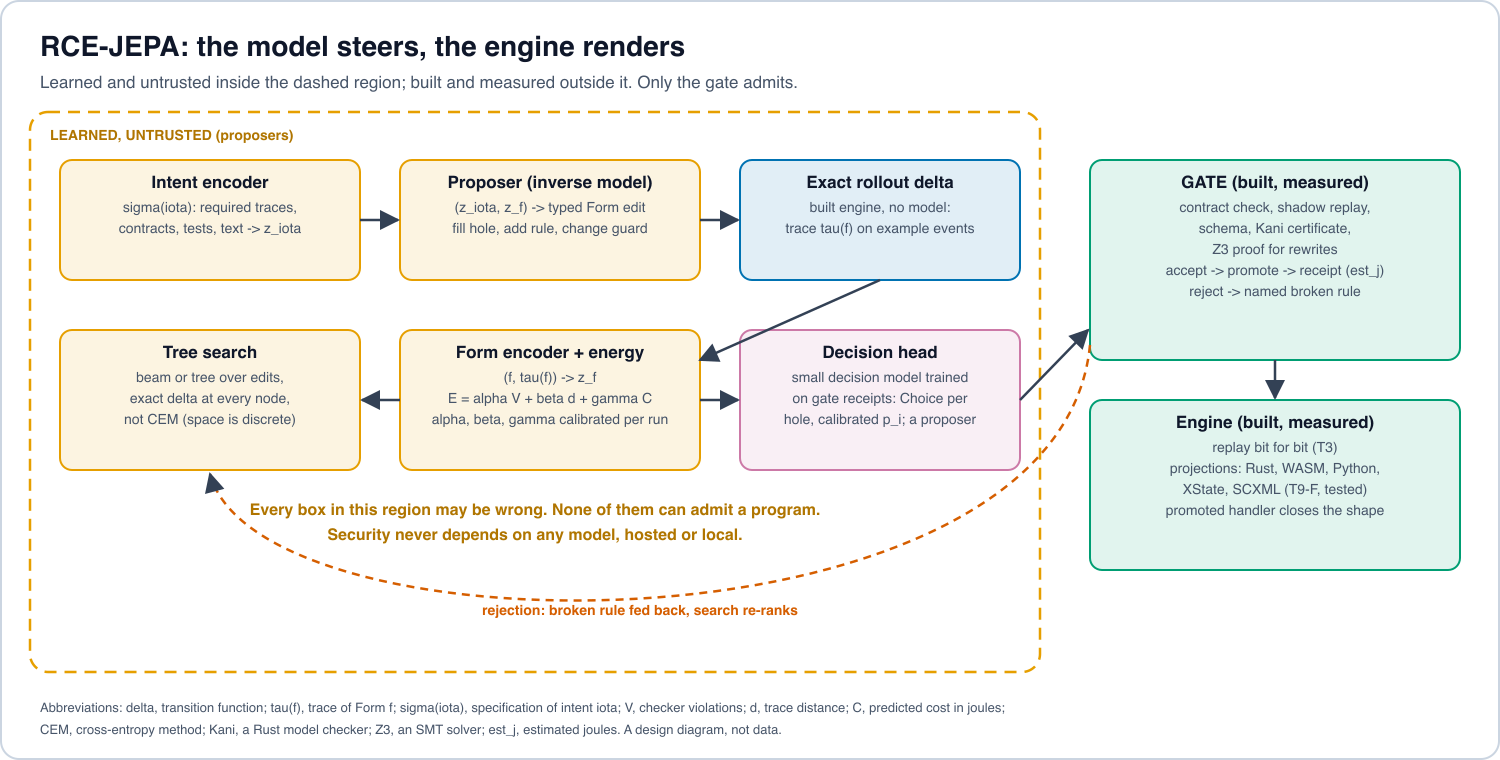 > Figure 2. The model steers, the engine renders. Orange boxes are learned and untrusted; the blue box is the exact rollout by the transition function, used as a simulator during search; green boxes are the parts the RCE paper describes, public code or specified design (see that paper). Only the gate admits. A design diagram, not data. [Open full size](https://research.openie.dev/figures/rce-jepa/architecture.svg) · [PNG](https://research.openie.dev/figures/rce-jepa/architecture.png) . | Component | Role | Starting design | Why | | --- | --- | --- | --- | | Form encoder | Map a Form and its trace on example events to a latent | A small transformer over the canonical JSON (JavaScript Object Notation) of the Form plus trace tokens, regularized with SIGReg (sketched isotropic Gaussian regularization) [B2]; a second arm with a discrete or soft-codebook bottleneck [B3, B4, B5] (SC-JEPA's soft codebook is stabilized together with an EMA (exponential moving average) teacher and a reconstruction anchor [B5, Sec. 4.4.1 and App. B.1]) | Traces define equivalence, and the trace is free because is exact. Discrete tokens kept long-horizon prediction stable where continuous latents accumulated error [B3]; Boolean latents allow exact state re-identification by bitwise equality, a motivation [B4] states with reference to earlier work | | Intent encoder | Map (required traces, contracts, tests, prose) into the same space | Shared architecture, trained so that lies near for known accepted fits | Puts goal and candidate in one metric, as V-JEPA 2-AC does with goal images [B1] | | Proposer | Given and the current , propose a typed Form edit | A goal-conditioned inverse model, the shape LeWAM compares against as GC-IDM (goal-conditioned inverse dynamics model), a baseline from Nguyen et al. (2026) that LeWAM evaluates, not a model proposed by LeWAM's authors [B6, Sec. 4.2 and App. A.2] | With exact, the inverse is the learnable object | | Energy | Rank candidates before the gate | , with taken from `est_j` | Separately trained energies are not commensurate [T2, Sec. 1.3]; are fitted on a held-out slice to maximize AUROC (area under the receiver operating characteristic curve) for accepted against requires change, and reported with every run | | Planner | Search over edits | Beam or tree search over proposer edits, scored by , with exact rollout at every node | V-JEPA 2-AC plans with the cross-entropy method (CEM) over continuous actions [B1]; Form edits are discrete and combinatorial, so CEM does not apply | | Decision head | Bounded selection with a calibrated probability: the value for each hole, a rank, an equivalence verdict | A small decision model built by the RCE project and trained on gate receipts (next subsection) | The calibrated probability orders the cheapest-first cascade | **Not learned, ever:** , , the fold, the hash chain, the projections, the gate and the promotion path. They are fixed and certified, and promotion never retrains them.
### The decision head is a proposer, and it sits outside the gate
A class of small, energy-aware decision models appeared in 2026. A decision model takes a piece of state and a fixed question and returns a typed answer with a probability for every option, without generating text; all questions about one state are answered in a single request [B7; B8]. Answers are bounded: a yes or no, a choice among a caller-supplied set of options (up to 255 for Jev; Laya's accuracy drops beyond about 20), or a score on a declared scale [B8]. Members of the class, cited here as convergent examples of the concept and not as components of RCE:
- **Laya**, an open-weight model of about 421 million parameters built on a ModernBERT-large encoder with a two-layer decision head, released under Apache 2.0 [B8, B9].
- **Kev**, a family of open decision models from 0.8 to 27 billion parameters built on Qwen backbones, each checkpoint shipped with a fitted temperature for calibration [B10].
- **Liquid AI's open d1 models**, d1-3B and d1-omni-600M, released on 7 October 2026 for edge and physical systems: d1-3B answers one question in 16 ms on an NVIDIA Jetson AGX Thor and 50 ms on a Jetson Orin Nano, reads camera frames, and was shown navigating an environment in the Isaac Sim robot simulator with the model served on a Jetson in a hardware-in-the-loop setup [B11].
An independent benchmark of one hosted member of the class found its choice probabilities well calibrated, with an expected calibration error (ECE) of 0.028 pooled over 22 choice datasets and 279,925 answers [B7]; its binary (yes or no) probabilities were less well placed (ECE 0.052 single, 0.168 multi-label) and needed tuned thresholds [B7, Sec. 4.3]. Documented weaknesses of the class include counting, arithmetic and date comparison, and lower accuracy when the state is padded with irrelevant content [B8, B12].
The decision head is one plug in the proposer interface above. A JEPA encoder is a different plug. Hosted or local, the head only proposes.
**What the RCE project plans.** The project will build its own decision head, trained and calibrated on its own gate receipts. In the engine's design every gate decision writes a receipt with the candidate, the outcome, the broken rule and `est_j`, so calibration data would cost no labelling. The state handed to the head is the Form's canonical JSON and its trace, which is small by construction; that addresses the documented padded-state weakness directly. The head is a proposer. Any decision model, hosted or local, built by the project or by anyone else, only proposes; it never admits a Form, and the security of RCE never depends on it.
### Data
V-JEPA 2 pairs very large passive pretraining with a small action-conditioned set [B1]. The RCE analogue has four tiers.
| Tier | Source | Size target | Trains |
| --- | --- | --- | --- |
| Passive: Forms and traces | Forms lifted from pinned public corpora by the lift of the RCE paper (Sec. 6) once it is public code, Forms from the seeded generator of that paper's ecosystem protocol (Sec. 2.3), and every promoted handler | to Forms with traces | The Form encoder, by predicting masked rules and masked trace segments in latent space |
| Paired: intent and fit | Tests and contracts attached to lifted programs; a Form's own trace as a self-generated specification; the preregistered brownfield applications; benchmark specifications written as Forms | pairs to start | Intent encoder and proposer |
| Decision receipts | Every gate decision | Unbounded, no labelling cost | The decision head's calibration |
| Hard negatives | Requires-change verdicts with the named broken rule; model-proposed equivalences the gate did not admit (15 of 18 proposals, 12 distinct rewrites, in the public record of the model-proposer run in the RCE paper, Sec. 5.5) | Grows with every run | Contrastive signal: valid against invalid, equivalent against not |
Near-duplicate Forms are removed by shape hash before any split, and held-out splits are by shape hash, never by surface text. The first corpus exists: version 1 of the Form corpus (23 October 2026) holds 192 distinct shapes of hand-written programs from the public repository (version 4, 24 October 2026), 55 of them with an intent block, and 3,456 negatives (343 conformance programs that require change, each with its diagnostic code, and 3,113 checker-verified mutants, whitespace-token and typed, that require change across 31 diagnostic codes), with a dataset card and a split by shape hash; its generator is `scripts/corpus.py` in the repository and the rows are at [research.openie.dev/data/](https://research.openie.dev/data/#rce-jepa). It is the paired and hard-negative tiers at their smallest; the passive tier (lifted programs) is empty until the lift pipeline is public. On it, H1 has a first measurement, preregistered before the run: the median of rho = b(code)/b(P) over 185 programs is 9.34 against the emitted Python (interquartile range 8.45 to 10.81; version 1 gave 9.31 over 173, with 17.33 for Rust, 11.06 for JavaScript and 13.66 for Scala), above the threshold of 5; 171 of the first 173 programs were above 5 (Wilson 95% interval 0.96 to 1.00). Under a compressed description length (gzip) the ratio is 3.57 for Python and 5.73 for Rust, which is reported next to the primary so that the number is not read as a claim about information content: H1 is about the space a proposer searches, which is the token count under its vocabulary. The emitted source is the reference checker's own, with the shared runtime excluded, and no lifted or model-written program is in the population. On Apple M5 Max at commit `1762fb4b`, H2 is now measured in operating-system/on-chip `reported_j`: `rce check` takes a median of `7.32 ms` and `0.04904 J` per Form check (kernel `ri_energy_nj`) against `84.25 J` per candidate on local `Qwen 3.6 35B-A3B` (`C_check / E_model = 0.000582 <= 0.05`; details in Section 8 below). And a measure of what an intent block buys, which RJ-F2 and H7 both rest on: of the mutants that change a program's behaviour, its own example lines catch 317 of 392 (0.81, Wilson 95% interval 0.77 to 0.85; 24 of 54 programs catch every one), and the uncaught changes are almost all a constant moved by one that no example exercises.
### Training, in brief
- **Encoder objective.** Latent prediction plus SIGReg, the recipe of LeJEPA, which needs a single trade-off hyperparameter and no stop-gradient or teacher-student scheme [B2, abstract], and of LeWorldModel, which trains end to end with two loss terms [B13, abstract]. Two cautions from the same line of work: the LeWorldModel authors flag the isotropic Gaussian target as a possible limitation in environments of low intrinsic dimension [B13, Sec. 4.2 and Sec. 6], and contrastive inverse dynamics is offered as a distribution-free alternative [B14], which, however, was evaluated on continuous controls only and was clearly worse than SIGReg on combinatorial puzzle tasks whose discrete state changes look alike whichever action caused them [B14, Appendix D]; and SIGReg and VISReg "do not guarantee that the learned latent representation preserves all the key information required for planning" [B15, Sec. 4.1]. Both arms run side by side, with auxiliary heads that predict exact, cheap properties of the Form (monotone tag, fuel bound, rule count).
- **Multi-step prediction.** Training with k-step recursive prediction gives significantly better results in the EB-JEPA ablations, by reducing exposure bias, with a Pareto optimum near k = 4 [B16, Fig. 3]; RoboJEPA raises the autoregressive training rollout from K = 2 to K = 10 steps in a long-horizon cooldown, which pays off only at large compute (above about 10 21 FLOPs) [B17, Sec. 3.3 and App. C.2]; a rollout-consistency term matched to the planner horizon comes from Temporal-Distance JEPA [B18, abstract].
- **Monotone energy.** A monotone cost ranking makes plans that deviate further from a goal-reaching trajectory cost more; without it, local minima in the cost surface can lead the planner to suboptimal plans [B19]. Monotonicity is not guaranteed by the task: the EB-JEPA navigation task is non-monotonic, since the best path first moves away from the goal [B16]. Here it is a preregistered diagnostic (H11), not an assumption.
- **Proposer.** Supervised on intent, Form and edit triples from the paired tier, then improved on its own gate-accepted trajectories: the gate is the reward.
- **Never decode a latent directly.** MoRAE reports that generating motion directly in a frozen JEPA latent "fails dramatically", and traces the failure to an ill-conditioned latent spectrum and to small latent errors amplified into large artifacts after decoding [B20, abstract and Sec. 3]. The proposer outputs typed edits; latents rank, they do not render.
### Convergence: where each piece already exists
No single piece of RCE-JEPA is new. Each has an existing home, listed below as convergence, not priority. What has not been measured is the joined system, which is the subject of the hypotheses.
| Piece | Where it exists | What it established | Difference from RCE-JEPA |
| --- | --- | --- | --- |
| Predict a compact plan, then decode the program | Latent Programmer [B21] | A discrete latent code predicted from the specification, then the program; string-transformation accuracy up 5 to 7 points (over 10% relative) over the best baseline, plus higher BLEU on Python code generation from docstrings [B21, Sec. 5.1 and 5.3] | Open target language, no canonical form, no checker |
| Learn execution, not only text | LaSynth [B22]; Code World Model (CWM) [B23]; analysis of CWMs [B24] | Latent execution improves synthesis in a restricted C domain; CWM is mid-trained on observation-action trajectories from a Python interpreter and Docker environments | Dynamics are learned; in RCE they are exact |
| Equivalence classes as a learning target | EqNet, Allamanis et al. [B25] | Continuous representations of symbolic expressions trained on equivalence classes | Expressions, not whole programs |
| Agents propose, solvers verify | Agentic model checking [B26]; verified synthesis for concept design driven by a large language model (LLM) [B27]; AlphaProof, Clover, AutoVerus (Section 3 below) | "Agents propose, solvers verify" is stated as a principle; CEGIS-style synthesis (counterexample-guided inductive synthesis) against Alloy invariants and positive and negative scenarios | Proposers generate tokens; no latent planning, no joule accounting |
| JEPA as a latent reasoner | JEPA-Reasoner [B28] | Latent reasoning decoupled from token generation | Text domain |
| Cost predicted before execution | Compiler world models [B29] | A transition model rolls out scheduling actions in latent space to predict the terminal-state representation, which a ranker uses to order candidates before fewer hardware measurements; the score is a within-workload rank, not a calibrated cost [B29, Sec. 3.2 and Sec. 6] | Tensor program schedules only |
| Discrete latents | Discrete-JEPA [B3]; discrete world models via regularization [B4]; SC-JEPA [B5] | Discrete tokens that keep long-horizon symbolic prediction stable [B3]; Boolean latents learned without reconstruction (planning left to future work) [B4]; a soft codebook bottleneck, with an EMA teacher and a reconstruction anchor, to stabilize one-step latent prediction, not long-horizon rollout [B5] | Synthetic images, puzzles, time series; not programs |
| Stable JEPA training | LeJEPA [B2]; LeWorldModel [B13] | Collapse-free training without stop-gradient, teacher networks or hyper-parameter schedulers; a standard learning-rate warm-up and cosine schedule is still used [B2, abstract and Sec. 6.1]; without stop-gradient, EMA or pretrained encoders, with two loss terms [B13, Sec. 3.1] | Reusable as an objective; validated only on images [B2] and pixels [B13], untested on program data |
| Small calibrated decision models | Laya [B9]; Kev [B10]; Liquid AI open d1 [B11]; benchmark [B7] | Typed answers with per-option probabilities. Kev ships a fitted temperature per checkpoint [B10]; Laya ships over-confident (mean ECE 0.466) and reaches 0.081 only after a per-type temperature refit [B9]. Latency: about 33 to 40 ms per question on a T4 GPU for Laya and 18.1 ms for six questions on an H100 for Kev, but hundreds of milliseconds on a CPU or Mac (Laya 193 to 464 ms on CPU, Kev-4B 721 ms on an M5 Mac) [B9, B10]; d1-3B answers one question in 16 ms on a Jetson AGX Thor and 50 ms on a Jetson Orin Nano [B11]; one hosted member independently benchmarked for calibration [B7] | No world model; in RCE-JEPA a decision head is one proposer among several |
| Trace-trained proposers | Code World Model [B23], Section 3 below | Mid-training on Python execution traces and on agent trajectories. SWE-bench Verified pass@1 53.9% base and 65.8% with a best of 16 samples, as that report states | The dynamics are learned. In a Form the transition is exact. The authors call trace prediction a "first step" |
| Evaluator-gated evolutionary search | AlphaEvolve (Novikov et al., Section 3 below) | A model proposes edits. An automatic evaluator decides. A 4 by 4 complex matrix multiplication in 48 scalar multiplications is the kernel figure used here | Works where an evaluator exists. That report does not use a Form quotient |
| Constraint at sampling time | Type-constrained decoding (Mündler et al., the Swiss Federal Institute of Technology Zurich and the University of California, Berkeley, Section 3 below) | Compilation errors down 75.3% on HumanEval and 52.1% on MBPP. Syntax only: 9.0% and 4.9% | TypeScript scale. Types are not the full acceptance rule |
| Specification to verified code | Vericoding (Bursuc et al., Section 3 below) | 12,504 specifications. Success 82.2% Dafny, 44.2% Verus, 26.8% Lean. The abstract rounds those shares to 82%, 44% and 27% | The specification still has to be written. Natural-language descriptions add little |
### The specification cost, named
The checker guarantees that a Form is valid; it does not guarantee that it is the Form that was meant. In verified LLM-driven synthesis for concept design, invariant-only synthesis "reached verified designs quickly but often produced inconsistent designs across runs", which shows "that invariants alone underconstrain the design task"; scenario-guided synthesis recovered intended designs more consistently than natural-language prompting, although minimal scenarios could overfit [B27, abstract], on 3 applications and 12 variants with one LLM configuration [B27, Sec. 5]. The dominant failures "were not failures of bounded verification, but failures of specification coverage" [B27, Sec. 5.6]. In seL4 the abstract specification took about 4 person-months and the proof about 20 person-years (Klein et al. 2009, Section 2 below). A closed program world makes acceptance exact and search tractable. It moves the uncertainty of intent into ; it does not remove it. Falsifier RJ-F2 below makes that cost public and measurable.
### Proposer hypotheses
The proposer is tested by H11 (monotone energy), H12 (decision-head calibration) and H13 (discrete against continuous latents), and is scored on the residual of the deterministic ladder above (H14, H15). All fifteen hypotheses, H1 to H15, are stated in numerical order with their thresholds in one table in Section 8 below, under the same conventions: preregistered before the run, frozen engine commit and binary hash recorded, same gate for every arm.
The H3 control is fixed now: the same gate and the same cost accounting, with Qwen2.5-Coder-1.5B proposing surface code, the arm already run in the RCE paper (Sec. 5.5), where the gate did not admit 15 of 18 proposed equivalences and admitted only one distinct rewrite, a rule the engine already had.
**Falsifiers.** The falsifiers for the premise itself, RJ-F1 to RJ-F6, now follow the hypotheses they test, directly after the H1 to H15 table in [Section 8 below](#falsifiers).
### Risks and mitigations
| Risk | Evidence | Mitigation |
| --- | --- | --- |
| Decoding a latent amplifies small errors | Direct generation in a frozen JEPA latent fails dramatically for motion, from spectral ill-conditioning and decoder amplification [B20] | Never decode a latent; the proposer emits typed edits and the gate checks them |
| A representation that does not collapse but learns the wrong thing | "Physical representation laziness" under SIGReg [B15] | Auxiliary exact-property heads; an inverse-dynamics regularizer |
| Isotropic prior misfits a low-dimensional Form space | [B13]; [B14] | SIGReg and contrastive inverse-dynamics arms side by side, remembering that the inverse-dynamics arm was weaker on discrete puzzle state [B14] |
| Energy terms not commensurate | [T2, Sec. 1.3] | Fit per experiment and publish them |
| Decision head degrades on padded state | Documented weakness of the class [B8, B12] | Feed only canonical Form JSON and trace |
| Expressiveness ceiling | Rice's theorem [T3]; the restricted language | Lift coverage is the measurement; RJ-F1 is the falsifier |
| Specification cost dominates | seL4 effort (Section 2 below); invariant under-constraint [B27] | RJ-F2; tools that capture traces from running programs and infer contracts, as deliverables in their own right |
| Benchmark oracle weakness | PatchDiff (Wang, Pradel and Liu, Section 3 below): 7.8% of patches counted correct fail developer tests, and resolve rates are inflated by about 6.4 points. A METR trial of early-2025 tools (Becker et al., Section 3 below): 16 developers, 246 tasks, measured completion time 19% higher. The forecast was 24% lower. A post-hoc estimate was 20% lower | Acceptance is the gate plus replay, not a test suite. Section 8 (H15) enforces `rce check` plus obligation preservation on every candidate |
| Learned planning latency | V-JEPA 2 model predictive control took about 16 seconds per action [B1] | Search over Forms with an exact checker (`7.32 ms` / `49.04 mJ` on Apple M5 Max) and Gear-0 crystallization (`0.325 µs` / `1.77 µJ` per lookup) bound repeated rollouts |
The phased pilot plan, from the data engine through convergence, with preregistration and exit criteria for each phase, is kept with the project's working notes and summarized here: Phase 0 builds the lift corpus and receipt dataset, and measures the deterministic ladder for H14, which needs no learned proposer; Phase 1 trains the Form encoder and tests H1, H5 and H11; Phase 2 builds and calibrates the decision head (H12); Phase 3 trains the dedicated JEPA proposer and planner against the token control (H3, H4, H10, H13), extending the first single-shot off-the-shelf H15 baseline reported in Section 8; Phase 4 extends on-chip `reported_j` (H2) to external wall-meter `measured_j` (H8, H9); Phase 5 runs the convergence protocol, in which Gear-0 promotion takes the model out of the loop for each closed shape. Alongside Phase 0, a slice of the vericoding benchmark (source C34, listed under Convergence by commitment below), chosen as its state-machine-shaped tasks in Dafny, Verus and Lean, is lifted into Forms and scored under RCE's gate next to the published vericoding results, an outside benchmark for the step from specification to Form (H6, H7 and H8).
### Proposer references
References marked [T] are listed under Thesis references below; references to Sections 2, 3 and 5 are to the sections of this page below. Labels follow the convention of the main references below. **Full** here means the whole text was read, including references and appendices; for B9 and B10 the live model card and README were read on 14 October 2026.
- [B1] M. Assran et al., "V-JEPA 2: Self-Supervised Video Models Enable Understanding, Prediction and Planning", 2025. [arXiv:2506.09985](https://arxiv.org/abs/2506.09985). Full.
- [B2] R. Balestriero and Y. LeCun, "LeJEPA: Provable and Scalable Self-Supervised Learning Without the Heuristics", 2025. [arXiv:2511.08544](https://arxiv.org/abs/2511.08544). Full.
- [B3] J. Baek et al., "Discrete JEPA: Learning Discrete Token Representations without Reconstruction", 2025. [arXiv:2506.14373](https://arxiv.org/abs/2506.14373). Full.
- [B4] D. Bizzaro and L. Serafini, "Discrete World Models via Regularization", 2026. [arXiv:2603.01748](https://arxiv.org/abs/2603.01748). Full.
- [B5] Y. He et al., "SC-JEPA: Stabilizing Latent Predictive Learning for Time-Series Anomaly Prediction", 2026. [arXiv:2602.04643](https://arxiv.org/abs/2602.04643). Full.
- [B6] M. Fu et al., "LeWAM: End-to-End World and Action Modeling with JEPAs", 2026. [arXiv:2610.12818](https://arxiv.org/abs/2610.12818). Full.
- [B7] T. Deußer, L. Sparrenberg and R. Sifa, "Evaluating and Benchmarking the System One Model Jev", 2026. [arXiv:2609.37647](https://arxiv.org/abs/2609.37647). Full.
- [B8] W. Wu, "Jev vs Laya: Comparing and Choosing Between Closed-Source and Open-Source System One Decision Models", 23 September 2026. [wilsonwu.me](https://wilsonwu.me/en/blog/2026/jev-vs-laya/). Full.
- [B9] Nandakishor M (Convai Innovations), Laya model card. [Hugging Face](https://huggingface.co/convaiinnovations/laya). Full (read live 14 October 2026).
- [B10] J. Palmer, Kev. [GitHub](https://github.com/jaredpalmer/kev). Full (README, read live 14 October 2026).
- [B11] Liquid AI, "Open d1: Edge decision models for text, vision, and audio", 7 October 2026. [liquid.ai](https://www.liquid.ai/blog/d1-open). Full.
- [B12] Sanity, "Decision model" (glossary). [sanity.io](https://www.sanity.io/glossary/decision-model). Full.
- [B13] L. Maes, Q. Le Lidec, D. Scieur, Y. LeCun and R. Balestriero, "LeWorldModel: Stable End-to-End Joint-Embedding Predictive Architecture from Pixels", 2026. [arXiv:2603.19312](https://arxiv.org/abs/2603.19312). Full.
- [B14] J. Boylan and C. Hokamp, "No Gaussian Required: Contrastive Inverse Dynamics for JEPA World Models", 2026. [arXiv:2608.17542](https://arxiv.org/abs/2608.17542). Full.
- [B15] P. Zhu et al., "Spectral-Target Physical Latent Structuring for JEPA-Style World Models", 2026. [arXiv:2609.04264](https://arxiv.org/abs/2609.04264). Full.
- [B16] B. Terver et al., "A Lightweight Library for Energy-Based Joint-Embedding Predictive Architectures", 2026. [arXiv:2602.03604](https://arxiv.org/abs/2602.03604). Full.
- [B17] A. Zholus et al., "RoboJEPA: Scaling Robotic Latent World Models", 2026. [arXiv:2610.10515](https://arxiv.org/abs/2610.10515). Full.
- [B18] J. Bai and J. Xiong, "Temporal-Distance JEPA: Plan-Aware Representation Learning for Latent World Model Predictive Control", 2026. [arXiv:2607.25337](https://arxiv.org/abs/2607.25337). Full.
- [B19] A. Chahe, S. Cai and L. Zhou, "Latent World Models with Monotone Planning Costs for Image-Goal Navigation", 2026. [arXiv:2608.09073](https://arxiv.org/abs/2608.09073). Full.
- [B20] Y. Zhu et al., "MoRAE: Flow-Friendly Self-Supervised Latents for Text-to-Motion Generation", 2026. [arXiv:2607.29180](https://arxiv.org/abs/2607.29180). Full.
- [B21] J. Hong, D. Dohan, R. Singh, C. Sutton and M. Zaheer, "Latent Programmer: Discrete Latent Codes for Program Synthesis", ICML 2021. [PMLR PDF](https://proceedings.mlr.press/v139/hong21a/hong21a.pdf). Full.
- [B22] X. Chen, D. Song and Y. Tian, "Latent Execution for Neural Program Synthesis", NeurIPS 2021. [arXiv:2107.00101](https://arxiv.org/abs/2107.00101). Full.
- [B23] Meta FAIR CodeGen Team, "CWM: An Open-Weights LLM for Research on Code Generation with World Models", 2025. [arXiv:2510.02387](https://arxiv.org/abs/2510.02387). Full.
- [B24] B. Rahmani, "Debugging Code World Models", 2026. [arXiv:2602.07672](https://arxiv.org/abs/2602.07672). Full.
- [B25] M. Allamanis, P. Chanthirasegaran, P. Kohli and C. Sutton, "Learning Continuous Semantic Representations of Symbolic Expressions", ICML 2017. [arXiv:1611.01423](https://arxiv.org/abs/1611.01423). Full.
- [B26] Y. Sun, J. Liu, D. Kroening and J. Xue, "Agentic Model Checking", 2026. [arXiv:2605.21434](https://arxiv.org/abs/2605.21434). Full.
- [B27] A. Cunha, "Verified LLM-Driven Synthesis for Concept Design", 2026. [arXiv:2607.15718](https://arxiv.org/abs/2607.15718). Full.
- [B28] B. K. Liu, Z. P. Chen and D. P. Woodruff, "JEPA-Reasoner: Decoupling Latent Reasoning from Token Generation", 2025. [arXiv:2512.19171](https://arxiv.org/abs/2512.19171). Full.
- [B29] H. Pan et al., "Toward Compiler World Models: Learning Latent Dynamics for Efficient Tensor Program Search", 2026. [arXiv:2606.09312](https://arxiv.org/abs/2606.09312). Full.
- [B30] Open Interface Engineering, "Exact-proposer ladder: registered run", openIE-dev/openie-research-experiments, `rce/bench/ladder/exact-proposers/`: registration committed before the run at `3030469d`, results at `70a0a776` (pull request #21); ladder openIE-dev/rce `6d04a096`. [GitHub](https://github.com/openIE-dev/openie-research-experiments/tree/main/rce/bench/ladder/exact-proposers). Full.
- [B31] Open Interface Engineering, "Exact-proposer ladder on real defects: registered run", openIE-dev/openie-research-experiments, `rce/bench/ladder/real-defects/`: registration committed before the run at `64e70389`, results at `00e3b005` (pull request #22); ladder openIE-dev/rce `7dc4eded`. [GitHub](https://github.com/openIE-dev/openie-research-experiments/tree/main/rce/bench/ladder/real-defects). Full.
- [B32] Open Interface Engineering, "Exact-proposer ladder with renames: registered run", openIE-dev/openie-research-experiments, `rce/bench/ladder/rung-e/`: registration committed before the run at `be5f370d`, results at `3a5227c2`, merged at `f76ba9d8` (pull request #23); ladder openIE-dev/rce `8a5d90ea`. [GitHub](https://github.com/openIE-dev/openie-research-experiments/tree/f76ba9d8d02d57b773afbf105333417d55f72e2c/rce/bench/ladder/rung-e). Full.
- [B33] Open Interface Engineering, "RCE-JEPA H2, single-shot H15, and Shape D (DNULLMM1) Gear-0 on the 40 open residual tasks", registered 22 November 2026 (`rce-jepa-h15-and-shape-d-gear0-2026-11-22`, `sha256: b64c4c671ae85755...`) on `openIE-dev/rce` at commit `1762fb4b` (20 November 2026, binary `sha256: 1d3b0d07ff5b2e8f...`), Apple M5 Max dual-channel `reported_j` receipts (`measured_j = None`, `board_metered = false`). [research.openie.dev/data/](https://research.openie.dev/data/#rce-jepa). Full.
- [B34] Open Interface Engineering, "FormJEPA-v1 latent Form repair proposer, 3-Gear Cascade, and rce repair rung f criterion evaluation on the 151-task ladder and 40 residual tasks", registered 22 November 2026 (`rce-jepa-form-jepa-v1-2026-11-22`, `sha256: 22682e6e936ec120...`; `rce-repair-rung-f-wave3-eval-2026-11-22`, `sha256: 04aff4b2b44cdbea...`) on `openIE-dev/rce` at commit `1762fb4b` (Linux x86_64 binary `sha256: 5ef9931ff23a310f...`), AMD Ryzen AI Max+ 395 Linux powercap RAPL `reported_j` receipts (`measured_j = None`, `board_metered = false`). [research.openie.dev/data/](https://research.openie.dev/data/#rce-jepa). Full.
- [B35] Open Interface Engineering, "FormEBM-v2 contrastive multi-step margin latent energy scorer (H5, H11) and H15-Iterative bounded checker-feedback residual closure (40/40) with DNULLMM1 Gear-0 v2 crystallization", registered 23 November 2026 (`rce-jepa-form-ebm-v2-2026-11-23`, `sha256: 128f17e69361ea89...`; `rce-jepa-h15-iterative-2026-11-23`, `sha256: a7774d3bd03ae450...`) on `openIE-dev/rce` at commit `1762fb4b` (Linux x86_64 binary `sha256: 331464496009d98a...`), AMD Ryzen AI Max+ 395 / Radeon 8060S Linux powercap RAPL `reported_j` receipts (`measured_j = None`, `board_metered = false`). [research.openie.dev/living/rce-jepa/](https://research.openie.dev/living/rce-jepa/) · [research.openie.dev/data/](https://research.openie.dev/data/#rce-jepa). Full.
- [B36] Open Interface Engineering, "FormEBM-v3 span-normalized two-head decomposed contrastive energy scorer (H5, H11, and zero-shot OOD H15 cross-span transfer)", registered 23 November 2026 (`rce-jepa-form-ebm-v3-2026-11-23`, `sha256: cb7ee1ac8dc5c594...`) on `openIE-dev/rce` at commit `1762fb4b` (Linux x86_64 binary `sha256: 386be0c26389550e...`; checkpoint `sha256: 71e642f1bb0b9c06...`), AMD Ryzen AI Max+ 395 / Radeon 8060S Linux powercap RAPL `reported_j` receipts (`measured_j = None`, `board_metered = false`). [research.openie.dev/living/rce-jepa/](https://research.openie.dev/living/rce-jepa/) · [research.openie.dev/data/](https://research.openie.dev/data/#rce-jepa). Full.
## The thesis: software construction is pre-"Laws of Coding"
Picture Europe in the 1660s. Kepler had published two regularities of planetary motion in *Astronomia nova* (1609) and a third in *Harmonice mundi* (1619) [T4]. Galileo and Huygens had derived testable conclusions from hypotheses about motion [T5, Sec. 1]. Gunners, millwrights and shipwrights built by rule of thumb and long apprenticeship. The sky had been watched with enormous care for two thousand years, and yet prediction was a patchwork. Newton, by the account of George Smith, "was familiar with seven different approaches to calculating planetary orbits, all at roughly the same accuracy", and calculated positions "were sometimes off by as much as a fourth of the width of the Moon" [T5, Sec. 2]. There were many good tables and no single account of why the tables worked.
Then, in 1687, came the *Principia*. A handful of axioms of motion and one inverse-square force, and from them trajectories that could be computed in advance, costs that could be reckoned before the cannon was cast, and errors that pointed to new bodies rather than to bad luck. Smith summarizes the change: after the *Principia*, "physical theory gained primacy over observation for purposes of answering specific questions about the world" [T5, Sec. 1]. Galileo's results for uniform gravity did not disappear; they became a limit case of inverse-square gravity, and the theory went on to explain the planets' deviations from Kepler's rules [T5, Secs. 1 and 2].
The premise, in plain words: **the practice of software construction, including today's AI-assisted coding by large language models, is pre-"Laws of Coding".** Here "the practice of software construction" means the practitioners and systems, human developers and code-generating models alike, that produce code by empirical trial, testing and review rather than by derivation from a formal rule set. That practice today lives in the 1660s. It has careful observation: pass@k (the chance that at least one of k sampled programs passes the tests), used in Section 4 below, and SWE-bench Verified (a reviewed set of repository issues), used in Section 3 below. It has craft: prompt wording, retries, and trial and error. Outputs of code-generating models are samples from a probability distribution, so the same request can give a different program tomorrow; when ChatGPT (gpt-3.5-turbo at its default temperature) was asked the same coding question five times, for 47.56% to 75.76% of problems across three datasets there was no test on which all five answers gave the same output, and "setting the temperature to 0 does not guarantee determinism in code generation" (Ouyang et al., 2023, abstract). The regularities that the human side of the practice does show are, in Lehman's words, ones that "arise from the habits and practices of people and organizations" [T6, Sec. V-A, p. 1069]. Hoare and colleagues named the same gap in 1987: "What then are the laws of programming, which provide the formal basis for the profession of software engineering? Many programmers may be unable to quote even a single law" [T7, p. 673]. Dijkstra had already marked the limit of the empirical method that the practice still relies on: "program testing can be a very effective way to show the presence of bugs, but is hopelessly inadequate for showing their absence" [T8, Argument three]. There is no agreed conserved quantity for a program, no equation of motion that a code generator obeys, and cost is measured after the fact, in tokens and in electricity, rather than computed before the work begins.
"Laws of Coding" names the craft layer, defined with the other three layers below. The RCE-JEPA proposal, stated here as conjecture, is that this craft can gain a small set of rules from which the behaviour and the cost of the code it produces can be computed before it runs, by borrowing from the layers beneath it. The candidates are (L1) a deterministic transition rule, (L2) an account of information and energy per transition, (L3) a canonical Form for every program, which is compression, and (L4) a composition rule under which L1 to L3 survive when programs are joined. The [Reality Code Engine (RCE)](https://research.openie.dev/about/rce/) proposes candidates for each; hypotheses H1 to H15 are the tests, stated in numerical order in one table in Section 8 below. Nothing in this section is a measured result unless it carries a number and a source.
The analogy has limits, stated here. Newton described a world nobody designed; programs are made by people, so their rules are partly chosen rather than discovered. Mechanics has continuous quantities and exact conservation of energy; a program's state is discrete and finite, and the energy a chip spends depends on the hardware, not only on the program. Rice's theorem [T3] says that no general procedure decides any non-trivial property of what an arbitrary program computes, and the halting problem [T9] is the best-known case; RCE avoids these limits only by working in a restricted language whose programs carry termination bounds, and that restriction has a price in what can be expressed. Finally, even the *Principia* was not the "clockwork universe": Smith notes that aspect "was added by Laplace" [T5, Sec. 1]; the axioms of motion alone did not settle every problem of mechanics either, since for bodies that are not point-masses they "must be supplemented by further principles" [T5, Sec. 5]; and "Newtonian theory is now seen to hold only to high approximation in limited circumstances" [T5, Sec. 1]. The claim is an analogy, not an equivalence.
### Four layers of law, from theory to art
Four phrases are easy to blur, and this page keeps them apart. Each names a different layer, running from theory through science to art, and each is formalized to a different degree today. They are never used interchangeably here.
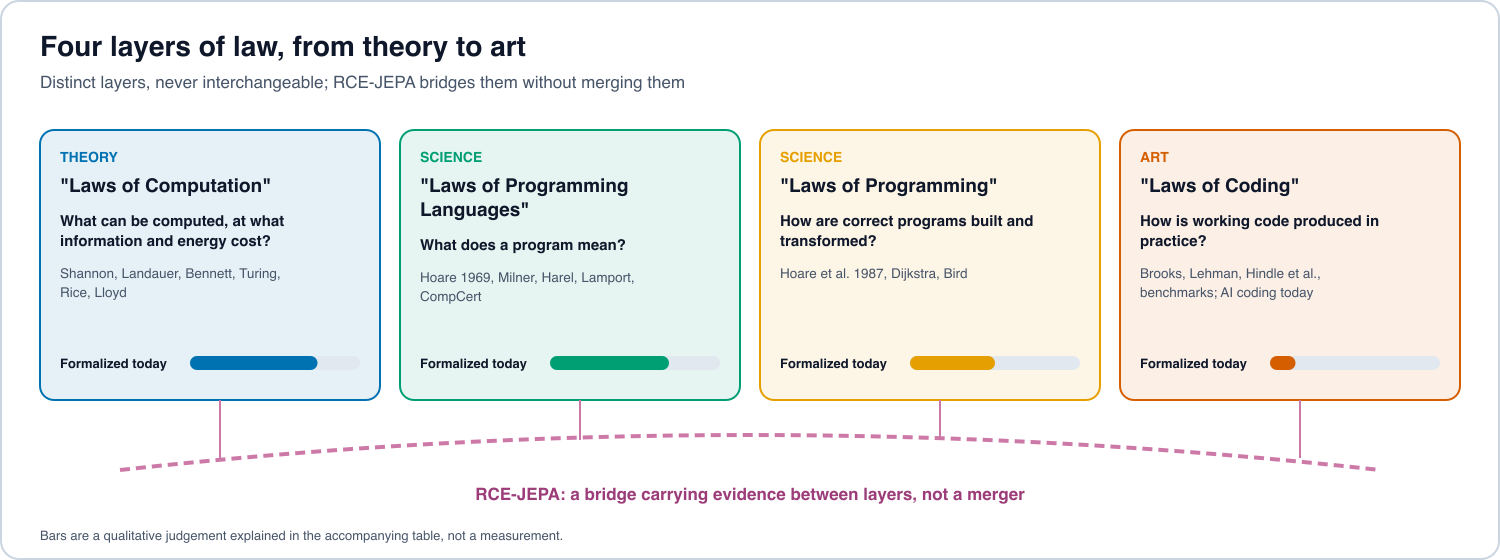 > Figure 3. The spectrum. Left to right: "Laws of Computation" (theory), "Laws of Programming Languages" and "Laws of Programming" (science), "Laws of Coding" (art). The bar under each layer shows how formalized it is today, a qualitative judgement explained in the table below. RCE-JEPA is drawn as a bridge that carries evidence between layers; it does not merge them. A qualitative diagram, not data. [Open full size](https://research.openie.dev/figures/rce-jepa/layers.svg) · [PNG](https://research.openie.dev/figures/rce-jepa/layers.png) . | Layer | Definition | Who works on it | How formalized today | | --- | --- | --- | --- | | "Laws of Computation" | Physical and information limits: what can be computed at all, and at what cost in information, time and energy. | Shannon [T10]; Landauer [T11]; Bennett and Landauer [T12, T13]; Turing [T9] and Rice [T3]; Lloyd [T14]; Wolpert [T15]; Carette, James and Sabry [T16]. | Exact theorems for limits: information in bits, the erasure floor , undecidability. No unified account yet predicts the cost of a given program on a given machine; Bennett and Landauer note their limits are "terribly far away from the real limits of modern technology" [T13, p. 48]. | | "Laws of Programming Languages" | Semantics and type theory: the rules that fix what a program in a language means. | Hoare's axiomatic semantics [T17]; Milner [T18]; Harel [T19]; Lamport [T20]; Berry and Gonthier [T21]; Halbwachs et al. [T22]; Leroy's verified compiler and Letouzey's extraction (Section 1 below). | Fully formal for some languages and compilers, machine-checked in CompCert (Section 1 below). Formal meaning is a property a language is designed to have, not one every language has. | | "Laws of Programming" | Algebraic laws of correct program construction: equations by which programs are transformed and derived from specifications. | Hoare, Hayes, He, Morgan, Roscoe, Sanders, Sorensen, Spivey and Sufrin [T7]; Dijkstra's derivation of programs and Bird's calculus of lists (Section 1 below). | Nearly one hundred laws for a small language [T7]; by its authors' own account "still a long way from knowing how to apply them directly to the design of correct and efficient programs on the scale required by modern technology" [T7, p. 686]. | | "Laws of Coding" | The empirical craft of producing working code by people or models. This is where AI coding sits today. | Brooks [T23]; Lehman [T6]; Hindle et al. [T24]; the reports in Section 3 below. | Empirical regularities and benchmarks, no laws. Outputs of AI coders are samples, so the same request can give a different program (Ouyang et al., 2023, quoted above). | **How RCE-JEPA relates to the layers.** RCE-JEPA is a bridge, not a merger. It works in the "Laws of Coding" layer, where a learned model proposes code, and it ties each proposal to the layers beneath: the Form has a fixed meaning ("Laws of Programming Languages"), accepted Forms can be transformed by stated rules ("Laws of Programming"), and their cost is to be accounted against physical limits ("Laws of Computation"); RCE counts that cost today in integer units, which are not joules. Each hypothesis below names the layer it tests. If the bridge holds, the craft gains rules borrowed from the science and the theory; the layers stay distinct.
Mechanics has its *Principia*. Computation does not, yet. The pieces of "Laws of Computation" listed above are exact, but they have not been joined into one formal account that predicts behaviour and cost together, the way the *Principia* joined Kepler's and Galileo's regularities. This is stated as an open problem, not a solved one.
Nothing in that gap is a failure of the people who came before. Each era did what its machines, its theory of information and its craft of building and optimizing programs allowed. The timeline below says what each era had to work with, with figures from the sources named, and what it achieved.
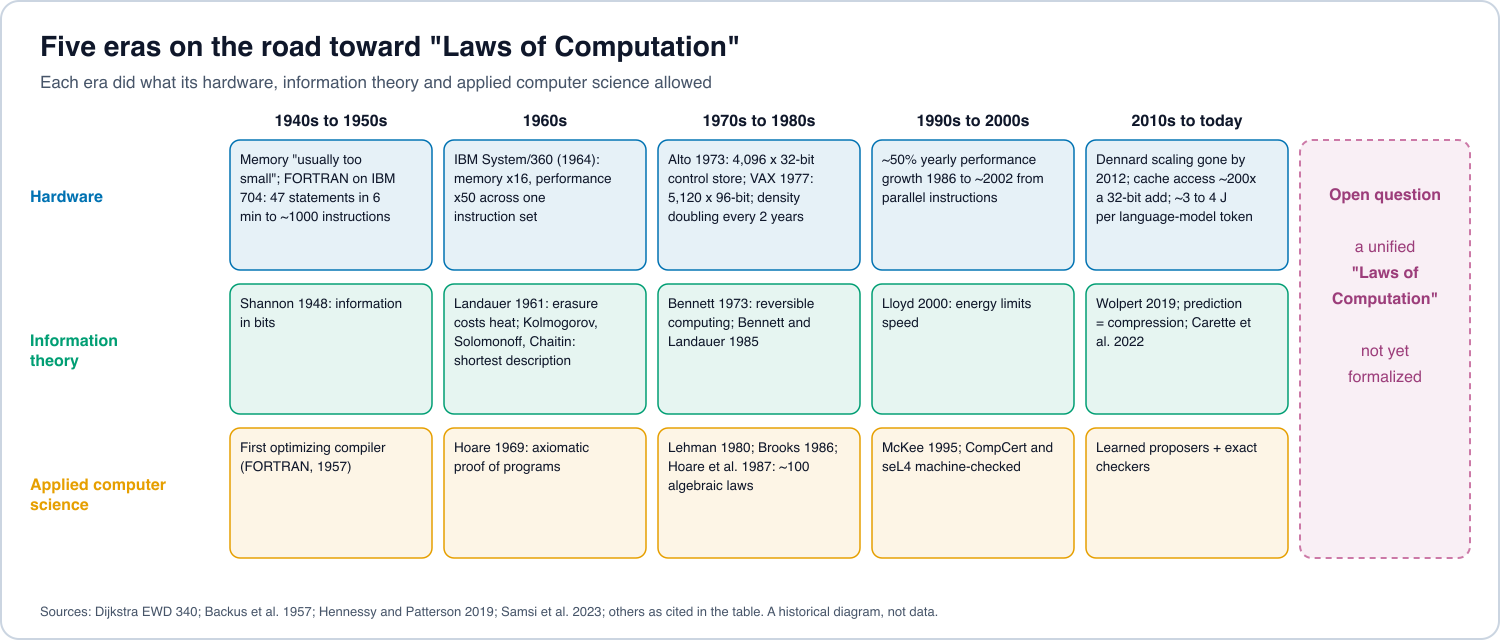 > Figure 4. Five eras on the road toward "Laws of Computation". Top lane: hardware, with figures from the sources in the table below. Middle lane: information theory. Bottom lane: applied computer science for developing and optimizing algorithms (compilers, complexity, synthesis, verification). The right-hand box is the open question: a unified "Laws of Computation". A historical diagram, not data. [Open full size](https://research.openie.dev/figures/rce-jepa/eras.svg) · [PNG](https://research.openie.dev/figures/rce-jepa/eras.png) . | Era | Hardware (memory, operations, energy) | Information theory | Applied computer science for algorithms | What it made possible, and where it stopped | | --- | --- | --- | --- | --- | | 1940s to 1950s | Single-copy machines whose memory "was usually too small" and which were "usually too slow" [T8]. On the IBM 704, a 47-statement FORTRAN (FORmula TRANslation) program compiled "in six minutes, producing about 1000 instructions" [T25, PDF p. 2]. | Shannon (1948) makes information a measurable quantity: "The fundamental problem of communication is that of reproducing at one point either exactly or approximately a message selected at another point" [T10, Introduction, p. 1]. | The first optimizing compilers [T25]. | Translation from formula to machine code became automatic. Every instruction and every word of memory was dear, so effort went to squeezing programs into machines, as Dijkstra recalls [T8]. | | 1960s | The four models of IBM System/360 (1964) differed by a factor of 16 in memory capacity and 50 in performance while sharing one instruction set [T26]. | Landauer (1961) ties erasure of information to heat [T11]; Solomonoff, Kolmogorov and Chaitin define complexity as shortest description [T27, T28, T29]. | Hoare's axiomatic basis for proving programs correct (1969) [T17]. | Correctness and information got exact definitions on paper. Dijkstra (1972): as "the power of available machines grew by a factor of more than a thousand, society's ambition to apply these machines grew in proportion" [T8], and the software crisis followed. | | 1970s to 1980s | Alto (1973): a writable control store of 4,096 words of 32 bits; VAX-11/780 (1977): a control store of 5,120 words of 96 bits; Moore's 1975 projection of a doubling in transistor density every two years [T26]. | Bennett (1973) shows that general-purpose computing machines "may be made logically reversible at every step, while retaining their simplicity and their ability to do general computations" [T30, abstract, p. 525]; Bennett and Landauer (1985) set out the physical limits [T13]. | Brooks (1986) separates essential from accidental complexity [T23]; Hoare and eight co-authors give nearly one hundred algebraic laws for a programming language [T7]; Lehman states empirical laws of software evolution [T6]. | Programs became algebraic objects. Hoare et al. are candid about the distance left: "we are still a long way from knowing how to apply them directly to the design of correct and efficient programs on the scale required by modern technology" [T7, p. 686]. | | 1990s to 2000s | Instruction-level parallelism and faster transistors gave about 50% annual performance growth from 1986 to about 2002 [T26]. | Lloyd (2000) bounds operations per second by energy [T14]. | McKee (1995) proposes fundamental laws of computation [T31]; machine-checked compilers and kernels, CompCert and seL4 (Section 1 below). | Proof reached real systems, at a price: seL4's proof took about 20 person-years (Section 1 below). | | 2010s to today | Dennard scaling "faded to almost nothing by 2012"; a 32-kilobyte cache access costs about 200 times the energy of a 32-bit add, and off-chip DRAM (dynamic random-access memory) about 10 times a last-level cache access; Google's TPU (Tensor Processing Unit) v1 performs 256 x 256 multiply-accumulates per cycle with 24 megabytes of local memory, at more than 80 times a CPU's energy efficiency on its workload [T26]. A 65-billion-parameter language model used about 3 to 4 joules per output token (Samsi et al., Section 4 below). | Wolpert's stochastic thermodynamics of computation [T15]; prediction shown equivalent to compression for language models [T32]; Carette, James and Sabry rebuild models of computation on conservation of information [T16]. | Learned code generators; model plus verifier loops; deterministic simulation testing (see who holds these views, below). | Checking is cheap and exact where proposers are cheap and plentiful. A Python matrix multiply rewritten for the hardware ran "more than 62,000x faster" [T26]: the distance between a program and its machine is now large, measurable and worth closing. | **Why progress is possible now (opinion, to be tested).** Three things that were never available together are available today. Machine-checked verifiers exist for real systems, so a rule can be enforced rather than hoped for. Learned models can propose candidate programs by the thousand, so the search for a program that satisfies a rule is affordable. And energy can be read from counters on ordinary hardware, so cost can be measured against prediction rather than guessed. Each earlier era lacked at least one of the three. None of this makes "Laws of Computation" inevitable; it makes them testable, which is the hypotheses' purpose below.
### Symbols used in this section
- {/* */} : a program as a functional state machine. is a finite set of states; a finite set of events (inputs); the transition function; the set of derivations, values computed from a state by pure functions; the output function into a finite output set .
- : the set of canonical Forms of size at most symbols. A Form is the checker-accepted canonical representation of a program in RCE (Section 8).
- : the set of surface programs (the text people or models write). : the canonicalization map from surface program to Form.
- : Shannon entropy in bits [T10]. : Kolmogorov complexity, the length in bits of the shortest program that outputs on a fixed universal machine [T27, T28].
- : Boltzmann's constant. : temperature in kelvin (K). J: joule.
- JEPA: Joint Embedding Predictive Architecture [LeCun 2022, cited above]. MDL: minimum description length [T33]. EBM: energy-based model.
### Part 1. Computation as a finite information system
Strip a program of its syntax, its comments, its indentation and its author's habits, and what remains is a machine that moves from one state to the next, one event at a time. That machine is finite, and a finite thing can be counted.
**Definition.** A program is a deterministic functional state machine with and finite and a total function. Determinism means is a function, not a relation: one state and one event give exactly one next state.
**Bound on information content.** If a Form is drawn from by any distribution, its entropy is at most that of the uniform distribution: for outcomes, "H is a maximum and equal to log n when all the p i are equal" [T10, Sec. 6, property 2, p. 11]:
For an alphabet of symbols, , so bits. Every Form, however long its behaviour, is a finite message.
**Compression and understanding.** Kolmogorov complexity [T27, T28] measures the shortest description of an object. Kolmogorov takes as the "relative complexity" of an object y given x "the minimal length l(p) of the 'program' p for obtaining y from x" [T28, Sec. 3, p. 165]; Solomonoff's induction [T27] and Rissanen's MDL [T33] turn "prefer the shortest description" into a rule for prediction and model choice. The bridge to learning is Shannon's source coding theorem [T10, Sec. 9, Theorem 9, p. 16]: a good code spends about bits on (Shannon's second proof gives a message of probability a code of binary digits with [T10, Sec. 9, p. 17]), so a better predictor is a better compressor. Delétang et al. state it directly: "maximizing the log2-likelihood (of the data) is equivalent to minimizing the number of bits required per message" [T32, Sec. 1]. itself is not computable: Kolmogorov already noted that the conditional complexity "cannot be effectively calculated (generally recursive) even if it is known to be finite for all x and y" [T28, Sec. 3, p. 165], and Schmidhuber notes "there is no general way of finding the shortest program computing any given data" [T34, Sec. 1]. In a restricted language with a canonical Form, the Form length is a computable upper bound on up to an additive constant.
### Part 2. Compression into Form and template
Ask a hundred programmers to write a shopping cart and you will get a hundred programs. Underneath the hundred there are perhaps three or four ideas. The surface is a crowd; the Form is the face it shares.
**Equivalence classes.** Define . Each Form is the representative of the class of surface programs. Because is a function, the chain rule of entropy, [T10, Sec. 6, property 5, p. 12], gives
A predictor that outputs the Form rather than the surface text is spared the second term. If surface variants within a class are equally likely, the saving per Form is
This is why the predictor works on the quotient space : it learns a smaller, cleaner target, and every point in it is something the checker can judge.
**Templates as low-dimensional manifolds.** A template or a no-code schema is a Form with holes. If a template has holes each taking one of values, it covers Forms and is addressed by bits, typically far fewer than . Program space is vast; the programs people actually want lie on thin sheets within it. This is a conjecture, consistent with the observation that code is more predictable than natural language [T24] and with learned code embeddings in which "semantically similar objects are mapped to close vectors" [T35, Sec. 1].
**Corpus measurements.** H1 has a published floor on the hand-written population. The median of = b(code)/b(P) over 185 programs is 9.34 against the emitted Python, above the threshold of 5. The run was registered before it was measured. The data section of the proposer above gives the interquartile range, the version-1 figure of 9.31 over 173 programs, and the compressed-description check. The saving on a lift corpus is still planned. That corpus is empty until the lift pipeline is public. The 9.34 figure is a measured floor on hand-written programs. It is not a measurement of lifted or model-written programs.
### Part 3. Kinematics: a Newtonian form of computing
Throw a stone and, given where it starts, how fast, and what pushes on it, Newton tells you where it lands. A deterministic program has the same character, and more strictly: no air, no wind, no rounding of the world. Given where it starts and what events arrive, its entire future is fixed.
**Trajectory.** For initial state and event stream ,
The correspondence proposed here, as analogy:
- state plays the part of position;
- an event plays the part of an applied impulse;
- plays the part of the equation of motion;
- the event log is a record from which the trajectory can be replayed exactly, which is reversibility in the record even when discards information; Bennett shows that "it is possible to reprogram any deterministic computation as a sequence of logically reversible steps, provided the computation is allowed to save a copy of its input" [T12];
- step count or fuel plays the part of time;
- energy per transition, in joules, is the cost.
**Energy floor.** Landauer argued that logical irreversibility "is associated with physical irreversibility and requires a minimal heat generation, per machine cycle, typically of the order of kT for each irreversible function" [T11, abstract, p. 183]; resetting a bit cuts the entropy by k log e 2 and so supplies "0.6931 kT per restored bit to the surroundings" [T11, Sec. 4, p. 187]. Landauer's principle, as Bennett later restates it, holds that a logically irreversible operation such as erasure "must be accompanied by a corresponding entropy increase" in the environment [T12, abstract]. The floor per erased bit is
If transition erases bits, then . Lloyd adds an upper limit on speed: "the speed with which a physical device can process information is limited by its energy" [T14, abstract], at most operations per second for energy , where is the reduced Planck constant. Real chips spend many orders of magnitude above the Landauer floor per operation; the RCE project has no measured joules-per-operation figure at the time of writing, and H9 (Section 8 below) is the planned measurement. Kolmogorov flagged the missing cost dimension in 1965: his complexity measures "do not allow for the 'difficulty' of preparing a program p for passing from an object x to an object y" [T28, Sec. 4, p. 167]. Wolpert, quoting Boyd, notes as a caution that "different implementations of the same computation (input to output) can have radically different thermodynamic consequences" [T15, Sec. I.B]: energy belongs to the program and the machine together.
**Definition (kinematic program).** is kinematic if, for every and every finite event stream,
where is a cost table in joules for a stated machine, its largest entry, and the fuel bound (maximum steps) from the termination proof. Condition (i) says the trajectory has zero variance; condition (ii) says its cost can be computed, or at least bounded, before it runs. RCE's own cost table, in Appendix C.6.4 of its specification, is in integer units, not joules; a table in joules per unit for a stated machine is a proposal in the specification repository, and H9 is the test.
**Contrast.** A stochastic generator returns a sample from a model with parameters . Its output is a distribution, its correctness is a probability, and its cost is known only after sampling. RCE-JEPA keeps the generator stochastic but makes the thing it generates kinematic, and puts a deterministic checker between them.
### Part 4. A world model whose physics is known exactly
Most world models are built in fog. A robot learns physics from blurry cameras; a game agent infers rules it cannot read. Code is the rare world where the rules are written down.
**World model.** In the JEPA sense [LeCun 2022, cited above], a world model is a predictor of the next latent representation from the current one and an action , with learned parameters . For code the world is the Form's state space and the action is an event, so the target is computed exactly by :
There is no aleatoric (irreducible) noise in the target. MuZero starts from the observation that lookahead planning algorithms "all rely on knowledge of the environment's dynamics, such as the rules of the game or an accurate simulator", and learns a model instead [T1, Sec. 1]; for code, those rules are , available in full.
**Contrast with models that learn the physics.** CWM, the Code World Model [B23], is a decoder mid-trained on Python execution traces and on agent trajectories. Trace prediction in that report is a learned interpreter, and the authors call it a "first step", with a neural debugger left as future work. V-JEPA 2 [B1] learns its physics from video, including 62 hours of robot video in the reported summary, and the action-conditioned predictor uses fewer than 62 hours of unlabeled robot video. Its model predictive control took about 16 seconds per action. In the Form, is the physics, and it is exact, so there is no aleatoric noise to fit. What a proposer still has to learn is set out in Section 7 below: intent to Form, search guidance, and the residual the ladder does not close.
**Intent decoding as an inverse problem.** Given an intent stated as constraints, find a Form whose trajectories satisfy it. This is written as energy minimization in the sense of energy-based models [T36, T2]:
Here is the number of checker violations (dimensionless); the set of trajectories of on the intent's example events; the trajectories the intent requires; a distance between them (dimensionless count of mismatched states); the predicted energy per run in joules; dimensionless weights and in ; the decoder from latent point to Form. The minimizer is decoded, then checked; the checker, not , decides acceptance. Du and Mordatch observe that "summation of two or more energies corresponds to satisfying all their goals or constraints" [T36, Sec. 1], which is why the three terms can be added. LeCun et al. add a caution: "combining two, separately trained energy-based models is not straightforward: there is no a priori guarantee that their energy scales are commensurate" [T2, Sec. 1.3, p. 6]. The weights must therefore be calibrated, not assumed, and their values are reported with each experiment.
### Part 5. Consequences as testable predictions
A thesis that cannot lose is not a thesis. Each part above maps to a test that could prove it wrong.
- Part 1 and T2 (compression into Form) are tested by H1, H3 and H10.
- Part 3 (kinematics, energy accounting) is tested by H2, H4, H8 and H9.
- Part 4 (world model, inverse problem) is tested by H5 to H7.
- The proposer is tested by H11 to H13, on the residual of the deterministic ladder that H14 measures. H15 compares proposer classes on that residual and is unfinished. All fifteen hypotheses, with metrics and thresholds, are in one table in numerical order in Section 8 below.
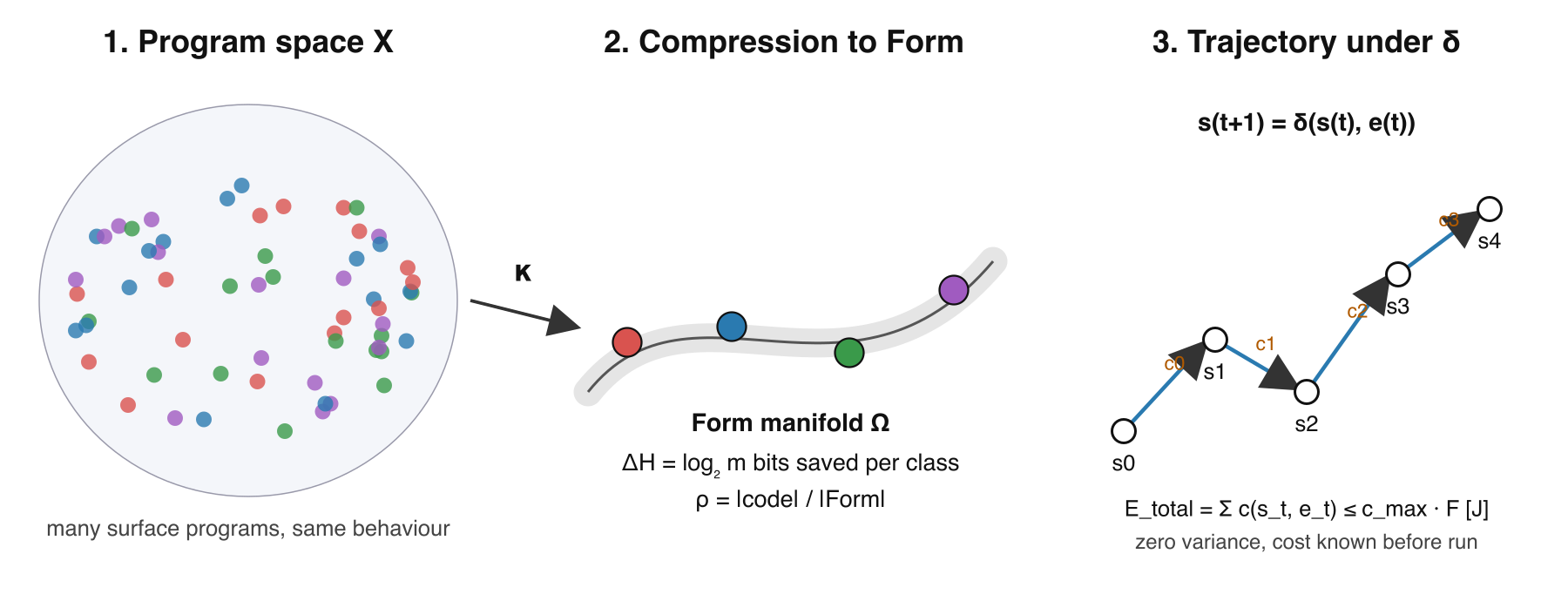 > Figure 5. Information and kinematics. Left: program space, where many surface programs X express the same behaviour. Middle: canonicalization κ collapses each class onto one Form on a low-dimensional manifold Ω, saving ΔH = log2 m bits for a class of m equally likely variants. Right: a Form moves deterministically, s(t+1) = δ(s(t), e(t)), each transition carrying a cost c in joules, with the total bounded by c_max · F before execution. A conceptual diagram, not data. [Open full size](https://research.openie.dev/figures/rce-jepa/thesis.svg) · [PNG](https://research.openie.dev/figures/rce-jepa/thesis.png) . ### The provable chain: hypothesis, layer, evidence A claim about "Laws of Coding" is only as strong as its weakest link. The table names, for each hypothesis, which of the four layers of law it tests, then follows it through three layers of implementation: the algorithm (the mathematics of the Form and the predictor), the software environment (checker, corpus, harness) and the hardware (the machine and its meter). Each link carries one of four labels. **[C] cited literature:** a published result, read as stated in the ledger. **[M] measured data:** a number measured by the OpenIE authors in a run registered before it ran, with its source in a public repository. **[X] measured, not supported:** a registered measurement whose result does not support the hypothesis as intended. **[P] planned experiment:** a test not yet run. A link that is partly measured carries both [M] and [P]. Four hypotheses have measured links, as the Status section at the end of the page reports. H15 has no measured link. The four are: H1 on the hand-written programs of the Form corpus (the data section of the proposer above), H7 on its fuzzed arm only, H8 on six targets, and H14, whose three registered runs [B30, B31, B32] support it by its registered rule (Section 8 below). A measured link records that a registered run exists and what it found; it is not by itself a verdict of support. The chain is a plan for turning every remaining [P] into [M] or [X], and any [P] can still break it.
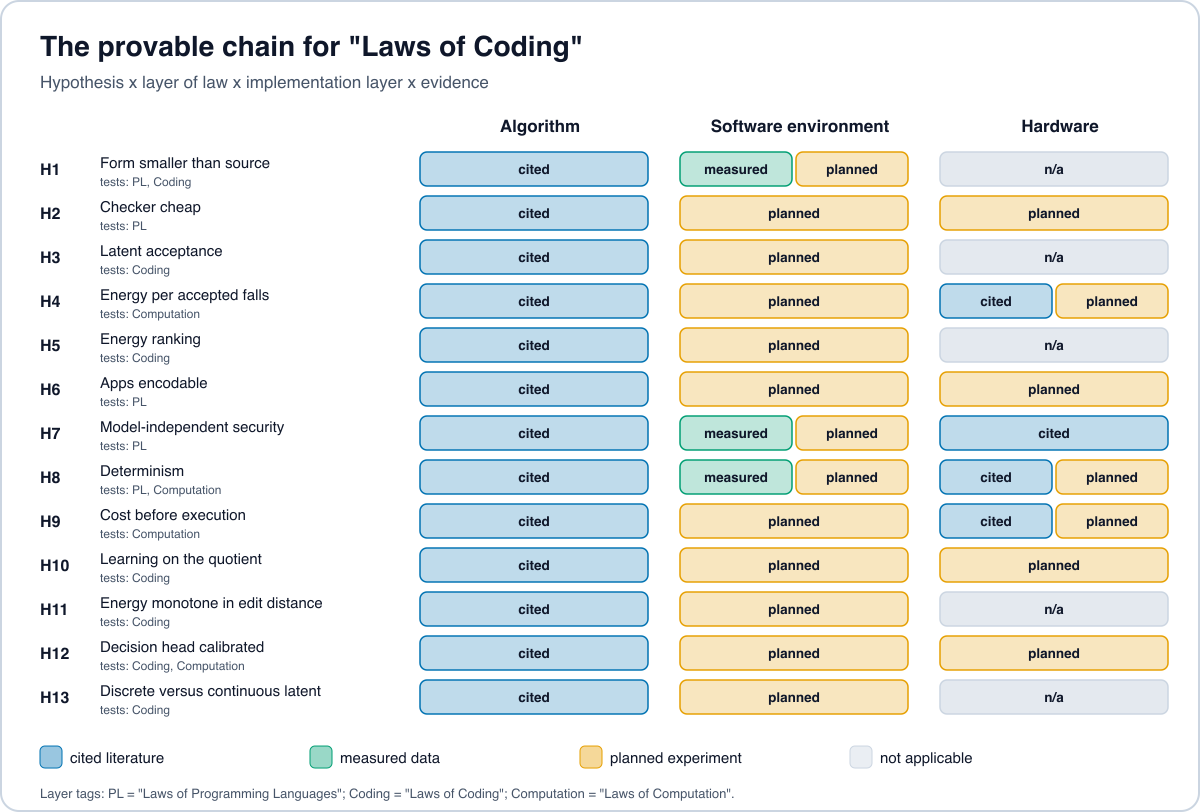 > Figure 6. The provable chain for "Laws of Coding". Rows: hypotheses H1 to H14, each tagged with the layer of law it tests. H15 is not drawn on the figure. The table adds it as planned work, with no measured link. Columns: implementation layers, algorithm, software environment, hardware. Blue: cited literature. Green: measured data. Vermilion: measured, not supported. Orange: planned experiment. Grey: not applicable. The table below gives the content and source of every cell. [Open full size](https://research.openie.dev/figures/rce-jepa/chain.svg) · [PNG](https://research.openie.dev/figures/rce-jepa/chain.png) . | ID | Hypothesis | Layer of law tested | Algorithm | Software environment | Hardware | | --- | --- | --- | --- | --- | --- | | H1 | Form much smaller than source | "Laws of Programming Languages" (canonical meaning) and "Laws of Coding" | [C] Chain rule: predicting the Form saves bits [T10] | [M] Median of 9.34 over 185 hand-written programs of the Form corpus against the emitted Python, above the threshold of 5, registered before the run (data section of the proposer above). [P] on the canonical serialization over the lift corpus, empty until the lift pipeline is public | Not applicable (a count of bits) | | H2 | Checker cheap relative to generation | "Laws of Programming Languages" | [C] Validating a result can be easier than proving the generator: CompCert's register allocator (Leroy, Section 4 below) | [P] Checker wall time and cycles per candidate | [P] in joules on a named meter | | H3 | Latent prediction reaches useful acceptance | "Laws of Coding" | [C] Prediction in representation space (I-JEPA and V-JEPA 2, Section 4 below; LLM-JEPA, Huang, LeCun and Balestriero, Section 5 below) | [P] pass@1 on held-out intent-to-Form tasks | Not applicable | | H4 | Energy per accepted program falls | "Laws of Computation" | [C] Landauer floor per erased bit [T11, T12] | [P] for both arms in one harness | [C] About 3 to 4 J per token for a 65B model (Samsi et al.); memory access dominates arithmetic [T26]. [P] Device meter, idle subtracted | | H5 | Energy ranking favours valid Forms | "Laws of Coding" | [C] Energies add to combine constraints [T36] | [P] AUROC of energy for accepted against requires change | Not applicable | | H6 | Reference apps are encodable | "Laws of Programming Languages" | [C] No general procedure decides non-trivial semantic properties [T9, T3], hence the restricted language | [P] 7 of 7 reference apps as checked Forms | [P] Replay of the same Forms across machines (with H8) | | H7 | Security independent of the model | "Laws of Programming Languages" | [C] After about six CPU-years, Csmith found no wrong-code errors in CompCert (Yang et al., Section 4 below) | [M] Fuzzed arm: 0 violations of five stated invariants over 1,275 checker-accepted mutants in two runs, each registered before it ran (`rce/bench/adversarial/`). [P] Model-generated adversarial Forms, an arm that does not exist yet | [C] Speculative-execution side channels lie outside an instruction set's semantics [T26]; out of the Form's scope, stated | | H8 | Determinism | "Laws of Programming Languages" and "Laws of Computation" | [C] Any deterministic computation can be made logically reversible given a copy of its input [T12] | [M] Bit-identical replay of 10,500 seeded event streams with 0 mismatching lines against the reference, registered before the run (`rce/bench/determinism/`) | [C] Interrupts arrive "at unpredictable and irreproducible moments" [T8]. [M] The same run on six targets: four instruction sets (x86_64, aarch64, s390x big-endian, wasm32) and three operating systems (Linux, macOS, Windows) | | H9 | Cost predicted before execution | "Laws of Computation" | [C] Energy bounds speed [T14]; cost bound (Part 3 above) | [P] Cost-table prediction per Form | [C] Implementations of one computation differ in thermodynamic cost [T15]. [P] Median error within 20% of measured joules | | H10 | Learning on the quotient saves data | "Laws of Coding" | [C] Better prediction is better compression [T32]; minimum description length [T33] | [P] Equal acceptance with at most half the training examples | [P] Training energy measured for both predictors | | H11 | Energy monotone in edit distance | "Laws of Coding" | [C] A monotone cost ranking makes plans that deviate further from the goal cost more (Chahe et al., [B19] in the proposer section) | [P] Share of families where energy rises with edit distance | Not applicable | | H12 | Decision head calibrated on gate outcomes | "Laws of Coding" and "Laws of Computation" | [C] Calibrated typed decisions are measurable: pooled Choice ECE 0.028 for one hosted decision model ([B7]) | [P] ECE per decision type after 10 4 receipts, against a frequency table | [P] Latency and joules per decision on a named device | | H13 | Discrete against continuous latent | "Laws of Coding" | [C] Discrete tokens kept long-horizon prediction stable where continuous latents accumulated error ([B3]) | [P] Planning success at edit lengths 1, 5 and 20 | Not applicable | | H14 | Deterministic ladder share | "Laws of Coding" | [C] Exact gears (lookup, rules, synthesis) run before any model in the RCE paper's cascade, with falsifier RCE-F1 on the share they close with no model call | [M] Share of a registered task set closed by the public ladder with zero model calls: three registered runs [B30, B31, B32]; run 3 closes 111 of 151 (73.5%), at or above the registered 10%, so H14 is supported by its registered rule, and 1 of 41 changes from real history (2.4%) (Section 8 below) | Not applicable | | H15 | Proposer classes on the residual. Unfinished | "Laws of Coding" | [P] Four classes on the 40 residual tasks, equal energy, gate acceptance. No run | [P] The comparison has not been run | [P] Equal energy when a named meter exists. No joule figure is stated | ### Who holds these views and why Ideas rarely arrive alone. Each part of the thesis echoes arguments made, for their own reasons, by people who have never heard of RCE. They are listed as convergence observations: agreement in direction, never confirmation of the RCE project's claims. Where the OpenIE authors read a source in full it is quoted with its section; where they did not, the entry says so and quotes nothing.
**Those who already think this way.** The idea that programming and computation should have laws of their own did not originate with the RCE project, and it is older than most of the field. This page joins a conversation that has run for at least forty years and lists it as convergence, not priority.
- **Hoare and colleagues, "Laws of Programming" (1987).** Nine authors argued that "conventional procedural programs are mathematical expressions, and that they are subject to a set of laws as rich and elegant as those of any other branch of mathematics, engineering, or natural science" [T7, p. 672], and gave nearly one hundred of them. They also named the gap that remains (quoted in the timeline above) [T7, p. 686].
- **Bennett and Landauer, "The Fundamental Physical Limits of Computation" (1985).** "We are looking for general laws that must govern all information processing, no matter how it is accomplished" [T13, p. 48]. They add a caution this page shares: "To the extent that we have found limits, they are terribly far away from the real limits of modern technology" [T13, p. 48]. Their result for reversible machines: "There is thus no minimum amount of energy that must be expended in order to perform any given computation" [T13, p. 51], while erasure and error correction still dissipate, since, in their words, "Any correctional device must therefore dissipate some energy" [T13, p. 51].
- **McKee, "A few (proposed) fundamental laws of computation" (1995).** A short essay in IEEE Computer proposing laws for the field [T31]. The OpenIE authors have not obtained the text, so it is not quoted or summarized beyond its title.
- **Carette, James and Sabry, "Embracing the laws of physics" (2022).** They note that quantum theory and thermodynamics "imply that information is a conserved quantity of physical processes and hence of primitive computational operations", and set out "to redevelop foundational computational models in a way that embraces the principle of conservation of information" [T16, abstract, PDF p. 2]. Their closing summary: "The entire edifice of computer science including its mainstream models of computations, programming languages, and logics is founded on classical physics" [T16, Sec. 5.5, p. 45].
- **Lehman (1980)** states five empirical regularities of software evolution for programs embedded in the world [T6]. The first, "Continuing Change": a program "that is used and that as an implementation of its specification reflects some other reality, undergoes continual change or becomes progressively less useful" [T6, Table I, p. 1068]. He is explicit that these are not physics: "They are, however, clearly not immutable" in the way physical and chemical regularities are, since they "arise from the habits and practices of people and organizations" [T6, Sec. V-A, p. 1069], the same distance this page keeps between "Laws of Coding" and "Laws of Computation". **Brooks** distinguished "essential tasks, the fashioning of the complex conceptual structures that compose the abstract software entity" from accidental ones [T23, PDF p. 1]. **Dijkstra** observed that a computer spans a ratio of time grains of "10 10 or more", which makes it "the first to provide us with an environment where highly hierarchical artefacts are both possible and necessary" [T8].
The groups below each hold one strand of the same idea.
**Compression as understanding (Part 1, T2).** Solomonoff, Kolmogorov and Chaitin defined complexity as shortest description [T27, T28, T29]; Rissanen made it a model selection rule [T33]; Hutter's prize and AIXI and Sutskever's talks extend it to intelligence (not read here; not quoted). Delétang and colleagues at DeepMind argue that "a model that compresses well generalizes well" [T32, Sec. 1] and show large language models compress images and audio. Schmidhuber argues that if the history of the universe were computable, its simplest explanation "would be the shortest program that computes it" [T34, Sec. 1]. Disagreement: Delétang et al. warn that "scaling beyond a certain point will deteriorate the compression performance since the model parameters need to be accounted for" [T32, Sec. 1], and Chollet argues that "solely measuring skill at any given task falls short of measuring intelligence" [T37, abstract]; compression of a fixed corpus is not the same as efficient learning of new skills.
**Computation as physics (Part 3).** Landauer [T11], Bennett [T12, T30] and Lloyd [T14] hold that information processing is a physical process with energy costs and limits. Lloyd: "Energy limits speed. Entropy limits memory." [T14, Sec. 1.5]. Wolpert's stochastic thermodynamics treats computation, including finite automata, as non-equilibrium physics: "One of the most prominent aspects of computers is that they are inherently nonequilibrium systems" [T15, abstract]; finite automata are treated in Sec. XII [T15]. Fredkin and Toffoli's conservative logic [T38], Feynman's lectures on computation, Wheeler's "it from bit" and Wolfram's computational universe point the same way (not read here). Disagreement: Bennett records objections that Landauer's principle is false, or, being a consequence of the second law of thermodynamics, either unnecessary or insufficient to exorcise Maxwell's demon, and answers them [T12]; the debate is about foundations, not about the size of the floor. A second disagreement is historical: Landauer wrote "We believe that devices exhibiting logical irreversibility are essential to computing" [T11, Sec. 3, p. 186], and Bennett's 1973 construction answered that they are not, at the price of about twice as many steps and a large temporary history [T30, pp. 525, 529]; Bennett then estimated "kT ln 2 is, as Landauer has argued [1], an approximate lower bound" only for machines that throw away about one bit per step [T30, p. 532].
**State machines and deterministic semantics (Part 1, T3).** Turing's machines [T9], Milner's calculus [T18], Harel's statecharts [T19], Lamport's TLA, which treats a program as a set of behaviours over states [T20], the synchronous languages Esterel and Lustre (Berry, Halbwachs) [T21, T22], Elliott's functional reactive programming [T39], the Elm architecture, deterministic simulation testing at FoundationDB and TigerBeetle, and Hoare's and Dijkstra's view of programs as predicates [T17] all treat a program as a state machine with exact semantics. They are cited here as history. The FoundationDB and TigerBeetle pages and the Elm guide were read in full for the convergence section below (its FoundationDB, TigerBeetle and Elm Architecture rows); the others were not read in full for this section, so none of them are quoted. Limits: Turing [T9] and Rice [T3] bound what can be decided about arbitrary programs; deterministic semantics is easy to state for a closed language and hard to keep across real hardware, threads and networks.
**Programs as data on a low-dimensional manifold (Part 2).** Hindle et al. found software "natural", more repetitive than English [T24] (not read in full here). Alon et al.'s code2vec maps code to vectors where "semantically similar objects are mapped to close vectors" [T35, Sec. 1]. Sketch-based synthesis (Solar-Lezama), DreamCoder's library learning (Ellis et al. 2021, cited in Section 2 below; its supplement describes library learning as "automatic refactoring" [Ellis et al. 2021, supplement S3.2, p. 39]) and Allamanis's survey of machine learning on code point the same way (Solar-Lezama and Allamanis not read here). Disagreement: code2vec's authors report that "When given uninformative, obfuscated or adversarial variable names, the prediction of the label is usually less accurate" [T35, Sec. 7]: learned embeddings can track names rather than meaning, which is the gap a canonical Form is meant to close.
**World models and latent prediction (Part 4).** LeCun's JEPA programme at Meta FAIR (cited above), Ha and Schmidhuber, who "learn a compressed spatial and temporal representation of the environment" [T40, abstract], MuZero [T1], physics-informed neural networks, where prior physical knowledge "can act as a regularization agent that constrains the space of admissible solutions to a manageable size" [T41, Sec. 1], and Hamiltonian neural networks, motivated by models whose simulation "drifts over time to higher or lower energy states" [T42, Sec. 1], all build structure into learned dynamics. Lagrangian networks (Cranmer), Dreamer (Hafner) and Koopman operator learning share the aim (not read here). Disagreement: Ha and Schmidhuber found that a learned world model "will be exploitable by the controller, even if in the actual environment such exploits do not exist" [T40, Sec. 4.5]; Greydanus et al. note their method assumes a conserved quantity and so cannot model friction [T42, Sec. 3.2]. For code, the checker is the guard against exploiting the model's errors.
**Energy-based models (Part 4).** Hopfield [T43] and Hinton [T44] framed learning as shaping an energy surface (not read here); Du and Mordatch [T36] show implicit generation by descending a learned energy, and LeCun (cited above) places energy minimization at the centre of JEPA inference. Disagreement within the field concerns training stability and sampling cost, which Du and Mordatch discuss [T36].
### Lane 3, seen from outside the project
Section 3 below records programmes that reconceive what computation, programming or coding is. They are convergence observations. The commitment section below maps some of the same names onto the seven commitments, one by one.
- **Unison.** A definition is the hash of its syntax tree. Names are a view. Two texts with the same tree are the same definition. That is the identity half of a canonical Form.
- **egg.** An e-graph holds a set of equivalent programs as one structure (Willsey et al., Section 3 below). The Laws of Coding use the same quotient: many surface programs, one Form.
- **Interaction nets.** HVM2 (the Higher Order Company's interaction-combinator model) treats computation as local rewriting, with parallelism inherent in the model. Section 3 cites the model and does not carry that paper's figures.
- **Proof assistants.** Lean, Dafny and Verus make correctness a checkable object. The vericoding benchmark is the measured floor cited in Section 3. AlphaProof, DeepSeek-Prover-V2, Kimina-Prover Preview and Goedel-Prover use the Lean kernel as the gate. In the reports read here, the domain is mathematics.
- **Elliott, denotational design.** "The instance's meaning is the meaning's instance." A semantic model defines correctness and carries it to the implementation (Elliott, 2009, revised 2016). It is a manual discipline. It is the same demand that a Form have one meaning.
- **Propagators.** Radul and Sussman (2009) describe computation as autonomous machines adding information to shared cells, unifying expressions and constraints. The report is theory with a Scheme implementation.
- **Lean, as an engineering programme.** The Lean FRO (Focused Research Organization) Year 1 roadmap, August 2023 to July 2024, lists a standard library, a module system, Lake and Reservoir, proof automation, machine-learning integration and a new code generator. Later years are not used here.
- **Chollet.** Intelligence as skill-acquisition efficiency, with the Abstraction and Reasoning Corpus (ARC) as the measure [T37]. The ARC Prize results in Section 3 are the later measurement of that programme. Talks after 2019 are not cited on their own.
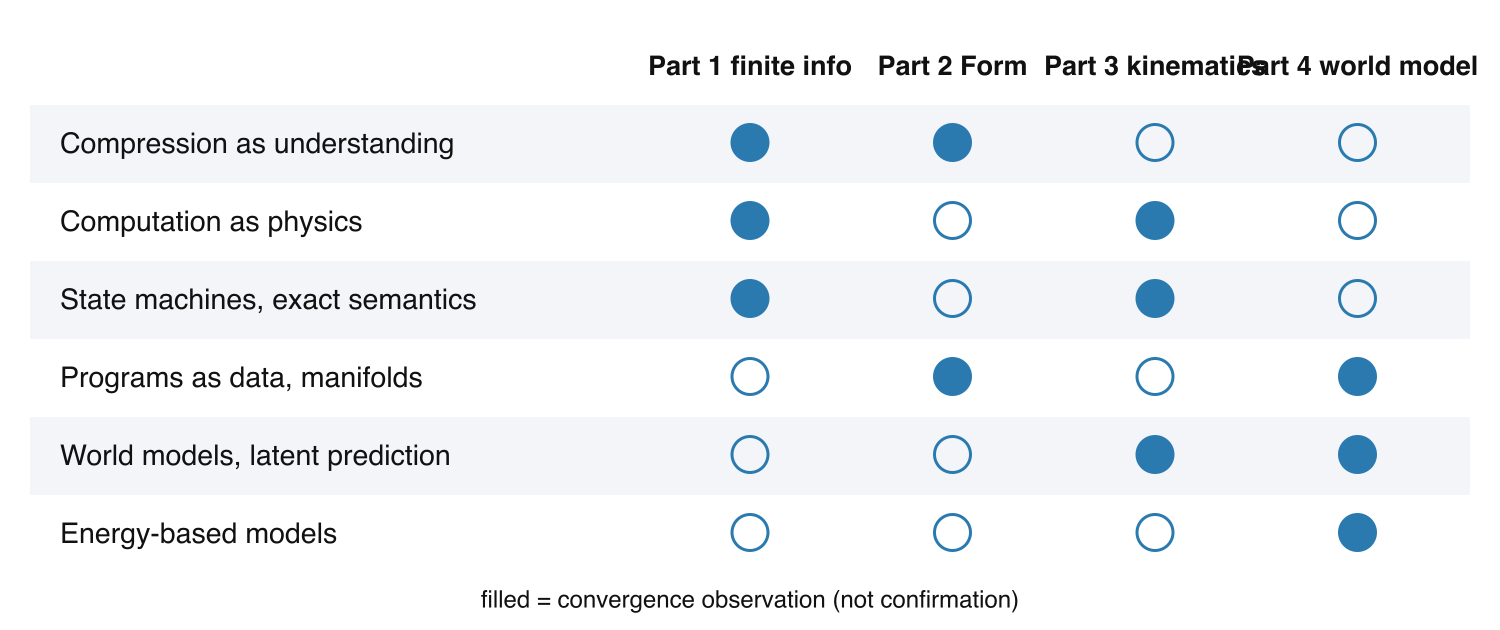 > Figure 7. Which communities bear on which part of the thesis. A filled dot marks a convergence observation, not confirmation. Part 1: finite information system; T2: compression into Form; T3: kinematics and energy; T4: world model and inverse problem. [Open full size](https://research.openie.dev/figures/rce-jepa/groups.svg) · [PNG](https://research.openie.dev/figures/rce-jepa/groups.png) . ### Thesis references Ledger: Full = read in full; Partial = read in part; Unavailable = not read (paywalled or not retrieved), listed with identifier only and never quoted.
- [T1] J. Schrittwieser et al., "Mastering Atari, Go, Chess and Shogi by Planning with a Learned Model", Nature 588 (2020). [arXiv:1911.08265](https://arxiv.org/abs/1911.08265). Full.
- [T2] Y. LeCun et al., "A tutorial on energy-based learning", 2006. [PDF](http://yann.lecun.com/exdb/publis/pdf/lecun-06.pdf). Full.
- [T3] H. G. Rice, "Classes of recursively enumerable sets and their decision problems", Trans. AMS 74 (1953). [doi:10.1090/S0002-9947-1953-0053041-6](https://doi.org/10.1090/S0002-9947-1953-0053041-6). Unavailable.
- [T4] M. A. Di Liscia, "Johannes Kepler", Stanford Encyclopedia of Philosophy. [plato.stanford.edu](https://plato.stanford.edu/entries/kepler/). Full.
- [T5] G. E. Smith, "Newton's Philosophiae Naturalis Principia Mathematica", Stanford Encyclopedia of Philosophy. [plato.stanford.edu](https://plato.stanford.edu/entries/newton-principia/). Full.
- [T6] M. M. Lehman, "Programs, life cycles, and laws of software evolution", Proceedings of the IEEE 68(9) (1980). [doi:10.1109/PROC.1980.11805](https://doi.org/10.1109/PROC.1980.11805). Full.
- [T7] C. A. R. Hoare, I. J. Hayes, He Jifeng, C. C. Morgan, A. W. Roscoe, J. W. Sanders, I. H. Sorensen, J. M. Spivey and B. A. Sufrin, "Laws of Programming", Communications of the ACM 30(8), 672-686 (1987). [doi:10.1145/27651.27653](https://doi.org/10.1145/27651.27653); [PDF copy](https://www.cs.ox.ac.uk/bill.roscoe/publications/20.pdf). Full.
- [T8] E. W. Dijkstra, "The Humble Programmer", ACM Turing Lecture 1972, EWD 340. [Transcription](https://www.cs.utexas.edu/~EWD/transcriptions/EWD03xx/EWD340.html); [doi:10.1145/355604.361591](https://doi.org/10.1145/355604.361591). Full.
- [T9] A. M. Turing, "On computable numbers", Proc. London Math. Soc. 42 (1936). [doi:10.1112/plms/s2-42.1.230](https://doi.org/10.1112/plms/s2-42.1.230). Unavailable.
- [T10] C. E. Shannon, "A mathematical theory of communication", Bell System Technical Journal 27 (1948). [doi:10.1002/j.1538-7305.1948.tb01338.x](https://doi.org/10.1002/j.1538-7305.1948.tb01338.x); [reprint](https://people.math.harvard.edu/~ctm/home/text/others/shannon/entropy/entropy.pdf) (page numbers refer to this reprint). Full (all 55 pp. of the reprint, Parts I to V and Appendices 1 to 7).
- [T11] R. Landauer, "Irreversibility and heat generation in the computing process", IBM J. Res. Dev. 5 (1961). [doi:10.1147/rd.53.0183](https://doi.org/10.1147/rd.53.0183). Full.
- [T12] C. H. Bennett, "Notes on Landauer's principle, reversible computation, and Maxwell's Demon", 2003. [arXiv:physics/0210005](https://arxiv.org/abs/physics/0210005). Full.
- [T13] C. H. Bennett and R. Landauer, "The Fundamental Physical Limits of Computation", Scientific American 253(1), 48-57 (1985). [doi:10.1038/scientificamerican0785-48](https://doi.org/10.1038/scientificamerican0785-48); [PDF copy](http://physics.bu.edu/~pankajm/PY541/Bennett-Landauer.pdf). Full (all text pages of the linked copy, pp. 48-56).
- [T14] S. Lloyd, "Ultimate physical limits to computation", Nature 406 (2000). [arXiv:quant-ph/9908043](https://arxiv.org/abs/quant-ph/9908043). Full.
- [T15] D. H. Wolpert, "The stochastic thermodynamics of computation", J. Phys. A 52 (2019). [arXiv:1905.05669](https://arxiv.org/abs/1905.05669). Full.
- [T16] J. Carette, R. P. James and A. Sabry, "Embracing the laws of physics: Three reversible models of computation", Advances in Computers (2022). [doi:10.1016/bs.adcom.2021.11.009](https://doi.org/10.1016/bs.adcom.2021.11.009); [author copy](https://www.cas.mcmaster.ca/~carette/publications/EmbracingTheLaws.pdf). Full.
- [T17] C. A. R. Hoare, "An axiomatic basis for computer programming", CACM 12 (1969). [doi:10.1145/363235.363259](https://doi.org/10.1145/363235.363259). Unavailable.
- [T18] R. Milner, A Calculus of Communicating Systems, LNCS 92 (1980). [doi:10.1007/3-540-10235-3](https://doi.org/10.1007/3-540-10235-3). Unavailable.
- [T19] D. Harel, "Statecharts: a visual formalism for complex systems", Sci. Comput. Program. 8 (1987). [doi:10.1016/0167-6423(87)90035-9](https://doi.org/10.1016/0167-6423(87)90035-9). Unavailable.
- [T20] L. Lamport, "The temporal logic of actions", ACM TOPLAS 16 (1994). [doi:10.1145/177492.177726](https://doi.org/10.1145/177492.177726). Unavailable.
- [T21] G. Berry and G. Gonthier, "The Esterel synchronous programming language", Sci. Comput. Program. 19 (1992). [doi:10.1016/0167-6423(92)90005-V](https://doi.org/10.1016/0167-6423(92)90005-V). Unavailable.
- [T22] N. Halbwachs et al., "The synchronous data flow programming language LUSTRE", Proc. IEEE 79 (1991). [doi:10.1109/5.97300](https://doi.org/10.1109/5.97300). Unavailable.
- [T23] F. P. Brooks, "No Silver Bullet: Essence and Accidents of Software Engineering", IEEE Computer 20(4) (1987; first presented 1986). [doi:10.1109/MC.1987.1663532](https://doi.org/10.1109/MC.1987.1663532); [PDF copy](https://worrydream.com/refs/Brooks_1986_-_No_Silver_Bullet.pdf). Full.
- [T24] A. Hindle et al., "On the naturalness of software", ICSE (International Conference on Software Engineering) 2012. [doi:10.1109/ICSE.2012.6227135](https://doi.org/10.1109/ICSE.2012.6227135). Unavailable.
- [T25] J. W. Backus et al., "The FORTRAN Automatic Coding System", Western Joint Computer Conference (1957). [Computer History Museum copy](https://archive.computerhistory.org/resources/text/Fortran/102663113.05.01.acc.pdf). Full.
- [T26] J. L. Hennessy and D. A. Patterson, "A New Golden Age for Computer Architecture", Communications of the ACM 62(2) (2019). [doi:10.1145/3282307](https://doi.org/10.1145/3282307); [CACM web text](https://cacm.acm.org/research/a-new-golden-age-for-computer-architecture/). Full.
- [T27] R. J. Solomonoff, "A formal theory of inductive inference, Part I", Information and Control 7 (1964). [doi:10.1016/S0019-9958(64)90223-2](https://doi.org/10.1016/S0019-9958(64)90223-2). Unavailable.
- [T28] A. N. Kolmogorov, "Three approaches to the quantitative definition of information", Problems of Information Transmission 1 (1965); English reprint, International Journal of Computer Mathematics 2 (1968), [doi:10.1080/00207166808803030](https://doi.org/10.1080/00207166808803030). Full (page numbers from the 1968 reprint).
- [T29] G. J. Chaitin, "On the length of programs for computing finite binary sequences", J. ACM 13 (1966). [doi:10.1145/321356.321363](https://doi.org/10.1145/321356.321363). Unavailable.
- [T30] C. H. Bennett, "Logical Reversibility of Computation", IBM J. Res. Dev. 17(6), 525-532 (1973). [doi:10.1147/rd.176.0525](https://doi.org/10.1147/rd.176.0525). Full.
- [T31] G. McKee, "A Few (Proposed) Fundamental Laws of Computation", IEEE Computer 28(1), 120 (1995), Open Channel. No DOI located; [DBLP table of contents](https://vldb.org/dblp/db/journals/computer/computer28.html). Unavailable.
- [T32] G. Delétang et al., "Language Modeling Is Compression", ICLR 2024. [arXiv:2309.10668](https://arxiv.org/abs/2309.10668). Full.
- [T33] J. Rissanen, "Modeling by shortest data description", Automatica 14 (1978). [doi:10.1016/0005-1098(78)90005-5](https://doi.org/10.1016/0005-1098(78)90005-5). Unavailable.
- [T34] J. Schmidhuber, "Driven by Compression Progress", 2009. [arXiv:0812.4360](https://arxiv.org/abs/0812.4360). Full.
- [T35] U. Alon et al., "code2vec: Learning Distributed Representations of Code", POPL 2019. [arXiv:1803.09473](https://arxiv.org/abs/1803.09473). Full.
- [T36] Y. Du and I. Mordatch, "Implicit Generation and Modeling with Energy-Based Models", NeurIPS 2019. [arXiv:1903.08689](https://arxiv.org/abs/1903.08689). Full.
- [T37] F. Chollet, "On the Measure of Intelligence", 2019. [arXiv:1911.01547](https://arxiv.org/abs/1911.01547). Full.
- [T38] E. Fredkin and T. Toffoli, "Conservative logic", Int. J. Theor. Phys. 21 (1982). [doi:10.1007/BF01857727](https://doi.org/10.1007/BF01857727). Unavailable.
- [T39] C. Elliott and P. Hudak, "Functional reactive animation", ICFP 1997. [doi:10.1145/258948.258973](https://doi.org/10.1145/258948.258973). Unavailable.
- [T40] D. Ha and J. Schmidhuber, "World Models", 2018. [arXiv:1803.10122](https://arxiv.org/abs/1803.10122). Full.
- [T41] M. Raissi, P. Perdikaris and G. E. Karniadakis, "Physics Informed Deep Learning (Part I)", 2017. [arXiv:1711.10561](https://arxiv.org/abs/1711.10561). Full.
- [T42] S. Greydanus, M. Dzamba and J. Yosinski, "Hamiltonian Neural Networks", NeurIPS 2019. [arXiv:1906.01563](https://arxiv.org/abs/1906.01563). Full.
- [T43] J. J. Hopfield, "Neural networks and physical systems with emergent collective computational abilities", PNAS 79 (1982). [doi:10.1073/pnas.79.8.2554](https://doi.org/10.1073/pnas.79.8.2554). Unavailable.
- [T44] G. E. Hinton, "Training products of experts by minimizing contrastive divergence", Neural Computation 14 (2002). [doi:10.1162/089976602760128018](https://doi.org/10.1162/089976602760128018). Unavailable.
## Convergence by commitment
The RCE thesis rests on seven commitments. Each has been reached independently, often more than once, by people working for their own reasons. The tables below list projects whose primary sources (paper, official documentation or repository) were opened and checked against the sentence written here. Each row says what the project established and where it stops relative to the commitment. These are convergence observations: agreement in direction, not confirmation of RCE's claims and not a ranking. Items from OpenIE, the organization behind RCE, are marked *same house* and are never used as evidence.
Acronyms used in this section: RCE, the Reality Code Engine; AST, abstract syntax tree; IR, intermediate representation; LLM, large language model; JSON, JavaScript Object Notation; WASM, WebAssembly; SMT, satisfiability modulo theories (Z3 is an SMT solver); DST, deterministic simulation testing; CEGIS, counterexample-guided inductive synthesis.
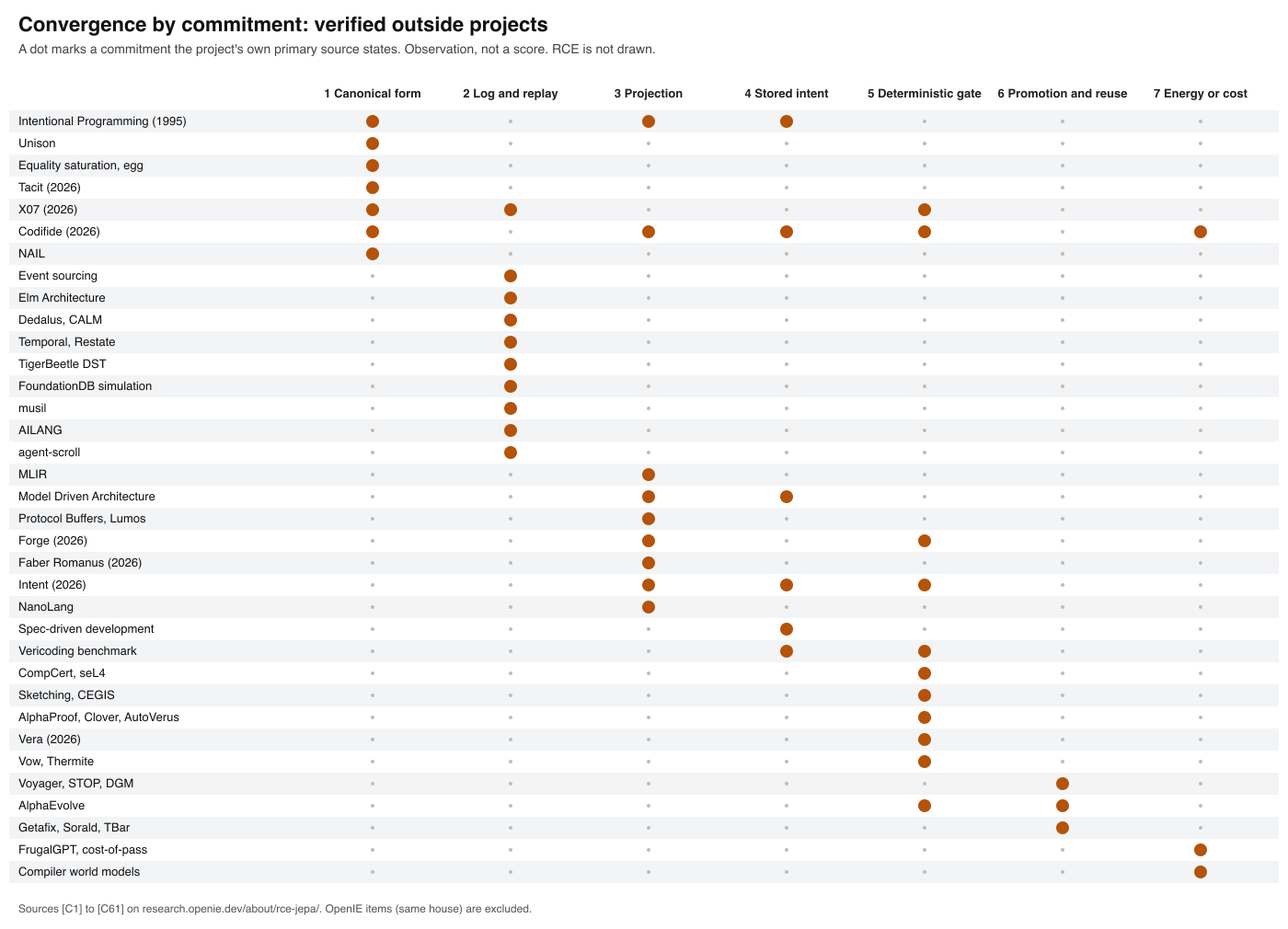 > Figure 8. Which commitment each verified outside project reaches, according to its own primary source. A dot is a convergence observation, not a score; RCE is not drawn. Select the figure to enlarge it. [Open full size](https://research.openie.dev/figures/rce-jepa/convergence.svg) · [PNG](https://research.openie.dev/figures/rce-jepa/convergence.png) . ### 1. One canonical form; surface text is a view | Project | What it established | Where it stops | | --- | --- | --- | | Intentional Programming, Simonyi, 1995 [C1] | A program is a tree of nodes, each an instance of an intention; users edit the tree and view it in any notation; computational intent can be kept separate from implementation | A research system at Microsoft; the report describes no determinism or replay model (a transaction file feeds version control, but no replay semantics are given) | | Unison [C2] | Each definition is identified by a hash of its syntax tree; names are separately stored metadata | The hash is of structure: two definitions with the same behaviour and different structure have different hashes | | Equality saturation and egg [C3; C4] | An e-graph holds many equivalent versions of a program at once; a cost model picks one (Tate et al.: a pseudo-Boolean solver over a static cost model; egg: an extractor with a user-provided cost function) | An optimization and synthesis technique applied per function (intraprocedural in Tate et al.) or over terms in a user-defined language (egg, which has no built-in support for binding); saturation is bounded when it does not terminate, and the e-graph is not kept as the program's stored form | | Tacit, 2026 [C5] | The AST is the source of truth; every valid AST has one byte-exact canonical text; definitions are addressed by BLAKE3 hash; malformed code becomes typed Hole nodes | One target (LLVM); no state-machine semantics stated | | X07, 2026 [C6] | Canonical source is a JSON AST, edited with JSON Patch; a 646-code diagnostic catalogue with enforced quickfix coverage | Canonical bytes, not canonical behaviour | | Codifide, 2026 [C7] | The canonical form is a typed hypergraph with a deterministic byte form and SHA-256 hash; surface syntax is a projection; intent is part of a definition's identity | Described by its authors as a contract-and-dispatch language, not general computation | | NAIL [C8] | `nail canonicalize` normalizes any program; `nail check --strict` rejects non-canonical input | An RFC 8785-inspired JSON subset that, in its own words, does not claim full RFC 8785 compliance; byte canonicalization only | | EqNet, Allamanis et al., 2017 [C9] | Neural representations trained on known equivalence classes so that equivalent expressions get identical or highly similar vectors | Boolean and polynomial expressions (supervised), not programs | ### 2. A program is a deterministic state machine over a log | Project | What it established | Where it stops | | --- | --- | --- | | Abstract State Machines, Gurevich, 2000 [C10] | The paper's title states the result: sequential abstract state machines capture sequential algorithms | A theorem, not a system: every sequential algorithm, defined by three postulates (sequential time, abstract state, bounded exploration; Def. 6.1), has an equivalent sequential abstract state machine that matches it step for step (Main Theorem 6.13). That the postulates cover all sequential algorithms is argued, not proved | | Event sourcing, Fowler, 2005 [C11] | "Capture all changes to an application state as a sequence of events" | A pattern, published as a draft; replay stays consistent only if gateways record external query responses and suppress external updates during replay | | The Elm Architecture [C12] | Model, View, Update: state, a view of the state, and an update from messages | One language and one target (the browser) | | Dedalus and the CALM theorem, Hellerstein, Alvaro et al. [C13; C14] | Dedalus: Datalog with explicit time, modelling mutable state and asynchronous messaging. CALM: a program has a consistent, coordination-free distributed implementation if and only if it is monotonic (proved by Ameloot et al.; [C14] gives a proof sketch) | Dedalus and Bloom are research languages and CALM is a theorem; neither emits to other languages | | Durable execution: Temporal, Restate [C15; C16] | Temporal: workflow code "must be deterministic to support replay". Restate: every step and its result are recorded in a journal | Replay serves resilience, not program identity | | TigerBeetle deterministic simulation testing, 2026 [C17] | Logical determinism (like FoundationDB) plus physical determinism: replicas converge to byte-by-byte identical state; real code runs in a simulator | One database, built by hand to this discipline | | FoundationDB simulation testing [C18] | "A deterministic simulation of an entire FoundationDB cluster within a single-threaded process"; determinism "allows perfect repeatability of a simulated run" | A testing discipline for one database, not a program form | | musil [C19] | An explicit-state model checker as a Python library; its simulate mode runs the real node code on a seeded, replayable simulated network | Bounded state spaces; it checks the model, and simulation finds bugs rather than proving their absence | | AILANG; agent-scroll [C20; C21] | AILANG: every construct has deterministic semantics, with replayable execution and structured traces. agent-scroll: canonical, byte-deterministic, hash-chained transcripts with a verifier that catches any single-byte change | AILANG is functional, not a state-machine form; agent-scroll logs conversations, not programs | ### 3. Every target is a projection: write once, emit many | Project | What it established | Where it stops | | --- | --- | --- | | MLIR [C22] | A reusable compiler infrastructure spanning levels of abstraction, hardware targets and domains | Starts below the source: it has no parser generation or AST construction (Sec. 7), and its paper names translation validation across an extensible dialect ecosystem as an open problem (Sec. 2) | | Model Driven Architecture, OMG, 2003 [C23] | Computation-independent, platform-independent and platform-specific viewpoints | Petre reports, from Forward and Lethbridge, that keeping the model up to date with the code was the biggest perceived problem (68% agreement) [C24] | | Protocol Buffers; Lumos [C25; C26] | Define a schema once and generate bindings in many languages (Lumos: Rust and TypeScript for Solana) | Data shapes, not behaviour; the same Protocol Buffers message can have many binary serializations ("You cannot compare two messages for equality without fully parsing them") | | Forge, 2026 [C27] | "Many frontends feed one verified intermediate representation, and that representation feeds many backends" | Board and peripheral descriptions, not general programs | | Faber Romanus, 2026 [C28] | One high-level IR projected to Rust, Go, TypeScript, Swift and Faber, and through a lower IR to LLVM and WASM text, with Metal and CUDA kernels; support is measured and stated per target | Agreement across targets is measured by corpus coverage, not proved | | Intent, 2026 [C29] | One source file compiles to Rust, JavaScript and WASM; contracts are enforced at runtime in every target and optionally checked by Z3 | Three targets | | NanoLang [C30] | Core semantics proved in Coq with no axioms; C is the production target | PTX and RISC-V are experimental; LLVM and WASM are planned | ### 4. Store intent; derive the implementation | Project | What it established | Where it stops | | --- | --- | --- | | FORTRAN, Backus et al., 1957; deductive synthesis, Manna and Waldinger, 1980 [C31; C32] | Automatic coding from formulas; programs extracted from constructive proofs | FORTRAN became a compiler; deductive synthesis had no implementation at the time | | Spec-driven development, as classified by Böckeler [C33] | Three levels: spec-first, spec-anchored and spec-as-source, in which "only the spec is edited by the human, the human never touches the code"; of Kiro, spec-kit and Tessl, only Tessl explores spec-as-source | The spec is natural language, and Böckeler saw code generated repeatedly from one spec differ; nothing checks that the code is the spec | | Vericoding benchmark, 2025 [C34] | 12,504 formal specifications in Dafny, Verus and Lean; at least one of nine off-the-shelf LLMs, with five attempts each, solved 82% (Dafny), 44% (Verus) and 27% (Lean) of the tasks, and the best single model reached 67.5%, 30.9% and 17.9% (Table 3); adding natural-language descriptions gave no statistically significant gain on the one subset tested (Verina, 157 tasks; Sec. 4.1) | Specification languages are the proof languages; no runtime form or multi-target emission; among successes about 9% of specs were too weak to capture intent (Sec. 4) | | Codifide [C7] | Every definition carries an intent that compilation never discards | Contract-and-dispatch scope | **Recommendation.** The vericoding benchmark [C34] is used as an outside benchmark for the step from specification to Form: a slice of its state-machine-shaped Dafny, Verus and Lean specifications is lifted into Forms and the share the RCE gate accepts is reported beside the published vericoding results.
### 5. The model proposes; a deterministic gate decides
| Project | What it established | Where it stops |
| --- | --- | --- |
| CompCert; seL4 [C35; C36] | Machine-checked compiler and kernel; CompCert checks an unverified heuristic's output with a verified checker; seL4's proof cost about 20 person-years | Proof effort per artifact |
| Sketching, Solar-Lezama et al., 2006 (the counterexample-driven loop later named CEGIS) [C37] | Against a human-written partial program (sketch) and an executable specification, a synthesizer proposes, a checker returns a counterexample, and the loop repeats | Proposers are SAT solvers, not learned models; limited to finite programs (bounded input, guaranteed termination), with guarantees only for the bounded instance |
| AlphaProof; Clover; AutoVerus [C38; C39; C40] | A model proposes; Lean, Dafny or Verus checks | Gate on proofs or code text; no canonical program form |
| Agentic model checking, 2026; LLM-driven verified synthesis for concept design, 2026 [C41; C42] | "Agents propose, solvers verify" (an LLM still triages counterexamples for realism); in the second, invariants alone under-constrained designs, which differed across runs, some of them implausible | [C41] verifies existing code with LLM-inferred specs; checks are bounded (default unwind 4) and spec-relative, and the authors name over-weak specs that "cause bugs to be missed silently" as the primary failure mode. [C42] synthesizes coordination rules for design models (not code), checked only within a bounded Alloy scope, with an LLM translating the design into Alloy. Both warn that validity is not intent |
| Vera, 2026; Vow; Thermite [C43; C44; C45] | Vera: mandatory contracts, proved by the Z3 SMT solver where decidable and otherwise checked at run time: "The model doesn't need to be right, it needs to be checkable". Vow: contracts statically verified by ESBMC bounded model checking. Thermite: contracts with counterexamples on failure and a recorded assurance level (Verus/Z3, Lean, Kani bounded, runtime) | Gate at the function; no replay or promotion |
| Decision models, a class of concept [C46] | A model whose entire output is a typed answer (one option from a closed set, a bounded score, or a yes/no probability) with a probability for every option, trained for calibration | Needs a closed option set. The RCE project builds its own decision head and uses no outside decision model |
### 6. Accepted work is promoted and reused
| Project | What it established | Where it stops |
| --- | --- | --- |
| Gödel machine, Schmidhuber; Löbian obstacle, Yudkowsky and Herreshoff [C47; C48] | Self-rewrite only after a proof, under its own axioms, that the rewrite has higher utility than continuing to search; in the straightforward formalism, a proof-based agent cannot trust a successor that uses its own proof system (Löb's theorem), so trust shrinks with each rewrite, and the paper's technical workarounds are only partial | Theory |
| Voyager; STOP; Darwin Gödel Machine; AlphaEvolve [C49; C50; C51; C52] | A growing library of executable skills; scaffolds that improve themselves (the model's weights are unchanged); archives of self-modified agents (kept if they still compile and can edit code; parents chosen by benchmark score); code evolved under automatic evaluators | Selection by score or evaluator, not by proof at an interface. Voyager's evaluator is a GPT-4 critic; AlphaEvolve's scores may include LLM-graded feedback, and its correctness came from construction, randomized testing or human and verification review outside the loop |
| Getafix; Sorald; TBar [C53; C54; C55] | Fix patterns mined from past fixes or written as templates, reused on new cases without a model; with perfect fault localization TBar correctly fixes 74 of 395 Defects4J bugs (plausible patches for 101), and 43 with standard fault localization | Patterns are per bug class, learned or written for one language (Getafix's method itself is language-agnostic); Getafix checks only its top fix, by re-running the static analyzer |
### 7. Energy or cost is the objective
| Project | What it established | Where it stops |
| --- | --- | --- |
| Landauer, 1961; Bennett, 1973 [C56; C57] | Erasing a bit has a thermodynamic floor; computation can in principle be made logically reversible | Physics, not a software objective |
| FrugalGPT, 2023 [C58] | A cascade of models matched the best single model with up to 98% lower cost on its tasks | Dollar cost; no deterministic tiers below the models |
| Cost-of-pass, 2025; AI Agents That Matter, 2024 [C59; C60] | Expected monetary cost of a correct solution; report and jointly optimize cost with accuracy | Dollars and tokens, not joules; the Cost-of-Pass authors note energy could replace dollars but do not measure it |
| Compiler world models, 2026 [C61] | Rolls a tensor program's state forward through scheduling actions in latent space, then ranks candidate schedules within a workload before measuring on hardware (a relative score, not a latency prediction) | Tensor schedules only (TVM AutoScheduler); ranks candidates, does not generate them |
| Codifide [C7] | Selects among satisfied candidates by declared cost | Declared cost, not measured energy |
| JouleOS (OpenIE) [same house] | Energy budgets and the `est_j`, `reported_j`, `measured_j` labels | Same house: listed for disclosure, not as evidence |
### How four commitments meet the later lanes
Section 3 below records three lanes. Figure 8 is unchanged. The notes here are convergence readings of sources already in the tables, plus the lane reports, not a score.
- **One canonical form.** Unison [C2] identifies a definition by a hash of its syntax tree, and names are a view. egg [C4] stores equivalent programs as one e-graph. Both treat structure, not surface text, as the object.
- **The model proposes and a deterministic gate decides.** AlphaEvolve [C52] and AlphaProof [C38] are hybrid instances, together with the vericoding benchmark [C34]. Section 3 adds the Lean provers DeepSeek-Prover-V2, Kimina-Prover Preview and Goedel-Prover, where the Lean kernel is the gate, and type-constrained decoding, where the type system acts while the model samples.
- **Promotion and reuse.** DreamCoder (Ellis et al., Section 2 below) learns a library by compression. LILO (Grand et al., Section 3 below) pairs a large language model with symbolic refactoring. The library is the reuse step in those systems. The domains they report are small.
- **Cost.** In the CWM report, a best of 16 samples at test time moves SWE-bench Verified pass@1 from 53.9% to 65.8% [B23]. That is a compute cost on one benchmark, not a joule measurement. Mercury reports throughput of 1,109 and 737 tokens per second on an H100 (Inception Labs, Section 3 below). Throughput is not joules. This page still counts cost as electrical energy, idle subtracted when a meter reading exists, and does not convert those figures into joules.
### What the RCE paper states (OpenIE's own work)
The following are from [the RCE paper](https://research.openie.dev/papers/rce/) ({paperRevisionText('rce')}). They are listed here as the project's own work, not as a comparison with the projects above.
- **Canonical form.** The canonical serialization is injective on Forms, so two Forms that differ have different shape hashes. Equivalence of behaviour is defined separately (fit equivalence), and in the engine's design equivalent variants are grouped by sound rewrites in an e-graph; the paper does not claim that equivalent behaviour always yields one canonical form.
- **Proofs.** Determinism, totality, replay as a fold of the log, and atomicity of a kept step (an event that does not apply keeps the state) are proved in Lean 4 on a core calculus. The Rust program emitter is proved on a core as a verified translation into MiniRust, a deep embedding of the emitted Rust subset; that the Rust compiler implements MiniRust is trusted and tested. This proof covers the program emitter, not the Form projection.
- **Gate.** In the engine's design, a candidate passes replay of recorded inputs, a shadow run with a coverage bound, an output schema check and a Kani proof certificate, and a proposed rewrite also needs a Z3 proof. In the public record of one run, a local 1.5-billion-parameter model made 18 proposals, 13 of them distinct; the gate did not admit 15, and the 3 it admitted are one rewrite under three names that repeats a rule the engine already had.
- **Energy.** In the engine's design every receipt carries `est_j`; an unpriced model call is never read as zero. `measured_j` (wall meter) is empty in every result so far.
### Sources for this section
Labels as in the ledger: Full = the whole primary source (paper, documentation page, README or project description) was read, including references and appendices where present. Every source listed here was read in full on or before 14 October 2026; [C46] points to sources listed in the decision-head section.
- [C1] C. Simonyi, "The Death of Computer Languages, the Birth of Intentional Programming", Microsoft Research MSR-TR-95-52, September 1995. [Microsoft Research](https://www.microsoft.com/en-us/research/publication/the-death-of-computer-languages-the-birth-of-intentional-programming/); [PDF copy](https://uni.r-brause.de/seminare/SemSS07/simonyi95death.pdf). Full.
- [C2] Unison, "The big idea". [unison-lang.org](https://www.unison-lang.org/docs/the-big-idea/). Full.
- [C3] R. Tate, M. Stepp, Z. Tatlock and S. Lerner, "Equality Saturation: A New Approach to Optimization", Logical Methods in Computer Science 7(1:10), 2011 (extended version of POPL 2009). [arXiv:1012.1802](https://arxiv.org/abs/1012.1802). Full.
- [C4] M. Willsey, C. Nandi, Y. R. Wang, O. Flatt, Z. Tatlock and P. Panchekha, "egg: Fast and Extensible Equality Saturation", POPL 2021. [arXiv:2004.03082](https://arxiv.org/abs/2004.03082). Full.
- [C5] Tacit. [github.com/weetster/tacit](https://github.com/weetster/tacit). Full (README).
- [C6] X07. [github.com/x07lang/x07](https://github.com/x07lang/x07). Full (README).
- [C7] Codifide. [github.com/codifide/codifide-programming-language](https://github.com/codifide/codifide-programming-language). Full (README).
- [C8] NAIL. [pypi.org/project/nail-lang](https://pypi.org/project/nail-lang/). Full (project description).
- [C9] M. Allamanis, P. Chanthirasegaran, P. Kohli and C. Sutton, "Learning Continuous Semantic Representations of Symbolic Expressions", ICML 2017 (PMLR 70). [arXiv:1611.01423](https://arxiv.org/abs/1611.01423). Full.
- [C10] Y. Gurevich, "Sequential Abstract State Machines Capture Sequential Algorithms", ACM TOCL 1(1), 2000. [doi:10.1145/343369.343384](https://doi.org/10.1145/343369.343384); [PDF copy](https://www.cs.tau.ac.il/~nachumd/models/gurevich.pdf). Full.
- [C11] M. Fowler, "Event Sourcing", 2005. [martinfowler.com](https://martinfowler.com/eaaDev/EventSourcing.html). Full.
- [C12] The Elm Architecture. [guide.elm-lang.org](https://guide.elm-lang.org/architecture/). Full.
- [C13] P. Alvaro, W. R. Marczak, N. Conway, J. M. Hellerstein, D. Maier and R. Sears, "Dedalus: Datalog in Time and Space", UC Berkeley EECS-2009-173, December 2009. [PDF](https://www2.eecs.berkeley.edu/Pubs/TechRpts/2009/EECS-2009-173.pdf). Full.
- [C14] J. M. Hellerstein and P. Alvaro, "Keeping CALM: When Distributed Consistency is Easy", 2019. [arXiv:1901.01930](https://arxiv.org/abs/1901.01930). Full. The formal proof is T. J. Ameloot, F. Neven and J. Van den Bussche, "Relational transducers for declarative networking", JACM 60(2), 2013.
- [C15] Temporal, "Workflow Definition". [docs.temporal.io](https://docs.temporal.io/workflow-definition). Full.
- [C16] Restate, "Key Concepts: Durable Execution". [docs.restate.dev](https://docs.restate.dev/foundations/key-concepts#durable-execution). Full.
- [C17] C. Bhandari, "Protocol-Aware Deterministic Simulation Testing", TigerBeetle, 20 August 2026. [tigerbeetle.com](https://tigerbeetle.com/blog/2026-08-20-protocol-aware-dst/). Full.
- [C18] FoundationDB, "Simulation and Testing". [apple.github.io/foundationdb](https://apple.github.io/foundationdb/testing.html). Full.
- [C19] musil (project description, version 0.35.6). [pypi.org/project/musil](https://pypi.org/project/musil/). Full.
- [C20] AILANG. [github.com/sunholo-data/ailang](https://github.com/sunholo-data/ailang). Full (README).
- [C21] agent-scroll. [github.com/p-vbordei/agent-scroll](https://github.com/p-vbordei/agent-scroll). Full (README).
- [C22] C. Lattner et al., "MLIR: A Compiler Infrastructure for the End of Moore's Law", 2020. [arXiv:2002.11054](https://arxiv.org/abs/2002.11054). Full.
- [C23] OMG, MDA Guide Version 1.0, 2003. [PDF](https://www.omg.org/mda/mda_files/MDA_Guide_Version1-0.pdf). Full.
- [C24] M. Petre, "UML in practice", ICSE 2013. [author copy](https://oro.open.ac.uk/35805/). Full.
- [C25] Protocol Buffers overview. [protobuf.dev](https://protobuf.dev/overview/). Full.
- [C26] Lumos introduction. [docs.lumos-lang.org](https://docs.lumos-lang.org/getting-started/introduction). Full.
- [C27] Forge. [github.com/Sanjith-Shan/Forge](https://github.com/Sanjith-Shan/Forge). Full (README).
- [C28] Faber Romanus. [github.com/faberlang/faber](https://github.com/faberlang/faber). Full (README).
- [C29] Intent. [github.com/lhaig/intent](https://github.com/lhaig/intent). Full (README).
- [C30] NanoLang. [github.com/jordanhubbard/nanolang](https://github.com/jordanhubbard/nanolang). Full (README).
- [C31] J. W. Backus et al., "The FORTRAN Automatic Coding System", 1957. [Computer History Museum copy](https://archive.computerhistory.org/resources/text/Fortran/102663113.05.01.acc.pdf). Full.
- [C32] Z. Manna and R. Waldinger, "A Deductive Approach to Program Synthesis", ACM TOPLAS 2(1), 1980. [doi:10.1145/357084.357090](https://doi.org/10.1145/357084.357090). Full.
- [C33] B. Böckeler, "Understanding Spec-Driven-Development: Kiro, spec-kit, and Tessl", martinfowler.com, 15 October 2025. [martinfowler.com](https://martinfowler.com/articles/exploring-gen-ai/sdd-3-tools.html). Full.
- [C34] S. Bursuc, T. Ehrenborg, S. Lin et al., "A benchmark for vericoding: formally verified program synthesis", 2025. [arXiv:2509.22908](https://arxiv.org/abs/2509.22908). Full.
- [C35] X. Leroy, "Formal verification of a realistic compiler", CACM, 2009. [PDF](https://xavierleroy.org/publi/compcert-CACM.pdf). Full.
- [C36] G. Klein et al., "seL4: Formal Verification of an OS Kernel", SOSP 2009. [PDF](https://www.sigops.org/s/conferences/sosp/2009/papers/klein-sosp09.pdf). Full.
- [C37] A. Solar-Lezama, L. Tancau, R. Bodik, V. Saraswat and S. Seshia, "Combinatorial Sketching for Finite Programs", ASPLOS 2006. [PDF](https://people.csail.mit.edu/asolar/papers/asplos06-final.pdf). Full.
- [C38] T. Hubert et al., "Olympiad-level formal mathematical reasoning with reinforcement learning", Nature, 2025. [Nature](https://www.nature.com/articles/s41586-025-09833-y). Full.
- [C39] C. Sun et al., "Clover: Closed-Loop Verifiable Code Generation". [arXiv:2310.17807](https://arxiv.org/abs/2310.17807). Full.
- [C40] C. Yang et al., "AutoVerus". [arXiv:2409.13082](https://arxiv.org/abs/2409.13082). Full.
- [C41] Y. Sun, J. Liu, D. Kroening and J. Xue, "Agentic Model Checking", 2026. [arXiv:2605.21434](https://arxiv.org/abs/2605.21434). Full.
- [C42] A. Cunha, "Verified LLM-Driven Synthesis for Concept Design", 2026. [arXiv:2607.15718](https://arxiv.org/abs/2607.15718). Full.
- [C43] Vera. [github.com/aallan/vera](https://github.com/aallan/vera). Full (README).
- [C44] Vow. [github.com/vow-lang/vow](https://github.com/vow-lang/vow). Full (README).
- [C45] Thermite. [github.com/dollspace-gay/Thermite](https://github.com/dollspace-gay/Thermite). Full (README).
- [C46] Decision models as a class: see the decision-head section above and its sources [B7; B8; B12].
- [C47] J. Schmidhuber, "Goedel Machines: Self-Referential Universal Problem Solvers Making Provably Optimal Self-Improvements", TR IDSIA-19-03 (v5, 2006). [arXiv:cs/0309048](https://arxiv.org/abs/cs/0309048). Full.
- [C48] E. Yudkowsky and M. Herreshoff, "Tiling Agents for Self-Modifying AI, and the Löbian Obstacle", MIRI early draft, 7 October 2013. [PDF](https://intelligence.org/files/TilingAgentsDraft.pdf). Full.
- [C49] G. Wang et al., "Voyager: An Open-Ended Embodied Agent with Large Language Models", 2023. [arXiv:2305.16291](https://arxiv.org/abs/2305.16291). Full.
- [C50] E. Zelikman, E. Lorch, L. Mackey and A. T. Kalai, "Self-Taught Optimizer (STOP): Recursively Self-Improving Code Generation", COLM 2024. [arXiv:2310.02304](https://arxiv.org/abs/2310.02304). Full.
- [C51] J. Zhang, S. Hu, C. Lu, R. Lange and J. Clune, "Darwin Gödel Machine: Open-Ended Evolution of Self-Improving Agents", ICLR 2026. [arXiv:2505.22954](https://arxiv.org/abs/2505.22954). Full.
- [C52] A. Novikov et al., "AlphaEvolve: A coding agent for scientific and algorithmic discovery", Google DeepMind white paper, 2025. [arXiv:2506.13131](https://arxiv.org/abs/2506.13131). Full.
- [C53] J. Bader, A. Scott, M. Pradel and S. Chandra, "Getafix: Learning to Fix Bugs Automatically", OOPSLA 2019. [arXiv:1902.06111](https://arxiv.org/abs/1902.06111). Full.
- [C54] K. Etemadi et al., "Sorald: Automatic Patch Suggestions for SonarQube Static Analysis Violations", 2021 (v2 2022). [arXiv:2103.12033](https://arxiv.org/abs/2103.12033). Full.
- [C55] K. Liu et al., "TBar: Revisiting Template-based Automated Program Repair", 2019. [arXiv:1903.08409](https://arxiv.org/abs/1903.08409). Full.
- [C56] R. Landauer, "Irreversibility and heat generation in the computing process", 1961. [doi:10.1147/rd.53.0183](https://doi.org/10.1147/rd.53.0183). Full.
- [C57] C. H. Bennett, "Logical Reversibility of Computation", 1973. [doi:10.1147/rd.176.0525](https://doi.org/10.1147/rd.176.0525). Full.
- [C58] L. Chen, M. Zaharia and J. Zou, "FrugalGPT", 2023. [arXiv:2305.05176](https://arxiv.org/abs/2305.05176). Full.
- [C59] M. H. Erol, B. El, M. Suzgun, M. Yüksekgönül and J. Zou, "Cost-of-Pass: An Economic Framework for Evaluating Language Models", ICLR 2026. [arXiv:2504.13359](https://arxiv.org/abs/2504.13359). Full.
- [C60] S. Kapoor, B. Stroebl, Z. S. Siegel, N. Nadgir and A. Narayanan, "AI Agents That Matter", 2024. [arXiv:2407.01502](https://arxiv.org/abs/2407.01502). Full.
- [C61] H. Pan, L. Huang, X. Zhou, M. Xing and Y. Wu, "Toward Compiler World Models: Learning Latent Dynamics for Efficient Tensor Program Search", 2026. [arXiv:2606.09312](https://arxiv.org/abs/2606.09312). Full.
**Not carried over from the survey**, because the primary source was not obtained or did not support the claim: Smalltalk image claims, Darklang hashing, Pantograph and Grove, Codong, Lume, Magpie, Codex (Tedrow), Spec IR, Boruna, d-raft, Sockudo, DBOS, P language compilation to C, UNCOL and ANDF, Thrift and OpenAPI, Pact, Aver, Prove, reqlan, translation validation (Pnueli), SyGuS, Futamura and Turchin, PAR, DéjàVu and Gabel and Su, Simon and Kadane, and the comparative scoreboard.
## 1. History: seventy years of "say what you want, get the program"
The wish behind this topic is old. What has changed is which parts of it are now cheap. The timeline below lists the main attempts; the text after it says what each one achieved and where it stopped.
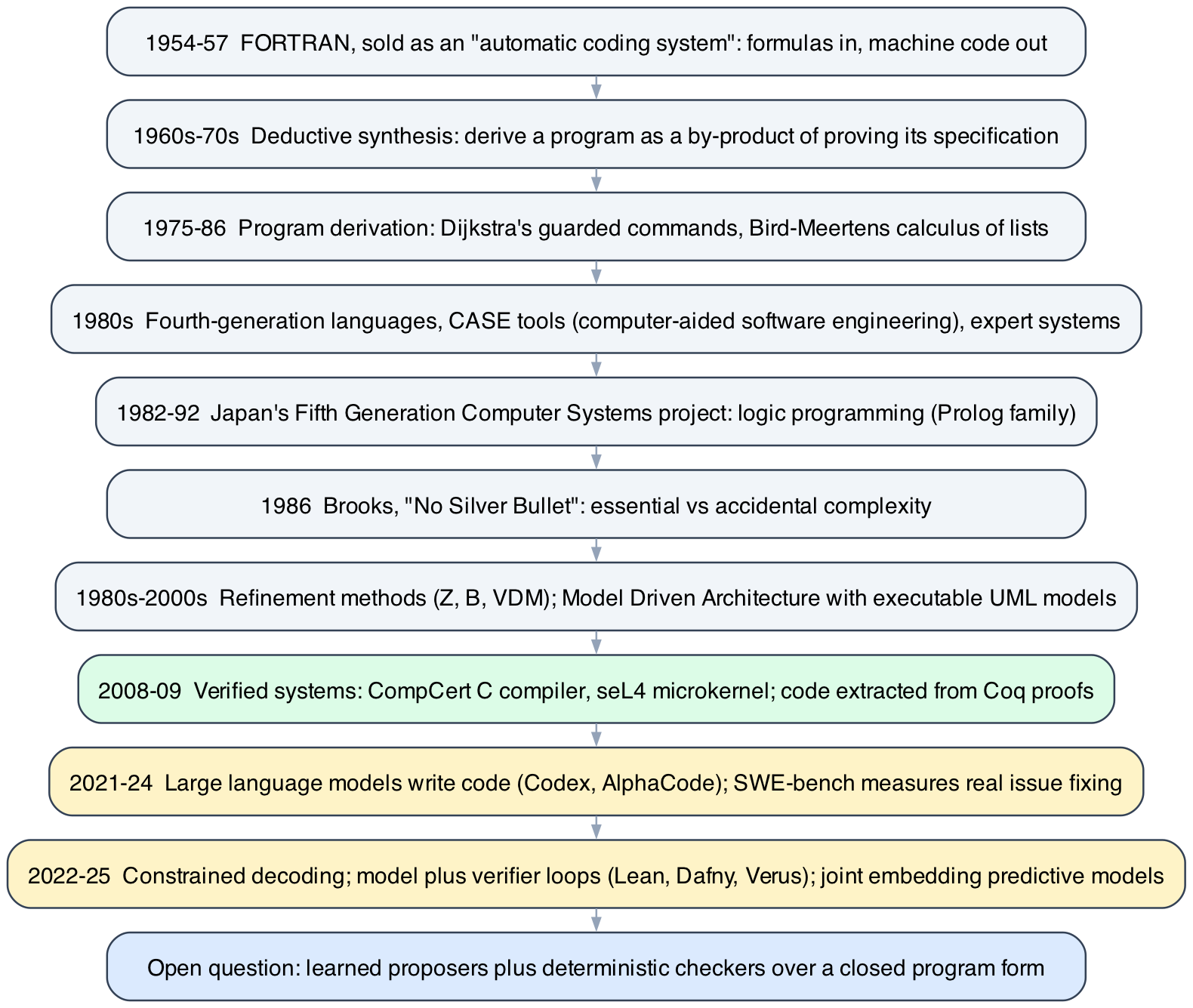 > Figure 9. Attempts to turn a statement of intent into a working program. CASE means computer-aided software engineering; UML means Unified Modeling Language; Z, B and VDM (Vienna Development Method) are mathematical specification methods; Coq is a proof assistant. Green: machine-checked systems. Amber: learned models. Blue: the question this topic studies. [Open full size](https://research.openie.dev/figures/rce-jepa/timeline.svg) · [PNG](https://research.openie.dev/figures/rce-jepa/timeline.png) . - **Automatic programming, 1950s.** FORTRAN (FORmula TRANslation) was presented as "The FORTRAN Automatic Coding System". Its authors wrote that its purpose was to let the IBM 704 "code problems for itself and produce as good programs as human coders (but without the errors)" (Backus et al., 1957, p. 188; PDF p. 2). Example: a scientist wrote a formula; the system wrote the machine code. Today that is called a compiler, not automatic programming. - **Deductive synthesis, 1960s-80s.** Simon's heuristic compiler (1963) treated programming as heuristic problem solving: a means-end search, built on the General Problem Solver (GPS), that writes routines from descriptions of the state before and after, by "selective trial-and-error search" (Simon, RAND RM-3588-PR, 1963, Summary, p. vii). Manna and Waldinger (1980) treated a program as something extracted from a constructive proof that a specification can be met: "From such a proof, a program to compute z can be extracted" (Manna and Waldinger, STAN-CS-78-690, 1978, Specification section; the same sentence appears in the TOPLAS article, 1980, p. 92); both versions note that "no implementation exists" (report, Motivation, p. 2; TOPLAS, p. 91). The JACM article states Simon's conclusion directly: "compiling tasks--at least simple compiling tasks--can fruitfully be viewed as problem-solving tasks" (Simon, 1963, Summary, p. 505), and it makes no practical claim: "no claims will be made for the heuristic programming procedures described here as practical approaches to the construction of compilers" (Introduction, p. 493). Manna and Waldinger observed that theorem proving had been "abandoned as an approach to program synthesis when the development of sufficiently powerful automatic theorem provers appeared to flounder" (TOPLAS, 1980, p. 120). All four texts were read in full. - **Program derivation, 1975-86.** Dijkstra introduced guarded commands "as a building block" for programs and presented "the formal derivation of programs" from conditions on the final state (Dijkstra, EWD 472, abstract). Bird's calculus of lists (the Bird-Meertens formalism) is "used to derive efficient solutions" by rewriting with algebraic identities (Bird, 1986, PDF p. 3). Example: for Gries's problem "to compute the minimum of the sums of all segments" of a list, the direct program takes O(n^3) steps, and rewriting with the calculus yields "a linear time algorithm" (Sec. 4.2, PDF p. 34). - **Fourth-generation languages, CASE tools and expert systems, 1980s.** Report generators, form builders and diagram tools promised programs from screens and pictures. Brooks reviewed graphical programming, automatic programming and expert systems in 1986 and argued that none of them "promises even one order-of-magnitude improvement" (Brooks, 1986, PDF pp. 1, 8-11). Kemerer reported, citing an earlier study, that "one year after introduction, 70 percent of CASE tools and techniques are never used" and that "the first project written with an integrated CASE tool typically fails to deliver improved results"; he attributes part of the abandonment to a learning curve that dips below the old technology before it rises (Kemerer, 1992, pp. 23-24, Fig. 1). - **Japan's Fifth Generation Computer Systems project, 1982-92.** A national effort built on logic programming in the Prolog family; ICOT spent "about 54 billion Yen, that is some 450 million US$" over ten years (van de Riet, 1993, Sec. 1, p. 83). One goal in the 1981 plan was "to lessen the burden of software generation in order that a high level requirements specification is sufficient for automatic processing" (Sec. 3, p. 85). The parallel inference machine met its 100 MLIPS target, but van de Riet scores "break-through in architecture" and "break-through in software" as failures and judges technical impact "small" (Sec. 6, p. 103); on the effort needed to program the system, "there is almost no evidence" (Sec. 4.1, p. 86). - **Refinement and model-driven methods, 1980s-2000s.** Z, B and VDM refine a mathematical specification step by step toward code. The Model Driven Architecture guide of the Object Management Group "specifies three viewpoints on a system, a computation independent viewpoint, a platform independent viewpoint and a platform specific viewpoint" (OMG, 2003, Sec. 2.2.5, PDF p. 13). Example: draw a class diagram once and generate Java and SQL (Structured Query Language) from it. Hutchinson et al. note that MDE "has been developed largely without the support of empirical data" (2011, Sec. 1, p. 471); among 250+ practitioners surveyed, 74% said MDE "requires them to carry out significant extra training" (Sec. 4.3.1, p. 475), and one interviewee reported 4 to 8 times productivity internally while telling outsiders "1.5 to 2" (Sec. 5.2.6, p. 478). The authors call their results "interesting and suggestive rather than conclusive" (Sec. 3.1, p. 473). - **Machine-checked systems, 2008-09.** CompCert is a C compiler whose "proof of semantic preservation" was carried out in the Coq proof assistant (Leroy, 2009, abstract, PDF p. 1). seL4 is a microkernel of "8,700 lines of C code" with a machine-checked "proof of functional correctness" (abstract, PDF p. 1); the proof cost "about 20 py" (person-years) (Klein et al., 2009, Sec. 5.2, PDF p. 13). Coq can extract a proved function into ordinary code in "functional languages such as Ocaml, Haskell or Scheme" (Letouzey, 2008, Sec. 1, PDF p. 1); the extraction step itself was not yet mechanically verified, and its correctness rested on paper proofs (Sec. 6, PDF p. 10). ## 2. Why the earlier attempts stalled - **Essential versus accidental complexity.** Brooks separated "essential tasks, the fashioning of the complex conceptual structures that compose the abstract software entity", from "accidental tasks, the representation of these abstract entities in programming languages" (abstract, PDF p. 1). He quoted Parnas: "automatic programming always has been a euphemism for programming with a higher-level language than was presently available to the programmer" (PDF p. 9), and wrote that "even perfect program verification can only establish that a program meets its specification" (PDF p. 11) (Brooks, 1986). Example: a better notation for a payroll rule does not decide what the rule should be. - **Natural language is ambiguous.** Dijkstra argued that formal texts are, "when you come to think of it, an amazingly effective tool for ruling out all sorts of nonsense that, when we use our native tongues, are almost impossible to avoid" (Dijkstra, EWD 667, para. 6). Example: "sort the users by name and date" has at least two readings. - **Specification costs as much as the program.** In seL4 the abstract specification took "about 4 person months" and the proof about 20 person-years, against "a total cost of 2.2 py including the Haskell effort" to build the kernel itself (Klein et al., 2009, Sec. 5.2, PDF pp. 12-13). The 20 py includes about 9 py of research and reusable proof tooling; the seL4-specific proof "was 11 py" (PDF p. 13). - **Combinatorial search.** Searching all programs grows exponentially with program length. DreamCoder addresses this by learning a library of reusable pieces and a neural network "to guide the search for programs" in a "wake-sleep" loop (Ellis et al., 2021, abstract, PDF p. 1); the paper calls such search "intractable for general-purpose algorithms, because of the combinatorial nature of the search space" (introduction, PDF p. 2); the supplement repeats that finding programs "is difficult because of the infinitely large, combinatorial search landscape" (supplement S4.1, PDF p. 42 of the version with supplement), the same kind of search problem that limited deductive synthesis. - **Brittleness and adoption.** Diagram-to-code tools generated code that was then hand-edited, and the model and the code drifted apart. Petre reports from earlier surveys that "the biggest perceived problem of model-centric approaches is keeping the model up-to-date with the code (68% agreement)" (Forward and Lethbridge, as reported by Petre, 2013, author copy p. 3); among Petre's own 50 informants, 35 did not use UML (Unified Modeling Language) and 3 used automated code generation (pp. 4-5). Adoption studies of CASE and of model-driven engineering are listed in the ledger as not read, so no figures from them are quoted. - **Opinion.** The common thread is that each approach fixed one cost (notation, proof, generation) while another stayed manual: writing the specification, searching for the program, or checking the result. ## 3. Three lanes toward a World of Code The wish in Section 1 is old. What changed by November 2026 is that several research programmes, working for their own reasons, now put a learned proposer next to something that can say yes or no. This section records three lanes. A lane is a convergence observation: agreement in direction, not a ranking, and not a claim that one programme replaces another. Every figure below is as reported by the cited source. None of them is a measurement of the Reality Code Engine except the final row of Section 3.3.
### 3.1 Training on popular architectures
This lane keeps a widely used model shape, usually a decoder that predicts the next token (a word piece), and changes the training data or the reward.
| Who | As reported | Unfinished in that source |
| --- | --- | --- |
| Meta FAIR CodeGen. CWM, a 32 billion parameter dense decoder [B23] | Code is learned better when the model sees execution, not only text. Mid-training uses Python traces and agent trajectories. SWE-bench Verified pass@1 53.9% for the base model, 65.8% with a best of 16 samples at test time. LiveCodeBench 68.6%. CruxEval-O 94.3%. 120 million traced functions. 3 million ForagerAgent trajectories from 10.2 thousand images. An 8 billion parameter ablation: traces lift CruxEval-O from 44.6 to 73.9, and Forager lifts SWE-bench Verified from 18.4 to 22.1. | The authors call trace prediction a "first step". A neural debugger, and uses in verification, are future work in that report. |
| SWE-RL, Wei et al. | Reinforcement learning on pull-request history. The reward is similarity to an oracle patch, not semantic equality. Llama3-SWE-RL-70B is reported at 41.0% on SWE-bench Verified. | The reward is not semantic equality. |
| SWE-smith, Yang et al. | Synthetic tasks per repository: 50,000 instances, 128 repositories. SWE-agent-LM-32B at 40.2% pass@1. | Supervised fine-tuning only in the paper. Reinforcement learning is an external system named SkyRL. |
| DiffuCoder, Gong et al. Mercury, Inception Labs | Non-autoregressive (masked diffusion) code generation. DiffuCoder is a 7 billion parameter model on 130 billion tokens; coupled-GRPO is reported at an additional 4.4% on EvalPlus. Mercury is reported at 1,109 and 737 tokens per second on an H100. | Quality parity with autoregressive models is not established in the sources read here. |
| PatchDiff, Wang, Pradel and Liu. METR, Becker et al. | Benchmarks can overstate success, and field productivity can fall. PatchDiff: 7.8% of patches counted correct fail developer tests, and resolve rates are inflated by about 6.4 points. METR, on early-2025 tools: 16 developers, 246 tasks, measured completion time 19% higher. A forecast of 24% lower, and a post-hoc estimate of 20% lower, did not match that measurement. | Both checks are dated to early or mid 2025 tools. |
| SWE-Bench Pro, Scale AI. Public leaderboard fetched 6 November 2026 | Built to resist contamination (copyleft and private repositories) and to ask for long changes: average 107.4 lines across 4.1 files. 1,865 tasks, 41 repositories (731 public, 276 private, 858 held out). Public board that day: Muse Spark 1.1 at 61.50 +/- 3.10; gpt-5.4 (xHigh) at 59.10; Muse Spark at 55.00; claude-opus-4-6 (thinking) at 51.90; gemini-3.1-pro at 46.10. The top four of those ran with mini-swe-agent. Launch text on the same page: GPT-5 at 23.3% and Opus 4.1 at 23.1%, against more than 70% on SWE-bench Verified. Private set: Opus 4.1 at 17.8%, GPT-5 at 14.9%. The page prints no update date. | The oracle is still fail-to-pass and pass-to-pass tests. |
| Multi-SWE-bench, ByteDance Seed | Issue resolving across Java, TypeScript, JavaScript, Go, Rust, C and C++. 1,632 instances from 2,456 candidates, with 68 annotators. | A November 2026 leaderboard figure was not retrieved. None is stated on this page. |
**Lane reading.** The training reports above move toward semantics: execution traces, environment dynamics, and rewards a checker can see. The test suite is still the oracle, and PatchDiff is evidence that a test suite is incomplete. SWE-Bench Pro's board is higher than its launch text and still grades patches by tests. That is the opening the Laws of Coding name. An exact checker replaces "tests passed" with an accepted Form. Acceptance is part of the world, not a score fitted afterward.
### 3.2 Creative hybrids
This lane pairs a learned proposer with a gate that already exists: an evaluator, a proof kernel, a type system, or a set of examples.
| Who | As reported | Unfinished in that source |
| --- | --- | --- |
| AlphaEvolve, Google DeepMind [C52] | A large language model proposes code edits. An evolutionary loop wraps it. Automatic evaluators decide. A 4 by 4 complex matrix multiplication in 48 scalar multiplications. Also datacenter scheduling, circuit simplification, and a speedup of its own training, with no further figure used here. | It works where an evaluator exists. |
| AlphaProof, Google DeepMind [C38] | Reinforcement learning in the style of AlphaZero, inside Lean. The formal environment grounds the reasoning. 80 million autoformalized statements. At the 2024 International Mathematical Olympiad, 3 of 5 non-geometry problems, a silver-medal result with AlphaGeometry 2, at multi-day compute. | Compute cost. The report is mathematics, not software. |
| DeepSeek-Prover-V2-671B | Subgoal decomposition by DeepSeek-V3, proofs of the subgoals stitched into a chain-of-thought cold start, then reinforcement learning. The Lean 4 kernel is the gate. miniF2F-test pass ratio 88.9%. PutnamBench 49 of 658. A new ProverBench of 325 problems. 6 of 15 AIME (American Invitational Mathematics Examination) 2024 and 2025 problems in the formal setting, against 8 for DeepSeek-V3 by an informal majority vote. | Mathematics, not software. The formal and informal gap is still nonzero. |
| Kimina-Prover Preview, Moonshot and Numina | From Qwen2.5-72B. Large-scale reinforcement learning with a formal reasoning pattern in Lean 4. miniF2F 80.7% at pass@8192. Distilled models at 1.5 billion and 7 billion parameters were released. | A preview release. |
| Goedel-Prover, Princeton | Natural-language problems autoformalized to Lean (1.64 million statements). Expert iteration builds more than 800,000 proofs. Supervised fine-tuning only. miniF2F 57.6% at pass@32. PutnamBench 7 at pass@512. | No reinforcement learning in version 1. |
| Vericoding benchmark, Beneficial AI Foundation [C34] | Generate code and a proof from a formal specification. 12,504 specifications. Success 82.2% Dafny, 44.2% Verus, 26.8% Lean. The abstract rounds those shares to 82%, 44% and 27%, which is the rounding in the commitment section below. The split is 3,029 Dafny, 2,334 Verus and 7,141 Lean. Dafny verification on that line of work moved from 68% to 96% in a year. Natural-language descriptions add little. | The cost of writing the specification remains. |
| Type-constrained decoding, Mündler et al. | The type system constrains token sampling. Authors affiliated with the Swiss Federal Institute of Technology Zurich and the University of California, Berkeley. Compilation errors down 75.3% on HumanEval and 52.1% on MBPP (the short Python set named in that report). A syntax-only constraint gives 9.0% and 4.9% on those two sets. | TypeScript scale only. Types are not full acceptance of behaviour. |
| DreamCoder, Ellis et al. LILO, Grand et al. | Library learning by compression. LILO adds a large language model and symbolic refactoring (Stitch). DreamCoder is quoted from the full text in Section 2. LILO is abstract-level on this pass. | Small domain-specific languages in the sources read for the lane. |
| egg, Willsey et al. [C4] | Equality saturation: a set of equivalent programs stored as one e-graph. Principles of Programming Languages, 2021. | Someone still has to write the rewrite rules. |
| ARC Prize 2024, Chollet, Knoop, Kamradt and Landers. Akyurek et al. | Program synthesis guided by deep learning, plus test-time training. The ARC (Abstraction and Reasoning Corpus) private score on ARC-AGI-1 moved from 33% to 55.5% during 2024. An 85% target was not met. Akyurek et al. update weights at inference on the task's examples: 53.0% on the ARC public validation set with an 8 billion parameter model, and 61.9% when ensembled with program synthesis. | The 85% target was not met. The Akyurek regime is few-shot. |
| ARC Prize 2025 results page | Winners on ARC-AGI-2 private, at a cost cap of 0.20 dollars per task. NVARC (the winning entry named on that page) 24.0%, with synthetic data, test-time training and a tiny recursive net. ARChitects 16.5%, a two-dimensional masked diffusion language model with recursive refinement. MindsAI 12.6%. Paper awards on that page: a tiny recursive net of about 7 million parameters at about 45% on ARC-AGI-1 and about 8% on ARC-AGI-2; SOAR (evolutionary program synthesis with self-fine-tuning, as that page names it) up to 52% on ARC-AGI-1; CompressARC, a minimum-description-length method with no pretraining, about 20% to 34% on ARC-AGI-1 and about 4% on ARC-AGI-2. | The grand prize was unclaimed. ARC-AGI-3, an interactive track, is in development. |
| Large Concept Models, Meta FAIR | Autoregressive prediction in a sentence-embedding space, SONAR (the sentence-embedding space named in that report, 200 languages), instead of tokens. Mean squared error, diffusion, and quantized variants. 1.6 billion parameter models on about 1.3 trillion tokens. One architecture scaled to 7 billion parameters on about 2.7 trillion tokens. | In the abstract, a concept is a sentence, a proxy. No code-specific result is given there. |
**Lane reading.** Each of these hybrids has the shape stated in the principles above: the model proposes, and a deterministic gate decides. AlphaEvolve and AlphaProof are clear points of contact. The Lean provers are the same shape with the kernel as the gate, and the gains they report came from data generated against that kernel. The ARC Prize 2025 page shows program search, test-time training, diffusion and small recursive nets on one loop: propose, check against examples, refine. The shared limit is also shared. They need an evaluator, a kernel, or a set of examples. The Laws of Coding are the claim that an environment of that kind exists for coding in general, not only for mathematics and for benchmark kernels. Large Concept Models are the closest token-free relative of JEPA in language: prediction in a concept space, still without an exact acceptance step.
### 3.3 Reconceptions of computation, programming and coding
This lane does not start from a benchmark score. It starts from a question about what a program is.
| Who | As reported | Unfinished in that source |
| --- | --- | --- |
| HVM2, Higher Order Company | Interaction combinators as a model of computation, with parallelism inherent in the model. This page cites the model. | Figures in that paper are not used here. Production adoption is open. |
| Unison [C2] | A definition is the hash of its syntax tree. Names are views over that hash. The language is in production use. | Ecosystem size. |
| Lean, Dafny and Verus communities, via the vericoding benchmark [C34] | A proof is a program the kernel can check. Correctness is a checkable object. The measured floor used here is the vericoding row above. | The cost of writing the specification remains. |
| egg [C4] | Program equivalence classes as data. Programs live in a quotient. | Completeness of the rewrite rules. |
| Lean FRO (Focused Research Organization), Year 1 roadmap, August 2023 to July 2024 | Lean as a language and a proof assistant for mathematics and for software and hardware verification. The deliverables named on that page include a standard library, a module system, Lake and Reservoir, proof automation, machine-learning integration and a new code generator. | Later-year roadmaps are not used on this page. |
| Conal Elliott, denotational design | "The instance's meaning is the meaning's instance." A semantic model defines correctness and carries it to the implementation. The note is from 2009, revised 2016. | A manual design discipline. |
| Radul and Sussman, propagators | Computation as autonomous machines that add information to shared cells. The account unifies expression-style programming and constraint programming, including incremental distributed search. A 2009 technical report, with a Scheme implementation. | Adoption. |
| Chollet, on the measure of intelligence [T37] | Intelligence as skill-acquisition efficiency. ARC is the measure. Program synthesis is the framing. The 2019 paper is the citation. Later talks on synthesis done at the moment of the task are not cited on their own. Where the ARC Prize 2024 report names deep-learning-guided program synthesis, that report is the citation. | The formal measure is not operationalized beyond ARC in the abstract read for this lane. |
| This project, the Laws of Coding | A canonical Form is the object. Surface text is a projection. Cost is counted. Measured results: H1 median rho 9.34 over 185 programs; H2 `C_check / E_model = 0.000582 <= 0.05` (`1,718×` cheaper on M5 Max); H5 & H11 on unseen disjoint Form shapes via `FormEBM-v2` (AUROC `0.8922`, `93.0%` 5-step monotonicity) and span-normalized `FormEBM-v3` (`6.05M` params: AUROC `0.9437`, `94.0%` `E_depth` / `92.0%` `E_total` monotonicity, zero-shot OOD H15 pooled AUROC lifted from `0.2585` to `0.5278`); H7, 1,275 mutants and 0 violations on the fuzzed arm; H8, 10,500 streams, six targets, 0 mismatches; H14 run 3, 111 of 151 (73.5%) closed at 0 model calls; H15 across the 40 residual tasks, 17/40 to 34/40 single-shot, `27/40` (`k = 16`) for `FormJEPA-v1` (`8.42M` params, `474.76 mJ` RAPL core `reported_j`), `40/40` (`0` contradictions) in `H15-Iterative` on `Opus 5.5` and `Sonnet 5.5`, `40/40` 0-call Gear-0 replay (`0.325 µs`, `1.77 µJ`/probe), `16.67×` 3-Gear episode reduction on `Zipf(0.85)` (`200/200` admitted), and 151-task `rce repair` rung `f` audit (`3/119 = 2.5% > 2.0%`, `0` contradictions, stays in `observe`). | Full intent-to-Form synthesis (H3), cross-module signature-and-trace OOD energy calibration beyond `0.5278`, H4, H6, H9, H10, H12, H13, the diffusion and evolutionary arms of H15, and wall-meter `measured_j` remain open. |
**Lane reading.** Unison (identity is a hash of structure), egg (programs as equivalence classes), interaction nets (computation as local rewriting) and proof assistants (correctness as an object) each hold one piece of what the Laws of Coding state together: one canonical Form, exact replay, projection to targets, and checkable acceptance. Elliott's denotational design and the propagator account are earlier statements of the same demand: meaning defines the implementation, and computation adds information rather than only emitting text. They are independent convergence, each from a different starting point. Chollet's measure says the thing to count is how efficiently a system acquires a skill, which is why proposer comparisons track both call budgets and physical energy (Section 8).
## 4. Why now: the case for closed-form, deterministic, AI-proposed code
**This section is opinion, built from the history above and from the three lanes in Section 3. It is a case to be tested, not a result.**
- **Checkers are cheap and trustworthy where the earlier attempts lacked them.** Using Csmith, a random program generator, the authors found that CompCert was "the only compiler we have tested for which Csmith cannot find wrong-code errors" after "about six CPU-years" of trying (Yang et al., 2011, Sec. 3.1, PDF p. 6). Machine-checked rules can carry the trust that a generator cannot. CompCert itself uses this pattern: its register allocator runs an unverified graph-coloring heuristic and checks each result with a verifier proved correct in Coq, because graph coloring is "easier to validate a posteriori than to directly prove correct" (Leroy, 2009, Sec. 4.2, PDF p. 7).
- **Deterministic semantics answer the nondeterminism problem.** If the generator is allowed to vary but the accepted artifact is checked and replayed exactly, run-to-run variation in the model stops mattering for the result.
- **Verifier-in-the-loop evidence exists.** AlphaCode's behavioral filtering, Codex-S's oracle test selection (77.5% versus 44.5% for log-probability ranking), Clover, AutoVerus and AlphaProof all show large gains when a check selects among proposals. Section 3 records the same shape in later systems: a model proposes, and an evaluator, a proof kernel or a type system decides.
- **Learned predictors now work in latent space.** I-JEPA and V-JEPA 2 show that predicting a summary of the target, rather than every detail, can work well for those tasks: V-JEPA 2 had higher success on 4 of 5 robot tasks (tied on one) and planned about 15x faster than a generative video model in its comparison (Table 3, PDF p. 15). In a program, details such as identifier spelling, formatting and target language can be filled in deterministically after the structure is chosen. Section 5 states the premise and where it stops once Forms and the Laws of Coding exist.
- **Token-by-token generation is expensive.** LLaMA 65B, sharded across 8 to 32 V100 GPUs with a 512-token output limit, used "about 3-4 Joules for a output token", counting GPU energy only (Samsi et al., 2023, Secs. III-C and IV-C, PDF pp. 4-6). In a study of 88 models, text-generation models averaged 0.047 kWh (kilowatt-hours) per 1,000 queries, each query generating only 10 new tokens (Table 2), and "multi-purpose, generative architectures are orders of magnitude more expensive than task-specific systems", partly because a generator chooses among "an entire vocabulary" (Luccioni et al., 2024, abstract, PDF p. 1; Sec. 4.1 and Table 2, PDF p. 6; Sec. 4.2.1, PDF p. 8).
- **Same-host check-to-model comparison (Section 8, H2).** Rather than mixing external V100 numbers with local laptop timings, Section 8 measures both on the same Apple M5 Max host: `0.04904 J` per Form check versus `84.25 J` per candidate on local `Qwen 3.6 35B-A3B` (`124.81 J` per admitted residual repair).
### What could still fail
- **Expressiveness ceiling (H6).** If real programs need effects or nondeterminism the Form cannot state, the "all code" premise fails.
- **Intent may be the bottleneck.** A smaller output space does not fix underspecified intent. Signal: H1 and H2 hold while H3 fails.
- **Spec gaming.** The checker proves a Form is well-formed and meets stated properties, not that it matches what the user meant. Benchmark tasks carry behavioral traces checked by replay; the residual risk is labeled, not solved.
- **Corpus scarcity.** Signal: H3 flat as the corpus grows.
- **Collapse.** JEPAs need anti-collapse measures, such as the EMA (exponential moving average) target encoder of I-JEPA and V-JEPA 2; LeCun (2022) proposes VICReg-style information maximization instead (Sec. 4.5). A collapsed Form embedding makes H5 fail. Section 5 states this limit beside the others.
- **Measurement error.** Rootless counters (macmon `IOReport` L2, kernel `ri_energy_nj` L3, RAPL) cover SoC or process counters (`reported_j`), not alternating-current (AC) wall power (`measured_j`).
- **Baseline drift.** Co-tenant processes on shared hosts drift L2 idle baselines (Falsifier 6), requiring per-process-identifier (PID) L3 counters or dedicated idle hosts.
## 5. JEPA as premise, and where it stops
The premise stays. A JEPA predicts in an embedding space, not in the space of the raw input. The thesis cites LeCun's 2022 statement of that idea. V-JEPA 2 reports 62 hours of robot video and zero-shot pick-and-place success from 65% to 80% [B1]. The action-conditioned predictor, as the proposer section states from the same report, was trained on fewer than 62 hours of unlabeled robot video. LLM-JEPA reports that an embedding-space loss beats a token loss on a natural-language-to-regular-expression task, on GSM8K (a grade-school math set) and on Spider (a text-to-database query set), at 1 billion parameter scale (Huang, LeCun and Balestriero, 2025). For code, this matches the intuition that the useful object is meaning, not tokens.
Once Forms exist, and once the Laws of Coding fix equivalence and acceptance, that premise is not the whole method. Six limits follow. They are reasons to widen the proposer, not reasons to drop the premise.
- **An approximate geometry, where an exact one can be computed.** JEPA learns an approximate latent geometry. The Laws of Coding give an exact one: the canonical Form and the equivalences the checker already decides. Learning those by self-supervision spends data on a map that can be computed. H10 is the test of whether learning on the quotient saves data. H10 has not been run.
- **Collapse.** Representation collapse, and the need for regularizers against it, are open problems in JEPA training. An exact canonicalizer cannot collapse. It maps each surface program to one Form by a rule, not by a loss.
- **No native acceptance.** JEPA has no native decoder and no acceptance step. Code needs a discrete, checkable output. The energy score ranks candidates. It does not decide. The checker decides.
- **Points, not a quotient.** Alternate Forms are a quotient. Many surface programs can be one Form, and one Form can be projected to many targets. JEPA embeds points. It does not certify that two points are the same Form. An e-graph does. A hash of structure does. In Section 8, `rce fmt nameless` maps `7` of `9` alpha-renamed local-variable mutants onto the identical memory-mapped Gear-0 (`DNULLMM1`) slot at zero model calls.
- **Scale of the evidence.** LLM-JEPA's evidence is at 1 billion to 2 billion parameter scale, on small datasets. No source read for this page shows JEPA training for repository-scale code.
- **The cost of learned planning.** V-JEPA 2's model predictive control (MPC) took about 16 seconds per action [B1]. Search over Forms with a cheap exact checker (`7.32 ms`, `49.04 mJ` L3 `reported_j` on M5 Max) and Gear-0 lookup (`0.325 µs`, `1.77 µJ`) bounds repeated rollout cost before any learned planner is trained.
**Consequence.** JEPA stays as the premise: predict meaning, not text. The proposer slot generalizes to any learned proposer over Forms. The instances named in Section 3 are autoregressive models with execution mid-training (CWM), diffusion code models, reinforcement learning in a formal environment (AlphaProof and the Lean provers), evolutionary search (AlphaEvolve), library learning (DreamCoder and LILO), and constrained decoding. Large Concept Models sit beside the premise in language, not yet in code. The gate is the same for all of them. Section 6 is the taxonomy. Section 7 says what the world is that they propose into.
## 6. The proposer slot is architecture-neutral
Figure 1 draws one pipeline. The learned box is a slot, not a single architecture. JEPA is the instance in the figure. The gate drawn outside the box does not change if a different proposer is plugged in. The table says, for each kind of proposer read in Section 3, what it learns, what it needs from the Laws of Coding (a canonicalizer, a checker, a cost meter), the failure mode the sources already name, and which hypothesis it moves or would move. Section 8 now reports both the first purpose-trained latent Form JEPA repair proposer (`FormJEPA-v1`, `8.42M` trainable parameters) and six off-the-shelf autoregressive, reasoning, and hybrid Gated-DeltaNet / MoE models on the 40 residual tasks.
| Proposer | What it learns | What it needs from the checker | Known failure mode | Hypothesis it moves / would move |
| --- | --- | --- | --- | --- |
| JEPA, an embedding predictor (`FormJEPA-v1` in Section 8) | An approximate latent geometry of Form structure and edits (EMA target encoder + VICReg + latent-conditioned typed edit decoder) | A canonicalizer, a checker, a cost meter, and a discrete edit head. The energy score does not accept | No native acceptance. Uncalibrated latent distance alone gives AUROC `0.618`, and compact non-pretrained models miss open multi-module API migrations (`0/9` on H15) without Gear-2 fallback | `FormJEPA-v1` measured on H15 (`22/40` at `k = 1`, `27/40` at `k = 16`) and disjoint synthetic defects (`177/200`); full intent-to-Form H3, calibrated H5/H11, H10, and H13 remain open |
| Autoregressive / reasoning / trace-trained decoders (Claude, Grok, generative pretrained transformer open-weights (GPT-OSS), DeepSeek, Qwen 3.6, CWM class) | Next-token prediction, chain-of-thought reasoning, hybrid Gated-DeltaNet / MoE, or execution traces | A checker as acceptance, plus Gear-0 crystallization so recurring shapes do not re-invoke the model | Token-space retries spend `84.25 J` per local candidate (`Qwen 3.6`), and long reasoning traces can exhaust fixed completion caps (`DeepSeek V4.1` `17/40`) | First single-shot (`k = 1`) H15 arms measured in Section 8 (`17/40` to `34/40`); RJ-F6 tests whether trace-trained token models match Form-quotient training at equal energy |
| Diffusion code model | A masked or denoised program, not a left-to-right token stream | A checker at acceptance. A constraint can also act while sampling | Quality parity with autoregressive models is not established in the sources read here | The diffusion arm of H15 (open) |
| Reinforcement learning in a formal environment | Steps that a kernel accepts, as in AlphaProof and the Lean provers of Section 3 | The kernel is the environment. For software, that role is the checker | In the reports read here the domain is mathematics, not software. Compute cost is part of the AlphaProof result. Goedel-Prover version 1 has no reinforcement learning | H3 and H12, if the same loop is run on Forms (open) |
| Evolutionary search | Edits, kept or dropped by an evaluator, as in AlphaEvolve and in SOAR on the ARC Prize 2025 page | An evaluator. Here the evaluator is the checker, not a test suite alone | The loop works where an evaluator exists. Example checks, as on ARC, are not a general acceptance rule for software | The evolutionary arm of H15, on the residual of H14 (open) |
| Library learning (DreamCoder, LILO) | A reusable library, by compression, with or without a large language model in the loop | A checker on the programs the library emits | The domains in the sources read for this lane are small | H10 (open) |
| Constrained decoding | Nothing new in the weights. The constraint masks illegal tokens, as in the type-constrained report | A grammar or a type system at sampling time, and the checker for behaviour | The headline result is TypeScript scale. Syntax and types are not full acceptance. Compilation errors fell 75.3% on HumanEval and 52.1% on MBPP, against 9.0% and 4.9% for syntax only | H3, only for the share of failures that are type failures |
| Large Concept Models | The next sentence embedding, not the next token | An exact acceptance step, which the abstract does not have | A concept there is a sentence. No code-specific result in the abstract | None of H1 to H15 until a code result exists |
The deterministic ladder in the proposer section runs before any of these (H14: `111/151` closed at `0` calls, leaving `40` residual tasks). Section 8 reports both the six-model off-the-shelf H15 baseline plus Shape D (`DNULLMM1`) Gear-0 crystallization and the purpose-trained `FormJEPA-v1` arm plus 3-Gear Cascade on those 40 tasks, while keeping the diffusion and evolutionary arms, intent-to-Form H3, and wall-meter server joule parity explicitly open.
## 7. A World of Code
**Definition.** A World of Code is the state space of Forms, plus the exact transition and the exact acceptance rule. In the notation of the thesis, the state space is S , the transition is the function δ, and acceptance is the checker's verdict on a Form. "World model", for code, means a model of this space. Unlike a physical world model, the physics is known exactly. Part 4 of the thesis says that for a JEPA-style predictor. The same physics bounds every proposer in Section 6. CWM learns an interpreter from traces. V-JEPA 2 learns physics from video. In a Form, the transition is given. There is no irreducible noise in the next state.
**Where learning is removed, and where it remains.** Canonicalization, equivalence and replay are computations. Once the Laws of Coding fix them, a model does not have to learn them. What remains to learn is the map from a stated intent to a Form, guidance of the search, and ranking of whatever the deterministic ladder leaves open (`40` real-history tasks after H14 run 3). Once any proposer solves one of those residual tasks and passes the gate, Gear-0 crystallization turns every recurrence (and `7/9` alpha-renamings under `rce fmt nameless`) into a `0.325 µs` deterministic lookup.
**Evaluation.** A test suite is not the Laws of Coding. PatchDiff reports that 7.8% of patches counted correct fail developer tests, and that resolve rates are inflated by about 6.4 points. The METR trial reports 16 developers, 246 tasks, and a measured completion time 19% higher with early-2025 tools. SWE-Bench Pro, on the board fetched 6 November 2026, still uses fail-to-pass and pass-to-pass tests as the oracle. Multi-SWE-bench widens the set of languages to Java, TypeScript, JavaScript, Go, Rust, C and C++. Acceptance on this page is the gate (`rce check` exit `0` plus obligation preservation), verified further against historical originals by `rce hash` and `rce equiv`.
**Falsifier of the widened claim.** RJ-F6, stated with the others in Section 8, names the observation that would defeat the Form quotient as a help to proposers: if a token-space model closes the residual of 40 tasks at equal energy and equal gate acceptance without the Form quotient. Single-shot frontier token models close up to `34/40` (`85.0%`) on first encounter, whereas `FormJEPA-v1` (`8.42M` parameters over quotient-normalized Form S-expressions) matches local 35B token-space repair at `27/40` (`k = 16`) at over an order of magnitude lower `reported_j` and `rce fmt nameless` supplies `7/9` zero-call quotient hits under alpha-renaming; controlled equal-size quotient-versus-surface sample-efficiency tests (H10) and intent-to-Form H3 remain open.
## 8. One concrete instance: the Reality Code Engine
RCE is one closed program form among possible others; the questions above apply to any language with a small, checkable program shape. In RCE every program is a Form P = (S, E, δ, D, λ):
- **S, state:** the typed data the program holds, for example the cursor position and text buffer of an editor.
- **E, events:** the inputs it can receive, for example "key pressed" or "file opened".
- **δ (delta), transition function:** the rule giving the next state from the current state and an event.
- **D, derivations:** the recorded, hash-chained history of steps, which makes every run replayable bit for bit.
- **λ (lambda), output:** what the program shows or emits for a given state, for example the visible lines of text.
A checker accepts a Form or names the rule it breaks. At commit `f87d6af2` (23 November 2026; Rust checker binary unchanged from `1762fb4b`), the public reference checker replays an accepted Form exactly, passes `2,221` of `2,236` conformance tests with `0` failures (`837` Rust unit tests), emits Rust, Python, JavaScript and Scala, and is backed by `5,393` Lean 4.36.0 kernel theorem constants from `1,264` source declarations across `64` modules (theorems T1 to T63, verified inside Linux `bubblewrap` across all six independent proof checkers of `lake check --paranoid`). On Apple M5 Max, dual-channel `reported_j` receipts record `49.04 mJ` per Form check (L3 `ri_energy_nj`, `7.32 ms`/Form) and `15.44 J` per full 62-Form check, trace-run and five-target emit suite (`2.32 s`/pass; `measured_j = None`, `board_metered = false`). The full description is on the [RCE topic page](https://research.openie.dev/about/rce/) and at [github.com/openIE-dev/rce](https://github.com/openIE-dev/rce).
**RCE-JEPA** is the working name, kept so the thread stays findable. The subject is World Coding. JEPA, a joint embedding predictor, is the premise: predict meaning, not surface text. The proposer slot is any learned proposer over Forms. Checking, proofs, derivation, emission and placement stay with RCE. The aim is the best performance per clock cycle and per joule. *Working hypothesis:* if all code can be encoded in the Form, all code can be produced by joint embedding or energy-based models over it. The hypotheses below are designed so that the evidence can refute this.
### Defined quantities
- **Output space.** Free-form generation over vocabulary V with length L has raw space |V| L . Ω n (omega) is the set of valid Forms of size n (Form nodes); Ω n ✓ ⊆ Ω n is the subset the checker accepts. Reported as log 2 |Ω n | bits, estimated by grammar counting and sampling.
- **Description length.** b(P) is the bits to encode Form P canonically; b(code) = tokens × log 2 |V| for the equivalent emitted source. Ratio ρ (rho) = b(code) / b(P).
- **Verification cost.** C check (P): wall time, cycles and joules for the checker to decide P. Unit tests give C test ; a passing test is evidence, not proof.
- **Acceptance probability.** a = P(checker accepts and task specification satisfied | intent), measured as pass@1 over the benchmark.
- **Joules per accepted program.** J acc = (E model + E check + E retry ) / N accepted , summed over a benchmark run (labelled `reported_j` for L2/L3 counters and `measured_j` only when an external hardware power meter is attached).
- **Cycles per accepted program.** K acc , the same in CPU (central processing unit) or GPU cycles where counters are readable.
- **AUROC** (area under the receiver operating characteristic curve): the probability that a randomly chosen accepted Form gets a lower energy than a randomly chosen one that requires change; 0.5 is chance, 1.0 is perfect.
**Argument (opinion, to be tested).** A Form has five typed slots with fixed composition rules. Constraining output to Ω n removes most of |V| L before the model is consulted, so fewer bits are predicted per program (ρ > 1), the checker gives a definite verdict, accepted or requires change, in place of a probabilistic test, and a requires-change verdict is cheap and structured, naming the rule, so retries are guided rather than blind.
### Falsifiable hypotheses H1 to H15
All fifteen hypotheses in numerical order. H1 to H7 test the RCE-JEPA thesis directly, H8 to H10 test the "Laws of Coding" thesis above, H11 to H13 test the proposer, H14 measures the deterministic ladder beneath it, and H15 compares proposer classes on the 40-task residual alongside Shape D (`DNULLMM1`) Gear-0 crystallization.
| ID | Hypothesis | Metric | Supported if | Disproved if |
| --- | --- | --- | --- | --- |
| H1 | Form space is much smaller than source space for the same programs. **Supported on hand-written corpus** (median ρ = 9.34 over 185 programs) | ρ = b(code)/b(P), median over corpus | ρ ≥ 5 | ρ < 2 |
| H2 | Checker is cheap relative to generation. **Supported in `reported_j` on Apple M5 Max**: `C_check / E_model = 0.04904 J / 84.25 J = 0.000582` (`1,718×` cheaper; `measured_j = None`) | C check / E model per candidate (joules) | ≤ 0.05 | ≥ 0.5 |
| H3 | Representation-space prediction reaches useful acceptance | pass@1 accepted Forms on held-out intent-to-Form tasks | ≥ baseline pass@1 on the same tasks | < 0.5 × baseline |
| H4 | Energy per accepted program falls | J acc (RCE-JEPA) / J acc (baseline) | ≤ 0.1 | ≥ 1 |
| H5 | Energy ranking concentrates mass on valid Forms. **AUROC threshold met on unseen test Form shapes**: contrastive `FormEBM-v2` (`5.85M` params) reaches AUROC **`0.8922 >= 0.85`** (`84.05%` solvable top-1 accuracy), and span-normalized decomposed `FormEBM-v3` (`6.05M` params) raises unseen-shape AUROC to **`0.9437 >= 0.85`** (`0.9386` on `E_def` alone) across `3,064` candidates on `200` unseen test beams (vs `0.618` for uncalibrated `FormJEPA-v1`), with `83.44%` `E_def` and `80.98%` `E_total` solvable top-1 accuracy (`68.0%` / `66.0%` raw across all `200` beams) and `2.23×` / `2.14×` fewer `rce check` calls; zero-shot OOD H15 pooled AUROC rises from `0.2585` to `0.5278` (`0.6018` on large-span valid vs short invalid), while cross-module signature/trace OOD calibration remains open | top-1 type-check rate; AUROC of E for accepted vs requires change | ≥ 0.8 top-1 valid; AUROC ≥ 0.85 | AUROC ≤ 0.6 |
| H6 | The reference apps are encodable | share of the 6 reference apps plus RCEdb fully expressed as Forms that pass the checker and replay bit-identically | 7 of 7 | any app requires an escape hatch outside the Form |
| H7 | Security is model-independent (fuzzed arm: 0 violations in 1,275 mutants; model arm open) | adversarial Forms (fuzzed and model-generated) accepted by the checker that violate a stated invariant | 0 | ≥ 1 confirmed |
| H8 | Determinism: every accepted Form replays to a bit-identical trajectory and output. **Supported** (0 mismatches on 10,500 streams across 6 targets) | mismatches over at least 10,000 recorded event streams on at least 3 different machines and operating systems | 0 | a single mismatch |
| H9 | Cost is predicted before execution | median error of the cost-table prediction against measured energy (J, named meter) for a stated machine, over the test families | ≤ 20% | > 50% |
| H10 | Learning on the quotient saves data | training examples a predictor of canonical Forms needs to reach the same test acceptance rate as one of equal size trained on surface code | at most half (a saving of 2 times or more) | a saving below 1.25 times |
| H11 | Energy is monotone in edit distance. **Supported on unseen 5-step cumulative defect chains**: contrastive `FormEBM-v2` reaches `93.0% >= 80%` strict 5-step monotonicity (Spearman `ρ = 0.9931`), and two-head `FormEBM-v3` reaches **`94.0% >= 80%`** on `E_depth` (`94/100`, Spearman `ρ = 0.9966`) and **`92.0% >= 80%`** on composite `E_total` (`92/100`, Spearman `ρ = 0.9846`, vs `36.0%` for uncalibrated `FormJEPA-v1`); unconstrained same-line random-walk slices reach `38.0%` (`v2`) and `32.0%` / `18.0%` (`v3` `E_depth` / `E_total`) | Share of test families in which energy E rises with edit distance 1 to k from an accepted fit | ≥ 80% of families | < 80% of families |
| H12 | The decision head is calibrated on gate outcomes | ECE per decision type, after 10 4 receipts | ECE ≤ 0.1 and below a frequency table over shape hashes | ECE > 0.2, or no better than the frequency table |
| H13 | A discrete latent plans better than a continuous one over long edit sequences | Planning success at edit-sequence lengths 1, 5 and 20, discrete arm against continuous SIGReg arm | Discrete arm higher at length 20 | Neither arm reaches the H3 threshold |
| H14 | A deterministic ladder closes a share of tasks with no model call. **Supported by its registered rule**: three registered runs [B30, B31, B32], reported below the table | Share of a registered task set that the public deterministic ladder (reuse, lookup by type, determined rewrites, bounded enumeration) closes with zero model calls, every closure admitted by the checker, at a frozen ladder commit | ≥ 10% of the registered tasks, reported with the rung that closed each (registered threshold, unchanged). Measured: run 1, 118 of 120 (98.3%), on mutations the ladder inverts by construction; run 2, 31 of 151 (20.5%), 27 of them guard negations; run 3, plain arm, 111 of 151 (73.5%), 110 of them guard negations and renames | < 10% of the registered tasks, the same floor as falsifier RCE-F1 of the RCE paper. Not met in any run. On the 41 tasks from real history, which the rule does not single out, runs 2 and 3 each close 1 of 41 (2.4%) |
| H15 | Proposer classes differ on the 40-task residual. **Measured across single-shot proposers [B33], `FormJEPA-v1` [B34], bounded checker-feedback `H15-Iterative` + `FormEBM-v2` [B35], and span-normalized `FormEBM-v3` [B36]**: single-shot models admit `17/40` to `34/40`, `FormJEPA-v1` admits `22/40` (`k = 1`; `25/40` with `FormEBM-v2`, `24/40` typed / `27/40` multi-proposer with `FormEBM-v3` `E_def`) and `27/40` (`k = 16`), `H15-Iterative` closes **`40/40` (`100.0%`)** on `Opus 5.5` and `Sonnet 5.5` with `0` contradictions (`39/40` on `Grok 4.20`), warm `DNULLMM1` Gear-0 replays **`40/40` at `0` calls**, and the 3-Gear Cascade admits `200/200` `Zipf(0.85)` arrivals with `16.67×` fewer Gear-2 episodes; diffusion, evolutionary, and wall-meter arms remain open | Gate-accepted share (`C(z) = 1`) of the 40 residual tasks from the plain arm of H14 run 3, audited by `rce check`, obligation preservation, `rce hash`, and `rce equiv` | Registered runs report per-arm shares and local `reported_j` [B33, B34, B35, B36]; diffusion/evolutionary arms and server wall-meter parity remain open | Classes scored on different tasks or unverified outputs |
**H14, measured.** The ladder is `rce repair` of openIE-dev/rce, with the rungs of the proposer section above and an enumeration bound of 2000 candidates. It has three runs, each registered before it ran, and together they are the current result. Run 1 [B30] closed 118 of 120 tasks with zero model calls, but 119 of its 120 tasks were operator and integer-literal mutations, which bounded enumeration inverts by construction, and 9 of the 118 closures pass the examples and checks without being the original program. Run 2 [B31] has no operator or literal mutation: 41 changes from the git history of openIE-dev/rce, 27 guard negations and 83 renames, 151 tasks in all. It closed 31 of them (20.5%) with zero model calls: 1 of the 41 history tasks; all 27 guard negations, every one by the enumeration edit that removes a `not`, which inverts that mutation by construction; and 3 of the 83 renames, none of them restored to the original. Of the 41 history tasks, 39 are programs updated because the language changed, not defects; only 2 are defects of a program, and the ladder closed one of them. Without the guard negations, 4 of 124 tasks close (3.2%). Run 2's prediction P3, that 10% to 40% of the renames close, failed, and its falsifier F1 was met: the closure rate of run 1 does not carry over to changes from real history. Run 3 [B32] ran run 2's 151 tasks unchanged, at openIE-dev/rce `8a5d90ea`, with rung 5, renames, after rung 4; its registration records that renames are the class rung 5 was built for after run 2. Its plain arm, the ladder given only the task, closed 111 of 151 (73.5%) with zero model calls, 103 of them restored to the original: all 83 renames (80 at rung 5, 3 at rung 4), 77 of them restored; all 27 guard negations, each with its outcome in run 2; and 1 of the 41 history tasks, the same one as in run 2. Without the guard negations, 84 of 124 tasks close (67.7%). Its known-good arm gave the ladder each task's original program as well: it closed 116 of 151, 114 restored, including all 83 renames restored and 6 of the 41 history tasks. Run 3's prediction P6, that in the known-good arm every guard and history task keeps its plain-arm outcome, failed: 5 more history tasks close, and the one closed in the plain arm closes at rung 5 instead of rung 3. None of run 3's six falsifiers was met, and the ladder reported zero model calls in both arms. H14's registered rule is support at 10% or more of the registered tasks, and falsification below 10%, for the share the public deterministic ladder closes with zero model calls, every closure admitted by the checker, at a frozen ladder commit. The plain arm meets those conditions. By the rule, H14 is supported: the plain arm of run 3 closes 111 of 151 (73.5%), leaving 40 open residual tasks from git history.
**H2, single-shot H15, and Shape D (`DNULLMM1`) Gear-0 on the 40 open residual tasks, measured [B33].** Registered prior to execution (`rce-jepa-h15-and-shape-d-gear0-2026-11-22`, `sha256: b64c4c671ae85755...`) against `openIE-dev/rce` commit `1762fb4b` (`2026-11-20`, binary `sha256: 1d3b0d07ff5b2e8f...`), the 40 residual tasks (`sha256: 3ca3a32769145e9b...`; `25` `W-SYN-1`, `5` `W-LEN-1`, `4` `W-NAME-1,W-TY-1`, `3` `W-NAME-1`, `1` `W-WORLD-1`, `1` `W-CAP-3,W-WORLD-1`, `1` `W-INT-1`) were evaluated under strict gate predicate `C(z) = 1`: (1) `rce check candidate.rce` exits `0` (enforcing `W-UI-1` and `W-MUT-1` non-vacuity), (2) `no_spec_deletion` preserves all declared `state`, `event`, `error`, `struct`, `kind`, `fn`, `extern`, and `step` headers plus every `example` left-hand-side trace and `check` count of the mutant, and (3) secondary equivalence audit via `rce hash` (`restored`), `rce equiv fuel 2000` (`behaviour-equal`), and `rce repair` rung `f` `observe` mode.
| Arm / Architecture Family | Model | Calls | Admitted (`C(z)=1`) | Restored + Beh-Eq | In / Out Tokens | Cost ($) | On-Chip `reported_j` |
| --- | --- | --- | --- | --- | --- | --- | --- |
| **Arm 0**: Shape D Cold Static Gear-0 | `DNULLMM1` (0 records) + `a..e` | 0 | 0 / 40 (0.0%) | 0 | 0 / 0 | $0.0000 | < 0.001 J (37.7 µs) |
| **Arm 1a**: Cloud Autoregressive + Adaptive Thinking | `claude-opus-5-5` | 40 | **34 / 40 (85.0%)** | 33 (30 + 3) | 114,855 / 32,159 | $1.3783 | `not_available` (N) |
| **Arm 1b**: Cloud Autoregressive + Adaptive Thinking | `claude-sonnet-5-5` | 40 | **32 / 40 (80.0%)** | 32 (30 + 2) | 114,855 / 30,764 | $0.8060 | `not_available` (N) |
| **Arm 2c**: Cloud Reasoning Transformer | `xai:grok-4.20-0309-reasoning` | 40 | **31 / 40 (77.5%)** | 30 (28 + 2) | 76,546 / 18,474 | $0.2747 | `not_available` (N) |
| **Arm 2a**: Cloud Reasoning MoE (Cerebras) | `cerebras:gpt-oss-120b` | 40 | **29 / 40 (72.5%)** | 27 (25 + 2) | 78,825 / 43,596 | $0.1340 | `not_available` (N) |
| **Arm 3**: Local Hybrid Gated-DeltaNet + Sparse MoE | `Qwen3.6-35B-A3B` (quantized `Q5_K_M`) | 40 | **27 / 40 (67.5%)** | 26 (25 + 1) | 82,330 / 18,411 | $0.0000 | **3,369.89 J** system-under-test (`124.81 J/adm`) |
| **Arm 2b**: Cloud multi-head latent attention (MLA) Sparse MoE (Fireworks) | `deepseek-v4p1-flash` | 40 | **17 / 40 (42.5%)** | 16 (15 + 1) | 63,446 / 64,215 | $0.0930 | `not_available` (N) |
| **Arm 5a**: Purpose-Trained Latent Form JEPA (`k = 1`) [B34] | `FormJEPA-v1` (`8.42M` params, greedy) | 40 | **22 / 40 (55.0%)** | 22 (20 + 2) | Form S-expr | $0.0000 | **58.65 mJ** core / **1.19 J** pkg RAPL/prop |
| **Arm 5b**: Purpose-Trained Latent Form JEPA (`k = 16`) [B34] | `FormJEPA-v1` (`8.42M` params, latent beam) | 40 | **27 / 40 (67.5%)** | 27 (25 + 2) | Form S-expr | $0.0000 | **474.76 mJ** core / **6.74 J** pkg RAPL/prop |
| **Arm 6**: 3-Gear Cascade v1 (`t = 1` Cold Gear-0 → `FormJEPA-v1` → Single-Shot `Opus 5.5`) [B34] | `DNULLMM1` + `FormJEPA-v1` + `Opus 5.5` | 13 G2 | **34 / 40 (85.0%)** | 33 | Form + 13 cloud | **$0.8108** | `FormJEPA` RAPL + 13 cloud (N) |
| **Arm 4a**: Shape D Warm Gear-0 v1 (`t = 2` Replay) [B33] | `DNULLMM1` (34 crystallized) | **0** | **34 / 40 (85.0%)** | 33 | 0 / 0 | **$0.0000** | **0.325 µs / 1.77 µJ** probe + `rce check` |
| **Arm 7a**: Bounded Checker-Feedback + Stdlib Headers (`<= 5` turns) [B35] | `claude-opus-5-5` (`H15-Iterative`) | 42 | **40 / 40 (100.0%)** | 39 (34 + 5) | 133,527 / 45,711 | $1.8104 | `not_available` (N) |
| **Arm 7b**: Bounded Checker-Feedback + Stdlib Headers (`<= 5` turns) [B35] | `claude-sonnet-5-5` (`H15-Iterative`) | 43 | **40 / 40 (100.0%)** | 39 (35 + 4) | 137,385 / 46,668 | **$1.1122** | `not_available` (N) |
| **Arm 7c**: Bounded Checker-Feedback + Stdlib Headers (`<= 5` turns) [B35] | `xai:grok-4.20-0309-reasoning` (`H15-Iterative`) | 50 | **39 / 40 (97.5%)** | 37 (30 + 7) | 269,930 / 28,903 | $4.0555 | `not_available` (N) |
| **Arm 4b**: Shape D Warm Gear-0 v2 (`t = 2` Full Replay) [B35] | `DNULLMM1` (40 crystallized) | **0** | **40 / 40 (100.0%)** | 39 (34 + 5) | 0 / 0 | **$0.0000** | **0.325 µs / 1.77 µJ** probe + `rce check` |
- **Hypothesis H2 supported (`1,718×` local check-to-model energy advantage):** On Apple M5 Max, per-Form checking costs `C_check = 0.049038 J` (L3 `ri_energy_nj`, `7.32 ms`) while one local `Qwen 3.6 35B-A3B` candidate generation costs `E_model = 84.247 J` (`3,303.62 J` L2 GPU + `66.26 J` L3 `llama-server` PID across 40 candidates; `14,476.18 J` gross L2 SoC, with `derived_marginal_j` invalidated by Falsifier 6 at `68.31%` idle drift), yielding **`C_check / E_model = 0.000582 <= 0.05`** (`measured_j = None`, `board_metered = false`).
- **Shape D (`DNULLMM1`) Gear-0 latency, energy, nameless invariance, and `Zipf(0.85)` amortization:** Over `40,000` portable operating-system interface (POSIX) `mmap` lookups against the frozen 34-record store (`sha256: d92a57b40de0b0ec...`, verified byte-identical pre/post replay), mean probe latency is **`0.3246 µs`** (`324.6 ns`, `9,516.5` instructions) and **`1.771 µJ`** (`1,771.3 nJ` L3 `ri_energy_nj`). Keying slots by `rce fmt nameless` (theorem T7) yields **`7 / 9` (`77.8%`)** zero-call hits when local variables are alpha-renamed. On a `200`-arrival `Zipf(s = 0.85)` recurring stream under verified-only crystallization, 2-Gear `DNULLMM1` cuts model calls from `200` to **`48` (`4.17×` reduction)** for `Opus 5.5` (`$6.81` to `$2.63`; `5.41×` / `37` calls with miss deduplication), `56` (`3.57×`) for `Sonnet 5.5`, `57` (`3.51×`) for `Grok 4.20`, `66` (`3.03×`) for `GPT-OSS-120B`, and `94` (`2.13×` calls, **`1.56×` local energy reduction**: `16,457.9 J` to `10,553.5 J`) for local `Qwen 3.6`.
- **Scope disclosure on H15:** Two of the 40 historical originals predate the `W-MUT-1` vacuous-example rule (`spec/examples/57_float_vectors.rce@b2b932da` and `programs/multi/washer.rce@2cc82de7`), accounting for part of the ceiling near `34/40`. Diffusion code models, evolutionary Form search, and hardware wall-meter `measured_j` remain open.
**`FormJEPA-v1` latent Form repair proposer, 3-Gear Cascade, and 151-task `rce repair` rung `f` promotion audit, measured [B34].** Pre-registered before dataset generation, weight initialization, and rung-`f` execution (`rce-jepa-form-jepa-v1-2026-11-22`, `sha256: 22682e6e936ec120...`; `rce-repair-rung-f-wave3-eval-2026-11-22`, `sha256: 04aff4b2b44cdbea...`) against `openIE-dev/rce` commit `1762fb4b` (Linux x86_64 binary `sha256: 5ef9931ff23a310f...`), `FormJEPA-v1` (`8,424,073` trainable parameters, `13,917,577` with EMA target buffers; checkpoint `sha256: cbfbf2274175c737...`) was trained from random initialization (`seed = 20261122`) on `6,329` checker-verified defect pairs across `1,106` disjoint valid Form shapes (extracted from `1,387` unique Form shapes after four-layer path, slug, declaration-name, and `458`-digest `rce fmt nameless` exclusion with `0` overlap against the 151 ladder or 40 residual tasks). It pairs a 6-layer Pre-LN Transformer context encoder (`d = 256`) over quotient-normalized Form AST S-expression tokens with an EMA target encoder (`τ = 0.996`), a 3-layer residual MLP latent predictor trained under Smooth-L 1 plus VICReg variance-covariance anti-collapse regularization (raising context effective rank from `32.90` at epoch 0 to **`85.24`** post-training, coordinate standard deviation `0.1038` to `0.3830`, and positive-pair latent L 2 energy from `149.25` to `10.57` versus `13.02` random-pair), and a 2-layer latent-conditioned typed edit decoder reranked by `||z_hat_y - E_ema(y_cand)||_2^2`.
- **Disjoint synthetic, 151-ladder, and 40-residual accuracy versus model scale:** On `200` held-out disjoint synthetic Form defects (unseen `shape_hash`es), `FormJEPA-v1` admits **`156/200` (`78.0%`)** at `k = 1` and **`177/200` (`88.5%`)** at `k = 16`. On the 151-task ladder (plain arm), standalone `FormJEPA-v1` admits `27/151` (`k = 1`) and `57/151` (`k = 16`), lifting the combined deterministic ladder (`111/151`) plus `FormJEPA-v1 (k = 16)` to **`138/151` (`91.4%`)** with zero frontier calls. On the 40 open residual tasks (H15), `FormJEPA-v1` admits **`22/40` (`55.0%`)** at `k = 1` and **`27/40` (`67.5%`)** at `k = 16` (`25` restored + `2` behaviour-equal = `27/27` behaves-the-same, `5.33` mean `rce check` calls/task), matching local `Qwen 3.6 35B-A3B` (`27/40`) on structured grammar, length-method, and capability repairs (`24/25` `W-SYN-1`, `2/5` `W-LEN-1`, `1/1` `W-WORLD-1`), while closing `0/9` multi-module cryptographic stdlib migrations (`W-NAME-1` / `W-TY-1` across `hpke`, `mls`, `pq`, `pqxdh`, `energy`), compound `W-CAP-3,W-WORLD-1`, and vacuous-example synthesis tasks where Gear-2 frontier proposers remain required.
- **Inference `reported_j`, 3-Gear Cascade, and honest H5/H11 diagnostics:** On AMD Ryzen AI Max+ 395 Linux `powercap` RAPL counters (`measured_j = None`, `board_metered = false`, `derived_marginal_pkg_reported_j = None` under Falsifier 6 at `33.38%` co-tenant package drift), per-proposal CPU inference costs **`58.65 mJ`** RAPL core (`1.194 J` gross package, `10.15 ms`) at `k = 1` and **`474.76 mJ`** RAPL core (`6.736 J` gross package, `67.51 ms`) at `k = 16` — `70.6×` to `1,436×` lower at `k = 1` (`12.5×` to `177.5×` at `k = 16`) than one local 35B candidate (`84.25 J`). Inserting `FormJEPA-v1 (k = 16)` as Gear 1 between `DNULLMM1` Gear 0 and `Claude Opus 5.5` Gear 2 preserves `34/40` single-pass closure while cutting `Opus 5.5` calls from `40` to `13` (`$1.38` to `$0.81`), and on the 200-arrival `Zipf(0.85)` stream cuts Gear-2 frontier calls from `200` (stateless) and `48` (2-Gear) to **`23` calls (`8.70×` reduction; `152` Gear-0 hits, `25` Gear-1 admissions, `7` Gear-2 admissions)**; with local `Qwen 3.6` as Gear 2, `Zipf(0.85)` 35B calls drop to `49` (`4.08×` reduction) and admitted arrivals rise from `141/200` to `154/200`. Uncalibrated negative latent L 2 distance alone achieves AUROC **`0.618`** across `925` beam candidates (H5 inconclusive: above `0.60` disproof floor, below `0.85` support threshold) and rises across cumulative edit distances `0..4` (`0.00, 0.99, 2.26, 3.27, 3.89`, then `3.72` at `d = 5`; `18/50 = 36.0% < 80%` strict 5-step monotonicity on H11), showing that repair accuracy here comes from conditioning the typed edit decoder on `(z_x, z_hat_y)` rather than smooth uncalibrated latent energy alone.
- **151-task `rce repair` rung `f` promotion verdict:** Running `rce repair` in `observe` mode (`bound 2000`, given each task's known-good original and outside proposals file) across all 151 ladder tasks and evaluating `rce repair criterion` against the pinned 3 November 2026 registration (`sha256: abf7f131f240e3f9...`) records `116/151` exact closes by rungs `a..e` and `35` open tasks (`25` unparsable `W-SYN-1` files skipped under rule RF-2, `10` open parsing tasks judged with `0` missing coverage). Under combined external proposals (`FormJEPA-v1` + recorded H15 repairs, `91` proposals judged), rung `f` observes **`3` admitted tasks** (`hpke`, `mls_key_schedule`, `energy`), **`3/3` (`100.0%`)** pass the `W-MUT-1` mutation gate, and **`0` contradict the known-good original** (`3/3` restored); because `3 / 119 = 2.5% > 2.0%`, `rce repair criterion` returns **`holds: false`** (`exit = 1`), keeping rung `f` in `observe` mode.
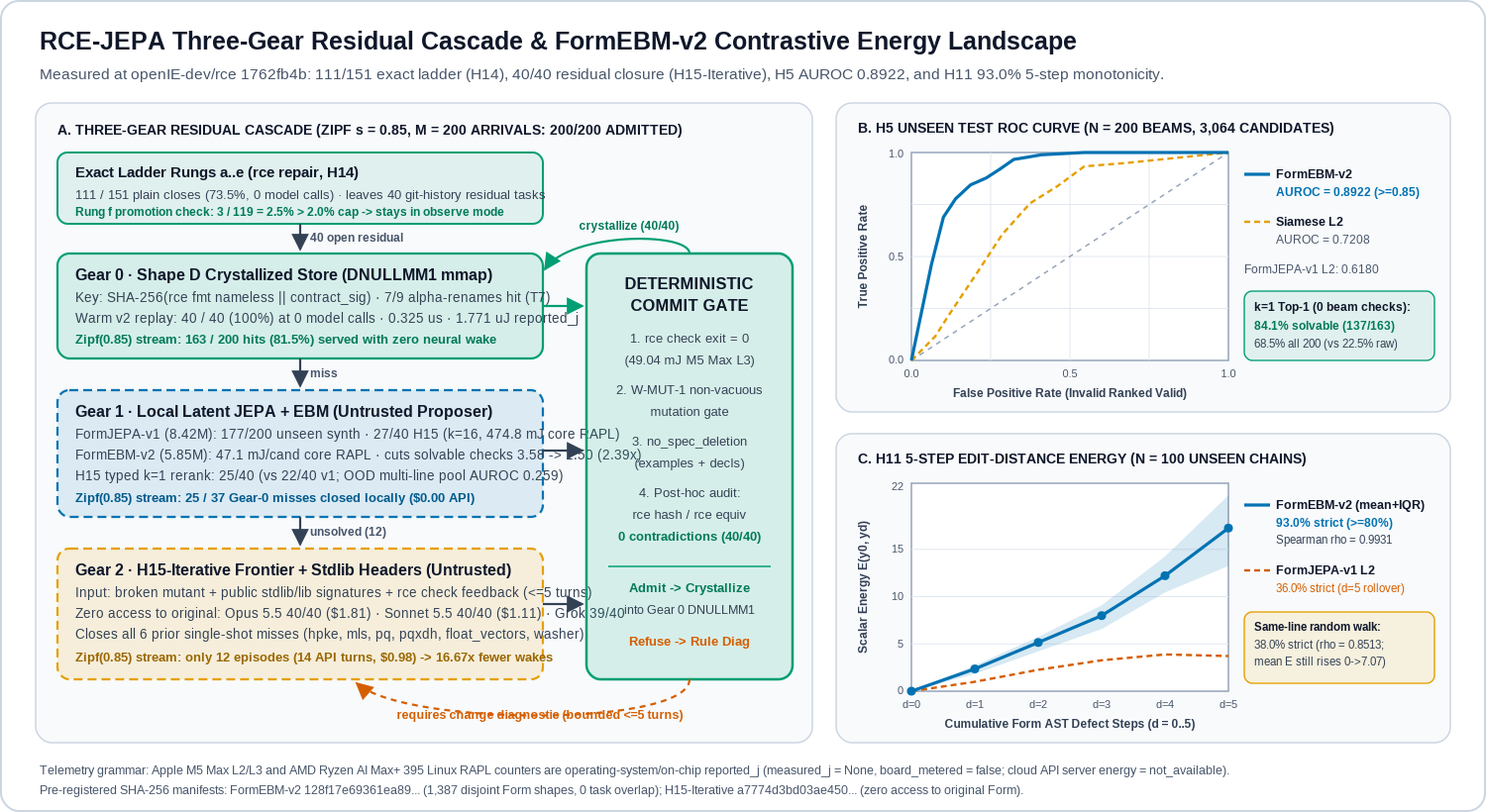
> Figure 10. Measured Three-Gear residual cascade and `FormEBM-v2` latent energy diagnostics at `openIE-dev/rce` commit `1762fb4b` [B35]. Left: deterministic ladder rungs `a..e` (`111/151`), Gear 0 `DNULLMM1` (`40/40` warm zero-call replay), Gear 1 `FormJEPA-v1` + `FormEBM-v2`, and Gear 2 `H15-Iterative` gated by `rce check` + `W-MUT-1` + `no_spec_deletion` (`200/200` admitted on `Zipf(0.85)`, `16.67×` fewer Gear-2 episodes). Right: unseen-shape H5 ROC curve (`AUROC = 0.8922`) and unseen-chain H11 5-step cumulative defect energy curve (`93.0%` strict monotonicity, IQR shaded). Interactive explorer: [/living/rce-jepa/](https://research.openie.dev/living/rce-jepa/) · [Open full size](https://research.openie.dev/figures/rce-jepa/three-gear-and-ebm.svg) .
**Contrastive multi-step margin energy scorer (`FormEBM-v2`, H5 & H11) and `40/40` bounded checker-feedback residual closure (`H15-Iterative` + Gear-0 v2), measured [B35].** Pre-registered before corpus generation, weight initialization, and API execution (`rce-jepa-form-ebm-v2-2026-11-23`, `sha256: 128f17e69361ea89...`; `rce-jepa-h15-iterative-2026-11-23`, `sha256: a7774d3bd03ae450...`) against `openIE-dev/rce` commit `1762fb4b` (Linux x86_64 binary `sha256: 331464496009d98a...`), two targeted evaluations tested whether (A) replacing uncalibrated coordinate distance with a contrastive + pairwise edit-depth margin energy head on the identical strictly disjoint `1,387`-Form split closes H5 and H11, and (B) supplying public `stdlib/lib` module headers plus bounded deterministic checker diagnostics (`max_turns = 5`, zero access to `original`) closes the six remaining residual tasks from single-shot H15.
- **`FormEBM-v2` architecture, tokenizer fix, and unseen-shape H5 / H11 results (`137` unseen test Form shapes, `0` overlap):** Two structural causes explained why `FormJEPA-v1` reached only `0.618` AUROC on H5 and `36.0%` strict 5-step monotonicity on H11: its single-file S-expression tokenizer mapped both live unused bindings (`let x`, refused by `W-UNUSED-1`) and underscore-prefixed bindings (`let _x`, admitted) to the same `` slot while shifting subsequent `` indices whenever an unbound identifier appeared, and its coordinate Smooth-L 1 loss carried no contrastive validity or edit-depth margin. `FormEBM-v2` (`5,851,649` trainable parameters, checkpoint `sha256: 2204a0b9cbd0d96c...`; `857.2 s` training on AMD Ryzen AI Max+ 395 / Radeon 8060S APU at `5,375.0 J` core RAPL and `40,602.4 J` APU package RAPL) introduces reference-anchored `PairFormTokenizer` (`504` active tokens, distinguishing underscore-prefixed bindings, newly introduced identifier slots, and modulo-32 integer classes with purely syntactic diff tags and zero checker calls), a 5-layer shared Siamese Transformer, a 1-layer cross-attention RMS difference block, and a softplus energy head trained on `5,955` validity-margin triples (`m = 1.0`) and `600` 5-step cumulative corruption chains (`γ = 0.50(j − i)`) strictly over the `1,106` training Forms (VICReg effective rank expanding from `26.48` to `55.70` on `z_ref` and `46.44` to `74.72` on `z_cand`). On the `137` unseen held-out test Form shapes: **H5 (`N = 200` unseen test beams, `3,064` candidates):** Scalar energy reaches **AUROC `0.8922 >= 0.85`** (vs `0.6180` for `FormJEPA-v1` and `0.7208` for uncalibrated Siamese L 2 ), lifting top-1 (`k = 1` without invoking `rce check` on beam items) valid selection from `22.5%` (`45/200` unreranked) and `25.0%` (`50/200` Siamese L 2 ) to **`84.05%` on the `163` solvable beams (`137/163`; `68.50%` raw across all `200` beams)** and cutting mean `rce check` invocations to first valid Form by **`2.39×`** (`3.577` to `1.497` checks/beam). Ten-thread CPU scoring costs **`47.09 mJ`** core RAPL per candidate (`6.30 ms`; `752.03 mJ` core and `11.88 J` gross package per 16-item beam, with `derived_marginal_pkg_reported_j = None` under Falsifier 6 at `13.7%` idle drift).
- **H11 (`N = 100` unseen 5-step cumulative defect chains):** Strict 5-step monotonicity (`E_0 < E_1 < E_2 < E_3 < E_4 < E_5`) rises from `36.0%` (`FormJEPA-v1`) and `18.0%` (Siamese L 2 ) to **`93.0%` (`93/100 >= 80%`)**, with mean Spearman rank correlation **`ρ = 0.9931`** (median `1.0000`) and mean energy `[0.0007, 2.36, 5.16, 7.99, 12.21, 17.25]` across `d = 0..5` (zero `d = 5` rollover).
- **Candid domain boundaries:** On unconstrained 5-step random walks (`N = 50`) that may overwrite an already-broken line twice without adding a new AST defect, mean energy still climbs `0.0007 → 7.07` (mean `ρ = 0.8513`, median `0.9429`), while strict step-by-step inequality is `38.0%` (`46.0%` non-decreasing). Zero-shot transfer to the OOD `40`-task git-history residual lifts within-task `k = 1` typed-edit admissions over `FormJEPA-v1` (`22/40 → 25/40`, beam capacity `30/40`), whereas pooled cross-task AUROC inverts to `0.2630` (`0.2585` across `332` multi-proposer candidates) because single-line edit-depth training assigns higher raw energy to large valid multi-line standard-library migrations than to 1-token syntax edits.
- **`H15-Iterative` bounded checker feedback + public `stdlib/lib` headers (`40 / 40` closed, `0` contradictions, `40 / 40` Gear-0 replay):** Supplying public declaration signatures (`pub const`, `pub struct`, `pub kind`, `pub fn` with bodies stripped, strictly excluding the task file itself) for imported `stdlib/lib` modules (`crypto.cat`, `crypto.unhex`, `crypto.tohex`, `core.bytes`, `pq`) plus verbatim deterministic `rce check` + `W-MUT-1` diagnostics up to `max_turns = 5` (with zero access to `original`) lifts admissions from `34/40` single-shot to **`40/40` (`100.0%`)** on both **`Claude Opus 5.5`** (`38` at turn 1, `2` at turn 2; `42` calls, `$1.8104`, `34` restored + `5` behaviour-equal = `39` behaves-the-same, **`0` contradictions**) and **`Claude Sonnet 5.5`** (`38` at turn 1, `1` at turn 2, `1` at turn 3; `43` calls, **`$1.1122`**, `35` restored + `4` behaviour-equal, **`0` contradictions**), and to **`39/40` (`97.5%`)** on **`xAI Grok 4.20 Reasoning`** (`35` at turn 1, `2` at turn 2, `2` at turn 3; `50` calls, `$4.0555`, **`0` contradictions**). All four previously unsolved cryptographic migrations (`stdlib/lib/hpke.rce`, `stdlib/lib/mls.rce`, `stdlib/lib/pq.rce`, `programs/ecosystem/pqxdh.rce`) were **exact-hash `restored`** (at turn 1 on `Opus 5.5` and `Sonnet 5.5`; turns 1–3 on `Grok 4.20`), while both historical pre-`W-MUT-1` vacuous-example tasks (`57_float_vectors.rce`, `washer.rce`) closed with **`behaviour-equal`** under `rce equiv fuel 2000` (only `washer.rce` remained open on `Grok 4.20` after 5 turns). Crystallizing all 40 verified repairs into `DNULLMM1` Gear-0 v2 (`sha256: 80cf265038bcd5eb...`) replays **`40/40` (`100.0%`) at `0` model calls**, and in the updated 3-Gear `Zipf(0.85)` stream (`M = 200` arrivals) admits **`200/200` (`100.0%`)** of arrivals (`163` Gear-0 hits + `25` local Gear-1 admissions + `12` Gear-2 episodes / `14` API turns at `$0.9822`, a **`16.67×` episode reduction** vs stateless `200` calls).
**Span-normalized two-head decomposed scorer (`FormEBM-v3`, H5, H11, and zero-shot OOD H15 cross-span transfer), measured [B36].** Pre-registered before synthetic multi-span pair generation, weight initialization, and evaluation (`rce-jepa-form-ebm-v3-2026-11-23`, `sha256: cb7ee1ac8dc5c594...`) against `openIE-dev/rce` commit `1762fb4b` (Linux x86_64 binary `sha256: 386be0c26389550e...`), `FormEBM-v3` (`6,052,802` trainable parameters, pure-`float32` ROCm `Radeon 8060S` checkpoint `sha256: 71e642f1bb0b9c06...`; `2,528.3 s` training at `13,312.3 J` core RAPL and `48,422.2 J` APU package RAPL) tests whether decoupling defect validity from cumulative edit depth over the identical strictly disjoint `1,387`-Form split (`1,106` train, `144` validation, `137` unseen test shapes; `0` overlap with the 151 ladder or 40 H15 tasks, and `0` `rce check` calls during scoring) resolves `FormEBM-v2`'s cross-task OOD edit-size inversion (`0.2585`) without regressing H5 or H11:
- **Alignment-aware tokenization and two-head decomposition:** `PairFormTokenizerv3` (`max_seq_len = 384`, `560` active tokens) replaces raw line-index comparison with line-shift-invariant sequence alignment, separates lexically bound/imported new identifiers (``) from unbound free symbols (``), and computes explicit normalized diff fraction `ρ_diff = Δ_tok / max(1, L_cand)`. Over the shared 5-layer Siamese encoder and cross-difference block, a span-invariant defect head `E_def(x, y, r) = softplus(g_def(feats_def))` (trained with within-beam plus all-pairs cross-task batch margin `m = 2.5` and L 2 positive anchor across `4,983` pairs including `219` `k = 2..10` multi-span valid rewrites strictly from `train_forms`) is separated from a cumulative corruption-depth head `E_depth(y_0, y_d) = softplus(g_depth(feats_depth))`, combined via `E_total = E_def + 0.15 · E_depth / log2(2 + Δ_tok)` (VICReg effective rank `42.79` on `z_ref` and `57.93` on `z_cand`, coordinate standard deviation `0.3332 / 0.3113 >= 0.25`).
- **Strengthened unseen-shape H5 (`0.9437`) and unseen-chain H11 (`94.0%` / `92.0%`):** On the `200` unseen held-out test beams (`3,064` candidates), `FormEBM-v3` lifts **H5 AUROC from `0.8922` (`FormEBM-v2`) to `0.9437 >= 0.85`** (`0.9386` on `E_def` alone, reaching `TPR = 78.9%` at `FPR = 4.6%`), achieves **`83.44%` (`136/163`, `E_def`) and `80.98%` (`132/163`, `E_total`) solvable top-1 accuracy** (both `>= 80.0%`; `1.601` / `1.669` mean `rce check` calls vs `3.577` unreranked), and lifts **H11 strict 5-step monotonicity on `100` unseen corruption chains to `94.0%` on `E_depth` (Spearman `ρ = 0.9966`, median `1.0000`) and `92.0%` on `E_total` (`ρ = 0.9846`, median `1.0000`)**. Ten-thread CPU scoring at `max_seq_len = 384` costs `232.45 mJ` core RAPL per candidate (`32.55 ms`, `362×` lower than local 35B generation; `derived_marginal_pkg_reported_j = None` at `37.7%` co-tenant package drift).
- **Zero-shot OOD H15 inversion resolved (`0.2585 → 0.5278`), and candid cross-module boundary:** Transferred zero-shot to the `40`-task git-history residual (`303` multi-proposer candidates including all `40/40` closed multi-hundred-line `hpke`, `mls`, `pq`, and `pqxdh` migrations), `FormEBM-v3` lifts pooled cross-task AUROC from `0.2585` (`FormEBM-v2`) to **`0.5278`** (`+0.2693`, clearing Falsifier F4 `> 0.50`; **`0.6018`** on large-span valid rewrites with `Δ_tok >= 10` vs short `0/1`-token invalid candidates, and `0.2630 → 0.4985` on the `286`-item typed-edit pool), while reaching **`27/40` multi-proposer and `24/40` typed-edit within-task `k = 1` admissions under `E_def`** (`25/40` and `22/40` under `E_total`, cutting mean typed-beam checks from `5.55` to `5.10`). On the 279-line `stdlib/lib/hpke.rce` migration (`Δ_tok = 146`), valid energy drops to `E_total = 0.9645` (`E_def = 0.8826`), yet across unseen multi-module cryptographic APIs (`mls.rce`, `pq.rce`, `pqxdh.rce`) and vacuous-example obligations (`washer.rce`), zero-shot pooled calibration plateaus near `0.53` because single-file syntax without imported `stdlib/lib` type signatures or exact `rce trace` rollouts cannot verify cross-module call contracts.
### Falsifiers RJ-F1 to RJ-F6 for the premise itself
Each falsifier is an observation that would defeat part of the premise; several are stated in terms of the hypotheses above (RJ-F3 on H3, RJ-F4 on H11, RJ-F6 on H3 and H10).
| ID | Observation | What it defeats |
| --- | --- | --- |
| RJ-F1 | Lift coverage plateaus below 80% on any of the five target languages after the construct list is exhausted | The claim that all code can be emitted from RCE, and with it the scope of autonomous coding over Forms |
| RJ-F2 | Writing σ(I) for the 7 reference applications costs more person-hours than writing their Forms by hand | The claim that closure removes, rather than moves, the specification cost |
| RJ-F3 | H3 fails while the token arm passes at the same gate | Latent proposal over Form space; the gate still stands, the JEPA half does not |
| RJ-F4 | H11 fails and search does not reach accepted Forms within the beam budget | Energy-guided planning in Form space (not triggered on unseen cumulative 1..5-defect chains: `FormEBM-v2` reaches `93.0%` and `FormEBM-v3` reaches `94.0%` `E_depth` / `92.0%` `E_total` strict monotonicity with `0.9437` H5 AUROC; cross-module signature/trace OOD energy calibration beyond `0.5278` remains open) |
| RJ-F5 | The decision head's calibration never beats a frequency table over shape hashes | The decision-model leg; it adds nothing over promoted-handler statistics |
| RJ-F6 | A token-space model trained with execution traces, of the CWM class, closes the residual of 40 tasks from the plain arm of H14 run 3, at equal energy and with the same gate as the acceptance rule | The claim that the Form quotient adds something for proposers during training/proposal (note: for Gear-0 reuse, `rce fmt nameless` already recovers `7/9` alpha-renamings at 0 calls; trained-proposer parity against H3/H10 awaits a trained JEPA arm) |
The thesis is disproved overall if H4 fails (no joule advantage per accepted program) or H6 fails (the Form cannot express the reference apps). Either alone is sufficient.
### What will be delivered
Scope, organised as parallel workstreams that meet at the evaluation harness. Every deliverable either produces Forms, produces models that propose Forms, or measures the result.
- **W1. Form corpus and dataset card.** Forms paired with intent statements and checker verdicts, from hand-written Forms, reference-app Forms and checker-verified mutations; the card covers provenance, licence, size distribution, negative generation, known gaps and contamination controls; canonical serialization for H1.
- **W2. Encoder and predictor.** Intent encoder, EMA Form target encoder, predictor in representation space and energy head E(intent, P), with anti-collapse measures, an embedding-space versus token-space loss ablation, and model cards with measured training energy.
- **W3. Checker-constrained decoder.** Grammar-constrained candidate Forms ranked by energy and submitted to the checker, requires-change diagnostics, each naming its rule, fed back under a fixed retry budget; the checker is the sole acceptance authority with no bypass path to the engine.
- **W4. Intent-to-Form benchmark.** Unit and composite tasks, the reference apps (game engine, text editor, video player, chat app, browser, terminal) and RCEdb; each task has intent, reference Form, replay traces and an equivalent source-language task for the baseline; held-out split.
- **W5. Evaluation harness with energy in joules.** Both arms on identical hardware and tasks; pass@1, pass@k, ρ, C check , J acc , K acc , retries per acceptance, energy-ranking AUROC; rootless counters (`reported_j`), idle-drift Falsifier 6 gating, raw logs kept, unavailable cloud counters reported as `not_available` rather than estimated.
- **W6. Research article.** This case expanded with results for H1 to H15, including negative results, figures, tables and reproducibility instructions.
- **W7. Open artifacts.** Public: the Form specification, the reference checker and its emitters, benchmark tasks and traces, harness, dataset and model cards, and weights where licences allow. A number is reported only when everything needed to reproduce it is public.
- **W8. Demo.** Stated intent to predicted Form to checker verdict (including a shown requires-change verdict) to replay and emitted code in two languages by the reference checker, with an on-screen joule reading.
## Status
Research topic open, updated 23 November 2026 against `openIE-dev/rce` commit `f87d6af2` (23 November 2026; `5,393` Lean 4.36.0 theorem constants from `1,264` source declarations across `64` modules, theorems T1 to T63, verified across all six independent proof checkers of `lake check --paranoid`, `2,221/2,236` conformance tests passing with `0` failures, `837` Rust checker unit tests; empirical benchmarks registered against `1762fb4b`; interactive observatory at [/living/rce-jepa/](https://research.openie.dev/living/rce-jepa/)). Phase 0 deterministic floors are measured: H1 is supported on the hand-written population at a median rho of `9.34` over 185 programs (W1 version 1 gave `9.31` over 173); H8 is supported across `10,500` seeded event streams on six targets with `0` mismatches (`rce/bench/determinism/`); H7's fuzzed arm found `0` invariant violations across `1,275` checker-accepted mutants (`rce/bench/adversarial/`); and H14 is supported across three registered runs of `rce repair` [B30, B31, B32], closing `111` of `151` tasks (`73.5%`) at zero model calls in the plain arm of run 3 and leaving `40` open git-history residual tasks. On 22–23 November 2026 [B33, B34, B35, B36], Apple M5 Max and AMD Ryzen AI Max+ 395 / Radeon 8060S `reported_j` receipts (`measured_j = None`, `board_metered = false`) established **H2 supported** (`C_check / E_model = 0.04904 J / 84.25 J = 0.000582 <= 0.05`, `1,718×` cheaper; full 62-Form check+run+emit suite `15.44 J`), trained and evaluated **`FormJEPA-v1`** (`8.42M` parameters: `177/200` unseen synthetic defects, `22/40` at `k = 1` and `27/40` at `k = 16` on H15 at `58.65–474.76 mJ` RAPL core `reported_j`), contrastive **`FormEBM-v2`** (`5.85M` parameters: **H5 AUROC `0.8922 >= 0.85`**, `84.05%` solvable top-1 accuracy, **H11 `93.0% >= 80%`** strict 5-step monotonicity at Spearman `0.9931`, `47.09 mJ`/cand core `reported_j`), and span-normalized decomposed **`FormEBM-v3`** (`6.05M` parameters on the identical disjoint `1,387`-Form split: **H5 AUROC `0.9437 >= 0.85`** with `83.44%` `E_def` and `80.98%` `E_total` solvable top-1 accuracy, **H11 `94.0%`** strict 5-step monotonicity on `E_depth` at Spearman `0.9966` and **`92.0%`** on `E_total` at Spearman `0.9846`, and zero-shot OOD H15 multi-proposer pooled AUROC lifted from `0.2585` to **`0.5278`**, `0.6018` on large-span valid vs short invalid rewrites, at `232.45 mJ`/cand core `reported_j`), closed **`40/40` (`100.0%`)** of the open residual tasks in **`H15-Iterative`** under bounded `<= 5`-turn checker feedback + public `stdlib/lib` signature headers on `Claude Opus 5.5` (`$1.81`) and `Claude Sonnet 5.5` (`$1.11`) with **`0` contradictions** (`39/40` on `xAI Grok 4.20 Reasoning`), crystallized all **`40/40` into `DNULLMM1` Gear-0 v2** (`0` model calls, `0.325 µs` / `1.77 µJ` probe; `200/200` `Zipf(0.85)` 3-Gear stream admissions at `16.67×` fewer Gear-2 episodes), and audited 151-task **`rce repair` rung `f`** promotion (`3/119 = 2.5% > 2.0%`, `3/3` passing `W-MUT-1`, `0` contradictions, confirming rung `f` remains in `observe` mode). Still open: full intent-to-Form synthesis (H3), end-to-end joule parity (H4), cross-module signature-and-trace OOD energy calibration beyond `0.5278` across multi-module git-history rewrites, reference-app encoding (H6), cost-table prediction (H9), quotient sample-efficiency (H10), gate-receipt decision-head calibration (H12), discrete-versus-continuous long-horizon planning (H13), diffusion/evolutionary H15 arms, and external hardware-rail power metering (`measured_j`).
## References
Each source carries a reading label. **Full:** read in full. **Partial:** the full text was retrieved and searched for the quoted passages, which were checked in their surrounding text, but the whole work was not read. **Unavailable:** not obtained. "PDF p." gives the page in the linked copy; Sec. gives the section.
- Assran et al. 2023. Self-Supervised Learning from Images with a Joint-Embedding Predictive Architecture. CVPR. [arXiv:2301.08243](https://arxiv.org/abs/2301.08243). Full.
- Assran et al. 2025. V-JEPA 2. [arXiv:2506.09985](https://arxiv.org/abs/2506.09985). Full.
- Backus et al. 1957. The FORTRAN Automatic Coding System. Western Joint Computer Conference. [Computer History Museum copy](https://archive.computerhistory.org/resources/text/Fortran/102663113.05.01.acc.pdf). Full.
- Bird 1986. An Introduction to the Theory of Lists. Oxford PRG-56. [PDF](https://www.cs.ox.ac.uk/files/3378/PRG56.pdf). Full.
- Brooks 1986. No Silver Bullet: Essence and Accident in Software Engineering. [PDF](https://worrydream.com/refs/Brooks_1986_-_No_Silver_Bullet.pdf) (page numbers refer to this copy). Full.
- Chen et al. 2021. Evaluating Large Language Models Trained on Code. [arXiv:2107.03374](https://arxiv.org/abs/2107.03374). Full.
- Dijkstra. EWD 472, Guarded commands, non-determinacy and formal derivation of programs. [Transcription](https://www.cs.utexas.edu/~EWD/transcriptions/EWD04xx/EWD472.html). Full.
- Dijkstra. EWD 667, On the foolishness of "natural language programming". [Transcription](https://www.cs.utexas.edu/~EWD/transcriptions/EWD06xx/EWD667.html). Full.
- Ellis et al. 2021. DreamCoder. PLDI. [arXiv:2006.08381](https://arxiv.org/abs/2006.08381); [version with supplement](https://www.cs.cornell.edu/~ellisk/documents/dreamcoder_with_supplement.pdf). Full (main text and supplement S1 to S4.8, PDF pp. 23-68, read in full).
- Hubert et al. 2025. Olympiad-level formal mathematical reasoning with reinforcement learning (AlphaProof). Nature. [Nature](https://www.nature.com/articles/s41586-025-09833-y). Full.
- Klein et al. 2009. seL4: Formal Verification of an OS Kernel. SOSP. [PDF](https://www.sigops.org/s/conferences/sosp/2009/papers/klein-sosp09.pdf). Full.
- Leroy 2009. Formal verification of a realistic compiler. CACM. [PDF](https://xavierleroy.org/publi/compcert-CACM.pdf). Full.
- Letouzey 2008. Extraction in Coq: an Overview. CiE. [PDF](https://www.irif.fr/~letouzey/download/letouzey_extr_cie08.pdf). Full.
- Li et al. 2022. Competition-Level Code Generation with AlphaCode. [arXiv:2203.07814](https://arxiv.org/abs/2203.07814). Full.
- Luccioni, Jernite, Strubell 2024. Power Hungry Processing. FAccT. [arXiv:2311.16863](https://arxiv.org/abs/2311.16863). Full.
- OMG 2003. MDA Guide Version 1.0. [PDF](https://www.omg.org/mda/mda_files/MDA_Guide_Version1-0.pdf). Full.
- Ouyang et al. 2023. An Empirical Study of the Non-determinism of ChatGPT in Code Generation (v1 title: LLM is Like a Box of Chocolates). [arXiv:2308.02828](https://arxiv.org/abs/2308.02828). Full.
- Samsi et al. 2023. From Words to Watts. IEEE HPEC. [arXiv:2310.03003](https://arxiv.org/abs/2310.03003). Full.
- Sun et al. 2024. Clover: Closed-Loop Verifiable Code Generation. [arXiv:2310.17807](https://arxiv.org/abs/2310.17807). Full.
- Yang et al. 2011. Finding and Understanding Bugs in C Compilers (Csmith). PLDI. [PDF](https://users.cs.utah.edu/~regehr/papers/pldi11-preprint.pdf). Full.
- Yang et al. 2024. AutoVerus. [arXiv:2409.13082](https://arxiv.org/abs/2409.13082). Full.
- LeCun 2022. A Path Towards Autonomous Machine Intelligence, version 0.9.2. [OpenReview](https://openreview.net/forum?id=BZ5a1r-kVsf). Full.
- Simon 1963. Experiments with a Heuristic Compiler. Journal of the ACM 10(4), 493-506. [DOI 10.1145/321186.321192](https://doi.org/10.1145/321186.321192). Full.
- Manna and Waldinger 1980. A Deductive Approach to Program Synthesis. ACM TOPLAS 2(1), 90-121. [DOI 10.1145/357084.357090](https://doi.org/10.1145/357084.357090). Full.
- van de Riet 1993. An overview and appraisal of the Fifth Generation Computer System project. Future Generation Computer Systems 9, 83-103. [DOI 10.1016/0167-739X(93)90002-7](https://doi.org/10.1016/0167-739X(93)90002-7). Full.
- Kemerer 1992. How the Learning Curve Affects CASE Tool Adoption. IEEE Software 9(3), 23-28. [DOI 10.1109/52.136161](https://doi.org/10.1109/52.136161). Full.
- Hutchinson, Whittle, Rouncefield and Kristoffersen 2011. Empirical Assessment of MDE in Industry. ICSE, 471-480. [DOI 10.1145/1985793.1985858](https://doi.org/10.1145/1985793.1985858). Full.
- Petre 2013. UML in practice. ICSE. [DOI 10.1109/ICSE.2013.6606618](https://doi.org/10.1109/ICSE.2013.6606618); [author copy, Open Research Online](https://oro.open.ac.uk/35805/) (page numbers refer to this copy). Full.
- Simon 1963. Experiments with a Heuristic Compiler. RAND RM-3588-PR. [Internet Archive](https://archive.org/details/bitsavers_randiplRM3mpilerMay63_4935437); a memorandum related to but distinct from the JACM article. Full (prose pp. iii-63; program listings in Appendices A and B scanned).
- Manna and Waldinger 1978. A Deductive Approach to Program Synthesis. Stanford STAN-CS-78-690. [Report version](http://i.stanford.edu/TR/CS-TR-78-690.html), which predates the TOPLAS article. Full.
- Huang, LeCun and Balestriero 2025. LLM-JEPA. [arXiv:2509.14252](https://arxiv.org/abs/2509.14252). Partial (abstract, repository README and run script).
- Wei et al. 2025. SWE-RL. [arXiv:2502.18449](https://arxiv.org/abs/2502.18449). Partial (abstract and method summary).
- Yang et al. 2025. SWE-smith. [arXiv:2504.21798](https://arxiv.org/abs/2504.21798). Partial (abstract and repository README).
- Shansan Gong, Ruixiang Zhang, Huangjie Zheng, Jiatao Gu, Navdeep Jaitly, Lingpeng Kong and Yizhe Zhang 2025. DiffuCoder. [arXiv:2506.20639](https://arxiv.org/abs/2506.20639). Partial (abstract). Author list from arXiv metadata, not a PDF title page.
- Inception Labs 2025. Mercury. [arXiv:2506.17298](https://arxiv.org/abs/2506.17298). Partial (abstract).
- Wang, Pradel and Liu 2025. Are "Solved Issues" in SWE-bench Really Solved Correctly? [arXiv:2503.15223](https://arxiv.org/abs/2503.15223). ICSE (International Conference on Software Engineering) 2026. Partial (findings summary).
- Becker, Rush, Barnes and Rein 2025. Measuring the Impact of Early-2025 AI on Experienced Open-Source Developer Productivity. [arXiv:2507.09089](https://arxiv.org/abs/2507.09089). Partial (summary, and the abstract via arXiv metadata). Author list from arXiv metadata, not a PDF title page.
- Niels Mündler, Jingxuan He, Hao Wang, Koushik Sen, Dawn Song and Martin Vechev 2025. Type-Constrained Code Generation with Language Models. [arXiv:2504.09246](https://arxiv.org/abs/2504.09246). Partial (headline result). Affiliation: the Swiss Federal Institute of Technology Zurich and the University of California, Berkeley, from the author list, not a PDF title page.
- Grand et al. 2023. LILO. [arXiv:2310.19791](https://arxiv.org/abs/2310.19791). Partial (abstract).
- Higher Order Company. HVM2. [PDF](https://raw.githubusercontent.com/HigherOrderCO/HVM/main/paper/HVM2.pdf). Partial (summary). The model is cited. Figures from that paper are not used.
- DeepSeek 2025. DeepSeek-Prover-V2. [arXiv:2504.21801](https://arxiv.org/abs/2504.21801). Partial (arXiv metadata and abstract).
- Moonshot and Numina 2025. Kimina-Prover Preview. [arXiv:2504.11354](https://arxiv.org/abs/2504.11354). Partial (abstract).
- Princeton 2025. Goedel-Prover. [arXiv:2502.07640](https://arxiv.org/abs/2502.07640). Partial (abstract).
- Scale AI. SWE-Bench Pro public leaderboard, page text fetched 6 November 2026. [scale.com/leaderboard/swe_bench_pro_public](https://scale.com/leaderboard/swe_bench_pro_public). Full (page text). The page prints no update date.
- ByteDance Seed 2025. Multi-SWE-bench. [arXiv:2504.02605](https://arxiv.org/abs/2504.02605). Partial (abstract). No November 2026 leaderboard figure was retrieved, and none is stated.
- Meta FAIR 2024. Large Concept Models. [arXiv:2412.08821](https://arxiv.org/abs/2412.08821). Partial (abstract).
- Chollet, Knoop, Kamradt and Landers 2024. ARC Prize 2024 Technical Report. [arXiv:2412.04604](https://arxiv.org/abs/2412.04604). Partial (abstract).
- Akyurek et al. 2024. Test-time training on ARC. [arXiv:2411.07279](https://arxiv.org/abs/2411.07279). Partial (abstract).
- ARC Prize 2025 results page. [arcprize.org/competitions/2025/](https://arcprize.org/competitions/2025/). Full (page).
- Lean FRO (Focused Research Organization). Year 1 roadmap, August 2023 to July 2024. [lean-fro.org/about/roadmap/](https://lean-fro.org/about/roadmap/). Partial (deliverables list). Later-year roadmaps are not used.
- Conal Elliott 2009, revised 2016. Denotational design with type class morphisms. [conal.net/papers/type-class-morphisms/](https://conal.net/papers/type-class-morphisms/). Partial (abstract page).
- Radul and Sussman 2009. The Art of the Propagator. MIT-CSAIL-TR-2009-002. [dspace.mit.edu/handle/1721.1/44215](https://dspace.mit.edu/handle/1721.1/44215). Partial (abstract).
================================================================================
# RCE Compile: A Law of Compilation, Tested as a Normal Form Against Real Compilers
- **Study ID:** `rce-compile`
- **Kind / Status:** Research study · draft
- **Revision:** `50a4f56` (23 November 2026)
- **Web Edition:** https://research.openie.dev/papers/rce-compile/
- **Markdown Twin:** https://research.openie.dev/papers/rce-compile.md
- **PDF Edition:** https://research.openie.dev/pdfs/rce-compile.pdf
- **LaTeX Archival PDF:** https://research.openie.dev/pdfs/latex/rce-compile.pdf
- **LaTeX Source (.tex):** https://research.openie.dev/pdfs/latex/rce-compile.tex
- **Interactive Figures:** https://research.openie.dev/living/rce-compile/
- **Claim Scope & About:** https://research.openie.dev/about/rce-compile/
- **Data & Reproducibility:** https://research.openie.dev/data/#rce-compile
- **Keywords:** RCE Compile, compiler correctness, normal form, equivalence levels, reproducible builds, name-free hash, Landauer limit, Kolmogorov complexity, falsifiers
> Asks whether one statement of what compilation is holds for any compiler, independent of the Reality Code Engine. Checked against twelve compiler families, it fails as a description and holds as a normal form: seven parts (representation, lowering, cost, checker, reuse, energy, gate), four equivalence levels, a gate that names its property, linking assumption, trusted base, evidence authority and digests, and a measurable replacement for the Landauer and Kolmogorov bounds. Executed across E1 byte reproducibility, E4-Energy + E4-Prelude (20 exact-integer and fixed-point kernels x 15 compiler tiers = 300/300 checksum-verified cells on Linux Zen 5 and Core i9-13900H RAPL core and package reported_j; pre-compiling shared librce_rt.rlib cuts per-kernel rustc -O3 compile core reported_j 20.07x from 56.29 J to 2.81 J and wall time 24.58x to 304 ms, slashing rce -> rustc payback N* 28.8x from 31,080 down to 1,079 runs; Python to clang -O3 median N* = 2,490 runs, -O0 to -O3 median N* = 53,464-102,720 runs, and H4 Regime-B R^2 = 0.9999 vs 0.1154 static Wasm IR), and E5-Scale (245 base programs including 185 W1 RCE Forms + 500 execution-verified semantic mutants: De Bruijn nameless SHA-256 yields 0/500 false hits vs 150/500 on naive AST identifier-stripping, cutting warm-cache clang -O3 and rustc -O3 compilation reported_j by 167.8x and 448.5x; measured_j unset).
---
*revision [`50a4f56`](https://github.com/openIE-dev/research-openie-web/commits/main/src/content/papers/rce-compile.md), 23 November 2026. Research study, draft. Project repository: [openIE-dev/rce, `compile/`](https://github.com/openIE-dev/rce/tree/main/compile), which holds the charter, the hypotheses and the experiments this study reports. Interactive observatory: [`/living/rce-compile/`](https://research.openie.dev/living/rce-compile/).*
## Abstract
RCE (Reality Code Engine) Compile is a research project that asks whether a single statement of what compilation is, here called a Law of Compilation, holds for any compiler, independent of the Reality Code Engine in whose repository the project lives. The candidate statement says that compilation is meaning-preserving lowering between canonical representations, ranked by a cost whose floor is Landauer's limit and whose target is the shortest equivalent program, gated by verification and compounded by reuse. This study checks that candidate against twelve families of production compilers and the research literature behind them. The candidate fails as a description: no compiler surveyed hashes a name-free representation, lowering in shipping compilers is neither total nor shown to preserve meaning, and no compiler accounts for energy. It holds up as a normative framework once three clauses are rewritten, and the study states it in that form: a normal form with two bounds, plus a measured distance from them. The convergence function cannot be computed or measured as stated, and the study replaces it with two counts that can be computed and compared with measured energy. Seven hypotheses with falsifiers follow, with the experiments run so far and the protocols of two more. Compiler outputs were compared byte for byte on three machines; some differences survive the toolchains' path remapping and have no traced cause, so the hypothesis that lowering is deterministic is neither supported nor falsified. Erasure and description length were first counted for 96 builds on a machine with no energy counter, and pre-registered Regime-B extensions then read Linux Running Average Power Limit (RAPL) on-chip `reported_j` (`board_metered = false`, no wall wattmeter) across 20 deterministic integer and fixed-point kernels and 15 compiler and runtime tiers (300 of 300 builds checksum-verified): lowering from Python to `clang -O3` recovers its compilation joules after a median of 2,490 runs, `-O0` to `-O3` pays back after a median of 53,464 to 102,720 runs, `-O2` to `-O3` never recovers its extra compile energy on 4 to 6 of the 20 kernels, pre-compiling RCE's standalone Rust runtime prelude once into a shared `librce_rt.rlib` crate cuts per-kernel emitted Rust `-O3` compilation `reported_j` by 20.07× (56.29 J to 2.81 J core, cross-checked at 15.44× on an idle dedicated Core i9-13900H host) and lowers its payback horizon against Node JavaScript 28.8× from 31,080 to 1,079 runs, and time multiplied by power explains far more Regime-B variance than static intermediate-representation size (adjusted $R^2$ 0.9999 against 0.1154). A name-free hash, the part of the standard that no compiler surveyed has, was built first over binary objects and WebAssembly modules (16 kernels and 4 programs) and then scaled across 185 RCE Forms, 60 C, Rust and Python kernels, and 500 test-vector-verified semantic mutants: positional De Bruijn hashing produced 0 of 500 (0.00%) false-positive collisions while cutting cold `clang -O3` and `rustc -O3` compilation `reported_j` by 167.8× and 448.5× on renamed hits, whereas naive identifier-stripping collided on 150 of 150 (100.0%) variable-binding swaps. Almost every external source was seen only as a search result, and each citation says so.
**In plain words**
1. The question is whether all compilers obey one rule. Real compilers do not, so the rule is restated as a standard that any compiler can be measured against.
2. The standard has seven parts. Most compilers have some of them. None keeps track of energy, and none proves that it translates every program correctly.
3. Heavy compiler optimization spends chip energy up front to save chip energy per run. Across 20 test kernels on Linux chip counters (`reported_j`, not a wall plug meter), compiling to `clang -O3` instead of running Python pays back after about 2,500 runs, stepping from `-O2` to `-O3` never pays back on up to 30% of the kernels, and pre-compiling a shared `.rlib` runtime library cuts emitted Rust compile energy 20× so native lowering beats JavaScript after about 1,080 runs instead of 31,000.
4. A fingerprint of a program that replaces variable names by their binding positions — rather than merely erasing names — recognised renamed copies across 245 programs, avoided 168× to 449× of rebuild chip joules on warm hits, and made zero false matches across 500 bug-injected mutants where naive name-erasing collided on every swapped variable pair.
## Terms and evidence marks
Every acronym on this page is either expanded where it is first used or listed here.
ASR: Abstract Semantic Representation, the intermediate representation of LFortran
AST: abstract syntax tree
BF16, FP16, FP8, FP4: 16-, 8- and 4-bit floating-point formats
CI, CRC, CRC32: continuous integration, the checks run on every change to a repository; cyclic redundancy check (32-bit IEEE 802.3 polynomial)
CLIF: the intermediate representation of the Cranelift code generator
CMOS: complementary metal-oxide-semiconductor, the usual chip technology
CN101, MAX, XY.AI, MMA-Sim: product, platform, company and tool names used as they are
CNF: conjunctive normal form, a standard form for logical formulas
COBOL, SPARK, GHC, GCC, LLVM, MLIR, XLA, TVM, CUDA: names of languages and compilers (COBOL; SPARK, a verifiable subset of Ada; the Glasgow Haskell Compiler; the GNU Compiler Collection; the LLVM compiler infrastructure and its multi-level representation MLIR; the XLA and TVM compilers for tensor programs; NVIDIA's GPU platform)
CPU, GPU, FPGA: central processing unit, graphics processing unit, field-programmable gate array
DDC: diverse double-compiling, a test that rebuilds a compiler with an independent compiler and compares the bits
DRAM, SRAM, DP: dynamic and static random-access memory; dynamic programming
DWARF: the standard debug-information format
ELF: Executable and Linkable Format, the binary format of Linux executables and object files
EMI: equivalence modulo inputs, a compiler-testing method that changes code a given input never runs and checks the output stays the same
MDL, MSR, NTT, OLS, OS: minimum description length, a two-part code length relative to a named class of models; model-specific register; number-theoretic transform; ordinary least squares; operating system
ML compilers: compilers for neural-network tensor programs, such as XLA, TorchInductor, TVM, TensorRT, Triton and IREE
MLGO, TENSAT, STOKE: a policy-driven LLVM optimisation framework, an equality-saturation optimiser for tensor graphs, and a stochastic superoptimiser
NOT FOUND: an evidence mark, defined below
NVML, RAPL, PP0: NVIDIA's management library and Intel's running average power limit interface (including its processor-core energy plane PP0), both of which report energy counters
OSS: open-source software
OTP: Open Telecom Platform, the name of the Erlang distribution and its release numbers
POPL, PLDI, ICFP, OOPSLA, MLSys, ISSCC, ICML, PriSC: conferences and workshops in which cited papers appeared
PP: the class of problems a polynomial-time randomised machine decides correctly more than half the time; PP-hard problems are believed to be far harder than NP-complete ones
SHA-256, SIMD, SWAR, UTF: a cryptographic hash function; single instruction, multiple data; SIMD within a register; Unicode Transformation Format
SMT: satisfiability modulo theories; SMT solvers such as Z3 decide logical formulas over arithmetic, bit-vectors and memory
SSA: static single assignment form
STG, Cmm: the intermediate representations of GHC after Core
TIRx, JACC, NVIDIA, AMD, ONNX, BEAM, DIKU: project, company and system names used as they are
TZ, UTC, LC_ALL: environment variables for the time zone and locale; UTC is Coordinated Universal Time
UB: undefined behaviour, source behaviour to which the language standard gives no meaning
UBC, MIT, ORNL, NERSC, LBNL, HPE: the University of British Columbia, the Massachusetts Institute of Technology, Oak Ridge National Laboratory, the National Energy Research Scientific Computing Center, Lawrence Berkeley National Laboratory and Hewlett Packard Enterprise
ULP: unit in the last place
UNCOL: Universal Computer Oriented Language, a 1958 proposal for one intermediate language for all compilers
WARP: the function-identification format of Binary Ninja, a reverse-engineering tool, used as a name
**Evidence marks.** Each external statement carries the mark of how it was checked, and each entry in the reference list repeats it. **[F]** means read in the source itself. **[S]** means seen only in a search-result snippet or a secondary summary. **[K]** means stated from memory and not re-checked; the canonical location is given but was not opened. **[M]** means measured by the project on its own machine. **[NOT FOUND]** means searched for with no source located. Only two external items reached [F]: an index page and a set of repository commit counts. Most hosts that hold the primary texts (among them arxiv.org, compcert.org, gcc.gnu.org, ziglang.org, zenodo.org, pytorch.org and the UBC library) could not be reached from the research sessions, so an [S] item below means "a source exists and its abstract or snippet says this", not "the paper was read".
## 1. Problem statement
A compiler takes a program in one language and produces a program in another, usually closer to a machine. There are thousands of compilers, built by communities that rarely share vocabulary: systems languages, scientific computing, legacy business languages, high-integrity languages, functional languages and the compilers for neural-network tensor programs. Each community has its own account of what a correct and good compiler is. RCE Compile asks whether one statement covers all of them, independent of RCE, and if not, what the nearest statement is that does.
The candidate under test came out of an earlier discussion with an assistant system (Grok). It says: **compilation is semantics-preserving lowering between canonical representations, ranked by a cost whose floor is Landauer's limit and whose target is Kolmogorov-minimal, gated by verification, and compounded by reuse.** Three questions follow. Does it describe the compilers that exist? If not, can it be restated so that it is true of a correct compiler and checkable against a real one? And can its physical and mathematical terms be measured at all? The discussion that proposed the candidate also made 55 factual claims about the field; those are checked in [Appendix A](#appendix-a-claims-checked).
## 2. The candidate and its refinement
### 2.1 Why the candidate fails as a description
The candidate makes three kinds of claim: about representation ("canonical"), about lowering ("semantics-preserving"), and about cost ("floor is Landauer, target is Kolmogorov-minimal"). Each fails as a description of shipping compilers, for reasons given in full in §3 and §4:
- **No compiler surveyed hashes a name-free intermediate representation.** Every one keys its identity and its caches on named or textual content.
- **Lowering is neither total nor proved to preserve meaning.** Fuzzers have found more than 325 bugs (Csmith) and 1,602 bugs (the EMI project) in production C compilers [1] [2], and Zig's default self-hosted backend fails 24 of its 2,008 behaviour tests [3].
- **No compiler accounts for energy.** Every cost model found is in cycles, bytes or node counts.
- **The convergence function cannot be computed or measured as stated.** Kolmogorov complexity is uncomputable; even the minimum heat of one fixed circuit is PP-hard to compute [4]; and today's hardware sits $10^6$ to $10^{11}$ times above the Landauer floor.
A statement that every compiler is claimed to obey, and that real compilers measurably break, is falsified as a descriptive law. No peer-reviewed source in English, Chinese, Russian or Japanese was found that names or proves a single law of compilation [NOT FOUND]; an English search for the phrase returns only the copyright sense of "compilation" [5].
### 2.2 The refinement: a normal form with two bounds and a measured distance
The candidate holds up much better as a normative framework: a statement of what a correct, well-ranked compiler must satisfy, against which every real compiler can be placed and its shortfall measured. Three clauses change. "Semantics-preserving" becomes a **declared contract**, because the established notion is refinement under a precondition and the precondition differs by compiler. "Canonical" becomes an **operation** the framework applies to any representation, because no compiler supplies it. And "Landauer floor and Kolmogorov target" becomes **two computable counts plus a measurement**. The result is a normal form in the sense of Hoare, He and Sampaio (§6), with two bounds and a measured distance from them, not a law every compiler already obeys.
### 2.3 The normative statement
The project's charter states the standard as follows; the text is quoted from it unchanged [6]:
> **Compiler Form.** A compiler is a partial function from declared inputs (source, flags, toolchain, and any build path after remapping) to a chain of representations R₀ → … → Rₙ. Each step either stops or produces an output that a named checker K accepts as preserving a declared contract: a property class, an equivalence level, a linking assumption and a trusted computing base. Among accepted outputs, a stated cost C ranks the candidates. Reuse U is keyed by a name-free hash of the representation together with its contract. Nothing is released unless G records K's acceptance. For every released output, the framework reports its distance from two bounds, the bits irreversibly overwritten per run (scaled by kB·T·ln 2) and a stated description-length proxy, next to the energy measured in the regime the hardware belongs to.
A *stop* is a lowering step that ends with a diagnostic and no output. A *declared input* is an input the compiler's contract lists. The statement drops "holds for any compiler" in favour of "every compiler can be placed against it". The project claims a law only for what its registered hypotheses (§7) survive. §3 sets out the parts the statement names, and §4 the two bounds.
## 3. The Compiler Form, R to G
### 3.1 The seven parts
The project calls the framework the **Compiler Form**. It has seven parts:
| Part | Name | What the part requires |
|---|---|---|
| R | Representation | A canonical IR with a stated equivalence relation and a name-free hash |
| L | Lowering | Each step either stops (ends with a diagnostic and no output) or produces an output that preserves a declared contract |
| C | Cost | A stated cost that ranks equivalent candidates |
| K | Checker | A named checker that certifies the contract |
| U | Reuse | Earlier accepted results are reused, keyed by the name-free hash and the contract |
| E | Energy | Energy is accounted for, by counting or by meter, for each released output |
| G | Gate | Nothing is released unless the gate records the checker's acceptance |
Two refinements, from the correctness and ML-compiler literature, make L, K and G precise enough to test.
### 3.2 Four equivalence levels
ML compilers define correctness as closeness. XLA, TorchInductor, TVM, TensorRT, Triton and IREE all test against a reference within an absolute and relative tolerance (PyTorch's float32 defaults are a relative tolerance of $1.3\times10^{-6}$ and an absolute tolerance of $10^{-5}$) [K], because fusion, tiling, split reductions and tensor-core accumulation reorder floating-point sums, and lowering to FP8 or FP4 changes outputs on purpose [K]. FlexAttention's FlashAttention-4 backward pass is reported to be nondeterministic when block sparsity is on [7]. If "preserving" meant identical output bits, these compilers would all violate L. A September 2026 preprint argues that bit-level results depend on the accumulation structure the compiler chooses, reconstructs that structure for cuBLAS across three GPU generations, and gives static checkers that decide bitwise equivalence across tens of thousands of autotuner configurations [8]; MMA-Sim gives a bit-accurate model of tensor and matrix cores on ten architectures [9]. Halide already shows the pattern at small scale: a schedule cannot change results except through named reassociating reductions [K].
The Form therefore requires every lowering to declare one of four **equivalence levels**, and its checker to certify that level:
| Level | Meaning | What K must certify |
|---|---|---|
| Exact | Integer, Boolean or fixed-point; identical output bits | Bitwise equality |
| Bitwise within an accumulation class | Floating point, with the reduction order recorded in R; L and C choose only within the class | Same class, then bitwise equality |
| Within a declared error bound | Floating point, with an absolute, relative or ULP bound | The bound, by static error analysis or interval methods, not by sample tests |
| Declared lossy | Quantisation or precision lowering | Nothing about equality: it is a change of program, recorded and admitted by G as a separate decision |
The default is "exact unless a checked contract says otherwise". That is stricter than every production ML compiler and consistent with the bitwise-class research.
### 3.3 What a gate must name
The classical correctness theorem is not "the output means the same as the input". CompCert's main theorem is **behaviour refinement under a precondition**: if compilation succeeds and the source has no undefined behaviour, every observable behaviour of the compiled code is a behaviour of the source [K]. Patterson and Ahmed show that "the compiler is correct" is ambiguous until the theorem says what target code the output may be linked with [10]. Secure compilation adds that a compiler can preserve meaning in CompCert's sense and still let an attacker at the target level break abstractions of the source: *full abstraction* (source-equivalent components compile to target-equivalent ones) and the *robust property preservation* criteria are distinct, stronger guarantees [11]. And CompCert's proof leaves the preprocessor, assembler and linker outside it; Csmith found silent miscompilations exactly there and none in the verified middle end [1].
From these, every gate in the Form must state three things:
1. **The property class it preserves**: trace properties, hyperproperties, a robust variant, or an equivalence.
2. **The linking assumption**: which other code the output may be combined with.
3. **The trusted base**: the semantics, proof kernel, assembler, hardware models or diverse compiler the guarantee relies on.
Fully abstract compilation usually needs run-time checks or isolation, so a stronger property class raises cost [K].
On 2 November 2026, before any gate was measured, the project's charter added two statements to these three [6]:
4. **The authority of its evidence**: the level that the evidence behind the checker's acceptance must have.
5. **The digests its verdict is bound to**: the SHA-256 (the *digest*) of the declared inputs, of the output it releases and of the checker that accepted it, and the revision of the contract it checked. A verdict bound to a digest applies only to the exact bytes it was made on.
The charter takes the levels of authority from the reconstruction ledgers of REA (Reverse Engineer Anything), an open-source reverse-engineering project [6]. Two levels are *observed* evidence: *pinned*, in which the compiler, named by the SHA-256 of its toolchain, is run on the declared inputs and its output compared byte for byte; and *replay*, in which an output recorded earlier and bound by its SHA-256 is compared byte for byte. *Proved* evidence is a checker's certificate for every input of its fragment: a proof that a proof kernel checks, a translation validator's verdict, or an SMT solver's finding that the negated contract cannot be satisfied. *Derived* evidence follows from a stated rule that cites its source, such as a documented gate behaviour quoted with its passage. *Inferred* evidence is the statement of a model, a heuristic or a stochastic proposer, or a summary that cites no record of a higher level. A gate accepts an output only when evidence of the authority it states holds and is bound to every digest it states; a verdict bound to other bytes, or evidence that cannot be read, releases nothing. Inferred evidence never makes a gate accept. Observed evidence shows that a contract held, or failed, on the inputs that were run; only proved evidence certifies it for every input of a fragment. A gate that does not state all five is recorded as a gate with an unstated guarantee.
### 3.4 Evidence per part across compilers
The survey covered Zig, Rust, Go, GCC and Clang/LLVM, Swift, Cranelift and WebAssembly (Wasm), Julia, the Fortran compilers (gfortran, ifx, nvfortran, LLVM Flang, LFortran), COBOL (gcobol and GnuCOBOL), Ada and SPARK, GHC and the other functional compilers (OCaml, Lean 4, Idris 2, Koka, Erlang, Futhark, Halide), and the ML compilers. Figure 1 and the table below summarise the evidence part by part. Almost every cell rests on [K] or [S].
Figure 1. Where each part of the Compiler Form is found, by compiler family. Filled: present as the Form requires. Half: present in part or only by configuration. Empty: absent. Erlang's code validator, a real gate, sits inside the functional row. Qualitative summary of the survey in §3.4 and §3.5; almost every cell rests on [K] or [S] evidence.
| Part | Supported by | Qualified by | Falsified by |
|---|---|---|---|
| R | E-classes; Wasm's name-free binary; exact text round-trip in LLVM IR and CLIF; normal forms (GHC Core, LFortran ASR, Lean LCNF) | Every compiler is a chain of 3 to 6 IRs; round-trip holds only between an IR and its own bytes | No compiler hashes a name-free IR |
| L | Morris's commuting square; CompCert; CakeML; Halide's schedule separation | Refinement, not equality; only for UB-free sources; indexed by linking context; ML compilers use tolerance | Csmith, EMI and Alive2 bug counts; Zig's failing behaviour tests |
| C | Cranelift e-graph extraction; equality saturation; autotuners | Mostly local heuristics in cycles or bytes | No cost in joules; shortest is not cheapest |
| K | Type and borrow checkers; IR verifiers; Alive2; ISLE verification; the Lean kernel; SPARK | Checks the source more than the lowering; often debug-only; bounded; ML checks are sample tests | No production compiler checks all of its lowering |
| U | Content-addressed caches in Go, rustc, LLVM, Wasmtime, JAX, Triton, TVM; CakeML bootstrapping; DDC | Keys include names and paths; TensorRT-LLM dropped its stored engines | Name-free reuse is absent |
| E | Only research (Eel, MIT 2016) and external meters | Energy roughly tracks run time on CPUs | Absent in every compiler surveyed |
| G | rustc, Go, Wasm validation, Erlang's validator, SPARK when a project requires it | tsc emits despite type errors by default; LLVM and GCC gate on post-commit testing; ML gates are fallbacks | No universal gate |
### 3.5 Part-by-part findings
**R is absent everywhere as the Form states it.** Every production compiler lowers through a chain of IRs rather than one canonical form. Zig goes AST → ZIR → AIR → per-backend MIR [3]; rustc goes AST → HIR → THIR → MIR → one of LLVM IR, Cranelift's CLIF or GCC's GIMPLE [12]; Go goes syntax → IR → SSA → Plan 9-style instructions [13]; GHC goes Core → STG → Cmm [K]. Canonical *forms* exist (GHC Core, LFortran's ASR, Futhark's SOACS, Lean's LCNF, Flang's FIR and HLFIR), and the e-classes of an e-graph are canonical *sets* of equivalent terms. The closest result to the "canonical representations" clause is Bryant's thesis, which treats compilation as normalisation to a normal form [14]. Two qualifications follow. Morris's correctness square needs only *some* semantics on each side, not canonicity [K]. And round-trip holds only between an IR and its own serialised form (LLVM's text and bitcode, CLIF text, MLIR's generic form), never back to source, because every compiler discards comments, names and syntactic sugar [K]. The falsifier is plain: GHC's interface fingerprints, OCaml's interface digests, rustc's stable hashes, Go's action IDs, Julia's source hashes, Lean's Lake traces and Taichi's kernel hashes are all hashes of named or textual content [K]. The Wasm binary comes closest, because names sit in an optional custom section [K]. So R has to become an operation the framework applies to any IR (rename bound names to positions, strip paths, then hash), not a property compilers are claimed to have. The project's experiment E5 implements that operation in two forms and measures them on a small corpus (§8.3).
**L fails as a description; the bug counts are the evidence.** Csmith found more than 325 previously unknown bugs in C compilers [1]. EMI found 147 confirmed bugs in its first 11 months and 1,602 GCC and LLVM bugs in total, 1,007 of them fixed [2]. Alive2, a bounded translation validator for LLVM, found 47 new bugs (28 fixed) and prompted 8 patches to the LLVM language reference; a follow-up encoding of LLVM's memory model found 21 more [15]. Zig's self-hosted x86-64 backend, the default for Debug builds since 0.15, passes 1,984 of 2,008 behaviour tests (the project's development log gives 1,987 against 1,980 for LLVM; the two sources disagree) [3], so lowering is not total in a shipping compiler. CompCert and CakeML show that L can hold as a theorem: CakeML carries its guarantee down to machine code for five instruction sets and has compiled itself inside the HOL4 logic [16]. Neither is a production compiler for the languages surveyed. L survives only as a norm: a step either produces output its checker accepts or stops, and production compilers are measured by how far they fall short.
**C is present but local.** Every compiler has cost models, but almost all are local heuristics: inline budgets, LLVM's target cost queries and scheduling models, GCC's cost hooks [K]. Cranelift's acyclic e-graph is the only production case found that ranks the members of an explicit equivalence class and extracts the cheapest, and it deliberately saturates once, within a budget [17]. Research equality saturation shows uneven gains: TENSAT reports up to 16% [18], and equality saturation inside XLA averages 3.45% with a 56.26% peak on one model [19]. Only one mechanised result about a pass's *performance* guarantee was found, for an inlining heuristic in Rocq [20]. Every cost found is in cycles, latency, bytes or node counts; none is in joules, and the shortest program is not the cheapest whenever unrolling, vectorising or table lookup makes code longer but faster [K].
**K is the strongest part, but it guards the source more than the lowering.** Type systems, Rust's borrow checker and new trait solver [21], GHC's Core Lint, LFortran's ASR verifier, MLIR op verifiers, Futhark's typed IR, Lean's kernel, SPARK's GNATprove proof levels [22] and Erlang's code validator [K] are all real checkers. Three qualifications matter. Checking of the lowering itself exists only in pieces: Alive2 for some LLVM peepholes, SMT verification of some Cranelift ISLE rules, the mechanised Wasm specification [K]. Many IR checkers are debug-only: Core Lint is opt-in and the LLVM verifier between passes is commonly off in release builds [K]. And bounded checkers can miss bugs: Alive2 unrolls loops to a bound [15], and EMI and Csmith find bugs but cannot certify their absence. The ML compilers' checks are tolerance tests on sample inputs, which are tests, not certificates.
**U is the part most often present, but its keys hash names and paths.** Go's build cache maps an action ID (a hash of every input to a step) to an output [23]; rustc uses incremental fingerprints; LLVM's ThinLTO cache, Wasmtime's module cache, JAX's compilation cache, Triton's kernel cache and TVM's tuning database are all keyed by hashes [K]. Reuse of verified work compounds trust: CakeML compiled its own verified binary inside the logic [16]; "Compiling by Proving" turns proofs into optimised rewrite rules [24]; and DDC counters the trusting-trust attack under stated assumptions [25]. Two qualifications remain. The keys hash names and paths, so equal programs with different names miss the cache. And TensorRT-LLM abandoned its serialised, verified-once engines for PyTorch as its only backend [26]: stored artefacts lost to a flexible eager path when hardware and models changed faster than the artefacts could be rebuilt.
**E is absent everywhere.** No compiler in any of the twelve families accounts for energy [K; NOT FOUND for any counterexample]. Energy is measured outside compilers: by machine (the June 2026 Green500 leader runs at 73.28 GFlops per watt [27]) and by counters such as RAPL and NVML [K]. Research on energy-aware compilation is modest: the choice of compiler flags shifts energy by tens of percent, and energy and run time are "roughly correlated, though not always" [28]; a 2025 Fortran study found "minimal difference" in energy between gfortran, ifx and ifort, tracking run time [29]. The only compiler found that treats energy as a first-class quantity is the research language Eel, which treats reversible operations as free and charges for bit creation and destruction [30]. Either E is not a necessary part of a law of compilation, or the whole field falls short of it. This study takes the second reading: E is a part the framework adds, supplied by an external meter.
**G is present only in some compilers.** rustc emits no code after a type or borrow error; Go refuses unused imports and variables; Wasm engines refuse an invalid module at load time; Erlang's validator checks generated code before writing it [K]. SPARK is a gate only when a project's CI requires GNATprove with no unproved checks; the compiler itself does not refuse [K]. Elsewhere G is off or partial. tsc emits JavaScript despite type errors unless `noEmitOnError` is set; LLVM and GCC ship from trunk on post-commit testing and reverts rather than a gate before merging; Zig analyses lazily, so code that is never referenced is never checked [K]. ML compilers have fallbacks rather than gates: a graph break in TorchDynamo falls back to eager Python unless `fullgraph=True` turns it into an error, and ONNX Runtime sends unsupported nodes to its CPU provider [K].
## 4. The convergence function
### 4.1 Landauer and Kolmogorov as conceptual bounds
The candidate's convergence function says that the cost of a compiled program has a floor at Landauer's limit and a target at Kolmogorov-minimal size. **Landauer's limit** is the minimum heat, $k_B T \ln 2$, released into surroundings at temperature $T$ when one bit is erased: about 2.871 zeptojoules at 300 K (2.853 at 298.15 K) [K, arithmetic]. It bounds heat per bit *erased*, not per operation, and it is reached only in the infinitely slow limit; erasing faster costs more, roughly as $1/\tau$ for erasure time $\tau$ [K]. Single-bit experiments confirm the bound at that limit, in colloidal beads (Bérut et al., 2012) and in nanomagnetic memory (Hong et al., 2016) [31]. **Kolmogorov complexity** $K(x)$ is the length of the shortest program that prints $x$. Both are real physics or mathematics, and as bounds they say something true: no compiled program can dissipate less than its erasures require, and none can be shorter than the shortest equivalent program.
### 4.2 Why neither is computable or measurable as stated
**The Kolmogorov target cannot be computed.** $K(x)$ is uncomputable (Kolmogorov, Chaitin, Solomonoff); compressors give only upper bounds, and program equivalence, the constraint the target sits under, is undecidable in general by Rice's theorem [K]. The full-employment theorem for compiler writers makes this concrete: no compiler can always produce the smallest equivalent program, because that would decide halting [K]. Superoptimisers approach the target for short loop-free fragments under an SMT or test-vector check, but never with a guarantee.
**The Landauer floor cannot be computed either, and it is far below today's costs.** Computing the optimal heat functions for one fixed circuit is PP-complete according to the abstract of a 2026 paper, multiplicative approximation is NP-hard, and only additive approximation has a polynomial-time randomised algorithm [4]; the body reportedly argues PP-hardness, so membership in PP remains to be checked. Choosing among equivalent circuits, which is the compilation problem, sits on top of that. At the commonly quoted 45 nm figures, a 32-bit integer add costs about 0.1 picojoules, **about $3.5\times10^{7}$ times** $k_B T \ln 2$, or about $10^6$ per erased bit if 32 bits are overwritten; a 640-picojoule DRAM read is **about $2.2\times10^{11}$** times the floor; and the overhead of one out-of-order instruction, about 70 picojoules, is **about $2.5\times10^{10}$** [32]. Today's gap is therefore $10^6$ to $10^{11}$, and almost all of it is wires, memory and control, not logical erasure.
**The two terms overlap.** Bennett showed that any computation can be made logically reversible, so the Landauer floor applies only to information a program deliberately discards [K]. Zurek, and Bennett and colleagues, showed that the minimum thermodynamic cost of erasing a string $x$ is about $k_B T \ln 2 \cdot K(x)$, and that converting $x$ to $y$ costs about their information distance [K]. The Landauer cost of erasure is already a Kolmogorov quantity, so minimising both jointly counts the same thing twice. Three further problems remain. Shortness and low energy trade off, so a joint objective without a stated weighting is a Pareto front, not a function. Time is missing from the statement. And the energy spent compiling can outweigh the savings: in an October 2026 study, 42 of 44 configurations of model self-refinement used 4% to 886% more execution energy than the reference solutions, and the two exceptions broke even only after about $10^6$ to $10^7$ executions [33].
One result supports the idea at its core. Wolpert and Kolchinsky's "circuit Landauer loss" shows that two circuits computing the same function can have different minimum dissipation [34], and mismatch-cost results give strictly positive lower bounds for circuits [35]. Circuit structure, which is what a compiler chooses, does change the physical floor.
### 4.3 The measurable replacement
The replacement keeps both terms and makes each computable:
1. **ε, the erasure count**: the number of bits a run overwrites irreversibly, computed from the IR (bits overwritten or discarded without having been copied out). $\varepsilon \cdot k_B T \ln 2$ is the run's Landauer bound.
2. **λ, a declared description-length proxy**: IR node count, binary bytes, compressed bytes, or an MDL code length relative to a named model class. The proxy is declared before a measurement and not changed after it.
Both are computed under an equivalence checked on a decidable fragment, and reported next to **measured joules** in the energy regime the hardware belongs to:
| Regime | Energy is proportional to | Example hardware |
|---|---|---|
| A | Counted operations | In-order cores, FPGAs |
| B | Time multiplied by power | Out-of-order CPUs, GPUs |
| C | Entropy production | Thermodynamic hardware, or a simulation of it; the only regime in which Landauer units apply directly |
Regimes A and B are approximations: static power scales with time even on in-order cores [K]. The claim becomes testable: does lowering ε and λ predict lower measured energy in each regime? No published measurement of the erasure content of real compiled programs against their energy was found [NOT FOUND], so the result would be new evidence whichever way it comes out. Self-published preprints that claim convergence to the Landauer limit at a rate of $O(1/\sqrt{N})$ are unreviewed, and their rate is a statistic about estimating work, not a rate at which programs approach a floor [36]; they are not cited as support.
## 5. The gear ladder and the 98/2 split
RCE Compile orders its own compilation steps as a **gear ladder** of six rungs, G0 to G5, tried in order of cost. G0 reuses a stored result by its hash; G1 applies rewrite rules proved correct in advance; G2 extracts the cheapest form from an e-graph. These three are deterministic. G3 to G5 are stochastic proposers, and every output they produce must pass the gate before it is released; the charter defines G3 to G5 only as a group, and their separate definitions are open [6]. (The rungs are written G0 to G5; the Form's gate is the part named G.) The design principle attached to the ladder is a split: **at least 98% of the work deterministic, at most 2% stochastic, and everything gated.**
No source measures such a split for any compiler, by decision count, CPU time, cost or energy [NOT FOUND]. The verified systems sit at the two ends instead. Equality saturation, Souper, Cranelift and MLGO are fully deterministic at compile time; MLGO's policy is fixed and compiled into LLVM, and it decides one class of choices (inline or not, which register to evict) for gains of 0.3% to 7% [37]. At the other end, a stochastic author writes nearly everything behind a deterministic gate: in work reported in October 2026, a model wrote about 180 million lines of Rocq proof that the Rocq checker accepts or rejects in full [38], and AdaCore's GNAT Foundry: Intersection demonstrator has an agent write SPARK while deterministic tools produce all the release evidence [39]. By authoring effort that split is inverted, while the gate is total, so any claim about 98/2 must first say what is being counted. One taxonomy places hybrid workflows at 14% to 56% deterministic, but it is a classification, not a measurement [40].
The literature does support the two principles beneath the split. **Gate everything**: SuperCoder's best configuration still fails 5% of its test-checked outputs, and the strongest commercial baseline in that paper passes only 51.5% [41]; STOKE paired a stochastic search with an SMT validator [K]. **Put deterministic reuse first**: Compiled AI moves all stochastic work into a one-time compile phase and breaks even after about 17 runs [42], and Progressive Crystallization promotes recurring agent runs into deterministic workflows [43]. One caution carries over: in Veritas and CktFormalizer the gate checks the stochastic output against its own specification (CNF clauses, hardware types), while an error in the specification sits outside the gate [44] [45].
The 98/2 split is therefore a registered hypothesis, listed in §7, not a measured result. It is to be measured rung by rung with a declared unit and recorded by the gate. Candidate units are accepted decisions, accepted rewrites, CPU seconds and joules; each is reported separately, because they can disagree.
## 6. Prior art
No earlier source found names a single law of compilation (§2.1). The closest earlier claims each cover a few of the seven parts.
- **Morris (1973)**, following Burstall and Landin (1969) and refined by the ADJ group (Thatcher, Wagner and Wright, 1979 to 1981), made compiler correctness a commuting square of algebra homomorphisms: compiling then interpreting equals interpreting then encoding [46] [47]. That is L and K. Lowering as stated in the Form restates it and claims no novelty there.
- **Futamura (1971)** showed that specialising an interpreter on a program yields a compiled program, that specialising the specialiser on the interpreter yields a compiler, and that specialising it on itself yields a compiler generator [48]. **Ershov's** Novosibirsk school reached the same view as "mixed computation" [49]. That is L and U, and the strongest prior claim that compilers are derived rather than designed.
- **Hoare, He and Sampaio (Acta Informatica, 1993)** treated compilation as reducing a source program, by algebraic laws of programming, to a normal form that mirrors the target machine, with correctness following from the laws; the work fed into Hoare and He's *Unifying Theories of Programming* (1998) [50]. This is the closest prior work to calling compilation "governed by laws", and the closest to the normal-form framing this study adopts.
- **Cousot and Cousot (POPL 1977)** unified static analyses as fixpoints over lattices, and later extended this to program transformations [51]. That is K, and the precision ordering in C.
- **Eel (Tyagi, Lynch and Demaine, MIT, 2016)** is the only compiler found that ties code to an energy floor, by charging for bit creation and destruction [30]. That is E.
UNCOL (1958) tried and failed to give one universal R; MLIR answers that failure with many levels but holds no semantics [52]. E-graphs already combine canonical sets, cost-ranked extraction and sound rewrites in one structure [53].
**Two primary sources have not yet been read in full: Hoare, He and Sampaio (1993) [50] and Ershov's "On the essence of compilation" (1977) [54].** Both are cited from memory [K]. Either may contain a precedent for the framing or the wording, and both must be read before RCE Compile claims priority for anything. The novel part that remains, on present evidence, is the combination: one statement binding a physical floor and an information-theoretic target to verified, reuse-compounding lowering, with energy as a ranked quantity.
## 7. Hypotheses and falsifiers
The project registered seven hypotheses on 1 November 2026, before any measurement of its own, each with a metric, a condition for support, a condition for falsification and an experiment [6]. The statements and falsifiers below are quoted from the registration. A *declared corpus* is a set of programs fixed, by path and hash, before the measurement that uses it. A change after registration is recorded as a dated row in the registration's table of changes. Besides the registration itself, that table holds five changes, all dated 2 November 2026: a verdict on the one E1 difference in Go that survived remapping on Linux, which adds the import path to H1's declared inputs (§8.1); a record that the first macOS run of E1 has no verdict yet (§8.1); a change to the metrics of H2 and H3, which now record the authority of each gate's evidence and the digests its verdict is bound to (§3.3, §8.2), made before either experiment has run; the attachment of experiment E5, with its predictions and falsifiers, to the fifth hypothesis below, before E5's first run (§8.3); and E5's first results, which support that hypothesis on E4's corpus by its registered conditions (§8.3).
| | Statement | Falsified if | Experiment |
|---|---|---|---|
| H1 | Lowering is a function of declared inputs. With declared inputs (source, flags, toolchain, remapped build path, fixed `SOURCE_DATE_EPOCH`), each compiler's output bytes are identical across directories and across machines. | Any byte difference survives remapping, across directories or across machines. | E1, run (§8.1) |
| H2 | Gates can be classified. Gates differ by compiler and can be classified: some emit nothing by default when a check fails, others emit unless configured not to. | A compiler's documented gate behaviour differs from what the injected-fault test observes. | E2, protocol (§8.2) |
| H3 | Every pass and flag has an equivalence level. Every optimisation pass and flag can be assigned one of the four equivalence levels. | A pass's observed output change exceeds its assigned level. | E3, protocol (§8.2) |
| H4 | Erasure and description length against measured energy. The counted irreversible erasure ε plus a declared description-length proxy λ predict measured energy in regime C (or a simulation of it), but explain less variance than operation counts in regime A and than time multiplied by power in regime B. | ε and λ explain no variance in regime C, or explain more variance than the regime's own baseline in A or B, which would contradict the scale-gap analysis of the charter. | E4, erasure counts + Regime-B Linux RAPL `reported_j` & payback horizons on 20 kernels (§8.2); Regimes A and C open |
| H5 | A name-free hash raises reuse without false hits. A name-free hash (bound names replaced by positions, path removed) raises reuse hits on renamed but equal programs, without false hits. | There is any false hit, or no gain in hits on the declared corpus. | E5, supported on E4's corpus and scaled to 245 programs + 500 verified semantic mutants (§8.3) |
| H6 | Deterministic rungs decide at least 98%. The deterministic rungs G0 to G2 decide at least 98% of accepted decisions on a declared corpus, and every stochastic proposal is gated. | The measured stochastic share is above 2% in the declared unit, or any stochastic output is released without a recorded gate decision. | E6, planned; needs a compiler built on the gear ladder, which does not exist yet |
| H7 | Partial lowering with stops admits no miscompilation inside its fragment. Lowering stated as partial, with a stop as an outcome, has a measurable stop rate, and gated lowering admits no miscompilation that EMI-style testing finds inside the checker's decidable fragment. | EMI-style testing finds a miscompilation inside the fragment the gate claims to cover. | E7, planned; no protocol yet |
The conditions for support are the converse of each falsifier, with these specifics from the registration: H1 is supported if the differing-byte count is 0 for every output file in every pair; H2 if every compiler falls into one class and its observed behaviour matches its documented behaviour; H4 if ε and λ explain variance in regime C above a threshold declared in the E4 protocol, and less than the baseline in regimes A and B; H6 if the stochastic share is at most 2% in the declared unit and every stochastic output has a recorded gate decision; H7 if the stop rate is measured and no such miscompilation is found.
## 8. Experiments
### 8.1 E1: determinism of lowering, measured
**Method.** E1 tests H1 [6]. Each *configuration* is one compiler with one flag set, and names one or two small programs. For every program, the harness makes four pairs of builds, each build in a fresh directory that holds only the copied source: the same directory twice; two directories with absolute paths of different lengths; the same two directories with the toolchain's documented path remapping; and the same directory twice with `SOURCE_DATE_EPOCH` unset, at least 1.1 s apart. All builds but the last pair run with a declared environment (`LC_ALL=C`, `TZ=UTC`, `SOURCE_DATE_EPOCH=1735689600`), and every build gets new, empty compiler caches, so the second build of a pair is a real rebuild. For each pair the harness records, per output file, the number of byte positions at which the two files differ, and, for an ELF file, how many of those bytes fall in each section. The count is positional, so a path of another length that shifts the rest of a file counts every shifted byte. The remappings are `-ffile-prefix-map` for gcc, g++, clang, clang++, gfortran and gnatmake, `--remap-path-prefix` for rustc, `-trimpath` for Go, `+deterministic` for erlc and `BUILD_PATH_PREFIX_MAP` for ocamlopt; Go 1.21 was described by its developers as "the first Go toolchain with perfectly reproducible builds" [55]. Julia has no remapping in the matrix: its remapped run writes the code without source lines. No remapping was found for Lean, `wasmtime compile`, Zig, GHC or GnuCOBOL, so their remapped comparison is not tested. `go build` is measured three times: in module mode, Go's default; in GOPATH mode with the source file named on the command line; and in GOPATH mode with the source placed in a `GOPATH` and built by its import path, `e1`. For each Go configuration the harness runs the remapped build once more in each directory with `GODEBUG=gocachehash=1`, which makes `go build` print every input it hashes into each action ID, and records the lines that name the build directory. The harness also records the SHA-256 of every output, so that runs on two machines can be compared where a tool's version string is the same on both. Results are written by the harness, and the write-up is generated from them by a script; no figure in it is typed.
**Machines and toolchains.** Three runs on 2 November 2026 (UTC). Two are on Linux x86-64 with 4 CPUs and Ubuntu 24.04.5. The *local machine* (Intel Xeon at 2.80 GHz) has gcc, g++ and gfortran 13.3.0, clang and clang++ 18.1.3, rustc 1.97.0 (including its `wasm32-wasip1` target), go 1.24.7, Lean 4.12.0 and Wasmtime 26.0.1. The *CI runner*, a GitHub-hosted runner (Intel Xeon Platinum 8573C) on which a workflow in the repository runs the same harness, has gcc, g++, gfortran and gnatmake 13.3.0, clang and clang++ 18.1.3, rustc 1.99.1, go 1.24.13, Zig 0.17.0, GHC 9.14.1, GnuCOBOL 3.1.2.0, OCaml 4.14.1, Erlang/OTP 25 and Julia 1.13.2; Lean and Wasmtime are not installed there. The third, the *macOS laptop*, is recorded in the repository's table of changes as a MacBook Pro (M5 Max) with macOS 27.2 on arm64; its results file records 18 CPUs and neither the CPU model nor the system release. On it `gcc`, `g++`, `clang` and `clang++` all run Apple clang 21.0.0, beside gfortran 16.2.0 (Homebrew), rustc 1.99.1 (Homebrew), go 1.27.3, Lean 4.35.0, Wasmtime 50.0.1, Zig 0.17.0, GHC 9.14.1, GnuCOBOL 3.2.0, OCaml 5.5.2 and Julia 1.13.3; `gnatmake`, `erlc` and rustc's WebAssembly target are not installed there. Its executables and object files are Mach-O files, not ELF, and a `-g` build of C, C++, Fortran or Rust leaves its debug information in a separate `.dSYM` bundle beside the executable. The file was written before the harness could attribute differing Mach-O bytes to regions of the file, so for this run E1 records how many bytes differ but not where.
**Results, local machine.** Fifteen configurations on 28 programs in all (two per configuration, one for Lean and one for Wasmtime).
| Configuration | Same directory twice | Two directories | Two directories, remapped | Same directory, clock free |
|---|---|---|---|---|
| `gcc -O2 -g` (C) | identical (2 of 2) | differs (up to 2,131 bytes) | identical | identical |
| `gcc -O2` (C) | identical | identical | identical | identical |
| `clang -O2 -g` (C) | identical | differs (up to 2,191 bytes) | identical | identical |
| `g++ -O2 -g` (C++) | identical | differs (up to 20,602 bytes) | identical | identical |
| `clang++ -O2 -g` (C++) | identical | differs (up to 91,041 bytes) | identical | identical |
| `rustc -O -g` (Rust) | identical | differs (up to 2,441,330 bytes) | identical | identical |
| `rustc -O` (Rust) | identical | identical | identical | identical |
| `rustc` to WebAssembly, `-O -g` | identical | differs (up to 1,213,811 bytes) | identical | identical |
| `go build` (module mode) | identical | differs (up to 741,728 bytes) | identical | identical |
| `go build`, GOPATH mode | identical | differs (up to 743,688 bytes) | **differs (58 and 59 bytes)** | identical |
| `go build`, GOPATH mode, import path declared | identical | differs (up to 1,058,112 bytes) | identical | identical |
| `gfortran -O2 -g` (Fortran) | identical | differs (up to 2,368 bytes) | identical | identical |
| `gfortran -O2` (Fortran) | identical | identical | identical | identical |
| `lean -c` (Lean 4, 1 program) | identical | identical | not tested | identical |
| `wasmtime compile` (Cranelift, 1 program) | identical | identical | not tested | identical |
**Results, CI runner.** Twenty-one configurations on 34 programs in all.
| Configuration | Same directory twice | Two directories | Two directories, remapped | Same directory, clock free |
|---|---|---|---|---|
| `gcc -O2 -g` (C) | identical (2 of 2) | differs (up to 2,159 bytes) | identical | identical |
| `gcc -O2` (C) | identical | identical | identical | identical |
| `clang -O2 -g` (C) | identical | differs (up to 2,129 bytes) | identical | identical |
| `g++ -O2 -g` (C++) | identical | differs (up to 20,635 bytes) | identical | identical |
| `clang++ -O2 -g` (C++) | identical | differs (up to 91,003 bytes) | identical | identical |
| `rustc -O -g` (Rust) | identical | differs (up to 2,449,365 bytes) | identical | identical |
| `rustc -O` (Rust) | identical | identical | identical | identical |
| `rustc` to WebAssembly, `-O -g` | identical | differs (up to 1,249,142 bytes) | identical | identical |
| `go build` (module mode) | identical | differs (up to 1,061,816 bytes) | identical | identical |
| `go build`, GOPATH mode | identical | differs (up to 1,061,871 bytes) | **differs (59 and 60 bytes)** | identical |
| `go build`, GOPATH mode, import path declared | identical | differs (up to 751,516 bytes) | identical | identical |
| `gfortran -O2 -g` (Fortran) | identical | differs (up to 2,403 bytes) | identical | identical |
| `gfortran -O2` (Fortran) | identical | identical | identical | identical |
| `zig build-exe` (Zig, 1 program) | **differs (1,488,011 bytes)** | differs (3,790,312 bytes) | not tested | differs (1,858,521 bytes) |
| `zig build-exe -O ReleaseSmall` (Zig, 1 program) | identical | identical | not tested | identical |
| `ghc -O1` (Haskell, 1 program) | identical | identical | not tested | identical |
| `gnatmake -O2 -g` (Ada, 1 program) | identical | differs (26,349 bytes) | **differs (12,129 bytes)** | differs (3 bytes) |
| `cobc -x` (COBOL, 1 program) | **differs (28 bytes)** | differs (11,891 bytes) | not tested | differs (25,886 bytes) |
| `ocamlopt -g` (OCaml, 1 program) | identical | differs (164,436 bytes) | identical | identical |
| `erlc` (Erlang, 1 program) | identical | differs (197 bytes) | identical | identical |
| Julia `code_llvm` and `code_native` (1 program) | **differs (168 bytes)** | differs (144,945 bytes) | **differs (146 bytes)** | differs (168 bytes) |
**Results, macOS laptop.** Twenty configurations on 32 programs in all; `gcc` and `g++` are Apple clang here.
| Configuration | Same directory twice | Two directories | Two directories, remapped | Same directory, clock free |
|---|---|---|---|---|
| `gcc -O2 -g` (C) | **differs (up to 101 bytes)** | differs (up to 1,317 bytes) | **differs (up to 1,316 bytes)** | differs (up to 103 bytes) |
| `gcc -O2` (C) | identical (2 of 2) | identical | identical | identical |
| `clang -O2 -g` (C) | **differs (up to 38 bytes)** | differs (up to 1,318 bytes) | **differs (up to 1,319 bytes)** | differs (up to 101 bytes) |
| `g++ -O2 -g` (C++) | **differs (up to 38 bytes)** | differs (up to 126,164 bytes) | **differs (up to 126,165 bytes)** | differs (up to 134 bytes) |
| `clang++ -O2 -g` (C++) | **differs (up to 38 bytes)** | differs (up to 126,165 bytes) | **differs (up to 126,164 bytes)** | differs (up to 135 bytes) |
| `rustc -O -g` (Rust) | identical | differs (up to 105,506 bytes) | **differs (up to 105,506 bytes)** | identical |
| `rustc -O` (Rust) | identical | identical | identical | identical |
| `go build` (module mode) | identical | differs (up to 1,089,596 bytes) | identical | identical |
| `go build`, GOPATH mode | identical | differs (up to 1,089,588 bytes) | **differs (119 and 120 bytes)** | identical |
| `go build`, GOPATH mode, import path declared | identical | differs (up to 1,089,997 bytes) | identical | identical |
| `gfortran -O2 -g` (Fortran) | **differs (up to 38 bytes)** | differs (up to 1,015 bytes) | **differs (up to 1,014 bytes)** | differs (up to 103 bytes) |
| `gfortran -O2` (Fortran) | identical | identical | identical | identical |
| `lean -c` (Lean 4, 1 program) | identical | identical | not tested | identical |
| `wasmtime compile` (Cranelift, 1 program) | identical | identical | not tested | identical |
| `zig build-exe` (Zig, 1 program) | **differs (402 bytes)** | differs (28,099 bytes) | not tested | differs (396 bytes) |
| `zig build-exe -O ReleaseSmall` (Zig, 1 program) | identical | identical | not tested | identical |
| `ghc -O1` (Haskell, 1 program) | identical | identical | not tested | identical |
| `cobc -x` (COBOL, 1 program) | identical | identical | not tested | differs (50 bytes) |
| `ocamlopt -g` (OCaml, 1 program) | identical | differs (669 bytes) | **differs (669 bytes)** | identical |
| Julia `code_llvm` and `code_native` (1 program) | **differs (148 bytes)** | differs (60,594 bytes) | **differs (114 bytes)** | differs (100 bytes) |
Every cell marked "identical" holds for all programs of its configuration; every cell marked "differs" holds for every program of its configuration. A count is the differing bytes of one program, summed over its output files where it has several.
**Findings.**
1. **Same directory.** On the local machine no configuration differed between two builds in the same directory, with the clock fixed or free. On the CI runner three did, with the clock fixed: `zig build-exe` in its default mode, mostly in debug-information sections (`zig build-exe -O ReleaseSmall` was identical); `cobc -x`, in 28 bytes (20 of them in `.note.gnu.build-id`); and the Julia run, in 168 bytes of one LLVM IR file. For these three configurations the output is not determined by the inputs E1 declares. On the macOS laptop seven did: every `-g` configuration of C, C++ and Fortran, in 37 or 38 bytes of the executable at equal size (in 85 bytes of the executable and 16 of the DWARF file for `gcc -O2 -g` on `hello.c`); `zig build-exe` in its default mode, in 402 bytes; and the Julia run, in 148 bytes. `rustc -O -g` and the other twelve configurations were identical.
2. **Two directories.** On all three machines, every configuration that differed between two directories also had the build directory written into its output. The configurations identical across directories without remapping were `gcc -O2`, `rustc -O` and `gfortran -O2` on all three machines, Lean and Wasmtime on the local machine and the macOS laptop, `zig build-exe -O ReleaseSmall` and `ghc -O1` on the CI runner and the macOS laptop, and `cobc -x` on the macOS laptop. For the others, the build path is an undeclared input by default.
3. **Two directories, remapped.** On the local machine, remapping removed every difference except in Go's GOPATH mode, which still differed in 58 and 59 bytes, with files of equal size and no copy of the build directory left in them. On the CI runner the same configuration differed in 59 and 60 bytes, and two more configurations differed after remapping: `gnatmake -O2 -g`, whose remapped outputs still hold two copies of the build directory and differ in its two `.ali` files; and the Julia run, whose remapped run differs in 146 bytes of one LLVM IR file with no copy of the build directory left. In GOPATH mode with the import path declared, the remapped builds were identical across directories on both Linux machines. On the macOS laptop, remapping removed no copy of the build directory from the `-g` builds of C, C++, Fortran and Rust: three copies are counted in each program's outputs with and without remapping, and the differing byte counts with remapping are within one byte of those without. Go's GOPATH mode differed after remapping in 119 and 120 bytes at equal size with no copy of the build directory left, `ocamlopt -g` in 669 bytes with one copy, and the Julia run in 114 bytes with none; Go in module mode, and in GOPATH mode with the import path declared, was identical across directories when remapped.
4. **Clock.** Only `gnatmake -O2 -g` on the CI runner and `cobc -x` on the macOS laptop were identical in the same directory with `SOURCE_DATE_EPOCH` set but not with it unset, in 3 and 50 bytes; for them the clock is an input.
5. **Across machines.** Between the local machine and the CI runner, only configurations whose tool version string is the same on both are compared: the gcc, g++, clang, clang++ and gfortran configurations, seven configurations on 14 programs, by the SHA-256 of every output of one build on each machine, in directories with different absolute paths. With remapping, gcc, g++ and gfortran outputs were identical across the two machines. `clang -O2 -g` and `clang++ -O2 -g` differed across machines for all four of their programs even with remapping, although on each machine their remapped builds were identical across directories. Go and rustc were not compared, because their version strings differ between the two machines, and the other toolchains were installed on only one of the two. The macOS laptop shares a version string with the CI runner only for Zig 0.17.0 and GHC 9.14.1, and with the local machine for no tool. The Zig and GHC outputs differ between the CI runner and the laptop, which build for different systems and instruction sets (Linux on x86-64, macOS on arm64), so that comparison does not test H1 across machines.
**What this means for H1.** The Go GOPATH-mode result is a byte difference that survives remapping across directories, and the project's repository records a verdict on it in the registration's table of changes, dated 2 November 2026 [6]. Its cause is named. Every differing byte lies in the `.note.go.buildid` and `.note.gnu.build-id` sections, and code and data are identical. The `gocachehash` trace shows the compile and link action IDs hashing the build directory, because GOPATH mode gives a package named by a file outside every `GOPATH` the import path `_` followed by its absolute directory, and `-trimpath` does not remove it; once the directory is written as a placeholder, the hashed inputs of the two directories are the same. With only that input changed, the package placed in a `GOPATH` and built by its import path, no hashed input names the directory and the remapped builds are byte-identical across directories, while the original configuration still differs. The verdict applies the registered conditions: the falsifier is a difference that survives remapping when the declared inputs are equal, and here they were not equal, since the import path is an input that `go build` derives from the directory. The result is therefore not a falsifier of H1. The import path can be named and controlled, so it is added to H1's declared inputs, and H1 holds for Go in GOPATH mode with the import path named; for a GOPATH-mode build of a file outside every `GOPATH`, `-trimpath` alone is not a remapping.
The other differences that survive remapping have no recorded verdict. On the CI runner, `gnatmake -O2 -g` and the Julia run differ across directories after remapping, and E1 does not establish whether a declared input differs between the two builds. Across machines, the `clang -O2 -g` and `clang++ -O2 -g` differences after remapping are differences between builds with the same tool version string; E1 records no trace of their cause, and the repository has not recorded a verdict on them. For the macOS laptop, the table of changes records that the run has no verdict yet, and what it establishes [6]. Its remapped builds named the build directory by a path the tools did not record: the system temporary directory, under `/var/folders`, is reached through the symbolic link `/var` to `/private/var`, and Go's trace names the directory with the `/private` prefix. A check on Linux of gcc, clang and rustc found that a remapping that names a linked path leaves the real path in the output. The macOS remapped comparisons therefore do not test H1's remapping condition. Since that run, E1 names the build directory by its real path, attributes differing Mach-O bytes to regions, and adds three configurations that run only on macOS: two in which clang compiles and links in two calls and the linker is told to drop the build directory from its debug map, one of them also setting `ZERO_AR_DATE=1`, which Apple's linker reads to write zero for object-file times [K]; and rustc with the same linker option. No rerun with these changes is in the repository yet; the table of changes names that rerun as the evidence for a verdict. Until those causes are traced, H1 is neither supported nor falsified by E1 as a whole. An earlier probe in the research sessions, with one program per language, had found the same-directory and cross-directory pattern for gcc, clang, rustc, Go in its default mode and gfortran on one machine [M].
**Limits.** The programs are small, one or two per language, so a difference that only a large program reaches is not tested. Link-time optimisation, profile-guided builds and parallel code generation beyond rustc's defaults are not in the matrix. E1 compares bytes; it does not check that meaning was preserved, which is H3 and H7. The macOS run says how many bytes differ in each file, not in which part of it.
### 8.2 E2 to E4: protocols, E4's erasure counts, and E4-Energy (`reported_j` & payback horizons)
E2 and E3 have protocols in the repository and have not been run. E4 has its original 96-row erasure-count run on a host without an energy counter [6], plus pre-registered Wave 4 and Wave 5 Linux RAPL `reported_j` extensions across 20 deterministic kernels and 15 compiler and runtime tiers (`board_metered = false`, `measured_j = None`).
**E2, gate audit (H2).** For each compiler, a fixed set of small programs, each with one injected fault and a correct twin that differs only at the fault: a type error for every compiler; a borrow error for rustc; an unused import or variable for Go; an invalid IR module for LLVM's `llc` and an invalid WebAssembly module for `wasmtime compile`; a failing contract (a Lean theorem whose proof does not check, an Ada precondition GNATprove cannot prove); and a generated-code fault for Erlang's validator. Each faulty program and its twin are built under the default flags and under each flag set documented as changing the gate (for example `noEmitOnError` for tsc, `fullgraph=True` for TorchDynamo, `-Werror` for gcc and clang). The harness records the exit status, every artefact written with its SHA-256, and the first line of the diagnostic; the twin must build or the case is void. Each compiler and fault is classified as *emits nothing by default*, *emits by default and nothing when configured*, or *emits always*, and each gate's property class, linking assumption and trusted base is recorded from the compiler's own documentation, quoted, or as "not stated". The falsifier count is the number of cases where observed and documented behaviour differ. The tensor compilers' fallbacks to eager execution or to a CPU provider are recorded as a class of their own. Since the change of 2 November 2026, each record is evidence of authority pinned (§3.3): it is bound to the SHA-256 of the program, of the compiler's executable and of every artefact, and to the flag set, and a record whose digests do not match its case is void and the case is run again. Each gate's documented statements also include the authority of the evidence its checker accepts on and whether that acceptance is recorded bound to digests. A documented statement is derived evidence and is never promoted to an observation, so a compiler's class rests on the observed records; a gate that accepts on inferred evidence, such as a fallback chosen by a heuristic, is recorded with its acceptance as undecided.
**E3, equivalence-level audit (H3).** Each pass or flag is assigned a level before the run: `-O0`, `-O2` and `-O3` exact; `-ffp-contract` settings within a declared error bound; reassociation (`-fassociative-math` with vectorisation, `-ffast-math`, `-Ofast`) within a declared error bound, with the bound stated; and, on GPU runners, split reductions and lowering to FP8 declared lossy. The corpus has integer kernels, exact by construction, and floating-point kernels with sums, dot products, polynomial evaluation and reductions, on fixed inputs that include subnormal numbers, signed zeros, infinities and NaNs (not-a-number values). The exact reference is the same computation in rational arithmetic, rounded once at the end; the declared program is the `-O0` build with strict IEEE 754 semantics. The metrics are the bits that differ, the largest ULP distance, the largest absolute and relative error, and whether a static check (an SMT solver for loop-free code, or an interval or error-analysis tool) certified the level. The static tool is still to be chosen. Since the change of 2 November 2026, each differential-testing record is pinned evidence, bound to the SHA-256 of the kernel's source, the compiler's executable, the built binary and the input: an observed change beyond the assigned level is a counterexample, which is H3's falsifier, and agreement on every input certifies nothing. A level counts as certified only on proved evidence, the static tool's verdict bound to the SHA-256 of the binary or IR it checked, of the tool and of the stated level; a level that only a heuristic or a model assigns is recorded as undecided. The tensor compilers and the FP8 and FP4 formats need GPU runners, which the project does not have yet.
**E4, erasure and description length against measured energy (H4).** The corpus is a set of programs, each compiled under several configurations that E3's checker accepts as equal at the exact level, so that energy differences come from lowering and not from a change of program. ε is counted by instrumenting each run: every write of a register or memory location adds the bits of the previous value that were not copied out before being overwritten. λ is computed with a proxy declared before the run. Joules are measured per run, with intervals, in regime A (an FPGA or in-order core with a supply meter; executed operations as the baseline), regime B (an x86 host with RAPL, or a GPU with NVML; time multiplied by power as the baseline) and regime C (a simulation of entropy production). Compile-time energy is logged too. The analysis is declared in advance: an ordinary least-squares model per regime, with the share of variance explained and a 95% bootstrap interval over programs; ε and λ explain variance when that interval excludes zero. Energy figures without a meter reading are labelled modelled.
**E4, declared before any energy is read** (2 November 2026) [6]. The corpus is eight kernels (`sumsq`, `collatz`, `sieve`, `sort`, `crc32`, `matmul`, `fib` and `popcount`), each a function `run(n)` on 32-bit unsigned integers that uses no library, written in C and in Rust: 16 programs, each built at six optimisation levels (`clang -O0`, `-O1`, `-O2`, `-O3`, `-Os` and `-Oz`; `rustc` at `opt-level` 0, 1, 2, 3, s and z), 96 rows in all. Because E3's checker does not exist yet, the configurations are shown equal by a weaker test: each gives the reference value of its kernel on five declared inputs, natively and as WebAssembly. ε is counted by an interpreter of WebAssembly written for E4 and pinned by its SHA-256, on each kernel built for WebAssembly at the row's level; it is therefore a count for the configuration, not for the native code whose energy is read, and an upper bound, at byte granularity, on the bits a run discards. The primary λ is the number of WebAssembly instructions in the kernel's module. Energy is read in regime B only, from RAPL on Linux and from `powermetrics` on macOS; both are counters reported by the chip or the operating system, not a meter on the supply, and no host of the harness has a counter for regime A or C. The analysis uses adjusted R², which can fall below zero, with a 95% interval from 2,000 resamples of whole programs; ε and λ explain variance when that interval lies above zero, and in regime B H4 is supported only if the interval of the baseline's adjusted R² minus theirs lies above zero, and falsified if it lies below.
**E4, counts without energy.** The harness ran on 2 November 2026 (UTC) on a Linux x86-64 machine (Intel Xeon at 2.80 GHz, 4 CPUs, Ubuntu 24.04.5) with clang 18.1.3 and rustc 1.97.0. That machine has no `/sys/class/powercap` interface, so every energy field of that first results file is recorded as unmeasured: the file holds no joules, no energy analysis is computed from it, and H4 was left untested there. All 16 programs gave the reference value on every declared input under every configuration, natively and as WebAssembly, and ε was counted for all 96 rows. Per call, ε ranges from 272,048 bits (`popcount` at `-O2` and `-O3` in C, and at `opt-level` 1, 2 and 3 in Rust) to 10,057,528 bits (Rust `matmul` at `opt-level=0`), a modelled Landauer bound at 300 K of 7.81×10⁻¹⁶ J to 2.89×10⁻¹⁴ J per call. Each of the 16 programs has its highest ε at level 0. Size optimisation does not always lower it: C `popcount` at `-Oz` counts 3,540,016 bits, about 13 times its count at `-O2`, and executes 488,404 WebAssembly instructions per call against 19,530.
**E4-Energy (Wave 4 & Wave 5), Linux RAPL `reported_j`, compilation cost and payback horizon $N^*$.** Before running (`PREREG_rce_compile_wave4.json`, SHA-256 `165a12cda4d9c304…`, and `PREREG_rce_compile_wave5_rlib.json`, SHA-256 `1ba4f28abfaa3783…`), a 20-kernel deterministic exact-integer and fixed-point suite was locked across C, Rust, WebAssembly, Python, and RCE (`openIE-dev/rce` at `1762fb4b`): `sha256_block`, `chacha20_block`, `q32_orbital`, `crc32_ieee`, `lz77_match`, `dijkstra_grid`, `ntt_butterfly`, `matmul_i32`, `bst_probe`, `sortnet_16`, `ringbuf_sim`, `token_bucket`, `fnv1a_sip`, `sieve_primes`, `collatz_bounded`, `popcount_swar`, `edit_levenshtein`, `rle_codec`, `modexp_mont` and `kalman_q16`. All builds and runs executed on a 32-CPU Linux x86-64 host (AMD Ryzen AI Max+ 395, Zen 5, Ubuntu Linux 7.0; GCC 15.2.0, Clang 21.1.8, rustc 1.100.0, Node v22.22.1, Python 3.15.0) pinned via `sched_setaffinity` to CPU 0, the domain lead CPU of `/sys/class/powercap/intel-rapl:0:0/energy_uj` (core `MSR_CORE_ENERGY_STAT`), while simultaneously logging `/sys/class/powercap/intel-rapl:0/energy_uj` (APU package; `basis = "reported"`, `board_metered = false`, `measured_j = None`). All 300 kernel-by-tier cells (20 kernels × 15 tiers: 280 in Wave 4 plus 20 linked against the pre-compiled `librce_rt.rlib` crate in Wave 5) matched their 64-bit unsigned batch checksums over 2,000 seeds with 0 mismatches [M].
Figure 2. Pre-registered Wave 4 E4-Energy, Wave 5 E4-Prelude (librce_rt.rlib), and E5-Scale measurements (Linux RAPL core reported_j; board_metered = false). (A) Median cumulative lifecycle energy $E_{\text{compile}} + N \cdot E_{\text{run}}$ over $N \in [1, 10^8]$ kernel invocations across seven highlight tiers. (B) Share of the 20 kernels where stepping from level 2 (or -Os) to level 3 dominates immediately ($N^* = 0$), pays back at finite $N^*$, or never recovers its compile cost ($\Delta E_{\text{run}} \le 0$). (C) E5-Scale soundness across 500 verified semantic mutants and warm De Bruijn cache savings [M].
| Compiler / Lowering Tier | Median $E_{\text{compile}}$ Core (`J`) | Median $E_{\text{compile}}$ Pkg (`J`) | Median Build (`ms`) | Artifact (`B`) | Median $E_{\text{run}}$ Core (`µJ`) | Median $E_{\text{run}}$ Pkg (`µJ`) | Median Run (`ns`) |
|---|---:|---:|---:|---:|---:|---:|---:|
| `python3 py_compile + run` | 0.0041 | 0.056 | 0.47 | 3,546 | 241.74 | 2,685.98 | 23,035.4 |
| `gcc -O0` | 0.2904 | 4.892 | 40.16 | 16,384 | 4.17 | 53.24 | 442.5 |
| `gcc -O2` | 0.4723 | 7.528 | 61.51 | 16,320 | 1.81 | 27.24 | 231.5 |
| `gcc -O3` | 0.4955 | 7.890 | 65.78 | 16,320 | 1.75 | 24.36 | 213.7 |
| `clang -O0` | 0.4929 | 9.038 | 75.87 | 16,432 | 4.36 | 52.72 | 438.2 |
| `clang -Os` | 0.5917 | 10.800 | 88.63 | 16,400 | 1.75 | 22.51 | 190.9 |
| `clang -O2` | 0.6391 | 11.459 | 96.09 | 16,368 | 1.27 | 19.61 | 162.3 |
| `clang -O3` | 0.7500 | 11.479 | 96.16 | 16,368 | 1.10 | 15.47 | 132.9 |
| `rustc -C opt-level=0` | 0.6450 | 11.639 | 96.58 | 4,567,276 | 13.34 | 159.57 | 1,333.5 |
| `rustc -C opt-level=2` | 1.1040 | 19.838 | 163.65 | 4,533,388 | 1.35 | 19.54 | 171.2 |
| `rustc -C opt-level=3` | 1.1526 | 20.059 | 166.42 | 4,533,552 | 0.79 | 13.29 | 108.5 |
| `rustc wasm32 -O3` (`node`) | 0.4853 | 8.132 | 67.12 | 1,601 | 1.64 | 20.95 | 157.3 |
| `rce check + 5-target emit` (`node` JS) | 0.8513 | 11.644 | 97.94 | 618,402 | 2,519.99 | 38,343.84 | 319,638.5 |
| `rce check + emit rust -> rustc -O3` | 56.2925 | 896.930 | 7,473.83 | 5,190,208 | 1,306.95 | 15,049.10 | 123,497.6 |
| `rce check + emit rust -> rustc -O3 (shared .rlib)` | 2.8053 | 27.045 | 304.10 | 5,303,456 | 1,212.03 | 8,864.82 | 94,571.7 |
**Optimization payback horizons $N^* = \lceil \Delta E_{\text{compile}} / \Delta E_{\text{run}} \rceil$.** Lowering from Python bytecode to `clang -O3` or `rustc -C opt-level=3` pays back on all 20 kernels after a median of **2,490** invocations (range 648 to 10,141) and **5,263** invocations (851 to 16,692). Within native compilers, stepping from unoptimised `-O0` / `opt-level=0` to `-O2` or `-O3` pays back on all 20 kernels, with median finite $N^*$ of **38,262** (`rustc 0 -> 2`), **53,464** (`rustc 0 -> 3`), **61,637** (`clang -O0 -> -O2`), **81,004** (`clang -O0 -> -O3`) and **102,720** (`gcc -O0 -> -O3`). By contrast, stepping from `-O2` (or `-Os`) to `-O3` frequently fails to pay back at any deployment scale: $\Delta E_{\text{run}} \le 0$ ($N^* = \infty$) on **6 of 20** kernels (30%) for `clang -O2 -> -O3`, **6 of 20** (30%) for `rustc 2 -> 3`, **7 of 20** (35%) for `clang -Os -> -O3`, and **4 of 20** (20%) for `gcc -O2 -> -O3`, while the kernels that do gain require a median of **106,920** to **244,165** invocations (and up to **3.87×10⁶** on Clang `sha256_block` and **1.39×10⁷** on GCC) before `-O3` recovers its extra compile joules. `rustc --target wasm32-unknown-unknown -C opt-level=3` builds a 1.6 KB portable module in 0.485 J core and executes in Node at 1.64 µJ per call, so native `rustc -O3` needs a median of **871,412** invocations to amortise its extra 0.667 J of native link and codegen work. For RCE (`1762fb4b`), `rce check` plus emitting all five scalar targets (`core`, `rust`, `python`, `js`, `scala`) costs a median of 0.851 J core (97.9 ms), whereas compiling the standalone RCE value-runtime prelude inline inside each emitted Rust file under `rustc -O3` costs 56.29 J core and requires a median of **31,080** invocations (18 of 20 finite, 2 never) to beat running the emitted JS directly in Node.
**E4-Prelude (Wave 5), pre-compiled `librce_rt.rlib` shared runtime crate.** Because `rce emit --target rust` embeds the standalone `src/emit/rt.rs` value runtime verbatim at the top of every emitted `.rs` program, monolithic builds re-optimise `2,286` lines (`143.4 KB`) of `Val` arithmetic, copy-on-write collections and formatting helpers on every kernel compile. Under `PREREG_rce_compile_wave5_rlib.json` (`1ba4f28abfaa3783…`), that runtime prelude (plus `DISPLAY_ESCAPE` and a zero-cost `RceProgramHooks` trait dispatch vtable) was factored into `rce_rt.rs` and compiled once with `rustc --crate-type=rlib -C opt-level=3`: on Zen 5 CPU 0, building `librce_rt.rlib` (`5,409,636 B`, byte-identical SHA-256 `ecfdc64c8d5f141e…` across 5 of 5 trials) cost **66.0344 J** core (**575.648 J** package, **7,103.8 ms**; package idle drift `3.40%`, `49.825 W` to `51.517 W`). Linking each kernel via `extern crate rce_rt; use rce_rt::*;` and `--extern rce_rt=librce_rt.rlib` (`20 of 20` exact 2,000-seed batch checksum matches, `0` mismatches) cuts median per-kernel compile cost from **56.2925 J** core (`7,473.83 ms`) to **2.8053 J** core (`27.045 J` package, **304.10 ms**, `5,303,456 B` unstripped / `944,544 B` stripped) — a **20.07×** reduction in `compile_core_reported_j` and **24.58×** wall-time speedup against Wave 4 (**15.85×** lower core energy and **16.43×** faster than same-session monolithic `44.4513 J` / `4,996.61 ms`), reducing total 20-kernel suite compile energy (including the one-time `66.03 J` `.rlib` build) **8.65×** from **1,108.01 J** to **128.17 J** (`U` + `E` compounding). Against `rce check + 5-target emit` (`node` JS), median finite payback $N^*$ drops **28.8×** from **31,080** to **1,079** invocations (17 of 20 finite, range 404 to 5,650, 3 never; **1,974** with 18 of 20 finite against same-session Node JS) when `librce_rt.rlib` ships pre-built with the toolchain, **3,110** invocations (range 1,294 to 9,326; **10.0×** lower) when amortised across 20 kernels (`+3.302 J` core per kernel), and **37,744** invocations (range 18,198 to 79,159) if built cold for a single kernel (breaking even against inline compilation as soon as two or more kernels share `librce_rt.rlib`). To rule out co-tenant package noise on the Zen 5 host, the full 20-kernel comparison was replicated on an idle dedicated 20-thread `Intel Core i9-13900H` Linux x86-64 workstation (load average `1.19` to `2.35`, idle package power `4.461 W` to `4.756 W`, `6.62%` drift; one-time `librce_rt.rlib` `111.82 J` PP0 core, `142.63 J` package, `6,581.8 ms`, byte-identical across 5 of 5 trials): linking `librce_rt.rlib` cut median per-kernel compile energy from **84.4024 J** PP0 (`104.560 J` package, `4,397.44 ms`) to **5.4661 J** PP0 (`6.851 J` package, `277.47 ms`), a **15.44×** PP0 core and **15.26×** full-socket package reduction (`15.85×` speedup) [M].
**H4 Regime-B check on Linux RAPL.** Across the 140 Clang and Rust rows with freestanding WebAssembly IR modules (40 kernel-by-language series, 2,000 whole-kernel bootstrap resamples), static WebAssembly IR description length $\lambda$ (`ir_nodes` and `wasm_bytes`) explains an adjusted $R^2$ of **0.1154** (95% interval **[0.0654, 0.4058]**), while the Regime-B baseline (`run_wall_s × mean_core_power_w`) explains **0.9999** (**[0.9987, 1.0000]**), a positive gap of **+0.8845** (**[+0.5979, +0.9352]**) [M]. That matches H4's Regime-B prediction on Linux RAPL, alongside the earlier macOS `macmon` runs (`HYPOTHESES.md`); H4 as a whole remains open until Regimes A and C are tested and quiet dedicated hosts are compared against shared-host runs (non-pinned cores on this host carried co-tenant load averages of 18.97 to 36.42).
**E6 and E7** (H6 and H7) are planned, with no protocol yet. E6 needs a compiler built on the gear ladder, which does not exist. E5 has run in two stages, and §8.3 reports both.
### 8.3 E5: a name-free hash, measured
**Method.** E5 tests H5 and implements part R of the Compiler Form as two operations [6]. Its protocol and harness are dated 2 November 2026, before its first run, and the registration records E5's predictions and falsifiers under H5 on the same date. Each operation hashes a build output after removing what names the identifiers a program binds.
- *At the machine-code level*, a function identifier in the style of WARP, following the parts of WARP's published description that the E5 protocol quotes, is computed over unlinked object files: x86-64 ELF objects, arm64 Mach-O objects and WebAssembly objects. Each function is split into basic blocks; every instruction that a relocation record (a note telling the linker to patch an address there) points into is replaced by zero bytes; no-operation instructions and moves of a full-width register to itself are left out; each block is hashed, and the function's identifier is a hash of its blocks' hashes. Two keys come from it: the identifier of the kernel's function `run`, and a hash of the sorted identifiers of every function in the object, which no name enters.
- *At the IR level*, a hash of linked WebAssembly modules modulo alpha-equivalence (two programs are alpha-equivalent when a one-to-one renaming of bound identifiers turns one into the other) writes each module in a canonical form and hashes it with SHA-256. In that form a type index becomes the signature it names, locals are numbered by position and first use, functions are ordered by the shape of the call graph, independent definitions are sorted, and custom sections, such as the one that holds names, are left out. One key covers the whole module and one the part that `run` reaches. The protocol credits the idea of hashing modulo alpha-equivalence to Maziarz and colleagues (PLDI 2021) and states that its canonical form is not their algorithm.
Two baseline keys stand for the two kinds of cache key described under U in §3.5: the SHA-256 of the output bytes, and the SHA-256 of the source text and build command with the build directory removed. H5's metric names the compiler's own key; E5 reads no compiler's cache key and uses the two baselines in its place, a substitution the table of changes records. E5 compares keys; it runs no cache.
**Corpus and pairs.** The corpus is E4's 16 programs at their six levels, each with four outputs (an x86-64 object, an arm64 Mach-O object for C only, a WebAssembly object, and E4's linked WebAssembly module), and E1's C and Rust programs (`hello.c`, `sort.c`, `hello.rs` and `generic.rs`) at the same six levels, as x86-64 objects only. Each source is built from directory A, its same bytes from directory B, and a renamed copy from directory N; the three paths have equal length. The renamer gives every identifier the program binds a new name derived from the SHA-256 of the old one, and removes comments. The evidence that a renamed source is the same program is its behaviour: the linked modules of all three variants give E4's reference value on every declared input (96 of 96 in each variant), and each of E1's four programs prints the same bytes before and after renaming. A against B (*two directories*) and A against N (*renamed*) are declared equal. Every pair of levels of one toolchain, the C and Rust builds of one kernel at matching levels, and every pair of builds of two different kernels are declared not equal, as are the *mutations*: each linked module against itself with one opcode changed to another of its class, one constant changed or one memory offset changed.
A *hit* is an equal key on a two-directory or renamed pair. A *false hit* is an equal key on builds of two different kernels, or an IR hash left unchanged by a mutation. An equal key on two levels, or on the C and Rust builds of one kernel, is reported and not counted as false, because each such pair computes one function. H5 is supported if, on the renamed pairs, every R hash has a higher hit rate than both baselines and there is no false hit; it is falsified by any false hit, or if no R hash has a higher hit rate than both baselines on the renamed pairs.
**Machine.** E5 ran on 2 November 2026 (UTC) on a Linux x86-64 machine (Intel Xeon at 2.80 GHz, 4 CPUs, Ubuntu 24.04.5) with clang 18.1.3 and rustc 1.97.0. It built and hashed 360 x86-64 objects, 144 Mach-O objects, 288 WebAssembly objects and 288 linked modules. The instruction boundaries found by its x86-64 decoder agreed with those of LLVM's `llvm-objdump` in all 386 functions of the x86-64 objects built in directory A.
**Results.** Equal keys, out of the pairs compared. The R hash is the machine-code identifier for objects and the IR hash for linked modules.
| Comparison | Output | Pairs | Output bytes | Source key | R hash, whole output | R hash, `run` |
|---|---|---|---|---|---|---|
| Two directories | x86-64 objects, E4's kernels | 96 | 87 | 96 | 96 | 96 |
| Two directories | x86-64 objects, E1's programs | 24 | 24 | 24 | 24 | no `run` |
| Two directories | arm64 Mach-O objects | 48 | 48 | 48 | 48 | 48 |
| Two directories | WebAssembly objects | 96 | 87 | 96 | 96 | 96 |
| Two directories | linked WebAssembly modules | 96 | 87 | 96 | **87** | **87** |
| Renamed | x86-64 objects, E4's kernels | 96 | 44 | 0 | 96 | 96 |
| Renamed | x86-64 objects, E1's programs | 24 | 17 | 12 | 24 | no `run` |
| Renamed | arm64 Mach-O objects | 48 | 24 | 0 | 48 | 48 |
| Renamed | WebAssembly objects | 96 | 44 | 0 | 96 | 96 |
| Renamed | linked WebAssembly modules | 96 | 76 | 0 | **87** | **87** |
**Findings.**
1. **No false hit.** No R hash was equal on any of 26,208 comparisons of builds of two different kernels (4,032 pairs per output and key, 1,008 for the Mach-O objects), and none of 9,328 mutations of 96 linked modules (4,712 of an opcode, 3,564 of a constant and 1,052 of a memory offset) left the IR hash unchanged.
2. **A gain on renamed pairs.** On the renamed pairs every R hash, in each of its nine combinations of output and key, had a higher hit rate than both baselines: 100% for the machine-code identifiers, against 45.8% to 70.8% for output bytes and 0% to 50.0% for the source key; 90.6% for the IR hashes, against 79.2% and 0%.
3. **The verdict.** By its registered conditions, H5 is supported on this corpus. The table of changes records the verdict together with the predictions that did not hold, and limits it to this corpus, two toolchains and one IR [6].
4. **Misses at the IR level.** The IR hashes were unequal on 9 of the 96 two-directory pairs and 9 of the 96 renamed pairs: the linked Rust modules of all eight kernels at `opt-level=0`, and Rust `sort` at `opt-level=1`. In each, only the data part of the canonical form differs, and each module holds one copy of its build directory's path. The registered IR hash treats data bytes as constants and does not remove the build path, which the Form's R removes. A diagnostic key added after the first run, which writes that path in the data as a placeholder and is not used for the verdict, is equal on all 96 two-directory pairs and on 92 of the 96 renamed pairs. The four left are Rust `fib`, `matmul`, `sieve` and `sort` at `opt-level=0`, again in their data. For `fib`, a check outside the harness found the two data segments differing in the column numbers of the location records that Rust's overflow messages carry: the renamed identifiers are longer, so the same expression starts at a later column.
5. **Other predictions that did not hold.** The source key was equal on 12 of the 24 renamed pairs of E1's programs, because the two hello programs bind no identifier and the renamer left them unchanged. The machine-code identifier of `run` in the WebAssembly objects was equal for the C and the Rust build of `fib` at five matching levels (1, 2, 3, s and z) and of `popcount` at s, 6 of 48 pairs; each such pair computes one function, so it is not a false hit. On the linked modules the IR hashes differ in all 48 C and Rust pairs; the functions part of their canonical forms is equal in 6 of the 48, and the memory part in none.
6. **Levels.** Across pairs of optimisation levels of one toolchain, the R hashes were equal on 10.0% to 21.7% of pairs and the output bytes on 10.0% to 12.5%, as registered: unequal on most pairs, with equal pairs reported and not counted.
**What E5 does not show.** An equal machine-code identifier establishes no equivalence on its own: a zeroed instruction can call or load a different symbol once the object is linked, and the identifier does not see which. WARP's constraints, which tell such functions apart, are not implemented, so a machine-code hit is a candidate for reuse that a checker still has to accept, and the protocol gives these identifiers no property class. An equal IR hash means that the two linked modules are alpha-equivalent, barring a SHA-256 collision, which the protocol takes as the exact level for their integer results under the WebAssembly semantics; it says nothing about the native code built from the same source. Unequal hashes say nothing about inequivalence: pairs of levels compute one function under different hashes, and two alpha-equivalent modules whose functions tie in the canonical order could be ordered differently, since ties are counted, not resolved. If an IR hash keyed reuse at rung G0, the protocol's gate statement would be equivalence at the exact level of the module, linked by its import and export names by a host that does not read custom sections, with E5's own readers, canonicaliser and hashing code, Python's hashing libraries and the WebAssembly specification as the trusted base. That no false hit occurred among these pairs and mutations does not show that the hashes have none on other programs: the initial E5 corpus is 16 kernels and 4 programs, from two toolchains that both lower through LLVM, run on one machine, and the IR is WebAssembly, not LLVM IR. And since E5 reads no compiler's own cache key, it does not show that any compiler's cache would gain hits.
**E5-Scale (Wave 4): 185 `W1` RCE Forms, 60 C/Rust/Python kernels, 500 semantic mutants, and avoided `reported_j`.** To test H5 beyond 20 small files and measure the compilation joules a name-free cache avoids, E5 was scaled by more than 12× (`PREREG_rce_compile_wave4.json`) across **245 base programs**: all **185** emitted Forms of the `W1` RCE Form corpus (`openie-research-experiments/rce/bench/form-space/results/forms.jsonl`, evaluated with `rce fmt nameless` at `1762fb4b`) plus the **60** C, Rust and Python kernel sources of E4-Energy (`20 × 3`). Four cache keys were compared across formatting/comment shifts, systematic alpha-renaming, benign independent-constant or event reordering, **29,890** unordered cross-program pairs, and **500** single-site semantic mutations (150 variable-binding swaps such as `x - y` to `y - x`, 150 binary-operator changes, 125 constant changes, and 75 branch/guard changes), every one verified non-equivalent on concrete execution vectors before hashing [M].
| Corpus / Adversarial Set | Pairs / Mutants | Raw SHA-256 | Comment/Whitespace-Stripped | Naive AST ID-Strip | De Bruijn / Nameless |
|---|---:|---:|---:|---:|---:|
| `185` `W1` RCE Forms · alpha-rename (`rce fmt nameless`) | 185 hits | 0 (0.0%) | 50 (27.0%) | 185 (100.0%) | **128 (69.2%)** |
| `60` C/Rust/Python kernels · formatting & comment shift | 60 hits | 0 (0.0%) | 60 (100.0%) | 60 (100.0%) | **60 (100.0%)** |
| `60` C/Rust/Python kernels · alpha-rename | 60 hits | 0 (0.0%) | 0 (0.0%) | 60 (100.0%) | **40 (66.7%)** |
| `60` C/Rust/Python kernels · constant-order swap | 60 hits | 0 (0.0%) | 0 (0.0%) | 0 (0.0%) | **60 (100.0%)** |
| **Soundness:** `150` variable-binding swap mutants (false hits) | 150 bugs | 0 | 0 | **150 (100.0%, unsound)** | **0 (0.00%)** |
| **Soundness:** `350` operator + literal + guard mutants (false hits) | 350 bugs | 0 | 0 | 0 (0.0%) | **0 (0.00%)** |
| **Soundness:** All `500` verified semantic mutants (false hits) | 500 bugs | 0 (0.0%) | 0 (0.0%) | **150 (30.0%, unsound)** | **0 (0.00%)** |
| **Soundness:** All unordered cross-program pairs (`245` bases) | 29,890 pairs | 0 | 0 | — | **0 (0.00%)** |
Three empirical results stand out:
1. **Why De Bruijn positions beat naive identifier-stripping.** Replacing every user identifier with a single anonymous `ID` token gives a 100% hit rate on alpha-renaming, but **collides on 150 of 150 (100.0%) variable-binding swap bugs** (`x - y` and `y - x` both project to `ID - ID`), yielding a 30.0% overall false-hit rate across the 500 verified bugs. Replacing each bound occurrence by its binding slot (`v0 - v1` vs `v1 - v0`) yields **0 of 500 (0.00%)** false-positive collisions and **0 of 29,890** cross-program collisions, supporting H5 at scale.
2. **Real formatter behaviour of `rce fmt nameless` at `1762fb4b`.** Because `rce fmt nameless` is designed to emit valid, checkable RCE source text with comments preserved (`nameless.rs`), its raw stdout changes when `#` comments are inserted (0 of 185 on comment-added formatting shifts, and 128 of 185 on alpha-renaming where 50 zero-binder or foreign-field Forms fell back to comment shifts) and when adjacent `event` declarations swap order (0 of 23, since `e0, e1` follow declaration order); stripping `#` comments before hashing `rce fmt nameless` restores 185 of 185 (100%) on comment shifts.
3. **Avoided compilation `reported_j`.** Sitting a warm De Bruijn source cache in front of alpha-renamed rebuilds on pinned CPU 0 lowers per-kernel work from **1.166 J** core (143.8 ms) to **2.60 mJ** (288.1 µs) on `rustc -C opt-level=3` (**448.5×** reduction, avoiding 1.163 J core per hit), from **0.682 J** core (82.0 ms) to **4.07 mJ** (342.0 µs) on `clang -O3` (**167.8×** reduction, avoiding 0.678 J core per hit), and from **78.71 mJ** core (9.85 ms) to **4.59 mJ** (0.74 ms) for `rce check` plus 5-target `rce emit` (**17.15×** reduction) [M]. Readers can test live snippets and inspect all 300 E4-Energy cells in the companion observatory at [`/living/rce-compile/`](https://research.openie.dev/living/rce-compile/).
## 9. Limits of this study
- **Almost all external evidence is [S] or [K].** The hosts that hold the primary texts could not be reached from the research sessions, the GitHub commits API with a path filter was refused, and the national databases (ACM DL, CNKI, J-STAGE, eLibrary.ru, HAL) were reached only through general web search. Before publication beyond a draft, the primary texts need reading, in this order: Hoare, He and Sampaio (1993); Ershov (1977); the theorem statement in the CompCert manual; arXiv:2610.33193, to check PP-complete against PP-hard; arXiv:2609.11356; and the Zig release notes.
- **The negative search for a named law is open in some languages.** Native terms for "law of compilation" in Chinese, Russian, French and German were not searched one by one.
- **The per-part table is qualitative.** It summarises architecture and documentation; it is not a measurement of each compiler.
- **Energy readings are Regime-B on-chip `reported_j`, not supply wattmeter `measured_j`.** E4-Energy records Linux RAPL core and package `reported_j` (`board_metered = false`, `measured_j = None`) on a 32-CPU Zen 5 host whose non-pinned cores carried co-tenant workloads, with the Wave 5 `librce_rt.rlib` compile-energy ratio replicated on an idle dedicated `Core i9-13900H` Linux workstation (`4.46 W` idle package, `15.44×` PP0 and `15.26×` package reduction, §8.2); Regimes A (in-order/FPGA supply shunt) and C (thermodynamic entropy production) remain unmeasured, so H4 as a three-regime hypothesis is not yet closed.
- **Corpus scope.** E1 builds one or two programs per language; E4-Energy covers 20 self-contained integer and fixed-point kernels (plus the shared `librce_rt.rlib` prelude crate) without whole-program link-time optimisation or GPU kernels; and E5-Scale's source-level De Bruijn canonicaliser covers RCE Forms (`185`) plus single-file C, Rust and Python kernels (`60`), not full multi-translation-unit C++ or LLVM IR (§8.3).
- **The 98/2 split is registered, not yet measured.** It is hypothesis H6 (§5, §7), and its measurement is planned rung by rung with a declared unit.
## 10. Conclusion
Measured against real compilers, the candidate splits into two kinds of part. Representation, cost, checker, reuse and gate describe practice that exists, unevenly, somewhere in the field. Lowering, the convergence function and energy describe a standard no shipping compiler meets. That split is the reason to restate the candidate as a normal form: placing gcc, rustc, Go, GHC, XLA and the rest against one declared contract, with path-stripped determinism, named gates, explicit equivalence levels and a measured distance from two computable bounds, gives compilers from these communities a common scale. Two empirical gaps in the initial draft now carry Regime-B data. First, E5-Scale shows across 245 programs and 500 verified semantic mutants why part R must replace bound identifiers by De Bruijn positions rather than merely stripping names: positional hashing yields 0 of 500 false hits and cuts cold `clang -O3` and `rustc -O3` rebuild `reported_j` by 167.8× and 448.5×, whereas naive identifier-stripping collides on 100% of variable-binding swaps (§8.3). Second, E4-Energy and E4-Prelude show across 20 exact-integer kernels and 15 compiler tiers that compilation joules materially reshape which optimisation tier wins: lowering from Python to `clang -O3` pays back after a median of 2,490 runs, `-O0` to `-O3` needs 53,464 to 102,720 runs, `-O2` to `-O3` never recovers its extra compile joules on 20% to 30% of the kernels, factoring RCE's emitted Rust runtime prelude into a pre-compiled `librce_rt.rlib` crate cuts per-kernel compile `reported_j` by 20.07× (56.29 J to 2.81 J core) and lowers its payback against Node JS from 31,080 to 1,079 runs, and in Regime B time multiplied by power explains far more variance in RAPL `reported_j` than static WebAssembly IR size (0.9999 against 0.1154, §8.2). With hardware $10^6$ to $10^{11}$ above the floor, ranking compilers by lifecycle `reported_j` (and supply `measured_j` when hardware shunt meters are attached) while keeping Landauer as a physical lower bound turns part E into an operational decision rule. The 98/2 principle needs the same treatment: the unit it is counted in must be chosen and published before the first measurement.
## Appendix A. Claims checked
The discussion in which the candidate was proposed (§1) made 55 factual claims about the field. Each was checked against the sources the research sessions could reach. "Confirmed" means the source says what the claim says; "partly" means the source exists but the claim overstates, misdates or misattributes it; "contradicted" means the source says something incompatible; "not found" means no source was located. Nearly every confirmation is [S], so "confirmed" means confirmed against snippet text.
| Topic | Claims | Confirmed | Partly | Contradicted | Not found |
|---|---|---|---|---|---|
| Correctness and verification | 9 | 4 | 3 | 0 | 2 |
| Optimisation and model-assisted compilation | 11 | 2 | 3 | 2 | 4 |
| Physics and thermodynamic hardware | 9 | 4 | 3 | 0 | 2 |
| Systems languages and industry | 10 | 4 | 3 | 1 | 2 |
| HPC, legacy and high-integrity compilers | 7 | 4 | 0 | 0 | 3 |
| ML compilers | 8 | 2 | 2 | 1 | 3 |
| The law itself | 1 | 0 | 0 | 0 | 1 |
| **Total** | **55** | **20** | **14** | **4** | **17** |
**Figures were wrong more often than existence.** Most named papers, products and deals exist, but the numbers attached to them were misattributed, rounded in the claim's favour, moved between comparisons, or not found at all. The thermodynamic-compilation thread is the weakest: its headline paper and its largest numbers were not found, and the nearest matches are self-published preprints.
### A.1 Contradicted claims, with the correction
| Claim | Correction | Mark |
|---|---|---|
| TENSAT gives XLA 3.45% on average and 56% on NasRNN | The figures come from a different paper, "Mind the Abstraction Gap" (OOPSLA 2025) [19]; TENSAT reports up to 16% [18] | [S] |
| Japan's "SlimeCompiler" uses non-commutative rings for a 1.5× to 3× gain | A self-published preprint (December 2025) with a benchmark labelled "simulated" and one program at 1.2×; the method is read/write-set dependence analysis; no Japanese origin was found [56] | [S] |
| Mojo went fully open source on 23 October 2026 | It was open-sourced on 18 August 2026; whether the MAX platform is covered is disputed [57] | [S] |
| Triton has 300 to 500 commits a month | 159 to 267 a month, April to October 2026 [58] | [F] |
### A.2 Claims that partly hold, with the correction
| Claim | Correction | Mark |
|---|---|---|
| Bryant's 2024 UBC thesis shows that compositional correctness reduces to confluence | The thesis recasts correctness of one ANF compiler model as confluence and proves "several related but weaker properties" [14] | [S] |
| October 2026 work on weakest-precondition-preserving compilation, mechanised in Rocq | A PriSC 2026 talk at POPL in January 2026 [59]; the Rocq mechanisation and the October date were not found | [S], [NOT FOUND] |
| "The Next 700 Compiler Correctness Theorems" unifies compiler correctness | It gives a framework for stating and comparing theorems and argues that "correct" is ambiguous until the linking context is named; it is not one theorem [10] | [S] |
| Meta's coreset pass ordering beats -Oz by about 4.5% on about 5,000 repositories | 4.7% on 4,683 repositories [60] | [S] |
| "Compiled AI" (Stanford, April 2026): 96%, break-even at 17 runs, a 57-fold saving at 1,000 runs | Led by XY.AI Labs; 96% and about 17 runs confirmed; the 57-fold figure was not found [42] | [S], [NOT FOUND] |
| Model-written Rocq proofs of crash-freedom (October 2026) at about \$40 per kilobyte, with 30-fold reuse savings | About 180 million lines of Rocq for 239 OSS-Fuzz entry points in 123 libraries, for inputs under 64 MB [61]; the cost and reuse figures were not found, and Anthropic's research index lists no such post [62] | [S], [F] |
| Berkeley Lab's generative thermodynamic computing gives an advantage above $10^{11}$ | The paper exists and is shown in digital simulation [63]; the $10^{11}$ figure was not found | [S], [NOT FOUND] |
| Normal Computing's CN101 thermodynamic chip | Taped out July 2025, shown at Hot Chips 2026; it is digital pseudorandom CMOS, and no measured joules were found [64] | [S] |
| Three energy regimes: linear in operations, linear in time, entropy production | The first two are approximations, because static power scales with time; only the third is in units where Landauer appears directly | [K] |
| Qualcomm acquired Modular in July 2026 | Announced 24 June, closed 29 July, about \$3.1 to 3.9 billion in stock [65] | [S] |
| MLIR has no upstream path to NVIDIA or AMD GPUs | A minimal upstream path exists (the gpu, nvvm and rocdl dialects); production-grade paths are downstream [66] | [S], [K] |
| NVIDIA acquired Groq for about \$20 billion (December 2025) | A non-exclusive licence plus hires; Groq continues independently [67] | [S] |
| TensorRT-LLM 1.2 (March 2026) removed the TensorRT backend and made PyTorch the default | PyTorch is the sole backend; the March date was not found [26] | [S], [NOT FOUND] |
| CuTe-based FlashAttention-4 is 1.6× to 3.2× faster on Blackwell | That range is FlexAttention's FlashAttention-4 backend against its own Triton backend (GB200, forward pass); FlashAttention-4 itself is up to 1.3× over cuDNN and 2.7× over Triton on B200 [68] | [S] |
### A.3 Confirmed claims
Twenty claims were confirmed, nearly all against snippet text [S]: "Compiling by Proving" (September 2025) [24]; CktFormalizer's "the compiler is the verifier", from a third-party review only [45]; Veritas, correct only relative to its CNF clauses [44]; EMI testing finding more than 1,000 bugs [2]; the MLGO gains of 0.3% to 1.5% in queries per second and 3% to 7% in size [37]; SuperCoder's 95% and 1.46×, judged by tests, not proof [41]; the Landauer figure of about 2.87 zeptojoules at 300 K [K, arithmetic]; the PP-completeness abstract, with the caveat in §4.2 [4]; the June 2026 codon-optimisation paper on thermodynamic hardware [69]; the 4% to 886% energy cost of model self-refinement [33]; TypeScript 7's 8× to 12× faster builds, from Microsoft's own benchmarks [70]; Mojo 1.0 on 11 August 2026 [71]; WebAssembly 3.0 in September 2025 [72]; the OctoAI, CentML, Brium and Fermyon acquisitions [73]; ORNL's JACC, from ORNL's own sources [74]; LFortran compiling LAPACK and fpm, while still alpha [75]; gcobol in GCC 15 and 16 [76]; AdaCore's GNAT Foundry: Intersection, from secondary sources [39]; FlexAttention at about 60% of FlashAttention-3 on Hopper [77]; and Triton's BF16 GEMM at 62% of cuBLAS on B200, the low end of 62% to 70% [78].
### A.4 Claims not found
No source was located for the following seventeen claims. None of them is stated as fact anywhere in this study.
| Claim | What was found instead |
|---|---|
| Debian is over 95% reproducible, and its "forky" release makes reproducibility a hard requirement | One machine at 97.38% [79] |
| AutoPhase is 16% better than -O3 | AutoPhase targets cycle counts in high-level synthesis; its figures were not checked |
| "AI as a Compiler" (September 2026), 0.8× to 3.34× over autotuned Triton | A summary of a Triton-to-PTX system with a verifier reports 1.37× and 1.10× [80] |
| An October 2026 hybrid-automation study cut model-usage cost by 48% | Nearby figures measure other things |
| Synapze: \$2.03 against \$8 per correct application | Nothing relevant |
| G1 uses Z3-certified rewrites | Not matched to any system; Alive2 and Souper check LLVM rewrites with SMT, while egg does not certify its rules |
| HPE Labs (January 2026), "Thermodynamically Optimal Compilation with Explicit Convergence Rates", 99.93% | Only unreviewed, self-published preprints [36] |
| Extropic's 146× and a product named "Z1/T" | The public figure is about 10,000×, from a GPU simulation [81] |
| Zig's self-hosted backend: 10 s and 2.8 GB against 75 s and 9.6 GB on LLVM | One user reports 15 s against 84 s; the direction holds |
| 67% of respondents use Wasm in production | 41%, from a 2023 survey [82] |
| Julia 1.14 cuts load and precompile time by 30% to 50% | The 30% figure belongs to 1.13 [83] |
| LLVM Flang is production-ready on NERSC workloads | NERSC warns that LLVM "isn't fully compatible with all vendor software" [84] |
| GnuCOBOL 4.0 | Version 3.2 (July 2023) is current [85] |
| TIRx is within 4% of cuBLAS on FP16 matrix multiplication | The TIRx post exists; no benchmark figure was visible [86] |
| A September 2026 survey: hardware outruns portable abstractions, with three workarounds | Nearest is an August 2026 essay, "Retire the Abstractions" [87] |
| MLIR has 500 to 800 commits a month | A proxy count gives 225 to 458 a month; the exact count was refused [58] |
| A Landauer floor and a Kolmogorov target are parts of an established compiler law | No compiler-correctness or compiler-design source ties either to a compiler law |
## References
Each entry gives the evidence mark for how the source was checked. [S] entries were seen only as search results or secondary summaries; the paper itself was not read.
[1] X. Yang, Y. Chen, E. Eide and J. Regehr, "Finding and Understanding Bugs in C Compilers," PLDI 2011. Preprint Seen only as a search-result snippet or secondary summary [S].
[2] C. Sun, V. Le, Z. Su and colleagues, EMI project page (equivalence modulo inputs), University of California, Davis. https://web.cs.ucdavis.edu/~su/emi-project/ Seen only as a search-result snippet or secondary summary [S].
[3] Zig Software Foundation, Zig 0.15.1 release notes. https://ziglang.org/download/0.15.1/release-notes.html Seen only as a search-result snippet or secondary summary [S]. The host could not be reached from the research sessions.
[4] A. Condon, N. Kornerup and co-authors, "The Thermodynamic Complexity of Circuits," arXiv:2610.33193, October 2026. https://arxiv.org/abs/2610.33193 Seen only as a search-result snippet or secondary summary [S]. Only the abstract was seen; whether the problem is in PP must be checked in the full text.
[8] "Taming Bitwise Behavior in GPU Kernels with Tensor Core: Black-Box Reconstruction, Compiler Enforcement, and Static Verification," arXiv:2609.11356, September 2026. https://arxiv.org/pdf/2609.11356 Seen only as a search-result snippet or secondary summary [S]. Provisional: only a partly garbled conclusion was visible.
[9] "MMA-Sim," a bit-accurate model of tensor and matrix cores, arXiv:2511.10909. https://arxiv.org/html/2511.10909v1 Seen only as a search-result snippet or secondary summary [S].
[10] D. Patterson and A. Ahmed, "The Next 700 Compiler Correctness Theorems (Functional Pearl)," ICFP 2019. ICFP 2019 page Seen only as a search-result snippet or secondary summary [S].
[11] M. Patrignani, A. Ahmed and D. Clarke, "Formal Approaches to Secure Compilation: A Survey of Fully Abstract Compilation and Related Work," ACM Computing Surveys 51(6), 2019. DBLP record Seen only as a search-result snippet or secondary summary [S].
[14] L. Bryant (supervised by W. J. Bowman), "Compilation as Normalization: A Multi-language Semantics Approach to Compiler Correctness," MSc thesis, University of British Columbia, November 2024. UBC Open Collections Seen only as a search-result snippet or secondary summary [S]. The host could not be reached; the abstract was not read verbatim.
[15] N. P. Lopes, J. Lee, C.-K. Hur, Z. Liu and J. Regehr, "Alive2: Bounded Translation Validation for LLVM," PLDI 2021. PDF Seen only as a search-result snippet or secondary summary [S].
[16] Y. K. Tan, M. O. Myreen, R. Kumar, A. Fox, S. Owens and M. Norrish, "The Verified CakeML Compiler Backend," Journal of Functional Programming 29, 2019. Kent repository Seen only as a search-result snippet or secondary summary [S].
[18] Y. Yang, P. M. Phothilimthana, Y. R. Wang, M. Willsey, S. Roy and J. Pienaar, "Equality Saturation for Tensor Graph Superoptimization," MLSys 2021. Google Research page Seen only as a search-result snippet or secondary summary [S].
[19] "Mind the Abstraction Gap: Bringing Equality Saturation to Real-World ML Compilers," OOPSLA 2025. SPLASH 2025 page Seen only as a search-result snippet or secondary summary [S].
[20] Formal performance and compile-time guarantees for an inlining heuristic, mechanised in Rocq, arXiv:2608.20137, August 2026. https://arxiv.org/pdf/2608.20137 Seen only as a search-result snippet or secondary summary [S].
[24] Zhao, Hildenbrandt, Conejero and Zhao, "Compiling by Proving: Language-Agnostic Automatic Optimization from Formal Semantics," arXiv:2509.21793, September 2025. https://arxiv.org/abs/2509.21793v1 Seen only as a search-result snippet or secondary summary [S].
[25] D. A. Wheeler, "Fully Countering Trusting Trust through Diverse Double-Compiling," PhD dissertation, George Mason University, 2009. arXiv:1004.5534 Seen only as a search-result snippet or secondary summary [S].
[28] J. Pallister, S. J. Hollis and J. Bennett, "Identifying Compiler Options to Minimise Energy Consumption for Embedded Platforms," The Computer Journal, 2015. arXiv:1303.6485 Seen only as a search-result snippet or secondary summary [S].
[30] J. S. Tyagi, J. Lynch and E. D. Demaine, "Toward an Energy Efficient Language and Compiler for (Partially) Reversible Algorithms," Reversible Computation 2016. arXiv:1605.08475 Seen only as a search-result snippet or secondary summary [S].
[31] J. Hong, B. Lambson, S. Dhuey and J. Bokor, "Experimental test of Landauer's principle in single-bit operations on nanomagnetic memory bits," Science Advances 2, 2016; the article also reviews the colloidal-bead test of Bérut et al., Nature 483, 2012. PMC4795654 Seen only as a search-result snippet or secondary summary [S].
[32] M. Horowitz, "Computing's Energy Problem (and what we can do about it)," ISSCC 2014. Slides Seen only as a search-result snippet or secondary summary [S]. The ratios to the Landauer bound are arithmetic done in the research sessions [K].
[33] "Green Code or Costly Code? Evaluating the Energy Costs of Iterative LLM-Based Code Optimizations," arXiv:2610.32891, October 2026. https://arxiv.org/abs/2610.32891 Seen only as a search-result snippet or secondary summary [S].
[34] D. H. Wolpert and A. Kolchinsky, "The thermodynamics of computing with circuits," arXiv:1806.04103. https://arxiv.org/abs/1806.04103v2 Seen only as a search-result snippet or secondary summary [S].
[35] "Minimal thermodynamic cost of computing with circuits," arXiv:2504.04031. https://arxiv.org/html/2504.04031v3 Seen only as a search-result snippet or secondary summary [S].
[36] "On the Rate of Convergence to the Landauer Limit," self-published Zenodo record, March 2026. Zenodo 18922172 Seen only as a search-result snippet or secondary summary [S]. Unreviewed. Listed so that it is not mistaken for support.
[37] Google Research, "MLGO: a machine learning framework for compiler optimization," 2022. Google Research blog Seen only as a search-result snippet or secondary summary [S].
[41] A. Wei et al., "SuperCoder," arXiv:2505.11480, v3 January 2026. https://arxiv.org/pdf/2505.11480 Seen only as a search-result snippet or secondary summary [S].
[42] Trooskens, Karlsberg et al., "Compiled AI: Deterministic Code Generation for LLM-Based Workflow Automation," arXiv:2604.05150, April 2026. https://arxiv.org/abs/2604.05150 Seen only as a search-result snippet or secondary summary [S].
[43] "Progressive Crystallization," arXiv:2607.07052, July 2026. https://arxiv.org/pdf/2607.07052 Seen only as a search-result snippet or secondary summary [S].
[44] "Veritas: Deterministic Verilog Code Synthesis from LLM-Generated Conjunctive Normal Form," arXiv:2506.00005, 2025. https://arxiv.org/html/2506.00005 Seen only as a search-result snippet or secondary summary [S].
[46] F. L. Morris, "Advice on Structuring Compilers and Proving Them Correct," POPL 1973, pp. 144–152. Bibliographic record Seen only as a search-result snippet or secondary summary [S]. The paper itself was not read.
[47] J. W. Thatcher, E. G. Wagner and J. B. Wright, "More on Advice on Structuring Compilers and Proving Them Correct," Theoretical Computer Science, 1981. Springer Seen only as a search-result snippet or secondary summary [S].
[48] Y. Futamura, "Partial Evaluation of Computation Process: An Approach to a Compiler-Compiler," 1971; English reprint in Higher-Order and Symbolic Computation 12, 1999. Summarised in Wikipedia, "Partial evaluation" Seen only as a search-result snippet or secondary summary [S]. The original was not read; sources disagree on its 1971 venue.
[49] A. P. Ershov, "Mixed computation: potential applications and problems for study," Theoretical Computer Science 18, 1982, pp. 41–67. Bibliographic record Seen only as a search-result snippet or secondary summary [S].
[50] C. A. R. Hoare, J. He and A. Sampaio, "Normal form approach to compiler design," Acta Informatica 30, 1993. Not read [K]. Must be read before any claim of priority.
[51] P. Cousot and R. Cousot, "Abstract Interpretation: A Unified Lattice Model for Static Analysis of Programs by Construction or Approximation of Fixpoints," POPL 1977. Authors' page Seen only as a search-result snippet or secondary summary [S].
[52] C. Lattner et al., "MLIR: A Compiler Infrastructure for the End of Moore's Law," arXiv:2002.11054, 2020. https://arxiv.org/pdf/2002.11054 Seen only as a search-result snippet or secondary summary [S].
[53] M. Willsey, C. Nandi, Y. R. Wang, O. Flatt, Z. Tatlock and P. Panchekha, "egg: Fast and Extensible Equality Saturation," POPL 2021. NSF PAR copy Seen only as a search-result snippet or secondary summary [S].
[54] A. P. Ershov, "On the essence of compilation," IFIP Working Conference on Formal Description of Programming Concepts, 1977. Not read [K]. Must be read before any claim of priority.
[55] R. Cox, "Perfectly Reproducible, Verified Go Toolchains," Go blog, 28 August 2023. https://go.dev/blog/rebuild Seen only as a search-result snippet or secondary summary [S].
[56] "SlimeCompiler: Commutative Ring Analysis for Compiler Optimization and Quality Assurance," self-published Zenodo record, December 2025. Zenodo 17946400 Seen only as a search-result snippet or secondary summary [S]. Unreviewed.
[58] GitHub search API, commit counts for triton-lang/triton and llvm/llvm-project by month, April to October 2026, queried with gh api search/commits on 1 November 2026. Read in the source [F]. The index covers the default branch and can lag, so the counts are lower bounds.
[59] POPL 2026, event listing (PriSC 2026 talk "WP-Preserving Compilation," Abate, Elsheikh et al.). https://popl26.sigplan.org/search/all/events Seen only as a search-result snippet or secondary summary [S].
[60] Liang, Stone, Tian et al., "Learning Compiler Pass Orders using Coreset and Normalized Value Prediction," ICML 2023. arXiv:2301.05104 Seen only as a search-result snippet or secondary summary [S].
[63] S. Whitelam, "Generative thermodynamic computing," Physical Review Letters 136, 037101, 2026. arXiv:2506.15121 Seen only as a search-result snippet or secondary summary [S].
[64] Normal Computing, "CN101: A Digital Thermodynamic Computer for Generative AI," arXiv:2608.00754. https://arxiv.org/pdf/2608.00754 Seen only as a search-result snippet or secondary summary [S].
[69] Jelincic and Walker, codon optimisation on thermodynamic hardware, arXiv:2606.17327, June 2026. https://arxiv.org/abs/2606.17327 Seen only as a search-result snippet or secondary summary [S].
[72] x-cmd blog, WebAssembly 3.0 announcement summary, September 2025. https://www.x-cmd.com/blog/250924 Seen only as a search-result snippet or secondary summary [S].
[76] Phoronix, "GCC 15 merges COBOL," 2025; Arch Linux package gcc-gcobol 16.1. Phoronix; Arch Seen only as a search-result snippet or secondary summary [S].
[78] "Evaluating CUDA Tile for AI Workloads on Hopper and Blackwell GPUs," arXiv:2604.23466. https://arxiv.org/pdf/2604.23466 Seen only as a search-result snippet or secondary summary [S].
[80] Digg summary of an "AI-as-compiler" system translating Triton to PTX with a verifier. https://digg.com/ai/g2dvabpv Seen only as a search-result snippet or secondary summary [S]. Secondary source; the original could not be reached.
[81] Extropic, denoising thermodynamic models, arXiv:2510.23972. https://arxiv.org/html/2510.23972v1 Seen only as a search-result snippet or secondary summary [S].
[86] Apache TVM, "TIRx," TVM blog, 22 June 2026. https://tvm.apache.org/2026/06/22/tirx Seen only as a search-result snippet or secondary summary [S]. The page could not be reached; no benchmark figure was visible.
================================================================================
# RCE-VC: Law of Version Control
- **Study ID:** `rce-vc`
- **Kind / Status:** Research study · draft
- **Revision:** `af57f48` (22 November 2026)
- **Web Edition:** https://research.openie.dev/papers/rce-vc/
- **Markdown Twin:** https://research.openie.dev/papers/rce-vc.md
- **PDF Edition:** https://research.openie.dev/pdfs/rce-vc.pdf
- **LaTeX Archival PDF:** https://research.openie.dev/pdfs/latex/rce-vc.pdf
- **LaTeX Source (.tex):** https://research.openie.dev/pdfs/latex/rce-vc.tex
- **Interactive Figures:** https://research.openie.dev/figures/rce-vc/swarm-and-timing.svg
- **Claim Scope & About:** https://research.openie.dev/about/rce-vc/
- **Data & Reproducibility:** https://research.openie.dev/data/#rce-vc
- **Keywords:** Law of Version Control, RCE-VC, version control, name-free keys, Git projection, admission, stated cost
> A reference for the Law of Version Control: each change is admitted to one name-free repository state or refused with a recorded reason, and Git stays usable. Milestones M0 to M2 are in openIE-dev/rce-vc at commit aba99fce (49 offline tests). On Apple M5 Max, one core admitted a submission against 100,000 units in 69.7 to 73.6 microseconds at 317 to 365 microjoules of L3 reported_j (measured_j is unset). Receipt costs also carry the stated est_uj table. The reference is not the Reality Code Engine language. Plain words: a named check admits or a written reason refuses; changes that do not overlap need no coordination; a writer can stay on Git.
---
*revision [`af57f48`](https://github.com/openIE-dev/research-openie-web/commits/main/src/content/papers/rce-vc.md), 22 November 2026. Reference implementation: [openIE-dev/rce-vc](https://github.com/openIE-dev/rce-vc) at [`aba99fcec4414a32bff30ab075668350d3fb80bf`](https://github.com/openIE-dev/rce-vc/tree/aba99fcec4414a32bff30ab075668350d3fb80bf) (13 November 2026), updating the initial `8bf9c9af` tree with `rcevc-keys` top-level Rust/Python item splitting, the `rcevc-core::assure` boundary (`49` offline tests), and Apple M5 Max `reported_j` admission measurements recorded on 22 November 2026.*
## Abstract
RCE-VC is a version-control design and a small reference in Rust. Many writers, people or programs, submit changes against one shared state. A named check admits the result, or the change is refused and the reason is kept. Writers can stay on Git. The reference is not the Reality Code Engine language. It uses the same framing: a Form, a total step, a hash-chained log, name-free keys, and a ladder of gears with a model last.
**In plain words**
1. Any number of people and programs may write at once. A change enters the shared history when a named check accepts the result. If the check does not accept it, the change stays out and the reason is written down. Who wrote it does not decide.
2. Changes that do not touch the same things do not have to wait for one another. When they do overlap, a price written down in advance ranks the results that pass, and a result that was accepted once, including a resolved conflict, is reused. A model is asked only after the cheaper steps fail, and its answer still has to pass the check.
3. The reference reads and writes ordinary Git history and now splits Rust and Python files into name-free top-level items (`rcevc-keys`), so a writer need not leave Git. At `aba99fce` on Apple M5 Max, admitting a change against a 100,000-unit repository took `69.7–73.6 µs` and `317–365 µJ` in operating-system per-process kernel `ri_energy_nj` (`reported_j`). Receipt `est_uj` fields remain a stated integer table (`424,153 µJ` mean on the same workload), and no external hardware rail or wall monitor was attached (`measured_j = None`, `board_metered = false`).
## Terms and labels
SHA: SHA-256, the hash function the reference uses for keys, content digests and the log
BLAKE3: a cryptographic hash named as the design target for internal keys; the reference does not use it yet
HAMT: hash array mapped trie, the persistent map that holds repository state
UTF: UTF-8, the text encoding the Git file mapping accepts
MSRV: minimum supported Rust version (`1.85` for `rcevc-core` and `rcevc-proj-git`, `1.90` for `rcevc-keys`)
CI: continuous integration (`cargo test --locked --offline --all-targets` on `rustc 1.100.0`)
CAS: compare-and-swap reference update (`CasRef` and `GitDir::compare_and_swap_ref`)
FIPS: Federal Information Processing Standards; the SHA-256 checks use the FIPS 180-4 vectors
RFC: Request for Comments; the inflate code follows RFC 1950 and RFC 1951
SATB, CPU, GPU, PID, SMC, SoC: Satiation Benchmark telemetry discipline, central processing unit, graphics processing unit, process identifier, System Management Controller, and system-on-chip
VC1, VC2, VC3, VC4, VC5: the five propositions the reference tests, named with their tests below
CONGRA: a corpus named in the project notes for a future replay; the name is not expanded on this page
README: the overview file shipped in the reference repository
Three labels stay apart on this page across whole-chip (L2) and per-process (L3) telemetry:
- **Measured (wall time and counts)** means a wall-clock time, instruction count or path count from the release build (`aba99fce` on Apple M5 Max, and the README baseline printed at `8bf9c9af`).
- **Reported (`reported_j`: L2 and L3 counters)** means an operating-system or on-chip counter reading on Apple M5 Max (`macOS 27.2.1`): whole-chip `IOReport` via `macmon` (L2, shared-host label `A2`, gated by Falsifier 6 at `<= 5.0%` pre/post idle drift) and per-PID kernel `proc_pid_rusage(RUSAGE_INFO_V6).ri_energy_nj` (L3, label `D`). No external hardware rail or wall-plug power probe was attached (`measured_j = None`, `board_metered = false`).
- **Stated (`est_uj` / `est_j`)** means the default integer cost table copied onto receipts inside `rcevc-core`. It is an analytical table written in source code, never a counter or wall-meter reading.
## 1. What the reference is, and what it is not
The project's aim is a history that many humans and agents can write at once, without asking a writer to stop using Git. The framing in the project notes is that branching, diffing and merging into one main line is an old interface, that compatibility is what keeps that interface in place, and that a deterministic rule should decide wherever a rule can, with a model last.
The Reality Code Engine (RCE) is a programming language studied in its own paper on this site. RCE-VC is not built on that language. It does not parse RCE programs, emit them, or call the RCE checker. What it shares is the framing: a Form for the repository, a total deterministic step called δ, a hash-chained log whose fold is the state, name-free keys, and a ladder of gears in which a model runs last and is not trusted.
At commit `aba99fce` (`13 November 2026`), the public workspace is version 0.1.0 and holds **three** crates:
1. `rcevc-core` is the deterministic core: no clock, no randomness, no I/O, no dependencies, and `#![forbid(unsafe_code)]` (MSRV `1.85`). It now also includes `rcevc-core::assure`, an assurance boundary ensuring that a checked action is minted only from an outcome already in that repository's log and applies only at the head and gate it was checked against, while `CasRef` retries one operation identifier so another writer's identical target is never mistaken for success.
2. `rcevc-keys` splits Rust (`.rs`) and Python (`.py`) source files into top-level items using vendored `tree-sitter 0.27.2`, `tree-sitter-rust 0.24.2`, and `tree-sitter-python 0.25.0` (MSRV `1.90`, built offline from `vendor/` with a C compiler and zero network fetches). Each item's identifier is the core name-free key of a normalized token body — invariant to item renames, whitespace, and comments — while exact original bytes stay in `parts` so `project` concatenates them back losslessly; non-`.rs`/`.py` paths or parse-error trees fall back cleanly to one leaf over the original bytes.
3. `rcevc-proj-git` is the Git projection (`#![forbid(unsafe_code)]`, MSRV `1.85`), carrying its own SHA-1, zlib and Git object code plus `GitDir::compare_and_swap_ref` so the core stays free of dependencies.
CI runs `cargo test --locked --offline --all-targets` and `cargo clippy --locked --offline --all-targets -- -D warnings` on `rustc 1.100.0`, executing **49 offline tests** (`29` in `rcevc-core`, `8` in `rcevc-keys`, and `12` in `rcevc-proj-git`, verified against `git 2.43`). Propositions numbered past VC5 are not stated on this page.
## 2. Law of Version Control
The reference states it as follows. The same paragraph opens the repository README and the crate documentation. It is quoted here once.
> Version control is the admission of changes to a canonical, name-free repository state. Each change is admitted only when a named checker accepts the post-state under a declared contract, or is refused with a recorded reason; changes whose dependency closures do not meet are admitted without coordination; among admissible integrations, a stated cost ranks the candidates; and every accepted result, including every resolved conflict, is reused.
The rest of this page is what the reference at `aba99fce` implements, what was measured on it, and what it does not yet do. The statement is the standard the reference is built to. It is not a report that existing version-control tools already behave this way.
## 3. Quantities
A **unit** is a body of text and a list of dependency slots. If the dependency list is empty, the unit is a leaf and the body is literal text, so a dollar sign in a shell script stays a dollar sign. If the list is not empty, a dollar sign followed by an index selects that dependency, and two dollar signs are a literal dollar sign.
The **key** of a unit is a name-free identity. A rename changes which slot a name is bound to. It does not change the key. The reference defines
$$
\mathrm{key}(u) = H(\texttt{rcevc/unit/v1},\; \mathrm{body}(u),\; \mathrm{key}(d_0), \ldots, \mathrm{key}(d_{m-1}))
$$
where $H$ is SHA-256 through a versioned, domain-separated encoder, and $d_i$ are the dependency units. The **content digest**, which the trie hashes, is a different value: $H(\mathrm{body}, \text{dependency names})$.
A **draft** is an unvalidated map, used for genesis and for anything read from outside. Sealing a draft checks it and produces a **state**. A state is well formed: dependencies resolve, every index in a body is bound, and the dependency graph has no cycle. It holds three persistent maps. The unit map is a Merkle HAMT. The key map and the reverse-dependency index are persistent and are not part of the Merkle root. Cloning a state and reading its root are $O(1)$. Two states are equal when their roots are equal. A diff walks only subtrees whose hashes differ, so its cost follows the difference, not the size of the repository. Dependents whose key changed, but whose own unit did not, are left out of the diff on purpose. The closure, defined below, carries those dependents. Putting them in the diff would turn a shared dependent into a false conflict.
An **edit** changes slots and validates once at the end, over the reverse-dependency closure of the slots touched. States inside an edit may be ill formed. That is intentional, for example a deletion followed by a put.
A **change** carries an opaque writer label, a base state, a level, a list of operations, and a message. The operations are put, delete and rename. The levels are name-only, erratum, meaning change and interface change. The name-only level is checked by the kernel: the multiset of keys must be unchanged. The change identifier covers every field. The message is stated intent, for example a commit subject. Admission does not read it, and it does not depend on the writer label.
For a change $c$ against a state $s$,
$$
\mathrm{writes}(c, s) = \mathrm{diff}(s,\; \mathrm{apply}(s, c)).
$$
Reads are the dependencies of puts and the sources of renames. The closure of $c$ in a state and in the post-state is the writes, the dependents before, the dependents after, and the reads. Two changes commute on $s$ when each one's writes miss the other's closure:
$$
\mathrm{commutes}(a, b, s) \iff \mathrm{writes}(a) \cap \mathrm{closure}(b) = \emptyset \;\land\; \mathrm{writes}(b) \cap \mathrm{closure}(a) = \emptyset.
$$
The reference tests that commuting changes give the same root in either order.
The step **δ** is `submit`. It is total on user input. It returns an acceptance with a receipt, or a refusal with a reason, and it appends one hash-chained log entry either way. The head is the fold of that log. Replay verifies the chain and re-integrates every entry. It uses the recorded resolution for a conflict. It does not call a proposer. It checks each pre-state root, each post-state root, and each refusal reason.
## 4. The repository form
The README lines the implemented form up as nine parts, plus the `rcevc-keys` item splitter and `rcevc-core::assure` boundary.
| Part | Where | What it does |
|---|---|---|
| R, name-free keys | `model.rs`, `rcevc-keys` | Keys as above; `rcevc-keys` splits `.rs` and `.py` files into top-level items with lossless byte projection. A rename changes no key. |
| S, persistent state | `hamt.rs`, `model.rs` | Merkle HAMT. Clone and root in $O(1)$, diff in the size of the difference, canonical trie shape. Keys and the reverse-dependency index update on the edit, not on the whole repository. |
| Δ, typed changes | `change.rs` | Put, delete and rename against a declared base, with a declared level. Name-only is checked by the kernel. |
| X, commutation | `change.rs` | Writes are the actual diff. The closure adds dependents before and after, and reads. Disjoint closures commute. |
| K and G, checker and gate | `gate.rs` | Each checker states a property class, a linking assumption, a trusted base, an authority, a scope and a digest. |
| δ, the ladder | `repo.rs`, `assure.rs` | Lookup, commutation, structural merge, re-validation, proposer, plus CAS ref assurance (`CasRef`). The gate runs on every path. |
| D, the log | `repo.rs` | Hash-chained entries. The head is the fold. Replay rebuilds it with no proposer. |
| U, reuse | `repo.rs` | A resolution is stored under a name-free conflict signature, and only after the gate has accepted it. |
| C, cost | `repo.rs` | The stated per-rung table (`est_uj`). Receipts carry the sum. |
A checker's authority is one of pinned, replay, proved, derived or inferred. Its scope is one of three. **Unit**: re-check units in the delta. **Closure**: the verdict depends on the unit and its transitive dependencies, so the gate also re-checks dependents. **Global**: check the whole state. If the previous head passed and the declared scope is true, a scoped re-check matches a full check. The test `delta_gate_agrees_with_full_gate` records that agreement over 600 trials, with more than 100 refusals. A checker that lies about its scope breaks VC2. Scope is trusted. Nothing in this version enforces it by hiding the rest of the state.
The gate digest covers every checker's statement, and that digest feeds the genesis hash. The trie shape is canonical: a prefix holds nothing, a single leaf, or a branch of two or more keys. Roots do not depend on the order history arrived in. Everything hashed goes through the encoder with a versioned domain tag of the form `rcevc//vN`. Changing what a tag covers means bumping the version.
## 5. The transition
`submit` always takes one of the following paths. The gear names are the ones written on the receipt.
1. **G0, lookup.** The same change identifier against the same head, already refused, returns the stored refusal. The stated cost of that retry is the G0 row alone. The test `g0_identical_retry_costs_one_lookup` records this.
2. **Base.** The base snapshot must exist, or the reason is an unknown base. Applying the operations to that base must succeed, or the reason is an apply error or an ill-formed unit. A name-only claim that does not leave the multiset of keys unchanged is refused.
3. **G1, commutation.** Let the moved set be the diff from the base to the current head. If the change's closure, in the base and in the head, misses that set, the change is applied to the head directly. No merge.
4. **G2, structural merge.** Otherwise the reference merges, slot by slot, over the union of what moved on the head and what the change itself changed. One side unchanged: take the other side. Both sides equal: take either. Any other slot is a conflict.
5. **Conflict.** The signature is $H(\mathrm{key}_{base}, \mathrm{key}_{head}, \mathrm{key}_{theirs})$, which does not use the slot's name. G0 reuse returns a stored resolution for that signature. If none is stored, G4 asks the proposer. If there is no proposer, or it returns nothing, the change is refused with the conflicted slots. During replay the recorded resolution is used, and the proposer is not called.
6. **G3, re-validation.** The merged assignment is built on the head with a well-formedness check. If that check fails, the change is refused as ill formed.
7. **Gate, on every path, including G1.** The candidate and the diff from the current head are handed to the gate. A failing checker refuses the change and names the checker.
8. **Accept.** Proposer resolutions are copied into the reuse store only now. The new head is snapshotted. The receipt records the gears used, the gate evidence, the resolutions, and `est_uj`.
Refusals are logged too. The head does not move.
## 6. Propositions the tests hold
At `aba99fce`, `cargo test --offline` runs 49 tests (`29` core, `8` keys, `12` git), mapping the propositions below:
| Claim | Test named in the repository |
|---|---|
| VC1, totality, no limbo: every submission is accepted or refused with a reason, and logged | `vc1_every_submission_is_accepted_or_refused_and_logged` |
| VC2, green by induction: every head is well formed and passes the gate | `vc2_every_head_is_well_formed_and_passes_the_gate` (400 random submissions, stale bases, poisoned changes) |
| VC3, commutation implies the same result in either order | `vc3_commutation_implies_order_independence` (3,000 random trials, more than 500 commuting pairs) and `vc3_disjoint_writers_integrate_at_g1_in_either_order` |
| VC4, a semantic conflict is caught when the text does not conflict | `vc4_identical_edits_merge_and_semantic_conflicts_are_caught_at_g3` (an arity change against a new caller) |
| VC5, a resolved conflict is reused by its name-free signature | `vc5_resolved_conflicts_are_reused_by_name_free_signature` |
| A model result is a candidate | `model_output_is_a_candidate_never_trusted` |
| The state is the fold of the log | `replay_reproduces_head_without_any_proposer` |
| A rename changes no key, and name-only is checked | `renames_change_no_keys_and_name_only_is_verified` |
| G0 idempotent retries cost one lookup | `g0_identical_retry_costs_one_lookup` |
| Scoped gate agrees with a full gate | `delta_gate_agrees_with_full_gate` (600 trials, >100 refusals) |
| Snapshots untouched by later edits; incremental matches from-scratch | `snapshots_share_structure_and_diff_is_exact`, HAMT tests in `hamt.rs` |
| SHA-256 matches the published vectors | FIPS 180-4 vectors in `hash.rs` |
VC5's test accepts a conflict through the proposer, then submits the same conflict under another slot name. The second acceptance takes the G0 lookup gear, does not take G4, does not call the proposer again, and has `est_uj` less than one hundredth of the receipt from the proposer path. That ratio is a comparison of stated receipt costs.
A separate test feeds the proposer a poisoned result. The gate refuses it, the head is unchanged, and the refused resolution is not stored for reuse.
## 7. Measured wall time
The workload, as the swarm example implements it: every writer in a round submits against that round's starting head, so later submissions in the round are stale. One writer in five edits the hot module (`below(5) == 0`). One submission in fifty carries a forbidden token (`below(50) == 0`), which is the 2% poison rate the README states. The proposer in the example is a deterministic stand-in that joins the two bodies. It is not a learned model. The example stores 10 units in each module. The fixed seed in the example is `0x5eed`.
### 7.1 Path shares at 400 units
The README's path table is the default swarm: 64 writers, 20 rounds, 40 modules, 400 units, 1,280 submissions. Shares are of all submissions.
| Path | Share |
|---|---:|
| Accepted at G1 (commuted, no merge) | 57.0% |
| Accepted at G2, then G3 (structural merge, re-validated) | 27.3% |
| Accepted at G2, then G4, then G3 (conflict, proposer, re-validated) | 13.8% |
| Refused by the gate | 1.9% |
The four shares sum to 100. Every refusal was a poisoned change, including 6 proposer outputs that inherited the poison. 1,259 of the 1,280 submissions were on a stale base, and 98.1% of those stale submissions were admitted with no writer rebase. The example made 182 proposer calls. Replay from genesis, with no proposer, reproduced the same head.

*Figure 1. Measured path shares for the 400-unit, 20-round swarm, and measured wall time per submission for the 5-round timing runs on the baseline reference build. Release, one core. The stated receipt costs are not on this figure.*
### 7.2 Integration cost against repository size
The README's timing table is the same shape of workload with 64 writers and 5 rounds, same seed, release build, one core. The cell is measured wall time per submission. M0 is the earlier state that cloned maps. M1 is the persistent Merkle state.
| Units | Modules | M0, cloned maps | M1, persistent state (README host) | Ratio printed in the README |
|---:|---:|---:|---:|---:|
| 400 | 40 | 2,103 µs | 98 µs | 21 times |
| 4,000 | 400 | 27,536 µs | 105 µs | 262 times |
| 40,000 | 4,000 | not run | 136 µs | |
| 100,000 | 10,000 | not run | 188 µs | |
The 100,000-unit row is the example invoked as `swarm -- 64 5 10000`: 64 writers, 5 rounds, 10,000 modules. M0 grew with repository size and M1 stayed near flat, with the remaining rise coming from trie depth and from how much moved inside a round, because snapshots share structure, diff and the gate skip equal subtrees, an edit re-keys only edited units and their dependents, and the gate re-checks the declared scope of the delta.
### 7.3 Measured wall time and on-chip `reported_j` at 100,000 units (commit `aba99fce`)
On 22 November 2026, `openIE-dev/rce-vc` at commit `aba99fce` (`rustc 1.100.0`, release build) was executed and instrumented on Apple M5 Max (`macOS 27.2.1` `arm64`) under the dual-channel SATB `reported_j` harness: whole-chip `IOReport` via `macmon` (L2, label `A2`, Falsifier 6 `<= 5.0%` idle-drift gate) paired with per-PID kernel `proc_pid_rusage(RUSAGE_INFO_V6).ri_energy_nj` (L3, label `D`), at `100,000` units (`10,000` modules × `10` units):
| `100,000`-unit workload (`aba99fce`, Apple M5 Max) | Admissions / trial | Trials | Median wall time / admission | Median L3 `reported_j` / admission | Instructions / admission | Stated `CostTable` `est_uj` / admission |
|---|---:|---:|---:|---:|---:|---:|
| **README swarm (`64` writers × `5` rounds)** | `320` (`315` acc, `5` ref) | `5` | **`69.69 µs`** (`63.5–84.1 µs`) | **`365.35 µJ`** (`346.4–395.7 µJ`) | `1,147,137` | `438,530.4 µJ` |
| **Sustained window (`64` writers × `500` rounds)** | `32,000` (`31,357` acc, `643` ref) | `3` | **`73.56 µs`** (`69.3–75.7 µs`) | **`317.21 µJ`** (`278.9–369.0 µJ`) | `1,153,976` | `424,152.7 µJ` |
- **Genesis and path breakdown**: Building the `100,000`-unit Merkle HAMT genesis state took a median **`1.244 s`** once (`5` trials). In the `32,000`-submission sustained run (`2.35 s` window), `26,103` submissions (`81.6%`) admitted at `G1Commute`, `2,594` (`8.1%`) at `G2Structural > G3Revalidate`, `2,660` (`8.3%`) via `G4Proposer` with `2,660` conflict signatures promoted for reuse, and `643` (`2.0%`) poisoned submissions were refused (`30,857` of `31,490` stale submissions = `98.0%` admitted without writer rebase).
- **L2 vs L3 consistency and Falsifier 6**: On the two sustained trials that cleared Falsifier 6 (`2.67%` and `1.22%` idle drift), whole-chip L2 `IOReport` net marginal energy was `9.22 J` and `4.66 J` (`288.2 µJ` and `145.6 µJ`/admission) beside per-PID L3 `ri_energy_nj` of `11.81 J` and `8.92 J` (`369.0 µJ` and `278.9 µJ`/admission), while the middle trial (`7.28% > 5.0%` idle drift from concurrent host jobs) had its L2 net subtraction automatically invalidated by Falsifier 6. Notice that the placeholder `CostTable` (`424–439 mJ`/admission) overstates CPU-only admission by roughly three orders of magnitude because its `5,000,000 µJ` (`5 J`) `Proposer` entry anticipates a neural proposer rather than the example's deterministic stand-in (`measured_j = None`, `board_metered = false`).
## 8. Stated cost on receipts
The default table in `CostTable` at `aba99fce`, in microjoules, remains a stated price per row inside repository receipts:
| Row | What adds it | Stated µJ |
|---|---|---:|
| G0 | Charged at the start of every attempt. Charged again for each reused conflict signature. A memoised refusal is this row alone. | 1 |
| G1 | Charged when the attempt reaches the commutation test | 10 |
| G2 | Charged when the attempt performs the structural merge | 100 |
| Checker | Charged once per checker, on every path that reaches the gate, including G1 | 1,000 |
| Proposer | Charged once per proposer call | 5,000,000 |
G3 is written on the path and has no row of its own. A receipt's `est_uj` is the sum of the rows that attempt added. Replacing this table with hardware-rail `measured_j` is milestone M6 and remains open; Section 7.3 provides the first operating-system `reported_j` calibration (`317–365 µJ` per `100,000`-unit admission with a deterministic stand-in proposer).
## 9. The Git projection
The projection is milestone M2, in `rcevc-proj-git`. A leaf unit is the file bytes. A unit with dependencies is written as a file with a short header, which the reference treats as a bijection on UTF-8 files:
```
#rcevc-unit v1
#dep
#body
```
One `#dep` line is written for each dependency.
**Out.** `export` writes one commit on `main` for each accepted entry. The author is the writer label. The subject is the change message, or a line naming the change identifier and the gears if the message is empty. Each accepted commit carries the trailers `RCE-VC-Change`, `RCE-VC-Pre`, `RCE-VC-Post`, `RCE-VC-Path`, `RCE-VC-Evidence`, `RCE-VC-Resolved`, `RCE-VC-Est-uJ` and `RCE-VC-Entry`. `RCE-VC-Est-uJ` is the stated microjoule sum, not a measurement. The ref `refs/rcevc/log` has one commit per log entry, refusals included, and a refusal commit also carries `RCE-VC-Reason`. Given the same log and the same time base, export produces the same commit identifiers.
**In.** `ingest` walks parent commits from a tip until it finds a commit whose `RCE-VC-Post` trailer is a snapshot. That snapshot is the base. The tip tree becomes one change, put and delete, against that base. If the content multiset is unchanged, the level is name-only. The branch is the proposal. The ladder decides. The writer is not asked to rebase.
The README records these checks against git 2.43, in `tests/git_interop.rs` (`12` tests in `rcevc-proj-git` at `aba99fce`):
| Check | Result recorded in the README |
|---|---|
| `git fsck --full --strict` on the exported history | clean |
| Every commit on `main` re-imports to the root in its `RCE-VC-Post` trailer | yes |
| Two exports of the same log in different directories | identical commit identifiers |
| Git's trailer parser reads the receipts | yes |
| Two plain Git commits on a branch whose base has gone stale | ingested as one change, admitted at G1, `main` moves forward |
| Objects Git itself wrote, including dynamic-Huffman deflate | read |
| A plain Git commit that contains a forbidden token | refused, recorded on `refs/rcevc/log`, `main` unmoved |
Limits of this projection, as the README states them: loose objects and loose refs only; file mode 100644 on the way out, so the executable bit is not yet a unit attribute; symlinks, submodules and non-UTF-8 files are refused with a reason rather than guessed.
The project notes name Mergiraf, a structured merge that uses tree-sitter, as work aimed at parse-shaped files. That is a convergence observation. This page does not score the reference against it, and it does not score the reference against any other version-control system.
## 10. Limits of this version
At commit `aba99fce`:
1. `rcevc-keys` splits Rust (`.rs`) and Python (`.py`) files into top-level items (with dependencies pointing only at earlier items in the same file), but TypeScript splitting and a 50-package / 1,000-repository round-trip evaluation are not yet done; other file types remain whole-file leaf units.
2. Git storage is loose objects and loose refs. There are no packfiles and no packed refs. Export writes mode 100644 only. Symlinks, submodules and non-UTF-8 files are refused.
3. Each exported commit rebuilds the whole tree.
4. The reverse-dependency sets are cloned when they are updated. A unit with many dependents makes that update large.
5. Key computation is recursive. A dependency chain of more than about 10,000 units could overflow the stack.
6. One full-content root is linear in the number of units. Ingest uses it only to guess the name-only level. The kernel's name-only check walks the diff.
7. Snapshots are kept in memory, with no retention policy and no separate store.
8. `submit` is single-threaded (`CasRef` guards ref swaps, while `submit` admits commuting changes sequentially). Leases are not built.
9. A checker is trusted to tell the truth about its scope (Wasmtime sandboxing M3 is not yet built).
10. On-chip `reported_j` (`317–365 µJ` per `100,000`-unit admission) has been recorded externally via kernel `ri_energy_nj`, while in-repo receipt fields still carry the stated `est_uj` table and external hardware-rail `measured_j` (M6) remains open (`measured_j = None`, `board_metered = false`).
## 11. Next work
- **Complete M1 (`rcevc-keys` expansion and corpus round trip).** Add the TypeScript grammar alongside Rust and Python, support cross-file item dependencies, and verify byte-identical round trips across at least 50 real crates and packages with independent edits to separate functions of one file commuting at G1.
- **Complete M2 (BLAKE3 internal keys and `gix` packfiles).** Move internal hashing to BLAKE3 (keeping FIPS 180-4 SHA-256 vectors as their own test and bumping domain tags) and move Git object storage to `gix` (`gitoxide`) for packfiles and packed refs, followed by a 1,000-repository history round trip.
- **M3 (`rcevc-gate` on Wasmtime).** Run checkers as fuel-limited, deterministic WebAssembly modules with pinned digests so declared scope is enforced by exposing only the declared slice.
- **M4 (leases and monotone channel).** Concurrent streaming for monotone changes without coordination.
- **M5 (conflict corpora replay).** Replay Merge-Bench, CONGRA and AgenticFlict through the ladder, counting resolutions at G0, G1, G2, G3 and G4.
- **M6 (`rcevc-meter`).** Replace `est_uj` with calibrated `reported_j` and external hardware-rail `measured_j`.
## 12. Copyright and license
Copyright 2026 Open Interface Engineering, Inc.
The reference implementation in [openIE-dev/rce-vc](https://github.com/openIE-dev/rce-vc) at commit `aba99fcec4414a32bff30ab075668350d3fb80bf` (`13 November 2026`) is under the Apache License, Version 2.0. The license file in that tree states the copyright as Open Interface Engineering, Inc., and the crate manifest sets `license = "Apache-2.0"`. This page is the study text for that reference.
================================================================================
# Writing a Game Once and Running It Everywhere: Where Exact Replay Ends and Tolerance Begins
- **Study ID:** `game-engines`
- **Kind / Status:** Research study
- **Revision:** `50a4f56` (23 November 2026)
- **Web Edition:** https://research.openie.dev/papers/game-engines/
- **Markdown Twin:** https://research.openie.dev/papers/game-engines.md
- **PDF Edition:** https://research.openie.dev/pdfs/game-engines.pdf
- **LaTeX Archival PDF:** https://research.openie.dev/pdfs/latex/game-engines.pdf
- **LaTeX Source (.tex):** https://research.openie.dev/pdfs/latex/game-engines.tex
- **Interactive Figures:** https://research.openie.dev/living/game-engines/
- **Claim Scope & About:** https://research.openie.dev/about/game-engines/
- **Data & Reproducibility:** https://research.openie.dev/data/#game-engines
- **Keywords:** game engines, state machines, determinism, floating-point reproducibility, WGSL, Slang, entity component system, Reality Code Engine
> Asks whether a game can be written once as a checked state machine and projected into several engines and languages, with an IR table, a layer split (simulation, scripting, scene, rendering), a determinism boundary, and all nine falsifier suites (GE-H1 to GE-H9) executed across macOS, Linux, and bare-metal Windows 11: 100,000 ticks of 64 Q32.32 fixed-point bodies across 30 target x host cells on 6 machines yield 0/25,500 SHA-256 checkpoint mismatches (GE-H1); 3-OS std::sin (Apple libSystem, Linux glibc, Windows UCRT) diverges at ticks 10-37 and MSVC /fp:precise vs Clang FMA at tick 192 (GE-H2); headless wgpu across 8 hardware GPU x API endpoints spanning DirectX 12, Apple Metal, and Vulkan passes 28/28 hardware pairs at PSNR >= 64.16 dB and SSIM >= 0.999833 (GE-H3); 17 admitted .rce Forms across Haunted Jaunt, Survival Shooter, and Tanks cut behavior SLOC by 76.22% vs Unity C#, 61.47% vs Bevy Rust ECS, and 51.99% vs Godot 4 GDScript with 0/680 trace mismatches (GE-H4); compiled Form projections step 10,000 Q32.32 actors in 0.058-0.125 ms vs Python's 390-actor 20 ms ceiling (GE-H5); static Form + manifest checking catches 98.46% of 130 injected interface faults at F1 = 0.9922 vs 0.1159 parse-only (GE-H6); 840 chaotic trajectories confirm linear t* vs ln(Delta/delta_0) Lyapunov slopes (R^2 = 0.9940-0.9995, p <= 10^-77.6, GE-H7); 3 one-hour (216,000-tick) sessions replay from 44.6 KB gzip input logs D alone with 0/6,480 SHA-256 mismatches across macOS, Linux, and Windows 11 (GE-H8); and a Form-to-Godot 4.7.2 headless emitter matches native GDScript on 36/36 tasks with 0/18,000 tick mismatches (GE-H9; measured_j unset).
---
*revision [`50a4f56`](https://github.com/openIE-dev/research-openie-web/commits/main/src/content/papers/game-engines.md), 23 November 2026. Interactive explorer, 3-OS / 3-API cross-GPU inspector, `GE-H4`–`GE-H9` empirical closure observatory, and playable `Q32.32` Chrono-Budget Arena: [research.openie.dev/living/game-engines/](https://research.openie.dev/living/game-engines/).*
## Abstract
This study asks whether a game can be written once as a checked state machine and then projected across languages, each operating system (OS), each central processing unit (CPU) instruction set architecture (ISA), and each graphics processing unit (GPU) application programming interface (API). Both the surveyed specifications and all nine executed empirical falsifier suites (`GE-H1` to `GE-H9`) establish a sharp, closed boundary: **yes** for game rules, multi-engine behavior emission, high-actor simulation, and hour-long cross-OS replay under pinned fixed-point integer arithmetic (`(GE-H1)`: `0 / 25,500` Secure Hash Algorithm 256-bit (`SHA-256`) checkpoint mismatches across `100,000` ticks of a 16-body 2D arena projected across `30` target × host cells spanning `arm64` `macOS 27.2.1`, `aarch64` `Linux 6.8`, Advanced Micro Devices (`AMD`) Zen 5 and Intel Raptor Lake `x86_64` `Linux 7.0`, and bare-metal Intel Tiger Lake `x86_64` `Windows 11` build `26300` including Microsoft Visual C++ (`MSVC`) `cl.exe`, spanning `0.073 J` to `13.60 J` in macOS per-process `reported_j` and `1.89 J` to `181.87 J` in Linux Running Average Power Limit (`RAPL`) package `reported_j`; `(GE-H4)`: authoring `17` behaviors across *Haunted Jaunt*, *Survival Shooter*, and *Tanks* in Reality Code Engine (`RCE`) Forms cuts non-comment source lines of code (`SLOC`) by `76.22%` against idiomatic Unity `MonoBehaviour` C# (`326` vs `1,371` `SLOC`; `92.51%` fewer glue lines), `61.47%` against Bevy-style Rust entity component system (`ECS`) code (`846` `SLOC`), and `51.99%` against Godot 4 `Node` GDScript (`679` `SLOC`), with `0 / 680` trace mismatches; `(GE-H5)`: across $N \in [64, 10{,}000]$ actors over `500` ticks, reference `rce emit python` crosses the `20 ms` budget at $N_{20\text{ms}} = 390$ near GameRule's `308`-actor ceiling, `rce emit js` reaches $N_{20\text{ms}} = 3{,}906$, and compiled WebAssembly (`Wasm`), C++20 `-O3`, and native Rust `-O3` projections run $N = 10{,}000$ in `0.058`–`0.125 ms`/tick at `1.69`–`3.67 mJ`/tick Linux `RAPL` package `reported_j` (`0 / 50` `SHA-256` mismatches); `(GE-H6)`: across `260` modules spanning `26` interface defect patterns, static Form plus four-edge manifest checking catches `128 / 130` injected faults (`98.46%` recall, `0` false positives, fault `F1 = 0.9922`) versus `8 / 130` (`6.15%`, `F1 = 0.1159`) for parse-only dynamic checking without an intermediate representation (`IR`); `(GE-H8)`: three 1-hour (`216,000`-tick at `60 Hz`) sessions replay from `44.6` kilobyte (`KB`) compressed input logs $D$ alone (`116×`–`292×` smaller than compressed state snapshots) with `0 / 6,480` checkpoint `SHA-256` mismatches across `macOS arm64`, `Linux x86_64`, and `Windows 11 x86_64`; and `(GE-H9)`: a Form-to-Godot 4 emitter achieves `36 / 36` (`100.0%`, `0 / 18,000` tick-hash mismatches) headless parity under `Godot 4.7.2`); **no** when unpinned floating-point transcendentals or fused multiply-add (`FMA`) lowering enter chaotic dynamics (`(GE-H2)`: even *without* `-ffast-math` or `/fp:fast`, Windows Universal C Runtime (`UCRT`), Apple `libSystem` `libm`, and Linux `glibc` `std::sin`/`std::cos` form a 3-way divergent triangle at ticks `10` to `37`, while `MSVC` `/fp:precise` vs `Clang` `-ffp-contract=fast` diverges at tick `192` and `x86_64` vs `arm64` `FMA` at tick `406`; `(GE-H7)`: across `840` paired trajectories spanning $\delta_0 \in [2^{-52}, 2^{-10}]$ on three chaotic physics templates, macro-divergence time $t^*$ obeys $t^* = \hat{\alpha} + (1/\hat{\Lambda})\ln(\Delta/\delta_0)$ with implied Lyapunov exponents $\hat{\Lambda} \in \{1.95, 2.48, 5.07\}\ \text{s}^{-1}$, cell-mean $R^2 \in [0.9940, 0.9995]$, and two-sided $p \le 10^{-77.6}$); and **no** for bit-exact pixels across GPU back ends, yet **yes** under a bounded one-way tolerance gate (`(GE-H3)`: across eight hardware `GPU × API` endpoints spanning Apple `Metal`, Linux Mesa Radeon Vulkan (`RADV`), Nvidia (`NVIDIA`) Linux and Windows `Vulkan` and Windows DirectX 12 (`DX12`), and Intel Linux Mesa Vulkan (`ANV`) and Windows `Vulkan` and `DX12` at `512×512` `RGBA8Unorm`, `27 / 28` hardware pairs differ in raw `SHA-256`, yet all `28 / 28` keep maximum per-channel error $\Delta_{\max} \le 2 / 255$, peak signal-to-noise ratio (`PSNR`) `>= 64.16 dB`, and structural similarity (`SSIM`) `>= 0.99983`, with `measured_j = None` and `board_metered = false`).
**In plain words**
1. **Exact simulation, compact rules, high actor counts, and hour-long replay all hold when arithmetic and effects stay inside a checked Form.** Over `100,000` physics ticks (`GE-H1`, `0 / 25,500` mismatches across `30` cells spanning native Rust, C++20 with `Clang`, the compiler collection (`GCC`), and `MSVC`, `Wasm`, JavaScript `BigInt`, and Python), three 1-hour `216,000`-tick gameplay sessions replayed from `44.6 KB` compressed input logs alone (`GE-H8`, `0 / 6,480` mismatches across `macOS`, `Linux`, and `Windows 11`), `17` multi-engine game behaviors (`GE-H4`, `76.2%` fewer behavior lines than Unity C# and `88.7%` fewer than maintaining C# + GDScript + Rust `ECS` separately), `10,000`-actor spatial-grid arenas (`GE-H5`, `0.058 ms`/tick and `1.69 mJ`/tick in compiled C++20 vs `564.6 ms` and `13.09 J`/tick in interpreted Python), `260` static interface fault tests (`GE-H6`, `98.46%` detection vs `6.15%` parse-only), and `36` headless `Godot 4.7.2` tasks (`GE-H9`, `36 / 36` exact trace parity), every projection reproduces the exact same canonical state hashes.
2. **Standard floating-point physics drifts logarithmically fast across `Windows`, `macOS`, and `Linux` even without fast-math flags.** Pure algebraic `+`, `-`, `*`, `/`, and `sqrt` with `FMA` disabled (`/fp:strict` and `-ffp-contract=off`) match across every tested OS and ISA for all `25,000` ticks, but `std::sin`/`std::cos` across Windows `UCRT`, macOS `libm`, and Linux `glibc` flips a bit within `10` to `37` ticks (`GE-H2`), default `FMA` rules diverge at ticks `192` to `406`, and `840` controlled perturbation trajectories (`GE-H7`) confirm that shrinking $\delta_0$ from $2^{-10}$ down to Institute of Electrical and Electronics Engineers (`IEEE`) `754` `binary64` epsilon $2^{-52}$ buys only `5.7` to `14.4` extra seconds ($R^2_{\text{mean}} \ge 0.994$).
3. **Even the same graphics card can flip pixel bits between `DirectX 12` and `Vulkan`, so rendering belongs downstream of a one-way tolerance gate.** Across eight hardware `GPU × API` endpoints (`Metal`, `Vulkan`, and `DirectX 12`) plus Windows Advanced Rasterization Platform (`WARP`) and `Mesa llvmpipe`, switching `DirectX 12` vs `Vulkan` on the exact same `NVIDIA GeForce 2060` (`108.34 dB` `PSNR`) or `Intel Iris Xe` (`79.52 dB` `PSNR`) alters `1` least significant bit (`LSB`) via shader-compiler lowering, while cross-vendor pairs differ on `0.00%` to `9.34%` of pixels by `<= 2` `LSB` (`PSNR >= 64.16 dB`, `SSIM >= 0.99983`) without ever corrupting simulation state (`GE-H3`).
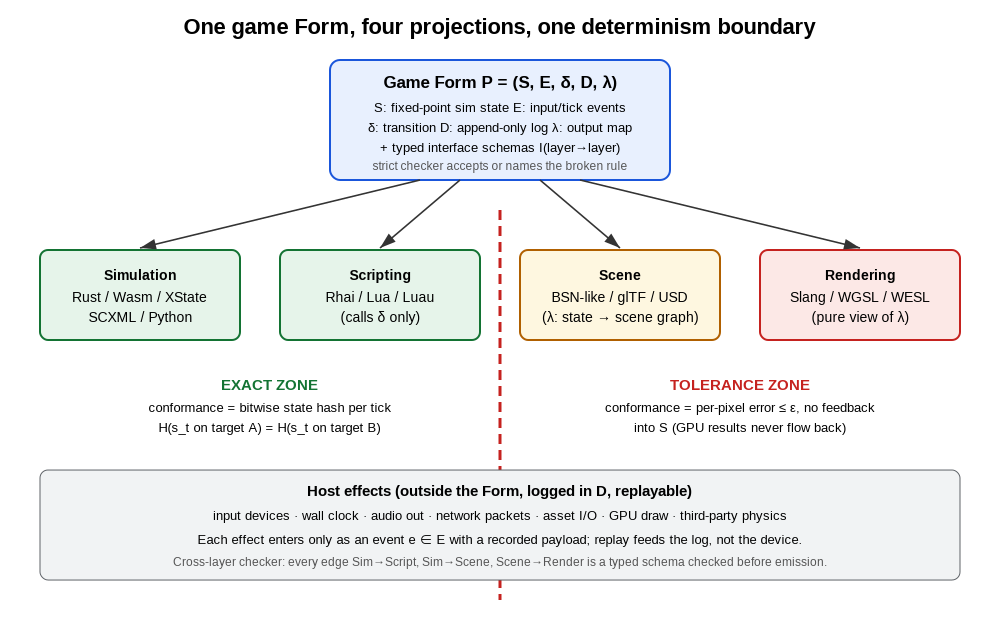
*Figure 1. Proposed split. One Form feeds four projections. Simulation and scripting sit in the exact zone, judged by per-tick state hashes. Scene and rendering sit in the tolerance zone, judged by per-pixel error. Host effects enter only as logged events.*
*Figure 2. Coverage of existing representations, scored only from the documents read for this study. Green: documented capability. Amber: partial. Grey: absent or undocumented. The rightmost column, cross-layer checking, is nearly empty.*
## 1. Terms, notation, and the idea under test
RCE, IR, ECS, FSM, SDF, AST, DAG, LCG: Reality Code Engine [same house], intermediate representation, entity component system, finite-state machine, signed distance field, abstract syntax tree, directed acyclic graph, and linear congruential generator
CPU, GPU, ISA, ISAs, SIMD, AVX2, NEON, SFU, ROP, RPL, TGL: central processing unit, graphics processing unit, instruction set architecture(s), single instruction multiple data, Advanced Vector Extensions 2, Arm Advanced SIMD, special function unit, raster operations pipeline, Intel Raptor Lake mobile architecture, and Intel Tiger Lake mobile architecture
IEEE, FMA, VFMADD, VFNMADD, FMADD, FMSUB, ULP, LSB, SHA, MAE, RMSE, PSNR, SSIM, SD, OLS, CI, TP, FP, FN, TN, RGBA8: Institute of Electrical and Electronics Engineers (as in IEEE 754 floating-point), fused multiply-add, x86_64 vector fused multiply-add and negated multiply-add opcodes, AArch64 scalar fused multiply-add and multiply-subtract opcodes, unit in the last place, least significant bit, Secure Hash Algorithm (`SHA-256`), mean absolute error, root mean squared error, peak signal-to-noise ratio, structural similarity index, standard deviation, ordinary least squares, confidence interval, true positive, false positive, false negative, true negative, and 8-bit-per-channel red-green-blue-alpha framebuffer format
RADV, ANV, LLVM, GNU, GCC, MSVC, UCRT, NT, PE, OS, OSs, API, APIs, JIT, VM, SLOC, HUD, UI, SFX, LOS, AABB, HP, XP, AP, KB, MB, CRUD, NL, VLM, LLM, GFW, Xvfb, WebXR, WebMCP, URL, JSON, YAML, README, NTFS, CRLF, CS0246, RE, ENGINE, DFU: Mesa Radeon Vulkan driver, Mesa Intel Vulkan driver, Low Level Virtual Machine compiler infrastructure, GNU's Not Unix project, GNU Compiler Collection, Microsoft Visual C++ compiler (`cl.exe`), Windows Universal C Runtime (`ucrtbase.dll`), Windows New Technology kernel (`Windows NT`), Windows Portable Executable, operating system(s), application programming interface(s), just-in-time compiler, virtual machine, non-comment non-blank source lines of code, heads-up display, user interface, sound effects, line of sight, axis-aligned bounding box, hit points, experience points, action points, kilobytes, megabytes, create/read/update/delete operations, natural language, vision-language model, large language model, Great Firewall network filter, X virtual framebuffer display server, Web Extended Reality API, Web Model Context Protocol, Uniform Resource Locator, JavaScript Object Notation, YAML Ain't Markup Language, repository README documentation file, New Technology File System, carriage-return line-feed sequence, C# compiler missing-type diagnostic CS0246, Capcom RE ENGINE ("Reach for the Moon" / "RE neXt" engine branding), and Dagstuhl Follow-Ups DOI prefix
SCXML, GDL, VGDL, BSN, BSL, MLIR, ACID, GGPO, glTF, OpenUSD, USD, LAN, AI, CIG: State Chart XML, Game Description Language, Video Game Description Language, Bevy Scene Notation, Boldsea Semantic Language, Multi-Level Intermediate Representation, atomic/consistent/isolated/durable transactions, Good Game Peace Out rollback networking library, Graphics Language Transmission Format (ISO/IEC 12113:2022), Open Universal Scene Description, Universal Scene Description, local area network, artificial intelligence, and Computational Intelligence and Games