Research paper agency
Thermodynamic Bounds and an Optimal Tempo for Goal-Holding Agents
Defines an agent as a system that holds a goal under an energy budget, derives physical bounds on how fast it can act per second and per joule, and reads intelligence as progress per joule on a completed run. Plain words: to count as an agent, a system must aim at a goal, act, and stay within an energy budget; physics sets a minimum energy cost for every decision; among systems that finish a job correctly, the one that used less energy ranks higher.
Universal Law of Agencyagencykinematic boundsoptimal tempo
Research paper gates
Metered Commit Gates: Energy-to-Correct-Completion for Agentic Systems
A gate that lets a machine act only after a check passes, and a cascade that tries the cheapest method first, with software results and one board-level energy reading (11,428 pJ per gate cycle, whole module, KV260). Plain words: do not take an action that cannot be undone until a check says it is safe; try the cheapest way first; write every decision down with its energy.
commit gateenergy to correct completionNotational IntelligenceMixture of Limits
Economics paper satiation
Task Satiation vs. Aggregate Rebound in AI Demand
Defines the stop at which more machine work on a finished task adds nothing, and separates it from growth in total demand. Plain words: every job has a finish line; cheaper work can still create more jobs; AI prices fall but its electricity is never free.
satiationtask completionreboundJevons
Research paper rce
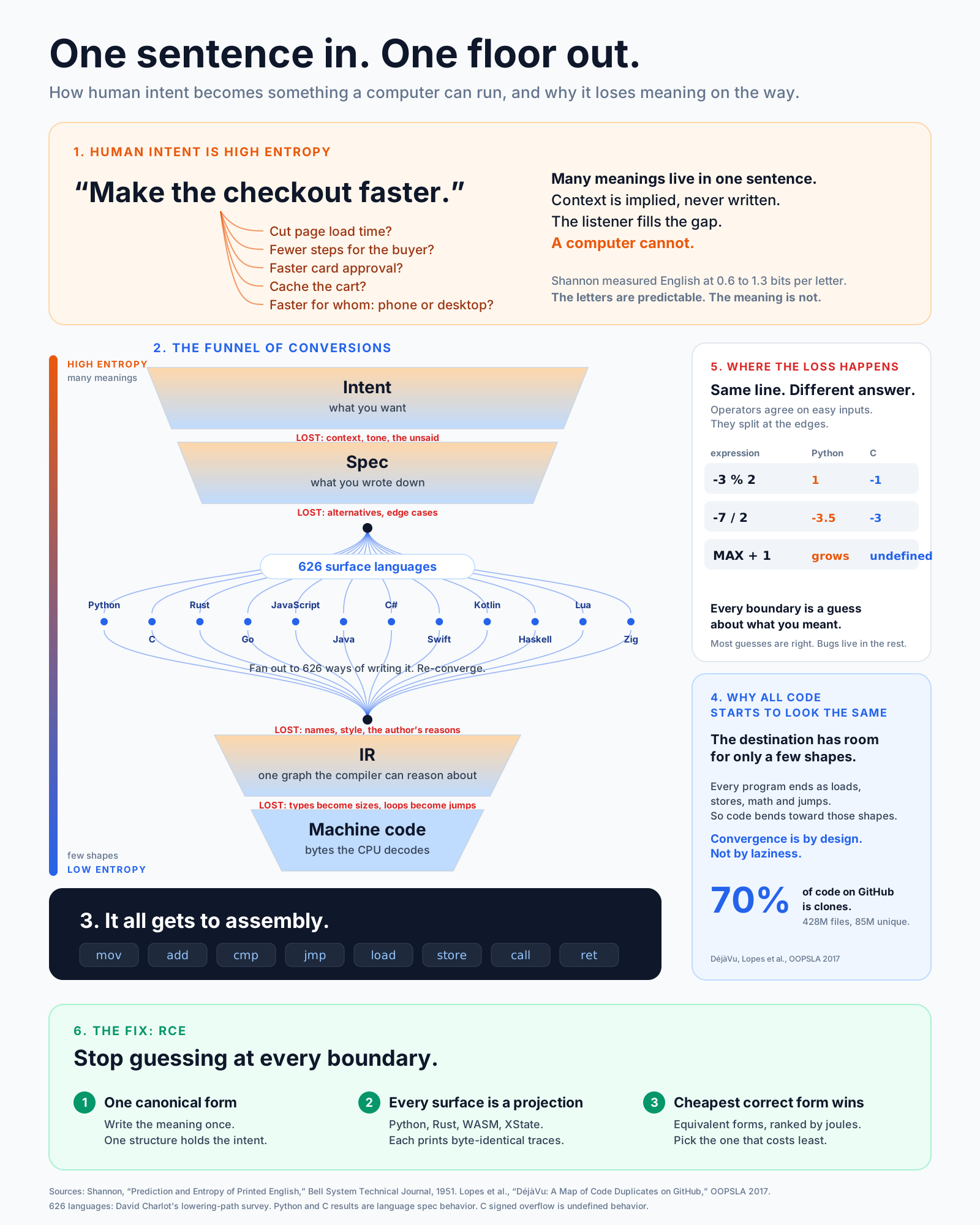
The Reality Code Engine: One Lossless Form for Native, Verified, Low-Energy Programming
A system in which a program is written once as a state machine and code in other languages is generated from it, with measurements on 10,000 Forms and public bug datasets and falsifiers fixed in advance. Plain words: write a program once and generate it in many languages; reject broken input at the door; save checked fixes so the same problem is not paid for twice.
Reality Code EngineRCEprogram form and fitAbstract State Machine
Research paper rce-jepa
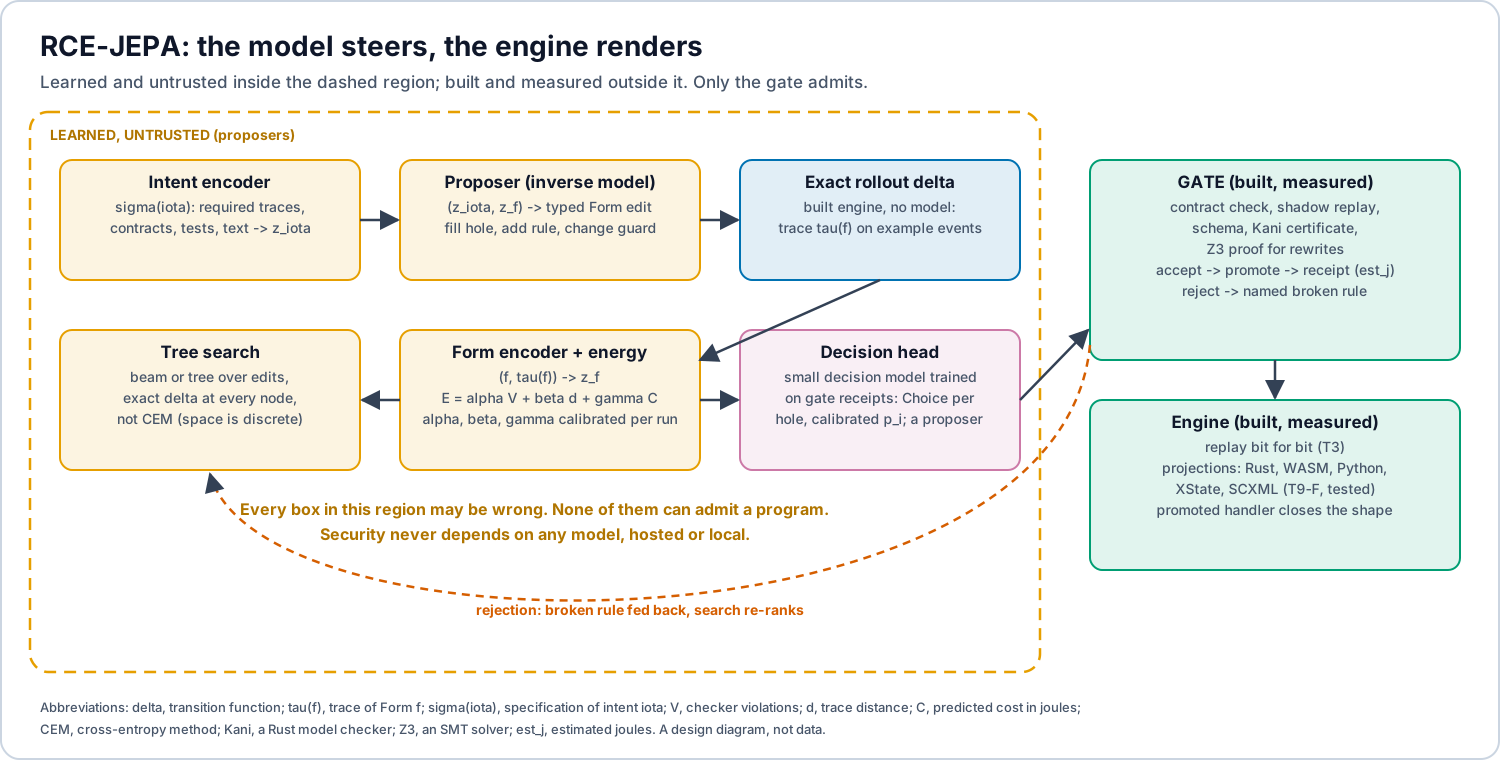
RCE-JEPA: Autonomous Deterministic Coding using Latent Space
RCE is the Reality Code Engine, a deterministic programming system in which every program has one fixed, checkable shape. JEPA is a Joint Embedding Predictive Architecture, a kind of learned model that predicts a compact summary of the answer instead of writing the answer out word by word. Latent space is the space of those learned summaries: a list of numbers that keeps what matters about a program and drops surface detail. This topic asks whether software can be written autonomously by having a learned model propose programs in that closed, deterministic shape while a deterministic checker, not the model, decides what is accepted, with the best performance per clock cycle and per joule as the goal. Its thesis is that coding today resembles mechanics before Newton, rich in observation and craft but without rules that predict behaviour and cost in advance, and that a finite, deterministic, compressed program form makes such rules possible to state and test.
RCE-JEPAReality Code Enginejoint embedding predictive architecturelatent space
Research study game-engines
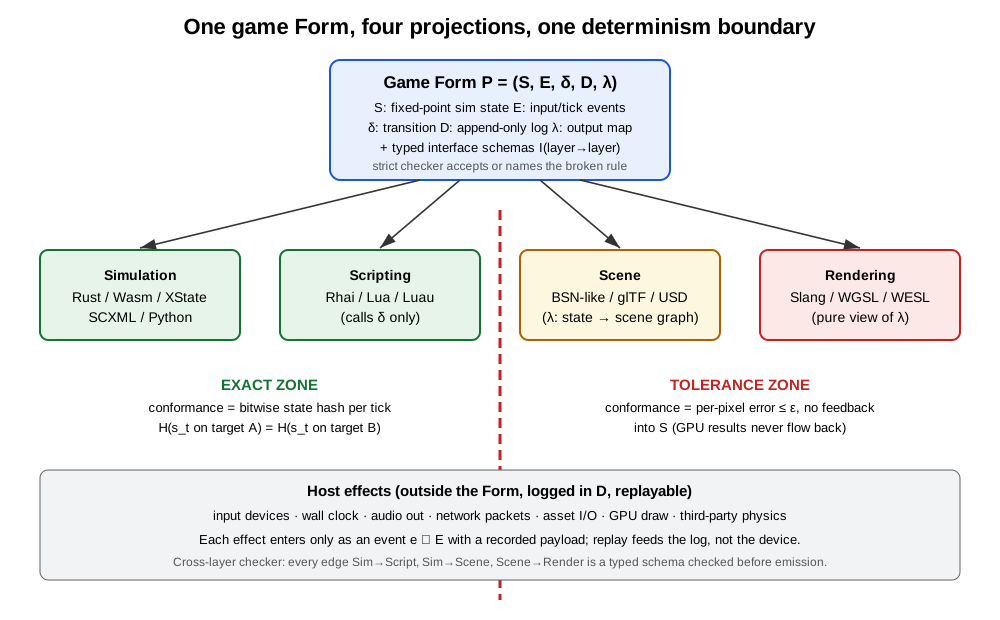
Writing a Game Once and Running It Everywhere: Where Exact Replay Ends and Tolerance Begins
Asks whether a game can be written once as a checked state machine and projected into several engines and languages, with an IR table, a layer split (simulation, scripting, scene, rendering), a determinism boundary, a falsifier-first test plan on public benchmarks, and infeasibility flags. Plain words: game rules can be replayed exactly if the arithmetic is pinned down; pictures cannot be identical on every graphics card but can be checked within a measured error; the seams between layers are where checking is missing.
game enginesstate machinesdeterminismfloating-point reproducibility
Research paper three-body
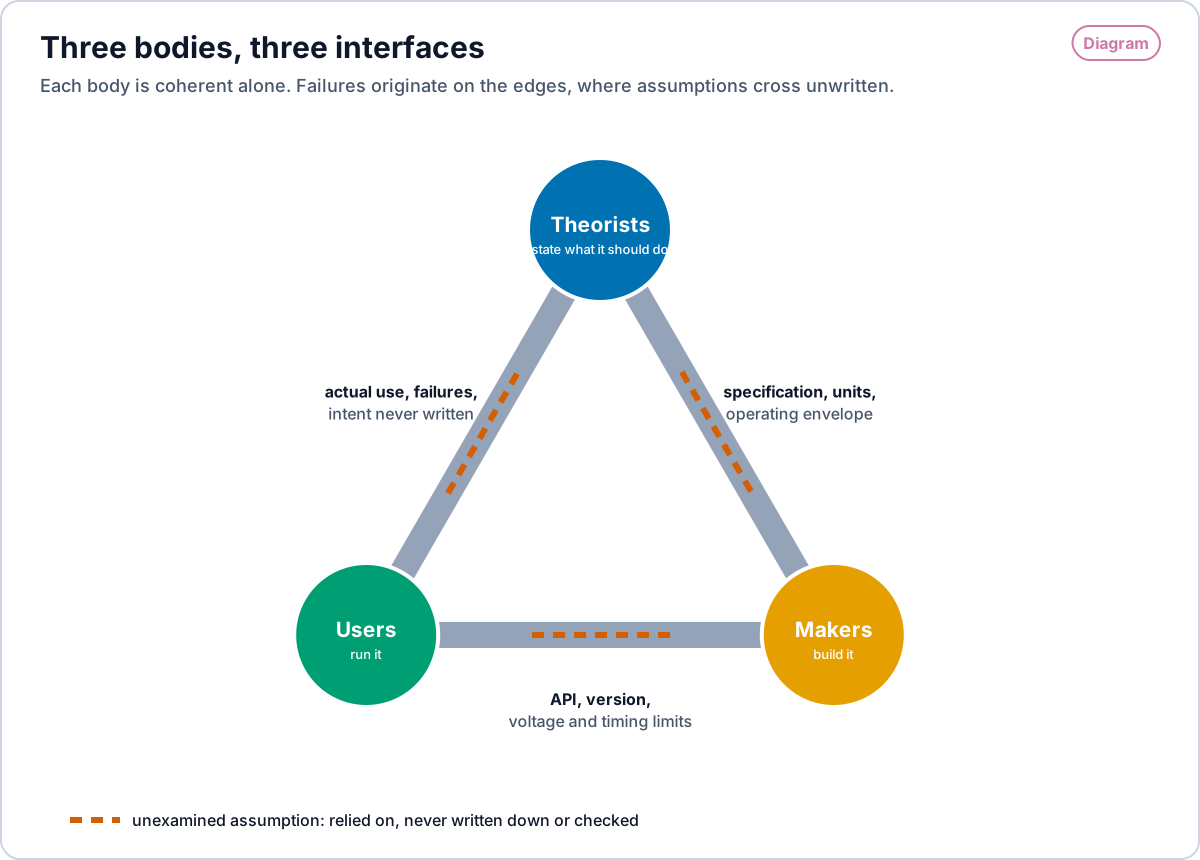
The Pursuit of AGI Resolves the Three-Body Problem in Computing
Locates many computing failures at handoffs between the people who specify, build and use systems, states when checking every handoff assumption makes a stack stable, and supports it with independently tested verified systems (CompCert, seL4, TLA+ at AWS, unit types). Plain words: most big failures happen at handoffs; the cause is usually an unwritten guess; if every guess is written down and machine-checked, a fix stays fixed.
three-body probleminterfacesinterface assumptionssystems integration
Research topic (work in progress) ai-reads-human
"AI" Reads Human: Human Language Encoding at Machine Speed and the Energy Cost
Software agents exchange data in formats made for people to read. This topic names the extra work that causes (the impedance tax), defines it with units, and reports parse time and token counts on a reproducible 20,000-record corpus, with a table of format hazards from cited specifications and tests. No joules were measured; model energy figures are other authors' measurements. Plain words: people and computers share one written format, and the computer pays extra to read it; on our test data YAML took about 735 times as long as a fixed binary layout and about 2.2 times the tokens of CSV; energy is the next measurement and is not yet claimed.
human-readable formatsimpedance taxtokensparse time
History essay spellcheck
Spell Check is Global: The Future of Computer Intelligence in the Hands of the Many (7B+), Not the Few
Documents with dated prices how spell check went from a premium product to a free built-in feature, and explains it by marginal cost and bundling. Plain words: spell check used to cost a lot and is now free; it became free because it costs almost nothing to run and is most useful inside tools people have; other computer skills can follow.
spell checkhistory of computingbundlingglobal access
Economics essay ai-coding-market
The Promised Trillion Dollar AI-Coding Market
Lists who projects a trillion-dollar AI coding market, labels each number by kind, and names the shared assumptions about energy, tokens and reuse, with testable propositions. Plain words: the big numbers are mostly forecasts; they assume a large model is paid for every piece of code forever; reuse would lower the cost of repeated work toward the cost of electricity.
economics of AIAI codingone-direction assumptionmarginal cost
Economics essay interface-economics
The Price of the Unexamined Interface
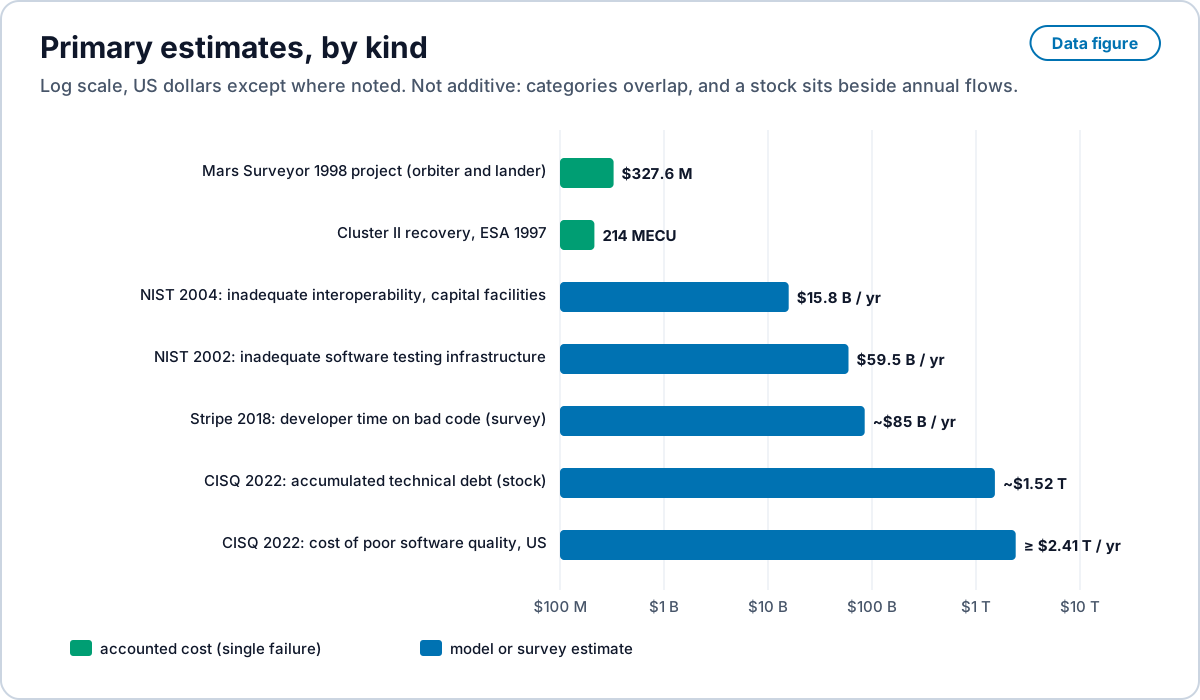
Published costs of failures at handoffs, labeled as accounted costs, model estimates or survey estimates and never added into one total. Plain words: some handoff failures have exact price tags; national totals are estimates; checking assumptions is cheap but the one who does it pays while everyone benefits.
economics of interfacesintegration failuretechnical debtinteroperability
Research study latency
The Gap Between Possible and Deployed: A Cadence Model of Computer Intelligence and the Forcing Function of Automation Tools
A dated survey of methods that lower the cost of computer intelligence, evidence on the gap between publication and deployment, and a cadence model in which reporting and funding calendars quantize release decisions, with a forcing-function result for tools that lower the cost of automation. It adds what public filings document about capital flows among labs, clouds and chip makers with a closed-loop test, a cost model in dollars and joules per task, open methods and alternative hardware measured against the incumbent stack, and maps of compute, power and models. Plain words: cheaper methods are published long before most products use them; most of what a task costs is the machine and not the electricity; part of the wait is engineering and part is calendars; once the work is cheap, what is left to charge for is the cost of switching away.
technology diffusionadoption lagcadence modelforcing function