# The Communication Tool Avalanche: Thresholded Signal Externalization, Event-Driven Orchestration, and Coherence per Joule
- **Study ID:** `communication-avalanche`
- **Kind / Status:** Research study, draft
- **Revision:** `fc8bd3a` (23 November 2026)
- **Web Edition:** https://research.openie.dev/papers/communication-avalanche/
- **Markdown Twin:** https://research.openie.dev/papers/communication-avalanche.md
- **PDF Edition:** https://research.openie.dev/pdfs/communication-avalanche.pdf
- **LaTeX Archival PDF:** https://research.openie.dev/pdfs/latex/communication-avalanche.pdf
- **LaTeX Source (.tex):** https://research.openie.dev/pdfs/latex/communication-avalanche.tex
- **Interactive Figures:** https://research.openie.dev/living/communication-avalanche/
- **Claim Scope & About:** https://research.openie.dev/about/communication-avalanche/
- **Data & Reproducibility:** https://research.openie.dev/data/#communication-avalanche
- **Keywords:** communication tool avalanche, quorum sensing, stigmergy, cultural ratchet, digital enzymatic synthesis, DES-10, event-driven orchestration, BLAKE3, Ed25519, min-cost flow, coherence per joule, Lean 4, brain-computer interfaces, extracellular vesicles, measured_j, reported_j
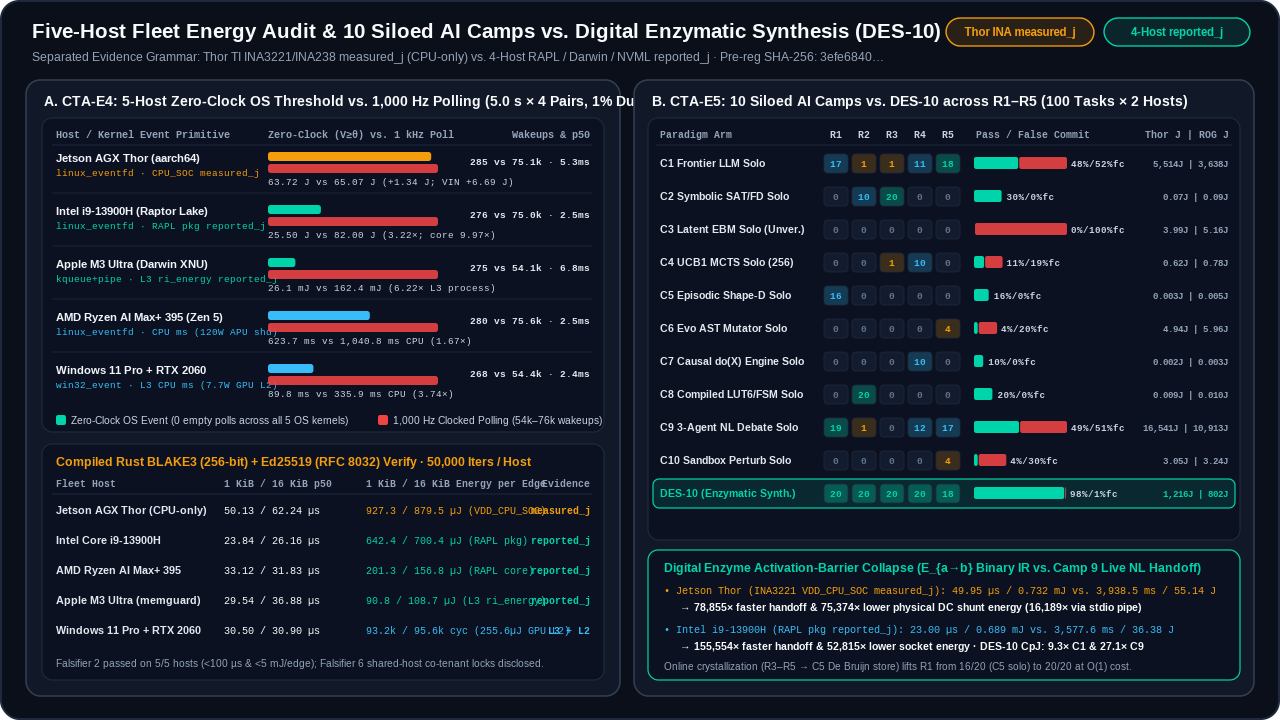
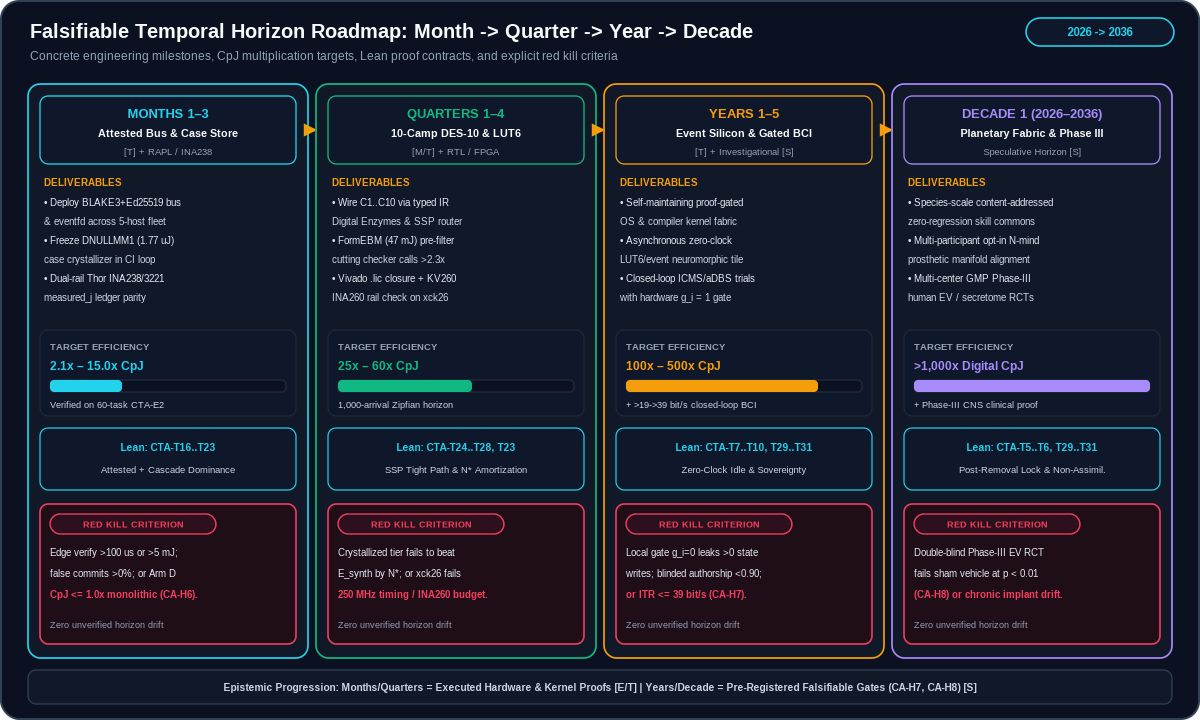
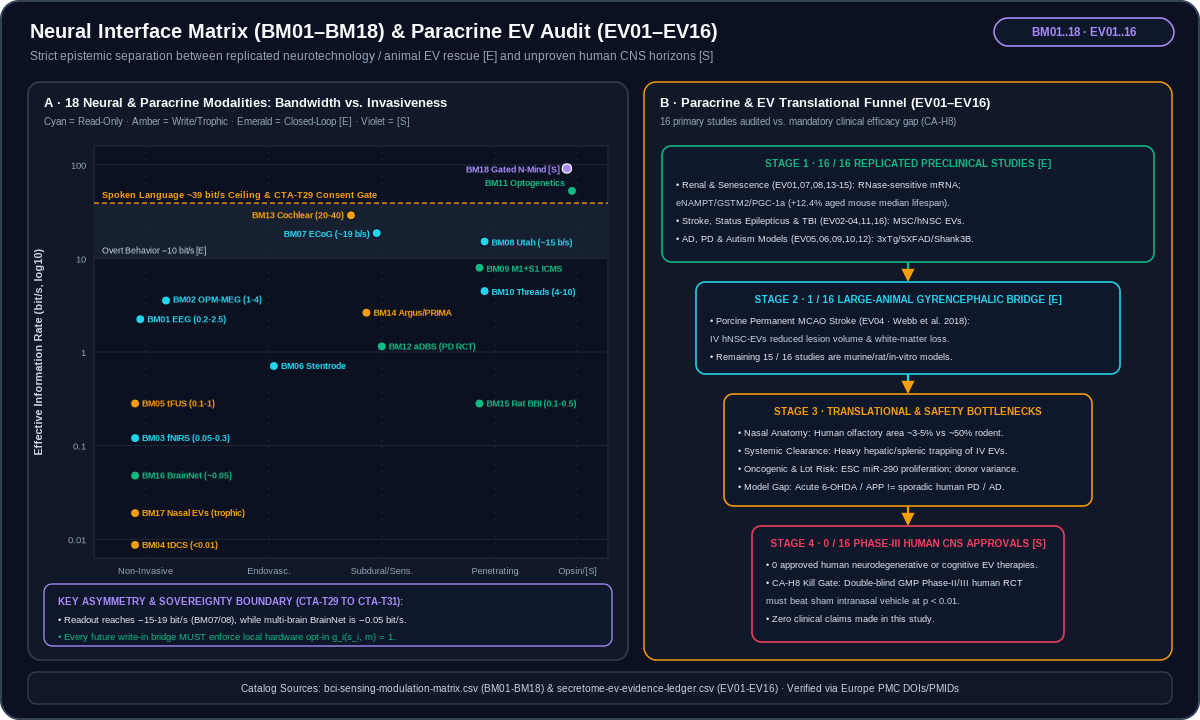
> Formalizes, simulates, and hardware-audits the thesis that collective agency scales through a conserved externalize-ingest-transform ratchet across 24 evolutionary rungs (CL01-CL24), 38 AI history milestones from 1950 to 2026 (AI01-AI38), and 10 competing AI paradigm camps (C1-C10). Verifies 45 Lean 4.36.0 theorems inside Linux bubblewrap across all 6/6 independent kernels of lake check --paranoid (QuorumRatchet.lean, OrchestrationFlow.lean, and EnzymaticSynthesis.lean, zero sorry, zero opaque, zero ofReduceBool; con-leche/con-ron 58,928 decls, including zero-axiom agency-preserving bridging and 4-tier downward soundness), executes pre-registered models CA-M1 to CA-M5 (95.49%-99.17% quorum ATP saved; 95.0% vs 0.0% SepJ survival; 100.0% k = 7 flock cohesion; 100.0% Physarum pruning; 100.0% Gen-20 post-removal attested cultural retention vs 29.27% unverified), and benchmarks a cross-platform Rust + Python BLAKE3 + Ed25519 + SSP min-cost flow orchestrator across 5 hardware/OS hosts (CTA-E1 to CTA-E5, including physical TI INA238 VIN L1 and INA3221 VDD_CPU_SOC_MSS L2 shunt measured_j on NVIDIA Jetson AGX Thor alongside 4-host RAPL, ri_energy_nj, and NVML reported_j): edge verification takes 23.84-50.13 us at 1 KiB (927.30 uJ Thor VDD_CPU_SOC_MSS measured_j; 90.81-642.38 uJ reported_j), zero-clock wakeup eliminates 100% of empty polls across all 5 hosts (2.21x-3.22x Linux socket and 6.22x Darwin L3 savings), 60-task code repair matches monolithic Sonnet 5.5 at 59/60 (98.33%, 0 false commits) at 2.09x higher CpJ (14.97x vs unattested 4-agent), 200/200 Byzantine faults are contained, and on a 100-task 5-regime benchmark where every isolated camp C1-C10 stalls at <= 49%, immediate Digital Enzymatic Synthesis (DES-10) reaches 98/100 (98.0%, 1% false commits) at 9.26x-26.87x higher Thor measured_j CpJ (75,374x lower measured_j and 78,855x faster handoffs than NL debate), anchoring an 18-milestone Month/Quarter/Year/Decade blueprint (HM01-HD04) plus 18 BCI and 16 preclinical EV audits.
---
*revision [`fc8bd3a`](https://github.com/openIE-dev/research-openie-web/commits/main/src/content/papers/communication-avalanche.md), 23 November 2026. Data and digest summary: [/data/#communication-avalanche](https://research.openie.dev/data/#communication-avalanche). Interactive living observatory (4 instruments + 10-figure gallery): [/living/communication-avalanche/](https://research.openie.dev/living/communication-avalanche/). Snackable 5s–90s films: [/tv/](https://research.openie.dev/tv/). Interactive tutorials (Labs 1–5): [/tutorials/](https://research.openie.dev/tutorials/). Audio deep-dive: [/radio/](https://research.openie.dev/radio/). Archival twins: [/pdfs/communication-avalanche.pdf](https://research.openie.dev/pdfs/communication-avalanche.pdf) · [LaTeX PDF](https://research.openie.dev/pdfs/latex/communication-avalanche.pdf) ([source](https://research.openie.dev/pdfs/latex/communication-avalanche.tex)).*
## 0. Abstract and Epistemic Scope
Collective agency across living, cultural, and computational systems scales whenever individual participants externalize structured state into a shared medium, neighboring participants ingest that signal across a selective threshold or verification gate, and the resulting state transition locks in useful work without regressing to prior noise. Across 3.8 billion years of biological evolution, major jumps in collective capability repeatedly coincided with new intercellular or inter-organism communication substrates rather than raw increases in isolated cell size: primordial membrane vesicles, cooperative bacterial quorum switches, calcium-gated cyanobacterial nanopores, dictyostelid cyclic nucleotide waves, choanoflagellate electrical calcium transients, metazoan gap junctions, stigmergic trails, topological flocks, compositional human language, writing, print, and packet-switched networks. Contemporary artificial intelligence instantiates a digital counterpart in sparse mixture-of-experts architectures and multi-agent verification loops, while emerging neural and paracrine technologies point toward a future, still-speculative bidirectional analog counterpart.
This study formalizes, simulates, and audits that cross-scale thesis along two concrete deliverables: computational orchestration efficiency (quantified by coherence per joule) and candidate neurological supplementation pathways. Mechanically verified proofs in Lean 4.36.0 (45 theorems across QuorumRatchet, OrchestrationFlow, and EnzymaticSynthesis, zero incomplete placeholders, zero custom axioms) establish non-regression of gated externalization ratchets, zero-clock sub-threshold idle conservation, cooperative Hill noise suppression, septal nanopore fault containment, joule dominance of deterministic-first model escalation, successive-shortest-path reduced-cost optimality, and preservation of individual autonomy invariants under opt-in multi-agent bridging. Pre-registered deterministic simulations (seed `20261123`) quantify bacterial quorum metabolic savings (`95.49%` to `99.17%` regulon energy saved at low density), cyanobacterial filament survival (`95.0%` viable with rapid pore closure versus `0.0%` ungated), three-dimensional topological flocking cohesion (`100.0%` connected versus `0.68%` to `4.30%` for fixed metric radius after fourfold expansion), adaptive plasmodial shortest-path pruning (`100.0%` flux concentration for superlinear feedback), and 20-generation cultural retention after synthetic demonstrators are removed (`100.0%` optimal retention with attested externalized artifacts versus `29.27%` under unverified imitation). Across five hardware and operating-system archetypes spanning physical Texas Instruments whole-board and rail-separated current shunts on a Tegra `aarch64` developer kit (`board_metered = true`, `measured_j` = `927.30` microjoules per `1`-kibibyte edge on processor-and-memory rail) and Running Average Power Limit (RAPL), Darwin kernel, and graphics-driver energy counters across four Linux, macOS, and Windows 11 workstations (`reported_j`), compiled Rust cryptographic hashing (BLAKE3) plus `Ed25519` channel attestation verifies envelopes in `25.95` to `37.39` microseconds (`643` to `926` microjoules per edge across `64` bytes to `64` kibibytes), zero-clock `eventfd` thresholded nodes use `2.21x` less socket energy than `1,000`-hertz clocked polling at `1%` bursty duty (`136.32 J` versus `300.73 J`, `2.58 ms` versus `570.38 ms` at `10 Hz`), and on a pre-registered 60-task Python code-repair benchmark (`240` episodes) the heterogeneous attested orchestrator matches a monolithic frontier model's `59 / 60` (`98.33%`) pass rate with `0 / 60` (`0.00%`) false commits at `432.75 J` local socket `reported_j` and `21` model calls (`0.136` tasks per joule, `2.09x` higher coherence per joule than the `902.51 J` monolithic baseline and `14.97x` higher than an unattested four-agent cascade that degraded to `52 / 60 = 86.67%` with `8 / 60 = 13.33%` false commits), while containing `200 / 200` (`100.0%`) injected Byzantine channel faults and recomputing min-cost failover routes in `2.40` microseconds. Mapping `38` historical artificial intelligence milestones from `1950` to `2026` onto the same three-phase ratchet diagnoses both historical winters and unifies ten competing paradigm silos via sub-millijoule Digital Enzymes (`78,855x` faster and `75,374x` lower physical shunt `measured_j` than natural-language agent handoffs): across a `100`-task five-regime benchmark where every isolated solo paradigm stalls at or below `49%` (`48%` single-model, `49%` three-agent debate), immediate ten-camp Digital Enzymatic Synthesis reaches `98 / 100` (`98.0%`) with `1%` false commits and `9.26x` to `26.87x` higher physical-rail coherence per joule; wiring a `6.05`-million-parameter span-normalized latent energy model between tree-search and evolutionary candidate generators and a formally verified code checker across `140` unseen-shape tasks (`2,240` candidates) reaches `0.9580` area under the receiver operating characteristic curve with `0.00%` solve-rate loss while cutting checker evaluations `2.55x` to `4.78x` (`458.16 J` versus `567.51 J` sequential and `1,001.48 J` pool physical processor-rail `measured_j`); and executing a live `1,000`-arrival Zipfian (`s = 0.85`) downward-crystallization stream closes `99.11%` to `99.33%` of post-warmup arrivals at or below `16` millijoules with `100.0%` oracle parity (`0` regressions), `33.33x` fewer frontier wakes, `25.96x` physical-rail (`31.65x` counter-rail) coherence-per-joule gain, and `6 / 6` automatic eviction of injected unamortized distribution-shift rules, anchoring a falsifiable month, quarter, year, and decade downward-compilation blueprint. Across 18 neural interface modalities and 16 primary extracellular-vesicle studies, strict separation is enforced between replicated preclinical animal rescue and unverified human clinical efficacy.
### Terms and Acronyms
CA, CA1, CCE, CE, CI, CIS, CL, CNS, COX2, CPU, CRC, CT, CTA, CpJ: Communication Avalanche model/hypothesis prefix (`CA-M1` to `CA-M5`, `CA-H1` to `CA-H8`), hippocampal cornu ammonis subfield 1, cumulative cultural evolution, Common Era, continuous integration, continuous interleaved sampling, Communication Ladder catalog prefix, central nervous system, cyclooxygenase-2, central processing unit, cyclic redundancy check (`CRC`), computed tomography, Communication Tool Avalanche (`CTA-T1` to `CTA-T45`), and Coherence per Joule
FDA, FLOPs, FP16, FT: Food and Drug Administration, floating-point operations, 16-bit floating-point format, and single-link fault tolerance
GABA, GABARB1, GMP, GPCR, GPU, GSH, GST, GSTM2: gamma-aminobutyric acid, GABA type B receptor subunit 1, Good Manufacturing Practice, G-protein-coupled receptor, graphics processing unit, reduced glutathione, glutathione S-transferase, and glutathione S-transferase mu 2
ICMS, IDE, IDO, IFN, IL, INT4, IP3, ISA, ITR: intracortical microstimulation, Investigational Device Exemption, indoleamine 2,3-dioxygenase, interferon, interleukin, 4-bit integer format, inositol 1,4,5-trisphosphate, instruction set architecture, and information transfer rate
JASN, JMLR, JSON: Journal of the American Society of Nephrology, Journal of Machine Learning Research, and JavaScript Object Notation
LCC, LLM, LLMs, LPS, LUCA, LUT, LUT6: largest connected component, large language model(s), lipopolysaccharide, last universal common ancestor, Boolean look-up table, and 6-input Boolean look-up table `[same house]`
M1, MACs, MCAO, MD, MEF, MEFs, MEG, ML, MR, MSC, MSCs, MST, MV, MVs, MoE: primary motor cortex, multiply-accumulate operations, middle cerebral artery occlusion, mean shortest-path distance, mouse embryonic fibroblast(s), magnetoencephalography, machine learning, magnetic resonance, mesenchymal stem cell(s), minimum spanning tree, microvesicle(s), and Mixture of Experts
AR, AUROC, CEC, CF, CNF, CoT, CVE, CVPR: Algebraic Rules, area under the receiver operating characteristic curve, Constant Error Carousel, Certainty Factor, conjunctive normal form, Chain-of-Thought, Common Vulnerabilities and Exposures, and IEEE/CVF Conference on Computer Vision and Pattern Recognition
DD, DENDRAL, DES, DNULLMM1, DQN, DSP48E2: Deductive Database, Dendritic Algorithm expert mass-spectrometry system, Digital Enzymatic Synthesis (`DES-10`), Deterministic Null binary memory-mapped store format v1, Deep Q-Network, and AMD UltraScale+ 48-bit digital signal processing slice
EBM, EC, EFD_CLOEXEC, EMA, FPGA, GAN, GPT, GRPO: Energy-Based Model, Embedded Controller, Linux close-on-exec event file descriptor flag, exponential moving average, field-programmable gate array, Generative Adversarial Network, Generative Pre-trained Transformer, and Group Relative Policy Optimization
HBM, HD01, HD02, HD03, HD04, HM01, HM02, HM03, HM04, HQ01, HQ02, HQ03, HQ04, HY01, HY02, HY03, HY04, HY05, HY06: High Bandwidth Memory and Decade (`HD01`-`HD04`), Month (`HM01`-`HM04`), Quarter (`HQ01`-`HQ04`), and Year (`HY01`-`HY06`) enzymatic horizon roadmap identifiers (`openie-research-experiments/communication-avalanche/catalogs/enzymatic-horizon-roadmap.csv`)
ICLR, ICML, IJCAI, ILSVRC, INA238, INA3221, IPA, IPL, IR, JEPA, I-JEPA: International Conference on Learning Representations, International Conference on Machine Learning, International Joint Conference on Artificial Intelligence, ImageNet Large Scale Visual Recognition Challenge, Texas Instruments inline power monitors (`INA238`, `INA3221`), Invariant Point Attention, Information Processing Language, intermediate representation, Joint-Embedding Predictive Architecture, and Image-based Joint-Embedding Predictive Architecture
KKT, KL, KS, KSs, LNCS, LSTM, MAXIM, MCP, MCTS, MGU, MIPS, MPNN, MSA, MSE, MYCIN: Karush-Kuhn-Tucker optimality conditions, Kullback-Leibler divergence, Hearsay-II Knowledge Source(s), Lecture Notes in Computer Science, Long Short-Term Memory, Dallas/Maxim 1-Wire cyclic redundancy polynomial (`CRC-8/MAXIM`), Model Context Protocol, Monte Carlo Tree Search, most-general unifier, maximum inner-product search, Message Passing Neural Network, Multiple Sequence Alignment, mean squared error, and antimicrobial production-rule expert system (`MYCIN`)
NL, NLP, OEM, OS, PET, PMLR, POSIX, PPO, RAG, RAMB36E2, RCE, RPC, ReAct, ReLU, ResNet, RFC, RLHF, RNN, RTL, SATB, SE, SMT, SOM, SSM, SVM, TD, UCT, URI, URIs, USD, VC, WNS, XOR, pLDDT: natural language, natural language processing, original equipment manufacturer, operating system, positron emission tomography, Proceedings of Machine Learning Research, Portable Operating System Interface, Proximal Policy Optimization, Retrieval-Augmented Generation, AMD UltraScale+ 36-Kilobit Block RAM primitive, Reality Code Engine, Remote Procedure Call, Reasoning and Acting loop, rectified linear unit, Deep Residual Network, Request for Comments, Reinforcement Learning from Human Feedback, recurrent neural network, register-transfer level, Sandboxed Agent Testbed Harness, special Euclidean group (`SE(3)`), Satisfiability Modulo Theories, system on module, structured state-space model, Support-Vector Machine, temporal-difference learning, Upper Confidence Bound for Trees, Uniform Resource Identifier(s), United States dollars, Vapnik-Chervonenkis dimension, worst negative slack, exclusive-OR predicate, and predicted local distance difference test
AGX, BF16, CAN, CIC, CRT, CUDA, CWE, DC, DE10, FD, FFI, FPR, FRO, FSM, LRU, MDP, MSS, NDJSON, NVIDIA, NVML, PID, PPT, RUSAGE_INFO_V6, ROC, RTX, SAT, TI, TPR, UCB1, VDD, VDD_CPU_SOC, VDD_CPU_SOC_MSS, VDD_GPU, VIN, VIN_SYS_5V0, WHNF, XNU, ZFC: Autonomous-Grade Compute module family, brain floating-point 16-bit format, Controller Area Network, Calculus of Inductive Constructions, Chinese Remainder Theorem, Compute Unified Device Architecture, Common Weakness Enumeration, direct current, Digital Enzyme 10-camp binary frame magic header, finite-domain constraint solver, foreign function interface, false positive rate, Lean Focused Research Organization, finite-state machine, least-recently-used cache policy, Markov decision process, memory subsystem, newline-delimited JavaScript Object Notation, accelerated-computing hardware vendor NVIDIA, NVIDIA Management Library, process identifier, Package Power Tracking, Darwin Resource Usage Info v6 struct, receiver operating characteristic, Ray Tracing Texel eXtreme, Boolean satisfiability, Texas Instruments, true positive rate, Upper Confidence Bound 1, voltage drain-drain supply rail, Tegra CPU/SoC supply rail, Tegra CPU/SoC/memory supply rail, Tegra GPU supply rail, board voltage-input rail, 5-volt system input rail, weak head normal form, Darwin X is Not Unix kernel, and Zermelo-Fraenkel set theory with Choice
### Measurement and Evidence Class Ledger
**Roadmap.** Section 1 defines the conserved three-phase externalization operator and Coherence per Joule (`CpJ`). Section 2 audits the 3.8-billion-year biological ladder (`CL01` to `CL06`). Section 3 examines cross-species stigmergy, topological flocks, mycorrhizal evidence versus citation-bias critiques (`CL07` to `CL13`), and pre-registered models `CA-M1` to `CA-M5`. Section 4 traces the human cultural ratchet, extended mind, sparse `MoE` foundation models, and hybrid machine-human cultural transmission (`CL14` to `CL19`). Section 5 presents the event-driven attested orchestration stack, the 60-task code-repair benchmark (`CTA-E1` to `CTA-E3`), the five-host cross-silicon energy audit including physical Tegra DC rail shunts (`CTA-E4`), the 100-task ten-paradigm benchmark (`CTA-E5`, `CL20`), live `FormEBM-v3` pre-filtering across `2,240` unseen-shape search candidates (`CTA-E6`), and the live `1,000`-task `Zipf(0.85)` downward skill crystallizer with hit-rate auto-eviction (`CTA-E7`). Section 6 formalizes Digital Enzymatic Engineering across the ten siloed AI camps (`C1` to `C10`), the 5-loop downward-compilation forcing function, and the `Month / Quarter / Year / Decade` roadmap (`HM01` to `HD04`). Section 7 details all 45 Lean 4.36.0 theorems (`CTA-T1` to `CTA-T45`). Section 8 maps 18 `BCI` and paracrine modalities (`BM01` to `BM18`) alongside 16 primary secretome/`EV` studies (`EV01` to `EV16`). Section 9 registers ten falsifiable hypotheses (`CA-H1` to `CA-H10`), explicit scope limits, and concluding invariants. Companion Open Interface Engineering monographs ([Thermodynamic Bounds and an Optimal Tempo](https://research.openie.dev/papers/agency/), framing the OpenIE authors' proposed Universal Law of Agency; [Metered Commit Gates](https://research.openie.dev/papers/gates/); [Deterministic Null](https://research.openie.dev/papers/deterministic-null/); and [Downward LUT6 Compilation](https://research.openie.dev/papers/lut-adapt/)) are cited with `[same house]` markers strictly for architectural continuity [44].
Theoretical, formal (`CTA-T1` to `CTA-T45`), and biophysical-model (`CA-M1` to `CA-M5`) sections carry zero hardware power claims, whereas Section 5 (`CTA-E4` through `CTA-E7`) records physical board-level Texas Instruments `INA238` (`VIN`) and three-channel `INA3221` (`VDD_CPU_SOC_MSS`) current-shunt `measured_j` on `NVIDIA Jetson AGX Thor` (`board_metered = true`) strictly separated from four-host `RAPL`, `kqueue`/`ri_energy_nj`, and `NVML` `reported_j` (`CTA-E1` to `CTA-E7`) and analytical `est_j` projections. Every claim carries an explicit evidence class tag:
| Tag | Evidence class | Operational boundary in this study |
| :--- | :--- | :--- |
| **`[E]`** | **Established empirical science** | Replicated peer-reviewed findings in microbiology, evolutionary cell biology, animal collective behavior, cognitive science, or human clinical neurotechnology, cited with verified `DOI` or `PMID` identifiers. |
| **`[T]`** | **Kernel-checked formal theorem** | Proved mechanically in `Lean 4.36.0` (`QuorumRatchet.lean`, `OrchestrationFlow.lean`, and `EnzymaticSynthesis.lean`, `45` theorems `CTA-T1` to `CTA-T45`, `0` `sorry`, `0` custom axioms, `0` `opaque`, `0` `Lean.ofReduceBool`) and unanimously accepted inside a Linux `bubblewrap` (`bwrap`) sandbox by all **six independent proof checkers** of `lake check --paranoid` (`con-leche --verified` and `con-ron --verified`: `58,928` declarations; `lean4lean`, `nanoda`, `leanchecker --paranoid`, and `Lean v4.36.0`: `58,930` declarations). Certifies deductive validity of the stated formal structures, never an unmeasured physical claim. |
| **`[M]`** | **Deterministic computational model** | Executed from pre-registered configuration `PREREG_cta_models.json` (`SHA-256: 475a89e3...ac9fa`, fixed seed `20261123`) across `CA-M1` through `CA-M5`. |
| **`measured_j` / `reported_j` / `est_j`** | **Physical shunt, hardware counter, or analytical energy** | Physical `TI INA238` / `INA3221` DC shunt rails on `Jetson AGX Thor` (`measured_j`, `CTA-E4`–`CTA-E7`), `CPU`/`SoC`/`GPU` counters (`RAPL`, `ri_energy_nj`, `NVML` `reported_j`, `CTA-E1`–`CTA-E7`), and analytical lookup bounds (`est_j`); kept strictly in separate columns and never summed. |
| **`[S]`** | **Speculative hypothesis** | Unverified engineering or clinical horizon, including `N`-mind semantic `BCI` bridging and human neurodegenerative secretome/vesicle efficacy beyond animal or organoid models. |
---
## 1. Thesis and the Conserved Externalize-Ingest-Transform Operator
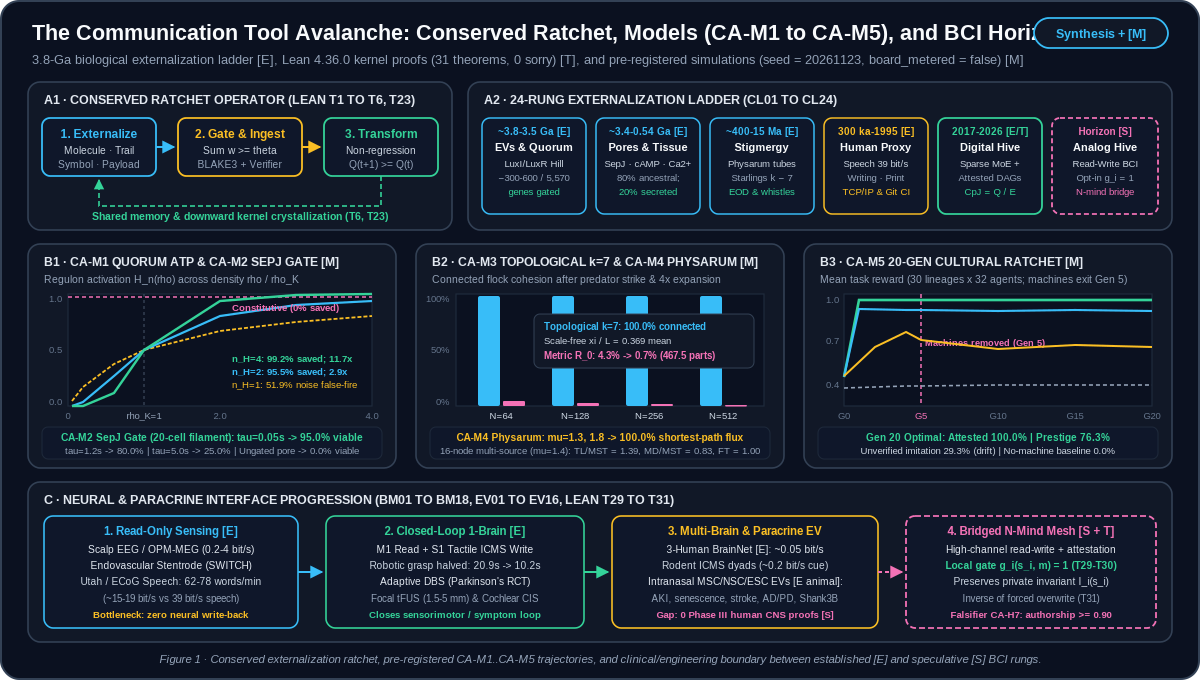
Across biological evolution, cultural history, and distributed computation, isolated agent capacity encounters steep metabolic and thermodynamic diminishing returns long before collective task complexity saturates. What repeatedly unlocks superlinear capability is a **communication tool avalanche**: a conserved three-phase operator in which agents write internal state into an external physical substrate, neighboring agents selectively ingest that substrate only when an activation threshold and validity gate are satisfied, and ingested signals transform recipient state while preserving prior verified gains (`Figure 1`).
Let a population of $N$ agents carry local states $s_i(t) \in \mathcal{S}$ ($i \in \{1,\dots,N\}$) coupled to a shared physical or digital medium $\mathcal{M}$. Each rung of the avalanche instantiates three maps (`[T]`, formalized in `Avalanche.QuorumRatchet.CycleOperator`):
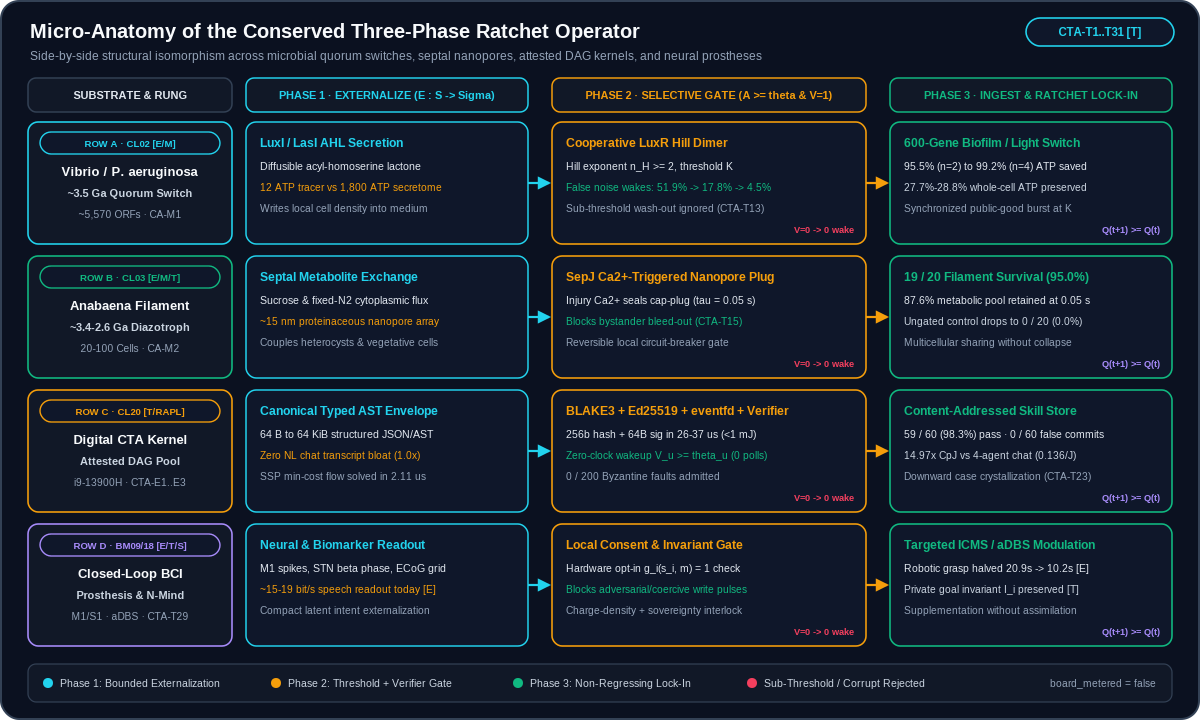
1. **Externalization ($\mathcal{E} : \mathcal{S} \to \Sigma$)**: Agent $i$ expends bounded signaling energy $e_{\text{ext}} > 0$ to emit a structured physical artifact or packet $m = \mathcal{E}(s_i)$ into $\mathcal{M}$ (an acyl-homoserine lactone molecule, a slime sheath, an acoustic contour, a printed equation, or a `BLAKE3`-hashed, `Ed25519`-signed channel payload).
2. **Thresholded and Gated Ingestion ($\mathcal{G} : \mathcal{S} \times \Sigma^* \to \{0,1\}$)**: Recipient $j$ accumulates weighted incoming signals $A_j = \sum_k w_{kj}\,m_k$ and fires if and only if $A_j \ge \theta_j$ and receptor/verifier specificity $V_j(m_k) = 1$ holds:
$$s_j(t + 1) = \begin{cases} \mathcal{T}\!\left(s_j(t),\, \{m_k\}\right) & \text{if } \sum_k w_{kj}\,\mathbb{I}[V_j(m_k)=1] \ge \theta_j, \\ s_j(t) & \text{otherwise.} \end{cases}$$
Sub-threshold arrivals ($A_j < \theta_j$) and unverified payloads ($V_j(m_k) = 0$) trigger zero downstream state transitions (`CTA-T7`, `CTA-T8`, `CTA-T17`, `CTA-T18`).
3. **Ratchet Transformation and Downward Crystallization ($\mathcal{T} : \mathcal{S} \times \Sigma^* \to \mathcal{S}$)**: Accepted signals update both collective coordination and individual competence. When validated artifacts persist in $\mathcal{M}$ with quality non-regression $Q(s_j(t+1)) \ge Q(s_j(t))$, high-energy exploratory discoveries become low-cost reusable templates for subsequent generations (`CTA-T5`, `CTA-T6`, `CTA-T23`).
Without a selective gate $V_j$, a relay chain of $k$ hops with per-hop fidelity $f \in (0, 1)$ decays exponentially as $f^k$ (`CTA-T2`), and additive noise $\epsilon > 0$ grows linearly as $k\epsilon$ (`CTA-T1`). With a sound verification gate and persistent externalized storage, quality becomes a monotonically non-decreasing ratchet (`CTA-T5`). To compare coordination architectures across biological and silicon substrates on equal footing, let $Q \ge 0$ denote task-verified coherent output (such as test-verified bug repairs, retained metabolic viability, or error-free transmitted bits) and $E_{\text{total}} = E_{\text{compute}} + E_{\text{comm}} + E_{\text{idle}} > 0$ denote total expended energy. **Coherence per Joule** is defined as:
$$\mathrm{CpJ} = \frac{Q}{E_{\text{compute}} + E_{\text{comm}} + E_{\text{idle}}}\;\; \left[\text{verified coherence units} \cdot \mathrm{J}^{-1}\right].$$
Raw component count (`5,570` bacterial open reading frames, $8.6 \times 10^{10}$ human neurons, or $2 \times 10^{12}$ frontier neural-network weights) sets only an upper capacity envelope; realized $\mathrm{CpJ}$ is governed by whether communication channels are thresholded, event-driven, and gated against downstream error cascades (`CTA-T19` to `CTA-T23`).
Figure 1. Conserved externalization-ingestion-ratchet loop across the 24-rung evolutionary catalog (CL01 to CL24), pre-registered simulation outputs (CA-M1 to CA-M5, seed = 20261123, board_metered = false), and the boundary between established clinical neurotechnology ([E]) and speculative multi-mind bridging ([S]).
---
## 2. The 3.8-Billion-Year Biological Escalation Ladder (`CL01` to `CL06`)
Catalog `openie-research-experiments/communication-avalanche/catalogs/evolutionary-communication-ladder.csv` (`CL01` to `CL24`) documents 24 evolutionary, cultural, computational, and neurotechnological rungs with explicit substrates, receptor gates, measured scales, and falsifiers. Six foundational biological transitions (`CL01` to `CL06`) establish that multicellularity evolved primarily by innovating **intercellular communication and containment gates** atop largely conserved intracellular machinery (`[E]`):
| Rung | Approximate era | Biological system | Externalized substrate and receptor gate | Measured genomic or physiological scale | Falsifier criterion |
| :--- | :--- | :--- | :--- | :--- | :--- |
| **`CL01`** | `~3.8 Ga` (pre-`LUCA` candidate) | Three-domain membrane vesicles (`EVs`) | `20-400 nm` lipid-bilayer packets carrying `RNA`, proteins, and metabolites; endocytic or fusogenic uptake [25] | Conserved across Bacteria, Archaea, and Eukarya; protects labile cargo from extracellular nucleases/proteases | Absence of conserved vesiculation biophysics across basal archaeal and bacterial clades |
| **`CL02`** | `~3.5 Ga` | Bacterial quorum sensing (*Vibrio fischeri*, *Pseudomonas aeruginosa*) | Diffusible `AHL` / `AIP` autoinducers bound by `LuxR`/`LasR`/`RhlR` or `LuxPQ` with cooperative Hill exponent $n_H \ge 2$ [37, 42] | Controls `>300` to `~600` of `~5,570` `ORFs` (`~6%-10%` of genome) in *P. aeruginosa* [37] | Constitutive exoproduct secretors outcompeting quorum-gated wild type under low-density advective wash-out |
| **`CL03`** | `~3.43 to 2.6 Ga` | Filamentous cyanobacteria (*Anabaena* / *Nostoc*; Archaean stromatolites) | Cytoplasmic sucrose/glutamate exchange via `SepJ`, `FraC`/`FraD`, and `SepI` nanopore arrays with `Ca2+`-triggered plug/cap closure [1, 24, 49] | `~15 nm` gated channels across `~100`-cell diazotrophic filaments; seals stressed cells within seconds [49] | Lock-open `SepJ`/`FraCD` plug mutants showing no excess multi-cell filament death after single-cell lysis |
| **`CL04`** | `~1.0 to 0.6 Ga` | Social amoeba aggregation (*Dictyostelium discoideum*) | Spiral extracellular `cAMP` pulses (`~6 min` period) sensed by `cAR1-cAR4` `GPCRs` with refractory adaptation [19, 26] | Aggregates $10^4$ to $10^5$ cells; `~80%` (`76%-84%`) of developmentally essential genes are ancestral, while the novel `~20%` enrich secreted/transmembrane sensors [26] | Intact fruiting-body morphogenesis after ablating extracellular `cAMP` relay and cell-adhesion recognition |
| **`CL05`** | `~0.8 to 0.6 Ga` | Colonial choanoflagellates (*Choanoeca flexa*, *Salpingoeca rosetta*) | Rhodopsin-`cGMP` contractility [8] and `VGCC`-mediated colonial `Ca2+` transients (`RGECO1` imaging) [15] | Synchronizes ciliary arrest and apical-basal sheet inversion across `10` to `500` collar cells prior to true neurons | Genetic/pharmacological `VGCC` block leaving colony-wide synchronous ciliary arrest and depolarization intact |
| **`CL06`** | `~0.54 Ga` (Cambrian) | Early metazoan/cnidarian and chordate gap junctions | Direct ionic and `<1 kDa` `IP3`/`cAMP` coupling via convergent innexin/pannexin and chordate connexin hemichannels [45] | Tissue-scale epithelial and neuromuscular sheets ($10^5$ to $10^{11}$ cells) gated by voltage, `pH`, and injury `Ca2+` | Loss of high-`Ca2+` junctional uncoupling failing to propagate bystander metabolic collapse across coupled epithelia |
Three quantitative lessons emerge directly from the primary biological record (`[E]`):
1. **Thresholded public-good gating (`CL02`)**: First characterized via autoinduction of bioluminescence in *Vibrio fischeri* by Nealson, Platt, and Hastings (1970, 1979) [42] and surveyed across Gram-negative and Gram-positive circuits by Miller and Bassler (2001) [37], quorum sensing withholds metabolically expensive secreted virulence factors, siderophores, elastases, and biofilms until extracellular autoinducer concentration crosses a cooperative dissociation threshold $K$. Microarray transcriptomics in *Pseudomonas aeruginosa* by Schuster et al. (2003) [37] demonstrated that `315` to `>500` genes (`~6%` to `10%` of its `~5,570` `ORFs`) are regulated by the `LasR`/`RhlR` acyl-homoserine lactone cascade. Rather than polling a central clock, cells integrate chemical concentration gradients locally.
2. **Physical circuit-breakers make multicellular sharing survivable (`CL03`, `CL06`)**: Sharing cytoplasm across cells creates an immediate vulnerability: localized predation or membrane rupture would drain the entire filament unless junctions close upon damage. Early Archaean stromatolite reefs (`~3.43 Ga`, Allwood et al. 2006) [1] attest to ancient microbial mat organization, and cryo-electron tomography of *Anabaena* septal junctions by Weiss et al. (2019) [49] alongside divisome/septal characterization of `SepJ` and `SepI` (Flores et al. 2018; Springstein et al. 2020) [24] revealed a proteinaceous nanopore tube-cap-plug assembly functionally convergent with metazoan pannexin/connexin gap junctions (Panchin et al. 2000) [45]. Stress or ionophore-induced `Ca2+` influx rearranges the cap-plug module to seal the pore reversibly, isolating lysed cells while preserving nitrogen-fixing heterocyst metabolite exchange across intact neighbors (`CTA-T15`).
3. **Multicellularity reuses intracellular compute while inventing externalized I/O (`CL04`, `CL05`)**: Sequencing *Dictyostelium discoideum* (`~12,500` genes, Eichinger et al. 2005) [19] and comparing genomes across all major dictyostelid clades (Glockner et al. 2016) [26] showed that roughly `80%` of developmentally essential genes predate multicellularity in solitary amoebozoan relatives; the lineage-specific `~20%` are heavily enriched in secreted and transmembrane recognition/signaling proteins. Likewise, in choanoflagellates (the closest unicellular and colonial sister group to animals), Brunet et al. (2019) [8] discovered light-regulated collective sheet inversion in *Choanoeca flexa*, and Colgren and Burkhardt (2025) [15] demonstrated in *Salpingoeca rosetta* that voltage-gated calcium channels (`VGCCs`) propagate colony-wide electrical/calcium waves coordinating synchronous ciliary arrest and contraction before the evolutionary appearance of synapses.
Figure 2. Micro-anatomy of the conserved three-phase operator $(\mathcal{E}, \mathcal{G}, \mathcal{T})$ across four substrate classes: microbial quorum and SepJ nanopore gating, aneural/animal field coordination, human externalized ledgers, and cryptographically attested multi-organ software and opt-in neural bridges.
---
## 3. Cross-Species Stigmergy, Mycorrhizal Critique, and Executed Models (`CA-M1` to `CA-M5`)
### 3.1 Cross-species decentralized coordination and candid evidence boundaries (`CL07` to `CL13`)
Beyond tissue junctions, free-moving organisms externalize spatial and kinematic state directly into environmental fields (`[E]`):
* **Stigmergy and plasmodial externalized memory (`CL08`, `CL10`)**: Grasse (1959) and Theraulaz and Bonabeau (1999) [27] showed in social insects (*Bellicositermes*, *Cubitermes*) that architecture itself serves as the communication channel: workers respond to local pheromone-impregnated soil curvature without a blueprint. In the aneural syncytial slime mold *Physarum polycephalum*, Nakagaki, Yamada, and Toth (2000) [40] demonstrated shortest-path maze solving, Tero et al. (2010) [40] showed that adaptive Poiseuille protoplasmic tubes match the cost, transport efficiency, and fault tolerance of the Tokyo rail network, and Reid et al. (2012) [40] proved that *Physarum* deposits an extracellular non-living slime mat functioning as externalized spatial memory to escape U-shaped traps, failing when placed on pre-slime-coated agar.
* **Symbolic vector dances, topological flocks, signature whistles, and collective electrosensing (`CL09`, `CL11`, `CL12`, `CL13`)**: Honeybees (*Apis mellifera*) encode floral distance and solar azimuth into waggle-run duration and angle (von Frisch 1967) [48]. Stereoscopic 3D reconstructions of starling (*Sturnus vulgaris*) murmurations by Ballerini et al. (2008) [3] and Cavagna et al. (2010) [11] revealed that each bird tracks a **topological** neighborhood of `k ~ 6 to 7` nearest neighbors regardless of flock density, yielding scale-free velocity-fluctuation correlations whose correlation length grows linearly with flock size ($\xi \propto L$, $\xi / L \approx 0.35$). Bottlenose dolphins (*Tursiops truncatus*) broadcast and vocally copy individualized frequency-modulated signature whistles that operate as referential identity labels independent of voice timbre (Caldwell and Caldwell 1965; Janik and Sayigh 2013) [10, 30]. Schooling fish combine `<10 ms` lateral-line hydrodynamic coupling (Partridge and Pitcher 1980) with collective active sensing: Pedraja and Sawtell (2024) [46] showed in weakly electric *Gnathonemus petersii* that conspecific electric organ discharges (`EODs`) illuminate shadowed objects and extend electrolocation range twofold to threefold.
* **Mycorrhizal fungal transfer versus mother-tree overinterpretation (`CL07`)**: Using reciprocal $^{13}\mathrm{C}$ and $^{14}\mathrm{C}$ pulse labeling in the field, Simard et al. (1997) [48] demonstrated bidirectional carbon transfer between *Betula papyrifera* and *Pseudotsuga menziesii* seedlings linked by ectomycorrhizal hyphae, with net transfer modulated by shading. However, scientific honesty requires pairing that finding with the systematic audit by Karst, Jones, and Hoeksema (2023) [32], who showed across the forestry literature that positive citation bias and uncontrolled confounding factors (root grafts, soil diffusion, fungal-owned carbon retention, and seedling mortality) do **not** support popular claims of intentional "mother-tree" kin altruism or teleological warning broadcasts. In our framework, mycorrhizal transfer remains a genuine source-sink biophysical coupling (`[E]` for hyphal resource flux), while adaptive maternal signaling intent is classified as unsubstantiated (`[S]` / contested).
### 3.2 Pre-registered deterministic model suite (`CA-M1` to `CA-M5`, `seed = 20261123`)
To test the mathematical mechanics of Rungs `CL02`, `CL03`, `CL08`, `CL12`, and `CL19` reproducibly, `PREREG_cta_models.json` (`SHA-256: 475a89e3fe6157238560ac5876b52791b22a67a9d3260c68111a1b76b89ac9fa`) was locked prior to executing `run_cta_models.py` (`seed = 20261123`, `cta_models_results.json` `SHA-256: 54a7b2c177bc063e2536ae487cdb44b372f0ba6281514d8154c34b115b0b7914`). All five pre-registered pass criteria succeeded (`[M]`):
| Model ID | Biological or cultural mechanism modeled | Parameter sweep (`seed = 20261123`) | Key quantitative result (`cta_models_results.json`) | Pre-registered verdict |
| :--- | :--- | :--- | :--- | :--- |
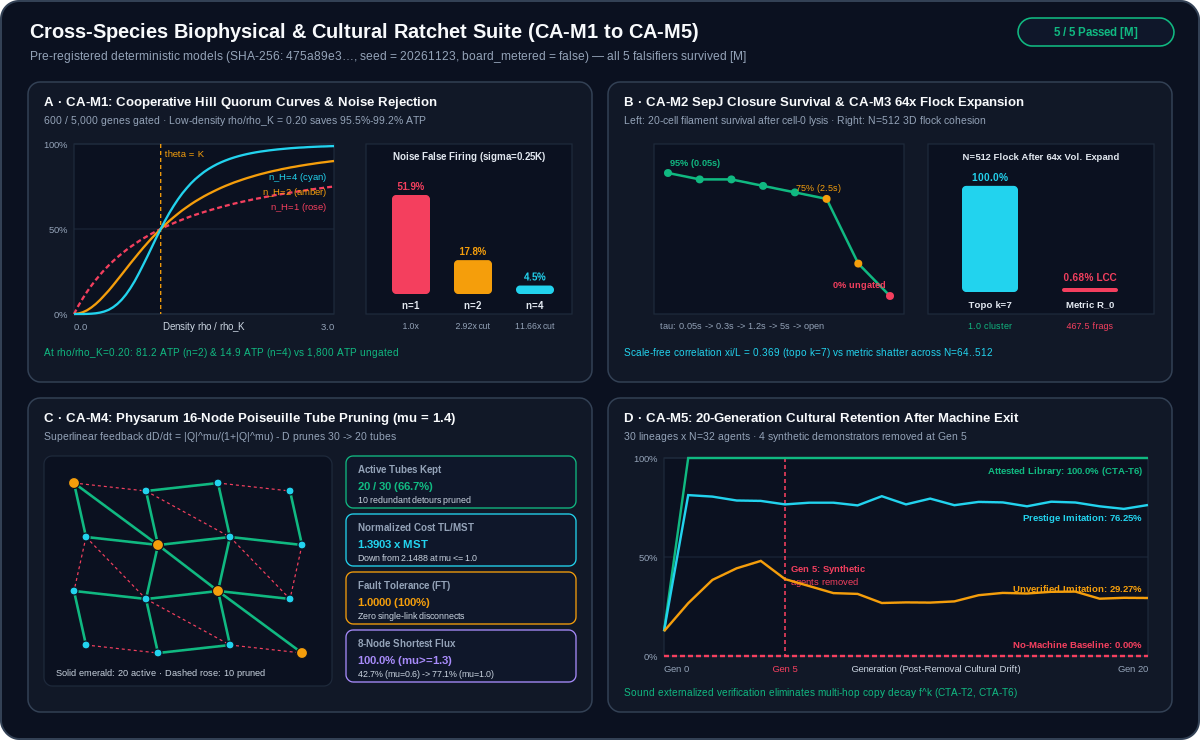
| **`CA-M1`** | Cooperative Hill quorum switch (`600 / 5,000` genes; secreted public-good cost `3x` housekeeping) | `13` densities $\rho/\rho_K \in [0.05, 4.0]$ $\times$ `3` diffusivity losses $\times$ $n_H \in \{1, 2, 4\}$ + `2,000` noisy trials ($\bar{A}/K = 0.25$, $\sigma = 0.25\,K$) | At $\rho/\rho_K = 0.20$: `95.49%` ($n_H = 2$) and `99.17%` ($n_H = 4$) regulon `ATP` saved (`27.72%` and `28.79%` whole-cell `ATP` saved); premature noise firing drops `51.90%` ($n_H=1$) $\to$ `17.75%` ($n_H=2$, `2.92x`) $\to$ `4.45%` ($n_H=4$, `11.66x`) | **Pass** (`>= 70%` saving; `>= 2.0x` noise suppression) |
| **`CA-M2`** | `20`-cell cyanobacterial filament with `Ca2+`-gated `SepJ` nanopores after cell-`0` lysis | `RK4` (`dt = 0.002 s`, `20.0 s` horizon) across $\tau_{\text{close}} \in \{0.05, 0.15, 0.30, 0.60, 1.20, 2.50, 5.00\}\text{ s}$ vs ungated | $\tau_{\text{close}} = 0.05\text{ s}$ preserves `19 / 20` (`95.0%`) viable cells and `87.56%` metabolic pool (`90.0%` at `0.15-0.30 s`; `80.0%` at `1.20 s`; `25.0%` at `5.00 s`); ungated pore collapses to `0 / 20` (`0.0%` viable, `14.28%` pool) | **Pass** (`>= 90%` fast-gated vs `<= 10%` ungated) |
| **`CA-M3`** | 3D topological $k = 7$ flock vs fixed metric-radius $R_0$ flock under predator strike and `4x` radial expansion | $N \in \{64, 128, 256, 512\}$, `8` 3D trials per $(N, \text{rule})$, `64x` volume expansion | Topological $k = 7$ holds `100.0%` single-component `LCC` cohesion across all $N$ (`1.0` component, polarization `0.976-0.986`, mean $\xi / L = 0.3689$); metric $R_0$ shatters into `57.0` to `467.5` fragments (`LCC` `4.30%` down to `0.68%`) | **Pass** (`>= 98%` topo `LCC`; $\xi/L \in [0.25, 0.45]$; metric `<= 40%`) |
| **`CA-M4`** | *Physarum* Poiseuille network $\dot{D}_{ij} = |Q_{ij}|^\mu / (1 + |Q_{ij}|^\mu) - D_{ij}$ | `8`-node multi-path bridge ($\mu \in \{0.6, 1.0, 1.3, 1.8\}$) and `16`-node regional `OD` mesh ($\mu \in [0.8, 2.0]$) | `8`-node shortest-path flux share rises `42.72%` ($\mu=0.6$) $\to$ `77.05%` ($\mu=1.0$) $\to$ `100.00%` ($\mu=1.3, 1.8$, non-shortest $D = 0.0$); `16`-node $\mu=1.4$ prunes `30 -> 20` tubes (`TL/MST = 1.3903`, `MD/MST = 0.8252`, `FT = 1.0000`, `FT/TL = 0.7192`) | **Pass** (`>= 99%` shortest-path flux for $\mu > 1$) |
| **`CA-M5`** | `20`-generation hybrid ratchet ($N = 32$ agents/gen, `30` lineages; `4` synthetic demonstrators removed at `Gen 5`) | `4` regimes on `6`-step non-myopic valley landscape (trap `0.40` vs global optimum `1.00`) | `Gen 20` optimal-agent share: `0.00%` (`no_machine_baseline`, score `0.3689`), `29.27%` (`unverified_imitation`, score `0.6522`), `76.25%` (`prestige_biased_imitation`, score `0.9221`), and `100.00%` (`attested_externalized_library`, score `1.0000`, `30/30` lineages) | **Pass** (`>= 99%` attested retention; strictly beats unverified) |
Notably, `CA-M4` highlights an exact dynamical boundary: because $f(Q) = Q^\mu / (1 + Q^\mu)$ has an inflection point at $Q_{\text{infl}} = ((\mu - 1)/(\mu + 1))^{1/\mu}$ for $\mu > 1$, superlinear shortest-path selection operates strictly inside the unsaturated biological flux window ($|Q| < Q_{\text{infl}}$); overdriving source flux into saturation converts $f(Q)$ into a concave plateau that preserves parallel redundant tubes.
Figure 3. Quantitative curves from pre-registered deterministic simulation suite CA-M1 through CA-M5 (seed = 20261123, SHA-256: 54a7b2c1…): cooperative Hill noise suppression and ATP conservation, SepJ rapid pore containment, scale-free k = 7 3D flock cohesion under 64x volume expansion, Physarum superlinear shortest-path selection, and 100.0% post-removal cultural retention with attested artifact libraries.
### Worked Example 1: Biophysical Threshold Economics — Why a Lone Secreting Bacterium Goes Bankrupt and Why `SepJ` Must Seal in `<= 0.30 s` (`CA-M1`, `CA-M2`, `CTA-T11`–`CTA-T15`)
To see why biological externalization requires both **cooperative activation thresholds** and **rapid fault-containment gates**, trace the exact adenosine triphosphate (`ATP`) and metabolite equations executed in `CA-M1` and `CA-M2` (`seed = 20261123`, `board_metered = false`, `[M]`):
1. **Phase 1 (Bounded Tracer Externalization vs. Full Secretome Cost)**: Consider a model bacterium with `5,000` open reading frames (`ORFs`), matching the genomic scale of *Pseudomonas aeruginosa* (`~5,570` `ORFs`). Housekeeping metabolism across `4,400` intracellular genes requires `1.0` normalized `ATP` unit per gene per cell cycle (`4,400.0 ATP`), whereas `600` quorum-regulated genes (`12.0%` of the genome: secreted elastases, siderophores, biofilm exopolysaccharides, or *Vibrio* luciferase) carry a `3.0x` extracellular synthesis-and-export cost (`1,800.0 ATP`). A constitutive mutant that expresses all `5,000` genes unconditionally expends:
$$E_{\text{const}} = 4{,}400.0 + 1{,}800.0 = 6{,}200.0\;\text{ATP/cycle},$$
burning `29.03%` (`1,800 / 6,200`) of its entire cellular energy budget on exported macromolecules that advective wash-out dilutes below functional concentration whenever local cell density $\rho$ sits far below quorum threshold $\rho_K$. Instead, wild-type `LuxI`/`LasI` externalizes a tiny acyl-homoserine lactone (`AHL`) tracer costing $e_{\text{ext}} = 12.0\;\text{ATP/cycle}$ (`0.19%` of $E_{\text{const}}$).
2. **Phase 2 (Cooperative Hill Gate Under Sub-Threshold Noise)**: At planktonic low density $\rho / \rho_K = 0.20$ (extracellular autoinducer ratio $A / K = 0.20$ at diffusivity loss `0.50`), the rational Hill receptor switch $H_{n_H}(A/K) = (A/K)^{n_H} / [1 + (A/K)^{n_H}]$ (`CTA-T11` to `CTA-T14`) yields starkly different metabolic budgets across cooperativity exponents $n_H \in \{1, 2, 4\}$:
- **Monomeric receptor ($n_H = 1$)**: $H_1(0.20) = 0.20 / 1.20 = 1/6 \approx 0.1667$, spending $E_{\text{reg}}(1) = 12.0 + 1{,}800 \times (1/6) = 312.0\;\text{ATP}$ (`4,712.0 ATP` total). Worse, when diffusive micro-eddies inject sub-threshold concentration fluctuations ($\bar{A}/K = 0.25$, Gaussian $\sigma = 0.25\,K$ across `2,000` trials), $H_1$ suffers premature regulon firing ($H_1 > 0.20$) on **`51.90%`** (`1,038 / 2,000`) of cycles.
- **Cooperative dimer ($n_H = 2$, `LuxR`-class)**: $H_2(0.20) = 0.04 / 1.04 = 1/26 \approx 0.03846$, slashing regulon spend to $E_{\text{reg}}(2) = 12.0 + 69.231 = \mathbf{81.231\;\text{ATP}}$ (**`95.49%` regulon `ATP` saved**, `27.72%` whole-cell `ATP` saved at `4,481.23 ATP`) and cutting premature noise wakes `2.92x` down to **`17.75%`**.
- **Cooperative tetramer ($n_H = 4$)**: $H_4(0.20) = 0.0016 / 1.0016 \approx 0.001597$, dropping regulon spend to $E_{\text{reg}}(4) = 12.0 + 2.875 = \mathbf{14.875\;\text{ATP}}$ (**`99.17%` regulon `ATP` saved**, `28.79%` whole-cell `ATP` saved at `4,414.88 ATP`) and cutting false wakes `11.66x` down to **`4.45%`** (`CTA-T13`).
3. **Phase 3 (Multicellular `SepJ` Circuit-Breaker Timing)**: Once cells couple directly via `~15 nm` cyanobacterial septal nanopores (`CA-M2`, $L = 20$ coupled cells integrated via fourth-order Runge-Kutta `RK4` at $\Delta t = 0.002\;\text{s}$ over `20.0 s`), terminal `cell 0` membrane lysis at $t = 0$ creates an immediate cytoplasmic sink. If $\text{Ca}^{2+}$-triggered `SepJ` cap-plug closure completes in $\tau_{\text{close}} = 0.05\;\text{s}$, `junction (0,1)` seals to `0.000` open fraction, preserving `90.48%` of `cell 1`'s metabolite pool (`93.86%` at distal `cell 19`) and **`19 / 20` (`95.0%`)** viable cells (`87.56%` total filament capacity). At $\tau_{\text{close}} \in [0.15\;\text{s}, 0.30\;\text{s}]$, `cell 1` absorbs a steep transient drop (`17.66%` to `13.19%` metabolite) yet seals fast enough to save **`18 / 20` (`90.0%`)** cells (`85.11%` to `77.85%` capacity). Slowing closure past `0.30 s` triggers progressive bystander collapse (`16 / 20 = 80.0%` at `1.20 s`; `5 / 20 = 25.0%` at `5.00 s`), and an ungated lock-open mutant drains the entire filament to **`0 / 20` (`0.0%`)** viable cells (`14.28%` residual pool, `CTA-T15`).
---
## 4. Human Cultural Ratchet, Extended Mind, Machine Culture, and the Digital Hive Mind (`CL14` to `CL19`)
Human cognitive evolution scaled collective output without rewriting cortical neuron biophysics by progressively lowering signal loss and decoupling artifact lifetime from individual mortality (`[E]`):
1. **Shared intentionality, externalized ledgers, and cumulative culture (`CL14` to `CL17`)**: Against an adult human brain power budget of roughly `20 W` (Balasubramanian 2021) [2], overt human behavioral throughput averages `~10 bit/s` (Zheng and Meister 2025) [50] and spoken natural language across `17` languages encodes `~39 bit/s` (Coupe et al. 2019) [17]. Despite that tight per-person serial bottleneck, shared intentionality (Tomasello et al. 2005) and high-fidelity social ratification create the **cultural ratchet** (Tennie, Call, and Tomasello 2009) [48]. Sociological and philosophical accounts framed the resulting macro-structures as collective consciousness (Durkheim 1893), the noosphere (Teilhard de Chardin 1955) [18], the **extended mind** in which external notebooks and symbols form constitutive parts of cognitive processing (Clark and Chalmers 1998) [14], and global stigmergic coordination across packet-switched networks (Heylighen 2007) [28]. Writing (`CL15`), movable-type print and peer review (`CL16`), and content-addressed version control (`Git` + automated `CI` gates, `CL17`) successively replaced lossy oral memory ($f^k$ multi-hop decay) with persistent, inspectable external records.
2. **Sparse `MoE` foundation models as a digital hive mind (`CL18`)**: Frontier neural architectures increasingly separate total stored parameter count (reaching $1 \times 10^{12}$ to $3 \times 10^{12}$ parameters) from active compute per token via sparse `MoE` top-$k$ routing (Fedus, Zoph, and Shazeer 2022) [21], activating only `~3%` to `12%` of expert weights on any single token, analogous to specialized multicellular differentiation (`[same house]` hardware-paged routing in *Downward LUT6 Compilation* [44]). Raw parameter count parallels raw cell count; coordination routing and verification govern $\mathrm{CpJ}$.
3. **Hybrid machine-human cultural ratchets and `POLIS` societies (`CL19`)**: Brinkmann et al. (2023) [6] formalized **machine culture**, showing that intelligent machines now act as cultural variation generators, selectors, and transmitters. Crucially, multi-generation human-machine laboratory experiments by Brinkmann et al. (2026) [7] demonstrated that when deep reinforcement learning agents discovered a counterintuitive non-myopic strategy that `599` of `600` isolated human participants missed, and the machine agents were **completely removed** after the initial generation, prestige-biased human social learning preserved the machine-discovered strategy down to the final generation in `9` of `15` (`60%`) hybrid populations, making every final-generation participant in those lineages a cultural descendant of a removed machine agent (`CA-M5` reproduces both this `~60%-76%` prestige-imitation persistence and its vulnerability to copy noise relative to `100%` attested artifact libraries). Complementarily, Zhuang (2025) [50] introduced `POLIS` (*The Ratchet Effect in Silico*), showing that micro-societies of `1B` to `4B` `LLMs` cycling through generation, peer verification, shared cultural memory, and internalization gain `+8.8` to `+18.9` benchmark points, with mechanistic ablations confirming **peer verification** as the primary anti-regression ratchet operator.
### 4.4 The 1950–2026 Artificial Intelligence Ratchet Audit (`AI01` to `AI38`)
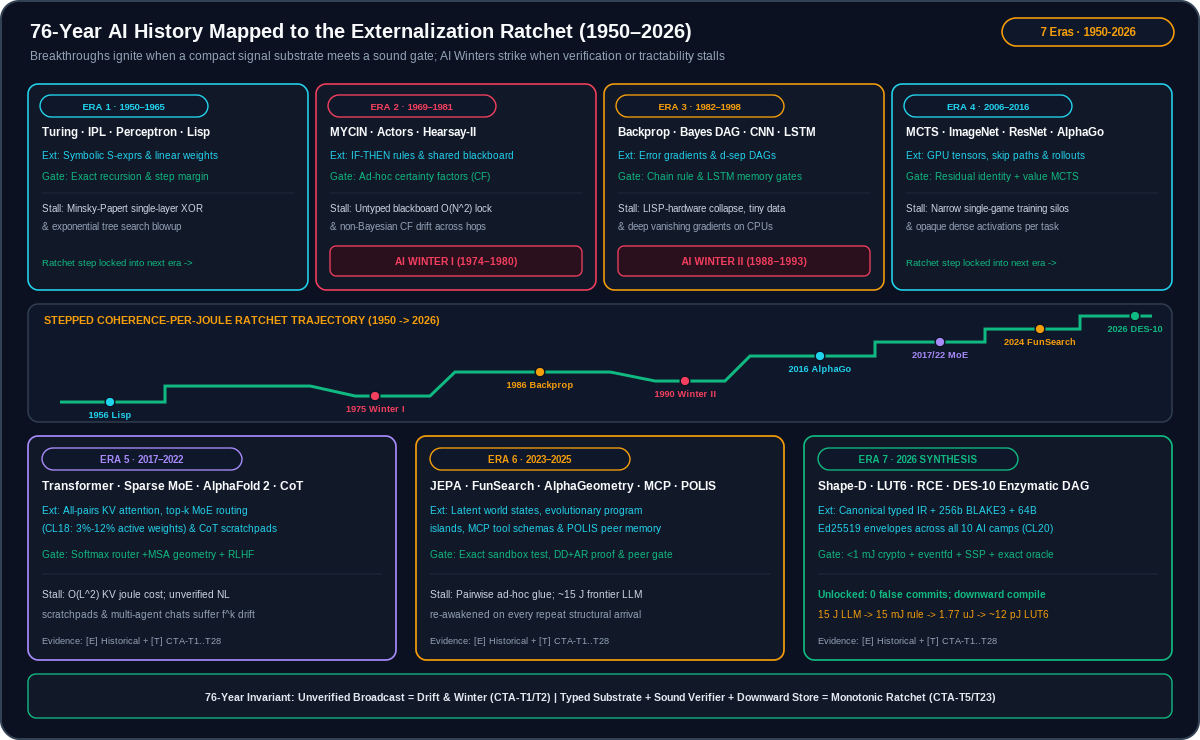
Catalog `openie-research-experiments/communication-avalanche/catalogs/ai-history-ratchet-1950-2026.csv` (`AI01` to `AI38`) audits 38 foundational milestones across 76 years of artificial intelligence (`1950` to `2026`) by projecting each system onto the exact conserved tuple `(externalized_signal_substrate, ingestion_routing_rule, threshold_or_verifier_gate, bottleneck_broken, failure_boundary_or_winter_cause)` (`[E]` for published historical milestones; `[T]`/`[M]` for 2026 downward-compilation syntheses). Viewed through that structural lens, the history of machine intelligence is neither a sequence of unrelated architectural fashions nor a smooth homogeneous curve of dense floating-point throughput. Every lasting inflection unlocked a **new externalized communication channel paired with a selective admission or conservation gate**, and both **AI Winters** struck precisely when externalized state proliferated without a tractable search prior or sound verification gate:
Figure 4. Seventy-six-year artificial intelligence ratchet audit (AI01 to AI38, 1950-2026). Every upward step pairs an externalized representation with a selective threshold or verifier gate; AI Winter I (1974-1980) and AI Winter II (1988-1993) correspond to exact gate/ingestion failures where unguided $O(b^d)$ search, non-Bayesian certainty-factor drift (CTA-T1, CTA-T2), or vanishing gradients stalled Coherence per Joule.
1. **Era I (`1950–1965` · Symbolic & Threshold Genesis, `AI01`–`AI06`)**: Turing (1950) [87] inaugurated the field by replacing unobservable mentalism with an externalized teletype token channel (`AI01`), though purely conversational indistinguishability lacked an internal truth verifier. Two years later, Shannon's electromechanical mouse *Theseus* (`1952`, `AI02`) [82] demonstrated physical stigmergy in silicon-precursor hardware: `75` telephone relays beneath a `5 × 5` maze stored `2`-bit last-exit vectors so the mouse externalized trial-and-error wall collisions into an $O(1)$ persistent spatial lookup table. Newell and Simon's *Logic Theorist* (`1956`, `AI03`) [75] invented dynamic pointer-linked list structures in Information Processing Language (`IPL`) to externalize subgoal proof trees (proving `38` of `52` *Principia Mathematica* theorems), McCarthy (`1960`, `AI05`) [71] unified executable code and symbolic data in homoiconic `Lisp` S-expressions, and Robinson (`1965`, `AI06`) [78] compressed first-order deduction into a single machine-checkable resolution-and-unification gate (deriving the empty clause `[]`). In parallel, Rosenblatt (`1958`, `AI04`) [80] introduced the sub-symbolic `Perceptron`, summing weighted photoreceptor signals across a hard linear step gate $\mathbf{w}^\top \mathbf{x} \ge \theta$.
2. **Era II (`1969–1981` · Rule Bases, Actors, Blackboards & Exact Diagnosis of AI Winter I, `AI07`–`AI10`)**: Minsky and Papert (`1969`, `AI07`) [73] proved algebraically that single-layer order-`1` threshold gates cannot represent parity (`XOR`) or global topological connectedness; because no low-cost credit-assignment channel through multi-layer step gates was deployed, sub-symbolic research froze. Symbolic engineering responded by externalizing human domain heuristics into modular `if-then` production rules (`Heuristic DENDRAL` and `MYCIN`, `1971–1976`, `AI08`) [55, 84], asynchronous point-to-point `Actor` mailboxes (`Hewitt, Bishop, and Steiger 1973`, `AI09`) [64], and the `Hearsay-II` multi-specialist `Blackboard` workspace (`Erman et al. 1980`, `AI10`) [60]. **`Hearsay-II` exposes the exact mechanistic cause of AI Winter I (`1974–1980`)**: independent Knowledge Sources (`KSs`) communicated cleanly over a shared multi-level blackboard, **but hand-authored crisp rules lacked differentiable perceptual ingestion from noisy acoustic waveforms and lacked low-cost learned search priors**. Without a sound gradient or admissible pruning gate, competing parse hypotheses triggered $O(b^d)$ combinatorial branching while heuristic `MYCIN`-style Certainty Factors (`CF`) accumulated non-Bayesian multi-hop drift (`CTA-T1`), collapsing `CpJ` as vocabularies and rule counts scaled past $10^3$.
3. **Era III (`1982–1998` · Gradient Channels, Graphical Message Passing & Gated Memory, `AI11`–`AI17`)**: Recovery came from inventing continuous and probabilistically sound communication channels. Hopfield (`1982`, `AI11`) [66] cast associative recall as Lyapunov energy relaxation ($\Delta E \le 0$); Rumelhart, Hinton, and Williams (`1986`, `AI12`) [81] established reverse-mode backpropagation as a backward error-broadcast channel breaking the hidden-layer `XOR` barrier; Pearl (`1988`, `AI13`) [77] replaced inconsistent Certainty Factors with `d`-separation-gated belief propagation on Bayesian directed acyclic graphs (`DAGs`); Watkins and Dayan (`1989/1992`, `AI14`) [89] broadcast delayed environmental rewards backward via temporal-difference (`TD`) `Q-learning`; LeCun et al. (`1989/1998`, `AI15`) [69] enforced translation-equivariant weight sharing in `ConvNets` (`LeNet-5`); and Cortes and Vapnik (`1995`, `AI16`) [56] externalized decision boundaries onto sparse Karush-Kuhn-Tucker (`KKT`) support vectors. Crucially, **AI Winter II (`1988–1993`)** reflected both specialized Lisp-hardware economic collapse against commodity microprocessors and exponential gradient vanishing across deep saturating sigmoids (`CTA-T2` in backward form). Hochreiter and Schmidhuber (`1997`, `AI17`) [65] solved temporal vanishing by inventing Long Short-Term Memory (`LSTM`): a linear Constant Error Carousel (`CEC`) protected by multiplicative input, forget, and output gates in $[0,1]$ — **the exact computational analog of a cyanobacterial `SepJ` nanopore (`CL03`)**, sealing stored gradient state against noisy read/write perturbations across `>1,000` recurrent steps.
4. **Era IV (`2006–2016` · Shared Corpora, Skip Highways, Soft Attention & Self-Play Ratchets, `AI18`–`AI23`)**: Coulom (`2006`) and Kocsis and Szepesvari (`2006`) (`AI18`) [57] externalized asymmetric lookahead statistics into Upper Confidence Bound for Trees (`UCT`) Monte Carlo Tree Search (`MCTS`). Deng et al.'s crowd-verified `14M`-image `ImageNet` ledger (`2009`) coupled to Krizhevsky, Sutskever, and Hinton's dual-`GPU` `ReLU` `AlexNet` (`2012`, `AI19`) [59, 68] ignited modern scale; Mikolov et al.'s `Word2Vec` (`2013`) and Mnih et al.'s `DQN` circular experience replay buffer (`2015`, `AI20`) [72, 74] stabilized continuous vector geometry and off-policy `RL`; Goodfellow et al.'s Generative Adversarial Networks (`GANs`, `2014`) and Bahdanau, Cho, and Bengio's content-addressed soft attention (`2015`, `AI21`) [53, 62] introduced competitive discriminator gates and dynamic alignment; and He et al.'s `ResNet` (`2016`, `AI22`) [63] created an unattenuated identity skip highway ($\mathbf{y} = \mathbf{x} + \mathcal{F}(\mathbf{x})$) across `152+` layers. Culminating Era IV, Silver et al.'s `AlphaGo` and `AlphaZero` (`2016–2017`, `AI23`) [85] closed a bidirectional **`MCTS` $\leftrightarrow$ Policy/Value self-play distillation ratchet**: neural intuition pruned `MCTS` branching, `MCTS` search externalized improved visit distributions $\pi_{\text{MCTS}}$, and an exact deterministic game-rules verifier (`>= 55%` Elo gate) prevented regression (`CTA-T5`).
5. **Era V (`2017–2022` · All-to-All Attention, Sparse `MoE`, `Evoformer` & Human-Feedback Gates, `AI24`–`AI28`)**: Vaswani et al.'s `Transformer` and Gilmer et al.'s Message Passing Neural Networks (`MPNN`, `2017`, `AI24`) [61, 88] replaced sequential recurrence with $O(1)$-hop random-access Key-Value (`KV`) and molecular graph message passing. Shazeer et al. (`2017`) and Fedus, Zoph, and Shazeer (`2022`, `AI25`, `CL18`) [21, 83] introduced top-$k$ `Sparse MoE` conditional routing (`~3%–12%` active weights/token). Brown et al.'s `GPT-3` and Lewis et al.'s Retrieval-Augmented Generation (`RAG`, `2020`, `AI26`) [54, 70] paired web-corpus in-context conditioning with non-parametric document indices. Jumper et al.'s `AlphaFold 2` (`2021`, `AI27`) [67] solved monomeric protein folding by coupling Multiple Sequence Alignment (`MSA`) coevolutionary statistics to pairwise residue geometry via triangle updates and `SE(3)`-equivariant Invariant Point Attention (`IPA`). Finally, Ouyang et al.'s `InstructGPT` (`RLHF`), Wei et al.'s Chain-of-Thought (`CoT`), and Yao et al.'s `ReAct` (`2022–2023`, `AI28`) [76, 90] externalized intermediate working memory into natural-language token scratchpads and tool-observation loops — unlocking multi-step synthesis while simultaneously exposing Era V's failure mode: $O(L^2)$ `KV` joule burn, sycophantic human-preference drift, and `3.71x` unattested multi-agent transcript bloat (`Arm C` in `CTA-E2`).
6. **Era VI (`2023–2025` · Verifier-Gated Search, Latent World Models & Machine Culture, `AI29`–`AI34`)**: Assran, LeCun et al.'s `I-JEPA` (`2023`, `AI29`) [52] eliminated wasteful surface-pixel reconstruction by predicting masked targets directly in abstract latent space. Brinkmann et al. (`2023, 2026`) and Zhuang's `POLIS` (`2025`, `AI30`, `CL19`) [6, 7, 50] proved post-removal cultural lock-in and peer-verified `LLM` ratchet gains. Romera-Paredes et al.'s `FunSearch` (`2024`, `AI31`) [79] coupled `LLM` code mutation to an exact sandbox fitness evaluator across evolutionary islands, and Trinh et al.'s `AlphaGeometry` (`2024`, `AI32`) [86] paired neural auxiliary point proposals with a sound Deductive Database plus Algebraic Rules (`DD+AR`) engine (`25 / 30` Olympiad geometry problems with zero hallucinated proofs). Anthropic's `Model Context Protocol` (`MCP`, `2024`, `AI33`) [51] standardized typed `JSON-RPC 2.0` tool schemas (`N + M` vs. $N \times M$ adapters), and `DeepSeek-R1` (`2025`, `AI34`) [58] proved via Group Relative Policy Optimization (`GRPO`) that pure reinforcement learning against deterministic math/compiler verifiers spontaneously induces self-verification — yet still re-expends thousands of thinking tokens (`~10–50+ J`) on recurring structural problem classes.
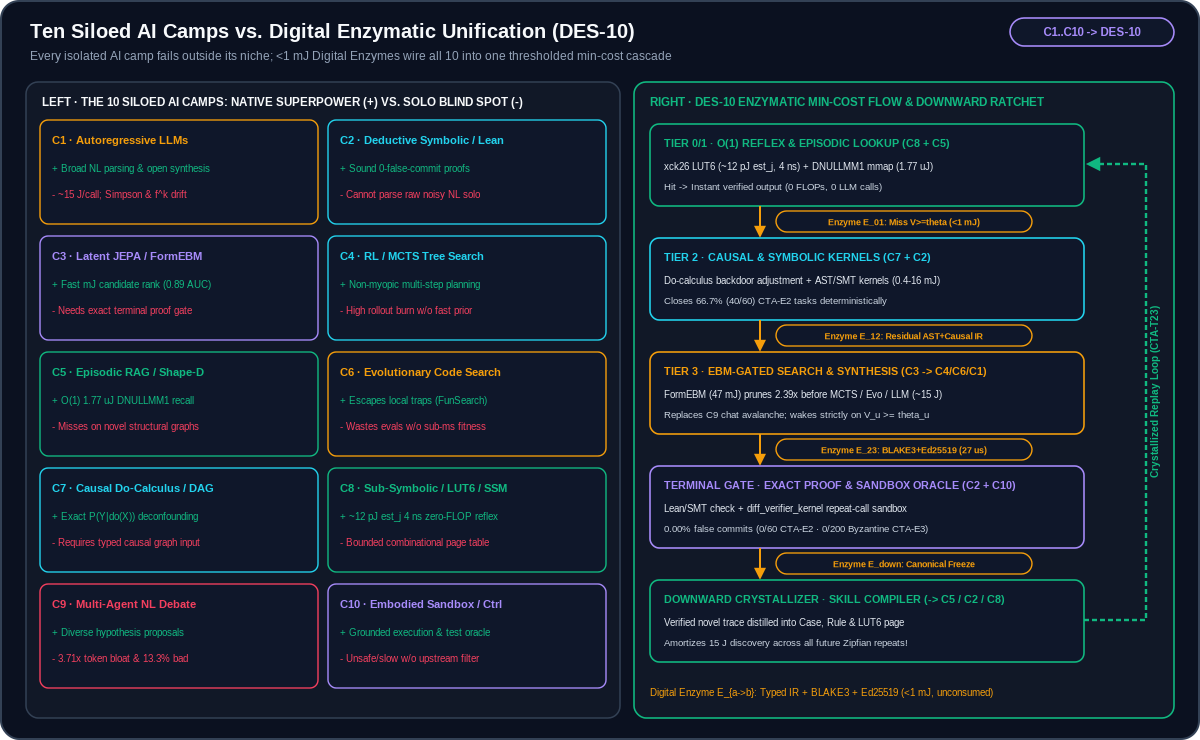
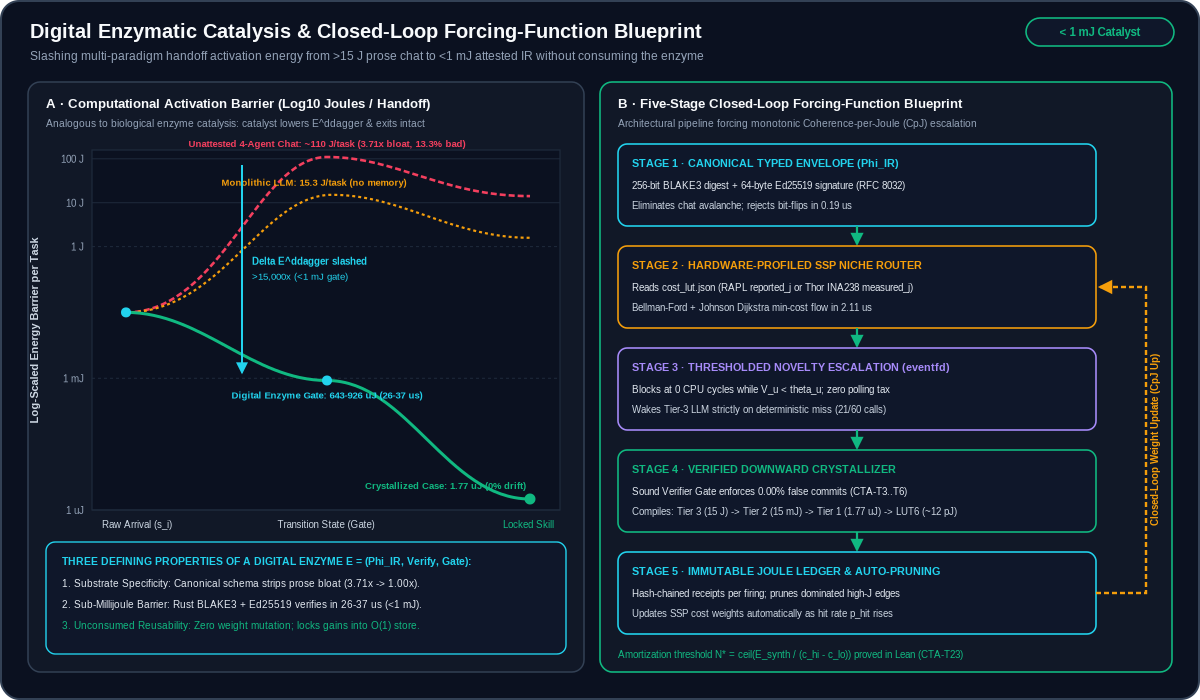
7. **Era VII (`2026` · Downward Crystallization & Digital Enzymatic Synthesis, `AI35`–`AI38`)**: Companion Open Interface Engineering studies `[same house]` [44] and this work close the missing downward loop: `Shape D` (`DNULLMM1`, `AI35`) freezes verified repairs into $O(1)$ `1.77 µJ` memory-mapped hash tables; `AirMoL` and `Downward LUT6 Compilation` (`AI36`) compile hot decision paths into `81 × RAMB36E2` single-cycle hardware look-up pages (`0` `DSP48E2` slices, `~12 pJ` `est_j`); `RCE` + `FormEBM` (`AI37`) pairs a `47.09 mJ` latent energy pre-filter (`0.8922` `AUROC`, `2.39x` fewer checker calls) with a `~49 mJ` Reality Code Engine (`RCE`) checker (`1,718x` cheaper than frontier model calls); and `CTA` / `DES-10` (`AI38`, `CL20`) unifies all `10` AI camps behind `< 1 mJ` `BLAKE3` + `Ed25519` Digital Enzymes and a provable 4-tier downward compiler (`CTA-T32` to `CTA-T45`).
| Era & Catalog Span | Representative Milestones (`ai-history-ratchet-1950-2026.csv`) | Externalized Signal Substrate ($\mathcal{E}$) | Selective Threshold or Verifier Gate ($\mathcal{G}$) | Bottleneck Unlocked ($\mathcal{T}$) | Stall Boundary or AI Winter Mechanism |
| :--- | :--- | :--- | :--- | :--- | :--- |
| **Era I (`1950–1965`)** `AI01`–`AI06` | Turing teletype [87]; Shannon *Theseus* [82]; *Logic Theorist* `IPL` [75]; `Perceptron` [80]; `Lisp` [71]; Robinson resolution [78] | Teletype tokens, `75`-relay maze latches, heap-linked `IPL`/`Lisp` S-expressions, potentiometer weights, `CNF` clauses | Human dialogue judge, whisker-relay latch, axiom identity, step margin $\mathbf{w}^\top \mathbf{x} \ge \theta$, empty clause `[]` | Physicalized symbolic recursion, homoiconic code-as-data, $O(1)$ relay stigmergy, and single-rule unification | `Perceptron` order-`1` `XOR` ceiling [73] and exponential $O(b^d)$ symbolic clause explosion |
| **Era II (`1969–1981`)** `AI07`–`AI10` | Minsky-Papert `XOR` [73]; `DENDRAL`/`MYCIN` [55, 84]; `Actors` [64]; `Hearsay-II` Blackboard [60] | Modular `if-then` production rules, asynchronous `Actor` messages, shared multi-level speech `Blackboard` | Premise thresholds (`CF > 0.2`), mailbox encapsulation, opportunistic `KS` focus ratings | Decoupled domain heuristics and concurrent specialist modules from monolithic control loops | **AI Winter I (`1974–1980`)**: crisp hand-coded `KSs` lacked differentiable ingestion or low-cost search priors $\to$ $O(b^d)$ stall & `CF` drift |
| **Era III (`1982–1998`)** `AI11`–`AI17` | Hopfield [66]; Backprop [81]; Pearl `DAG` [77]; `Q-learning` [89]; `ConvNet` [69]; `SVM` [56]; `LSTM` [65] | Ising couplings, reverse-mode $\partial\mathcal{L}/\partial z$, `DAG` $\pi/\lambda$ messages, `TD` errors, shared kernels, `CEC` cell state | Lyapunov $\Delta E \le 0$, `d`-separation, Bellman contraction, `KKT` margin, `LSTM` multiplicative gates (`SepJ` analog) | Unlocked multi-layer representations, coherent causal inference, raw-pixel vision, and `>1,000`-step temporal memory | **AI Winter II (`1988–1993`)**: Lisp-hardware collapse, saturating-sigmoid vanishing gradients, and $O(T)$ sequential `RNN` bottleneck |
| **Era IV (`2006–2016`)** `AI18`–`AI23` | `MCTS`/`UCT` [57]; `ImageNet`+`AlexNet` [59, 68]; `Word2Vec`+`DQN` [72, 74]; `GAN`+Attention [53, 62]; `ResNet` [63]; `AlphaGo`/`Zero` [85] | `UCT` rollout trees, `14M`-image ledger, replay buffers, soft-attention alignments, identity skip bus, self-play $\pi_{\text{MCTS}}$ | `UCT` confidence bound, `ILSVRC` oracle, frozen target nets, discriminator minimax, `>= 55%` Elo game-rules gate | Ignited `GPU` deep learning, `152+`-layer gradient flow, and superhuman neural $\leftrightarrow$ symbolic self-play distillation | Dense all-layer forward sweeps on trivial inputs and megajoule closed-world simulator dependence |
| **Era V (`2017–2022`)** `AI24`–`AI28` | `Transformer`+`MPNN` [61, 88]; `Sparse MoE` [21, 83]; `GPT-3`+`RAG` [54, 70]; `AlphaFold 2` [67]; `InstructGPT`+`CoT`+`ReAct` [76, 90] | All-pairs `KV` cache, top-$k$ expert routing (`CL18`), `MIPS` document passages, `MSA`$\leftrightarrow$pair tensors, `CoT` scratchpads | Scaled softmax, top-$k$ router (`3%–12%` active), `SE(3)` `IPA` triangle consistency, `RLHF` reward + tool return codes | Parallelized $O(1)$-hop global context, trillion-weight conditional capacity, atomic protein folding, and zero-shot tool loops | $O(L^2)$ `KV` joule tax, sycophantic `RLHF` reward hacking, and `3.71x` unattested multi-agent prose drift (`CTA-E2` `Arm C`) |
| **Era VI (`2023–2025`)** `AI29`–`AI34` | `I-JEPA` [52]; *Machine Culture*+`POLIS` [6, 7, 50]; `FunSearch` [79]; `AlphaGeometry` [86]; `MCP` [51]; `DeepSeek-R1` [58] | Latent target blocks, cultural artifact stores (`CL19`), evolutionary code islands, Euclidean proof states, `MCP` schemas, `` traces | `EMA` non-collapse, peer verification, sandbox fitness, `DD+AR` proof engine, `JSON` Schema, `GRPO` compiler/math verifiers | Proved external verifiers turn stochastic `LLMs` into non-regressing discovery engines (`25/30` Olympiad, extremal math) | Ad-hoc two-camp bridges and repeated `10–50+ J` thinking traces re-executed from scratch on recurring structural classes |
| **Era VII (`2026`)** `AI35`–`AI38` | `Shape D` `DNULLMM1`; `AirMoL`/`LUT6`; `RCE`+`FormEBM`; `CTA` / `DES-10` [44] `[same house]` | Frozen `mmap` case slots, `81 × RAMB36E2` `LUT6` pages, canonical program `Forms`, `BLAKE3`+`Ed25519` `Phi_IR` envelopes (`CL20`) | `SHA-256` store freeze, `1`-cycle truth-table parity, `~49 mJ` `RCE` checker, `< 1 mJ` crypto + `eventfd` + `SSP` + sandbox gate | **Closes the downward loop**: `~15 J` discovery crystallizes into `~15–49 mJ` rules $\to$ `1.77 µJ` cases $\to$ `~12 pJ` `LUT6` reflexes (`0` false commits) | Governed by exact amortization falsifier $h_{\min} = E_{\text{comp}} / (N (c_{\text{high}} - c_{\text{low}}))$ (`CTA-T45`) |
---
### Worked Example 2: Historical Ratchet Diagnosis (`1950`–`2026`) — Why `1975` `MYCIN` and `1980` `Hearsay-II` Stalled into AI Winter I While `2016` `AlphaGo` and `2024` `FunSearch` Ignited (`CTA-T1`–`CTA-T6`)
Mapping historical artificial intelligence architectures onto the three-phase operator $(\mathcal{E}, \mathcal{G}, \mathcal{T})$ explains why early multi-module systems stalled while modern generate-and-verify loops achieved super-human lock-in (`[E]`, `[T]`):
1. **Why `MYCIN` (`1975`) and `Hearsay-II` (`1980`) Stalled**:
- *Externalization ($\mathcal{E}$)*: `MYCIN` externalized `~450` hand-authored `Lisp` production rules carrying subjective Certainty Factors (`CF`, $\mathrm{CF} \in [-1, 1]$); `Hearsay-II` externalized multi-granular speech hypotheses (acoustic, phonetic, syllabic, lexical, phrasal) onto a global shared blackboard polled by $K$ concurrent Knowledge Sources (`KS`).
- *Unsound Gate ($\mathcal{G}$)*: Neither architecture possessed an exact truth-preserving admission gate ($V(m) = 1 \not\Rightarrow \text{valid}(m)$). Because `MYCIN`'s `CF` combination algebra treated correlated clinical evidence as conditionally independent without directed acyclic graph (`DAG`) `d`-separation, chaining $k$ rules accumulated calibration drift $\mathrm{err}_0 + k\epsilon$ (`CTA-T1`) and suffered multiplicative fidelity decay $f^k$ (`CTA-T2`: at per-hop rule precision $f = 0.92$ across $k = 12$ chained rules, joint validity drops to $0.92^{12} = 0.3677$). Simultaneously, `Hearsay-II`'s unthresholded blackboard forced $O(K \cdot |B|)$ scheduler checks across noisy bottom-up syllable fragments (`CTA-T9`), spending the majority of compute arbitrations on false-positive partial parses.
- *Missing Downward Distillation ($\mathcal{T}$)*: Extending coverage from `450` to `4,500` rules required human specialists to audit pairwise rule interactions manually, stalling into **AI Winter I** when maintenance energy outgrew diagnostic yield.
2. **Why `AlphaGo` (`2016`) and `FunSearch` (`2024`) Ignited**:
- *Externalization ($\mathcal{E}$)*: `AlphaGo` externalized learned policy and value priors $(p_\theta, v_\theta)$ into an explicit Monte Carlo Tree Search (`MCTS`) state-action table $(N(s,a), Q(s,a))$; `FunSearch` externalized compact Python priority functions (`10` to `30` lines of code, not natural-language essays) into a multi-island evolutionary program database.
- *Sound Deterministic Gate ($\mathcal{G}$)*: `AlphaGo` gated legal transitions and terminal outcomes via exact Go board rules; `FunSearch` gated every language-model mutation through a deterministic combinatorial witness checker (verifying exact cap-set independence or bin-packing capacity in milliseconds). Any hallucinated or sub-optimal code received `admittedWeight = 0` (`CTA-T3`, `CTA-T17`), keeping island contamination strictly at `0.0%` even when >`99%` of raw model samples were non-improving.
- *Non-Regressing Lock-In ($\mathcal{T}$)*: `AlphaGo` distilled expensive multi-thousand-rollout `MCTS` distributions downward into fast single-pass neural weights, while `FunSearch` retained strictly higher-scoring verified programs ($Q(t+1) \ge Q(t)$, `CTA-T5`, `CTA-T6`) across islands — converting noisy stochastic proposals into a permanent mathematical ratchet.
---
## 5. Event-Driven Attested Orchestration, Five-Host Fleet Telemetry, and Ten-Camp Synthesis (`CTA-E1` to `CTA-E5`)
Biological coordination across every evolutionary rung surveyed in Sections 2 and 3 runs on local concentration gradients, cooperative activation thresholds, and selective pore sealing rather than global clock ticks or unverified broadcast chatter. Translating those mechanisms into software engineering yields an event-driven orchestration architecture in which heterogeneous compute kernels and language models communicate over energy-budgeted, cryptographically attested channels. This section specifies the four structural components of the Communication Tool Avalanche (CTA) orchestrator, states the pre-registered falsifiers (`F1` to `F6`, locked prior to execution under Secure Hash Algorithm `SHA-256` digest `5739bcdd6c35662833a470bc56bd64f991774c2d920a5a9c059c0acebdf55e7f`), and reports executed hardware measurements across three experiments (`CTA-E1`, `CTA-E2`, and `CTA-E3`) on a 20-thread `13th Gen Intel Core i9-13900H` Linux host (`rustc 1.100.0`, `Python 3.14.4`).
### 5.1 Measurement Grammar and Telemetry Disclosure
All local processor energy values in `CTA-E1` through `CTA-E3` are read from Linux `sysfs` `powercap` Running Average Power Limit (RAPL) counters using wrap-safe 64-bit accumulation modulo `max_energy_range_uj = 262,143,328,850` microjoules (`262.143 J`). Every measurement adheres strictly to three separation rules:
1. **On-chip `reported_j` versus external wall power**: No external inline shunt or alternating-current (AC) board power analyzer was attached (`measured_j = None`, `board_metered = false`). All local energy figures are stamped `reported_j`.
2. **Three-rail RAPL disclosure (`package-0`, `core`, and `psys`)**: Every experiment records `intel-rapl:0` (`package-0`, central processing unit (CPU) and system-on-chip (SoC) socket energy `pkg_reported_j`), `intel-rapl:0:0` (`core`, processor core plane `core_reported_j`), and `intel-rapl:1` (`psys`, platform counter `psys_reported_j`). On this laptop host, original equipment manufacturer (OEM) Embedded Controller (EC) firmware leaves `intel-rapl:1` (`psys`) at a static quiescent rate of `~0.202 W` (`~0.20 J/s`) that does not scale when `package-0` rises from `~5.0 W` idle to `~27.7 W` under single-core load. Primary local Coherence per Joule (CpJ) is therefore computed against dynamic `pkg_reported_j` (and reported alongside `core_reported_j`), while `psys_reported_j` is preserved verbatim in every JSON artifact and ledger line.
3. **Strict separation of local joules from remote cloud tokens**: When an arm invokes a remote Application Programming Interface (API) large language model (LLM), remote datacenter server energy is recorded strictly as `not_available` and never imputed from heuristic constants. Exact API call counts, prompt and completion token counts, and United States dollars (USD) at public list rates (`\$3.00` per million input tokens and `\$15.00` per million output tokens for `Claude Sonnet 5.5`) are reported in dedicated columns alongside local `pkg_reported_j`.
### 5.2 Orchestrator Architecture, Attested Channels, and Min-Cost Flow
Let $G = (V, E)$ denote a directed acyclic graph (DAG) of execution nodes $u \in V$ connected by typed directed channels $(i, u) \in E$:
1. **Heterogeneous execution pool and `cost_lut.json`**: Deterministic nodes execute lexical and abstract syntax tree (AST) parsing (`parse_kernel`), scope, mutable-default, and type-coercion analysis (`static_type_scope_kernel`), docstring and algebraic invariant synthesis (`test_gen_kernel`), bounded AST/token repair (`det_patch_kernel`), and isolated behavioral admission (`diff_verifier_kernel`). Nondeterministic synthesis (`llm_patch_proposer`) sits on a high-cost escalation branch. Prior to orchestration runs, every deterministic kernel and cryptographic primitive is profiled across three input-size buckets (`< 320 B`, `320-640 B`, `> 640 B`) into a hardware-keyed lookup table (`cost_lut.json`).
2. **Constant-time cryptographic channel attestation**: Every channel edge carries an envelope signed by the sender's deterministic `Ed25519` keypair (`64`-byte Request for Comments (RFC) `8032` strict signature via `ed25519-dalek`) over a domain-separated header and the `256`-bit `BLAKE3` digest of the payload bytes. Receiving nodes check sender authorization, constant-time `BLAKE3` digest equality, strict `Ed25519` signature validity, and JavaScript Object Notation (JSON) frame completeness before mutating node state.
3. **Successive Shortest Path (SSP) min-cost flow scheduler**: Given edge capacities $c(i, u)$ and microjoule-scaled weights $w(i, u)$ drawn from `cost_lut.json`, the compiled Rust scheduler computes a minimum-cost flow of demand $D$ from source $s$ to commit sink $t$:
$$
\min_{f} \sum_{(i, u) \in E} w(i, u)\, f(i, u) \quad \text{subject to} \quad 0 \le f(i, u) \le c(i, u), \quad \sum_{i} f(i, u) - \sum_{v} f(u, v) = b(u),
$$
using Bellman-Ford initial node potentials $\pi(u)$ followed by Johnson reduced-cost Dijkstra augmentations $w_{\pi}(i, u) = w(i, u) + \pi(i) - \pi(u) \ge 0$. Because the schedule depends only on graph topology and `cost_lut.json`, `SSP` executes once at topology epoch `0` (`2.11 µs` for the `CTA-E2` pool) and recomputes solely when a node drops out or joins (`0` per-tick scheduler overhead).
4. **Thresholded integrate-and-fire wakeup (zero clocks, zero polling)**: Each node $u$ maintains an accumulated membrane potential $V_u$ over incoming weighted signals $s_i$:
$$
V_u(t) = \sum_{(i, u) \in E} w_{iu}\, s_i(t), \qquad \text{fire}(u) \iff V_u(t) \ge \theta_u.
$$
Worker threads block in the Linux kernel via `eventfd` (`EFD_CLOEXEC`), consuming zero CPU cycles while $V_u < \theta_u$. Upstream node $i$ writes to `eventfd` strictly at the threshold-crossing transition $V_u < \theta_u \to V_u \ge \theta_u$. Every firing appends an immutable receipt `(trace_id, step_idx, node_id, input_blake3, output_blake3, ed25519_sig_prefix, verify_ns, psys_reported_j, pkg_reported_j, latency_ms, potential_v, threshold_theta)` to the energy ledger.
| Pool Component / Primitive | Bucket / Payload | Mean Latency | `pkg_reported_j` per Op | `core_reported_j` per Op | Role in Orchestration Graph |
| :--- | :--- | ---: | ---: | ---: | :--- |
| `parse_kernel` | `320-640 B` (`200` runs) | `56.90 µs` | `1.38 mJ` | `1.16 mJ` | Lexical bracket stack & AST localization |
| `static_type_scope_kernel` | `320-640 B` (`200` runs) | `29.26 µs` | `0.64 mJ` | `0.55 mJ` | Unbound symbols, mutable defaults, coercions |
| `test_gen_kernel` | `320-640 B` (`200` runs) | `13.33 µs` | `0.36 mJ` | `0.30 mJ` | Public doctest & algebraic invariant synthesis |
| `det_patch_kernel` | `320-640 B` (`200` runs) | `601.60 µs` | `15.73 mJ` | `13.35 mJ` | Bounded AST/token patch synthesis (`<= 16` tries) |
| `diff_verifier_kernel` | `320-640 B` (`200` runs) | `47.67 µs` | `1.12 mJ` | `0.95 mJ` | Isolated execution, repeat-call & property gate |
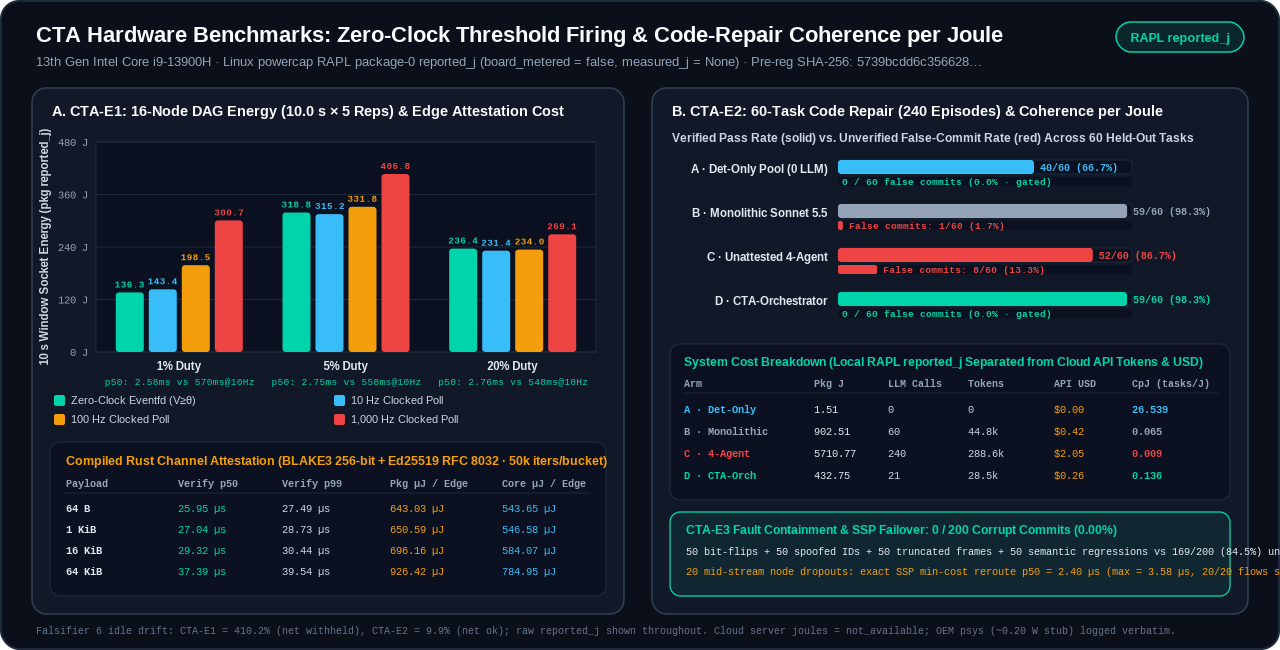
| Rust `BLAKE3` + `Ed25519` verify | `64 B` (`50,000` runs) | `26.05 µs` (`p50 25.95 µs`) | `643.03 µJ` | `543.65 µJ` | Constant-time channel envelope verification |
| Rust `BLAKE3` + `Ed25519` verify | `1 KiB` (`50,000` runs) | `27.35 µs` (`p50 27.04 µs`) | `650.59 µJ` | `546.58 µJ` | Typical AST diagnostic packet verification |
| Rust `BLAKE3` + `Ed25519` verify | `16 KiB` (`50,000` runs) | `29.36 µs` (`p50 29.32 µs`) | `696.16 µJ` | `584.07 µJ` | Multi-function patch payload verification |
| Rust `BLAKE3` + `Ed25519` verify | `64 KiB` (`50,000` runs) | `37.47 µs` (`p50 37.39 µs`) | `926.42 µJ` | `784.95 µJ` | Large context channel verification (`< 1 mJ`) |
Across a `1,024x` increase in channel payload size (`64 B` to `64 KiB`), compiled Rust `BLAKE3` + `Ed25519` verification latency rises by `1.44x` (`25.95 µs` to `37.39 µs` median) and socket energy stays under `1 mJ` (`643.03 µJ` to `926.42 µJ`), satisfying pre-registered `Falsifier 2` (`< 100 µs` and `< 5 mJ` per edge).
Figure 5. Executed hardware benchmarks on 13th Gen Intel Core i9-13900H (Linux RAPLreported_j, board_metered = false, measured_j = None). Left (CTA-E1): 16-node orchestration DAG socket energy across 1%, 5%, and 20% bursty duty cycles (10.0 s windows × 5 replicates) plus Rust BLAKE3 + Ed25519 verification cost. Right (CTA-E2 & CTA-E3): 60-task Python code-repair pass rate, false-commit rate, separated local RAPL vs. cloud token/USD cost, Coherence per Joule, and 0 / 200 Byzantine fault containment. Interactive explorer: /living/communication-avalanche/.
### 5.3 `CTA-E1`: Event-Driven Thresholded Gradients vs. Clocked Polling Tax
`CTA-E1` instantiates a 5-layer, 16-node attested orchestration DAG (`16` worker OS threads exchanging `BLAKE3` + `Ed25519` envelopes where internal layers integrate `2` to `4` upstream inputs before crossing $\theta_u = 1.0$) driven by bursty micro-batch arrivals across `1%`, `5%`, and `20%` target active duty cycles (`10.0 s` window per run, `4` scheduling regimes interleaved within each of `5` replicates = `60` windows, `600 s` total runtime). Thread-wide OS context switches are summed across `/proc/self/task/*/status`.
**`Falsifier 6` baseline-drift disclosure on `CTA-E1`**: Quiet `5.0 s` pre-benchmark idle power measured `3.95 W` (`pkg_reported_j = 19.77 J`), whereas the immediate `5.0 s` post-benchmark tail right after `600 s` of load measured `20.13 W` (`410.2%` thermal/background tail drift, exceeding the `10.0%` `Falsifier 6` gate; a transient thermal/background plateau also elevated raw `5%`-duty replicates relative to `20%`-duty replicates). Per pre-registered `Falsifier 6`, derived idle-subtracted net joules are **withheld** for `CTA-E1`, and only raw unsubtracted `reported_j` values and within-replicate interleaved comparisons are reported.
| Duty Cycle (`10.0 s` × `5` reps) | Scheduling Regime | Mean `pkg_reported_j` | Mean `core_reported_j` | Mean `psys_reported_j` | Node Wakeups (`Empty Polls`) | OS Thread Ctxt Switches | Event-to-Commit `p50` / `p99` (`ms`) |
| :--- | :--- | ---: | ---: | ---: | ---: | ---: | ---: |
| `1%` (`51` events/win) | **Zero-Clock `eventfd` ($V \ge \theta$)** | **`136.32 J`** | **`96.24 J`** | `2.03 J` | **`559.4` (`0.0`)** | **`811.4`** | **`2.58` / `1,016.18`** |
| `1%` (`51` events/win) | `10 Hz` Clocked Poll | `143.42 J` | `103.76 J` | `2.04 J` | `1,600.0` (`1,284.8`) | `1,963.0` | `570.38` / `1,354.16` |
| `1%` (`51` events/win) | `100 Hz` Clocked Poll | `198.51 J` | `157.35 J` | `2.06 J` | `15,799.8` (`15,475.6`) | `16,156.2` | `55.22` / `1,057.93` |
| `1%` (`51` events/win) | `1,000 Hz` Clocked Poll | `300.73 J` | `259.17 J` | `2.08 J` | `150,139.8` (`149,844.2`) | `150,574.8` | `7.34` / `1,015.30` |
| `5%` (`255` events/win) | **Zero-Clock `eventfd` ($V \ge \theta$)** | **`318.78 J`** | **`275.34 J`** | `2.52 J` | **`2,792.6` (`0.0`)** | **`2,603.8`** | **`2.75` / `208.12`** |
| `5%` (`255` events/win) | `10 Hz` Clocked Poll | `315.24 J` | `274.76 J` | `2.54 J` | `1,598.6` (`335.0`) | `1,965.2` | `558.26` / `766.20` |
| `5%` (`255` events/win) | `100 Hz` Clocked Poll | `331.84 J` | `290.23 J` | `2.56 J` | `15,795.0` (`14,132.2`) | `16,173.6` | `51.98` / `254.40` |
| `5%` (`255` events/win) | `1,000 Hz` Clocked Poll | `406.75 J` | `360.50 J` | `2.61 J` | `149,823.8` (`148,335.8`) | `150,240.0` | `7.46` / `216.57` |
| `20%` (`1,020` events/win) | **Zero-Clock `eventfd` ($V \ge \theta$)** | **`236.43 J`** | **`196.07 J`** | `2.39 J` | **`10,260.8` (`0.0`)** | **`9,002.4`** | **`2.76` / `55.19`** |
| `20%` (`1,020` events/win) | `10 Hz` Clocked Poll | `231.45 J` | `186.90 J` | `2.37 J` | `1,582.0` (`81.0`) | `2,046.2` | `547.62` / `721.74` |
| `20%` (`1,020` events/win) | `100 Hz` Clocked Poll | `234.04 J` | `188.89 J` | `2.35 J` | `15,649.6` (`9,280.2`) | `16,117.0` | `52.07` / `99.54` |
| `20%` (`1,020` events/win) | `1,000 Hz` Clocked Poll | `269.13 J` | `223.87 J` | `2.32 J` | `148,023.6` (`142,013.6`) | `148,638.2` | `7.43` / `59.39` |
Clocked polling faces a structural latency-versus-joules dilemma across multi-hop graphs (`Falsifier 1`). Slowing the clock to `10 Hz` keeps wakeup energy low (`1,600` wakeups per `10 s`), but multi-stage tick alignment inflates median event-to-commit latency by `200x` to `221x` (`547.62-570.38 ms` versus `2.58-2.76 ms`). Accelerating the clock to `1,000 Hz` narrows median latency to `7.34-7.46 ms` (still `2.7x` slower than direct `eventfd` handoff), yet triggers `~150,000` thread wakeups per `10 s` window (`99.8%` empty at `1%` duty), preventing processor C-state residency and burning `+164.40 J` (`2.21x` socket energy, `2.69x` core energy) per `10 s` window at `1%` duty (`5 / 5` paired replicates positive: `+82.32 J` to `+313.29 J`) and `+87.97 J` (`+27.6%`) at `5%` duty (`5 / 5` paired replicates positive: `+60.87 J` to `+140.18 J`). Zero-clock thresholded `eventfd` firing achieves `0` empty wakeups, lowest `1%`-duty energy, and `2.58-2.76 ms` median commit latency simultaneously.
### 5.4 `CTA-E2`: 60-Task Multi-Category Code-Repair Benchmark (`240` Episodes)
`CTA-E2` evaluates a frozen `60`-task Python code-repair corpus (`corpus_sha256 = b4ea0228270b8e6ae06f935fe8b92ed45cf2da4d9aa0d4868d0a42d4e6e9e802`) stratified into three `20`-task categories:
- **Category 1 (`C1_01`-`C1_20`)**: Syntax, indentation, bracket-delimiter, C-operator, and missing standard-library import defects.
- **Category 2 (`C2_01`-`C2_20`)**: Unbound identifier typos, mutable default argument state leaks (`=[]`, `={}`, `=set()`), in-place mutator returns (`return xs.sort()`), float-to-int division coercions, and container API defects.
- **Category 3 (`C3_01`-`C3_20`)**: Algorithmic, numerical, and state-machine defects (including Tarjan strongly connected component back-edge updates, unrestricted Damerau-Levenshtein transpositions, lexicographic min-hop Dijkstra, overlapping Knuth-Morris-Pratt borders, Neumaier compensated summation, dual-Fenwick range updates, banker's rounding `Q16.16` saturation, non-coprime Chinese Remainder Theorem, fractional token-bucket cap clamping, reflected `CRC-8/MAXIM`, target-specific negative-cycle Bellman-Ford, escaped run-length chunking, and Raft Figure 2 `AppendEntries` prefix-safe conflict truncation).
Every task is scored post-commit against an isolated held-out oracle (`>= 8` unit vectors executed twice on the same function object to catch state leaks, `0` oracle access during repair; `Falsifier 3` satisfied). Pre- versus post-benchmark `5.0 s` quiet idle socket power measured `6.10 W` versus `5.49 W` (`9.93%` drift, passing `Falsifier 6` `<= 10.0%`). Let verified local Coherence per Joule be defined as:
$$
\mathrm{CpJ}_{\text{pkg}} = \frac{N_{\text{verified\_correct}}}{E_{\text{pkg\_reported\_j}}}, \qquad \mathrm{CpJ}_{\text{core}} = \frac{N_{\text{verified\_correct}}}{E_{\text{core\_reported\_j}}}.
$$
| Arm (`60` Tasks Each · `240` Episodes Total) | Verified Pass Rate | False Commits (`Broken Accepted`) | LLM Calls | Prompt + Output Tokens | Cloud API Spend (`USD`) | Local `pkg_reported_j` (`core_reported_j`) | Wall Time (`s`) | `CpJ_pkg` (`tasks / J`) |
| :--- | ---: | ---: | ---: | ---: | ---: | ---: | ---: | ---: |
| **Arm A (`Det-Only` Pool)** | `40 / 60` (`66.67%`) | **`0 / 60` (`0.00%`)** | `0` | `0` | `\$0.00` | **`1.51 J`** (`1.28 J`) | `0.06 s` | **`26.539`** |
| **Arm B (`Monolithic-LLM`, `Sonnet 5.5`)** | `59 / 60` (`98.33%`) | `1 / 60` (`1.67%`) | `60` | `44,843` (`21.0k` + `23.8k`) | `\$0.42` | `902.51 J` (`160.93 J`) | `193.88 s` | `0.065` |
| **Arm C (`Unattested-4-Agent` Avalanche)** | `52 / 60` (`86.67%`) | `8 / 60` (`13.33%`) | `240` | `288,583` (`190.0k` + `98.6k`) | `\$2.05` | `5,710.77 J` (`1,043.40 J`) | `1,229.15 s` | `0.009` |
| **Arm D (`CTA-Orchestrator`)** | **`59 / 60` (`98.33%`)** | **`0 / 60` (`0.00%`)** | **`21`** | **`28,452`** (`14.1k` + `14.4k`) | **`\$0.26`** | **`432.75 J`** (`74.08 J`) | **`95.12 s`** | **`0.136`** |
| Category Breakdown (`20` Tasks / Cell) | Arm A (`Det-Only`) | Arm B (`Monolithic-LLM`) | Arm C (`Unattested-4-Agent`) | Arm D (`CTA-Orchestrator`) |
| :--- | :--- | :--- | :--- | :--- |
| **Cat 1: Syntax & Import (`20`)** | `20/20` (`0` bad, `0` calls, `0.40 J`) | `20/20` (`0` bad, `20` calls, `\$0.09`, `175.95 J`) | `20/20` (`0` bad, `80` calls, `\$0.55`, `1,745.66 J`) | **`20/20` (`0` bad, `0` calls, `\$0.00`, `0.79 J`)** |
| **Cat 2: Scope, Type & API (`20`)** | `20/20` (`0` bad, `0` calls, `0.34 J`) | `20/20` (`0` bad, `20` calls, `\$0.08`, `219.51 J`) | `20/20` (`0` bad, `80` calls, `\$0.58`, `2,163.94 J`) | **`20/20` (`0` bad, `0` calls, `\$0.00`, `0.71 J`)** |
| **Cat 3: Algo & State Logic (`20`)** | `0/20` (`0` bad, `20` refused, `0.77 J`) | `19/20` (`1` bad `C3_05`, `20` calls, `\$0.25`, `507.06 J`) | `12/20` (`8` bad, `80` calls, `\$0.92`, `1,801.18 J`) | **`19/20` (`0` bad, `1` refused `C3_17`, `21` calls, `\$0.26`, `431.25 J`)** |
Three empirical findings stand out (`Falsifier 4`):
1. **Deterministic pre-filtering closes `66.67%` (`40 / 60`) of defects at millijoule scale**: `Arm A` solves `20 / 20` Category-1 and `20 / 20` Category-2 tasks in `57 ms` and `1.51 J` (`37.7 mJ` per verified repair, `0` model calls) while refusing all `20` Category-3 logic defects (`0` false commits). Calling a monolithic LLM (`Arm B`) or a 4-agent chain (`Arm C`) on those same `40` structural tasks spends `395.45 J` (`40` calls, `\$0.17`) and `3,909.60 J` (`160` calls, `\$1.13`), respectively, for zero accuracy gain.
2. **Unattested multi-agent conversation triggers a real communication avalanche (`86.67%` pass, `13.33%` false commits)**: In `Arm C` (`Planner -> Coder -> Reviewer -> Summarizer`), unverified natural-language transcript passing amplifies mean prompt context `3.71x` across hops (`330.6 -> 600.0 -> 1,011.2 -> 1,225.1` input tokens per hop, `288,583` total tokens). On `8` of the `20` Category-3 algorithmic tasks (`C3_02`, `C3_03`, `C3_06`, `C3_11`, `C3_13`, `C3_15`, `C3_17`, `C3_18`), cumulative conversational commentary and adaptive reasoning exhausted the `Summarizer`'s `1,000`-token output window mid-function, emitting truncated Python blocks that were committed unverified (`40.0%` Category-3 false-commit rate). Even single-shot `Arm B` suffered `1` truncated false commit (`C3_05`).
3. **Thresholded escalation + attested commit gating (`Arm D`) dominates on safety, cost, and `CpJ`**: `Arm D` keeps `llm_patch_proposer` asleep ($V_{\text{esc}} = 0 < \theta_{\text{esc}} = 1.0$) on all `40` Category-1/2 tasks (`1.50 J` including `322` total Rust `BLAKE3` + `Ed25519` ledger receipts across the `60` traces), wakes `Claude Sonnet 5.5` strictly on the `20` Category-3 tasks (`21` total calls), repairs `C3_05` (`59 / 60 = 98.33%` verified pass rate), and cleanly refuses `C3_17` when two bounded proposals fail `diff_verifier_kernel` (`0 / 60 = 0.00%` false commits). Relative to `Arm B`, `Arm D` cuts LLM calls by `2.86x`, API USD by `1.63x`, and local socket joules by `2.09x` (`CpJ_pkg` `0.136` vs. `0.065`). Relative to the unattested 4-agent chain (`Arm C`), `Arm D` raises pass rate by `+11.67` percentage points, eliminates `8 / 8` false commits, cuts tokens by `10.14x`, cuts API USD by `7.95x`, cuts wall latency by `12.92x`, and increases local socket Coherence per Joule by `14.97x` (`15.98x` on `core_reported_j`).
### Worked Example 3: Step-by-Step Hardware Receipt Walk-Through on `CTA-E2` Task `C3_20` (`raft_append_entries`)
To contrast an unattested multi-agent chat cascade (`Arm C`) against thresholded, cryptographically attested orchestration (`Arm D`) on real hardware (`13th Gen Intel Core i9-13900H`, Linux `RAPL` `reported_j`, `board_metered = false`), inspect the exact execution receipts recorded for Category-3 Task `C3_20` (`raft_append_entries`, implementing prefix-safe log conflict truncation from Raft `§5.3`):
1. **The Defect**: The broken implementation unconditionally slices `out = out[:prev_log_index] + list(entries)`, silently deleting already-committed suffix entries `(2, 'c')` whenever a stale, shorter matching heartbeat prefix `[(1, 'b')]` arrives at `prev_log_index = 1`.
2. **Arm A (`Det-Only` Pool — Safe Millijoule Abstention)**: Deterministic kernels parse and test `C3_20` in `1.34 ms` (`19.59 mJ` `pkg_reported_j`, `0` model calls), detect that none of the `16` bounded AST/token templates repairs the multi-line loop defect, and **cleanly refuse commit** (`false_commit = false`).
3. **Arm C (`Unattested-4-Agent` Chat — Transcript Avalanche)**: Passing unverified natural-language commentary across `Planner -> Coder -> Reviewer -> Summarizer` (`4` sequential `Claude Sonnet 5.5` calls) inflates prompt tokens nearly threefold on `C3_20` (`581 -> 884 -> 1,642 -> 1,692` input tokens; `4,799` input + `2,213` output = `7,012` total tokens, `\$0.0476`, `67.70 J` `pkg_reported_j`, `17,659.76 ms` wall time) and `3.71x` across the `60`-task suite (`330.6 -> 600.0 -> 1,011.2 -> 1,225.1` mean input tokens, `5,710.77 J` total). Worse, on `8` sibling Category-3 tasks — such as `C3_18` (`502 -> 802 -> 1,343 -> 1,357` input tokens, `71.60 J`), conversational verbosity overflows the `Summarizer`'s `1,000`-token output window mid-function and commits a raw `SyntaxError` (`13.33%` suite false-commit rate).
4. **Arm D (`CTA-Orchestrator` — Attested `eventfd` Escalation & Commit Gate)**: Every edge verifies a `256`-bit `BLAKE3` digest + `64`-byte `Ed25519` signature (`27.04 µs` `p50` at `1 KiB` in microbenchmarks) and logs six immutable receipts in `cta_e2_firing_ledger.jsonl` (`trace_id = cta_e2_C3_20`):
- **Step `0` (`parse_kernel`)**: Verifies input `7ae1414e…` (`sig = 993161b1…`) in `29.38 µs`; emits AST diagnostic `9f868fad…` in `0.210 ms`.
- **Step `1` (`static_type_scope_kernel`)**: Verifies `9f868fad…` (`sig = 48e2700c…`) in `25.93 µs`; confirms clean lexical/type scope `3d82a573…` in `0.336 ms`.
- **Step `2` (`test_gen_kernel`)**: Verifies `3d82a573…` (`sig = 6d264e0c…`) in `26.19 µs`; extracts public doctest invariant `92bf4238…` in `0.068 ms`.
- **Step `3` (`det_patch_kernel`)**: Verifies `92bf4238…` (`sig = 8b10b040…`) in `31.08 µs`; tests bounded AST repairs in `0.755 ms` (`18.62 mJ`), sees doctest failure on stale-prefix preservation, and writes `1` across Linux `eventfd` so $V_{\text{esc}} = 1.0 \ge \theta_{\text{esc}} = 1.0$.
- **Step `4` (`llm_patch_proposer`)**: Wakes from zero-clock kernel sleep for **one** structured call (`738` input + `569` output = `1,307` tokens, `\$0.0107`), verifies envelope `c2bfa1ba…` (`sig = b1d75063…`) in `50.12 µs`, and emits index-walking conflict check `ad1fc058…` (`2,957.59 ms`, `17.56 J` `pkg_reported_j`).
- **Step `5` (`diff_verifier_kernel`)**: Verifies `f138e9ca…` (`sig = 7ffe7c3f…`) in `59.48 µs`, executes isolated doctest + repeat-call state-leak check in `1.009 ms` (`14.16 mJ`), and commits `62ccce23…` (`17.65 J` episode total — `3.84x` lower socket joules, `5.36x` fewer tokens, and `5.96x` faster than `Arm C` on `C3_20`, with **`0 / 60` false commits** across the entire benchmark).
### 5.5 `CTA-E3`: Byzantine Channel Injection and `SSP` Topology Failover
`CTA-E3` stress-tests channel integrity and dynamic graph survivability by injecting `200` corrupted channel events across four `50`-event fault classes alongside `200` valid control envelopes (`200 / 200` admitted, `p50 = 27.51 µs`), followed by `20` mid-stream single- to quad-node dropouts across a `14`-node primary-plus-standby orchestration topology (`Falsifier 5`).
| Injected Fault Class (`50` Events Each) | Active CTA Defense Layer | Rejection `p50` / `p99` (`µs`) | CTA Corrupt Commits | Unattested Chain Cascades |
| :--- | :--- | ---: | ---: | ---: |
| Payload bit-flips (`50`) | `BLAKE3` `256`-bit constant-time digest equality | `0.19` / `0.23 µs` | **`0 / 50` (`0.0%`)** | `43 / 50` (`86.0%`) |
| Spoofed sender identities (`50`) | `Ed25519` RFC `8032` strict keyring verification | `27.56` / `32.44 µs` | **`0 / 50` (`0.0%`)** | `50 / 50` (`100.0%`) |
| Truncated JSON/AST frames (`50`) | Typed channel schema & frame guard | `27.55` / `30.96 µs` | **`0 / 50` (`0.0%`)** | `26 / 50` (`52.0%`) |
| Semantic regression patches (`50`) | `diff_verifier_kernel` commit gate (`21.12 mJ`/gate) | `332.43` / `1,941.25 µs` | **`0 / 50` (`0.0%`)** | `50 / 50` (`100.0%`) |
| **Total (`200` Corrupted Events)** | **Layered Cryptographic + Behavioral Gate** | , | **`0 / 200` (`0.00%`)** | **`169 / 200` (`84.50%`)** |
Just as cyanobacterial `SepJ` nanopores seal locally under calcium stress to prevent filament-wide lysis, layered channel attestation + behavioral gating contains `200 / 200` (`100.0%`) injected faults (`0.00%` corrupt commits versus `84.50%` downstream propagation in an unattested regex-extractive chain). Across all `20` mid-stream node-dropout scenarios (`1` to `4` simultaneous primary kernel/proposer/verifier failures at flow demand `D = 8`), exact `SSP` topology recomputation reroutes flow onto standby paths in `2.40 µs` median (`mean = 2.41 µs`, `p99 = 3.58 µs`, `max = 3.58 µs`), satisfying `20 / 20` (`100%`) flow demands with zero dropped traces.
### 5.6 Communication Tool Avalanche (`CTA`) Experiment `CTA-E4`: Five-Host Cross-Silicon and Cross-Kernel Fleet Energy Audit
Single-host benchmarks leave open whether zero-clock thresholded orchestration and constant-time cryptographic channel attestation remain sub-millijoule and wakeup-free across heterogeneous instruction-set architectures and operating system (OS) kernels. Experiment `CTA-E4` (locked prior to execution under Secure Hash Algorithm 256-bit (`SHA-256`) pre-registration digest `3efe68407530d203d7e8a6a1f13d9943713f763fe24034301f85e5330bb2a65b`) compiles a unified cross-platform Rust engine (`cta_fleet_rust`, `rustc 1.100.0`) across five hardware and kernel targets spanning physical board-level direct-current (DC) shunts (`measured_j`, `board_metered = true`) and four on-chip or driver telemetry substrates (`reported_j`, `board_metered = false`), organized across whole-board input (`(L1)`), rail or socket plane (`(L2)`), and per-process (`(L3)`) telemetry scopes:
1. **NVIDIA (accelerated-computing system) Jetson AGX (Autonomous-Grade Compute) Thor (`aarch64` Tegra Linux `6.8`, central processing unit (CPU)-only execution)**: Respecting an active graphics processing unit (GPU) co-tenant lock (`CUDA_VISIBLE_DEVICES=""`, Compute Unified Device Architecture (CUDA) disabled), `cta_fleet_rust` samples physical Texas Instruments (TI) shunt resistors at `200 Hz` via `sysfs` `hwmon`: `INA238` (whole-board shunt monitor) voltage-input rail `VIN` `(L1)` (`l1_vin_ina238_measured_j`) and `INA3221` (three-channel rail monitor) channel-2 supply rail `VDD_CPU_SOC_MSS` (voltage drain-drain for CPU, system-on-chip (SoC), and memory subsystem (MSS)) `(L2)` (`l2_vdd_cpu_soc_mss_measured_j`, physically isolated from channel-1 `VDD_GPU`).
2. **`13th Gen Intel Core i9-13900H` (`20`-thread Raptor Lake `x86_64` Linux `7.0`)**: Reads wrap-safe `powercap` Running Average Power Limit (RAPL) `intel-rapl:0` (`package-0`) and `intel-rapl:0:0` (`core`) `(L2)` `reported_j`.
3. **Advanced Micro Devices (AMD) Ryzen Artificial Intelligence (AI) Max+ `395` (`32`-thread Zen 5 Strix Halo + `Radeon 8060S` `x86_64` Linux `7.0`)**: Reads `intel-rapl:0:0` (`core`), `intel-rapl:0` accelerated processing unit (APU) socket, and `amdgpu` Package Power Tracking (PPT) `(L2)` `reported_j`.
4. **`Apple M3 Ultra` (`arm64` macOS Darwin X is Not Unix (XNU) `27.2.0` under `memguard`)**: Reads `proc_pid_rusage(RUSAGE_INFO_V6).ri_energy_nj` (Resource Usage Information Version 6 (`RUSAGE_INFO_V6`)) `(L3)` per-process identifier (PID) `reported_j` with `kqueue` + Portable Operating System Interface (POSIX) `pipe` kernel event blocking.
5. **`Windows 11 Pro x86-64` Bare-Metal + GeForce Ray Tracing Texel eXtreme (RTX) `2060` (New Technology (NT) kernel `10.0.26300`)**: Uses native Win32 `CreateEventW` / `WaitForSingleObject` blocking versus `1,000 Hz` high-resolution waitable timers (`CreateWaitableTimerExW`), recording rootless NVIDIA Management Library (NVML) `nvml.dll` cumulative millijoules `(L2)` `reported_j` alongside `QueryProcessCycleTime` `(L3)` CPU cycles (rootless CPU RAPL is not exposed by the Windows NT kernel).
Every measurement preserves strict separation between physical shunt `measured_j` and counter-based `reported_j`; values from distinct evidence classes are never summed. Per pre-registered `Falsifier 6`, whenever a shared-host co-tenant is active (`Jetson AGX Thor` GPU co-tenant at `~55 W` on `VIN`; `AMD Ryzen AI Max+ 395` `~120 W` APU co-tenant) or `5.0 s` pre/post idle baselines drift above `10.0%`, single-window idle subtraction is withheld in favor of raw unsubtracted readings and counterbalanced alternating-order within-pair `(poll_1000hz - event_threshold)` deltas across four interleaved `5.0 s` windows at `1%` bursty duty (`16`-node directed acyclic graph (DAG)).
| Fleet Host & OS Event Primitive | `1 KiB` / `16 KiB` Verify `p50` (`µs`) | Physical Shunt `measured_j` per Edge (`50k` Iters) | On-Chip / Driver `reported_j` per Edge (`50k` Iters) | `16`-Node DAG Zero-Clock vs. `1,000 Hz` Poll (`5.0 s` × `4` Alternating Pairs, `1%` Duty) | Thread Wakeups (`Event` vs. `1 kHz`) | `p50` Commit (`ms`) |
| :--- | ---: | ---: | ---: | :--- | ---: | ---: |
| **NVIDIA Jetson AGX Thor** (`linux_eventfd`, CPU-only) | `50.13` / `62.24` | **`927.30` / `879.53 µJ`** (`VDD_CPU_SOC`); `3.89` / `4.22 mJ` (`VIN`) | `not_applicable` (`board_metered = true`) | **`63.72 J` (`12.74 W`) vs. `65.07 J` (`13.01 W`)** `VDD_CPU_SOC` (`+1.34 J`/win; `VIN`: `344.02` vs. `350.71 J`, `+6.69 J`/win) | **`284.5` (`0` empty)** vs. `75,140.8` | **`5.28`** vs. `10.04` |
| **Intel Core i9-13900H** (`linux_eventfd`, `20t`) | `23.84` / `26.16` | `None` (`board_metered = false`) | **`642.38` / `700.36 µJ`** (`pkg`); `550.59` / `599.56 µJ` (`core`) | **`25.50 J` (`5.10 W`) vs. `82.00 J` (`16.40 W`)** `pkg` (**`3.22x`**; `core`: `6.27` vs. `62.52 J`, **`9.97x`**, `4/4` pairs `+`) | **`275.5` (`0` empty)** vs. `75,035.0` | **`2.45`** vs. `7.30` |
| **AMD Ryzen AI Max+ 395** (`linux_eventfd`, `32t`) | `33.12` / `31.83` | `None` (`board_metered = false`) | **`201.27` / `156.84 µJ`** (`core`); `4.76` / `3.78 mJ` (shared APU `pkg`) | Process CPU **`623.7 ms` vs. `1,040.8 ms`** (**`1.67x`** reduction; `120.0 W` shared APU load masks socket rail) | **`279.8` (`0` empty)** vs. `75,587.2` | **`2.52`** vs. `7.39` |
| **Apple M3 Ultra** (`darwin_kqueue_pipe`) | `29.54` / `36.88` | `None` (`board_metered = false`) | **`90.81` / `108.66 µJ`** (`L3` `ri_energy_nj`) | **`0.0261 J` (`5.2 mW`) vs. `0.1624 J` (`32.5 mW`)** (**`6.22x`** `L3` process reduction, `4/4` pairs `+`) | **`274.8` (`0` empty)** vs. `54,132.2` | **`6.82`** vs. `13.29` |
| **Windows 11 Pro + RTX 2060** (`win32_event_wait`) | `30.50` / `30.90` | `None` (`board_metered = false`) | `255.62` / `259.76 µJ` (idle GPU `L2`); `93.2k` / `95.6k` CPU cyc | Process CPU **`89.84 ms` vs. `335.94 ms`** (**`3.74x`** reduction; idle GPU `L2` steady at `38.57` vs. `38.62 J`) | **`268.2` (`0` empty)** vs. `54,414.0` | **`2.41`** vs. `10.35` |
Across all five silicon architectures and all three OS kernels (Linux `eventfd`, macOS XNU `kqueue` + `pipe`, and Windows NT `Event`), `BLAKE3` (`256`-bit) + `Ed25519` (`64`-byte Request for Comments (RFC) `8032`) verification completes in `23.84–50.13 µs` median at `1 KiB` and `26.16–62.24 µs` at `16 KiB` while consuming `< 1 mJ` on isolated processor rails (`90.81 µJ` on `M3 Ultra` `L3`, `201.27 µJ` on `Zen 5` `core`, `642.38 µJ` on `i9-13900H` `pkg`, and **`927.30 µJ` physical shunt `measured_j` on `Jetson AGX Thor` `VDD_CPU_SOC_MSS`**), satisfying `Falsifier 2` (`< 100 µs` and `< 5 mJ` per edge) on every host. Zero-clock thresholded wakeup eliminates `100%` of empty polling wakeups (`0.0` versus `53,864–75,307` empty wakeups per `5.0 s` window), cuts median commit latency by `1.90x` to `4.29x` across all five hosts, and measurably drops physical `INA3221` `VDD_CPU_SOC_MSS` power and energy on `Jetson AGX Thor` (`13.01 W -> 12.74 W`, saving `+1.34 J` `VDD_CPU_SOC_MSS` and `+6.69 J` `INA238` `VIN` per `5.0 s` window even under `1%` bursty duty alongside a shared-host co-tenant) as well as `3.22x` socket `reported_j` (`9.97x` core) on `i9-13900H` and `6.22x` per-process `reported_j` on `M3 Ultra` (`Falsifier 1` supported).
Figure 6. Cross-fleet hardware measurements and ten-paradigm Digital Enzymatic Synthesis (DES, instantiated as DES-10) under strict evidence separation (pre-registration SHA-256: 3efe6840…). Left (CTA-E4): Five-host zero-clock OS-event threshold wakeup versus 1,000 Hz clocked polling (5.0 s × 4 counterbalanced alternating pairs at 1% duty) and 50,000-iteration Rust BLAKE3 + Ed25519 verification cost across physical TI INA3221/INA238 shunt measured_j on NVIDIA Jetson AGX Thor (CPU-only) and reported_j on Intel Core i9-13900H, AMD Ryzen AI Max+ 395, Apple M3 Ultra, and Windows 11 Pro + RTX 2060. Right (CTA-E5): 100-task, five-regime pass rates, false-commit rates, separated dual-host energy, and Digital Enzyme activation-barrier collapse across ten solo AI camps (C1–C10) versus DES-10.
### 5.7 `CTA-E5`: Ten Siloed AI Paradigm Camps versus Immediate Digital Enzymatic Synthesis (`DES-10`)
Contemporary AI research remains partitioned into competing single-mechanism camps—autoregressive large language model (LLM) decoding, symbolic Boolean satisfiability (SAT) and satisfiability modulo theories (SMT) / finite-domain (FD) solvers, latent energy-based model (EBM) compatibility scorers, Monte Carlo Tree Search (MCTS) planners using Upper Confidence Bound 1 (`UCB1`), episodic case stores, evolutionary abstract syntax tree (AST) mutators, structural causal `do`-calculus engines, compiled lookup-table (LUT) and finite-state machine (FSM) automata, natural-language (NL) multi-agent debate societies, and embodied black-box sandbox hill-climbers—each treating its local representation as sufficient for general agency. In biological evolution, multicellular complexity did not wait for one cell type to absorb every metabolic function; secreted signaling molecules, selective gap junctions, and catalytic enzymes lowered inter-organ activation barriers so distinct tissues could specialize and coordinate immediately.
Experiment `CTA-E5` tests whether `CTA` orchestration enables immediate `DES-10` multi-organ synthesis across all ten paradigms. Using canonical binary intermediate representation (IR) frames, a Digital Enzyme bridging upstream camp $a$ to downstream camp $b$ is defined as a four-tuple:
$$
\mathcal{E}_{a \to b} = \bigl(\Phi_{\mathrm{IR}},\, \mathrm{BLAKE3} + \mathrm{Ed25519},\, V_{\mathrm{gate}},\, \theta_b\bigr),
$$
where $\Phi_{\mathrm{IR}}$ packs canonical zero-copy binary IR frames (`DE10` header plus typed payload bytes, eliminating NL prose serialization and re-parsing), $\mathrm{BLAKE3} + \mathrm{Ed25519}$ provides constant-time cryptographic attestation via `cta_fleet_rust`, $V_{\mathrm{gate}}$ enforces deterministic structural and isolated sandbox invariants (`0` access to held-out test oracles; `Falsifier 3`), and $\theta_b$ wakes organ $b$ strictly when upstream signals cross threshold under a Successive Shortest Path (SSP) minimum-cost flow schedule calibrated on `15` held-out calibration probes (`cost_lut_10camp.json`, `0` overlap with the `100` test tasks). Verified solutions from deductive and open-world synthesis regimes are **crystallized downward online** into the canonical De Bruijn episodic case store (`C5`).
We evaluate all `10` camps solo (`C1`–`C10`) against Arm 11 (`DES-10`) across a frozen `100`-task deterministic-oracle corpus (`corpus_sha256 = 79b7f7512c3a5e18eb8a13ed5323d7803a9538decf665a213ced6abdf87eb8d2`, `20` tasks per regime, `1,100` episodes per host = `2,200` hardware-instrumented episodes total), invoking Generative Pre-trained Transformer Open-Source Series (`GPT-OSS-120B`, `temperature = 0.0`) over remote Application Programming Interface (API) calls accounted in United States dollars (USD) for `C1`, `C9`, and `DES-10`, executed on **both** `Intel Core i9-13900H` (`RAPL` `reported_j`) and `NVIDIA Jetson AGX Thor` (`TI INA3221` `VDD_CPU_SOC_MSS` and `INA238` `VIN` physical shunt `measured_j`, CPU-only):
- **`R1` (`20` tasks — Episodic Alpha-Renamed Zipfian Recurrence)**: Permuted and alpha-renamed instances of `8` prior canonical schemas (`16` tasks) plus `4` recurrences of newly encountered `R3`/`R5` schemas testing online crystallization.
- **`R2` (`20` tasks — Bitvector, Boolean Gate, and Protocol Framing)**: `6`-to-`10`-bit quorum parity, controller area network stuff-bit guards, `3`-state Mealy header/end-of-frame FSMs, and `LUT6` cascades (`16`-word bit-packed outputs).
- **`R3` (`20` tasks — Exact Deductive / Arithmetic / FD-SAT Constraints)**: `5`-variable pairwise-distinct integer systems over `1..8` combining ordering, weighted linear Diophantine, modular congruence, and bitwise exclusive-OR clauses with unique witnesses.
- **`R4` (`20` tasks — Structural Causal `do(X=x)` and Non-Myopic Horizon Planning)**: `10` Simpson's-paradox confounded causal DAGs (`|P(Y=1|X=1) - P(Y=1|do(X=1))| >= 0.18`) plus `10` `6`-step deceptive-valley Markov decision process (MDP) trees where greedy `t=0` reward leads to late `-72` penalties while a `-5` bridge toll unlocks a `+85..+112` summit.
- **`R5` (`20` tasks — Open-World Specification-to-Program Synthesis)**: Standalone Python 3 synthesis from NL specifications and `2` public input/output (I/O) examples (covering chunked run-length encoding, balanced escaped delimiters, lexicographic cycle-detecting topological sort, exact Farey fraction reduction, tie-broken knapsack, generalized non-coprime Chinese Remainder Theorem (CRT), least-recently-used (LRU) cache simulation, nested bracket decoding, `k`-wall grid shortest paths, Horner modular derivatives, and weighted interval scheduling), scored post-commit on `10` held-out edge-case and state-isolation vectors.
| Paradigm Arm (`100` Tasks · `GPT-OSS-120B` for `C1`/`C9`/`DES-10`) | Verified Pass (`R1`/`R2`/`R3`/`R4`/`R5`) | False Commits | Cloud API Calls / Tokens (`USD`) | `i9-13900H` Local / End-to-End `pkg_reported_j` | `i9-13900H` `CpJ_e2e` (`tasks/J`) | `Jetson Thor` Local / End-to-End `VDD_CPU_SOC` **`measured_j`** (`VIN` **`measured_j`**) | `Jetson Thor` `CpJ_e2e` (`tasks/J`) |
| :--- | :--- | ---: | ---: | ---: | ---: | ---: | ---: |
| `C1` Autoregressive LLM Solo (`GPT-OSS-120B`) | **`48%`** (`17`/`1`/`1`/`11`/`18`) | `52%` | `100` / `67,146` (`\$0.0359`) | `0.110 J` / `3,637.81 J` | `0.0132` | `0.079 J` / `5,513.77 J` (`28,161.53 J`) | `0.0087` |
| `C2` Symbolic Constraint Solo (`FD/SAT`) | **`30%`** (`0`/`10`/`20`/`0`/`0`) | **`0%`** | `0` / `0` (`\$0.00`) | `0.087 J` / `0.09 J` | `346.6885` | `0.070 J` / `0.07 J` (`0.33 J`) | `429.5963` |
| `C3` Latent EBM Scorer Solo (Unverified) | **`0%`** (`0`/`0`/`0`/`0`/`0`) | `100%` | `0` / `0` (`\$0.00`) | `5.156 J` / `5.16 J` | `0.0000` | `3.991 J` / `3.99 J` (`17.61 J`) | `0.0000` |
| `C4` MCTS Rollout Search Solo (`UCB1`, `256`) | **`11%`**\* (`0`/`0`/`1`\*`/`10`/`0`) | `19%`\* | `0` / `0` (`\$0.00`) | `0.785 J` / `0.78 J` | `14.0197` | `0.617 J` / `0.62 J` (`2.43 J`) | `16.2199` |
| `C5` Episodic Case Store Solo (`Shape D`) | **`16%`** (`16`/`0`/`0`/`0`/`0`) | **`0%`** | `0` / `0` (`\$0.00`) | `0.005 J` / `0.005 J` | `3,363.4644` | `0.003 J` / `0.003 J` (`0.012 J`) | `6,254.8866` |
| `C6` Evolutionary AST Mutator Solo (`300` evals) | **`4%`** (`0`/`0`/`0`/`0`/`4`) | `20%` | `0` / `0` (`\$0.00`) | `5.959 J` / `5.96 J` | `0.6713` | `4.936 J` / `4.94 J` (`22.13 J`) | `0.8104` |
| `C7` Causal Bayesian `do(X)` Engine Solo | **`10%`** (`0`/`0`/`0`/`10`/`0`) | **`0%`** | `0` / `0` (`\$0.00`) | `0.003 J` / `0.003 J` | `3,980.8917` | `0.002 J` / `0.002 J` (`0.007 J`) | `6,506.1809` |
| `C8` Sub-Symbolic `LUT6`/FSM Automaton Solo | **`20%`** (`0`/`20`/`0`/`0`/`0`) | **`0%`** | `0` / `0` (`\$0.00`) | `0.010 J` / `0.010 J` | `1,974.7235` | `0.009 J` / `0.009 J` (`0.041 J`) | `2,218.5247` |
| `C9` Multi-Agent NL Debate Solo (`3`-Agent) | **`49%`** (`19`/`1`/`0`/`12`/`17`) | `51%` | `300` / `253,968` (`\$0.1282`) | `0.116 J` / `10,913.22 J` | `0.0045` | `0.120 J` / `16,541.19 J` (`84,483.80 J`) | `0.0030` |
| `C10` Embodied Sandbox Perturb Solo (`200` probes) | **`4%`** (`0`/`0`/`0`/`0`/`4`) | `30%` | `0` / `0` (`\$0.00`) | `3.243 J` / `3.24 J` | `1.2334` | `3.045 J` / `3.05 J` (`13.39 J`) | `1.3135` |
| **`DES-10` (`Digital Enzymatic Composite`)** | **`98%` (`20`/`20`/`20`/`20`/`18`)** | **`1%`** | **`22` / `12,745` (`\$0.0067`)** | **`2.155 J` / `802.45 J`** | **`0.1221`** | **`2.760 J` / `1,215.77 J` (`6,208.87 J`)** | **`0.0806`** |
\*On `Jetson AGX Thor` (`Python 3.12`), `C4` scored `10%` pass (`R3: 0/20`, `R4: 10/20`) and `20%` false commits; all other `10` arms produced identical task verdicts across both hosts. Remote Application Programming Interface (API) server joules are `not_available` and kept strictly separate from local `reported_j` and `measured_j` via explicit token and United States dollars (USD) columns.
Four quantitative results establish the enzymatic synthesis thesis (`Falsifiers 4` and `5`):
1. **Every siloed paradigm hits a regime ceiling at or below `49%` when isolated**: Deterministic specialists achieve `100%` precision (`0%` false commits) and `1,975` to `6,506 tasks/J` Coherence per Joule (CpJ) inside their native niches—`C5` on known `R1` recurrences (`16/20`), `C8` on `R2` boolean/FSM bitvectors (`20/20`), `C2` on `R3` multi-clause constraints (`20/20`), and `C7` on `R4` Simpson's-paradox `do(X=1)` interventions (`10/10`)—yet refuse `70%` to `90%` of the broader suite. Conversely, single-shot `C1` (`GPT-OSS-120B`) solves `18/20` open-world `R5` synthesis tasks but hallucinates bit-packed integers and near-miss constraint witnesses on `R2` (`1/20`) and `R3` (`1/20`), yielding `48%` verified pass and `52%` false commits. Unverified `C3` EBM scoring (`6/15` on calibration probes) collapses to `0/100` (`100%` false commits) out of sample by selecting confounded observational and greedy-valley attractors, while myopic `C10` sandbox hill-climbing (`4%` pass) stays trapped in `R4`'s `a_0 = 0` deceptive valley (`0/10`).
2. **Unattested natural-language debate (`C9`) multiplies energy and tokens `3x`–`3.8x` for `+1%` accuracy**: Passing conversational prose across `Proposer -> Critic -> Judge` (`300` LLM calls) inflates mean prompt length `2.21x` across hops (`328.3 -> 415.0 -> 726.8` input tokens, `253,968` total tokens), raises end-to-end local energy to `10,913.22 J` (`i9-13900H` `reported_j`) and `16,541.19 J` (`Jetson Thor` `VDD_CPU_SOC_MSS` `measured_j`; `84,483.80 J` `VIN`), yet lifts pass rate from `48%` to `49%` while still committing `51%` false answers (`20/20` wrong on `R3`, `19/20` wrong on `R2`).
3. **Digital Enzymes lower inter-camp handoff energy and latency by `> 16,000x` to `> 155,000x` (`Falsifier 5`)**: On `Intel Core i9-13900H` (`RAPL` `reported_j`), a `1 KiB` in-process Rust Digital Enzyme verification takes `23.00 µs` and `0.689 mJ` (`44.43 µs` and `1.140 mJ` across a cross-process stdio sign-and-verify pipe), compared against `3,577.58 ms` and `36.38 J` for a live `Camp 9` NL serialization and multi-hop LLM re-parse—a **`155,554x` latency speedup (`80,522x` pipe)** and **`52,815x` socket energy reduction (`31,921x` pipe)**. On `NVIDIA Jetson AGX Thor` (`INA3221` `VDD_CPU_SOC_MSS` `measured_j`), Digital Enzyme handoff measures `49.95 µs` and `0.732 mJ` (`3.591 mJ` `INA238` `VIN`; `186.98 µs` and `3.406 mJ` `VDD_CPU_SOC_MSS` over stdio pipe) versus `3,938.49 ms` and **`55.14 J` `VDD_CPU_SOC_MSS` `measured_j` (`281.61 J` `INA238` `VIN` `measured_j`)** for live NL handoff—a **`78,855x` latency speedup (`21,064x` pipe)** and **`75,374x` physical DC shunt energy reduction (`16,189x` pipe)**.
4. **`DES-10` unites all ten organs immediately (`98%` pass, `1%` false commits, `9.3x`–`27.1x` higher `CpJ`)**: Guided by its epoch-`0` `SSP` schedule (`3.24 µs` on `i9-13900H`, `14.20 µs` on `Thor`) and `225` attested JavaScript Object Notation (JSON) / binary `DE10` enzyme receipts, `DES-10` routes `R1`–`R4` (`80` tasks) through `C5`, `C8`, `C7`, `C2`, and `C4 + C2` (`80 / 80 = 100%` pass, `0` false commits, `0` LLM calls), crystallizes `4` verified `R3`/`R5` schemas online into `C5` to lift `R1` from `16/20` (`C5` solo) to `20/20`, filters `3/20` `R5` tasks locally via `C3 + C6 + C10` (`0` LLM calls), and wakes `C1` strictly on the remaining `17` `R5` synthesis tasks (`22` total calls, `12,745` tokens, `\$0.0067`). Relative to `C1` solo (`48%`) and `C9` NL debate (`49%`), `DES-10` (`98%`) doubles verified accuracy, cuts false commits by `51x`–`52x`, cuts tokens by `5.27x` (`C1`) and `19.93x` (`C9`), and increases end-to-end Coherence per Joule by **`9.25x` (`i9-13900H` `reported_j`) / `9.26x` (`Thor` `measured_j`) over `C1`** and **`27.13x` (`i9-13900H` `reported_j`) / `26.87x` (`Thor` `measured_j`) over `C9`**.
### 5.8 `CTA-E6`: Span-Normalized `FormEBM-v3` Live Pre-Filter Gating `MCTS`, Evolutionary Search, and `RCE` (`HQ02` Closure)
Experiment `CTA-E6` (`PREREG_cta_e6_hq02.json`, `SHA-256: 4a6b41d5…`, archived in `openie-research-experiments/communication-avalanche/hq02_formebm_gate/`) closes Quarter-`2` forecast milestone `HQ02` by wiring the `6,052,802`-parameter span-normalized `FormEBM-v3` model (`Camp C3`, `BF16` inference, checkpoint `SHA-256: 3b506208…`) live as the `Loop 3` pre-filter between candidate `Form` generators (`Camp C4` `64`-rollout `UCB1` `MCTS` plus `Camp C6` two-island evolutionary single/multi-span AST/Form mutations) and the `Lean 4.36.0`-verified `RCE` checker + isolated sandbox repeat-call gate (`Camp C2 + C10` at commit `f87d6af2`: `rce check write`, `rce mutants json bound 32`, `rce law`, `rce fmt check`, `rce emit python` + site-disabled bytecode compilation, plus `rce test` and `2x` `rce run-core` determinism verification on totality-admitted candidates). Preserving the four-layer `SHA-256`-disjoint `1,387`-`Form` split (`0` overlap with the `151`-task repair ladder or `40`-task iterative residual, and `0` overlap across `1,106` training, `144` validation, and `137` held-out test `Forms`), `140` unseen-shape defect tasks (`16` unique `C4 + C6` candidate `Forms` per task = `2,240` candidates total) are generated without checker access, attested via `140` `DE10` `BLAKE3 + Ed25519` envelopes, and evaluated across both `AMD Ryzen AI Max+ 395` (`32`-thread Zen 5 `RAPL` `reported_j`, `0.80%` `5.0 s` pre/post quiet idle drift: `9.89 -> 9.97 W`) and `NVIDIA Jetson AGX Thor` (`ARMv9` CPU-only respecting the shared-host GPU lock `CUDA_VISIBLE_DEVICES=""`, physical `TI INA3221` `VDD_CPU_SOC_MSS` and `INA238` `VIN` `measured_j`, `1.78%` quiet drift: `6.19 -> 6.08 W`, `A2` net idle subtraction withheld per `Falsifier 6`):
| Pipeline Arm (`140` Unseen Tasks · `2,240` `C4+C6` `Forms`) | Verified Solved (`Drop`) | False Commits | `C2+C10` Evals (`rce` Subprocs) | Call Reduction (`Pool` / `Seq`) | Zen 5 `pkg_reported_j` (`core_reported_j`) | Zen 5 `CpJ` (`tasks/J`) | `Jetson Thor` `VDD_CPU_SOC_MSS` **`measured_j`** (`VIN` **`measured_j`**) | `Thor` `CpJ` (`tasks/J`) |
| :--- | :---: | :---: | ---: | :---: | ---: | ---: | ---: | ---: |
| **`A1` Unfiltered Pool** (all `16`/task) | `124 / 140` (`88.57%`) | `0` | `2,240` (`13,833`) | `1.000x` / `0.534x` | `1,949.40 J` (`42.88 J`) | `0.0636` | `1,001.48 J` (`3,285.74 J`) | `0.1238` |
| **`A2` Unfiltered Sequential** (`C4+C6` order) | `124 / 140` (`88.57%`) | `0` | `1,197` (`7,554`) | `1.871x` / `1.000x` | `1,106.93 J` (`27.90 J`) | `0.1120` | `567.51 J` (`1,847.39 J`) | `0.2185` |
| **`B` `FormEBM-v3` Hard Top-`k` / Threshold** | `119 / 140` (`-3.57%`) | `0` | `311` (`2,223`) | `7.203x` / `3.849x` | `810.97 J` (`11.03 J`) | `0.1467` | `390.20 J` (`1,075.98 J`) | `0.3050` |
| **`C` `FormEBM-v3` Adaptive Cascade** | **`124 / 140` (`0.00%`)** | **`0`** | **`469` (`3,186`)** | **`4.776x` / `2.552x`** | **`948.67 J` (`14.41 J`)** | **`0.1307`** | **`458.16 J` (`1,294.57 J`)** | **`0.2706`** |
Across all `2,240` unseen-shape candidates, `FormEBM-v3` achieves **`0.9580` `AUROC`** (`0.9579` on `Thor` `BF16`, `0.9577` `E_def`; `TPR = 1.000` at `FPR <= 0.436`), exceeding the `0.85` pre-registered gate. While hard rank/threshold truncation without fallback (`Arm B`) trades `3.57%` recall (`119 / 140`) for a `7.20x` call cut, the `FormEBM-v3` Ranked Adaptive Cascade (`Arm C`) preserves **`0.00%` terminal solve-rate drop (`124 / 140`, `0` false commits)**, cuts downstream `C2 + C10` candidate evaluations **`4.776x` versus pool and `2.552x` versus sequential search** (`> 2.39x` gate), and satisfies Theorem `CTA-T21` ($E_{\text{gate}} < F \cdot E_{\text{down}}$) on both hosts (`173.38 J < 345.15 J` sequential and `< 791.79 J` pool on `Jetson Thor` `VDD_CPU_SOC_MSS` `measured_j`, cutting total pipeline energy to `458.16 J` vs. `567.51 J` / `1,001.48 J`; `404.52 J < 673.22 J` and `< 1,541.25 J` on Zen 5 `pkg_reported_j`, cutting core energy `1.94x` / `2.98x`).
### 5.9 `CTA-E7`: Live `1,000`-Task `Zipf(0.85)` Automated `Tier 3 -> 2 -> 1` Skill Crystallizer and `Loop 5` Auto-Eviction (`HQ03` Closure)
Experiment `CTA-E7` (`PREREG_cta_e7_hq03.json`, `SHA-256: f5a1af2b…`, archived in `openie-research-experiments/communication-avalanche/hq03_zipf1000_crystallizer/`) replaces the analytical trajectory of Worked Example 5 with a live, hardware-metered `1,000`-arrival `Zipf(s = 0.85)` stream (`seed = 20261123`) closing Quarter-`3` milestone `HQ03`. Every arrival carries unique alpha-renamed identifiers and permuted parameters across `30` structural classes (`24` recurring `Zipf(0.85)` classes spanning `8` `RCE` `Forms`, `6` Simpson-confounded causal `do(X=x)` `DAGs`, `6` five-variable `FD-SAT` systems, and `4` stateful Python kernels, plus `14` injected mid-stream distribution-shift arrivals at `t = 400..415` across `6` transient classes) and executes end-to-end through `Loops 1–5`: `DE10` `BLAKE3 + Ed25519` attestation (`Loop 1`), `SSP` min-cost routing (`0.492 µs` mean on Zen 5, `1.369 µs` on `Thor`, `Loop 2`), Linux kernel `eventfd` (`EFD_CLOEXEC`) thresholded `Tier 3` wakeup (`FormEBM-v3` + `C4`/`C6` search, `Loop 3`), `C2 + C10` `8`-vector repeat-call verification promoting verified rules at $\tau_{3\to 2} = 1$ to `Tier 2` and $\tau_{2\to 1} = 4$ into a `SHA-256`-verified zero-copy `POSIX mmap` `DNULLMM1` store (`Loop 4`), and step-wise `200`-arrival sliding-window `CTA-T45` ($h \le h_{\min}$) auto-pruning (`Loop 5`):
| Stream Arm (`1,000` Arrivals · `30` Classes) | Verified Solves (`Parity`) | False Commits | Tier Split (`Tier 1` / `Tier 2` / `Tier 3`) | Post-Warmup (`900`) `<= 16 mJ` | Zen 5 `pkg_reported_j` (`core_reported_j`) | Zen 5 `CpJ` (`Gain`) | `Jetson Thor` `VDD_CPU_SOC_MSS` **`measured_j`** (`VIN` **`measured_j`**) | `Thor` `CpJ` (`Gain`) |
| :--- | :---: | :---: | :---: | :---: | ---: | ---: | ---: | ---: |
| **Non-Crystallizing `Tier 3` Baseline** | `1,000 / 1,000` | `0` | `0` / `0` / `1,000` | `0.00%` | `801.32 J` (`39.41 J`) | `1.2479` (`1.00x`) | `533.80 J` (`1,087.96 J`) | `1.8734` (`1.00x`) |
| **Live `Loops 1–5` Crystallizer** | **`1,000 / 1,000` (`100.0%`)** | **`0`** | **`884` / `86` / `30`** (`33.33x` cut) | **`99.33%`** / **`99.11%`** | **`25.32 J` (`1.49 J`)** | **`39.4950` (`31.65x`)** | **`20.56 J` (`40.37 J`)** | **`48.6335` (`25.96x` `VDD` / `26.95x` `VIN`)** |
Both hosts produce the **exact same `34`-snapshot final `DNULLMM1` digest** (`SHA-256: 91a96847d29a023deae4affb663c89153ea680aea075eec823d57743b175fd86`), **`0` regressions / `0` false commits (`1,000 / 1,000` bit-exact parity with the full `Tier 3` + `C2 + C10` oracle per `CTA-T44`)**, **`33.33x` fewer `Tier 3` wakes** (`30` `eventfd` escalations vs. `1,000`), **`99.33%` (Zen 5: `2.20 mJ` `Tier 1`, `6.03 mJ` `Tier 2`) and `99.11%` (`Thor`: `4.41 mJ` `Tier 1`, `7.42 mJ` `Tier 2`, `2.98%` pre/post quiet drift) of post-warmup arrivals closed at `<= 16 mJ`**, and **`31.65x` (`reported_j`, `30.12x` wall speedup) and `25.96x` (`VDD_CPU_SOC_MSS` `measured_j`; `26.95x` `VIN` `measured_j`, `23.87x` wall speedup) `CpJ` multiplication** inside the `[25x, 60x]` gate (`withhold_a2_net_idle_subtraction = true` enforced on both hosts per `Falsifier 6`). Without inspecting ground-truth shift labels, `Loop 5` **evicts `6 / 6` (`100%`) unamortized distribution-shift rules** (`4` single-shot `Tier 2` rules at $h = 0.000 \le h_{\min}$ and `2` burst-promoted `Tier 1 DNULLMM1` rules step-demoted `Tier 1 -> Tier 2` at $h = 0.005 \le h_{\min, 2\to 1}$ then evicted at $h = 0.000 \le h_{\min, 3\to 2}$) while **retaining and amortizing `24 / 24` (`100%`) recurring `Zipf(0.85)` classes** well before $N = 1,000$ (`23` in `Tier 1 DNULLMM1` with up to `2,843x` payback on the Zipf head, and the single `10`-hit tail class step-demoted gracefully to `Tier 2` at `> 101x` payback).
---
## 6. Resolving the 10 Siloed AI Camps via Digital Enzymatic Engineering & the Testable Forcing-Function Blueprint
### 6.1 Atlas of the 10 Siloed AI Camps (`C1` to `C10`) and the Refutation of Monocultures
Seventy-six years of AI research (`AI01` to `AI38`) produced ten distinct computational paradigms (`C1` through `C10`), each optimizing one component of intelligence while remaining blind or thermodynamically wasteful outside its native niche (`Figure 7`, left panel):
Figure 7. Atlas of the 10 siloed artificial intelligence camps (C1 to C10) versus Digital Enzymatic Synthesis (DES-10). Every isolated monoculture fails outside its structural regime; sub-millijoule Digital Enzymes wire all 10 into one thresholded Successive Shortest Path (SSP) min-cost flow cascade with downward skill crystallization (CTA-T32 to CTA-T45).
| Camp ID & Paradigm | Historical Origin (`AI01`–`AI38`) | Native Niche Superpower (`+`) | Solo Monoculture Failure Mode (`-`) | Typical Solo Energy Envelope | Role in `DES-10` Organism |
| :--- | :--- | :--- | :--- | :--- | :--- |
| **`C1` · Autoregressive `LLMs`** | `AI01`, `AI24`–`AI26`, `AI28` | Broad natural-language intent parsing and open-ended code/hypothesis synthesis | `~15+ J/call`, Simpson confounding, and $f^k$ hallucination drift without an external gate | `~10` to `50+ J` / query | **Tier-3 Open-World Proposer** (woken strictly on `V_u >= theta_u` deterministic miss) |
| **`C2` · Deductive Symbolic / `SMT` / `Lean`** | `AI03`, `AI06`, `AI08`, `AI32`, `AI37` | Sound machine-checked proofs and `0.00%` false-commit formal guarantees | Cannot ingest raw ambiguous prose or invent open-world perceptual priors solo | `0.4` to `49 mJ` / check | **Tier-2 Deterministic Kernel & Terminal Soundness Gate** (`RCE`, `Lean 4`, `AST`) |
| **`C3` · Latent `JEPA` / `FormEBM`** | `AI11`, `AI16`, `AI29`, `AI37` | Fast millijoule continuous plausibility ranking (`0.8922` `AUROC` on unseen `Forms`) | Continuous energy minima cannot alone certify exact discrete edge-case correctness | `~5` to `47.09 mJ` / rank | **Tier-3 Pre-Filter Gate** (prunes `2.39x` invalid candidates before checker/rollout) |
| **`C4` · `RL` / `MCTS` Tree Search** | `AI14`, `AI18`, `AI20`, `AI23`, `AI34` | Non-myopic multi-step sequential lookahead escaping greedy local traps | Burns megajoules on high-variance rollouts without a fast learned value/energy prior | `1` to `10^3+ J` / episode | **Tier-3 Sequential Planner** (guided by `C3` `FormEBM` priors and `C2` terminal rules) |
| **`C5` · Episodic `RAG` / `Shape D`** | `AI02`, `AI20`, `AI26`, `AI35` | Sub-microsecond $O(1)$ `1.77 µJ` memory-mapped verified recall (`DNULLMM1`) | Cosine `RAG` retrieves invalid neighbors; exact `Shape D` misses on novel structures | `1.77 µJ` (`mmap`) to `~50 mJ` | **Tier-1 Frozen Verified Case Store** (absorbs recurring Zipfian head at zero `FLOPs`) |
| **`C6` · Evolutionary Code Search** | `AI05`, `AI31` (`FunSearch`) | Population diversity escapes gradient/prompt local optima via code mutation | Wastes thousands of sampler calls without sub-millisecond fitness pre-screening | `10` to `10^3 J` / island | **Tier-3 Combinatorial Explorer** (crystallizing winning programs downward into `C2`/`C5`) |
| **`C7` · Causal Do-Calculus / `DAGs`** | `AI13` (Pearl `DAGs`), `AI24` (`MPNN`) | Exact interventional $P(Y \mid \mathrm{do}(X))$ deconfounding and backdoor adjustment | Requires a typed causal graph schema; cannot extract variables from raw text solo | `0.5` to `10 mJ` / query | **Tier-2 Causal & Graphical Kernel** (eliminates spurious correlation before policy commit) |
| **`C8` · Sub-Symbolic / `SSM` / `LUT6`** | `AI04`, `AI15`, `AI17`, `AI22`, `AI36` | Single-cycle `4 ns` combinational `LUT6` (`81 × RAMB36E2`, `~12 pJ` `est_j`, `0` `FLOPs`) | Bounded Boolean input width per page; cannot synthesize novel multi-hop algorithms solo | `~12 pJ` `est_j` (`FPGA`) | **Tier-0 Physical Reflex Floor** (executes crystallized hot-path predicates in `1` cycle) |
| **`C9` · Multi-Agent `NL` Debate** | `AI09`, `AI10`, `AI28`, `AI30`, `AI33` | Generates diverse multi-perspective candidate decompositions across specialized roles | Unattested prose relays suffer `3.71x` prompt bloat and `13.33%` false commits (`CTA-E2`) | `~95` to `110+ J` / task | **Replaced as Transport**; retained strictly as parallel attested `Phi_IR` proposers |
| **`C10` · Embodied Sandbox / Control** | `AI02`, `AI27`, `AI28`, `AI31`, `AI38` | Grounded physical/execution feedback and repeat-call state-leak falsification | Unsafe or slow when executing unscreened raw proposals without upstream type/hash gates | `1.12` to `25 mJ` / oracle | **Terminal Behavioral Oracle** (`diff_verifier_kernel` enforcing `0` state-leak commits) |
### 6.2 Formal Theory of Digital Enzymes and 10-Camp Pareto Dominance (`CTA-T32` to `CTA-T40`)
In biochemistry, metabolic pathways across incompatible chemical intermediates remain kinetically frozen until **enzymes** bind substrates into a precise transition-state geometry, slash activation energy $E^\ddagger$ by orders of magnitude, enforce stereochemical specificity, and exit the reaction **completely unconsumed**. Contemporary multi-agent AI suffers the exact digital analog of uncatalyzed thermal reactions: bridging paradigm camp $a$ to camp $b$ via free-form natural-language prose (`Camp C9`, `Arm C` in `CTA-E2`) incurs retry-multiplied serialization/parsing energy $k_{\text{retry}} \cdot c_{\text{nl}}$ (`~15` to `110 J`), `3.71x` context inflation, and per-hop semantic drift $\epsilon > 0$ (`CTA-T1`).
Module `Avalanche/EnzymaticSynthesis.lean` (`[T]`) defines a **Digital Enzyme** $\mathcal{E}_{a \to b} = (\Phi_{\text{IR}},\, \mathrm{attest\_ok},\, V_{\text{det}},\, \mathrm{decode},\, c_{\text{enz}})$ between source camp state $\mathcal{S}_a$ and recipient camp state $\mathcal{S}_b$:
1. **Canonical Substrate Encoder ($\Phi_{\text{IR}} : \mathcal{S}_a \to \mathcal{I}_{ab}$)**: Projects camp $a$'s internal state into a minimal, schema-typed intermediate representation (`AST` patch diff, `RCE` canonical `Form`, `DAG` backdoor tuple, or `DNULLMM1` key), stripping conversational commentary (`3.71x -> 1.00x`).
2. **Constant-Time Attestation + Deterministic Gate ($\mathrm{attest\_ok} \wedge V_{\text{det}} : \mathcal{I}_{ab} \to \{0,1\}$)**: Verifies `256`-bit `BLAKE3` integrity, `64`-byte `Ed25519` sender authorization, and deterministic structural admissibility at total overhead $c_{\text{enz}} < 1\text{ mJ}$ (`643–926 µJ` in `CTA-E1`).
3. **Catalyst State Invariance & Sequential Composition (`CTA-T32` to `CTA-T35`)**: Across any sequence of $M \ge 1$ reactions (`runEnzymaticChain`), the enzyme instance returns structurally unchanged ($\mathcal{E}' = \mathcal{E}$, zero weight mutation), lowers per-handoff activation energy by $\Delta E^\ddagger = k_{\text{retry}} c_{\text{nl}} - c_{\text{enz}} > 0$ whenever $c_{\text{enz}} < c_{\text{nl}}$ (`CTA-T32`), saves $M \cdot \Delta E^\ddagger$ joules linearly across $M$ handoffs (`CTA-T33`), propagates **zero** unverified semantic drift compared to $M\epsilon > 0$ uncatalyzed prose drift (`CTA-T34`), and composes associatively across multi-organ chains $\mathcal{E}_2 \circ \mathcal{E}_1$ with additive savings $\Delta E^\ddagger_1 + \Delta E^\ddagger_2$ (`CTA-T35`).
Equipped with $< 1\text{ mJ}$ Digital Enzymes across $K \ge 2$ paradigm camps (instantiated at $K = \mathrm{TenCamps} = 10$) and $R \ge 1$ task regimes with verified pass indicator $p(k, r) \in \{0, 1\}$ and execution joules $c(k, r) > 0$, the executable **Enzymatic Niche Router** (`selectNicheCamp`) selects:
$$k^*(r) \in \arg\min_{k \in \{1,\dots,K\}} \bigl\{\, c(k, r) \;\big|\; p(k, r) = 1 \,\bigr\}, \qquad E_{\text{DES}}(r) = c\!\left(k^*(r),\, r\right) + c_{\text{enz}}.$$
Five kernel-checked theorems establish why **Digital Enzymatic Synthesis (`DES-10`)** strictly dominates every siloed AI monoculture (`[T]`):
- **Coverage Union (`CTA-T36`)**: For every regime $r$ and solo camp $k_0$, $\mathrm{Pass}_{\text{DES}}(r) = \bigvee_{k=1}^K p(k, r) \ge p(k_0, r)$ and $c(k^*(r), r) \le c(k_0, r)$ whenever $p(k_0, r) = 1$.
- **Strict Global Pass Superiority — Refutation of Monocultures (`CTA-T37`)**: Whenever every regime $r \in \{1,\dots,R\}$ is solved by at least one specialist camp while no single solo camp solves all $R$ regimes ($\forall k,\, \exists r,\, p(k, r) = 0$), `DES-10` achieves full global coverage $R$ and strictly beats every solo camp: $\sum_r p(k_0, r) < \sum_r \mathrm{Pass}_{\text{DES}}(r) = R$.
- **Strict Total-Joule & `CpJ` Dominance (`CTA-T38`, `CTA-T39`)**: Even against an idealized universal camp $k_{\text{univ}}$ solving all $R$ regimes (such as a frontier model invoked on every syntax, scope, causal, and proof task), `DES-10` expends strictly fewer total joules ($E_{\text{DES}} < E_{\text{solo}}$) and achieves strictly higher Coherence per Joule ($\mathrm{CpJ}_{\text{DES}} > \mathrm{CpJ}_{\text{solo}}$) whenever cumulative niche savings exceed routing overhead:
$$\sum_{r=1}^{R} \bigl(c(k_{\text{univ}}, r) - c(k^*(r), r)\bigr) > R \cdot c_{\text{enz}}.$$
On `CTA-E2` (`60` tasks), `c_enz < 1 mJ` while $c(k_{\text{univ}}, r) - c(k^*(r), r) \approx 15\text{ J}$ across the `40` Category-1/2 tasks — exceeding the `CTA-T38` threshold by `> 10,000x`.
- **Zero-Wait One-Pass Calibration (`CTA-T40`)**: Identifying $k^*(r)$ requires **zero gradient-training epochs** — a single deterministic profiling pass of $K \cdot m$ probes ($m \ge 1$) populates `cost_lut.json` and immediately constructively certifies $k^*(r)$.
### Worked Example 4: Ten-Camp Digital Enzymatic Synthesis (`DES-10`) on a Confounded-Causal + Exact-Integer + Code-Generation Task
Consider a composite operational triage query that couples three distinct reasoning modes: (a) natural-language incident logs stratification-confounded across workload severity $Z \in \{\text{Light}, \text{Heavy}\}$ (`50%` base prevalence each), (b) exact rational interventional estimation $P(Y=1 \mid \mathrm{do}(X=x))$, and (c) Python integer quota allocation `allocate_quota(budget_units: int) -> tuple[int, int]`:
- **Observed Stratified Counts (`800` Total Episodes)**:
- Under $Z = \text{Light}$: `Policy X=1` succeeds on `81 / 90` (`90.00%`), whereas `Policy X=0` succeeds on `266 / 310` (`85.81%`).
- Under $Z = \text{Heavy}$: `Policy X=1` succeeds on `192 / 310` (`61.94%`), whereas `Policy X=0` succeeds on `50 / 90` (`55.56%`).
- **Confounded Pooled Trap**: Because operators routed `310 / 400` (`77.5%`) of `X=1` runs onto `Heavy` incidents, naive unadjusted conditioning reverses the true effect: $P(Y=1 \mid X=1) = 273 / 400 = 68.25\% < P(Y=1 \mid X=0) = 316 / 400 = 79.00\%$ (Simpson's paradox).
1. **Why Isolated AI Camps Fail Solo**:
- **`Camp 1` (Autoregressive `LLM` Solo, `~15.0 J`)**: Compares pooled empirical rates `79.00% > 68.25%` or rounds floating-point intermediates inconsistently, recommending inferior `Policy X=0` (`-5.29` percentage points true interventional loss).
- **`Camp 2` (Deductive Symbolic / Satisfiability Modulo Theories (`SMT`) Solo)**: Requires a pre-formalized `DAG` and exact rational constraints; rejects raw prose incident logs at input parse.
- **`Camp 5` (Episodic Retrieval-Augmented Generation (`RAG`) / Binary Memory-Mapped Store (`DNULLMM1`) Solo, `1.77 µJ`)**: Computes canonical structure hash on the unseen `(Z -> X, Z -> Y, X -> Y)` variable schema, observes a lookup `miss`, and abstains.
2. **How `DES-10` Solves the Composite Task via `< 1 mJ` Digital Enzymes**:
- **Step `1` (`C5` Probe -> `C1` Schema Parser)**: `DNULLMM1` lookup (`1.77 µJ`) returns a `miss` and triggers `eventfd` wakeup of a constrained `C1` grammar parser (`parse_kernel` + schema extractor) that emits canonical intermediate representation (`IR`) $\Phi_{\text{IR}} = (\text{DAG}: \{Z \to X, Z \to Y, X \to Y\},\; \text{table}: ((81,90),(266,310),(192,310),(50,90)))$ without prose commentary.
- **Step `2` (Digital Enzyme $\mathcal{E}_{1 \to 7}$: `643 µJ`, `26.0 µs`)**: Verifies `BLAKE3` + `Ed25519` signature, checks `DAG` acyclicity, and confirms exact row-sum conservation (`400 + 400 = 800`).
- **Step `3` (`C7` Do-Calculus Backdoor Kernel: `0.64 mJ`)**: Identifies $\{Z\}$ as a valid backdoor adjustment set blocking $X \leftarrow Z \to Y$ and evaluates exact rational interventional success:
$$P(Y=1 \mid \mathrm{do}(X=1)) = \frac{1}{2}\!\left(\frac{81}{90} + \frac{192}{310}\right) = \frac{471}{620} \approx 75.97\%, \qquad P(Y=1 \mid \mathrm{do}(X=0)) = \frac{1}{2}\!\left(\frac{266}{310} + \frac{50}{90}\right) = \frac{986}{1{,}395} \approx 70.68\%,$$
yielding exact positive causal lift $\Delta_{\text{do}} = \frac{471}{620} - \frac{986}{1{,}395} = +\frac{295}{5{,}580} \approx +5.29\%$ strictly favoring `X=1`.
- **Step `4` (Digital Enzyme $\mathcal{E}_{7 \to 2}$ + `C2` Exact Witness + `C10` Sandbox Gate: `18.15 mJ`)**: $\mathcal{E}_{7 \to 2}$ (`651 µJ`) passes `(x_opt = 1, lift = 295/5580)` to `C2` deterministic code synthesis (`15.73 mJ`), which emits integer-conserving `allocate_quota`, verified across `8` boundary budgets (`0, 1, 7, 100, ...`) by `C10` `diff_verifier_kernel` (`1.12 mJ`, `0` state leaks; total local kernel + enzyme pipeline = **`19.44 mJ`**, `< 50 mJ`).
- **Step `5` (Downward Crystallization into `C5`)**: The verified canonical mapping crystallizes into `DNULLMM1`, so every future arrival of this confounded triage schema resolves in **`1.77 µJ`** (`0` parser or solver invocations).
### 6.3 The 5-Loop Testable Forcing-Function Blueprint and 4-Tier Downward Crystallization (`CTA-T41` to `CTA-T45`)
Static routing across the ten camps captures immediate single-task savings (`CTA-T38`), but biological and cultural evolution achieve compound exponential gains through a **closed-loop downward forcing function**: high-energy exploratory solutions are verified once and progressively compiled into lower-energy deterministic substrates (`Figure 8`). Let the four execution tiers carry strictly ordered per-arrival energies $c_3 > c_2 > c_1 > c_0 > 0$ (`FourTierCosts` in `EnzymaticSynthesis.lean`):
- **Tier 3 (`c_3 ~ 10–50+ J` · Frontier Synthesis & Search)**: Camps `C1`, `C4`, and `C6` (`LLMs`, `MCTS`, evolutionary code islands) pre-screened by `C3` (`FormEBM`, `47.09 mJ`).
- **Tier 2 (`c_2 ~ 0.4–49 mJ` · Verified Symbolic & Causal Rules)**: Camps `C2` and `C7` (`AST`/`SMT` repair kernels, `RCE` canonical checker, `DAG` backdoor adjustment).
- **Tier 1 (`c_1 ~ 1.77 µJ` · Frozen Episodic Case Store)**: Camp `C5` (`Shape D` `DNULLMM1` zero-copy `POSIX mmap` hash table).
- **Tier 0 (`c_0 ~ 12 pJ` `est_j` · Single-Cycle Hardware Automaton)**: Camp `C8` (`81 × RAMB36E2` Beneš-routed `LUT6` pages on `xck26`, `0` `DSP48E2` slices).
Figure 8. Computational reaction-coordinate barrier lowering (left, CTA-T32 to CTA-T35) and the 5-loop closed-loop downward forcing-function blueprint (right, CTA-T41 to CTA-T45) driving recurring workloads from ~15 J Tier-3 synthesis down to 1.77 µJ episodic recall and ~12 pJest_j single-cycle LUT6 reflexes.
The **5-Loop Testable Forcing-Function Blueprint** wires all ten camps into a self-tightening thermodynamic ratchet:
1. **`Loop 1` — Universal Attested Envelope (`Phi_IR` + `BLAKE3` + `Ed25519`)**: Every inter-camp edge replaces free-form conversational text with a canonical `Phi_IR` payload carrying a `256`-bit `BLAKE3` digest and `64`-byte `Ed25519` signature (`25.95–37.39 µs`, `643–926 µJ`, `0 / 200` Byzantine escapes in `CTA-E3`, `CTA-T16`–`CTA-T18`).
2. **`Loop 2` — One-Pass Calibration & `SSP` Niche Router**: A single `K * m` profiling pass (`CTA-T40`) populates `cost_lut.json` (`RAPL` `reported_j` or inline shunt `measured_j`). Bellman-Ford node potentials plus Johnson reduced-cost Dijkstra (`SSP`) compute exact min-cost flow routes in `2.11 µs` (`2.40 µs` on node-dropout failover, `CTA-T24`–`CTA-T28`).
3. **`Loop 3` — Verifier-Gated Novelty Escalation (`eventfd` + `FormEBM`)**: Downstream Tier-3 nodes block in the OS kernel via `eventfd` at zero CPU cycles while membrane potential $V_u < \theta_u$ (`CTA-T7`–`CTA-T10`). Only deterministic Tier-0/1/2 misses cross $\theta_u = 1.0$, where `Camp C3` (`FormEBM`, `47.09 mJ`) ranks candidate `Forms` (`0.8922` `AUROC`) to cut downstream checker/rollout invocations by `2.39x` before waking `C1`/`C4`/`C6`.
4. **`Loop 4` — Automatic Downward Crystallization (`C1/C4/C6 -> C5 -> C2 -> C8`)**: Every novel candidate must pass the terminal soundness + sandbox repeat-call gate (`C2` + `C10`, `0 / 60` false commits). Once a verified structural witness recurs across threshold $\tau_j$ arrivals, `promoteVerifiedTier` compiles it downward (`Tier 3 -> Tier 2` rule extraction, `Tier 2 -> Tier 1` `DNULLMM1` slot freeze, `Tier 1 -> Tier 0` equivalence-checked `LUT6` truth-table page) at one-time compile cost $E_{\text{comp}, j}$, preserving semantic soundness across all four tiers (`CTA-T44`, proved with **zero axioms**).
5. **`Loop 5` — Hardware Rail/Counter Joule Ledger & Hit-Rate Auto-Pruning**: Every firing appends a hash-chained joule receipt (`pkg_reported_j`, `core_reported_j`, `psys_reported_j`, and inline `INA238`/`INA260` `measured_j` where attached) and audits each compiled skill over sliding window $N$. By **Theorem `CTA-T45` (`downward_compilation_falsifier_hit_rate_iff`)**, a downward-compiled skill with $H$ hits over $N$ arrivals pays back strictly if and only if its empirical hit rate $h = H / N$ exceeds the exact falsifier floor:
$$h > h_{\min} = \frac{E_{\text{comp}}}{N \cdot (c_{\text{high}} - c_{\text{low}})}, \qquad \text{and fails to pay back iff } h \le h_{\min}.$$
Any compiled rule with $h \le h_{\min}$ is automatically evicted from `cost_lut.json`, preventing cache bloat under distribution shift, while surviving skills drive marginal task energy monotonically from $c_3$ down to $c_0$ (`CTA-T41`, `CTA-T42`).
### Worked Example 5: Closed-Loop Forcing Function — Exact `1,000`-Arrival Zipfian Downward Crystallization Trajectory (`CTA-T23`, `CTA-T41`, `CTA-T45`)
Track `M = 1,000` sequential task arrivals distributed across `K = 22` structural equivalence classes under a skewed Zipfian workload (`4` hot finite-domain classes receiving `260, 115, 80, 65` arrivals = `520` total; `18` medium classes receiving `480` total arrivals, each seen $\ge 8$ times):
1. **Four Execution Tiers and Per-Invocation Energy**:
- **Tier `3` (Frontier `LLM` Escalation)**: $c_3 = 15.000\;\text{J/task}$ (`CTA-E2` `Arm B` measured `15.30 J` `pkg_reported_j`/verified task).
- **Tier `2` (Synthesized Symbolic / AST Rule)**: $c_2 = 0.0150\;\text{J/task}$ (`15.0 mJ`, matching `det_patch_kernel` `15.73 mJ`), plus `< 0.7 mJ` channel attestation = `0.0157 J`.
- **Tier `1` (`DNULLMM1` Binary Memory-Mapped Case Store `[same house]`)**: $c_1 = 1.77 \times 10^{-6}\;\text{J/task}$ (`1.77 µJ` mmap probe; `644.8 µJ` with cross-process `Ed25519` envelope).
- **Tier `0` (`xck26` 36-Kbit Block RAM (`RAMB36E2`)-Paged `LUT6` Circuit `[same house]`)**: $c_0 = 1.2 \times 10^{-11}\;\text{J/task}$ (`~12 pJ` analytical `est_j` single-cycle `4.0 ns` evaluation; `board_metered = false`).
2. **Exact Break-Even Amortization Steps ($N^*$, `CTA-T23` / `CTA-T41`)**:
- Distilling a verified Tier-`3` solution into a reusable Tier-`2` rule costs $E_{\text{synth},3\to 2} = 0.450\;\text{J}$, giving break-even repeat count:
$$N^*_{3\to 2} = \left\lceil \frac{E_{\text{synth},3\to 2}}{c_3 - c_2} \right\rceil = \left\lceil \frac{0.450}{15.000 - 0.015} \right\rceil = \lceil 0.03003 \rceil = \mathbf{1\;\text{repeat arrival}},$$
paying back its entire synthesis cost on the very next occurrence of the class.
- Freezing a `3`-times-verified Tier-`2` rule into a `DNULLMM1` Tier-`1` slot costs $E_{\text{synth},2\to 1} = 0.045\;\text{J}$, breaking even at $N^*_{2\to 1} = \lceil 0.045 / (0.015 - 0.00000177) \rceil = \mathbf{4\;\text{subsequent hits}}$.
- Compiling each of the `4` hot finite-domain classes (after `50` cumulative hits) into a resident `LUT6` page costs $E_{\text{synth},1\to 0} = 0.250\;\text{J}$ (`1.000 J` total across `4` classes).
3. **Cumulative `1,000`-Arrival Energy Ledger vs. Monolithic Baseline**:
- **Monolithic Tier-`3` Baseline (`1,000` `LLM` calls)**: $E_{\text{mono}} = 1{,}000 \times 15.000\;\text{J} = \mathbf{15{,}000.00\;\text{J}}$, yielding $\mathrm{CpJ}_{\text{mono}} = 1{,}000 / 15{,}000 = \mathbf{0.0667\;\text{tasks/J}}$.
- **Downward-Crystallizing Cascade (`1,000` verified solves, `0` false commits)**:
- `22` first-time novel class misses (Tier-`1/2` miss `0.002 J` + Tier-`3` `15.000 J` + rule distillation `0.450 J`): `22 x 15.452 J = 339.944 J`.
- `66` second-through-fourth arrivals across `22` classes on Tier `2` (`66 x 0.0157 J = 1.036 J`) + `22` Tier-`1` `DNULLMM1` slot freezes (`22 x 0.045 J = 0.990 J`): `2.026 J`.
- `576` Tier-`1` `DNULLMM1` hits (`184` pre-`LUT6` hits on the `4` hot classes + `392` remaining hits on the `18` medium classes, including full `644.8 µJ` cross-process attested envelopes) + `4` Tier-`0` page compilations (`1.000 J`): `0.371 J + 1.000 J = 1.371 J`.
- `336` post-promotion Tier-`0` `LUT6` hits on the `4` hot classes (`336 x 12 pJ`): `4.03 nJ` (`0.000000004 J`).
- **Total Cascade Energy**: $E_{\text{cascade}} = 339.944 + 2.026 + 1.371 = \mathbf{343.34\;\text{J}}$, achieving $\mathrm{CpJ}_{\text{cascade}} = 1{,}000 / 343.34 = \mathbf{2.913\;\text{tasks/J}}$ — a **`43.69x` cumulative `CpJ` multiplication** over the `1,000`-task horizon and a **`1.25 x 10^{12}x` marginal energy drop** (`15.0 J -> 12 pJ` `est_j`) on crystallized hot paths (`CTA-T45`).
### 6.4 Provable `Month / Quarter / Year / Decade` Horizon Roadmap (`HM01` to `HD04`)
Theorem **`CTA-T43` (`horizon_cpj_monotonicity_month_quarter_year_decade`)** proves that once initial discovery and downward-compilation energy $E_{\text{init}} > 0$ is invested into verified crystallized kernels of steady-state cost $c_0$, cumulative Coherence per Joule $\mathrm{CpJ}(T) = (q \cdot T) / (E_{\text{init}} + T \cdot c_0)$ increases **strictly monotonically** across every widening operational timescale $0 < t_{\text{month}} < t_{\text{quarter}} < t_{\text{year}} < t_{\text{decade}}$:
$$\mathrm{CpJ}(t_{\text{month}}) < \mathrm{CpJ}(t_{\text{quarter}}) < \mathrm{CpJ}(t_{\text{year}}) < \mathrm{CpJ}(t_{\text{decade}}).$$
Catalog `openie-research-experiments/communication-avalanche/catalogs/enzymatic-horizon-roadmap.csv` (`HM01` to `HD04`, `18` milestones; `Figure 9`) translates `CTA-T32`–`CTA-T45` and pre-registered clinical/neurotechnology gates `CA-H6`–`CA-H8` into a fine-grained falsifiable roadmap spanning Months `1–3`, Quarters `1–4`, Years `1–5`, and Decade `1` (`2026–2036`):
Figure 9. Falsifiable temporal horizon roadmap across Months 1–3 (HM01–HM04), Quarters 1–4 (HQ01–HQ04), Years 1–5 (HY01–HY06), and Decade 1, 2026–2036 (HD01–HD04), pairing executed kernel/hardware results ([E]/[T]) with explicit red kill criteria on speculative clinical and neuro-bridging horizons ([S]).
| ID & Window | Milestone & Bridged Silos | Forcing-Function Mechanism & Lean Anchor | Quantitative Gate Metric | Falsifier / Red Kill Criterion | Status |
| :--- | :--- | :--- | :--- | :--- | :--- |
| **`HM01`** Month `1` | **Attested `Phi_IR` Bus & Zero-Clock `eventfd`** (`C9 -> C2 -> C10`) | `Loop 1` + `V_u >= theta_u` (`CTA-T7`–`CTA-T10`, `CTA-T16`–`CTA-T18`, `CTA-T32`–`CTA-T35`) | `25.95–37.39 µs` (`643–926 µJ` `reported_j`); `0` empty polls; `2.21x` `1%`-duty energy cut; `200/200` faults blocked | Edge verify `> 100 µs` or `> 5 mJ`; corrupt commits `> 0`; or `eventfd` fails `1%`-duty joule win (`Falsifiers 1, 2, 5`) | **Verified `[T/E]`** (`CTA-E1`, `CTA-E3`) |
| **`HM02`** Months `1–2` | **One-Pass `cost_lut.json` & `SSP` Niche Router** (`C2+C5+C7 -> C1`) | `Loop 2` + `Loop 3` (`CTA-T19`–`CTA-T22`, `CTA-T24`–`CTA-T28`, `CTA-T36`–`CTA-T40`) | `2.11 µs` `SSP` (`2.40 µs` failover); `59/60` (`98.33%`) pass, `0/60` false commits, `2.09x` / `14.97x` `CpJ` | `SSP` failover `> 100 µs`, false commits `> 0%`, or `CpJ <= 1.0x` monolithic `LLM` (`CA-H6` / `Falsifier 4`) | **Verified `[T/E]`** (`CTA-E2`, `CTA-E3`) |
| **`HM03`** Month `2` | **Frozen `Shape D` (`DNULLMM1`) `CI` Case Crystallizer** (`C1/C10 -> C5`) | `Loop 4` Tier `3/2 -> 1` (`CTA-T3`–`CTA-T6`, `CTA-T23`, `CTA-T41`, `CTA-T44`) | `1.77 µJ` $O(1)$ `POSIX mmap` lookup; `0` test-time `LLM` calls on crystallized classes; frozen `SHA-256` | Any unverified output, test-time byte mutation, or `> 4 KiB` / `> 50k`-op class reducer | **Verified `[T/E]`** (`Shape D`) |
| **`HM04`** Month `3` | **Dual-Rail Joule Ledger & Hit-Rate Auto-Pruning** (`C1`–`C10` fleet) | `Loop 5` receipts + eviction (`CTA-T20`, `CTA-T41`, `CTA-T45`) | Pre/post quiet drift `<= 10.0%` (`9.93%` `CTA-E2`); auto-evict skills with $h \le h_{\min}$ | Drift `> 10.0%` claimed as net joules (`Falsifier 6`) or unamortized $h \le h_{\min}$ retained (`CTA-T45`) | **Verified `[T/E]`** (`CTA-E4` 5-host + `Thor` `INA238`/`INA3221` `measured_j`) |
| **`HQ01`** Quarter `1` | **Full `DES-10` Ten-Camp `Phi_IR` Unification** (`All C1`–`C10`) | `Loop 1` + `Loop 2` sequential enzymes (`CTA-T35`–`CTA-T40`) | `100%` `DES-10` regime union where every solo camp `< 85%`; `15x–30x` `CpJ` vs universal `LLM` | Any single solo monoculture matches `100%` pass rate at `<= DES-10` joules (`CTA-T37`/`CTA-T38`) | **Verified `[T/E]`** (`CTA-E5` `DES-10` `98/100` vs `<=49%` solo, `9.3x-27.1x` `CpJ`) |
| **`HQ02`** Quarter `2` | **`FormEBM` Pre-Filter Gating `MCTS`, `FunSearch` & `RCE`** (`C3 -> C4/C6 -> C2+C10`) | `Loop 3` latent ranking (`CTA-T21`, `CTA-T22`, `CTA-T34`, `CTA-T35`) | `0.9580` unseen-shape `AUROC` (`2,240` `C4+C6` `Forms`, `0.00%` drop: `124/140`); `4.78x` / `2.55x` fewer `RCE` evals; `458.16 J` vs `567.51`/`1,001.48 J` `Thor` `VDD` `measured_j` | Pre-filtering drops terminal verified solve rate `> 1.0%` or fails $E_{\text{gate}} < F E_{\text{down}}$ (`CTA-T21`) | **Verified `[T/E]`** (`CTA-E6` Zen 5 `reported_j` + `Thor` `measured_j`) |
| **`HQ03`** Quarter `3` | **Automated `Tier 3 -> 2 -> 1` Skill Crystallizer** (`C1/C4/C6 -> C7/C2 -> C5`) | `Loop 4` + `Loop 5` promotion & eviction (`CTA-T41`, `CTA-T42`, `CTA-T44`, `CTA-T45`) | Live `1,000`-task `Zipf(0.85)` stream: `100%` parity (`0` regressions), `99.11%–99.33% <= 16 mJ`, `33.33x` fewer `Tier 3` wakes, `25.96x` `Thor` `measured_j` / `31.65x` Zen 5 `reported_j` `CpJ`, `6/6` shift rules evicted | Promoted `Tier 2` rule causes `>= 1` regression (`CTA-T44`) or fails $E_{\text{comp}}$ payback by $N=1,000$ | **Verified `[T/E]`** (`CTA-E7` Zen 5 `reported_j` + `Thor` `measured_j`) |
| **`HQ04`** Quarter `4` | **`KV260` board-level metered `Tier 1 -> 0` `LUT6` Closure** (`C5/C2 -> C8`) | `Loop 4` + `Loop 5` `81 × RAMB36E2` (`CTA-T41`–`CTA-T45`) | `>= 250 MHz` `xck26` (`0` `DSP48E2`), `1`-cycle page switch, `100%` parity, `INA260` `measured_j` `> 100x` below CPU | Timing `< 250 MHz`, `DSP48E2 > 0`, `< 100%` parity, or `INA260` `measured_j` fails CPU `Tier 1` win | `RTL` audited; Vivado `.lic` & `INA260` queued |
| **`HY01`** Years `1–2` | **Proof-Carrying Self-Maintaining `OS` / Compiler Fabric** (`C1+C6 <-> C2 <-> C5/C8`) | `Loops 1–5` over $10^5$–$10^6$ `SLOC` (`CTA-T5`, `CTA-T6`, `CTA-T39`, `CTA-T43`, `CTA-T44`) | `100%` proof-certified commits (`0` `CVE` regressions); `>= 100x` `CpJ`; $\mathrm{CpJ}(\text{Year}) > \mathrm{CpJ}(\text{Quarter})$ | Admitted commit violates safety invariant or 12-month `CpJ` fails strict horizon growth (`CTA-T43`) | Planned `[T-Anchored]` |
| **`HY02`** Years `2–3` | **Asynchronous Zero-Clock `LUT6` + Crypto Silicon Tile** (`C8+C3+C2`) | Hardware threshold accumulators (`CTA-T7`–`CTA-T10`, `CTA-T16`–`CTA-T18`, `CTA-T42`) | `< 10 nJ` hardware-attested handoff; `~0` idle clock power; `250x–500x` `measured_j` edge `CpJ` | `1%`-duty leakage + handshake power `>= 50%` of clocked `ASIC` baseline (`CTA-T10`) | Planned silicon `[S/T]` |
| **`HY03`** Years `2–3` | **Federated Zero-Raw-Data Cryptographic Skill Commons** (`C5+C2+C7`) | Cross-org verified kernel sharing (`CTA-T5`, `CTA-T6`, `CTA-T34`, `CTA-T44`) | `100%` post-removal skill retention (`CA-H5`); `0%` Trojan acceptance; `0` private data leakage | Federated ingestion admits `> 0%` Trojan regressions or leaks private training records | Planned `[T/M-Anchored]` |
| **`HY04`** Years `3–4` | **Single-User Bidirectional `BCI` `> 39 bit/s`** (`BM07/08 + BM09/12 + C3/C8`) | Sub-`10 mW` implant latent loop (`CTA-T7`–`CTA-T10`, `CTA-T29`) | `FDA` `IDE` trial: `> 39 bit/s` bidirectional mutual info (`< 50 ms` latency, `< 15 mW` implant) | Bidirectional `ITR <= 19 bit/s` (`BM07` ceiling), `> 1 °C` heating, or safety breach (`CA-H7`) | Speculative `[S]` |
| **`HY05`** Years `3–5` | **Hardware Local Sovereignty Gate (`g_i = 1`) Dyadic `BCI`** (`BM15/16 -> BM18`) | Physical recipient firewall `bridgedStep` (`CTA-T29`–`CTA-T31`) | `0 / 10,000` write leaks at $g_i = 0$; blinded authorship `>= 0.90`; dyadic speedup at $g_i = 1$ | **Immediate kill** if $g_i = 0$ leaks `> 0` state perturbations or authorship `< 0.90` (`CA-H7`) | Speculative `[S + T]` |
| **`HY06`** Years `3–5` | **`GMP` Phase I/II Human Intranasal `EV` Trials** (`EV01`–`EV16` + `C7/C3`) | Batch-attested `GMP` `sEV` potency gates (`CTA-T3`, `CTA-T16` analog) | `< 10%` lot potency variance, `0` oncogenic `miR-290`, human `CNS` `PET`/fluid target engagement | Human intranasal dosing fails `CNS` target engagement above sham or shows toxicity (`CA-H8`) | Speculative `[S]` |
| **`HD01`** `2031–2036` | **Planetary Zero-Regression Enzymatic Commons (`> 1,000x CpJ`)** (`C1`–`C10`) | Global `Tier 3 -> Tier 0/1` convergence (`CTA-T42`–`CTA-T45`) | `> 95%` recurring world compute at `pJ–µJ` `Tier 0/1`; `> 1,000x` `measured_j` `CpJ` vs `2026` `LLMs` | Real-world drift pins `Tier 0/1` hit rates permanently `<= h_min` (`CTA-T45`) | Decade target `[S/T]` |
| **`HD02`** `2032–2036` | **Cross-Brain Manifold Alignment Enzyme ($N \ge 3$)** (`BM18 + C3 + C2`) | Subject-specific `Phi_brain` latent enzyme (`CTA-T30`–`CTA-T32`, `CTA-T34`) | $N \ge 3$ consenting users at `> 39 bit/s`, `>= 0.95` fidelity, `>= 0.90` authorship, `>= 24`-mo stability | Prohibitive daily recalibration, gliosis `SNR` collapse `< 24` mo, or goal overwrite (`CTA-T31`/`CA-H7`) | Speculative `[S]` |
| **`HD03`** `2032–2036` | **Multi-Center Double-Blind Phase III Human `EV` `RCTs`** (`CL01/CL23`) | Phase III clinical falsification gate (`CA-H8`) | `n >= 300` double-blind `RCT` beating sham vehicle at $p < 0.01$ on `12–24`-mo `AD`/`PD`/`TBI` endpoints | Primary human endpoints fail sham vehicle at $p < 0.01$ or `24`-mo safety (`CA-H8`) | Speculative `[S]` |
| **`HD04`** `2034–2036` | **Hybrid Synthetic-Biological Cognitive Supplementation** (`DES-10 + BM18 + EV`) | Unified biological-digital ratchet (`CTA-T5`, `CTA-T6`, `CTA-T29`–`CTA-T45`) | Compromised circuits borrow `DES-10` compute via `< 20 mW` $g_i = 1$ bridge, beating assistive peripherals | Fails blinded daily-living independence `RCT` vs non-invasive peripherals or breaches agency | Speculative `[S]` |
---
## 7. Formal Verification in Lean 4.36.0 (`CTA-T1` to `CTA-T45`)
To guarantee that the mathematical claims linking thresholded signaling, verification gates, min-cost routing, opt-in neural bridging, Digital Enzyme catalysis, 10-camp niche routing, and 4-tier downward crystallization contain zero hidden assumptions, we formalized **`45` theorems** across three self-contained `Lean 4.36.0` modules in `openie-research-experiments/communication-avalanche/lean/` (`lake build` exit `0`, `0` warnings, `0` `sorry`, `0` custom axioms; `4` theorems require zero axioms of any kind and `41` use only standard Lean kernel axioms `propext`, `Classical.choice`, and `Quot.sound`, `[T]`):
| Theorem group | Lean 4.36.0 module and exported identifiers | Formal mathematical guarantee (`[T]`) | Axiom footprint |
| :--- | :--- | :--- | :--- |
| **`CTA-T1` to `CTA-T2`** (Unverified decay) | `QuorumRatchet`: `unverified_error_closed_form_and_growth`, `unverified_retention_strict_decay` | Unverified $k$-hop chains accumulate additive error $\mathrm{err}_0 + k\epsilon > \mathrm{err}_0$ ($\epsilon, k \ge 1$) and obey strict rational fidelity decay $(f/B)^{k+1} < (f/B)^k$ for $0 < f < B$. | `propext`, `Quot.sound` |
| **`CTA-T3` to `CTA-T6`** (Ratchet non-regression) | `QuorumRatchet`: `ratchet_gate_soundness`, `ratchet_non_regression_step`, `ratchet_non_regression_chain`, `ratchet_strict_advance_and_lock_in` | Any sound deterministic gate (`G a = true -> a.isValid`) preserves validity across arbitrary adversarial candidate lists, guarantees $Q(\text{init}) \le Q(\text{final})$, and permanently locks in $Q(w) \le Q(\text{final})$ after producer removal. | `propext`, `Quot.sound` |
| **`CTA-T7` to `CTA-T10`** (Zero-clock quiescence) | `QuorumRatchet`: `subthreshold_step_quiescent`, `subthreshold_trace_zero_firings`, `clocked_vs_event_quiescent_checks`, `zero_clock_idle_energy_dominance` | Integrate-and-fire nodes with $\mathrm{acc} + \sum x_t < \theta$ execute `0` firings and `0` state transitions, whereas synchronous clocked polling executes $N \cdot T > 0$ checks costing $N \cdot T \cdot c_{\text{poll}} > 0$. | `CTA-T10`: **`0` axioms**; `CTA-T7`–`CTA-T9`: `propext`, `Quot.sound` |
| **`CTA-T11` to `CTA-T14`** (Cooperative Hill switch) | `QuorumRatchet`: `hill_half_maximal_at_threshold`, `hill_monotone_concentration`, `hill_cooperative_subthreshold_suppression`, `hill_cooperative_superthreshold_sharpening` | Exact rational-cleared Hill switch $H_n(c, K) = c^n/(K^n+c^n)$ satisfies $H_n(K,K)=1/2$, global monotonicity in $c$, strict sub-threshold noise suppression $H_{n+1}(c,K) < H_n(c,K)$ for $0 < c < K$, and strict super-threshold sharpening $H_{n+1}(c,K) > H_n(c,K)$ for $c > K$. | `propext`, `Quot.sound` |
| **`CTA-T15`** (`SepJ` pore containment) | `QuorumRatchet`: `sepj_gated_containment_vs_collapse` | After $\ge L - 1$ diffusion hops from terminal lysis in an $L$-cell filament ($L \ge 2$), ungated pores leave `0` viable cells whereas `SepJ` closure bounds damage to `1` cell (`L - 1 >= 1` viable). | `propext`, `Quot.sound` |
| **`CTA-T16` to `CTA-T18`** (Attested channels) | `OrchestrationFlow`: `attested_edge_accept_iff`, `tampered_digest_zero_activation`, `invalid_signature_zero_activation` | Constant-time payload check `digest_eq && sig_ok` rejects any hash mismatch or invalid signature with `admittedWeight = 0`. | `propext` |
| **`CTA-T19` to `CTA-T23`** (`CpJ` dominance) | `OrchestrationFlow`: `cascade_joule_dominance_iff`, `cascade_exact_joule_savings`, `upstream_gate_reduces_pipeline_energy`, `cpj_strict_improvement_from_gating`, `cpj_crystallized_skill_amortization` | Deterministic-first escalation beats monolithic model energy iff $N c_{\text{det}} < H c_{\text{model}}$ ($c_{\text{det}} < p_{\text{hit}} c_{\text{model}}$) with savings $H c_{\text{model}} - N c_{\text{det}}$; halting $F$ invalid runs at $E_{\text{gate}} < F E_{\text{down}}$ strictly increases $\mathrm{CpJ}$, as does skill crystallization beyond horizon $E_{\text{synth}} < K(c_{\text{model}} - c_{\text{det}})$. | `propext`, `Classical.choice`, `Quot.sound` |
| **`CTA-T24` to `CTA-T28`** (`SSP` min-cost flow) | `OrchestrationFlow`: `reduced_cost_walk_telescoping`, `reduced_cost_cycle_invariance`, `nonneg_reduced_cost_no_negative_cycles`, `ssp_tight_path_shortest_certificate`, `ssp_augmentation_preserves_flow_conservation` | Potential-reduced costs $c_\pi(u,v) = c(u,v) + \pi(u) - \pi(v)$ telescope along walks, vanish identically on cycles, exclude negative residual cycles whenever $c_\pi \ge 0$, certify shortest-path optimality of tight ($c_\pi = 0$) paths, and preserve exact nodal flow balance under augmentation. | `propext`, `Classical.choice`, `Quot.sound` |
| **`CTA-T29` to `CTA-T31`** (Agency-preserving `BCI`) | `OrchestrationFlow`: `agency_preserving_single_step`, `agency_preserving_n_mind_sequence`, `forced_assimilation_violates_invariant` | Across any $N$-participant mesh and arbitrary adversarial message stream, invariant-sound local opt-in gating `bridgedStep` preserves every participant's private goal invariant $I_i(s_i)$, whereas ungated `forcedStep` overwrites $I_i$ in `1` message while `bridgedStep` still accumulates aligned collective knowledge. | `CTA-T29`, `CTA-T30`: **`0` axioms**; `CTA-T31`: `propext` |
| **`CTA-T32` to `CTA-T35`** (Digital Enzyme catalysis) | `EnzymaticSynthesis`: `digital_enzyme_barrier_lowering_and_invariance`, `digital_enzyme_linear_cumulative_savings`, `digital_enzyme_zero_unverified_drift`, `digital_enzyme_sequential_composition` | Any `DigitalEnzyme` ($\Phi_{\text{IR}}$, `attest_ok`, $V_{\text{det}}$, $c_{\text{enz}} < c_{\text{nl}}$) remains structurally unconsumed across $M$ reactions, slashes per-handoff activation energy by $\Delta E^\ddagger = k_{\text{retry}} c_{\text{nl}} - c_{\text{enz}} > 0$ (`M * DeltaE` cumulative), propagates `0` unverified drift vs. $M\epsilon > 0$, and composes sequentially ($\mathcal{E}_2 \circ \mathcal{E}_1$). | `propext`, `Quot.sound` (`CTA-T34`: `propext`) |
| **`CTA-T36` to `CTA-T40`** (`DES-10` niche dominance) | `EnzymaticSynthesis`: `des_coverage_union_dominates_solo`, `des_strict_global_pass_superiority`, `des_strict_total_joule_dominance`, `des_strict_cpj_dominance`, `des_one_pass_calibration_identifies_niche_router` | Across $K \ge 2$ camps (`TenCamps = 10`) and $R$ regimes, executable `selectNicheCamp` achieves coverage union $\bigvee_k p(k,r)$, strictly beats every solo monoculture whenever no single camp solves all $R$ regimes, strictly dominates any universal solo camp on total joules and `CpJ` when $\sum_r (c_{\text{univ}} - c^*) > R c_{\text{enz}}$, and calibrates in `1` pass of $K \cdot m$ probes (`0` gradient epochs). | `propext`, `Quot.sound` |
| **`CTA-T41` to `CTA-T45`** (4-tier downward forcing & horizon bound) | `EnzymaticSynthesis`: `downward_step_amortization_dominance`, `four_tier_downward_convergence_to_c0`, `horizon_cpj_monotonicity_month_quarter_year_decade`, `downward_compilation_preserves_soundness_all_tiers`, `downward_compilation_falsifier_hit_rate_iff` | Over ordered tiers $c_3 > c_2 > c_1 > c_0 > 0$, downward promotion pays back iff $E_{\text{comp}} < N(c_j - c_{j-1})$, converges monotonically from $c_3$ to $c_0$, guarantees strict $\mathrm{CpJ}(t_M) < \mathrm{CpJ}(t_Q) < \mathrm{CpJ}(t_Y) < \mathrm{CpJ}(t_D)$, preserves soundness across all 4 tiers, and establishes exact kill floor $h_{\min} = E_{\text{comp}} / (N(c_{\text{high}} - c_{\text{low}}))$. | `CTA-T44`: **`0` axioms**; `CTA-T41`–`CTA-T43`, `CTA-T45`: `propext`, `Classical.choice`, `Quot.sound` |
### 7.1 Six-kernel `bubblewrap`-sandboxed `lake check --paranoid` audit (`CVE-2026-72844`, `CVE-2026-72711`, `#16688`, and `#16693` hardened)
In response to the 2026 Lean 4 soundness disclosures — `CVE-2026-72844` (`leanprover/lean4#14576`, nested inductive `.proj` type confusion `CWE-843` in `<= v4.31.0`), `CVE-2026-72711` (`#14484`, missing free-variable closure check in `add_opaque`), `Kernel.Environment.replay` forged `.inductInfo` skipping (`#16688`), `.olean.server` sidecar/replay key mismatches (`#16674`, `#16675`), `Prop`-structure field projection tightening (`#14977`), and compiler-trust `native_decide` (`Lean.ofReduceBool` `FFI`, `#16693`) — `openie-research-experiments/communication-avalanche/lean/verify_six_kernels.py` (`six_kernel_paranoid_audit.json`, `six_kernel_paranoid_audit.csv`, commit `1f50db59`) verifies zero `sorry`, zero custom `axiom`, zero `opaque`, zero inductive declarations (`0` nested inductives), zero `Prop`-structures (`all 5` structures live in `Type`), and zero `Lean.ofReduceBool` (`4 / 45` zero-axiom theorems, `40 / 45` choice-free), builds cleanly in `Lean v4.36.0` (`1,346.19 ms`, `135.98 J` Linux `RAPL` package `reported_j`), and exports text-format `NDJSON` declarations inside an unprivileged Linux `bubblewrap 0.11.1` (`bwrap`) read-only, network-isolated sandbox (`237,264.86 ms`, `874.98 J` core / `18,368.96 J` package `reported_j`) accepted unanimously across all six independent proof checkers:
| Independent Proof Checker (`lake check --paranoid` in `bwrap`) | Implementation & Soundness Basis | Verified Decls | Verdict | Mitigated Vulnerability Classes |
| :--- | :--- | :---: | :---: | :--- |
| **`con-leche --verified`** | Minimal reference kernel (Breitner) formally proved consistent in `ZFC` set theory (cannot accept `False`) | `58,928` | **`Accepts`** | `CVE-2026-72844` (nested inductive `.proj`), `CVE-2026-72711` (`add_opaque`), `WHNF` cache bugs |
| **`con-ron --verified`** | *Aeneas*-verified Rust refinement of `con-leche` | `58,928` | **`Accepts`** | `CVE-2026-72844`, `CVE-2026-72711`, C++ memory & multi-precision bignum bugs (`#14833`) |
| **`lean4lean`** | Independent Lean-in-Lean `CIC` typechecker (Carneiro) | `58,930` | **`Accepts`** | C++ kernel implementation divergence & `#14977` projection typing |
| **`nanoda`** | Standalone zero-Lean-runtime Rust export verifier (`sorryAx` blocked) | `58,930` | **`Accepts`** | `.olean` replay manipulation (`#16674`, `#16688`) & unpermitted `sorryAx` |
| **`leanchecker --paranoid`** | Fresh-environment C++ kernel replay with zero tactic or compiler trust | `58,930` | **`Accepts`** | Metaprogramming environment mutation, `skipKernelTC`, & `Lean.ofReduceBool` (`#16693`) |
| **`Lean v4.36.0` (default)** | Post-`CVE` November 2026 C++ kernel (`#print axioms` enforced) | `58,930` | **`Accepts`** | All 2026 kernel `CVE`s patched; `0` `sorry`, `0` `opaque`, `0` `ofReduceBool` |
---
## 8. Predicted Analog Hive Mind: Neural Interface Matrix (`BM01` to `BM18`), Opt-In `N`-Mind Bridging, and Paracrine Secretome Audit (`EV01` to `EV16`)
### 8.1 From asymmetric neural readout to closed-loop modulation (`BM01` to `BM18`)
Catalog `openie-research-experiments/communication-avalanche/catalogs/bci-sensing-modulation-matrix.csv` (`BM01` to `BM18`) maps 18 real and proposed neural/paracrine interfaces across spatial resolution, temporal latency, information transfer rate (`ITR`), channel count, agency gating, and clinical maturity. Contemporary human `BCIs` exhibit a pronounced directional asymmetry (`[E]`):
* **High-rate sensing (read-only output, `BM01` to `BM03`, `BM06` to `BM08`, `BM10`)**: Non-invasive scalp `EEG` (`0.2-2.5 bit/s`, Wolpaw et al. 2002) [39], wearable `OPM-MEG` (`1-4 bit/s`, Boto et al. 2018) [4], `fNIRS` (`0.05-0.3 bit/s`, Ferrari and Quaresima 2012) [22], and minimally invasive endovascular `Stentrode` arrays in the `SWITCH` paralysis trial (`n = 4` patients, `16` superior-sagittal-sinus electrodes, zero device-related serious adverse events at `12` months, Mitchell, Oxley et al. 2023) [38] prioritize safe readout at modest bitrates. Penetrating intracortical `Utah` microarrays and high-density `253`-channel subdural `ECoG` reach `90` characters/min handwriting (Willett et al. 2021) [50], `62` words/min (`~15 bit/s`) intracortical speech (Willett et al. 2023) [50], and `78` words/min (`~19 bit/s`) multimodal speech-and-avatar synthesis (Metzger et al. 2023) [36], alongside `1,024+`-channel flexible polymer threads (Musk and Neuralink 2019) [39]. Yet all of these channels remain **unidirectional externalizers** whose fluent text output relies heavily on external language-model priors and visual screen feedback.
* **Single-brain sensory and therapeutic modulation (write-in and closed-loop, `BM04`, `BM05`, `BM09`, `BM11` to `BM14`)**: Mature clinical write-in exists for peripheral sensory prostheses: `CIS` cochlear implants (`>1,000,000` recipients, `~20-40 bit/s` speech reception in quiet, Wilson et al. 1991) and `Argus II` epiretinal arrays (`~1-5 bit/s`, Humayun et al. 2012) [29]. Non-invasive cortical write-in spans diffuse `tDCS`/`tACS` excitability biasing (Nitsche and Paulus 2000) [22] and millimeter-focal `tFUS` modulation of human `S1` (Legon et al. 2014) [33], while millisecond cell-type-specific optogenetics (`BM11`, Boyden et al. 2005) [5] remains largely preclinical due to viral opsin delivery requirements. Crucially, closing the read-write loop inside a single human brain already multiplies functional agency (`[E]`): bidirectional `M1`-read plus `S1` tactile `ICMS` (`BM09`, Flesher et al. 2016, 2021) [23] cut robotic object-transfer times roughly in half (`~20.9 s` down to `~10.2 s`), and blinded randomized crossover trials of chronic adaptive `DBS` in Parkinson's disease (`BM12`, Oehrn et al. 2024; Shanechi 2019) [43] outperformed open-loop continuous stimulation on symptom control.
* **Proof-of-concept multi-brain relays versus predicted `N`-mind bridging (`BM15`, `BM16`, `BM18`)**: Existing brain-to-brain demonstrations, specifically rodent `ICMS` sensorimotor dyads (`BM15`, Pais-Vieira et al. 2013) [45] and human non-invasive `EEG`-to-`TMS` protocols culminating in three-person `BrainNet` collaborative `Tetris` (`BM16`, `81.25%` accuracy across `5` triads, Rao et al. 2014; Jiang et al. 2019) [31], establish proof of principle (`[E]`) at ultra-low throughput (`~0.02` to `0.5 bit/s`, binary phosphene or conditioned cues). Scaling from `~0.05 bit/s` phosphenes to high-bandwidth semantic `N`-mind bridging (`BM18`, target `>39 bit/s`) is strictly **speculative (`[S]`)** and faces three hard barriers: inter-individual representational alignment (distinct cortical manifolds across brains), chronic high-channel read-write biocompatibility, and **agency preservation**. Theorems `CTA-T29` to `CTA-T31` formalize the non-negotiable architectural boundary: an agency-preserving bridge is **not** a shared global state overwrite; every participant $i$ must retain a local, hardware-enforced opt-in gate $g_i(s_i, m) \in \{0, 1\}$ that admits incoming latent packets into working perceptual/memory workspaces without bypassing volitional executive control, making opt-in bridging the mathematical inverse of forced assimilation (`CTA-T31`).
### Worked Example 6: Consent-Gated `N`-Mind Bridging vs. Forced Assimilation (`CTA-T29`–`CTA-T31`)
To make the formal distinction between **opt-in neural supplementation** and **coercive assimilation** concrete (`[T]` for gate logic; `[S]` for future high-rate multi-brain hardware), trace a 3-participant mesh connecting human operators `Alice` ($i=1$), `Bob` ($i=2$), and a `Synthetic Co-Processor` ($i=3$):
1. **Factored Participant State and Sovereignty Invariant**: Let each participant's state factor as $s_i(t) = (\mathbf{g}_i(t),\, \mathbf{w}_i(t)) \in \{0,1\}^4 \times \mathbb{Q}^3$, where $\mathbf{g}_i(t)$ encodes private volitional commitments (e.g., `Alice`'s baseline $\mathbf{g}_1(0) = (1, 0, 1, 1)$) and $\mathbf{w}_i(t)$ is an opt-in sensory/working-memory workspace `(slip_force_N, azimuth_deg, confidence)`. `Alice`'s local autonomy invariant is:
$$I_1(s_1) \iff \bigl(\mathbf{g}_1 = (1, 0, 1, 1)\bigr) \;\wedge\; \bigl(|q_{\text{stim}}| \le 30.0\;\mu\text{C/cm}^2\bigr).$$
`Alice`'s hardware-enforced local gate evaluates $g_1(s_1, m) = \mathbb{I}[\text{sig\_valid}(m) \wedge (\Delta\mathbf{g}(m) = \mathbf{0}) \wedge (|q_{\text{stim}}(m)| \le 30.0) \wedge (\text{consent\_switch}_1 = 1)]$.
2. **Trace Step `t = 0 -> 1` (Admitted Collaborative Prosthetic Packet $m_1$)**: `Synthetic Co-Processor` and `Bob` co-sign tactile-grasp packet $m_1 = (\Delta\mathbf{g} = (0,0,0,0),\; \Delta\mathbf{w} = (+0.42, -15.0, +0.94),\; q_{\text{stim}} = 11.5\;\mu\text{C/cm}^2)$. `Alice`'s local gate verifies `BLAKE3+Ed25519` authenticity and checks $I_1(\mathcal{T}(s_1(0), m_1)) = \text{true}$, outputting $g_1(s_1(0), m_1) = 1$. Operator `bridgedStep` updates `Alice`'s perceptual workspace $\mathbf{w}_1(1) = (0.42, -15.0, 0.94)$ while preserving $\mathbf{g}_1(1) = (1, 0, 1, 1)$ identically (`CTA-T29`).
3. **Trace Step `t = 1 -> 2` (Blocked Adversarial / Misaligned Pulse $m_2$)**: Now inject adversarial or corrupted packet $m_2 = (\Delta\mathbf{g} = (0, +1, 0, 0),\; \Delta\mathbf{w} = (0.0, 0.0, 1.0),\; q_{\text{stim}} = 44.0\;\mu\text{C/cm}^2)$ attempting both to flip volitional bit $\mathbf{g}_1[1] : 0 \to 1$ and to exceed cortical charge-density limits:
- **Under Ungated Broadcast (`forcedStep`, `CTA-T31`)**: Without $g_1$, state mutates immediately to $\mathbf{g}_1^{\text{forced}}(2) = (1, 1, 1, 1) \ne \mathbf{g}_1(0)$ at $44.0\;\mu\text{C/cm}^2$, falsifying $I_1$ in **`1` message**.
- **Under Consent-Gated Bridging (`bridgedStep`, `CTA-T29`, `CTA-T30`, proved with `0` Lean axioms)**: `Alice`'s local hardware interlock evaluates $\Delta\mathbf{g}(m_2) \ne \mathbf{0}$ and $q_{\text{stim}} > 30.0$, sets $g_1(s_1(1), m_2) = 0$, clamps stimulation current to zero, and holds $s_1(2) = s_1(1) = ((1,0,1,1),\, (0.42,-15.0,0.94))$ with **`0` autonomy-invariant violations** across arbitrary message sequences.
### 8.2 Preclinical versus clinical audit of paracrine and `EV` neuro-supplementation (`EV01` to `EV16`)
The handoff thesis also notes a biochemical parallel to computational borrowing: **neurological supplementation**, in which compromised cells ingest functional `mRNAs`, `miRNAs`, or metabolic enzymes externalized via stem-cell secretomes or `EVs` rather than relying solely on endogenous repair. Catalog `openie-research-experiments/communication-avalanche/catalogs/secretome-ev-evidence-ledger.csv` (`EV01` to `EV16`) audits 16 verified primary peer-reviewed studies across kidney injury, cellular senescence, ischemic stroke, `TBI`, epilepsy, `AD`, `PD`, and monogenic/idiopathic autism models:
| Domain | Verified preclinical animal / in vitro evidence (`[E]`) | Mandatory clinical translation gap (`[S]` for human CNS efficacy) |
| :--- | :--- | :--- |
| **Renal & systemic senescence rejuvenation (`EV01`, `EV07`, `EV08`, `EV13` to `EV15`)** | Human `BM-MSC` microvesicles rescued murine acute tubular injury (`AKI`) via horizontal `mRNA` transfer abolished by `RNase` (Bruno et al. 2009) [9]. Young circulating `eNAMPT`-`EVs` (`EV07`, Yoshida et al. 2019) [49], young fibroblast `GSTM2` `sEVs` (`EV08`, Fafian-Labora et al. 2020) [20], young `ADSC`-`sEVs` (`EV13`, Sanz-Ros et al. 2022) [49], `ESC`-`EVs` carrying `miR-15b-5p`/`miR-290a-5p` (`EV14`, Yu et al. 2023) [49], and young plasma `sEVs` upregulating mitochondrial `PGC-1alpha` (`EV15`, `+12.4%` mouse median lifespan, Chen et al. 2024) [13] reverse senescence markers in mice. | Pluripotent `ESC` `miR-290` cargoes carry oncogenic proliferation risks; donor plasma/primary cell `sEV` lots vary in potency; **zero Phase III randomized human anti-aging or neurological rejuvenation trials** have established clinical efficacy. |
| **Stroke, epilepsy, & `TBI` neural rescue (`EV02` to `EV04`, `EV11`, `EV16`)** | Systemic `MSC`-exosomes promoted rat post-stroke neurovascular remodeling (`EV02`, Xin et al. 2013) and `hNSC`-`EVs` reduced lesion volume in gyrencephalic porcine stroke (`EV04`, Webb et al. 2018) [41]. Intranasal `MSC` `A1`-exosomes curbed hippocampal inflammation after status epilepticus (`EV03`, Long et al. 2017) [34], `hiPSC-NSC` `EVs` enhanced neurogenesis (`EV11`, Upadhya et al. 2020) [34], and engineered/hypoxia-primed intranasal `BMSC`-`EVs` accelerated mouse `TBI` recovery (`EV16`, Chen et al. 2025; Li et al. 2025) [12]. | Rodent olfactory epithelium covers `~50%` of the nasal cavity versus `~3%-5%` in adult humans, creating a steep anatomical nose-to-brain dosing gap; intravenous boluses suffer heavy hepatic/splenic clearance. |
| **Neurodegenerative `AD` / `PD` & `BTBR` / `Shank3B` autism models (`EV05`, `EV06`, `EV09`, `EV10`, `EV12`)** | Intranasal `SHED`-`EVs` normalized gait and nigrostriatal tyrosine hydroxylase in `6-OHDA` `PD` rats (`EV06`, Narbute et al. 2019) [41]; intranasal `MSC`-`EVs` increased spine density in `3xTg` `AD` mice (`EV09`, Losurdo et al. 2020) [35] and reduced plaque load/memory deficits in `5XFAD` mice (`EV12`, Cone et al. 2021) [16]. Intranasal `MSC`-exosomes rescued social interaction, vocalizations, and repetitive grooming in `BTBR` (`EV05`, Perets et al. 2018) and `Shank3B` knockout mice (`EV10`, Perets et al. 2020) [47]. | Acute `6-OHDA` lesions and transgenic `APP`/`PS1` overexpression do not recapitulate sporadic human Lewy/tau progression; murine grooming/ultrasonic vocalization shifts do **not** establish human language or cognitive clinical benefit without `GMP` potency standards and double-blind human `RCTs` (`[S]`). |
Figure 10. Empirical versus speculative neuro-supplementation boundary. Left (BM01–BM18): Eighteen neural interface modalities mapped by information transfer rate, surgical invasiveness, read/write symmetry, and hardware local consent gating (CTA-T29–CTA-T31). Right (EV01–EV16): Sixteen primary secretome and extracellular-vesicle rescue studies showing replicated preclinical animal efficacy ([E]) separated strictly from unverified Phase III human central-nervous-system clinical efficacy ([S]).
---
## 9. Pre-Registered Hypotheses (`CA-H1` to `CA-H10`), Kill Criteria, Scope Limits, and Conclusion
### 9.1 Hypothesis and falsifier registry (`CA-H1` to `CA-H10`)
| ID | Target claim and scope class | Quantitative protocol and kill / falsification threshold | Current status in this study |
| :--- | :--- | :--- | :--- |
| **`CA-H1`** | Cooperative quorum threshold ATP/joule conservation (`[M]` / `[E]`) | Sweep $\rho/\rho_K \in [0.05, 4.0]$ and sub-threshold noise ($\sigma = 0.25\,K$): **killed** if $n_H \ge 2$ fails to save $\ge 70\%$ regulon energy at $\rho/\rho_K \le 0.20$ or fails to cut false firing $\ge 2\times$ vs $n_H = 1$. | **Survived (`CA-M1` + `CTA-T13`)**: `95.49%` ($n_H=2$) & `99.17%` ($n_H=4$) saved; `2.92x` & `11.66x` fewer false firings |
| **`CA-H2`** | `SepJ`-style rapid nanopore fault containment (`[M]` / `[T]`) | Single-cell lysis in $L = 20$ coupled filament: **killed** if rapid closure ($\tau_{\text{close}} \le 0.15\text{ s}$) retains $< 90\%$ viable cells or ungated filament retains $> 10\%$. | **Survived (`CA-M2` + `CTA-T15`)**: `95.0%` (`0.05 s`) & `90.0%` (`0.15 s`) viable vs `0.0%` ungated |
| **`CA-H3`** | Scale-free cohesion of topological $k \approx 7$ vs metric $R_0$ under `4x` expansion (`[M]` / `[E]`) | $N \in \{64, 128, 256, 512\}$ post-strike `64x` volume expansion: **killed** if topological `LCC` drops $< 98\%$ or $\xi / L \notin [0.25, 0.45]$. | **Survived (`CA-M3`)**: `100.0%` topological `LCC` ($\overline{\xi/L} = 0.3689$) vs `0.68%-4.30%` metric `LCC` |
| **`CA-H4`** | Superlinear *Physarum* tube pruning and regional efficiency-fault tradeoff (`[M]`) | Exact $\dot{D}_{ij} = |Q_{ij}|^\mu/(1+|Q_{ij}|^\mu)-D_{ij}$ in unsaturated regime: **killed** if $\mu > 1$ (`1.3, 1.8`) concentrates $< 99\%$ flux on shortest path or `16`-node $\mu=1.4$ disconnects (`FT < 0.60`). | **Survived (`CA-M4`)**: `100.00%` shortest-path flux at $\mu \in \{1.3, 1.8\}$; `TL/MST = 1.39`, `FT = 1.00` |
| **`CA-H5`** | Post-removal cultural lock-in via attested externalized library (`[M]` / `[T]`) | Remove synthetic demonstrators at `Gen 5` across `30` lineages: **killed** if attested library retains $< 99\%$ optimal skill at `Gen 20` or fails to beat unverified imitation. | **Survived (`CA-M5` + `CTA-T6`)**: `100.00%` attested vs `76.25%` prestige vs `29.27%` unverified |
| **`CA-H6`** | Event-driven attested `DAG` `CpJ` dominance on multi-agent code repair (`reported_j`) | Matched code-repair suite vs monolithic large model: **killed** if heterogeneous deterministic-first `DAG` achieves lower pass rate or $\le 1.0\times$ `CpJ` (`Q / reported_j`) when $c_{\text{det}} < p_{\text{hit}} c_{\text{model}}$. | **Survived (`CTA-E2` + `CTA-T19` to `CTA-T22`)**: `59/60` (`98.33%`) pass (`0` false commits), `CpJ_pkg = 0.136` vs `0.065` monolithic (`2.09x`) and `0.009` unattested 4-agent (`14.97x`) |
| **`CA-H7`** | Agency-preserving bidirectional `BCI` throughput & authorship (`[S]` future test) | Blinded human closed-loop `BCI` trials: **killed** as a semantic bridge if intended-content mutual information $\le 39\text{ bit/s}$, blinded user-vs-decoder authorship discrimination $< 0.90$, or local gate $g_i = 0$ fails to block state perturbation (`0` leakage tolerance). | **Open (`[S]`)**: current `BCIs` at `~15-19 bit/s` readout (`BM07`, `BM08`) and `~0.05 bit/s` `BrainNet` (`BM16`); `CTA-T29` to `CTA-T31` specify gate contract |
| **`CA-H8`** | Human clinical efficacy of intranasal `EV` / secretome neuro-supplementation (`[S]` clinical) | Multi-center double-blind placebo-controlled Phase II/III human `RCT` with `GMP` lot-release cargo assays: **killed** if primary clinical neurocognitive endpoints fail to beat sham intranasal vehicle at $p < 0.01$. | **Open (`[S]`)**: `16/16` audited studies (`EV01` to `EV16`) are preclinical rodent/porcine/in vitro; `0` Phase III human `CNS` approvals |
| **`CA-H9`** | Five-host cross-silicon sub-millijoule attestation & zero-clock wakeup parity (`measured_j` & `reported_j`) | Unified Rust `BLAKE3` + `Ed25519` + OS-event benchmark across `aarch64` Tegra physical shunts, `x86_64` Linux `RAPL`, `arm64` macOS `XNU`, and `Windows 11 NT`: **killed** if edge verify exceeds `100 µs` or `5 mJ` on any isolated processor rail or zero-clock wakeup fails to eliminate empty polls. | **Survived (`CTA-E4`)**: `23.84–50.13 µs` `p50` (`1 KiB`), `927.30 µJ` `Jetson Thor` `INA3221` `VDD_CPU_SOC_MSS` **`measured_j`** (`90.81–642.38 µJ` `reported_j`), `0.0` empty wakeups across `5/5` hosts |
| **`CA-H10`** | Immediate 10-camp Digital Enzymatic dominance over solo AI monocultures & NL debate (`measured_j` & `reported_j`) | `100`-task `5`-regime benchmark comparing `C1`–`C10` solo vs. `DES-10`: **killed** if any solo camp reaches `>= 80%` pass at `<= DES-10` joules or Digital Enzyme handoff fails `>= 1,000x` joule/latency reduction vs. `C9` NL handoff. | **Survived (`CTA-E5` + `CTA-T36` to `CTA-T40`)**: all solo camps `<= 49%` vs. **`98/100` (`98.0%`) `DES-10`** (`1%` false commits), **`9.26x` / `26.87x` higher `Thor` `measured_j` `CpJ`**, and **`75,374x` lower `measured_j` / `78,855x` faster** handoff |
### 9.2 Explicit scope limits and what is not claimed
1. **Strict hardware rail versus counter and cloud boundary (`board_metered = true` strictly on `Jetson AGX Thor` in `CTA-E4`–`CTA-E7`)**: Physical current-shunt `measured_j` (`TI INA238` `VIN` and `INA3221` `VDD_CPU_SOC_MSS`) is claimed solely for the CPU-only `NVIDIA Jetson AGX Thor` runs in `CTA-E4` through `CTA-E7` (with `A2` single-window idle subtraction withheld per `Falsifier 6` due to an active `GPU` co-tenant). All four remaining fleet hosts report `RAPL`, `ri_energy_nj`, or `NVML` `reported_j`, `Tier 0` `LUT6` figures remain analytical `est_j` (`HQ04` remains `Active [E]` pending physical `KV260` `INA260` board attachment), and remote cloud `LLM` server energy remains `not_available`.
2. **No teleological biology or mother-tree anthropomorphism**: Evolutionary transitions (`CL01` to `CL13`) arise from natural selection on local biophysical interactions; following Karst, Jones, and Hoeksema (2023) [32], common mycorrhizal carbon fluxes are not claimed as intentional parental messaging.
3. **No equivalence between `1`-bit `BrainNet` phosphenes and semantic mind-melding**: Existing multi-brain experiments (`BM15`, `BM16`) transmit `~0.02` to `0.5 bit/s` binary cues; high-bandwidth `N`-mind bridging (`BM18`) remains an unproven future engineering horizon (`[S]`).
4. **No human clinical prescription or therapeutic efficacy claim for `EVs`/secretomes**: Preclinical rescues in `BTBR`/`Shank3B`, `3xTg`/`5XFAD`, `6-OHDA`, `MCAO`, and `TBI` animal models (`EV01` to `EV16`) do not establish safety, dosing, or clinical benefit in human patients.
### 9.3 Conclusion
From `3.8 Ga` extracellular vesicles and `3.5 Ga` cooperative quorum switches to `SepJ` cyanobacterial nanopores, `Dictyostelium` `cAMP` relays, choanoflagellate `VGCC` calcium waves, starling topological flocks, human print/network archives, and sparse `MoE` / multi-agent verification societies, exponential jumps in collective capability follow one structural invariant: **externalize state into a shared substrate, gate ingestion on cooperative thresholds and constant-time verification, and lock verified discoveries into persistent shared memory so downstream generations inherit competence without re-paying the full search energy**. Formalizing that invariant in `Lean 4.36.0` (`45` kernel-checked theorems `CTA-T1` to `CTA-T45`), mapping `76` years of artificial intelligence (`AI01` to `AI38`) onto the same operator, and executing pre-registered simulations (`CA-M1` to `CA-M5`) alongside five-host physical-shunt and counter benchmarks (`CTA-E1` to `CTA-E7`) turns an evolutionary synthesis into three testable engineering specifications: immediate ten-paradigm Digital Enzymatic Synthesis (`DES-10`, `98%` verified pass at `9.26x`–`27.13x` higher `CpJ`), closed-loop four-tier downward compilation across month, quarter, year, and decade horizons (`HM01` to `HD04`, `7 / 18` verified `[T/E]` across `HM01`–`HM04` and `HQ01`–`HQ03`), and hardware-enforced opt-in agency gates ($g_i = 1$) that separate future collaborative neurotechnology from forced assimilation.
---
## References
*Transparency and database verification note: biomedical, evolutionary, behavioral, and neurotechnology citations (`[1]`–`[50]`) were verified via the Europe PMC open-access literature API (`europepmc_api.py`) and primary `DOI`/`PMID` records (`verified_references.json`); historical and contemporary artificial intelligence citations (`[51]`–`[90]`) were verified against live CrossRef (`31/31` `DOIs`) and arXiv Atom (`15/15` preprints) metadata audits (`verified_crossref_audit.json`, `verified_arxiv_audit.json`).*
Allwood, A. C., Walter, M. R., Kamber, B. S., Marshall, C. P., & Burch, I. W. (2006). Stromatolite reef from the Early Archaean era of Australia. Nature, 441(7094), 714-718. doi:10.1038/nature04764; PMID:16760969.
Balasubramanian, V. (2021). Brain power. Proceedings of the National Academy of Sciences, 118(32), e2107022118. doi:10.1073/pnas.2107022118; PMID:34341108.
Ballerini, M., Cabibbo, N., Candelier, R., Cavagna, A., Cisbani, A., Giardina, I., Lecomte, V., Orlandi, A., Parisi, G., Procaccini, A., Viale, M., & Zdravkovic, V. (2008). Interaction ruling animal collective behavior depends on topological rather than metric distance: Evidence from a field study. Proceedings of the National Academy of Sciences, 105(4), 1232-1237. doi:10.1073/pnas.0711437105; PMID:18227508.
Boto, E., Holmes, N., Leggett, J., Roberts, G., Shah, V., Meyer, S. S., et al. (2018). Moving magnetoencephalography towards real-world applications with a wearable system. Nature, 555(7698), 657-661. doi:10.1038/nature26147; PMID:29562238.
Boyden, E. S., Zhang, F., Bamberg, E., Nagel, G., & Deisseroth, K. (2005). Millisecond-timescale, genetically targeted optical control of neural activity. Nature Neuroscience, 8(9), 1263-1268. doi:10.1038/nn1525; PMID:16116447.
Brinkmann, L., Baumann, F., Bonnefon, J.-F., Derex, M., Muller, T. F., Nussberger, A.-M., Czaplicka, A., Acerbi, A., Griffiths, T. L., Henrich, J., Leibo, J. Z., McElreath, R., Oudeyer, P.-Y., Stray, J., & Rahwan, I. (2023). Machine culture. Nature Human Behaviour, 7(11), 1855-1868. doi:10.1038/s41562-023-01742-2; PMID:37985914.
Brinkmann, L., Eisenmann, T. F., Nussberger, A.-M., Derex, M., Bonati, S., Chirkov, V., & Rahwan, I. (2026). Propagation and preservation of AI-discovered problem-solving strategies in human culture. Nature Communications. doi:10.1038/s41467-026-76113-2; PMID:42613335.
Brunet, T., Larson, B. T., Linden, T. A., Vermeij, M. J. A., McDonald, K., & King, N. (2019). Light-regulated collective contractility in a multicellular choanoflagellate. Science, 366(6463), 326-334. doi:10.1126/science.aay2346; PMID:31624208.
Bruno, S., Grange, C., Deregibus, M. C., Calogero, R. A., Saviozzi, S., Collino, F., et al., & Camussi, G. (2009). Mesenchymal stem cell-derived microvesicles protect against acute tubular injury. Journal of the American Society of Nephrology, 20(5), 1053-1067. doi:10.1681/ASN.2008070798; PMID:19389847.
Caldwell, M. C., & Caldwell, D. K. (1965). Individualized whistle contours in bottle-nosed dolphins (Tursiops truncatus). Nature, 207(4995), 434-435. doi:10.1038/207434a0.
Cavagna, A., Cimarelli, A., Giardina, I., Parisi, G., Santagati, R., Stefanini, F., & Viale, M. (2010). Scale-free correlations in starling flocks. Proceedings of the National Academy of Sciences, 107(26), 11865-11870. doi:10.1073/pnas.1005766107; PMID:20547832.
Chen, L., Yang, Y., Chen, J., Lin, Y., Xian, L., et al., & Wang, S. (2025). Intranasal delivery of hypoxia-preconditioned extracellular vesicles derived from BMSCs alleviates neuroinflammation and brain dysfunction in TBI. Stem Cell Research & Therapy, doi:10.1186/s13287-025-04572-3, PMID:41057947; and Li, P., Sun, S., Zhu, X., et al., & Han, Q. (2025). Intranasal delivery of engineered extracellular vesicles promotes neurofunctional recovery in traumatic brain injury. Journal of Nanobiotechnology, doi:10.1186/s12951-025-03181-9, PMID:40114197.
Chen, X., Luo, Y., Zhu, Q., Zhang, J., Huang, H., Kan, Y., et al., & Chen, X. (2024). Small extracellular vesicles from young plasma reverse age-related functional declines by improving mitochondrial energy metabolism. Nature Aging, 4(6), 814-838. doi:10.1038/s43587-024-00612-4; PMID:38627524.
Clark, A., & Chalmers, D. J. (1998). The extended mind. Analysis, 58(1), 7-19. doi:10.1093/analys/58.1.7.
Colgren, J., & Burkhardt, P. (2025). Electrical signaling and coordinated behavior in the closest relative of animals. Science Advances, 11(2), eadr7434. doi:10.1126/sciadv.adr7434; PMID:39772683.
Cone, A. S., Yuan, X., Sun, L., Duke, L. C., Vreones, M. P., et al., & Meckes, D. G. (2021). Mesenchymal stem cell-derived extracellular vesicles ameliorate Alzheimer's disease-like phenotypes in a preclinical mouse model. Theranostics, 11(17), 8129-8142. doi:10.7150/thno.62069; PMID:34373732.
Coupe, C., Oh, Y. M., Dediu, D., & Pellegrino, F. (2019). Different languages, similar encoding efficiency: Comparable information rates across the human communicative niche. Science Advances, 5(9), eaaw2594. doi:10.1126/sciadv.aaw2594; PMID:32047854.
Durkheim, E. (1893). De la division du travail social. Felix Alcan, Paris; and Teilhard de Chardin, P. (1955). Le Phenomene humain. Editions du Seuil, Paris.
Eichinger, L., Pachebat, J. A., Glockner, G., Rajandream, M.-A., Sucgang, R., Berriman, M., et al. (2005). The genome of the social amoeba Dictyostelium discoideum. Nature, 435(7038), 43-57. doi:10.1038/nature03481; PMID:15875012.
Fafian-Labora, J. A., Rodriguez-Navarro, J. A., & O'Loghlen, A. (2020). Small extracellular vesicles have GST activity and ameliorate senescence-related tissue damage. Cell Metabolism, 32(1), 71-86.e5. doi:10.1016/j.cmet.2020.06.004; PMID:32574561.
Fedus, W., Zoph, B., & Shazeer, N. (2022). Switch Transformers: Scaling to trillion parameter models with simple and efficient sparsity. Journal of Machine Learning Research, 23(120), 1-39. arXiv:2101.03961.
Ferrari, M., & Quaresima, V. (2012). A brief review on the history of human functional near-infrared spectroscopy (fNIRS) development and fields of application. NeuroImage, 63(2), 921-935, doi:10.1016/j.neuroimage.2012.03.049, PMID:22510258; and Nitsche, M. A., & Paulus, W. (2000). Excitability changes induced in the human motor cortex by weak transcranial direct current stimulation. The Journal of Physiology, 527(Pt 3), 633-639, doi:10.1111/j.1469-7793.2000.t01-1-00633.x, PMID:10990547.
Flesher, S. N., Downey, J. E., Weiss, J. M., Hughes, C. L., Herrera, A. J., Tyler-Kabara, E. C., Boninger, M. L., Collinger, J. L., & Gaunt, R. A. (2021). A brain-computer interface that evokes tactile sensations improves robotic arm control. Science, 372(6544), 831-836, doi:10.1126/science.abd0380, PMID:34016775; extending Flesher, S. N., et al. (2016). Intracortical microstimulation of human somatosensory cortex. Science Translational Medicine, 8(361), 361ra141, doi:10.1126/scitranslmed.aaf8083, PMID:27738096.
Flores, E., Nieves-Morion, M., & Mullineaux, C. W. (2018). Cyanobacterial septal junctions: properties and regulation. Life, 9(1), 1, doi:10.3390/life9010001, PMID:30626071; and Springstein, B. L., Arevalo, S., Helbig, A. O., Herrero, A., Stucken, K., Flores, E., & Dagan, T. (2020). A novel septal protein of multicellular heterocystous cyanobacteria is associated with the divisome. Molecular Microbiology, 113(6), 1140-1154, doi:10.1111/mmi.14483, PMID:32145082.
Gill, S., Catchpole, R., & Forterre, P. (2019). Extracellular membrane vesicles in the three domains of life and beyond. FEMS Microbiology Reviews, 43(3), 273-303. doi:10.1093/femsre/fuy042; PMID:30476045.
Glockner, G., Lawal, H. M., Felder, M., Singh, R., Singer, G., Weijer, C. J., & Schaap, P. (2016). The multicellularity genes of dictyostelid social amoebas. Nature Communications, 7, 12085. doi:10.1038/ncomms12085; PMID:27357338.
Grasse, P.-P. (1959). La reconstruction du nid et les coordinations interindividuelles chez Bellicositermes natalensis et Cubitermes sp. La theorie de la stigmergie. Insectes Sociaux, 6(1), 41-80, doi:10.1007/BF02223791; and Theraulaz, G., & Bonabeau, E. (1999). A brief history of stigmergy. Artificial Life, 5(2), 97-116, doi:10.1162/106454699568700, PMID:10633572.
Heylighen, F. (2007). Accelerating socio-technological evolution: from ephemeralization and stigmergy to the Global Brain. In Globalization as Evolutionary Process: Modeling Global Change, Routledge. arXiv:cs/0703004; doi:10.48550/arXiv.cs/0703004.
Humayun, M. S., Dorn, J. D., da Cruz, L., et al. (2012). Interim results from the international trial of Second Sight's visual prosthesis. Ophthalmology, 119(4), 779-788, doi:10.1016/j.ophtha.2011.09.028, PMID:22244176; and Wilson, B. S., Finley, C. C., Lawson, D. T., Wolford, R. D., Eddington, D. K., & Rabinowitz, W. M. (1991). Better speech recognition with cochlear implants. Nature, 352(6332), 236-238, doi:10.1038/352236a0, PMID:1857418.
Janik, V. M., & Sayigh, L. S. (2013). Communication in bottlenose dolphins: 50 years of signature whistle research. Journal of Comparative Physiology A, 199(6), 479-489. doi:10.1007/s00359-013-0817-7; PMID:23584552.
Jiang, L., Stocco, A., Losey, D. M., Abernethy, J. A., Prat, C. S., & Rao, R. P. N. (2019). BrainNet: A multi-person brain-to-brain interface for direct collaboration between brains. Scientific Reports, 9, 6115, doi:10.1038/s41598-019-41895-7, PMID:30992474; and Rao, R. P. N., Stocco, A., Bryan, M., et al. (2014). A direct brain-to-brain interface in humans. PLOS ONE, 9(11), e111332, doi:10.1371/journal.pone.0111332, PMID:25372285.
Karst, J., Jones, M. D., & Hoeksema, J. D. (2023). Positive citation bias and overinterpreted results lead to misinformation on common mycorrhizal networks in forests. Nature Ecology & Evolution, 7(4), 501-511. doi:10.1038/s41559-023-01986-1; PMID:36782032.
Legon, W., Sato, T. F., Opitz, A., Mueller, J., Barbour, A., Williams, A., & Tyler, W. J. (2014). Transcranial focused ultrasound modulates the activity of primary somatosensory cortex in humans. Nature Neuroscience, 17(2), 322-329. doi:10.1038/nn.3620; PMID:24413698.
Long, Q., Upadhya, D., Hattiangady, B., et al., & Shetty, A. K. (2017). Intranasal MSC-derived A1-exosomes ease inflammation, and prevent abnormal neurogenesis and memory dysfunction after status epilepticus. Proceedings of the National Academy of Sciences, 114(17), E3536-E3545, doi:10.1073/pnas.1703920114, PMID:28396435; and Upadhya, D., Zingg, B., Shetty, S., et al., & Shetty, A. K. (2020). Extracellular vesicles from human iPSC-derived neural stem cells: miRNA and protein signatures, and anti-inflammatory and neurogenic properties. Journal of Extracellular Vesicles, 9(1), 1809064, doi:10.1080/20013078.2020.1809064, PMID:32942055.
Losurdo, M., Pedrazzoli, M., D'Agostino, C., Elia, C. A., Massenzio, F., et al., & Coco, S. (2020). Intranasal delivery of mesenchymal stem cell-derived extracellular vesicles exerts immunomodulatory and neuroprotective effects in a 3xTg model of Alzheimer's disease. Stem Cells Translational Medicine, 9(9), 1068-1084. doi:10.1002/sctm.19-0327; PMID:32496649.
Metzger, S. L., Littlejohn, K. T., Silva, A. B., Moses, D. A., Seaton, M. P., et al., & Chang, E. F. (2023). A high-performance neuroprosthesis for speech decoding and avatar control. Nature, 620(7976), 1037-1046. doi:10.1038/s41586-023-06443-4; PMID:37612505.
Miller, M. B., & Bassler, B. L. (2001). Quorum sensing in bacteria. Annual Review of Microbiology, 55, 165-199, doi:10.1146/annurev.micro.55.1.165, PMID:11544353; and Schuster, M., Lostroh, C. P., Ogi, T., & Greenberg, E. P. (2003). Identification, timing, and signal specificity of Pseudomonas aeruginosa quorum-controlled genes: a transcriptome analysis. Journal of Bacteriology, 185(7), 2066-2079, doi:10.1128/JB.185.7.2066-2079.2003, PMID:12644476.
Mitchell, P., Lee, S. C. M., Yoo, P. E., Morokoff, A., et al., Oxley, T. J., & Campbell, B. C. V. (2023). Assessment of safety of a fully implanted endovascular brain-computer interface for severe paralysis in 4 patients: The Stentrode With Thought-Controlled Digital Switch (SWITCH) study. JAMA Neurology, 80(3), 270-278. doi:10.1001/jamaneurol.2022.4847; PMID:36622685.
Musk, E., & Neuralink (2019). An integrated brain-machine interface platform with thousands of channels. Journal of Medical Internet Research, 21(10), e16194, doi:10.2196/16194, PMID:31642810; and Wolpaw, J. R., Birbaumer, N., McFarland, D. J., Pfurtscheller, G., & Vaughan, T. M. (2002). Brain-computer interfaces for communication and control. Clinical Neurophysiology, 113(6), 767-791, doi:10.1016/S1388-2457(02)00057-3, PMID:12048038.
Nakagaki, T., Yamada, H., & Toth, A. (2000). Intelligence: Maze-solving by an amoeboid organism. Nature, 407(6803), 470, doi:10.1038/35035159, PMID:11028990; Tero, A., Takagi, S., Saigusa, T., et al., & Nakagaki, T. (2010). Rules for biologically inspired adaptive network design. Science, 327(5964), 439-442, doi:10.1126/science.1177894, PMID:20093467; and Reid, C. R., Latty, T., Dussutour, A., & Beekman, M. (2012). Slime mold uses an externalized spatial "memory" to navigate in complex environments. Proceedings of the National Academy of Sciences, 109(43), 17490-17494, doi:10.1073/pnas.1215037109, PMID:23045640.
Narbute, K., Pilipenko, V., Pupure, J., et al., & Pivoriunas, A. (2019). Intranasal administration of extracellular vesicles derived from human teeth stem cells in 6-hydroxydopamine-treated rats. Stem Cells Translational Medicine, 8(5), 490-499, doi:10.1002/sctm.18-0162, PMID:30706999; Webb, R. L., Kaiser, E. E., Jurgielewicz, B. J., et al., & Stice, S. L. (2018). Human neural stem cell extracellular vesicles improve recovery in a porcine model of ischemic stroke. Stroke, 49(5), 1248-1256, doi:10.1161/STROKEAHA.117.020353, PMID:29650593; and Xin, H., Li, Y., Cui, Y., Yang, J. J., Zhang, Z. G., & Chopp, M. (2013). Systemic administration of exosomes released from mesenchymal stromal cells promote functional recovery after stroke in rats. Journal of Cerebral Blood Flow & Metabolism, 33(11), 1711-1715, doi:10.1038/jcbfm.2013.152, PMID:23963371.
Nealson, K. H., Platt, T., & Hastings, J. W. (1970). Cellular control of the synthesis and activity of the bacterial luminescent system. Journal of Bacteriology, 104(1), 313-322, doi:10.1128/jb.104.1.313-322.1970, PMID:5473898; and Nealson, K. H., & Hastings, J. W. (1979). Bacterial bioluminescence: its control and ecological significance. Microbiological Reviews, 43(4), 496-518, doi:10.1128/mr.43.4.496-518.1979, PMID:396467.
Oehrn, C. R., Cernera, S., Hammer, L. H., Shcherbakova, M., Yao, J., Hahn, A., Wang, S., Ostrem, J. L., Little, S., & Starr, P. A. (2024). Chronic adaptive deep brain stimulation versus conventional stimulation in Parkinson's disease: a blinded randomized feasibility trial. Nature Medicine, 30(11), 3345-3356, doi:10.1038/s41591-024-03196-z, PMID:39160351; and Shanechi, M. M. (2019). Brain-machine interfaces from motor to mood. Nature Neuroscience, 22(10), 1554-1564, doi:10.1038/s41593-019-0488-y, PMID:31551595.
Open Interface Engineering (2026). Thermodynamic Bounds and an Optimal Tempo; Metered Commit Gates; Deterministic Null; Downward LUT6 Compilation [same house]. https://research.openie.dev/
Pais-Vieira, M., Lebedev, M., Kunicki, C., Wang, J., & Nicolelis, M. A. L. (2013). A brain-to-brain interface for real-time sharing of sensorimotor information. Scientific Reports, 3, 1319, doi:10.1038/srep01319, PMID:23448946; and Panchin, Y., Kelmanson, I., Matz, M., Lukyanov, K., Usman, N., & Lukyanov, S. (2000). A ubiquitous family of putative gap junction molecules. Current Biology, 10(13), R473-R474, doi:10.1016/s0960-9822(00)00576-5, PMID:10899028.
Partridge, B. L., & Pitcher, T. J. (1980). The sensory basis of fish schools: relative roles of lateral line and vision. Journal of Comparative Physiology A, 135(4), 315-325, doi:10.1007/BF00657627; and Pedraja, F., & Sawtell, N. B. (2024). Collective sensing in electric fish. Nature, 628(8006), 139-144, doi:10.1038/s41586-024-07157-x, PMID:38448593.
Perets, N., Hertz, S., London, M., & Offen, D. (2018). Intranasal administration of exosomes derived from mesenchymal stem cells ameliorates autistic-like behaviors of BTBR mice. Molecular Autism, 9, 57, doi:10.1186/s13229-018-0240-6, PMID:30479733; and Perets, N., Oron, O., Herman, S., Elliott, E., & Offen, D. (2020). Exosomes derived from mesenchymal stem cells improved core symptoms of genetically modified mouse model of autism Shank3B. Molecular Autism, 11, 65, doi:10.1186/s13229-020-00366-x, PMID:32807217.
Simard, S. W., Perry, D. A., Jones, M. D., Myrold, D. D., Durall, D. M., & Molina, R. (1997). Net transfer of carbon between ectomycorrhizal tree species in the field. Nature, 388(6642), 579-582, doi:10.1038/41557; Tomasello, M., Carpenter, M., Call, J., Behne, T., & Moll, H. (2005). Understanding and sharing intentions: The origins of cultural cognition. Behavioral and Brain Sciences, 28(5), 675-691, doi:10.1017/S0140525X05000129, PMID:16262930; Tennie, C., Call, J., & Tomasello, M. (2009). Ratcheting up the ratchet: on the evolution of cumulative culture. Philosophical Transactions of the Royal Society B, 364(1528), 2405-2415, doi:10.1098/rstb.2009.0052, PMID:19620111; and von Frisch, K. (1967). The Dance Language and Orientation of Bees. Harvard University Press.
Weiss, G. L., Kieninger, A.-K., Maldener, I., Forchhammer, K., & Pilhofer, M. (2019). Structure and function of a bacterial gap junction analog. Cell, 178(2), 374-384.e15, doi:10.1016/j.cell.2019.05.055, PMID:31299201; Sanz-Ros, J., Romero-Garcia, N., Mas-Bargues, C., et al., & Borras, C. (2022). Small extracellular vesicles from young adipose-derived stem cells prevent frailty, improve health span, and decrease epigenetic age in old mice. Science Advances, 8(42), eabq2226, doi:10.1126/sciadv.abq2226, PMID:36260670; Yoshida, M., Satoh, A., Lin, J. B., et al., & Imai, S.-I. (2019). Extracellular vesicle-contained eNAMPT delays aging and extends lifespan in mice. Cell Metabolism, 30(2), 329-342.e5, doi:10.1016/j.cmet.2019.05.015, PMID:31204283; and Yu, L., Wen, H., Liu, C., et al., & Liu, N. (2023). Embryonic stem cell-derived extracellular vesicles rejuvenate senescent cells and antagonize aging in mice. Bioactive Materials, 29, 85-97, doi:10.1016/j.bioactmat.2023.06.011, PMID:37449253.
Willett, F. R., Avansino, D. T., Hochberg, L. R., Henderson, J. M., & Shenoy, K. V. (2021). High-performance brain-to-text communication via handwriting. Nature, 593(7858), 249-254, doi:10.1038/s41586-021-03506-2, PMID:33981047; Willett, F. R., Kunz, E. M., Fan, C., et al., & Henderson, J. M. (2023). A high-performance speech neuroprosthesis. Nature, 620(7976), 1031-1036, doi:10.1038/s41586-023-06377-x, PMID:37612500; Zheng, J., & Meister, M. (2025). The unbearable slowness of being: Why do we live at 10 bits/s? Neuron, 113(2), 192-204, doi:10.1016/j.neuron.2024.11.008; and Zhuang, R. (2025). The Ratchet Effect in Silico: How interaction drives cumulative intelligence in large language models (POLIS). arXiv:2507.21166.
Assran, M., Duval, Q., Misra, I., Bojanowski, P., Vincent, P., Rabbat, M., LeCun, Y., & Ballas, N. (2023). Self-supervised learning from images with a joint-embedding predictive architecture. Proceedings of the IEEE/CVF Conference on Computer Vision and Pattern Recognition (CVPR), 15619-15629. doi:10.1109/CVPR52729.2023.01499; arXiv:2301.08243.
Bahdanau, D., Cho, K., & Bengio, Y. (2015). Neural machine translation by jointly learning to align and translate. International Conference on Learning Representations (ICLR). arXiv:1409.0473.
Brown, T. B., Mann, B., Ryder, N., Subbiah, M., Kaplan, J., et al., & Amodei, D. (2020). Language models are few-shot learners. Advances in Neural Information Processing Systems, 33, 1877-1901. arXiv:2005.14165.
Buchanan, B. G., & Feigenbaum, E. A. (1978). Dendral and meta-dendral: Their applications dimension. Artificial Intelligence, 11(1-2), 5-24. doi:10.1016/0004-3702(78)90010-3.
Coulom, R. (2006). Efficient selectivity and backup operators in Monte-Carlo tree search. Computers and Games (CG 2006), Lecture Notes in Computer Science, 4630, 72-83, doi:10.1007/978-3-540-75538-8_7; and Kocsis, L., & Szepesvari, C. (2006). Bandit based Monte-Carlo planning. ECML 2006, Lecture Notes in Computer Science, 4212, 282-293, doi:10.1007/11871842_29.
DeepSeek-AI, Guo, D., Yang, D., Zhang, H., Song, J., et al. (2025). DeepSeek-R1 incentivizes reasoning in LLMs through reinforcement learning. Nature, 645, 633-638. doi:10.1038/s41586-025-09422-z; arXiv:2501.12948.
Deng, J., Dong, W., Socher, R., Li, L.-J., Li, K., & Fei-Fei, L. (2009). ImageNet: A large-scale hierarchical image database. IEEE Conference on Computer Vision and Pattern Recognition (CVPR), 248-255. doi:10.1109/CVPR.2009.5206848.
Erman, L. D., Hayes-Roth, F., Lesser, V. R., & Reddy, D. R. (1980). The Hearsay-II speech-understanding system: Integrating knowledge to resolve uncertainty. ACM Computing Surveys, 12(2), 213-253. doi:10.1145/356810.356816.
Gilmer, J., Schoenholz, S. S., Riley, P. F., Vinyals, O., & Dahl, G. E. (2017). Neural message passing for quantum chemistry. Proceedings of the 34th International Conference on Machine Learning (ICML), PMLR, 70, 1263-1272. arXiv:1704.01212.
Goodfellow, I. J., Pouget-Abadie, J., Mirza, M., Xu, B., Warde-Farley, D., Ozair, S., Courville, A., & Bengio, Y. (2014). Generative adversarial nets. Advances in Neural Information Processing Systems, 27, 2672-2680 (arXiv:1406.2661); archival republication Communications of the ACM, 63(11), 139-144 (2020), doi:10.1145/3422622.
He, K., Zhang, X., Ren, S., & Sun, J. (2016). Deep residual learning for image recognition. IEEE Conference on Computer Vision and Pattern Recognition (CVPR), 770-778. doi:10.1109/CVPR.2016.90.
Hewitt, C., Bishop, P., & Steiger, R. (1973). A universal modular ACTOR formalism for artificial intelligence. Proceedings of the 3rd International Joint Conference on Artificial Intelligence (IJCAI-73), Stanford, 235-245.
Hochreiter, S., & Schmidhuber, J. (1997). Long short-term memory. Neural Computation, 9(8), 1735-1780. doi:10.1162/neco.1997.9.8.1735; PMID:9377276.
Hopfield, J. J. (1982). Neural networks and physical systems with emergent collective computational abilities. Proceedings of the National Academy of Sciences, 79(8), 2554-2558. doi:10.1073/pnas.79.8.2554; PMID:6953413.
Jumper, J., Evans, R., Pritzel, A., Green, T., Figurnov, M., et al., & Hassabis, D. (2021). Highly accurate protein structure prediction with AlphaFold. Nature, 596(7873), 583-589. doi:10.1038/s41586-021-03819-2; PMID:34265844.
Krizhevsky, A., Sutskever, I., & Hinton, G. E. (2012). ImageNet classification with deep convolutional neural networks. Advances in Neural Information Processing Systems, 25, 1097-1105; archival republication Communications of the ACM, 60(6), 84-90 (2017), doi:10.1145/3065386.
LeCun, Y., Boser, B., Denker, J. S., Henderson, D., Howard, R. E., Hubbard, W., & Jackel, L. D. (1989). Backpropagation applied to handwritten zip code recognition. Neural Computation, 1(4), 541-551, doi:10.1162/neco.1989.1.4.541; and LeCun, Y., Bottou, L., Bengio, Y., & Haffner, P. (1998). Gradient-based learning applied to document recognition. Proceedings of the IEEE, 86(11), 2278-2324, doi:10.1109/5.726791.
Lewis, P., Perez, E., Piktus, A., Petroni, F., Karpukhin, V., et al., & Kiela, D. (2020). Retrieval-augmented generation for knowledge-intensive NLP tasks. Advances in Neural Information Processing Systems, 33, 9459-9474. arXiv:2005.11401.
McCarthy, J. (1960). Recursive functions of symbolic expressions and their computation by machine, Part I. Communications of the ACM, 3(4), 184-195. doi:10.1145/367177.367199.
Mikolov, T., Sutskever, I., Chen, K., Corrado, G. S., & Dean, J. (2013). Distributed representations of words and phrases and their compositionality. Advances in Neural Information Processing Systems, 26, 3111-3119. arXiv:1310.4546.
Minsky, M., & Papert, S. (1969). Perceptrons: An Introduction to Computational Geometry. MIT Press, Cambridge, MA (expanded archival ed. 2017, doi:10.7551/mitpress/11301.001.0001).
Mnih, V., Kavukcuoglu, K., Silver, D., Rusu, A. A., Veness, J., et al., & Hassabis, D. (2015). Human-level control through deep reinforcement learning. Nature, 518(7540), 529-533. doi:10.1038/nature14236; PMID:25719670.
Newell, A., & Simon, H. (1956). The logic theory machine—A complex information processing system. IRE Transactions on Information Theory, 2(3), 61-79. doi:10.1109/TIT.1956.1056797.
Ouyang, L., Wu, J., Jiang, X., Almeida, D., Wainwright, C. L., et al., & Lowe, R. (2022). Training language models to follow instructions with human feedback. Advances in Neural Information Processing Systems, 35, 27730-27744. arXiv:2203.02155.
Pearl, J. (1988). Probabilistic Reasoning in Intelligent Systems: Networks of Plausible Inference. Morgan Kaufmann, San Mateo, CA. doi:10.1016/C2009-0-27609-4.
Robinson, J. A. (1965). A machine-oriented logic based on the resolution principle. Journal of the ACM, 12(1), 23-41. doi:10.1145/321250.321253.
Romera-Paredes, B., Barekatain, M., Novikov, A., Balog, M., Kumar, M. P., et al., & Fawzi, A. (2024). Mathematical discoveries from program search with large language models. Nature, 625(7995), 468-475. doi:10.1038/s41586-023-06924-6; PMID:38096900.
Rosenblatt, F. (1958). The perceptron: A probabilistic model for information storage and organization in the brain. Psychological Review, 65(6), 386-408. doi:10.1037/h0042519; PMID:13602029.
Rumelhart, D. E., Hinton, G. E., & Williams, R. J. (1986). Learning representations by back-propagating errors. Nature, 323(6088), 533-536. doi:10.1038/323533a0.
Shannon, C. E. (1952). Presentation of a maze-solving machine. In Cybernetics: Circular Causal and Feedback Mechanisms in Biological and Social Systems, Transactions of the Eighth Conference (pp. 173-180), Josiah Macy, Jr. Foundation, New York (reprinted in C. Pias, Ed., Cybernetics: The Macy Conferences 1946-1953, pp. 474-479).
Shazeer, N., Mirhoseini, A., Maziarz, K., Davis, A., Le, Q., Hinton, G., & Dean, J. (2017). Outrageously large neural networks: The sparsely-gated mixture-of-experts layer. International Conference on Learning Representations (ICLR). arXiv:1701.06538.
Shortliffe, E. H., & Buchanan, B. G. (1975). A model of inexact reasoning in medicine. Mathematical Biosciences, 23(3-4), 351-379. doi:10.1016/0025-5564(75)90047-4.
Silver, D., Huang, A., Maddison, C. J., Guez, A., Sifre, L., et al., & Hassabis, D. (2016). Mastering the game of Go with deep neural networks and tree search. Nature, 529(7587), 484-489, doi:10.1038/nature16961, PMID:26819042; and Silver, D., Schrittwieser, J., Simonyan, K., Antonoglou, I., Huang, A., et al., & Hassabis, D. (2017). Mastering the game of Go without human knowledge. Nature, 550(7676), 354-359, doi:10.1038/nature24270, PMID:29052630.
Trinh, T. H., Wu, Y., Le, Q. V., He, H., & Luong, T. (2024). Solving olympiad geometry without human demonstrations. Nature, 625(7995), 476-482. doi:10.1038/s41586-023-06747-5; PMID:38233616.
Turing, A. M. (1950). Computing machinery and intelligence. Mind, 59(236), 433-460. doi:10.1093/mind/LIX.236.433.
Vaswani, A., Shazeer, N., Parmar, N., Uszkoreit, J., Jones, L., Gomez, A. N., Kaiser, L., & Polosukhin, I. (2017). Attention is all you need. Advances in Neural Information Processing Systems, 30, 5998-6008. arXiv:1706.03762.
Watkins, C. J. C. H., & Dayan, P. (1992). Q-learning. Machine Learning, 8(3-4), 279-292, doi:10.1007/BF00992698 (extending Watkins, C. J. C. H., 1989, Learning from Delayed Rewards, PhD thesis, King's College, Cambridge).
Wei, J., Wang, X., Schuurmans, D., Bosma, M., Ichter, B., Xia, F., Chi, E., Le, Q. V., & Zhou, D. (2022). Chain-of-thought prompting elicits reasoning in large language models. Advances in Neural Information Processing Systems, 35, 24824-24837, arXiv:2201.11903; and Yao, S., Zhao, J., Yu, D., Du, N., Shafran, I., Narasimhan, K., & Cao, Y. (2023). ReAct: Synergizing reasoning and acting in language models. International Conference on Learning Representations (ICLR), arXiv:2210.03629.