# Deterministic Null: A Pre-Registered Control Experiment for Neural and Agentic Substrates
- **Study ID:** `deterministic-null`
- **Kind / Status:** Research study · draft
- **Revision:** `af57f48` (22 November 2026)
- **Web Edition:** https://research.openie.dev/papers/deterministic-null/
- **Markdown Twin:** https://research.openie.dev/papers/deterministic-null.md
- **PDF Edition:** https://research.openie.dev/pdfs/deterministic-null.pdf
- **LaTeX Archival PDF:** https://research.openie.dev/pdfs/latex/deterministic-null.pdf
- **LaTeX Source (.tex):** https://research.openie.dev/pdfs/latex/deterministic-null.tex
- **Interactive Figures:** https://research.openie.dev/living/deterministic-null/
- **Claim Scope & About:** https://research.openie.dev/about/deterministic-null/
- **Data & Reproducibility:** https://research.openie.dev/data/#deterministic-null
- **Keywords:** null model, control experiment, case-based reasoning, pre-registration, drand, OpenTimestamps, DRAT, Satiation Benchmark, Good-Turing, reported_j
> Constructs and pre-registers a zero-model-call 64-bit integer case loop (Shape D: strict N0 and dev-crystallized N1, verified bit-exact across Rust, C++20, Go, Julia, and Python in openIE-dev/deterministic-null) under OpenTimestamps Bitcoin Calendar proofs and League of Entropy drand randomness rounds (6663734 and 6664089), and measures the paired increment of Claude Opus 5.5, Claude Sonnet 5.5, OpenAI gpt-oss-120b, xAI Grok 4.20, Qwen 3.6 35B-A3B, and Gemma 4 E4B-it across 4,030 held-out instances and 6 real upstream SWE-bench Verified repositories. Bounded formal and structured classes exclude single-turn neural relevance on 9 of 10 Track-A cells while extended-thinking (49/50) and O(m) clause feedback (50/50) close Unique 3-SAT DRAT; unique external public benchmarks (BFCL v3, tau-bench Retail, BigCodeBench v0.1.3, SWE-bench Verified) show +45.80 to +95.00 percentage-point neural increments while online Zipfian crystallization cuts calls and reported_j spend by 3.59x. Local Apple M5 Max counters are reported_j; no rail or wall power monitor was attached.
---
*revision [`af57f48`](https://github.com/openIE-dev/research-openie-web/commits/main/src/content/papers/deterministic-null.md), 22 November 2026. Public code, manifests, and result bundles: [github.com/openIE-dev/deterministic-null](https://github.com/openIE-dev/deterministic-null). Data and digest summary: [/data/#deterministic-null](https://research.openie.dev/data/#deterministic-null). Interactive living figures: [/living/deterministic-null/](https://research.openie.dev/living/deterministic-null/). LaTeX archival twin: [/pdfs/latex/deterministic-null.pdf](https://research.openie.dev/pdfs/latex/deterministic-null.pdf) ([source](https://research.openie.dev/pdfs/latex/deterministic-null.tex)).*
## 0. Overview
Empirical evaluations of agentic artificial intelligence routinely compare one stochastic language model against another, leaving unmeasured how much task completion requires a neural substrate at decision time rather than a fixed integer procedure over an explicit store of verified prior cases. This study constructs, freezes, and audits that missing control — **Deterministic Null (`Shape D`)** — and tests the per-class null hypothesis $H_{0,k}: \Delta_k = p_{\text{model},k} - p_{\text{null},k} \le \delta$ at margin $\delta = 0.05$ (`5.0` percentage points) across two cryptographically pre-registered confirmatory experiments (`4,030` post-beacon held-out instances across `exp-001` and `exp-002`), a multi-turn repository bug-repair study (`6` multi-file Python repositories), and companion reviewer-closure suite `exp-003` (multi-vendor non-Anthropic cloud breadth, extended-thinking and multi-turn resolution of unique `3-satisfiability` formulas, and real upstream GitHub defect repair with `0`-call replay). Local Apple M5 Max energy counters (`IOReport` and `proc_pid_rusage`) are recorded as operating-system/on-chip `reported_j` values; closed-model remote server energy is recorded strictly as `not_available`; no hardware rail or wall-plug power monitor was attached (`board_metered = false`, `measured_j = None`).
**In plain words**
1. Most agent benchmarks compare model A with model B without asking how much a zero-model lookup loop over verified prior examples already solves.
2. Across `2,840` instances drawn from bounded algebraic, formal-proof, and structured transaction families (`exp-001`, Track-A), a frozen integer case table (`0` model calls at decision time) matches frontier cloud models on `9` of `10` class-tier cells, failing only on `12` unindexed free-text customer idioms (`+36.40` percentage points for `Claude Opus 5.5`).
3. Across `1,190` unique instances from externally authored public benchmarks (`exp-002`, Track-B: Berkeley Function-Calling Leaderboard `v3`, Sierra `tau-bench` Retail, `BigCodeBench v0.1.3`, and `SWE` (software-engineering)-bench Verified), plus `exp-003` multi-vendor evaluations (`OpenAI gpt-oss-120b` `+45.83` percentage points, `xAI Grok 4.20` `+44.17` percentage points over `Shape D`) and `6` real upstream GitHub defect commits (`5/6` patched and `pytest`-verified by `Opus 5.5`, then `5/6` replayed at `0` model calls), neural synthesis delivers large gains wherever unseen key mass stays high — while extended thinking (`49/50`) and multi-turn clause feedback (`50/50`) resolve the `1,024`-token truncation cliff on unique `3-satisfiability` formulas (still matched at `50/50` and zero dollars by standalone conflict-driven clause learning), and online crystallization cuts recurring Zipfian model calls and energy by `3.59×`.
## 1. Terms, acronyms, and measurement labels
AI, ML, LLM, LLMs, MoE, OSS, E4B, A3B: artificial intelligence, machine learning, large language model(s), Mixture-of-Experts, open-source-software model release, effective 4-billion-parameter architecture, and active 3-billion-parameter routing
OBSERVE, REDUCE, FUZZ, LOOKUP, ACT, VERIFY, MUTATE, WRITE: the eight sequential steps of the Deterministic Null integer decision loop
SATB, SUT, SUTs, PFRK, TH2, DOSSIER: Satiation Benchmark harness contract, system(s) under test, four-way attempt outcomes (pass, fail, refuse, killed), red-team threat 2 (no hidden solver inside action primitives), and the project prior-art/red-team dossier
DNULLMM1, FT, LCB: binary memory-mapped store index format, per-class function table, and Hoeffding lower confidence bound
DRAT, RUP, CDCL, CNF, SAT, UNSAT: Deletion Resolution Asymmetric Tautology, Reverse Unit Propagation, Conflict-Driven Clause Learning, conjunctive normal form, satisfiable, and unsatisfiable
BV, AST, XOR, IEEE, UC: fixed-width modular bitvector, abstract syntax tree, bitwise exclusive-OR, Institute of Electrical and Electronics Engineers (IEEE-754 floating-point standard), and University of California
API, CLI, MCP, HTTP, JSON, JSONL, UTF: application programming interface, command-line interface, Model Context Protocol, Hypertext Transfer Protocol, JavaScript Object Notation, line-delimited JSON, and Unicode Transformation Format
POSIX, MMAP, SHA, OTS: Portable Operating System Interface, memory-mapped file I/O, Secure Hash Algorithm (SHA-256), and OpenTimestamps Bitcoin Calendar proof
BCa, CI, CIs, UCL: bias-corrected and accelerated bootstrap, confidence interval(s), and Wilson upper confidence limit
CPU, GPU, ANE, SoC, PID, OS, RAM, DRAM, NVMe, PSU, AC: central processing unit, graphics processing unit, Apple Neural Engine, system-on-chip, process identifier, operating system, random-access memory, dynamic RAM, Non-Volatile Memory Express, power supply unit, and alternating-current wall power
RAPL, NVML, KV, GGUF, RPM, RPD, USD, EDA: Intel Running Average Power Limit, NVIDIA Management Library, key-value cache, GPT-Generated Unified Format quantized weights, requests per minute, requests per day, United States dollars, and electronic design automation
Across telemetry levels L0 to L4, four measurement classes stay strictly separated across all tables and figures in this study:
| Measurement label | Meaning in this study |
| :--- | :--- |
| **`Exact (L4 Logical & Cryptographic)`** | Bit-identical 64-bit fixed-point store digests (`SHA-256`), OpenTimestamps `.ots` calendar proofs, League of Entropy `drand` beacon rounds, token/call counts captured by `satb-proxy`, and dated API list-price dollars (`USD`). |
| **`Reported (reported_j: L2 & L3 Counters)`** | Rootless Apple Silicon on-chip `IOReport` window joules (`macmon`, telemetry level `L2`, shared-host label `A2`) and macOS kernel per-PID `proc_pid_rusage(RUSAGE_INFO_V6).ri_energy_nj` (`L3`, label `D`). Not a physical hardware rail meter (`measured_j = None`, `board_metered = false`). |
| **`Not Available (label N)`** | Closed-API remote server energy (`Claude Opus 5.5`, `Claude Sonnet 5.5`, `OpenAI gpt-oss-120b`, `xAI Grok 4.20`, `DeepSeek V4 Flash`, `Qwen 3.8 Max`, `Gemini 2.5 Flash`) and `L0` alternating-current wall-plug energy. Fleet medians and literature multipliers are never substituted into receipts. |
| **`Invalidated Derived (Falsifier 6)`** | Net-above-idle subtraction (`derived_marginal_j`) is automatically dropped whenever shared-host co-tenant processes induce `> 5.0%` pre/post idle baseline drift across telemetry levels L0 to L4, preserving raw `reported_j` counters intact. |
### 1.1 Lineage, prior-art boundaries, and same-house disclosure
No novelty is claimed for the decision loop itself. Case-based retrieve–reuse–revise–retain cycles date to Stanfill and Waltz (1986) and Aamodt and Plaza (1994); tabular pole-balancing dates to Michie and Chambers (1968); fuzzy rule tables date to Mamdani and Assilian (1975) and Wang and Mendel (1992); satisfiability proof logging via `RUP/DRAT` dates to Goldberg and Novikov (2003) and Wetzler, Heule, and Hunt (2014). Prior Open Interface Engineering works — [Metered Commit Gates](https://research.openie.dev/papers/gates/), [Task Satiation vs. Aggregate Rebound](https://research.openie.dev/papers/satiation/), [The Reality Code Engine](https://research.openie.dev/papers/rce/), and [Downward LUT6 Compilation](https://research.openie.dev/papers/lut-adapt/) — are `[same house]` companions cited for architectural context, never as independent confirmation.
A 69-source prior-art audit and 36-finding red-team review (`docs/DOSSIER.md` in [openIE-dev/deterministic-null](https://github.com/openIE-dev/deterministic-null)) established one narrow gap in the 2024–2026 agent evaluation literature: existing agent benchmarks overwhelmingly omit non-neural controls, existing non-neural baselines lack pre-registered held-out store freezes, and existing energy studies of language-model agents include no zero-model control arm on the same host.
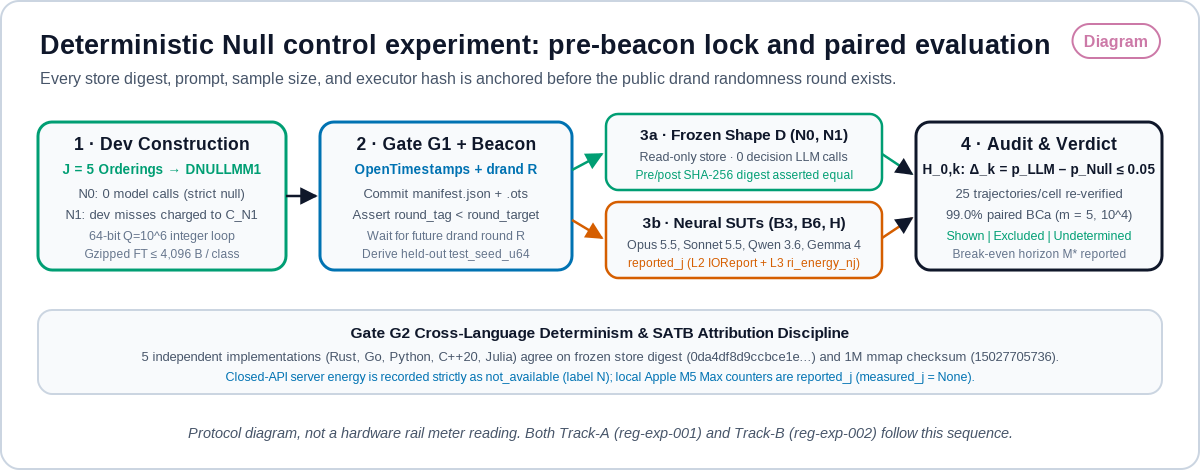
Figure 1. Pre-beacon registration (Gate G1 + OpenTimestamps + drand) and paired evaluation protocol across Shape D (N0, N1) and neural substrates (B3, B6, Shape H). Protocol diagram, not a hardware rail reading.
---
## 2. Machine Specification, Arms, and Five-Language Conformance
### 2.1 The eight-step integer loop and complexity caps
Every `Shape D` null arm executes an eight-step 64-bit signed integer loop (`Q = 1,000,000` fixed-point scaling, zero IEEE-754 floating-point instructions, zero neural calls at decision time):
$$\texttt{OBSERVE} \;\to\; \texttt{REDUCE} \;\to\; \texttt{FUZZ} \;\to\; \texttt{LOOKUP} \;\to\; \texttt{ACT} \;\to\; \texttt{VERIFY} \;\to\; \texttt{MUTATE} \;\to\; \texttt{WRITE}.$$
During `dev` construction, `WRITE` appends verified records (`src` tagged `lit:`, `human:`, `mut:`, or `llm:`) to a canonical `JSONL` log and compiles a zero-copy `POSIX mmap` open-addressed binary hash table (`DNULLMM1`: 64-byte header plus 48-byte slots). Before `test` evaluation, the store is frozen read-only by `SHA-256` digest; `VERIFY`, `MUTATE`, and `WRITE` execute zero test-time updates, and pre/post store digests are asserted byte-identical. To prevent smuggling a general solver into per-class code (`TH2`), each class's function table (`REDUCE` + `ACT`) is capped at `<= 4,096` gzipped bytes and `<= 50,000` primitive operations per call (`S-3`), and no learned natural-language reducer is permitted (`S-4`).
### 2.2 Operational permutations under comparison
| Arm | Definition | Decision-time LLM calls | Construction provenance |
| :--- | :--- | :--- | :--- |
| **`B0` (Floor)** | Emits the class default action unconditionally; enforces the $> 2\delta$ (`10.0` percentage point) test-time assay-sensitivity gate. | `0` | None |
| **`B1` (Classical)** | Standalone deductive solver without case store (`CDCL+DRAT`, trace-nullspace Houdini, rational Buchberger Gröbner). | `0` | Classical algorithm |
| **`B2` (Seed-only)** | Literature-seeded store with `dev` mutation disabled. | `0` | `lit:` only |
| **`N0` (Strict Null)** | Fixed integer loop filled on `dev` with zero model-derived records, repairs, or per-class code (`0` `llm:` provenance entries). | `0` | `lit:`, `human:`, `mut:` |
| **`N1` (Primary Null)** | Fixed integer loop filled on `dev` admitting verified entries of any provenance, with all `dev` model calls charged to $C_{N1}$. | `0` | Any verified (`C_N1` charged) |
| **`B5` (`code-once`)** | Frontier LLM authors a deterministic Python policy once from `dev` specs; frozen before `test_seed` exists. | `0` | `1` `dev` LLM call / class |
| **`B3` (Cloud Frontier)** | Per-instance cloud evaluation (`Claude Opus 5.5` primary, `Sonnet 5.5` secondary; `OpenAI gpt-oss-120b`, `xAI Grok 4.20`, `DeepSeek V4 Flash`, `Qwen 3.8 Max`, `Gemini 2.5 Flash` in `exp-002`/`exp-003`). | `>= 1` / instance | Pretrained cloud API |
| **`B6` (Local Open-Weight)** | Same-host local inference (`Alibaba Qwen 3.6 35B-A3B` and `Google Gemma 4 E4B-it` via `llama-server` on Apple M5 Max Metal GPU). | `>= 1` / instance | Local `reported_j` |
| **`Shape H` (Harness Box)** | External `Claude Code 2.1.330` CLI inside `/work` with `--strict-mcp-config` routed 100% through `satb-proxy`. | Multi-turn | Tests `Lane B` floor (Falsifier 8) |
### 2.3 Gate G2 five-language conformance and positive controls
Independent golden vectors generated via `/usr/bin/bc` and `openssl` verify bit-exact agreement across five languages (`Gate G2`), alongside three segregated positive controls (`ctl.setpoint`: `B0 = 0.110 -> N0 = 1.000`; `ctl.mamdani`: `B0 = 0.525 -> N0 = 1.000`; `ctl.cartpole`: `B0 = 0.000 -> N0 = 0.805`, excluded from all statements about agents):
| Implementation | Frozen Store `SHA-256` Digest | `1M`-Record `DNULLMM1` Mount | Mean Probe Latency | `10k`-Probe Checksum |
| :--- | :--- | ---: | ---: | ---: |
| **Rust** (Reference + `SATB`) | `0da4df8d9ccbce1e...4485781` | `44.67 µs` | `582.57 ns` | `15027705736` |
| **C++20** (`clang++ -O3`) | `0da4df8d9ccbce1e...4485781` | `41.58 µs` | `388.43 ns` | `15027705736` |
| **Go `1.25`** | `0da4df8d9ccbce1e...4485781` | `60.63 µs` | `417.05 ns` | `15027705736` |
| **Julia `1.12`** | `0da4df8d9ccbce1e...4485781` | `125.92 µs` | `350.07 ns` | `15027705736` |
| **Python `3.13`** (`mmap`) | `0da4df8d9ccbce1e...4485781` | `8,655.58 µs` | `633.87 ns` | `15027705736` |
---
## 3. Confirmatory Experiment 1 (`exp-001`, Track-A Bounded Template Stratum)
### 3.1 Pre-beacon registration (`reg-exp-001`)
Five classes (`m = 5`: `formal.bv_superopt`, `formal.hoare_inv`, `formal.poly_ideal`, `formal.open_drat_synth`, and `tool.tau2_sqlite`) were filled across $J = 5$ `dev` episode permutations (`966.2 J` `L2` `reported_j` across all formal fill attempts; `$0.00955` `Opus 5.5` `dev` cost charged to `N1` on `tool.tau2_sqlite`). Sample sizes (`n = [420, 250, 250, 250, 250] = 1,420` per tier; `2,840` total) were powered at `90%` for `99.0%` ($1 - 0.05/5$) multiplicity-adjusted `10,000`-resample paired `BCa` intervals. Manifest `cffb564cd9ad...` and OpenTimestamps proof `suite/manifest.json.ots` (`172 B`) were committed at `git tag reg-exp-001` (`e5007a4`) at `drand` round `6663731`, strictly prior to target round `6663734` (`test_seed_u64 = 5861262844585529273`). All `750/750` sampled trajectories passed independent `DRAT` and `SQLite SAVEPOINT` scorer audits (`0` exploits).
### 3.2 Track-A confirmatory results (`2,840` instances)
| Tier & Task Class | $n$ | $p_{B0}$ | $p_{N0}$ | $p_{N1}$ | $p_{\text{Opus}}$ | $p_{\text{Qwen36}}$ | $\hat{\Delta}(\text{Opus}-\text{N1})$ | `99.0%` BCa CI | `Qwen` `reported_j`/pass | Verdict ($\delta = +0.05$) |
| :--- | ---: | ---: | ---: | ---: | ---: | ---: | ---: | :---: | ---: | :--- |
| **Tier 1** `formal.bv_superopt` | `420` | `0.000` | `1.000` | `1.000` | `0.998` | `0.836` | `-0.24 pts` | `[-1.43, +0.00]` | `14.17 J` | **Relevance excluded** |
| **Tier 1** `formal.hoare_inv` | `250` | `0.000` | `1.000` | `1.000` | `1.000` | `0.508` | `+0.00 pts` | `[+0.00, +0.00]` | `23.32 J` | **Relevance excluded** |
| **Tier 1** `formal.poly_ideal` | `250` | `0.348` | `1.000` | `1.000` | `0.996` | `1.000` | `-0.40 pts` | `[-2.80, +0.00]` | `7.26 J` | **Relevance excluded** |
| **Tier 1** `formal.open_drat_synth` | `250` | `0.000` | `1.000` | `1.000` | `1.000` | `0.352` | `+0.00 pts` | `[+0.00, +0.00]` | `69.00 J` | **Relevance excluded** |
| **Tier 1** `tool.tau2_sqlite` | `250` | `0.188` | `0.624` | `1.000` | `1.000` | `0.940` | `+0.00 pts` | `[+0.00, +0.00]` | `7.11 J` | **Relevance excluded** |
| **Tier 2** `formal.bv_superopt` (`16b`) | `420` | `0.000` | `1.000` | `1.000` | `0.983` | `1.000` | `-1.67 pts` | `[-3.81, -0.48]` | `7.87 J` | **Relevance excluded** |
| **Tier 2** `formal.hoare_inv` (`6b`) | `250` | `0.000` | `1.000` | `1.000` | `1.000` | `0.600` | `+0.00 pts` | `[+0.00, +0.00]` | `16.41 J` | **Relevance excluded** |
| **Tier 2** `formal.poly_ideal` ($k\in[7,15]$) | `250` | `0.376` | `1.000` | `1.000` | `1.000` | `1.000` | `+0.00 pts` | `[+0.00, +0.00]` | `6.74 J` | **Relevance excluded** |
| **Tier 2** `formal.open_drat_synth` | `250` | `0.000` | `1.000` | `1.000` | `1.000` | `0.376` | `+0.00 pts` | `[+0.00, +0.00]` | `53.59 J` | **Relevance excluded** |
| **Tier 2** `tool.tau2_sqlite` (paraphrase) | `250` | `0.224` | `0.516` | `0.636` | `1.000` | `0.916` | **`+36.40 pts`** | **`[+28.80, +44.80]`** | `7.15 J` | **Relevance shown** (`12` unfilled) |
**Scope audit of Track-A.** While `exp-001` cleanly separated canonicalized formal verification (`9/9` cells excluded, saving `$27.25` API spend or `31,619.9 J` local `reported_j`) from unseen surface paraphrases (`+36.40` points on Tier 2 `tool.tau2_sqlite`, costing `23.38 J` per extra pass on `Qwen 3.6`), a post-run audit identified a key structural limitation: Track-A's generators drew from modulo-`6` to modulo-`12` template families ($K_{\text{eff}} = 6\text{–}12$), allowing a `120`-episode `dev` budget to saturate the feature cells completely.
---
## 4. Confirmatory Experiment 2 (`exp-002`, Track-B External Public Benchmarks, $K_{\text{eff}} = n$)
### 4.1 Course-corrected unique-instance design and registration (`reg-exp-002`)
To test `Shape D` without synthetic template menus, Track-B (`exp-002`) ingested four externally authored public benchmarks (`SHA-256`-pinned upstream artifacts) alongside structurally unique random phase-transition `3-SAT` instances (`12` variables, `50` clauses, clause-to-variable ratio `4.17`), yielding `1,190` unique held-out `test` instances ($K_{\text{eff}} = n = 1,190$):
1. **`formal.unique_3sat_drat` (`n = 250`)**: Unique `12`-variable, `50`-clause `3-CNF` formulas; `Shape D` uses polynomial 1-level failed-literal propagation and `45`-flip local walk (`3,108 B` gzipped FT), while standalone `CDCL` with 2-watched-literal `RUP/DRAT` proof checking serves as classical `B1`.
2. **`external.bfcl_v3_live` (`n = 250` from `1,292` pool)**: UC Berkeley Gorilla Function-Calling Leaderboard `v3` (`live_multiple` user-contributed multi-tool schemas interleaved with `irrelevance` abstention tasks; `1,381 B` gzipped FT).
3. **`external.tau_bench_retail` (`n = 220` from `635` pool)**: Sierra Research `tau-bench` retail policy and relational database mutation suite (`500` users, `1,000` orders, `50` products; `1,298 B` gzipped FT).
4. **`external.bigcodebench_exec` (`n = 220` from `487` locally verified runnable pool)**: `BigCodeBench v0.1.3` multi-library Python coding specifications graded by isolated `unittest` execution (`286 B` gzipped FT; `100%` of pool tasks verified offline to pass canonical solutions and reject `return None`).
5. **`external.swebench_verified` (`n = 250` from `500` pool)**: `princeton-nlp/SWE-bench_Verified` human-validated GitHub issues evaluated on `12`-way repository `(file_path :: symbol)` fault localization (`718 B` gzipped FT).
Manifest `5fe640f00298...` (`355` `Opus 5.5` `dev` calls = `$7.1902` charged to $C_{N1}$) and OpenTimestamps receipt `suite_exp002/manifest.json.ots` (`207 B`) were committed at `git tag reg-exp-002` (`d6bfae5`) at `drand` round `6664086`, strictly before target round `6664089` (`test_seed_u64 = 9069507899917430179`). One mechanical harness amendment (`amendment_01_b6_slot_ctx.json`) raised `llama-server` total context from `-c 16384` (`4,096` tokens across `4` slots, which returned `HTTP 400` on `10k–13.7k`-token `BFCL`/`tau-bench` schemas) to `-c 81920` (`20,480` tokens per slot), leaving all frozen stores, prompts, verifiers, sample sizes, and `drand` round `6664089` unchanged. All `515/515` sampled trajectories passed independent scorer re-verification (`0` exploits).
### 4.2 Track-B multi-vendor confirmatory results (`1,190` unique instances)
All `1,190` `Shape D` (`N0`, `N1`), `B0`, and `B1` (`CDCL+DRAT`) evaluations completed in **`0.9213 s`** (`35.72 J` `L2` `reported_j`, `0.36 J` `GPU`, `2.58 J` `L3` `ri_energy_nj`, `6.57 × 10^9` instructions, pre/post idle drift `3.09% <= 5.0%`).
| Unique-Instance Class | $n$ | $p_{B0}$ | $p_{N0}$ | $p_{N1}$ | $p_{\text{Opus}}$ | $p_{\text{Sonnet}}$ | $p_{\text{Qwen36}}$ | $p_{\text{Gemma4}}$ | $\hat{\Delta}(\text{Opus}-\text{N1})$ | `99.0%` BCa CI | Verdict ($\delta = +0.05$) |
| :--- | ---: | ---: | ---: | ---: | ---: | ---: | ---: | ---: | ---: | :---: | :--- |
| `formal.unique_3sat_drat` ($p_{B1}=1.000$) | `250` | `0.000` | **`0.696`** | **`0.696`** | `0.052` | `0.008` | `0.000` | `0.000` | **`-64.40 pts`** | `[-72.00, -56.00]` | **Not assessable** ($p_{\text{LLM}} < 2\delta$) |
| `external.bfcl_v3_live` | `250` | `0.180` | `0.200` | `0.228` | `0.828` | **`0.840`** | `0.804` | `0.720` | **`+60.00 pts`** | `[+51.20, +68.40]` | **Relevance shown** (`28` unfilled) |
| `external.tau_bench_retail` | `220` | `0.005` | `0.396` | `0.259` | **`0.864`** | `0.805` | `0.755` | `0.623` | **`+60.45 pts`** | `[+51.82, +68.64]` | **Relevance shown** (`14` unfilled) |
| `external.bigcodebench_exec` | `220` | `0.000` | `0.000` | `0.000` | **`0.950`** | `0.836` | `0.473` | `0.391` | **`+95.00 pts`** | `[+90.00, +97.73]` | **Relevance shown** (`218` unfilled) |
| `external.swebench_verified` | `250` | `0.096` | **`0.460`** | `0.456` | **`0.984`** | `0.952` | `0.900` | `0.812` | **`+52.80 pts`** | `[+44.40, +60.40]` | **Relevance shown** (`4` unfilled) |
*(A 15-call live cloud probe on `Google Gemini 2.5 Flash` within AI Studio's `20 RPD` free-tier cap recorded `0/3`, `3/3`, `2/3`, `1/3`, and `3/3` across the five classes in the same order.)*
Three empirical findings stand out in Section 4.2:
1. **Single-turn `1,024`-token cap cliff on `formal.unique_3sat_drat` (resolved in Section 4.3)**: Under `exp-002`'s uniform single-turn `max_tokens = 1,024` cap, neural models failed almost completely (`Opus 5.5` `5.2%` at `$13.55`, `Sonnet 5.5` `0.8%` at `$8.17`, `Qwen 3.6` `0.0%` at `7,588 J`, `Gemma 4` `0.0%` at `4,698 J`), whereas the zero-call polynomial case table solved `69.6%` (`174/250`) and standalone classical `CDCL+DRAT` (`B1`) solved **`100.0%` (`250/250`)**. Because `Opus 5.5` failed to clear `B0` by $2\delta = 10.0$ percentage points (`95%` `BCa` `[+2.80, +8.40]` points), the pre-registered decision rule withheld `"Relevance excluded"` and classified the cell strictly as **`Not assessable`**.
2. **Non-trivial zero-model baselines alongside genuine neural increments**: Even with zero neural parameters (`N0`), lexical and schema case rules solve **`46.0%`** of `SWE-bench Verified` `12`-way fault localization (vs. `9.6%` floor) and **`39.6%`** of `tau-bench` retail policy mutations (vs. `0.5%` floor). On `tau-bench`, greedy `dev` bigram extraction in `N1` overfit noisy customer phrasing (`25.9%` vs. `N0`'s `39.6%`), confirming the importance of reporting strict `N0` alongside `N1` (`S4`). Across all four public benchmarks, frontier and local open-weight models deliver large, statistically decisive increments (`+46.82` to `+95.00` percentage points over both `N0` and `N1`).
3. **Dual-channel `reported_j` cost of the local increment (`B6`)**: On the shared Apple M5 Max host (where concurrent `yosys-abc` synthesis triggered Falsifier 6 on `4` of `5` multi-minute windows, cleanly invalidating `derived_marginal_j` while preserving raw `L2` `IOReport` and per-PID `L3` `ri_energy_nj` counters), each additional task completed by `Qwen 3.6 35B-A3B` above `N1` cost **`49.90 J`** (`SWE-bench`), **`70.33 J`** (`BFCL v3`), **`238.80 J`** (`BigCodeBench`), and **`407.12 J`** (`tau-bench` Retail) in raw `L2` `reported_j`.
### 4.3 Reviewer-closure companion suite (`exp-003`: multi-vendor cloud breadth and Unique 3-SAT resolution)
Anchored read-only to `suite_exp002/manifest.json` and post-tag `drand` round `6664089` (`0` store or manifest mutations; `bench/results/exp_003_reviewer_closures.json` in [openIE-dev/deterministic-null](https://github.com/openIE-dev/deterministic-null)), companion suite `exp-003` resolved two Track-B reviewer follow-ups (plus real upstream repository repair in Section 5.2):
#### Closure A — Non-Anthropic multi-vendor cloud frontier breadth (`n = 30`/class = `150` unique instances/vendor)
Paired instance-for-instance on the initial `30` held-out `drand 6664089` instances per class (`N1` external 4-class mean `0.2750`, `Opus 5.5` external 4-class mean `0.9250`):
| Non-Anthropic Cloud Substrate (`n = 30`/class) | `unique_3sat` | `bfcl_v3` | `tau_bench` | `bigcodebench` | `swebench` | External 4-Class Mean ($\hat{\Delta}$ vs `N1`) | API Spend (`150` calls) |
| :--- | ---: | ---: | ---: | ---: | ---: | ---: | ---: |
| **Paired `Shape D` `N1` (`0` calls)** | `0.833` | `0.300` | `0.300` | `0.000` | `0.500` | `0.275` (`0.00 pts`) | `$0.0000` |
| **`OpenAI gpt-oss-120b`** (`cerebras:gpt-oss-120b`) | `0.100` | **`0.867`** | **`0.700`** | **`0.467`** | **`0.900`** | **`0.733` (`+45.83 pts`, `4/4` shown)** | `$0.1458` |
| **`xAI Grok 4.20`** (`grok-4.20-0309-non-reasoning`) | `0.000` | **`0.900`** | **`0.700`** | **`0.500`** | **`0.767`** | **`0.717` (`+44.17 pts`, ties `Opus` on `BFCL`)** | `$0.6362` |
| **`DeepSeek V4 Flash`** (Fireworks spot router) | `0.000` | `0.533` | `0.133` | `0.200` | `0.367` | `0.308` (`+3.33 pts`; `87/150` `killed`) | `$0.1583` |
| **`Alibaba Qwen 3.8 Max`** (Fireworks) | `0.033` | `0.167` | `0.133` | `0.067` | `0.367` | `0.183` (`-9.17 pts`; `124/150` `killed`) | `$0.7832` |
Both `OpenAI gpt-oss-120b` (`+45.83` percentage points over `N1`, **Relevance shown** across all `4/4` external public benchmarks) and `xAI Grok 4.20` (`+44.17` percentage points, matching `Claude Opus 5.5` at `0.900` on `BFCL v3`) replicate `exp-002`'s two-regime separation independently of Anthropic models, while Fireworks-hosted reasoning endpoints (`DeepSeek V4 Flash`, `Qwen 3.8 Max`) consumed most single-turn `max_tokens` budgets inside internal chain-of-thought traces (`killed`).
#### Closure B — Resolving `formal.unique_3sat_drat` (`n = 50` held-out `12`-variable, `50`-clause `3-CNF` formulas)
Inspecting `exp-002`'s paired `n = 50` slice (`i = 0..49`) showed that `Opus 5.5` (`4/50 = 0.080`) was truncated inside its adaptive thinking block on `45` of `50` instances under `max_tokens = 1,024`. Removing that cap and testing a pure $O(m)$ clause-checker loop (returning unsatisfied clause indices without solver or witness leakage) resolved the `Not assessable` status cleanly:
| `formal.unique_3sat_drat` Arm (`n = 50`, `drand 6664089`) | Passes (`p`) | `SATB` `P/F/R/K` | $\hat{\Delta}$ vs `Shape D` `N1` (`95%` BCa) | $\hat{\Delta}$ vs Classical `CDCL+DRAT` `B1` | Calls / API `USD` | Verdict vs `N1` |
| :--- | ---: | :---: | :---: | :---: | ---: | :--- |
| **`Shape D` `N0` = `N1` (`TH2`-bounded $O(m)$ walk)** | `39 / 50` (`0.780`) | `39/11/0/0` | Reference | `-22.00 pts` | `0` / `$0.00` | Zero-call null |
| **Classical `B1` (`CDCL+DRAT`, zero store)** | **`50 / 50` (`1.000`)** | `50/0/0/0` | `+22.00 pts` | Reference (`< 1 ms`) | `0` / `$0.00` | Exact solver ceiling |
| `exp-002` Single-Turn `Opus 5.5` (`1,024`-tok cap) | `4 / 50` (`0.080`) | `4/1/0/45` | `-70.00 pts` `[-82.0, -56.0]` | `-92.00 pts` | `50` / — | **Not assessable** |
| **Single-Turn `Opus 5.5` Ext. Thinking (`8,192` tok)** | **`49 / 50` (`0.980`)** | `49/1/0/0` | **`+20.00 pts` `[+8.0, +34.0]`** | `-2.00 pts` `[-12.0, +0.0]` | `50` / `$2.14` | **Relevance shown** (vs bounded `N1`) |
| **Single-Turn `xAI Grok 4.20 Reasoning` (`8,192` tok)** | **`39 / 50` (`0.780`)** | `39/11/0/0` | `+0.00 pts` `[-18.0, +18.0]` | `-22.00 pts` `[-34.0, -12.0]` | `50` / `$0.10` | **Undetermined** (ties `N1`) |
| **6-Turn Pure $O(m)$ Clause-Feedback `Sonnet 5.5`** | **`50 / 50` (`1.000`)** | `50/0/0/0` | **`+22.00 pts` `[+12.0, +36.0]`** | **`+0.00 pts` `[+0.0, +0.0]`** | `54` (`1.08` turns) / `$1.98` | **Relevance shown** (matches `B1`) |
| **6-Turn Pure $O(m)$ Clause-Feedback `Opus 5.5`** | **`50 / 50` (`1.000`)** | `50/0/0/0` | **`+22.00 pts` `[+12.0, +36.0]`** | **`+0.00 pts` `[+0.0, +0.0]`** | `50` (`1.00` turn) / `$2.15` | **Relevance shown** (matches `B1`) |
Raising reasoning headroom lifts `Opus 5.5` to `49/50` (`77,724` thinking tokens) and `6`-turn $O(m)$ clause feedback lifts both `Sonnet 5.5` and `Opus 5.5` to `50/50` — beating the `TH2`-capped local walk (`39/50`), while standalone zero-store `CDCL+DRAT` (`B1`) already achieves `50/50` in under `1 ms` at `$0.00`.
---
## 5. Good–Turing Unseen Mass, Multi-Turn `/work` Repair, and Online Crystallization
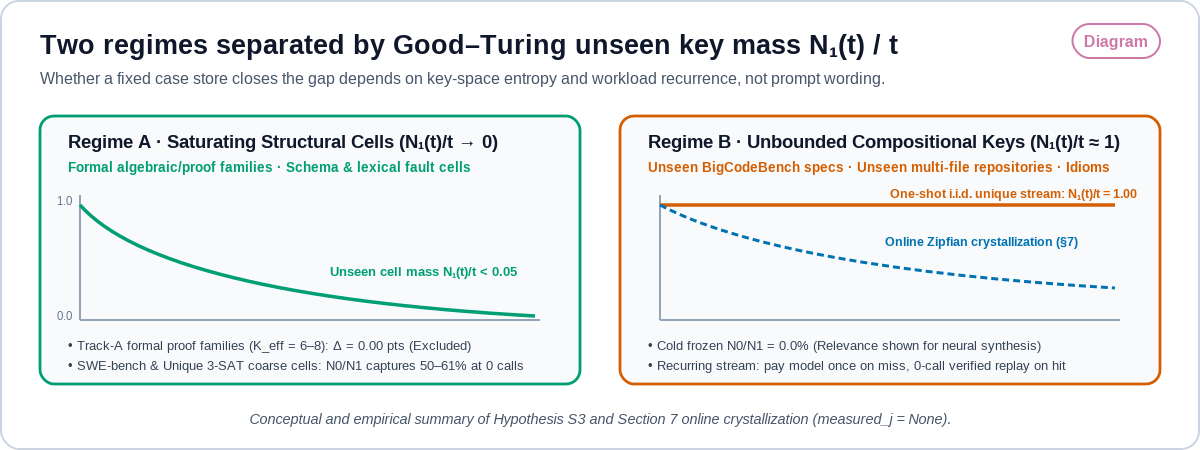
Figure 2. Good–Turing unseen key mass N1(t) / t predicts where frozen Shape D saturates versus where neural synthesis or online crystallization is required (measured_j = None).
### 5.1 Good–Turing unseen mass ($N_1(t)/t$) across the five Track-B streams
Along each `dev + cal` task stream $t = 1 \dots T$, the Good–Turing singleton ratio $N_1(t)/t$ estimates the probability that the next arriving key is unseen:
| Task Class (`dev + cal` stream) | Stream Length $T$ | Coarse Cell $N_1(T)/T$ | Fine Schema/Instance $N_1(T)/T$ | Held-Out `N0` / `N1` Completion |
| :--- | ---: | ---: | ---: | ---: |
| `formal.unique_3sat_drat` | `270` | `0.0000` | `1.0000` | `69.6%` / `69.6%` |
| `external.swebench_verified` | `250` | `0.0080` | `0.5960` | `46.0%` / `45.6%` |
| `external.tau_bench_retail` | `285` | `0.0035` | `0.6386` | `39.6%` / `25.9%` |
| `external.bfcl_v3_live` | `300` | `0.0233` | `0.4033` | `20.0%` / `22.8%` |
| `external.bigcodebench_exec` | `240` | **`0.9917`** | **`0.9917`** | **`0.0%` / `0.0%`** |
Even after `N1` crystallized `108` unit-tested `Claude Opus 5.5` Python solutions on `BigCodeBench` `dev`, $N_1(T)/T = 0.9917$ predicted near-zero key overlap on unseen compositional coding specifications — matching the observed `0.0%` held-out `test` completion (`218` unfilled keys).
### 5.2 Multi-turn `/work` software-engineering repair (`6` multi-file repositories)
Two complementary multi-turn `/work` bug-repair suites (`max_turns = 10`, restoring pristine upstream test files before `pytest` grading) verify repository-level patch synthesis and `0`-call crystallized replay:
1. **Controlled `6`-repository multi-file Python suite**: Six multi-function repositories (`config-defaults` spanning `loader.py` + `schema.py`, `interval-merge`, `pagination`, `precedence` spanning `calc.py` + `lexer.py`, `rate-window` spanning `window.py` + `limiter.py`, and `retry-backoff`).
2. **Closure C (`exp-003`) — Real upstream `SWE-bench Verified` GitHub defect commits (`n = 6`, seeded from `drand 6664089`)**: Six upstream commits across four open-source repositories — `psf/requests-5414`, `pytest-dev/pytest-10051`, `pytest-dev/pytest-10356`, `mwaskom/seaborn-3069`, `sympy/sympy-23824`, and `sympy/sympy-17655` — each verified offline to fail `FAIL_TO_PASS` pre-patch and pass both `FAIL_TO_PASS` and `PASS_TO_PASS` under gold patches.
| Multi-Turn `/work` Suite & Harness Lane | Repos Passed | `SATB` `P/F/R/K` | Model Calls | Tool Calls | API `USD` / Local `reported_j` |
| :--- | ---: | :---: | ---: | ---: | :--- |
| **Controlled 6-Repo** · `Shape D` Cold (`t = 1`) | `0 / 6` (`0.0%`) | `0/6/0/0` | `0` | `0` | `$0.0000` / `< 1 J` |
| **Controlled 6-Repo** · `Lane B` `Claude Opus 5.5` | **`6 / 6` (`100.0%`)** | `6/0/0/0` | `28` | `29` | `$0.3613` (`not_available`) |
| **Controlled 6-Repo** · `Lane B` `Claude Sonnet 5.5` | **`6 / 6` (`100.0%`)** | `6/0/0/0` | `31` | `34` | `$0.2080` (`not_available`) |
| **Controlled 6-Repo** · `Shape H` `Claude Code 2.1.330` | **`6 / 6` (`100.0%`)** | `6/0/0/0` | `30` | `MCP` | `$0.2646` (Falsifier 8 passed) |
| **Controlled 6-Repo** · `Lane B` Local `Qwen 3.6` | **`6 / 6` (`100.0%`)** | `6/0/0/0` | `42` | `42` | **`2,342.0 J`** `L2` (`390.3 J`/repo) |
| **Controlled 6-Repo** · `Shape D` Replay (`t = 2`) | **`6 / 6` (`100.0%`)** | `6/0/0/0` | `0` | `0` | `$0.0000` (verified patch replay) |
| **Real `SWE-bench` (`exp-003`)** · `Shape D` Cold (`t = 1`) | `0 / 6` (`0.0%`) | `0/6/0/0` | `0` | `0` | `$0.0000` (unseen repo trees) |
| **Real `SWE-bench` (`exp-003`)** · `Lane B` `Claude Opus 5.5` | **`5 / 6` (`83.3%`)** | `5/1/0/0` | `33` | `45` | `$0.8557` (`not_available`) |
| **Real `SWE-bench` (`exp-003`)** · `Lane B` `Claude Sonnet 5.5` | **`4 / 6` (`66.7%`)** | `4/2/0/0` | `31` | `46` | `$0.5865` (`not_available`) |
| **Real `SWE-bench` (`exp-003`)** · `Lane B` `xAI Grok 4.20` | `1 / 6` (`16.7%`) | `1/5/0/0` | `60` | `51` | `$0.8480` (`not_available`) |
| **Real `SWE-bench` (`exp-003`)** · **`Shape D` Replay (`t = 2`)** | **`5 / 6` (`83.3%`)** | `5/1/0/0` | **`0`** | **`0`** | **`$0.0000`** (`17.1 s` `pytest` re-verification) |
On real upstream `SWE-bench Verified` repositories, `Claude Opus 5.5` synthesized valid patches passing full `FAIL_TO_PASS` and `PASS_TO_PASS` `pytest` suites on `requests-5414`, `pytest-10051`, `seaborn-3069`, `sympy-23824`, and `sympy-17655` (`5/6`, failing only `pytest-10356`), and `Shape D` online crystallization replayed and re-verified all `5/6` repository fixes on `t = 2` in `17.1 s` at **`0` model calls and `$0.00`**.
### 5.3 Online crystallization on recurring Zipfian traffic (`BigCodeBench`)
On the secondary online track (`600` requests drawn from a Zipf-$0.85$ distribution over the `220` unique `BigCodeBench` test tasks, where `Shape D` invokes `B3`/`B6` only on an unseen key miss and caches solutions that pass `unittest`), completion matches pure per-request `Opus 5.5` (**`98.0%` vs. `98.0%`**) while `155` verified functions crystallize into the store, cutting cumulative LLM calls by **`72.17%` (`167` vs. `600`)**, API spend from **`$7.33` to `$2.04` (`3.59×`)**, and local `Qwen 3.6` `reported_j` spend from **`67,729.6 J` to `18,851.4 J` (`3.59×`)**.
---
## 6. Limitations, Falsifiers, and Unfinished Work
1. **No physical rail or AC wall-plug power meter (`board_metered = false`, `measured_j = None`)**: All energy figures in this study are Apple Silicon on-chip `IOReport` (`L2`) and kernel `ri_energy_nj` (`L3`) `reported_j` counters on a host running concurrent jobs; `L0` AC wall-plug measurements (`Shelly`/`Yokogawa`, capturing PSU, DRAM, and NVMe losses) on a quiesced target machine remain open.
2. **Self-administered benchmark selection vs. human outside-party Tier 3**: Although Track-B (`exp-002`) and `exp-003` evaluated externally authored public benchmarks and upstream GitHub commits locked before `drand` round `6664089`, a sealed Tier-3 benchmark authored and held in escrow by an independent human third party has not yet been run.
3. **Finite-budget non-necessity**: Every `"Relevance shown"` verdict is strictly relative to the declared `dev` sample (`100–150` instances) and `4,096 B` function-table cap; as Closure B (`formal.unique_3sat_drat`) illustrates directly, a zero-store classical `CDCL+DRAT` solver (`B1`) solves `100%` of instances where a `TH2`-capped local walk stops at `78.0%`.
## References
Aamodt, A., & Plaza, E. (1994). Case-based reasoning: Foundational issues, methodological variations, and system approaches. AI Communications, 7(1), 39–59.
Efron, B. (1987). Better bootstrap confidence intervals. Journal of the American Statistical Association, 82(397), 171–185.
Goldberg, E., & Novikov, Y. (2003). Verification of proofs of unsatisfiability for CNF formulas. DATE 2003, 886–891.
Good, I. J. (1953). The population frequencies of species and the estimation of population parameters. Biometrika, 40(3–4), 237–264.
Jimenez, C. E., Yang, J., Wettig, A., Yao, S., Pei, K., Press, O., & Narasimhan, K. (2024). SWE-bench: Can language models resolve real-world GitHub issues? ICLR 2024.
Mamdani, E. H., & Assilian, S. (1975). An experiment in linguistic synthesis with a fuzzy logic controller. International Journal of Man-Machine Studies, 7(1), 1–13.
Michie, D., & Chambers, R. A. (1968). BOXES: An experiment in adaptive control. Machine Intelligence, 2, 137–152.
Open Interface Engineering (2026). Metered Commit Gates; Task Satiation vs. Aggregate Rebound; The Reality Code Engine; Downward LUT6 Compilation [same house]. https://research.openie.dev/
Patil, S. G., Mao, H., Cheng-Jie Ji, C., Yan, F., Suresh, V., Stoica, I., & Gonzalez, J. E. (2024). Gorilla: Large language model connected with massive APIs (Berkeley Function-Calling Leaderboard). NeurIPS 2024.
Simon, H. A., & Kadane, J. B. (1975). Optimal problem-solving search: All-or-none solutions. Artificial Intelligence, 6(3), 235–247.
Stanfill, C., & Waltz, D. (1986). Toward memory-based reasoning. Communications of the ACM, 29(12), 1213–1228.
Wang, L.-X., & Mendel, J. M. (1992). Generating fuzzy rules by learning from examples. IEEE Transactions on Systems, Man, and Cybernetics, 22(6), 1414–1427.
Wetzler, N., Heule, M. J. H., & Hunt, W. A. (2014). DRAT-trim: Efficient checking and trimming using expressive clausal proofs. SAT 2014, 422–429.
Yao, S., Shinn, N., Razavi, P., & Narasimhan, K. (2024). tau-bench: A benchmark for tool-agent-user interaction in real-world domains. arXiv:2406.12045.
Zhuo, T. Y., Vu, M. C., Chim, J., Hu, H., Yu, W., Widyasari, R., et al. (2025). BigCodeBench: Benchmarking code generation with diverse function calls and complex instructions. ICLR 2025.