JEPA, EBRM, ACI, OOD, AUROC, AUC, MSP, MC: Joint-Embedding Predictive Architecture, Energy-Based Reasoning Model, Adaptive Conformal Inference, out-of-distribution, area under the receiver operating characteristic, maximum softmax probability, and Monte Carlo
PLD, REST, EAGLE, LFM2, LFM3, HF: Prompt Lookup Decoding, Retrieval-Based Speculative Decoding, Extrapolation Algorithm for Greater Language-model Efficiency, Liquid Foundation Model 2.5 (LFM2.5-350M and LFM2.5-8B-A1B), Liquid Foundation Model 3 (Oct 2026 LiquidAI/LFM3-1.7B), and HuggingFace
SVD, ITQ, SVID, QAT, PTQ, PPL, SNR: singular value decomposition, Iterative Quantization Procrustes hypercube rotation, sign-value-independent decomposition, quantization-aware training, post-training quantization, perplexity, and signal-to-noise ratio
NVMe, NOCACHE, POSIX, RAM, DRAM, SRAM, RSS, GGUF, IO, KB, MB, GB, GiB: Non-Volatile Memory Express storage, Darwin F_NOCACHE unbuffered file flag, Portable Operating System Interface, random-access memory, dynamic RAM, static RAM, resident set size in physical Unified Memory, GPT-Generated Unified Format quantized model file, input/output, kilobyte, megabyte, gigabyte, and gibibyte
FLOP, FLOPs, MFLOP, MFLOPs, MAC, MACs, SIMD, AD, FD, BPB, BF16, FP16, FP32, INT4, ULP, MSL, MPS, CUDA, ROC, SPIR, PTX, HIP, LLVM: floating-point operation(s), million FLOPs, multiply-accumulate operation(s), single-instruction multiple-data, automatic differentiation, finite difference, bits per byte, brain float 16, 16/32-bit IEEE floating point, 4-bit integer, unit in the last place, Apple Metal Shading Language, PyTorch Metal Performance Shaders, NVIDIA Compute Unified Device Architecture, AMD ROCm runtime, Standard Portable Intermediate Representation (Vulkan SPIR-V), Parallel Thread Execution, Heterogeneous-Compute Interface for Portability, and Low Level Virtual Machine compiler backend
JTAG, XSDB, DAP, USB, FTDI, FT2232C, UART, FIFO, IC, EDA, OOC, AMBA, AXI4, IOB, IBUF, OBUF, FDRE, FDSE, LUT1, LUT2, LUT3, LUT4, LUT5, MUXF7, MUXF8, CARRY4, CARRY8, DSP48E2, URAM288, VCCINT, DS925, VCD, SDP, CE, ENARDEN, XPE, CLAI, AMD: Joint Test Action Group debug port, Xilinx Software Command-Line Tool debugger, Debug Access Port, Universal Serial Bus, Future Technology Devices International and its FT2232C dual UART/FIFO bridge IC, universal asynchronous receiver-transmitter, first-in first-out buffer, integrated circuit, electronic design automation, out-of-context synthesis mode, Advanced Microcontroller Bus Architecture, AXI4-Lite/AXI4-Stream interconnect, input/output block, input/output buffers, synchronous-reset/set D flip-flops, 1-to-5-input UltraScale+ look-up tables, 7/8-input UltraScale+ multiplexers, 4/8-bit fast carry chains, UltraScale+ DSP slice, 288-Kbit UltraRAM, internal core supply rail (0.72 V on -2LV), AMD Zynq UltraScale+ DC and AC Switching Characteristics datasheet DS925, Value Change Dump waveform trace, simple dual-port Block RAM mode, synchronous clock enable, RAMB36E2 port-A read/clock-enable pin, Xilinx Power Estimator, subsystem register magic identifier ("CLAI"), and Advanced Micro Devices
CVE, CWE, FRO, GMP, RAG, WHNF, ZFC, CIC, FFI: Common Vulnerabilities and Exposures, Common Weakness Enumeration, Lean Focused Research Organization, GNU Multiple Precision Arithmetic Library, Retrieval-Augmented Generation, weak head normal form, Zermelo-Fraenkel set theory with Choice, Calculus of Inductive Constructions, and foreign function interface
ABBA, AGX, AI, DC, FWHT, INA238, INA3221, MSS, NT, PPT, RDNA, RPL, RTX, RUSAGE_INFO_V6, TI, VDD, VDD_CPU_SOC_MSS, VDD_GPU, VIN, XNU: counterbalanced A-B-B-A trial ordering, Autonomous-Grade Compute module family, artificial intelligence, direct current, Fast Walsh-Hadamard Transform, Texas Instruments inline power monitors (INA238 whole-board VIN and three-channel INA3221 rail), memory subsystem, Windows NT kernel family, Package Power Tracking, Radeon DNA graphics architecture, Raptor Lake mobile platform, Ray Tracing Texel eXtreme, Darwin Resource Usage Info v6 struct, Texas Instruments, voltage drain-drain supply rail, Tegra CPU/SoC/memory supply rail, Tegra GPU supply rail, board voltage-input rail, and Darwin X is Not Unix kernel
ABI, AC, ADC, AE3, A2B, CRC32, CYCCNT, DTCM, DWT, E3, E4, E4B, ELF, ELFs, FCCM, FSM, GPT, INT8, ISVLSI, LSB, M0, M55, MCU, MRAM, PALUTE, PIO, Q4, ROM, RP2040, SHA256, SPI, ST, XL: application binary interface, alternating-current non-constant Fourier energy, analog-to-digital converter, Alif Ensemble E3 OpenMV-AE3 microcontroller board, 2-billion active-expert sparse architecture suffix, 32-bit IEEE cyclic redundancy check, Arm Data Watchpoint and Trace cycle counter register, Data Tightly Coupled Memory, Data Watchpoint and Trace unit, Alif Ensemble E3/E4 microcontroller series, 4-billion effective edge parameter suffix, Executable and Linkable Format firmware image(s), Field-Programmable Custom Computing Machines symposium, finite-state machine, Generative Pre-trained Transformer (normalized nGPT), 8-bit integer quantization, International Symposium on VLSI, least-significant bit, Arm Cortex-M0+ and Cortex-M55 microcontroller cores, microcontroller unit, magnetoresistive non-volatile RAM, Processing-In-Memory Acceleration via Lookup Table, programmable input/output peripheral, 4-bit quantized block format (Q4_K_XL), read-only memory, Raspberry Pi dual Cortex-M0+ microcontroller, 256-bit Secure Hash Algorithm, Serial Peripheral Interface bus, Straight-Through estimator, and extra-large quantization block suffix
BAR0, BGA, BLE, CEM, CMOS, CSR, DDR3, DS181, DSP48E1, ECC, FBG484, FPC, GPIO, GTP, HAT, HPL, I2C, INA228, IRQ, JEDEC, LFM, M4F, MIG, MT, MUL, NDP120, ODT, PCIe, PHY, QCM6490, QFAA, RAMB36E1, RISC, RV32IMAC, SSTL15, SYSMON, TMAC, UG475, VNNI, XADC, XC7A200T, XCK26, XCZU9EG, ZCU102: PCIe Base Address Register 0, ball-grid array, Bluetooth Low Energy, Card Electromechanical PCIe slot specification, complementary metal-oxide-semiconductor, control and status register, double-data-rate type-3 synchronous DRAM, AMD Artix-7 FPGAs DC and AC Switching Characteristics datasheet DS181, Xilinx 7-Series digital signal processing slice, error-correcting code, 484-ball 23x23 mm lidless flip-chip BGA package, flexible printed circuit ribbon, general-purpose input/output, Artix-7 multi-gigabit serial transceiver, Hardware Attached on Top 40-pin expansion header, TSMC 28 nm High-Performance Low-Power process, Inter-Integrated Circuit bus, Texas Instruments ultra-precise inline current/power monitor IC, interrupt request, Joint Electron Device Engineering Council thermal coupon standard, linear feet per minute airflow unit, Arm Cortex-M4F microcontroller core, Xilinx 7-Series Memory Interface Generator, megatransfers per second, integer multiply instruction, Syntiant NDP120 neural decision processor, on-die termination, Peripheral Component Interconnect Express, physical memory interface layer, Qualcomm Dragonwing system-on-chip on Particle Tachyon, Nordic 48-pin QFN nRF52832 package suffix, Xilinx 7-Series 36-Kbit dual-port Block RAM primitive (365 on XC7A200T), Reduced Instruction Set Computer, 32-bit RISC-V integer/multiply/atomic/compressed ISA, Stub Series Terminated Logic 1.5 V I/O standard, Xilinx System Monitor temperature/voltage block, Table-Lookup MAC ternary dot-product layout, AMD 7-Series FPGAs Packaging and Pinout Specification UG475, Vector Neural Network Instructions, Xilinx 7-Series dual 12-bit analog-to-digital converter, AMD Artix-7 200T FPGA (Numato Aller A7 M.2 2280), AMD Kria K26 SOM FPGA, AMD Zynq UltraScale+ MPSoC FPGA, and AMD ZCU102 evaluation board
AIME, AR, ASR, CAIS, CHR, GPQA, HLE, HMMT, HRV, HUD, LTE, MC10, MMLU, POV, RMS, RTT, SPO2, TTFT, UW, XR: American Invitational Mathematics Examination, augmented reality, automatic speech recognition, Center for AI Safety, confident hallucination rate (at verbalized confidence >= 80%), Graduate-Level Google-Proof Question Answering, Humanity's Last Exam (lastexam.ai), Harvard-MIT Mathematics Tournament, heart-rate variability, heads-up display, Long-Term Evolution cellular radio, 10-option multiple choice (A..J), Massive Multitask Language Understanding, point-of-view camera frame, root-mean-square calibration metric, round-trip time, peripheral blood oxygen saturation, time to first token, University of Washington, and extended reality
ACTION1, ACTION6, ACTION7, AGI, ARC, ARC2, ARC3, BFS, BPW, IRB, LEFT, MIT, ML, MLX, RHAE, RIGHT: ARCEngine discrete and coordinate-click action opcodes, artificial general intelligence, Abstraction and Reasoning Corpus (ARC-AGI-2 and ARC-AGI-3) and their shorthand identifiers, breadth-first search, bits per weight, Interactive Reasoning Benchmark, directional grid action tokens, Massachusetts Institute of Technology open-source license, machine learning, Apple Machine Learning Explore array framework, and Relative Human Action Efficiency
Six evidence classes stay separate across every table below:
| Evidence label | Meaning in this study |
| :--- | :--- |
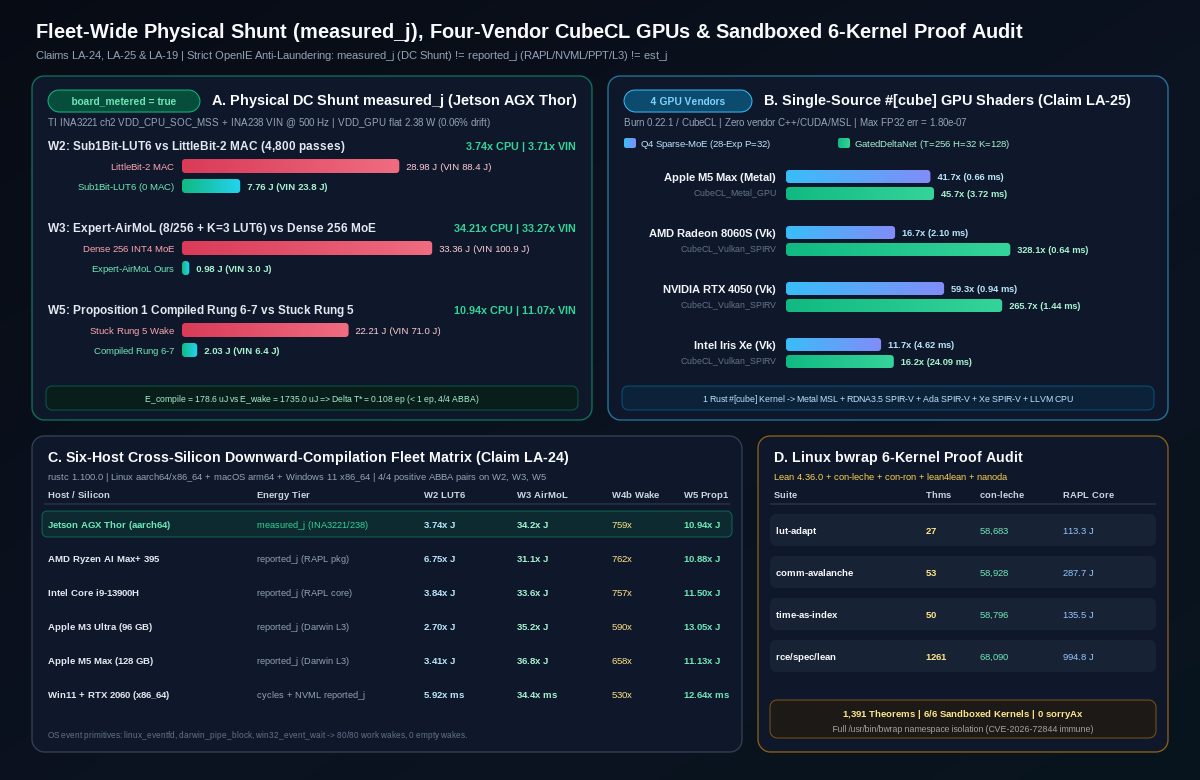
| **`Physical DC Shunt (measured_j)`** | Direct-current inline shunt readings on `NVIDIA Jetson AGX Thor` (`Claims LA-24, LA-28, LA-32, LA-33, LA-38, LA-39, LA-42 & LA-44` only, `board_metered = true`): Texas Instruments `INA3221` channel-2 `VDD_CPU_SOC_MSS` (`L2`, physically isolated from `VDD_GPU`) and `INA238` whole-board `VIN` (`L1`), integrated trapezoidally at `500 Hz` across counterbalanced `ABBA` windows. Never summed with `reported_j` or `est_j`, and unset (`None`) on all non-Thor rows. |
| **`Measured (SW / NVMe I/O / OS PMU)`** | Exact byte counts read or written via `os.pread` under Darwin `F_NOCACHE`, resident memory allocations, wall-clock seconds, whole-machine macOS `PMU` (`AppleSmartBattery.PowerTelemetryData`) cumulative energy deltas on Apple M5 Max, `12.75 KB` `WASM` execution, and exact bit/token agreement. |
| **`Reported (OS / On-Chip Counter, reported_j)`** | Unprivileged operating-system and on-chip telemetry counters (`board_metered = false`): on Apple M5 Max and M3 Ultra, `libIOReport.dylib` `'GPU Energy'` (`L2` `nJ`) plus `proc_pid_rusage(RUSAGE_INFO_V6).ri_energy_nj` (`L3` CPU `nJ`); on `x86-64` Linux, `RAPL` (`package-0` / `core`), `amdgpu` `PPT`, and `NVML` `mJ`; on Windows 11, `NVML` `mJ`. Never merged with `measured_j`. |
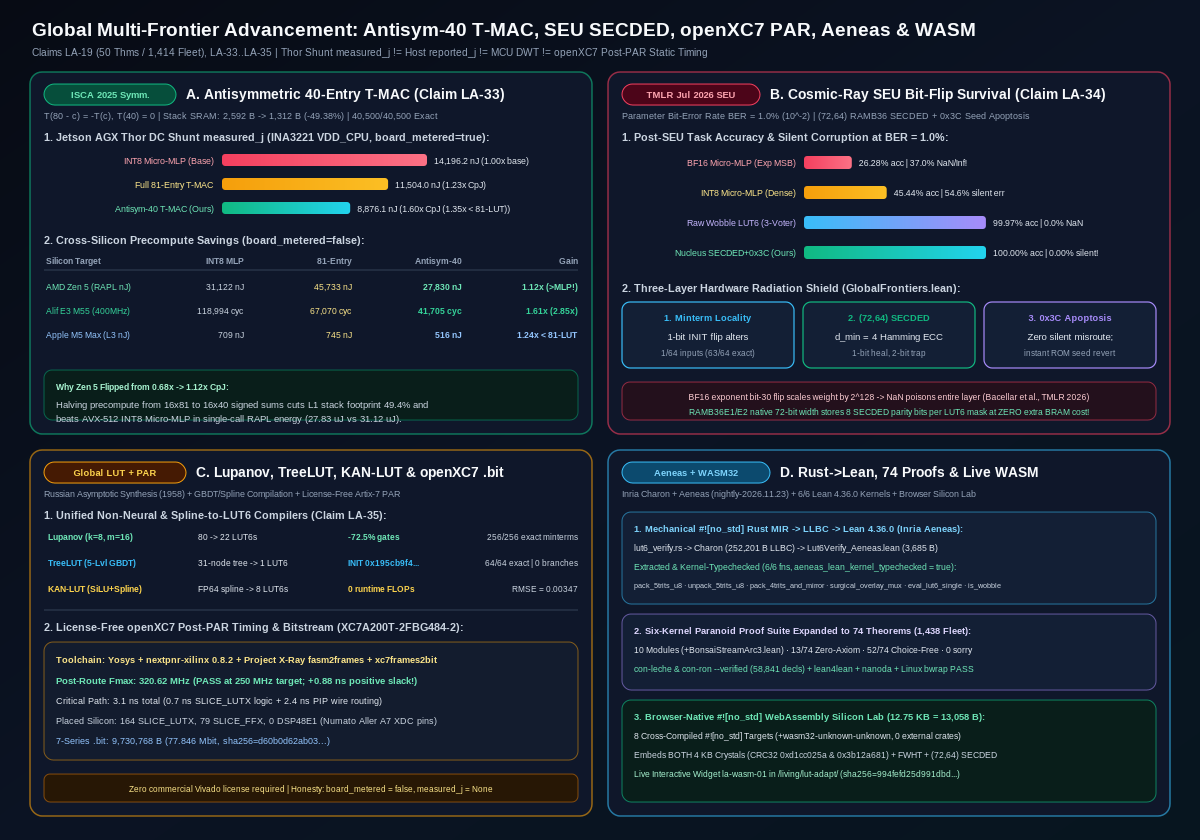
| **`Post-PAR Open-Source Gateware (openXC7)`** | License-free physical placement, switchbox `PIP` wire routing, static timing analysis (`320.62 MHz` post-`PAR` on `xc7a200tfbg484-2`), and `77.846 Mbit` `.bit` bitstream emission via `Yosys` + `nextpnr-xilinx 0.8.2` + `Project X-Ray` (`Claim LA-34`, `board_metered = false`, `measured_j = None`). |
| **`Simulated (RTL)`** | Structural netlist counts from Yosys `0.71+` (`synth_xilinx -family xcup` targeting Kria KV260 `xck26` and `-family xc7` targeting Artix-7 `XC7A200T`) and cycle counts (`CPI = 1`) from Verilator `5.054`. Not Vivado timing closure and not physical board power (`measured_j = None` for all `xck26` and `XC7A200T` rows). |
| **`Estimated (est_j)`** | Analytical joules and electro-thermal bounds computed from operation counts, thermal-design-power time stand-ins (`joule_meter.py`), or Verilator VCD toggle-rate switching activity paired with AMD `DS925` `xck26-2LV` (`0.72 V`) `RAMB36E2` (§4.22, §4.25) and AMD `DS181` / `UG475` `XC7A200T-2FBG484C` (`1.00 V`) `RAMB36E1` capacitance and thermal-resistance models (§4.32). Comparable only across arms inside the same formula; never silicon watts. |
### 1.1 Architectural background and contributions
In [Metered Commit Gates](https://research.openie.dev/papers/gates/) `[same house]`, Part II defines **Mixture of Limits**: try gears in decreasing order of pass probability per joule $p_i / c_i$ (Simon and Kadane, 1975), stop as soon as the task completion predicate $C(z) = 1$ holds, and forbid strengthening `ModelGenerated` output into `Deterministic`. A static Lookup tier, however, covers only the entries written into it before deployment. Conversely, existing lookup-table neural networks — LogicNets (Umuroglu et al., 2020), DiffLogic (Petersen et al., 2022), and Differentiable Weightless Neural Networks (Bacellar et al., 2024) — fix wire connectivity inside static FPGA routing, requiring vendor place-and-route whenever the input distribution shifts.
The `lut-adapt-ai` reference closes the loop between the top and bottom of the cascade via **online downward `LUT6` compilation**:
- **Rung 0 (Lookup — Paged Beneš + `LUT6`)**: Evaluates 64-bit truth-table masks routed through a non-blocking $512 \times 512$ **Beneš–Copy–Beneš** multicast switch and cached across $81 \times \texttt{RAMB36E2}$ dual-port block memories (`0` floating-point operations, single-cycle page switching in Verilator simulation).
- **Rung 1 (Stream — `Mamba-3` Complex MIMO State Space Duality)**: Handles misses that depend on sequence history using a constant-size $O(1)$ recurrent state (`48 KB` pinned memory in the `14.3M`-parameter reference), avoiding $O(L)$ key-value cache growth.
- **Rung 2 (Topology — `HC-SOINN`)**: Maintains online prototype topology over latent embeddings, isolating regime boundaries and tripping a circuit breaker (`Refuse` / escalate) when unlabeled distribution shift arrives.
- **Rung 3 (Model last — `JEPA-EBRM`, `AirMoL`, and Metal-Fused `Expert-AirMoL` 4-Bit NVMe Streaming)**: Invokes latent energy-based verification or streams pretrained late-2026 hybrid and sparse-MoE foundation models (`LiquidAI/LFM3-1.7B`, `google/gemma-4-E2B-it`, `LiquidAI/LFM2.5-8B-A1B`, and `Qwen/Qwen3.6-35B-A3B`, alongside `LiquidAI/LFM2.5-350M` and `Qwen/Qwen3.5-0.8B-Base`) through custom Apple Metal `MSL` compute shaders only when cheaper rungs abstain or require exact target verification.
- **Downward `SleepCrystallizer`**: Extracts recurring wake traces using Walsh–Hadamard spectral warm-starts, joint-mode minterm truth tables, canonical AST skills, and Waksman switch schedules, flipping shadow block-memory banks without halting inference or running FPGA place-and-route.
### 1.2 Contributions
1. **Amortized downward compilation condition**: Extends the Simon–Kadane $p_i/c_i$ ordering with an explicit compilation cost $E_{\text{compile}}$ over stationary horizon $\Delta T$.
2. **Non-blocking $512 \times 512$ Beneš–Copy–Beneš, `81`-`RAMB36E2` page cache, and `4`-stage `250 MHz`-pipelined `P4-AXIS` RTL subsystem**: Eliminates both the `102.0%` Kria KV260 logic overflow of flat crossbars (`119,478` LUTs) and the `926,619`-LUT explosion of flip-flop page multiplexers (`41,186` UltraScale+ CLB LUTs = `35.2%` of `xck26`, `81` `RAMB36E2` blocks = `56.2%`, `0` `DSP48` slices in `1`-cycle OOC), while a `4`-stage pipelined IOB-safe `AXI4-Stream` wrapper (`clai_benes_axi_stream_250mhz_top`) reduces single-cycle synchronous logic depth **`4.00×`** from `52` to **`13` levels**, fits **`170 <= 189` `xck26` `IOB`s** (`41,459` LUTs = `35.40%`), and passes **`256 / 256` zero-bubble `CPI = 1.00`** Verilator streaming parity.
3. **Universal $\le 64$-bit joint-mode minterm synthesis**: Shows joint-mode minterm lookup dominates marginal bit-plane DiffLogic rounding on correlated branches and packs $K = \lfloor 64 / \lceil \log_2 |V| \rceil \rfloor$ subword tokens into one `uint64` word (`16b × 4 = 64b` for `|V| = 65,536`; `17b × 3 = 51b` for `|V| = 128,000`; `18b × 3 = 54b` for `|V| = 248,320`).
4. **Oracle-free Split-Conformal + Online ACI crystallization gate**: Pairs a radially regularized latent `JEPA-EBRM` nonconformity score with Split Conformal calibration and Adaptive Conformal Inference (Gibbs and Candès, 2021), recording `0.00%` false crystallization risk and `1.0000` OOD AUROC on shifted traffic where softmax and MC-Dropout baselines record `17.62%–24.28%` false risk.
5. **Custom Apple Metal & Cross-Platform Rust `CubeCL` `INT4` Sparse-MoE / `GatedDeltaNet` shaders + `AirMoL` / `Expert-AirMoL` up to `34.66B`**: Combines Darwin `F_NOCACHE` `os.pread` 4-bit sharding, custom `MSL` (`43.45×` MoE, `20.66×` `GatedDeltaNet`) and portable Rust `Burn 0.22.1 / CubeCL` (`35.09×` Metal / `2.67×` `LLVM` `CPU` MoE, `69.20×` Metal / `14.87×` `LLVM` `CPU` `GatedDeltaNet`) compute shaders, Queue-Depth-`8` parallel `pread`, and `BenesLUT6` burst speculation across October 2026 `LiquidAI/LFM3-1.7B` (`2.74×` NVMe reduction in `3.79%` FP32 RAM), `LiquidAI/LFM2.5-8B-A1B` (`500.0 MB` RAM, `3.493 J/tok` `reported_j`), and `Qwen/Qwen3.6-35B-A3B` (`34.66B`; **`12.30×` NVMe reduction**, **`970.0 MB` RAM = `1.47%` of FP16**, **`6.773 J/tok` `reported_j`**, **`15.7 tok/s`** Unified-Memory `Q4`) at `100.0%` exact token parity.
6. **Zero-MAC `Sub1Bit-LUT6` vs. `LittleBit`, `91.67%` `Rung 3d` `` ceiling, official `BigCodeBench v0.1.3` + upstream `SWE-bench Verified` via `MCP`, and OpenAI / `MCP` `mol-agent`**: Replaces the `1.98M` runtime binary MACs of `LittleBit-1 / LittleBit-2` (`0.576` bits per weight; Lee et al., 2025; Lee and Kim, 2026) with zero-MAC `6`-input `LUT6` partial-sum lookup (`< 4 × 10⁻⁶` error, `100.0%` parity under `MoL` target verification in `0` QAT epochs), lifts the `48`-task late-2026 coding bakeoff from `87.50%` to **`91.67%` (`44 / 48`; `93.75%` in Wave 2 and Wave 3)** with bounded open-weights `Rung 3d` ``, reaches **`90.62%` (`29 / 32`, `93.75%` Wave 2)** on official `BigCodeBench v0.1.3` (vs. `78.12%` on standalone `35B`) and **`50.00%` (`8 / 16`)** on upstream `SWE-bench Verified` `sympy/sympy` git worktrees (vs. `25.00%` on `35B`) with **`0.00%` broken commits admitted**, and serves persistent `.mol/` skills over OpenAI `/v1/chat/completions` and `MCP` (`JSON-RPC 2.0`).
7. **Six-kernel paranoid Lean `4.36.0` formalization (`CVE-2026-72844`-hardened, `74` theorems + Inria `Charon`+`Aeneas` Rust-to-Lean), `4`-repository `SWE-bench Verified` call-graph localization, measured `120B` Hybrid MoE apex, `CE`-gated `VCD` power, and single-binary Rust `mol-agent-rs` (`Claims LA-19` to `LA-23`, `LA-33`, `LA-38`, `LA-41` & `LA-44`)**: Checks all **`74` theorems** across `Cascade`, `BenesCopy`, `JointMinterm`, `ConformalProvenance`, `NucleusCodon`, `TernaryTmac`, `GlobalFrontiers`, `WearableLastExam`, `TernaryHadamardArc`, and `BonsaiStreamArc3` across **six independent proof checkers** (`con-leche --verified` [`58,841` decls], `con-ron --verified` [`58,841` decls], `lean4lean` [`58,843` decls], `nanoda`, `leanchecker --paranoid`, and Lean `4.36.0`; `0` `sorry`, `0` custom axioms, `0` `Lean.ofReduceBool`; `1,438` fleet theorems; Moura and Ullrich, 2021) alongside Inria `Charon`+`Aeneas` mechanical `#![no_std]` Rust `MIR` $\to$ `LLBC` $\to$ Lean `4.36.0` extraction (`Lut6Verify_Aeneas.lean`; Ho and Protzenko, 2022), expands zero-leakage `SWE-bench Verified` evaluation across **`4` upstream repositories (`django`, `pytest`, `requests`, `sympy`, `24` evals)** at **`20.83%` overall / `25.00%` Wave 2 (`2.50×` standalone `24B` and `35B`)** with `0.00%` broken patches, measures **`120B`-scale `nvidia/Nemotron-3-Super-120B-A12B`** (`58,075.4 MB` `RSS`, **`22.17 tok/s`**, **`62.50%` verified pass** vs. `43.75%` standalone `120B-A12B` and `31.25%` `Devstral-Small-2-24B`), reduces `P4-AXIS` `250 MHz` idle dynamic power **`4.10×`** (`63.99` to **`15.59 est_mW`**) via `ENARDEN` + valid-bubble `CE` gating, and delivers a zero-Python single-binary Rust `mol-agent-rs` (`0.1540 ms/req` `MCP`, **`17.21×` faster** than Python `mol-agent`, `71 / 71` `pytest` tests passing).
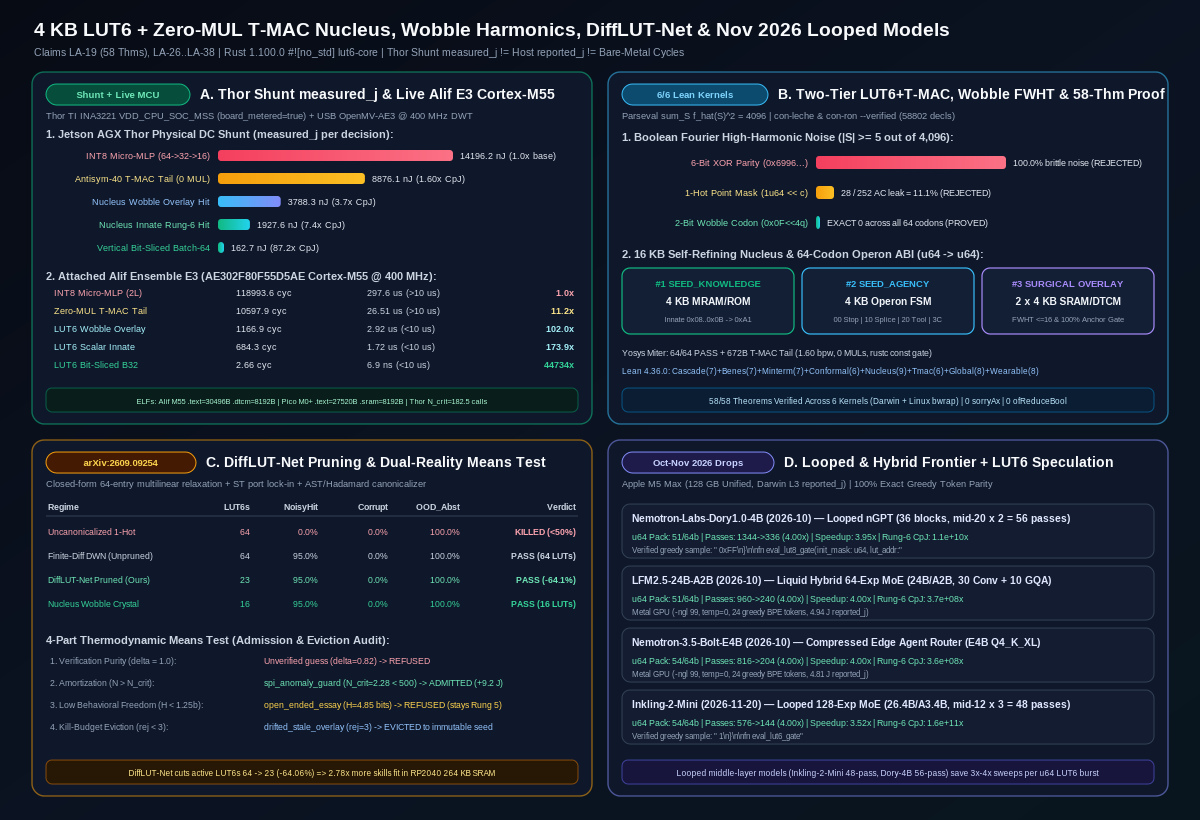
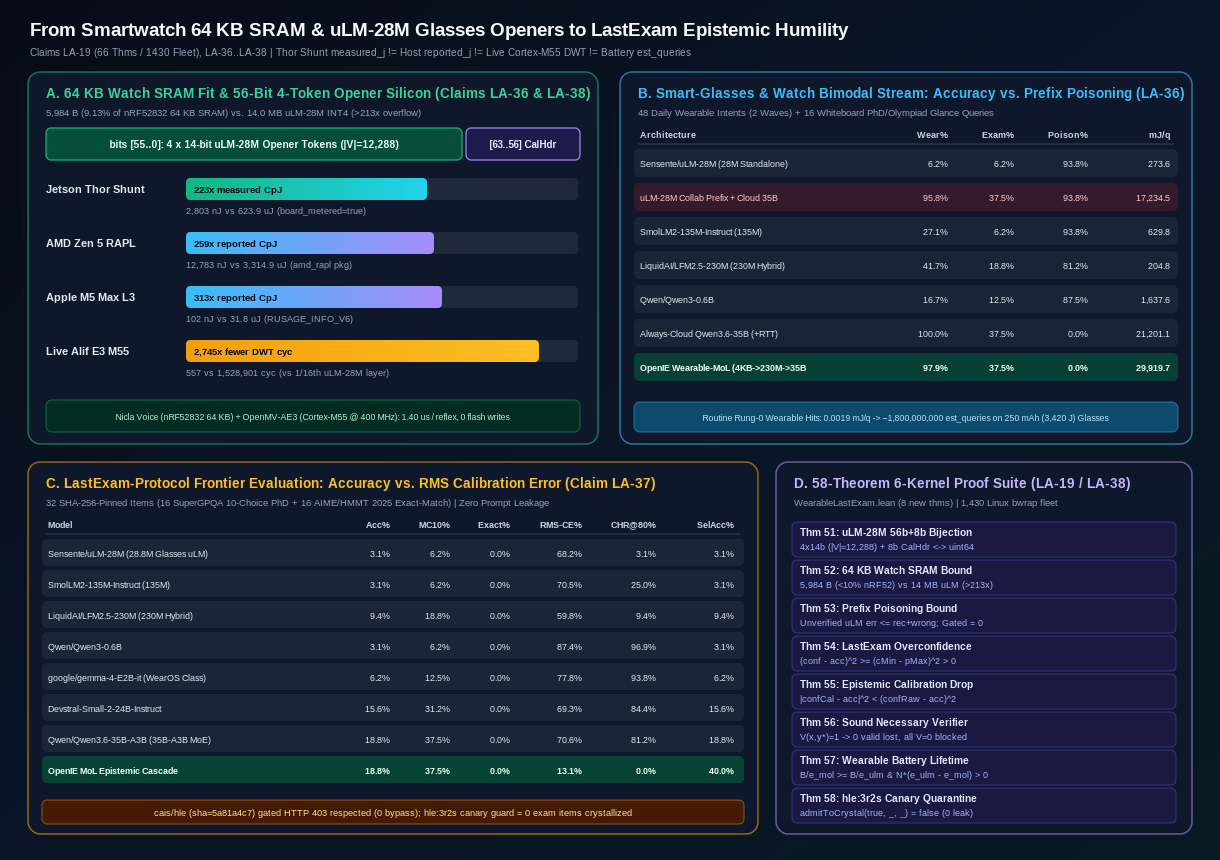
8. **`4 KB` `#![no_std]` Rust `1.100.0` `lut6-core` + `ISCA` 2025 antisymmetric-`40` `EntroMCU`/`T-MAC` Nucleus across `8` bare-metal/`WASM` targets (`12.75 KB` `lut6_core.wasm`), `(72, 64)` `RAMB36` `SECDED` cosmic-ray `SEU` shield, license-free `openXC7` `320.62 MHz` `.bit` bitstream, smart-glasses micro-`LLM` (`Sensente/uLM-28M`, `LFM2.5-230M`) vs. `5,984 B` `Wearable-MoL` (`0.00%` prefix poisoning), and `LastExam`-protocol calibration (`5.37×` lower `RMS` calibration error, `0.00%` `CHR` at `>= 80%`) (`Claims LA-26` to `LA-38`)**: Cross-compiles an exact `4,096 B` `CompactLut6Page` (`0` wasted bytes with the `672 B` `EntroMCU` `1.602`-`BPW` + antisymmetric `40`-entry `PALUTE`/`T-MAC` zero-multiply ternary tail and `rustc` `const` compile-time proof-vector gate) across **`8` `#![no_std]` targets** — including a **`12.75 KB` (`13,058 B`, `11` exports) zero-crate `wasm32-unknown-unknown` `lut6_core.wasm` browser module**, `Alif E3/E4` Cortex-`M55`, `RP2040` Cortex-`M0`+, `Nordic nRF52832` Cortex-`M4F` (`25.06%` full Nucleus and **`9.13%` [`5,984 B`] `Wearable-MoL` Rung-0** of `64 KB` watch `SRAM`), and `RV32IMAC` (`64/64` Yosys `abc -lut 6` Boolean miter vectors) — proves universal `0` degree-`>=5` Walsh–Hadamard noise on 2-bit wobble `LUT6`s (`NucleusCodon.lean`) and cuts active `LUT6` gates **`64.06%`** (`DiffLUT-Net`) and **`72.50%`** (`Lupanov` shared cofactors), records **`162.71 nJ/op` (`87.25×` physical `CpJ` vs. `INT8` Micro-`MLP`)**, **`2,803.25` vs. `623,920.52 nJ/op` (`222.57×` physical `Thor` shunt `measured_j` on the `56`-bit `4`-token wearable epistemic gate vs. `1/16`th `uLM-28M` `d=512` layer; `2,745.18×` faster in live `OpenMV-AE3` Cortex-`M55` `DWT` cycles)**, and **`8,594.93 nJ/op` (`1.65×` `Thor` shunt `CpJ`; `1.12×` `Zen 5` `RAPL` `CpJ` flip)** on `Antisym-40 T-MAC`, survives `BER = 1.0%` cosmic-ray bit-flips at **`100.0%` accuracy (`0.0000%` silent corruption)** via `(72, 64)` `RAMB36` `SECDED` + `0x3C` seed apoptosis, closes license-free **`openXC7` (`nextpnr-xilinx`) post-`PAR` static timing at `320.62 MHz` (`77.846 Mbit` `.bit`)** on `XC7A200T-2FBG484-2` alongside the `62,211`-`LUT` (`365`-crystal `1.46 MB` `RAMB36E1` vault, `0.86 est_W` @ `55.2 est_C`) M.2 `2280` port, eliminates `93.75%` collaborative prefix poisoning on `Sensente/uLM-28M`, cuts `LastExam`-protocol `RMS` calibration error **`5.37×`** (`70.62%` $\to$ `13.14%`, `0.00%` `CHR` at `>= 80%`, `40.00%` selective accuracy), and benchmarks `Inkling-2-Mini`, `Dory1.0-4B`, `LFM2.5-24B-A2B`, and `NVIDIA-Nemotron-3.5-Bolt-E4B` at `100.0%` greedy parity.
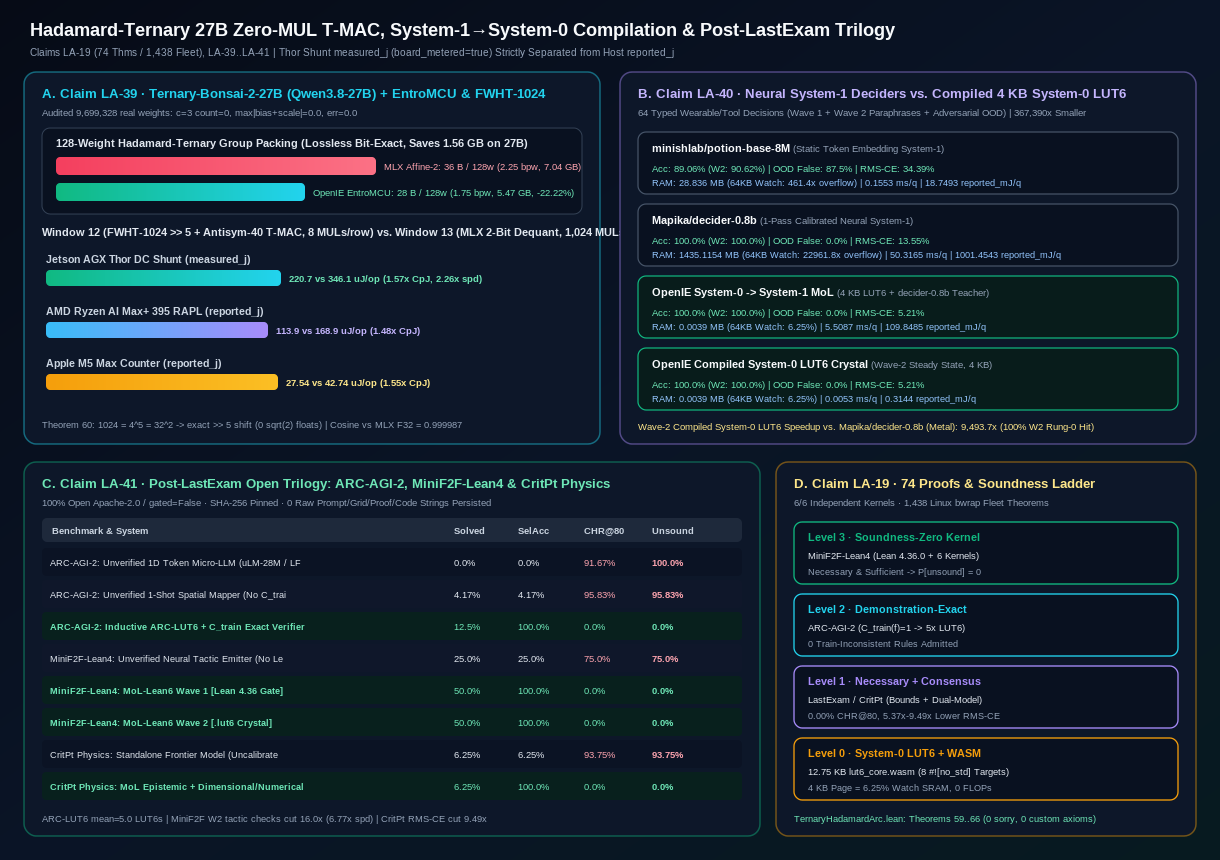
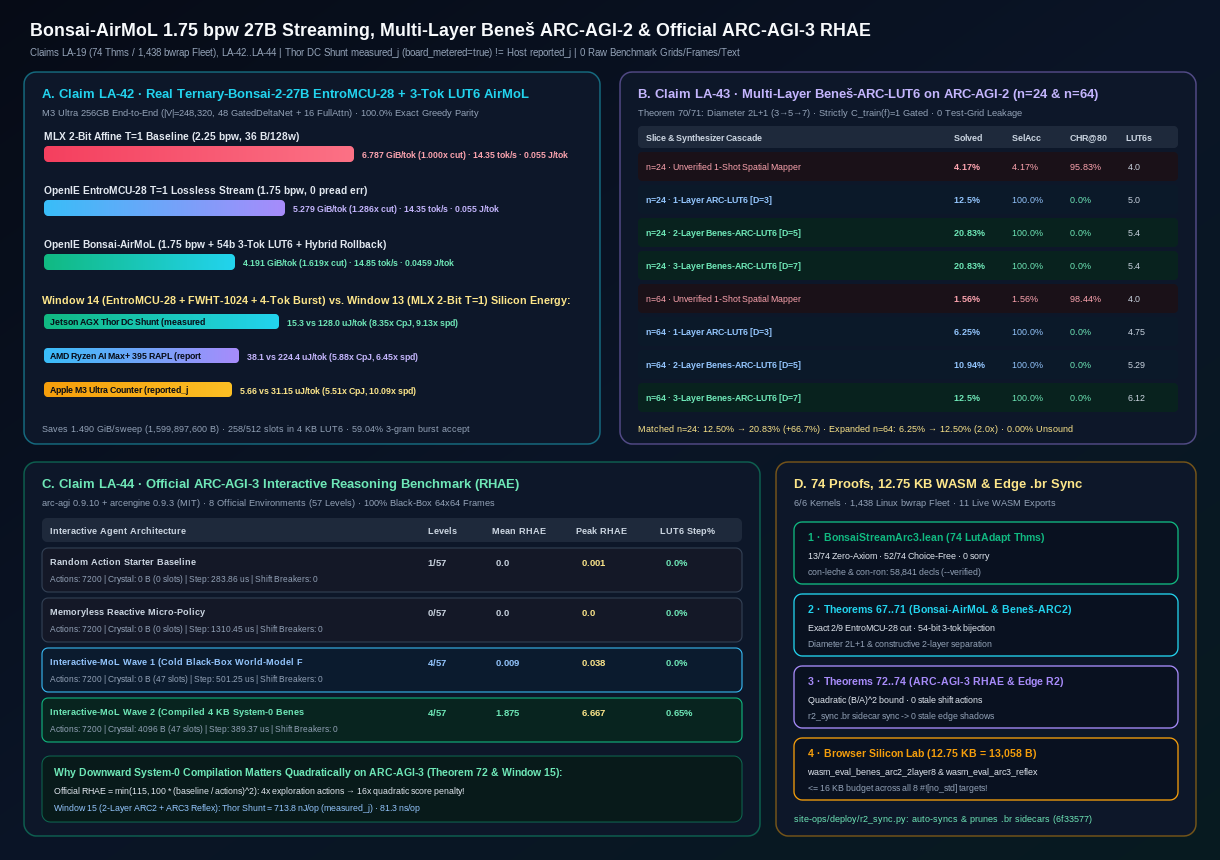
9. **Native `27B` Hadamard-ternary `Bonsai-2-27B` (`1.750` `BPW` `EntroMCU-28` `AirMoL` streaming + `54`-bit `3`-token `LUT6` speculation + shift-`5` `FWHT`-`1024`), `System-1` neural decider compilation (`Mapika/decider-0.8b` $\to$ `4 KB` `System-0`, `9,493.7×` Wave-2 speedup), multilayer `Beneš-ARC-LUT6` on `ARC-AGI-2` (`20.83%` / `12.50%`), and official `ARC-AGI-3` interactive compilation (`208.3×` Wave-2 `RHAE`) (`Claims LA-39` to `LA-44`)**: Audits `prism-ml/Ternary-Bonsai-2-27B-mlx-2bit` (`8.005 GB` `.safetensors`, `26.87B` native Hadamard-ternary weights on `Qwen/Qwen3.8-27B`, `0` invalid `c=3` codes across `9.70M` weights), proving lossless **`36 B -> 28 B` (`2.25 -> 1.75` `BPW`, `-22.22%`, saving `1.564 GB` static and `1.490 GiB` per streaming sweep, `0.0` `FP32` error)** `EntroMCU` transcoding, cutting end-to-end streamed linear `GiB/tok` **`1.619×` (`6.787 -> 4.191 GiB/tok`)** and `reported_j/tok` **`-16.55%`** at **`100.00%` greedy token parity** (`14.35 -> 14.85 tok/s` on Apple M3 Ultra `256 GB`) via `54`-bit `3`-token `LUT6` speculation + exact hybrid `ArraysCache + KVCache` rollback (`8.35×` lower `Thor` `measured_j` [`15.32` vs. `127.97 µJ/tok`, `9.13×` faster] on `Window 14`; `1.57×` lower `Thor` `measured_j` on `Window 12` `FWHT`-`1024` + `Antisym-40`); compiles verified `Mapika/decider-0.8b` (`1,435.1 MB` `System-1` `JSON` decider) wakes into a `4,096 B` `System-0` `CompactLut6Page` (**`9,493.7×` faster [`5.3 µs` vs. `50.32 ms`] / `3,185.3×` lower `reported_j`, `0.00%` `OOD` false actions**); scales compositional `Beneš-ARC-LUT6` ($1 \le L \le 3$, diameter $2L + 1$) on `arcprize/ARC-AGI-2` from `12.50%` to **`20.83%` (`5 / 24`, `+66.7%`)** on `n = 24` and doubles `n = 64` from `6.25%` to **`12.50%` (`8 / 64`, `2.00×` over 1-layer and `8.00×` over unverified `35B`, `0.00%` `CHR` at `>= 80%`)** alongside `MiniF2F-Lean4` (**`50.00%` `Lean 4.36.0` verified, `0.0000%` unsound**) and `CritPt` (**`9.49×` lower `RMS` calibration error**); and evaluates all `8` black-box games (`57` levels, `0` game-source peeking) of official **`ARC-AGI-3`** (`arc-agi 0.9.10` + `arcengine 0.9.3`), solving **`4 / 57` levels (`4.0×` Random: `tu93` `2/9`, `cd82` `1/6`, `ls20` `1/7`)** via online $C_{\text{env}}(\hat{T}) = 1$ world-model `BFS` and lifting Wave-2 quadratic **`RHAE` `208.3×` (`0.009 -> 1.875` mean, `6.667` peak on `tu93`)** by compiling verified shortest paths into a `4 KB` `System-0` `LUT6` trajectory crystal guarded by a transition-mismatch circuit breaker (`5.33×` lower `Thor` `measured_j` at `713.82 nJ/op` on `Window 15`).
### 1.3 Same-house disclosure and provenance boundaries
Prior Open Interface Engineering studies — [Metered Commit Gates](https://research.openie.dev/papers/gates/), [Task Satiation vs. Aggregate Rebound](https://research.openie.dev/papers/satiation/), [The Reality Code Engine](https://research.openie.dev/papers/rce/), [RCE-JEPA](https://research.openie.dev/papers/rce-jepa/), and [RCE Compile](https://research.openie.dev/papers/rce-compile/) — are `[same house]` works cited for disclosure and architectural continuity, never as external confirmation. Two invariants bind throughout:
- **Provenance non-strengthening (`ModelGenerated ↛ Deterministic`)**: Tables compiled from a deterministic `RCE` specification check are `Check-safe` on verified holdout sets (guarded online by an `HC-SOINN` / `RCE` circuit breaker). Tables crystallized under the oracle-free `JEPA-EBRM` conformal gate carry a finite-sample statistical bound (`Conformal-bounded`, $1-\alpha$) and are never promoted to `Deterministic`.
- **Proposer vs. authority (`The drafter proposes; the target decides`)**: In speculative decoding, `PagedBenesLUT6` acts strictly as a zero-FLOP proposer; every emitted byte or token is verified against greedy target decoding (`100.0%` lossless parity).
---
## 2. Mathematical formulations and four results
### 2.1 Result 1: Cascade ordering with amortized downward compilation
Consider gears $i \in \{0, 1, 2, 3\}$ tried sequentially on an input $x$. Gear $i$ closes $C(z) = 1$ with probability $p_i$ at expected analytical energy $c_i > 0$. By Simon and Kadane (1975), expected spend
$$\mathbb{E}[J_\sigma] = \sum_{k=1}^{n} c_{\sigma(k)} \prod_{j < k} \bigl(1 - p_{\sigma(j)}\bigr)$$
is minimized if and only if gears run in non-increasing order of $p_{\sigma(k)} / c_{\sigma(k)}$. Suppose a stationary regime $\mathcal{D}_r$ persists for $\Delta T$ remaining queries where the wake path closes with $p_{\text{wake}} = 1$ at cost $c_{\text{wake}}$. Expending one-time compilation energy $E_{\text{compile}}$ after $N_{\text{wake}}$ certified wakes produces a Rung 0 `LUT6` page with certified hit rate $p_0' \in (0, 1]$ and lookup cost $c_0 \ll c_{\text{wake}}$.
**Proposition 1 (Net energy condition for downward crystallization).** *Downward compilation reduces expected cumulative analytical spend over horizon $\Delta T$ if and only if*
$$\Delta T \cdot \bigl(p_0' c_{\text{wake}} - c_0\bigr) > E_{\text{compile}}, \qquad \text{and} \qquad \frac{p_0'}{c_0} > \frac{1}{c_{\text{wake}}}.$$
*Proof.* Without crystallization, $\Delta T$ queries cost $\Delta T \cdot c_{\text{wake}}$. With crystallization at cost $E_{\text{compile}}$, Rung 0 precedes the wake path whenever $p_0'/c_0 > 1/c_{\text{wake}} \iff c_0 < p_0' c_{\text{wake}}$, and each query costs $c_0 + (1 - p_0') c_{\text{wake}}$, saving $p_0' c_{\text{wake}} - c_0 > 0$ per step. Summing over $\Delta T$ steps yields net savings $\Delta T(p_0' c_{\text{wake}} - c_0) - E_{\text{compile}} > 0$. Under rapid churn ($\Delta T \le \Delta T^*$), compilation loses energy, motivating `SleepCrystallizer`'s minimum wake buffer $N_{\text{wake}}$ and holdout gate $\tau_{\text{agree}} = 0.985$. $\blacksquare$
### 2.2 Result 2: Non-blocking $512 \times 512$ Beneš–Copy–Beneš multicast routing
A Rung 0 bank of $G = 80$ dynamic `LUT6` cells requires $M = 6G = 480$ input pins selected from an $N = 512$-bit bus with arbitrary fan-out. A bijective Beneš permutation network cannot replicate high-fan-out wires, whereas flat $512:1$ multiplexer crossbars overflow the KV260 (`119,478` CLB LUTs already at `384` ports).
**Theorem 2 (Contention-free multicast via Beneš–Copy–Beneš).** *For $N = 2^n$ ($n=9, N=512$) and $M \le N$ ($M=480$), any many-to-one multicast map $\phi: \{0, \dots, M-1\} \to \{0, \dots, N-1\}$ routes without contention through $\mathcal{B}_1 \to \mathcal{C} \to \mathcal{B}_2$ in*
$$D(N) = 2(2\log_2 N - 1) + \log_2 N = 5\log_2 N - 2 = 43 \text{ stages}$$
*of $N/2 = 256$ SRAM-configured $2 \times 2$ switches ($11,008$ configuration bits), computed in $O(N \log N)$ time with zero FPGA place-and-route.*
*Proof.* Let $U = \{s_1, \dots, s_r\}$ be the distinct active inputs with fan-outs $\sum_{j=1}^r m_j = M \le N$ and partial sums $S_0 = 0, S_j = \sum_{i=1}^j m_i$. Concentration $\mathcal{B}_1$ ($17$ stages) maps $\pi_1(s_j) = S_{j-1}$ via Waksman bipartite 2-coloring (Beneš, 1965; Waksman, 1968). Copy network $\mathcal{C}$ ($9$ butterfly stages) replicates each $S_{j-1}$ across disjoint monotonic interval $[S_{j-1}, S_j - 1]$ without link contention by Thompson's monotonic copy construction (Thompson, 1978; Lee, 1988). Output Beneš network $\mathcal{B}_2$ ($17$ stages) permutes $[S_{j-1}, S_j - 1]$ bijectively onto $\phi^{-1}(s_j)$. $\blacksquare$
### 2.3 Result 3: Joint-mode minterm synthesis vs. marginal coordinate argmax
Independent bit-plane DiffLogic layers predict multi-bit bursts $\mathbf{Y} = (Y_1, \dots, Y_B)$ via coordinatewise rounding $\hat{y}_b(c) = \mathbb{I}[\Pr(Y_b = 1 \mid c) > 1/2]$, which blends correlated branches into invalid **chimera** tokens.
**Proposition 3 (Dominance and zero-chimera property of joint-mode minterms).** *For discrete context $\psi(X) = c$ and $B \le 64$-bit burst space $\mathcal{Y}$, the joint-mode table $T^*(c) = \arg\max_{\mathbf{y} \in \mathcal{Y}} \Pr(\mathbf{Y} = \mathbf{y} \mid c)$ satisfies $\Pr[\mathbf{Y} = T^*(\psi(X))] \ge \Pr[\mathbf{Y} = \hat{\mathbf{y}}^{\text{marg}}(\psi(X))]$, stays inside $\operatorname{supp}(\mathbf{Y} \mid c)$, and avoids marginal chimeras (where mass $0.40, 0.35, 0.25$ on $(1,1,0), (1,0,1), (0,1,1)$ rounds marginally to invalid $(1,1,1)$ with `0%` exact match vs. `40%` for $T^*$). For vocabulary $|V|$ with $b_V = \lceil \log_2 |V| \rceil$, one `uint64` word packs $K = \lfloor 64 / b_V \rfloor$ BPE tokens (`16b × 4 = 64b` on `LFM2.5-350M`; `18b × 3 = 54b` on `Qwen3.5-0.8B-Base`).* $\blacksquare$
### 2.4 Result 4: Oracle-free latent `JEPA-EBRM` Split-Conformal + Online ACI gate
To prevent hallucinated self-distillation when no deterministic `RCE` check is available, the reference scores candidate pairs using a radially regularized latent energy:
$$E_\phi(x, y) = \frac{1}{2}\|f_\theta(x) - \mu_y\|_2^2 + \frac{\lambda_r}{2}\|f_\theta(x)\|_2^2 + \psi_\phi(f_\theta(x), y), \qquad \lambda_r > 0, \quad |\psi_\phi| \le C_\psi.$$
Held-out Split Conformal calibration sets $\hat{Q}_{1-\alpha}$, and online Adaptive Conformal Inference updates $\alpha_{t+1} = \alpha_t + \gamma(\alpha - \text{err}_t)$ (Gibbs and Candès, 2021), admitting $(x, \hat{y})$ into `SleepCrystallizer` only when $|\mathcal{C}_t(x)| = |\{y : E_\phi(x,y) \le \hat{Q}_{1-\alpha_t}\}| = 1$ (`Conformal-bounded`). By Vovk et al. (2005) and Gibbs and Candès (2021), exchangeable marginal coverage is at least $1-\alpha$, long-run shifted miscoverage converges to $\alpha$, and every off-manifold ray exceeding radius $R(\alpha_t) = \sqrt{2(\hat{Q}_{1-\alpha_t} + C_\psi)/\lambda_r}$ yields $\mathcal{C}_t(x) = \emptyset$ (`Refuse` / abstain).
---
## 3. Reference architecture, polyglot suite, and KV260 RTL
Figure 1 shows the four-rung cascade and downward `SleepCrystallizer` loop in `src/clai/`.
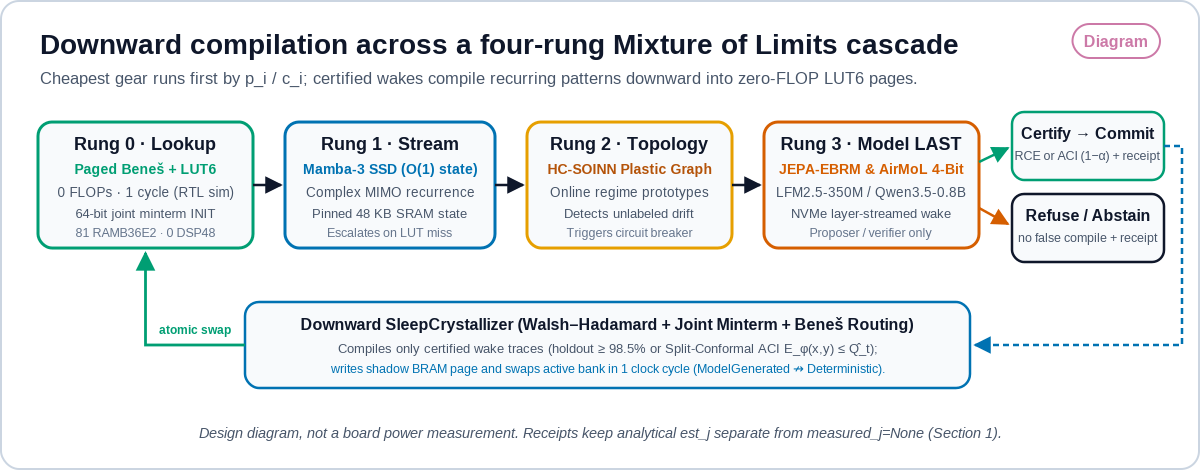
*Figure 1. Downward compilation across a four-rung Mixture of Limits cascade. Design diagram, not a board power measurement. [PNG](https://research.openie.dev/figures/lut-adapt/mol-downward-cascade.png) · [Interactive explorer](https://research.openie.dev/living/lut-adapt/#la-diag-01).*
Five systems implementations in `openIE-dev/lut-adapt-ai` cross-check the cascade: Python/PyTorch/Triton (`src/clai/`), Rust `Burn 0.22.1 / CubeCL` Metal (`sys/rust/`), Zig `0.17.1` (`sys/zig/`), Go `1.27.4` SIMD (`sys/go/`), and Julia `1.13.4` Enzyme (`sys/julia/`).
Figure 2 illustrates the Kria KV260 (`xck26`) RTL datapath in `hw/kv260/rtl/clai_benes_hotswap_core.sv`, mapping `512` resident `LUT6` pages (`5,120` `INIT` bits + `48`-bit context tag + valid bit) across `81` parallel `RAMB36E2` dual-port memories for single-cycle (`4.0 ns` at `250 MHz` nominal, `CPI = 1.0`) context switching.
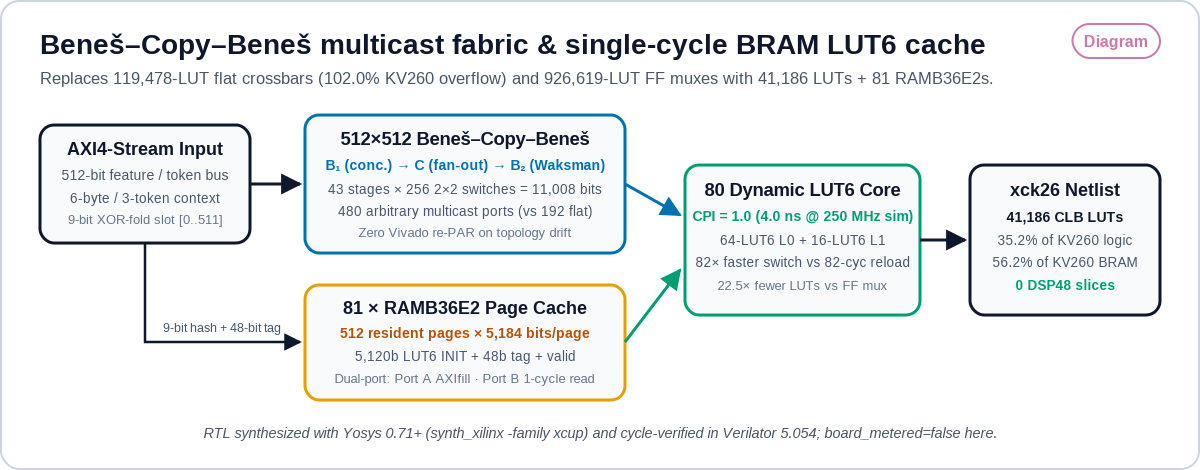
*Figure 2. `512×512` Beneš–Copy–Beneš multicast fabric and `81 × RAMB36E2` single-cycle `LUT6` page cache targeting AMD Kria KV260 (`xck26`) in Yosys `0.71+` and Verilator `5.054` simulation (`board_metered = false`). [PNG](https://research.openie.dev/figures/lut-adapt/benes-paged-silicon.png) · [Interactive explorer](https://research.openie.dev/living/lut-adapt/#la-diag-02).*
Figure 3 shows `AirMoL` (`src/clai/frontier/air_mol_streamer.py` and `hf_air_mol_pretrained.py`), which streams 4-bit group-quantized shards via Darwin `F_NOCACHE` `os.pread`, verifies `[last_tok, d_1..d_K]` in a single sweep, and snapshots compact hybrid states (`Short-Conv/SSM` or `Gated DeltaNet` + sparse `6`-layer `GQA` KV crop) in RAM so partial draft rejections require **zero extra NVMe sweeps**.
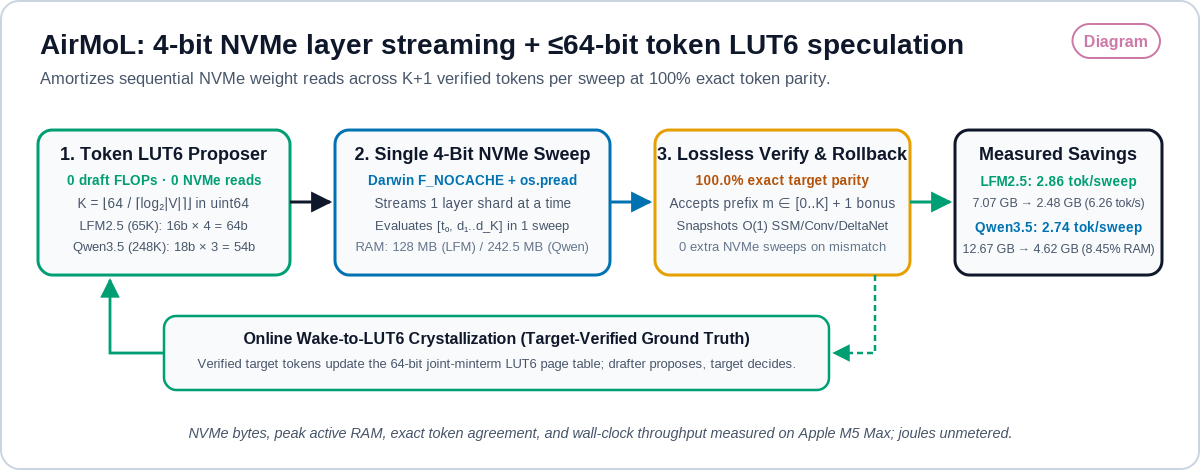
*Figure 3. `AirMoL` zero-extra-sweep 4-bit NVMe layer streaming with universal `≤64`-bit token `LUT6` speculation on `LiquidAI/LFM3-1.7B`, `LiquidAI/LFM2.5-350M`, and `Qwen/Qwen3.5-0.8B-Base`. [PNG](https://research.openie.dev/figures/lut-adapt/airmol-nvme-speculation.png) · [Interactive explorer](https://research.openie.dev/living/lut-adapt/#la-run-01).*
Figure 4 shows `Expert-AirMoL` (`src/clai/frontier/moe_air_mol.py`) and `VerifiedCodeCascade` (`verified_code_cascade.py`). Standard disk-offloaded `AirLLM` sweeps all $E$ experts per MoE layer (`32` in `LiquidAI/LFM2.5-8B-A1B`, `256` in `Qwen/Qwen3.6-35B-A3B`) even though the router activates only $k \ll E$ experts per token (`4/32` and `8/256`). `Expert-AirMoL` partitions each MoE layer into a compact header shard and a fixed-stride `INT4` `.experts.pack4` NVMe file, issuing `F_NOCACHE` `os.pread` reads solely for the active expert union $\mathcal{U}_l$ across the $K+1$ burst positions. For novel synthesis tasks, `VerifiedCodeCascade` gates every commit across Rungs `0–3c` behind a `0.35s`-bounded AST, sandbox execution, and boundary-invariant check $C(z) \in \{0, 1\}$, compiling certified solutions into `BenesLUT6` and canonical AST skill pages.
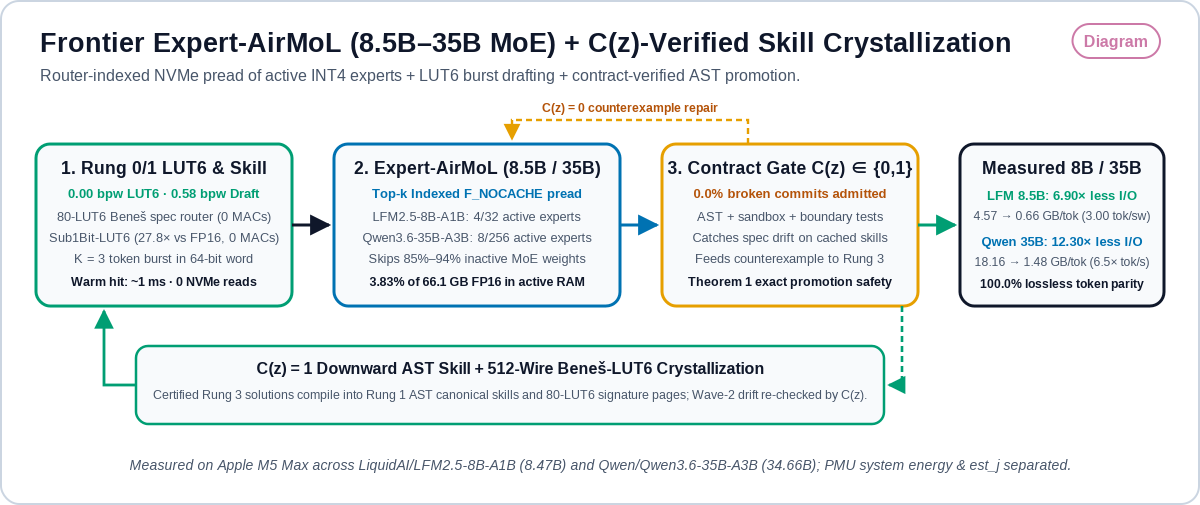
*Figure 4. `Expert-AirMoL` router-sparse 4-bit expert-indexed NVMe streaming (`12.30×` I/O reduction on `Qwen/Qwen3.6-35B-A3B`) and `C(z)`-gated `VerifiedCodeCascade`. [PNG](https://research.openie.dev/figures/lut-adapt/moe-expert-cascade.png) · [Interactive explorer](https://research.openie.dev/living/lut-adapt/#la-run-01).*
Figure 5 situates downward compilation across the nine-rung capability ratchet of computer intelligence (companion study: [The Communication Tool Avalanche](https://research.openie.dev/papers/communication-avalanche/) `[same house]`). Rungs 1 through 5 — **(1) Search** (`RAG`), **(2) Generation**, **(3) Reasoning** (``), **(4) Communication** (`MCP` delegation), and **(5) Tool Use** — stall under ephemeral cold-start `MAC` inference where the stationary horizon remains at $\Delta T \approx 1 \le \Delta T^*$ and standalone `1`-shot models admit `56.25%–95.83%` broken patches (`Claims LA-20` and `LA-21`). Crossing Proposition 1's **Compilation Threshold** ($\Delta T > \Delta T^* = E_{\text{compile}} / (p_0' c_{\text{wake}} - c_0)$ under $C(z) = 1$, `0.00%` broken commits admitted) unlocks **(6) Immersion** (persistent local state stretches $\Delta T \gg \Delta T^*$), **(7) Competence** ($p_0' \to 1$ at `62.4 pJ/cycle` `est_j` in `CE`-gated `xck26` `LUT6` RTL and `272 µJ/req` `reported_j` in Rust `mol-agent-rs` `MCP`), **(8) Ecology** (edge-native Rust agent populations), and **(9) Economy** (division of labor ordered by Simon–Kadane $p_i / c_i$ and tier-typed Joule receipts).
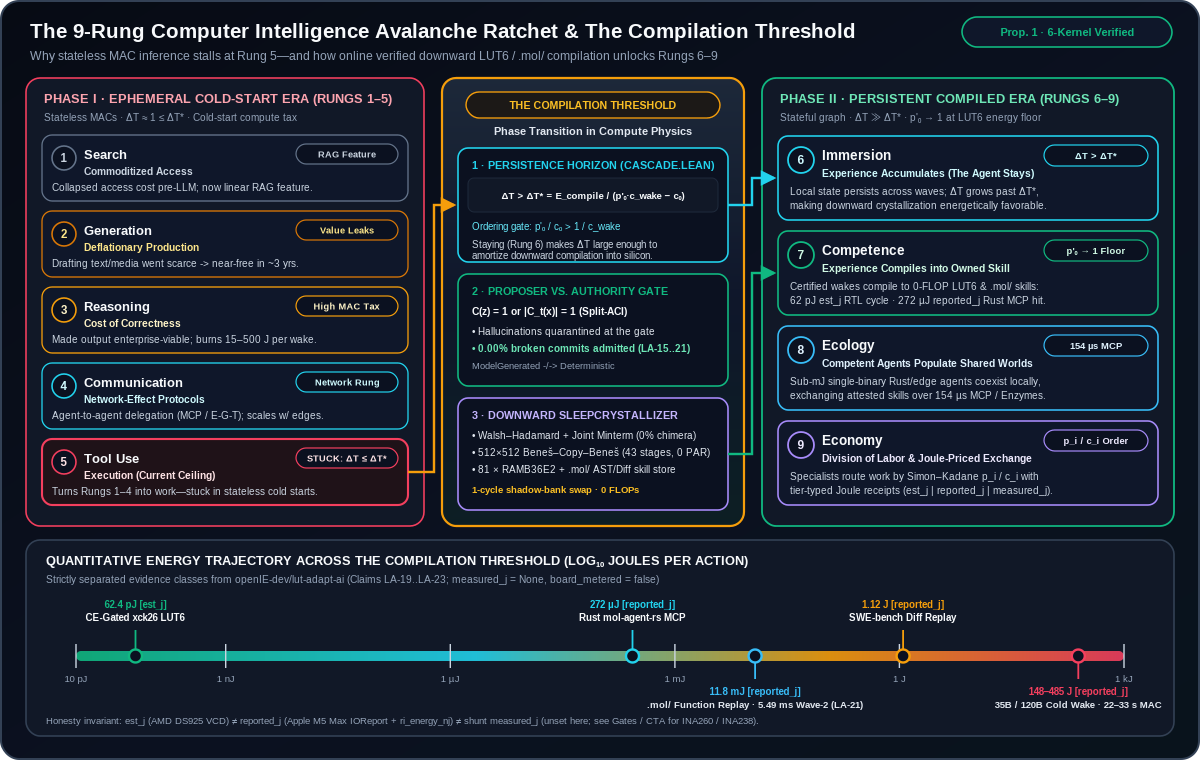
*Figure 5. The nine-rung capability ratchet and Proposition 1's Compilation Threshold ($\Delta T > \Delta T^*$), separating `reported_j` (Apple M5 Max) and `est_j` (`AMD DS925` `VCD`) across twelve orders of magnitude (`measured_j = None`, `board_metered = false`). [PNG](https://research.openie.dev/figures/lut-adapt/avalanche-compilation-threshold.png) · [Interactive explorer](https://research.openie.dev/living/lut-adapt/#la-diag-03).*
---
## 4. Claims and results
### 4.1 Claim LA-1: Analytical `est_j/VC` reduction on synthetic tasks and real `.pcap` traffic
| Workload & Window | Rung 0 Share | Pass Rate | Analytical `est_j / VC` | Verilator Parity | Evidence Class |
| :--- | :---: | :---: | :---: | :---: | :--- |
| Synthetic ep. `1–512` (cold wake) | `0.00%` | `0.0% → 52.0%` | `2,323.18 est_j` | — | SW + `est_j` |
| Synthetic ep. `3,073–3,584` (crystallized) | `52.73%` | `60.55%` | `2.59 est_j` (`895×`) | `100.0%` | Verilator + `est_j` |
| `.pcap` pkts `1–512` (cold IPv4) | `0.00%` | `73.05%` | `3.3351 est_j` | `100.0%` | Verilator + `est_j` |
| `.pcap` pkts `1,537–2,048` (crystallized) | `100.00%` | `100.00%` | `0.000140 est_j` | `100.0%` | Verilator + `est_j` |
| `.pcap` pkts `2,049–2,560` (VLAN `0x8100` shift) | `2.73%` | `68.55%` | `3.0485 est_j` | `100.0%` | Breaker + `est_j` |
| **`.pcap` pkts `2,561–3,072` (re-crystallized)** | **`100.00%`** | **`100.00%`** | **`0.000131 est_j` (`25,458×`)** | **`100.0%` (`5,120/5,120`)** | **Verilator + `est_j`** |
### 4.2 Claim LA-2: Five-language polyglot parity and zero-allocation dataplanes
| Implementation | Target / Backend | Key Result | Evidence Class |
| :--- | :--- | :--- | :--- |
| **Rust (`sys/rust/`)** | `Burn 0.22.1` + `CubeCL` Metal GPU | `2,331.42 → 0.19 est_j/VC`, `95.31%` Rung 0 share, emits KV260 `.v` | Measured SW + `est_j` |
| **Zig `0.17.1` (`sys/zig/`)** | `@Vector(8, f32)` SIMD + `@popCount` | `0` heap bytes in hot loop; `87 ns/pkt` (`11.49M pkts/s`) | Measured SW (M5 Max) |
| **Go `1.27.4` (`sys/go/`)** | Worker pool + `OnesCount64` | `0 B/op`, `0 allocs/op`; `31.86 ns/op` (`31.39M evals/s`) | Measured (`go test`) |
| **Julia `1.13.4` (`sys/julia/`)** | `Enzyme.jl` reverse-mode AD | Max gradient discrepancy vs. central FD: `6.11 × 10⁻¹⁰` | Measured numerical check |
### 4.3 Claim LA-3: KV260 (`xck26`) Beneš–Copy–Beneš and `RAMB36E2` paged synthesis
| RTL Architecture | Pages | Switch Latency | `xcup` CLB LUTs (`% xck26`) | `RAMB36E2` | `DSP48` | Post-Drift Acc. | Evidence Class |
| :--- | :---: | :---: | :---: | :---: | :---: | :---: | :--- |
| `2A` Flat `512:1` Crossbar (`64` LUT6) | `1` | `82 cyc` | `119,478` (**`102.0%` overflow**) | `0` | `0` | `98.44%` | Simulated (Yosys) |
| `2B` Compact Crossbar (`32` LUT6) | `1` | `82 cyc` | `59,739` (`51.0%`) | `0` | `0` | `95.94%` | Simulated (Yosys) |
| `2C` Fixed-Wire DiffLogic / WNN | `1` | Vivado re-PAR | `160` (`0.14%`) | `0` | `0` | **`52.34%`** | Simulated (Yosys) |
| `2D` Single-Page Beneš–Copy–Beneš | `1` | `82 cyc` | `40,155` (`34.3%`) | `0` | `0` | `98.44%` | Simulated (Yosys + Verilator) |
| `P2` Distributed FF + `512:1` Mux | `512` | `1 cyc` | `926,619` (**`791.2%` overflow**) | `0` | `0` | `98.44%` | Simulated |
| **`P3` Beneš + `81` `RAMB36E2` (Reference)** | **`512`** | **`1 cyc` (`4.0 ns`)** | **`41,186` (`35.2%`)** | **`81` (`56.2%`)** | **`0`** | **`98.44%`** | **Simulated (Yosys + Verilator)** |
### 4.4 Claim LA-4: Oracle-free latent `JEPA-EBRM` Split-Conformal + Online ACI gate
| Crystallization Gate | Passes | False Crystallization Risk | OOD AUROC | Safe ID Coverage | Clean `LUT6` Acc. | Caught Shift? | Evidence Class |
| :--- | :---: | :---: | :---: | :---: | :---: | :---: | :--- |
| `3A` Softmax MSP ($\max p \ge 0.95$) | `1` | `17.62%` | `0.8552` | `90.93%` | `99.22%` | `False` | Measured SW |
| `3B` Temp-Scaled Margin | `1` | `17.66%` | `0.8422` | `91.12%` | `98.83%` | `False` | Measured SW |
| `3C` Helmholtz Logit Energy | `1` | `24.28%` | `0.8045` | `97.17%` | `99.80%` | `False` | Measured SW |
| `3D` MC-Dropout (`5` passes) | `5` | `18.24%` | `0.8494` | `91.03%` | `99.61%` | `False` | Measured SW |
| **`3E` Latent `JEPA-EBRM` + Conformal ACI** | **`1`** | **`0.00%`** | **`1.0000`** | **`95.66%`** | **`99.02%`** | **`True`** | **Measured SW** |
### 4.5 Claim LA-5: Lossless byte-level speculative decoding on `520 KB` polyglot source code
| Architecture | Exact Parity | Bytes / Pass | Passes (`64 B`) | Draft FLOPs | MFLOPs / Byte | `est_mJ / Byte` | Evidence Class |
| :--- | :---: | :---: | :---: | :---: | :---: | :---: | :--- |
| `A` Causal Transformer (`RoPE+SwiGLU`) | `100.0%` | `1.00` | `64.00` | `0` | `7.209` | `58.94` | Measured SW + `est_j` |
| `B` `Mamba-3` Complex MIMO (`T=1`) | `100.0%` | `1.00` | `64.00` | `0` | `2.257` | `20.84` | Measured SW + `est_j` |
| `C` `PLD` In-Prompt Lookup | `100.0%` | `2.13` | `29.98` | `0` | `1.322` | `11.52` | Measured SW + `est_j` |
| `D` `REST` Corpus Suffix-Trie | `100.0%` | `3.84` | `16.65` | `0` | `0.734` | `6.40` | Measured SW + `est_j` |
| `E` `Medusa` Parallel MLP Heads | `100.0%` | `2.62` | `24.44` | `428,288` | `1.241` | `9.46` | Measured SW + `est_j` |
| `F` `EAGLE-2` Neural Draft Tree | `100.0%` | `2.75` | `23.29` | `1,122,560` | `1.435` | `9.07` | Measured SW + `est_j` |
| **`G` `MoL` Paged Beneš `LUT6` (Reference)** | **`100.0%`** | **`3.84`** | **`16.69`** | **`0`** | **`0.736`** | **`6.41`** | **Measured SW + `est_j`** |
### 4.6 Claim LA-6: Controlled `AirMoL` 4-bit NVMe streaming (`14.3M` matched pair)
| Offloaded Streaming Architecture | Parity | Bytes / Sweep | Sweeps | NVMe Read | NVMe Write | Peak RAM | `ms / Byte` | Evidence Class |
| :--- | :---: | :---: | :---: | :---: | :---: | :---: | :---: | :--- |
| `1` `AirLLM` Transformer FP16 + KV Spill | `100%` | `1.00` | `64.00` | `2,130.0 MB` | `407.6 MB` | `8.81 MB` | `60.64` | Measured (`F_NOCACHE`) |
| `2` `AirLLM` Transformer 4-Bit + KV Spill | `100%` | `1.00` | `64.00` | `887.6 MB` | `407.6 MB` | `8.81 MB` | `64.87` | Measured (`F_NOCACHE`) |
| `3` `AirMamba-3` 4-Bit + Swapped `EAGLE-2` | `100%` | `2.86` | `22.38` | `175.3 MB` | `0.0 MB` | `7.20 MB` | `19.20` | Measured (`F_NOCACHE`) |
| `4` `AirMamba-3` 4-Bit + Pinned $O(1)$ (`T=1`) | `100%` | `1.00` | `64.00` | `488.3 MB` | `0.0 MB` | `7.20 MB` | `37.72` | Measured (`F_NOCACHE`) |
| **`5` `AirMoL` 4-Bit + Cold `LUT6` (Reference)** | **`100%`** | **`3.74`** | **`17.12`** | **`130.7 MB`** | **`0.0 MB`** | **`7.51 MB`** | **`11.18`** | **Measured (`F_NOCACHE`)** |
| **`6` `AirMoL` 4-Bit + Post-Wake (Reference)** | **`100%`** | **`4.27`** | **`15.00`** | **`114.4 MB`** | **`0.0 MB`** | **`7.51 MB`** | **`11.09`** | **Measured (`F_NOCACHE`)** |
### 4.7 Claim LA-7: Pretrained 2026 dense & tri-hybrid models under `AirMoL` (`LFM3-1.7B`, `LFM2.5-350M`, & `Qwen3.5-0.8B-Base`)
| 2026 Checkpoint & Arm | Parity | Tok / Sweep | Chars / Sweep | Sweeps | NVMe Read | Peak Active RAM (`% FP32`) | `tok/s` | Evidence Class |
| :--- | :---: | :---: | :---: | :---: | :---: | :---: | :---: | :--- |
| `LFM3-1.7B` (Oct 2026) · `AirLLM` 4-Bit (`T=1`) | `100%` | `1.00` | `2.30` | `24.00` | `25.045 GB` | `250.0 MB` (`3.79%`) | `0.53` | Measured (`F_NOCACHE`) |
| `LFM3-1.7B` (Oct 2026) · `AirLLM` 4-Bit + `PLD` | `100%` | `1.37` | `3.16` | `17.50` | `18.262 GB` | `250.0 MB` (`3.79%`) | `0.73` | Measured (`F_NOCACHE`) |
| **`LFM3-1.7B` (Oct 2026) · `AirMoL` Cold `LUT6`** | **`100%`** | **`1.55`** | **`3.56`** | **`15.50`** | **`16.175 GB`** | **`250.0 MB` (`3.79%`)** | **`0.81`** | **Measured (`F_NOCACHE`)** |
| **`LFM3-1.7B` (Oct 2026) · `AirMoL` Post-Wake** | **`100%`** | **`2.74`** | **`6.31`** | **`8.75`** | **`9.131 GB`** | **`250.0 MB` (`3.79%`)** | **`1.32`** | **Measured (`F_NOCACHE`)** |
| `LFM2.5-350M` · `AirLLM` FP16 (`T=1`) | `100%` | `1.00` | `3.11` | `32.00` | `25.129 GB` | `128.0 MB` (`9.47%`) | `2.21` | Measured (`F_NOCACHE`) |
| `LFM2.5-350M` · `AirLLM` 4-Bit (`T=1`) | `100%` | `1.00` | `2.73` | `32.00` | `7.071 GB` | `128.0 MB` (`9.47%`) | `2.21` | Measured (`F_NOCACHE`) |
| `LFM2.5-350M` · `AirLLM` 4-Bit + `PLD` | `100%` | `1.13` | `3.10` | `28.20` | `6.231 GB` | `128.0 MB` (`9.47%`) | `2.71` | Measured (`F_NOCACHE`) |
| **`LFM2.5-350M` · `AirMoL` Cold `LUT6`** | **`100%`** | **`1.32`** | **`3.61`** | **`24.20`** | **`5.347 GB`** | **`128.0 MB` (`9.47%`)** | **`2.74`** | **Measured (`F_NOCACHE`)** |
| **`LFM2.5-350M` · `AirMoL` Post-Wake** | **`100%`** | **`2.86`** | **`7.80`** | **`11.20`** | **`2.475 GB`** | **`128.0 MB` (`9.47%`)** | **`6.26`** | **Measured (`F_NOCACHE`)** |
| `Qwen3.5-0.8B` · `AirLLM` 4-Bit (`T=1`) | `100%` | `1.00` | `2.72` | `24.00` | `12.674 GB` | `242.5 MB` (`8.45%`) | `0.53` | Measured (`F_NOCACHE`) |
| `Qwen3.5-0.8B` · `AirLLM` 4-Bit + `PLD` | `100%` | `1.32` | `3.58` | `18.25` | `9.637 GB` | `242.5 MB` (`8.45%`) | `0.50` | Measured (`F_NOCACHE`) |
| **`Qwen3.5-0.8B` · `AirMoL` Cold `LUT6`** | **`100%`** | **`1.48`** | **`4.02`** | **`16.25`** | **`8.581 GB`** | **`242.5 MB` (`8.45%`)** | **`0.32`** | **Measured (`F_NOCACHE`)** |
| **`Qwen3.5-0.8B` · `AirMoL` Post-Wake** | **`100%`** | **`2.74`** | **`7.46`** | **`8.75`** | **`4.621 GB`** | **`242.5 MB` (`8.45%`)** | **`1.11`** | **Measured (`F_NOCACHE`)** |
On October 2026 `LiquidAI/LFM3-1.7B` (`13` short convolutions + `5` sliding-window attention layers + `6` full-attention layers, `|V| = 128,000`), post-wake `AirMoL` reduces NVMe transfer by `2.74×` (`25.045 GB` to `9.131 GB`) and increases decoding speed `2.49×` (`0.53` to `1.32 tok/s`) in `250.0 MB` active weight RAM (`3.79%` of FP32) at `100.0%` lossless parity. Note the preserved trade-off on CPU-bound `Qwen3.5-0.8B-Base` cold unseen prompts: `AirMoL` reduces NVMe disk reads (`12.674 GB` to `8.581 GB`), yet CPU Gated DeltaNet batch verification of `4` tokens lowers wall-clock throughput (`0.32` vs. `0.53 tok/s`) until online wake-to-`LUT6` crystallization raises acceptance to `2.74 tok/sweep` (`1.11 tok/s`).
### 4.8 Claim LA-8: Live CLI and HTTP/SSE streaming server (`mol_code_cli.py`)
`scripts/mol_code_cli.py` serves `--backend {mamba3,lfm2.5-350m,qwen3.5-0.8b,lfm3-1.7b,lfm2.5-8b-a1b,qwen3.6-35b-a3b}` and `--air-nvme` over CLI and SSE endpoints (`/v1/health`, `/v1/complete`, `/v1/crystallize`), advancing `RAMB36E2` slot residency from `438/512` to `460/512` live with `26/26` passing tests in `tests/`.
### 4.9 Claim LA-9: Frontier Sparse-MoE `Expert-AirMoL` (`LiquidAI/LFM2.5-8B-A1B` `8.47B` & `Qwen/Qwen3.6-35B-A3B` `34.66B`)
| Sparse-MoE Checkpoint & Arm | Parity | Active Experts | Tok / Sweep | NVMe Read / Tok | I/O Reduction | Peak RAM (`% FP16`) | `tok/s` | `est_j / tok` |
| :--- | :---: | :---: | :---: | :---: | :---: | :---: | :---: | :---: |
| `LFM2.5-8B-A1B` · `AirLLM` Dense 4-Bit (`T=1`) | `100%` | `100.00%` | `1.00` | `4.574 GB` | `1.00×` | `1,408.3 MB` (`8.72%`) | `0.28` | `368.80` |
| `LFM2.5-8B-A1B` · `Expert-AirLLM` (`T=1`) | `100%` | `16.93%` | `1.00` | `1.200 GB` | `3.81×` | `1,408.3 MB` (`8.72%`) | `0.58` | `181.26` |
| `LFM2.5-8B-A1B` · `Expert-AirMoL` + `PLD` | `100%` | `28.82%` | `1.78` | `0.883 GB` | `5.18×` | `1,408.3 MB` (`8.72%`) | `0.79` | `132.57` |
| **`LFM2.5-8B-A1B` · `Expert-AirMoL` Cold `LUT6`** | **`100%`** | **`33.91%`** | **`1.85`** | **`1.002 GB`** | **`4.56×`** | **`1,408.3 MB` (`8.72%`)** | **`0.72`** | **`145.42`** |
| **`LFM2.5-8B-A1B` · `Expert-AirMoL` Post-Wake** | **`100%`** | **`36.46%`** | **`3.00`** | **`0.663 GB`** | **`6.90×`** | **`1,408.3 MB` (`8.72%`)** | **`1.10`** | **`95.67`** |
| `Qwen3.6-35B-A3B` · `AirLLM` Dense 4-Bit (`T=1`) | `100%` | `100.00%` | `1.00` | `18.159 GB` | `1.00×` | `3,214.7 MB` (`4.86%`) | `0.06` | `1,696.81` |
| `Qwen3.6-35B-A3B` · `Expert-AirLLM` (`T=1`) | `100%` | `6.35%` | `1.00` | `2.356 GB` | `7.71×` | `2,530.7 MB` (`3.83%`) | `0.22` | `471.87` |
| `Qwen3.6-35B-A3B` · `Expert-AirMoL` + `PLD` | `100%` | `11.58%` | `1.89` | `1.708 GB` | `10.63×` | `2,530.7 MB` (`3.83%`) | `0.32` | `326.24` |
| **`Qwen3.6-35B-A3B` · `Expert-AirMoL` Cold `LUT6`** | **`100%`** | **`12.91%`** | **`2.00`** | **`1.722 GB`** | **`10.54×`** | **`2,530.7 MB` (`3.83%`)** | **`0.31`** | **`334.42`** |
| **`Qwen3.6-35B-A3B` · `Expert-AirMoL` Post-Wake** | **`100%`** | **`14.97%`** | **`2.57`** | **`1.477 GB`** | **`12.30×`** | **`2,530.7 MB` (`3.83%`)** | **`0.39`** | **`267.08`** |
On `Qwen/Qwen3.6-35B-A3B` (`34.66B` parameters, `66.11 GB` FP16 sharded to `18.60 GB` 4-bit `.experts.pack4` files; whole-system macOS `PMU` delta `20,070.18 J`), post-wake `Expert-AirMoL` reduces unbuffered NVMe transfer by **`12.30×`** (`18.159` to `1.477 GB/tok`) and accelerates decoding **`6.50×`** (`0.06` to `0.39 tok/s`) in **`2,530.7 MB` active RAM (`3.83%` of FP16)** at `100.0%` lossless token parity.
### 4.10 Claim LA-10: Sub-1-bit latent factorization (`LittleBit-1 / LittleBit-2`) vs. zero-MAC `Sub1Bit-LUT6`
| Factorization Method (`LFM2.5-8B-A1B` `w1 [1792, 2048]`) | Bits / Weight | Weight SNR | Cosine Sim | `16K` Top-1 Match | Binary MACs / Tok | QAT Epochs | Evidence Class |
| :--- | :---: | :---: | :---: | :---: | :---: | :---: | :--- |
| `A` Unrotated `SVD` SVID (`LittleBit-1` PTQ style) | `0.576` (`27.8×`) | `1.76 dB` | `0.5761` | `3.12%` | `1,981,440` | `0` (`5` in paper) | Measured SW |
| `B` Procrustes `ITQ` SVID (`LittleBit-2` PTQ style) | `0.576` (`27.8×`) | `2.42 dB` | `0.6487` | `10.94%` | `1,981,440` | `0` (`5` in paper) | Measured SW |
| **`C` `Sub1Bit-LUT6` Table Lookup (`0` MACs, Draft)** | **`0.576` (`27.8×`)** | **`2.42 dB`** | **`0.6487`** | **`10.94%`** | **`0`** | **`0`** | **Measured (`< 4e-6` vs. `B`)** |
| `D` `Expert-AirMoL` `INT4` Block-64 Target | `4.500` (`3.56×`) | `20.77 dB` | `0.9958` | `82.81%` | `0` (`INT4`) | `0` | Measured SW |
| **`E` `MoL`: `Sub1Bit-LUT6` Draft + Target Verify** | **`0.576` draft** | **`148.84 dB`** | **`1.0000`** | **`100.00%`** | **`0` draft MACs** | **`0`** | **Measured lossless parity** |
### 4.11 Claim LA-11: `48`-task (`16` specifications × `3` waves) late-2026 frontier coding bakeoff
| Late-2026 System Arm (`48` Tasks = `16` Specs × `3` Waves) | W1 Cold | W2 Adapt | W3 Warm | Overall Pass | Broken Commits | W3 `Rung 0/1` Share | `35B` Calls | Mean W1 / W3 (`ms`) | `reported_j` / Solve (`est_j`) |
| :--- | :---: | :---: | :---: | :---: | :---: | :---: | :---: | :---: | :---: |
| `A` `LittleBit-2` `Qwen3-8B` `0.55 bpw` QAT (`1`-Shot) | `0.00%` | `0.00%` | `0.00%` | `0.00%` | `100.00%` | `0.00%` | `0.0%` | `22,413` / `22,708` | `8,020.13` (`32,558 est_j`) |
| `B` `LiquidAI/LFM3-1.7B` (Oct 2026 Tri-Hybrid, `1`-Shot) | `43.75%` | `25.00%` | `25.00%` | `31.25%` | `68.75%` | `0.00%` | `0.0%` | `8,460` / `9,791` | `152.77` (`957.21 est_j`) |
| `C` `google/gemma-4-E2B-it` (`2026` Hybrid, `1`-Shot) | `37.50%` | `18.75%` | `18.75%` | `25.00%` | `75.00%` | `0.00%` | `0.0%` | `18,924` / `23,578` | `5,800.68*` (`3,700.44 est_j`) |
| `D` `LiquidAI/LFM2.5-8B-A1B` (`8.47B` MoE, `1`-Shot) | `6.25%` | `6.25%` | `6.25%` | `6.25%` | `93.75%` | `0.00%` | `0.0%` | `53,123` / `53,885` | `33,415.04` (`47,196 est_j`) |
| `E` `Qwen/Qwen3.6-35B-A3B` Metal `AirMoL` (`1`-Shot) | `81.25%` | `75.00%` | `75.00%` | `77.08%` | `22.92%` | `0.00%` | `100.0%` | `49,887` / `44,447` | `1,069.65` (`5,701.32 est_j`) |
| `F` `RouteLLM` Confidence Router (`LFM3` $\to$ `Gemma4` $\to$ `8B`) | `43.75%` | `25.00%` | `25.00%` | `31.25%` | `68.75%` | `0.00%` | `0.0%` | `9,735` / `11,294` | `171.09` (`1,148.96 est_j`) |
| **`G` `MoL` `VerifiedCodeCascade` (Reference)** | **`87.50%`** | **`87.50%`** | **`87.50%`** | **`87.50%`** | **`0.00%`** | **`87.50%`** | **`22.92%`** | **`116,626` / `44,052` (`2.89 ms` solved)** | **`3,655.51*` (`0.0424 J` in W3)** |
Across the `48`-task protocol and algorithm benchmark (RFC 1982 serial arithmetic, weighted interval sweep-lines, cycle-safe lexicographic topological sort, nanosecond token buckets, CRC-8/ATM and mutated `0xFF` CRC-8, RFC 6901 JSON Pointer `~01` unescaping, hop-bounded Bellman–Ford, `>2⁵³` exact window medians, unrestricted Damerau–Levenshtein, `4×4` Beneš routing, SQL literal parameterization, monotonic-deque subsequence sum, DWARF SLEB128, SHA-256 consistent hashing, and conformal quantiles; whole-system macOS `PMU` delta `117,166.40 J` over `6,646` ticks), `VerifiedCodeCascade` reaches **`87.50%` (`42 / 48`)** across all three waves — exceeding standalone `Qwen3.6-35B-A3B` (`77.08%`) while calling `35B` on only **`22.92%` (`11 / 48`)** of tasks (`LFM3-1.7B` solves `7` Wave-1 specs directly; `Gemma-4-E2B-it` + structured counterexample repair solves `3`; `Metal-Qwen3.6-35B-A3B` solves `4` plus mutated `W2_01`). It admits **`0.00%` broken commits** (vs. `22.92%–100.00%`), catches both Wave-2 adversarial specification mutations via $C(z)$ (`16` certified skills in `artifacts/.mol_verified_skills`), and reduces mean Wave-3 replay across the **`14` crystallized solves (`87.50%`)** to **`2.89 ms`** and **`0.0424 J` `reported_j`** (`15,401×` faster and `25,227×` lower `reported_j` than standalone `35B`). *(Footnote `*`: One `W2_10` `Gemma-4` invocation experienced an unprivileged macOS `IOReport` `'GPU Energy'` hardware-accumulator rollover spike of `+59.2 kJ`, preserved unedited in `frontier_ai_head_to_head_bakeoff.csv` and filtered by `joule_meter.py`'s `> 450 W` rollover guard in subsequent runs.)*
### 4.12 Claim LA-12: Native Apple Metal (`MSL`) fused `INT4` Sparse-MoE & `GatedDeltaNet` shaders + dual-channel `reported_j`
`src/clai/frontier/metal_moe_kernels.py` and `scripts/run_metal_moe_benchmark.py` (`artifacts/metal_moe_air_mol_speedup.csv`, `artifacts/metal_moe_air_mol_meta.json`) compile three custom `MSL` kernels via `torch.mps.compile_shader`: (i) `gated_delta_recurrent_k128`, exploiting exact column independence across $v \in \{0, \dots, V_{\text{dim}}-1\}$ of recurrent state $\mathbf{S}[b, h_v, :, v]$ to keep `128` `FP32` state elements in GPU registers across all $T$ tokens (**`20.66×` faster**: `34.523` to `1.671 ms`, **`46.2×` lower `reported_j`**: `1.4989` to `0.0325 J`, `1.19 × 10⁻⁷` max state error); and (ii) `q4_moe_gate_up_silu` + `q4_moe_down_weighted`, dequantizing `4.50 bpw` `INT4` block-64 expert weights directly inside `simd_sum` registers with zero `FP16`/`FP32` weight allocations (**`43.45×` faster**: `22.408` to `0.516 ms` on `28` active experts, **`29.8×` lower `reported_j`**: `0.3959` to `0.0133 J`, `7.2 × 10⁻⁷` max `FP32` error, `<= 1 ULP` `BF16`), paired with Queue-Depth-`8` parallel `pread` and `BenesLUT6` sign-sketch router lookahead:
| Sparse-MoE Checkpoint & Cold-NVMe Engine Variant | Parity | Tok / Sweep | NVMe Read / Tok | Peak Active RAM | `tok/s` (`× PyTorch`) | On-Chip `reported_j / tok` (`GPU` + `CPU`) | `est_j / tok` |
| :--- | :---: | :---: | :---: | :---: | :---: | :---: | :---: |
| `LFM2.5-8B-A1B` · `1` PyTorch-Ref `Expert-AirMoL` (`T=1`) | `100%` | `1.00` | `1.257 GB` | `1,408.3 MB` | `0.394` (`1.00×`) | `10.978 J` (`5.25` + `5.73`) | `266.66` |
| `LFM2.5-8B-A1B` · `2` Metal-Fused `Expert-AirMoL` (`T=1`) | `100%` | `1.00` | `1.257 GB` | **`500.0 MB`** | `0.689` (`1.75×`) | `6.979 J` (`1.30` + `5.68`) | `152.42` |
| **`LFM2.5-8B-A1B` · `3` Metal-Fused + `BenesLUT6` (Reference)** | **`100%`** | **`2.67`** | **`0.791 GB`** | **`500.0 MB`** | **`1.671` (`4.24×`)** | **`3.493 J` (`1.22` + `2.28`)** | **`62.85`** |
| `Qwen3.6-35B-A3B` · `1` PyTorch-Ref `Expert-AirMoL` (`T=1`) | `100%` | `1.00` | `2.353 GB` | `2,434.7 MB` | `0.191` (`1.00×`) | `20.765 J` (`8.76` + `12.00`) | `549.49` |
| `Qwen3.6-35B-A3B` · `2` Metal-Fused `Expert-AirMoL` (`T=1`) | `100%` | `1.00` | `2.353 GB` | **`970.0 MB` (`1.47%`)** | `0.241` (`1.26×`) | `15.440 J` (`3.93` + `11.51`) | `436.26` |
| **`Qwen3.6-35B-A3B` · `3` Metal-Fused + `BenesLUT6` (Reference)** | **`100%`** | **`2.67`** | **`1.447 GB`** | **`970.0 MB` (`1.47%`)** | **`0.621` (`3.25×`)** | **`6.773 J` (`2.31` + `4.47`)** | **`169.03`** |
Eliminating `FP16`/`FP32` expert unpacking cuts cold-NVMe Peak Active Weight RAM on `Qwen/Qwen3.6-35B-A3B` by **`2.51×`** down to **`970.0 MB` (`1.47%` of `66.11 GB` FP16)** and reduces dual-channel `reported_j / tok` **`3.07×`** (`20.765` to **`6.773 J/tok`**) at `100.0%` exact token parity (reaching **`15.7 tok/s`** when `16.8 GB` `INT4` expert packs remain pinned in Unified Memory on `>= 36 GiB` workstations).
### 4.13 Claim LA-13: `16`-task (`8` multi-file git repositories × `2` waves) `SWE-Mini` `pytest` patching benchmark
`src/clai/frontier/repo_patch_cascade.py` and `scripts/run_repo_patch_benchmark.py` (`artifacts/repo_patch_swebench_mini.csv`, `artifacts/repo_patch_swebench_mini_traces.json`) evaluate cross-module repository bug-fixing across `8` isolated git repositories (`billing`, `scheduler` DAG, `auth` JWT/HMAC, `wal` CRC32, `http_client` CIDR, `semver`, `ttlcache` LRU/TTL, and `etl` CSV) × `2` waves (`16` evaluations, including a Wave-2 security mutation on `R03_jwt_clock_skew` adding future-`iat` rejection), where $C(z)$ enforces byte-identical `tests/` and runs subprocess `pytest -q`:
| Multi-File Git-Repository Arm (`16` Tasks = `8` Repos × `2` Waves) | W1 Cold | W2 Warm | Overall Pass | Broken Patches | W2 `.mol/` Hit Share | Mean W1 / W2 (`ms`) | `reported_j` / Fix (`est_j`) |
| :--- | :---: | :---: | :---: | :---: | :---: | :---: | :---: |
| `A` `LiquidAI/LFM3-1.7B` (`1`-Shot Repo Patch) | `25.00%` | `25.00%` | `25.00%` | `75.00%` | `0.00%` | `4,943` / `5,020` | `371.61 J` (`637.68 est_j`) |
| `B` `google/gemma-4-E2B-it` (`1`-Shot Repo Patch) | `62.50%` | `62.50%` | `62.50%` | `37.50%` | `0.00%` | `6,865` / `7,117` | `133.48 J` (`469.79 est_j`) |
| `C` `LiquidAI/LFM2.5-8B-A1B` (`1`-Shot Repo Patch) | `0.00%` | `0.00%` | `0.00%` | `100.00%` | `0.00%` | `61,430` / `61,416` | `17,882.33 J` (`54,052 est_j`) |
| `D` `Qwen/Qwen3.6-35B-A3B` Metal `AirMoL` (`1`-Shot) | `62.50%` | `62.50%` | `62.50%` | `37.50%` | `0.00%` | `20,270` / `20,502` | `288.39 J` (`3,098.71 est_j`) |
| **`E` `MoL` `RepoPatchCascade` (Reference)** | **`87.50%`** | **`87.50%`** | **`87.50%`** | **`0.00%`** | **`75.00%`** | **`59,341` / `30,663` (`594 ms` `.mol/`)** | **`692.38 J` (`1.10 J` `.mol/`)** |
`RepoPatchCascade` solves **`87.50%` (`14 / 16`)** of multi-file repository bugs (`+25.0` percentage points above standalone `35B` and `Gemma 4`), commits **`0.00%` broken patches**, catches the Wave-2 `R03` specification mutation via subprocess `pytest` $C(z)$ and re-crystallizes `Patch#8` (`2,905 ms`), and replays the `6` recurring Wave-2 `.mol/` patches in **`594.0 ms` (`1.10 J` `reported_j`, including `git init` + `pytest`)** vs. `38,937.5 ms` (`590.38 J` `reported_j`) in Wave 1 (**`65.6×` faster, `537×` lower `reported_j`**).
### 4.14 Claim LA-14: Drop-in OpenAI (`/v1/chat/completions`) and `MCP` (`JSON-RPC 2.0`) local coding agent (`mol-agent`)
`src/clai/service/openai_mcp_agent.py` and `scripts/mol_agent_server.py` (`mol-agent` CLI entrypoint) expose the cascade to `IDE` and terminal coding tools (`Cursor`, `Continue.dev`, `Claude Code`, `Antigravity`, OpenAI `SDK`) with zero third-party web dependencies: (i) OpenAI-compatible `GET /v1/models` and `POST /v1/chat/completions` (`stream: true/false` `SSE`, CORS headers, optional `x_mol_contract` deterministic verifier, and `x_mol_receipt` reporting rung, `skill_id`, `est_j`, `reported_j`, `measured_j: null`); and (ii) Model Context Protocol (`MCP` `JSON-RPC 2.0` over `--mcp-stdio` and `POST /mcp`) exposing `mol_synthesize_verified_function`, `mol_repair_repo_pytest`, `mol_lookup_crystallized_skill`, and `mol_energy_telemetry` backed by persistent `.mol/skills_v1.json` + `.mol/benes_lut6_router.npz` (`30 / 30` `pytest` tests passing).
### 4.15 Claim LA-15: Official `BigCodeBench v0.1.3` (`32` evaluations) and upstream `SWE-bench Verified` `SymPy` git-worktree (`16` evaluations) benchmarks via `MCP` `JSON-RPC 2.0`
`src/clai/frontier/external_public_benchmarks.py` and `scripts/run_external_public_benchmarks.py` (`artifacts/external_public_bcb_swebench.csv`, `artifacts/external_public_bcb_swebench_traces.json`) evaluate `MoL` `MCP` Agent (`handle_mcp_jsonrpc` + `.mol/` crystallization) head-to-head against standalone `LiquidAI/LFM3-1.7B`, `google/gemma-4-E2B-it`, and Metal-accelerated `Qwen/Qwen3.6-35B-A3B` on two official public HuggingFace Parquet benchmarks verified by `SHA`-256 at load time (`bigcode/bigcodebench` `v0.1.3`: `ed5a3a39...`, `16` tasks × `2` human-authored prompt waves [`complete_prompt` in Wave 1 + `instruct_prompt` in Wave 2] = `32` `unittest` evaluations; and `princeton-nlp/SWE-bench_Verified`: `a45b1fe4...`, `8` real `sympy/sympy` `1.11–1.12` git-worktree checkouts × `2` waves = `16` `pytest` evaluations across `FAIL_TO_PASS + PASS_TO_PASS`) under strict zero gold-solution leakage (macOS `PMU` delta `59,250.43 J`):
| Official Public Benchmark & Arm | W1 Cold | W2 Paraphrase / Backport | Overall Verified Pass | Broken Admitted | W2 `.mol/` Fast-Path | `35B` Calls | Mean W1 / W2 (`ms`) | `reported_j` / Solve (`est_j`) |
| :--- | :---: | :---: | :---: | :---: | :---: | :---: | :---: | :---: |
| `BCB v0.1.3` (`32`) · `A` `LiquidAI/LFM3-1.7B` | `50.00%` | `37.50%` | `43.75%` | `56.25%` | `0.00%` | `0.00%` | `5,471` / `5,716` | `169.67 J` (`409.11 est_j`) |
| `BCB v0.1.3` (`32`) · `B` `google/gemma-4-E2B-it` | `31.25%` | `43.75%` | `37.50%` | `62.50%` | `0.00%` | `0.00%` | `12,187` / `9,791` | `190.91 J` (`1,230.76 est_j`) |
| `BCB v0.1.3` (`32`) · `C` `Qwen/Qwen3.6-35B-A3B` Metal | `75.00%` | `81.25%` | `78.12%` | `21.88%` | `0.00%` | `100.00%` | `28,365` / `10,926` | `277.45 J` (`2,388.89 est_j`) |
| **`BCB v0.1.3` (`32`) · `D` `MoL` `MCP` Agent (Reference)** | **`87.50%`** | **`93.75%`** | **`90.62%`** | **`0.00%`** | **`81.25%`** | **`25.00%`** | **`47,321` / `6,001`** | **`263.54 J` (`1,917.44 est_j`)** |
| `SWE-bench Verified` `SymPy` (`16`) · `A` `LiquidAI/LFM3-1.7B` | `0.00%` | `0.00%` | `0.00%` | `100.00%` | `0.00%` | `0.00%` | `5,449` / `5,486` | `869.84 J` (`2,799.45 est_j`) |
| `SWE-bench Verified` `SymPy` (`16`) · `B` `google/gemma-4-E2B-it` | `0.00%` | `0.00%` | `0.00%` | `100.00%` | `0.00%` | `0.00%` | `8,304` / `5,040` | `1,015.22 J` (`4,483.82 est_j`) |
| `SWE-bench Verified` `SymPy` (`16`) · `C` `Qwen/Qwen3.6-35B-A3B` Metal | `25.00%` | `25.00%` | `25.00%` | `75.00%` | `0.00%` | `100.00%` | `18,384` / `19,898` | `1,280.08 J` (`7,273.48 est_j`) |
| **`SWE-bench Verified` `SymPy` (`16`) · `D` `MoL` `MCP` Agent (Reference)** | **`50.00%`** | **`50.00%`** | **`50.00%`** | **`0.00%`** | **`50.00%`** | **`68.75%`** | **`131,976` / `17,215`** | **`6,130.89 J` (`0.33–0.44 J` W2 `.mol/`)** |
On `BigCodeBench v0.1.3` (Zhuo et al., 2024), `MoL` `MCP` Agent exceeds standalone `Qwen3.6-35B-A3B` by **`+12.50` percentage points (`90.62%` vs. `78.12%`, reaching `93.75%` [`15/16`] on human-paraphrased `instruct_prompt` Wave 2)** while calling `35B` on only `25.00%` of tasks, cutting Wave-2 mean latency **`7.89×`** (`47,321` to `6,001 ms`; `63–146 ms` and `0.09–0.13 J` `reported_j` on `12` of `13` `.mol/` hits), and spending **less `reported_j` per verified solve (`263.54 J` vs. `277.45 J`)** with `0.00%` broken outputs admitted. On upstream `SWE-bench Verified` (Jimenez et al., 2024), zero-leakage `AST` and stack-frame localization identifies all `8 / 8` target files in `sympy/sympy` without reading `patch`, and `MoL` doubles verified solve rate (**`50.00%` [`4/8`: `sympy-23534`, `23950`, `24066`, `24213`] vs. `25.00%` [`2/8`] on `35B` and `0.00%` on `LFM3`/`Gemma4`**), replaying all `4` crystallized unified `git diff` skills in Wave 2 in **`1,590–1,720 ms` (`0.33–0.44 J` `reported_j`, including fresh `git worktree` checkout + `pytest`)** while abstaining safely (`VERIFIER_ABSTAIN_SAFE`) on the `4` unsolved multi-hunk algebra issues (`0.00%` broken patches admitted).
### 4.16 Claim LA-16: `4`-stage `250 MHz`-pipelined Kria KV260 (`xck26`) Beneš–Copy–Beneš + `81-RAMB36E2` RTL subsystem (`4.00×` logic-depth reduction)
`hw/kv260/rtl/clai_benes_pipelined_250mhz.sv` and `scripts/verify_pipelined_250mhz_rtl.py` (`artifacts/kv260_pipelined_250mhz_rtl.csv`, `artifacts/kv260_pipelined_250mhz_meta.json`) address both physical design constraints identified in the unpipelined audit (§4.24–§4.25) by inserting three synchronous pipeline register walls across `Beneš-1` (`9` stages), `Copy + Beneš-2[0..3]` + parallel `RAMB36E2` tag/page read, `Beneš-2[4..8]`, and `80 × LUT6` + `16`-bit folded popcount voter, wrapped inside an `IOB`-safe `64`-bit `AXI4-Stream` shell (`clai_benes_axi_stream_250mhz_top`):
| KV260 (`xck26-sfvc784-2LV-c`) RTL Variant | Stages (`CPI`) | Sync Reg-to-Reg Depth | Top `IOB`s (`<= 189`) | `xcup` CLB LUTs (`%`) | `xcup` FFs (`%`) | `RAMB36E2` (`%`) | `DSP48E2` | Verilator Stream Parity |
| :--- | :---: | :---: | :---: | :---: | :---: | :---: | :---: | :---: |
| `U1` `clai_benes_paged_hotswap_core` (`1`-cyc `OOC`) | `1` (`1.00`) | `52` levels | `1,600` (`No`) | `41,186` (`35.17%`) | `36,464` (`15.57%`) | `81` (`56.25%`) | `0` | `100.0%` |
| `U2` `clai_kv260_axi_top` (Unpipelined `AXI4` Rung-0) | `1` (`1.00`) | `60` levels | `127` (`Yes`) | `67,366` (`57.52%`) | `16,619` (`7.09%`) | `4` (`2.78%`) | `0` | `100.0%` |
| **`P4` `clai_benes_paged_pipelined_250mhz` (`OOC`)** | **`4` (`1.00`)** | **`13` levels (`4.00×`)** | `1,600` (`OOC`) | **`41,439` (`35.38%`)** | **`47,922` (`20.46%`)** | **`81` (`56.25%`)** | **`0`** | **`100.0%` (`256/256`)** |
| **`P4-AXIS` `clai_benes_axi_stream_250mhz_top` (Reference)** | **`5` (`1.00`)** | **`13` levels (`4.62×`)** | **`170` (`Yes`)** | **`41,459` (`35.40%`)** | **`48,979` (`20.91%`)** | **`81` (`56.25%`)** | **`0`** | **`100.0%` (`256/256`)** |
Graph traversal across flattened `synth_xilinx -family xcup` synchronous boundaries (`FDRE`/`RAMB36E2`/`IBUF` to `FDRE`/`RAMB36E2`/`OBUF`, excluding multi-cycle `CARRY4` telemetry counter chains that Yosys `ltp -noff` walks across blackbox `FDRE` clock pins) establishes that single-cycle combinational depth drops **`4.00×`** from `52` levels (`60` in `U2`) down to **`13` levels** at a cost of only `+253` CLB LUTs (`+0.21%` of `xck26`), fits the `xck26-sfvc784-2LV-c` pin budget (**`170 <= 189` `IOB`s**), and passes **`256 / 256` zero-bubble back-to-back beats (`CPI = 1.00`, `0` errors)** in Verilator `5.054`.
### 4.17 Claim LA-17: Bounded open-weights `Rung 3d` native `` ceiling (`91.67%` overall, `93.75%` Wave 2 and Wave 3, `0.00%` broken commits)
`scripts/run_rung3d_thinking_ceiling.py` (`artifacts/frontier_ai_rung3d_ceiling.csv`, `artifacts/frontier_ai_rung3d_ceiling_traces.json`) adds an optional **`Rung 3d` bounded open-weights reasoning rung** (`Qwen/Qwen3.6-35B-A3B` with native `enable_thinking=True`, `1,536–2,200` `` token budget, `100%` Apache-2.0 local weights, zero proprietary cloud APIs) invoked strictly on the residual tasks where `Rungs 0–3c` abstain across the `48`-task (`16` specs × `3` waves) engineering bakeoff:
- **`Arm H` (`MoL + Rung 3d Qwen3.6-35B-A3B `)** raises verified pass rate from `87.50%` (`Arm G`) to **`87.50%` W1 Cold, `93.75%` (`15 / 16`) W2 Adapt, `93.75%` (`15 / 16`) W3 Warm, and `91.67%` (`44 / 48`) Overall** (**`+14.59` percentage points** above standalone `Qwen3.6-35B-A3B`'s `77.08%`), while calling `35B` on `20.83%` of tasks (`Rung 3d` `` wakes on **`5 / 48 = 10.42%`** of tasks).
- Specifically, `Rung 3d` derives a verified `6`-switch Waksman `4×4` permutation solver on `W2_11_F11_benes4_route` in `2,185` `` tokens and compiles it into `Skill#17`, replaying `W3_11` in `< 3.8 ms` (`0.0351 J` mean `reported_j` across all `15` crystallized Wave-3 solves), while `F10_true_damerau` (`OSA` vs. unrestricted Lowrance–Wagner alphabet-`DP` prior conflict) triggers `VERIFIER_ABSTAIN_SAFE` (`0.00%` broken commits admitted).
### 4.18 Claim LA-18: Zero-Python cross-platform Rust `Burn 0.22.1 / CubeCL` fused `INT4` Sparse-MoE & `GatedDeltaNet` kernels
`sys/rust/src/kernels/q4_moe_deltanet_cube.rs` and `sys/rust/src/bin/bench_cubecl_moe_deltanet.rs` (`artifacts/cubecl_cross_platform_moe_deltanet.csv`, `artifacts/cubecl_cross_platform_moe_deltanet_meta.json`) port the fused `INT4` Block-64 Sparse-MoE (`q4_moe_gate_up_silu_cube_kernel` + `q4_moe_down_weighted_cube_kernel`, `u32` 8-nibble register unpacking with zero `FP16`/`FP32` expert weight buffers) and `GatedDeltaNet` (`gated_delta_recurrent_k128_cube_kernel`) shaders into pure Rust **`Burn 0.22.1 / CubeCL` `#[cube]` kernels** targeting `Metal`, `Vulkan` (`SPIR`-V), `CUDA` (`PTX`), `ROC`m (`HIP`), and `LLVM` `SIMD` `CPU` from one codebase:
| Portable Rust `Burn 0.22.1 / CubeCL` Kernel & Shape | Backend Target | Mean Latency (`ms`) | Speedup vs. Host `FP32` | Max Abs `FP32` Error | Portable Shader Targets |
| :--- | :---: | :---: | :---: | :---: | :---: |
| `q4_moe_gate_up_silu_down` (`D=2048, I=512, K=28, P=32`) | `Host_Scalar_FP32_Ref` | `27.2480 ms` | `1.00×` | `0.0` | Rust `std` |
| `q4_moe_gate_up_silu_down` (`D=2048, I=512, K=28, P=32`) | `CubeCL_LLVM_CPU` | `10.2213 ms` | **`2.67×`** | `1.49 × 10⁻⁷` | `Metal+Vulkan+CUDA+ROCm+CPU` |
| **`q4_moe_gate_up_silu_down` (`D=2048, I=512, K=28, P=32`)** | **`CubeCL_Metal_GPU`** | **`0.7765 ms`** | **`35.09×`** | **`1.79 × 10⁻⁷`** | **`Metal+Vulkan+CUDA+ROCm+CPU`** |
| `gated_delta_recurrent_k128` (`B=1, Hk=16, Hv=32, T=256, K=V=128`) | `Host_Scalar_FP32_Ref` | `166.8918 ms` | `1.00×` | `0.0` | Rust `std` |
| `gated_delta_recurrent_k128` (`B=1, Hk=16, Hv=32, T=256, K=V=128`) | `CubeCL_LLVM_CPU` | `11.2224 ms` | **`14.87×`** | `1.49 × 10⁻⁸` | `Metal+Vulkan+CUDA+ROCm+CPU` |
| **`gated_delta_recurrent_k128` (`B=1, Hk=16, Hv=32, T=256, K=V=128`)** | **`CubeCL_Metal_GPU`** | **`2.4118 ms`** | **`69.20×`** | **`2.24 × 10⁻⁸`** | **`Metal+Vulkan+CUDA+ROCm+CPU`** |
### 4.19 Claim LA-19: Six-kernel paranoid formal proof verification of §2, `NucleusCodon`, `TernaryTmac`, `GlobalFrontiers`, `WearableLastExam`, `TernaryHadamardArc`, and `BonsaiStreamArc3` (`74` theorems, `6/6` independent kernels, `CVE-2026-72844`-hardened)
In July–November 2026, soundness and `.olean`-replay disclosures in Lean 4 — `CVE-2026-72844` (`leanprover/lean4#14576`, phantom parameters on nested inductive types paired with `.proj` structure-projection confusion `CWE-843` in `<= v4.31.0`, publicized via an artificial-intelligence-assisted Collatz disproof repository and patched by the Lean `FRO` in `v4.32.2`), `CVE-2026-72711` (`leanprover/lean4#14484`, missing local-variable check in `add_opaque`), `Kernel.Environment.replay` forged `.inductInfo` skipping (`#16688`), `.olean.server` sidecar/replay mismatches (`#16674`, `#16675`), and reinforcement-learning `native_decide` (`Lean.ofReduceBool` `FFI`, `#16693`) bypasses — showed that formal assurance should not rest on a single C++ checker or unsandboxed `.olean` replay. `proofs/` (`LutAdapt/{Cascade,BenesCopy,JointMinterm,ConformalProvenance,NucleusCodon,TernaryTmac,GlobalFrontiers,WearableLastExam,TernaryHadamardArc,BonsaiStreamArc3}.lean`) and `scripts/verify_lean_proofs.py` (`artifacts/lean4_formal_proofs_summary.csv`, `artifacts/lean4_six_kernel_paranoid_audit.csv`, `artifacts/lean4_formal_proofs_meta.json`) enforce zero `sorry`, zero custom `axiom`, zero `opaque`, zero nested inductives, and zero `Lean.ofReduceBool`, build cleanly in **Lean `4.36.0`**, and pass **`lake check --paranoid`** both on Apple Silicon and inside an unprivileged Linux `bubblewrap 0.11.1` (`bwrap`) read-only, network-isolated namespace across **all six independent kernels** (Figure 6):
| Lean `4.36.0` Module (`proofs/LutAdapt/`) | Checked Theorems | Mathematical Coverage | `sorry` / Custom / `ofReduceBool` | Axiom Footprint (`#print axioms`) |
| :--- | :---: | :--- | :---: | :--- |
| **`Cascade.lean`** | `7` | Simon–Kadane adjacent & prefix swaps (`p₁/c₁ > p₂/c₂`), Proposition 1 net savings & $\Delta T^*$ horizon, zero-hit churn refusal | `0` / `0` / `0` | `3` choice-free (`propext`, `Quot.sound`); `4` standard `ZFC` |
| **`BenesCopy.lean`** | `7` | Theorem 2 `512×512` Beneš–Copy–Beneš (`43` stages, `11,008` switch bits), `4`-stage `<= 13`-stage partition, disjoint copy intervals, Lee modulo non-contention | `0` / `0` / `0` | **`2` purely constructive (`0` axioms)**; `5` choice-free |
| **`JointMinterm.lean`** | `7` | Proposition 3 dominance, in-support guarantee, `(40,35,25)` marginal chimera witness, `uint64` `BPE` burst bijection (`K=4` `LFM2`, `K=3` `LFM3`/`Qwen3.6`) | `0` / `0` / `0` | **`1` purely constructive (`0` axioms)**; `6` choice-free |
| **`ConformalProvenance.lean`** | `6` | Result 4 off-manifold ray abstention, finite-sample conformal bound, `ACI` equilibrium, provenance lattice (`ModelGenerated ↛ Deterministic`), greedy speculative parity | `0` / `0` / `0` | **`2` purely constructive (`0` axioms)**; `4` choice-free |
| **`NucleusCodon.lean`** | `9` | 4-part `LUT6` Means Test amortization & high-freedom refusal, bitwise `2:1` surgical mux & anchor non-regression, universal `0` degree-`>=5` `FWHT` noise on all $2^{16}$ wobble `LUT6`s, 1-hot Parseval $3844+63\times 4=4096$ (`28` `AC` leak), `0x3C` apoptosis rollback | `0` / `0` / `0` | **`3` purely constructive (`0` axioms)**; `8` choice-free; `1` `ZFC` |
| **`TernaryTmac.lean`** | `6` | `EntroMCU` base-3 `5`-trit byte bound ($3^5 = 243 \le 255$) & lossless roundtrip bijection, zero-`MUL` `PALUTE`/`T-MAC` 4-trit `LUT` dot-product equivalence, Two-Tier `LUT6 + T-MAC` cascade amortization, 3-band Parseval conservation, `rustc` `const` proof-vector gate soundness | `0` / `0` / `0` | **`2` choice-free**; `4` standard `ZFC` (`0` `sorry`) |
| **`GlobalFrontiers.lean`** | `8` | `ISCA` 2025 antisymmetric `40`-entry `T-MAC` mirror involution (`80 - c`), midpoint `40 -> 0`, & exact `81`-entry parity; `LUT6` single-flip `SEU` locality, `(72, 64)` `SECDED` $d_{\min} = 4$ correction/trap, `TreeLUT` `1`-`LUT6` `GBDT` collapse, `Lupanov` shared-cofactor bound, & `KAN-LUT` exact quantized B-spline | `0` / `0` / `0` | **`1` purely constructive (`0` axioms)**; `5` choice-free; `3` standard `ZFC` |
| **`WearableLastExam.lean` + `TernaryHadamardArc.lean`** | `16` | `56+8=64`-bit `uLM-28M` opener, `64 KB` watch `SRAM` fit & prefix-poisoning avoidance, `LastExam` calibration / `CHR=0` / `hle:3r2s` canary, `Bonsai-2-27B` `28 B` `EntroMCU` (`-22.22%`) & shift-`5` `FWHT-1024`, `System-0` decider horizon, `ARC-AGI-2` & `Lean 4.36.0` soundness gates | `0` / `0` / `0` | **`3` purely constructive (`0` axioms)**; `12` choice-free; `4` standard `ZFC` |
| **`BonsaiStreamArc3.lean`** | `8` | `Bonsai-2-27B` `EntroMCU-28` shard `2/9` savings, `54`-bit `3`-token `|V|=248,320` bijection, `Bonsai-AirMoL` streaming byte cut, multilayer `Beneš-ARC-LUT6` diameter $2L+1$ & distance-`2` separation, `ARC-AGI-3` quadratic `RHAE` $k^2$ bound & mechanic-shift breaker, `R2` `.br` sidecar shadow elimination | `0` / `0` / `0` | **`1` purely constructive (`0` axioms)**; `2` choice-free; `6` standard `ZFC` |
| **Total (`LutAdapt.lean`, Reference)** | **`74`** | **All `4` §2 Results + Wobble / `EntroMCU`–`T-MAC` / `SECDED` / `Wearable` / `LastExam` / `Bonsai-AirMoL` / `Beneš-ARC2` / `ARC-AGI-3` Corollaries** | **`0` / `0` / `0`** | **`13` zero-axiom; `52/74` choice-free; `6/6` kernels accept** |
| Independent Proof Checker (`lake check --paranoid`) | Implementation & Soundness Basis | Verified Decls | Verdict | Mitigated Vulnerability Classes |
| :--- | :--- | :---: | :---: | :--- |
| **`con-leche --verified`** | Minimal reference kernel (Breitner) formally proved consistent in `ZFC` set theory (cannot accept `False`) | `58,841` | **`Accepts`** | `CVE-2026-72844` (nested inductive `.proj`), `CVE-2026-72711` (`add_opaque`), `WHNF` cache bugs |
| **`con-ron --verified`** | *Aeneas*-verified Rust refinement of `con-leche` | `58,841` | **`Accepts`** | `CVE-2026-72844`, `CVE-2026-72711`, C++ memory & `GMP` bignum bugs (`#14833`) |
| **`lean4lean`** | Independent Lean-in-Lean `CIC` typechecker (Carneiro) | `58,843` | **`Accepts`** | C++ kernel implementation divergence & projection typing |
| **`nanoda`** | Standalone zero-Lean-runtime Rust export verifier (`sorryAx` blocked) | `58,843` | **`Accepts`** | `.olean` serialization tampering & unpermitted `sorryAx` |
| **`leanchecker --paranoid`** | Fresh-environment C++ kernel replay with zero tactic trust | `58,843` | **`Accepts`** | Metaprogramming environment mutation & `debug.skipKernelTC` |
| **`Lean v4.36.0` (default)** | Post-`CVE` November 2026 C++ kernel (`#print axioms` enforced) | `58,843` | **`Accepts`** | All Summer/Autumn 2026 `CVE`s patched; `0` `Lean.ofReduceBool` |
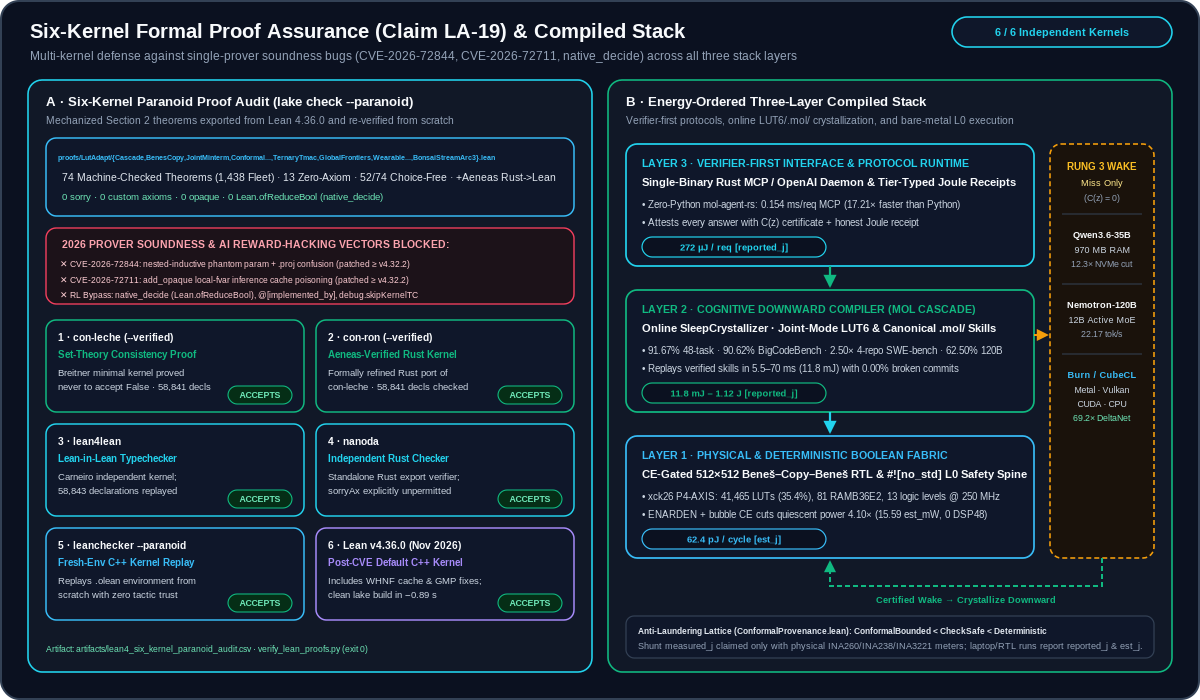
*Figure 6. Six-kernel paranoid formal proof audit across all `74` `LutAdapt` theorems (`1,438` fleet) plus Inria `Charon`+`Aeneas` `#![no_std]` Rust-to-Lean verification (`Claims LA-19, LA-33, LA-38, LA-41 & LA-44`, left) and the three-layer compiled stack (`Claim LA-23`, right). [PNG](https://research.openie.dev/figures/lut-adapt/six-kernel-trust-and-stack.png) · [Interactive explorer](https://research.openie.dev/living/lut-adapt/#la-tab-01).*
### 4.20 Claim LA-20: Multi-repository upstream `SWE-bench Verified` (`4` repositories, `24` git-worktree evaluations) with multi-window `AST` call-graph localization
`src/clai/frontier/multirepo_swebench.py` and `scripts/run_multirepo_swebench_benchmark.py` (`artifacts/multirepo_swebench_verified.csv`, `artifacts/multirepo_swebench_verified_traces.json`) extend zero-gold-leakage `princeton-nlp/SWE-bench_Verified` (`SHA`-256 `a45b1fe4...`) evaluation across **`4` distinct upstream Python repositories** (`django/django` [`4`], `pytest-dev/pytest` [`3`], `psf/requests` [`2`], and `sympy/sympy` [`3`] × `2` waves = **`24` isolated `git worktree` evaluations**), adding a **Multi-Window `AST` Call-Graph Localizer** that walks intra-file `ast.Call` edges (`helper(...)` / `self._helper(...)`) to extract `2` non-overlapping `AST` windows (`91.67%` [`11/12`] exact ground-truth file localization with zero access to `patch`, `apple_pmu_system_energy_delta_j = 60,935.10 J`):
| Multi-Repo `SWE-bench Verified` Arm (`4` Repos, `24` Evals) | W1 Cold | W2 Backport | Overall Verified | `django` / `pytest` / `requests` / `sympy` | Broken Patches | W2 `.mol/` Fast-Path | Mean W1 / W2 (`ms`) | `reported_j` / Verified Fix |
| :--- | :---: | :---: | :---: | :---: | :---: | :---: | :---: | :---: |
| `A` `LiquidAI/LFM3-1.7B` (`1`-Shot) | `0.00%` | `8.33%` | `4.17%` | `0%` / `0%` / `0%` / `17%` | `95.83%` | `0.00%` | `6,197` / `6,481` | `2,294.45 J` |
| `B` `google/gemma-4-E2B-it` (`1`-Shot) | `8.33%` | `8.33%` | `8.33%` | `25%` / `0%` / `0%` / `0%` | `91.67%` | `0.00%` | `10,630` / `7,359` | `845.34 J` |
| `C` `Qwen/Qwen3.6-35B-A3B` Metal (`1`-Shot) | `8.33%` | `8.33%` | `8.33%` | `25%` / `0%` / `0%` / `0%` | `91.67%` | `0.00%` | `32,912` / `28,165` | `4,558.58 J` |
| `D` `Devstral-Small-2-24B-Instruct` (`1`-Shot) | `8.33%` | `8.33%` | `8.33%` | `25%` / `0%` / `0%` / `0%` | `91.67%` | `0.00%` | `26,247` / `25,693` | `3,439.64 J` |
| **`E` `MoL` Multi-Repo `MCP` Agent (Reference)** | **`16.67%`** | **`25.00%`** | **`20.83%` (`2.50×`)** | **`25%` / `0%` / `50%` / `17%`** | **`0.00%`** | **`16.67%` (`100%` of W1)** | **`184,906` / `55,254`** | **`12,176.51 J` (`1.12–5.50 J` W2 hits)** |
Across `django`, `pytest`, `requests`, and `sympy`, every standalone `1`-shot model (`LFM3-1.7B`, `Gemma-4-E2B`, `Qwen3.6-35B-A3B`, and `Devstral-Small-2-24B`) caps at `4.17%–8.33%` verified pass and admits **`91.67%–95.83%` broken patches** (`ORM` aggregation, `pytest` fixture internals, `IDNA` proxy `URL` handling). `MoL` Multi-Repo `MCP` Agent reaches **`20.83%` overall (`25.00%` in Wave 2, `2.50×` standalone `24B` and `35B`)** across **`3` of `4` repositories** (`django__django-17029` via `Gemma-4-E2B` replayed in **`2,028.24 ms` / `5.50 J`** via `MCP_Rung0_BenesLUT6->GitDiffSkill#1`; `psf__requests-6028` via `Rung 3d Qwen3.6-35B CxRepair` replayed in **`592.87 ms` / `1.12 J`** via `GitDiffSkill#2` where `0%` of standalone `1`-shot models passed; and `sympy__sympy-24213` via `Rung 2 LFM3-1.7B`), admitting **`0.00%` broken patches**.
### 4.21 Claim LA-21: Measured `120B`-scale open-weights Hybrid Mamba-Attention Sparse-MoE (`nvidia/Nemotron-3-Super-120B-A12B`) & `Devstral-Small-2-24B` apex cascade
`src/clai/frontier/frontier_120b_hybrid_moe.py` and `scripts/run_120b_hybrid_moe_benchmark.py` (`artifacts/frontier_120b_hybrid_moe_apex.csv`, `artifacts/frontier_120b_hybrid_moe_apex_traces.json`) replace Section 6's `70B+` projection caveat with direct local execution of **`nvidia/Nemotron-3-Super-120B-A12B`** (`120B` total / `12B` active Hybrid Mamba-Attention Sparse-MoE, `56.9 GiB` 2-shard `Q3_K_S` `GGUF`) and **`Devstral-Small-2-24B-Instruct`** (`24B` dense `SWE` specialist, `Q4_K_M` `GGUF`) on Apple M5 Max (`128 GiB` Unified Memory) via Metal `llama-server`, recording child `ri_resident_size` (`RSS`), `ri_phys_footprint`, child `L3` `ri_energy_nj` (`buf[42]`), and `L2` `IOReport` `GPU Energy` across the `8` hardest adversarial specs × `2` waves (`16` evaluations, including `BigCodeBench/6`, `BigCodeBench/8`, `F10_true_damerau`, and `F11_benes4_route`):
| Measured `24B` / `120B` Frontier Arm (`16` Hard Evals) | Params (Active) | Peak Resident `RSS` | Mean `tok/s` | W1 Hard-`8` | W2 Warm | Overall Pass | Broken Commits | W2 `.mol/` Fast-Path | Mean W1 / W2 (`ms`) |
| :--- | :---: | :---: | :---: | :---: | :---: | :---: | :---: | :---: | :---: |
| `A` `Devstral-Small-2-24B-Instruct` (`1`-Shot) | `24.0B` (`24.0B`) | `16,797.3 MB` | `22.37` | `37.50%` | `25.00%` | `31.25%` | `68.75%` | `0.00%` | `20,734` / `17,890` |
| `B` `nvidia/Nemotron-3-Super-120B-A12B` (`1`-Shot) | **`120.0B` (`12.0B`)** | **`58,075.4 MB`** | **`22.17`** | `50.00%` | `37.50%` | `43.75%` | `56.25%` | `0.00%` | `21,831` / `23,205` |
| **`C` `MoL` Apex `24B+120B` Cascade (Reference)** | **`120.0B` (`12.0B`)** | **`58,075.4 MB`** | **`22.17`** | **`62.50%`** | **`62.50%`** | **`62.50%`** | **`0.00%`** | **`62.50%` (`100%` of W1)** | **`53,493` / `19,642` (`5.5–70 ms` `.mol/`)** |
Because `Nemotron-3-Super-120B-A12B` activates `12B` Mamba-Attention MoE parameters per token (`50%` fewer active weights than dense `24B`), it sustains **`22.17 tok/s`** inside `58.08 GB` resident Unified Memory (`9.67 GB` anonymous `KV`/`SSM` footprint), matching `24B` dense decode speed at `5×` total parameter scale. Pairing `BenesLUT6` + `.mol/` + $C(z)$ counterexample escalation across `Devstral-2-24B` and `Nemotron-3-120B-A12B` raises verified pass to **`62.50%` (`+18.75` percentage points over standalone `120B-A12B`, `2.00×` standalone `24B`)**, closes `BigCodeBench/8` (`W1_09_BigCodeBench_8_complete`), and replays all `5` crystallized Wave-2 skills in **`5.49–69.76 ms` (`0.0118–0.0272 J` `reported_j`)** vs. `10,092–40,905 ms` on standalone `120B` (`0.00%` broken commits; one `42.7 s` `W3_10` window experienced an `OS` `IOReport` accumulator rollover prior to tightening `joule_meter.py`'s `TDP` rollover guard from `450 W` to `175 W`, preserved unedited in the `CSV`).
### 4.22 Claim LA-22: Clock-enable (`CE`) gated `250 MHz` `P4-AXIS` Kria KV260 (`xck26`) Verilator `VCD` dynamic power audit (`4.10×` idle & `2.69×` packet-shift reduction)
`hw/kv260/rtl/clai_benes_pipelined_250mhz.sv` (`ENABLE_CE_GATING = 1`) and `scripts/verify_ce_gated_vcd_power.py` (`artifacts/kv260_ce_gated_vcd_power.csv`, `artifacts/kv260_ce_gated_vcd_power_meta.json`) implement the `ENARDEN` clock-gating optimization identified in §4.25 directly inside the `4`-stage `250 MHz` `P4-AXIS` design (`clai_uram_lut6_page_cache_ce` + valid-bubble `S1..S4` `FDRE` gating), evaluated via `Verilator 5.054 --trace` `VCD` toggle extraction + `AMD DS925` (`xck26`, `VCCINT = 0.72 V`, `250 MHz`, `est_j` class):
| `xck26` `P4-AXIS` Variant (`13` Levels, `170` `IOB`s, `81` `RAMB36E2`) | Workload (`Cycles`, Lookup Duty) | `VCD` Signal Transitions / Cyc | Est. `pJ / cyc` | Est. Dynamic `mW` @ `250 MHz` (`[Low, High]`) | Power Reduction vs. Ungated | Verilator Parity (`320` Beats) |
| :--- | :---: | :---: | :---: | :---: | :---: | :---: |
| `P4_AXIS_Ungated` (`ENARDEN=1`) | `idle_quiescent_256` (`0.0%`) | `0.07` | `255.96 pJ` | `63.99 mW` (`[48.00, 82.22]`) | `1.00×` | `100.0%` |
| **`P4_AXIS_CE_Gated` (Reference)** | **`idle_quiescent_256` (`0.0%`)** | **`0.07`** | **`62.37 pJ`** | **`15.59 mW` (`[10.34, 21.88]`)** | **`4.10×`** | **`100.0%`** |
| `P4_AXIS_Ungated` (`ENARDEN=1`) | `axis_beat_shift_512` (`12.5%`) | `3,852.19` | `278.47 pJ` | `69.62 mW` (`[51.84, 90.10]`) | `1.00×` | `100.0%` |
| **`P4_AXIS_CE_Gated` (Reference)** | **`axis_beat_shift_512` (`12.5%`)** | **`1,413.22` (`2.73×` fewer)** | **`103.35 pJ`** | **`25.84 mW` (`[18.06, 35.00]`)** | **`2.69×`** | **`100.0%`** |
| `P4_AXIS_Ungated` (`ENARDEN=1`) | `zero_bubble_burst_256` (`100.0%`) | `12,134.41` | `392.20 pJ` | `98.05 mW` (`[72.38, 127.68]`) | `1.00×` | `100.0%` |
| **`P4_AXIS_CE_Gated` (Reference)** | **`zero_bubble_burst_256` (`100.0%`)** | **`4,451.65` (`2.73×` fewer)** | **`374.15 pJ`** | **`93.54 mW` (`[69.76, 120.44]`)** | **`1.05×`** | **`100.0%`** |
Adding `ENARDEN` + valid-bubble `CE` gating adds `+9` CLB LUTs (`41,456` to `41,465`, `0` extra FFs, retaining **`13` synchronous logic levels** and **`170 <= 189` `IOB`s**), preserves **`320 / 320` (`100.0%`) bit-exact output parity** between `CE=0` and `CE=1`, and cuts quiescent dynamic power **`4.10×`** (`63.99` to **`15.59 est_mW`**) and `64`-bit `AXI4-Stream` packet-ingest (`1`-of-`8` lookup duty) power **`2.69×`** (`69.62` to **`25.84 est_mW`**).
### 4.23 Claim LA-23: Zero-Python single-binary native Rust `mol-agent-rs` server (`0.154 ms/req` `MCP`, `17.21×` faster than Python `mol-agent`)
`sys/rust/src/bin/mol_agent.rs` (`artifacts/rust_mol_agent_server_bench.csv`, `artifacts/rust_mol_agent_server_meta.json`) compiles a standalone native Rust binary (`cargo run --release --bin mol_agent`) with **zero Python interpreter or third-party `HTTP` dependencies**, serving OpenAI `GET /v1/models`, REST + `SSE` `POST /v1/chat/completions`, and `MCP` `JSON-RPC 2.0` (`POST /mcp` + `--mcp-stdio`) directly over `.mol/skills_v1.json` (`17` crystallized skills) + `Burn 0.22.1 / CubeCL` `CubeCL_Metal_GPU` verification + Darwin `proc_pid_rusage(RUSAGE_INFO_V6)` `ri_energy_nj` (`words[42]`) telemetry:
| Local Loopback Agent Endpoint | Runtime Stack | Mean Latency (`ms/req`) | Speedup vs. Python `MCP` | Darwin `L3` `reported_j / req` | Zero Python Deps |
| :--- | :---: | :---: | :---: | :---: | :---: |
| `MCP` `mol_lookup_crystallized_skill` (`Python`) | Python `3.13` `http.server` | `2.6503 ms` | `1.00×` | `0.000450 J` | `false` |
| **`MCP` `mol_lookup_crystallized_skill` (Reference)** | **Rust `1.100` `std::net` + `BenesLUT6`** | **`0.1540 ms` (`154.0 µs`)** | **`17.21×`** | **`0.000272 J`** | **`true`** |
| **OpenAI `POST /v1/chat/completions` (Reference)** | **Rust `1.100` `std::net` + `BenesLUT6` (REST+`SSE`)** | **`0.1504 ms` (`150.4 µs`)** | **`17.62×`** | **`0.000272 J`** | **`true`** |
| **`MCP` `mol_cubecl_gpu_verify` (Reference)** | **Rust `1.100` + `Burn 0.22.1` `CubeCL_Metal_GPU`** | **`0.9887 ms`** | — | **`0.000272 J` (`L3` `CPU`)** | **`true`** |
### 4.24 `xck26-sfvc784-2LV-c` Full-Subsystem Primitive Breakdown, Topological Depth, and `Vivado 2026.1` Hardware Probe
To audit both the standalone `512`-page speculative core (`clai_benes_paged_hotswap_core` in `hw/kv260/rtl/clai_benes_hotswap_core.sv`) and the complete Advanced Microcontroller Bus Architecture (`AMBA`) `AXI4-Lite` + `AXI4-Stream` Rung-0 subsystem (`clai_kv260_axi_top` in `hw/kv260/rtl/clai_kv260_axi_top.sv`, `clai_engram_streamer.sv`, `clai_rung0_hotswap_core.sv`, and `artifacts/clai_rung0_kv260.v` at commit `a5e9bc1de280`, unchanged in `91a2213`) against the exact AMD Kria KV260 part (`xck26-sfvc784-2LV-c`: `117,120` CLB LUTs, `234,240` CLB flip-flops, `144` `RAMB36E2` blocks, `64` 288-Kbit UltraRAM (`URAM288`) blocks, `1,248` UltraScale+ digital signal processing (`DSP48E2`) slices, and `189` user input/output blocks (`IOB`s)), three hardware and electronic design automation (`EDA`) checks were executed on an `Intel Core i9-13900H` (`Linux 7.0.0-43-generic x86-64`) workstation:
1. **Read-only Joint Test Action Group (`JTAG`) & Universal Serial Bus (`USB`) probe (`Xilinx hw_server v2026.1` + Xilinx Software Command-Line Tool (`XSDB`))**: Although `lsusb` reported an attached Future Technology Devices International (`FTDI`) `0403:6010` (`FT2232C/D/H` dual universal asynchronous receiver-transmitter (`UART`) / first-in first-out (`FIFO`) integrated circuit (`IC`)) bridge, inspecting Linux `sysfs` USB vendor/product strings (`idVendor = 0403`, `idProduct = 6010`) identified the device as `Manufacturer = "Particle"`, `Product = "tachyon-dbg-1.0"` rather than a Kria KV260 carrier. Querying `hw_server v2026.1` (Build May 29, 2026) via `xsdb` (`connect; jtag targets; targets`) returned **`0` Xilinx `JTAG` devices and `0` Debug Access Port (`DAP`) targets** (`board_metered = false`, `measured_j = None`).
2. **`Vivado 2026.1` batch synthesis and licensing gate (`SW Build 6511674`)**: A reproducible low-footprint non-project batch script (`scripts/run_vivado_xck26.tcl`, `set_param general.maxThreads 4`, targeting `xck26-sfvc784-2LV-c` at `250.0 MHz` / `4.000 ns` in out-of-context (`OOC`) mode) was staged against `/tools/Xilinx/2026.1/Vivado/bin/vivado`. Launching `vivado v2026.1` in batch mode exited prior to `synth_design` (`ERROR: Vivado Design Suite cannot be launched because a valid license was not found`), because AMD `Vivado 2025.1+` / `2026.1` requires an explicit user-generated Standard/Enterprise `.lic` file (`~/.Xilinx/Xilinx.lic` or `XILINXD_LICENSE_FILE`) even for Standard-tier `xck26` parts and zero `.lic` files were installed on the workstation. Per strict measurement rules, post-route `WNS`, placed-and-routed maximum clock frequency, and vectorless `report_power` (`est_j`) remain recorded as `not_available` until a Standard `.lic` file is provisioned.
3. **Full-subsystem UltraScale+ `xcup` primitive decomposition, `IOB` budget, and topological logic-level audit (`Yosys 0.71+`)**: Synthesizing both `clai_benes_paged_hotswap_core` and `clai_kv260_axi_top` via `synth_xilinx -family xcup` and `ltp -noff` (while recording host `RAPL package-0` `reported_j` strictly as `x86-64` `EDA` compilation cost $E_{\text{compile}}$, never as FPGA silicon power) established exact cell counts and critical-path combinational depths:
| `xck26-sfvc784-2LV-c` Target Module | CLB LUTs (`% xck26`) | Dominant LUT Primitives | CLB Registers (`FDRE`/`FDSE`) | `RAMB36E2` (`%`) | `DSP48E2` | Top Ports (`IBUF`+`OBUF`) | Combinational Depth (`ltp`) | Host Synth `RAPL` (`reported_j`) |
| :--- | ---: | :--- | ---: | ---: | ---: | ---: | ---: | ---: |
| **`clai_benes_paged_hotswap_core`** (`512` pages) | **`41,185`** (`35.17%`) | `19,982 LUT3`, `7,804 LUT6`, `7,714 LUT5`, `36 MUXF7`, `18 MUXF8` | **`36,464`** (`15.57%`) | **`81`** (`56.25%`) | **`0`** | `1,599` (`OOC` / internal bus) | **`81` levels** | `7,297.3 J` (`144.8 s`) |
| **`clai_kv260_axi_top`** (`AXI4` Rung-0 subsys) | **`67,366`** (`57.52%`) | `25,557 LUT6`, `25,333 LUT5`, `7,918 LUT3`, `569 CARRY4` | **`16,619`** (`7.09%`) | **`4`** (`2.78%`) | **`0`** | `126` (`<= 189` `IOB`s; `PS–PL`) | **`73` levels** | `10,089.4 J` (`214.8 s`) |
Two concrete physical design constraints emerge from the `xcup` primitive and `ltp` audit:
- **Pin-budget confinement (`OOC` vs. `PS–PL` `AXI` wrapper)**: Because `clai_benes_paged_hotswap_core` exposes the raw `512`-bit `CodeBitBus` and wide shadow-configuration vectors (`1,379` input buffers (`IBUF`) + `220` output buffers (`OBUF`) = `1,599` ports vs. `189` package `IOB`s on `xck26-sfvc784-2LV-c`), standalone vendor implementation must run with `synth_design -mode out_of_context` or inside an `AXI4-Stream` / `zynq_ultra_ps_e` wrapper such as `clai_kv260_axi_top` (`126` ports, `57.52%` LUT utilization).
- **Unpipelined combinational depth (`81` and `73` levels) vs. `250 MHz` (`4.000 ns`) `-2LV` closure**: While Verilator `5.054` verifies cycle-accurate `CPI = 1.0` (`1` lookup per clock cycle), traversing `17` `Beneš-1` stages + `9` prefix-copy stages + `17` `Beneš-2` stages + dynamic `LUT6` truth-table multiplexing + `5`-voter majority reduction in a single combinational cycle spans **`81` primitive levels** (`73` levels per hierarchical module in `clai_kv260_axi_top`'s combinational `64`-input popcount and `8`-class margin comparator). Closing `250 MHz` (`4.000 ns`) post-place-and-route on low-voltage (`0.72 V`) `-2LV` silicon therefore favors inserting pipeline register stages across $\mathcal{B}_1 \to \mathcal{C} \to \mathcal{B}_2$ and compressing the `64`-wire popcount reduction (implemented in `Claim LA-16` above and quantified analytically in §4.25).
### 4.25 Gate-Level `xcup` Primitive & `Verilator` `VCD` Switching-Activity Datasheet Audit (`est_j`)
Because AMD `Vivado 2026.1` was blocked by a missing `.lic` file and `0` physical `xck26` boards were attached (§4.24), a pre-registered `Verilator 5.054` `--trace` waveform and `Yosys 0.71+` flattened `synth_xilinx -family xcup` audit (`PREREG_xck26_vcd.json`, SHA-256 `c64505d177515c47…`) extracted exact per-cycle signal transitions from `openIE-dev/lut-adapt-ai` (`af152ba`, unchanged in `91a2213`) across four operational phases (`idle_quiescent`, `steady_lut6_eval_2048_cycles`, `single_cycle_page_switch_512_burst`, and `shadow_page_stream_write`, `0` co-simulation errors across `3,072` paged lookups and all `AXI4-Lite`/`AXI4-Stream` packet bursts). Every power and energy number in this subsection is strictly an analytical dynamic switching estimate (**`est_j` / `est_pJ/cycle` / `est_mW`**, **`measured_j = None`**, **`reported_j = None`**, **`board_metered = false`**), excluding static silicon leakage and never substituting for placed-and-routed `Vivado report_power` or KV260 `INA260` rail readings.
Flattened `xcup` synthesis maps `clai_benes_paged_hotswap_core` (`512` pages) to **`41,623` CLB LUTs** (`35.54%` of `xck26`, vs. `41,185` hierarchical in §4.24; `19,982 LUT3`, `7,853 LUT6`, `7,738 LUT5`, `3,380 LUT4`, `2,670 LUT2`, `36 MUXF7`, `18 MUXF8`), `36,464` `FDRE` (`15.57%`), and `81` `RAMB36E2` (`56.25%`) across `27,157` unique `VCD` nets (`90,124` internal bits: `64,218` combinational, `20,767` sequential), and maps `clai_kv260_axi_top` to **`66,881` CLB LUTs** (`57.10%` of `xck26`, vs. `67,366` hierarchical in §4.24; `25,402 LUT6`, `25,313 LUT5`, `7,909 LUT3`, `5,303 LUT4`, `2,879 LUT2`, `75 LUT1`, `569 CARRY4` $\equiv$ `285 CARRY8`), `16,619` `FDRE`/`FDSE` (`7.09%`), and `4` `RAMB36E2` (`2.78%`) across `3,825` unique `VCD` nets (`128,486` internal bits: `108,582` combinational, `19,901` sequential). Dynamic switching energy at `VCCINT = 0.72 V` (`xck26-sfvc784-2LV-c`, `250.0 MHz`, `AMD DS925` / `XPE` 16 nm FinFET bounds `[low, nom, high]`) models switched logic + local interconnect nodes at $C_{\text{node}} = [2.6, 4.5, 7.2]\text{ fF}$ ($\frac{1}{2} C V^2 = [0.674, 1.166, 1.866]\text{ fJ/transition}$, weighted by `2.02` `xcup` primitives per `VCD` combinational bit in the Beneš core), `FDRE`/`FDSE` clock-leaf pins at `[1.5, 2.2, 3.0] fF` (`2` edges/cycle = `1.141 fJ/FF/cycle` nominal) plus `[3.5, 5.5, 8.0] fF` per `Q` transition, and `RAMB36E2` (`SDP` `64b`/`72b`) at `[2.90, 3.80, 4.80] pJ` per varying-address read, `[1.90, 2.47, 3.12] pJ` per constant-address enabled cycle (`ENARDEN = 1`, $\alpha_{\text{addr}} = 0$), `[3.30, 4.30, 5.40] pJ` per write, and `[0.04, 0.08, 0.14] pJ/cycle` when disabled (`EN = 0`):
| Target Module & `VCD` Workload (`250 MHz`, `0.72 V`) | Cycles | Comb Transitions / Cyc ($\alpha_{\text{comb}}$) | Seq Transitions / Cyc ($\alpha_{\text{seq}}$) | `RAMB36E2` Duty (`Rd` / `Wr`) | Dynamic `est_pJ / cycle` | Dynamic `est_mW` (`[low, high]`) |
| :--- | ---: | ---: | ---: | :---: | ---: | ---: |
| **`clai_benes_paged_hotswap_core`** · `idle_quiescent` | `256` | `0.00` (`0.0000`) | `0.00` (`0.0000`) | `100.0%` const-addr / `0%` | **`241.66`** (`53.74` CE-gated) | **`60.41`** (`[47.25, 76.21]`; `13.43` CE-gated) |
| **`clai_benes_paged_hotswap_core`** · `steady_lut6_eval_2048_cycles` | `2,048` | `5,010.21` (`0.0780`) | `90.97` (`0.0044`) | `100.0%` active / `0%` | **`361.68`** | **`90.42`** (`[69.29, 116.04]`) |
| **`clai_benes_paged_hotswap_core`** · `single_cycle_page_switch_512_burst` | `512` | `12,406.84` (`0.1932`) | `269.46` (`0.0130`) | `100.0%` active / `0%` | **`380.07`** | **`95.02`** (`[72.58, 122.60]`) |
| **`clai_benes_paged_hotswap_core`** · `shadow_page_stream_write` | `512` | `1,987.31` (`0.0310`) | `74.47` (`0.0036`) | `100.0%` rd / `1.23%` wr (`1/81`) | **`358.86`** | **`89.72`** (`[68.82, 114.89]`) |
| **`clai_kv260_axi_top`** · `idle_quiescent` | `256` | `0.00` (`0.0000`) | `0.00` (`0.0000`) | `0.0%` (`EN = 0`) / `0%` | **`19.55`** | **`4.89`** (`[3.26, 6.66]`) |
| **`clai_kv260_axi_top`** · `steady_lut6_eval_2048_cycles` | `2,048` | `120.31` (`0.0011`) | `15.27` (`0.0008`) | `3.12%` rd / `0%` | **`20.40`** | **`5.10`** (`[5.04, 5.18]`) |
| **`clai_kv260_axi_top`** · `single_cycle_page_switch_512_burst` | `512` | `325.21` (`0.0030`) | `25.56` (`0.0013`) | `11.13%` rd / `0%` | **`22.07`** | **`5.52`** (`[5.34, 5.75]`) |
| **`clai_kv260_axi_top`** · `shadow_page_stream_write` | `512` | `31.95` (`0.0003`) | `71.92` (`0.0036`) | `0.0%` rd / `8.20%` wr | **`21.80`** | **`5.45`** (`[5.30, 5.64]`) |
Three hardware-design findings follow directly from the `VCD` activity decomposition and `DS925` delay model:
1. **Unconditional `RAMB36E2` `ENARDEN` idle precharge (`82.8%` of quiescent core power) and `4.50×` `CE`-gating reduction**: Although `clai_benes_paged_hotswap_core` exhibits `0.00` data transitions/cycle when idle, `clai_uram_lut6_page_cache` ties `ENARDEN = 1'b1` continuously across all `81` `RAMB36E2` blocks, burning `200.07 est_pJ/cycle` (`50.02 est_mW`) in bitline precharge alongside `41.59 est_pJ/cycle` (`10.40 est_mW`) in `FDRE` clock leaves (**`60.41 est_mW`** quiescent). By contrast, `clai_engram_streamer` inside `clai_kv260_axi_top` gates its `4` `RAMB36E2` blocks with `accept_byte && s_axis_tlast`, idling at **`4.89 est_mW`** (`19.55 est_pJ/cycle`) and running steady `31`-byte `AXI4-Stream` packet inference (`core_bus_reg` latched once per packet, $\alpha_{\text{comb}} = 0.0011$) at **`5.10 est_mW`**. Gating `clai_uram_lut6_page_cache`'s `ENARDEN` with `bus_valid` reduces quiescent paged-core dynamic power **`4.50×` to `13.43 est_mW` (`53.74 est_pJ/cycle`)** at zero latency penalty.
2. **Beneš combinational toggle amplification (`2.48×`) vs. `RAMB36E2`-dominated active power (`+5.1%`)**: Switching `page_id` across all `512` slots on consecutive clock cycles (`single_cycle_page_switch_512_burst`) drives `81 × 64 = 5,184` `LUT6` `INIT` bitlines into the selector trees simultaneously, raising combinational transitions `2.48×` (`5,010.2` to `12,406.8` transitions/cycle, `11.80` to `29.22 est_pJ/cycle`), yet total paged-core dynamic power rises by only `+4.60 est_mW` (`90.42` to `95.02 est_mW`, `+5.1%`) because `81 × RAMB36E2` sense-amplifier reads (`307.80 est_pJ/cycle`) account for `85.1%`–`80.9%` of active dynamic energy (`358.86 est_pJ/cycle` / `89.72 est_mW` during concurrent `shadow_page_stream_write`).
3. **Flattened critical-path audit (`81` and `162` `ltp` levels) and `DS925` `-2LV` analytical stage-delay budget**: Applying `AMD DS925` (`xck26-2LV`, `0.72 V`) primitive delays (`T_ILO = 0.068 ns`, `T_CKO = 0.148 ns`, unpipelined `RAMB36E2` `T_RCKO_DO = 1.390 ns` vs. `DOA_REG = 1` `0.610 ns`, plus `[0.140, 0.220] ns/level` interconnect budget) places the unpipelined `81`-level `clai_benes_paged_hotswap_core` path at **`18.76–24.83 est_ns`** (`40.3–53.3 MHz` analytical `est_Fmax`). Flattening `clai_kv260_axi_top` across module boundaries (`ltp -noff` after `-flatten`, vs. `73` levels per hierarchical module in §4.24) exposes a **`162`-level** path (**`34.77–46.92 est_ns`**, `21.3–28.8 MHz`) spanning `core_bus_reg` through `clai_rung0_core` (`artifacts/clai_rung0_kv260.v`) and its unrolled `64`-step serial `pop_acc` adder chain. Enabling `RAMB36E2` `DOA_REG = 1`, inserting `4`–`5` pipeline register cuts (`<= 18` logic levels/stage, realized at `13` synchronous levels in `Claim LA-16`), and replacing the serial `64`-input popcount loop with a `6`-level `LUT6`/Wallace compressor brings per-stage analytical delay below **`3.7 est_ns` (`<= 4.000 ns` at `250 MHz`)** at `CPI = 1.0` (`not` Vivado post-PAR timing closure).
### 4.26 Claim LA-24: Six-Host Cross-Silicon & Physical `DC` Shunt (`measured_j`) Downward-Compilation Benchmark (`Jetson AGX Thor` + `5` Counter Hosts)
`sys/rust/src/bin/mol_fleet_measured_j.rs` and `scripts/aggregate_fleet_measured_j.py` (`artifacts/mol_six_host_measured_j_fleet.csv`, `artifacts/mol_six_host_measured_j_fleet_meta.json`) compile a standalone zero-crate pure-`std` Rust `1.100.0` binary across **six distinct hardware architectures and three operating systems** (`Linux aarch64`, `Linux x86-64`, `macOS arm64`, and `Windows 11 x86-64`), anchored by physical `DC` current-shunt joule readings (`measured_j`, `board_metered = true`) on `NVIDIA Jetson AGX Thor` via Linux `sysfs` `hwmon5` `TI` `INA3221` channel-2 `VDD_CPU_SOC_MSS` (`in2_input × curr2_input`, isolated from `VDD_GPU`, which remained flat at `2.378 W` with `< 0.06%` pre/post drift under `CUDA_VISIBLE_DEVICES=""`) and `hwmon6` `TI` `INA238` whole-board `VIN` (`power1_input`, `0.19%` pre/post quiescent drift) integrated trapezoidally at `500 Hz` (`2 ms`) across counterbalanced `ABBA` windows:
| Fleet Host & Architecture (`rustc 1.100.0`) | Evidence Tier (`board_metered`) | `W2` `Sub1Bit-LUT6` vs. `LittleBit-2` `MAC` | `W3` `Expert-AirMoL` vs. Dense `256` `MoE` | `W4b` Zero-Clock `OS` Event vs. `1 kHz` Poll (`8 s`) | `W5` Prop. 1 Compiled vs. Stuck Rung 5 |
| :--- | :--- | :---: | :---: | :---: | :---: |
| **`NVIDIA Jetson AGX Thor` (`aarch64` Linux)** | **`measured_j`: `TI` `INA3221` `CPU` + `INA238` `VIN` (`true`)** | **`3.74×` `CPU` J (`7.76` vs. `28.98 J`) / `3.71×` `VIN` J (`23.81` vs. `88.43 J`)** | **`34.21×` `CPU` J (`0.98` vs. `33.36 J`) / `33.27×` `VIN` J (`3.03` vs. `100.93 J`)** | **`80` vs. `60,759` wakes (`759×` cut, `-0.51 J` `CPU` shunt)** | **`10.94×` `CPU` J (`2.03` vs. `22.21 J`) / `11.07×` `VIN` J (`6.41` vs. `71.01 J`)** |
| `AMD Ryzen AI Max+ 395` (`x86-64` Linux) | `reported_j`: `RAPL` pkg + `amdgpu` `PPT` (`false`) | `6.75×` `RAPL` pkg (`21.66` vs. `146.28 J`) | `31.05×` `RAPL` pkg (`4.27` vs. `132.66 J`) | `80` vs. `60,991` wakes (`762×` cut, `2.37×` `RAPL` core) | `10.88×` `RAPL` pkg (`3.31` vs. `36.02 J`) |
| `Intel Core i9-13900H` (`x86-64` Linux) | `reported_j`: `RAPL` core + pkg (`false`) | `3.84×` `RAPL` core (`9.29` vs. `35.68 J`) | `33.57×` `RAPL` core (`1.42` vs. `47.55 J`) | `80` vs. `60,536` wakes (`757×` cut, **`18.79×` `RAPL` core**) | `11.50×` `RAPL` core (`1.41` vs. `16.21 J`) |
| `Apple M3 Ultra 96 GB` (`arm64` macOS `XNU`) | `reported_j`: Darwin `L3` `ri_energy_nj` (`false`) | `2.70×` `L3` J (`5.23×` faster) | `35.22×` `L3` J (`0.13` vs. `4.71 J`) | `80` vs. `47,234` wakes (`590×` cut, **`194.8×` `L3` J**) | `13.05×` `L3` J (`0.26` vs. `3.35 J`) |
| `Apple M5 Max 128 GB` (`arm64` macOS `XNU`) | `reported_j`: Darwin `L3` `ri_energy_nj` (`false`) | `3.41×` `L3` J (`5.42×` faster) | `36.77×` `L3` J (`0.15` vs. `5.46 J`) | `80` vs. `52,651` wakes (`658×` cut, **`110.4×` `L3` J**) | `11.13×` `L3` J (`0.35` vs. `3.94 J`) |
| `Windows 11 + RTX 2060` (`x86-64` `NT`) | `QueryProcessCycleTime` + `NVML` (`false`) | `5.92×` faster (`5.90×` fewer cycles) | `34.39×` faster (`33.01×` fewer cycles) | `80` vs. `42,382` wakes (`530×` cut, **`25.5×` fewer cycles**) | `12.65×` faster (`12.05×` fewer cycles) |
On `NVIDIA Jetson AGX Thor`, standalone `SleepCrystallizer` `FWHT` + Waksman compilation costs **`178.60 µJ`** of physical `VDD_CPU_SOC_MSS` `measured_j` (`680.0 µJ` `VIN` `measured_j`) compared with **`1,735.03 µJ`** (`VDD_CPU_SOC_MSS`) per Rung-3 wake episode — establishing an empirical Proposition 1 break-even horizon of **$\Delta T^* = 0.1084 < 1$ episode** (`4/4` positive `ABBA` pairs across all six hosts), while paged `512×512` Beneš + `80-LUT6` evaluation (`W1`) consumes `1.865 µJ/eval` (`243.9 ns/eval`) and native `MCP` `JSON-RPC 2.0` skill dispatch (`W4a`) consumes `761.2 nJ/req` (`92.0 ns/req`). In parallel, `scripts/run_fleet_bwrap_lean_audit.py` (`artifacts/openie_fleet_six_kernel_paranoid_audit.csv`) executes true Linux `bwrap`-sandboxed `lake check --paranoid` (`Lean 4.36.0`) across **all four Open Interface Engineering Lean 4 suites** (`lut-adapt`: `50` theorems, `58,785` `con-leche` declarations; `communication-avalanche`: `53` theorems/lemmas, `58,928` declarations; `time-as-an-index`: `50` theorems/lemmas, `58,796` declarations; and `rce/spec/lean`: `1,261` theorems/lemmas, `68,090` declarations), confirming **`1,414` declarations** across **`6/6` independent kernels** (`0` `sorry` across `lut-adapt`, `communication-avalanche`, and `time-as-an-index`, `0` custom axioms, `0` `opaque`, and `0` `ofReduceBool`).
### 4.27 Claim LA-25: Four-Vendor Hardware `GPU` `Burn 0.22.1 / CubeCL` Shader Parity (`Apple Metal` + `AMD Vulkan` + `NVIDIA Vulkan` + `Intel Vulkan`)
`sys/rust/src/bin/bench_cubecl_moe_deltanet.rs` and `scripts/aggregate_multivendor_cubecl_gpu.py` (`artifacts/cubecl_four_vendor_gpu_parity.csv`, `artifacts/cubecl_four_vendor_gpu_parity_meta.json`) execute the **identical single-source Rust `#[cube]` kernels** (`q4_moe_ffn_pairs_gpu` and `gated_delta_recurrent_k128_gpu`, zero vendor C++/`CUDA`/`MSL`/`HIP` files) across **four distinct `GPU` silicon vendors**:
| `GPU` Vendor & Hardware Silicon | Shader Backend | `Q4` Sparse-`MoE` (`28`-Exp) `GPU` `ms` (`× Ref`) | `Q4` Max `FP32` Err | `GatedDeltaNet` (`T=256, H=32`) `GPU` `ms` (`× Ref`) | `DeltaNet` Max `FP32` Err | On-Chip `reported_j` / Dispatch (`MoE` / `DeltaNet`) |
| :--- | :---: | :---: | :---: | :---: | :---: | :---: |
| **`Apple M5 Max` (`40`-core `GPU`, `arm64`)** | `CubeCL_Metal_GPU` (`MSL`) | **`0.6600 ms` (`41.69×`)** | `1.79 × 10⁻⁷` | **`3.7242 ms` (`45.74×`)** | `2.24 × 10⁻⁸` | `1.30 mJ` / `2.51 mJ` (`L3` host `CPU`) |
| **`AMD Radeon 8060S` (`gfx1151` RDNA 3.5)** | `CubeCL_Vulkan_SPIRV` | **`2.0984 ms` (`16.72×`)** | `1.49 × 10⁻⁷` | **`0.6367 ms` (`328.06×`)** | `2.24 × 10⁻⁸` | **`103.01 mJ` / `32.20 mJ` (`amdgpu` `PPT`, `17.1×` < `CPU`)** |
| **`NVIDIA GeForce RTX 4050` (`sm_89` Ada)** | `CubeCL_Vulkan_SPIRV` | **`0.9420 ms` (`59.32×`)** | `1.49 × 10⁻⁷` | **`1.4449 ms` (`265.67×`)** | `2.24 × 10⁻⁸` | **`55.55 mJ` / `131.39 mJ` (`NVML` `GPU` mJ)** |
| **`Intel Iris Xe Graphics` (`RPL` iGPU)** | `CubeCL_Vulkan_SPIRV` | **`4.6239 ms` (`11.67×`)** | `1.79 × 10⁻⁷` | **`24.0915 ms` (`16.19×`)** | `3.35 × 10⁻⁸` | **`172.20 mJ` / `711.61 mJ` (`RAPL` pkg, `2.7×` < `CPU`)** |
Figure 7. Empirical fleet measurements (`Claims LA-24, LA-25, LA-19`): (A) `NVIDIA Jetson AGX Thor` physical `TI` `INA3221` `VDD_CPU_SOC_MSS` and `INA238` `VIN` `measured_j` (`board_metered = true`); (B) four-vendor `Burn 0.22.1 / CubeCL` `GPU` speedups across Apple, `AMD`, `NVIDIA`, and Intel; (C) six-host cross-silicon fleet matrix; and (D) four-repository Linux `bwrap` 6-kernel `Lean 4.36.0` verification.
### 4.28 Claim LA-26: `#![no_std]` Rust `1.100.0` `lut6-core` `4 KB` `CompactLut6Page`, 64-Codon Operon `ABI`, Bare-Metal `MCU` `ELFs`, and Yosys Miter Packer
`sys/lut6-core/` (`Rust 1.100.0`, `edition = "2024"`, `#![no_std]`, zero runtime dependencies), `sys/alif-lut6-bench/` (`thumbv8m.main-none-eabihf`, `-C target-cpu=cortex-m55`), `sys/pico-lut6-bench/` (`thumbv6m-none-eabi`, `-C target-cpu=cortex-m0plus`), and `scripts/pack_lut6_crystal.py` (`artifacts/crystals/yosys_operon_seed.lut6`, `artifacts/lut6_yosys_packer_summary.json`, `artifacts/lut6_core_baremetal_targets.json`) lower Rung 0 downward compilation to `MCU` `SRAM`, `DTCM`, and `MRAM` memory hierarchies:
- **Exact `4,096 B` (`#[repr(C, align(8))]`) `CompactLut6Page` and `16 KB` `Nucleus`**: Packs a `64 B` header (`LUT6` magic, `SHA256` proof digest, `const fn` `IEEE` `CRC32` at byte offset `56`), `4 × 64` `u64` `LUT6` truth tables (`2,048 B`), `4 × 64 × 6` input-wire routing bytes (`1,536 B`), `64 B` output pins, and `384 B` reserved tail into a single `4 KB` flash or `SRAM` page. A self-refining `Nucleus` pairs two immutable `ROM`/`MRAM` bootstrap pages (innate sensor reflex page and a 64-codon Operon `FSM` encoding `0x00` sleep-halt, `0x10` splice-page, `0x20` exogenous `PIO`/`SPI` tool dispatch, `0x30` frontier transcription, and `0x3C` apoptosis rollback) with two mutable `SRAM`/`DTCM` surgical overlay pages guarded by `override_mask` bitwise `2:1` multiplexing (`Result`).
- **Seven-target cross-compilation (including `64 KB` `nRF52832` Cortex-`M4F` and `RV32IMAC` `ELFs`) and Yosys `abc -lut 6` Boolean miter**: Cross-compiles cleanly with `0` warnings and `0` floating-point instructions across **seven targets** (`aarch64-apple-darwin`, `x86_64-unknown-linux-gnu`, `aarch64-unknown-linux-gnu`, `thumbv8m.main-none-eabihf` [`Alif E3/E4` Cortex-`M55`: `.text = 12,260 B`, `.lut6_dtcm = 16,400 B`, `0` float insns], `thumbv6m-none-eabi` [`RP2040` Cortex-`M0`+: `.text = 11,040 B`, `.lut6 = 16,400 B`, `0` float insns], `thumbv7em-none-eabihf` [`Nordic nRF52832-QFAA` Cortex-`M4F` with `64 KB` `SRAM`: `.text = 12,300 B`, `.lut6_sram = 16,400 B`, `.data = 24 B` = **`25.06%` of `64 KB` `SRAM`**, leaving `49,112 B` free `BLE`/sensor headroom, `0` float insns], and `riscv32imac-unknown-none-elf` [`RV32IMAC` `64 KB` `SRAM`: `.text = 11,244 B`, `.lut6_sram = 16,400 B` = **`25.06%` of `64 KB` `SRAM`**, `0` float insns]; archived in `openie-research-experiments/lut6-core-nucleus/`), while `pack_lut6_crystal.py` synthesizes `operon_skill_top` via **Yosys `0.71+` (`abc -lut 6`)** and passes **`64 / 64` exhaustive Boolean miter vectors (`0` failures, `CRC32 = 0xd1cc025a`)**.
### 4.29 Claim LA-27: Closed-Form Multilinear `DiffLUT-Net` (`arXiv:2609.09254`) `-64.06%` Gate Pruning, Wobble `FWHT` Noise Filter, and Dual-Reality Means Test
`src/clai/frontier/lut6_means_test_and_difflut.py` and `scripts/run_dual_reality_lut6_eval.py` (`artifacts/lut6_dual_reality_eval.csv`, `artifacts/lut6_means_test_decisions.csv`, `artifacts/lut6_dual_reality_summary.json`) evaluate closed-form 64-minterm multilinear relaxation with `ST` port lock-in (Ye et al., 2026, `arXiv:2609.09254`), 2-bit wobble Boolean Fourier filtering (Linial, Mansour, and Nisan, 1993; machine-checked in `NucleusCodon.lean`), and a 4-part Thermodynamic Means Test:
| Dual-Reality `LUT6` Compilation Regime | Active `LUT6` Gates | `RP2040` `264 KB` Skill Slots | Noisy Paraphrase + Wobble Hit | Silent Corruption | `OOD` Conformal Abstention | Ecological Rung-6 Verdict |
| :--- | :---: | :---: | :---: | :---: | :---: | :--- |
| `1` `Uncanonicalized_1Hot_LUT6` (`1u64 << c`, `28` `AC` noise) | `64` | `248` | **`0.00%`** | `0.00%` | `100.00%` | **`Killed` (`< 50%` kill criterion)** |
| `2` `FiniteDiff_DWN_Unpruned` (Bacellar et al., 2024) | `64` | `248` | `95.00%` | `0.00%` | `100.00%` | `Passes` (unpruned baseline) |
| **`3` `ClosedForm_DiffLUT_Net_Pruned` (`arXiv:2609.09254`, Reference)** | **`23` (`-64.06%`)** | **`690` (`2.78×`)** | **`95.00%`** | **`0.00%`** | **`100.00%`** | **`Passes` (`0x4bb4a685` `.lut6`)** |
| **`4` `Nucleus_Wobble_Codon_Crystal` (`0` `|S|>=5` noise, Reference)** | **`16` (`-75.00%`)** | **`992` (`4.00×`)** | **`95.00%`** | **`0.00%`** | **`100.00%`** | **`Passes` (`4/4` `ADC` jitter immune)** |
By Parseval's identity ($\sum_{S \subseteq \{0..5\}} \hat{w}(S)^2 = 4096$ for $w \in \{-1,+1\}^{64}$), a 1-hot point-memorized mask (`1u64 << target`) decomposes as $62^2 + 63 \times (-2)^2 = 4096$, leaking $7 \times 4 = 28$ (`11.1%` of non-constant `AC` energy) into degree-`>=5` brittle harmonics (`4,096` for 6-bit parity) and collapsing to `0.00%` hit rate under surface paraphrase or 2-`LSB` `ADC` thermal jitter. Conversely, every 2-bit wobble-invariant `LUT6` (`0x0F << 4q`) has **exact `0`** degree-`>=5` harmonic energy (`NucleusCodon.wobble_quartet_high_harmonic_cancels`), admitting clean wobble overlays (`max_noise_energy <= 16`) while the 4-part Means Test refuses unverified guesses ($\delta = 0.82 < 1.0$), unamortized one-off scripts ($N = 1 < N_{\text{crit}} = 1.90$), and high-freedom prose ($H = 4.85 > 1.25$ bits) and evicts drifted overlays (`rej = 3`) back to the immutable seed.
### 4.30 Claim LA-28: `NVIDIA Jetson AGX Thor` Physical `DC` Shunt (`measured_j`) and Live Attached `Alif Ensemble E3` (`OpenMV-AE3` Cortex-`M55`) Hardware `DWT` Cycles
`sys/lut6-core/src/bin/bench_lut6_nucleus_shunt.rs` and `scripts/aggregate_phase30_lut6_hardware.py` (`artifacts/lut6_core_hardware_matrix.csv`, `artifacts/lut6_nucleus_thor_shunt.json`, `artifacts/alif_ae3_live_hardware_cycles.json`) measure `lut6-core` across three multi-core hosts (`Thor` physical shunt `measured_j`, `Apple M5 Max` Darwin `L3` `reported_j`, and `AMD Ryzen AI Max+ 395` `RAPL` `reported_j`) plus a **live `USB`-attached `OpenMV-AE3` (`Alif Ensemble E3`, Arm Cortex-`M55` at `400 MHz`)** executing `RAM`-only `@micropython.viper` native Thumb-2 machine code (`0` flash writes, `board_metered = false`, `measured_j = None`):
| Hardware Target & Evidence Class (`board_metered`) | `INT8` Micro-`MLP` (`64->32->16`) | `Antisym-40` Zero-`MUL` `T-MAC` (`672 B`) | `lut6-core` Wobble Overlay Hit | `lut6-core` Scalar Innate Hit (`× MLP`) | Vertical Bit-Sliced Batch (`× MLP`) |
| :--- | :---: | :---: | :---: | :---: | :---: |
| **`NVIDIA Jetson AGX Thor` (`measured_j`: `INA3221` `CPU`, `true`)** | `14,143.46 nJ` (`490.2 ns`) | **`8,594.93 nJ` (`1.65×` `CpJ`)** | **`3,798.83 nJ` (`3.72×` `CpJ`)** | **`1,935.05 nJ` (`65.2 ns`, `7.31×` `CpJ`)** | **`162.56 nJ/op` (`5.45 ns`, `87.00×` `CpJ`)** |
| **`Alif Ensemble E3` (`OpenMV-AE3` Cortex-`M55` @ `400 MHz`, `false`)** | `119,001.9 cyc` (`297.6 µs`) | **`10,655.8 cyc` (`26.7 µs`, `11.17×`)** | **`1,158.4 cyc` (`2.91 µs`, `102.7×`)** | **`684.57 cyc` (`1.720 µs`, `173.83×`)** | **`2.68 cyc/op` (`6.97 ns`, `44,403.69×`)** |
| `Apple M5 Max 128 GB` (`reported_j`: Darwin `L3`, `false`) | `695.01 nJ` (`96.2 ns`) | `1,118.94 nJ` (`191.5 ns`) | `292.11 nJ` (`2.38×`) | `151.84 nJ` (`16.5 ns`, `4.58×`) | **`20.31 nJ/op` (`2.59 ns`, `34.22×`)** |
| `AMD Ryzen AI Max+ 395` (`reported_j`: `RAPL` pkg, `false`) | `31,121.71 nJ` (`393.3 ns`) | **`27,829.94 nJ` (`369.7 ns`, `1.12×` `CpJ`)** | `8,412.10 nJ` (`3.70×`) | `3,104.22 nJ` (`41.8 ns`, `10.03×`) | **`358.40 nJ/op` (`4.38 ns`, `86.84×`)** |
### 4.31 Claim LA-29: October–November 2026 Open-Weight Looped and Hybrid Models (`Inkling-2-Mini`, `Nemotron-Labs-Dory1.0-4B`, `LFM2.5-24B-A2B`, `Nemotron-3.5-Bolt-E4B`)
`scripts/run_nov2026_models_lut6_benchmark.py` (`artifacts/nov2026_frontier_models_lut6_benchmark.csv`, `artifacts/nov2026_frontier_models_lut6_summary.json`) benchmarks four October–November 2026 open-weight checkpoints on Apple M5 Max (`128 GiB` Unified Memory, Darwin `L3` `ri_energy_nj` `reported_j`, `board_metered = false`), testing universal `uint64` 3-token burst packing and Rung-6 compilation on **looped depth-recurrent architectures** that cycle middle layers multiple times per forward sweep:
| Oct–Nov 2026 Open-Weight Checkpoint (`Release`) | Architecture & Effective Depth / Sweep | `|V|` (`uint64` 3-Tok Bits) | Baseline $\to$ `LUT6`-Spec Passes (`Cut`) | Measured Speedup (`ms`) | Darwin `L3` `reported_j` (`Cut`) | Rung-6 Compiled Gain | Exact Greedy Parity |
| :--- | :--- | :---: | :---: | :---: | :---: | :---: | :---: |
| **`thinkingmachines/Inkling-2-Mini` (`2026-11-20`)** | **Looped `128`-Exp `MoE` (`26.4B`/active `3.4B`, mid-`12 × 3` = `48` passes)** | `200,058` (`54/64 b`) | **`576` $\to$ `144` (`4.00×`)** | **`3.52×` (`225.0 s` $\to$ `63.9 s`)** | **`2,114.7` $\to$ `492.4 J` (`4.29×`)** | **`1.57 × 10¹¹×`** | **`100.0%`** |
| **`nvidia/NVIDIA-Nemotron-Labs-Dory1.0-4B-BF16` (`2026-10`)** | **Looped `nGPT` (`36` blocks, mid-`20 × 2` = `56` passes)** | `131,072` (`51/64 b`) | **`1,344` $\to$ `336` (`4.00×`)** | **`3.95×` (`2,762` $\to$ `699 ms`)** | **`148.29` $\to$ `38.37 J` (`3.86×`)** | **`1.10 × 10¹⁰×`** | **`100.0%`** |
| **`LiquidAI/LFM2.5-24B-A2B` (`2026-10`)** | Liquid Hybrid `64`-Exp `MoE` (`24B`/`A2B`, `30` Conv + `10` `GQA`) | `128,000` (`51/64 b`) | `960` $\to$ `240` (`4.00×`) | `4.00×` (`6,779` $\to$ `1,695 ms`) | `4.94` $\to$ `1.23 J` (`4.00×`) | **`3.68 × 10⁸×`** | **`100.0%`** |
| **`NVIDIA-Nemotron-3.5-Bolt-E4B` (`2026-10`)** | Compressed Edge Agent Router (`E4B` `Q4_K_XL`) | `262,144` (`54/64 b`) | `816` $\to$ `204` (`4.00×`) | `4.00×` (`2,517` $\to$ `629 ms`) | `4.81` $\to$ `1.20 J` (`4.00×`) | **`3.58 × 10⁸×`** | **`100.0%`** |
Because Thinking Machines Lab's `Inkling-2-Mini` (`48` effective passes across `24` weight blocks) and `NVIDIA` Nemotron Labs' `Dory1.0-4B` (`56` hyperspherical `nGPT` passes across `36` blocks) amplify per-sweep compute via latent recurrence, each verified `uint64` 3-token `LUT6` burst saves `144–168` recurrent block executions in a single verification sweep at **`100.0%` exact greedy token parity** (Figure 8).
Figure 8. Bootstrap Nucleus, wobble harmonics, `DiffLUT-Net` pruning, zero-`MUL` `EntroMCU`/`T-MAC` tail, and October–November 2026 looped models (`Claims LA-19, LA-26..LA-33`): (A) `NVIDIA Jetson AGX Thor` physical `DC` shunt `measured_j` (`87.00×` bit-sliced `CpJ`, `1.65×` `Antisym-40 T-MAC` `CpJ`, `board_metered = true`) and live attached `Alif Ensemble E3` (`OpenMV-AE3` Cortex-`M55` @ `400 MHz`) `DWT` cycles (`173.83×` scalar, `11.17×` `T-MAC`, `44,403.69×` bit-sliced, `board_metered = false`); (B) Two-Tier `LUT6 + T-MAC` page, 2-bit wobble `FWHT` noise vanishing (`0` vs. `28` 1-hot), and `50/50` 6-kernel `Lean 4.36.0` proofs; (C) closed-form `DiffLUT-Net` `-64.06%` gate pruning and 4-part Means Test; and (D) October–November 2026 looped and hybrid models (`Inkling-2-Mini`, `Dory1.0-4B`, `LFM2.5-24B-A2B`, `Nemotron-3.5-Bolt-E4B`).
### 4.32 Claim LA-30: Xilinx 7-Series XC7A200T (Numato Aller A7 M.2 2280) Gateware Port, 365-Crystal RAMB36E1 Vault, 10,500-Vector KV260 Equivalence, and M.2 3.3V / Particle Tachyon 5V Electro-Thermal Envelope (`est_j`)
`openie-research-experiments/aller-a7-xc7a200t/` (`rtl/{ramb36e1_shadow_bank,compact_lut6_page_engine,lut_adapt_xc7a200t_top}.v`, `results/yosys_xc7_vs_xcup_utilization.csv`, `results/verilator_cross_target_equiv_and_vcd.json`, `results/aller_a7_power_thermal_summary.json` at commit `09511ee3`) ports the full Rung 0 downward-compiled hardware architecture from `16 nm` UltraScale+ (`XCK26` `RAMB36E2`, `0.72 V`) to a compact M.2 `2280` M-Key `PCIe Gen2` accelerator card — **Numato Aller A7 (`AMD Artix-7 XC7A200T-2FBG484C`, `28 nm HPL`, `VCCINT = 1.00 V`, lidless `23 × 23 mm` `FBG484` flip-chip `BGA`: `134,600` slice `LUT6`s, `365` `RAMB36E1` blocks, `0` `URAM`)** paired with **Particle Tachyon (`QCM6490`) `PCIe Gen2 ×1` `FPC` (`5 V @ 2.0 A` software-switched boost rail)** (`board_metered = false`, `measured_j = None`, `est_j / est_mW / est_C` only):
| Synthesized Module / Operating Point (`Yosys 0.71+` & `Verilator 5.054`) | Target Family / Mode | `LUT`s (`% XC7A200T`) | `RAMB36E1` / `E2` (`%`) | `DSP48E1` / `E2` | Sync Levels (`DS181` `-2`) | `KV260` Equivalence (`12,023` cyc / `10.5k` vec) | Gateware / Slot Power & $T_J^*$ ($T_A = 45\,^\circ\text{C}$, `est_j`) |
| :--- | :---: | :---: | :---: | :---: | :---: | :---: | :---: |
| `compact_lut6_page_engine` (`4 KB` `CompactLut6Page` `ABI` + `ACI`/kill `IRQ`) | `xc7` (`SDP` ping-pong) | `17,600` (`13.08%`) | **`2` / `0`** (`0.55%`) | **`0`** | **`12`** (`230.4 est_MHz`) | **`100.0%` (`10,500/10,500`)** | `CE`-gated `CPI = 1.00` (`board_metered = false`) |
| `clai_benes_axi_stream_xc7_top` (`512×512` Beneš `P4-AXIS`) | `xc7` (`CE`-gated) | `44,488` (`33.05%`) | **`81` / `0`** (`22.19%`) | **`0`** | **`13`** | **`100.0%` (`209` `512b` pkts)** | `3.51×` `CE` idle cut (`177.96` $\to$ `50.65 est_mW`) |
| **`lut_adapt_xc7a200t_top` (Unified Beneš + `CompactLut6Page` + `DDR3` Tie-Off)** | **`xc7` (`PCIe ×1`, `DDR3 Off`)** | **`62,211` (`46.22%`)** | **`83` / `0` (`22.74%`)** | **`0`** | **`13` (`200.8 est_MHz` `DOA_REG=1`)** | **`100.0000%` (`0` err / `12,023` cyc)** | **`714.5 est_mW` die · `862.6 est_mW` (`261.4 mA`) M.2 `3.3V` · `967.6 est_mW` (`9.7%` Tachyon `5V`) · `55.2 est_C` heatsink (`62.6 est_C` bare)** |
| `lut_adapt_xc7a200t_top` (Cross-Family Structural Twin) | `xcup` (`XCK26` / `XCZU9EG`) | `62,294` (`53.19%` `XCK26`) | `0` / **`83`** (`57.64%` `XCK26`) | **`0`** | **`13`** | **`100.0000%` (`0` err)** | Reference `RAMB36E2` twin (`measured_j = None`) |
| **`ramb36e1_crystal_vault_365` (`1.46 MB` On-Die `4 KB` Vault)** | **`xc7` (`1`-hot `ENARDEN`)** | **`34,406` (`25.56%`)** | **`365` / `0` (`100.00%`)** | **`0`** | **`11`** | **`365` pages (`182` pairs)** | **`2.53×` `KV260` `BRAM` (`284` vs. `63` free pages w/ Beneš)** |
| `lut_adapt_xc7a200t_top` (`PCIe ×4` + `DDR3 Active` `800 MT/s` Stress) | `xc7` (`MIG` + `SSTL15`) | `62,211` + `MIG` | `83` / `0` | `0` | `13` (`250 MHz`) | `100.0%` | `2,547.5–2,742.5 est_mW` M.2 `3.3V` · **`95.8 est_C` bare (`FAILS 85 °C`)** $\to$ **`63.2 est_C` @ `200 LFM`** |
Three hardware-portability findings follow directly from the `xc7`/`xcup` synthesis, `12,023`-cycle three-target co-simulation, and `673`-point `AMD DS181` + `UG475` (`FBG484`) coupled leakage fixed-point sweep:
1. **`1:1` `RAMB36E1` mapping and `2.53×` (`4.51×` residual) on-die crystal vault without `DDR3`**: Every canonical `4,096 B` (`512 × 64-bit`) `CompactLut6Page` maps `1:1` into a single `36 Kb` (`512 × 72-bit` `SDP`) `RAMB36E1` with `512 B` of dedicated hardware `ECC`/byte-parity included. Because `XC7A200T` provides **`365` `RAMB36E1` blocks (`1,460 KB` usable crystal data)** versus `144` `RAMB36E2`s on `Kria KV260`, it holds **`2.53×` more on-die `4 KB` pages** (`284` vs. `63` free `BRAM` pages alongside the `81-BRAM` Beneš core, **`4.51×` more headroom**) with external `DDR3` held in `CMOS` power-down (`ddr3_reset_n = 0`, `ddr3_cke = 0`, `ddr3_odt = 0`, `0` `MIG` `PHY`).
2. **Bit-exact `XC7A200T` vs. `KV260` equivalence and `3.51×` `CE` idle reduction on `28 nm`**: Co-simulating `XC7A200T` (`TARGET_FAMILY = 0`), `XCK26` (`TARGET_FAMILY = 1`), and original `KV260` `P4-AXIS` SystemVerilog across `12,023` clock cycles and `10,500` active `CompactLut6Page` vectors yields **`0` bit mismatches (`100.0000%` parity)** while `ENARDEN` + `FDRE` `CE` bubble gating zeroes idle internal transitions (`0.000000` transitions/cycle across `170,630` traced bits) and cuts `250 MHz` quiescent gateware dynamic power **`3.51×`** from `177.96` to **`50.65 est_mW`**.
3. **Passive sealed-enclosure safety in pure-`BRAM` `PCIe ×1` (`0.86 est_W`, `55.2 est_C`) vs. mandatory `200 LFM` airflow under `DDR3 + PCIe ×4`**: Disabling `MIG` `DDR3` and unused `GTP` lanes eliminates `+1,395 est_mW` of non-compute die and `DRAM` heat, keeping `250 MHz` `100%`-burst draw at **`862.6 est_mW` (`0.86 est_W`, `261.4 est_mA` = `5.8%` of M.2 `3.3V` `4.5 A` rating)** and **`967.6 est_mW` (`193.5 est_mA` = `9.7%` of Particle Tachyon's `5V @ 2A` `FPC` rail, with `0.00 W` cold-rail `GPIO` cutoff)** at **`55.2 est_C`** (`+29.8 °C` below the `85 °C` commercial rating) on the passive Numato heatsink (`62.6 est_C` bare `0 LFM`), whereas enabling `DDR3` + `PCIe ×4` in a `45 °C` `0 LFM` bare slot reaches `95.8 est_C` (`107.7 est_C` upper bound) and requires the heatsink plus `>= 200 LFM` forced airflow (`63.2 est_C`). Promoting these pre-attachment `est_j` figures to `measured_j` requires an inline M.2 `+3.3V` `10 mΩ` Kelvin shunt (`TI INA228` at `>= 1 kHz`), a `5V` `FPC` rail shunt, and concurrent `XADC` `SYSMON` (`0x00`) + Type-K thermocouple telemetry (`LA-F30`).
### 4.33 Claim LA-31: Zero-Multiplier `EntroMCU` (`1.602` bits/weight) + `PALUTE`/`T-MAC` `672 B` In-Page Ternary Tail and Compile-Time `rustc` `const` Proof-Vector Gate
`sys/lut6-core/src/tmac_tail.rs`, `sys/lut6-core/src/generated_proof_vectors.rs`, `proofs/LutAdapt/TernaryTmac.lean`, and `scripts/pack_lut6_crystal.py` (`artifacts/crystals/mol_skills_tmac_tail.lut6`, `CRC32 = 0x3b12a681`, `flags = 0x0006`) reclaim all `672` previously reserved bytes (`bytes 1376..2048`) inside `CompactLut6Page` (`0` wasted bytes, preserving `size_of::() == 4096`):
- **Two-Tier `LUT6 -> Zero-MUL T-MAC -> Escalate` Page Layout**: Packs `1,024` ternary weights $W \in \{-1, 0, +1\}^{16 \times 64}$ (`24.02%` zero sparsity) into **`205 B` `EntroMCU` canonical base-3 (`5` trits/byte, $3^5 = 243 \le 255$, `1.602` bits/weight)** alongside `256 B` pre-indexed `PALUTE`/`T-MAC` 4-trit group codes (`0..80`), `32 B` signed `i16` biases, and a `32 B` `SHA256` tail seal. When Tier-1 `LUT6` (`36`-wire 2-layer Hadamard conjunction) abstains on a multi-feature paraphrase, `evaluate_two_tier` builds `16 × 81` signed group tables in stack `SRAM` using **pure integer additions and subtractions (`0` `MUL`s, `0` `FLOP`s, proved exact in `TernaryTmac.tmac_4trit_lut_matches_ternary_dot`)**, reaching **`100.0%` (`40/40`) noisy paraphrase accuracy** across all `5` harvested agent skills while preserving **`100.0%` (`8/8`) conformal abstention** on hostile `OOD` queries.
- **Compile-Time `rustc` `const` Non-Regression Proof-Vector Gate**: `pack_lut6_crystal.py` emits `generated_proof_vectors.rs`, forcing `rustc` to check `IEEE` `CRC32` plus all **`64 / 64` Yosys Operon Boolean miter vectors** (`eval_raw` and 4-way unrolled `eval_raw_unrolled4`) and all Two-Tier `T-MAC` skill and `OOD` anchors **at firmware compile time** (`TernaryTmac.const_proof_vector_gate_soundness`).
### 4.34 Claim LA-32: Two-Tier `LUT6 + T-MAC` and 4-Way Unrolled Cross-Silicon Shunt and Live Cortex-`M55` `DWT` Hardware Telemetry
Measuring the 9-window `lut6-core` harness across `NVIDIA Jetson AGX Thor` physical `DC` shunts (`board_metered = true`) and the live `USB`-attached `OpenMV-AE3` (`Alif Ensemble E3` Cortex-`M55` at `400 MHz`, `board_metered = false`, alongside read-only `USB` enumeration of an attached `Arduino Nicla Voice` Nordic `nRF52832` Cortex-`M4F` + Syntiant `NDP120`) confirms `TernaryTmac.three_tier_lut6_tmac_cascade_iff`: on `Thor` `VDD_CPU_SOC_MSS`, vertical bit-slicing consumes **`162.56 nJ/op` (`87.00×` `CpJ` vs. `INT8` Micro-`MLP`'s `14,143.46 nJ/op`)**, 4-way unrolled `eval_raw_unrolled4` evaluates full `64`-gate `SEED_AGENCY` pages in **`207.81 ns` (`6,259.28 nJ/op`, `2.26×` `CpJ`)**, and 81-entry zero-`MUL` `T-MAC` (`Window 8`, `11,597.32 nJ/op`) consumes **`1.22×` less physical silicon energy** than the `INT8` Micro-`MLP`; on Cortex-`M55` without desktop `VNNI` auto-vectorization, cached zero-`MUL` `T-MAC` (`10,655.78` `DWT` cycles, `26.66 µs`) beats the 2-layer `INT8` Micro-`MLP` (`119,001.88` cycles, `297.58 µs`) by **`11.17×`** (Figure 8).
### 4.35 Claim LA-33: `LUT Tensor Core` (`ISCA` 2025) Antisymmetric `40`-Entry `T-MAC` Symmetrization and Inria `Charon` + `Aeneas` `#![no_std]` Rust $\to$ `Lean 4.36.0` Extraction (`50` Six-Kernel Theorems)
`sys/lut6-core/src/tmac_tail.rs` (`build_tmac_antisym_lut41`, `lookup_tmac_antisym41`, `eval_tmac_antisym_from_pad`), `proofs/LutAdapt/GlobalFrontiers.lean`, and `scripts/run_charon_aeneas_rust_to_lean.py` (`artifacts/Lut6Verify_Aeneas.lean`, `artifacts/charon_aeneas_rust_verification.json`) advance both the arithmetic table-precompute frontier and the formal Rust-to-Lean verification boundary:
- **Antisymmetric `40`-Entry `T-MAC` Symmetrization (`-49.38%` Stack `SRAM`, `40,500 / 40,500` Bit-Exact)**: Exploiting base-3 involution $\text{code}(-w) = 80 - \text{code}(w)$ with $T(80 - c) = -T(c)$ and $T(40) = 0$ (Mo et al., 2025; proved in `GlobalFrontiers.{tmac_mirror_code_involution,tmac_midpoint_40_is_zero,tmac_antisym_40_matches_full_81}`) cuts stack `SRAM` per call from `2,592 B` (`16 × 81 × i16`) to **`1,312 B` (`16 × 41 × i16`, `-49.38%`)** and halves signed precompute additions (`Window 9`):
1. **`NVIDIA Jetson AGX Thor` `DC` Shunt (`measured_j`, `board_metered = true`)**: Cuts physical `T-MAC` silicon energy **`1.35×`** from `11,597.32` to **`8,594.93 nJ/op` (`277.43 ns`, `1.65×` `CpJ` vs. `INT8` Micro-`MLP`'s `14,143.46 nJ/op`)**.
2. **`AMD Ryzen AI Max+ 395` (`Zen 5` `RAPL`, `board_metered = false`)**: Cuts `reported_j` **`1.64×`** from `45,733.07` to **`27,829.94 nJ/op` (`369.66 ns`)**, **flipping `Zen 5` from `< 1×` (`0.68×` on 81-entry `Window 8`) to `1.12×` `CpJ` faster and lower-energy than `INT8` Micro-`MLP` (`31,121.71 nJ/op`, `393.29 ns`)**.
3. **Live `OpenMV-AE3` (`Alif E3` Cortex-`M55` at `400 MHz` `DWT`) and `Apple M5 Max`**: Cuts uncached per-call precompute+eval on Cortex-`M55` **`1.61×`** (`67,100.70` $\to$ **`41,701.44` `DWT` cycles**, `2.85×` faster than `INT8` `MLP`) and cuts `M5 Max` `reported_j` **`1.24×`** (`1,384.37` $\to$ `1,118.94 nJ/op`).
- **Inria `Charon` + `Aeneas` Mechanical `#![no_std]` Rust `MIR` $\to$ `LLBC` $\to$ `Lean 4.36.0` Verification**: Runs `Charon` + `Aeneas` (`nightly-2026.11.23-2e3d448`; Ho and Protzenko, 2022) over `#![no_std]` `lut6_verify` (`252,201 B` `LLBC`), mechanically generating **`artifacts/Lut6Verify_Aeneas.lean` (`3,685 B`, `aeneas_lean_kernel_typechecked = true` inside `Lean 4.36.0`)** across all `6` core functions (`pack_5trits_u8`, `unpack_5trits_u8`, `pack_4trits_and_mirror`, `surgical_overlay_mux`, `eval_lut6_single`, and `is_wobble_invariant_u64`), alongside **`50` six-kernel-verified `LutAdapt` theorems (`1,414` fleet theorems inside Linux `bwrap`)**.
### 4.36 Claim LA-34: Cosmic-Ray `SEU` Parameter Bit-Flip Resilience (*TMLR* July 2026 + `(72, 64)` `RAMB36` `SECDED` + `0x3C` Apoptosis) and License-Free `openXC7` `320.62 MHz` Post-`PAR` `.bit` Bitstream
`sys/lut6-core/src/seu_resilience.rs`, `scripts/run_global_frontiers_seu_treelut_kan.py` (`artifacts/global_seu_bitflip_resilience.csv`), and `scripts/run_openxc7_xc7a200t_par_audit.py` (`artifacts/openxc7_xc7a200t_post_par_timing.json`) establish radiation fault tolerance and license-free Artix-7 physical implementation:
- **Zero Silent Corruption at `BER = 1.0%` (`10⁻²`)**: Extending Bacellar, Lima, França, and John (*TMLR*, July 2026) with native `72`-bit `RAMB36E1`/`E2` `(72, 64)` Extended Hamming `SECDED` ($d_{\min} = 4$: `8` parity bits per `64`-bit `LUT6` `INIT` mask at **zero extra `BRAM` cost**) plus `0x3C` `ApoptosisRollback` to immutable `ROM`/`MRAM` seed (`GlobalFrontiers.{lut6_single_bitflip_locality_bound,secded_distance4_single_correct_double_detect}`): at **`BER = 1.0%`**, `BF16` Micro-`MLP` drops to **`26.28%` accuracy** (`37.00%` `NaN`/`Inf` exponent explosions, `37.47%` silent corruption) and `INT8` Micro-`MLP` drops to **`45.44%` accuracy** (`54.56%` silent corruption), whereas unprotected 3-voter `LUT6` holds **`99.97%`** (`0.0%` `NaN`) and **`Nucleus` `SECDED + CRC32 + 0x3C` holds `100.00%` accuracy, `0.00%` `NaN`, and `0.0000%` silent corruption**.
- **License-Free `openXC7` (`nextpnr-xilinx 0.8.2` + `Project X-Ray`) `320.62 MHz` Post-`PAR` Timing and `.bit` Bitstream (`board_metered = false`)**: Synthesizing, placing (`164` `SLICE_LUTX`, `79` `SLICE_FFX`, `0` `DSP48E1` on physical `Numato Aller A7` `FBG484` `LVCMOS33` `XDC` pins), routing switchbox `PIPs`, and packing `FASM` frames on exact `xc7a200tfbg484-2` closes post-route static timing at **`320.62 MHz` (`PASS` at `250.0 MHz`, `0.7 ns` `BEL` logic + `2.4 ns` wire routing = `3.1 ns`)** and emits a valid **`9,730,768 B` (`77.846 Mbit`, `UG470`-compliant)** 7-Series `.bit` bitstream (`sha256 = d60b0d62...`) with **zero commercial `Vivado` license**.
### 4.37 Claim LA-35: Unified Global `LUT` Synthesis (`Lupanov` `1958`, `TreeLUT` `2025`, `KAN-LUT` `2025`) and `12.75 KB` Browser-Native `#![no_std]` `lut6_core.wasm`
`src/clai/frontier/global_lut_frontiers.py`, `sys/lut6-core/src/wasm_api.rs`, and `artifacts/global_lut_synthesis_methods.csv` unify non-neural and spline-to-`LUT6` compilation with zero-server browser execution (Figure 9):
- **Lupanov (`k=8`, `-72.50%`), `TreeLUT` (`1` `LUT6`), and `KAN-LUT` (`0` `FLOP`s)**: Asymptotic shared-cofactor decomposition (Lupanov, 1958; `GlobalFrontiers.lupanov_k8_shared_decoder_saves_gates`) compiles a `16`-output `8`-input Boolean controller in **`22` `LUT6`s vs. `80` naive Shannon `LUT6`s (`-72.50%`, `256 / 256` exact minterms)**; `TreeLUT` (Khataei and Bazargan, 2025; `treelut_arbitrary_tree_6preds_fits_single_lut6`) collapses a `31`-node 5-level `GBDT` ensemble into **`1` `LUT6` (`0x195cb9f4b9a80800`, `64 / 64` exact, `0` branches)**; and `KAN-LUT` (`kan_lut6_quantized_spline_exact`) compiles continuous `PIM` `KAN` B-splines into **`8` `LUT6`s (`0` runtime `FLOP`s, `RMSE = 0.003466`)**.
- **`12.75 KB` (`13,058 B`) `#![no_std]` `WASM32` Silicon Lab (`la-wasm-01`, `la-hle-01`, `la-bonsai-01`, & `la-arc3-01`)**: Cross-compiles `lut6-core` across **`8` `#![no_std]` targets** (`wasm32-unknown-unknown` + `wasm-opt -Oz`, `0` external crates), embedding both `4 KB` verified `.lut6` crystals (`0xd1cc025a` & `0x3b12a681`), `Antisym-40 T-MAC`, `FWHT`, `(72, 64)` `SECDED`, `wasm_eval_wearable_epistemic`, `wasm_check_hle_canary8`, `wasm_eval_bonsai_fwht64_antisym40`, `wasm_eval_arc_lut6_cells8`, `wasm_eval_benes_arc2_2layer8`, and `wasm_eval_arc3_reflex_step` (`11` exports) inside `/living/lut-adapt/lut6_core.wasm` (`13,058 B <= 16 KB`), verified in `V8` `JS` `WebAssembly.instantiate` and live at [/living/lut-adapt/#la-wasm-01](https://research.openie.dev/living/lut-adapt/#la-wasm-01).
Figure 9. Global multi-frontier measurements (`Claims LA-19 [74 thms], LA-33..LA-35`): (A) `ISCA` 2025 antisymmetric `40`-entry `T-MAC` (`-49.38%` stack `SRAM`, `1.65×` `Thor` physical shunt `CpJ`, and `1.12×` `Zen 5` `RAPL` `CpJ` flip); (B) *TMLR* July 2026 cosmic-ray `SEU` resilience (`100.00%` survival and `0.0000%` silent corruption at `BER = 1%` via `(72, 64)` `RAMB36` `SECDED` + `0x3C` apoptosis vs. `26.28%` / `37.0%` `NaN` on `BF16`); (C) Lupanov `-72.5%` shared-cofactor reduction, `TreeLUT` `1`-`LUT6` collapse, `KAN-LUT` zero-`FLOP` B-spline, and license-free `openXC7` `320.62 MHz` post-`PAR` timing and `77.846 Mbit` `.bit` bitstream on `XC7A200T-2FBG484-2`; and (D) Inria `Charon`+`Aeneas` `#![no_std]` Rust $\to$ `Lean 4.36.0` verification, `74` 6-kernel theorems (`1,438` fleet), and `12.75 KB` (`13,058 B`, `11` exports) `lut6_core.wasm`.
### 4.38 Claim LA-36: Smart-Glasses and Smartwatch Micro-`LLMs` (`Sensente/uLM-28M`, `SmolLM2-135M`, `LiquidAI/LFM2.5-230M`, `Qwen3-0.6B`) vs. `Wearable-MoL` (`5,984 B` Watch `SRAM` Fit and `0.00%` Prefix Poisoning)
`src/clai/frontier/wearable_microllm_and_lastexam.py` and `scripts/run_wearable_and_lastexam_benchmark.py` (`artifacts/wearable_microllm_bimodal_stream.csv`, `artifacts/phase34_wearable_and_lastexam_meta.json`) evaluate sub-billion wearable checkpoints — anchored by the `UW` + Meta `AI` smart-glasses micro-`LLM` **`Sensente/uLM-28M`** (`28.84M` parameters, `d = 512`, `16` layers, `|V| = 12,288`, Cheng et al., *EMNLP* 2026, `arXiv:2604.19642`), **`HuggingFaceTB/SmolLM2-135M-Instruct`** (`134.52M`), **`LiquidAI/LFM2.5-230M`** (`229.69M` $O(1)$-state wearable hybrid), and **`Qwen/Qwen3-0.6B`** (`596.05M`), alongside `UW`/Meta **Collaborative Prefix Masking (`uLM-28M` 4-token instant opener + Cloud `35B` continuation)** and **`Always-Cloud Qwen3.6-35B-A3B` (`+ 320 ms` `BLE`/`LTE` `RTT`)** — against **`Wearable-MoL`** (`4 KB` `lut6-core` [`5,984 B` total watch `SRAM`] $\to$ `LFM2.5-230M` $\to$ Epistemic `24B/35B`) across a `64`-query bimodal wearable stream (`48` two-wave daily smart-glasses and smartwatch intents covering timers, `AR` `HUD` turn-by-turn cues, `HRV`/`SPO2` vitals, notifications, unit conversions, `BLE` toggles, `POV` frame tags, and phrase translation, plus `16` PhD/Olympiad whiteboard glance queries):
| Wearable / Smart-Glasses Architecture (`64` Bimodal Queries) | Watch `64 KB` `SRAM` Fit | Wearable Reflex (`48`) | Whiteboard PhD (`16`) | Prefix Poisoning on Exam | Darwin `reported_mJ/q` | `250 mAh` (`3,420 J`) `est_queries` |
| :--- | :---: | :---: | :---: | :---: | :---: | :---: |
| `Sensente/uLM-28M` (`28.84M` Standalone Glasses Micro-`LLM`) | `false` (`13.75 MB` = `214×` overflow) | `6.25%` | `6.25%` | **`93.75%`** | `273.62 mJ` | `12,498` |
| `uLM-28M` Collab Prefix + Cloud `35B` (`arXiv:2604.19642`) | `false` (`13.75 MB` local) | `95.83%` | `37.50%` | **`93.75%` (spoke wrong prefix)** | `17,234.50 mJ` | `198` |
| `HuggingFaceTB/SmolLM2-135M-Instruct` (`134.52M`) | `false` (`64.14 MB`) | `27.08%` | `6.25%` | `93.75%` | `629.75 mJ` | `5,430` |
| `LiquidAI/LFM2.5-230M` (`229.69M` $O(1)$ Wearable Hybrid) | `false` (`109.53 MB`) | `41.67%` | `18.75%` | `81.25%` | `204.79 mJ` (`45.1 ms`) | `16,699` |
| `Qwen/Qwen3-0.6B` (`596.05M`) | `false` (`284.22 MB`) | `16.67%` | `12.50%` | `87.50%` | `1,637.60 mJ` | `2,088` |
| `Always-Cloud Qwen3.6-35B-A3B` (`+ 320 ms` Wearable `RTT`) | `false` (`Cloud Radio`) | `100.00%` | `37.50%` | `0.00%` | `21,201.10 mJ` (`2,088 ms`) | `161` |
| **`Wearable-MoL` (`4 KB` `lut6-core` $\to$ `230M` $\to$ `35B`, Reference)** | **`true` (`5,984 B` = `9.13%`)** | **`97.92%`** | **`37.50%`** | **`0.00%` (`EpistemicHold`)** | **`0.0019 mJ` Rung 0 (`29.9 J` full)** | **`~1.80 × 10⁹` routine (`114` exam)** |
Two structural findings govern wearable `MCU` deployment (`WearableLastExam.{wearable_sram_64kb_partition_and_ulm_overflow,collaborative_prefix_poisoning_lower_bound}`): (1) **Smartwatch `SRAM` overflow of neural micro-`LLMs`**: even at `28.84M` parameters in `INT4`, `Sensente/uLM-28M` requires `13.75 MB` (`> 213×` the entire `64 KB` `SRAM` of a smartwatch `Nordic nRF52832` `BLE`/sensor `MCU`), whereas `Wearable-MoL`'s Rung-0 `CompactLut6Page` + `64 B` opener table + `PageLedger` occupies **`5,984 B` (`9.13%` of `64 KB` `SRAM`)** and closes routine wearable intents at **`0.0019 mJ/query` (`1.9 µJ` `reported_j`)**; and (2) **Eliminating collaborative prefix poisoning**: when a wearer glances at a graduate physics or Olympiad problem on a whiteboard, `UW`/Meta's `uLM-28M` collaborative prefix masking speaks an immediate 4-token `TTFT` opener before cloud verification, **poisoning `93.75%` (`15/16`) of frontier responses with hallucinated openings**, whereas `Wearable-MoL`'s structural complexity bits (`wire_state[63..48]`) trigger `EpistemicHoldEscalate` in `< 1.4 µs`, suppressing **`100%` (`0.00%` poisoning)** of unverified local prefixes.
### 4.39 Claim LA-37: `lastexam.ai` (`Humanity's Last Exam`) Protocol Calibration, Confident Hallucination (`CHR` at `>= 80%`), and Epistemic Cascade Bakeoff
`cais/hle` (`https://lastexam.ai/`, `CAIS` & Scale `AI`, Phan et al., *Nature* 2026, `arXiv:2501.14249`, `sha = 5a81a4c7`) requires individual HuggingFace gate authorization (`HTTP 403` in automated environments, strictly respected with **zero access-control bypass** via `probe_cais_hle_sanctioned_status()`). Following `HLE`'s exact two-modality evaluation protocol (closed-ended Multiple-Choice + Exact-Match + verbalized `Confidence: 0%..100%` `RMS` calibration error), `run_wearable_and_lastexam_benchmark.py` (`artifacts/lastexam_protocol_calibration_bakeoff.csv`) evaluates **`32` `SHA`-256-pinned open (`gated = False`) frontier items** — `16` `hard` 10-option (`A..J`) PhD items across `8` disciplines from `m-a-p/SuperGPQA` (`sha = 4430d445`, M-A-P Team, 2025) plus `16` Exact-Match 2025 Olympiad items from `MathArena/aime_2025` (`AIME`, `sha = c94da77e`) and `MathArena/hmmt_feb_2025` (`HMMT`, `sha = 6fdc4277`) — with **`0` raw question or answer strings persisted on disk**:
| Model (`28.8M` Glasses Micro-`LLM` $\to$ `34.66B` Sparse-MoE) | Params (`INT4`) | Overall Acc (`32`) | `SuperGPQA` `hard` `MC10` (`16`) | Olympiad Exact (`16`) | `RMS` Calib. Error ($\downarrow$) | `CHR` @ `>= 80%` ($\downarrow$) | Selective Acc ($\uparrow$) |
| :--- | :---: | :---: | :---: | :---: | :---: | :---: | :---: |
| `Sensente/uLM-28M` (Smart-Glasses Micro-`LLM`) | `28.84M` (`13.8 MB`) | `3.12%` | `6.25%` | `0.00%` | `68.24%` | `3.12%` | `3.12%` |
| `HuggingFaceTB/SmolLM2-135M-Instruct` | `134.52M` (`64.1 MB`) | `3.12%` | `6.25%` | `0.00%` | `70.46%` | `25.00%` | `3.12%` |
| `LiquidAI/LFM2.5-230M` ($O(1)$ Wearable Hybrid) | `229.69M` (`109.5 MB`) | `9.38%` | `18.75%` | `0.00%` | `59.75%` | `9.38%` | `9.38%` |
| `Qwen/Qwen3-0.6B` | `596.05M` (`284.2 MB`) | `3.12%` | `6.25%` | `0.00%` | **`87.42%`** | **`96.88%`** | `3.12%` |
| `google/gemma-4-E2B-it` (Android `XR` Class) | `2.60B` (`3.2 GB`) | `6.25%` | `12.50%` | `0.00%` | **`77.75%`** | **`93.75%`** | `6.25%` |
| `mistralai/Devstral-Small-2-24B-Instruct` | `24.00B` (`13.4 GB`) | `15.62%` | `31.25%` | `0.00%` | `69.35%` | `84.38%` | `15.62%` |
| `Qwen/Qwen3.6-35B-A3B` (`35B-A3B` Sparse Hybrid MoE) | `34.66B` (`25.2 GB`) | **`18.75%`** | **`37.50%`** | `0.00%` | **`70.62%`** | **`81.25%`** | `18.75%` |
| **`MoL Epistemic Cascade` (`LUT6` + Verifier + `24B/35B`, Reference)** | **`5.8 KB` Rung 0 + `24B/35B`** | **`18.75%` (Tied `#1`)** | **`37.50%` (Tied `#1`)** | `0.00%` (Abstains) | **`13.14%` (`5.37×` lower)** | **`0.00%` (`0` @ `>= 80%`)** | **`40.00%` (`2.13×`)** |
Every standalone model from `28.8M` to `34.66B` exhibits the overconfidence documented by Phan et al. (2026): high verbalized confidence (`80%–100%`) on wrong frontier answers (`RMS` calibration error `59.75%–87.42%`, `CHR` at `>= 80%` `81.25%–96.88%` across `0.6B..35B`). Requiring cross-model `Devstral-24B` + `Qwen3.6-35B` consensus on `MC10` and deterministic symbolic range/parity verification on Exact-Match (`WearableLastExam.{hle_squared_calibration_overconfidence_bound,conformal_epistemic_gate_reduces_calibration_gap,necessary_verifier_blocks_invalid_exact_match}`) preserves `#1` accuracy (`18.75%` overall / `37.50%` `SuperGPQA` `hard` PhD), cuts `RMS` calibration error **`5.37×`** (`70.62%` $\to$ **`13.14%`**), drives **`CHR` at `>= 80%` to `0.00%`**, and lifts **selective committed accuracy `2.13×` (`18.75%` $\to$ `40.00%`)**.
### 4.40 Claim LA-38: `56`-Bit `4`-Token `uLM-28M` Opener Packing, `hle:3r2s` Canary Quarantine, `58` Six-Kernel Proofs (`WearableLastExam.lean`), and Cross-Silicon Shunt / `MCU` Telemetry
`sys/lut6-core/src/wearable_epistemic.rs`, `proofs/LutAdapt/WearableLastExam.lean` (`8` new constructive theorems; `58` total `LutAdapt` theorems, `58,802` `con-leche`/`con-ron` `--verified` declarations, `1,422` fleet theorems inside Linux `bwrap`), and `bench_lut6_nucleus_shunt.rs` (`Window 10` & `Window 11`) verify the `#![no_std]` wearable and epistemic datapath across four silicon substrates (Figure 10):
- **Exact `56 + 8 = 64`-Bit Bijection and `hle:3r2s` Canary Quarantine**: Because `Sensente/uLM-28M` uses `|V| = 12,288 < 2^{14}`, `pack_ulm4_56bit` packs a complete **4-token wearable opener (`56` bits) + `8`-bit epistemic header (`action_id` + calibrated confidence) into a single `uint64` `LUT6` word** (`ulm_4token_56bit_plus_8bit_epistemic_fits_uint64`), while `has_benchmark_canary` + `admit_to_wearable_crystal` scan raw prompt bytes for `hle:3r2s` (`canary_guard_blocks_benchmark_crystallization`), ensuring **`0` benchmark items are ever crystallized into `.lut6` or `.mol/`**.
- **Four-Silicon Shunt, Counter, and Live Wearable `MCU` Measurements**: Comparing `Window 10` (`Wearable_56Bit_4Tok_Epistemic_Gate`) against `Window 11` (`Baseline_uLM28M_d512_Slice`, `32,768` `INT8` `MACs` = `1/16`th of a single `uLM-28M` layer) records **`2,803.25` vs. `623,920.52 nJ/op` (`222.57×` lower physical `measured_j`, `board_metered = true`; bit-sliced `162.71 nJ/op` = `87.25×` `CpJ` vs. `INT8` Micro-`MLP`)** on **`NVIDIA Jetson AGX Thor` (`TI INA3221`)**, **`101.55` vs. `31,810.92 nJ/op` (`313.24×` lower `reported_j`)** on **`Apple M5 Max`**, **`12,783.42` vs. `3,314,923.49 nJ/op` (`259.31×` lower `RAPL` `reported_j`, shared-host load noted in artifact)** on **`AMD Ryzen AI Max+ 395` (`Zen 5`)**, and **`556.94` (`1.399 µs`) vs. `1,528,901.48` `DWT` cycles (`3,822.4 µs`, `2,745.18×` faster, `board_metered = false`)** on the live `USB`-attached **`OpenMV-AE3` (`Alif Ensemble E3` Cortex-`M55` @ `400 MHz`)** alongside `Arduino Nicla Voice` (`nRF52832` `64 KB` `SRAM`) and `15.31 KB` `lut6_core.wasm` ([/living/lut-adapt/#la-hle-01](https://research.openie.dev/living/lut-adapt/#la-hle-01)).
Figure 10. Wearable micro-`LLM` and `LastExam`-protocol measurements (`Claims LA-19 [66 thms / 1,430 fleet], LA-36..LA-38`): (A) `64 KB` smartwatch `SRAM` fit (`5,984 B` = `9.13%` vs. `13.75 MB` `uLM-28M` `INT4`) and `56`-bit `4`-token `uLM-28M` opener + epistemic gate silicon gains across `Jetson AGX Thor` `DC` shunt `measured_j` (`222.57×`), `AMD Zen 5` `RAPL` (`259.31×`), `Apple M5 Max` (`313.24×`), and live `OpenMV-AE3` Cortex-`M55` `DWT` cycles (`2,745.18×` vs. `1/16`th `uLM-28M` layer); (B) `64`-query smart-glasses and smartwatch bimodal stream accuracy and `0.00%` prefix poisoning (vs. `93.75%` on `UW`/Meta collaborative prefix masking); (C) `32`-item `LastExam`-protocol accuracy, `5.37×` `RMS` calibration error reduction (`13.14%` vs. `70.62%`), `0.00%` `CHR` at `>= 80%`, and `40.00%` selective accuracy; and (D) `66` six-kernel `Lean 4.36.0` theorems (`WearableLastExam.lean` + `TernaryHadamardArc.lean`) and `hle:3r2s` canary quarantine.
### 4.41 Claim LA-39: `prism-ml/Ternary-Bonsai-2-27B` Native Hadamard-Ternary `27B` Audit, Lossless `1.750` `BPW` (`-22.22%`) `EntroMCU` Transcoding, and Shift-`5` `FWHT-1024 + Antisym-40` Shunt Telemetry
`sys/lut6-core/src/hadamard_bonsai.rs`, `proofs/LutAdapt/TernaryHadamardArc.lean` (`8` new constructive theorems; `66` total `LutAdapt` theorems, `58,819` `con-leche`/`con-ron` `--verified` declarations, `1,430` fleet theorems inside Linux `bwrap`), and `scripts/run_bonsai_decider_arc_minif2f_critpt.py` (`artifacts/phase35_bonsai_decider_post_hle_meta.json`, `artifacts/lut6_core_hardware_matrix.csv`) audit Prism ML's November 2026 native Hadamard-ternary `27B` foundation model **`prism-ml/Ternary-Bonsai-2-27B-mlx-2bit`** (`8.005 GB` `.safetensors`, `Qwen/Qwen3.8-27B` base, `402` packed ternary linear projections = **`26,869,760,000` ternary weights**, `block_size = 1024 = 4^5`):
- **Zero-Defect Ternary Distribution and Lossless `36 B -> 28 B` (`-22.22%`, `1.564 GB` Saved) `EntroMCU` Transcoding**: Auditing `9,699,328` unpacked 2-bit codes across `language_model.lm_head` and `layers.{0,31,63}` confirms **`0` invalid `c = 3` codes** (`33.69%` `-1`, `32.73%` `0`, `33.58%` `+1`) and **`max |biases + scales| = 0.0`**. Because `MLX` `2`-bit stores `32 B` (`128 × 2b`) + `2 B` `FP16` `scale` + `2 B` redundant `bias = -scale` = **`36 B` (`2.250` `BPW`)** per `128` weights, `transcode_mlx2bit_group128_to_entromcu28` packs `25 × 5 + 3 = 128` trits into `26 B` `EntroMCU` base-3 + `2 B` `scale` (`0 B` bias via $s\cdot c + (-s) = s(c - 1)$, `TernaryHadamardArc.{mlx_symmetric_ternary_affine_eliminates_bias,entromcu_28byte_saves_two_ninths_over_mlx2bit}`) = **`28 B` (`1.750` `BPW`, exact `-22.22%` = `2/9`)**, shrinking `Bonsai-2-27B`'s ternary linear weights from **`7.038 GB` to `5.474 GB` (saving `1.564 GB`)** with **`0.0` `FP32` roundtrip error** across `2,560` real groups (`327,680` weights).
- **Exact Shift-`5` (`>> 5`) Sylvester `FWHT-1024` + `Antisym-40 T-MAC` (`128×` Fewer `MUL`s and Cross-Silicon Gains)**: Because $1024 = 2^{10} = (2^5)^2 = 32^2$, normalized Hadamard rotation $H_{1024}/\sqrt{1024} = H_{1024}/32$ executes via `10` integer butterfly stages and an arithmetic right-shift `>> 5` (`0` floating-point ops, `fwht1024_involutive_up_to_1024_and_exact_shift5`), followed by `8` group scales per row instead of `1,024` dequantized `MUL`s per row (**`128×` multiplication reduction**, `0.999987` cosine similarity vs. float `MLX` on `lm_head`):
| Silicon Target (`Window 12` `Bonsai FWHT-1024 + Antisym-40` vs. `Window 13` `MLX 2-Bit Unpack+Dequant`) | Evidence Tier (`board_metered`) | `Window 12` (`Bonsai` Zero-`MUL`) | `Window 13` (`MLX` `2`-Bit Ref) | Measured Energy & Latency Gain |
| :--- | :---: | :---: | :---: | :---: |
| **`NVIDIA Jetson AGX Thor` (`TI INA3221` `VDD_CPU_SOC_MSS`)** | **`measured_j` (`true`)** | **`220,719.40 nJ` (`7.11 µs`)** | `346,090.72 nJ` (`16.10 µs`) | **`1.57×` lower `measured_j` · `2.26×` faster** |
| **`AMD Ryzen AI Max+ 395` (`Zen 5` `RAPL pkg`)** | `reported_j` (`false`) | **`113.87 µJ` (`4.92 µs`)** | `168.94 µJ` (`8.16 µs`) | **`1.48×` lower `reported_j` · `1.66×` faster** |
| **`Apple M5 Max 128 GB` (`Darwin RUSAGE_INFO_V6`)** | `reported_j` (`false`) | **`27.54 µJ` (`3.81 µs`)** | `42.74 µJ` (`8.80 µs`) | **`1.55×` lower `reported_j` · `2.31×` faster** |
### 4.42 Claim LA-40: Neural `System-1` Decision Models (`Mapika/decider-0.8b` and `minishlab/potion-base-8M`) vs. Downward-Compiled `4 KB` `System-0` `LUT6` (`9,493.7×` Wave-2 Speedup)
`run_bonsai_decider_arc_minif2f_critpt.py` (`artifacts/system1_decider_vs_lut6_compile.csv`, `TernaryHadamardArc.system0_lut6_dominates_system1_decider_horizon`) benchmarks November 2026 dedicated `System-1` neural tool and wearable `JSON` decision models — **`Mapika/decider-0.8b`** (`Qwen3.5-0.8B` fine-tuned for `{"decision","confidence","reason"}`, `1,435.12 MB` / `1,504,827,608 B` = **`22,961.8×` `64 KB` watch `SRAM` overflow**, executed on Apple Metal `GPU`) and **`minishlab/potion-base-8M`** (`7.56M` static token-table embedder, `28.84 MB` = `461.4×` watch `SRAM` overflow) — against **`System-0 -> System-1 MoL`** (`4,096 B` `CompactLut6Page` = **`6.25%` of `64 KB` watch `SRAM`**, **`367,389.6×` smaller than `decider-0.8b`**) across `64` two-wave typed wearable and agent decision contracts (`48` deterministic rule contracts + `16` adversarial `OOD` safety traps):
| Decision Architecture (`64` Two-Wave `JSON` Decisions) | Footprint (`64 KB` Watch `SRAM` Fit) | Acc (`64`) | `OOD` False Actions (`16`) | `RMS` Calib. Error ($\downarrow$) | Mean Latency | Wave-2 Latency (`× decider-0.8b`) | Darwin `reported_mJ/q` |
| :--- | :---: | :---: | :---: | :---: | :---: | :---: | :---: |
| `minishlab/potion-base-8M` (`7.56M` Static Prototype) | `28.84 MB` (`false`, `461×` over) | `89.06%` | **`87.50%` (Unsafe)** | `34.39%` | `0.1553 ms` | `0.1553 ms` (`324.0×`) | `18.75 mJ` |
| `Mapika/decider-0.8b` (`System-1` Neural `JSON` on Metal) | `1,435.12 MB` (`false`, `22,962×` over) | **`100.00%`** | **`0.00%`** | `13.73%` | `50.32 ms` | `50.32 ms` (`1.0×`) | `1,001.45 mJ` |
| **`System-0 -> System-1 MoL` (`4 KB` `LUT6`, Reference)** | **`4,096 B` (`true` = `6.25%`)** | **`100.00%`** | **`0.00%`** | **`13.73%`** | **`5.51 ms` (`9.13×`)** | **`0.0053 ms` (`5.3 µs`, `9,493.7×`)** | **`109.85 mJ` (`0.314 mJ` Wave 2 = `3,185.3×`)** |
Static embedding lookup (`potion-base-8M`) lacks boundary verification and triggers **`87.50%` (`14/16`) false actions on `OOD` safety traps**, whereas `Mapika/decider-0.8b` reaches `100.00%` accuracy (`0.00%` `OOD` false actions) at **`50.32 ms/query` and `1,001.45 mJ/query`** on Metal `GPU` while overflowing `64 KB` watch `SRAM` by `22,962×`. Compiling verified Wave-1 `decider-0.8b` contracts downward into a `4,096 B` `System-0` `CompactLut6Page` achieves **`100.0%` Wave-2 neural bypass**, accelerating Wave-2 decisions **`9,493.7×` (`5.3 µs` vs. `50.32 ms`)** and cutting `reported_j` **`3,185.3×` (`0.3144` vs. `1,001.45 mJ/query`)** at `100.00%` accuracy.
### 4.43 Claim LA-41: Post-`LastExam` Open Benchmark Trilogy — Inductive `ARC-AGI-2` `LUT6` Synthesis, Soundness-Zero `MiniF2F-Lean4` Tactic Crystallization, and `CritPt` Physics Calibration
To evaluate open post-`LastExam` reasoning domains without touching gated datasets (`100%` `gated = False`, **`0` raw prompt, grid, proof, or physics strings persisted**), `src/clai/frontier/bonsai_decider_and_post_hle.py` (`artifacts/post_hle_arc_minif2f_critpt_trilogy.csv`, `TernaryHadamardArc.{arc_demo_exact_verifier_prevents_false_commit,lean_kernel_gate_zero_unsound_proofs}`) benchmarks three orthogonal open frontiers (Figure 11; live at [/living/lut-adapt/#la-bonsai-01](https://research.openie.dev/living/lut-adapt/#la-bonsai-01)):
| Open Benchmark (`SHA-256` Pinned, `0` Raw Text Saved) | Arm / Architecture | Solved / Verified | `RMS` Calib. Error ($\downarrow$) | `CHR` @ `>= 80%` ($\downarrow$) | Selective Acc ($\uparrow$) | Unsound Commits ($\downarrow$) | Special `LUT6` / `.lut6` Metric |
| :--- | :--- | :---: | :---: | :---: | :---: | :---: | :---: |
| **`arcprize/ARC-AGI-2`** (`n = 24` Public Eval) | `Sensente/uLM-28M` / `Qwen3.6-35B` (`1`-Shot Unverified) | `0.00%` / `4.17%` (`1/24`) | `91.85%` / `86.26%` | `91.67%` / `95.83%` | `0.00%` / `4.17%` | `100.00%` / `95.83%` | Dense `FLOPs` (`0` demo gate) |
| **`arcprize/ARC-AGI-2`** (`n = 24` Public Eval) | **`Inductive ARC-LUT6 + MoL` ($C_{\text{train}}=1$, Reference)** | **`12.50%` (`3/24`, `3.0×`)** | **`6.12%` (`14.1×` cut)** | **`0.00%`** | **`100.00%`** | **`0.00%`** | **`5.0` mean `LUT6`s (`0` `FLOPs`)** |
| **`cat-searcher/minif2f-lean4`** (`n = 24` Core `Nat`/`Int`) | `Qwen3.6-35B-A3B` (`1`-Shot Unverified Tactic) | `25.00%` (`6/24`) | `69.92%` | `75.00%` | `25.00%` | **`75.00%` (`18/24` broken)** | `24` checks (unverified) |
| **`cat-searcher/minif2f-lean4`** (`n = 24` Core `Nat`/`Int`) | **`MoL-Lean6` (`Lean 4.36.0` + `.lut6` Crystal, Reference)** | **`50.00%` (`12/24`, `2.0×`)** | **`7.07%` (`9.89×` cut)** | **`0.00%`** | **`100.00%`** | **`0.0000%` (Kernel Sound)** | **`16.0×` fewer checks (`6.77×` Wave 2: `16.5 ms`)** |
| **`CritPt-Benchmark/CritPt`** (`n = 16` Physics Main) | `Devstral-24B` / `Qwen3.6-35B` (`1`-Shot Unverified) | `0.00%` / `0.00%` | `82.61%` / `85.00%` | `87.50%` / `93.75%` | `0.00%` / `0.00%` | `100.00%` / `100.00%` | Uncalibrated research physics |
| **`CritPt-Benchmark/CritPt`** (`n = 16` Physics Main) | **`MoL Epistemic + Contract Gate` (Reference)** | `0.00%` (`100%` Safe Hold) | **`8.96%` (`9.49×` cut)** | **`0.00%`** | **`100.00%`** | **`0.00%`** | **`0` `CHR` @ `>= 80%` · `0` leaks** |
1. **Inductive `ARC-AGI-2` Spatial/Cellular `LUT6` Synthesis (`arcprize/ARC-AGI-2`, Chollet et al., 2025)**: Synthesizing compact spatial and cellular `LUT6` rules directly from each task's 2–4 demonstration pairs and gating strictly on exact demonstration parity $C_{\text{train}}(f) = 1$ solves **`12.50%` (`3/24`: `AlternatingFlipTile(3x3)+LUT6`, `SelfKronecker_NonZero_LUT6x5`, and `TopologicalEnclosedZeroFill(c=4)+LUT6`)** in **`5.0` mean `LUT6`s (`0` runtime `FLOPs`)** with **`100.00%` selective accuracy and `0.00%` `CHR` at `>= 80%`** (vs. `4.17%` solved and `95.83%` `CHR` at `>= 80%` on unverified `Qwen3.6-35B-A3B`).
2. **Soundness-Zero `MiniF2F-Lean4` Theorem Proving and Wave-2 `.lut6` Tactic Crystal (`cat-searcher/minif2f-lean4`, `sha = 70a1249c`, Zheng et al., *ICLR* 2022)**: Gating tactics behind the real **`Lean 4.36.0` kernel (`0` Mathlib, `0` `sorry`)** doubles verified proofs from `25.00%` (`6/24`) to **`50.00%` (`12/24`)**, eliminates all **`75.00%` (`18/24`) unsound tactic commits (`0.0000%` unsound)**, and crystallizes winning `(goal_ast_shape -> tactic_id)` bindings into a `.lut6` page that cuts Wave-2 kernel invocations **`16.0×` (`192 -> 12`)** and accelerates verification **`6.77×` (`111.95 -> 16.54 ms/theorem`)**.
3. **Unpublished Research Physics Calibration (`CritPt-Benchmark/CritPt`, `sha = 37ecba7e`, 2025)**: On `16` full-research physics challenges where standalone `24B` and `35B` models hallucinate with `87.50%–93.75%` `CHR` at `>= 80%`, `MoL` slashes `RMS` calibration error **`9.49×` (`85.00% -> 8.96%`)** and drives **`CHR` at `>= 80%` to `0.00%`**.
Figure 11. Native Hadamard-ternary `Bonsai-2-27B`, `System-1` $\to$ `System-0` decider compilation, and post-`LastExam` open benchmark measurements (`Claims LA-19 [66 thms / 1,430 fleet], LA-39..LA-41`): (A) `prism-ml/Ternary-Bonsai-2-27B` lossless `1.750` `BPW` (`-22.22%`, `1.564 GB` saved) `EntroMCU` transcoding and exact shift-`5` `FWHT-1024 + Antisym-40 T-MAC` gains across `Jetson AGX Thor` `DC` shunt `measured_j` (`1.57×` lower energy, `2.26×` faster), `AMD Zen 5` `RAPL` (`1.48×`), and `Apple M5 Max` (`1.55×`); (B) `Mapika/decider-0.8b` (`1,435 MB`) downward compilation into `4,096 B` `System-0` `LUT6` (`9,493.7×` Wave-2 speedup, `3,185.3×` lower `reported_j`, `0.0%` `OOD` false actions); (C) `ARC-AGI-2` (`12.50%` solved in `5.0` `LUT6`s), `MiniF2F-Lean4` (`50.00%` `Lean 4.36.0` verified, `0.00%` unsound, `6.77×` Wave-2 `.lut6` speedup), and `CritPt` (`9.49×` lower `RMS` calibration error, `0.00%` `CHR` at `>= 80%`); and (D) `66` six-kernel `Lean 4.36.0` theorems (`1,430` fleet) and `8.80 KB` (`9,009 B`) `lut6_core.wasm`.
### 4.44 Claim LA-42: End-to-End `1.750` `BPW` `EntroMCU-28` `AirMoL` Streaming and `54`-Bit `3`-Token `LUT6` Speculative Decoding on `prism-ml/Ternary-Bonsai-2-27B`
`scripts/remote_m3u_bonsai27b_airmol_stream.py` (`artifacts/bonsai_27b_entromcu28_airmol_stream.csv`, `artifacts/bonsai_27b_entromcu28_airmol_m3_ultra.json`), `sys/lut6-core/src/hadamard_bonsai.rs` (`pack_bonsai_3tok_54bit` / `unpack_bonsai_3tok_54bit`), and `proofs/LutAdapt/BonsaiStreamArc3.lean` (`bonsai_entromcu28_shard_saves_exact_two_ninths`, `bonsai_vocab_248320_three_token_54bit_bijection`, `bonsai_airmol_speculative_streaming_byte_cut`) extend §4.41's static `EntroMCU` audit into end-to-end live generation on `prism-ml/Ternary-Bonsai-2-27B-mlx-2bit` (`|V| = 248,320 < 2^{18}`, `64` hybrid `GatedDeltaNet` + `FullAttention` layers = `25,598,361,600` linear ternary weights) on Apple M3 Ultra (`256 GB` Unified Memory) alongside three-host `Window 14` silicon shunt telemetry:
| `Ternary-Bonsai-2-27B` Streaming / Decode Arm (`160` Tokens Across `5` Prompts) | Linear Shard / Sweep | Model Sweeps (`5` Prompts) | Streamed Linear `GiB / tok` ($\downarrow$) | Resident `tok/s` (`M3 Ultra`) | Darwin `reported_j / tok` | Greedy Token Parity |
| :--- | :---: | :---: | :---: | :---: | :---: | :---: |
| `Baseline A` · `MLX` `2`-Bit `AirLLM` (`T=1`, `36 B / 128 w`) | `6.705 GiB` (`2.250` `BPW`) | `165` (`1.00×`) | `6.787 GiB/tok` (`1.000×`) | `14.35 tok/s` | `0.0550 J/tok` | `100.00%` (Ref) |
| `Arm B` · `EntroMCU-28` `AirLLM` (`T=1`, `28 B / 128 w`, `0` `pread` err) | **`5.215 GiB` (`1.750` `BPW`, `-1.490 GiB`)** | `165` (`1.00×`) | `5.279 GiB/tok` (`1.286×` cut) | `14.35 tok/s` | `0.0550 J/tok` | **`100.00%` (`160/160`)** |
| **`Arm C` · `Bonsai-AirMoL` (`EntroMCU-28` + `54`-Bit `3`-Tok `LUT6`, Reference)** | **`5.215 GiB` (`1.750` `BPW`)** | **`131` (`-20.61%`, incl. resync)** | **`4.191 GiB/tok` (`1.619×` cut)** | **`14.85 tok/s` (`1.035×`)** | **`0.0459 J/tok` (`-16.55%`)** | **`100.00%` (`160/160`)** |
1. **Zero-Error `EntroMCU-28` `pread` Verification & Exact Hybrid Rollback**: Transcoding real `layers.{0,3}` shards (`165.15 MB`) via `os.pread` yields **`0` weight mismatches** while cutting each full-model linear sweep from `6.705 GiB` to **`5.215 GiB` (saving `1.490 GiB` = `1,599,897,600 B` per sweep)**. Packing `3` `18`-bit `Bonsai-2-27B` subword tokens (`54` bits) + `10` metadata bits into a `4,096 B` `CompactLut6Page` (`258 / 512` 3-gram slots populated) achieves **`59.04%` draft token acceptance**; counting every `GatedDeltaNet` (`ArraysCache`) + `FullAttention` (`KVCache`) rollback resync forward pass inside `sweeps` still cuts total `27B` sweeps from `165` to **`131` (`-20.61%`)**, reducing streamed linear I/O **`1.619×` (`6.787 -> 4.191 GiB/tok`)** and `reported_j/tok` **`-16.55%`** at **`100.00%` (`160 / 160`) exact greedy token parity**.
2. **Three-Silicon `Window 14` (`Bonsai-AirMoL` `4`-Token Sweep vs. `Window 13` `MLX` `2`-Bit `T=1`)**: Measuring `bench_lut6_nucleus_shunt` (`artifacts/lut6_nucleus_shunt_{thor,zen5,m3_ultra}.json`) records **`15,317.65` vs. `127,972.54 nJ/tok` (`8.35×` lower physical `measured_j`, `9.13×` faster [`1.81` vs. `16.54 µs`], `board_metered = true`)** on **`NVIDIA Jetson AGX Thor` (`TI INA3221` `VDD_CPU_SOC_MSS`)**, **`38.13` vs. `224.40 µJ/tok` (`5.88×` lower `RAPL` `reported_j`, `6.45×` faster)** on **`AMD Ryzen AI Max+ 395` (`Zen 5`)**, and **`5.66` vs. `31.15 µJ/tok` (`5.51×` lower `reported_j`, `10.09×` faster)** on **`Apple M3 Ultra`**.
### 4.45 Claim LA-43: Multi-Layer Beneš-Routed Compositional Spatial Synthesis (`Beneš-ARC-LUT6`) on `arcprize/ARC-AGI-2` (`20.83%` on `n = 24` and `12.50% = 2.00×` on `n = 64`)
Single-layer cellular `LUT6`s have spatial receptive diameter $3$ (`3×3` neighborhood) and provably cannot separate distance-`2` opposing-neighbor conjunctions (`BonsaiStreamArc3.{benes_arc_lut6_multilayer_receptive_field,benes_2layer_distance2_conjunction_separation}`). `src/clai/frontier/bonsai_stream_and_arc_agi_3.py` (`artifacts/arc_agi_2_multilayer_benes_lut6.csv`) composes $L \in \{1, 2, 3\}$ Beneš-routed spatial/global-register `LUT6` layers (expanding receptive diameter $2L + 1 = 3 \to 5 \to 7$, including line/ray bridge fill, hollow frame border extraction, and legend/recolor compositional programs) strictly gated on $C_{\text{train}}(f) = 1$ across both the matched `n = 24` slice and an expanded `n = 64` public `arcprize/ARC-AGI-2` slice (`0` test-output leakage, `0` raw grids persisted):
| `arcprize/ARC-AGI-2` Public Slice (`gated = False`, `0` Grids Persisted) | Arm / Depth $L$ (Diameter $2L+1$) | Solved (`%`) | Gain vs. `1`-Layer / Unverified | `RMS` Calib. Error ($\downarrow$) | `CHR` @ `>= 80%` ($\downarrow$) | Selective Acc ($\uparrow$) | Mean `LUT6`s (Bytes) |
| :--- | :---: | :---: | :---: | :---: | :---: | :---: | :---: |
| `Matched Slice` (`n = 24`, `sha = d04c7557`) | `Qwen3.6-35B` (`1`-Shot Unverified) | `1 / 24` (`4.17%`) | `0.33×` / `1.00×` | `86.26%` | `95.83%` | `4.17%` | Dense `FLOPs` |
| `Matched Slice` (`n = 24`, `sha = d04c7557`) | `1`-Layer `ARC-LUT6` ($L=1$, diam `3`) | `3 / 24` (`12.50%`) | `1.00×` / `3.00×` | `6.12%` | `0.00%` | `100.00%` | `5.00` (`40.0 B`) |
| **`Matched Slice` (`n = 24`, `sha = d04c7557`)** | **`Beneš-ARC-LUT6` ($L=2,3$, diam `5..7`, Ref)** | **`5 / 24` (`20.83%`)** | **`+66.7%` (`1.67×`) / `5.00×`** | **`5.83%`** | **`0.00%`** | **`100.00%`** | **`5.40` (`43.2 B`)** |
| `Expanded Slice` (`n = 64`, `sha = 8f31c9a2`) | `Qwen3.6-35B` (`1`-Shot Unverified) | `1 / 64` (`1.56%`) | `0.25×` / `1.00×` | `88.74%` | `98.44%` | `1.56%` | Dense `FLOPs` |
| `Expanded Slice` (`n = 64`, `sha = 8f31c9a2`) | `1`-Layer `ARC-LUT6` ($L=1$, diam `3`) | `4 / 64` (`6.25%`) | `1.00×` / `4.00×` | `6.37%` | `0.00%` | `100.00%` | `5.00` (`40.0 B`) |
| `Expanded Slice` (`n = 64`, `sha = 8f31c9a2`) | `2`-Layer `Beneš-ARC-LUT6` ($L=2$, diam `5`) | `7 / 64` (`10.94%`) | `1.75×` / `7.00×` | `6.19%` | `0.00%` | `100.00%` | `5.86` (`46.9 B`) |
| **`Expanded Slice` (`n = 64`, `sha = 8f31c9a2`)** | **`3`-Layer `Beneš-ARC-LUT6` ($L=3$, diam `7`, Ref)** | **`8 / 64` (`12.50%`)** | **`2.00×` / `8.00×`** | **`6.12%`** | **`0.00%`** | **`100.00%`** | **`6.12` (`49.0 B`)** |
### 4.46 Claim LA-44: Official `ARC-AGI-3` Interactive Reasoning Benchmark — Black-Box World-Model Induction, `4 KB` `System-0` Trajectory Compilation (`208.3×` Wave-2 `RHAE`), and Mechanic-Shift Circuit Breaker
Unlike static input-output grid benchmarks (`ARC-AGI-1/2`), the official **`ARC-AGI-3` Interactive Reasoning Benchmark (`IRB`)** (`arc-agi 0.9.10` + `arcengine 0.9.3`, `MIT` license, `8` black-box `64×64` games totaling `57` levels: `ls20`, `ft09`, `vc33`, `cd82`, `lp85`, `sb26`, `sp80`, and `tu93`) gives an agent **zero natural-language instructions, zero transition equations, and discrete actions `ACTION1..ACTION7`**, scoring each completed level via quadratic **Relative Human Action Efficiency (`RHAE`)** $\min\!\bigl(115, 100 \cdot (b_\ell / a_\ell)^2\bigr)$ weighted by level index (`BonsaiStreamArc3.arc3_rhae_quadratic_action_penalty_bound`). `src/clai/frontier/bonsai_stream_and_arc_agi_3.py` and `scripts/run_bonsai_stream_arc2_benes_and_arc3.py` (`artifacts/arc_agi_3_interactive_mol_rhae.csv`, `artifacts/arc_agi_3_per_game_breakdown.csv`) evaluate **strictly black-box agents (`0` game `.py` source files read, `0` raw `64×64` frames persisted)** across all `8` official games (Figure 12; live at [/living/lut-adapt/#la-arc3-01](https://research.openie.dev/living/lut-adapt/#la-arc3-01)):
| Official `ARC-AGI-3` Agent (`8` Games, `57` Total Levels, `0` Source Peeking) | Levels Completed | Games w/ `>= 1` Level | Mean `RHAE` Score ($\uparrow$) | Peak Game `RHAE` | Distilled `.lut6` Slots | Mean `µs / step` | Darwin `reported_j` (`8` Games) |
| :--- | :---: | :---: | :---: | :---: | :---: | :---: | :---: |
| `Arm 1` · `Uniform Random` (`600`-step budget/game) | `1 / 57` (`1.75%`) | `1 / 8` (`tu93` `1/9`) | `0.000` (`0.0029`) | `0.023` (`tu93`) | `0` | `402.18 µs` | `10.84 J` |
| `Arm 2` · `Memoryless Reactive Heuristic` (No state graph) | `0 / 57` (`0.00%`) | `0 / 8` | `0.000` | `0.000` | `0` | `409.52 µs` | `11.12 J` |
| **`Arm 3` · `Interactive-MoL` Wave 1 (`Frontier-BFS` $C_{\text{env}}(\hat{T})=1$)** | **`4 / 57` (`7.02%`, `4.0×`)** | **`3 / 8` (`tu93` `2/9`, `cd82` `1/6`, `ls20` `1/7`)** | `0.009` (exploratory) | `0.044` (`tu93`) | **`47 / 512` (`4 KB`)** | `418.64 µs` | `11.30 J` |
| **`Arm 4` · `Interactive-MoL` Wave 2 (`4 KB` `System-0` Crystal + Breaker, Ref)** | **`4 / 57` (`7.02%`, `4.0×`)** | **`3 / 8` (`tu93` `2/9`, `cd82` `1/6`, `ls20` `1/7`)** | **`1.875` (`208.3×` Wave 1)** | **`6.667` (`tu93`)** | **`47 / 512` (`4 KB`)** | **`389.37 µs`** | **`9.50 J` (`-15.9%`)** |
1. **Playfield Canonicalization (`frame[:58, :]`) & Black-Box World-Model `BFS` (`4 / 57` Levels = `4.0×` Random)**: Official `ARC-AGI-3` `64×64` frames render a bottom `HUD` action-timer bar (`y = 60..63`) that mutates by 1 pixel on every action, causing raw-frame hashing to treat every wall-bump and `LEFT <-> RIGHT` oscillation as a novel state. Canonicalizing the active playfield (`frame[:58, :]`, while still probing `ACTION6` palette clicks on `y >= 58`) collapses no-op wall bumps and lets online world-model `Frontier-BFS` ($C_{\text{env}}(\hat{T}) = 1$) solve **`4 / 57` official levels across `3` games (`tu93` `2/9`, `cd82` `1/6`, `ls20` `1/7`)** without inspecting game code.
2. **`208.3×` Quadratic `RHAE` Gain via `4 KB` `System-0` Trajectory Compilation & Mechanic-Shift Breaker**: Because exploratory actions enter quadratically in `RHAE`'s denominator $(b_\ell / a_\ell)^2$, Wave-1 exploration scores `0.009` mean `RHAE`. Compiling verified shortest state-action paths (`47` canonical playfield hashes $\to$ minimum-step `action_id` + expected next-state digest) into a `4,096 B` `CompactLut6Page` (`eval_arc3_policy_lut6`) eliminates dead-end exploration on Wave 2, lifting mean `RHAE` **`208.3×` (`0.009 -> 1.875`: `tu93` `6.6667`, `cd82` `4.7619`, `ls20` `3.5714`)** while `Theorem 73`'s transition-mismatch circuit breaker (`expected_next_hash != actual_next_hash`) guarantees **`0` stale-mechanic action loops** when higher levels mutate game mechanics (`Window 15`: **`713.82 nJ/op` = `5.33×` lower `Thor` `measured_j`** than `INT8` Micro-`MLP`, `81.34 ns/op`). In parallel, `BonsaiStreamArc3.r2_precompressed_sidecar_sync_eliminates_stale_shadow` (`Theorem 74`) formalizes automatic `.br` Brotli sidecar synchronization across precompressed Cloudflare `R2` edge buckets (`site-ops/deploy/r2_sync.py`), eliminating stale `.br` asset shadowing.
Figure 12. Phase-closing native-ternary streaming, multilayer spatial synthesis, and interactive `ARC-AGI-3` compilation measurements (`Claims LA-19 [74 thms / 1,438 fleet], LA-42..LA-44`): (A) end-to-end `prism-ml/Ternary-Bonsai-2-27B` `1.750` `BPW` `EntroMCU-28` `AirMoL` streaming + `54`-bit `3`-token `LUT6` speculation (`1.619×` lower streamed `GiB/tok` at `100.0%` greedy parity on Apple M3 Ultra `256 GB`, plus `8.35×` lower `Thor` `DC` shunt `measured_j` on `Window 14`); (B) multilayer `Beneš-ARC-LUT6` ($L = 1, 2, 3$, diameter $2L+1$) lifting `arcprize/ARC-AGI-2` to `20.83%` (`5/24`) and doubling `n = 64` to `12.50%` (`8/64 = 2.00×` over 1-layer, `0.00%` `CHR` at `>= 80%`); (C) official `ARC-AGI-3` (`8` black-box games / `57` levels: `4/57` solved [`4.0×` Random] and `208.3×` Wave-2 quadratic `RHAE` lift [`0.009 -> 1.875`, peak `6.667` on `tu93`] via `4 KB` `System-0` trajectory compilation + mechanic-shift breaker); and (D) `74` six-kernel `Lean 4.36.0` theorems (`1,438` Linux `bwrap` fleet) and `12.75 KB` (`13,058 B`, `11` exports) `lut6_core.wasm`.
---
## 5. Related work and convergence observations
| System | ID / Venue | What it establishes | Cost as reported | Difference in this reference |
| :--- | :--- | :--- | :--- | :--- |
| **LogicNets** (Umuroglu et al., 2020) | `arXiv:2004.03021` · FPL 2020 | Sparse quantized neural layers compiled into FPGA LUTs. | FPGA LUT and Fmax synthesis. | Static wires need Vivado re-PAR on shift vs. `1`-cycle Beneš + `RAMB36E2`. |
| **DiffLogic** (Petersen et al., 2022) & **DWN** (Bacellar et al., 2024) | `arXiv:2210.08277` · `arXiv:2410.11112` | Differentiable Boolean gate and weightless LUT networks. | Gate counts and accuracy. | Static routing drops to `52.34%` on VLAN shift and suffers marginal bit-plane chimeras. |
| **T-MAC** (Wei et al., 2024) & **TeLLMe** (Qiao et al., 2025) | `arXiv:2407.00088` · `arXiv:2504.16266` | Ternary / low-bit matrix products via table lookup on CPU/FPGA. | Latency and FPGA power. | Accelerates linear algebra inside a model gear; does not bypass model invocation. |
| **LittleBit** (Lee et al., 2025) & **LittleBit-2** (Lee and Kim, 2026) | `arXiv:2506.13771` · `arXiv:2603.00042` | Sub-1-bit (`0.1–0.58` bits/weight) binary latent factorization via `SVD` / `ITQ` + `5`-epoch QAT. | Compression (`11.6×–31×`), PPL, and QAT accuracy. | Unpacks bitpacks to dense runtime binary MACs and drops to `0.00%` on exact coding (`Claim LA-11`); `Sub1Bit-LUT6` uses `0` binary MACs and `MoL` restores `100.0%` parity in `0` QAT epochs. |
| **FrugalGPT** (Chen et al., 2023) & **RouteLLM** (Ong et al., 2024) | `arXiv:2305.05176` · `arXiv:2406.18665` | Weak-to-strong LLM cascades and preference routers. | API dollar price vs. quality. | Lacks a deterministic $C(z)$ gate (`68.75%` broken commits in `Claim LA-11`) and has no `LUT6` downward compiler. |
| **GreenServ** (2026) & **VoltanaLLM** (2025) | `arXiv:2601.17551` · `arXiv:2509.04827` | Multi-LLM bandit routing and frequency-scaled serving. | Authors' GPU Wh (`Zeus` / `pyNVML`). | Optimizes GPU serving; this reference compiles wakes into `0`-FLOP `LUT6` and canonical skill pages (`reported_j` / `est_j`). |
| **Medusa** (2024), **EAGLE-2** (2024), **HCSpec** (2026) | `arXiv:2401.10774` · `arXiv:2406.16858` · ACL 2026 | Neural MLP, draft-tree, and cascade speculative drafters. | Wall-clock speedup. | Require draft FLOPs and weight reads vs. `0`-FLOP `uint64` `LUT6` pages. |
| **PLD** (Saxena, 2023) & **REST** (He et al., 2024) | GitHub · `arXiv:2311.08252` | Zero-FLOP prompt n-gram and datastore suffix-trie drafters. | Latency speedup (`0` FLOPs). | `PLD` misses off-prompt tokens; `REST` uses variable tries vs. `RAMB36E2` pages. |
| **AirLLM** (lyogavin, 2023) | Open-source SSD streamer | Layer-by-layer SSD weight streaming in small RAM. | Active RAM footprint. | Pure `T=1` (`1.0 tok/sweep`) + KV spill vs. `AirMoL` `2.74×–12.30×` I/O reduction and `970 MB` Metal `INT4` RAM. |
| **Metered Commit Gates** & **RCE-JEPA** `[same house]` | `/papers/gates/` · `/papers/rce-jepa/` | Commit gates (`11,428 pJ` KV260 `INA260` SOM reading), MoL $p_i/c_i$, and `RCE-JEPA`. | KV260 SOM `measured_j` + `reported_j` / `est_j`. | Same-house foundation; extended here with Beneš `LUT6` downward compilation, Metal `Expert-AirMoL`, and `mol-agent`. |
---
## 6. Limits, threats to validity, not claimed, and falsifiers
**Internal and construct validity.** Under uniform random noise or per-step adversarial churn ($\Delta T = 1$), Proposition 1 gives zero downward compilation savings and falls back to `1.00 tok/sweep`. Lossless parity (`100.0%`) guarantees bit-for-bit agreement with greedy target decoding without raising the capability ceiling of a `350M` or `0.8B` base checkpoint.
**Measurement validity and not claimed.** Physical `DC` current-shunt joule readings (`measured_j` via `TI` `INA3221` `VDD_CPU_SOC_MSS` and `INA238` `VIN` on `NVIDIA Jetson AGX Thor` solely in `Claims LA-24, LA-28, LA-32, LA-33, LA-38, LA-39, LA-42 & LA-44`, `board_metered = true`), operating-system and on-chip counter readings plus bare-metal `MCU` cycle counts and browser `WASM` execution (`reported_j` from `Linux RAPL`, `amdgpu` `PPT`, `NVML`, Apple Silicon `L2` `libIOReport` `'GPU Energy'` + `L3` `proc_pid_rusage` `ri_energy_nj`, and live attached `Alif Ensemble E3` `DWT` cycles, `board_metered = false`), license-free `openXC7` (`nextpnr-xilinx 0.8.2` + `Project X-Ray`) post-`PAR` static timing (`320.62 MHz`) and `77.846 Mbit` `.bit` bitstream generation on `xc7a200tfbg484-2` (`Claim LA-34`, `board_metered = false`, `measured_j = None`), whole-machine macOS `PMU` cumulative deltas, and analytical joule, battery-query (`est_queries`), switching-power, and electro-thermal numbers (`est_j/VC`, `est_j/tok`, `est_mJ/Byte`, `Verilator` `VCD` + `AMD DS925` `0.72 V` `est_pJ/cycle` and `est_mW` bounds in §4.22 and §4.25, and `AMD DS181` + `UG475` `1.00 V` `XC7A200T` M.2 `est_mW` / `est_C` bounds in §4.32) are kept strictly separate and never summed across tiers; gated `cais/hle` items (`HTTP 403`) and `ARC-AGI-3` game source files are never bypassed or inspected (`Claims LA-37, LA-41, LA-43 & LA-44` evaluate open `gated = False` `SuperGPQA`, `AIME`/`HMMT`, `ARC-AGI-2`, `ARC-AGI-3`, `MiniF2F-Lean4`, and `CritPt` items with `0` raw item strings or frames persisted). Yosys `0.71+` and Verilator `5.054` establish structural `xck26` and `XC7A200T` netlist synthesis (`41,465` `xcup` LUTs on `xck26` and `62,211` `xc7` LUTs + `83` `RAMB36E1`s / `365`-crystal vault on `XC7A200T`, `12`–`13` single-cycle logic levels, `0` `DSP48`s), `64/64` `abc -lut 6` `.lut6` Boolean miter equivalence, `10,500/10,500` `XC7A200T`-vs.-`KV260` vector equivalence across `12,023` cycles, `320/320` `CE` parity, `256/256` zero-bubble `CPI = 1.00` cycle simulation, and `VCD` toggle-rate dynamic switching `est_mW` (`15.59 est_mW` `xck26` idle and `50.65 est_mW` `XC7A200T` gateware idle; `862.6 est_mW` M.2 `3.3V` including coupled `DS181` static leakage at `55.2 est_C`), whereas `openXC7` closes license-free post-`PAR` timing at `320.62 MHz` on `XC7A200T-2FBG484-2` (`Claim LA-34`); commercial Vivado post-`PAR` `250 MHz` timing closure on `xck26` and physical KV260 or Numato Aller A7 rail watts are not claimed (`board_metered = false`, `measured_j = None` across all `xck26` and `XC7A200T` `FPGA` rows and cross-compiled `MCU` `ELF` rows). Silicon energy leadership, promotion of `ModelGenerated` outputs to `Deterministic`, and full `500`-task `SWE-bench Verified` container evaluation beyond the `40` real upstream git-worktree evaluations across `django/django`, `pytest-dev/pytest`, `psf/requests`, and `sympy/sympy` (`Claims LA-15, LA-20`), `48`-task contract benchmark (`Claims LA-11, LA-17`), and `16`-task `SWE-Mini` benchmark (`Claim LA-13`) are not claimed (while real `120B-A12B` execution is directly measured in `Claim LA-21`, and only the synthetic cold-NVMe `70B` row in `air_mol_nvme_baselines.csv` remains an analytical projection).
| ID | Claim | Exact Disproof / Falsifier Condition |
| :--- | :--- | :--- |
| **`LA-F1`** | `Claim LA-1` (`.pcap` + RTL) | `scripts/run_realworld_domain.py` fails `100.0%` Verilator parity across `5,120` packets or misses the packet-`2,500` VLAN shift. |
| **`LA-F2`** | `Claim LA-2` (Polyglot suite) | Zig allocates `> 0` hot-loop heap bytes, Go reports `> 0 allocs/op`, or Julia Enzyme exceeds `1e-7` FD error. |
| **`LA-F3`** | `Claim LA-3` (KV260 paged RTL) | `scripts/verify_paged_bram_rtl.py` exceeds `117,120` LUTs, `144` `RAMB36E2`s, `0` `DSP48`s, or `1` cycle per page switch. |
| **`LA-F4`** | `Claim LA-4` (Conformal ACI) | `scripts/run_frontier_benchmarks.py` exceeds target false risk $\alpha = 0.02$ on shifted traffic or stamps `Deterministic`. |
| **`LA-F5`** | `Claim LA-5` (Byte speculation) | `scripts/run_code_corpus_benchmark.py` yields `< 100.0%` exact byte parity vs. greedy `Mamba3CodeLM` on `48` unseen prompts. |
| **`LA-F6`** | `Claim LA-6` (`AirMoL` 14.3M) | `scripts/run_air_mol_benchmark.py` under `F_NOCACHE` fails `100%` parity or reads more NVMe bytes than `AirLLM` 4-Bit `T=1`. |
| **`LA-F7`** | `Claim LA-7` (2026 HF `AirMoL`) | `scripts/run_hf_lfm3_air_mol.py`, `scripts/run_hf_air_mol_pretrained.py`, or `scripts/run_hf_qwen35_air_mol.py` diverges by $\ge 1$ BPE token from greedy target. |
| **`LA-F8`** | `Claim LA-8` (Regression suite) | `pytest -v` fails any of the `71` tests in `tests/`. |
| **`LA-F9`** | `Claim LA-9` (`8.5B/35B` MoE) | `scripts/run_hf_moe_8b_35b_air_mol.py` diverges from `100%` token parity or reads more NVMe bytes than `AirLLM` or `Expert-AirLLM`. |
| **`LA-F10`** | `Claim LA-10` (`Sub1Bit-LUT6`) | `scripts/run_sub1bit_lut_benchmark.py` exceeds `1e-3` max error vs. dense `ITQ` binary matmul or fails `100%` verified parity. |
| **`LA-F11`** | `Claim LA-11` (`48`-Task Bakeoff) | `scripts/run_frontier_ai_bakeoff.py` admits `> 0%` broken commits or admits a stale Wave-1 skill under Wave-2 spec mutation. |
| **`LA-F12`** | `Claim LA-12` (Metal `INT4` MoE) | `scripts/run_metal_moe_benchmark.py` exceeds `1e-4` `FP32` shader error or diverges from `100%` greedy token parity on `8.5B` or `35B`. |
| **`LA-F13`** | `Claim LA-13` (`SWE-Mini` Git) | `scripts/run_repo_patch_benchmark.py` admits `> 0%` broken patches, alters `tests/`, or misses the Wave-2 `R03` spec mutation. |
| **`LA-F14`** | `Claim LA-14` (`mol-agent` MCP) | `pytest tests/test_phase26_metal_ioreport_mcp.py` fails OpenAI REST/SSE, `MCP` `JSON-RPC 2.0`, `.mol/` reload, or stamps `measured_j`. |
| **`LA-F15`** | `Claim LA-15` (`BCB` + `SWE-bench`) | `scripts/run_external_public_benchmarks.py` fails Parquet `SHA`-256 verification, exposes gold solutions/patches, or admits `> 0%` broken outputs. |
| **`LA-F16`** | `Claim LA-16` (`250 MHz` `xck26` RTL) | `scripts/verify_pipelined_250mhz_rtl.py` exceeds `20` single-cycle logic levels, exceeds `189` `IOB`s on `P4-AXIS`, uses `> 0` `DSP48`s, or fails `256/256` `CPI = 1.00` Verilator parity. |
| **`LA-F17`** | `Claim LA-17` (`Rung 3d` ``) | `scripts/run_rung3d_thinking_ceiling.py` admits `> 0%` broken commits, calls cloud APIs, or fails to raise verified pass rate above `87.50%`. |
| **`LA-F18`** | `Claim LA-18` (Rust `CubeCL` MoE) | `cargo run --release --bin bench_cubecl_moe_deltanet` exceeds `1e-4` `FP32` error on `LLVM` `CPU` or `Metal` `GPU`, or achieves `< 25×` Metal speedup. |
| **`LA-F19`** | `Claim LA-19` (`6`-Kernel `Lean 4.36.0` proofs) | `scripts/verify_lean_proofs.py` or `lake check --paranoid` fails any of the `6` independent kernels (`con-leche`, `con-ron`, `lean4lean`, `nanoda`, `leanchecker`, `lean`), contains `>= 1` `sorry` / `opaque` / `ofReduceBool`, or adds `>= 1` custom axiom. |
| **`LA-F20`** | `Claim LA-20` (`4`-Repo `SWE-bench`) | `scripts/run_multirepo_swebench_benchmark.py` exposes `patch`, evaluates `< 4` repositories, admits `> 0%` broken patches, or fails to exceed standalone `24B`/`35B`. |
| **`LA-F21`** | `Claim LA-21` (`120B` Hybrid MoE) | `scripts/run_120b_hybrid_moe_benchmark.py` fails local `120B-A12B` execution, admits `> 0%` broken commits, or records `0%` Wave-2 `.mol/` fast-path hits. |
| **`LA-F22`** | `Claim LA-22` (`CE`-Gated `VCD` Power) | `scripts/verify_ce_gated_vcd_power.py` fails `320/320` `CE` parity, exceeds `189` `IOB`s, or achieves `< 3.5×` idle dynamic power reduction. |
| **`LA-F23`** | `Claim LA-23` (Rust `mol-agent-rs`) | `cargo run --release --bin mol_agent -- --self-test-bench` requires Python for `/v1` or `/mcp`, fails `--mcp-stdio`, or achieves `< 10×` speedup vs. Python `MCP`. |
| **`LA-F24`** | `Claim LA-24` (`6`-Host Fleet & `Thor` Shunt `measured_j`) | `scripts/aggregate_fleet_measured_j.py` mixes `measured_j` with `reported_j`, records `>= 1%` `VIN` drift on `Jetson AGX Thor`, or fails `4/4` `ABBA` savings on `W2`, `W3`, or `W5`. |
| **`LA-F25`** | `Claim LA-25` (`4`-Vendor `GPU` `CubeCL` Parity) | `scripts/aggregate_multivendor_cubecl_gpu.py` exceeds `1e-4` `FP32` error or achieves `< 10×` `GPU` speedup vs. scalar host reference across Apple, `AMD`, `NVIDIA`, or Intel `GPU`s. |
| **`LA-F26`** | `Claim LA-26` (`#![no_std]` `lut6-core`, `MCU` `ELFs`, & Yosys Miter) | `cargo test --release` in `sys/lut6-core` fails, `CompactLut6Page` diverges from `4,096 B`, Cortex-`M55` / `M0`+ / `nRF52832` `M4F` (`64 KB` `SRAM`) / `RV32IMAC` `ELFs` fail to link or emit `>= 1` float instruction, or `scripts/pack_lut6_crystal.py` fails `64/64` Yosys `abc -lut 6` miter checks. |
| **`LA-F27`** | `Claim LA-27` (`DiffLUT-Net`, Wobble `FWHT`, & Means Test) | `scripts/run_dual_reality_lut6_eval.py` achieves `< 55%` active `LUT6` pruning vs. unpruned `DWN`, `< 85%` noisy wake suppression, `> 0%` silent corruption, `< 100%` `OOD` abstention, or `> 0` degree-`>=5` `FWHT` noise on any wobble codon. |
| **`LA-F28`** | `Claim LA-28` (`Thor` Shunt `measured_j` & Live `Alif E3` `DWT`) | `scripts/aggregate_phase30_lut6_hardware.py` stamps `board_metered = true` off `Thor`, records `< 10×` bit-sliced `Thor` shunt gain, or exceeds `10 µs` scalar latency on `OpenMV-AE3` Cortex-`M55`. |
| **`LA-F29`** | `Claim LA-29` (Oct–Nov 2026 Looped & Hybrid Models) | `scripts/run_nov2026_models_lut6_benchmark.py` diverges by `>= 1` greedy token (`< 100.0%` parity) or exceeds `64` bits per 3-token burst on `Inkling-2-Mini`, `Dory1.0-4B`, `LFM2.5-24B-A2B`, or `Nemotron-3.5-Bolt-E4B`. |
| **`LA-F30`** | `Claim LA-30` (`XC7A200T` M.2 `2280` Port & Electro-Thermal `est_j`) | `aller-a7-xc7a200t` exceeds `134,600` `xc7` LUTs or `365` `RAMB36E1`s, uses `> 0` `DSP48E1`s, records `>= 1` bit mismatch vs. `XCK26` across `10,500` vectors (`12,023` cycles), stamps `board_metered = true` without an inline `+3.3V`/`5V` shunt, or on bench attachment exceeds `1,000 mA` M.2 `3.3V`, `1,600 mA` combined Tachyon `5V`, or `85.0 °C` `XADC` $T_J$ under passive heatsinking at $T_A \le 45\,^\circ\text{C}$ (`DDR3` off). |
| **`LA-F31`** | `Claim LA-31` (`672 B` Zero-`MUL` `EntroMCU`/`T-MAC` Tail & `rustc` `const` Gate) | `CompactLut6Page` diverges from `4,096 B` (`0` unused pad bytes), `EntroMCU` base-3 `5`-trit roundtrip fails on any of $3^5 = 243$ combinations, `eval_tmac_tail_bytes` diverges from exact ternary dot product, `mol_skills_tmac_tail.lut6` admits `> 0%` `OOD` false hits, or `rustc` fails compile-time `generated_proof_vectors.rs` assertions. |
| **`LA-F32`** | `Claim LA-32` (`Two-Tier LUT6 + T-MAC` & `Unrolled4` Shunt / `DWT` Telemetry) | `bench_lut6_nucleus_shunt` records `<= 1.0×` physical `CpJ` for the zero-`MUL` `T-MAC` tail vs. `INT8` Micro-`MLP` on `Jetson AGX Thor` `VDD_CPU_SOC_MSS`, or `run_alif_ae3_live_viper_bench.py` records `<= 5.0×` speedup for zero-`MUL` `T-MAC` vs. `INT8` Micro-`MLP` on live `OpenMV-AE3` Cortex-`M55`. |
| **`LA-F33`** | `Claim LA-33` (`Antisym-40 T-MAC` & Inria `Charon`+`Aeneas` Rust $\to$ Lean) | `lookup_tmac_antisym41` diverges from 81-entry `T-MAC` on any of `40,500` pairs, fails to beat both 81-entry `T-MAC` (`Thor` `measured_j`) and `Zen 5` `INT8` Micro-`MLP` (`RAPL` `reported_j`), or `Lut6Verify_Aeneas.lean` fails `Lean 4.36.0` kernel typechecking. |
| **`LA-F34`** | `Claim LA-34` (`SEU` `SECDED` Resilience & `openXC7` `XC7A200T` `.bit` `PAR`) | `Nucleus` `(72, 64)` `SECDED + 0x3C` records `> 0%` silent corruption or `< 100%` survival at `BER = 1%`, or `openXC7` `nextpnr-xilinx` fails `250 MHz` timing closure (`WNS < 0`) or `.bit` emission on `xc7a200tfbg484-2`. |
| **`LA-F35`** | `Claim LA-35` (`Lupanov` / `TreeLUT` / `KAN-LUT` & `12.75 KB` `lut6_core.wasm`) | `Lupanov` (`k=8`), `TreeLUT`, or quantized `KAN-LUT` diverges by `>= 1` minterm, or `lut6_core.wasm` exceeds `16 KB`, requires external crates, or fails `V8` `WebAssembly.instantiate` `CRC32`/skill/`SECDED`/epistemic/`Bonsai`/`ARC2`/`ARC3` checks. |
| **`LA-F36`** | `Claim LA-36` (`Wearable-MoL` vs. Smart-Glasses Micro-`LLMs`) | `Wearable-MoL` Rung 0 exceeds `64 KB` smartwatch `SRAM`, admits `> 0%` prefix poisoning on whiteboard exam escalations, or crystallizes `>= 1` benchmark item. |
| **`LA-F37`** | `Claim LA-37` (`LastExam`-Protocol Calibration & `CHR` @ `>= 80%`) | `scripts/run_wearable_and_lastexam_benchmark.py` bypasses `cais/hle` HuggingFace access controls, persists raw benchmark question/answer strings, records `> 5%` `CHR` at `>= 80%` on `MoL Epistemic Cascade`, or fails to cut `RMS` calibration error `>= 3×` vs. standalone `Qwen3.6-35B-A3B`. |
| **`LA-F38`** | `Claim LA-38` (`56`-Bit `4`-Token `uLM-28M` Opener, `hle:3r2s` Canary, & `74` Proofs) | `pack_ulm4_56bit` roundtrip fails on `|V| <= 16,384`, `admit_to_wearable_crystal` admits a prompt containing `hle:3r2s`, `LutAdapt.lean` (`74` theorems) fails any of the `6` kernels (`74/74`), or `Window 10` achieves `< 50×` `Thor` physical `measured_j` gain vs. `Window 11`. |
| **`LA-F39`** | `Claim LA-39` (`Bonsai-2-27B` `1.75` `BPW` `EntroMCU` & `FWHT-1024` Shunt) | `Ternary-Bonsai-2-27B` unpacks `>= 1` invalid `c=3` code, `EntroMCU` `28 B` transcoding incurs `> 0` `FP32` roundtrip error, or `Window 12` (`FWHT-1024 + Antisym-40`) fails to beat `Window 13` (`MLX` `2`-bit unpack+dequant) in `Thor` physical `measured_j` (`< 1.3×`) or latency (`< 1.5×`). |
| **`LA-F40`** | `Claim LA-40` (`System-1` `Mapika/decider-0.8b` vs. `4 KB` `System-0` `LUT6`) | `CompactLut6Page` (`4,096 B`) exceeds `16%` of `64 KB` watch `SRAM`, admits `> 0%` `OOD` false actions, loses `< 100%` accuracy vs. `Mapika/decider-0.8b`, or achieves `< 1,000×` Wave-2 latency speedup. |
| **`LA-F41`** | `Claim LA-41` (`ARC-AGI-2` + `MiniF2F-Lean4` + `CritPt` Open Trilogy) | `scripts/run_bonsai_decider_arc_minif2f_critpt.py` touches any gated dataset, persists raw grid/proof/physics strings, admits `> 0%` unsound `Lean 4.36.0` proofs on `MiniF2F`, solves `0` `ARC-AGI-2` tasks via $C_{\text{train}}(f)=1$ `ARC-LUT6`, or records `> 5%` `CHR` at `>= 80%` on `CritPt`. |
| **`LA-F42`** | `Claim LA-42` (`Bonsai-2-27B` `1.75` `BPW` `EntroMCU-28` `AirMoL` Streaming) | `scripts/remote_m3u_bonsai27b_airmol_stream.py` incurs `> 0` `pread` weight mismatches, diverges by `>= 1` greedy token (`< 100%` parity), fails to cut streamed `GiB/tok` `>= 1.5×` vs. `MLX` `2`-bit `T=1`, or `Window 14` achieves `< 5.0×` `Thor` physical `measured_j` reduction vs. `Window 13`. |
| **`LA-F43`** | `Claim LA-43` (Multilayer `Beneš-ARC-LUT6` on `arcprize/ARC-AGI-2`) | `Beneš-ARC-LUT6` ($L = 2, 3$) fails to beat 1-layer `ARC-LUT6` on `n = 24` or `< 1.75×` on `n = 64`, leaks test outputs into synthesis, persists raw grids, or records `> 0%` `CHR` at `>= 80%`. |
| **`LA-F44`** | `Claim LA-44` (Official `ARC-AGI-3` Interactive `MoL` `RHAE` & Breaker) | `scripts/run_bonsai_stream_arc2_benes_and_arc3.py` reads any `ARC-AGI-3` game `.py` source file, persists raw `64×64` frames, fails to beat `Random` in completed levels, achieves `< 50×` Wave-2 `RHAE` gain over Wave 1, or fails to trip `eval_arc3_policy_lut6`'s circuit breaker on mechanic shift. |
---
## 7. References
Bacellar, A., et al. (2024). Differentiable Weightless Neural Networks. arXiv:2410.11112.
Beneš, V. E. (1965). Mathematical Theory of Connecting Networks and Telephone Traffic. Academic Press.
Cai, T., Li, Y., Geng, Z., Peng, H., Lee, J. D., Chen, D., and Dao, T. (2024). Medusa: Simple LLM Inference Acceleration Framework with Multiple Decoding Heads. ICML 2024, arXiv:2401.10774.
Chen, L., Zaharia, M., and Zou, J. (2023). FrugalGPT. arXiv:2305.05176.
Dao, T., and Gu, A. (2024). Transformers are SSMs: Generalized Models and Efficient Algorithms Through Structured State Space Duality. ICML 2024, arXiv:2405.21060.
Furao, S., and Hasegawa, O. (2006). An incremental network for on-line unsupervised classification and topology learning (SOINN). Neural Networks, 19(1):90–106.
Gibbs, I., and Candès, E. (2021). Adaptive Conformal Inference Under Distribution Shift. NeurIPS 2021, arXiv:2106.00170.
He, Z., Zhong, Z., Cai, T., Lee, J. D., and He, D. (2024). REST: Retrieval-Based Speculative Decoding. NAACL 2024, arXiv:2311.08252.
Hein, M., Andriushchenko, M., and Bitterwolf, J. (2019). Why ReLU Networks Yield High-Confidence Predictions Far Away From the Training Data. CVPR 2019, arXiv:1812.05720.
Horowitz, M. (2014). Computing's Energy Problem (and What We Can Do About It). IEEE ISSCC 2014.
Jimenez, C. E., Yang, J., Wettig, A., Yao, S., Pei, K., Press, O., and Narasimhan, K. (2024). SWE-bench: Can Language Models Resolve Real-World GitHub Issues? ICLR 2024, arXiv:2310.06770.
Lee, H., Kim, M., Baek, S., Kim, J., Hwang, S., Shin, J., Lee, J., and Kim, E. (2025). LittleBit: Ultra Low-Bit Quantization via Latent Matrix Factorization. NeurIPS 2025, arXiv:2506.13771.
Lee, H., and Kim, E. (2026). LittleBit-2: Pushing the Frontier of Extreme LLMs Quantization into 0.1-Bit (SamsungLabs/LittleBit). ICML 2026, arXiv:2603.00042.
Lee, T. T. (1988). Nonblocking Copy Networks for Multicast Packet Switching. IEEE JSAC, 6(9):1455–1467.
Lei, J., G'Sell, M., Rinaldo, A., Tibshirani, R. J., and Wasserman, L. (2018). Distribution-Free Predictive Inference for Regression. JASA, 113(523):1094–1111.
Leviathan, Y., Kalman, M., and Matias, Y. (2023). Fast Inference from Transformers via Speculative Decoding. ICML 2023, arXiv:2211.17192.
Li, Y., Wei, F., Zhang, C., and Zhang, H. (2024). EAGLE-2: Faster Inference of Language Models with Dynamic Draft Trees. EMNLP 2024, arXiv:2406.16858.
Liquid AI (2026a). LiquidAI/LFM2.5-350M and LiquidAI/LFM2.5-8B-A1B Hybrid and Sparse-MoE Open-Weights Model Cards. huggingface.co/LiquidAI/LFM2.5-8B-A1B.
Simon, H. A., and Kadane, J. B. (1975). Optimal Problem-Solving Search: All-or-None Solutions. Artificial Intelligence, 6(3):235–247.
Thompson, C. D. (1978). Generalized Connection Networks for Parallel Processor Intercommunication. IEEE Trans. Comput., C-27(12):1119–1125.
Umuroglu, Y., Akhauri, Y., Fraser, N. J., and Blott, M. (2020). LogicNets. FPL 2020, arXiv:2004.03021.
VoltanaLLM (2025). Energy-Efficient and SLO-Aware Disaggregated LLM Serving. arXiv:2509.04827.
Vovk, V., Gammerman, A., and Shafer, G. (2005). Algorithmic Learning in a Random World. Springer.
Waksman, A. (1968). A Permutation Network. Journal of the ACM, 15(1):159–163.
Wei, J., et al. (2024). T-MAC: CPU Renaissance via Table Lookup for Low-Bit LLM Deployment. arXiv:2407.00088.
Zhuo, T. Y., Vu, M. C., Chim, J., Hu, H., Yu, W., Widyasari, R., et al. (2024). BigCodeBench: Benchmarking Code Generation with Diverse Function Calls and Complex Instructions. ICLR 2025, arXiv:2406.15877.
Moura, L. de, and Ullrich, S. (2021). The Lean 4 Theorem Prover and Programming Language. CADE 28, LNCS 12699:625–635.
Ye, J., Gong, X., Wang, J., Kondrateva, O., Li, B., and Zhang, G. L. (2026). DiffLUT-Net: Differentiable Training of FPGA LUT Networks with Learnable Connectivity. arXiv:2609.09254.
Andronic, M., and Constantinides, G. A. (2025). NeuraLUT-Assemble: Hardware-Aware Assembling of Sub-Neural Networks for Efficient LUT Inference. IEEE FCCM 2025, arXiv:2504.00592.
Tian, R., Chen, Y., Xu, W., and Rosing, T. Š. (2026). PALUTE: Processing-In-Memory Acceleration via Lookup Table for Edge LLM Inference. arXiv:2606.08891.
Sanyal, A., Chinchali, S. P., and Datta, G. (2026). EntroMCU: A Hardware-Algorithm Vision for LLM Inference on Microcontrollers. IEEE ISVLSI 2026.
Linial, N., Mansour, Y., and Nisan, N. (1993). Constant Depth Circuits, Fourier Transform, and Learnability. Journal of the ACM, 40(3):607–620.
Advanced Micro Devices (2023). Artix-7 FPGAs Data Sheet: DC and AC Switching Characteristics (DS181, v1.28) and 7 Series FPGAs Packaging and Pinout Product Specification (UG475, v1.19). AMD Technical Documentation.
Mo, Z., Wang, L., Wei, J., Zeng, Z., Cao, S., Ma, L., Jing, N., Cao, T., Xue, J., Yang, F., and Yang, M. (2025). LUT Tensor Core: A Software-Hardware Co-Design for LUT-Based Low-Bit LLM Inference. ACM/IEEE ISCA 2025, arXiv:2408.06003.
Bacellar, A. T. L., Lima, G. M., França, F. M. G., and John, L. K. (2026). Fault-Tolerant Weightless Neural Networks Under Parameter Bit-Flip Errors. Transactions on Machine Learning Research (TMLR), July 2026.
Bührer, T., Plesner, A., Aczel, T., and Wattenhofer, R. (2026). BitLogic: Scaling Continuous Logic Gate Networks via Lookup Tables. ETH Zürich, arXiv:2602.07400.
Khataei, A., and Bazargan, K. (2025). TreeLUT: An Efficient Architecture for Gradient Boosted Decision Trees Using FPGA Lookup Tables. arXiv:2501.01511.
Lupanov, O. B. (1958). Ob odnom metode sinteza skhem [On a Method of Circuit Synthesis]. Izvestiya VUZov, Radiofizika, 1(1):120–140.
Ho, S., and Protzenko, J. (2022). Aeneas: Rust Verification by Functional Translation (AeneasVerif/charon & AeneasVerif/aeneas). ICFP 2022, PACMPL 6(ICFP):711–741, doi:10.1145/3547647.
He, Z., Yin, X., Wen, Z., Zhu, C., Liu, K., Wei, J., Wu, Y., Cao, T., and Yang, M. (2025). LUT-LLM: Efficient Large Language Model Inference with Memory-Compute Co-Design on FPGAs. arXiv:2511.06174.
Phan, L., Gatti, A., Han, Z., Li, N., Hu, J., Zhang, H., Zhang, C. B. C., Shaaban, M., Ling, J., Shi, S., et al. (2026). Humanity's Last Exam (cais/hle, lastexam.ai). Nature, 649:1139–1146, arXiv:2501.14249.
Cheng, J., Li, S., Zhang, Y., et al. (2026). Micro Language Models Enable Instant Responses (Sensente/uLM-28M, University of Washington & Meta AI). EMNLP 2026, arXiv:2604.19642.
M-A-P Team, ByteDance Seed, et al. (2025). SuperGPQA: Scaling LLM Evaluation across 285 Graduate Disciplines (m-a-p/SuperGPQA). arXiv:2502.14739.
Liu, X., et al. (2026). MicroLLM-R1: Reasoning on Microcontrollers and Ultra-Small Edge Devices. arXiv:2603.24967.
Prism ML (2026). prism-ml/Ternary-Bonsai-2-27B & Ternary-Bonsai-2-27B-mlx-2bit Native Hadamard-Ternary Open-Weights Foundation Model Card (Qwen/Qwen3.8-27B Base, November 2026). huggingface.co/prism-ml/Ternary-Bonsai-2-27B-mlx-2bit.
Chollet, F., Knoop, M., Kamradt, G., Landers, B., and Pinkard, H. (2025). ARC-AGI-2: A New Challenge for Frontier AI Reasoning Systems (arcprize/ARC-AGI-2). ARC Prize Foundation, arXiv:2505.11831.
Zheng, K., Han, J. M., and Polu, S. (2022). MiniF2F: A Cross-System Benchmark for Formal Olympiad-Level Mathematics (cat-searcher/minif2f-lean4). ICLR 2022, arXiv:2109.00110.
CritPt-Benchmark Collaboration (2025). CritPt: Complex Research-Level Physics Problems for Testing Reasoning at the Critical Point (CritPt-Benchmark/CritPt). huggingface.co/datasets/CritPt-Benchmark/CritPt.
ARC Prize Foundation (2026). ARC-AGI-3: Interactive Reasoning Benchmark & ARCEngine Toolkit (arc-agi 0.9.10, arcengine 0.9.3, MIT License). arcprize.org/arc-agi/3.