# Satiation Benchmark: Reference Harness, Adapters, and Telemetry Attribution
- **Study ID:** `satb-harness`
- **Kind / Status:** Research study · draft
- **Revision:** `5c50a85` (23 November 2026)
- **Web Edition:** https://research.openie.dev/papers/satb-harness/
- **Markdown Twin:** https://research.openie.dev/papers/satb-harness.md
- **PDF Edition:** https://research.openie.dev/pdfs/satb-harness.pdf
- **LaTeX Archival PDF:** https://research.openie.dev/pdfs/latex/satb-harness.pdf
- **LaTeX Source (.tex):** https://research.openie.dev/pdfs/latex/satb-harness.tex
- **Interactive Figures:** https://research.openie.dev/living/satb-harness/
- **Claim Scope & About:** https://research.openie.dev/about/satb-harness/
- **Data & Reproducibility:** https://research.openie.dev/data/#satb-harness
- **Keywords:** Satiation Benchmark, agent harness, telemetry attribution, MCP, conformance testing, determinism, observer effect, Kepler, IOReport, reported_j
> Specifies and empirically audits the Satiation Benchmark (SATB) evaluation stack across five silicon and OS archetypes: a deterministic sequential Rust reference harness (Lane B with ContextRule_v0 80% oldest-tool-output elision and Truncate_v0 8+8 KiB truncation), a loopback proxy bridge (Shapes D, M, H, and I), a five-block SUT fingerprint, twelve conformance checks (C1-C12), and a five-level rootless telemetry engine (L0-L4 crossed with attribution labels A1-N). Verified across Apple M5 Max (macOS Darwin IOReport and proc_pid_rusage reported_j), NVIDIA Jetson AGX Thor (aarch64 Tegra Linux physical TI INA238 whole-board VIN L1 and 3-channel INA3221 VDD_GPU / VDD_CPU_SOC_MSS / VIN_SYS_5V0 L2 shunt measured_j), Framework AMD Ryzen AI Max+ 395 Strix Halo (0440 root:energy PLATYPUS-isolated RAPL reported_j plus Radeon 8060S PPT), Intel Core i9-13900H Raptor Lake (RAPL psys L1 and package-0 L2 reported_j), and bare-metal Windows 11 Pro x86-64 (Intel Core i7-1165G7 + NVIDIA RTX 2060 rootless nvml.dll cumulative mJ L2 reported_j, Win32 TerminateJobObject 2.458 ms C10, and -89.88% GetProcessTimes 15.625 ms tick-aliasing Falsifier 3): 12/12 C1-C12 checks pass, Shape D (15027705736) and C9 (149,747 B) replay with 0 diffs across all 5 hosts, Kepler CPU-proportional splitting errs by 32.59%-89.88%, and Falsifier 6 withholds shared-host net attribution while preserving raw measured_j and reported_j channels.
---
*revision [`5c50a85`](https://github.com/openIE-dev/research-openie-web/commits/main/src/content/papers/satb-harness.md), 23 November 2026. Data and digest summary: [/data/#satb-harness](https://research.openie.dev/data/#satb-harness). Interactive living figures: [/living/satb-harness/](https://research.openie.dev/living/satb-harness/). LaTeX archival twin: [/pdfs/latex/satb-harness.pdf](https://research.openie.dev/pdfs/latex/satb-harness.pdf) ([source](https://research.openie.dev/pdfs/latex/satb-harness.tex)).*
## 0. Overview
When two agent evaluations report different task-completion rates or different energy figures, the gap frequently comes from how the model was wrapped and how the host counters were attributed rather than from the model itself. Changing only the surrounding harness shifted `Gemini 2.5 Pro` task resolution by `17` percentage points on `Terminal-Bench 2`, while subtracting a drifted idle baseline or splitting a shared silicon rail by processor time can distort energy attribution by more than `30%`.
This study specifies and empirically verifies the **Satiation Benchmark (`SATB`)** evaluation contract: one fixed sequential Rust reference harness (**`Lane B`**), one proxy-isolated adapter bridge (**`Shapes D, M, H, and I`**) for zero-model controls, raw model endpoints, external command-line harnesses, and public benchmark solvers, a five-block system-under-test (`SUT`) cryptographic fingerprint, twelve mandatory conformance checks, and a five-level rootless telemetry engine. Rather than leaving the design unmeasured, we execute live conformance and falsifier benchmarks across **five hardware archetypes** spanning `macOS`, `Linux`, and `Windows 11`: an `Apple M5 Max` workstation (`128` gigabytes of unified memory, `macOS 27.2.1`, on-chip `IOReport` and kernel `proc_pid_rusage` `reported_j`), a Tegra `aarch64` developer kit (`Jetson Thor`, `Linux 6.8.12-1021-tegra`, physical Texas Instruments whole-board and three-channel rail-separated current-shunt `measured_j`), a `Framework` Desktop `Strix Halo` workstation (`Ryzen Max+ 395`, `Linux 7.0.0-43-generic x86-64`, `0440 root:energy` group-isolated package-energy `reported_j` plus `amdgpu` package-power tracking), a `Raptor Lake` workstation (`Intel Core i9-13900H`, `Linux 7.0.0-43-generic x86-64`, platform and package energy `reported_j`), and a bare-metal `Windows 11` workstation (`Intel Core i7-1165G7` plus `GeForce 2060`, `Windows 11` build `26300` `x86-64`, rootless cumulative discrete-graphics `reported_j`, Win32 Job Object confinement, and unprivileged processor-package energy strictly marked `not_available`), alongside closed cloud server energy (`not_available`).
**In plain words**
1. An agent's prompt loop, context-trimming rule, and tool sandbox can swing benchmark scores as much as swapping the underlying model, so `Lane B` holds that wrapper completely fixed in deterministic Rust while `Lane O` forces external wrappers through one audited proxy plug.
2. Energy channels are recorded raw at their true physical boundary — whole wall plug, board input, chip package, operating-system process estimate, or logical token ledger — and are never blended into a single unlabelled number, summed across evidence classes (`measured_j` vs. `reported_j` vs. `est_j`), or back-filled with fleet sustainability averages.
3. Live tests across five silicon and operating-system platforms (`macOS`, `Linux`, and `Windows 11`) verify exact `Shape D` million-record memory-mapped (`15027705736`) and `C9` replay (`149,747 B`, `0` newline or byte diffs) determinism, `0.87–9.54 ms` kernel process-tree cleanup (`2.46 ms` via Win32 Job Objects on `Windows 11`), cloud `temperature = 0` non-determinism across three vendors, hardware sensor cadence ceilings (`24.3–45.4 µs` Linux counter reads at `94–97 Hz` vs. `1.17 ms` Windows in-process graphics-counter reads at `64.6 Hz` vs. `2.95 ms` serial-bus shunt reads at `66.6 Hz` on `Jetson Thor` vs. `~8 Hz` `macmon` `IOReport`), `32.59%–89.88%` error when splitting sequential compute-plus-storage phases by processor time (`Falsifier 3`), and physical graphics-versus-processor shunt rail separation alongside `Falsifier 6` shared-host drift gating (`dedicated_host = false`).
## 1. Terms, acronyms, and attribution labels
SATB, SUT, PFRK, OQ, SPEC, BUNDLE, SUBMIT, REFUSE, STOP: Satiation Benchmark harness and attribution specification, system under test, four-way attempt outcomes (pass, fail, refuse, killed), resolved specification open question, normative specification document, task bundle file, terminal answer submission call, terminal refusal call, and sequential loop halt token
ACI, SWE, CLI, MCP, SDK, ACP, ARC, AGI, GUI: Agent-Computer Interface, software-engineering benchmark prefix, command-line interface, Model Context Protocol, software development kit, Agent Client Protocol, Abstraction and Reasoning Corpus, artificial general intelligence benchmark suite, and graphical user interface
IO, JSON, JSONL, RPC, JCS, UTF, HTTP, SSE, URL: input/output protocol, JavaScript Object Notation, line-delimited JSON, remote procedure call, JSON Canonicalization Scheme (RFC 8785), Unicode Transformation Format, Hypertext Transfer Protocol, Server-Sent Events, and Uniform Resource Locator
POSIX, MMAP, DNULLMM1, SHA, SIGKILL, ESRCH, EACCES, EOF, NT, NTFS, CRLF, MSVC, UCRT, FFI, DLL: Portable Operating System Interface, memory-mapped file interface, binary memory-mapped Deterministic Null index format, Secure Hash Algorithm (SHA-256), non-catchable POSIX process termination signal, kernel no-such-process status, POSIX permission-denied error status, end-of-file heredoc delimiter, Windows New Technology kernel (`Windows NT`), New Technology File System, carriage-return line-feed (`\r\n`) newline sequence, Microsoft Visual C++ compiler (`cl.exe`), Windows Universal C Runtime (`ucrtbase.dll`), foreign function interface, and dynamic-link library
AI, ML, LLM, MLX, GGUF, KV, TP, ENERGY: artificial intelligence, machine learning, large language model, Apple array framework for local inference, GPT-Generated Unified Format quantized weights, key-value cache, tensor parallelism, and the ML.ENERGY GPU power benchmark consortium
CPU, GPU, APU, ANE, SoC, ALU, ISA, IPC, PID, UID, GID, OS, VM, EC, GB, TGL, RTX: central processing unit, graphics processing unit, accelerated processing unit, Apple Neural Engine, system-on-chip, arithmetic logic unit, instruction set architecture, instructions per cycle, process identifier, user identifier, group identifier, operating system, virtual machine, embedded controller, gigabytes, Intel Tiger Lake mobile architecture, and NVIDIA GeForce RTX discrete GPU family
RAM, DRAM, SLC, NVMe, PSU, PDU, AC, DC, DVFS, MSR, MMIO, RDTSC, HVCI, WMI, EMI, SRUM: random-access memory, dynamic RAM, system-level cache, Non-Volatile Memory Express, power supply unit, power distribution unit, alternating current, direct current, dynamic voltage and frequency scaling, model-specific register, memory-mapped input/output, x86 Read Time-Stamp Counter instruction, Windows Hypervisor-Protected Code Integrity, Windows Management Instrumentation, Windows Energy Metering Interface (`\\.\EnergyMeter`), and Windows System Resource Usage Monitor
RAPL, NVML, PPT, TI, I2C, ADC, INA, INA238, INA3221, AGX, VDD, SOC, MSS, VIN, SYS, PLATYPUS: Intel/AMD Running Average Power Limit, NVIDIA Management Library, AMD Package Power Tracking, Texas Instruments, Inter-Integrated Circuit bus, analog-to-digital converter, Texas Instruments current/power monitor family (`INA238`, `INA3221`), NVIDIA Jetson AGX module tier, drain supply voltage rail, system-on-chip rail, memory subsystem rail, input system voltage rail, and Power Leakage Attacks: Targeting Your Processor Using Software
API, USD, CNCF, AISI, UK, AMD, NVIDIA: application programming interface, United States dollars, Cloud Native Computing Foundation, AI Safety Institute, United Kingdom, Advanced Micro Devices, and NVIDIA Corporation
RCE, MoL, WCA, LUT6: Reality Code Engine [same house], Mixture of Limits [same house], Wise Computer Automation [same house], and 6-input Boolean look-up table
Across telemetry levels L0 to L4, every channel recorded in a `SATB` receipt carries both its physical boundary and one of four strict evidence classes:
| Evidence class | Scope in `SATB` receipts and tables |
| :--- | :--- |
| **`Exact (L4 Logical & Cryptographic)`** | `SHA-256` and `JCS` (`RFC 8785`) canonical digests of task bundles, five-block `SUT` fingerprints, and replay transcripts; proxy-logged prompt, cache, reasoning, and completion token counts; wall-clock durations; and dated `API` list-price `USD`. |
| **`Measured Hardware Rail (measured_j: L0, L1, L2)`** | Populated only from a calibrated external `AC` wall analyzer (`L0`) or physical board current-shunt monitor (`L1`/`L2`). Verified live on `NVIDIA Jetson AGX Thor` via `TI` `INA238` (`hwmon6` `VIN`, `L1`) and `INA3221` (`hwmon5` `ch1 VDD_GPU`, `ch2 VDD_CPU_SOC_MSS`, `ch3 VIN_SYS_5V0`, `L2`/`L1`; `board_metered = true`). Because an active co-tenant held `VDD_GPU` during capture (`dedicated_host = false`), raw rail `measured_j` is preserved while `A2` net placement attribution is withheld; `measured_j` remains `None` on `Apple M5 Max`, `AMD Strix Halo`, `Intel Raptor Lake`, and `Windows 11` (`i7-1165G7` + `RTX 2060`), and `L0` wall power is unset throughout. |
| **`Reported Counter (reported_j: L1, L2 & L3)`** | Rootless on-chip telemetry counters (`Apple M5 Max` `IOReport` `sys_power` at `L1` and `chip_power`/`cpu_power`/`gpu_power` at `L2` via `macmon`; `Intel Raptor Lake` `RAPL` `psys` at `L1` and `package-0`/`core`/`uncore` at `L2`; `Framework AMD Strix Halo` `RAPL` `package-0`/`core` at `L2` plus `amdgpu` `PPT` watts; `Windows 11` rootless `NVML` `nvmlDeviceGetTotalEnergyConsumption` cumulative `mJ` on `NVIDIA GeForce RTX 2060` at `L2`) and `OS`-modelled per-process estimates (`macOS proc_pid_rusage(RUSAGE_INFO_V6).ri_energy_nj` at `L3`, label `D`). Never summed with `measured_j` or `est_j`. |
| **`Provider-Attested (P) vs. Not Available (N)`** | Closed-`API` remote server energy (and Windows 11 user-mode `CPU` package energy where ring-0 `RAPL` `MSR` drivers are barred) is written as `P` only when a provider returns a per-request energy figure with verbatim methodology, and otherwise literally as `"not_available"` (label `N`). Derived baseline subtractions failing the `5.0%` drift bound (`Falsifier 6`) or the `Step 7` sum check are automatically dropped while raw channels remain intact. |
### 1.1 Lineage, design invariants, and same-house disclosure
`SATB` builds directly on public agent-evaluation and power-attribution work rather than inventing bespoke protocols where standards exist: minimal stateless shell execution follows `mini-swe-agent`; solver and external-CLI bridging draw on `UK AISI Inspect` (`react()` and `Inspect Agent Bridge`) and `Terminal-Bench` (`Harbor` / `Terminus-2`); tool schemas use `MCP` canonicalized via `RFC 8785` (`JCS`); GPU cumulative counter discipline follows Chung et al. (`ML.ENERGY` / `Zeus`) and Yang et al. on `nvidia-smi` part-time sampling pitfalls; proportional `CPU` splitting (`label C`) is evaluated against the `CNCF Kepler` model; and Linux `RAPL` permission isolation follows Lipp et al. (`PLATYPUS`). Companion Open Interface Engineering studies — [Metered Commit Gates](https://research.openie.dev/papers/gates/), [Task Satiation vs. Aggregate Rebound](https://research.openie.dev/papers/satiation/), and [Deterministic Null](https://research.openie.dev/papers/deterministic-null/) — are `[same house]` works cited strictly for shared architectural definitions:
| Contract axis | Invariant preserved across all lanes |
| :--- | :--- |
| **Attempt protocol** | Fixed task ladder; at most one terminal `SUBMIT` or `REFUSE` per attempt; one immutable `SHA-256` receipt per attempt; canonical outcomes `pass`, `fail`, `refuse`, `killed`; zero verifier feedback during test attempts. |
| **System identity** | Five-block `SUT` fingerprint (`model` + `serving` + `sampling` + `harness` + `envelope`), hashed at `session.open` and re-hashed at `session.close`. |
| **Attributable energy** | Whole-`SUT` raw window energy (`A2`) on a quiesced dedicated host; inference-engine energy on an exclusive physical rail (`A1`); sequential model-vs-tool phase energy (`B`) under `Lane B`. |
| **Non-attributable** | Unattested closed-`API` server joules (`N`); exact per-process joule shares of a shared `SoC` or unified-memory rail (`C` and `D` are models, not physical rail meters); model weights divorced from engine kernels and silicon. |
---
## 2. Survey of Agent Harnesses and Why Context Policy Is Part of the System
Modern coding, terminal, and computer-use harnesses differ sharply in how they expose tools, gate file edits, and compact growing conversation histories:
| Harness | Loop and tool surface | Context and history policy |
| :--- | :--- | :--- |
| **`mini-swe-agent`** | `Bash` only. Every action spawns a fresh stateless `subprocess.run`. | Strictly linear append-only message history; no automatic compaction. |
| **`SWE-agent` (`ACI`)** | 100-line windowed file viewer, linter-gated edit command, succinct search. | History processor folds older environment observations to bounded summaries. |
| **`Inspect react()`** | Sequential tool loop until `submit()`: `bash()`, `text_editor()`, `MCP` tools. | Editable message state with pluggable history truncation or compaction solvers. |
| **`Inspect Agent Bridge`** | Wraps `Claude Code`, `Codex CLI`, `Gemini CLI`, and custom `SDK` agents behind a local proxy. | Delegates context management entirely to the wrapped external harness. |
| **`Terminus-2` (`Harbor`)** | Single tool: persistent `tmux` terminal session receiving raw keystrokes. | Three-stage context summarization (`3-stage` progressive transcript compression). |
| **`Codex CLI`** | Sandboxed shell (`Landlock`/`seccomp` or `seatbelt`), structured `apply_patch`, `MCP`. | Native rolling context compaction triggered near model window limits. |
| **`Claude Code`** | `Bash`, structured file tools (`Read`, `Write`, `Edit`, `Glob`, `Grep`), `MCP`. | Automatic LLM-driven conversation compaction (`auto-compact`) plus prompt caching. |
| **`OpenHands`** | Event-stream runtime executing any `ACP` or `CodeAct` coding agent in containers. | Configurable context condenser (`LLM` summarization or window masking). |
| **`ARC-AGI-3` runner** | Standard harness vs. Provider Adapter harnesses over interactive grid states. | Bounded visual/grid state trajectory window declared per adapter track. |
| **`OSWorld run.py`** | Desktop `GUI` loop emitting `pyautogui` mouse/keyboard actions over VM screenshots. | Sliding trajectory window retaining only the most recent $K$ screenshots and actions. |
On `Terminal-Bench 2`, `Gemini 2.5 Pro` resolved **`17%` more tasks** when paired with `Terminus-2` than when paired with `OpenHands` — holding the underlying model checkpoint constant. Context management, output truncation, edit linting, and retry rules are therefore first-order components of the evaluated system rather than neutral plumbing. `SATB` resolves this confound by splitting evaluation into two explicit lanes and closing Open Questions `OQ-1` and `OQ-2`:
1. **Holding the wrapper constant (`Lane B`) vs. evaluating external wrappers (`Lane O`)**: `Lane B` (`satb-agent`) fixes a single auditable Rust loop across all models, whereas `Lane O` wraps complete third-party harnesses (`Claude Code`, `Codex CLI`, `OpenHands`, `Terminus-2`, `Inspect`) as black-box `SUT`s whose internal prompts and compaction calls are hashed into the `harness` fingerprint block and routed 100% through `satb-proxy`.
2. **Context policy resolution (`OQ-1`: `ContextRule_v0`)**: Hard-killing an attempt with zero elision conflates multi-step reasoning with verbose tool output, whereas `LLM`-generated summarization (`Claude Code` auto-compact) injects hidden stochastic model calls that break deterministic harness replay. `Lane B` adopts **`ContextRule_v0`**: whenever accumulated conversation size exceeds **`80%`** of the declared context window, the harness deterministically replaces the oldest tool outputs with `"[ELIDED_BY_CONTEXT_RULE_V0]"` while keeping `system(TEMPLATE_v0)`, the initial `user(render(bundle))`, and the **most recent `8` tool outputs** verbatim, making **zero model calls**. Hard `killed(context_ceiling)` fires only if those retained messages alone exceed `100%` of the window.
3. **Tool surface resolution (`OQ-2`: `TOOLS_v0`)**: Pure `exec`-only (`mini`-style) forces models to shell-escape multi-line source patches and algebraic proofs (`cat << 'EOF'`), introducing shell-quoting failures orthogonal to task reasoning and complicating portable rootless sandboxing across `macOS`, `Linux`, and `Windows`. `Lane B` fixes **`TOOLS_v0`** — four workspace tools (`exec`, `read_file`, `write_file`, `list_dir`) plus two terminal tools (`submit`, `refuse`), canonicalized via `JCS` into `tools_hash` (`d5b102...`).
---
## 3. Reference Harness (`Lane B`), `ContextRule_v0`, and `SATB-IO` Protocol
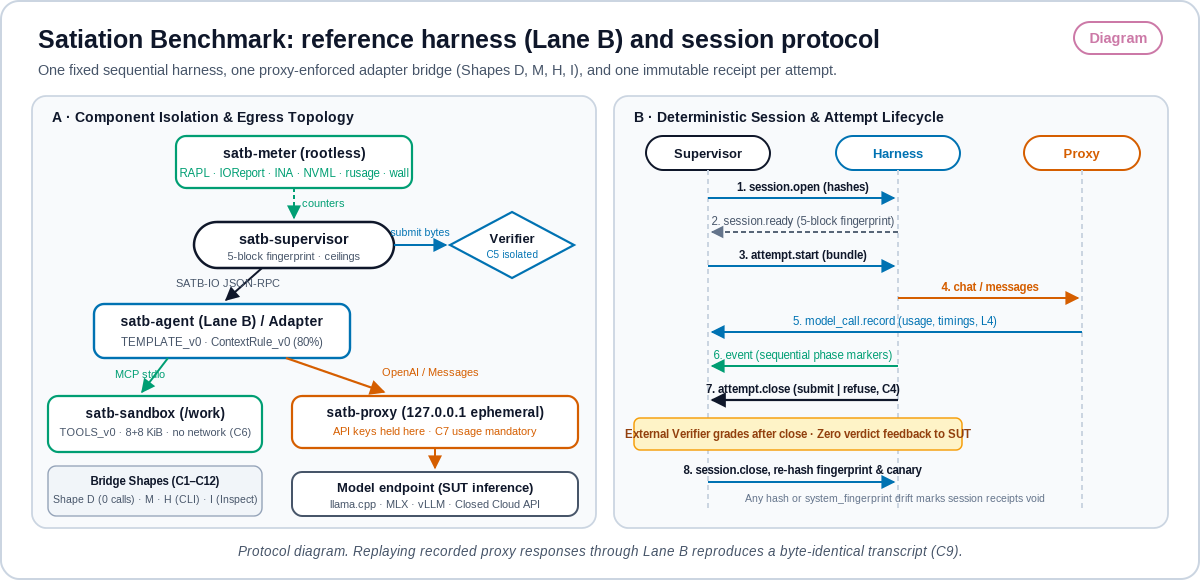
Figure 1. Left: Lane B component isolation separating rootless satb-meter, satb-supervisor, satb-agent, network-blocked satb-sandbox, credential-holding satb-proxy, and the unreachable external Verifier. Right: deterministic SATB-IO session and attempt sequence.
### 3.1 Sequential execution loop and fixed-versus-configurable split
Inside `satb-agent`, every attempt executes a strictly sequential single-agent loop with no overlapping background tool threads, no `best-of-k` voting, and no verifier oracle feedback:
```text
msgs <- [system(TEMPLATE_v0), user(render(bundle))]
loop:
ContextRule_v0(msgs) # >= 80% window -> elide oldest tool outputs; keep last 8; 0 model calls
r <- proxy.chat(msgs, TOOLS_v0) # missing usage -> immediate killed(usage_missing)
if no tool calls: append CONTINUE_v0; continue
for call in r.tool_calls (sequential):
submit | refuse -> attempt.close; ignore trailing calls (C4); STOP
exec | read_file | write_file | list_dir -> fresh sandboxed process in /work,
Truncate_v0 (8 KiB head + 8 KiB tail), no network egress (C6)
envelope ceiling reached -> killed(wall_ceiling | token_ceiling | turn_ceiling | context_ceiling)
```
Every `Lane B` run separates fixed benchmark constants (hashed into `harness_id`) from declared `SUT` parameters (hashed into `sut_fingerprint_sha256`):
| Fixed across all `Lane B` runs (`harness_id`) | Configurable per `SUT` (`sut_fingerprint_sha256`) |
| :--- | :--- |
| `TEMPLATE_v0` prompt, bundle renderer, and `CONTINUE_v0` nudge | `model_id`, provider snapshot date, or local `GGUF`/safetensors `SHA-256` |
| `TOOLS_v0` schemas (`tools/list` `JCS` digest) and sequential dispatch | Sampling parameters: `temperature`, `top_p`, `top_k`, `seed`, `max_tokens`, `reasoning_effort` |
| `ContextRule_v0` (`80%` threshold, keep last `8`) and `Truncate_v0` (`8 + 8 KiB`) | Serving engine (`llama.cpp`, `MLX`, `vLLM`, cloud `API`) and batch/cache flags |
| Single attempt (`attempts = 1`), zero verifier feedback, zero internal voting | Envelope ceilings: `wall_ms`, `max_total_tokens`, `max_turns` |
| `satb-sandbox`: `/work` confinement, stripped environment, zero network egress | Sandbox `CPU`/`RAM` quotas, host silicon, `OS` kernel, and isolation tier |
### 3.2 Canonical four-way outcome mapping (`OQ-3`)
To prevent benchmarks from silently dropping crashed runs or conflating voluntary bad answers with infrastructure timeouts, `SATB` maps legacy five-state completion codes losslessly onto **`{pass, fail, refuse, killed}`** (`PFRK`), preserving the exact `sub_reason` in every receipt:
1. **`completed` $\to$ `pass` (`sub_reason: "verified"`, score `1`)**: `SUT` called `submit(bytes)` prior to ceiling expiration and the external `Verifier` accepted `bytes` after `attempt.close`.
2. **`incorrect` $\to$ `fail` (`sub_reason: "incorrect"`, score `0`)**: `SUT` called `submit(bytes)` cleanly; external `Verifier` rejected the candidate.
3. **`malformed` $\to$ `fail` (`sub_reason: "malformed_submission"`, score `0`)**: `SUT` voluntarily called `submit(bytes)` with unparseable or schema-invalid content. A bad submission authored by the `SUT` is an accuracy failure, never an infrastructure kill.
4. **`refused` $\to$ `refuse` (`sub_reason: "policy" | "capability" | "other"`, score `0`)**: `SUT` explicitly invoked `refuse(reason)`.
5. **`no_submission` $\to$ `killed` (`sub_reason: "wall_ceiling" | "token_ceiling" | "turn_ceiling" | "context_ceiling" | "usage_missing" | "exec_timeout_killed" | "process_crash"`, score `0`)**: `satb-supervisor` terminated the attempt before any terminal tool call arrived. All four outcomes remain in the denominator $n$.
---
## 4. Adapter Bridge (`Shapes D, M, H, I`), Five-Block `SUT` Fingerprint, and `C1–C12` Conformance
### 4.1 Four adapter shapes behind one supervisor and proxy
Any system outside `Lane B` connects to `satb-supervisor` through one of four adapter shapes:
| Adapter shape | Target systems | Execution and isolation contract | Standards reused |
| :--- | :--- | :--- | :--- |
| **`Shape D` (`dnull` control)** | Deterministic Null (`N0` strict model-free and `N1` dev-crystallized) over frozen `DNULLMM1` `mmap` stores | Executes inside `/work` under identical `TOOLS_v0` and `Verifier` rules with **`0` proxy model calls** at decision time. | `POSIX mmap` / Win32 `MapViewOfFile`, `SPEC v0.4` 64-bit integer loop |
| **`Shape M` (Model endpoint)** | Local open-weight servers and closed cloud `API`s | Runs `Lane B` `satb-agent` over `Chat Completions` or `Messages` with tool calls and mandatory `usage`, routed 100% via `satb-proxy`. | OpenAI-compatible `API` (`llama.cpp`, `mlx_lm`, `vLLM`); `Anthropic`, `Gemini`, `xAI` translators |
| **`Shape H` (Harness in a box)** | `Claude Code`, `Codex CLI`, `Gemini CLI`, `OpenHands`, `Terminus-2` | Task written to `/work/task/BUNDLE.md`. Base `URL` pointed at `satb-proxy` (`127.0.0.1:`); real `API` keys withheld from `/work`; ends via `MCP` `submit` or `refuse`; zero other egress. | `Inspect` sandbox bridge env vars; `--strict-mcp-config` `MCP`; optional `ACP` |
| **`Shape I` (`Inspect` agent)** | Existing public benchmark `Inspect` solvers | Wraps `SATB` task bundle with `submit` and `refuse` tools at `attempts = 1`, routing model calls through `satb-proxy`. | `UK AISI Inspect` `Task` and `Solver` interface |
### 4.2 Five-block `SUT` fingerprint and session validity
Before `attempt.start` can fire, the adapter returns a five-block JSON structure whose canonical `JCS` `SHA-256` digest defines the `SUT`. Unknown or unobservable fields must be written literally as `"not_available"`, never omitted or guessed:
| Fingerprint block | Required fields (unavailable values written literally as `"not_available"`) |
| :--- | :--- |
| **`model`** | `provider`, `model_id`, `snapshot_date`, `weights_sha256`, `quantisation`, `tokenizer_hash`, `chat_template_hash`, `context_window`, `system_fingerprint` |
| **`serving`** | `engine`, `version`, `commit`, `binary_hash`, `flags_hash` (`cache_prompt`, `slots`, `batch_invariance`, `TP`), `drivers`, `devices` |
| **`sampling`** | `temperature`, `top_p`, `top_k`, `seed`, `max_tokens`, `stop`, `reasoning_effort`, `tool_choice` |
| **`harness`** | `name`, `version`, `commit`, `binary_hash`, `prompt_hash`, `tools_hash`, `context_policy`, `internal_voting`, `sub_agents`, `config_hash` |
| **`envelope`** | `hardware`, `os_kernel`, `isolation_tier`, `cgroup_limits`, `cpuset`, `network_policy`, `ceilings`, `telemetry_config_hash` |
**Session voiding and start/end canaries.** Any changed block digest at `session.close`, any `MCP` `tools/list_changed` notification, an inference-engine restart, an `NVML` counter reset, a changed echoed `model` or `system_fingerprint` mid-session, or an `OS`/driver update marks **every receipt in the session `void`**. Void receipts remain in the public archive for auditability but are excluded from benchmark placement. Because a cloud provider can swap weights or quantization behind a fixed `model_id` without updating `system_fingerprint`, every session also brackets evaluation with a deterministic canary rung at `session.open` and `session.close`.
### 4.3 Mandatory `C1–C12` adapter conformance suite
No adapter or harness enters evaluation until it passes all twelve conformance checks (`C1` to `C12`):
| Check | Requirement for passing |
| :--- | :--- |
| **`C1` Bundle round-trip** | Adapter echoes the exact `JCS` `SHA-256` digest of the input task bundle. |
| **`C2` Submit path** | External `Verifier` receives the exact byte sequence logged at `satb-proxy` / `MCP` terminal capture. |
| **`C3` Refuse path** | An instructed refusal arrives cleanly as `refuse` (`sub_reason = "other"`, `completion_score = 0`). |
| **`C4` One terminal call** | Any tool or terminal calls emitted after the first `submit` or `refuse` are ignored and counted. |
| **`C5` No oracle** | `Verifier` and `satb-supervisor` directories, sockets, and parent paths (`..`) are unreachable from `/work`. |
| **`C6` Egress** | Only `satb-proxy` (`127.0.0.1:`) is reachable for model traffic; `/work` subprocesses have zero external network access and zero upstream `API` keys. |
| **`C7` Usage present** | Every model call carries `usage` (`missing -> killed(usage_missing)`); proxy token totals match upstream engine counts exactly. |
| **`C8` Fingerprint stable** | Five-block `SUT` fingerprint `SHA-256` is identical before and after a 3-attempt dry run. |
| **`C9` Harness replay** | Replaying recorded `satb-proxy` responses reproduces a byte-identical transcript (`0` byte or `CRLF` diffs; mandatory for `Lane B`). |
| **`C10` Kill path** | Runaway `/work` process tree (`POSIX` process group or Win32 Job Object, including detached child processes) is reaped within `< 2,000 ms` and recorded as `killed`. |
| **`C11` Telemetry handshake** | Rootless `L3` process counters (`cgroup v2`, `proc_pid_rusage`, or Win32 `GetProcessTimes`/`QueryProcessCycleTime`) are readable, phase markers arrive, and monotonic-to-wall clock offset is recorded. |
| **`C12` Determinism probe** | `8` identical requests are executed and the count of distinct outputs is recorded as an empirical `SUT` property. |
---
## 5. Five-Level Telemetry Attribution (`L0–L4 × A1–N`), Platform Channel Maps, and What Cannot Be Attributed
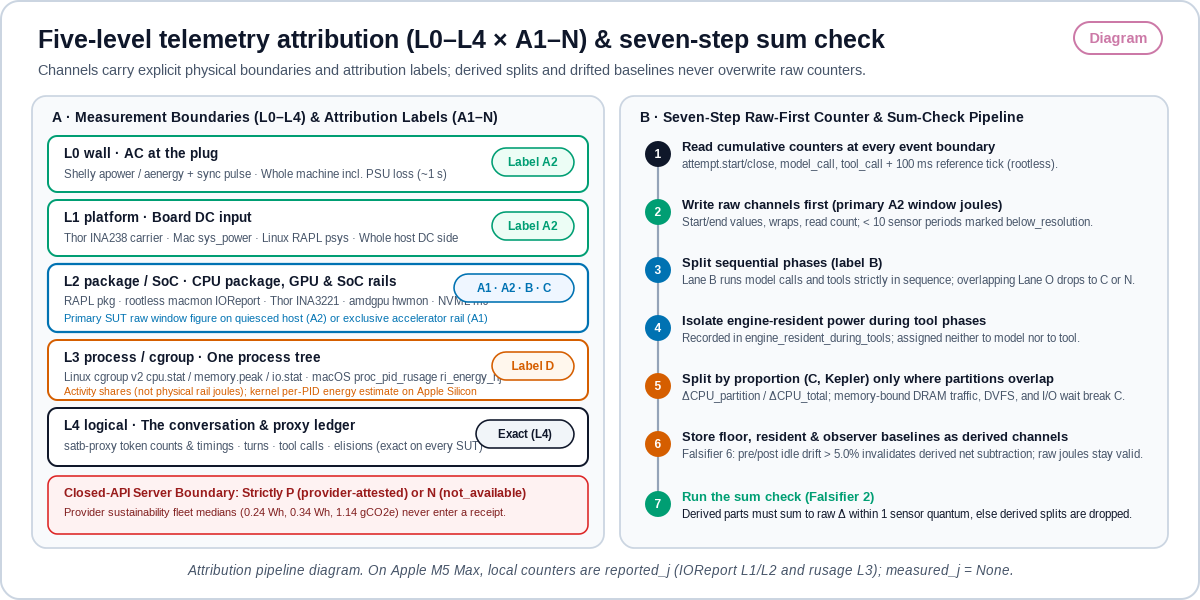
Figure 2. Left: physical and logical telemetry levels L0–L4 mapped to attribution labels A1–N. Right: seven-step raw-first counter discipline enforcing pre/post baseline drift bounds (Falsifier 6) and the Step 7 sum check.
### 5.1 Telemetry boundaries (`L0–L4`) and attribution labels (`A1–N`)
Energy and activity sensors sit at five distinct boundaries that measure physically different quantities and must never be summed or conflated:
| Level | Physical / logical boundary | Representative sensors | What the channel can honestly attribute |
| :--- | :--- | :--- | :--- |
| **`L0` wall** | `AC` at the wall receptacle | Smart plug or `PDU` (`Shelly` `apower`, `aenergy`; `Yokogawa` analyzer) | Whole machine including `PSU` conversion heat, fans, `DRAM`, and `NVMe`; `~1 s` cadence. |
| **`L1` platform** | Board `DC` input rail | `Jetson Thor INA238` carrier; `Mac sys_power`; `RAPL psys` | Whole computer on the `DC` side downstream of the power brick or `PSU`. |
| **`L2` package / SoC** | `CPU` package, `GPU`, and `SoC` rails | `RAPL pkg`; rootless `macmon IOReport`; `Thor INA3221`; `amdgpu hwmon`; `NVML` cumulative energy (`mJ`) | Whole `SUT` on `SoC` (`A2`), or inference engine alone when a rail is physically exclusive (`A1`). |
| **`L3` process / cgroup** | Single `OS` process tree | `Linux cgroup v2` (`cpu.stat`, `memory.peak`, `io.stat`), `perf`; `macOS proc_pid_rusage` `ri_energy_nj`; Win32 `GetProcessTimes` + `QueryProcessCycleTime` | Resource activity shares (`C`), or the `OS` kernel's own internal per-process energy model (`D`). |
| **`L4` logical** | The model/tool conversation | `satb-proxy` token counts and call latencies; harness turns, tool calls, and `ContextRule_v0` elisions | Exact counts on every `SUT` without exception, including closed cloud `API`s. |
Every energy value in a receipt carries one of seven attribution labels:
- **`A1` (Exclusive physical rail)**: A hardware rail sensor touched exclusively by one partition during the measurement window (e.g., `Jetson Thor INA3221 ch1 VDD_GPU` when only the local inference engine has `GPU` device access).
- **`A2` (Dedicated whole-system boundary)**: A whole-machine (`L0`/`L1`) or whole-package (`L2`) counter on a quiesced dedicated machine (`SUT` plus idle `OS` floor). **Per `OQ-4`, whole-`SUT` raw window energy at `A2` is the primary physical energy metric for placement**, preventing thin models from offloading uncounted brute-force search into `/work` subprocesses and preventing `active - idle` subtraction from flattering slow runs.
- **`B` (Temporal phase split)**: Counter differences across non-overlapping time windows delimited by sequential phase markers (`model_call` vs. `tool_call` in `Lane B`).
- **`C` (Proportional share — the `Kepler` model)**: A shared hardware counter partitioned by $\Delta \text{CPU}_{\text{partition}} / \Delta \text{CPU}_{\text{total}}$ or `GPU` utilization when parallel processes overlap (`Lane O` `Shape H`).
- **`D` (`OS`-modelled estimate)**: The kernel's internal per-process energy model (`macOS ri_energy_nj`). Isolates a process tree from `CPU` co-tenants, but remains a firmware/kernel model rather than a physical shunt reading.
- **`P` (Provider-attested)**: A per-request server energy number returned by a cloud provider alongside its verbatim measurement methodology.
- **`N` (`not_available`)**: Unobserved and **never estimated**.
### 5.2 Seven-step counter discipline, rootless collection (`OQ-5`), and platform maps
`satb-meter` processes every attempt through seven ordered steps:
1. **Read cumulative counters at every event boundary** (`attempt.start`, each `model_call` and `tool_call`, `attempt.close`, plus a `100 ms` reference tick) so window energy is an exact counter difference $\Delta E = E(t_{\text{end}}) - E(t_{\text{start}})$.
2. **Write raw channels first**: record boundary, sensor, start/end readings, counter wraps, and sample count; mark windows shorter than `10` sensor periods `"below_resolution"` and absent hardware `"not_available"`.
3. **Split sequential phases (`B`)**: in `Lane B`, model inference and `/work` tool calls never overlap; parallel `Lane O` harnesses drop phase splits to `C` or `N`.
4. **Isolate `engine_resident_during_tools`**: while a `/work` tool runs, a local model server (`llama-server`, `vLLM`) holds weights resident on the `GPU`/`DRAM`. Its idle draw during the tool window is placed in `engine_resident_during_tools` and charged neither to model active inference nor to tool execution.
5. **Split by proportion (`C`) only where partitions overlap**: apply $\Delta \text{CPU}$ ratios strictly as a characterisation fallback, recognizing that `C`-states, turbo `DVFS`, and `DRAM`/storage stalls violate proportionality.
6. **Store baselines as derived channels**: bracket sessions with pre/post resident baselines; if pre/post idle power drifts beyond `5.0%` (`Falsifier 6`), drop derived net-above-idle values while keeping raw channels intact.
7. **Run the sum check (`Falsifier 2`)**: verify that derived phase components sum back to the raw attempt counter delta within one sensor quantum (`1 mJ`); if they do not, discard the derived split and retain only the raw channel.
**Rootless collection rule (`OQ-5`).** Benchmarks must never run `SUT` orchestration as `root` or load custom ring-0 drivers. On `macOS`, `satb-meter` uses rootless `macmon` (`IOReport` subscription) and `libSystem` `proc_pid_rusage(RUSAGE_INFO_V6)`, never `sudo` or `powermetrics`. On `Linux` (where `/sys/class/powercap/intel-rapl` became root-only in kernel `5.10` following `PLATYPUS`), a one-time administrator `udev` rule grants read access to a dedicated `satb-meter` group containing **only `satb-supervisor`'s `UID`**, ensuring `/work` sandbox processes can neither side-channel `RAPL` nor read their own energy meter. On `Windows 11` (`NT 10.0.26300`), unprivileged Basic User tokens (`0x20000`) read discrete-`GPU` cumulative energy (`mJ`) directly via `nvml.dll` (`nvmlDeviceGetTotalEnergyConsumption`) and `L3` process cycles via Win32 `QueryProcessCycleTime`, whereas Intel `RAPL` `MSR` `0x611` requires a ring-0 kernel driver barred by `OQ-5` and `HVCI` (placing Windows `CPU` package energy strictly in `"not_available"`, label `N`):
| Target platform | `L0` / `L1` whole-system channels | `L2` package / `SoC` channels | `L3` process & `L4` logical channels | Key verification status |
| :--- | :--- | :--- | :--- | :--- |
| **Apple Silicon Mac** (`M5 Max` verified) | `L0`: `Shelly` `PDU` (`not_available` if unplugged); `L1`: `macmon sys_power` (`reported_j`) | `macmon IOReport`: `chip_power`, `cpu_power`, `gpu_power`, `ane_power`, `ram_power` (`reported_j`) | `L3`: `proc_pid_rusage` `ri_energy_nj` (`D`), `ri_instructions`, `ri_diskio_*`; `L4`: `satb-proxy` | Rootless `L1`–`L4` verified live on `Apple M5 Max`; `L0` plug open. |
| **Framework AMD Strix Halo** (`Ryzen AI Max+ 395`, `Linux x86-64` verified) | `L0`: `Shelly` `PDU` (`not_available` if unplugged); `L1`: `cros_ec` (`0` power attrs) | `RAPL package-0` & `core` (`0440 root:energy` `udev`) `reported_j` + `amdgpu` `PPT` `power1_input` (`0444`; `energy1_input` absent) | `L3`: `cgroup v2` / `getrusage` (`C` activity shares); `L4`: `satb-proxy` | Verified live (`0440 root:energy` `PLATYPUS` isolation; `amdgpu PPT` `0444`). |
| **Intel Raptor Lake** (`Core i9-13900H`, `Linux x86-64` verified) | `L0`: `not_available`; `L1`: `RAPL psys` (`intel-rapl:1/energy_uj`, `0444` `reported_j`) | `RAPL package-0`, `core`, & `uncore` (`MSR` + `MMIO` `energy_uj`, `0444` `reported_j`) | `L3`: `cgroup v2` / `getrusage` (`C` activity shares); `L4`: `satb-proxy` | Verified live (`0 µJ` `Step 7` residual across `psys` `L1` and `package-0` `L2`). |
| **NVIDIA Jetson AGX Thor** (`Linux aarch64` Tegra verified) | `L1`: `TI INA238` (`hwmon6` `VIN`, `0444` `measured_j`) + `INA3221 ch3 VIN_SYS_5V0` (`0444` `measured_j`) | `INA3221 ch1 VDD_GPU` (`0444` `measured_j`, `A1` when exclusive); `ch2 VDD_CPU_SOC_MSS` (`0444` `measured_j`); `NVML` (`unverified`) | `L3`: `cgroup v2` / `getrusage` (`C` activity shares); `L4`: `satb-proxy` | Verified live (`INA238` + `INA3221 ch1–ch3` `0444` rootless; GPU `NVML` open under co-tenant lock). |
| **Windows 11 `x86-64` + Discrete `RTX`** (`i7-1165G7` + `RTX 2060`, `NT 26300` verified) | `L0`: `not_available`; `L1`: `WMI` `EMI` `PowerMeter` (`0` instances -> `not_available`) | `RTX 2060`: rootless `nvml.dll` cumulative `mJ` (`reported_j`); `CPU` `RAPL` `MSR 0x611`: **`N` (`not_available` without ring-0 driver)** | `L3`: Win32 `GetProcessTimes` + `QueryProcessCycleTime` (`C` shares; `SRUM` coarse `OS` background excluded); `L4`: `satb-proxy` | Verified live under Basic User `0x20000` token (`0 mJ` `Step 7` residual; `2.46 ms` Job Object kill). |
| **Closed Cloud `API`** (`Anthropic`, `xAI`, `Cerebras`, `OpenAI`, `Google`) | Local `L0`–`L1` measure client host only (excluded from server inference) | Remote server `L2`: strictly **`N` (`not_available`)** or per-request **`P`** (`OQ-6`) | Local `/work` `L3` (`D`/`C`) for sandbox tools; `L4`: **exact** `satb-proxy` tokens, calls, `USD` | Verified live across `Anthropic`, `Cerebras`, and `xAI` via `satb-proxy`. |
### 5.3 Eight hardware measurement pitfalls and seven non-attributable quantities
Standard power-measurement shortcuts fail systematically on modern `SoC`s and `GPU`s:
| Hardware telemetry pitfall | `SATB` mitigation |
| :--- | :--- |
| **Idle power drifts with die temperature, fans, `DVFS`, and turbo** | Wait for `GPU` cooldown (`<= 1.5 W`), bracket every window with pre/post baselines, record peak `GPU` temperature, and invalidate derived net joules above `5.0%` drift (`Falsifier 6`). |
| **Ambiguity between cold-machine idle and weights-resident idle** | Measure and label both explicitly in `Step 6` rather than silently subtracting one. |
| **`Active - idle` subtraction flatters slow runs** | Whole-`SUT` raw window energy (`A2`) remains the primary placement figure (`OQ-4`). |
| **Sub-period windows read as zero, negative, or quantization noise** | Mark any window shorter than `10` sensor periods `"below_resolution"` (e.g., `< 1.2 s` on `~8 Hz` `macmon` or `< 10 s` on a `1 Hz` smart plug). |
| **High-rate telemetry samplers burn significant `CPU` power** | Read cumulative counters at event boundaries (`0.011 mW` at `0 Hz`) plus a `100 ms` tick; record `observer_only` baseline. |
| **`NVML` instantaneous power gauge on `A100`/`H100` samples only `~25%` of runtime** | Read cumulative `nvmlDeviceGetTotalEnergyConsumption` (`mJ`) via in-process `FFI` (`1.17 ms` on `RTX 2060` vs. `43.88 ms` `nvidia-smi` subprocess), never instantaneous `nvmlDeviceGetPowerUsage` polling (Chung et al.; Yang et al.). |
| **External `L0` wall plug runs on an unsynchronized clock** | Emit a deterministic `50%`-duty calibration load pulse at `session.open` and `session.close` and cross-correlate timestamps. |
| **Shared-host background daemons or co-tenant jobs** | Log process list, downgrade shared `L2` derived subtractions via `Falsifier 6`, and record co-tenant-isolated `L3` `ri_energy_nj` (`D`) alongside raw `L2`. |
Consequently, **seven quantities cannot be honestly attributed** and are barred from `SATB` claims: (1) unattested closed-`API` server energy (`N` or `P` only); (2) exact per-process physical joules on a shared `SoC` or unified-memory rail (`C` and `D` are models); (3) model weights isolated from serving kernels, quantization, batching, and silicon; (4) ownership of the `OS` idle floor and `DRAM`-resident weight power (reported as standalone channels); (5) individual events shorter than the sensor period (such as a `30 ms` tool call under a `1 s` plug); (6) shared cloud `VM`s or unprivileged Windows `CPU` domains lacking user-mode hardware counters; and (7) silent mid-session provider weight swaps (flagged by start/end canaries, never ruled out a priori). In particular (`OQ-6`), **provider sustainability disclosures are fleet medians rather than per-request measurements and never enter a `SATB` receipt** — including Google's `0.24 Wh` median `Gemini Apps` prompt, OpenAI's `0.34 Wh` figure (published without methodology), and Mistral's `1.14 gCO2e` per `400`-token response.
---
## 6. Measured Conformance, Determinism, Observer-Effect, and Multi-Host Attribution Results
To replace unmeasured design assumptions with auditable receipts, we executed the complete `SATB` conformance suite and falsifier harness (`bench_satb_falsifiers.py` $\to$ `satb_empirical_receipts.json`, total runtime `175.69 s`) on an `Apple M5 Max` workstation (`arm64`, `128 GB` unified memory, `macOS 27.2.1`, `macmon 0.12.0`), alongside a `188`-window cross-study audit and live cross-OS multi-silicon runs across `Linux` and `Windows 11`.
### 6.1 `C1–C12` conformance, `C9` deterministic replay, and `C10` process-tree cleanup
All **`12 / 12` Rust reference conformance checks** (`dnull_cli satb-conformance`) and all extended operating-system checks passed:
- **Bundle, terminal, confinement, and fingerprint checks (`C1`–`C8`, `C11`)**: `C1` echoed canonical bundle digest `455e941f51f8ffef`; `C2` delivered byte-exact `submit` payloads across `satb-proxy` to `Verifier`; `C3` mapped empty/instructed refusals to `refuse:other`; `C4` ignored trailing post-`submit` tool calls (`ignored_trailing_calls = 1`); `C5` blocked `../`, `/etc/passwd`, and `verifier_oracle/*` escapes; `C6` stripped proxy/credential environment variables inside `/work` (`NP=*|HTTP=`) while returning `HTTP 404` on unlisted proxy paths; `C7` aborted missing-usage responses immediately as `killed(usage_missing)`; `C8` preserved byte-identical five-block fingerprint `8b741c27bf364e5d` across dry runs while flagging simulated `system_fingerprint` swaps with `session_void = true`; and `C11` verified rootless `RUSAGE_INFO_V6` counter visibility (`sudo_invoked = false`).
- **Extended `C9` multi-turn `ContextRule_v0` + `Truncate_v0` replay**: Across a `14`-turn trace generating `24 KiB` raw file reads per turn (`14` outputs truncated to `8,192 B + 8,192 B` by `Truncate_v0`) inside a `48,000`-token window (`80%` threshold = `38,400` tokens), `ContextRule_v0` deterministically elided the **`5` oldest tool outputs** with **`0` extra model calls**, producing a `149,747`-byte canonical transcript (`SHA-256` `d697ed1476129939...`) with **`0` byte differences** across independent `/work` replays. Repeating the identical trace under a tight `16,000`-token window (where `8` retained `16 KiB` outputs exceed `100%`) deterministically triggered `killed(context_ceiling)`.
- **Extended `C10` multi-process `SIGKILL` cleanup (`< 2,000 ms` specification ceiling)**: Across `5` trials spawning a `4`-process tree (`sh` parent plus `3` detached background Python sleepers in an isolated process group), `SIGKILL` delivery and kernel reaping completed in **`2.073 ms` mean** (`1.429 ms` min, `2.571 ms` max — **`778×` below** the `2,000 ms` ceiling) with **`0` surviving `PID`s** and outcome `killed(wall_ceiling)`.
### 6.2 Live `C12` eight-request determinism probes across four model substrates
Routing `8` identical algebraic-synthesis requests per model (`32` live cloud calls plus `8` local `Shape D` runs) through `satb-proxy` verified `100%` exact `C7` token-count parity (`32/32` calls) and exposed three distinct determinism regimes:
| `SUT` / Endpoint via `satb-proxy` | `temperature = 0` preflight | Recorded `sampling.temperature` | Distinct raw outputs (`/ 8`) | Distinct algebraic forms (`/ 8`) | `system_fingerprint` | Mean latency |
| :--- | :---: | :--- | :---: | :---: | :--- | ---: |
| **`Shape D`: `dnull N1`** (Rust local) | `Exact i64` | `0 (exact_i64_q1e6)` | **`1 / 8`** | **`1 / 8`** | `0da4df8d9ccbce1e…` | `1,474.0 ms` |
| **`Anthropic claude-opus-5-5`** | **`HTTP 400`** | `not_available` (deprecated) | **`8 / 8`** | **`4 / 8`** | `not_available` | `3,389.1 ms` |
| **`Anthropic claude-sonnet-5-5`** | **`HTTP 400`** | `not_available` (deprecated) | **`8 / 8`** | **`2 / 8`** | `not_available` | `2,914.3 ms` |
| **`Cerebras gpt-oss-120b`** | `HTTP 200` | `0.0 (seed=42)` | **`2 / 8`** | **`2 / 8`** | `fp_fd4dff7eed92aaf38281` | `484.2 ms` |
| **`xAI grok-4.20-0309-non-reasoning`** | `HTTP 200` | `0.0 (seed=42)` | **`8 / 8`** | **`1 / 8`** | `fp_9974b11849` | `942.7 ms` |
1. **Provider deprecation of `temperature = 0`**: Both `claude-opus-5-5` and `claude-sonnet-5-5` rejected `"temperature": 0.0` with **`HTTP 400` (`"`temperature` is deprecated for this model."`)**, empirically validating `SATB`'s rule that unavailable sampling controls be normalized to `"not_available"` rather than silently assumed to equal zero. Across `8` identical calls, `claude-opus-5-5` (`1,047` adaptive thinking tokens) emitted `8` distinct raw texts spanning `4` algebraically distinct bitvector identities (`(x | y) - (x & y)`, `(x | y) & ~(x & y)`, `(x & ~y) | (~x & y)`, and `(x + y) - ((x & y) + (x & y))`).
2. **Residual non-determinism under `temperature = 0, seed = 42`**: Even when `temperature = 0.0` and `seed = 42` were accepted (`HTTP 200`) with a stable `system_fingerprint`, `Cerebras gpt-oss-120b` (`2,976` reasoning tokens) produced `2` distinct outputs across `8` identical calls, while `xAI grok-4.20-0309-non-reasoning` stabilized on `1` algebraic formula (`(x | y) & ~(x & y)`) across all `8` calls yet varied its prose proof sentence on all `8/8` responses. Separating **harness determinism given recorded responses (`C9`)** from **measured `SUT` output dispersion (`C12`)** is therefore essential.
### 6.3 Falsifier 5: Observer-effect benchmark across telemetry cadences (`10 s` windows)
Measuring combined sampler (`Python` + child `macmon` `IOReport` pipe) `CPU` time, `L3` `ri_energy_nj` (`observer_only` `reported_j`), and whole-`SoC` `L2` `reported_j` across interleaved `10.0 s` windows on `Apple M5 Max` quantified exact observer overhead:
| Sampling cadence | Achieved rate | Sampler `CPU` time / `10 s` | Observer `L3` `reported_j` | Observer power (`mW`) | Share of `L2` window | Whole-`SoC` `L2` window (`reported_j`) |
| :--- | ---: | ---: | ---: | ---: | ---: | ---: |
| **`0 Hz` boundary-only** (`2` `rusage` syscalls) | `0.20 Hz` | **`0.004 ms`** | **`0.000108 J`** | **`0.011 mW`** | **`0.0000%`** | `—` (zero `IOReport` daemon) |
| **`1 Hz` (`1,000 ms` tick)** | `0.90 Hz` | `9.323 ms` | `0.194237 J` | `19.371 mW` | `0.0521%` | `372.769 J` (`37.17 W`) |
| **`10 Hz` (`100 ms` `SATB` reference tick)** | `8.12 Hz` | `36.434 ms` | `0.666596 J` | **`66.439 mW`** | **`0.1770%`** | `376.603 J` (`37.53 W`) |
| **`100 Hz` (`10 ms` stress falsifier)** | `7.44 Hz` | `35.636 ms` | `0.598721 J` | `58.971 mW` | `0.1618%` | `369.926 J` (`36.44 W`) |
Two hardware facts emerge directly from this measurement:
1. **Negligible perturbation (`< 0.18%`)**: Boundary-only `proc_pid_rusage` reads consume `108 µJ` (`0.011 mW`), **`6,040×` less power** than `10 Hz` `IOReport` polling (`66.44 mW`), and even the `100 ms` reference tick represents just **`0.177%`** of whole-`SoC` window energy (`0.76%` total `L2` window difference between `-i 10` and `-i 1000`, clearing `Falsifier 5`).
2. **`IOReport` subscription cadence ceiling (`~8 Hz`)**: Requesting `-i 10` (`100 Hz`) from `macmon 0.12.0` achieved **`7.44 Hz`** (`75.5` samples in `10.15 s`) because each rootless `IOReport` subscription cycle blocks for `~120 ms` in macOS user space. Consequently, `Step 2`'s `10`-period `below_resolution` floor corresponds physically to **`~1.2 s`** on `macmon` `L2` windows, whereas sub-second operations must rely on `0 Hz` boundary `L3` `ri_energy_nj` counters or batched windows.
### 6.4 Falsifier 3 & Step 7: `B` temporal boundary vs. `C` proportional (`Kepler`) attribution
Across `3` replicates on `Apple M5 Max`, a single `SUT` executed **Phase 1** (`2.50 s` ALU-dense `SHA-256` digest burst: `29.27 ms` mean `CPU` time, `38.63 mJ` per `CPU`-ms) followed sequentially by **Phase 2** (`2.51 s` `192 MiB` `DRAM` cache-miss sweep + synchronous `fsync` disk flushes and `8 ms` `I/O` waits: `15.94 ms` mean `CPU` time, `27.73 mJ` per `CPU`-ms) alongside a steady duty-cycled background worker:
| Attribution check (`n = 3` sequential two-phase + co-tenant replicates) | Phase 1 (`Compute` `2.50 s`) | Phase 2 (`DRAM + fsync I/O` `2.51 s`) | Falsifier / Step-7 verdict |
| :--- | ---: | ---: | :--- |
| **Exact `B` temporal boundary `L3` delta (`reported_j`)** | `1.1272 J` (`1,127,172 µJ`) | `0.4433 J` (`443,317 µJ`) | **`Step 7` residual `<= 1 µJ` (`3/3` pass)** |
| **`C` (`Kepler` $\Delta\text{CPU}$ share: `64.58%` vs. `35.42%`) on `L3`** | `1.0145 J` (`-10.00%`) | `0.5560 J` (**`+25.21%` mean err**) | `DRAM`/stall energy/ms $\ne$ `ALU` energy/ms |
| **Exact `B` temporal `L2` whole-`SoC` window (`reported_j`)** | `82.246 J` | `90.975 J` | `DRAM`, `NVMe`, & host draw persist in `I/O` wait |
| **`C` (`Kepler` $\Delta\text{CPU}$ share) applied to `L2` window** | `111.758 J` (**`+35.86%` err**) | `61.464 J` (**`-32.59%` err**) | **`Falsifier 3` triggered (`> 20%` error)** |
While `Step 7`'s sum check held to `0–1 µJ` (`100.0%` of trials) under boundary counter differences (`B`), `CPU`-time proportional attribution (`C`) over-credited the compute burst by **`+35.86%`** and under-credited the memory-and-`fsync` phase by **`-32.59%`** on shared `L2` (and erred by **`25.21%`** even on per-process `L3`), empirically confirming why `SATB` restricts `C` to overlapping parallel harnesses (`Shape H`) and flags `> 20%` sequential divergence via `Falsifier 3`.
### 6.5 Multi-session `Falsifier 6` audit (`188` windows) and `Falsifier 8` harness-floor check
Auditing **`188` real `L2` `IOReport` windows** collected across three experimental campaigns on the shared `Apple M5 Max` host plus two paired `Lane B` vs. `Shape H` (`Claude Code 2.1.330`) evaluations confirms both session-level safeguards:
1. **`Falsifier 6` baseline-drift audit (`188` windows)**: Across `exp-001` (`11` windows: `1` within `5.0%`, `10` drifted up to `44.5%`), `exp-002` + multi-turn (`7` windows: `2` within `5.0%` — `dnull` `1,190`-instance batch at `3.09%` drift and `BigCodeBench` `Qwen 3.6` at `1.02%` drift — and `5` drifted `12.16%–65.11%` under concurrent `yosys-abc` synthesis), and `ai-reads-human` (`170` windows at `loadavg_1m = 12.92`: `61` within `5.0%`, `109` drifted), **`64 / 188` windows (`34.04%`)** retained valid `derived_marginal_j` while **`124 / 188` (`65.96%`)** automatically invalidated net-above-idle subtraction without losing a single raw `L2` or per-`PID` `L3` `reported_j` reading (`188 / 188 = 100.0%` raw survival).
2. **`Falsifier 8` (`Lane B` vs. `Shape H` `Claude Code 2.1.330`)**: Across `24` paired `/work` formal and `SQLite` policy bundles, `Lane B` achieved **`24 / 24` (`100.0%`)** on both `Claude Opus 5.5` (`44` model calls, `63,568` prompt+cache tokens, `\$0.5477`) and `Claude Sonnet 5.5` (`43` calls, `60,284` tokens, `\$0.3413`), matching `Shape H` (`Claude Code 2.1.330`: **`24 / 24`**, `89` calls / `218,449` tokens on `Opus 5.5`; `83` calls / `196,128` tokens on `Sonnet 5.5`) while reducing prompt+cache token traffic by **`3.44×` and `3.25×`**. On `6` unseen multi-file Python bug-repair repositories (`config-defaults`, `interval-merge`, `pagination`, `precedence`, `rate-window`, `retry-backoff`), `Lane B` (`Opus 5.5` `28` calls / `52,045` tokens; `Sonnet 5.5` `31` calls; local `Qwen 3.6 35B-A3B` `42` calls / `2,342.05 J` `L2`) again matched `Shape H` (`Claude Code 2.1.330` + `Opus 5.5`: **`6 / 6`**, `30` calls / `86,744` tokens, `1.67×` more tokens), confirming that `Lane B` is **not** a crippled harness floor.
### 6.6 Multi-platform hardware attribution across five silicon and OS archetypes
To verify that `SATB` conformance, `Shape D` fixed-point determinism, rootless `PLATYPUS` / `HVCI` permission boundaries, and physical shunt or cumulative `NVML` attribution hold across `macOS`, `Linux`, and `Windows 11`, we executed `run_multi_host_satb.py` (`multi_host_satb_receipts.json`) and `run_windows_suite.py` (`windows_satb_receipts.json`) across four additional `Linux` and `Windows 11` hardware archetypes alongside `Apple M5 Max`:
| Hardware archetype & `OS` kernel | Rootless sensor boundary & evidence class | `Shape D` `1M` `DNULLMM1` (`10k` probes) | `C9` replay & `C10` tree-kill mean | Single-read latency & `100 Hz` achieved | `Step 7` residual & `Falsifier 3` (`C` vs. `B`) |
| :--- | :--- | :--- | :--- | :--- | :--- |
| **`Apple M5 Max`** (`arm64`, `128 GB`, `macOS 27.2.1`) | `IOReport` `L1`/`L2` + `rusage` `L3` (`reported_j`; `measured_j = None`) | `15027705736` (`388.43 ns` `C++`, `582.57 ns` Rust) | `149,747 B` (`0` diffs) · `2.073 ms` (`0` `PID`s) | `~120 ms` `IOReport` · **`7.44 Hz`** | `<= 1 µJ` · **`-32.59%`** Phase 2 (`+35.86%` Ph. 1) |
| **`NVIDIA Jetson AGX Thor`** (`aarch64`, `122.9 GiB`, `Linux 6.8.12-1021-tegra`) | `TI INA238` (`hwmon6` `VIN` `L1`) + `INA3221` (`hwmon5` `ch1–ch3` `L2`/`L1`, `0444` **`measured_j`**) | `15027705736` (`984.86 ns` `C -O3`, `2,489.4 ns` Py) | `149,747 B` (`0` diffs) · `9.544 ms` (`0` `PID`s) | `2,948.8 µs` `I2C` · **`66.55 Hz`** | `0.0 µJ` · **`-70.01%`** `ch2` (`-67.02%` `VIN`) |
| **`Framework AMD Ryzen AI Max+ 395`** (`x86-64`, `122.8 GiB`, `Linux 7.0.0-43`) | `RAPL package-0` & `core` (`0440 root:energy` **`reported_j`**) + `amdgpu PPT` (`0444`; `measured_j = None`) | `15027705736` (`376.61 ns` `C -O3`, `1,341.7 ns` Py) | `149,747 B` (`0` diffs) · `0.868 ms` (`0` `PID`s) | `24.34 µs` `sysfs` · **`94.28 Hz`** | `0 µJ` · **`-71.61%`** `pkg-0` (`-63.34%` `core`) |
| **`Intel Core i9-13900H`** (`x86-64`, `14.7 GiB`, `Linux 7.0.0-43`) | `RAPL psys` (`L1`) + `package-0`, `core`, `uncore` (`L2`, `0444` **`reported_j`**; `measured_j = None`) | `15027705736` (`420.93 ns` `C -O3`, `863.6 ns` Py) | `149,747 B` (`0` diffs) · `1.120 ms` (`0` `PID`s) | `45.37 µs` `sysfs` · **`97.12 Hz`** | `0 µJ` · **`-72.89%`** `pkg-0` (`-73.62%` `psys`) |
| **`Intel Core i7-1165G7 + RTX 2060`** (`x86-64`, `63.7 GiB`, `Windows 11 26300`) | `nvml.dll` `RTX 2060` cumulative `mJ` (`L2` **`reported_j`**) + Win32 `L3`; `CPU RAPL` = `N` (`measured_j = None`) | `15027705736` (`1,474.22 ns` `MSVC /O2`, `2,885.6 ns` Py) | `149,747 B` (`0` `CRLF`) · `2.458 ms` JobObj (`0` `PID`s) | `1,174.2 µs` `NVML` · **`64.64 Hz`** (`NT` tick) | `0 mJ` · **`-89.88%`** time (`-77.05%` `RDTSC`) |
Five cross-platform hardware and operating-system findings emerge from these live receipts:
1. **Bit-exact `Shape D` and `Lane B` replay invariance across `macOS`, `Linux`, and `Windows 11` (`arm64`/`aarch64` and `x86-64`)**: All five hosts — including Win32 `CreateFileMappingA` + `MapViewOfFile` compiled under `MSVC 19.44 /O2` and `NTFS` file I/O on `Windows 11` (`NT 10.0.26300`) — produced the exact `10,000`-probe `DNULLMM1` checksum **`15027705736`**, the exact `test.setpoint` frozen digest `0da4df8d9ccbce1e...4485781`, and the exact `149,747`-byte `C9` transcript (`SHA-256` `d697ed1476129939...` with **`0` `NTFS` `CRLF` byte drift**), while reaping `4`-`PID` runaway process trees in `0.868 ms` to `9.544 ms` via kernel primitives (`SIGKILL` on `macOS`/`Linux` and Win32 `TerminateJobObject` at **`2.458 ms` mean** on `Windows 11`, **`50.0×` faster** than spawning `taskkill.exe /F /T /PID` at `122.817 ms` mean, and `> 200×` under the `2,000 ms` specification ceiling).
2. **Physical `INA238` / `INA3221` shunt separation and `Falsifier 6` under live `GPU` co-tenancy on `NVIDIA Jetson AGX Thor`**: On `Linux 6.8.12-1021-tegra`, both `hwmon6` (`ti,ina238` at `i2c@c600000/ina238@44`, `VIN` whole-board `DC` input at `~27.97 V`) and all three channels of `hwmon5` (`ina3221@40`: `ch1 VDD_GPU`, `ch2 VDD_CPU_SOC_MSS`, and `ch3 VIN_SYS_5V0`) are world-readable (`0444`) without `sudo`. During our strictly `CPU`-only probe (`dedicated_host = false`), an independent co-tenant `llama-server` held the host `GPU` lock:
| `Jetson AGX Thor` physical shunt channel (`0444` rootless `sysfs`) | Boundary | Pre-baseline (`W`) | Phase 1 Compute (`measured_j` / `W`) | Phase 2 `DRAM+fsync` (`measured_j` / `W`) | Post-baseline (`W`) | Drift (`F6`) & `Kepler` `C` Phase-2 err |
| :--- | :---: | ---: | ---: | ---: | ---: | :--- |
| **`hwmon6` `INA238` `VIN`** (module + carrier input) | **`L1`** | `100.70 W` | `122.12 J` (`101.66 W`) | `99.02 J` (`81.94 W`) | `97.21 W` | `3.47%` (`A2` withheld: co-tenant) · **`-67.02%`** |
| **`hwmon5` `INA3221 ch1` `VDD_GPU`** (co-tenant `LLM`) | **`L2`** | `29.26 W` | `40.29 J` (`33.54 W`) | `26.00 J` (`21.52 W`) | `28.13 W` | External `GPU` co-tenant (`-36.1%` swing in `F5`) |
| **`hwmon5` `INA3221 ch2` `VDD_CPU_SOC_MSS`** | **`L2`** | `36.68 W` | `45.73 J` (`38.07 W`) | `44.37 J` (`36.71 W`) | `36.08 W` | `1.64%` (`CPU`/`SoC`/`MSS` domain) · **`-70.01%`** |
| **`hwmon5` `INA3221 ch3` `VIN_SYS_5V0`** (`5.08 V` rail) | **`L1`** | `14.89 W` | `18.66 J` (`15.53 W`) | `16.82 J` (`13.92 W`) | `13.98 W` | **`6.13% > 5.0%` (`F6` triggered)** · **`-68.85%`** |
Across the four `Falsifier 5` cadence windows, fluctuating co-tenant `LLM` requests shifted `ch1 VDD_GPU` from `35.36 J` down to `22.60 J` (`-36.1%`), pulling whole-board `INA238 VIN` (`L1`) from `107.48 J` down to `81.73 J` (`-24.0%`) even while `ch2 VDD_CPU_SOC_MSS` remained within `35.76–39.31 J`. Because `dedicated_host = false` (and `ch3 VIN_SYS_5V0` exceeded `5.0%` drift at `6.13%`), `SATB` withholds `A2` whole-`SUT` net placement claims while preserving exact rail-separated `measured_j` (`L1` and `L2` channels never summed).
3. **`PLATYPUS` `0440 root:energy` isolation and `Strix Halo` `APU` domain verification on `Framework` `AMD`**: On `Framework` Desktop (`AMD Ryzen AI Max+ 395 w/ Radeon 8060S`, `Linux 7.0.0-43-generic`), `udev` rule `90-energy-read.rules` sets `/sys/class/powercap/intel-rapl:0/energy_uj` (`package-0`) and `intel-rapl:0:0/energy_uj` (`core`) to mode **`0440` (`root:energy`, `world_readable = false`)**: ungrouped `/work` sandbox `UID`s receive `EACCES` (blocking `PLATYPUS` side-channels), while the supervisor `GID` (`energy`) reads cumulative microjoules rootlessly at `24.34 µs` median latency (`0 µJ` `Step 7` residual). Inspecting `hwmon9` (`amdgpu`) further resolved an open specification detail: `Strix Halo`'s integrated `Radeon 8060S` exposes world-readable (`0444`) `PPT` power (`power1_input` / `power1_average` in `µW`, `75.38 W` Phase 1 / `69.72 W` Phase 2) rather than a separate `energy1_input` counter, whereas `cros_ec` (`hwmon8`) exposes fans and board thermals only.
4. **Bare-metal `Windows 11` rootless boundary (`0x20000` Basic User `NVML` vs. ring-0 `RAPL` block) and `15.625 ms` `NT` clock-tick aliasing**: Under an explicitly de-elevated Basic User token (`runas.exe /trustlevel:0x20000`, `IsUserAnAdmin() == false`) on `Windows 11 Pro` (`NT 10.0.26300`, `Intel Core i7-1165G7` + `NVIDIA GeForce RTX 2060`), in-process `FFI` calls to `nvml.dll` `nvmlDeviceGetTotalEnergyConsumption` (`mJ`) and `nvmlDeviceGetPowerUsage` (`mW`) succeed rootlessly in **`1,174.15 µs` median** (**`37.4×` faster** than spawning `nvidia-smi.exe` at `43.88 ms` per call), clearing `Step 7` with **`0 mJ` residual** (`8.769 J + 8.816 J = 17.585 J`, `3.0%` pre/post drift). By contrast, unprivileged user-mode reads of Intel `RAPL` `MSR 0x611` are blocked by the `Windows NT` kernel without a signed ring-0 driver (barred by `OQ-5` and `HVCI`), and `WMI` `EMI` (`\\.\EnergyMeter` / `Win32_PerfRawData_Counters_PowerMeter`) exposes `0` instances, placing Windows `CPU` package `L2` strictly in `Label N` (`"not_available"`). Furthermore, because unadjusted `Windows NT` updates `GetProcessTimes` on `~15.625 ms` clock interrupts, `8 ms` sleep-plus-`FlushFileBuffers` bursts in Phase 2 were aliased down to `62.5 ms` (`5.06%` `CPU` share vs. `1,171.9 ms` in Phase 1), causing `Kepler` `C` attribution to err by **`-89.88%`** (`-77.05%` even when using sub-tick `RDTSC` `QueryProcessCycleTime` cycles at `11.48%` share).
5. **Sensor bus and `OS` timer cadence physics across all five platforms**: Whereas Linux `x86-64` `powercap` `sysfs` reads complete in `24.34–45.37 µs` (`94.28–97.12 Hz` achieved at `100 Hz`), `Windows NT`'s default `15.625 ms` sleep quantum caps unadjusted `10 ms` `NVML` loops at **`64.64 Hz`** while delivering **`9.45 Hz`** cleanly at `SATB`'s `100 ms` (`10 Hz`) reference tick, matching `Jetson AGX Thor`'s `66.55 Hz` `I2C` shunt ceiling (`9.49 Hz` at `100 ms` ref) and contrasting with `macmon`'s `7.44 Hz` `IOReport` ceiling. Across **`5 / 5` silicon and `OS` architectures**, `CPU`-proportional splitting (`C`) under-credited the `192 MiB` `DRAM` + disk-sync phase by **`32.59%` to `89.88%`**, confirming universally why `SATB` restricts `C` to overlapping parallel runs.
---
## 7. Open Hardware Verification and Limitations
| Session falsifier | Consequence when triggered | Empirical status in this study |
| :--- | :--- | :--- |
| **`F1` Replay mismatch (`C9`)** | Reference harness is non-deterministic | **Cleared on `5/5` hosts (`0` byte/`CRLF` diffs across `149,747 B`, `14` turns)** |
| **`F2` Sum check fails on `> 5%` of attempts** | Attribution split broken on host | **Cleared on `5/5` hosts (`0 µJ` Linux; `0 mJ` Win11 `NVML`; `<= 1 µJ` `M5 Max`)** |
| **`F3` `B` and `C` disagree by `> 20%` sequentially** | `C` (`Kepler`) marked unreliable on host | **Triggered on `5/5` hosts (`32.59%–89.88%` error); `C` restricted** |
| **`F4` Known pulse load outside sensor accuracy** | Sensor downgraded for session | **Open (`L0` smart-plug sync-pulse rig not yet attached)** |
| **`F5` `10 ms` vs. `1 s` tick shifts window energy** | Telemetry observer effect | **Cleared (`0.76%` `M5 Max` `L2` delta; `9.45–10.48 Hz` achieved at `100 ms` ref)** |
| **`F6` Pre/post resident baselines drift `> 5.0%`** | Derived net channels invalidated | **Active (`124/188` `M5 Max` windows + Linux co-tenant drifts cleanly gated)** |
| **`F7` Adapter passes `C1`–`C12`, fails canary** | Conformance insufficient; session `void` | **Verified in simulation (`session_void = true` on swap)** |
| **`F8` `Lane B` places below strong `Lane O` harnesses** | `Lane B` reported strictly as a floor | **Cleared (`24/24` & `6/6` parity vs. `Claude Code 2.1.330`)** |
Three concrete hardware and adapter items remain open (`OQ-5`):
1. **Dedicated quiesced `A2` sessions and `L0` `AC` wall-plug calibration**: Although physical `TI INA238` (`L1`) and `INA3221` (`L2`/`L1`) shunt `measured_j` rails are now verified live on `NVIDIA Jetson AGX Thor` alongside rootless `reported_j` counters on `Apple M5 Max`, `Framework AMD Strix Halo`, `Intel Raptor Lake`, and `Windows 11` (`RTX 2060` `NVML`), all five bench machines ran shared services or co-tenant workloads (`dedicated_host = false`), withholding `A2` whole-`SUT` placement claims; attaching a sync-pulsed `L0` `AC` meter (`Shelly` / `Yokogawa`) on a quiesced dedicated host is next.
2. **Integrated-`GPU` `NVML` counter check on `Jetson AGX Thor`**: While discrete-`GPU` `nvmlDeviceGetTotalEnergyConsumption` (`mJ`) is now verified rootlessly via `nvml.dll` on `NVIDIA GeForce RTX 2060` (`Windows 11`), probing `NVML` cumulative energy on `Jetson AGX Thor`'s unified Tegra `GPU` alongside its verified `0444` `INA3221 ch1 VDD_GPU` shunt awaits an idle window when the shared `GPU` lock is free.
3. **Broader `Shape H` and `Shape I` live roster**: Live external-harness runs in this study exercised `Shape H` on `Claude Code 2.1.330` alongside `Lane B` and `Shape D`; executing live `C1–C12` certification on `Codex CLI`, `OpenHands`, `Terminus-2`, and `Shape I` `Inspect` solvers is next.
## References
Anthropic (2026). Claude Code sandboxing and MCP configuration documentation. https://docs.anthropic.com/en/docs/claude-code/security
ARC Prize Foundation (2026). ARC-AGI-3 interactive benchmarking and adapter harness specification. https://github.com/arcprize/
Chung, J.-W., Gu, Y., Jang, I., Meng, L., Bansal, N., & Chowdhury, M. (2024). Zeus / ML.ENERGY: Understanding and optimizing GPU energy consumption of DNN training and inference. NSDI 2023 / ML.ENERGY . https://ml.energy/
Cloud Native Computing Foundation (2025). Kepler (Kubernetes-based Efficient Power Level Exporter): Proportional CPU/GPU power attribution model. https://github.com/sustainable-computing-io/kepler
gerganov, g., & contributors (2026). llama.cpp HTTP server and prompt-cache determinism documentation. https://github.com/ggml-org/llama.cpp
Kwon, W., Li, Z., Zhuang, S., Sheng, Y., Zheng, L., Yu, C. H., et al. (2023/2026). Efficient memory management for large language model serving with PagedAttention and vLLM batch invariance notes. SOSP 2023 / vLLM Docs . https://docs.vllm.ai/
Lipp, M., Kogler, A., Oswald, D., Schwarz, M., Easdon, C., Canella, C., & Gruss, D. (2021). PLATYPUS: Software-based power side-channel attacks on x86. IEEE Symposium on Security and Privacy (SP) , 355–371. https://platypusattack.com/
Luccioni, A. S., Jernite, Y., & Strubell, E. (2024/2026). Power hungry processing and comparative disclosures of commercial AI energy figures. FAccT / Hugging Face Blog . https://huggingface.co/blog
Model Context Protocol (2025). MCP specification: Tools (`tools/list`, `tools/call`, and `tools/list_changed`). https://modelcontextprotocol.io/specification
NVIDIA Corporation (2025/2026). Jetson Thor series power management, INA238 carrier, and INA3221 rail monitoring guide. https://docs.nvidia.com/jetson/
Open Interface Engineering (2026). Metered Commit Gates; Task Satiation vs. Aggregate Rebound; Deterministic Null [same house]. https://research.openie.dev/
OpenAI (2025/2026). Codex CLI Linux Landlock/seccomp and macOS Seatbelt sandboxing architecture. https://github.com/openai/codex
Rundgren, A., Jordan, B., & Erdtman, S. (2020). JSON Canonicalization Scheme (JCS). IETF RFC 8785 . https://www.rfc-editor.org/rfc/rfc8785
Terminal-Bench Team (2025/2026). Terminal-Bench 2 and Terminus-2 (Harbor) terminal agent evaluation benchmark. arXiv / GitHub . https://github.com/laude-institute/terminal-bench
UK AI Safety Institute (2025/2026). Inspect Evals: ReAct solver (`react()`) and Inspect Agent Bridge documentation. https://inspect.aisi.org.uk/
vladkens (2025/2026). macmon: Sudoless Apple Silicon power and performance monitoring CLI over IOReport. https://github.com/vladkens/macmon
Wang, X., Li, B., Song, Y., Xu, F. F., Tang, X., Zhuge, M., et al. (2025). OpenHands: An open platform for AI software developers as generalist agents. ICLR 2025 .
Xie, T., Zhang, D., Chen, J., Li, X., Zhao, S., Cao, R., et al. (2024). OSWorld: Benchmarking multimodal agents for open-ended tasks in real computer environments. NeurIPS 2024 .
Yang, J., Jimenez, C. E., Wettig, A., Lieret, K., Yao, S., Narasimhan, K., & Press, O. (2024/2025). SWE-agent: Agent-computer interfaces enable automated software engineering, and mini-swe-agent reference implementation. NeurIPS 2024 / GitHub . https://github.com/SWE-agent/mini-swe-agent
Yang, Z., Adamek, K., & Armour, W. (2024). Accurate and convenient energy measurements for GPUs: Detailed study of nvidia-smi part-time power sampling. arXiv:2312.12741 .