OpenIE Research · /living/game-engines/ · 3-OS × 3-ISA, 3-API cross-GPU & joule-native observatory
Living Figures: Multi-ISA Replay, Cross-GPU Tolerance & Playable Q32.32 Chrono-Budget Arena
GE-H1 25,500 verified checkpoints across 30 3-OS × 3-ISA cells (arm64 macOS, aarch64 Linux, AMD & Intel x86_64 Linux, Intel x86_64 Windows 11), GE-H2 exact divergence ticks, and GE-H3 512×512 RGBA8Unorm DirectX 12/Metal/Vulkan pixel metrics;
Reported (L3 vs L2 reported_j) keeping macOS per-PID proc_pid_rusage(RUSAGE_INFO_V6).ri_energy_nj (L3), Linux socket/core /sys/class/powercap/intel-rapl:0 (L2), and Windows 11 Win32 GetProcessTimes/QueryProcessCycleTime (L3) strictly separate; and
Analytical Model (est_j & Lyapunov) for Section 3's t* = (1/Λ) ln(Δ/δ₀) curve and the Chrono-Budget Arena's Hellman lookahead & Landauer branch-erasure microjoule (µJ) mechanics. Across all runs, measured_j = None and board_metered = false.
ge-diag-01 · GE-H1 3-OS & 3-ISA Q32.32 Replay Explorer (30 Cells)
0 / 25,500 SHA-256 Mismatches
The identical 16-body + 4-pickup Q32.32 signed 64-bit integer arena ran for 100,000 ticks across six machines spanning three OSs (macOS, Linux, Windows 11) and three ISAs (arm64, aarch64, x86_64 + wasm32) across Rust, C++20 (Clang, GCC & MSVC cl.exe), WebAssembly, Node.js BigInt, and Python 3. Filter by host/OS and scale match length.
| Host · ISA | Target Projection | Wall ms / 100k | ns / tick | Telemetry Scope | reported_j / 100k | Session J | Checkpoints |
|---|
ge-diag-02 · GE-H2 3-OS & Cross-ISA Floating-Point Divergence Explorer (25,000 Ticks)
Cross-ISA Tick Horizons + Lyapunov Model
Even without -ffast-math or /fp:fast, all three desktop OS math libraries form a pairwise-divergent triangle on std::sin/cos — Windows 11 UCRT vs Linux glibc diverges on the same x86_64 ISA at tick 10, Apple libSystem vs glibc at tick 10, and Windows UCRT vs Apple libSystem at tick 37 — while default MSVC /fp:precise vs Clang -ffp-contract=fast diverges at tick 192 and x86_64 vs arm64 FMA at tick 406.
| Host / Target Pair | Mechanism | t_div (IEEE bits) | t_div (10⁻³ pos) | t_div (Gameplay) | Gameplay @ 60 Hz |
|---|
ge-diag-03 · GE-H3 3-OS × 3-API Headless wgpu Tolerance Inspector (DirectX 12, Metal & Vulkan)
28 / 28 Hardware GPU×API Pairs Pass Gate (PSNR ≥ 64.2 dB)
Four canonical Q32.32 snapshots (ticks 0, 250, 1,000, 10,000) were rendered at 512×512 RGBA8Unorm across 8 hardware GPU×API endpoints spanning Windows 11 DirectX 12 (RTX 2060, Iris Xe), Windows 11 Vulkan (RTX 2060, Iris Xe), macOS Metal (Apple M3 Ultra), and Linux Vulkan (AMD Radeon 8060S RADV, NVIDIA RTX 4050, Intel Iris Xe ANV), plus Microsoft WARP (DX12), Mesa llvmpipe (Vulkan), and 4-host zero-float CPU Q16.16.
| Adapter A vs Adapter B | Mean Diff Px | Δ_max | Min PSNR | PSNR Margin | Min SSIM | Gate |
|---|
ge-diag-04 · Playable Q32.32 Chrono-Budget Arena (BigInt + WebXR / Gamepad)
Play a real 60 Hz deterministic orbital-navigation arena joining game-engines (Q32.32 BigInt integer physics + rolling FIPS SHA-256 state hash + input-tape replay verification) with Time as an Index joule-budgeted temporal mechanics (est_j design model): Hellman Branch Lookahead projects 3 speculative future steering arcs K ticks ahead at explicit microjoule (µJ) precompute + Landauer branch-discard cost, while Causal Rewind rolls back to a persistent log snapshot without refunding spent energy.
Controls: WASD / Arrows or drag on canvas to thrust · Shift/Space Dash · L Toggle 3-branch lookahead · R Rewind · Quest / Gamepad left stick + A/B/X.
ge-diag-05 · GE-H4 Behavior Concision (17 Modules) & GE-H5 10,000-Actor Scaling
-76.2% SLOC vs C# · 0 / 50 Actor-Scaling Mismatches
Inspect all 17 admitted .rce behavior Forms across Haunted Jaunt, Survival Shooter, and Tanks paired against behavior-identical Unity C#, Bevy Rust ECS, and Godot 4 GDScript (0 / 680 trace mismatches), alongside the 5-tier Q32.32 spatial-grid actor benchmark up to N = 10,000 actors on idle Intel Core i9-13900H (SATB L2 RAPL package joules).
| GE-H5 Projection Tier | p50 ms / tick | p99 ms / tick | L2 RAPL mJ / tick | N_20ms Ceiling | Budget Gate |
|---|
| Suite · Behavior Module | Form .rce | Unity C# | Bevy Rust | Godot 4 GDScript | Cut vs C# |
|---|
ge-diag-06 · GE-H6–GE-H9 Interface Gate, Lyapunov Slope, 1-Hour Replay & Godot 4 Parity
F1 = 0.9922 · R²_mean ≥ 0.994 · 0/6,480 Replay · 36/36 Godot 4
Switch across the remaining four Wave 5 closure suites: GE-H6 26-pattern static interface gate (260 modules, zero runtime execution), GE-H7 840-trajectory Lyapunov slope sweep across three physics-heavy templates, GE-H8 three 1-hour (216,000-tick) 3-OS replays from 44.6 KB gzip input logs plus 4 ambient-leak controls, and GE-H9 36-task form_to_gdscript.py parity on headless Godot 4.7.2.stable.
Architecture, Coverage & Cross-GPU Tolerance Figures (Click to Zoom)
All 9 Suites Executed (GE-H1..GE-H9)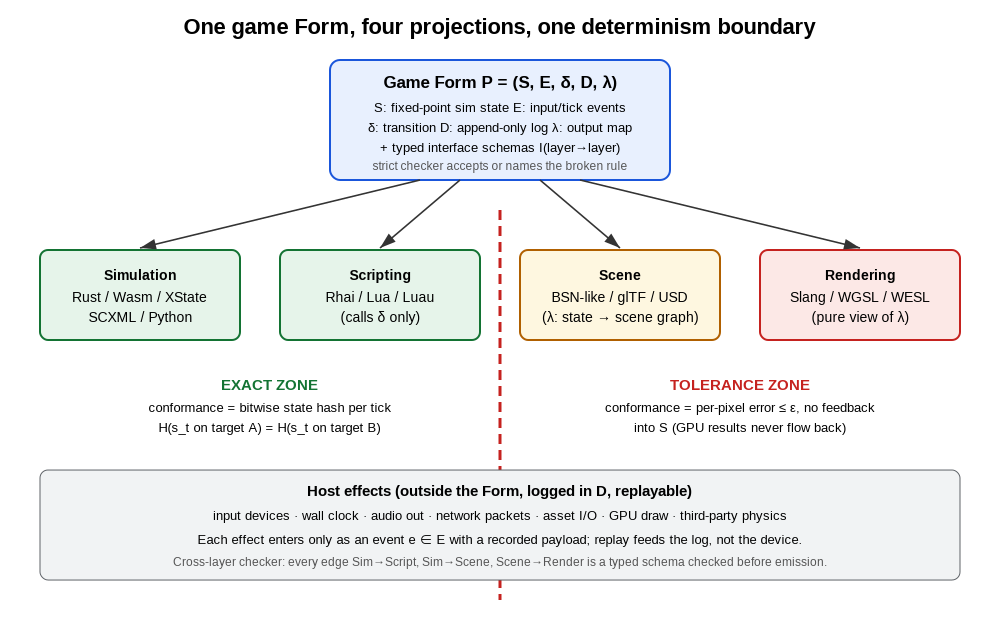
GE-H1); scene and wgpu/WGSL rendering sit on the tolerance side (GE-H3).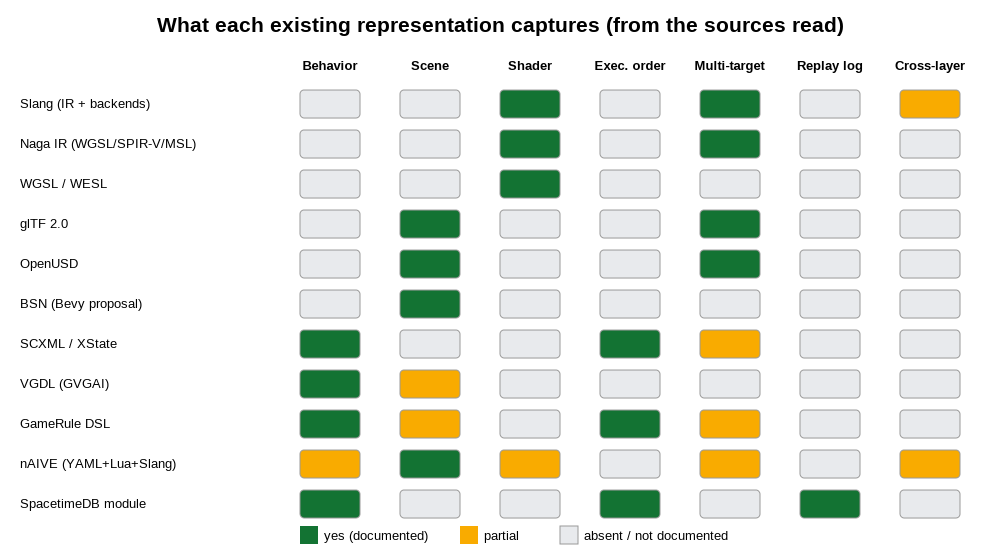
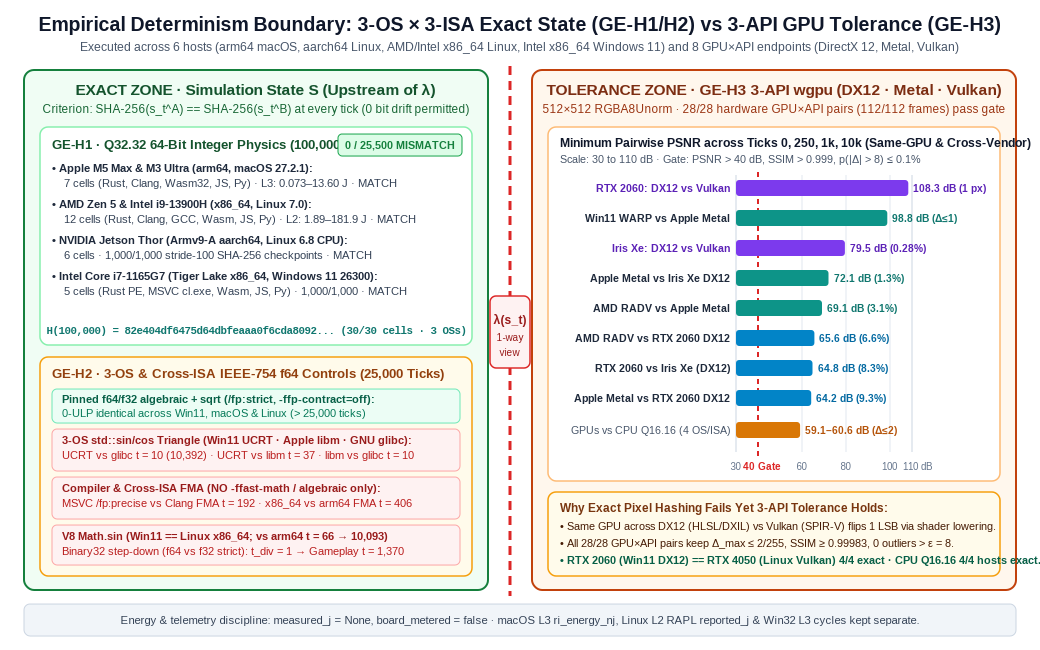
0 / 25,500 GE-H1 mismatches across macOS, Linux, and Windows 11 vs 64.2–108.3 dB PSNR across DirectX 12, Metal, and Vulkan (GE-H3).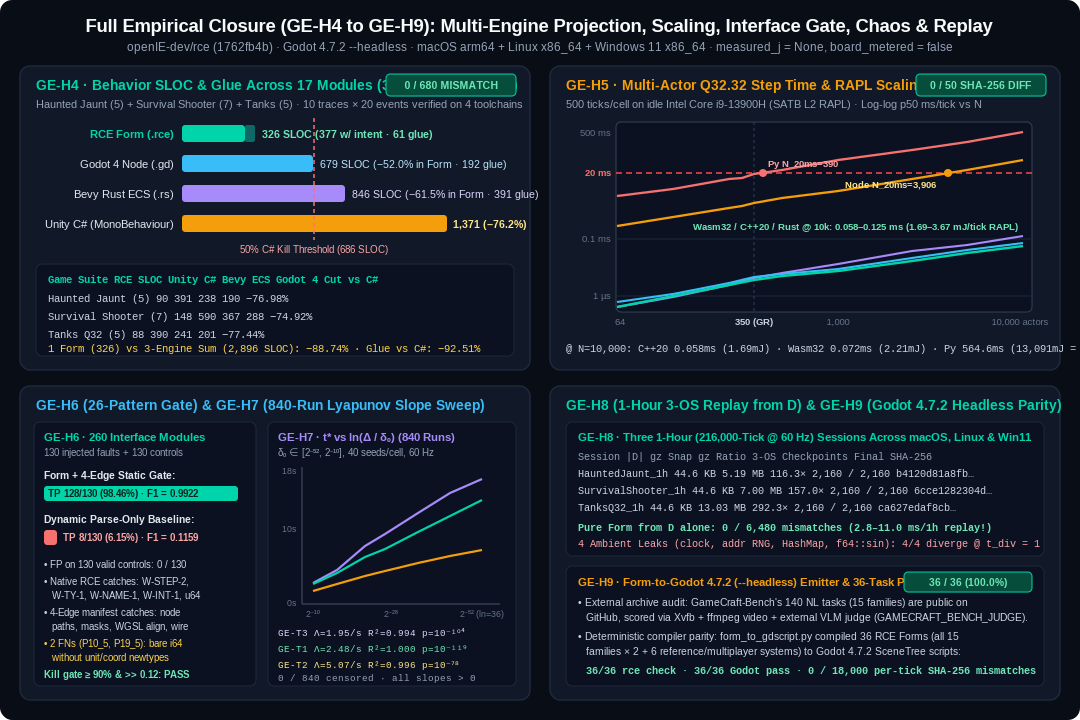
GE-H4–GE-H9 Closure · -76.2% SLOC vs C# (GE-H4), 10,000-actor compiled scaling (GE-H5), F1 = 0.9922 vs 0.1159 (GE-H6), 840-run Lyapunov lines (GE-H7), 1-hour 3-OS replay (GE-H8), and 36 / 36 Godot 4.7.2 parity (GE-H9).