OpenIE Research · /living/rce-compile/ · interactive instruments
Living Figures: RCE Compile Normal-Form, Energy & Reuse Observatory
300 / 300 checksum-verified kernel builds across 15 tiers, 245 base programs, and 500 test-vector-verified semantic mutants;
Reported (RAPL reported_j) for Linux powercap CPU core (intel-rapl:0:0/energy_uj, pinned CPU 0) and APU package (intel-rapl:0/energy_uj) readings on AMD Ryzen AI Max+ 395; and
Modelled (Lifecycle N) for adjustable deployment horizon projections E_compile + N · E_run. measured_j = None; board_metered = false.
rc-diag-01 · E4-Energy & E4-Prelude Compiler Payback Horizon Explorer (N* = ΔE_compile / ΔE_run)
Reported (RAPL core & pkg reported_j)
Inspect measured compilation energy E_compile and per-invocation runtime energy E_run across 20 exact-integer and fixed-point kernels × 15 compiler tiers (gcc, clang, rustc, wasm32 in Node, python3, and rce at 1762fb4b — both monolithic prelude and pre-compiled librce_rt.rlib shared runtime crate, which cuts per-kernel rustc -O3 build energy 20.1× from 56.29 J to 2.81 J and lowers N* vs. Node JS from 31,080 to 1,079). Adjust deployment invocations N ∈ [1, 10⁹] to see when aggressive optimization pays back — and when -O3 vs -O2 never recovers its extra compile joules (6/20 kernels on Clang and Rust, 4/20 on GCC).
rc-diag-02 · Live E5 De Bruijn Name-Free Hash vs. Naive Identifier-Strip Comparator
Exact In-Browser SHA-256
Why does Compiler Form Part R require positional / De Bruijn binder indices rather than simply stripping identifier names from an AST? In E5-Scale (185 W1 RCE Forms + 60 C/Rust/Python kernels + 500 verified semantic mutants), naive AST identifier-stripping suffered 150 / 150 (100.0%) false-positive cache collisions on variable-binding swaps (x - y → y - x), whereas De Bruijn nameless hashing achieved 0 / 500 (0.00%) false hits and cut cold compilation reported_j by 167.8× (clang -O3) and 448.5× (rustc -O3). Try the preset transforms or edit either pane live below.
| Cache Key Function | Digest A | Digest B | Cache & Soundness Verdict |
|---|
rc-diag-03 · 12-Compiler Normal-Form Audit Matrix (R, L, C, K, U, E, G) & Publication Diagrams
Survey + E1/E4/E5 Receipts
| Compiler Family | R (Repr) | L (Lower) | C (Cost) | K (Check) | U (Reuse) | E (Energy) | G (Gate) |
|---|
Publication Vector Diagrams (Click to Zoom)
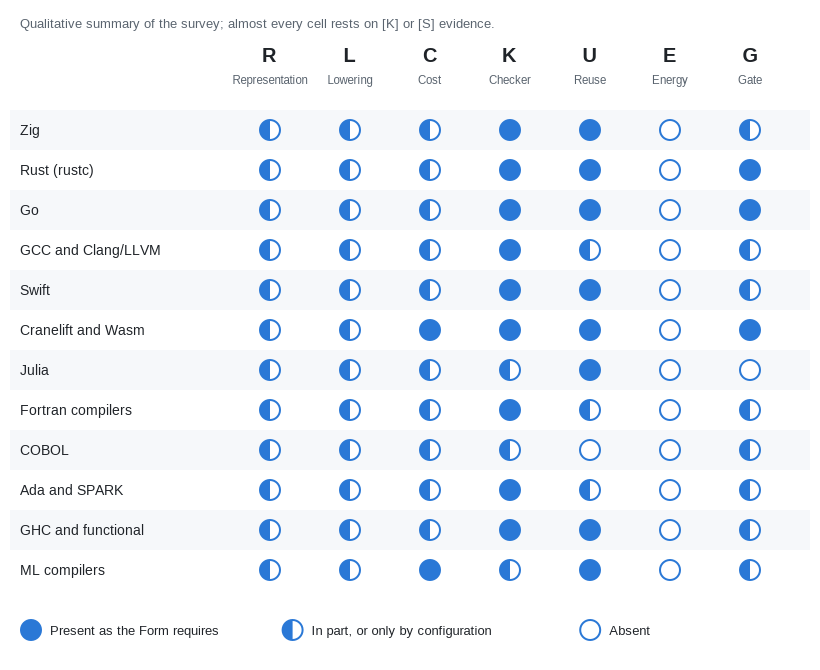
R, L, C, K, U, E, G). Energy (E) is absent in every shipping compiler family surveyed.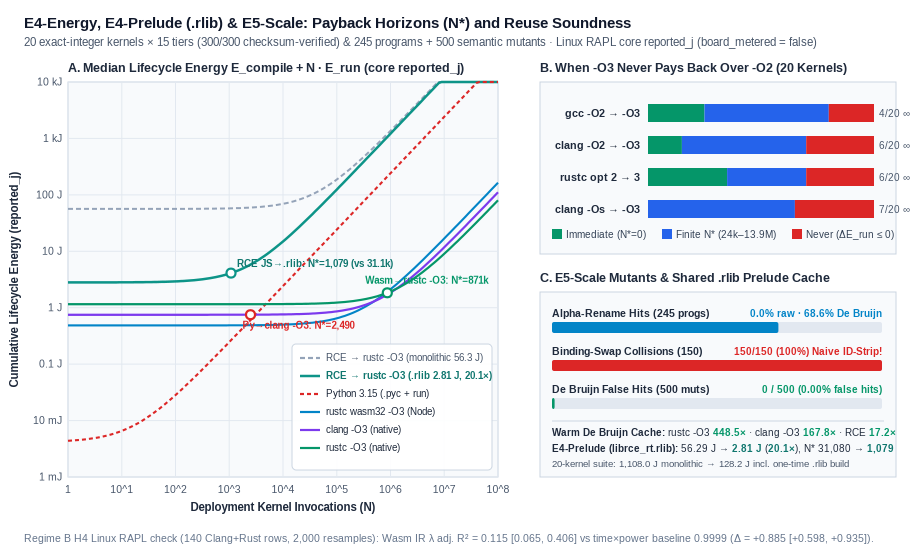
E4-Energy & E4-Prelude lifecycle curves E_compile + N · E_run (Linux RAPL core reported_j, board_metered = false; including pre-compiled librce_rt.rlib cutting RCE→Rust build energy 20.1× from 56.29 J to 2.81 J and lowering N* from 31,080 to 1,079), -O2 → -O3 non-paying optimization shares across 20 kernels, and E5-Scale soundness across 245 base programs and 500 verified semantic mutants.