RCE Compile: A Law of Compilation, Tested as a Normal Form Against Real Compilers
RCE Compile (a research project in the Reality Code Engine repository) asks whether one statement of what compilation is holds for every compiler, independent of the Reality Code Engine itself. Checked against twelve compiler families, the candidate holds as a standard a compiler can be measured against, not as a description of what compilers do. This study states that standard, the evidence for and against each of its seven parts, a measurable replacement for its convergence function, seven hypotheses with their falsifiers, and the first measured experiment.
David Charlot, Open Interface Engineering
Research studies, not journal finals. Notation is defined in the paper. Analytical energy estimates are not board power. Interactive figures live under /living/. Shared terms: glossary.
Cite this
Genre: Research study, draft: problem, framework, evidence, hypotheses, falsifiers and the first experiment
David Charlot, Open Interface Engineering. RCE Compile: A Law of Compilation, Tested as a Normal Form Against Real Compilers. Open Interface Engineering. Web: https://research.openie.dev/papers/rce-compile/. PDF: https://research.openie.dev/pdfs/rce-compile.pdf.
RCE Compile: A Law of Compilation, Tested as a Normal Form Against Real Compilers
Revision 68b8b43, 2 November 2026. Research study, draft. Project repository: openIE-dev/rce, compile/, which holds the charter, the hypotheses and the experiments this study reports.
Abstract
RCE Compile is a research project that asks whether a single statement of what compilation is, here called a Law of Compilation, holds for any compiler, independent of the Reality Code Engine (RCE) in whose repository the project lives. The candidate statement says that compilation is meaning-preserving lowering between canonical representations, ranked by a cost whose floor is Landauer’s limit and whose target is the shortest equivalent program, gated by verification and compounded by reuse. This study checks that candidate against twelve families of production compilers and the research literature behind them. The candidate fails as a description: no compiler surveyed hashes a name-free representation, lowering in shipping compilers is neither total nor shown to preserve meaning, and no compiler accounts for energy. It holds up as a normative framework once three clauses are rewritten, and the study states it in that form: a normal form with two bounds, plus a measured distance from them. The convergence function cannot be computed or measured as stated, and the study replaces it with two counts that can be computed and compared with measured energy. Seven hypotheses with falsifiers follow, with the measured results of the first experiment, on whether lowering is deterministic, and the protocols of the next three. Almost every external source was seen only as a search result, and each citation says so.
In plain words
- The question is whether all compilers obey one rule. Real compilers do not, so the rule is restated as a standard that any compiler can be measured against.
- The standard has seven parts. Most compilers have some of them. None keeps track of energy, and none proves that it translates every program correctly.
- The physical and mathematical limits in the original rule are real but cannot be computed, so they are replaced by two quantities that can be counted and compared with an energy meter.
Terms and evidence marks
Every acronym on this page is either expanded where it is first used or listed here.
- AI, API: artificial intelligence; application programming interface
- AIR, ZIR, MIR: intermediate representations of the Zig compiler (analysed, untyped and machine-level)
- ANF: A-normal form, a program form in which every intermediate value is named
- ASR: Abstract Semantic Representation, the intermediate representation of LFortran
- AST: abstract syntax tree
- BF16, FP16, FP8, FP4: 16-, 8- and 4-bit floating-point formats
- CI: continuous integration, the checks run on every change to a repository
- CLIF: the intermediate representation of the Cranelift code generator
- CMOS: complementary metal-oxide-semiconductor, the usual chip technology
- CN101, MAX, XY.AI, MMA-Sim: product, platform, company and tool names used as they are
- CNF: conjunctive normal form, a standard form for logical formulas
- COBOL, SPARK, GHC, GCC, LLVM, MLIR, XLA, TVM, CUDA: names of languages and compilers (COBOL; SPARK, a verifiable subset of Ada; the Glasgow Haskell Compiler; the GNU Compiler Collection; the LLVM compiler infrastructure and its multi-level representation MLIR; the XLA and TVM compilers for tensor programs; NVIDIA's GPU platform)
- CPU, GPU, FPGA: central processing unit, graphics processing unit, field-programmable gate array
- DDC: diverse double-compiling, a test that rebuilds a compiler with an independent compiler and compares the bits
- DRAM, SRAM: dynamic and static random-access memory
- DWARF: the standard debug-information format
- ELF: Executable and Linkable Format, the binary format of Linux executables and object files
- EMI: equivalence modulo inputs, a compiler-testing method that changes code a given input never runs and checks the output stays the same
- GEMM: general matrix multiplication; cuBLAS and cuDNN are NVIDIA's libraries for it and for neural-network kernels
- GIMPLE, FIR, HLFIR, SOACS: the intermediate representations of GCC, of LLVM Flang (two levels) and of Futhark
- GNU, GNAT, GNATprove: the GNU project; the Ada compiler in GCC; the SPARK proof tool
- GODEBUG: the environment variable that turns on debugging settings of the Go toolchain and runtime
- GOPATH: Go's older workspace mode, used before Go modules
- HAL, CNKI, ACM DL, J-STAGE: national and publisher research databases (France, China, the ACM, Japan)
- HIR, THIR: the high-level and typed high-level representations of the Rust compiler, rustc
- HOL4, Rocq, Lean, Coq: proof assistants (Coq was renamed Rocq)
- HPC: high-performance computing
- IEEE 754: the floating-point standard of the Institute of Electrical and Electronics Engineers; NaN: not-a-number
- IR: intermediate representation, the form a compiler holds a program in between source and machine code
- ISLE: the rule language in which Cranelift's lowering rules are written
- LAPACK: the Linear Algebra Package, a Fortran library
- LCNF: Lean Compiler Normal Form
- LTO: link-time optimisation
- MB, GB: megabytes, gigabytes
- MDL: minimum description length, a two-part code length relative to a named class of models
- ML compilers: compilers for neural-network tensor programs, such as XLA, TorchInductor, TVM, TensorRT, Triton and IREE
- MLGO, TENSAT, STOKE: a policy-driven LLVM optimisation framework, an equality-saturation optimiser for tensor graphs, and a stochastic superoptimiser
- NOT FOUND: an evidence mark, defined below
- NVML, RAPL: NVIDIA's management library and Intel's running average power limit interface, both of which report energy counters
- OSS: open-source software
- OTP: Open Telecom Platform, the name of the Erlang distribution and its release numbers
- POPL, PLDI, ICFP, OOPSLA, MLSys, ISSCC, ICML, PriSC: conferences and workshops in which cited papers appeared
- PP: the class of problems a polynomial-time randomised machine decides correctly more than half the time; PP-hard problems are believed to be far harder than NP-complete ones
- PTX: NVIDIA's virtual GPU instruction set
- RCE: the Reality Code Engine
- SHA-256: a cryptographic hash function
- SMT: satisfiability modulo theories; SMT solvers such as Z3 decide logical formulas over arithmetic, bit-vectors and memory
- SSA: static single assignment form
- STG, Cmm: the intermediate representations of GHC after Core
- TIRx, JACC, NVIDIA, AMD, ONNX, BEAM, DIKU: project, company and system names used as they are
- TZ, UTC, LC_ALL: environment variables for the time zone and locale; UTC is Coordinated Universal Time
- UB: undefined behaviour, source behaviour to which the language standard gives no meaning
- UBC, MIT, ORNL, NERSC, LBNL, HPE: the University of British Columbia, the Massachusetts Institute of Technology, Oak Ridge National Laboratory, the National Energy Research Scientific Computing Center, Lawrence Berkeley National Laboratory and Hewlett Packard Enterprise
- ULP: unit in the last place
- UNCOL: Universal Computer Oriented Language, a 1958 proposal for one intermediate language for all compilers
Evidence marks. Each external statement carries the mark of how it was checked, and each entry in the reference list repeats it. [F] means read in the source itself. [S] means seen only in a search-result snippet or a secondary summary. [K] means stated from memory and not re-checked; the canonical location is given but was not opened. [M] means measured by the project on its own machine. [NOT FOUND] means searched for with no source located. Only two external items reached [F]: an index page and a set of repository commit counts. Most hosts that hold the primary texts (among them arxiv.org, compcert.org, gcc.gnu.org, ziglang.org, zenodo.org, pytorch.org and the UBC library) could not be reached from the research sessions, so an [S] item below means “a source exists and its abstract or snippet says this”, not “the paper was read”.
1. Problem statement
A compiler takes a program in one language and produces a program in another, usually closer to a machine. There are thousands of compilers, built by communities that rarely share vocabulary: systems languages, scientific computing, legacy business languages, high-integrity languages, functional languages and the compilers for neural-network tensor programs. Each community has its own account of what a correct and good compiler is. RCE Compile asks whether one statement covers all of them, independent of RCE, and if not, what the nearest statement is that does.
The candidate under test came out of an earlier discussion with an assistant system (Grok). It says: compilation is semantics-preserving lowering between canonical representations, ranked by a cost whose floor is Landauer’s limit and whose target is Kolmogorov-minimal, gated by verification, and compounded by reuse. Three questions follow. Does it describe the compilers that exist? If not, can it be restated so that it is true of a correct compiler and checkable against a real one? And can its physical and mathematical terms be measured at all? The discussion that proposed the candidate also made 55 factual claims about the field; those are checked in Appendix A.
2. The candidate and its refinement
2.1 Why the candidate fails as a description
The candidate makes three kinds of claim: about representation (“canonical”), about lowering (“semantics-preserving”), and about cost (“floor is Landauer, target is Kolmogorov-minimal”). Each fails as a description of shipping compilers, for reasons given in full in §3 and §4:
- No compiler surveyed hashes a name-free intermediate representation. Every one keys its identity and its caches on named or textual content.
- Lowering is neither total nor proved to preserve meaning. Fuzzers have found more than 325 bugs (Csmith) and 1,602 bugs (the EMI project) in production C compilers [1] [2], and Zig’s default self-hosted backend fails 24 of its 2,008 behaviour tests [3].
- No compiler accounts for energy. Every cost model found is in cycles, bytes or node counts.
- The convergence function cannot be computed or measured as stated. Kolmogorov complexity is uncomputable; even the minimum heat of one fixed circuit is PP-hard to compute [4]; and today’s hardware sits to times above the Landauer floor.
A statement that every compiler is claimed to obey, and that real compilers measurably break, is falsified as a descriptive law. No peer-reviewed source in English, Chinese, Russian or Japanese was found that names or proves a single law of compilation [NOT FOUND]; an English search for the phrase returns only the copyright sense of “compilation” [5].
2.2 The refinement: a normal form with two bounds and a measured distance
The candidate holds up much better as a normative framework: a statement of what a correct, well-ranked compiler must satisfy, against which every real compiler can be placed and its shortfall measured. Three clauses change. “Semantics-preserving” becomes a declared contract, because the established notion is refinement under a precondition and the precondition differs by compiler. “Canonical” becomes an operation the framework applies to any representation, because no compiler supplies it. And “Landauer floor and Kolmogorov target” becomes two computable counts plus a measurement. The result is a normal form in the sense of Hoare, He and Sampaio (§6), with two bounds and a measured distance from them, not a law every compiler already obeys.
2.3 The normative statement
The project’s charter states the standard as follows; the text is quoted from it unchanged [6]:
Compiler Form. A compiler is a partial function from declared inputs (source, flags, toolchain, and any build path after remapping) to a chain of representations R₀ → … → Rₙ. Each step either stops or produces an output that a named checker K accepts as preserving a declared contract: a property class, an equivalence level, a linking assumption and a trusted computing base. Among accepted outputs, a stated cost C ranks the candidates. Reuse U is keyed by a name-free hash of the representation together with its contract. Nothing is released unless G records K’s acceptance. For every released output, the framework reports its distance from two bounds, the bits irreversibly overwritten per run (scaled by kB·T·ln 2) and a stated description-length proxy, next to the energy measured in the regime the hardware belongs to.
A stop is a lowering step that ends with a diagnostic and no output. A declared input is an input the compiler’s contract lists. The statement drops “holds for any compiler” in favour of “every compiler can be placed against it”. The project claims a law only for what its registered hypotheses (§7) survive. §3 sets out the parts the statement names, and §4 the two bounds.
3. The Compiler Form, R to G
3.1 The seven parts
The project calls the framework the Compiler Form. It has seven parts:
| Part | Name | What the part requires |
|---|---|---|
| R | Representation | A canonical IR with a stated equivalence relation and a name-free hash |
| L | Lowering | Each step either stops (ends with a diagnostic and no output) or produces an output that preserves a declared contract |
| C | Cost | A stated cost that ranks equivalent candidates |
| K | Checker | A named checker that certifies the contract |
| U | Reuse | Earlier accepted results are reused, keyed by the name-free hash and the contract |
| E | Energy | Energy is accounted for, by counting or by meter, for each released output |
| G | Gate | Nothing is released unless the gate records the checker’s acceptance |
Two refinements, from the correctness and ML-compiler literature, make L, K and G precise enough to test.
3.2 Four equivalence levels
ML compilers define correctness as closeness. XLA, TorchInductor, TVM, TensorRT, Triton and IREE all test against a reference within an absolute and relative tolerance (PyTorch’s float32 defaults are a relative tolerance of and an absolute tolerance of ) [K], because fusion, tiling, split reductions and tensor-core accumulation reorder floating-point sums, and lowering to FP8 or FP4 changes outputs on purpose [K]. FlexAttention’s FlashAttention-4 backward pass is reported to be nondeterministic when block sparsity is on [7]. If “preserving” meant identical output bits, these compilers would all violate L. A September 2026 preprint argues that bit-level results depend on the accumulation structure the compiler chooses, reconstructs that structure for cuBLAS across three GPU generations, and gives static checkers that decide bitwise equivalence across tens of thousands of autotuner configurations [8]; MMA-Sim gives a bit-accurate model of tensor and matrix cores on ten architectures [9]. Halide already shows the pattern at small scale: a schedule cannot change results except through named reassociating reductions [K].
The Form therefore requires every lowering to declare one of four equivalence levels, and its checker to certify that level:
| Level | Meaning | What K must certify |
|---|---|---|
| Exact | Integer, Boolean or fixed-point; identical output bits | Bitwise equality |
| Bitwise within an accumulation class | Floating point, with the reduction order recorded in R; L and C choose only within the class | Same class, then bitwise equality |
| Within a declared error bound | Floating point, with an absolute, relative or ULP bound | The bound, by static error analysis or interval methods, not by sample tests |
| Declared lossy | Quantisation or precision lowering | Nothing about equality: it is a change of program, recorded and admitted by G as a separate decision |
The default is “exact unless a checked contract says otherwise”. That is stricter than every production ML compiler and consistent with the bitwise-class research.
3.3 What a gate must name
The classical correctness theorem is not “the output means the same as the input”. CompCert’s main theorem is behaviour refinement under a precondition: if compilation succeeds and the source has no undefined behaviour, every observable behaviour of the compiled code is a behaviour of the source [K]. Patterson and Ahmed show that “the compiler is correct” is ambiguous until the theorem says what target code the output may be linked with [10]. Secure compilation adds that a compiler can preserve meaning in CompCert’s sense and still let an attacker at the target level break abstractions of the source: full abstraction (source-equivalent components compile to target-equivalent ones) and the robust property preservation criteria are distinct, stronger guarantees [11]. And CompCert’s proof leaves the preprocessor, assembler and linker outside it; Csmith found silent miscompilations exactly there and none in the verified middle end [1].
From these, every gate in the Form must state three things:
- The property class it preserves: trace properties, hyperproperties, a robust variant, or an equivalence.
- The linking assumption: which other code the output may be combined with.
- The trusted base: the semantics, proof kernel, assembler, hardware models or diverse compiler the guarantee relies on.
Fully abstract compilation usually needs run-time checks or isolation, so a stronger property class raises cost [K].
3.4 Evidence per part across compilers
The survey covered Zig, Rust, Go, GCC and Clang/LLVM, Swift, Cranelift and WebAssembly (Wasm), Julia, the Fortran compilers (gfortran, ifx, nvfortran, LLVM Flang, LFortran), COBOL (gcobol and GnuCOBOL), Ada and SPARK, GHC and the other functional compilers (OCaml, Lean 4, Idris 2, Koka, Erlang, Futhark, Halide), and the ML compilers. Figure 1 and the table below summarise the evidence part by part. Almost every cell rests on [K] or [S].
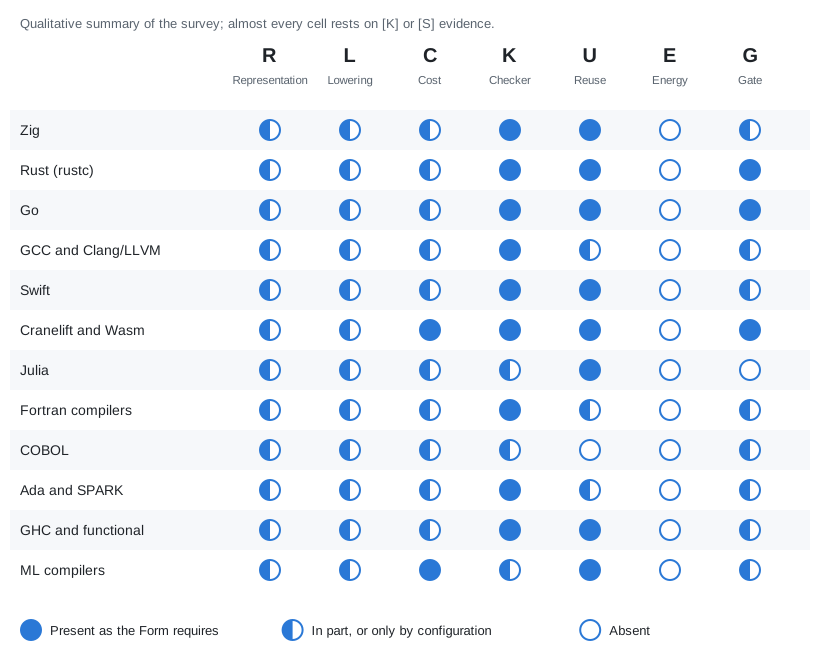
| Part | Supported by | Qualified by | Falsified by |
|---|---|---|---|
| R | E-classes; Wasm’s name-free binary; exact text round-trip in LLVM IR and CLIF; normal forms (GHC Core, LFortran ASR, Lean LCNF) | Every compiler is a chain of 3 to 6 IRs; round-trip holds only between an IR and its own bytes | No compiler hashes a name-free IR |
| L | Morris’s commuting square; CompCert; CakeML; Halide’s schedule separation | Refinement, not equality; only for UB-free sources; indexed by linking context; ML compilers use tolerance | Csmith, EMI and Alive2 bug counts; Zig’s failing behaviour tests |
| C | Cranelift e-graph extraction; equality saturation; autotuners | Mostly local heuristics in cycles or bytes | No cost in joules; shortest is not cheapest |
| K | Type and borrow checkers; IR verifiers; Alive2; ISLE verification; the Lean kernel; SPARK | Checks the source more than the lowering; often debug-only; bounded; ML checks are sample tests | No production compiler checks all of its lowering |
| U | Content-addressed caches in Go, rustc, LLVM, Wasmtime, JAX, Triton, TVM; CakeML bootstrapping; DDC | Keys include names and paths; TensorRT-LLM dropped its stored engines | Name-free reuse is absent |
| E | Only research (Eel, MIT 2016) and external meters | Energy roughly tracks run time on CPUs | Absent in every compiler surveyed |
| G | rustc, Go, Wasm validation, Erlang’s validator, SPARK when a project requires it | tsc emits despite type errors by default; LLVM and GCC gate on post-commit testing; ML gates are fallbacks | No universal gate |
3.5 Part-by-part findings
R is absent everywhere as the Form states it. Every production compiler lowers through a chain of IRs rather than one canonical form. Zig goes AST → ZIR → AIR → per-backend MIR [3]; rustc goes AST → HIR → THIR → MIR → one of LLVM IR, Cranelift’s CLIF or GCC’s GIMPLE [12]; Go goes syntax → IR → SSA → Plan 9-style instructions [13]; GHC goes Core → STG → Cmm [K]. Canonical forms exist (GHC Core, LFortran’s ASR, Futhark’s SOACS, Lean’s LCNF, Flang’s FIR and HLFIR), and the e-classes of an e-graph are canonical sets of equivalent terms. The closest result to the “canonical representations” clause is Bryant’s thesis, which treats compilation as normalisation to a normal form [14]. Two qualifications follow. Morris’s correctness square needs only some semantics on each side, not canonicity [K]. And round-trip holds only between an IR and its own serialised form (LLVM’s text and bitcode, CLIF text, MLIR’s generic form), never back to source, because every compiler discards comments, names and syntactic sugar [K]. The falsifier is plain: GHC’s interface fingerprints, OCaml’s interface digests, rustc’s stable hashes, Go’s action IDs, Julia’s source hashes, Lean’s Lake traces and Taichi’s kernel hashes are all hashes of named or textual content [K]. The Wasm binary comes closest, because names sit in an optional custom section [K]. So R has to become an operation the framework applies to any IR (rename bound names to positions, strip paths, then hash), not a property compilers are claimed to have.
L fails as a description; the bug counts are the evidence. Csmith found more than 325 previously unknown bugs in C compilers [1]. EMI found 147 confirmed bugs in its first 11 months and 1,602 GCC and LLVM bugs in total, 1,007 of them fixed [2]. Alive2, a bounded translation validator for LLVM, found 47 new bugs (28 fixed) and prompted 8 patches to the LLVM language reference; a follow-up encoding of LLVM’s memory model found 21 more [15]. Zig’s self-hosted x86-64 backend, the default for Debug builds since 0.15, passes 1,984 of 2,008 behaviour tests (the project’s development log gives 1,987 against 1,980 for LLVM; the two sources disagree) [3], so lowering is not total in a shipping compiler. CompCert and CakeML show that L can hold as a theorem: CakeML carries its guarantee down to machine code for five instruction sets and has compiled itself inside the HOL4 logic [16]. Neither is a production compiler for the languages surveyed. L survives only as a norm: a step either produces output its checker accepts or stops, and production compilers are measured by how far they fall short.
C is present but local. Every compiler has cost models, but almost all are local heuristics: inline budgets, LLVM’s target cost queries and scheduling models, GCC’s cost hooks [K]. Cranelift’s acyclic e-graph is the only production case found that ranks the members of an explicit equivalence class and extracts the cheapest, and it deliberately saturates once, within a budget [17]. Research equality saturation shows uneven gains: TENSAT reports up to 16% [18], and equality saturation inside XLA averages 3.45% with a 56.26% peak on one model [19]. Only one mechanised result about a pass’s performance guarantee was found, for an inlining heuristic in Rocq [20]. Every cost found is in cycles, latency, bytes or node counts; none is in joules, and the shortest program is not the cheapest whenever unrolling, vectorising or table lookup makes code longer but faster [K].
K is the strongest part, but it guards the source more than the lowering. Type systems, Rust’s borrow checker and new trait solver [21], GHC’s Core Lint, LFortran’s ASR verifier, MLIR op verifiers, Futhark’s typed IR, Lean’s kernel, SPARK’s GNATprove proof levels [22] and Erlang’s code validator [K] are all real checkers. Three qualifications matter. Checking of the lowering itself exists only in pieces: Alive2 for some LLVM peepholes, SMT verification of some Cranelift ISLE rules, the mechanised Wasm specification [K]. Many IR checkers are debug-only: Core Lint is opt-in and the LLVM verifier between passes is commonly off in release builds [K]. And bounded checkers can miss bugs: Alive2 unrolls loops to a bound [15], and EMI and Csmith find bugs but cannot certify their absence. The ML compilers’ checks are tolerance tests on sample inputs, which are tests, not certificates.
U is the part most often present, but its keys hash names and paths. Go’s build cache maps an action ID (a hash of every input to a step) to an output [23]; rustc uses incremental fingerprints; LLVM’s ThinLTO cache, Wasmtime’s module cache, JAX’s compilation cache, Triton’s kernel cache and TVM’s tuning database are all keyed by hashes [K]. Reuse of verified work compounds trust: CakeML compiled its own verified binary inside the logic [16]; “Compiling by Proving” turns proofs into optimised rewrite rules [24]; and DDC counters the trusting-trust attack under stated assumptions [25]. Two qualifications remain. The keys hash names and paths, so equal programs with different names miss the cache. And TensorRT-LLM abandoned its serialised, verified-once engines for PyTorch as its only backend [26]: stored artefacts lost to a flexible eager path when hardware and models changed faster than the artefacts could be rebuilt.
E is absent everywhere. No compiler in any of the twelve families accounts for energy [K; NOT FOUND for any counterexample]. Energy is measured outside compilers: by machine (the June 2026 Green500 leader runs at 73.28 GFlops per watt [27]) and by counters such as RAPL and NVML [K]. Research on energy-aware compilation is modest: the choice of compiler flags shifts energy by tens of percent, and energy and run time are “roughly correlated, though not always” [28]; a 2025 Fortran study found “minimal difference” in energy between gfortran, ifx and ifort, tracking run time [29]. The only compiler found that treats energy as a first-class quantity is the research language Eel, which treats reversible operations as free and charges for bit creation and destruction [30]. Either E is not a necessary part of a law of compilation, or the whole field falls short of it. This study takes the second reading: E is a part the framework adds, supplied by an external meter.
G is present only in some compilers. rustc emits no code after a type or borrow error; Go refuses unused imports and variables; Wasm engines refuse an invalid module at load time; Erlang’s validator checks generated code before writing it [K]. SPARK is a gate only when a project’s CI requires GNATprove with no unproved checks; the compiler itself does not refuse [K]. Elsewhere G is off or partial. tsc emits JavaScript despite type errors unless noEmitOnError is set; LLVM and GCC ship from trunk on post-commit testing and reverts rather than a gate before merging; Zig analyses lazily, so code that is never referenced is never checked [K]. ML compilers have fallbacks rather than gates: a graph break in TorchDynamo falls back to eager Python unless fullgraph=True turns it into an error, and ONNX Runtime sends unsupported nodes to its CPU provider [K].
4. The convergence function
4.1 Landauer and Kolmogorov as conceptual bounds
The candidate’s convergence function says that the cost of a compiled program has a floor at Landauer’s limit and a target at Kolmogorov-minimal size. Landauer’s limit is the minimum heat, , released into surroundings at temperature when one bit is erased: about 2.871 zeptojoules at 300 K (2.853 at 298.15 K) [K, arithmetic]. It bounds heat per bit erased, not per operation, and it is reached only in the infinitely slow limit; erasing faster costs more, roughly as for erasure time [K]. Single-bit experiments confirm the bound at that limit, in colloidal beads (Bérut et al., 2012) and in nanomagnetic memory (Hong et al., 2016) [31]. Kolmogorov complexity is the length of the shortest program that prints . Both are real physics or mathematics, and as bounds they say something true: no compiled program can dissipate less than its erasures require, and none can be shorter than the shortest equivalent program.
4.2 Why neither is computable or measurable as stated
The Kolmogorov target cannot be computed. is uncomputable (Kolmogorov, Chaitin, Solomonoff); compressors give only upper bounds, and program equivalence, the constraint the target sits under, is undecidable in general by Rice’s theorem [K]. The full-employment theorem for compiler writers makes this concrete: no compiler can always produce the smallest equivalent program, because that would decide halting [K]. Superoptimisers approach the target for short loop-free fragments under an SMT or test-vector check, but never with a guarantee.
The Landauer floor cannot be computed either, and it is far below today’s costs. Computing the optimal heat functions for one fixed circuit is PP-complete according to the abstract of a 2026 paper, multiplicative approximation is NP-hard, and only additive approximation has a polynomial-time randomised algorithm [4]; the body reportedly argues PP-hardness, so membership in PP remains to be checked. Choosing among equivalent circuits, which is the compilation problem, sits on top of that. At the commonly quoted 45 nm figures, a 32-bit integer add costs about 0.1 picojoules, about times , or about per erased bit if 32 bits are overwritten; a 640-picojoule DRAM read is about times the floor; and the overhead of one out-of-order instruction, about 70 picojoules, is about [32]. Today’s gap is therefore to , and almost all of it is wires, memory and control, not logical erasure.
The two terms overlap. Bennett showed that any computation can be made logically reversible, so the Landauer floor applies only to information a program deliberately discards [K]. Zurek, and Bennett and colleagues, showed that the minimum thermodynamic cost of erasing a string is about , and that converting to costs about their information distance [K]. The Landauer cost of erasure is already a Kolmogorov quantity, so minimising both jointly counts the same thing twice. Three further problems remain. Shortness and low energy trade off, so a joint objective without a stated weighting is a Pareto front, not a function. Time is missing from the statement. And the energy spent compiling can outweigh the savings: in an October 2026 study, 42 of 44 configurations of model self-refinement used 4% to 886% more execution energy than the reference solutions, and the two exceptions broke even only after about to executions [33].
One result supports the idea at its core. Wolpert and Kolchinsky’s “circuit Landauer loss” shows that two circuits computing the same function can have different minimum dissipation [34], and mismatch-cost results give strictly positive lower bounds for circuits [35]. Circuit structure, which is what a compiler chooses, does change the physical floor.
4.3 The measurable replacement
The replacement keeps both terms and makes each computable:
- ε, the erasure count: the number of bits a run overwrites irreversibly, computed from the IR (bits overwritten or discarded without having been copied out). is the run’s Landauer bound.
- λ, a declared description-length proxy: IR node count, binary bytes, compressed bytes, or an MDL code length relative to a named model class. The proxy is declared before a measurement and not changed after it.
Both are computed under an equivalence checked on a decidable fragment, and reported next to measured joules in the energy regime the hardware belongs to:
| Regime | Energy is proportional to | Example hardware |
|---|---|---|
| A | Counted operations | In-order cores, FPGAs |
| B | Time multiplied by power | Out-of-order CPUs, GPUs |
| C | Entropy production | Thermodynamic hardware, or a simulation of it; the only regime in which Landauer units apply directly |
Regimes A and B are approximations: static power scales with time even on in-order cores [K]. The claim becomes testable: does lowering ε and λ predict lower measured energy in each regime? No published measurement of the erasure content of real compiled programs against their energy was found [NOT FOUND], so the result would be new evidence whichever way it comes out. Self-published preprints that claim convergence to the Landauer limit at a rate of are unreviewed, and their rate is a statistic about estimating work, not a rate at which programs approach a floor [36]; they are not cited as support.
5. The gear ladder and the 98/2 split
RCE Compile orders its own compilation steps as a gear ladder of six rungs, G0 to G5, tried in order of cost. G0 reuses a stored result by its hash; G1 applies rewrite rules proved correct in advance; G2 extracts the cheapest form from an e-graph. These three are deterministic. G3 to G5 are stochastic proposers, and every output they produce must pass the gate before it is released; the charter defines G3 to G5 only as a group, and their separate definitions are open [6]. (The rungs are written G0 to G5; the Form’s gate is the part named G.) The design principle attached to the ladder is a split: at least 98% of the work deterministic, at most 2% stochastic, and everything gated.
No source measures such a split for any compiler, by decision count, CPU time, cost or energy [NOT FOUND]. The verified systems sit at the two ends instead. Equality saturation, Souper, Cranelift and MLGO are fully deterministic at compile time; MLGO’s policy is fixed and compiled into LLVM, and it decides one class of choices (inline or not, which register to evict) for gains of 0.3% to 7% [37]. At the other end, a stochastic author writes nearly everything behind a deterministic gate: in work reported in October 2026, a model wrote about 180 million lines of Rocq proof that the Rocq checker accepts or rejects in full [38], and AdaCore’s GNAT Foundry: Intersection demonstrator has an agent write SPARK while deterministic tools produce all the release evidence [39]. By authoring effort that split is inverted, while the gate is total, so any claim about 98/2 must first say what is being counted. One taxonomy places hybrid workflows at 14% to 56% deterministic, but it is a classification, not a measurement [40].
The literature does support the two principles beneath the split. Gate everything: SuperCoder’s best configuration still fails 5% of its test-checked outputs, and the strongest commercial baseline in that paper passes only 51.5% [41]; STOKE paired a stochastic search with an SMT validator [K]. Put deterministic reuse first: Compiled AI moves all stochastic work into a one-time compile phase and breaks even after about 17 runs [42], and Progressive Crystallization promotes recurring agent runs into deterministic workflows [43]. One caution carries over: in Veritas and CktFormalizer the gate checks the stochastic output against its own specification (CNF clauses, hardware types), while an error in the specification sits outside the gate [44] [45].
The 98/2 split is therefore a hypothesis, to be measured rung by rung with a declared unit and recorded by the gate. Candidate units are accepted decisions, accepted rewrites, CPU seconds and joules; each is reported separately, because they can disagree.
6. Prior art
No earlier source found names a single law of compilation (§2.1). The closest earlier claims each cover a few of the seven parts.
- Morris (1973), following Burstall and Landin (1969) and refined by the ADJ group (Thatcher, Wagner and Wright, 1979 to 1981), made compiler correctness a commuting square of algebra homomorphisms: compiling then interpreting equals interpreting then encoding [46] [47]. That is L and K. Lowering as stated in the Form restates it and claims no novelty there.
- Futamura (1971) showed that specialising an interpreter on a program yields a compiled program, that specialising the specialiser on the interpreter yields a compiler, and that specialising it on itself yields a compiler generator [48]. Ershov’s Novosibirsk school reached the same view as “mixed computation” [49]. That is L and U, and the strongest prior claim that compilers are derived rather than designed.
- Hoare, He and Sampaio (Acta Informatica, 1993) treated compilation as reducing a source program, by algebraic laws of programming, to a normal form that mirrors the target machine, with correctness following from the laws; the work fed into Hoare and He’s Unifying Theories of Programming (1998) [50]. This is the closest prior work to calling compilation “governed by laws”, and the closest to the normal-form framing this study adopts.
- Cousot and Cousot (POPL 1977) unified static analyses as fixpoints over lattices, and later extended this to program transformations [51]. That is K, and the precision ordering in C.
- Eel (Tyagi, Lynch and Demaine, MIT, 2016) is the only compiler found that ties code to an energy floor, by charging for bit creation and destruction [30]. That is E.
UNCOL (1958) tried and failed to give one universal R; MLIR answers that failure with many levels but holds no semantics [52]. E-graphs already combine canonical sets, cost-ranked extraction and sound rewrites in one structure [53].
Two primary sources have not yet been read in full: Hoare, He and Sampaio (1993) [50] and Ershov’s “On the essence of compilation” (1977) [54]. Both are cited from memory [K]. Either may contain a precedent for the framing or the wording, and both must be read before RCE Compile claims priority for anything. The novel part that remains, on present evidence, is the combination: one statement binding a physical floor and an information-theoretic target to verified, reuse-compounding lowering, with energy as a ranked quantity.
7. Hypotheses and falsifiers
The project registered seven hypotheses on 1 November 2026, before any measurement of its own, each with a metric, a condition for support, a condition for falsification and an experiment [6]. The statements and falsifiers below are quoted from the registration. A declared corpus is a set of programs fixed, by path and hash, before the measurement that uses it. A change after registration is recorded as a dated row in the registration’s table of changes. Besides the registration itself, that table holds one change, dated 2 November 2026: a verdict on the one E1 difference in Go that survived remapping, which adds the import path to H1’s declared inputs (§8.1).
| Statement | Falsified if | Experiment | |
|---|---|---|---|
| H1 | Lowering is a function of declared inputs. With declared inputs (source, flags, toolchain, remapped build path, fixed SOURCE_DATE_EPOCH), each compiler’s output bytes are identical across directories and across machines. | Any byte difference survives remapping, across directories or across machines. | E1, run (§8.1) |
| H2 | Gates can be classified. Gates differ by compiler and can be classified: some emit nothing by default when a check fails, others emit unless configured not to. | A compiler’s documented gate behaviour differs from what the injected-fault test observes. | E2, protocol (§8.2) |
| H3 | Every pass and flag has an equivalence level. Every optimisation pass and flag can be assigned one of the four equivalence levels. | A pass’s observed output change exceeds its assigned level. | E3, protocol (§8.2) |
| H4 | Erasure and description length against measured energy. The counted irreversible erasure ε plus a declared description-length proxy λ predict measured energy in regime C (or a simulation of it), but explain less variance than operation counts in regime A and than time multiplied by power in regime B. | ε and λ explain no variance in regime C, or explain more variance than the regime’s own baseline in A or B, which would contradict the scale-gap analysis of the charter. | E4, protocol (§8.2) |
| H5 | A name-free hash raises reuse without false hits. A name-free hash (bound names replaced by positions, path removed) raises reuse hits on renamed but equal programs, without false hits. | There is any false hit, or no gain in hits on the declared corpus. | E5, planned; no protocol yet |
| H6 | Deterministic rungs decide at least 98%. The deterministic rungs G0 to G2 decide at least 98% of accepted decisions on a declared corpus, and every stochastic proposal is gated. | The measured stochastic share is above 2% in the declared unit, or any stochastic output is released without a recorded gate decision. | E6, planned; needs a compiler built on the gear ladder, which does not exist yet |
| H7 | Partial lowering with stops admits no miscompilation inside its fragment. Lowering stated as partial, with a stop as an outcome, has a measurable stop rate, and gated lowering admits no miscompilation that EMI-style testing finds inside the checker’s decidable fragment. | EMI-style testing finds a miscompilation inside the fragment the gate claims to cover. | E7, planned; no protocol yet |
The conditions for support are the converse of each falsifier, with these specifics from the registration: H1 is supported if the differing-byte count is 0 for every output file in every pair; H2 if every compiler falls into one class and its observed behaviour matches its documented behaviour; H4 if ε and λ explain variance in regime C above a threshold declared in the E4 protocol, and less than the baseline in regimes A and B; H6 if the stochastic share is at most 2% in the declared unit and every stochastic output has a recorded gate decision; H7 if the stop rate is measured and no such miscompilation is found.
8. Experiments
8.1 E1: determinism of lowering, measured
Method. E1 tests H1 [6]. Each configuration is one compiler with one flag set, and names one or two small programs. For every program, the harness makes four pairs of builds, each build in a fresh directory that holds only the copied source: the same directory twice; two directories with absolute paths of different lengths; the same two directories with the toolchain’s documented path remapping; and the same directory twice with SOURCE_DATE_EPOCH unset, at least 1.1 s apart. All builds but the last pair run with a declared environment (LC_ALL=C, TZ=UTC, SOURCE_DATE_EPOCH=1735689600), and every build gets new, empty compiler caches, so the second build of a pair is a real rebuild. For each pair the harness records, per output file, the number of byte positions at which the two files differ, and, for an ELF file, how many of those bytes fall in each section. The count is positional, so a path of another length that shifts the rest of a file counts every shifted byte. The remappings are -ffile-prefix-map for gcc, g++, clang, clang++, gfortran and gnatmake, --remap-path-prefix for rustc, -trimpath for Go, +deterministic for erlc and BUILD_PATH_PREFIX_MAP for ocamlopt; Go 1.21 was described by its developers as “the first Go toolchain with perfectly reproducible builds” [55]. Julia has no remapping in the matrix: its remapped run writes the code without source lines. No remapping was found for Lean, wasmtime compile, Zig, GHC or GnuCOBOL, so their remapped comparison is not tested. go build is measured three times: in module mode, Go’s default; in GOPATH mode with the source file named on the command line; and in GOPATH mode with the source placed in a GOPATH and built by its import path, e1. For each Go configuration the harness runs the remapped build once more in each directory with GODEBUG=gocachehash=1, which makes go build print every input it hashes into each action ID, and records the lines that name the build directory. The harness also records the SHA-256 of every output, so that runs on two machines can be compared where a tool’s version string is the same on both. Results are written by the harness, and the write-up is generated from them by a script; no figure in it is typed.
Machines and toolchains. Two runs on 2 November 2026 (UTC), both on Linux x86-64 with 4 CPUs and Ubuntu 24.04.5. The local machine (Intel Xeon at 2.80 GHz) has gcc, g++ and gfortran 13.3.0, clang and clang++ 18.1.3, rustc 1.97.0 (including its wasm32-wasip1 target), go 1.24.7, Lean 4.12.0 and Wasmtime 26.0.1. The CI runner, a GitHub-hosted runner (Intel Xeon Platinum 8573C) on which a workflow in the repository runs the same harness, has gcc, g++, gfortran and gnatmake 13.3.0, clang and clang++ 18.1.3, rustc 1.99.1, go 1.24.13, Zig 0.17.0, GHC 9.14.1, GnuCOBOL 3.1.2.0, OCaml 4.14.1, Erlang/OTP 25 and Julia 1.13.2; Lean and Wasmtime are not installed there.
Results, local machine. Fifteen configurations on 28 programs in all (two per configuration, one for Lean and one for Wasmtime).
| Configuration | Same directory twice | Two directories | Two directories, remapped | Same directory, clock free |
|---|---|---|---|---|
gcc -O2 -g (C) | identical (2 of 2) | differs (up to 2,131 bytes) | identical | identical |
gcc -O2 (C) | identical | identical | identical | identical |
clang -O2 -g (C) | identical | differs (up to 2,191 bytes) | identical | identical |
g++ -O2 -g (C++) | identical | differs (up to 20,602 bytes) | identical | identical |
clang++ -O2 -g (C++) | identical | differs (up to 91,041 bytes) | identical | identical |
rustc -O -g (Rust) | identical | differs (up to 2,441,330 bytes) | identical | identical |
rustc -O (Rust) | identical | identical | identical | identical |
rustc to WebAssembly, -O -g | identical | differs (up to 1,213,811 bytes) | identical | identical |
go build (module mode) | identical | differs (up to 741,728 bytes) | identical | identical |
go build, GOPATH mode | identical | differs (up to 743,688 bytes) | differs (58 and 59 bytes) | identical |
go build, GOPATH mode, import path declared | identical | differs (up to 1,058,112 bytes) | identical | identical |
gfortran -O2 -g (Fortran) | identical | differs (up to 2,368 bytes) | identical | identical |
gfortran -O2 (Fortran) | identical | identical | identical | identical |
lean -c (Lean 4, 1 program) | identical | identical | not tested | identical |
wasmtime compile (Cranelift, 1 program) | identical | identical | not tested | identical |
Results, CI runner. Twenty-one configurations on 34 programs in all.
| Configuration | Same directory twice | Two directories | Two directories, remapped | Same directory, clock free |
|---|---|---|---|---|
gcc -O2 -g (C) | identical (2 of 2) | differs (up to 2,159 bytes) | identical | identical |
gcc -O2 (C) | identical | identical | identical | identical |
clang -O2 -g (C) | identical | differs (up to 2,129 bytes) | identical | identical |
g++ -O2 -g (C++) | identical | differs (up to 20,635 bytes) | identical | identical |
clang++ -O2 -g (C++) | identical | differs (up to 91,003 bytes) | identical | identical |
rustc -O -g (Rust) | identical | differs (up to 2,449,365 bytes) | identical | identical |
rustc -O (Rust) | identical | identical | identical | identical |
rustc to WebAssembly, -O -g | identical | differs (up to 1,249,142 bytes) | identical | identical |
go build (module mode) | identical | differs (up to 1,061,816 bytes) | identical | identical |
go build, GOPATH mode | identical | differs (up to 1,061,871 bytes) | differs (59 and 60 bytes) | identical |
go build, GOPATH mode, import path declared | identical | differs (up to 751,516 bytes) | identical | identical |
gfortran -O2 -g (Fortran) | identical | differs (up to 2,403 bytes) | identical | identical |
gfortran -O2 (Fortran) | identical | identical | identical | identical |
zig build-exe (Zig, 1 program) | differs (1,488,011 bytes) | differs (3,790,312 bytes) | not tested | differs (1,858,521 bytes) |
zig build-exe -O ReleaseSmall (Zig, 1 program) | identical | identical | not tested | identical |
ghc -O1 (Haskell, 1 program) | identical | identical | not tested | identical |
gnatmake -O2 -g (Ada, 1 program) | identical | differs (26,349 bytes) | differs (12,129 bytes) | differs (3 bytes) |
cobc -x (COBOL, 1 program) | differs (28 bytes) | differs (11,891 bytes) | not tested | differs (25,886 bytes) |
ocamlopt -g (OCaml, 1 program) | identical | differs (164,436 bytes) | identical | identical |
erlc (Erlang, 1 program) | identical | differs (197 bytes) | identical | identical |
Julia code_llvm and code_native (1 program) | differs (168 bytes) | differs (144,945 bytes) | differs (146 bytes) | differs (168 bytes) |
Every cell marked “identical” holds for all programs of its configuration; every cell marked “differs” holds for every program of its configuration. A count is the differing bytes of one program, summed over its output files where it has several.
Findings.
- Same directory. On the local machine no configuration differed between two builds in the same directory, with the clock fixed or free. On the CI runner three did, with the clock fixed:
zig build-exein its default mode, mostly in debug-information sections (zig build-exe -O ReleaseSmallwas identical);cobc -x, in 28 bytes (20 of them in.note.gnu.build-id); and the Julia run, in 168 bytes of one LLVM IR file. For these three configurations the output is not determined by the inputs E1 declares. - Two directories. On both machines, every configuration that differed between two directories also had the build directory written into its output. The configurations identical across directories without remapping were
gcc -O2,rustc -Oandgfortran -O2on both machines, Lean and Wasmtime on the local machine, andzig build-exe -O ReleaseSmallandghc -O1on the CI runner. For the others, the build path is an undeclared input by default. - Two directories, remapped. On the local machine, remapping removed every difference except in Go’s GOPATH mode, which still differed in 58 and 59 bytes, with files of equal size and no copy of the build directory left in them. On the CI runner the same configuration differed in 59 and 60 bytes, and two more configurations differed after remapping:
gnatmake -O2 -g, whose remapped outputs still hold two copies of the build directory and differ in its two.alifiles; and the Julia run, whose remapped run differs in 146 bytes of one LLVM IR file with no copy of the build directory left. In GOPATH mode with the import path declared, the remapped builds were identical across directories on both machines. - Clock. Only
gnatmake -O2 -gon the CI runner was identical in the same directory withSOURCE_DATE_EPOCHset but not with it unset, in 3 bytes; for it the clock is an input. - Across machines. Only configurations whose tool version string is the same on both machines are compared: the gcc, g++, clang, clang++ and gfortran configurations, seven configurations on 14 programs, by the SHA-256 of every output of one build on each machine, in directories with different absolute paths. With remapping, gcc, g++ and gfortran outputs were identical across the two machines.
clang -O2 -gandclang++ -O2 -gdiffered across machines for all four of their programs even with remapping, although on each machine their remapped builds were identical across directories. Go and rustc were not compared, because their version strings differ between the two machines, and the toolchains installed only on the CI runner ran on one machine.
What this means for H1. The Go GOPATH-mode result is a byte difference that survives remapping across directories, and the project’s repository records a verdict on it in the registration’s table of changes, dated 2 November 2026 [6]. Its cause is named. Every differing byte lies in the .note.go.buildid and .note.gnu.build-id sections, and code and data are identical. The gocachehash trace shows the compile and link action IDs hashing the build directory, because GOPATH mode gives a package named by a file outside every GOPATH the import path _ followed by its absolute directory, and -trimpath does not remove it; once the directory is written as a placeholder, the hashed inputs of the two directories are the same. With only that input changed, the package placed in a GOPATH and built by its import path, no hashed input names the directory and the remapped builds are byte-identical across directories, while the original configuration still differs. The verdict applies the registered conditions: the falsifier is a difference that survives remapping when the declared inputs are equal, and here they were not equal, since the import path is an input that go build derives from the directory. The result is therefore not a falsifier of H1. The import path can be named and controlled, so it is added to H1’s declared inputs, and H1 holds for Go in GOPATH mode with the import path named; for a GOPATH-mode build of a file outside every GOPATH, -trimpath alone is not a remapping.
The other differences that survive remapping have no recorded verdict. On the CI runner, gnatmake -O2 -g and the Julia run differ across directories after remapping, and E1 does not establish whether a declared input differs between the two builds. Across machines, the clang -O2 -g and clang++ -O2 -g differences after remapping are differences between builds with the same tool version string; E1 records no trace of their cause, and the repository has not recorded a verdict on them. Until those causes are traced, H1 is neither supported nor falsified by E1 as a whole. An earlier probe in the research sessions, with one program per language, had found the same-directory and cross-directory pattern for gcc, clang, rustc, Go in its default mode and gfortran on one machine [M].
Limits. The programs are small, one or two per language, so a difference that only a large program reaches is not tested. Link-time optimisation, profile-guided builds and parallel code generation beyond rustc’s defaults are not in the matrix. E1 compares bytes; it does not check that meaning was preserved, which is H3 and H7.
8.2 Protocols for E2 to E4
These experiments have protocols in the repository and have not been run [6].
E2, gate audit (H2). For each compiler, a fixed set of small programs, each with one injected fault and a correct twin that differs only at the fault: a type error for every compiler; a borrow error for rustc; an unused import or variable for Go; an invalid IR module for LLVM’s llc and an invalid WebAssembly module for wasmtime compile; a failing contract (a Lean theorem whose proof does not check, an Ada precondition GNATprove cannot prove); and a generated-code fault for Erlang’s validator. Each faulty program and its twin are built under the default flags and under each flag set documented as changing the gate (for example noEmitOnError for tsc, fullgraph=True for TorchDynamo, -Werror for gcc and clang). The harness records the exit status, every artefact written with its SHA-256, and the first line of the diagnostic; the twin must build or the case is void. Each compiler and fault is classified as emits nothing by default, emits by default and nothing when configured, or emits always, and each gate’s property class, linking assumption and trusted base is recorded from the compiler’s own documentation, quoted, or as “not stated”. The falsifier count is the number of cases where observed and documented behaviour differ. The tensor compilers’ fallbacks to eager execution or to a CPU provider are recorded as a class of their own.
E3, equivalence-level audit (H3). Each pass or flag is assigned a level before the run: -O0, -O2 and -O3 exact; -ffp-contract settings within a declared error bound; reassociation (-fassociative-math with vectorisation, -ffast-math, -Ofast) within a declared error bound, with the bound stated; and, on GPU runners, split reductions and lowering to FP8 declared lossy. The corpus has integer kernels, exact by construction, and floating-point kernels with sums, dot products, polynomial evaluation and reductions, on fixed inputs that include subnormal numbers, signed zeros, infinities and NaNs (not-a-number values). The exact reference is the same computation in rational arithmetic, rounded once at the end; the declared program is the -O0 build with strict IEEE 754 semantics. The metrics are the bits that differ, the largest ULP distance, the largest absolute and relative error, and whether a static check (an SMT solver for loop-free code, or an interval or error-analysis tool) certified the level. The static tool is still to be chosen. The tensor compilers and the FP8 and FP4 formats need GPU runners, which the project does not have yet.
E4, erasure and description length against measured energy (H4). The corpus is a set of programs, each compiled under several configurations that E3’s checker accepts as equal at the exact level, so that energy differences come from lowering and not from a change of program. ε is counted by instrumenting each run: every write of a register or memory location adds the bits of the previous value that were not copied out before being overwritten. λ is computed with a proxy declared before the run. Joules are measured per run, with intervals, in regime A (an FPGA or in-order core with a supply meter; executed operations as the baseline), regime B (an x86 host with RAPL, or a GPU with NVML; time multiplied by power as the baseline) and regime C (a simulation of entropy production). Compile-time energy is logged too. The analysis is declared in advance: an ordinary least-squares model per regime, with the share of variance explained and a 95% bootstrap interval over programs; ε and λ explain variance when that interval excludes zero. The local machine of E1 has no /sys/class/powercap interface and no wall meter, so E4 cannot run there; it needs a host with an energy meter. Energy figures without a meter reading are labelled modelled.
E5 to E7 (H5, H6 and H7) are planned, with no protocol yet. E6 needs a compiler built on the gear ladder, which does not exist.
9. Limits of this study
- Almost all external evidence is [S] or [K]. The hosts that hold the primary texts could not be reached from the research sessions, the GitHub commits API with a path filter was refused, and the national databases (ACM DL, CNKI, J-STAGE, eLibrary.ru, HAL) were reached only through general web search. Before publication beyond a draft, the primary texts need reading, in this order: Hoare, He and Sampaio (1993); Ershov (1977); the theorem statement in the CompCert manual; arXiv:2610.33193, to settle PP-complete against PP-hard; arXiv:2609.11356; and the Zig release notes.
- The negative search for a named law is open in some languages. Native terms for “law of compilation” in Chinese, Russian, French and German were not searched one by one.
- The per-part table is qualitative. It summarises architecture and documentation; it is not a measurement of each compiler.
- No energy has been measured. The local machine of E1 exposes no energy counters (§8), and the energy experiment needs a host with a meter.
- The 98/2 split is unmeasured (§5).
10. Conclusion
Measured against real compilers, the candidate splits into two kinds of part. Representation, cost, checker, reuse and gate describe practice that exists, unevenly, somewhere in the field. Lowering, the convergence function and energy describe a standard no shipping compiler meets. That split is the reason to restate the candidate as a normal form: placing gcc, rustc, Go, GHC, XLA and the rest against one declared contract, with path-stripped determinism, named gates, explicit equivalence levels and a measured distance from two computable bounds, would give compilers from these communities a common scale. The weakest link is the physics. With hardware to above the floor, the erasure and description-length experiment may show that neither count predicts energy outside regime C. That result would still settle something: RCE Compile would rank by measured joules and keep Landauer only as a bound. The 98/2 principle needs the same treatment. The literature supports its two premises, gate everything and put deterministic reuse first, but says nothing about the number, so the unit it is counted in has to be chosen and published before the first measurement.
Appendix A. Claims checked
The discussion in which the candidate was proposed (§1) made 55 factual claims about the field. Each was checked against the sources the research sessions could reach. “Confirmed” means the source says what the claim says; “partly” means the source exists but the claim overstates, misdates or misattributes it; “contradicted” means the source says something incompatible; “not found” means no source was located. Nearly every confirmation is [S], so “confirmed” means confirmed against snippet text.
| Topic | Claims | Confirmed | Partly | Contradicted | Not found |
|---|---|---|---|---|---|
| Correctness and verification | 9 | 4 | 3 | 0 | 2 |
| Optimisation and model-assisted compilation | 11 | 2 | 3 | 2 | 4 |
| Physics and thermodynamic hardware | 9 | 4 | 3 | 0 | 2 |
| Systems languages and industry | 10 | 4 | 3 | 1 | 2 |
| HPC, legacy and high-integrity compilers | 7 | 4 | 0 | 0 | 3 |
| ML compilers | 8 | 2 | 2 | 1 | 3 |
| The law itself | 1 | 0 | 0 | 0 | 1 |
| Total | 55 | 20 | 14 | 4 | 17 |
Figures were wrong more often than existence. Most named papers, products and deals exist, but the numbers attached to them were misattributed, rounded in the claim’s favour, moved between comparisons, or not found at all. The thermodynamic-compilation thread is the weakest: its headline paper and its largest numbers were not found, and the nearest matches are self-published preprints.
A.1 Contradicted claims, with the correction
| Claim | Correction | Mark |
|---|---|---|
| TENSAT gives XLA 3.45% on average and 56% on NasRNN | The figures come from a different paper, “Mind the Abstraction Gap” (OOPSLA 2025) [19]; TENSAT reports up to 16% [18] | [S] |
| Japan’s “SlimeCompiler” uses non-commutative rings for a 1.5× to 3× gain | A self-published preprint (December 2025) with a benchmark labelled “simulated” and one program at 1.2×; the method is read/write-set dependence analysis; no Japanese origin was found [56] | [S] |
| Mojo went fully open source on 23 October 2026 | It was open-sourced on 18 August 2026; whether the MAX platform is covered is disputed [57] | [S] |
| Triton has 300 to 500 commits a month | 159 to 267 a month, April to October 2026 [58] | [F] |
A.2 Claims that partly hold, with the correction
| Claim | Correction | Mark |
|---|---|---|
| Bryant’s 2024 UBC thesis shows that compositional correctness reduces to confluence | The thesis recasts correctness of one ANF compiler model as confluence and proves “several related but weaker properties” [14] | [S] |
| October 2026 work on weakest-precondition-preserving compilation, mechanised in Rocq | A PriSC 2026 talk at POPL in January 2026 [59]; the Rocq mechanisation and the October date were not found | [S], [NOT FOUND] |
| “The Next 700 Compiler Correctness Theorems” unifies compiler correctness | It gives a framework for stating and comparing theorems and argues that “correct” is ambiguous until the linking context is named; it is not one theorem [10] | [S] |
| Meta’s coreset pass ordering beats -Oz by about 4.5% on about 5,000 repositories | 4.7% on 4,683 repositories [60] | [S] |
| “Compiled AI” (Stanford, April 2026): 96%, break-even at 17 runs, a 57-fold saving at 1,000 runs | Led by XY.AI Labs; 96% and about 17 runs confirmed; the 57-fold figure was not found [42] | [S], [NOT FOUND] |
| Model-written Rocq proofs of crash-freedom (October 2026) at about $40 per kilobyte, with 30-fold reuse savings | About 180 million lines of Rocq for 239 OSS-Fuzz entry points in 123 libraries, for inputs under 64 MB [61]; the cost and reuse figures were not found, and Anthropic’s research index lists no such post [62] | [S], [F] |
| Berkeley Lab’s generative thermodynamic computing gives an advantage above | The paper exists and is shown in digital simulation [63]; the figure was not found | [S], [NOT FOUND] |
| Normal Computing’s CN101 thermodynamic chip | Taped out July 2025, shown at Hot Chips 2026; it is digital pseudorandom CMOS, and no measured joules were found [64] | [S] |
| Three energy regimes: linear in operations, linear in time, entropy production | The first two are approximations, because static power scales with time; only the third is in units where Landauer appears directly | [K] |
| Qualcomm acquired Modular in July 2026 | Announced 24 June, closed 29 July, about $3.1 to 3.9 billion in stock [65] | [S] |
| MLIR has no upstream path to NVIDIA or AMD GPUs | A minimal upstream path exists (the gpu, nvvm and rocdl dialects); production-grade paths are downstream [66] | [S], [K] |
| NVIDIA acquired Groq for about $20 billion (December 2025) | A non-exclusive licence plus hires; Groq continues independently [67] | [S] |
| TensorRT-LLM 1.2 (March 2026) removed the TensorRT backend and made PyTorch the default | PyTorch is the sole backend; the March date was not found [26] | [S], [NOT FOUND] |
| CuTe-based FlashAttention-4 is 1.6× to 3.2× faster on Blackwell | That range is FlexAttention’s FlashAttention-4 backend against its own Triton backend (GB200, forward pass); FlashAttention-4 itself is up to 1.3× over cuDNN and 2.7× over Triton on B200 [68] | [S] |
A.3 Confirmed claims
Twenty claims were confirmed, nearly all against snippet text [S]: “Compiling by Proving” (September 2025) [24]; CktFormalizer’s “the compiler is the verifier”, from a third-party review only [45]; Veritas, correct only relative to its CNF clauses [44]; EMI testing finding more than 1,000 bugs [2]; the MLGO gains of 0.3% to 1.5% in queries per second and 3% to 7% in size [37]; SuperCoder’s 95% and 1.46×, judged by tests, not proof [41]; the Landauer figure of about 2.87 zeptojoules at 300 K [K, arithmetic]; the PP-completeness abstract, with the caveat in §4.2 [4]; the June 2026 codon-optimisation paper on thermodynamic hardware [69]; the 4% to 886% energy cost of model self-refinement [33]; TypeScript 7’s 8× to 12× faster builds, from Microsoft’s own benchmarks [70]; Mojo 1.0 on 11 August 2026 [71]; WebAssembly 3.0 in September 2025 [72]; the OctoAI, CentML, Brium and Fermyon acquisitions [73]; ORNL’s JACC, from ORNL’s own sources [74]; LFortran compiling LAPACK and fpm, while still alpha [75]; gcobol in GCC 15 and 16 [76]; AdaCore’s GNAT Foundry: Intersection, from secondary sources [39]; FlexAttention at about 60% of FlashAttention-3 on Hopper [77]; and Triton’s BF16 GEMM at 62% of cuBLAS on B200, the low end of 62% to 70% [78].
A.4 Claims not found
No source was located for the following seventeen claims. None of them is stated as fact anywhere in this study.
| Claim | What was found instead |
|---|---|
| Debian is over 95% reproducible, and its “forky” release makes reproducibility a hard requirement | One machine at 97.38% [79] |
| AutoPhase is 16% better than -O3 | AutoPhase targets cycle counts in high-level synthesis; its figures were not checked |
| “AI as a Compiler” (September 2026), 0.8× to 3.34× over autotuned Triton | A summary of a Triton-to-PTX system with a verifier reports 1.37× and 1.10× [80] |
| An October 2026 hybrid-automation study cut model-usage cost by 48% | Nearby figures measure other things |
| Synapze: $2.03 against $8 per correct application | Nothing relevant |
| G1 uses Z3-certified rewrites | Not matched to any system; Alive2 and Souper check LLVM rewrites with SMT, while egg does not certify its rules |
| HPE Labs (January 2026), “Thermodynamically Optimal Compilation with Explicit Convergence Rates”, 99.93% | Only unreviewed, self-published preprints [36] |
| Extropic’s 146× and a product named “Z1/T” | The public figure is about 10,000×, from a GPU simulation [81] |
| Zig’s self-hosted backend: 10 s and 2.8 GB against 75 s and 9.6 GB on LLVM | One user reports 15 s against 84 s; the direction holds |
| 67% of respondents use Wasm in production | 41%, from a 2023 survey [82] |
| Julia 1.14 cuts load and precompile time by 30% to 50% | The 30% figure belongs to 1.13 [83] |
| LLVM Flang is production-ready on NERSC workloads | NERSC warns that LLVM “isn’t fully compatible with all vendor software” [84] |
| GnuCOBOL 4.0 | Version 3.2 (July 2023) is current [85] |
| TIRx is within 4% of cuBLAS on FP16 matrix multiplication | The TIRx post exists; no benchmark figure was visible [86] |
| A September 2026 survey: hardware outruns portable abstractions, with three workarounds | Nearest is an August 2026 essay, “Retire the Abstractions” [87] |
| MLIR has 500 to 800 commits a month | A proxy count gives 225 to 458 a month; the exact count was refused [58] |
| A Landauer floor and a Kolmogorov target are parts of an established compiler law | No compiler-correctness or compiler-design source ties either to a compiler law |
References
Each entry gives the evidence mark for how the source was checked. [S] entries were seen only as search results or secondary summaries; the paper itself was not read.
- [1] X. Yang, Y. Chen, E. Eide and J. Regehr, "Finding and Understanding Bugs in C Compilers," PLDI 2011. Preprint Seen only as a search-result snippet or secondary summary [S].
- [2] C. Sun, V. Le, Z. Su and colleagues, EMI project page (equivalence modulo inputs), University of California, Davis. https://web.cs.ucdavis.edu/~su/emi-project/ Seen only as a search-result snippet or secondary summary [S].
- [3] Zig Software Foundation, Zig 0.15.1 release notes. https://ziglang.org/download/0.15.1/release-notes.html Seen only as a search-result snippet or secondary summary [S]. The host could not be reached from the research sessions.
- [4] A. Condon, N. Kornerup and co-authors, "The Thermodynamic Complexity of Circuits," arXiv:2610.33193, October 2026. https://arxiv.org/abs/2610.33193 Seen only as a search-result snippet or secondary summary [S]. Only the abstract was seen; whether the problem is in PP must be checked in the full text.
- [5] USLegal, "Compilation" (legal definition). https://definitions.uslegal.com/c/compilation/ Seen only as a search-result snippet or secondary summary [S].
- [6] openIE-dev/rce,
compile/: CHARTER.md, HYPOTHESES.md and the experiments. https://github.com/openIE-dev/rce/tree/main/compile The project's own repository. - [7] liora.io, "PyTorch's FlexAttention with FlashAttention-4." https://liora.io/en/pytorchs-flexattention-with-flashattention-4-is-a-game-changer Seen only as a search-result snippet or secondary summary [S]. Secondary source.
- [8] "Taming Bitwise Behavior in GPU Kernels with Tensor Core: Black-Box Reconstruction, Compiler Enforcement, and Static Verification," arXiv:2609.11356, September 2026. https://arxiv.org/pdf/2609.11356 Seen only as a search-result snippet or secondary summary [S]. Provisional: only a partly garbled conclusion was visible.
- [9] "MMA-Sim," a bit-accurate model of tensor and matrix cores, arXiv:2511.10909. https://arxiv.org/html/2511.10909v1 Seen only as a search-result snippet or secondary summary [S].
- [10] D. Patterson and A. Ahmed, "The Next 700 Compiler Correctness Theorems (Functional Pearl)," ICFP 2019. ICFP 2019 page Seen only as a search-result snippet or secondary summary [S].
- [11] M. Patrignani, A. Ahmed and D. Clarke, "Formal Approaches to Secure Compilation: A Survey of Fully Abstract Compilation and Related Work," ACM Computing Surveys 51(6), 2019. DBLP record Seen only as a search-result snippet or secondary summary [S].
- [12] Rust project, rustc dev guide, "Overview of the compiler." https://rustc-dev-guide.rust-lang.org/overview.html Cited from memory; the page was not opened in the research sessions [K].
- [13] Go project, cmd/compile README. https://go.dev/src/cmd/compile/README Cited from memory; the page was not opened in the research sessions [K].
- [14] L. Bryant (supervised by W. J. Bowman), "Compilation as Normalization: A Multi-language Semantics Approach to Compiler Correctness," MSc thesis, University of British Columbia, November 2024. UBC Open Collections Seen only as a search-result snippet or secondary summary [S]. The host could not be reached; the abstract was not read verbatim.
- [15] N. P. Lopes, J. Lee, C.-K. Hur, Z. Liu and J. Regehr, "Alive2: Bounded Translation Validation for LLVM," PLDI 2021. PDF Seen only as a search-result snippet or secondary summary [S].
- [16] Y. K. Tan, M. O. Myreen, R. Kumar, A. Fox, S. Owens and M. Norrish, "The Verified CakeML Compiler Backend," Journal of Functional Programming 29, 2019. Kent repository Seen only as a search-result snippet or secondary summary [S].
- [17] Bytecode Alliance, "Cranelift: an acyclic e-graph mid-end" (accepted RFC). https://github.com/bytecodealliance/rfcs/blob/main/accepted/cranelift-egraph.md Cited from memory; the page was not opened in the research sessions [K].
- [18] Y. Yang, P. M. Phothilimthana, Y. R. Wang, M. Willsey, S. Roy and J. Pienaar, "Equality Saturation for Tensor Graph Superoptimization," MLSys 2021. Google Research page Seen only as a search-result snippet or secondary summary [S].
- [19] "Mind the Abstraction Gap: Bringing Equality Saturation to Real-World ML Compilers," OOPSLA 2025. SPLASH 2025 page Seen only as a search-result snippet or secondary summary [S].
- [20] Formal performance and compile-time guarantees for an inlining heuristic, mechanised in Rocq, arXiv:2608.20137, August 2026. https://arxiv.org/pdf/2608.20137 Seen only as a search-result snippet or secondary summary [S].
- [21] Rust project, "Enabling the next-generation trait solver on nightly," Rust blog, 21 August 2026. https://blog.rust-lang.org/2026/08/21/enabling-next-solver-on-nightly Seen only as a search-result snippet or secondary summary [S].
- [22] AdaCore, "Migrating C to Ada/SPARK with agentic AI: a practical playbook," March 2026. https://www.adacore.com/blog/migrating-c-to-ada-spark-with-agentic-ai-a-practical-playbook Seen only as a search-result snippet or secondary summary [S].
- [23] Go project, cmd/go documentation, "Build and test caching." https://pkg.go.dev/cmd/go#hdr-Build_and_test_caching Cited from memory; the page was not opened in the research sessions [K].
- [24] Zhao, Hildenbrandt, Conejero and Zhao, "Compiling by Proving: Language-Agnostic Automatic Optimization from Formal Semantics," arXiv:2509.21793, September 2025. https://arxiv.org/abs/2509.21793v1 Seen only as a search-result snippet or secondary summary [S].
- [25] D. A. Wheeler, "Fully Countering Trusting Trust through Diverse Double-Compiling," PhD dissertation, George Mason University, 2009. arXiv:1004.5534 Seen only as a search-result snippet or secondary summary [S].
- [26] NVIDIA, TensorRT-LLM, "Migration Guide: TensorRT Backend Removed." https://nvidia.github.io/TensorRT-LLM/legacy/tensorrt-backend-removal.html Seen only as a search-result snippet or secondary summary [S].
- [27] TOP500, Green500 list, June 2026. https://top500.org/lists/green500/green500-june-2026/ Seen only as a search-result snippet or secondary summary [S].
- [28] J. Pallister, S. J. Hollis and J. Bennett, "Identifying Compiler Options to Minimise Energy Consumption for Embedded Platforms," The Computer Journal, 2015. arXiv:1303.6485 Seen only as a search-result snippet or secondary summary [S].
- [29] Comparison of gfortran, ifx and ifort energy use, Cloud Computing and Data Science (Wiser Pub), 2025. https://ojs.wiserpub.com/index.php/CCDS/article/view/6280 Seen only as a search-result snippet or secondary summary [S].
- [30] J. S. Tyagi, J. Lynch and E. D. Demaine, "Toward an Energy Efficient Language and Compiler for (Partially) Reversible Algorithms," Reversible Computation 2016. arXiv:1605.08475 Seen only as a search-result snippet or secondary summary [S].
- [31] J. Hong, B. Lambson, S. Dhuey and J. Bokor, "Experimental test of Landauer's principle in single-bit operations on nanomagnetic memory bits," Science Advances 2, 2016; the article also reviews the colloidal-bead test of Bérut et al., Nature 483, 2012. PMC4795654 Seen only as a search-result snippet or secondary summary [S].
- [32] M. Horowitz, "Computing's Energy Problem (and what we can do about it)," ISSCC 2014. Slides Seen only as a search-result snippet or secondary summary [S]. The ratios to the Landauer bound are arithmetic done in the research sessions [K].
- [33] "Green Code or Costly Code? Evaluating the Energy Costs of Iterative LLM-Based Code Optimizations," arXiv:2610.32891, October 2026. https://arxiv.org/abs/2610.32891 Seen only as a search-result snippet or secondary summary [S].
- [34] D. H. Wolpert and A. Kolchinsky, "The thermodynamics of computing with circuits," arXiv:1806.04103. https://arxiv.org/abs/1806.04103v2 Seen only as a search-result snippet or secondary summary [S].
- [35] "Minimal thermodynamic cost of computing with circuits," arXiv:2504.04031. https://arxiv.org/html/2504.04031v3 Seen only as a search-result snippet or secondary summary [S].
- [36] "On the Rate of Convergence to the Landauer Limit," self-published Zenodo record, March 2026. Zenodo 18922172 Seen only as a search-result snippet or secondary summary [S]. Unreviewed. Listed so that it is not mistaken for support.
- [37] Google Research, "MLGO: a machine learning framework for compiler optimization," 2022. Google Research blog Seen only as a search-result snippet or secondary summary [S].
- [38] AlphaSignal, report on model-written Rocq proofs of crash-freedom for 239 OSS-Fuzz entry points, October 2026. https://alphasignal.ai/news/anthropic-s-claude-proves-239-open-source-libraries-crash-free-exposing-fuzzing Seen only as a search-result snippet or secondary summary [S]. Secondary source; no primary post was found.
- [39] Wevolver, "Guarding AI with deterministic trust" (AdaCore GNAT Foundry: Intersection), 2026. https://www.wevolver.com/article/guarding-ai-with-deterministic-trust Seen only as a search-result snippet or secondary summary [S]. Secondary source.
- [40] T. Tunguz, "Hybrid state-machine agents." https://tomtunguz.com/hybrid-state-machine-agents/index.md Seen only as a search-result snippet or secondary summary [S]. A classification, not a measurement.
- [41] A. Wei et al., "SuperCoder," arXiv:2505.11480, v3 January 2026. https://arxiv.org/pdf/2505.11480 Seen only as a search-result snippet or secondary summary [S].
- [42] Trooskens, Karlsberg et al., "Compiled AI: Deterministic Code Generation for LLM-Based Workflow Automation," arXiv:2604.05150, April 2026. https://arxiv.org/abs/2604.05150 Seen only as a search-result snippet or secondary summary [S].
- [43] "Progressive Crystallization," arXiv:2607.07052, July 2026. https://arxiv.org/pdf/2607.07052 Seen only as a search-result snippet or secondary summary [S].
- [44] "Veritas: Deterministic Verilog Code Synthesis from LLM-Generated Conjunctive Normal Form," arXiv:2506.00005, 2025. https://arxiv.org/html/2506.00005 Seen only as a search-result snippet or secondary summary [S].
- [45] Moonlight, review of "CktFormalizer: Autoformalization of Natural Language into Circuit Representations." https://www.themoonlight.io/de/review/cktformalizer-autoformalization-of-natural-language-into-circuit-representations Seen only as a search-result snippet or secondary summary [S]. Third-party review only; no arXiv record or author list was found.
- [46] F. L. Morris, "Advice on Structuring Compilers and Proving Them Correct," POPL 1973, pp. 144–152. Bibliographic record Seen only as a search-result snippet or secondary summary [S]. The paper itself was not read.
- [47] J. W. Thatcher, E. G. Wagner and J. B. Wright, "More on Advice on Structuring Compilers and Proving Them Correct," Theoretical Computer Science, 1981. Springer Seen only as a search-result snippet or secondary summary [S].
- [48] Y. Futamura, "Partial Evaluation of Computation Process: An Approach to a Compiler-Compiler," 1971; English reprint in Higher-Order and Symbolic Computation 12, 1999. Summarised in Wikipedia, "Partial evaluation" Seen only as a search-result snippet or secondary summary [S]. The original was not read; sources disagree on its 1971 venue.
- [49] A. P. Ershov, "Mixed computation: potential applications and problems for study," Theoretical Computer Science 18, 1982, pp. 41–67. Bibliographic record Seen only as a search-result snippet or secondary summary [S].
- [50] C. A. R. Hoare, J. He and A. Sampaio, "Normal form approach to compiler design," Acta Informatica 30, 1993. Not read [K]. Must be read before any claim of priority.
- [51] P. Cousot and R. Cousot, "Abstract Interpretation: A Unified Lattice Model for Static Analysis of Programs by Construction or Approximation of Fixpoints," POPL 1977. Authors' page Seen only as a search-result snippet or secondary summary [S].
- [52] C. Lattner et al., "MLIR: A Compiler Infrastructure for the End of Moore's Law," arXiv:2002.11054, 2020. https://arxiv.org/pdf/2002.11054 Seen only as a search-result snippet or secondary summary [S].
- [53] M. Willsey, C. Nandi, Y. R. Wang, O. Flatt, Z. Tatlock and P. Panchekha, "egg: Fast and Extensible Equality Saturation," POPL 2021. NSF PAR copy Seen only as a search-result snippet or secondary summary [S].
- [54] A. P. Ershov, "On the essence of compilation," IFIP Working Conference on Formal Description of Programming Concepts, 1977. Not read [K]. Must be read before any claim of priority.
- [55] R. Cox, "Perfectly Reproducible, Verified Go Toolchains," Go blog, 28 August 2023. https://go.dev/blog/rebuild Seen only as a search-result snippet or secondary summary [S].
- [56] "SlimeCompiler: Commutative Ring Analysis for Compiler Optimization and Quality Assurance," self-published Zenodo record, December 2025. Zenodo 17946400 Seen only as a search-result snippet or secondary summary [S]. Unreviewed.
- [57] Dataconomy, "Qualcomm open-sources Modular AI platform," 19 August 2026. https://dataconomy.com/2026/08/19/qualcomm-open-sources-modular-ai-platform-challenge-nvidia/ Seen only as a search-result snippet or secondary summary [S].
- [58] GitHub search API, commit counts for triton-lang/triton and llvm/llvm-project by month, April to October 2026, queried with
gh api search/commitson 1 November 2026. Read in the source [F]. The index covers the default branch and can lag, so the counts are lower bounds. - [59] POPL 2026, event listing (PriSC 2026 talk "WP-Preserving Compilation," Abate, Elsheikh et al.). https://popl26.sigplan.org/search/all/events Seen only as a search-result snippet or secondary summary [S].
- [60] Liang, Stone, Tian et al., "Learning Compiler Pass Orders using Coreset and Normalized Value Prediction," ICML 2023. arXiv:2301.05104 Seen only as a search-result snippet or secondary summary [S].
- [61] AI Weekly, "Anthropic and Theorem use Claude to verify 123 OSS libraries," October 2026. https://aiweekly.co/alerts/anthropic-theorem-use-claude-to-verify-123-oss-libraries Seen only as a search-result snippet or secondary summary [S].
- [62] Anthropic, research index. https://www.anthropic.com/research Read in the source [F]. It lists no October 2026 post on this work.
- [63] S. Whitelam, "Generative thermodynamic computing," Physical Review Letters 136, 037101, 2026. arXiv:2506.15121 Seen only as a search-result snippet or secondary summary [S].
- [64] Normal Computing, "CN101: A Digital Thermodynamic Computer for Generative AI," arXiv:2608.00754. https://arxiv.org/pdf/2608.00754 Seen only as a search-result snippet or secondary summary [S].
- [65] RuntimeWire, report on the Qualcomm acquisition of Modular and the Mojo source release, 2026. https://runtimewire.com/article/chris-lattner-open-sources-mojo-qualcomm-modular Seen only as a search-result snippet or secondary summary [S].
- [66] LLVM project, MLIR "gpu" dialect documentation. https://mlir.llvm.org/docs/Dialects/GPU/ Seen only as a search-result snippet or secondary summary [S].
- [67] AIN, "Nvidia is acquiring the assets of startup Groq," 26 December 2025. https://en.ain.ua/2025/12/26/nvidia-is-acquiring-the-assets-of-startup-groq/ Seen only as a search-result snippet or secondary summary [S].
- [68] Lambda, "FlashAttention-4 gives the NVIDIA Blackwell platform its most optimized attention kernel yet." https://lambda.ai/blog/flashattention-4-gives-the-nvidia-blackwell-platform-its-most-optimized-attention-kernel-yet Seen only as a search-result snippet or secondary summary [S].
- [69] Jelincic and Walker, codon optimisation on thermodynamic hardware, arXiv:2606.17327, June 2026. https://arxiv.org/abs/2606.17327 Seen only as a search-result snippet or secondary summary [S].
- [70] Microsoft, "Announcing TypeScript 7.0," TypeScript blog, 8 July 2026. https://devblogs.microsoft.com/typescript/announcing-typescript-7.0/ Seen only as a search-result snippet or secondary summary [S].
- [71] Techzine, "Mojo programming language reaches version 1.0," August 2026. https://www.techzine.eu/news/devops/143570/mojo-programming-language-reaches-version-1-0/ Seen only as a search-result snippet or secondary summary [S].
- [72] x-cmd blog, WebAssembly 3.0 announcement summary, September 2025. https://www.x-cmd.com/blog/250924 Seen only as a search-result snippet or secondary summary [S].
- [73] GeekWire, "Chip giant Nvidia acquires OctoAI," 2024. https://www.geekwire.com/2024/chip-giant-nvidia-acquires-octoai-a-seattle-startup-that-helps-companies-run-ai-models/ Seen only as a search-result snippet or secondary summary [S].
- [74] Oak Ridge National Laboratory, "ORNL debuts JACC for performance-portable Julia on HPC systems," June 2026. https://www.ornl.gov/news/ornl-debuts-jacc-performance-portable-julia-hpc-systems Seen only as a search-result snippet or secondary summary [S].
- [75] LFortran, "LFortran compiles LAPACK," February 2026. https://lfortran.org/blog/2026/02/lfortran-compiles-lapack/ Seen only as a search-result snippet or secondary summary [S].
- [76] Phoronix, "GCC 15 merges COBOL," 2025; Arch Linux package gcc-gcobol 16.1. Phoronix; Arch Seen only as a search-result snippet or secondary summary [S].
- [77] PyTorch, "FlexAttention + FlashAttention-4: fast and flexible." https://pytorch.org/blog/flexattention-flashattention-4-fast-and-flexible/ Seen only as a search-result snippet or secondary summary [S].
- [78] "Evaluating CUDA Tile for AI Workloads on Hopper and Blackwell GPUs," arXiv:2604.23466. https://arxiv.org/pdf/2604.23466 Seen only as a search-result snippet or secondary summary [S].
- [79] debian-vote mailing list, May 2025 (one machine at 97.38% reproducible). https://lists.debian.org/debian-vote/2025/05/msg00123.html Seen only as a search-result snippet or secondary summary [S].
- [80] Digg summary of an "AI-as-compiler" system translating Triton to PTX with a verifier. https://digg.com/ai/g2dvabpv Seen only as a search-result snippet or secondary summary [S]. Secondary source; the original could not be reached.
- [81] Extropic, denoising thermodynamic models, arXiv:2510.23972. https://arxiv.org/html/2510.23972v1 Seen only as a search-result snippet or secondary summary [S].
- [82] The New Stack, WebAssembly adoption survey figures (2023). https://thenewstack.io/whos-leading-webassembly-adoption-so-far-vendors/ Seen only as a search-result snippet or secondary summary [S].
- [83] AlternativeTo, "Julia 1.13 released," September 2026. https://alternativeto.net/news/2026/9/julia-1-13-released-with-major-speed-gains-in-precompilation-startup-and-garbage-collection/ Seen only as a search-result snippet or secondary summary [S].
- [84] NERSC documentation, base compilers. https://docs.nersc.gov/development/compilers/base/ Seen only as a search-result snippet or secondary summary [S].
- [85] GnuCOBOL project page. https://gnucobol.sourceforge.io/ Seen only as a search-result snippet or secondary summary [S].
- [86] Apache TVM, "TIRx," TVM blog, 22 June 2026. https://tvm.apache.org/2026/06/22/tirx Seen only as a search-result snippet or secondary summary [S]. The page could not be reached; no benchmark figure was visible.
- [87] Hazy Research, "Retire the Abstractions," 5 August 2026. https://hazyresearch.stanford.edu/blog/2026-08-05-retire-the-abstractions Seen only as a search-result snippet or secondary summary [S].