Research study · draft · about
RCE Compile: A Law of Compilation, Tested as a Normal Form Against Real Compilers
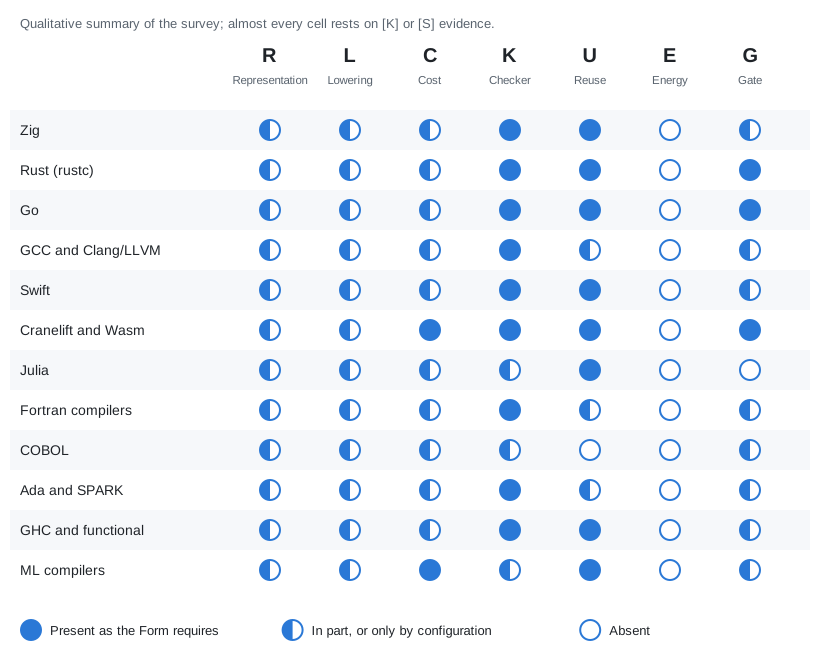
RCE Compile is a research project in the repository of the Reality Code Engine (RCE). It asks whether one statement of what compilation is, a Law of Compilation, holds for any compiler, independent of RCE. Checked against twelve families of production compilers, the candidate fails as a description: no compiler hashes a name-free representation, lowering in shipping compilers is neither total nor proved to preserve meaning, and no compiler accounts for energy. It holds as a normative framework: a normal form with two bounds and a measured distance from them, against which every compiler can be placed.
What the study claims and what it does not
- It claims that the candidate, as first stated, is falsified as a description of real compilers, and gives the evidence part by part.
- It states a refined standard with seven parts, four equivalence levels and a gate that names what it preserves, and seven hypotheses with falsifiers.
- It does not claim a measured energy result, a measured 98/2 split, or priority over earlier work: two primary sources (Hoare, He and Sampaio, 1993; Ershov, 1977) have not yet been read in full, and almost every external source was seen only as a search result.