Research paper · about
RCE-JEPA: Autonomous Deterministic Coding using Latent Space
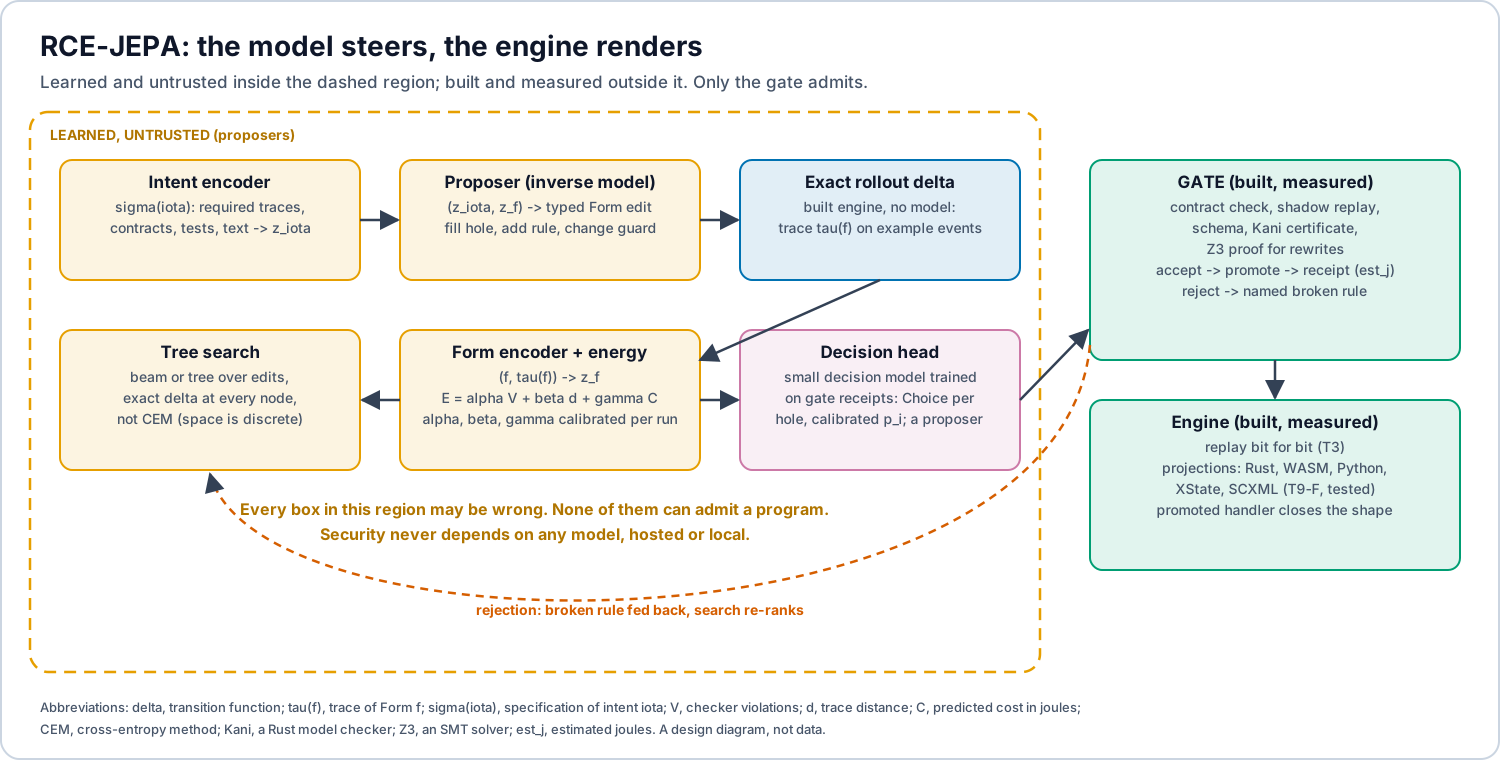
RCE is the Reality Code Engine, a deterministic programming system in which every program has one fixed, checkable shape. JEPA is a Joint Embedding Predictive Architecture, a kind of learned model that predicts a compact summary of the answer instead of writing the answer out word by word. Latent space is the space of those learned summaries: a list of numbers that keeps what matters about a program and drops surface detail. This topic asks whether software can be written autonomously by having a learned model propose programs in that closed, deterministic shape while a deterministic checker, not the model, decides what is accepted, with the best performance per clock cycle and per joule as the goal. Its thesis is that coding today resembles mechanics before Newton, rich in observation and craft but without rules that predict behaviour and cost in advance, and that a finite, deterministic, compressed program form makes such rules possible to state and test.
What it claims and what it does not
- It states a thesis, thirteen hypotheses (H1 to H13), five falsifiers (RJ-F1 to RJ-F5) and a programme of work in phases 0 to 5, with the Phase 0 results that need no learned proposer: the Form corpus, the name-free Form space, the determinism streams and the adversarial Forms.
- It reports no result for a learned proposer: no model has been trained and no hypothesis that needs one has been tested.
- The model only proposes and the checker decides; nothing on the page depends on a model being right.