Metered Commit Gates: Energy-to-Correct-Completion for Agentic Systems
A gate that lets an agent act only after a check passes, a cascade that tries the cheapest method first, and the energy measurements of both, labeled by how each was obtained.
David Charlot, Open Interface Engineering
Research studies, not journal finals. Notation is defined in the paper. Analytical energy estimates are not board power. Interactive figures live under /living/. Shared terms: glossary.
Cite this
Genre: Research paper · systems
David Charlot, Open Interface Engineering. Metered Commit Gates: Energy-to-Correct-Completion for Agentic Systems. Open Interface Engineering. Web: https://research.openie.dev/papers/gates/. PDF: https://research.openie.dev/pdfs/gates.pdf.
Metered Commit Gates: Energy-to-Correct-Completion for Agentic Systems
Version 1.2, 11 October 2026. Data and code: research.openie.dev/data/. LaTeX PDF: /pdfs/latex/gates.pdf (source).
0. Overview
This paper defines a gate that lets a machine act only after a check passes, and a rule that tries the cheapest method first. It reports software results and one board-level energy measurement, each labeled by how it was obtained.
In plain words
- A computer should not take an action that cannot be undone until a simple check says it is safe.
- It should try the cheapest way to finish a job first and use a big AI model only if nothing cheaper works.
- Every decision is written down with the energy it used, so anyone can check it later.
This paper has two parts that share one rule: correctness is the gate, and joules are the ranking. Part I is the commit gate. A proposal may not authorize itself. An irreversible act runs only behind a certificate, and every decision, commit or refuse, is written to a receipt. Part II is Mixture of Limits: a task needs a minimal expected energy to close, and energy spent after the task is complete buys no verified progress. Its standard instance is a cascade that tries the cheapest gear first: Lookup, then Formula, then Solver, then Model. The cascade stops as soon as the task completion predicate holds, and it refuses with a receipt when the next gear would break the budget. Among systems that complete the task correctly, the one that needs fewer joules ranks higher.
One board measurement anchors the gate fabric. On an AMD Kria KV260, the onboard INA260 read SOM-level A/B/A differences of 11,428 pJ per gate cycle (standard error 129 pJ, N = 4) for the WCA gate fabric, and 98.0 pJ per seed cycle (standard error 30.8 pJ, N = 4) for the seed fabric. The INA260 sits on VCC_SOM, which feeds the processing system, the programmable logic, DDR memory and the module regulators (KV260 device tree, ina260@40), so these are whole-module differences, not a core-rail or PL-only figure (Section I.3.7). The seed-fabric difference is about 1 mW at 5 V, near the part’s 1.25 mA current resolution, and is reported as inconclusive until a PL-rail meter and at least 10 passes are run.
0.1 Contributions
- A commit envelope: proposal, then certificate, then commit or refuse, then receipt. The certificate is conjunctive: look-up allow AND an energy predicate, optionally AND a control barrier function. Refusal reasons are typed. A Rust software reference implementation, Wise Computer Automation (WCA), runs it (Part I).
- A typed provenance invariant. Output labeled
ModelGeneratedcan never be promoted toDeterministic(Parts I and II). - A cascade with named refusals, and the condition under which cheapest first is optimal in expected joules, which follows from Simon and Kadane’s ordering result for sequential search: try gears in decreasing order of , where is the probability that gear closes the task and its expected energy in joules (Simon and Kadane, 1975) (Part II).
- Energy to correct completion as the ranking, defined in Section 0.2.
- Receipts as an instrument. Each receipt holds the prediction hash and its timestamp before the act, the outcome, the match, the joules by tier (measured, reported, estimated, never summed) and the refusal reason.
0.2 Energy to correct completion
Let be the task completion predicate, with any deadline written into it. For a system with policies and an allowed failure rate ,
Correctness and deadlines are constraints. Among systems that pass the gate, joules alone order them. Ordering systems by the real number is a total preorder, since any two reals compare. If each reading carries meter error at most joules, two systems whose differ by more than keep their order. MLPerf Power gates every power result behind an accuracy target. has the same form.
0.3 How to read this paper
Sections in Part I are numbered I.n and sections in Part II are numbered II.n. Each part has its own reference list. Two figures carry the main ideas: Figure 1 (Section I.1) draws the commit gate, and Figure 2 (Section II.1) draws the floor and the plateau of Mixture of Limits. Prices and demand are not argued here.
Part I. The commit gate
I. Abstract
Agents propose actions. Irreversible work begins only when an action is allowed to run. This paper treats that permission step as a formal object. Linus Lee’s notational intelligence is the observation that a change in symbols can make some thoughts cheap and others expressible. The claim here is narrower. For machines that can move matter or call an irreversible tool, the useful notation is a runtime law: a proposal may not authorize itself. The software reference, Wise Computer Automation (WCA), records the law as four objects under schema wca.commit.v1: a proposal, a certificate, a typed refuse reason, and a commit decision. The certificate used in the reference is conjunctive. A look-up table (LUT) allow bit must hold, and an energy predicate must hold. An optional control barrier function (CBF) may be added. Read-only calls may bypass the gate. Irreversible calls may not.
Energy numbers in this paper are products of operation counts and analytical energy constants (an OpCounter model). They are not board power. Field-programmable gate array (FPGA) behavior has three classes here. Icarus Verilog simulation checks the emitted register-transfer logic. An Alchitry Pt V2 runs the closed-loop gate and agrees with the software on every decision. It has no meter, so its energy is unmetered. An AMD Kria KV260 runs the gate fabric under its onboard INA260 power monitor. Halting and running the same bitstream, interleaved A/B/A, gives a board-level metered difference of 11,428 pJ per gate cycle (standard error 129 pJ, N = 4) for eight parallel evaluations of LUT allow, energy predicate and barrier at 25 MHz. The smaller seed fabric gives 98.0 pJ per seed cycle (standard error 30.8 pJ, N = 4). These are measured_j at board level. They are not core-rail readings and not a closed-loop plant joule cost (Section I.3.7). Stage B is available as a browser instrument at https://research.openie.dev/living/fpga-sim/. It compiles the same Rust gate to WebAssembly (WASM) and shows LUT state and commit traces through the WebGPU API. That instrument is an emulation. It is not a device-under-test (DUT) measurement and it is not Alchitry board power.
The measured software results are bounded. On a 16-step pendulum episode with seed 1, the reference commits 1 step and refuses 15. The analytical episode energy is 8.6795e-10 joule. On the reported Safe fixed-point port-Hamiltonian check, false allows against the continuous energy oracle Vdot <= epsilon are 0 on the stated grids, and the price is 79 false refuses in 209,261 decisions (Section I.4.3). That is the safety and liveness pair on that test set (Section I.4.10). A Model Context Protocol (MCP) demo refuses an irreversible tool call without invoking the executor. A toy comparison with an energy-set barrier and a discrete shield shows disagreement across safety definitions. None of these results is a claim of silicon energy leadership, of industrial control performance, or of a core-rail measurement.
I. Notation
Terms are defined at first scientific use below and collected here so later sections can use the short form.
| Term | Definition in this paper |
|---|---|
| Notational intelligence | Lee’s claim that better notations can raise what a person or system can reliably do, beyond adding tools alone. |
| Commit gate | A runtime rule that either applies a proposed action or refuses it. The proposer does not get a second, informal channel. |
| Wise Computer Automation (WCA) | The software reference that implements the commit gate at the boundary between a proposal and an irreversible effect. |
| Energy-First Architecture (EFA) | The design choice to put an energy predicate inside the permission record, not only in a later report. |
| Proposal | A candidate action u, state, and optional analytical energy hints. It cannot commit. |
| Certificate | The gate record: LUT allow, energy predicate, optional CBF predicate, reasons, and metrics. |
| Refuse reason | A typed code such as lut_veto, energy_veto, cbf_veto, budget_exceeded, or policy. |
| Commit decision | The envelope that sets plant action to u or to zero. |
| Look-up table (LUT) | A discrete map from a compact code to allow or refuse. |
| Ternary look-up matrix multiplier (TLMM) | The reference’s cheap ternary table-lookup proposal path. |
| Control barrier function (CBF) | A certificate of set invariance when its inequality holds (Ames et al., 2019). |
| Model Context Protocol (MCP) | A tool-call transport. In this paper it is an adapter under test, not a plant certificate. |
| System One | Typed decision procedures (Laya / Jev class) that choose among known options in software. They are proposers. |
| Port-Hamiltonian | A structured energy model used here for a passivity-style check on toy plants. |
| Runtime verification (RV) | Checking a property on an executing trace. Related, not identical, to the commit record. |
| Device under test (DUT) | Hardware measured under a stated workload with a stated meter. The KV260 runs of Section I.3.7 are the only DUT measurements in this paper. |
| Field-programmable gate array (FPGA) | Reconfigurable logic. This paper reports Verilog simulation, a programmed Alchitry Pt V2 with unmetered energy, and board-level KV260 meter readings (Section I.3.7). |
| WebAssembly (WASM) | A portable compilation target for the browser. The Stage B WASM FPGA emulator is shipped at https://research.openie.dev/living/fpga-sim/. |
| WebGPU | The browser GPU API named as the display and grid-evaluation path for that emulator. |
| Alchitry Pt V2 | Vendor documentation identifies a Xilinx Artix-7 XC7A100T. FPGA programmed (SRAM-loaded) with the closed-loop commit gate; energy unmetered (Section I.3.7). |
| DiffLogic | Differentiable logic gate networks trained toward Boolean structure (Petersen et al., 2022). |
| Analytical energy estimate | J = sum_op count_op * E_op with named constants. Not board power. |
| Modeled | A quantity obtained from a stated formula or fitted structure. |
| Simulated | A quantity obtained by executing the software or Verilog model. |
| Board-measured | A quantity from a meter on a stated device and workload. Only the KV260 readings of NI-9 are in this class. |
| Oracle-safe | Agreement with the continuous energy oracle Vdot <= epsilon on the stated plant. |
| Check-safe | The discrete Safe fixed-point / Q16.16 residual that approximates that oracle in the gate. |
| Set-safe | Set-invariance under a barrier or shield predicate (for example an energy-set CBF), which can disagree with oracle-safe. |
I. Terms used here
This paper already distinguishes three safety predicates. Oracle-safe means the continuous Vdot <= epsilon oracle. Check-safe means the discrete Safe Q16.16 residual that tracks that oracle in the gate. Set-safe means set-invariance under a barrier or shield. NI-4 shows check-safe and set-safe can disagree. The software reference is the Rust implementation that produces every simulated result here. Evidence classes are defined in the Notation table: modeled, simulated, board-measured. The page flag board_metered is true because of the KV260 readings alone.
Analytical constants. E_LUT_READ = 1e-12 J and the other OpCounter constants in Section I.3.4 are engineering stand-ins for relative comparison inside this model. They are not calibrated board measurements. Do not read them as silicon joules. The zero-false-allows counts against the named oracle stay as reported.
Living figures. Commit stack: /living/ni/#ni-diag-02. Seed-1 runner: /living/ni/#ni-run-01. Safe false-allow=0: /living/ni/#ni-run-02. Stage B simulator: /living/fpga-sim/.
Scope of Part I. Section I.2 places the commit record against notation research, information theory, scaling results, LUT networks, control certificates, and runtime enforcement. Section I.3 defines the objects, the plants, the analytical energy model, the browser instrument, and the boards. Section I.4 reports only quantities produced by the software reference, by the boards, or by a cited external source. Section I.5 answers objections that have published form. Section I.6 states what would falsify the claims and what was not measured.
I.1. Introduction
A language model can rank actions. Ranking is not permission. The failure mode that matters for a plant, a shell, a payment, or a destructive laboratory step is a commit: the action runs. Soft scores remain useful upstream. They are the wrong type at the irreversible branch, because a probability does not name which predicate failed, and it does not force the actuator command to zero.
Lee (2022) states a prior claim cleanly. Notation is not decoration. A notation that makes an operation executable changes which errors can be written down and which can be hidden. Iverson (1980) made the same point for array languages: notation is a tool of thought. Engelbart (1962) treated language, artifacts, methods, and training as one system. Kay (1972) and Victor (2013; 2012 talk) argued that representations should keep consequences near the idea being edited. Matuschak and Nielsen asked why tools for thought stall as products. That literature is about cognition and media. It does not, by itself, specify a record that a machine must obey before it moves.
The industrial center of recent artificial intelligence is scale. Kaplan et al. (2020) and Hoffmann et al. (2022) report loss scaling with parameters, data, and compute. Hooker (2021) argues that ideas spread when they fit available hardware and kernels. Those results describe how the capability of a proposer grows with the resources spent on it. They do not define a commit predicate.
This paper’s contribution is a software reference for that predicate, plus a report of what the reference actually does on toy plants. The contribution is compositional. Boolean LUT shields, energy certificates, ternary table lookup, and tool transports each exist in prior work. The reference wires them as one auditable decision: proposal, then certificate, then typed refuse or commit. The claim is the existence and behavior of this reference, not priority.
Three measurement statements constrain every later number. First, joules computed by the OpCounter are analytical estimates. Second, Verilog results are simulation. Third, the only board joules are the KV260 board-level differences of Section I.3.7, filed as measured_j with the meter named. The board-result flag is true for those KV260 runs alone. The Pt V2 stays unmetered. A reader should be able to tell modeled, simulated, and board-measured apart from the method clause attached to the number.
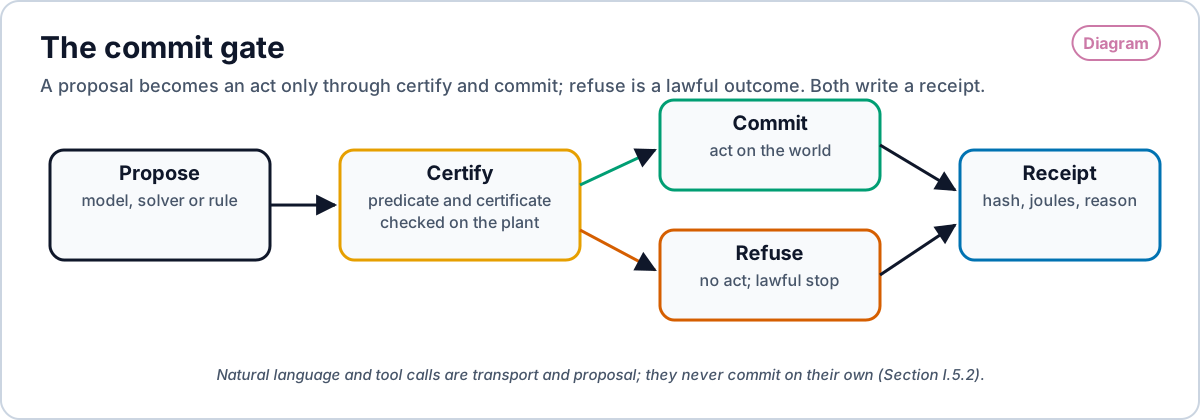
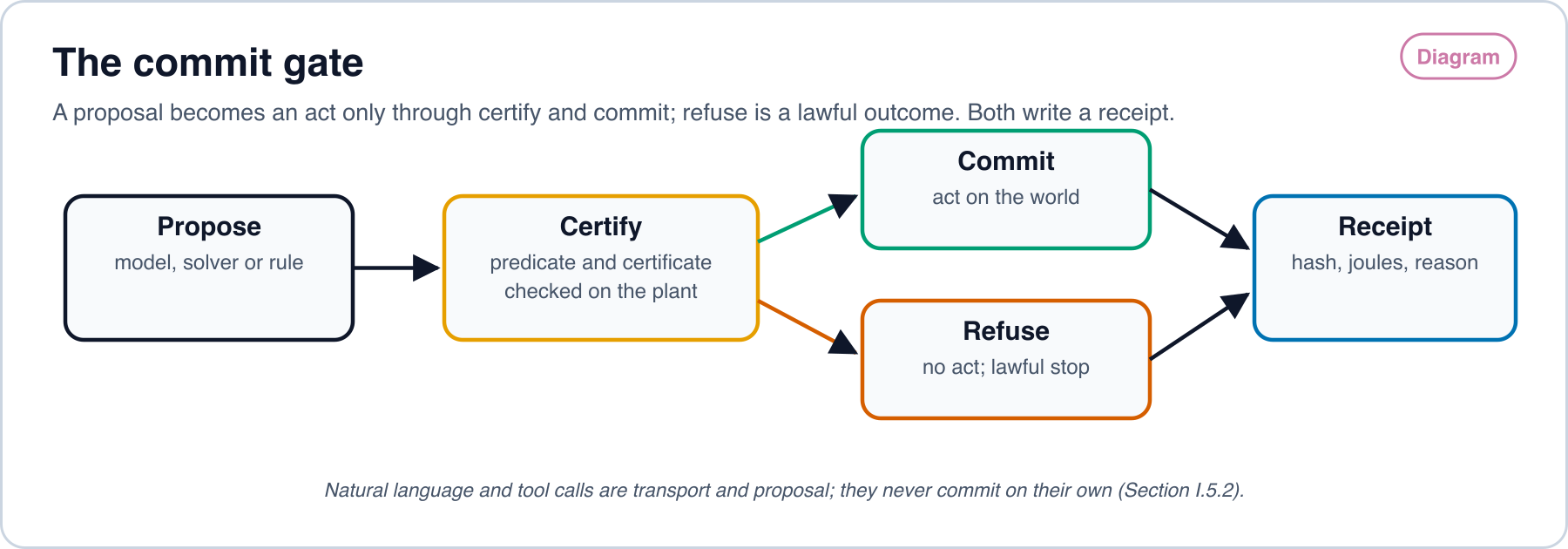
Figure 1 draws the commit gate.
I.2. Related work
I.2.1 Notation and tools for thought
Lee (2022) argues that inventing notations can matter more than inventing additional automated tools, because a notation changes the thoughts that are cheap. The interview record with The Gradient is consistent with that essay and is not an independent empirical result. Iverson (1980), Turing Award lecture, is the classical computer-science statement: notation is a tool of thought, and executability is part of the test. Engelbart (1962) locates intelligence in a human plus artifact system, not in a bare brain. Kay (1972) specifies a personal dynamic medium. Victor’s “Media for Thinking the Unthinkable” and “Inventing on Principle” argue that creators need representations whose consequences are visible while the idea is still being formed. Matuschak and Nielsen, “How can we develop transformative tools for thought?”, document adoption and institutional failure modes of such tools.
This paper uses that lineage for one limited inference. If a notation is executable, some failures become ordinary data rather than unrepresented accidents. A typed refuse reason is an instance. It does not support the strong Sapir-Whorf claim that language determines thought. The strong claim is rejected in Section I.5. The weak claim, which is Iverson’s, is that an executable notation changes the cost of operations and the representability of errors.
Chollet (2019) defines intelligence as skill-acquisition efficiency and grounds the definition in algorithmic information theory. That definition is about learning new skills, not about commit.
I.2.2 Information, description length, and physical cost
Shannon (1948) defines entropy and channel capacity. Shannon (1959) defines rate-distortion: how much description is required for a stated fidelity. Kolmogorov (1965) defines description length by program size. Solomonoff (1964) defines inductive inference by a mixture over programs. Chaitin (1977) develops program-size complexity. Cover and Thomas (2006) is the textbook spine. Jaynes (1957) uses maximum entropy as a rule for distributions under constraints. Brillouin (1956) connects information to physical negentropy in the Maxwell-demon line.
Cross-entropy training of a language model is an information-theoretic objective on a data distribution. Sutskever’s 2023 Simons Institute talk, which is a talk and not a paper, discusses unsupervised learning as compression. That fact does not yield a Kolmogorov certificate for a particular string, and it does not yield a commit bit. Statistical compression of a training distribution is not the same object as a runtime allow set under a plant constraint.
Landauer (1961) proves a lower bound: logically irreversible erasure dissipates at least kT ln 2 per bit in the ideal model. Bennett (1973) shows that logically reversible computation can avoid that erasure cost in the limit. Horowitz (2014) reports practical CMOS energy at picojoule scales for operations and memory movement, far above the Landauer bound, and treats energy rather than transistor count as the constraint. Mead (1990) is the neuromorphic argument for analog efficiency. Sandberg (2016) warns that a brain power near 20 watt does not bound the energy of an engineered system trained from scratch. A cortical partitioning preprint (arXiv:2102.06273) further warns against treating all of that biological power as comparable compute. This paper uses Landauer and Horowitz as bounds and practice tables. It does not claim that any model in the reference operates near kT ln 2.
I.2.3 Scale and hardware fit
Hestness et al. (2017), Kaplan et al. (2020), and Hoffmann et al. (2022) document empirical scaling of deep learning loss. Amodei and Hernandez (2018), an OpenAI blog post, describe rapid growth in training compute for landmark results. The page is a vendor essay. This paper does not depend on a specific doubling time from it. Sutton (2019) argues that general methods which use computation have beaten systems that encode the contents of human knowledge as fixed features. The essay is not an argument against every constraint. A commit predicate is a constraint on action, not a hand-built chess feature. Hooker (2021) explains why alternatives lose when the installed base of chips and libraries rewards dense matrix multiplication.
This paper ranks by joules to correct completion and separates proposal cost from permission. A price is not a term in either.
I.2.4 LUT networks, ternary lookup, and differentiable logic
Umuroglu et al. (2020) map sparse low-bit networks to FPGA truth tables (LogicNets). Petersen et al. (2022) train networks of logic gates with differentiable relaxations (DiffLogic). Bacellar et al. (2024) train weightless networks of LUTs (differentiable weightless neural networks). Ma et al. (2024) study ternary-weight language models (BitNet b1.58). Wei et al. (2024) implement low-bit matrix multiplication by table lookup on CPUs (T-MAC). The TeLLMe line (arXiv:2504.16266) is a ternary LUT matrix-multiplication design aimed at FPGA execution. Those systems show that tables and gates are a real compute substrate. They do not, in the papers cited, attach a port-Hamiltonian energy veto and a typed commit envelope to a tool executor.
The reference uses DiffLogic as a thin allow table on toy features, and TLMM as a proposal path. That is a different job from using a logic network as the whole classifier, which is the usual DiffLogic evaluation (vision benchmarks, large gate counts). Section I.6 records the capacity gap.
I.2.5 Certificates, shields, and runtime monitoring
Ames et al. (2019) survey control barrier functions as set-invariance certificates, typically enforced by a filter or a quadratic program. Alshiekh et al. (2018 preprint arXiv:1708.08611) introduce shields that replace unsafe actions with safe ones, minimally when possible. Dawson, Gao, and Fan (2022) survey learned Lyapunov and barrier certificates and the failure modes of treating a neural network as a certificate without a check. Manek and Kolter (2020) learn stable dynamics with a Lyapunov structure. Greydanus, Dzamba, and Yosinski (2019) learn Hamiltonian neural networks. Roth et al. (2025) study stable port-Hamiltonian neural networks. Yu, Zikelic, and Henzinger (2024) repair neural certificates using runtime monitors. Leung and Paré (arXiv:2512.24493) give Bayesian safety guarantees for port-Hamiltonian systems with learned energy functions. Their energy is the plant’s physical Hamiltonian. It is not the energy of computation. The Safe path of this reference uses energy in that same physical sense. The joules of computation are a separate account (Section I.3.4). Sanchez et al. (2018) survey runtime-verification taxonomies.
The gate is a Simplex. Sha’s Simplex architecture runs an unverified high-performance controller beside a verified safety controller, and a decision module hands control to the safety controller before the plant leaves the region it can recover from (Sha 2001). “A proposal may not authorize itself” is that rule, carried from control loops to tool calls and actuators. Runtime assurance is its name in avionics and robotics. Three older results fix the rest of the shape. Saltzer and Schroeder named complete mediation: every access is checked against authority, every time (1975). A reference monitor is the mechanism that does the checking. Gray’s two-phase commit separates prepare from commit, so no participant commits alone (1978). Necula’s proof-carrying code ships a proof that the host checks before untrusted code runs (1997). The commit record here is a reference monitor in front of irreversible effects, with a Simplex switch to refusal and a certificate the host checks, as in proof-carrying code. What the reference adds to that lineage is one conjunct and one ledger: an energy predicate inside the certificate, and joules on the same record as the decision.
The reference does not replace that mathematics. The Safe path is a conservative fixed-point test of a known energy identity on a pendulum, V = (1/2)(g theta^2 + omega^2) with Vdot = omega * u. The CBF used in the toy bake-off is an energy-set inequality on the same V, not a claim to have solved the Ames quadratic program on a manipulator. Learned Lyapunov structure on a cart-pole is a second toy, reported in Section I.4, and is not a region-of-attraction theorem for arbitrary plants.
I.2.6 World models, typed decisions, and tool transport
Ha and Schmidhuber (2018) and Hafner et al. (DreamerV3, arXiv:2301.04104) show that learned models can propose actions from imagined trajectories. LeCun’s JEPA essays (Meta research blog) argue for predictive world models. LeCun et al. (2006) is the earlier energy-based learning tutorial. Prediction error is not identically zero in these systems. A predictor can sit upstream of a gate. It cannot replace the gate unless its predictions are perfect and the plant model is the plant. This paper does not compete with those systems on prediction benchmarks.
System One models return a typed answer and a probability for each allowed option in one forward pass, with no free-form text. TypeSafe AI named the category with its hosted Jev model (15 September 2026). Open models followed, among them Laya from Convai Innovations, an encoder with decision heads. They collapse generation cost when the option set is typed and known. Anthropic’s Model Context Protocol announcement specifies discovery and transport for tools. Transport delivers a call. It does not evaluate Vdot. In the reference’s MCP adapter, irreversible tools require a certificate before the executor runs. That is an engineering claim about this adapter, tested by the demo in Section I.4, not a claim about every MCP server in production.
I.2.7 What the composition adds
Shields refuse unsafe actions but are not, in the cited papers, exported as the reference’s four-field commit record with an analytical joule account. DiffLogic and LUT networks compute functions. They are not, in those papers, a veto in front of a separate proposer and a tool executor. Energy-aware barrier filters are continuous. The reference’s allow bit is a table. The compositional claim is the wiring: LUT allow and energy predicate and optional barrier, recorded with a typed reason, applied before an irreversible effect, with analytical energy kept distinct from board power. Section I.4 states which parts of that wiring were executed.
I.2.8 Certify / commit peers (2025 to 2026)
Several recent systems enforce a decision before an irreversible tool runs.
Shi et al., Progent (arXiv:2504.11703), check every tool call against symbolic least-privilege rules and use an SMT solver so privilege can only narrow without approval (monotonic confinement). Chen, Kang, and Li, ShieldAgent (ICML 2025; proceedings.mlr.press/v267/chen25ae.html), enforce verifiable safety-policy circuits over agent action trajectories before shielding. Yu, Žikelić, and Henzinger (AAAI 2025; doi:10.1609/aaai.v39i25.34840) repair neural certificates via runtime monitoring. A companion line verifies ReLU control-barrier certificates online over a lookahead region (arXiv:2507.11987).
What Part I adds. Those peers are policy, shield, or certificate-repair objects. This reference ships a four-field commit envelope (proposal → certificate → commit|refuse → receipt) with a conjunctive LUT allow bit and an energy predicate, typed refuse reasons, and analytical joules kept distinct from board power. Transport (MCP) remains proposal. Board joules exist only for the KV260 runs in Section I.3.7, at board level.
I.2.9 Runtime enforcement
The gate is a security automaton. Schneider showed that execution monitors enforce exactly the safety properties Schneider 2000, and Ligatti, Bauer and Walker extended the monitor to edit automata that suppress or insert actions Ligatti et al. 2005. Falcone set out when to enforce rather than verify Falcone 2010, and Bauer, Leucker and Schallhart gave runtime verdicts three values Bauer et al. 2011, which map onto allow, refuse and settle_refuse. What this paper adds to that line is the energy predicate in the certificate and the receipt. Agent guards of 2024 to 2026 have the same shape, a check between a proposed tool call and its effect: GuardAgent arXiv:2406.09187 and AgentSpec arXiv:2503.18666. PolicyGuide argues that a check on each action cannot steer a multi-step workflow arXiv:2608.19861; that is why Part II puts the stop on the task predicate rather than on the single act. Multi-step irreversible work also needs compensation, which sagas supply Garcia-Molina and Salem 1987, and “a proposal may not authorize itself” is the reference-monitor principle that capability kernels such as seL4 enforce by proof Klein et al. 2009. The 0-false-allow scan of Section I.4 is a test over a grid, not a proof; Section I.6 states that limit, and it applies to every summary of the result.
I.2.10 Reference points for the board figure
An FPGA implementation of a function is expected to cost more energy than an ASIC; Kuon and Rose measured the dynamic power gap Kuon and Rose 2007, and Horowitz gives the CMOS energy per operation that frames such figures Horowitz 2014. A vendor power estimate for the same bitstream beside the SOM reading is part of the PL-rail protocol.
I.3. Definitions and methods
I.3.1 Objects
Fix a state x and a candidate action u in a set U. A proposal is a tuple
Proposal = (u, x, hints)hints may include analytical energy quantities. A proposal has no interpretation as permission.
A certificate is a tuple
Certificate = (lut_allow, energy_ok, cbf_ok, reasons, metrics)lut_allow and energy_ok are Booleans. cbf_ok is a Boolean when the selected compose mode requires it, and is absent otherwise. reasons is a list of refuse reasons. metrics includes the analytical energy account and the board-result flag.
Compose modes in the schema README are:
lut_and_energy        : commit <=> lut_allow AND energy_ok
lut_and_safe          : commit <=> lut_allow AND safe_energy_ok
lut_and_safe_and_cbf  : commit <=> lut_allow AND safe_energy_ok AND cbf_ok
Ablations energy_only and lut_only exist so a comparison can remove one conjunct. They are not the default for irreversible tools.
A commit decision is
if commit then plant_action = u else plant_action = 0with the certificate attached. The executor for an irreversible tool is called only in the first branch.
Worked record. File artifacts/schemas/wca.commit.v1/examples/commit_decision_refuse.json stores a refuse in which lut_allow is true and energy_ok is false. The reason code is energy_veto. The fixed-point detail string is Vdot_q=1461 > eps_q=13. plant_action is [0.0]. The record sets the board-result flag to false. One true conjunct does not commit.
I.3.2 Plants and oracles
The primary plant is a pendulum. Continuous reference quantities used by the Safe check are g = 9.81, epsilon = 0.05, V = (1/2)(g theta^2 + omega^2), and Vdot = omega * u. energy_ok in the continuous oracle means Vdot <= epsilon.
The legacy discrete check is a Q8.8 fixed-point approximation, bit-matched to the Verilog module wca_ph_energy.v in simulation. The Safe check (SafeFixedPointPHCertificate) uses Q16.16 and an exact integer residual. The reported predicate is
energy_ok <=> 4*omega_q*u_q + 2*(abs(omega_q)+abs(u_q)) + 1
              <= floor(4*epsilon*S^2)
with the rounding argument given in artifacts/RESULTS.md: under round-to-nearest with error at most half a least significant bit, Vdot is bounded by (prod + (1/2) abs + 1/4) / S^2. The design goal is one-sided. If the Safe predicate allows, the continuous oracle allows. The converse is not required. Extra refuses are a measured cost, not a contradiction of the safety direction.
A second plant, cart-pole, is used only in the learned-Lyapunov simulation. State is [x, xdot, theta, thetadot], with g = 9.81, cart mass 1.0, pole mass 0.1, length 0.5. V is a quadratic form xi^T P xi / 2 with P positive definite by a Cholesky construction plus a multiple of the identity. The fit is stochastic gradient on a hinge of Vdot + alpha V under a linear policy, seed 42, 400 iterations, batch 32, alpha = 0.15, as recorded in RESULTS.md. The continuous gate is Vdot <= 0.05. The Safe discrete rule adds a Lipschitz margin times half a least significant bit. This is a simulation of one fitted quadratic on one box. It is not a proof for other plants.
I.3.3 LUT allow and proposal path
The allow LUT in the reported episodes is a DiffLogic export with mask 21887 on four features: absolute theta, absolute omega, absolute u, and an energy bit, unless a section says otherwise. TLMM is a grouped ternary table lookup used as a proposer. Iso-correctness means agreement with a naive ternary matrix product within absolute tolerance 1e-12, which RESULTS.md records as measured in software. Scale behavior is whatever wca-tlmm-scale writes under a stated analytical forward budget. The default budget discussed in results is 2e-10 joule per forward, analytical, not electrical.
I.3.4 Analytical energy model
RESULTS.md separates two facts. Operation counts are exact in the OpCounter. Joules are the counts times constants:
| Constant | Value (joule) | Role |
|---|---|---|
E_LUT_READ | 1e-12 | LUT read |
E_BRAM_WORD | 1e-11 | BRAM word |
E_BITMASK_OP | 5e-14 | bitmask operation |
E_ADD | 5e-13 | add |
E_PACK | 2e-13 | pack |
E_COMMIT_BASE | 2e-11 | commit overhead |
E_REFUSE_OVERHEAD | 5e-12 | refuse overhead |
J = sum count_op * E_op. These constants are engineering stand-ins, not measurements. Structure counters such as shared BRAM hits are reported and are not charged unless they change a counted read. Changing a constant rescales every analytical joule in lockstep. That is why the numbers cannot be compared to a vendor’s tokens per joule, to MLPerf Tiny energy, or to a rail measurement. They can be compared across modes inside the same model.
Utility in the internal tables is commit count. Commit count is not a task reward. A policy that commits more can score higher utility per joule while violating the energy oracle. Section I.4 therefore does not treat utility per joule as a safety metric.
I.3.5 Tool adapter
wca-mcp-gate classifies tools. Read-only tools may execute without a commit record. Unknown tools are treated as irreversible. Irreversible tools require a certificate under the configured compose mode, default lut_and_safe_and_cbf in artifacts/mcp_gate_demo.json. On refuse, executed is false and executor_calls is 0. The demo executor records calls and does not perform host input or output. The method string in the demo file is rust_mcp_commit_gate_v1.
I.3.6 Simulation of Verilog
The repository emits Verilog and memory images for the allow LUT and the commit gate (artifacts/fpga/). wca-rtl-verify and Icarus Verilog check bit-exact behavior of those models against the software oracle. Icarus executes a simulation. It does not place, route, or measure a chip. Vivado reports enter only for the KV260 runs of Section I.3.7, as utilization and timing closure. Vivado power estimates are not results.
I.3.7 Browser instrument and boards
The completeness path for replication has three stages. Stages A and B exist. Stage C has two boards: one for decision agreement and one for joules.
Stage A, present. Rust binaries in wca-commit run the episode, the Safe check, the tool demo, and the analytical joule account. Icarus simulates emitted Verilog on a workstation.
Stage B, shipped. The pure decision core (proposal in, certificate out, plant step, analytical joule update) compiles to wasm32 (crates/wca-fpga-sim). A static page at https://research.openie.dev/living/fpga-sim/ loads the module. WebGPU holds the LUT words and a trace buffer of (step, lut_allow, energy_ok, cbf_ok, decision) for display. WebGPU timestamps are not joules. On seed-1 (16 steps, theta 1.5, omega 3.0) the WASM episode reports committed 1, refused 15, analytical joule 8.6795e-10, matching Stage A. The WASM module is an emulation of the same functions the Rust crate runs. It is not a cycle-accurate model of an Artix-7, not a switching-activity power model, and not a substitute for Icarus on the Verilog. Stage B does not claim an Alchitry Pt V2 DUT.
Stage C, board programmed, energy unmetered. An Alchitry Pt V2 was detected and loaded (SRAM) with a closed-loop WCA commit-gate bitstream: on-fabric seed-1 pendulum plant dynamics, TLMM proposal, allow LUT, Safe Q16.16 port-Hamiltonian residual, and Ames-style energy-set control barrier function (CBF) residual. Fabric commit is lut_allow ∧ energy_ok ∧ cbf_ok. UART at 115200 8N1 agreed with the software composite golden on allow/refuse/commit (1 commit, 15 refuses, sole commit at step 6). On that seed-1 closed-loop episode the CBF conjunct did not change the allow/refuse trace versus LUT and Safe PH alone (the sole PH commit has u=0, so the CBF Lie check holds). Closed-loop here means plant state evolves from gate commits and refuses on the fabric; it is not a streamed stimulus ROM of plant/proposal state. The Pt V2 has no onboard joule meter. No USB inline meter or shunt was attached. Vivado / post-PAR power estimates are not DUT readings. SparkFun’s product page names FPGA XC7A100T-2FGG84I and lists 101,440 logic cells, 240 DSP48E1 slices, 4,860 Kb of block RAM, and 256 MB of DDR3L (https://www.sparkfun.com/alchitry-pt-v2.html); those remain vendor specifications. Builder metering methods: /living/fpga-sim/alchitry/#energy.
Stage C, board metered. An AMD Kria KV260 carries an onboard INA260 power monitor (ina260_u14). Three rungs ran on 30 September 2026, each as interleaved A/B/A passes with N = 4, settle 15 s and sampling 25 s at about 4 Hz. Rung 1 compares a free-running seed fabric (439 LUTs) to the board’s baseline bitstream. It gives watts only, with no operation count, so it gives no joules per operation. Rung 2 halts and runs one seed bitstream (975 LUTs) at about 100 MHz under an on-device operation counter. The difference is +0.0098 W (standard error 0.0031 W), which is 98.0 pJ per seed cycle (standard error 30.8 pJ). Rung 3 halts and runs the gate bitstream: eight lanes, each the conjunction of the allow LUT, the Safe Q16.16 energy residual and the barrier residual, in 6,370 LUTs and 128 DSP slices, timing closed at 25 MHz. The difference is +0.2857 W (standard error 0.0032 W). At 2.4999 × 10⁷ gate cycles per second that is 11,428 pJ per gate cycle (standard error 129 pJ), about 1.43 nJ per lane decision. The A2 minus A1 drift was +0.0047 W (standard error 0.0040 W). The bitstream hashes and logs are in the wca-kv260-meter artifact of the reference.
What the meter can and cannot see. The INA260 specifies a maximum offset of 5 mA and a maximum system gain error of 0.15%, with a current step of 1.25 mA (TI INA260 datasheet). The offset is common to A and B on the same board and rail, so the halt-versus-run difference cancels it. Gain error scales the difference by at most 0.15%. The meter senses board power, so the difference includes clock tree and routing switched by the enable, not the gate logic alone. Rung 2’s difference is about three standard errors from zero. Rung 3’s is about ninety. The next protocol is fixed: read the core rail (VCCINT) through the module’s regulator telemetry or a source-measure unit; at least 30 randomized interleaved A/B pairs; at least 10⁹ gate evaluations per block; die temperature logged with an idle baseline before each block; gross and subtracted values both reported; the Vivado power estimate reported beside the reading with the discrepancy. Rung 3 is not a closed-loop plant joule cost, and the analytical constants of Section I.3.4 are not calibrated by it.
The scientific reason for stage B is replication and inspection, not a new physical claim. A reader with a browser steps the same seed-1 episode and reads the same allow bit and reason codes that the crate prints. Agreement with stage A is the acceptance test for stage B, and it passes on seed 1. Agreement of decisions is the acceptance test for the Pt V2, and it passes on seed 1. A meter reading on a stated workload is the acceptance test for the KV260, and rungs 2 and 3 meet it at board level.
I.3.8 What is not a method of this paper
No human-subject study. No claim about linguistic relativity beyond the rejection in Section I.5. No training-compute extrapolation. No identification of economic satiation. No optimization against Groq, Etched, or Taalas throughput. No world-model benchmark.
I.4. Results
All quantities in this section are simulated in the software reference unless a sentence cites an external paper. Analytical joules use Section I.3.4. Only NI-9 is board-measured.
I.4.1 Claim NI-1. The commit record exists as a schema and a Rust type
Schemas Proposal, Certificate, RefuseReason, and CommitDecision are in artifacts/schemas/wca.commit.v1/. Rust types are in crates/wca-commit/src/schema.rs. Round-trip tests are cargo test -p wca-commit. This is an existence result about the reference, version wca.commit.v1. It is not a uniqueness theorem.
I.4.2 Claim NI-2. Seed-1 pendulum episode
Command, from RESULTS.md:
cargo run --release --bin wca-soc-loop -- \
  --steps 16 --init-theta 1.5 --init-omega 3.0 --seed 1
Reported outcome: committed = 1, refused = 15, analytical episode energy = 8.6795e-10 joule. The same committed and refused counts and the same analytical energy are reported for --safe-ph on that seed. RESULTS.md states that the single commit is step 6. Toolchain note in that file: Rust 1.98. Re-running the binary is the reproduction. The energy is not a measurement of a chip.
I.4.3 Claim NI-3. False allows of the Safe energy check
wca-ph-tighten compares discrete decisions to the continuous oracle Vdot <= epsilon. On a 21 cubed grid plus 200,000 near-threshold Monte Carlo samples (209,261 decisions):
| Path | False allow | False refuse | Both allow | Both refuse |
|---|---|---|---|---|
| Legacy Q8.8 | 30836 | 105 | 104711 | 73609 |
| Safe v1 (Q8.8 over-approximation) | 0 | 42430 | 62386 | 104445 |
| Safe v2 (Q16.16 residual) | 0 | 79 | 104737 | 104445 |
RESULTS.md also states that a denser 41 cubed grid plus 50,000 Monte Carlo samples, checked in cargo test, asserts false allow equal to 0. Safe v2 cuts false refuses from 42,430 to 79 relative to Safe v1 while keeping false allows at 0. Legacy Q8.8 is not safe on this definition: it records 30,836 false allows. These counts are properties of the numerical test, not of a physical pendulum.
I.4.4 Claim NI-4. Toy barrier comparison, neither definition dominates
wca-cbf-bakeoff runs seeds 0 through 4, 40 steps, time step 0.05, action scale 2.5, shared demo TLMM and DiffLogic mask 21887. The energy-set barrier uses h = 18 - V and allows when h >= 0 and omega * u <= kappa * h with kappa = 0.05. The discrete shield allows a step that stays inside absolute theta at most 2 and absolute omega at most 4. Closed-loop means differ because trajectories diverge. The file reports per-episode means for commits and sums for violation counts. Selected rows:
| Filter | Commit | Refuse | Analytical J | False allow vs PH | h < 0 | Vdot > epsilon |
|---|---|---|---|---|---|---|
lut_and_safe_ph | 1 | 38 | 2.153e-09 | 0 | 4 | 0 |
cbf_energy_set | 1 | 38 | 2.056e-09 | 3 | 0 | 3 |
shield_discrete | 18 | 21 | 2.306e-09 | 90 | 38 | 90 |
lut_only | 40 | 0 | 2.544e-09 | 194 | 220 | 194 |
On this plant and this oracle, lut_and_safe_ph has zero Vdot violations and four h < 0 events. The energy-set barrier has zero h < 0 events and three Vdot violations. The shield commits more and violates the energy oracle often. lut_only matches always_allow on violations in the reported table. Offline agreement on a shared always-allow stream of 200 steps gives 4 disagreements between lut_and_safe_ph and cbf_energy_set, and 70 against the shield.
Interpretation inside the test: passivity and set invariance are different predicates. The LUT-and-energy gate is not equivalent to an Ames filter, and it does not win every column. A full quadratic-program baseline on a richer plant is not in this table. That comparison remains open. The result that is available is the disagreement, which is evidence against collapsing the two certificates into one word.
I.4.5 Claim NI-5. Cart-pole Safe Lyapunov simulation
On the audit described in Section I.3.2 (grid n = 7 plus 20,000 boundary samples inside the Lipschitz box, 26,487 decisions), Safe learned Lyapunov versus the continuous Vdot oracle records false allow 0, false refuse 3, both allow 15,925, both refuse 10,559. Closed-loop means over five seeds: lut_and_safe_lyap commits 11, refuses 28, analytical J 2.719e-09, and records zero false allows against that oracle. The level-set barrier on the same V commits 14 and records 15 energy-oracle violations. The discrete shield commits 29 and records 95. Same pattern as the pendulum: the Safe conjunct tracks its own oracle; a different certificate tracks a different one; permissiveness without the oracle is not safety.
This is one additional simulated plant. It does not establish the commit gate on industrial dynamics.
I.4.6 Claim NI-6. MCP demo
artifacts/mcp_gate_demo.json records four cases. The board-result flag in the file is false.
| Case | Class | Executed | Executor calls | Commit |
|---|---|---|---|---|
read_only_bypass | read-only | true | (no commit record) | absent |
irreversible_refuse | irreversible | false | 0 | false |
irreversible_allow | irreversible | true | 1 | true |
shell_exec_gated | irreversible | true | (gated) | true |
The refuse case lists energy_veto (vdot 6.0 against eps 0.05) and cbf_veto. Plant action on that case is [0.0]. The allow case uses compose lut_and_safe_and_cbf and plant action [-0.02]. The note in the file states that refuse never executes. This is a demo of the adapter, not a field study of computer-use agents.
I.4.7 Claim NI-7. TLMM under an analytical budget
RESULTS.md reports a demo 2 by 4, group 2 configuration near 4.24e-11 analytical joule, under the forward budget. The largest configurations that remain under the 2e-10 forward budget stop at 64 parameters. Widths 8 by 16 and above exceed that budget even after the optimizer. Iso-correctness against naive ternary arithmetic is a software comparison at tolerance 1e-12. These statements do not say that the design matches TeLLMe throughput or any board energy.
I.4.8 Claim NI-8. DiffLogic allow versus an energy teacher, toy only
On the hard multi-seed gate benchmark in RESULTS.md, after threshold calibration and denser labels, DiffLogic matches the energy teacher on refuse rate 50.0 plus or minus 15.9 percent, precision at threshold 0.890 plus or minus 0.067, and recall 0.802 plus or minus 0.076. A bitmask reference refuses more (71.0 plus or minus 14.9 percent) and recalls less (0.454 plus or minus 0.266). Before calibration, DiffLogic refuse rate was 57.5 plus or minus 14.1 percent with recall 0.724 plus or minus 0.163. The match is on this toy labeling setup. It is not an ImageNet or control-suite result. Internal utility per joule rises for the calibrated gate (3.570e9 versus 3.212e9 before) under the analytical model. As Section I.3.4 states, that ratio uses commit count as utility.
I.4.9 Claim NI-9. Board-level joules of the gate fabric
| Rung | Fabric | Clock | Difference (W) | Operation | Joules per operation | Label |
|---|---|---|---|---|---|---|
| 1 | Seed freerun vs board baseline | n/a | −0.8212 (SE 0.0024) | none | none | measured_j, watts only |
| 2 | Seed, halt vs run | about 100 MHz | +0.0098 (SE 0.0031) | one seed cycle | 98.0 pJ (SE 30.8) | measured_j, INA260, SOM rail (VCC_SOM) |
| 3 | Gate, 8 lanes, halt vs run | 25 MHz | +0.2857 (SE 0.0032) | one gate cycle, 8 decisions | 11,428 pJ (SE 129) | measured_j, INA260, SOM rail (VCC_SOM) |
N = 4 interleaved A/B/A passes per rung. Rung 1’s negative sign means the seed bitstream draws less than the board’s baseline bitstream. It does not mean the seed is free. Section I.3.7 gives the limits of a board-level reading.
I.4.10 Safety and liveness
Zero false allows is safety. A gate that refuses everything is also safe, and useless. Liveness is the other axis: false refuses, and the share of tasks the gated agent completes. NI-3 reports both on the Safe grid. Safe v2 cuts false refuses from 42,430 to 79 at zero false allows. The seed-1 episode commits 1 step of 16, and that count alone does not say whether the plant reached its goal. The required report is a frontier per plant: task completion rate against false-allow rate, one point per compose mode of NI-4 (lut_only, shield_discrete, cbf_energy_set, lut_and_safe_ph), each point with its seeds and spread. On agent workloads the same frontier uses an attack suite for false allows and a benign task suite for completion. A gate is judged on the frontier, not on one axis.
I.4.11 What the literature search supports
A literature search in September 2026 (Sections I.2.4 to I.2.9) found no published system that composes a learned Boolean allow LUT, a port-Hamiltonian or Lyapunov energy predicate, and a ternary LUT proposal as one commit boundary with bit-exact RTL simulation and an analytical joule account. The nearest neighbors are shields, energy-aware barrier filters, logic networks as the whole model, and TLMM designs without an energy certificate. The search supports a gap statement about the literature that was searched. It does not support a priority claim over unpublished work, and it does not support an energy-leadership claim.
I.5. Discussion
I.5.1 Scale does not answer the commit question
Kaplan, Hoffmann, Hooker, and Sutton describe how loss and proposal capability scale. A larger proposer can still emit an action that fails Vdot <= epsilon. Putting that proposer behind the certificate uses scale where the evidence says scale works, and uses the predicate where scale is silent. The Bitter Lesson objects to frozen human features that block learning. It does not entail deleting a safety predicate. If a future result shows that an unconstrained policy meets the same false-allow test at lower analytical cost and equal task error, NI-3’s engineering preference for the gate would be weakened on that plant. The logical distinction between proposal and permission would remain.
I.5.2 Natural language and MCP are transport and proposal
MCP solves discovery and call shape. System One solves some decisions without free-form generation. Neither object is energy_ok. The demo in NI-6 shows a refuse that does not call the executor. A production deployment could bypass the adapter. The claim is not that the protocol makes bypass impossible. The claim is that permission has to be a separate record if irreversible effects are to be auditable.
I.5.3 Strong linguistic determinism is not the claim
The strong hypothesis that language determines thought is not a premise. The operational statement is local. In this schema, a commit without a passing certificate is not a successful record. An untyped confidence string can be stored beside a success flag and still leave the reason unstated. The enum removes that particular ambiguity. It does not describe human cognition.
I.5.4 Formalism can be wasteful; this predicate is small
Requiring a proof of the whole agent at every step would dominate the budget. The reference formalizes one boundary. Read-only calls bypass. The Safe residual is a fixed-point inequality, not a general SMT query. NI-2’s analytical episode energy is 8.6795e-10 joule under the stated constants. It cannot be stated as a fraction of a generative model’s board energy, because that comparison was not measured. A split between proposal joules and gate joules on a real agent workload is not in the results. Until it is, the cost objection is answered for this toy gate and remains open for large certificates.
I.5.5 A wrong model with a green light is a real failure
If V is not the plant’s energy, energy_ok can be true while the plant is not safe. The mitigation present in the reference is a continuous twin on the toys, a separated reason code, and a refusal to treat a probability as a certificate. The mitigation not present is disturbance Input-to-State Stability, a verified region of attraction, or a Bayesian credibility budget of the kind Leung and Paré study. NI-4 is the evidence that two respectable certificates disagree. That disagreement is a reason to name the predicate, not a reason to trust either one outside its test.
I.5.6 Prior certificate theory is not duplicated here
Ames, Alshiekh, Dawson, and the runtime-monitoring papers already define filters and monitors. NI-1’s addition is the product record and the composition with a LUT export and a tool executor in one reference. Where the toy barrier wins on set invariance, the paper says so (NI-4, NI-5). Composition is cbf_ok as another conjunct when that predicate is the one required. It is not a claim that the LUT computes the Ames quadratic program.
I.5.7 Predictors and specialized inference chips
World models reduce some prediction error and leave a residual. Specialized inference devices change the cost of proposals. Vendor throughput figures are vendor reports until an independent meter repeats them. The gate’s job is the irreversible branch. If a device’s only interface is a token stream, the commit record still has to live somewhere before actuators or irreversible tools run.
I.5.8 Analytical joules are not watts
The constants in Section I.3.4 are chosen engineering numbers. They make counts comparable inside the repo. They are not calibrated to an Artix-7 rail. Reporting them as board watts would be a false measurement report. The correct report is the one given: operation counts are computed; analytical joules are modeled; board joules come only from the KV260 meter and are filed apart. Stage B of Section I.3.7 makes the same model inspectable in a browser at https://research.openie.dev/living/fpga-sim/. It does not change the measurement class. The KV260 rungs do, for the fabric they ran.
I.6. Limits and threats to validity
Internal validity. Seed-1 is one initial condition. The Safe grid is large but still a chosen box and a chosen epsilon. Monte Carlo samples near the threshold stress the boundary the designers chose to stress. A different epsilon or a different plant identity breaks the numerical claim until re-run. The CBF in the bake-off is an energy-set inequality implemented in the same crate, not an independently coded solver from an Ames reference implementation. Disagreement is informative. Absolute ranking against the literature’s code is not established.
Construct validity. Commit count as utility does not measure task success. False allow is defined against a named oracle. A system can be oracle-safe and check-safe (zero false allows against Vdot <= epsilon) and still fail set-safe (h >= 0), which NI-4 shows. Readers who treat “safe” as one word will misread the table.
External validity. Both plants are toys. There is no manipulator, quadrotor, or human-in-the-loop trial. The MCP demo does not call a network. Verilog is simulated. The browser instrument is shipped as Stage B simulation. The Alchitry Pt V2 agrees on decisions and is unmetered. The KV260 reading is board level and open loop. Vendor logic-cell counts are not confirmed here.
Measurement validity. Analytical constants can be edited to any scale. Comparisons to Horowitz’s picojoule tables, to Landauer’s bound, or to vendor tokens per joule are not valid with these constants. The KV260 rungs are a board-level meter under a stated workload. A core-rail reading under the closed-loop episode is the missing measurement. Post-place-and-route tool power would be a third class, still not a meter, and it is not reported as a result.
Statistical reporting. Where RESULTS.md gives a mean and a standard deviation, this paper copies them. It does not add confidence intervals that were not computed. Multi-seed coverage is five seeds on the bake-offs and the hard gate benchmark’s reported spreads. That is not a large-sample claim.
Not claimed. The following are not results: silicon joule leadership; operation near the Landauer bound; brain-equivalent power; a win over System One on latency; a win over world-model benchmarks; strong linguistic determinism; identification of “intelligence” with commit count.
Falsifiers. NI-2 is false if the stated command on the stated crate revision does not print those counts. NI-3 is false if the Safe v2 test reports a false allow on the stated grid. NI-6 is false if the refuse case in the demo file executes. NI-1 is false if the schema and the runtime diverge. A stage B emulator that disagrees with stage A on seed 1 fails its own acceptance test. A future meter that assigns board energy to the analytical number without a calibration study does not confirm the analytical model.
I.7. Conclusion
The paper defined a commit decision as a conjunctive certificate over a LUT allow bit and an energy predicate, with an optional barrier, and showed a software reference that emits the decision before an irreversible effect. On the reported pendulum tests, the Safe fixed-point rule has zero false allows against its continuous oracle Vdot <= epsilon on the stated test set, at the cost of 79 false refuses in 209,261 decisions. On the reported comparisons, that oracle is not the same as set invariance. Analytical episode energy for the seed-1 run is 8.6795e-10 joule under published constants. Tool refuse in the MCP demo does not call the executor. Verilog checks are simulation. The browser WASM and WebGPU instrument is available at https://research.openie.dev/living/fpga-sim/ so that the same decision can be inspected without a board. It remains a simulation, not a DUT result. The Alchitry Pt V2 agrees with the software on every decision of seed 1 and stays unmetered. The KV260 meters the gate fabric at board level: 11,428 pJ per eight-lane gate cycle at 25 MHz. The reference is a measured software artifact and a board-metered fabric. The closed-loop chip joule is the next measurement.
I. References
Simon, H. A., and Kadane, J. B. Optimal problem-solving search: all-or-none solutions. Artificial Intelligence 6(3), 235-247, 1975. https://doi.org/10.1016/0004-3702(75)90002-8
Alshiekh, M., Bloem, R., Ehlers, R., Konighofer, B., Niekum, S., and Topcu, U. Safe reinforcement learning via shielding. arXiv:1708.08611.
Ames, A. D., Coogan, S., Egerstedt, M., Notomista, G., Sreenath, K., and Tabuada, P. Control barrier functions: theory and applications. European Control Conference, 2019. https://doi.org/10.23919/ECC.2019.8796030
Amodei, D., and Hernandez, D. AI and compute. OpenAI, 2018. https://openai.com/index/ai-and-compute/
Anthropic. Introducing the Model Context Protocol. https://www.anthropic.com/news/model-context-protocol
Bacellar, A., et al. Differentiable weightless neural networks. arXiv:2410.11112.
Bauer, A., Leucker, M., and Schallhart, C. Runtime verification for LTL and TLTL. ACM Transactions on Software Engineering and Methodology 20(4), 14, 2011. https://doi.org/10.1145/2000799.2000800
Bennett, C. H. Logical reversibility of computation. IBM Journal of Research and Development, 1973. https://doi.org/10.1147/rd.176.0525
Brillouin, L. Science and Information Theory. Academic Press, 1956.
Chaitin, G. J. Algorithmic information theory. IBM Journal of Research and Development, 1977. https://doi.org/10.1147/rd.214.0350
Chen, Z., Kang, M., and Li, B. ShieldAgent: Shielding Agents via Verifiable Safety Policy Reasoning. ICML 2025 (PMLR v267). arXiv:2503.22738. https://proceedings.mlr.press/v267/chen25ae.html
Chollet, F. On the measure of intelligence. arXiv:1911.01547.
Convai Innovations. Laya model card. https://huggingface.co/convaiinnovations/laya
Cover, T. M., and Thomas, J. A. Elements of Information Theory, 2nd ed. Wiley, 2006. https://doi.org/10.1002/047174882X
Dawson, C., Gao, S., and Fan, C. Safe control with learned certificates: a survey of neural Lyapunov, barrier, and contraction methods. arXiv:2202.11762.
Engelbart, D. C. Augmenting human intellect: a conceptual framework. 1962. https://www.dougengelbart.org/pubs/augment-3906-Framework.html
Falcone, Y. You should better enforce than verify. Runtime Verification (RV 2010), Lecture Notes in Computer Science 6418, 89-105. Springer, 2010. https://doi.org/10.1007/978-3-642-16612-9_9
Garcia-Molina, H., and Salem, K. Sagas. Proceedings of ACM SIGMOD 1987, 249-259. https://doi.org/10.1145/38713.38742
Gray, J. Notes on data base operating systems. In Operating Systems: An Advanced Course, Lecture Notes in Computer Science 60, 393-481. Springer, 1978. https://doi.org/10.1007/3-540-08755-9_9
Greydanus, S., Dzamba, M., and Yosinski, J. Hamiltonian neural networks. arXiv:1906.01563.
Ha, D., and Schmidhuber, J. World models. arXiv:1803.10122.
Hafner, D., Pasukonis, J., Ba, J., and Lillicrap, T. Mastering diverse domains through world models. arXiv:2301.04104.
Henzinger, T. A., Kueffner, K., and Yu, E. Formal verification of neural certificates done dynamically. arXiv:2507.11987. https://arxiv.org/abs/2507.11987
Hestness, J., et al. Deep learning scaling is predictable, empirically. arXiv:1712.00409.
Hoffmann, J., et al. Training compute-optimal large language models. arXiv:2203.15556.
Hooker, S. The hardware lottery. arXiv:2009.06489. Communications of the ACM, 2021. https://doi.org/10.1145/3467017
Horowitz, M. Computing’s energy problem (and what we can do about it). IEEE International Solid-State Circuits Conference, 2014. https://doi.org/10.1109/ISSCC.2014.6757323
Iverson, K. E. Notation as a tool of thought. Communications of the ACM, 1980. https://dl.acm.org/doi/10.1145/358896.358899
Jaynes, E. T. Information theory and statistical mechanics. Physical Review 106, 620, 1957. https://doi.org/10.1103/PhysRev.106.620
Kang, S., Yu, T., and Hwang, S. J. PolicyGuide: from guarding one action to guiding the whole workflow for policy-compliant LLM agents. arXiv:2608.19861. https://arxiv.org/abs/2608.19861
Kaplan, J., et al. Scaling laws for neural language models. arXiv:2001.08361.
Kay, A. A personal computer for children of all ages. 1972. https://worrydream.com/refs/Kay_1972_-_A_Personal_Computer_for_Children_of_All_Ages.pdf
Klein, G., et al. seL4: formal verification of an OS kernel. Proceedings of SOSP 2009, 207-220. https://doi.org/10.1145/1629575.1629596
Kolmogorov, A. N. Three approaches to the quantitative definition of information. 1965. English: International Journal of Computer Mathematics, 1968. https://doi.org/10.1080/00207166808803030
Kuon, I., and Rose, J. Measuring the gap between FPGAs and ASICs. IEEE Transactions on Computer-Aided Design 26(2), 203-215, 2007. https://doi.org/10.1109/TCAD.2006.884574
Landauer, R. Irreversibility and heat generation in the computing process. IBM Journal of Research and Development, 1961. https://doi.org/10.1147/rd.53.0183
Laya. System One models and typed decision engines (comparison table, checked 2 October 2026). https://laya-ai.com/system-one-models
LeCun, Y. Path towards autonomous machine intelligence / JEPA discussion. Meta AI blog. https://ai.meta.com/blog/yann-lecun-advances-in-ai-research/
LeCun, Y., Chopra, S., Hadsell, R., Ranzato, M., and Huang, F. J. A tutorial on energy-based learning. 2006. http://yann.lecun.com/exdb/publis/pdf/lecun-06.pdf
Lee, L. Notational intelligence. 2022. https://thesephist.com/posts/notation/
Leung, C. H., and Paré, P. E. Bayesian safety guarantees for port-Hamiltonian systems with learned energy functions. arXiv:2512.24493.
Levy, W. B., and Calvert, V. G. Cerebral cortical communication overshadows computational energy-use, but these combine to predict synapse number. arXiv:2102.06273.
Ligatti, J., Bauer, L., and Walker, D. Edit automata: enforcement mechanisms for run-time security policies. International Journal of Information Security 4, 2-16, 2005. https://doi.org/10.1007/s10207-004-0046-8
Ma, S., et al. The era of 1-bit LLMs: all large language models are in 1.58 bits. arXiv:2402.17764.
Manek, G., and Kolter, J. Z. Learning stable deep dynamics models. arXiv:2001.06116.
Matuschak, A., and Nielsen, M. How can we develop transformative tools for thought? https://numinous.productions/ttft/
Mead, C. Neuromorphic electronic systems. Proceedings of the IEEE, 1990. https://doi.org/10.1109/5.58356
Necula, G. C. Proof-carrying code. Proceedings of the 24th ACM SIGPLAN-SIGACT Symposium on Principles of Programming Languages (POPL ‘97), 106-119, 1997. https://doi.org/10.1145/263699.263712
Petersen, F., et al. Deep differentiable logic gate networks. arXiv:2210.08277.
Qiao, Y., Chen, Z., Zhang, Y., Wang, Y., et al. TeLLMe: an energy-efficient ternary LLM accelerator for prefilling and decoding on edge FPGAs. arXiv:2504.16266.
Roth, F., et al. Stable port-Hamiltonian neural networks. arXiv:2502.02480.
Saltzer, J. H., and Schroeder, M. D. The protection of information in computer systems. Proceedings of the IEEE 63(9), 1278-1308, 1975. https://doi.org/10.1109/PROC.1975.9939
Sanchez, C., et al. A survey of challenges for runtime verification from advanced application domains. arXiv:1811.06740.
Sandberg, A. Energetics of the brain and AI. arXiv:1602.04019.
Schneider, F. B. Enforceable security policies. ACM Transactions on Information and System Security 3(1), 30-50, 2000. https://doi.org/10.1145/353323.353382
Sha, L. Using simplicity to control complexity. IEEE Software 18(4), 20-28, 2001. https://doi.org/10.1109/MS.2001.936213
Shannon, C. E. A mathematical theory of communication. Bell System Technical Journal, 1948. https://doi.org/10.1002/j.1538-7305.1948.tb01338.x
Shannon, C. E. Coding theorems for a discrete source with a fidelity criterion. IRE National Convention Record, 1959.
Shi, T., He, J., Wang, Z., et al. Progent: Securing AI Agents with Privilege Control. arXiv:2504.11703. https://arxiv.org/abs/2504.11703
Solomonoff, R. J. A formal theory of inductive inference, parts I and II. Information and Control, 1964.
SparkFun. Alchitry Pt V2 product page. https://www.sparkfun.com/alchitry-pt-v2.html
Sutskever, I. An observation on generalization. Simons Institute talk, 2023. https://www.youtube.com/watch?v=AKMuA_TVz3A
Sutton, R. The bitter lesson. 13 March 2019. http://www.incompleteideas.net/IncIdeas/BitterLesson.html
Texas Instruments. INA260 precision digital current and power monitor, data sheet. https://www.ti.com/lit/ds/symlink/ina260.pdf
TypeSafe AI. Introducing System One Models and Jev. 15 September 2026. https://typesafe.ai/blog/introducing-system-one-models-and-jev
Umuroglu, Y., et al. LogicNets. arXiv:2004.03021.
Victor, B. Inventing on principle. 2012. https://www.youtube.com/watch?v=PUv66718DII
Victor, B. Media for thinking the unthinkable. https://worrydream.com/MediaForThinkingTheUnthinkable/
Wang, H., Poskitt, C. M., and Sun, J. AgentSpec: customizable runtime enforcement for safe and reliable LLM agents. arXiv:2503.18666. https://arxiv.org/abs/2503.18666
Wei, J., et al. T-MAC. arXiv:2407.00088.
Xiang, Z., Zheng, L., Li, Y., Hong, J., et al. GuardAgent: safeguard LLM agents by a guard agent via knowledge-enabled reasoning. arXiv:2406.09187. https://arxiv.org/abs/2406.09187
Yu, E., Žikelić, Đ., and Henzinger, T. A. Neural control and certificate repair via runtime monitoring. AAAI 2025. https://doi.org/10.1609/aaai.v39i25.34840 (arXiv:2412.12996).
Local measurement record: artifacts/RESULTS.md in the wca-lut-edge software reference. KV260 meter record: artifacts/stage-c/wca-kv260-meter/ (protocol, claim status, A/B/A logs and summaries). Schema examples: artifacts/schemas/wca.commit.v1/examples/. Demo: artifacts/mcp_gate_demo.json.
I. Appendix A. Reproducibility
Workstation path used to generate the cited logs: the wca-lut-edge tree, Rust 1.98 as recorded in RESULTS.md. Day-to-day commands:
cargo test -p wca-commit
cargo run --release --bin wca-soc-loop -- \
  --steps 16 --init-theta 1.5 --init-omega 3.0 --seed 1
cargo run --release --bin wca-soc-loop -- \
  --steps 16 --init-theta 1.5 --init-omega 3.0 --seed 1 --safe-ph
cargo run --release --bin wca-ph-tighten -- --grid 21 --out artifacts/ph_tighten_report.json
cargo run --release --bin wca-cbf-bakeoff -- --out artifacts/cbf_bakeoff_report.json
cargo run --release --bin wca-lyap-plant -- --out artifacts/lyap_plant_report.json
cargo run --release --bin wca-mcp-gate -- --demo
cargo run --release --bin wca-tlmm-scale -- --out artifacts/tlmm_scale_report.json
Icarus Verilog was version 12.0 in the environment note in RESULTS.md. RTL checks are simulation. Do not read analytical joules as board power.
The board-result flag is true for the KV260 Stage C rungs 1 to 3 only (Section I.3.7), at board level. Every other result in this paper is simulation or analytical.
I. Appendix B. Browser FPGA emulator: architecture
This appendix describes the architecture of the Stage B emulator, which runs at https://research.openie.dev/living/fpga-sim/. Seed-1 agreement numbers below are from the WASM run against the Stage A golden.
Modules.
decision_core. Pure functions already represented by the Rust certificate, plant step, and joule accumulator. No file system and no threads required. Targetwasm32-unknown-unknown.lut_image. The same memory image the Verilog path loads (artifacts/fpga/wca_allow_lut.memand successors). The browser copy must hash-match the file used for the Icarus check.trace. A fixed schema: step index, state,u,lut_allow,energy_ok,cbf_ok, reason codes, analytical joule increment, plant action. Identical field names towca.commit.v1so a dump can be diffed against the crate’s JSON.webgpu_view. Device, queue, and a storage buffer for the LUT and the trace. A shader draws allow and refuse. A second dispatch may map the Safe residual across a grid. Buffers are for inspection. They are not a power model.workstation_oracle. Icarus remains the RTL oracle. The browser does not replace it. Disagreement between WASM and the Rust binary fails the build. Disagreement between WASM and Icarus on the shared LUT image fails the build. Neither comparison mentions watts.
Acceptance tests. The seed-1 test passes (Section I.3.7). The others are the specified checks for the module.
- Seed-1, 16 steps, init theta 1.5, omega 3.0: committed 1, refused 15, analytical joule 8.6795e-10, matching NI-2.
- Safe grid smoke: false allow 0 on a published subset of the 209,261-decision test, matching NI-3’s direction.
- MCP refuse vector: executor call count 0, matching NI-6.
- A unit test that WebGPU buffer readback equals the WASM trace. If readback is unavailable, the page must show that the GPU path did not confirm the trace, and the CPU WASM trace remains the result.
Physical follow-on for board joules. Stage C already programmed a closed-loop commit-gate on the Alchitry Pt V2 with UART decision agreement; the board still has no onboard joule meter. A USB inline power meter or a shunt-plus-scope on the 5 V rail, on a stated workload, is what would support a board-measured joule. Vivado / post-PAR estimates are not that meter. Vendor logic-cell and memory figures stay vendor figures. See /living/fpga-sim/alchitry/#energy.
Out of scope for the emulator: training DiffLogic in the browser and estimating Artix-7 dynamic power from a shader.
Part II. The cascade (Mixture of Limits)
II.1. The rule
A task is given by a completeness predicate over its state . A gear is a mechanism that may close the task: Lookup (read a stored, verified value), Formula (evaluate a closed form), Solver (run a search, optimizer or settle with a certificate), or Model (run a learned generator). Gear has a pass probability , the probability that it reaches on the task class, and an expected energy in joules (J).
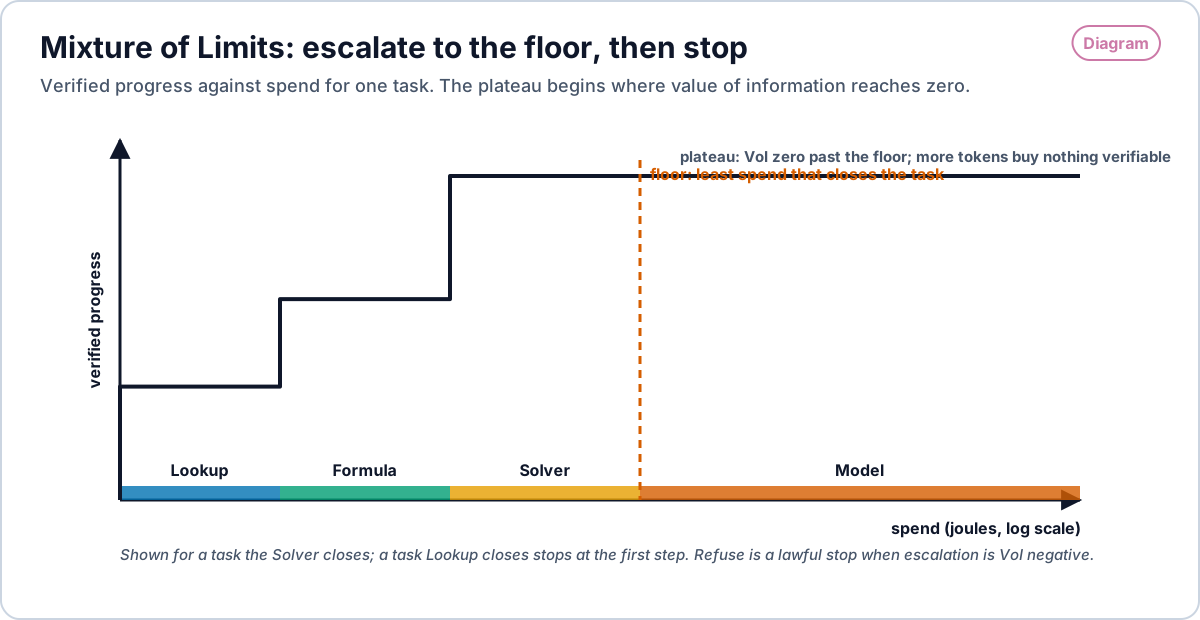
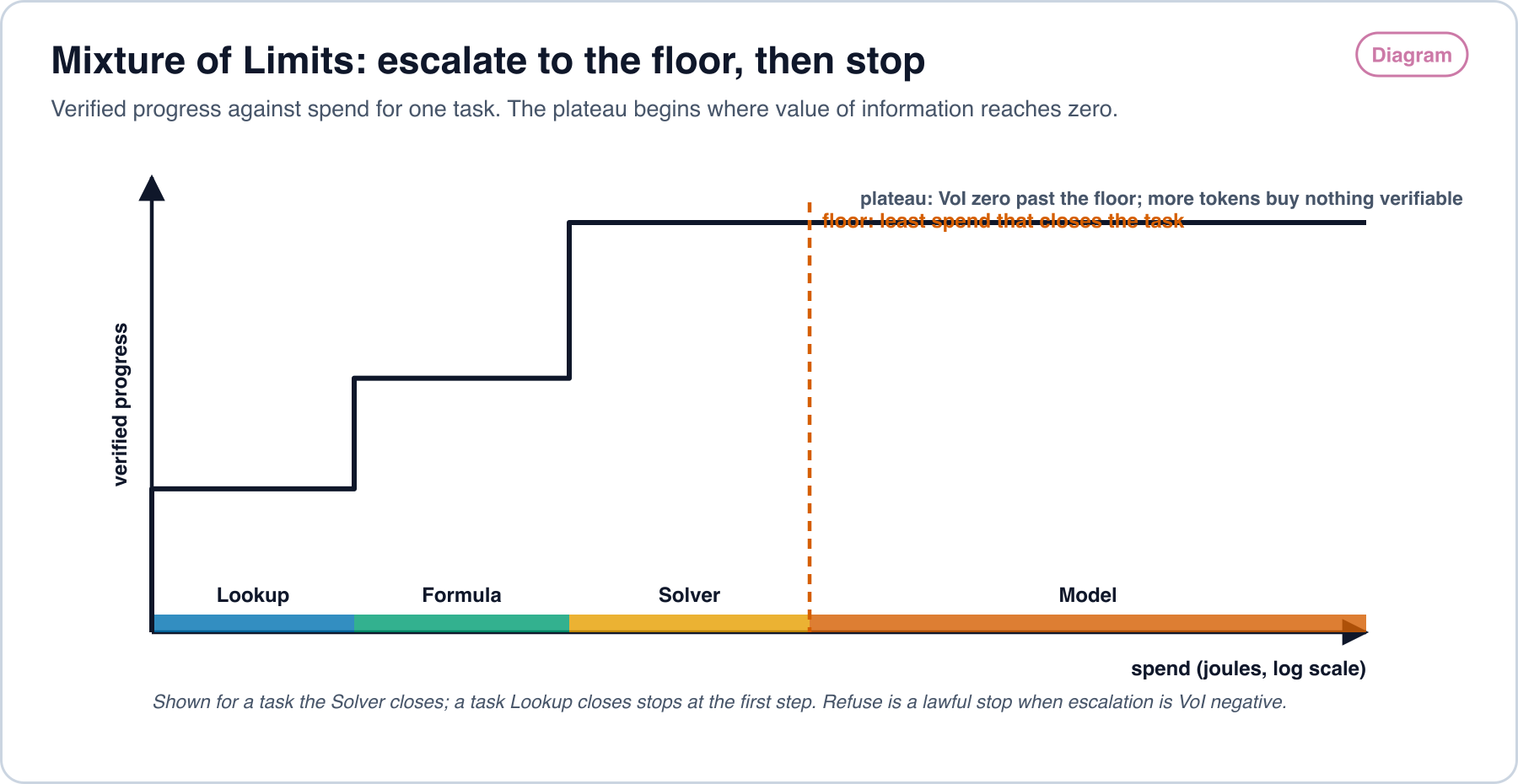
The floor of a task is the least expected energy at which some policy over gears reaches with failure probability at most . It equals of Section 0.2. The plateau is the region of spend beyond the floor: once , no further computation can raise , so further joules buy nothing on the stated objective.
Mixture of Limits is the rule: try gears in an order that minimizes expected energy to the first close, stop at the first gear that closes , and refuse with a receipt when the next gear would exceed the budget or cannot change the decision. Lookup → Formula → Solver → Model is the standard order. It is optimal only under the condition derived in Section II.2. Every close passes through Part I’s record: propose, certify, commit or refuse, receipt.
Where the model sits. Model last is an order of trial, not a verdict on what models can do. Snell et al. (2024) showed that a compute-optimal schedule of test-time compute beats best-of-N by more than 4× in efficiency, and that on some problems test-time compute can substitute for a larger model. That result concerns the schedule inside the Model gear, which is priced in joules like any other gear. The Model gear opens whenever cheaper gears cannot close , and it opens first when they pass too rarely to pay for their failures.
Figure 2 draws the floor and the plateau for one task.
Mixture of Limits is not Mixture of Experts. Mixture-of-Experts (MoE) routing selects parameters inside one generative model (Shazeer et al., 2017; Fedus et al., 2022). Mixture of Limits selects whether and where to spend across gears, and an MoE model can serve as its Model gear.
| MoE | Mixture of Limits | |
|---|---|---|
| Where the choice is made | Inside one model | Across gears, before any model runs |
| Object chosen | Which parameters run | Which gear closes, or refuse |
| Success | Next-token likelihood | , a certified commit, and a receipt |
| Refusal | Not a native outcome | A typed outcome with a receipt |
II.2. Expected energy of a cascade and the optimal order
Two gears. Let a light gear L with pass probability and energy precede a heavy gear H that always passes, with energy . Trying L first costs in expectation. Trying H first costs . So L first is cheaper if and only if
For example, a lookup costing J that passes on of tasks ahead of a model call costing J saves J per task in expectation. If falls below , the order reverses.
Many gears. For gears tried in sequence until the first pass, with independent outcomes, the expected energy of order is
Swapping two adjacent gears then changes this sum by a factor common to both terms times . So should precede if and only if , and the optimal order sorts gears by decreasing (Simon and Kadane, 1975). Cheapest first is optimal exactly when cheaper gears also have the higher pass probability per joule. When that fails, the cascade starts at a heavier gear. Under a binding budget the joules of failed light attempts stay spent, so a selector that estimates per task can close tasks that a fixed order cannot.
Physical floor. Any gear that erases bits irreversibly at temperature dissipates at least
which is J per bit at 300 K (Landauer, 1961; Bennett, 1973, for the reversible limit). Measured CMOS operations cost about 0.9 pJ for a 32-bit floating-point add and about 640 pJ for a 32-bit DRAM read at 45 nm (Horowitz, 2014), eight to eleven orders of magnitude above that floor. The Landauer figure on a receipt is therefore a labeled lower bound, never a measurement.
Catalog cost model. Before a gear runs, the software reference prices it as
where (dimensionless) scales with the difficulty class of act and (J) is a catalog energy for primitive on hardware view . Both are stated catalog constants, so is an estimate used to order gears. It is not derived from physics, and it is never reported as a measurement. Ranking among systems that close the task uses metered joules (Section 0.2).
II.3. Stopping conditions
Value of information. Let be the payoff of a decision, the current information state, a further observation or computation, its energy, and the exchange rate between payoff and joules. The net value is
(Howard, 1966; Russell and Wefald, 1991). The rule refuses escalation when . Once , the first two terms are equal for any further on the task, so and the stop follows.
Grammar coverage. Let be the set of verified derivations available to Lookup, Formula and Solver. A query is covered when a derivation exists. When is covered, the Model gear is not opened, because a covered gear passes with probability 1 at lower energy than the Model gear, so by the two-gear inequality of Section II.2 it goes first and closes the task. When is not covered and policy forbids the Model gear, the rule refuses.
Settle refusal. A Solver gear that searches for a low-energy configuration either reaches a certified fixed point (commit) or reports that it will not settle within its budget (refuse).
Named refusal reasons in the software reference:
| Reason | Condition |
|---|---|
voi | for every available next step |
grammar | Not covered and the Model gear is not allowed |
energy | The next gear’s estimate exceeds the remaining budget |
efa_certificate | The certificate check fails before commit |
settle_refuse | The Solver does not settle within its budget |
primitive_gap | A required primitive is absent from the catalog |
safety | A capability check denies the action |
II.4. Provenance and receipts
Every answer carries a replay class stating how it was produced: Deterministic (Lookup, Formula, or a certified Solver), RetrievedCited, Composed, or ModelGenerated. The type system forbids strengthening a class: ModelGenerated cannot be rewritten as Deterministic. Energy on a receipt carries one of three labels: Estimated (catalog, Landauer or instruction-fuel figure), Unmetered (no reading), or Metered (a named meter returned a reading). The software reference leaves measured_j unset unless a meter returns. The catalog of primitives the reference navigates, grouped into families, is called the Periodic Stack in this paper; each cell is Present (implemented) or Gap (absent).
II.5. Software reference
The software reference mixture-of-limits (Apache-2.0 or MIT) has a harness, cargo run -p mol-cli -- prove, that prints VERIFIED for each criterion and exits 0. The workspace test suite (cargo test --workspace) passes (P0), and the harness exits 0 (P1). A criterion marked verified means that an implementation exists and passes its stated specification. It is not a theorem, not an independent replication and not an energy measurement. As of the 2 October 2026 run the harness prints 43 VERIFIED criteria (this replaces the earlier count of about 29); the table below itemises P2 to P24, and II.5.1 to II.5.3 describe the product-gap criteria A11 to A14 that were added after it. The other criteria are not itemised in this paper and are in the software reference’s PLAN.md and product/ACCEPTANCE.
| Prove # | Criterion | Claim id | Claim | Scope note | Measurement |
|---|---|---|---|---|---|
| Prove # | Criterion (PLAN) | Paper claim id | Claim (one sentence) | Software reference / scope note | Measurement |
| --- | --- | --- | --- | --- | --- |
| P2 | Deterministic close (double-run) | claim.mol.deterministic_close | Same asks yield the same commit/refuse + limit id. | none | Unmetered |
| P3 | Formula/lookup close without model | claim.mol.formula_lookup_no_model | Landauer / unit-convert closes COMMIT at Lookup or Formula; model never answered. | none | Unmetered / Estimated (Landauer floor on receipt) |
| P4 | VoI refuse when !allow_model | claim.mol.voi_refuse | Free-form ask → REFUSE voi. | none | Unmetered |
| P5 | Settle commit + settle refuse | claim.mol.settle_ternary | Ternary settle → COMMIT; will not settle → REFUSE settle_refuse. | Software-ref settle stub; no VM / FPGA | Unmetered |
| P6 | Certificate refuse on diverge | claim.mol.efa_certificate_refuse | Formula + diverge → REFUSE efa_certificate. | In-tree certificate | Unmetered |
| P7 | Capability default-deny mutate | claim.mol.capability_deny_mutate | AutomateGate::default().gate(Mutate) → Refuse. | none | Unmetered |
| P8 | Receipt labels | claim.mol.receipt_honesty | Software-ref: measured_j=None, estimate labeled (EstimateKind). | Live RAPL/NVML default close OUT OF SCOPE | Unmetered / Estimated |
| P9 | ModelGenerated ↛ Deterministic | claim.mol.replay_no_strengthen | TypedAnswer::weaken_to returns ReplayCoercion. | none | none |
| P10 | Periodic Stack live catalog navigation | claim.mol.stack_live_catalog | Family + present + scale → COMMIT at Lookup; 258 live Lookup/Formula/Solver/Navigate gears. | μ calib + silicon HW OUT OF SCOPE; software reference Gap sims in proof | Unmetered |
| P11 | primitive_gap via registry probe | claim.mol.primitive_gap | Gap marker physical_settle + absent name → REFUSE primitive_gap (not string-only). | none | Unmetered |
| P12 | μ / impedance catalog | claim.mol.mu_catalog | Receipts stamp mu_source=catalog, mu, landauer_floor_ratio; E≈θ·μ (catalog estimate, not RAPL/measured_j). | μ calib corpus OUT OF SCOPE | Estimated |
| P13 | Receipt transcript replay | claim.mol.receipt_replay | JSONL/in-memory replay reproduces commit/refuse + limit id; model never answered. | none | Unmetered |
| P14 | Z2 retrieve+cite | claim.mol.z2_retrieve_cite | Seeded factual hit → COMMIT RetrievedCited + citation ids; unknown → REFUSE claim_unknown (no invent). | Seed corpus in-tree only | Unmetered |
| P15 | Z1 compose/synthesis | claim.mol.z1_compose | ≥2 cited claims → COMMIT Composed + synthesis.composed_from; missing → REFUSE compose_missing; never laundered as Deterministic/RetrievedCited alone. | none | Unmetered |
| P16 | Agent mailbox loop | claim.mol.agent_mailbox | Goal/Message/Act → close → commit|refuse + receipt in transcript; demo hits formula/cite/compose COMMIT and voi/settle_refuse REFUSE; model cold; measurement flags hold. | none | Unmetered |
| P17 | Bitemporal state + memory | claim.mol.bitemporal_memory | Writes only on Mixture of Limits close COMMIT; Mutate deny / free-form remember → REFUSE; recall → RetrievedCited + memory: cite; unknown → memory_unknown. | none | Unmetered |
| P18 | Fabric routing + software reference inventory | claim.mol.fabric_soft_ref | Offline inventory valid (source=software_ref, Cpu always); Lookup/Formula→Cpu; Settle→ThermoSettle|Cpu; Model→Gpu* or REFUSE fabric_unavailable; detect ≠ measured joules. | Live wgpu presence optional / not required for prove | Unmetered |
| P19 | Desktop shell headless | claim.mol.desktop_headless | ShellSession ask/close → receipt view (zone/fabric/limit/estimated_j/measured_j=None); joule ledger; VoI refuse; GUI not required. | egui GUI optional | Unmetered / Estimated |
| P20 | OS meter labels | claim.mol.os_meter_honesty | Feature off / VM / no permission → measured_j=None, empty components, measure_source=unavailable; fixtures stamp labeled sources; default close stays unmetered. | Live probe optional (energy-meter) | Unmetered (default) / Metered only when probe returns |
| P21 | WASM capsule certify | claim.mol.wasm_capsule | add.wasm under stub runtime; fuel → estimated_j only; FS/net grant / fuel exceed / host-share → REFUSE; close stamps capsule. | Optional wasmtime feature | Unmetered / Estimated (fuel) |
| P22 | Agent Lane session path | claim.mol.agent_lane | Lane partitions; host_invoke without provenance refuses; keyword confirm insufficient; need GrantReceipt; allow stamps AgentLaneReceipt. | none | Unmetered |
| P23 | Multi-fabric compute receipt | claim.mol.fabric_compute_receipt | Software reference inventory; ComputeFabric / ScheduleDecision / ComputeStepReceipt with fabric_id; cascade stamps fabric:route; CPU Formula COMMIT; Model residual may fabric_unavailable; measured_j=None on software reference path. | none | Unmetered |
| P23b | Live fabric soft | claim.mol.fabric_live_soft | Feature off stays software_ref; mock/live Metal can stamp gpu_metal; Formula stays Cpu; missing Gpu* fail-closed; prove does not require a GPU; measured_j=None unless Metered. | Soft / optional detect | Unmetered |
| P23c | wgpu / Metal tiny kernel | claim.mol.kernel_vector_add | Clean-room WGSL vector-add; soft stub offline (same checksum); Gpu* stamps kernel:vector_add + execution_proof; optional overlapping meter may stamp package measured_j with energy_honesty=measured (field name); no rail-sum package joules. | Live Metal optional; fixture OK for prove | Unmetered (default) / Metered only if meter returns |
| P24 | Ecosystem e2e certify (one receipt) | claim.mol.ecosystem_e2e | Lane → fabric (Cpu software reference) → WASM → energy labels (estimated fuel; optional meter_sample) → host invoke only with GrantReceipt → commit|refuse on one receipt; refuse-without-grant → grant_receipt_required. | none | Unmetered / Estimated |
Outside the harness: live energy counters (RAPL, NVML) as the default close, live GPU detection, on-device certificate hardware, trained model weights, and silicon meters for Gap cells. None is claimed.
II.5.1 Phase-1 micro-perception on the arena (A11, A14)
The arena scores the cascade on typed chores (decision, ticket close, risk) against an always-model baseline and a small leaf baseline. Typed baselines run with phase1=false. With phase1=true, an unstructured ticket, risk or decision string first goes through the in-tree rule AST transducer (mol phase1) and only then enters the cascade; unrecognised input is refused, so the transducer is never used as a model and Model LAST stays last. In the software-reference run of 2 October 2026 (n = 36, America/New_York), the cascade closed 36 of 36 correctly and refused 5 of 5 satiation cases, while the always-model baseline and the leaf baseline each got 28 of 36 and 0 of 5 on satiation. Mean estimated joules were about 2.1e-11 for the cascade, 5.0e-1 for the always-model baseline and 2.5e-4 for the leaf baseline. These are catalog estimates; measured_j is not set, and the figures are the reference’s own published table, not a re-run for this paper.
II.5.2 Tier-1 OS meters (A13)
An optional build feature adds package-level probes so that measured_j is filled only from a real reading: Linux RAPL (powercap energy_uj delta), NVIDIA (nvidia-smi power times the window, or an energy-consumed delta, as device-total GPU energy) and macOS (SMC PSTR watts times the window, without sudo; the Energy Model package channel is not used and rails are never summed). The harness runs with the feature off, so measured_j stays unset there. Criterion A13 stamps RAPL, NVML and SMC fixtures and forbids inventing a value from a utilisation percentage. No Part II figure is a reading from these probes.
II.5.3 Primitive distillation (A12)
After a certified Model LAST commit, mol distill appends a Lookup or Formula entry to a store with deterministic replay; an uncertified proposal is never distilled. A second pass on the distilled pattern then closes at Lookup or Formula without opening Model LAST (A12). Receipts keep estimated_j labelled as an estimate.
Reproduce: cargo run -p mol-cli -- prove (43 criteria including A1 to A14), -- arena, -- phase1 "please close ticket as R-OK", -- distill "ticket summary" --gear lookup --store product/fixtures/distill_store.json. Code: openIE-dev/mixture-of-limits.
II.6. Related work
Cascades and metareasoning. Viola and Jones (2001) ran a cascade of boosted classifiers in which cheap stages reject most inputs. Russell and Wefald (1991) priced each computation by its expected value to the decision net of its cost and stopped when none had positive net value. Horvitz (1987) set the same trade for bounded reasoning. Anytime algorithms trade computation for quality with an interruptible stop (Dean and Boddy, 1988; Zilberstein, 1996). Model cascading sends an input to a larger model only when a smaller one is unsure (Varshney and Baral, 2022), and FrugalGPT stops when a learned scorer accepts the answer (Chen, Zaharia and Zou, 2023). Mixture of Limits differs in three respects: the gears include non-neural mechanisms ahead of any model; the stop is the predicate , not a learned score; and cost is joules on a receipt, not dollars or latency.
Spend past the answer. Reasoning models spend tokens after their first correct answer without changing it (Chen et al., 2024), and a survey collects methods that stop earlier (Sui et al., 2025). Speculative decoding (Leviathan et al., 2023), Mixture-of-Depths (Raposo et al., 2024), quantization (Frantar et al., 2022; Lin et al., 2024) and paged KV caches (Kwon et al., 2023) lower the energy of a Model gear once it runs. They do not decide whether it runs.
Formula recovery. AI Feynman (Udrescu and Tegmark, 2020), SINDy (Brunton et al., 2016) and PySR (Cranmer, 2023) recover closed forms from data; AlphaGeometry (Trinh et al., 2024) and AlphaProof (Hubert et al., 2025) pair a proposer with a symbolic or Lean verifier. Each produces Formula or certified Solver gears that close covered tasks at lower energy than a generator.
Routing among models. These systems choose which model answers. None tries a non-neural gear first or refuses with a typed reason.
| System | Title | ID | Class | What it routes or accelerates | Energy or cost as reported | Difference |
|---|---|---|---|---|---|---|
| RouteLLM | RouteLLM: Learning to Route LLMs with Preference Data (arXiv); ICLR 2025 venue title uses from Preference Data | arXiv:2406.18665 · ICLR 2025 | Preference router (strong↔weak LLM) | Query → strong or weak LLM | Cost / quality (API $); reported by the authors | Model↔model; no Lookup/Formula floor; no typed refuse-to-commit |
| PEARL (routing) | PEARL: Performance and energy aware routing for LLMs | DOI:10.1016/j.future.2025.108218 · FGCS 176:108218 | Energy-aware multi-LLM router | Query → LLM under energy cap (EMM predicts energy) | Authors report energy-aware routing (GPU/infra) | Still picks a model; Mixture of Limits may refuse before any model |
| GreenServ | GreenServ: Energy-Efficient Context-Aware Dynamic Routing for Multi-Model LLM Inference | arXiv:2601.17551 · ICPE 2026 | Contextual bandit multi-LLM router | Query features → LLM; accuracy vs measured GPU energy (Zeus) | Metered (authors’ GPU Wh via Zeus) on their LLM pool | Model pool routing; Mixture of Limits cascade is non-neural first |
| VoltanaLLM | VoltanaLLM: Energy-Efficient and SLO-Aware Disaggregated LLM Serving via Adaptive Frequency Control and State-Space Routing | arXiv:2509.04827 | P/D-disagg serving + frequency + state-space route | Prefill/decode instances + GPU frequency under TTFT/ITL SLOs | Metered (authors; pyNVML on A100/GH200) up to ~36.3% E2E GPU energy vs max-freq baseline (field serving result) | Routes instances of the same generative stack; Mixture of Limits may never open decode |
| HCSpec | HCSpec: Two-Tier Horizontal Cascade Speculative Decoding for High-Efficiency Large Language Model Inference | DOI:10.18653/v1/2026.acl-long.353 · ACL 2026 | Speculative decoding (draft↔target) | Position-specialized draft cascade → target verify | Latency speedup (vs EAGLE-3 / AR) | Speeds generation; does not refuse generation on floors |
| CAS-Spec | CAS-Spec: Cascade Adaptive Self-Speculative Decoding for On-the-Fly Lossless Inference Acceleration of LLMs | arXiv:2510.26843 · NeurIPS 2025 | Self-speculative cascade (DSIA drafts) | Draft stages from target (sparsity/quant) + DyTC | Latency speedup ~1.1×-2.3× AR (authors); lossless tokens | Model-internal draft hierarchy ≠ Mixture of Limits floors |
| GCD | Grammar-Constrained Decoding for Structured NLP Tasks without Finetuning | arXiv:2305.13971 · DOI:10.18653/v1/2023.emnlp-main.674 · EMNLP 2023 | Grammar-constrained LLM decoding | Mask logits to CFG | Unmetered / quality metrics | Constrains tokens; Mixture of Limits constrains commit |
II.7. Baselines and falsifiers
A cascade claim is tested on one typed task set as a frontier of joules per task against closure rate. The arms are: always the large model; always the small model; a learned router (Ong et al., 2024); a scored cascade (Chen, Zaharia and Zou, 2023); a selector that estimates per task; and an oracle that knows the cheapest sufficient gear for each task. The fixed Lookup → Formula → Solver → Model order claims the frontier only where its curve lies below every arm. The order is falsified on a task class where measured is not decreasing along it, by the derivation of Section II.2. The harness claims are falsified if mol prove does not exit 0 on the stated revision.
II.8. Limits
The harness is constructive existence in software. No Part II figure is a meter reading: catalog and Landauer energies are estimates, and measured_j is unset on the harness path. The optimal-order result assumes independent gear outcomes; correlated failures change the expected energy and require the full sum of Section II.2 with conditional probabilities. Pass probabilities must be estimated per task class, and estimation error moves the order. The frontier comparison of Section II.7 has not been run.
II. References
Bennett, C. H. (1973). Logical reversibility of computation. IBM Journal of Research and Development 17(6):525-532. https://doi.org/10.1147/rd.176.0525
Brunton, S. L., Proctor, J. L., and Kutz, J. N. (2016). Discovering governing equations from data by sparse identification of nonlinear dynamical systems. PNAS 113(15):3932-3937. https://doi.org/10.1073/pnas.1517384113
Chen, L., Zaharia, M., and Zou, J. (2023). FrugalGPT. arXiv:2305.05176.
Chen, X., et al. (2024). Do NOT Think That Much for 2+3=? On the Overthinking of o1-Like LLMs. arXiv:2412.21187.
CAS-Spec (2025). Cascade Adaptive Self-Speculative Decoding. NeurIPS. arXiv:2510.26843.
Cranmer, M. (2023). Interpretable Machine Learning for Science with PySR and SymbolicRegression.jl. arXiv:2305.01582.
Dean, T., and Boddy, M. (1988). An analysis of time-dependent planning. AAAI-88, 49-54.
Fedus, W., Zoph, B., and Shazeer, N. (2022). Switch Transformers. JMLR 23(120).
Frantar, E., et al. (2022). GPTQ. arXiv:2210.17323.
Geng, S., et al. (2023). Grammar-Constrained Decoding for Structured NLP Tasks without Finetuning. EMNLP. https://doi.org/10.18653/v1/2023.emnlp-main.674
GreenServ (2026). Energy-Efficient Context-Aware Dynamic Routing for Multi-Model LLM Inference. ICPE. arXiv:2601.17551.
HCSpec (2026). Two-Tier Horizontal Cascade Speculative Decoding. ACL. https://doi.org/10.18653/v1/2026.acl-long.353
Horowitz, M. (2014). Computing’s energy problem (and what we can do about it). ISSCC. https://doi.org/10.1109/ISSCC.2014.6757323
Horvitz, E. J. (1987). Reasoning about beliefs and actions under computational resource constraints. UAI. arXiv:1304.2759.
Howard, R. A. (1966). Information value theory. IEEE Transactions on Systems Science and Cybernetics 2(1):22-26. https://doi.org/10.1109/TSSC.1966.300074
Hubert, T., et al. (2025). Olympiad-level formal mathematical reasoning with reinforcement learning. Nature. https://doi.org/10.1038/s41586-025-09833-y
Kwon, W., et al. (2023). Efficient Memory Management for Large Language Model Serving with PagedAttention. arXiv:2309.06180.
Landauer, R. (1961). Irreversibility and heat generation in the computing process. IBM Journal of Research and Development 5(3):183-191. https://doi.org/10.1147/rd.53.0183
Leviathan, Y., Kalman, M., and Matias, Y. (2023). Fast Inference from Transformers via Speculative Decoding. ICML.
Lin, J., et al. (2024). AWQ. MLSys. arXiv:2306.00978.
Ong, I., et al. (2024). RouteLLM: Learning to Route LLMs with Preference Data. arXiv:2406.18665.
PEARL (2025). Performance and energy aware routing for LLMs. Future Generation Computer Systems 176:108218. https://doi.org/10.1016/j.future.2025.108218
Raposo, D., et al. (2024). Mixture-of-Depths. arXiv:2404.02258.
Russell, S., and Wefald, E. (1991). Principles of metareasoning. Artificial Intelligence 49:361-395. https://doi.org/10.1016/0004-3702(91)90015-C
Shazeer, N., et al. (2017). Outrageously Large Neural Networks: The Sparsely-Gated Mixture-of-Experts Layer. ICLR. arXiv:1701.06538.
Simon, H. A., and Kadane, J. B. (1975). Optimal problem-solving search: all-or-none solutions. Artificial Intelligence 6(3):235-247. https://doi.org/10.1016/0004-3702(75)90002-8
Snell, C., Lee, J., Xu, K., and Kumar, A. (2024). Scaling LLM Test-Time Compute Optimally can be More Effective than Scaling Model Parameters. arXiv:2408.03314.
Sui, Y., et al. (2025). Stop Overthinking: A Survey on Efficient Reasoning for Large Language Models. arXiv:2503.16419.
Trinh, T. H., et al. (2024). Solving olympiad geometry without human demonstrations. Nature 625:476-482. https://doi.org/10.1038/s41586-023-06747-5
Udrescu, S.-M., and Tegmark, M. (2020). AI Feynman. Science Advances 6(16). https://doi.org/10.1126/sciadv.aay2631
Varshney, N., and Baral, C. (2022). Model cascading. EMNLP. https://doi.org/10.18653/v1/2022.emnlp-main.756
Viola, P., and Jones, M. (2001). Rapid object detection using a boosted cascade of simple features. CVPR. https://doi.org/10.1109/CVPR.2001.990517
VoltanaLLM (2025). Energy-Efficient and SLO-Aware Disaggregated LLM Serving. arXiv:2509.04827.
Zilberstein, S. (1996). Using anytime algorithms in intelligent systems. AI Magazine 17(3).
II. Appendix. Reproducibility
cargo test --workspace
cargo run -p mol-cli -- prove   # expect 43 VERIFIED lines (A1 to A14 included), exit 0
cargo run -p mol-cli -- arena   # refresh the arena table from a real run only