Task Satiation vs. Aggregate Rebound in AI Demand
Published price collapse for digital inference does not identify free energy, free actuation, or unbounded value after a chore is complete.
David Charlot, Open Interface Engineering
Research studies, not journal finals. Notation is defined in the paper. Analytical energy estimates are not board power. Interactive figures live under /living/. Shared terms: glossary.
Cite this
Genre: Research paper · economics
David Charlot, Open Interface Engineering. Task Satiation vs. Aggregate Rebound in AI Demand. Open Interface Engineering. Web: https://research.openie.dev/papers/satiation/. PDF: https://research.openie.dev/pdfs/satiation.pdf.
Task Satiation vs. Aggregate Rebound in AI Demand
Version 1.1, 11 October 2026. Data and code: research.openie.dev/data/. LaTeX PDF: /pdfs/latex/satiation.pdf (source).
Abstract
Once a task is done, more machine effort on that task adds nothing. This paper defines that stop precisely and separates it from the separate question of whether total demand for machine work keeps growing.
In plain words
- Every job has a finish line. After it, more computer work on that job is waste.
- Cheaper computer work can still make people start many more jobs, so total use can keep rising.
- Money prices for AI are falling fast, but the electricity it uses is never free.
Many planning models treat demand for machine intelligence as if it had no finish line. Consumer theory already contains the opposite object. Satiation, and the related bliss point, is the region in which further units of a good do not raise utility and may lower it (Andersen, 2001). This paper defines an operational cousin for work and care: a loop reaches task completion when a stated completeness predicate holds, further calls do not flip any clause of that predicate from false to true, and calls that undo the predicate are harm, not value. Engagement time, token count, and seat count are different variables. They can rise after completeness.
Two claims must be kept apart. Task-level satiation holds by definition: once a task’s completeness predicate is true, more synthesis on that task buys nothing. Aggregate satiation is a claim about total demand, and it is not implied. Cheaper synthesis can open new tasks (Acemoglu and Restrepo, 2019) and raise total use, as cheaper coal raised total coal use (Jevons, 1865). Each chore can be satiated while total demand for chores grows without bound. This rebound is the central identification problem for the paper. Section 5.1 states two testable hypotheses and the data that would identify them.
A second fact is about price, not physics. Epoch AI reports large declines in the price of a fixed inference performance (Epoch AI, 2025; Emberson and Roodman, 2026). This paper calls the resulting situation free at the margin for digital chores whose output is information and whose completeness test is finite. The phrase does not mean that joules are free, that a plant may move without a certificate, or that care labor has been automated away. Landauer’s bound is a lower bound on erasure, not a description of current accelerators (Landauer, 1961; Horowitz, 2014).
The paper does not report a randomized trial, a done-detector error rate, or a split between energy spent before completeness and energy spent after it. Those measurements are specified in Section 3.3 and are absent.
Notation
| Term | Definition in this paper |
|---|---|
| Satiation | In the cited theory, a fall of marginal utility to zero or below. In this paper’s operational clause, after completeness, further calls do not flip any clause of C from false to true; calls that undo C are harm, not value (Section 3.1). |
| Bliss point | A bundle at which additional quantity of the good reduces utility. A textbook object. Not estimated here. |
| Task completion | The event that the completeness predicate becomes true. Orthogonal to model scale. |
| Work completeness | A stated work stop: ticket closed, patch merged, report filed, ledger reconciled, or an equivalent written test. |
| Care completeness | A stated care stop: assessment finished, medications reconciled, receiving party notified, person in a safe state, or an equivalent written test. |
| Free at the margin | Marginal price of a digital synthesis step trends toward bundled or negligible money price. Joules and commits stay costly. |
| Artificial general intelligence (AGI) | A broad capability target. Not a price observation and not a result of this paper. |
| Direct rebound | Extra use of a service when its effective price falls, on the same service (Gillingham, Rapson, and Wagner). |
| Modeled / simulated / board-measured | Formula, program execution, or meter. This paper’s new numbers are none of the three; its empirical content is citation of published series and documents. |
Scope. Section 2 reviews satiation theory, task automation, attention markets, technology-cycle evidence, and inference prices. Section 3 writes predicates and says which were not estimated. Section 4 lists claims that rest on citations, and separates them from design rules. Section 5 answers rebound, care costs, and military demand. Section 6 lists threats to validity.
1. Introduction
A demand curve with constant positive slope in “intelligence” will recommend more seats, more tokens, and more agents after a job is finished. That recommendation is a modeling choice. It is not a theorem about work. Standard consumer theory allows marginal utility to decline and to cross zero. If a chore has a completeness predicate, the relevant question is whether more model output changes that predicate. If it does not, extra output is a cost with no increment on the objective that was written down.
The recent price evidence points the other way from scarcity of synthesis. Epoch’s series show the money price of a given benchmark performance falling quickly. Open weights and typed decision procedures, including System One, are additional routes by which a previously scarce generation step becomes cheap. Teams that price a closed chore as if synthesis were still scarce are using a stale constraint.
The constraints that do not follow from a price series are physical and institutional. Computation dissipates energy. Horowitz (2014) documents that data movement and memory dominate practical CMOS energy, at scales far above Landauer’s ideal erasure bound. An actuator is not a token. A signature, a clinical handoff, and a payment are not reversed by sampling another paragraph. Baumol (1967) showed how sectors with weak productivity growth can absorb a rising share of expenditure. Acemoglu and Restrepo (2019) model automation as task displacement plus the possible creation of new tasks. None of these results says that a language model ends cost disease. They do say that “more capability” is not a sufficient description of value.
This paper’s positive claim is definitional and bibliographic. Satiation is a coherent object. Published prices for inference have fallen sharply. Engagement metrics are not completeness metrics. A stop for “do not spend” and a stop for “do not move” are different predicates. The negative claim is equally important. This paper does not identify a structural demand system, does not estimate rebound, and does not report measured energy.
2. Related work
2.1 Satiation and bliss points
Andersen (2001) treats satiation inside an evolutionary model of structural change, not as a verbal preference. The durable element for this paper is the economic one: marginal valuation of a good can reach zero. Textbook bliss points make the geometry explicit. For a bundle x*, utility does not increase in a coordinate past x*, and a smooth representation can have negative marginal utility there. A quadratic illustration, U(x) = -a (x - x*)^2 for a > 0, has a maximum at x* and a negative derivative beyond it. That function is a model used to teach the definition. It is not fitted to agent logs in this study. No coefficient a is reported.
The operational translation requires a predicate the model does not know unless someone states it. Let C(z) = 1 when the written completeness test for episode z holds, else 0. Satiation on that episode means there exists a time t* such that C is 1 at t* and, for all later calls, no clause of C flips from false to true. Calls that undo C are harm, not value. Section 3.1 states the same rule. The internal event economic done is when C becomes 1; this paper calls that event task completion. This is a definition. It becomes an empirical claim only with a labeled set of episodes and a detector whose errors are counted. Section 4 does not contain that count.
Keynes drew the same line in 1930. He split needs into absolute needs, felt whatever others have, and relative needs, felt because satisfying them lifts us above others. He argued the absolute needs could be met. The completeness predicate is the absolute need of one task, written down. Relative and open-ended wants have no such predicate, and Section 5.2 keeps them out of the claim.
2.2 Tasks, displacement, and cost disease
Baumol (1967) analyzes unbalanced growth. If one sector’s productivity rises and another’s does not, the relative cost of the stagnant sector rises, and it can dominate expenditure even when its quantity grows slowly. Health care, education, and live performance are the usual examples. Later health-economics papers dispute magnitudes and mechanisms. This paper uses Baumol for a negative instruction: do not infer, from a fall in token price, that care has become a software good. Care remains dependent on time, trust, and liability in the ordinary institutional sense. A documentation model can increase recorded activity, which is a Baumol-relevant ambiguity: measured output can move while the care predicate does not.
The labor literature associated with David Autor decomposes jobs into tasks that machines may or may not perform. The pinned statement is Acemoglu and Restrepo (2019), “Automation and New Tasks: How Technology Displaces and Reinstates Labor,” Journal of Economic Perspectives 33(2), https://www.aeaweb.org/articles?id=10.1257/jep.33.2.3. They argue that displacement reduces labor’s task share and that new tasks can restore it. A completeness-oriented stop is closer to finishing a task than to creating a new engagement task. An agent loop with no stop can raise activity measures without a productivity gain. That possibility is consistent with their warning about weak automation.
2.3 Attention and engagement
Wu’s book “The Attention Merchants” (publisher page: https://www.penguinrandomhouse.com/books/234876/the-attention-merchants-by-tim-wu/) describes businesses that harvest attention and resell it. The Center for Humane Technology’s overview of the attention economy (https://www.humanetech.com/youth/the-attention-economy) is an advocacy summary of the same pattern, not a trial. The inference used here is limited. If a product’s objective is time on task, then a session that continues after C = 1 can look successful. If the objective is C, the same session is waste or harm. The two objectives are not observationally equivalent in a token log. No experiment in this paper estimates the welfare gap.
2.4 Historical cycles
Technology markets often show a speculative phase, a use phase, and a later commodity phase. The evidence is uneven.
Quinn (2019), “Technological revolutions and speculative finance: evidence from the British Bicycle Mania,” Cambridge Journal of Economics 43(2), 271-294, https://doi.org/10.1093/cje/bey029, studies cycle-share prices from 1895 to 1900. Prices rose by over 200 percent and then fell by more than 75 percent. The paper’s result is about speculative finance and fundamentals, not about a measured “enough bicycle” predicate for households. Using it as a picture of race-phase finance is supported. Using it as a proof of transport satiation is not.
Cars, scheduled aviation, and television have commodity-like markets in the everyday sense: used vehicles, yield-managed seats, and panels sold as inputs to content. The rows are historical orientation. They are not regressions. Airline yield management after deregulation is a pricing institution for a seat, which is evidence of a commodity market in seats, not evidence that passengers’ demand for travel is globally satiated.
Pew Research Center’s mobile fact sheet (https://www.pewresearch.org/internet/fact-sheet/mobile/) is the saturation source used for phones. The project archive records U.S. smartphone ownership near 91 percent in the 2024 and 2025 fact-sheet readings. A reader who quotes the figure should open the live sheet, because fact sheets are revised. High ownership is evidence of diffusion. It is not, by itself, evidence that marginal value of another phone camera is zero.
The digital-chore row is the one this paper defends with a price series rather than with an analogy. See Section 4.2.
2.5 Inference prices and open weights
Epoch AI (2025), “LLM inference price trends,” https://epoch.ai/data-insights/llm-inference-price-trends, reports price declines at fixed performance on the order of 9 to 900 times per year across benchmarks in that note. Emberson and Roodman for Epoch AI (2026), “The plunging price of thought,” https://epoch.ai/publications/the-plunging-price-of-thought, report about a 47 percent decline per quarter in the cost of a given performance since about 2023, summarized as about 13 times per year, faster near the frontier. These are the authors’ summaries of their data. This paper does not re-estimate the index. The economic reading is narrow: the money price of synthesis for a fixed measured performance has been falling fast. A falling supply price shifts quantity demanded if demand is elastic. It does not create a new completeness predicate, and it does not set the energy price to zero.
System One-class tools are relevant as a mechanism for a further price cut on decision problems with a known option set. A System One model returns a typed answer and a probability for each allowed option in one forward pass, with no free-form text. TypeSafe AI named the category with its hosted Jev model (15 September 2026). Open models followed, among them Laya from Convai Innovations. A System One model proposes. It is not a completeness evaluation.
A planning rule of thumb that frontier competence reaches cheaper devices in about six months is not a measured constant in any source cited here. Distillation, quantization, and table-lookup inference (Ma et al., 2024; Wei et al., 2024) are published mechanisms by which a given competence can move to cheaper hardware. The speed is an empirical question per model pair.
2.6 Physical cost
Landauer (1961) bounds erasure. Bennett (1973) shows reversible computation can avoid that bound in theory. Horowitz (2014) is the practical CMOS statement: energy per operation and energy of data movement set the design constraint, at many orders of magnitude above kT ln 2 for irreversible CMOS logic. At K the bound is J per erased bit, with J/K.
Goldman Sachs published a research note titled “Gen AI: Too Much Spend, Too Little Benefit?” (https://www.goldmansachs.com/insights/top-of-mind/gen-ai-too-much-spend-too-little-benefit). The existence of a major sell-side note that questions infrastructure spend relative to benefit is a document fact. Dollar figures inside the note are not quoted here, because sell-side estimates are not a scientific energy account.
3. Definitions and methods
3.1 Predicates
Let an episode be a sequence of model or tool calls z_1, ..., z_T together with a human-facing state. A completeness predicate C maps the episode prefix to {0, 1}. Examples that can be written without a model score:
- Work: tests pass and the change is merged; or the ledger discrepancy is zero; or the required fields of a report are filled and the report is filed.
- Care: the medication list matches the source, the receiving clinician has the note, and the safety checklist items that the institution marked critical are true.
C is not a probability. A detector that outputs a score still needs a threshold and an error table before it is a predicate in the sense of Section 4’s missing experiment.
The internal event economic done at time t* means C = 0 on the prefix before t* and C = 1 at t*, for the chosen test. This paper calls the catalog layer task completion. Satiation relative to model calls means that for all t > t*, extra calls do not flip any clause of C from false to true. Calls that undo C are harm, not value. The definition does not say humans always know t*. It says that if no C is written, the satiation claim is not yet a statement about that product.
Free at the margin is a statement about money price. Let p_t(q) be the price of synthesis service q at date t. The archival price evidence is that p_t for fixed benchmark performance has fallen at the rates Epoch reports. Free at the margin means p_t is low enough that a seat license is a weak explanation of cost for that chore. It does not mean the integral of power over time is zero.
A stop rule can therefore have two kinds of reason, economic (the predicate holds, or a budget or policy limit is reached) and physical (a safety or energy limit is reached). The two kinds are different predicates and should be recorded as different reasons.
3.2 What was done in this study
This study is a structured reading. Sources are the citation spine checked in the project on 29 to 30 September 2026, and the satiation notes. Section 3.3 names the measurements that would make the operational definition empirical.
Design rules in Section 4.10 are recommendations conditional on the definitions. They are not estimated treatment effects. A reader can reject a rule without rejecting Epoch’s price series, and can accept the price series without accepting a product recommendation.
3.3 Measurements specified and not taken
The predicate is endogenous. Witt (2001) argues that wants are learned, so the completeness predicate can ratchet as price falls. A study of satiation across a price change must therefore freeze in its preregistration before the change and report any change of predicate as a separate treatment.
H1 can be read from public data now. Chen and colleagues (2024) measure tokens spent after the first correct answer; Cuadron and colleagues (2025) score overthinking in agent trajectories; Bai, Huang and Wang (2026) find that same-task token use in agentic coding varies up to 30 times across runs. Applying this paper’s post hoc to those trajectories gives an exploratory H1 estimate, labeled exploratory. It is the next measurement.
Tokens and joules. H1 and H2 are stated in tokens; the thesis is in joules. Masanet and colleagues (2020) found that data-centre compute grew about sixfold from 2010 to 2018 while energy rose far less, so a token elasticity is not an energy elasticity. Each hypothesis is to be reported in both units, with the unit the data identify named.
- Split account. For each episode, sum analytical or, later, board-measured energy on calls with
t <= t*and on calls witht > t*. Direct rebound on that chore is visible only if the post-done integral is estimated. The repository does not contain this split. - Detector errors. On a labeled corpus, false done (predicate declared true when a clause is false) and false continue (
Ctrue and the system keeps calling). No rates are published here. - Care handoff. Time to safe state and a handoff checklist, contrasted with session length. Not measured.
- Segment table. Which products have a short
Cand which are open-ended research or adversarial races. Not estimated. The military case is excluded from the satiation claim in Section 5 rather than forced into it. - Measured energy. An external power meter on a stated workload. Not done.
Until those exist, sentences about “overkill joules” are hypotheses. Sentences about Epoch prices are citations.
3.4 Illustrative episodes, not data
Support desk. Completeness: the customer’s issue is resolved, the reply is sent, and the ticket state is Done. Further drafts do not change C. A token counter can still increment. The episode is a constructed example to show the variables. It is not a sample from a help desk.
Care handoff. Completeness: critical fields filled, medication list reconciled, receiving party confirmed, person in a safe state. Session length is a different variable. The episode is constructed. No hospital dataset was analyzed.
Coding chore. Completeness: the artifact matches a written oracle (tests, or a bit-exact check). Regenerating a passing artifact does not raise C.
3.6 Fidelity criteria and stop rules
Shannon (1959) defines a rate-distortion function: the least description rate that holds expected distortion at or below a chosen fidelity. The object is communication under a constraint the user states. It is not a demand curve for intelligence. The resemblance to this paper is only structural. A completeness predicate C is a hard fidelity: either the stated clauses hold, or they do not. A language-model loss is closer to an average distortion on a training distribution. Falling loss, and falling price at a fixed benchmark, can be read as movement along a rate-resource curve of the kind Kaplan et al. (2020) and Hoffmann et al. (2022) estimate for training. That movement does not choose C for a particular chore. Confusing benchmark distortion with chore completeness is the category error behind unbounded-seat plans for closed work.
Cover and Thomas (2006) is the textbook path into rate-distortion if a reader wants the formal development. It uses the existence of the fidelity concept to keep two numbers apart: a score that can always be improved by a fraction, and a predicate that is already true.
3.7 Rebound taxonomy, without a new estimate
The rebound canon is the frame for H2. Khazzoom (1980) showed that mandated efficiency can raise use of the service, Brookes (1990) argued the same at the level of the economy, and Saunders (1992) derived the conditions in neoclassical growth. Sorrell and Dimitropoulos (2008) gave the microeconomic definitions and their limits. Brockway, Sorrell, Semieniuk, Heun and Court (2021) reviewed the evidence and found that economy-wide rebound may erode more than half of the expected energy savings. Task satiation does not contradict that finding. It is a per-task stop, and the aggregate rebound of H2 is where the canon’s evidence applies. Lighting is the historical case to test it against: Fouquet and Pearson (2006) trace seven centuries of the price and use of light in the United Kingdom, and Tsao and colleagues (2010) find that use of light rose with efficiency, a satiable service with large rebound.
The rebound survey of Gillingham, Rapson, and Wagner separates channels that a single slogan collapses. Direct rebound is additional use of the same service when its effective cost falls. Indirect rebound is spending of saved resources on other services. Economy-wide rebound runs through prices and growth. The survey’s policy domain is energy efficiency, not tokens. The taxonomy still transfers as a warning about identification. A measured fall in p_t (claim S-2) identifies none of the three channels by itself. Direct rebound on a chore with C already true requires that buyers still pay for calls that do not change C. Indirect and economy-wide channels can be large when new tasks appear (Acemoglu and Restrepo, 2019). A paper that reported one elasticity and called it “the rebound” would be under-specified. This paper reports no elasticity.
The pattern is old. Jevons argued in 1865 that more efficient steam engines would raise, not lower, Britain’s total coal use. Alcott traces that argument and the debate that followed (Ecological Economics 54(1), 2005). Nordhaus measured the price of computation over more than a century and found it falling by many orders of magnitude while total computation rose (Journal of Economic History 67(1), 2007). Agent workloads already show the use side. Anthropic’s engineering team reported, for its own system, that agents use about 4 times the tokens of a chat interaction and multi-agent systems about 15 times (13 June 2025). That figure is operator-reported, not audited. It is consistent with per-task appetite rising as tasks change shape, which is exactly what the split account in Section 3.3 must separate from post-completion waste.
3.8 Scarce joules and the economic stop (2025 to 2026 peers)
Epoch’s price series (S-2) show synthesis getting cheaper in money. Recent energy publications show joules remaining scarce, and often growing in the aggregate.
Chung, Wu, Ma, and Chowdhury (arXiv:2601.22076, 2026) diagnose inference energy across 1,858 configurations: task type alone can move LLM energy per response by about 25×; video generation can exceed image energy by two orders of magnitude. The Joule article “Energy use of AI inference, efficiency pathways, and test-time scaling” (cell.com/joule/fulltext/S2542-4351(26)00114-5, online 22 Apr 2026) estimates optimized frontier-scale queries in the sub-watt-hour median range while reporting that long reasoning and agentic queries can raise energy by more than an order of magnitude; efficiency gains of 8 to 20× are line-of-sight, not free joules. Luccioni, Strubell, and Crawford (FAccT 2025) (doi:10.1145/3715275.3732007) warn that efficiency without a stop can amplify total spend (Jevons). Epoch AI’s energy overview (epoch.ai/publications/ai-energy, updated Jul 2026) separates modest per-query costs from rapidly doubling aggregate data-center power.
Reading for this paper. Free at the margin is a money-price statement. Scarce joules are a physical statement. The operational stop is task completion: when C(z) = 1, further synthesis does not raise the written objective, and a stop on budget or policy grounds is success. Estimates are not measured energy.
3.9 Protocol for a done-detector study (not executed)
The following protocol is a method for a future measurement. No step has been run. It is written so the missing result has an exit criterion rather than a slogan.
Population. Episodes drawn from one product surface, not a mix of open-ended research and ticket closure. Each episode has a written C with finitely many clauses, each clause observable by a person who did not operate the model. Target size is a design choice; this paper does not pretend a power calculation was done. A first usable table needs enough positives and negatives that a rate is not a single anecdote. The archive does not contain that table.
Label. Two annotators mark each clause true or false at the time the system first declares done, and again at the end of the session. Disagreements are adjudicated and counted. The detector’s decision is recorded separately from the label.
Primary rates.
- False done: system declares
C = 1while any critical clause is false. - False continue: all critical clauses are true and the system issues further model or tool calls.
- Session length and call count are covariates, not endpoints.
Secondary split, only if an energy account exists. Sum energy, analytical or board-measured, on calls before the adjudicated t* and after it. State the measurement class in the same sentence as the number. An analytical OpCounter total is not a substitute for a meter and is not comparable to Horowitz’s tables.
Exclusion. Episodes with no written C are not labeled “unsatiated.” They are out of scope. Adversarial episodes are out of scope for the satiation endpoint and may still be scored for physical refuse if a certificate is present.
Failure of the protocol. If annotators cannot agree on clauses, the predicate was not written. If the system has no declare-done event, false continue is not identified. Publishing a model leaderboard instead of the two rates would not execute this protocol.
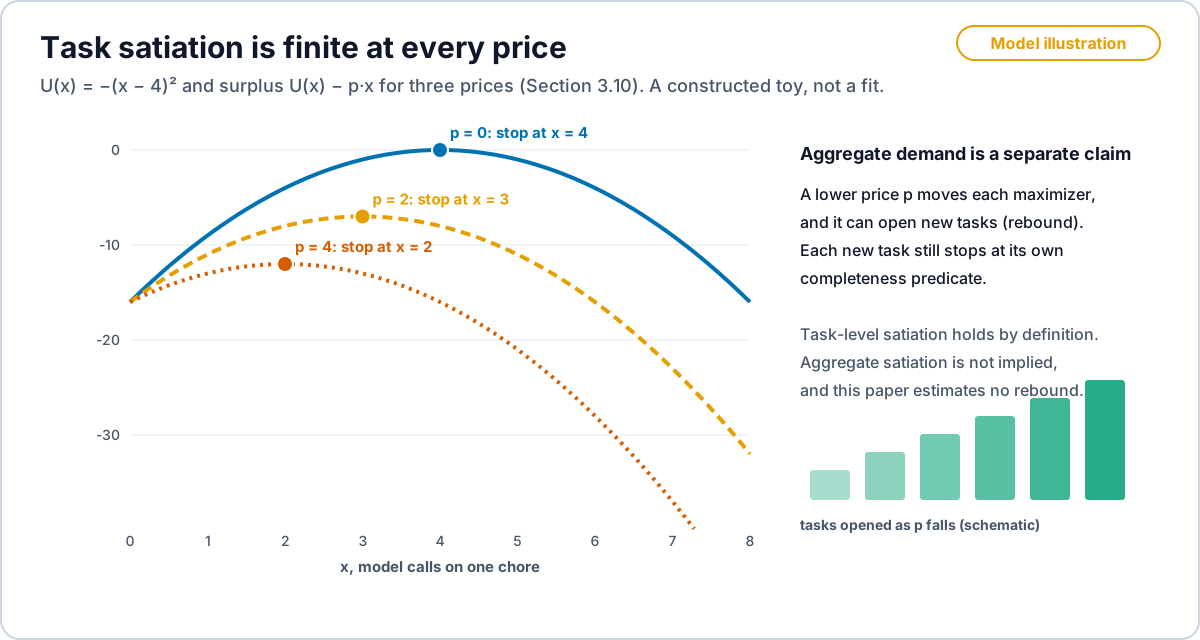
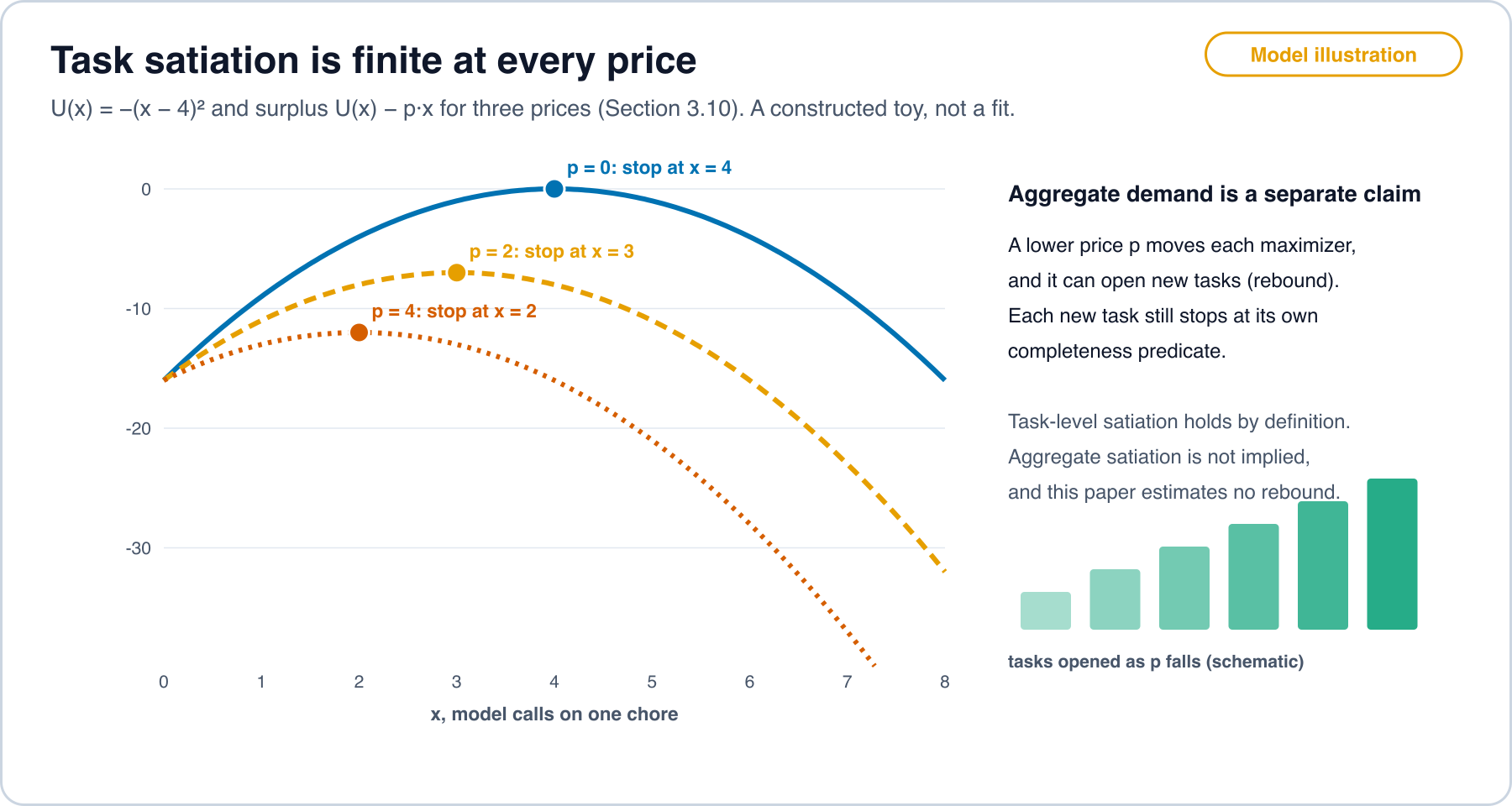
3.10 A numerical illustration of a bliss point (model, not a fit)
Let one coordinate x be the count of model calls on a single chore, and set
U(x) = -(x - 4)^2for a chore whose constructed maximum is at four calls. Then U(0) = -16, U(4) = 0, U(8) = -16. Marginal utility is dU/dx = -2(x - 4), which is positive before 4, zero at 4, and negative after. The illustration uses integers so the sign change is visible without a fit. No dataset was used to choose 4. Replacing 4 with another integer moves the peak and does not change the definition. A product metric equal to x ranks x = 8 above x = 4. A product metric equal to U does the reverse. Claim S-3 is this non-identity, here in a fully specified toy function, and in Section 3.4 in constructed episodes. Neither is a welfare estimate for a firm.
Token price can be attached without confusing units. Suppose a call costs p in money and the buyer pays p * x while value follows U. The buyer’s surplus proxy U(x) - p x still has a finite maximizer for any p >= 0. A fall in p moves the maximizer, which is the rebound logic on this toy, and the maximizer remains finite. The toy does not say where the maximizer sits for any real buyer. It blocks the inference that a lower p removes the maximum.
Figure 1 draws the toy and the separate aggregate claim.
3.11 Reason codes as a partition, not a welfare function
Let R be the set of refuse codes on a trace. Partition R into R_econ = {policy, budget_exceeded} and R_phys = {lut_veto, energy_veto, cbf_veto}, matching the schema’s taxonomy. Other codes, if added later, have to be assigned in writing before they are counted. A trace interval contributes to post-done economic refuse only if C is already 1 and the code is in R_econ. It contributes to physical refuse if the code is in R_phys, whether or not C is 1. An unsafe action after done is in both stories and should be counted in both columns, not averaged. The MCP demo’s irreversible refuse is a physical example: energy and barrier codes, executor calls 0. It is not an R_econ example. A future episode with policy after a merged patch would be the economic example. The repository does not include that episode. The partition is how it would be scored.
4. Evidence
4.1 Claim S-1. Satiation is a defined economic object
Andersen (2001), https://doi.org/10.1007/PL00003852, and the textbook bliss construction in Section 2.1 support S-1. The claim is theoretical. It is not a measured utility function for any user population in this study.
4.2 Claim S-2. Published inference prices fell sharply at fixed performance
Supported by Epoch AI (2025) and Emberson and Roodman (2026), with the magnitudes those notes state (Section 2.5). The claim is about price indices those authors publish. It is not a claim that every organization’s invoice fell by 13 times, and it is not a claim about watts.
4.3 Claim S-3. Engagement variables are not the completeness predicate
Supported by the definitions in Section 3.1 and by the attention literature’s description of time-on-task objectives (Wu; Center for Humane Technology overview). No causal estimate of welfare loss is claimed. The logical claim is non-identity of the variables: token count can increase while C stays constant. The constructed episodes in Section 3.4 are illustrations of non-identity, not datasets.
4.4 Claim S-4. Bicycle-mania prices detached from a simple fundamental story
Supported by Quinn (2019): rises over 200 percent and subsequent falls over 75 percent in cycle shares, 1895 to 1900, not fully explained by fundamentals or by a simple risk shift in that paper’s tests. The claim stops there. It does not quantify household satiation for bicycles.
4.5 Claim S-5. U.S. smartphone ownership is high in the cited fact sheet
The project archive’s reading of Pew’s mobile fact sheet is ownership near 91 percent for the 2024 and 2025 rows. The claim used in this paper is diffusion at that order, conditional on the live sheet matching the archive. It is a saturation fact about ownership, not a bliss-point estimate.
4.6 Claim S-6. Care is not priced as a pure software good by the Baumol framework
Baumol (1967) supplies the framework. Acemoglu and Restrepo (2019) supply the task language. The claim is that these frameworks do not imply an end to care’s labor, trust, or liability requirements when token prices fall. The claim is not a forecast of health-care expenditure.
4.7 Claim S-7. A sell-side note questions spend versus benefit
The Goldman Sachs page named in Section 2.6 exists and frames the question in its title.
4.9 Claim S-9. Physical law is not priced to zero by Epoch
Landauer (1961) and Horowitz (2014) support a permanent gap between an ideal erasure bound and CMOS practice. S-9 says only that a citation of Epoch does not discharge a citation of Landauer.
4.10 Design rules, marked as design
These rules follow if one accepts the definitions and wants a product that optimizes C rather than tokens. They are not effects.
- Write
Cbefore adding model capacity. - Treat a synthesis price premium as temporary when Epoch-type series and open weights apply to that chore.
- Do not describe modeled or simulated energy as measured energy.
- Prefer a detector of
Cwith an error table over an unlabeled increase in model size, once the chore is the product. - Require a separate physical safety check before any irreversible action.
- Report pre-done and post-done energy separately when the split exists. It does not exist yet.
- Do not apply the satiation predicate to adversarial or military races (Section 5.3).
- If the product’s objective is attention, say so. The completeness claims then do not apply.
Kill tests for a roadmap, also design: a plan that assumes unbounded appetite for a chore with a short C; a price that requires permanent synthesis scarcity and no physical or liability wedge; a safety story that uses only a confidence string; a “free” claim that deletes joules; an agent loop with no C.
4.11 What would be a result and is not
A table of false-done and false-continue rates. A time series of calls after t*. A meter reading of energy on a stated workload. A structural rebound estimate. An AGI price premium estimated on a satiated chore. None of these appear in Section 4’s supported claims.
4.12 Non-identity, stated as a comparison of objectives
Let x be call count, s session length, J_pre and J_post energy before and after adjudicated done, and C the predicate. The following implications are definitional.
| Observation | Does not imply |
|---|---|
x increased | C increased |
s increased | welfare increased |
p fell (S-2) | J_post = 0 |
C = 1 | the detector’s error rate is known |
| ownership of phones is high (S-5) | marginal value of another model call is zero |
| cycle-share prices boomed and busted (S-4) | households reached a transport bliss point |
The right-hand column is the list of inferences this paper refuses. Each left-hand observation is either a citation in Section 4 or a variable in Section 3. The table is the discussion compressed into a check. A sentence that asserts a right-hand claim has left the evidence.
5. Discussion
5.1 Rebound: the central identification problem
Three results limit the natural experiment. Gundlach and colleagues (2025) find that prices at fixed benchmark performance fall fast while frontier prices do not, and Du (2026) finds a structural break and a reasoning premium in price evolution, so price cuts arrive bundled with model changes. Anthropic’s Economic Index (September 2025) reports that across tasks each 1% increase in cost is associated with a 0.29% decrease in usage frequency, an inelastic cross-sectional figure, not a price change over time. A provider-level design cannot identify market-level rebound; the design needs market-level prices and quantities.
Gillingham, Rapson, and Wagner survey rebound from energy-efficiency policy. The mechanism is residual demand elasticity. If the money price of synthesis falls, use rises where buyers still value another unit. At a bliss point for a closed chore, the direct derivative of value with respect to more synthesis on that chore is not positive, so direct rebound on that chore is not implied. Indirect rebound, new tasks, and attention shifting can remain. Acemoglu and Restrepo’s new-task margin is one place quantity can reappear. Claim S-2 therefore does not imply a global cap on compute. It implies a cap only relative to a stated C. Denying global rebound would require the split in Section 3.3 and a demand system. This paper does not deny global rebound. It refuses to treat “Jevons” as a reason to avoid writing C.
Two hypotheses make the question testable.
- H1. Post-completion spend. The fraction of agent compute spent after
C(z) = 1, joules or calls witht > t*over all joules or calls in the episode, is measurably above zero. H1 is the direct waste the completeness stop removes. It is estimable from agent logs with a labeledt*per episode (Section 3.3, item 1). - H2. Jevons in tasks. H2 is the direct-rebound elasticity of Khazzoom (1980), stated for tasks. When the price of synthesis falls, the elasticity of the number of tasks run exceeds the fall in spend per task. Then total spend rises even though each task is satiated. H2 is aggregate rebound.
Identification. H1 needs no price variation: a labeled corpus, the detector error rates of Section 3.3 item 2, and the split account. H2 needs exogenous price changes. Provider price cuts at fixed model quality, announced on a known date, are natural experiments. The design is a panel of accounts with price paid, tasks opened, calls per task and a completeness label per episode, before and after each cut. Comparing accounts on a repriced model with accounts on models whose price did not move gives a difference-in-differences estimate of the task-count elasticity and the per-task spend response separately. Spend per task can fall while task count rises. Both numbers are needed. The completeness stop is a claim about the first. Jevons is a claim about the second. Neither was estimated here.
5.2 Status and creative goods
Some goods are valued because they are not finished: status, open-ended art, research whose C is not a finite checklist. The definition in Section 3.1 does not force a bliss point onto those goods. It forces a segmentation. A finite chore and an open-ended practice can be sold by the same firm and should not share a demand assumption. Pricing a finite chore as if it were an open-ended capability race is a category error, not a finding about AGI.
5.3 Adversarial demand
If the other party’s gain is this party’s loss, “enough” is not defined by a local checklist. Arms races and some security contests are in that class. Physical commit constraints can still apply: an unsafe action can be refused while the strategic demand remains open. Scope is part of the claim, not a footnote that cancels it.
5.4 Incomplete knowledge of done
People misjudge completion. Detectors will false-done and false-continue. That is an argument for measuring detector error, which Section 3.3 lists as missing. It is not an argument that session length is a substitute for C in a domain where a missed handoff has a liable party. Where no predicate can be written, this paper’s operational claim is silent.
5.5 Baumol is not solved
A model that drafts a note faster can raise throughput of notes and leave examination, judgment, and responsibility with a person. Expenditure shares can still move as Baumol described if the human residual does not speed up. Saying otherwise would be a forecast this bibliography does not contain. The permitted statement is S-6.
5.6 Free synthesis is not free actuation
A falling money price for inference says nothing about the energy of moving a physical system. Moving a mass through a speed change from rest takes at least joules of work, whatever the price of the instruction that commanded it. Epoch prices sit on a different axis from that work. Collapsing them into “free AI” deletes the measurement class.
5.7 Confidence is not a certificate
A high model score can order proposals. It is not a completeness predicate: a score needs a threshold and an error table (false and true positive rates against a labeled set) before it decides C.
5.8 Sell-side skepticism is not a measurement
S-7 prevents a literature review from ignoring a major public doubt about spend and benefit. It does not let a research note replace a meter or a demand estimate. If the note’s figures are quoted later, the primary PDF has to be the source, and the label is sell-side estimate.
5.9 What a structural demand estimate would require
S-2 is a supply-price fact from secondary published series. A demand estimate is a different regression. At minimum it needs a quantity (calls, tasks closed, or both), a price, and a way to separate movement along a demand curve from movement of the curve. Epoch’s benchmark price is not a firm-level invoice, and a firm’s invoice is not C. Linking them requires a panel this study does not have: accounts that record price paid, calls made, and an adjudicated completeness label on the same episode. Without that panel, the slope of demand after t* is not identified. The toy surplus in Section 3.10 shows only that a quadratic bliss point keeps a finite optimum as p falls. It is not the missing regression.
Segmentation belongs in the same design. Code each product as finite-C or open-ended before pooling. Pooling a ticket desk with an open research tool averages two demand regimes and can manufacture an appearance of unbounded appetite. The military exclusion in Section 5.3 is the same rule applied to a domain where the opponent’s objective prevents a local bliss point. A table with those codes, even with no prices yet, would be more informative than a single total-addressable-market number. The table was not built.
5.10 Why no multiple of kT ln 2 is stated
Landauer’s result is an inequality for an idealized erasure at temperature T. Horowitz (2014) reports energies for particular CMOS operations and for memory traffic, in picojoules, under the assumptions of that tutorial. Dividing one by the other produces a number only after someone chooses the operation, the activity factor, the temperature, and the device. None of those choices is measured in this paper. Stating a fold above the Landauer bound would pretend those choices had been made. The scientific statement is the inequality direction: practical irreversible CMOS in Horowitz’s account sits far above the bound, and a price index does not move a device onto the bound.
6. Limits and threats to validity
Construct validity. Operational satiation depends on C. A hostile or vague C makes the predicate arbitrary. The paper’s defense is to require C to be written in observable clauses. Many real products do not have that writing yet. For those products the theory does not yet apply empirically.
Internal validity of the price claim. S-2 inherits whatever identification Epoch used (quality adjustment, benchmark choice, posted prices versus realized invoices). This paper did not audit the microdata. A revision of Epoch’s series would revise S-2’s magnitudes and might not revise the direction. S-2 should be re-read against the primary pages before it is used as an executive figure.
External validity. Work and care, as defined, exclude military rivalry and may exclude research. Phone ownership does not transfer to agent products. Bicycle share prices do not transfer to software margins. The constructed episodes are not a sample.
Measurement validity. No split joules, no detector confusion matrix, and no energy meter on any device. Vendor hardware specifications are not energy measurements.
Omitted variable. New tasks can absorb spending released by cheap synthesis. Section 5.1 states this. A roadmap that treats per-chore satiation as a forecast of aggregate compute demand is not licensed by this paper.
Publication bias and document type. Wu is a book. The Humane Technology page is advocacy. Goldman Sachs is sell-side. Quinn and Epoch and Baumol and Acemoglu and Restrepo and Landauer and Horowitz are the load-bearing citations, and they support different sentences. The paper’s structure is an attempt to keep those sentences from being averaged into a mood.
Falsifiers. S-1 fails if the cited theory does not contain a zero marginal-utility region. It does. S-2 fails if the primary Epoch pages do not report declines of that kind. A future labeled corpus in which extra calls after a correct C systematically raise an independently specified value would falsify satiation for that corpus. One such corpus would not falsify the definition. It would bound its domain.
Vendor hardware specifications list capacities, not switching activity, static power or the energy of a workload. An energy report has to name the hardware, the clock, the workload, the meter and the duration.
7. Conclusion
Satiation is a standard object in the theory cited, and it has a narrow operational form: a written completeness predicate that extra synthesis does not advance. Epoch’s published series document a sharp fall in the money price of fixed-performance inference. That fall supports a free-at-the-margin description of digital chores and does not support free joules, free plant motion, or the end of care’s cost structure. Bicycle share prices, smartphone diffusion, and attention markets are weaker and stronger in the specific ways Section 4 states. The missing scientific objects are a labeled done detector, a pre-done versus post-done energy split, and a demand estimate that can see rebound. Until they exist, the paper’s empirical content is the cited record, and its formal content is the predicate.
References
Cover, T. M., and Thomas, J. A. Elements of Information Theory, 2nd ed. Wiley, 2006. https://doi.org/10.1002/047174882X
Hoffmann, J., et al. Training compute-optimal large language models. arXiv:2203.15556.
Kaplan, J., et al. Scaling laws for neural language models. arXiv:2001.08361.
Shannon, C. E. Coding theorems for a discrete source with a fidelity criterion. IRE National Convention Record, 1959.
Acemoglu, D., and Restrepo, P. Automation and new tasks: how technology displaces and reinstates labor. Journal of Economic Perspectives 33(2), 2019. https://www.aeaweb.org/articles?id=10.1257/jep.33.2.3
Ames, A. D., et al. Control barrier functions: theory and applications. ECC 2019. https://doi.org/10.23919/ECC.2019.8796030
Andersen, E. S. Satiation in an evolutionary model of structural economic dynamics. Journal of Evolutionary Economics, 2001. https://doi.org/10.1007/PL00003852
Baumol, W. J. Macroeconomics of unbalanced growth: the anatomy of urban crisis. American Economic Review 57, 415-426, 1967.
Bennett, C. H. Logical reversibility of computation. IBM Journal of Research and Development, 1973. https://doi.org/10.1147/rd.176.0525
Center for Humane Technology. The attention economy. https://www.humanetech.com/youth/the-attention-economy
Emberson, L., and Roodman, D. / Epoch AI. The plunging price of thought. 22 September 2026. https://epoch.ai/publications/the-plunging-price-of-thought
Epoch AI. LLM inference price trends. 12 March 2025. https://epoch.ai/data-insights/llm-inference-price-trends
Gillingham, K., Rapson, D., and Wagner, G. The rebound effect and energy efficiency policy. Review of Environmental Economics and Policy 10(1), 68-88, 2016. https://doi.org/10.1093/reep/rev017 Working text: https://gwagner.com/wp-content/uploads/Gillingham-Rapson-Wagner-2015-Rebound-Effect.pdf
Alcott, B. Jevons’ paradox. Ecological Economics 54(1), 9-21, 2005. https://doi.org/10.1016/j.ecolecon.2005.03.020
Anthropic. How we built our multi-agent research system. 13 June 2025. https://www.anthropic.com/engineering/multi-agent-research-system
Jevons, W. S. The Coal Question. London: Macmillan, 1865.
Keynes, J. M. Economic possibilities for our grandchildren. 1930. Reprinted in Essays in Persuasion, 1931.
Nordhaus, W. D. Two centuries of productivity growth in computing. Journal of Economic History 67(1), 128-159, 2007. https://doi.org/10.1017/S0022050707000058
Goldman Sachs. Gen AI: too much spend, too little benefit? https://www.goldmansachs.com/insights/top-of-mind/gen-ai-too-much-spend-too-little-benefit
Horowitz, M. Computing’s energy problem (and what we can do about it). ISSCC 2014. https://doi.org/10.1109/ISSCC.2014.6757323
Landauer, R. Irreversibility and heat generation in the computing process. IBM Journal of Research and Development, 1961. https://doi.org/10.1147/rd.53.0183
Laya. System One models and typed decision engines (comparison table, checked 2 October 2026). https://laya-ai.com/system-one-models
Convai Innovations. Laya model card. https://huggingface.co/convaiinnovations/laya
TypeSafe AI. Introducing System One Models and Jev. 15 September 2026. https://typesafe.ai/blog/introducing-system-one-models-and-jev
Ma, S., et al. The era of 1-bit LLMs. arXiv:2402.17764.
Pew Research Center. Mobile fact sheet. https://www.pewresearch.org/internet/fact-sheet/mobile/
Quinn, W. Technological revolutions and speculative finance: evidence from the British Bicycle Mania. Cambridge Journal of Economics 43(2), 271-294, 2019. https://doi.org/10.1093/cje/bey029
Wei, J., et al. T-MAC. arXiv:2407.00088.
Wu, T. The Attention Merchants. Knopf. https://www.penguinrandomhouse.com/books/234876/the-attention-merchants-by-tim-wu/
Chung, J.-W., Wu, R., Ma, J. J., and Chowdhury, M. Where Do the Joules Go? Diagnosing Inference Energy Consumption. arXiv:2601.22076. https://arxiv.org/abs/2601.22076
Energy use of AI inference, efficiency pathways, and test-time scaling. Joule, 2026. https://www.cell.com/joule/fulltext/S2542-4351(26)00114-5
Luccioni, A. S., Strubell, E., and Crawford, K. From efficiency gains to rebound effects: the problem of Jevons’ Paradox in AI’s polarized environmental debate. FAccT 2025. https://doi.org/10.1145/3715275.3732007
Ostrovsky, N. / Epoch AI. What you need to know about AI energy use. Updated 14 July 2026. https://epoch.ai/publications/ai-energy
Anthropic. Anthropic Economic Index report: uneven geographic and enterprise AI adoption. September 2025. https://www.anthropic.com/research/anthropic-economic-index-september-2025-report
Bai, L., Huang, Z., Wang, X., et al. How do AI agents spend your money? Analyzing and predicting token consumption in agentic coding. arXiv:2604.22750, 2026. https://arxiv.org/abs/2604.22750
Brockway, P. E., Sorrell, S., Semieniuk, G., Heun, M. K., and Court, V. Energy efficiency and economy-wide rebound effects: a review of the evidence and its implications. Renewable and Sustainable Energy Reviews 141, 110781, 2021. https://doi.org/10.1016/j.rser.2021.110781
Brookes, L. The greenhouse effect: the fallacies in the energy efficiency solution. Energy Policy 18(2), 199-201, 1990. https://doi.org/10.1016/0301-4215(90)90145-T
Chen, X., Xu, J., Liang, T., et al. Do NOT think that much for 2+3=? On the overthinking of o1-like LLMs. arXiv:2412.21187, 2024. https://arxiv.org/abs/2412.21187
Cuadron, A., Li, D., Ma, W., et al. The danger of overthinking: examining the reasoning-action dilemma in agentic tasks. arXiv:2502.08235, 2025. https://arxiv.org/abs/2502.08235
Du, M. Tiered super-Moore’s law: price evolution, production frontiers, and market competition in large language models. arXiv:2603.28576, 2026. https://arxiv.org/abs/2603.28576
Fouquet, R., and Pearson, P. J. G. Seven centuries of energy services: the price and use of light in the United Kingdom (1300-2000). The Energy Journal 27(1), 2006. https://doi.org/10.5547/ISSN0195-6574-EJ-Vol27-No1-8
Gundlach, H., Lynch, J., Mertens, M., et al. The price of progress: price performance and the future of AI. arXiv:2511.23455, 2025. https://arxiv.org/abs/2511.23455
Khazzoom, J. D. Economic implications of mandated efficiency in standards for household appliances. The Energy Journal 1(4), 1980. https://doi.org/10.5547/ISSN0195-6574-EJ-Vol1-No4-2
Masanet, E., Shehabi, A., Lei, N., Smith, S., and Koomey, J. Recalibrating global data center energy-use estimates. Science 367(6481), 984-986, 2020. https://doi.org/10.1126/science.aba3758
Saunders, H. D. The Khazzoom-Brookes postulate and neoclassical growth. The Energy Journal 13(4), 1992. https://doi.org/10.5547/ISSN0195-6574-EJ-Vol13-No4-7
Sorrell, S., and Dimitropoulos, J. The rebound effect: microeconomic definitions, limitations and extensions. Ecological Economics 65(3), 636-649, 2008. https://doi.org/10.1016/j.ecolecon.2007.08.013
Tsao, J. Y., Saunders, H. D., Creighton, J. R., Coltrin, M. E., and Simmons, J. A. Solid-state lighting: an energy-economics perspective. Journal of Physics D: Applied Physics 43(35), 354001, 2010. https://doi.org/10.1088/0022-3727/43/35/354001
Witt, U. Learning to consume: a theory of wants and the growth of demand. Journal of Evolutionary Economics 11(1), 23-36, 2001. https://doi.org/10.1007/PL00003851
Appendix A. Decision rules and non-results
| Id | Statement | Class |
|---|---|---|
| R1 | Write the completeness predicate before adding capacity. | Design |
| R2 | Expect synthesis price premia to erode where Epoch-type evidence applies. | Design, conditional on S-2 |
| R3 | Do not claim free energy or free actuation. | Constraint from S-9 |
| R4 | Separate economic stop reasons from physical stop reasons. | Design |
| R5 | Publish detector error rates before treating a stop as accurate. | Not yet a result |
| R6 | Split energy before and after done. | Not yet a result |
| R7 | Keep adversarial races outside the satiation claim. | Scope |
| R8 | Re-read Pew and Epoch primaries before quoting a finer magnitude. | Method |
Appendix C. Claim map
Supported now: S-1 through S-9, with the scope sentences in Section 4.
Not supported: an end to Baumol cost disease; free plant motion; satiation of military demand; a numerical global rebound of zero; Landauer-scale operation of a language model; board watts; an AGI price as a fact about satiated chores; a universal distillation lag; silicon performance leadership.
Open measurements: Section 3.3.