RCE language specification, draft 0.5
6. Dynamic semantics: the mapping into the Form
This section gives the dynamic semantics: what a program computes, as a
mapping into the Form. It also lists the exact edge behaviour of every
primitive (overflow, division by zero, float rounding, text indexing), which
every implementation must reproduce. Example: -7 / 2 is -3, and
i64.MIN / -1 traps with "overflow: 9223372036854775808 is outside i64".
6.1 The Form of a program
Let the program declare regions R₁…Rₖ (state and actor declarations;
actors also carry a mailbox), events E₁…Eₘ and errors X₁…Xⱼ. Its Form
P = (S, E, δ, D, λ) is:
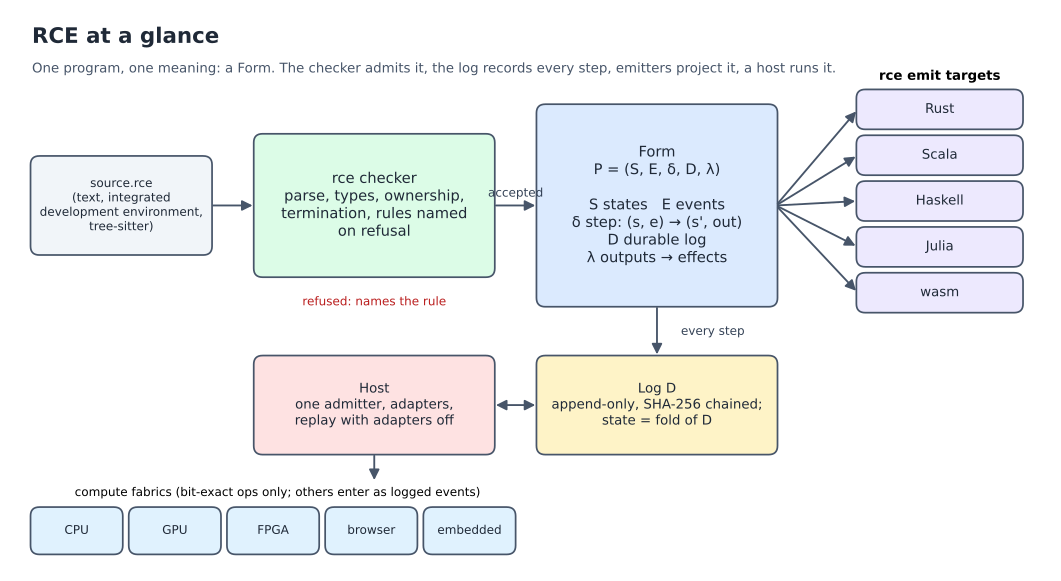
Figure (informative). Where the Form sits between the checker, the log D and the emitters. Source: docs/figures.
- S = ⟦R₁⟧ × … × ⟦Rₖ⟧, where ⟦R⟧ is the set of records {fᵢ : ⟦τᵢ⟧} of R's field types, with the initial state s₀ = (r₁⁰, …, rₖ⁰), rᵢ⁰ the record of field initializers (evaluated at comptime). Actor regions add a mailbox queue and a held-message queue (Form law 3).
- E = the disjoint union of the events' payload sets:
E = ⊎ₗ {Eₗ} × ⟦payload(Eₗ)⟧, plus the built-in
Tick(n: u64)and the task events of 6.8. - δ : S × E → S × O* (state and the outputs of the step) is defined in 6.4. It is a total function (T2).
- λ maps each step to its output sequence O*: values
emitted, and for a refused event the recordRefused(X, payload). - D is the log: the sequence of admitted events e₁, e₂, …, each entry with its outcome (applied, or refused with X). The fold law: the state after the log is sₙ = foldl(δ₁, s₀, D) where δ₁ is the state component of δ.
Canonical signature (normative). This is the one signature; the engine
profile (D.6), the engine IR (FormIr::step) and the language interpreter
are instances of it, and any other text (FORM.md, papers) defers to it.
S = Σc × Σd (control regions, data: regions, clock, input count,
relations); δ : S × E → S × O* total; λ = π₂ ∘ δ; δ₁ = π₁ ∘ δ. An entry of
D is the record {seq, event, prev_hash, state_hash, hash} where seq is
the 0-based index, event is {type, payload}, prev_hash is the hash
of the previous entry (64 zeros for the first), state_hash is the
SHA-256 of the canonical JSON of the state after the step, and hash is
the SHA-256 of the canonical JSON of {event, prev_hash, seq,
state_hash}. A log may also carry outcome, out and state; these are
derived and must equal replay (T1), so they are not hashed. A refused
event (T8) is recorded with its unchanged state and ends the example
log. Both producers are tested against this rule
(spec/checker/tests/form_signature.rs, tests/form_signature.rs).
Values ⟦τ⟧ are the Form's JSON-shaped values (form/types.rs): integers (i64), floats (finite f64), text, bool, null, lists, records. The embedding of RCE types into them is fixed:
| RCE type | Form value |
|---|---|
| bool | bool |
| iN, uN, usize | int, with the range of the RCE type checked at every write |
| f64 | float, finite, normalized (6.3 N1) |
| text | text (sequence of Unicode scalar values) |
| () | null |
| (a, b, …), [τ; n], List[τ] | list |
| Set[τ] | list, sorted by canonical order, no duplicates |
| Map[k, v] | list of [k, v] pairs sorted by canonical order of k |
| struct / state record | record (keys sorted, as canonical JSON) |
| kind variant V(f: …) | record {"$v": "V", f: …}; unit variant: {"$v": "V"} |
| τ? | null for none, the value for some (and some(none) is refused: τ may not itself be an option, W-TY-2) |
| chan τ, actor handle | record {"$chan": id} / {"$actor": id}, id the content hash of 6.6 |
Canonical order of values (used by Set, Map and select): null < bool < number < text < list < record; numbers by value; text by code point; lists and records lexicographically. This is a total order because NaN does not exist.
6.2 Evaluation
Expressions are evaluated by a big-step judgment
⟨e, ρ, σ⟩ ⇓ r, where ρ maps variables to values, σ is the store of vars
and fields, and the result r is one of
ok(v, σ′): a value and updated store,trap(m): a defined failure of the Form. The trap texts are exactly those of 6.3 ("overflow: V is outside T", "division by zero", "shift amount out of range", "non-finite float", "index K out of range", "slice index out of range", "slice bounds reversed", "not a char boundary", "size limit", "value limit"), "loop bound" (6.7) and "budget" (C.5),fail(X, v): a user error raised byfailor propagated bytry,- control signals
ret(v),brk,cont(statements only).
Evaluation order is fixed: left to right, operands before operators,
arguments before the call, receiver before arguments. and/or short-circuit.
There is no other source of nondeterminism in expressions.
Selected rules (the rest are the standard ones for a strict language):
Typing rules E-Arith, E-Arith-Trap, E-Try-F, E-TryElse, E-Catch
Plain text of this block
  ⟨a,ρ,σ⟩ ⇓ ok(x,σ₁)   ⟨b,ρ,σ₁⟩ ⇓ ok(y,σ₂)   arith_ι(⊕,x,y) = v
  ──────────────────────────────────────────────────── [E-Arith]
  ⟨a ⊕ b,ρ,σ⟩ ⇓ ok(v,σ₂)

  ... arith_ι(⊕,x,y) = Err(m)
  ──────────────────────────────── [E-Arith-Trap]
  ⟨a ⊕ b,ρ,σ⟩ ⇓ trap(m)

  ⟨e,ρ,σ⟩ ⇓ ok(err(X,v),σ′)                ⟨e,ρ,σ⟩ ⇓ ok(val(v),σ′)
  ──────────────────────── [E-Try-F]       ─────────────────────── [E-Try-V]
  ⟨try e,ρ,σ⟩ ⇓ fail(X,v)                  ⟨try e,ρ,σ⟩ ⇓ ok(v,σ′)

  ⟨e,ρ,σ⟩ ⇓ ok(none or err(_),σ′)
  ─────────────────────────────────── [E-TryElse]
  ⟨try e else X,ρ,σ⟩ ⇓ fail(X, ⟦X⟧)

  ⟨e,ρ,σ⟩ ⇓ ok(err(X,v),σ′)   ⟨h,ρ[x↦X(v)],σ′⟩ ⇓ r
  ──────────────────────────────────────── [E-Catch]
  ⟨e catch |x| h,ρ,σ⟩ ⇓ r
trap and fail propagate outward through every construct (they are not
caught by catch: catch handles only declared errors and none; a trap
always refuses the event).
&mut write-back (normative). A call writes back each &mut
argument and a &mut self receiver on every outcome, including fail:
the callee's writes made before it failed stay in the caller's store,
exactly as an in-place update (fail above leaves the store at σ′, the
store when it was raised, not σ). The derivation: the Rust target updates
in place, and copy-in/copy-out agrees with in-place update only when it
also copies out on failure (T33, WriteBack.t33; copyOk_differs shows
that copying out only on success disagrees). Atomicity is per event, not
per call: a trap, or a fail that leaves the step, refuses the event
and the state is the pre-state (T8). The program emitters implement the
rule for a write-back call that is a whole statement or expression of a
let, var, assignment, emit or return, and for such a call under
catch or try (f(&mut x) catch h, try f(&mut x)): the call is the
first thing the statement evaluates, so it can be hoisted without
changing evaluation order or budget charges. A write-back call nested
deeper in a strict position (an operand of an operator, an argument, a
list or map element, a receiver) is first rewritten by one shared
A-normal-form pass that runs before all three emitters
(spec/checker/src/anf.rs): the operands evaluated before it are bound
to fresh let temporaries in left-to-right order, then the call, so
reads, budget charges and emits keep their order (T34). A write-back
call in a conditional position (right of and/or, an if branch, a
catch handler, a lambda or a comprehension) is not flattened, since
that would evaluate it eagerly; it is refused with a diagnostic, never
given a different meaning. Tested on every target
(spec/checker/tests/write_back.rs). Values of type τ ! ε are val(v) or
err(X, v); they are first-class only until a try or catch consumes them.
6.3 Edge semantics of primitives (normative, from form/num.rs)
These are the Form's own rules; every implementation reproduces them exactly.
- N1 Numbers. A Form number is an int (i64) or a float (finite f64). At
every event boundary a payload is normalized: a finite float with no
fractional part and |x| < 2^63 becomes the int (
3.0is3,-0.0is0). RCE's static types make the int/float distinction visible to the programmer; normalization is applied only when values cross the Form boundary (event payloads, state, outputs) and is invisible inside a computation because each RCE value carries its static type. - N2 Integer arithmetic is checked: overflow of the static type's
range is
trap("overflow: V is outside T")with V the exact result and T the static type (i64for an untyped literal), never a wrap./truncates toward zero (-7 / 2 = -3);%has the sign of the dividend (-3 % 2 = -1). Division or remainder by zero istrap("division by zero"). Modular and clamped arithmetic are explicit methods, never the default:a.wrapping_add(b),wrapping_sub,wrapping_mulgive the result modulo 2^N mapped into the static type's range, andsaturating_add,saturating_sub,saturating_mulclamp it to the range; neither traps. u64 and usize arithmetic uses the Form opsuadd usub umul udiv urem(draft 0.5), which compute the exact result and trap unless it lies in [0, 2^64); a value at or above 2^63 is carried as an unsigned Form int, so18446744073709551615 - 1is exact. Lean:RCE/U64.lean.i64.MIN / -1andi64.MIN % -1aretrap("overflow: 9223372036854775808 is outside i64")(the quotient is out of range; Rust'schecked_rem). Shifts:x << nandx >> nwith n ≥ bit width or n < 0 aretrap("shift amount out of range");>>is arithmetic for signed and logical for unsigned types. Bitwise& | ^ ~act on the two's-complement representation of the static type. - N3 Floats. f64 operations are IEEE 754 binary64, round to nearest even.
%is not defined on floats (W-TY-1:%needs integers). A non-finite result (±inf, NaN) istrap("non-finite float"): NaN and infinities never exist as values.x / 0.0istrap("non-finite float")(its result is ±inf or NaN), and so issqrtof a negative number. Canonical float text is the shortest round-trip digits; decimal notation for 1e-5 ≤ |x| < 1e16, elsed.ddde±Nwith+on positive exponents (1e+300,1.5e-7). f32 (draft 0.5). The Form opsf32add f32sub f32mul f32divround both operands to binary32, compute in binary64, and round the result to binary32 (round to nearest even). Binary64 has 53 ≥ 2·24 + 2 significand bits, so by Figueroa's theorem the result equals the correctly rounded binary32 result, and every target (Rustf32, Pythonstruct, JavaScriptMath.fround) gives the same bits. A result outside the binary32 range istrap("non-finite float").x as f32(Formtof32) rounds once. Lean:RCE/F32.lean. - N4 Mixed arithmetic does not exist in RCE (both operands of a binary
operator have the same static type).
a as f64converts an integer exactly when |a| ≤ 2^53 and otherwise rounds to nearest even;x as iNtruncates toward zero and traps if the result is out of range or x is not finite. - N5 min / max compare exactly on integers and by IEEE order on floats (total, since operands are finite); on a tie the receiver is returned.
- N6 Equality is structural value equality after normalization;
1 == 1.0is a type error in RCE (different static types), so the Form's "1 equals 1.0" rule matters only at the boundary. - N7 Text is a sequence of Unicode scalar values compared by code point,
stored as UTF-8. From draft 0.5,
len, indexing and slicing count UTF-8 bytes (Formblen,bget,bslice):s[i]is au8, and a slice whose ends are not character boundaries istrap("not a char boundary").for c in sandchars()still go by character. Case mapping (upper,lower) and class tests (isdigit,isalpha,isupper,islower) are ASCII-only; other characters are unchanged / false.stripandwordssplit on ASCII whitespace (space, \t, \n, \r, \x0b, \x0c). - N8 Indexing The index
iofa[i]and the ends ofa[i:j]have typeusize(W-TY-1 otherwise), so no index is negative.a[i]with i ≥ n istrap("index i out of range"). A slice end above n istrap("slice index out of range"), and i > j istrap("slice bounds reversed"); an omitted end is 0 or n. Indexing and slicing are total or trapping by one rule: an out-of-range position is never silently moved. - N9 Limits. A list or text built by any operation is at most
SIZE_LIMIT = 1,000,000 elements (
trap("size limit")). A value written to state is at most VALUE_LIMIT = 1,048,576 bytes of canonical JSON (trap("value limit"), the event is refused, the value is not recorded). - N10 Absence.
noneand a present()differ, exactly as the Form's null-versus-absent rule: an option field holding none is present. - N11 Time is the logical clock only:
Tickevents andafter ninselect. No construct reads a wall clock.
The built-in methods are exactly the table of 5.15 (the closed standard
library); each has the semantics of the Form primitive of the same name in
num.rs and ir.rs (Prim, Map, Filter, Fold, SortBy), at the RCE
static type. A Form primitive that is not in that table (for example
pow, floordiv, pmod, zip, replace, unique) is not an RCE
method and is W-NAME-1.
sort and sort_by are stable.
Built from spec commit 49fa9af. Code cells run the reference checker rce-check, written in Rust and compiled to WebAssembly, inside your browser; nothing is sent to a server. Read-aloud uses the Kokoro-82M model (Apache-2.0), served from this site and run in your browser.