RCE language specification, draft 0.5
10. Tooling: the `rce` command and the language server
This section defines the tools that read RCE programs: the rce command
and the language server it contains. It adds no rules to the language; it
says what each tool prints and returns for a given input. Example:
rce run counter.rce "Inc, Dec, Dec" prints the state after each event
and stops at the refused third event with exit status 1.
10.1 Principles
- Determinism. Every subcommand is a function of its arguments and the bytes of the files it reads. Two runs on the same input give the same output bytes and the same exit status. No subcommand reads the clock, the network, environment variables or random numbers.
- No model in the loop. No subcommand and no language server request calls a language model, a remote service or any learned component. A diagnostic, a run, a test verdict, an emitted file and a formatted file come only from the rules of sections 2 to 7.
- One checker.
rce check,rce test,rce run,rce emitand the language server all use the same parser, type checker and admission gate (6.9) as the reference checkerrce-check. A file accepted by one is accepted by all. - Exit status. 0 means success. 1 means a program was refused, an
example or check failed, a run reached a refused event, or
fmt --checkfound a file to change. 2 means a usage error: unknown subcommand, wrong number of arguments, unreadable file, or an unknown emit target or construct an emitter does not translate (10.5).
rce is one binary, built from the reference checker crate in
spec/checker (crate rce-spec-check, cargo build --release --bin rce).
The language commands of this section are implemented in
spec/checker/src/cli.rs (entry point cli::main), with their tests in
spec/checker/tests/. This rce carries the language commands only; the
Form command line (rce form ...), which reads the Form spec format rather
than RCE programs, is not part of this build, and rce form exits with
status 2.
The tables of 5.15 (which methods each receiver has) and C.6.4 (the work
class of each method) are not typed into the checker a second time: it
reads them from spec/data/spec-data.json, which rce-spec-data
generates from this book. The two tables are cut from it into
spec/data/spec-tables.json, the file compiled into rce, the checker
and its wasm build; rce-spec-data --check fails when either file
differs from what the book gives.
10.2 `rce check FILE|DIR...`
All FILEs form one program: use resolves among them (4.1). A DIR is a
package: it stands for its .rce files, recursively, in sorted order,
and reads nothing outside it (the multi-module example is the package
spec/examples/26_use_module/, so rce check spec/examples/26_use_module
checks it alone). Each file is
parsed, type checked (section 5) and admitted (6.9: every const,
comptime block, check and example is evaluated). For each file, in
the order given, one line is printed:
ok FILE
REFUSED FILE: line N: RULE message[; line M: RULE message ...]
Every refusal names its rule from section 7. Exit status 1 if any file is refused, else 0.
10.3 `rce run FILE [EVENTS]`
The file must pass rce check alone; otherwise one REFUSED line is
printed and the status is 1.
With EVENTS. EVENTS is written exactly as the event list of an
example line (3.2, EventRef { "," EventRef }), for example
"Inc, Inc, Dec" or "Deposit(amount: 50), Withdraw(amount: 20)".
Let s₀ be the initial state (6.1) and e₁ … eₙ the events. For k = 1 … n the command computes
(sₖ, oₖ) = δ(sₖ₋₁, eₖ)where δ is the step function of 6.4 and oₖ is the sequence of values the
step emitted (λ). It prints line 0 as 0 (initial) STATE, then for each k
the line k EVENT STATE followed by one line emit VALUE per element of
oₖ, in order. STATE lists every region as Region { field = value, ... },
regions separated by ; , in declaration order. If δ refuses eₖ, the line
is k EVENT refused: ERROR, no later event is applied, and the status is
- Otherwise the status is 0. An event name that is not declared is a usage
of a wrong event list: one
REFUSEDline, status 1.
For the counter spec/examples/01_counter.rce:
$ rce run 01_counter.rce "Inc, Inc, Dec, Dec, Dec"
0 (initial) Counter { n = 0 }
1 Inc Counter { n = 1 }
2 Inc Counter { n = 2 }
3 Dec Counter { n = 1 }
4 Dec Counter { n = 0 }
5 Dec refused: Underflow
Without EVENTS. The module must declare fn main() with no
parameters. The command evaluates its body by the rules of section 6 and
prints emit VALUE for each value emitted, in order. If the body traps or
fails, the last line is refused: REASON and the status is 1. Calls to
foreign functions (5.11) are not executed by the reference evaluator and
trap. If there is no fn main(), the command says so and the status is 1.
The evaluator is the reference interpreter of the checker, with the fuel bound of 6.7 and the VALUE_LIMIT of 6.3. It is a definition of meaning, not a fast runtime.
10.4 `rce test FILE|DIR...`
The test cases of a module are its example lines and its check items,
including those inside intent blocks. rce test admits the files as
rce check does, which evaluates every case (6.9, W-INT-1). It prints, per
file,
ok FILE (E examples, C checks)
FAIL FILE: line N: RULE message[; ...]
with E and C the numbers of cases in that file, then a total line
P passed, F failed. Exit status 1 if F > 0. A test verdict therefore
equals the admission verdict: a module whose examples do not hold is not a
program (section 7).
10.5 `rce emit TARGET FILE`
TARGET names an output. The file must pass rce check on its own.
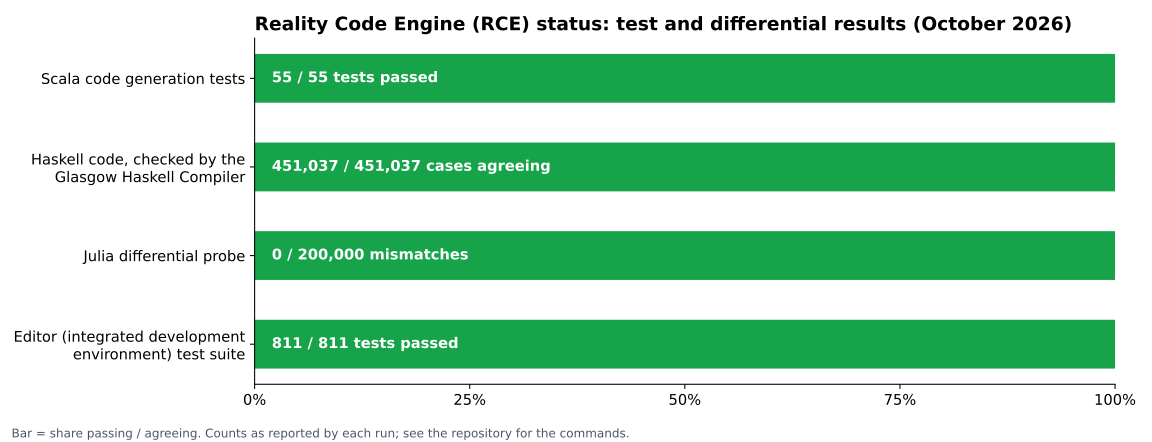
Figure (informative). Test and differential results, October 2026, for the Scala and Haskell emitters, the Julia probe and the IDE. Source: docs/figures.
| TARGET | Output |
|---|---|
form | the Form P = (S, E, δ, D, λ) as one line of JSON (6.1), then a line end |
rust | one Rust 2024 source file with a main |
python | one Python 3 source file |
js | one JavaScript module (ES2020 or later, BigInt) for Node |
scala | one Scala 3 source file with a @main for the JVM (Java 19 or later) |
The Form JSON lists objects in canonical order (6.1), so it is a deterministic function of the program text.
The program emitters. rust, python, js and scala translate the checked
module, not the Form. Each output is self-contained. It starts with a
runtime that defines the values of 6.3 and their operations, following the
reference evaluator (spec/checker/src/interp.rs) value by value. That
includes the integer range checks, the trap messages, map insertion order
and the display of floats and text. After the runtime comes one target
function per RCE function, method, step and constant. An expression becomes
calls to runtime helpers with its operands in evaluation order; if,
while, loop, for and match become the target's own control flow,
with one counter per loop against its bound. Values are never changed in
place: an assignment to a.f[i] rebuilds the value, as the reference
evaluator's assign does.
The Rust output follows the shape of the verified emitter of T9
(spec/lean/RCE/Emit.lean): one value type, Result with ? for traps
and refusals, and i128 arithmetic checked against each integer type's
range. The theorem of T9 is about the Lean model of that emitter. The
emitter in rce is tested against the reference evaluator; it is not
proved.
The Scala output is the functional-language target. Its values are the
same dynamic values as the JavaScript output's (integers as BigInt with
their type, floats as JVM Double, whose arithmetic is IEEE 754 binary64
with round to nearest even and no contraction since Java 17, and whose
toString is the shortest round trip since Java 19). Loops are while
loops, and break and continue are control exceptions caught at the
loop, so no RCE loop grows the stack; the observations run on one thread
with a 2 GiB stack.
What an emitted program does. Run it, and it prints the module's
observations: one line per constant, per check, per function without
parameters (other than main), per event of each example (the state after
it, its outputs, or the refusal), and finally the outputs and result of
fn main. These are the lines emit::observe computes with the reference
evaluator, so that a target and the reference can be compared line for
line.
How the emitters are tested. spec/checker/tests/emit.rs emits all 51
programs of spec/examples/ in all three targets. To exercise function
bodies, it first adds probes: for each function and method, up to three
calls on small sample arguments built from the parameter types, plus one
example that sends every event. It then runs each output (rustc,
python3, node) and requires its output to equal the reference
evaluator's, line for line. All 51 agree on all three targets, with 299
observation lines per target. Four programs (14, 15, 34, 47) contain only
concurrency and give no observation. A separate program
(tests/emit_edge.rce) covers range traps, loop bounds, &mut write-back,
closures and float display. The Scala target has its own test in the same
file: on 2026-10-14, on the Apple M5 Max below, with Scala 3.10.0 run by
scala-cli 1.18.0 on OpenJDK 27, all 55 programs of the current corpus
(with the package files of example 26) agree with the reference, 0
refused, 361 observation lines, and the edge program agrees on all four
targets. Its oracle is RCE_SCALA (default scala-cli).
When rustc, python3 or node is missing,
its test prints SKIPPED and the reason; a skipped target is never
counted as a pass. The oracles used were Python 3.13.5 and Node 20.19.2.
The test reads the oracle paths from RCE_RUSTC, RCE_PYTHON and
RCE_NODE (default rustc, python3, node on the path) and prints each
oracle's version. On 2026-10-12 the same tests were also run on an Apple
M5 Max (macOS 27.0.1, arm64) with rustc 1.98.1, Python 3.14.5 and Node
26.11.1: 51 of 51 agree on each of the three targets, 0 refused, 0
skipped, 299 observation lines per target, and the edge program agrees on
all three.
Fuel. Each emitted program counts fuel (6.7) at the reference
evaluator's charge points: one tick per evaluated expression, per
executed statement, per call of a user function or method, and per
element of a list comprehension and of map, filter and fold. A
temporary introduced by the emitter's own lowering is not charged. The
limit is 50,000,000; it is reset before each observation, as the reference
starts a new evaluator for each, and running out traps with the message
"comptime fuel exhausted". The argument --fuel=N sets the limit to N and
--fuel-trace prints fuel K after each observation, K being the ticks
used. These two arguments exist for the test below; the default program
takes no argument.
spec/checker/tests/fuel.rs compares the ticks used, line for line, on
the 50 programs of the emitter tests (with probes) against
emit::observe_fuel of the reference evaluator, in all three targets. It
then runs ten programs at every limit from 0 up to 300 and at 400 evenly
spaced limits above, up to one more than the program uses, and requires
each target to trap at the same observation with the same output as the
reference run at the same limit. Within one observation, the emitted
order of ticks can differ from the reference where the emitter evaluates
arguments before entering a call; the trap observation and the total are
what the test fixes. The Scala target is in the same test (the emitted
file is packaged once into a jar and run with java -jar); on 2026-10-14
it agreed on all 54 programs of that corpus and at all 1,366 swept limits
(RCE_FUEL_LANGS=scala).
Running fn main. Run with the argument --run, an emitted program
instead evaluates fn main with tasks, channels, select, actors and
par on a runtime of its own: every task is a thread (a worker in
JavaScript), and one scheduler admits their moves tick by tick in the
order of conc::run_main, the reference of rce run without EVENTS. It
prints emit VALUE per output and the line outcome Done,
outcome Deadlock or outcome Refused: REASON. A module without
fn main() prints the reference's message ("nothing to run") on standard
error and exits with status 1, as rce run does. Fuel follows the reference's
pools: each task has its own, starting full (its first ticks are the call
of its function and one per argument); actor handlers share the
scheduler's pool; a par branch or for ... par chunk starts from its
parent's remaining fuel, and the branches are charged back in source
order, so the trap falls where the reference's sequential run puts it.
spec/checker/tests/emit_run.rs compares the three runtimes with
conc::run_main on a corpus of task programs. Among them are the four
concurrency examples 14, 15, 34 and 47, each run with a fn main from
spec/checker/tests/drivers/ appended to its unchanged text.
spec/checker/tests/fuel_run.rs runs seven of these programs at every
fuel limit where the reference's result changes and at the limit before
it (258 runs over the three targets), and requires the same outputs and
outcome.
Limits of the emitters.
- In the observations, channels,
spawn,select, actors andexternfunctions trap with the same message as in the reference evaluator ("not available at comptime"); they run only under--run.externfunctions trap there too. - Under
--run, aparwhose branches wait on an lvar runs its branches at the same time in the reference (ParMode::Threads), each on a copy of the parent's fuel; the emitted runtimes charge everyparas the sequential run does. The two differ only when such aparruns out of fuel, and no test covers that case. - Deep recursion ends with the target's own stack error.
- A call that writes back its receiver or a
&mutargument (xs.push(x),f(&mut a)) is translated only as a whole statement or as the right side oflet,var, an assignment,return,emitorfail. Elsewhere,rce emitrefuses the program with status 2 and names the construct. No example program is refused. - When a function whose result is a union fails, its
&mutarguments are not written back. The reference evaluator writes them back. - The Python output has been checked with Python 3.13.5 and 3.14.5, and the JavaScript output with Node 20.19.2 and 26.11.1. Other versions have not been run.
- The Scala output has been checked with Scala 3.10.0 on OpenJDK 27 only.
It has no
--runruntime yet: with--runit prints that--runis not available on this target and exits with status 2. Aparruns its branches in source order on one thread (by restart when they wait on lvars), as the JavaScript output does when a local cannot go to a worker.
For an unknown target, or a program that one of these emitters does not
translate, rce emit prints nothing on standard output, prints the reason
on standard error, and exits with status 2. It never prints a partial file.
10.6 `rce fmt [--check] FILE...`
rce fmt rewrites each file into canonical layout. Let tok(t) be the token
sequence of text t produced by the lexer and layout pass of 2.6, with line
numbers dropped. The formatter is a function fmt on texts with:
- Meaning preserved. tok(fmt(t)) = tok(t). The formatter checks this
equality on every file before writing it; if it would fail, the file is
left unchanged, a
REFUSEDline is printed and the status is 1. - Canonical layout. In fmt(t): a block that is k levels deep starts its lines with exactly 4k spaces; no line has trailing spaces; there are no blank lines before the first line, no two blank lines in a row, and the file ends with exactly one line end. A comment-only line takes the indentation of the next code line. A line that continues inside an open bracket keeps its position relative to the line that opened it.
- Idempotence. fmt(fmt(t)) = fmt(t). This is tested on every program
in
spec/examples/and on the formatter's tests; it is not proved.
A text the lexer refuses (2.6, W-LEX-1, W-LEX-2) is refused by fmt with
the same reason. fmt does not type check: a file that is refused by
rce check can still be formatted. With --check, no file is written;
each file that would change is printed as would reformat FILE and the
status is 1. Without it, each changed file is written and printed as
formatted FILE.
10.7 The language server: `rce lsp`
rce lsp speaks the Language Server Protocol 3.17 over standard input and
output (JSON-RPC 2.0 messages framed by Content-Length headers). It keeps
the full text of each open document; it does not read other files.
| Message | Behaviour |
|---|---|
initialize | replies with capabilities: full-text sync (textDocumentSync = 1), formatting, hover, definition, document symbols, and completion triggered by . |
textDocument/didOpen, didChange | stores the text and publishes diagnostics for that document |
textDocument/didClose | forgets the text and publishes an empty diagnostic list |
textDocument/formatting | returns one edit replacing the whole text with fmt(t) (10.6), or no edit if t is canonical or refused |
textDocument/hover | the type or declaration of the name at the position, or null |
textDocument/definition | the location of that name's binding or item, or null |
textDocument/completion | the names that can be written at the position |
textDocument/documentSymbol | the document's items, each with its fields, variants or methods |
shutdown | replies null |
exit | ends the server: status 0 after shutdown, 1 without it |
| any other request | error -32601, method not found |
Diagnostics. For a document with text t, the published diagnostics are
exactly the refusals rce check gives for t, one per refusal, with severity
Error and source rce. A refusal line N: ... covers line N − 1 in the
protocol's 0-based numbering, from column 0 to the start of the next line.
use resolves among the module paths of all open documents.
Names. Hover, definition, completion and symbols all read one index of
the document. The index is built from the parsed module and from the
bindings the type checker declares while it checks the module: each local
binding, with its line and its inferred type. A document that does not
parse has an empty index, so these requests answer null or an empty list.
- Hover on a local binding shows
name: T, with the type T the checker inferred. On an item it shows the item's declaration: the line of a function, constant, event or alias, or the whole block of a kind, struct, state or trait. On a variant, field or method it shows that line. - Definition gives the line of the binding or item, and the column where the name appears on it.
- Completion after
.offers user methods, fields and the builtin methods of the reference evaluator. Elsewhere it offers the local bindings of the enclosing item, the module's items, variants and fields, and the keywords. Each list is filtered by the part of the name already typed. - Document symbols list the items in order, with fields of structs and states, variants of kinds and methods of impls as children.
Limits: the AST has no columns, so a name is found by scanning its line,
and columns are counted in Unicode scalar values rather than the UTF-16
units of the protocol; the two counts differ only on a line with a character outside
the Basic Multilingual Plane. A local is visible from its line to the end
of its enclosing item: block scope is not tracked, so a binding of a closed
block is still offered. Names are resolved within one document, not across
use.
Because diagnostics come from the same checker, an editor shows a program
as clean exactly when rce check accepts it (10.1, principle 3).
10.8 What is not yet implemented
- The program emitters do not run concurrency or actors in their
observations, only under
--run, and never runexternfunctions (10.5). - The language server resolves names within one document, without block scope, and counts columns in Unicode scalar values (10.7). It has no rename, references or semantic tokens.
rce runuses the reference interpreter; there is no compiled runtime.- Idempotence of
fmtis tested, not proved.
10.9 `rce trace --json FILE [EVENTS]`: reference traces (informative)
The trace format lets an independent projector (another compiler or runtime of the same Form) show that it agrees with the reference evaluator step by step. It adds no meaning: every field is a field of the log D of 6.1, so a trace is the log, and conformance to 6.1 implies conformance to the trace.
rce trace --json FILE prints one trace per example of the module, in
source order (the same logs rce emit form puts in logs); with EVENTS
(the syntax of an example line, as in 10.3) it prints one trace of that
event list. A module that is refused, or a trace of EVENTS that yields no
step, is status 1. The output is one JSON object (format rce-trace/1),
compact, with sorted keys:
| Field | Meaning |
|---|---|
format | "rce-trace/1" |
file | the file name, without directories |
events | the EVENTS argument, or null |
genesis | the first prev_hash: 64 zeros (6.1) |
traces | list of {source, steps}; source is "example@L" (the example's line) or "events" |
steps[i].seq | required: 0-based index in the trace |
steps[i].event | required: {type, payload}, payload values as in 6.1 |
steps[i].state_hash | required: SHA-256 (lower-case hex) of the canonical JSON of the state after the step |
steps[i].prev_hash, steps[i].hash | the 6.1 chain: hash is the SHA-256 of the canonical JSON of {event, prev_hash, seq, state_hash} |
steps[i].outcome | "applied" or {refused: error name}; derived, not hashed |
A refused event is the last step of its trace, with the unchanged state's
hash (T8). A projector conforms on a module when, for every trace, its
steps have the same seq, event and state_hash as the reference, in
order and with none missing or extra; when it also emits prev_hash,
hash or outcome they must be equal too. Since state_hash covers
the whole state, equal hashes mean equal states without exchanging them.
spec/traces/ holds the reference traces of the example corpus: one
file per top-level example (the package 26_use_module/ has no state
machine), plus two event-list traces, 01_counter.events.json (the
counter on a longer list) and 16_multi_region.events.json (two regions
stepped by one event, which has no example lines). Examples without a
state machine have an empty traces list. spec/traces/rce-trace-diff.py REFERENCE OTHER (Python 3,
standard library only) compares two trace files or two directories of
them and prints exact match or the first divergence (trace, seq,
field, both values); exit 0 on full match. spec/checker/tests/traces.rs
checks that the fixtures are current, that every step is on the 6.1
chain, and that the runner finds a planted divergence.
Built from spec commit 49fa9af. Code cells run the reference checker rce-check, written in Rust and compiled to WebAssembly, inside your browser; nothing is sent to a server. Read-aloud uses the Kokoro-82M model (Apache-2.0), served from this site and run in your browser.