RCE language specification, draft 0.5
Appendix E. The host contract (normative)
This appendix states what a host must do to run an RCE program. A host is everything outside δ and λ: the code that admits events, appends the log D (6.1), runs λ's outputs as effects, answers foreign calls and talks to devices. The language defines meaning; the host is conforming when every run it performs is the fold of its own log (T3) and the log it leaves on storage can be replayed with every adapter disconnected (T37). The appendix applies to every version (C.15): it constrains hosts and the format of D, and it gives no valid program a different meaning.
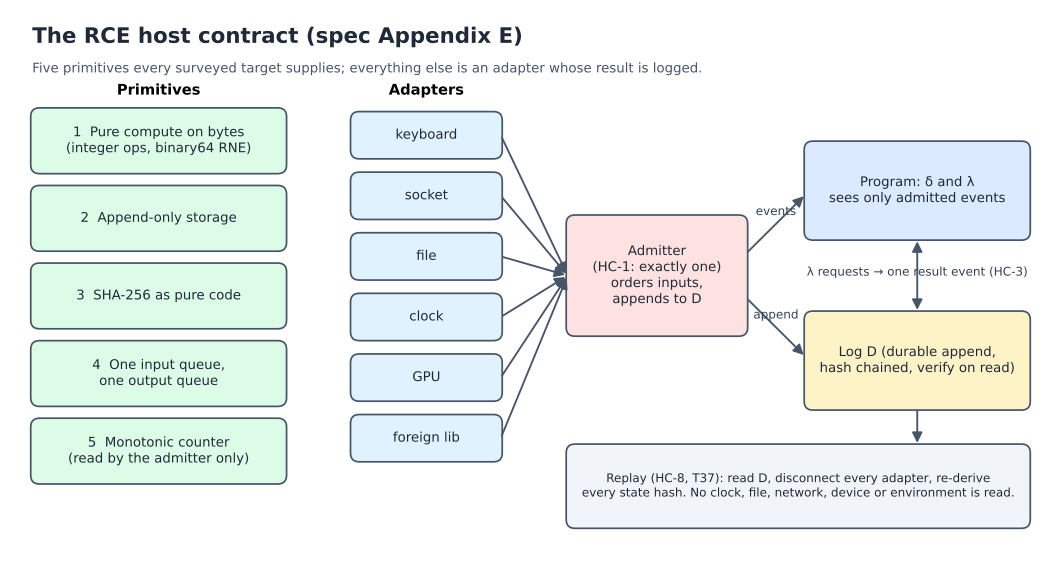
Figure (informative). The five primitives, adapters, the single admitter (HC-1), typed results (HC-3) and replay with adapters disconnected (HC-8, T37). Source: docs/figures.
The rules were derived from a survey of operating systems, embedded kernels, browsers, language runtimes, replay systems, storage engines and compute fabrics. A primitive is in the contract only when (a) every surveyed target can supply it and (b) its result is a pure function of logged data or is itself logged. What fails (b), because it depends on timing, ordering, hardware or another process, enters as an event, as 5.15 already requires. Every target supplies: pure computation on bytes with integer operations and binary64 round-to-nearest-even, append-only storage, SHA-256 as pure code, one input queue and one output queue, and a monotonic counter read only by the admitter. Everything else is an adapter.
E.1 Terms
- Admitter. The one component that orders inputs into E and appends entries to D.
- Adapter. Host code that turns one outside source (a keyboard, a socket, a file, a clock, a GPU, a foreign library) into events, or one output request into an effect and a result event.
- Host entry. An entry of D whose event type starts with
host.(E.5). No RCE identifier contains a dot, so no program declares such an event, and δ is the identity on it: δ(s, e) = (s, []) and the entry'sstate_hashequals the previous entry's (or that of s₀ for the first). The fold law of 6.1 is unchanged. - Durable. An entry is durable when the barrier of E.3 for its storage returned success.
E.2 Admission, time and authority (HC-1 to HC-9)
E.3 Storage: durable append (HS-1 to HS-5)
- HS-1 D is the base truth. A host stores one primary artefact: D. Snapshots and indexes are caches derived from it (HS-4, E.6).
- HS-2 Durable append. An entry is durable only after the barrier for its storage succeeded. The admitter reports no output of a step as durable before the step's entry is durable.
| Storage | Append barrier | New file or rename barrier |
|---|---|---|
| Linux | write then fdatasync (or fsync) on the segment | fsync of the directory after create or rename |
| macOS, iOS | fcntl(F_FULLFSYNC); plain fsync is not a barrier, since the drive may reorder and delay writes | F_FULLFSYNC on the directory |
| Windows | FILE_FLAG_WRITE_THROUGH with FILE_FLAG_NO_BUFFERING, or FlushFileBuffers | MoveFileEx with MOVEFILE_WRITE_THROUGH |
| FreeBSD, other POSIX | fsync on the segment | fsync of the directory |
| WASI, browser, no file system | none | the host declares volatile in host.StorageCaps (E.5); no entry is reported durable |
A host that cannot meet its row declares volatile. A setting that
weakens a barrier (SQLite synchronous=OFF, RocksDB sync=false,
LMDB MDB_NOSYNC) is not a conforming D store.
- HS-3 A failed barrier is fatal. After a failed barrier the file
system may already have discarded the failed pages and marked them
clean, so a retry can report success for data that is lost. The
admitter therefore stops: it admits nothing more, retries nothing,
emits
host.StorageFaultto the outside when it still can, and the next start recovers by HS-4. It never retries and continues (T39). - HS-4 Verify on open. On open, the host checks the chain of D from
the genesis hash (64 zeros): each entry's
prev_hashis the previous entry'shashand itshashis the SHA-256 of the canonical JSON of {event, prev_hash, seq, state_hash} (6.1). D is cut after the longest prefix that verifies, and the host logshost.Truncatedwith the number of entries dropped. A torn tail after a crash, a corrupted entry and a misdirected write are detected, never folded into state (T38). Replay of the kept prefix then re-derives eachstate_hash(HC-8); a mismatch is a host fault (HS-3). - HS-5 Snapshots are caches. A snapshot is (seq, state_hash, bytes).
It is used only when the hash of its bytes equals the
state_hashof D at seq; otherwise it is discarded. Loading one changes no meaning.
E.4 Inputs are events (HC-10)
HC-10. Every value that enters a run is an event or a logged answer
in D. This includes key, pointer, resize and focus input; Tick and
host.WallTime; every file, network, PTY, audio and GPU readback result;
foreign results and traps; select nondet choices; Delivered, TimedOut
and Unreachable; capability minting; lifecycle (suspend, resume, process
kill); random bytes; and the host entries of E.5. An input that is not
in D does not exist for the program.
E.5 Host entries
A host entry is {type: host.<Name>, payload}. Its payload is canonical
JSON. The host entries are:
| Type | Payload | When |
|---|---|---|
host.StorageCaps | barrier (E.3 row name, or volatile) | at open |
host.Truncated | dropped (u64) | at open, when HS-4 cut D |
host.Synced | upto (seq) | after a barrier succeeded; every entry up to seq is durable |
host.StorageFault | seq, error text | output only: written to the outside, never appended, since the admitter has stopped |
host.FabricCaps | the fabric record of E.7 | at start and on hot-plug |
host.Calibrated | fabric id, op class, overhead, throughput | after a calibration run |
host.Exact | fabric id, op class, probe digest, reference digest | after a probe (HC-12) |
host.Placed | op id, fabric id | when placement is decided (HC-11) |
host.WallTime | nanoseconds since the Unix epoch | when an adapter supplies wall time |
host.Energy | source, basis, joules | when a counter is read (D.11) |
host.Bind | host result kind, program event name | at start (E.8) |
A program receives the content of a host entry only through a binding (E.8): the admitter then appends, after the host entry, an ordinary event the program declares, with the same payload. δ itself never reads a host entry.
E.6 Fabrics and placement (HC-11 to HC-14)
- HC-11 Fabric discovery as events. At start and on hot-plug the host
appends
host.FabricCaps: ISA flags, each GPU adapter's features and float controls (rounding mode, denormal preservation, signed zero, inf and NaN preservation per width), NPU receipts, memory topology and which counters can be read. Replay reads the same record, so every decision taken from it is a function of D. - HC-12 Automatic placement. The engine places each lane-wise array
operation,
for … parbody and reduction itself, from the cost table of C.6.4 extended with per-fabric overhead and throughput (time = overhead + work / throughput), whose calibration results arehost.Calibratedentries. A program needs no annotation.with device(5.13) and device kernels stay hints that never change meaning. Placement is a function of the host entries of D, so it is the same on replay (T37). - HC-13 Bit-exactness gate. A fabric computes a value that reaches
state only for an operation on its logged exact list: integer
operations; IEEE add, sub, mul, div and sqrt with round-to-nearest-even,
no contraction and no flush to zero; and reductions in the fixed tree of
T18. An operation enters the list by a probe whose digest equals the
CPU reference digest, logged as
host.Exact. Everything else (transcendentals, vendor BLAS, f16, NPU, any WGSL float operation, whose rounding WGSL does not specify) is either output only (λ sinks) or verified: recomputed on the reference, or checked against a logged digest per device. - HC-14 No performance flags. No user-visible setting chooses
performance. The engine derives the build profile (optimization, link
time optimization, codegen units, target ISA from
host.FabricCaps), the allocator and collection policy and the I/O backend. A knob is admissible only when it cannot change meaning (decision 38; 10.1). Fast math, floating contraction, excess precision and hash-seed randomization do not exist under the contract. Capabilities whose use changes no result are on by default; input capabilities (hardware random numbers, clocks, energy and thermal counters) are events; those that change bits are gated by HC-13.
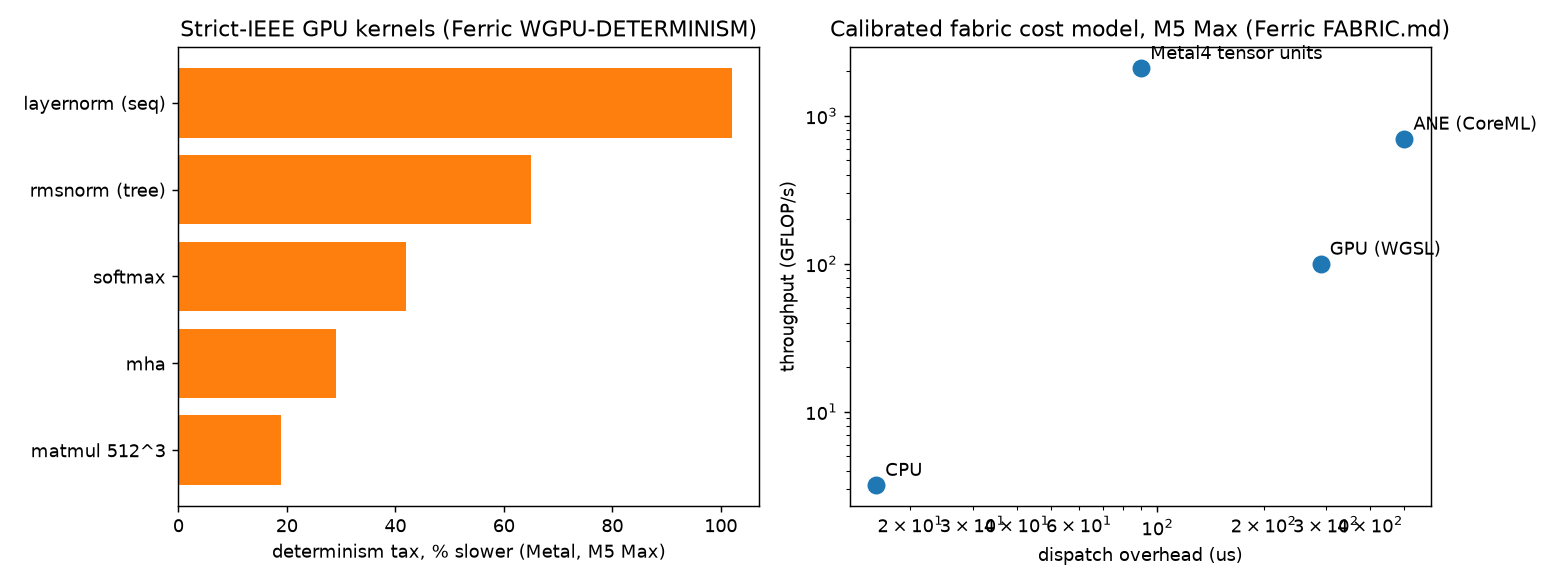
Figure (informative). Survey measurements behind E.6: cost of strict IEEE mode on GPU kernels and a calibrated dispatch model. Source: docs/figures.
E.7 The fabric record
host.FabricCaps has the payload {cpu, gpus, npus, memory, counters}.
cpu lists ISA feature names; each GPU and NPU entry has an id, an API
name and the float controls as booleans; memory lists nodes with their
size in bytes; counters names the readable energy and performance
counters. Field order is canonical (6.1). A host that cannot query a
field writes null for it; placement then treats that fabric as absent.
E.8 RCEdb: storage and queries written in RCE
The database of an RCE system is written in RCE. The host supplies only
durable append (E.3) and sync result events (host.Synced, delivered by a
binding); it supplies no query engine, index or cache whose behaviour
reaches δ.
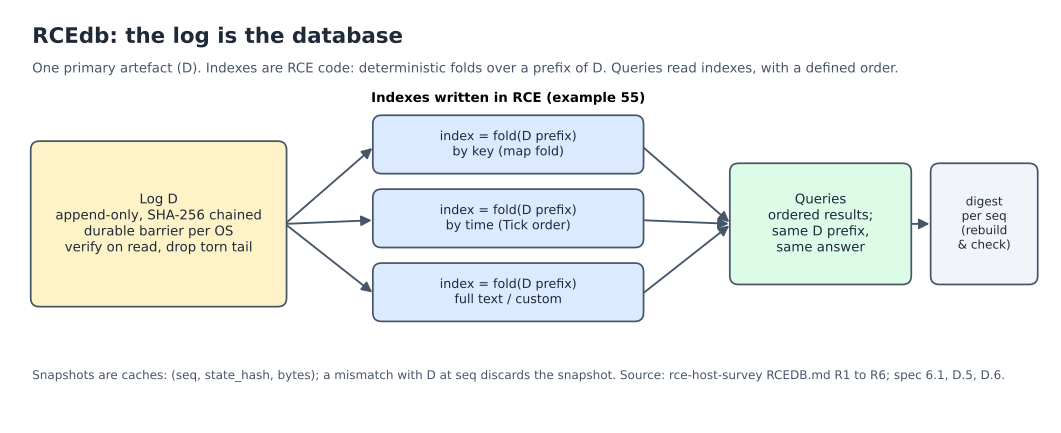
Figure (informative). D is the one primary artefact; indexes are deterministic folds written in RCE (example 55); queries read them in a defined order. Source: docs/figures.
- HS-6 Bindings. At start the host appends one
host.Bindper result kind it delivers, naming an event the program declares (for examplehost.Syncedtoevent Synced(upto: u64)). The program's checker types the bound event as any other; a payload that does not fit is refused at admission (5.1). - HS-7 Indexes are projections. An index is a pure function of a prefix of D and the index definition, rebuilt by folding D and checked by a digest per seq. Its structure (B-tree, LSM, hash) is a placement choice with no effect on meaning, so a foreign store (SQLite, RocksDB, LMDB) may hold an index, and its durability settings do not matter for correctness: a lost index is refolded from D.
- HS-8 Queries. A query is an RCE term over state using keyed reads, keyed joins and scans in canonical key order (6.1, D.5). Results are in canonical order, never unspecified. A query states in its type whether it is a set or a bag. Float aggregation uses the fixed tree of T18. Recursive queries are not in D.5.
- HS-9 Time travel. The state as of seq is the fold of D up to seq (T3), so any past state is queryable with no storage beyond snapshots.
Example 55 (examples/55_rcedb.rce) is a keyed store in RCE: puts are
state writes, a scan sorts the keys (keys() then sort()) so its
order is canonical, and a bound Synced event moves the durable mark.
E.9 Existing ecosystems
Code in other languages and engines stays reachable as foreign calls
(5.11, HC-4): a SQL engine, a numerical library, an operating system
service or a model runtime is called from fn main or a task function,
and its result is logged. Its order, its timing and its numerics are
therefore recorded and replayed, never re-executed (T32). Text sent to a
foreign SQL, HTML, URL or JSON sink is Text[C] (5.16), so no query or
markup is built from data.
E.10 Theorems and conformance
- T37 Host replay. For every adapter oracle, replaying D with every adapter disconnected gives the live run's state after every entry, host entries leave the state unchanged, and two runs that logged the same host entries make the same placements.
- T38 Verify on open. The verified prefix of a log is a prefix of it, is a valid chain, equals the log when the log is valid, and a valid log followed by any entry that does not link is cut back to the valid log.
- T39 Fatal barrier. After a failed barrier the admitter appends nothing, whatever arrives, and the log of an admitter still running is exactly the entries it was given: a failed barrier is never followed by further appends.
Lean: RCE/Host.lean. Conformance: spec/checker/tests/host_contract.rs
checks every example log against HS-4 (intact, torn tail, a flipped
byte, a swapped pair), HC-8 and T37 (each example log re-folded with host
entries interleaved, every state hash equal, every host entry's state
hash equal to its predecessor's), HC-12 (placement from host entries
only), HS-6 to HS-9 on example 55, and that every rule of this appendix
is cited by a test.
| Rule | Source in the survey | Test |
|---|---|---|
| HC-1 to HC-3 | single admitter, clocks, typed outputs | admitter_order_is_d_order |
| HC-4, E.9 | foreign calls logged | foreign_and_host_entries_replay |
| HC-5 | capabilities minted by events | capability_examples_check |
| HC-6, HC-7 | tick scheduler, numerics | existing T1, T9 and 6.3 tests |
| HC-8, HC-10, T37 | replay with adapters disconnected | foreign_and_host_entries_replay |
| HC-9 | priority admission | admitter_order_is_d_order |
| HS-1 to HS-5, T38, T39 | durable append, fatal barrier, verify on open | verify_on_open_cuts_bad_suffix, fatal_barrier_stops_admission |
| HC-11 to HC-14 | fabrics, placement, exactness, no flags | placement_is_a_function_of_host_entries |
| HS-6 to HS-9 | RCEdb in RCE | rcedb_example_runs |
Built from spec commit 49fa9af. Code cells run the reference checker rce-check, written in Rust and compiled to WebAssembly, inside your browser; nothing is sent to a server. Read-aloud uses the Kokoro-82M model (Apache-2.0), served from this site and run in your browser.