Research study · draft · about
The Communication Tool Avalanche: Thresholded Signal Externalization, Event-Driven Orchestration, and Coherence per Joule
This study tests whether collective agency across biological, cultural, computational, and neural systems scales through a conserved three-phase operator — externalize structured signal, ingest across a selective threshold or verification gate, and lock in non-regressing state — auditing 24 evolutionary rungs (`CL01` to `CL24`), 38 historical AI milestones from 1950 to 2026 (`AI01` to `AI38`), 45 Lean 4.36.0 theorems (`CTA-T1` to `CTA-T45`), pre-registered biological/stigmergic simulations (`CA-M1` to `CA-M5`), five-host hardware benchmarks (`CTA-E1` to `CTA-E5`) spanning physical `TI INA238`/`INA3221` current-shunt `measured_j` and four-host `reported_j`, ten-paradigm Digital Enzymatic Synthesis (`DES-10`) plus an 18-milestone `Month / Quarter / Year / Decade` roadmap (`HM01` to `HD04`), 18 neural interface modalities (`BM01` to `BM18`), and 16 primary extracellular-vesicle studies (`EV01` to `EV16`).
What the study claims and what it does not
- Formal, historical, and biophysical thresholds hold: 45 kernel-checked Lean 4.36.0 theorems (`QuorumRatchet.lean`, `OrchestrationFlow.lean`, and `EnzymaticSynthesis.lean`, zero `sorry`, zero `opaque`, zero `ofReduceBool`, unanimously accepted inside Linux `bubblewrap` across all `6 / 6` independent proof checkers of `lake check --paranoid`: `con-leche --verified` and `con-ron --verified` `58,928` decls; `lean4lean`, `nanoda`, `leanchecker --paranoid`, and `Lean v4.36.0` `58,930` decls) establish gated ratchet non-regression, zero-clock sub-threshold quiescence, cooperative Hill noise suppression, `SepJ` pore containment, deterministic-first Coherence-per-Joule (`CpJ`) dominance, `SSP` reduced-cost optimality, opt-in agency-preserving multi-agent bridging (`CTA-T29`, `CTA-T30`, `CTA-T44`, zero axioms), Digital Enzyme barrier lowering (`CTA-T32`–`CTA-T35`), 10-camp coverage/joule dominance (`CTA-T36`–`CTA-T40`), and 4-tier downward convergence across `Month/Quarter/Year/Decade` horizons (`CTA-T41`–`CTA-T45`); `CA-M1` to `CA-M5` confirm `95.49%`–`99.17%` quorum `ATP` savings, `95.0%` vs `0.0%` gated filament survival, `100.0%` $k = 7$ flock cohesion under $64\times$ volume expansion, `100.0%` *Physarum* shortest-path convergence, and `100.0%` Gen-20 post-removal cultural retention with attested libraries vs `29.27%` unverified imitation.
- Five-host fleet energy (`CTA-E4`) and 10-camp Digital Enzymatic Synthesis (`CTA-E5`) confirm sub-millijoule attested orchestration across physical shunts and on-chip counters: on `NVIDIA Jetson AGX Thor` (`board_metered = true`, CPU-only), Rust `BLAKE3` + `Ed25519` verifies edges at `927.30 µJ` (`1 KiB`) / `879.53 µJ` (`16 KiB`) physical `TI INA3221` `VDD_CPU_SOC_MSS` `measured_j` (`90.81`–`642.38 µJ` `reported_j` across `M3 Ultra`, `Zen 5`, and `i9-13900H`), while zero-clock wakeup eliminates `100%` of empty polls across all 5 hosts (`2.21×`–`3.22×` Linux socket `RAPL` cut, `6.22×` Darwin `L3` cut, `+1.34 J`/`5 s` `Thor` `VDD_CPU_SOC_MSS` shunt saving). On `CTA-E2` (`60` tasks), `CTA-Orchestrator` matches monolithic `Claude Sonnet 5.5` at `59 / 60` (`98.33%`, `0` false commits) at `2.09×` higher `CpJ` (`14.97×` vs unattested 4-agent); `CTA-E3` contains `200 / 200` Byzantine faults; and on `CTA-E5` (`100` tasks, `5` regimes), every solo AI camp `C1`–`C10` stalls at `≤ 49%` (`48%` LLM solo, `49%` 3-agent debate) while `DES-10` reaches `98 / 100` (`98.0%`, `1%` false commits) at `9.26×` / `26.87×` higher `Thor` `measured_j` `CpJ` (`75,374×` lower `measured_j` and `78,855×` faster handoffs than NL debate).
- Strict empirical boundaries on neural interfaces and paracrine rescue: current human intracortical readout reaches `~15`–`19 bit/s` (`Willett et al. 2021, 2023`) while non-invasive multi-brain `BrainNet` demos transmit `~0.05 bit/s` binary cues; all `16 / 16` audited extracellular-vesicle neural/senescent rescue studies (`EV01`–`EV16`) are preclinical rodent, porcine, or *in vitro* models with zero Phase III human central-nervous-system approvals; and mycorrhizal transfer (`Simard et al. 1997`) is paired with the `Karst, Jones & Hoeksema (2023)` critique of mother-tree overinterpretation.
- Not claimed: physical rail power on the four non-Thor workstations (`reported_j` only) or remote cloud LLM servers (`not_available`), single-window net idle subtraction on shared hosts (`Falsifier 6` respected), teleological evolution, realized high-bandwidth `N`-mind semantic bridging (`CA-H7` open), or human clinical efficacy of intranasal secretome/vesicle neuro-supplementation (`CA-H8` open).
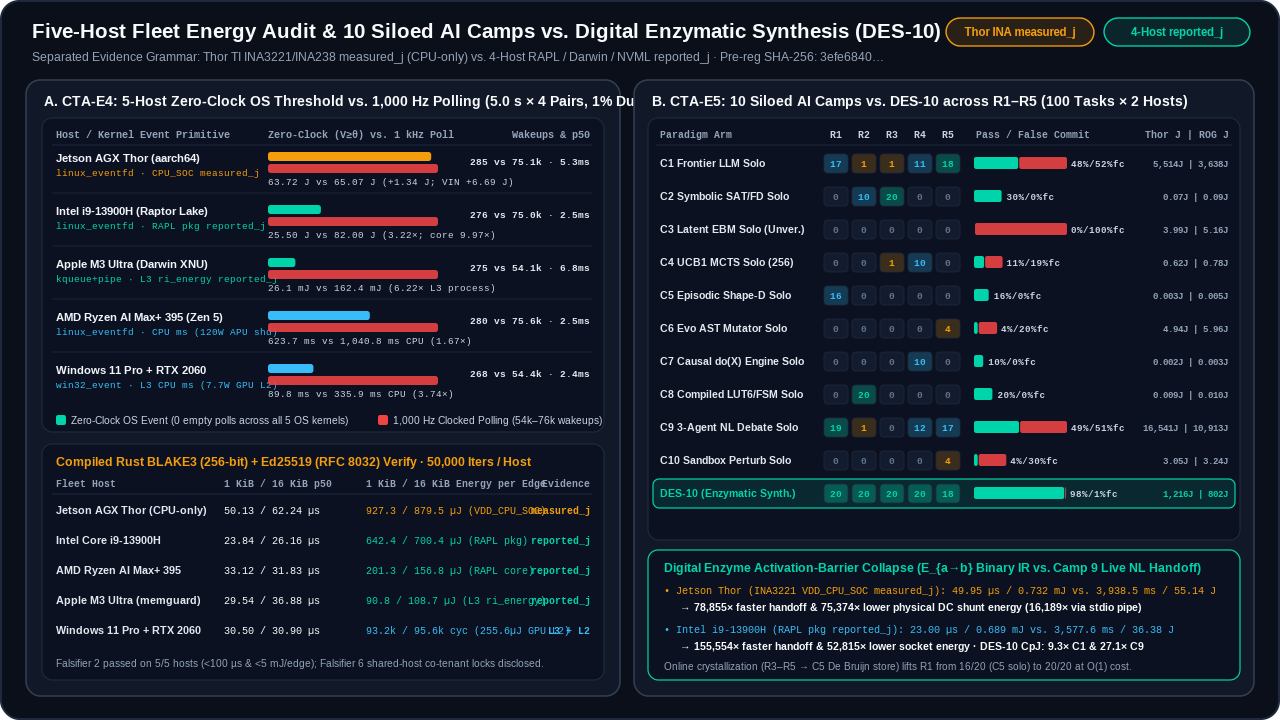
CTA-E4, including physical TI INA3221/INA238 shunt measured_j on NVIDIA Jetson AGX Thor) and 100-task ten-paradigm Digital Enzymatic Synthesis benchmark (CTA-E5: DES-10 98% pass vs. ≤ 49% solo across C1–C10).