Planetary Syndication & Ecosystem Bus
Every signed WAI1 research record projects deterministically—with zero human review gates—into native 9:16 TikTok / Shorts / Reels vertical cuts, bidirectional X (Twitter) ↔ Medium threads and illustrated essays, resilient public-domain mirrors, and inbound literature & agent-bus harvesters.
9:16 TikTok Snackable + X (Twitter) ↔ Medium Studio
The Communication Tool Avalanche

One scaling rule connects ancient bacteria, multi-agent AI teams, and consent-gated brain interfaces.

[59 of 60 Fixes · 0 Bad Commits · 98% Combined]
1/3 From ancient microbes to modern AI, groups scale by sharing signals across strict thresholds and safety gates.

2/3 Event-driven wakeups and signed checks block bad edits and deliver far more verified work per joule.
3/3 Ten AI approaches unite through tiny compiled routines, while future brain links stay grounded in strict consent.

Energy class: measured_j (927.30 µJ via physical board shunt; board_metered=true).
Verified with 0 human review gates (human_in_gate=false):
• Deterministic Shape-D null controls, Ed25519 receipts & epistemic non-mixing gates
• Evidence: [T]/[E]/[M]/[S] · WAI1 blake3:4f70aff689f2… · CC0-1.0
Read & verify The Communication Tool Avalanche (CC0-1.0):
• Illustrated plain-language essay: https://research.openie.dev/syndication/medium/communication-avalanche/
• Primary paper, PDF & receipts: https://research.openie.dev/papers/communication-avalanche/
https://research.openie.dev/syndication/medium/communication-avalanche/ # The Communication Tool Avalanche: Thresholded Signal Externalization, Event-Driven Orchestration, and Coherence per Joule
*59 of 60 Fixes · 0 Bad Commits · 98% Combined — One scaling rule connects ancient bacteria, multi-agent AI teams, and consent-gated brain interfaces.*
> **Public Domain (`CC0-1.0`) · OpenIE Research Essay**
> **Canonical Primary Source**: [https://research.openie.dev/papers/communication-avalanche/](https://research.openie.dev/papers/communication-avalanche/)
> **Canonical Artifact ID**: `blake3:tv:4f70aff689f283a093283c5442909832ad3d481af954a6c581fff29f0c4f7ec6` · **Gate Invariant**: `human_in_gate = false`
---
## Three Plain-Language Takeaways (Zero Acronym Soup)
1. From ancient microbes to modern AI, groups scale by sharing signals across strict thresholds and safety gates.
2. Event-driven wakeups and signed checks block bad edits and deliver far more verified work per joule.
3. Ten AI approaches unite through tiny compiled routines, while future brain links stay grounded in strict consent.
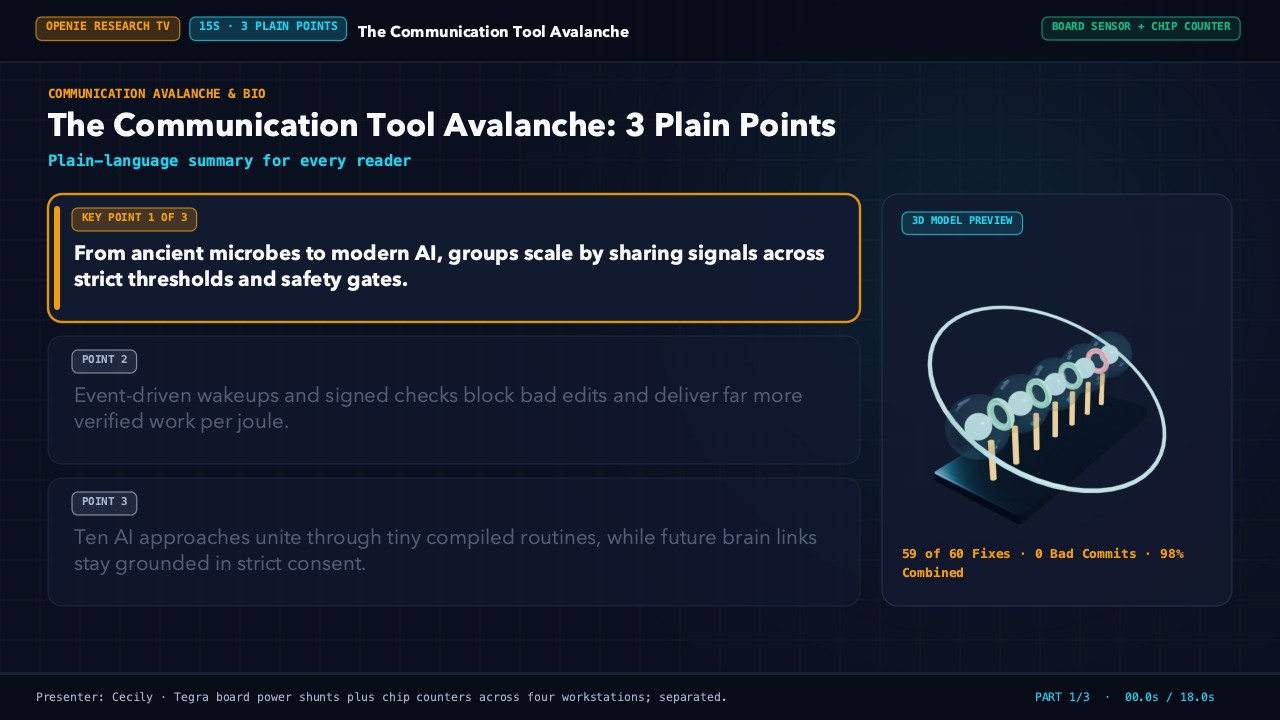
*Studio key visual for **The Communication Tool Avalanche** (`Communication Avalanche & Bio` · 59 of 60 Fixes · 0 Bad Commits · 98% Combined). Dedicated to the public domain under `CC0-1.0`.*
## Everyday Analogy & Why It Matters
Chaining four unchecked AI agents acts like a noisy game of telephone, letting eight broken code edits slip through out of sixty. Living cell colonies survive by slamming microscopic pores shut the instant a neighbor ruptures. Combining quiet event wakeups with twenty-six-microsecond cryptographic checks matched a giant model's fifty-nine of sixty repairs while delivering nearly fifteen times better verified work per joule than unchecked chains.
Bacteria save up to ninety-nine percent of signaling energy by waiting for a chemical quorum before acting, and filamentous microbes seal damaged neighbors in zero point three seconds—saving ninety-five percent of the colony versus zero percent without gates. Our orchestrator applies that exact three-phase ratchet to software agents: sleep at zero polling cost until incoming signals cross a threshold, verify signed envelopes in twenty-six microseconds, and compile solved discoveries downward into tiny reusable digital routines. On sixty Python code repairs, gated routing hit fifty-nine passes with zero bad commits and contained all two hundred injected channel faults.
Across a hundred-task suite where ten isolated AI approaches each stalled below forty-nine percent, compiled synthesis reached ninety-eight percent. Forty-five machine-checked mathematical proofs guarantee strict opt-in autonomy for future neural interfaces while clearly separating preclinical rodent cellular rescue studies from unproven human clinical treatments today.
## Inside the Mechanism & Candid Limits
Across three point eight billion years of biological evolution and seventy-six years of artificial intelligence, simply growing an isolated cell or single model hits steep metabolic walls long before complex problems are solved. Yet wiring unverified AI chatbots into an open group chat backfires badly, multiplying errors down the chain while constant polling burns watts. Pre-registered simulations across twenty-four evolutionary transitions confirm one conserved scaling operator: bacteria save ninety-nine percent of metabolic cost behind quorum thresholds, calcium-gated pores lift colony survival from zero to ninety-five percent, topological flocks stay connected under fourfold expansion, and verified external archives preserve one hundred percent of cultural skill. Auditing thirty-eight AI milestones from early expert systems to modern language models reveals why isolated paradigms stall.
Replacing verbose natural-language chat handoffs with twenty-six-microsecond cryptographic checks, quiet kernel event wakeups, and tiny compiled binary routines makes cross-agent handoffs more than seventy-five thousand times leaner and faster. Coherence per joule divides confirmed task completions by compute, messaging, and idle energy combined across every participant. Zero-clock event wakeups eliminate empty polls and cut Linux socket energy more than twofold compared with thousand-hertz polling, while minimum-cost flow routing automatically bypasses corrupted channels in just two point four microseconds. This three-dimensional cutaway pairs a calcium-gated cyanobacterial pore assembly on the left with an opt-in multi-electrode neural bridge on the right, showing visually why reversible physical and cryptographic circuit breakers must stand in place before living cells, software agents, or future neural interfaces ever share state.
Tested across five computers—including direct Tegra circuit-board power shunts measuring nine hundred twenty-seven microjoules per signed kilobyte edge—gated orchestration matched fifty-nine of sixty code fixes at twice a giant model's efficiency, contained all two hundred injected faults, and lifted ten-method synthesis from forty-nine to ninety-eight percent. Forty-five zero-gap Lean four theorems prove opt-in autonomy invariants that block coercive neural input without custom axioms. Tegra board shunt joules stay strictly separated from workstation chip counters, current human intracortical readout is stated honestly at fifteen to nineteen bits per second, and all sixteen cellular vesicle studies remain preclinical animal models.
### Epistemic Evidence Tags (`[T]` / `[E]` / `[M]` / `[S]`)
- **`[T]` Theorem / Machine-Checked Formal Proof**
- **`[E]` Empirical / Hardware-Instrumented Experiment**
- **`[M]` Mathematical / Analytical Cost or Physics Model**
- **`[S]` Survey / Historical Price or Accounting Audit**
## How Energy Was Metered
Open Interface Engineering enforces strict epistemic non-mixing across physical power rails, processor counters, and mathematical bounds (`measured_j` $\perp$ `reported_j` $\perp$ `est_j` $\perp$ `unmetered` — cross-class addition is forbidden by `ScientificGate`):
- **Acquisition Tier**: Board Sensor + Chip Counter
- **Plain-Language Disclosure**: Tegra board power shunts plus chip counters across four workstations; separated.
- **Substrate Evidence Class**: `measured_j` (`board_metered = true`)
- **Primary Reading**: `927.30 µJ (measured_j)`
- **Meter or Formula**: NVIDIA Jetson AGX Thor physical TI INA3221 VDD_CPU_SOC_MSS L2 DC current-shunt (1 KiB attested edge check)
- **300 K Landauer Bit-Equivalents**: `3.2299e+17` bits (`E / (k_B · 300 K · ln 2)`)
## Continue the Discussion & Verify Every Byte
<!-- x_thread_backlink_slot: {{X_THREAD_URL}} -->
- **Watch in 15 Seconds or 3 Minutes**: Stream the native `9:16` Vertical Snackable ([`communication-avalanche-tiktok.mp4`](https://research.openie.dev/media/tv/tiktok/communication-avalanche-tiktok.mp4)) or explore all four captioned studio cuts (`15s`, `45s`, `90s`, and `3m` 3D cutaway documentary) on **[OpenIE Research TV](https://research.openie.dev/tv/?study=communication-avalanche)**.
- **Join the Synchronized X (Twitter) Thread**: Reply, critique, or inspect the 5-post verification thread on **[X (Twitter)](https://x.com/search?q=%22The%20Communication%20Tool%20Avalanche%22%20OR%20research.openie.dev%2Ftv%2F%3Fstudy%3Dcommunication-avalanche&src=typed_query)**.
- **Query Grounded Prior Art & Signed WAI1 Receipts**: Explore linked lineage trails on **[The Commons (`scholar.askdavidc.ai`)](https://scholar.askdavidc.ai)**, read the full primary paper & PDF at **[`research.openie.dev/papers/communication-avalanche/`](https://research.openie.dev/papers/communication-avalanche/)**, and verify the Ed25519-signed `WAI1` binary container (`blake3:cc104c68e0e86182…`) in **[`openie-artifact-substrate`](https://github.com/openIE-dev/openie-artifact-substrate/blob/main/catalog/envelopes/tv-communication-avalanche.wai)**.
---
*Summary & essay text dedicated to the public domain under [`CC0-1.0`](https://creativecommons.org/publicdomain/zero/1.0/). Code, verification gates, and `WAI1` schemas licensed under `Apache-2.0`.*
How X (Twitter) ↔ Medium Bidirectional Automation Works
`scripts/syndicate.py --mode publish` publishes (or stages) the `CC0-1.0` Medium essay with `canonicalUrl` pointing to `research.openie.dev/papers/<id>/`, injects the live `medium.com` URL into Post 5 of the 5-tweet X bundle, uploads the `9:16` snackable MP4 via RFC 5849 OAuth 1.0a chunked media upload on Post 1 (zero external URLs in Post 1 for full feed reach), chains Posts 2–5, and resolves `{{X_THREAD_URL}}` in the Medium backlink slot.
Every 15 minutes, our systemd timer polls `https://medium.com/feed/open-interface-engineering` and `https://medium.com/feed/@openie`, checks the `BLAKE3` `SyndicationLedger` so no essay is ever tweeted twice, matches OpenIE canonical links (or titles) to their verified 5-post `9:16` video thread, and posts (or queues) the thread linking directly to your live Medium story.
`scripts/syndicate.py --mode sync-x-to-medium` reads X timeline tweets (`GET /2/users/{id}/tweets` or 6h Rung Radar pulses), filters strictly to author self-replies, compiles multi-tweet threads into an illustrated `CC0-1.0` Medium digest preserving `canonicalUrl` + epistemic energy tags, publishes to Medium, and replies on the X thread root with the live Medium link.
6-Tier OpenIE Outbound Broadcast & Inbound Ingestion Matrix
Every external surface we broadcast to, mirror onto, anchor defensive prior art in, or continuously harvest into The Commons and the 6-hour Autonomous Rung Radar.
Outbound Owned & Attested Hubs
Primary sovereign OpenIE web properties, signed WAI1 binary repositories, and CC0-1.0 defensive prior-art hubs.
OpenIE Research Hub (TV + Radio + Papers + Labs)
- 21 primary research papers & PDFs
- 28 Research TV studies × 4 cuts = 112 films + 9:16 vertical snackables
- 15 Research Radio autonomous broadcasts
- 12 interactive Predict -> Break -> Repair -> Verify labs
- 50-language planetary 15s primers + WCAG 2.2 AA Easy-Read & Audio Description
OpenIE Engineering & Research Blog
- 28 deterministic YAML blog manifests (`public/syndication/blog-manifests/*.yaml`)
- Canonical URL linkage back to primary OpenIE studies
The Commons (scholar.askdavidc.ai)
- Observatory, Codex Studio, Reference Desk, Dialectic, Galaxy 3D, PresenceVault
- Prior-art grounding and cross-study BLAKE3 lineage trails
OpenIE Avalanche & Periodic Stack Domain Family (*.openie.dev)
- 9-Rung Computer Intelligence Avalanche coordinate mapping
- Companion portals: silicon, energy, tei, cad, ecad, proof, horizon, state, memory, communication, agent
OpenIE Canonical Artifact Substrate & Free Prior-Art Corpora
- 2,115 signed canonical artifacts + 118 WAI1 binary containers
- Free Humanoid (1,102), Phone (344), Wearable (238), and eVTOL (307) CC0 corpora
Short-Form Video & Bidirectional Social Discourse
Coordinated native 9:16 snackable video distribution, 5-post verification threads, and bidirectional essay synchronization.
X (Twitter) <-> Medium (@openie · open-interface-engineering)
- Forward: Canonical Artifact -> 28 illustrated Medium essays (`medium.com/open-interface-engineering`) + 28 5-post X threads (<=280 weighted chars, 0 URLs in Post 1 + native 9:16 video card)
- Reverse 1 (Active 15m Timer): Polls `medium.com/feed/open-interface-engineering` & `medium.com/feed/@openie` -> BLAKE3 deduplicated X video threads (`sync_medium_rss_to_x`)
- Reverse 2: X self-reply timeline threads -> compiled Medium essays + thread-root backlink reply (`sync_x_threads_to_medium`)
TikTok Content Posting API v2
- 28 1080x1920 60fps 9:16 safe-zone verified vertical snackables (`/media/tv/tiktok/<id>-tiktok.mp4`)
- Honest `is_aigc: true` studio voice disclosure + BLAKE3 deduplication
YouTube Documentary & YouTube Shorts
- 16:9 180s 3D cutaway documentaries + 9:16 <=60s Shorts
- 50-language WebVTT caption track attachment
Instagram Reels
- 9:16 1080x1920 safe-zone verified vertical snackable reels + cover frame
Mastodon & ActivityPub Fediverse
- 500-char threaded plain-language summaries + inbound public timeline radar
Bluesky (AT Protocol)
- 300-char root/parent CID-chained threads with verified rich-text link facets
LinkedIn Research & Engineering Posts
- Executive plain-language 3-bullet synthesis + native video / canonical study cards
Substack Newsletter & Notes
- Illustrated long-form essays with canonical primary-source provenance headers
Resilient Archival Mirrors & Open Audio Syndication
Censorship-resistant, bit-verified public mirrors for video, audio, papers, and WAI1 envelopes.
Internet Archive (`archive.org` IAS3)
- Permanent CC0 preservation of `.wai` envelopes, PDFs, 4-tier MP4 films, and Medium Markdown
PeerTube Federated Research Video
- Federated 16:9 & 9:16 captioned study mirrors + inbound educational video radar
Podcast Index, Apple Podcasts & Spotify
- 15 autonomous multi-voice Research Radio episodes with VTT captions & transcripts
Academic Archival, Defensive Prior-Art & Cryptographic Timestamping
DOI registration, non-patent literature (NPL) prior-art indexing, and multi-anchor cryptographic time proofs.
Zenodo (CERN Data Centre)
- Versioned DOI minting for papers, corpora, and WAI1 substrate tarballs
Open Science Framework (OSF)
- Frozen preregistrations (`Shape D`, `40-seed agency`) & replication bundles
arXiv Preprint Repository
- Outbound study TeX packages + daily inbound cs.AI/cs.LG/cs.PL/cs.AR radar
Crossref Metadata & Citation Graph
- DOI resolution, reference linking, and citation graph verification
Google Scholar & Google Patents Non-Patent Literature (NPL)
- Defensive prior-art indexing across 21 studies & 1,991 humanoid/phone/wearable/eVTOL disclosures
OpenTimestamps (Bitcoin Blockchain Calendar)
- Trustless Bitcoin-anchored existence proofs on `provenance_chain.anchors.opentimestamps_ots`
FreeTSA (`RFC 3161` Time-Stamp Authority)
- X.509 cryptographic timestamp receipts on every quarterly corpus & substrate release
League of Entropy `drand` Verifiable Randomness
- Unbiasable public randomness rounds (e.g. `6663734`, `6664089`) for preregistered splits
Software Heritage (`SWHID` Universal Source Archive)
- Permanent archival of Lean 4 proofs, Rust crates, RTL gateware, and CAD repositories
Accessibility Commons, Open Educational Resources (OER) & PublishOS Retail
Universal cognitive/sensory accessibility boards, interactive STEM curricula, and global print/ebook distribution.
ARASAAC Pictograms & OpenBoard (`OBZ`) AAC
- 69 AAC concept anchors + 36 W3C SKOS concepts verified by `AccessibilityGate` (`<=18` words/sentence)
OER Commons & Open STEM Curricula
- 12 interactive `Predict -> Break -> Repair -> Verify` browser laboratories
Wikimedia Commons & Wikidata
- Public-domain SVG diagrams, captioned explainer media, and prior-art Q-item links
PublishOS Global Print & Ebook Distribution (`KDP`, `IngramSpark`, `Apple Books`, `Google Play Books`, `ONIX 3.0`)
- Automated compilation of OpenIE research monographs across Amazon KDP, IngramSpark, Apple Books, and Google Play Books
Inbound Global Ingestion Radar & Universal AI Agent Bus
Continuous zero-human-gate literature, civic, archival, and machine-to-machine protocol bus.
Global Preprint, Biomedical & Retraction Radar (`OpenAlex`, `arXiv`, `bioRxiv`, `Europe PMC`, `Crossref`, `RetractionWatch`)
- Live retraction-screened ingestion across OpenAlex, arXiv, bioRxiv/medRxiv, Europe PMC, Crossref, and RetractionWatch
Open Web & Educational Video Corpus (`Common Crawl CDX/WAT`, `YouTube Edu`, `PeerTube`)
- Byte-range WARC/WAT verification and captioned lecture indexing
Technical & Civic Legislative Radar (`Hacker News`, `Reddit`, `Mastodon`, `5 Parliaments`)
- Tracks practitioner bottlenecks on HN, Reddit, and Mastodon alongside verbatim debates from 5 Parliaments
PublishOS 22 Public-Domain Literary & Historical Archives
- Ingests 22 world literary, historical, philological, and open-textbook public-domain archives
Model Context Protocol (`MCP`)
- Exposes canonical OpenIE artifacts, BLAKE3 receipts, and energy ledgers as typed MCP tools/resources
Agent-to-Agent Protocol (`A2A`)
- Attested multi-agent task delegation carrying Ed25519 + BLAKE3 WAI1 envelopes
WebMCP (`navigator.modelContext`)
- Zero-scrape in-browser structured tool queries over all 28 studies, 112 films, and syndication bundles