The Communication Tool Avalanche: Thresholded Signal Externalization, Event-Driven Orchestration, and Coherence per Joule
A biological, formal, historical, and five-host hardware audit of externalized signal ratchets from Archaean quorum switches and gated nanopores across seventy-six years of artificial intelligence to ten-paradigm digital enzymatic synthesis, closed-loop downward compilation, and consent-gated neural interfaces. Includes physical whole-board and three-channel rail current-shunt measured_j on Tegra aarch64 Jetson Thor alongside four-host on-chip reported_j (board_metered is true).
David Charlot, Open Interface Engineering
Research studies, not journal finals. Notation is defined in the paper. Analytical energy estimates are not board power. Interactive figures live under /living/. Shared terms: glossary.
Cite this
Genre: Research study, draft: evolutionary communication ladder, Lean 4 ratchet and min-cost flow theorems, event-driven attested orchestration benchmarks, and neural interface audit
David Charlot, Open Interface Engineering. The Communication Tool Avalanche: Thresholded Signal Externalization, Event-Driven Orchestration, and Coherence per Joule. Open Interface Engineering. Web: https://research.openie.dev/papers/communication-avalanche/. PDF: https://research.openie.dev/pdfs/communication-avalanche.pdf. Markdown: https://research.openie.dev/papers/communication-avalanche.md.
The Communication Tool Avalanche: Thresholded Signal Externalization, Event-Driven Orchestration, and Coherence per Joule
Revision fc8bd3a, 23 November 2026. Data and digest summary: /data/#communication-avalanche. Interactive living observatory (4 instruments + 10-figure gallery): /living/communication-avalanche/. Snackable 5s–90s films: /tv/. Interactive tutorials (Labs 1–5): /tutorials/. Audio deep-dive: /radio/. Archival twins: /pdfs/communication-avalanche.pdf · LaTeX PDF (source).
0. Abstract and Epistemic Scope
Collective agency across living, cultural, and computational systems scales whenever individual participants externalize structured state into a shared medium, neighboring participants ingest that signal across a selective threshold or verification gate, and the resulting state transition locks in useful work without regressing to prior noise. Across 3.8 billion years of biological evolution, major jumps in collective capability repeatedly coincided with new intercellular or inter-organism communication substrates rather than raw increases in isolated cell size: primordial membrane vesicles, cooperative bacterial quorum switches, calcium-gated cyanobacterial nanopores, dictyostelid cyclic nucleotide waves, choanoflagellate electrical calcium transients, metazoan gap junctions, stigmergic trails, topological flocks, compositional human language, writing, print, and packet-switched networks. Contemporary artificial intelligence instantiates a digital counterpart in sparse mixture-of-experts architectures and multi-agent verification loops, while emerging neural and paracrine technologies point toward a future, still-speculative bidirectional analog counterpart.
This study formalizes, simulates, and audits that cross-scale thesis along two concrete deliverables: computational orchestration efficiency (quantified by coherence per joule) and candidate neurological supplementation pathways. Mechanically verified proofs in Lean 4.36.0 (45 theorems across QuorumRatchet, OrchestrationFlow, and EnzymaticSynthesis, zero incomplete placeholders, zero custom axioms) establish non-regression of gated externalization ratchets, zero-clock sub-threshold idle conservation, cooperative Hill noise suppression, septal nanopore fault containment, joule dominance of deterministic-first model escalation, successive-shortest-path reduced-cost optimality, and preservation of individual autonomy invariants under opt-in multi-agent bridging. Pre-registered deterministic simulations (seed 20261123) quantify bacterial quorum metabolic savings (95.49% to 99.17% regulon energy saved at low density), cyanobacterial filament survival (95.0% viable with rapid pore closure versus 0.0% ungated), three-dimensional topological flocking cohesion (100.0% connected versus 0.68% to 4.30% for fixed metric radius after fourfold expansion), adaptive plasmodial shortest-path pruning (100.0% flux concentration for superlinear feedback), and 20-generation cultural retention after synthetic demonstrators are removed (100.0% optimal retention with attested externalized artifacts versus 29.27% under unverified imitation). Across five hardware and operating-system archetypes spanning physical Texas Instruments whole-board and rail-separated current shunts on a Tegra aarch64 developer kit (board_metered = true, measured_j = 927.30 microjoules per 1-kibibyte edge on processor-and-memory rail) and Running Average Power Limit (RAPL), Darwin kernel, and graphics-driver energy counters across four Linux, macOS, and Windows 11 workstations (reported_j), compiled Rust cryptographic hashing (BLAKE3) plus Ed25519 channel attestation verifies envelopes in 25.95 to 37.39 microseconds (643 to 926 microjoules per edge across 64 bytes to 64 kibibytes), zero-clock eventfd thresholded nodes use 2.21x less socket energy than 1,000-hertz clocked polling at 1% bursty duty (136.32 J versus 300.73 J, 2.58 ms versus 570.38 ms at 10 Hz), and on a pre-registered 60-task Python code-repair benchmark (240 episodes) the heterogeneous attested orchestrator matches a monolithic frontier model’s 59 / 60 (98.33%) pass rate with 0 / 60 (0.00%) false commits at 432.75 J local socket reported_j and 21 model calls (0.136 tasks per joule, 2.09x higher coherence per joule than the 902.51 J monolithic baseline and 14.97x higher than an unattested four-agent cascade that degraded to 52 / 60 = 86.67% with 8 / 60 = 13.33% false commits), while containing 200 / 200 (100.0%) injected Byzantine channel faults and recomputing min-cost failover routes in 2.40 microseconds. Mapping 38 historical artificial intelligence milestones from 1950 to 2026 onto the same three-phase ratchet diagnoses both historical winters and unifies ten competing paradigm silos via sub-millijoule Digital Enzymes (78,855x faster and 75,374x lower physical shunt measured_j than natural-language agent handoffs): across a 100-task five-regime benchmark where every isolated solo paradigm stalls at or below 49% (48% single-model, 49% three-agent debate), immediate ten-camp Digital Enzymatic Synthesis reaches 98 / 100 (98.0%) with 1% false commits and 9.26x to 26.87x higher physical-rail coherence per joule; wiring a 6.05-million-parameter span-normalized latent energy model between tree-search and evolutionary candidate generators and a formally verified code checker across 140 unseen-shape tasks (2,240 candidates) reaches 0.9580 area under the receiver operating characteristic curve with 0.00% solve-rate loss while cutting checker evaluations 2.55x to 4.78x (458.16 J versus 567.51 J sequential and 1,001.48 J pool physical processor-rail measured_j); and executing a live 1,000-arrival Zipfian (s = 0.85) downward-crystallization stream closes 99.11% to 99.33% of post-warmup arrivals at or below 16 millijoules with 100.0% oracle parity (0 regressions), 33.33x fewer frontier wakes, 25.96x physical-rail (31.65x counter-rail) coherence-per-joule gain, and 6 / 6 automatic eviction of injected unamortized distribution-shift rules, anchoring a falsifiable month, quarter, year, and decade downward-compilation blueprint. Across 18 neural interface modalities and 16 primary extracellular-vesicle studies, strict separation is enforced between replicated preclinical animal rescue and unverified human clinical efficacy.
Terms and Acronyms
- AD, ADSC, AHL, AI, AIP, AKI, AMP, API, APP, ASIC, AST, ATP: Alzheimer's disease, adipose-derived stem cell, acyl-homoserine lactone, artificial intelligence, autoinducing peptide, acute kidney injury, adenosine monophosphate, application programming interface, amyloid precursor protein, application-specific integrated circuit, abstract syntax tree, and adenosine triphosphate
- BBB, BBI, BCE, BCI, BCIs, BLAKE3, BM, BMI, BMSC, BMSCs, BOLD, BTBR: blood-brain barrier, brain-to-brain interface, Before Common Era, brain-computer interface(s), cryptographic hash function BLAKE3, Brain-Modality catalog prefix, brain-machine interface, bone marrow mesenchymal stem cell(s), blood-oxygen-level-dependent signal, and Black and Tan Brachyury inbred mouse strain
- BM01, BM02, BM03, BM04, BM05, BM06, BM07, BM08, BM09, BM10, BM11, BM12, BM13, BM14, BM15, BM16, BM17, BM18: Neural and paracrine interface catalog identifiers (`openie-research-experiments/communication-avalanche/catalogs/bci-sensing-modulation-matrix.csv`)
- CA, CA1, CCE, CE, CI, CIS, CL, CNS, COX2, CPU, CRC, CT, CTA, CpJ: Communication Avalanche model/hypothesis prefix (`CA-M1` to `CA-M5`, `CA-H1` to `CA-H8`), hippocampal cornu ammonis subfield 1, cumulative cultural evolution, Common Era, continuous integration, continuous interleaved sampling, Communication Ladder catalog prefix, central nervous system, cyclooxygenase-2, central processing unit, cyclic redundancy check (`CRC`), computed tomography, Communication Tool Avalanche (`CTA-T1` to `CTA-T45`), and Coherence per Joule
- CL01, CL02, CL03, CL04, CL05, CL06, CL07, CL08, CL09, CL10, CL11, CL12, CL13, CL14, CL15, CL16, CL17, CL18, CL19, CL20, CL21, CL22, CL23, CL24: Evolutionary communication ladder catalog identifiers (`openie-research-experiments/communication-avalanche/catalogs/evolutionary-communication-ladder.csv`)
- DAG, DAGs, DBS, DNA, DOI, DPSC: directed acyclic graph(s), deep brain stimulation, deoxyribonucleic acid, Digital Object Identifier, and dental pulp stem cell
- ECoG, EEG, EOD, ESC, ESCs, ESCRT, EV, EVs: electrocorticography, electroencephalography, electric organ discharge, embryonic stem cell(s), endosomal sorting complexes required for transport, and extracellular vesicle(s)
- EV01, EV02, EV03, EV04, EV05, EV06, EV07, EV08, EV09, EV10, EV11, EV12, EV13, EV14, EV15, EV16: Secretome and extracellular vesicle primary study identifiers (`openie-research-experiments/communication-avalanche/catalogs/secretome-ev-evidence-ledger.csv`)
- FDA, FLOPs, FP16, FT: Food and Drug Administration, floating-point operations, 16-bit floating-point format, and single-link fault tolerance
- GABA, GABARB1, GMP, GPCR, GPU, GSH, GST, GSTM2: gamma-aminobutyric acid, GABA type B receptor subunit 1, Good Manufacturing Practice, G-protein-coupled receptor, graphics processing unit, reduced glutathione, glutathione S-transferase, and glutathione S-transferase mu 2
- ICMS, IDE, IDO, IFN, IL, INT4, IP3, ISA, ITR: intracortical microstimulation, Investigational Device Exemption, indoleamine 2,3-dioxygenase, interferon, interleukin, 4-bit integer format, inositol 1,4,5-trisphosphate, instruction set architecture, and information transfer rate
- JASN, JMLR, JSON: Journal of the American Society of Nephrology, Journal of Machine Learning Research, and JavaScript Object Notation
- KV, KV260: key-value attention cache and AMD Xilinx Kria KV260 vision board
- LCC, LLM, LLMs, LPS, LUCA, LUT, LUT6: largest connected component, large language model(s), lipopolysaccharide, last universal common ancestor, Boolean look-up table, and 6-input Boolean look-up table `[same house]`
- M1, MACs, MCAO, MD, MEF, MEFs, MEG, ML, MR, MSC, MSCs, MST, MV, MVs, MoE: primary motor cortex, multiply-accumulate operations, middle cerebral artery occlusion, mean shortest-path distance, mouse embryonic fibroblast(s), magnetoencephalography, machine learning, magnetic resonance, mesenchymal stem cell(s), minimum spanning tree, microvesicle(s), and Mixture of Experts
- NAD, NLRP3, NMDA, NSC, NSCs, NVMe: nicotinamide adenine dinucleotide, NOD-like receptor family pyrin domain containing 3, N-methyl-D-aspartate, neural stem cell(s), and Non-Volatile Memory Express
- OD, ODE, OPM, ORF, ORFs: origin-destination pair, ordinary differential equation, optically pumped magnetometer, and open reading frame(s)
- PD, PDE, PGC, PMC, PMCID, PMID, PMU, PNAS, POLIS, PRIMA, PRIME, PS1: Parkinson's disease, phosphodiesterase, peroxisome proliferator-activated receptor-gamma coactivator, PubMed Central, PubMed Central identifier, PubMed identifier, performance monitoring unit, Proceedings of the National Academy of Sciences, Population Orchestrated Learning and Inference Society, Photovoltaic Retinal Implant microarray, Precise Robotically Implanted Brain-Computer Interface trial, and presenilin-1
- RAPL, RCT, RGECO1, RK4, RL, RNA, RNase, ROS, RVG: Running Average Power Limit, randomized controlled trial, red genetically encoded calcium indicator 1, fourth-order Runge-Kutta integrator, reinforcement learning, ribonucleic acid, ribonuclease, reactive oxygen species, and rabies virus glycoprotein peptide
- S1, SA, SHA, SHED, SLOC, SNR, SSP, SSVEP, STN, SWITCH: primary somatosensory cortex, senescence-associated (as in SA-beta-galactosidase), Secure Hash Algorithm, stem cells from human exfoliated deciduous teeth, source lines of code, signal-to-noise ratio, Successive Shortest Path min-cost flow algorithm, steady-state visually evoked potential, subthalamic nucleus, and Stentrode With Thought-Controlled Digital Switch study
- TBI, TCP, TL, TLS, TMS, TNF: traumatic brain injury, Transmission Control Protocol, total normalized network length, Transport Layer Security, transcranial magnetic stimulation, and tumor necrosis factor
- VGCC, VGCCs, SoC, INA260: voltage-gated calcium channel(s), system on a chip, and Texas Instruments INA260 inline power sensor
- aDBS, cAMP, cDBS, cGMP, eNAMPT, fNIRS, hNSC, hiPSC, mRNA, mTOR, miRNA, sEV, sEVs, tACS, tDCS, tFUS: adaptive deep brain stimulation, cyclic adenosine monophosphate, conventional continuous deep brain stimulation, cyclic guanosine monophosphate, extracellular nicotinamide phosphoribosyltransferase, functional near-infrared spectroscopy, human neural stem cell, human induced pluripotent stem cell, messenger RNA, mechanistic target of rapamycin, microRNA, small extracellular vesicle(s), transcranial alternating current stimulation, transcranial direct current stimulation, and transcranial focused ultrasound
- AI01, AI02, AI03, AI04, AI05, AI06, AI07, AI08, AI09, AI10, AI11, AI12, AI13, AI14, AI15, AI16, AI17, AI18, AI19, AI20, AI21, AI22, AI23, AI24, AI25, AI26, AI27, AI28, AI29, AI30, AI31, AI32, AI33, AI34, AI35, AI36, AI37, AI38: 1950-2026 artificial intelligence ratchet milestone identifiers (`openie-research-experiments/communication-avalanche/catalogs/ai-history-ratchet-1950-2026.csv`)
- AR, AUROC, CEC, CF, CNF, CoT, CVE, CVPR: Algebraic Rules, area under the receiver operating characteristic curve, Constant Error Carousel, Certainty Factor, conjunctive normal form, Chain-of-Thought, Common Vulnerabilities and Exposures, and IEEE/CVF Conference on Computer Vision and Pattern Recognition
- DD, DENDRAL, DES, DNULLMM1, DQN, DSP48E2: Deductive Database, Dendritic Algorithm expert mass-spectrometry system, Digital Enzymatic Synthesis (`DES-10`), Deterministic Null binary memory-mapped store format v1, Deep Q-Network, and AMD UltraScale+ 48-bit digital signal processing slice
- EBM, EC, EFD_CLOEXEC, EMA, FPGA, GAN, GPT, GRPO: Energy-Based Model, Embedded Controller, Linux close-on-exec event file descriptor flag, exponential moving average, field-programmable gate array, Generative Adversarial Network, Generative Pre-trained Transformer, and Group Relative Policy Optimization
- HBM, HD01, HD02, HD03, HD04, HM01, HM02, HM03, HM04, HQ01, HQ02, HQ03, HQ04, HY01, HY02, HY03, HY04, HY05, HY06: High Bandwidth Memory and Decade (`HD01`-`HD04`), Month (`HM01`-`HM04`), Quarter (`HQ01`-`HQ04`), and Year (`HY01`-`HY06`) enzymatic horizon roadmap identifiers (`openie-research-experiments/communication-avalanche/catalogs/enzymatic-horizon-roadmap.csv`)
- ICLR, ICML, IJCAI, ILSVRC, INA238, INA3221, IPA, IPL, IR, JEPA, I-JEPA: International Conference on Learning Representations, International Conference on Machine Learning, International Joint Conference on Artificial Intelligence, ImageNet Large Scale Visual Recognition Challenge, Texas Instruments inline power monitors (`INA238`, `INA3221`), Invariant Point Attention, Information Processing Language, intermediate representation, Joint-Embedding Predictive Architecture, and Image-based Joint-Embedding Predictive Architecture
- KKT, KL, KS, KSs, LNCS, LSTM, MAXIM, MCP, MCTS, MGU, MIPS, MPNN, MSA, MSE, MYCIN: Karush-Kuhn-Tucker optimality conditions, Kullback-Leibler divergence, Hearsay-II Knowledge Source(s), Lecture Notes in Computer Science, Long Short-Term Memory, Dallas/Maxim 1-Wire cyclic redundancy polynomial (`CRC-8/MAXIM`), Model Context Protocol, Monte Carlo Tree Search, most-general unifier, maximum inner-product search, Message Passing Neural Network, Multiple Sequence Alignment, mean squared error, and antimicrobial production-rule expert system (`MYCIN`)
- NL, NLP, OEM, OS, PET, PMLR, POSIX, PPO, RAG, RAMB36E2, RCE, RPC, ReAct, ReLU, ResNet, RFC, RLHF, RNN, RTL, SATB, SE, SMT, SOM, SSM, SVM, TD, UCT, URI, URIs, USD, VC, WNS, XOR, pLDDT: natural language, natural language processing, original equipment manufacturer, operating system, positron emission tomography, Proceedings of Machine Learning Research, Portable Operating System Interface, Proximal Policy Optimization, Retrieval-Augmented Generation, AMD UltraScale+ 36-Kilobit Block RAM primitive, Reality Code Engine, Remote Procedure Call, Reasoning and Acting loop, rectified linear unit, Deep Residual Network, Request for Comments, Reinforcement Learning from Human Feedback, recurrent neural network, register-transfer level, Sandboxed Agent Testbed Harness, special Euclidean group (`SE(3)`), Satisfiability Modulo Theories, system on module, structured state-space model, Support-Vector Machine, temporal-difference learning, Upper Confidence Bound for Trees, Uniform Resource Identifier(s), United States dollars, Vapnik-Chervonenkis dimension, worst negative slack, exclusive-OR predicate, and predicted local distance difference test
- AGX, BF16, CAN, CIC, CRT, CUDA, CWE, DC, DE10, FD, FFI, FPR, FRO, FSM, LRU, MDP, MSS, NDJSON, NVIDIA, NVML, PID, PPT, RUSAGE_INFO_V6, ROC, RTX, SAT, TI, TPR, UCB1, VDD, VDD_CPU_SOC, VDD_CPU_SOC_MSS, VDD_GPU, VIN, VIN_SYS_5V0, WHNF, XNU, ZFC: Autonomous-Grade Compute module family, brain floating-point 16-bit format, Controller Area Network, Calculus of Inductive Constructions, Chinese Remainder Theorem, Compute Unified Device Architecture, Common Weakness Enumeration, direct current, Digital Enzyme 10-camp binary frame magic header, finite-domain constraint solver, foreign function interface, false positive rate, Lean Focused Research Organization, finite-state machine, least-recently-used cache policy, Markov decision process, memory subsystem, newline-delimited JavaScript Object Notation, accelerated-computing hardware vendor NVIDIA, NVIDIA Management Library, process identifier, Package Power Tracking, Darwin Resource Usage Info v6 struct, receiver operating characteristic, Ray Tracing Texel eXtreme, Boolean satisfiability, Texas Instruments, true positive rate, Upper Confidence Bound 1, voltage drain-drain supply rail, Tegra CPU/SoC supply rail, Tegra CPU/SoC/memory supply rail, Tegra GPU supply rail, board voltage-input rail, 5-volt system input rail, weak head normal form, Darwin X is Not Unix kernel, and Zermelo-Fraenkel set theory with Choice
Measurement and Evidence Class Ledger
Roadmap. Section 1 defines the conserved three-phase externalization operator and Coherence per Joule (CpJ). Section 2 audits the 3.8-billion-year biological ladder (CL01 to CL06). Section 3 examines cross-species stigmergy, topological flocks, mycorrhizal evidence versus citation-bias critiques (CL07 to CL13), and pre-registered models CA-M1 to CA-M5. Section 4 traces the human cultural ratchet, extended mind, sparse MoE foundation models, and hybrid machine-human cultural transmission (CL14 to CL19). Section 5 presents the event-driven attested orchestration stack, the 60-task code-repair benchmark (CTA-E1 to CTA-E3), the five-host cross-silicon energy audit including physical Tegra DC rail shunts (CTA-E4), the 100-task ten-paradigm benchmark (CTA-E5, CL20), live FormEBM-v3 pre-filtering across 2,240 unseen-shape search candidates (CTA-E6), and the live 1,000-task Zipf(0.85) downward skill crystallizer with hit-rate auto-eviction (CTA-E7). Section 6 formalizes Digital Enzymatic Engineering across the ten siloed AI camps (C1 to C10), the 5-loop downward-compilation forcing function, and the Month / Quarter / Year / Decade roadmap (HM01 to HD04). Section 7 details all 45 Lean 4.36.0 theorems (CTA-T1 to CTA-T45). Section 8 maps 18 BCI and paracrine modalities (BM01 to BM18) alongside 16 primary secretome/EV studies (EV01 to EV16). Section 9 registers ten falsifiable hypotheses (CA-H1 to CA-H10), explicit scope limits, and concluding invariants. Companion Open Interface Engineering monographs (Thermodynamic Bounds and an Optimal Tempo, framing the OpenIE authors’ proposed Universal Law of Agency; Metered Commit Gates; Deterministic Null; and Downward LUT6 Compilation) are cited with [same house] markers strictly for architectural continuity [44].
Theoretical, formal (CTA-T1 to CTA-T45), and biophysical-model (CA-M1 to CA-M5) sections carry zero hardware power claims, whereas Section 5 (CTA-E4 through CTA-E7) records physical board-level Texas Instruments INA238 (VIN) and three-channel INA3221 (VDD_CPU_SOC_MSS) current-shunt measured_j on NVIDIA Jetson AGX Thor (board_metered = true) strictly separated from four-host RAPL, kqueue/ri_energy_nj, and NVML reported_j (CTA-E1 to CTA-E7) and analytical est_j projections. Every claim carries an explicit evidence class tag:
| Tag | Evidence class | Operational boundary in this study |
|---|---|---|
[E] | Established empirical science | Replicated peer-reviewed findings in microbiology, evolutionary cell biology, animal collective behavior, cognitive science, or human clinical neurotechnology, cited with verified DOI or PMID identifiers. |
[T] | Kernel-checked formal theorem | Proved mechanically in Lean 4.36.0 (QuorumRatchet.lean, OrchestrationFlow.lean, and EnzymaticSynthesis.lean, 45 theorems CTA-T1 to CTA-T45, 0 sorry, 0 custom axioms, 0 opaque, 0 Lean.ofReduceBool) and unanimously accepted inside a Linux bubblewrap (bwrap) sandbox by all six independent proof checkers of lake check --paranoid (con-leche --verified and con-ron --verified: 58,928 declarations; lean4lean, nanoda, leanchecker --paranoid, and Lean v4.36.0: 58,930 declarations). Certifies deductive validity of the stated formal structures, never an unmeasured physical claim. |
[M] | Deterministic computational model | Executed from pre-registered configuration PREREG_cta_models.json (SHA-256: 475a89e3...ac9fa, fixed seed 20261123) across CA-M1 through CA-M5. |
measured_j / reported_j / est_j | Physical shunt, hardware counter, or analytical energy | Physical TI INA238 / INA3221 DC shunt rails on Jetson AGX Thor (measured_j, CTA-E4–CTA-E7), CPU/SoC/GPU counters (RAPL, ri_energy_nj, NVML reported_j, CTA-E1–CTA-E7), and analytical lookup bounds (est_j); kept strictly in separate columns and never summed. |
[S] | Speculative hypothesis | Unverified engineering or clinical horizon, including N-mind semantic BCI bridging and human neurodegenerative secretome/vesicle efficacy beyond animal or organoid models. |
1. Thesis and the Conserved Externalize-Ingest-Transform Operator
Across biological evolution, cultural history, and distributed computation, isolated agent capacity encounters steep metabolic and thermodynamic diminishing returns long before collective task complexity saturates. What repeatedly unlocks superlinear capability is a communication tool avalanche: a conserved three-phase operator in which agents write internal state into an external physical substrate, neighboring agents selectively ingest that substrate only when an activation threshold and validity gate are satisfied, and ingested signals transform recipient state while preserving prior verified gains (Figure 1).
Let a population of agents carry local states () coupled to a shared physical or digital medium . Each rung of the avalanche instantiates three maps ([T], formalized in Avalanche.QuorumRatchet.CycleOperator):
- Externalization (): Agent expends bounded signaling energy to emit a structured physical artifact or packet into (an acyl-homoserine lactone molecule, a slime sheath, an acoustic contour, a printed equation, or a
BLAKE3-hashed,Ed25519-signed channel payload). - Thresholded and Gated Ingestion (): Recipient accumulates weighted incoming signals and fires if and only if and receptor/verifier specificity holds:
Sub-threshold arrivals () and unverified payloads () trigger zero downstream state transitions (
CTA-T7,CTA-T8,CTA-T17,CTA-T18). - Ratchet Transformation and Downward Crystallization (): Accepted signals update both collective coordination and individual competence. When validated artifacts persist in with quality non-regression , high-energy exploratory discoveries become low-cost reusable templates for subsequent generations (
CTA-T5,CTA-T6,CTA-T23).
Without a selective gate , a relay chain of hops with per-hop fidelity decays exponentially as (CTA-T2), and additive noise grows linearly as (CTA-T1). With a sound verification gate and persistent externalized storage, quality becomes a monotonically non-decreasing ratchet (CTA-T5). To compare coordination architectures across biological and silicon substrates on equal footing, let denote task-verified coherent output (such as test-verified bug repairs, retained metabolic viability, or error-free transmitted bits) and denote total expended energy. Coherence per Joule is defined as:
Raw component count (5,570 bacterial open reading frames, human neurons, or frontier neural-network weights) sets only an upper capacity envelope; realized is governed by whether communication channels are thresholded, event-driven, and gated against downstream error cascades (CTA-T19 to CTA-T23).
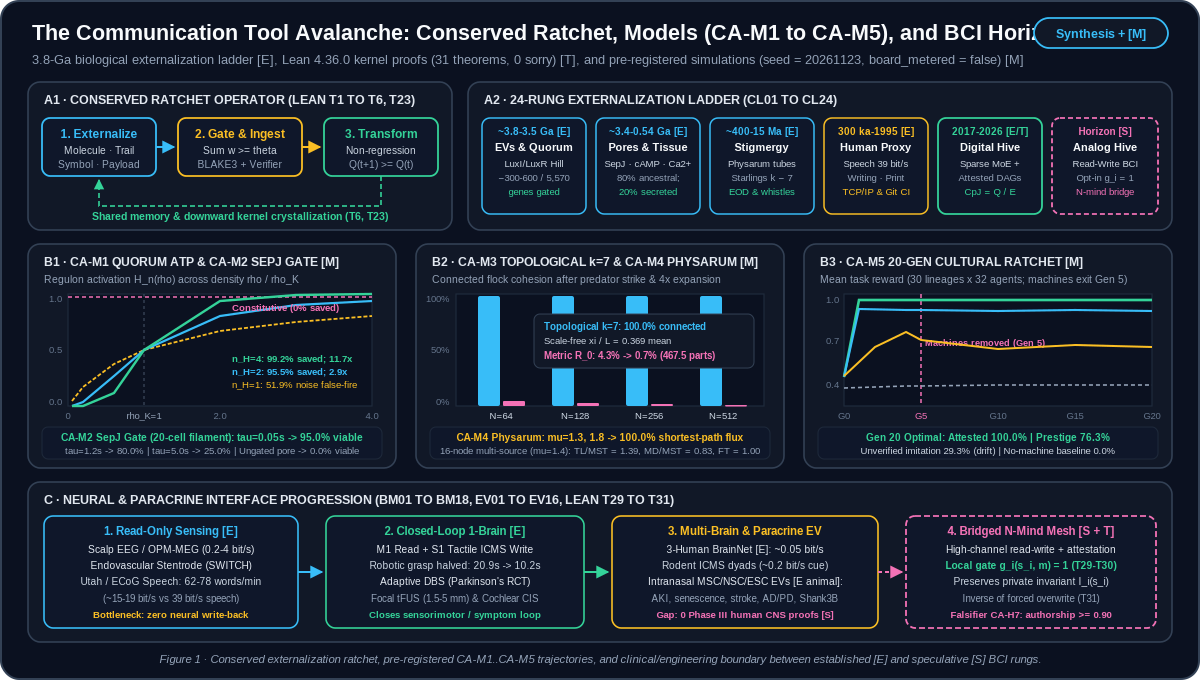
CL01 to CL24), pre-registered simulation outputs (CA-M1 to CA-M5, seed = 20261123, board_metered = false), and the boundary between established clinical neurotechnology ([E]) and speculative multi-mind bridging ([S]).2. The 3.8-Billion-Year Biological Escalation Ladder (CL01 to CL06)
Catalog openie-research-experiments/communication-avalanche/catalogs/evolutionary-communication-ladder.csv (CL01 to CL24) documents 24 evolutionary, cultural, computational, and neurotechnological rungs with explicit substrates, receptor gates, measured scales, and falsifiers. Six foundational biological transitions (CL01 to CL06) establish that multicellularity evolved primarily by innovating intercellular communication and containment gates atop largely conserved intracellular machinery ([E]):
| Rung | Approximate era | Biological system | Externalized substrate and receptor gate | Measured genomic or physiological scale | Falsifier criterion |
|---|---|---|---|---|---|
CL01 | ~3.8 Ga (pre-LUCA candidate) | Three-domain membrane vesicles (EVs) | 20-400 nm lipid-bilayer packets carrying RNA, proteins, and metabolites; endocytic or fusogenic uptake [25] | Conserved across Bacteria, Archaea, and Eukarya; protects labile cargo from extracellular nucleases/proteases | Absence of conserved vesiculation biophysics across basal archaeal and bacterial clades |
CL02 | ~3.5 Ga | Bacterial quorum sensing (Vibrio fischeri, Pseudomonas aeruginosa) | Diffusible AHL / AIP autoinducers bound by LuxR/LasR/RhlR or LuxPQ with cooperative Hill exponent [37, 42] | Controls >300 to ~600 of ~5,570 ORFs (~6%-10% of genome) in P. aeruginosa [37] | Constitutive exoproduct secretors outcompeting quorum-gated wild type under low-density advective wash-out |
CL03 | ~3.43 to 2.6 Ga | Filamentous cyanobacteria (Anabaena / Nostoc; Archaean stromatolites) | Cytoplasmic sucrose/glutamate exchange via SepJ, FraC/FraD, and SepI nanopore arrays with Ca2+-triggered plug/cap closure [1, 24, 49] | ~15 nm gated channels across ~100-cell diazotrophic filaments; seals stressed cells within seconds [49] | Lock-open SepJ/FraCD plug mutants showing no excess multi-cell filament death after single-cell lysis |
CL04 | ~1.0 to 0.6 Ga | Social amoeba aggregation (Dictyostelium discoideum) | Spiral extracellular cAMP pulses (~6 min period) sensed by cAR1-cAR4 GPCRs with refractory adaptation [19, 26] | Aggregates to cells; ~80% (76%-84%) of developmentally essential genes are ancestral, while the novel ~20% enrich secreted/transmembrane sensors [26] | Intact fruiting-body morphogenesis after ablating extracellular cAMP relay and cell-adhesion recognition |
CL05 | ~0.8 to 0.6 Ga | Colonial choanoflagellates (Choanoeca flexa, Salpingoeca rosetta) | Rhodopsin-cGMP contractility [8] and VGCC-mediated colonial Ca2+ transients (RGECO1 imaging) [15] | Synchronizes ciliary arrest and apical-basal sheet inversion across 10 to 500 collar cells prior to true neurons | Genetic/pharmacological VGCC block leaving colony-wide synchronous ciliary arrest and depolarization intact |
CL06 | ~0.54 Ga (Cambrian) | Early metazoan/cnidarian and chordate gap junctions | Direct ionic and <1 kDa IP3/cAMP coupling via convergent innexin/pannexin and chordate connexin hemichannels [45] | Tissue-scale epithelial and neuromuscular sheets ( to cells) gated by voltage, pH, and injury Ca2+ | Loss of high-Ca2+ junctional uncoupling failing to propagate bystander metabolic collapse across coupled epithelia |
Three quantitative lessons emerge directly from the primary biological record ([E]):
- Thresholded public-good gating (
CL02): First characterized via autoinduction of bioluminescence in Vibrio fischeri by Nealson, Platt, and Hastings (1970, 1979) [42] and surveyed across Gram-negative and Gram-positive circuits by Miller and Bassler (2001) [37], quorum sensing withholds metabolically expensive secreted virulence factors, siderophores, elastases, and biofilms until extracellular autoinducer concentration crosses a cooperative dissociation threshold . Microarray transcriptomics in Pseudomonas aeruginosa by Schuster et al. (2003) [37] demonstrated that315to>500genes (~6%to10%of its~5,570ORFs) are regulated by theLasR/RhlRacyl-homoserine lactone cascade. Rather than polling a central clock, cells integrate chemical concentration gradients locally. - Physical circuit-breakers make multicellular sharing survivable (
CL03,CL06): Sharing cytoplasm across cells creates an immediate vulnerability: localized predation or membrane rupture would drain the entire filament unless junctions close upon damage. Early Archaean stromatolite reefs (~3.43 Ga, Allwood et al. 2006) [1] attest to ancient microbial mat organization, and cryo-electron tomography of Anabaena septal junctions by Weiss et al. (2019) [49] alongside divisome/septal characterization ofSepJandSepI(Flores et al. 2018; Springstein et al. 2020) [24] revealed a proteinaceous nanopore tube-cap-plug assembly functionally convergent with metazoan pannexin/connexin gap junctions (Panchin et al. 2000) [45]. Stress or ionophore-inducedCa2+influx rearranges the cap-plug module to seal the pore reversibly, isolating lysed cells while preserving nitrogen-fixing heterocyst metabolite exchange across intact neighbors (CTA-T15). - Multicellularity reuses intracellular compute while inventing externalized I/O (
CL04,CL05): Sequencing Dictyostelium discoideum (~12,500genes, Eichinger et al. 2005) [19] and comparing genomes across all major dictyostelid clades (Glockner et al. 2016) [26] showed that roughly80%of developmentally essential genes predate multicellularity in solitary amoebozoan relatives; the lineage-specific~20%are heavily enriched in secreted and transmembrane recognition/signaling proteins. Likewise, in choanoflagellates (the closest unicellular and colonial sister group to animals), Brunet et al. (2019) [8] discovered light-regulated collective sheet inversion in Choanoeca flexa, and Colgren and Burkhardt (2025) [15] demonstrated in Salpingoeca rosetta that voltage-gated calcium channels (VGCCs) propagate colony-wide electrical/calcium waves coordinating synchronous ciliary arrest and contraction before the evolutionary appearance of synapses.
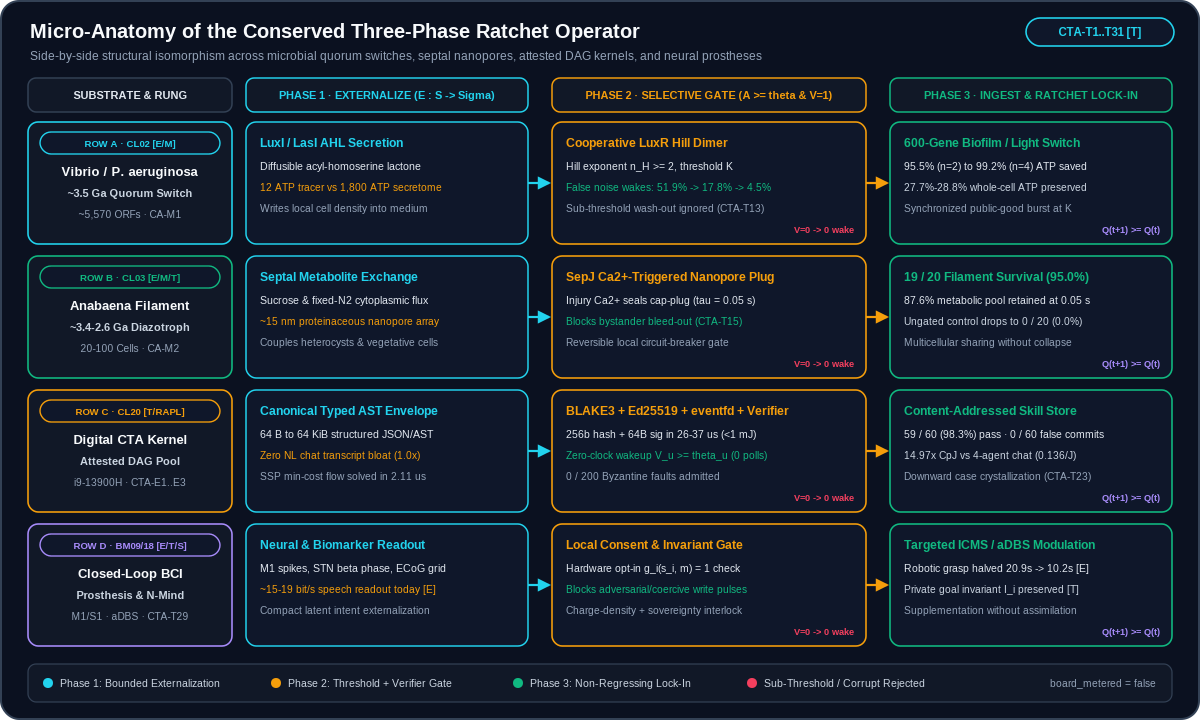
SepJ nanopore gating, aneural/animal field coordination, human externalized ledgers, and cryptographically attested multi-organ software and opt-in neural bridges.3. Cross-Species Stigmergy, Mycorrhizal Critique, and Executed Models (CA-M1 to CA-M5)
3.1 Cross-species decentralized coordination and candid evidence boundaries (CL07 to CL13)
Beyond tissue junctions, free-moving organisms externalize spatial and kinematic state directly into environmental fields ([E]):
- Stigmergy and plasmodial externalized memory (
CL08,CL10): Grasse (1959) and Theraulaz and Bonabeau (1999) [27] showed in social insects (Bellicositermes, Cubitermes) that architecture itself serves as the communication channel: workers respond to local pheromone-impregnated soil curvature without a blueprint. In the aneural syncytial slime mold Physarum polycephalum, Nakagaki, Yamada, and Toth (2000) [40] demonstrated shortest-path maze solving, Tero et al. (2010) [40] showed that adaptive Poiseuille protoplasmic tubes match the cost, transport efficiency, and fault tolerance of the Tokyo rail network, and Reid et al. (2012) [40] proved that Physarum deposits an extracellular non-living slime mat functioning as externalized spatial memory to escape U-shaped traps, failing when placed on pre-slime-coated agar. - Symbolic vector dances, topological flocks, signature whistles, and collective electrosensing (
CL09,CL11,CL12,CL13): Honeybees (Apis mellifera) encode floral distance and solar azimuth into waggle-run duration and angle (von Frisch 1967) [48]. Stereoscopic 3D reconstructions of starling (Sturnus vulgaris) murmurations by Ballerini et al. (2008) [3] and Cavagna et al. (2010) [11] revealed that each bird tracks a topological neighborhood ofk ~ 6 to 7nearest neighbors regardless of flock density, yielding scale-free velocity-fluctuation correlations whose correlation length grows linearly with flock size (, ). Bottlenose dolphins (Tursiops truncatus) broadcast and vocally copy individualized frequency-modulated signature whistles that operate as referential identity labels independent of voice timbre (Caldwell and Caldwell 1965; Janik and Sayigh 2013) [10, 30]. Schooling fish combine<10 mslateral-line hydrodynamic coupling (Partridge and Pitcher 1980) with collective active sensing: Pedraja and Sawtell (2024) [46] showed in weakly electric Gnathonemus petersii that conspecific electric organ discharges (EODs) illuminate shadowed objects and extend electrolocation range twofold to threefold. - Mycorrhizal fungal transfer versus mother-tree overinterpretation (
CL07): Using reciprocal and pulse labeling in the field, Simard et al. (1997) [48] demonstrated bidirectional carbon transfer between Betula papyrifera and Pseudotsuga menziesii seedlings linked by ectomycorrhizal hyphae, with net transfer modulated by shading. However, scientific honesty requires pairing that finding with the systematic audit by Karst, Jones, and Hoeksema (2023) [32], who showed across the forestry literature that positive citation bias and uncontrolled confounding factors (root grafts, soil diffusion, fungal-owned carbon retention, and seedling mortality) do not support popular claims of intentional “mother-tree” kin altruism or teleological warning broadcasts. In our framework, mycorrhizal transfer remains a genuine source-sink biophysical coupling ([E]for hyphal resource flux), while adaptive maternal signaling intent is classified as unsubstantiated ([S]/ contested).
3.2 Pre-registered deterministic model suite (CA-M1 to CA-M5, seed = 20261123)
To test the mathematical mechanics of Rungs CL02, CL03, CL08, CL12, and CL19 reproducibly, PREREG_cta_models.json (SHA-256: 475a89e3fe6157238560ac5876b52791b22a67a9d3260c68111a1b76b89ac9fa) was locked prior to executing run_cta_models.py (seed = 20261123, cta_models_results.json SHA-256: 54a7b2c177bc063e2536ae487cdb44b372f0ba6281514d8154c34b115b0b7914). All five pre-registered pass criteria succeeded ([M]):
| Model ID | Biological or cultural mechanism modeled | Parameter sweep (seed = 20261123) | Key quantitative result (cta_models_results.json) | Pre-registered verdict |
|---|---|---|---|---|
CA-M1 | Cooperative Hill quorum switch (600 / 5,000 genes; secreted public-good cost 3x housekeeping) | 13 densities 3 diffusivity losses + 2,000 noisy trials (, ) | At : 95.49% () and 99.17% () regulon ATP saved (27.72% and 28.79% whole-cell ATP saved); premature noise firing drops 51.90% () 17.75% (, 2.92x) 4.45% (, 11.66x) | Pass (>= 70% saving; >= 2.0x noise suppression) |
CA-M2 | 20-cell cyanobacterial filament with Ca2+-gated SepJ nanopores after cell-0 lysis | RK4 (dt = 0.002 s, 20.0 s horizon) across vs ungated | preserves 19 / 20 (95.0%) viable cells and 87.56% metabolic pool (90.0% at 0.15-0.30 s; 80.0% at 1.20 s; 25.0% at 5.00 s); ungated pore collapses to 0 / 20 (0.0% viable, 14.28% pool) | Pass (>= 90% fast-gated vs <= 10% ungated) |
CA-M3 | 3D topological flock vs fixed metric-radius flock under predator strike and 4x radial expansion | , 8 3D trials per , 64x volume expansion | Topological holds 100.0% single-component LCC cohesion across all (1.0 component, polarization 0.976-0.986, mean ); metric shatters into 57.0 to 467.5 fragments (LCC 4.30% down to 0.68%) | Pass (>= 98% topo LCC; ; metric <= 40%) |
CA-M4 | Physarum Poiseuille network $\dot{D}_{ij} = | Q_{ij} | ^\mu / (1 + | Q_{ij} |
CA-M5 | 20-generation hybrid ratchet ( agents/gen, 30 lineages; 4 synthetic demonstrators removed at Gen 5) | 4 regimes on 6-step non-myopic valley landscape (trap 0.40 vs global optimum 1.00) | Gen 20 optimal-agent share: 0.00% (no_machine_baseline, score 0.3689), 29.27% (unverified_imitation, score 0.6522), 76.25% (prestige_biased_imitation, score 0.9221), and 100.00% (attested_externalized_library, score 1.0000, 30/30 lineages) | Pass (>= 99% attested retention; strictly beats unverified) |
Notably, CA-M4 highlights an exact dynamical boundary: because has an inflection point at for , superlinear shortest-path selection operates strictly inside the unsaturated biological flux window (); overdriving source flux into saturation converts into a concave plateau that preserves parallel redundant tubes.
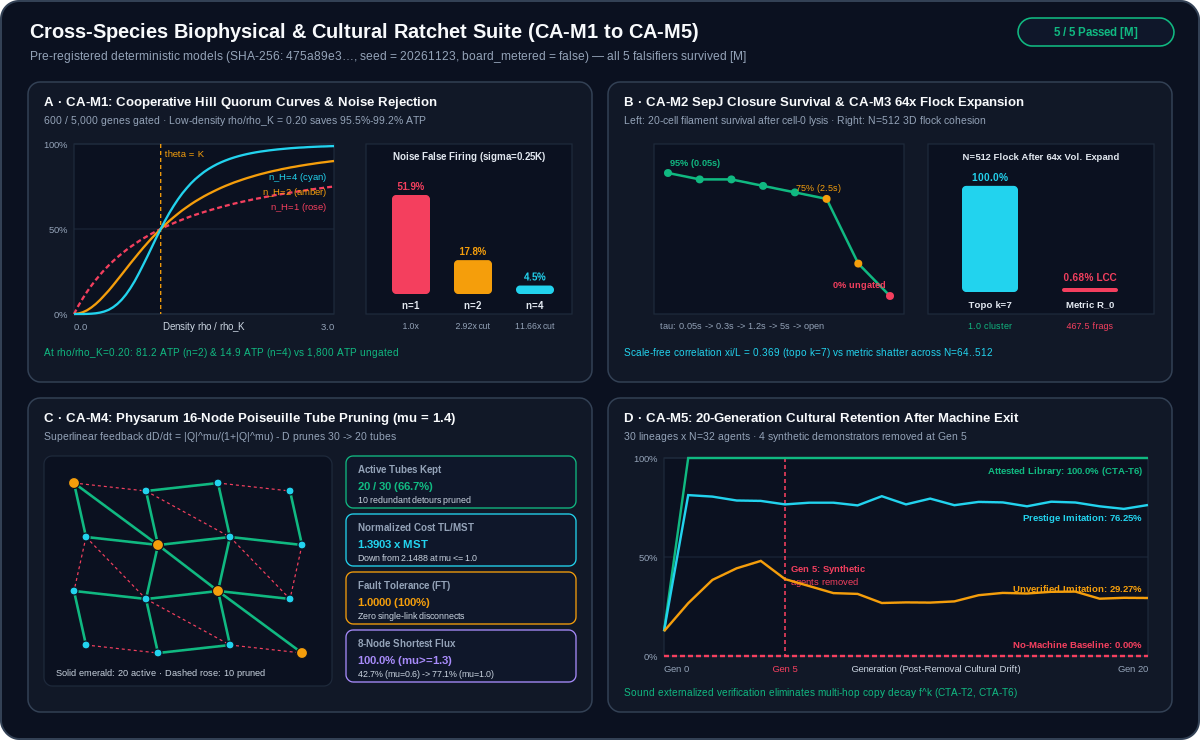
CA-M1 through CA-M5 (seed = 20261123, SHA-256: 54a7b2c1…): cooperative Hill noise suppression and ATP conservation, SepJ rapid pore containment, scale-free k = 7 3D flock cohesion under 64x volume expansion, Physarum superlinear shortest-path selection, and 100.0% post-removal cultural retention with attested artifact libraries.Worked Example 1: Biophysical Threshold Economics — Why a Lone Secreting Bacterium Goes Bankrupt and Why SepJ Must Seal in <= 0.30 s (CA-M1, CA-M2, CTA-T11–CTA-T15)
To see why biological externalization requires both cooperative activation thresholds and rapid fault-containment gates, trace the exact adenosine triphosphate (ATP) and metabolite equations executed in CA-M1 and CA-M2 (seed = 20261123, board_metered = false, [M]):
- Phase 1 (Bounded Tracer Externalization vs. Full Secretome Cost): Consider a model bacterium with
5,000open reading frames (ORFs), matching the genomic scale of Pseudomonas aeruginosa (~5,570ORFs). Housekeeping metabolism across4,400intracellular genes requires1.0normalizedATPunit per gene per cell cycle (4,400.0 ATP), whereas600quorum-regulated genes (12.0%of the genome: secreted elastases, siderophores, biofilm exopolysaccharides, or Vibrio luciferase) carry a3.0xextracellular synthesis-and-export cost (1,800.0 ATP). A constitutive mutant that expresses all5,000genes unconditionally expends: burning29.03%(1,800 / 6,200) of its entire cellular energy budget on exported macromolecules that advective wash-out dilutes below functional concentration whenever local cell density sits far below quorum threshold . Instead, wild-typeLuxI/LasIexternalizes a tiny acyl-homoserine lactone (AHL) tracer costing (0.19%of ). - Phase 2 (Cooperative Hill Gate Under Sub-Threshold Noise): At planktonic low density (extracellular autoinducer ratio at diffusivity loss
0.50), the rational Hill receptor switch (CTA-T11toCTA-T14) yields starkly different metabolic budgets across cooperativity exponents :- Monomeric receptor (): , spending (
4,712.0 ATPtotal). Worse, when diffusive micro-eddies inject sub-threshold concentration fluctuations (, Gaussian across2,000trials), suffers premature regulon firing () on51.90%(1,038 / 2,000) of cycles. - Cooperative dimer (,
LuxR-class): , slashing regulon spend to (95.49%regulonATPsaved,27.72%whole-cellATPsaved at4,481.23 ATP) and cutting premature noise wakes2.92xdown to17.75%. - Cooperative tetramer (): , dropping regulon spend to (
99.17%regulonATPsaved,28.79%whole-cellATPsaved at4,414.88 ATP) and cutting false wakes11.66xdown to4.45%(CTA-T13).
- Monomeric receptor (): , spending (
- Phase 3 (Multicellular
SepJCircuit-Breaker Timing): Once cells couple directly via~15 nmcyanobacterial septal nanopores (CA-M2, coupled cells integrated via fourth-order Runge-KuttaRK4at over20.0 s), terminalcell 0membrane lysis at creates an immediate cytoplasmic sink. If -triggeredSepJcap-plug closure completes in ,junction (0,1)seals to0.000open fraction, preserving90.48%ofcell 1’s metabolite pool (93.86%at distalcell 19) and19 / 20(95.0%) viable cells (87.56%total filament capacity). At ,cell 1absorbs a steep transient drop (17.66%to13.19%metabolite) yet seals fast enough to save18 / 20(90.0%) cells (85.11%to77.85%capacity). Slowing closure past0.30 striggers progressive bystander collapse (16 / 20 = 80.0%at1.20 s;5 / 20 = 25.0%at5.00 s), and an ungated lock-open mutant drains the entire filament to0 / 20(0.0%) viable cells (14.28%residual pool,CTA-T15).
4. Human Cultural Ratchet, Extended Mind, Machine Culture, and the Digital Hive Mind (CL14 to CL19)
Human cognitive evolution scaled collective output without rewriting cortical neuron biophysics by progressively lowering signal loss and decoupling artifact lifetime from individual mortality ([E]):
- Shared intentionality, externalized ledgers, and cumulative culture (
CL14toCL17): Against an adult human brain power budget of roughly20 W(Balasubramanian 2021) [2], overt human behavioral throughput averages~10 bit/s(Zheng and Meister 2025) [50] and spoken natural language across17languages encodes~39 bit/s(Coupe et al. 2019) [17]. Despite that tight per-person serial bottleneck, shared intentionality (Tomasello et al. 2005) and high-fidelity social ratification create the cultural ratchet (Tennie, Call, and Tomasello 2009) [48]. Sociological and philosophical accounts framed the resulting macro-structures as collective consciousness (Durkheim 1893), the noosphere (Teilhard de Chardin 1955) [18], the extended mind in which external notebooks and symbols form constitutive parts of cognitive processing (Clark and Chalmers 1998) [14], and global stigmergic coordination across packet-switched networks (Heylighen 2007) [28]. Writing (CL15), movable-type print and peer review (CL16), and content-addressed version control (Git+ automatedCIgates,CL17) successively replaced lossy oral memory ( multi-hop decay) with persistent, inspectable external records. - Sparse
MoEfoundation models as a digital hive mind (CL18): Frontier neural architectures increasingly separate total stored parameter count (reaching to parameters) from active compute per token via sparseMoEtop- routing (Fedus, Zoph, and Shazeer 2022) [21], activating only~3%to12%of expert weights on any single token, analogous to specialized multicellular differentiation ([same house]hardware-paged routing in Downward LUT6 Compilation [44]). Raw parameter count parallels raw cell count; coordination routing and verification govern . - Hybrid machine-human cultural ratchets and
POLISsocieties (CL19): Brinkmann et al. (2023) [6] formalized machine culture, showing that intelligent machines now act as cultural variation generators, selectors, and transmitters. Crucially, multi-generation human-machine laboratory experiments by Brinkmann et al. (2026) [7] demonstrated that when deep reinforcement learning agents discovered a counterintuitive non-myopic strategy that599of600isolated human participants missed, and the machine agents were completely removed after the initial generation, prestige-biased human social learning preserved the machine-discovered strategy down to the final generation in9of15(60%) hybrid populations, making every final-generation participant in those lineages a cultural descendant of a removed machine agent (CA-M5reproduces both this~60%-76%prestige-imitation persistence and its vulnerability to copy noise relative to100%attested artifact libraries). Complementarily, Zhuang (2025) [50] introducedPOLIS(The Ratchet Effect in Silico), showing that micro-societies of1Bto4BLLMscycling through generation, peer verification, shared cultural memory, and internalization gain+8.8to+18.9benchmark points, with mechanistic ablations confirming peer verification as the primary anti-regression ratchet operator.
4.4 The 1950–2026 Artificial Intelligence Ratchet Audit (AI01 to AI38)
Catalog openie-research-experiments/communication-avalanche/catalogs/ai-history-ratchet-1950-2026.csv (AI01 to AI38) audits 38 foundational milestones across 76 years of artificial intelligence (1950 to 2026) by projecting each system onto the exact conserved tuple (externalized_signal_substrate, ingestion_routing_rule, threshold_or_verifier_gate, bottleneck_broken, failure_boundary_or_winter_cause) ([E] for published historical milestones; [T]/[M] for 2026 downward-compilation syntheses). Viewed through that structural lens, the history of machine intelligence is neither a sequence of unrelated architectural fashions nor a smooth homogeneous curve of dense floating-point throughput. Every lasting inflection unlocked a new externalized communication channel paired with a selective admission or conservation gate, and both AI Winters struck precisely when externalized state proliferated without a tractable search prior or sound verification gate:
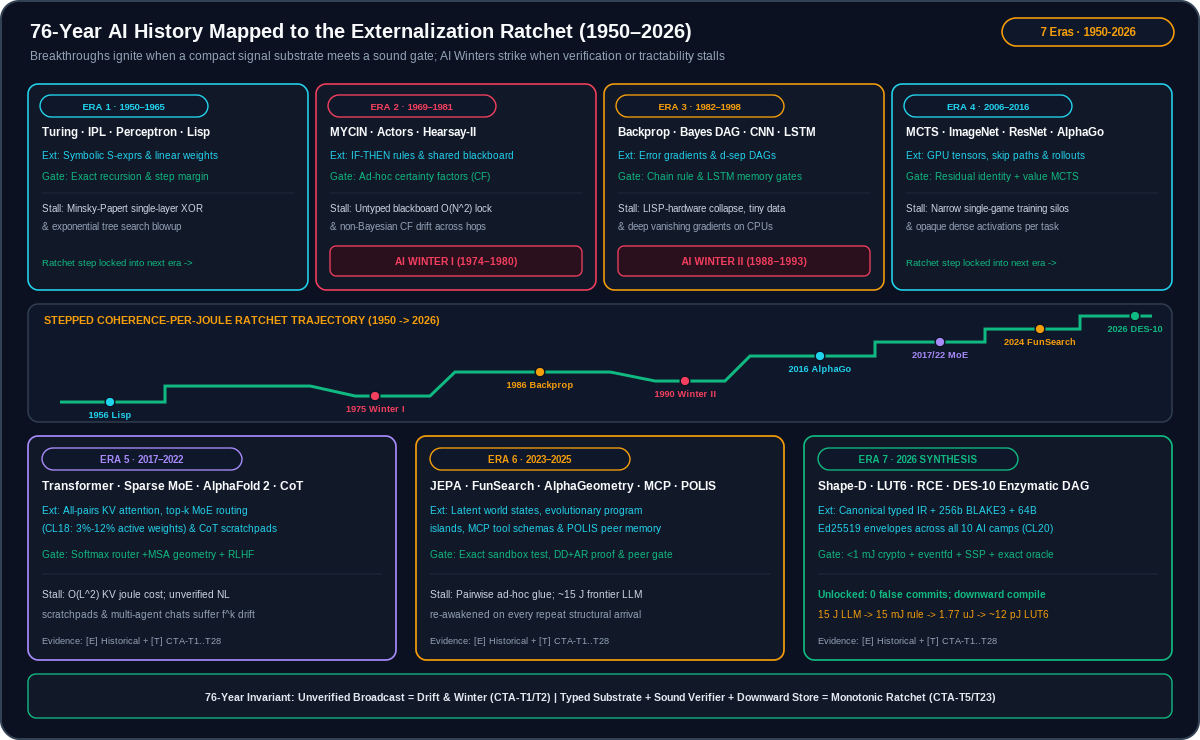
AI01 to AI38, 1950-2026). Every upward step pairs an externalized representation with a selective threshold or verifier gate; AI Winter I (1974-1980) and AI Winter II (1988-1993) correspond to exact gate/ingestion failures where unguided $O(b^d)$ search, non-Bayesian certainty-factor drift (CTA-T1, CTA-T2), or vanishing gradients stalled Coherence per Joule.- Era I (
1950–1965· Symbolic & Threshold Genesis,AI01–AI06): Turing (1950) [87] inaugurated the field by replacing unobservable mentalism with an externalized teletype token channel (AI01), though purely conversational indistinguishability lacked an internal truth verifier. Two years later, Shannon’s electromechanical mouse Theseus (1952,AI02) [82] demonstrated physical stigmergy in silicon-precursor hardware:75telephone relays beneath a5 × 5maze stored2-bit last-exit vectors so the mouse externalized trial-and-error wall collisions into an persistent spatial lookup table. Newell and Simon’s Logic Theorist (1956,AI03) [75] invented dynamic pointer-linked list structures in Information Processing Language (IPL) to externalize subgoal proof trees (proving38of52Principia Mathematica theorems), McCarthy (1960,AI05) [71] unified executable code and symbolic data in homoiconicLispS-expressions, and Robinson (1965,AI06) [78] compressed first-order deduction into a single machine-checkable resolution-and-unification gate (deriving the empty clause[]). In parallel, Rosenblatt (1958,AI04) [80] introduced the sub-symbolicPerceptron, summing weighted photoreceptor signals across a hard linear step gate . - Era II (
1969–1981· Rule Bases, Actors, Blackboards & Exact Diagnosis of AI Winter I,AI07–AI10): Minsky and Papert (1969,AI07) [73] proved algebraically that single-layer order-1threshold gates cannot represent parity (XOR) or global topological connectedness; because no low-cost credit-assignment channel through multi-layer step gates was deployed, sub-symbolic research froze. Symbolic engineering responded by externalizing human domain heuristics into modularif-thenproduction rules (Heuristic DENDRALandMYCIN,1971–1976,AI08) [55, 84], asynchronous point-to-pointActormailboxes (Hewitt, Bishop, and Steiger 1973,AI09) [64], and theHearsay-IImulti-specialistBlackboardworkspace (Erman et al. 1980,AI10) [60].Hearsay-IIexposes the exact mechanistic cause of AI Winter I (1974–1980): independent Knowledge Sources (KSs) communicated cleanly over a shared multi-level blackboard, but hand-authored crisp rules lacked differentiable perceptual ingestion from noisy acoustic waveforms and lacked low-cost learned search priors. Without a sound gradient or admissible pruning gate, competing parse hypotheses triggered combinatorial branching while heuristicMYCIN-style Certainty Factors (CF) accumulated non-Bayesian multi-hop drift (CTA-T1), collapsingCpJas vocabularies and rule counts scaled past . - Era III (
1982–1998· Gradient Channels, Graphical Message Passing & Gated Memory,AI11–AI17): Recovery came from inventing continuous and probabilistically sound communication channels. Hopfield (1982,AI11) [66] cast associative recall as Lyapunov energy relaxation (); Rumelhart, Hinton, and Williams (1986,AI12) [81] established reverse-mode backpropagation as a backward error-broadcast channel breaking the hidden-layerXORbarrier; Pearl (1988,AI13) [77] replaced inconsistent Certainty Factors withd-separation-gated belief propagation on Bayesian directed acyclic graphs (DAGs); Watkins and Dayan (1989/1992,AI14) [89] broadcast delayed environmental rewards backward via temporal-difference (TD)Q-learning; LeCun et al. (1989/1998,AI15) [69] enforced translation-equivariant weight sharing inConvNets(LeNet-5); and Cortes and Vapnik (1995,AI16) [56] externalized decision boundaries onto sparse Karush-Kuhn-Tucker (KKT) support vectors. Crucially, AI Winter II (1988–1993) reflected both specialized Lisp-hardware economic collapse against commodity microprocessors and exponential gradient vanishing across deep saturating sigmoids (CTA-T2in backward form). Hochreiter and Schmidhuber (1997,AI17) [65] solved temporal vanishing by inventing Long Short-Term Memory (LSTM): a linear Constant Error Carousel (CEC) protected by multiplicative input, forget, and output gates in — the exact computational analog of a cyanobacterialSepJnanopore (CL03), sealing stored gradient state against noisy read/write perturbations across>1,000recurrent steps. - Era IV (
2006–2016· Shared Corpora, Skip Highways, Soft Attention & Self-Play Ratchets,AI18–AI23): Coulom (2006) and Kocsis and Szepesvari (2006) (AI18) [57] externalized asymmetric lookahead statistics into Upper Confidence Bound for Trees (UCT) Monte Carlo Tree Search (MCTS). Deng et al.’s crowd-verified14M-imageImageNetledger (2009) coupled to Krizhevsky, Sutskever, and Hinton’s dual-GPUReLUAlexNet(2012,AI19) [59, 68] ignited modern scale; Mikolov et al.’sWord2Vec(2013) and Mnih et al.’sDQNcircular experience replay buffer (2015,AI20) [72, 74] stabilized continuous vector geometry and off-policyRL; Goodfellow et al.’s Generative Adversarial Networks (GANs,2014) and Bahdanau, Cho, and Bengio’s content-addressed soft attention (2015,AI21) [53, 62] introduced competitive discriminator gates and dynamic alignment; and He et al.’sResNet(2016,AI22) [63] created an unattenuated identity skip highway () across152+layers. Culminating Era IV, Silver et al.’sAlphaGoandAlphaZero(2016–2017,AI23) [85] closed a bidirectionalMCTSPolicy/Value self-play distillation ratchet: neural intuition prunedMCTSbranching,MCTSsearch externalized improved visit distributions , and an exact deterministic game-rules verifier (>= 55%Elo gate) prevented regression (CTA-T5). - Era V (
2017–2022· All-to-All Attention, SparseMoE,Evoformer& Human-Feedback Gates,AI24–AI28): Vaswani et al.’sTransformerand Gilmer et al.’s Message Passing Neural Networks (MPNN,2017,AI24) [61, 88] replaced sequential recurrence with -hop random-access Key-Value (KV) and molecular graph message passing. Shazeer et al. (2017) and Fedus, Zoph, and Shazeer (2022,AI25,CL18) [21, 83] introduced top-Sparse MoEconditional routing (~3%–12%active weights/token). Brown et al.’sGPT-3and Lewis et al.’s Retrieval-Augmented Generation (RAG,2020,AI26) [54, 70] paired web-corpus in-context conditioning with non-parametric document indices. Jumper et al.’sAlphaFold 2(2021,AI27) [67] solved monomeric protein folding by coupling Multiple Sequence Alignment (MSA) coevolutionary statistics to pairwise residue geometry via triangle updates andSE(3)-equivariant Invariant Point Attention (IPA). Finally, Ouyang et al.’sInstructGPT(RLHF), Wei et al.’s Chain-of-Thought (CoT), and Yao et al.’sReAct(2022–2023,AI28) [76, 90] externalized intermediate working memory into natural-language token scratchpads and tool-observation loops — unlocking multi-step synthesis while simultaneously exposing Era V’s failure mode:KVjoule burn, sycophantic human-preference drift, and3.71xunattested multi-agent transcript bloat (Arm CinCTA-E2). - Era VI (
2023–2025· Verifier-Gated Search, Latent World Models & Machine Culture,AI29–AI34): Assran, LeCun et al.’sI-JEPA(2023,AI29) [52] eliminated wasteful surface-pixel reconstruction by predicting masked targets directly in abstract latent space. Brinkmann et al. (2023, 2026) and Zhuang’sPOLIS(2025,AI30,CL19) [6, 7, 50] proved post-removal cultural lock-in and peer-verifiedLLMratchet gains. Romera-Paredes et al.’sFunSearch(2024,AI31) [79] coupledLLMcode mutation to an exact sandbox fitness evaluator across evolutionary islands, and Trinh et al.’sAlphaGeometry(2024,AI32) [86] paired neural auxiliary point proposals with a sound Deductive Database plus Algebraic Rules (DD+AR) engine (25 / 30Olympiad geometry problems with zero hallucinated proofs). Anthropic’sModel Context Protocol(MCP,2024,AI33) [51] standardized typedJSON-RPC 2.0tool schemas (N + Mvs. adapters), andDeepSeek-R1(2025,AI34) [58] proved via Group Relative Policy Optimization (GRPO) that pure reinforcement learning against deterministic math/compiler verifiers spontaneously induces self-verification — yet still re-expends thousands of thinking tokens (~10–50+ J) on recurring structural problem classes. - Era VII (
2026· Downward Crystallization & Digital Enzymatic Synthesis,AI35–AI38): Companion Open Interface Engineering studies[same house][44] and this work close the missing downward loop:Shape D(DNULLMM1,AI35) freezes verified repairs into1.77 µJmemory-mapped hash tables;AirMoLandDownward LUT6 Compilation(AI36) compile hot decision paths into81 × RAMB36E2single-cycle hardware look-up pages (0DSP48E2slices,~12 pJest_j);RCE+FormEBM(AI37) pairs a47.09 mJlatent energy pre-filter (0.8922AUROC,2.39xfewer checker calls) with a~49 mJReality Code Engine (RCE) checker (1,718xcheaper than frontier model calls); andCTA/DES-10(AI38,CL20) unifies all10AI camps behind< 1 mJBLAKE3+Ed25519Digital Enzymes and a provable 4-tier downward compiler (CTA-T32toCTA-T45).
| Era & Catalog Span | Representative Milestones (ai-history-ratchet-1950-2026.csv) | Externalized Signal Substrate () | Selective Threshold or Verifier Gate () | Bottleneck Unlocked () | Stall Boundary or AI Winter Mechanism |
|---|---|---|---|---|---|
Era I (1950–1965) AI01–AI06 | Turing teletype [87]; Shannon Theseus [82]; Logic Theorist IPL [75]; Perceptron [80]; Lisp [71]; Robinson resolution [78] | Teletype tokens, 75-relay maze latches, heap-linked IPL/Lisp S-expressions, potentiometer weights, CNF clauses | Human dialogue judge, whisker-relay latch, axiom identity, step margin , empty clause [] | Physicalized symbolic recursion, homoiconic code-as-data, relay stigmergy, and single-rule unification | Perceptron order-1 XOR ceiling [73] and exponential symbolic clause explosion |
Era II (1969–1981) AI07–AI10 | Minsky-Papert XOR [73]; DENDRAL/MYCIN [55, 84]; Actors [64]; Hearsay-II Blackboard [60] | Modular if-then production rules, asynchronous Actor messages, shared multi-level speech Blackboard | Premise thresholds (CF > 0.2), mailbox encapsulation, opportunistic KS focus ratings | Decoupled domain heuristics and concurrent specialist modules from monolithic control loops | AI Winter I (1974–1980): crisp hand-coded KSs lacked differentiable ingestion or low-cost search priors stall & CF drift |
Era III (1982–1998) AI11–AI17 | Hopfield [66]; Backprop [81]; Pearl DAG [77]; Q-learning [89]; ConvNet [69]; SVM [56]; LSTM [65] | Ising couplings, reverse-mode , DAG messages, TD errors, shared kernels, CEC cell state | Lyapunov , d-separation, Bellman contraction, KKT margin, LSTM multiplicative gates (SepJ analog) | Unlocked multi-layer representations, coherent causal inference, raw-pixel vision, and >1,000-step temporal memory | AI Winter II (1988–1993): Lisp-hardware collapse, saturating-sigmoid vanishing gradients, and sequential RNN bottleneck |
Era IV (2006–2016) AI18–AI23 | MCTS/UCT [57]; ImageNet+AlexNet [59, 68]; Word2Vec+DQN [72, 74]; GAN+Attention [53, 62]; ResNet [63]; AlphaGo/Zero [85] | UCT rollout trees, 14M-image ledger, replay buffers, soft-attention alignments, identity skip bus, self-play | UCT confidence bound, ILSVRC oracle, frozen target nets, discriminator minimax, >= 55% Elo game-rules gate | Ignited GPU deep learning, 152+-layer gradient flow, and superhuman neural symbolic self-play distillation | Dense all-layer forward sweeps on trivial inputs and megajoule closed-world simulator dependence |
Era V (2017–2022) AI24–AI28 | Transformer+MPNN [61, 88]; Sparse MoE [21, 83]; GPT-3+RAG [54, 70]; AlphaFold 2 [67]; InstructGPT+CoT+ReAct [76, 90] | All-pairs KV cache, top- expert routing (CL18), MIPS document passages, MSApair tensors, CoT scratchpads | Scaled softmax, top- router (3%–12% active), SE(3) IPA triangle consistency, RLHF reward + tool return codes | Parallelized -hop global context, trillion-weight conditional capacity, atomic protein folding, and zero-shot tool loops | KV joule tax, sycophantic RLHF reward hacking, and 3.71x unattested multi-agent prose drift (CTA-E2 Arm C) |
Era VI (2023–2025) AI29–AI34 | I-JEPA [52]; Machine Culture+POLIS [6, 7, 50]; FunSearch [79]; AlphaGeometry [86]; MCP [51]; DeepSeek-R1 [58] | Latent target blocks, cultural artifact stores (CL19), evolutionary code islands, Euclidean proof states, MCP schemas, <think> traces | EMA non-collapse, peer verification, sandbox fitness, DD+AR proof engine, JSON Schema, GRPO compiler/math verifiers | Proved external verifiers turn stochastic LLMs into non-regressing discovery engines (25/30 Olympiad, extremal math) | Ad-hoc two-camp bridges and repeated 10–50+ J thinking traces re-executed from scratch on recurring structural classes |
Era VII (2026) AI35–AI38 | Shape D DNULLMM1; AirMoL/LUT6; RCE+FormEBM; CTA / DES-10 [44] [same house] | Frozen mmap case slots, 81 × RAMB36E2 LUT6 pages, canonical program Forms, BLAKE3+Ed25519 Phi_IR envelopes (CL20) | SHA-256 store freeze, 1-cycle truth-table parity, ~49 mJ RCE checker, < 1 mJ crypto + eventfd + SSP + sandbox gate | Closes the downward loop: ~15 J discovery crystallizes into ~15–49 mJ rules 1.77 µJ cases ~12 pJ LUT6 reflexes (0 false commits) | Governed by exact amortization falsifier (CTA-T45) |
Worked Example 2: Historical Ratchet Diagnosis (1950–2026) — Why 1975 MYCIN and 1980 Hearsay-II Stalled into AI Winter I While 2016 AlphaGo and 2024 FunSearch Ignited (CTA-T1–CTA-T6)
Mapping historical artificial intelligence architectures onto the three-phase operator explains why early multi-module systems stalled while modern generate-and-verify loops achieved super-human lock-in ([E], [T]):
- Why
MYCIN(1975) andHearsay-II(1980) Stalled:- Externalization ():
MYCINexternalized~450hand-authoredLispproduction rules carrying subjective Certainty Factors (CF, );Hearsay-IIexternalized multi-granular speech hypotheses (acoustic, phonetic, syllabic, lexical, phrasal) onto a global shared blackboard polled by concurrent Knowledge Sources (KS). - Unsound Gate (): Neither architecture possessed an exact truth-preserving admission gate (). Because
MYCIN’sCFcombination algebra treated correlated clinical evidence as conditionally independent without directed acyclic graph (DAG)d-separation, chaining rules accumulated calibration drift (CTA-T1) and suffered multiplicative fidelity decay (CTA-T2: at per-hop rule precision across chained rules, joint validity drops to ). Simultaneously,Hearsay-II’s unthresholded blackboard forced scheduler checks across noisy bottom-up syllable fragments (CTA-T9), spending the majority of compute arbitrations on false-positive partial parses. - Missing Downward Distillation (): Extending coverage from
450to4,500rules required human specialists to audit pairwise rule interactions manually, stalling into AI Winter I when maintenance energy outgrew diagnostic yield.
- Externalization ():
- Why
AlphaGo(2016) andFunSearch(2024) Ignited:- Externalization ():
AlphaGoexternalized learned policy and value priors into an explicit Monte Carlo Tree Search (MCTS) state-action table ;FunSearchexternalized compact Python priority functions (10to30lines of code, not natural-language essays) into a multi-island evolutionary program database. - Sound Deterministic Gate ():
AlphaGogated legal transitions and terminal outcomes via exact Go board rules;FunSearchgated every language-model mutation through a deterministic combinatorial witness checker (verifying exact cap-set independence or bin-packing capacity in milliseconds). Any hallucinated or sub-optimal code receivedadmittedWeight = 0(CTA-T3,CTA-T17), keeping island contamination strictly at0.0%even when >99%of raw model samples were non-improving. - Non-Regressing Lock-In ():
AlphaGodistilled expensive multi-thousand-rolloutMCTSdistributions downward into fast single-pass neural weights, whileFunSearchretained strictly higher-scoring verified programs (,CTA-T5,CTA-T6) across islands — converting noisy stochastic proposals into a permanent mathematical ratchet.
- Externalization ():
5. Event-Driven Attested Orchestration, Five-Host Fleet Telemetry, and Ten-Camp Synthesis (CTA-E1 to CTA-E5)
Biological coordination across every evolutionary rung surveyed in Sections 2 and 3 runs on local concentration gradients, cooperative activation thresholds, and selective pore sealing rather than global clock ticks or unverified broadcast chatter. Translating those mechanisms into software engineering yields an event-driven orchestration architecture in which heterogeneous compute kernels and language models communicate over energy-budgeted, cryptographically attested channels. This section specifies the four structural components of the Communication Tool Avalanche (CTA) orchestrator, states the pre-registered falsifiers (F1 to F6, locked prior to execution under Secure Hash Algorithm SHA-256 digest 5739bcdd6c35662833a470bc56bd64f991774c2d920a5a9c059c0acebdf55e7f), and reports executed hardware measurements across three experiments (CTA-E1, CTA-E2, and CTA-E3) on a 20-thread 13th Gen Intel Core i9-13900H Linux host (rustc 1.100.0, Python 3.14.4).
5.1 Measurement Grammar and Telemetry Disclosure
All local processor energy values in CTA-E1 through CTA-E3 are read from Linux sysfs powercap Running Average Power Limit (RAPL) counters using wrap-safe 64-bit accumulation modulo max_energy_range_uj = 262,143,328,850 microjoules (262.143 J). Every measurement adheres strictly to three separation rules:
- On-chip
reported_jversus external wall power: No external inline shunt or alternating-current (AC) board power analyzer was attached (measured_j = None,board_metered = false). All local energy figures are stampedreported_j. - Three-rail RAPL disclosure (
package-0,core, andpsys): Every experiment recordsintel-rapl:0(package-0, central processing unit (CPU) and system-on-chip (SoC) socket energypkg_reported_j),intel-rapl:0:0(core, processor core planecore_reported_j), andintel-rapl:1(psys, platform counterpsys_reported_j). On this laptop host, original equipment manufacturer (OEM) Embedded Controller (EC) firmware leavesintel-rapl:1(psys) at a static quiescent rate of~0.202 W(~0.20 J/s) that does not scale whenpackage-0rises from~5.0 Widle to~27.7 Wunder single-core load. Primary local Coherence per Joule (CpJ) is therefore computed against dynamicpkg_reported_j(and reported alongsidecore_reported_j), whilepsys_reported_jis preserved verbatim in every JSON artifact and ledger line. - Strict separation of local joules from remote cloud tokens: When an arm invokes a remote Application Programming Interface (API) large language model (LLM), remote datacenter server energy is recorded strictly as
not_availableand never imputed from heuristic constants. Exact API call counts, prompt and completion token counts, and United States dollars (USD) at public list rates (\$3.00per million input tokens and\$15.00per million output tokens forClaude Sonnet 5.5) are reported in dedicated columns alongside localpkg_reported_j.
5.2 Orchestrator Architecture, Attested Channels, and Min-Cost Flow
Let denote a directed acyclic graph (DAG) of execution nodes connected by typed directed channels :
- Heterogeneous execution pool and
cost_lut.json: Deterministic nodes execute lexical and abstract syntax tree (AST) parsing (parse_kernel), scope, mutable-default, and type-coercion analysis (static_type_scope_kernel), docstring and algebraic invariant synthesis (test_gen_kernel), bounded AST/token repair (det_patch_kernel), and isolated behavioral admission (diff_verifier_kernel). Nondeterministic synthesis (llm_patch_proposer) sits on a high-cost escalation branch. Prior to orchestration runs, every deterministic kernel and cryptographic primitive is profiled across three input-size buckets (< 320 B,320-640 B,> 640 B) into a hardware-keyed lookup table (cost_lut.json). - Constant-time cryptographic channel attestation: Every channel edge carries an envelope signed by the sender’s deterministic
Ed25519keypair (64-byte Request for Comments (RFC)8032strict signature viaed25519-dalek) over a domain-separated header and the256-bitBLAKE3digest of the payload bytes. Receiving nodes check sender authorization, constant-timeBLAKE3digest equality, strictEd25519signature validity, and JavaScript Object Notation (JSON) frame completeness before mutating node state. - Successive Shortest Path (SSP) min-cost flow scheduler: Given edge capacities and microjoule-scaled weights drawn from
cost_lut.json, the compiled Rust scheduler computes a minimum-cost flow of demand from source to commit sink :
using Bellman-Ford initial node potentials followed by Johnson reduced-cost Dijkstra augmentations . Because the schedule depends only on graph topology and cost_lut.json, SSP executes once at topology epoch 0 (2.11 µs for the CTA-E2 pool) and recomputes solely when a node drops out or joins (0 per-tick scheduler overhead).
4. Thresholded integrate-and-fire wakeup (zero clocks, zero polling): Each node maintains an accumulated membrane potential over incoming weighted signals :
Worker threads block in the Linux kernel via eventfd (EFD_CLOEXEC), consuming zero CPU cycles while . Upstream node writes to eventfd strictly at the threshold-crossing transition . Every firing appends an immutable receipt (trace_id, step_idx, node_id, input_blake3, output_blake3, ed25519_sig_prefix, verify_ns, psys_reported_j, pkg_reported_j, latency_ms, potential_v, threshold_theta) to the energy ledger.
| Pool Component / Primitive | Bucket / Payload | Mean Latency | pkg_reported_j per Op | core_reported_j per Op | Role in Orchestration Graph |
|---|---|---|---|---|---|
parse_kernel | 320-640 B (200 runs) | 56.90 µs | 1.38 mJ | 1.16 mJ | Lexical bracket stack & AST localization |
static_type_scope_kernel | 320-640 B (200 runs) | 29.26 µs | 0.64 mJ | 0.55 mJ | Unbound symbols, mutable defaults, coercions |
test_gen_kernel | 320-640 B (200 runs) | 13.33 µs | 0.36 mJ | 0.30 mJ | Public doctest & algebraic invariant synthesis |
det_patch_kernel | 320-640 B (200 runs) | 601.60 µs | 15.73 mJ | 13.35 mJ | Bounded AST/token patch synthesis (<= 16 tries) |
diff_verifier_kernel | 320-640 B (200 runs) | 47.67 µs | 1.12 mJ | 0.95 mJ | Isolated execution, repeat-call & property gate |
Rust BLAKE3 + Ed25519 verify | 64 B (50,000 runs) | 26.05 µs (p50 25.95 µs) | 643.03 µJ | 543.65 µJ | Constant-time channel envelope verification |
Rust BLAKE3 + Ed25519 verify | 1 KiB (50,000 runs) | 27.35 µs (p50 27.04 µs) | 650.59 µJ | 546.58 µJ | Typical AST diagnostic packet verification |
Rust BLAKE3 + Ed25519 verify | 16 KiB (50,000 runs) | 29.36 µs (p50 29.32 µs) | 696.16 µJ | 584.07 µJ | Multi-function patch payload verification |
Rust BLAKE3 + Ed25519 verify | 64 KiB (50,000 runs) | 37.47 µs (p50 37.39 µs) | 926.42 µJ | 784.95 µJ | Large context channel verification (< 1 mJ) |
Across a 1,024x increase in channel payload size (64 B to 64 KiB), compiled Rust BLAKE3 + Ed25519 verification latency rises by 1.44x (25.95 µs to 37.39 µs median) and socket energy stays under 1 mJ (643.03 µJ to 926.42 µJ), satisfying pre-registered Falsifier 2 (< 100 µs and < 5 mJ per edge).
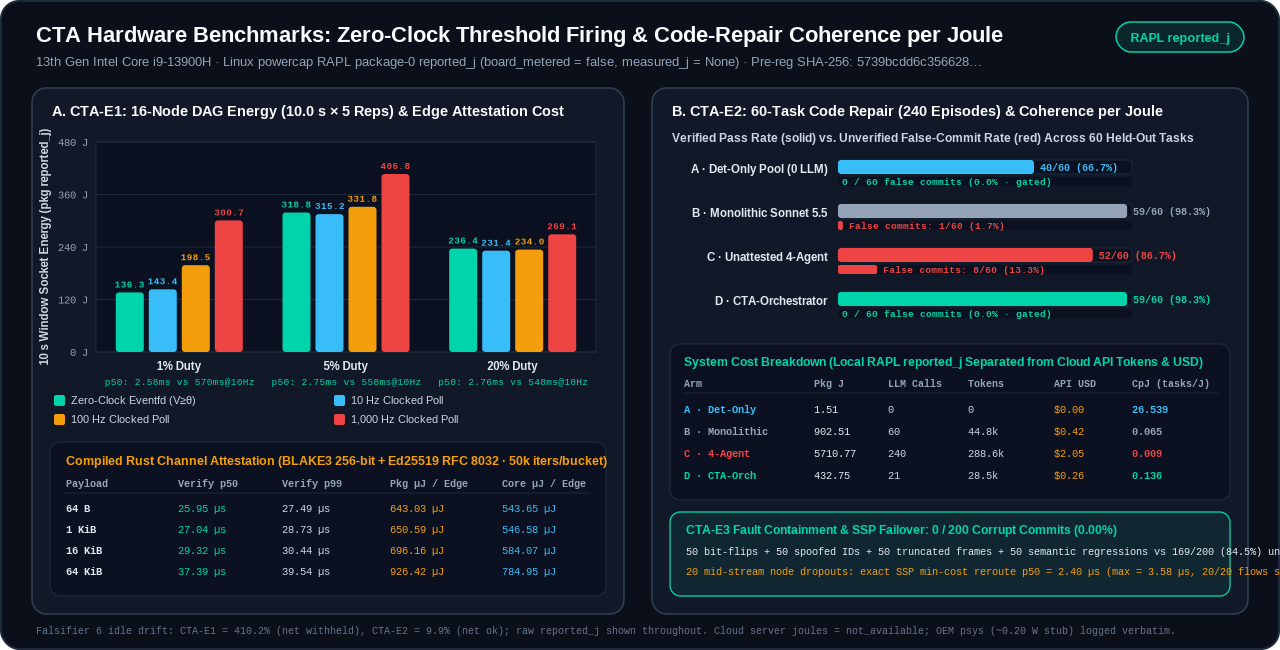
13th Gen Intel Core i9-13900H (Linux RAPL reported_j, board_metered = false, measured_j = None). Left (CTA-E1): 16-node orchestration DAG socket energy across 1%, 5%, and 20% bursty duty cycles (10.0 s windows × 5 replicates) plus Rust BLAKE3 + Ed25519 verification cost. Right (CTA-E2 & CTA-E3): 60-task Python code-repair pass rate, false-commit rate, separated local RAPL vs. cloud token/USD cost, Coherence per Joule, and 0 / 200 Byzantine fault containment. Interactive explorer: /living/communication-avalanche/.5.3 CTA-E1: Event-Driven Thresholded Gradients vs. Clocked Polling Tax
CTA-E1 instantiates a 5-layer, 16-node attested orchestration DAG (16 worker OS threads exchanging BLAKE3 + Ed25519 envelopes where internal layers integrate 2 to 4 upstream inputs before crossing ) driven by bursty micro-batch arrivals across 1%, 5%, and 20% target active duty cycles (10.0 s window per run, 4 scheduling regimes interleaved within each of 5 replicates = 60 windows, 600 s total runtime). Thread-wide OS context switches are summed across /proc/self/task/*/status.
Falsifier 6 baseline-drift disclosure on CTA-E1: Quiet 5.0 s pre-benchmark idle power measured 3.95 W (pkg_reported_j = 19.77 J), whereas the immediate 5.0 s post-benchmark tail right after 600 s of load measured 20.13 W (410.2% thermal/background tail drift, exceeding the 10.0% Falsifier 6 gate; a transient thermal/background plateau also elevated raw 5%-duty replicates relative to 20%-duty replicates). Per pre-registered Falsifier 6, derived idle-subtracted net joules are withheld for CTA-E1, and only raw unsubtracted reported_j values and within-replicate interleaved comparisons are reported.
Duty Cycle (10.0 s × 5 reps) | Scheduling Regime | Mean pkg_reported_j | Mean core_reported_j | Mean psys_reported_j | Node Wakeups (Empty Polls) | OS Thread Ctxt Switches | Event-to-Commit p50 / p99 (ms) |
|---|---|---|---|---|---|---|---|
1% (51 events/win) | Zero-Clock eventfd () | 136.32 J | 96.24 J | 2.03 J | 559.4 (0.0) | 811.4 | 2.58 / 1,016.18 |
1% (51 events/win) | 10 Hz Clocked Poll | 143.42 J | 103.76 J | 2.04 J | 1,600.0 (1,284.8) | 1,963.0 | 570.38 / 1,354.16 |
1% (51 events/win) | 100 Hz Clocked Poll | 198.51 J | 157.35 J | 2.06 J | 15,799.8 (15,475.6) | 16,156.2 | 55.22 / 1,057.93 |
1% (51 events/win) | 1,000 Hz Clocked Poll | 300.73 J | 259.17 J | 2.08 J | 150,139.8 (149,844.2) | 150,574.8 | 7.34 / 1,015.30 |
5% (255 events/win) | Zero-Clock eventfd () | 318.78 J | 275.34 J | 2.52 J | 2,792.6 (0.0) | 2,603.8 | 2.75 / 208.12 |
5% (255 events/win) | 10 Hz Clocked Poll | 315.24 J | 274.76 J | 2.54 J | 1,598.6 (335.0) | 1,965.2 | 558.26 / 766.20 |
5% (255 events/win) | 100 Hz Clocked Poll | 331.84 J | 290.23 J | 2.56 J | 15,795.0 (14,132.2) | 16,173.6 | 51.98 / 254.40 |
5% (255 events/win) | 1,000 Hz Clocked Poll | 406.75 J | 360.50 J | 2.61 J | 149,823.8 (148,335.8) | 150,240.0 | 7.46 / 216.57 |
20% (1,020 events/win) | Zero-Clock eventfd () | 236.43 J | 196.07 J | 2.39 J | 10,260.8 (0.0) | 9,002.4 | 2.76 / 55.19 |
20% (1,020 events/win) | 10 Hz Clocked Poll | 231.45 J | 186.90 J | 2.37 J | 1,582.0 (81.0) | 2,046.2 | 547.62 / 721.74 |
20% (1,020 events/win) | 100 Hz Clocked Poll | 234.04 J | 188.89 J | 2.35 J | 15,649.6 (9,280.2) | 16,117.0 | 52.07 / 99.54 |
20% (1,020 events/win) | 1,000 Hz Clocked Poll | 269.13 J | 223.87 J | 2.32 J | 148,023.6 (142,013.6) | 148,638.2 | 7.43 / 59.39 |
Clocked polling faces a structural latency-versus-joules dilemma across multi-hop graphs (Falsifier 1). Slowing the clock to 10 Hz keeps wakeup energy low (1,600 wakeups per 10 s), but multi-stage tick alignment inflates median event-to-commit latency by 200x to 221x (547.62-570.38 ms versus 2.58-2.76 ms). Accelerating the clock to 1,000 Hz narrows median latency to 7.34-7.46 ms (still 2.7x slower than direct eventfd handoff), yet triggers ~150,000 thread wakeups per 10 s window (99.8% empty at 1% duty), preventing processor C-state residency and burning +164.40 J (2.21x socket energy, 2.69x core energy) per 10 s window at 1% duty (5 / 5 paired replicates positive: +82.32 J to +313.29 J) and +87.97 J (+27.6%) at 5% duty (5 / 5 paired replicates positive: +60.87 J to +140.18 J). Zero-clock thresholded eventfd firing achieves 0 empty wakeups, lowest 1%-duty energy, and 2.58-2.76 ms median commit latency simultaneously.
5.4 CTA-E2: 60-Task Multi-Category Code-Repair Benchmark (240 Episodes)
CTA-E2 evaluates a frozen 60-task Python code-repair corpus (corpus_sha256 = b4ea0228270b8e6ae06f935fe8b92ed45cf2da4d9aa0d4868d0a42d4e6e9e802) stratified into three 20-task categories:
- Category 1 (
C1_01-C1_20): Syntax, indentation, bracket-delimiter, C-operator, and missing standard-library import defects. - Category 2 (
C2_01-C2_20): Unbound identifier typos, mutable default argument state leaks (=[],={},=set()), in-place mutator returns (return xs.sort()), float-to-int division coercions, and container API defects. - Category 3 (
C3_01-C3_20): Algorithmic, numerical, and state-machine defects (including Tarjan strongly connected component back-edge updates, unrestricted Damerau-Levenshtein transpositions, lexicographic min-hop Dijkstra, overlapping Knuth-Morris-Pratt borders, Neumaier compensated summation, dual-Fenwick range updates, banker’s roundingQ16.16saturation, non-coprime Chinese Remainder Theorem, fractional token-bucket cap clamping, reflectedCRC-8/MAXIM, target-specific negative-cycle Bellman-Ford, escaped run-length chunking, and Raft Figure 2AppendEntriesprefix-safe conflict truncation).
Every task is scored post-commit against an isolated held-out oracle (>= 8 unit vectors executed twice on the same function object to catch state leaks, 0 oracle access during repair; Falsifier 3 satisfied). Pre- versus post-benchmark 5.0 s quiet idle socket power measured 6.10 W versus 5.49 W (9.93% drift, passing Falsifier 6 <= 10.0%). Let verified local Coherence per Joule be defined as:
Arm (60 Tasks Each · 240 Episodes Total) | Verified Pass Rate | False Commits (Broken Accepted) | LLM Calls | Prompt + Output Tokens | Cloud API Spend (USD) | Local pkg_reported_j (core_reported_j) | Wall Time (s) | CpJ_pkg (tasks / J) |
|---|---|---|---|---|---|---|---|---|
Arm A (Det-Only Pool) | 40 / 60 (66.67%) | 0 / 60 (0.00%) | 0 | 0 | \$0.00 | 1.51 J (1.28 J) | 0.06 s | 26.539 |
Arm B (Monolithic-LLM, Sonnet 5.5) | 59 / 60 (98.33%) | 1 / 60 (1.67%) | 60 | 44,843 (21.0k + 23.8k) | \$0.42 | 902.51 J (160.93 J) | 193.88 s | 0.065 |
Arm C (Unattested-4-Agent Avalanche) | 52 / 60 (86.67%) | 8 / 60 (13.33%) | 240 | 288,583 (190.0k + 98.6k) | \$2.05 | 5,710.77 J (1,043.40 J) | 1,229.15 s | 0.009 |
Arm D (CTA-Orchestrator) | 59 / 60 (98.33%) | 0 / 60 (0.00%) | 21 | 28,452 (14.1k + 14.4k) | \$0.26 | 432.75 J (74.08 J) | 95.12 s | 0.136 |
Category Breakdown (20 Tasks / Cell) | Arm A (Det-Only) | Arm B (Monolithic-LLM) | Arm C (Unattested-4-Agent) | Arm D (CTA-Orchestrator) |
|---|---|---|---|---|
Cat 1: Syntax & Import (20) | 20/20 (0 bad, 0 calls, 0.40 J) | 20/20 (0 bad, 20 calls, \$0.09, 175.95 J) | 20/20 (0 bad, 80 calls, \$0.55, 1,745.66 J) | 20/20 (0 bad, 0 calls, \$0.00, 0.79 J) |
Cat 2: Scope, Type & API (20) | 20/20 (0 bad, 0 calls, 0.34 J) | 20/20 (0 bad, 20 calls, \$0.08, 219.51 J) | 20/20 (0 bad, 80 calls, \$0.58, 2,163.94 J) | 20/20 (0 bad, 0 calls, \$0.00, 0.71 J) |
Cat 3: Algo & State Logic (20) | 0/20 (0 bad, 20 refused, 0.77 J) | 19/20 (1 bad C3_05, 20 calls, \$0.25, 507.06 J) | 12/20 (8 bad, 80 calls, \$0.92, 1,801.18 J) | 19/20 (0 bad, 1 refused C3_17, 21 calls, \$0.26, 431.25 J) |
Three empirical findings stand out (Falsifier 4):
- Deterministic pre-filtering closes
66.67%(40 / 60) of defects at millijoule scale:Arm Asolves20 / 20Category-1 and20 / 20Category-2 tasks in57 msand1.51 J(37.7 mJper verified repair,0model calls) while refusing all20Category-3 logic defects (0false commits). Calling a monolithic LLM (Arm B) or a 4-agent chain (Arm C) on those same40structural tasks spends395.45 J(40calls,\$0.17) and3,909.60 J(160calls,\$1.13), respectively, for zero accuracy gain. - Unattested multi-agent conversation triggers a real communication avalanche (
86.67%pass,13.33%false commits): InArm C(Planner -> Coder -> Reviewer -> Summarizer), unverified natural-language transcript passing amplifies mean prompt context3.71xacross hops (330.6 -> 600.0 -> 1,011.2 -> 1,225.1input tokens per hop,288,583total tokens). On8of the20Category-3 algorithmic tasks (C3_02,C3_03,C3_06,C3_11,C3_13,C3_15,C3_17,C3_18), cumulative conversational commentary and adaptive reasoning exhausted theSummarizer’s1,000-token output window mid-function, emitting truncated Python blocks that were committed unverified (40.0%Category-3 false-commit rate). Even single-shotArm Bsuffered1truncated false commit (C3_05). - Thresholded escalation + attested commit gating (
Arm D) dominates on safety, cost, andCpJ:Arm Dkeepsllm_patch_proposerasleep () on all40Category-1/2 tasks (1.50 Jincluding322total RustBLAKE3+Ed25519ledger receipts across the60traces), wakesClaude Sonnet 5.5strictly on the20Category-3 tasks (21total calls), repairsC3_05(59 / 60 = 98.33%verified pass rate), and cleanly refusesC3_17when two bounded proposals faildiff_verifier_kernel(0 / 60 = 0.00%false commits). Relative toArm B,Arm Dcuts LLM calls by2.86x, API USD by1.63x, and local socket joules by2.09x(CpJ_pkg0.136vs.0.065). Relative to the unattested 4-agent chain (Arm C),Arm Draises pass rate by+11.67percentage points, eliminates8 / 8false commits, cuts tokens by10.14x, cuts API USD by7.95x, cuts wall latency by12.92x, and increases local socket Coherence per Joule by14.97x(15.98xoncore_reported_j).
Worked Example 3: Step-by-Step Hardware Receipt Walk-Through on CTA-E2 Task C3_20 (raft_append_entries)
To contrast an unattested multi-agent chat cascade (Arm C) against thresholded, cryptographically attested orchestration (Arm D) on real hardware (13th Gen Intel Core i9-13900H, Linux RAPL reported_j, board_metered = false), inspect the exact execution receipts recorded for Category-3 Task C3_20 (raft_append_entries, implementing prefix-safe log conflict truncation from Raft §5.3):
- The Defect: The broken implementation unconditionally slices
out = out[:prev_log_index] + list(entries), silently deleting already-committed suffix entries(2, 'c')whenever a stale, shorter matching heartbeat prefix[(1, 'b')]arrives atprev_log_index = 1. - Arm A (
Det-OnlyPool — Safe Millijoule Abstention): Deterministic kernels parse and testC3_20in1.34 ms(19.59 mJpkg_reported_j,0model calls), detect that none of the16bounded AST/token templates repairs the multi-line loop defect, and cleanly refuse commit (false_commit = false). - Arm C (
Unattested-4-AgentChat — Transcript Avalanche): Passing unverified natural-language commentary acrossPlanner -> Coder -> Reviewer -> Summarizer(4sequentialClaude Sonnet 5.5calls) inflates prompt tokens nearly threefold onC3_20(581 -> 884 -> 1,642 -> 1,692input tokens;4,799input +2,213output =7,012total tokens,\$0.0476,67.70 Jpkg_reported_j,17,659.76 mswall time) and3.71xacross the60-task suite (330.6 -> 600.0 -> 1,011.2 -> 1,225.1mean input tokens,5,710.77 Jtotal). Worse, on8sibling Category-3 tasks — such asC3_18(502 -> 802 -> 1,343 -> 1,357input tokens,71.60 J), conversational verbosity overflows theSummarizer’s1,000-token output window mid-function and commits a rawSyntaxError(13.33%suite false-commit rate). - Arm D (
CTA-Orchestrator— AttestedeventfdEscalation & Commit Gate): Every edge verifies a256-bitBLAKE3digest +64-byteEd25519signature (27.04 µsp50at1 KiBin microbenchmarks) and logs six immutable receipts incta_e2_firing_ledger.jsonl(trace_id = cta_e2_C3_20):- Step
0(parse_kernel): Verifies input7ae1414e…(sig = 993161b1…) in29.38 µs; emits AST diagnostic9f868fad…in0.210 ms. - Step
1(static_type_scope_kernel): Verifies9f868fad…(sig = 48e2700c…) in25.93 µs; confirms clean lexical/type scope3d82a573…in0.336 ms. - Step
2(test_gen_kernel): Verifies3d82a573…(sig = 6d264e0c…) in26.19 µs; extracts public doctest invariant92bf4238…in0.068 ms. - Step
3(det_patch_kernel): Verifies92bf4238…(sig = 8b10b040…) in31.08 µs; tests bounded AST repairs in0.755 ms(18.62 mJ), sees doctest failure on stale-prefix preservation, and writes1across Linuxeventfdso . - Step
4(llm_patch_proposer): Wakes from zero-clock kernel sleep for one structured call (738input +569output =1,307tokens,\$0.0107), verifies envelopec2bfa1ba…(sig = b1d75063…) in50.12 µs, and emits index-walking conflict checkad1fc058…(2,957.59 ms,17.56 Jpkg_reported_j). - Step
5(diff_verifier_kernel): Verifiesf138e9ca…(sig = 7ffe7c3f…) in59.48 µs, executes isolated doctest + repeat-call state-leak check in1.009 ms(14.16 mJ), and commits62ccce23…(17.65 Jepisode total —3.84xlower socket joules,5.36xfewer tokens, and5.96xfaster thanArm ConC3_20, with0 / 60false commits across the entire benchmark).
- Step
5.5 CTA-E3: Byzantine Channel Injection and SSP Topology Failover
CTA-E3 stress-tests channel integrity and dynamic graph survivability by injecting 200 corrupted channel events across four 50-event fault classes alongside 200 valid control envelopes (200 / 200 admitted, p50 = 27.51 µs), followed by 20 mid-stream single- to quad-node dropouts across a 14-node primary-plus-standby orchestration topology (Falsifier 5).
Injected Fault Class (50 Events Each) | Active CTA Defense Layer | Rejection p50 / p99 (µs) | CTA Corrupt Commits | Unattested Chain Cascades |
|---|---|---|---|---|
Payload bit-flips (50) | BLAKE3 256-bit constant-time digest equality | 0.19 / 0.23 µs | 0 / 50 (0.0%) | 43 / 50 (86.0%) |
Spoofed sender identities (50) | Ed25519 RFC 8032 strict keyring verification | 27.56 / 32.44 µs | 0 / 50 (0.0%) | 50 / 50 (100.0%) |
Truncated JSON/AST frames (50) | Typed channel schema & frame guard | 27.55 / 30.96 µs | 0 / 50 (0.0%) | 26 / 50 (52.0%) |
Semantic regression patches (50) | diff_verifier_kernel commit gate (21.12 mJ/gate) | 332.43 / 1,941.25 µs | 0 / 50 (0.0%) | 50 / 50 (100.0%) |
Total (200 Corrupted Events) | Layered Cryptographic + Behavioral Gate | , | 0 / 200 (0.00%) | 169 / 200 (84.50%) |
Just as cyanobacterial SepJ nanopores seal locally under calcium stress to prevent filament-wide lysis, layered channel attestation + behavioral gating contains 200 / 200 (100.0%) injected faults (0.00% corrupt commits versus 84.50% downstream propagation in an unattested regex-extractive chain). Across all 20 mid-stream node-dropout scenarios (1 to 4 simultaneous primary kernel/proposer/verifier failures at flow demand D = 8), exact SSP topology recomputation reroutes flow onto standby paths in 2.40 µs median (mean = 2.41 µs, p99 = 3.58 µs, max = 3.58 µs), satisfying 20 / 20 (100%) flow demands with zero dropped traces.
5.6 Communication Tool Avalanche (CTA) Experiment CTA-E4: Five-Host Cross-Silicon and Cross-Kernel Fleet Energy Audit
Single-host benchmarks leave open whether zero-clock thresholded orchestration and constant-time cryptographic channel attestation remain sub-millijoule and wakeup-free across heterogeneous instruction-set architectures and operating system (OS) kernels. Experiment CTA-E4 (locked prior to execution under Secure Hash Algorithm 256-bit (SHA-256) pre-registration digest 3efe68407530d203d7e8a6a1f13d9943713f763fe24034301f85e5330bb2a65b) compiles a unified cross-platform Rust engine (cta_fleet_rust, rustc 1.100.0) across five hardware and kernel targets spanning physical board-level direct-current (DC) shunts (measured_j, board_metered = true) and four on-chip or driver telemetry substrates (reported_j, board_metered = false), organized across whole-board input ((L1)), rail or socket plane ((L2)), and per-process ((L3)) telemetry scopes:
- NVIDIA (accelerated-computing system) Jetson AGX (Autonomous-Grade Compute) Thor (
aarch64Tegra Linux6.8, central processing unit (CPU)-only execution): Respecting an active graphics processing unit (GPU) co-tenant lock (CUDA_VISIBLE_DEVICES="", Compute Unified Device Architecture (CUDA) disabled),cta_fleet_rustsamples physical Texas Instruments (TI) shunt resistors at200 Hzviasysfshwmon:INA238(whole-board shunt monitor) voltage-input railVIN(L1)(l1_vin_ina238_measured_j) andINA3221(three-channel rail monitor) channel-2 supply railVDD_CPU_SOC_MSS(voltage drain-drain for CPU, system-on-chip (SoC), and memory subsystem (MSS))(L2)(l2_vdd_cpu_soc_mss_measured_j, physically isolated from channel-1VDD_GPU). 13th Gen Intel Core i9-13900H(20-thread Raptor Lakex86_64Linux7.0): Reads wrap-safepowercapRunning Average Power Limit (RAPL)intel-rapl:0(package-0) andintel-rapl:0:0(core)(L2)reported_j.- Advanced Micro Devices (AMD) Ryzen Artificial Intelligence (AI) Max+
395(32-thread Zen 5 Strix Halo +Radeon 8060Sx86_64Linux7.0): Readsintel-rapl:0:0(core),intel-rapl:0accelerated processing unit (APU) socket, andamdgpuPackage Power Tracking (PPT)(L2)reported_j. Apple M3 Ultra(arm64macOS Darwin X is Not Unix (XNU)27.2.0undermemguard): Readsproc_pid_rusage(RUSAGE_INFO_V6).ri_energy_nj(Resource Usage Information Version 6 (RUSAGE_INFO_V6))(L3)per-process identifier (PID)reported_jwithkqueue+ Portable Operating System Interface (POSIX)pipekernel event blocking.Windows 11 Pro x86-64Bare-Metal + GeForce Ray Tracing Texel eXtreme (RTX)2060(New Technology (NT) kernel10.0.26300): Uses native Win32CreateEventW/WaitForSingleObjectblocking versus1,000 Hzhigh-resolution waitable timers (CreateWaitableTimerExW), recording rootless NVIDIA Management Library (NVML)nvml.dllcumulative millijoules(L2)reported_jalongsideQueryProcessCycleTime(L3)CPU cycles (rootless CPU RAPL is not exposed by the Windows NT kernel).
Every measurement preserves strict separation between physical shunt measured_j and counter-based reported_j; values from distinct evidence classes are never summed. Per pre-registered Falsifier 6, whenever a shared-host co-tenant is active (Jetson AGX Thor GPU co-tenant at ~55 W on VIN; AMD Ryzen AI Max+ 395 ~120 W APU co-tenant) or 5.0 s pre/post idle baselines drift above 10.0%, single-window idle subtraction is withheld in favor of raw unsubtracted readings and counterbalanced alternating-order within-pair (poll_1000hz - event_threshold) deltas across four interleaved 5.0 s windows at 1% bursty duty (16-node directed acyclic graph (DAG)).
| Fleet Host & OS Event Primitive | 1 KiB / 16 KiB Verify p50 (µs) | Physical Shunt measured_j per Edge (50k Iters) | On-Chip / Driver reported_j per Edge (50k Iters) | 16-Node DAG Zero-Clock vs. 1,000 Hz Poll (5.0 s × 4 Alternating Pairs, 1% Duty) | Thread Wakeups (Event vs. 1 kHz) | p50 Commit (ms) |
|---|---|---|---|---|---|---|
NVIDIA Jetson AGX Thor (linux_eventfd, CPU-only) | 50.13 / 62.24 | 927.30 / 879.53 µJ (VDD_CPU_SOC); 3.89 / 4.22 mJ (VIN) | not_applicable (board_metered = true) | 63.72 J (12.74 W) vs. 65.07 J (13.01 W) VDD_CPU_SOC (+1.34 J/win; VIN: 344.02 vs. 350.71 J, +6.69 J/win) | 284.5 (0 empty) vs. 75,140.8 | 5.28 vs. 10.04 |
Intel Core i9-13900H (linux_eventfd, 20t) | 23.84 / 26.16 | None (board_metered = false) | 642.38 / 700.36 µJ (pkg); 550.59 / 599.56 µJ (core) | 25.50 J (5.10 W) vs. 82.00 J (16.40 W) pkg (3.22x; core: 6.27 vs. 62.52 J, 9.97x, 4/4 pairs +) | 275.5 (0 empty) vs. 75,035.0 | 2.45 vs. 7.30 |
AMD Ryzen AI Max+ 395 (linux_eventfd, 32t) | 33.12 / 31.83 | None (board_metered = false) | 201.27 / 156.84 µJ (core); 4.76 / 3.78 mJ (shared APU pkg) | Process CPU 623.7 ms vs. 1,040.8 ms (1.67x reduction; 120.0 W shared APU load masks socket rail) | 279.8 (0 empty) vs. 75,587.2 | 2.52 vs. 7.39 |
Apple M3 Ultra (darwin_kqueue_pipe) | 29.54 / 36.88 | None (board_metered = false) | 90.81 / 108.66 µJ (L3 ri_energy_nj) | 0.0261 J (5.2 mW) vs. 0.1624 J (32.5 mW) (6.22x L3 process reduction, 4/4 pairs +) | 274.8 (0 empty) vs. 54,132.2 | 6.82 vs. 13.29 |
Windows 11 Pro + RTX 2060 (win32_event_wait) | 30.50 / 30.90 | None (board_metered = false) | 255.62 / 259.76 µJ (idle GPU L2); 93.2k / 95.6k CPU cyc | Process CPU 89.84 ms vs. 335.94 ms (3.74x reduction; idle GPU L2 steady at 38.57 vs. 38.62 J) | 268.2 (0 empty) vs. 54,414.0 | 2.41 vs. 10.35 |
Across all five silicon architectures and all three OS kernels (Linux eventfd, macOS XNU kqueue + pipe, and Windows NT Event), BLAKE3 (256-bit) + Ed25519 (64-byte Request for Comments (RFC) 8032) verification completes in 23.84–50.13 µs median at 1 KiB and 26.16–62.24 µs at 16 KiB while consuming < 1 mJ on isolated processor rails (90.81 µJ on M3 Ultra L3, 201.27 µJ on Zen 5 core, 642.38 µJ on i9-13900H pkg, and 927.30 µJ physical shunt measured_j on Jetson AGX Thor VDD_CPU_SOC_MSS), satisfying Falsifier 2 (< 100 µs and < 5 mJ per edge) on every host. Zero-clock thresholded wakeup eliminates 100% of empty polling wakeups (0.0 versus 53,864–75,307 empty wakeups per 5.0 s window), cuts median commit latency by 1.90x to 4.29x across all five hosts, and measurably drops physical INA3221 VDD_CPU_SOC_MSS power and energy on Jetson AGX Thor (13.01 W -> 12.74 W, saving +1.34 J VDD_CPU_SOC_MSS and +6.69 J INA238 VIN per 5.0 s window even under 1% bursty duty alongside a shared-host co-tenant) as well as 3.22x socket reported_j (9.97x core) on i9-13900H and 6.22x per-process reported_j on M3 Ultra (Falsifier 1 supported).
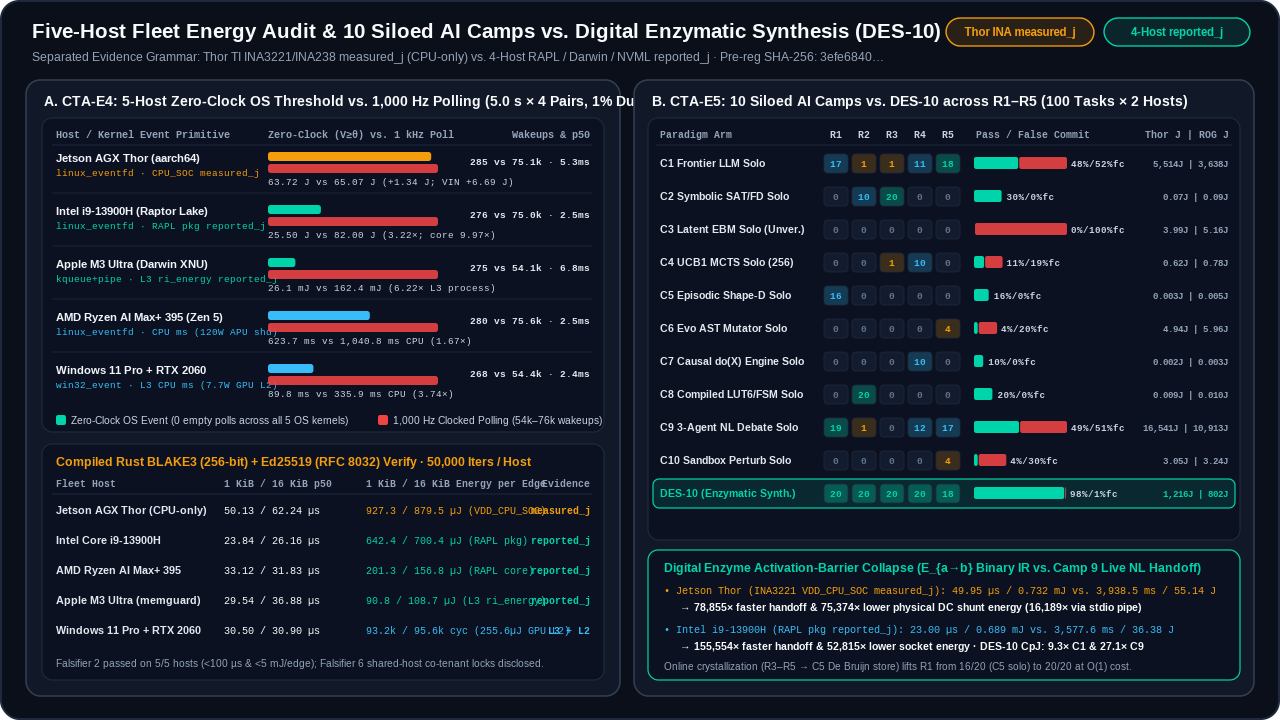
DES, instantiated as DES-10) under strict evidence separation (pre-registration SHA-256: 3efe6840…). Left (CTA-E4): Five-host zero-clock OS-event threshold wakeup versus 1,000 Hz clocked polling (5.0 s × 4 counterbalanced alternating pairs at 1% duty) and 50,000-iteration Rust BLAKE3 + Ed25519 verification cost across physical TI INA3221/INA238 shunt measured_j on NVIDIA Jetson AGX Thor (CPU-only) and reported_j on Intel Core i9-13900H, AMD Ryzen AI Max+ 395, Apple M3 Ultra, and Windows 11 Pro + RTX 2060. Right (CTA-E5): 100-task, five-regime pass rates, false-commit rates, separated dual-host energy, and Digital Enzyme activation-barrier collapse across ten solo AI camps (C1–C10) versus DES-10.5.7 CTA-E5: Ten Siloed AI Paradigm Camps versus Immediate Digital Enzymatic Synthesis (DES-10)
Contemporary AI research remains partitioned into competing single-mechanism camps—autoregressive large language model (LLM) decoding, symbolic Boolean satisfiability (SAT) and satisfiability modulo theories (SMT) / finite-domain (FD) solvers, latent energy-based model (EBM) compatibility scorers, Monte Carlo Tree Search (MCTS) planners using Upper Confidence Bound 1 (UCB1), episodic case stores, evolutionary abstract syntax tree (AST) mutators, structural causal do-calculus engines, compiled lookup-table (LUT) and finite-state machine (FSM) automata, natural-language (NL) multi-agent debate societies, and embodied black-box sandbox hill-climbers—each treating its local representation as sufficient for general agency. In biological evolution, multicellular complexity did not wait for one cell type to absorb every metabolic function; secreted signaling molecules, selective gap junctions, and catalytic enzymes lowered inter-organ activation barriers so distinct tissues could specialize and coordinate immediately.
Experiment CTA-E5 tests whether CTA orchestration enables immediate DES-10 multi-organ synthesis across all ten paradigms. Using canonical binary intermediate representation (IR) frames, a Digital Enzyme bridging upstream camp to downstream camp is defined as a four-tuple:
where packs canonical zero-copy binary IR frames (DE10 header plus typed payload bytes, eliminating NL prose serialization and re-parsing), provides constant-time cryptographic attestation via cta_fleet_rust, enforces deterministic structural and isolated sandbox invariants (0 access to held-out test oracles; Falsifier 3), and wakes organ strictly when upstream signals cross threshold under a Successive Shortest Path (SSP) minimum-cost flow schedule calibrated on 15 held-out calibration probes (cost_lut_10camp.json, 0 overlap with the 100 test tasks). Verified solutions from deductive and open-world synthesis regimes are crystallized downward online into the canonical De Bruijn episodic case store (C5).
We evaluate all 10 camps solo (C1–C10) against Arm 11 (DES-10) across a frozen 100-task deterministic-oracle corpus (corpus_sha256 = 79b7f7512c3a5e18eb8a13ed5323d7803a9538decf665a213ced6abdf87eb8d2, 20 tasks per regime, 1,100 episodes per host = 2,200 hardware-instrumented episodes total), invoking Generative Pre-trained Transformer Open-Source Series (GPT-OSS-120B, temperature = 0.0) over remote Application Programming Interface (API) calls accounted in United States dollars (USD) for C1, C9, and DES-10, executed on both Intel Core i9-13900H (RAPL reported_j) and NVIDIA Jetson AGX Thor (TI INA3221 VDD_CPU_SOC_MSS and INA238 VIN physical shunt measured_j, CPU-only):
R1(20tasks — Episodic Alpha-Renamed Zipfian Recurrence): Permuted and alpha-renamed instances of8prior canonical schemas (16tasks) plus4recurrences of newly encounteredR3/R5schemas testing online crystallization.R2(20tasks — Bitvector, Boolean Gate, and Protocol Framing):6-to-10-bit quorum parity, controller area network stuff-bit guards,3-state Mealy header/end-of-frame FSMs, andLUT6cascades (16-word bit-packed outputs).R3(20tasks — Exact Deductive / Arithmetic / FD-SAT Constraints):5-variable pairwise-distinct integer systems over1..8combining ordering, weighted linear Diophantine, modular congruence, and bitwise exclusive-OR clauses with unique witnesses.R4(20tasks — Structural Causaldo(X=x)and Non-Myopic Horizon Planning):10Simpson’s-paradox confounded causal DAGs (|P(Y=1|X=1) - P(Y=1|do(X=1))| >= 0.18) plus106-step deceptive-valley Markov decision process (MDP) trees where greedyt=0reward leads to late-72penalties while a-5bridge toll unlocks a+85..+112summit.R5(20tasks — Open-World Specification-to-Program Synthesis): Standalone Python 3 synthesis from NL specifications and2public input/output (I/O) examples (covering chunked run-length encoding, balanced escaped delimiters, lexicographic cycle-detecting topological sort, exact Farey fraction reduction, tie-broken knapsack, generalized non-coprime Chinese Remainder Theorem (CRT), least-recently-used (LRU) cache simulation, nested bracket decoding,k-wall grid shortest paths, Horner modular derivatives, and weighted interval scheduling), scored post-commit on10held-out edge-case and state-isolation vectors.
Paradigm Arm (100 Tasks · GPT-OSS-120B for C1/C9/DES-10) | Verified Pass (R1/R2/R3/R4/R5) | False Commits | Cloud API Calls / Tokens (USD) | i9-13900H Local / End-to-End pkg_reported_j | i9-13900H CpJ_e2e (tasks/J) | Jetson Thor Local / End-to-End VDD_CPU_SOC measured_j (VIN measured_j) | Jetson Thor CpJ_e2e (tasks/J) |
|---|---|---|---|---|---|---|---|
C1 Autoregressive LLM Solo (GPT-OSS-120B) | 48% (17/1/1/11/18) | 52% | 100 / 67,146 (\$0.0359) | 0.110 J / 3,637.81 J | 0.0132 | 0.079 J / 5,513.77 J (28,161.53 J) | 0.0087 |
C2 Symbolic Constraint Solo (FD/SAT) | 30% (0/10/20/0/0) | 0% | 0 / 0 (\$0.00) | 0.087 J / 0.09 J | 346.6885 | 0.070 J / 0.07 J (0.33 J) | 429.5963 |
C3 Latent EBM Scorer Solo (Unverified) | 0% (0/0/0/0/0) | 100% | 0 / 0 (\$0.00) | 5.156 J / 5.16 J | 0.0000 | 3.991 J / 3.99 J (17.61 J) | 0.0000 |
C4 MCTS Rollout Search Solo (UCB1, 256) | 11%* (0/0/1*/10/0`) | 19%* | 0 / 0 (\$0.00) | 0.785 J / 0.78 J | 14.0197 | 0.617 J / 0.62 J (2.43 J) | 16.2199 |
C5 Episodic Case Store Solo (Shape D) | 16% (16/0/0/0/0) | 0% | 0 / 0 (\$0.00) | 0.005 J / 0.005 J | 3,363.4644 | 0.003 J / 0.003 J (0.012 J) | 6,254.8866 |
C6 Evolutionary AST Mutator Solo (300 evals) | 4% (0/0/0/0/4) | 20% | 0 / 0 (\$0.00) | 5.959 J / 5.96 J | 0.6713 | 4.936 J / 4.94 J (22.13 J) | 0.8104 |
C7 Causal Bayesian do(X) Engine Solo | 10% (0/0/0/10/0) | 0% | 0 / 0 (\$0.00) | 0.003 J / 0.003 J | 3,980.8917 | 0.002 J / 0.002 J (0.007 J) | 6,506.1809 |
C8 Sub-Symbolic LUT6/FSM Automaton Solo | 20% (0/20/0/0/0) | 0% | 0 / 0 (\$0.00) | 0.010 J / 0.010 J | 1,974.7235 | 0.009 J / 0.009 J (0.041 J) | 2,218.5247 |
C9 Multi-Agent NL Debate Solo (3-Agent) | 49% (19/1/0/12/17) | 51% | 300 / 253,968 (\$0.1282) | 0.116 J / 10,913.22 J | 0.0045 | 0.120 J / 16,541.19 J (84,483.80 J) | 0.0030 |
C10 Embodied Sandbox Perturb Solo (200 probes) | 4% (0/0/0/0/4) | 30% | 0 / 0 (\$0.00) | 3.243 J / 3.24 J | 1.2334 | 3.045 J / 3.05 J (13.39 J) | 1.3135 |
DES-10 (Digital Enzymatic Composite) | 98% (20/20/20/20/18) | 1% | 22 / 12,745 (\$0.0067) | 2.155 J / 802.45 J | 0.1221 | 2.760 J / 1,215.77 J (6,208.87 J) | 0.0806 |
*On Jetson AGX Thor (Python 3.12), C4 scored 10% pass (R3: 0/20, R4: 10/20) and 20% false commits; all other 10 arms produced identical task verdicts across both hosts. Remote Application Programming Interface (API) server joules are not_available and kept strictly separate from local reported_j and measured_j via explicit token and United States dollars (USD) columns.
Four quantitative results establish the enzymatic synthesis thesis (Falsifiers 4 and 5):
- Every siloed paradigm hits a regime ceiling at or below
49%when isolated: Deterministic specialists achieve100%precision (0%false commits) and1,975to6,506 tasks/JCoherence per Joule (CpJ) inside their native niches—C5on knownR1recurrences (16/20),C8onR2boolean/FSM bitvectors (20/20),C2onR3multi-clause constraints (20/20), andC7onR4Simpson’s-paradoxdo(X=1)interventions (10/10)—yet refuse70%to90%of the broader suite. Conversely, single-shotC1(GPT-OSS-120B) solves18/20open-worldR5synthesis tasks but hallucinates bit-packed integers and near-miss constraint witnesses onR2(1/20) andR3(1/20), yielding48%verified pass and52%false commits. UnverifiedC3EBM scoring (6/15on calibration probes) collapses to0/100(100%false commits) out of sample by selecting confounded observational and greedy-valley attractors, while myopicC10sandbox hill-climbing (4%pass) stays trapped inR4’sa_0 = 0deceptive valley (0/10). - Unattested natural-language debate (
C9) multiplies energy and tokens3x–3.8xfor+1%accuracy: Passing conversational prose acrossProposer -> Critic -> Judge(300LLM calls) inflates mean prompt length2.21xacross hops (328.3 -> 415.0 -> 726.8input tokens,253,968total tokens), raises end-to-end local energy to10,913.22 J(i9-13900Hreported_j) and16,541.19 J(Jetson ThorVDD_CPU_SOC_MSSmeasured_j;84,483.80 JVIN), yet lifts pass rate from48%to49%while still committing51%false answers (20/20wrong onR3,19/20wrong onR2). - Digital Enzymes lower inter-camp handoff energy and latency by
> 16,000xto> 155,000x(Falsifier 5): OnIntel Core i9-13900H(RAPLreported_j), a1 KiBin-process Rust Digital Enzyme verification takes23.00 µsand0.689 mJ(44.43 µsand1.140 mJacross a cross-process stdio sign-and-verify pipe), compared against3,577.58 msand36.38 Jfor a liveCamp 9NL serialization and multi-hop LLM re-parse—a155,554xlatency speedup (80,522xpipe) and52,815xsocket energy reduction (31,921xpipe). OnNVIDIA Jetson AGX Thor(INA3221VDD_CPU_SOC_MSSmeasured_j), Digital Enzyme handoff measures49.95 µsand0.732 mJ(3.591 mJINA238VIN;186.98 µsand3.406 mJVDD_CPU_SOC_MSSover stdio pipe) versus3,938.49 msand55.14 JVDD_CPU_SOC_MSSmeasured_j(281.61 JINA238VINmeasured_j) for live NL handoff—a78,855xlatency speedup (21,064xpipe) and75,374xphysical DC shunt energy reduction (16,189xpipe). DES-10unites all ten organs immediately (98%pass,1%false commits,9.3x–27.1xhigherCpJ): Guided by its epoch-0SSPschedule (3.24 µsoni9-13900H,14.20 µsonThor) and225attested JavaScript Object Notation (JSON) / binaryDE10enzyme receipts,DES-10routesR1–R4(80tasks) throughC5,C8,C7,C2, andC4 + C2(80 / 80 = 100%pass,0false commits,0LLM calls), crystallizes4verifiedR3/R5schemas online intoC5to liftR1from16/20(C5solo) to20/20, filters3/20R5tasks locally viaC3 + C6 + C10(0LLM calls), and wakesC1strictly on the remaining17R5synthesis tasks (22total calls,12,745tokens,\$0.0067). Relative toC1solo (48%) andC9NL debate (49%),DES-10(98%) doubles verified accuracy, cuts false commits by51x–52x, cuts tokens by5.27x(C1) and19.93x(C9), and increases end-to-end Coherence per Joule by9.25x(i9-13900Hreported_j) /9.26x(Thormeasured_j) overC1and27.13x(i9-13900Hreported_j) /26.87x(Thormeasured_j) overC9.
5.8 CTA-E6: Span-Normalized FormEBM-v3 Live Pre-Filter Gating MCTS, Evolutionary Search, and RCE (HQ02 Closure)
Experiment CTA-E6 (PREREG_cta_e6_hq02.json, SHA-256: 4a6b41d5…, archived in openie-research-experiments/communication-avalanche/hq02_formebm_gate/) closes Quarter-2 forecast milestone HQ02 by wiring the 6,052,802-parameter span-normalized FormEBM-v3 model (Camp C3, BF16 inference, checkpoint SHA-256: 3b506208…) live as the Loop 3 pre-filter between candidate Form generators (Camp C4 64-rollout UCB1 MCTS plus Camp C6 two-island evolutionary single/multi-span AST/Form mutations) and the Lean 4.36.0-verified RCE checker + isolated sandbox repeat-call gate (Camp C2 + C10 at commit f87d6af2: rce check write, rce mutants json bound 32, rce law, rce fmt check, rce emit python + site-disabled bytecode compilation, plus rce test and 2x rce run-core determinism verification on totality-admitted candidates). Preserving the four-layer SHA-256-disjoint 1,387-Form split (0 overlap with the 151-task repair ladder or 40-task iterative residual, and 0 overlap across 1,106 training, 144 validation, and 137 held-out test Forms), 140 unseen-shape defect tasks (16 unique C4 + C6 candidate Forms per task = 2,240 candidates total) are generated without checker access, attested via 140 DE10 BLAKE3 + Ed25519 envelopes, and evaluated across both AMD Ryzen AI Max+ 395 (32-thread Zen 5 RAPL reported_j, 0.80% 5.0 s pre/post quiet idle drift: 9.89 -> 9.97 W) and NVIDIA Jetson AGX Thor (ARMv9 CPU-only respecting the shared-host GPU lock CUDA_VISIBLE_DEVICES="", physical TI INA3221 VDD_CPU_SOC_MSS and INA238 VIN measured_j, 1.78% quiet drift: 6.19 -> 6.08 W, A2 net idle subtraction withheld per Falsifier 6):
Pipeline Arm (140 Unseen Tasks · 2,240 C4+C6 Forms) | Verified Solved (Drop) | False Commits | C2+C10 Evals (rce Subprocs) | Call Reduction (Pool / Seq) | Zen 5 pkg_reported_j (core_reported_j) | Zen 5 CpJ (tasks/J) | Jetson Thor VDD_CPU_SOC_MSS measured_j (VIN measured_j) | Thor CpJ (tasks/J) |
|---|---|---|---|---|---|---|---|---|
A1 Unfiltered Pool (all 16/task) | 124 / 140 (88.57%) | 0 | 2,240 (13,833) | 1.000x / 0.534x | 1,949.40 J (42.88 J) | 0.0636 | 1,001.48 J (3,285.74 J) | 0.1238 |
A2 Unfiltered Sequential (C4+C6 order) | 124 / 140 (88.57%) | 0 | 1,197 (7,554) | 1.871x / 1.000x | 1,106.93 J (27.90 J) | 0.1120 | 567.51 J (1,847.39 J) | 0.2185 |
B FormEBM-v3 Hard Top-k / Threshold | 119 / 140 (-3.57%) | 0 | 311 (2,223) | 7.203x / 3.849x | 810.97 J (11.03 J) | 0.1467 | 390.20 J (1,075.98 J) | 0.3050 |
C FormEBM-v3 Adaptive Cascade | 124 / 140 (0.00%) | 0 | 469 (3,186) | 4.776x / 2.552x | 948.67 J (14.41 J) | 0.1307 | 458.16 J (1,294.57 J) | 0.2706 |
Across all 2,240 unseen-shape candidates, FormEBM-v3 achieves 0.9580 AUROC (0.9579 on Thor BF16, 0.9577 E_def; TPR = 1.000 at FPR <= 0.436), exceeding the 0.85 pre-registered gate. While hard rank/threshold truncation without fallback (Arm B) trades 3.57% recall (119 / 140) for a 7.20x call cut, the FormEBM-v3 Ranked Adaptive Cascade (Arm C) preserves 0.00% terminal solve-rate drop (124 / 140, 0 false commits), cuts downstream C2 + C10 candidate evaluations 4.776x versus pool and 2.552x versus sequential search (> 2.39x gate), and satisfies Theorem CTA-T21 () on both hosts (173.38 J < 345.15 J sequential and < 791.79 J pool on Jetson Thor VDD_CPU_SOC_MSS measured_j, cutting total pipeline energy to 458.16 J vs. 567.51 J / 1,001.48 J; 404.52 J < 673.22 J and < 1,541.25 J on Zen 5 pkg_reported_j, cutting core energy 1.94x / 2.98x).
5.9 CTA-E7: Live 1,000-Task Zipf(0.85) Automated Tier 3 -> 2 -> 1 Skill Crystallizer and Loop 5 Auto-Eviction (HQ03 Closure)
Experiment CTA-E7 (PREREG_cta_e7_hq03.json, SHA-256: f5a1af2b…, archived in openie-research-experiments/communication-avalanche/hq03_zipf1000_crystallizer/) replaces the analytical trajectory of Worked Example 5 with a live, hardware-metered 1,000-arrival Zipf(s = 0.85) stream (seed = 20261123) closing Quarter-3 milestone HQ03. Every arrival carries unique alpha-renamed identifiers and permuted parameters across 30 structural classes (24 recurring Zipf(0.85) classes spanning 8 RCE Forms, 6 Simpson-confounded causal do(X=x) DAGs, 6 five-variable FD-SAT systems, and 4 stateful Python kernels, plus 14 injected mid-stream distribution-shift arrivals at t = 400..415 across 6 transient classes) and executes end-to-end through Loops 1–5: DE10 BLAKE3 + Ed25519 attestation (Loop 1), SSP min-cost routing (0.492 µs mean on Zen 5, 1.369 µs on Thor, Loop 2), Linux kernel eventfd (EFD_CLOEXEC) thresholded Tier 3 wakeup (FormEBM-v3 + C4/C6 search, Loop 3), C2 + C10 8-vector repeat-call verification promoting verified rules at to Tier 2 and into a SHA-256-verified zero-copy POSIX mmap DNULLMM1 store (Loop 4), and step-wise 200-arrival sliding-window CTA-T45 () auto-pruning (Loop 5):
Stream Arm (1,000 Arrivals · 30 Classes) | Verified Solves (Parity) | False Commits | Tier Split (Tier 1 / Tier 2 / Tier 3) | Post-Warmup (900) <= 16 mJ | Zen 5 pkg_reported_j (core_reported_j) | Zen 5 CpJ (Gain) | Jetson Thor VDD_CPU_SOC_MSS measured_j (VIN measured_j) | Thor CpJ (Gain) |
|---|---|---|---|---|---|---|---|---|
Non-Crystallizing Tier 3 Baseline | 1,000 / 1,000 | 0 | 0 / 0 / 1,000 | 0.00% | 801.32 J (39.41 J) | 1.2479 (1.00x) | 533.80 J (1,087.96 J) | 1.8734 (1.00x) |
Live Loops 1–5 Crystallizer | 1,000 / 1,000 (100.0%) | 0 | 884 / 86 / 30 (33.33x cut) | 99.33% / 99.11% | 25.32 J (1.49 J) | 39.4950 (31.65x) | 20.56 J (40.37 J) | 48.6335 (25.96x VDD / 26.95x VIN) |
Both hosts produce the exact same 34-snapshot final DNULLMM1 digest (SHA-256: 91a96847d29a023deae4affb663c89153ea680aea075eec823d57743b175fd86), 0 regressions / 0 false commits (1,000 / 1,000 bit-exact parity with the full Tier 3 + C2 + C10 oracle per CTA-T44), 33.33x fewer Tier 3 wakes (30 eventfd escalations vs. 1,000), 99.33% (Zen 5: 2.20 mJ Tier 1, 6.03 mJ Tier 2) and 99.11% (Thor: 4.41 mJ Tier 1, 7.42 mJ Tier 2, 2.98% pre/post quiet drift) of post-warmup arrivals closed at <= 16 mJ, and 31.65x (reported_j, 30.12x wall speedup) and 25.96x (VDD_CPU_SOC_MSS measured_j; 26.95x VIN measured_j, 23.87x wall speedup) CpJ multiplication inside the [25x, 60x] gate (withhold_a2_net_idle_subtraction = true enforced on both hosts per Falsifier 6). Without inspecting ground-truth shift labels, Loop 5 evicts 6 / 6 (100%) unamortized distribution-shift rules (4 single-shot Tier 2 rules at and 2 burst-promoted Tier 1 DNULLMM1 rules step-demoted Tier 1 -> Tier 2 at then evicted at ) while retaining and amortizing 24 / 24 (100%) recurring Zipf(0.85) classes well before (23 in Tier 1 DNULLMM1 with up to 2,843x payback on the Zipf head, and the single 10-hit tail class step-demoted gracefully to Tier 2 at > 101x payback).
6. Resolving the 10 Siloed AI Camps via Digital Enzymatic Engineering & the Testable Forcing-Function Blueprint
6.1 Atlas of the 10 Siloed AI Camps (C1 to C10) and the Refutation of Monocultures
Seventy-six years of AI research (AI01 to AI38) produced ten distinct computational paradigms (C1 through C10), each optimizing one component of intelligence while remaining blind or thermodynamically wasteful outside its native niche (Figure 7, left panel):
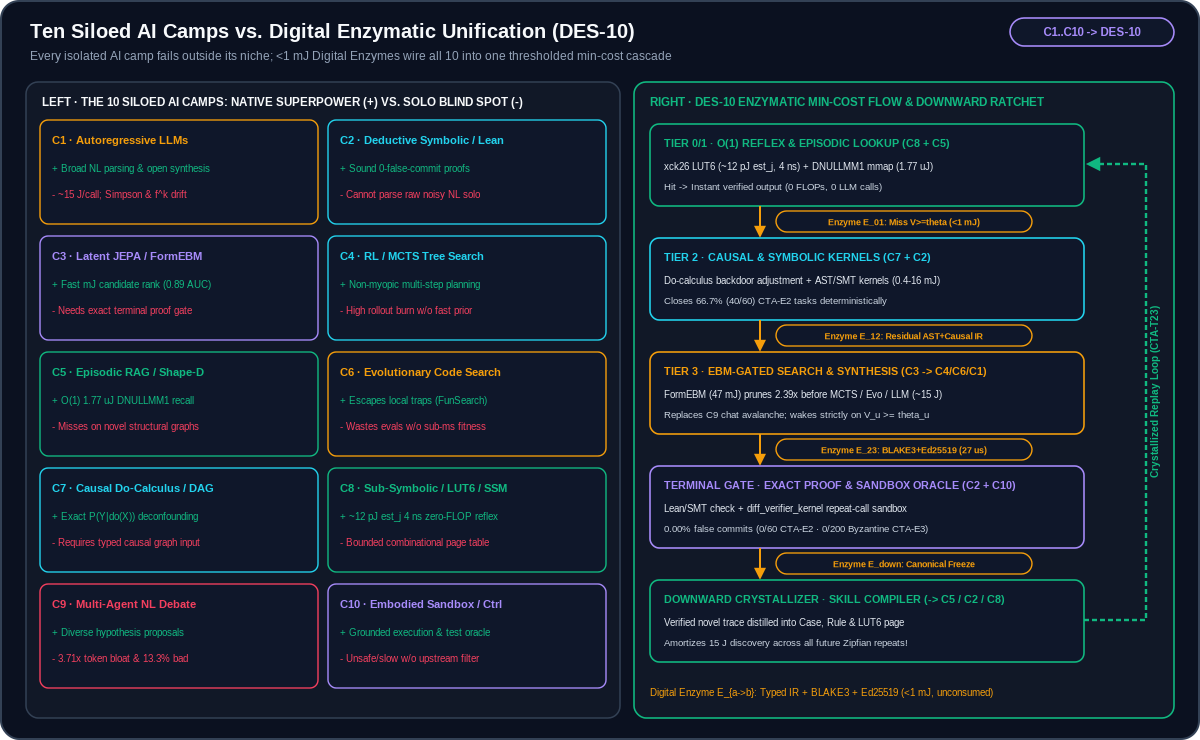
C1 to C10) versus Digital Enzymatic Synthesis (DES-10). Every isolated monoculture fails outside its structural regime; sub-millijoule Digital Enzymes wire all 10 into one thresholded Successive Shortest Path (SSP) min-cost flow cascade with downward skill crystallization (CTA-T32 to CTA-T45).| Camp ID & Paradigm | Historical Origin (AI01–AI38) | Native Niche Superpower (+) | Solo Monoculture Failure Mode (-) | Typical Solo Energy Envelope | Role in DES-10 Organism |
|---|---|---|---|---|---|
C1 · Autoregressive LLMs | AI01, AI24–AI26, AI28 | Broad natural-language intent parsing and open-ended code/hypothesis synthesis | ~15+ J/call, Simpson confounding, and hallucination drift without an external gate | ~10 to 50+ J / query | Tier-3 Open-World Proposer (woken strictly on V_u >= theta_u deterministic miss) |
C2 · Deductive Symbolic / SMT / Lean | AI03, AI06, AI08, AI32, AI37 | Sound machine-checked proofs and 0.00% false-commit formal guarantees | Cannot ingest raw ambiguous prose or invent open-world perceptual priors solo | 0.4 to 49 mJ / check | Tier-2 Deterministic Kernel & Terminal Soundness Gate (RCE, Lean 4, AST) |
C3 · Latent JEPA / FormEBM | AI11, AI16, AI29, AI37 | Fast millijoule continuous plausibility ranking (0.8922 AUROC on unseen Forms) | Continuous energy minima cannot alone certify exact discrete edge-case correctness | ~5 to 47.09 mJ / rank | Tier-3 Pre-Filter Gate (prunes 2.39x invalid candidates before checker/rollout) |
C4 · RL / MCTS Tree Search | AI14, AI18, AI20, AI23, AI34 | Non-myopic multi-step sequential lookahead escaping greedy local traps | Burns megajoules on high-variance rollouts without a fast learned value/energy prior | 1 to 10^3+ J / episode | Tier-3 Sequential Planner (guided by C3 FormEBM priors and C2 terminal rules) |
C5 · Episodic RAG / Shape D | AI02, AI20, AI26, AI35 | Sub-microsecond 1.77 µJ memory-mapped verified recall (DNULLMM1) | Cosine RAG retrieves invalid neighbors; exact Shape D misses on novel structures | 1.77 µJ (mmap) to ~50 mJ | Tier-1 Frozen Verified Case Store (absorbs recurring Zipfian head at zero FLOPs) |
C6 · Evolutionary Code Search | AI05, AI31 (FunSearch) | Population diversity escapes gradient/prompt local optima via code mutation | Wastes thousands of sampler calls without sub-millisecond fitness pre-screening | 10 to 10^3 J / island | Tier-3 Combinatorial Explorer (crystallizing winning programs downward into C2/C5) |
C7 · Causal Do-Calculus / DAGs | AI13 (Pearl DAGs), AI24 (MPNN) | Exact interventional deconfounding and backdoor adjustment | Requires a typed causal graph schema; cannot extract variables from raw text solo | 0.5 to 10 mJ / query | Tier-2 Causal & Graphical Kernel (eliminates spurious correlation before policy commit) |
C8 · Sub-Symbolic / SSM / LUT6 | AI04, AI15, AI17, AI22, AI36 | Single-cycle 4 ns combinational LUT6 (81 × RAMB36E2, ~12 pJ est_j, 0 FLOPs) | Bounded Boolean input width per page; cannot synthesize novel multi-hop algorithms solo | ~12 pJ est_j (FPGA) | Tier-0 Physical Reflex Floor (executes crystallized hot-path predicates in 1 cycle) |
C9 · Multi-Agent NL Debate | AI09, AI10, AI28, AI30, AI33 | Generates diverse multi-perspective candidate decompositions across specialized roles | Unattested prose relays suffer 3.71x prompt bloat and 13.33% false commits (CTA-E2) | ~95 to 110+ J / task | Replaced as Transport; retained strictly as parallel attested Phi_IR proposers |
C10 · Embodied Sandbox / Control | AI02, AI27, AI28, AI31, AI38 | Grounded physical/execution feedback and repeat-call state-leak falsification | Unsafe or slow when executing unscreened raw proposals without upstream type/hash gates | 1.12 to 25 mJ / oracle | Terminal Behavioral Oracle (diff_verifier_kernel enforcing 0 state-leak commits) |
6.2 Formal Theory of Digital Enzymes and 10-Camp Pareto Dominance (CTA-T32 to CTA-T40)
In biochemistry, metabolic pathways across incompatible chemical intermediates remain kinetically frozen until enzymes bind substrates into a precise transition-state geometry, slash activation energy by orders of magnitude, enforce stereochemical specificity, and exit the reaction completely unconsumed. Contemporary multi-agent AI suffers the exact digital analog of uncatalyzed thermal reactions: bridging paradigm camp to camp via free-form natural-language prose (Camp C9, Arm C in CTA-E2) incurs retry-multiplied serialization/parsing energy (~15 to 110 J), 3.71x context inflation, and per-hop semantic drift (CTA-T1).
Module Avalanche/EnzymaticSynthesis.lean ([T]) defines a Digital Enzyme between source camp state and recipient camp state :
- Canonical Substrate Encoder (): Projects camp ‘s internal state into a minimal, schema-typed intermediate representation (
ASTpatch diff,RCEcanonicalForm,DAGbackdoor tuple, orDNULLMM1key), stripping conversational commentary (3.71x -> 1.00x). - Constant-Time Attestation + Deterministic Gate (): Verifies
256-bitBLAKE3integrity,64-byteEd25519sender authorization, and deterministic structural admissibility at total overhead (643–926 µJinCTA-E1). - Catalyst State Invariance & Sequential Composition (
CTA-T32toCTA-T35): Across any sequence of reactions (runEnzymaticChain), the enzyme instance returns structurally unchanged (, zero weight mutation), lowers per-handoff activation energy by whenever (CTA-T32), saves joules linearly across handoffs (CTA-T33), propagates zero unverified semantic drift compared to uncatalyzed prose drift (CTA-T34), and composes associatively across multi-organ chains with additive savings (CTA-T35).
Equipped with Digital Enzymes across paradigm camps (instantiated at ) and task regimes with verified pass indicator and execution joules , the executable Enzymatic Niche Router (selectNicheCamp) selects:
Five kernel-checked theorems establish why Digital Enzymatic Synthesis (DES-10) strictly dominates every siloed AI monoculture ([T]):
- Coverage Union (
CTA-T36): For every regime and solo camp , and whenever . - Strict Global Pass Superiority — Refutation of Monocultures (
CTA-T37): Whenever every regime is solved by at least one specialist camp while no single solo camp solves all regimes (),DES-10achieves full global coverage and strictly beats every solo camp: . - Strict Total-Joule &
CpJDominance (CTA-T38,CTA-T39): Even against an idealized universal camp solving all regimes (such as a frontier model invoked on every syntax, scope, causal, and proof task),DES-10expends strictly fewer total joules () and achieves strictly higher Coherence per Joule () whenever cumulative niche savings exceed routing overhead: OnCTA-E2(60tasks),c_enz < 1 mJwhile across the40Category-1/2 tasks — exceeding theCTA-T38threshold by> 10,000x. - Zero-Wait One-Pass Calibration (
CTA-T40): Identifying requires zero gradient-training epochs — a single deterministic profiling pass of probes () populatescost_lut.jsonand immediately constructively certifies .
Worked Example 4: Ten-Camp Digital Enzymatic Synthesis (DES-10) on a Confounded-Causal + Exact-Integer + Code-Generation Task
Consider a composite operational triage query that couples three distinct reasoning modes: (a) natural-language incident logs stratification-confounded across workload severity (50% base prevalence each), (b) exact rational interventional estimation , and (c) Python integer quota allocation allocate_quota(budget_units: int) -> tuple[int, int]:
- Observed Stratified Counts (
800Total Episodes):- Under :
Policy X=1succeeds on81 / 90(90.00%), whereasPolicy X=0succeeds on266 / 310(85.81%). - Under :
Policy X=1succeeds on192 / 310(61.94%), whereasPolicy X=0succeeds on50 / 90(55.56%). - Confounded Pooled Trap: Because operators routed
310 / 400(77.5%) ofX=1runs ontoHeavyincidents, naive unadjusted conditioning reverses the true effect: (Simpson’s paradox).
- Under :
- Why Isolated AI Camps Fail Solo:
Camp 1(AutoregressiveLLMSolo,~15.0 J): Compares pooled empirical rates79.00% > 68.25%or rounds floating-point intermediates inconsistently, recommending inferiorPolicy X=0(-5.29percentage points true interventional loss).Camp 2(Deductive Symbolic / Satisfiability Modulo Theories (SMT) Solo): Requires a pre-formalizedDAGand exact rational constraints; rejects raw prose incident logs at input parse.Camp 5(Episodic Retrieval-Augmented Generation (RAG) / Binary Memory-Mapped Store (DNULLMM1) Solo,1.77 µJ): Computes canonical structure hash on the unseen(Z -> X, Z -> Y, X -> Y)variable schema, observes a lookupmiss, and abstains.
- How
DES-10Solves the Composite Task via< 1 mJDigital Enzymes:- Step
1(C5Probe ->C1Schema Parser):DNULLMM1lookup (1.77 µJ) returns amissand triggerseventfdwakeup of a constrainedC1grammar parser (parse_kernel+ schema extractor) that emits canonical intermediate representation (IR) without prose commentary. - Step
2(Digital Enzyme :643 µJ,26.0 µs): VerifiesBLAKE3+Ed25519signature, checksDAGacyclicity, and confirms exact row-sum conservation (400 + 400 = 800). - Step
3(C7Do-Calculus Backdoor Kernel:0.64 mJ): Identifies as a valid backdoor adjustment set blocking and evaluates exact rational interventional success: yielding exact positive causal lift strictly favoringX=1. - Step
4(Digital Enzyme +C2Exact Witness +C10Sandbox Gate:18.15 mJ): (651 µJ) passes(x_opt = 1, lift = 295/5580)toC2deterministic code synthesis (15.73 mJ), which emits integer-conservingallocate_quota, verified across8boundary budgets (0, 1, 7, 100, ...) byC10diff_verifier_kernel(1.12 mJ,0state leaks; total local kernel + enzyme pipeline =19.44 mJ,< 50 mJ). - Step
5(Downward Crystallization intoC5): The verified canonical mapping crystallizes intoDNULLMM1, so every future arrival of this confounded triage schema resolves in1.77 µJ(0parser or solver invocations).
- Step
6.3 The 5-Loop Testable Forcing-Function Blueprint and 4-Tier Downward Crystallization (CTA-T41 to CTA-T45)
Static routing across the ten camps captures immediate single-task savings (CTA-T38), but biological and cultural evolution achieve compound exponential gains through a closed-loop downward forcing function: high-energy exploratory solutions are verified once and progressively compiled into lower-energy deterministic substrates (Figure 8). Let the four execution tiers carry strictly ordered per-arrival energies (FourTierCosts in EnzymaticSynthesis.lean):
- Tier 3 (
c_3 ~ 10–50+ J· Frontier Synthesis & Search): CampsC1,C4, andC6(LLMs,MCTS, evolutionary code islands) pre-screened byC3(FormEBM,47.09 mJ). - Tier 2 (
c_2 ~ 0.4–49 mJ· Verified Symbolic & Causal Rules): CampsC2andC7(AST/SMTrepair kernels,RCEcanonical checker,DAGbackdoor adjustment). - Tier 1 (
c_1 ~ 1.77 µJ· Frozen Episodic Case Store): CampC5(Shape DDNULLMM1zero-copyPOSIX mmaphash table). - Tier 0 (
c_0 ~ 12 pJest_j· Single-Cycle Hardware Automaton): CampC8(81 × RAMB36E2Beneš-routedLUT6pages onxck26,0DSP48E2slices).
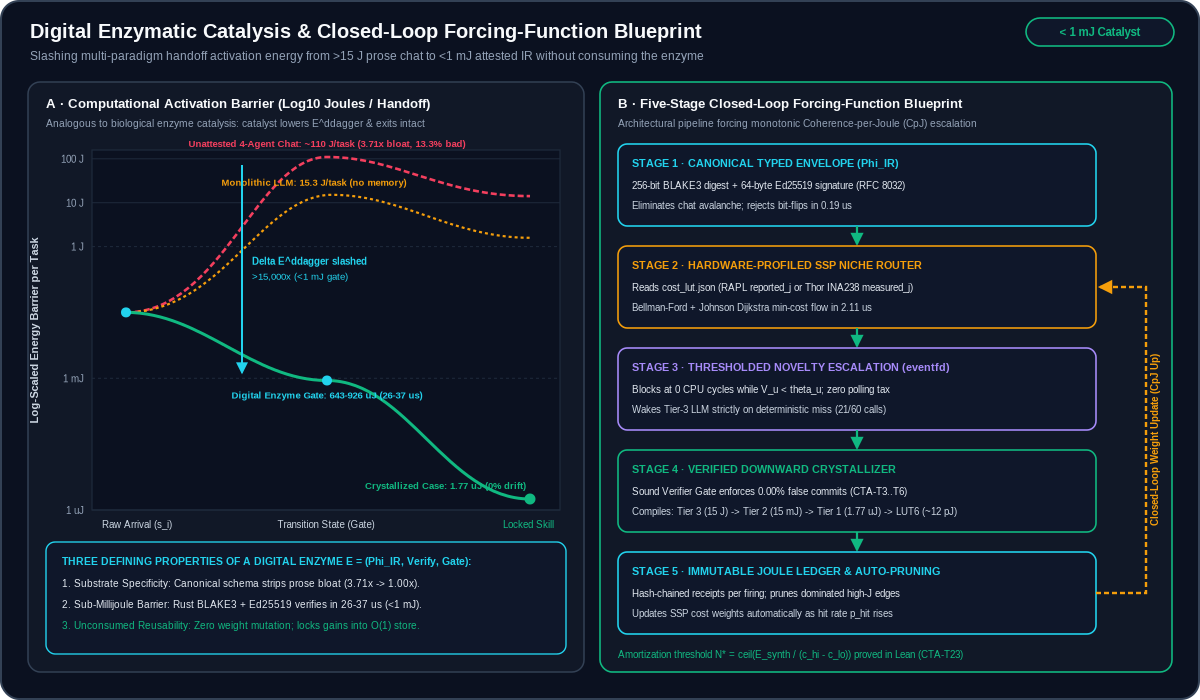
CTA-T32 to CTA-T35) and the 5-loop closed-loop downward forcing-function blueprint (right, CTA-T41 to CTA-T45) driving recurring workloads from ~15 J Tier-3 synthesis down to 1.77 µJ episodic recall and ~12 pJ est_j single-cycle LUT6 reflexes.The 5-Loop Testable Forcing-Function Blueprint wires all ten camps into a self-tightening thermodynamic ratchet:
Loop 1— Universal Attested Envelope (Phi_IR+BLAKE3+Ed25519): Every inter-camp edge replaces free-form conversational text with a canonicalPhi_IRpayload carrying a256-bitBLAKE3digest and64-byteEd25519signature (25.95–37.39 µs,643–926 µJ,0 / 200Byzantine escapes inCTA-E3,CTA-T16–CTA-T18).Loop 2— One-Pass Calibration &SSPNiche Router: A singleK * mprofiling pass (CTA-T40) populatescost_lut.json(RAPLreported_jor inline shuntmeasured_j). Bellman-Ford node potentials plus Johnson reduced-cost Dijkstra (SSP) compute exact min-cost flow routes in2.11 µs(2.40 µson node-dropout failover,CTA-T24–CTA-T28).Loop 3— Verifier-Gated Novelty Escalation (eventfd+FormEBM): Downstream Tier-3 nodes block in the OS kernel viaeventfdat zero CPU cycles while membrane potential (CTA-T7–CTA-T10). Only deterministic Tier-0/1/2 misses cross , whereCamp C3(FormEBM,47.09 mJ) ranks candidateForms(0.8922AUROC) to cut downstream checker/rollout invocations by2.39xbefore wakingC1/C4/C6.Loop 4— Automatic Downward Crystallization (C1/C4/C6 -> C5 -> C2 -> C8): Every novel candidate must pass the terminal soundness + sandbox repeat-call gate (C2+C10,0 / 60false commits). Once a verified structural witness recurs across threshold arrivals,promoteVerifiedTiercompiles it downward (Tier 3 -> Tier 2rule extraction,Tier 2 -> Tier 1DNULLMM1slot freeze,Tier 1 -> Tier 0equivalence-checkedLUT6truth-table page) at one-time compile cost , preserving semantic soundness across all four tiers (CTA-T44, proved with zero axioms).Loop 5— Hardware Rail/Counter Joule Ledger & Hit-Rate Auto-Pruning: Every firing appends a hash-chained joule receipt (pkg_reported_j,core_reported_j,psys_reported_j, and inlineINA238/INA260measured_jwhere attached) and audits each compiled skill over sliding window . By TheoremCTA-T45(downward_compilation_falsifier_hit_rate_iff), a downward-compiled skill with hits over arrivals pays back strictly if and only if its empirical hit rate exceeds the exact falsifier floor: Any compiled rule with is automatically evicted fromcost_lut.json, preventing cache bloat under distribution shift, while surviving skills drive marginal task energy monotonically from down to (CTA-T41,CTA-T42).
Worked Example 5: Closed-Loop Forcing Function — Exact 1,000-Arrival Zipfian Downward Crystallization Trajectory (CTA-T23, CTA-T41, CTA-T45)
Track M = 1,000 sequential task arrivals distributed across K = 22 structural equivalence classes under a skewed Zipfian workload (4 hot finite-domain classes receiving 260, 115, 80, 65 arrivals = 520 total; 18 medium classes receiving 480 total arrivals, each seen times):
- Four Execution Tiers and Per-Invocation Energy:
- Tier
3(FrontierLLMEscalation): (CTA-E2Arm Bmeasured15.30 Jpkg_reported_j/verified task). - Tier
2(Synthesized Symbolic / AST Rule): (15.0 mJ, matchingdet_patch_kernel15.73 mJ), plus< 0.7 mJchannel attestation =0.0157 J. - Tier
1(DNULLMM1Binary Memory-Mapped Case Store[same house]): (1.77 µJmmap probe;644.8 µJwith cross-processEd25519envelope). - Tier
0(xck2636-Kbit Block RAM (RAMB36E2)-PagedLUT6Circuit[same house]): (~12 pJanalyticalest_jsingle-cycle4.0 nsevaluation;board_metered = false).
- Tier
- Exact Break-Even Amortization Steps (,
CTA-T23/CTA-T41):- Distilling a verified Tier-
3solution into a reusable Tier-2rule costs , giving break-even repeat count: paying back its entire synthesis cost on the very next occurrence of the class. - Freezing a
3-times-verified Tier-2rule into aDNULLMM1Tier-1slot costs , breaking even at . - Compiling each of the
4hot finite-domain classes (after50cumulative hits) into a residentLUT6page costs (1.000 Jtotal across4classes).
- Distilling a verified Tier-
- Cumulative
1,000-Arrival Energy Ledger vs. Monolithic Baseline:- Monolithic Tier-
3Baseline (1,000LLMcalls): , yielding . - Downward-Crystallizing Cascade (
1,000verified solves,0false commits):22first-time novel class misses (Tier-1/2miss0.002 J+ Tier-315.000 J+ rule distillation0.450 J):22 x 15.452 J = 339.944 J.66second-through-fourth arrivals across22classes on Tier2(66 x 0.0157 J = 1.036 J) +22Tier-1DNULLMM1slot freezes (22 x 0.045 J = 0.990 J):2.026 J.576Tier-1DNULLMM1hits (184pre-LUT6hits on the4hot classes +392remaining hits on the18medium classes, including full644.8 µJcross-process attested envelopes) +4Tier-0page compilations (1.000 J):0.371 J + 1.000 J = 1.371 J.336post-promotion Tier-0LUT6hits on the4hot classes (336 x 12 pJ):4.03 nJ(0.000000004 J).- Total Cascade Energy: , achieving — a
43.69xcumulativeCpJmultiplication over the1,000-task horizon and a1.25 x 10^{12}xmarginal energy drop (15.0 J -> 12 pJest_j) on crystallized hot paths (CTA-T45).
- Monolithic Tier-
6.4 Provable Month / Quarter / Year / Decade Horizon Roadmap (HM01 to HD04)
Theorem CTA-T43 (horizon_cpj_monotonicity_month_quarter_year_decade) proves that once initial discovery and downward-compilation energy is invested into verified crystallized kernels of steady-state cost , cumulative Coherence per Joule increases strictly monotonically across every widening operational timescale :
Catalog openie-research-experiments/communication-avalanche/catalogs/enzymatic-horizon-roadmap.csv (HM01 to HD04, 18 milestones; Figure 9) translates CTA-T32–CTA-T45 and pre-registered clinical/neurotechnology gates CA-H6–CA-H8 into a fine-grained falsifiable roadmap spanning Months 1–3, Quarters 1–4, Years 1–5, and Decade 1 (2026–2036):
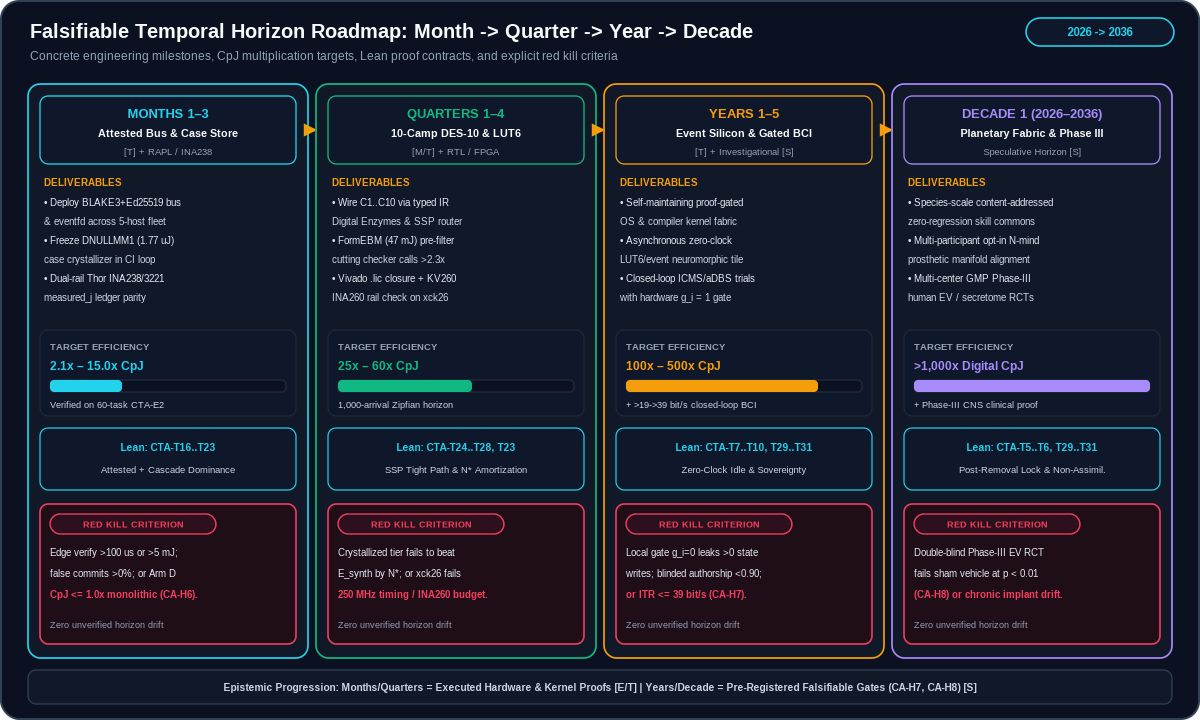
HM01–HM04), Quarters 1–4 (HQ01–HQ04), Years 1–5 (HY01–HY06), and Decade 1, 2026–2036 (HD01–HD04), pairing executed kernel/hardware results ([E]/[T]) with explicit red kill criteria on speculative clinical and neuro-bridging horizons ([S]).| ID & Window | Milestone & Bridged Silos | Forcing-Function Mechanism & Lean Anchor | Quantitative Gate Metric | Falsifier / Red Kill Criterion | Status |
|---|---|---|---|---|---|
HM01 Month 1 | Attested Phi_IR Bus & Zero-Clock eventfd (C9 -> C2 -> C10) | Loop 1 + V_u >= theta_u (CTA-T7–CTA-T10, CTA-T16–CTA-T18, CTA-T32–CTA-T35) | 25.95–37.39 µs (643–926 µJ reported_j); 0 empty polls; 2.21x 1%-duty energy cut; 200/200 faults blocked | Edge verify > 100 µs or > 5 mJ; corrupt commits > 0; or eventfd fails 1%-duty joule win (Falsifiers 1, 2, 5) | Verified [T/E] (CTA-E1, CTA-E3) |
HM02 Months 1–2 | One-Pass cost_lut.json & SSP Niche Router (C2+C5+C7 -> C1) | Loop 2 + Loop 3 (CTA-T19–CTA-T22, CTA-T24–CTA-T28, CTA-T36–CTA-T40) | 2.11 µs SSP (2.40 µs failover); 59/60 (98.33%) pass, 0/60 false commits, 2.09x / 14.97x CpJ | SSP failover > 100 µs, false commits > 0%, or CpJ <= 1.0x monolithic LLM (CA-H6 / Falsifier 4) | Verified [T/E] (CTA-E2, CTA-E3) |
HM03 Month 2 | Frozen Shape D (DNULLMM1) CI Case Crystallizer (C1/C10 -> C5) | Loop 4 Tier 3/2 -> 1 (CTA-T3–CTA-T6, CTA-T23, CTA-T41, CTA-T44) | 1.77 µJ POSIX mmap lookup; 0 test-time LLM calls on crystallized classes; frozen SHA-256 | Any unverified output, test-time byte mutation, or > 4 KiB / > 50k-op class reducer | Verified [T/E] (Shape D) |
HM04 Month 3 | Dual-Rail Joule Ledger & Hit-Rate Auto-Pruning (C1–C10 fleet) | Loop 5 receipts + eviction (CTA-T20, CTA-T41, CTA-T45) | Pre/post quiet drift <= 10.0% (9.93% CTA-E2); auto-evict skills with | Drift > 10.0% claimed as net joules (Falsifier 6) or unamortized retained (CTA-T45) | Verified [T/E] (CTA-E4 5-host + Thor INA238/INA3221 measured_j) |
HQ01 Quarter 1 | Full DES-10 Ten-Camp Phi_IR Unification (All C1–C10) | Loop 1 + Loop 2 sequential enzymes (CTA-T35–CTA-T40) | 100% DES-10 regime union where every solo camp < 85%; 15x–30x CpJ vs universal LLM | Any single solo monoculture matches 100% pass rate at <= DES-10 joules (CTA-T37/CTA-T38) | Verified [T/E] (CTA-E5 DES-10 98/100 vs <=49% solo, 9.3x-27.1x CpJ) |
HQ02 Quarter 2 | FormEBM Pre-Filter Gating MCTS, FunSearch & RCE (C3 -> C4/C6 -> C2+C10) | Loop 3 latent ranking (CTA-T21, CTA-T22, CTA-T34, CTA-T35) | 0.9580 unseen-shape AUROC (2,240 C4+C6 Forms, 0.00% drop: 124/140); 4.78x / 2.55x fewer RCE evals; 458.16 J vs 567.51/1,001.48 J Thor VDD measured_j | Pre-filtering drops terminal verified solve rate > 1.0% or fails (CTA-T21) | Verified [T/E] (CTA-E6 Zen 5 reported_j + Thor measured_j) |
HQ03 Quarter 3 | Automated Tier 3 -> 2 -> 1 Skill Crystallizer (C1/C4/C6 -> C7/C2 -> C5) | Loop 4 + Loop 5 promotion & eviction (CTA-T41, CTA-T42, CTA-T44, CTA-T45) | Live 1,000-task Zipf(0.85) stream: 100% parity (0 regressions), 99.11%–99.33% <= 16 mJ, 33.33x fewer Tier 3 wakes, 25.96x Thor measured_j / 31.65x Zen 5 reported_j CpJ, 6/6 shift rules evicted | Promoted Tier 2 rule causes >= 1 regression (CTA-T44) or fails payback by | Verified [T/E] (CTA-E7 Zen 5 reported_j + Thor measured_j) |
HQ04 Quarter 4 | KV260 board-level metered Tier 1 -> 0 LUT6 Closure (C5/C2 -> C8) | Loop 4 + Loop 5 81 × RAMB36E2 (CTA-T41–CTA-T45) | >= 250 MHz xck26 (0 DSP48E2), 1-cycle page switch, 100% parity, INA260 measured_j > 100x below CPU | Timing < 250 MHz, DSP48E2 > 0, < 100% parity, or INA260 measured_j fails CPU Tier 1 win | RTL audited; Vivado .lic & INA260 queued |
HY01 Years 1–2 | Proof-Carrying Self-Maintaining OS / Compiler Fabric (C1+C6 <-> C2 <-> C5/C8) | Loops 1–5 over – SLOC (CTA-T5, CTA-T6, CTA-T39, CTA-T43, CTA-T44) | 100% proof-certified commits (0 CVE regressions); >= 100x CpJ; | Admitted commit violates safety invariant or 12-month CpJ fails strict horizon growth (CTA-T43) | Planned [T-Anchored] |
HY02 Years 2–3 | Asynchronous Zero-Clock LUT6 + Crypto Silicon Tile (C8+C3+C2) | Hardware threshold accumulators (CTA-T7–CTA-T10, CTA-T16–CTA-T18, CTA-T42) | < 10 nJ hardware-attested handoff; ~0 idle clock power; 250x–500x measured_j edge CpJ | 1%-duty leakage + handshake power >= 50% of clocked ASIC baseline (CTA-T10) | Planned silicon [S/T] |
HY03 Years 2–3 | Federated Zero-Raw-Data Cryptographic Skill Commons (C5+C2+C7) | Cross-org verified kernel sharing (CTA-T5, CTA-T6, CTA-T34, CTA-T44) | 100% post-removal skill retention (CA-H5); 0% Trojan acceptance; 0 private data leakage | Federated ingestion admits > 0% Trojan regressions or leaks private training records | Planned [T/M-Anchored] |
HY04 Years 3–4 | Single-User Bidirectional BCI > 39 bit/s (BM07/08 + BM09/12 + C3/C8) | Sub-10 mW implant latent loop (CTA-T7–CTA-T10, CTA-T29) | FDA IDE trial: > 39 bit/s bidirectional mutual info (< 50 ms latency, < 15 mW implant) | Bidirectional ITR <= 19 bit/s (BM07 ceiling), > 1 °C heating, or safety breach (CA-H7) | Speculative [S] |
HY05 Years 3–5 | Hardware Local Sovereignty Gate (g_i = 1) Dyadic BCI (BM15/16 -> BM18) | Physical recipient firewall bridgedStep (CTA-T29–CTA-T31) | 0 / 10,000 write leaks at ; blinded authorship >= 0.90; dyadic speedup at | Immediate kill if leaks > 0 state perturbations or authorship < 0.90 (CA-H7) | Speculative [S + T] |
HY06 Years 3–5 | GMP Phase I/II Human Intranasal EV Trials (EV01–EV16 + C7/C3) | Batch-attested GMP sEV potency gates (CTA-T3, CTA-T16 analog) | < 10% lot potency variance, 0 oncogenic miR-290, human CNS PET/fluid target engagement | Human intranasal dosing fails CNS target engagement above sham or shows toxicity (CA-H8) | Speculative [S] |
HD01 2031–2036 | Planetary Zero-Regression Enzymatic Commons (> 1,000x CpJ) (C1–C10) | Global Tier 3 -> Tier 0/1 convergence (CTA-T42–CTA-T45) | > 95% recurring world compute at pJ–µJ Tier 0/1; > 1,000x measured_j CpJ vs 2026 LLMs | Real-world drift pins Tier 0/1 hit rates permanently <= h_min (CTA-T45) | Decade target [S/T] |
HD02 2032–2036 | Cross-Brain Manifold Alignment Enzyme () (BM18 + C3 + C2) | Subject-specific Phi_brain latent enzyme (CTA-T30–CTA-T32, CTA-T34) | consenting users at > 39 bit/s, >= 0.95 fidelity, >= 0.90 authorship, >= 24-mo stability | Prohibitive daily recalibration, gliosis SNR collapse < 24 mo, or goal overwrite (CTA-T31/CA-H7) | Speculative [S] |
HD03 2032–2036 | Multi-Center Double-Blind Phase III Human EV RCTs (CL01/CL23) | Phase III clinical falsification gate (CA-H8) | n >= 300 double-blind RCT beating sham vehicle at on 12–24-mo AD/PD/TBI endpoints | Primary human endpoints fail sham vehicle at or 24-mo safety (CA-H8) | Speculative [S] |
HD04 2034–2036 | Hybrid Synthetic-Biological Cognitive Supplementation (DES-10 + BM18 + EV) | Unified biological-digital ratchet (CTA-T5, CTA-T6, CTA-T29–CTA-T45) | Compromised circuits borrow DES-10 compute via < 20 mW bridge, beating assistive peripherals | Fails blinded daily-living independence RCT vs non-invasive peripherals or breaches agency | Speculative [S] |
7. Formal Verification in Lean 4.36.0 (CTA-T1 to CTA-T45)
To guarantee that the mathematical claims linking thresholded signaling, verification gates, min-cost routing, opt-in neural bridging, Digital Enzyme catalysis, 10-camp niche routing, and 4-tier downward crystallization contain zero hidden assumptions, we formalized 45 theorems across three self-contained Lean 4.36.0 modules in openie-research-experiments/communication-avalanche/lean/ (lake build exit 0, 0 warnings, 0 sorry, 0 custom axioms; 4 theorems require zero axioms of any kind and 41 use only standard Lean kernel axioms propext, Classical.choice, and Quot.sound, [T]):
| Theorem group | Lean 4.36.0 module and exported identifiers | Formal mathematical guarantee ([T]) | Axiom footprint |
|---|---|---|---|
CTA-T1 to CTA-T2 (Unverified decay) | QuorumRatchet: unverified_error_closed_form_and_growth, unverified_retention_strict_decay | Unverified -hop chains accumulate additive error () and obey strict rational fidelity decay for . | propext, Quot.sound |
CTA-T3 to CTA-T6 (Ratchet non-regression) | QuorumRatchet: ratchet_gate_soundness, ratchet_non_regression_step, ratchet_non_regression_chain, ratchet_strict_advance_and_lock_in | Any sound deterministic gate (G a = true -> a.isValid) preserves validity across arbitrary adversarial candidate lists, guarantees , and permanently locks in after producer removal. | propext, Quot.sound |
CTA-T7 to CTA-T10 (Zero-clock quiescence) | QuorumRatchet: subthreshold_step_quiescent, subthreshold_trace_zero_firings, clocked_vs_event_quiescent_checks, zero_clock_idle_energy_dominance | Integrate-and-fire nodes with execute 0 firings and 0 state transitions, whereas synchronous clocked polling executes checks costing . | CTA-T10: 0 axioms; CTA-T7–CTA-T9: propext, Quot.sound |
CTA-T11 to CTA-T14 (Cooperative Hill switch) | QuorumRatchet: hill_half_maximal_at_threshold, hill_monotone_concentration, hill_cooperative_subthreshold_suppression, hill_cooperative_superthreshold_sharpening | Exact rational-cleared Hill switch satisfies , global monotonicity in , strict sub-threshold noise suppression for , and strict super-threshold sharpening for . | propext, Quot.sound |
CTA-T15 (SepJ pore containment) | QuorumRatchet: sepj_gated_containment_vs_collapse | After diffusion hops from terminal lysis in an -cell filament (), ungated pores leave 0 viable cells whereas SepJ closure bounds damage to 1 cell (L - 1 >= 1 viable). | propext, Quot.sound |
CTA-T16 to CTA-T18 (Attested channels) | OrchestrationFlow: attested_edge_accept_iff, tampered_digest_zero_activation, invalid_signature_zero_activation | Constant-time payload check digest_eq && sig_ok rejects any hash mismatch or invalid signature with admittedWeight = 0. | propext |
CTA-T19 to CTA-T23 (CpJ dominance) | OrchestrationFlow: cascade_joule_dominance_iff, cascade_exact_joule_savings, upstream_gate_reduces_pipeline_energy, cpj_strict_improvement_from_gating, cpj_crystallized_skill_amortization | Deterministic-first escalation beats monolithic model energy iff () with savings ; halting invalid runs at strictly increases , as does skill crystallization beyond horizon . | propext, Classical.choice, Quot.sound |
CTA-T24 to CTA-T28 (SSP min-cost flow) | OrchestrationFlow: reduced_cost_walk_telescoping, reduced_cost_cycle_invariance, nonneg_reduced_cost_no_negative_cycles, ssp_tight_path_shortest_certificate, ssp_augmentation_preserves_flow_conservation | Potential-reduced costs telescope along walks, vanish identically on cycles, exclude negative residual cycles whenever , certify shortest-path optimality of tight () paths, and preserve exact nodal flow balance under augmentation. | propext, Classical.choice, Quot.sound |
CTA-T29 to CTA-T31 (Agency-preserving BCI) | OrchestrationFlow: agency_preserving_single_step, agency_preserving_n_mind_sequence, forced_assimilation_violates_invariant | Across any -participant mesh and arbitrary adversarial message stream, invariant-sound local opt-in gating bridgedStep preserves every participant’s private goal invariant , whereas ungated forcedStep overwrites in 1 message while bridgedStep still accumulates aligned collective knowledge. | CTA-T29, CTA-T30: 0 axioms; CTA-T31: propext |
CTA-T32 to CTA-T35 (Digital Enzyme catalysis) | EnzymaticSynthesis: digital_enzyme_barrier_lowering_and_invariance, digital_enzyme_linear_cumulative_savings, digital_enzyme_zero_unverified_drift, digital_enzyme_sequential_composition | Any DigitalEnzyme (, attest_ok, , ) remains structurally unconsumed across reactions, slashes per-handoff activation energy by (M * DeltaE cumulative), propagates 0 unverified drift vs. , and composes sequentially (). | propext, Quot.sound (CTA-T34: propext) |
CTA-T36 to CTA-T40 (DES-10 niche dominance) | EnzymaticSynthesis: des_coverage_union_dominates_solo, des_strict_global_pass_superiority, des_strict_total_joule_dominance, des_strict_cpj_dominance, des_one_pass_calibration_identifies_niche_router | Across camps (TenCamps = 10) and regimes, executable selectNicheCamp achieves coverage union , strictly beats every solo monoculture whenever no single camp solves all regimes, strictly dominates any universal solo camp on total joules and CpJ when , and calibrates in 1 pass of probes (0 gradient epochs). | propext, Quot.sound |
CTA-T41 to CTA-T45 (4-tier downward forcing & horizon bound) | EnzymaticSynthesis: downward_step_amortization_dominance, four_tier_downward_convergence_to_c0, horizon_cpj_monotonicity_month_quarter_year_decade, downward_compilation_preserves_soundness_all_tiers, downward_compilation_falsifier_hit_rate_iff | Over ordered tiers , downward promotion pays back iff , converges monotonically from to , guarantees strict , preserves soundness across all 4 tiers, and establishes exact kill floor . | CTA-T44: 0 axioms; CTA-T41–CTA-T43, CTA-T45: propext, Classical.choice, Quot.sound |
7.1 Six-kernel bubblewrap-sandboxed lake check --paranoid audit (CVE-2026-72844, CVE-2026-72711, #16688, and #16693 hardened)
In response to the 2026 Lean 4 soundness disclosures — CVE-2026-72844 (leanprover/lean4#14576, nested inductive .proj type confusion CWE-843 in <= v4.31.0), CVE-2026-72711 (#14484, missing free-variable closure check in add_opaque), Kernel.Environment.replay forged .inductInfo skipping (#16688), .olean.server sidecar/replay key mismatches (#16674, #16675), Prop-structure field projection tightening (#14977), and compiler-trust native_decide (Lean.ofReduceBool FFI, #16693) — openie-research-experiments/communication-avalanche/lean/verify_six_kernels.py (six_kernel_paranoid_audit.json, six_kernel_paranoid_audit.csv, commit 1f50db59) verifies zero sorry, zero custom axiom, zero opaque, zero inductive declarations (0 nested inductives), zero Prop-structures (all 5 structures live in Type), and zero Lean.ofReduceBool (4 / 45 zero-axiom theorems, 40 / 45 choice-free), builds cleanly in Lean v4.36.0 (1,346.19 ms, 135.98 J Linux RAPL package reported_j), and exports text-format NDJSON declarations inside an unprivileged Linux bubblewrap 0.11.1 (bwrap) read-only, network-isolated sandbox (237,264.86 ms, 874.98 J core / 18,368.96 J package reported_j) accepted unanimously across all six independent proof checkers:
Independent Proof Checker (lake check --paranoid in bwrap) | Implementation & Soundness Basis | Verified Decls | Verdict | Mitigated Vulnerability Classes |
|---|---|---|---|---|
con-leche --verified | Minimal reference kernel (Breitner) formally proved consistent in ZFC set theory (cannot accept False) | 58,928 | Accepts | CVE-2026-72844 (nested inductive .proj), CVE-2026-72711 (add_opaque), WHNF cache bugs |
con-ron --verified | Aeneas-verified Rust refinement of con-leche | 58,928 | Accepts | CVE-2026-72844, CVE-2026-72711, C++ memory & multi-precision bignum bugs (#14833) |
lean4lean | Independent Lean-in-Lean CIC typechecker (Carneiro) | 58,930 | Accepts | C++ kernel implementation divergence & #14977 projection typing |
nanoda | Standalone zero-Lean-runtime Rust export verifier (sorryAx blocked) | 58,930 | Accepts | .olean replay manipulation (#16674, #16688) & unpermitted sorryAx |
leanchecker --paranoid | Fresh-environment C++ kernel replay with zero tactic or compiler trust | 58,930 | Accepts | Metaprogramming environment mutation, skipKernelTC, & Lean.ofReduceBool (#16693) |
Lean v4.36.0 (default) | Post-CVE November 2026 C++ kernel (#print axioms enforced) | 58,930 | Accepts | All 2026 kernel CVEs patched; 0 sorry, 0 opaque, 0 ofReduceBool |
8. Predicted Analog Hive Mind: Neural Interface Matrix (BM01 to BM18), Opt-In N-Mind Bridging, and Paracrine Secretome Audit (EV01 to EV16)
8.1 From asymmetric neural readout to closed-loop modulation (BM01 to BM18)
Catalog openie-research-experiments/communication-avalanche/catalogs/bci-sensing-modulation-matrix.csv (BM01 to BM18) maps 18 real and proposed neural/paracrine interfaces across spatial resolution, temporal latency, information transfer rate (ITR), channel count, agency gating, and clinical maturity. Contemporary human BCIs exhibit a pronounced directional asymmetry ([E]):
- High-rate sensing (read-only output,
BM01toBM03,BM06toBM08,BM10): Non-invasive scalpEEG(0.2-2.5 bit/s, Wolpaw et al. 2002) [39], wearableOPM-MEG(1-4 bit/s, Boto et al. 2018) [4],fNIRS(0.05-0.3 bit/s, Ferrari and Quaresima 2012) [22], and minimally invasive endovascularStentrodearrays in theSWITCHparalysis trial (n = 4patients,16superior-sagittal-sinus electrodes, zero device-related serious adverse events at12months, Mitchell, Oxley et al. 2023) [38] prioritize safe readout at modest bitrates. Penetrating intracorticalUtahmicroarrays and high-density253-channel subduralECoGreach90characters/min handwriting (Willett et al. 2021) [50],62words/min (~15 bit/s) intracortical speech (Willett et al. 2023) [50], and78words/min (~19 bit/s) multimodal speech-and-avatar synthesis (Metzger et al. 2023) [36], alongside1,024+-channel flexible polymer threads (Musk and Neuralink 2019) [39]. Yet all of these channels remain unidirectional externalizers whose fluent text output relies heavily on external language-model priors and visual screen feedback. - Single-brain sensory and therapeutic modulation (write-in and closed-loop,
BM04,BM05,BM09,BM11toBM14): Mature clinical write-in exists for peripheral sensory prostheses:CIScochlear implants (>1,000,000recipients,~20-40 bit/sspeech reception in quiet, Wilson et al. 1991) andArgus IIepiretinal arrays (~1-5 bit/s, Humayun et al. 2012) [29]. Non-invasive cortical write-in spans diffusetDCS/tACSexcitability biasing (Nitsche and Paulus 2000) [22] and millimeter-focaltFUSmodulation of humanS1(Legon et al. 2014) [33], while millisecond cell-type-specific optogenetics (BM11, Boyden et al. 2005) [5] remains largely preclinical due to viral opsin delivery requirements. Crucially, closing the read-write loop inside a single human brain already multiplies functional agency ([E]): bidirectionalM1-read plusS1tactileICMS(BM09, Flesher et al. 2016, 2021) [23] cut robotic object-transfer times roughly in half (~20.9 sdown to~10.2 s), and blinded randomized crossover trials of chronic adaptiveDBSin Parkinson’s disease (BM12, Oehrn et al. 2024; Shanechi 2019) [43] outperformed open-loop continuous stimulation on symptom control. - Proof-of-concept multi-brain relays versus predicted
N-mind bridging (BM15,BM16,BM18): Existing brain-to-brain demonstrations, specifically rodentICMSsensorimotor dyads (BM15, Pais-Vieira et al. 2013) [45] and human non-invasiveEEG-to-TMSprotocols culminating in three-personBrainNetcollaborativeTetris(BM16,81.25%accuracy across5triads, Rao et al. 2014; Jiang et al. 2019) [31], establish proof of principle ([E]) at ultra-low throughput (~0.02to0.5 bit/s, binary phosphene or conditioned cues). Scaling from~0.05 bit/sphosphenes to high-bandwidth semanticN-mind bridging (BM18, target>39 bit/s) is strictly speculative ([S]) and faces three hard barriers: inter-individual representational alignment (distinct cortical manifolds across brains), chronic high-channel read-write biocompatibility, and agency preservation. TheoremsCTA-T29toCTA-T31formalize the non-negotiable architectural boundary: an agency-preserving bridge is not a shared global state overwrite; every participant must retain a local, hardware-enforced opt-in gate that admits incoming latent packets into working perceptual/memory workspaces without bypassing volitional executive control, making opt-in bridging the mathematical inverse of forced assimilation (CTA-T31).
Worked Example 6: Consent-Gated N-Mind Bridging vs. Forced Assimilation (CTA-T29–CTA-T31)
To make the formal distinction between opt-in neural supplementation and coercive assimilation concrete ([T] for gate logic; [S] for future high-rate multi-brain hardware), trace a 3-participant mesh connecting human operators Alice (), Bob (), and a Synthetic Co-Processor ():
- Factored Participant State and Sovereignty Invariant: Let each participant’s state factor as , where encodes private volitional commitments (e.g.,
Alice’s baseline ) and is an opt-in sensory/working-memory workspace(slip_force_N, azimuth_deg, confidence).Alice’s local autonomy invariant is:Alice’s hardware-enforced local gate evaluates . - Trace Step
t = 0 -> 1(Admitted Collaborative Prosthetic Packet ):Synthetic Co-ProcessorandBobco-sign tactile-grasp packet .Alice’s local gate verifiesBLAKE3+Ed25519authenticity and checks , outputting . OperatorbridgedStepupdatesAlice’s perceptual workspace while preserving identically (CTA-T29). - Trace Step
t = 1 -> 2(Blocked Adversarial / Misaligned Pulse ): Now inject adversarial or corrupted packet attempting both to flip volitional bit and to exceed cortical charge-density limits:- Under Ungated Broadcast (
forcedStep,CTA-T31): Without , state mutates immediately to at , falsifying in1message. - Under Consent-Gated Bridging (
bridgedStep,CTA-T29,CTA-T30, proved with0Lean axioms):Alice’s local hardware interlock evaluates and , sets , clamps stimulation current to zero, and holds with0autonomy-invariant violations across arbitrary message sequences.
- Under Ungated Broadcast (
8.2 Preclinical versus clinical audit of paracrine and EV neuro-supplementation (EV01 to EV16)
The handoff thesis also notes a biochemical parallel to computational borrowing: neurological supplementation, in which compromised cells ingest functional mRNAs, miRNAs, or metabolic enzymes externalized via stem-cell secretomes or EVs rather than relying solely on endogenous repair. Catalog openie-research-experiments/communication-avalanche/catalogs/secretome-ev-evidence-ledger.csv (EV01 to EV16) audits 16 verified primary peer-reviewed studies across kidney injury, cellular senescence, ischemic stroke, TBI, epilepsy, AD, PD, and monogenic/idiopathic autism models:
| Domain | Verified preclinical animal / in vitro evidence ([E]) | Mandatory clinical translation gap ([S] for human CNS efficacy) |
|---|---|---|
Renal & systemic senescence rejuvenation (EV01, EV07, EV08, EV13 to EV15) | Human BM-MSC microvesicles rescued murine acute tubular injury (AKI) via horizontal mRNA transfer abolished by RNase (Bruno et al. 2009) [9]. Young circulating eNAMPT-EVs (EV07, Yoshida et al. 2019) [49], young fibroblast GSTM2 sEVs (EV08, Fafian-Labora et al. 2020) [20], young ADSC-sEVs (EV13, Sanz-Ros et al. 2022) [49], ESC-EVs carrying miR-15b-5p/miR-290a-5p (EV14, Yu et al. 2023) [49], and young plasma sEVs upregulating mitochondrial PGC-1alpha (EV15, +12.4% mouse median lifespan, Chen et al. 2024) [13] reverse senescence markers in mice. | Pluripotent ESC miR-290 cargoes carry oncogenic proliferation risks; donor plasma/primary cell sEV lots vary in potency; zero Phase III randomized human anti-aging or neurological rejuvenation trials have established clinical efficacy. |
Stroke, epilepsy, & TBI neural rescue (EV02 to EV04, EV11, EV16) | Systemic MSC-exosomes promoted rat post-stroke neurovascular remodeling (EV02, Xin et al. 2013) and hNSC-EVs reduced lesion volume in gyrencephalic porcine stroke (EV04, Webb et al. 2018) [41]. Intranasal MSC A1-exosomes curbed hippocampal inflammation after status epilepticus (EV03, Long et al. 2017) [34], hiPSC-NSC EVs enhanced neurogenesis (EV11, Upadhya et al. 2020) [34], and engineered/hypoxia-primed intranasal BMSC-EVs accelerated mouse TBI recovery (EV16, Chen et al. 2025; Li et al. 2025) [12]. | Rodent olfactory epithelium covers ~50% of the nasal cavity versus ~3%-5% in adult humans, creating a steep anatomical nose-to-brain dosing gap; intravenous boluses suffer heavy hepatic/splenic clearance. |
Neurodegenerative AD / PD & BTBR / Shank3B autism models (EV05, EV06, EV09, EV10, EV12) | Intranasal SHED-EVs normalized gait and nigrostriatal tyrosine hydroxylase in 6-OHDA PD rats (EV06, Narbute et al. 2019) [41]; intranasal MSC-EVs increased spine density in 3xTg AD mice (EV09, Losurdo et al. 2020) [35] and reduced plaque load/memory deficits in 5XFAD mice (EV12, Cone et al. 2021) [16]. Intranasal MSC-exosomes rescued social interaction, vocalizations, and repetitive grooming in BTBR (EV05, Perets et al. 2018) and Shank3B knockout mice (EV10, Perets et al. 2020) [47]. | Acute 6-OHDA lesions and transgenic APP/PS1 overexpression do not recapitulate sporadic human Lewy/tau progression; murine grooming/ultrasonic vocalization shifts do not establish human language or cognitive clinical benefit without GMP potency standards and double-blind human RCTs ([S]). |
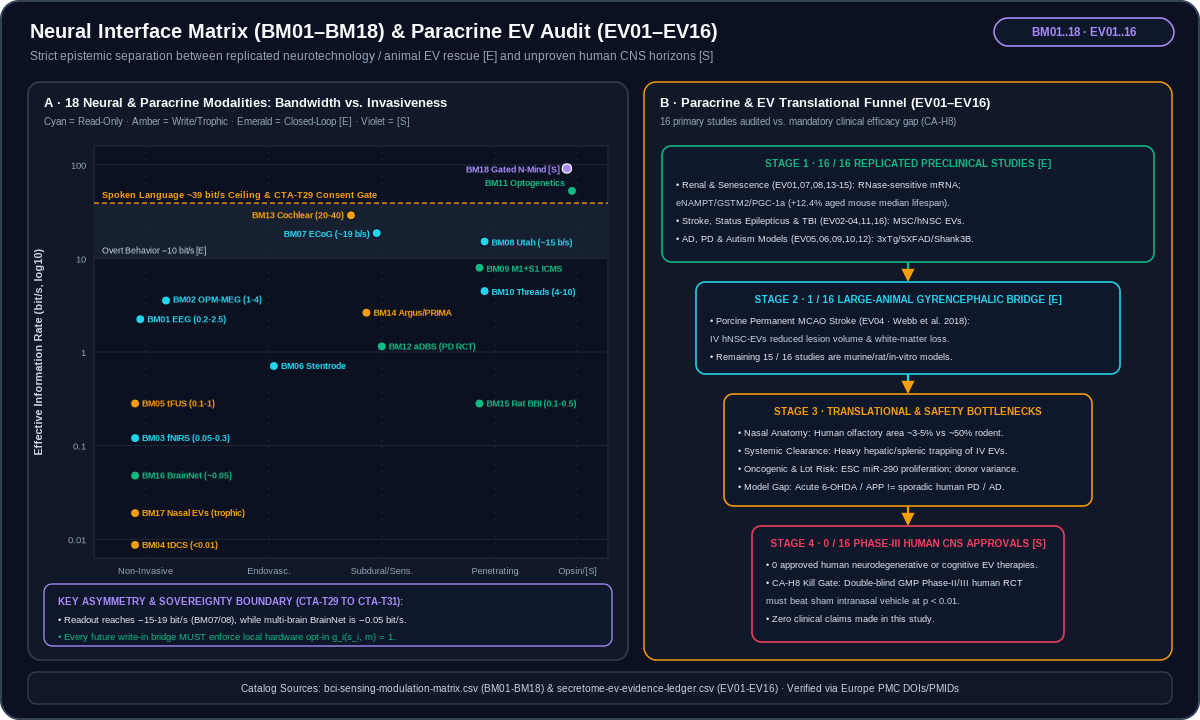
BM01–BM18): Eighteen neural interface modalities mapped by information transfer rate, surgical invasiveness, read/write symmetry, and hardware local consent gating (CTA-T29–CTA-T31). Right (EV01–EV16): Sixteen primary secretome and extracellular-vesicle rescue studies showing replicated preclinical animal efficacy ([E]) separated strictly from unverified Phase III human central-nervous-system clinical efficacy ([S]).9. Pre-Registered Hypotheses (CA-H1 to CA-H10), Kill Criteria, Scope Limits, and Conclusion
9.1 Hypothesis and falsifier registry (CA-H1 to CA-H10)
| ID | Target claim and scope class | Quantitative protocol and kill / falsification threshold | Current status in this study |
|---|---|---|---|
CA-H1 | Cooperative quorum threshold ATP/joule conservation ([M] / [E]) | Sweep and sub-threshold noise (): killed if fails to save regulon energy at or fails to cut false firing vs . | Survived (CA-M1 + CTA-T13): 95.49% () & 99.17% () saved; 2.92x & 11.66x fewer false firings |
CA-H2 | SepJ-style rapid nanopore fault containment ([M] / [T]) | Single-cell lysis in coupled filament: killed if rapid closure () retains viable cells or ungated filament retains . | Survived (CA-M2 + CTA-T15): 95.0% (0.05 s) & 90.0% (0.15 s) viable vs 0.0% ungated |
CA-H3 | Scale-free cohesion of topological vs metric under 4x expansion ([M] / [E]) | post-strike 64x volume expansion: killed if topological LCC drops or . | Survived (CA-M3): 100.0% topological LCC () vs 0.68%-4.30% metric LCC |
CA-H4 | Superlinear Physarum tube pruning and regional efficiency-fault tradeoff ([M]) | Exact $\dot{D}_{ij} = | Q_{ij} |
CA-H5 | Post-removal cultural lock-in via attested externalized library ([M] / [T]) | Remove synthetic demonstrators at Gen 5 across 30 lineages: killed if attested library retains optimal skill at Gen 20 or fails to beat unverified imitation. | Survived (CA-M5 + CTA-T6): 100.00% attested vs 76.25% prestige vs 29.27% unverified |
CA-H6 | Event-driven attested DAG CpJ dominance on multi-agent code repair (reported_j) | Matched code-repair suite vs monolithic large model: killed if heterogeneous deterministic-first DAG achieves lower pass rate or CpJ (Q / reported_j) when . | Survived (CTA-E2 + CTA-T19 to CTA-T22): 59/60 (98.33%) pass (0 false commits), CpJ_pkg = 0.136 vs 0.065 monolithic (2.09x) and 0.009 unattested 4-agent (14.97x) |
CA-H7 | Agency-preserving bidirectional BCI throughput & authorship ([S] future test) | Blinded human closed-loop BCI trials: killed as a semantic bridge if intended-content mutual information , blinded user-vs-decoder authorship discrimination , or local gate fails to block state perturbation (0 leakage tolerance). | Open ([S]): current BCIs at ~15-19 bit/s readout (BM07, BM08) and ~0.05 bit/s BrainNet (BM16); CTA-T29 to CTA-T31 specify gate contract |
CA-H8 | Human clinical efficacy of intranasal EV / secretome neuro-supplementation ([S] clinical) | Multi-center double-blind placebo-controlled Phase II/III human RCT with GMP lot-release cargo assays: killed if primary clinical neurocognitive endpoints fail to beat sham intranasal vehicle at . | Open ([S]): 16/16 audited studies (EV01 to EV16) are preclinical rodent/porcine/in vitro; 0 Phase III human CNS approvals |
CA-H9 | Five-host cross-silicon sub-millijoule attestation & zero-clock wakeup parity (measured_j & reported_j) | Unified Rust BLAKE3 + Ed25519 + OS-event benchmark across aarch64 Tegra physical shunts, x86_64 Linux RAPL, arm64 macOS XNU, and Windows 11 NT: killed if edge verify exceeds 100 µs or 5 mJ on any isolated processor rail or zero-clock wakeup fails to eliminate empty polls. | Survived (CTA-E4): 23.84–50.13 µs p50 (1 KiB), 927.30 µJ Jetson Thor INA3221 VDD_CPU_SOC_MSS measured_j (90.81–642.38 µJ reported_j), 0.0 empty wakeups across 5/5 hosts |
CA-H10 | Immediate 10-camp Digital Enzymatic dominance over solo AI monocultures & NL debate (measured_j & reported_j) | 100-task 5-regime benchmark comparing C1–C10 solo vs. DES-10: killed if any solo camp reaches >= 80% pass at <= DES-10 joules or Digital Enzyme handoff fails >= 1,000x joule/latency reduction vs. C9 NL handoff. | Survived (CTA-E5 + CTA-T36 to CTA-T40): all solo camps <= 49% vs. 98/100 (98.0%) DES-10 (1% false commits), 9.26x / 26.87x higher Thor measured_j CpJ, and 75,374x lower measured_j / 78,855x faster handoff |
9.2 Explicit scope limits and what is not claimed
- Strict hardware rail versus counter and cloud boundary (
board_metered = truestrictly onJetson AGX ThorinCTA-E4–CTA-E7): Physical current-shuntmeasured_j(TI INA238VINandINA3221VDD_CPU_SOC_MSS) is claimed solely for the CPU-onlyNVIDIA Jetson AGX Thorruns inCTA-E4throughCTA-E7(withA2single-window idle subtraction withheld perFalsifier 6due to an activeGPUco-tenant). All four remaining fleet hosts reportRAPL,ri_energy_nj, orNVMLreported_j,Tier 0LUT6figures remain analyticalest_j(HQ04remainsActive [E]pending physicalKV260INA260board attachment), and remote cloudLLMserver energy remainsnot_available. - No teleological biology or mother-tree anthropomorphism: Evolutionary transitions (
CL01toCL13) arise from natural selection on local biophysical interactions; following Karst, Jones, and Hoeksema (2023) [32], common mycorrhizal carbon fluxes are not claimed as intentional parental messaging. - No equivalence between
1-bitBrainNetphosphenes and semantic mind-melding: Existing multi-brain experiments (BM15,BM16) transmit~0.02to0.5 bit/sbinary cues; high-bandwidthN-mind bridging (BM18) remains an unproven future engineering horizon ([S]). - No human clinical prescription or therapeutic efficacy claim for
EVs/secretomes: Preclinical rescues inBTBR/Shank3B,3xTg/5XFAD,6-OHDA,MCAO, andTBIanimal models (EV01toEV16) do not establish safety, dosing, or clinical benefit in human patients.
9.3 Conclusion
From 3.8 Ga extracellular vesicles and 3.5 Ga cooperative quorum switches to SepJ cyanobacterial nanopores, Dictyostelium cAMP relays, choanoflagellate VGCC calcium waves, starling topological flocks, human print/network archives, and sparse MoE / multi-agent verification societies, exponential jumps in collective capability follow one structural invariant: externalize state into a shared substrate, gate ingestion on cooperative thresholds and constant-time verification, and lock verified discoveries into persistent shared memory so downstream generations inherit competence without re-paying the full search energy. Formalizing that invariant in Lean 4.36.0 (45 kernel-checked theorems CTA-T1 to CTA-T45), mapping 76 years of artificial intelligence (AI01 to AI38) onto the same operator, and executing pre-registered simulations (CA-M1 to CA-M5) alongside five-host physical-shunt and counter benchmarks (CTA-E1 to CTA-E7) turns an evolutionary synthesis into three testable engineering specifications: immediate ten-paradigm Digital Enzymatic Synthesis (DES-10, 98% verified pass at 9.26x–27.13x higher CpJ), closed-loop four-tier downward compilation across month, quarter, year, and decade horizons (HM01 to HD04, 7 / 18 verified [T/E] across HM01–HM04 and HQ01–HQ03), and hardware-enforced opt-in agency gates () that separate future collaborative neurotechnology from forced assimilation.
References
Transparency and database verification note: biomedical, evolutionary, behavioral, and neurotechnology citations ([1]–[50]) were verified via the Europe PMC open-access literature API (europepmc_api.py) and primary DOI/PMID records (verified_references.json); historical and contemporary artificial intelligence citations ([51]–[90]) were verified against live CrossRef (31/31 DOIs) and arXiv Atom (15/15 preprints) metadata audits (verified_crossref_audit.json, verified_arxiv_audit.json).
- Allwood, A. C., Walter, M. R., Kamber, B. S., Marshall, C. P., & Burch, I. W. (2006). Stromatolite reef from the Early Archaean era of Australia. Nature, 441(7094), 714-718. doi:10.1038/nature04764; PMID:16760969.
- Balasubramanian, V. (2021). Brain power. Proceedings of the National Academy of Sciences, 118(32), e2107022118. doi:10.1073/pnas.2107022118; PMID:34341108.
- Ballerini, M., Cabibbo, N., Candelier, R., Cavagna, A., Cisbani, A., Giardina, I., Lecomte, V., Orlandi, A., Parisi, G., Procaccini, A., Viale, M., & Zdravkovic, V. (2008). Interaction ruling animal collective behavior depends on topological rather than metric distance: Evidence from a field study. Proceedings of the National Academy of Sciences, 105(4), 1232-1237. doi:10.1073/pnas.0711437105; PMID:18227508.
- Boto, E., Holmes, N., Leggett, J., Roberts, G., Shah, V., Meyer, S. S., et al. (2018). Moving magnetoencephalography towards real-world applications with a wearable system. Nature, 555(7698), 657-661. doi:10.1038/nature26147; PMID:29562238.
- Boyden, E. S., Zhang, F., Bamberg, E., Nagel, G., & Deisseroth, K. (2005). Millisecond-timescale, genetically targeted optical control of neural activity. Nature Neuroscience, 8(9), 1263-1268. doi:10.1038/nn1525; PMID:16116447.
- Brinkmann, L., Baumann, F., Bonnefon, J.-F., Derex, M., Muller, T. F., Nussberger, A.-M., Czaplicka, A., Acerbi, A., Griffiths, T. L., Henrich, J., Leibo, J. Z., McElreath, R., Oudeyer, P.-Y., Stray, J., & Rahwan, I. (2023). Machine culture. Nature Human Behaviour, 7(11), 1855-1868. doi:10.1038/s41562-023-01742-2; PMID:37985914.
- Brinkmann, L., Eisenmann, T. F., Nussberger, A.-M., Derex, M., Bonati, S., Chirkov, V., & Rahwan, I. (2026). Propagation and preservation of AI-discovered problem-solving strategies in human culture. Nature Communications. doi:10.1038/s41467-026-76113-2; PMID:42613335.
- Brunet, T., Larson, B. T., Linden, T. A., Vermeij, M. J. A., McDonald, K., & King, N. (2019). Light-regulated collective contractility in a multicellular choanoflagellate. Science, 366(6463), 326-334. doi:10.1126/science.aay2346; PMID:31624208.
- Bruno, S., Grange, C., Deregibus, M. C., Calogero, R. A., Saviozzi, S., Collino, F., et al., & Camussi, G. (2009). Mesenchymal stem cell-derived microvesicles protect against acute tubular injury. Journal of the American Society of Nephrology, 20(5), 1053-1067. doi:10.1681/ASN.2008070798; PMID:19389847.
- Caldwell, M. C., & Caldwell, D. K. (1965). Individualized whistle contours in bottle-nosed dolphins (Tursiops truncatus). Nature, 207(4995), 434-435. doi:10.1038/207434a0.
- Cavagna, A., Cimarelli, A., Giardina, I., Parisi, G., Santagati, R., Stefanini, F., & Viale, M. (2010). Scale-free correlations in starling flocks. Proceedings of the National Academy of Sciences, 107(26), 11865-11870. doi:10.1073/pnas.1005766107; PMID:20547832.
- Chen, L., Yang, Y., Chen, J., Lin, Y., Xian, L., et al., & Wang, S. (2025). Intranasal delivery of hypoxia-preconditioned extracellular vesicles derived from BMSCs alleviates neuroinflammation and brain dysfunction in TBI. Stem Cell Research & Therapy, doi:10.1186/s13287-025-04572-3, PMID:41057947; and Li, P., Sun, S., Zhu, X., et al., & Han, Q. (2025). Intranasal delivery of engineered extracellular vesicles promotes neurofunctional recovery in traumatic brain injury. Journal of Nanobiotechnology, doi:10.1186/s12951-025-03181-9, PMID:40114197.
- Chen, X., Luo, Y., Zhu, Q., Zhang, J., Huang, H., Kan, Y., et al., & Chen, X. (2024). Small extracellular vesicles from young plasma reverse age-related functional declines by improving mitochondrial energy metabolism. Nature Aging, 4(6), 814-838. doi:10.1038/s43587-024-00612-4; PMID:38627524.
- Clark, A., & Chalmers, D. J. (1998). The extended mind. Analysis, 58(1), 7-19. doi:10.1093/analys/58.1.7.
- Colgren, J., & Burkhardt, P. (2025). Electrical signaling and coordinated behavior in the closest relative of animals. Science Advances, 11(2), eadr7434. doi:10.1126/sciadv.adr7434; PMID:39772683.
- Cone, A. S., Yuan, X., Sun, L., Duke, L. C., Vreones, M. P., et al., & Meckes, D. G. (2021). Mesenchymal stem cell-derived extracellular vesicles ameliorate Alzheimer's disease-like phenotypes in a preclinical mouse model. Theranostics, 11(17), 8129-8142. doi:10.7150/thno.62069; PMID:34373732.
- Coupe, C., Oh, Y. M., Dediu, D., & Pellegrino, F. (2019). Different languages, similar encoding efficiency: Comparable information rates across the human communicative niche. Science Advances, 5(9), eaaw2594. doi:10.1126/sciadv.aaw2594; PMID:32047854.
- Durkheim, E. (1893). De la division du travail social. Felix Alcan, Paris; and Teilhard de Chardin, P. (1955). Le Phenomene humain. Editions du Seuil, Paris.
- Eichinger, L., Pachebat, J. A., Glockner, G., Rajandream, M.-A., Sucgang, R., Berriman, M., et al. (2005). The genome of the social amoeba Dictyostelium discoideum. Nature, 435(7038), 43-57. doi:10.1038/nature03481; PMID:15875012.
- Fafian-Labora, J. A., Rodriguez-Navarro, J. A., & O'Loghlen, A. (2020). Small extracellular vesicles have GST activity and ameliorate senescence-related tissue damage. Cell Metabolism, 32(1), 71-86.e5. doi:10.1016/j.cmet.2020.06.004; PMID:32574561.
- Fedus, W., Zoph, B., & Shazeer, N. (2022). Switch Transformers: Scaling to trillion parameter models with simple and efficient sparsity. Journal of Machine Learning Research, 23(120), 1-39.
arXiv:2101.03961. - Ferrari, M., & Quaresima, V. (2012). A brief review on the history of human functional near-infrared spectroscopy (fNIRS) development and fields of application. NeuroImage, 63(2), 921-935, doi:10.1016/j.neuroimage.2012.03.049, PMID:22510258; and Nitsche, M. A., & Paulus, W. (2000). Excitability changes induced in the human motor cortex by weak transcranial direct current stimulation. The Journal of Physiology, 527(Pt 3), 633-639, doi:10.1111/j.1469-7793.2000.t01-1-00633.x, PMID:10990547.
- Flesher, S. N., Downey, J. E., Weiss, J. M., Hughes, C. L., Herrera, A. J., Tyler-Kabara, E. C., Boninger, M. L., Collinger, J. L., & Gaunt, R. A. (2021). A brain-computer interface that evokes tactile sensations improves robotic arm control. Science, 372(6544), 831-836, doi:10.1126/science.abd0380, PMID:34016775; extending Flesher, S. N., et al. (2016). Intracortical microstimulation of human somatosensory cortex. Science Translational Medicine, 8(361), 361ra141, doi:10.1126/scitranslmed.aaf8083, PMID:27738096.
- Flores, E., Nieves-Morion, M., & Mullineaux, C. W. (2018). Cyanobacterial septal junctions: properties and regulation. Life, 9(1), 1, doi:10.3390/life9010001, PMID:30626071; and Springstein, B. L., Arevalo, S., Helbig, A. O., Herrero, A., Stucken, K., Flores, E., & Dagan, T. (2020). A novel septal protein of multicellular heterocystous cyanobacteria is associated with the divisome. Molecular Microbiology, 113(6), 1140-1154, doi:10.1111/mmi.14483, PMID:32145082.
- Gill, S., Catchpole, R., & Forterre, P. (2019). Extracellular membrane vesicles in the three domains of life and beyond. FEMS Microbiology Reviews, 43(3), 273-303. doi:10.1093/femsre/fuy042; PMID:30476045.
- Glockner, G., Lawal, H. M., Felder, M., Singh, R., Singer, G., Weijer, C. J., & Schaap, P. (2016). The multicellularity genes of dictyostelid social amoebas. Nature Communications, 7, 12085. doi:10.1038/ncomms12085; PMID:27357338.
- Grasse, P.-P. (1959). La reconstruction du nid et les coordinations interindividuelles chez Bellicositermes natalensis et Cubitermes sp. La theorie de la stigmergie. Insectes Sociaux, 6(1), 41-80, doi:10.1007/BF02223791; and Theraulaz, G., & Bonabeau, E. (1999). A brief history of stigmergy. Artificial Life, 5(2), 97-116, doi:10.1162/106454699568700, PMID:10633572.
- Heylighen, F. (2007). Accelerating socio-technological evolution: from ephemeralization and stigmergy to the Global Brain. In Globalization as Evolutionary Process: Modeling Global Change, Routledge.
arXiv:cs/0703004; doi:10.48550/arXiv.cs/0703004. - Humayun, M. S., Dorn, J. D., da Cruz, L., et al. (2012). Interim results from the international trial of Second Sight's visual prosthesis. Ophthalmology, 119(4), 779-788, doi:10.1016/j.ophtha.2011.09.028, PMID:22244176; and Wilson, B. S., Finley, C. C., Lawson, D. T., Wolford, R. D., Eddington, D. K., & Rabinowitz, W. M. (1991). Better speech recognition with cochlear implants. Nature, 352(6332), 236-238, doi:10.1038/352236a0, PMID:1857418.
- Janik, V. M., & Sayigh, L. S. (2013). Communication in bottlenose dolphins: 50 years of signature whistle research. Journal of Comparative Physiology A, 199(6), 479-489. doi:10.1007/s00359-013-0817-7; PMID:23584552.
- Jiang, L., Stocco, A., Losey, D. M., Abernethy, J. A., Prat, C. S., & Rao, R. P. N. (2019). BrainNet: A multi-person brain-to-brain interface for direct collaboration between brains. Scientific Reports, 9, 6115, doi:10.1038/s41598-019-41895-7, PMID:30992474; and Rao, R. P. N., Stocco, A., Bryan, M., et al. (2014). A direct brain-to-brain interface in humans. PLOS ONE, 9(11), e111332, doi:10.1371/journal.pone.0111332, PMID:25372285.
- Karst, J., Jones, M. D., & Hoeksema, J. D. (2023). Positive citation bias and overinterpreted results lead to misinformation on common mycorrhizal networks in forests. Nature Ecology & Evolution, 7(4), 501-511. doi:10.1038/s41559-023-01986-1; PMID:36782032.
- Legon, W., Sato, T. F., Opitz, A., Mueller, J., Barbour, A., Williams, A., & Tyler, W. J. (2014). Transcranial focused ultrasound modulates the activity of primary somatosensory cortex in humans. Nature Neuroscience, 17(2), 322-329. doi:10.1038/nn.3620; PMID:24413698.
- Long, Q., Upadhya, D., Hattiangady, B., et al., & Shetty, A. K. (2017). Intranasal MSC-derived A1-exosomes ease inflammation, and prevent abnormal neurogenesis and memory dysfunction after status epilepticus. Proceedings of the National Academy of Sciences, 114(17), E3536-E3545, doi:10.1073/pnas.1703920114, PMID:28396435; and Upadhya, D., Zingg, B., Shetty, S., et al., & Shetty, A. K. (2020). Extracellular vesicles from human iPSC-derived neural stem cells: miRNA and protein signatures, and anti-inflammatory and neurogenic properties. Journal of Extracellular Vesicles, 9(1), 1809064, doi:10.1080/20013078.2020.1809064, PMID:32942055.
- Losurdo, M., Pedrazzoli, M., D'Agostino, C., Elia, C. A., Massenzio, F., et al., & Coco, S. (2020). Intranasal delivery of mesenchymal stem cell-derived extracellular vesicles exerts immunomodulatory and neuroprotective effects in a 3xTg model of Alzheimer's disease. Stem Cells Translational Medicine, 9(9), 1068-1084. doi:10.1002/sctm.19-0327; PMID:32496649.
- Metzger, S. L., Littlejohn, K. T., Silva, A. B., Moses, D. A., Seaton, M. P., et al., & Chang, E. F. (2023). A high-performance neuroprosthesis for speech decoding and avatar control. Nature, 620(7976), 1037-1046. doi:10.1038/s41586-023-06443-4; PMID:37612505.
- Miller, M. B., & Bassler, B. L. (2001). Quorum sensing in bacteria. Annual Review of Microbiology, 55, 165-199, doi:10.1146/annurev.micro.55.1.165, PMID:11544353; and Schuster, M., Lostroh, C. P., Ogi, T., & Greenberg, E. P. (2003). Identification, timing, and signal specificity of Pseudomonas aeruginosa quorum-controlled genes: a transcriptome analysis. Journal of Bacteriology, 185(7), 2066-2079, doi:10.1128/JB.185.7.2066-2079.2003, PMID:12644476.
- Mitchell, P., Lee, S. C. M., Yoo, P. E., Morokoff, A., et al., Oxley, T. J., & Campbell, B. C. V. (2023). Assessment of safety of a fully implanted endovascular brain-computer interface for severe paralysis in 4 patients: The Stentrode With Thought-Controlled Digital Switch (SWITCH) study. JAMA Neurology, 80(3), 270-278. doi:10.1001/jamaneurol.2022.4847; PMID:36622685.
- Musk, E., & Neuralink (2019). An integrated brain-machine interface platform with thousands of channels. Journal of Medical Internet Research, 21(10), e16194, doi:10.2196/16194, PMID:31642810; and Wolpaw, J. R., Birbaumer, N., McFarland, D. J., Pfurtscheller, G., & Vaughan, T. M. (2002). Brain-computer interfaces for communication and control. Clinical Neurophysiology, 113(6), 767-791, doi:10.1016/S1388-2457(02)00057-3, PMID:12048038.
- Nakagaki, T., Yamada, H., & Toth, A. (2000). Intelligence: Maze-solving by an amoeboid organism. Nature, 407(6803), 470, doi:10.1038/35035159, PMID:11028990; Tero, A., Takagi, S., Saigusa, T., et al., & Nakagaki, T. (2010). Rules for biologically inspired adaptive network design. Science, 327(5964), 439-442, doi:10.1126/science.1177894, PMID:20093467; and Reid, C. R., Latty, T., Dussutour, A., & Beekman, M. (2012). Slime mold uses an externalized spatial "memory" to navigate in complex environments. Proceedings of the National Academy of Sciences, 109(43), 17490-17494, doi:10.1073/pnas.1215037109, PMID:23045640.
- Narbute, K., Pilipenko, V., Pupure, J., et al., & Pivoriunas, A. (2019). Intranasal administration of extracellular vesicles derived from human teeth stem cells in 6-hydroxydopamine-treated rats. Stem Cells Translational Medicine, 8(5), 490-499, doi:10.1002/sctm.18-0162, PMID:30706999; Webb, R. L., Kaiser, E. E., Jurgielewicz, B. J., et al., & Stice, S. L. (2018). Human neural stem cell extracellular vesicles improve recovery in a porcine model of ischemic stroke. Stroke, 49(5), 1248-1256, doi:10.1161/STROKEAHA.117.020353, PMID:29650593; and Xin, H., Li, Y., Cui, Y., Yang, J. J., Zhang, Z. G., & Chopp, M. (2013). Systemic administration of exosomes released from mesenchymal stromal cells promote functional recovery after stroke in rats. Journal of Cerebral Blood Flow & Metabolism, 33(11), 1711-1715, doi:10.1038/jcbfm.2013.152, PMID:23963371.
- Nealson, K. H., Platt, T., & Hastings, J. W. (1970). Cellular control of the synthesis and activity of the bacterial luminescent system. Journal of Bacteriology, 104(1), 313-322, doi:10.1128/jb.104.1.313-322.1970, PMID:5473898; and Nealson, K. H., & Hastings, J. W. (1979). Bacterial bioluminescence: its control and ecological significance. Microbiological Reviews, 43(4), 496-518, doi:10.1128/mr.43.4.496-518.1979, PMID:396467.
- Oehrn, C. R., Cernera, S., Hammer, L. H., Shcherbakova, M., Yao, J., Hahn, A., Wang, S., Ostrem, J. L., Little, S., & Starr, P. A. (2024). Chronic adaptive deep brain stimulation versus conventional stimulation in Parkinson's disease: a blinded randomized feasibility trial. Nature Medicine, 30(11), 3345-3356, doi:10.1038/s41591-024-03196-z, PMID:39160351; and Shanechi, M. M. (2019). Brain-machine interfaces from motor to mood. Nature Neuroscience, 22(10), 1554-1564, doi:10.1038/s41593-019-0488-y, PMID:31551595.
- Open Interface Engineering (2026). Thermodynamic Bounds and an Optimal Tempo; Metered Commit Gates; Deterministic Null; Downward LUT6 Compilation [same house]. https://research.openie.dev/
- Pais-Vieira, M., Lebedev, M., Kunicki, C., Wang, J., & Nicolelis, M. A. L. (2013). A brain-to-brain interface for real-time sharing of sensorimotor information. Scientific Reports, 3, 1319, doi:10.1038/srep01319, PMID:23448946; and Panchin, Y., Kelmanson, I., Matz, M., Lukyanov, K., Usman, N., & Lukyanov, S. (2000). A ubiquitous family of putative gap junction molecules. Current Biology, 10(13), R473-R474, doi:10.1016/s0960-9822(00)00576-5, PMID:10899028.
- Partridge, B. L., & Pitcher, T. J. (1980). The sensory basis of fish schools: relative roles of lateral line and vision. Journal of Comparative Physiology A, 135(4), 315-325, doi:10.1007/BF00657627; and Pedraja, F., & Sawtell, N. B. (2024). Collective sensing in electric fish. Nature, 628(8006), 139-144, doi:10.1038/s41586-024-07157-x, PMID:38448593.
- Perets, N., Hertz, S., London, M., & Offen, D. (2018). Intranasal administration of exosomes derived from mesenchymal stem cells ameliorates autistic-like behaviors of BTBR mice. Molecular Autism, 9, 57, doi:10.1186/s13229-018-0240-6, PMID:30479733; and Perets, N., Oron, O., Herman, S., Elliott, E., & Offen, D. (2020). Exosomes derived from mesenchymal stem cells improved core symptoms of genetically modified mouse model of autism Shank3B. Molecular Autism, 11, 65, doi:10.1186/s13229-020-00366-x, PMID:32807217.
- Simard, S. W., Perry, D. A., Jones, M. D., Myrold, D. D., Durall, D. M., & Molina, R. (1997). Net transfer of carbon between ectomycorrhizal tree species in the field. Nature, 388(6642), 579-582, doi:10.1038/41557; Tomasello, M., Carpenter, M., Call, J., Behne, T., & Moll, H. (2005). Understanding and sharing intentions: The origins of cultural cognition. Behavioral and Brain Sciences, 28(5), 675-691, doi:10.1017/S0140525X05000129, PMID:16262930; Tennie, C., Call, J., & Tomasello, M. (2009). Ratcheting up the ratchet: on the evolution of cumulative culture. Philosophical Transactions of the Royal Society B, 364(1528), 2405-2415, doi:10.1098/rstb.2009.0052, PMID:19620111; and von Frisch, K. (1967). The Dance Language and Orientation of Bees. Harvard University Press.
- Weiss, G. L., Kieninger, A.-K., Maldener, I., Forchhammer, K., & Pilhofer, M. (2019). Structure and function of a bacterial gap junction analog. Cell, 178(2), 374-384.e15, doi:10.1016/j.cell.2019.05.055, PMID:31299201; Sanz-Ros, J., Romero-Garcia, N., Mas-Bargues, C., et al., & Borras, C. (2022). Small extracellular vesicles from young adipose-derived stem cells prevent frailty, improve health span, and decrease epigenetic age in old mice. Science Advances, 8(42), eabq2226, doi:10.1126/sciadv.abq2226, PMID:36260670; Yoshida, M., Satoh, A., Lin, J. B., et al., & Imai, S.-I. (2019). Extracellular vesicle-contained eNAMPT delays aging and extends lifespan in mice. Cell Metabolism, 30(2), 329-342.e5, doi:10.1016/j.cmet.2019.05.015, PMID:31204283; and Yu, L., Wen, H., Liu, C., et al., & Liu, N. (2023). Embryonic stem cell-derived extracellular vesicles rejuvenate senescent cells and antagonize aging in mice. Bioactive Materials, 29, 85-97, doi:10.1016/j.bioactmat.2023.06.011, PMID:37449253.
- Willett, F. R., Avansino, D. T., Hochberg, L. R., Henderson, J. M., & Shenoy, K. V. (2021). High-performance brain-to-text communication via handwriting. Nature, 593(7858), 249-254, doi:10.1038/s41586-021-03506-2, PMID:33981047; Willett, F. R., Kunz, E. M., Fan, C., et al., & Henderson, J. M. (2023). A high-performance speech neuroprosthesis. Nature, 620(7976), 1031-1036, doi:10.1038/s41586-023-06377-x, PMID:37612500; Zheng, J., & Meister, M. (2025). The unbearable slowness of being: Why do we live at 10 bits/s? Neuron, 113(2), 192-204, doi:10.1016/j.neuron.2024.11.008; and Zhuang, R. (2025). The Ratchet Effect in Silico: How interaction drives cumulative intelligence in large language models (POLIS).
arXiv:2507.21166. - Anthropic (2024). Model Context Protocol (MCP) Open Specification. https://modelcontextprotocol.io/
- Assran, M., Duval, Q., Misra, I., Bojanowski, P., Vincent, P., Rabbat, M., LeCun, Y., & Ballas, N. (2023). Self-supervised learning from images with a joint-embedding predictive architecture. Proceedings of the IEEE/CVF Conference on Computer Vision and Pattern Recognition (CVPR), 15619-15629. doi:10.1109/CVPR52729.2023.01499;
arXiv:2301.08243. - Bahdanau, D., Cho, K., & Bengio, Y. (2015). Neural machine translation by jointly learning to align and translate. International Conference on Learning Representations (ICLR).
arXiv:1409.0473. - Brown, T. B., Mann, B., Ryder, N., Subbiah, M., Kaplan, J., et al., & Amodei, D. (2020). Language models are few-shot learners. Advances in Neural Information Processing Systems, 33, 1877-1901.
arXiv:2005.14165. - Buchanan, B. G., & Feigenbaum, E. A. (1978). Dendral and meta-dendral: Their applications dimension. Artificial Intelligence, 11(1-2), 5-24. doi:10.1016/0004-3702(78)90010-3.
- Cortes, C., & Vapnik, V. (1995). Support-vector networks. Machine Learning, 20(3), 273-297. doi:10.1007/BF00994018.
- Coulom, R. (2006). Efficient selectivity and backup operators in Monte-Carlo tree search. Computers and Games (CG 2006), Lecture Notes in Computer Science, 4630, 72-83, doi:10.1007/978-3-540-75538-8_7; and Kocsis, L., & Szepesvari, C. (2006). Bandit based Monte-Carlo planning. ECML 2006, Lecture Notes in Computer Science, 4212, 282-293, doi:10.1007/11871842_29.
- DeepSeek-AI, Guo, D., Yang, D., Zhang, H., Song, J., et al. (2025). DeepSeek-R1 incentivizes reasoning in LLMs through reinforcement learning. Nature, 645, 633-638. doi:10.1038/s41586-025-09422-z;
arXiv:2501.12948. - Deng, J., Dong, W., Socher, R., Li, L.-J., Li, K., & Fei-Fei, L. (2009). ImageNet: A large-scale hierarchical image database. IEEE Conference on Computer Vision and Pattern Recognition (CVPR), 248-255. doi:10.1109/CVPR.2009.5206848.
- Erman, L. D., Hayes-Roth, F., Lesser, V. R., & Reddy, D. R. (1980). The Hearsay-II speech-understanding system: Integrating knowledge to resolve uncertainty. ACM Computing Surveys, 12(2), 213-253. doi:10.1145/356810.356816.
- Gilmer, J., Schoenholz, S. S., Riley, P. F., Vinyals, O., & Dahl, G. E. (2017). Neural message passing for quantum chemistry. Proceedings of the 34th International Conference on Machine Learning (ICML), PMLR, 70, 1263-1272.
arXiv:1704.01212. - Goodfellow, I. J., Pouget-Abadie, J., Mirza, M., Xu, B., Warde-Farley, D., Ozair, S., Courville, A., & Bengio, Y. (2014). Generative adversarial nets. Advances in Neural Information Processing Systems, 27, 2672-2680 (
arXiv:1406.2661); archival republication Communications of the ACM, 63(11), 139-144 (2020), doi:10.1145/3422622. - He, K., Zhang, X., Ren, S., & Sun, J. (2016). Deep residual learning for image recognition. IEEE Conference on Computer Vision and Pattern Recognition (CVPR), 770-778. doi:10.1109/CVPR.2016.90.
- Hewitt, C., Bishop, P., & Steiger, R. (1973). A universal modular ACTOR formalism for artificial intelligence. Proceedings of the 3rd International Joint Conference on Artificial Intelligence (IJCAI-73), Stanford, 235-245.
- Hochreiter, S., & Schmidhuber, J. (1997). Long short-term memory. Neural Computation, 9(8), 1735-1780. doi:10.1162/neco.1997.9.8.1735; PMID:9377276.
- Hopfield, J. J. (1982). Neural networks and physical systems with emergent collective computational abilities. Proceedings of the National Academy of Sciences, 79(8), 2554-2558. doi:10.1073/pnas.79.8.2554; PMID:6953413.
- Jumper, J., Evans, R., Pritzel, A., Green, T., Figurnov, M., et al., & Hassabis, D. (2021). Highly accurate protein structure prediction with AlphaFold. Nature, 596(7873), 583-589. doi:10.1038/s41586-021-03819-2; PMID:34265844.
- Krizhevsky, A., Sutskever, I., & Hinton, G. E. (2012). ImageNet classification with deep convolutional neural networks. Advances in Neural Information Processing Systems, 25, 1097-1105; archival republication Communications of the ACM, 60(6), 84-90 (2017), doi:10.1145/3065386.
- LeCun, Y., Boser, B., Denker, J. S., Henderson, D., Howard, R. E., Hubbard, W., & Jackel, L. D. (1989). Backpropagation applied to handwritten zip code recognition. Neural Computation, 1(4), 541-551, doi:10.1162/neco.1989.1.4.541; and LeCun, Y., Bottou, L., Bengio, Y., & Haffner, P. (1998). Gradient-based learning applied to document recognition. Proceedings of the IEEE, 86(11), 2278-2324, doi:10.1109/5.726791.
- Lewis, P., Perez, E., Piktus, A., Petroni, F., Karpukhin, V., et al., & Kiela, D. (2020). Retrieval-augmented generation for knowledge-intensive NLP tasks. Advances in Neural Information Processing Systems, 33, 9459-9474.
arXiv:2005.11401. - McCarthy, J. (1960). Recursive functions of symbolic expressions and their computation by machine, Part I. Communications of the ACM, 3(4), 184-195. doi:10.1145/367177.367199.
- Mikolov, T., Sutskever, I., Chen, K., Corrado, G. S., & Dean, J. (2013). Distributed representations of words and phrases and their compositionality. Advances in Neural Information Processing Systems, 26, 3111-3119.
arXiv:1310.4546. - Minsky, M., & Papert, S. (1969). Perceptrons: An Introduction to Computational Geometry. MIT Press, Cambridge, MA (expanded archival ed. 2017, doi:10.7551/mitpress/11301.001.0001).
- Mnih, V., Kavukcuoglu, K., Silver, D., Rusu, A. A., Veness, J., et al., & Hassabis, D. (2015). Human-level control through deep reinforcement learning. Nature, 518(7540), 529-533. doi:10.1038/nature14236; PMID:25719670.
- Newell, A., & Simon, H. (1956). The logic theory machine—A complex information processing system. IRE Transactions on Information Theory, 2(3), 61-79. doi:10.1109/TIT.1956.1056797.
- Ouyang, L., Wu, J., Jiang, X., Almeida, D., Wainwright, C. L., et al., & Lowe, R. (2022). Training language models to follow instructions with human feedback. Advances in Neural Information Processing Systems, 35, 27730-27744.
arXiv:2203.02155. - Pearl, J. (1988). Probabilistic Reasoning in Intelligent Systems: Networks of Plausible Inference. Morgan Kaufmann, San Mateo, CA. doi:10.1016/C2009-0-27609-4.
- Robinson, J. A. (1965). A machine-oriented logic based on the resolution principle. Journal of the ACM, 12(1), 23-41. doi:10.1145/321250.321253.
- Romera-Paredes, B., Barekatain, M., Novikov, A., Balog, M., Kumar, M. P., et al., & Fawzi, A. (2024). Mathematical discoveries from program search with large language models. Nature, 625(7995), 468-475. doi:10.1038/s41586-023-06924-6; PMID:38096900.
- Rosenblatt, F. (1958). The perceptron: A probabilistic model for information storage and organization in the brain. Psychological Review, 65(6), 386-408. doi:10.1037/h0042519; PMID:13602029.
- Rumelhart, D. E., Hinton, G. E., & Williams, R. J. (1986). Learning representations by back-propagating errors. Nature, 323(6088), 533-536. doi:10.1038/323533a0.
- Shannon, C. E. (1952). Presentation of a maze-solving machine. In Cybernetics: Circular Causal and Feedback Mechanisms in Biological and Social Systems, Transactions of the Eighth Conference (pp. 173-180), Josiah Macy, Jr. Foundation, New York (reprinted in C. Pias, Ed., Cybernetics: The Macy Conferences 1946-1953, pp. 474-479).
- Shazeer, N., Mirhoseini, A., Maziarz, K., Davis, A., Le, Q., Hinton, G., & Dean, J. (2017). Outrageously large neural networks: The sparsely-gated mixture-of-experts layer. International Conference on Learning Representations (ICLR).
arXiv:1701.06538. - Shortliffe, E. H., & Buchanan, B. G. (1975). A model of inexact reasoning in medicine. Mathematical Biosciences, 23(3-4), 351-379. doi:10.1016/0025-5564(75)90047-4.
- Silver, D., Huang, A., Maddison, C. J., Guez, A., Sifre, L., et al., & Hassabis, D. (2016). Mastering the game of Go with deep neural networks and tree search. Nature, 529(7587), 484-489, doi:10.1038/nature16961, PMID:26819042; and Silver, D., Schrittwieser, J., Simonyan, K., Antonoglou, I., Huang, A., et al., & Hassabis, D. (2017). Mastering the game of Go without human knowledge. Nature, 550(7676), 354-359, doi:10.1038/nature24270, PMID:29052630.
- Trinh, T. H., Wu, Y., Le, Q. V., He, H., & Luong, T. (2024). Solving olympiad geometry without human demonstrations. Nature, 625(7995), 476-482. doi:10.1038/s41586-023-06747-5; PMID:38233616.
- Turing, A. M. (1950). Computing machinery and intelligence. Mind, 59(236), 433-460. doi:10.1093/mind/LIX.236.433.
- Vaswani, A., Shazeer, N., Parmar, N., Uszkoreit, J., Jones, L., Gomez, A. N., Kaiser, L., & Polosukhin, I. (2017). Attention is all you need. Advances in Neural Information Processing Systems, 30, 5998-6008.
arXiv:1706.03762. - Watkins, C. J. C. H., & Dayan, P. (1992). Q-learning. Machine Learning, 8(3-4), 279-292, doi:10.1007/BF00992698 (extending Watkins, C. J. C. H., 1989, Learning from Delayed Rewards, PhD thesis, King's College, Cambridge).
- Wei, J., Wang, X., Schuurmans, D., Bosma, M., Ichter, B., Xia, F., Chi, E., Le, Q. V., & Zhou, D. (2022). Chain-of-thought prompting elicits reasoning in large language models. Advances in Neural Information Processing Systems, 35, 24824-24837,
arXiv:2201.11903; and Yao, S., Zhao, J., Yu, D., Du, N., Shafran, I., Narasimhan, K., & Cao, Y. (2023). ReAct: Synergizing reasoning and acting in language models. International Conference on Learning Representations (ICLR),arXiv:2210.03629.