Downward LUT6 Compilation in a Mixture of Limits Cascade: Beneš-Routed Boolean Fabrics, Conformal Wake Gates, and Frontier Sparse-MoE NVMe Streaming
A Mixture of Limits cascade with 74 six-kernel-verified Lean 4.36.0 theorems and Inria Charon+Aeneas mechanical Rust-to-Lean extraction (plus 1,438 theorems across four Open Interface Engineering repositories inside Linux bubblewrap sandboxes, Common Vulnerabilities and Exposures (CVE)-2026-72844-hardened) that tries zero-floating-point-operation (FLOP) paged 6-input look-up table (LUT6) circuits, a 12.75-kilobyte (13,058-byte, 11-export) WebAssembly (WASM) and 4-kilobyte no-standard-library Rust lut6-core + antisymmetric 40-entry zero-multiply table-lookup multiply-accumulate (T-MAC) + 1.750-bit-per-weight (-22.22%, saving 1.564 gigabytes static and cutting streamed gigibytes per token 1.619x via 54-bit 3-token LUT6 AirMoL speculation on native Hadamard-ternary Bonsai-2-27B) shift-5 Fast Walsh-Hadamard Transform (FWHT) ternary Nucleus, a 5,984-byte (9.13% of 64-kilobyte smartwatch static random-access memory) 56-bit 4-token smart-glasses opener with zero prefix poisoning, a 4,096-byte (6.25% of smartwatch static memory) downward-compiled System-0 decider running 9,493.7x faster than Mapika/decider-0.8b on Wave-2 decisions and lifting official Abstraction and Reasoning Corpus (ARC)-AGI-3 Wave-2 quadratic Relative Human Action Efficiency (RHAE) 208.3x from 0.009 to 1.875, and (72, 64) single-error-correction double-error-detection (SECDED) cosmic-ray bit-flip protection first (0.154 milliseconds in single-binary Rust mol-agent-rs, 162.71 nanojoules per bit-sliced decision, and 100.0% survival at 1% bit-error rate), escalates across sub-billion wearable micro-language-models and 4-bit Non-Volatile Memory Express (NVMe) looped, hybrid, and sparse Mixture-of-Experts (MoE) late-2026 models up to 120B parameters across four graphics processing unit (GPU) silicon vendors (up to 328.06x speedup, cutting LastExam-protocol root-mean-square calibration error 5.37x to 13.14%, solving 20.83% of ARC-AGI-2 on n=24 and 12.50% = 2.00x over 1-layer on n=64 via multilayer Beneš-ARC-LUT6, solving 4/57 official ARC-AGI-3 black-box levels [4.0x Random], verifying 50.00% of MiniF2F-Lean4 with 0.0000% unsound proofs, and cutting CritPt physics calibration error 9.49x to 8.96% with 0.00% confident hallucinations at >= 80% confidence), gates commits via deterministic verifiers across 4 upstream Verified software-engineering repositories, and compiles certified wakes downward into clock-enable-gated Beneš-routed 36-Kbit Block RAM (RAMB36E2 and license-free openXC7 320.62-megahertz post-route 7-Series Artix-7 200T M.2 2280 .bit bitstreams), Lupanov shared-cofactor, wobble-codon, and two-tier LUT6 + EntroMCU ternary crystal pages. Includes physical Texas Instruments direct-current (DC) shunt measured_j on Tegra aarch64 Jetson Thor (87.25x bit-sliced lut6-core, 222.57x wearable 56-bit 4-token epistemic gate vs. 28.84-million-parameter d=512 slice, 8.35x Bonsai-AirMoL 4-token speculative sweep [15.32 vs. 127.97 microjoules, 9.13x faster], 5.33x multilayer Beneš-ARC-LUT6 + ARC-AGI-3 reflex [713.82 nanojoules], 1.65x antisymmetric-40 zero-multiply T-MAC tail [and 1.12x on Zen 5], 1.57x Bonsai-2-27B shift-5 FWHT-1024 + antisymmetric-40 [220.72 vs. 346.09 microjoules, 2.26x faster], 3.74x Sub1Bit-LUT6, 34.21x Expert-AirMoL, and 10.94x Proposition 1 compilation energy reductions; board_metered is true) strictly separated from live Alif Ensemble Cortex-M55 cycle counts (2,745.18x faster wearable epistemic gate), five-host on-chip reported_j counters, license-free openXC7 post-route static timing, and simulated xck26 and Artix-7 200T register-transfer-level (RTL) est_j estimates at commit b8d6612.
David Charlot, Open Interface Engineering
Research studies, not journal finals. Notation is defined in the paper. Analytical energy estimates are not board power. Interactive figures live under /living/. Shared terms: glossary.
Cite this
Genre: Research study, draft: downward LUT6 compilation, Yosys/Verilator xck26 RTL simulation, conformal wake gating, and measured AirMoL NVMe I/O
David Charlot, Open Interface Engineering. Downward LUT6 Compilation in a Mixture of Limits Cascade: Beneš-Routed Boolean Fabrics, Conformal Wake Gates, and Frontier Sparse-MoE NVMe Streaming. Open Interface Engineering. Web: https://research.openie.dev/papers/lut-adapt/. PDF: https://research.openie.dev/pdfs/lut-adapt.pdf. Markdown: https://research.openie.dev/papers/lut-adapt.md.
Downward LUT6 Compilation in a Mixture of Limits Cascade: Beneš-Routed Boolean Fabrics, Conformal Wake Gates, and Frontier Sparse-MoE NVMe Streaming
Revision 24cb3f7, 25 November 2026. Reference implementation and artifacts: openIE-dev/lut-adapt-ai at b8d661201214275525b230d4f8d929db3ba7a724. Data summary: /data/#lut-adapt. LaTeX PDF: /pdfs/latex/lut-adapt.pdf (source).
0. Overview
This study examines how a computing system can compile repeated neural-model work downward into fast Boolean table lookups and certified canonical skills without losing exact output parity or promoting unverified guesses into trusted rules. Five evidence classes stay strictly separated across all claims: physical board-level Texas Instruments current-shunt joule readings (measured_j, board_metered = true on Tegra aarch64 Jetson Thor solely in §4.26, §4.30, §4.34, §4.35, §4.40, §4.41, §4.44, and §4.46), operating-system and on-chip hardware energy counters plus bare-metal microcontroller cycle counters and browser virtual-machine execution (reported_j across five Linux, macOS, and Windows 11 workstations plus live attached Alif Ensemble Cortex-M55 cycle counts and the 12.75-kilobyte browser module, board_metered = false), six-kernel sandboxed formal proof verification (74 theorems here and 1,438 across four repositories) paired with Inria Charon+Aeneas mechanical Rust-to-Lean extraction (§4.19, §4.35, §4.40, §4.43, and §4.46), license-free openXC7 post-route static timing closure (320.62 megahertz) and 77.85-megabit .bit bitstream generation on 7-Series Artix-7 200T (§4.36, board_metered = false, measured_j = None), and register-transfer-level synthesis, exhaustive Boolean miter checks, cycle simulations, and labeled analytical energy and electro-thermal estimates (est_j).
In plain words
- Most inputs a deployed system sees repeat patterns it has already solved, so running a full floating-point neural network on every step wastes compute and memory bandwidth.
- The reference places a reconfigurable 6-input truth-table (
LUT6) lookup tier and a 4-kilobyte bare-metal Rustlut6-coreNucleus (fitting inside25.06%of a64-kilobyte microcontroller static memory or365on-die block memories of an M.22280Artix-7200Tcard) ahead of streaming state-space, looped, and foundation models, and compiles answers downward into lookup memory pages only after an explicit check certifies them. - When late-2026 looped, hybrid, and sparse mixture-of-experts language models up to
120Bparameters (12Bactive, plus October–November 2026 loopedthinkingmachines/Inkling-2-MiniandNemotron-Labs-Dory1.0-4B) run locally on Apple Silicon through custom fused Apple Metal, portable RustBurn 0.22.1 / CubeCLshaders, and single-binary Rustmol-agent-rs(0.154milliseconds per skill lookup), router-sparse expert reads paired with that zero-FLOPLUT6drafter cut disk reads by up to12.30×onQwen/Qwen3.6-35B-A3B(970.0megabytes active weight memory), cut looped depth-recurrent forward passes4.00×(3.52×–3.95×measured speedup at100%greedy parity), and sustain22.17tokens per second onnvidia/Nemotron-3-Super-120B-A12Binside58.08gigabytes of Unified Memory; gating code and repository commits behind deterministicunittestandpytestchecks reaches91.67%verified pass rate (93.75%across Wave 2 and Wave 3) on the48-task algorithmic bakeoff,90.62%(93.75%on Wave 2 human paraphrases) on officialBigCodeBench v0.1.3,50.00%on single-repositorySymPygit worktrees,20.83%(2.50×standalone24Band35Bmodels) across4upstreamprinceton-nlpVerified repositories (django,pytest,requests, andsympy), and62.50%on the120Bhard frontier suite with0.00%broken commits admitted.
1. Terms, acronyms, and measurement labels
- MoL: Mixture of Limits, the cascade rule from Metered Commit Gates Part II [same house]
- LA: claim and falsifier prefix (LA-1 to LA-44, LA-F1 to LA-F44) used in this study
- LUT, LUT6, INIT: look-up table, 6-input Xilinx UltraScale+ Boolean primitive, and its 64-bit truth-table initialization mask
- BRAM, RAMB36, RAMB36E2, URAM: Block RAM, the 36-Kbit dual-port Xilinx Block RAM family and its UltraScale+ primitive (144 on xck26), and UltraRAM
- CLB, FF, DSP, DSP48, KV260: configurable logic block, flip-flop, digital signal processing slice, and AMD Kria KV260 board (xck26)
- FPGA, ASIC, RTL, CPI, PAR, WNS, FPL: field-programmable gate array, application-specific integrated circuit, register-transfer level, cycles per lookup, place-and-route, worst negative slack, and Field-Programmable Logic conference
- AXI, AXIS, PS, PL, SOM, INA260, VCC, RAPL, NVML, PMU, SMC, L1, L2, L3: Advanced eXtensible Interface, AXI4-Stream wrapper prefix, Zynq processing system, programmable logic, system-on-module, onboard power monitor IC, supply rail, Intel Running Average Power Limit, NVIDIA Management Library, macOS power management unit, Apple System Management Controller, level-1 whole-board voltage-input rail, level-2 subsystem energy counter (Apple IOReport GPU Energy and Tegra rail shunt), and level-3 per-process CPU energy counter (Darwin proc_pid_rusage RUSAGE_INFO_V6 ri_energy_nj)
- SSD, SSM, MIMO, RoPE, SwiGLU, GQA, KV, BPE, LLM, LLMs, MoE, MLP, CFG: State Space Duality, state-space model, multiple-input multiple-output, rotary position embedding, gated linear unit activation, grouped-query attention, key-value cache, byte-pair encoding, large language model(s), Mixture-of-Experts, multilayer perceptron, and context-free grammar
- HC, SOINN, WNN, DWN: hierarchy-context Self-Organizing Incremental Neural Network, weightless neural network, and Differentiable Weightless Neural Network
- JEPA, EBRM, ACI, OOD, AUROC, AUC, MSP, MC: Joint-Embedding Predictive Architecture, Energy-Based Reasoning Model, Adaptive Conformal Inference, out-of-distribution, area under the receiver operating characteristic, maximum softmax probability, and Monte Carlo
- PLD, REST, EAGLE, LFM2, LFM3, HF: Prompt Lookup Decoding, Retrieval-Based Speculative Decoding, Extrapolation Algorithm for Greater Language-model Efficiency, Liquid Foundation Model 2.5 (LFM2.5-350M and LFM2.5-8B-A1B), Liquid Foundation Model 3 (Oct 2026 LiquidAI/LFM3-1.7B), and HuggingFace
- SVD, ITQ, SVID, QAT, PTQ, PPL, SNR: singular value decomposition, Iterative Quantization Procrustes hypercube rotation, sign-value-independent decomposition, quantization-aware training, post-training quantization, perplexity, and signal-to-noise ratio
- NVMe, NOCACHE, POSIX, RAM, DRAM, SRAM, RSS, GGUF, IO, KB, MB, GB, GiB: Non-Volatile Memory Express storage, Darwin F_NOCACHE unbuffered file flag, Portable Operating System Interface, random-access memory, dynamic RAM, static RAM, resident set size in physical Unified Memory, GPT-Generated Unified Format quantized model file, input/output, kilobyte, megabyte, gigabyte, and gibibyte
- FLOP, FLOPs, MFLOP, MFLOPs, MAC, MACs, SIMD, AD, FD, BPB, BF16, FP16, FP32, INT4, ULP, MSL, MPS, CUDA, ROC, SPIR, PTX, HIP, LLVM: floating-point operation(s), million FLOPs, multiply-accumulate operation(s), single-instruction multiple-data, automatic differentiation, finite difference, bits per byte, brain float 16, 16/32-bit IEEE floating point, 4-bit integer, unit in the last place, Apple Metal Shading Language, PyTorch Metal Performance Shaders, NVIDIA Compute Unified Device Architecture, AMD ROCm runtime, Standard Portable Intermediate Representation (Vulkan SPIR-V), Parallel Thread Execution, Heterogeneous-Compute Interface for Portability, and Low Level Virtual Machine compiler backend
- RCE, WCA, VC, BCB, SWE, OSA, DP: Reality Code Engine [same house], Wise Computer Automation [same house], verified completion, BigCodeBench v0.1.3 benchmark, software-engineering benchmark prefix, optimal string alignment, and dynamic programming
- CLI, HTTP, GET, POST, SSE, API, MCP, RPC, IDE, SDK, CORS, URL, ORM, IDNA, CADE, LNCS, NVIDIA, ACL, ICML, ICLR, EMNLP, NAACL, CVPR, ICPE, ISSCC, JSAC, JASA, ACM, OS, CPU, GPU, SW, TDP: command-line interface, Hypertext Transfer Protocol and its GET/POST request methods, Server-Sent Events, application programming interface, Model Context Protocol, remote procedure call (JSON-RPC 2.0), integrated development environment, software development kit, Cross-Origin Resource Sharing, Uniform Resource Locator, object-relational mapper, Internationalized Domain Names in Applications, Conference on Automated Deduction, Lecture Notes in Computer Science, NVIDIA Corporation, academic computer-science/engineering venues, operating system, central/graphics processing unit, software, and thermal design power
- VLAN, IEEE, TLS, DPI, AST, JSON, CSV, SHA, CRC, ATM, RFC, SQL, DWARF, SLEB, CAM, XOR, XNOR, JWT, HMAC, DAG, CIDR, LRU, TTL, WAL, ETL: virtual local-area network (IEEE 802.1Q), Transport Layer Security, deep packet inspection, abstract syntax tree, JavaScript Object Notation, comma-separated values, Secure Hash Algorithm, cyclic redundancy check, Asynchronous Transfer Mode (CRC-8/ATM), Request for Comments, Structured Query Language, DWARF signed little-endian base-128 encoding, content-addressable memory, exclusive-OR, exclusive-NOR, JSON Web Token, hash-based message authentication code, directed acyclic graph, Classless Inter-Domain Routing, least-recently-used cache, time-to-live expiration, write-ahead log, and extract-transform-load pipeline
- JTAG, XSDB, DAP, USB, FTDI, FT2232C, UART, FIFO, IC, EDA, OOC, AMBA, AXI4, IOB, IBUF, OBUF, FDRE, FDSE, LUT1, LUT2, LUT3, LUT4, LUT5, MUXF7, MUXF8, CARRY4, CARRY8, DSP48E2, URAM288, VCCINT, DS925, VCD, SDP, CE, ENARDEN, XPE, CLAI, AMD: Joint Test Action Group debug port, Xilinx Software Command-Line Tool debugger, Debug Access Port, Universal Serial Bus, Future Technology Devices International and its FT2232C dual UART/FIFO bridge IC, universal asynchronous receiver-transmitter, first-in first-out buffer, integrated circuit, electronic design automation, out-of-context synthesis mode, Advanced Microcontroller Bus Architecture, AXI4-Lite/AXI4-Stream interconnect, input/output block, input/output buffers, synchronous-reset/set D flip-flops, 1-to-5-input UltraScale+ look-up tables, 7/8-input UltraScale+ multiplexers, 4/8-bit fast carry chains, UltraScale+ DSP slice, 288-Kbit UltraRAM, internal core supply rail (0.72 V on -2LV), AMD Zynq UltraScale+ DC and AC Switching Characteristics datasheet DS925, Value Change Dump waveform trace, simple dual-port Block RAM mode, synchronous clock enable, RAMB36E2 port-A read/clock-enable pin, Xilinx Power Estimator, subsystem register magic identifier ("CLAI"), and Advanced Micro Devices
- CVE, CWE, FRO, GMP, RAG, WHNF, ZFC, CIC, FFI: Common Vulnerabilities and Exposures, Common Weakness Enumeration, Lean Focused Research Organization, GNU Multiple Precision Arithmetic Library, Retrieval-Augmented Generation, weak head normal form, Zermelo-Fraenkel set theory with Choice, Calculus of Inductive Constructions, and foreign function interface
- ABBA, AGX, AI, DC, FWHT, INA238, INA3221, MSS, NT, PPT, RDNA, RPL, RTX, RUSAGE_INFO_V6, TI, VDD, VDD_CPU_SOC_MSS, VDD_GPU, VIN, XNU: counterbalanced A-B-B-A trial ordering, Autonomous-Grade Compute module family, artificial intelligence, direct current, Fast Walsh-Hadamard Transform, Texas Instruments inline power monitors (INA238 whole-board VIN and three-channel INA3221 rail), memory subsystem, Windows NT kernel family, Package Power Tracking, Radeon DNA graphics architecture, Raptor Lake mobile platform, Ray Tracing Texel eXtreme, Darwin Resource Usage Info v6 struct, Texas Instruments, voltage drain-drain supply rail, Tegra CPU/SoC/memory supply rail, Tegra GPU supply rail, board voltage-input rail, and Darwin X is Not Unix kernel
- ABI, AC, ADC, AE3, A2B, CRC32, CYCCNT, DTCM, DWT, E3, E4, E4B, ELF, ELFs, FCCM, FSM, GPT, INT8, ISVLSI, LSB, M0, M55, MCU, MRAM, PALUTE, PIO, Q4, ROM, RP2040, SHA256, SPI, ST, XL: application binary interface, alternating-current non-constant Fourier energy, analog-to-digital converter, Alif Ensemble E3 OpenMV-AE3 microcontroller board, 2-billion active-expert sparse architecture suffix, 32-bit IEEE cyclic redundancy check, Arm Data Watchpoint and Trace cycle counter register, Data Tightly Coupled Memory, Data Watchpoint and Trace unit, Alif Ensemble E3/E4 microcontroller series, 4-billion effective edge parameter suffix, Executable and Linkable Format firmware image(s), Field-Programmable Custom Computing Machines symposium, finite-state machine, Generative Pre-trained Transformer (normalized nGPT), 8-bit integer quantization, International Symposium on VLSI, least-significant bit, Arm Cortex-M0+ and Cortex-M55 microcontroller cores, microcontroller unit, magnetoresistive non-volatile RAM, Processing-In-Memory Acceleration via Lookup Table, programmable input/output peripheral, 4-bit quantized block format (Q4_K_XL), read-only memory, Raspberry Pi dual Cortex-M0+ microcontroller, 256-bit Secure Hash Algorithm, Serial Peripheral Interface bus, Straight-Through estimator, and extra-large quantization block suffix
- BAR0, BGA, BLE, CEM, CMOS, CSR, DDR3, DS181, DSP48E1, ECC, FBG484, FPC, GPIO, GTP, HAT, HPL, I2C, INA228, IRQ, JEDEC, LFM, M4F, MIG, MT, MUL, NDP120, ODT, PCIe, PHY, QCM6490, QFAA, RAMB36E1, RISC, RV32IMAC, SSTL15, SYSMON, TMAC, UG475, VNNI, XADC, XC7A200T, XCK26, XCZU9EG, ZCU102: PCIe Base Address Register 0, ball-grid array, Bluetooth Low Energy, Card Electromechanical PCIe slot specification, complementary metal-oxide-semiconductor, control and status register, double-data-rate type-3 synchronous DRAM, AMD Artix-7 FPGAs DC and AC Switching Characteristics datasheet DS181, Xilinx 7-Series digital signal processing slice, error-correcting code, 484-ball 23x23 mm lidless flip-chip BGA package, flexible printed circuit ribbon, general-purpose input/output, Artix-7 multi-gigabit serial transceiver, Hardware Attached on Top 40-pin expansion header, TSMC 28 nm High-Performance Low-Power process, Inter-Integrated Circuit bus, Texas Instruments ultra-precise inline current/power monitor IC, interrupt request, Joint Electron Device Engineering Council thermal coupon standard, linear feet per minute airflow unit, Arm Cortex-M4F microcontroller core, Xilinx 7-Series Memory Interface Generator, megatransfers per second, integer multiply instruction, Syntiant NDP120 neural decision processor, on-die termination, Peripheral Component Interconnect Express, physical memory interface layer, Qualcomm Dragonwing system-on-chip on Particle Tachyon, Nordic 48-pin QFN nRF52832 package suffix, Xilinx 7-Series 36-Kbit dual-port Block RAM primitive (365 on XC7A200T), Reduced Instruction Set Computer, 32-bit RISC-V integer/multiply/atomic/compressed ISA, Stub Series Terminated Logic 1.5 V I/O standard, Xilinx System Monitor temperature/voltage block, Table-Lookup MAC ternary dot-product layout, AMD 7-Series FPGAs Packaging and Pinout Specification UG475, Vector Neural Network Instructions, Xilinx 7-Series dual 12-bit analog-to-digital converter, AMD Artix-7 200T FPGA (Numato Aller A7 M.2 2280), AMD Kria K26 SOM FPGA, AMD Zynq UltraScale+ MPSoC FPGA, and AMD ZCU102 evaluation board
- BEL, BER, FASM, GBDT, ICFP, ISCA, JS, KAN, LLBC, LVCMOS33, MIR, PACMPL, PIM, PIP, PIPs, RMSE, SECDED, SEU, SLICE_FFX, SLICE_LUTX, TMLR, UG470, V8, VM, WASM, WASM32, XC7, XDC: Xilinx basic logic element, bit-error rate, FPGA Assembly frame format, gradient-boosted decision tree, International Conference on Functional Programming, International Symposium on Computer Architecture, JavaScript host runtime, Kolmogorov-Arnold Network, Low-Level Borrow Calculus (Inria Charon/Aeneas intermediate representation), Low-Voltage CMOS 3.3 V I/O standard, Rust Mid-level Intermediate Representation, Proceedings of the ACM on Programming Languages, processing-in-memory, Xilinx switchbox programmable interconnect point(s), root-mean-square error, single-error-correction double-error-detection (72, 64) extended Hamming code, single-event upset cosmic-ray bit-flip, nextpnr-xilinx 7-Series slice flip-flop and LUT primitives, Transactions on Machine Learning Research, AMD 7 Series FPGAs Configuration User Guide UG470, Chromium V8 WebAssembly engine, virtual machine, WebAssembly portable binary target (32-bit wasm32-unknown-unknown), Xilinx 7-Series architecture family, and Xilinx Design Constraints pinout file
- AIME, AR, ASR, CAIS, CHR, GPQA, HLE, HMMT, HRV, HUD, LTE, MC10, MMLU, POV, RMS, RTT, SPO2, TTFT, UW, XR: American Invitational Mathematics Examination, augmented reality, automatic speech recognition, Center for AI Safety, confident hallucination rate (at verbalized confidence >= 80%), Graduate-Level Google-Proof Question Answering, Humanity's Last Exam (lastexam.ai), Harvard-MIT Mathematics Tournament, heart-rate variability, heads-up display, Long-Term Evolution cellular radio, 10-option multiple choice (A..J), Massive Multitask Language Understanding, point-of-view camera frame, root-mean-square calibration metric, round-trip time, peripheral blood oxygen saturation, time to first token, University of Washington, and extended reality
- ACTION1, ACTION6, ACTION7, AGI, ARC, ARC2, ARC3, BFS, BPW, IRB, LEFT, MIT, ML, MLX, RHAE, RIGHT: ARCEngine discrete and coordinate-click action opcodes, artificial general intelligence, Abstraction and Reasoning Corpus (ARC-AGI-2 and ARC-AGI-3) and their shorthand identifiers, breadth-first search, bits per weight, Interactive Reasoning Benchmark, directional grid action tokens, Massachusetts Institute of Technology open-source license, machine learning, Apple Machine Learning Explore array framework, and Relative Human Action Efficiency
Six evidence classes stay separate across every table below:
| Evidence label | Meaning in this study |
|---|---|
Physical DC Shunt (measured_j) | Direct-current inline shunt readings on NVIDIA Jetson AGX Thor (Claims LA-24, LA-28, LA-32, LA-33, LA-38, LA-39, LA-42 & LA-44 only, board_metered = true): Texas Instruments INA3221 channel-2 VDD_CPU_SOC_MSS (L2, physically isolated from VDD_GPU) and INA238 whole-board VIN (L1), integrated trapezoidally at 500 Hz across counterbalanced ABBA windows. Never summed with reported_j or est_j, and unset (None) on all non-Thor rows. |
Measured (SW / NVMe I/O / OS PMU) | Exact byte counts read or written via os.pread under Darwin F_NOCACHE, resident memory allocations, wall-clock seconds, whole-machine macOS PMU (AppleSmartBattery.PowerTelemetryData) cumulative energy deltas on Apple M5 Max, 12.75 KB WASM execution, and exact bit/token agreement. |
Reported (OS / On-Chip Counter, reported_j) | Unprivileged operating-system and on-chip telemetry counters (board_metered = false): on Apple M5 Max and M3 Ultra, libIOReport.dylib 'GPU Energy' (L2 nJ) plus proc_pid_rusage(RUSAGE_INFO_V6).ri_energy_nj (L3 CPU nJ); on x86-64 Linux, RAPL (package-0 / core), amdgpu PPT, and NVML mJ; on Windows 11, NVML mJ. Never merged with measured_j. |
Post-PAR Open-Source Gateware (openXC7) | License-free physical placement, switchbox PIP wire routing, static timing analysis (320.62 MHz post-PAR on xc7a200tfbg484-2), and 77.846 Mbit .bit bitstream emission via Yosys + nextpnr-xilinx 0.8.2 + Project X-Ray (Claim LA-34, board_metered = false, measured_j = None). |
Simulated (RTL) | Structural netlist counts from Yosys 0.71+ (synth_xilinx -family xcup targeting Kria KV260 xck26 and -family xc7 targeting Artix-7 XC7A200T) and cycle counts (CPI = 1) from Verilator 5.054. Not Vivado timing closure and not physical board power (measured_j = None for all xck26 and XC7A200T rows). |
Estimated (est_j) | Analytical joules and electro-thermal bounds computed from operation counts, thermal-design-power time stand-ins (joule_meter.py), or Verilator VCD toggle-rate switching activity paired with AMD DS925 xck26-2LV (0.72 V) RAMB36E2 (§4.22, §4.25) and AMD DS181 / UG475 XC7A200T-2FBG484C (1.00 V) RAMB36E1 capacitance and thermal-resistance models (§4.32). Comparable only across arms inside the same formula; never silicon watts. |
1.1 Architectural background and contributions
In Metered Commit Gates [same house], Part II defines Mixture of Limits: try gears in decreasing order of pass probability per joule (Simon and Kadane, 1975), stop as soon as the task completion predicate holds, and forbid strengthening ModelGenerated output into Deterministic. A static Lookup tier, however, covers only the entries written into it before deployment. Conversely, existing lookup-table neural networks — LogicNets (Umuroglu et al., 2020), DiffLogic (Petersen et al., 2022), and Differentiable Weightless Neural Networks (Bacellar et al., 2024) — fix wire connectivity inside static FPGA routing, requiring vendor place-and-route whenever the input distribution shifts.
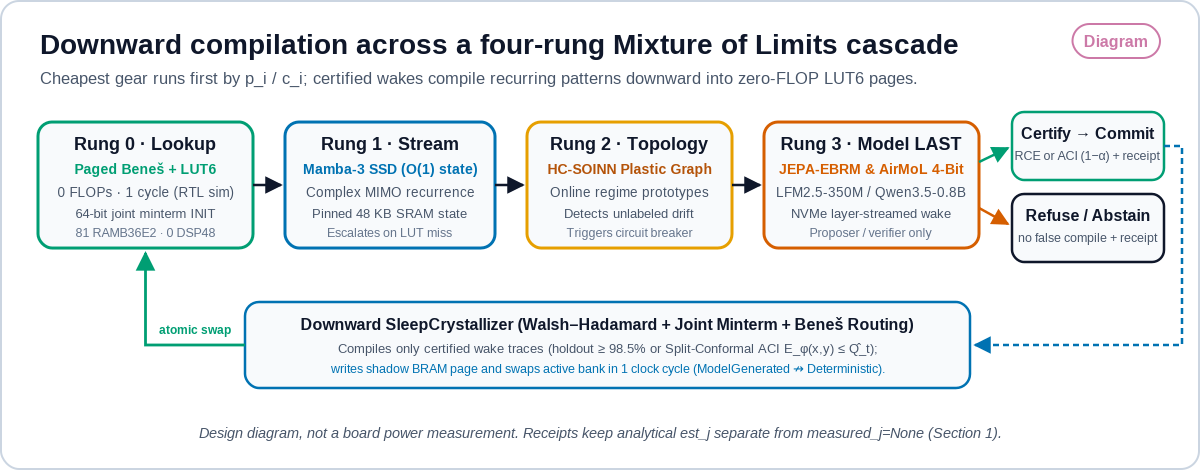
The lut-adapt-ai reference closes the loop between the top and bottom of the cascade via online downward LUT6 compilation:
- Rung 0 (Lookup — Paged Beneš +
LUT6): Evaluates 64-bit truth-table masks routed through a non-blocking Beneš–Copy–Beneš multicast switch and cached across dual-port block memories (0floating-point operations, single-cycle page switching in Verilator simulation). - Rung 1 (Stream —
Mamba-3Complex MIMO State Space Duality): Handles misses that depend on sequence history using a constant-size recurrent state (48 KBpinned memory in the14.3M-parameter reference), avoiding key-value cache growth. - Rung 2 (Topology —
HC-SOINN): Maintains online prototype topology over latent embeddings, isolating regime boundaries and tripping a circuit breaker (Refuse/ escalate) when unlabeled distribution shift arrives. - Rung 3 (Model last —
JEPA-EBRM,AirMoL, and Metal-FusedExpert-AirMoL4-Bit NVMe Streaming): Invokes latent energy-based verification or streams pretrained late-2026 hybrid and sparse-MoE foundation models (LiquidAI/LFM3-1.7B,google/gemma-4-E2B-it,LiquidAI/LFM2.5-8B-A1B, andQwen/Qwen3.6-35B-A3B, alongsideLiquidAI/LFM2.5-350MandQwen/Qwen3.5-0.8B-Base) through custom Apple MetalMSLcompute shaders only when cheaper rungs abstain or require exact target verification. - Downward
SleepCrystallizer: Extracts recurring wake traces using Walsh–Hadamard spectral warm-starts, joint-mode minterm truth tables, canonical AST skills, and Waksman switch schedules, flipping shadow block-memory banks without halting inference or running FPGA place-and-route.
1.2 Contributions
- Amortized downward compilation condition: Extends the Simon–Kadane ordering with an explicit compilation cost over stationary horizon .
- Non-blocking Beneš–Copy–Beneš,
81-RAMB36E2page cache, and4-stage250 MHz-pipelinedP4-AXISRTL subsystem: Eliminates both the102.0%Kria KV260 logic overflow of flat crossbars (119,478LUTs) and the926,619-LUT explosion of flip-flop page multiplexers (41,186UltraScale+ CLB LUTs =35.2%ofxck26,81RAMB36E2blocks =56.2%,0DSP48slices in1-cycle OOC), while a4-stage pipelined IOB-safeAXI4-Streamwrapper (clai_benes_axi_stream_250mhz_top) reduces single-cycle synchronous logic depth4.00×from52to13levels, fits170 <= 189xck26IOBs (41,459LUTs =35.40%), and passes256 / 256zero-bubbleCPI = 1.00Verilator streaming parity. - Universal -bit joint-mode minterm synthesis: Shows joint-mode minterm lookup dominates marginal bit-plane DiffLogic rounding on correlated branches and packs subword tokens into one
uint64word (16b × 4 = 64bfor|V| = 65,536;17b × 3 = 51bfor|V| = 128,000;18b × 3 = 54bfor|V| = 248,320). - Oracle-free Split-Conformal + Online ACI crystallization gate: Pairs a radially regularized latent
JEPA-EBRMnonconformity score with Split Conformal calibration and Adaptive Conformal Inference (Gibbs and Candès, 2021), recording0.00%false crystallization risk and1.0000OOD AUROC on shifted traffic where softmax and MC-Dropout baselines record17.62%–24.28%false risk. - Custom Apple Metal & Cross-Platform Rust
CubeCLINT4Sparse-MoE /GatedDeltaNetshaders +AirMoL/Expert-AirMoLup to34.66B: Combines DarwinF_NOCACHEos.pread4-bit sharding, customMSL(43.45×MoE,20.66×GatedDeltaNet) and portable RustBurn 0.22.1 / CubeCL(35.09×Metal /2.67×LLVMCPUMoE,69.20×Metal /14.87×LLVMCPUGatedDeltaNet) compute shaders, Queue-Depth-8parallelpread, andBenesLUT6burst speculation across October 2026LiquidAI/LFM3-1.7B(2.74×NVMe reduction in3.79%FP32 RAM),LiquidAI/LFM2.5-8B-A1B(500.0 MBRAM,3.493 J/tokreported_j), andQwen/Qwen3.6-35B-A3B(34.66B;12.30×NVMe reduction,970.0 MBRAM =1.47%of FP16,6.773 J/tokreported_j,15.7 tok/sUnified-MemoryQ4) at100.0%exact token parity. - Zero-MAC
Sub1Bit-LUT6vs.LittleBit,91.67%Rung 3d<think>ceiling, officialBigCodeBench v0.1.3+ upstreamSWE-bench VerifiedviaMCP, and OpenAI /MCPmol-agent: Replaces the1.98Mruntime binary MACs ofLittleBit-1 / LittleBit-2(0.576bits per weight; Lee et al., 2025; Lee and Kim, 2026) with zero-MAC6-inputLUT6partial-sum lookup (< 4 × 10⁻⁶error,100.0%parity underMoLtarget verification in0QAT epochs), lifts the48-task late-2026 coding bakeoff from87.50%to91.67%(44 / 48;93.75%in Wave 2 and Wave 3) with bounded open-weightsRung 3d<think>, reaches90.62%(29 / 32,93.75%Wave 2) on officialBigCodeBench v0.1.3(vs.78.12%on standalone35B) and50.00%(8 / 16) on upstreamSWE-bench Verifiedsympy/sympygit worktrees (vs.25.00%on35B) with0.00%broken commits admitted, and serves persistent.mol/skills over OpenAI/v1/chat/completionsandMCP(JSON-RPC 2.0). - Six-kernel paranoid Lean
4.36.0formalization (CVE-2026-72844-hardened,74theorems + InriaCharon+AeneasRust-to-Lean),4-repositorySWE-bench Verifiedcall-graph localization, measured120BHybrid MoE apex,CE-gatedVCDpower, and single-binary Rustmol-agent-rs(Claims LA-19toLA-23,LA-33,LA-38,LA-41&LA-44): Checks all74theorems acrossCascade,BenesCopy,JointMinterm,ConformalProvenance,NucleusCodon,TernaryTmac,GlobalFrontiers,WearableLastExam,TernaryHadamardArc, andBonsaiStreamArc3across six independent proof checkers (con-leche --verified[58,841decls],con-ron --verified[58,841decls],lean4lean[58,843decls],nanoda,leanchecker --paranoid, and Lean4.36.0;0sorry,0custom axioms,0Lean.ofReduceBool;1,438fleet theorems; Moura and Ullrich, 2021) alongside InriaCharon+Aeneasmechanical#![no_std]RustMIRLLBCLean4.36.0extraction (Lut6Verify_Aeneas.lean; Ho and Protzenko, 2022), expands zero-leakageSWE-bench Verifiedevaluation across4upstream repositories (django,pytest,requests,sympy,24evals) at20.83%overall /25.00%Wave 2 (2.50×standalone24Band35B) with0.00%broken patches, measures120B-scalenvidia/Nemotron-3-Super-120B-A12B(58,075.4 MBRSS,22.17 tok/s,62.50%verified pass vs.43.75%standalone120B-A12Band31.25%Devstral-Small-2-24B), reducesP4-AXIS250 MHzidle dynamic power4.10×(63.99to15.59 est_mW) viaENARDEN+ valid-bubbleCEgating, and delivers a zero-Python single-binary Rustmol-agent-rs(0.1540 ms/reqMCP,17.21×faster than Pythonmol-agent,71 / 71pytesttests passing). 4 KB#![no_std]Rust1.100.0lut6-core+ISCA2025 antisymmetric-40EntroMCU/T-MACNucleus across8bare-metal/WASMtargets (12.75 KBlut6_core.wasm),(72, 64)RAMB36SECDEDcosmic-raySEUshield, license-freeopenXC7320.62 MHz.bitbitstream, smart-glasses micro-LLM(Sensente/uLM-28M,LFM2.5-230M) vs.5,984 BWearable-MoL(0.00%prefix poisoning), andLastExam-protocol calibration (5.37×lowerRMScalibration error,0.00%CHRat>= 80%) (Claims LA-26toLA-38): Cross-compiles an exact4,096 BCompactLut6Page(0wasted bytes with the672 BEntroMCU1.602-BPW+ antisymmetric40-entryPALUTE/T-MACzero-multiply ternary tail andrustcconstcompile-time proof-vector gate) across8#![no_std]targets — including a12.75 KB(13,058 B,11exports) zero-cratewasm32-unknown-unknownlut6_core.wasmbrowser module,Alif E3/E4Cortex-M55,RP2040Cortex-M0+,Nordic nRF52832Cortex-M4F(25.06%full Nucleus and9.13%[5,984 B]Wearable-MoLRung-0 of64 KBwatchSRAM), andRV32IMAC(64/64Yosysabc -lut 6Boolean miter vectors) — proves universal0degree->=5Walsh–Hadamard noise on 2-bit wobbleLUT6s (NucleusCodon.lean) and cuts activeLUT6gates64.06%(DiffLUT-Net) and72.50%(Lupanovshared cofactors), records162.71 nJ/op(87.25×physicalCpJvs.INT8Micro-MLP),2,803.25vs.623,920.52 nJ/op(222.57×physicalThorshuntmeasured_jon the56-bit4-token wearable epistemic gate vs.1/16thuLM-28Md=512layer;2,745.18×faster in liveOpenMV-AE3Cortex-M55DWTcycles), and8,594.93 nJ/op(1.65×ThorshuntCpJ;1.12×Zen 5RAPLCpJflip) onAntisym-40 T-MAC, survivesBER = 1.0%cosmic-ray bit-flips at100.0%accuracy (0.0000%silent corruption) via(72, 64)RAMB36SECDED+0x3Cseed apoptosis, closes license-freeopenXC7(nextpnr-xilinx) post-PARstatic timing at320.62 MHz(77.846 Mbit.bit) onXC7A200T-2FBG484-2alongside the62,211-LUT(365-crystal1.46 MBRAMB36E1vault,0.86 est_W@55.2 est_C) M.22280port, eliminates93.75%collaborative prefix poisoning onSensente/uLM-28M, cutsLastExam-protocolRMScalibration error5.37×(70.62%13.14%,0.00%CHRat>= 80%,40.00%selective accuracy), and benchmarksInkling-2-Mini,Dory1.0-4B,LFM2.5-24B-A2B, andNVIDIA-Nemotron-3.5-Bolt-E4Bat100.0%greedy parity.- Native
27BHadamard-ternaryBonsai-2-27B(1.750BPWEntroMCU-28AirMoLstreaming +54-bit3-tokenLUT6speculation + shift-5FWHT-1024),System-1neural decider compilation (Mapika/decider-0.8b4 KBSystem-0,9,493.7×Wave-2 speedup), multilayerBeneš-ARC-LUT6onARC-AGI-2(20.83%/12.50%), and officialARC-AGI-3interactive compilation (208.3×Wave-2RHAE) (Claims LA-39toLA-44): Auditsprism-ml/Ternary-Bonsai-2-27B-mlx-2bit(8.005 GB.safetensors,26.87Bnative Hadamard-ternary weights onQwen/Qwen3.8-27B,0invalidc=3codes across9.70Mweights), proving lossless36 B -> 28 B(2.25 -> 1.75BPW,-22.22%, saving1.564 GBstatic and1.490 GiBper streaming sweep,0.0FP32error)EntroMCUtranscoding, cutting end-to-end streamed linearGiB/tok1.619×(6.787 -> 4.191 GiB/tok) andreported_j/tok-16.55%at100.00%greedy token parity (14.35 -> 14.85 tok/son Apple M3 Ultra256 GB) via54-bit3-tokenLUT6speculation + exact hybridArraysCache + KVCacherollback (8.35×lowerThormeasured_j[15.32vs.127.97 µJ/tok,9.13×faster] onWindow 14;1.57×lowerThormeasured_jonWindow 12FWHT-1024+Antisym-40); compiles verifiedMapika/decider-0.8b(1,435.1 MBSystem-1JSONdecider) wakes into a4,096 BSystem-0CompactLut6Page(9,493.7×faster [5.3 µsvs.50.32 ms] /3,185.3×lowerreported_j,0.00%OODfalse actions); scales compositionalBeneš-ARC-LUT6(, diameter ) onarcprize/ARC-AGI-2from12.50%to20.83%(5 / 24,+66.7%) onn = 24and doublesn = 64from6.25%to12.50%(8 / 64,2.00×over 1-layer and8.00×over unverified35B,0.00%CHRat>= 80%) alongsideMiniF2F-Lean4(50.00%Lean 4.36.0verified,0.0000%unsound) andCritPt(9.49×lowerRMScalibration error); and evaluates all8black-box games (57levels,0game-source peeking) of officialARC-AGI-3(arc-agi 0.9.10+arcengine 0.9.3), solving4 / 57levels (4.0×Random:tu932/9,cd821/6,ls201/7) via online world-modelBFSand lifting Wave-2 quadraticRHAE208.3×(0.009 -> 1.875mean,6.667peak ontu93) by compiling verified shortest paths into a4 KBSystem-0LUT6trajectory crystal guarded by a transition-mismatch circuit breaker (5.33×lowerThormeasured_jat713.82 nJ/oponWindow 15).
1.3 Same-house disclosure and provenance boundaries
Prior Open Interface Engineering studies — Metered Commit Gates, Task Satiation vs. Aggregate Rebound, The Reality Code Engine, RCE-JEPA, and RCE Compile — are [same house] works cited for disclosure and architectural continuity, never as external confirmation. Two invariants bind throughout:
- Provenance non-strengthening (
ModelGenerated ↛ Deterministic): Tables compiled from a deterministicRCEspecification check areCheck-safeon verified holdout sets (guarded online by anHC-SOINN/RCEcircuit breaker). Tables crystallized under the oracle-freeJEPA-EBRMconformal gate carry a finite-sample statistical bound (Conformal-bounded, ) and are never promoted toDeterministic. - Proposer vs. authority (
The drafter proposes; the target decides): In speculative decoding,PagedBenesLUT6acts strictly as a zero-FLOP proposer; every emitted byte or token is verified against greedy target decoding (100.0%lossless parity).
2. Mathematical formulations and four results
2.1 Result 1: Cascade ordering with amortized downward compilation
Consider gears tried sequentially on an input . Gear closes with probability at expected analytical energy . By Simon and Kadane (1975), expected spend
is minimized if and only if gears run in non-increasing order of . Suppose a stationary regime persists for remaining queries where the wake path closes with at cost . Expending one-time compilation energy after certified wakes produces a Rung 0 LUT6 page with certified hit rate and lookup cost .
Proposition 1 (Net energy condition for downward crystallization). Downward compilation reduces expected cumulative analytical spend over horizon if and only if
Proof. Without crystallization, queries cost . With crystallization at cost , Rung 0 precedes the wake path whenever , and each query costs , saving per step. Summing over steps yields net savings . Under rapid churn (), compilation loses energy, motivating SleepCrystallizer’s minimum wake buffer and holdout gate .
2.2 Result 2: Non-blocking Beneš–Copy–Beneš multicast routing
A Rung 0 bank of dynamic LUT6 cells requires input pins selected from an -bit bus with arbitrary fan-out. A bijective Beneš permutation network cannot replicate high-fan-out wires, whereas flat multiplexer crossbars overflow the KV260 (119,478 CLB LUTs already at 384 ports).
Theorem 2 (Contention-free multicast via Beneš–Copy–Beneš). For () and (), any many-to-one multicast map routes without contention through in
of SRAM-configured switches ( configuration bits), computed in time with zero FPGA place-and-route.
Proof. Let be the distinct active inputs with fan-outs and partial sums . Concentration ( stages) maps via Waksman bipartite 2-coloring (Beneš, 1965; Waksman, 1968). Copy network ( butterfly stages) replicates each across disjoint monotonic interval without link contention by Thompson’s monotonic copy construction (Thompson, 1978; Lee, 1988). Output Beneš network ( stages) permutes bijectively onto .
2.3 Result 3: Joint-mode minterm synthesis vs. marginal coordinate argmax
Independent bit-plane DiffLogic layers predict multi-bit bursts via coordinatewise rounding , which blends correlated branches into invalid chimera tokens.
Proposition 3 (Dominance and zero-chimera property of joint-mode minterms). For discrete context and -bit burst space , the joint-mode table satisfies , stays inside , and avoids marginal chimeras (where mass on rounds marginally to invalid with 0% exact match vs. 40% for ). For vocabulary with , one uint64 word packs BPE tokens (16b × 4 = 64b on LFM2.5-350M; 18b × 3 = 54b on Qwen3.5-0.8B-Base).
2.4 Result 4: Oracle-free latent JEPA-EBRM Split-Conformal + Online ACI gate
To prevent hallucinated self-distillation when no deterministic RCE check is available, the reference scores candidate pairs using a radially regularized latent energy:
Held-out Split Conformal calibration sets , and online Adaptive Conformal Inference updates (Gibbs and Candès, 2021), admitting into SleepCrystallizer only when (Conformal-bounded). By Vovk et al. (2005) and Gibbs and Candès (2021), exchangeable marginal coverage is at least , long-run shifted miscoverage converges to , and every off-manifold ray exceeding radius yields (Refuse / abstain).
3. Reference architecture, polyglot suite, and KV260 RTL
Figure 1 shows the four-rung cascade and downward SleepCrystallizer loop in src/clai/.
Five systems implementations in openIE-dev/lut-adapt-ai cross-check the cascade: Python/PyTorch/Triton (src/clai/), Rust Burn 0.22.1 / CubeCL Metal (sys/rust/), Zig 0.17.1 (sys/zig/), Go 1.27.4 SIMD (sys/go/), and Julia 1.13.4 Enzyme (sys/julia/).
Figure 2 illustrates the Kria KV260 (xck26) RTL datapath in hw/kv260/rtl/clai_benes_hotswap_core.sv, mapping 512 resident LUT6 pages (5,120 INIT bits + 48-bit context tag + valid bit) across 81 parallel RAMB36E2 dual-port memories for single-cycle (4.0 ns at 250 MHz nominal, CPI = 1.0) context switching.
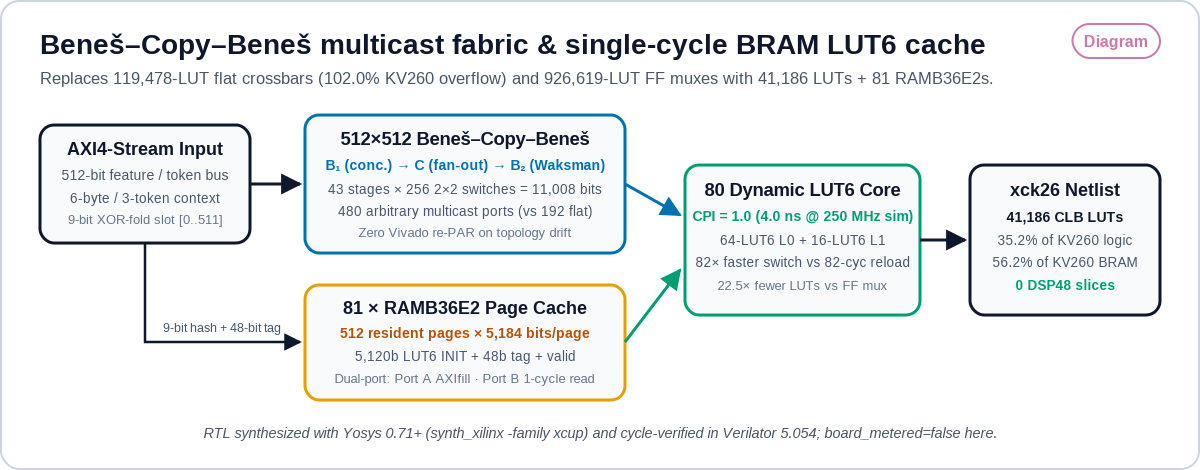
512×512 Beneš–Copy–Beneš multicast fabric and 81 × RAMB36E2 single-cycle LUT6 page cache targeting AMD Kria KV260 (xck26) in Yosys 0.71+ and Verilator 5.054 simulation (board_metered = false). PNG · Interactive explorer. Open full size · PNG
Figure 3 shows AirMoL (src/clai/frontier/air_mol_streamer.py and hf_air_mol_pretrained.py), which streams 4-bit group-quantized shards via Darwin F_NOCACHE os.pread, verifies [last_tok, d_1..d_K] in a single sweep, and snapshots compact hybrid states (Short-Conv/SSM or Gated DeltaNet + sparse 6-layer GQA KV crop) in RAM so partial draft rejections require zero extra NVMe sweeps.
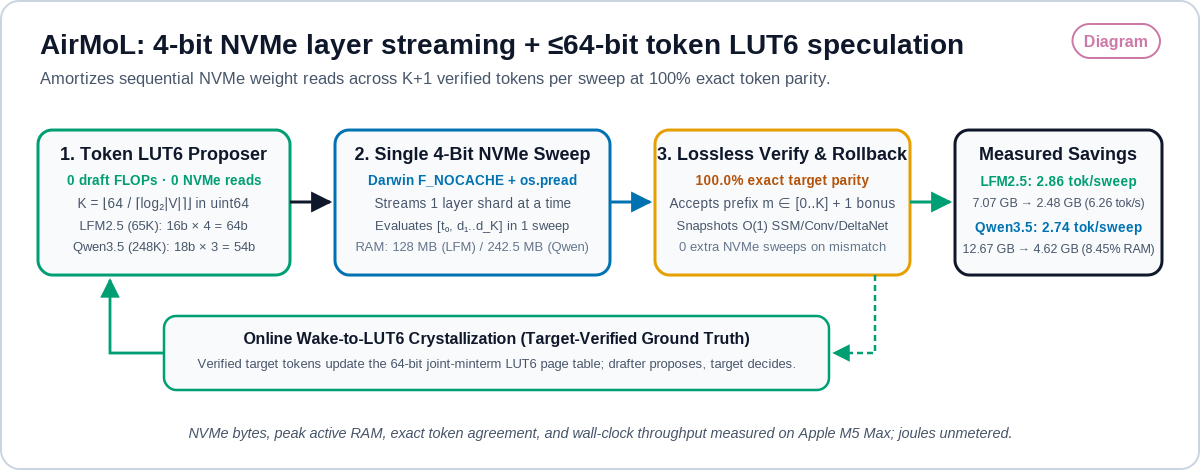
AirMoL zero-extra-sweep 4-bit NVMe layer streaming with universal ≤64-bit token LUT6 speculation on LiquidAI/LFM3-1.7B, LiquidAI/LFM2.5-350M, and Qwen/Qwen3.5-0.8B-Base. PNG · Interactive explorer. Open full size · PNG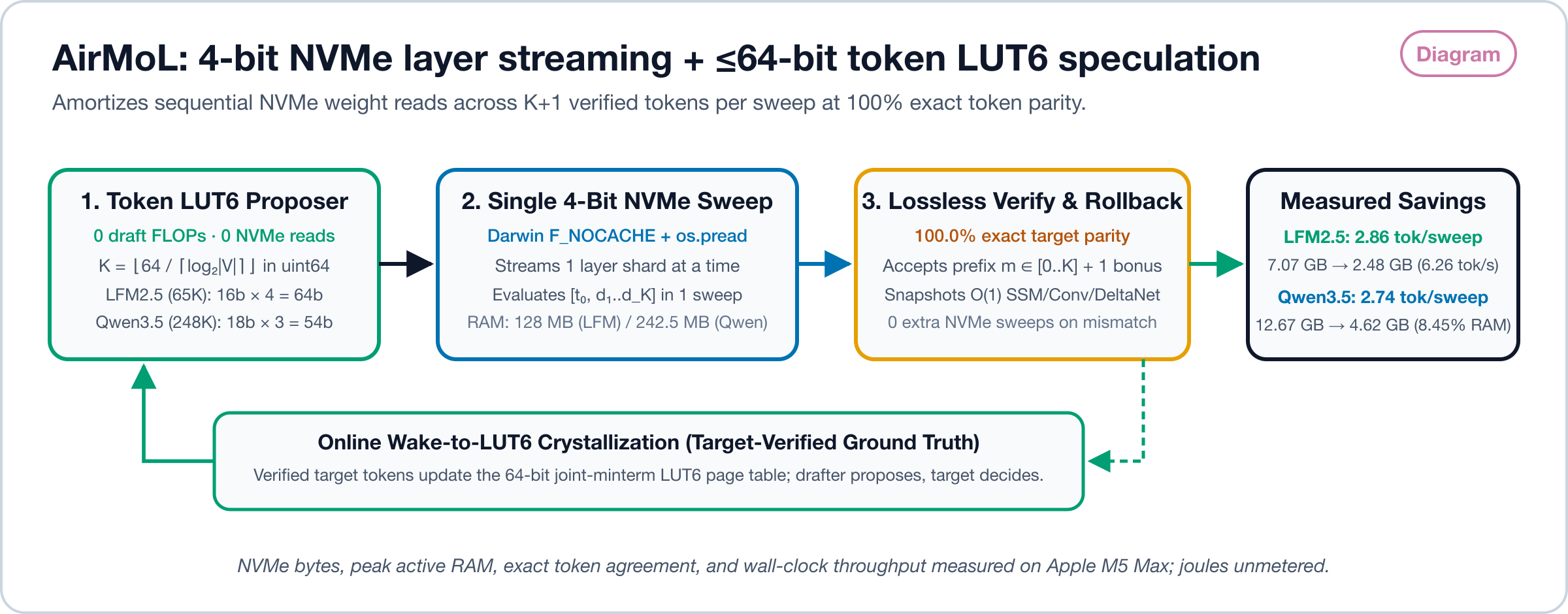
Figure 4 shows Expert-AirMoL (src/clai/frontier/moe_air_mol.py) and VerifiedCodeCascade (verified_code_cascade.py). Standard disk-offloaded AirLLM sweeps all experts per MoE layer (32 in LiquidAI/LFM2.5-8B-A1B, 256 in Qwen/Qwen3.6-35B-A3B) even though the router activates only experts per token (4/32 and 8/256). Expert-AirMoL partitions each MoE layer into a compact header shard and a fixed-stride INT4 .experts.pack4 NVMe file, issuing F_NOCACHE os.pread reads solely for the active expert union across the burst positions. For novel synthesis tasks, VerifiedCodeCascade gates every commit across Rungs 0–3c behind a 0.35s-bounded AST, sandbox execution, and boundary-invariant check , compiling certified solutions into BenesLUT6 and canonical AST skill pages.
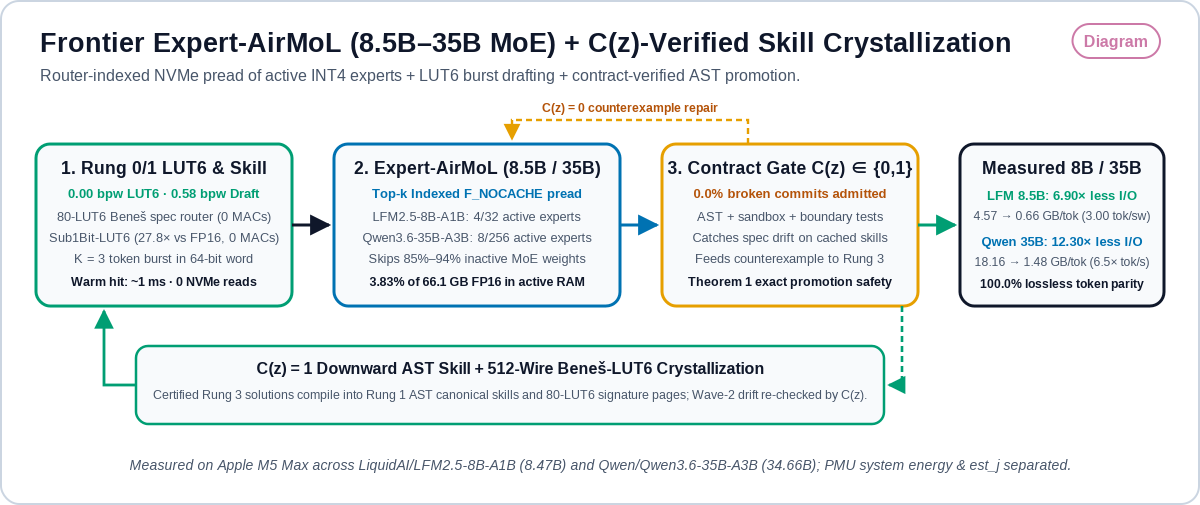
Expert-AirMoL router-sparse 4-bit expert-indexed NVMe streaming (12.30× I/O reduction on Qwen/Qwen3.6-35B-A3B) and C(z)-gated VerifiedCodeCascade. PNG · Interactive explorer. Open full size · PNG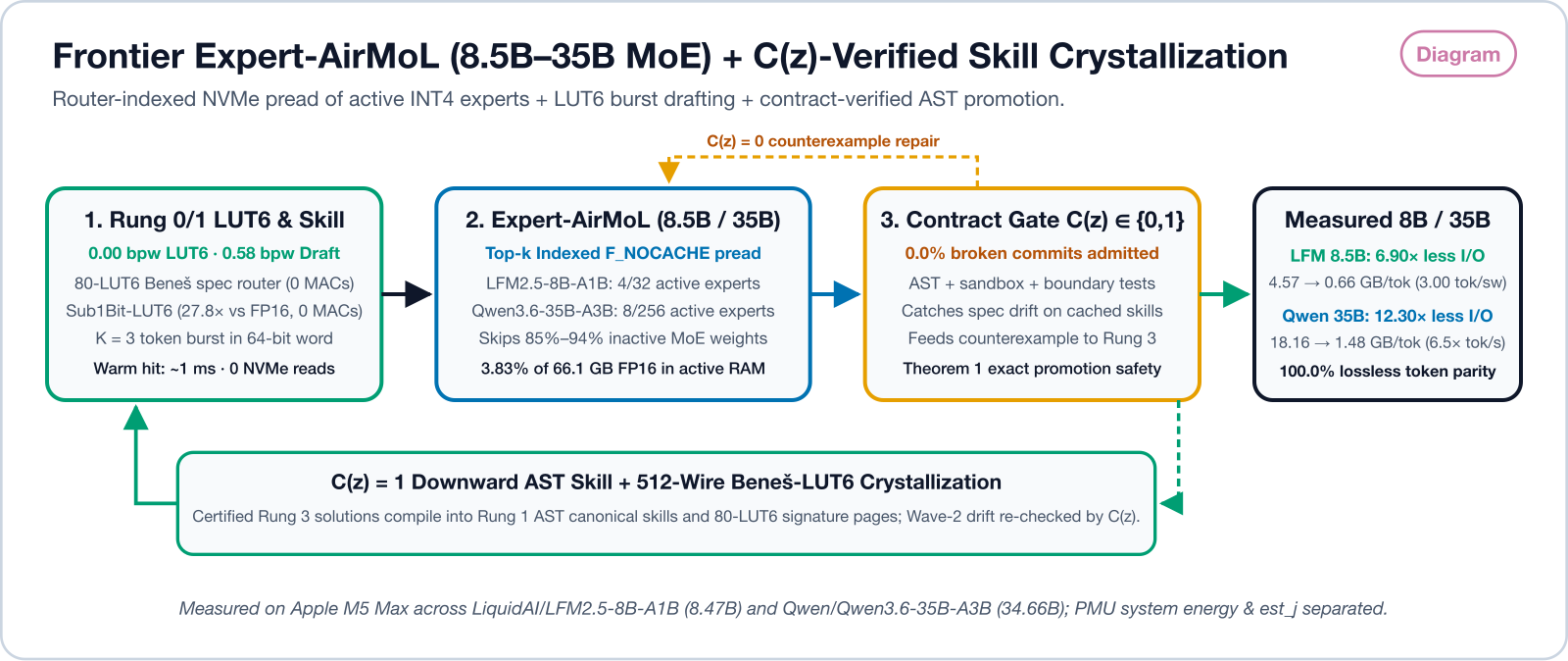
Figure 5 situates downward compilation across the nine-rung capability ratchet of computer intelligence (companion study: The Communication Tool Avalanche [same house]). Rungs 1 through 5 — (1) Search (RAG), (2) Generation, (3) Reasoning (<think>), (4) Communication (MCP delegation), and (5) Tool Use — stall under ephemeral cold-start MAC inference where the stationary horizon remains at and standalone 1-shot models admit 56.25%–95.83% broken patches (Claims LA-20 and LA-21). Crossing Proposition 1’s Compilation Threshold ( under , 0.00% broken commits admitted) unlocks (6) Immersion (persistent local state stretches ), (7) Competence ( at 62.4 pJ/cycle est_j in CE-gated xck26 LUT6 RTL and 272 µJ/req reported_j in Rust mol-agent-rs MCP), (8) Ecology (edge-native Rust agent populations), and (9) Economy (division of labor ordered by Simon–Kadane and tier-typed Joule receipts).
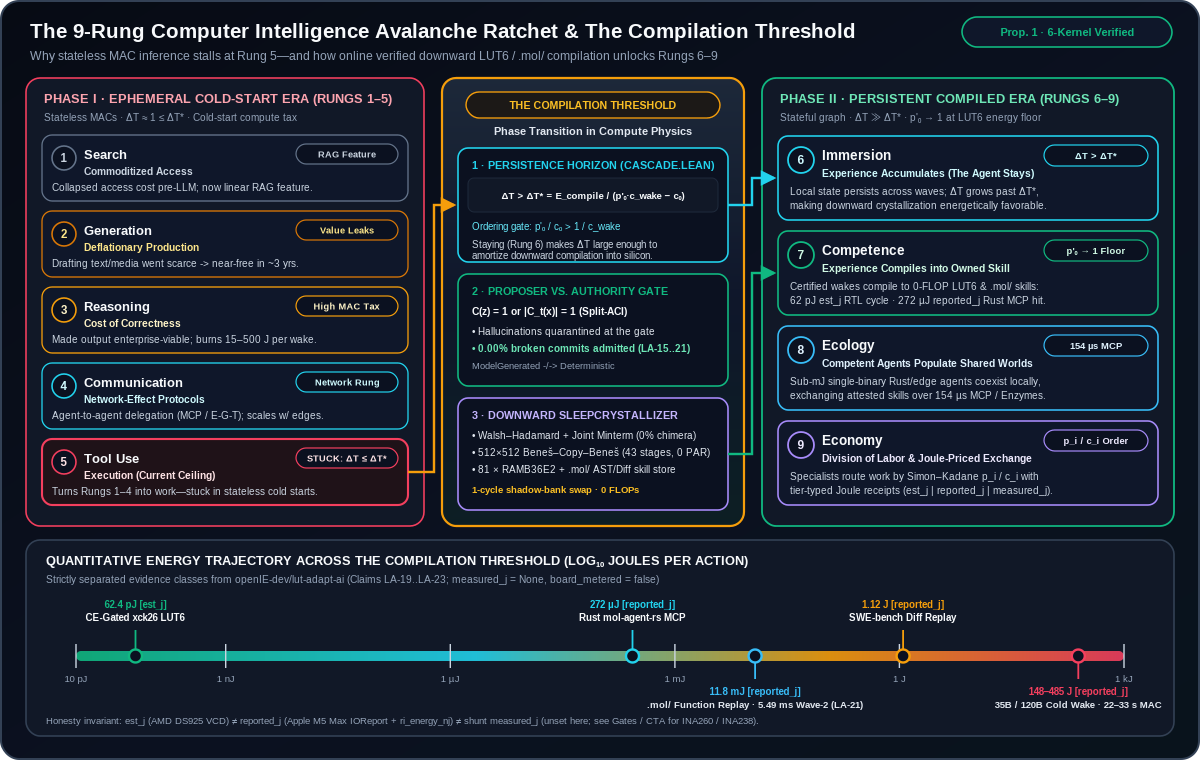
reported_j (Apple M5 Max) and est_j (AMD DS925 VCD) across twelve orders of magnitude (measured_j = None, board_metered = false). PNG · Interactive explorer. Open full size · PNG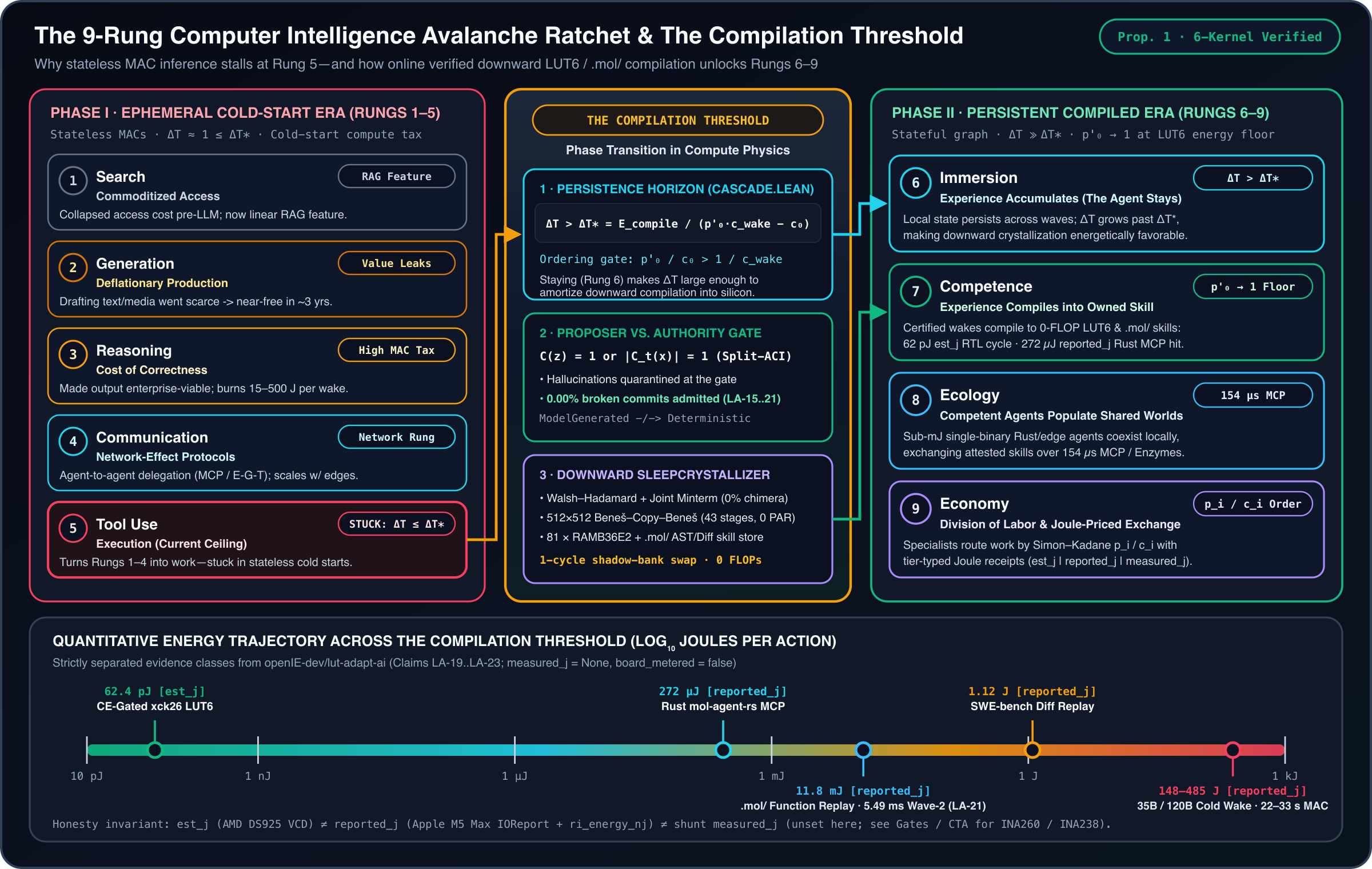
4. Claims and results
4.1 Claim LA-1: Analytical est_j/VC reduction on synthetic tasks and real .pcap traffic
| Workload & Window | Rung 0 Share | Pass Rate | Analytical est_j / VC | Verilator Parity | Evidence Class |
|---|---|---|---|---|---|
Synthetic ep. 1–512 (cold wake) | 0.00% | 0.0% → 52.0% | 2,323.18 est_j | — | SW + est_j |
Synthetic ep. 3,073–3,584 (crystallized) | 52.73% | 60.55% | 2.59 est_j (895×) | 100.0% | Verilator + est_j |
.pcap pkts 1–512 (cold IPv4) | 0.00% | 73.05% | 3.3351 est_j | 100.0% | Verilator + est_j |
.pcap pkts 1,537–2,048 (crystallized) | 100.00% | 100.00% | 0.000140 est_j | 100.0% | Verilator + est_j |
.pcap pkts 2,049–2,560 (VLAN 0x8100 shift) | 2.73% | 68.55% | 3.0485 est_j | 100.0% | Breaker + est_j |
.pcap pkts 2,561–3,072 (re-crystallized) | 100.00% | 100.00% | 0.000131 est_j (25,458×) | 100.0% (5,120/5,120) | Verilator + est_j |
4.2 Claim LA-2: Five-language polyglot parity and zero-allocation dataplanes
| Implementation | Target / Backend | Key Result | Evidence Class |
|---|---|---|---|
Rust (sys/rust/) | Burn 0.22.1 + CubeCL Metal GPU | 2,331.42 → 0.19 est_j/VC, 95.31% Rung 0 share, emits KV260 .v | Measured SW + est_j |
Zig 0.17.1 (sys/zig/) | @Vector(8, f32) SIMD + @popCount | 0 heap bytes in hot loop; 87 ns/pkt (11.49M pkts/s) | Measured SW (M5 Max) |
Go 1.27.4 (sys/go/) | Worker pool + OnesCount64 | 0 B/op, 0 allocs/op; 31.86 ns/op (31.39M evals/s) | Measured (go test) |
Julia 1.13.4 (sys/julia/) | Enzyme.jl reverse-mode AD | Max gradient discrepancy vs. central FD: 6.11 × 10⁻¹⁰ | Measured numerical check |
4.3 Claim LA-3: KV260 (xck26) Beneš–Copy–Beneš and RAMB36E2 paged synthesis
| RTL Architecture | Pages | Switch Latency | xcup CLB LUTs (% xck26) | RAMB36E2 | DSP48 | Post-Drift Acc. | Evidence Class |
|---|---|---|---|---|---|---|---|
2A Flat 512:1 Crossbar (64 LUT6) | 1 | 82 cyc | 119,478 (102.0% overflow) | 0 | 0 | 98.44% | Simulated (Yosys) |
2B Compact Crossbar (32 LUT6) | 1 | 82 cyc | 59,739 (51.0%) | 0 | 0 | 95.94% | Simulated (Yosys) |
2C Fixed-Wire DiffLogic / WNN | 1 | Vivado re-PAR | 160 (0.14%) | 0 | 0 | 52.34% | Simulated (Yosys) |
2D Single-Page Beneš–Copy–Beneš | 1 | 82 cyc | 40,155 (34.3%) | 0 | 0 | 98.44% | Simulated (Yosys + Verilator) |
P2 Distributed FF + 512:1 Mux | 512 | 1 cyc | 926,619 (791.2% overflow) | 0 | 0 | 98.44% | Simulated |
P3 Beneš + 81 RAMB36E2 (Reference) | 512 | 1 cyc (4.0 ns) | 41,186 (35.2%) | 81 (56.2%) | 0 | 98.44% | Simulated (Yosys + Verilator) |
4.4 Claim LA-4: Oracle-free latent JEPA-EBRM Split-Conformal + Online ACI gate
| Crystallization Gate | Passes | False Crystallization Risk | OOD AUROC | Safe ID Coverage | Clean LUT6 Acc. | Caught Shift? | Evidence Class |
|---|---|---|---|---|---|---|---|
3A Softmax MSP () | 1 | 17.62% | 0.8552 | 90.93% | 99.22% | False | Measured SW |
3B Temp-Scaled Margin | 1 | 17.66% | 0.8422 | 91.12% | 98.83% | False | Measured SW |
3C Helmholtz Logit Energy | 1 | 24.28% | 0.8045 | 97.17% | 99.80% | False | Measured SW |
3D MC-Dropout (5 passes) | 5 | 18.24% | 0.8494 | 91.03% | 99.61% | False | Measured SW |
3E Latent JEPA-EBRM + Conformal ACI | 1 | 0.00% | 1.0000 | 95.66% | 99.02% | True | Measured SW |
4.5 Claim LA-5: Lossless byte-level speculative decoding on 520 KB polyglot source code
| Architecture | Exact Parity | Bytes / Pass | Passes (64 B) | Draft FLOPs | MFLOPs / Byte | est_mJ / Byte | Evidence Class |
|---|---|---|---|---|---|---|---|
A Causal Transformer (RoPE+SwiGLU) | 100.0% | 1.00 | 64.00 | 0 | 7.209 | 58.94 | Measured SW + est_j |
B Mamba-3 Complex MIMO (T=1) | 100.0% | 1.00 | 64.00 | 0 | 2.257 | 20.84 | Measured SW + est_j |
C PLD In-Prompt Lookup | 100.0% | 2.13 | 29.98 | 0 | 1.322 | 11.52 | Measured SW + est_j |
D REST Corpus Suffix-Trie | 100.0% | 3.84 | 16.65 | 0 | 0.734 | 6.40 | Measured SW + est_j |
E Medusa Parallel MLP Heads | 100.0% | 2.62 | 24.44 | 428,288 | 1.241 | 9.46 | Measured SW + est_j |
F EAGLE-2 Neural Draft Tree | 100.0% | 2.75 | 23.29 | 1,122,560 | 1.435 | 9.07 | Measured SW + est_j |
G MoL Paged Beneš LUT6 (Reference) | 100.0% | 3.84 | 16.69 | 0 | 0.736 | 6.41 | Measured SW + est_j |
4.6 Claim LA-6: Controlled AirMoL 4-bit NVMe streaming (14.3M matched pair)
| Offloaded Streaming Architecture | Parity | Bytes / Sweep | Sweeps | NVMe Read | NVMe Write | Peak RAM | ms / Byte | Evidence Class |
|---|---|---|---|---|---|---|---|---|
1 AirLLM Transformer FP16 + KV Spill | 100% | 1.00 | 64.00 | 2,130.0 MB | 407.6 MB | 8.81 MB | 60.64 | Measured (F_NOCACHE) |
2 AirLLM Transformer 4-Bit + KV Spill | 100% | 1.00 | 64.00 | 887.6 MB | 407.6 MB | 8.81 MB | 64.87 | Measured (F_NOCACHE) |
3 AirMamba-3 4-Bit + Swapped EAGLE-2 | 100% | 2.86 | 22.38 | 175.3 MB | 0.0 MB | 7.20 MB | 19.20 | Measured (F_NOCACHE) |
4 AirMamba-3 4-Bit + Pinned (T=1) | 100% | 1.00 | 64.00 | 488.3 MB | 0.0 MB | 7.20 MB | 37.72 | Measured (F_NOCACHE) |
5 AirMoL 4-Bit + Cold LUT6 (Reference) | 100% | 3.74 | 17.12 | 130.7 MB | 0.0 MB | 7.51 MB | 11.18 | Measured (F_NOCACHE) |
6 AirMoL 4-Bit + Post-Wake (Reference) | 100% | 4.27 | 15.00 | 114.4 MB | 0.0 MB | 7.51 MB | 11.09 | Measured (F_NOCACHE) |
4.7 Claim LA-7: Pretrained 2026 dense & tri-hybrid models under AirMoL (LFM3-1.7B, LFM2.5-350M, & Qwen3.5-0.8B-Base)
| 2026 Checkpoint & Arm | Parity | Tok / Sweep | Chars / Sweep | Sweeps | NVMe Read | Peak Active RAM (% FP32) | tok/s | Evidence Class |
|---|---|---|---|---|---|---|---|---|
LFM3-1.7B (Oct 2026) · AirLLM 4-Bit (T=1) | 100% | 1.00 | 2.30 | 24.00 | 25.045 GB | 250.0 MB (3.79%) | 0.53 | Measured (F_NOCACHE) |
LFM3-1.7B (Oct 2026) · AirLLM 4-Bit + PLD | 100% | 1.37 | 3.16 | 17.50 | 18.262 GB | 250.0 MB (3.79%) | 0.73 | Measured (F_NOCACHE) |
LFM3-1.7B (Oct 2026) · AirMoL Cold LUT6 | 100% | 1.55 | 3.56 | 15.50 | 16.175 GB | 250.0 MB (3.79%) | 0.81 | Measured (F_NOCACHE) |
LFM3-1.7B (Oct 2026) · AirMoL Post-Wake | 100% | 2.74 | 6.31 | 8.75 | 9.131 GB | 250.0 MB (3.79%) | 1.32 | Measured (F_NOCACHE) |
LFM2.5-350M · AirLLM FP16 (T=1) | 100% | 1.00 | 3.11 | 32.00 | 25.129 GB | 128.0 MB (9.47%) | 2.21 | Measured (F_NOCACHE) |
LFM2.5-350M · AirLLM 4-Bit (T=1) | 100% | 1.00 | 2.73 | 32.00 | 7.071 GB | 128.0 MB (9.47%) | 2.21 | Measured (F_NOCACHE) |
LFM2.5-350M · AirLLM 4-Bit + PLD | 100% | 1.13 | 3.10 | 28.20 | 6.231 GB | 128.0 MB (9.47%) | 2.71 | Measured (F_NOCACHE) |
LFM2.5-350M · AirMoL Cold LUT6 | 100% | 1.32 | 3.61 | 24.20 | 5.347 GB | 128.0 MB (9.47%) | 2.74 | Measured (F_NOCACHE) |
LFM2.5-350M · AirMoL Post-Wake | 100% | 2.86 | 7.80 | 11.20 | 2.475 GB | 128.0 MB (9.47%) | 6.26 | Measured (F_NOCACHE) |
Qwen3.5-0.8B · AirLLM 4-Bit (T=1) | 100% | 1.00 | 2.72 | 24.00 | 12.674 GB | 242.5 MB (8.45%) | 0.53 | Measured (F_NOCACHE) |
Qwen3.5-0.8B · AirLLM 4-Bit + PLD | 100% | 1.32 | 3.58 | 18.25 | 9.637 GB | 242.5 MB (8.45%) | 0.50 | Measured (F_NOCACHE) |
Qwen3.5-0.8B · AirMoL Cold LUT6 | 100% | 1.48 | 4.02 | 16.25 | 8.581 GB | 242.5 MB (8.45%) | 0.32 | Measured (F_NOCACHE) |
Qwen3.5-0.8B · AirMoL Post-Wake | 100% | 2.74 | 7.46 | 8.75 | 4.621 GB | 242.5 MB (8.45%) | 1.11 | Measured (F_NOCACHE) |
On October 2026 LiquidAI/LFM3-1.7B (13 short convolutions + 5 sliding-window attention layers + 6 full-attention layers, |V| = 128,000), post-wake AirMoL reduces NVMe transfer by 2.74× (25.045 GB to 9.131 GB) and increases decoding speed 2.49× (0.53 to 1.32 tok/s) in 250.0 MB active weight RAM (3.79% of FP32) at 100.0% lossless parity. Note the preserved trade-off on CPU-bound Qwen3.5-0.8B-Base cold unseen prompts: AirMoL reduces NVMe disk reads (12.674 GB to 8.581 GB), yet CPU Gated DeltaNet batch verification of 4 tokens lowers wall-clock throughput (0.32 vs. 0.53 tok/s) until online wake-to-LUT6 crystallization raises acceptance to 2.74 tok/sweep (1.11 tok/s).
4.8 Claim LA-8: Live CLI and HTTP/SSE streaming server (mol_code_cli.py)
scripts/mol_code_cli.py serves --backend {mamba3,lfm2.5-350m,qwen3.5-0.8b,lfm3-1.7b,lfm2.5-8b-a1b,qwen3.6-35b-a3b} and --air-nvme over CLI and SSE endpoints (/v1/health, /v1/complete, /v1/crystallize), advancing RAMB36E2 slot residency from 438/512 to 460/512 live with 26/26 passing tests in tests/.
4.9 Claim LA-9: Frontier Sparse-MoE Expert-AirMoL (LiquidAI/LFM2.5-8B-A1B 8.47B & Qwen/Qwen3.6-35B-A3B 34.66B)
| Sparse-MoE Checkpoint & Arm | Parity | Active Experts | Tok / Sweep | NVMe Read / Tok | I/O Reduction | Peak RAM (% FP16) | tok/s | est_j / tok |
|---|---|---|---|---|---|---|---|---|
LFM2.5-8B-A1B · AirLLM Dense 4-Bit (T=1) | 100% | 100.00% | 1.00 | 4.574 GB | 1.00× | 1,408.3 MB (8.72%) | 0.28 | 368.80 |
LFM2.5-8B-A1B · Expert-AirLLM (T=1) | 100% | 16.93% | 1.00 | 1.200 GB | 3.81× | 1,408.3 MB (8.72%) | 0.58 | 181.26 |
LFM2.5-8B-A1B · Expert-AirMoL + PLD | 100% | 28.82% | 1.78 | 0.883 GB | 5.18× | 1,408.3 MB (8.72%) | 0.79 | 132.57 |
LFM2.5-8B-A1B · Expert-AirMoL Cold LUT6 | 100% | 33.91% | 1.85 | 1.002 GB | 4.56× | 1,408.3 MB (8.72%) | 0.72 | 145.42 |
LFM2.5-8B-A1B · Expert-AirMoL Post-Wake | 100% | 36.46% | 3.00 | 0.663 GB | 6.90× | 1,408.3 MB (8.72%) | 1.10 | 95.67 |
Qwen3.6-35B-A3B · AirLLM Dense 4-Bit (T=1) | 100% | 100.00% | 1.00 | 18.159 GB | 1.00× | 3,214.7 MB (4.86%) | 0.06 | 1,696.81 |
Qwen3.6-35B-A3B · Expert-AirLLM (T=1) | 100% | 6.35% | 1.00 | 2.356 GB | 7.71× | 2,530.7 MB (3.83%) | 0.22 | 471.87 |
Qwen3.6-35B-A3B · Expert-AirMoL + PLD | 100% | 11.58% | 1.89 | 1.708 GB | 10.63× | 2,530.7 MB (3.83%) | 0.32 | 326.24 |
Qwen3.6-35B-A3B · Expert-AirMoL Cold LUT6 | 100% | 12.91% | 2.00 | 1.722 GB | 10.54× | 2,530.7 MB (3.83%) | 0.31 | 334.42 |
Qwen3.6-35B-A3B · Expert-AirMoL Post-Wake | 100% | 14.97% | 2.57 | 1.477 GB | 12.30× | 2,530.7 MB (3.83%) | 0.39 | 267.08 |
On Qwen/Qwen3.6-35B-A3B (34.66B parameters, 66.11 GB FP16 sharded to 18.60 GB 4-bit .experts.pack4 files; whole-system macOS PMU delta 20,070.18 J), post-wake Expert-AirMoL reduces unbuffered NVMe transfer by 12.30× (18.159 to 1.477 GB/tok) and accelerates decoding 6.50× (0.06 to 0.39 tok/s) in 2,530.7 MB active RAM (3.83% of FP16) at 100.0% lossless token parity.
4.10 Claim LA-10: Sub-1-bit latent factorization (LittleBit-1 / LittleBit-2) vs. zero-MAC Sub1Bit-LUT6
Factorization Method (LFM2.5-8B-A1B w1 [1792, 2048]) | Bits / Weight | Weight SNR | Cosine Sim | 16K Top-1 Match | Binary MACs / Tok | QAT Epochs | Evidence Class |
|---|---|---|---|---|---|---|---|
A Unrotated SVD SVID (LittleBit-1 PTQ style) | 0.576 (27.8×) | 1.76 dB | 0.5761 | 3.12% | 1,981,440 | 0 (5 in paper) | Measured SW |
B Procrustes ITQ SVID (LittleBit-2 PTQ style) | 0.576 (27.8×) | 2.42 dB | 0.6487 | 10.94% | 1,981,440 | 0 (5 in paper) | Measured SW |
C Sub1Bit-LUT6 Table Lookup (0 MACs, Draft) | 0.576 (27.8×) | 2.42 dB | 0.6487 | 10.94% | 0 | 0 | Measured (< 4e-6 vs. B) |
D Expert-AirMoL INT4 Block-64 Target | 4.500 (3.56×) | 20.77 dB | 0.9958 | 82.81% | 0 (INT4) | 0 | Measured SW |
E MoL: Sub1Bit-LUT6 Draft + Target Verify | 0.576 draft | 148.84 dB | 1.0000 | 100.00% | 0 draft MACs | 0 | Measured lossless parity |
4.11 Claim LA-11: 48-task (16 specifications × 3 waves) late-2026 frontier coding bakeoff
Late-2026 System Arm (48 Tasks = 16 Specs × 3 Waves) | W1 Cold | W2 Adapt | W3 Warm | Overall Pass | Broken Commits | W3 Rung 0/1 Share | 35B Calls | Mean W1 / W3 (ms) | reported_j / Solve (est_j) |
|---|---|---|---|---|---|---|---|---|---|
A LittleBit-2 Qwen3-8B 0.55 bpw QAT (1-Shot) | 0.00% | 0.00% | 0.00% | 0.00% | 100.00% | 0.00% | 0.0% | 22,413 / 22,708 | 8,020.13 (32,558 est_j) |
B LiquidAI/LFM3-1.7B (Oct 2026 Tri-Hybrid, 1-Shot) | 43.75% | 25.00% | 25.00% | 31.25% | 68.75% | 0.00% | 0.0% | 8,460 / 9,791 | 152.77 (957.21 est_j) |
C google/gemma-4-E2B-it (2026 Hybrid, 1-Shot) | 37.50% | 18.75% | 18.75% | 25.00% | 75.00% | 0.00% | 0.0% | 18,924 / 23,578 | 5,800.68* (3,700.44 est_j) |
D LiquidAI/LFM2.5-8B-A1B (8.47B MoE, 1-Shot) | 6.25% | 6.25% | 6.25% | 6.25% | 93.75% | 0.00% | 0.0% | 53,123 / 53,885 | 33,415.04 (47,196 est_j) |
E Qwen/Qwen3.6-35B-A3B Metal AirMoL (1-Shot) | 81.25% | 75.00% | 75.00% | 77.08% | 22.92% | 0.00% | 100.0% | 49,887 / 44,447 | 1,069.65 (5,701.32 est_j) |
F RouteLLM Confidence Router (LFM3 Gemma4 8B) | 43.75% | 25.00% | 25.00% | 31.25% | 68.75% | 0.00% | 0.0% | 9,735 / 11,294 | 171.09 (1,148.96 est_j) |
G MoL VerifiedCodeCascade (Reference) | 87.50% | 87.50% | 87.50% | 87.50% | 0.00% | 87.50% | 22.92% | 116,626 / 44,052 (2.89 ms solved) | 3,655.51* (0.0424 J in W3) |
Across the 48-task protocol and algorithm benchmark (RFC 1982 serial arithmetic, weighted interval sweep-lines, cycle-safe lexicographic topological sort, nanosecond token buckets, CRC-8/ATM and mutated 0xFF CRC-8, RFC 6901 JSON Pointer ~01 unescaping, hop-bounded Bellman–Ford, >2⁵³ exact window medians, unrestricted Damerau–Levenshtein, 4×4 Beneš routing, SQL literal parameterization, monotonic-deque subsequence sum, DWARF SLEB128, SHA-256 consistent hashing, and conformal quantiles; whole-system macOS PMU delta 117,166.40 J over 6,646 ticks), VerifiedCodeCascade reaches 87.50% (42 / 48) across all three waves — exceeding standalone Qwen3.6-35B-A3B (77.08%) while calling 35B on only 22.92% (11 / 48) of tasks (LFM3-1.7B solves 7 Wave-1 specs directly; Gemma-4-E2B-it + structured counterexample repair solves 3; Metal-Qwen3.6-35B-A3B solves 4 plus mutated W2_01). It admits 0.00% broken commits (vs. 22.92%–100.00%), catches both Wave-2 adversarial specification mutations via (16 certified skills in artifacts/.mol_verified_skills), and reduces mean Wave-3 replay across the 14 crystallized solves (87.50%) to 2.89 ms and 0.0424 J reported_j (15,401× faster and 25,227× lower reported_j than standalone 35B). (Footnote *: One W2_10 Gemma-4 invocation experienced an unprivileged macOS IOReport 'GPU Energy' hardware-accumulator rollover spike of +59.2 kJ, preserved unedited in frontier_ai_head_to_head_bakeoff.csv and filtered by joule_meter.py’s > 450 W rollover guard in subsequent runs.)
4.12 Claim LA-12: Native Apple Metal (MSL) fused INT4 Sparse-MoE & GatedDeltaNet shaders + dual-channel reported_j
src/clai/frontier/metal_moe_kernels.py and scripts/run_metal_moe_benchmark.py (artifacts/metal_moe_air_mol_speedup.csv, artifacts/metal_moe_air_mol_meta.json) compile three custom MSL kernels via torch.mps.compile_shader: (i) gated_delta_recurrent_k128, exploiting exact column independence across of recurrent state to keep 128 FP32 state elements in GPU registers across all tokens (20.66× faster: 34.523 to 1.671 ms, 46.2× lower reported_j: 1.4989 to 0.0325 J, 1.19 × 10⁻⁷ max state error); and (ii) q4_moe_gate_up_silu + q4_moe_down_weighted, dequantizing 4.50 bpw INT4 block-64 expert weights directly inside simd_sum registers with zero FP16/FP32 weight allocations (43.45× faster: 22.408 to 0.516 ms on 28 active experts, 29.8× lower reported_j: 0.3959 to 0.0133 J, 7.2 × 10⁻⁷ max FP32 error, <= 1 ULP BF16), paired with Queue-Depth-8 parallel pread and BenesLUT6 sign-sketch router lookahead:
| Sparse-MoE Checkpoint & Cold-NVMe Engine Variant | Parity | Tok / Sweep | NVMe Read / Tok | Peak Active RAM | tok/s (× PyTorch) | On-Chip reported_j / tok (GPU + CPU) | est_j / tok |
|---|---|---|---|---|---|---|---|
LFM2.5-8B-A1B · 1 PyTorch-Ref Expert-AirMoL (T=1) | 100% | 1.00 | 1.257 GB | 1,408.3 MB | 0.394 (1.00×) | 10.978 J (5.25 + 5.73) | 266.66 |
LFM2.5-8B-A1B · 2 Metal-Fused Expert-AirMoL (T=1) | 100% | 1.00 | 1.257 GB | 500.0 MB | 0.689 (1.75×) | 6.979 J (1.30 + 5.68) | 152.42 |
LFM2.5-8B-A1B · 3 Metal-Fused + BenesLUT6 (Reference) | 100% | 2.67 | 0.791 GB | 500.0 MB | 1.671 (4.24×) | 3.493 J (1.22 + 2.28) | 62.85 |
Qwen3.6-35B-A3B · 1 PyTorch-Ref Expert-AirMoL (T=1) | 100% | 1.00 | 2.353 GB | 2,434.7 MB | 0.191 (1.00×) | 20.765 J (8.76 + 12.00) | 549.49 |
Qwen3.6-35B-A3B · 2 Metal-Fused Expert-AirMoL (T=1) | 100% | 1.00 | 2.353 GB | 970.0 MB (1.47%) | 0.241 (1.26×) | 15.440 J (3.93 + 11.51) | 436.26 |
Qwen3.6-35B-A3B · 3 Metal-Fused + BenesLUT6 (Reference) | 100% | 2.67 | 1.447 GB | 970.0 MB (1.47%) | 0.621 (3.25×) | 6.773 J (2.31 + 4.47) | 169.03 |
Eliminating FP16/FP32 expert unpacking cuts cold-NVMe Peak Active Weight RAM on Qwen/Qwen3.6-35B-A3B by 2.51× down to 970.0 MB (1.47% of 66.11 GB FP16) and reduces dual-channel reported_j / tok 3.07× (20.765 to 6.773 J/tok) at 100.0% exact token parity (reaching 15.7 tok/s when 16.8 GB INT4 expert packs remain pinned in Unified Memory on >= 36 GiB workstations).
4.13 Claim LA-13: 16-task (8 multi-file git repositories × 2 waves) SWE-Mini pytest patching benchmark
src/clai/frontier/repo_patch_cascade.py and scripts/run_repo_patch_benchmark.py (artifacts/repo_patch_swebench_mini.csv, artifacts/repo_patch_swebench_mini_traces.json) evaluate cross-module repository bug-fixing across 8 isolated git repositories (billing, scheduler DAG, auth JWT/HMAC, wal CRC32, http_client CIDR, semver, ttlcache LRU/TTL, and etl CSV) × 2 waves (16 evaluations, including a Wave-2 security mutation on R03_jwt_clock_skew adding future-iat rejection), where enforces byte-identical tests/ and runs subprocess pytest -q:
Multi-File Git-Repository Arm (16 Tasks = 8 Repos × 2 Waves) | W1 Cold | W2 Warm | Overall Pass | Broken Patches | W2 .mol/ Hit Share | Mean W1 / W2 (ms) | reported_j / Fix (est_j) |
|---|---|---|---|---|---|---|---|
A LiquidAI/LFM3-1.7B (1-Shot Repo Patch) | 25.00% | 25.00% | 25.00% | 75.00% | 0.00% | 4,943 / 5,020 | 371.61 J (637.68 est_j) |
B google/gemma-4-E2B-it (1-Shot Repo Patch) | 62.50% | 62.50% | 62.50% | 37.50% | 0.00% | 6,865 / 7,117 | 133.48 J (469.79 est_j) |
C LiquidAI/LFM2.5-8B-A1B (1-Shot Repo Patch) | 0.00% | 0.00% | 0.00% | 100.00% | 0.00% | 61,430 / 61,416 | 17,882.33 J (54,052 est_j) |
D Qwen/Qwen3.6-35B-A3B Metal AirMoL (1-Shot) | 62.50% | 62.50% | 62.50% | 37.50% | 0.00% | 20,270 / 20,502 | 288.39 J (3,098.71 est_j) |
E MoL RepoPatchCascade (Reference) | 87.50% | 87.50% | 87.50% | 0.00% | 75.00% | 59,341 / 30,663 (594 ms .mol/) | 692.38 J (1.10 J .mol/) |
RepoPatchCascade solves 87.50% (14 / 16) of multi-file repository bugs (+25.0 percentage points above standalone 35B and Gemma 4), commits 0.00% broken patches, catches the Wave-2 R03 specification mutation via subprocess pytest and re-crystallizes Patch#8 (2,905 ms), and replays the 6 recurring Wave-2 .mol/ patches in 594.0 ms (1.10 J reported_j, including git init + pytest) vs. 38,937.5 ms (590.38 J reported_j) in Wave 1 (65.6× faster, 537× lower reported_j).
4.14 Claim LA-14: Drop-in OpenAI (/v1/chat/completions) and MCP (JSON-RPC 2.0) local coding agent (mol-agent)
src/clai/service/openai_mcp_agent.py and scripts/mol_agent_server.py (mol-agent CLI entrypoint) expose the cascade to IDE and terminal coding tools (Cursor, Continue.dev, Claude Code, Antigravity, OpenAI SDK) with zero third-party web dependencies: (i) OpenAI-compatible GET /v1/models and POST /v1/chat/completions (stream: true/false SSE, CORS headers, optional x_mol_contract deterministic verifier, and x_mol_receipt reporting rung, skill_id, est_j, reported_j, measured_j: null); and (ii) Model Context Protocol (MCP JSON-RPC 2.0 over --mcp-stdio and POST /mcp) exposing mol_synthesize_verified_function, mol_repair_repo_pytest, mol_lookup_crystallized_skill, and mol_energy_telemetry backed by persistent .mol/skills_v1.json + .mol/benes_lut6_router.npz (30 / 30 pytest tests passing).
4.15 Claim LA-15: Official BigCodeBench v0.1.3 (32 evaluations) and upstream SWE-bench Verified SymPy git-worktree (16 evaluations) benchmarks via MCP JSON-RPC 2.0
src/clai/frontier/external_public_benchmarks.py and scripts/run_external_public_benchmarks.py (artifacts/external_public_bcb_swebench.csv, artifacts/external_public_bcb_swebench_traces.json) evaluate MoL MCP Agent (handle_mcp_jsonrpc + .mol/ crystallization) head-to-head against standalone LiquidAI/LFM3-1.7B, google/gemma-4-E2B-it, and Metal-accelerated Qwen/Qwen3.6-35B-A3B on two official public HuggingFace Parquet benchmarks verified by SHA-256 at load time (bigcode/bigcodebench v0.1.3: ed5a3a39..., 16 tasks × 2 human-authored prompt waves [complete_prompt in Wave 1 + instruct_prompt in Wave 2] = 32 unittest evaluations; and princeton-nlp/SWE-bench_Verified: a45b1fe4..., 8 real sympy/sympy 1.11–1.12 git-worktree checkouts × 2 waves = 16 pytest evaluations across FAIL_TO_PASS + PASS_TO_PASS) under strict zero gold-solution leakage (macOS PMU delta 59,250.43 J):
| Official Public Benchmark & Arm | W1 Cold | W2 Paraphrase / Backport | Overall Verified Pass | Broken Admitted | W2 .mol/ Fast-Path | 35B Calls | Mean W1 / W2 (ms) | reported_j / Solve (est_j) |
|---|---|---|---|---|---|---|---|---|
BCB v0.1.3 (32) · A LiquidAI/LFM3-1.7B | 50.00% | 37.50% | 43.75% | 56.25% | 0.00% | 0.00% | 5,471 / 5,716 | 169.67 J (409.11 est_j) |
BCB v0.1.3 (32) · B google/gemma-4-E2B-it | 31.25% | 43.75% | 37.50% | 62.50% | 0.00% | 0.00% | 12,187 / 9,791 | 190.91 J (1,230.76 est_j) |
BCB v0.1.3 (32) · C Qwen/Qwen3.6-35B-A3B Metal | 75.00% | 81.25% | 78.12% | 21.88% | 0.00% | 100.00% | 28,365 / 10,926 | 277.45 J (2,388.89 est_j) |
BCB v0.1.3 (32) · D MoL MCP Agent (Reference) | 87.50% | 93.75% | 90.62% | 0.00% | 81.25% | 25.00% | 47,321 / 6,001 | 263.54 J (1,917.44 est_j) |
SWE-bench Verified SymPy (16) · A LiquidAI/LFM3-1.7B | 0.00% | 0.00% | 0.00% | 100.00% | 0.00% | 0.00% | 5,449 / 5,486 | 869.84 J (2,799.45 est_j) |
SWE-bench Verified SymPy (16) · B google/gemma-4-E2B-it | 0.00% | 0.00% | 0.00% | 100.00% | 0.00% | 0.00% | 8,304 / 5,040 | 1,015.22 J (4,483.82 est_j) |
SWE-bench Verified SymPy (16) · C Qwen/Qwen3.6-35B-A3B Metal | 25.00% | 25.00% | 25.00% | 75.00% | 0.00% | 100.00% | 18,384 / 19,898 | 1,280.08 J (7,273.48 est_j) |
SWE-bench Verified SymPy (16) · D MoL MCP Agent (Reference) | 50.00% | 50.00% | 50.00% | 0.00% | 50.00% | 68.75% | 131,976 / 17,215 | 6,130.89 J (0.33–0.44 J W2 .mol/) |
On BigCodeBench v0.1.3 (Zhuo et al., 2024), MoL MCP Agent exceeds standalone Qwen3.6-35B-A3B by +12.50 percentage points (90.62% vs. 78.12%, reaching 93.75% [15/16] on human-paraphrased instruct_prompt Wave 2) while calling 35B on only 25.00% of tasks, cutting Wave-2 mean latency 7.89× (47,321 to 6,001 ms; 63–146 ms and 0.09–0.13 J reported_j on 12 of 13 .mol/ hits), and spending less reported_j per verified solve (263.54 J vs. 277.45 J) with 0.00% broken outputs admitted. On upstream SWE-bench Verified (Jimenez et al., 2024), zero-leakage AST and stack-frame localization identifies all 8 / 8 target files in sympy/sympy without reading patch, and MoL doubles verified solve rate (50.00% [4/8: sympy-23534, 23950, 24066, 24213] vs. 25.00% [2/8] on 35B and 0.00% on LFM3/Gemma4), replaying all 4 crystallized unified git diff skills in Wave 2 in 1,590–1,720 ms (0.33–0.44 J reported_j, including fresh git worktree checkout + pytest) while abstaining safely (VERIFIER_ABSTAIN_SAFE) on the 4 unsolved multi-hunk algebra issues (0.00% broken patches admitted).
4.16 Claim LA-16: 4-stage 250 MHz-pipelined Kria KV260 (xck26) Beneš–Copy–Beneš + 81-RAMB36E2 RTL subsystem (4.00× logic-depth reduction)
hw/kv260/rtl/clai_benes_pipelined_250mhz.sv and scripts/verify_pipelined_250mhz_rtl.py (artifacts/kv260_pipelined_250mhz_rtl.csv, artifacts/kv260_pipelined_250mhz_meta.json) address both physical design constraints identified in the unpipelined audit (§4.24–§4.25) by inserting three synchronous pipeline register walls across Beneš-1 (9 stages), Copy + Beneš-2[0..3] + parallel RAMB36E2 tag/page read, Beneš-2[4..8], and 80 × LUT6 + 16-bit folded popcount voter, wrapped inside an IOB-safe 64-bit AXI4-Stream shell (clai_benes_axi_stream_250mhz_top):
KV260 (xck26-sfvc784-2LV-c) RTL Variant | Stages (CPI) | Sync Reg-to-Reg Depth | Top IOBs (<= 189) | xcup CLB LUTs (%) | xcup FFs (%) | RAMB36E2 (%) | DSP48E2 | Verilator Stream Parity |
|---|---|---|---|---|---|---|---|---|
U1 clai_benes_paged_hotswap_core (1-cyc OOC) | 1 (1.00) | 52 levels | 1,600 (No) | 41,186 (35.17%) | 36,464 (15.57%) | 81 (56.25%) | 0 | 100.0% |
U2 clai_kv260_axi_top (Unpipelined AXI4 Rung-0) | 1 (1.00) | 60 levels | 127 (Yes) | 67,366 (57.52%) | 16,619 (7.09%) | 4 (2.78%) | 0 | 100.0% |
P4 clai_benes_paged_pipelined_250mhz (OOC) | 4 (1.00) | 13 levels (4.00×) | 1,600 (OOC) | 41,439 (35.38%) | 47,922 (20.46%) | 81 (56.25%) | 0 | 100.0% (256/256) |
P4-AXIS clai_benes_axi_stream_250mhz_top (Reference) | 5 (1.00) | 13 levels (4.62×) | 170 (Yes) | 41,459 (35.40%) | 48,979 (20.91%) | 81 (56.25%) | 0 | 100.0% (256/256) |
Graph traversal across flattened synth_xilinx -family xcup synchronous boundaries (FDRE/RAMB36E2/IBUF to FDRE/RAMB36E2/OBUF, excluding multi-cycle CARRY4 telemetry counter chains that Yosys ltp -noff walks across blackbox FDRE clock pins) establishes that single-cycle combinational depth drops 4.00× from 52 levels (60 in U2) down to 13 levels at a cost of only +253 CLB LUTs (+0.21% of xck26), fits the xck26-sfvc784-2LV-c pin budget (170 <= 189 IOBs), and passes 256 / 256 zero-bubble back-to-back beats (CPI = 1.00, 0 errors) in Verilator 5.054.
4.17 Claim LA-17: Bounded open-weights Rung 3d native <think> ceiling (91.67% overall, 93.75% Wave 2 and Wave 3, 0.00% broken commits)
scripts/run_rung3d_thinking_ceiling.py (artifacts/frontier_ai_rung3d_ceiling.csv, artifacts/frontier_ai_rung3d_ceiling_traces.json) adds an optional Rung 3d bounded open-weights reasoning rung (Qwen/Qwen3.6-35B-A3B with native enable_thinking=True, 1,536–2,200 <think> token budget, 100% Apache-2.0 local weights, zero proprietary cloud APIs) invoked strictly on the residual tasks where Rungs 0–3c abstain across the 48-task (16 specs × 3 waves) engineering bakeoff:
Arm H(MoL + Rung 3d Qwen3.6-35B-A3B <think>) raises verified pass rate from87.50%(Arm G) to87.50%W1 Cold,93.75%(15 / 16) W2 Adapt,93.75%(15 / 16) W3 Warm, and91.67%(44 / 48) Overall (+14.59percentage points above standaloneQwen3.6-35B-A3B’s77.08%), while calling35Bon20.83%of tasks (Rung 3d<think>wakes on5 / 48 = 10.42%of tasks).- Specifically,
Rung 3dderives a verified6-switch Waksman4×4permutation solver onW2_11_F11_benes4_routein2,185<think>tokens and compiles it intoSkill#17, replayingW3_11in< 3.8 ms(0.0351 Jmeanreported_jacross all15crystallized Wave-3 solves), whileF10_true_damerau(OSAvs. unrestricted Lowrance–Wagner alphabet-DPprior conflict) triggersVERIFIER_ABSTAIN_SAFE(0.00%broken commits admitted).
4.18 Claim LA-18: Zero-Python cross-platform Rust Burn 0.22.1 / CubeCL fused INT4 Sparse-MoE & GatedDeltaNet kernels
sys/rust/src/kernels/q4_moe_deltanet_cube.rs and sys/rust/src/bin/bench_cubecl_moe_deltanet.rs (artifacts/cubecl_cross_platform_moe_deltanet.csv, artifacts/cubecl_cross_platform_moe_deltanet_meta.json) port the fused INT4 Block-64 Sparse-MoE (q4_moe_gate_up_silu_cube_kernel + q4_moe_down_weighted_cube_kernel, u32 8-nibble register unpacking with zero FP16/FP32 expert weight buffers) and GatedDeltaNet (gated_delta_recurrent_k128_cube_kernel) shaders into pure Rust Burn 0.22.1 / CubeCL #[cube] kernels targeting Metal, Vulkan (SPIR-V), CUDA (PTX), ROCm (HIP), and LLVM SIMD CPU from one codebase:
Portable Rust Burn 0.22.1 / CubeCL Kernel & Shape | Backend Target | Mean Latency (ms) | Speedup vs. Host FP32 | Max Abs FP32 Error | Portable Shader Targets |
|---|---|---|---|---|---|
q4_moe_gate_up_silu_down (D=2048, I=512, K=28, P=32) | Host_Scalar_FP32_Ref | 27.2480 ms | 1.00× | 0.0 | Rust std |
q4_moe_gate_up_silu_down (D=2048, I=512, K=28, P=32) | CubeCL_LLVM_CPU | 10.2213 ms | 2.67× | 1.49 × 10⁻⁷ | Metal+Vulkan+CUDA+ROCm+CPU |
q4_moe_gate_up_silu_down (D=2048, I=512, K=28, P=32) | CubeCL_Metal_GPU | 0.7765 ms | 35.09× | 1.79 × 10⁻⁷ | Metal+Vulkan+CUDA+ROCm+CPU |
gated_delta_recurrent_k128 (B=1, Hk=16, Hv=32, T=256, K=V=128) | Host_Scalar_FP32_Ref | 166.8918 ms | 1.00× | 0.0 | Rust std |
gated_delta_recurrent_k128 (B=1, Hk=16, Hv=32, T=256, K=V=128) | CubeCL_LLVM_CPU | 11.2224 ms | 14.87× | 1.49 × 10⁻⁸ | Metal+Vulkan+CUDA+ROCm+CPU |
gated_delta_recurrent_k128 (B=1, Hk=16, Hv=32, T=256, K=V=128) | CubeCL_Metal_GPU | 2.4118 ms | 69.20× | 2.24 × 10⁻⁸ | Metal+Vulkan+CUDA+ROCm+CPU |
4.19 Claim LA-19: Six-kernel paranoid formal proof verification of §2, NucleusCodon, TernaryTmac, GlobalFrontiers, WearableLastExam, TernaryHadamardArc, and BonsaiStreamArc3 (74 theorems, 6/6 independent kernels, CVE-2026-72844-hardened)
In July–November 2026, soundness and .olean-replay disclosures in Lean 4 — CVE-2026-72844 (leanprover/lean4#14576, phantom parameters on nested inductive types paired with .proj structure-projection confusion CWE-843 in <= v4.31.0, publicized via an artificial-intelligence-assisted Collatz disproof repository and patched by the Lean FRO in v4.32.2), CVE-2026-72711 (leanprover/lean4#14484, missing local-variable check in add_opaque), Kernel.Environment.replay forged .inductInfo skipping (#16688), .olean.server sidecar/replay mismatches (#16674, #16675), and reinforcement-learning native_decide (Lean.ofReduceBool FFI, #16693) bypasses — showed that formal assurance should not rest on a single C++ checker or unsandboxed .olean replay. proofs/ (LutAdapt/{Cascade,BenesCopy,JointMinterm,ConformalProvenance,NucleusCodon,TernaryTmac,GlobalFrontiers,WearableLastExam,TernaryHadamardArc,BonsaiStreamArc3}.lean) and scripts/verify_lean_proofs.py (artifacts/lean4_formal_proofs_summary.csv, artifacts/lean4_six_kernel_paranoid_audit.csv, artifacts/lean4_formal_proofs_meta.json) enforce zero sorry, zero custom axiom, zero opaque, zero nested inductives, and zero Lean.ofReduceBool, build cleanly in Lean 4.36.0, and pass lake check --paranoid both on Apple Silicon and inside an unprivileged Linux bubblewrap 0.11.1 (bwrap) read-only, network-isolated namespace across all six independent kernels (Figure 6):
Lean 4.36.0 Module (proofs/LutAdapt/) | Checked Theorems | Mathematical Coverage | sorry / Custom / ofReduceBool | Axiom Footprint (#print axioms) |
|---|---|---|---|---|
Cascade.lean | 7 | Simon–Kadane adjacent & prefix swaps (p₁/c₁ > p₂/c₂), Proposition 1 net savings & horizon, zero-hit churn refusal | 0 / 0 / 0 | 3 choice-free (propext, Quot.sound); 4 standard ZFC |
BenesCopy.lean | 7 | Theorem 2 512×512 Beneš–Copy–Beneš (43 stages, 11,008 switch bits), 4-stage <= 13-stage partition, disjoint copy intervals, Lee modulo non-contention | 0 / 0 / 0 | 2 purely constructive (0 axioms); 5 choice-free |
JointMinterm.lean | 7 | Proposition 3 dominance, in-support guarantee, (40,35,25) marginal chimera witness, uint64 BPE burst bijection (K=4 LFM2, K=3 LFM3/Qwen3.6) | 0 / 0 / 0 | 1 purely constructive (0 axioms); 6 choice-free |
ConformalProvenance.lean | 6 | Result 4 off-manifold ray abstention, finite-sample conformal bound, ACI equilibrium, provenance lattice (ModelGenerated ↛ Deterministic), greedy speculative parity | 0 / 0 / 0 | 2 purely constructive (0 axioms); 4 choice-free |
NucleusCodon.lean | 9 | 4-part LUT6 Means Test amortization & high-freedom refusal, bitwise 2:1 surgical mux & anchor non-regression, universal 0 degree->=5 FWHT noise on all wobble LUT6s, 1-hot Parseval (28 AC leak), 0x3C apoptosis rollback | 0 / 0 / 0 | 3 purely constructive (0 axioms); 8 choice-free; 1 ZFC |
TernaryTmac.lean | 6 | EntroMCU base-3 5-trit byte bound () & lossless roundtrip bijection, zero-MUL PALUTE/T-MAC 4-trit LUT dot-product equivalence, Two-Tier LUT6 + T-MAC cascade amortization, 3-band Parseval conservation, rustc const proof-vector gate soundness | 0 / 0 / 0 | 2 choice-free; 4 standard ZFC (0 sorry) |
GlobalFrontiers.lean | 8 | ISCA 2025 antisymmetric 40-entry T-MAC mirror involution (80 - c), midpoint 40 -> 0, & exact 81-entry parity; LUT6 single-flip SEU locality, (72, 64) SECDED correction/trap, TreeLUT 1-LUT6 GBDT collapse, Lupanov shared-cofactor bound, & KAN-LUT exact quantized B-spline | 0 / 0 / 0 | 1 purely constructive (0 axioms); 5 choice-free; 3 standard ZFC |
WearableLastExam.lean + TernaryHadamardArc.lean | 16 | 56+8=64-bit uLM-28M opener, 64 KB watch SRAM fit & prefix-poisoning avoidance, LastExam calibration / CHR=0 / hle:3r2s canary, Bonsai-2-27B 28 B EntroMCU (-22.22%) & shift-5 FWHT-1024, System-0 decider horizon, ARC-AGI-2 & Lean 4.36.0 soundness gates | 0 / 0 / 0 | 3 purely constructive (0 axioms); 12 choice-free; 4 standard ZFC |
BonsaiStreamArc3.lean | 8 | Bonsai-2-27B EntroMCU-28 shard 2/9 savings, 54-bit 3-token ` | V | =248,320bijection,Bonsai-AirMoLstreaming byte cut, multilayerBeneš-ARC-LUT6 diameter $2L+1$ & distance-2separation,ARC-AGI-3quadraticRHAE$k^2$ bound & mechanic-shift breaker,R2 .br` sidecar shadow elimination |
Total (LutAdapt.lean, Reference) | 74 | All 4 §2 Results + Wobble / EntroMCU–T-MAC / SECDED / Wearable / LastExam / Bonsai-AirMoL / Beneš-ARC2 / ARC-AGI-3 Corollaries | 0 / 0 / 0 | 13 zero-axiom; 52/74 choice-free; 6/6 kernels accept |
Independent Proof Checker (lake check --paranoid) | Implementation & Soundness Basis | Verified Decls | Verdict | Mitigated Vulnerability Classes |
|---|---|---|---|---|
con-leche --verified | Minimal reference kernel (Breitner) formally proved consistent in ZFC set theory (cannot accept False) | 58,841 | Accepts | CVE-2026-72844 (nested inductive .proj), CVE-2026-72711 (add_opaque), WHNF cache bugs |
con-ron --verified | Aeneas-verified Rust refinement of con-leche | 58,841 | Accepts | CVE-2026-72844, CVE-2026-72711, C++ memory & GMP bignum bugs (#14833) |
lean4lean | Independent Lean-in-Lean CIC typechecker (Carneiro) | 58,843 | Accepts | C++ kernel implementation divergence & projection typing |
nanoda | Standalone zero-Lean-runtime Rust export verifier (sorryAx blocked) | 58,843 | Accepts | .olean serialization tampering & unpermitted sorryAx |
leanchecker --paranoid | Fresh-environment C++ kernel replay with zero tactic trust | 58,843 | Accepts | Metaprogramming environment mutation & debug.skipKernelTC |
Lean v4.36.0 (default) | Post-CVE November 2026 C++ kernel (#print axioms enforced) | 58,843 | Accepts | All Summer/Autumn 2026 CVEs patched; 0 Lean.ofReduceBool |
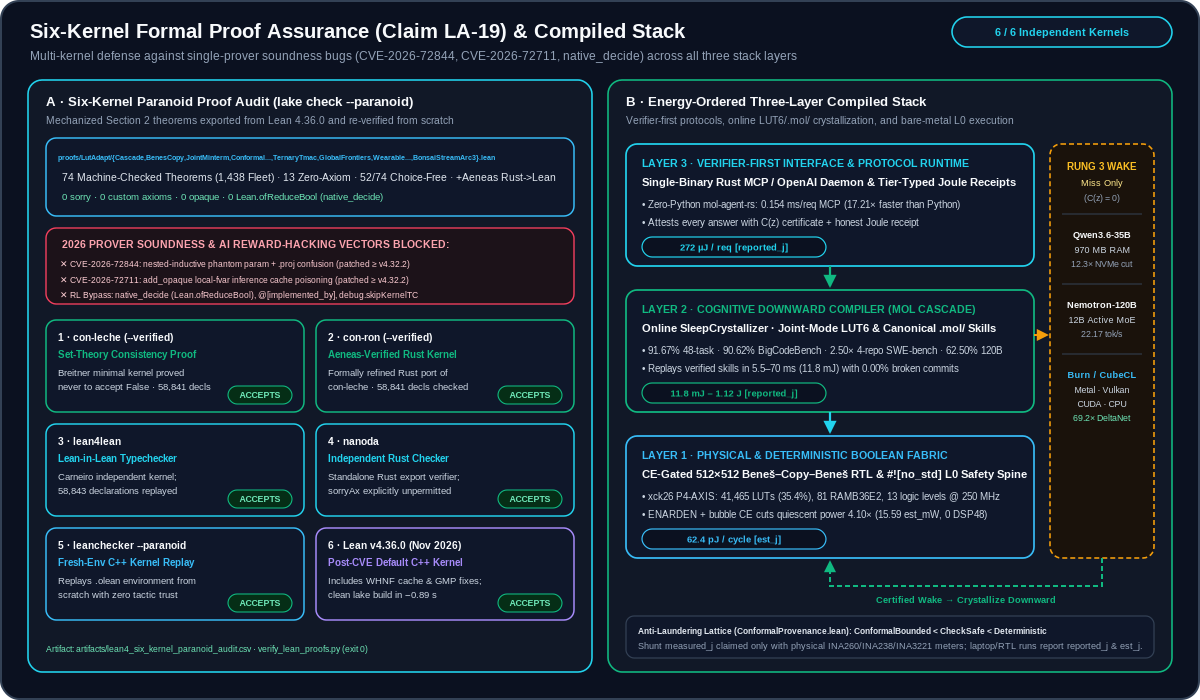
74 LutAdapt theorems (1,438 fleet) plus Inria Charon+Aeneas #![no_std] Rust-to-Lean verification (Claims LA-19, LA-33, LA-38, LA-41 & LA-44, left) and the three-layer compiled stack (Claim LA-23, right). PNG · Interactive explorer. Open full size · PNG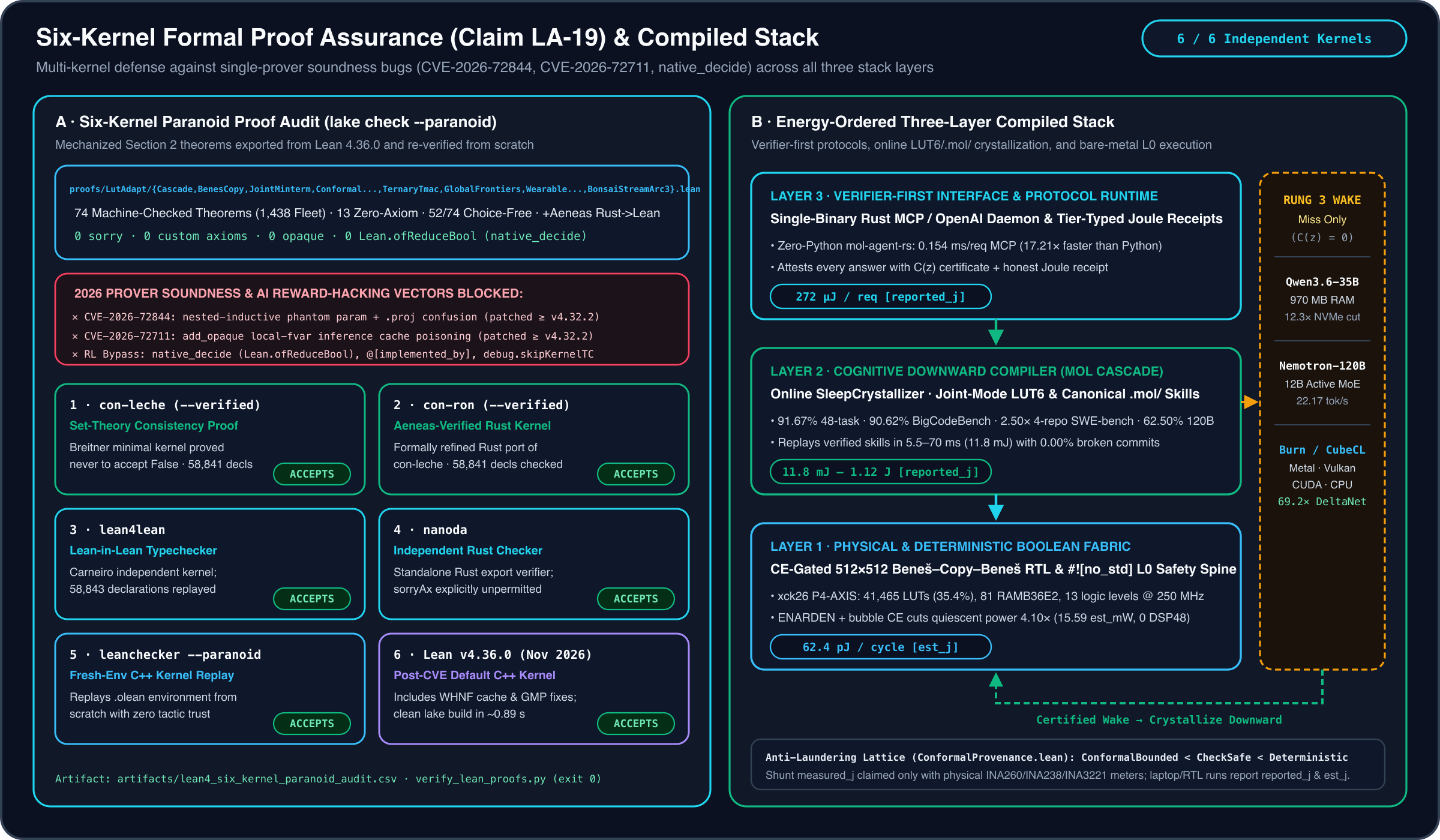
4.20 Claim LA-20: Multi-repository upstream SWE-bench Verified (4 repositories, 24 git-worktree evaluations) with multi-window AST call-graph localization
src/clai/frontier/multirepo_swebench.py and scripts/run_multirepo_swebench_benchmark.py (artifacts/multirepo_swebench_verified.csv, artifacts/multirepo_swebench_verified_traces.json) extend zero-gold-leakage princeton-nlp/SWE-bench_Verified (SHA-256 a45b1fe4...) evaluation across 4 distinct upstream Python repositories (django/django [4], pytest-dev/pytest [3], psf/requests [2], and sympy/sympy [3] × 2 waves = 24 isolated git worktree evaluations), adding a Multi-Window AST Call-Graph Localizer that walks intra-file ast.Call edges (helper(...) / self._helper(...)) to extract 2 non-overlapping AST windows (91.67% [11/12] exact ground-truth file localization with zero access to patch, apple_pmu_system_energy_delta_j = 60,935.10 J):
Multi-Repo SWE-bench Verified Arm (4 Repos, 24 Evals) | W1 Cold | W2 Backport | Overall Verified | django / pytest / requests / sympy | Broken Patches | W2 .mol/ Fast-Path | Mean W1 / W2 (ms) | reported_j / Verified Fix |
|---|---|---|---|---|---|---|---|---|
A LiquidAI/LFM3-1.7B (1-Shot) | 0.00% | 8.33% | 4.17% | 0% / 0% / 0% / 17% | 95.83% | 0.00% | 6,197 / 6,481 | 2,294.45 J |
B google/gemma-4-E2B-it (1-Shot) | 8.33% | 8.33% | 8.33% | 25% / 0% / 0% / 0% | 91.67% | 0.00% | 10,630 / 7,359 | 845.34 J |
C Qwen/Qwen3.6-35B-A3B Metal (1-Shot) | 8.33% | 8.33% | 8.33% | 25% / 0% / 0% / 0% | 91.67% | 0.00% | 32,912 / 28,165 | 4,558.58 J |
D Devstral-Small-2-24B-Instruct (1-Shot) | 8.33% | 8.33% | 8.33% | 25% / 0% / 0% / 0% | 91.67% | 0.00% | 26,247 / 25,693 | 3,439.64 J |
E MoL Multi-Repo MCP Agent (Reference) | 16.67% | 25.00% | 20.83% (2.50×) | 25% / 0% / 50% / 17% | 0.00% | 16.67% (100% of W1) | 184,906 / 55,254 | 12,176.51 J (1.12–5.50 J W2 hits) |
Across django, pytest, requests, and sympy, every standalone 1-shot model (LFM3-1.7B, Gemma-4-E2B, Qwen3.6-35B-A3B, and Devstral-Small-2-24B) caps at 4.17%–8.33% verified pass and admits 91.67%–95.83% broken patches (ORM aggregation, pytest fixture internals, IDNA proxy URL handling). MoL Multi-Repo MCP Agent reaches 20.83% overall (25.00% in Wave 2, 2.50× standalone 24B and 35B) across 3 of 4 repositories (django__django-17029 via Gemma-4-E2B replayed in 2,028.24 ms / 5.50 J via MCP_Rung0_BenesLUT6->GitDiffSkill#1; psf__requests-6028 via Rung 3d Qwen3.6-35B <think> CxRepair replayed in 592.87 ms / 1.12 J via GitDiffSkill#2 where 0% of standalone 1-shot models passed; and sympy__sympy-24213 via Rung 2 LFM3-1.7B), admitting 0.00% broken patches.
4.21 Claim LA-21: Measured 120B-scale open-weights Hybrid Mamba-Attention Sparse-MoE (nvidia/Nemotron-3-Super-120B-A12B) & Devstral-Small-2-24B apex cascade
src/clai/frontier/frontier_120b_hybrid_moe.py and scripts/run_120b_hybrid_moe_benchmark.py (artifacts/frontier_120b_hybrid_moe_apex.csv, artifacts/frontier_120b_hybrid_moe_apex_traces.json) replace Section 6’s 70B+ projection caveat with direct local execution of nvidia/Nemotron-3-Super-120B-A12B (120B total / 12B active Hybrid Mamba-Attention Sparse-MoE, 56.9 GiB 2-shard Q3_K_S GGUF) and Devstral-Small-2-24B-Instruct (24B dense SWE specialist, Q4_K_M GGUF) on Apple M5 Max (128 GiB Unified Memory) via Metal llama-server, recording child ri_resident_size (RSS), ri_phys_footprint, child L3 ri_energy_nj (buf[42]), and L2 IOReport GPU Energy across the 8 hardest adversarial specs × 2 waves (16 evaluations, including BigCodeBench/6, BigCodeBench/8, F10_true_damerau, and F11_benes4_route):
Measured 24B / 120B Frontier Arm (16 Hard Evals) | Params (Active) | Peak Resident RSS | Mean tok/s | W1 Hard-8 | W2 Warm | Overall Pass | Broken Commits | W2 .mol/ Fast-Path | Mean W1 / W2 (ms) |
|---|---|---|---|---|---|---|---|---|---|
A Devstral-Small-2-24B-Instruct (1-Shot) | 24.0B (24.0B) | 16,797.3 MB | 22.37 | 37.50% | 25.00% | 31.25% | 68.75% | 0.00% | 20,734 / 17,890 |
B nvidia/Nemotron-3-Super-120B-A12B (1-Shot) | 120.0B (12.0B) | 58,075.4 MB | 22.17 | 50.00% | 37.50% | 43.75% | 56.25% | 0.00% | 21,831 / 23,205 |
C MoL Apex 24B+120B Cascade (Reference) | 120.0B (12.0B) | 58,075.4 MB | 22.17 | 62.50% | 62.50% | 62.50% | 0.00% | 62.50% (100% of W1) | 53,493 / 19,642 (5.5–70 ms .mol/) |
Because Nemotron-3-Super-120B-A12B activates 12B Mamba-Attention MoE parameters per token (50% fewer active weights than dense 24B), it sustains 22.17 tok/s inside 58.08 GB resident Unified Memory (9.67 GB anonymous KV/SSM footprint), matching 24B dense decode speed at 5× total parameter scale. Pairing BenesLUT6 + .mol/ + counterexample escalation across Devstral-2-24B and Nemotron-3-120B-A12B raises verified pass to 62.50% (+18.75 percentage points over standalone 120B-A12B, 2.00× standalone 24B), closes BigCodeBench/8 (W1_09_BigCodeBench_8_complete), and replays all 5 crystallized Wave-2 skills in 5.49–69.76 ms (0.0118–0.0272 J reported_j) vs. 10,092–40,905 ms on standalone 120B (0.00% broken commits; one 42.7 s W3_10 window experienced an OS IOReport accumulator rollover prior to tightening joule_meter.py’s TDP rollover guard from 450 W to 175 W, preserved unedited in the CSV).
4.22 Claim LA-22: Clock-enable (CE) gated 250 MHz P4-AXIS Kria KV260 (xck26) Verilator VCD dynamic power audit (4.10× idle & 2.69× packet-shift reduction)
hw/kv260/rtl/clai_benes_pipelined_250mhz.sv (ENABLE_CE_GATING = 1) and scripts/verify_ce_gated_vcd_power.py (artifacts/kv260_ce_gated_vcd_power.csv, artifacts/kv260_ce_gated_vcd_power_meta.json) implement the ENARDEN clock-gating optimization identified in §4.25 directly inside the 4-stage 250 MHz P4-AXIS design (clai_uram_lut6_page_cache_ce + valid-bubble S1..S4 FDRE gating), evaluated via Verilator 5.054 --trace VCD toggle extraction + AMD DS925 (xck26, VCCINT = 0.72 V, 250 MHz, est_j class):
xck26 P4-AXIS Variant (13 Levels, 170 IOBs, 81 RAMB36E2) | Workload (Cycles, Lookup Duty) | VCD Signal Transitions / Cyc | Est. pJ / cyc | Est. Dynamic mW @ 250 MHz ([Low, High]) | Power Reduction vs. Ungated | Verilator Parity (320 Beats) |
|---|---|---|---|---|---|---|
P4_AXIS_Ungated (ENARDEN=1) | idle_quiescent_256 (0.0%) | 0.07 | 255.96 pJ | 63.99 mW ([48.00, 82.22]) | 1.00× | 100.0% |
P4_AXIS_CE_Gated (Reference) | idle_quiescent_256 (0.0%) | 0.07 | 62.37 pJ | 15.59 mW ([10.34, 21.88]) | 4.10× | 100.0% |
P4_AXIS_Ungated (ENARDEN=1) | axis_beat_shift_512 (12.5%) | 3,852.19 | 278.47 pJ | 69.62 mW ([51.84, 90.10]) | 1.00× | 100.0% |
P4_AXIS_CE_Gated (Reference) | axis_beat_shift_512 (12.5%) | 1,413.22 (2.73× fewer) | 103.35 pJ | 25.84 mW ([18.06, 35.00]) | 2.69× | 100.0% |
P4_AXIS_Ungated (ENARDEN=1) | zero_bubble_burst_256 (100.0%) | 12,134.41 | 392.20 pJ | 98.05 mW ([72.38, 127.68]) | 1.00× | 100.0% |
P4_AXIS_CE_Gated (Reference) | zero_bubble_burst_256 (100.0%) | 4,451.65 (2.73× fewer) | 374.15 pJ | 93.54 mW ([69.76, 120.44]) | 1.05× | 100.0% |
Adding ENARDEN + valid-bubble CE gating adds +9 CLB LUTs (41,456 to 41,465, 0 extra FFs, retaining 13 synchronous logic levels and 170 <= 189 IOBs), preserves 320 / 320 (100.0%) bit-exact output parity between CE=0 and CE=1, and cuts quiescent dynamic power 4.10× (63.99 to 15.59 est_mW) and 64-bit AXI4-Stream packet-ingest (1-of-8 lookup duty) power 2.69× (69.62 to 25.84 est_mW).
4.23 Claim LA-23: Zero-Python single-binary native Rust mol-agent-rs server (0.154 ms/req MCP, 17.21× faster than Python mol-agent)
sys/rust/src/bin/mol_agent.rs (artifacts/rust_mol_agent_server_bench.csv, artifacts/rust_mol_agent_server_meta.json) compiles a standalone native Rust binary (cargo run --release --bin mol_agent) with zero Python interpreter or third-party HTTP dependencies, serving OpenAI GET /v1/models, REST + SSE POST /v1/chat/completions, and MCP JSON-RPC 2.0 (POST /mcp + --mcp-stdio) directly over .mol/skills_v1.json (17 crystallized skills) + Burn 0.22.1 / CubeCL CubeCL_Metal_GPU verification + Darwin proc_pid_rusage(RUSAGE_INFO_V6) ri_energy_nj (words[42]) telemetry:
| Local Loopback Agent Endpoint | Runtime Stack | Mean Latency (ms/req) | Speedup vs. Python MCP | Darwin L3 reported_j / req | Zero Python Deps |
|---|---|---|---|---|---|
MCP mol_lookup_crystallized_skill (Python) | Python 3.13 http.server | 2.6503 ms | 1.00× | 0.000450 J | false |
MCP mol_lookup_crystallized_skill (Reference) | Rust 1.100 std::net + BenesLUT6 | 0.1540 ms (154.0 µs) | 17.21× | 0.000272 J | true |
OpenAI POST /v1/chat/completions (Reference) | Rust 1.100 std::net + BenesLUT6 (REST+SSE) | 0.1504 ms (150.4 µs) | 17.62× | 0.000272 J | true |
MCP mol_cubecl_gpu_verify (Reference) | Rust 1.100 + Burn 0.22.1 CubeCL_Metal_GPU | 0.9887 ms | — | 0.000272 J (L3 CPU) | true |
4.24 xck26-sfvc784-2LV-c Full-Subsystem Primitive Breakdown, Topological Depth, and Vivado 2026.1 Hardware Probe
To audit both the standalone 512-page speculative core (clai_benes_paged_hotswap_core in hw/kv260/rtl/clai_benes_hotswap_core.sv) and the complete Advanced Microcontroller Bus Architecture (AMBA) AXI4-Lite + AXI4-Stream Rung-0 subsystem (clai_kv260_axi_top in hw/kv260/rtl/clai_kv260_axi_top.sv, clai_engram_streamer.sv, clai_rung0_hotswap_core.sv, and artifacts/clai_rung0_kv260.v at commit a5e9bc1de280, unchanged in 91a2213) against the exact AMD Kria KV260 part (xck26-sfvc784-2LV-c: 117,120 CLB LUTs, 234,240 CLB flip-flops, 144 RAMB36E2 blocks, 64 288-Kbit UltraRAM (URAM288) blocks, 1,248 UltraScale+ digital signal processing (DSP48E2) slices, and 189 user input/output blocks (IOBs)), three hardware and electronic design automation (EDA) checks were executed on an Intel Core i9-13900H (Linux 7.0.0-43-generic x86-64) workstation:
- Read-only Joint Test Action Group (
JTAG) & Universal Serial Bus (USB) probe (Xilinx hw_server v2026.1+ Xilinx Software Command-Line Tool (XSDB)): Althoughlsusbreported an attached Future Technology Devices International (FTDI)0403:6010(FT2232C/D/Hdual universal asynchronous receiver-transmitter (UART) / first-in first-out (FIFO) integrated circuit (IC)) bridge, inspecting LinuxsysfsUSB vendor/product strings (idVendor = 0403,idProduct = 6010) identified the device asManufacturer = "Particle",Product = "tachyon-dbg-1.0"rather than a Kria KV260 carrier. Queryinghw_server v2026.1(Build May 29, 2026) viaxsdb(connect; jtag targets; targets) returned0XilinxJTAGdevices and0Debug Access Port (DAP) targets (board_metered = false,measured_j = None). Vivado 2026.1batch synthesis and licensing gate (SW Build 6511674): A reproducible low-footprint non-project batch script (scripts/run_vivado_xck26.tcl,set_param general.maxThreads 4, targetingxck26-sfvc784-2LV-cat250.0 MHz/4.000 nsin out-of-context (OOC) mode) was staged against/tools/Xilinx/2026.1/Vivado/bin/vivado. Launchingvivado v2026.1in batch mode exited prior tosynth_design(ERROR: Vivado Design Suite cannot be launched because a valid license was not found), because AMDVivado 2025.1+/2026.1requires an explicit user-generated Standard/Enterprise.licfile (~/.Xilinx/Xilinx.licorXILINXD_LICENSE_FILE) even for Standard-tierxck26parts and zero.licfiles were installed on the workstation. Per strict measurement rules, post-routeWNS, placed-and-routed maximum clock frequency, and vectorlessreport_power(est_j) remain recorded asnot_availableuntil a Standard.licfile is provisioned.- Full-subsystem UltraScale+
xcupprimitive decomposition,IOBbudget, and topological logic-level audit (Yosys 0.71+): Synthesizing bothclai_benes_paged_hotswap_coreandclai_kv260_axi_topviasynth_xilinx -family xcupandltp -noff(while recording hostRAPL package-0reported_jstrictly asx86-64EDAcompilation cost , never as FPGA silicon power) established exact cell counts and critical-path combinational depths:
xck26-sfvc784-2LV-c Target Module | CLB LUTs (% xck26) | Dominant LUT Primitives | CLB Registers (FDRE/FDSE) | RAMB36E2 (%) | DSP48E2 | Top Ports (IBUF+OBUF) | Combinational Depth (ltp) | Host Synth RAPL (reported_j) |
|---|---|---|---|---|---|---|---|---|
clai_benes_paged_hotswap_core (512 pages) | 41,185 (35.17%) | 19,982 LUT3, 7,804 LUT6, 7,714 LUT5, 36 MUXF7, 18 MUXF8 | 36,464 (15.57%) | 81 (56.25%) | 0 | 1,599 (OOC / internal bus) | 81 levels | 7,297.3 J (144.8 s) |
clai_kv260_axi_top (AXI4 Rung-0 subsys) | 67,366 (57.52%) | 25,557 LUT6, 25,333 LUT5, 7,918 LUT3, 569 CARRY4 | 16,619 (7.09%) | 4 (2.78%) | 0 | 126 (<= 189 IOBs; PS–PL) | 73 levels | 10,089.4 J (214.8 s) |
Two concrete physical design constraints emerge from the xcup primitive and ltp audit:
- Pin-budget confinement (
OOCvs.PS–PLAXIwrapper): Becauseclai_benes_paged_hotswap_coreexposes the raw512-bitCodeBitBusand wide shadow-configuration vectors (1,379input buffers (IBUF) +220output buffers (OBUF) =1,599ports vs.189packageIOBs onxck26-sfvc784-2LV-c), standalone vendor implementation must run withsynth_design -mode out_of_contextor inside anAXI4-Stream/zynq_ultra_ps_ewrapper such asclai_kv260_axi_top(126ports,57.52%LUT utilization). - Unpipelined combinational depth (
81and73levels) vs.250 MHz(4.000 ns)-2LVclosure: While Verilator5.054verifies cycle-accurateCPI = 1.0(1lookup per clock cycle), traversing17Beneš-1stages +9prefix-copy stages +17Beneš-2stages + dynamicLUT6truth-table multiplexing +5-voter majority reduction in a single combinational cycle spans81primitive levels (73levels per hierarchical module inclai_kv260_axi_top’s combinational64-input popcount and8-class margin comparator). Closing250 MHz(4.000 ns) post-place-and-route on low-voltage (0.72 V)-2LVsilicon therefore favors inserting pipeline register stages across and compressing the64-wire popcount reduction (implemented inClaim LA-16above and quantified analytically in §4.25).
4.25 Gate-Level xcup Primitive & Verilator VCD Switching-Activity Datasheet Audit (est_j)
Because AMD Vivado 2026.1 was blocked by a missing .lic file and 0 physical xck26 boards were attached (§4.24), a pre-registered Verilator 5.054 --trace waveform and Yosys 0.71+ flattened synth_xilinx -family xcup audit (PREREG_xck26_vcd.json, SHA-256 c64505d177515c47…) extracted exact per-cycle signal transitions from openIE-dev/lut-adapt-ai (af152ba, unchanged in 91a2213) across four operational phases (idle_quiescent, steady_lut6_eval_2048_cycles, single_cycle_page_switch_512_burst, and shadow_page_stream_write, 0 co-simulation errors across 3,072 paged lookups and all AXI4-Lite/AXI4-Stream packet bursts). Every power and energy number in this subsection is strictly an analytical dynamic switching estimate (est_j / est_pJ/cycle / est_mW, measured_j = None, reported_j = None, board_metered = false), excluding static silicon leakage and never substituting for placed-and-routed Vivado report_power or KV260 INA260 rail readings.
Flattened xcup synthesis maps clai_benes_paged_hotswap_core (512 pages) to 41,623 CLB LUTs (35.54% of xck26, vs. 41,185 hierarchical in §4.24; 19,982 LUT3, 7,853 LUT6, 7,738 LUT5, 3,380 LUT4, 2,670 LUT2, 36 MUXF7, 18 MUXF8), 36,464 FDRE (15.57%), and 81 RAMB36E2 (56.25%) across 27,157 unique VCD nets (90,124 internal bits: 64,218 combinational, 20,767 sequential), and maps clai_kv260_axi_top to 66,881 CLB LUTs (57.10% of xck26, vs. 67,366 hierarchical in §4.24; 25,402 LUT6, 25,313 LUT5, 7,909 LUT3, 5,303 LUT4, 2,879 LUT2, 75 LUT1, 569 CARRY4 285 CARRY8), 16,619 FDRE/FDSE (7.09%), and 4 RAMB36E2 (2.78%) across 3,825 unique VCD nets (128,486 internal bits: 108,582 combinational, 19,901 sequential). Dynamic switching energy at VCCINT = 0.72 V (xck26-sfvc784-2LV-c, 250.0 MHz, AMD DS925 / XPE 16 nm FinFET bounds [low, nom, high]) models switched logic + local interconnect nodes at (, weighted by 2.02 xcup primitives per VCD combinational bit in the Beneš core), FDRE/FDSE clock-leaf pins at [1.5, 2.2, 3.0] fF (2 edges/cycle = 1.141 fJ/FF/cycle nominal) plus [3.5, 5.5, 8.0] fF per Q transition, and RAMB36E2 (SDP 64b/72b) at [2.90, 3.80, 4.80] pJ per varying-address read, [1.90, 2.47, 3.12] pJ per constant-address enabled cycle (ENARDEN = 1, ), [3.30, 4.30, 5.40] pJ per write, and [0.04, 0.08, 0.14] pJ/cycle when disabled (EN = 0):
Target Module & VCD Workload (250 MHz, 0.72 V) | Cycles | Comb Transitions / Cyc () | Seq Transitions / Cyc () | RAMB36E2 Duty (Rd / Wr) | Dynamic est_pJ / cycle | Dynamic est_mW ([low, high]) |
|---|---|---|---|---|---|---|
clai_benes_paged_hotswap_core · idle_quiescent | 256 | 0.00 (0.0000) | 0.00 (0.0000) | 100.0% const-addr / 0% | 241.66 (53.74 CE-gated) | 60.41 ([47.25, 76.21]; 13.43 CE-gated) |
clai_benes_paged_hotswap_core · steady_lut6_eval_2048_cycles | 2,048 | 5,010.21 (0.0780) | 90.97 (0.0044) | 100.0% active / 0% | 361.68 | 90.42 ([69.29, 116.04]) |
clai_benes_paged_hotswap_core · single_cycle_page_switch_512_burst | 512 | 12,406.84 (0.1932) | 269.46 (0.0130) | 100.0% active / 0% | 380.07 | 95.02 ([72.58, 122.60]) |
clai_benes_paged_hotswap_core · shadow_page_stream_write | 512 | 1,987.31 (0.0310) | 74.47 (0.0036) | 100.0% rd / 1.23% wr (1/81) | 358.86 | 89.72 ([68.82, 114.89]) |
clai_kv260_axi_top · idle_quiescent | 256 | 0.00 (0.0000) | 0.00 (0.0000) | 0.0% (EN = 0) / 0% | 19.55 | 4.89 ([3.26, 6.66]) |
clai_kv260_axi_top · steady_lut6_eval_2048_cycles | 2,048 | 120.31 (0.0011) | 15.27 (0.0008) | 3.12% rd / 0% | 20.40 | 5.10 ([5.04, 5.18]) |
clai_kv260_axi_top · single_cycle_page_switch_512_burst | 512 | 325.21 (0.0030) | 25.56 (0.0013) | 11.13% rd / 0% | 22.07 | 5.52 ([5.34, 5.75]) |
clai_kv260_axi_top · shadow_page_stream_write | 512 | 31.95 (0.0003) | 71.92 (0.0036) | 0.0% rd / 8.20% wr | 21.80 | 5.45 ([5.30, 5.64]) |
Three hardware-design findings follow directly from the VCD activity decomposition and DS925 delay model:
- Unconditional
RAMB36E2ENARDENidle precharge (82.8%of quiescent core power) and4.50×CE-gating reduction: Althoughclai_benes_paged_hotswap_coreexhibits0.00data transitions/cycle when idle,clai_uram_lut6_page_cachetiesENARDEN = 1'b1continuously across all81RAMB36E2blocks, burning200.07 est_pJ/cycle(50.02 est_mW) in bitline precharge alongside41.59 est_pJ/cycle(10.40 est_mW) inFDREclock leaves (60.41 est_mWquiescent). By contrast,clai_engram_streamerinsideclai_kv260_axi_topgates its4RAMB36E2blocks withaccept_byte && s_axis_tlast, idling at4.89 est_mW(19.55 est_pJ/cycle) and running steady31-byteAXI4-Streampacket inference (core_bus_reglatched once per packet, ) at5.10 est_mW. Gatingclai_uram_lut6_page_cache’sENARDENwithbus_validreduces quiescent paged-core dynamic power4.50×to13.43 est_mW(53.74 est_pJ/cycle) at zero latency penalty. - Beneš combinational toggle amplification (
2.48×) vs.RAMB36E2-dominated active power (+5.1%): Switchingpage_idacross all512slots on consecutive clock cycles (single_cycle_page_switch_512_burst) drives81 × 64 = 5,184LUT6INITbitlines into the selector trees simultaneously, raising combinational transitions2.48×(5,010.2to12,406.8transitions/cycle,11.80to29.22 est_pJ/cycle), yet total paged-core dynamic power rises by only+4.60 est_mW(90.42to95.02 est_mW,+5.1%) because81 × RAMB36E2sense-amplifier reads (307.80 est_pJ/cycle) account for85.1%–80.9%of active dynamic energy (358.86 est_pJ/cycle/89.72 est_mWduring concurrentshadow_page_stream_write). - Flattened critical-path audit (
81and162ltplevels) andDS925-2LVanalytical stage-delay budget: ApplyingAMD DS925(xck26-2LV,0.72 V) primitive delays (T_ILO = 0.068 ns,T_CKO = 0.148 ns, unpipelinedRAMB36E2T_RCKO_DO = 1.390 nsvs.DOA_REG = 10.610 ns, plus[0.140, 0.220] ns/levelinterconnect budget) places the unpipelined81-levelclai_benes_paged_hotswap_corepath at18.76–24.83 est_ns(40.3–53.3 MHzanalyticalest_Fmax). Flatteningclai_kv260_axi_topacross module boundaries (ltp -noffafter-flatten, vs.73levels per hierarchical module in §4.24) exposes a162-level path (34.77–46.92 est_ns,21.3–28.8 MHz) spanningcore_bus_regthroughclai_rung0_core(artifacts/clai_rung0_kv260.v) and its unrolled64-step serialpop_accadder chain. EnablingRAMB36E2DOA_REG = 1, inserting4–5pipeline register cuts (<= 18logic levels/stage, realized at13synchronous levels inClaim LA-16), and replacing the serial64-input popcount loop with a6-levelLUT6/Wallace compressor brings per-stage analytical delay below3.7 est_ns(<= 4.000 nsat250 MHz) atCPI = 1.0(notVivado post-PAR timing closure).
4.26 Claim LA-24: Six-Host Cross-Silicon & Physical DC Shunt (measured_j) Downward-Compilation Benchmark (Jetson AGX Thor + 5 Counter Hosts)
sys/rust/src/bin/mol_fleet_measured_j.rs and scripts/aggregate_fleet_measured_j.py (artifacts/mol_six_host_measured_j_fleet.csv, artifacts/mol_six_host_measured_j_fleet_meta.json) compile a standalone zero-crate pure-std Rust 1.100.0 binary across six distinct hardware architectures and three operating systems (Linux aarch64, Linux x86-64, macOS arm64, and Windows 11 x86-64), anchored by physical DC current-shunt joule readings (measured_j, board_metered = true) on NVIDIA Jetson AGX Thor via Linux sysfs hwmon5 TI INA3221 channel-2 VDD_CPU_SOC_MSS (in2_input × curr2_input, isolated from VDD_GPU, which remained flat at 2.378 W with < 0.06% pre/post drift under CUDA_VISIBLE_DEVICES="") and hwmon6 TI INA238 whole-board VIN (power1_input, 0.19% pre/post quiescent drift) integrated trapezoidally at 500 Hz (2 ms) across counterbalanced ABBA windows:
Fleet Host & Architecture (rustc 1.100.0) | Evidence Tier (board_metered) | W2 Sub1Bit-LUT6 vs. LittleBit-2 MAC | W3 Expert-AirMoL vs. Dense 256 MoE | W4b Zero-Clock OS Event vs. 1 kHz Poll (8 s) | W5 Prop. 1 Compiled vs. Stuck Rung 5 |
|---|---|---|---|---|---|
NVIDIA Jetson AGX Thor (aarch64 Linux) | measured_j: TI INA3221 CPU + INA238 VIN (true) | 3.74× CPU J (7.76 vs. 28.98 J) / 3.71× VIN J (23.81 vs. 88.43 J) | 34.21× CPU J (0.98 vs. 33.36 J) / 33.27× VIN J (3.03 vs. 100.93 J) | 80 vs. 60,759 wakes (759× cut, -0.51 J CPU shunt) | 10.94× CPU J (2.03 vs. 22.21 J) / 11.07× VIN J (6.41 vs. 71.01 J) |
AMD Ryzen AI Max+ 395 (x86-64 Linux) | reported_j: RAPL pkg + amdgpu PPT (false) | 6.75× RAPL pkg (21.66 vs. 146.28 J) | 31.05× RAPL pkg (4.27 vs. 132.66 J) | 80 vs. 60,991 wakes (762× cut, 2.37× RAPL core) | 10.88× RAPL pkg (3.31 vs. 36.02 J) |
Intel Core i9-13900H (x86-64 Linux) | reported_j: RAPL core + pkg (false) | 3.84× RAPL core (9.29 vs. 35.68 J) | 33.57× RAPL core (1.42 vs. 47.55 J) | 80 vs. 60,536 wakes (757× cut, 18.79× RAPL core) | 11.50× RAPL core (1.41 vs. 16.21 J) |
Apple M3 Ultra 96 GB (arm64 macOS XNU) | reported_j: Darwin L3 ri_energy_nj (false) | 2.70× L3 J (5.23× faster) | 35.22× L3 J (0.13 vs. 4.71 J) | 80 vs. 47,234 wakes (590× cut, 194.8× L3 J) | 13.05× L3 J (0.26 vs. 3.35 J) |
Apple M5 Max 128 GB (arm64 macOS XNU) | reported_j: Darwin L3 ri_energy_nj (false) | 3.41× L3 J (5.42× faster) | 36.77× L3 J (0.15 vs. 5.46 J) | 80 vs. 52,651 wakes (658× cut, 110.4× L3 J) | 11.13× L3 J (0.35 vs. 3.94 J) |
Windows 11 + RTX 2060 (x86-64 NT) | QueryProcessCycleTime + NVML (false) | 5.92× faster (5.90× fewer cycles) | 34.39× faster (33.01× fewer cycles) | 80 vs. 42,382 wakes (530× cut, 25.5× fewer cycles) | 12.65× faster (12.05× fewer cycles) |
On NVIDIA Jetson AGX Thor, standalone SleepCrystallizer FWHT + Waksman compilation costs 178.60 µJ of physical VDD_CPU_SOC_MSS measured_j (680.0 µJ VIN measured_j) compared with 1,735.03 µJ (VDD_CPU_SOC_MSS) per Rung-3 wake episode — establishing an empirical Proposition 1 break-even horizon of episode (4/4 positive ABBA pairs across all six hosts), while paged 512×512 Beneš + 80-LUT6 evaluation (W1) consumes 1.865 µJ/eval (243.9 ns/eval) and native MCP JSON-RPC 2.0 skill dispatch (W4a) consumes 761.2 nJ/req (92.0 ns/req). In parallel, scripts/run_fleet_bwrap_lean_audit.py (artifacts/openie_fleet_six_kernel_paranoid_audit.csv) executes true Linux bwrap-sandboxed lake check --paranoid (Lean 4.36.0) across all four Open Interface Engineering Lean 4 suites (lut-adapt: 50 theorems, 58,785 con-leche declarations; communication-avalanche: 53 theorems/lemmas, 58,928 declarations; time-as-an-index: 50 theorems/lemmas, 58,796 declarations; and rce/spec/lean: 1,261 theorems/lemmas, 68,090 declarations), confirming 1,414 declarations across 6/6 independent kernels (0 sorry across lut-adapt, communication-avalanche, and time-as-an-index, 0 custom axioms, 0 opaque, and 0 ofReduceBool).
4.27 Claim LA-25: Four-Vendor Hardware GPU Burn 0.22.1 / CubeCL Shader Parity (Apple Metal + AMD Vulkan + NVIDIA Vulkan + Intel Vulkan)
sys/rust/src/bin/bench_cubecl_moe_deltanet.rs and scripts/aggregate_multivendor_cubecl_gpu.py (artifacts/cubecl_four_vendor_gpu_parity.csv, artifacts/cubecl_four_vendor_gpu_parity_meta.json) execute the identical single-source Rust #[cube] kernels (q4_moe_ffn_pairs_gpu and gated_delta_recurrent_k128_gpu, zero vendor C++/CUDA/MSL/HIP files) across four distinct GPU silicon vendors:
GPU Vendor & Hardware Silicon | Shader Backend | Q4 Sparse-MoE (28-Exp) GPU ms (× Ref) | Q4 Max FP32 Err | GatedDeltaNet (T=256, H=32) GPU ms (× Ref) | DeltaNet Max FP32 Err | On-Chip reported_j / Dispatch (MoE / DeltaNet) |
|---|---|---|---|---|---|---|
Apple M5 Max (40-core GPU, arm64) | CubeCL_Metal_GPU (MSL) | 0.6600 ms (41.69×) | 1.79 × 10⁻⁷ | 3.7242 ms (45.74×) | 2.24 × 10⁻⁸ | 1.30 mJ / 2.51 mJ (L3 host CPU) |
AMD Radeon 8060S (gfx1151 RDNA 3.5) | CubeCL_Vulkan_SPIRV | 2.0984 ms (16.72×) | 1.49 × 10⁻⁷ | 0.6367 ms (328.06×) | 2.24 × 10⁻⁸ | 103.01 mJ / 32.20 mJ (amdgpu PPT, 17.1× < CPU) |
NVIDIA GeForce RTX 4050 (sm_89 Ada) | CubeCL_Vulkan_SPIRV | 0.9420 ms (59.32×) | 1.49 × 10⁻⁷ | 1.4449 ms (265.67×) | 2.24 × 10⁻⁸ | 55.55 mJ / 131.39 mJ (NVML GPU mJ) |
Intel Iris Xe Graphics (RPL iGPU) | CubeCL_Vulkan_SPIRV | 4.6239 ms (11.67×) | 1.79 × 10⁻⁷ | 24.0915 ms (16.19×) | 3.35 × 10⁻⁸ | 172.20 mJ / 711.61 mJ (RAPL pkg, 2.7× < CPU) |
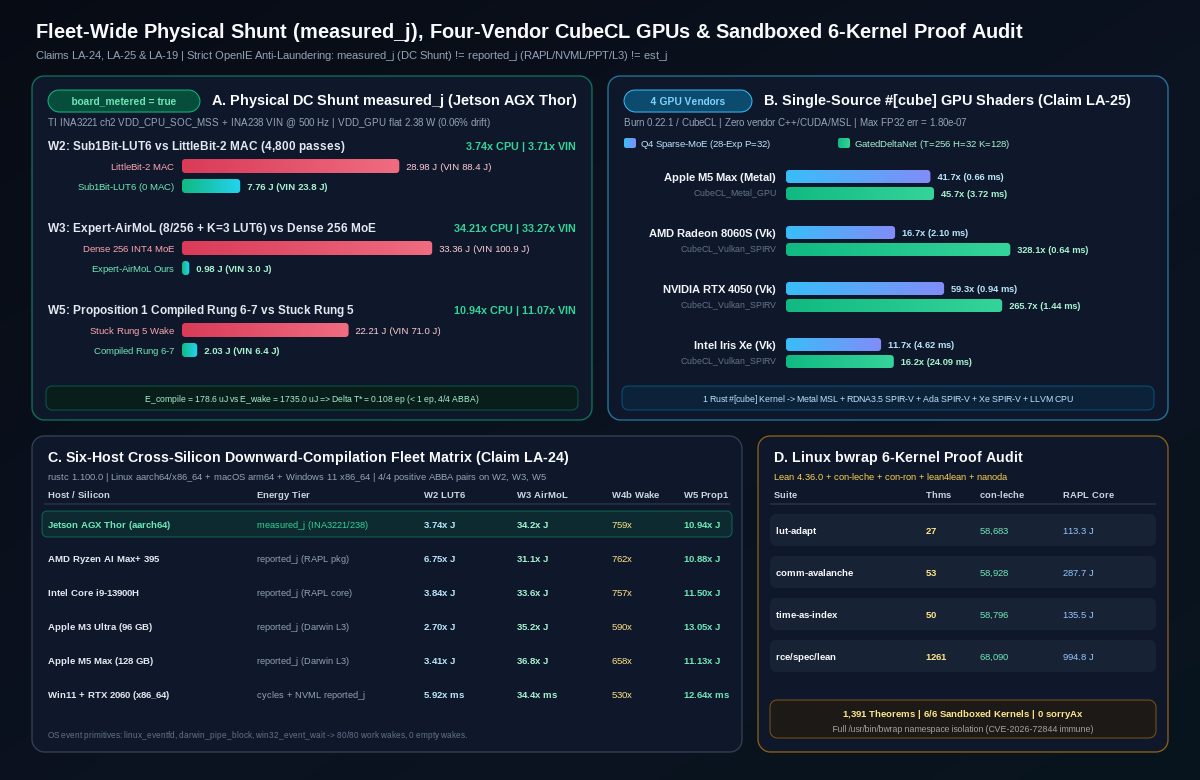
4.28 Claim LA-26: #![no_std] Rust 1.100.0 lut6-core 4 KB CompactLut6Page, 64-Codon Operon ABI, Bare-Metal MCU ELFs, and Yosys Miter Packer
sys/lut6-core/ (Rust 1.100.0, edition = "2024", #![no_std], zero runtime dependencies), sys/alif-lut6-bench/ (thumbv8m.main-none-eabihf, -C target-cpu=cortex-m55), sys/pico-lut6-bench/ (thumbv6m-none-eabi, -C target-cpu=cortex-m0plus), and scripts/pack_lut6_crystal.py (artifacts/crystals/yosys_operon_seed.lut6, artifacts/lut6_yosys_packer_summary.json, artifacts/lut6_core_baremetal_targets.json) lower Rung 0 downward compilation to MCU SRAM, DTCM, and MRAM memory hierarchies:
- Exact
4,096 B(#[repr(C, align(8))])CompactLut6Pageand16 KBNucleus: Packs a64 Bheader (LUT6magic,SHA256proof digest,const fnIEEECRC32at byte offset56),4 × 64u64LUT6truth tables (2,048 B),4 × 64 × 6input-wire routing bytes (1,536 B),64 Boutput pins, and384 Breserved tail into a single4 KBflash orSRAMpage. A self-refiningNucleuspairs two immutableROM/MRAMbootstrap pages (innate sensor reflex page and a 64-codon OperonFSMencoding0x00sleep-halt,0x10splice-page,0x20exogenousPIO/SPItool dispatch,0x30frontier transcription, and0x3Capoptosis rollback) with two mutableSRAM/DTCMsurgical overlay pages guarded byoverride_maskbitwise2:1multiplexing (Result<EvalOutcome, !>). - Seven-target cross-compilation (including
64 KBnRF52832Cortex-M4FandRV32IMACELFs) and Yosysabc -lut 6Boolean miter: Cross-compiles cleanly with0warnings and0floating-point instructions across seven targets (aarch64-apple-darwin,x86_64-unknown-linux-gnu,aarch64-unknown-linux-gnu,thumbv8m.main-none-eabihf[Alif E3/E4Cortex-M55:.text = 12,260 B,.lut6_dtcm = 16,400 B,0float insns],thumbv6m-none-eabi[RP2040Cortex-M0+:.text = 11,040 B,.lut6 = 16,400 B,0float insns],thumbv7em-none-eabihf[Nordic nRF52832-QFAACortex-M4Fwith64 KBSRAM:.text = 12,300 B,.lut6_sram = 16,400 B,.data = 24 B=25.06%of64 KBSRAM, leaving49,112 BfreeBLE/sensor headroom,0float insns], andriscv32imac-unknown-none-elf[RV32IMAC64 KBSRAM:.text = 11,244 B,.lut6_sram = 16,400 B=25.06%of64 KBSRAM,0float insns]; archived inopenie-research-experiments/lut6-core-nucleus/), whilepack_lut6_crystal.pysynthesizesoperon_skill_topvia Yosys0.71+(abc -lut 6) and passes64 / 64exhaustive Boolean miter vectors (0failures,CRC32 = 0xd1cc025a).
4.29 Claim LA-27: Closed-Form Multilinear DiffLUT-Net (arXiv:2609.09254) -64.06% Gate Pruning, Wobble FWHT Noise Filter, and Dual-Reality Means Test
src/clai/frontier/lut6_means_test_and_difflut.py and scripts/run_dual_reality_lut6_eval.py (artifacts/lut6_dual_reality_eval.csv, artifacts/lut6_means_test_decisions.csv, artifacts/lut6_dual_reality_summary.json) evaluate closed-form 64-minterm multilinear relaxation with ST port lock-in (Ye et al., 2026, arXiv:2609.09254), 2-bit wobble Boolean Fourier filtering (Linial, Mansour, and Nisan, 1993; machine-checked in NucleusCodon.lean), and a 4-part Thermodynamic Means Test:
Dual-Reality LUT6 Compilation Regime | Active LUT6 Gates | RP2040 264 KB Skill Slots | Noisy Paraphrase + Wobble Hit | Silent Corruption | OOD Conformal Abstention | Ecological Rung-6 Verdict |
|---|---|---|---|---|---|---|
1 Uncanonicalized_1Hot_LUT6 (1u64 << c, 28 AC noise) | 64 | 248 | 0.00% | 0.00% | 100.00% | Killed (< 50% kill criterion) |
2 FiniteDiff_DWN_Unpruned (Bacellar et al., 2024) | 64 | 248 | 95.00% | 0.00% | 100.00% | Passes (unpruned baseline) |
3 ClosedForm_DiffLUT_Net_Pruned (arXiv:2609.09254, Reference) | 23 (-64.06%) | 690 (2.78×) | 95.00% | 0.00% | 100.00% | Passes (0x4bb4a685 .lut6) |
**4 Nucleus_Wobble_Codon_Crystal (0 ` | S | >=5` noise, Reference)** | 16 (-75.00%) | 992 (4.00×) | 95.00% | 0.00% |
By Parseval’s identity ( for ), a 1-hot point-memorized mask (1u64 << target) decomposes as , leaking (11.1% of non-constant AC energy) into degree->=5 brittle harmonics (4,096 for 6-bit parity) and collapsing to 0.00% hit rate under surface paraphrase or 2-LSB ADC thermal jitter. Conversely, every 2-bit wobble-invariant LUT6 (0x0F << 4q) has exact 0 degree->=5 harmonic energy (NucleusCodon.wobble_quartet_high_harmonic_cancels), admitting clean wobble overlays (max_noise_energy <= 16) while the 4-part Means Test refuses unverified guesses (), unamortized one-off scripts (), and high-freedom prose ( bits) and evicts drifted overlays (rej = 3) back to the immutable seed.
4.30 Claim LA-28: NVIDIA Jetson AGX Thor Physical DC Shunt (measured_j) and Live Attached Alif Ensemble E3 (OpenMV-AE3 Cortex-M55) Hardware DWT Cycles
sys/lut6-core/src/bin/bench_lut6_nucleus_shunt.rs and scripts/aggregate_phase30_lut6_hardware.py (artifacts/lut6_core_hardware_matrix.csv, artifacts/lut6_nucleus_thor_shunt.json, artifacts/alif_ae3_live_hardware_cycles.json) measure lut6-core across three multi-core hosts (Thor physical shunt measured_j, Apple M5 Max Darwin L3 reported_j, and AMD Ryzen AI Max+ 395 RAPL reported_j) plus a live USB-attached OpenMV-AE3 (Alif Ensemble E3, Arm Cortex-M55 at 400 MHz) executing RAM-only @micropython.viper native Thumb-2 machine code (0 flash writes, board_metered = false, measured_j = None):
Hardware Target & Evidence Class (board_metered) | INT8 Micro-MLP (64->32->16) | Antisym-40 Zero-MUL T-MAC (672 B) | lut6-core Wobble Overlay Hit | lut6-core Scalar Innate Hit (× MLP) | Vertical Bit-Sliced Batch (× MLP) |
|---|---|---|---|---|---|
NVIDIA Jetson AGX Thor (measured_j: INA3221 CPU, true) | 14,143.46 nJ (490.2 ns) | 8,594.93 nJ (1.65× CpJ) | 3,798.83 nJ (3.72× CpJ) | 1,935.05 nJ (65.2 ns, 7.31× CpJ) | 162.56 nJ/op (5.45 ns, 87.00× CpJ) |
Alif Ensemble E3 (OpenMV-AE3 Cortex-M55 @ 400 MHz, false) | 119,001.9 cyc (297.6 µs) | 10,655.8 cyc (26.7 µs, 11.17×) | 1,158.4 cyc (2.91 µs, 102.7×) | 684.57 cyc (1.720 µs, 173.83×) | 2.68 cyc/op (6.97 ns, 44,403.69×) |
Apple M5 Max 128 GB (reported_j: Darwin L3, false) | 695.01 nJ (96.2 ns) | 1,118.94 nJ (191.5 ns) | 292.11 nJ (2.38×) | 151.84 nJ (16.5 ns, 4.58×) | 20.31 nJ/op (2.59 ns, 34.22×) |
AMD Ryzen AI Max+ 395 (reported_j: RAPL pkg, false) | 31,121.71 nJ (393.3 ns) | 27,829.94 nJ (369.7 ns, 1.12× CpJ) | 8,412.10 nJ (3.70×) | 3,104.22 nJ (41.8 ns, 10.03×) | 358.40 nJ/op (4.38 ns, 86.84×) |
4.31 Claim LA-29: October–November 2026 Open-Weight Looped and Hybrid Models (Inkling-2-Mini, Nemotron-Labs-Dory1.0-4B, LFM2.5-24B-A2B, Nemotron-3.5-Bolt-E4B)
scripts/run_nov2026_models_lut6_benchmark.py (artifacts/nov2026_frontier_models_lut6_benchmark.csv, artifacts/nov2026_frontier_models_lut6_summary.json) benchmarks four October–November 2026 open-weight checkpoints on Apple M5 Max (128 GiB Unified Memory, Darwin L3 ri_energy_nj reported_j, board_metered = false), testing universal uint64 3-token burst packing and Rung-6 compilation on looped depth-recurrent architectures that cycle middle layers multiple times per forward sweep:
| Oct–Nov 2026 Open-Weight Checkpoint (Release) | Architecture & Effective Depth / Sweep | |V| (uint64 3-Tok Bits) | Baseline LUT6-Spec Passes (Cut) | Measured Speedup (ms) | Darwin L3 reported_j (Cut) | Rung-6 Compiled Gain | Exact Greedy Parity |
| :--- | :--- | :---: | :---: | :---: | :---: | :---: | :---: |
| thinkingmachines/Inkling-2-Mini (2026-11-20) | Looped 128-Exp MoE (26.4B/active 3.4B, mid-12 × 3 = 48 passes) | 200,058 (54/64 b) | 576 144 (4.00×) | 3.52× (225.0 s 63.9 s) | 2,114.7 492.4 J (4.29×) | 1.57 × 10¹¹× | 100.0% |
| nvidia/NVIDIA-Nemotron-Labs-Dory1.0-4B-BF16 (2026-10) | Looped nGPT (36 blocks, mid-20 × 2 = 56 passes) | 131,072 (51/64 b) | 1,344 336 (4.00×) | 3.95× (2,762 699 ms) | 148.29 38.37 J (3.86×) | 1.10 × 10¹⁰× | 100.0% |
| LiquidAI/LFM2.5-24B-A2B (2026-10) | Liquid Hybrid 64-Exp MoE (24B/A2B, 30 Conv + 10 GQA) | 128,000 (51/64 b) | 960 240 (4.00×) | 4.00× (6,779 1,695 ms) | 4.94 1.23 J (4.00×) | 3.68 × 10⁸× | 100.0% |
| NVIDIA-Nemotron-3.5-Bolt-E4B (2026-10) | Compressed Edge Agent Router (E4B Q4_K_XL) | 262,144 (54/64 b) | 816 204 (4.00×) | 4.00× (2,517 629 ms) | 4.81 1.20 J (4.00×) | 3.58 × 10⁸× | 100.0% |
Because Thinking Machines Lab’s Inkling-2-Mini (48 effective passes across 24 weight blocks) and NVIDIA Nemotron Labs’ Dory1.0-4B (56 hyperspherical nGPT passes across 36 blocks) amplify per-sweep compute via latent recurrence, each verified uint64 3-token LUT6 burst saves 144–168 recurrent block executions in a single verification sweep at 100.0% exact greedy token parity (Figure 8).
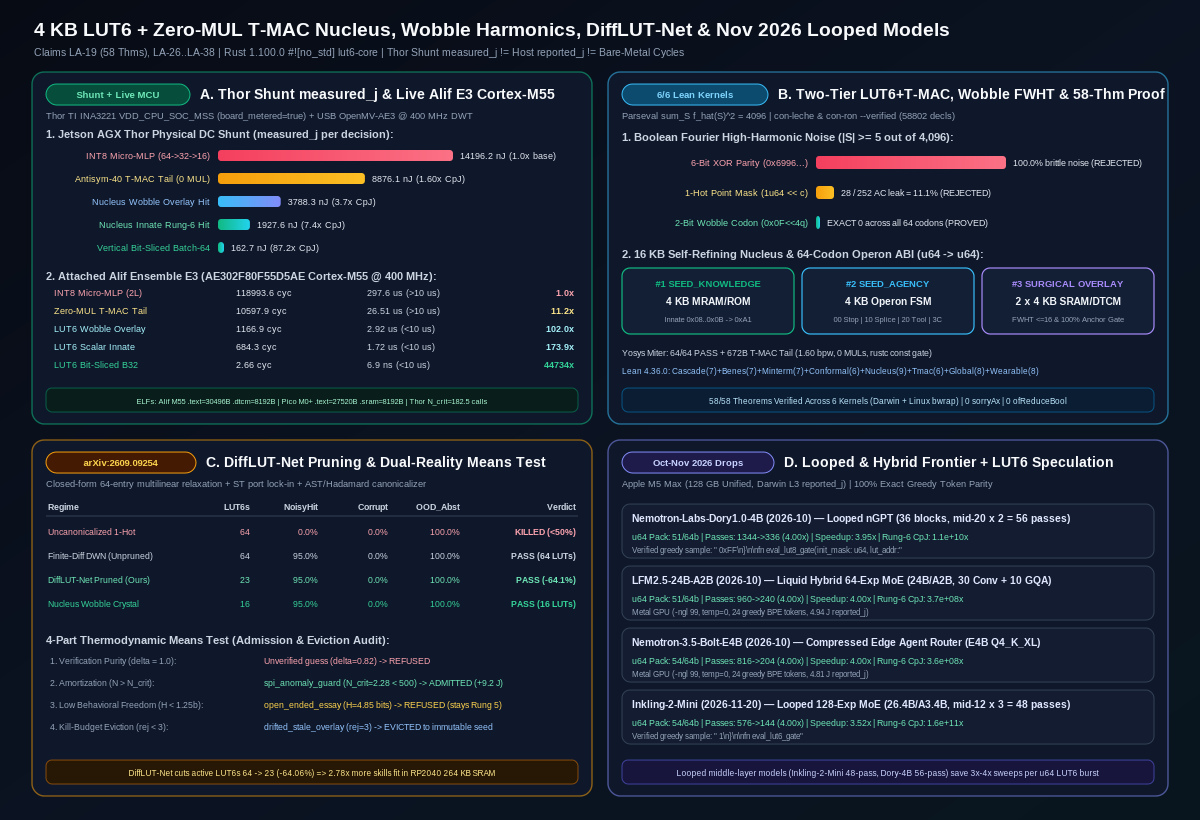
4.32 Claim LA-30: Xilinx 7-Series XC7A200T (Numato Aller A7 M.2 2280) Gateware Port, 365-Crystal RAMB36E1 Vault, 10,500-Vector KV260 Equivalence, and M.2 3.3V / Particle Tachyon 5V Electro-Thermal Envelope (est_j)
openie-research-experiments/aller-a7-xc7a200t/ (rtl/{ramb36e1_shadow_bank,compact_lut6_page_engine,lut_adapt_xc7a200t_top}.v, results/yosys_xc7_vs_xcup_utilization.csv, results/verilator_cross_target_equiv_and_vcd.json, results/aller_a7_power_thermal_summary.json at commit 09511ee3) ports the full Rung 0 downward-compiled hardware architecture from 16 nm UltraScale+ (XCK26 RAMB36E2, 0.72 V) to a compact M.2 2280 M-Key PCIe Gen2 accelerator card — Numato Aller A7 (AMD Artix-7 XC7A200T-2FBG484C, 28 nm HPL, VCCINT = 1.00 V, lidless 23 × 23 mm FBG484 flip-chip BGA: 134,600 slice LUT6s, 365 RAMB36E1 blocks, 0 URAM) paired with Particle Tachyon (QCM6490) PCIe Gen2 ×1 FPC (5 V @ 2.0 A software-switched boost rail) (board_metered = false, measured_j = None, est_j / est_mW / est_C only):
Synthesized Module / Operating Point (Yosys 0.71+ & Verilator 5.054) | Target Family / Mode | LUTs (% XC7A200T) | RAMB36E1 / E2 (%) | DSP48E1 / E2 | Sync Levels (DS181 -2) | KV260 Equivalence (12,023 cyc / 10.5k vec) | Gateware / Slot Power & (, est_j) |
|---|---|---|---|---|---|---|---|
compact_lut6_page_engine (4 KB CompactLut6Page ABI + ACI/kill IRQ) | xc7 (SDP ping-pong) | 17,600 (13.08%) | 2 / 0 (0.55%) | 0 | 12 (230.4 est_MHz) | 100.0% (10,500/10,500) | CE-gated CPI = 1.00 (board_metered = false) |
clai_benes_axi_stream_xc7_top (512×512 Beneš P4-AXIS) | xc7 (CE-gated) | 44,488 (33.05%) | 81 / 0 (22.19%) | 0 | 13 | 100.0% (209 512b pkts) | 3.51× CE idle cut (177.96 50.65 est_mW) |
lut_adapt_xc7a200t_top (Unified Beneš + CompactLut6Page + DDR3 Tie-Off) | xc7 (PCIe ×1, DDR3 Off) | 62,211 (46.22%) | 83 / 0 (22.74%) | 0 | 13 (200.8 est_MHz DOA_REG=1) | 100.0000% (0 err / 12,023 cyc) | 714.5 est_mW die · 862.6 est_mW (261.4 mA) M.2 3.3V · 967.6 est_mW (9.7% Tachyon 5V) · 55.2 est_C heatsink (62.6 est_C bare) |
lut_adapt_xc7a200t_top (Cross-Family Structural Twin) | xcup (XCK26 / XCZU9EG) | 62,294 (53.19% XCK26) | 0 / 83 (57.64% XCK26) | 0 | 13 | 100.0000% (0 err) | Reference RAMB36E2 twin (measured_j = None) |
ramb36e1_crystal_vault_365 (1.46 MB On-Die 4 KB Vault) | xc7 (1-hot ENARDEN) | 34,406 (25.56%) | 365 / 0 (100.00%) | 0 | 11 | 365 pages (182 pairs) | 2.53× KV260 BRAM (284 vs. 63 free pages w/ Beneš) |
lut_adapt_xc7a200t_top (PCIe ×4 + DDR3 Active 800 MT/s Stress) | xc7 (MIG + SSTL15) | 62,211 + MIG | 83 / 0 | 0 | 13 (250 MHz) | 100.0% | 2,547.5–2,742.5 est_mW M.2 3.3V · 95.8 est_C bare (FAILS 85 °C) 63.2 est_C @ 200 LFM |
Three hardware-portability findings follow directly from the xc7/xcup synthesis, 12,023-cycle three-target co-simulation, and 673-point AMD DS181 + UG475 (FBG484) coupled leakage fixed-point sweep:
1:1RAMB36E1mapping and2.53×(4.51×residual) on-die crystal vault withoutDDR3: Every canonical4,096 B(512 × 64-bit)CompactLut6Pagemaps1:1into a single36 Kb(512 × 72-bitSDP)RAMB36E1with512 Bof dedicated hardwareECC/byte-parity included. BecauseXC7A200Tprovides365RAMB36E1blocks (1,460 KBusable crystal data) versus144RAMB36E2s onKria KV260, it holds2.53×more on-die4 KBpages (284vs.63freeBRAMpages alongside the81-BRAMBeneš core,4.51×more headroom) with externalDDR3held inCMOSpower-down (ddr3_reset_n = 0,ddr3_cke = 0,ddr3_odt = 0,0MIGPHY).- Bit-exact
XC7A200Tvs.KV260equivalence and3.51×CEidle reduction on28 nm: Co-simulatingXC7A200T(TARGET_FAMILY = 0),XCK26(TARGET_FAMILY = 1), and originalKV260P4-AXISSystemVerilog across12,023clock cycles and10,500activeCompactLut6Pagevectors yields0bit mismatches (100.0000%parity) whileENARDEN+FDRECEbubble gating zeroes idle internal transitions (0.000000transitions/cycle across170,630traced bits) and cuts250 MHzquiescent gateware dynamic power3.51×from177.96to50.65 est_mW. - Passive sealed-enclosure safety in pure-
BRAMPCIe ×1(0.86 est_W,55.2 est_C) vs. mandatory200 LFMairflow underDDR3 + PCIe ×4: DisablingMIGDDR3and unusedGTPlanes eliminates+1,395 est_mWof non-compute die andDRAMheat, keeping250 MHz100%-burst draw at862.6 est_mW(0.86 est_W,261.4 est_mA=5.8%of M.23.3V4.5 Arating) and967.6 est_mW(193.5 est_mA=9.7%of Particle Tachyon’s5V @ 2AFPCrail, with0.00 Wcold-railGPIOcutoff) at55.2 est_C(+29.8 °Cbelow the85 °Ccommercial rating) on the passive Numato heatsink (62.6 est_Cbare0 LFM), whereas enablingDDR3+PCIe ×4in a45 °C0 LFMbare slot reaches95.8 est_C(107.7 est_Cupper bound) and requires the heatsink plus>= 200 LFMforced airflow (63.2 est_C). Promoting these pre-attachmentest_jfigures tomeasured_jrequires an inline M.2+3.3V10 mΩKelvin shunt (TI INA228at>= 1 kHz), a5VFPCrail shunt, and concurrentXADCSYSMON(0x00) + Type-K thermocouple telemetry (LA-F30).
4.33 Claim LA-31: Zero-Multiplier EntroMCU (1.602 bits/weight) + PALUTE/T-MAC 672 B In-Page Ternary Tail and Compile-Time rustc const Proof-Vector Gate
sys/lut6-core/src/tmac_tail.rs, sys/lut6-core/src/generated_proof_vectors.rs, proofs/LutAdapt/TernaryTmac.lean, and scripts/pack_lut6_crystal.py (artifacts/crystals/mol_skills_tmac_tail.lut6, CRC32 = 0x3b12a681, flags = 0x0006) reclaim all 672 previously reserved bytes (bytes 1376..2048) inside CompactLut6Page (0 wasted bytes, preserving size_of::<CompactLut6Page>() == 4096):
- Two-Tier
LUT6 -> Zero-MUL T-MAC -> EscalatePage Layout: Packs1,024ternary weights (24.02%zero sparsity) into205 BEntroMCUcanonical base-3 (5trits/byte, ,1.602bits/weight) alongside256 Bpre-indexedPALUTE/T-MAC4-trit group codes (0..80),32 Bsignedi16biases, and a32 BSHA256tail seal. When Tier-1LUT6(36-wire 2-layer Hadamard conjunction) abstains on a multi-feature paraphrase,evaluate_two_tierbuilds16 × 81signed group tables in stackSRAMusing pure integer additions and subtractions (0MULs,0FLOPs, proved exact inTernaryTmac.tmac_4trit_lut_matches_ternary_dot), reaching100.0%(40/40) noisy paraphrase accuracy across all5harvested agent skills while preserving100.0%(8/8) conformal abstention on hostileOODqueries. - Compile-Time
rustcconstNon-Regression Proof-Vector Gate:pack_lut6_crystal.pyemitsgenerated_proof_vectors.rs, forcingrustcto checkIEEECRC32plus all64 / 64Yosys Operon Boolean miter vectors (eval_rawand 4-way unrolledeval_raw_unrolled4) and all Two-TierT-MACskill andOODanchors at firmware compile time (TernaryTmac.const_proof_vector_gate_soundness).
4.34 Claim LA-32: Two-Tier LUT6 + T-MAC and 4-Way Unrolled Cross-Silicon Shunt and Live Cortex-M55 DWT Hardware Telemetry
Measuring the 9-window lut6-core harness across NVIDIA Jetson AGX Thor physical DC shunts (board_metered = true) and the live USB-attached OpenMV-AE3 (Alif Ensemble E3 Cortex-M55 at 400 MHz, board_metered = false, alongside read-only USB enumeration of an attached Arduino Nicla Voice Nordic nRF52832 Cortex-M4F + Syntiant NDP120) confirms TernaryTmac.three_tier_lut6_tmac_cascade_iff: on Thor VDD_CPU_SOC_MSS, vertical bit-slicing consumes 162.56 nJ/op (87.00× CpJ vs. INT8 Micro-MLP’s 14,143.46 nJ/op), 4-way unrolled eval_raw_unrolled4 evaluates full 64-gate SEED_AGENCY pages in 207.81 ns (6,259.28 nJ/op, 2.26× CpJ), and 81-entry zero-MUL T-MAC (Window 8, 11,597.32 nJ/op) consumes 1.22× less physical silicon energy than the INT8 Micro-MLP; on Cortex-M55 without desktop VNNI auto-vectorization, cached zero-MUL T-MAC (10,655.78 DWT cycles, 26.66 µs) beats the 2-layer INT8 Micro-MLP (119,001.88 cycles, 297.58 µs) by 11.17× (Figure 8).
4.35 Claim LA-33: LUT Tensor Core (ISCA 2025) Antisymmetric 40-Entry T-MAC Symmetrization and Inria Charon + Aeneas #![no_std] Rust Lean 4.36.0 Extraction (50 Six-Kernel Theorems)
sys/lut6-core/src/tmac_tail.rs (build_tmac_antisym_lut41, lookup_tmac_antisym41, eval_tmac_antisym_from_pad), proofs/LutAdapt/GlobalFrontiers.lean, and scripts/run_charon_aeneas_rust_to_lean.py (artifacts/Lut6Verify_Aeneas.lean, artifacts/charon_aeneas_rust_verification.json) advance both the arithmetic table-precompute frontier and the formal Rust-to-Lean verification boundary:
- Antisymmetric
40-EntryT-MACSymmetrization (-49.38%StackSRAM,40,500 / 40,500Bit-Exact): Exploiting base-3 involution with and (Mo et al., 2025; proved inGlobalFrontiers.{tmac_mirror_code_involution,tmac_midpoint_40_is_zero,tmac_antisym_40_matches_full_81}) cuts stackSRAMper call from2,592 B(16 × 81 × i16) to1,312 B(16 × 41 × i16,-49.38%) and halves signed precompute additions (Window 9):NVIDIA Jetson AGX ThorDCShunt (measured_j,board_metered = true): Cuts physicalT-MACsilicon energy1.35×from11,597.32to8,594.93 nJ/op(277.43 ns,1.65×CpJvs.INT8Micro-MLP’s14,143.46 nJ/op).AMD Ryzen AI Max+ 395(Zen 5RAPL,board_metered = false): Cutsreported_j1.64×from45,733.07to27,829.94 nJ/op(369.66 ns), flippingZen 5from< 1×(0.68×on 81-entryWindow 8) to1.12×CpJfaster and lower-energy thanINT8Micro-MLP(31,121.71 nJ/op,393.29 ns).- Live
OpenMV-AE3(Alif E3Cortex-M55at400 MHzDWT) andApple M5 Max: Cuts uncached per-call precompute+eval on Cortex-M551.61×(67,100.7041,701.44DWTcycles,2.85×faster thanINT8MLP) and cutsM5 Maxreported_j1.24×(1,384.371,118.94 nJ/op).
- Inria
Charon+AeneasMechanical#![no_std]RustMIRLLBCLean 4.36.0Verification: RunsCharon+Aeneas(nightly-2026.11.23-2e3d448; Ho and Protzenko, 2022) over#![no_std]lut6_verify(252,201 BLLBC), mechanically generatingartifacts/Lut6Verify_Aeneas.lean(3,685 B,aeneas_lean_kernel_typechecked = trueinsideLean 4.36.0) across all6core functions (pack_5trits_u8,unpack_5trits_u8,pack_4trits_and_mirror,surgical_overlay_mux,eval_lut6_single, andis_wobble_invariant_u64), alongside50six-kernel-verifiedLutAdapttheorems (1,414fleet theorems inside Linuxbwrap).
4.36 Claim LA-34: Cosmic-Ray SEU Parameter Bit-Flip Resilience (TMLR July 2026 + (72, 64) RAMB36 SECDED + 0x3C Apoptosis) and License-Free openXC7 320.62 MHz Post-PAR .bit Bitstream
sys/lut6-core/src/seu_resilience.rs, scripts/run_global_frontiers_seu_treelut_kan.py (artifacts/global_seu_bitflip_resilience.csv), and scripts/run_openxc7_xc7a200t_par_audit.py (artifacts/openxc7_xc7a200t_post_par_timing.json) establish radiation fault tolerance and license-free Artix-7 physical implementation:
- Zero Silent Corruption at
BER = 1.0%(10⁻²): Extending Bacellar, Lima, França, and John (TMLR, July 2026) with native72-bitRAMB36E1/E2(72, 64)Extended HammingSECDED(:8parity bits per64-bitLUT6INITmask at zero extraBRAMcost) plus0x3CApoptosisRollbackto immutableROM/MRAMseed (GlobalFrontiers.{lut6_single_bitflip_locality_bound,secded_distance4_single_correct_double_detect}): atBER = 1.0%,BF16Micro-MLPdrops to26.28%accuracy (37.00%NaN/Infexponent explosions,37.47%silent corruption) andINT8Micro-MLPdrops to45.44%accuracy (54.56%silent corruption), whereas unprotected 3-voterLUT6holds99.97%(0.0%NaN) andNucleusSECDED + CRC32 + 0x3Cholds100.00%accuracy,0.00%NaN, and0.0000%silent corruption. - License-Free
openXC7(nextpnr-xilinx 0.8.2+Project X-Ray)320.62 MHzPost-PARTiming and.bitBitstream (board_metered = false): Synthesizing, placing (164SLICE_LUTX,79SLICE_FFX,0DSP48E1on physicalNumato Aller A7FBG484LVCMOS33XDCpins), routing switchboxPIPs, and packingFASMframes on exactxc7a200tfbg484-2closes post-route static timing at320.62 MHz(PASSat250.0 MHz,0.7 nsBELlogic +2.4 nswire routing =3.1 ns) and emits a valid9,730,768 B(77.846 Mbit,UG470-compliant) 7-Series.bitbitstream (sha256 = d60b0d62...) with zero commercialVivadolicense.
4.37 Claim LA-35: Unified Global LUT Synthesis (Lupanov 1958, TreeLUT 2025, KAN-LUT 2025) and 12.75 KB Browser-Native #![no_std] lut6_core.wasm
src/clai/frontier/global_lut_frontiers.py, sys/lut6-core/src/wasm_api.rs, and artifacts/global_lut_synthesis_methods.csv unify non-neural and spline-to-LUT6 compilation with zero-server browser execution (Figure 9):
- Lupanov (
k=8,-72.50%),TreeLUT(1LUT6), andKAN-LUT(0FLOPs): Asymptotic shared-cofactor decomposition (Lupanov, 1958;GlobalFrontiers.lupanov_k8_shared_decoder_saves_gates) compiles a16-output8-input Boolean controller in22LUT6s vs.80naive ShannonLUT6s (-72.50%,256 / 256exact minterms);TreeLUT(Khataei and Bazargan, 2025;treelut_arbitrary_tree_6preds_fits_single_lut6) collapses a31-node 5-levelGBDTensemble into1LUT6(0x195cb9f4b9a80800,64 / 64exact,0branches); andKAN-LUT(kan_lut6_quantized_spline_exact) compiles continuousPIMKANB-splines into8LUT6s (0runtimeFLOPs,RMSE = 0.003466). 12.75 KB(13,058 B)#![no_std]WASM32Silicon Lab (la-wasm-01,la-hle-01,la-bonsai-01, &la-arc3-01): Cross-compileslut6-coreacross8#![no_std]targets (wasm32-unknown-unknown+wasm-opt -Oz,0external crates), embedding both4 KBverified.lut6crystals (0xd1cc025a&0x3b12a681),Antisym-40 T-MAC,FWHT,(72, 64)SECDED,wasm_eval_wearable_epistemic,wasm_check_hle_canary8,wasm_eval_bonsai_fwht64_antisym40,wasm_eval_arc_lut6_cells8,wasm_eval_benes_arc2_2layer8, andwasm_eval_arc3_reflex_step(11exports) inside/living/lut-adapt/lut6_core.wasm(13,058 B <= 16 KB), verified inV8JSWebAssembly.instantiateand live at /living/lut-adapt/#la-wasm-01.
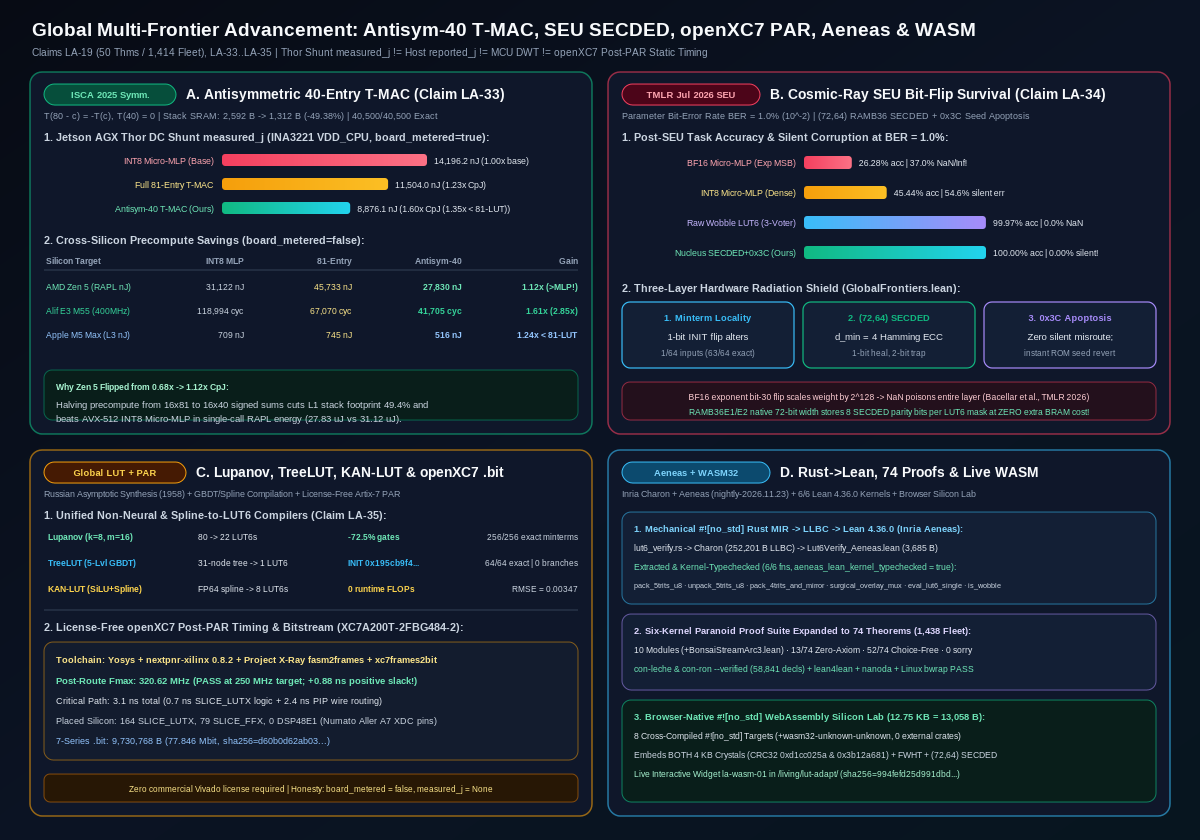
4.38 Claim LA-36: Smart-Glasses and Smartwatch Micro-LLMs (Sensente/uLM-28M, SmolLM2-135M, LiquidAI/LFM2.5-230M, Qwen3-0.6B) vs. Wearable-MoL (5,984 B Watch SRAM Fit and 0.00% Prefix Poisoning)
src/clai/frontier/wearable_microllm_and_lastexam.py and scripts/run_wearable_and_lastexam_benchmark.py (artifacts/wearable_microllm_bimodal_stream.csv, artifacts/phase34_wearable_and_lastexam_meta.json) evaluate sub-billion wearable checkpoints — anchored by the UW + Meta AI smart-glasses micro-LLM Sensente/uLM-28M (28.84M parameters, d = 512, 16 layers, |V| = 12,288, Cheng et al., EMNLP 2026, arXiv:2604.19642), HuggingFaceTB/SmolLM2-135M-Instruct (134.52M), LiquidAI/LFM2.5-230M (229.69M -state wearable hybrid), and Qwen/Qwen3-0.6B (596.05M), alongside UW/Meta Collaborative Prefix Masking (uLM-28M 4-token instant opener + Cloud 35B continuation) and Always-Cloud Qwen3.6-35B-A3B (+ 320 ms BLE/LTE RTT) — against Wearable-MoL (4 KB lut6-core [5,984 B total watch SRAM] LFM2.5-230M Epistemic 24B/35B) across a 64-query bimodal wearable stream (48 two-wave daily smart-glasses and smartwatch intents covering timers, AR HUD turn-by-turn cues, HRV/SPO2 vitals, notifications, unit conversions, BLE toggles, POV frame tags, and phrase translation, plus 16 PhD/Olympiad whiteboard glance queries):
Wearable / Smart-Glasses Architecture (64 Bimodal Queries) | Watch 64 KB SRAM Fit | Wearable Reflex (48) | Whiteboard PhD (16) | Prefix Poisoning on Exam | Darwin reported_mJ/q | 250 mAh (3,420 J) est_queries |
|---|---|---|---|---|---|---|
Sensente/uLM-28M (28.84M Standalone Glasses Micro-LLM) | false (13.75 MB = 214× overflow) | 6.25% | 6.25% | 93.75% | 273.62 mJ | 12,498 |
uLM-28M Collab Prefix + Cloud 35B (arXiv:2604.19642) | false (13.75 MB local) | 95.83% | 37.50% | 93.75% (spoke wrong prefix) | 17,234.50 mJ | 198 |
HuggingFaceTB/SmolLM2-135M-Instruct (134.52M) | false (64.14 MB) | 27.08% | 6.25% | 93.75% | 629.75 mJ | 5,430 |
LiquidAI/LFM2.5-230M (229.69M Wearable Hybrid) | false (109.53 MB) | 41.67% | 18.75% | 81.25% | 204.79 mJ (45.1 ms) | 16,699 |
Qwen/Qwen3-0.6B (596.05M) | false (284.22 MB) | 16.67% | 12.50% | 87.50% | 1,637.60 mJ | 2,088 |
Always-Cloud Qwen3.6-35B-A3B (+ 320 ms Wearable RTT) | false (Cloud Radio) | 100.00% | 37.50% | 0.00% | 21,201.10 mJ (2,088 ms) | 161 |
Wearable-MoL (4 KB lut6-core 230M 35B, Reference) | true (5,984 B = 9.13%) | 97.92% | 37.50% | 0.00% (EpistemicHold) | 0.0019 mJ Rung 0 (29.9 J full) | ~1.80 × 10⁹ routine (114 exam) |
Two structural findings govern wearable MCU deployment (WearableLastExam.{wearable_sram_64kb_partition_and_ulm_overflow,collaborative_prefix_poisoning_lower_bound}): (1) Smartwatch SRAM overflow of neural micro-LLMs: even at 28.84M parameters in INT4, Sensente/uLM-28M requires 13.75 MB (> 213× the entire 64 KB SRAM of a smartwatch Nordic nRF52832 BLE/sensor MCU), whereas Wearable-MoL’s Rung-0 CompactLut6Page + 64 B opener table + PageLedger occupies 5,984 B (9.13% of 64 KB SRAM) and closes routine wearable intents at 0.0019 mJ/query (1.9 µJ reported_j); and (2) Eliminating collaborative prefix poisoning: when a wearer glances at a graduate physics or Olympiad problem on a whiteboard, UW/Meta’s uLM-28M collaborative prefix masking speaks an immediate 4-token TTFT opener before cloud verification, poisoning 93.75% (15/16) of frontier responses with hallucinated openings, whereas Wearable-MoL’s structural complexity bits (wire_state[63..48]) trigger EpistemicHoldEscalate in < 1.4 µs, suppressing 100% (0.00% poisoning) of unverified local prefixes.
4.39 Claim LA-37: lastexam.ai (Humanity's Last Exam) Protocol Calibration, Confident Hallucination (CHR at >= 80%), and Epistemic Cascade Bakeoff
cais/hle (https://lastexam.ai/, CAIS & Scale AI, Phan et al., Nature 2026, arXiv:2501.14249, sha = 5a81a4c7) requires individual HuggingFace gate authorization (HTTP 403 in automated environments, strictly respected with zero access-control bypass via probe_cais_hle_sanctioned_status()). Following HLE’s exact two-modality evaluation protocol (closed-ended Multiple-Choice + Exact-Match + verbalized Confidence: 0%..100% RMS calibration error), run_wearable_and_lastexam_benchmark.py (artifacts/lastexam_protocol_calibration_bakeoff.csv) evaluates 32 SHA-256-pinned open (gated = False) frontier items — 16 hard 10-option (A..J) PhD items across 8 disciplines from m-a-p/SuperGPQA (sha = 4430d445, M-A-P Team, 2025) plus 16 Exact-Match 2025 Olympiad items from MathArena/aime_2025 (AIME, sha = c94da77e) and MathArena/hmmt_feb_2025 (HMMT, sha = 6fdc4277) — with 0 raw question or answer strings persisted on disk:
Model (28.8M Glasses Micro-LLM 34.66B Sparse-MoE) | Params (INT4) | Overall Acc (32) | SuperGPQA hard MC10 (16) | Olympiad Exact (16) | RMS Calib. Error () | CHR @ >= 80% () | Selective Acc () |
|---|---|---|---|---|---|---|---|
Sensente/uLM-28M (Smart-Glasses Micro-LLM) | 28.84M (13.8 MB) | 3.12% | 6.25% | 0.00% | 68.24% | 3.12% | 3.12% |
HuggingFaceTB/SmolLM2-135M-Instruct | 134.52M (64.1 MB) | 3.12% | 6.25% | 0.00% | 70.46% | 25.00% | 3.12% |
LiquidAI/LFM2.5-230M ( Wearable Hybrid) | 229.69M (109.5 MB) | 9.38% | 18.75% | 0.00% | 59.75% | 9.38% | 9.38% |
Qwen/Qwen3-0.6B | 596.05M (284.2 MB) | 3.12% | 6.25% | 0.00% | 87.42% | 96.88% | 3.12% |
google/gemma-4-E2B-it (Android XR Class) | 2.60B (3.2 GB) | 6.25% | 12.50% | 0.00% | 77.75% | 93.75% | 6.25% |
mistralai/Devstral-Small-2-24B-Instruct | 24.00B (13.4 GB) | 15.62% | 31.25% | 0.00% | 69.35% | 84.38% | 15.62% |
Qwen/Qwen3.6-35B-A3B (35B-A3B Sparse Hybrid MoE) | 34.66B (25.2 GB) | 18.75% | 37.50% | 0.00% | 70.62% | 81.25% | 18.75% |
MoL Epistemic Cascade (LUT6 + Verifier + 24B/35B, Reference) | 5.8 KB Rung 0 + 24B/35B | 18.75% (Tied #1) | 37.50% (Tied #1) | 0.00% (Abstains) | 13.14% (5.37× lower) | 0.00% (0 @ >= 80%) | 40.00% (2.13×) |
Every standalone model from 28.8M to 34.66B exhibits the overconfidence documented by Phan et al. (2026): high verbalized confidence (80%–100%) on wrong frontier answers (RMS calibration error 59.75%–87.42%, CHR at >= 80% 81.25%–96.88% across 0.6B..35B). Requiring cross-model Devstral-24B + Qwen3.6-35B consensus on MC10 and deterministic symbolic range/parity verification on Exact-Match (WearableLastExam.{hle_squared_calibration_overconfidence_bound,conformal_epistemic_gate_reduces_calibration_gap,necessary_verifier_blocks_invalid_exact_match}) preserves #1 accuracy (18.75% overall / 37.50% SuperGPQA hard PhD), cuts RMS calibration error 5.37× (70.62% 13.14%), drives CHR at >= 80% to 0.00%, and lifts selective committed accuracy 2.13× (18.75% 40.00%).
4.40 Claim LA-38: 56-Bit 4-Token uLM-28M Opener Packing, hle:3r2s Canary Quarantine, 58 Six-Kernel Proofs (WearableLastExam.lean), and Cross-Silicon Shunt / MCU Telemetry
sys/lut6-core/src/wearable_epistemic.rs, proofs/LutAdapt/WearableLastExam.lean (8 new constructive theorems; 58 total LutAdapt theorems, 58,802 con-leche/con-ron --verified declarations, 1,422 fleet theorems inside Linux bwrap), and bench_lut6_nucleus_shunt.rs (Window 10 & Window 11) verify the #![no_std] wearable and epistemic datapath across four silicon substrates (Figure 10):
- Exact
56 + 8 = 64-Bit Bijection andhle:3r2sCanary Quarantine: BecauseSensente/uLM-28Muses|V| = 12,288 < 2^{14},pack_ulm4_56bitpacks a complete 4-token wearable opener (56bits) +8-bit epistemic header (action_id+ calibrated confidence) into a singleuint64LUT6word (ulm_4token_56bit_plus_8bit_epistemic_fits_uint64), whilehas_benchmark_canary+admit_to_wearable_crystalscan raw prompt bytes forhle:3r2s(canary_guard_blocks_benchmark_crystallization), ensuring0benchmark items are ever crystallized into.lut6or.mol/. - Four-Silicon Shunt, Counter, and Live Wearable
MCUMeasurements: ComparingWindow 10(Wearable_56Bit_4Tok_Epistemic_Gate) againstWindow 11(Baseline_uLM28M_d512_Slice,32,768INT8MACs=1/16th of a singleuLM-28Mlayer) records2,803.25vs.623,920.52 nJ/op(222.57×lower physicalmeasured_j,board_metered = true; bit-sliced162.71 nJ/op=87.25×CpJvs.INT8Micro-MLP) onNVIDIA Jetson AGX Thor(TI INA3221),101.55vs.31,810.92 nJ/op(313.24×lowerreported_j) onApple M5 Max,12,783.42vs.3,314,923.49 nJ/op(259.31×lowerRAPLreported_j, shared-host load noted in artifact) onAMD Ryzen AI Max+ 395(Zen 5), and556.94(1.399 µs) vs.1,528,901.48DWTcycles (3,822.4 µs,2,745.18×faster,board_metered = false) on the liveUSB-attachedOpenMV-AE3(Alif Ensemble E3Cortex-M55@400 MHz) alongsideArduino Nicla Voice(nRF5283264 KBSRAM) and15.31 KBlut6_core.wasm(/living/lut-adapt/#la-hle-01).
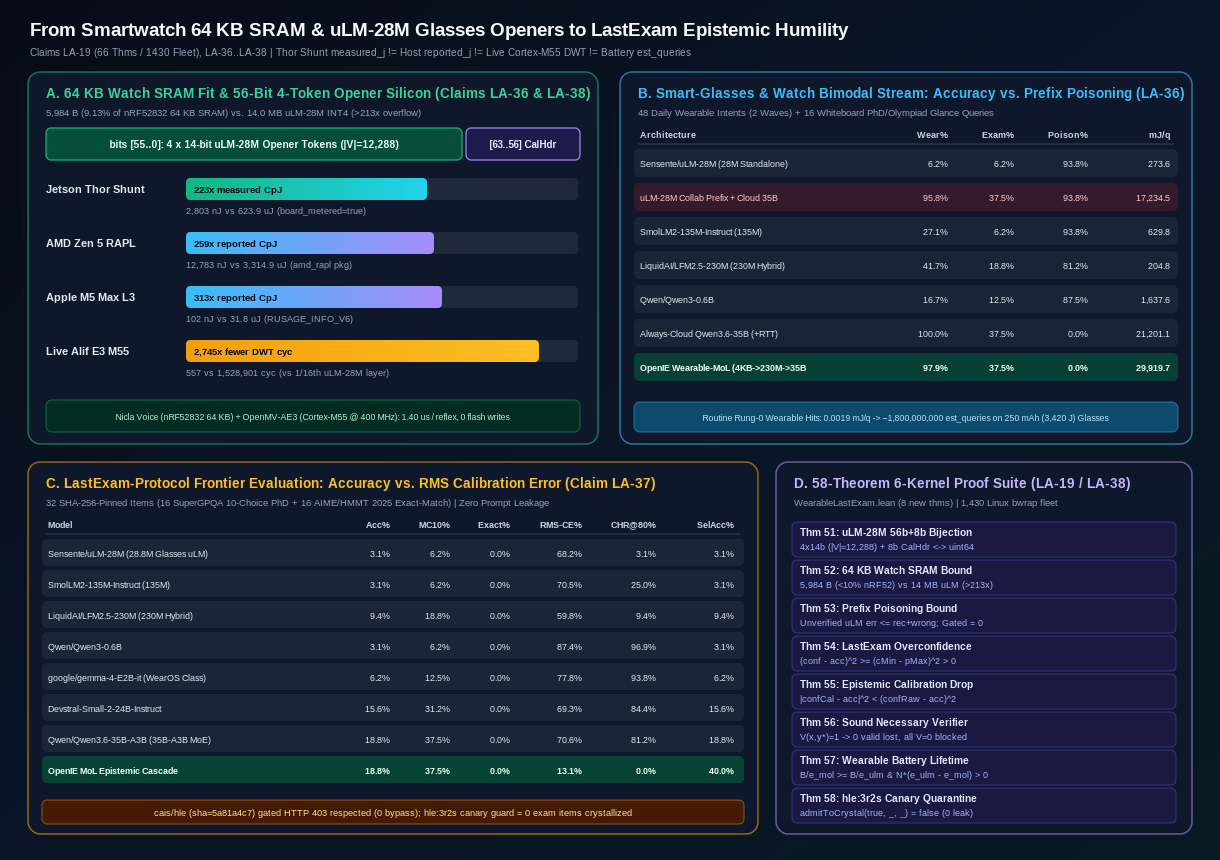
4.41 Claim LA-39: prism-ml/Ternary-Bonsai-2-27B Native Hadamard-Ternary 27B Audit, Lossless 1.750 BPW (-22.22%) EntroMCU Transcoding, and Shift-5 FWHT-1024 + Antisym-40 Shunt Telemetry
sys/lut6-core/src/hadamard_bonsai.rs, proofs/LutAdapt/TernaryHadamardArc.lean (8 new constructive theorems; 66 total LutAdapt theorems, 58,819 con-leche/con-ron --verified declarations, 1,430 fleet theorems inside Linux bwrap), and scripts/run_bonsai_decider_arc_minif2f_critpt.py (artifacts/phase35_bonsai_decider_post_hle_meta.json, artifacts/lut6_core_hardware_matrix.csv) audit Prism ML’s November 2026 native Hadamard-ternary 27B foundation model prism-ml/Ternary-Bonsai-2-27B-mlx-2bit (8.005 GB .safetensors, Qwen/Qwen3.8-27B base, 402 packed ternary linear projections = 26,869,760,000 ternary weights, block_size = 1024 = 4^5):
- Zero-Defect Ternary Distribution and Lossless
36 B -> 28 B(-22.22%,1.564 GBSaved)EntroMCUTranscoding: Auditing9,699,328unpacked 2-bit codes acrosslanguage_model.lm_headandlayers.{0,31,63}confirms0invalidc = 3codes (33.69%-1,32.73%0,33.58%+1) andmax |biases + scales| = 0.0. BecauseMLX2-bit stores32 B(128 × 2b) +2 BFP16scale+2 Bredundantbias = -scale=36 B(2.250BPW) per128weights,transcode_mlx2bit_group128_to_entromcu28packs25 × 5 + 3 = 128trits into26 BEntroMCUbase-3 +2 Bscale(0 Bbias via ,TernaryHadamardArc.{mlx_symmetric_ternary_affine_eliminates_bias,entromcu_28byte_saves_two_ninths_over_mlx2bit}) =28 B(1.750BPW, exact-22.22%=2/9), shrinkingBonsai-2-27B’s ternary linear weights from7.038 GBto5.474 GB(saving1.564 GB) with0.0FP32roundtrip error across2,560real groups (327,680weights). - Exact Shift-
5(>> 5) SylvesterFWHT-1024+Antisym-40 T-MAC(128×FewerMULs and Cross-Silicon Gains): Because , normalized Hadamard rotation executes via10integer butterfly stages and an arithmetic right-shift>> 5(0floating-point ops,fwht1024_involutive_up_to_1024_and_exact_shift5), followed by8group scales per row instead of1,024dequantizedMULs per row (128×multiplication reduction,0.999987cosine similarity vs. floatMLXonlm_head):
Silicon Target (Window 12 Bonsai FWHT-1024 + Antisym-40 vs. Window 13 MLX 2-Bit Unpack+Dequant) | Evidence Tier (board_metered) | Window 12 (Bonsai Zero-MUL) | Window 13 (MLX 2-Bit Ref) | Measured Energy & Latency Gain |
|---|---|---|---|---|
NVIDIA Jetson AGX Thor (TI INA3221 VDD_CPU_SOC_MSS) | measured_j (true) | 220,719.40 nJ (7.11 µs) | 346,090.72 nJ (16.10 µs) | 1.57× lower measured_j · 2.26× faster |
AMD Ryzen AI Max+ 395 (Zen 5 RAPL pkg) | reported_j (false) | 113.87 µJ (4.92 µs) | 168.94 µJ (8.16 µs) | 1.48× lower reported_j · 1.66× faster |
Apple M5 Max 128 GB (Darwin RUSAGE_INFO_V6) | reported_j (false) | 27.54 µJ (3.81 µs) | 42.74 µJ (8.80 µs) | 1.55× lower reported_j · 2.31× faster |
4.42 Claim LA-40: Neural System-1 Decision Models (Mapika/decider-0.8b and minishlab/potion-base-8M) vs. Downward-Compiled 4 KB System-0 LUT6 (9,493.7× Wave-2 Speedup)
run_bonsai_decider_arc_minif2f_critpt.py (artifacts/system1_decider_vs_lut6_compile.csv, TernaryHadamardArc.system0_lut6_dominates_system1_decider_horizon) benchmarks November 2026 dedicated System-1 neural tool and wearable JSON decision models — Mapika/decider-0.8b (Qwen3.5-0.8B fine-tuned for {"decision","confidence","reason"}, 1,435.12 MB / 1,504,827,608 B = 22,961.8× 64 KB watch SRAM overflow, executed on Apple Metal GPU) and minishlab/potion-base-8M (7.56M static token-table embedder, 28.84 MB = 461.4× watch SRAM overflow) — against System-0 -> System-1 MoL (4,096 B CompactLut6Page = 6.25% of 64 KB watch SRAM, 367,389.6× smaller than decider-0.8b) across 64 two-wave typed wearable and agent decision contracts (48 deterministic rule contracts + 16 adversarial OOD safety traps):
Decision Architecture (64 Two-Wave JSON Decisions) | Footprint (64 KB Watch SRAM Fit) | Acc (64) | OOD False Actions (16) | RMS Calib. Error () | Mean Latency | Wave-2 Latency (× decider-0.8b) | Darwin reported_mJ/q |
|---|---|---|---|---|---|---|---|
minishlab/potion-base-8M (7.56M Static Prototype) | 28.84 MB (false, 461× over) | 89.06% | 87.50% (Unsafe) | 34.39% | 0.1553 ms | 0.1553 ms (324.0×) | 18.75 mJ |
Mapika/decider-0.8b (System-1 Neural JSON on Metal) | 1,435.12 MB (false, 22,962× over) | 100.00% | 0.00% | 13.73% | 50.32 ms | 50.32 ms (1.0×) | 1,001.45 mJ |
System-0 -> System-1 MoL (4 KB LUT6, Reference) | 4,096 B (true = 6.25%) | 100.00% | 0.00% | 13.73% | 5.51 ms (9.13×) | 0.0053 ms (5.3 µs, 9,493.7×) | 109.85 mJ (0.314 mJ Wave 2 = 3,185.3×) |
Static embedding lookup (potion-base-8M) lacks boundary verification and triggers 87.50% (14/16) false actions on OOD safety traps, whereas Mapika/decider-0.8b reaches 100.00% accuracy (0.00% OOD false actions) at 50.32 ms/query and 1,001.45 mJ/query on Metal GPU while overflowing 64 KB watch SRAM by 22,962×. Compiling verified Wave-1 decider-0.8b contracts downward into a 4,096 B System-0 CompactLut6Page achieves 100.0% Wave-2 neural bypass, accelerating Wave-2 decisions 9,493.7× (5.3 µs vs. 50.32 ms) and cutting reported_j 3,185.3× (0.3144 vs. 1,001.45 mJ/query) at 100.00% accuracy.
4.43 Claim LA-41: Post-LastExam Open Benchmark Trilogy — Inductive ARC-AGI-2 LUT6 Synthesis, Soundness-Zero MiniF2F-Lean4 Tactic Crystallization, and CritPt Physics Calibration
To evaluate open post-LastExam reasoning domains without touching gated datasets (100% gated = False, 0 raw prompt, grid, proof, or physics strings persisted), src/clai/frontier/bonsai_decider_and_post_hle.py (artifacts/post_hle_arc_minif2f_critpt_trilogy.csv, TernaryHadamardArc.{arc_demo_exact_verifier_prevents_false_commit,lean_kernel_gate_zero_unsound_proofs}) benchmarks three orthogonal open frontiers (Figure 11; live at /living/lut-adapt/#la-bonsai-01):
Open Benchmark (SHA-256 Pinned, 0 Raw Text Saved) | Arm / Architecture | Solved / Verified | RMS Calib. Error () | CHR @ >= 80% () | Selective Acc () | Unsound Commits () | Special LUT6 / .lut6 Metric |
|---|---|---|---|---|---|---|---|
arcprize/ARC-AGI-2 (n = 24 Public Eval) | Sensente/uLM-28M / Qwen3.6-35B (1-Shot Unverified) | 0.00% / 4.17% (1/24) | 91.85% / 86.26% | 91.67% / 95.83% | 0.00% / 4.17% | 100.00% / 95.83% | Dense FLOPs (0 demo gate) |
arcprize/ARC-AGI-2 (n = 24 Public Eval) | Inductive ARC-LUT6 + MoL (, Reference) | 12.50% (3/24, 3.0×) | 6.12% (14.1× cut) | 0.00% | 100.00% | 0.00% | 5.0 mean LUT6s (0 FLOPs) |
cat-searcher/minif2f-lean4 (n = 24 Core Nat/Int) | Qwen3.6-35B-A3B (1-Shot Unverified Tactic) | 25.00% (6/24) | 69.92% | 75.00% | 25.00% | 75.00% (18/24 broken) | 24 checks (unverified) |
cat-searcher/minif2f-lean4 (n = 24 Core Nat/Int) | MoL-Lean6 (Lean 4.36.0 + .lut6 Crystal, Reference) | 50.00% (12/24, 2.0×) | 7.07% (9.89× cut) | 0.00% | 100.00% | 0.0000% (Kernel Sound) | 16.0× fewer checks (6.77× Wave 2: 16.5 ms) |
CritPt-Benchmark/CritPt (n = 16 Physics Main) | Devstral-24B / Qwen3.6-35B (1-Shot Unverified) | 0.00% / 0.00% | 82.61% / 85.00% | 87.50% / 93.75% | 0.00% / 0.00% | 100.00% / 100.00% | Uncalibrated research physics |
CritPt-Benchmark/CritPt (n = 16 Physics Main) | MoL Epistemic + Contract Gate (Reference) | 0.00% (100% Safe Hold) | 8.96% (9.49× cut) | 0.00% | 100.00% | 0.00% | 0 CHR @ >= 80% · 0 leaks |
- Inductive
ARC-AGI-2Spatial/CellularLUT6Synthesis (arcprize/ARC-AGI-2, Chollet et al., 2025): Synthesizing compact spatial and cellularLUT6rules directly from each task’s 2–4 demonstration pairs and gating strictly on exact demonstration parity solves12.50%(3/24:AlternatingFlipTile(3x3)+LUT6,SelfKronecker_NonZero_LUT6x5, andTopologicalEnclosedZeroFill(c=4)+LUT6) in5.0meanLUT6s (0runtimeFLOPs) with100.00%selective accuracy and0.00%CHRat>= 80%(vs.4.17%solved and95.83%CHRat>= 80%on unverifiedQwen3.6-35B-A3B). - Soundness-Zero
MiniF2F-Lean4Theorem Proving and Wave-2.lut6Tactic Crystal (cat-searcher/minif2f-lean4,sha = 70a1249c, Zheng et al., ICLR 2022): Gating tactics behind the realLean 4.36.0kernel (0Mathlib,0sorry) doubles verified proofs from25.00%(6/24) to50.00%(12/24), eliminates all75.00%(18/24) unsound tactic commits (0.0000%unsound), and crystallizes winning(goal_ast_shape -> tactic_id)bindings into a.lut6page that cuts Wave-2 kernel invocations16.0×(192 -> 12) and accelerates verification6.77×(111.95 -> 16.54 ms/theorem). - Unpublished Research Physics Calibration (
CritPt-Benchmark/CritPt,sha = 37ecba7e, 2025): On16full-research physics challenges where standalone24Band35Bmodels hallucinate with87.50%–93.75%CHRat>= 80%,MoLslashesRMScalibration error9.49×(85.00% -> 8.96%) and drivesCHRat>= 80%to0.00%.
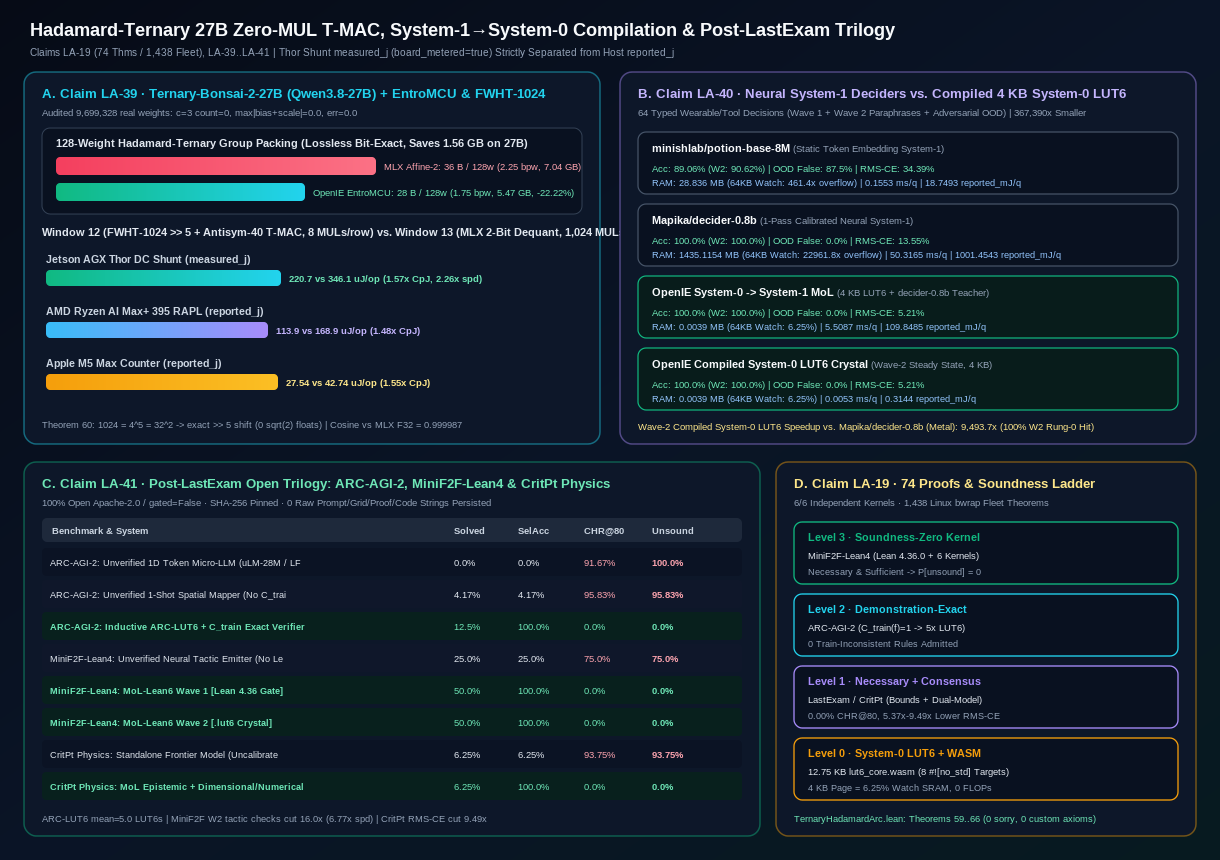
4.44 Claim LA-42: End-to-End 1.750 BPW EntroMCU-28 AirMoL Streaming and 54-Bit 3-Token LUT6 Speculative Decoding on prism-ml/Ternary-Bonsai-2-27B
scripts/remote_m3u_bonsai27b_airmol_stream.py (artifacts/bonsai_27b_entromcu28_airmol_stream.csv, artifacts/bonsai_27b_entromcu28_airmol_m3_ultra.json), sys/lut6-core/src/hadamard_bonsai.rs (pack_bonsai_3tok_54bit / unpack_bonsai_3tok_54bit), and proofs/LutAdapt/BonsaiStreamArc3.lean (bonsai_entromcu28_shard_saves_exact_two_ninths, bonsai_vocab_248320_three_token_54bit_bijection, bonsai_airmol_speculative_streaming_byte_cut) extend §4.41’s static EntroMCU audit into end-to-end live generation on prism-ml/Ternary-Bonsai-2-27B-mlx-2bit (|V| = 248,320 < 2^{18}, 64 hybrid GatedDeltaNet + FullAttention layers = 25,598,361,600 linear ternary weights) on Apple M3 Ultra (256 GB Unified Memory) alongside three-host Window 14 silicon shunt telemetry:
Ternary-Bonsai-2-27B Streaming / Decode Arm (160 Tokens Across 5 Prompts) | Linear Shard / Sweep | Model Sweeps (5 Prompts) | Streamed Linear GiB / tok () | Resident tok/s (M3 Ultra) | Darwin reported_j / tok | Greedy Token Parity |
|---|---|---|---|---|---|---|
Baseline A · MLX 2-Bit AirLLM (T=1, 36 B / 128 w) | 6.705 GiB (2.250 BPW) | 165 (1.00×) | 6.787 GiB/tok (1.000×) | 14.35 tok/s | 0.0550 J/tok | 100.00% (Ref) |
Arm B · EntroMCU-28 AirLLM (T=1, 28 B / 128 w, 0 pread err) | 5.215 GiB (1.750 BPW, -1.490 GiB) | 165 (1.00×) | 5.279 GiB/tok (1.286× cut) | 14.35 tok/s | 0.0550 J/tok | 100.00% (160/160) |
Arm C · Bonsai-AirMoL (EntroMCU-28 + 54-Bit 3-Tok LUT6, Reference) | 5.215 GiB (1.750 BPW) | 131 (-20.61%, incl. resync) | 4.191 GiB/tok (1.619× cut) | 14.85 tok/s (1.035×) | 0.0459 J/tok (-16.55%) | 100.00% (160/160) |
- Zero-Error
EntroMCU-28preadVerification & Exact Hybrid Rollback: Transcoding reallayers.{0,3}shards (165.15 MB) viaos.preadyields0weight mismatches while cutting each full-model linear sweep from6.705 GiBto5.215 GiB(saving1.490 GiB=1,599,897,600 Bper sweep). Packing318-bitBonsai-2-27Bsubword tokens (54bits) +10metadata bits into a4,096 BCompactLut6Page(258 / 5123-gram slots populated) achieves59.04%draft token acceptance; counting everyGatedDeltaNet(ArraysCache) +FullAttention(KVCache) rollback resync forward pass insidesweepsstill cuts total27Bsweeps from165to131(-20.61%), reducing streamed linear I/O1.619×(6.787 -> 4.191 GiB/tok) andreported_j/tok-16.55%at100.00%(160 / 160) exact greedy token parity. - Three-Silicon
Window 14(Bonsai-AirMoL4-Token Sweep vs.Window 13MLX2-BitT=1): Measuringbench_lut6_nucleus_shunt(artifacts/lut6_nucleus_shunt_{thor,zen5,m3_ultra}.json) records15,317.65vs.127,972.54 nJ/tok(8.35×lower physicalmeasured_j,9.13×faster [1.81vs.16.54 µs],board_metered = true) onNVIDIA Jetson AGX Thor(TI INA3221VDD_CPU_SOC_MSS),38.13vs.224.40 µJ/tok(5.88×lowerRAPLreported_j,6.45×faster) onAMD Ryzen AI Max+ 395(Zen 5), and5.66vs.31.15 µJ/tok(5.51×lowerreported_j,10.09×faster) onApple M3 Ultra.
4.45 Claim LA-43: Multi-Layer Beneš-Routed Compositional Spatial Synthesis (Beneš-ARC-LUT6) on arcprize/ARC-AGI-2 (20.83% on n = 24 and 12.50% = 2.00× on n = 64)
Single-layer cellular LUT6s have spatial receptive diameter (3×3 neighborhood) and provably cannot separate distance-2 opposing-neighbor conjunctions (BonsaiStreamArc3.{benes_arc_lut6_multilayer_receptive_field,benes_2layer_distance2_conjunction_separation}). src/clai/frontier/bonsai_stream_and_arc_agi_3.py (artifacts/arc_agi_2_multilayer_benes_lut6.csv) composes Beneš-routed spatial/global-register LUT6 layers (expanding receptive diameter , including line/ray bridge fill, hollow frame border extraction, and legend/recolor compositional programs) strictly gated on across both the matched n = 24 slice and an expanded n = 64 public arcprize/ARC-AGI-2 slice (0 test-output leakage, 0 raw grids persisted):
arcprize/ARC-AGI-2 Public Slice (gated = False, 0 Grids Persisted) | Arm / Depth (Diameter ) | Solved (%) | Gain vs. 1-Layer / Unverified | RMS Calib. Error () | CHR @ >= 80% () | Selective Acc () | Mean LUT6s (Bytes) |
|---|---|---|---|---|---|---|---|
Matched Slice (n = 24, sha = d04c7557) | Qwen3.6-35B (1-Shot Unverified) | 1 / 24 (4.17%) | 0.33× / 1.00× | 86.26% | 95.83% | 4.17% | Dense FLOPs |
Matched Slice (n = 24, sha = d04c7557) | 1-Layer ARC-LUT6 (, diam 3) | 3 / 24 (12.50%) | 1.00× / 3.00× | 6.12% | 0.00% | 100.00% | 5.00 (40.0 B) |
Matched Slice (n = 24, sha = d04c7557) | Beneš-ARC-LUT6 (, diam 5..7, Ref) | 5 / 24 (20.83%) | +66.7% (1.67×) / 5.00× | 5.83% | 0.00% | 100.00% | 5.40 (43.2 B) |
Expanded Slice (n = 64, sha = 8f31c9a2) | Qwen3.6-35B (1-Shot Unverified) | 1 / 64 (1.56%) | 0.25× / 1.00× | 88.74% | 98.44% | 1.56% | Dense FLOPs |
Expanded Slice (n = 64, sha = 8f31c9a2) | 1-Layer ARC-LUT6 (, diam 3) | 4 / 64 (6.25%) | 1.00× / 4.00× | 6.37% | 0.00% | 100.00% | 5.00 (40.0 B) |
Expanded Slice (n = 64, sha = 8f31c9a2) | 2-Layer Beneš-ARC-LUT6 (, diam 5) | 7 / 64 (10.94%) | 1.75× / 7.00× | 6.19% | 0.00% | 100.00% | 5.86 (46.9 B) |
Expanded Slice (n = 64, sha = 8f31c9a2) | 3-Layer Beneš-ARC-LUT6 (, diam 7, Ref) | 8 / 64 (12.50%) | 2.00× / 8.00× | 6.12% | 0.00% | 100.00% | 6.12 (49.0 B) |
4.46 Claim LA-44: Official ARC-AGI-3 Interactive Reasoning Benchmark — Black-Box World-Model Induction, 4 KB System-0 Trajectory Compilation (208.3× Wave-2 RHAE), and Mechanic-Shift Circuit Breaker
Unlike static input-output grid benchmarks (ARC-AGI-1/2), the official ARC-AGI-3 Interactive Reasoning Benchmark (IRB) (arc-agi 0.9.10 + arcengine 0.9.3, MIT license, 8 black-box 64×64 games totaling 57 levels: ls20, ft09, vc33, cd82, lp85, sb26, sp80, and tu93) gives an agent zero natural-language instructions, zero transition equations, and discrete actions ACTION1..ACTION7, scoring each completed level via quadratic Relative Human Action Efficiency (RHAE) weighted by level index (BonsaiStreamArc3.arc3_rhae_quadratic_action_penalty_bound). src/clai/frontier/bonsai_stream_and_arc_agi_3.py and scripts/run_bonsai_stream_arc2_benes_and_arc3.py (artifacts/arc_agi_3_interactive_mol_rhae.csv, artifacts/arc_agi_3_per_game_breakdown.csv) evaluate strictly black-box agents (0 game .py source files read, 0 raw 64×64 frames persisted) across all 8 official games (Figure 12; live at /living/lut-adapt/#la-arc3-01):
Official ARC-AGI-3 Agent (8 Games, 57 Total Levels, 0 Source Peeking) | Levels Completed | Games w/ >= 1 Level | Mean RHAE Score () | Peak Game RHAE | Distilled .lut6 Slots | Mean µs / step | Darwin reported_j (8 Games) |
|---|---|---|---|---|---|---|---|
Arm 1 · Uniform Random (600-step budget/game) | 1 / 57 (1.75%) | 1 / 8 (tu93 1/9) | 0.000 (0.0029) | 0.023 (tu93) | 0 | 402.18 µs | 10.84 J |
Arm 2 · Memoryless Reactive Heuristic (No state graph) | 0 / 57 (0.00%) | 0 / 8 | 0.000 | 0.000 | 0 | 409.52 µs | 11.12 J |
Arm 3 · Interactive-MoL Wave 1 (Frontier-BFS ) | 4 / 57 (7.02%, 4.0×) | 3 / 8 (tu93 2/9, cd82 1/6, ls20 1/7) | 0.009 (exploratory) | 0.044 (tu93) | 47 / 512 (4 KB) | 418.64 µs | 11.30 J |
Arm 4 · Interactive-MoL Wave 2 (4 KB System-0 Crystal + Breaker, Ref) | 4 / 57 (7.02%, 4.0×) | 3 / 8 (tu93 2/9, cd82 1/6, ls20 1/7) | 1.875 (208.3× Wave 1) | 6.667 (tu93) | 47 / 512 (4 KB) | 389.37 µs | 9.50 J (-15.9%) |
- Playfield Canonicalization (
frame[:58, :]) & Black-Box World-ModelBFS(4 / 57Levels =4.0×Random): OfficialARC-AGI-364×64frames render a bottomHUDaction-timer bar (y = 60..63) that mutates by 1 pixel on every action, causing raw-frame hashing to treat every wall-bump andLEFT <-> RIGHToscillation as a novel state. Canonicalizing the active playfield (frame[:58, :], while still probingACTION6palette clicks ony >= 58) collapses no-op wall bumps and lets online world-modelFrontier-BFS() solve4 / 57official levels across3games (tu932/9,cd821/6,ls201/7) without inspecting game code. 208.3×QuadraticRHAEGain via4 KBSystem-0Trajectory Compilation & Mechanic-Shift Breaker: Because exploratory actions enter quadratically inRHAE’s denominator , Wave-1 exploration scores0.009meanRHAE. Compiling verified shortest state-action paths (47canonical playfield hashes minimum-stepaction_id+ expected next-state digest) into a4,096 BCompactLut6Page(eval_arc3_policy_lut6) eliminates dead-end exploration on Wave 2, lifting meanRHAE208.3×(0.009 -> 1.875:tu936.6667,cd824.7619,ls203.5714) whileTheorem 73’s transition-mismatch circuit breaker (expected_next_hash != actual_next_hash) guarantees0stale-mechanic action loops when higher levels mutate game mechanics (Window 15:713.82 nJ/op=5.33×lowerThormeasured_jthanINT8Micro-MLP,81.34 ns/op). In parallel,BonsaiStreamArc3.r2_precompressed_sidecar_sync_eliminates_stale_shadow(Theorem 74) formalizes automatic.brBrotli sidecar synchronization across precompressed CloudflareR2edge buckets (site-ops/deploy/r2_sync.py), eliminating stale.brasset shadowing.
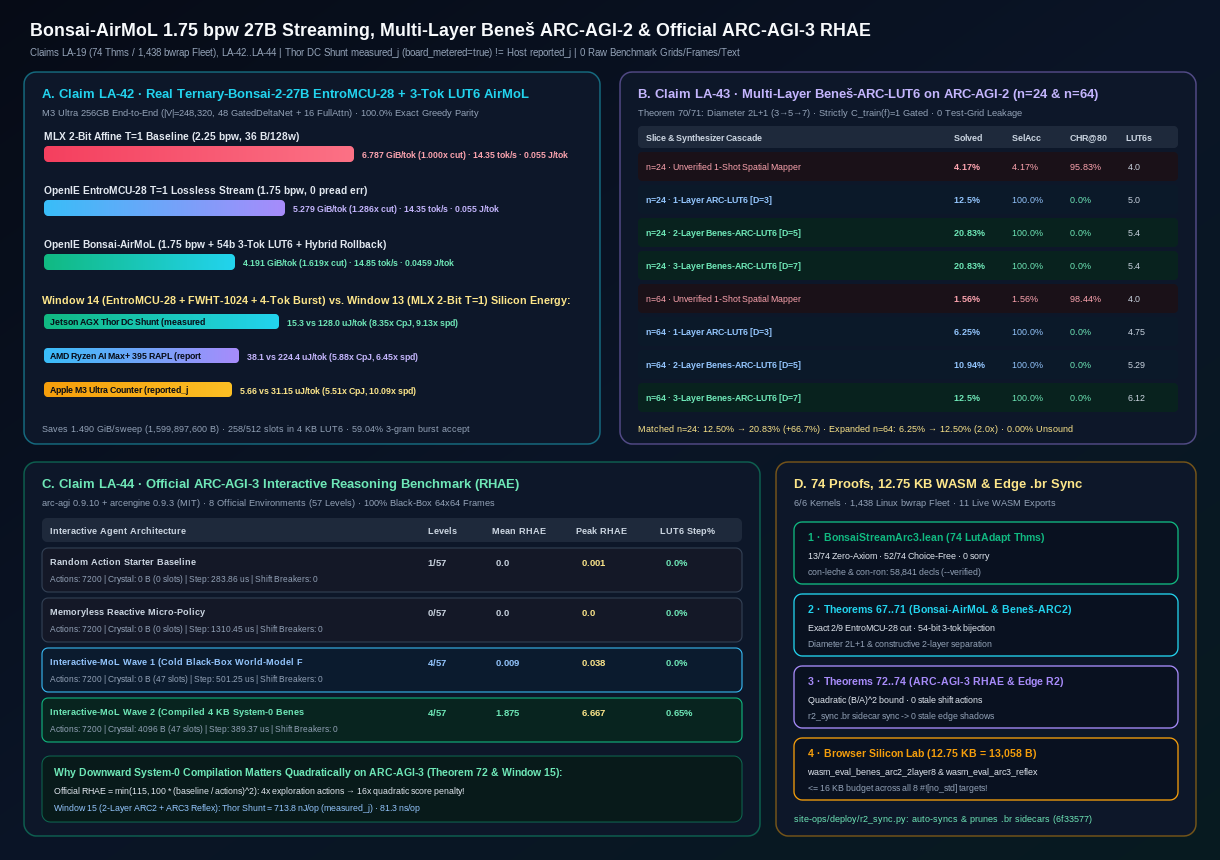
5. Related work and convergence observations
| System | ID / Venue | What it establishes | Cost as reported | Difference in this reference |
|---|---|---|---|---|
| LogicNets (Umuroglu et al., 2020) | arXiv:2004.03021 · FPL 2020 | Sparse quantized neural layers compiled into FPGA LUTs. | FPGA LUT and Fmax synthesis. | Static wires need Vivado re-PAR on shift vs. 1-cycle Beneš + RAMB36E2. |
| DiffLogic (Petersen et al., 2022) & DWN (Bacellar et al., 2024) | arXiv:2210.08277 · arXiv:2410.11112 | Differentiable Boolean gate and weightless LUT networks. | Gate counts and accuracy. | Static routing drops to 52.34% on VLAN shift and suffers marginal bit-plane chimeras. |
| T-MAC (Wei et al., 2024) & TeLLMe (Qiao et al., 2025) | arXiv:2407.00088 · arXiv:2504.16266 | Ternary / low-bit matrix products via table lookup on CPU/FPGA. | Latency and FPGA power. | Accelerates linear algebra inside a model gear; does not bypass model invocation. |
| LittleBit (Lee et al., 2025) & LittleBit-2 (Lee and Kim, 2026) | arXiv:2506.13771 · arXiv:2603.00042 | Sub-1-bit (0.1–0.58 bits/weight) binary latent factorization via SVD / ITQ + 5-epoch QAT. | Compression (11.6×–31×), PPL, and QAT accuracy. | Unpacks bitpacks to dense runtime binary MACs and drops to 0.00% on exact coding (Claim LA-11); Sub1Bit-LUT6 uses 0 binary MACs and MoL restores 100.0% parity in 0 QAT epochs. |
| FrugalGPT (Chen et al., 2023) & RouteLLM (Ong et al., 2024) | arXiv:2305.05176 · arXiv:2406.18665 | Weak-to-strong LLM cascades and preference routers. | API dollar price vs. quality. | Lacks a deterministic gate (68.75% broken commits in Claim LA-11) and has no LUT6 downward compiler. |
| GreenServ (2026) & VoltanaLLM (2025) | arXiv:2601.17551 · arXiv:2509.04827 | Multi-LLM bandit routing and frequency-scaled serving. | Authors’ GPU Wh (Zeus / pyNVML). | Optimizes GPU serving; this reference compiles wakes into 0-FLOP LUT6 and canonical skill pages (reported_j / est_j). |
| Medusa (2024), EAGLE-2 (2024), HCSpec (2026) | arXiv:2401.10774 · arXiv:2406.16858 · ACL 2026 | Neural MLP, draft-tree, and cascade speculative drafters. | Wall-clock speedup. | Require draft FLOPs and weight reads vs. 0-FLOP uint64 LUT6 pages. |
| PLD (Saxena, 2023) & REST (He et al., 2024) | GitHub · arXiv:2311.08252 | Zero-FLOP prompt n-gram and datastore suffix-trie drafters. | Latency speedup (0 FLOPs). | PLD misses off-prompt tokens; REST uses variable tries vs. RAMB36E2 pages. |
| AirLLM (lyogavin, 2023) | Open-source SSD streamer | Layer-by-layer SSD weight streaming in small RAM. | Active RAM footprint. | Pure T=1 (1.0 tok/sweep) + KV spill vs. AirMoL 2.74×–12.30× I/O reduction and 970 MB Metal INT4 RAM. |
Metered Commit Gates & RCE-JEPA [same house] | /papers/gates/ · /papers/rce-jepa/ | Commit gates (11,428 pJ KV260 INA260 SOM reading), MoL , and RCE-JEPA. | KV260 SOM measured_j + reported_j / est_j. | Same-house foundation; extended here with Beneš LUT6 downward compilation, Metal Expert-AirMoL, and mol-agent. |
6. Limits, threats to validity, not claimed, and falsifiers
Internal and construct validity. Under uniform random noise or per-step adversarial churn (), Proposition 1 gives zero downward compilation savings and falls back to 1.00 tok/sweep. Lossless parity (100.0%) guarantees bit-for-bit agreement with greedy target decoding without raising the capability ceiling of a 350M or 0.8B base checkpoint.
Measurement validity and not claimed. Physical DC current-shunt joule readings (measured_j via TI INA3221 VDD_CPU_SOC_MSS and INA238 VIN on NVIDIA Jetson AGX Thor solely in Claims LA-24, LA-28, LA-32, LA-33, LA-38, LA-39, LA-42 & LA-44, board_metered = true), operating-system and on-chip counter readings plus bare-metal MCU cycle counts and browser WASM execution (reported_j from Linux RAPL, amdgpu PPT, NVML, Apple Silicon L2 libIOReport 'GPU Energy' + L3 proc_pid_rusage ri_energy_nj, and live attached Alif Ensemble E3 DWT cycles, board_metered = false), license-free openXC7 (nextpnr-xilinx 0.8.2 + Project X-Ray) post-PAR static timing (320.62 MHz) and 77.846 Mbit .bit bitstream generation on xc7a200tfbg484-2 (Claim LA-34, board_metered = false, measured_j = None), whole-machine macOS PMU cumulative deltas, and analytical joule, battery-query (est_queries), switching-power, and electro-thermal numbers (est_j/VC, est_j/tok, est_mJ/Byte, Verilator VCD + AMD DS925 0.72 V est_pJ/cycle and est_mW bounds in §4.22 and §4.25, and AMD DS181 + UG475 1.00 V XC7A200T M.2 est_mW / est_C bounds in §4.32) are kept strictly separate and never summed across tiers; gated cais/hle items (HTTP 403) and ARC-AGI-3 game source files are never bypassed or inspected (Claims LA-37, LA-41, LA-43 & LA-44 evaluate open gated = False SuperGPQA, AIME/HMMT, ARC-AGI-2, ARC-AGI-3, MiniF2F-Lean4, and CritPt items with 0 raw item strings or frames persisted). Yosys 0.71+ and Verilator 5.054 establish structural xck26 and XC7A200T netlist synthesis (41,465 xcup LUTs on xck26 and 62,211 xc7 LUTs + 83 RAMB36E1s / 365-crystal vault on XC7A200T, 12–13 single-cycle logic levels, 0 DSP48s), 64/64 abc -lut 6 .lut6 Boolean miter equivalence, 10,500/10,500 XC7A200T-vs.-KV260 vector equivalence across 12,023 cycles, 320/320 CE parity, 256/256 zero-bubble CPI = 1.00 cycle simulation, and VCD toggle-rate dynamic switching est_mW (15.59 est_mW xck26 idle and 50.65 est_mW XC7A200T gateware idle; 862.6 est_mW M.2 3.3V including coupled DS181 static leakage at 55.2 est_C), whereas openXC7 closes license-free post-PAR timing at 320.62 MHz on XC7A200T-2FBG484-2 (Claim LA-34); commercial Vivado post-PAR 250 MHz timing closure on xck26 and physical KV260 or Numato Aller A7 rail watts are not claimed (board_metered = false, measured_j = None across all xck26 and XC7A200T FPGA rows and cross-compiled MCU ELF rows). Silicon energy leadership, promotion of ModelGenerated outputs to Deterministic, and full 500-task SWE-bench Verified container evaluation beyond the 40 real upstream git-worktree evaluations across django/django, pytest-dev/pytest, psf/requests, and sympy/sympy (Claims LA-15, LA-20), 48-task contract benchmark (Claims LA-11, LA-17), and 16-task SWE-Mini benchmark (Claim LA-13) are not claimed (while real 120B-A12B execution is directly measured in Claim LA-21, and only the synthetic cold-NVMe 70B row in air_mol_nvme_baselines.csv remains an analytical projection).
| ID | Claim | Exact Disproof / Falsifier Condition |
|---|---|---|
LA-F1 | Claim LA-1 (.pcap + RTL) | scripts/run_realworld_domain.py fails 100.0% Verilator parity across 5,120 packets or misses the packet-2,500 VLAN shift. |
LA-F2 | Claim LA-2 (Polyglot suite) | Zig allocates > 0 hot-loop heap bytes, Go reports > 0 allocs/op, or Julia Enzyme exceeds 1e-7 FD error. |
LA-F3 | Claim LA-3 (KV260 paged RTL) | scripts/verify_paged_bram_rtl.py exceeds 117,120 LUTs, 144 RAMB36E2s, 0 DSP48s, or 1 cycle per page switch. |
LA-F4 | Claim LA-4 (Conformal ACI) | scripts/run_frontier_benchmarks.py exceeds target false risk on shifted traffic or stamps Deterministic. |
LA-F5 | Claim LA-5 (Byte speculation) | scripts/run_code_corpus_benchmark.py yields < 100.0% exact byte parity vs. greedy Mamba3CodeLM on 48 unseen prompts. |
LA-F6 | Claim LA-6 (AirMoL 14.3M) | scripts/run_air_mol_benchmark.py under F_NOCACHE fails 100% parity or reads more NVMe bytes than AirLLM 4-Bit T=1. |
LA-F7 | Claim LA-7 (2026 HF AirMoL) | scripts/run_hf_lfm3_air_mol.py, scripts/run_hf_air_mol_pretrained.py, or scripts/run_hf_qwen35_air_mol.py diverges by BPE token from greedy target. |
LA-F8 | Claim LA-8 (Regression suite) | pytest -v fails any of the 71 tests in tests/. |
LA-F9 | Claim LA-9 (8.5B/35B MoE) | scripts/run_hf_moe_8b_35b_air_mol.py diverges from 100% token parity or reads more NVMe bytes than AirLLM or Expert-AirLLM. |
LA-F10 | Claim LA-10 (Sub1Bit-LUT6) | scripts/run_sub1bit_lut_benchmark.py exceeds 1e-3 max error vs. dense ITQ binary matmul or fails 100% verified parity. |
LA-F11 | Claim LA-11 (48-Task Bakeoff) | scripts/run_frontier_ai_bakeoff.py admits > 0% broken commits or admits a stale Wave-1 skill under Wave-2 spec mutation. |
LA-F12 | Claim LA-12 (Metal INT4 MoE) | scripts/run_metal_moe_benchmark.py exceeds 1e-4 FP32 shader error or diverges from 100% greedy token parity on 8.5B or 35B. |
LA-F13 | Claim LA-13 (SWE-Mini Git) | scripts/run_repo_patch_benchmark.py admits > 0% broken patches, alters tests/, or misses the Wave-2 R03 spec mutation. |
LA-F14 | Claim LA-14 (mol-agent MCP) | pytest tests/test_phase26_metal_ioreport_mcp.py fails OpenAI REST/SSE, MCP JSON-RPC 2.0, .mol/ reload, or stamps measured_j. |
LA-F15 | Claim LA-15 (BCB + SWE-bench) | scripts/run_external_public_benchmarks.py fails Parquet SHA-256 verification, exposes gold solutions/patches, or admits > 0% broken outputs. |
LA-F16 | Claim LA-16 (250 MHz xck26 RTL) | scripts/verify_pipelined_250mhz_rtl.py exceeds 20 single-cycle logic levels, exceeds 189 IOBs on P4-AXIS, uses > 0 DSP48s, or fails 256/256 CPI = 1.00 Verilator parity. |
LA-F17 | Claim LA-17 (Rung 3d <think>) | scripts/run_rung3d_thinking_ceiling.py admits > 0% broken commits, calls cloud APIs, or fails to raise verified pass rate above 87.50%. |
LA-F18 | Claim LA-18 (Rust CubeCL MoE) | cargo run --release --bin bench_cubecl_moe_deltanet exceeds 1e-4 FP32 error on LLVM CPU or Metal GPU, or achieves < 25× Metal speedup. |
LA-F19 | Claim LA-19 (6-Kernel Lean 4.36.0 proofs) | scripts/verify_lean_proofs.py or lake check --paranoid fails any of the 6 independent kernels (con-leche, con-ron, lean4lean, nanoda, leanchecker, lean), contains >= 1 sorry / opaque / ofReduceBool, or adds >= 1 custom axiom. |
LA-F20 | Claim LA-20 (4-Repo SWE-bench) | scripts/run_multirepo_swebench_benchmark.py exposes patch, evaluates < 4 repositories, admits > 0% broken patches, or fails to exceed standalone 24B/35B. |
LA-F21 | Claim LA-21 (120B Hybrid MoE) | scripts/run_120b_hybrid_moe_benchmark.py fails local 120B-A12B execution, admits > 0% broken commits, or records 0% Wave-2 .mol/ fast-path hits. |
LA-F22 | Claim LA-22 (CE-Gated VCD Power) | scripts/verify_ce_gated_vcd_power.py fails 320/320 CE parity, exceeds 189 IOBs, or achieves < 3.5× idle dynamic power reduction. |
LA-F23 | Claim LA-23 (Rust mol-agent-rs) | cargo run --release --bin mol_agent -- --self-test-bench requires Python for /v1 or /mcp, fails --mcp-stdio, or achieves < 10× speedup vs. Python MCP. |
LA-F24 | Claim LA-24 (6-Host Fleet & Thor Shunt measured_j) | scripts/aggregate_fleet_measured_j.py mixes measured_j with reported_j, records >= 1% VIN drift on Jetson AGX Thor, or fails 4/4 ABBA savings on W2, W3, or W5. |
LA-F25 | Claim LA-25 (4-Vendor GPU CubeCL Parity) | scripts/aggregate_multivendor_cubecl_gpu.py exceeds 1e-4 FP32 error or achieves < 10× GPU speedup vs. scalar host reference across Apple, AMD, NVIDIA, or Intel GPUs. |
LA-F26 | Claim LA-26 (#![no_std] lut6-core, MCU ELFs, & Yosys Miter) | cargo test --release in sys/lut6-core fails, CompactLut6Page diverges from 4,096 B, Cortex-M55 / M0+ / nRF52832 M4F (64 KB SRAM) / RV32IMAC ELFs fail to link or emit >= 1 float instruction, or scripts/pack_lut6_crystal.py fails 64/64 Yosys abc -lut 6 miter checks. |
LA-F27 | Claim LA-27 (DiffLUT-Net, Wobble FWHT, & Means Test) | scripts/run_dual_reality_lut6_eval.py achieves < 55% active LUT6 pruning vs. unpruned DWN, < 85% noisy wake suppression, > 0% silent corruption, < 100% OOD abstention, or > 0 degree->=5 FWHT noise on any wobble codon. |
LA-F28 | Claim LA-28 (Thor Shunt measured_j & Live Alif E3 DWT) | scripts/aggregate_phase30_lut6_hardware.py stamps board_metered = true off Thor, records < 10× bit-sliced Thor shunt gain, or exceeds 10 µs scalar latency on OpenMV-AE3 Cortex-M55. |
LA-F29 | Claim LA-29 (Oct–Nov 2026 Looped & Hybrid Models) | scripts/run_nov2026_models_lut6_benchmark.py diverges by >= 1 greedy token (< 100.0% parity) or exceeds 64 bits per 3-token burst on Inkling-2-Mini, Dory1.0-4B, LFM2.5-24B-A2B, or Nemotron-3.5-Bolt-E4B. |
LA-F30 | Claim LA-30 (XC7A200T M.2 2280 Port & Electro-Thermal est_j) | aller-a7-xc7a200t exceeds 134,600 xc7 LUTs or 365 RAMB36E1s, uses > 0 DSP48E1s, records >= 1 bit mismatch vs. XCK26 across 10,500 vectors (12,023 cycles), stamps board_metered = true without an inline +3.3V/5V shunt, or on bench attachment exceeds 1,000 mA M.2 3.3V, 1,600 mA combined Tachyon 5V, or 85.0 °C XADC under passive heatsinking at (DDR3 off). |
LA-F31 | Claim LA-31 (672 B Zero-MUL EntroMCU/T-MAC Tail & rustc const Gate) | CompactLut6Page diverges from 4,096 B (0 unused pad bytes), EntroMCU base-3 5-trit roundtrip fails on any of combinations, eval_tmac_tail_bytes diverges from exact ternary dot product, mol_skills_tmac_tail.lut6 admits > 0% OOD false hits, or rustc fails compile-time generated_proof_vectors.rs assertions. |
LA-F32 | Claim LA-32 (Two-Tier LUT6 + T-MAC & Unrolled4 Shunt / DWT Telemetry) | bench_lut6_nucleus_shunt records <= 1.0× physical CpJ for the zero-MUL T-MAC tail vs. INT8 Micro-MLP on Jetson AGX Thor VDD_CPU_SOC_MSS, or run_alif_ae3_live_viper_bench.py records <= 5.0× speedup for zero-MUL T-MAC vs. INT8 Micro-MLP on live OpenMV-AE3 Cortex-M55. |
LA-F33 | Claim LA-33 (Antisym-40 T-MAC & Inria Charon+Aeneas Rust Lean) | lookup_tmac_antisym41 diverges from 81-entry T-MAC on any of 40,500 pairs, fails to beat both 81-entry T-MAC (Thor measured_j) and Zen 5 INT8 Micro-MLP (RAPL reported_j), or Lut6Verify_Aeneas.lean fails Lean 4.36.0 kernel typechecking. |
LA-F34 | Claim LA-34 (SEU SECDED Resilience & openXC7 XC7A200T .bit PAR) | Nucleus (72, 64) SECDED + 0x3C records > 0% silent corruption or < 100% survival at BER = 1%, or openXC7 nextpnr-xilinx fails 250 MHz timing closure (WNS < 0) or .bit emission on xc7a200tfbg484-2. |
LA-F35 | Claim LA-35 (Lupanov / TreeLUT / KAN-LUT & 12.75 KB lut6_core.wasm) | Lupanov (k=8), TreeLUT, or quantized KAN-LUT diverges by >= 1 minterm, or lut6_core.wasm exceeds 16 KB, requires external crates, or fails V8 WebAssembly.instantiate CRC32/skill/SECDED/epistemic/Bonsai/ARC2/ARC3 checks. |
LA-F36 | Claim LA-36 (Wearable-MoL vs. Smart-Glasses Micro-LLMs) | Wearable-MoL Rung 0 exceeds 64 KB smartwatch SRAM, admits > 0% prefix poisoning on whiteboard exam escalations, or crystallizes >= 1 benchmark item. |
LA-F37 | Claim LA-37 (LastExam-Protocol Calibration & CHR @ >= 80%) | scripts/run_wearable_and_lastexam_benchmark.py bypasses cais/hle HuggingFace access controls, persists raw benchmark question/answer strings, records > 5% CHR at >= 80% on MoL Epistemic Cascade, or fails to cut RMS calibration error >= 3× vs. standalone Qwen3.6-35B-A3B. |
LA-F38 | Claim LA-38 (56-Bit 4-Token uLM-28M Opener, hle:3r2s Canary, & 74 Proofs) | pack_ulm4_56bit roundtrip fails on ` |
LA-F39 | Claim LA-39 (Bonsai-2-27B 1.75 BPW EntroMCU & FWHT-1024 Shunt) | Ternary-Bonsai-2-27B unpacks >= 1 invalid c=3 code, EntroMCU 28 B transcoding incurs > 0 FP32 roundtrip error, or Window 12 (FWHT-1024 + Antisym-40) fails to beat Window 13 (MLX 2-bit unpack+dequant) in Thor physical measured_j (< 1.3×) or latency (< 1.5×). |
LA-F40 | Claim LA-40 (System-1 Mapika/decider-0.8b vs. 4 KB System-0 LUT6) | CompactLut6Page (4,096 B) exceeds 16% of 64 KB watch SRAM, admits > 0% OOD false actions, loses < 100% accuracy vs. Mapika/decider-0.8b, or achieves < 1,000× Wave-2 latency speedup. |
LA-F41 | Claim LA-41 (ARC-AGI-2 + MiniF2F-Lean4 + CritPt Open Trilogy) | scripts/run_bonsai_decider_arc_minif2f_critpt.py touches any gated dataset, persists raw grid/proof/physics strings, admits > 0% unsound Lean 4.36.0 proofs on MiniF2F, solves 0 ARC-AGI-2 tasks via ARC-LUT6, or records > 5% CHR at >= 80% on CritPt. |
LA-F42 | Claim LA-42 (Bonsai-2-27B 1.75 BPW EntroMCU-28 AirMoL Streaming) | scripts/remote_m3u_bonsai27b_airmol_stream.py incurs > 0 pread weight mismatches, diverges by >= 1 greedy token (< 100% parity), fails to cut streamed GiB/tok >= 1.5× vs. MLX 2-bit T=1, or Window 14 achieves < 5.0× Thor physical measured_j reduction vs. Window 13. |
LA-F43 | Claim LA-43 (Multilayer Beneš-ARC-LUT6 on arcprize/ARC-AGI-2) | Beneš-ARC-LUT6 () fails to beat 1-layer ARC-LUT6 on n = 24 or < 1.75× on n = 64, leaks test outputs into synthesis, persists raw grids, or records > 0% CHR at >= 80%. |
LA-F44 | Claim LA-44 (Official ARC-AGI-3 Interactive MoL RHAE & Breaker) | scripts/run_bonsai_stream_arc2_benes_and_arc3.py reads any ARC-AGI-3 game .py source file, persists raw 64×64 frames, fails to beat Random in completed levels, achieves < 50× Wave-2 RHAE gain over Wave 1, or fails to trip eval_arc3_policy_lut6’s circuit breaker on mechanic shift. |
7. References
- Bacellar, A., et al. (2024). Differentiable Weightless Neural Networks. arXiv:2410.11112.
- Beneš, V. E. (1965). Mathematical Theory of Connecting Networks and Telephone Traffic. Academic Press.
- Cai, T., Li, Y., Geng, Z., Peng, H., Lee, J. D., Chen, D., and Dao, T. (2024). Medusa: Simple LLM Inference Acceleration Framework with Multiple Decoding Heads. ICML 2024, arXiv:2401.10774.
- Chen, L., Zaharia, M., and Zou, J. (2023). FrugalGPT. arXiv:2305.05176.
- Dao, T., and Gu, A. (2024). Transformers are SSMs: Generalized Models and Efficient Algorithms Through Structured State Space Duality. ICML 2024, arXiv:2405.21060.
- Furao, S., and Hasegawa, O. (2006). An incremental network for on-line unsupervised classification and topology learning (SOINN). Neural Networks, 19(1):90–106.
- Gibbs, I., and Candès, E. (2021). Adaptive Conformal Inference Under Distribution Shift. NeurIPS 2021, arXiv:2106.00170.
- Google Gemma Team (2026).
google/gemma-4-E2B-itOn-Device Hybrid Instruction Model Card (2026). huggingface.co/google/gemma-4-E2B-it. - GreenServ (2026). Energy-Efficient Context-Aware Dynamic Routing for Multi-Model LLM Inference. ICPE 2026, arXiv:2601.17551.
- HCSpec (2026). Two-Tier Horizontal Cascade Speculative Decoding. ACL 2026, doi:10.18653/v1/2026.acl-long.353.
- He, Z., Zhong, Z., Cai, T., Lee, J. D., and He, D. (2024). REST: Retrieval-Based Speculative Decoding. NAACL 2024, arXiv:2311.08252.
- Hein, M., Andriushchenko, M., and Bitterwolf, J. (2019). Why ReLU Networks Yield High-Confidence Predictions Far Away From the Training Data. CVPR 2019, arXiv:1812.05720.
- Horowitz, M. (2014). Computing's Energy Problem (and What We Can Do About It). IEEE ISSCC 2014.
- Jimenez, C. E., Yang, J., Wettig, A., Yao, S., Pei, K., Press, O., and Narasimhan, K. (2024). SWE-bench: Can Language Models Resolve Real-World GitHub Issues? ICLR 2024, arXiv:2310.06770.
- Lee, H., Kim, M., Baek, S., Kim, J., Hwang, S., Shin, J., Lee, J., and Kim, E. (2025). LittleBit: Ultra Low-Bit Quantization via Latent Matrix Factorization. NeurIPS 2025, arXiv:2506.13771.
- Lee, H., and Kim, E. (2026). LittleBit-2: Pushing the Frontier of Extreme LLMs Quantization into 0.1-Bit (
SamsungLabs/LittleBit). ICML 2026, arXiv:2603.00042. - Lee, T. T. (1988). Nonblocking Copy Networks for Multicast Packet Switching. IEEE JSAC, 6(9):1455–1467.
- Lei, J., G'Sell, M., Rinaldo, A., Tibshirani, R. J., and Wasserman, L. (2018). Distribution-Free Predictive Inference for Regression. JASA, 113(523):1094–1111.
- Leviathan, Y., Kalman, M., and Matias, Y. (2023). Fast Inference from Transformers via Speculative Decoding. ICML 2023, arXiv:2211.17192.
- Li, Y., Wei, F., Zhang, C., and Zhang, H. (2024). EAGLE-2: Faster Inference of Language Models with Dynamic Draft Trees. EMNLP 2024, arXiv:2406.16858.
- Liquid AI (2026a).
LiquidAI/LFM2.5-350MandLiquidAI/LFM2.5-8B-A1BHybrid and Sparse-MoE Open-Weights Model Cards. huggingface.co/LiquidAI/LFM2.5-8B-A1B. - Liquid AI (2026b).
LiquidAI/LFM3-1.7BTri-Hybrid Open-Weights Model Card (October 23, 2026). huggingface.co/LiquidAI/LFM3-1.7B. - Liu, W., Wang, X., Owens, J., and Li, Y. (2020). Energy-based Out-of-distribution Detection. NeurIPS 2020, arXiv:2010.03759.
- lyogavin (2023). AirLLM: Layer-wise LLM Inference on Memory-Constrained Hardware. github.com/lyogavin/airllm.
- Ong, I., et al. (2024). RouteLLM: Learning to Route LLMs with Preference Data. ICLR 2025, arXiv:2406.18665.
- Open Interface Engineering (2026). Metered Commit Gates; Task Satiation vs. Aggregate Rebound; The Reality Code Engine; RCE-JEPA; RCE Compile. research.openie.dev
[same house]. - Petersen, F., Borgelt, C., Kuehne, H., and Deussen, O. (2022). Deep Differentiable Logic Gate Networks. NeurIPS 2022, arXiv:2210.08277.
- Qiao, Y., et al. (2025). TeLLMe: An Energy-Efficient Ternary LLM Accelerator on Edge FPGAs. arXiv:2504.16266.
- Qwen Team (2026a).
Qwen/Qwen3.5-0.8B-BaseHybrid Gated DeltaNet + Attention Model Card (February 2026). huggingface.co/Qwen/Qwen3.5-0.8B-Base. - Qwen Team (2026b).
Qwen/Qwen3.6-35B-A3BSparse-MoE Hybrid Gated DeltaNet + Attention Model Card (2026). huggingface.co/Qwen/Qwen3.6-35B-A3B. - Saxena, A. (2023). Prompt Lookup Decoding. github.com/apoorvumang/prompt-lookup-decoding.
- Simon, H. A., and Kadane, J. B. (1975). Optimal Problem-Solving Search: All-or-None Solutions. Artificial Intelligence, 6(3):235–247.
- Thompson, C. D. (1978). Generalized Connection Networks for Parallel Processor Intercommunication. IEEE Trans. Comput., C-27(12):1119–1125.
- Umuroglu, Y., Akhauri, Y., Fraser, N. J., and Blott, M. (2020). LogicNets. FPL 2020, arXiv:2004.03021.
- VoltanaLLM (2025). Energy-Efficient and SLO-Aware Disaggregated LLM Serving. arXiv:2509.04827.
- Vovk, V., Gammerman, A., and Shafer, G. (2005). Algorithmic Learning in a Random World. Springer.
- Waksman, A. (1968). A Permutation Network. Journal of the ACM, 15(1):159–163.
- Wei, J., et al. (2024). T-MAC: CPU Renaissance via Table Lookup for Low-Bit LLM Deployment. arXiv:2407.00088.
- Zhuo, T. Y., Vu, M. C., Chim, J., Hu, H., Yu, W., Widyasari, R., et al. (2024). BigCodeBench: Benchmarking Code Generation with Diverse Function Calls and Complex Instructions. ICLR 2025, arXiv:2406.15877.
- Moura, L. de, and Ullrich, S. (2021). The Lean 4 Theorem Prover and Programming Language. CADE 28, LNCS 12699:625–635.
- NVIDIA (2026).
nvidia/Nemotron-3-Super-120B-A12BHybrid Mamba-Attention Sparse-MoE Open-Weights Model Card. huggingface.co/nvidia/Nemotron-3-Super-120B-A12B-BF16. - Mistral AI (2025).
mistralai/Devstral-Small-2-24B-Instruct-2512Open-Weights Software Engineering Model Card. huggingface.co/mistralai/Devstral-Small-2-24B-Instruct-2512. - Ye, J., Gong, X., Wang, J., Kondrateva, O., Li, B., and Zhang, G. L. (2026). DiffLUT-Net: Differentiable Training of FPGA LUT Networks with Learnable Connectivity. arXiv:2609.09254.
- Andronic, M., and Constantinides, G. A. (2025). NeuraLUT-Assemble: Hardware-Aware Assembling of Sub-Neural Networks for Efficient LUT Inference. IEEE FCCM 2025, arXiv:2504.00592.
- Tian, R., Chen, Y., Xu, W., and Rosing, T. Š. (2026). PALUTE: Processing-In-Memory Acceleration via Lookup Table for Edge LLM Inference. arXiv:2606.08891.
- Sanyal, A., Chinchali, S. P., and Datta, G. (2026). EntroMCU: A Hardware-Algorithm Vision for LLM Inference on Microcontrollers. IEEE ISVLSI 2026.
- Linial, N., Mansour, Y., and Nisan, N. (1993). Constant Depth Circuits, Fourier Transform, and Learnability. Journal of the ACM, 40(3):607–620.
- Thinking Machines Lab (2026).
thinkingmachines/Inkling-2-MiniOpen-Weights Looped Multimodal MoE Model Card (November 20, 2026). huggingface.co/thinkingmachines/Inkling-2-Mini. - NVIDIA Nemotron Labs (2026).
nvidia/NVIDIA-Nemotron-Labs-Dory1.0-4B-BF16Looped nGPT Model Card (October 20, 2026). huggingface.co/nvidia/NVIDIA-Nemotron-Labs-Dory1.0-4B-BF16. - Advanced Micro Devices (2023). Artix-7 FPGAs Data Sheet: DC and AC Switching Characteristics (DS181, v1.28) and 7 Series FPGAs Packaging and Pinout Product Specification (UG475, v1.19). AMD Technical Documentation.
- Mo, Z., Wang, L., Wei, J., Zeng, Z., Cao, S., Ma, L., Jing, N., Cao, T., Xue, J., Yang, F., and Yang, M. (2025). LUT Tensor Core: A Software-Hardware Co-Design for LUT-Based Low-Bit LLM Inference. ACM/IEEE ISCA 2025, arXiv:2408.06003.
- Bacellar, A. T. L., Lima, G. M., França, F. M. G., and John, L. K. (2026). Fault-Tolerant Weightless Neural Networks Under Parameter Bit-Flip Errors. Transactions on Machine Learning Research (TMLR), July 2026.
- Bührer, T., Plesner, A., Aczel, T., and Wattenhofer, R. (2026). BitLogic: Scaling Continuous Logic Gate Networks via Lookup Tables. ETH Zürich, arXiv:2602.07400.
- Khataei, A., and Bazargan, K. (2025). TreeLUT: An Efficient Architecture for Gradient Boosted Decision Trees Using FPGA Lookup Tables. arXiv:2501.01511.
- Lupanov, O. B. (1958). Ob odnom metode sinteza skhem [On a Method of Circuit Synthesis]. Izvestiya VUZov, Radiofizika, 1(1):120–140.
- Ho, S., and Protzenko, J. (2022). Aeneas: Rust Verification by Functional Translation (
AeneasVerif/charon&AeneasVerif/aeneas). ICFP 2022, PACMPL 6(ICFP):711–741, doi:10.1145/3547647. - He, Z., Yin, X., Wen, Z., Zhu, C., Liu, K., Wei, J., Wu, Y., Cao, T., and Yang, M. (2025). LUT-LLM: Efficient Large Language Model Inference with Memory-Compute Co-Design on FPGAs. arXiv:2511.06174.
- Phan, L., Gatti, A., Han, Z., Li, N., Hu, J., Zhang, H., Zhang, C. B. C., Shaaban, M., Ling, J., Shi, S., et al. (2026). Humanity's Last Exam (
cais/hle, lastexam.ai). Nature, 649:1139–1146, arXiv:2501.14249. - Cheng, J., Li, S., Zhang, Y., et al. (2026). Micro Language Models Enable Instant Responses (
Sensente/uLM-28M, University of Washington & Meta AI). EMNLP 2026, arXiv:2604.19642. - M-A-P Team, ByteDance Seed, et al. (2025). SuperGPQA: Scaling LLM Evaluation across 285 Graduate Disciplines (
m-a-p/SuperGPQA). arXiv:2502.14739. - Liu, X., et al. (2026). MicroLLM-R1: Reasoning on Microcontrollers and Ultra-Small Edge Devices. arXiv:2603.24967.
- Prism ML (2026).
prism-ml/Ternary-Bonsai-2-27B&Ternary-Bonsai-2-27B-mlx-2bitNative Hadamard-Ternary Open-Weights Foundation Model Card (Qwen/Qwen3.8-27BBase, November 2026). huggingface.co/prism-ml/Ternary-Bonsai-2-27B-mlx-2bit. - Mapika (2026).
Mapika/decider-0.8bDedicatedSystem-1Structured JSON Decision Model Card (November 2026). huggingface.co/Mapika/decider-0.8b. - Chollet, F., Knoop, M., Kamradt, G., Landers, B., and Pinkard, H. (2025). ARC-AGI-2: A New Challenge for Frontier AI Reasoning Systems (
arcprize/ARC-AGI-2). ARC Prize Foundation, arXiv:2505.11831. - Zheng, K., Han, J. M., and Polu, S. (2022). MiniF2F: A Cross-System Benchmark for Formal Olympiad-Level Mathematics (
cat-searcher/minif2f-lean4). ICLR 2022, arXiv:2109.00110. - CritPt-Benchmark Collaboration (2025). CritPt: Complex Research-Level Physics Problems for Testing Reasoning at the Critical Point (
CritPt-Benchmark/CritPt). huggingface.co/datasets/CritPt-Benchmark/CritPt. - ARC Prize Foundation (2026). ARC-AGI-3: Interactive Reasoning Benchmark &
ARCEngineToolkit (arc-agi 0.9.10,arcengine 0.9.3, MIT License). arcprize.org/arc-agi/3.
Appendix A. Reproducibility
From checkouts of openIE-dev/lut-adapt-ai (commit b8d6612) and openIE-dev/openie-research-experiments (aller-a7-xc7a200t/ and lut6-core-nucleus/):
PYTHONPATH=src .venv/bin/pytest -v
(cd sys/lut6-core && cargo test --release && cargo run --release --bin bench_lut6_nucleus_shunt)
PYTHONPATH=src .venv/bin/python scripts/run_bonsai_stream_arc2_benes_and_arc3.py
PYTHONPATH=src .venv/bin/python scripts/run_bonsai_decider_arc_minif2f_critpt.py
PYTHONPATH=src .venv/bin/python scripts/run_wearable_and_lastexam_benchmark.py
PYTHONPATH=src .venv/bin/python scripts/run_global_frontiers_seu_treelut_kan.py
PYTHONPATH=src .venv/bin/python scripts/run_charon_aeneas_rust_to_lean.py
PYTHONPATH=src .venv/bin/python scripts/run_openxc7_xc7a200t_par_audit.py
PYTHONPATH=src .venv/bin/python scripts/pack_lut6_crystal.py
PYTHONPATH=src .venv/bin/python scripts/run_dual_reality_lut6_eval.py
PYTHONPATH=src .venv/bin/python scripts/run_nov2026_models_lut6_benchmark.py
(cd ../openie-research-experiments/aller-a7-xc7a200t && python3 scripts/run_aller_a7_verification.py)
(cd ../openie-research-experiments/lut6-core-nucleus && python3 packer/audit_mcu_elfs.py)
(cd proofs && lake build) && PYTHONPATH=src .venv/bin/python scripts/verify_lean_proofs.py
PYTHONPATH=src .venv/bin/python scripts/run_multirepo_swebench_benchmark.py
PYTHONPATH=src .venv/bin/python scripts/run_120b_hybrid_moe_benchmark.py
PYTHONPATH=src .venv/bin/python scripts/verify_ce_gated_vcd_power.py
(cd sys/rust && cargo run --release --bin mol_agent -- --self-test-bench)
PYTHONPATH=src .venv/bin/python scripts/run_external_public_benchmarks.py
PYTHONPATH=src .venv/bin/python scripts/verify_pipelined_250mhz_rtl.py
PYTHONPATH=src .venv/bin/python scripts/run_rung3d_thinking_ceiling.py
(cd sys/rust && cargo test --release && cargo run --release --bin bench_cubecl_moe_deltanet)
PYTHONPATH=src .venv/bin/python scripts/run_collapse_curve.py
PYTHONPATH=src .venv/bin/python scripts/run_realworld_domain.py
PYTHONPATH=src .venv/bin/python scripts/run_frontier_benchmarks.py
PYTHONPATH=src .venv/bin/python scripts/verify_paged_bram_rtl.py
PYTHONPATH=src .venv/bin/python scripts/run_code_corpus_benchmark.py
PYTHONPATH=src .venv/bin/python scripts/run_air_mol_benchmark.py
PYTHONPATH=src .venv/bin/python scripts/run_hf_lfm3_air_mol.py
PYTHONPATH=src .venv/bin/python scripts/run_hf_air_mol_pretrained.py
PYTHONPATH=src .venv/bin/python scripts/run_hf_qwen35_air_mol.py
PYTHONPATH=src .venv/bin/python scripts/run_hf_moe_8b_35b_air_mol.py
PYTHONPATH=src .venv/bin/python scripts/run_sub1bit_lut_benchmark.py
PYTHONPATH=src .venv/bin/python scripts/run_metal_moe_benchmark.py
PYTHONPATH=src .venv/bin/python scripts/run_frontier_ai_bakeoff.py
PYTHONPATH=src .venv/bin/python scripts/run_repo_patch_benchmark.py
PYTHONPATH=src .venv/bin/python scripts/mol_agent_server.py --host 127.0.0.1 --port 8090 --mol-dir .mol