Deterministic Null: A Pre-Registered Control Experiment for Neural and Agentic Substrates
A zero-model-call 64-bit integer case loop (Shape D: strict N0 and dev-crystallized N1) implemented across Rust, Go, Python, C++20, and Julia, locked under OpenTimestamps Bitcoin Calendar proofs prior to League of Entropy drand randomness rounds, and compared against multi-vendor cloud (Anthropic, OpenAI, xAI, DeepSeek, Alibaba Qwen) and local open-weight language models across exp-001, exp-002, and reviewer-closure suite exp-003. On-chip Apple Silicon IOReport and kernel rusage counters are recorded as reported_j; no external wall or rail joule monitor was attached (board_metered is false; measured_j is unset).
David Charlot, Open Interface Engineering
Research studies, not journal finals. Notation is defined in the paper. Analytical energy estimates are not board power. Interactive figures live under /living/. Shared terms: glossary.
Cite this
Genre: Research study, draft: pre-registered null-model control experiment, drand and OpenTimestamps cryptographic registration, polyglot 64-bit integer case engine, and reported_j telemetry
David Charlot, Open Interface Engineering. Deterministic Null: A Pre-Registered Control Experiment for Neural and Agentic Substrates. Open Interface Engineering. Web: https://research.openie.dev/papers/deterministic-null/. PDF: https://research.openie.dev/pdfs/deterministic-null.pdf. Markdown: https://research.openie.dev/papers/deterministic-null.md.
Deterministic Null: A Pre-Registered Control Experiment for Neural and Agentic Substrates
Revision af57f48, 22 November 2026. Public code, manifests, and result bundles: github.com/openIE-dev/deterministic-null. Data and digest summary: /data/#deterministic-null. Interactive living figures: /living/deterministic-null/. LaTeX archival twin: /pdfs/latex/deterministic-null.pdf (source).
0. Overview
Empirical evaluations of agentic artificial intelligence routinely compare one stochastic language model against another, leaving unmeasured how much task completion requires a neural substrate at decision time rather than a fixed integer procedure over an explicit store of verified prior cases. This study constructs, freezes, and audits that missing control — Deterministic Null (Shape D) — and tests the per-class null hypothesis at margin (5.0 percentage points) across two cryptographically pre-registered confirmatory experiments (4,030 post-beacon held-out instances across exp-001 and exp-002), a multi-turn repository bug-repair study (6 multi-file Python repositories), and companion reviewer-closure suite exp-003 (multi-vendor non-Anthropic cloud breadth, extended-thinking and multi-turn resolution of unique 3-satisfiability formulas, and real upstream GitHub defect repair with 0-call replay). Local Apple M5 Max energy counters (IOReport and proc_pid_rusage) are recorded as operating-system/on-chip reported_j values; closed-model remote server energy is recorded strictly as not_available; no hardware rail or wall-plug power monitor was attached (board_metered = false, measured_j = None).
In plain words
- Most agent benchmarks compare model A with model B without asking how much a zero-model lookup loop over verified prior examples already solves.
- Across
2,840instances drawn from bounded algebraic, formal-proof, and structured transaction families (exp-001, Track-A), a frozen integer case table (0model calls at decision time) matches frontier cloud models on9of10class-tier cells, failing only on12unindexed free-text customer idioms (+36.40percentage points forClaude Opus 5.5). - Across
1,190unique instances from externally authored public benchmarks (exp-002, Track-B: Berkeley Function-Calling Leaderboardv3, Sierratau-benchRetail,BigCodeBench v0.1.3, andSWE(software-engineering)-bench Verified), plusexp-003multi-vendor evaluations (OpenAI gpt-oss-120b+45.83percentage points,xAI Grok 4.20+44.17percentage points overShape D) and6real upstream GitHub defect commits (5/6patched andpytest-verified byOpus 5.5, then5/6replayed at0model calls), neural synthesis delivers large gains wherever unseen key mass stays high — while extended thinking (49/50) and multi-turn clause feedback (50/50) resolve the1,024-token truncation cliff on unique3-satisfiabilityformulas (still matched at50/50and zero dollars by standalone conflict-driven clause learning), and online crystallization cuts recurring Zipfian model calls and energy by3.59×.
1. Terms, acronyms, and measurement labels
- AI, ML, LLM, LLMs, MoE, OSS, E4B, A3B: artificial intelligence, machine learning, large language model(s), Mixture-of-Experts, open-source-software model release, effective 4-billion-parameter architecture, and active 3-billion-parameter routing
- OBSERVE, REDUCE, FUZZ, LOOKUP, ACT, VERIFY, MUTATE, WRITE: the eight sequential steps of the Deterministic Null integer decision loop
- SATB, SUT, SUTs, PFRK, TH2, DOSSIER: Satiation Benchmark harness contract, system(s) under test, four-way attempt outcomes (pass, fail, refuse, killed), red-team threat 2 (no hidden solver inside action primitives), and the project prior-art/red-team dossier
- DNULLMM1, FT, LCB: binary memory-mapped store index format, per-class function table, and Hoeffding lower confidence bound
- DRAT, RUP, CDCL, CNF, SAT, UNSAT: Deletion Resolution Asymmetric Tautology, Reverse Unit Propagation, Conflict-Driven Clause Learning, conjunctive normal form, satisfiable, and unsatisfiable
- BV, AST, XOR, IEEE, UC: fixed-width modular bitvector, abstract syntax tree, bitwise exclusive-OR, Institute of Electrical and Electronics Engineers (IEEE-754 floating-point standard), and University of California
- BFCL, BCB, SWE, SQL, DB, SAVEPOINT: Berkeley Function-Calling Leaderboard, BigCodeBench, software-engineering benchmark prefix, Structured Query Language, relational database, and transactional rollback checkpoint
- API, CLI, MCP, HTTP, JSON, JSONL, UTF: application programming interface, command-line interface, Model Context Protocol, Hypertext Transfer Protocol, JavaScript Object Notation, line-delimited JSON, and Unicode Transformation Format
- POSIX, MMAP, SHA, OTS: Portable Operating System Interface, memory-mapped file I/O, Secure Hash Algorithm (SHA-256), and OpenTimestamps Bitcoin Calendar proof
- BCa, CI, CIs, UCL: bias-corrected and accelerated bootstrap, confidence interval(s), and Wilson upper confidence limit
- CPU, GPU, ANE, SoC, PID, OS, RAM, DRAM, NVMe, PSU, AC: central processing unit, graphics processing unit, Apple Neural Engine, system-on-chip, process identifier, operating system, random-access memory, dynamic RAM, Non-Volatile Memory Express, power supply unit, and alternating-current wall power
- RAPL, NVML, KV, GGUF, RPM, RPD, USD, EDA: Intel Running Average Power Limit, NVIDIA Management Library, key-value cache, GPT-Generated Unified Format quantized weights, requests per minute, requests per day, United States dollars, and electronic design automation
- RCE, MoL, WCA, JEPA, LUT6: Reality Code Engine [same house], Mixture of Limits [same house], Wise Computer Automation [same house], Joint-Embedding Predictive Architecture, and 6-input Boolean look-up table
Across telemetry levels L0 to L4, four measurement classes stay strictly separated across all tables and figures in this study:
| Measurement label | Meaning in this study |
|---|---|
Exact (L4 Logical & Cryptographic) | Bit-identical 64-bit fixed-point store digests (SHA-256), OpenTimestamps .ots calendar proofs, League of Entropy drand beacon rounds, token/call counts captured by satb-proxy, and dated API list-price dollars (USD). |
Reported (reported_j: L2 & L3 Counters) | Rootless Apple Silicon on-chip IOReport window joules (macmon, telemetry level L2, shared-host label A2) and macOS kernel per-PID proc_pid_rusage(RUSAGE_INFO_V6).ri_energy_nj (L3, label D). Not a physical hardware rail meter (measured_j = None, board_metered = false). |
Not Available (label N) | Closed-API remote server energy (Claude Opus 5.5, Claude Sonnet 5.5, OpenAI gpt-oss-120b, xAI Grok 4.20, DeepSeek V4 Flash, Qwen 3.8 Max, Gemini 2.5 Flash) and L0 alternating-current wall-plug energy. Fleet medians and literature multipliers are never substituted into receipts. |
Invalidated Derived (Falsifier 6) | Net-above-idle subtraction (derived_marginal_j) is automatically dropped whenever shared-host co-tenant processes induce > 5.0% pre/post idle baseline drift across telemetry levels L0 to L4, preserving raw reported_j counters intact. |
1.1 Lineage, prior-art boundaries, and same-house disclosure
No novelty is claimed for the decision loop itself. Case-based retrieve–reuse–revise–retain cycles date to Stanfill and Waltz (1986) and Aamodt and Plaza (1994); tabular pole-balancing dates to Michie and Chambers (1968); fuzzy rule tables date to Mamdani and Assilian (1975) and Wang and Mendel (1992); satisfiability proof logging via RUP/DRAT dates to Goldberg and Novikov (2003) and Wetzler, Heule, and Hunt (2014). Prior Open Interface Engineering works — Metered Commit Gates, Task Satiation vs. Aggregate Rebound, The Reality Code Engine, and Downward LUT6 Compilation — are [same house] companions cited for architectural context, never as independent confirmation.
A 69-source prior-art audit and 36-finding red-team review (docs/DOSSIER.md in openIE-dev/deterministic-null) established one narrow gap in the 2024–2026 agent evaluation literature: existing agent benchmarks overwhelmingly omit non-neural controls, existing non-neural baselines lack pre-registered held-out store freezes, and existing energy studies of language-model agents include no zero-model control arm on the same host.
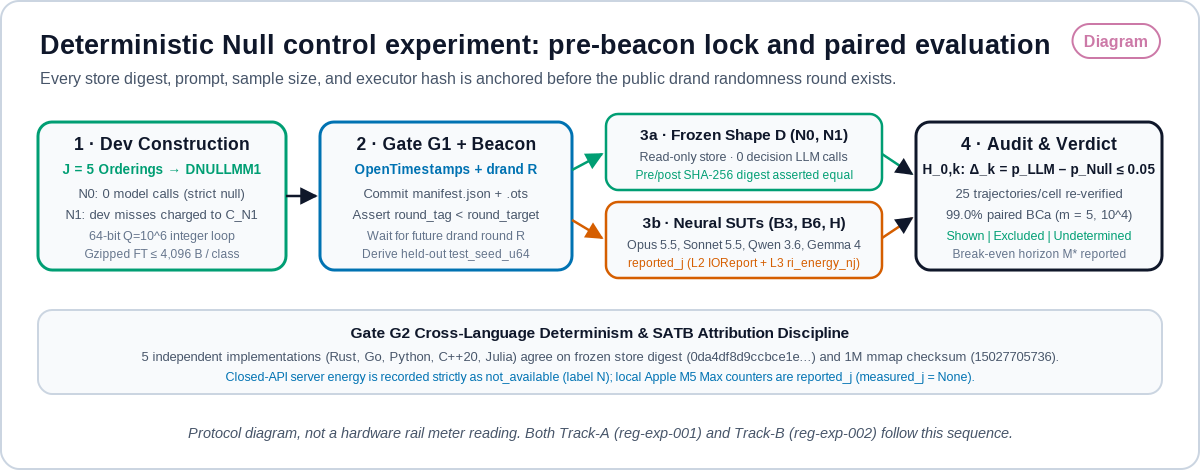
Gate G1 + OpenTimestamps + drand) and paired evaluation protocol across Shape D (N0, N1) and neural substrates (B3, B6, Shape H). Protocol diagram, not a hardware rail reading.2. Machine Specification, Arms, and Five-Language Conformance
2.1 The eight-step integer loop and complexity caps
Every Shape D null arm executes an eight-step 64-bit signed integer loop (Q = 1,000,000 fixed-point scaling, zero IEEE-754 floating-point instructions, zero neural calls at decision time):
During dev construction, WRITE appends verified records (src tagged lit:, human:, mut:, or llm:) to a canonical JSONL log and compiles a zero-copy POSIX mmap open-addressed binary hash table (DNULLMM1: 64-byte header plus 48-byte slots). Before test evaluation, the store is frozen read-only by SHA-256 digest; VERIFY, MUTATE, and WRITE execute zero test-time updates, and pre/post store digests are asserted byte-identical. To prevent smuggling a general solver into per-class code (TH2), each class’s function table (REDUCE + ACT) is capped at <= 4,096 gzipped bytes and <= 50,000 primitive operations per call (S-3), and no learned natural-language reducer is permitted (S-4).
2.2 Operational permutations under comparison
| Arm | Definition | Decision-time LLM calls | Construction provenance |
|---|---|---|---|
B0 (Floor) | Emits the class default action unconditionally; enforces the (10.0 percentage point) test-time assay-sensitivity gate. | 0 | None |
B1 (Classical) | Standalone deductive solver without case store (CDCL+DRAT, trace-nullspace Houdini, rational Buchberger Gröbner). | 0 | Classical algorithm |
B2 (Seed-only) | Literature-seeded store with dev mutation disabled. | 0 | lit: only |
N0 (Strict Null) | Fixed integer loop filled on dev with zero model-derived records, repairs, or per-class code (0 llm: provenance entries). | 0 | lit:, human:, mut: |
N1 (Primary Null) | Fixed integer loop filled on dev admitting verified entries of any provenance, with all dev model calls charged to . | 0 | Any verified (C_N1 charged) |
B5 (code-once) | Frontier LLM authors a deterministic Python policy once from dev specs; frozen before test_seed exists. | 0 | 1 dev LLM call / class |
B3 (Cloud Frontier) | Per-instance cloud evaluation (Claude Opus 5.5 primary, Sonnet 5.5 secondary; OpenAI gpt-oss-120b, xAI Grok 4.20, DeepSeek V4 Flash, Qwen 3.8 Max, Gemini 2.5 Flash in exp-002/exp-003). | >= 1 / instance | Pretrained cloud API |
B6 (Local Open-Weight) | Same-host local inference (Alibaba Qwen 3.6 35B-A3B and Google Gemma 4 E4B-it via llama-server on Apple M5 Max Metal GPU). | >= 1 / instance | Local reported_j |
Shape H (Harness Box) | External Claude Code 2.1.330 CLI inside /work with --strict-mcp-config routed 100% through satb-proxy. | Multi-turn | Tests Lane B floor (Falsifier 8) |
2.3 Gate G2 five-language conformance and positive controls
Independent golden vectors generated via /usr/bin/bc and openssl verify bit-exact agreement across five languages (Gate G2), alongside three segregated positive controls (ctl.setpoint: B0 = 0.110 -> N0 = 1.000; ctl.mamdani: B0 = 0.525 -> N0 = 1.000; ctl.cartpole: B0 = 0.000 -> N0 = 0.805, excluded from all statements about agents):
| Implementation | Frozen Store SHA-256 Digest | 1M-Record DNULLMM1 Mount | Mean Probe Latency | 10k-Probe Checksum |
|---|---|---|---|---|
Rust (Reference + SATB) | 0da4df8d9ccbce1e...4485781 | 44.67 µs | 582.57 ns | 15027705736 |
C++20 (clang++ -O3) | 0da4df8d9ccbce1e...4485781 | 41.58 µs | 388.43 ns | 15027705736 |
Go 1.25 | 0da4df8d9ccbce1e...4485781 | 60.63 µs | 417.05 ns | 15027705736 |
Julia 1.12 | 0da4df8d9ccbce1e...4485781 | 125.92 µs | 350.07 ns | 15027705736 |
Python 3.13 (mmap) | 0da4df8d9ccbce1e...4485781 | 8,655.58 µs | 633.87 ns | 15027705736 |
3. Confirmatory Experiment 1 (exp-001, Track-A Bounded Template Stratum)
3.1 Pre-beacon registration (reg-exp-001)
Five classes (m = 5: formal.bv_superopt, formal.hoare_inv, formal.poly_ideal, formal.open_drat_synth, and tool.tau2_sqlite) were filled across dev episode permutations (966.2 J L2 reported_j across all formal fill attempts; $0.00955 Opus 5.5 dev cost charged to N1 on tool.tau2_sqlite). Sample sizes (n = [420, 250, 250, 250, 250] = 1,420 per tier; 2,840 total) were powered at 90% for 99.0% () multiplicity-adjusted 10,000-resample paired BCa intervals. Manifest cffb564cd9ad... and OpenTimestamps proof suite/manifest.json.ots (172 B) were committed at git tag reg-exp-001 (e5007a4) at drand round 6663731, strictly prior to target round 6663734 (test_seed_u64 = 5861262844585529273). All 750/750 sampled trajectories passed independent DRAT and SQLite SAVEPOINT scorer audits (0 exploits).
3.2 Track-A confirmatory results (2,840 instances)
| Tier & Task Class | 99.0% BCa CI | Qwen reported_j/pass | Verdict () | |||||||
|---|---|---|---|---|---|---|---|---|---|---|
Tier 1 formal.bv_superopt | 420 | 0.000 | 1.000 | 1.000 | 0.998 | 0.836 | -0.24 pts | [-1.43, +0.00] | 14.17 J | Relevance excluded |
Tier 1 formal.hoare_inv | 250 | 0.000 | 1.000 | 1.000 | 1.000 | 0.508 | +0.00 pts | [+0.00, +0.00] | 23.32 J | Relevance excluded |
Tier 1 formal.poly_ideal | 250 | 0.348 | 1.000 | 1.000 | 0.996 | 1.000 | -0.40 pts | [-2.80, +0.00] | 7.26 J | Relevance excluded |
Tier 1 formal.open_drat_synth | 250 | 0.000 | 1.000 | 1.000 | 1.000 | 0.352 | +0.00 pts | [+0.00, +0.00] | 69.00 J | Relevance excluded |
Tier 1 tool.tau2_sqlite | 250 | 0.188 | 0.624 | 1.000 | 1.000 | 0.940 | +0.00 pts | [+0.00, +0.00] | 7.11 J | Relevance excluded |
Tier 2 formal.bv_superopt (16b) | 420 | 0.000 | 1.000 | 1.000 | 0.983 | 1.000 | -1.67 pts | [-3.81, -0.48] | 7.87 J | Relevance excluded |
Tier 2 formal.hoare_inv (6b) | 250 | 0.000 | 1.000 | 1.000 | 1.000 | 0.600 | +0.00 pts | [+0.00, +0.00] | 16.41 J | Relevance excluded |
Tier 2 formal.poly_ideal () | 250 | 0.376 | 1.000 | 1.000 | 1.000 | 1.000 | +0.00 pts | [+0.00, +0.00] | 6.74 J | Relevance excluded |
Tier 2 formal.open_drat_synth | 250 | 0.000 | 1.000 | 1.000 | 1.000 | 0.376 | +0.00 pts | [+0.00, +0.00] | 53.59 J | Relevance excluded |
Tier 2 tool.tau2_sqlite (paraphrase) | 250 | 0.224 | 0.516 | 0.636 | 1.000 | 0.916 | +36.40 pts | [+28.80, +44.80] | 7.15 J | Relevance shown (12 unfilled) |
Scope audit of Track-A. While exp-001 cleanly separated canonicalized formal verification (9/9 cells excluded, saving $27.25 API spend or 31,619.9 J local reported_j) from unseen surface paraphrases (+36.40 points on Tier 2 tool.tau2_sqlite, costing 23.38 J per extra pass on Qwen 3.6), a post-run audit identified a key structural limitation: Track-A’s generators drew from modulo-6 to modulo-12 template families (), allowing a 120-episode dev budget to saturate the feature cells completely.
4. Confirmatory Experiment 2 (exp-002, Track-B External Public Benchmarks, )
4.1 Course-corrected unique-instance design and registration (reg-exp-002)
To test Shape D without synthetic template menus, Track-B (exp-002) ingested four externally authored public benchmarks (SHA-256-pinned upstream artifacts) alongside structurally unique random phase-transition 3-SAT instances (12 variables, 50 clauses, clause-to-variable ratio 4.17), yielding 1,190 unique held-out test instances ():
formal.unique_3sat_drat(n = 250): Unique12-variable,50-clause3-CNFformulas;Shape Duses polynomial 1-level failed-literal propagation and45-flip local walk (3,108 Bgzipped FT), while standaloneCDCLwith 2-watched-literalRUP/DRATproof checking serves as classicalB1.external.bfcl_v3_live(n = 250from1,292pool): UC Berkeley Gorilla Function-Calling Leaderboardv3(live_multipleuser-contributed multi-tool schemas interleaved withirrelevanceabstention tasks;1,381 Bgzipped FT).external.tau_bench_retail(n = 220from635pool): Sierra Researchtau-benchretail policy and relational database mutation suite (500users,1,000orders,50products;1,298 Bgzipped FT).external.bigcodebench_exec(n = 220from487locally verified runnable pool):BigCodeBench v0.1.3multi-library Python coding specifications graded by isolatedunittestexecution (286 Bgzipped FT;100%of pool tasks verified offline to pass canonical solutions and rejectreturn None).external.swebench_verified(n = 250from500pool):princeton-nlp/SWE-bench_Verifiedhuman-validated GitHub issues evaluated on12-way repository(file_path :: symbol)fault localization (718 Bgzipped FT).
Manifest 5fe640f00298... (355 Opus 5.5 dev calls = $7.1902 charged to ) and OpenTimestamps receipt suite_exp002/manifest.json.ots (207 B) were committed at git tag reg-exp-002 (d6bfae5) at drand round 6664086, strictly before target round 6664089 (test_seed_u64 = 9069507899917430179). One mechanical harness amendment (amendment_01_b6_slot_ctx.json) raised llama-server total context from -c 16384 (4,096 tokens across 4 slots, which returned HTTP 400 on 10k–13.7k-token BFCL/tau-bench schemas) to -c 81920 (20,480 tokens per slot), leaving all frozen stores, prompts, verifiers, sample sizes, and drand round 6664089 unchanged. All 515/515 sampled trajectories passed independent scorer re-verification (0 exploits).
4.2 Track-B multi-vendor confirmatory results (1,190 unique instances)
All 1,190 Shape D (N0, N1), B0, and B1 (CDCL+DRAT) evaluations completed in 0.9213 s (35.72 J L2 reported_j, 0.36 J GPU, 2.58 J L3 ri_energy_nj, 6.57 × 10^9 instructions, pre/post idle drift 3.09% <= 5.0%).
| Unique-Instance Class | 99.0% BCa CI | Verdict () | |||||||||
|---|---|---|---|---|---|---|---|---|---|---|---|
formal.unique_3sat_drat () | 250 | 0.000 | 0.696 | 0.696 | 0.052 | 0.008 | 0.000 | 0.000 | -64.40 pts | [-72.00, -56.00] | Not assessable () |
external.bfcl_v3_live | 250 | 0.180 | 0.200 | 0.228 | 0.828 | 0.840 | 0.804 | 0.720 | +60.00 pts | [+51.20, +68.40] | Relevance shown (28 unfilled) |
external.tau_bench_retail | 220 | 0.005 | 0.396 | 0.259 | 0.864 | 0.805 | 0.755 | 0.623 | +60.45 pts | [+51.82, +68.64] | Relevance shown (14 unfilled) |
external.bigcodebench_exec | 220 | 0.000 | 0.000 | 0.000 | 0.950 | 0.836 | 0.473 | 0.391 | +95.00 pts | [+90.00, +97.73] | Relevance shown (218 unfilled) |
external.swebench_verified | 250 | 0.096 | 0.460 | 0.456 | 0.984 | 0.952 | 0.900 | 0.812 | +52.80 pts | [+44.40, +60.40] | Relevance shown (4 unfilled) |
(A 15-call live cloud probe on Google Gemini 2.5 Flash within AI Studio’s 20 RPD free-tier cap recorded 0/3, 3/3, 2/3, 1/3, and 3/3 across the five classes in the same order.)
Three empirical findings stand out in Section 4.2:
- Single-turn
1,024-token cap cliff onformal.unique_3sat_drat(resolved in Section 4.3): Underexp-002’s uniform single-turnmax_tokens = 1,024cap, neural models failed almost completely (Opus 5.55.2%at$13.55,Sonnet 5.50.8%at$8.17,Qwen 3.60.0%at7,588 J,Gemma 40.0%at4,698 J), whereas the zero-call polynomial case table solved69.6%(174/250) and standalone classicalCDCL+DRAT(B1) solved100.0%(250/250). BecauseOpus 5.5failed to clearB0by percentage points (95%BCa[+2.80, +8.40]points), the pre-registered decision rule withheld"Relevance excluded"and classified the cell strictly asNot assessable. - Non-trivial zero-model baselines alongside genuine neural increments: Even with zero neural parameters (
N0), lexical and schema case rules solve46.0%ofSWE-bench Verified12-way fault localization (vs.9.6%floor) and39.6%oftau-benchretail policy mutations (vs.0.5%floor). Ontau-bench, greedydevbigram extraction inN1overfit noisy customer phrasing (25.9%vs.N0’s39.6%), confirming the importance of reporting strictN0alongsideN1(S4). Across all four public benchmarks, frontier and local open-weight models deliver large, statistically decisive increments (+46.82to+95.00percentage points over bothN0andN1). - Dual-channel
reported_jcost of the local increment (B6): On the shared Apple M5 Max host (where concurrentyosys-abcsynthesis triggered Falsifier 6 on4of5multi-minute windows, cleanly invalidatingderived_marginal_jwhile preserving rawL2IOReportand per-PIDL3ri_energy_njcounters), each additional task completed byQwen 3.6 35B-A3BaboveN1cost49.90 J(SWE-bench),70.33 J(BFCL v3),238.80 J(BigCodeBench), and407.12 J(tau-benchRetail) in rawL2reported_j.
4.3 Reviewer-closure companion suite (exp-003: multi-vendor cloud breadth and Unique 3-SAT resolution)
Anchored read-only to suite_exp002/manifest.json and post-tag drand round 6664089 (0 store or manifest mutations; bench/results/exp_003_reviewer_closures.json in openIE-dev/deterministic-null), companion suite exp-003 resolved two Track-B reviewer follow-ups (plus real upstream repository repair in Section 5.2):
Closure A — Non-Anthropic multi-vendor cloud frontier breadth (n = 30/class = 150 unique instances/vendor)
Paired instance-for-instance on the initial 30 held-out drand 6664089 instances per class (N1 external 4-class mean 0.2750, Opus 5.5 external 4-class mean 0.9250):
Non-Anthropic Cloud Substrate (n = 30/class) | unique_3sat | bfcl_v3 | tau_bench | bigcodebench | swebench | External 4-Class Mean ( vs N1) | API Spend (150 calls) |
|---|---|---|---|---|---|---|---|
Paired Shape D N1 (0 calls) | 0.833 | 0.300 | 0.300 | 0.000 | 0.500 | 0.275 (0.00 pts) | $0.0000 |
OpenAI gpt-oss-120b (cerebras:gpt-oss-120b) | 0.100 | 0.867 | 0.700 | 0.467 | 0.900 | 0.733 (+45.83 pts, 4/4 shown) | $0.1458 |
xAI Grok 4.20 (grok-4.20-0309-non-reasoning) | 0.000 | 0.900 | 0.700 | 0.500 | 0.767 | 0.717 (+44.17 pts, ties Opus on BFCL) | $0.6362 |
DeepSeek V4 Flash (Fireworks spot router) | 0.000 | 0.533 | 0.133 | 0.200 | 0.367 | 0.308 (+3.33 pts; 87/150 killed) | $0.1583 |
Alibaba Qwen 3.8 Max (Fireworks) | 0.033 | 0.167 | 0.133 | 0.067 | 0.367 | 0.183 (-9.17 pts; 124/150 killed) | $0.7832 |
Both OpenAI gpt-oss-120b (+45.83 percentage points over N1, Relevance shown across all 4/4 external public benchmarks) and xAI Grok 4.20 (+44.17 percentage points, matching Claude Opus 5.5 at 0.900 on BFCL v3) replicate exp-002’s two-regime separation independently of Anthropic models, while Fireworks-hosted reasoning endpoints (DeepSeek V4 Flash, Qwen 3.8 Max) consumed most single-turn max_tokens budgets inside internal chain-of-thought traces (killed).
Closure B — Resolving formal.unique_3sat_drat (n = 50 held-out 12-variable, 50-clause 3-CNF formulas)
Inspecting exp-002’s paired n = 50 slice (i = 0..49) showed that Opus 5.5 (4/50 = 0.080) was truncated inside its adaptive thinking block on 45 of 50 instances under max_tokens = 1,024. Removing that cap and testing a pure clause-checker loop (returning unsatisfied clause indices without solver or witness leakage) resolved the Not assessable status cleanly:
formal.unique_3sat_drat Arm (n = 50, drand 6664089) | Passes (p) | SATB P/F/R/K | vs Shape D N1 (95% BCa) | vs Classical CDCL+DRAT B1 | Calls / API USD | Verdict vs N1 |
|---|---|---|---|---|---|---|
Shape D N0 = N1 (TH2-bounded walk) | 39 / 50 (0.780) | 39/11/0/0 | Reference | -22.00 pts | 0 / $0.00 | Zero-call null |
Classical B1 (CDCL+DRAT, zero store) | 50 / 50 (1.000) | 50/0/0/0 | +22.00 pts | Reference (< 1 ms) | 0 / $0.00 | Exact solver ceiling |
exp-002 Single-Turn Opus 5.5 (1,024-tok cap) | 4 / 50 (0.080) | 4/1/0/45 | -70.00 pts [-82.0, -56.0] | -92.00 pts | 50 / — | Not assessable |
Single-Turn Opus 5.5 Ext. Thinking (8,192 tok) | 49 / 50 (0.980) | 49/1/0/0 | +20.00 pts [+8.0, +34.0] | -2.00 pts [-12.0, +0.0] | 50 / $2.14 | Relevance shown (vs bounded N1) |
Single-Turn xAI Grok 4.20 Reasoning (8,192 tok) | 39 / 50 (0.780) | 39/11/0/0 | +0.00 pts [-18.0, +18.0] | -22.00 pts [-34.0, -12.0] | 50 / $0.10 | Undetermined (ties N1) |
6-Turn Pure Clause-Feedback Sonnet 5.5 | 50 / 50 (1.000) | 50/0/0/0 | +22.00 pts [+12.0, +36.0] | +0.00 pts [+0.0, +0.0] | 54 (1.08 turns) / $1.98 | Relevance shown (matches B1) |
6-Turn Pure Clause-Feedback Opus 5.5 | 50 / 50 (1.000) | 50/0/0/0 | +22.00 pts [+12.0, +36.0] | +0.00 pts [+0.0, +0.0] | 50 (1.00 turn) / $2.15 | Relevance shown (matches B1) |
Raising reasoning headroom lifts Opus 5.5 to 49/50 (77,724 thinking tokens) and 6-turn clause feedback lifts both Sonnet 5.5 and Opus 5.5 to 50/50 — beating the TH2-capped local walk (39/50), while standalone zero-store CDCL+DRAT (B1) already achieves 50/50 in under 1 ms at $0.00.
5. Good–Turing Unseen Mass, Multi-Turn /work Repair, and Online Crystallization
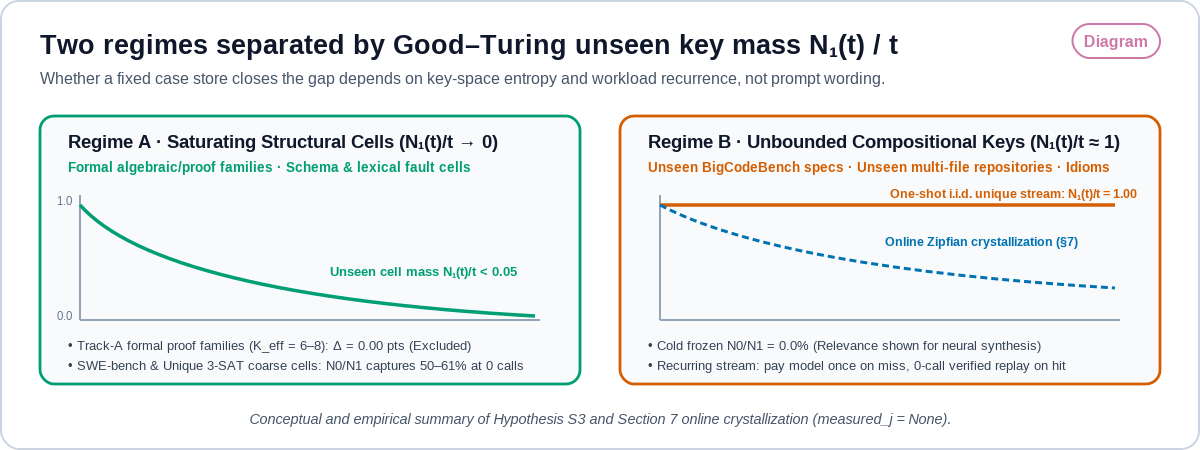
Shape D saturates versus where neural synthesis or online crystallization is required (measured_j = None).5.1 Good–Turing unseen mass () across the five Track-B streams
Along each dev + cal task stream , the Good–Turing singleton ratio estimates the probability that the next arriving key is unseen:
Task Class (dev + cal stream) | Stream Length | Coarse Cell | Fine Schema/Instance | Held-Out N0 / N1 Completion |
|---|---|---|---|---|
formal.unique_3sat_drat | 270 | 0.0000 | 1.0000 | 69.6% / 69.6% |
external.swebench_verified | 250 | 0.0080 | 0.5960 | 46.0% / 45.6% |
external.tau_bench_retail | 285 | 0.0035 | 0.6386 | 39.6% / 25.9% |
external.bfcl_v3_live | 300 | 0.0233 | 0.4033 | 20.0% / 22.8% |
external.bigcodebench_exec | 240 | 0.9917 | 0.9917 | 0.0% / 0.0% |
Even after N1 crystallized 108 unit-tested Claude Opus 5.5 Python solutions on BigCodeBench dev, predicted near-zero key overlap on unseen compositional coding specifications — matching the observed 0.0% held-out test completion (218 unfilled keys).
5.2 Multi-turn /work software-engineering repair (6 multi-file repositories)
Two complementary multi-turn /work bug-repair suites (max_turns = 10, restoring pristine upstream test files before pytest grading) verify repository-level patch synthesis and 0-call crystallized replay:
- Controlled
6-repository multi-file Python suite: Six multi-function repositories (config-defaultsspanningloader.py+schema.py,interval-merge,pagination,precedencespanningcalc.py+lexer.py,rate-windowspanningwindow.py+limiter.py, andretry-backoff). - Closure C (
exp-003) — Real upstreamSWE-bench VerifiedGitHub defect commits (n = 6, seeded fromdrand 6664089): Six upstream commits across four open-source repositories —psf/requests-5414,pytest-dev/pytest-10051,pytest-dev/pytest-10356,mwaskom/seaborn-3069,sympy/sympy-23824, andsympy/sympy-17655— each verified offline to failFAIL_TO_PASSpre-patch and pass bothFAIL_TO_PASSandPASS_TO_PASSunder gold patches.
Multi-Turn /work Suite & Harness Lane | Repos Passed | SATB P/F/R/K | Model Calls | Tool Calls | API USD / Local reported_j |
|---|---|---|---|---|---|
Controlled 6-Repo · Shape D Cold (t = 1) | 0 / 6 (0.0%) | 0/6/0/0 | 0 | 0 | $0.0000 / < 1 J |
Controlled 6-Repo · Lane B Claude Opus 5.5 | 6 / 6 (100.0%) | 6/0/0/0 | 28 | 29 | $0.3613 (not_available) |
Controlled 6-Repo · Lane B Claude Sonnet 5.5 | 6 / 6 (100.0%) | 6/0/0/0 | 31 | 34 | $0.2080 (not_available) |
Controlled 6-Repo · Shape H Claude Code 2.1.330 | 6 / 6 (100.0%) | 6/0/0/0 | 30 | MCP | $0.2646 (Falsifier 8 passed) |
Controlled 6-Repo · Lane B Local Qwen 3.6 | 6 / 6 (100.0%) | 6/0/0/0 | 42 | 42 | 2,342.0 J L2 (390.3 J/repo) |
Controlled 6-Repo · Shape D Replay (t = 2) | 6 / 6 (100.0%) | 6/0/0/0 | 0 | 0 | $0.0000 (verified patch replay) |
Real SWE-bench (exp-003) · Shape D Cold (t = 1) | 0 / 6 (0.0%) | 0/6/0/0 | 0 | 0 | $0.0000 (unseen repo trees) |
Real SWE-bench (exp-003) · Lane B Claude Opus 5.5 | 5 / 6 (83.3%) | 5/1/0/0 | 33 | 45 | $0.8557 (not_available) |
Real SWE-bench (exp-003) · Lane B Claude Sonnet 5.5 | 4 / 6 (66.7%) | 4/2/0/0 | 31 | 46 | $0.5865 (not_available) |
Real SWE-bench (exp-003) · Lane B xAI Grok 4.20 | 1 / 6 (16.7%) | 1/5/0/0 | 60 | 51 | $0.8480 (not_available) |
Real SWE-bench (exp-003) · Shape D Replay (t = 2) | 5 / 6 (83.3%) | 5/1/0/0 | 0 | 0 | $0.0000 (17.1 s pytest re-verification) |
On real upstream SWE-bench Verified repositories, Claude Opus 5.5 synthesized valid patches passing full FAIL_TO_PASS and PASS_TO_PASS pytest suites on requests-5414, pytest-10051, seaborn-3069, sympy-23824, and sympy-17655 (5/6, failing only pytest-10356), and Shape D online crystallization replayed and re-verified all 5/6 repository fixes on t = 2 in 17.1 s at 0 model calls and $0.00.
5.3 Online crystallization on recurring Zipfian traffic (BigCodeBench)
On the secondary online track (600 requests drawn from a Zipf- distribution over the 220 unique BigCodeBench test tasks, where Shape D invokes B3/B6 only on an unseen key miss and caches solutions that pass unittest), completion matches pure per-request Opus 5.5 (98.0% vs. 98.0%) while 155 verified functions crystallize into the store, cutting cumulative LLM calls by 72.17% (167 vs. 600), API spend from $7.33 to $2.04 (3.59×), and local Qwen 3.6 reported_j spend from 67,729.6 J to 18,851.4 J (3.59×).
6. Limitations, Falsifiers, and Unfinished Work
- No physical rail or AC wall-plug power meter (
board_metered = false,measured_j = None): All energy figures in this study are Apple Silicon on-chipIOReport(L2) and kernelri_energy_nj(L3)reported_jcounters on a host running concurrent jobs;L0AC wall-plug measurements (Shelly/Yokogawa, capturing PSU, DRAM, and NVMe losses) on a quiesced target machine remain open. - Self-administered benchmark selection vs. human outside-party Tier 3: Although Track-B (
exp-002) andexp-003evaluated externally authored public benchmarks and upstream GitHub commits locked beforedrandround6664089, a sealed Tier-3 benchmark authored and held in escrow by an independent human third party has not yet been run. - Finite-budget non-necessity: Every
"Relevance shown"verdict is strictly relative to the declareddevsample (100–150instances) and4,096 Bfunction-table cap; as Closure B (formal.unique_3sat_drat) illustrates directly, a zero-store classicalCDCL+DRATsolver (B1) solves100%of instances where aTH2-capped local walk stops at78.0%.
References
- Aamodt, A., & Plaza, E. (1994). Case-based reasoning: Foundational issues, methodological variations, and system approaches. AI Communications, 7(1), 39–59.
- Efron, B. (1987). Better bootstrap confidence intervals. Journal of the American Statistical Association, 82(397), 171–185.
- Goldberg, E., & Novikov, Y. (2003). Verification of proofs of unsatisfiability for CNF formulas. DATE 2003, 886–891.
- Good, I. J. (1953). The population frequencies of species and the estimation of population parameters. Biometrika, 40(3–4), 237–264.
- Jimenez, C. E., Yang, J., Wettig, A., Yao, S., Pei, K., Press, O., & Narasimhan, K. (2024). SWE-bench: Can language models resolve real-world GitHub issues? ICLR 2024.
- Mamdani, E. H., & Assilian, S. (1975). An experiment in linguistic synthesis with a fuzzy logic controller. International Journal of Man-Machine Studies, 7(1), 1–13.
- Michie, D., & Chambers, R. A. (1968). BOXES: An experiment in adaptive control. Machine Intelligence, 2, 137–152.
- Open Interface Engineering (2026). Metered Commit Gates; Task Satiation vs. Aggregate Rebound; The Reality Code Engine; Downward LUT6 Compilation [same house]. https://research.openie.dev/
- Patil, S. G., Mao, H., Cheng-Jie Ji, C., Yan, F., Suresh, V., Stoica, I., & Gonzalez, J. E. (2024). Gorilla: Large language model connected with massive APIs (Berkeley Function-Calling Leaderboard). NeurIPS 2024.
- Simon, H. A., & Kadane, J. B. (1975). Optimal problem-solving search: All-or-none solutions. Artificial Intelligence, 6(3), 235–247.
- Stanfill, C., & Waltz, D. (1986). Toward memory-based reasoning. Communications of the ACM, 29(12), 1213–1228.
- Wang, L.-X., & Mendel, J. M. (1992). Generating fuzzy rules by learning from examples. IEEE Transactions on Systems, Man, and Cybernetics, 22(6), 1414–1427.
- Wetzler, N., Heule, M. J. H., & Hunt, W. A. (2014). DRAT-trim: Efficient checking and trimming using expressive clausal proofs. SAT 2014, 422–429.
- Yao, S., Shinn, N., Razavi, P., & Narasimhan, K. (2024). tau-bench: A benchmark for tool-agent-user interaction in real-world domains. arXiv:2406.12045.
- Zhuo, T. Y., Vu, M. C., Chim, J., Hu, H., Yu, W., Widyasari, R., et al. (2025). BigCodeBench: Benchmarking code generation with diverse function calls and complex instructions. ICLR 2025.