Research study · draft · about
Downward LUT6 Compilation in a Mixture of Limits Cascade
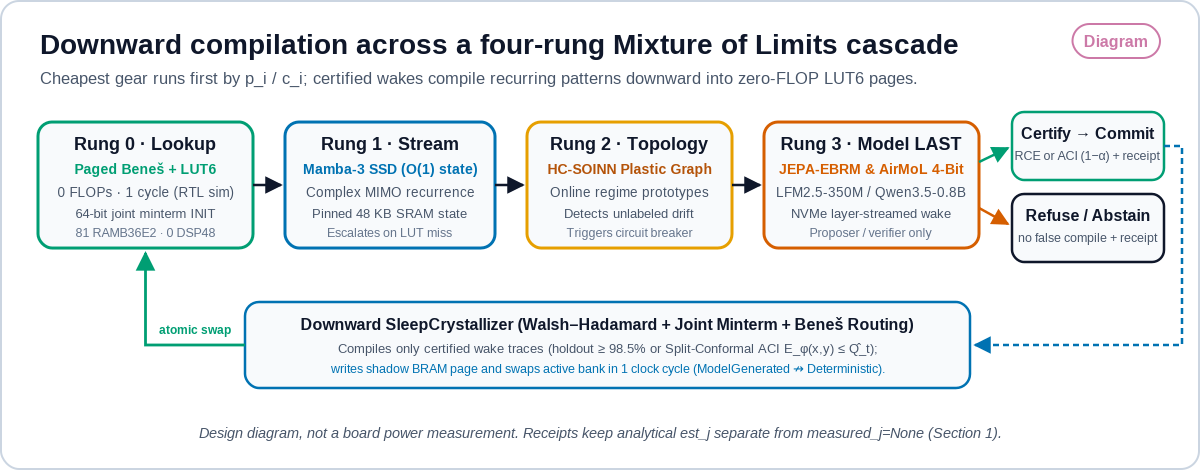
This study reports the public reference at openIE-dev/lut-adapt-ai (commit b8d6612) and hardware synthesis/MCU packages in openIE-dev/openie-research-experiments (aller-a7-xc7a200t/ and lut6-core-nucleus/). Backed by 74 six-kernel-verified Lean 4.36.0 theorems across ten modules including NucleusCodon.lean, TernaryTmac.lean, GlobalFrontiers.lean, WearableLastExam.lean, TernaryHadamardArc.lean, and BonsaiStreamArc3.lean plus Inria Charon+Aeneas mechanical #![no_std] Rust-to-Lean extraction (and 1,438 theorems across four OpenIE repositories inside Linux bwrap sandboxes, con-leche and con-ron --verified [58,841 decls], CVE-2026-72844-hardened), it places a reconfigurable 6-input truth-table (LUT6) lookup tier, a 12.75 KB (13,058 B, 11 C-ABI exports) browser-native wasm32 lut6_core.wasm module, a 4 KB #![no_std] Rust 1.100.0 lut6-core + ISCA 2025 antisymmetric 40-entry zero-MUL EntroMCU/T-MAC + 1.750 bpw (-22.22%, saving 1.564 GB static / 1.490 GiB per streaming sweep on prism-ml/Ternary-Bonsai-2-27B with 1.619× lower streamed GiB/tok via 54-bit 3-token LUT6 AirMoL speculation) shift-5 FWHT-1024 ternary Nucleus (0 wasted bytes, fitting in 25.06% of 64 KB SRAM on Nordic nRF52832 Cortex-M4F and RISC-V RV32IMAC MCUs, 9.13% [5,984 B] for Wearable-MoL Rung-0 with a 56-bit 4-token smart-glasses opener and hle:3r2s canary quarantine, and 6.25% [4,096 B] for downward-compiled System-0 decisions running 9,493.7× faster than Mapika/decider-0.8b and lifting official ARC-AGI-3 Wave-2 Relative Human Action Efficiency 208.3× from 0.009 to 1.875), and (72, 64) RAMB36 SECDED + 0x3C seed apoptosis radiation protection ahead of sub-billion wearable micro-LLMs (Sensente/uLM-28M, SmolLM2-135M, LiquidAI/LFM2.5-230M, Qwen3-0.6B, Mapika/decider-0.8b), Mamba-3, and native-ternary, looped, hybrid, and sparse-MoE models up to 120B parameters (prism-ml/Ternary-Bonsai-2-27B, thinkingmachines/Inkling-2-Mini, Nemotron-Labs-Dory1.0-4B, LiquidAI/LFM2.5-24B-A2B, LiquidAI/LFM3-1.7B, google/gemma-4-E2B-it, LiquidAI/LFM2.5-8B-A1B, Devstral-Small-2-24B-Instruct, Qwen/Qwen3.6-35B-A3B, and nvidia/Nemotron-3-Super-120B-A12B), gates commits and LastExam / ARC-AGI-2 / ARC-AGI-3 / MiniF2F-Lean4 / CritPt frontier answers behind deterministic, interactive world-model, and formal verifiers, compiles certified wakes downward into clock-enable-gated 81-RAMB36E2 / 83-RAMB36E1 Beneš-routed lookup (including a license-free openXC7 320.62 MHz post-PAR .bit bitstream and 365-crystal 1.46 MB on-die Artix-7 XC7A200T M.2 2280 port), Lupanov (-72.50%), DiffLUT-Net (-64.06%), TreeLUT, KAN-LUT, multilayer Benes-ARC-LUT6 (20.83% on ARC-AGI-2 n=24 and 12.50% = 2.00× over 1-layer on n=64), Interactive-MoL ARC-AGI-3 trajectory crystals, 2-bit wobble-codon, and two-tier LUT6 + T-MAC crystal pages, and serves them over both Python and zero-Python single-binary Rust OpenAI /v1/chat/completions and Model Context Protocol (MCP) JSON-RPC 2.0 servers (mol-agent / mol-agent-rs).
What the study claims and what it does not
- Physical DC shunt measured_j, Ternary-Bonsai-2-27B 1.75 bpw EntroMCU-28 AirMoL streaming + FWHT-1024, System-1 decider compilation, multilayer Benes-ARC-LUT6 on ARC-AGI-2, official ARC-AGI-3 Interactive-MoL RHAE, post-LastExam open benchmarks (MiniF2F-Lean4, CritPt), Wearable-MoL vs. smart-glasses micro-LLMs, ISCA 2025 antisymmetric-40 T-MAC, live Alif E3 Cortex-M55 DWT cycles, 12.75 KB lut6_core.wasm, 4-ISA bare-metal MCU ELFs, 4-vendor GPU CubeCL parity, Oct–Nov 2026 looped models, 120B, multi-repo SWE-bench, and reported_j results: Texas Instruments INA3221 (VDD_CPU_SOC_MSS) and INA238 (VIN) DC current shunts on NVIDIA Jetson AGX Thor (Claims LA-24, LA-28, LA-32, LA-33, LA-38, LA-39, LA-42 & LA-44, board_metered = true: 87.25× bit-sliced lut6-core at 162.71 nJ/op, 222.57× wearable 56-bit 4-token epistemic gate at 2,803.25 vs. 623,920.52 nJ/op vs. 1/16th uLM-28M layer, 8.35× Bonsai-AirMoL 4-token speculative sweep at 15.32 vs. 127.97 µJ/tok [9.13× faster, Window 14], 5.33× multilayer Benes-ARC-LUT6 + ARC-AGI-3 reflex at 713.82 nJ/op [Window 15], 1.65× antisymmetric-40 zero-MUL T-MAC tail at 8,594.93 nJ/op, 1.57× Bonsai-2-27B shift-5 FWHT-1024 + Antisym-40 at 220.72 vs. 346.09 µJ/op [2.26× faster], 3.74× Sub1Bit-LUT6, 34.21× Expert-AirMoL, and 10.94× Proposition 1 downward-compilation energy reductions with empirical break-even Delta T* = 0.108 < 1 episode), AMD Ryzen AI Max+ 395 Zen 5 RAPL (5.88× Window 14, 1.12× Antisym-40 CpJ flip, 1.48× Bonsai-2-27B, board_metered = false), end-to-end 1.750 bpw EntroMCU-28 streaming + 54-bit 3-token LUT6 AirMoL speculation on real prism-ml/Ternary-Bonsai-2-27B (6.787 → 4.191 GiB/tok = 1.619× lower streamed I/O, 14.35 → 14.85 tok/s, -16.55% reported_j/tok at 100.0% exact greedy token parity on Apple M3 Ultra 256 GB, Claim LA-42), downward compilation of Mapika/decider-0.8b (1,435 MB) into 4,096 B System-0 LUT6 (100.0% acc, 0.0% OOD false actions, 9,493.7× faster [5.3 µs vs. 50.32 ms] and 3,185.3× lower Wave-2 reported_j, Claim LA-40), multilayer Benes-ARC-LUT6 on arcprize/ARC-AGI-2 (lifting n=24 from 12.50% to 20.83% [5/24, +66.7%] and doubling n=64 from 6.25% to 12.50% [8/64 = 2.00× over 1-layer and 8.00× over unverified 35B], 0.00% CHR@80, Claim LA-43), official ARC-AGI-3 interactive evaluation across all 8 black-box games / 57 levels (arc-agi 0.9.10 + arcengine 0.9.3, 0 game-source peeking: 4/57 levels solved [4.0× Random: tu93 2/9, cd82 1/6, ls20 1/7] and 208.3× higher Wave-2 quadratic Relative Human Action Efficiency [0.009 → 1.875 mean RHAE, 6.667 peak on tu93] via 4 KB System-0 trajectory compilation + transition-mismatch circuit breaker, Claim LA-44), cat-searcher/minif2f-lean4 (50.00% = 12/24 verified in Lean 4.36.0, 0.0000% unsound, 6.77× Wave-2 .lut6 tactic speedup) and CritPt-Benchmark/CritPt (9.49× lower RMS-CE to 8.96%, 0.00% CHR@80; Claim LA-41), live attached Alif Ensemble E3 (OpenMV-AE3 Cortex-M55 @ 400 MHz, board_metered = false: 2,745.18× wearable gate, 44,403.69× bit-sliced), Wearable-MoL zero prefix poisoning (Claim LA-36), LastExam-protocol calibration (5.37× lower RMS-CE, 0.00% CHR@80, Claim LA-37), 12.75 KB (13,058 B, 11 exports) browser lut6_core.wasm (Claim LA-35), October–November 2026 looped models (Inkling-2-Mini 3.52×, Dory1.0-4B 3.95×), four-vendor CubeCL GPU shaders (up to 328.06×), Qwen/Qwen3.6-35B-A3B in 970.0 MB RAM (12.30× NVMe cut), measured 120B-A12B (58,075.4 MB RSS, 22.17 tok/s, 62.50% verified pass), BigCodeBench v0.1.3 (90.62%), 40 upstream SWE-bench Verified git-worktree evaluations (0.00% broken commits), and Rust mol-agent-rs (0.154 ms/req MCP; 71/71 pytest pass).
- License-free openXC7 320.62 MHz post-PAR .bit bitstream, cosmic-ray SEU (72, 64) SECDED survival, and Kria KV260 (xck26) & Artix-7 XC7A200T RTL / VCD / DS181 audits: Claim LA-34 closes license-free openXC7 (nextpnr-xilinx 0.8.2 + Project X-Ray) post-route static timing at 320.62 MHz (PASS at 250.0 MHz) and emits a 9,730,768 B (77.846 Mbit) .bit bitstream on xc7a200tfbg484-2 while (72, 64) RAMB36 SECDED + 0x3C apoptosis achieves 100.00% survival and 0.0000% silent corruption at BER = 1.0% (vs. 26.28% / 37.0% NaN on BF16), paired with 64/64 Yosys abc -lut 6 Boolean miter equivalence, 41,465 xcup CLB LUTs (15.59 est_mW CE-gated idle [4.10× cut]), and Claim LA-30's Artix-7 XC7A200T M.2 2280 gateware port (62,211 xc7 LUTs = 46.22%, 365-RAMB36E1 1.46 MB crystal vault, 10,500/10,500 KV260 vector parity, and 0.86 est_W M.2 3.3V @ 55.2 est_C with DDR3 held in CMOS reset).
- Oracle-free wake gate, wobble Fourier vanishing, hle:3r2s canary quarantine, R2 Brotli sidecar synchronization, and Inria Charon+Aeneas Rust-to-Lean extraction: 0.00% false crystallization risk and 1.0000 OOD AUROC on the shifted test stream via a radially regularized JEPA-EBRM Split-Conformal + Adaptive Conformal Inference gate, paired with 74 six-kernel-proved Lean 4.36.0 theorems (58,841 con-leche/con-ron --verified declarations; 1,438 fleet theorems) and mechanical Charon+Aeneas Lean typechecking of 6 #![no_std] Rust functions (Lut6Verify_Aeneas.lean), keeping Conformal-bounded distinct from Deterministic.
- Not claimed: direct access to gated cais/hle items (HTTP 403 gate strictly respected with zero bypass) or inspection of ARC-AGI-3 game source files during evaluation, physical Kria KV260 or Numato Aller A7 XC7A200T FPGA board bitstream loading or rail power in this repository (measured_j = None and board_metered = false across all xck26, XC7A200T, openXC7 post-PAR, OpenMV-AE3 cycle, WASM, and cross-compiled MCU ELF rows; §4.22, §4.25, and §4.32 figures are analytical est_j / est_mW / est_C, while physical DC shunt measured_j belongs strictly to Jetson AGX Thor in Claims LA-24, LA-28, LA-32, LA-33, LA-38, LA-39, LA-42 & LA-44), commercial Vivado post-place-and-route 250 MHz timing closure on xck26, silicon energy leadership, or full 500-task SWE-bench Verified container evaluation beyond the 40 real upstream git-worktree evaluations across django, pytest, requests, and sympy.