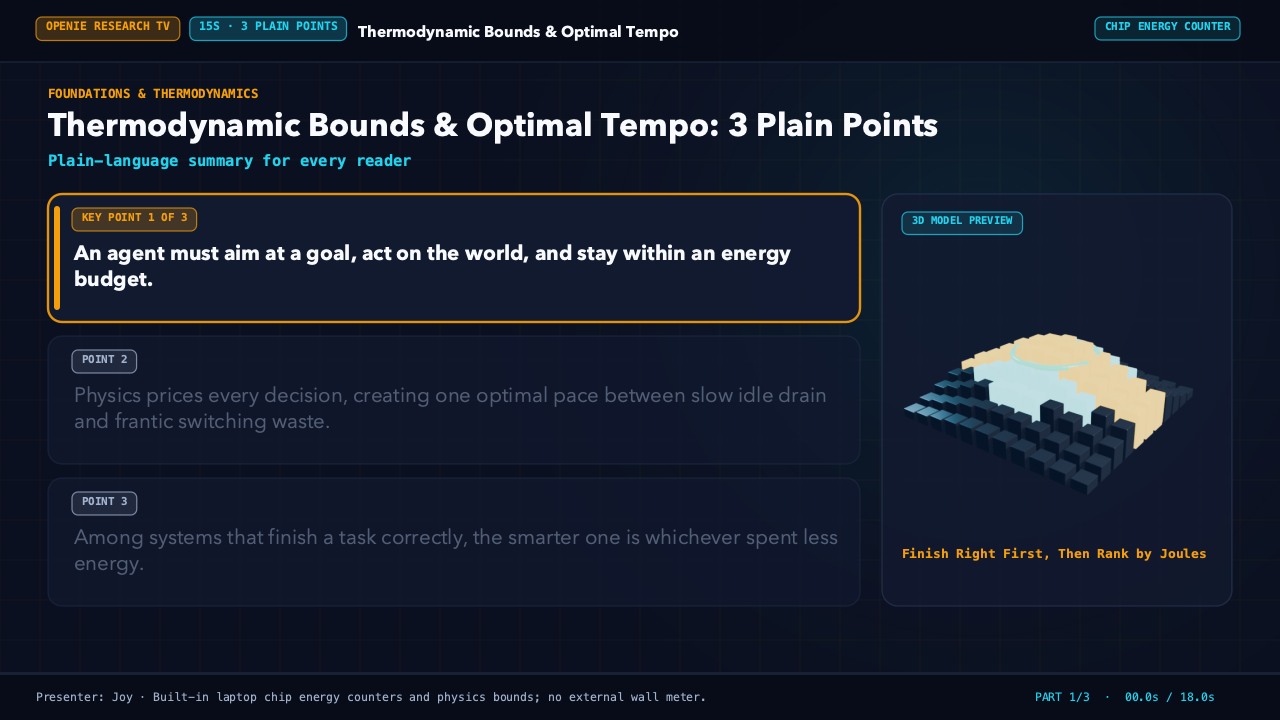
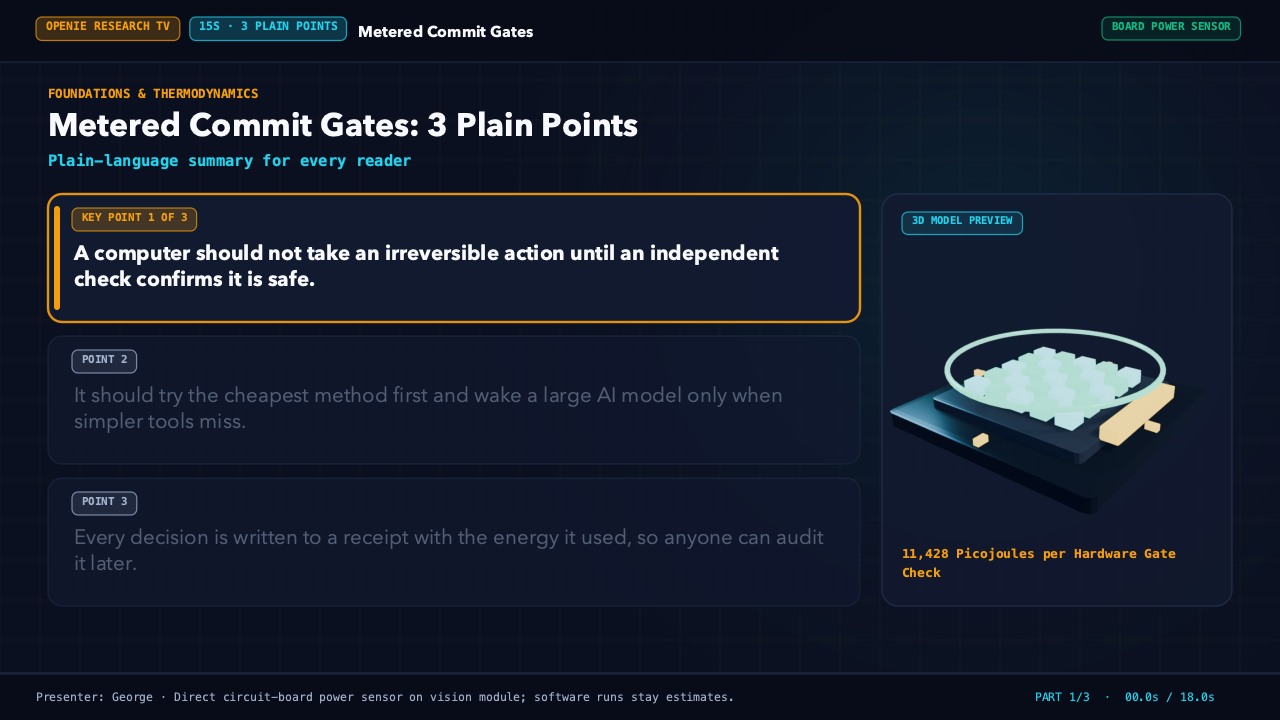
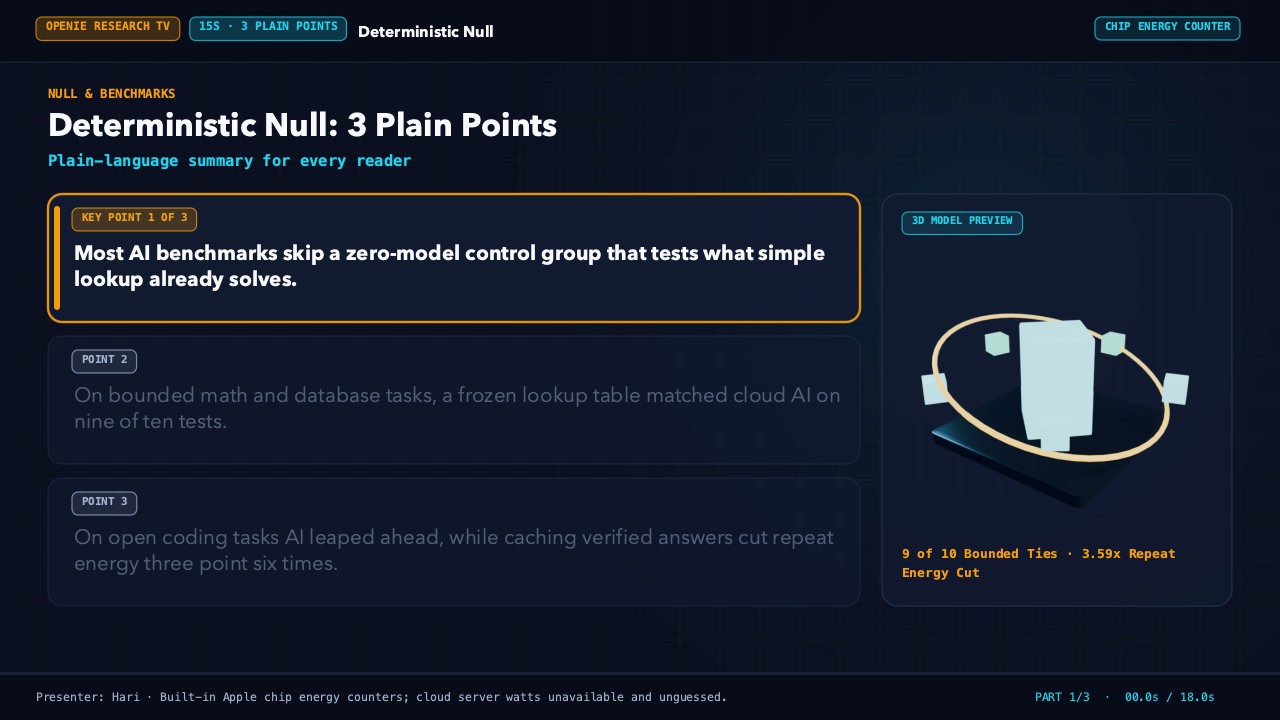
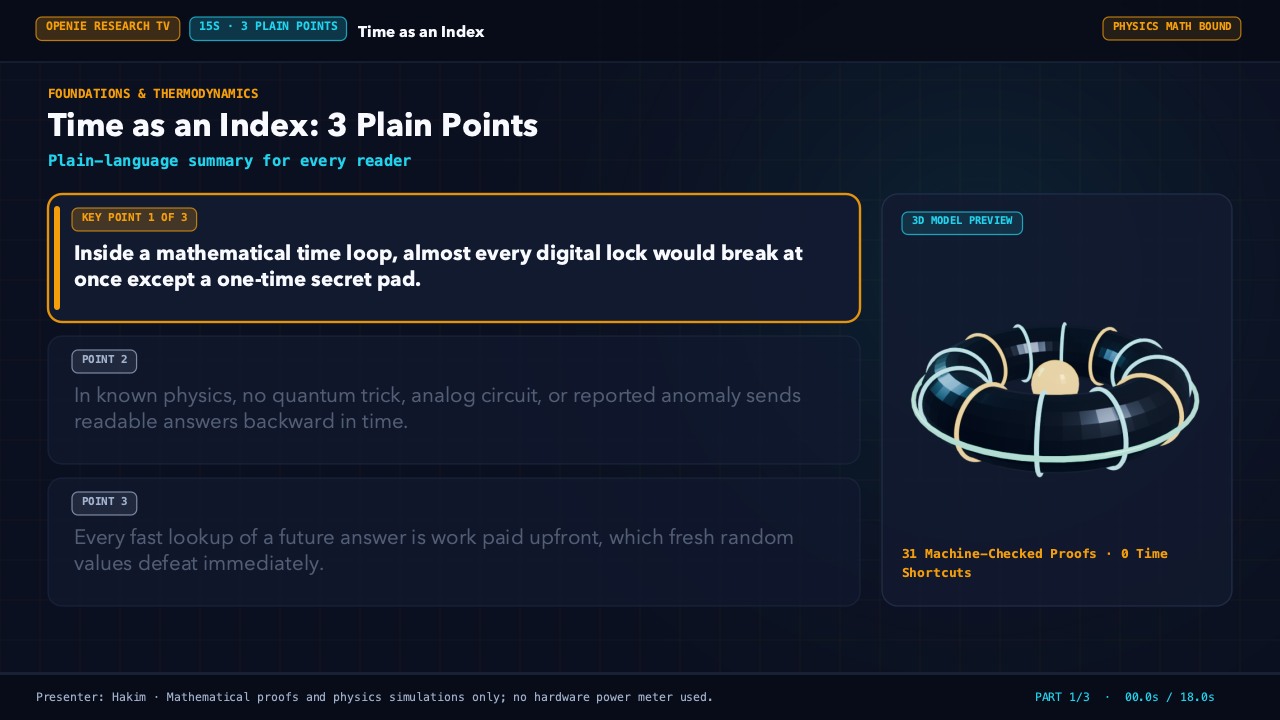
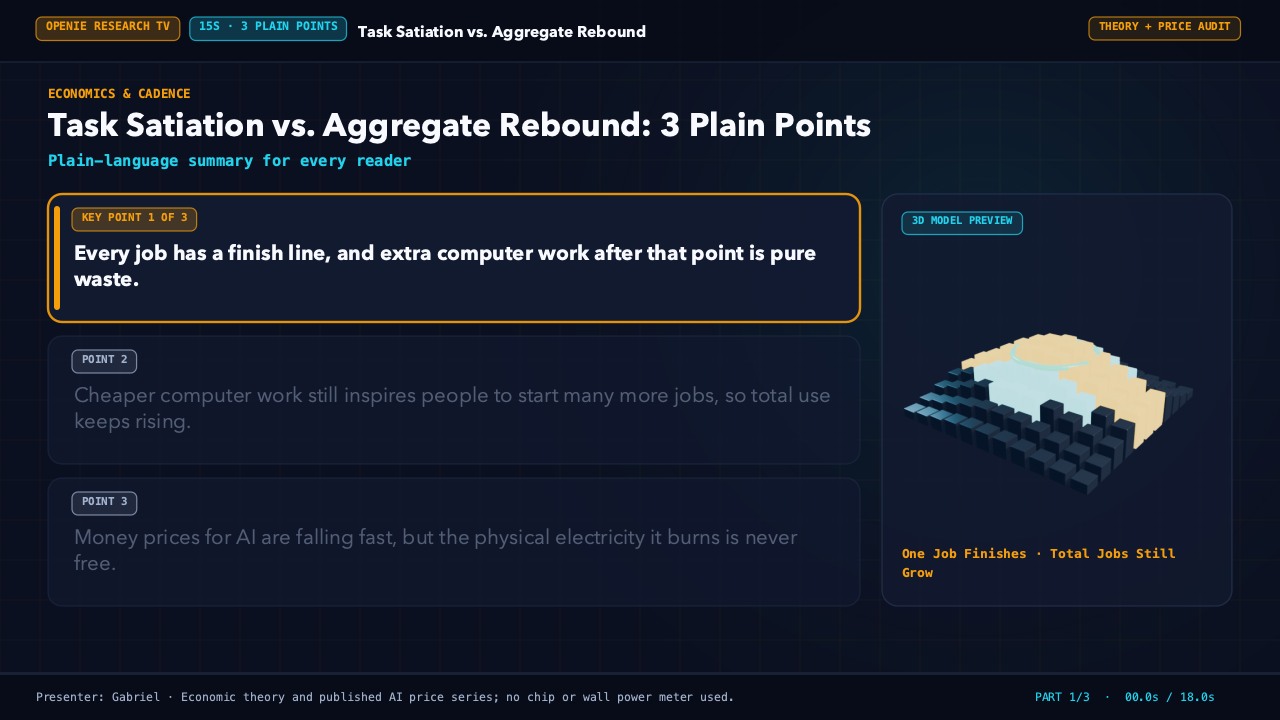
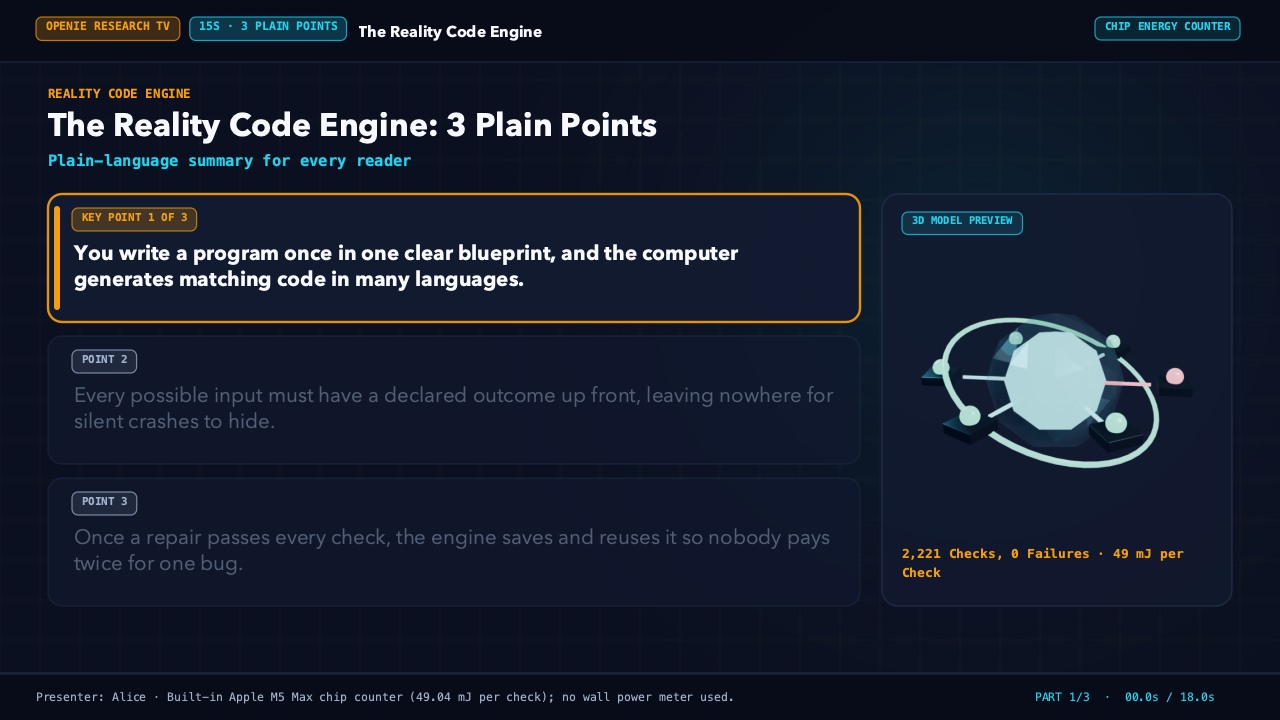
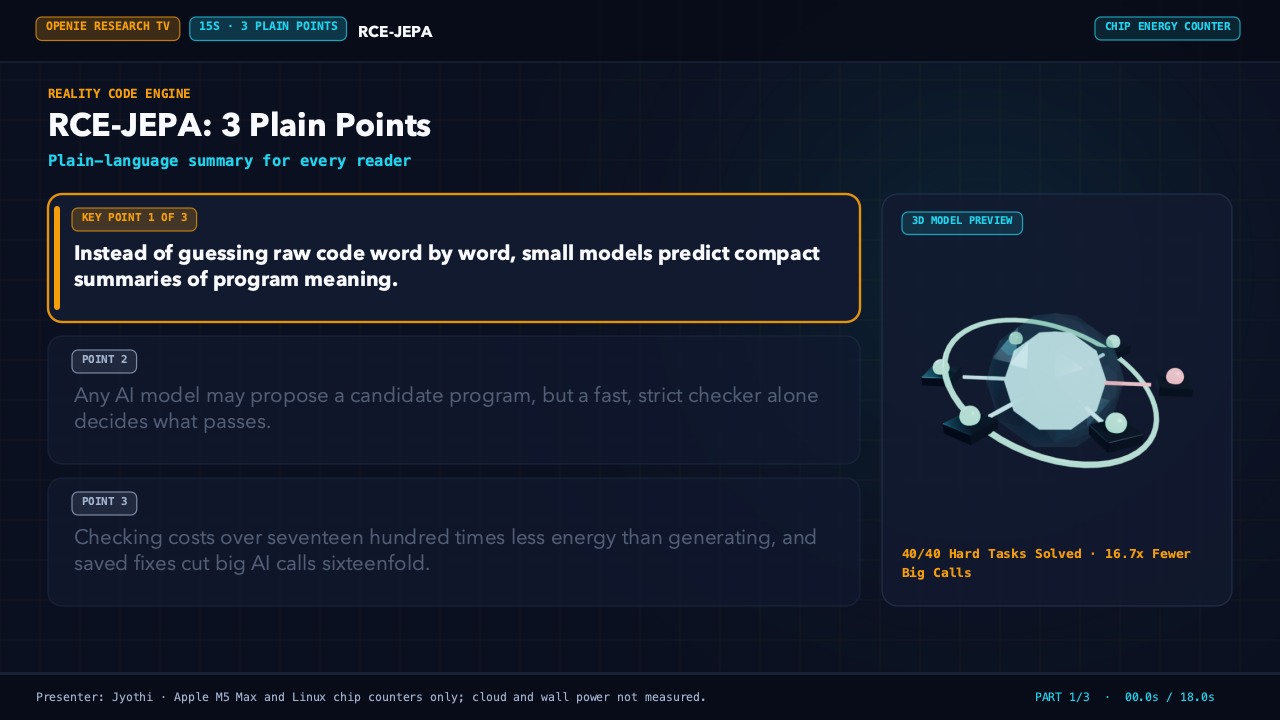
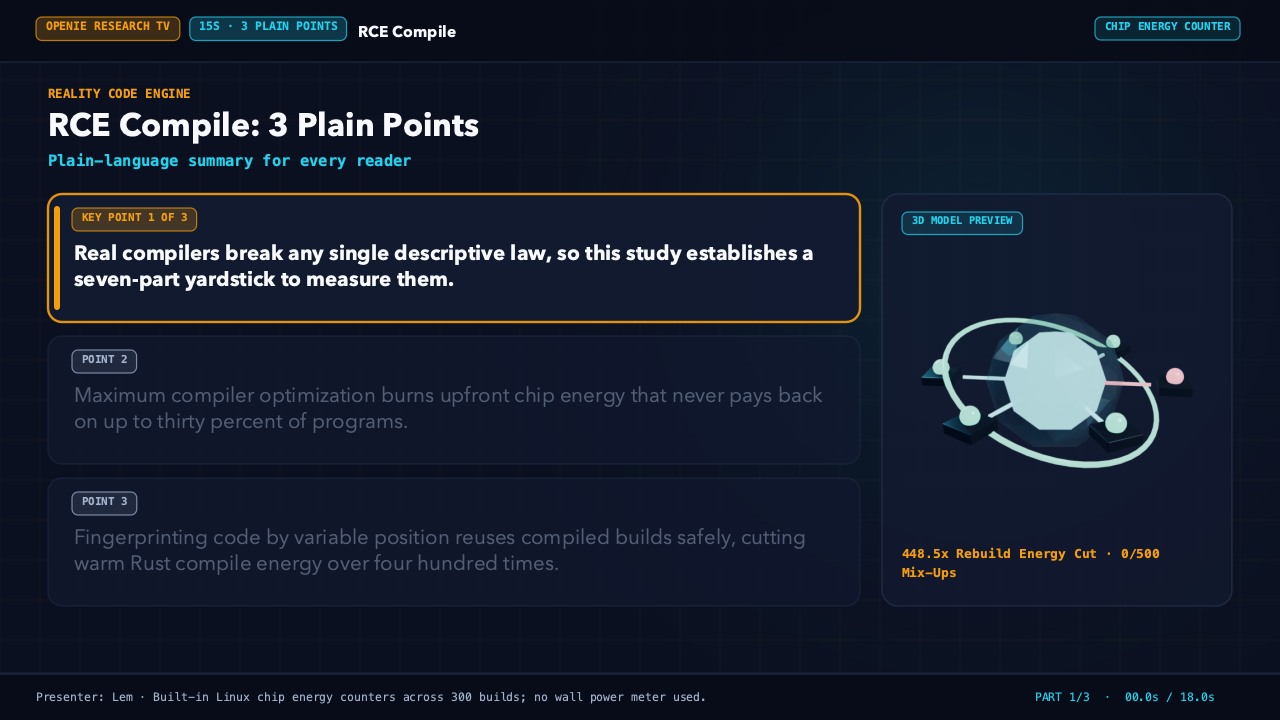
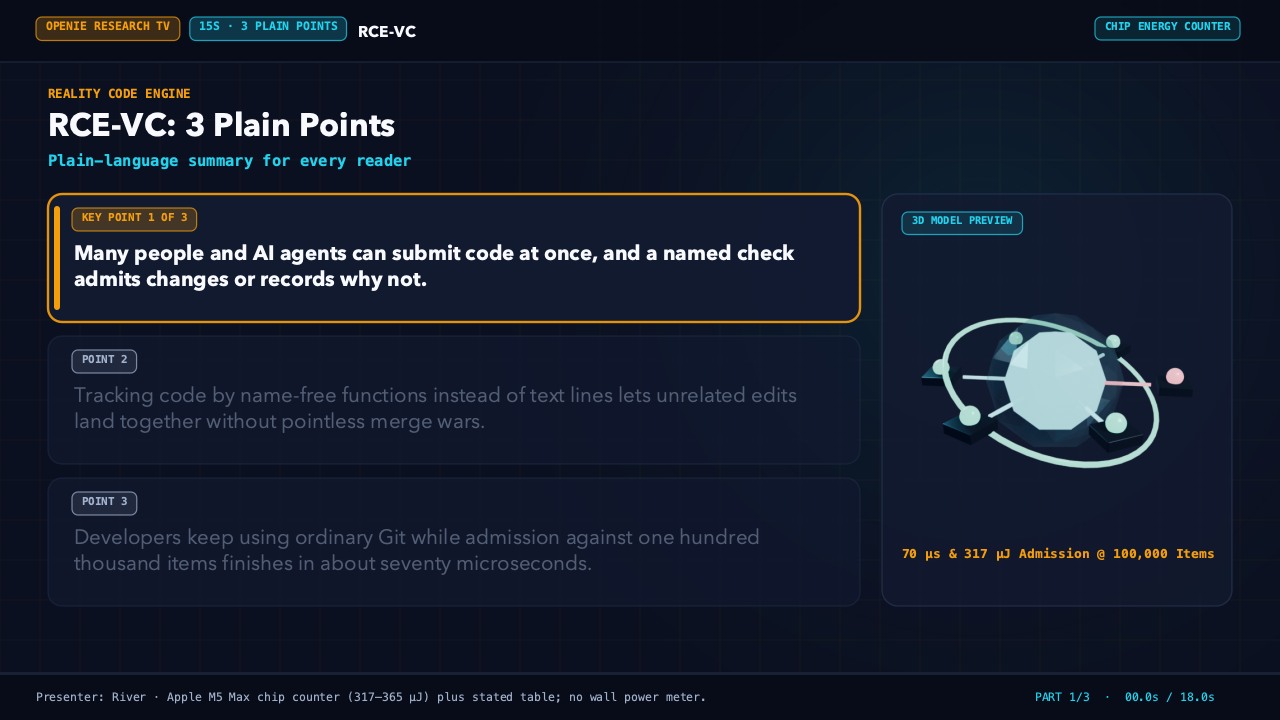
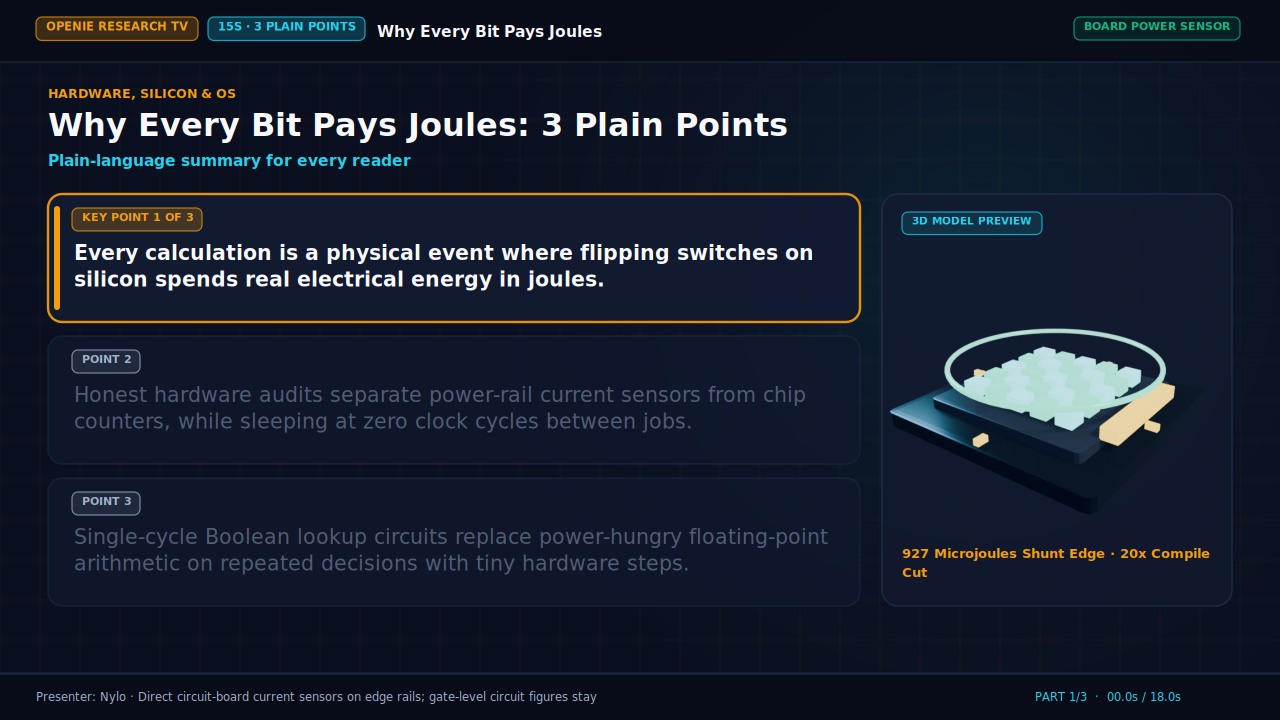
Every film—at every length—starts with the paper's three high-level points in plain everyday words, then expands smoothly as you choose more time: from a 15-second three-point primer, to a 45-second real-world example, to a 90-second full briefing, to a 3-minute deep cut with 3D architecture views and candid scientific limits.
Plain-Language Guarantee · Signed Provenance · Self-Checked · Orthogonal Energy Classes
No film assumes insider jargon or unexplained acronyms. Every study is narrated by its own studio presenter via ElevenLabs eleven_v4 under Signed Provenance · Self-Checked (not yet externally peer-reviewed), and every energy claim keeps four evidence classes strictly orthogonal (measured_j ⊥ reported_j ⊥ est_j ⊥ unmetered):
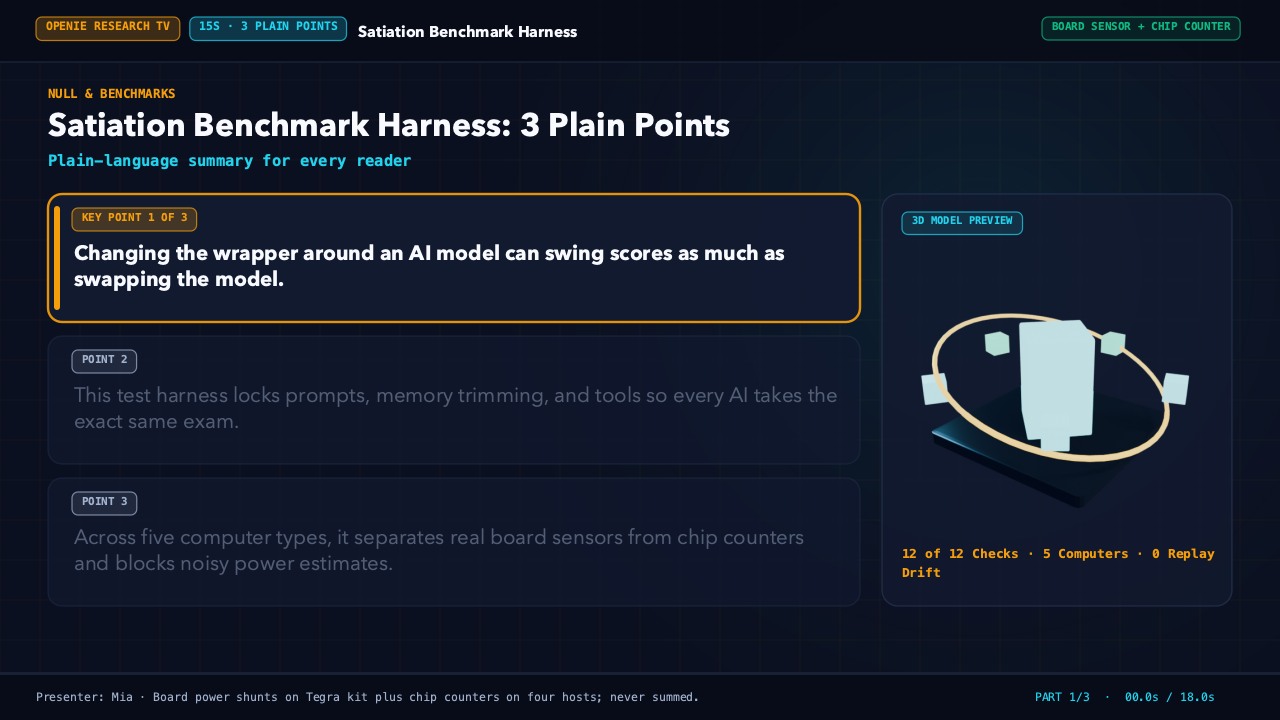
direct circuit-board power shunts (physical current sensors in From Ephemeral Inference to Compiled Agency, Metered Commit Gates, Satiation Benchmark Harness, and The Communication Tool Avalanche),
built-in computer chip counters,
analytical estimates, or unmetered formal work.
Hardware, Silicon & OS · Board Power Sensor (DC Shunts) Low-BW MP4: 109.41 J/min · AD Mix: 54.9 J/min (Thor INA3221 measured_j) · Cloud TTS: unmetered
Voice: Cecily · ElevenLabs v4 Studio
Single-Film Mode
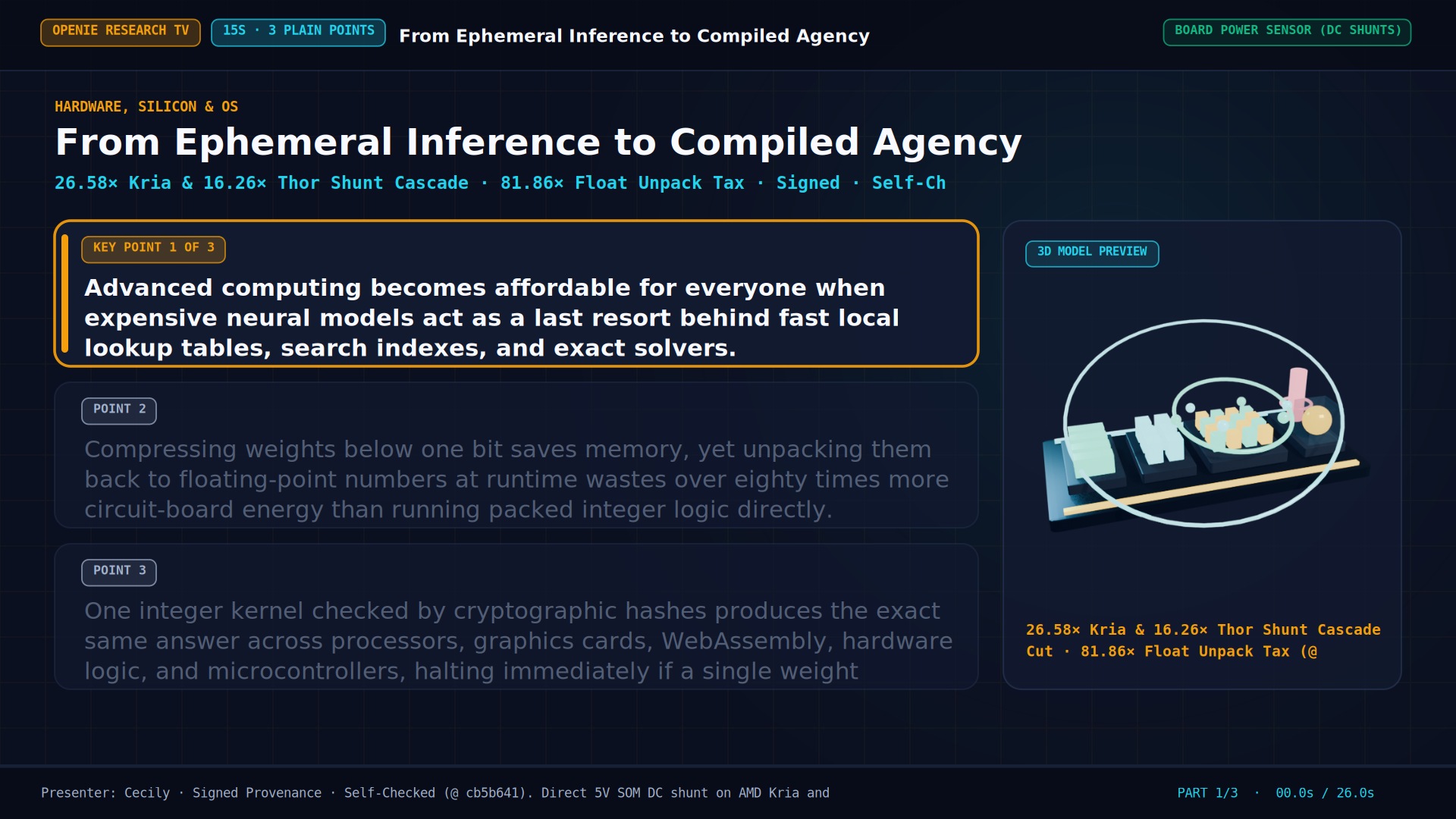
From Ephemeral Inference to Compiled Agency: A Position Paper on Verifiable, Energy-Accounted Computing
Full capstone briefing across all 6 Shots on Goal (@ cb5b641): 1,500-task null triage, Kria & Thor physical shunts, 6-fabric waiOS ring, and 1,315 Digital Well recipes.
In Plain Words — The 3 Key Points Every Slot Builds From
Advanced computing becomes affordable for everyone when expensive neural models act as a last resort behind fast local lookup tables, search indexes, and exact solvers.
Compressing weights below one bit saves memory, yet unpacking them back to floating-point numbers at runtime wastes over eighty times more circuit-board energy than running packed integer logic directly.
One integer kernel checked by cryptographic hashes produces the exact same answer across processors, graphics cards, WebAssembly, hardware logic, and microcontrollers, halting immediately if a single weight changes.
Signed Provenance · Self-Checked (@ cb5b641). Direct 5V SOM DC shunt on AMD Kria and rail shunt on Jetson Thor, strictly orthogonal to chip counters, analytical estimates, and unmetered work.
Presenter Profile: Documentary Host · African American English
Every film on OpenIE Research TV connects directly to our live domain properties—from the 9-rung forecasting engine at avalanche.openie.dev and the substrate map at stack.openie.dev to compute, synthesis, knowledge, and database. Select any channel below to filter the studio grid or launch its curated film queue.
Extracts the three-step signal ratchet across 3.8 billion years of biology and 76 years of AI, diagnoses why the industry is stuck at Rung 5 (Tool Use), and forecasts Month, Quarter, Year, and Decade breakthroughs through ten-camp Digital Enzymatic Synthesis.
98/100 DES-10 pass vs ≤49% solo · 9.26×–26.87× physical shunt CpJ · 18-milestone forecast
Reads information theory (Shannon and Landauer), game theory (von Neumann and Nash), and mechanism design (Hurwicz, Maskin, and Myerson) as three altitudes of one energy-bounded computing map.
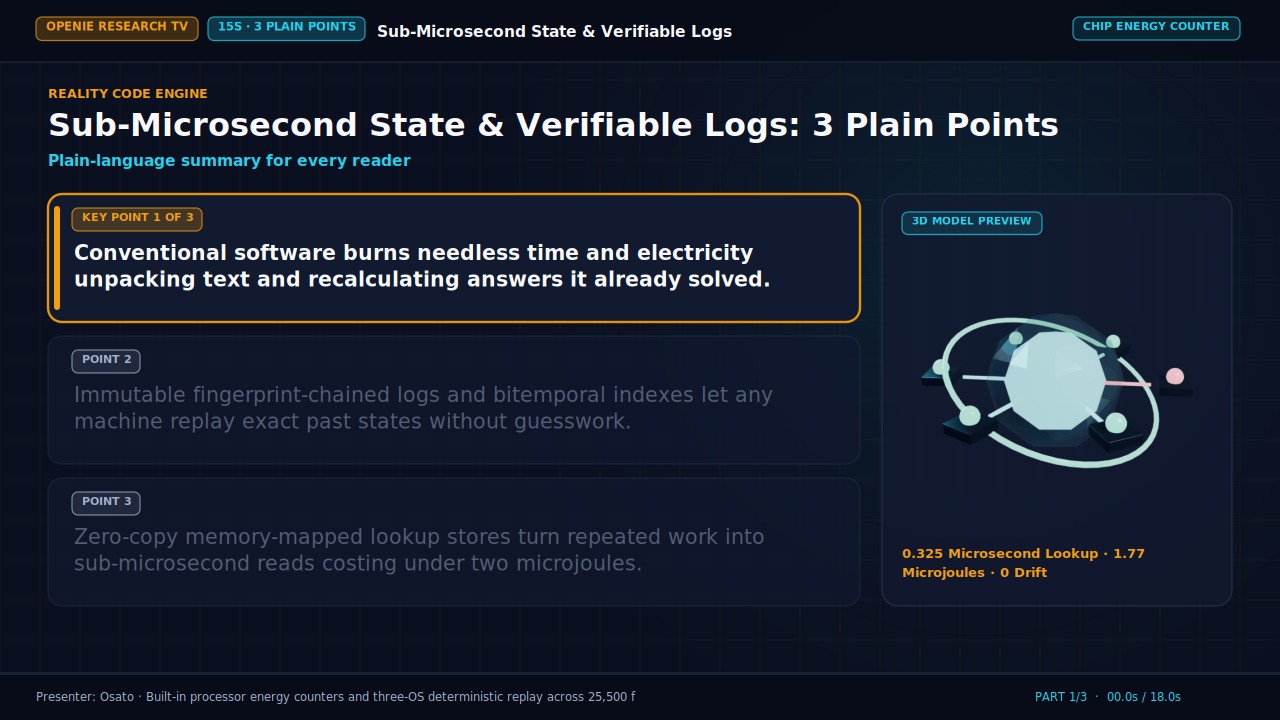
Defines the permitted-act substrate where bits pay joules—connecting physical board current-shunt sensors, processor energy counters, 250 MHz paged Boolean lookup circuits, and sovereign hardware tags.
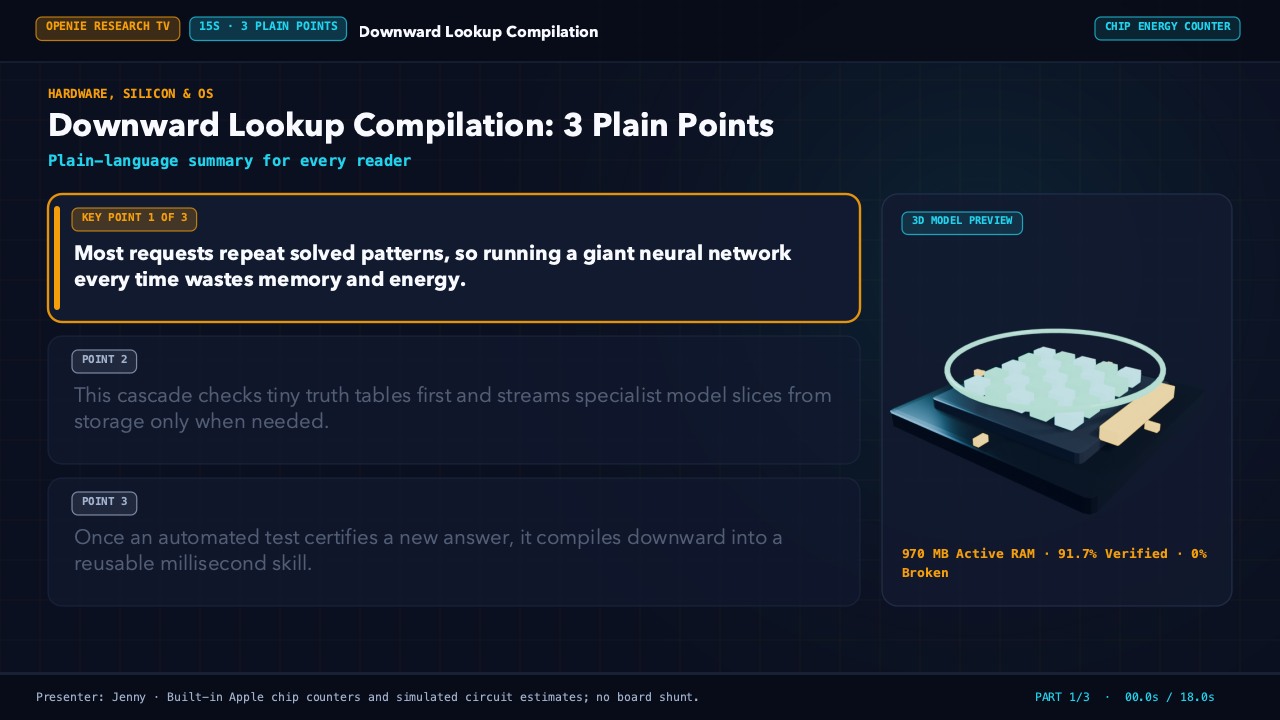
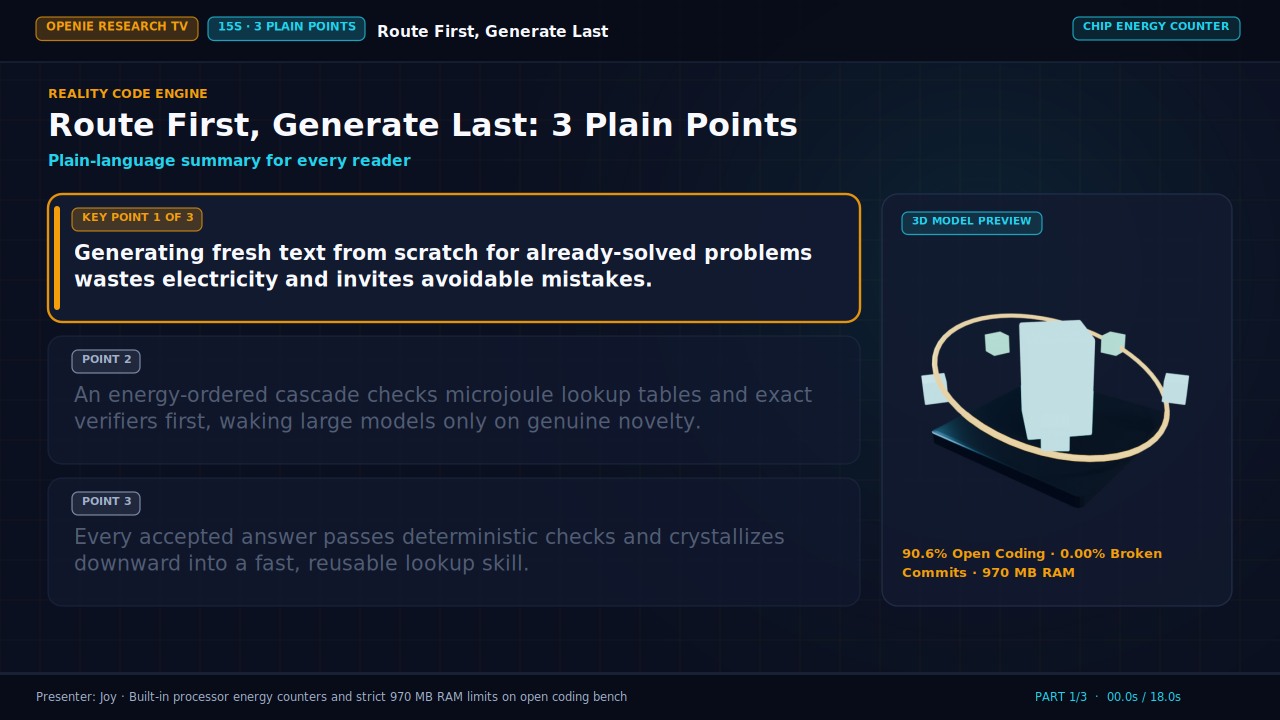
Replaces cold-start floating-point generation with energy-ordered cascades: try zero-FLOP lookup pages and exact proposers first, stream sparse experts only on misses, verify every commit, and crystallize winners downward.
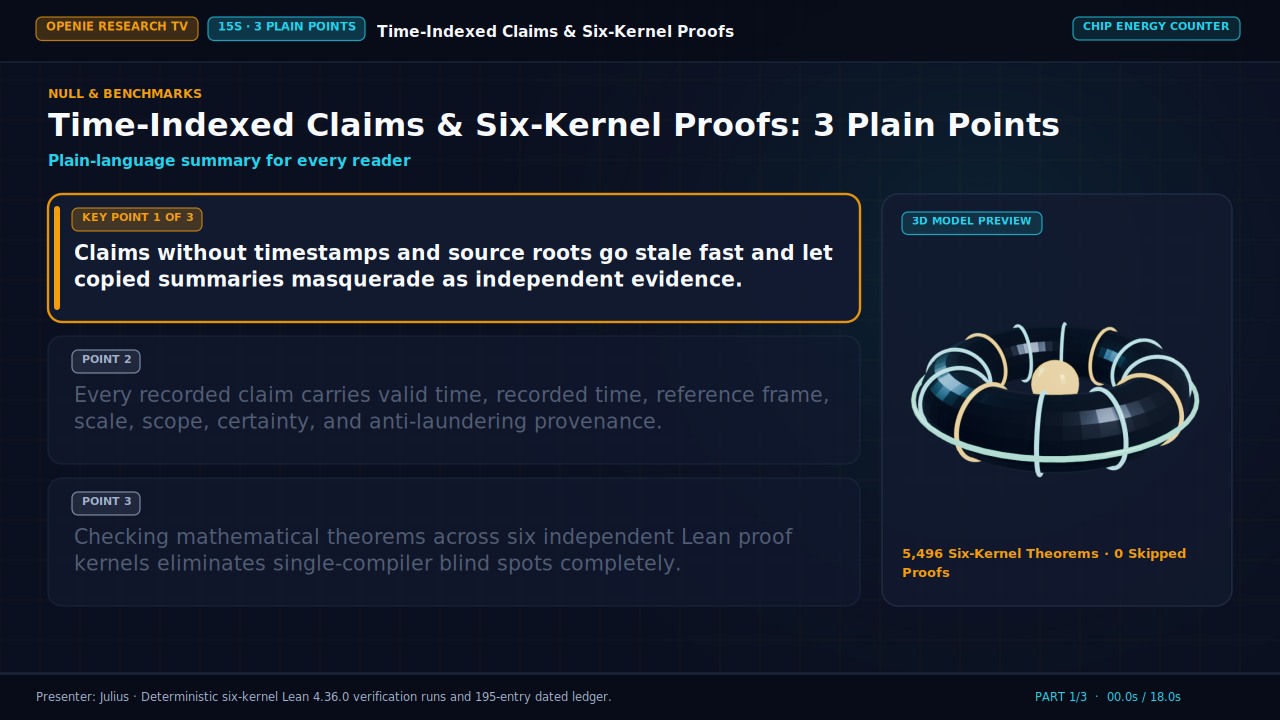
Treats knowledge as a claim carrying valid time, transaction time, reference time, granularity, scope, certainty, and anti-laundering provenance—anchored across six independent Lean 4.36.0 proof checkers.
Advanced computing becomes affordable for everyone when expensive neural models act as a last resort behind fast local lookup tables, search indexes, and exact solvers.
Compressing weights below one bit saves memory, yet unpacking them back to floating-point numbers at runtime wastes over eighty times more circuit-board energy than running packed integer logic directly.
One integer kernel checked by cryptographic hashes produces the exact same answer across processors, graphics cards, WebAssembly, hardware logic, and microcontrollers, halting immediately if a single weight changes.
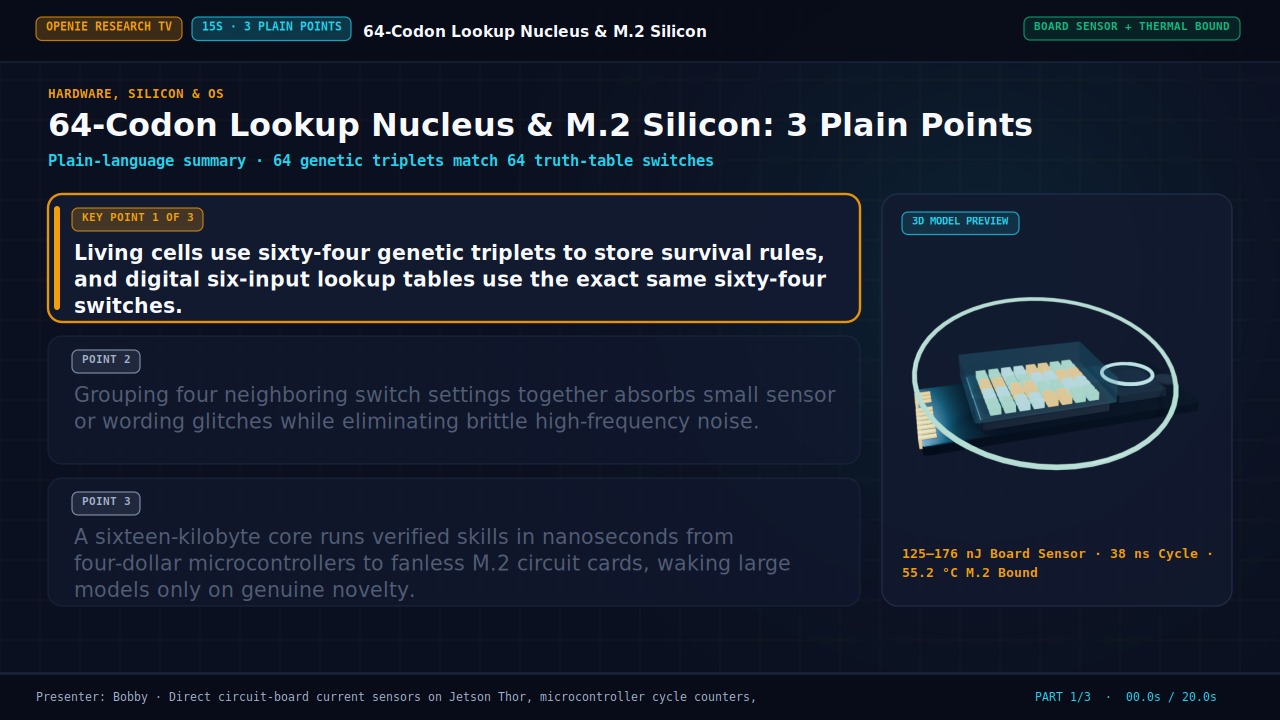
Living cells use sixty-four genetic triplets to store survival rules, and digital six-input lookup tables use the exact same sixty-four switches.
Grouping four neighboring switch settings together absorbs small sensor or wording glitches while eliminating brittle high-frequency noise.
A sixteen-kilobyte core runs verified skills in nanoseconds from four-dollar microcontrollers to fanless M.2 circuit cards, waking large models only on genuine novelty.