29 Topics × (4 Horizontal + 9:16 Vertical) = 145 Films 29 Voiced · 50 Captioned · 50 Selector Codes · review_status: machine 📑 29 [G0–G12] Source Sheets → ⠃ 46 Braille HTML Transcripts → 📱 9:16 TikTok + X ↔ Medium Studio → Planetary Media Blueprint v1.0 → coverage.json

OpenIE Research TV

Every film—at every length—starts with the paper's three high-level points in plain everyday words, then expands smoothly as you choose more time: from a 15-second three-point primer, to a 45-second real-world example, to a 90-second full briefing, to a 3-minute deep cut with 3D architecture views and candid scientific limits.

Plain-Language Guarantee · Signed Provenance · Self-Checked · Orthogonal Energy Classes

No film assumes insider jargon or unexplained acronyms. Every study is narrated by its own studio presenter via ElevenLabs eleven_v4 under Signed Provenance · Self-Checked (not yet externally peer-reviewed), and every energy claim keeps four evidence classes strictly orthogonal (measured_j ⊥ reported_j ⊥ est_j ⊥ unmetered): direct circuit-board power shunts (physical current sensors in From Ephemeral Inference to Compiled Agency, Metered Commit Gates, Satiation Benchmark Harness, and The Communication Tool Avalanche), built-in computer chip counters, analytical estimates, or unmetered formal work.

⬇ <1 MB Mobile MP4
Hardware, Silicon & OS · Board Power Sensor (DC Shunts) Low-BW MP4: 109.41 J/min · AD Mix: 54.9 J/min (Thor INA3221 measured_j) · Cloud TTS: unmetered Voice: Cecily · ElevenLabs v4 Studio
Single-Film Mode

From Ephemeral Inference to Compiled Agency: A Position Paper on Verifiable, Energy-Accounted Computing

Full capstone briefing across all 6 Shots on Goal (@ cb5b641): 1,500-task null triage, Kria & Thor physical shunts, 6-fabric waiOS ring, and 1,315 Digital Well recipes.

In Plain Words — The 3 Key Points Every Slot Builds From
  1. Advanced computing becomes affordable for everyone when expensive neural models act as a last resort behind fast local lookup tables, search indexes, and exact solvers.
  2. Compressing weights below one bit saves memory, yet unpacking them back to floating-point numbers at runtime wastes over eighty times more circuit-board energy than running packed integer logic directly.
  3. One integer kernel checked by cryptographic hashes produces the exact same answer across processors, graphics cards, WebAssembly, hardware logic, and microcontrollers, halting immediately if a single weight changes.
Key Outcome: 26.58× Kria & 16.26× Thor Shunt Cascade Cut · 81.86× Float Unpack Tax (@ cb5b641)
Signed Provenance · Self-Checked (@ cb5b641). Direct 5V SOM DC shunt on AMD Kria and rail shunt on Jetson Thor, strictly orthogonal to chip counters, analytical estimates, and unmetered work.
Presenter Profile: Documentary Host · African American English
Plain-Language Synced Transcript
Click any timestamped line to jump directly
Space Play/Pause 1–4 Depth Slot (15s–3m) J / K Next/Prev M Mute
6 Domain Channels + 9 Stack Companions

Watch by OpenIE Domain & Avalanche Rung

Every film on OpenIE Research TV connects directly to our live domain properties—from the 9-rung forecasting engine at avalanche.openie.dev and the substrate map at stack.openie.dev to compute, synthesis, knowledge, and database. Select any channel below to filter the studio grid or launch its curated film queue.

◉ Matching Radio Desks →
avalanche.openie.dev ↗ 8 studies · 32 films

OpenIE Avalanche

Rungs 1–5 (Ephemeral) → Compilation Threshold → Rungs 6–9 (Compiled)

Extracts the three-step signal ratchet across 3.8 billion years of biology and 76 years of AI, diagnoses why the industry is stuck at Rung 5 (Tool Use), and forecasts Month, Quarter, Year, and Decade breakthroughs through ten-camp Digital Enzymatic Synthesis.

98/100 DES-10 pass vs ≤49% solo · 9.26×–26.87× physical shunt CpJ · 18-milestone forecast
stack.openie.dev ↗ 6 studies · 24 films

OpenIE Stack

Unifying Substrate Across Rungs 1–9

Reads information theory (Shannon and Landauer), game theory (von Neumann and Nash), and mechanism design (Hurwicz, Maskin, and Myerson) as three altitudes of one energy-bounded computing map.

E(x) = Σ θ(p)·μ(p, H) · 9 Periodic Stacks · Zones Z₁, Z₂, Z₃
compute.openie.dev ↗ 8 studies · 32 films

OpenIE Compute

Rung 6 (Zero-Clock Idle) · Rung 7 (LUT6 Silicon) · Rung 9 (JouleOS)

Defines the permitted-act substrate where bits pay joules—connecting physical board current-shunt sensors, processor energy counters, 250 MHz paged Boolean lookup circuits, and sovereign hardware tags.

258 primitives · 927.3 µJ Tegra shunt edge · 20.07× compile cut · 15.59 est_mW CE-gated LUT6
synthesis.openie.dev ↗ 7 studies · 28 films

OpenIE Synthesis

Rung 2 (Generation) · Rung 3 (Reasoning) → Rung 7 (Competence)

Replaces cold-start floating-point generation with energy-ordered cascades: try zero-FLOP lookup pages and exact proposers first, stream sparse experts only on misses, verify every commit, and crystallize winners downward.

91.67% 48-task & 90.62% BCB v0.1.3 · 40/40 H15-Iterative · 0.00% broken commits · 970 MB 35B RAM
knowledge.openie.dev ↗ 6 studies · 24 films

OpenIE Knowledge

Rung 1 (Access) · Rung 3 (Correctness) · Rung 8 (Provenance)

Treats knowledge as a claim carrying valid time, transaction time, reference time, granularity, scope, certainty, and anti-laundering provenance—anchored across six independent Lean 4.36.0 proof checkers.

5,496 six-kernel-verified theorem constants · 0 sorry / 0 opaque / 0 ofReduceBool · 195-entry time ledger
database.openie.dev ↗ 7 studies · 28 films

OpenIE Database & Data

Rung 1 (Indexed Lookup) · Rung 4 (Transport) · Rung 6 (Immersion)

Maps storage, retrieval, state machines, durable hash-chained logs (RCEdb), and sub-microsecond memory-mapped case stores (DNULLMM1) onto shared thermodynamic and bitemporal coordinates.

35.28M data cells · 0.325 µs / 1.77 µJ mmap lookup · 69.7 µs RCE-VC admit · 0/25,500 lockstep diffs
Extended *.openie.dev Periodic Stack Research Directory
State · state.openie.dev ↗
9 axes · 2M cells · deterministic state machines & orchestrators
Communication · communication.openie.dev ↗
11 axes · 155.5M cells · theorem-bounded transport & protocols
Memory · memory.openie.dev ↗
11 axes · 533.4M cells · register → NVMe → hippocampus → DNA
Agent · agent.openie.dev ↗
Act tuple ⟨A, σ, p, t⟩ · 2×2 actor × selection keystone
Verify · proof.openie.dev ↗
7 axes · 115.2K cells · 6-kernel Lean 4.36.0 escalation ladder
CAD & Napkin · cad.openie.dev ↗
Unified NURBS CAD, ECAD (ecad.openie.dev) & Wasm sketcher
Silicon & Energy · silicon.openie.dev ↗
Open silicon fabrics, energy.openie.dev & ThermoEdge (tei.openie.dev)
29 / 29 studies shown (145 horizontal + 9:16 films)
From Ephemeral Inference to Compiled Agency plain-language summary poster
Hardware, Silicon & OS Board Power Sensor (DC Shunts)

From Ephemeral Inference to Compiled Agency

Voice: Cecily · Low-BW: 109.41 J/m (measured_j)
26.58× Kria & 16.26× Thor Shunt Cascade Cut · 81.86× Float Unpack Tax (@ cb5b641)
  1. Advanced computing becomes affordable for everyone when expensive neural models act as a last resort behind fast local lookup tables, search indexes, and exact solvers.
  2. Compressing weights below one bit saves memory, yet unpacking them back to floating-point numbers at runtime wastes over eighty times more circuit-board energy than running packed integer logic directly.
  3. One integer kernel checked by cryptographic hashes produces the exact same answer across processors, graphics cards, WebAssembly, hardware logic, and microcontrollers, halting immediately if a single weight changes.
save table
Choose Time Slot or 9:16 Vertical Cut:
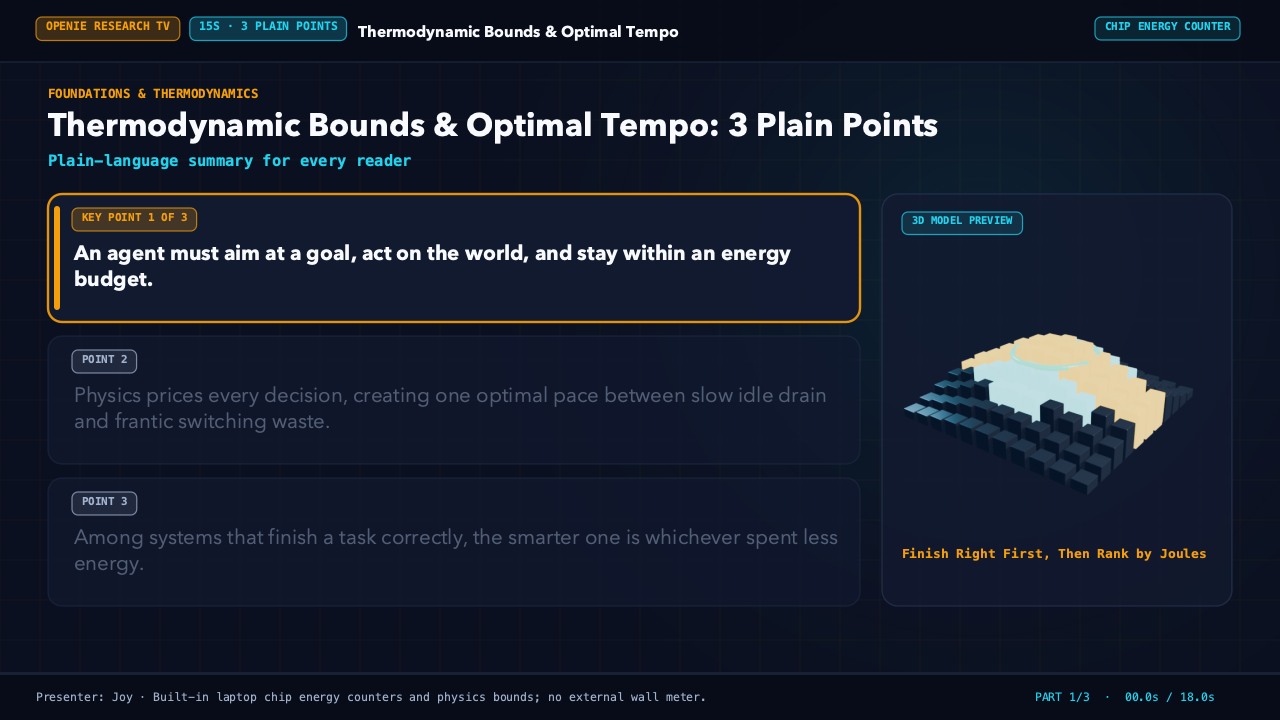
Thermodynamic Bounds & Optimal Tempo plain-language summary poster
Foundations & Thermodynamics Chip Energy Counter

Thermodynamic Bounds & Optimal Tempo

Voice: Joy · Low-BW: 109.41 J/m (measured_j)
Finish Right First, Then Rank by Joules
  1. An agent must aim at a goal, act on the world, and stay within an energy budget.
  2. Physics prices every decision, creating one optimal pace between slow idle drain and frantic switching waste.
  3. Among systems that finish a task correctly, the smarter one is whichever spent less energy.
chip less
Choose Time Slot or 9:16 Vertical Cut:
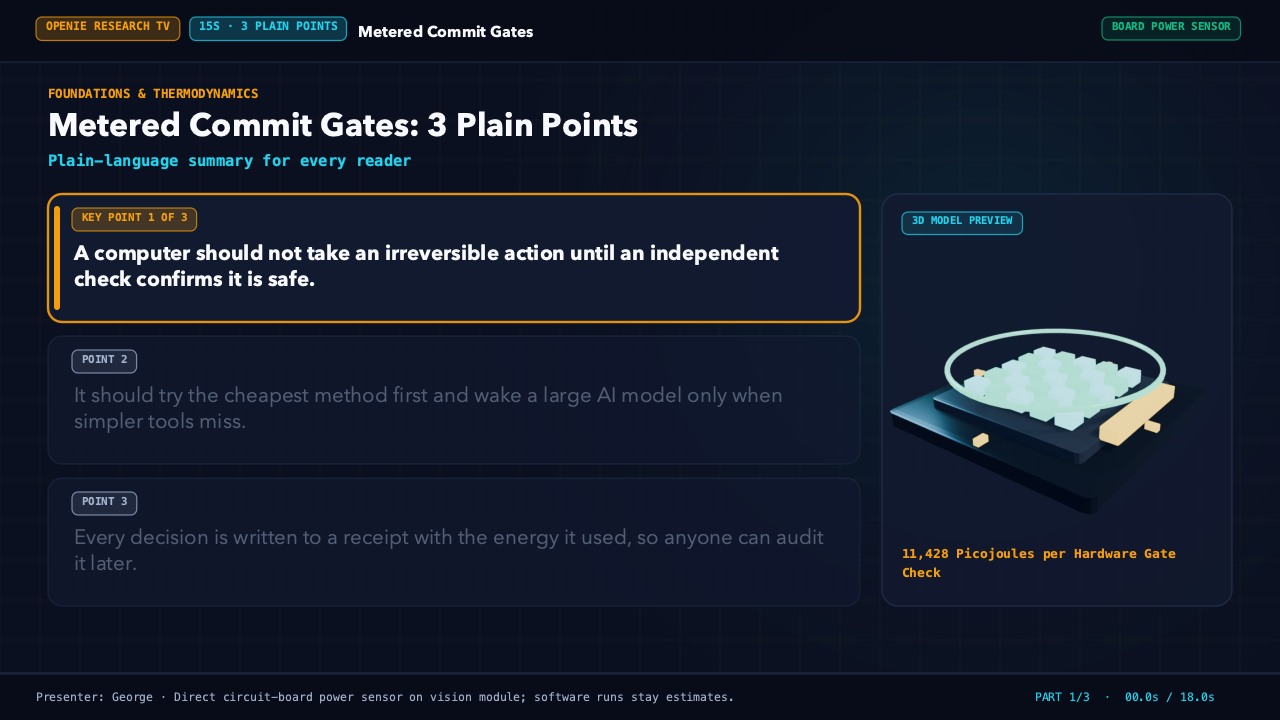
Metered Commit Gates plain-language summary poster
Foundations & Thermodynamics Board Power Sensor

Metered Commit Gates

Voice: George · Low-BW: 109.41 J/m (measured_j)
11,428 Picojoules per Hardware Gate Check
  1. A computer should not take an irreversible action until an independent check confirms it is safe.
  2. It should try the cheapest method first and wake a large AI model only when simpler tools miss.
  3. Every decision is written to a receipt with the energy it used, so anyone can audit it later.
stop write
Choose Time Slot or 9:16 Vertical Cut:
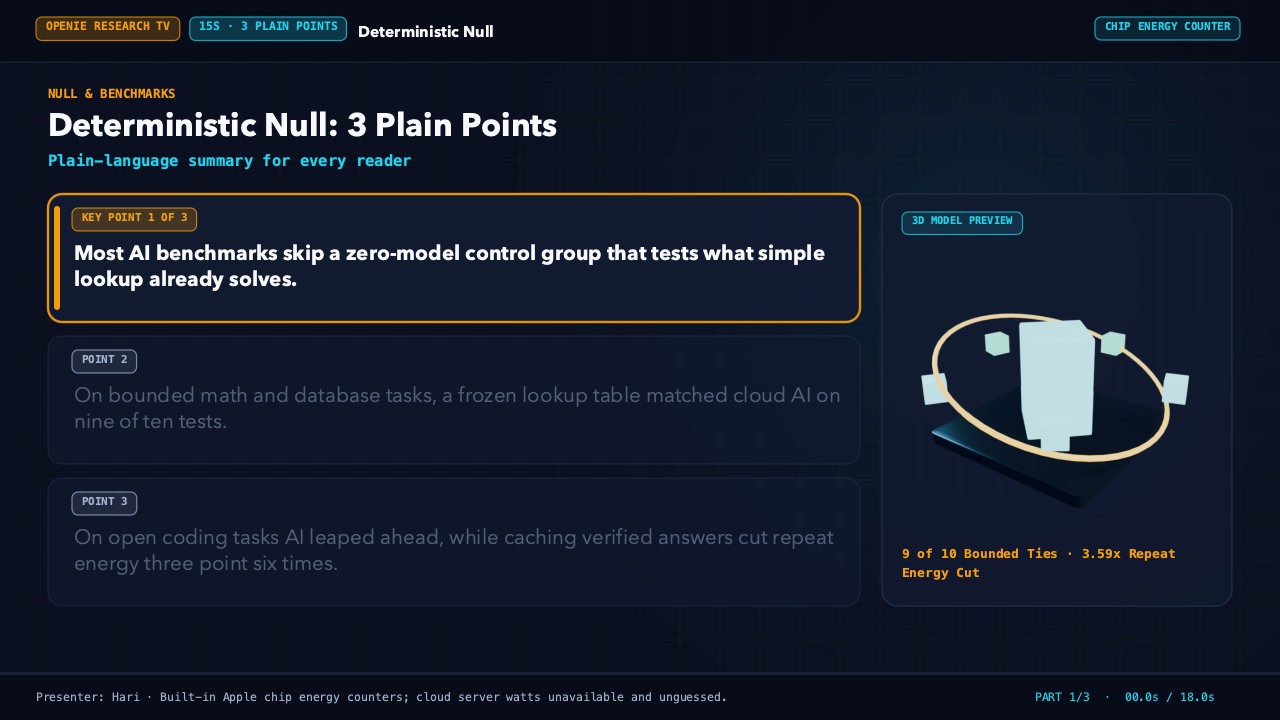
Deterministic Null plain-language summary poster
Null & Benchmarks Chip Energy Counter

Deterministic Null

Voice: Hari · Low-BW: 109.41 J/m (measured_j)
9 of 10 Bounded Ties · 3.59x Repeat Energy Cut
  1. Most AI benchmarks skip a zero-model control group that tests what simple lookup already solves.
  2. On bounded math and database tasks, a frozen lookup table matched cloud AI on nine of ten tests.
  3. On open coding tasks AI leaped ahead, while caching verified answers cut repeat energy three point six times.
table chip
Choose Time Slot or 9:16 Vertical Cut:
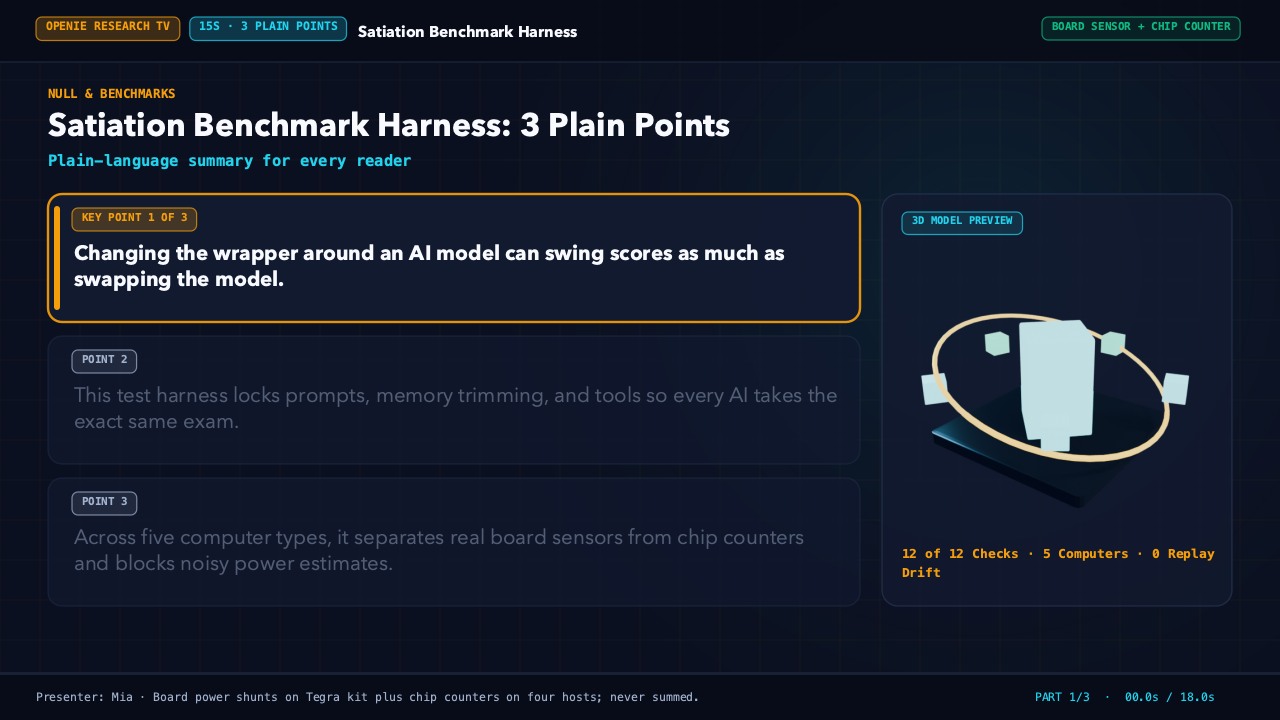
Satiation Benchmark Harness plain-language summary poster
Null & Benchmarks Board Sensor + Chip Counter

Satiation Benchmark Harness

Voice: Mia · Low-BW: 109.41 J/m (measured_j)
12 of 12 Checks · 5 Computers · 0 Replay Drift
  1. Changing the wrapper around an AI model can swing scores as much as swapping the model.
  2. This test harness locks prompts, memory trimming, and tools so every AI takes the exact same exam.
  3. Across five computer types, it separates real board sensors from chip counters and blocks noisy power estimates.
chip count
Choose Time Slot or 9:16 Vertical Cut:
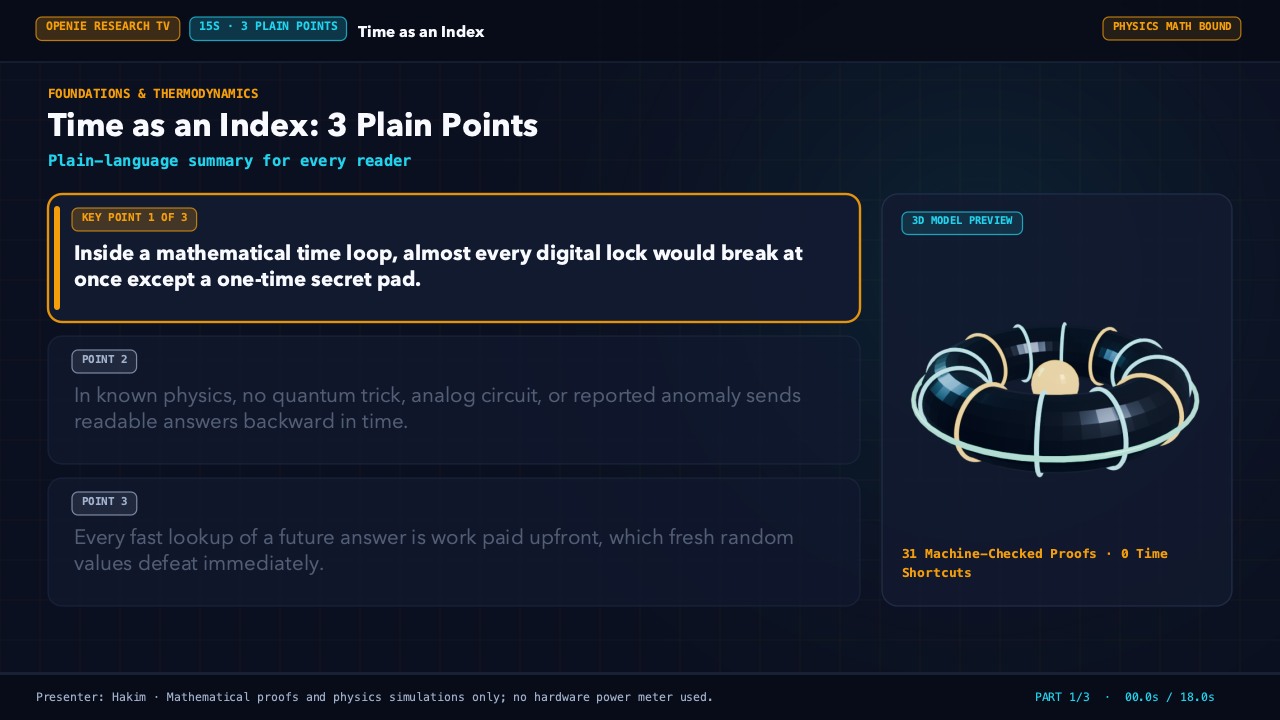
Time as an Index plain-language summary poster
Foundations & Thermodynamics Physics Math Bound

Time as an Index

Voice: Hakim · Low-BW: 109.41 J/m (measured_j)
31 Machine-Checked Proofs · 0 Time Shortcuts
  1. Inside a mathematical time loop, almost every digital lock would break at once except a one-time secret pad.
  2. In known physics, no quantum trick, analog circuit, or reported anomaly sends readable answers backward in time.
  3. Every fast lookup of a future answer is work paid upfront, which fresh random values defeat immediately.
less table
Choose Time Slot or 9:16 Vertical Cut:
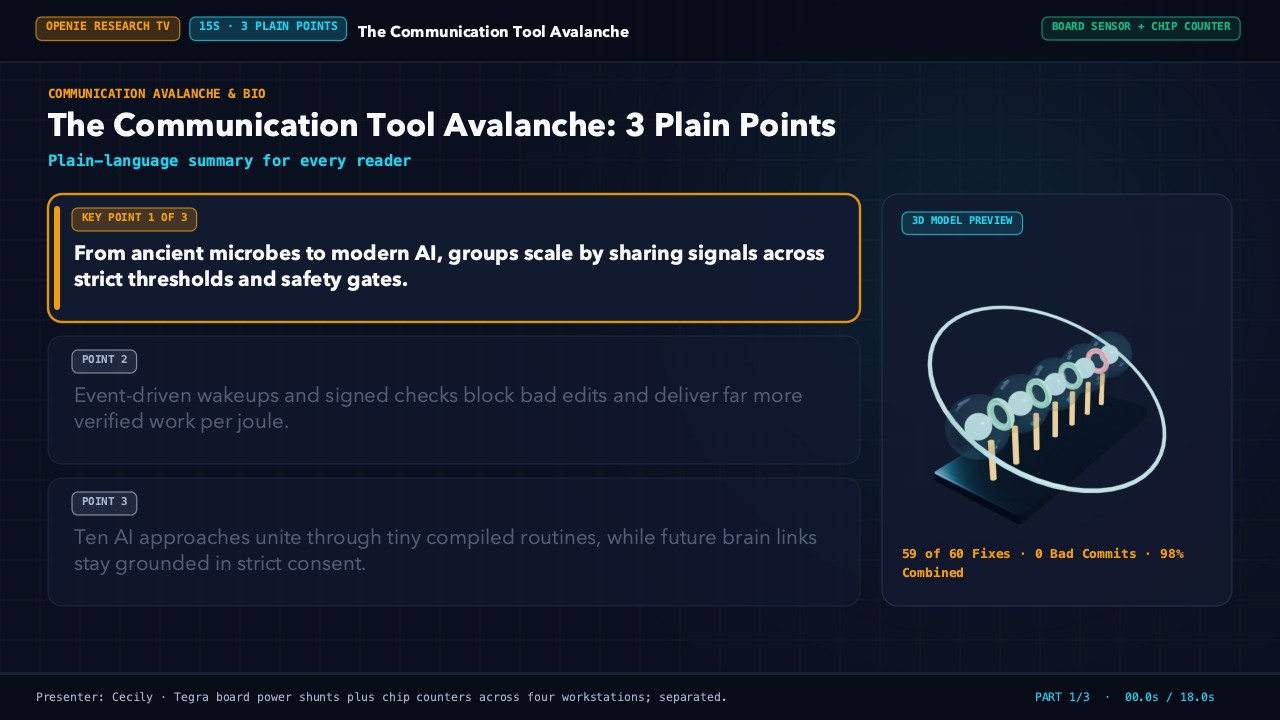
The Communication Tool Avalanche plain-language summary poster
Communication Avalanche & Bio Board Sensor + Chip Counter

The Communication Tool Avalanche

Voice: Cecily · Low-BW: 109.41 J/m (measured_j)
59 of 60 Fixes · 0 Bad Commits · 98% Combined
  1. From ancient microbes to modern AI, groups scale by sharing signals across strict thresholds and safety gates.
  2. Event-driven wakeups and signed checks block bad edits and deliver far more verified work per joule.
  3. Ten AI approaches unite through tiny compiled routines, while future brain links stay grounded in strict consent.
stop chip
Choose Time Slot or 9:16 Vertical Cut:
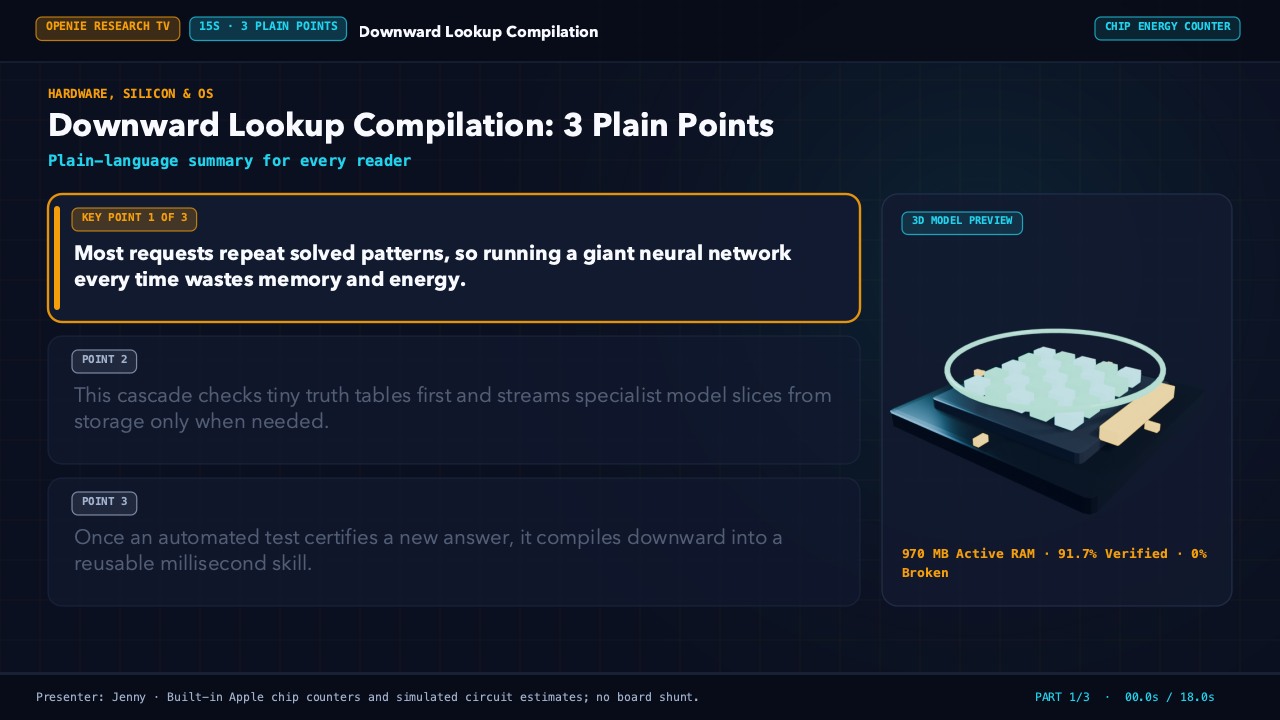
Downward Lookup Compilation plain-language summary poster
Hardware, Silicon & OS Chip Energy Counter

Downward Lookup Compilation

Voice: Jenny · Low-BW: 109.41 J/m (measured_j)
970 MB Active RAM · 91.7% Verified · 0% Broken
  1. Most requests repeat solved patterns, so running a giant neural network every time wastes memory and energy.
  2. This cascade checks tiny truth tables first and streams specialist model slices from storage only when needed.
  3. Once an automated test certifies a new answer, it compiles downward into a reusable millisecond skill.
first stop
Choose Time Slot or 9:16 Vertical Cut:
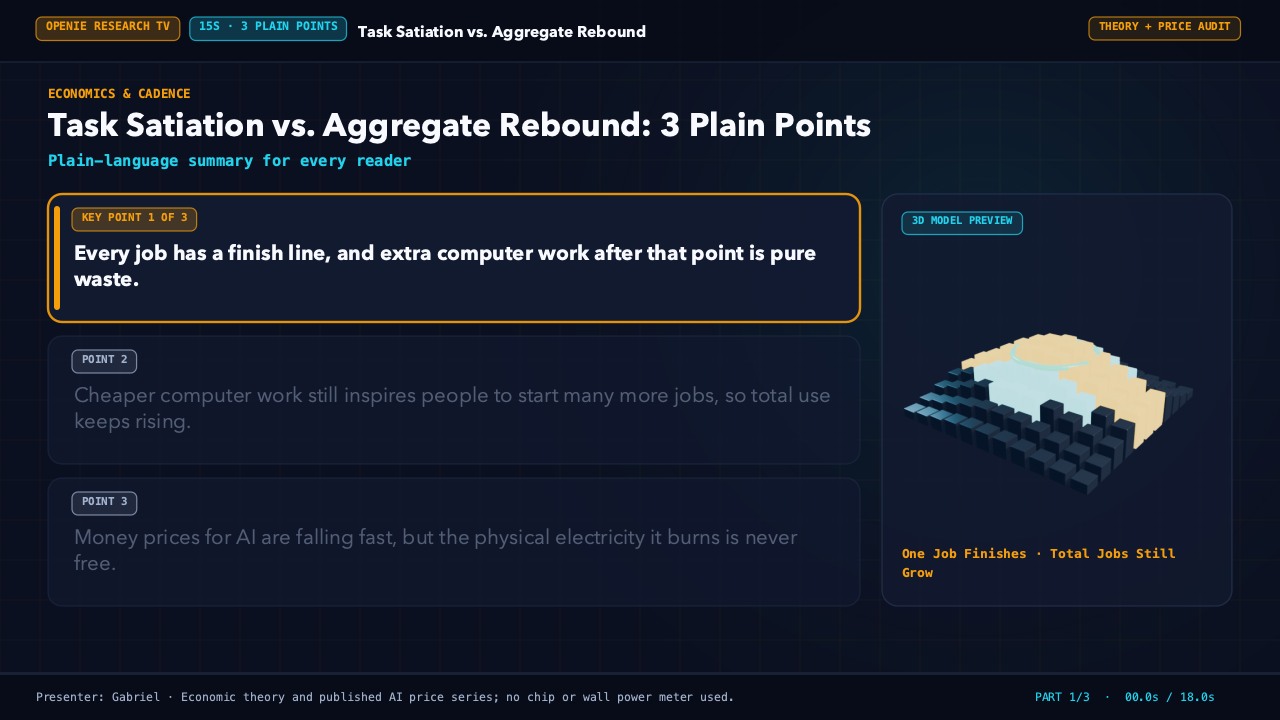
Task Satiation vs. Aggregate Rebound plain-language summary poster
Economics & Cadence Theory + Price Audit

Task Satiation vs. Aggregate Rebound

Voice: Gabriel · Low-BW: 109.41 J/m (measured_j)
One Job Finishes · Total Jobs Still Grow
  1. Every job has a finish line, and extra computer work after that point is pure waste.
  2. Cheaper computer work still inspires people to start many more jobs, so total use keeps rising.
  3. Money prices for AI are falling fast, but the physical electricity it burns is never free.
stop done
Choose Time Slot or 9:16 Vertical Cut:
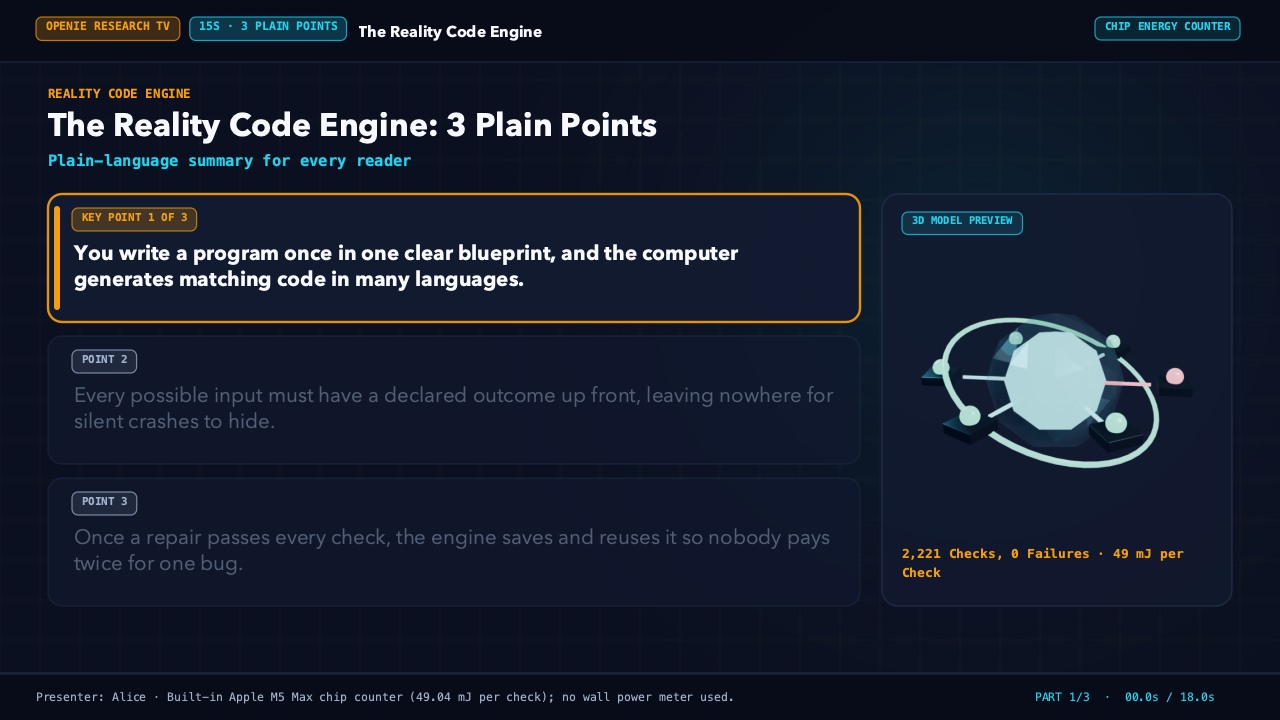
The Reality Code Engine plain-language summary poster
Reality Code Engine Chip Energy Counter

The Reality Code Engine

Voice: Alice · Low-BW: 109.41 J/m (measured_j)
2,221 Checks, 0 Failures · 49 mJ per Check
  1. You write a program once in one clear blueprint, and the computer generates matching code in many languages.
  2. Every possible input must have a declared outcome up front, leaving nowhere for silent crashes to hide.
  3. Once a repair passes every check, the engine saves and reuses it so nobody pays twice for one bug.
chip one
Choose Time Slot or 9:16 Vertical Cut:
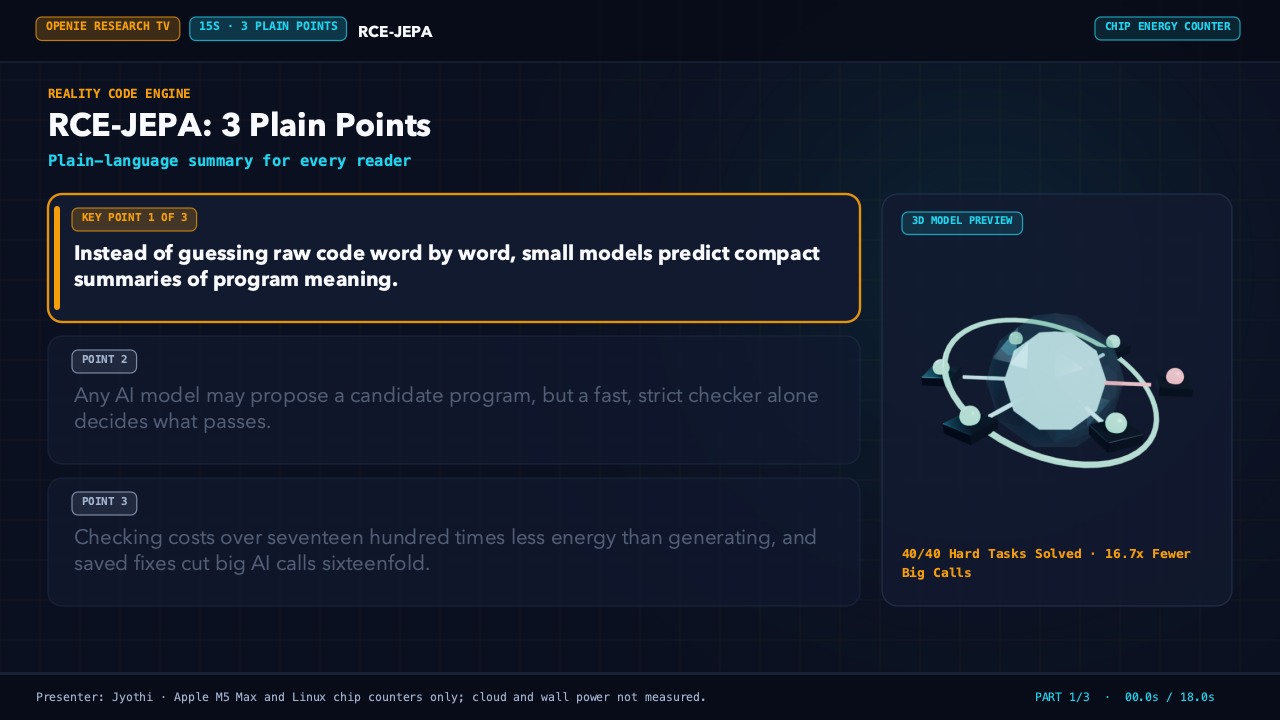
RCE-JEPA plain-language summary poster
Reality Code Engine Chip Energy Counter

RCE-JEPA

Voice: Jyothi · Low-BW: 109.41 J/m (measured_j)
40/40 Hard Tasks Solved · 16.7x Fewer Big Calls
  1. Instead of guessing raw code word by word, small models predict compact summaries of program meaning.
  2. Any AI model may propose a candidate program, but a fast, strict checker alone decides what passes.
  3. Checking costs over seventeen hundred times less energy than generating, and saved fixes cut big AI calls sixteenfold.
less chip
Choose Time Slot or 9:16 Vertical Cut:
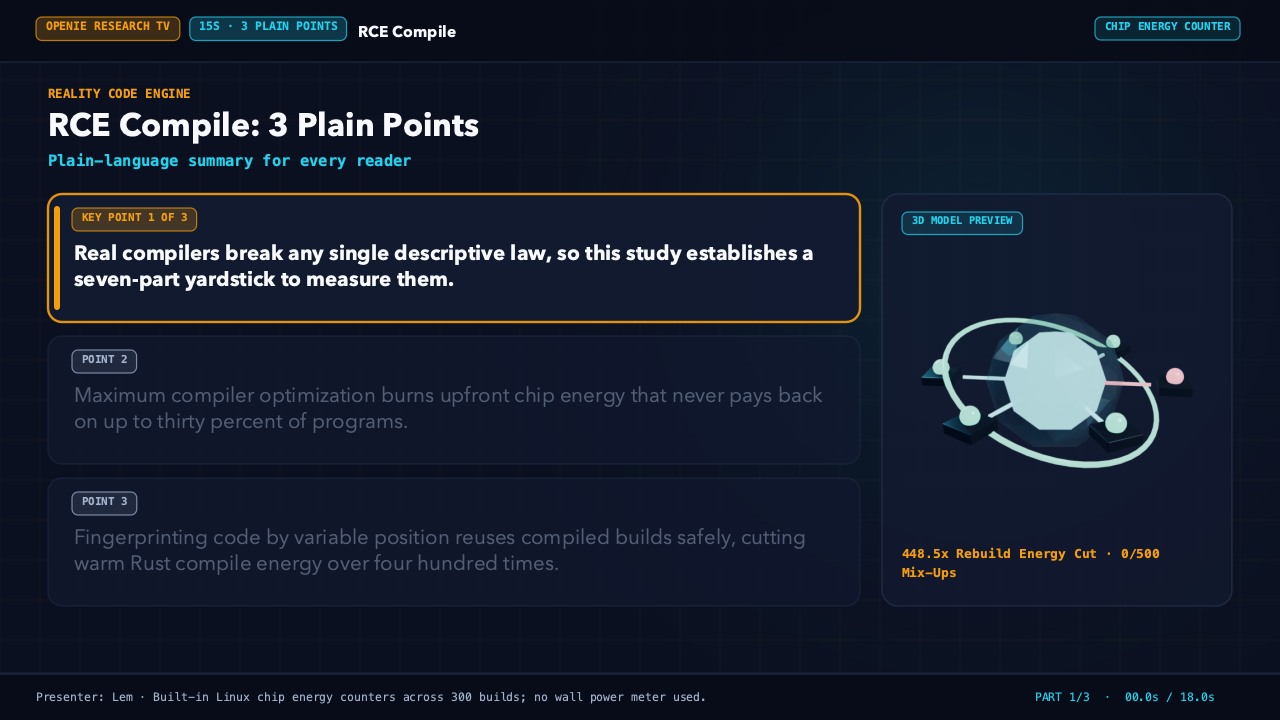
RCE Compile plain-language summary poster
Reality Code Engine Chip Energy Counter

RCE Compile

Voice: Lem · Low-BW: 109.41 J/m (measured_j)
448.5x Rebuild Energy Cut · 0/500 Mix-Ups
  1. Real compilers break any single descriptive law, so this study establishes a seven-part yardstick to measure them.
  2. Maximum compiler optimization burns upfront chip energy that never pays back on up to thirty percent of programs.
  3. Fingerprinting code by variable position reuses compiled builds safely, cutting warm Rust compile energy over four hundred times.
less chip
Choose Time Slot or 9:16 Vertical Cut:
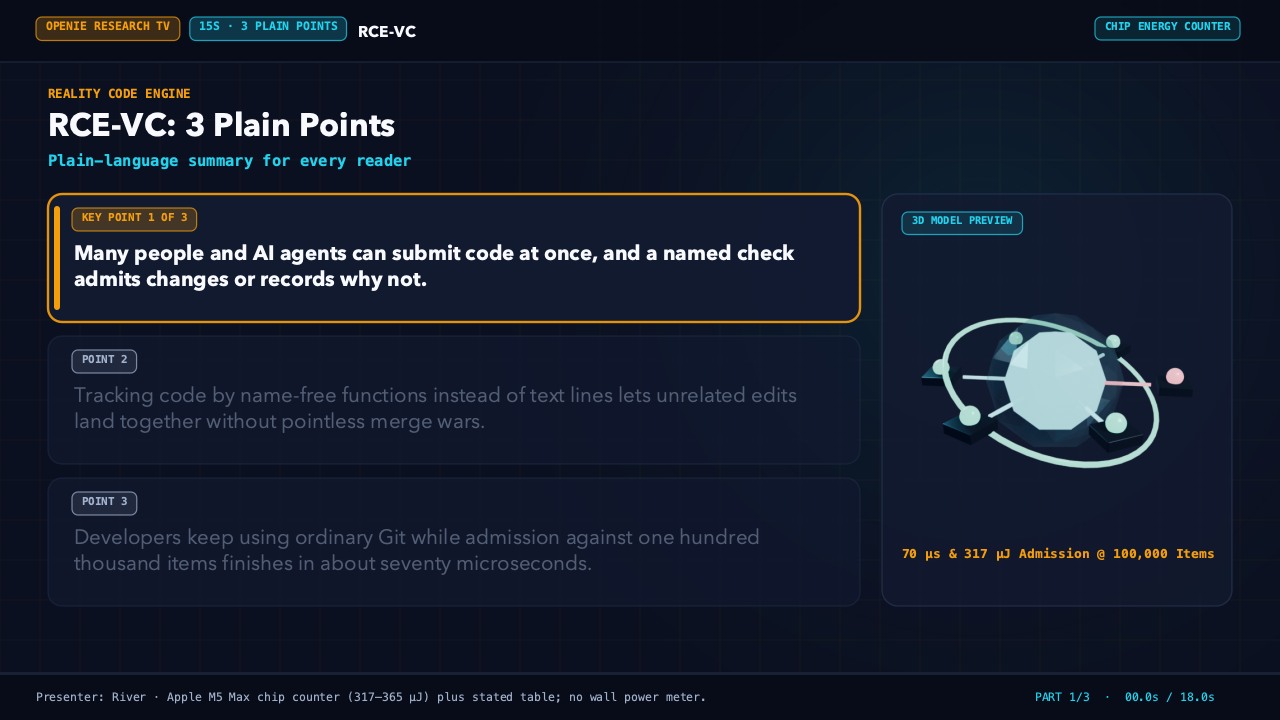
RCE-VC plain-language summary poster
Reality Code Engine Chip Energy Counter

RCE-VC

Voice: River · Low-BW: 109.41 J/m (measured_j)
70 µs & 317 µJ Admission @ 100,000 Items
  1. Many people and AI agents can submit code at once, and a named check admits changes or records why not.
  2. Tracking code by name-free functions instead of text lines lets unrelated edits land together without pointless merge wars.
  3. Developers keep using ordinary Git while admission against one hundred thousand items finishes in about seventy microseconds.
chip join
Choose Time Slot or 9:16 Vertical Cut:
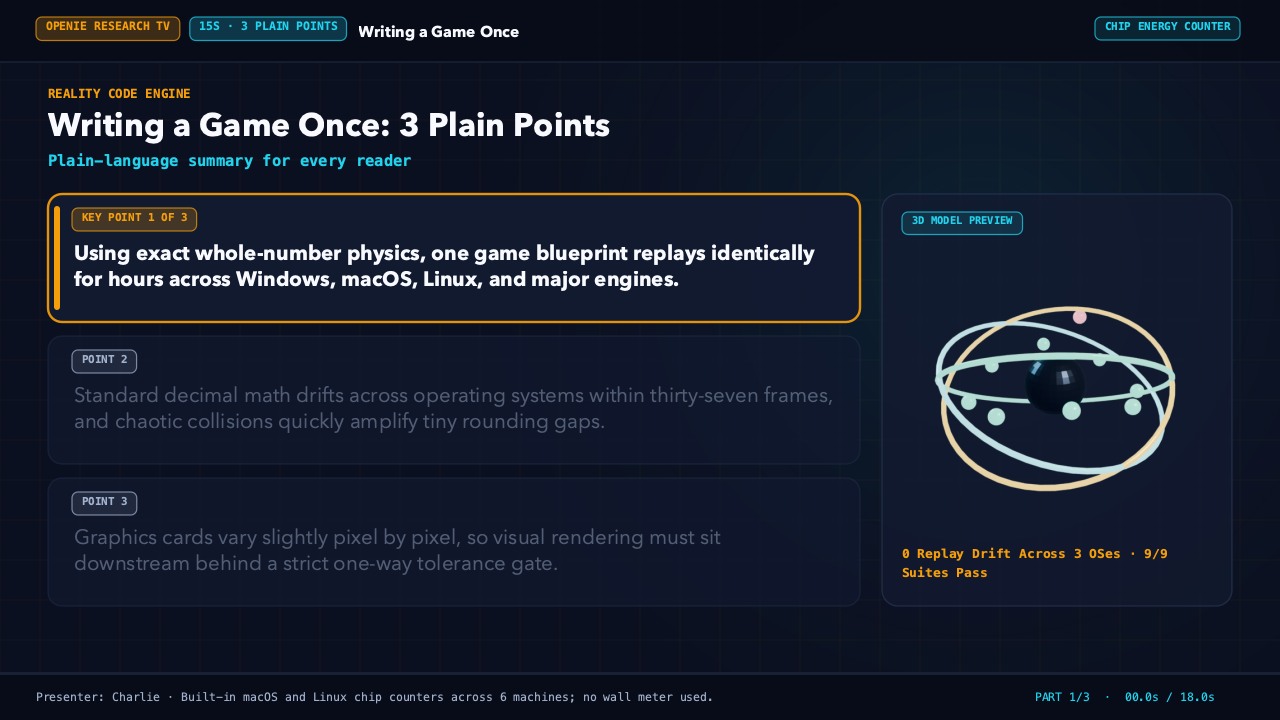
Writing a Game Once plain-language summary poster
Reality Code Engine Chip Energy Counter

Writing a Game Once

Voice: Charlie · Low-BW: 109.41 J/m (measured_j)
0 Replay Drift Across 3 OSes · 9/9 Suites Pass
  1. Using exact whole-number physics, one game blueprint replays identically for hours across Windows, macOS, Linux, and major engines.
  2. Standard decimal math drifts across operating systems within thirty-seven frames, and chaotic collisions quickly amplify tiny rounding gaps.
  3. Graphics cards vary slightly pixel by pixel, so visual rendering must sit downstream behind a strict one-way tolerance gate.
stop chip
Choose Time Slot or 9:16 Vertical Cut:
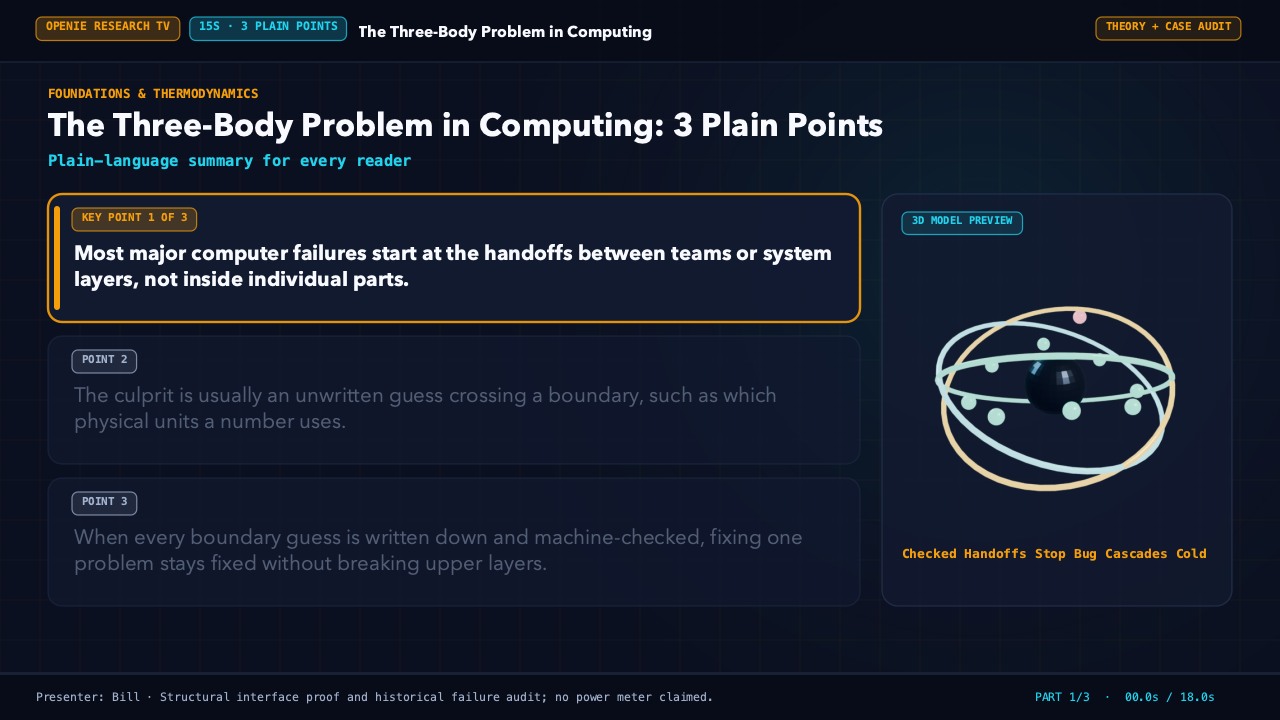
The Three-Body Problem in Computing plain-language summary poster
Foundations & Thermodynamics Theory + Case Audit

The Three-Body Problem in Computing

Voice: Bill · Low-BW: 109.41 J/m (measured_j)
Checked Handoffs Stop Bug Cascades Cold
  1. Most major computer failures start at the handoffs between teams or system layers, not inside individual parts.
  2. The culprit is usually an unwritten guess crossing a boundary, such as which physical units a number uses.
  3. When every boundary guess is written down and machine-checked, fixing one problem stays fixed without breaking upper layers.
less check
Choose Time Slot or 9:16 Vertical Cut:
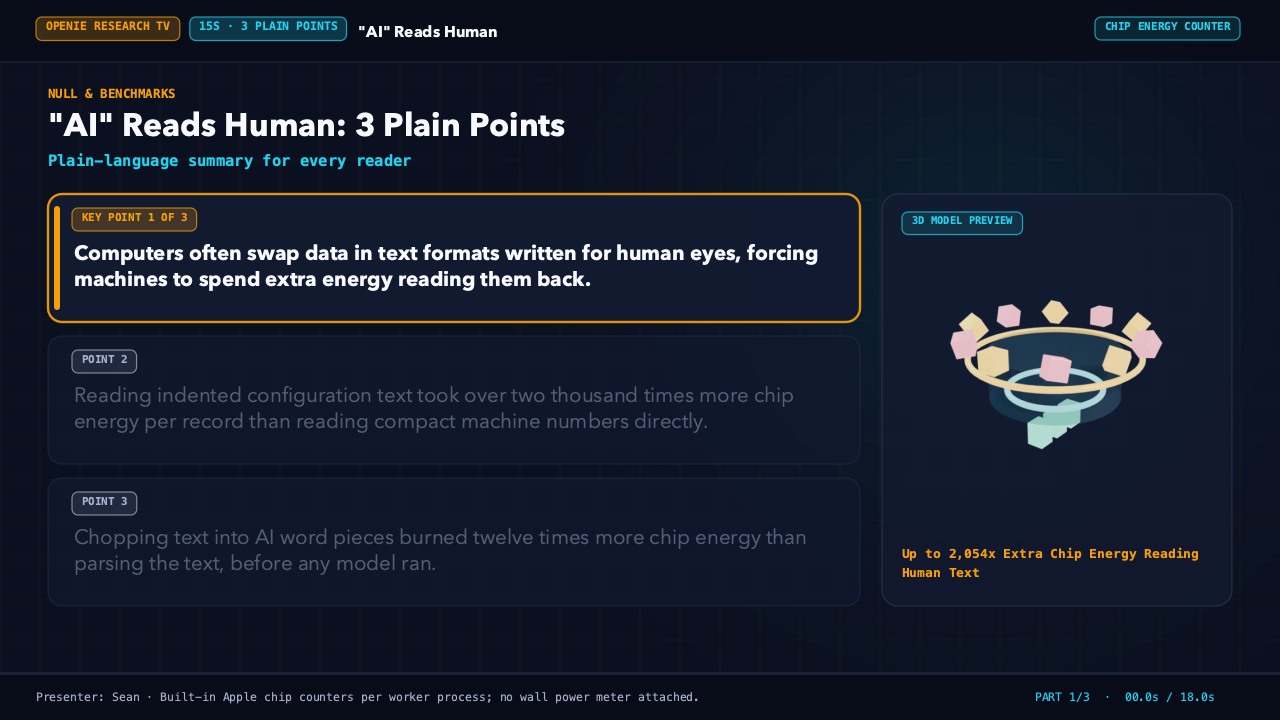
"AI" Reads Human plain-language summary poster
Null & Benchmarks Chip Energy Counter

"AI" Reads Human

Voice: Sean · Low-BW: 109.41 J/m (measured_j)
Up to 2,054x Extra Chip Energy Reading Human Text
  1. Computers often swap data in text formats written for human eyes, forcing machines to spend extra energy reading them back.
  2. Reading indented configuration text took over two thousand times more chip energy per record than reading compact machine numbers directly.
  3. Chopping text into AI word pieces burned twelve times more chip energy than parsing the text, before any model ran.
less chip
Choose Time Slot or 9:16 Vertical Cut:
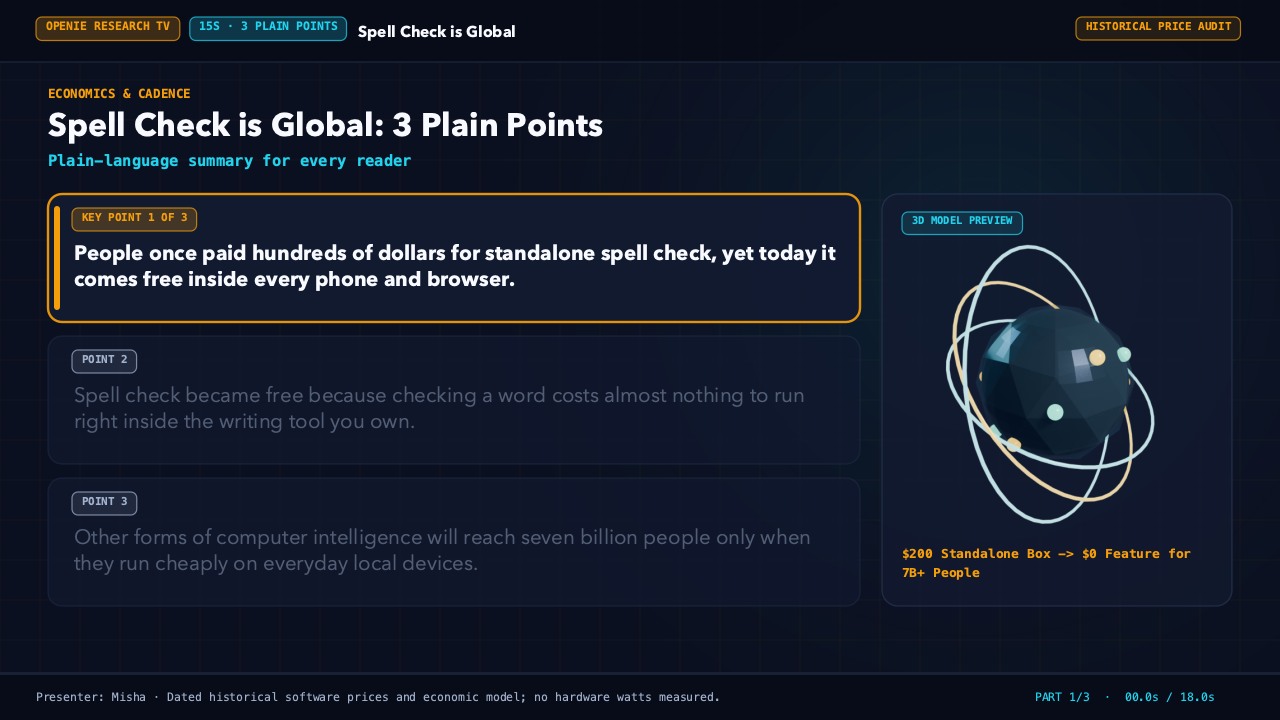
Spell Check is Global plain-language summary poster
Economics & Cadence Historical Price Audit

Spell Check is Global

Voice: Misha · Low-BW: 109.41 J/m (measured_j)
$200 Standalone Box -> $0 Feature for 7B+ People
  1. People once paid hundreds of dollars for standalone spell check, yet today it comes free inside every phone and browser.
  2. Spell check became free because checking a word costs almost nothing to run right inside the writing tool you own.
  3. Other forms of computer intelligence will reach seven billion people only when they run cheaply on everyday local devices.
less check
Choose Time Slot or 9:16 Vertical Cut:
The Promised Trillion Dollar AI-Coding Market plain-language summary poster
Economics & Cadence Market Forecast Audit

The Promised Trillion Dollar AI-Coding Market

Voice: Osato · Low-BW: 109.41 J/m (measured_j)
$1T Forecasts Assume Zero Verified Code Reuse
  1. Headline trillion-dollar figures for AI coding are mostly future projections and value guesses, not counts of money actually earned.
  2. Almost every forecast quietly assumes programmers will pay a giant AI model by the word for every task forever.
  3. When verified working code is saved and reused, repeated jobs drop toward the cost of electricity, shrinking vendor rent.
less check
Choose Time Slot or 9:16 Vertical Cut:
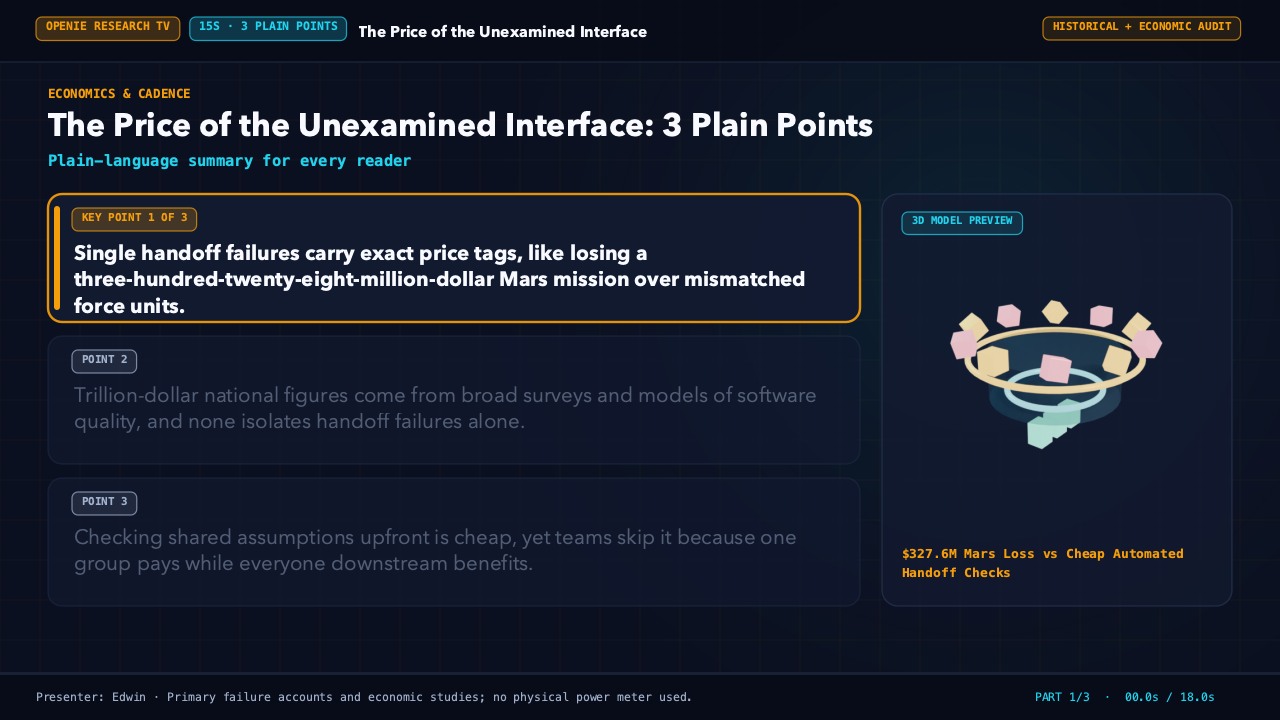
The Price of the Unexamined Interface plain-language summary poster
Economics & Cadence Historical + Economic Audit

The Price of the Unexamined Interface

Voice: Edwin · Low-BW: 109.41 J/m (measured_j)
$327.6M Mars Loss vs Cheap Automated Handoff Checks
  1. Single handoff failures carry exact price tags, like losing a three-hundred-twenty-eight-million-dollar Mars mission over mismatched force units.
  2. Trillion-dollar national figures come from broad surveys and models of software quality, and none isolates handoff failures alone.
  3. Checking shared assumptions upfront is cheap, yet teams skip it because one group pays while everyone downstream benefits.
less check
Choose Time Slot or 9:16 Vertical Cut:
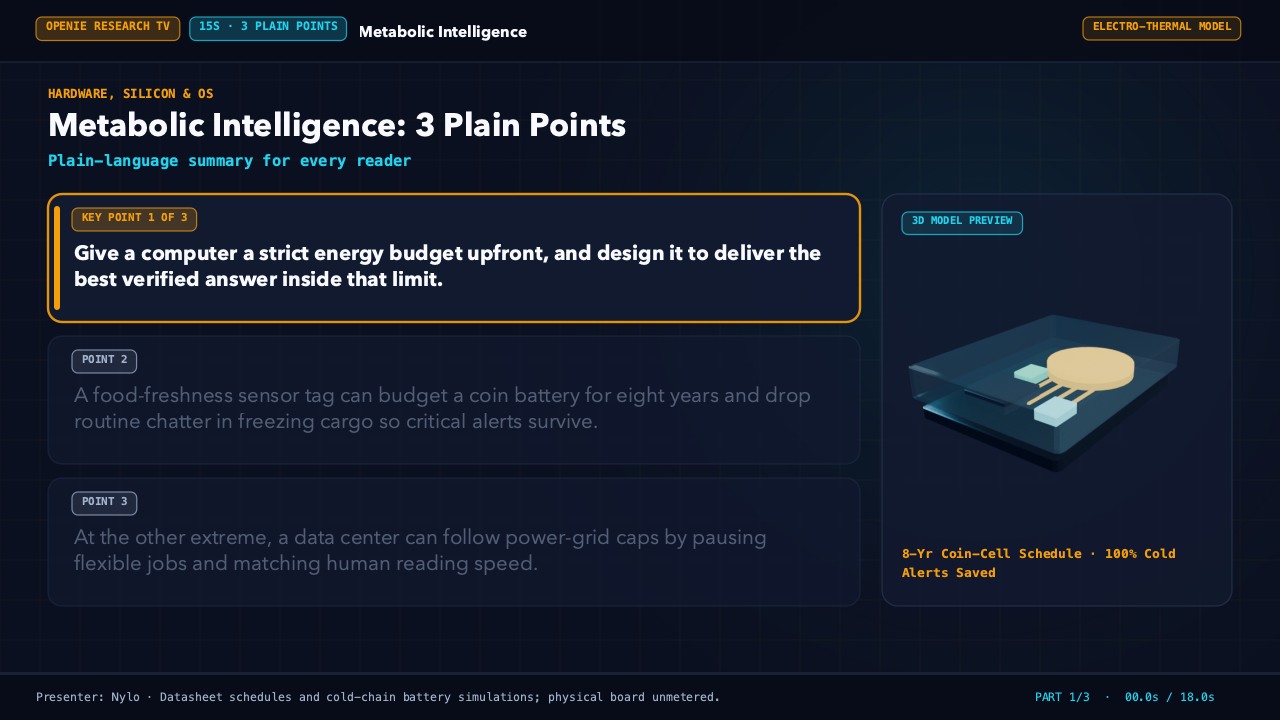
Metabolic Intelligence plain-language summary poster
Hardware, Silicon & OS Electro-Thermal Model

Metabolic Intelligence

Voice: Nylo · Low-BW: 109.41 J/m (measured_j)
8-Yr Coin-Cell Schedule · 100% Cold Alerts Saved
  1. Give a computer a strict energy budget upfront, and design it to deliver the best verified answer inside that limit.
  2. A food-freshness sensor tag can budget a coin battery for eight years and drop routine chatter in freezing cargo so critical alerts survive.
  3. At the other extreme, a data center can follow power-grid caps by pausing flexible jobs and matching human reading speed.
budget less
Choose Time Slot or 9:16 Vertical Cut:
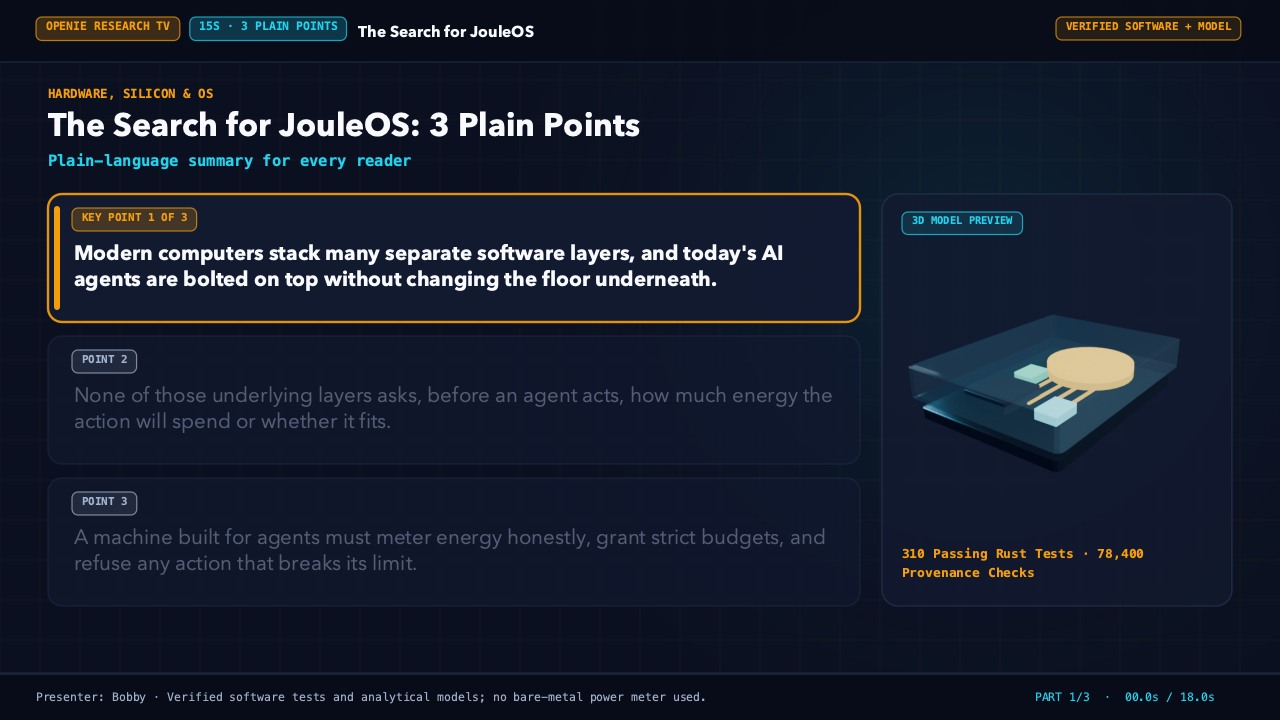
The Search for JouleOS plain-language summary poster
Hardware, Silicon & OS Verified Software + Model

The Search for JouleOS

Voice: Bobby · Low-BW: 109.41 J/m (measured_j)
310 Passing Rust Tests · 78,400 Provenance Checks
  1. Modern computers stack many separate software layers, and today's AI agents are bolted on top without changing the floor underneath.
  2. None of those underlying layers asks, before an agent acts, how much energy the action will spend or whether it fits.
  3. A machine built for agents must meter energy honestly, grant strict budgets, and refuse any action that breaks its limit.
less check
Choose Time Slot or 9:16 Vertical Cut:
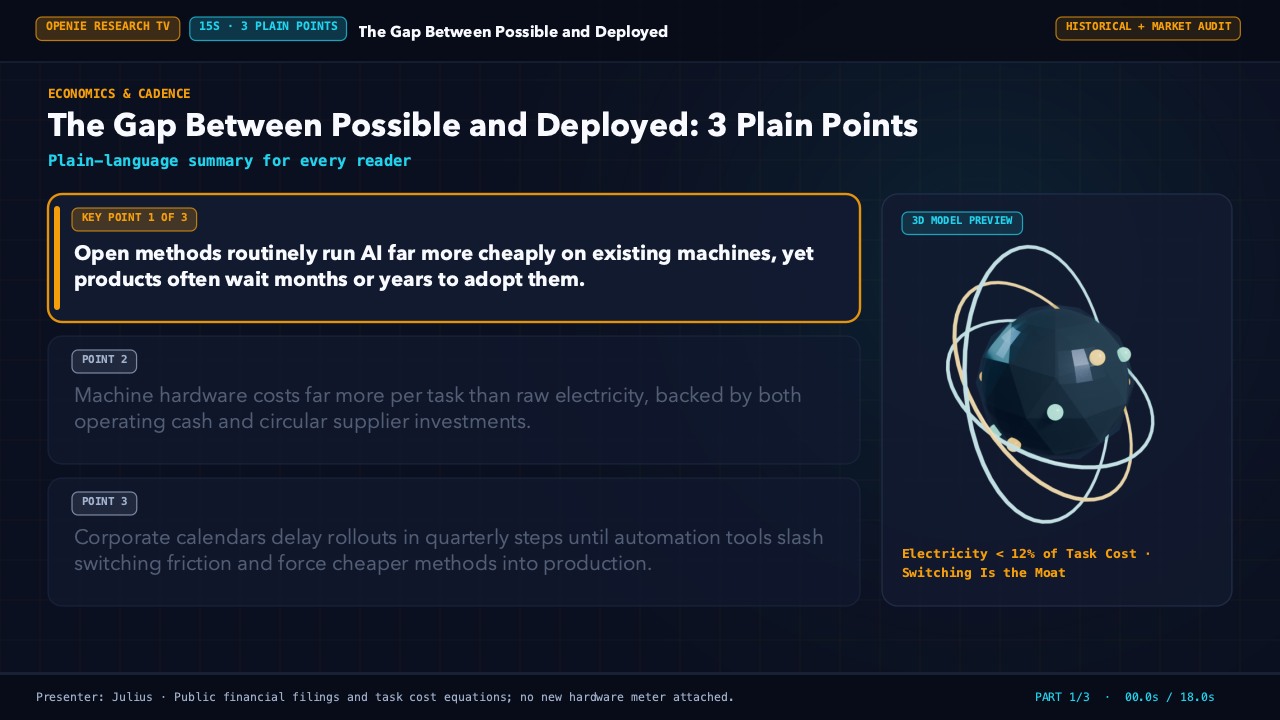
The Gap Between Possible and Deployed plain-language summary poster
Economics & Cadence Historical + Market Audit

The Gap Between Possible and Deployed

Voice: Julius · Low-BW: 109.41 J/m (measured_j)
Electricity < 12% of Task Cost · Switching Is the Moat
  1. Open methods routinely run AI far more cheaply on existing machines, yet products often wait months or years to adopt them.
  2. Machine hardware costs far more per task than raw electricity, backed by both operating cash and circular supplier investments.
  3. Corporate calendars delay rollouts in quarterly steps until automation tools slash switching friction and force cheaper methods into production.
less check
Choose Time Slot or 9:16 Vertical Cut:
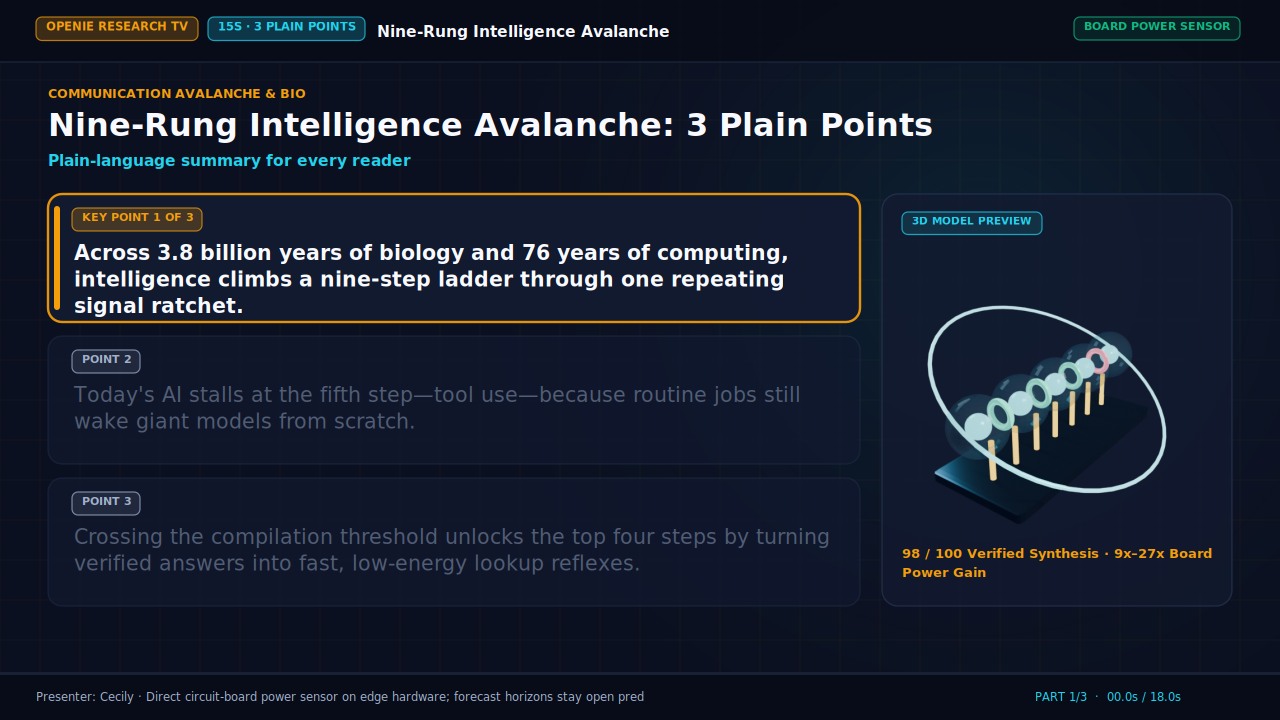
Nine-Rung Intelligence Avalanche plain-language summary poster
Communication Avalanche & Bio Board Power Sensor

Nine-Rung Intelligence Avalanche

Voice: Cecily · Low-BW: 109.41 J/m (measured_j)
98 / 100 Verified Synthesis · 9x–27x Board Power Gain
  1. Across 3.8 billion years of biology and 76 years of computing, intelligence climbs a nine-step ladder through one repeating signal ratchet.
  2. Today's AI stalls at the fifth step—tool use—because routine jobs still wake giant models from scratch.
  3. Crossing the compilation threshold unlocks the top four steps by turning verified answers into fast, low-energy lookup reflexes.
table real
Choose Time Slot or 9:16 Vertical Cut:
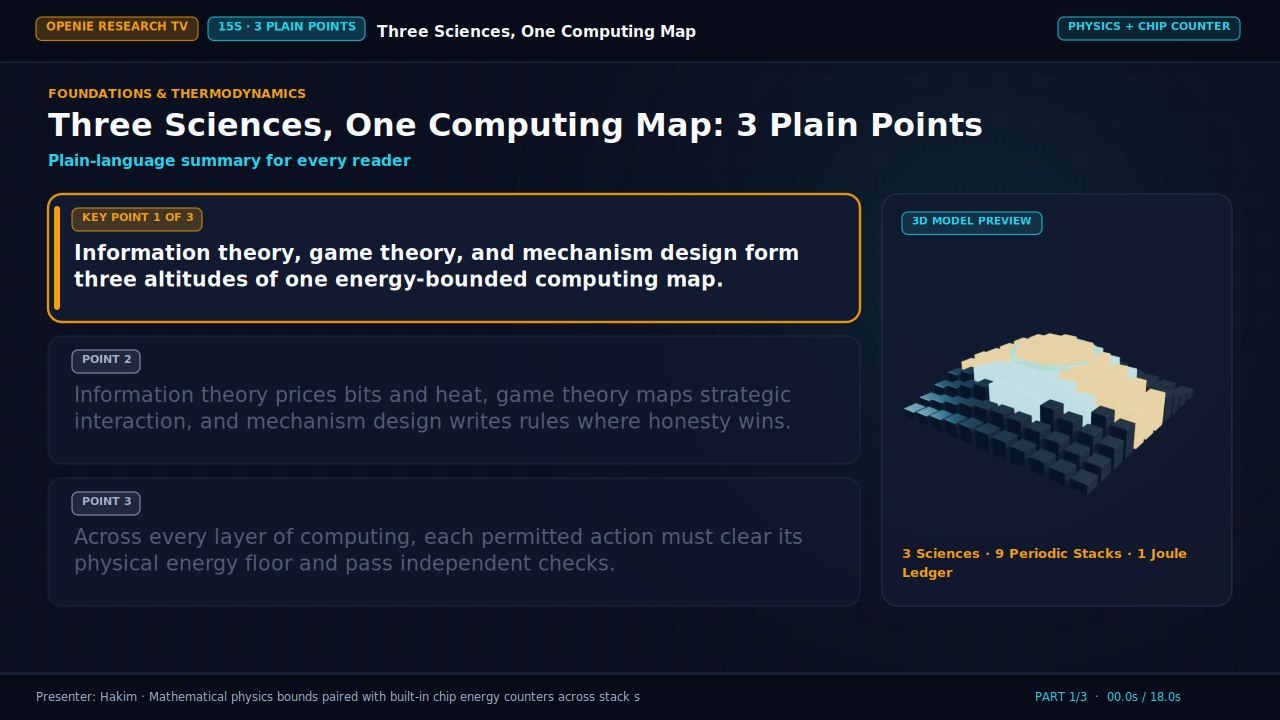
Three Sciences, One Computing Map plain-language summary poster
Foundations & Thermodynamics Physics + Chip Counter

Three Sciences, One Computing Map

Voice: Hakim · Low-BW: 109.41 J/m (measured_j)
3 Sciences · 9 Periodic Stacks · 1 Joule Ledger
  1. Information theory, game theory, and mechanism design form three altitudes of one energy-bounded computing map.
  2. Information theory prices bits and heat, game theory maps strategic interaction, and mechanism design writes rules where honesty wins.
  3. Across every layer of computing, each permitted action must clear its physical energy floor and pass independent checks.
less chip
Choose Time Slot or 9:16 Vertical Cut:
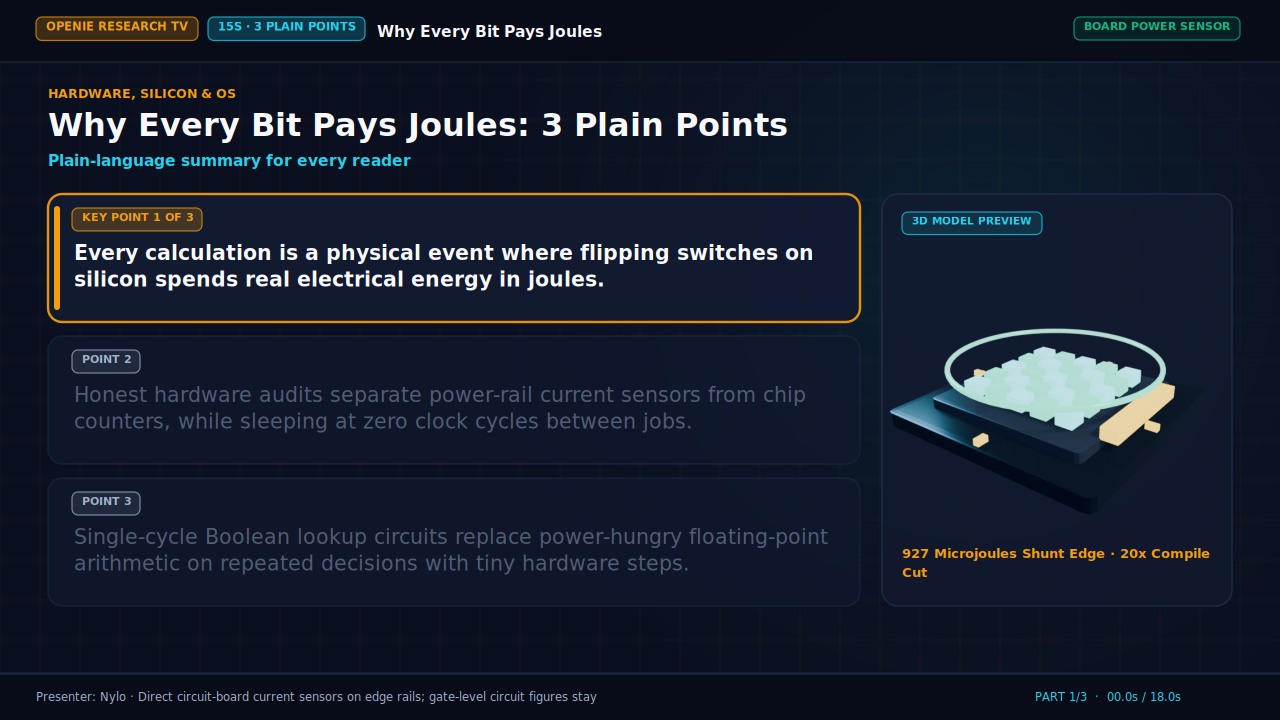
Why Every Bit Pays Joules plain-language summary poster
Hardware, Silicon & OS Board Power Sensor

Why Every Bit Pays Joules

Voice: Nylo · Low-BW: 109.41 J/m (measured_j)
927 Microjoules Shunt Edge · 20x Compile Cut
  1. Every calculation is a physical event where flipping switches on silicon spends real electrical energy in joules.
  2. Honest hardware audits separate power-rail current sensors from chip counters, while sleeping at zero clock cycles between jobs.
  3. Single-cycle Boolean lookup circuits replace power-hungry floating-point arithmetic on repeated decisions with tiny hardware steps.
table real
Choose Time Slot or 9:16 Vertical Cut:
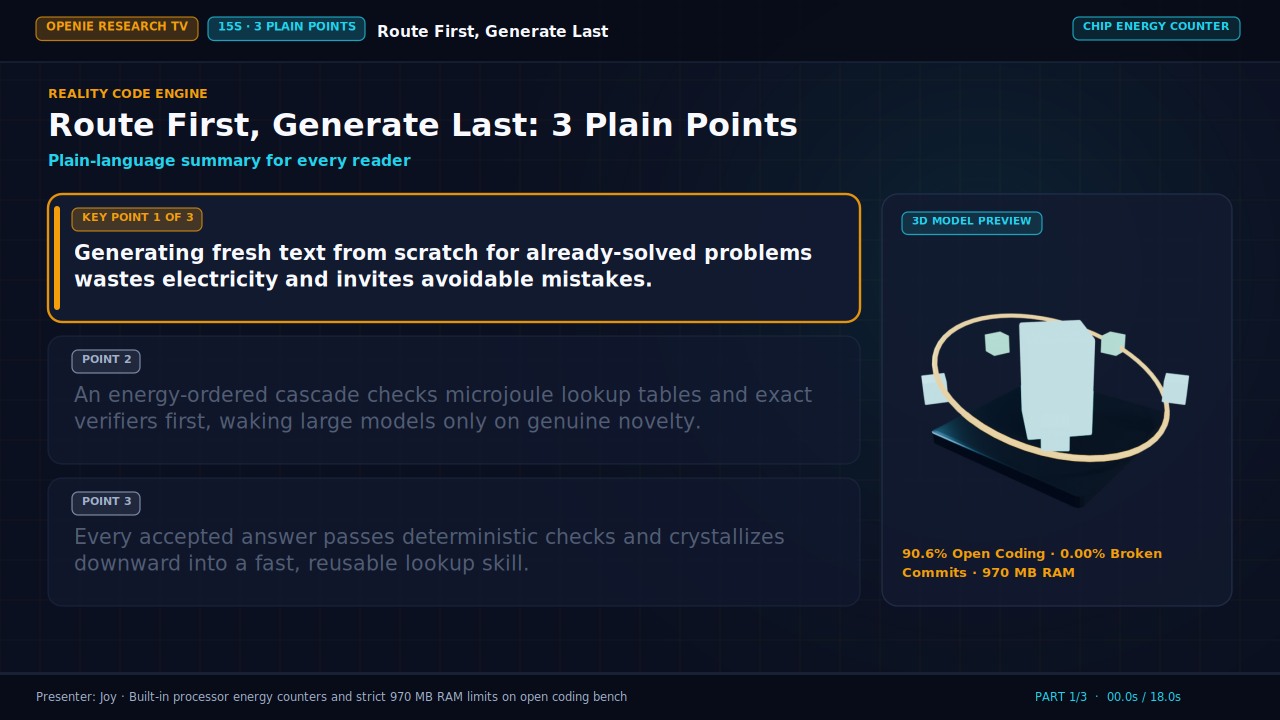
Route First, Generate Last plain-language summary poster
Reality Code Engine Chip Energy Counter

Route First, Generate Last

Voice: Joy · Low-BW: 109.41 J/m (measured_j)
90.6% Open Coding · 0.00% Broken Commits · 970 MB RAM
  1. Generating fresh text from scratch for already-solved problems wastes electricity and invites avoidable mistakes.
  2. An energy-ordered cascade checks microjoule lookup tables and exact verifiers first, waking large models only on genuine novelty.
  3. Every accepted answer passes deterministic checks and crystallizes downward into a fast, reusable lookup skill.
table first
Choose Time Slot or 9:16 Vertical Cut:
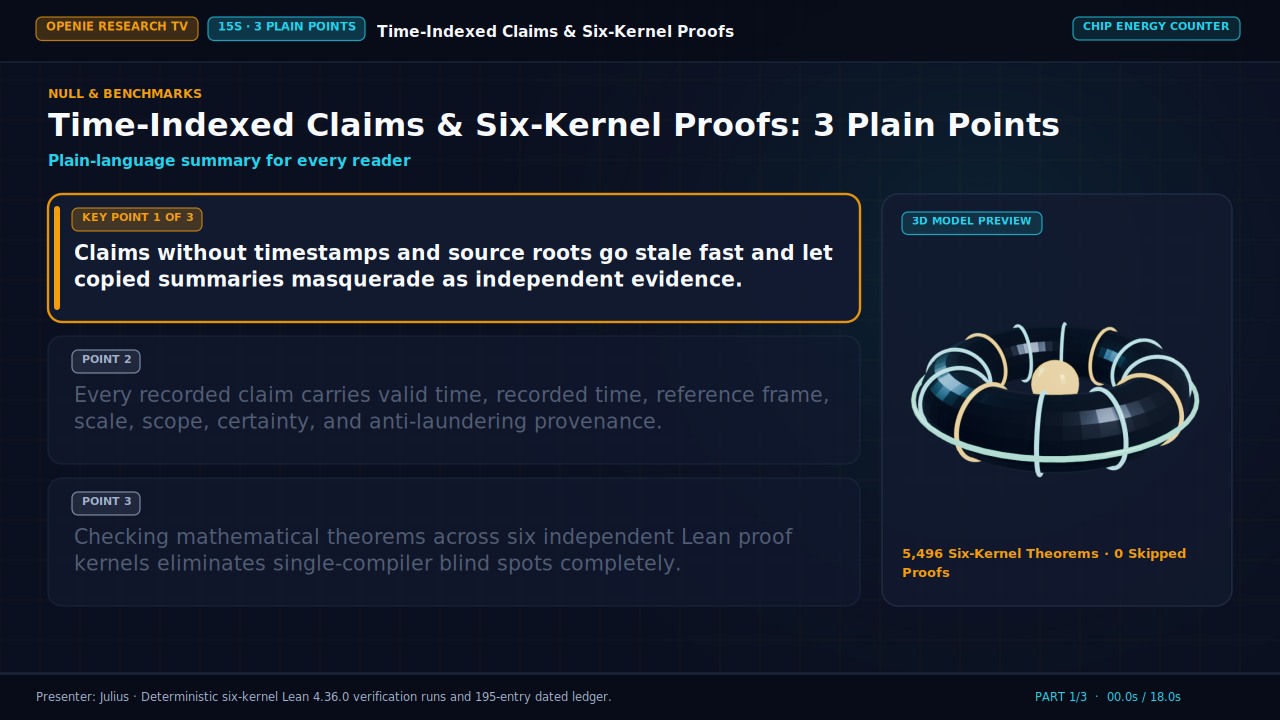
Time-Indexed Claims & Six-Kernel Proofs plain-language summary poster
Null & Benchmarks Chip Energy Counter

Time-Indexed Claims & Six-Kernel Proofs

Voice: Julius · Low-BW: 109.41 J/m (measured_j)
5,496 Six-Kernel Theorems · 0 Skipped Proofs
  1. Claims without timestamps and source roots go stale fast and let copied summaries masquerade as independent evidence.
  2. Every recorded claim carries valid time, recorded time, reference frame, scale, scope, certainty, and anti-laundering provenance.
  3. Checking mathematical theorems across six independent Lean proof kernels eliminates single-compiler blind spots completely.
less chip
Choose Time Slot or 9:16 Vertical Cut:
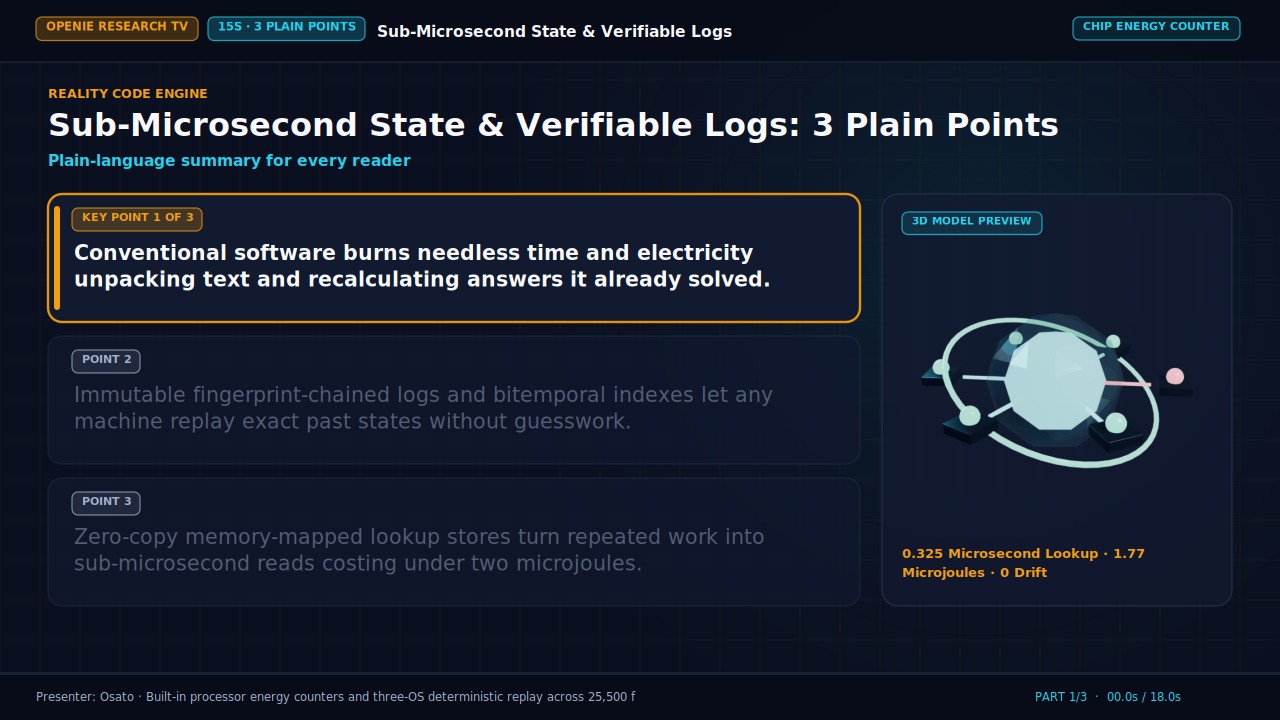
Sub-Microsecond State & Verifiable Logs plain-language summary poster
Reality Code Engine Chip Energy Counter

Sub-Microsecond State & Verifiable Logs

Voice: Osato · Low-BW: 109.41 J/m (measured_j)
0.325 Microsecond Lookup · 1.77 Microjoules · 0 Drift
  1. Conventional software burns needless time and electricity unpacking text and recalculating answers it already solved.
  2. Immutable fingerprint-chained logs and bitemporal indexes let any machine replay exact past states without guesswork.
  3. Zero-copy memory-mapped lookup stores turn repeated work into sub-microsecond reads costing under two microjoules.
table chip
Choose Time Slot or 9:16 Vertical Cut:
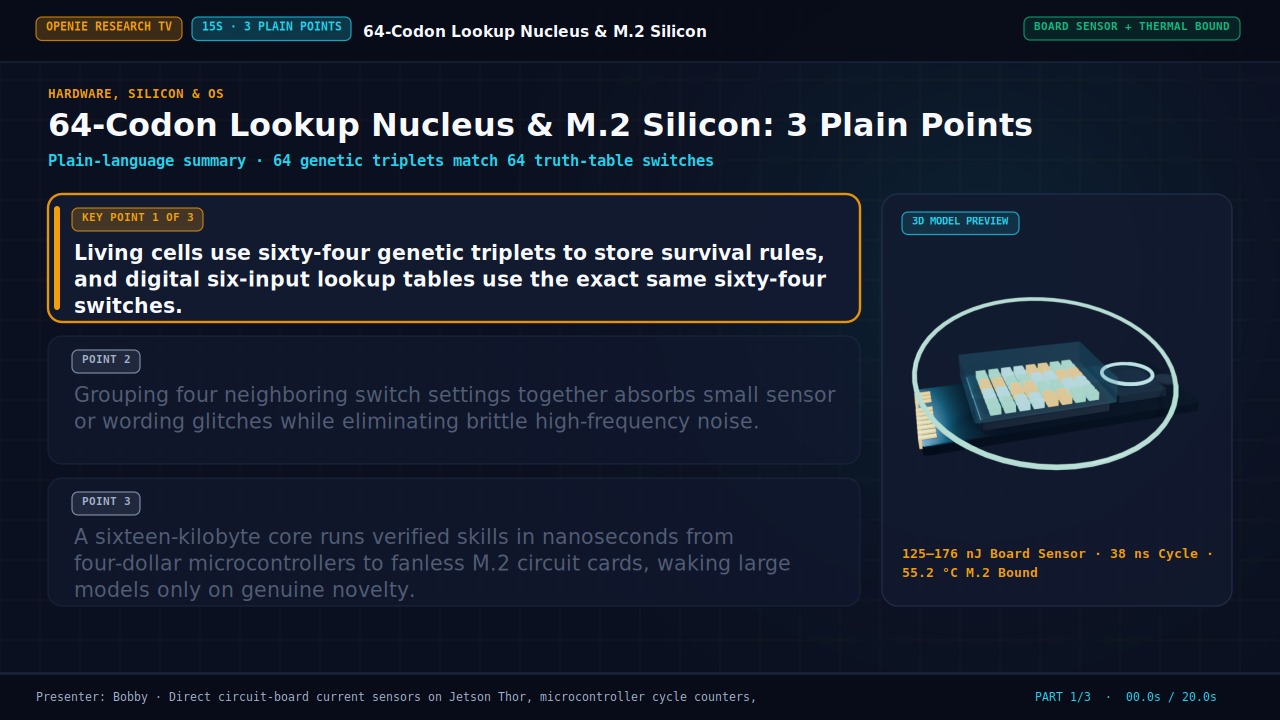
64-Codon Lookup Nucleus & M.2 Silicon plain-language summary poster
Hardware, Silicon & OS Board Sensor + Thermal Bound

64-Codon Lookup Nucleus & M.2 Silicon

Voice: Bobby · Low-BW: 109.41 J/m (measured_j)
125–176 nJ Board Sensor · 38 ns Cycle · 55.2 °C M.2 Bound
  1. Living cells use sixty-four genetic triplets to store survival rules, and digital six-input lookup tables use the exact same sixty-four switches.
  2. Grouping four neighboring switch settings together absorbs small sensor or wording glitches while eliminating brittle high-frequency noise.
  3. A sixteen-kilobyte core runs verified skills in nanoseconds from four-dollar microcontrollers to fanless M.2 circuit cards, waking large models only on genuine novelty.
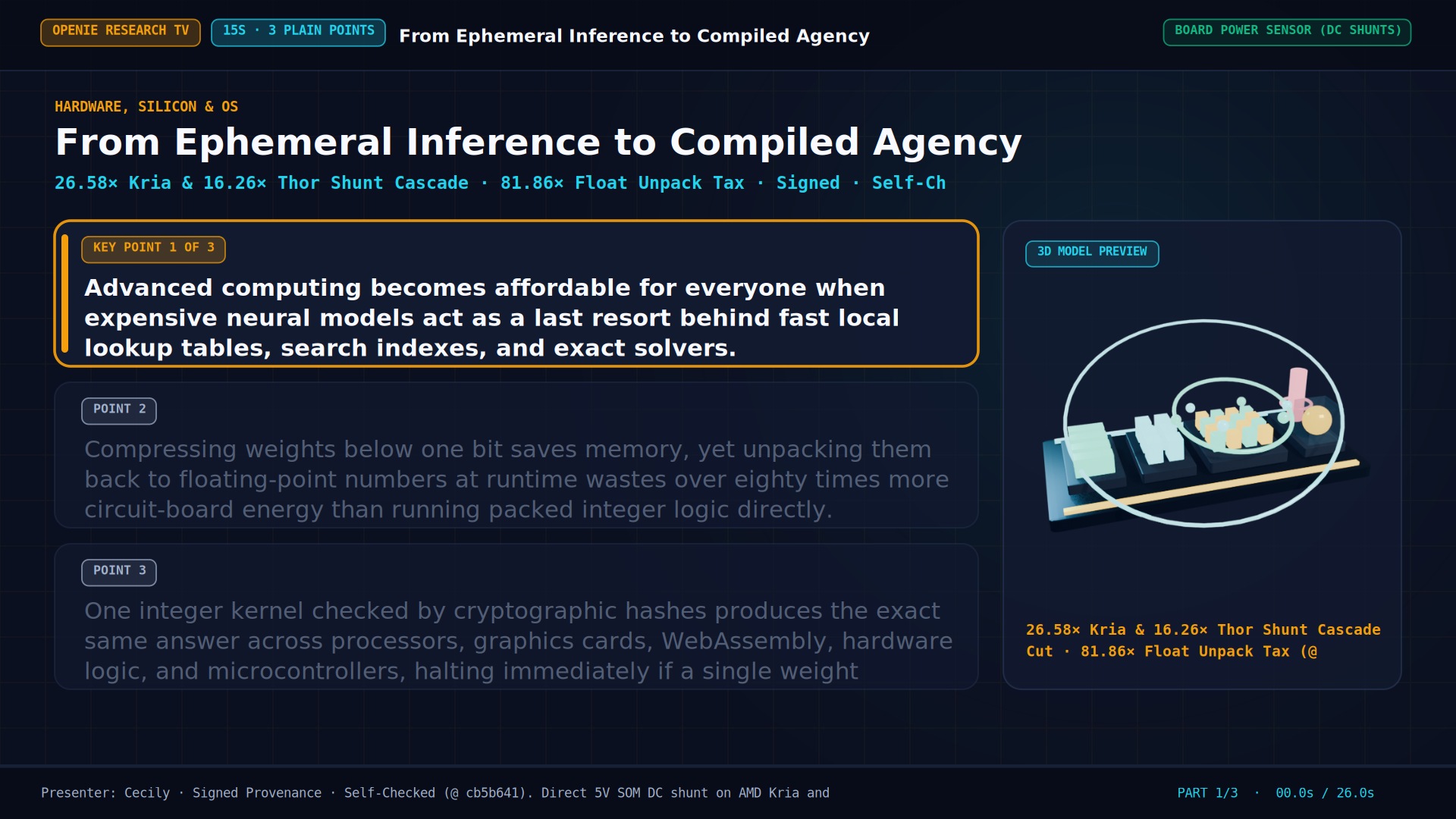
table grid
Choose Time Slot or 9:16 Vertical Cut: