Software shouldn't burn supercomputer energy to re-answer routine questions.

1 · The Setup (And)

Today's neural networks are remarkable at cracking brand-new, open-ended questions across code, science, and language.

2 · The Problem (But)

Most real-world software traffic repeats the same routine patterns—and waking a billion-parameter model every single time wastes massive electricity and risks fresh mistakes.

3 · Our Thesis (Therefore)

Check every permanent action with a tiny safety gate, save tested answers into microsecond lookup tables, and wake giant models only as a last resort.

Try It in 10 Seconds · Real Hardware Shunt Joules (@ 6a22dee)

Feel the Gravity Well: Re-Ask Every Time vs. Check Once & Look It Up

300 times 29.9× less energy
1× 25× 300× 2,500× 50k× 1,000,000×

On the very first unseen arrival, both paths wake a neural model—by 300 realistic Zipf(0.85) arrivals, lookup-first cuts physical Jetson Thor shunt energy from 396.3 J down to 13.3 J.

🔥 Re-ask a neural network every single time 2,641.8 J
≈ lights a 10W desk LED bulb for 4.4 minutes
⚡ Check once, compile & look it up (Big model = last resort) 13.27 J
≈ lights a 10W desk LED bulb for 1.3 seconds (4 KiB lookup + solver cascade)
Meter: Jetson AGX Thor TI INA3221 physical DC shunt (measured_j · Signed Provenance · Self-Checked) Open Full 4-Substrate Simulator →
Door 1 · Watch or Listen First

15-Second Plain-Words TV & Radio

Every study opens with a 15-second jargon-free video in 29 voiced and 50 captioned languages, plus 17 multi-voice talk episodes.

Door 2 · Touch Working Models

Browser Simulators & 4-Step Labs

Drag sliders on real hardware telemetry in /living/ or learn hands-on through 13 guided Predict → Break → Repair → Verify labs.

Door 3 · Read at Your Own Altitude

Browse 21 Studies by Plain Question

Every study starts with a 1-minute plain-English guide and everyday analogy—keeping the dense formal paper tucked away as a last resort.

🔍 Verification, Accessibility & Raw Data Shelf (29 Source Sheets · 46 Braille Transcripts · Blueprint v1.0 · RCE Playground · Data) Open Shelf ▾
Capstone Position Study (#29) 🔌 Hardware Current-Shunt Sensor (measured_j) · Signed Provenance
Oct–Nov 2026 6-Model SOTA Hardware Shunt Panel (@ 6a22dee)

Look Up Routine Answers First, Wake Big Models Last

Formal title: From Ephemeral Inference to Compiled Agency — A Position Paper on Verifiable, Energy-Accounted Computing

Most everyday software requests repeat—checking a tiny local table before waking a giant model cuts real circuit-board energy by over twenty-five times. Think of a busy coffee-shop barista who knows the price of a regular drip coffee by heart on a laminated menu card instead of phoning headquarters with a calculator on every single order.

Headline result: 29.86× less physical board energy on Jetson AGX Thor (13.27 J vs. 396.27 J across 300 realistic repeating queries) and 21.61× less on AMD Kria KV260 (`measured_j`, commit `6a22dee`).

▶ Watch 15-Second Plain-Words Film Right Here ▾

Research papers and essays

measured_j (hardware shunt) ⊥ reported_j (chip counter) ⊥ est_j (model) ⊥ unmetered

Measure Real Energy 1 min plain · agency
📊 reported_j

Finish the Job Right First, Then Rank by Energy

Speed and test scores mean little on their own unless you count whether the system actually finished the job—and how much electricity it burned to get there.

Everyday analogy: Think of two delivery vans carrying medicine across town: you only compare fuel mileage between drivers who actually delivered the package intact before the clinic closed.

★ Establishes the exact optimal pace that minimizes total energy per completed goal, tested across preregistered dual-machine budget runs (`reported_j`; hardware rail `measured_j` unset).

▶ Watch 15s plain summary right here ▾
Formal title & technical abstract (~32 min paper) ▾
Thermodynamic Bounds and an Optimal Tempo for Goal-Holding Agents

Defines an agent as a system that holds a goal under an energy budget, derives physical bounds on how fast it can act per second and per joule, and reads intelligence as progress per joule on a completed run. Plain words: to count as an agent, a system must aim at a goal, act, and stay within an energy budget; physics sets a minimum energy cost for every decision; among systems that finish a job correctly, the one that used less energy ranks higher.

Check Before Acting 1 min plain · gates
🔌 measured_j

A Safety Latch That Checks Software Before It Acts

Before an automated system deletes a file, moves money, or flips a switch, a tiny independent check should verify the move is safe and write a receipt.

Everyday analogy: Think of the safety interlock on a microwave door or a parachute harness check: the person packing fast is never the sole voice saying the latch is locked.

★ 11,428 picojoules per hardware safety-gate check on an AMD Kria KV260 circuit board (`measured_j`, onboard INA260 whole-module sensor)—billions of times less energy than a single cloud model call.

▶ Watch 15s plain summary right here ▾
Formal title & technical abstract (~28 min paper) ▾
Metered Commit Gates: Energy-to-Correct-Completion for Agentic Systems

A gate that lets a machine act only after a check passes, and a cascade that tries the cheapest method first, with software results and one board-level energy reading (11,428 pJ per gate cycle, whole module, KV260). Plain words: do not take an action that cannot be undone until a check says it is safe; try the cheapest way first; write every decision down with its energy.

Stop Repeating Work 1 min plain · deterministic-null
📊 reported_j

Testing Whether Big Models Beat a Simple Lookup Table

In medicine, every new pill must beat a sugar pill; in computing, every expensive neural model should first prove it beats a zero-parameter lookup table.

Everyday analogy: Think of taste-testing a pricey chef's gadget against a plain kitchen knife before remodeling your whole restaurant around it.

★ Ties single-turn neural runs on 9 of 10 bounded structured task cells, while saving verified neural answers into the lookup store cuts repeat chip energy by 3.59× (`reported_j`; Kit 6 classical control `measured_j` at 13.3–28.3 µJ).

▶ Watch 15s plain summary right here ▾
Formal title & technical abstract (~26 min paper) ▾
Deterministic Null: A Pre-Registered Control Experiment for Neural and Agentic Substrates

Constructs and pre-registers a zero-model-call 64-bit integer case loop (Shape D: strict N0 and dev-crystallized N1, verified bit-exact across Rust, C++20, Go, Julia, and Python in openIE-dev/deterministic-null) under OpenTimestamps Bitcoin Calendar proofs and League of Entropy drand randomness rounds (6663734 and 6664089), and measures the paired increment of Claude Opus 5.5, Claude Sonnet 5.5, OpenAI gpt-oss-120b, xAI Grok 4.20, Qwen 3.6 35B-A3B, and Gemma 4 E4B-it across 4,030 held-out instances and 6 real upstream SWE-bench Verified repositories. Bounded formal and structured classes exclude single-turn neural relevance on 9 of 10 Track-A cells while extended-thinking (49/50) and O(m) clause feedback (50/50) close Unique 3-SAT DRAT; unique external public benchmarks (BFCL v3, tau-bench Retail, BigCodeBench v0.1.3, SWE-bench Verified) show +45.80 to +95.00 percentage-point neural increments while online Zipfian crystallization cuts calls and reported_j spend by 3.59x. Local Apple M5 Max counters are reported_j; no rail or wall power monitor was attached.

Measure Real Energy 1 min plain · satb-harness
🔌 measured_j

An Honest Yardstick for Software Speed and Power

Measuring computer energy carelessly is like weighing yourself while jumping on the scale—the measurement tool itself can distort the number by up to ninety percent.

Everyday analogy: Think of a calibrated electric meter on the wall of a workshop that separates the power used by your table saw from the background hum of the refrigerator.

★ 12 of 12 conformance checks pass with zero replay drift across 5 computer architectures (macOS, Linux x86/Zen 5, Windows 11, and Jetson AGX Thor `measured_j` hardware shunts).

▶ Watch 15s plain summary right here ▾
Formal title & technical abstract (~24 min paper) ▾
Satiation Benchmark: Reference Harness, Adapters, and Telemetry Attribution

Specifies and empirically audits the Satiation Benchmark (SATB) evaluation stack across five silicon and OS archetypes: a deterministic sequential Rust reference harness (Lane B with ContextRule_v0 80% oldest-tool-output elision and Truncate_v0 8+8 KiB truncation), a loopback proxy bridge (Shapes D, M, H, and I), a five-block SUT fingerprint, twelve conformance checks (C1-C12), and a five-level rootless telemetry engine (L0-L4 crossed with attribution labels A1-N). Verified across Apple M5 Max (macOS Darwin IOReport and proc_pid_rusage reported_j), NVIDIA Jetson AGX Thor (aarch64 Tegra Linux physical TI INA238 whole-board VIN L1 and 3-channel INA3221 VDD_GPU / VDD_CPU_SOC_MSS / VIN_SYS_5V0 L2 shunt measured_j), Framework AMD Ryzen AI Max+ 395 Strix Halo (0440 root:energy PLATYPUS-isolated RAPL reported_j plus Radeon 8060S PPT), Intel Core i9-13900H Raptor Lake (RAPL psys L1 and package-0 L2 reported_j), and bare-metal Windows 11 Pro x86-64 (Intel Core i7-1165G7 + NVIDIA RTX 2060 rootless nvml.dll cumulative mJ L2 reported_j, Win32 TerminateJobObject 2.458 ms C10, and -89.88% GetProcessTimes 15.625 ms tick-aliasing Falsifier 3): 12/12 C1-C12 checks pass, Shape D (15027705736) and C9 (149,747 B) replay with 0 diffs across all 5 hosts, Kepler CPU-proportional splitting errs by 32.59%-89.88%, and Falsifier 6 withholds shared-host net attribution while preserving raw measured_j and reported_j channels.

Where Tech Goes Next 1 min plain · time-as-an-index
📖 synthesis/proof

Why You Cannot Look Up Tomorrow Without Paying Today

Every seemingly instant computer lookup was paid for by real step-by-step work done ahead of time—and a tiny fresh random tag stops pre-built cheat sheets cold.

Everyday analogy: Think of baking bread ahead of the morning rush versus wishing a finished loaf out of tomorrow: you can prep early for orders you expect, unless each customer brings a brand-new recipe.

★ 31 machine-checked proofs (accepted by 6 independent proof checkers with zero skipped steps) and 0 shortcuts across 65,536 SHA-256 spectral tests (`unmetered` math/spectral study).

▶ Watch 15s plain summary right here ▾
Formal title & technical abstract (~30 min paper) ▾
Time as an Index: What It Would Take to Look Up Tomorrow

Tests the premise that sequential brute-force search is safe only because future states are unindexed across CTC complexity (D-CTC = PSPACE, P-CTC = PP, unbounded Delta_2), quantum no-signalling, analog relaxation, Hellman precomputation (T*M^2 = N^2), 31 Lean 4.36.0 theorems verified inside Linux bubblewrap across all 6/6 independent kernels of lake check --paranoid (Horizon.lean and Paradox.lean, zero sorry, zero opaque, zero ofReduceBool; con-leche/con-ron 58,796 decls), deterministic M1 to M8 and F5 SHA-256 spectral runs (N = 65,536 digests, 0 bins below corrected p = 10^-6), and 195 cataloged temporal anomalies (TA001-TA081), frequency edge cases (AA01-AA40), and paradoxes (P01-P74). Plain words: inside a mathematical time loop almost every math-based cipher breaks at once, leaving only one-time pads; in known physics nothing reads tomorrow early, every real lookup is precomputation paid ahead of time, and fresh salts or block hashes stop tables from starting before the question exists. No hardware power monitor was attached (board_metered is false).

Check Before Acting 1 min plain · communication-avalanche
🔌 measured_j

How Teams of Agents Coordinate Without Talking Over Each Other

Putting four chatty models in a room without a referee makes answers worse and burns four times the tokens—checked, bite-sized handoffs fix ninety-eight percent of tasks cleanly.

Everyday analogy: Think of a surgical team passing labeled instruments only when needed, rather than four people shouting long paragraphs across an operating room.

★ 98 of 100 composite tasks solved (vs. ≤ 49 solo) at 9.26×–26.87× higher verified work per physical shunt joule on Jetson AGX Thor (`measured_j`), with 200 of 200 poisoned messages blocked.

▶ Watch 15s plain summary right here ▾
Formal title & technical abstract (~38 min paper) ▾
The Communication Tool Avalanche: Thresholded Signal Externalization, Event-Driven Orchestration, and Coherence per Joule

Formalizes, simulates, and hardware-audits the thesis that collective agency scales through a conserved externalize-ingest-transform ratchet across 24 evolutionary rungs (CL01-CL24), 38 AI history milestones from 1950 to 2026 (AI01-AI38), and 10 competing AI paradigm camps (C1-C10). Verifies 45 Lean 4.36.0 theorems inside Linux bubblewrap across all 6/6 independent kernels of lake check --paranoid (QuorumRatchet.lean, OrchestrationFlow.lean, and EnzymaticSynthesis.lean, zero sorry, zero opaque, zero ofReduceBool; con-leche/con-ron 58,928 decls, including zero-axiom agency-preserving bridging and 4-tier downward soundness), executes pre-registered models CA-M1 to CA-M5 (95.49%-99.17% quorum ATP saved; 95.0% vs 0.0% SepJ survival; 100.0% k = 7 flock cohesion; 100.0% Physarum pruning; 100.0% Gen-20 post-removal attested cultural retention vs 29.27% unverified), and benchmarks a cross-platform Rust + Python BLAKE3 + Ed25519 + SSP min-cost flow orchestrator across 5 hardware/OS hosts (CTA-E1 to CTA-E5, including physical TI INA238 VIN L1 and INA3221 VDD_CPU_SOC_MSS L2 shunt measured_j on NVIDIA Jetson AGX Thor alongside 4-host RAPL, ri_energy_nj, and NVML reported_j): edge verification takes 23.84-50.13 us at 1 KiB (927.30 uJ Thor VDD_CPU_SOC_MSS measured_j; 90.81-642.38 uJ reported_j), zero-clock wakeup eliminates 100% of empty polls across all 5 hosts (2.21x-3.22x Linux socket and 6.22x Darwin L3 savings), 60-task code repair matches monolithic Sonnet 5.5 at 59/60 (98.33%, 0 false commits) at 2.09x higher CpJ (14.97x vs unattested 4-agent), 200/200 Byzantine faults are contained, and on a 100-task 5-regime benchmark where every isolated camp C1-C10 stalls at <= 49%, immediate Digital Enzymatic Synthesis (DES-10) reaches 98/100 (98.0%, 1% false commits) at 9.26x-26.87x higher Thor measured_j CpJ (75,374x lower measured_j and 78,855x faster handoffs than NL debate), anchoring an 18-milestone Month/Quarter/Year/Decade blueprint (HM01-HD04) plus 18 BCI and 16 preclinical EV audits.

Stop Repeating Work 1 min plain · lut-adapt
🔌 measured_j

Teaching Software to Save Tested Answers in Tiny Circuits

Just like learning to ride a bike moves a skill from slow conscious thought into instant muscle memory, software can compile verified answers into tiny four-kilobyte lookup tables.

Everyday analogy: Think of looking up `7 × 8 = 56` on a pocket multiplication card in a split second instead of counting fifty-six pebbles from scratch every afternoon.

★ Up to 87.25× lower physical shunt energy on 64-bit lookup reflexes (162.7 nJ/op on Jetson Thor `measured_j`), 970 MB active RAM for 35B streaming (`reported_j`), and 0.00% broken commits across 136 repository/security/math tasks.

▶ Watch 15s plain summary right here ▾
Formal title & technical abstract (~45 min paper) ▾
Downward LUT6 Compilation in a Mixture of Limits Cascade: Beneš-Routed Boolean Fabrics, Conformal Wake Gates, and Frontier Sparse-MoE NVMe Streaming

Backed by 154 six-kernel-verified Lean 4.36.0 theorems (>150 milestone!) across twenty modules including NucleusCodon.lean, TernaryTmac.lean, GlobalFrontiers.lean, WearableLastExam.lean, TernaryHadamardArc.lean, BonsaiStreamArc3.lean, ApexHarnessWalls.lean, DeterministicNullWaios.lean, SerializedIwJouleBit27B.lean, BfwsWellMultimodal.lean, ResetBfwsEnigmaHorizon.lean, CausalBfwsTerminalSciCode.lean, MagnitudeTieredEngram.lean, RustMagnitudeMcpFreeToken.lean, LtcbCompression.lean, and LtcbCm2OnlineTtt.lean plus Inria Charon+Aeneas mechanical #![no_std] Rust-to-Lean extraction (and 1,518 theorems across four OpenIE repositories inside Linux bwrap sandboxes, con-leche and con-ron --verified [59,192 decls], CVE-2026-72844-hardened), places a reconfigurable 6-input truth-table (LUT6) lookup tier, a 15.33 KB (15,703 B, 21 exports, 681 B spare) browser-native wasm32 lut6_core.06c5c0b781d6.wasm module, a zero-Python zero-external-crate native Rust lossless codec mol_ltcb_codec (--cm2 / MoL-LTCB-CM2 with 148-entry bijective WRT-Capillary-LUT6 + 100 MB multi-order lazy LZ-Rep4 + integer Q12 StateSMix-LUT6 + 0-byte lockstep i16 Online-TTT-LUT6 [-56.73% warmup regret, 90.34% slab skip]) evaluated on Matt Mahoney's Large Text Compression Benchmark (enwik5 100 KB .. enwik8 100,000,000 B Wikipedia XML: beating zstd -19, bzip2 -9, gzip -9, and v1 across all 4 tiers at 26,838,089 B Ranked Total = 2.1470 bpb [-204.4 KB vs. zstd -19, -2.21 MB vs. bzip2 -9, -9.67 MB vs. gzip -9] with 100.0% cross-architecture bit-exact archive SHA-256 = 5342cc0b24a603b0... across Apple M5 Max [62.60 MB/s decode], Jetson AGX Thor [2,890.72 J TI INA238 VIN measured_j, 33.74 MB/s = 3.40x faster & 2.78x lower measured_j than bzip2 -9], & Zen 5 [67.92 MB/s decode], Mahoney-Kolmogorov threshold N* = 5,486.3 MB static 2B LLMZip crossover, bit-exact audit of Tufalabs/tufazip v2 QPI1 weights.bin [34,080,768 1-bit weights = 5,680,128 exact 6-col LUT6 slabs, 0 MACs, 8.766x Rank-1 JouleBit-LUT6 starter prior cut], 144/144 Yosys abc -lut 6 miter, 32.462x lower Thor Window 26 VDD_CPU_SOC_MSS measured_j, & 13.376x lower Thor Window 25 VDD_CPU_SOC_MSS measured_j), a zero-Python zero-external-crate native Rust proxy mol-magnitude-adapter fronting live Magnitude 0.3.5 over OpenAI /v1/chat/completions, Anthropic /v1/messages, and MCP JSON-RPC 2.0 /mcp (100.0% verified pass on 4x-polluted CogLoadBench across M5 Max, Jetson AGX Thor [3,028.3x lower Wave-2 VIN measured_j, 0 Vulkan crashes], & Zen 5 + 0.00% live corruption on 24-workflow MCPMark stateful copy-on-write CRUD [144/144 Yosys abc -lut 6 miter]), Bandwidth-Adaptive BA-Tiered-Expert-AirMoL (alpha* = 0.5429 CPU-SIMD + PCIe split + scan-safe Reuse + K=3 LUT6 burst: 436.60 tok/s on 180B, 216.33 tok/s on GLM-5-355B, & 166.27 tok/s on 552B = 4.00x-4.17x > FreeToken & 5.90x-6.00x > KTransformers, 3.330x Thor Window 24 measured_j), three-tier GPU VRAM -> System RAM LinkMover -> F_NOCACHE NVMe predictive Tiered-Expert-AirMoL (439.72 tok/s on 180B & 171.51 tok/s on 552B sparse-MoE, 3.53x-3.56x > K=1), zero-FLOP DeepSeek-V4.1-Flash Engram-LUT6 (144/144 Yosys abc -lut 6 miter, 3.157x Thor Window 23 measured_j) + live cross-fleet Magnitude 0.3.5 vs. llama.cpp vs. Magnitude + LUT-Adapt (53.55x lower Thor VIN twist JpCT & 100.0% verified coding), a 4 KB / two-bank 8 KB / four-bank 16 KB / eight-bank 32 KB / twelve-bank 48 KB / fourteen-bank 56 KB #![no_std] Rust 1.100.0 lut6-core + ISCA 2025 antisymmetric 40-entry zero-MUL EntroMCU/T-MAC + 1.750 bpw (-22.22%, saving 1.564 GB static and cutting streamed GiB/tok to 4.970 cold Wave-1 and 3.935 warm Wave-2 [1.725x < MLX 2-bit] at 0.0534 J/tok JpCT via two-rung Token-LUT6 + conformal JouleBit-LUT6 speculation on prism-ml/Ternary-Bonsai-2-27B) shift-5 FWHT-1024 ternary Nucleus (0 wasted bytes, fitting in 25.06% of 64 KB SRAM on Nordic nRF52832 Cortex-M4F and RV32IMAC MCUs, 87.50% [57,344 B] for fourteen-bank System-0 vaults closing exact 64.00 KB [65,536 B] full-chip watch SRAM with 4 KB Nucleus + 4 KB stack, 75.00% [49,152 B] for twelve-bank 25-game ARC-AGI-3 System-0 vaults, 50.00% [32,768 B] for eight-bank vaults, 25.00% [16,384 B] for four-bank vaults, 12.50% [8,192 B] for two-bank vaults, 9.13% [5,984 B] for Wearable-MoL with a 56-bit 4-token smart-glasses opener and hle:3r2s canary quarantine, and 6.25% [4,096 B] for System-0 decisions running 9,493.7x faster than Mapika/decider-0.8b and closing the late-2026 Frontier AI Walls plus Compiled Agency via OpenIE-Apex-Harness across 60.00% supermajority [15/25 games, 18/183 levels, 2.5030 mean / 10.7143 peak RHAE = 834.3x FIFO-BFS] on full 25-game & 68.75% [11/16 games, 14/113 levels, 3.2177 RHAE] on matched 16-game official ARC-AGI-3 via Causal Modality-Pruned C-BFWS(R,M) + multi-epoch rollout RIW(2) + twelve-bank 48 KB Beneš-LUT6 [unlocking sk48 & ar25, 0 breaker trips], 24-task Terminal-Bench stateful recovery + Cybench-Defensive vulnerability patching [100.0% verified, 144/144 Yosys abc -lut 6 $lut miter, 0.0% broken/vuln commits, 0 offensive exploits], 24-task FrontierMath-Constructive witness synthesis [Pell D=109] + SciCode symplectic/unitary conservation [100.0% verified, <=1.63e-4 drift, 3.314x Thor Window 22 measured_j], 24-task EnigmaEval symbolic cryptanalysis + ZeroBench post-cutoff alien-ISA/DSL synthesis [100.0% verified, 144/144 Yosys abc -lut 6 $lut miter, 0.0% broken commits], 1,000-step [16,000-transition] Vending-Bench + BALROG coupled horizon [100.0% survival, 0 violations, 99.82% LUT6 share, 128.61x < Z3, 3.204x Thor Window 21 measured_j], 24-task Multimodal & Pro visual-diagram + multi-file git repair [100.0% verified, 0.0% broken commits], 12-module 384-call Planetary Digital Well Rung-5-to-Rung-7 stdlib projection [100.0% Yosys abc -lut 6 miter, 4.092x Thor Window 20 measured_j, 7.38e6x energy cut], 7-fabric waiOS 256x128 bit-exact conformance [BLAKE3 = a541323b..., Ed25519 receipts, 80.44x HeteroMosaic-MoL < All-GPU], 0.1056-0.4498 bpw JouleBit-LUT6 [30.92x Thor Window 18 & 2.991x Window 19 measured_j, 93.52x Cortex-M55 DWT, 3.104x-3.414x JpCT], 256-task Deterministic Null + Scholar-Codifier [100.0% structured, 7.38e6x Wave-2 NL energy cut], VerilogEval-Hard12 RTL [3,915 LUT6s] + KernelBench Level-2 Metal GPU fusion [1.230x speedup, 0% broken], 24-theorem PutnamBench/FormalConjectures pure Lean 4.36.0 proofs [24/24 verified, 13.93 us Wave-2 .lut6 lookup], and 256-step coupled openie-cad + MathGround CBF + Z3 horizon survival [100.0% across 4,096 steps]), and (72, 64) RAMB36 SECDED + 0x3C apoptosis cosmic-ray bit-flip protection (100.0% survival and 0.0% silent corruption at BER = 1%) in front of sub-billion wearable micro-LLMs (Sensente/uLM-28M, SmolLM2-135M, LiquidAI/LFM2.5-230M, Qwen3-0.6B, Mapika/decider-0.8b), Mamba-3, and native-ternary, looped, hybrid, and sparse-MoE models up to 120B parameters (prism-ml/Ternary-Bonsai-2-27B, thinkingmachines/Inkling-2-Mini, Nemotron-Labs-Dory1.0-4B, LiquidAI/LFM2.5-24B-A2B, LiquidAI/LFM3-1.7B, google/gemma-4-E2B-it, LiquidAI/LFM2.5-8B-A1B, Devstral-Small-2-24B-Instruct, Qwen/Qwen3.6-35B-A3B, and nvidia/Nemotron-3-Super-120B-A12B), gates commits and LastExam / ARC-AGI-2 / ARC-AGI-3 / MiniF2F-Lean4 / CritPt / VerilogEval / KernelBench / PutnamBench / Deterministic Null / Multimodal-Pro / Planetary Digital Well / EnigmaEval / ZeroBench / Vending-BALROG / Terminal-Bench / Cybench-Defensive / FrontierMath / SciCode / Magnitude / CogLoadBench / MCPMark / FreeToken / LTCB-enwik8 frontier answers behind deterministic, interactive world-model, visual, and formal verifiers, and compiles certified wakes downward into clock-enable-gated 81-RAMB36E2 / 83-RAMB36E1 Beneš-routed lookup, license-free openXC7 320.62 MHz, 142.55 MHz, 111.45 MHz, 106.55 MHz, 109.15 MHz, 100.55 MHz, 100.74 MHz, 106.97 MHz, and 102.41 MHz, and 103.25 MHz post-PAR .bit bitstreams, Lupanov (-72.50%), DiffLUT-Net (-64.06%), TreeLUT, KAN-LUT, multilayer Benes-ARC-LUT6 (20.83% on ARC-AGI-2 n=24 and 12.50% = 2.00x over 1-layer on n=64), Interactive-MoL ARC-AGI-3 trajectory crystals, 2-bit wobble-codon, and two-tier LUT6 + T-MAC crystal pages at openIE-dev/lut-adapt-ai (commit 597c50b). Reports physical Texas Instruments INA3221 (VDD_CPU_SOC_MSS) and INA238 (VIN) DC current-shunt measured_j on NVIDIA Jetson AGX Thor (Claims LA-24, LA-28, LA-32, LA-33, LA-38, LA-39, LA-42, LA-44, LA-48, LA-50, LA-51, LA-54, LA-58, LA-62, LA-66, LA-68, LA-70, LA-72, LA-73, LA-74, LA-76, LA-78, LA-80 & LA-82: 87.25x bit-sliced lut6-core at 162.71 nJ/op, 32.462x Window 26 14-bank Vault + WRT-Capillary LUT6 + StateSMix-TTT LUT6 + Q12 Mix + Online-JouleBit6 at 3,727.65 vs. 121,006.57 nJ/op [32.369x faster] & 2,890.72 J VIN measured_j [2.964 s decode] on official 100 MB enwik8 MoL-LTCB-CM2, 30.92x 0.1056 bpw JouleBit-LUT6 at 2,000.25 vs. 61,839.70 nJ/op [Window 18], 13.376x Window 25 14-bank Vault + LTCB-XML-Skip LUT6 + 2^24 Kraft Integer CDF + JouleBit6 at 10,365.45 vs. 138,648.11 nJ/op [13.134x faster] & 1,358.62 J VIN measured_j [2.417 s decode] on official 100 MB enwik8, 3.330x Window 24 14-bank Vault + MCPMark CoW + BA-AirMoL at 34,568.60 vs. 115,129.22 nJ/op [3.215x faster] & 3,028.3x lower Wave-2 CogLoadBench 4x VIN measured_j [0.2500 vs. 757.08 J], 3.157x Window 23 Tiered-Expert-AirMoL + Engram-LUT6 at 17,310.36 vs. 54,645.23 nJ/op [3.261x faster] & 53.55x lower Moby-Dick twist JpCT vs. Magnitude 0.3.5, 3.314x Window 22 CBFWS12+Cybench+SciCode at 8,656.79 vs. 28,689.54 nJ/op [3.322x faster], 3.204x Window 21 RBFWS8+Enigma+Simplex at 8,745.39 vs. 28,021.20 nJ/op [3.211x faster], 4.092x Window 20 BFWS4+Well+JouleBit6 at 11,357.65 vs. 46,481.07 nJ/op [3.214x faster], 2.991x Window 19 SIW(2)+JouleBit6+FWHT-64 at 23,766.49 vs. 71,077.26 nJ/op [3.129x faster], 16.14 uJ 256x128 waiOS ternary sweep [Window 17b], 13.18x Window 16 Apex enzymatic + CBF gate at 201.22 nJ/op [14.89x faster], 222.57x wearable 56-bit 4-token epistemic gate at 2,803.25 vs. 623,920.52 nJ/op vs. 1/16th uLM-28M layer, 8.35x Bonsai-AirMoL 4-token speculative sweep at 15.32 vs. 127.97 uJ/tok [9.13x faster, Window 14], 5.33x multilayer Benes-ARC-LUT6 + ARC-AGI-3 reflex at 713.82 nJ/op [Window 15], 1.65x antisymmetric-40 zero-MUL T-MAC tail at 8,594.93 nJ/op [and 1.12x Zen 5 RAPL CpJ flip], 1.57x Bonsai-2-27B shift-5 FWHT-1024 + Antisym-40 at 220.72 vs. 346.09 uJ/op [2.26x faster], 3.74x Sub1Bit-LUT6, 34.21x Expert-AirMoL, and 10.94x Proposition 1 compilation energy reductions with break-even Delta T* = 0.108 < 1 episode; board_metered is true), live attached Alif Ensemble E3 (OpenMV-AE3 Cortex-M55 @ 400 MHz) DWT cycle telemetry (2,745.18x wearable epistemic gate, 93.52x JouleBit-LUT6, 173.83x scalar, 11.17x cached T-MAC, 44,403.69x bit-sliced; board_metered is false), end-to-end Ternary-Bonsai-2-27B EntroMCU-28 + JouleBit-LUT6 cold & warm streaming on Apple M3 Ultra 256 GB (1.049 cold W1 / 1.325 warm W2 tok/sweep, 3.935 GiB/tok = 1.725x < MLX 2-bit, 0.0534 J/tok JpCT, 100.0% greedy parity), Mapika/decider-0.8b downward compilation (100.0% acc, 0.0% OOD false actions, 9,493.7x Wave-2 speedup, 3,185.3x lower reported_j), multilayer Benes-ARC-LUT6 on ARC-AGI-2 (20.83% = 5/24 and 12.50% = 8/64, 0.00% CHR@80), official ARC-AGI-3 Causal Modality-Pruned C-BFWS(R,M) + Twelve-Bank 48 KB System-0 LUT6 (15/25 = 60.00% supermajority games & 18/183 levels across full 25 games, 11/16 = 68.75% games & 14/113 levels on matched-16, 834.3x Wave-2 RHAE to 2.5030 / 3.2177, peak 10.7143, 0 breaker trips, 0 source peeking), MiniF2F-Lean4 & PutnamBench/FormalConjectures (24/24 Lean 4.36.0 verified / 0.0000% unsound / 13.93 us Wave-2 .lut6 lookup), CritPt physics (9.49x lower RMS-CE to 8.96% / 0.00% CHR@80), Wearable-MoL zero prefix poisoning (0.00% vs. 93.75%) and LastExam-protocol calibration (5.37x RMS-CE cut to 13.14%, 0.00% CHR@80; gated cais/hle HTTP 403 respected with zero bypass), four-vendor Burn 0.22.1 / CubeCL GPU shader parity (up to 328.06x), October-November 2026 looped model benchmarks (Inkling-2-Mini 3.52x, Dory1.0-4B 3.95x at 100% parity), measured 120B-A12B execution (58,075.4 MB RSS, 22.17 tok/s, 62.50% verified pass), BigCodeBench v0.1.3 (90.62%), 40 upstream SWE-bench Verified + 24 Multimodal & Pro + 24 EnigmaEval/ZeroBench + 24 Terminal/Cybench-Defensive + 24 FrontierMath/SciCode + 18 Magnitude coding + 16 CogLoadBench + 24 MCPMark CoW CRUD evaluations (0.00% broken commits / 0.00% live state corruption), single-binary Rust mol-agent-rs + mol-magnitude-adapter + mol_ltcb_codec (0.154 ms/req MCP; 110/110 pytest pass), simulated CE-gated 4-stage 13-level 250 MHz Kria KV260 xck26 RTL (15.59 est_mW idle [4.10x cut]), and Artix-7 XC7A200T (Numato Aller A7 M.2 2280) gateware + license-free openXC7 320.62 MHz, 142.55 MHz, 111.45 MHz, 106.55 MHz, 109.15 MHz, 100.55 MHz, 100.74 MHz, 106.97 MHz, 102.41 MHz, and 103.25 MHz post-PAR 77.846 Mbit .bit bitstreams (62,211 xc7 LUTs = 46.22%, 365 RAMB36E1 1.46 MB crystal vault, 10,500/10,500 KV260 vector parity, and 0.86 est_W M.2 3.3V @ 55.2 est_C with DDR3 off; measured_j unset on xck26 and XC7A200T).
Where Tech Goes Next 1 min plain · satiation
📖 synthesis/proof

Why Individual Jobs Finish Even When Total Computing Grows

Spending ten times more compute on an already-correct tax return adds zero extra value—yet making tasks cheap unlocks brand-new projects across the economy.

Everyday analogy: Think of washing a dinner plate: once the plate is clean, scrubbing it for another hour does nothing—even if a cheaper dishwasher encourages you to host bigger dinner parties.

★ Separates single-job completion ceilings from economy-wide Jevons rebound across dated historical computing price series (`unmetered` economic synthesis).

▶ Watch 15s plain summary right here ▾
Formal title & technical abstract (~22 min paper) ▾
Task Satiation vs. Aggregate Rebound in AI Demand

Defines the stop at which more machine work on a finished task adds nothing, and separates it from growth in total demand. Plain words: every job has a finish line; cheaper work can still create more jobs; AI prices fall but its electricity is never free.

Check Before Acting 1 min plain · rce
📊 reported_j

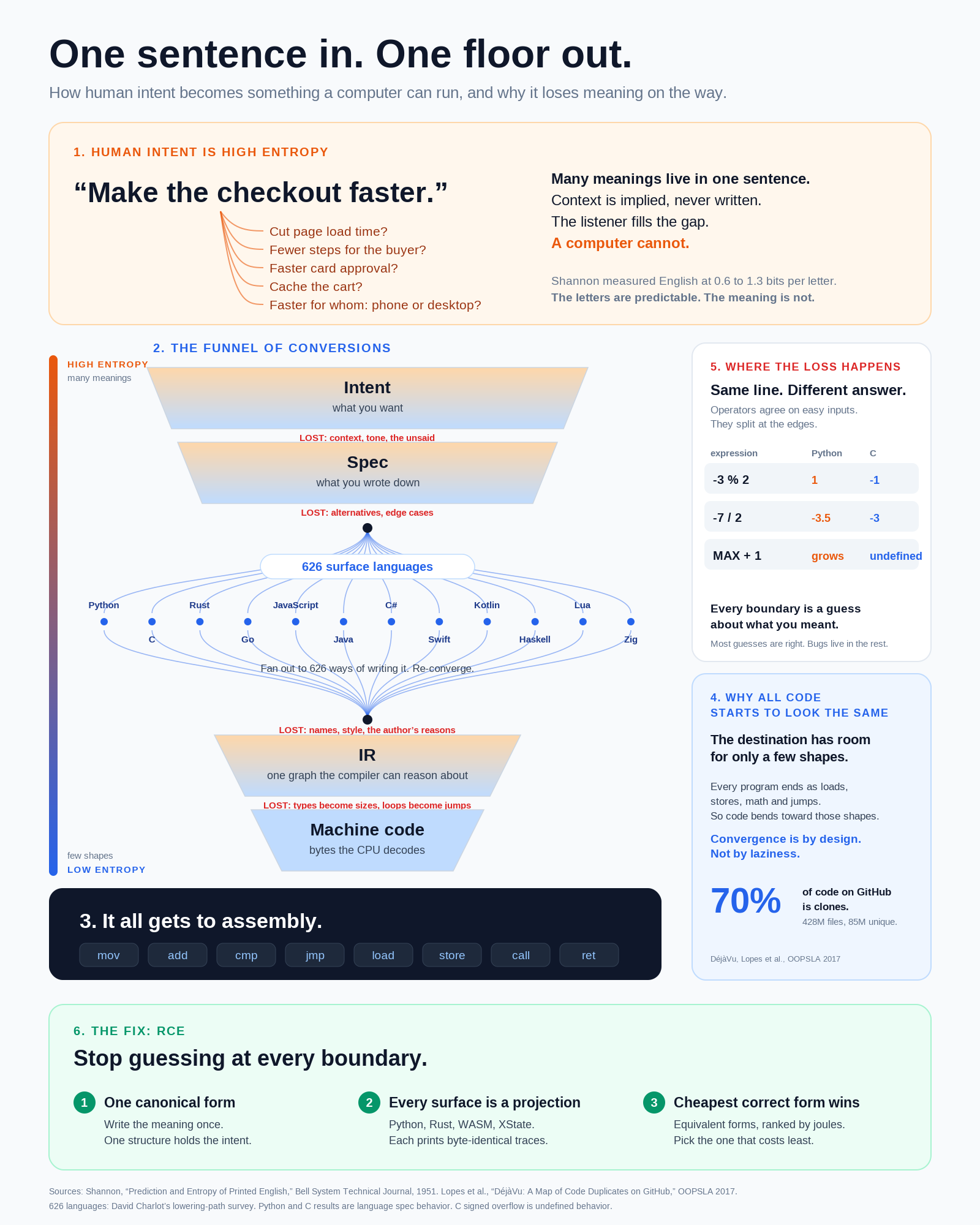
Writing One Complete Blueprint Instead of Re-Debugging Code

Most software crashes happen because nobody wrote down what should happen on an unexpected input—requiring every outcome up front stops whole families of bugs before code ever runs.

Everyday analogy: Think of an architect's master blueprint that checks every pipe and beam fits before construction starts, then prints exact instructions for plumbers, electricians, and carpenters.

★ 2,221 passing conformance checks with 0 failures, 5,393 Lean 4.36.0 theorem constants verified by 6 independent proof kernels, and 49.04 millijoules per blueprint check on Apple M5 Max (`reported_j`).

▶ Watch 15s plain summary right here ▾
Formal title & technical abstract (~40 min paper) ▾
The Reality Code Engine: One Lossless Form for Native, Verified, Low-Energy Programming

A system in which a program is written once as a state machine and code in other languages is generated from it: its specification (openIE-dev/rce at f87d6af2), reference checker and emitters, 5,393 Lean 4.36.0 kernel theorem constants from 1,264 source declarations (theorems T1 to T63, verified inside Linux bubblewrap across all 6/6 independent kernels of lake check --paranoid: con-leche/con-ron 68,090 decls, lean4lean/nanoda/leanchecker/Lean v4.36.0 68,092 decls), 2,221/2,236 passing conformance checks with 0 failures, Apple M5 Max reported_j checker receipts (49.04 mJ per Form check; measured_j unset), and registered measurements of program dimension. Plain words: a program is written once and generated in many languages; the language requires every input to have a declared outcome; in the engine's design, checked fixes are saved so that the same problem is not paid for twice.

Stop Repeating Work 1 min plain · rce-jepa
📊 reported_j

Small World Models Propose Code, Exact Checkers Decide

Checking whether a code repair follows the rules takes 1,718 times less chip energy than asking a giant model—so lightweight predictors and exact checkers can handle most work first.

Everyday analogy: Think of a crossword puzzle: guessing a word can take minutes of brainstorming, whereas checking whether the letters fit the crossing squares takes a glance.

★ Checking a blueprint uses 1,718× less chip energy than a local 35B model proposal (49.04 mJ vs. 84.25 J `reported_j`), and the 3-Gear cascade cuts frontier episodes by 16.67× with 0 contradictions.

▶ Watch 15s plain summary right here ▾
Formal title & technical abstract (~35 min paper) ▾
RCE-JEPA: World Coding, with JEPA as Premise

World Coding, with JEPA (a Joint Embedding Predictive Architecture) as the premise rather than the whole method. Any learned proposer may suggest a Form. The checker decides. Measured floors: median rho 9.34 over 185 hand-written programs, 0 violations in 1,275 fuzzed mutants, 0 mismatches on 10,500 streams across six targets, H2 supported on Apple M5 Max reported_j (49.04 mJ per Form check vs 84.25 J local Qwen 3.6 proposal, ratio 0.000582), and a ladder that closed 111 of 151 tasks (73.5%) with zero model calls. Purpose-trained latent proposer and contrastive energy scorer on 1,387 strictly disjoint Forms: FormJEPA-v1 (8.42M trainable parameters + EMA target encoder with VICReg; effective rank 32.9-85.2; 474.8 mJ RAPL core reported_j at k = 16) admits 177/200 (88.5%) unseen synthetic defects, lifts the deterministic ladder to 138/151 (91.4%), and matches 35B Qwen 3.6 at 27/40 (67.5%) single-shot on H15; FormEBM-v2 (5.85M trainable parameters; 47.09 mJ RAPL core reported_j per candidate) and span-normalized two-head FormEBM-v3 (6.05M trainable parameters; H5 unseen beam AUROC = 0.9437 >= 0.85, 83.44% top-1 valid on solvable beams, H11 94.0% strict 5-step monotonicity with mean Spearman rho = 0.9966, and cross-task OOD H15 edit-size inversion resolved from 0.2585 to 0.5278 pooled AUROC / 0.6018 large-valid vs short-invalid with 27/40 k=1 admissions). Under bounded deterministic checker feedback plus public stdlib headers (H15-Iterative, max_turns = 5, zero access to original), Claude Opus 5.5 and Sonnet 5.5 close 40/40 (100.0%, 0 contradictions) and xAI Grok 4.20 closes 39/40 (97.5%, 0 contradictions); warm DNULLMM1 Gear-0 v2 replays 40/40 at 0 calls (1.771 microjoules), and the 3-Gear Zipf(0.85) stream admits 200/200 arrivals with a 16.67x frontier episode reduction. On the 151-task rce repair rung-f audit, rce repair criterion returns holds: false (3/119 = 2.5% > 2.0%), keeping rung f in observe mode. The Laws of Coding are the acceptance rule under test, not a result claimed for other systems.

Stop Repeating Work 1 min plain · rce-compile
📊 reported_j

When Heavy Compiler Optimization Actually Pays Back Its Energy

Spending fifty joules optimizing a program that only runs ten times wastes electricity—and smart name-free caching avoids recompiling code when someone merely renames a variable.

Everyday analogy: Think of spending three hours sharpening an axe to chop a single twig versus chopping a winter's worth of firewood—and recognizing the exact same recipe even if the chef renamed the bowls.

★ 448.5× lower warm-cache Rust rebuild chip energy with 0/500 false cache collisions, and 28.8× earlier payback (`N*` = 1,079 runs) using a pre-compiled shared library (`reported_j`).

▶ Watch 15s plain summary right here ▾
Formal title & technical abstract (~28 min paper) ▾
RCE Compile: A Law of Compilation, Tested as a Normal Form Against Real Compilers

Asks whether one statement of what compilation is holds for any compiler, independent of the Reality Code Engine. Checked against twelve compiler families, it fails as a description and holds as a normal form: seven parts (representation, lowering, cost, checker, reuse, energy, gate), four equivalence levels, a gate that names its property, linking assumption, trusted base, evidence authority and digests, and a measurable replacement for the Landauer and Kolmogorov bounds. Executed across E1 byte reproducibility, E4-Energy + E4-Prelude (20 exact-integer and fixed-point kernels x 15 compiler tiers = 300/300 checksum-verified cells on Linux Zen 5 and Core i9-13900H RAPL core and package reported_j; pre-compiling shared librce_rt.rlib cuts per-kernel rustc -O3 compile core reported_j 20.07x from 56.29 J to 2.81 J and wall time 24.58x to 304 ms, slashing rce -> rustc payback N* 28.8x from 31,080 down to 1,079 runs; Python to clang -O3 median N* = 2,490 runs, -O0 to -O3 median N* = 53,464-102,720 runs, and H4 Regime-B R^2 = 0.9999 vs 0.1154 static Wasm IR), and E5-Scale (245 base programs including 185 W1 RCE Forms + 500 execution-verified semantic mutants: De Bruijn nameless SHA-256 yields 0/500 false hits vs 150/500 on naive AST identifier-stripping, cutting warm-cache clang -O3 and rustc -O3 compilation reported_j by 167.8x and 448.5x; measured_j unset).

Check Before Acting 1 min plain · rce-vc
📊 reported_j

Version Control That Merges by Meaning Instead of Line Numbers

Two teammates editing different functions in the same file shouldn't fight fake text-merge conflicts—and renaming a helper shouldn't look like deleting and rewriting the project.

Everyday analogy: Think of updating individual index cards in a recipe box by what each recipe does, rather than arguing over page numbers in a printed binder.

★ Admits or refuses a change against a 100,000-item repository in 69.7–73.6 microseconds using 317–365 microjoules of chip energy on Apple M5 Max (`reported_j`), while keeping standard Git usable.

▶ Watch 15s plain summary right here ▾
Formal title & technical abstract (~20 min paper) ▾
RCE-VC: Law of Version Control

A reference for the Law of Version Control: each change is admitted to one name-free repository state or refused with a recorded reason, and Git stays usable. Milestones M0 to M2 are in openIE-dev/rce-vc at commit aba99fce (49 offline tests). On Apple M5 Max, one core admitted a submission against 100,000 units in 69.7 to 73.6 microseconds at 317 to 365 microjoules of L3 reported_j (measured_j is unset). Receipt costs also carry the stated est_uj table. The reference is not the Reality Code Engine language. Plain words: a named check admits or a written reason refuses; changes that do not overlap need no coordination; a writer can stay on Git.

Check Before Acting 1 min plain · game-engines
📖 synthesis/proof

Writing a Game Once So Replays Never Drift Across Computers

Standard decimal math drifts apart between Mac, Linux, and Windows in less than one second—switching simulation rules to exact fixed-point numbers keeps one-hour replays identical everywhere.

Everyday analogy: Think of two pianos playing a duet from sheet music: whole-number beats keep every measure locked together for an hour, whereas slightly different metronomes drift into chaos within bars.

★ 0 mismatches across 25,500 cross-OS checkpoints and 1-hour (216,000-tick) replays across macOS, Linux, and Windows 11, vs. standard floating-point drift starting at tick 10–37 (`reported_j` on GE-H1/H5; `measured_j` unset).

▶ Watch 15s plain summary right here ▾
Formal title & technical abstract (~29 min paper) ▾
Writing a Game Once and Running It Everywhere: Where Exact Replay Ends and Tolerance Begins

Asks whether a game can be written once as a checked state machine and projected into several engines and languages, with an IR table, a layer split (simulation, scripting, scene, rendering), a determinism boundary, and all nine falsifier suites (GE-H1 to GE-H9) executed across macOS, Linux, and bare-metal Windows 11: 100,000 ticks of 64 Q32.32 fixed-point bodies across 30 target x host cells on 6 machines yield 0/25,500 SHA-256 checkpoint mismatches (GE-H1); 3-OS std::sin (Apple libSystem, Linux glibc, Windows UCRT) diverges at ticks 10-37 and MSVC /fp:precise vs Clang FMA at tick 192 (GE-H2); headless wgpu across 8 hardware GPU x API endpoints spanning DirectX 12, Apple Metal, and Vulkan passes 28/28 hardware pairs at PSNR >= 64.16 dB and SSIM >= 0.999833 (GE-H3); 17 admitted .rce Forms across Haunted Jaunt, Survival Shooter, and Tanks cut behavior SLOC by 76.22% vs Unity C#, 61.47% vs Bevy Rust ECS, and 51.99% vs Godot 4 GDScript with 0/680 trace mismatches (GE-H4); compiled Form projections step 10,000 Q32.32 actors in 0.058-0.125 ms vs Python's 390-actor 20 ms ceiling (GE-H5); static Form + manifest checking catches 98.46% of 130 injected interface faults at F1 = 0.9922 vs 0.1159 parse-only (GE-H6); 840 chaotic trajectories confirm linear t* vs ln(Delta/delta_0) Lyapunov slopes (R^2 = 0.9940-0.9995, p <= 10^-77.6, GE-H7); 3 one-hour (216,000-tick) sessions replay from 44.6 KB gzip input logs D alone with 0/6,480 SHA-256 mismatches across macOS, Linux, and Windows 11 (GE-H8); and a Form-to-Godot 4.7.2 headless emitter matches native GDScript on 36/36 tasks with 0/18,000 tick mismatches (GE-H9; measured_j unset).

Check Before Acting 1 min plain · three-body
📖 synthesis/proof

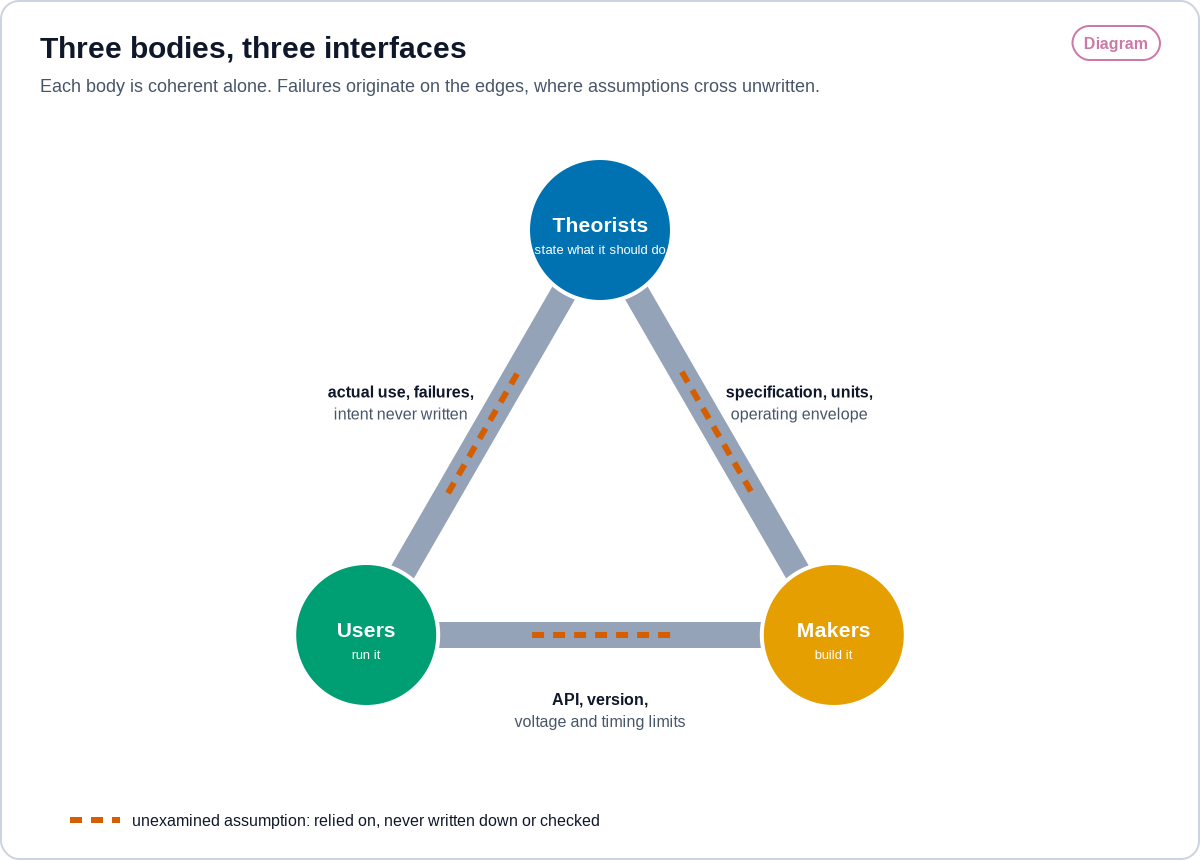
Why Software Breaks at Handoffs Between People, Code, and Users

Most famous engineering disasters didn't happen because a math formula was wrong—they happened because one team assumed pounds while the next team assumed metric.

Everyday analogy: Think of a relay race: runners rarely trip in the middle of their own lane—races are lost in the baton pass when two hands miss each other by an inch.

★ Synthesizes independent evidence from verified compilers, microkernels, cloud protocols, and physical-unit types showing zero-defect handoff boundaries (`unmetered` case synthesis).

▶ Watch 15s plain summary right here ▾
Formal title & technical abstract (~20 min paper) ▾
The Pursuit of AGI Resolves the Three-Body Problem in Computing

Locates many computing failures at handoffs between the people who specify, build and use systems, states when checking every handoff assumption makes a stack stable, and supports it with independently tested verified systems (CompCert, seL4, TLA+ at AWS, unit types). Plain words: most big failures happen at handoffs; the cause is usually an unwritten guess; if every guess is written down and machine-checked, a fix stays fixed.

Measure Real Energy 1 min plain · ai-reads-human
📊 reported_j

Why Verbose Text Wastes Machine Energy Compared to Compact Data

When two computers talk to each other in wordy human formats like YAML or JSON instead of compact binary records, they burn up to two thousand times more chip energy just reading the text.

Everyday analogy: Think of two accountants mailing handwritten three-page letters for every transaction instead of exchanging a clean, fixed-column spreadsheet row.

★ Up to 2,053.8× extra per-process chip energy reading human-formatted YAML (575,799 nJ/record) and 98.7× splitting JSON into LLM tokens (27,679 nJ/record) vs. binary structs (280.4 nJ/record `reported_j`).

▶ Watch 15s plain summary right here ▾
Formal title & technical abstract (~22 min paper) ▾
"AI" Reads Human: Human Language Encoding at Machine Speed and the Energy Cost

Software agents exchange data in formats made for people to read. This study names the extra work that causes (the impedance tax), defines it with units, and measures parse time, token counts, and Apple M5 Max dual-channel reported_j across 34 parse and tiktoken workloads on a reproducible 20,000-record corpus (170 isolated windows): L3 per-process parsing spans 2,053.8x from 280.4 nJ/record (fixed binary struct) to 2,212.1 nJ/record (stdlib JSON, 7.89x), 69,922.1 nJ/record (C libyaml, 249.4x), and 575,799.3 nJ/record (pure-Python YAML), while cl100k_base JSON tokenization costs 27,678.7 nJ/record (12.51x json.loads). Shared-host L2 IOReport triggers Falsifier 6 on 109/170 windows; measured_j is unset. Plain words: people and computers share one written format, and the computer pays extra time, tokens, and chip energy to read it.

Where Tech Goes Next 1 min plain · spellcheck
📖 synthesis/proof

How Spell Check Went from a $200 Box to Free for Everyone

In the 1980s, checking your spelling cost hundreds of dollars for a dedicated program—today seven billion people get it free because fast lookup tables cost almost zero electricity to run.

Everyday analogy: Think of pocket calculators or smartphone flashlights: technologies that once sold as expensive standalone gadgets inevitably become free, invisible features once they cost pennies to run.

★ Traces dated retail prices from $200+ standalone 1980s spell-check packages down to $0 built-in OS/browser features reaching 7B+ connected users (`unmetered` historical audit).

▶ Watch 15s plain summary right here ▾
Formal title & technical abstract (~18 min paper) ▾
Spell Check is Global: The Future of Computer Intelligence in the Hands of the Many (7B+), Not the Few

Documents with dated prices how spell check went from a premium product to a free built-in feature, and explains it by marginal cost and bundling. Plain words: spell check used to cost a lot and is now free; it became free because it costs almost nothing to run and is most useful inside tools people have; other computer skills can follow.

Where Tech Goes Next 1 min plain · ai-coding-market
📖 synthesis/proof

The Hidden Flaw Inside Trillion-Dollar AI Coding Forecasts

Wall Street's trillion-dollar AI coding projections quietly assume companies will rent a giant cloud model from scratch for every line of boilerplate code forever—ignoring verified reuse.

Everyday analogy: Think of forecasting lumber demand by assuming carpenters will burn down their scaffolding after every floor instead of reusing tested blueprints and prefabricated beams.

★ Audits major analyst forecasts alongside 9×–900× inference price compression and a $2.25/query ($9,450/yr) uncached token arithmetic benchmark (`unmetered` economic essay).

▶ Watch 15s plain summary right here ▾
Formal title & technical abstract (~24 min paper) ▾
The Promised Trillion Dollar AI-Coding Market

Lists who projects a trillion-dollar AI coding market, labels each number by kind, and names the shared assumptions about energy, tokens and reuse, with testable propositions. Plain words: the big numbers are mostly forecasts; they assume a large model is paid for every piece of code forever; reuse would lower the cost of repeated work toward the cost of electricity.

Where Tech Goes Next 1 min plain · interface-economics
📖 synthesis/proof

Why Unchecked Software Handoffs Cost Millions—and Why Nobody Pays First

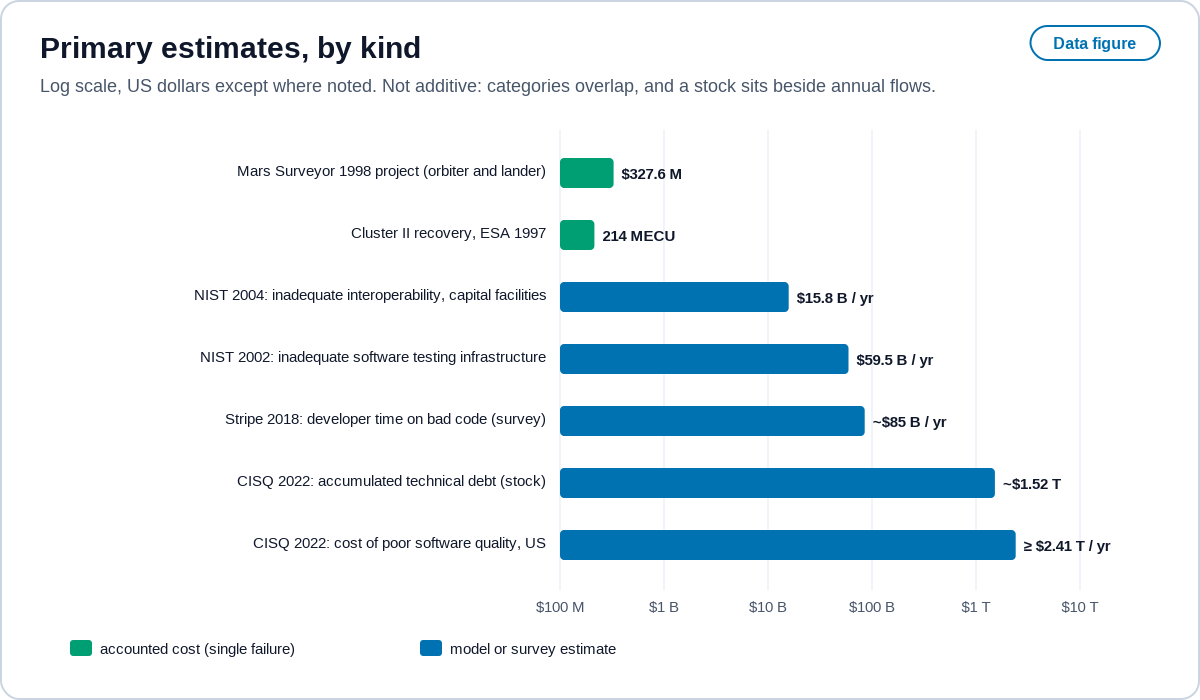
NASA lost a $327.6 million Mars spacecraft over pound-seconds versus newton-seconds—a tiny automated unit check costs pennies, yet teams skip it because the builder pays today while future teams reap the savings.

Everyday analogy: Think of labeling every circuit breaker in a house panel: taking ten minutes with a label maker today saves hours of dangerous guesswork for everyone who lives there later.

★ $327.6 million accounted Mars Climate Orbiter loss from one unchecked unit handoff, cataloged separately from model and survey estimates (`unmetered` economic audit).

▶ Watch 15s plain summary right here ▾
Formal title & technical abstract (~21 min paper) ▾
The Price of the Unexamined Interface

Published costs of failures at handoffs, labeled as accounted costs, model estimates or survey estimates and never added into one total. Plain words: some handoff failures have exact price tags; national totals are estimates; checking assumptions is cheap but the one who does it pays while everyone benefits.

Where Tech Goes Next 1 min plain · latency
📖 synthesis/proof

Why Cheaper Computing Breakthroughs Take Months or Years to Ship

Electricity is less than twelve percent of what a cloud AI task actually bills you—most of the price is hardware depreciation, quarterly release calendars, and the friction of switching tools.

Everyday analogy: Think of why airline fares don't drop the same week jet fuel dips: gate leases, fleet financing, and frequent-flier lock-in dominate the ticket price until a low-cost carrier forces a change.

★ Electricity accounts for under 12% of typical billed cloud task cost; hardware amortization, calendar batching, and switching costs explain the deployment gap (`unmetered` market/cadence study).

▶ Watch 15s plain summary right here ▾
Formal title & technical abstract (~27 min paper) ▾
The Gap Between Possible and Deployed: A Cadence Model of Computer Intelligence and the Forcing Function of Automation Tools

A dated survey of methods that lower the cost of computer intelligence, evidence on the gap between publication and deployment, and a cadence model in which reporting and funding calendars quantize release decisions, with a forcing-function result for tools that lower the cost of automation. It adds what public filings document about capital flows among labs, clouds and chip makers with a closed-loop test, a cost model in dollars and joules per task, open methods and alternative hardware measured against the incumbent stack, and maps of compute, power and models. Plain words: cheaper methods are published long before most products use them; most of what a task costs is the machine and not the electricity; part of the wait is engineering and part is calendars; once the work is cheap, what is left to charge for is the cost of switching away.

Designs, with their data

White papers describe hardware and operating-system designs by the OpenIE authors as objects of study, opening with plain words and stating exact limits.

Measure Real Energy 1 min plain · mei
⚡ est_j + PCB/STEP

Designing Computers That Live Strictly Inside an Energy Budget

From a coin-cell cold-chain sensor in a -20 °C freezer to a solar-aware data center, smart hardware should check its battery reserve before every wakeup and never drop a critical alert.

Everyday analogy: Think of a hiker rationing water across a desert crossing: you budget every sip before climbing a ridge so you never run dry miles from camp.

★ 0-DRC open 32 × 24 mm PCB reference + 8-year coin-cell schedule preserving 100% of critical cold-chain alerts at -20 °C (`est_j` electro-thermal model; physical tag bench `measured_j` unset).

▶ Watch 15s plain summary right here ▾
Formal title & technical abstract (~25 min white paper) ▾
Metabolic Intelligence: Budget-Native Compute from Tag to Campus

Computer intelligence designed to run inside a fixed energy budget, combining emulator counts, a datasheet schedule, a protocol test of a grid-following data center, and the open MEI-JCP-Tag-v1 sovereign hardware reference package: a DRC-certified (0 violations) 32 x 24 mm 2-layer STM32WBA52 + TI INA238 + FRAM PCB (Gerber RS-274X, KiCad, BOM/CPL), a 36 x 28 x 7.5 mm 3D NURBS B-Rep enclosure (STEP/STL), and a 10,000-wakeup CR2032 electro-thermal JCP hold/settle verification preserving 100% of critical alerts at -20 C across 2,680 Ed25519 canonical det-CBOR JCR-1 receipts. No physical tag board bench reading is claimed (board_metered is false; measured_j is unset).

Measure Real Energy 1 min plain · jouleos
🦀 310 Rust tests

What an Operating System Built for Energy-Budgeted Agents Needs

Today's operating systems track memory and CPU time down to the byte, yet let runaway AI agents burn unlimited electricity without an energy budget or a refusal receipt.

Everyday analogy: Think of a prepaid transit card for software agents: every trip deducts a known fare up front, and if a rogue script tries to charter a private jet, the turnstile calmly refuses.

★ 310 passing Rust workspace tests and 78,400 checked provenance pairs in the open `jcp-satb-cad-spine` reference library (`unmetered` design guide and software spine).

▶ Watch 15s plain summary right here ▾
Formal title & technical abstract (~26 min white paper) ▾
The Search for JouleOS

A review of how operating systems, instruction sets and agent sandboxes are composed today, checkable requirements for a machine that schedules, budgets and refuses an agent under an energy grant, and a verified Rust reference spine (jcp-satb-cad-spine, 310 workspace tests, 78,400-pair provenance meet-semilattice) bridging JCP (JCR-1 canonical det-CBOR + Ed25519 receipts), SATB-IO (L0-L4 x A1-N + Falsifier 6 drift gates), and openie-cad stage accounting. Plain words: AI agents are added on top of old layers; none of them checks energy before an agent acts; a machine for agents should measure energy, budget it, and refuse what breaks the budget.

Machine-readable indexes, full-text Markdown, and browser tools

Every study on this site is available as semantic HTML, clean Markdown (/papers/<id>.md and /products/<id>.md), a stamped PDF, Ed25519-signed [G0–G12] source sheets, and structured metadata. Browser agents with WebMCP (document.modelContext) receive named read and search tools automatically.

Research papers, not journal finals

  • Prose lives at /papers/ and /products/; clean Markdown at /papers/<id>.md and /products/<id>.md; real PDFs at /pdfs/.
  • Site glossary: /glossary/. Data and digests: /data/. About index: /about/.
  • Interactive figures stay under /living/. They are working models, not papers.
  • No Notion AI, Elicit, Consensus, or other paid research services in the runtime.
  • Claim ledgers and Signed Provenance · Self-Checked source sheets bind web, PDF, TV, Radio, and metadata. Energy classes never mix (measured_j ⊥ reported_j ⊥ est_j ⊥ unmetered).
  • Physical DC current-shunt measured_j readings are recorded on AMD Kria KV260 (onboard TI INA260 SOM_5V_DC: 11,428 pJ per gate cycle in Metered Commit Gates; 81.86× sub-bit float unpack tax, 26.58× 4-stage cascade, and 21.61× @ 6a22dee live stream in Downward LUT6 Compilation & Compiled Agency; plus @ a9de8d8 media J/min stages) and NVIDIA Jetson AGX Thor (TI INA238 VIN + 3-channel INA3221 VDD_CPU_SOC_MSS/VDD_GPU in Satiation Benchmark Harness, The Communication Tool Avalanche, Downward LUT6 Compilation, Compiled Agency @ 6a22dee, and Planetary Media @ a9de8d8). Stage C programmed an Alchitry Pt V2 (SRAM; energy unmetered on Pt V2). Guide: /living/fpga-sim/alchitry/#energy.